
Submitted:
21 June 2026
Posted:
23 June 2026
You are already at the latest version
Abstract
Saudi highland Arabica coffee has been cultivated for centuries on mountain terraces across Jazan, Asir, and Al-Baha. It commands premium prices (SAR 100–200 per kilogram) in one of the world’s fastest-growing coffee markets, while its UNESCO recognition as an Intangible Cultural Heritage of Humanity further strengthens its market position. Yet, despite these favourable conditions, many smallholder farmers remain unable to cover their production costs. Drawing on a stratified survey of 347 farms, a purposive cost-structure dataset of 19 farms, and qualitative field observations, this study examines the structural constraints that keep the sector in a low-viability equilibrium. The analysis shows that labour and water account for 72% of variable production costs, median yield is only 0.25 kg per productive tree compared with a biological potential of 4.0 kg, and 42% of farmers report no commercial sales, relying instead on household consumption and social gifting. Government subsidies keep about 40% of farms profitable, but the employment-based eligibility criterion excludes many younger growers needed for the sector’s long-term sustainability. The study proposes a practical reform package centred on rural infrastructure, cooperative extension and shared labour, performance-based subsidies, and contract farming to transform highland coffee into a viable specialty commodity aligned with Saudi Vision 2030.
Keywords:
coffee value chain
; smallholder farming
; Saudi Arabia
; subsidy reform
; water constraint
; specialty coffee
; rural sustainability
; Vision 2030
1. Introduction
Saudi highland Arabica coffee occupies an unusual position in the domestic rural economy. It has been cultivated for centuries on mountain terraces across several governorates located in three regions: Jazan, Asir, and Al-Baha in southwestern Saudi Arabia (Figure 1). Most farms lie between 1,200 and 2,200 metres above sea level, with smaller pockets in deeper wadi (valley) systems at elevations as low as 800 m [1,2]. This distinctive agroecological setting underpins both the crop’s cultural significance and its potential economic value.
Highland Saudi coffee commands prices that reach SAR 250 per kilogram in Riyadh’s specialty markets. This is more than four times the retail price of high-grade Ethiopian coffee and fifteen times the international import price of Vietnamese beans. This premium price reflects a cultural dimension where Saudi Arabica is valued by a segment of consumers not simply as a commodity, but as a prestige heritage product. This status received formal international recognition when UNESCO inscribed Khawlani coffee as an Intangible Cultural Heritage of Humanity [3]. The genetic diversity of these highland coffee populations, adapted to conditions not found elsewhere, adds a scientific value that extends beyond the Kingdom’s borders [2]. Moreover, the premium position is enhanced by the fact that the crop is grown almost entirely under organic practices, with farmers relying on manure and stone mulching rather than chemical inputs [1].
The broader market context reinforces this opportunity. Data from Food and Agriculture Organization of the United Nations (FAO) shows that Saudi Arabia spends over SAR 2.74 billion annually on coffee imports, importing from Ethiopia around 70 percent of its coffee needs [4]. Moreover, the domestic specialty retail sector, concentrated in urban centres but expanding rapidly, has created a consumer base that actively seeks product differentiation by origin and is demonstrably willing to pay premiums for locally certified varieties [5,6]. Under Vision 2030’s mandate to localise agricultural production and develop non-oil rural economies, coffee has been explicitly identified as a promising sector capable of converting a share of the Kingdom’s import bill into rural livelihoods [7].
Against this favourable background, however, the sector remains under stress. Between 2017 and 2020, production in Jazan, which hosts over 70 percent of the country’s coffee farms, fell by 34 percent [8]. The farming population is ageing: 85 percent of surveyed farmers are over 40 years old and only 3 percent are under 30. Rural-to-urban migration is depleting the successor generation that would otherwise inherit both farms and the tacit agronomic knowledge embedded in them. Most production also remains outside commercial channels, being consumed within households or distributed through social networks in a pattern that field observations describe as a closed circle of non-market exchange.
This paper analyses the structural economics of smallholder highland coffee farming in Saudi Arabia and identifies the policy pathways most likely to break the low-viability equilibrium in which the sector is currently trapped. It is organised around a central paradox: a sector whose farmers express genuine optimism (84 percent intend to expand cultivation) and whose product commands some of the highest per-kilogram farmgate prices of any Saudi agricultural commodity is simultaneously loss-making for the majority of farms and steadily losing its workforce to the urban economy. By identifying the structural mechanisms that produce this paradox, and the policy levers through which targeted intervention can address it, the paper contributes new empirical evidence to debates on rural transformation, specialty agriculture, and the sustainability of heritage crops in arid environments.
2. Materials and Methods
This study draws on three complementary sources of evidence, each designed to address a distinct dimension of the research questions.
Representative farm survey (n = 347). A stratified random survey of 347 coffee farmers was conducted between May and October 2023 across Jazan (n = 255, 73.5%), Asir (n = 66, 19.0%), and Al-Baha (n = 26, 7.5%). The sample was allocated using probability-proportional-to-size procedures based on Cochran’s formula for finite populations [9]. The survey collected data on farmer demographics, land and tree holdings, yield estimates, post-harvest practices, marketing behaviour, extension access, and cooperative membership. This dataset is statistically representative of the coffee-farming population across the three study regions and is used for all distributional analyses of yield, market participation, and institutional access.
Purposive cost-structure survey (n = 19). A separate survey of 19 purposively selected farms captured detailed variable cost inventories, including labour (permanent and seasonal), water (purchased, pumped, and harvested), agrochemicals, equipment, and post-harvest operations. Farms were selected to reflect variation in scale, water source, and labour arrangement. Because accurate cost reconstruction requires a level of farmer engagement that is difficult to achieve in a large-scale survey instrument, this dataset is used exclusively for cost analysis and does not support population-level inference. Costs from the 19-farm dataset were extended to the broader representative sample through Predictive Mean Matching (PMM) imputation, using farm size, water source, and region as matching covariates. PMM was preferred to mean imputation and regression-based alternatives because it preserves the non-normal distribution of cost data while avoiding implausible out-of-range estimates [10].
Qualitative field observations. Focus group discussions with coffee farmers in each region and semi-structured interviews with processors, traders, and cooperative leaders were conducted alongside both surveys. These observations provide interpretive context for patterns identified in the quantitative data, including why drip irrigation is often rejected despite its theoretical cost advantages, the legal constraints on land consolidation, and the practical mechanisms through which farmgate prices are formed along the value chain.
Farm viability was assessed through a gross margin simulation for the 220 farms in the sample with fewer than one-third unproductive trees. This restriction excludes farms still in the early establishment phase and therefore avoids overstating structural losses. Revenue was estimated from survey-reported yields and observed farmgate prices under two scenarios: SAR 100/kg (baseline, lower quality) and SAR 200/kg (improved quality and post-harvest handling). Costs were drawn from PMM-imputed per-tree estimates. The government subsidy (SAR 75/tree, capped at 700 trees) was modelled as a separate transfer. Given the reliance on imputed costs, the results are presented as indicative scenarios rather than precise point estimates. All analyses were conducted in accordance with research ethics standards for anonymous household survey data.
Survey data processing, descriptive statistics, and farm-level cost and revenue simulations were carried out in Python 3, using the Pandas and NumPy libraries for data manipulation and numerical computation. Production cost imputation across the 309-farm survey that was performed using PMM, was also implemented in Python. Figure 3, Figure 4 and Figure 5 were produced using the Matplotlib library, while Figure 2 and Figure 6 were produced with support from OpenAI’s ChatGPT. The analytical workflow, including the viability simulation and margin calculations presented in Section 4.4, was developed with the assistance of Claude (Anthropic, version Sonnet 4.5). All outputs were reviewed, verified, and validated by the authors, who retain full responsibility for the interpretation of the results and the final content of the manuscript.
3. Results: Opportunity and Its Structural Constraints of Highland Saudi Coffee
3.1. A Premium Market with a Disconnected Supply Chain
Saudi Arabia’s domestic coffee market is both large and structurally favourable for local producers. In 2024, the country’s coffee import bill reached SAR 2.74 billion, of which 55 percent was accounted for by green beans and the remainder by roasted, decaffeinated, and extract products [4]. Consumer demand has remained relatively price-inelastic, with expenditure on coffee rising steadily even during periods of global price volatility [6]. At the same time, the urban specialty segment has cultivated a consumer base that actively values differentiation by origin, processing method, and sensory profile [5].
Local production occupies a distinctive niche within this market. Field interviews indicate a clear three-tier price structure: high-quality Ethiopian green beans retail at approximately SAR 60/kg, equivalent-grade Yemeni coffee at SAR 150/kg, and equivalent Saudi Arabica at SAR 250/kg. The Saudi premium is therefore both real and substantial, sustained by cultural prestige and a willingness to pay that is largely decoupled from global commodity benchmarks. It is, however, narrowly based: the buyer segment is affluent, identity-driven, and limited in scale. Any expansion strategy that depends on preserving this premium must therefore prioritise quality over volume, since supply growth beyond a relatively narrow threshold could erode the price margin that currently underpins viability for part of the sector.
The central structural problem is the disconnect between this favourable demand environment and the supply base that should serve it. Figure 2 maps the full value chain and illustrates this disconnect in structural terms. Local farmer supply flows, shown on the left side of the figure, diverge sharply at the post-harvest stage: the larger share, estimated from field observations at approximately 90 percent, returns to household consumption and social gifting without entering any commercial channel, while only a small residual fraction reaches processors, roasteries, and the specialty retail outlets where the SAR 250/kg premium is realised. By contrast, the import-dominated formal channels shown on the right side of Figure 2 supply the bulk of the urban market without facing an equivalent bottleneck. The purple demand gradient in the figure, running from closed-circle social consumption at the lightest shade to formal specialty retail at the darkest, indicates that the demand associated with the highest premiums is structurally separated from the local supply that would benefit most from accessing it.
Figure 2.
Structure of the Saudi highland coffee value chain. Light blue boxes represent local farmer supply flows; dark blue represents import-dominated formal channels; purple shading maps demand destinations from closed-circle social consumption (lightest) to formal retail (darkest). Source: Authors' elaboration based on field surveys and key informant interviews.
Figure 2.
Structure of the Saudi highland coffee value chain. Light blue boxes represent local farmer supply flows; dark blue represents import-dominated formal channels; purple shading maps demand destinations from closed-circle social consumption (lightest) to formal retail (darkest). Source: Authors' elaboration based on field surveys and key informant interviews.
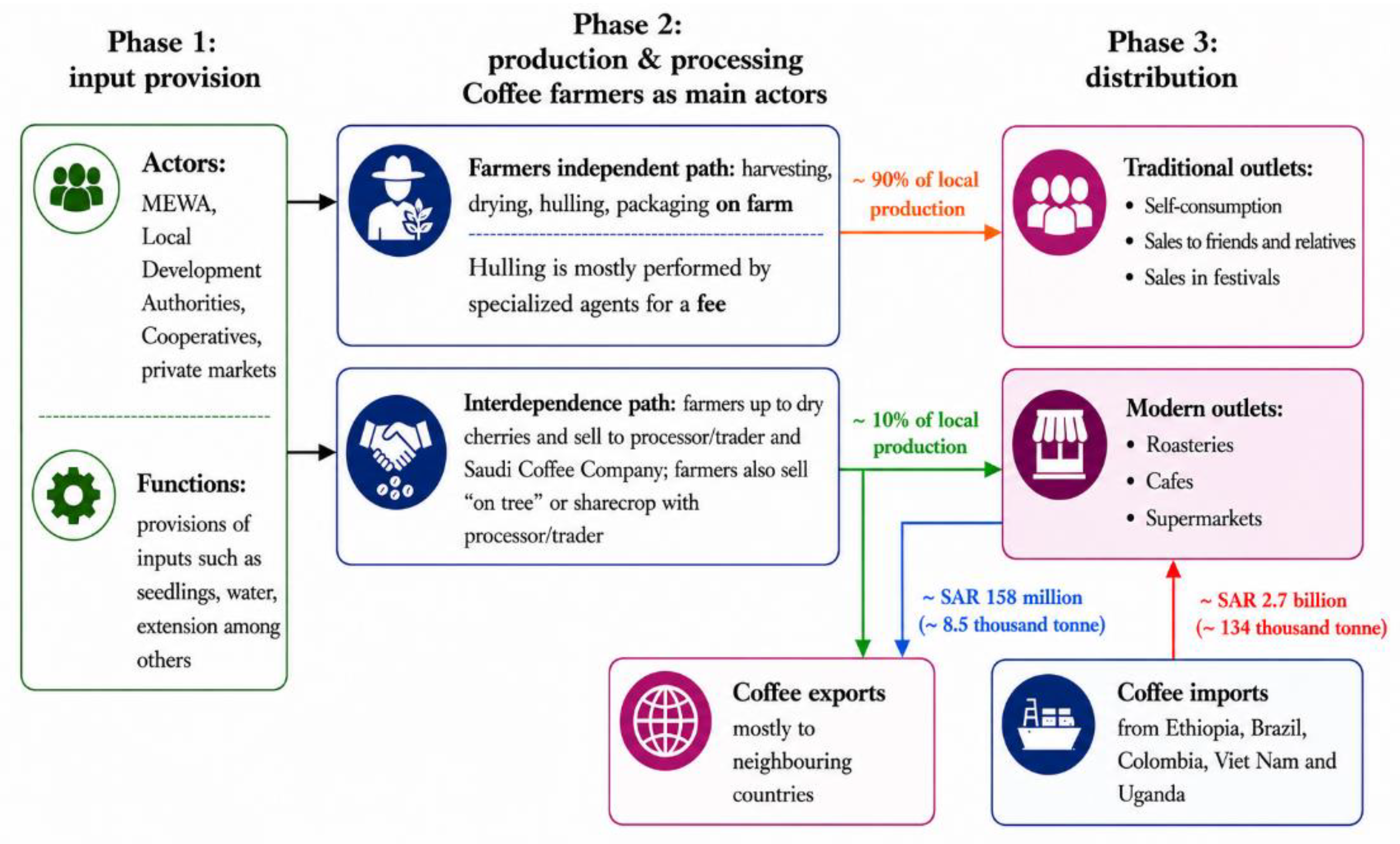
Survey data quantify the scale of this disconnect. Forty-two percent of the 347 surveyed farmers reported zero commercial sales, either retaining the entire harvest for household consumption and social gifting or because their trees had not yet reached production age. Among those who did sell, the median farmer commercialised only 25 percent of output, and 76 percent of sales were transacted through personal relationships rather than structured commercial channels. A small number of farmers had begun selling dried cherries to the Saudi Coffee Company, which then processes and supplies modern roasteries (see Section 4). Only 12 respondents, however, reported selling directly to a local roastery, the intermediary node that Figure 2 identifies as the critical link between highland supply and urban specialty demand.
Post-harvest infrastructure gaps are the most immediate mechanism through which this disconnect is reproduced. Three-quarters of farmers undertake no hulling, meaning their product never reaches the green-bean stage required by formal buyers. Among those who dry their coffee, 43 percent do so on bare concrete floors, a practice that compromises cup quality through moisture contamination and uneven drying, while only 29 percent use elevated surfaces with protective cover consistent with specialty-grade standards. These are not peripheral inefficiencies. They are structural barriers that prevent local production from entering the premium channels that would otherwise reward investment in quality. Key indicators across the survey sample are summarised in Table 1.
The Saudi Coffee Company, established in May 2022 as a Public Investment Fund company, remains in an early operational phase despite its ambitious mandate. At present, it purchases only limited quantities of coffee from farmers, but it has clear potential to bridge part of the disconnect in the value chain through its commercial role.
3.2. The Water Constraint: Why the Standard Fix Does Not Work
Water scarcity is the most widely cited production constraint in the survey, identified as the primary challenge by 84 percent of farmers. The concentration of responses around a single constraint is itself revealing, pointing to a systemic problem rather than farm-specific variation. Cost data confirm the burden. Water accounts for an average of 17 percent of variable production costs across the 19-farm dataset, rising to 42 percent for the most water-dependent farms. This variation is only partly explained by differences in farm management or irrigation efficiency; it is also shaped by road access and transport distance. A 12-tonne water delivery tank costs SAR 200 in accessible lowland areas and SAR 600 in the upper Shadda mountains of Al-Baha, a threefold difference within the same study area. In the most remote locations, road conditions are so poor that a 12-tonne delivery may arrive with only nine tonnes, the remainder lost to leakage during the ascent, and some villages in upper Shadda have no road access at all.
Experimental work in the Saudi highlands has shown that reducing irrigation frequency and applying appropriate drip systems during non-critical growth stages can reduce water use without compromising yields [11]. However, local supply-side conditions make this recommendation insufficient for a substantial share of the study area. For a farmer in upper Shadda, the binding constraint is often not the irrigation technology available on the farm, but the inability of a water tanker to reach it in the first place. The implication is that water policy for remote highland communities must begin with infrastructure rather than technology, an issue taken up in the Discussion.
3.3. The Costs and Yield Gap
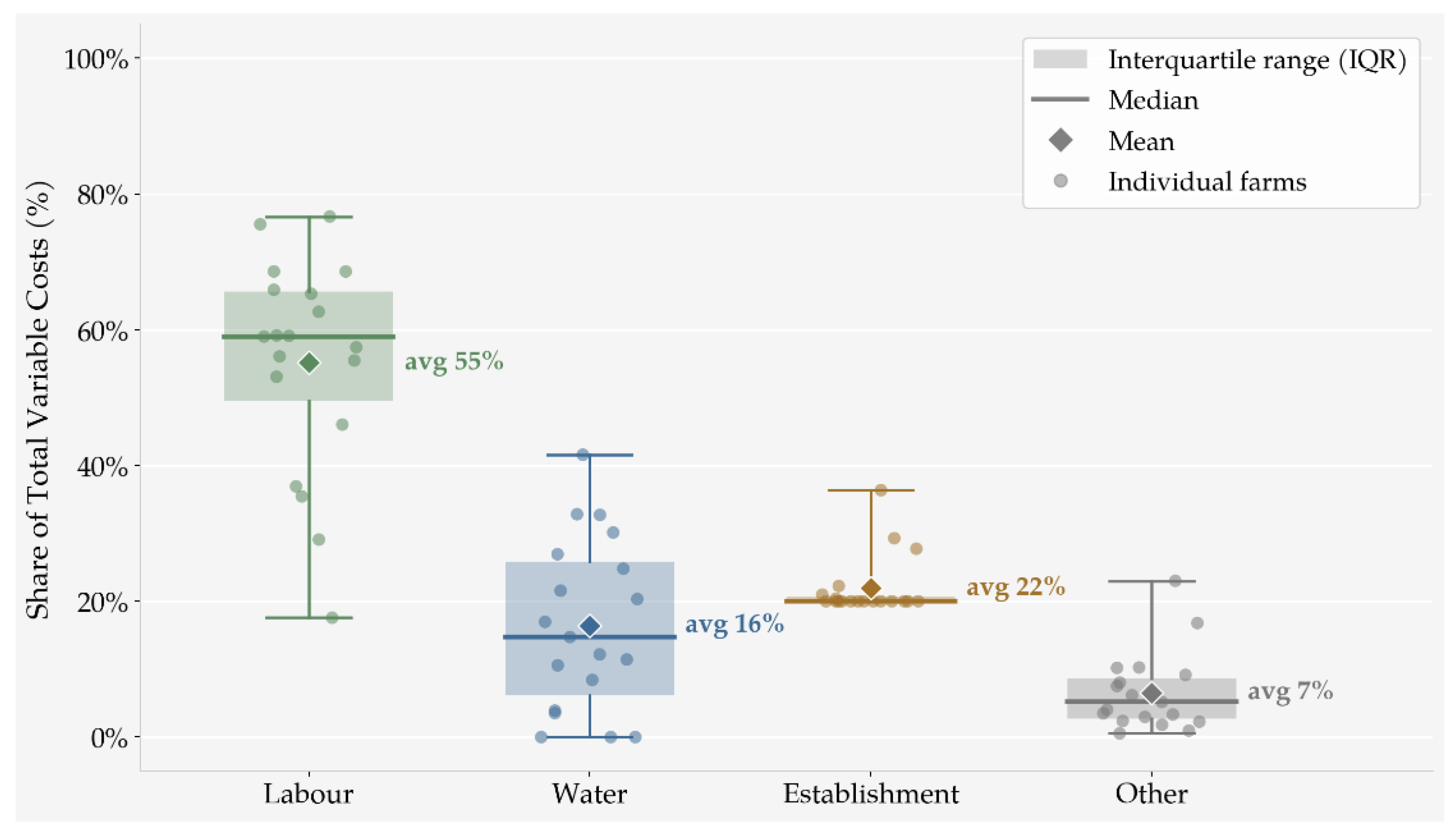
Labour and water together account for 72 percent of average variable production costs, with labour alone representing 55 percent (Figure 3). This concentration has a direct implication for the reform agenda: interventions that do not address these two inputs specifically are unlikely to generate meaningful improvements in farm-level viability. The variation around these averages is, however, analytically as important as the averages themselves. Across the 19 surveyed farms, labour accounts for between 18 and 77 percent of variable costs, and the positive correlation between labour cost per tree and water cost per tree (r = 0.73) indicates that farms often face compounded disadvantage on both dimensions simultaneously. Earlier case-study evidence from Jazan similarly found that production costs are unfavourable for the majority of smallholder farms at current yield levels [13].
Figure 3.
Distribution of variable cost shares by component across 19 surveyed farms (percentage of total variable costs per tree). Source: Authors' elaboration based on the cost-structure survey.
Figure 3.
Distribution of variable cost shares by component across 19 surveyed farms (percentage of total variable costs per tree). Source: Authors' elaboration based on the cost-structure survey.
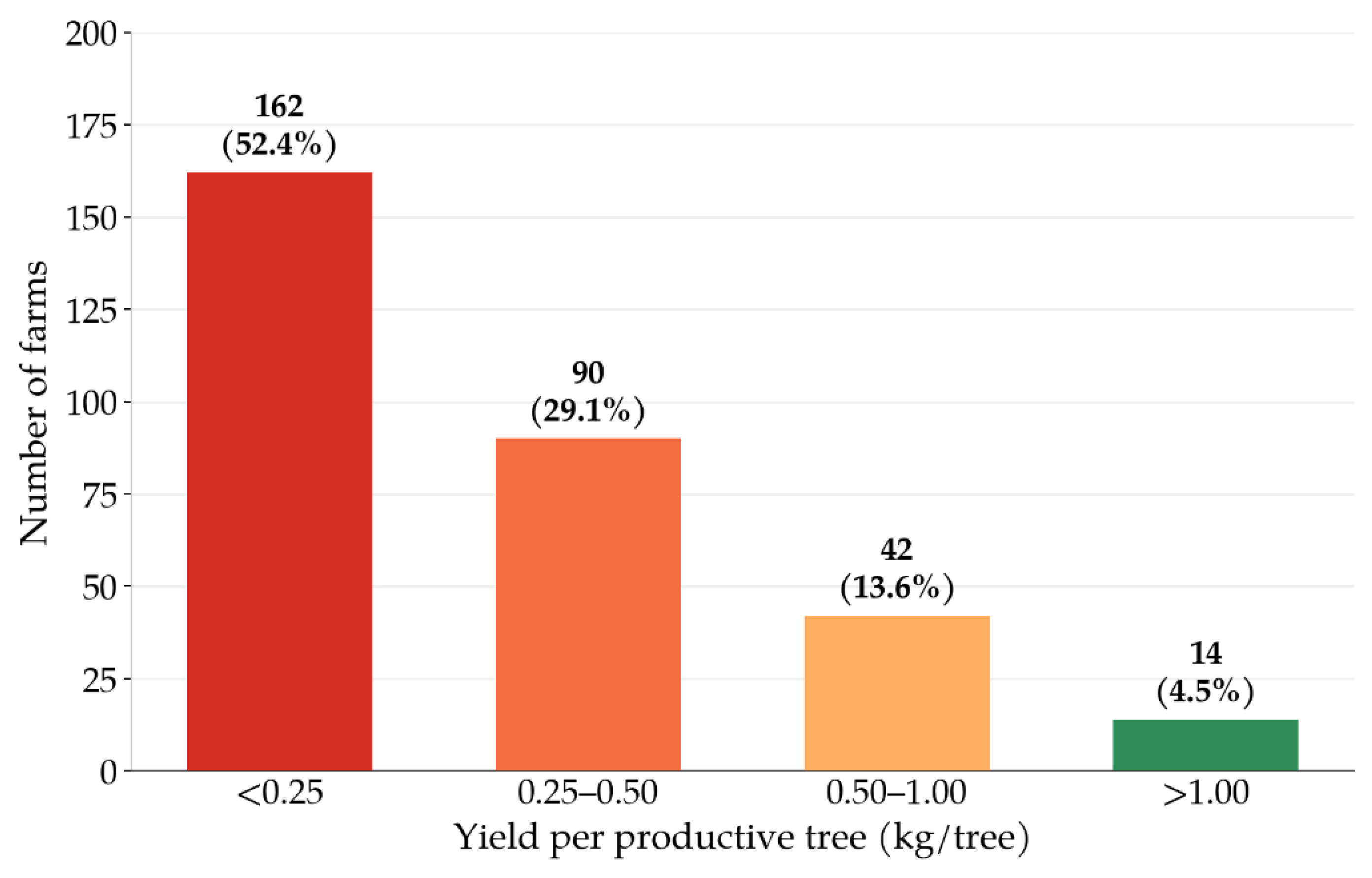
The yield distribution compounds the cost problem. Across 309 farms with valid yield data, the distribution is strongly right-skewed: the median farm yields only 0.25 kg of green beans per productive tree, while the best-performing farms in the same survey reach 4.0 kg/tree, a sixteen-fold difference (Figure 4). This gap captures the distance between what highland coffee farming currently achieves and what it is biologically capable of delivering. It is also the main mechanism through which otherwise manageable per-tree costs become unmanageable on a per-unit basis. A farm with 200 productive trees yielding 0.25 kg/tree generates only 50 kg of green beans annually, a volume at which virtually no cost structure can produce a positive gross margin at any plausible farmgate price.
Two institutional factors are positively associated with yield performance in the survey data, and both are amenable to programme design. Farms receiving quarterly extension visits average 0.61 kg/tree, compared with 0.31 kg/tree for farms that have never received a visit, representing a near-doubling of yield. Cooperative or association members average 0.46 kg/tree, compared with 0.36 kg/tree for non-members. These associations are policy-relevant because this type of institutional access can be expanded through deliberate investment. Yet 46 percent of farmers have never received any extension support, and 84 percent belong to no cooperative or agricultural association. The institutions most consistently associated with higher yields are, in other words, precisely those to which the majority of farmers still lack access.
Figure 4.
Green bean yield distribution across 309 surveyed farms (Jazan, Asir, and Al-Baha, 2023). Colour bands: red = very low (<0.25 kg/tree); orange = low (0.25-0.50 kg/tree); yellow = moderate (0.50-1.00 kg/tree); green = high (>1.00 kg/tree). Source: Authors' elaboration based on the farm representative survey.
Figure 4.
Green bean yield distribution across 309 surveyed farms (Jazan, Asir, and Al-Baha, 2023). Colour bands: red = very low (<0.25 kg/tree); orange = low (0.25-0.50 kg/tree); yellow = moderate (0.50-1.00 kg/tree); green = high (>1.00 kg/tree). Source: Authors' elaboration based on the farm representative survey.
3.4. The Subsidy: Lifeline and Unintended Trap
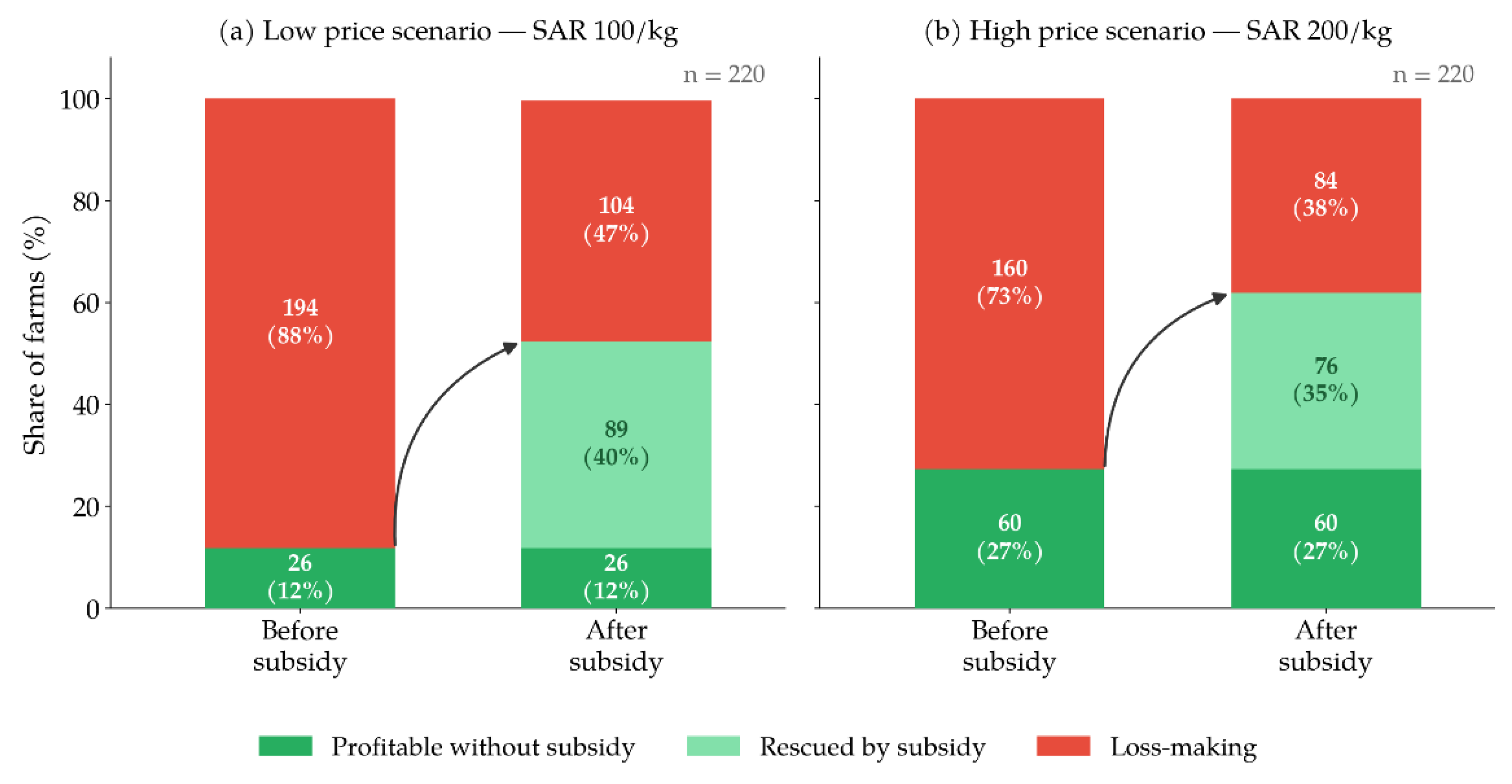
The government subsidy, channelled through the Reef Programme, transfers SAR 75 per tree per year to farmers without formal employment and with monthly incomes below SAR 9,000. Its principal function has been to sustain a sector that, on production economics alone, would not survive at current yields and cost levels. The gross margin simulation confirms this at scale (Figure 5). At a farmgate price of SAR 100/kg, only 12 percent of farms in the simulation sample are profitable before the subsidy; the transfer rescues a further 40 percent, leaving 47 percent in loss even after it is applied. At the higher price of SAR 200/kg, the structural pattern remains similar: 27 percent are profitable before the subsidy, 35 percent are rescued by it, and 38 percent remain loss-making. In both scenarios, the subsidy functions not as a marginal top-up but as the principal mechanism of financial viability for a large share of recipients. This finding is consistent with El Kurdi [7], who documents a statistically significant positive effect of government support on the net present value of coffee cultivation investment.
Figure 5.
Farm financial viability before and after government subsidy under two farmgate price scenarios (n = 220 farms with fewer than one-third unproductive trees). Costs imputed via Predictive Mean Matching from the 19-farm cost dataset; subsidy at SAR 75/tree capped at 700 trees. o account for the stochastic uncertainty of PMM's random donor selection, the simulation was repeated 500 times using different random seeds. The values shown represent the means across all 500 runs. The range of outcomes across runs is: profitable before subsidy 17–39 farms (SAR 100/kg) and 44–75 farms (SAR 200/kg); rescued by subsidy 69–113 farms and 60–95 farms respectively; still loss-making 84–128 farms and 59–102 farms respectively. Source: Authors' elaboration.
Figure 5.
Farm financial viability before and after government subsidy under two farmgate price scenarios (n = 220 farms with fewer than one-third unproductive trees). Costs imputed via Predictive Mean Matching from the 19-farm cost dataset; subsidy at SAR 75/tree capped at 700 trees. o account for the stochastic uncertainty of PMM's random donor selection, the simulation was repeated 500 times using different random seeds. The values shown represent the means across all 500 runs. The range of outcomes across runs is: profitable before subsidy 17–39 farms (SAR 100/kg) and 44–75 farms (SAR 200/kg); rescued by subsidy 69–113 farms and 60–95 farms respectively; still loss-making 84–128 farms and 59–102 farms respectively. Source: Authors' elaboration.
These losses should not be interpreted as evidence of permanent structural non-viability. Across the full 309-farm sample, 65 percent of farms contain some unproductive trees, and 98 percent of those farms report that such trees are three years old or younger, placing them within the Arabica establishment phase before full bearing is reached. The simulation sample is restricted to farms with fewer than one-third unproductive trees precisely to distinguish farms still in mid-investment from those that are structurally loss-making. For farms that remain in loss within the simulation, the median break-even yield at SAR 200/kg is 0.54 kg/tree, roughly double the current sample median but still well within the range achievable under improved agronomic practice. For a substantial share of subsidy recipients, the transfer is therefore buying time for trees to mature rather than permanently underwriting an unviable activity.
The case against the subsidy is therefore not a case against its existence, but against its current design. The flat per-tree structure provides identical support to a farm actively investing in productivity improvement and to one that is not, offering no incentive for the yield gains on which the sector’s long-term commercial viability depends. Al-Abdulkader et al. [12] identified water cost and productivity as the decisive variables determining whether coffee cultivation generates positive returns and concluded that a subsidy conditioned on tree presence rather than performance is unlikely to deliver the improvements needed for long-term fiscal sustainability.
A more consequential design problem, however, concerns the employment eligibility criterion. Field discussions in Asir and Al-Baha confirmed that the Reef criterion has been tightened to exclude any person in formal employment, regardless of income level. A young person earning SAR 4,000 per month from a salaried position must therefore choose between the subsidy and that income. Since coffee farming at current yields cannot provide a living wage, most choose the salary and exit the sector. By contrast, a retired farmer receiving a pension below SAR 9,000 per month—the demographic profile of 85 percent of current farmers—qualifies without restriction. The criterion therefore directs support towards the demographic already dominant in the sector while excluding the demographic the sector most needs to attract. Mehrez et al. [8] identify youth disengagement as one of the four principal drivers of the 34 percent production contraction in Jazan between 2017 and 2020, a finding that points to the eligibility rule as a contributing factor in the decline it was ostensibly designed to prevent.
4. Discussion: From Heritage to Business: Six Reform Priorities
The analysis points to six interconnected reform priorities, summarised in Figure 6. The conceptual framework presented there links the sector's major binding constraints to a corresponding set of policy reform pillars, and identifies the complementary roles of the government (MEWA and the Agricultural Development Fund), cooperatives, and the private sector in driving the transition toward a more efficient, competitive, inclusive, and sustainable highland coffee sector aligned with Vision 2030.
Figure 6.
Conceptual framework for transforming the Saudi highland coffee sector. Source: Authors' elaboration.
Figure 6.
Conceptual framework for transforming the Saudi highland coffee sector. Source: Authors' elaboration.
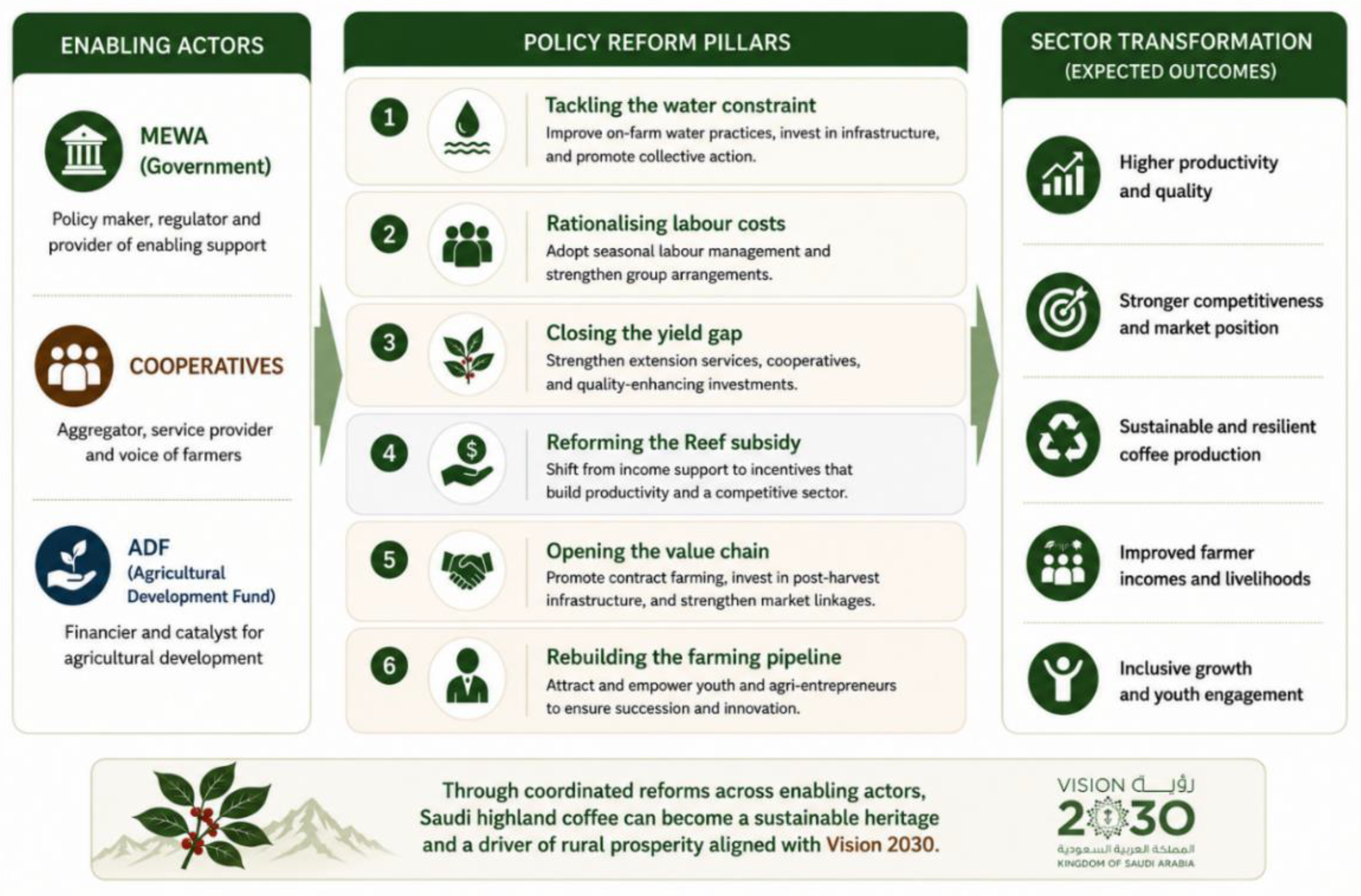
The six structural constraints that a reform agenda must address simultaneously are water access, labour costs, yields, subsidy design, market integration, and demographics. The paragraphs below develop each in turn before arguing that institutional coordination is the precondition for any of them to function effectively.
The most fundamental constraint on sector viability is the yield gap. The median farm yields 0.25 kg of green beans per productive tree against a demonstrated potential of 4.0 kg, a sixteen-fold difference that converts manageable per-tree costs into unmanageable per-unit burdens regardless of how efficiently other inputs are managed. Extension access and cooperative membership are the two institutional factors most strongly associated with better yield performance: farms receiving quarterly extension visits yield nearly double those that have never received a visit, and SRAD demonstration farms indicate that best-practice adoption improves cherry yields by approximately 100 percent. Yet 46 percent of farmers have never received extension support and 84 percent belong to no cooperative. Closing the yield gap requires extending extension to remote communities through peer-advisor models, repositioning cooperatives as knowledge and quality infrastructure, and establishing a National Coffee Research Centre to provide the locally validated agronomic guidance the sector currently lacks.
Closing the yield gap, however, requires first addressing the resource constraint that most directly depresses farm-level yields: water. Eighty-four percent of surveyed farmers identify water as their single most binding production constraint, and its cost varies threefold within the study area depending almost entirely on road access and transport distance. Water stress coincides with the bean-filling stage during summer, reducing both yield and quality at the most sensitive point in the agronomic calendar [11]. Responses are needed at different time horizons: in the short term, validated climate-smart irrigation practices deployable through existing extension channels; in the medium term, rural road investment that is more accurately understood as rural infrastructure than agricultural spending; and in the longer term, shared rainwater harvesting infrastructure managed through cooperatives, the same institutional vehicle that the yield pillar requires.
Once the productive potential of farms is better supported, labour deployment becomes the next lever. Labour absorbs 55 percent of average variable costs, but the problem is one of misallocation as much as cost level. Many farms attribute full annual salaries to coffee when workers also perform household tasks, and harvest scheduling is rarely optimised. A structured harvesting programme with 10 to 14 day intervals between picking rounds would reduce unnecessary labour passes while improving cherry quality. Cooperative labour pools that share workers across member farms during overlapping harvest windows would reduce fixed salary burdens further. The lowest-cost farms in the dataset already operate on this basis, using family labour at genuine opportunity cost and hiring seasonally for peak periods.
The Reef subsidy simultaneously sustains the sector and constrains its development. It currently rescues between 40 and 45 percent of farms from loss, making its near-term preservation important. Its design, however, rewards tree presence over performance and its employment eligibility criterion excludes any person in formal work regardless of income level, a condition that actively deters the young workers and women the sector most needs. A graduated architecture combining a base income-support tier with an enhanced tier conditional on verified best-practice adoption would preserve the safety-net function while redirecting resources toward productivity improvement. Replacing the employment criterion with an income-based threshold would remove one of the most readily correctable barriers to youth and women's engagement at negligible fiscal cost.
Market failure compounds every upstream constraint. Forty-two percent of farmers sell nothing and the median farmer commercialises only a quarter of output, a pattern explained not by subsistence preference but by the absence of reliable buyers and quality-linked prices. Contract farming, with cooperatives acting as intermediaries between roasteries and individual smallholders, represents the most tractable structural intervention: a guaranteed quality-linked price makes post-harvest investment economically rational for the first time for most smallholders [14]. Investment in shared hulling and drying infrastructure would capture value currently lost to poor handling, while Geographical Indication certification offers a credible pathway to broader specialty market access. The newly established Saudi Coffee Company, which started engaging in the coffee value chain, clearly has the potential to address, at least, parts of these challenges [15].
All of these reforms are, however, racing against a demographic constraint. Eighty-five percent of farmers are over 40 and only 3 percent are under 30, and the tacit agronomic knowledge embedded in highland coffee farming cannot transfer to a successor generation that is not actively present. Reframing coffee as agri-entrepreneurship, mobilising the UNESCO heritage [3,14] designation and traceable organic production as the foundation of a national branding strategy, and creating internationally recognised quality credentials as visible career pathways are the most concrete mechanisms through which a successor generation can be attracted. The genetic diversity of highland varieties adapted to unique local conditions, combined with the organic practices, adds a scientific dimension to this heritage [3,11].
The six pillars are mutually reinforcing and cannot be treated as independent or sequentially implementable. Extension without research has no validated content to deliver; water reform without road access stalls at the field boundary; contract farming without post-harvest infrastructure cannot deliver consistent quality; and subsidy reform without market development reduces income without replacing it. This interdependence means that a coordinating institution is not one recommendation among many but the precondition for the others to function. A Saudi Coffee Board with a mandate spanning MEWA, the Agricultural Development Fund, cooperatives, and the private sector would provide the institutional architecture within which parallel investments form a coherent sector-building strategy rather than a fragmented set of uncoordinated interventions.
5. Conclusions
This paper examines a paradox not previously analysed using primary survey data: a sector characterised by premium farmgate prices, farmer optimism, and a favourable cultural and policy environment, yet still under financial stress. The paradox becomes understandable when its constraints are considered together rather than in isolation. High water and labour costs, a severe yield gap, and structural exclusion from formal value chains combine to ensure that the prices available to a minority of well-positioned producers do not translate into viability for the majority. The government subsidy bridges part of that gap for approximately 40 percent of farms, but its current design also reinforces the demographic problem that it cannot, by itself, resolve.
Two findings extend beyond the Saudi case. First, drip irrigation—often proposed in water-efficiency reports—is not readily adopted by many farmers for practical reasons, especially unreliable water delivery and emitter clogging. In remote highland settings, improved road access, more efficient irrigation scheduling, and shared rainwater harvesting may therefore offer more effective solutions. Second, subsidy rules tied to employment status are not unique to Saudi Arabia. Many programmes across the MENA region were designed for older farmers with no other job and inadvertently exclude younger, partly employed people who are more likely to drive sector growth. Periodic review of such rules may carry little fiscal cost while generating substantial developmental returns.
The reform package is coherent only when treated as a package, and sequencing matters. Road access is the necessary precondition: without it, extension cannot reach remote farms, water cannot be delivered reliably, and cooperative development faces immediate practical limits. With connectivity in place, better-resourced cooperatives can pool labour, raise yields, and intermediate market access. A performance-linked subsidy may then reduce barriers to youth engagement, while contract farming with urban specialty roasters can create the market incentives that make investment in quality economically rational. Vision 2030’s framing of coffee as a strategic crop is therefore well founded, but it requires a policy environment that shifts from preventing abandonment to enabling transformation.
Several limitations of this study should be acknowledged. The cost analysis rests on a purposive sample of 19 farms and therefore cannot support precise population-level estimates, while yield data are self-reported and unverified. The cross-sectional design does not allow transitional losses to be distinguished fully from structural ones, and remote sub-regions may be underrepresented in both surveys. These limitations point to a clear agenda for future research, including panel data that track the same farms across seasons, more systematic coverage of remote communities, and pilot implementation of subsidy redesign with rigorous impact monitoring using the current survey instruments as a baseline.
Author Contributions
Conceptualization, A.S., B.M.G., B.H.A., and K.G.; methodology, A.S and B.M.G..; field investigation and data acquisition (farmer interviews), B.M.G. and A.S.; formal analysis and data curation, B.M.G. and A.S.; writing—original draft preparation, A.S.; review and editing, A.S., B.M.G., B.H.A., K.G., A.M., K.A., and N.H.; project administration, K.G., and N.H. All authors have read and agreed to the published version of the manuscript. During the preparation of this manuscript, the authors used two Ai tools. Claude (Anthropic, version Sonnet 4.5) was used to assist with the drafting of selected sections, particularly the results, and to review and improve English language quality throughout. ChatGPT (OpenAI) was used to refine the visual presentation of two figures that had been fully conceptualized and specified by the authors, with its role limited to aesthetic improvements. All AI-assisted content was reviewed, verified, and edited by the authors, who take full responsibility for the accuracy and integrity of the published work.
Funding
This work was supported by the FAO Saudi Arabia Technical Cooperation Programme (UTF/SAU/051/SAU), “Strengthening MEWA’s Capacity to implement its Sustainable Rural Agricultural Development Programme (2019–2025)”, funded by the Ministry of Environment, Water and Agriculture of the Kingdom of Saudi Arabia and implemented by the Food and Agriculture Organization of the United Nations.
Institutional Review Board Statement
The survey was conducted under the institutional framework of the FAO Technical Cooperation Programme “Strengthening MEWA’s Capacity to Implement its Sustainable Rural Agricultural Development Programme” (UTF/SAU/051/SAU), implemented jointly by the Food and Agriculture Organization of the United Nations and the Ministry of Environment, Water and Agriculture of the Kingdom of Saudi Arabia. The study involved adult smallholder farmers in non-clinical agricultural research of minimal risk; no sensitive personal, biomedical, or genetic data were collected, and no individual identifiers are reported in this manuscript. Under FAO and MEWA programme protocols applicable to socio-economic surveys of this type, formal ethics-committee review was not required, and the project was approved through internal programme governance. The study was conducted in accordance with the FAO Statistical Quality Assurance Framework and internationally recognized ethical principles for research involving human participants.
Informed Consent Statement
Verbal (oral) informed consent was obtained from every respondent prior to interview, following a standardized enumerator-led script delivered in Arabic. The enumerators explained: (i) the purpose of the survey and the implementing institutions (FAO and MEWA); (ii) that participation was voluntary and could be discontinued at any time without consequence; (iii) that responses were anonymized, would be reported only in aggregate, and would not be linked to identifying information; and (iv) that the data would inform agricultural policy and would not be shared with third parties for commercial use. Verbal consent rather than written consent was chosen because it is the more culturally appropriate and equitable modality in the predominantly oral rural setting of southwestern Saudi Arabia, where literacy levels vary, and because the minimal-risk nature of the questions did not warrant a written instrument. Enumerators recorded confirmation of consent on the survey form prior to administering the questionnaire. No personally identifiable information appears in this manuscript or its supporting materials.
Data Availability Statement
Anonymized survey data are available from the corresponding author upon reasonable request, subject to FAO and MEWA data-sharing protocols.
Acknowledgments
The study was conducted within the institutional governance framework of the Sustainable Rural Agriculture Development (SRAD) Programme (UTF/SAU/051/SAU). The authors gratefully acknowledge the support of the Ministry of Environment, Water and Agriculture (MEWA) of the Kingdom of Saudi Arabia, its regional offices in Jazan, Asir, and Al-Baha, and the participating coffee farmers, processors, and cooperative leaders who contributed time and information to this study. Special thanks go also to Mr. khalid Alfaifi (FAO Field Technician) for his support in implementing the survey, and to Mr. Haitham Abdullah (FAO GIS Specialist) for his support in creating the map. The views expressed herein are those of the authors and do not necessarily reflect the official position of FAO, MEWA, Reef Academy or Estidamah.
Conflicts of Interest
The authors declare no conflict of interest.
References
- Al-Asmari, K.M.; Abu Zeid, I.M.; Al-Attar, A.M. Coffee Arabica in Saudi Arabia: An overview. Int. J. Pharm. Phytopharmacol. Res. 2020, 10, 71-78. [CrossRef]
- Al-Ghamedi, K.; Alaraidh, I.; Afzal, M.; Mahdhi, M.; Al-Faifi, Z.; Oteef, M.D.Y.; Khemira, H. Assessment of genetic diversity of local coffee populations in Southwestern Saudi Arabia using SRAP markers. Agronomy 2023, 13, 302. [CrossRef]
- UNESCO. Intangible Cultural Heritage: Arabic Coffee. United Nations Educational, Scientific and Cultural Organization: Paris, France, 2022.
- FAO. FAOSTAT Trade Data: Coffee Imports, Saudi Arabia 2024. Food and Agriculture Organization of the United Nations: Rome, Italy, 2026.
- Al-Shammre, A.S. Unlocking sustainable economic development in Saudi Arabia through the coffee industry. Sustainability 2024, 16, 526. [CrossRef]
- Aljohani, E.S.; Chidmi, B.; Kotb, A.; Alderiny, M.; Aldakhil, A.; Krimly, Y. Estimating the demand for imported green coffee in Saudi Arabia using the Almost Ideal Demand System. Front. Sustain. Food Syst. 2025, 9, 1516742. [CrossRef]
- El Kurdi, M.S.M.G. The impact of localizing maize and coffee crops on sustainable development in the Kingdom of Saudi Arabia. J. Bus. Res. (Zagazig Univ.) 2025, 47, 2. [CrossRef]
- Mehrez, K.H.; Khemira, H.; Medabesh, A.M. Marketing strategies for value chain development: Case of Khawlani coffee, Jazan Region, Saudi Arabia. J. Saudi Soc. Agric. Sci. 2023, 22, 449-460. [CrossRef]
- Cochran, W. G. (1997). Estimation of population ratio in post-stratified sampling using variable transformation. Open Journal of Statistics, 5(1), 54-75.
- Little, R.J.A.; Rubin, D.B. Statistical Analysis with Missing Data, 3rd ed.; Wiley: New York, NY, USA, 2019.
- Sayed, O.H.; Masrahi, Y.S.; Remesh, M.; Al-Ammari, B.S. Coffee production in southern Saudi Arabian highlands: Current status and water conservation. Saudi J. Biol. Sci. 2019, 26, 1911-1914. [CrossRef]
- Al-Abdulkader, A.M.; Al-Namazi, A.A.; AlTurki, T.A.; Al-Khuraish, M.M.; Al-Dakhil, A.I. Optimizing coffee cultivation and its impact on economic growth and export earnings of the producing countries: The case of Saudi Arabia. Saudi J. Biol. Sci. 2018, 25, 776-782. [CrossRef]
- Ziad, A.A.; Yousif, I.E.; Alsultan, M.M. Economics of coffee production in Saudi Arabia: A case study of Jazan region. J. Assoc. Arab Univ. Agric. Sci. 2023, 19, 1515-1524.
- Maspul, K.A. Coffee acculturation in Saudi Arabia: Diversifying local wisdom and strengthening sustainable economy in coffee value chain. EKOMA J. Econ. Manag. Account. 2022, 1, 271-284. [CrossRef]
- Public Investment Fund (PIF). PIF Launches Saudi Coffee Company to Further Enable Saudi Arabia's Food and Agriculture Sector. Public Investment Fund: Riyadh, Saudi Arabia, 2022. Available online: https://www.pif.gov.sa/en/news-and-insights/press-releases/2022/pif-launches-saudi-coffee/.
Figure 1.
Map of the study area showing the three coffee-growing regions (Jazan, Asir, and Al-Baha) of southwestern Saudi Arabia. Source: the map was created using ArcGIS Arcmap based on data from the Saudi Ministry of Environment, Water and Agriculture (MEWA).
Figure 1.
Map of the study area showing the three coffee-growing regions (Jazan, Asir, and Al-Baha) of southwestern Saudi Arabia. Source: the map was created using ArcGIS Arcmap based on data from the Saudi Ministry of Environment, Water and Agriculture (MEWA).
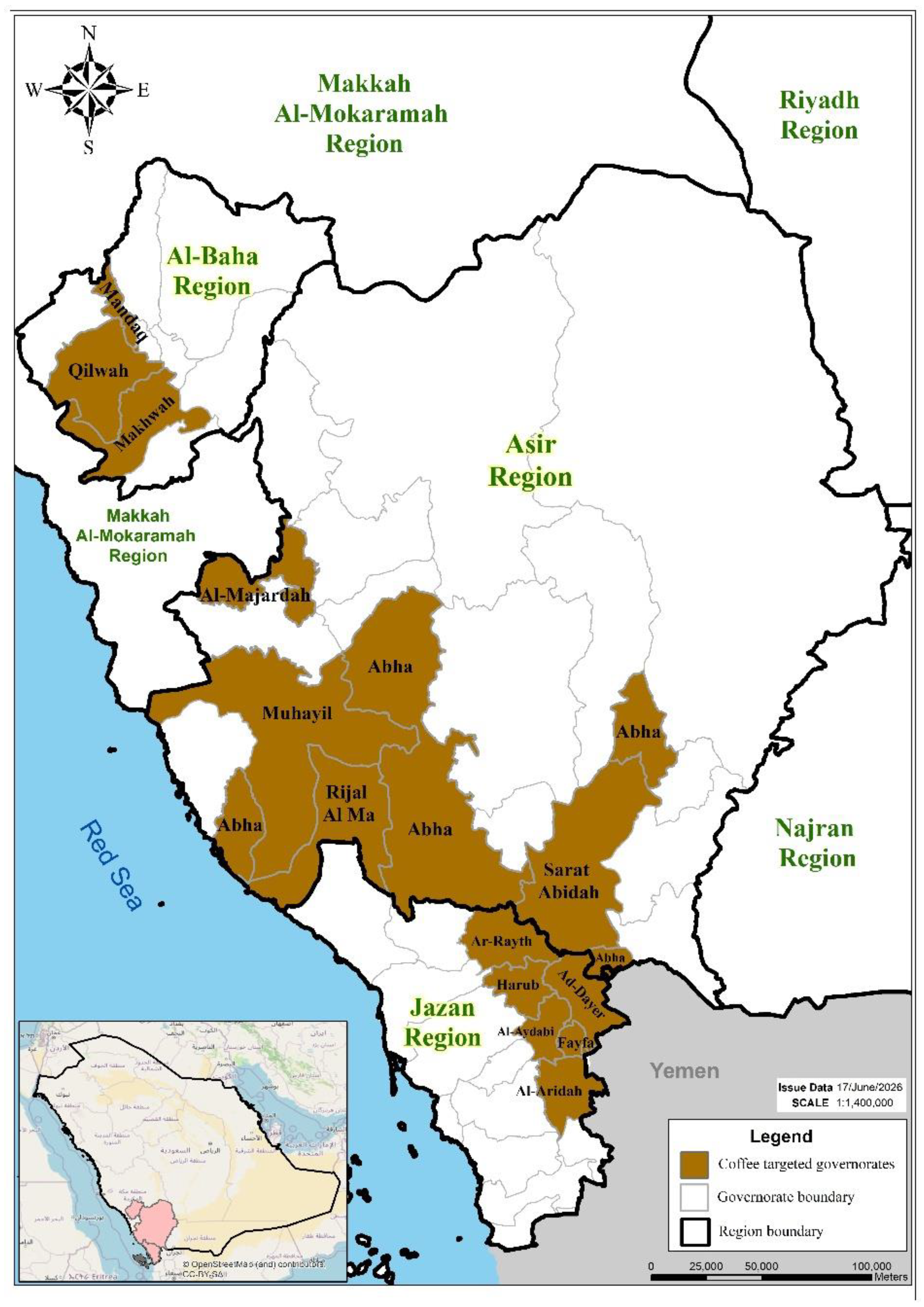

Table 1.
Summary of key farm-level indicators across the survey sample.
| Indicator | Value | Source/Note |
|---|---|---|
| Share of farmers with zero commercial sales | 42% | n = 347 representative survey |
| Median share of output sold (among sellers) | 25% | n = 202 farmers who sell any product |
| Share selling through personal relationships | 76% | n = 202 farmers who sell any product |
| Farmers with no hulling equipment | 76% | n = 347 |
| Farmers drying on bare concrete | 43% | Of those who dry; n = 309 |
| Median yield (kg green bean/productive tree) | 0.25 kg | n = 309; max observed 4.0 kg |
| Farms with quarterly extension access | 54% | Avg yield 0.61 vs 0.31 kg/tree |
| Farmers with cooperative membership | 16% | Avg yield 0.46 vs 0.36 kg/tree |
| Farmers over 40 years old | 85% | n = 347 representative survey |
| Farmers intending to expand cultivation | 84% | 294,000 seedlings requested collectively |
Source: authors’ elaboration on the 347-farm representative survey (2023).
Disclaimer/Publisher’s Note: The statements, opinions and data contained in all publications are solely those of the individual author(s) and contributor(s) and not of MDPI and/or the editor(s). MDPI and/or the editor(s) disclaim responsibility for any injury to people or property resulting from any ideas, methods, instructions or products referred to in the content. |
© 2026 by the authors. Licensee MDPI, Basel, Switzerland. This article is an open access article distributed under the terms and conditions of the Creative Commons Attribution (CC BY) license.
Copyright: This open access article is published under a Creative Commons CC BY 4.0 license, which permit the free download, distribution, and reuse, provided that the author and preprint are cited in any reuse.


