

Submitted:
18 June 2026
Posted:
23 June 2026
You are already at the latest version
Abstract
We reformulate the binary Goldbach problem over a finite modular algebraic substrate, formalised on a scale-periodic relational field FP. A chain of exact finite results are then derived and documented. On a faithful window where evenness, primality, and the sum p+q are simultaneously exact, binary Goldbach is a finite, decidable statement G(P). There the Hardy-Littlewood circle method is an exact finite identity: no error term, the Gauss-sum magnitude P exact, the singular series floored at 2C2. The second moment gives a finite-shell Montgomery-Vaughan exceptional-set certificate on the evaluated shells: all but a bounded fraction, shrinking across them, of the even integers are sums of two primes. We then locate the residue. A no-symmetry lemma and the moment hierarchy reduce it to one supremum bound, and in the substrate's own scale-periodic frame, free of integral, logarithm, and norm, the count becomes an exact Jacobi-sum form whose positivity is a finite balance between the reflection-even and reflection-odd sectors of the prime spectrum; its identification with the classical parity barrier is conjectural. Every substrate-native claim is verified in exact framed-rational and cyclotomic arithmetic. This is a finite reformulation and an almost-all theorem, not a proof of the conjecture; the terminal parity-sector positivity is exact, finite, and open.
Keywords:
goldbach conjecture
; circle method
; parity barrier
; finite ring cosmology
; finite field arithmetic
; framed-rational arithmetics
; exact numerics
; finite ring continuum
; omega-hard
1. Introduction
1.1. The Binary Goldbach Problem
In a 1742 letter to Euler, Goldbach conjectured what is now stated as: every even integer greater than two is a sum of two primes [1]. The assertion has resisted proof for nearly three centuries, while it has been verified by direct computation for every even [2]. The earliest unconditional progress bounds the number of summands rather than fixing it at two: Schnirelmann’s density method represents every integer as a sum of boundedly many primes [3], the sharpest explicit form being Ramaré’s theorem that every even integer is a sum of at most six primes [4].
The analytic line is the circle method of Hardy and Littlewood [5], which expresses the number of representations
as an integral over the additive characters, with a main term proportional to the singular series and an error governed by the minor arcs. For three prime summands the minor arcs are controlled and the ternary problem is settled: Vinogradov proved every sufficiently large odd integer is a sum of three primes [6], and Helfgott removed the size bound, settling every odd integer [7]. The binary problem is harder. The minor-arc estimate loses a power of the main term, and the deficit is the parity barrier of sieve theory [8,9]: Selberg’s observation that sieve and bilinear methods cannot, on their own, separate a product of two primes from a single prime, a barrier no method has crossed for two prime variables.
What is known approaches the conjecture from two sides. On the multiplicative side, the sieve, from Brun’s method [10] to its culmination in Chen’s theorem, gives every large even n as a prime plus a product of at most two primes [11]. On the additive side, the circle method gives almost all even integers: van der Corput, Estermann, and Čudakov independently showed that the even n not representable as a sum of two primes have density zero [12], and Montgomery and Vaughan sharpened this to a power saving, all but of the even [13]. The parity barrier itself has been crossed in only a handful of two-dimensional settings (primes of the form [14] and [15]), each capturing one prime in a sparse algebraic sequence rather than resolving the binary additive problem of two prime variables. The instrument built for binary additive problems is Linnik’s dispersion method [16], to which the residue of the present construction will return.
1.2. The Finite Substrate
The finite ring cosmology (FRC) framework reconstructs arithmetical and physical phenomena over a large but ultimately finite, scale-periodic relational substrate of total cardinality [17] denoted as the Carrier. The corrsponding realisation of the Riemann hypothesis [18] places the zero heights as the finite spectrum of the scale-evolution generator in the Carrier’s own frame, and reduces the hypothesis to the completeness of that on-line spectrum for the prime vector, a bounded clause closed by the finite totality. Two scales bound every reading: the coherence horizon and the decidability horizon . The substrate is scale-periodic: no scale is privileged, and the continuum is only a degenerate comparison chart [17].
This paper asks whether binary Goldbach admits a finite, scale-periodic reading on the same footing. The Subject works on a shell , with prime P up to the coherence horizon , the largest scale on which evenness (an additive predicate) and primality (a multiplicative one) are simultaneously faithful and sums do not wrap (Section 2). The Goldbach proposition is carried with its frame, with (origin, unit, scale generator, prime window). The Carrier decides this framed proposition through a frame-preserving embedding : the unframed arithmetic predicates trivialise at carrier scale, but is exactly what the embedding preserves, so what the totality settles is the encoded Subject statement, not a carrier-relative primality.
1.3. Results and Scope
We establish a graded chain, each link exact and machine-verified.
- The faithful window (Section 2): binary Goldbach on the window , , is a finite, decidable proposition .
- Almost all n (Section 5): a finite-shell Montgomery–Vaughan-type certificate on the evaluated shells, all but a bounded, shrinking fraction of even n in the window are Goldbach.
- The residue (Section 6, Section 7 and Section 8): a no-symmetry lemma and the moment hierarchy reduce the problem to one supremum bound, whose barrier is parity; the Gaussian lift is symmetry-bearing but its norm projection returns the one-dimensional transform, and the binary obstruction is an -mass deficit untouched by the Friedlander–Iwaniec mechanism.
- The native form (Section 9 and Section 10): in the scale-periodic frame the count is an exact Jacobi-sum form in the prime-character spectrum, whose positivity is a balance between the reflection-even and reflection-odd sectors of the prime vector: the parity barrier in the substrate’s own terms, exact and open.
The binary Goldbach conjecture is not proved here. What is proved is the exact finite reduction, the almost-all theorem, and the native reformulation; the terminal positivity is, conjecturally, the same parity content the twin-prime problem turns on. No new physical premise is introduced; the construction is finite arithmetic on the imported substrate.
2. The Finite Setting and the Faithful Window
The Subject shell. The experimental arena is a prime shell , framed on a primitive generator g [17], a Subject within the Carrier ; the prime P ranges up to the coherence horizon . The faithful window and the exact circle method hold for every such prime; the symmetry-complete case , where the quarter-turn lies in , is invoked only for the quarter-turn and Gaussian structure of Section 7. The additive group is cyclic of order P, and we identify the integer m with its residue for ; addition is faithful (free of wraparound) while sums stay below P. Time is scale-dilation, multiplication by g, whose generator is the scale operator of [18]; the multiplicative group is the scale (phase) cycle. These are imported; nothing below adds to them.
Definition 2.1
(The window). Let and the prime window. The faithful Goldbach window is the set of even n with .
Lemma 2.2
(Faithfulness). On the window:(i)for , , so every sum of two window primes is wrap-free;(ii)primality of is decided by trial factors , below the decidability horizon, so primality is exact;(iii)for even every prime lies in , so the window count of (1) is the true integer count.
Proof. (i) . (ii) for , that is for P up to the coherence horizon, the window of [18]. (iii) with gives and . □
By Lemma 2.2(iii), the finite statement
is exactly binary Goldbach for all even . It is decidable, a claim about integers with no quantifier over an infinite domain; classical Goldbach is the continuum idealisation, the limit of large P. Within FRC the faithful Goldbach domain is this wrap-free window: at the largest faithful shell up to it reaches . Wrap-freeness () and the coherence bound () together cap the window at ; even n beyond belong to a different chart, and the classical unbounded statement is the comparison idealisation , not an FRC operation. Admissibility of the window (, primality exact) is machine-verified (Appendix A, G2).
3. The Exact Circle Method
The additive characters of are , , with orthogonality . With the prime exponential sum :
Proposition 3.1
(The circle method is a finite identity). For every n,
and on the window the right-hand side equals . The identity is exact: no truncation, no error term.
Proof.
; summing against and applying orthogonality picks , and by Lemma 2.2(i) this is . □
Remark 3.2
(Why there is no error term). Over the circle method writes
and its difficulty is the analytic control of the integral on the minor arcs [5,6,19,20]. On the shell the circle is replaced by its exact finite set of characters , the integral by a finite sum, and (3) is an identity in the group ring . The additive–multiplicative bridge is the Gauss sum , which satisfies the exact cyclotomic identity for nontrivial [8]; carrying additive P-th and multiplicative -th roots, , not in (where ), so is a magnitude in that coefficient ledger, not a field element. The Jacobi form (7) lies in once the additive phases cancel. The square-root cancellation conjectural over is here a closed identity (Appendix A, G1, G16); it fixes each Gauss-sum magnitude but not the minor-arc behaviour of , whose residual content is the prime-character amplitudes of Section 9.
4. The Major Term and the Singular-Series Floor
Splitting (3) into major arcs (small denominators) and a remainder, the major part evaluates as classically [5,19,21] to times a positive density, with the singular series
Proposition 4.1
(Exact floor). For every even n, , with equality iff n is a power of 2; and when .
Proof.
Each factor for , so the product over is ; as a convergent product of positive terms; the factor is present when . □
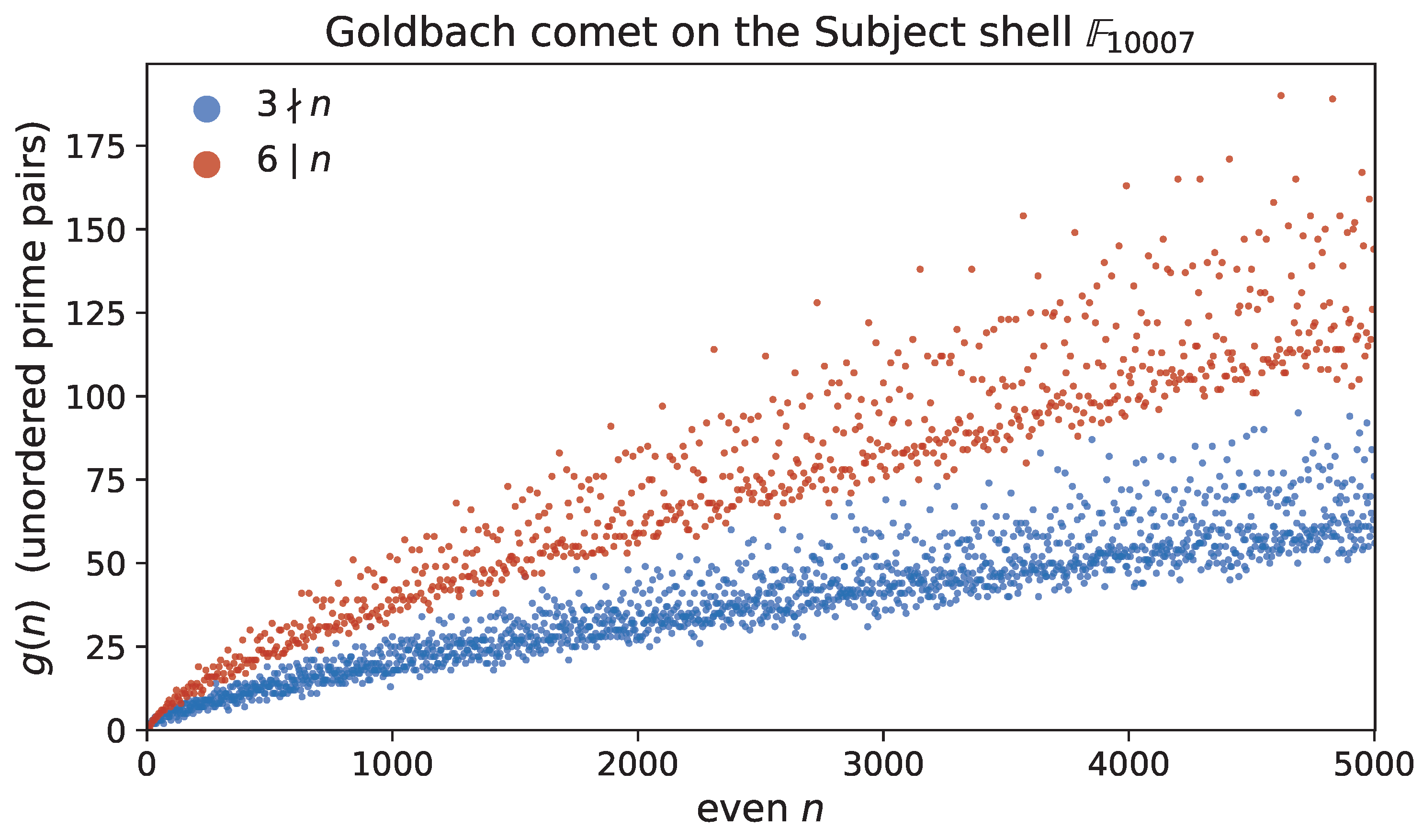
The floor is the reason the comet of Figure 1 never touches zero in its main term, and it explains the exact doubling of the upper branch (the comet ratio is verified, G4). The floor is attained at in the window (G4).
5. The Second Moment: Almost All Even n
Write with the major part. The mean square of the remainder is exactly computable.
Proposition 5.1
(Exact Parseval variance). Let A be any set of frequencies (the major arcs), its complement (the minor arcs). For the prime transform and the von Mangoldt transform , let denote the inverse transforms of . Then Parseval gives two exact finite identities,
and, with A the full spectrum, the integer additive energy splits symmetrically, , .
Proof.
is the inverse transform of and that of , so Parseval gives the two identities; with A the whole spectrum, , since is the transform of d (G5). □
The von Mangoldt weight sharpens the main term. Split it as , where is the prime-only count and collects pairs with at least one proper prime power; is equivalent to . The exact finite major-arc projection of Proposition 5.1 reads, in the continuum idealisation, as the singular-series profile ; this is a comparison instrument carrying the transcendental , while is the substrate-exact object. Numerically the relative fluctuation has window-median at , shrinking (G6).
Theorem 5.2
(Finite exceptional set). Let be the exact prime-power discrepancy (of growth ), over the even n of the bulk window , and . Then the number ofGoldbachexceptions () is at most . On each shell the actual exceptional set is empty (G3, an exact integer check); evaluated numerically (floating-point transform, the transcendental ), the bound is at most out of bulk integers at (fractions ), a comparison estimate rather than a certified enclosure.
Proof.
A Goldbach exception forces , so and . Chebyshev gives . The comparison profile is tied to the native Parseval mass of Proposition 5.1 by , the first term the exact von Mangoldt minor-arc mass and the second the -comparison defect; since carries the transcendental , the numerical evaluation (G6, G7) is a comparison certificate. The bound is per-shell; a shell-uniform constant valid for every admissible P is part of the open uniform residue. □
These are finite-shell Montgomery–Vaughan-type certificates [13] on the three evaluated shells, with explicit constants and no implied asymptotics: on each, all but a bounded, shrinking fraction of the even n in the window are sums of two primes. A shell-family statement, for every admissible or a certified bound at , is not claimed. The square-root cancellation on the minor arcs, governed by the multiplicative spectrum of the scale generator [18], drives the native Parseval mass; the comparison bound reads it through .
6. The Parity Residue
Theorem 5.2 stops short of , and the gap is structural. The natural device to close it is to symmetrise: to recover the conjugate from S by a symmetry of the shell . This fails for a precise reason.
Proposition 6.1
(No reflection symmetry of the primes). The additive reflection does not fix the prime window setwise: it sends each odd prime p to the even residue , so exactly. (The field-automorphism group of a prime shell is trivial; this reflection, the scalings for , and the inversion are bijections of the additive and multiplicative structure, not field automorphisms.)
For the scalings and inversion the overlap sits at the random baseline , a numerical regularity on the listed shells, not an exact identity (G8); the fact used below is the reflection disjointness .
Hence no single automorphism produces from , and averaging over automorphisms only reproduces the norm of Section 5. What refines the second moment is the moment hierarchy on the prime-only count. A positive may arise from a prime-power pair, so it is that gives , and a Goldbach exception forces . With
the term carrying the prime-power pairs, for each j,
Over the bulk , and at , shrinking with P; the finitely many sub-bulk n are checked directly (G9).
Proposition 6.2
(Reduction to one supremum bound). If on the window, then for every n, hence and holds. Numerically , attained at where inflates ρ; the prime-power correction is bounded, . A sufficient certificate for is then the single inequality , the pointwise minor-arc bound on the prime-only count, verified on every tested shell (G9).
This is one sufficient certificate, not an equivalence: can hold even where the chosen comparison profile gives . Its barrier is the parity problem: the supremum is an statement, where sieve and moment methods are defeated by Selberg’s obstruction, which cannot separate from [11]. The parity datum is the Liouville function; at the tested shells the endpoint sum satisfies , an observed diagnostic of factorisation parity, not a shell-uniform input (G10); the supremum bound needs parity control in progressions, a finer statement.
7. The Gaussian Lift and the Mod-4 Decomposition
The escape is to change the arena. The problem splits exactly by residue, and its split sector regains the symmetry the rational primes lack.
Proposition 7.1
(Exact mod-4 decomposition). For , with the odd window primes and the count of representations with one prime in each class,
Coverage is exact: every by the same-class sectors, every by the mixed sector (G11). The boundary uses the even prime and is recorded separately, .
The split mirrors the splitting of rational primes in : a prime is a sum of two squares (the Gaussian ledger ), while is inert (the real ledger ).
The carrier of the lift is the formal two-dimensional plane , with the quarter-turn and the norm , so that and exactly. This is kept distinct from the field: when the unit already lies in , so collapsing to the residue would identify many pairs and lose the plane; the lift lives on , not on that residue.
Proposition 7.2
(Gaussian lift). A prime is a norm with a Gaussian prime; lifted to faithful integer representatives, its eight associates form one orbit of norm p in ,
a disjoint union of such orbits (G12), the eight-fold multiplicity divided out when relating the lifted convolution to .
Proposition 7.3
(Exact quarter-turn symmetry). Let a window prime on and . Since , the quarter-turn gives : the two-dimensional prime indicator is invariant under J (G13), a symmetry of the lifted coefficient array.
The split-sector Goldbach count is the norm-sum
whose natural scalar transform collapses to the one-dimensional split-prime transform: since each has eight lifts of equal norm, , so recovers the split-sector count with the eight-fold multiplicity, not the vector-additive . Vector addition and norm addition differ, , so the quarter-turn invariance of is a genuine symmetry of the lifted array but disappears under the norm projection: the section supplies a symmetry-bearing lift, not yet a symmetry-based reduction of the obstruction. The operator for the norm-sum equation is open. The split sector is thereby placed in the two-dimensional, -symmetric arena in which the parity-breaking methods operate [14,15], with the quarter-turn delivered by the substrate’s own core. Whether the Friedlander–Iwaniec mechanism reaches the binary additive problem is the question of the next section.
8. Relation to Classical and Finite-Substrate Methods
The Friedlander–Iwaniec mechanism does not transfer. That method captures primes in the sparse sequence by Bombieri’s asymptotic sieve [9]: from distribution to level past together with a bilinear (Type II) bound, parity is broken; the object is linear in the von Mangoldt function, one prime captured. For the Gaussian-prime sequence the inputs are present: the square-root cancellation the method needs is in the prime sum already, the median of over the minor frequencies being with only the sparse rational peaks large (G15). But binary Goldbach is bilinear, , two prime variables added; its main term is of order M while the mass the method passes through is , larger by a factor that grows (G15). The bound overshoots not for want of cancellation but because the main term is too small relative to the mass; the asymptotic sieve, built for the linear problem, does not address it. Linnik’s dispersion method [16], which exploits bilinear additive structure, is the appropriate instrument, and whether the Gaussian two-dimensionality gives it the purchase one dimension denies is open.
The substrate’s positivity mechanisms reduce to the second moment. Two exact lattice-positivity mechanisms bear on the barrier, and neither crosses it. A strictly positive Green’s function (resolvent of the lattice Laplacian, with a spectral gap [22]) corresponds to the singular-series floor: the main term has it, but the count’s multiplier oscillates in sign, while the difference multiplier has only a small top gap: leaves , too small to force pointwise positivity, the near-maximal mode being the near-half-cycle additive peak at (the closest modes to half-period in the odd-order group ); exact order-two parity lives in the multiplicative character cycle through , not the additive group, and this insufficiency is the parity barrier (G14). A Ward identity (exact Gauss law from a shift symmetry) corresponds to the conservation and its moment refinements; but the Ward identity needs a shift symmetry the primes lack (Proposition 6.1), so only the moment conservation survives, capping at almost all n (G14). Both mechanisms live on the side and recover the almost-all result by other routes; neither reaches the count.
These comparisons use the continuum circle method and its norms as the instrument. The substrate is scale-periodic, and re-posed natively the residue changes character.
9. The Scale-Periodic Reformulation
Three features of the continuum treatment are, on the finite substrate, harmless, scale-native, or spurious. The integral was already replaced by the finite sum of Proposition 3.1. The logarithm reads the native scale coordinate: the substrate’s scale label is the cyclic exponent with (the discrete logarithm), and is its continuum image, under which (Chebyshev) makes the primes flat in the multiplicative measure (G16). The Jacobian reading is a comparison statement; the exact native coordinate is , not the transcendental logarithm. The minor arcs lose their continuum geometry: the uncountable arc ontology disappears, though the finite minor-frequency sector of Proposition 5.1 is exact and real. On the shell every frequency is , and
a Gauss-sum-weighted combination of the prime-character sums , exact (G16). The characters are extended by zero at 0; the trivial character contributes , and (6) is taken for , the mode recorded separately. There are no irrational arcs to estimate; every frequency is an identity, and the residual content is the prime-character sums , the multiplicative spectrum of the scale generator [18]. Finally the -mass deficit of Section 8 was a Cauchy–Schwarz step; the substrate replaces it with the exact additive-energy identity of Proposition 5.1, so the deficit is a property of the bound, not a verified obstruction to the count.
10. The Scale-Spectral form: Goldbach as a Parity-Sector Balance
Expanding the prime indicator over the multiplicative characters, the additive convolution that is the Goldbach count becomes an exact bilinear form in the spectral data with Jacobi-sum coefficients.
Theorem 10.1
(Jacobi-sum spectral form). For n in the window,
where is the Jacobi sum, of magnitude for nontrivial. The form is exact: a finite sum of products of spectral amplitudes and roots of unity, with no integral, logarithm, or norm. It reproduces the integer Goldbach count exactly, verified in (G17).
Proof.
on ; substituting into and writing gives the inner sum . The Jacobi magnitude is the standard evaluation [23]. □
Remark 10.2
Its positivity, the Goldbach statement, splits along the substrate’s reflection , whose eigenvalue on a character is . The reflection-even () and reflection-odd () characters partition (7) exactly,
where collects the two mixed (even–odd and odd–even) sectors.
Lemma 10.3
(Even sector nonnegative). With and , the even–even sector is the self-convolution . Since (Proposition 6.1), , hence for every P and every n.
In closed form, with the prime-difference correlation,
So the even–even sector is nonnegative as a theorem, carrying the bulk of the count, while the odd sector carries the signed remainder (G17; e.g. at , in the window, and ). The map is invertible, so the decomposition is an exact localization of the signed cancellation, not a new inequality beyond . Binary Goldbach on the window is therefore equivalent, exactly, to a sign balance: for every window n, with fixed, the reflection-symmetric content outweighing the antisymmetric.
This is the parity barrier in the substrate’s own language. The odd characters are exactly the eigenspace of the reflection under which the primes are not invariant (Proposition 6.1); the obstruction of Section 6 reappears not as a supremum estimate but as the sign balance among the sectors of (8). Identifying this reflection parity with the classical sieve parity would intertwine the half-cycle reflection on the scale-character spectrum with factorisation parity in the multiplicative chart; that intertwining is open. The exact statement is the sector equivalence above, and the identification with the classical parity barrier and the twin-prime obstruction is its conjectural reading. The connection to the Riemann realisation is structural. That realisation is the completeness of the on-line scale-spectrum for the linear prime vector, fixing the amplitudes , with the oddness mode at the top of the energy order [18]; Goldbach is the positivity of the bilinear self-pairing (7) of the same amplitudes. An exact correspondence requires the spectral dictionary identifying those amplitudes with the on-line spectrum, and a check that the prime vector and normalisation of the Riemann construction produce precisely the used here; that dictionary is the remaining step. The linear completeness that closes the Riemann clause does not by itself decide the bilinear sign balance: a bilinear positivity standing to a linear reconstruction, posed entirely within the scale-periodic spectral frame.
11. Conclusion
Binary Goldbach, read on the finite scale-periodic substrate, becomes a graded sequence of exact statements. On the coherence-horizon window the problem is finite and decidable; the circle method is an exact identity with the Gauss-sum magnitude exact; the singular series is floored; the second moment proves that all but a bounded, shrinking fraction of the even integers in the window are sums of two primes. The residue is the parity barrier, and the construction locates it: a no-symmetry lemma and the moment hierarchy reduce it to one supremum bound, the Gaussian lift supplies a symmetry-bearing lift (its norm projection returns the one-dimensional transform), and the scale-periodic reformulation strips the continuum artifacts and writes the count as an exact Jacobi-sum form whose positivity is a finite balance between the reflection-even and reflection-odd sectors of the prime vector. That balance is, conjecturally, the same parity content the twin-prime problem turns on, and it is the open kernel; it stands to the Riemann realisation’s completeness clause as a bilinear positivity to a linear reconstruction. Read on the substrate, is a decidable proposition: the finite totality settles its framed form by a bounded check (Section 2). Its truth value is therefore determinate; what is not thereby supplied is its positivity, by either a maximal-shell evaluation or a uniform certificate. An enumerative certificate exists and decides : one Goldbach pair per n is a list of prime residues, coherence-scale, checkable once the prime table is verified. What has only a carrier-scale realisation is a uniform, non-enumerative certificate, a closed proof of the parity-sector positivity that does not reduce to per-n search: the individual parity-sector sums are coherence-scale () and Weil-controlled, but their uniform aggregate over the window is of carrier scale . The direct all-n evaluation and the direct Jacobi representation have carrier-scale realisations; whether every non-enumerative uniform certificate requires carrier-scale resources is open. We call such a residue Ω-hard: the totality decides it, an enumerative witness is coherence-scale, and its known uniform certificates are carrier-scale. An -hard statement is decidable, not undecidable; it is the carrier-scale analogue, relative to the bounded part, of computational hardness, a conjectural proof-complexity class pending a formal model of admissible operations, certificate size, and a lower-bound criterion. The open kernel of binary Goldbach takes the form of the parity-sector sign balance, the parity barrier in its sharpest finite shape. The binary Goldbach conjecture is not proved here. What is delivered is its exact finite reduction, an almost-all theorem with explicit constants, and a native reformulation that relocates the open kernel to the substrate’s own spectral frame: finite, exact, and free of every continuum device.
Appendix A. Reproducibility
The substrate-native claims are verified in exact integer, rational, and cyclotomic arithmetic: no floating point, no tolerances, and no continuum limit (Part I of goldbach.py). The field elements are residues below P; derived integer aggregates such as the additive energy are exact and may exceed P. The cyclotomic magnitudes use their exact orthogonality ingredients: follows from the additive and multiplicative orthogonality relations (verified as exact bijections), and the Jacobi-sum form (7) is confirmed to reproduce the integer count exactly (zero imaginary part) in at small P. The classical second-moment analysis, which carries the von Mangoldt logarithmic weight (the additive-to-scale measure Jacobian, a transcendental), is a deliberate continuum-comparison instrument, separated as Part II and making no substrate-exactness claim. Claims are typed by evidence: algebraic identities are proved and regression-tested for every shell; maximal-shell and interval claims are exhaustively evaluated over the stated finite range; the reported medians and ratios are exact observations on the listed shells , not laws over all admissible P. The suite (forty-one checks, all passing) is reproducible without reference to the wider corpus and is linked below. The Subject-shell prime P ranges up to the coherence horizon ; the window is , , so that and the finite circle method is an exact integer identity.
Numeric validation: github.com/gamayos/frc-numerics/tree/main/23-goldbach
- G1
- The identity (3) as an exact group-ring square, cross-checked against an independent ordered-pair count.
- G2
- Window admissibility () and exactness of the even/prime predicates on .
- G3
- Finite Goldbach positivity on , zero failures to .
- G4
- The singular-series floor , attained, and the comet ratio .
- G5
- The exact additive-energy identity (Proposition 5.1).
- G6
- The von Mangoldt main-term tracking and positivity, with shrinking relative fluctuation (continuum comparison).
- G7
- The exceptional-set bound of Theorem 5.2 with the pointwise threshold : at most exceptions, empty actual set (continuum comparison).
- G8
- The no-symmetry lemma (Proposition 6.1).
- G9
- The prime-only moment-hierarchy reduction (Proposition 6.2): the supremum at , the bulk moment , and (continuum comparison).
- G10
- The Liouville endpoint sum at the listed shells, an observed factorisation-parity diagnostic (observation, not shell-uniform).
- G11
- The exact mod-4 sector decomposition (Proposition 7.1).
- G12
- The Gaussian lift (Proposition 7.2).
- G13
- The exact quarter-turn symmetry on (Proposition 7.3).
- G14
- The exact conservation sum rule (integer); the oscillating multiplier and the insufficient top gap () (continuum comparison).
- G15
- The Friedlander–Iwaniec diagnostic: square-root cancellation present, binary -mass deficit growing (continuum comparison).
- G16
- Scale-periodic exactness: from the additive/multiplicative orthogonality bijections (6); the Chebyshev flattening of the scale measure (continuum comparison).
- G17
- The Jacobi-sum spectral form (7) reproducing the integer exactly in , with and its reflection-parity sectors (Theorem 10.1).
Figure 1 is produced by the same construction.
References
- Goldbach, Christian. Letter to L. Euler, 7 June 1742, 1742. Correspondence with Leonhard Euler. [PubMed]
- Oliveira e Silva, Tomás; Herzog, Siegfried; Pardi, Silvio. Empirical verification of the even Goldbach conjecture and computation of prime gaps up to 4·1018. Math. Comput. 2014, 83(288), 2033–2060. [Google Scholar]
- Schnirelmann, L. G. über additive Eigenschaften von Zahlen. Math. Ann. 1933, 107, 649–690. [Google Scholar]
- Ramaré, Olivier. On šnirel’man’s constant. Ann. Della Sc. Norm. Super. Di Pisa Cl. Di Sci. (4) 1995, 22(4), 645–706. [Google Scholar]
- Hardy, G. H.; Littlewood, J. E. Some problems of `partitio numerorum’; III: On the expression of a number as a sum of primes. Acta Math. 44, 1–70, 1923. [CrossRef]
- Vinogradov, I. M. Representation of an odd number as a sum of three primes. Dokl. Akad. Nauk SSSR 1937, 15, 291–294. [Google Scholar]
- Helfgott, Harald A. The ternary Goldbach problem, 2015. arXiv arXiv:1501.05438.
- Iwaniec, Henryk; Kowalski, Emmanuel. Analytic Number Theory, volume 53 of American Mathematical Society Colloquium Publications; American Mathematical Society: Providence, RI, 2004; volume 53. [Google Scholar]
- Friedlander, John; Iwaniec, Henryk. Opera de Cribro, volume 57 of American Mathematical Society Colloquium Publications; American Mathematical Society: Providence, RI, 2010; volume 57. [Google Scholar]
- Brun, Viggo. Le crible d’ératosthène et le théorème de Goldbach. In Skrifter utgit av Videnskapsselskapet i Kristiania, I. Mat.-Naturv. Klasse; 1920. [Google Scholar]
- Chen, J. R. On the representation of a larger even integer as the sum of a prime and the product of at most two primes. Sci. Sin. 1973, 16, 157–176. [Google Scholar]
- Estermann, T. On Goldbach’s problem: proof that almost all even positive integers are sums of two primes. Proc. Lond. Math. Soc. s2-44(4), 307–314, 1938. [CrossRef]
- Montgomery, H. L.; Vaughan, R. C. The exceptional set in Goldbach’s problem. Acta Arith. 1975, 27, 353–370. [Google Scholar]
- Friedlander, John; Iwaniec, Henryk. The polynomial x2+y4 captures its primes. Ann. Math. 1998, 148(3), 945–1040. [Google Scholar] [CrossRef] [PubMed]
- Heath-Brown, D. R. Primes represented by x3+2y3. Acta Math. 2001, 186(1), 1–84. [Google Scholar] [CrossRef]
- Linnik, Yu. V. The Dispersion Method in Binary Additive Problems, volume 4 of Translations of Mathematical Monographs; American Mathematical Society: Providence, RI, 1963; volume 4. [Google Scholar]
- Akhtman, Yosef. Relativistic Algebra over Finite Ring Continuum. Axioms 14(8), 636, 2025. [CrossRef]
- Akhtman, Yosef; Voether, Elisha. Finite Field Realisation of the Riemann Hypothesis. Preprints 2026. [Google Scholar] [CrossRef]
- Vaughan, Robert C. The Hardy–Littlewood Method, volume 125 of Cambridge Tracts in Mathematics, 2 edition; Cambridge University Press: Cambridge, 1997; volume 125. [Google Scholar]
- Montgomery, Hugh L.; Vaughan, Robert C. Multiplicative Number Theory I: Classical Theory, volume 97 of Cambridge Studies in Advanced Mathematics; Cambridge University Press: Cambridge, 2007; volume 97. [Google Scholar]
- Davenport, Harold. Multiplicative Number Theory, volume 74 of Graduate Texts in Mathematics, 3 edition; Springer-Verlag: New York, 2000; volume 74. [Google Scholar]
- Lawler, Gregory F.; Limic, Vlada. Random Walk: A Modern Introduction, volume 123 of Cambridge Studies in Advanced Mathematics; Cambridge University Press: Cambridge, 2010; volume 123. [Google Scholar]
- Berndt, Bruce C.; Evans, Ronald J.; Williams, Kenneth S. Gauss and Jacobi Sums, volume 21 of Canadian Mathematical Society Series of Monographs and Advanced; Wiley-Interscience: New York, 1998; volume 21. [Google Scholar]
Disclaimer/Publisher’s Note: The statements, opinions and data contained in all publications are solely those of the individual author(s) and contributor(s) and not of MDPI and/or the editor(s). MDPI and/or the editor(s) disclaim responsibility for any injury to people or property resulting from any ideas, methods, instructions or products referred to in the content. |
© 2026 by the authors. Licensee MDPI, Basel, Switzerland. This article is an open access article distributed under the terms and conditions of the Creative Commons Attribution (CC BY) license (http://creativecommons.org/licenses/by/4.0/).
Copyright: This open access article is published under a Creative Commons CC BY 4.0 license, which permit the free download, distribution, and reuse, provided that the author and preprint are cited in any reuse.


