
Submitted:
19 June 2026
Posted:
22 June 2026
You are already at the latest version
Abstract
This study examines ESG data gaps, digital readiness and environmental-security relevance from a multiview Life Cycle Sustainability Assessment (LCSA) perspective, comparing Bulgaria as an EU member state and Moldova as an EU-aligned transition economy. Using publicly available sustainability reports, integrated reports, non-financial statements, ESG disclosures and public-sector documents, the study analyses a balanced sample of 36 organisations, equally distributed between the two countries and covering corporate, financial and public-sector entities. The methodology combines qualitative content analysis with semi-quantitative scoring through two instruments: the ESG Digital Readiness Index (ESG-DRI) and the Data Gap Matrix (DGM), covering 540 indicator-level observations. The results show a moderate overall level of ESG digital readiness, with a mean ESG-DRI score of 2.20. Bulgaria records stronger readiness than Moldova, while financial institutions show the highest sectoral readiness. The DGM results reveal that ESG information is generally available, but remains insufficiently granular and weakly auditable. Auditability is the weakest dimension, while LCSA relevance and environmental-security materiality are comparatively high. The findings suggest that ESG reporting in both countries is progressing toward more structured sustainability disclosure, but stronger data systems, internal controls, audit trails and life-cycle data integration are needed to support CSRD/ESRS-aligned, assurance-ready and environmental-security-oriented reporting.
Keywords:
ESG reporting
; CSRD
; ESRS
; digital readiness
; data gaps
; multiview LCSA
; environmental security
; sustainability reporting
; Bulgaria
; Moldova
1. Introduction
1.1. Regulatory and Research Context
The European sustainability reporting landscape has changed substantially with the adoption of the Corporate Sustainability Reporting Directive (CSRD) and the European Sustainability Reporting Standards (ESRS). Directive (EU) 2022/2464 expanded sustainability reporting obligations and strengthened the links between sustainability information, corporate governance, assurance, and capital-market transparency [1]. Commission Delegated Regulation (EU) 2023/2772 operationalised this framework by introducing the first set of ESRS, covering environmental, social, and governance impacts, risks, and opportunities [2].
A central principle of the CSRD/ESRS framework is double materiality, which requires organisations to assess both their impacts on people and the environment and the financial effects of sustainability-related risks and opportunities [1,2]. This approach increases the need for complete, comparable, and credible ESG information. Reporting quality therefore depends not only on regulatory compliance, but also on methodological consistency, reporting maturity, and the reliability of disclosed data [3,4].
Digitalisation and assurance are equally important. EFRAG’s ESRS Set 1 XBRL Taxonomy supports the transition toward machine-readable sustainability reporting [5], while the CSRD [1] and ISSA 5000 [6] increase expectations concerning traceable data sources, documented methodologies, internal controls, and verifiable evidence. Sustainability assurance research similarly shows that credible reporting requires reliable and auditable underlying information [7].
These developments raise the question of whether organisations can produce ESG data that are sufficiently granular, auditable, digitally structured, and useful for advanced sustainability analysis. This study addresses that question by examining ESG data gaps and digital readiness in Bulgaria and Moldova from a multiview Life Cycle Sustainability Assessment (LCSA) perspective.
1.2. Problem Statement
Despite regulatory progress, the capacity of organisations to produce high-quality ESG information remains uneven. The main issue is no longer simply whether sustainability information is disclosed, but whether it is sufficiently complete, granular, traceable, auditable, and digitally structured to support compliance, assurance, life-cycle assessment, and risk-informed decision-making.
In practice, ESG information is often narrative, fragmented, aggregated, or only partially quantified. Group-level reporting, unclear boundaries, limited methodological explanations, and insufficient disaggregation reduce the usefulness of disclosures, particularly for Scope 3 emissions, renewable energy, biodiversity, circular economy, workforce indicators, and governance risks. Value-chain data remain especially difficult to collect and verify.
Auditability is another major weakness. ESG information intended for assurance must be supported by identifiable data sources, calculation methods, internal controls, and audit trails. Weak documentation limits both reporting credibility and external assurance [7]. At the same time, fragmented databases, manual collection procedures, and low interoperability between accounting, environmental, operational, and governance systems constrain digital readiness.
These limitations also restrict the use of ESG information for multiview LCSA, which requires integrated environmental, economic, and social data across products, organisations, and value chains. Recent research confirms that even standardised information such as greenhouse gas data remains difficult to extract and compare consistently [8]. Weak ESG data may therefore constrain not only reporting quality, but also the assessment of climate, energy, resource, infrastructure, and pollution-related risks.
The central problem addressed in this study is thus the mismatch between the growing regulatory and methodological expectations for ESG reporting and the actual capacity of organisations to provide information that is digitally structured, auditable, LCSA-compatible, and relevant to environmental security.
1.3. Relevance of Multiview LCSA and Environmental Security
Multiview Life Cycle Sustainability Assessment (LCSA) provides an appropriate analytical lens for evaluating the usability of ESG disclosures beyond organisational reporting boundaries. By integrating environmental LCA, Life Cycle Costing and Social LCA, it enables environmental, economic and social information to be interpreted across products, processes, organisations and value chains [9,10,11].
This perspective is relevant to ESRS-aligned reporting because emissions, energy use, resource consumption, waste and social impacts frequently extend across upstream and downstream activities. However, LCSA integration requires structured, granular, traceable and methodologically consistent data. Fragmented or weakly auditable ESG disclosures therefore limit their suitability for life-cycle-based sustainability assessment.
Environmental security extends this analytical perspective by connecting ESG information quality with climate resilience, energy security, resource efficiency, infrastructure vulnerability and pollution prevention [12,13]. In this study, multiview LCSA is used to assess the analytical usefulness of disclosed ESG indicators, while environmental security captures the potential risk implications of missing or weak sustainability information.
1.4. Research Gap
Several research gaps remain. First, ESG reporting and LCSA have largely developed as separate research streams. While ESG studies focus on disclosure quality, materiality, assurance, and digital reporting, LCSA research concentrates on integrating environmental, economic, and social life-cycle methods. Limited empirical evidence exists on whether public ESG disclosures are sufficiently granular, auditable, and life-cycle-relevant to support multiview LCSA [11].
Second, the role of digital readiness remains insufficiently examined. Digital technologies may improve ESG data integration, traceability, and reporting quality [14], while technologies such as IoT, blockchain, big data, and artificial intelligence can strengthen life-cycle assessment processes [15]. However, comparative evidence on how organisational digital readiness affects LCSA-compatible ESG reporting is still limited.
Third, ESG data availability, standardisation, and comparability remain problematic despite the introduction of CSRD and ESRS. Granular data and methodological transparency continue to represent major challenges for sustainability and ESG risk assessment [16].
Fourth, EU-aligned transition economies remain underrepresented in the literature. Bulgaria and Moldova provide a relevant comparison between an EU member state and an economy undergoing EU approximation and institutional modernisation. Existing evidence identifies differences in environmental auditing and institutional capacity between the two countries, but does not directly examine ESG data gaps, digital readiness, or LCSA integration at the organisational level [17].
This study addresses these gaps by integrating ESG disclosure quality, organisational digital readiness, multiview LCSA relevance, and environmental-security materiality within a single comparative framework.
1.5. Aim, Contributions and Research Questions
The study aims to assess whether publicly disclosed ESG information in Bulgaria and Moldova is sufficiently available, granular, auditable, digitally structured, and relevant to multiview LCSA and environmental-security-oriented analysis.
It makes four main contributions. First, it evaluates CSRD/ESRS-related reporting quality through data availability, granularity, auditability, and digital readiness. Second, it examines the potential of ESG disclosures to support environmental LCA, Life Cycle Costing, and Social LCA. Third, it provides comparative evidence from Bulgaria and Moldova. Fourth, it introduces environmental security as an analytical extension of ESG data quality.
Methodologically, the study applies two complementary instruments: the ESG Digital Readiness Index, which assesses organisation-level technological infrastructure, data governance, and organisational capacity, and the Data Gap Matrix, which evaluates indicator-level availability, granularity, auditability, LCSA relevance, and environmental-security materiality.
The study addresses the following research questions:
RQ1: What data gaps in ESG disclosures limit the integration of multiview LCSA indicators in Bulgaria and Moldova?
RQ2: To what extent are corporate, financial, and public-sector entities digitally prepared to support LCSA-compatible and audit-ready ESG reporting?
RQ3: How do institutional context, sectoral profile, and regulatory alignment influence ESG digital readiness and data completeness in Bulgaria and Moldova?
2. Theoretical Background and Conceptual Framework
2.1. ESG Reporting Under CSRD and ESRS
The Corporate Sustainability Reporting Directive (CSRD) and the European Sustainability Reporting Standards (ESRS) represent the core framework for sustainability reporting in the European Union [1,2]. Directive (EU) 2022/2464 expands mandatory reporting requirements and integrates sustainability information into the regulated corporate reporting system [1]. Commission Delegated Regulation (EU) 2023/2772 operationalises this framework through cross-cutting and topical standards covering environmental, social, and governance matters [2]. This marks a transition from fragmented and largely voluntary disclosure toward a more standardised and accountability-oriented regime [4].
A defining principle of the ESRS is double materiality, which requires organisations to assess both their impacts on people and the environment and the financial effects of sustainability-related risks and opportunities [1,2]. This approach increases the need for reliable, evidence-based, and sufficiently detailed ESG information.
The ESRS also emphasise granularity, auditability, and digital usability [2]. EFRAG’s List of ESRS Datapoints illustrates the level of detail expected [18], while the CSRD [1] and ISSA 5000 [6] require sustainability information to be supported by traceable sources, documented methodologies, internal controls, and verifiable evidence. Sustainability assurance research similarly shows that reporting credibility depends on data quality and mature assurance practices [7].
EFRAG’s ESRS Set 1 XBRL Taxonomy further supports the transition toward machine-readable and interoperable reporting [5]. Digital readiness is therefore becoming a precondition for effective ESRS implementation. In this study, the CSRD/ESRS framework serves as a benchmark for assessing whether ESG information is available, granular, auditable, digitally structured, and suitable for multiview LCSA and environmental-security analysis.
2.2. Life Cycle Sustainability Assessment and the Multiview Paradigm
Life Cycle Sustainability Assessment integrates environmental Life Cycle Assessment, Life Cycle Costing, and Social Life Cycle Assessment [9,10]:
LCSA = LCA + LCC + SLCA
This framework combines environmental impacts, economic costs, and social consequences across products, processes, organisations, and value chains [9,10]. Its purpose is to identify trade-offs, synergies, sustainability hotspots, and potential burden-shifting across different dimensions.
The multiview paradigm extends this approach by interpreting environmental, economic, and social information simultaneously. It is particularly relevant to ESRS reporting because topics such as emissions, energy, resource use, waste, labour conditions, and community impacts often extend beyond organisational boundaries and require value-chain and life-cycle perspectives [11,19].
However, LCSA integration requires reliable data on system boundaries, inventory flows, costs, social impacts, and stakeholder effects. Environmental LCA is more methodologically established, while LCC and SLCA remain less standardised. ESG disclosures can therefore support LCSA only when they are sufficiently detailed, comparable, traceable, and methodologically transparent [9,10,11,19].
This study does not conduct a full LCA, LCC, or SLCA. Instead, multiview LCSA is used to evaluate whether disclosed ESG indicators could support future life-cycle analysis. This logic forms the basis of the Data Gap Matrix, which assesses availability, granularity, auditability, LCSA relevance, and environmental-security materiality.
2.3. Digitalisation and Data Governance in Sustainability Reporting
Digitalisation is transforming sustainability reporting from a predominantly narrative practice into a structured, traceable, and assurance-oriented information system. Digital readiness refers to an organisation’s capacity to collect, validate, store, control, and disclose ESG data through reliable technologies and governance processes [14].
It includes three interrelated dimensions:
- technological infrastructure, including ESG platforms, ERP systems, data repositories, and automated measurement tools;
- data governance, including ownership, internal controls, documentation, and audit trails;
- organisational capacity, including responsibilities, procedures, and staff expertise [14].
EFRAG’s ESRS Set 1 XBRL Taxonomy reflects the regulatory movement toward machine-readable sustainability disclosures [5]. Unlike information embedded in narrative PDF reports, digitally tagged data can be extracted, compared, verified, and processed automatically. This requires interoperability between accounting, environmental, human-resource, procurement, risk-management, and governance systems.
Audit trails and data provenance are equally important. Sustainability assurance requires reported information to be linked to original sources, calculation methods, supporting evidence, and responsible data owners [6,7]. ISSA 5000 reinforces the need for reliable and verifiable sustainability information [6]. Digital technologies can improve reporting quality when they support integration, standardisation, and internal data management [14].
In this study, digital readiness is treated as an enabling condition for ESG reporting quality and multiview LCSA integration. It is operationalised through technological infrastructure, data governance, and organisational capacity within the ESG Digital Readiness Index.
2.4. Data Gaps and Sustainability Information Quality
Data gaps are a major barrier to high-quality sustainability reporting [8]. Under the CSRD/ESRS framework, information must not only be disclosed but also be complete, granular, comparable, methodologically consistent, and auditable [1,2,18].
The present study distinguishes three main dimensions of ESG data quality:
Availability refers to whether information can be identified and linked to a specific sustainability indicator. General narratives without quantitative values, boundaries, baselines, or methodologies provide limited analytical value.
Granularity refers to the degree of disaggregation by activity, location, organisational unit, reporting period, or value-chain stage. Group-level disclosures may conceal entity-specific impacts and limit comparison and life-cycle interpretation.
Auditability refers to whether information can be traced to identifiable sources, calculation methods, documented procedures, internal controls, and supporting evidence. Weak auditability reduces reporting credibility and assurance readiness [6,7].
Scope 3 emissions illustrate these difficulties because they depend on upstream and downstream value-chain data and are often characterised by estimation uncertainty, inconsistent boundaries, and limited comparability [8]. Energy indicators may similarly lack sufficient disaggregation, while social disclosures are frequently narrative and difficult to standardise [8]. Governance information is important because it reveals whether sustainability data are produced through reliable systems or ad hoc procedures.
Data gaps are therefore conceptualised as multidimensional deficiencies arising from missing indicators, weak quantification, excessive aggregation, poor methodological explanation, limited digital structure, or insufficient audit evidence. These dimensions are operationalised through the Data Gap Matrix.
2.5. Environmental Security as an Analytical Extension
Environmental security extends ESG reporting beyond compliance by linking information quality with risk identification, resilience, and governance. It concerns the stability and resilience of societies, institutions, organisations, and communities in relation to climate change, resource scarcity, pollution, biodiversity loss, energy disruption, and infrastructure vulnerability [12].
These risks cannot be effectively assessed without reliable data on organisational impacts, dependencies, exposures, and mitigation capacities. Climate-related risks affect energy systems, ecosystems, infrastructure, water resources, financial stability, and public health [13,20].
Weak or non-auditable ESG information may therefore constrain:
- climate-risk and transition-risk assessment;
- evaluation of energy dependency and efficiency;
- pollution prevention and environmental compliance;
- resource-efficiency management;
Environmental security is compatible with multiview LCSA because both approaches examine sustainability across interconnected systems. LCSA evaluates environmental, economic, and social consequences across life-cycle boundaries, while environmental security focuses on their implications for resilience and stability [11,12,13,19,20].
In this study, environmental security is used as an analytical overlay rather than as a separate outcome variable. Its relevance is assessed through indicators related to emissions, energy, renewable energy, risk management, transparency, governance, and public-sector resilience.
2.6. Conceptual Framework of the Study
The conceptual framework treats digital readiness and ESG data gaps as interrelated conditions shaping the usability of sustainability information. Stronger technological infrastructure, data governance and organisational capacity are expected to reduce deficiencies in data availability, granularity and auditability. Together, these conditions influence the potential for multiview LCSA integration and the overall quality of ESG reporting.
The analytical logic can therefore be expressed as follows:
Digital readiness and ESG data quality → Multiview LCSA integration capacity and ESG reporting quality → Environmental-security relevance
The relationships are interpretative rather than causal and provide the structure for the coding and comparative analysis conducted in the study.
Figure 1 illustrates the conceptual relationships among digital readiness, ESG data quality, multiview LCSA integration capacity, reporting quality, and environmental-security relevance, together with their empirical operationalisation in the study.
3. Materials and Methods
3.1. Research Design and Analytical Positioning
This study applies a comparative document-based research design combining qualitative content analysis with structured semi-quantitative ordinal scoring. The approach enables the interpretation of textual, numerical, and tabular ESG disclosures while supporting structured comparisons across countries, sectors, organisations, and indicators [21,22].
The qualitative analysis covers publicly available sustainability reports, integrated reports, non-financial statements, ESG disclosures, annual reports, and public-sector environmental documents. Documentary evidence was translated into ordinal scores assessing reporting maturity rather than actual sustainability performance.
The analysis is informed by the CSRD, ESRS, the ESRS XBRL Taxonomy, and ISSA 5000 [1,2,5,6]. These frameworks provide the basis for evaluating whether ESG information is sufficiently available, granular, traceable, auditable, digitally structured, and relevant to multiview LCSA.
The dataset covers 36 organisations and 540 indicator-level observations. The analysis is comparative and exploratory and aims to identify patterns in ESG data quality and digital readiness rather than to rank organisations or establish causal relationships.
3.2. Sample, Data Sources and Inclusion Criteria
The balanced sample includes 36 organisations, equally divided between Bulgaria and Moldova. Each country is represented by 10 corporate entities, 4 financial institutions, and 4 public-sector bodies, producing a total of 20 corporate, 8 financial, and 8 public-sector organisations.
The corpus comprises publicly available documents from 2023–2025, predominantly from 2024. It includes 17 sustainability reports, 9 integrated reports, 5 non-financial reports or statements, and 5 ESG disclosure documents.
Documents were included when they:
- were publicly available from an official or recognised source;
- contained relevant environmental, social, governance, climate, risk, or public-accountability information;
- represented one of the most recent available reporting cycles;
- provided sufficient evidence for at least partial ESG-DRI and DGM coding.
Where standalone sustainability reports were unavailable, integrated, consolidated, or public-sector documents were used as alternative sources. Group-level or highly aggregated disclosures received lower granularity or auditability scores when entity-specific evidence was insufficient. Publicly available documents were considered suitable for systematic content analysis [23].
3.3. Coding Procedure and Excel Dataset
The analysis was conducted using an Excel-based coding template containing seven worksheets: Lookups, Codebook, Org_Metadata, ESG_DRI_Raw, ESG_DRI_Summary, DGM_Raw, and DGM_Summary.
Coding proceeded in three stages. First, organisational metadata were recorded, including country, sector, reporting year, report type, source URL, and explanatory notes. Second, each organisation was evaluated through the ESG Digital Readiness Index. Third, 15 ESG indicators were coded through the Data Gap Matrix, generating 540 observations.
The DGM indicators were grouped as follows:
- Environmental: Scope 1, Scope 2, Scope 3 emissions, total energy use, and renewable energy share;
- Social: employee turnover, training and development, health and safety, diversity and inclusion, and community engagement;
- Governance: ESG governance, board structure and independence, risk management, ethics and compliance, and transparency.
All coding decisions were based on explicit evidence contained in the analysed documents. Where evidence was ambiguous or incomplete, the lower score was assigned in accordance with the conservative coding principle.
Evidence quotations, page references, URLs, and explanatory notes were recorded where applicable. Scores were not inferred from organisational reputation, sector, or presumed regulatory exposure. Results were aggregated by country, sector, organisation, indicator group, and analytical dimension, without imputing missing values or introducing additional data.
3.4. ESG Digital Readiness Index
The ESG Digital Readiness Index assesses organisations’ capacity to generate structured, traceable, and assurance-relevant ESG information. It comprises 15 indicators grouped into three equally weighted dimensions:
- Technological infrastructure (TI): ESG systems, integration with ERP or management systems, structured-data export, automated measurement, and centralised repositories;
- Data governance (DG): documented procedures, assigned responsibilities, internal controls, digital audit trails, and assurance;
- Organisational capacity (OC): dedicated ESG teams, staff training, internal reporting policies, links to life-cycle thinking, and strategic commitment to digitalisation.
Each indicator is scored from 0 to 3:
- 0 – no evidence;
- 1 – rudimentary or ad hoc practice;
- 2 – partial implementation;
- 3 – full implementation.
Composite ESG-DRI scores were classified as low readiness (0.00–1.49), medium readiness (1.50–2.49), and high readiness (2.50–3.00).
The composite index is calculated as follows:
where TImean is the average score for technological infrastructure indicators TI1–TI5, DGmean is the average score for data governance indicators DG1–DG5, and OCmean is the average score for organisational capacity indicators OC1–OC5.
Equal weighting was applied because the three dimensions are treated as interdependent components of reporting-system maturity. The ESG-DRI measures digital and organisational readiness for ESG reporting rather than actual environmental or social performance.
3.5. Data Gap Matrix
The Data Gap Matrix evaluates whether specific ESG indicators are usable for ESRS-aligned reporting, multiview LCSA, and environmental-security analysis. Each of the 540 observations is assessed across five dimensions:
- Availability: whether the indicator is absent, narrative, partially quantitative, or fully structured;
- Granularity: the level of disaggregation by scope, activity, location, organisational unit, or value-chain stage;
- Auditability: the presence of methodologies, controls, evidence, audit trails, or assurance;
- LCSA relevance: usefulness for environmental LCA, Life Cycle Costing, or Social LCA;
- Environmental-security materiality: relevance to climate, energy, resources, infrastructure, pollution, or environmental governance.
Each dimension was evaluated using a four-point ordinal scale ranging from 0 to 3. For availability, a score of 0 indicates that the indicator is absent, 1 denotes narrative or highly limited disclosure, 2 represents partially quantitative information, and 3 indicates complete and systematically structured disclosure. For granularity, scores range from no disaggregation (0) to detailed disaggregation by scope, activity, location, organisational unit, reporting period, or value-chain stage (3). Auditability ranges from the absence of methodological or supporting evidence (0) to fully traceable information supported by documented methods, internal controls, audit trails, or external assurance (3). LCSA relevance and environmental-security materiality are assessed from no identifiable relevance (0) to high analytical or risk-related relevance (3).
The DGM is recorded in the Excel dataset through the DGM_Raw and DGM_Summary sheets. The raw sheet contains the indicator-level coding for each organisation, including scores and evidence notes. The summary sheet aggregates the results and provides the basis for country-level, sector-level and indicator-level comparisons.
The DGM complements the ESG-DRI by distinguishing organisational readiness from actual indicator-level disclosure quality. An organisation may possess relatively advanced reporting systems while still exhibiting gaps in Scope 3 emissions, renewable energy, social metrics, or auditability.
3.6. Reliability, Validity and Methodological Limitations
Reliability was supported by the use of a fixed and balanced sample, a predefined codebook, uniform four-point scoring scales, documentary evidence fields, conservative coding rules, and transparent aggregation procedures. Each score was linked, where applicable, to an evidence quote, page reference, source URL, or explanatory note, thereby strengthening traceability and reducing unsupported interpretation. Construct validity was enhanced by distinguishing between organisation-level digital readiness, measured through the ESG-DRI, and indicator-level information quality, assessed through the DGM. This separation prevents technological or institutional capacity from being treated as equivalent to the actual completeness, granularity, or auditability of disclosed ESG information.
Several limitations should be acknowledged. First, the study evaluates publicly disclosed reporting capacity rather than organisations’ complete internal ESG systems or actual sustainability performance; undisclosed practices and internal datasets therefore remain outside the scope of the analysis. Second, the purposively selected sample of 36 organisations from Bulgaria and Moldova is balanced by country and sector but is not statistically representative, which limits generalisation beyond the analysed entities and institutional settings. Third, the documentary corpus combines sustainability reports, integrated reports, non-financial statements, ESG disclosures, and public-sector documents that differ in purpose, reporting boundaries, level of detail, and assurance status. Group-level disclosures may obscure country-, subsidiary-, site-, or value-chain-specific conditions, while public-sector documents are analytically valuable for environmental governance and security but are not fully comparable with conventional corporate ESG reports. Fourth, the four-point ordinal scales enable systematic comparison but retain an element of interpretative judgement and should not be treated as precise interval measurements or direct measures of sustainability performance. Finally, because the analysed reports cover the period 2023–2025, the findings capture a transitional stage of sustainability reporting and may evolve as digital reporting and assurance practices become more established.
These limitations define the scope of the conclusions rather than invalidate the analysis. The combined use of a fixed sample, predefined codebook, documentary evidence fields, conservative scoring rules, and transparent aggregation provides a replicable basis for assessing disclosed ESG data quality, digital readiness, multiview LCSA integration potential, and environmental-security relevance.
4. Results
4.1. Overview of the Empirical Sample
The empirical results are based on 36 organisations and 540 indicator-level observations. The balanced research design—18 organisations per country with an identical sectoral composition—supports direct comparison between Bulgaria and Moldova while preserving differentiation among corporate entities, financial institutions, and public-sector bodies. As the sampling procedure, documentary corpus, and inclusion criteria were described in Section 3.2, the following subsections focus on the observed ESG-DRI and DGM patterns.
4.2. ESG Digital Readiness
The full sample demonstrates a moderate level of ESG digital readiness. The mean composite ESG-DRI score is 2.20 on a 0–3 scale, with a median of 2.30. Organisational capacity is the strongest dimension (2.34), while technological infrastructure and data governance both score 2.13. Of the 36 organisations, 23 are classified as medium readiness, 10 as high readiness, and 3 as low readiness.
Table 1 summarises the ESG-DRI results for the full sample and the corresponding country- and sector-level profiles.
As shown in Table 1, Bulgaria records a higher composite ESG-DRI score than Moldova (2.37 versus 2.04). The largest country-level difference is observed in technological infrastructure, where Bulgaria reaches 2.39, compared with 1.88 for Moldova. Smaller differences are found in data governance and organisational capacity, although Bulgaria also records higher scores in both dimensions.
At the sectoral level, financial institutions achieve the highest composite ESG-DRI score (2.31), followed by public-sector bodies (2.18) and corporate entities (2.17). Financial institutions also record the strongest data-governance score (2.32), while public-sector bodies achieve the highest organisational-capacity score (2.48) but the lowest technological-infrastructure score (1.98). Corporate entities display a comparatively balanced profile across the three dimensions.
Organisational capacity is the strongest ESG-DRI dimension for the full sample, with a mean score of 2.34, whereas technological infrastructure and data governance both record a mean of 2.13. This pattern indicates that formal ESG responsibilities, reporting commitments, and organisational arrangements are more developed than the technological systems and governance mechanisms required for fully traceable, interoperable, and assurance-ready sustainability reporting.
Figure 2 illustrates the higher mean ESG-DRI score recorded by Bulgaria compared with Moldova (2.37 versus 2.04).
4.3. Data Gap Matrix: Overall Results
The Data Gap Matrix (DGM) comprises 540 observations derived from 36 organisations and 15 ESG indicators. Unlike the ESG-DRI, which assesses organisation-level digital readiness, the DGM evaluates indicator-level availability, granularity, auditability, LCSA relevance, and environmental-security materiality. Table 2 summarises the overall results and compares these dimensions across environmental, social, and governance indicators.
As shown in Table 2, ESG information is generally available across the analysed organisations, with a full-sample mean of 2.04. However, the lower scores for granularity (1.57) and particularly auditability (1.12) indicate that disclosed information is often aggregated, only partially quantified, or insufficiently supported by traceable methodologies, controls, and evidence. LCSA relevance (2.06) and environmental-security materiality (2.24) are substantially higher, revealing a gap between the analytical importance of ESG indicators and the quality of the data currently disclosed.
The results also differ across ESG domains. Governance indicators demonstrate the strongest disclosure profile, recording the highest availability (2.43), granularity (1.97), and auditability (1.44). Environmental indicators show the highest LCSA relevance (2.48), but considerably weaker availability, granularity, and auditability. Social indicators occupy an intermediate position in terms of availability, while their granularity and auditability remain limited. These patterns are examined in greater detail in Section 4.4.
4.4. Environmental, Social and Governance Indicator Patterns
Environmental indicators exhibit the largest discrepancy between analytical relevance and disclosed data quality. Their mean LCSA relevance (2.48) and environmental-security materiality (2.45) are high, whereas availability (1.73), granularity (1.33), and auditability (0.96) remain substantially lower. Among the environmental indicators, total energy use presents the strongest disclosure profile. By contrast, Scope 3 emissions constitute the most pronounced information gap, with mean scores of 1.06 for availability, 0.81 for granularity, and only 0.44 for auditability. Although Scope 3 emissions are highly relevant to value-chain analysis, climate-risk assessment, and life-cycle interpretation, the disclosed information is frequently incomplete, aggregated, or insufficiently supported by methodological and assurance evidence. Corporate entities generally provide the most developed operational environmental disclosures, whereas public-sector bodies record particularly high environmental-security materiality.
Social indicators demonstrate moderate availability, with a mean score of 1.97, but considerably lower granularity (1.42) and auditability (0.96). This pattern indicates that workforce- and community-related information is frequently disclosed, although often in narrative, aggregated, or methodologically insufficient forms that limit its systematic use in Social Life Cycle Assessment. Community engagement and training and development show the strongest disclosure profiles within the social group, reflecting comparatively more established reporting practices in these areas. Employee turnover remains the weakest social indicator, particularly where organisations do not provide disaggregated values, calculation methods, reporting boundaries, or comparable time-series data. Health and safety records relatively high environmental-security materiality because workforce protection, operational continuity, and organisational resilience are closely interconnected.
Governance indicators demonstrate the strongest overall disclosure profile, with mean scores of 2.43 for availability, 1.97 for granularity, and 1.44 for auditability. Transparency and reporting practices, risk management, and ESG governance are the most developed indicators within this group, reflecting the greater formalisation of governance-related disclosure and control mechanisms. Nevertheless, the difference between availability and auditability shows that the presence of governance information does not always guarantee full methodological traceability or assurance readiness. Financial institutions record the strongest governance profile, which is consistent with their more formalised risk-management, compliance, internal-control, and supervisory reporting systems. Governance indicators are also important for multiview LCSA because they support the reliability, control, and interpretability of the environmental and social information used in life-cycle-oriented analysis.
4.5. Environmental-Security Materiality
The indicators with the highest environmental-security materiality are concentrated in the governance and environmental domains. Risk management records the highest mean score (2.86), followed by transparency and reporting practices (2.75), ESG governance (2.64), and Scope 3 emissions (2.58). Total energy use (2.47), Scope 1 and Scope 2 emissions (2.44 each), and renewable energy share (2.31) also demonstrate substantial environmental-security materiality. This distribution shows that environmental security depends not only on direct environmental impacts, but also on governance, risk-management, transparency, and reporting systems that enable organisations to identify, assess, and respond to sustainability-related threats.
Figure 3.
Indicators with the highest environmental-security materiality.
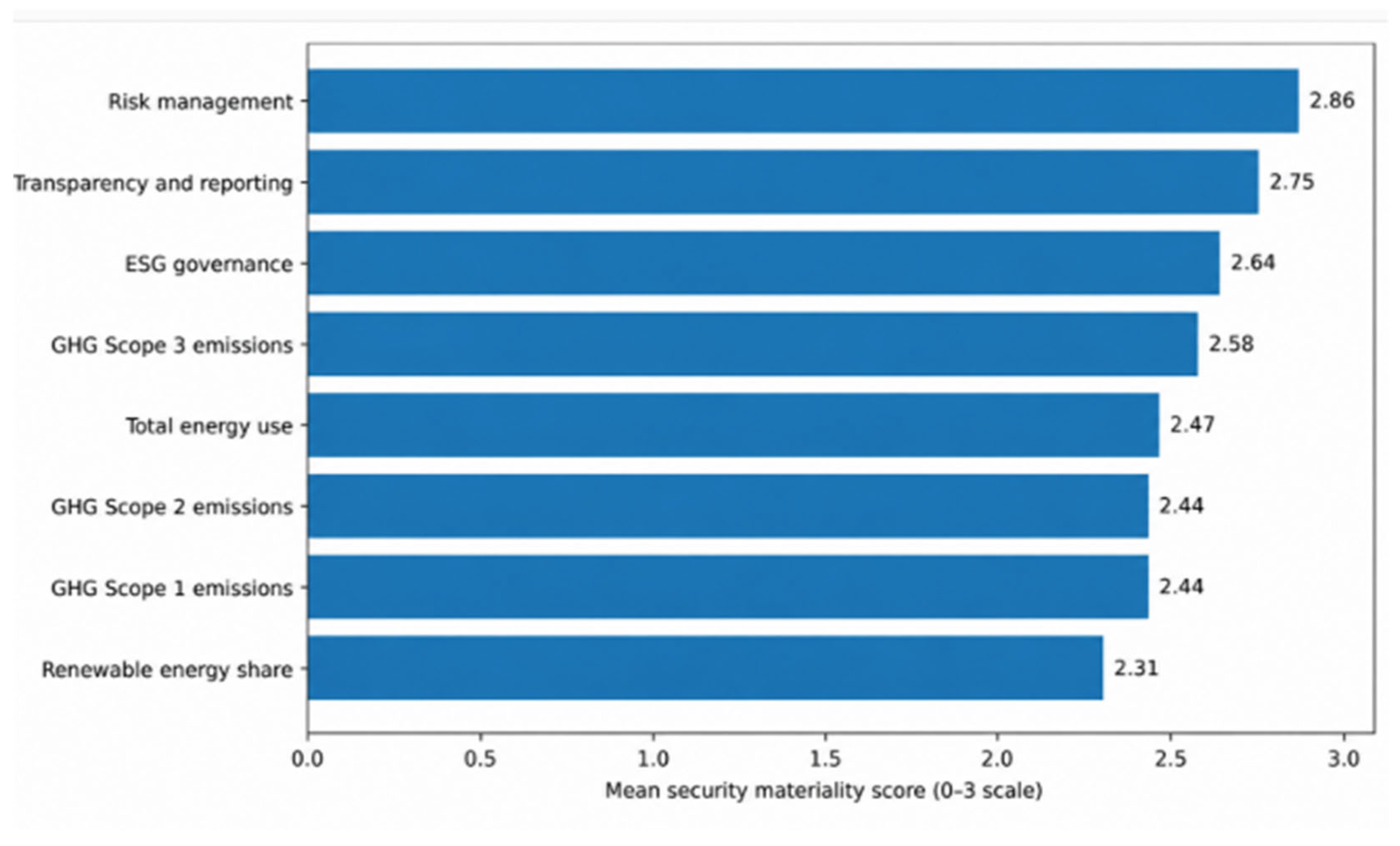
These findings demonstrate that environmental security depends not only on the disclosure of environmental metrics, but also on the governance systems through which sustainability risks are identified, monitored, controlled, and communicated. The prominence of risk management, transparency, and ESG governance indicates that reliable environmental-security analysis requires both substantive environmental data and robust institutional processes. At the same time, the high materiality of emissions and energy indicators contrasts with their comparatively weaker granularity and auditability. Missing, aggregated, or insufficiently traceable information in these areas may therefore limit organisations’ ability to assess climate exposure, energy dependence, resource vulnerability, infrastructure resilience, and pollution-related risks.
5. Discussion
The findings answer the three research questions by showing that ESG reporting in Bulgaria and Moldova is developing, but remains constrained by weak auditability, limited granularity and uneven digital readiness.
5.1. ESG Data Quality and Digital Readiness
The empirical results show that ESG data quality and digital readiness are two interdependent conditions for ESRS-aligned sustainability reporting. The analysed organisations from Bulgaria and Moldova increasingly disclose ESG-related information, but the presence of disclosure does not automatically imply that the information is sufficiently structured, granular, auditable or decision-useful. This distinction is particularly important under the CSRD/ESRS framework, where sustainability statements are expected to provide material, comparable, traceable and assurance-relevant information across environmental, social and governance dimensions [1,2,7].
The Data Gap Matrix results confirm that the main limitation is not the complete absence of ESG information, but its uneven usability. The overall availability score of 2.04 indicates that ESG indicators are generally present in the analysed reports, often through narrative explanations, selected quantitative indicators or partial metrics. However, the lower granularity score of 1.57 shows that many disclosures remain aggregated or insufficiently disaggregated by scope, entity, geography, activity, value-chain segment or reporting boundary. This limits their usefulness for ESRS-aligned reporting, where sustainability information must be connected to material impacts, risks, opportunities, policies, actions, targets and metrics.
Recent Bulgarian research similarly shows that CSRD-oriented sustainability reporting is moving toward more structured practices, while reporting maturity, implementation capacity, and the comparability of disclosed information remain uneven [24,25].
The weakest dimension is auditability, with a mean score of only 1.12. This is the most critical barrier to assurance-ready sustainability reporting. Under the CSRD, ESG information must be supported by traceable data sources, documented methodologies, internal controls, audit trails and verifiable evidence [1,6,7]. The low auditability score suggests that many disclosures in the sample describe ESG practices or present selected data, but do not provide sufficient methodological transparency to verify how the data were collected, calculated, validated or controlled. This finding confirms that the credibility of ESG reporting depends not only on external assurance, but also on the maturity of internal data systems and reporting processes [6,7].
The environmental indicators reveal this problem particularly clearly. They show high LCSA relevance and high environmental-security materiality, but weaker availability, granularity and auditability. Scope 3 emissions are the most problematic indicator: they are highly relevant for life-cycle assessment, value-chain analysis and transition-risk interpretation, but they show very low availability, granularity and auditability. This reflects the broader difficulty of collecting, verifying and reporting data beyond direct organisational boundaries [8]. Similar limitations appear in renewable-energy data and selected social indicators, where disclosures are often present but not sufficiently standardised, disaggregated or auditable.
Digital readiness is therefore a key precondition for transforming ESG disclosures into information that can support ESRS-aligned reporting, assurance and multiview Life Cycle Sustainability Assessment [5,14]. The ESG-DRI results show a moderate overall level of digital readiness, with a composite score of 2.20. This indicates that the organisations are not at an initial stage of ESG reporting development, but they have not yet reached a fully mature digital-reporting environment. The dimensional profile is especially important: organisational capacity records the highest score, at 2.34, while technological infrastructure and data governance both remain lower, at 2.13. This suggests that many organisations have ESG responsibilities, sustainability functions or strategic commitments, but their technological and procedural foundations are still less developed.
Evidence from Bulgaria also shows that digital tools can strengthen information-risk assessment and financial control, although their effectiveness depends on the quality of internal processes, control mechanisms, and data-governance arrangements [26,27].
Research on artificial-intelligence adoption and technology-driven changes in accounting similarly highlights the organisational and professional capabilities required for successful digital transformation [28,29].
The interaction between digitalisation, ESG reporting, and circular-economy information further reinforces the need for integrated and reusable sustainability data architectures [30].
This gap between organisational capacity and data infrastructure is central to the interpretation of the findings. Sustainability teams, policies and reporting routines can support ESG reporting, but they cannot compensate for fragmented data systems, weak audit trails, manual consolidation or insufficiently documented methodologies. Multiview LCSA requires structured and reusable data across environmental, economic and social dimensions. Environmental LCA depends on emissions, energy, material, waste and value-chain data; Life Cycle Costing requires reliable cost and resource-use information; and Social LCA requires consistent data on workers, communities, health and safety, diversity and stakeholder impacts. Such information cannot be effectively integrated when ESG data are dispersed across disconnected systems or disclosed only in narrative form [9,10,11,19].
The connection between the two empirical instruments is therefore important. Weak data governance at the organisation level is reflected in weak auditability at the indicator level. Conversely, stronger digital readiness increases the likelihood that ESG data will be structured, traceable and analytically usable. This confirms the conceptual argument of the study: ESG reporting quality depends not only on what organisations disclose, but also on whether they possess the digital and governance capacity to transform sustainability information into reliable, life-cycle-relevant and assurance-ready data.
Overall, the findings suggest that the transition toward ESRS-aligned reporting requires more than formal compliance with disclosure obligations. It requires stronger ESG data systems, methodological protocols, internal controls, audit trails and digital traceability. Without these foundations, sustainability reporting risks remaining partially descriptive and insufficiently usable for assurance, LCSA integration and environmental-security-oriented decision-making [1,2,5,6,7,14].
5.2. Country and Sectoral Differences
The comparative findings show that ESG reporting quality and digital readiness are strongly shaped by institutional context, regulatory alignment and administrative capacity. Bulgaria and Moldova are both situated within the broader European sustainability transition, but they occupy different positions in relation to the CSRD/ESRS reporting architecture. Bulgaria is an EU member state and is therefore directly embedded in the EU sustainability reporting framework. Moldova, by contrast, is an EU candidate country and an EU-aligned transition economy, where sustainability reporting and environmental-governance practices are developing through regulatory approximation, institutional reform and gradual modernisation [1,2,17].
This institutional distinction helps explain the stronger ESG digital readiness profile observed in the Bulgarian subsample. Bulgaria records a mean ESG-DRI score of 2.37, compared with 2.04 for Moldova. The difference is visible across all three dimensions: technological infrastructure, data governance and organisational capacity. The largest gap concerns technological infrastructure, suggesting that Bulgarian organisations more frequently disclose evidence of digital systems, structured ESG data capacity and integration of sustainability information into organisational reporting processes. This pattern is consistent with Bulgaria’s direct exposure to CSRD/ESRS implementation and the related pressure to formalise sustainability reporting, internal controls and assurance-ready data systems.
Moldova’s results, however, should not be interpreted as evidence of weak or absent ESG reporting capacity. Its mean ESG-DRI score remains within the medium-readiness range, and most Moldovan organisations in the sample are classified as medium-readiness entities. This indicates that Moldova is developing a recognisable ESG reporting base, although it remains less consistently mature than Bulgaria’s. The Moldovan case is particularly important because it shows how EU approximation, environmental-governance reforms and international support can gradually strengthen sustainability reporting capacity even before full integration into the EU regulatory framework.
The Data Gap Matrix adds further nuance to the country comparison. Bulgaria records stronger average scores for availability, auditability, LCSA relevance and environmental-security materiality, while Moldova shows a higher score for granularity. This is an important finding because it shows that stronger regulatory alignment does not automatically produce superiority in every dimension of ESG information quality. Moldova’s higher granularity reflects the presence of several detailed environmental, energy, carbon-footprint and public-sector reports in the analysed corpus. Thus, Moldova demonstrates emerging strengths in selected disclosure areas, even though its overall digital readiness remains lower.
The country comparison therefore supports a differentiated interpretation. Bulgaria appears closer to CSRD/ESRS-aligned digital reporting expectations, especially in terms of technological infrastructure and organisational ESG capacity. Moldova represents an emerging sustainability-reporting environment where regulatory convergence and institutional modernisation are gradually strengthening ESG data infrastructures. From the perspective of multiview LCSA and environmental security, this means that regulatory alignment matters, but it must be accompanied by concrete improvements in data systems, reporting procedures, audit trails and digital capacity. The broader importance of sustainability-oriented financial and institutional development in Bulgaria has also been identified in research on green finance and sustainable development [31].
Sectoral differences further demonstrate that ESG digital readiness and data-gap profiles vary according to organisational function, regulatory exposure and reporting traditions. The financial sector records the highest mean ESG-DRI score, at 2.31, followed by public-sector bodies and corporate entities. This suggests that financial institutions are more advanced in formalising ESG data governance, internal controls, risk-management procedures and organisational reporting capacity. Their stronger profile reflects the broader supervisory environment in which banks and financial institutions are increasingly expected to integrate ESG and climate-related risks into governance, disclosure and risk-management processes. At the organisational level, an explicit ESG strategy may strengthen stakeholder trust and sustainability commitment, while the capacity for environmental innovation remains dependent on technological, organisational, and external conditions [32,33].
At the same time, stronger ESG digital readiness in the financial sector does not necessarily mean stronger environmental life-cycle data. Financial institutions tend to perform well in governance, risk management, compliance and climate-risk framing, but their disclosures may be less developed in relation to operational environmental indicators such as direct emissions, energy use or renewable energy share. This distinction is important for LCSA-compatible reporting because financial-sector ESG maturity is often governance- and risk-oriented rather than based on direct environmental flows.
Corporate entities show a different pattern. Their mean ESG-DRI score of 2.17 indicates medium digital readiness, but the corporate sector is also the most heterogeneous group in the sample. This heterogeneity reflects differences in sectoral exposure, operational complexity, group-level reporting practices, resources and reporting maturity. Corporate entities are particularly important for multiview LCSA because they are more likely to generate operational data on emissions, energy, materials, waste, resource use and supply-chain impacts. However, the DGM results show that such data are not always sufficiently granular or auditable. Thus, corporate entities have strong potential for LCSA-relevant disclosure, but this potential is constrained by uneven data quality and limited assurance readiness. Sector-specific environmental evidence also confirms the analytical importance of examining emissions information together with economic development and organisational transition [34].
Public-sector bodies represent a third, analytically distinct group. Their mean ESG-DRI score of 2.18 places them close to corporate entities, but their readiness profile is different. Public-sector organisations often show strong policy and institutional relevance, but weaker technological infrastructure. Their reports may not follow conventional corporate ESG formats, yet they frequently contain information relevant to climate governance, energy regulation, environmental monitoring, infrastructure resilience and public accountability. This explains why public-sector documents may be highly relevant for environmental-security analysis, even when they are less aligned with standard corporate ESG indicators.
These sectoral patterns show that ESG reporting quality cannot be assessed through a single uniform lens. Financial institutions may have more mature governance systems, but less direct environmental life-cycle data. Corporate entities may provide more operational environmental information, but their auditability and granularity remain uneven. Public-sector bodies may lack standardised corporate ESG metrics, but they are highly relevant for environmental-security interpretation. Therefore, each sector contributes differently to the ESG–LCSA–environmental security framework.
Overall, the country and sectoral findings confirm that the transition toward LCSA-compatible and environmental-security-relevant ESG reporting depends not only on reporting standards, but also on the institutional and organisational conditions under which sustainability data are collected, governed and disclosed. Bulgaria’s stronger EU regulatory embeddedness supports more advanced ESG digital readiness, while Moldova demonstrates emerging but uneven reporting capacity. Across sectors, financial institutions appear strongest in governance readiness, corporate entities are central for environmental operational data, and public-sector bodies are particularly important for environmental-security and policy-related information. This reinforces the need for sector-sensitive ESG reporting guidance, digital capacity-building and stronger data-governance mechanisms adapted to the specific roles of corporate, financial and public-sector organisations.
5.3. Implications for Multiview LCSA Integration
The empirical results show that the ESG indicators disclosed by the organisations in the Bulgaria–Moldova sample provide a partial but uneven basis for multiview Life Cycle Sustainability Assessment (LCSA) integration. In this study, multiview LCSA is not applied as a full product- or process-level assessment. Rather, it is used as an analytical perspective for evaluating whether publicly disclosed ESG indicators are sufficiently available, granular, auditable, and relevant for future life-cycle-based interpretation. This analytical positioning is consistent with the established understanding of LCSA as an integrated framework combining environmental LCA, Life Cycle Costing, and Social LCA, while recognising that its practical implementation remains constrained by differences in methodological maturity, indicator selection, system boundaries, data availability, and comparability across the three sustainability dimensions [10,35].
The results indicate that the strongest potential for LCSA integration lies in the environmental indicators. This group records the highest mean LCSA relevance score, at 2.48 on a 0–3 scale. GHG Scope 1, Scope 2, and Scope 3 emissions, together with total energy use, represent the ESG indicators most directly applicable to environmental LCA, climate-impact assessment, and value-chain interpretation. Their analytical importance reflects the life-cycle principle that environmental assessment should extend beyond direct organisational operations to include purchased energy and upstream and downstream value-chain effects. This interpretation is consistent with research emphasising that scientifically robust carbon-neutrality assessment requires complete life-cycle coverage, including Scope 3 emissions [36].
At the same time, the environmental indicators reveal the principal constraint to practical LCSA integration. Although their mean LCSA relevance is high, their auditability remains weak, with an average score of 0.96. Scope 3 emissions present the clearest example of this mismatch, combining high life-cycle relevance with an auditability score of only 0.44. Measuring Scope 3 emissions requires information from multiple upstream and downstream actors and is frequently affected by incomplete data, inconsistent methodologies, limited supplier cooperation, and weak control over data generated outside the reporting organisation. Previous research similarly identifies data availability, methodological inconsistency, and the complexity of multinational value chains as major barriers to reliable Scope 3 measurement [37]. The results therefore show that the most conceptually relevant environmental indicators are not necessarily the most operationally mature or verifiable inputs for LCA integration.
These findings are summarised in Table 3, which compares the mean LCSA relevance of the environmental, social, and governance indicator groups and clarifies their respective contribution to multiview LCSA integration.
The social indicators make a more moderate contribution to multiview LCSA, with a mean LCSA relevance score of 1.68. Community engagement, training and employee development, and health and safety are relevant to Social Life Cycle Assessment because they reflect workforce conditions, human-capital development, occupational well-being, community effects, and stakeholder-related sustainability impacts. However, their analytical usefulness is constrained by weak auditability, inconsistent granularity, and the frequent use of narrative or aggregated disclosures. These limitations are consistent with the broader methodological challenges of Social LCA, where indicator selection, data availability, context dependence, qualitative assessment, and comparability across locations and life-cycle stages remain difficult to standardise [38,39]. Consequently, the analysed social disclosures provide useful evidence of organisational practices, but they cannot always be translated directly into systematic and comparable SLCA inventory inputs.
Governance indicators have an average LCSA relevance score of 2.01, but their contribution to multiview LCSA is primarily enabling and procedural rather than inventory-based. ESG governance, risk management, transparency, and reporting practices do not usually provide direct environmental LCA, LCC, or SLCA inputs. Instead, they determine whether sustainability data are assigned to responsible owners, collected through documented procedures, validated through internal controls, and supported by traceable evidence. This interpretation is consistent with research emphasising that sustainability data governance connects strategic planning, process ownership, data-quality controls, risk management, and verifiable reporting [40]. Greater transparency and traceability across the supply chain can also improve the reliability, integrity, and usability of life-cycle information [41]. Governance indicators should therefore not be treated as substitutes for environmental, economic, or social inventory data; rather, they constitute enabling conditions that strengthen the credibility and analytical usability of ESG information for multiview LCSA.
The weakest component of multiview LCSA integration is the economic dimension represented by Life Cycle Costing. The indicators included in the Data Gap Matrix provide only indirect evidence relevant to LCC-oriented interpretation. Energy use, renewable energy share, risk management, and governance disclosures may indicate potential cost exposure, operational efficiency, transition risk, or resource dependency, but they cannot substitute for explicit monetary data. A comprehensive LCC analysis requires clearly defined system boundaries and dedicated information on acquisition, operation, maintenance, compliance, externality-related, and end-of-life costs across the relevant life-cycle stages and organisational actors. These methodological requirements are well established in the LCC literature, which emphasises the need to align economic and environmental system boundaries while maintaining transparent cost categories and assumptions [42,43]. Because the present dataset does not contain dedicated life-cycle expenditure, maintenance-cost, end-of-life-cost, or product-level cost-flow indicators, the findings support only a preliminary LCC-oriented interpretation rather than a full assessment of economic life-cycle performance.
The results therefore indicate an asymmetrical form of multiview LCSA readiness. Environmental LCA receives the strongest support, particularly through emissions and energy indicators, whereas Social LCA is supported only partially through workforce-, health-, diversity-, and community-related disclosures. The economic dimension receives the weakest direct support because the analysed ESG reports rarely contain explicit life-cycle cost data. This imbalance reflects the uneven methodological and informational maturity of the three LCSA components rather than differences in their conceptual importance. Environmental LCA is supported by comparatively established methods, standards, and inventory structures, while the economic and social dimensions continue to face greater difficulties concerning indicator consistency, system boundaries, data availability, contextual interpretation, and comparability [10,44]. The findings consequently suggest that comprehensive multiview LCSA integration requires not only broader ESG disclosure, but also more balanced development of environmental, economic, and social life-cycle datasets.
From the perspective of CSRD/ESRS-aligned reporting, these findings demonstrate that standardised sustainability disclosures do not automatically generate LCSA-ready datasets. The ESRS framework can expand the scope, consistency, and digital structuring of ESG information, but practical life-cycle integration additionally requires clearly defined system boundaries, interoperable primary data, methodological documentation, traceability across value-chain actors, and procedures for validating information obtained from external sources. Digital technologies can facilitate data collection, storage, exchange, processing, and traceability, thereby improving the potential usability of ESG information for life-cycle assessment. However, their effectiveness depends on organisational resources, data-governance arrangements, stakeholder participation, and willingness to exchange sufficiently detailed information across the value chain [15,45]. Consequently, CSRD/ESRS reporting can provide an important information infrastructure for multiview LCSA, but it cannot replace the dedicated environmental, economic, and social inventories required for a comprehensive life-cycle assessment.
Overall, the ESG disclosures examined in Bulgaria and Moldova provide a meaningful starting point for multiview LCSA integration, but not yet a sufficiently mature information base for comprehensive environmental, economic, and social life-cycle assessment. The principal opportunity lies in the comparatively high LCSA relevance of environmental and governance indicators, whereas the main constraints concern weak auditability, insufficient granularity, uneven Scope 3 disclosure, limited standardisation of social indicators, and the absence of explicit LCC-oriented data. Increasing the volume of sustainability disclosure alone would therefore be insufficient. Progress toward LCSA-compatible reporting also requires systematic data-quality assessment, clearly documented sources and methodologies, transparent reporting boundaries, traceable metadata, and explicit evaluation of whether particular datasets are fit for the intended analytical purpose. This conclusion is consistent with research emphasising that the creation, management, assessment, and appropriate use of data-quality information are essential for reliable LCA interpretation and decision-making [46]. Future improvements should consequently strengthen not only disclosure coverage, but also digital traceability, methodological transparency, data-quality controls, and the explicit mapping of ESG indicators to environmental LCA, LCC, and SLCA requirements.
5.4. Environmental-Security Implications of ESG Data Gaps
The findings of this study demonstrate that ESG data gaps have implications that extend beyond technical reporting quality. When information on emissions, energy use, resource efficiency, risk management, infrastructure exposure, or pollution prevention is absent, insufficiently granular, or poorly auditable, organisations and public institutions face a reduced capacity to identify, assess, and manage environmental-security risks. This broader interpretation is consistent with research linking climate change to human security, institutional stability, societal resilience, and public health [47,48]. Climate change, energy disruption, resource dependency, infrastructure vulnerability, and pollution should therefore be treated not merely as environmental concerns, but as interconnected risks affecting economic stability, public health, institutional resilience, and sustainable development.
The Data Gap Matrix confirms the environmental-security relevance of ESG reporting. The overall mean score for environmental-security materiality is 2.24 on a 0–3 scale, which is higher than the corresponding scores for availability, granularity, and auditability. This indicates that many ESG indicators are highly relevant to environmental-security analysis even when the quality of the disclosed information remains incomplete. The most security-material indicators are risk management (2.86), transparency and reporting practices (2.75), ESG governance structure (2.64), GHG Scope 3 emissions (2.58), total energy use (2.47), Scope 1 and Scope 2 emissions (2.44 each), and renewable energy share (2.31). These findings reveal a significant mismatch between information materiality and reporting quality. This interpretation is consistent with evidence that the usefulness of mandatory sustainability reporting depends on implementation, comparability, enforcement, information quality, and appropriate governance mechanisms [49,50].
The climate-related implications are the most direct. Reliable ESG information on emissions, energy use, climate-risk governance, adaptation measures, and transition planning is necessary for assessing organisational exposure and resilience. In the present study, the weak auditability of environmental indicators, particularly Scope 3 emissions, suggests that organisations may struggle to provide decision-useful evidence on value-chain emissions, climate-transition risks, and long-term adaptation capacity. This finding is important because institutional investors perceive physical and transition risks as financially material and increasingly demand more detailed and credible climate-risk disclosure [51,52]. Weakly traceable climate information may therefore limit both internal risk management and external stakeholders’ capacity to evaluate climate exposure and transition readiness.
Energy security represents a second major implication. Energy-related indicators are among the most security-material variables in the dataset: total energy use records a score of 2.47, while renewable energy share reaches 2.31. These indicators are essential for assessing exposure to energy dependency, price volatility, supply disruption, fossil-fuel reliance, and decarbonisation pressures. Energy security is inherently multidimensional and includes the availability, affordability, reliability, technological development, governance, and environmental sustainability of energy systems [53]. When energy data are aggregated, inconsistently reported, or weakly auditable, organisations and regulators have a limited capacity to evaluate resilience to energy-system disruptions and the economic consequences of the low-carbon transition.
Resource efficiency and infrastructure vulnerability are also directly affected by ESG data quality. Weak information on energy use, material flows, waste, circularity, pollution prevention, and environmental controls can obscure organisational dependencies on resource-intensive production and consumption models. Circular-economy research emphasises the importance of reducing resource inputs, closing material loops, minimising waste, and strengthening system-level sustainability [54]. Similarly, incomplete information on risk management, governance, and transparency may reduce the ability to identify infrastructure vulnerabilities related to climate hazards, energy disruption, water stress, pollution, or extreme weather events. Climate-adaptation research demonstrates that infrastructure and institutional decisions must remain robust under uncertain future conditions [55]. In this sense, weak ESG data can conceal systemic resource and infrastructure dependencies, thereby limiting both organisational sustainability management and broader public environmental governance.
The governance results are particularly important. The fact that risk management, transparency, and ESG governance rank above most environmental indicators in terms of security materiality shows that environmental security is not determined only by environmental metrics. It also depends on the institutional systems through which such data are collected, validated, controlled, disclosed, and used. A reported emissions figure has limited analytical value when the organisation lacks clearly assigned risk ownership, internal controls, traceable methodologies, audit trails, or transparent reporting procedures. Conversely, stronger governance arrangements can improve the credibility and decision usefulness of environmental information even when certain indicators remain incomplete. The findings therefore support the conclusion that environmental data quality and governance capacity are inseparable, which is consistent with evidence that sustainable corporate governance contributes to higher-quality mandatory sustainability reporting [50].
For Bulgaria and Moldova, these findings have specific implications. Bulgaria’s stronger ESG digital-readiness profile suggests a greater disclosed capacity to generate structured and traceable sustainability information within the CSRD/ESRS reporting environment. Moldova’s results indicate emerging but uneven readiness, including several comparatively strong cases in environmental, energy, financial, and public-sector reporting. These differences should nevertheless be interpreted cautiously because the analysis measures publicly disclosed reporting capacity rather than complete internal information systems. In both countries, weak auditability and uneven granularity remain substantial constraints. Consequently, environmental-security-relevant information may be present without being fully assurance-ready, machine-readable, or sufficiently structured for automated analysis and multiview LCSA integration.
Overall, the environmental-security implications of the study can be summarised in three principal findings. First, weak ESG data reduce the capacity to assess climate-, energy-, resource-, infrastructure-, and pollution-related risks. Second, the indicators with the highest security materiality include both environmental and governance variables, confirming that substantive sustainability information and institutional control mechanisms must be considered together. Third, the transition toward CSRD/ESRS-aligned reporting should be understood not only as a regulatory compliance exercise, but also as an information infrastructure for environmental-risk governance and institutional resilience. The value of sustainability disclosure therefore depends not merely on the quantity of reported information, but on whether the underlying data are sufficiently granular, traceable, comparable, and auditable to support risk-informed and life-cycle-oriented decision-making.
5.5. Contributions of the Study
This study makes theoretical, methodological and practical contributions to the literature on CSRD/ESRS implementation, ESG digitalisation, multiview Life Cycle Sustainability Assessment (LCSA) and environmental-security-oriented sustainability reporting. Its main contribution lies in integrating these domains into a single empirical framework. Rather than treating ESG reporting, digital readiness, LCSA and environmental security as separate research areas, the article demonstrates that they are closely interdependent: ESG reporting quality depends on digital data infrastructures; LCSA integration depends on the availability and auditability of ESG indicators; and environmental-security assessment depends on reliable sustainability information related to climate, energy, resources, infrastructure and pollution [10,14,35,40].
The theoretical contribution of the study is that it extends the CSRD/ESRS reporting debate beyond formal compliance and the mere presence of disclosure. The findings show that ESG information may be present in sustainability reports, but still insufficiently granular, weakly auditable or analytically limited. The Data Gap Matrix confirms this distinction: availability reaches 2.04, while granularity is lower, at 1.57, and auditability is the weakest dimension, at 1.12. This demonstrates that the key challenge of ESRS-aligned reporting is not only whether organisations disclose ESG information, but whether such information is sufficiently structured, traceable and verifiable to support assurance, digital reporting and decision-making [6,7,49,50].
The study also contributes theoretically by linking ESG data quality with multiview LCSA and environmental security. The results show that environmental indicators have the highest LCSA relevance, especially emissions and energy-related indicators, while social indicators provide a more limited basis for Social LCA and governance indicators contribute indirectly through risk management, transparency and data reliability. At the same time, the environmental-security materiality results show that weak ESG data are not merely technical reporting deficiencies. They may also reduce the capacity of organisations and public institutions to identify and manage climate-, energy-, resource-, infrastructure- and pollution-related risks.
The methodological contribution lies in the development and application of two complementary empirical instruments: the ESG Digital Readiness Index and the Data Gap Matrix. The ESG-DRI assesses organisation-level readiness through technological infrastructure, data governance and organisational capacity. The DGM evaluates indicator-level ESG data quality through availability, granularity, auditability, LCSA relevance and environmental-security materiality. Together, these instruments make it possible to distinguish between the existence of ESG disclosure, the maturity of digital reporting capacity and the actual usability of ESG data for assurance, LCSA integration and risk-oriented sustainability analysis.
The practical contribution is relevant for organisations, regulators, auditors and policymakers. For organisations, the findings indicate that improving sustainability reporting requires stronger ESG data systems, clearer data responsibilities, internal controls, audit trails and methodological documentation. For policymakers and regulators, the comparison between Bulgaria and Moldova shows that regulatory alignment matters, but institutional capacity and digital infrastructure also strongly influence ESG reporting maturity. For auditors and assurance providers, the results identify auditability as the most critical weakness, which confirms the need for traceable evidence, reliable methodologies and documented controls before sustainability information can fully support assurance engagements within the CSRD and ISSA 5000 assurance framework [1,2,6]. The expanding role of accountants in sustainability reporting also requires corresponding changes in professional competencies, accounting practice and accounting education [56,57].
Overall, the study contributes by showing that the future of ESG reporting depends on the quality of the underlying data infrastructure. CSRD/ESRS compliance, digital reporting, LCSA integration and environmental-security governance all require ESG information that is not only disclosed, but also available, granular, auditable, digitally structured and analytically useful. This integrated perspective supports the interpretation of sustainability reporting as a data-governance system rather than merely a disclosure exercise [14,40].
6. Conclusions
This study examined ESG data gaps, digital readiness, multiview LCSA integration potential and environmental-security relevance in a comparative sample of 36 organisations from Bulgaria and Moldova. The empirical analysis was based on two complementary instruments: the ESG Digital Readiness Index (ESG-DRI) and the Data Gap Matrix (DGM). Together, these instruments made it possible to assess both organisation-level digital readiness and indicator-level ESG data quality.
The results show that the analysed organisations demonstrate a moderate level of ESG digital readiness. The mean ESG-DRI score for the full sample is 2.20 on a 0–3 scale. This indicates that the organisations are no longer at an initial stage of ESG reporting development, but they have not yet reached a fully mature, consistently implemented, machine-readable and assurance-ready sustainability reporting environment. The strongest ESG-DRI dimension is organisational capacity (2.34), while technological infrastructure and data governance both record lower mean values of 2.13. This suggests that ESG responsibilities, sustainability functions and strategic commitments are developing faster than the underlying digital systems, audit trails and formal data-governance mechanisms required for ESRS-aligned reporting.
The country comparison shows that Bulgaria has a stronger ESG digital readiness profile than Moldova. The mean ESG-DRI score for Bulgaria is 2.37, compared with 2.04 for Moldova. Bulgaria performs better across technological infrastructure, data governance and organisational capacity, which may partly reflect its position as an EU member state directly exposed to CSRD/ESRS implementation [1,2]. Moldova, however, also remains within the medium-readiness range, indicating an emerging ESG reporting capacity, although the disclosed evidence is less consistent and includes fewer high-readiness cases.
The sectoral results reveal further differences. Financial institutions show the highest ESG-DRI score (2.31), followed by public-sector bodies (2.18) and corporate entities (2.17). Financial institutions appear stronger in data governance, compliance and risk-management structures. Corporate entities are especially important for operational environmental data, while public-sector bodies demonstrate high environmental-security relevance, particularly in relation to climate governance, energy regulation, infrastructure and public accountability. These findings indicate that ESG reporting maturity depends not only on national context, but also on sectoral function, regulatory exposure and organisational capacity.
The Data Gap Matrix results show that ESG information is generally present, but its analytical quality remains uneven. Across 540 indicator-level observations, the average score for availability is 2.04, indicating that ESG indicators are often disclosed in some form. However, the mean granularity score is only 1.57, and auditability is the weakest dimension, with a mean score of 1.12. This means that ESG data are frequently disclosed in narrative, aggregated or partially quantitative form, but are less often supported by detailed breakdowns, clear methodologies, internal controls, audit trails or external assurance.
The findings also show that the disclosed ESG indicators are relevant for multiview LCSA and environmental-security analysis, even when their reporting quality remains limited. The mean score for LCSA relevance is 2.06, while environmental-security materiality reaches 2.24. Environmental indicators show the strongest mismatch between relevance and data quality: they have high LCSA relevance (2.48) and high environmental-security materiality (2.45), but relatively low availability, granularity and auditability. The most critical gap concerns GHG Scope 3 emissions, which are highly relevant for value-chain analysis and life-cycle assessment, but remain weakly available, insufficiently granular and poorly auditable.
The social and governance indicators follow different patterns. Social indicators are moderately available, but remain weakly auditable and less standardised, which limits their usefulness for Social LCA. Governance indicators perform better overall, especially in relation to ESG governance, risk management and transparency. The highest environmental-security materiality scores are associated with risk management, transparency and reporting practices, ESG governance, Scope 3 emissions and energy-related indicators. This confirms that environmental security depends not only on environmental metrics, but also on the governance systems through which ESG data are produced, controlled and disclosed.
Overall, the results support the central argument of the study: the main challenge is not simply the absence of ESG disclosure, but the limited quality, structure, granularity and auditability of the disclosed information. ESG reporting in Bulgaria and Moldova is moving toward greater sustainability transparency, but the transition toward CSRD/ESRS-aligned, digitally structured, assurance-ready and LCSA-compatible reporting remains incomplete. Strengthening ESG data systems, improving audit trails, increasing methodological transparency and connecting ESG indicators with life-cycle and environmental-security analysis are therefore essential next steps [1,2,10,35].
The practical implications are clear. Organisations should move from narrative ESG disclosure toward data-governed sustainability reporting [14,40]. This requires integrated ESG information systems, clearer data responsibilities, internal controls, documented methodologies, audit trails and stronger digital traceability. ESG data should not be collected only through fragmented spreadsheets, ad hoc departmental inputs or descriptive reporting narratives. Instead, sustainability information should be structured in a way that supports ESRS compliance, assurance, internal decision-making, multiview LCSA and environmental-security-oriented risk management [2,5,6,10,35].
For policymakers and regulators, the findings highlight the need for practical guidance, digital disclosure infrastructure and assurance-readiness support [5,6,18]. Regulatory alignment alone is not sufficient if organisations lack the capacity to produce granular, traceable and verifiable sustainability data. This is particularly important for EU-aligned transition economies such as Moldova, where regulatory convergence should be accompanied by technical assistance, capacity-building, training, pilot reporting projects and accessible digital tools. Public-sector reporting also requires adapted sustainability-reporting templates that preserve its policy and environmental-security relevance while improving comparability, transparency and digital usability.
The study has several limitations. First, it relies exclusively on publicly available documents, which means that the results assess disclosed ESG information rather than the full internal sustainability-management capacity of organisations. Second, the ESG-DRI and DGM are based on ordinal scoring, which supports structured comparison but should not be interpreted as a precise measurement of actual ESG performance. Third, the document corpus includes heterogeneous report types, including sustainability reports, integrated reports, non-financial statements, ESG disclosures and public-sector documents. Fourth, in some cases, group-level or consolidated disclosures were used where entity-specific reports were unavailable, which may reduce granularity. Fifth, the cross-sectional design captures the early CSRD/ESRS transition period and does not allow for longitudinal conclusions.
Future research should extend the analysis in several directions. Larger and more diversified samples could test the robustness of the ESG-DRI and DGM across additional EU member states, EU candidate countries, transition economies and sector-specific contexts. Longitudinal studies could examine whether ESG data availability, granularity, auditability and digital readiness improve as CSRD/ESRS implementation progresses. Future studies could also map the Data Gap Matrix more directly to the full ESRS datapoint structure and the ESRS XBRL taxonomy [5,18]. In addition, sector-specific LCSA models, assurance-focused ESG data studies and primary research based on interviews or surveys could provide deeper insight into internal ESG data systems, reporting workflows and assurance preparation.
In conclusion, the future of ESG reporting depends on the quality of the underlying data infrastructure. CSRD/ESRS compliance, digital reporting, sustainability assurance, multiview LCSA integration and environmental-security governance all require ESG information that is not only disclosed, but also available, granular, auditable, digitally structured and analytically useful. This study therefore supports the interpretation of sustainability reporting as a data-governance system rather than merely a disclosure exercise [14,40].
Supplementary Materials
The following supporting information can be downloaded at the website of this paper posted on Preprints.org, File S1: ESG Digital Readiness Index and Data Gap Matrix Dataset for Bulgaria and Moldova. The Excel workbook contains the coding framework, organisational metadata, ESG-DRI raw scores and summaries, 540 indicator-level Data Gap Matrix observations, supporting evidence, page references, source URLs, and aggregated results.
Author Contributions
Conceptualization, R.K.-H. and L.D.; methodology, R.K.-H.; software, R.K.-H.; validation, R.K.-H. and L.D.; formal analysis, L.D.; investigation, L.D.; resources, L.D.; data curation, R.K.-H.; writing—original draft preparation, R.K.-H. and L.D.; writing—review and editing, R.K.-H. and L.D.; visualization, R.K.-H.; supervision, L.D.; project administration, R.K.-H. and L.D.; funding acquisition, R.K.-H. All authors have read and agreed to the published version of the manuscript.
Funding
This research received no external funding.
Institutional Review Board Statement
Not applicable.
Informed Consent Statement
Not applicable.
Data Availability Statement
The data supporting the findings of this study are available in the Supplementary Material, File S1. The workbook contains the coding framework, organisation-level metadata, ESG Digital Readiness Index scores, 540 indicator-level Data Gap Matrix observations, evidence excerpts, page references, source URLs, and aggregated summaries. The underlying sustainability reports and public-sector documents are publicly available through the URLs provided in the workbook.
Acknowledgments
This article is based upon work from COST Action CA23157, European Network for Multiple View Life Cycle Sustainability Assessment (MultiViewLCSA), supported by COST (European Co-operation in Science and Technology).
Conflicts of Interest
The authors declare no conflicts of interest.
References
- European Parliament; Council of the European Union. Directive (EU) 2022/2464 of the European Parliament and of the Council of 14 December 2022 Amending Regulation (EU) No. 537/2014, Directive 2004/109/EC, Directive 2006/43/EC and Directive 2013/34/EU, as Regards Corporate Sustainability Reporting. Off. J. Eur. Union 2022, L 322, 15–80. Available online: https://eur-lex.europa.eu/eli/dir/2022/2464/oj (accessed on 18 June 2026).
- European Commission. Commission Delegated Regulation (EU) 2023/2772 of 31 July 2023 Supplementing Directive 2013/34/EU of the European Parliament and of the Council as Regards Sustainability Reporting Standards. Off. J. Eur. Union 2023, L 2023/2772. Available online: https://eur-lex.europa.eu/eli/reg_del/2023/2772/oj (accessed on 18 June 2026).
- Hąbek, P.; Wolniak, R. Assessing the Quality of Corporate Social Responsibility Reports: The Case of Reporting Practices in Selected European Union Member States. Qual. Quant. 2016, 50, 399–420. [Google Scholar] [CrossRef] [PubMed]
- Baumüller, J.; Grbenic, S.O. Moving from Non-Financial to Sustainability Reporting: Analyzing the EU Commission’s Proposal for a Corporate Sustainability Reporting Directive (CSRD). Facta Univ. Ser. Econ. Organ. 2021, 18, 369–381. [Google Scholar] [CrossRef]
- European Financial Reporting Advisory Group. ESRS Set 1 XBRL Taxonomy; EFRAG: Brussels, Belgium, 2024; Available online: https://www.efrag.org/en/projects/esrs-xbrl-taxonomy/concluded (accessed on 18 June 2026).
- International Auditing and Assurance Standards Board. International Standard on Sustainability Assurance 5000: General Requirements for Sustainability Assurance Engagements; IAASB: New York, NY, USA, 2024; Available online: https://www.iaasb.org/publications/international-standard-sustainability-assurance-5000-general-requirements-sustainability-assurance (accessed on 18 June 2026).
- Boiral, O.; Heras-Saizarbitoria, I.; Brotherton, M.-C. Professionalizing the Assurance of Sustainability Reports: The Auditors’ Perspective. Account. Audit. Account. J. 2020, 33, 309–334. [Google Scholar] [CrossRef]
- Beck, J.; Steinberg, A.; Dimmelmeier, A.; Domenech Burin, L.; Kormanyos, E.; Fehr, M.; Schierholz, M. Addressing Data Gaps in Sustainability Reporting: A Benchmark Dataset for Greenhouse Gas Emission Extraction. Sci. Data 2025, 12, 1497. [Google Scholar] [CrossRef] [PubMed]
- Klöpffer, W. Life Cycle Sustainability Assessment of Products. Int. J. Life Cycle Assess. 2008, 13, 89–95. [Google Scholar] [CrossRef]
- Finkbeiner, M.; Schau, E.M.; Lehmann, A.; Traverso, M. Towards Life Cycle Sustainability Assessment. Sustainability 2010, 2, 3309–3322. [Google Scholar] [CrossRef]
- Valdivia, S.; Backes, J.G.; Traverso, M.; Sonnemann, G.; Cucurachi, S.; Guinée, J.B.; Schaubroeck, T.; Finkbeiner, M.; Leroy-Parmentier, N.; Ugaya, C.; Peña, C.; Zamagni, A.; Inaba, A.; Amaral, M.; Berger, M.; Dvarioniene, J.; Vakhitova, T.; Benoit-Norris, C.; Prox, M.; Foolmaun, R.; Goedkoop, M. Principles for the Application of Life Cycle Sustainability Assessment. Int. J. Life Cycle Assess. 2021, 26, 1900–1905. [Google Scholar] [CrossRef]
- United Nations Development Programme. Human Development Report 1994: New Dimensions of Human Security; Oxford University Press: New York, NY, USA, 1994. [Google Scholar] [CrossRef]
- European Environment Agency. European Climate Risk Assessment; EEA Report No. 01/2024; Publications Office of the European Union: Luxembourg, Luxembourg, 2024. [Google Scholar] [CrossRef]
- Pizzi, S.; Mastroleo, G.; Venturelli, A.; Caputo, F. The Digitalization of Sustainability Reporting Processes: A Conceptual Framework. Bus. Strategy Environ. 2024, 33, 1040–1050. [Google Scholar] [CrossRef]
- Popowicz, M.; Katzer, N.J.; Kettele, M.; Schöggl, J.-P.; Baumgartner, R.J. Digital Technologies for Life Cycle Assessment: A Review and Integrated Combination Framework. Int. J. Life Cycle Assess. 2025, 30, 405–428. [Google Scholar] [CrossRef]
- European Banking Authority. Report on Data Availability and Feasibility of Common Methodology for ESG Exposures; EBA/REP/2025/06; European Banking Authority: Paris, France, 2025; Available online: https://www.eba.europa.eu/sites/default/files/2025-02/6a3ca030-8911-42d8-8817-b99f6ea109b4/Report%20on%20data%20availability%20and%20feasibility%20of%20common%20methodology%20for%20ESG%20exposures.pdf (accessed on 18 June 2026).
- Diaconu, L.; Krastev, B.; Georgieva, E.; Krasteva-Hristova, R. Environmental Auditing, Public Finance, and Risk: Evidence from Moldova and Bulgaria. J. Risk Financ. Manag. 2025, 18, 683. [Google Scholar] [CrossRef]
- European Financial Reporting Advisory Group. EFRAG IG 3: List of ESRS Datapoints; EFRAG: Brussels, Belgium, 2024; Available online: https://www.efrag.org/en/projects/esrs-implementation-guidance-documents (accessed on 18 June 2026).
- United Nations Environment Programme; Society of Environmental Toxicology and Chemistry. Towards a Life Cycle Sustainability Assessment: Making Informed Choices on Products; UNEP/SETAC Life Cycle Initiative: Paris, France, 2011; Available online: https://www.unep.org/resources/report/towards-life-cycle-sustainability-assessment-making-informed-choices-products (accessed on 18 June 2026).
- Intergovernmental Panel on Climate Change. Climate Change 2022: Impacts, Adaptation and Vulnerability; Pörtner, H.-O., Roberts, D.C., Tignor, M., Poloczanska, E.S., Mintenbeck, K., Alegría, A., Craig, M., Langsdorf, S., Löschke, S., Möller, V., Okem, A., Rama, B., Eds.; Cambridge University Press: Cambridge, UK, 2022. [Google Scholar] [CrossRef]
- Creswell, J.W.; Plano Clark, V.L. Designing and Conducting Mixed Methods Research, 3rd ed.; SAGE Publications: Thousand Oaks, CA, USA, 2017. [Google Scholar]
- Krippendorff, K. Content Analysis: An Introduction to Its Methodology, 4th ed.; SAGE Publications: Thousand Oaks, CA, USA, 2019. [Google Scholar]
- Bowen, G.A. Document Analysis as a Qualitative Research Method. Qual. Res. J. 2009, 9, 27–40. [Google Scholar] [CrossRef]
- Papradanova, D.; Kostova, S.; Vechev, V. Sustainability Reporting in Bulgaria: An Overview of Reporting Practices in Bulgarian Companies. In Corporate Sustainability Reporting in Central and Eastern European Companies; Routledge: London, UK, 2025; pp. 21–39. [Google Scholar] [CrossRef]
- Petrova, P. Accounting for Impacts: Exploring Sustainability Reporting in Bulgarian Companies under the CSRD. Proc. Int. Conf. Bus. Excell. 2024, 18, 2172–2182. [Google Scholar] [CrossRef]
- Kostova, S.; Zhelev, Z. Application of Digital Tools Assessing Information Risk in the Control Activity. Naše Gospod. Our Econ. 2024, 70, 24–31. [Google Scholar] [CrossRef]
- Zhelev, Z.; Kostova, S. Investigating the Application of Digital Tools for Information Management in Financial Control: Evidence from Bulgaria. J. Risk Financ. Manag. 2024, 17, 165. [Google Scholar] [CrossRef]
- Chipriyanova, G.; Chipriyanov, M.; Luchkov, K. Investigation and Analysis of Attitudes towards the Implementation of Artificial Intelligence in Internal Business Processes. Environ. Technol. Resour. Proc. Int. Sci. Pract. Conf. 2024, 2, 61–67. [Google Scholar] [CrossRef]
- Pavlova, M.; Petrova, R. The Emerging Changes in the Accounting Profession and the Accounting Practice under the Influence of Technology. Econ. Arch. 2023, 1, 24–40. [Google Scholar] [CrossRef]
- Krasteva-Hristova, R.; Moneva, I. Digitalization, ESG Reporting, and Circular Economy: Accounting Challenges for Women-Led SMEs. World 2026, 7, 91. [Google Scholar] [CrossRef]
- Krastev, B.; Krasteva-Hristova, R. Challenges and Trends in Green Finance in the Context of Sustainable Development—A Bibliometric Analysis. J. Risk Financ. Manag. 2024, 17, 301. [Google Scholar] [CrossRef]
- Kulova, I.; Nikolova-Alexieva, V. ESG Strategy: Pivotal in Cultivating Stakeholder Trust and Ensuring Customer Loyalty. E3S Web Conf. 2023, 462, 03035. [Google Scholar] [CrossRef]
- Nikolova-Alexieva, V.; Alexieva, I.; Valeva, K.; Petrova, M. Model of the Factors Affecting the Eco-Innovation Activity of Bulgarian Industrial Enterprises. Risks 2022, 10, 178. [Google Scholar] [CrossRef]
- Georgieva, V. Analysis of Agricultural Emissions and Economic Growth in Europe in Search of Ecological Balance. Open Agric. 2024, 9, 1–16. [Google Scholar] [CrossRef]
- Backes, J.G.; Traverso, M. Life Cycle Sustainability Assessment—A Survey Based Potential Future Development for Implementation and Interpretation. Sustainability 2021, 13, 13688. [Google Scholar] [CrossRef]
- Finkbeiner, M.; Bach, V. Life Cycle Assessment of Decarbonization Options—Towards Scientifically Robust Carbon Neutrality. Int. J. Life Cycle Assess. 2021, 26, 635–639. [Google Scholar] [CrossRef]
- Mejia, C.; Kajikawa, Y. Estimating Scope 3 Greenhouse Gas Emissions through the Shareholder Network of Publicly Traded Firms. Sustain. Sci. 2024, 19, 1409–1425. [Google Scholar] [CrossRef]
- Wu, R.; Yang, D.; Chen, J. Social Life Cycle Assessment Revisited. Sustainability 2014, 6, 4200–4226. [Google Scholar] [CrossRef]
- van Haaster, B.; Ciroth, A.; Fontes, J.; Wood, R.; Ramirez, A. Development of a Methodological Framework for Social Life-Cycle Assessment of Novel Technologies. Int. J. Life Cycle Assess. 2017, 22, 423–440. [Google Scholar] [CrossRef]
- Liakh, O. Accountability through Sustainability Data Governance: Reconfiguring Reporting to Better Account for the Digital Acceleration. Sustainability 2021, 13, 13814. [Google Scholar] [CrossRef]
- D’Eusanio, M.; Petti, L. Blockchain Technology and Social Life Cycle Assessment: Synergies and Implications. Int. J. Life Cycle Assess. 2025, 30, 2337–2348. [Google Scholar] [CrossRef]
- Gluch, P.; Baumann, H. The Life Cycle Costing (LCC) Approach: A Conceptual Discussion of Its Usefulness for Environmental Decision-Making. Build. Environ. 2004, 39, 571–580. [Google Scholar] [CrossRef]
- Swarr, T.E.; Hunkeler, D.; Klöpffer, W.; Pesonen, H.-L.; Ciroth, A.; Brent, A.C.; Pagan, R. Environmental Life-Cycle Costing: A Code of Practice. Int. J. Life Cycle Assess. 2011, 16, 389–391. [Google Scholar] [CrossRef]
- Pollok, L.; Spierling, S.; Endres, H.-J.; Grote, U. Social Life Cycle Assessments: A Review on Past Development, Advances and Methodological Challenges. Sustainability 2021, 13, 10286. [Google Scholar] [CrossRef]
- Sica, D.; Esposito, B.; Malandrino, O.; Supino, S. The Role of Digital Technologies for the LCA Empowerment towards Circular Economy Goals: A Scenario Analysis for the Agri-Food System. Int. J. Life Cycle Assess. 2024, 29, 1486–1509. [Google Scholar] [CrossRef]
- Edelen, A.; Ingwersen, W.W. The Creation, Management, and Use of Data Quality Information for Life Cycle Assessment. Int. J. Life Cycle Assess. 2018, 23, 759–772. [Google Scholar] [CrossRef] [PubMed]
- Barnett, J. Security and Climate Change. Glob. Environ. Change 2003, 13, 7–17. [Google Scholar] [CrossRef]
- Haines, A.; Ebi, K. The Imperative for Climate Action to Protect Health. N. Engl. J. Med. 2019, 380, 263–273. [Google Scholar] [CrossRef] [PubMed]
- Christensen, H.B.; Hail, L.; Leuz, C. Mandatory CSR and Sustainability Reporting: Economic Analysis and Literature Review. Rev. Account. Stud. 2021, 26, 1176–1248. [Google Scholar] [CrossRef]
- Gerwing, T.; Kajüter, P.; Wirth, M. The Role of Sustainable Corporate Governance in Mandatory Sustainability Reporting Quality. J. Bus. Econ. 2022, 92, 517–555. [Google Scholar] [CrossRef]
- Krueger, P.; Sautner, Z.; Starks, L.T. The Importance of Climate Risks for Institutional Investors. Rev. Financ. Stud. 2020, 33, 1067–1111. [Google Scholar] [CrossRef]
- Ilhan, E.; Krueger, P.; Sautner, Z.; Starks, L.T. Climate Risk Disclosure and Institutional Investors. Rev. Financ. Stud. 2023, 36, 2617–2650. [Google Scholar] [CrossRef]
- Sovacool, B.K.; Mukherjee, I. Conceptualizing and Measuring Energy Security: A Synthesized Approach. Energy 2011, 36, 5343–5355. [Google Scholar] [CrossRef]
- Geissdoerfer, M.; Savaget, P.; Bocken, N.M.P.; Hultink, E.J. The Circular Economy—A New Sustainability Paradigm? J. Clean. Prod. 2017, 143, 757–768. [Google Scholar] [CrossRef]
- Hallegatte, S. Strategies to Adapt to an Uncertain Climate Change. Glob. Environ. Change 2009, 19, 240–247. [Google Scholar] [CrossRef]
- Stancheva-Todorova, E.; Nikolova, M. The Impact of Sustainability on Accountancy Profession. In Proceedings of the 24th International Multidisciplinary Scientific GeoConference SGEM, 2024. [Google Scholar] [CrossRef]
- Stefanov, S.; Georgieva, D.; Popova-Yosifova, N. The Role of Accounting Profession in Sustainability Reporting and the Need for Changes in Accounting Education. In Leading Change in Disruptive Times; Busu, M., Ed.; Springer: Cham, Switzerland, 2026; pp. 592–614. [Google Scholar] [CrossRef]
Figure 1.
Conceptual framework of ESG data gaps, digital readiness, multiview LCSA integration and environmental security.
Figure 1.
Conceptual framework of ESG data gaps, digital readiness, multiview LCSA integration and environmental security.
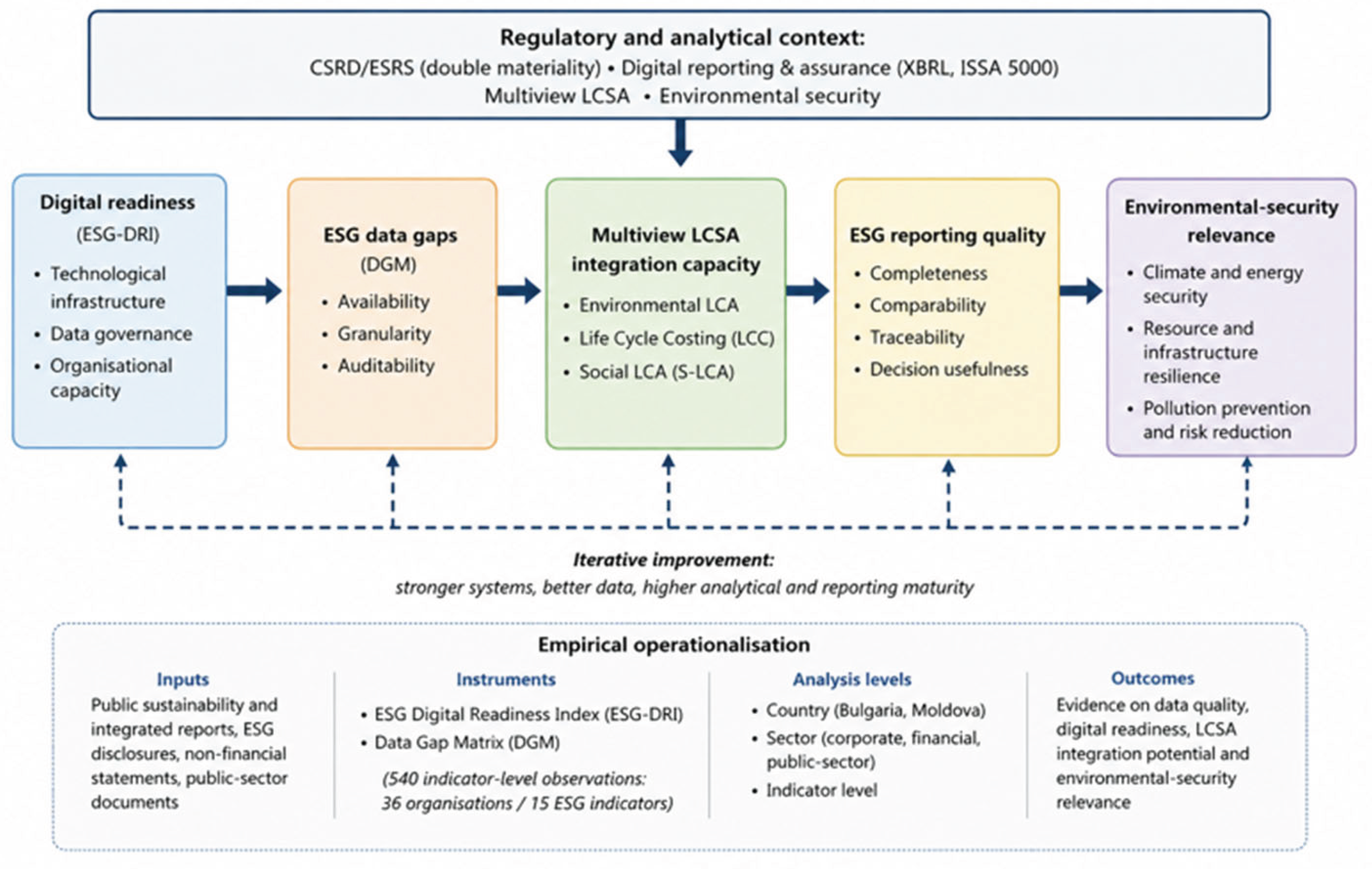
Figure 2.
Mean ESG Digital Readiness Index by country.
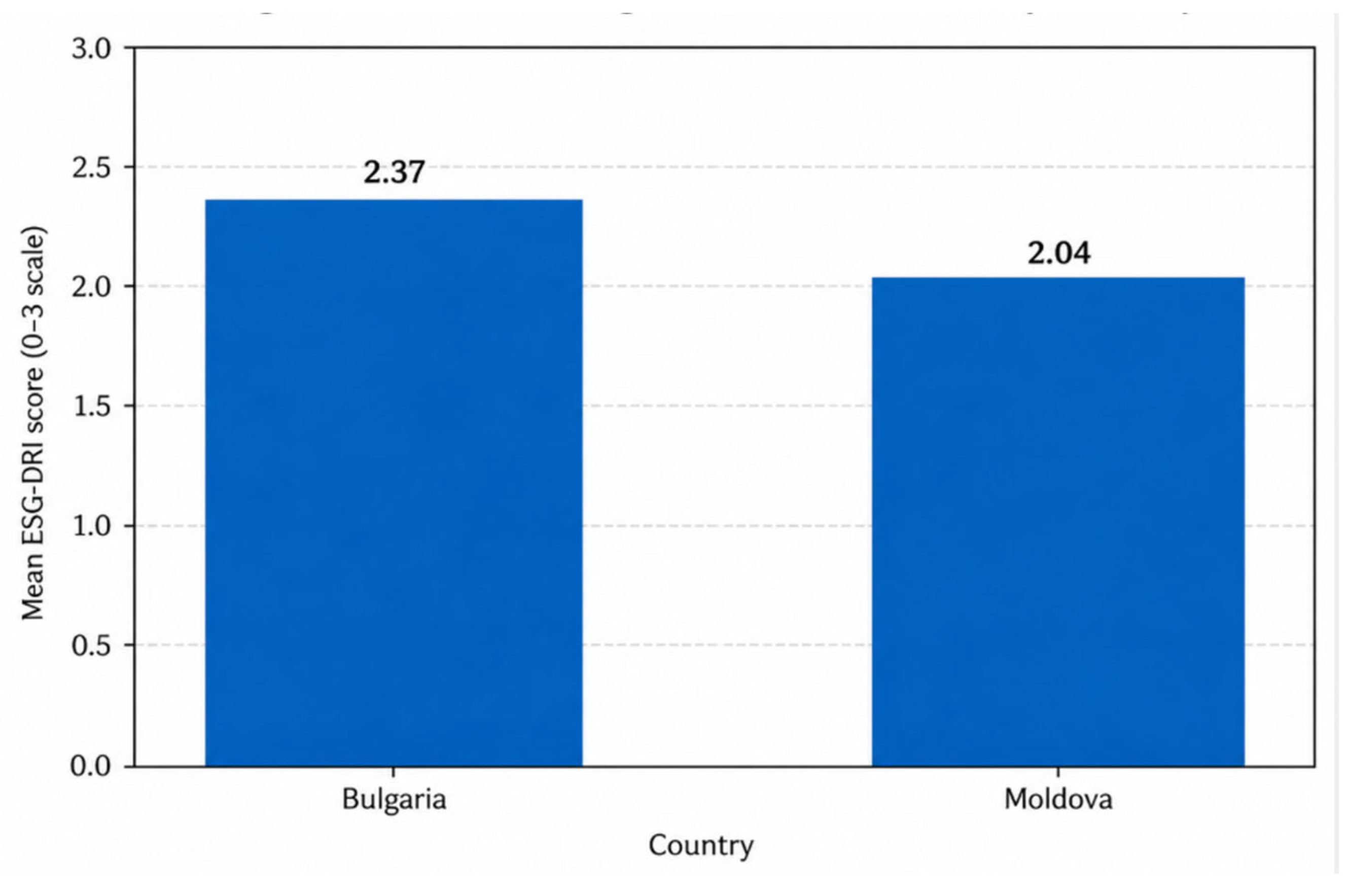

Table 1.
ESG-DRI scores for the full sample and by country and sector.
| Analytical group | TI | DG | OC | Composite ESG-DRI |
|---|---|---|---|---|
| Full sample | 2.13 | 2.13 | 2.34 | 2.20 |
| Bulgaria | 2.39 | 2.24 | 2.47 | 2.37 |
| Moldova | 1.88 | 2.02 | 2.22 | 2.04 |
| Corporate entities | 2.16 | 2.08 | 2.28 | 2.17 |
| Financial institutions | 2.23 | 2.32 | 2.38 | 2.31 |
| Public-sector bodies | 1.98 | 2.08 | 2.48 | 2.18 |
Table 2.
Data Gap Matrix scores for the full sample and by ESG indicator group.
| Analytical group | Availability | Granularity | Auditability | LCSA relevance | Environmental-security materiality |
|---|---|---|---|---|---|
| Full sample | 2.04 | 1.57 | 1.12 | 2.06 | 2.24 |
| Environmental indicators | 1.73 | 1.33 | 0.96 | 2.48 | 2.45 |
| Social indicators | 1.97 | 1.42 | 0.96 | 1.68 | 1.76 |
| Governance indicators | 2.43 | 1.97 | 1.44 | 2.01 | 2.51 |
Table 3.
LCSA relevance of disclosed ESG indicator groups.
| Indicator group | Mean LCSA relevance | Interpretation |
|---|---|---|
| Environmental indicators | 2.48 | Strong relevance for environmental LCA, climate assessment, energy analysis, and value-chain interpretation |
| Social indicators | 1.68 | Moderate relevance for SLCA, but constrained by limited standardisation and weak auditability |
| Governance indicators | 2.01 | Indirect but important relevance through data reliability, risk management, transparency, and procedural control |
Disclaimer/Publisher’s Note: The statements, opinions and data contained in all publications are solely those of the individual author(s) and contributor(s) and not of MDPI and/or the editor(s). MDPI and/or the editor(s) disclaim responsibility for any injury to people or property resulting from any ideas, methods, instructions or products referred to in the content. |
© 2026 by the authors. Licensee MDPI, Basel, Switzerland. This article is an open access article distributed under the terms and conditions of the Creative Commons Attribution (CC BY) license (http://creativecommons.org/licenses/by/4.0/).
Copyright: This open access article is published under a Creative Commons CC BY 4.0 license, which permit the free download, distribution, and reuse, provided that the author and preprint are cited in any reuse.


