
Submitted:
17 June 2026
Posted:
23 June 2026
You are already at the latest version
Abstract
Rural entrepreneurship is increasingly recognised as a critical driver of economic resilience and regional development, particularly in developing regions such as the Eastern Cape, South Africa. This exploratory study examines how entrepreneurial activities stimulate local economic growth, job creation, innovation, and community empowerment in Mnquma Local Municipality, where persistent unemployment and poverty remain significant challenges. Adopting an exploratory research design underpinned by a positivist philosophy, the study synthesises existing literature on the relationships among employment generation, economic contribution, innovation, diversification, community engagement, supply chain development, and economic resilience. Data were collected from 349 respondents drawn from a population of 3,750 formally registered rural entrepreneurs. The data were analysed using descriptive statistics, reliability and validity tests, correlation analysis, and Partial Least Squares Structural Equation Modeling (PLS-SEM) in SPSS and SmartPLS to examine the relationships among employment generation, economic contribution, innovation, diversification, community engagement, supply chain development, and economic resilience. The findings suggest that strong rural entrepreneurship enhances local adaptability and supports sustainable economic performance in the face of external shocks. The study emphasises the importance of inclusive, evidence-based policies that promote rural enterprise development through improved financial mechanisms, infrastructure investment, and strengthened stakeholder networks, thereby providing localised insights to inform policy and sustainable development in South Africa.
Keywords:
rural entrepreneurship
; employment generation
; economic resilience
; innovation
; community engagement
; supply chain development
1. Introduction
Economic resilience in rural areas of developing economies depends largely on adaptive strategies that address persistent challenges, such as poverty, unemployment, and dependence on traditional sectors like agriculture. Rural entrepreneurship has increasingly been recognised as a strategy, as it promotes the utilisation of local resources, innovation, and small-scale enterprise development to stimulate economic activity in non-urban settings (Asmit, Simatupang, Rudito & Novani, 2024). In South Africa, particularly within the Eastern Cape Province, rural entrepreneurship is viewed as a mechanism for employment creation, income diversification, and community empowerment in regions characterised by severe socio-economic inequalities (Makhoba, 2024; Rulashe & Ramolobe, 2024a). Entrepreneurial activities in sectors such as agriculture, retail, tourism, and food services contribute to local economic participation and may strengthen communities’ ability to withstand economic shocks and structural instability (Tshikovhi, More & Cele, 2023a; Thukral, 2025).
Despite these potential benefits, a major concern in the literature is whether rural entrepreneurship can meaningfully enhance economic resilience within structurally disadvantaged municipalities that continue to experience weak infrastructure, limited market access, financial exclusion, and inadequate institutional support (Högberg & Mitchell, 2023; Ngumbela, 2023). This challenge is particularly evident in Mnquma Local Municipality in the Eastern Cape, where high unemployment, low industrial development, and persistent poverty continue to constrain local economic growth and sustainable livelihoods (Giwu, Mdoda & Ntlanga, 2024; Kativhu, Mpongwana & Cishe, 2024). Although entrepreneurial initiatives exist within township and rural economies, many enterprises remain vulnerable to business instability and limited economic integration (Medina, Garfias & Tellez, 2023). Consequently, uncertainty remains regarding the extent to which rural entrepreneurship contributes to long-term economic resilience in rural municipalities.
The consequences of this problem are significant for both policy and practice. Weak entrepreneurial sustainability contributes to continued poverty, youth migration, low household income, economic dependency, and limited local economic diversification (Hasan, Shahid, Sultana & Siddiqui, 2023; Thukral, 2025). Furthermore, rural enterprises’ inability to withstand economic shocks undermines municipal efforts to create jobs and alleviate poverty. Although previous studies have broadly explored rural entrepreneurship and economic resilience, limited empirical research has examined the multidimensional relationship among employment generation, innovation and diversification, community engagement, local supply chain development, and economic resilience within rural municipalities of the Eastern Cape (Mbukanma, Sithole & Hosu, 2025). In addition, existing studies have paid limited theoretical attention to integrating Entrepreneurship Development Theory and Resilience Theory to explain how rural entrepreneurship strengthens economic resilience in underdeveloped rural economies. This creates both an empirical and theoretical gap in understanding the mechanisms through which rural entrepreneurship contributes to sustainable local economic resilience.
Against this background, the present study investigates the role of rural entrepreneurship in enhancing economic resilience in Mnquma Local Municipality. The study is justified by the need to generate localised empirical evidence to inform policymakers, development agencies, and rural stakeholders in designing targeted interventions that strengthen entrepreneurial ecosystems and promote sustainable rural development. By examining key entrepreneurial dimensions such as employment generation, innovation, community engagement, and local supply chain development, the study contributes to academic discourse and policy development relating to rural economic resilience in South Africa.
2. Literature Review
2.1. Challenges Faced by Rural Entrepreneurship in Enhancing Economic Resilience
Rural entrepreneurship has increasingly been recognised as an important mechanism for promoting economic development and enhancing economic resilience in developing economies. The existing literature indicates that rural enterprises contribute to employment creation, innovation, local economic participation, and income diversification, thereby reducing dependence on traditional sectors such as subsistence agriculture (Tshikovhi, Shokane & Mashamaite, 2023b; Chidakwa & Khanare, 2024; Sugiardi, 2024). Through entrepreneurial activities, rural communities are better positioned to adapt to economic shocks, including market instability, climate-related disruptions, and broader macroeconomic uncertainties (Habib, Ariyawardana & Aziz, 2023; Mbukanma et al., 2025). Furthermore, the adoption of digital technologies and innovative business models has improved the ability of some rural enterprises to access wider markets, enhance efficiency, and remain competitive in changing economic environments (Ediagbonya & Tioluwani, 2023). Despite these positive contributions, literature highlights an important contradiction: the developmental potential of rural entrepreneurship is often undermined by persistent structural and institutional constraints within rural economies.
One of the most significant challenges identified in the literature is limited access to finance, as many rural entrepreneurs struggle to secure funding due to inadequate collateral, poor credit histories, and exclusion from formal financial systems (Ediagbonya & Tioluwani, 2023). Inadequate infrastructure, including poor road networks, unreliable electricity supply, and weak digital connectivity, further increases operational costs and limits market access, thereby reducing the competitiveness and sustainability of rural enterprises (Gigaba, Niyitunga & Uwizeyimana, 2025; Mbukanma et al., 2025). Rural entrepreneurs also face restricted access to broader markets due to geographical isolation, weak distribution networks, and limited market information (Popa, Grasu Cadis & Popp, 2024). In addition, weak institutional support, ineffective implementation of entrepreneurial policies, skills shortages, and the persistence of informal business practices continue to constrain entrepreneurial growth and resilience (Thukral, 2025). Contextual and socio-cultural factors, including low social capital and fragmented community networks, also influence entrepreneurial behaviour and limit innovation and business expansion (Naguib & Barbar, 2025). Collectively, these challenges demonstrate that although rural entrepreneurship has considerable potential to strengthen economic resilience, its effectiveness remains constrained by complex interactions among financial, infrastructural, institutional, and socio-cultural barriers.
2.2. Opportunities Toward Advancing Rural Entrepreneurship in Enhancing Economic Resilience
Building on the challenges outlined in the literature, it indicates that although rural entrepreneurship is constrained by structural, institutional, and contextual barriers, it also offers significant opportunities to enhance economic resilience when supported by appropriate interventions. Rural entrepreneurship provides an important pathway for employment creation, livelihood diversification, and local economic participation, particularly in areas characterised by high unemployment and limited formal economic opportunities (Tshikovhi et al., 2023b; Ahmad, Audi & Ahmad, 2025). By creating alternative income-generating activities, rural enterprises reduce dependence on single income sources and strengthen household resilience to economic shocks and economic volatility (Habib, Ariyawardana & Aziz, 2023). Furthermore, strengthening local production systems and promoting value addition can stimulate local economic growth, reduce economic leakage and improve market participation within rural communities (Anene & Clement, 2024). Innovation and digital transformation also present important opportunities to overcome geographical isolation and infrastructural limitations, as technologies such as mobile platforms and e-commerce enable rural entrepreneurs to access broader markets, improve efficiency, and diversify into sectors such as agro-processing, tourism, and service industries (Nipo, Lily, Fabeil & Jamil, 2024). These developments enhance the adaptability and competitiveness of rural enterprises, thereby strengthening economic resilience.
In addition, the literature highlights that strong community networks, stakeholder collaboration, and effective institutional support can significantly enhance rural entrepreneurship’s contribution to sustainable development. Leveraging social capital through cooperative models, partnerships, and community-driven initiatives improves resource sharing, knowledge exchange, and entrepreneurial performance (Chen, Lin & Chen, 2025). Similarly, strengthening local supply chains and integrating rural enterprises into regional and national value chains can improve efficiency, reduce transaction costs, and expand market access (He, Fan & Fan, 2024). Governments and development agencies also play a critical role in unlocking these opportunities through targeted interventions such as improved access to finance, infrastructure development, entrepreneurship training, and public–private partnerships (Rashid, Anser, Shah, Nabi, Ahmad & Zaman, 2025). However, the literature emphasises that these opportunities are not automatic and depend on the extent to which barriers such as financial exclusion, infrastructural deficiencies, weak institutional support, and skills shortages are effectively addressed (Omweri, 2024). Consequently, coordinated and context-specific interventions are essential for strengthening the entrepreneurial ecosystem and enabling rural enterprises to contribute meaningfully to long-term economic resilience and sustainable rural development (Almeida & Daniel, 2025).
2.3. Theoretical Foundation
Building on the challenges identified and the opportunities outlined, this study adopts Entrepreneurship Development Theory and Resilience Theory as complementary frameworks to explain how rural entrepreneurship can enhance economic resilience despite existing structural and institutional constraints. These theories provide a multidimensional perspective on the limitations and transformative potential of rural enterprises in developing economies.
Gcume & Mohapeloa (2025) highlight barriers such as limited access to finance, weak infrastructure, and institutional inefficiencies. Guzman, Murray, Stern & Williams (2024) demonstrate that these challenges can be mitigated through innovation, policy support, and strengthened entrepreneurial ecosystems. The selected theoretical frameworks for this research, therefore, explain not only how entrepreneurial activities generate economic value but also how they enable rural communities to adapt, survive, and grow in uncertain environments.
2.3.1. Entrepreneurship Development Theory
Entrepreneurship Development Theory explains how entrepreneurial activities contribute to economic growth through innovation, opportunity recognition, and resource mobilisation (Fañanás-Biescas, Ključnikov, Bargoni & Ferraris, 2026). The theory highlights that constraints such as limited access to finance, skills shortages, inadequate infrastructure and weak institutional support hinder entrepreneurial development and restrict the sustainability and growth potential of rural enterprises. Without adequate human capital, financial resources, and enabling policy frameworks, entrepreneurial activities are likely to remain informal, small-scale and vulnerable to economic instability. At the same time, the theory emphasises that strategic investments in entrepreneurship training, financial inclusion, infrastructure development, and supportive institutional systems can create enabling environments that allow rural entrepreneurs to innovate, diversify, and expand their businesses (Olalekan, 2024; Thukral, 2025). In the context of this study, Entrepreneurship Development Theory provides a relevant framework for understanding how strengthening entrepreneurial capacity and addressing systemic barriers can enhance employment creation, value addition, market expansion, and ultimately economic resilience within Mnquma Local Municipality.
2.3.2. Resilience Theory
Resilience Theory explains the ability of systems, communities, and enterprises to absorb shocks, adapt to changing conditions, and recover from disruptions such as economic instability, market uncertainty, and environmental risks (Cui, Wang & Zheng, 2025). The theory emphasises that resilience is strengthened through adaptive strategies such as diversification, innovation, collaboration, and continuous learning, which enable rural economies to sustain development under changing conditions (Nosike, Ojobor & Nosike, 2024; Capoani, Fantinelli & Giordano, 2025). In this study, these resilience dimensions are directly reflected in the examined entrepreneurial constructs. Adaptation is reflected through innovation and diversification, which enables rural enterprises to explore new markets, products, and income opportunities. Economic diversification and employment generation strengthen household and community income stability, thereby reducing vulnerability to economic shocks. Collective action is reflected through community engagement and local supply chain development, where collaboration among entrepreneurs, communities, and local stakeholders enhances resource sharing, market access, and local economic coordination (Saputra & Havlíček, 2024).
Together with Entrepreneurship Development Theory, Resilience Theory provides a comprehensive framework for explaining how rural entrepreneurship contributes to economic resilience in Mnquma Local Municipality. While Entrepreneurship Development Theory focuses on value creation through entrepreneurial activity, Resilience Theory explains how entrepreneurial processes enhance the adaptability, sustainability, and recovery capacity of rural economies. Collectively, the theories suggest that strengthening entrepreneurial capacity alongside institutional support, infrastructure, finance and policy interventions is essential for promoting sustainable economic resilience in rural municipalities.
3. Methodology
This study employed a quantitative research methodology to examine the role of rural entrepreneurship in enhancing economic resilience in Mnquma Local Municipality, Eastern Cape. Guided by the theoretical foundations underpinning the study, a causal (explanatory) research design was adopted to empirically test the relationships between key entrepreneurial variables and economic resilience (Sturm, Hohenstein & Hartmann, 2023). This design was considered appropriate for examining how entrepreneurial challenges and opportunities influence economic outcomes within rural contexts. A pilot study involving 24 rural entrepreneurs was conducted to assess the clarity, reliability, and validity of the research instrument. Feedback from the pilot phase was used to refine the questionnaire and ensure the instruments adequately captured constructs related to entrepreneurial constraints, innovation, community engagement, and economic resilience.
The target population consisted of registered rural entrepreneurs within Mnquma Local Municipality, identified through municipal SMME databases and records from the Department of Small Business Development and the Eastern Cape Department of Rural Development and Agrarian Reform (2024). A multi-stage sampling approach combining purposive and snowball sampling techniques was employed to access both formal and informal entrepreneurs, particularly those operating within hard-to-reach rural areas. Using the Raosoft sample size calculator, a sample of 349 respondents was determined to be statistically adequate at a 95% confidence level and a 5% margin of error. Data were collected using structured questionnaires on a five-point Likert scale from strongly disagree to strongly agree. The instrument measured key constructs derived from the literature, including employment generation, economic contribution, innovation and diversification, community engagement, local supply chain development, and economic resilience.
Data analysis was conducted using SPSS and SmartPLS 4.0. Analytical techniques included confirmatory factor analysis, Partial Least Squares Structural Equation Modeling (PLS-SEM), and path analysis to test the hypothesised relationships among the study variables. PLS-SEM was selected over covariance-based SEM because the study is prediction-oriented and exploratory, involving complex relationships among multiple latent constructs (Hair et al., 2024). Furthermore, PLS-SEM is suitable for studies with relatively small sample sizes and does not require strict assumptions of multivariate normality, making it appropriate for analysing rural entrepreneurship data characterised by heterogeneous responses and varying enterprise conditions. Reliability and validity were assessed using Cronbach’s alpha, composite reliability, and average variance extracted (AVE), confirming the robustness of the measurement model. Ethical clearance was obtained from the Walter Sisulu University Senate Research Ethics Committee (Protocol No. 28/2025/MBM/BME/4786), ensuring compliance with institutional and national research ethics standards.
4. Data Analysis and Discussion of Results
This section presents the analysis and discussion of the empirical findings concerning the role of rural entrepreneurship in enhancing economic resilience within Mnquma Local Municipality. Quantitative data collected from 349 respondents, comprising rural entrepreneurs, SME owners and managers, agricultural cooperatives, and local business associations, were analysed using SmartPLS version 4. In line with the Partial Least Squares Structural Equation Modeling (PLS-SEM) approach, the analysis assessed reliability, convergent validity, discriminant validity, latent variable correlations, structural relationships, and model quality criteria, including R-square and F-square values. According to Hair et al. (2024), PLS-SEM is appropriate for exploratory studies that examine complex relationships among multiple constructs and prioritise prediction-oriented analysis. The findings are discussed in relation to the study objectives, existing empirical literature, and the theoretical foundations of Entrepreneurship Development Theory and Resilience Theory to determine how employment generation, economic contributions, innovation and diversification, community engagement, and local supply chain development influence economic resilience in rural communities.
4.1. Measurement of Reliability and Validity
Reliability refers to the extent to which a research instrument produces consistent, stable, and reproducible results across time, across different respondents, and within the instrument itself (Simkus, Coolen-Maturi, Coolen & Bendtsen, 2025). Consistent with the methodological approach outlined, the measurement model’s reliability and validity were assessed to ensure the robustness of the constructs derived from the literature. In accordance with established statistical standards, reliability was evaluated using Cronbach’s alpha and composite reliability, while convergent validity was assessed using the average variance extracted (AVE). Threshold values of 0.70 for composite reliability and 0.50 for AVE were used to determine adequacy and acceptance.
The results indicated excellent internal consistency across all constructs. Cronbach’s alpha values ranged from 0.915 for Local Supply Chain Development to 0.979 for Employment Generation, reflecting a high level of reliability. These findings suggest that the measurement items used to capture the key constructs associated with the opportunities and challenges discussed are both consistent and reliable. Notably, Employment Generation and Economic Resilience exhibited particularly strong reliability, underscoring their central significance within the study’s conceptual framework.
Composite reliability values, ranging from 0.917 to 0.983, further confirmed the internal consistency of all constructs and indicated minimal measurement error. In addition, AVE values ranging from 0.752 to 0.922 demonstrated strong convergent validity, confirming that the indicators effectively represented their respective constructs. Collectively, these results validate the robustness of the measurement model and support its suitability for subsequent structural analysis.

Table 1.
Construct Reliability Test.
| Cronbach’s alpha | Composite reliability (rho_a) | Composite reliability (rho_c) | Average variance extracted (AVE) | |
|---|---|---|---|---|
| Employment Generation | 0.979 | 0.981 | 0.983 | 0.922 |
| Economic Contributions | 0.941 | 0.957 | 0.955 | 0.809 |
| Innovation and Diversification | 0.936 | 0.957 | 0.951 | 0.798 |
| Community Engagement | 0.934 | 0.939 | 0.950 | 0.792 |
| Local Supply Chain Development | 0.915 | 0.917 | 0.938 | 0.752 |
| Economic Resilience | 0.946 | 0.948 | 0.956 | 0.756 |
Note: All values exceed thresholds (α>0.9 excellent; ρ>0.7 acceptable; AVE>0.5 construct validity).
To achieve the objectives of this study, quantitative data were collected from 349 participants registered as rural entrepreneurs, SME owners and managers, local business associations, and agricultural cooperatives, of whom 63% were female (220 respondents) and 37% were male (129 respondents), with no missing data and perfectly aligned percentages. The predominance of female respondents is consistent with patterns observed in South African rural entrepreneurship, where women frequently dominate informal and small-scale enterprises due to limited formal employment opportunities and culturally embedded roles within household economies. SmartPLS version 4 software was employed to analyse the data, generating key statistical outputs including reliability and validity assessments, inter-construct correlations, structural equation modeling (SEM), path analysis, and model quality criteria such as R-square and F-square.
4.2. Discriminant Validity: Heterotrait–Monotrait Ratio (HTMT)
Discriminant validity was assessed using the HTMT criterion to ensure that the constructs identified, such as innovation, community engagement, and supply chain development, are empirically distinct. The results indicated that all HTMT values were below the recommended threshold of 0.85, confirming that each construct measures a unique dimension of rural entrepreneurship. These results are consistent with the theoretical distinctions outlined, in which Entrepreneurship Development Theory and Resilience Theory emphasise different yet complementary dimensions of economic resilience, as illustrated in Table 2.
Discriminant validity was assessed using the Heterotrait–Monotrait ratio (HTMT). As shown in Table 2, most HTMT values were within or close to the recommended threshold of 0.85, indicating acceptable discriminant validity among the constructs. However, a few relationships exceeded the threshold, particularly Employment Generation and Community Engagement (HTMT = 1.046), indicating a strong conceptual association between these constructs. Similarly, Economic Contributions and Community Engagement (HTMT = 0.912), Innovation and Diversification and Local Supply Chain Development (HTMT = 0.919), and Economic Resilience and Employment Generation (HTMT = 0.931) showed relatively high associations. In contrast, Economic Contributions and Local Supply Chain Development (HTMT = 0.599) and Economic Resilience and Local Supply Chain Development (HTMT = 0.625) demonstrated clearer discriminant validity. Overall, the HTMT results confirm that the measurement model achieved acceptable discriminant validity for further structural analysis.
4.3. Fornell–Larcker Criterion
The Fornell–Larcker criterion was applied to assess discriminant validity within the structural equation model (Rasoolimanesh, 2022). According to this criterion, the square root of the Average Variance Extracted (AVE) for each construct should be higher than its correlations with other constructs (Haji-Othman & Yusuff, 2022). As shown in Table 3, most constructs met this requirement, indicating acceptable discriminant validity. Innovation and Diversification (0.960), Economic Contributions (0.899), and Local Supply Chain Development (0.893) showed strong discriminant validity. However, Community Engagement had a higher correlation with Employment Generation (0.984) than its square root of AVE (0.869), suggesting some conceptual overlap between these constructs. Despite this, the overall results confirm that the measurement model demonstrated acceptable discriminant validity for further structural analysis.
4.4. Latent Variable Correlation Results
To determine the correlation between latent variables, you typically use Structural Equation Modeling (SEM) or Confirmatory Factor Analysis (CFA) to estimate the relationship between unobserved constructs based on their observed indicators (Steenkamp & Maydeu-Olivares, 2023). The correlation matrix revealed positive relationships among all constructs, indicating that variables such as employment generation, innovation, and community engagement are positively associated with economic resilience. These findings align with the opportunities explained, which highlight the role of these variables in strengthening rural economies. The absence of excessively high correlations suggests that multicollinearity is not a concern, thereby supporting the reliability of subsequent structural analysis.
Table 4.
Correlation Matrix Results.
| Employment Generation | Economic Contributions | Innovation and Diversification | Community Engagement | Local Supply Community Development | Economic Resilience | |
|---|---|---|---|---|---|---|
| Employment Generation | 1.000 | 0.640 | 0.893 | 0.756 | 0.676 | 0.794 |
| Economic Contribution | 0.640 | 1.000 | 0.590 | 0.829 | 0.620 | 0.871 |
| Innovation and Diversification | 0.893 | 0.590 | 1.000 | 0.743 | 0.601 | 0.793 |
| Community Engagement | 0.756 | 0.829 | 0.743 | 1.000 | 0.863 | 0.985 |
| Local Supply Community Development | 0.676 | 0.620 | 0.601 | 0.863 | 1.000 | 0.837 |
| Economic Resilience | 0.794 | 0.871 | 0.793 | 0.985 | 0.837 | 1.000 |
4.5. Structural Equation Modeling (SEM)
Structural Equation Modeling (SEM) is a powerful, comprehensive statistical framework for testing and estimating complex causal relationships among variables (Ghaleb & Yaslioglu, 2024). SEM is widely used in social sciences, psychology, and education to analyse multivariate data by combining elements of factor analysis and multiple regression (El Jihaoui, Abra & Mansouri, 2025). Structural Equation Modeling (SEM) was employed to test the hypothesised relationships between rural entrepreneurship variables and economic resilience. SEM enables the simultaneous examination of multiple relationships, providing a comprehensive understanding of how the challenges and opportunities interact within the theoretical framework. Figure 1 indicates that the proposed model adequately explains the role of rural entrepreneurship in enhancing economic resilience, confirming the relevance of the selected variables and theoretical assumptions. A similar study by Bratha, Suardana & Arismayanti (2025) produced the same results, with PLS-SEM confirming that the model provided a strong explanation of economic resilience (R2 = 0.991), indicating that approximately 99.1% of the variance in economic resilience was accounted for by the predictor variables. Among the constructs, community engagement emerged as the strongest predictor of economic resilience (β = 0.660), highlighting the critical role of community-driven initiatives in strengthening local economies. Local supply chain development also showed a positive, though weaker, effect (β = 0.045), suggesting a supportive but less dominant influence.
Economic contributions (β = 0.221) and innovation and diversification (β = 0.172) demonstrated moderate positive effects, indicating that both financial activities and innovative practices contributed meaningfully to resilience outcomes. In comparison, employment generation had a small negative effect on economic resilience (- 0.032), suggesting that economic outcomes alone may not directly enhance resilience without the support of other factors, such as community engagement and innovation. Also, strong relationships were observed among the independent constructs, particularly between community engagement and local supply chain development (β = 0.866) and between economic contributions and employment generation (β = 0.642). These interconnections highlight the integrated nature of rural entrepreneurship, in which multiple dimensions interact to shape overall economic resilience (Shao, Jiang & Xie, 2024). The findings confirmed the multidimensional impact of rural entrepreneurship on economic resilience. The results emphasised that community engagement and economic contributions were key drivers, while innovation played a complementary role. These insights provided strong empirical support for the study’s conceptual framework and highlighted important policy areas for promoting sustainable rural development (Gidage & Bhide, 2025).
4.6. Model Fit
Model fit refers to the extent to which the model-implied covariance matrix matches the observed data (West, Wu, McNeish & Savord, 2023). Common indices include SRMR (≤ 0.08 for good fit, ≤ 0.10 acceptable), NFI (≥ 0.90), and d_ULS, which should be below the HI95 or HI99 bootstrap threshold.
As shown in Table 5, SRMR values (0.113; 0.227) exceed acceptable thresholds and d_ULS values are high, indicating poor fitness. The chi-square statistic is infinite, and NFI is unavailable, limiting further assessment. Overall, the model shows limited fit and may require refinement. Hair et al. (2024) explore that this is justified, as PLS-SEM is prediction-oriented and less dependent on global fit measures, especially in exploratory studies. The small sample size and model complexity may also affect fit indices. Despite this, the model demonstrates acceptable reliability, validity, and predictive relevance, supporting the key relationships of the study.
Table 5.
Model fit.
| Saturated model | Estimated model | |
|---|---|---|
| SRMR | 0.113 | 0.227 |
| d_ULS | 6.737 | 27.264 |
| d_G | n/a | n/a |
| Chi-square | ∞ | ∞ |
| NFI | n/a | n/a |
4.7. Path Coefficients
Path analysis is a statistical technique used to examine causal relationships between variables by estimating direct and indirect effects within a system of equations (Nazir, Gillani & Shafiq, 2023). As a specific application of structural equation modeling (SEM), it uses path diagrams to represent relationships among observed variables. In this study, path analysis was conducted using PLS-SEM with bootstrapping to assess the strength and significance of the hypothesised relationships. The results indicate that all structural paths are statistically significant at the 0.05 level, confirming the model’s robustness. Employment generation shows a strong positive effect on economic contributions (0.642) but a weak negative direct effect on economic resilience (- 0.032), suggesting a possible indirect or mediating effect. Economic contributions significantly influence both innovation (0.593) and diversification (0.221), highlighting their dual role in the model.
Innovation and diversification strongly enhance community engagement 0.746 and moderately contribute to economic resilience (0.172). Community engagement emerges as the most influential predictor, with strong effects on local supply chain development (0.866) and economic resilience (0.660). Consistent with these findings, Opoku (2025) found that local supply chain development has a weak but statistically significant effect on resilience (0.045), indicating a limited direct contribution. Overall, the findings support the proposed model and emphasise the critical role of innovation and community engagement in strengthening economic resilience, while also revealing important indirect dynamics, particularly regarding employment generation.
Table 6.
Path analysis results.
| Original sample (O) | Sample mean (M) | Standard deviation (STDEV) | T statistics (|O/STDEV|) | P values | |
|---|---|---|---|---|---|
| Employment Generation -> Economic Contributions | 0.642 | 0.643 | 0.032 | 20.241 | 0.000 |
| Employment Generation -> Economic Resilience | -0.032 | -0.031 | 0.015 | 2.166 | 0.030 |
| Economic Contributions -> Innovation and Diversification | 0.593 | 0.595 | 0.028 | 20.854 | 0.000 |
| Economic Contributions -> Economic Resilience | 0.221 | 0.221 | 0.011 | 20.136 | 0.000 |
| Innovation and Diversification -> Community Engagement | 0.746 | 0.746 | 0.029 | 25.982 | 0.000 |
| Innovation and Diversification -> Economic Resilience | 0.172 | 0.171 | 0.012 | 14.562 | 0.000 |
| Community Engagement -> Local Supply Chain Development | 0.866 | 0.866 | 0.014 | 61.780 | 0.000 |
| Community Engagement -> Economic Resilience | 0.660 | 0.660 | 0.011 | 57.488 | 0.000 |
| Local Supply Chain Development -> Economic Resilience | 0.045 | 0.045 | 0.011 | 4.240 | 0.000 |
4.8. Quality Criteria R-Square
R-square (R2) values represent the proportion of variance in dependent variables explained by the independent variables in the model, with higher values indicating stronger explanatory power. As shown in Table 7, the model demonstrates substantial explanatory power across all constructs. Rural entrepreneurship predictors collectively explain 99.1% of the variance in economic resilience (R2 = 0.991; adjusted R2 = 0.991) among the 349 SME respondents in Mnquma Local Municipality. Although this reflects very strong predictive capability, such an exceptionally high R2 value should be interpreted with caution, as it may indicate overlapping constructs, shared variance, or redundancy among predictors rather than purely independent effects.
The minimal difference between R2 and adjusted R2 suggests that the model is not significantly overfitting, supporting its internal consistency and stability (Niazy, Murphy, Nadeem & Ricker 2025). Overall, the findings confirm the significant role of rural entrepreneurship-related factors in explaining economic resilience. However, the unusually high explanatory power underscores the importance of model parsimony and cautious generalisation within the PLS-SEM framework (Padovano & Ivanov, 2025).
The F-square statistic assesses the effect size of each variable construct by examining the change in R2 when a predictor is removed from the model (Suleiman & Abdulkadir, 2022). According to established guidelines, f2 values of 0.02, 0.15, and 0.35 indicate small, medium, and large effects, respectively (Subhaktiyasa, 2024). This measure complements significance testing by indicating the practical contribution of each predictor.
As presented in Table 8, effect sizes vary considerably across the model. Community engagement shows an exceptionally large effect on economic resilience 4.178 and local supply chain development (f2 = 3.005). Economic contributions also exert large effects on economic resilience (1.442) and on innovation and diversification (0.544). Similarly, innovation and diversification strongly influence community engagement (1.257) and economic resilience (0.532), while employment generation has a substantial effect on economic contributions (0.702). In contrast, local supply chain development has only a small effect on economic resilience 0.043 and employment generation shows a negligible direct effect (0.018).
5. Key Findings and Policy Implications
The findings of this study present significant policy-relevant insights for addressing structural constraints and harnessing opportunities for sustainable rural entrepreneurship. The key policy implications are articulated as follows:
- Infrastructure Development: Strategic investment in transport networks, reliable energy supply, and digital infrastructure is critical to reducing operational inefficiencies and transaction costs. Improving infrastructure will enhance market access, facilitate information flow, and enable rural enterprises to participate more effectively in broader economic systems.
- Access to Finance: Strengthening financial inclusion through targeted interventions, such as micro finance schemes, government-backed grants, and accessible credit facilities, is essential for enabling rural entrepreneurs to expand and sustain their businesses. Policy frameworks should also promote innovative financing models tailored to the unique risk profiles of rural enterprises.
- Entrepreneurship Training and Skills Development: Capacity-building initiatives should be prioritised to equip entrepreneurs with essential business management, innovation, and digital skills. Such programmes should adopt context-specific and practice-oriented approaches that enhance both entrepreneurial competence and adaptability in dynamic market environments.
- Strengthening Local Supply Chains: Policies should support the development and integration of local value chains to improve productivity, competitiveness and economic resilience. Strengthening linkages between producers, suppliers and markets will foster inclusive growth and reduce dependency on external systems.
- Institutional Support and Community Engagement: Enhancing collaboration among government institutions, the private sector and local communities is vital for building social capital and fostering an enabling entrepreneurial ecosystem. Coordinated institutional support can improve policy implementation, resource mobilization and the sustainability of rural enterprises.
The study concludes that while this study provides valuable insights, it is limited to Mnquma Local Municipality and may not fully capture variations across other rural contexts. Future research should consider comparative studies across different regions to enhance generalisability. Additionally, incorporating qualitative approaches could provide deeper insights into entrepreneurial experiences and contextual dynamics. Longitudinal studies are also recommended to examine how rural entrepreneurship contributes to economic resilience over time, particularly in response to evolving economic and environmental challenges.
6. Conclusions
This study examined the role of rural entrepreneurship in enhancing economic resilience in Mnquma Local Municipality. The findings provide strong evidence that rural entrepreneurship contributes to economic resilience by creating jobs, diversifying incomes, fostering innovation, engaging communities, and developing local supply chains. Innovation and diversification improve entrepreneurs’ ability to adapt to changing economic conditions, while community engagement strengthens social capital and collective economic participation. Furthermore, local supply chain development enhances market access and economic integration within rural communities. However, the study also revealed that persistent structural barriers, including inadequate infrastructure, limited access to finance, weak institutional support, and restricted market opportunities, continue to constrain the sustainability and growth potential of rural enterprises. These findings suggest that although rural entrepreneurship plays a critical role in strengthening economic resilience, its effectiveness depends on the availability of supportive institutional, financial, and infrastructural systems.
Despite its contributions, the study was limited to Mnquma Local Municipality, which restricts the generalisability of the findings to other rural contexts. The cross-sectional quantitative design and reliance on self-reported data also limited deeper contextual understanding and may have introduced response bias. In addition, the exceptionally high R2 values suggest possible overlaps among constructs, indicating the need for further theoretical refinement and model validation. Future research should therefore consider longitudinal and mixed methods approaches to examine how entrepreneurial resilience evolves. Comparative studies across different rural municipalities or provinces are also recommended to improve contextual understanding and external validity. Furthermore, future studies could incorporate moderating and mediating variables such as government support, digital inclusion, entrepreneurial orientation, and social capital to provide a more comprehensive explanation of the relationship between rural entrepreneurship and economic resilience.
Author Contributions
Conceptualisation, X.G. and I.M.; methodology, X.G., I.M. and S.F.; software, X.G.; validation, X.G., I.M. and S.F.; formal analysis, X.G. and I.M.; investigation, X.G.; resources, X.G., I.M. and S.F.; data curation, X.G., I.M. and S.F.; writing original draft preparation, X.G.; writing review and editing, X.G. and I.M.; visualisation, X.G., I.M. and S.F.; supervision, I.M. and S.F.; project administration, X.G., I.M. All authors have read and agreed to the published version of the manuscript.
Funding
No funding was received.
Institutional Review Board Statement
The study was conducted in accordance with the research ethics conducted and approved by Walter Sisulu Senate Research Ethics Committee (Protocol No. 28/2025/MBM/BME/4786).
Informed Consent Statement
Informed consent was obtained from all respondents involved in the study, and their anonymity was maintained in accordance with Walter Sisulu’s research ethics code and conduct.
Data Availability Statement
In accordance with the Walter Sisulu research ethics code and conduct, all data are securely stored by the library directorate.
Conflicts of Interest
The authors declare no conflict of interest.
References
- Ahmad, M.; Audi, M.; Ahmad, K. Tax Burden, Incentives, And Informality: Determinants of SME Growth and Formalisation in Emerging Markets. Contemporary Journal of Social Science Review 2025, 3(1), 1299–1308. [Google Scholar]
- Almeida, J.; Daniel, A. D. Addressing the distinctive features of entrepreneurial ecosystems in low-density territories. Journal of Entrepreneurship and Public Policy 2025, 14(4), 599–622. [Google Scholar] [CrossRef]
- Al-Yami, M. A.; Alqahtany, A. M.; Dano, U. L. Towards a Conceptual Framework for Sustainable Economic Development in Small and Medium-Sized Cities: A Theoretical Study. Sustainability 2026, 18(5), 2582. [Google Scholar] [CrossRef]
- Anene, U. N.; Clement, T. Localized supply chain solutions for sustainable community development: A strategic model for economic revitalization and regional resilience. International Journal of Scientific Research in Science and Technology 2024, 11(5), 736–776. [Google Scholar] [CrossRef]
- Asmit, B.; Simatupang, T. M.; Rudito, B.; Novani, S. Uncovering the building blocks of rural entrepreneurship: A comprehensive framework for mapping the components of rural entrepreneurial ecosystems. Heliyon 2024, 10(1), 1–12. [Google Scholar]
- Bratha, I. K. S. A. S.; Suardana, I. W.; Arismayanti, N. K. The Structural relationship between Product Quality, Service Quality, and Culinary Destination Image on Visitor Satisfaction and Revisit Intention in Lebih Beach, Gianyar Regency. Asian Journal of Management, Entrepreneurship and Social Science 2025, 5(03), 1264–1288. [Google Scholar]
- Capoani, L.; Fantinelli, M.; Giordano, L. The concept of resilience in economics: a comprehensive analysis and systematic review of economic literature. Continuity & Resilience Review 2025, 7(2), 121–145. [Google Scholar] [CrossRef]
- Chen, H. C.; Lin, T. C.; Chen, Y. H. The impact of social capital and community empowerment on regional revitalization practices: A case study on the practice of university social responsibility programs in Wanli and Jinshan Districts. Sustainability 2025, 17(10), 4653. [Google Scholar] [CrossRef]
- Chidakwa, A.; Khanare, F. Policy frameworks for rural entrepreneurship in South Africa: Critical reflections. Development Policy Review 2024, 42(2), 178–193. [Google Scholar] [PubMed]
- Cui, H.; Wang, Y.; Zheng, L. Livelihood sustainability of rural households in response to external shocks, internal stressors and geographical disadvantages: empirical evidence from rural China. Environment, Development and Sustainability 2025, 27(8), 18221–18250. [Google Scholar]
- Department of Small Business Development; Eastern Cape Department of Rural Development and Agrarian Reform. Annual report 2024/25. Government Printing Works. 2025. Available online: https://www.gov.za/sites/default/files/gcis_document/202511/small-business-development.-.
- Ediagbonya, V.; Tioluwani, C. The role of fintech in driving financial inclusion in developing and emerging markets: issues, challenges and prospects. Technological Sustainability 2023, 2(1), 100–119. [Google Scholar]
- El Jihaoui, M.; Abra, O. E. K.; Mansouri, K. Factors affecting student academic performance: A combined factor analysis of mixed data and multiple linear regression analysis. IEEE access 2025, 13, 15946–15964. [Google Scholar] [CrossRef]
- Ezeudu, T. S.; Obimbua, E. N. Enhancing rural market access and value chain integration for sustainable agricultural development in Nigeria: A study of constraints, strategies, and implications. International Journal of Research and Innovation in Social Science 2024, 8(3), 528–550. [Google Scholar] [CrossRef]
- Fañanás-Biescas, A. P.; Ključnikov, A.; Bargoni, A.; Ferraris, A. Senior entrepreneurship and opportunity recognition: a systematic review of the literature. International Journal of Entrepreneurial Behavior & Research 2026, 32(4), 846–883. [Google Scholar] [CrossRef]
- Gcume, A.; Mohapeloa, T. Entrepreneurial ecosystems best practices and lessons amongst SMEs in BRICS member countries: A systematic literature review. Journal of BRICS Studies 2025, 4(1), 121–145. [Google Scholar] [CrossRef]
- Ghaleb, M.; Yaslioglu, M. Structural equation modeling (SEM) for social and behavioural sciences studies: Steps sequence and explanation. Journal of Organizational Behavior Review 2024, 6(1), 69–108. [Google Scholar]
- Gidage, M.; Bhide, S. ESG and economic growth: Catalysts for achieving sustainable development goals in developing economies. Sustainable Development 2025, 33(2), 2060–2077. [Google Scholar]
- Gigaba, K. M. N.; Niyitunga, E. B.; Uwizeyimana, D. E. Assessing the prospects of digital infrastructure in promoting rural economic development in South Africa. Journal of Infrastructure, Policy and Development 2025, 9(2), 8817. [Google Scholar] [CrossRef]
- Giwu, O.; Mdoda, L.; Ntlanga, S. S. Assessing the socio-economic impact of youth engagement in agricultural enterprise for employment creation and poverty alleviation. Cogent Social Sciences 2024, 10(1), 2368097. [Google Scholar] [CrossRef]
- Guzman, J.; Murray, F.; Stern, S.; Williams, H. Accelerating innovation ecosystems: The promise and challenges of regional innovation engines. Entrepreneurship and innovation policy and the economy 2024, 3(1), 9–75. [Google Scholar] [CrossRef]
- Habib, N.; Ariyawardana, A.; Aziz, A. A. The influence and impact of livelihood capitals on livelihood diversification strategies in developing countries: a systematic literature review. Environmental Science and Pollution Research 2023, 30(27), 69882–69898. [Google Scholar] [CrossRef] [PubMed]
- Hair, J. F.; Sarstedt, M.; Ringle, C. M.; Sharma, P. N.; Liengaard, B. D. Going beyond the untold facts in PLS–SEM and moving forward. European Journal of Marketing 2024, 58(13), 81–106. [Google Scholar] [CrossRef]
- Haji-Othman, Y.; Yusuff, M. S. S. Assessing reliability and validity of attitude construct using partial least squares structural equation modeling. Int J Acad Res Bus Soc Sci 2022, 12(5), 378–385. [Google Scholar] [CrossRef]
- Hasan, M. A.; Shahid, S.; Sultana, M.; Siddiqui, T. Rural entrepreneurship as a sustainable livelihood alternative for the returnee migrants: reviewing the potentials and challenges. Journal of Small Business Strategy 2023, 33(1), 20–35. [Google Scholar] [CrossRef]
- He, J.; Fan, M.; Fan, Y. Digital transformation and supply chain efficiency improvement: an empirical study from a-share listed companies in China. Plos one 2024, 19(4), e0302133. [Google Scholar] [CrossRef] [PubMed]
- Högberg, L.; Mitchell, C. Mixed embeddedness and entrepreneurship beyond new venture creation: Opportunity tensions in the case of reregulated public markets. International Small Business Journal 2023, 41(2), 121–151. [Google Scholar]
- Kativhu, S.; Mpongwana, Z.; Cishe, E. N. Community Perspectives on Local Action Groups: A Case of Mnquma and Mbhashe Municipalities in South Africa. African Renaissance 2024, 21(3), 83. [Google Scholar]
- Makhoba, T. I. An Examination of the Value of Entrepreneurial Education and Training for Generating Employment Opportunities for Young People in the Emalahleni Local Municipality, Eastern Cape. Public Administration and Development Alternatives (IPADA) 2024, 182. [Google Scholar]
- Maponya, F. M.; Nkoana, I.; Maenetja, R. E. Enhancing integrated development planning in South African local government: The critical role of youth engagement in planning and implementation. International Journal of Business Ecosystem & Strategy (2687-2293) 2024, 6(4), 484–492. [Google Scholar] [CrossRef]
- Mbukanma, I.; Sithole, V. L.; Hosu, Y. S. Exploring the factors enhancing marketability of coastal agricultural products in rural South Africa. Economies 2025, 13(5), 141. [Google Scholar] [CrossRef]
- Medina, M. L. P.; Garfias, R. A.; Tellez, B. L. C. Entrepreneurship on small towns: opportunities and challenges. South Florida Journal of Development 2023, 4(3), 1032–1047. [Google Scholar] [CrossRef]
- Mnquma Local Municipality. About Mnquma Local Municipality. 2025. Available online: https://www.mnquma.gov.za/about/.
- Naguib, R.; Barbar, J. Factors shaping sustainability through female entrepreneurship in the GCC: a systematic review with multi-level and institutional perspectives. Sustainability 2025, 17(5), 2163. [Google Scholar] [CrossRef]
- Nazir, R.; Gillani, S.; Shafiq, M. N. Realizing direct and indirect impact of environmental regulations on pollution: A path analysis approach to explore the mediating role of green innovation in G7 economies. Environmental Science and Pollution Research 2023, 30(15), 44795–44818. [Google Scholar] [CrossRef] [PubMed]
- Ngumbela, X. G. Eastern Cape province’s response to the challenge of poverty. African Renaissance 2023, 20(3), 289–312. [Google Scholar]
- Niazy, M.; Murphy, H. M.; Nadeem, K.; Ricker, N. A comprehensive guide to selecting the right modeling strategy for explanatory and predictive data analysis. Canadian Journal of Microbiology 2025, 71, 1–18. [Google Scholar] [CrossRef] [PubMed]
- Nipo, D. T.; Lily, J.; Fabeil, N. F.; Jamil, I. A. A. Transforming rural entrepreneurship through digital innovation: A review on opportunities, barriers and challenges. J. Mgmt. & Sustainability 2024, 14, 114. [Google Scholar] [CrossRef]
- Nosike, C. J.; Ojobor, O. S. N.; Nosike, C. U. Enhancing business resilience: Innovation and adaptation during and after the global pandemic. International Journal of Financial, Accounting, and Management 2024, 6(2), 217–229. [Google Scholar] [CrossRef]
- Olalekan, O. O. Rural entrepreneurship in the digital age: A systematic review. International Journal of Sustainable Rural Development 2024, 1(1), 1–5. [Google Scholar] [CrossRef]
- Omweri, F. S. A systematic literature review of e-government implementation in developing countries: examining urban-rural disparities, institutional capacity, and socio-cultural factors in the context of local governance and progress towards SDG 16.6. International Journal of Research and Innovation in Social Science 2024, 8(8), 1173–1199. [Google Scholar]
- Opoku, R. K. Resilience capabilities and performance dimensions of manufacturing supply chains in a developing economy. Business Process Management Journal 2025, 31(7), 2929–2955. [Google Scholar] [CrossRef]
- Padovano, A.; Ivanov, D. Towards resilient and viable supply chains: a multidimensional model and empirical analysis. International Journal of Production Research 2025, 63(17), 6252–6290. [Google Scholar] [CrossRef]
- Popa, M. G.; Grasu, S.; Cadis, A.; Popp, M. Investigating rural development: conceptual framework and factors for promoting it. Journal of Financial Studies. Special Issue 2024, 9, 165–190. [Google Scholar]
- Rashid, M.; Anser, M. K.; Shah, S. T. H.; Nabi, A. A.; Ahmad, I.; Zaman, K. Fostering entrepreneurship: analyzing the influence of access to finance, innovation investment, educational attainment, infrastructure development, and regulatory environment. Future Business Journal 2025, 11(1), 140. [Google Scholar] [CrossRef]
- Rasoolimanesh, S. M. Discriminant validity assessment in PLS-SEM: A comprehensive composite-based approach. Data Analysis Perspectives Journal 2022, 3(2), 1–8. [Google Scholar]
- Rulashe, T.; Ramolobe, K. Local economic development as a catalyst for agricultural growth and poverty relief strategy: A rural Eastern Cape perspective. In Exploring effective municipal planning and implementation; IGI Global Scientific Publishing, 2024a; pp. 77–108. [Google Scholar]
- Saputra, R.; Havlíček, T. Strengthening rural governance for rural development through collaborative strategy: the application of soft system methodology and textual network analysis. Systemic Practice and Action Research 2024, 37(6), 1175–1193. [Google Scholar] [CrossRef]
- Shao, Q.; Jiang, C.; Li, G.; Xie, G. Influencing factors of sustainable rural entrepreneurship: A four-dimensional evaluation system encompassing entrepreneurs, economy, society, and environment. Systems 2024, 12(10), 387. [Google Scholar] [CrossRef]
- Simkus, A.; Coolen-Maturi, T.; Coolen, F. P.; Bendtsen, C. Statistical perspectives on reproducibility: Definitions and challenges. Journal of Statistical Theory and Practice 2025, 19(3), 40. [Google Scholar] [CrossRef]
- Statistics South Africa. Population and housing census 2022: Eastern Cape; Statistics South Africa; Pretoria, 2023. [Google Scholar]
- Steenkamp, J. B. E.; Maydeu-Olivares, A. Unrestricted factor analysis: A powerful alternative to confirmatory factor analysis. Journal of the Academy of Marketing Science 2023, 51(1), 86–113. [Google Scholar]
- Sturm, S.; Hohenstein, N. O.; Hartmann, E. Linking entrepreneurial orientation and supply chain resilience to strengthen business performance: an empirical analysis. International Journal of Operations & Production Management 2023, 43(9), 1357–1386. [Google Scholar] [CrossRef]
- Subhaktiyasa, P. G. PLS-SEM for multivariate analysis: A practical guide to educational research using SmartPLS. EduLine: Journal of Education and Learning Innovation 2024, 4(3), 353–365. [Google Scholar] [CrossRef]
- Sugiardi, S. Economic diversification strategies to improve the welfare of rural communities: literature analysis and practical implications. International journal of financial economics 2024, 1(4), 1014–1022. [Google Scholar]
- Suleiman, S.; Abdulkadir, Y. Partial least square structural equation modelling (PLS-SEM) of patient satisfaction on service quality in Katsina Public Hospitals. Asian Journal of Probability and Statistics 2022, 17(3), 49–60. [Google Scholar] [CrossRef]
- Thukral, M. J. The impact of entrepreneurship on the resilience of remote rural communities: transforming challenges into opportunities. Entrepreneurial Opportunities in Disadvantaged Rural Communities 2025, 327–354. [Google Scholar] [CrossRef]
- Tshikovhi, N.; More, K.; Cele, Z. Driving sustainable growth for small and medium enterprises in emerging urban–rural economies. Sustainability 2023, 15(21), 15337. [Google Scholar] [CrossRef]
- West, S. G.; Wu, W.; McNeish, D.; Savord, A. Model fit in structural equation modeling. Handbook of structural equation modeling 2023, 2(1), 184–205. [Google Scholar]
Figure 1.
Structural Equation Modeling (SEM).
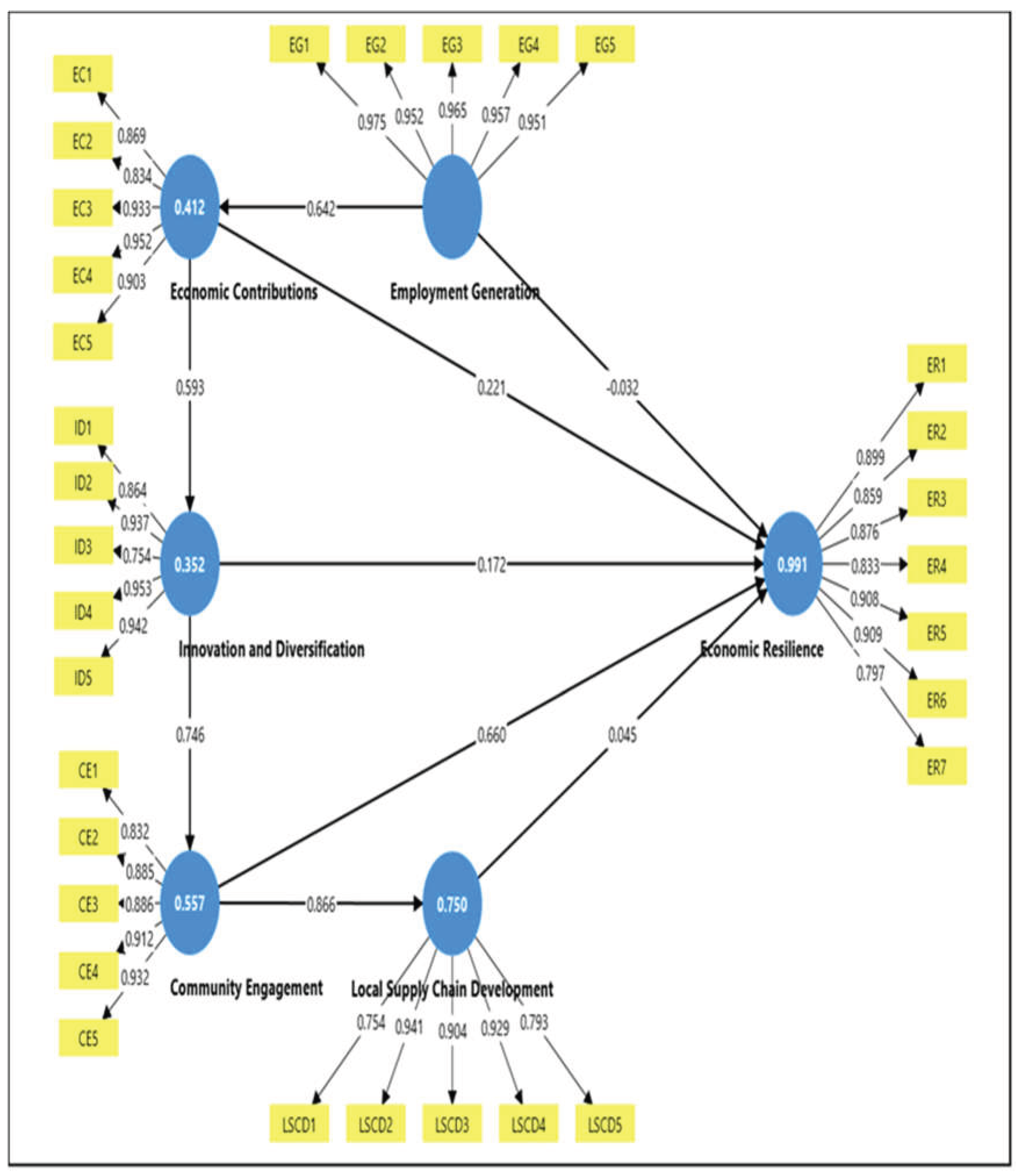
Table 2.
Heterotrait-Monotrait Ratio (HTMT) – Matrix.
| Employment Generation | Economic Contributions | Innovation and Diversification | Community Engagement | Local Supply Chain Development | Economic Resilience | |
|---|---|---|---|---|---|---|
| Employment Generation | ||||||
| Economic Contributions | 0.873 | |||||
| Innovation and Diversification | 0.789 | 0.654 | ||||
| Community Engagement | 1.046 | 0.912 | 0.826 | |||
| Local Supply Chain Development | 0.778 | 0.599 | 0.919 | 0.830 | ||
| Economic Resilience | 0.931 | 0.648 | 0.712 | 0.894 | 0.625 |
Table 3.
Fornell–Larcker Criterion.
| Employment Generation | Economic Contributions | Innovation and Diversification | Community Engagement | Local Supply Chain Development | Economic Resilience | |
|---|---|---|---|---|---|---|
| Employment Generation | 0.890 | |||||
| Economic Contributions | 0.822 | 0.899 | ||||
| Innovation and Diversification | 0.758 | 0.642 | 0.960 | |||
| Community Engagement | 0.984 | 0.873 | 0.794 | 0.869 | ||
| Local Supply Chain Development | 0.746 | 0.593 | 0.893 | 0.794 | 0.893 | |
| Economic Resilience | 0.866 | 0.618 | 0.676 | 0.835 | 0.602 | 0.867 |
Table 7.
R-square.
| R-square | R-square adjusted | |
|---|---|---|
| Economic Contributions | 0.412 | 0.411 |
| Innovation and Diversification | 0.352 | 0.350 |
| Community Engagement | 0.557 | 0.556 |
| Local Supply Chain Development | 0.750 | 0.750 |
| Economic Resilience | 0.991 | 0.991 |
Table 8.
F-square.
| f-square | |
|---|---|
| Community Engagement -> Economic Resilience | 4.178 |
| Community Engagement -> Local Supply Chain Development | 3.005 |
| Economic Contributions -> Economic Resilience | 1.442 |
| Economic Contributions -> Innovation and Diversification | 0.544 |
| Employment Generation -> Economic Contributions | 0.702 |
| Employment Generation -> Economic Resilience | 0.018 |
| Innovation and Diversification -> Community Engagement | 1.257 |
| Innovation and Diversification -> Economic Resilience | 0.532 |
| Local Supply Chain Development -> Economic Resilience | 0.043 |
Disclaimer/Publisher’s Note: The statements, opinions and data contained in all publications are solely those of the individual author(s) and contributor(s) and not of MDPI and/or the editor(s). MDPI and/or the editor(s) disclaim responsibility for any injury to people or property resulting from any ideas, methods, instructions or products referred to in the content. |
© 2026 by the authors. Licensee MDPI, Basel, Switzerland. This article is an open access article distributed under the terms and conditions of the Creative Commons Attribution (CC BY) license (http://creativecommons.org/licenses/by/4.0/).
Copyright: This open access article is published under a Creative Commons CC BY 4.0 license, which permit the free download, distribution, and reuse, provided that the author and preprint are cited in any reuse.


