

Submitted:
18 June 2026
Posted:
22 June 2026
You are already at the latest version
Abstract
This study aimed to compare antisaccade performance among adolescents with obsessive-compulsive disorder (OCD), their unaffected siblings, and healthy controls, and to examine whether this performance may serve as a candidate endophenotypic marker for OCD. The study included 48 adolescents aged 12–18 years with OCD, 35 unaffected siblings, and 39 healthy controls. Participants completed an antisaccade task using an eye-tracking device, and correct antisaccade percentage, latency, and saccadic velocity were measured to capture multiple components of oculomotor inhibitory control. The OCD group showed lower correct response rate and longer latency compared with healthy controls, while the sibling group demonstrated intermediate performance across these measures. Saccadic velocity was lower in both the OCD and sibling groups than in controls, with no significant difference observed between these two groups. Additional analyses indicated that both OCD diagnosis and sibling status were independently associated with antisaccade correct response rate and latency, whereas findings for antisaccade velocity should be considered exploratory. These findings suggest that impairments in antisaccade performance may not be specific to OCD but may also be present, to a milder extent, in unaffected siblings, supporting the view that oculomotor inhibitory control processes may represent a candidate endophenotypic marker associated with familial vulnerability to OCD and contribute to understanding the neurocognitive mechanisms underlying the disorder.
Keywords:
obsessive-compulsive disorder
; antisaccade task
; oculomotor inhibition
; endophenotype
; unaffected siblings
; adolescents
Introduction
Obsessive- compulsive disorder (OCD) is a chronic psychiatric disorder characterized by marked functional impairment, with a lifetime prevalence of approximately 1%–3% [1]. Because of the high disease burden it causes, the World Health Organization lists OCD among the disorders that lead to the greatest global functional disability [2]. The clinical burden of the disorder is not limited to the individual level; it also has serious economic and psychosocial consequences for families and society [3]. However, the predominantly internal nature of symptoms and the difficulty patients experience in disclosing them often lead to delays in diagnosis and intervention [4].
Neurobiological models point to functional abnormalities in cortico-striato-thalamo-cortical circuits in the pathophysiology of OCD. In particular, irregular patterns of activity between frontal regions such as the orbitofrontal cortex and anterior cingulate cortex, and basal ganglia structures, are thought to be associated with disruptions in executive functions such as cognitive control and response inhibition [5,6]. Indeed, it has been suggested that deficits in behavioral and cognitive inhibition may play a central role in the inability to suppress obsessive thoughts and in the continuation of compulsive behaviors [7].
Despite the strong genetic basis of OCD, genome-wide association studies have shown that it is difficult to establish direct and consistent relationships between the clinical phenotype and specific genetic variants [8]. For this reason, the endophenotype approach, which focuses on intermediate markers between genetic risk and clinical symptoms, provides an important framework for understanding the etiology of complex psychiatric disorders such as OCD. Endophenotypes are measurable characteristics that are relatively independent of clinical state, heritable, and more pronounced in patients and in first-degree relatives who are unaffected by the disorder than in healthy controls [9]. In OCD, response inhibition and executive control deficits have been proposed as potential candidate endophenotypes because they appear to satisfy several of these criteria [10]. Studies involving unaffected first-degree relatives are particularly valuable for identifying cognitive markers associated with the underlying neurobiology of OCD. Impairments in executive functions such as inhibition, planning, and decision-making observed in these individuals may emerge independently of clinical state, suggesting that these processes may reflect trait-related rather than state-dependent characteristics [11].
Traditional neuropsychological tests and computerized tasks used to assess response inhibition, such as Go/No-Go and Stop-Signal paradigms, provide millisecond-level reaction time information, but they often cannot fully separate inhibition processes from concurrent cognitive components such as attention, stimulus discrimination, and response selection [12]. For example, performance on the Go/No-Go task involves not only response suppression capacity, but also the accurate discrimination of No-Go stimuli and, in some cases, ignoring these stimuli rather than actively suppressing a response to them [13]. In addition, some stimulus pairings used in the task (for example, red for Go and green for No-Go) may conflict with everyday learned associations and thereby affect performance. Similarly, although the Stop-Signal paradigm appears to provide a more “pure” measure of inhibition, inhibitory performance in this task is determined by a calculated value rather than a directly observed behavior. Moreover, the auditory stop cues used in the task may also influence performance, which can complicate interpretation of the findings [14]. Given these limitations, there is a need for experimental approaches that can assess inhibitory control processes in a more isolated and direct manner. In this context, oculomotor tasks offer important advantages as they allow the suppression of reflexive responses and the initiation of voluntary actions to be examined within a single behavioral paradigm [15]. The antisaccade task is one of the most commonly used examples of this approach and is increasingly preferred for investigating inhibitory control processes in OCD. The antisaccade task requires suppression of the automatic gaze shift (prosaccade) that occurs when a peripheral stimulus appears and instead the generation of a voluntary eye movement toward the location directly opposite the stimulus. In this task, measures such as antisaccade error rate and latency provide direct and objective indicators of the inhibition of reflexive responses and the efficiency of voluntary control [16]. With eye-tracking technology, these processes can be recorded with high temporal and spatial resolution; thus, behavioral outputs associated with fronto-striatal networks involved in inhibitory control can be evaluated with precision [15].
Among antisaccade performance measures, correct response rate is widely considered a behavioral index of inhibitory control, as successful task performance requires suppression of a reflexive prosaccade and generation of a voluntary saccade in the opposite direction. In contrast, antisaccade latency reflects the efficiency of voluntary response preparation and initiation processes, whereas saccadic velocity provides information regarding oculomotor execution and motor output [15,16]. Previous studies have reported abnormalities across these measures in individuals with OCD, suggesting impairments in inhibitory control and executive functioning [12,17]. Accordingly, these metrics may provide complementary information regarding the neurocognitive mechanisms underlying OCD and may serve as candidate markers of familial vulnerability and potential endophenotypic risk [17,18].
Studies examining antisaccade performance in OCD have generally reported higher error rates and/or prolonged latencies in patients compared with healthy controls; however, these findings have been inconsistent across studies [12,17,18]. This heterogeneity suggests that antisaccade performance may reflect multiple underlying processes rather than a single deficit, highlighting the need for a more detailed examination of its components. In this context, evaluating antisaccade performance within an endophenotype framework may provide additional insight into the neurocognitive mechanisms underlying OCD. Nevertheless, studies addressing antisaccade performance as a candidate endophenotype remain limited. Existing evidence, largely derived from adult samples, has reported similar oculomotor abnormalities in individuals with OCD and their unaffected first-degree relatives, supporting the possibility that these alterations may be related to familial risk rather than clinical state alone [19,20].
Antisaccade performance has been shown to undergo marked developmental changes from childhood through adolescence, with error rates decreasing as age increases [21]. However, adolescence represents a developmental stage during which prefrontal and fronto-striatal networks involved in executive control are still maturing [22,23]. In this context, examining antisaccade performance in adolescents may provide a valuable opportunity to detect alterations in inhibitory control before full neurocognitive maturation is achieved. Moreover, because most previous studies investigating antisaccade performance and familial risk in OCD have been conducted in adult populations, evidence from adolescent samples remains relatively limited.
To the best of our knowledge, no endophenotype study has examined familial risk by comparing antisaccade performance among adolescent patients with active OCD, their unaffected siblings, and healthy controls. The present study therefore aimed to compare antisaccade performance among adolescents with active OCD, their siblings without an OCD diagnosis, and healthy controls without a history of OCD, and to investigate whether oculomotor inhibitory control measures may represent a potential endophenotypic candidate for OCD. By focusing on an adolescent sample and simultaneously examining patients, unaffected siblings, and healthy controls, this study seeks to extend previous adult-oriented findings and provide further insight into the relationship between inhibitory control, familial vulnerability, and OCD. In this framework, we hypothesized that individuals with OCD and their unaffected siblings would exhibit lower correct antisaccade percentage and longer antisaccade latencies compared with healthy controls.
Materials and Methods
Study Design and Participants
This study was conducted at the Child and Adolescent Psychiatry Clinic of a training and research hospital in Türkiye between October 1, 2024, and October 1, 2025. The study sample consisted of adolescents diagnosed with obsessive-compulsive disorder (OCD; n = 48), unaffected siblings of individuals with OCD (SIBL; n = 35), and healthy controls (HC; n = 39). Prior to the study, all participants were provided with detailed information about the study, and written informed consent was obtained from both the adolescents and their parents.
The OCD group included adolescents aged 12–18 years who met the Diagnostic and Statistical Manual of Mental Disorders, Fifth Edition, Text Revision (DSM-5-TR) criteria for OCD, with diagnoses confirmed by a semi-structured clinical interview (Kiddie Schedule for Affective Disorders and Schizophrenia for School-Age Children, K-SADS-5). To ensure the inclusion of clinically active cases, individuals in remission or with subthreshold symptoms were excluded; accordingly, only participants with a total score greater than 14 on the Children’s Yale-Brown Obsessive Compulsive Scale (CY-BOCS) were included [24]. The SIBL group was formed from siblings of participants in the OCD group and consisted of individuals aged 12–18 years who did not meet DSM-5-TR criteria for OCD and had no psychiatric disorder identified during the K-SADS-5 assessment. The HC group was recruited consecutively from adolescents presenting to the hospital for non-psychiatric reasons. These participants had no psychiatric diagnosis based on K-SADS-5 assessment and no history of OCD in first-degree relatives.
Exclusion criteria for all groups included the presence of neurological disorders, particularly epilepsy; any condition significantly affecting vision or uncorrected visual impairment; and the presence of cognitive impairment. In addition, for the OCD group, the presence of any comorbid psychiatric disorder according to K-SADS-5 was considered an exclusion criterion. Furthermore, in the OCD group, the use of any psychotropic medication other than antidepressants prescribed for OCD treatment (e.g., antipsychotics, benzodiazepines, or psychostimulants) was an exclusion criterion.
The sample size was calculated using G*Power software version 3.1.9.7. Based on the reference study [20], with an effect size (f) of .44, an alpha level of .05, and a statistical power of 95%, the minimum required total sample size was calculated as 105, with at least 35 participants targeted for each group. Accordingly, 125 participants meeting inclusion criteria for the OCD group were initially screened. Of these, 10 were excluded due to comorbid medical conditions (epilepsy [n = 2], cerebral palsy [n = 1], visual impairment [n = 7]). 7 participants were excluded due to the use of antipsychotics (n = 5) or benzodiazepines (n = 2). Among the remaining participants, 57 were excluded because of at least one comorbid psychiatric disorder. Because some participants met criteria for more than one psychiatric diagnosis, the total number of comorbid diagnoses exceeded the number of excluded participants (attention-deficit/hyperactivity disorder [n = 26], major depressive disorder [n = 18], anxiety disorders [n = 27], tic disorder [n = 4], intellectual disability [n = 8], autism spectrum disorder [n = 3], psychotic disorder [n = 2], bipolar disorder [n = 1]). Following these exclusions, 51 participants remained eligible. An additional 3 participants were unable to complete the antisaccade task. Consequently, 48 participants completed the study in the OCD group. For the SIBL group, 48 eligible participants were identified; 13 were excluded based on exclusion criteria, and 35 participants completed the study. For the HC group, 42 participants were invited; 2 withdrew from the study and 1 was unable to complete the antisaccade task, resulting in 39 participants completing the study.
Procedure
The study protocol was approved by the Scientific Research Ethics Committee of University of Health Sciences Türkiye, Trabzon Faculty of Medicine (Approval No: 2025/105; Approval Date: 13/08/2024), and all procedures were conducted in accordance with the Declaration of Helsinki (1975, revised in 2013). Written informed consent was obtained from both participants and their parents/legal guardians. The assessment was carried out in two stages. In the first stage, participants’ sociodemographic and clinical information was recorded, diagnostic evaluation was performed using K-SADS-5 in accordance with DSM-5-TR criteria, and OCD symptom severity was assessed using the CY-BOCS. Participants who met the study criteria were then scheduled for a second stage, during which the antisaccade task was administered and eye-tracking data were recorded simultaneously. Prior to the second stage, participants were instructed to ensure adequate sleep, avoid fasting, and refrain from consuming stimulants such as caffeine.
The second stage was conducted in a dedicated assessment room with stable ambient lighting and minimal background noise. Participants were tested individually, unnecessary visual and auditory distractions were minimized, and the same environmental conditions were maintained across all assessments. Before the eye-tracking task, task instructions were explained and a brief practice session consisting of five trials was administered. Following successful completion of the practice session, each participant completed 48 antisaccade trials. The total duration of the second stage (including calibration and practice) was approximately 25–30 minutes per participant.
Measurement Tools
Sociodemographic Data Form
Sociodemographic and clinical characteristics of the participants were collected using a sociodemographic data form developed by the researchers. This form included information on age, sex, educational status, monthly income, psychiatric history, duration of illness, and treatments used, and was completed by the interviewer during face-to-face interviews.
Kiddie Schedule for Affective Disorders and Schizophrenia for School-Age Children (K-SADS-5)
This semi-structured interview, developed by Kaufman et al., is designed to assess past and current psychopathology in children and adolescents according to DSM diagnostic criteria [25]. The validity and reliability of the Turkish version of the scale has been established [26]. In the present study, OCD and other psychiatric disorders were assessed using this interview.
Children’s Yale-Brown Obsessive Compulsive Scale (CY-BOCS)
Developed by Scahill et al., the Children’s Yale-Brown Obsessive Compulsive Scale (CY-BOCS) is a clinician-administered semi-structured instrument used to assess the severity of obsessive-compulsive symptoms in children and adolescents [27]. The scale consists of 10 clinician-rated items evaluating the severity of obsessions and compulsions across dimensions including time occupied, interference, distress, resistance, and degree of control. Five items assess obsessions and five assess compulsions, yielding Obsession and Compulsion subscale scores ranging from 0 to 20 and a total score ranging from 0 to 40. Higher scores indicate greater OCD symptom severity. The validity and reliability of the Turkish version of the scale have been established [28]. In the present study, CY-BOCS Obsession, Compulsion, and Total scores were used to quantify OCD symptom severity and to examine their associations with antisaccade performance measures.
Eye-Tracking System
Eye movement data were recorded using a Gazepoint GP3 HD® eye tracker with a sampling frequency of 250 Hz. The antisaccade task was created using PsychoPy v2025.2.4 software. Stimuli were presented on a 17-inch monitor with a resolution of 1920 × 1080 pixels, and participants were tested in a seated position at a viewing distance of 41 cm [20]. To minimize artifacts related to head and body movements during measurement, an adjustable chin rest was used.
Before eye-tracking experiments, ocular dominance was assessed using the Dolman method (hole-in-the-card test), and eye movement data were recorded based on the dominant eye to reduce potential confounding effects of dominance differences on measurements [29]. A 9-point calibration procedure was performed prior to data acquisition, and recording was initiated only after sufficient accuracy was achieved.
Antisaccade Task and Performance Measures
The antisaccade task began with a white square fixation stimulus subtending approximately 2° × 2° of visual angle, presented on a black background. This stimulus remained on the screen for a randomly varying duration between 800 and 1200 ms to prevent anticipatory effects that could influence performance. Two hundred milliseconds after the fixation stimulus disappeared, a white circular target stimulus (0.3 cm in diameter) appeared on the screen for 800 ms. The target was presented at one of four possible locations corresponding to ±6° and ±12° of visual angle from the center. Subsequently, a black screen was displayed for a randomly varying duration of 500–1000 ms before the next antisaccade trial began [30].
Participants were instructed to shift their gaze to the mirror-opposite location of the target without looking directly at the target itself. Saccades occurring within the first 80 ms following target onset or after 600 ms were excluded from analysis due to the likelihood of anticipatory responses or lapses in attention. Additionally, trials were excluded if, despite an initially correct saccade direction, the eye crossed the midline (approximately ±0.8° of visual angle) and moved toward or fixated on the target during the trial, or if they contained recording artifacts such as looking off-screen or corrupted corneal reflection signals [18]. A response was classified as a correct antisaccade only when the first valid saccade was directed toward the mirror-symmetric antitarget location corresponding to the target eccentricity. Thus, for targets presented at +6° or +12°, only saccades directed toward the corresponding −6° or −12° antitarget location were coded as correct, and vice versa. Responses directed merely to the opposite visual hemifield were not classified as correct antisaccades.
Antisaccade performance was evaluated using three primary measures. The correct antisaccade percentage (antisaccade correct response rate) was calculated as the proportion of valid correct antisaccades relative to the total number of valid antisaccade trials. Mean correct antisaccade latency (s) was defined as the average time interval between target onset and the initiation of a correct antisaccade. Mean correct antisaccade velocity (°/ms) was calculated as the ratio of saccade amplitude to saccade duration for correct antisaccades. A schematic representation of the experimental paradigm is presented in Figure 1.
Statistical Analysis
Data were examined for missing values and outliers. No missing data were identified in the dataset. No outliers were removed from the analyses because all identified values were considered plausible observations and did not reflect data-entry errors or measurement artifacts. The distribution of continuous variables was assessed using the Kolmogorov–Smirnov test and visual inspection of histograms. The chi-square test was used to compare categorical variables between groups. For comparisons of continuous variables across groups, one-way ANOVA was used when the normality assumption was met, whereas the Kruskal–Wallis H test was used when it was not. In ANOVA analyses, Bonferroni correction was used as the post hoc test; for the Kruskal–Wallis H test, Mann–Whitney U tests with Bonferroni correction were performed. Associations between continuous variables were examined using Pearson correlation analysis when the normality assumption was satisfied and Spearman rank-order correlation analysis when it was not. In addition to the statistical analyses, effect sizes were calculated and reported where appropriate for group comparisons (for ANOVA: partial η²; for Kruskal–Wallis: ε²; for Mann–Whitney U: rank-biserial correlation [r]; for chi-square: Cramer’s V).
Hierarchical multiple linear regression analyses were performed to examine factors predicting antisaccade performance. In the analyses, antisaccade correct response rate was entered as the dependent variable, and age and sex, along with dummy-coded variables representing group membership (OCD and SIBL; reference group: HC), were entered into the model sequentially as independent variables.
In addition, similar regression models were constructed for mean correct antisaccade latency and antisaccade velocity. Because these variables did not meet the assumption of normality in the initial analyses, logarithmic transformation was applied before regression modeling. Following transformation, normality was reassessed using the same procedures (Kolmogorov–Smirnov tests and visual inspection of histograms) before inclusion in the regression models. In all regression analyses, model assumptions (linearity, multicollinearity, normality of residuals, and homoscedasticity) were checked.
All analyses were conducted using the Statistical Package for the Social Sciences (SPSS), version 27.0. The level of statistical significance was set at α = .05.
Results
As shown in Table 1, no significant differences were found between the groups in terms of age, sex, or family income level (all p values > .05). When the OCD and SIBL groups were compared in terms of CY-BOCS scores, participants in the OCD group had higher Obsession, Compulsion, and Total scores (all p values < .001). Figure 2 visually demonstrates these differences, showing markedly higher CY-BOCS Obsession, Compulsion, and Total scores in the OCD group compared with the SIBL group.
Before examining antisaccade performance, trial-retention rates were evaluated to determine whether preprocessing-related data loss differed across groups. The proportion of excluded antisaccade trials was low in all groups. Given that each participant completed 48 antisaccade trials, the mean number of excluded trials was 4.23 ± 3.04 in the OCD group, 3.77 ± 2.80 in the SIBL group, and 3.15 ± 2.82 in the HC group, corresponding to trial-retention rates of 91.2%, 92.1%, and 93.4%, respectively. A one-way ANOVA revealed no significant group difference in the number of excluded trials (F(2,119) = 1.479, p = .232), indicating comparable data quality and trial-retention rates across groups.
Results regarding antisaccade performance measures are presented in Table 2 and Figure 3 and Figure 4.
A significant difference was found among the groups in correct antisaccade percentage (F(2,119) = 23.506, p < .001, Partial η² = .283). Post hoc analyses showed that the OCD group had a lower correct antisaccade percentage than both the SIBL group (p = .004) and the HC group (p < .001). In addition, the SIBL group had a lower correct antisaccade percentage than the HC group (p = .005). The statistical significance of the group differences remained unchanged in the ANCOVA model with age included as a covariate (Supplementary Table S1). The values presented in Supplementary Table S1 represent age-adjusted estimated marginal means derived from the ANCOVA model, whereas the values reported in Table 2 represent the observed group means. Therefore, small differences between the two tables are expected and reflect the statistical adjustment for age applied in the ANCOVA model.
A significant group difference was also observed in mean correct antisaccade latency (χ2(2) = 26.900, p < .001, ε2 = .209). Post hoc analyses showed that latency was higher in the OCD group than in both the SIBL group (p < .001) and the HC group (p < .001), and higher in the SIBL group than in the HC group (p = .005).
Similarly, a significant difference was found among the groups in mean correct antisaccade velocity (χ2(2) = 12.878, p = .002, ε² = .091). Post hoc analyses indicated that velocity was lower in both the OCD group (p < .001) and the SIBL group (p = .016) than in the HC group; however, no significant difference was observed between the OCD and SIBL groups (p = .143)
Among participants in the OCD group, 21 were receiving no medication, whereas 27 were receiving antidepressant treatment for OCD. Among the medicated participants with OCD, 13 were taking fluoxetine, 9 sertraline, 2 escitalopram, 2 fluvoxamine, 3 clomipramine, 2 mirtazapine, 1 trazodone, and 1 agomelatine. No significant differences were found between medicated and unmedicated participants in the OCD group with respect to correct antisaccade percentage, latency, or velocity (all p values > .05; Supplementary Table S2).
Data on the associations between antisaccade performance and clinical and demographic characteristics of the participants are presented in Table 3.
Accordingly, when all participants were considered, age showed a significant positive association with antisaccade correct response rate (r = .268, p = .003) and a significant negative association with mean correct antisaccade latency (r = −.187, p = .040). No significant association was found between age and mean correct antisaccade velocity (p > .05). No significant association was observed between sex and antisaccade performance (all p values > .05). In analyses specific to the OCD group, no significant association was found between CY-BOCS scores and antisaccade performance measures (all p values > .05). Similarly, no significant association was found between illness duration and antisaccade performance (all p values > .05).
Hierarchical regression analysis was conducted to examine factors predicting correct antisaccade percentage (Table 4). In the first model, age and sex were included, and the model was significant (R² = .080, Adjusted R² = .065, p = .007); in this model, only age was a significant predictor (p = .004). With the addition of the variable representing the OCD group (OCD dummy), the explanatory power of the model increased significantly (ΔR2 = .185, p < .001), and being in the OCD group was found to be negatively associated with antisaccade correct response rate (β = −.436, p < .001). With the addition of the SIBL dummy variable in the final model, the explanatory power of the model increased further (ΔR2 = .052, p = .004), and the final model explained 31.7% of the total variance (R² = .317, Adjusted R² = .293). In the final model, belonging to either the OCD group (β = −.576, p < .001) or the SIBL group (β = −.266, p = .004) was associated with a lower correct antisaccade percentage compared with healthy controls. In the models predicting mean correct antisaccade latency and velocity (Supplementary Table S3 and Table S4), analyses after logarithmic transformation showed that the transformed variables no longer demonstrated substantial deviations from normality based on Kolmogorov–Smirnov tests and visual inspection of histograms. Belonging to the OCD and SIBL groups was associated with longer latency periods (β = .448, p < .001; β = .209, p = .037, respectively). Similarly, both groups were associated with lower antisaccade velocity (OCD: β = −.223, p = .037; SIBL: β = −.215, p = .041), although the explanatory power of this model was limited (R2 = .075). Inspection of the variance inflation factor (VIF) values indicated no evidence of problematic multicollinearity among the predictor variables.
Discussion
In this study, antisaccade performance was compared among adolescents with OCD, their unaffected siblings, and healthy controls in order to examine the relationship between oculomotor inhibitory control processes and both the disorder and familial vulnerability. The findings showed significant group differences across all components of antisaccade performance, namely correct response rate, latency, and velocity. The overall pattern of performance, being lowest in the OCD group, intermediate in the sibling group, and highest in healthy controls, suggests that inhibitory control processes may reflect not only an impairment associated with the disorder but also a pattern that may be related to familial vulnerability.
One of the important contributions of this study is that antisaccade performance was evaluated in an adolescent sample within a familial-risk design, together with its correct response rate, latency, and velocity components. Whereas antisaccade correct response rate directly reflects the capacity to suppress a reflexive saccadic response, latency and velocity provide information about different components of voluntarily generating a saccade in the opposite direction [31]. Latency is associated with response initiation and cognitive control processes [32,33], whereas saccadic velocity is thought to reflect processes more closely related to motor execution and arousal level [34]. Examining these parameters together allows a more detailed assessment of the processes underlying antisaccade performance.
The findings regarding antisaccade correct response rate indicate a marked inhibitory deficit in the OCD group. Although increased antisaccade error rates in OCD have been frequently reported in the literature, it is known that findings may vary depending on task characteristics and sample differences [18]. Nevertheless, multiple studies have consistently shown increased antisaccade error rates in both individuals with OCD and their unaffected first-degree relatives [12,20,35,36]. Similarly, studies evaluating executive functions with methods other than antisaccade tasks have also reported difficulties in inhibitory control in both OCD groups and relatives [37,38,39]. In the present study, the reduced performance observed in the sibling group compared with controls, supported by the regression analyses, suggests that differences in inhibitory control processes may not be solely secondary to clinical status and may instead include a measurable familial vulnerability component.
The findings for antisaccade latency largely parallel the correct response rate results. The longer latency observed in the OCD group suggests a slowing not only in suppressing the reflexive response but also in initiating the voluntary response. Antisaccade latency is associated with higher-order executive functions involving response planning and initiation. Prolonged antisaccade latency in OCD has previously been reported and has been linked to inefficiency in voluntary response generation [20,40]. There are also studies reporting prolonged latency in unaffected relatives [35]. The intermediate latency values observed in the SIBL group suggest that this cognitive slowing cannot be explained solely by the presence of diagnosis and may instead reflect a broader neurocognitive vulnerability. Although the overall antisaccade latency values observed in the present study were shorter than those reported in some adult OCD studies [18], they were broadly comparable to findings from pediatric OCD studies employing similar antisaccade paradigms [20,30]. Therefore, differences in participant age and developmental stage may contribute to variability in antisaccade latency findings across studies. Similarly, the regression analyses showed that belonging to either the OCD or SIBL group was associated with longer antisaccade latency. Taken together, these findings are consistent with meta-analytic evidence suggesting that executive dysfunction in OCD may be considered not only as a categorical feature but also as part of a broader spectrum [41].
Most previous antisaccade studies have focused on error rate and latency, whereas saccadic velocity has been investigated relatively less often. In the present study, the findings for saccadic velocity showed a pattern that was partially dissociated from the other antisaccade parameters. The fact that the OCD and SIBL groups had similar velocity values and that both groups showed lower velocity than healthy controls suggests that this parameter may partly reflect components more closely related to oculomotor execution and motor output rather than inhibitory control processes. This finding supports the view that antisaccade performance cannot be explained by a single cognitive process and instead reflects a multicomponent structure involving cognitive control, response selection, and motor execution processes. Indeed, recent studies have shown that oculomotor performance in OCD is associated not only with inhibition errors but also with a broader control disturbance involving components such as motor output and task-specific performance efficiency [36]. In this context, the similar reduction in velocity observed in both the OCD and SIBL groups may indicate the possibility of shared underlying mechanisms; however, given the limited explanatory power of the regression model and the relatively limited literature on this parameter, this finding should be considered exploratory and interpreted with caution.
The relationships between age and antisaccade performance are important for interpreting the findings. The increase in antisaccade correct response rate and the decrease in latency with age indicate that inhibitory control processes mature developmentally. This finding is consistent with studies showing that antisaccade performance is age sensitive [21,30,42]. This demonstrates that antisaccade performance has a strong developmental component and that age should be controlled for, particularly in pediatric samples [43]. In the present study, the selection of a sibling group within a similar age range contributed to a more reliable evaluation of familial effects.
The absence of a significant association between symptom severity and illness duration and antisaccade performance in the OCD group suggests that these performance differences may be independent of symptom level. Similar findings have been reported previously, and antisaccade performance has been suggested to be independent of clinical severity [18,44]. This finding is consistent with the possibility that antisaccade performance may reflect trait-like characteristics rather than being solely associated with current symptom severity. No significant differences were observed between medicated and unmedicated participants with OCD in terms of antisaccade performance. However, because the medication analyses were based on relatively small subgroups, the absence of statistically significant differences should not be interpreted as evidence that antidepressant treatment has no influence on antisaccade performance. Rather, these findings should be considered preliminary, and larger studies specifically designed to evaluate medication-related effects are needed before firm conclusions can be drawn.
Several limitations should be considered when interpreting the findings of this study. The fact that the study was conducted at a single center may limit the generalizability of the findings. The relatively modest sample size may have reduced the power of subgroup analyses in particular. This limitation is particularly relevant to the comparison between medicated and unmedicated participants with OCD, which may have been underpowered to detect modest medication-related effects on antisaccade performance. The cross-sectional design also prevents evaluation of causal relationships. The antisaccade task used in the study consisted of a total of 48 trials. The relatively limited number of trials may have reduced measurement reliability by preventing sufficient balancing of within-subject variability and by increasing the influence of individual trials on the measurements. However, because the study was conducted in an adolescent sample, a shorter protocol was preferred in consideration of attention span and task compliance. This reflects a methodological trade-off, and it may be useful for future studies to evaluate longer task designs in different samples. In addition, the sampling frequency and measurement sensitivity of the eye-tracking device used in the study may be limited compared with higher-resolution systems. This may be a factor that could affect the precision of temporal measures such as saccadic velocity and latency. In addition, quantitative endpoint coordinates were not retained for subsequent analyses. Therefore, horizontal and vertical landing-position deviations from the intended antitarget location could not be examined, and spatial landing accuracy could not be quantified directly. Although correct antisaccades were classified according to predefined mirror-symmetric antitarget locations during data preprocessing, future studies should retain endpoint-level data and report landing-position measures to provide a more comprehensive evaluation of task compliance and oculomotor performance. Participants with psychiatric comorbidities were excluded to reduce potential confounding effects and increase internal validity. Although this approach allowed a more specific examination of antisaccade performance in relation to OCD, it may limit the generalizability of the findings because OCD in adolescence commonly co-occurs with disorders such as anxiety disorders, depression, and ADHD. Therefore, the present findings may be most applicable to a relatively selective subgroup of adolescents with OCD. Future studies including larger and more clinically representative samples, as well as participants with common psychiatric comorbidities, may help clarify the influence of psychiatric comorbidity on antisaccade performance. The SIBL group in this study consisted of siblings without a current psychiatric diagnosis. Although this approach reduced potential confounding effects and allowed familial vulnerability to be examined in a more selective manner, it may not fully reflect the broader population of relatives of individuals with OCD, among whom subclinical obsessive-compulsive, anxiety, and depressive symptoms are relatively common. Consequently, the findings may underestimate the magnitude of familial vulnerability observed in routine clinical settings. In addition, possible differential effects of symptom subtypes in the OCD group, such as contamination/cleaning, religious, aggressive, or multiple symptom patterns, on antisaccade performance were not examined. Given the heterogeneous nature of OCD, separating the effects of different symptom dimensions on cognitive and oculomotor processes represents an important area for future research.
Conclusion
The present study demonstrated that adolescents with OCD show impairments in antisaccade performance, reflected by reduced correct response rate, prolonged latency, and lower saccadic velocity. A similar but less pronounced pattern was observed in unaffected siblings, suggesting that alterations in oculomotor inhibitory control may be associated with familial vulnerability to OCD. Nevertheless, the cross-sectional nature of the study precludes conclusions regarding heritability, temporal stability, or endophenotypic status. Therefore, the current findings should be regarded as preliminary evidence supporting the potential relevance of antisaccade measures within an endophenotype framework. Future studies employing larger samples, longitudinal designs, family-based genetic approaches, and more comprehensive antisaccade paradigms will be important for clarifying the clinical and neurobiological significance of these findings.
Supplementary Materials
The following supporting information can be downloaded at the website of this paper posted on Preprints.org.
Author Contributions
Conceptualization, O.B.K., A.A. and M.S.D.; Methodology, O.B.K and M.S.D..; Software, Z.A.O, D.C.O , I.B.S., and S.K.; Validation, O.B.K, S.K., Z.A.O, I.S.E, and O.B.D; Formal Analysis, O.B.K and S.K.; Investigation, O.B.K and Z.A.O.; Resources, O.B.K., M.S.D., and S.K.; Data Curation, A.A, M.S.D., Z.A.O., D.C.O., I.B.S.; Writing – Original Draft Preparation, O.B.K., A.A., and D.C.O; Writing – Review & Editing, O.B.K.,D.C.O., I.S.E. and O.B.D.; Visualization, A.A. ,I.B.S., and S.K.; Supervision, D.C.O., I.B.S., I.S.E. and O.B.D.; All authors have read and agreed to the published version of the manuscript.
Funding
This research received no external funding.
Institutional Review Board Statement
The study was conducted in accordance with the Declaration of Helsinki and approved by the Scientific Research Ethics Committee of University of Health Sciences Türkiye, Trabzon Faculty of Medicine (Approval No: 2025/105; Approval Date: 13 August 2024).
Informed Consent Statement
Informed consent was obtained from all subjects involved in the study, and written informed consent has been obtained from the participants to publish this paper.
Data Availability Statement
The data presented in this study are available on request from the corresponding author due to patient privacy.
Acknowledgments
The authors would like to thank Onur Erdem Korkmaz for his valuable contributions to the development of the antisaccade task.
Conflicts of Interest
The authors declare no conflicts of interest.
References
- Ruscio AM, Stein DJ, Chiu WT, Kessler RC. The epidemiology of obsessive-compulsive disorder in the National Comorbidity Survey Replication. Mol Psychiatry. 2010 Jan;15(1):53–63. [CrossRef]
- Khayrullina GM, Moiseeva VV, Martynova OV. Specific Aspects of Eye Movement Reactions as Markers of Cognitive Control Disorders in Patients with Obsessive-Compulsive Disorder (Review). Sovrem Tekhnologii Med. 2022;14(2):80–95. [CrossRef]
- Yang W, Tang Z, Wang X, Ma X, Cheng Y, Wang B, et al. The cost of obsessive-compulsive disorder (OCD) in China: a multi-center cross-sectional survey based on hospitals. Gen Psychiatr. 2021 Dec 6;34(6):e100632. [CrossRef]
- Hirschtritt ME, Bloch MH, Mathews CA. Obsessive-Compulsive Disorder: Advances in Diagnosis and Treatment. JAMA. 2017 Apr 4;317(13):1358–67. [CrossRef]
- Menzies L, Chamberlain SR, Laird AR, Thelen SM, Sahakian BJ, Bullmore ET. Integrating evidence from neuroimaging and neuropsychological studies of obsessive-compulsive disorder: the orbitofronto-striatal model revisited. Neurosci Biobehav Rev. 2008;32(3):525–49. [CrossRef]
- Pauls DL, Abramovitch A, Rauch SL, Geller DA. Obsessive-compulsive disorder: an integrative genetic and neurobiological perspective. Nat Rev Neurosci. 2014 Jun;15(6):410–24. [CrossRef]
- Chamberlain SR, Fineberg NA, Blackwell AD, Robbins TW, Sahakian BJ. Motor inhibition and cognitive flexibility in obsessive-compulsive disorder and trichotillomania. Am J Psychiatry. 2006 Jul;163(7):1282–4. [CrossRef]
- Mattheisen M, Samuels JF, Wang Y, Greenberg BD, Fyer AJ, McCracken JT, et al. Genome-wide association study in obsessive-compulsive disorder: results from the OCGAS. Mol Psychiatry. 2015 Mar;20(3):337–44. [CrossRef]
- Gottesman II, Gould TD. The endophenotype concept in psychiatry: etymology and strategic intentions. Am J Psychiatry. 2003 Apr;160(4):636–45. [CrossRef]
- Riesel A, Endrass T, Kaufmann C, Kathmann N. Overactive error-related brain activity as a candidate endophenotype for obsessive-compulsive disorder: evidence from unaffected first-degree relatives. Am J Psychiatry. 2011 Mar;168(3):317–24. [CrossRef]
- Bora E. Meta-analysis of neurocognitive deficits in unaffected relatives of obsessive-compulsive disorder (OCD): comparison with healthy controls and patients with OCD. Psychol Med. 2020 Jun;50(8):1257–66. [CrossRef]
- Hu Y, Liao R, Chen W, Kong X, Liu J, Liu D, et al. Investigating behavior inhibition in obsessive-compulsive disorder: Evidence from eye movements. Scand J Psychol. 2020 Oct;61(5):634–41. [CrossRef]
- Rubia K, Russell T, Overmeyer S, Brammer MJ, Bullmore ET, Sharma T, et al. Mapping motor inhibition: conjunctive brain activations across different versions of go/no-go and stop tasks. Neuroimage. 2001 Feb;13(2):250–61. [CrossRef]
- Dillon DG, Pizzagalli DA. Inhibition of Action, Thought, and Emotion: A Selective Neurobiological Review. Appl Prev Psychol. 2007 Dec;12(3):99–114. [CrossRef]
- Breuer F, Meyhöfer I, Lencer R, Sprenger A, Roesmann K, Schag K, et al. Aberrant inhibitory control as a transdiagnostic dimension of mental disorders - A meta-analysis of the antisaccade task in different psychiatric populations. Neurosci Biobehav Rev. 2024 Oct;165:105840. [CrossRef]
- Aponte EA, Tschan DG, Stephan KE, Heinzle J. Inhibition failures and late errors in the antisaccade task: influence of cue delay. J Neurophysiol. 2018 Dec 1;120(6):3001–16. [CrossRef]
- Kloft L, Reuter B, Riesel A, Kathmann N. Impaired volitional saccade control: first evidence for a new candidate endophenotype in obsessive-compulsive disorder. Eur Arch Psychiatry Clin Neurosci. 2013 Apr;263(3):215–22. [CrossRef]
- Lennertz L, Rampacher F, Vogeley A, Schulze-Rauschenbach S, Pukrop R, Ruhrmann S, et al. Antisaccade performance in patients with obsessive-compulsive disorder and unaffected relatives: further evidence for impaired response inhibition as a candidate endophenotype. Eur Arch Psychiatry Clin Neurosci. 2012 Oct;262(7):625–34. [CrossRef]
- Damilou A, Apostolakis S, Thrapsanioti E, Theleritis C, Smyrnis N. Shared and distinct oculomotor function deficits in schizophrenia and obsessive compulsive disorder. Psychophysiology. 2016 Jun;53(6):796–805. [CrossRef]
- Narayanaswamy JC, Subramaniam A, Bose A, Agarwal SM, Kalmady SV, Jose D, et al. Antisaccade task performance in obsessive-compulsive disorder and its clinical correlates. Asian J Psychiatr. 2021 Mar;57:102508. [CrossRef]
- Coe BC, Munoz DP. Mechanisms of saccade suppression revealed in the anti-saccade task. Philos Trans R Soc Lond B Biol Sci. 2017 Apr 19;372(1718):20160192. [CrossRef]
- Luna B, Velanova K, Geier CF. Development of eye-movement control. Brain Cogn. 2008 Dec;68(3):293–308. [CrossRef]
- Casey BJ, Jones RM, Hare TA. The adolescent brain. Ann N Y Acad Sci. 2008 Mar;1124:111–26. [CrossRef]
- Lewin AB, De Nadai AS, Park J, Goodman WK, Murphy TK, Storch EA. Refining clinical judgment of treatment outcome in obsessive-compulsive disorder. Psychiatry Res. 2011 Feb 28;185(3):394–401. [CrossRef]
- Kaufman J, Birmaher B, Brent D, Rao U, Flynn C, Moreci P, et al. Schedule for Affective Disorders and Schizophrenia for School-Age Children-Present and Lifetime Version (K-SADS-PL): initial reliability and validity data. J Am Acad Child Adolesc Psychiatry. 1997 Jul;36(7):980–8. [CrossRef]
- Ünal F, Öktem F, Çetin Çuhadaroğlu F, Çengel Kültür SE, Akdemir D, Foto Özdemir D, et al. [Reliability and Validity of the Schedule for Affective Disorders and Schizophrenia for School-Age Children-Present and Lifetime Version, DSM-5 November 2016-Turkish Adaptation (K-SADS-PL-DSM-5-T)]. Turk Psikiyatri Derg. 2019;30(1):42–50. [CrossRef]
- Scahill L, Riddle MA, McSwiggin-Hardin M, Ort SI, King RA, Goodman WK, et al. Children’s Yale-Brown Obsessive Compulsive Scale: reliability and validity. J Am Acad Child Adolesc Psychiatry. 1997 Jun;36(6):844–52. [CrossRef]
- Yucelen AG, Rodopman-Arman A, Topcuoglu V, Yazgan MY, Fisek G. Interrater reliability and clinical efficacy of Children’s Yale-Brown Obsessive-Compulsive Scale in an outpatient setting. Compr Psychiatry. 2006;47(1):48–53. [CrossRef]
- Cheng CY, Yen MY, Lin HY, Hsia WW, Hsu WM. Association of ocular dominance and anisometropic myopia. Invest Ophthalmol Vis Sci. 2004 Aug;45(8):2856–60. [CrossRef]
- Ray A, Subramanian A, Chhabra H, Kommu JVS, Venkatsubramanian G, Srinath S, et al. Eye movement tracking in pediatric obsessive compulsive disorder. Asian J Psychiatr. 2019 Jun 1;43:9–16. [CrossRef]
- Liaukovich K, Panfilova E, Khayrullina G, Martynova O. Event-related potentials and presaccadic activity in response to affective stimuli in participants with obsessive-compulsive disorder. Int J Psychophysiol. 2025 Jan;207:112475. [CrossRef]
- Derakshan N, Ansari TL, Hansard M, Shoker L, Eysenck MW. Anxiety, inhibition, efficiency, and effectiveness. An investigation using antisaccade task. Exp Psychol. 2009;56(1):48–55. [CrossRef]
- Munoz DP, Everling S. Look away: the anti-saccade task and the voluntary control of eye movement. Nat Rev Neurosci. 2004 Mar;5(3):218–28. [CrossRef]
- Di Stasi LL, Catena A, Cañas JJ, Macknik SL, Martinez-Conde S. Saccadic velocity as an arousal index in naturalistic tasks. Neurosci Biobehav Rev. 2013 Jun;37(5):968–75. [CrossRef]
- Bey K, Lennertz L, Grützmann R, Heinzel S, Kaufmann C, Klawohn J, et al. Impaired Antisaccades in Obsessive-Compulsive Disorder: Evidence From Meta-Analysis and a Large Empirical Study. Front Psychiatry. 2018;9:284. [CrossRef]
- Wang Z, Zhang C, Guo Q, Fan Q, Wang L. Concurrent oculomotor hyperactivity and deficient anti-saccade performance in obsessive-compulsive disorder. J Psychiatr Res. 2024 Dec;180:402–10. [CrossRef]
- Abramovitch A, Abramowitz JS, Mittelman A. The neuropsychology of adult obsessive-compulsive disorder: a meta-analysis. Clin Psychol Rev. 2013 Dec;33(8):1163–71. [CrossRef]
- Chamberlain SR, Fineberg NA, Menzies LA, Blackwell AD, Bullmore ET, Robbins TW, et al. Impaired cognitive flexibility and motor inhibition in unaffected first-degree relatives of patients with obsessive-compulsive disorder. Am J Psychiatry. 2007 Feb;164(2):335–8. [CrossRef]
- Zartaloudi E, Laws KR, Bramon E. Endophenotypes of executive functions in obsessive compulsive disorder? A meta-analysis in unaffected relatives. Psychiatr Genet. 2019 Dec;29(6):211–9. [CrossRef]
- Liu Q, Tan B, Zhou J, Zheng Z, Li L, Yang Y. Pathophysiology of refractory obsessive-compulsive disorder: A study of visual search combined with overactive performance monitoring. Medicine (Baltimore). 2017 Jan;96(1):e5655. [CrossRef]
- Snyder HR, Kaiser RH, Warren SL, Heller W. Obsessive-compulsive disorder is associated with broad impairments in executive function: A meta-analysis. Clin Psychol Sci. 2015 Mar;3(2):301–30. [CrossRef]
- Edelman JA, Ahles TA, Prashad N, Fernbach M, Li Y, Melara RD, et al. The effect of visual target presence and age on antisaccade performance. J Neurophysiol. 2023 Feb 1;129(2):307–19. [CrossRef]
- Bey K, Kloft L, Lennertz L, Grützmann R, Heinzel S, Kaufmann C, et al. Volitional saccade performance in a large sample of patients with obsessive-compulsive disorder and unaffected first-degree relatives. Psychophysiology. 2017 Sep;54(9):1284–94. [CrossRef]
- Jaafari N, Rigalleau F, Rachid F, Delamillieure P, Millet B, Olié JP, et al. A critical review of the contribution of eye movement recordings to the neuropsychology of obsessive compulsive disorder. Acta Psychiatr Scand. 2011 Aug;124(2):87–101. [CrossRef]
Figure 1.
Experimental Design of the Antisaccade Task. *Figure 1. Schematic illustration of the antisaccade task sequence. The figure is not drawn to scale and does not represent the actual spatial arrangement of stimuli. Target stimuli were presented along the horizontal meridian at eccentricities of ±6° and ±12° of visual angle.
Figure 1.
Experimental Design of the Antisaccade Task. *Figure 1. Schematic illustration of the antisaccade task sequence. The figure is not drawn to scale and does not represent the actual spatial arrangement of stimuli. Target stimuli were presented along the horizontal meridian at eccentricities of ±6° and ±12° of visual angle.
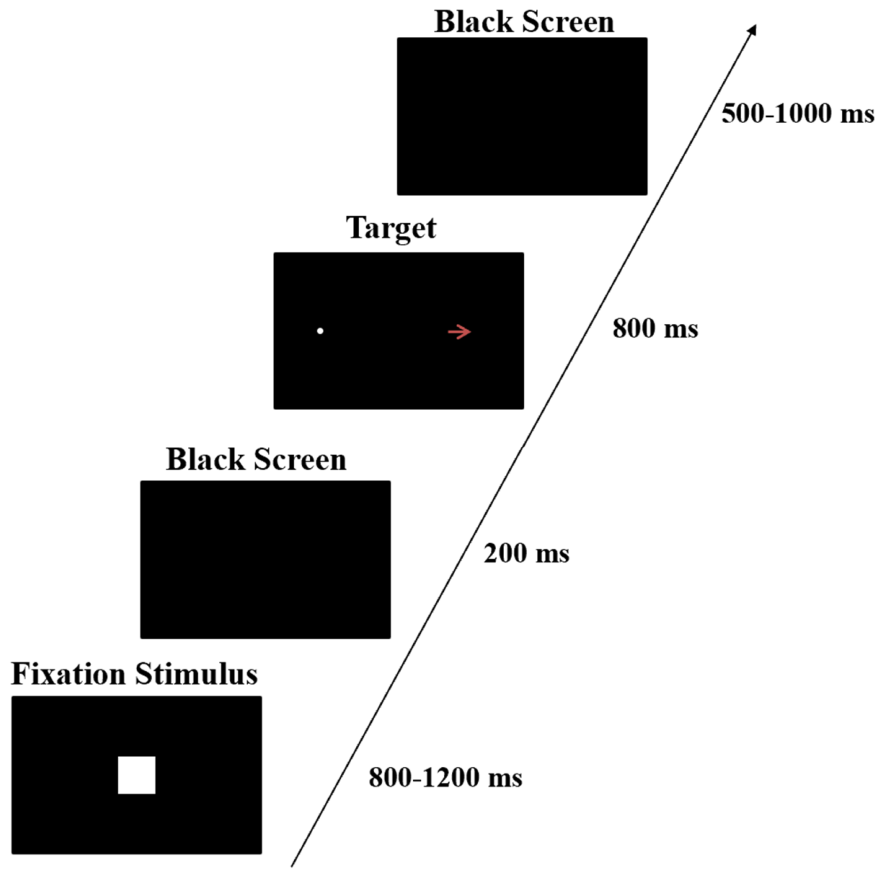
Figure 2.
Distribution of CY-BOCS Obsession, Compulsion, and Total Scores in Adolescents with OCD and SIBL Groups. *Violin plots and individual data points are presented to facilitate visualization of score distributions. Group comparisons were conducted using independent-samples t tests. Participants with OCD showed significantly higher Obsession, Compulsion, and Total CY-BOCS scores than unaffected siblings (all p < .001).
Figure 2.
Distribution of CY-BOCS Obsession, Compulsion, and Total Scores in Adolescents with OCD and SIBL Groups. *Violin plots and individual data points are presented to facilitate visualization of score distributions. Group comparisons were conducted using independent-samples t tests. Participants with OCD showed significantly higher Obsession, Compulsion, and Total CY-BOCS scores than unaffected siblings (all p < .001).
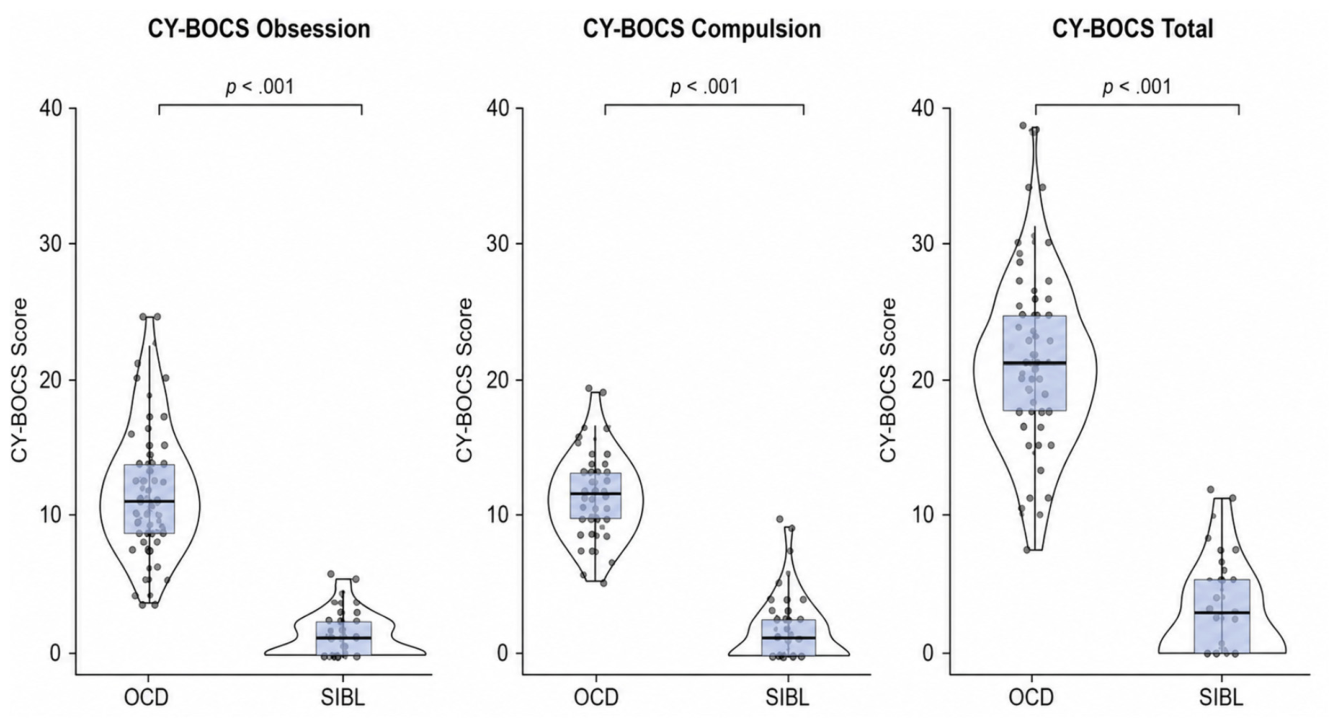
Figure 3.
Comparison of Correct Antisaccade Percentages Across Groups. *Individual data points are shown for each participant. Error bars represent 95% confidence intervals. A one-way ANOVA showed a significant group difference, F(2, 119) = 23.506, p < .001. Post-hoc comparisons indicated significant differences between OCD and SIBL (p = .004), OCD and HC (p < .001), and SIBL and HC (p = .005).
Figure 3.
Comparison of Correct Antisaccade Percentages Across Groups. *Individual data points are shown for each participant. Error bars represent 95% confidence intervals. A one-way ANOVA showed a significant group difference, F(2, 119) = 23.506, p < .001. Post-hoc comparisons indicated significant differences between OCD and SIBL (p = .004), OCD and HC (p < .001), and SIBL and HC (p = .005).
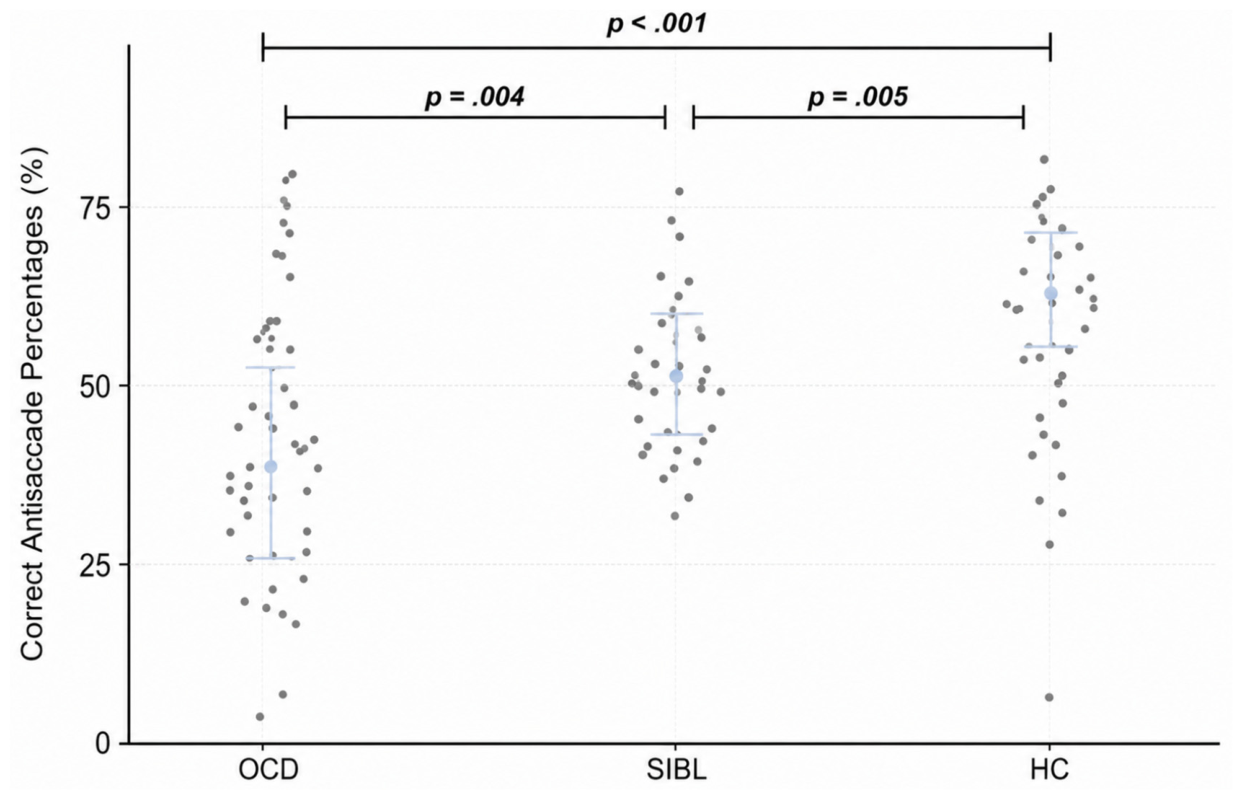
Figure 4.
Comparison of Mean Correct Antisaccade Latency and Velocity Across Groups. *(A) Mean correct antisaccade latency and (B) mean correct antisaccade velocity across OCD, SIBL, and HC groups. Violin plots illustrate score distributions, boxes represent the interquartile range (IQR), horizontal lines indicate medians, and gray dots represent individual participants. Group differences were evaluated using the Kruskal–Wallis test followed by Bonferroni-corrected Mann–Whitney U post-hoc comparisons. Pairwise comparison results are displayed above the plots.
Figure 4.
Comparison of Mean Correct Antisaccade Latency and Velocity Across Groups. *(A) Mean correct antisaccade latency and (B) mean correct antisaccade velocity across OCD, SIBL, and HC groups. Violin plots illustrate score distributions, boxes represent the interquartile range (IQR), horizontal lines indicate medians, and gray dots represent individual participants. Group differences were evaluated using the Kruskal–Wallis test followed by Bonferroni-corrected Mann–Whitney U post-hoc comparisons. Pairwise comparison results are displayed above the plots.
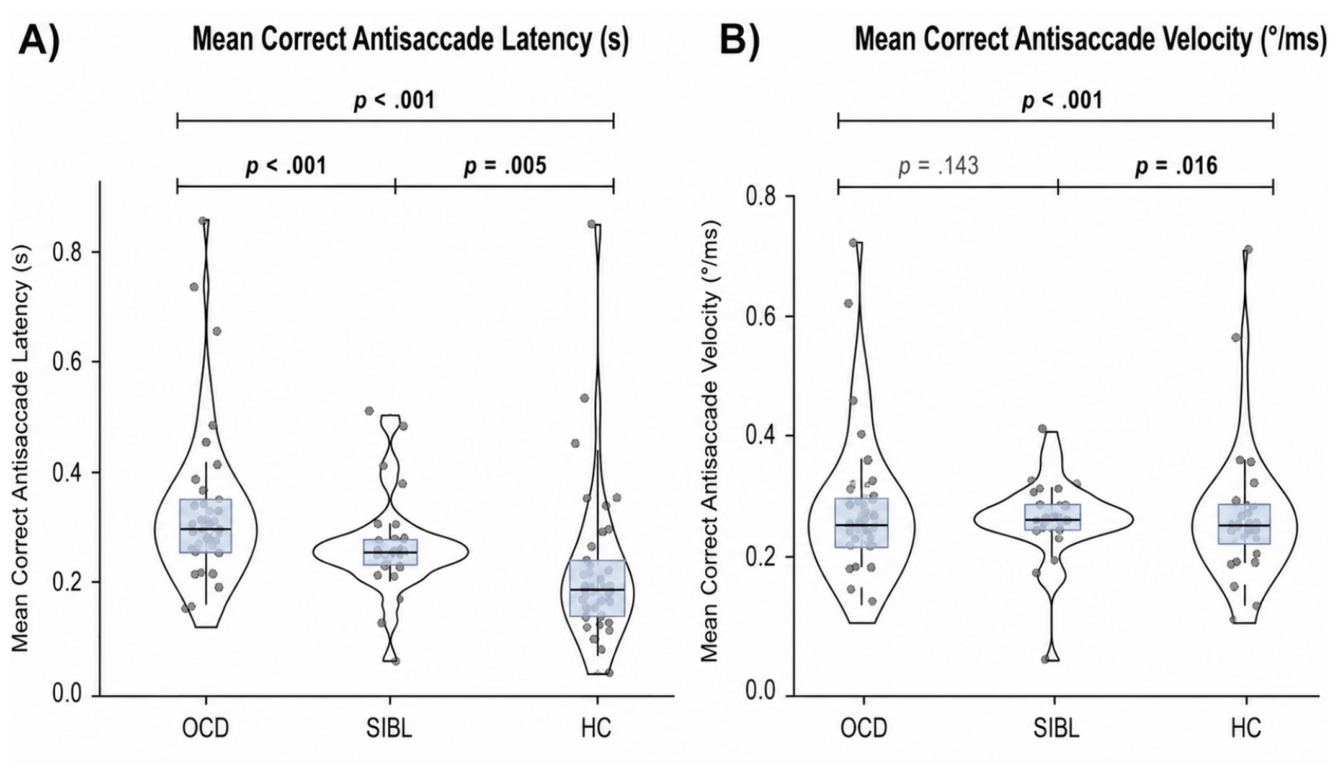

Table 1.
Comparison of Demographic and Clinical Characteristics Across Groups.
| Variables | OCD (n=48) | SIBL (n=35) | HC (n=39) | Statistics | p | Effect Size | ||
| Age (years) | 15.07 ±1.52 | 15.25 ± 2.06 | 15.84 ± 1.88 | F(2,119)= 2.140 | .122 | Partial η2= .035 | ||
| Gender (f:m) | 26:22 | 15:20 | 17:22 | χ2(2)= 1.397 | .497 | Cramer’s V= .107 | ||
| Family Income Level | Low | 15 (31.3) | 7 (20.0) | 11 (28.2) |
χ2(4)= 3.898 |
.420 |
Cramer’s V= .179 |
|
| Moderate | 13 (27.1) | 16 (45.7) | 16 (41.0) | |||||
| High | 20 (41.7) | 12 (34.3) | 12 (30.8) | |||||
| Family Structure (Nuclear Family) | 38 (79.2) | 31 (88.6) | 29 (74.4) | χ2(2)= 2.425 | .297 | Cramer’s V= .141 | ||
|
CY-BOCS |
Obsession | 12.15 ± 3.61 | 1.80 ± 1.95 | - | t(75.545)= 16.799 | < .001 | Cohen’s d= 3.424 | |
| Compulsion | 12.10 ± 3.00 | 1.83 ± 2.16 | - | t(81)= 17.225 | < .001 | Cohen’s d= 3.829 | ||
| Total | 23.46 ± 6.36 | 3.63 ± 3.77 | - | t(78.111)= 17.755 | < .001 | Cohen’s d= 3.657 | ||
Note: Data are presented as mean ± standard deviation for continuous variables and n (%) for categorical variables. F: one-way ANOVA; χ²: chi-square test; t: independent samples t-test.
Table 2.
Comparison of Antisaccade Performance Measures Across Groups.
| Antisaccade Performance Measures | OCD (n=48) | SIBL (n=35) | HC (n=39) | Statistics | p | Effect Size | Post-Hoc |
| Correct Antisaccade Percentage (%) | 42.09 ± 19.60 | 54.47 ± 12.66 | 67.38 ± 17.34 | F(2,119)= 23.506 | < .001 | Partial η2= .283 |
Bonferroni: OCD-SIBL (p = .004) OCD-HC (p < .001) SIBL-HC (p = .005) |
| Mean Correct Antisaccade Latency (s) | 0.327 (0.299-0.373) | 0.295 (0.268-0.309) | 0.247 (0.193-0.319) | χ2(2)= 26.900 | < .001 | ε 2= .209 |
Mann Whitney U (Bonferroni adjusted): OCD-HC (p < .001) OCD-SIBL (p < .001) SIBL-HC (p = .005) |
| Mean Correct Antisaccade Velocity (°/ms) | 0.262 (0.223-0.295) | 0.275 (0.265-0.297) | 0.295 (0.274-0.317) | χ2(2)=12.878 | .002 | ε 2= .091 |
Mann Whitney U (Bonferroni adjusted): OCD-HC (p < .001) SIBL-HC (p = .016) OCD-SIBL (p = .143) |
Note: Data are presented as mean ± standard deviation for normally distributed variables and median (interquartile range, Q1-Q3) for non-normally distributed variables. F: one-way ANOVA; χ²: Kruskal–Wallis H Test.
Table 3.
Associations Between Antisaccade Performance and Clinical and Demographic Variables.
| Variables | Correct Antisaccade Percentage (%)a | Mean Correct Antisaccade Latency (s)b | Mean Correct Antisaccade Velocity (°/ms)b | |
| Age (year) | r =.268, p = .003 | r =-.187, p = .040 | r = .166, p = .068 | |
| Sex*c | r = .115, p = .209 | r = -.062, p = .496 | r = .124, p = .173 | |
| CY-BOCS** | Obsession | r = .061, p = .680 | r = .240, p = .101 | r = -.115, p =. 437 |
| Compulsion | r = -.005, p = .976 | r = .163, p = .270 | r = .016, p = .912 | |
| Total | r = -.150, p = .310 | r = .076, p = .608 | r = -.116, p = .431 | |
| Disease duration (months)** | r = .167 , p = .257 | r = .095, p= .519 | r = -.147, p = .317 | |
*Sex was coded as female = 0 and male = 1. **Calculated only in the OCD group (n = 48). a Pearson correlation analysis; b Spearman correlation analysis; c point-biserial correlation.
Table 4.
Factors Predicting Correct Antisaccade Percentage: Hierarchical Regression Analysis.
| Variables | B | 95% CI for B | SE | β | t | p | VIF |
| Model I | |||||||
| Age | 2.917 | .957- 4.876 | .990 | .260 | 2.948 | .004 | 1.007 |
| Sex (male, ref: female) | 3.712 | -3.278- 10.701 | 3.530 | .093 | 1.051 | .295 | 1.007 |
| Model II | |||||||
| Age | 2.298 | .525- 4.071 | .895 | .205 | 2.566 | .012 | 1.024 |
| Sex (male, ref: female) | 2.032 | -4.272- 8.336 | 3.183 | .051 | .638 | .525 | 1.017 |
| OCD (dummy) | -17.839 | -24.319- -11.359 | 3.272 | -.436 | -5.451 | < .001 | 1.028 |
| Model III | |||||||
| Age | 1.958 | .226- 3.690 | .875 | .175 | 2.239 | .027 | 1.041 |
| Sex (male, ref: female) | 2.170 | -3.936- 8.275 | 3.083 | .054 | .704 | .483 | 1.017 |
| OCD (dummy) | -23.556 | -30.899- -16.214 | 3.708 | -.576 | -6.354 | < .001 | 1.407 |
| SIBL (dummy) | -11.768 | -19.612- -3.924 | 3.961 | -.266 | -2.971 | .004 | 1.377 |
Note: Dependent variable: Correct Antisaccade Percentage (%), reference group: HC, B: Unstandardized regression coefficient, β: Standardized regression coefficient, CI: Confidence Interval, SE: Standard error, VIF: Variance Inflation Factor. Model statistics: Model I: R² = .080, Adjusted R² = .065, F(2,119) = 5.193, p = .007. Model II: R² = .265, Adjusted R² = .247, ΔR² = .185, F(3,118) = 14.202, p < .001. Model III: R² = .317, Adjusted R² = .293, ΔR² = .052, F(4,117) = 13.565, p < .001.
Disclaimer/Publisher’s Note: The statements, opinions and data contained in all publications are solely those of the individual author(s) and contributor(s) and not of MDPI and/or the editor(s). MDPI and/or the editor(s) disclaim responsibility for any injury to people or property resulting from any ideas, methods, instructions or products referred to in the content. |
© 2026 by the authors. Licensee MDPI, Basel, Switzerland. This article is an open access article distributed under the terms and conditions of the Creative Commons Attribution (CC BY) license (http://creativecommons.org/licenses/by/4.0/).
Copyright: This open access article is published under a Creative Commons CC BY 4.0 license, which permit the free download, distribution, and reuse, provided that the author and preprint are cited in any reuse.


