

Submitted:
17 June 2026
Posted:
18 June 2026
You are already at the latest version
Abstract
This study examines whether ESRS-based ESG disclosures capture a life cycle perspective and whether they provide sufficiently risk-relevant information for sustainable finance decision-making. Drawing on Life Cycle Sustainability Assessment (LCSA), the paper analyzes the extent to which sustainability reports of major European non-financial enterprises reflect upstream, operational, downstream, and end-of-life impacts. The study applies qualitative comparative content analysis to the 2024 sustainability disclosures of Enel, Unilever, and Siemens AG. The findings indicate that ESG reporting remains predominantly entity-centered, indicator-based, and dimensionally segmented. Although value chain impacts and circular economy initiatives are increasingly disclosed, comprehensive cradle-to-grave integration remains limited. Environmental life cycle elements are more visible than social and economic dimensions, while cross-dimensional integration across life cycle stages is weak. These limitations may reduce the ability of ESG disclosures to capture systemic sustainability risks, including transition risks, supply chain vulnerabilities, and long-term value chain externalities. In response, the study proposes an LCSA–ESRS Operationalization Model based on boundary reconfiguration, stage-based indicator mapping, dimensional harmonization, and an accounting translation layer. The paper contributes to sustainability accounting and sustainable finance by showing how life cycle thinking can enhance the decision-usefulness, risk transparency, and systemic coherence of ESRS-based reporting.
Keywords:
ESG disclosure
; life cycle sustainability assessment
; ESRS
; systemic sustainability risk
; sustainable finance
; value chain transparency
1. Introduction
The ongoing transformation of corporate reporting under the European sustainability agenda represents one of the most significant regulatory shifts in contemporary accounting and finance. The adoption of the Corporate Sustainability Reporting Directive (CSRD) and the implementation of the European Sustainability Reporting Standards (ESRS) have fundamentally redefined the scope, structure, and institutional role of sustainability disclosures within corporate governance systems. Sustainability reporting is no longer framed as a voluntary corporate social responsibility practice, but as a regulated component of corporate accountability embedded within financial and non-financial reporting architecture.
The regulatory relevance of this transformation is grounded in the Corporate Sustainability Reporting Directive and the first set of European Sustainability Reporting Standards, which require companies to disclose sustainability information in relation to material impacts, risks and opportunities (European Parliament and Council of the European Union, 2022; European Commission, 2023). This reporting architecture is also connected with the broader EU sustainable finance framework, including the Sustainable Finance Disclosure Regulation and the EU Taxonomy Regulation, which strengthen the link between corporate sustainability information, financial market transparency and sustainable investment decision-making (European Parliament and Council of the European Union, 2019, 2020).
This transformation introduces a critical methodological question for sustainability accounting: whether current ESG reporting frameworks are capable of capturing systemic sustainability impacts across value chains. Although ESRS explicitly extend reporting requirements beyond organizational boundaries through value chain disclosures and double materiality assessment, the operational logic of ESG reporting remains predominantly indicator-based and entity-centered. Disclosures are typically structured around environmental, social, and governance performance metrics that reflect organizational control rather than full product-system accountability.
Prior research on mandatory CSR and sustainability reporting suggests that regulated sustainability disclosure may generate important economic effects, including changes in information environments, stakeholder monitoring and capital market decision-making (Christensen et al., 2021). However, sustainability reporting may also remain incomplete or symbolic when disclosures do not reflect substantive organizational accountability and systemic sustainability impacts (Cho et al., 2015). This makes the boundary logic of ESG disclosure particularly important for assessing whether reported sustainability information is sufficiently decision-useful.
This structural feature creates a potential misalignment between regulatory reporting logic and sustainability assessment methodologies grounded in life cycle thinking. Life Cycle Sustainability Assessment (LCSA) integrates environmental Life Cycle Assessment (LCA), Social Life Cycle Assessment (S-LCA), and Life Cycle Costing (LCC), thereby providing a systemic evaluation of sustainability performance across upstream and downstream stages. Unlike entity-based ESG metrics, LCSA is inherently product-system oriented and emphasizes cradle-to-grave boundaries, interdependencies across value chain stages, and multidimensional impact integration.
The life cycle perspective is especially relevant in this context because LCSA extends sustainability assessment beyond entity-level indicators and enables the integration of environmental, social and economic impacts across product systems and value chain stages (Zamagni et al., 2013).
The tension between these two logics—indicator-based ESG reporting and system-based life cycle assessment—raises important implications for sustainability accounting, sustainable finance, and risk management. If ESG disclosures remain confined within organizational boundaries, they may underrepresent supply chain externalities, downstream impacts, product-use effects, end-of-life responsibilities, and cumulative systemic risks. Conversely, embedding life cycle thinking into sustainability reporting could enhance measurement coherence, strengthen risk transparency, and improve the decision-usefulness of disclosures for investors, regulators, creditors, and other stakeholders.
From a sustainable finance perspective, this issue is particularly important. Investors increasingly rely on ESG disclosures to assess transition risks, supply chain vulnerabilities, resource dependencies, circular economy readiness, and long-term value creation. However, if ESG reporting does not systematically capture impacts across upstream, operational, downstream, and end-of-life stages, sustainability-related risks may be underestimated or fragmented across separate disclosure categories. This may limit the usefulness of ESG information for capital allocation, risk pricing, corporate valuation, and assessment of organizational resilience.
Despite the conceptual compatibility between ESRS value chain requirements and life cycle logic, empirical evidence regarding their practical integration remains limited. Existing sustainability accounting literature has largely examined ESG reporting quality, determinants of disclosure, greenwashing risks, materiality assessment, and capital market effects. However, relatively few studies have systematically assessed whether ESG reports operationalize life cycle principles. Moreover, the accounting implications of integrating LCSA into regulated reporting frameworks remain underexplored, particularly in relation to systemic sustainability risk and decision-useful ESG information.
This study addresses this gap by investigating the extent to which ESG disclosures of European non-financial enterprises reflect a life cycle perspective consistent with LCSA principles. The central research question is formulated as follows:
To what extent do ESRS-based ESG disclosures operationalize a life cycle perspective, and how can LCSA enhance the risk relevance and decision-usefulness of sustainability reporting?
The study pursues three interrelated objectives.
First, it analytically examines the boundary logic of ESG disclosures, assessing whether reporting structures extend beyond operational control toward cradle-to-grave system perspectives. Particular attention is given to upstream supplier integration, downstream product impacts, end-of-life considerations, and cross-dimensional alignment of environmental, social, and economic indicators.
Second, it evaluates the methodological coherence between ESG reporting practices and LCSA principles. This involves identifying whether sustainability disclosures demonstrate systematic stage-based integration, or whether life cycle elements remain fragmented, narrative, selectively applied, or confined mainly to environmental dimensions.
Third, the study develops a conceptual integration framework aimed at operationalizing LCSA within ESRS-based sustainability accounting. Rather than proposing an alternative reporting regime, the framework seeks to enhance methodological alignment by introducing a translation layer between life cycle impact categories, double materiality assessment, systemic sustainability risks, and accounting-based disclosure logic.
The contribution of this research is threefold.
From a theoretical perspective, the study advances sustainability accounting scholarship by articulating the structural tension between entity-based reporting logic and system-based sustainability assessment. It reframes ESG reporting as a boundary-definition and boundary-alignment problem rather than solely a disclosure-quality issue.
From a sustainable finance perspective, the study contributes to the debate on the decision-usefulness of ESG disclosures by showing how insufficient life cycle integration may reduce the ability of corporate reports to capture systemic sustainability risks. By linking LCSA with risk relevance, value chain transparency, and long-term value creation, the research highlights the importance of life cycle thinking for investors and other users of sustainability information.
From a methodological perspective, the study develops an operationalization model that connects LCSA principles with ESRS-based sustainability accounting. The proposed model offers a structured pathway for integrating boundary reconfiguration, stage-based indicator mapping, dimensional harmonization, and accounting translation into ESG disclosure practices. In doing so, the study contributes to the broader integration of sustainability assessment methodologies and corporate reporting systems.
Ultimately, this study argues that the future evolution of sustainability accounting depends not only on expanding disclosure requirements, but also on reconfiguring reporting boundaries. Embedding life cycle thinking within ESRS-based sustainability accounting may represent a necessary step toward achieving coherent, systemic, risk-relevant, and decision-useful sustainability reporting in the European context.
2. Literature Review
2.1. Sustainability Accounting, ESG Reporting, and Boundary Logic
Sustainability accounting has evolved from voluntary corporate social responsibility disclosure toward institutionalized ESG reporting frameworks embedded within regulatory and financial reporting architectures. Early critical scholarship questioned whether corporate sustainability disclosures provide genuine accountability or merely reproduce legitimacy narratives that protect organizational reputation without substantially altering corporate behavior (Bebbington and Larrinaga, 2014; Gray, 2010). This debate remains highly relevant in the context of contemporary ESG reporting, where expanded disclosure requirements may increase transparency but do not automatically ensure systemic accountability.
The institutionalization of sustainability reporting has intensified with the adoption of mandatory regulatory frameworks, particularly the Corporate Sustainability Reporting Directive (CSRD) and the European Sustainability Reporting Standards (ESRS). Commission Delegated Regulation (EU) 2023/2772 sets out the first set of ESRS and specifies sustainability information to be disclosed in relation to material impacts, risks, and opportunities (European Commission, 2023). Under this regulatory architecture, sustainability reporting is no longer peripheral to corporate communication, but increasingly functions as a formalized disclosure mechanism relevant to investors, creditors, regulators, and other users of corporate reports. Earlier European evidence indicates that mandatory non-financial disclosure can strengthen corporate transparency and accountability, with large European companies demonstrating substantial readiness to report social, employee, environmental, and risk-related information under the emerging regulatory framework (Manes-Rossi et al., 2018).
However, despite improvements in standardization and comparability, ESG reporting remains strongly influenced by organizational boundary logic. Sustainability disclosures are typically structured around the reporting undertaking, its operations, governance systems, and material impacts, risks, and opportunities identified through entity-specific assessment processes. Even when value chain information is included, it is often presented through supplier monitoring, Scope 3 emissions, risk exposure, or compliance mechanisms rather than through comprehensive product-system assessment. This creates a structural tension between the logic of financial accounting consolidation and the systemic nature of sustainability impacts.
Empirical and conceptual studies have repeatedly identified fragmentation as a persistent weakness of sustainability reporting. ESG information is often organized into separate environmental, social, and governance sections, while cross-dimensional interdependencies remain weakly articulated (Cho et al., 2015; Hahn and Kühnen, 2013). This segmentation limits the ability of stakeholders to understand how environmental impacts, social risks, economic costs, and governance mechanisms interact across value chains. From a sustainability accounting perspective, this reflects not only a disclosure-quality problem, but also a boundary-definition problem. Recent Bulgarian studies likewise document uneven reporting quality and implementation challenges, while bibliometric evidence confirms that ESG, circular economy, and integrated reporting remain partly fragmented research and reporting streams (Dimitrova, 2020; Nikolov, 2023; Papradanova et al., 2025; Petrova, 2024; Krasteva-Hristova et al., 2025). More specifically, evidence from large enterprises operating in Bulgaria indicates that environmental disclosures may remain declarative, insufficiently quantified, and difficult to compare, thereby reducing their usefulness for investors and other stakeholders (Dimitrova, 2023).
This interpretation is consistent with the broader development of sustainability accounting as a field that links external reporting, internal decision support, and stakeholder accountability. Sustainability accounting is increasingly expected not only to communicate sustainability performance, but also to support management decision-making and improve the informational basis for evaluating environmental and social consequences (Burritt & Schaltegger, 2010). At the same time, corporate engagement with sustainability may be driven by different motivations, ranging from ethical commitments to business-case considerations, which can influence the depth, orientation, and credibility of sustainability reporting practices (Schaltegger & Burritt, 2018). Therefore, the boundary logic of ESG reporting is relevant both to external disclosure quality and to the internal capacity of accounting systems to identify sustainability-related risks beyond the legal entity. Evidence from the Bulgarian chemical industry similarly indicates that environmental management becomes more effective when sustainability considerations are embedded in business processes and management practices (Chipriyanova et al., 2024).
From a financial and risk management perspective, entity-centered ESG reporting may constrain the decision-usefulness of sustainability information. If disclosures remain focused on organizational control boundaries, investors may receive incomplete signals about systemic sustainability risks embedded in upstream sourcing, product use, end-of-life treatment, or resource dependency. Such risks may affect long-term value creation, cost structures, transition exposure, and capital allocation decisions. Therefore, the boundary logic of ESG reporting is directly relevant to sustainable finance, because the usefulness of ESG information depends not only on the number of disclosed indicators but also on whether disclosures capture risks beyond the reporting entity. Research on green finance, ESG risk in bank lending, and analytical models of financial sustainability further demonstrates how accounting and sustainability information can support risk-oriented decisions and capital allocation (Kostova et al., 2022; Krastev & Krasteva-Hristova, 2024; Marinova, 2023).
2.2. Life Cycle Sustainability Assessment as a Systemic Sustainability Paradigm
Life Cycle Sustainability Assessment (LCSA) offers a systemic methodological framework for assessing sustainability performance across product-system boundaries. It builds on the integration of environmental Life Cycle Assessment (LCA), Social Life Cycle Assessment (S-LCA), and Life Cycle Costing (LCC), thereby expanding the assessment of sustainability from environmental impacts alone toward a multidimensional evaluation of environmental, social, and economic consequences across the life cycle (Sala et al., 2015; Zamagni et al., 2013). Unlike entity-based ESG reporting, LCSA is organized around product systems, functional units, and cradle-to-grave or otherwise explicitly defined system boundaries.
The central methodological advantage of LCSA lies in its ability to capture upstream, operational, downstream, and end-of-life impacts within a coherent analytical structure. It requires explicit consideration of raw material extraction, production, distribution, use phase, waste treatment, resource recovery, and broader value chain interdependencies. This stage-based orientation makes LCSA particularly relevant for analyzing circular economy practices, resource efficiency, and sustainability trade-offs. The UNEP Life Cycle Initiative defines life cycle approaches as tools for understanding environmental, social, and economic impacts across the life cycle, which makes LCSA especially relevant for systemic sustainability assessment.
From a methodological perspective, LCSA is closely related to the development of life cycle assessment as a standardized and increasingly systemic assessment approach (Guinée et al., 2011). The conceptual foundation of LCSA is commonly associated with the integration of environmental LCA, life cycle costing and social LCA into a broader sustainability assessment of products and product systems (Kloepffer, 2008). In addition, ISO 14040 and ISO 14044 provide the internationally recognized principles, framework, requirements and guidelines for conducting life cycle assessment, including goal and scope definition, inventory analysis, impact assessment, interpretation, reporting and critical review (International Organization for Standardization, 2006a, 2006b). This standard-based methodological logic reinforces the relevance of LCSA as a structured benchmark for evaluating whether ESG disclosures capture impacts across life cycle stages. Comparative applications further demonstrate that life cycle-based assessment can strengthen the systematic evaluation of complex environmental impacts and support the complementary use of different environmental assessment methods (Teodosiu et al., 2016).
LCSA differs from ESG reporting in both object of assessment and methodological logic. ESG reporting typically operates through disclosure indicators, materiality assessment, and regulatory datapoints, while LCSA operates through system boundary definition, inventory modeling, impact assessment, and interpretation. ESG disclosure is usually designed to communicate sustainability performance and risks at the undertaking level; LCSA is designed to evaluate sustainability impacts across product systems and life cycle stages. These differences explain why ESG reporting may include value chain information without fully operationalizing life cycle thinking.
Despite its analytical robustness, LCSA has remained primarily associated with industrial ecology, sustainability assessment, engineering, and environmental management research. Its integration into accounting systems and corporate disclosure architectures is still limited. This separation creates a methodological divide between sustainability measurement and sustainability reporting. While LCSA can generate systemic sustainability evidence, corporate reporting frameworks may not always provide a clear mechanism for translating such evidence into disclosure, materiality, governance, or financial risk categories.
For sustainability accounting, this divide is particularly important. Accounting systems are designed to classify, measure, and communicate information in ways that support accountability and decision-making. However, if sustainability accounting remains structurally anchored in entity-based indicators, it may fail to capture the full systemic impact profile of corporate activities. LCSA therefore provides a potential methodological foundation for extending sustainability accounting beyond organizational reporting boundaries toward value chain and product-system accountability.
2.3. ESRS, Value Chain Transparency, and the Integration Gap
The ESRS framework introduces a more advanced regulatory architecture for sustainability reporting by requiring companies to disclose material impacts, risks, and opportunities across their own operations and value chains. EFRAG’s implementation guidance on materiality assessment supports the operationalization of double materiality, while its value chain implementation guidance clarifies how undertakings should consider upstream and downstream information when applying ESRS (European Financial Reporting Advisory Group, 2024a, 2024b). Although these implementation guidance documents are non-authoritative, they are important for interpreting how ESRS value chain and materiality requirements can be applied in practice.
The expanding European sustainability reporting framework strengthens transparency and accountability. However, its multiple and partly overlapping requirements may also create regulatory fragmentation, information overload, and difficulties in interpreting sustainability information (Moneva, 2025).
Against this background, value chain disclosure under ESRS does not automatically amount to life cycle integration. ESRS requires companies to identify and disclose material value chain-related impacts, risks, and opportunities, but it does not prescribe full cradle-to-grave modeling, functional unit specification, or the systematic integration of environmental, social, and economic impacts across life cycle stages. As a result, ESRS and LCSA remain conceptually compatible but methodologically distinct.
The integration gap between ESRS-based ESG reporting and LCSA therefore arises from their different underlying logics. ESRS prioritizes regulatory disclosure, comparability, and materiality-based reporting, whereas LCSA prioritizes systemic assessment, life cycle boundaries, and multidimensional impact modeling. The former is primarily a disclosure architecture, while the latter is primarily an assessment methodology. Bridging the two requires an intermediate translation mechanism capable of connecting life cycle impact categories with accounting-relevant materiality, risk, and disclosure constructs. Digitalization can support this translation by improving the collection, traceability, integration, and control of financial and non-financial information, although it may also generate new challenges related to data quality, professional competencies, and assurance (Krasteva-Hristova & Moneva, 2026; Zhelev & Kostova, 2024).
This gap has important implications for sustainable finance. Investors increasingly rely on ESG disclosures to assess long-term exposure to transition risks, resource scarcity, supply chain disruption, carbon dependency, and reputational vulnerability. However, if ESG reports disclose value chain impacts narratively or selectively, rather than through stage-based integration, users may underestimate systemic sustainability risks. In this sense, the ESRS–LCSA integration gap is not merely methodological; it affects the quality of risk-relevant information available to financial market participants.
The conceptual divergence between ESRS-based ESG reporting and LCSA is summarized in Table 1. The comparison highlights that the two approaches differ not only in terminology, but also in their assessment object, boundary logic, data architecture, integration mechanisms, methodological standardization, and typical outputs.
As shown in Table 1, ESRS-based reporting and LCSA operate through different methodological logics. This difference explains why value chain disclosure under ESRS does not automatically lead to life cycle integration. Therefore, bridging the two approaches requires a translation mechanism between reporting-based materiality and system-based sustainability assessment.
2.4. Double Materiality, Professional Judgment, and Boundary Construction
Double materiality is one of the most important conceptual innovations of the European sustainability reporting regime. It requires companies to assess sustainability matters from two perspectives: impact materiality, which concerns the effects of the undertaking on people and the environment, and financial materiality, which concerns sustainability-related risks and opportunities that may affect enterprise value. This dual perspective broadens the scope of corporate accountability and connects sustainability reporting more explicitly with financial decision-making.
However, the operationalization of double materiality depends heavily on professional judgment and managerial discretion. Companies must determine which impacts, risks, and opportunities are material; how far into the value chain the assessment should extend; which time horizons should be considered; and what evidence is sufficient to support disclosure decisions. These judgments are unavoidable, especially under conditions of incomplete data, complex supply chains, uncertain downstream impacts, and evolving regulatory expectations.
The literature on sustainability reporting suggests that materiality assessment may become procedural if not supported by robust methodological foundations (Baumüller and Sopp, 2022). When companies define value chain boundaries narrowly or rely primarily on qualitative narratives, systemic externalities may remain partially invisible. In such cases, managerial discretion may influence not only what is disclosed, but also how sustainability impacts are framed, prioritized, aggregated, or omitted. Research focused specifically on double materiality under the new European regime similarly emphasizes the need for structured procedures that connect impact and financial materiality (Grozeva, 2023).
This issue reflects a deeper boundary problem in accounting. Organizational boundaries are historically derived from legal ownership, financial control, and consolidation principles (Miller, 1998; Santos and Eisenhardt, 2005). Ecological and socio-economic systems, however, do not follow corporate legal boundaries. Carbon emissions, biodiversity impacts, labor risks, waste flows, and product-use consequences frequently occur outside the direct operational control of the reporting undertaking. This divergence creates a structural tension between accounting accountability units and sustainability impact systems.
LCSA can contribute to this debate by providing a more structured methodological basis for boundary construction. By requiring explicit definition of system boundaries, life cycle stages, and impact categories, LCSA can reduce excessive discretion in sustainability reporting and make professional judgment more transparent. It does not eliminate judgment, but it disciplines it by linking disclosure decisions to a systematic assessment logic. In this sense, LCSA may support assurance readiness, comparability, and accountability by clarifying the assumptions behind value chain and impact materiality assessments.
2.5. Sustainability Accounting, Systemic Sustainability Risk, and Decision-Usefulness
The integration of LCSA into ESRS-based sustainability accounting has direct implications for systemic risk assessment and decision-usefulness. In financial reporting, decision-usefulness depends on whether information helps users assess future cash flows, risks, stewardship, and long-term value creation. In sustainability reporting, decision-usefulness increasingly depends on whether ESG disclosures help users understand sustainability-related risks and opportunities across time horizons and value chains.
The ISSB’s IFRS S1 emphasizes the disclosure of sustainability-related risks and opportunities that are useful to users of general purpose financial reports in making decisions about providing resources to an entity (IFRS Foundation, 2023). This investor-oriented logic complements, but does not replace, the broader double materiality logic of ESRS. Together, these developments show that sustainability information is becoming increasingly central to financial decision-making, capital allocation, and corporate risk management.
Evidence from the Romanian banking sector also demonstrates a significant relationship between multidimensional sustainability reporting and credit risk management, while indicating that strong governance mechanisms can help financial institutions manage the additional risks associated with financing emerging and sustainability-oriented sectors (Huian et al., 2025).
However, the usefulness of ESG disclosures depends on their capacity to capture systemic risks rather than only entity-level indicators. Transition risks may arise from regulatory changes, technological shifts, market preferences, carbon pricing, and resource substitution. Supply chain risks may arise from upstream labor conditions, critical raw materials, biodiversity impacts, or geopolitical disruptions. Product-related risks may arise from use-phase emissions, safety concerns, repairability, circularity, and end-of-life responsibilities. These risks are often distributed across life cycle stages and may remain underrepresented in conventional ESG reporting. Related evidence shows that waste-generation patterns, eco-innovation capacity, and environmental expenditure information can reveal sustainability exposures that are not fully visible in conventional entity-level indicators (Blagoeva et al., 2023; Nikolova-Alexieva et al., 2022; Krasteva-Hristova & Ivanova, 2026).
Life cycle integration can strengthen the informational value of ESG disclosures by making such distributed risks more visible. By mapping impacts across upstream, operational, downstream, and end-of-life stages, LCSA can help companies identify sustainability hotspots and translate them into risk-relevant disclosures. This can improve the ability of investors and other stakeholders to evaluate long-term resilience, exposure to transition pressures, and the credibility of corporate sustainability strategies.
From this perspective, sustainability accounting can be reconceptualized as a boundary-alignment process. The challenge is not merely to disclose more ESG indicators, but to align disclosure boundaries with the actual systems in which sustainability impacts and risks occur. LCSA provides a methodological basis for such alignment, while ESRS provides the regulatory disclosure architecture through which the resulting information can be communicated.
2.6. Research Gap and Theoretical Positioning of the Study
The reviewed literature reveals three interrelated gaps. First, although ESG reporting and sustainability accounting research has extensively examined disclosure quality, legitimacy, materiality, and regulatory development, less attention has been paid to the boundary logic through which ESG information is generated and structured. Existing studies often treat ESG reporting as a disclosure-quality issue, while the present study treats it as a boundary-definition and integration problem.
Second, while LCSA is well developed as a sustainability assessment paradigm, its translation into corporate reporting systems remains underexplored. The literature has not sufficiently examined how life cycle evidence can be embedded within ESRS-based sustainability accounting without creating a parallel reporting regime. This is particularly important because ESRS already requires value chain and double materiality disclosures, but does not prescribe a full LCSA methodology.
Third, the financial implications of insufficient life cycle integration remain insufficiently addressed. If ESG disclosures do not capture systemic sustainability risks across value chains, they may provide incomplete information for sustainable finance decision-making. This affects risk transparency, capital allocation, and the assessment of long-term value creation.
Against this background, the present study positions LCSA as a methodological bridge between ESRS-based reporting and systemic sustainability risk assessment. It argues that integrating life cycle thinking into sustainability accounting can enhance the decision-usefulness of ESG disclosures by improving boundary transparency, stage-based impact identification, cross-dimensional coherence, and risk-relevant interpretation. The study therefore contributes to sustainability accounting, sustainable finance, and LCSA research by developing an operationalization logic that connects regulatory disclosure requirements with systemic sustainability assessment.
3. Materials and Methods
3.1. Research Design
This study adopts a qualitative comparative content analysis design to examine whether ESRS-based ESG disclosures capture a life cycle perspective and whether such disclosures provide risk-relevant information for sustainable finance decision-making. The research design is theory-driven rather than inductive. Life Cycle Sustainability Assessment (LCSA) is used as the analytical benchmark against which corporate ESG disclosures are evaluated.
The use of a theory-driven qualitative content analysis design is consistent with directed approaches to qualitative content analysis, where existing theory or prior conceptual frameworks guide the development of analytical categories and interpretation of textual evidence (Hsieh & Shannon, 2005). In sustainability and environmental reporting research, content analysis has been widely used to examine corporate disclosure narratives, reporting structures and the informational characteristics of environmental and sustainability-related reports (Beck et al., 2010).
Content analysis is particularly appropriate for this study because sustainability reports represent formalized corporate communication artifacts through which companies disclose material impacts, risks, opportunities, governance mechanisms, and value chain-related information. Unlike purely quantitative disclosure scoring, qualitative content analysis allows for the interpretation of structural patterns, boundary assumptions, methodological references, and the degree of integration between environmental, social, and economic dimensions.
The purpose of the analysis is not to measure ESG disclosure quality in general, but to assess the degree of methodological alignment between ESRS-based reporting logic and LCSA principles. Therefore, the study focuses on the structure, depth, and coherence of disclosures rather than on the frequency of specific keywords. Particular attention is given to how companies define reporting boundaries, whether they disclose upstream and downstream impacts, whether sustainability dimensions are integrated across life cycle stages, and whether disclosures support the identification of systemic sustainability risks.
The study is exploratory and interpretive in nature. It does not aim to produce statistically generalizable findings, but to develop analytical insights into the conceptual and methodological relationship between ESG reporting and LCSA. This approach is suitable for a study that seeks to develop an operationalization model rather than test causal relationships.
3.2. Sample Selection and Data Sources
The empirical analysis is based on publicly available corporate sustainability disclosures for the 2024 reporting cycle issued by three major European non-financial enterprises: Enel, Unilever, and Siemens AG. These companies were selected because they operate in sectors characterized by complex value chains, substantial sustainability impacts, and relatively advanced sustainability reporting practices. The selected sectors—energy, consumer goods, and industrial manufacturing—are particularly relevant for life cycle-based analysis because they involve upstream resource inputs, operational impacts, downstream use-phase effects, and end-of-life considerations.
The documentary corpus comprises the Enel Integrated Annual Report 2024 (ENEL S.P.A., 2024), the Unilever Annual Report and Accounts 2024 (Unilever PLC, 2024), and the Siemens Sustainability Report 2024 (Siemens AG, 2024). The reports were obtained from the official corporate websites of the respective companies. The use of publicly available documents enhances transparency and allows future researchers to replicate, verify, or extend the analysis.
The companies and reports were selected according to four criteria. First, each company operates in a sector with significant environmental, social, and supply chain implications. Second, each report contains extensive disclosures related to sustainability strategy, material impacts, risks and opportunities, value chain relationships, environmental performance, governance, and corporate risk management. Third, the reports are available in English and provide sufficient documentary evidence for qualitative comparative analysis. Fourth, the three companies offer cross-sector diversity, enabling the identification of both common reporting patterns and sector-specific differences in the treatment of life cycle-related sustainability impacts.
The sample is intentionally limited because the objective of the study is analytical depth rather than statistical representativeness. This sampling logic is consistent with qualitative case-based research, in which carefully selected cases can provide analytically rich evidence and contribute to conceptual development even when statistical generalization is not the primary objective (Flyvbjerg, 2006). The companies are therefore treated as illustrative cases through which the study examines whether advanced European corporate sustainability disclosures operationalize life cycle thinking in a systematic manner. The use of corporate reports as documentary evidence is also consistent with previous sustainability disclosure research examining the quality, completeness, and credibility of corporate social responsibility and sustainability reporting practices (Michelon et al., 2015).
Although the three documents differ in their formal reporting format—an integrated annual report, an annual report containing extensive sustainability disclosures, and a standalone sustainability report—they all provide substantial information on sustainability, value chains, materiality, risks, environmental performance, and corporate governance. To avoid assuming an identical regulatory status for all three reports, they are treated as corporate sustainability disclosures for the 2024 reporting cycle and assessed against a common analytical benchmark derived from ESRS reporting logic and LCSA principles.
The unit of analysis was the disclosure unit, defined as a paragraph, table, metric, methodology note, policy description, or cross-referenced section containing information relevant to at least one of the analytical dimensions. Where several explicitly cross-referenced passages jointly addressed the same sustainability matter, they were treated as a connected disclosure unit. This approach allowed the analysis to capture information distributed across narrative sections, quantitative indicators, methodological explanations, and related report components.
3.3. Analytical Framework
To evaluate the degree of life cycle integration in corporate sustainability disclosures, an LCSA-informed analytical framework was developed. The framework is derived from the conceptual differences between ESRS reporting logic and LCSA, as discussed in the literature review. It operationalizes six analytical dimensions: boundary definition logic, upstream integration, downstream integration, cross-dimensional coherence, explicit methodological reference, and risk relevance and decision-usefulness.
The first five dimensions are grounded primarily in LCSA principles, while the sixth extends the framework toward the assessment of sustainability-related financial risks and the decision-usefulness of corporate disclosures. The framework therefore connects sustainability accounting with systemic sustainability risk assessment. It enables the analysis to capture not only the presence of life cycle-related information, but also the extent to which such information is structured, integrated, and relevant to investors and other users of sustainability information.
The analytical dimensions, evaluation focus, and guiding questions applied during the coding process are presented in Table 2.
As shown in Table 2, the analytical framework combines life cycle-based assessment logic with the risk-oriented and decision-usefulness perspective of sustainable finance. It allows the study to move beyond a general assessment of ESG disclosure quantity or completeness and to examine whether corporate sustainability disclosures reflect the systemic logic of LCSA. The framework also enables the identification of methodological gaps between value chain disclosure under ESRS reporting logic and life cycle-based sustainability assessment.
For analytical consistency, the identified disclosure units were first coded according to one or more of the six analytical dimensions. A disclosure unit could therefore receive multiple dimensional codes when it addressed interconnected issues. For example, a passage linking supplier emissions, raw material dependency, and financial exposure could be coded simultaneously under upstream integration, cross-dimensional coherence, and risk relevance and decision-usefulness.
Following the coding of individual disclosure units, the accumulated evidence for each company–dimension combination was classified into one of four qualitative integration categories: not identified, mentioned or fragmented, partially integrated, and systemically integrated.
“Not identified” indicates that no relevant evidence was located for the respective analytical dimension after full-document and section-specific review. This category refers only to the absence of identifiable evidence in the publicly available report and does not imply that the underlying corporate practice does not exist.
“Mentioned or fragmented” refers to isolated narratives, policies, targets, metrics, or initiatives that address a relevant sustainability issue but are not connected across life cycle stages, sustainability dimensions, or risk categories.
“Partially integrated” indicates structured disclosure covering more than one life cycle stage or sustainability dimension, but without comprehensive cradle-to-grave coverage, systematic cross-dimensional integration, or a consistent connection to material impacts, risks, opportunities, and financial consequences.
“Systemically integrated” requires explicit or clearly traceable boundary definition, stage-based linkage, multidimensional consideration of environmental, social, and economic effects, and a connection to material impacts, risks, opportunities, or decision-usefulness. This category represents the closest observable alignment between the corporate disclosure structure and the systemic logic of LCSA.
The four categories were used as interpretive classifications rather than numerical scores. Where disclosure evidence within the same company–dimension combination varied in depth, the final classification reflected the highest level of integration that was consistently supported by multiple related disclosure units rather than by a single isolated statement. This aggregation rule reduced the risk that an exceptional example or a general corporate commitment would result in an overstated assessment of life cycle integration.
3.4. Coding Procedure
The coding procedure was conducted in three stages.
In the first stage, each report was reviewed in full to identify sections related to sustainability strategy, materiality assessment, value chain impacts, environmental performance, social impacts, circular economy, supply chain management, product responsibility, and risk management. This initial reading allowed the identification of the main disclosure architecture of each report.
In the second stage, relevant disclosure passages were coded according to the six analytical dimensions presented in Table 2. The coding focused on structural and conceptual features rather than isolated terms. For example, the presence of Scope 3 emissions data was not interpreted as life cycle integration unless it was connected to broader upstream or downstream impact assessment. Similarly, references to circular economy initiatives were not treated as comprehensive downstream integration unless they were linked to product use, end-of-life impacts, or resource recovery.
In the third stage, the coded findings were compared across the three companies in order to identify common patterns, sector-specific differences, and evidence of methodological convergence or divergence between ESG reporting and LCSA principles. The comparative analysis focused on whether the companies disclose sustainability impacts through entity-centered, risk-oriented, or system-oriented logic.
The coding did not assign numerical scores. This decision reflects the exploratory nature of the study and its focus on structural alignment rather than disclosure quantity. Instead, the analysis emphasizes the depth of integration, consistency of reporting boundaries, cross-dimensional linkage, and the extent to which disclosures support systemic sustainability risk assessment.
The detailed inclusion, exclusion, and classification rules applied to each analytical dimension are provided in Appendix A. These rules were established before the final comparative interpretation in order to ensure consistent treatment of similar disclosure evidence across the three reports.
3.5. Interpretation Strategy
The interpretation strategy follows a theory-driven logic. LCSA is used as the benchmark for evaluating whether ESG disclosures reflect life cycle thinking. At the same time, ESRS-based sustainability reporting is interpreted as a disclosure architecture shaped by materiality assessment, value chain transparency, and regulatory accountability.
The analysis therefore does not assume that companies are required to conduct full LCSA under ESRS. Rather, it examines whether existing ESG disclosures contain elements that approximate, support, or fall short of life cycle integration. This distinction is important because the study does not criticize companies for failing to provide mandatory LCSA-based reporting. Instead, it investigates whether current reporting practices generate information that is sufficiently systemic, coherent, and risk-relevant.
Particular attention is paid to the distinction between narrative disclosure and methodological integration. A report may refer extensively to value chain impacts, supplier engagement, or circular economy initiatives without systematically integrating these elements across life cycle stages. Conversely, a disclosure may contain partial life cycle logic even if it does not explicitly use the term LCSA. The analysis therefore evaluates both explicit methodological references and implicit structural alignment with life cycle principles.
3.6. Trustworthiness and Limitations of the Method
Several steps were taken to strengthen the trustworthiness of the analysis. First, the analytical framework was derived from established LCSA principles and the conceptual comparison between ESRS reporting logic and LCSA logic. Second, the same coding dimensions were applied consistently to all three reports. To further strengthen methodological consistency, the coding process followed predefined analytical categories and decision rules. This is important because prior research on social and environmental disclosure analysis has shown that transparent coding rules and systematic coder judgment are essential for improving the reliability of content analysis in corporate reporting studies (Milne & Adler, 1999). Third, the analysis relied exclusively on publicly available corporate reports, which enhances transparency and allows future researchers to replicate or extend the study.
Nevertheless, the method has limitations. The sample includes only three companies, which limits the possibility of generalization. However, the selected companies are large European enterprises with advanced sustainability reporting practices, making them suitable for exploratory analysis. If life cycle integration remains limited even in such advanced cases, this may indicate a broader structural challenge in ESG reporting.
A second limitation concerns the use of public disclosures only. Internal management systems, non-public LCA studies, supplier databases, or assurance documents may contain more detailed life cycle information than what is disclosed in sustainability reports. Therefore, the study evaluates reporting outputs rather than internal sustainability practices.
A third limitation concerns the interpretive nature of qualitative coding. Although the analytical framework provides consistency, the assessment of structural integration inevitably involves professional judgment. This limitation is mitigated by clearly defining the coding dimensions and by focusing on observable disclosure patterns rather than subjective evaluations of corporate performance.
Finally, the study is normative in the sense that LCSA principles are used as an evaluative benchmark. This is consistent with the research objective, which is to examine whether ESG disclosures can be methodologically strengthened through life cycle integration. Future research could build on this design by developing a quantitative scoring index, expanding the sample, or combining content analysis with interviews, assurance data, or investor perception studies.
4. Results
4.1. Persistence of Entity-Centered Boundary Logic
The comparative analysis indicates that sustainability disclosures in all three examined companies remain predominantly anchored in entity-centered reporting logic. Although Enel, Unilever, and Siemens provide extensive sustainability information and refer to value chain impacts, their reporting architecture continues to follow the structure of the reporting undertaking rather than a full product-system or cradle-to-grave perspective.
This finding suggests that the expansion of ESG reporting requirements under ESRS does not automatically lead to life cycle integration. Value chain impacts are acknowledged, but they are usually organized around corporate functions, sustainability targets, risk management processes, supplier programs, or thematic ESG sections. As a result, the reporting boundary remains largely aligned with organizational accountability rather than systemic sustainability assessment.
In the case of Enel, sustainability disclosures are strongly connected with decarbonization, energy transition, Scope 3 emissions, supplier engagement, and climate-related targets. However, these disclosures are primarily structured around the company’s strategic and operational boundaries. The broader life cycle implications of energy infrastructure, raw material extraction, technology deployment, and end-of-life treatment are not systematically integrated within a cradle-to-grave assessment logic.
Unilever provides extensive disclosures on sustainable sourcing, packaging, product responsibility, and consumer-use impacts. Nevertheless, the reporting logic remains organized around brands, corporate sustainability priorities, and selected value chain initiatives rather than an integrated life cycle sustainability model. Product-related sustainability impacts are visible, but they are not consistently mapped across upstream, operational, downstream, and end-of-life stages.
Siemens discloses significant information on supply chain due diligence, decarbonization, product efficiency, governance systems, and customer-related sustainability impacts. However, these disclosures are mainly framed through corporate risk management, compliance, and technological innovation. The connection between upstream impacts, product use-phase effects, and end-of-life outcomes remains fragmented.
Overall, the results show that even advanced sustainability reports do not fully reconfigure reporting boundaries toward product-system accountability. This confirms the existence of a structural gap between ESRS-based value chain disclosure and LCSA-based life cycle assessment. This finding is consistent with critical sustainability reporting research showing that even formally advanced sustainability reports may present idealized representations and fail to capture substantive sustainability problems in a complete and transparent manner (Boiral, 2013).
4.2. Selective Upstream Integration
The analysis shows that upstream impacts are present in all three reports, but their integration remains selective and predominantly environmental or compliance-oriented. Supplier-related disclosures are generally framed through supplier codes of conduct, procurement policies, due diligence systems, audit mechanisms, Scope 3 emissions, and risk monitoring. These elements are relevant, but they do not amount to systematic life cycle integration.
Enel’s upstream disclosures focus strongly on decarbonization pathways, energy supply chains, supplier engagement, and climate-related value chain impacts. This provides useful information for assessing transition risk and supply chain exposure. However, social and economic life cycle dimensions, such as labor conditions in raw material extraction, community impacts linked to infrastructure development, or cost implications across the supply chain, are less systematically integrated.
Unilever demonstrates more visible upstream sustainability logic through sustainable agriculture, traceability, responsible sourcing, and supplier requirements. These disclosures are valuable from the perspective of value chain transparency. Yet, the integration remains fragmented because environmental sourcing impacts, supplier labor issues, product cost implications, and circularity considerations are not consistently analyzed within a unified life cycle framework.
Siemens presents detailed information on supplier risk management, human rights due diligence, environmental compliance, and responsible sourcing. These disclosures indicate a mature governance system. However, the reporting remains focused on procedural control and compliance, rather than cumulative upstream impact assessment. In other words, supplier governance is relatively advanced, but life cycle impact integration remains limited.
Across the three companies, upstream integration is therefore better characterized as risk-oriented and governance-oriented, rather than system-oriented. This distinction is important for sustainable finance. While supplier risk disclosures may help investors understand exposure to operational or reputational risks, they do not necessarily provide a comprehensive view of sustainability impacts across the upstream life cycle. This result is also consistent with prior research on Scope 3 greenhouse gas emissions, which shows that upstream and value chain emissions assessment is methodologically complex and may depend on estimation approaches, emission factors and the availability of supplier-related data (Downie & Stubbs, 2013).
4.3. Fragmented Downstream and End-of-Life Disclosure
Downstream and end-of-life impacts are less systematically disclosed than upstream impacts. Although all three companies refer to product use, circular economy, customer solutions, efficiency, recyclability, waste reduction, or end-of-life initiatives, these disclosures are usually presented as separate sustainability initiatives rather than as integrated stages of a life cycle model.
In Enel’s case, downstream impacts are closely related to energy use, infrastructure, electrification, and decarbonization pathways. However, the disclosures are mainly framed through climate strategy and transition objectives. End-of-life considerations related to infrastructure components, technology replacement, and circular resource flows are not systematically developed as part of a full life cycle sustainability assessment.
Unilever provides comparatively more visible downstream disclosure due to the nature of the consumer goods sector. Product use, packaging waste, water consumption, consumer behavior, and circularity initiatives are discussed in several sections. However, these disclosures remain partly narrative and target-driven. They do not fully integrate environmental, social, and economic impacts across the product life cycle.
Siemens emphasizes product efficiency, customer solutions, digital technologies, and industrial transformation. These disclosures are relevant for assessing how Siemens products may reduce downstream environmental impacts for customers. Nevertheless, downstream impacts are often framed as client benefits or technological contributions rather than as cumulative system-level effects across the life cycle.
This fragmentation limits the ability of ESG disclosures to capture deferred or distributed sustainability risks. Downstream impacts often become financially relevant over longer time horizons, especially where product use, energy consumption, maintenance, circularity, or end-of-life obligations influence future costs, liabilities, market expectations, and regulatory exposure. Therefore, the weak integration of downstream and end-of-life impacts reduces the decision-usefulness of ESG reporting for sustainable finance. The fragmented treatment of end-of-life impacts is particularly important in light of circular economy research, which emphasizes closed-loop resource flows, waste reduction and the need to consider product systems beyond production and immediate operational boundaries (Ghisellini et al., 2016; Kirchherr et al., 2017).
4.4. Dimensional Segmentation of Environmental, Social, and Economic Information
A central finding of the analysis is the persistence of dimensional segmentation. Environmental, social, and governance information is generally presented in separate sections or thematic blocks. Environmental indicators are typically the most developed, particularly in relation to emissions, energy use, climate strategy, resource efficiency, and circular economy. Social and economic dimensions are disclosed, but they are rarely integrated with environmental impacts across specific life cycle stages.
This is visible across all three companies. Environmental information is often quantified and linked to targets, whereas social information is more frequently presented through policies, commitments, due diligence mechanisms, workforce indicators, or stakeholder engagement. Economic and cost-related implications are usually implicit, dispersed, or connected to strategic narratives rather than explicitly integrated into life cycle stages.
From the perspective of LCSA, this segmentation is problematic because sustainability performance is not only the sum of separate environmental, social, and economic indicators. A life cycle perspective requires the joint consideration of these dimensions within each stage of the product system. For example, upstream raw material sourcing may involve carbon impacts, labor risks, supplier cost volatility, and community consequences. Similarly, downstream product use may involve energy efficiency, consumer safety, affordability, and long-term cost implications.
The analyzed reports rarely provide such integrated stage-based interpretation. This suggests that ESG reporting remains closer to an indicator architecture than to a systemic sustainability assessment architecture. Consequently, the ability of reports to reveal trade-offs, interdependencies, and systemic risks remains limited. This finding also reflects a broader limitation in sustainability practice, since the environmental, social and economic pillars of sustainability are often discussed together conceptually but remain difficult to integrate empirically and operationally in reporting systems (Purvis et al., 2019).
4.5. Limited Explicit Operationalization of LCSA
The analysis also shows that explicit references to life cycle-based methods are uneven and partial. Life cycle thinking appears most often in relation to environmental assessment, product footprinting, circularity, or selected environmental performance initiatives. However, comprehensive Life Cycle Sustainability Assessment, understood as the integration of environmental LCA, social LCA, and life cycle costing, is not systematically operationalized in the examined reports.
This indicates a methodological asymmetry. Environmental life cycle elements are more visible than social and economic life cycle dimensions. Companies may refer to product footprints, emissions across the value chain, resource efficiency, or circular economy, but these elements are not consistently connected to social impacts or economic life cycle costs. As a result, reporting practices remain closer to partial environmental life cycle thinking than to full LCSA.
The absence of comprehensive LCSA operationalization does not mean that the analyzed companies lack sustainability management practices. Rather, it indicates that such practices are not translated into sustainability disclosures in a way that allows external users to assess systemic life cycle impacts. This distinction is crucial. The study evaluates disclosure outputs, not internal management systems. It is possible that companies use more sophisticated internal tools than those visible in public reports. However, from the perspective of investors and other external stakeholders, only disclosed information can support decision-making.
4.6. Risk Relevance and Decision-Usefulness of ESG Disclosures
The results suggest that the current structure of ESG reporting provides useful but incomplete information for assessing systemic sustainability risks. The reports offer valuable insights into climate strategy, governance mechanisms, supplier management, circular economy initiatives, and sustainability targets. These disclosures are relevant for investors and other stakeholders. However, their risk relevance is constrained by the absence of systematic life cycle integration.
The main limitation concerns the fragmented representation of risks across the value chain. Transition risks, resource dependencies, supplier vulnerabilities, product-use impacts, circularity constraints, and end-of-life responsibilities are often disclosed separately. This makes it difficult for users to understand how these risks accumulate, interact, or shift across life cycle stages.
For sustainable finance, this limitation is significant. Investors need ESG information that supports the assessment of long-term value creation, risk pricing, and capital allocation. If sustainability disclosures remain entity-centered and indicator-based, they may underestimate systemic risks that originate outside the reporting undertaking but ultimately affect financial performance, resilience, or strategic positioning.
Life cycle integration could therefore enhance the decision-usefulness of ESG disclosures in three ways. First, it could improve boundary transparency by clarifying where impacts occur across the value chain. Second, it could strengthen risk interpretation by connecting environmental, social, and economic impacts across life cycle stages. Third, it could support comparability by providing a more consistent structure for organizing value chain information. This is relevant for sustainable finance because institutional investors increasingly perceive climate-related and sustainability-related risks as financially material for portfolio companies and investment decision-making (Krueger et al., 2020).
4.7. Comparative Synthesis of Results
Table 3 presents selected representative evidence supporting the company-level coding. The examples illustrate how the analytical categories were assigned on the basis of identifiable report sections and page references. The complete evidence base, including all eighteen company–dimension observations and the corresponding coding rationales, is provided in Supplementary Table S1.
The comparative findings are summarized in Table 4. The table shows that all three companies demonstrate advanced ESG disclosure practices, but none fully operationalizes LCSA within its reporting architecture.
The comparative synthesis confirms that the analyzed companies are not weak reporters. On the contrary, they represent relatively advanced examples of ESG disclosure. However, their reporting structures remain insufficiently aligned with life cycle sustainability assessment. This supports the central argument of the study: ESRS-based ESG reporting can improve value chain transparency, but without explicit life cycle integration it may still fail to capture systemic sustainability risks comprehensively.
The findings therefore justify the need for an operationalization model that can translate LCSA principles into ESRS-based sustainability accounting. Such a model should not replace ESRS requirements, but should provide a methodological layer for improving boundary definition, stage-based indicator mapping, cross-dimensional coherence, and risk-relevant interpretation.
5. The LCSA–ESRS Operationalization Model
The empirical findings reveal a structural misalignment between entity-centered ESG reporting and system-based life cycle sustainability assessment. Although ESRS-based disclosures increasingly include value chain information, Scope 3 emissions, circular economy initiatives, and supplier due diligence, the analyzed reports do not fully operationalize a cradle-to-grave sustainability perspective. Sustainability information remains predominantly organized around the reporting undertaking, thematic ESG categories, and corporate risk management processes rather than around product-system boundaries and life cycle stages.
To address this gap, this study proposes the LCSA–ESRS Operationalization Model. The model does not replace ESRS requirements and does not suggest the creation of a parallel reporting regime. Instead, it introduces a methodological integration layer that can help companies translate life cycle sustainability assessment principles into ESRS-based sustainability accounting. The model is designed to improve the systemic coherence, risk relevance, and decision-usefulness of ESG disclosures.
The logic of the model is consistent with prior research emphasizing the need to integrate corporate sustainability assessment, management accounting, management control and reporting, rather than treating them as isolated organizational systems (Maas et al., 2016). It also aligns with evidence that sustainability key performance indicators become more useful when they are embedded in internal planning, decision-making and performance management processes (Adams & Frost, 2008).
The proposed model is based on four interrelated pillars:
- Boundary reconfiguration – from entity-centered reporting toward product-system and value chain logic;
- Stage-based indicator mapping – alignment of ESG indicators with life cycle stages;
- Dimensional harmonization – integration of environmental, social, and economic dimensions across each stage;
- Accounting translation layer – connection between life cycle impacts, double materiality, risk relevance, and ESRS disclosure logic.
Together, these pillars provide a structured pathway for embedding LCSA logic into sustainability reporting without extending beyond the regulatory architecture of ESRS.
5.1. Pillar 1: Boundary Reconfiguration from Entity to Product-System Logic
The first pillar addresses the central limitation identified in the results: the persistence of entity-centered reporting boundaries. Traditional corporate reporting is grounded in organizational accountability, legal consolidation, and financial control. ESRS expands this logic by requiring value chain information where material, but the reporting undertaking remains the primary unit of disclosure. By contrast, LCSA is organized around product systems, functional units, and explicitly defined life cycle boundaries.
Boundary reconfiguration therefore requires companies to supplement entity-based reporting with product-system mapping. This does not mean abandoning corporate reporting boundaries. Rather, it means extending sustainability analysis to identify where material impacts occur across upstream, operational, downstream, and end-of-life stages.
In practical terms, companies could begin by identifying key product groups, services, or business activities with significant sustainability impacts. For each of these, the reporting process could map the relevant life cycle stages: raw material extraction, supplier production, own operations, distribution, product use, maintenance, waste treatment, recycling, or disposal. Such mapping would help clarify whether sustainability impacts are concentrated within the company’s own operations or distributed across the wider value chain.
This boundary extension is also consistent with value chain accounting logic, where companies are encouraged to understand their full value chain emissions impact in order to identify major reduction opportunities, data gaps and sustainability-related risks across upstream and downstream activities (World Resources Institute & World Business Council for Sustainable Development, 2011).
This pillar strengthens ESG reporting in two ways. First, it increases boundary transparency by making explicit which life cycle stages are included or excluded from disclosure. Second, it enhances systemic risk identification by revealing sustainability-related exposures that may originate outside the reporting entity but still affect long-term value creation, transition risk, supply chain resilience, or regulatory exposure.
5.2. Pillar 2: Stage-Based Indicator Mapping
The second pillar introduces a structured alignment between ESG indicators and life cycle stages. Current ESG reporting commonly presents information by topical categories such as climate change, pollution, resource use, workforce, value chain workers, consumers, governance, or business conduct. While this structure supports regulatory compliance, it may obscure how impacts accumulate across the life cycle.
Stage-based indicator mapping reorganizes sustainability information according to the sequence of value creation and impact generation. Instead of presenting environmental, social, and economic information only in separate thematic blocks, companies could map relevant ESG indicators to life cycle stages. Stage-based indicator mapping can also be linked to sustainability performance measurement systems, which aim to connect financial and non-financial, short-term and long-term, as well as environmental, social and economic indicators within strategy implementation and management control processes (Hansen & Schaltegger, 2016).
For example, the upstream stage may include indicators related to supplier emissions, raw material sourcing, biodiversity impacts, value chain workers, human rights due diligence, supplier cost volatility, and exposure to critical materials. The own-operations stage may include energy use, operational emissions, workforce safety, water consumption, pollution control, and production costs. The downstream stage may include product-use emissions, customer health and safety, energy efficiency, accessibility, affordability, and maintenance impacts. The end-of-life stage may include recyclability, waste generation, recovery value, take-back systems, and circularity performance.
This pillar improves the interpretability of ESG disclosures because users can see not only what the company reports, but also where in the life cycle the reported impacts occur. It also supports more meaningful comparison between companies and sectors because it separates operational impacts from upstream and downstream impacts. For sustainable finance, this distinction is important because different life cycle stages may generate different types of risks: upstream supply risks, operational transition risks, downstream market risks, or end-of-life liability risks.
5.3. Pillar 3: Dimensional Harmonization across Environmental, Social, and Economic Impacts
The third pillar addresses the segmentation of ESG reporting. The results show that environmental information is generally more developed and more frequently quantified than social and economic life cycle information. However, LCSA requires the integration of environmental, social, and economic dimensions within each life cycle stage.
Dimensional harmonization means that companies should not treat environmental, social, and economic impacts as isolated reporting categories. Instead, each life cycle stage should be analyzed through an integrated sustainability lens. The need for dimensional harmonization is also supported by research linking sustainable entrepreneurship, income, and sustainable consumption, which demonstrates that economic, social, and behavioural factors interact with environmental sustainability outcomes (Petrova et al., 2023). Related evidence from the European bioeconomy identifies significant interdependencies among intellectual capital, circular economy development, and economic growth, further supporting the need to assess sustainability outcomes through interconnected rather than isolated dimensions (Nedelea et al., 2018). For instance, upstream raw material sourcing may involve greenhouse gas emissions, biodiversity impacts, labor risks, community effects, supply continuity, and price volatility. Product use may involve energy consumption, user safety, affordability, accessibility, and customer-related risks. End-of-life management may involve waste reduction, recycling infrastructure, informal labor risks, community impacts, and recovery value.
This pillar is important because sustainability risks often arise from interactions between dimensions. A product may reduce operational emissions but increase upstream critical material dependency. A circular economy initiative may improve resource efficiency but generate social risks in informal recycling networks. A supplier transition may reduce carbon intensity but increase costs or expose the company to labor-related risks. These trade-offs are difficult to identify when ESG disclosures remain dimensionally segmented.
By integrating environmental, social, and economic information across life cycle stages, dimensional harmonization can improve the quality of sustainability-related risk analysis. It also supports more balanced decision-making by preventing overreliance on single-dimensional indicators such as carbon emissions alone.
5.4. Pillar 4: Accounting Translation Layer
The fourth pillar connects life cycle impacts with ESRS-based materiality assessment and financial decision-usefulness. One of the main barriers to integrating LCSA into sustainability reporting is that LCSA outputs are often technical, product-specific, and assessment-oriented, whereas ESRS disclosures are regulatory, entity-oriented, and materiality-based. The accounting translation layer is designed to bridge this difference.
The accounting translation layer is consistent with research on integrated reporting and internal mechanisms of change, which shows that new reporting frameworks may require changes in internal information systems, management processes and organizational routines in order to make sustainability information more integrated and decision-useful (Stubbs & Higgins, 2014).
This layer translates life cycle impacts into accounting-recognizable disclosure categories. Environmental, social, and economic life cycle impacts can be linked to ESRS material impacts, risks, and opportunities. For example, upstream resource depletion may be translated into supply chain risk, resource dependency, or transition exposure. Use-phase emissions may be translated into product-related climate risk or market transition risk. End-of-life waste impacts may be translated into circular economy risk, regulatory exposure, or future liability. Social impacts in the value chain may be translated into human rights risk, reputational risk, or due diligence requirements.
The translation layer is also relevant to professional judgment and managerial discretion. ESRS implementation requires companies to make judgments about materiality, value chain boundaries, time horizons, assumptions, and data limitations. Without a structured methodology, these judgments may remain opaque or inconsistent. LCSA can support professional judgment by providing a more disciplined basis for identifying where impacts occur and how they relate to sustainability-related risks.
From a sustainable finance perspective, the accounting translation layer improves the decision-usefulness of ESG disclosures. Investors and other users do not need only technical impact data; they need information that helps them assess risk exposure, resilience, capital allocation implications, and long-term value creation. By linking life cycle impacts with materiality and risk categories, the model makes sustainability information more relevant for financial decision-making.
5.5. Operational Logic of the Model
The operational logic of the proposed model can be summarized as a sequence of five steps.
First, the company identifies the most relevant products, services, or activities for life cycle assessment based on materiality, risk exposure, and stakeholder relevance. Second, it maps the life cycle stages associated with these products or activities. Third, it identifies environmental, social, and economic impacts within each stage. Fourth, it links these impacts to ESRS disclosure topics and double materiality assessment. Fifth, it translates the resulting information into risk-relevant and decision-useful disclosure.
This process is not intended to transform every sustainability report into a full technical LCSA report. Rather, it provides a structured method for using life cycle thinking within ESRS-based sustainability accounting. The purpose is to improve the coherence of disclosures, not to overload reports with excessive technical detail.
The operational logic is presented in Table 5.
5.6. Illustrative LCSA–ESRS Mapping Logic
To demonstrate how the model can be applied, Table 6 presents an illustrative mapping of life cycle stages, sustainability dimensions, and ESRS integration logic. The table does not propose new mandatory disclosures. Instead, it shows how existing ESRS-based sustainability information could be organized more systematically through life cycle thinking.
This mapping illustrates how LCSA can support ESRS-based reporting by improving the structure and interpretability of value chain information. It also demonstrates how companies can connect sustainability impacts with financial risk categories without creating a separate reporting framework.
5.7. Contribution of the Model to Sustainable Finance and Risk Transparency
The proposed LCSA–ESRS Operationalization Model contributes to sustainable finance by improving the quality of ESG information available for risk assessment. Current ESG disclosures often provide extensive information, but such information may remain fragmented across topics, sections, and indicators. Consequently, investors may encounter difficulties in assessing how sustainability impacts accumulate across value chains and how they may affect long-term financial performance. In this context, the transition toward a green economy also depends on financing mechanisms capable of supporting energy-efficient, resource-saving, and environmentally oriented investment projects (Krastev et al., 2023).
However, recent evidence from seven EU Member States and the EU-27 does not establish a robust direct relationship between environmental taxes and sectoral eco-investments, indicating that environmental fiscal instruments should not be assumed to stimulate green investment automatically (Georgieva, 2026). This finding reinforces the need for sustainability disclosures to provide transparent information on companies’ actual environmental investment responses, financing commitments, resource allocation decisions, and implementation capacity.
By introducing life cycle integration, the model helps identify systemic sustainability risks that may remain insufficiently visible under entity-centered reporting. These include transition risks associated with upstream inputs, physical and environmental risks related to resource use, reputational risks across the value chain, downstream market risks, and circularity-related risks connected with end-of-life obligations. Such risks are increasingly relevant to capital allocation, credit assessment, insurance, investment analysis, and corporate valuation.
The model also supports long-term value creation by encouraging companies to disclose not only the sustainability targets they have adopted, but also where material impacts, risks, and financial consequences arise across the life cycle. This may strengthen the credibility of corporate sustainability strategies and improve investors’ ability to distinguish between substantive sustainability transformation and symbolic disclosure.
This risk-translation logic is also consistent with the recommendations of the Task Force on Climate-related Financial Disclosures, which emphasize the interconnections among climate-related risks and opportunities, governance, strategy, risk management, metrics, and targets (Task Force on Climate-related Financial Disclosures, 2017).
5.8. Summary of the Model
The proposed model reframes ESG reporting as a boundary-alignment and risk-translation process. Its central argument is that ESRS-based reporting and LCSA are not competing frameworks. Rather, they can be integrated through a structured methodological layer that connects product-system sustainability impacts with corporate disclosure requirements.
The overall logic of the proposed model is summarized in Figure 1, which presents the connection between LCSA logic, ESRS disclosure requirements, the four operational pillars of integration, and the expected improvement in systemic coherence, risk transparency and decision-usefulness.
The model has three key implications. First, it enhances systemic coherence by aligning ESG disclosures with life cycle stages. Second, it improves risk transparency by identifying sustainability-related risks across upstream, operational, downstream, and end-of-life stages. Third, it strengthens decision-usefulness by translating life cycle impacts into materiality, governance, and financial risk categories.
In this way, the LCSA–ESRS Operationalization Model provides a practical and conceptual bridge between sustainability assessment and sustainability accounting. It supports the development of ESG disclosures that are not only compliant with regulatory expectations but also more meaningful for investors, regulators, companies, and other stakeholders concerned with sustainable finance and corporate responsibility.
6. Discussion
6.1. Reframing ESG Reporting as a Boundary-Definition Problem
The findings of this study suggest that the main limitation of contemporary ESG reporting does not lie only in the insufficient number of indicators, but in the boundary logic through which sustainability information is structured. The analyzed reports demonstrate extensive ESG disclosure practices, including climate targets, supplier engagement, Scope 3 emissions, circular economy initiatives, human rights due diligence, and governance mechanisms. However, these disclosures remain predominantly organized around the reporting undertaking and its corporate functions rather than around product-system boundaries.
This confirms the argument that sustainability accounting should be understood not merely as a disclosure expansion process, but as a boundary-definition problem. Traditional accounting systems are based on legal entities, ownership structures, control relationships, and consolidation principles. These boundaries are appropriate for financial reporting, but they do not necessarily correspond to the ecological, social, and economic systems in which sustainability impacts occur. Environmental degradation, resource depletion, social risks, product-use impacts, and waste flows often extend beyond the legal and operational perimeter of the reporting company.
The results therefore support earlier critical accounting literature which argues that sustainability reporting may reproduce organizational narratives without fully capturing the relationship between corporate activity and broader socio-ecological systems (Bebbington and Larrinaga, 2014; Gray, 2010). Even under more advanced regulatory frameworks, the architecture of disclosure may remain entity-centered unless it is complemented by methodologies capable of identifying systemic impacts across value chains.
From this perspective, the contribution of the present study is to shift the analytical focus from “how much ESG information is disclosed” to “how sustainability impacts are bounded, connected, and interpreted.” This reframing is important because extensive ESG reporting does not automatically produce systemic sustainability accountability. Reports may become longer, more standardized, and more detailed, while still failing to integrate upstream, downstream, and end-of-life impacts into a coherent life cycle structure.
This interpretation is also consistent with evidence that the relationship between sustainability performance and sustainability disclosure is not always straightforward, since disclosure may serve both informational and legitimacy-oriented purposes (Hummel & Schlick, 2016). Therefore, the expansion of ESG disclosure should be assessed not only by volume or formal compliance, but also by the extent to which it improves the substantive visibility of sustainability impacts across organizational and value chain boundaries.
6.2. ESRS, Double Materiality, and the Challenge of Operationalization
The European Sustainability Reporting Standards represent a significant regulatory advancement because they require companies to consider both impact materiality and financial materiality. In principle, double materiality creates a bridge between corporate impacts on society and the environment, on the one hand, and sustainability-related financial risks and opportunities, on the other. This dual perspective is highly relevant for strengthening corporate accountability and improving the usefulness of sustainability disclosures for investors and other stakeholders.
However, the results indicate that the operationalization of double materiality remains challenging. Although value chain impacts are increasingly acknowledged, they are not consistently structured according to life cycle stages. Companies disclose supplier risks, product responsibility, circularity initiatives, and downstream effects, but these elements are often presented separately. As a result, double materiality may broaden the scope of disclosure without necessarily producing systemic integration.
This finding is consistent with Baumüller and Sopp (2022), who emphasize that the shift from non-financial reporting to European sustainability reporting creates new opportunities but also implementation challenges. Double materiality can become transformative only if it is supported by robust processes for identifying, assessing, and connecting impacts, risks, and opportunities. Without such methodological support, it risks becoming a procedural exercise driven by compliance rather than a substantive mechanism for sustainability accountability (Baumüller & Sopp, 2022).
The present study argues that LCSA can strengthen the practical implementation of double materiality. LCSA does not replace materiality assessment, but it can support it by providing a systematic basis for identifying where impacts occur across the life cycle. This is particularly important for value chain assessment, where companies must exercise professional judgment regarding data availability, time horizons, boundaries, and the significance of upstream and downstream impacts. By introducing explicit life cycle boundaries and stage-based mapping, LCSA can make these judgments more transparent and more consistent.
This argument is consistent with prior research showing that different approaches to materiality may create tensions for users of sustainability information, especially when impact-oriented and financial materiality perspectives are not clearly connected (Jørgensen et al., 2022). A life cycle-based interpretation of materiality can therefore help reduce ambiguity by clarifying where impacts occur, how they relate to value chain stages, and whether they may become financially relevant over time.
6.3. Implications for Sustainable Finance and Systemic Risk Assessment
The findings have important implications for sustainable finance. ESG disclosures are increasingly used by investors, lenders, analysts, rating agencies, and regulators to assess long-term risks, corporate resilience, transition exposure, and value creation potential. However, the decision-usefulness of ESG information depends on whether disclosures capture the systemic conditions that may affect future financial performance.
The analyzed reports provide valuable information on sustainability strategies, governance systems, climate commitments, supplier monitoring, and circular economy initiatives. Nevertheless, the fragmented structure of these disclosures may limit their usefulness for assessing systemic sustainability risks. Transition risks, supply chain vulnerabilities, resource dependencies, product-use impacts, and end-of-life responsibilities are frequently disclosed in separate sections, making it difficult to understand how they interact across the value chain.
This limitation is particularly relevant because many sustainability-related financial risks are not confined to the reporting entity’s own operations. For example, upstream raw material dependency may affect cost volatility and production resilience; supplier labor issues may create reputational and compliance risks; product-use emissions may influence market demand and regulatory exposure; and end-of-life obligations may generate future liabilities or circularity-related costs. These risks are life cycle-based in nature, even when they are reported through entity-based disclosure structures.
Empirical evidence from European Union companies also indicates a long-term relationship between corporate ESG performance and financial performance, while suggesting that the financial effects of sustainability initiatives depend on resource allocation, managerial capacity, and their implications for corporate cash flows (Ivascu et al., 2022). This evidence reinforces the importance of transforming fragmented sustainability information into a more systematic basis for financial risk assessment.
By embedding LCSA principles into ESRS-based sustainability accounting, companies could improve the risk relevance of ESG disclosures. Life cycle integration can help identify where sustainability risks originate, how they accumulate, and how they may affect long-term enterprise value. This could improve the informational value of ESG reporting for sustainable finance by supporting more accurate risk pricing, capital allocation, and assessment of corporate transition strategies.
Material sustainability information has also been shown to improve stock price informativeness when it is relevant to the firm’s industry and risk profile (Grewal et al., 2021). From this perspective, life cycle integration may increase the usefulness of ESG disclosures by transforming dispersed sustainability information into more material, comparable, and risk-relevant signals for capital market participants.
6.4. Methodological Contribution: Connecting LCSA and Sustainability Accounting
The study also contributes methodologically by positioning LCSA as a bridge between sustainability assessment and sustainability accounting. Traditionally, LCSA has been developed within industrial ecology, environmental management, and sustainability assessment research. It provides a robust framework for evaluating environmental, social, and economic impacts across product systems. However, its integration into corporate reporting and accounting systems has remained limited.
The proposed LCSA–ESRS Operationalization Model addresses this gap by translating life cycle logic into a reporting-compatible structure. Instead of treating LCSA as a separate technical assessment tool, the model positions life cycle thinking as a methodological layer that can enhance ESRS-based reporting. Its four pillars—boundary reconfiguration, stage-based indicator mapping, dimensional harmonization, and accounting translation—offer a structured pathway for embedding systemic assessment into sustainability disclosure architecture.
This methodological contribution is important because it avoids two extremes. On the one hand, it does not suggest that ESRS should be replaced by LCSA or that companies should transform sustainability reports into technical life cycle assessment documents. On the other hand, it does not accept value chain disclosure as sufficient merely because upstream or downstream impacts are mentioned. Instead, it proposes a middle path: using life cycle thinking to organize, interpret, and translate sustainability information into materiality, risk, and decision-useful disclosure categories.
In this sense, the model contributes to the broader agenda of integrating sustainability assessment methodologies with corporate reporting systems. It shows how LCSA can become relevant not only for product assessment and environmental management, but also for accounting, assurance, governance, and sustainable finance.
This methodological contribution is also consistent with research on integrated and sustainability reporting, which shows that materiality is not merely a technical reporting filter but a process through which organizations define, prioritize and communicate the issues considered relevant for value creation and accountability (Mio et al., 2020). The LCSA–ESRS model extends this logic by adding a structured life cycle perspective to the construction of material sustainability information.
6.5. Practical Implications for Companies, Investors, and Regulators
The study has several practical implications. For companies, the proposed model provides a pathway for improving the coherence of ESG disclosures without creating an additional reporting regime. Companies can use life cycle mapping to identify material sustainability impacts across upstream, operational, downstream, and end-of-life stages. They can then connect these impacts to ESRS topics, materiality assessment, internal controls, risk management, and disclosure narratives.
For investors and other users of sustainability information, life cycle-based disclosure can improve the interpretation of systemic risks. Rather than reading ESG information as separate thematic indicators, users could assess how risks and impacts are distributed across the value chain. This would support better evaluation of long-term resilience, exposure to transition pressures, circular economy readiness, and sustainability-related value creation.
This implication is supported by experimental evidence showing that the format and assurance of sustainability information can affect professional investors’ information processing and investment-related judgments (Reimsbach et al., 2018). Therefore, more structured life cycle-based disclosure may strengthen investor interpretation by making the location, interaction and financial relevance of sustainability risks more explicit.
For regulators and standard setters, the findings suggest that the future development of sustainability reporting should not focus only on additional indicators. Greater attention is needed to methodological guidance on boundary definition, value chain assessment, and cross-dimensional integration. ESRS already provides a strong regulatory architecture, but its implementation could be strengthened by clearer links between value chain disclosure, double materiality, and life cycle-based assessment logic. National evidence also suggests that implementation challenges extend beyond formal compliance to differences in reporting scope, quality, methodological maturity, and organizational preparedness (Dimitrova, 2020; Nikolov, 2023; Papradanova et al., 2025; Petrova, 2024). Evidence from European-funded investment programmes similarly reveals that sustainability may be strongly emphasized at the programmatic level, while environmental and social criteria receive comparatively limited operational weight in project selection, implementation, and post-completion performance (Manolescu et al., 2019). Environmental impact assessment experience also shows that the existence of a legal framework does not by itself guarantee effective implementation, emphasizing the need for continuous methodological improvement and the systematic integration of environmental considerations into decision-making processes (Diaconu, 2024). Taken together, this evidence reinforces the need to translate formal sustainability requirements into clear operational criteria, assessment procedures, and monitoring mechanisms.
This recommendation is also aligned with the broader EU regulatory direction toward value chain accountability. The Corporate Sustainability Due Diligence Directive requires companies to address actual and potential adverse human rights and environmental impacts in their own operations, subsidiaries, and chains of activities (European Parliament and Council of the European Union, 2024). This reinforces the need to connect sustainability reporting, due diligence, value chain assessment, and life cycle-based risk interpretation.
For assurance providers, the model may also be useful because life cycle mapping can clarify the assumptions, boundaries, and data sources underlying ESG disclosures. This is particularly relevant as sustainability assurance becomes more important under the European reporting regime. A more structured life cycle approach may improve auditability, internal control, and the credibility of sustainability information.
The relevance of assurance is further supported by evidence that audit committees and assurance mechanisms can strengthen the credibility of sustainability reporting (Al-Shaer & Zaman, 2018). In addition, the development of International Standard on Sustainability Assurance 5000 confirms the growing need for consistent, high-quality assurance engagements over sustainability information (International Auditing and Assurance Standards Board, 2024). The transition also has professional and educational implications, because accountants and assurance providers require broader sustainability-reporting competences and stronger familiarity with digital and interdisciplinary information systems (Pavlova & Petrova, 2023; Stancheva-Todorova & Nikolova, 2024; Stefanov et al., 2026).
6.6. Theoretical Implications for Sustainability Accounting Research
The findings contribute to sustainability accounting theory by advancing the concept of boundary alignment. Existing research has often examined sustainability reporting through the lenses of legitimacy, accountability, disclosure quality, materiality, or institutional pressure. This study adds that the systemic usefulness of ESG reporting depends on the alignment between accounting boundaries and sustainability impact boundaries.
The concept of boundary alignment helps explain why ESG reports may be formally advanced but still methodologically incomplete. A company may disclose extensive environmental, social, and governance information, yet the information may remain insufficiently systemic if it is not organized across the stages where impacts occur. Therefore, sustainability accounting research should pay greater attention to how reporting boundaries are constructed, justified, and operationalized.
This perspective also opens new research directions. Future studies could examine whether different sectors show different levels of life cycle integration, whether LCSA-based reporting improves investor interpretation of ESG risks, or whether assurance processes become more robust when sustainability disclosures are organized through life cycle stages. Quantitative research could also develop scoring models to measure the degree of LCSA integration in ESG reports.
6.7. Summary of the Discussion
Overall, the discussion shows that ESRS-based ESG reporting and LCSA are conceptually compatible but methodologically distinct. ESRS provides the regulatory disclosure architecture, while LCSA provides the systemic assessment logic. The challenge lies in translating life cycle impacts into accounting-recognizable categories related to materiality, risk, governance, and long-term value creation.
The study demonstrates that advanced ESG disclosures already contain partial life cycle elements, particularly in relation to Scope 3 emissions, supplier management, circular economy, and product responsibility. However, these elements remain fragmented and are not fully integrated into a multidimensional life cycle structure. This limits the capacity of ESG reports to capture systemic sustainability risks and reduces their decision-usefulness for sustainable finance.
The LCSA–ESRS Operationalization Model responds to this limitation by proposing a practical and conceptual bridge between life cycle assessment and sustainability accounting. By improving boundary transparency, stage-based mapping, dimensional integration, and risk translation, the model can support more coherent, credible, and decision-useful sustainability reporting under the European regulatory framework.
7. Conclusions
This study examined whether ESRS-based ESG disclosures capture a life cycle perspective and whether they provide sufficiently systemic and risk-relevant information for sustainable finance decision-making. Drawing on Life Cycle Sustainability Assessment (LCSA), the paper analyzed the extent to which the sustainability disclosures of three major European non-financial enterprises—Enel, Unilever, and Siemens AG—reflect upstream, operational, downstream, and end-of-life impacts. The study was guided by the assumption that the future development of sustainability accounting depends not only on the expansion of ESG indicators, but also on the reconfiguration of reporting boundaries.
The findings indicate that current ESG reporting practices remain predominantly entity-centered, indicator-based, and dimensionally segmented. Although the analyzed companies disclose extensive sustainability information and increasingly refer to value chain impacts, Scope 3 emissions, supplier due diligence, circular economy initiatives, and product responsibility, these elements are not systematically integrated into a full life cycle sustainability framework. Environmental life cycle elements are more visible than social and economic dimensions, while cross-dimensional integration across life cycle stages remains limited.
A key conclusion of the study is that ESRS-based value chain disclosure does not automatically lead to life cycle integration. The analyzed reports demonstrate that companies may acknowledge upstream and downstream impacts without organizing them through cradle-to-grave or product-system logic. This creates a methodological gap between ESG disclosure architecture and LCSA-based sustainability assessment. As a result, sustainability reports may provide extensive information, but still underrepresent systemic sustainability risks distributed across value chains.
From a sustainable finance perspective, this limitation is significant. Investors and other users of sustainability information increasingly rely on ESG disclosures to assess transition risks, supply chain vulnerabilities, resource dependencies, circularity risks, reputational exposure, and long-term value creation. If disclosures remain fragmented across thematic ESG categories, they may provide incomplete signals for risk pricing, capital allocation, and assessment of corporate resilience. Therefore, improving the decision-usefulness of ESG reporting requires not only more disclosure, but more coherent boundary logic and better integration of sustainability impacts across life cycle stages.
In response to this gap, the study proposed the LCSA–ESRS Operationalization Model, structured around four pillars: boundary reconfiguration, stage-based indicator mapping, dimensional harmonization, and an accounting translation layer. The model does not replace ESRS requirements and does not impose a parallel reporting regime. Instead, it offers a methodological bridge between life cycle sustainability assessment and ESRS-based sustainability accounting. Its purpose is to translate life cycle impacts into accounting-recognizable categories related to materiality, risk, governance, and long-term value creation.
The theoretical contribution of the study lies in reframing ESG reporting as a boundary-definition and boundary-alignment problem. Rather than treating sustainability reporting only as a matter of disclosure quality or indicator completeness, the study shows that the systemic relevance of ESG information depends on whether reporting boundaries correspond to the real ecological, social, and economic systems in which impacts occur. This perspective contributes to sustainability accounting literature by positioning boundary construction as a central methodological issue.
The methodological contribution consists in operationalizing LCSA within a corporate reporting context. LCSA is usually developed within sustainability assessment, environmental management, and industrial ecology research. This study demonstrates how its principles can be translated into ESG reporting through stage-based mapping, cross-dimensional integration, and materiality-linked risk interpretation. In doing so, the paper contributes to the emerging agenda of integrating sustainability assessment methods with accounting and disclosure systems.
The practical contribution concerns companies, investors, regulators, and assurance providers. For companies, the proposed model provides a pathway for improving the coherence and credibility of ESG disclosures without creating additional reporting burdens. For investors, it offers a more structured basis for interpreting sustainability-related risks across value chains. For regulators and standard setters, it highlights the need for stronger methodological guidance on value chain boundaries and life cycle integration. For assurance providers, it may support clearer assessment of disclosure assumptions, data sources, and boundary choices.
The study has several limitations. First, the empirical analysis is based on three large European companies with advanced sustainability reporting practices. The findings are therefore not statistically generalizable. However, the selected cases provide analytically relevant evidence because they represent companies expected to have relatively mature ESG disclosure systems. Second, the analysis relies exclusively on publicly available corporate reports. Internal sustainability management systems, product-level LCA studies, supplier databases, or assurance documentation may contain more detailed information than is disclosed externally. Third, the study applies a qualitative interpretive approach, which involves professional judgment in assessing the degree of life cycle integration.
Future research could extend this study in several directions. First, larger samples across different sectors and countries could be examined to assess whether the observed gap between ESRS disclosure and LCSA integration is widespread. Second, quantitative scoring models could be developed to measure the degree of life cycle integration in ESG reports. Third, future studies could analyze whether life cycle-based ESG disclosures improve investor interpretation of sustainability-related risks. Fourth, sector-specific applications of the LCSA–ESRS model could be developed for industries such as energy, manufacturing, food, banking, construction, and consumer goods. Finally, future research could examine the role of digital reporting, XBRL tagging, ESG data systems, and assurance mechanisms in supporting life cycle-based sustainability accounting.
Overall, the study concludes that the evolution of sustainability reporting under the European regulatory regime requires more than compliance with disclosure requirements. It requires a methodological shift from entity-centered ESG reporting toward systemic, value chain-oriented, and life cycle-informed sustainability accounting. Embedding LCSA principles into ESRS-based reporting can enhance boundary transparency, improve systemic risk assessment, strengthen decision-usefulness, and support more credible sustainable finance. In this sense, life cycle thinking may become an essential component of the next stage of sustainability accounting development.
Supplementary Materials
The following supporting information can be downloaded at: https://www.mdpi.com/article/doi/s1, Table S1: Evidence Matrix for the Comparative Assessment of Life Cycle Integration in Corporate Sustainability Disclosures.
Author Contributions
Conceptualization, R.K.-H. and B.K.; methodology, R.K.-H.; software, R.K.-H.; validation, R.K.-H. and B.K.; formal analysis, B.K.; investigation, B.K.; resources, B.K.; data curation, R.K.-H.; writing—original draft preparation, R.K.-H. and B.K.; writing—review and editing, R.K.-H. and B.K.; visualization, R.K.-H.; supervision, B.K.; project administration, R.K.-H. and B.K.; funding acquisition, R.K.-H. and B.K. All authors have read and agreed to the published version of the manuscript.
Funding
This research received no external funding.
Institutional Review Board Statement
Not applicable.
Informed Consent Statement
Not applicable.
Data Availability Statement
The corporate reports analyzed in this study are publicly available through the official websites of Enel S.p.A., Unilever PLC, and Siemens AG and are cited in the References section. The coded evidence matrix supporting the qualitative comparative analysis, including the report sections, page references, analytical dimensions, integration categories, and coding rationales, is provided in Supplementary Table S1.
Acknowledgments
This article is based upon work from COST Action CA23157, European Network for Multiple View Life Cycle Sustainability Assessment (MultiViewLCSA), supported by COST (European Cooperation in Science and Technology).
Conflicts of Interest
The authors declare no conflicts of interest.
Appendix A. Coding Manual for the Assessment of Life Cycle Integration
Appendix A.1 General Coding Principles
The coding manual was developed to support the consistent application of the six analytical dimensions presented in Table 2. The coding process focused on identifiable disclosure evidence rather than on the frequency of individual keywords. A disclosure unit was coded only when its content provided an explicit or clearly traceable connection to one or more analytical dimensions.
Disclosure units could receive multiple codes where the same passage addressed several interconnected aspects. For example, a disclosure linking critical raw material sourcing, supplier-related environmental impacts, and cost exposure could be coded under upstream integration, cross-dimensional coherence, and risk relevance and decision-usefulness.
A keyword or general corporate commitment was not considered sufficient evidence of integration. Terms such as “value chain”, “circular economy”, “sustainability risk”, or “life cycle” were interpreted in relation to the surrounding disclosure context, the relevant life cycle stage, the reported impact or risk, and the degree of methodological or financial linkage.
Where relevant evidence was distributed across explicitly cross-referenced paragraphs, tables, metrics, methodology notes, or policy descriptions, the related passages were assessed jointly as a connected disclosure unit. Evidence not identified after full-document review and targeted review of relevant report sections was classified as “not identified in the public report”. This classification does not imply that the corresponding internal corporate practice does not exist.
Appendix A.2 Dimension-Specific Coding Rules
| Analytical dimension |
Inclusion rule |
Evidence not sufficient on its own |
Indicators of stronger integration |
| Boundary definition logic | A disclosure was coded under this dimension when it identified the organizational, product-system, value chain, geographical, or life cycle boundaries applied to the reported sustainability matter. Evidence could include the explicit inclusion or exclusion of upstream, own-operation, downstream, use-phase, or end-of-life stages. | A general reference to the “value chain”, suppliers, customers, or Scope 3 emissions without clarification of the assessed boundary was not sufficient to demonstrate integrated boundary logic. | Stronger integration required an explicit or clearly traceable description of included and excluded stages, the product or system boundary, and the relevant scope of the value chain. Systemic integration required the boundary to extend beyond the reporting entity and to connect multiple life cycle stages within a coherent assessment structure. |
| Upstream integration | A disclosure was coded as upstream integration when it connected suppliers, raw materials, resource extraction, purchased goods and services, upstream transportation, supplier labor conditions, biodiversity impacts, or upstream Scope 3 emissions with a specific impact, risk, material, resource, supplier group, or sourcing stage. | A supplier code of conduct, general procurement policy, supplier audit programme, or aggregated Scope 3 indicator was not sufficient on its own. Such evidence was classified as fragmented unless it was connected to identifiable upstream impacts, dependencies, risks, or value chain stages. | Stronger integration required a structured connection between upstream activities, environmental or social impacts, resource dependencies, risk exposure, and management responses. Systemic integration required upstream evidence to be connected with other life cycle stages and with materiality or financial consequences. |
| Downstream integration | A disclosure was coded as downstream integration when it addressed product distribution, product use, customer impacts, maintenance, durability, repairability, take-back systems, reuse, recycling, waste treatment, disposal, or end-of-life responsibility. | A general commitment to circular economy, recycling, waste reduction, or sustainable products was not sufficient unless the disclosure identified a downstream or end-of-life stage and explained the associated impact, responsibility, target, or management mechanism. | Stronger integration required links between products or services and their use-phase or end-of-life effects. Systemic integration required the downstream evidence to connect environmental, social, or economic consequences with product-system boundaries, materiality, risk, or long-term value implications. |
| Cross-dimensional coherence | A disclosure was coded under this dimension when it explicitly connected at least two sustainability dimensions—environmental, social, or economic—within the same life cycle stage, product system, value chain activity, or sustainability issue. | The presentation of environmental, social, and economic information in separate sections or adjacent paragraphs was not considered cross-dimensional integration unless the report explained the relationship between the dimensions. | Stronger integration required an identifiable interaction, dependency, trade-off, or cumulative effect. Examples include the connection of emissions reduction with labor conditions, resource efficiency with production costs, circularity with affordability, or environmental compliance with future liabilities. Systemic integration required multidimensional linkage across more than one life cycle stage. |
| Explicit methodological reference | A disclosure was coded under this dimension when it explicitly referred to or applied LCA, LCSA, S-LCA, LCC, life cycle assessment, life cycle thinking, product environmental footprinting, product carbon footprinting, Environmental Product Declarations, or another identifiable life cycle-based methodology. | General references to product sustainability, environmental performance, value chain analysis, or circularity were not coded as explicit methodological evidence unless a recognized life cycle term, tool, framework, or assessment procedure was identified. | A simple methodological mention was classified as fragmented. Partial integration required evidence that the method was applied to selected products, activities, or impacts. Systemic integration required regular or structured methodological application across environmental, social, and economic dimensions or across multiple life cycle stages. |
| Risk relevance and decision-usefulness | A disclosure was coded under this dimension when sustainability information was explicitly connected to financial effects, costs, revenues, liabilities, capital expenditure, operating expenditure, access to finance, enterprise value, resilience, risk exposure, time horizons, strategic decisions, or capital allocation. | A general statement that sustainability is important for risk management or long-term success was not sufficient unless the report identified the nature of the risk, the affected business activity, the relevant time horizon, or a possible financial or strategic implication. | Stronger integration required a clear connection between a sustainability impact or dependency and its potential financial, operational, strategic, or valuation consequences. Systemic integration required the risk to be traced across life cycle stages and linked to materiality, enterprise value, resilience, or investment decision-making. |
Appendix A.3 Classification Rules
After individual disclosure units were coded according to the six analytical dimensions, the accumulated evidence for each company–dimension combination was classified using the following four qualitative integration categories.
Not identified. No relevant evidence was located for the respective analytical dimension after full-document review and targeted review of the relevant sections. The classification refers only to the publicly available report.
Mentioned or fragmented. Relevant information was present, but it consisted primarily of isolated narratives, policies, targets, indicators, or initiatives. The evidence was not systematically connected across life cycle stages, sustainability dimensions, methodological procedures, or risk categories.
Partially integrated. The report provided structured evidence covering more than one life cycle stage, sustainability dimension, or analytical component. However, the disclosure did not demonstrate comprehensive cradle-to-grave coverage, consistent cross-dimensional integration, or a systematic connection to material impacts, risks, opportunities, and financial consequences.
Systemically integrated. The evidence demonstrated explicit or clearly traceable boundary definition, stage-based linkage, multidimensional sustainability consideration, and a connection to material impacts, risks, opportunities, or decision-usefulness. The classification required multiple mutually supporting disclosure units rather than a single isolated statement.
Appendix A.4 Aggregation and Decision Rules
Where a company disclosed evidence at different levels of depth within the same analytical dimension, the final classification was based on the level of integration consistently supported by the overall disclosure pattern. A single advanced example was not sufficient to classify the entire company–dimension combination as systemically integrated.
Where evidence supported two adjacent categories, the lower category was assigned unless the higher level was confirmed by multiple related disclosure units. This conservative decision rule was applied to reduce the risk of overstating the degree of life cycle integration.
The absence of a direct reference to LCSA did not automatically result in a “not identified” classification for the other dimensions. Reports could demonstrate implicit alignment with life cycle principles through structured upstream, downstream, boundary, multidimensional, or risk-related disclosure. However, the dimension “explicit methodological reference” required an identifiable life cycle-based term, method, tool, or assessment procedure.
The coding classifications evaluate the structure and content of publicly available corporate disclosures. They do not constitute an assessment of the companies’ overall sustainability performance, nor do they establish whether more advanced internal life cycle assessment or management practices exist outside the published reports.
References
- Adams; Frost; Adams, C. A.; Frost, G. R. Integrating sustainability reporting into management practices. Account. Forum 2008, 32(4), 288–302. [Google Scholar] [CrossRef]
- Al-Shaer; Zaman; Al-Shaer, H.; Zaman, M. Credibility of sustainability reports: The contribution of audit committees. Bus. Strategy Environ. 2018, 27(7), 973–986. [Google Scholar] [CrossRef]
- Baumüller; Sopp; Baumüller, J.; Sopp, K. Double materiality and the shift from non-financial to European sustainability reporting: Review, outlook and implications. J. Appl. Account. Res. 2022, 23(1), 8–28. [Google Scholar] [CrossRef]
- Bebbington; Larrinaga; Bebbington, J.; Larrinaga, C. Accounting and sustainable development: An exploration. Account. Organ. Soc. 2014, 39(6), 395–413. [Google Scholar] [CrossRef]
- Beck; Beck, C.; Campbell, D. J.; Shrives, P.; et al. Content analysis in environmental reporting research: Enrichment and rehearsal of the method in a British-German context. Br. Account. Rev. 2010, 42(3), 207–222. [Google Scholar] [CrossRef]
- Blagoeva; Blagoeva, N.; Georgieva, V.; Dimova, D.; et al. Relationship between GDP and municipal waste: Regional disparities and implications for waste management policies. Sustainability 2023, 15(21), 15193. [Google Scholar] [CrossRef]
- Boiral; Boiral, O. Sustainability reports as simulacra? A counter-account of A and A+ GRI reports. Account. Audit. Account. J. 2013, 26(7), 1036–1071. [Google Scholar] [CrossRef]
- Burritt; Schaltegger; Burritt, R. L.; Schaltegger, S. Sustainability accounting and reporting: Fad or trend? Accounting. Audit. Account. J. 2010, 23(7), 829–846. [Google Scholar] [CrossRef]
- Chipriyanova; Chipriyanova, G.; Atanasov, A.; Krasteva-Hristova, R.; et al. Environmental management for sustainable business in chemical industry in Bulgaria. Environ. Technol. Resour. Proc. Int. Sci. Pract. Conf. 1 2024, 95–101. [Google Scholar] [CrossRef]
- Cho; Cho, C. H.; Laine, M.; Roberts, R. W.; Rodrigue, M.; et al. Organized hypocrisy, organizational façades, and sustainability reporting. Account. Organ. Soc. 40 2015, 78–94. [Google Scholar] [CrossRef]
- Christensen; Christensen, H. B.; Hail, L.; Leuz, C.; et al. Mandatory CSR and sustainability reporting: Economic analysis and literature review. Rev. Account. Stud. 26 2021, 1176–1248. [Google Scholar] [CrossRef]
- Diaconu; Diaconu, L. Ecological expertise and environmental impact assessment: Reflections on challenges, approaches, and cross-country differences. Sci. J. Cahul State Univ. “B. P. Hasdeu” Soc. Sci. 2024, 18(2), 85–103. [Google Scholar] [CrossRef] [PubMed]
- Dimitrova; Dimitrova, P. Publicity of non-financial information regarding the environmental policy of public interest enterprises in Bulgaria. In Sustainable Development and Competitiveness of Regions, Book 3; Academic Publishing House “Talent”, University of Agribusiness and Rural Development, 2020; Available online: https://science.uard.bg/index.php/sustdev/article/view/821.
- Dimitrova; Dimitrova, P. The usefulness of information about the environmental policies of large enterprises in Bulgaria. New Knowl. J. Sci. 2023, 12(2), 23–36. [Google Scholar]
- Downie; Stubbs; Downie, J.; Stubbs, W. Evaluation of Australian companies’ Scope 3 greenhouse gas emissions assessments. J. Clean. Prod. 56 2013, 156–163. [Google Scholar] [CrossRef]
- ENEL, S.P.A. Integrated annual report 2024 . 2024. Available online: https://www.enel.com/content/dam/enel-com/documenti/investitori/informazioni-finanziarie/2024/annuali/en/integrated-annual-report_2024.pdf.
- European Commission. Commission Delegated Regulation (EU) 2023/2772 of 31 July 2023 supplementing Directive 2013/34/EU of the European Parliament and of the Council as regards sustainability reporting standards. Official Journal of the European Union. 2023. Available online: https://eur-lex.europa.eu/eli/reg_del/2023/2772/oj.
- European Financial Reporting Advisory Group. EFRAG IG 1: Materiality assessment implementation guidance; EFRAG, 2024a. [Google Scholar]
- European Financial Reporting Advisory Group. EFRAG IG 2: Value chain implementation guidance; EFRAG, 2024b. [Google Scholar]
- European Parliament and Council of the European Union; 2019) European Parliament and Council of the European Union. Regulation (EU) 2019/2088 of 27 November 2019 on sustainability-related disclosures in the financial services sector . Official Journal of the European Union. 2019. Available online: https://eur-lex.europa.eu/eli/reg/2019/2088/oj.
- European Parliament and Council of the European Union; 2020) European Parliament and Council of the European Union. Regulation (EU) 2020/852 of 18 June 2020 on the establishment of a framework to facilitate sustainable investment, and amending Regulation (EU) 2019/2088. Official Journal of the European Union. 2020. Available online: https://eur-lex.europa.eu/eli/reg/2020/852/oj.
- European Parliament and Council of the European Union; 2022) European Parliament and Council of the European Union. Directive (EU) 2022/2464 of 14 December 2022 amending Regulation (EU) No 537/2014, Directive 2004/109/EC, Directive 2006/43/EC and Directive 2013/34/EU, as regards corporate sustainability reporting. Official Journal of the European Union. 2022. Available online: https://eur-lex.europa.eu/eli/dir/2022/2464/oj.
- European Parliament and Council of the European Union; 2024) European Parliament and Council of the European Union. Directive (EU) 2024/1760 of 13 June 2024 on corporate sustainability due diligence and amending Directive (EU) 2019/1937 and Regulation (EU) 2023/2859. Official Journal of the European Union. 2024. Available online: https://eur-lex.europa.eu/eli/dir/2024/1760/oj.
- Flyvbjerg; Flyvbjerg, B. Five misunderstandings about case-study research. Qual. Inq. 2006, 12(2), 219–245. [Google Scholar] [CrossRef]
- Georgieva; Georgieva, V. Do environmental taxes stimulate eco-investments? Evidence from seven EU Member States and the EU-27. J. Risk Financ. Manag. 2026, 19(4), 256. [Google Scholar] [CrossRef]
- Ghisellini; Ghisellini, P.; Cialani, C.; Ulgiati, S.; et al. A review on circular economy: The expected transition to a balanced interplay of environmental and economic systems. J. Clean. Prod. 114 2016, 11–32. [Google Scholar] [CrossRef]
- Gray; Gray, R. Is accounting for sustainability actually accounting for sustainability…and how would we know? An exploration of narratives of organisations and the planet. Account. Organ. Soc. 2010, 35(1), 47–62. [Google Scholar] [CrossRef]
- Grewal; Grewal, J.; Hauptmann, C.; Serafeim, G.; et al. Material sustainability information and stock price informativeness. J. Bus. Ethics 171 2021, 513–544. [Google Scholar] [CrossRef]
- Grozeva; Grozeva, N. The double materiality analysis of sustainable reports’ information. In Challenges for Finance and Economic Accounting in Conditions of Multiple Crises; D. A. Tsenov Academy of Economics, 2023; pp. 305–309. [Google Scholar] [CrossRef]
- Guinée; Guinée, J. B.; Heijungs, R.; Huppes, G.; Zamagni, A.; Masoni, P.; Buonamici, R.; Ekvall, T.; Rydberg, T.; et al. Life cycle assessment: Past, present, and future. Environ. Sci. Technol. 2011, 45(1), 90–96. [Google Scholar] [CrossRef] [PubMed]
- Hahn; Kühnen; Hahn, R.; Kühnen, M. Determinants of sustainability reporting: a review of results, trends, theory, and opportunities in an expanding field of research. J. Clean. Prod. 59 2013, 5–21. [Google Scholar] [CrossRef]
- Hansen; Schaltegger; Hansen, E. G.; Schaltegger, S. The sustainability balanced scorecard: A systematic review of architectures. J. Bus. Ethics 133 2016, 193–221. [Google Scholar] [CrossRef]
- Hsieh; Shannon; Hsieh, H.-F.; Shannon, S. E. Three approaches to qualitative content analysis. Qual. Health Res. 2005, 15(9), 1277–1288. [Google Scholar] [CrossRef] [PubMed]
- Huian; Huian, M. C.; Curea, M.; Mironiuc, M.; et al. Sustainability reporting and credit risk management in the Romanian banking landscape. Amfiteatru Econ. 2025, 27(70), 1011–1031. [Google Scholar] [CrossRef]
- Hummel; Schlick; Hummel, K.; Schlick, C. The relationship between sustainability performance and sustainability disclosure: Reconciling voluntary disclosure theory and legitimacy theory. J. Account. Public Policy 2016, 35(5), 455–476. [Google Scholar] [CrossRef]
- IFRS Foundation. IFRS S1: General requirements for disclosure of sustainability-related financial information; International Sustainability Standards Board, 2023. [Google Scholar]
- International Auditing and Assurance Standards Board; International Auditing and Assurance Standards Board. International Standard on Sustainability Assurance 5000: General requirements for sustainability assurance engagements . IAASB. 2024. Available online: https://www.iaasb.org/publications/international-standard-sustainability-assurance-5000-general-requirements-sustainability-assurance.
- International Organization for Standardization; 2006a) International Organization for Standardization. ISO 14040:2006 Environmental management—Life cycle assessment—Principles and framework. ISO, 2006a.
- International Organization for Standardization; 2006b) International Organization for Standardization. ISO 14044:2006 Environmental management—Life cycle assessment—Requirements and guidelines. ISO, 2006b.
- Ivascu; Ivascu, L.; Domil, A.; Sarfraz, M.; Bogdan, O.; Burca, V.; Pavel, C.; et al. New insights into corporate sustainability, environmental management and corporate financial performance in European Union: An application of VAR and Granger causality approach. Environ. Sci. Pollut. Res. 29 2022, 82827–82843. [Google Scholar] [CrossRef] [PubMed]
- Jørgensen; Jørgensen, S.; Mjøs, A.; Pedersen, L. J. T.; et al. Sustainability reporting and approaches to materiality: Tensions and potential resolutions. Sustain. Account. Manag. Policy J. 2022, 13(2), 341–361. [Google Scholar] [CrossRef]
- Kirchherr; Kirchherr, J.; Reike, D.; Hekkert, M.; et al. Conceptualizing the circular economy: An analysis of 114 definitions. Resour. Conserv. Recycl. 127 2017, 221–232. [Google Scholar] [CrossRef]
- Kloepffer; Kloepffer, W. Life cycle sustainability assessment of products. Int. J. Life Cycle Assess. 13 2008, 89–95. [Google Scholar] [CrossRef]
- Kostova; Kostova, S.; Kulchev, K.; Ivanova, D.; et al. Analytical models for assessing the financial sustainability of enterprises. In Scientific Research Almanac 30; 2022. [Google Scholar]
- Krastev; Krastev, B.; Petkov, P.; Angelova, V.; Angelov, S.; Nechev, T.; et al. The role of project financing for sustainable development of the green economy. In UARD Yearbook 11; 2023. [Google Scholar]
- Krastev; Krasteva-Hristova; Krastev, B.; Krasteva-Hristova, R. Challenges and trends in green finance in the context of sustainable development—A bibliometric analysis. J. Risk Financ. Manag. 2024, 17(7), 301. [Google Scholar] [CrossRef]
- Krasteva-Hristova; Ivanova; Krasteva-Hristova, R.; Ivanova, Z. Accounting information for environmental protection expenditure and sustainability risk management: Evidence from EU Member States. In Preprints; 2026. [Google Scholar] [CrossRef]
- Krasteva-Hristova; Moneva; Krasteva-Hristova, R.; Moneva, I. Digitalization, ESG reporting, and circular economy: Accounting challenges for women-led SMEs. World 2026, 7(6), 91. [Google Scholar] [CrossRef]
- Krasteva-Hristova; Krasteva-Hristova, R.; Papradanova, D.; Vechev, V.; et al. Mapping the landscape of sustainability reporting: A bibliometric analysis across ESG, circular economy, and integrated reporting with sectoral perspectives. J. Risk Financ. Manag. 2025, 18(8), 416. [Google Scholar] [CrossRef]
- Krueger; Krueger, P.; Sautner, Z.; Starks, L. T.; et al. The importance of climate risks for institutional investors. Rev. Financ. Stud. 2020, 33(3), 1067–1111. [Google Scholar] [CrossRef]
- Maas; Maas, K.; Schaltegger, S.; Crutzen, N.; et al. Integrating corporate sustainability assessment, management accounting, control, and reporting. J. Clean. Prod. 136 2016, 237–248. [Google Scholar] [CrossRef]
- Manes-Rossi; Manes-Rossi, F.; Tiron-Tudor, A.; Nicolò, G.; Zanellato, G.; et al. Ensuring more sustainable reporting in Europe using non-financial disclosure—De facto and de jure evidence. Sustainability 2018, 10(4), 1162. [Google Scholar] [CrossRef]
- Manolescu; Manolescu, I. T.; Percic, S.; Talmaciu, M.; et al. Declarative vs. operational in the orientation of the non-reimbursable financing programs of investments towards sustainability. CES Work. Pap. 2019, 11(4), 365–384. [Google Scholar]
- Marinova; Marinova, R. ESG factors and ESG risk in bank lending. Izv. J. Union Sci. – Varna Econ. Sci. Ser. 2023, 12(1), 207–216. [Google Scholar] [CrossRef]
- Michelon; Michelon, G.; Pilonato, S.; Ricceri, F.; et al. CSR reporting practices and the quality of disclosure: An empirical analysis. Crit. Perspect. Account. 33 2015, 59–78. [Google Scholar] [CrossRef]
- Miller; Miller, P. The margins of accounting. Eur. Account. Rev. 1998, 7(4), 605–621. [Google Scholar] [CrossRef]
- Milne; Adler; Milne, M. J.; Adler, R. W. Exploring the reliability of social and environmental disclosures content analysis. Account. Audit. Account. J. 1999, 12(2), 237–256. [Google Scholar] [CrossRef]
- Mio; Mio, C.; Fasan, M.; Costantini, A.; et al. Materiality in integrated and sustainability reporting: A paradigm shift? Bus. Strategy Environ. 2020, 29(1), 306–320. [Google Scholar] [CrossRef]
- Moneva; Moneva, I. The European Union sustainability reporting framework. In Business Transformations in the Global World: Proceedings of the International Scientific Conference; Varna Free University “Chernorizets Hrabar”, 2025; pp. 196–204. ISBN 978-954-715-785-9. [Google Scholar]
- Nedelea; Nedelea, A.-M.; Mironiuc, M.; Huian, M. C.; Bîrsan, M.; Bedrule-Grigoruţă, M. V.; et al. Modeled interdependencies between intellectual capital, circular economy and economic growth in the context of bioeconomy. Amfiteatru Econ. 2018, 20(49), 616–630. [Google Scholar] [CrossRef]
- Nikolov; Nikolov, E. Assessing the quality of sustainability reporting: A case study of Bulgarian SOFIX companies. In Economic and Social Development: Book of Proceedings of the 100th International Scientific Conference; Varazdin Development and Entrepreneurship Agency, 2023; pp. 27–36. [Google Scholar]
- Nikolova-Alexieva; Nikolova-Alexieva, V.; Alexieva, I.; Valeva, K.; Petrova, M.; et al. Model of the factors affecting the eco-innovation activity of Bulgarian industrial enterprises. Risks 2022, 10(9), 178. [Google Scholar] [CrossRef]
- Papradanova; Papradanova, D.; Kostova, S.; Vechev, V.; et al. Sustainability reporting in Bulgaria: An overview of reporting practices in Bulgarian companies. In Corporate Sustainability Reporting in Central and Eastern European Companies; Routledge, 2025; pp. 21–39. [Google Scholar] [CrossRef]
- Pavlova; Petrova; Pavlova, M.; Petrova, R. The emerging changes in the accounting profession and the accounting practice under the influence of technology. Econ. Arch. 1 2023, 24–40. [Google Scholar] [CrossRef]
- Petrova; Petrova, P. Accounting for impacts: Exploring sustainability reporting in Bulgarian companies under the CSRD. Proc. Int. Conf. Bus. Excell. 2024, 18(1), 2172–2182. [Google Scholar] [CrossRef]
- Petrova; Petrova, S.; Marinov, I.; Ivanova, Z.; Akhmedyarov, Y.; et al. Impacts of sustainable entrepreneurship and income on sustainable food consumption. In Circular Business Management in Sustainability; Koval, V., Kazancoglu, Y., Lakatos, E.-S., Eds.; Springer, 2023; pp. 65–78. [Google Scholar] [CrossRef]
- Purvis; Purvis, B.; Mao, Y.; Robinson, D.; et al. Three pillars of sustainability: In search of conceptual origins. Sustain. Sci. 14 2019, 681–695. [Google Scholar] [CrossRef]
- Reimsbach; Reimsbach, D.; Hahn, R.; Gürtürk, A.; et al. Integrated reporting and assurance of sustainability information: An experimental study on professional investors’ information processing. Eur. Account. Rev. 2018, 27(3), 559–581. [Google Scholar] [CrossRef]
- Sala; Sala, S.; Ciuffo, B.; Nijkamp, P.; et al. A systemic framework for sustainability assessment. Ecol. Econ. 119 2015, 314–325. [Google Scholar] [CrossRef]
- Santos; Eisenhardt; Santos, F. M.; Eisenhardt, K. M. Organizational boundaries and theories of organization. Organ. Sci. 2005, 16(5), 491–508. [Google Scholar] [CrossRef]
- Schaltegger; Burritt; Schaltegger, S.; Burritt, R. Business Cases and Corporate Engagement with Sustainability: Differentiating Ethical Motivations. J. Bus. Ethics 2018, 147(2), 241–259. [Google Scholar] [CrossRef]
- SIEMENS AG. Sustainability report 2024 . 2024. Available online: https://assets.new.siemens.com/siemens/assets/api/uuid:32a7154d-edba-47bc-8e9b-9761617ba774/sustainability-report.pdf.
- Stancheva-Todorova; Nikolova; Stancheva-Todorova, E.; Nikolova, M. The impact of sustainability on accountancy profession. In Proceedings of the 24th International Multidisciplinary Scientific GeoConference SGEM, 2024. [Google Scholar] [CrossRef]
- Stefanov; Stefanov, S.; Georgieva, D.; Popova-Yosifova, N.; et al. The role of accounting profession in sustainability reporting and the need for changes in accounting education. In Leading Change in Disruptive Times; Busu, M., Ed.; Springer, 2026; pp. 592–614. [Google Scholar] [CrossRef]
- Stubbs; Higgins; Stubbs, W.; Higgins, C. Integrated reporting and internal mechanisms of change. Account. Audit. Account. J. 2014, 27(7), 1068–1089. [Google Scholar] [CrossRef]
- Task Force on Climate-related Financial Disclosures, 2017) Task Force on Climate-related Financial Disclosures Recommendations of the Task Force on Climate-related Financial Disclosures. Financial Stability Board. 2017. Available online: https://www.fsb-tcfd.org/recommendations/.
- Teodosiu; Teodosiu, C.; Barjoveanu, G.; Sluser, B. R.; Popa, S. A. E.; Trofin, O.; et al. Environmental assessment of municipal wastewater discharges: A comparative study of evaluation methods. Int. J. Life Cycle Assess. 2016, 21(3), 395–411. [Google Scholar] [CrossRef]
- UNILEVER PLC. Annual report and accounts 2024 . 2024. Available online: https://www.unilever.com/files/unilever-annual-report-and-accounts-2024.pdf.
- World Resources Institute; World Business Council for Sustainable Development; 2011) World Resources Institute; World Business Council for Sustainable Development. Corporate Value Chain (Scope 3) Accounting and Reporting Standard. Greenhouse Gas Protocol . 2011. Available online: https://ghgprotocol.org/corporate-value-chain-scope-3-standard.
- Zamagni; Zamagni, A.; Pesonen, H. L.; Swarr, T.; et al. From LCA to Life Cycle Sustainability Assessment: concept, practice and future directions. Int. J. Life Cycle Assess. 18 2013, 1637–1641. [Google Scholar] [CrossRef]
- Zhelev; Kostova; Zhelev, Z.; Kostova, S. Investigating the application of digital tools for information management in financial control: Evidence from Bulgaria. J. Risk Financ. Manag. 2024, 17(4), 165. [Google Scholar] [CrossRef]
Figure 1.
The LCSA–ESRS Operationalization Model for risk-relevant sustainability disclosure.
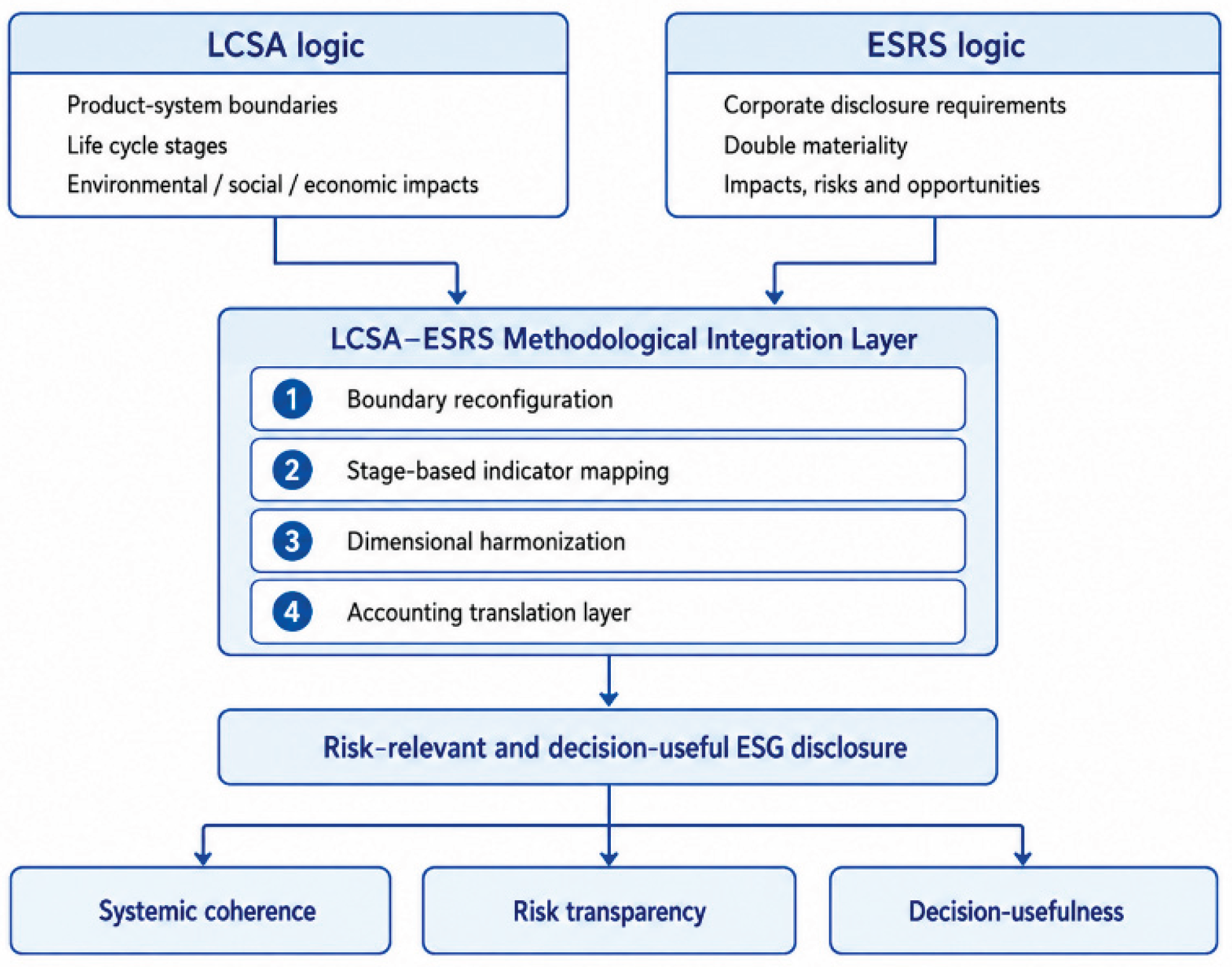

Table 1.
ESG/ESRS reporting logic versus LCSA logic (conceptual comparison).
| Dimension | ESRS-based ESG reporting (typical logic) |
LCSA (typical logic) |
|---|---|---|
| Primary object of assessment | Reporting undertaking (entity) | Product system / functional unit |
| Boundary principle | Organizational boundaries; value chain disclosure via IRO identification and narrative/metric disclosure | Explicit cradle-to-grave (or defined system) boundaries across stages |
| Data structure | Indicator/datapoint architecture; topical standards filtered by materiality | Inventory modelling + impact assessment across stages and categories |
| Integration across E/S/economic | Often thematically segmented; cross-dimensional linkage depends on reporting design | Designed for multi-dimensional integration (environmental + social + economic) |
| Methodological standardization | Disclosure rules + non-mandated process for materiality; entity-specific judgment | Standardized phases (goal/scope, inventory, impact assessment, interpretation) with critical review norms |
| Typical output | Compliance-oriented sustainability statement; enterprise-level metrics | Impact profiles and trade-offs per functional unit and life cycle stage |
Table 2.
Analytical framework for assessing life cycle integration in corporate sustainability disclosures.
Table 2.
Analytical framework for assessing life cycle integration in corporate sustainability disclosures.
| Analytical dimension | Evaluation focus | Key guiding question |
|---|---|---|
| Boundary definition logic | Reporting boundaries, value chain scope, product-system orientation, and inclusion or exclusion of life cycle stages | Do the disclosures remain primarily entity-centered, or do they extend toward explicitly defined product-system and cradle-to-grave boundaries? |
| Upstream integration | Supplier impacts, raw material sourcing, upstream Scope 3 emissions, human rights issues, resource dependencies, and supply chain risks | Are upstream impacts and risks assessed systematically and connected to specific value chain stages, or are they presented mainly through isolated supplier governance and compliance narratives? |
| Downstream integration | Product use, customer impacts, maintenance, product efficiency, circularity, waste treatment, recycling, and end-of-life management | Are downstream and end-of-life impacts incorporated into the overall reporting structure, or are they presented as separate initiatives, targets, or narratives? |
| Cross-dimensional coherence | Integration of environmental, social, and economic impacts within and across life cycle stages | Are environmental, social, and economic impacts linked within the same life cycle stages, enabling the identification of interactions, trade-offs, and cumulative effects? |
| Explicit methodological reference | References to LCA, S-LCA, LCC, LCSA, product footprinting, Environmental Product Declarations, or other life cycle-based methods | Do the reports explicitly refer to or apply recognized life cycle-based methodologies, and are these methods used systematically or only for selected products and environmental issues? |
| Risk relevance and decision-usefulness | Links to financial risk, transition exposure, resource dependency, liabilities, resilience, long-term value creation, and capital allocation | Do the disclosures enable investors and other users to assess systemic sustainability risks and their potential implications for financial performance and enterprise value? |
Table 3.
Representative disclosure evidence supporting the comparative coding.
| Company | Analytical dimension | Representative evidence | Page(s) | Interpretation |
|---|---|---|---|---|
| Unilever |
Boundary definition logic |
The double materiality assessment covers own operations and any stage of the upstream and downstream value chain, including product use and disposal. | 226 | Broad value-chain coverage is evident, but the disclosure does not establish a fully specified cradle-to-grave product-system boundary across all LCSA dimensions. |
| Enel |
Upstream integration |
The report links the procurement of critical raw materials, including lithium, cobalt, and nickel, with human rights concerns, geopolitical concentration, supply-chain disruption, and price volatility. |
364–365 | Specific upstream materials and interconnected environmental, social, and economic risks are identified, but they are not integrated with downstream and end-of-life impacts in a complete LCSA framework. |
| Siemens AG |
Downstream integration |
Siemens quantifies Scope 3 emissions from the use of sold products over their expected lifetime and reports that products sold in fiscal 2024 are expected to generate 398 million metric tons of CO2e during their anticipated use phase. | 70 | The disclosure quantitatively addresses the downstream use phase, but it remains focused on greenhouse gas emissions and does not integrate social, economic, or end-of-life effects across the complete product life cycle. |
| Unilever |
Cross-dimensional coherence |
Unilever links plastic packaging and extended producer responsibility schemes with environmental pressures and quantified economic consequences, including estimated effects of EPR costs and plastic taxes on net profit and net revenue under different scenarios and time horizons. | 262 | The disclosure connects environmental and economic effects within the downstream and end-of-life stages, but it does not incorporate the social dimension or provide an integrated assessment of trade-offs across the complete life cycle. |
| Siemens AG |
Explicit methodological reference |
Siemens explicitly applies Life Cycle Assessments and Environmental Product Declarations within its Robust Eco Design approach and calculates an LCA for representative products within Homogeneous Product Families. | 80–83 | The disclosure demonstrates a structured application of LCA across several product life cycle phases, but the methodology remains predominantly environmental and does not integrate Social LCA and Life Cycle Costing into a comprehensive LCSA framework. |
| Enel |
Risk relevance and decision-usefulness |
Enel links the sourcing of critical raw materials with geopolitical concentration, possible supply-chain disruption, and increases or volatility in material prices, indicating potential operational and economic consequences. | 364–365 | The disclosure provides decision-relevant information by connecting identifiable upstream dependencies with operational and economic risks. However, the potential financial effects are not systematically quantified or traced across the complete life cycle. |
Table 4.
Comparative synthesis of life cycle integration in ESG disclosures.
| Analytical dimension | Enel | Unilever | Siemens AG | Overall finding |
|---|---|---|---|---|
| Boundary definition logic | Mainly entity-centered, with strong climate and transition focus | Entity-centered, with visible product and sourcing elements | Entity-centered, with governance and technology focus | Reporting boundaries remain predominantly organizational |
| Upstream integration | Strong supplier and Scope 3 disclosure, mainly environmental | Strong sourcing and traceability disclosure | Strong supplier governance and due diligence | Upstream integration is present but not fully life cycle-based |
| Downstream integration | Focus on energy transition and infrastructure impacts | Product use, packaging, water, and consumer impacts visible | Product efficiency and customer solutions emphasized | Downstream impacts remain fragmented and partly narrative |
| Cross-dimensional coherence | Environmental dimension dominates | Environmental and consumer-related issues visible, but fragmented | Governance and environmental compliance dominate | Environmental, social, and economic dimensions are not systematically integrated |
| Explicit LCSA reference | Partial life cycle/environmental logic | Partial product and circularity logic | Partial product efficiency and environmental logic | Full LCSA is not operationalized |
| Risk relevance | Strong transition-risk relevance | Strong value chain and consumer-risk relevance | Strong supply chain and technology-risk relevance | Risk-relevant information exists, but systemic risk representation remains incomplete |
Table 5.
Operational logic of the LCSA–ESRS integration model.
| Step | Purpose | Practical application | Expected reporting improvement |
|---|---|---|---|
| 1. Identify material products, services, or activities | Select the most relevant objects of assessment | Identify business activities with significant sustainability impacts or financial risk exposure | More focused and material sustainability reporting |
| 2. Map life cycle stages | Extend reporting beyond own operations | Distinguish upstream, own operations, downstream use, and end-of-life stages | Greater boundary transparency |
| 3. Identify E/S/economic impacts | Integrate sustainability dimensions | Map environmental, social, and economic impacts at each stage | Reduced dimensional fragmentation |
| 4. Link impacts to ESRS materiality | Translate life cycle impacts into reporting logic | Connect impacts with ESRS topics, IROs, and double materiality assessment | Stronger regulatory alignment |
| 5. Communicate risk-relevant information | Improve decision-usefulness | Explain how life cycle impacts affect transition risk, supply chain risk, circularity risk, and long-term value | More useful information for investors and stakeholders |
Table 6.
Illustrative LCSA–ESRS mapping logic.
| Life cycle stage |
Environmental focus |
Social focus |
Economic / LCC focus | ESRS integration logic |
|---|---|---|---|---|
| Upstream | Supplier emissions, raw material extraction, biodiversity impacts, upstream transport | Value chain workers, human rights due diligence, community impacts | Supplier cost volatility, resource dependency, critical material exposure | Use value chain IRO identification to justify stage materiality and connect to material ESRS topics |
| Own operations | Operational emissions, energy use, pollution, water use, resource consumption | Own workforce safety, working conditions, governance controls | Operational costs, energy cost exposure, compliance costs | Align operational data with material topical metrics and assurance-ready internal control systems |
| Downstream use | Use-phase emissions, energy efficiency, water consumption, product-related environmental impacts | Consumer health and safety, accessibility, user impacts | Cost-to-use, affordability, maintenance costs | Make use-phase impacts explicit within materiality narratives and clarify assumptions |
| End-of-life | Waste treatment, recyclability, circularity outcomes, recovery rates | Community impacts, informal-sector risks, end-user responsibility | Recovery value, end-of-life costs, future liabilities | Link circular economy initiatives to stage-based KPIs and explain whether data are quantified or narrative |
Disclaimer/Publisher’s Note: The statements, opinions and data contained in all publications are solely those of the individual author(s) and contributor(s) and not of MDPI and/or the editor(s). MDPI and/or the editor(s) disclaim responsibility for any injury to people or property resulting from any ideas, methods, instructions or products referred to in the content. |
© 2026 by the authors. Licensee MDPI, Basel, Switzerland. This article is an open access article distributed under the terms and conditions of the Creative Commons Attribution (CC BY) license (http://creativecommons.org/licenses/by/4.0/).
Copyright: This open access article is published under a Creative Commons CC BY 4.0 license, which permit the free download, distribution, and reuse, provided that the author and preprint are cited in any reuse.