

Submitted:
17 June 2026
Posted:
18 June 2026
You are already at the latest version
Abstract
Background: Sedentary behaviour (SB) is a major risk factor for chronic diseases. While single interventions have been studied, limited evidence evaluates multiple integrated strategies for reducing SB and promoting wellbeing among university staff. The aim of this study was to evaluate the feasibility and impact of three workplace interventions on physical activity (PA), perceived health, wellbeing, and mood states among university employees. Methods: Three pre–post feasibility interventions were conducted at a UK university. Intervention 1 provided exercise bikes/rowers in staff offices for 11 weeks with participants (n=57). Intervention 2 introduced sit–stand desks for 8 weeks, participants (n=10). Intervention 3 compared seated, standing, and walking meetings on mood states, participants (n=61). Measures included various self-reported questionnaires, and PA logs. A significance level of p < 0.05 (two-tailed) and 95 % confidence intervals were applied throughout. Statistical tests included paired-sample t-tests, Wilcoxon Signed-Rank tests, Kruskal–Wallis H tests, and thematic analysis were also used throughout. Results: The total PA engagement across the 11 weeks of exercise equipment intervention increased from 330 minutes at baseline to 1287 minutes throughout the intervention and improved emotional wellbeing, though no significant p > 0.05 in quality of Life were observed. Sit–stand desks reduced sitting by 1153 minutes weekly, with significant improvements in physical functioning p < 0.05. Walking meetings significantly enhanced vigour, reduced confusion and depression p < 0.05 compared to seated or standing meetings which were associated with higher tension and fatigue. Conclusion: Providing access to exercise equipment, sit–stand desks, and walking meetings are feasible and acceptable strategies to reduce SB in university workplaces. Each intervention targeted distinct behavioural dimensions: PA engagement, sedentary reduction, and psychosocial wellbeing. A multi-component approach may therefore offer synergistic benefits for employee health and productivity, contributing to cultural change in HEIs. Larger controlled trials with longitudinal follow-up are needed.
Keywords:
physical activity
; sedentary behaviour
; workplace wellbeing
; sit–stand desks
; walking meetings
; university
; employees
; quality of life
; mood
1. Introduction
Sedentary behaviour (SB) is widely recognised as a major risk factor for chronic disease, strongly associated with obesity, cardiovascular disease, type 2 diabetes, and premature mortality (Leitzmann et al., 2026; Tully and Smith, 2026). Global trends reveal a steady rise in sedentary occupations, particularly in high-income countries where technology-driven roles have replaced physically demanding labour (Tully and Smith, 2026). Physical inactivity is estimated to cause more than five million deaths worldwide each year (Kohl et al., 2012). In the workplace, prolonged sitting is a health concern (Alaca et al., 2025). Employees in higher education settings may spend over 70%of their working day sitting (Safi et al., 2022a; Safi et al., 2024). This phenomenon poses new challenges to the promotion of health in the workplace, whist sedentary work is also associated with increasing health costs, including absenteeism and lower productivity (Voordt and Jensen, 2023).
Comparing workdays with non-workdays in relation to SB, clear disparity exists as evidence shows employees were spending an average of 138 minutes more sedentary in non-working days compared to working days (Quinn et al., 2022). Whereas previous research indicated that sitting at working days as 70.4% in compared to non-workdays as 62.9% (Thorp et al., 2012) and (McCrady and Levine, 2009) reported that mean sitting times of 597 minutes during work and 484 minutes during non-workdays. Most, if not all studies, have a consensus that employees generally spend most of their workday, if not the entire day, sitting (Fountaine et al., 2014; Safi et al., 2022a). Indeed, spending prolong time sitting has an adverse impact on a person’s health, wellbeing, and productivity when compared to engaging in movement while working (Lee et al., 2025; Tully and Smith, 2026).
Higher educational institutions (HEIs) have a dual role as workplaces and educational facilities and, as such, set lifestyle standards for employees and learners alike. Furthermore, health interventions also have dual values such as enhancing employee wellbeing and simultaneously demonstrating positive health practices for learners (Frazier and Doyle Fosco, 2024). Nonetheless, research on the health of employees of HEIs and physical activity (PA) of the active desk workers is insufficient (Ramezani et al., 2022; Safi et al., 2024). The available data, however, unequivocally demonstrate that university employees engage in excessive desk-based work at the workplace (Mott et al., 2026; Safi et al., 2022a). Therefore, it is crucial to develop and test the implementation of strategies that have a high potential for adoption in the culture of academic workplaces.
Typical workplace health promotion programmes have concentrated on the individual level, for example, lunchtimes for exercise or subsidised gym memberships. However, such programmes often fall short on sustainability unless there are accompanying changes to structures and/or processes (Donaldson-Feilder et al., 2017). The Social Ecological Model (SEM) recognises that health behaviours are influenced by individual, social, and organisational and physical environments (McLeroy et al., 1988). In response, modern workplace programmes focus more on changing the environment by adding structures such as sit-stand desks, stair prompts, and active meetings. For example, sit-stand workstations have been shown to reduce sitting time by as much as two hours per workday (Shrestha et al., 2018), and walking meetings enhance creativity while also decreasing sitting time (Tan and Ren, 2025). Previous research reported, simple behavioural prompts such as banners placed near lifts encouraged stair use and increased PA levels (Safi and Hossain, 2025). Furthermore, it is demonstrated that a team-based, friendly-competitive intervention increased daily step counts by more than 5,000 among university employees (Safi et al., 2024). Despite these promising developments, most published studies continue to investigate single strategies, often with small samples and limited follow-up, leaving a gap in evidence on integrated, multi-component approaches within HEIs.
Barriers to regular PA among university employees particularly academic staff have been well documented. The most common obstacles are lack of time and excessive workload (Che et al., 2017; Mercer et al., 2025). Academics frequently work beyond 40 hours per week, including early mornings, late evenings, and weekends (Das et al., 2013; Safi et al., 2022b). Donaldson-Feilder et al. (2017) identified six primary factors making PA difficult: (1) working patterns, (2) other commitments, (3) seasonal changes, (4) lack of motivation, (5) health problems, and (6) limited facilities. When asked what would enable participation, respondents cited: (1) easier access to gyms and fitness equipment, (2) support from colleagues, (3) greater motivation, (4) adapted job roles, (5) improved health, and (6) more free time. Adults typically spend around 60% of waking hours at work, with sedentary time averaging 77% on workdays and 70 per cent on non-workdays (Waters et al., 2016). Employees in public service roles are particularly sedentary (Landais et al., 2022). In the UK, healthcare professionals exhibit high levels of sickness absence, dissatisfaction, distress, and burnout largely attributed to long working hours and limited movement during shifts (Dall’Ora and Dahlgren, 2020; Johnson et al., 2018). Similar workload-related constraints apply to HEI employees, reinforcing the need for practical, time-efficient workplace interventions.
Given these challenges, the present study integrates three interventions conducted within the same HEI context, each targeting a different dimension of workplace sedentary culture:
- Provision of exercise equipment (exercise bikes and rowing machines) in staff offices.
- Introduction of sit–stand desks to reduce seated time.
- Implementation of walking and standing meetings as alternatives to traditional seated formats.
By synthesising these interventions, this study offers a multi-component perspective on the feasibility and potential impact of workplace health strategies in university settings.
2. Materials and Methods
Study design and setting
This study employed a pre–post mixed-methods feasibility design to evaluate three workplace physical activity (PA) interventions targeting different dimensions of sedentary behaviour (SB).
- Provision of exercise equipment (Monark 874E cycle ergometers and Concept 2 Model D rowing machines) within staff offices to encourage accessible PA during the working day.
- Introduction of sit–stand workstations to reduce time spent seated.
- Implementation of seated, standing, and walking meetings to assess short-term mood responses to different meeting formats.
Ethical approval and governance
The study was conducted according to the guidelines of the Declaration of Helsinki (1975, revised in 2013) and approved by the Birmingham City University Research Ethics Committee (Safi/Apr/2017/RLRA/0994), with additional permission from the Estates and Health & Safety departments. Written informed consent was obtained from all partici-pants. Participants were reminded of their right to withdraw at any point without providing any reason. Participation in the interventions did not require modification to staff contracts, working hours, or break entitlements. Data were anonymised through unique participant identification numbers and stored securely in accordance with the UK General Data Protection Regulation (2018).
Participants and recruitment
Staff across academic, administrative, and professional roles within a single university in England were invited to participate via internal communications. A health and safety risk assessment identified suitable offices and work areas for each intervention. All volunteers were aged ≥ 18 years, employed by the university, and eligibility required clearance for light-to-moderate PA based on the Physical Activity Readiness Questionnaire (PAR-Q). The lead researcher conducted regular safety inspections of all equipment and platforms. Participants were instructed to cease activity immediately if experiencing pain, dizziness, or discomfort and to notify the lead researcher. No adverse events requiring medical attention occurred during any phase of the study.
Intervention 1 (Exercise equipment): 57 participants (40 female, 17 male) across six offices such as School Administrative Office; Senior Management; Library; Administrative Assistant; Post-Graduate Research hub and Marketing and Communications.
Intervention 2 (Sit–stand workstations): 10 participants (8 female, 2 male) from Academic Staff, School Administrative Office and Senior Management.
Intervention 3 (Meeting formats): 61 participants from one university campus across academic staff, library, Administrative Assistant and Senior Management
Figure 1 shows the total number of staff and those who participated in Intervention 1 across the six offices
Intervention 1—Exercise equipment in offices
Equipment and induction
Five offices were equipped with Monark Ergomedic 874E cycle ergometers, and one office received a Concept 2 Model D rowing machine. The placement aimed to maximise accessibility without disrupting workflow. A group induction demonstrated correct use, and laminated step-by-step guides with photographs were displayed beside each machine. Participants were advised they could use the equipment freely throughout the working day for 11 weeks, with no minimum session length.
Monitoring and recording
A PA logbook was positioned near each machine and were reviewed twice weekly to monitor usage patterns and participant feedback. Participants recorded their unique ID, date, start and finish times, and comments regarding effort, motivation, or barriers.
Measures
Participants completed four validated self-report instruments before and after the intervention:
- Work Limitations Questionnaire—Long Form (WLQ-LF), assessing time management, physical, interpersonal, and output-related productivity limitations (Lerner et al., 2001).
- World Health Organisation WHO Quality of Life—BREF (WHOQOL-BREF), measuring physical, psychological, social, and environmental domains ((Group, 1994).
- RAND-36 Health Survey (SF-36), assessing physical and mental health across eight domains (Ware, 1993).
- EQ-5D-5L Visual Analogue Scale (VAS), a self-rated 0–100 health-status scale (Herdman et al., 2011).
Data Analysis
All statistical analysis were performed using IBM SPSS Statistics (version 25). Quantitative and qualitative data were analysed in complementary stages to assess behavioural, psychosocial, and affective changes arising from the three interventions. A significance level of p < 0.05 (two-tailed) and 95% confidence intervals were applied throughout. Before inferential testing, the distribution of continuous variables was examined using the Shapiro–Wilk test of normality, supported by visual inspection of histograms, boxplots, and Q–Q plots. Assessing normality was essential to determine whether parametric assumptions were met and, consequently, which statistical procedures were appropriate for each dataset. Effect sizes were calculated alongside p-values to gauge the magnitude and practical relevance of observed differences. For parametric analyses, Cohen’s d was reported, whereas for non-parametric analyses, the effect-size r (calculated as z/√n) was provided. Descriptive statistics (means ± SD, medians, and interquartile ranges) were also produced for transparency and interpretability.
Intervention 1—Exercise Equipment in Offices
After the discussion of the normality assumptions, for the evaluation of changes from pre to post at the different points of intervention, both parametric and non-parametric tests were conducted. In the scenario of the outcome variables that fulfilled the normality assumptions, the paired-samples t tests were conducted for the values recorded at baseline and after the intervention. This was the best option because the same participants were evaluated on two different occasions, thus providing the possibility to estimate within-subject changes during the 11 weeks of the intervention. For variables violating normality (p < 0.05), the Wilcoxon Signed-Rank test was used as a distribution-free alternative to the paired t-test. Accordingly, this method was applied to non-normal data from the WHOQOL-BREF, RAND-36, and EQ-5D-5L instruments.
Welch’s t-test was conducted to examine possible differences in the use of exercise equipment by gender. This method was used in place of the standard independent-samples t-test because Levene’s test for the equality of variances suggested the presence of heteroskedasticity (Levene p = 0.011). Adjusted Welch degrees of freedom are more accurate estimates of the degrees of freedom to be used in the calculation of the significance of the t-test when the assumption of homogeneity of variances is violated. Apart from statistical significance, effect sizes were evaluated to assess if the changes that were recorded had practical significance.
Qualitative data recorded by participants in the PA logbooks were analysed using reflexive thematic analysis (RTA), following the approach by Braun and Clarke (2006). RTA is a flexible, interpretive method used to identify, develop, and interpret patterns of meaning—themes—within the dataset. The analysis followed the six-phase process proposed by (Braun and Clarke, 2006) such as data familiarisation, initial coding, candidate themes, reviewed and refined, defined and named, and finally, themes were synthesised into a coherent narrative and supported by illustrative data extracts to enhance transparency and interpretive depth. This qualitative component was used to complement and explain the quantitative findings, providing deeper insight into participants’ experiences of the intervention, particularly in relation to its facilitators, challenges, and perceived value within the workplace context.
Qualitative integration and mixed-methods synthesis
Thematic analysis was employed to assess open-ended comments and logbook records from both interventions 1 and 2. Repeated concepts and experiences were identified through the use of inductive coding and then subsequently organised into higher level themes such as motivation and enjoyment, barriers to wellbeing or productivity (i.e., office temperature or space), and perceived improvements in wellbeing or productivity. Qualitative and quantitative findings were drawn together to provide a mixed-methods approach, enhancing interpretation through the connection of measured behavioural and health outcomes with participant experiences. The triangulation of these findings enhanced the ecological validity of the findings and resulting recommendations on the incorporating evidence-based and context-specific PA strategies into university workplace settings.
Intervention 2—Sit–stand workstations—Equipment and installation
This was the configuration for each participant: an L-E-VATE™ medium sit—stand workstation (Ergo Desktop Ltd., Cambridge, UK) fitted onto their existing desks for dual-monitor use. Participants were first given an individual safety demonstration, after which systems were installed with technical support from the campus. The lead researcher conducted daily inspections posture and system functionality to ensure safety.
Procedure
In the beginning, participants were assigned one baseline week where, using the standard desks, they recorded sitting and standing times and were asked to track these for “usual sitting and standing time” for comparison. After installation of the desks, participants were given unrestricted access to the system for a period of 8 weeks. Participants filled in daily time log-sheets, which documented each unique ID with the date and start and end times for both sitting and standing, as well as optional comments for comfort, fatigue, and productivity.
Measures
The same validated instruments used in Intervention 1 (WLQ-LF, WHOQOL-BREF, RAND-36, EQ-5D-5L) were administered pre- and post-intervention.
Statistical analysis
The procedures for the sit-stand intervention analysis were the same as those for the intervention 1 to maintain consistency in methodology. For each variable, the Shapiro-Wilk test confirmed the correct analysis and each variable’s distributional properties. The paired sample t test for means was used to test the means of the total number of minutes of sitting and standing during the week in which the intervention was implemented and compared it to the baseline so long as those were considered as logically ordered sample sets. Variables that are not normally distributed used the Wilcoxon Signed Rank test to compare median ranks without assuming normality. Measures of behaviour change over the eight-week intervention were effectively portrayed using descriptive statistics as means ± SD or medians (IQR) or percentiles. The change that was observed was quantified by the qualitative effect sizes to be Cohen’s d or r which were used for the interpretation of the changes without using the statistical significance. Quantitative analysis of qualitative comments captured in daily log-sheets was used to enhance the quantitative results as well. The data provided related to the experiences of the participants were concerned with comfort, fatigue, posture, and productivity, which helped interpret subtle behavioural changes associated with adopting sit–stand working practices. The qualitative materials were touched upon in the previous chapter and were used for integration within a mixed-methods framework.
Intervention 3—Seated, standing, and walking meetings
Design and rationale
The third intervention evaluated the immediate psychological impact of meeting format on employees’ mood states. Meetings represent a substantial proportion of university staff working time and are typically sedentary. This study explored whether altering meeting format to standing or walking could enhance energy and mood.
Participants
A total of 61 employees from academic and professional roles participated voluntarily. All provided informed consent and completed the PAR-Q prior to participation.
Procedure
Each participant attended three comparable meetings, each 60 minutes long conducted in a seated, standing and walking format within a single three-week period:
- Seated meeting—standard meeting room arrangement.
- Standing meeting—same setting but without chairs.
- Walking meeting—held outdoors on a pre-mapped 25–30-minute route around campus.
Before and immediately after each meeting, participants completed the Brunel Mood Scale (BRUMS) to capture acute changes in mood. Each participant entered their unique ID to link pre- and post-responses anonymously.
The BRUMS instrument
BRUMS (Terry et al., 1999) assesses transient mood across six subscales such as Anger, Confusion, Depression, Fatigue, Tension, and Vigour by using the 24 items rated 0 (“not at all”) to 4 (“extremely”). Higher scores indicate greater negative affect except for Vigour, where higher scores denote more positive energy. BRUMS has demonstrated good internal consistency and construct validity in occupational and exercise settings. It was the sole outcome measure for this intervention, providing focused insight into short-term emotional effects of meeting format.
Data preparation and statistical analysis
This intervention focused on short-term psychological and affective responses to different meeting formats, measured solely through the BRUMS. Each participant completed BRUMS immediately before and after three meeting types seated, standing, and walking over a three-week period. As BRUMS data were ordinal and non-normally distributed (p < 0.05, Shapiro–Wilk), non-parametric methods were selected. To examine within-condition changes (pre- vs. post-meeting for each meeting type), the Wilcoxon Signed-Rank test was applied. This test is robust to skewed data and suitable for paired ordinal measures. To assess between-condition differences across the three meeting types, the Kruskal–Wallis H test was used as the non-parametric equivalent of a one-way ANOVA. Where significant main effects were detected, Dunn’s pairwise post-hoc comparisons with Bonferroni correction were performed to identify which meeting formats differed significantly while controlling for family-wise error.
All BRUMS subscales were summarised using medians and interquartile ranges, supplemented by mean ± SD values for comparison. Effect sizes (r) were calculated for each significant finding to assess the strength and direction of mood changes. Reliability was ensured through attendance tracking and verification that both pre-post-questionnaires were completed for each meeting. This analytic strategy enabled the detection of both statistically and practically meaningful mood variations attributable to meeting format. These results suggest that incorporating movement-based meetings may offer valuable psychological benefits within sedentary academic work environments.
3. Results
Intervention 1: Exercise Equipment in Offices
Engagement and usage patterns
Descriptive statistics for employees’ engagement with the exercise equipment are presented in Figure 2, showing the mean total time spent using the bikes and rowers across the 11-week intervention. Overall, participants demonstrated consistent usage of the exercise equipment throughout the intervention, with male employees recording higher mean engagement than females. The mean difference was 138 minutes (95% CI = –122 to 398), although this difference was not statistically significant (t (17.77) = 1.114, p = 0.280). Thus, both male and female staff engaged comparably, indicating that the intervention was equally accessible and acceptable across genders.
Work Limitations Questionnaire—Long Form (WLQ-LF)
Inferential analyses showed no statistically significant pre–post differences across any WLQ-LF domains (p > 0.05). As shown in Table 1, mean scores for Time Management, Mental/Interpersonal Tasks, and Output Demands decreased slightly post-intervention, indicating modest improvements in perceived efficiency and work output, though not reaching statistical significance. Physical Tasks remained unchanged. The mean score for overall productivity loss decreased from 19 (± 3) pre-intervention to 18 (± 4) post-intervention. While the mean reduction of one point was not statistically significant (t (56) = –1.23, p = 0.225, d = –0.16), the trend indicates a small practical improvement in self-perceived work efficiency.
WHOQOL-BREF
The Wilcoxon Signed-Rank test identified no significant changes in quality-of-life domains between pre- and post-intervention (all p > 0.05). Median scores for Physical Health, Psychological, Social Relationships, and Environment remained stable, suggesting that 11 weeks of workplace exercise did not significantly alter general QoL perceptions in this sample.

Table 2.
Descriptive and inferential statistics for WHOQOL-BREF.
| Domain | Median (Range) Pre | Median (Range) Post | z | p |
|---|---|---|---|---|
| Physical Health | 16 (9) | 16 (19) | -0.07 | 0.944 |
| Psychological | 15 (9) | 14 (34) | 0.58 | 0.560 |
| Social Relationships | 15 (15) | 15 (20) | 0.45 | 0.650 |
| Environment | 15 (7) | 15 (19) | 0.00 | 1.000 |
RAND-36 Health Survey
Within the RAND-36 domains, a statistically significant improvement was observed in Emotional Wellbeing (z = 2.285, p = 0.022), reflecting enhanced mood and affective stability following regular exercise access. No other domains reached statistical significance (p > 0.05), although small positive shifts were noted for General Health and Physical Functioning.
Table 3.
Descriptive and inferential statistics for RAND-36 Health Survey.
| Domain | Median (Range) Pre | Median (Range) Post | z | p |
|---|---|---|---|---|
| Physical Functioning | 90 (60) | 95 (100) | -0.76 | 0.448 |
| Role Limitations (Physical) | 100 (100) | 100 (100) | -0.88 | 0.377 |
| Role Limitations (Emotional) | 67 (100) | 100 (100) | -0.60 | 0.551 |
| Energy/Fatigue | 60 (85) | 50 (90) | -1.10 | 0.271 |
| Emotional Wellbeing | 68 (72) | 76 (96) | 2.29 | 0.022* |
| Social Functioning | 75 (88) | 75 (100) | 0.16 | 0.873 |
| Pain | 78 (88) | 78 (100) | -1.07 | 0.285 |
| General Health | 70 (90) | 64 (94) | -1.88 | 0.060 |
EQ-5D-5L
Self-rated health status, measured via the EQ-5D-5L Visual Analogue Scale (“How is your health today?”), showed an improvement in median scores from 70 (pre) to 80 (post). This increase approached, but did not reach statistical significance (z = 1.724, p = 0.085).
Table 4.
Descriptive and inferential statistics for EQ-5D-5L.
| Measure | Median (Range) Pre | Median (Range) Post | z | p |
|---|---|---|---|---|
| Self-rated Health Today | 70 (95) | 80 (95) | 1.72 | 0.085 |
Table 5.
A summary of the themes and examples of raw data from participants comments recorded in the PA logbook.
Table 5.
A summary of the themes and examples of raw data from participants comments recorded in the PA logbook.
| Themes | Sub-themes | Participants comments |
|---|---|---|
| Positive mood | Feel good | “Feel good to workout in between work as my day is usually too busy and this changed my mood”. |
| Energetic | “Makes you feel energetic, and it changes mood for the rest of the day”. | |
| Active | “I have been sitting all morning, and I was stiff, and I lost the focus, good to have the bike in our office. Every time I use it, I feel active, and it wakes me up”. | |
| Work Productivity | Productivity | “Enjoyed it done it early today and wanted to do more saw effect on productivity yesterday”. |
| Time | “Time went faster than yesterday. Energised to get more work done”. | |
| Motivational/arousal | Motivation | “Made me feel ready for the day, motivated me to go to gym after work”. |
| Target | “Set a target of 10km a day”. | |
| Behaviour change | “Got me out of breath and felt good starting gradually as haven’t done this type of exercise in a while, I am so motivated to continue doing this”. | |
| Stress relief | Stress | “I was pre-stressed, but this has helped me”. |
| Away from computer | “Good to be away from PC and much needed piece of equipment to have in office”. | |
| Environmental Factors | Environment |
“Good start to my day but office is too warm”. “Feel good room seems less hot now and I missed going on the bike all these days”. |
| Change | “I’ve been in front of a computer screen until early hours loved the changed as it feels good and I missed it, but the room is so hot for the past few days, and it is not possible to use the bike”. |
Results—Intervention 2: Sit–Stand Workstations
This section presents the results of the sit–stand workstation intervention, examining changes in sitting and standing behaviour, health, wellbeing, and productivity across the eight-week period. Descriptive statistics of the baseline and post-intervention data are summarised in Figure 3, followed by quantitative analyses and qualitative feedback themes.
Behavioural Outcomes
The height-adjustable workstation reduced mean sitting time by 1,153 minutes per week, while standing time increased by 484 minutes across the intervention period. It is important to note that standing time did not rise in exact proportion to sitting time reduction, as not all standing behaviour occurred at the height-adjustable workstation. This variation reflects the natural fluctuation of daily and weekly work activities. Descriptive statistics of weekly sitting and standing time are provided in the appendices.
Qualitative Feedback
Thematic analysis of participant comments captured through daily log-sheets identified several recurring themes, including enhanced mood, productivity, and fatigue. Participants commonly reported feeling more energetic and positive, with improved focus and productivity, though some described mild tiredness due to prolonged standing. Illustrative quotes are summarised in Table 6.
Work Limitations Questionnaire—Long Form (WLQ-LF)
Descriptive and inferential statistics for WLQ-LF domains are presented in Table 7. Although mean differences were observed across all domains, no significant pre–post changes were detected (p > 0.05). This suggests that while the intervention may have encouraged perceived improvements in efficiency and task management, these were not statistically significant within the study duration. The mean productivity-loss score decreased slightly from 20 (±3) to 19 (±4); however, the change was not statistically significant (t (9) = 0.171, p = 0.868, d = -0.05). This finding aligns with the overall WLQ-LF pattern, showing stable work performance following the introduction of the sit–stand workstation.
WHOQOL-BREF
As shown in Table 8, there were no significant changes across any WHOQOL-BREF domains (p > 0.05) between pre- and post-intervention assessments. Nevertheless, slight positive trends were observed for Physical Health and Environment, suggesting potential incremental improvements over a longer intervention period.
RAND-36 Health Survey
Several RAND-36 domains demonstrated significant improvement from pre- to post-intervention, particularly in Physical Functioning (p = 0.001), Role Limitations due to Physical Health (p = 0.026), Energy/Fatigue (p = 0.001), and Social Functioning (p = 0.045). These findings suggest that the introduction of sit–stand workstations contributed positively to physical health and perceived vitality.
Table 9.
Descriptive and inferential statistics for RAND-36 Health Survey.
| Domain | Median (Range) Pre | Median (Range) Post | 95% CI | t(9), p | d |
| Physical Functioning | 80 (10) | 90 (11) | -14.46 to -5.54 | -5.07, 0.001* | -1.60 |
| Role Limitations (Physical) | 80 (37) | 95 (11) | -43.21 to -13.21 | -1.20, 0.026* | -0.38 |
| Energy/Fatigue | 39 (10) | 62 (17) | -28.44 to -17.11 | -9.10, 0.001* | -2.88 |
| Social Functioning | 81 (24) | 90 (14) | -17.23 to -0.27 | -2.33, 0.045* | -0.74 |
EQ-5D-5L
Self-rated health, as measured by the EQ-5D-5L, showed a modest increase from a mean of 81 (±11) pre-intervention to 83 (±11) post-intervention. This change was not statistically significant (t (9) = -0.405, p = 0.695, d = -0.13), as shown in Table 10.
The sit–stand workstation intervention led to a substantial reduction in sitting time and a corresponding increase in standing time. While improvements in health and productivity measures did not reach significance across all domains, significant gains were observed in several RAND-36 subscales, particularly Physical Functioning, Energy/Fatigue, and Social Functioning. Qualitative findings reinforced these results, suggesting that participants experienced greater alertness and engagement despite initial fatigue. These findings indicate that incorporating height-adjustable workstations into office environments can positively influence both physical and psychosocial aspects of employee wellbeing.
Results—Intervention 3: Seated, Standing, and Walking Meetings
This section presents findings from the third intervention, which examined differences in mood states across seated, standing, and walking meetings using the Brunel Mood Scale (BRUMS). Analyses explored pre- and post-meeting mood changes within each condition, followed by between-condition comparisons.
Seated Meetings
Results indicated a significant increase in tension following seated meetings (z = –3.085, p = 0.002), suggesting participants experienced greater stress or mental strain after conventional meetings. No other BRUMS subscales showed significant change (p > 0.05). Mean ± SD and inferential results are presented in Table 11.
Standing Meetings
Standing meetings were associated with significant reductions in Confusion (z = –2.507, p = 0.012), Tension (z = –2.408, p = 0.016), and Vigour (z = –4.395, p = 0.005). While reduced tension suggests potential stress relief, the decline in vigour indicates possible short-term fatigue from prolonged standing. Descriptive and inferential statistics are provided in Table 12.
Standing Meetings
Standing meetings were associated with significant reductions in Confusion (z = –2.507, p = 0.012), Tension (z = –2.408, p = 0.016), and Vigour (z = –4.395, p = 0.005). While reduced tension suggests potential stress relief, the decline in vigour indicates possible short-term fatigue from prolonged standing. Descriptive and inferential statistics are provided in Table 13.
Walking Meetings
Walking meetings produced the most substantial and positive mood responses. Significant reductions were observed in Confusion (z = –1.968, p = 0.049) and Depression (z = –2.055, p = 0.040). In contrast, significant increases were detected in Fatigue (z = –3.416, p = 0.001), Tension (z = –2.181, p = 0.029), and Vigour (z = 4.900, p = 0.005), indicating elevated arousal and energy immediately following walking sessions.
Table 14.
Descriptive and inferential statistics for BRUMS.
| BRUMS Subscale | Mean (SD) Pre | Mean (SD) Post | z | p |
|---|---|---|---|---|
| Anger | 0.57 (1.32) | 0.31 (0.87) | -1.401 | 0.161 |
| Confusion | 1.36 (2.69) | 0.72 (1.81) | -1.968 | 0.049* |
| Depression | 0.69 (1.68) | 0.38 (1.21) | -2.055 | 0.040* |
| Fatigue | 2.74 (1.70) | 2.94 (2.17) | -3.416 | 0.001* |
| Tension | 1.39 (0.77) | 2.49 (2.15) | -2.181 | 0.029* |
| Vigour | 5.11 (3.69) | 7.80 (4.30) | 4.900 | 0.005* |
Between-Meeting Comparisons
Kruskal–Wallis analyses revealed significant overall differences between meeting types for Fatigue (χ² (2) = 9.318, p = 0.009) and Vigour (χ² (2) = 47.481, p = 0.005). Post-hoc Dunn–Bonferroni pairwise tests showed that: (1) Fatigue was significantly higher after seated meetings compared with both standing and walking (p < 0.05), and (2) Vigour was significantly greater after walking meetings compared with both seated and standing (p < 0.05). No significant between-condition differences were observed for Anger, Confusion, Depression, or Tension.
Table 15.
Descriptive and inferential statistics for BRUMS.
| BRUMS Subscale | Seated Mean (SD) | Standing Mean (SD) | Walking Mean (SD) | χ² (2) | p |
|---|---|---|---|---|---|
| Anger | 0.07 (1.53) | -0.10 (0.85) | -0.26 (1.32) | 3.174 | 0.205 |
| Confusion | -0.08 (1.81) | -0.49 (1.45) | -0.64 (2.30) | 2.459 | 0.292 |
| Depression | -0.05 (2.17) | -0.05 (0.92) | -0.31 (1.22) | 0.544 | 0.762 |
| Fatigue | 0.34 (2.44) | -0.48 (2.11) | -1.03 (2.26) | 9.318 | 0.009* |
| Tension | -0.82 (2.15) | -0.48 (2.04) | -0.62 (2.15) | 2.714 | 0.257 |
| Vigour | 0.08 (2.92) | -1.89 (2.92) | 2.69 (3.55) | 47.481 | 0.005* |
Collectively, the findings demonstrate that meeting format influences employees’ immediate mood and energy levels. Traditional seated meetings were associated with increased tension, while standing meetings reduced tension and confusion but also lowered vigour. Walking meetings produced the most positive affective profile, significantly enhancing vigour and reducing confusion and depression. These results highlight the psychological and energising benefits of incorporating walking meetings as a simple, low-cost strategy to counteract sedentary work culture within university environments.
4. Discussion
The aim of this research was to integrate three interventions, each targeting a different dimension of university workplace sedentary culture and in turn promote PA, health and wellbeing. The series of workplace interventions conducted throughout this research collectively demonstrates that strategic changes to the physical and organisational environment can influence employees’ PA behaviour, sedentary time, and psychosocial wellbeing within aa workplace. Drawing upon the SEM, SDT, and TTM, the findings affirm that environmental facilitation through access to exercise equipment, height-adjustable workstations, and walking or standing meetings acts as a powerful enabler of behaviour change and can contribute to improved health and wellbeing outcomes, although to variable degrees across interventions as demonstrated in the results section.
Providing access to exercise equipment (e.g., bikes, rowers) enhanced PA engagement across employees. Participants recorded a total of 1,287 minutes of exercise engagement over 11 weeks, evidently higher than levels identified in the preceding phases of this research using the IPAQ-LF and ActiGraph measures. This supports previous studies that removing environmental barriers and increasing accessibility to PA opportunities encourages active behaviour in otherwise sedentary workplace settings (Proper and van Oostrom, 2019). Although the intervention duration was relatively short, increased participation is indicative of a clear behavioural change within the TTM framework from “preparation” to “action” and possibly beyond to “maintenance.” This was further supported by the height-adjustable workstation intervention, which demonstrated a reduction in sitting time from 1,974 to 821 minutes weekly, along with an increase in standing time from 439 to 923 minutes, which is an increase of over 400 minutes during the intervention period. These findings are consistent with the literature demonstrating that sit-stand desk interventions reduce sedentary behaviour and improve posture, energy, and physical function (Shrestha et al., 2018). Collectively, these two interventions demonstrate the impact of altering the physical environment on the workplace culture to promote active working.
The standing and walking meeting intervention promoted this behavioural shift beyond the individual workstation by changing old organisational customs. With walking meetings, employees felt more energetic and less angry, fatigued, and tense. This supports the evidence connecting mild physical movement with improved mood and productivity (Cocchiara et al., 2020). This research also shows that the promotion of physical activity does not have to come from structured exercise programs. Integrating movement into the daily work schedule is sufficient to cut down on sedentary time and boost wellbeing.
There was a discernible difference in the exercise equipment intervention as male employees participated in 135 more minutes of exercise than females. This may reflect the comfort levels different genders have in the exercise intensity of the open office setting. Lower participation in workplace PA by women due to privacy, cultural, and body image concerns has been documented in previous studies (Olney et al., 2018). Approaches workplace health programmes with an inclusive, gender-sensitive focus are needed, for example, providing alternative forms of movement that are not publicly visible, or single-sex access times. Also, environmental comfort emerged as a significant factor as well. Participation was sometimes discouraged by warm office conditions, implying that context constraints such as these can limit well-designed interventions. This exemplifies the SEM principle that environmental and policy conditions have fundamental reach over health behaviours (McLeroy et al., 1988). Engagement in future interventions will require consideration of environmental comfort, and sustained access to engagement resources.
Descriptive analyses from all three interventions have indicated marked emotional wellbeing and the perception of improved health across the board, albeit to a minimal degree. Improvements to mood, stress levels, and energy after the interventions were noted, even if the changes in the WHOQOL-BREF, RAND-36-SF, and EQ-5D-5L were not statistically significant. Employees, for instance, reported increases in both concentration and morale due to brief bouts of exercise (5-10 mins), which supports research indicating that even minimal durations of light physical activity can enhance affective wellbeing (Afsar et al., 2018). Productivity outcomes were more nuanced. Participants in WLQ-LF generally self-reported improved time management, energy, and motivation, even though the Former factor demonstrated limited significant improvement. This disparity means that the advantageous effects of PA interventions may be more easily captured by self-reports and a shift in organisational culture over quantitative organisational performance. In addition, the emotional and soothing effects of standing and exercising have been theorised to counteract workplace fatigue and emotional strain (Edwardson et al., 2018), which is consistent with qualitative data reporting improved mood, focus, and job satisfaction. Walking meetings resulted in notable improvements in mood and vigour, indicating increased alertness and participation. This suggests that movement-enhanced practices may be more useful than passive measures in optimizing health and wellness. This also suggests that it is possible for upper management to model such active behaviours and reinforce an organisational culture supportive of wellbeing, fulfilling the autonomy, competence, and relatedness of SDT on the positive end of the spectrum (Deci and Ryan, 1985).
Practical and Policy Implications
Together, current interventions provide practical evidence backing the applicability and success of inexpensive, widespread workplace health promotion measures in higher education institutions and similar settings. Institutions can foster active living supportive ecosystems by incorporating PA into daily routines through ready-at-hand apparatus, flexible workstations, and activity-centric meetings. These, in conjunction with national public health campaigns on inactivity and wellbeing, can help form cohesive systems. Other activities aimed at health and wellbeing, along with performance, engagement, and retention management, can be utilised for the promotion of such measures by universities and similar organisations. This approach, in addition to the individual health benefits attained, reaffirms the organisational pledge to staff welfare, which in turn can improve staff morale and the institution’s public standing.
Limitations and Future Research
There are positive developments however, there are important presumptions to be made. First, the equipment for exercise involved unique, short samples, and short periods of self-selection for the samples obtained (11 weeks for the exercise equipment intervention, and matching lengths for the workstation and meeting studies). People do not shift from one place to another, or from one state of mind to another instantaneously. “Behaviour change is a process of evolution”. It is important that we devote sufficient time to identify whether the behaviour and attitude markers which we previously identified, persist over the course of time (Prochaska et al., 1994).
The lack of control and comparison groups is a definitional limitation of the study. Future work should consider randomised controlled or quasi-experimental designs to disentangle the effects of the intervention. Also, the self-administered questionnaires are susceptible to self-report bias, and future research should use a combination of qualitative and quantitative approaches (e.g., accelerometer and heart rate monitoring, ecological momentary assessment) to confirm the findings. Gender, age, and occupation were also demographic variables that were not uniformly collected across the studies, restricting subgroup analyses. The documented differences in level of PA by gender indicate that such variables should be incorporated in future studies. To extend the body of work, more complex, mixed-method, longitudinal designs are needed, with larger, more heterogenous cohorts, and with a broader range of indicators, including psychological and physiological factors, as well as organisational absences, retention and productivity. Cross-sector studies that include corporate, health, and education settings may further clarify the generality of the findings.
5. Conclusions
This research collectively shows how changes made to workplaces, such as providing exercise equipment and sit-stand workstations, as well as allowing walking or standing meetings, positively impact on employees’ PA participation, sedentary time, and wellbeing. While statistical significance was not consistently achieved, the entire set of measures changing in the same direction lends to the practicality and theory of integrating movement in workplace culture. This research adds to the existing, yet still sparse, literature focusing on physical activity interventions in a university setting. Similar actions taken in other workplaces could serve to diminish the sedentary culture, improve employee health and morale, and create a more active, inclusive, and health-oriented Organisation. There continues to be a need for more research that incorporates controlled, long-term, and rigorous methodologies to improve the understanding of causation and aid in cross sector policy and practice.
Author Contributions
Conceptualization, A.S.; Data curation, A.S.; Formal analysis, A.S. Investigation, A.S.; Methodology, A.S.; Project administration, A.S.; Supervision, M.C. and N.C.W.; Writing— Original draft, A.S.; Writing—Review and editing, A. S, M.H., M.C., A.L.K., M.G.Z. and N.C.W. All authors have read and agreed to the published version of the manuscript.
Funding
This research received no external funding.
Institutional Review Board Statement
The study was conducted according to the guidelines of the Declaration of Helsinki (1975, revised in 2013) and approved by the Birmingham City University Research Ethics Committee (Safi/Apr/2017/RLRA/0994, approval date: 17 January 2019), with additional permission from the Estates and Health & Safety departments. Written informed consent was obtained from all partici-pants. Participants were reminded of their right to withdraw at any point without providing any reason. Participation in the interventions did not require modification to staff contracts, working hours, or break entitlements. Data were anonymised through unique participant identification numbers and stored securely in accordance with the UK General Data Protection Regulation (2018).
Informed Consent Statement
Informed consent was obtained from all subjects involved in the study.
Data Availability Statement
Data can be requested by lead/correspondence author on reasonable request.
Acknowledgments
The authors would like to thank all participants taking part in this study.
Conflicts of Interest
The authors declare no conflicts of interest.
References
- Afsar, B., Siriopol, D., Aslan, G., Eren, O. C., Dagel, T., Kilic, U., Kanbay, A., Burlacu, A., Covic, A. and Kanbay, M. (2018) The impact of exercise on physical function, cardiovascular outcomes and quality of life in chronic kidney disease patients: a systematic review. International urology and nephrology, 50(5), pp. 885-904. [CrossRef]
- Alaca, N., Acar, A. Ö. and Öztürk, S. (2025) Low back pain and sitting time, posture and behavior in office workers: A scoping review. Journal of back and musculoskeletal rehabilitation, 38(5), pp. 919-943. [CrossRef]
- Braun, V. and Clarke, V. (2006) Using thematic analysis in psychology. Qualitative research in psychology, 3(2), pp. 77-101. [CrossRef]
- Che, X. X., Zhou, Z. E., Kessler, S. R. and Spector, P. E. (2017) Stressors beget stressors: The effect of passive leadership on employee health through workload and work–family conflict. Work & Stress, pp. 1-17.
- Cocchiara, R. A., Dorelli, B., Gholamalishahi, S., Longo, W., Musumeci, E., Mannocci, A. and La Torre, G. (2020) Tai Chi and Workplace Wellness for Health Care Workers: A Systematic Review. International Journal of Environmental Research and Public Health, 17(1), p. 343. [CrossRef]
- Dall’Ora, C. and Dahlgren, A. (2020) Shift work in nursing: Closing the knowledge gaps and advancing innovation in practice. International Journal of Nursing Studies, 112, p. 103743. [CrossRef]
- Das, B. M., Rinaldi-Miles, A. I. and Evans, E. M. (2013) Exploring faculty and staff PA barriers at a large university. California Journal of Health Promotion, 11(2), pp. 61-72. [CrossRef]
- Deci, E. L. and Ryan, R. M. (1985) The general causality orientations scale: Self-determination in personality. Journal of research in personality, 19(2), pp. 109-134. [CrossRef]
- Donaldson-Feilder, E., Lewis, R., Pavey, L., Jones, B., Green, M. and Webster, A. (2017) Perceived barriers and facilitators of exercise and healthy dietary choices: A study of employees and managers within a large transport organisation. Health Education Journal, p. 0017896917712296.
- Edwardson, C. L., Biddle, S. J. H., Clarke-Cornwell, A., Clemes, S., Davies, M. J., Dunstan, D. W., Eborall, H., Granat, M. H., Gray, L. J. and Healy, G. N. (2018) A three arm cluster randomised controlled trial to test the effectiveness and cost-effectiveness of the SMART Work & Life intervention for reducing daily sitting time in office workers: study protocol. BMC Public Health, 18(1), p. 1120. [CrossRef]
- Fountaine, C. J., Piacentini, M. and Liguori, G. A. (2014) Occupational sitting and physical activity among university employees. International journal of exercise science, 7(4), p. 295. [CrossRef]
- Frazier, T. and Doyle Fosco, S. L. (2024) Nurturing positive mental health and wellbeing in educational settings–the PRICES model. Frontiers in public health, 11, p. 1287532.
- Group, W. (1994) Development of the WHOQOL: Rationale and current status. International Journal of Mental Health, 23(3), pp. 24-56.
- Herdman, M., Gudex, C., Lloyd, A., Janssen, M. F., Kind, P., Parkin, D., Bonsel, G. and Badia, X. (2011) Development and preliminary testing of the new five-level version of EQ-5D (EQ-5D-5L). Quality of Life Research, 20(10), pp. 1727-1736. [CrossRef]
- Johnson, J., Hall, L. H., Berzins, K., Baker, J., Melling, K. and Thompson, C. (2018) Mental healthcare staff well-being and burnout: A narrative review of trends, causes, implications, and recommendations for future interventions. Int J Ment Health Nurs, 27(1), pp. 20-32. [CrossRef]
- Kohl, H. W., Craig, C. L., Lambert, E. V., Inoue, S., Alkandari, J. R., Leetongin, G. and Kahlmeier, S. (2012) The pandemic of physical inactivity: global action for public health. The lancet, 380(9838), pp. 294-305. [CrossRef]
- Landais, L. L., Jelsma, J. G. M., Dotinga, I. R., Timmermans, D. R. M., Verhagen, E. A. L. M. and Damman, O. C. (2022) Office workers’ perspectives on physical activity and sedentary behaviour: a qualitative study. BMC public health, 22(1), p. 621. [CrossRef]
- Lee, D., Kennedy, J., Cothran, D. J., Shih, P. C., Dickinson, S., Golzarri-Arroyo, L. and Frey, G. C. (2025) Correlates of physical activity, sedentary time, and cardiovascular disease risk factors in autistic adults without intellectual disabilities. Research in Developmental Disabilities, 161, p. 104980. [CrossRef]
- Leitzmann, M. F., Bakogianni, I., Anderson, A. S., Bauld, L., Fernandez, E., Morris, S., Srour, B., Vardavas, C., Vlad, I. and Vuik, S. (2026) European Code Against Cancer, –diet, excess body weight, physical activity, sedentary behavior, breastfeeding, and cancer. Molecular Oncology, 20(1), pp. 28-48. [CrossRef]
- Lerner, D., Amick III, B. C., Rogers, W. H., Malspeis, S., Bungay, K. and Cynn, D. V(2001) The work limitations questionnaire. Medical care, pp. 72-85. [CrossRef]
- McCrady, S. K. and Levine, J. A. (2009) Sedentariness at work: how much do we really sit? Obesity, 17(11), pp. 2103-2105. [CrossRef]
- McLeroy, K. R., Bibeau, D., Steckler, A. and Glanz, K. (1988) An ecological perspective on health promotion programs. Health education quarterly, 15(4), pp. 351-377. [CrossRef]
- Mercer, R. A. J., Russell, J. L., Strack, D. S., Coutts, A. J. and McLean, B. D. (2025) Work Demands, Responses, and Coping Strategies for Staff in High-Performance Sport: A Scoping Review: RAJ Mercer et al. Sports Medicine, 55(12), pp. 3001-3058.
- Mott, L., Parchment, A., Money, A., Johnson, S. and Todd, C. (2026) Interrupting sedentary behaviour when working from home: a qualitative exploration of older desk-based employees. BMC Public Health. [CrossRef]
- Olney, N., Wertz, T., LaPorta, Z., Mora, A., Serbas, J. and Astorino, T. A. (2018) Comparison of acute physiological and psychological responses between moderate-intensity continuous exercise and three regimes of high-intensity interval training. The Journal of Strength & Conditioning Research, 32(8), pp. 2130-2138. [CrossRef]
- Prochaska, J. O., Velicer, W. F., Rossi, J. S., Goldstein, M. G., Marcus, B. H., Rakowski, W., Fiore, C., Harlow, L. L., Redding, C. A. and Rosenbloom, D. (1994) Stages of change and decisional balance for 12 problem behaviors. Health psychology, 13(1), p. 39. [CrossRef]
- Proper, K. I. and van Oostrom, S. H. (2019) The effectiveness of workplace health promotion interventions on physical and mental health outcomes–a systematic review of reviews. Scandinavian journal of work, environment & health, 45(6), pp. 546-559.
- Quinn, T. D., Kline, C. E., E, F. N., Radonovich, L. J. and Barone Gibbs, B. (2022) Physical Activity in the Workplace: Does Just Working Meet Activity Recommendations? Workplace Health Saf, 70(2), pp. 81-89. [CrossRef]
- Ramezani, M., Tayefi, B., Zandian, E., SoleimanvandiAzar, N., Khalili, N., Hoveidamanesh, S., Massahikhaleghi, P. and Rampisheh, Z. (2022) Workplace interventions for increasing physical activity in employees: A systematic review. Journal of occupational health, 64(1), p. e12358. [CrossRef]
- Safi, A., Cole, M., Kelly, A. L., Deb, S. and Walker, N. C. (2022a) A Comparison of Physical Activity and Sedentary Lifestyle of University Employees through ActiGraph and IPAQ-LF. Physical Activity and Health, 6(1), pp. 5-15. [CrossRef]
- Safi, A., Cole, M., Kelly, A. L., Zariwala, M. G. and Walker, N. C. (2022b) Workplace Physical Activity Barriers and Facilitators: A Qualitative Study Based on Employees Physical Activity Levels. International Journal of Environmental Research and Public Health, 19(15), p. 9442. [CrossRef]
- Safi, A., Deb, S., Kelly, A., Cole, M., Walker, N. and Zariwala, M. G. (2024) Incentivised physical activity intervention promoting daily steps among university employees in the workplace through a team-based competition. Frontiers in public health, 11, p. 1121936. [CrossRef]
- Safi, A. and Hossain, M. (2025) Promoting workplace physical activity among university employees: the impact of motivational and educational banners on stair use. Discover Public Health, 22(1), p. 197. [CrossRef]
- Shrestha, N., Kukkonen-Harjula, K. T., Verbeek, J. H., Ijaz, S., Hermans, V. and Pedisic, Z. (2018) Workplace interventions for reducing sitting at work. Cochrane Database of Systematic Reviews, (6). [CrossRef]
- Tan, P. and Ren, X. (2025) The effects of rhythmic footstep and sound interactions on creativity: A design and evaluation study. International Journal of Human–Computer Interaction, 41(10), pp. 6413-6430. [CrossRef]
- Terry, P. C., Lane, A. M., Lane, H. J. and Keohane, L. (1999) Development and validation of a mood measure for adolescents. J Sports Sci, 17(11), pp. 861-872. [CrossRef]
- Thorp, A. A., Healy, G. N., Winkler, E., Clark, B. K., Gardiner, P. A., Owen, N. and Dunstan, D. W. (2012) Prolonged sedentary time and physical activity in workplace and non-work contexts: a cross-sectional study of office, customer service and call centre employees. International Journal of Behavioral Nutrition and Physical Activity, 9(1), p. 128. [CrossRef]
- Tully, M. A. and Smith, L. (2026) Sedentary Behaviour and Obesity. In: Routledge Handbook of Sedentary Behaviour Routledge, pp. 157-163.
- Voordt, T. V. D. and Jensen, P. A. (2023) The impact of healthy workplaces on employee satisfaction, productivity and costs. Journal of Corporate Real Estate, 25(1), pp. 29-49.
- Ware, J. E. (1993) Scoring the SF-36. SF-36. Health Survey: Manual and Interpretation Guide.
- Waters, C. N., Ling, E. P., Chu, A. H., Ng, S. H., Chia, A., Lim, Y. W. and Müller-Riemenschneider, F. (2016) Assessing and understanding sedentary behaviour in office-based working adults: a mixed-method approach. BMC public health, 16(1), p. 360. [CrossRef]
Figure 1.
shows the total number of staff and those who participated in Intervention 1 across the six offices. Darker shades = Total Employees and Lighter shades = Employees Participated in the intervention.
Figure 1.
shows the total number of staff and those who participated in Intervention 1 across the six offices. Darker shades = Total Employees and Lighter shades = Employees Participated in the intervention.
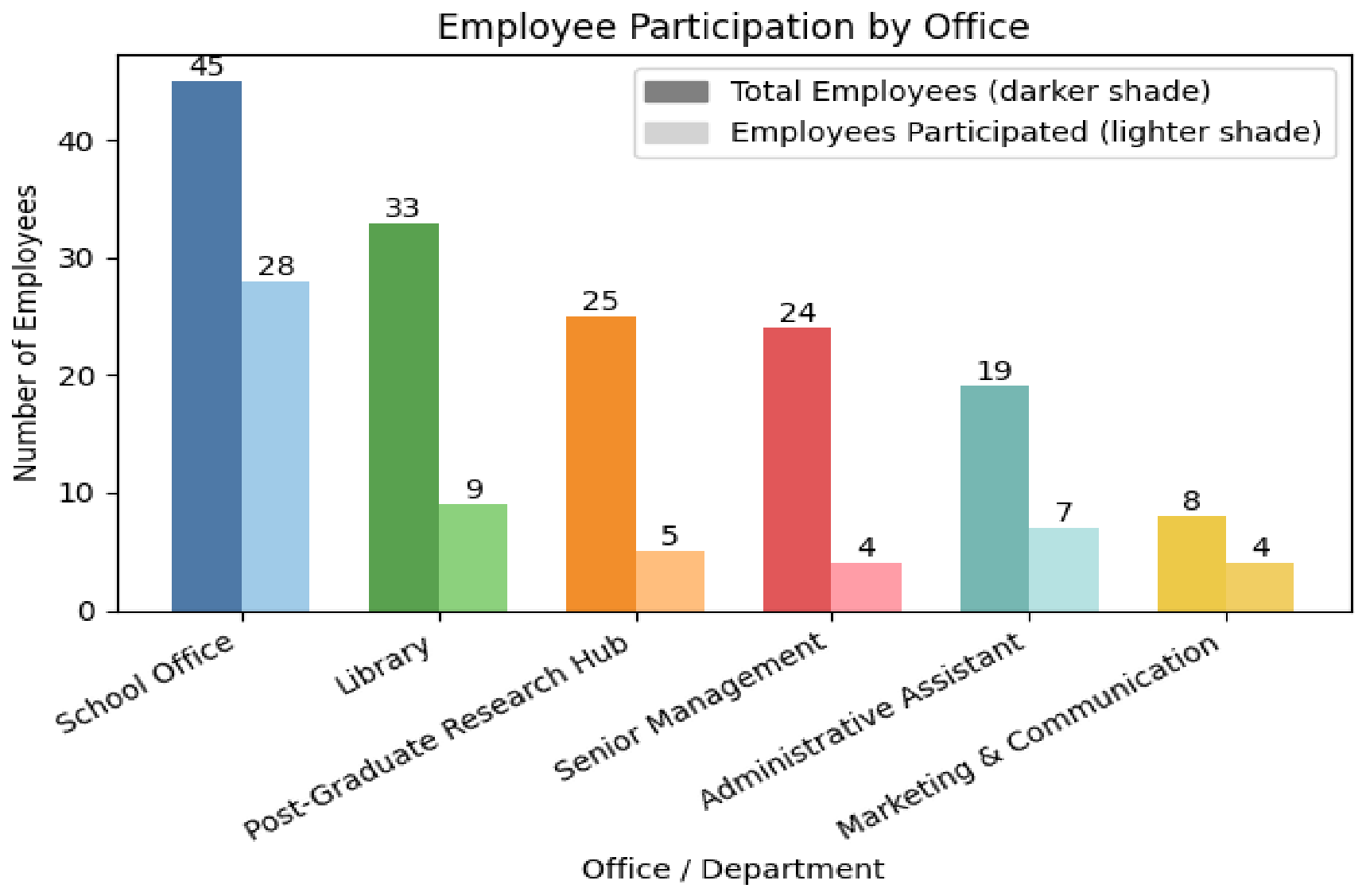
Figure 2.
The breakdown of mean total time spent using the exercise equipment and across gender throughout the intervention period.
Figure 2.
The breakdown of mean total time spent using the exercise equipment and across gender throughout the intervention period.
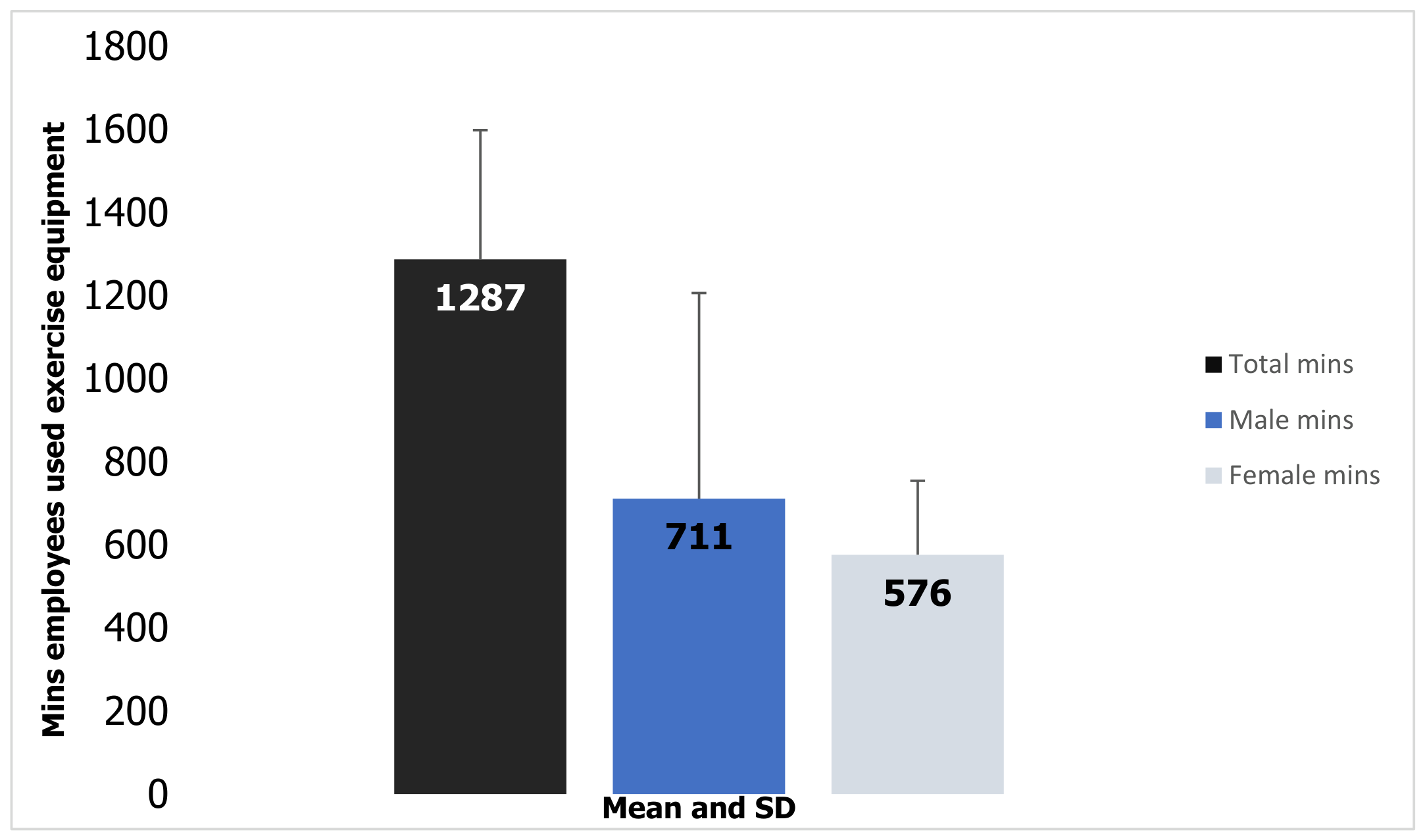
Figure 3.
The descriptive statistics of baseline week time spent sitting and standing versus post intervention in minutes.
Figure 3.
The descriptive statistics of baseline week time spent sitting and standing versus post intervention in minutes.
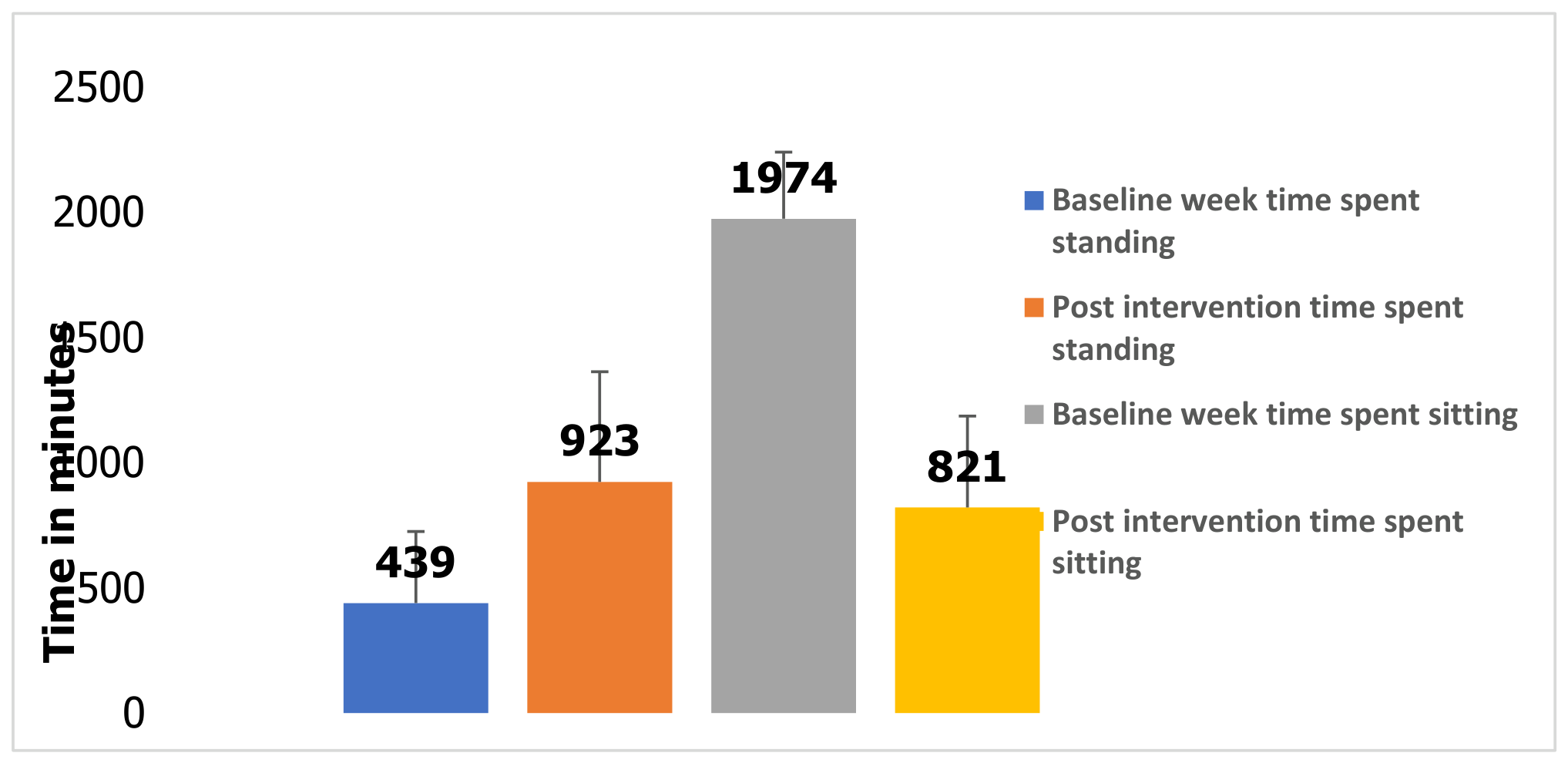
Table 1.
Descriptive and inferential statistics for WLQ-LF—domains.
| WLQ-LF Domain | Mean (SD) Pre | Mean (SD) Post | 95% CI | t(56), p | d |
|---|---|---|---|---|---|
| Time Management | 80 (18) | 73 (21) | 3.48 to 8.22 | 0.81, 0.421 | 0.11 |
| Physical Tasks | 23 (23) | 23 (20) | –5.95 to 6.39 | 0.07, 0.944 | 0.01 |
| Mental/Interpersonal Tasks | 79 (17) | 78 (18) | –3.28 to 6.01 | 0.59, 0.558 | 0.08 |
| Output Demands | 81 (20) | 77 (21) | –1.98 to 8.29 | 1.23, 0.223 | 0.16 |
Table 6.
A summary of the themes and examples of raw data from participants comments recorded.
| Theme | Sub-theme | Example Comments |
|---|---|---|
| Positive Mood | Energetics / Mood | “Strange adjusting to new desk and standing but feel more energetic.” / “Feel happy and my mood changed for better.” |
| Work Productivity | Productivity | “Feel productive. Lots of work done.” |
| Energy Status | Tiredness / Fatigue | “Feel tired and lethargic.” |
Table 7.
Descriptive and inferential statistics for WLQ-LF domains.
| WLQ-LF Domain | Mean (SD) Pre | Mean (SD) Post | 95% CI | t(9), p | d |
| Time Management | 88 (11) | 77 (25) | -6.23 to 27.23 | 1.42, 0.189 | 0.45 |
| Physical Tasks | 33 (18) | 39 (22) | -22.22 to 11.39 | -0.73, 0.484 | 0.23 |
| Mental/Interpersonal Tasks | 85 (12) | 79 (20) | -9.95 to 22.17 | 0.86, 0.412 | 0.27 |
| Output Tasks | 80 (27) | 85 (20) | -32.24 to 21.24 | -0.47, 0.653 | 0.15 |
Table 8.
Descriptive and inferential statistics for WHOQOL-BREF.
| Domain | Median (Range) Pre | Median (Range) Post | 95% CI | t(9), p | d |
| Physical Health | 16 (3) | 17 (2) | -2.69 to 1.20 | -0.86, 0.410 | -0.27 |
| Psychological | 16 (2) | 16 (2) | -0.91 to 0.51 | -0.64, 0.541 | 0.20 |
| Social Relationships | 17 (2) | 17 (2) | -1.52 to 1.25 | -0.22, 0.832 | -0.07 |
| Environment | 16 (2) | 17 (2) | -1.96 to 1.26 | -0.49, 0.634 | -0.16 |
Table 10.
Descriptive and inferential statistics for EQ-5D-5L.
| Measure | Mean (SD) Pre | Mean (SD) Post | t(9), p | d |
|---|---|---|---|---|
| Self-rated Health Today | 81 (11) | 83 (11) | -0.405, 0.695 | -0.13 |
Table 11.
Descriptive and inferential statistics for BRUMS.
| BRUMS Subscale | Mean (SD) Pre | Mean (SD) Post | z | p |
|---|---|---|---|---|
| Anger | 1.64 (2.89) | 1.70 (2.64) | 0.687 | 0.492 |
| Confusion | 2.44 (3.15) | 2.36 (3.32) | -0.182 | 0.855 |
| Depression | 1.98 (3.13) | 1.93 (3.22) | 0.339 | 0.735 |
| Fatigue | 4.16 (3.36) | 4.51 (3.87) | 0.768 | 0.442 |
| Tension | 2.67 (1.85) | 3.32 (2.80) | -3.085 | 0.002* |
| Vigour | 5.61 (3.19) | 5.69 (3.62) | 0.526 | 0.599 |
Table 12.
Descriptive and inferential statistics for BRUMS.
| BRUMS Subscale | Mean (SD) Pre | Mean (SD) Post | z | p |
|---|---|---|---|---|
| Anger | 0.54 (1.29) | 0.44 (1.32) | -1.016 | 0.310 |
| Confusion | 1.31 (2.12) | 0.82 (2.05) | -2.507 | 0.012* |
| Depression | 0.41 (1.04) | 0.36 (1.02) | -0.540 | 0.589 |
| Fatigue | 2.84 (3.28) | 2.36 (2.93) | -1.705 | 0.088 |
| Tension | 1.20 (2.32) | 0.72 (1.56) | -2.408 | 0.016* |
| Vigour | 6.74 (3.88) | 4.85 (3.24) | -4.395 | 0.005* |
Table 13.
Descriptive and inferential statistics for BRUMS.
| BRUMS Subscale | Mean (SD) Pre | Mean (SD) Post | z | p |
|---|---|---|---|---|
| Anger | 0.54 (1.29) | 0.44 (1.32) | -1.016 | 0.310 |
| Confusion | 1.31 (2.12) | 0.82 (2.05) | -2.507 | 0.012* |
| Depression | 0.41 (1.04) | 0.36 (1.02) | -0.540 | 0.589 |
| Fatigue | 2.84 (3.28) | 2.36 (2.93) | -1.705 | 0.088 |
| Tension | 1.20 (2.32) | 0.72 (1.56) | -2.408 | 0.016* |
| Vigour | 6.74 (3.88) | 4.85 (3.24) | -4.395 | 0.005* |
Disclaimer/Publisher’s Note: The statements, opinions and data contained in all publications are solely those of the individual author(s) and contributor(s) and not of MDPI and/or the editor(s). MDPI and/or the editor(s) disclaim responsibility for any injury to people or property resulting from any ideas, methods, instructions or products referred to in the content. |
© 2026 by the authors. Licensee MDPI, Basel, Switzerland. This article is an open access article distributed under the terms and conditions of the Creative Commons Attribution (CC BY) license (http://creativecommons.org/licenses/by/4.0/).
Copyright: This open access article is published under a Creative Commons CC BY 4.0 license, which permit the free download, distribution, and reuse, provided that the author and preprint are cited in any reuse.


