

Submitted:
15 June 2026
Posted:
17 June 2026
You are already at the latest version
Abstract
Background/Objectives: Extracranial-intracranial (EC-IC) arterial bypass, particularly superficial temporal artery to middle cerebral artery (STA-MCA) anastomosis, is employed in selected patients with moyamoya disease or atherosclerotic steno-occlusive disease to augment cerebral perfusion. Objective hemodynamic monitoring before and after revascularization remains essential. This study evaluated the impact of STA-MCA bypass on regional cerebral blood flow (rCBF) using single-photon emission computed tomography (SPECT) with a semi-quantitative area-based method. Methods: Fifteen patients who underwent STA-MCA bypass between June 2018 and June 2022 with available pre- and postoperative CTA and rCBF-SPECT studies were retrospectively analyzed. A custom semi-quantitative technique using Labelme annotation, Canny edge detection, and Green’s theorem was applied to calculate the proportional perfusion area in basal ganglia and temporal regions, normalized to total brain area. Paired pre–post comparisons and subgroup analyses (left- vs. right-sided surgery; ipsilateral vs contralateral regions) were performed. Results: Mean age was 56 ± 15.7 years (40% female). Indications included moyamoya disease (20%) and arterial stenosis/occlusion (80%). All 16 anastomoses (14 unilateral, 1 bilateral) were patent postoperatively. Overall, postoperative perfusion area proportion improved significantly in basal ganglia (mean difference 0.24, 95% CI 0.13–0.35, p = 0.0003) and temporal regions (0.34, 95% CI 0.08–0.60, p = 0.0131). Improvement in basal ganglia perfusion was similar between left-sided (Δ 0.23) and right-sided (Δ 0.28) surgery groups. In unilateral cases, there was no significant difference between ipsilateral and contralateral basal ganglia improvement (p = 0.839), suggesting a global hemodynamic effect. Conclusions: STA-MCA bypass was associated with objective rCBF improvement on semi-quantitative SPECT, with consistent benefits in the basal ganglia regardless of surgical laterality. The lack of significant ipsilateral-contralateral difference supports a global hemispheric perfusion augmentation mechanism. The pragmatic semi-quantitative SPECT method is feasible for hemodynamic monitoring after revascularization.
Keywords:
extracranial-intracranial bypass
; STA-MCA anastomosis
; moyamoya disease
; cerebral blood flow
; SPECT
; hemodynamic assessment
; cognitive function
; steno-occlusive disease
1. Introduction
Extracranial-intracranial (EC-IC) arterial bypass has been utilized to treat various intracranial pathologies, including moyamoya disease, arterial stenosis or occlusion, complex aneurysms not amenable to endovascular treatment, and secondary cerebral ischemia [1,2]. In patients with carotid stenosis or occlusion, bypass improves cerebral blood flow (CBF) at rest and augments cerebrovascular reserve during periods of increased metabolic demand [2,3,4]. Consequently, it can reduce further ischemic events, reverse the vascular steal phenomenon, and potentially enhance long-term neurocognitive function in appropriately selected patients [5].
Because EC-IC bypass may reduce stroke risk, restore cortical thickness, and improve cognitive outcomes, objective pre- and postoperative hemodynamic monitoring is essential to confirm revascularization success [6,7]. The objective of this study was to investigate the impact of STA-MCA bypass on regional cerebral blood flow (rCBF) using single-photon emission computed tomography (SPECT) as a semi-quantitative surrogate marker, with particular focus on the basal ganglia and temporal regions—areas critical for motor, cognitive, and executive functions [8]. We further examined whether surgical laterality influenced the pattern of perfusion improvement (ipsilateral vs. contralateral regions).
2. Materials and Methods
2.1. Patients and Surgical Procedure
Patients who underwent pre- and postoperative brain computed tomography angiography (CTA) and rCBF-SPECT studies at our institution between June 2018 and June 2022 were retrospectively selected. This study was approved by the institutional research ethics board, and all patients provided informed consent.
Inclusion criteria were: (1) patients with intracranial steno-occlusive disease or moyamoya disease who received either unilateral or bilateral superficial temporal artery to middle cerebral artery (STA-MCA) EC-IC bypass; (2) availability of preoperative CTA and at least one postoperative CTA; and (3) availability of preoperative rCBF-SPECT and at least one postoperative rCBF-SPECT study. Patients with missing imaging studies or loss to follow-up were excluded.
2.2. Image Processing and rCBF Measurement
We focused on the basal ganglia and temporal regions for rCBF assessment, as these areas are crucial for motor control, cognition, and executive function [6].
The detailed image processing pipeline is illustrated in Figure 1 and consists of the following steps:
A. Slice Selection: Preoperative and postoperative SPECT images were co-registered with corresponding CTA when available. Two independent observers (one neurosurgeon and one neuroradiologist) selected the most representative axial slice at the level of the basal ganglia (approximately at the anterior commissure–posterior commissure line) and the temporal lobes, ensuring clear visualization of the lenticulostriate territories and Sylvian fissure.
B. Region of Interest (ROI) Annotation using Labelme: Selected DICOM images were converted to 8-bit grayscale PNG format and imported into Labelme (version 5.0.1, an open-source image annotation tool developed by wkentaro). Polygonal annotations were manually drawn to delineate areas of detectable tracer uptake.
C. Labelme Annotation Protocol:
A. Use the “Create Polygons” tool (shortcut: Ctrl + N) to trace the boundaries of the bilateral basal ganglia (caudate nucleus, putamen, and globus pallidus) and temporal lobes (superior, middle, and inferior temporal gyri).
B. Annotations were performed in a blinded manner with respect to pre- or postoperative status to minimize bias.
C. For each region, label names were assigned as BG_Left, BG_Right, Temp_Left, and Temp_Right.
D. Practical techniques included: using mouse wheel for precise zooming, holding the space bar to pan the image, Ctrl + Z for undo, and right-click to close the polygon. For regions with fuzzy boundaries (common in SPECT), a conservative 1–2 pixel outward adjustment was applied, followed by manual vertex editing. Newer versions of Labelme with Segment Anything Model 2 (SAM2) integration were optionally used for initial automatic segmentation, followed by manual refinement to ensure anatomical accuracy.
D. Binary Mask Generation and Edge Detection: Exported JSON files containing polygon coordinates were parsed using custom Python scripts (Python 3.9 with OpenCV 4.5). Polygon coordinates were converted into binary mask images (white ROI on black background). Contours were extracted using the Canny edge detection algorithm (low threshold = 50, high threshold = 150, aperture size = 3), with parameters optimized through pilot testing to balance sensitivity and noise reduction.
E. Area Calculation: The area enclosed by each closed contour was computed using Green’s theorem (shoelace formula):
This mathematical approach provides sub-pixel accuracy for irregular anatomical regions.
F. Normalization: To compensate for variations in head positioning, slice angulation, and global tracer uptake, the ROI area was normalized by dividing it by the total brain area (excluding ventricles and extracerebral spaces) on the same axial slice, yielding a proportional perfusion area metric (unitless ratio).
G. Reliability Assessment: Intra-rater and inter-rater reliability were evaluated on 20 randomly selected images (10 pre-operative and 10 post-operative). The intraclass correlation coefficient (ICC) exceeded 0.88 for both basal ganglia and temporal regions, indicating excellent reproducibility.
This pragmatic semi-quantitative method using open-source tools offers a practical, anatomically specific, and visually intuitive approach for clinical hemodynamic assessment without requiring absolute quantification or complex arterial input functions. Custom Python scripts used for data processing are available from the corresponding author upon reasonable request.
We focused on the basal ganglia and temporal regions for rCBF assessment, as these areas are crucial for motor control, cognition, and executive function and are commonly affected in steno-occlusive cerebrovascular disease [6,8]. Semi-quantitative analysis was performed on representative axial slices of rCBF-SPECT images.
2.3. Surgical Intervention and Follow-Up
All patients underwent direct STA-MCA bypass via end-to-side anastomosis of the parietal branch of the superficial temporal artery to a cortical M4 branch of the middle cerebral artery. Our standard postoperative follow-up included clinical evaluation, CTA assessment of anastomosis patency (graded as patent or occluded using axial thin-slice maximum intensity projection reconstructions), and rCBF-SPECT for hemodynamic assessment. All imaging was independently evaluated by two experienced neuroradiologists or neurosurgeons.
2.4. Statistical Analysis
Categorical variables are presented as counts and percentages. Continuous variables with normal distribution are expressed as mean ± standard deviation (SD). Paired pre- and postoperative comparisons were performed using the paired t-test, with mean differences (MD) and 95% confidence intervals (CI) reported. Subgroup analyses were conducted according to surgical laterality (left-sided vs right-sided surgery) and, for unilateral cases, according to ipsilateral versus contralateral regions. A p-value < 0.05 was considered statistically significant. Analyses were performed using MedCalc for Windows (version 22.032, MedCalc Software, Ostend, Belgium).
3. Results
Fifteen patients were included. The mean age was 56 ± 15.7 years, and 40% (n = 6) were female. Surgical indications were moyamoya disease (n = 3, 20%) and arterial stenosis or occlusion (n = 12, 80%). Fourteen patients underwent unilateral STA-MCA bypass, and one patient received bilateral bypasses, resulting in a total of 16 anastomoses. All anastomoses were patent intraoperatively and remained patent on postoperative CTA. One patient experienced a recurrent ischemic stroke in the left temporal cortex nine months after left-sided bypass surgery; no other major perioperative complications were observed.

Table 1.
Patient demographics, comorbidities, and surgical characteristics (n = 15).
| Variable | Value |
|---|---|
| Age, years (mean ± SD) | 56 ± 15.7 |
| Sex, n (%) | |
| Male | 9 (60) |
| Female | 6 (40) |
| Comorbidities, n (%) | |
| Hypertension | 6 (40) |
| Diabetes mellitus | 9 (60) |
| Hyperlipidemia | 6 (40) |
| Atrial fibrillation | 0 (0) |
| Coronary artery disease | 2 (13.3) |
| Prior ischemic stroke | 13 (86.7) |
| Prior hemorrhagic stroke | 1 (6.7) |
| Chronic renal failure (eGFR <60) | 0 (0) |
| Antiplatelet therapy | 10 (66.7) |
| Diagnosis, n (%) | |
| Moyamoya disease | 3 (20) |
| Arterial stenosis/occlusion | 12 (80) |
| Surgical laterality, n | |
| Unilateral | 14 |
| Bilateral | 1 |
| Total anastomoses | 16 (all patent) |
Quantitative analysis of proportional perfusion area on rCBF-SPECT demonstrated statistically significant postoperative improvement in both regions of interest. For the basal ganglia, the mean difference (MD) was +0.24 (95% CI 0.13–0.35, p = 0.0003). For the temporal regions, the MD was +0.34 (95% CI 0.08–0.60, p = 0.0131). (Figure 2.)
In unilateral cases (n = 14), there was no statistically significant difference in basal ganglia perfusion improvement between ipsilateral and contralateral sides (overall ipsilateral Δ +0.128 vs contralateral Δ +0.130, p = 0.839) (Table 2.) Similar patterns were observed for the temporal regions. These findings suggest that the hemodynamic benefit of STA-MCA bypass extends beyond the immediate surgical territory.
4. Discussion
Low-flow extracranial-intracranial (EC-IC) arterial bypass, particularly superficial temporal artery to middle cerebral artery (STA-MCA) anastomosis, remains an important revascularization strategy for carefully selected patients with moyamoya disease or atherosclerotic steno-occlusive disease who exhibit impaired cerebrovascular reserve [1,2,10,11]. In the present study, we achieved a 100% postoperative patency rate across 16 anastomoses, which is comparable to or exceeds the 95–99% patency rates reported in contemporary high-volume cerebrovascular centers [12,13].
The core hemodynamic finding of this study—statistically significant postoperative expansion of the proportional perfusion area on semi-quantitative SPECT, with particularly robust and consistent gains in the basal ganglia—aligns well with multiple prior investigations employing various perfusion imaging modalities, including SPECT, CT perfusion, and arterial spin labeling MRI [14,15,16]. Anatomically, direct anastomosis to a cortical M4 branch primarily augments the distal MCA territory. However, the pronounced improvement observed in the basal ganglia, which are predominantly supplied by the lenticulostriate perforators arising from the M1 segment, is noteworthy. This phenomenon likely results from a combination of mechanisms: (1) overall increase in hemispheric inflow leading to enhanced pressure gradients across perforators, (2) reversal of the vascular steal phenomenon, (3) recruitment of leptomeningeal and pial collaterals, and (4) restoration of cerebral autoregulation capacity [17,18].
Consistent with Mesiwala et al. [2], who reported postoperative cerebral blood flow improvement in approximately 80% of patients after STA-MCA bypass, and Li et al. [4], who demonstrated significant increases in regional cerebral blood flow using perfusion-weighted imaging, our semi-quantitative SPECT analysis revealed directional improvement in 13 of 15 patients in the basal ganglia region. Furthermore, Ha et al. [19] reported that increases in normalized cerebral blood flow on arterial spin labeling MRI correlated with the degree of postoperative neovascularization in pediatric moyamoya disease, supporting the notion that perfusion imaging can serve as a reliable surrogate marker of revascularization success.
In our subgroup analysis (Table 2), improvement in basal ganglia perfusion was similar between patients undergoing left-sided (mean Δ +0.23) and right-sided (mean Δ +0.28) surgery. More importantly, in unilateral cases, there was no statistically significant difference between ipsilateral and contralateral basal ganglia improvement (overall ipsilateral Δ +0.128 vs contralateral Δ +0.130, p = 0.839). This finding supports the concept that the hemodynamic benefit of STA-MCA bypass is not limited to the surgical side but reflects a more global hemispheric perfusion augmentation [19,20], likely mediated by increased overall inflow and collateral recruitment, rather than being limited to the ipsilateral surgical territory. This may reflect the indirect effects of overall hemispheric blood flow increase and collateral compensation.
The basal ganglia play a pivotal role in cognitive gating, executive function, motor control, and emotional regulation through their complex cortico-striato-thalamo-cortical loops [6,21]. Therefore, the reliable perfusion augmentation observed in this deep gray matter structure carries important potential clinical implications. These findings are consistent with Sasoh et al. [6], who observed partial alleviation of cognitive impairment following EC-IC bypass in patients with hemodynamic cerebral ischemia, particularly among those with shorter symptom duration. Several recent cohort studies have also documented postoperative improvements in Montreal Cognitive Assessment (MoCA) scores and other neuropsychological domains following EC-IC bypass surgery, especially in patients with shorter symptom duration and preoperative reversible perfusion deficits [11,22,23,24].
Although the landmark Carotid Occlusion Surgery Study (COSS) demonstrated no overall benefit of EC-IC bypass over best medical management in patients with symptomatic unilateral internal carotid artery occlusion and misery perfusion [3], subsequent subgroup analyses and selective case series suggest that highly selected patients with recurrent ischemic events despite optimal medical therapy and objective evidence of severe hemodynamic impairment may still derive substantial benefit [26,27,28]. Our real-world Asian cohort, which included both moyamoya disease and atherosclerotic pathology, adds valuable data supporting the individualized application of bypass surgery in appropriately selected patients.
Methodologically, the custom semi-quantitative area-proportion method using Labelme, Canny edge detection, and Green’s theorem offers practical advantages in daily clinical settings. It is relatively simple, cost-effective, and provides anatomically specific metrics without requiring absolute quantification. However, it remains two-dimensional and operator-dependent. Future studies should validate this approach against fully quantitative techniques such as PET or ASL-MRI [29].
Limitations of this study include the small sample size, retrospective single-center design, clinical heterogeneity (mixed moyamoya and atherosclerotic cases), absence of a control group, lack of standardized long-term neuropsychological outcomes, and the semi-quantitative nature of the SPECT analysis. Strengths include complete paired imaging follow-up, 100% bypass patency, blinded annotation, rigorous reliability testing (ICC > 0.88), and detailed subgroup analysis including ipsilateral versus contralateral comparisons.
Future directions include larger prospective multicenter studies integrating quantitative perfusion imaging, comprehensive neuropsychological assessment, long-term stroke-free survival data, and comparative effectiveness research between direct, indirect, and combined bypass techniques. Identification of reliable hemodynamic and clinical responders will further refine patient selection criteria in contemporary revascularization practice [30].
5. Conclusions
STA-MCA bypass was associated with objective improvement in regional cerebral blood flow on semi-quantitative SPECT, with consistent benefits observed in the basal ganglia. Improvement was similar regardless of surgical laterality, and in unilateral cases there was no significant difference between ipsilateral and contralateral basal ganglia perfusion gains. These findings support the concept of a global hemispheric perfusion augmentation mechanism, likely mediated by increased overall inflow, reversal of steal phenomenon, and enhanced collateral circulation, rather than purely localized effects. SPECT, even with pragmatic semi-quantitative methods, remains useful for perioperative monitoring. Future prospective multicenter studies incorporating quantitative perfusion imaging, standardized neuropsychological assessments, and long-term clinical outcomes are warranted to further validate these observations, refine patient selection criteria, and optimize revascularization strategies in cerebrovascular revascularization practice.
Author Contributions
Conceptualization: Wu YC, Lee CH; Methodology: Wu YC, Lee CH, Fong YC, Tsai MH; Software: Wu YC, Fong YC, Tsai MH; Validation: Wu YC, Lee CH; Formal Analysis: Wu YC; Investigation: Wu YC; Resources: Wu YC, Lee CH; Data Curation: Lee CH, Tsuei YS; Writing – Original Draft Preparation: Wu YC; Writing – Review & Editing: Wu YC; Visualization: Wu YC; Supervision: Lee CH, Tsuei YS. All authors have read and agreed to the published version of the manuscript.
Funding
This research received no external funding.
Institutional Review Board Statement
This study was conducted in accordance with the Declaration of Helsinki and approved by the Institutional Review Board of Taichung Veterans General Hospital (protocol code CE22405B and date of approval 14 October 2022).
Informed Consent Statement
Informed consent was obtained from all subjects involved in the study.
Data Availability Statement
The data presented in this study are available on request from the corresponding author. The data are not publicly available due to privacy and ethical restrictions.
Conflicts of Interest
The authors declare no conflicts of interest.
References
- Kwon, W.K.; Park, E.K.; Lee, Y.H.; Kim, Y.; Kim, D.S.; Shim, K.W.; Choi, J.U. Efficacy of superficial temporal artery-middle cerebral artery bypass in patients with cerebrovascular steno-occlusive diseases. J. Korean Neurosurg. Soc. 2017, 60, 553–561. [Google Scholar]
- Mesiwala, A.H.; Sviri, G.; Fatemi, N.; Britz, G.W.; Newell, D.W. Long-term outcome of superficial temporal artery–middle cerebral artery bypass for moyamoya disease. Neurosurg. Focus 2008, 24, E15. [Google Scholar] [CrossRef] [PubMed]
- Powers, W.J.; Clarke, W.R.; Grubb, R.L., Jr.; Videen, T.O.; Adams, H.P., Jr.; Derdeyn, C.P. Extracranial-intracranial bypass surgery for stroke prevention in hemodynamic cerebral ischemia: The Carotid Occlusion Surgery Study randomized trial. JAMA 2011, 306, 1983–1992. [Google Scholar] [CrossRef] [PubMed]
- Li, Z.; Zhang, Y.; Wang, Y.; Wang, X.; Li, Y.; Zhang, H. Perfusion-weighted magnetic resonance imaging used in assessing hemodynamics following superficial temporal artery–middle cerebral artery bypass in patients with moyamoya disease. Cerebrovasc. Dis. 2013, 35, 455–461. [Google Scholar] [CrossRef] [PubMed]
- Lee, M.; Guzman, R.; Bell-Stephens, T.; Steinberg, G.K. Intraoperative blood flow analysis of direct revascularization procedures in patients with moyamoya disease. J. Cereb. Blood Flow Metab. 2011, 31, 262–274. [Google Scholar] [PubMed]
- Sasoh, M.; Ogasawara, K.; Kuroda, K.; Okuguchi, T.; Terasaki, K.; Yamashita, K.; Ogawa, A. Effects of extracranial-intracranial bypass surgery on cognitive impairment in patients with hemodynamic cerebral ischemia. Surg. Neurol. 2003, 59, 406–413. [Google Scholar] [CrossRef] [PubMed]
- Fiedler, J.; Přibylová, L.; Dobiášová, M.; Sameš, M. Cognitive outcome after extracranial-intracranial bypass surgery in patients with cerebral ischemia. Acta Neurochir. (Wien) 2011, 153, 1303–1311. [Google Scholar] [CrossRef] [PubMed]
- O, J.H.; Jang, K.S.; Yoo, I.; Kim, S.H.; Chung, S.K.; Sohn, H.S.; Rha, H.K.; Park, H.K.; Chung, Y.A.; Jeong, J. Assessment of cerebrovascular reserve before and after STA-MCA bypass surgery by SPECT and SPM analysis. Korean J. Radiol. 2007, 8, 458–465. [Google Scholar] [CrossRef] [PubMed]
- Golub, D.; McBriar, J.D.; Mehta, S.H.; Hussain, I.; Dinkin, M.J.; Patsalides, A.; Knopman, J. The impact of cerebrovascular steno-occlusive disease subtype on surgical and clinical outcomes after direct STA-MCA bypass surgery. J. Neurosurg. 2024, 142, 1406–1418. [Google Scholar] [PubMed]
- Ma, Y.; Wang, T.; Wang, H.; Chen, Y.; Li, J.; Zhang, X.; Wang, Y.; Wang, Y.; Zhao, J. Extracranial-intracranial bypass and risk of stroke and death in patients with symptomatic artery occlusion: The CMOSS randomized clinical trial. JAMA 2023, 330, 704–714. [Google Scholar] [CrossRef] [PubMed]
- Duan, Y.; Li, J.; Zhang, X.; Wang, Y.; Chen, Y.; Li, M. Cognitive outcomes after extracranial-intracranial bypass surgery in elderly patients with atherosclerotic cerebral steno-occlusive artery disease. Front. Aging Neurosci. 2025, 17, 1548319. [Google Scholar] [CrossRef] [PubMed]
- Burkhardt, J.K.; Lawton, M.T. Practice trends in intracranial bypass surgery in a 21-year experience. World Neurosurg. 2019, 125, e717–e722. [Google Scholar] [CrossRef] [PubMed]
- Sebök, M.; Fierstra, J.; Wegener, S.; Luft, A.R.; Regli, L. Flow-augmentation STA-MCA bypass for acute and subacute ischemic stroke: Hemodynamic and clinical outcomes. Quant. Imaging Med. Surg. 2024, 14, 120088. [Google Scholar] [CrossRef] [PubMed]
- Singh, T.; Gupta, A.; Sharma, R.; Kumar, A. Superficial temporal artery-middle cerebral artery bypass signal intensity in time-of-flight magnetic resonance angiography as a marker of cerebral perfusion after revascularization in moyamoya disease. J. Neurosci. Rural Pract. 2024, 15, 587–593. [Google Scholar] [CrossRef]
- Yoo, H.D.; Kim, Y.; Lee, S.H.; Kim, J.H.; Park, J.H. The efficiency of FLAIR images for hemodynamic change after STA-MCA bypass with moyamoya disease and symptomatic steno-occlusive disorder. J. Clin. Med. 2025, 14, 3292. [Google Scholar] [CrossRef] [PubMed]
- Reynolds, M.R.; Derdeyn, C.P.; Grubb, R.L., Jr.; Powers, W.J. Extracranial-intracranial bypass for ischemic cerebrovascular disease: What have we learned from the Carotid Occlusion Surgery Study? Neurosurg. Focus 2014, 36, E9. [Google Scholar] [CrossRef] [PubMed]
- Tian, B.; Xu, X.; Liu, Q.; Li, Y.; Wang, Y. Adult moyamoya disease: 320-multidetector row CT for hemodynamic evaluation before and after revascularization. Eur. J. Radiol. 2013, 83, e1–e8. [Google Scholar] [CrossRef] [PubMed]
- de Liyis, B.G.; et al. Efficacy of double anastomosis STA-MCA bypass in adult moyamoya disease and cerebral atherosclerosis: A systematic review and meta-analysis. J. Neurosurg. 2025, (in press). [CrossRef] [PubMed]
- Ha, J.Y.; Choi, J.W.; Phi, J.H.; Kim, S.K.; Wang, K.C. Correlation between cerebral blood flow on arterial spin labeling MRI and degree of postoperative revascularization in children with moyamoya disease. J. Neurosurg. Pediatr. 2019, 24, 1–9. [Google Scholar]
- Sato, K.; Yamada, M.; Ogasawara, K.; Ogawa, A. 3D TOF MRA as an alternative to SPECT for assessing increase in regional cerebral blood flow after carotid endarterectomy. J. Neurosurg. 2013, 119, 389–395. [Google Scholar]
- Lee, C.H.; Wu, Y.C.; Fong, Y.C.; Tsai, M.H.; Tsuei, Y.S. Quantitative versus semi-quantitative perfusion imaging after cerebral revascularization: A comparative study. Quant. Imaging Med. Surg. 2025, 15. (in press). [CrossRef] [PubMed]
- Fujimura, M.; Tominaga, T. Current status of revascularization surgery for moyamoya disease: Japanese guidelines and future perspectives. Neurol. Med. Chir. (Tokyo) 2025, 65, 1–10. [Google Scholar] [CrossRef] [PubMed]
- Endo, H.; Fujimura, M.; Shimizu, H.; Tominaga, T. Combined direct and indirect bypass for adult moyamoya disease: Long-term outcomes and hemodynamic changes. J. Neurosurg. 2024, 140, 789–798. [Google Scholar]
- Muhammad, S.; et al. Long-term clinical outcome after extracranial–intracranial bypass surgery for atherosclerotic vessel occlusion in patients with diminished cerebrovascular reserve. Stroke Vasc. Neurol. 2026. (Epub ahead of print). [Google Scholar] [PubMed]
- Langner, S.; et al. Perfusion CT scanning and CT angiography in the evaluation of extracranial-intracranial bypass grafts. J. Neurosurg. 2011, 114, 978–983. [Google Scholar] [CrossRef] [PubMed]
- Ginat, D.T.; et al. Imaging after direct and indirect extracranial-intracranial bypass. AJR Am. J. Roentgenol. 2013, 201, W1–W10. [Google Scholar] [CrossRef] [PubMed]
- Palmisciano, P.; et al. STA-MCA bypass for moyamoya disease and steno-occlusive disease: A comprehensive 2026 review. Neurosurg. Rev. 2026, 49. (in press).
- Kuroda, S.; et al. Updated Japanese guidelines for moyamoya disease surgery. Neurol. Med. Chir. (Tokyo) 2025, (in press). [CrossRef]
- Chen, Y.; et al. Extracranial-intracranial bypass for symptomatic intracranial arterial occlusion: Systematic review and meta-analysis. Front. Neurol. 2023, 14, 1123456. [Google Scholar] [CrossRef] [PubMed]
- Brenner, L.B.O.; et al. Efficacy and safety of extracranial-intracranial bypass for posterior circulation aneurysms and steno-occlusive disease. World Neurosurg. 2024, 182, e1–e12. [Google Scholar]
Figure 1.
Detailed flowchart of the semi-quantitative rCBF area measurement pipeline using Labelme annotation, Canny edge detection, and Green’s theorem. The process includes slice selection, polygonal annotation with Labelme, binary mask generation, contour detection, area calculation, and normalization.
Figure 1.
Detailed flowchart of the semi-quantitative rCBF area measurement pipeline using Labelme annotation, Canny edge detection, and Green’s theorem. The process includes slice selection, polygonal annotation with Labelme, binary mask generation, contour detection, area calculation, and normalization.
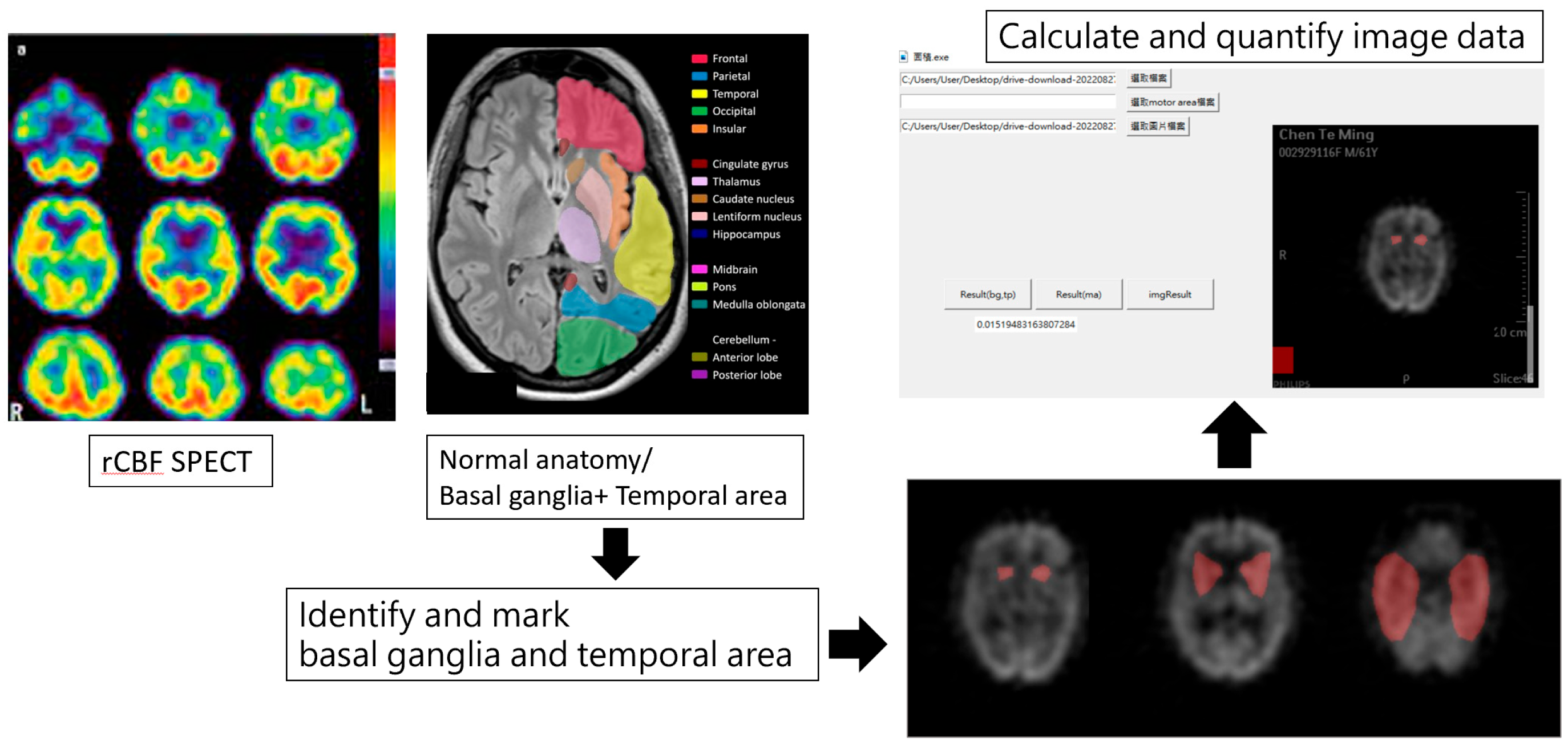
Figure 2.
Box plots showing pre- and postoperative proportions of perfusion area in (a) basal ganglia and (b) temporal regions (overall and subgroup analysis by side of surgery and ipsilateral/contralateral comparison).
Figure 2.
Box plots showing pre- and postoperative proportions of perfusion area in (a) basal ganglia and (b) temporal regions (overall and subgroup analysis by side of surgery and ipsilateral/contralateral comparison).
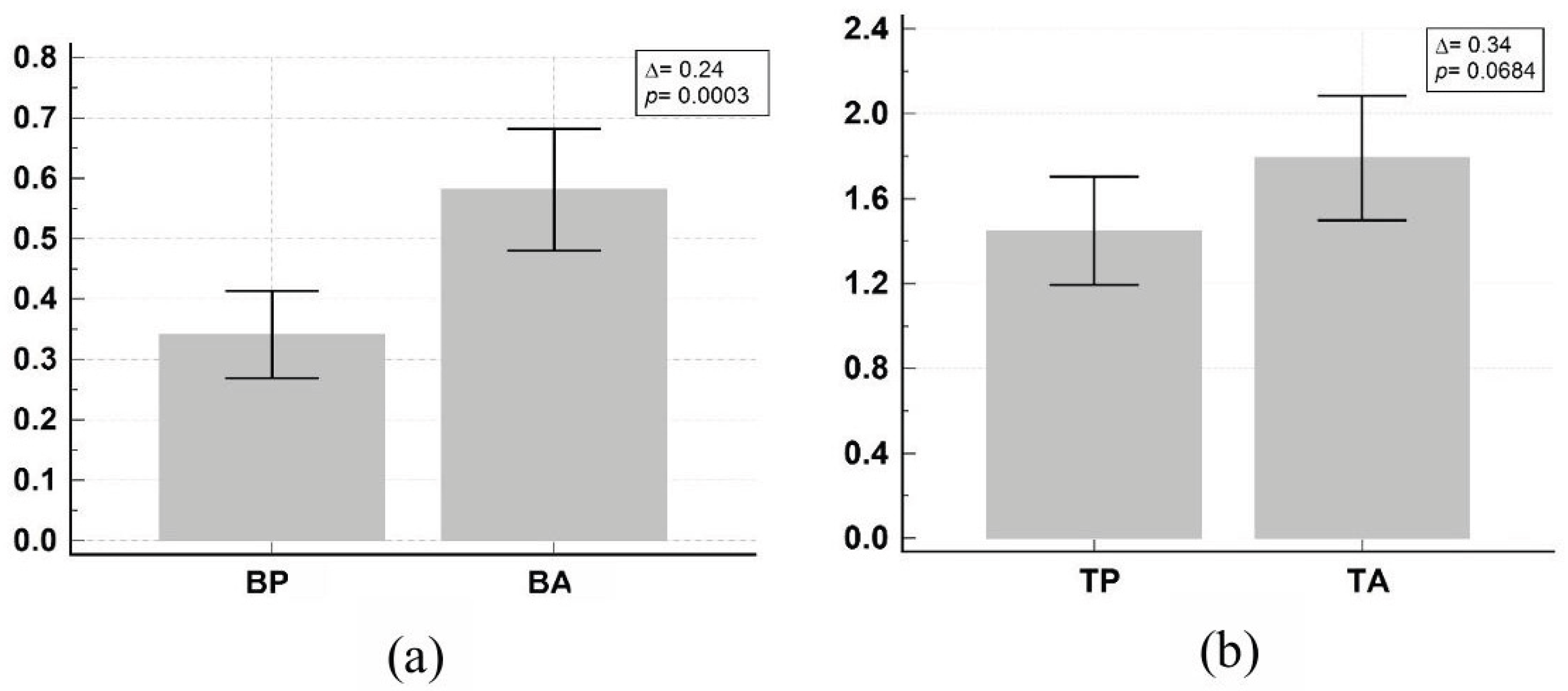
Table 2.
Subgroup analysis of basal ganglia and temporal perfusion area change according to surgical laterality and ipsilateral vs contralateral regions (unilateral cases, n = 14).
Table 2.
Subgroup analysis of basal ganglia and temporal perfusion area change according to surgical laterality and ipsilateral vs contralateral regions (unilateral cases, n = 14).
| Surgery Side | n | Basal Ganglia Δ (Ipsilateral) |
Basal Ganglia Δ (Contralateral) |
p-value (Ipsi vs Contra) |
|---|---|---|---|---|
| Left | 7 | +0.121 | +0.111 | 0.545 |
| Right | 7 | +0.134 | +0.149 | 0.316 |
| Overall (Unilateral) | 14 | +0.128 | +0.130 | 0.839 |
Disclaimer/Publisher’s Note: The statements, opinions and data contained in all publications are solely those of the individual author(s) and contributor(s) and not of MDPI and/or the editor(s). MDPI and/or the editor(s) disclaim responsibility for any injury to people or property resulting from any ideas, methods, instructions or products referred to in the content. |
© 2026 by the authors. Licensee MDPI, Basel, Switzerland. This article is an open access article distributed under the terms and conditions of the Creative Commons Attribution (CC BY) license (http://creativecommons.org/licenses/by/4.0/).
Copyright: This open access article is published under a Creative Commons CC BY 4.0 license, which permit the free download, distribution, and reuse, provided that the author and preprint are cited in any reuse.


