

Submitted:
27 September 2026
Posted:
29 September 2026
You are already at the latest version
Abstract
Background/Objectives: Antineoplastic therapies have improved cancer survival but remain a major source of treatment-related cardiotoxicity. Previous pharmacovigilance studies have largely focused on drug-specific cardiac signals or individual therapeutic pathways, whereas cross-class differences in cardiovascular reporting across MedDRA categories and their impact on disproportionality estimates remain less well characterized. We therefore compared cardiac adverse-event reporting patterns across anthracyclines, anti-HER2 agents, and anti-VEGF agents within a restricted antineoplastic comparator cohort. Methods: A retrospective pharmacovigilance study was conducted using aggregated ICSR data from VigiBase accessed through the public VigiAccess interface (March 23, 2026). Eight antineoplastic agents were grouped into three therapeutic classes. Descriptive analyses of demographic characteristics, System Organ Class (SOC) distributions, and cardiac Preferred Terms (PT) were performed. Reporting Odds Ratios (ROR) with 95% confidence intervals were calculated using a restricted antineoplastic comparator cohort. Signals were defined as a lower 95% CI bound >1 with at least five cardiac reports. Results: Across eight drug-specific VigiAccess queries, 389,068 drug-specific report observations were analyzed. Anti-HER2 agents showed the highest proportional cardiac-reporting burden (10.43%) and the strongest class-level disproportionality signal (ROR 2.04; 95% CI: 1.99–2.10), with trastuzumab showing the strongest individual-drug estimate (ROR 2.22; 95% CI: 2.16–2.29). Anthracyclines accounted for the largest number of cardiac reports (n = 11,273), with a reporting pattern dominated by myocardial-dysfunction Preferred Terms, led by cardiomyopathy and heart failure. Anti-VEGF agents showed greater reporting within the Vascular disorders (10.86%) and Renal and urinary disorders (6.08%) SOCs, with myocardial infarction among the most frequently reported cardiac PTs. Conclusions: Cardiac adverse event reporting for antineoplastic therapy follows class-specific patterns rather than a uniform profile. Anti-HER2 agents showed the highest proportion of reports classified under Cardiac disorders, anthracyclines the greatest absolute volume, and anti-VEGF therapies exhibited a distinct vascular–ischemic reporting profile. These reporting-based signals may support hypotheses regarding class-specific cardiovascular surveillance consistent with established cardio-oncology guidance, while highlighting both the value and the inherent limitations of global spontaneous-reporting pharmacovigilance data. These findings are hypothesis-generating and should be interpreted as reporting patterns rather than incidence estimates, comparative clinical risks, or causal effects. Spontaneous-reporting data remain susceptible to reporting bias, unmeasured confounding, and incomplete clinical information.
Keywords:
pharmacovigilance
; cardiotoxicity
; antineoplastic agents
; disproportionality analysis
; VigiAccess
; cardio-oncology
1. Introduction
Cancer remains one of the leading causes of morbidity and mortality worldwide. According to the GLOBOCAN 2022 estimates published by the International Agency for Research on Cancer (IARC) and the American Cancer Society, approximately 20 million new cancer cases were diagnosed, and 9.7 million cancer-related deaths were recorded globally in 2022 [1]. Projections indicate that by 2050 the annual number of incident cases will exceed 35 million, with a disproportionate burden falling on low- and middle-income countries, which already account for 57.9% of incident cases and 65.8% of cancer deaths worldwide [2]. Female breast cancer, with approximately 2.3 million new cases annually, remains the most frequently diagnosed malignancy among women. In the overall global cancer burden, lung and colorectal cancers are among the most common malignancies across both sexes, while prostate cancer represents one of the leading cancers in men [3].
Advances in antineoplastic therapy have substantially improved overall survival across a broad spectrum of malignancies; however, this progress has been accompanied by a growing recognition of treatment-related adverse drug reactions (ADR), among which cardiotoxicity represents one of the most clinically significant complications. Beyond its impact on quality of life and long-term survival, cardiotoxicity frequently requires dose reductions, treatment interruptions, or permanent discontinuation of otherwise effective therapies, directly compromising oncological outcomes [4].
Treatment-related cardiotoxicity encompasses a wide spectrum of clinical manifestations, including heart failure, left ventricular systolic dysfunction, arrhythmias, cardiomyopathy, arterial hypertension, and thromboembolic events. The growing recognition of these complications has driven the emergence of cardio-oncology as a dedicated subspecialty, focused on the prevention, early detection, and management of cardiovascular toxicity in cancer patients [4].
Among the antineoplastic agents most consistently implicated in cardiotoxicity are anthracyclines, anti-HER2 monoclonal antibodies, and anti-VEGF agents. Anthracyclines — including doxorubicin, epirubicin, daunorubicin, and idarubicin — exert cumulative dose-dependent cardiotoxicity mediated by oxidative stress, mitochondrial dysfunction, and cardiomyocyte apoptosis [5,6]. The reported incidence of anthracycline-induced left ventricular dysfunction ranges from 9% to 26%, depending on cumulative dose, treatment regimen, and the presence of pre-existing cardiovascular risk factors [7]. These three therapeutic classes were selected because they represent widely used antineoplastic treatments with established but mechanistically distinct cardiovascular toxicity profiles. The individual agents were included based on their clinical relevance and sufficient reporting history to support comparative pharmacovigilance analyses.
Anti-HER2 therapies, particularly trastuzumab, have transformed the treatment of HER2-positive breast cancer but are associated with clinically relevant cardiac dysfunction. Previous clinical trial, meta-analytic, and real-world evidence has shown that this risk is influenced by treatment sequence, prior anthracycline exposure, and baseline cardiovascular risk [8,9,10].
Anti-VEGF agents, including bevacizumab and ramucirumab, exert a mechanistically distinct form of cardiovascular toxicity. Available evidence from clinical trials and meta-analyses has consistently reported associations with hypertension, heart failure, and arterial and venous thromboembolic events, with reported incidences and risks varying across exposure settings [11,12,13]. This mechanistic and clinical divergence from anthracycline- and anti-HER2-mediated toxicity underscores the need for class-specific pharmacovigilance approaches.
Although randomized clinical trials provide foundational evidence on the safety profiles of these agents, they are inherently limited by small sample sizes, strict eligibility criteria, short follow-up periods, and the systematic exclusion of patients with pre-existing cardiovascular comorbidities — conditions that are common in real-world oncology practice. These constraints reduce the sensitivity of clinical trials for detecting rare or late-onset adverse cardiac events. Spontaneous reporting systems therefore constitute indispensable tools for post-marketing pharmacovigilance, enabling the detection of safety signals in large, heterogeneous, real-world populations [14].
The WHO Programme for International Drug Monitoring, through VigiBase and its publicly accessible interface VigiAccess, provides a comprehensive source of spontaneous ICSR data for global drug safety monitoring and early signal detection, with reports from over 170 countries. In this context, disproportionality analysis using measures such as the Reporting Odds Ratio (ROR) represents a central methodological approach to identify drug-event combinations reported more frequently than expected relative to a comparator. Previous VigiBase pharmacovigilance studies have identified drug-specific signals of cancer therapy-related cardiac dysfunction, including strong associations for trastuzumab and doxorubicin, and have characterized heart-failure reporting across anti-HER2 regimens [15,16]. However, these studies were primarily designed to identify drug-specific cardiac dysfunction signals rather than to compare how broader cardiovascular adverse-event reporting is distributed across MedDRA System Organ Classes and cardiac Preferred Terms among mechanistically distinct antineoplastic classes.
Whether anthracyclines, anti-HER2 agents, and anti-VEGF agents exhibit distinct reporting patterns when evaluated within a restricted antineoplastic comparator cohort, and how outcome definition influences those comparisons, remains less well characterized.
The present study aimed to characterize and compare cardiac adverse-event reporting patterns across anthracyclines, anti-HER2 agents, and anti-VEGF agents using global spontaneous-reporting data from WHO VigiBase accessed through VigiAccess. Specifically, we compared SOC-level reporting distributions, cardiac Preferred Term composition, and restricted-cohort disproportionality estimates at the therapeutic-class and individual-drug levels. We hypothesized that anthracyclines, anti-HER2 agents, and anti-VEGF agents would differ in the distribution of cardiovascular adverse-event reporting across MedDRA SOCs and cardiac Preferred Terms, and that these differences would materially affect class-specific disproportionality estimates when the outcome was restricted to the “Cardiac disorders” SOC.
2. Results
2.1. Characteristics of Retrieved Reports
Across the eight drug-specific VigiAccess queries, 389,068 drug-specific report observations were retrieved: 177,344 for anthracyclines, 88,373 for anti-HER2 monoclonal antibodies, and 123,351 for anti-VEGF monoclonal antibodies. Because report-level identifiers are not available through VigiAccess, these pooled counts cannot be assumed to represent 389,068 unique ICSRs, as the same underlying report may contribute to more than one drug-specific query when study drugs are co-reported (Table S2, Supplementary Material).
Anti-HER2 agents showed a pronounced female predominance (86.4%), consistent with their primary use in breast cancer, and a concentration of reports in the 45–64-year age group (39.4%). Anthracyclines displayed intermediate female representation (65.8%) and the highest proportion of reports in patients younger than 18 years (6.9%) among the three classes, reflecting their established role in pediatric oncology. Anti-VEGF agents showed the most balanced sex distribution (46.4% female; 40.1% male) and the highest combined proportion of older adults, with 20.3% of reports in the 65–74 years group and 10.4% in patients above 75 years, consistent with the demographic profile of colorectal, renal cell, and non-small-cell lung cancers. Regionally, anthracyclines were predominantly reported from Asia (47.4%), while anti-HER2 and anti-VEGF agents were mostly reported from the Americas (34.7% and 42.8%, respectively) and Europe. (Table S2, Supplementary Material)
2.2. Comparative Cardiac Adverse-Event Reporting Across Therapeutic Classes
Reports classified under the SOC “Cardiac disorders” represented different proportions of the reports available for each therapeutic class (Table 1). Anti-HER2 agents showed the highest proportional cardiac-reporting burden (10.43%; n = 9,218), followed by anthracyclines (6.36%; n = 11,273) and anti-VEGF agents (4.03%; n = 4,965). In absolute terms, anthracyclines accounted for the largest number of cardiac reports, driven primarily by doxorubicin (n = 7,756; Supplementary Table S1).
This difference between proportional and absolute reporting represents a central descriptive finding: anthracyclines contributed the largest absolute number of cardiac reports, whereas anti-HER2 agents showed the highest proportion of reports classified under “Cardiac disorders”.
A second class-specific pattern emerged from the broader SOC distribution. Anti-VEGF agents showed the highest proportional contribution of reports within “Vascular disorders” (10.86%) and “Renal and urinary disorders” (6.08%), both substantially exceeding the values observed in anthracyclines (4.62% and 2.34%, respectively) and anti-HER2 agents (5.07% and 1.75%, respectively). These data indicate that cardiovascular adverse-event reporting associated with anti-VEGF agents was not concentrated within the “Cardiac disorders” SOC but was more prominently represented in vascular and renal SOCs, a distribution consistent with the known vascular effects of VEGF-pathway inhibition.
2.3. Class-Specific Patterns in Reported Cardiac Preferred Terms
Beyond the quantitative burden described above, the composition of reported cardiac Preferred Terms differed substantially across therapeutic groups, revealing three distinct reporting patterns broadly consistent with the mechanistic and clinical differences described across these therapeutic classes in the cardio-oncology literature (Table 2).
Anthracyclines were characterized by a reporting pattern dominated by Preferred Terms denoting myocardial damage and dysfunction. Cardiomyopathy ranked second overall (13.13%), a proportion not replicated in either of the other two classes, and the concurrent prominence of cardiac failure (16.21%), cardiomyopathy, and the specific PT “Cardiotoxicity” (10.17%) among the most frequently reported terms is consistent with the classical dose-dependent, irreversible myocardial injury described for this drug class in the mechanistic and clinical literature, although PT composition alone cannot confirm structural myocardial injury at the individual-patient level. Notably, left ventricular dysfunction also appeared in the top ten (2.99%), further supporting a myocardial-dysfunction reporting pattern.
Anti-HER2 agents showed the highest proportion of cardiac failure among the three classes (19.95%), accompanied by a prominent representation of “Cardiotoxicity” as a standalone PT (14.97%) and dysfunction-specific terms including cardiac dysfunction (6.44%) and left ventricular dysfunction (4.68%). The prominence of cardiac failure and dysfunction-related PTs, together with the lower proportional reporting of cardiomyopathy (6.52%) compared with anthracyclines, is compatible with the predominantly functional pattern historically described for HER2-targeted cardiotoxicity.
Anti-VEGF agents displayed the most divergent profile. Myocardial infarction (13.05%) was the second most frequently reported PT, nearly matching cardiac failure (13.17%), a pattern not observed in the other two classes. Acute myocardial infarction appeared separately (4.55%), and atrial fibrillation (8.26%) and cardiac arrest (4.97%) were proportionally more prominent than in either anthracyclines or anti-HER2 agents. In contrast, cardiomyopathy was infrequent (3.42%), less than one-quarter of the proportion observed in anthracyclines. Taken together, this distribution is compatible with a predominantly ischemic–arrhythmic reporting pattern rather than a cardiomyopathic one, consistent with — though not itself proof of — the vascular mechanism described for VEGF-pathway inhibition in the existing literature.
2.4. Disproportionality Analysis Supporting Class-Specific Signals
At the therapeutic-class level (Figure 1), anti-HER2 agents showed the strongest disproportionality estimate and were the only class meeting the prespecified signal criterion (ROR 2.04; 95% CI: 1.99–2.10), consistent with the higher proportional cardiac-reporting burden observed in the descriptive analysis. Anthracyclines yielded an ROR of 0.95 (95% CI: 0.92–0.97) and did not meet the signal criterion, indicating lower reporting odds for Cardiac disorders relative to the remaining antineoplastic agents within the restricted comparator cohort. Anti-VEGF agents showed a more pronounced inverse estimate (ROR 0.50; 95% CI: 0.49–0.52), compatible with their greater representation within vascular and renal SOCs; however, the cardiac-only ROR cannot characterize their overall cardiovascular reporting profile.
At the individual-drug level (Figure 2), trastuzumab showed the strongest cardiac-reporting disproportionality estimate in the study cohort (ROR 2.22; 95% CI: 2.16–2.29), consistent with the class-level finding. Daunorubicin also met the signal criterion (ROR 1.71; 95% CI: 1.61–1.82), while pertuzumab retained a positive but comparatively smaller signal (ROR 1.14; 95% CI: 1.08–1.20). Doxorubicin (ROR 0.94; 95% CI: 0.91–0.96), epirubicin (ROR 0.78; 95% CI: 0.74–0.82), and idarubicin (ROR 0.91; 95% CI: 0.82–1.00) did not meet the signal criterion and showed estimates below unity within the restricted comparator cohort. Bevacizumab and ramucirumab likewise showed inverse disproportionality estimates (ROR 0.54; 95% CI: 0.53–0.56 and ROR 0.32; 95% CI: 0.28–0.36, respectively), consistent with the class-level pattern described above.
Importantly, the inverse estimates observed for anti-VEGF agents should not be interpreted as evidence of cardioprotection. Rather, they reflect the comparative nature of disproportionality analysis within a restricted cohort of cardiotoxic antineoplastic agents and are consistent with the greater representation of cardiovascular adverse-event reports within non-cardiac SOCs observed in Table 1.
2.5. Exploratory Outcome-Definition Sensitivity Analysis
Because anti-VEGF cardiovascular reporting was more prominently represented within the “Vascular disorders” than the “Cardiac disorders” SOC (Table 1), an exploratory class-level sensitivity analysis evaluated a broader “Cardiac or Vascular” outcome under two extreme assumptions regarding cross-SOC overlap (Table S4, Supplementary Material). For anti-VEGF agents, the resulting ROR ranged from 1.23 under the no-overlap scenario to 1.46 under the complete-overlap scenario, compared with a cardiac-only ROR of 0.50 (Figure 1; Table S3, Supplementary Material). For anti-HER2 agents, the corresponding estimates ranged from 1.27 to 1.30, compared with a cardiac-only ROR of 2.04; for anthracyclines, they ranged from 0.57 to 0.69, compared with a cardiac-only ROR of 0.95. These scenario estimates indicate substantial sensitivity of the anti-VEGF disproportionality result to outcome definition, whereas the anti-HER2 estimate remained above unity and the anthracycline estimate remained below unity under both scenarios.
3. Discussion
3.1. Principal Findings
This global pharmacovigilance study identified three class-specific patterns in reported cardiac adverse events. Anti-HER2 monoclonal antibodies showed the highest proportional cardiac-reporting burden and the strongest disproportionality estimate within the restricted comparator cohort. Anthracyclines accounted for the largest absolute number of cardiac reports and showed greater representation of cardiomyopathy and heart-failure Preferred Terms. Anti-VEGF agents showed greater representation of vascular and renal SOCs and an ischemic–arrhythmic pattern among cardiac Preferred Terms. Together, these findings support the study hypothesis that cardiovascular reporting is distributed differently across therapeutic classes and show that the definition of the pharmacovigilance outcome materially influences the interpretation of class-specific disproportionality, particularly for anti-VEGF agents. These findings describe reporting patterns and should not be interpreted as incidence estimates, comparative clinical risks, underlying mechanisms, or causal effects.
3.2. Anthracyclines: Myocardial-Dysfunction Reporting Pattern
The predominance of cardiomyopathy and heart failure among cardiac reports associated with anthracyclines is consistent with the classical mechanism of anthracycline-induced cardiotoxicity, in which cumulative dose-dependent damage leads to irreversible structural myocardial injury [5,6]. Contemporary molecular evidence has largely converged on the role of topoisomerase IIβ (TOP2B) as the central mediator of this injury, with anthracycline-induced double-stranded DNA breaks in cardiomyocytes driving mitochondrial dysfunction, oxidative stress, and apoptotic cell death [17]. This paradigm has translated clinically into the cardioprotective role of dexrazoxane, whose mechanism is now primarily attributed to TOP2B inhibition rather than to iron chelation, and whose use has been associated with substantial reductions in heart failure risk in patients exposed to high cumulative anthracycline doses [18,19].
Recent mechanistic reviews further describe a multifactorial pathogenesis involving inflammatory responses, cardiac progenitor cell depletion, renin-angiotensin-aldosterone dysregulation, and epigenetic changes, all of which converge on progressive structural remodeling [20]. Interindividual susceptibility to anthracycline-related cardiotoxicity may also be influenced by pharmacogenetic variation in pathways involved in anthracycline transport and metabolism, including ATP-binding cassette transporters and carbonyl reductases. However, reported associations remain heterogeneous, and these patient-level factors cannot be evaluated using aggregate VigiAccess data [21]. Within our data, daunorubicin retained a positive disproportionality signal (ROR 1.71; 95% CI: 1.61–1.82; Figure 2; Table S3, Supplementary Material) despite its lower absolute reporting frequency. This observation should be interpreted in the context of its frequent use in intensive hematologic regimens, in which cumulative exposure and dosing schedules are recognized determinants of cardiotoxicity [22]. The class-level anthracycline estimate remained below unity (ROR 0.95; 95% CI: 0.92–0.97; Figure 1; Table S3, Supplementary Material), despite the established cardiotoxicity of this therapeutic class; this comparator-dependent finding is addressed in Section 3.5.
3.3. Anti-HER2: Cardiac-Dysfunction Reporting Pattern
Pivotal clinical trials reported rates of cardiac dysfunction of up to 7% with trastuzumab monotherapy and as high as 28% when administered concurrently with anthracyclines [9]. A meta-analysis of 58 studies encompassing 29,598 patients estimated an overall incidence of severe cardiotoxicity of 3.0% (95% CI: 2.41–3.64) following trastuzumab exposure [10]. Importantly, contemporary cohort data suggest that in the absence of prior anthracycline exposure, the risk of symptomatic heart failure attributable to trastuzumab is considerably lower, ranging from 0.9% to 1.6% [8]. These findings identify combined or sequential anthracycline and HER2-targeted exposure as an important clinical determinant of cardiotoxicity and therefore provide essential context for the anti-HER2 reporting signal observed here; because treatment history is unavailable in VigiAccess, the trastuzumab estimate cannot be interpreted as independent of prior or concurrent anthracycline exposure.
The strong disproportionality signal concentrated in anti-HER2 agents, and specifically in trastuzumab, aligns with the expanding body of mechanistic evidence describing HER2-targeted cardiotoxicity as primarily functional rather than structural. Blockade of ErbB2 signaling disrupts the neuregulin-1/ErbB2/ErbB4 axis in cardiomyocytes, impairing antioxidant defenses, compromising mitochondrial integrity, and attenuating the stress-response pathways required to maintain myocardial homeostasis under hemodynamic or cytotoxic stress [23,24]. This injury is typically functional and, in most patients, reversible upon treatment interruption, a feature that originally led to the classification of trastuzumab-induced cardiotoxicity as “Type II” cardiac dysfunction, in contrast to the irreversible “Type I” pattern of anthracyclines [9].
However, more recent evidence has challenged the strict Type I/Type II dichotomy, as long-term follow-up studies and iPSC-derived cardiomyocyte models have demonstrated ultrastructural alterations and persistent metabolic dysregulation following trastuzumab exposure, particularly when combined with or preceded by anthracyclines. Accordingly, although trastuzumab-related cardiac dysfunction is frequently reversible, complete recovery is not universal, and persistent functional impairment may occur in a subset of patients, particularly following sequential anthracycline exposure [25,26]. This mechanistic interaction may help explain the substantially higher rates of cardiac dysfunction observed in patients receiving sequential or combined regimens, compared with trastuzumab monotherapy [8]. The smaller positive disproportionality estimate observed for pertuzumab (ROR 1.14; 95% CI: 1.08–1.20; Figure 2; Table S3, Supplementary Material) should be interpreted cautiously because the drug is predominantly administered with trastuzumab as part of dual-HER2 blockade. Because VigiAccess does not distinguish suspected from concomitant drug roles, the pertuzumab estimate may partly reflect co-reporting and should not be interpreted as an isolated pertuzumab effect [27].
Importantly, recent data support that trastuzumab-related cardiotoxicity is often reversible with early detection and the implementation of cardioprotective strategies such as statins, ACE inhibitors, and beta-blockers, which have shown the strongest cardioprotective effect in umbrella reviews of systematic reviews and meta-analyses [28].
Our finding of a strong, consistent cardiac signal for trastuzumab is concordant with previous VigiBase analyses showing that anti-HER2 monoclonal antibodies concentrate the highest cardiac event reporting odds among HER2-targeted therapies [15]. Our findings are therefore consistent with the established clinical rationale for proactive cardiovascular monitoring during HER2-targeted therapy.
3.4. Anti-VEGF: Vascular-Ischemic Reporting Pattern
Anti-VEGF agents displayed a cardiovascular adverse-event reporting profile that was quantitatively and qualitatively distinct from those of the other therapeutic classes analyzed. This finding is consistent with previous clinical and meta-analytic evidence showing that VEGF pathway inhibition is primarily associated with vascular toxicity, including hypertension, arterial thromboembolism, venous thromboembolism, and renal complications.
Interpretation of this ischemic reporting pattern also requires consideration of indication bias. Thrombotic risk varies according to cancer type and disease stage, with higher burdens reported in advanced disease and in several tumor groups, including gastrointestinal and lung cancers [29]. Because VigiAccess does not provide cancer stage, detailed indication, or baseline thrombotic risk, the observed myocardial infarction reporting pattern cannot be attributed solely to anti-VEGF exposure.
A large meta-analysis of 20,050 cancer patients across 22 randomized trials reported significantly higher risks of arterial (RR 1.37; 95% CI: 1.10–1.70) and venous thromboembolic events (RR 1.29; 95% CI: 1.12–1.47) with bevacizumab exposure, while congestive heart failure has been estimated to occur in approximately 2–4% of treated patients, with substantially higher rates in those with prior anthracycline exposure [12,13].
The distinctive reporting distribution of anti-VEGF agents, characterized by greater representation within vascular and renal rather than cardiac SOCs (Table 1) and an ischemic–arrhythmic pattern among cardiac reports (Table 2), is consistent with the vascular endothelial effects of VEGF-pathway inhibition. VEGFR blockade reduces endothelial nitric oxide synthase (eNOS) expression and nitric oxide (NO) bioavailability, increases endothelin-1 production, and promotes microvascular rarefaction, collectively producing endothelial dysfunction, impaired vasodilation, and elevated peripheral vascular resistance [30,31]. These mechanisms underlie the characteristic clinical manifestations of bevacizumab and ramucirumab, including treatment-related hypertension (reported in approximately 30–80% of exposed patients), arterial thromboembolism, and proteinuria [32,33].
The ischemic-arrhythmic profile observed in our data, in which myocardial infarction and acute myocardial infarction collectively represent one of the dominant clinical patterns within the cardiac SOC, is consistent with the known association between VEGF-pathway inhibitors and a 1.5-to-2.5-fold increase in arterial thromboembolic events [34]. Generalized endothelial dysfunction secondary to VEGF signaling disruption predisposes to vasoconstriction, platelet activation, accelerated atherosclerosis, and thrombosis, which converge on ischemic cardiac events rather than cardiomyopathic damage. This mechanistic framework supports the interpretation that, although VEGF inhibitors contribute less to “Cardiac disorders” in spontaneous reporting, their cardiovascular adverse-event reporting extends beyond the “Cardiac disorders” SOC and differs substantially from the reporting patterns observed for anthracyclines and anti-HER2 agents.
3.5. Interpretation of Disproportionality Findings
Because the comparator population was composed exclusively of other antineoplastic agents with recognized cardiovascular toxicity, the expected reporting proportion of cardiac events was already elevated within the reference group. Within this restricted comparator, anti-HER2 agents retained a positive class-level signal, whereas anthracyclines and anti-VEGF agents showed RORs below unity (Figure 1; Table S3, Supplementary Material). These relative estimates should not be interpreted as measures of absolute cardiovascular risk or, for estimates below unity, as evidence of cardioprotection. Rather, their interpretation depends on both the comparator composition and the definition of the pharmacovigilance outcome [35].
This dependence was particularly evident for anti-VEGF agents. Their greater representation within the “Vascular disorders” SOC relative to “Cardiac disorders” (Table 1), together with the exploratory extreme-overlap analysis in Section 2.5, shifted the class-level estimate from a cardiac-only ROR of 0.50 to values above unity when vascular reporting was incorporated. In contrast, anti-HER2 estimates remained above unity and anthracycline estimates remained below unity under both extreme scenarios. These findings reinforce that disproportionality estimates are outcome-definition dependent and should be interpreted alongside the underlying SOC and Preferred Term distributions rather than in isolation (Table 1 and Table 2).
These considerations align with the recent READUS-PV guideline, which emphasizes the need for transparent reporting, explicit acknowledgment of comparator-dependent interpretation, and avoidance of causal inferences drawn from disproportionality metrics alone [36,37]. Disproportionality analyses quantify reporting patterns, not incidence, and their validity depends on the integration of descriptive, clinical, and mechanistic evidence rather than on the numerical signal in isolation. In this study, the convergence of the descriptive SOC and PT patterns with the ROR estimates provides internal consistency but does not overcome the limitations and biases inherent to spontaneous-reporting data.
3.6. Clinical Implications for Cardiovascular Monitoring
The reporting patterns identified in this study are broadly consistent with the framework established by the 2022 European Society of Cardiology Guidelines on Cardio-Oncology, which emphasize that cardiovascular risk stratification and surveillance should be tailored to therapeutic class and mechanism of action [4]. Within this established framework, anthracycline-based regimens require attention to cumulative dose, baseline cardiovascular risk assessment, and, where appropriate, cardioprotective strategies such as dexrazoxane in high-risk patients [19]. Anti-HER2 surveillance includes periodic assessment of left ventricular function, particularly in patients with prior or concurrent anthracycline exposure [8]. For anti-VEGF therapy, established monitoring strategies include systematic blood-pressure assessment, thromboembolic risk evaluation, and surveillance for ischemic events, complementing rather than replacing left ventricular monitoring [32,34].
3.7. Study Limitations
Several limitations inherent to spontaneous reporting data and to the VigiAccess interface must be acknowledged. The platform aggregates reports in which the drug of interest is recorded as suspected, concomitant, or interacting, without the possibility of role-based stratification. Consequently, agents that are commonly administered together may be co-reported, and drug-specific estimates may not represent isolated drug effects; this limitation is particularly relevant to pertuzumab and trastuzumab. Individual-level deduplication and multivariable adjustment for covariates are not possible through the VigiAccess interface, although aggregated demographic variables (age, sex, and region) are available; information on comorbidities and concomitant medications is not accessible. Host pharmacogenetic susceptibility is likewise unavailable and could not be evaluated. In particular, the interface does not permit adjustment for oncologic indication or cancer type, prior or concurrent anthracycline exposure, concomitant cardiotoxic or cardioprotective co-medication, cumulative dose, treatment duration or regimen intensity, or country of notification. Accordingly, co-reported cardiotoxic medications may contribute to individual drug-specific reporting signals, but their contribution cannot be separated from that of the index antineoplastic agent using the aggregate data available in VigiAccess. Each of these unmeasured factors is a plausible source of confounding for the signals reported here. For anti-VEGF agents, unmeasured cancer type, disease stage, and baseline thrombotic risk may also contribute to the ischemic Preferred Term distribution. For example, the elevated trastuzumab signal may partly reflect sequential or combined anthracycline exposure rather than an effect of HER2 blockade in isolation (Section 3.3). Likewise, the marked cross-regional differences in reporting volume observed in Table S2 (Supplementary Material) may reflect heterogeneous pharmacovigilance infrastructure and reporting culture, rather than true differences in drug utilization or risk. Because none of these variables can be stratified or adjusted for within VigiAccess, the disproportionality estimates reported here should be regarded as unadjusted, hypothesis-generating signals rather than confounder-adjusted risk estimates. Disproportionality measures quantify reporting patterns and do not establish causality or incidence; they are susceptible to well-known biases, including underreporting, differential reporting across countries and time periods, and notoriety bias, particularly for high-profile cardiotoxic agents such as trastuzumab and doxorubicin [35,37]. Because the denominator of exposed patients is unavailable, absolute event rates cannot be calculated, and comparisons should be interpreted strictly as reporting proportions within the studied cohort rather than as clinical incidence estimates. In addition, the exclusion of antibody-drug conjugates and of additional anti-VEGF agents limits generalizability to the specific drugs included and does not capture the evolving cardiotoxic profiles of newer HER2- or VEGF-directed therapies. Time-to-onset could not be assessed because VigiAccess does not provide the individual treatment-start and adverse-event onset dates required to calculate this interval. Consequently, temporal differences in cardiovascular reporting across therapeutic classes were not evaluated, and the observed class-specific reporting patterns should not be interpreted as evidence of differences in latency or timing of toxicity.
A further limitation concerns the choice of the MedDRA System Organ Class “Cardiac disorders” as the sole primary outcome for disproportionality analysis. Because anti-VEGF-related cardiovascular toxicity is mechanistically vascular rather than primarily myocardial, a substantial proportion of its cardiovascular burden is plausibly coded under other SOCs — most notably “Vascular disorders”, which accounted for a proportion of anti-VEGF reports (10.86%; n = 13,396) more than 2.5-fold higher than “Cardiac disorders” itself (4.03%; n = 4,965; Table 1) — as well as under thromboembolic Preferred Terms that may be coded outside either SOC. Restricting the primary outcome to “Cardiac disorders” therefore may underrepresent the overall cardiovascular reporting burden of anti-VEGF agents specifically, whereas anthracyclines and anti-HER2 agents were comparatively less affected by this choice, as their vascular-SOC proportions (4.62% and 5.07%, respectively) were much closer to their cardiac-SOC proportions. Because VigiAccess provides only aggregate SOC-level counts and does not identify cross-SOC overlap at the individual-report level, an exact deduplicated composite of “Cardiac disorders” and “Vascular disorders” could not be calculated. The exploratory extreme-overlap scenarios presented in Section 2.5 therefore represent sensitivity analyses of outcome definition rather than exact composite cardiovascular estimates. Although both scenarios shifted the anti-VEGF ROR above unity, the true degree of overlap between the two SOCs is unknown, and the magnitude of a deduplicated combined estimate cannot be inferred from these aggregate data. Individual-level VigiBase data with verified cross-SOC overlap would be required for such an analysis.
Overall, the convergence of the descriptive SOC distribution, Preferred Term composition, and disproportionality estimates indicates heterogeneous reporting patterns across the therapeutic classes evaluated. These observations remain hypothesis-generating and do not establish underlying mechanisms or independently justify changes to clinical surveillance. Their interpretation should remain integrated with evidence from clinical studies and established cardio-oncology guidelines.
4. Materials and Methods
4.1. Study Design and Data Source
A retrospective pharmacovigilance study was conducted using aggregated ICSR data from VigiBase, the World Health Organization (WHO) global database of adverse drug reactions maintained by the Uppsala Monitoring Centre. Data were accessed through the public VigiAccess interface on March 23, 2026, including all reports available from database inception to the extraction date.
VigiAccess provides aggregated data for reports in which the drug of interest was recorded as suspected, concomitant, or interacting, and does not permit verification of duplicate reports at the individual level or stratification by drug role. These limitations were considered when interpreting disproportionality estimates and descriptive frequencies. Because VigiAccess provides aggregate marginal counts without individual-level drug–event co-occurrence, prior treatment history or treatment sequence, individual treatment dates or time-to-onset information, covariate information, or treatment-effectiveness outcomes, analyses requiring these data structures were not feasible.
4.2. Study Drugs
Eight antineoplastic agents with documented cardiotoxicity were selected and classified into three therapeutic groups:
- Anthracyclines: Doxorubicin, Daunorubicin, Epirubicin, Idarubicin
- Anti-HER2 monoclonal antibodies: Trastuzumab, Pertuzumab
- Anti-VEGF monoclonal antibodies: Bevacizumab, Ramucirumab
Drugs were selected based on their established cardiovascular toxicity profile, widespread clinical use, and sufficient reporting history in VigiBase. Antibody-drug conjugates and additional anti-VEGF agents were excluded to preserve comparability across therapeutic groups.
4.3. Variables and Coding
Adverse drug reactions were coded according to the Medical Dictionary for Regulatory Activities (MedDRA), organized by SOC and PT. The primary outcome for disproportionality analysis was the SOC “Cardiac disorders”. Demographic (sex, age group, geographic region) and clinical (SOC and cardiac PT distribution) variables were extracted as displayed in VigiAccess. Preferred Terms were retrieved in official MedDRA English terminology to ensure consistency across reporting languages and to avoid linguistic fragmentation of equivalent clinical entities. Because VigiAccess data cannot establish incidence, individual-level causality, or underlying pathophysiology, the class-specific differences in Preferred Term composition described below are interpreted as signal-generating reporting patterns that are consistent with, but do not confirm, the mechanistic and clinical patterns previously characterized in the cardio-oncology literature.
4.4. Descriptive Analysis
Absolute frequencies and proportions were calculated for each therapeutic group. Because VigiAccess provides aggregated data at different hierarchical levels, different denominators were applied according to the type of analysis: the total number of drug-specific report observations per therapeutic group was used for demographic analyses and for the distribution of reports across SOCs; the number of report observations classified under the SOC “Cardiac disorders” was used for the Preferred Term frequency analysis. The specific denominator used is indicated in each table legend. Because a single ICSR may be classified under multiple SOCs or include multiple PTs within the same SOC, percentages at the SOC and PT levels may exceed 100%.
For the descriptive analysis of cardiac Preferred Terms, the ten most frequently reported PTs within the SOC “Cardiac disorders” with at least 50 observed cases were presented per therapeutic group. PTs are reported as coded in VigiBase using official MedDRA English terminology, without regrouping or consolidation of terms. Detailed SOC-level distributions by individual drug are provided in the Supplementary Material.
4.5. Disproportionality Analysis
A restricted cohort design with active comparators was applied to improve clinical and pharmacological comparability relative to comparisons against the entire VigiBase background and to reduce heterogeneity arising from unrelated therapeutic areas. Rather than comparing each drug or therapeutic group against the entire VigiBase database — which aggregates reports for medicines used across unrelated indications, patient populations, and clinical and reporting contexts — the comparator population was restricted to the antineoplastic agents included in the study, in line with the READUS-PV recommendation that the interpretability of a disproportionality signal depends on the clinical and pharmacological comparability of the reference group [36,37]. Under this design, each drug or therapeutic group was compared against the pooled reports of the remaining study drugs rather than against the entire VigiBase database. The resulting estimates therefore reflect differences in cardiac-event reporting within a restricted oncologic pharmacovigilance context rather than comparisons against medicines used across unrelated therapeutic areas. This active-comparator approach was intended to improve clinical comparability and enhance the interpretability of the disproportionality estimates. This choice has a direct interpretive consequence: because the comparator group is itself composed of other cardiotoxic antineoplastic agents, RORs calculated within this restricted cohort are not equivalent to estimates against a general pharmacovigilance background and may attenuate the relative signal of agents such as anthracyclines, as detailed in Section 3.5. Analyses were performed at two levels: (i) individual active substance, and (ii) therapeutic group.
The restricted comparator was selected to improve clinical comparability across the antineoplastic agents under study. It does not control for co-reported or concomitant non-antineoplastic medications, because adjustment for such exposures would require ICSR-level drug co-occurrence, drug-role, and covariate information that is not available through the public VigiAccess interface.
Signal detection was performed using the Reporting Odds Ratio (ROR), calculated from 2 × 2 contingency tables based on drug-specific report counts. For each index drug, a represented the number of reports classified under the MedDRA SOC “Cardiac disorders”, and b represented the remaining reports for that drug (total drug-specific reports minus cardiac reports). For the restricted comparator, c represented the pooled number of cardiac reports for the remaining study drugs, and d represented the corresponding pooled number of non-cardiac reports. The same approach was applied at the therapeutic-class level by pooling the drug-specific report counts within each class.
Because VigiAccess does not provide report-level identifiers across drug-specific searches, pooled comparator and therapeutic-class counts cannot be deduplicated when multiple study drugs are co-reported within the same underlying ICSR. Accordingly, these pooled analyses should be interpreted as analyses of drug-specific report observations rather than counts of unique patients or necessarily unique ICSRs.
The 95% confidence intervals for the ROR were calculated using the log-normal approximation. A potential safety signal was considered present when the lower bound of the 95% confidence interval exceeded 1 and at least five cardiac reports were available.
As an exploratory outcome-definition sensitivity analysis at the therapeutic-class level, the counts reported under the MedDRA SOCs “Cardiac disorders” and “Vascular disorders” were combined under two extreme assumptions regarding cross-SOC overlap, because individual-report overlap cannot be determined through VigiAccess. Under the complete-overlap scenario, all report observations in the smaller SOC were assumed to be contained within the larger SOC; under the no-overlap scenario, the two SOC counts were assumed to be mutually exclusive. Combined-outcome RORs were then recalculated using the same report-based 2 × 2 structure as the primary analysis. These scenarios were intended to assess sensitivity to outcome definition and should not be interpreted as exact deduplicated cardiovascular estimates (Table S4, Supplementary Material).
Disproportionality estimates (ROR with 95% CI) are presented as forest plots stratified by individual active substance and by therapeutic group, to allow visual comparison of signal magnitude and precision across agents and classes. A vertical reference line at ROR = 1 indicates the null value; estimates above and below 1 represent higher and lower reporting odds, respectively, within the restricted comparator cohort.
5. Conclusions
Cardiac adverse-event reporting differed across the antineoplastic classes evaluated. Anti-HER2 agents showed the highest proportional cardiac-reporting burden and the strongest restricted-cohort disproportionality signal, anthracyclines accounted for the largest absolute number of cardiac reports, and anti-VEGF agents showed greater representation of vascular and ischemic reporting patterns. The divergence between the cardiac-only disproportionality estimates and the broader SOC distribution, particularly for anti-VEGF agents, underscores the importance of outcome definition when interpreting spontaneous-reporting comparisons across mechanistically distinct therapies. These findings are hypothesis-generating and should not be interpreted as incidence, comparative clinical risk, or causality. These reporting patterns are broadly consistent with established class-specific surveillance approaches, including left ventricular monitoring during anti-HER2 therapy, particularly after anthracycline exposure, and blood-pressure and thromboembolic surveillance during anti-VEGF therapy [4]. Confirmation requires individual-level studies with exposure denominators and adjustment for indication, treatment sequence, and baseline cardiovascular risk.
Supplementary Materials
The following supporting information can be downloaded at: https://www.mdpi.com/article/doi/s1, Table S1: Distribution of adverse drug reaction reports across MedDRA System Organ Classes by individual drug; Table S2: Demographic characteristics of drug-specific report observations by therapeutic group; Table S3: Two-by-two contingency-table inputs and reporting odds ratios for Cardiac disorders by therapeutic class and individual antineoplastic agent; Table S4: Exploratory outcome-definition sensitivity analysis combining Cardiac disorders and Vascular disorders under extreme cross-SOC overlap scenarios.
Author Contributions
Conceptualization, E.Z.-M. and S.A.-C.; methodology, E.Z.-M., S.A.-C., and J.M.-J.; formal analysis, K.T.-M., B.E.-G., and J.A.C.-G.; data curation, K.T.-M., B.E.-G., and J.M.-J.; writing—original draft preparation, K.T.-M., B.E.-G., and J.A.C.-G; writing—review and editing, E.Z.-M., S.A.-C., J.M.-J., J.A.V.-M., and J.A.C.-G.; supervision, E.Z.-M. and J.A.V.-M. All authors have read and agreed to the published version of the manuscript.
Funding
This research received no external funding.
Institutional Review Board Statement
Not applicable.
Informed Consent Statement
Not applicable.
Data Availability Statement
All aggregated data used in the analyses reported in this study are provided in the article and Supplementary Materials. No individual-level VigiBase data were accessed or analyzed.
Conflicts of Interest
The authors declare no conflicts of interest.
Abbreviations
The following abbreviations are used in this manuscript:
| ACE | Angiotensin-Converting Enzyme |
| ADR | Adverse Drug Reaction |
| CI | Confidence Interval |
| eNOs | Endothelial Nitric Oxide Synthase |
| erbB2 | Erythroblastic Oncogene B2 (Human Epidermal Growth Factor Receptor 2) |
| ESC | European Society of Cardiology |
| GLOBOCAN | Global Cancer Observatory |
| HER2 | Human Epidermal Growth Factor Receptor 2 |
| ICSR | Individual Case Safety Report |
| iPSC | Induced Pluripotent Stem Cell |
| MedDRA | Medical Dictionary for Regulatory Activities |
| PT | Preferred Term |
| READUS-PV | Reporting of A Disproportionality Analysis for DrUg Safety Signal Detection in PharmacoVigilance |
| ROR | Reporting Odds Ratio |
| RR | Relative Risk |
| SOC | System Organ Class |
| TOP2B | Topoisomerase II Beta |
| VEGF | Vascular Endothelial Growth Factor |
| VEGFR | Vascular Endothelial Growth Factor Receptor |
| WHO | World Health Organization |
References
- Bray, F.; Laversanne, M.; Sung, H.; Ferlay, J.; Siegel, R.L.; Soerjomataram, I.; Jemal, A. Global Cancer Statistics 2022: GLOBOCAN Estimates of Incidence and Mortality Worldwide for 36 Cancers in 185 Countries. CA A Cancer J. Clin. 2024, 74, 229–263. [Google Scholar] [CrossRef]
- GBD 2023 Cancer Collaborators. The Global, Regional, and National Burden of Cancer, 1990–2023, with Forecasts to 2050: A Systematic Analysis for the Global Burden of Disease Study 2023. Lancet 2025, 406, 1565–1586. [Google Scholar] [CrossRef]
- Global Cancer Burden Growing, amidst Mounting Need for Services. Saudi Med. J. 2024, 45, 326–327. [CrossRef]
- Lyon, A.R.; López-Fernández, T.; Couch, L.S.; et al. 2022 ESC Guidelines on cardio-oncology developed in collaboration with the European Hematology Association (EHA), the European Society for Therapeutic Radiology and Oncology (ESTRO) and the International Cardio-Oncology Society (IC-OS). Eur. Heart J. 2022, 43, 4229–4361. [Google Scholar] [CrossRef]
- Saleh, Y.; Abdelkarim, O.; Herzallah, K.; Abela, G.S. Anthracycline-Induced Cardiotoxicity: Mechanisms of Action, Incidence, Risk Factors, Prevention, and Treatment. Heart Fail Rev. 2021, 26, 1159–1173. [Google Scholar] [CrossRef]
- Xie, S.; Sun, Y.; Zhao, X.; Xiao, Y.; Zhou, F.; Lin, L.; Wang, W.; Lin, B.; Wang, Z.; Fang, Z.; et al. An Update of the Molecular Mechanisms Underlying Anthracycline Induced Cardiotoxicity. Front. Pharmacol. 2024, 15. [Google Scholar] [CrossRef]
- Guo, S.; Wong, S. Cardiovascular Toxicities from Systemic Breast Cancer Therapy. Front Oncol. 2014, 4, 346. [Google Scholar] [CrossRef]
- Zheng, H.; Mahmood, S.S.; Khalique, O.K.; Zhan, H. Trastuzumab-Induced Cardiotoxicity: When and How Much Should We Worry? JCO Oncol. Pract. 2024, 20, 1055–1063. [Google Scholar] [CrossRef]
- Riccio, G.; Coppola, C.; Piscopo, G.; Capasso, I.; Maurea, C.; Esposito, E.; De Lorenzo, C.; Maurea, N. Trastuzumab and Target-Therapy Side Effects: Is Still Valid to Differentiate Anthracycline Type I from Type II Cardiomyopathies? Hum. Vaccin Immunother. 2016, 12, 1124–1131. [Google Scholar] [CrossRef]
- Mantarro, S.; Rossi, M.; Bonifazi, M.; D’Amico, R.; Blandizzi, C.; La Vecchia, C.; Negri, E.; Moja, L. Risk of Severe Cardiotoxicity Following Treatment with Trastuzumab: A Meta-Analysis of Randomized and Cohort Studies of 29,000 Women with Breast Cancer. Intern Emerg. Med. 2016, 11, 123–140. [Google Scholar] [CrossRef]
- Mihalcea, D.; Memis, H.; Mihaila, S.; Vinereanu, D. Cardiovascular Toxicity Induced by Vascular Endothelial Growth Factor Inhibitors. Life 2023, 13, 366. [Google Scholar] [CrossRef]
- Totzeck, M.; Mincu, R.I.; Rassaf, T. Cardiovascular Adverse Events in Patients With Cancer Treated With Bevacizumab: A Meta-Analysis of More Than 20 000 Patients. J. Am. Heart Assoc. 2017, 6, e006278. [Google Scholar] [CrossRef]
- Economopoulou, P.; Kotsakis, A.; Kapiris, I.; Kentepozidis, N. Cancer Therapy and Cardiovascular Risk: Focus on Bevacizumab. Cancer Manag Res. 2015, 7, 133–143. [Google Scholar] [CrossRef]
- Li, Y.; Wu, Y.; Jiang, T.; Xing, H.; Xu, J.; Li, C.; Ni, R.; Zhang, N.; Xiang, G.; Li, L.; Li, Z.; Gan, L.; Liu, Y. Opportunities and challenges of pharmacovigilance in special populations: a narrative review of the literature. Ther. Adv. Drug Saf. 2023, 14, 20420986231200746. [Google Scholar] [CrossRef]
- Waliany, S.; Caswell-Jin, J.; Riaz, F.; Myall, N.; Zhu, H.; Witteles, R.M.; Neal, J.W. Pharmacovigilance Analysis of Heart Failure Associated With Anti-HER2 Monotherapies and Combination Regimens for Cancer. JACC CardioOncol 2023, 5, 85–98. [Google Scholar] [CrossRef]
- Legallois, D.; Da Silva, A.; Alexandre, J.; Milliez, P.; Sabatier, R.; Blanchart, K.; Plane, A.-F.; Font, J.; Chrétien, B.; Dolladille, C. Identification of Anticancer Drugs Associated to Cancer Therapy-Related Cardiac Dysfunction: A VigiBase® Disproportionality Analysis. Eur. Heart J.-Cardiovasc. Pharmacother. 2025, 11, 459–468. [Google Scholar] [CrossRef]
- Zhang, S.; Liu, X.; Bawa-Khalfe, T.; Lu, L.-S.; Lyu, Y.L.; Liu, L.F.; Yeh, E.T.H. Identification of the Molecular Basis of Doxorubicin-Induced Cardiotoxicity. Nat. Med. 2012, 18, 1639–1642. [Google Scholar] [CrossRef]
- Jirkovský, E.; Jirkovská, A.; Bavlovič-Piskáčková, H.; Skalická, V.; Pokorná, Z.; Karabanovich, G.; Kollárová-Brázdová, P.; Kubeš, J.; Lenčová-Popelová, O.; Mazurová, Y.; et al. Clinically Translatable Prevention of Anthracycline Cardiotoxicity by Dexrazoxane Is Mediated by Topoisomerase II Beta and Not Metal Chelation. Circ. Heart Fail 2021, 14, e008209. [Google Scholar] [CrossRef]
- Upshaw, J.N.; Parson, S.K.; Buchsbaum, R.J.; Schlam, I.; Ruddy, K.J.; Durani, U.; Epperla, N.; Leong, D.P. Dexrazoxane to Prevent Cardiotoxicity in Adults Treated with Anthracyclines: JACC: CardioOncology Controversies in Cardio-Oncology. JACC CardioOncol 2024, 6, 322–324. [Google Scholar] [CrossRef]
- Kuang, Z.; Ge, Y.; Cao, L.; Wang, X.; Liu, K.; Wang, J.; Zhu, X.; Wu, M.; Li, J. Precision Treatment of Anthracycline-Induced Cardiotoxicity: An Updated Review. Curr. Treat. Options Oncol. 2024, 25, 1038–1054. [Google Scholar] [CrossRef]
- Leong, S.L.; Chaiyakunapruk, N.; Lee, S.W.H. Candidate Gene Association Studies of Anthracycline-Induced Cardiotoxicity: A Systematic Review and Meta-Analysis. Sci. Rep. 2017, 7, 39. [Google Scholar] [CrossRef]
- Fujiwara, S.-I.; Murahashi, R.; Nakashima, H.; Matsuoka, S.; Ikeda, T.; Toda, Y.; Ito, S.; Kawaguchi, S.-I.; Nagayama, T.; Umino, K.; et al. Effect of Cumulative Daunorubicin Dose on Cardiotoxicity after Allogeneic Stem Cell Transplantation. Leuk. Res. 2022, 121, 106951. [Google Scholar] [CrossRef]
- Vermeulen, Z.; Segers, V.F.M.; De Keulenaer, G.W. ErbB2 Signaling at the Crossing between Heart Failure and Cancer. Basic Res. Cardiol. 2016, 111, 60. [Google Scholar] [CrossRef]
- Zhang, H.; Lu, C.; Cheng, S.; Wu, J.; Hu, A.; Mu, Z.; Dong, D.; Sun, M. Signaling Pathways and Potential Therapeutic Agents in Trastuzumab-Induced Cardiotoxicity. Apoptosis 2026, 31, 17. [Google Scholar] [CrossRef]
- Yu, A.F.; Flynn, J.R.; Moskowitz, C.S.; Scott, J.M.; Oeffinger, K.C.; Dang, C.T.; Liu, J.E.; Jones, L.W.; Steingart, R.M. Long-Term Cardiopulmonary Consequences of Treatment-Induced Cardiotoxicity in Survivors of ERBB2-Positive Breast Cancer. JAMA Cardiol. 2020, 5, 309–317. [Google Scholar] [CrossRef]
- Kitani, T.; Ong, S.-G.; Lam, C.K.; Rhee, J.-W.; Zhang, J.Z.; Oikonomopoulos, A.; Ma, N.; Tian, L.; Lee, J.; Telli, M.L.; et al. Human-Induced Pluripotent Stem Cell Model of Trastuzumab-Induced Cardiac Dysfunction in Patients With Breast Cancer. Circulation 2019, 139, 2451–2465. [Google Scholar] [CrossRef]
- de Azambuja, E.; Agostinetto, E.; Procter, M.; Eiger, D.; Pondé, N.; Guillaume, S.; Parlier, D.; Lambertini, M.; Desmet, A.; Caballero, C.; et al. Cardiac Safety of Dual Anti-HER2 Blockade with Pertuzumab plus Trastuzumab in Early HER2-Positive Breast Cancer in the APHINITY Trial. ESMO Open 2023, 8, 100772. [Google Scholar] [CrossRef]
- Wang, Y.; Xu, J.; Xie, Y.; Zhou, D.; Guo, M.; Qin, Y.; Yi, K.; Tian, J.; You, T. Interventions for Prevention and Treatment of Trastuzumab-Induced Cardiotoxicity: An Umbrella Review of Systematic Reviews and Meta-Analyses. Front Pharmacol. 2024, 15, 1479983. [Google Scholar] [CrossRef]
- Singh, V.; Tabassum, H.; Kohli, S.; Rulu, P.; Aggarwal, S. Burden and Distribution of Venous Thromboembolism across Cancer Types and Stages: A Meta-Analysis of Observational Studies. Front. Oncol. 2025, 15, 1619554. [Google Scholar] [CrossRef]
- Touyz, R.M.; Herrmann, S.M.S.; Herrmann, J. Vascular Toxicities with VEGF Inhibitor Therapies-Focus on Hypertension and Arterial Thrombotic Events. J. Am. Soc. Hypertens. 2018, 12, 409–425. [Google Scholar] [CrossRef]
- Touyz, R.M.; Lang, N.N.; Herrmann, J.; van den Meiracker, A.H.; Danser, A.H.J. Recent Advances in Hypertension and Cardiovascular Toxicities With Vascular Endothelial Growth Factor Inhibition. Hypertension 2017, 70, 220–226. [Google Scholar] [CrossRef]
- Camarda, N.; Travers, R.; Yang, V.K.; London, C.; Jaffe, I.Z. VEGF Receptor Inhibitor-Induced Hypertension: Emerging Mechanisms and Clinical Implications. Curr. Oncol. Rep. 2022, 24, 463–474. [Google Scholar] [CrossRef]
- Mourad, J.-J.; des Guetz, G.; Debbabi, H.; Levy, B.I. Blood Pressure Rise Following Angiogenesis Inhibition by Bevacizumab. A Crucial Role for Microcirculation. Ann. Oncol. 2008, 19, 927–934. [Google Scholar] [CrossRef]
- Scappaticci, F.A.; Skillings, J.R.; Holden, S.N.; Gerber, H.-P.; Miller, K.; Kabbinavar, F.; Bergsland, E.; Ngai, J.; Holmgren, E.; Wang, J.; et al. Arterial Thromboembolic Events in Patients with Metastatic Carcinoma Treated with Chemotherapy and Bevacizumab. J. Natl. Cancer Inst. 2007, 99, 1232–1239. [Google Scholar] [CrossRef]
- Bernardeau, C.; Revol, B.; Salvo, F.; Fusaroli, M.; Raschi, E.; Cracowski, J.-L.; Roustit, M.; Khouri, C. Are Causal Statements Reported in Pharmacovigilance Disproportionality Analyses Using Individual Case Safety Reports Exaggerated in Related Citations? A Meta-Epidemiological Study. Drug Saf. 2025, 48, 679–688. [Google Scholar] [CrossRef]
- Fusaroli, M.; Salvo, F.; Khouri, C.; Raschi, E. The Reporting of Disproportionality Analysis in Pharmacovigilance: Spotlight on the READUS-PV Guideline. Front Pharmacol. 2024, 15, 1488725. [Google Scholar] [CrossRef]
- Fusaroli, M.; Salvo, F.; Begaud, B.; AlShammari, T.M.; Bate, A.; Battini, V.; Brueckner, A.; Candore, G.; Carnovale, C.; Crisafulli, S.; et al. The Reporting of a Disproportionality Analysis for Drug Safety Signal Detection Using Individual Case Safety Reports in PharmacoVigilance (READUS-PV): Development and Statement. Drug Saf. 2024, 47, 575–584. [Google Scholar] [CrossRef]
Figure 1.
Disproportionality analysis of reports classified under Cardiac disorders by therapeutic class. Squares represent reporting odds ratios and horizontal lines represent 95% confidence intervals. For each therapeutic class, the comparator comprised the pooled drug-specific report observations for the remaining two classes. The value n denotes the number of report observations classified under Cardiac disorders for the index class. The vertical dashed line indicates the null value of ROR = 1.
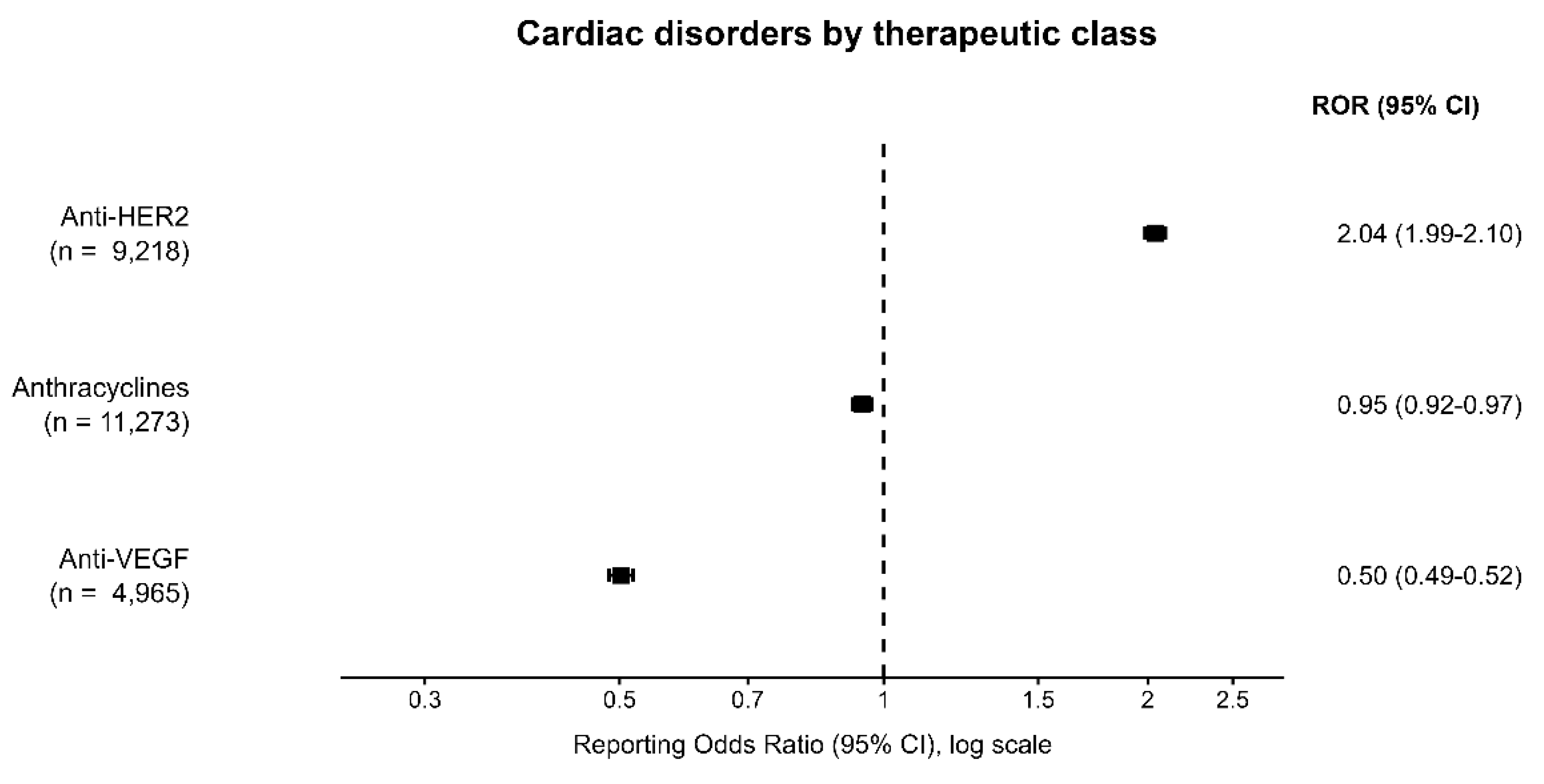
Figure 2.
Disproportionality analysis of reports classified under Cardiac disorders by individual antineoplastic agent. Points represent reporting odds ratios and horizontal lines represent 95% confidence intervals. For each agent, the comparator comprised the pooled drug-specific report observations for the remaining seven study drugs. The value n denotes the number of report observations classified under Cardiac disorders for the index agent. The vertical dashed line indicates the null value of ROR = 1.
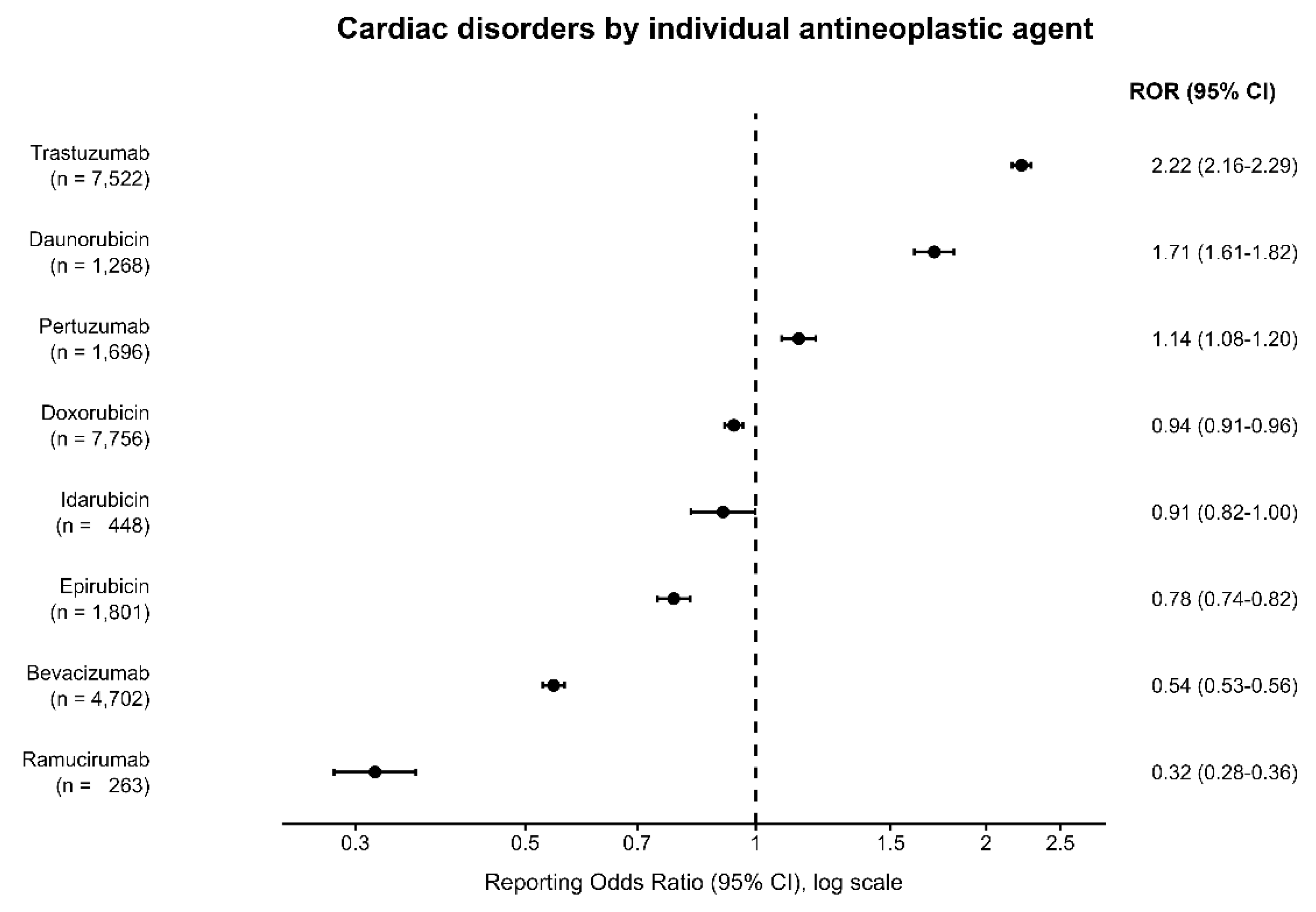

Table 1.
Distribution of drug-specific report observations across MedDRA System Organ Classes by therapeutic group.
Table 1.
Distribution of drug-specific report observations across MedDRA System Organ Classes by therapeutic group.
| System Organ Class | Anthracyclines (n= 177,344) | Anti-HER2 (n = 88,373) | Anti-VEGF (n = 123,351) |
| Blood and lymphatic system disorders | 61,142 (34.48%) | 9,865 (11.16%) | 14,919 (12.10%) |
| Cardiac disorders | 11,273 (6.36%) | 9,218 (10.43%) | 4,965 (4.03%) |
| Congenital, familial and genetic disorders | 668 (0.38%) | 165 (0.19%) | 243 (0.20%) |
| Ear and labyrinth disorders | 784 (0.44%) | 539 (0.61%) | 552 (0.45%) |
| Endocrine disorders | 709 (0.40%) | 263 (0.30%) | 867 (0.70%) |
| Eye disorders | 1,830 (1.03%) | 1,837 (2.08%) | 6,293 (5.10%) |
| Gastrointestinal disorders | 36,899 (20.81%) | 18,477 (20.91%) | 27,121 (21.99%) |
| General disorders and administration site conditions | 36,963 (20.84%) | 28,974 (32.79%) | 37,161 (30.13%) |
| Hepatobiliary disorders | 4,573 (2.58%) | 1,481 (1.68%) | 3,267 (2.65%) |
| Immune system disorders | 2,912 (1.64%) | 2,363 (2.67%) | 1,535 (1.24%) |
| Infections and infestations | 19,512 (11.00%) | 7,394 (8.37%) | 12,011 (9.74%) |
| Injury, poisoning and procedural complications | 9,763 (5.51%) | 8,758 (9.91%) | 16,893 (13.70%) |
| Investigations | 20,974 (11.83%) | 11,312 (12.80%) | 14,753 (11.96%) |
| Metabolism and nutrition disorders | 9,262 (5.22%) | 3,730 (4.22%) | 7,120 (5.77%) |
| Musculoskeletal and connective tissue disorders | 7,635 (4.31%) | 7,556 (8.55%) | 6,447 (5.23%) |
| Neoplasms benign, malignant and unspecified (incl cysts and polyps) | 10,607 (5.98%) | 5,240 (5.93%) | 8,296 (6.73%) |
| Nervous system disorders | 15,935 (8.99%) | 12,112 (13.71%) | 15,334 (12.43%) |
| Pregnancy, puerperium and perinatal conditions | 941 (0.53%) | 325 (0.37%) | 56 (0.05%) |
| Product issues | 151 (0.09%) | 222 (0.25%) | 487 (0.39%) |
| Psychiatric disorders | 3,005 (1.69%) | 2,540 (2.87%) | 2,842 (2.30%) |
| Renal and urinary disorders | 4,147 (2.34%) | 1,548 (1.75%) | 7,504 (6.08%) |
| Reproductive system and breast disorders | 1,449 (0.82%) | 980 (1.11%) | 929 (0.75%) |
| Respiratory, thoracic and mediastinal disorders | 14,554 (8.21%) | 9,548 (10.80%) | 13,491 (10.94%) |
| Skin and subcutaneous tissue disorders | 20,411 (11.51%) | 12,241 (13.85%) | 8,121 (6.58%) |
| Social circumstances | 216 (0.12%) | 203 (0.23%) | 330 (0.27%) |
| Surgical and medical procedures | 1,009 (0.57%) | 728 (0.82%) | 1,109 (0.90%) |
| Vascular disorders | 8,184 (4.62%) | 4,477 (5.07%) | 13,396 (10.86%) |
Note: Percentages are calculated over the total number of drug-specific report observations per therapeutic group. Because a single underlying ICSR may be classified under multiple SOCs, percentages may exceed 100%.
Table 2.
Most frequently reported cardiac Preferred Terms by therapeutic group.
|
Anthracyclines (n = 11,273) |
Anti-HER2 (n = 9,218) |
Anti-VEGF (n = 4,965) |
|||
| Preferred Term | n (%) | Preferred Term | n (%) | Preferred Term | n (%) |
| Cardiac failure | 1,827 (16.21%) | Cardiac failure | 1,839 (19.95%) | Cardiac failure | 654 (13.17%) |
| Cardiomyopathy | 1,480 (13.13%) | Cardiotoxicity | 1,380 (14.97%) | Myocardial infarction | 648 (13.05%) |
| Tachycardia | 1,161 (10.30%) | Tachycardia | 868 (9.42%) | Tachycardia | 415 (8.36%) |
| Cardiotoxicity | 1,146 (10.17%) | Cardiac disorder | 654 (7.09%) | Atrial fibrillation | 410 (8.26%) |
| Atrial fibrillation | 701 (6.22%) | Cardiomyopathy | 601 (6.52%) | Cardiac failure congestive | 331 (6.67%) |
| Cardiac failure congestive | 671 (5.95%) | Cardiac dysfunction | 594 (6.44%) | Cardiac arrest | 247 (4.97%) |
| Cardiac arrest | 503 (4.46%) | Cardiac failure congestive | 503 (5.46%) | Acute myocardial infarction | 226 (4.55%) |
| Palpitations | 450 (3.99%) | Palpitations | 484 (5.25%) | Cardiomyopathy | 170 (3.42%) |
| Myocardial infarction | 380 (3.37%) | Left ventricular dysfunction | 431 (4.68%) | Palpitations | 148 (2.98%) |
| Left ventricular dysfunction | 337 (2.99%) | Atrial fibrillation | 236 (2.56%) | Cardiac disorder | 139 (2.80%) |
Note: Only PTs with ≥50 reports are shown; the ten most frequently reported PTs per therapeutic group are presented. Percentages are calculated over the number of report observations classified under Cardiac disorders per therapeutic group. Percentages may exceed 100% because multiple PTs may be reported per case.
Disclaimer/Publisher’s Note: The statements, opinions and data contained in all publications are solely those of the individual author(s) and contributor(s) and not of MDPI and/or the editor(s). MDPI and/or the editor(s) disclaim responsibility for any injury to people or property resulting from any ideas, methods, instructions or products referred to in the content. |
© 2026 by the authors. Licensee MDPI, Basel, Switzerland. This article is an open access article distributed under the terms and conditions of the Creative Commons Attribution (CC BY) license (http://creativecommons.org/licenses/by/4.0/).
Copyright: This open access article is published under a Creative Commons CC BY 4.0 license, which permit the free download, distribution, and reuse, provided that the author and preprint are cited in any reuse.