
Submitted:
15 June 2026
Posted:
17 June 2026
You are already at the latest version
Abstract
Mortality in smallholder cattle and buffalo systems is driven by climate, and the climate signal is not uniform. Heat and cold stress, flooding, and climate-sensitive disease emergence act through different physiological and ecological pathways, yet livestock-loss models usually compress them into a single elevated-mortality state. This paper builds a climate-state-dependent mortality model for the Thai national herd, separating an endemic baseline from a temperature-extreme regime and a moisture- and disease-driven regime. A 100,000-iteration Monte Carlo, calibrated to the 2024 national herd and a 2017 primary farmer survey updated to 2026 prices, generates the annual loss distribution and decomposes it by climate driver. The average year is governed by endemic mortality, which accounts for about 81 percent of expected loss but none of the extreme tail. The tail belongs entirely to the two climate regimes: the moisture- and disease-driven regime carries roughly 69 percent of losses beyond the 95th percentile and the temperature regime about 31 percent. The driver of the typical year is therefore not the driver of the catastrophe. A second result concerns the ecological footprint of insurance. Using a reduced-form behavioral layer, mortality-payout design is shown to suppress adaptive destocking and lift stocking pressure 10 to 16 percent above a sustainable land-carrying-capacity benchmark, so that an instrument promoted for climate adaptation can degrade the rangeland it is meant to protect. The findings argue for regime-specific risk financing, for pairing insurance with heat-adaptation and animal-health investment, and for treating the carrying-capacity externality as a design parameter rather than a side effect. The paper closes with a research agenda for climate-state livestock-loss modeling, intended to give the field a transparent and reproducible starting point.
Keywords:
heat stress
; livestock mortality
; climate adaptation
; ecosystem resilience
; land carrying capacity
; regime-switching model
; cattle and buffalo
; Thailand
1. Introduction
Cattle and water buffalo are part of the agricultural ecosystem and the household balance sheet across much of the developing world. They convert forage into protein and draught power, recycle nutrients through manure, and hold value that households draw down when other income fails. The Food and Agriculture Organization [1] estimates that roughly 600 million smallholder households depend on livestock for some part of their food and income. In Thailand, the 2024 national herd reached 9.89 million beef cattle and 1.81 million buffalo [2], more than double the 2016 totals [3], and these animals support close to a million farming households. When animals die at scale, the loss is simultaneously a loss of food, of cash savings, and of the breeding stock needed to rebuild, so livestock mortality is an environmental-systems problem and not only an insurance problem. Treating it that way, as a question about climate, land, and the animals that link them, is the orientation of this paper.
The environmental pressure on these systems is rising. Warming has already cut agricultural output and raised its variance [4,5], and 2024 was confirmed as the warmest year in the instrumental record [6]. For livestock specifically, the most direct channel is thermal load. Heat stress reorganizes animal metabolism, depresses feed intake, impairs fertility, and at sufficient intensity raises mortality risk [7]. Exposure to extreme heat stress is projected to increase across domesticated livestock species through the twenty-first century [8], and heatwave exposure of the cattle sector rises under climate scenarios even in temperate production zones, with grazing and housed systems exposed differently [9]. The opposite tail matters too: cold snaps killed large numbers of cattle and buffalo in upland Lao PDR within the same Mekong production zone that includes northeastern Thailand [10]. Temperature extremes at both ends therefore belong in any honest description of livestock mortality risk.
A second environmental channel is moisture and disease. Flooding and shifting vector ranges move animal pathogens, and the regional record shows repeated transboundary outbreaks. Foot-and-mouth disease circulates persistently along Mekong trade and movement corridors [11,12,13,14,15], lumpy skin disease spread rapidly across Southeast Asia and South Asia after 2019 [16,17], and hemorrhagic septicemia remains endemic in buffalo populations [18]. These events cluster losses across animals and herds in a way that a constant mortality rate cannot represent, and their frequency and range are themselves climate-sensitive.
Most analyses of livestock-mortality risk nonetheless treat elevated mortality as a single epidemic state layered on a constant baseline [19,20]. That simplification hides a question with direct policy content: which climate driver dominates the average year, and which dominates the catastrophe? The two need not be the same, and the answer shapes where surveillance, early warning, and adaptation money should go. Recent macro evidence points the same way. Chen, Maneejuk and Yamaka [21], modeling Chinese grain systems, find that the effectiveness of agricultural insurance is climate-state dependent, substitutive under temperature shocks and complementary under precipitation shocks, so the optimal mix of insurance and physical adaptation varies with the type of climate stress. Splitting the elevated regime by driver is the natural way to bring that logic into livestock-loss modeling.
A further question is ecological. Insurance is promoted as a climate-adaptation instrument [22,23,24], but it is not ecologically neutral. John et al. [25], using an agent-based model calibrated to East African pastoralism, show that drought insurance can suppress the destocking that herders would otherwise undertake after a shock, holding stocking density above the land’s carrying capacity and degrading the rangeland over time. Gehring and Schaudt [26] document a related land-use channel: insured herders are less likely to drive animals onto cropland when forage fails. Bulte and Lensink [27] argue more generally that insurance can dampen risk-reducing behavior and slow productive adaptation. An instrument designed to protect a livestock ecosystem can, through these behavioral channels, place new pressure on it.
This paper develops both questions in one framework. It builds a climate-state-dependent mortality model for Thai cattle and buffalo, decomposes the annual loss distribution by climate driver, and then traces how mortality-insurance design feeds back onto destocking behavior and land carrying capacity. The contribution is fourfold. First, the model separates a temperature-extreme regime and a moisture- and disease-driven regime from the endemic baseline, grounded in the heat-stress and disease-ecology evidence above, and is nested in the conventional two-regime model as a limiting case so that it extends rather than discards standard practice. Second, it quantifies which climate driver owns the mean and which owns the tail, a decomposition that reframes livestock loss as climate-driver-specific environmental risk. Third, it makes the carrying-capacity externality explicit and measurable, so the ecological cost of generous payouts can be weighed against their adaptation benefit. Fourth, it sets out a structured research agenda, with the model, code, and calibration documented so that others can replicate the analysis and extend it to new perils, regions, and data.
The aim throughout is to provide a usable foundation rather than a closed result. The parameters that govern the climate regimes are calibrated, not estimated, because the data needed to estimate them directly do not yet exist in a form suited to national-scale loss modeling. Stating those parameters openly, bounding them with sensitivity analysis, and identifying the data that would replace them with estimates is part of the contribution. The remainder of the paper is organized as follows. Section 2 reviews the environmental, demand, fiscal, and ecological evidence and locates the open questions. Section 3 sets out the climate-state mortality model and the carrying-capacity layer. Section 4 documents data and calibration. Section 5 reports the loss distribution and its regime decomposition. Section 6 reports the insurance and carrying-capacity results. Section 7 draws policy and decision-support implications. Section 8 sets out a research agenda. Section 9 concludes. A Supplementary Materials document provides the full derivations, the extended results, the robustness analyses, and the complete code needed to reproduce every figure and table.
2. Climate, Disease Ecology, Demand, and the Ecology of Insurance
The literature relevant here spans four areas that are usually treated separately: the climatic and biological drivers of mortality, the demand-side behavior that determines whether insurance reaches farmers, the fiscal and structural performance of programs, and the ecological consequences of insurance itself. The modeling choice that follows, to condition mortality on climate state and to let insurance feed back onto land, draws on all four. This section organizes the evidence by driver rather than by instrument, because separating drivers is the analytical move the rest of the paper makes.
2.1. Temperature Extremes and Ruminant Mortality
The physiology of heat stress in ruminants is well characterized. Elevated thermal load shifts animals from production toward thermoregulation, disrupts redox balance, and damages cellular and metabolic function, so that growth, reproduction, and immune competence all decline before death occurs [7]. Because the early losses are sublethal, heat stress is increasingly measured through production metrics and animal-level sensing rather than mortality alone: milk yield, growth, and intake all respond to thermal load in ways that can be tracked continuously [28], and reproductive performance carries a genetic component of heat sensitivity that selection can shift only slowly [29]. The forward-looking evidence is the part that matters most for risk modeling. Thornton et al. [8] project rising exposure to extreme heat stress across domesticated livestock species through the twenty-first century, and Malek and See [9] show that heatwave exposure of the cattle sector increases under climate scenarios, with grazing systems and housed systems exposed differently, a distinction that bears directly on the land-use channel developed later in this paper. For tropical beef cattle, the closest setting to Thailand, Schuck-Paim et al. [30] quantify heat-stress welfare across hundreds of South American locations using the Comprehensive Climate Index, identify a thermal threshold above which mortality risk rises even in healthy animals, and show that shade provision is a cost-effective adaptation, which makes heat stress not only a risk to be insured but a risk that can be physically reduced. The cold tail is real as well: Khounsy et al. [10] document significant mortality of large ruminants from cold stress in northern and central Lao PDR, inside the same upland Mekong zone as northeastern Thailand, where smallholder large-ruminant health is constrained by feed and housing limits [31]. A temperature-extreme regime that spans both heat and cold therefore has empirical grounding. What the literature does not yet provide is a single annual kill rate for tropical cattle and buffalo that could be inserted directly into a national loss model, which is why the temperature-regime severity is calibrated here and flagged as a priority for estimation. The distinction between sublethal and lethal heat effects also matters for product design, because a contract that pays only on death misses the larger, earlier losses in milk, growth, and fertility that thermal load imposes, a point the production-metric and welfare evidence makes concrete [28,30].
2.2. Moisture, Flooding, and Climate-Sensitive Disease Emergence
The second elevated regime is driven by moisture and disease. Foot-and-mouth disease is endemic to mainland Southeast Asia, and its reporting and circulation track animal movement along the Mekong corridor [11,12]. Regional and global reviews document recurrent serotype turnover and cross-border transmission [13,14], and outbreaks of exotic strains have repeatedly emerged on Greater Mekong smallholder farms, where biosecurity is limited and trade links are dense [15]. Lumpy skin disease, a vector-borne pathogen whose spread is sensitive to temperature and moisture because it depends on biting-insect activity, moved across Southeast and South Asia from 2019 onward and caused large cattle losses in newly affected areas [16,17]. Hemorrhagic septicemia, strongly seasonal and tied to wet-season conditions, remains a leading cause of buffalo death in the region [18]. Two features of this evidence matter for modeling. First, these events are correlated across animals and herds and cluster in time, so they generate a heavy upper tail rather than a thicker spread around the mean. Second, several of the pathogens are climate-sensitive in range or seasonality, so the frequency of the moisture-and-disease regime is not fixed but plausibly rising, which is the same direction the heat-stress literature gives for the temperature regime. The movement and trade structure of the region compounds the climatic signal, because animals cross borders along established market chains, so a local outbreak can become a regional one within a single season [12,15]. For modeling, this means the moisture-and-disease regime is not only more severe than the temperature regime but also more spatially contagious, a feature a future spatial extension should capture.
2.3. Insurance as a Climate-Adaptation Instrument
Livestock and agricultural insurance is widely positioned within the climate-adaptation toolkit, and the case rests on both demand and design. Uptake tends to rise after climatic shocks, as experience updates risk perception [24], and index designs are promoted specifically to manage drought and climate risk while limiting moral hazard and verification cost [23,32,33,34]. Composite climatic indices that combine temperature, precipitation, and vegetation signals are proposed to separate climate drivers and lower the basis risk that has undermined single-index products [22]. The political economy of climate insurance complicates the adaptation story, because the instrument redistributes risk between farmers, insurers, and the state in ways that shape who bears climate loss [35,36]. The broader development record is mixed: agricultural insurance has expanded rapidly, but uptake in low- and middle-income settings remains below the levels needed for self-sustaining markets, and the evidence that it delivers on its development promise is uneven [37,38]. Foundational treatments of livestock revenue and income insurance establish the contract structures on which these products build [39,40,41], and regional syntheses document the design choices specific to Asian agriculture [42].
2.4. Demand, Behavior, and Adoption
Whether the instrument reaches the farmers who need it is a behavioral question as much as a price question, and the demand literature is now substantial. Willingness to pay rises with herd size, education, and prior loss experience, and elicited values frequently exceed the subsidized premium, which suggests latent demand that distribution failures leave unmet [43]. Trust, subsidy level, indemnity alignment, and claim-settlement speed each shape participation in controlled settings [44], and improved breed and credit access raise adoption probability among smallholders [45]. Gender matters for both demand and channel: evidence is mixed on whether a participation gap exists, but women consistently prefer home-centered information and respond strongly to bundled products [46,47]. Expectation management is a recurring failure mode, with inflated early expectations followed by attrition when payouts disappoint [48], and retention is chronically weak where claim settlement is difficult [49]. Reviews of African and Asian programs converge on a common diagnosis: subsidy expansion alone does not move uptake without parallel investment in data, distribution, and trust [50,51], and supply-side willingness to offer cover responds to incentives as much as demand does [52]. Even sophisticated commercial producers under-cover relative to historically optimal positions, so producer education and decision support carry a marginal return alongside premium subsidy [53]. The implication for an environmental-systems model is that the participation rate is endogenous and policy-sensitive, so the insured share of the herd is a design variable rather than a fixed input.
2.5. Fiscal Performance, Subsidy Design, and Structural Effects
The fiscal record sets the outer constraint on any insurance-based adaptation. The canonical framework for subsidy design warns that compressing loadings below sustainable levels trades short-run affordability for long-run insolvency, and documents wide variation in transfer efficiency across programs [54]. Subsidy expansion creates fiscal dilemmas when aggregate losses exceed premium revenue, and benefits can be captured by financially sophisticated participants rather than the intended beneficiaries [55,56]. Fiscal incentives can also reduce rural inequality, with stronger effects in poorer regions, so the distributional sign of subsidy is not fixed [57]. Program sustainability appears to depend less on subsidy generosity than on administrative efficiency and on linkage with extension, credit, and cooperative channels [58,59]. Two structural cautions complete the picture. Insurance may slow agricultural transformation by dampening the productive risk-taking and risk-reducing investment that drive productivity growth [27]. And livestock often serve as the de facto buffer asset in the household portfolio, so formal cover can substitute for, rather than complement, the informal risk management that sustains it [60,61]. These findings matter here because the same generosity that strains the public balance sheet also drives the behavioral channel that raises grazing pressure, so the fiscal and ecological costs of insurance move together.
2.6. Ecological Externalities of Livestock Insurance
That ecological channel is the least studied and the most central to this paper. The core mechanism is destocking suppression: after a mortality shock, herders without insurance sell or move animals to match stocking to available forage, but insured herders, expecting indemnity, retain animals and keep grazing pressure high, which over time degrades carrying capacity [25]. Gehring and Schaudt [26] provide complementary field evidence of a land-use externality, with insured pastoralists less likely to encroach on cropland during forage failure, an effect strong enough to reduce resource conflict. Bulte and Lensink [27] place these findings in a wider frame in which insurance crowds out risk-reducing behavior. The coping-portfolio literature sharpens the point: where livestock are the informal buffer, formal insurance can displace the very destocking and herd management that keep the system within ecological limits [60,61]. These externalities are documented mainly for extensive pastoral rangelands. Whether they carry over to free-range smallholder cattle and buffalo systems, and how they interact with a climate-state mortality structure, has not been modeled.
2.7. Synthesis and Open Questions
Four gaps follow from this review. Climate-driver heterogeneity is rarely built into livestock-loss models, which collapse distinct perils into one elevated state and so cannot say which driver owns the tail. Demand heterogeneity is studied in isolation from aggregate risk, so the endogeneity of the insured share is seldom fed into exposure modeling. Fiscal analysis quantifies subsidy cost but rarely connects it to the ecological consequences of the same generosity. And the ecological externality, though identified for rangelands, has not been quantified for free-range smallholder systems or linked to a climate-conditioned mortality structure. The framework below addresses the first and fourth gaps directly and is built so that the second and third can be added by later work. Table 1 maps the environmental drivers to mortality regimes and to the corpus evidence that grounds each.
3. The Climate-State-Dependent Mortality Model
The model generalizes a regime-switching mortality engine into a climate-conditioned form and adds a reduced-form behavioral layer linking insurance design to destocking and land carrying capacity. The presentation is complete, so the model can be reimplemented from the equations alone.
3.1. Individual Mortality and Indemnity
Index insured animals by . The annual mortality indicator equals one if animal dies during the policy year. With per-head insured value and coverage ratio , the indemnity on death is , and expected indemnity per animal under mortality rate is . The accuracy of any premium or exposure figure built on this identity depends entirely on , and small errors in scale into large aggregate imbalances when applied across a national herd [62]. Treating as a single constant is therefore the weak point, because mortality in these systems is neither constant nor stationary [19,20]. The revenue- and income-insurance literature reaches the same conclusion from the contract side: pricing that ignores the structure of the loss distribution misprices the product [39,40].
3.2. Climate-Conditioned Regimes
Let a climate-state index govern the policy year :
where is the endemic baseline, the temperature-extreme regime (heat or cold stress), and the moisture- and disease-driven regime. The regimes are mutually exclusive within a year, with probabilities
Conditional on the regime, the herd mortality rate is drawn from a truncated normal,
with and . The truncated normal is a parsimonious choice that keeps the mean and dispersion of each regime interpretable while preventing impossible mortality rates; alternative one-sided or heavy-tailed severity distributions are a natural extension and are discussed in Section 8. A single systemic draw scales the whole insured herd, which encodes the correlation that makes climate and disease shocks dangerous: a bad year is bad for the pool as a whole, not for independent animals. Aggregate annual loss is
for cattle () and buffalo () insured populations . The model nests the conventional two-regime structure: setting and recovers a single elevated epidemic regime, so the climate-state model is continuous with, rather than a departure from, standard livestock-loss modeling. The regime severities and frequencies are calibrated, not estimated, and bounded by the sensitivity analysis in Section 5; this is stated openly and is the same discipline applied to the epidemic regime in the conventional model.
3.3. Regime Decomposition of Loss
The new quantitative objects are the shares of expected and of tail loss attributable to each regime. Writing for the 95th percentile of ,
The mean share answers which driver dominates the typical year; the tail share answers which dominates the catastrophe. Separating them is the analytical payoff of conditioning mortality on climate state, and it is the object most directly useful to other researchers, because it converts a single loss distribution into a statement about attribution.
3.4. Insurance, Destocking, and Carrying-Capacity Pressure
The behavioral layer follows the John et al. [25] mechanism in reduced form. After a shock of severity , the surviving herd is . Herders choose a destocking fraction , the additional animals sold to relieve grazing pressure and smooth consumption. Insurance generosity, the product of coverage and subsidy , lowers the incentive to destock, because the indemnity substitutes for the cash that a distress sale would raise:
with the baseline destocking fraction absent insurance and the suppression strength. Define the land-carrying-capacity pressure index as standing stock relative to the sustainable benchmark , the stocking implied by endemic mortality with normal adaptive destocking:
Values above one mean stocking pressure above the sustainable benchmark. Generosity raises , lowers , and pushes above one, which is the John et al. degradation channel applied to a free-range smallholder setting. The specification is kept minimal so its drivers are transparent: the result depends on the sign of , not its exact value, and the comparative statics in and hold for any . Two caveats are explicit. The mechanism is calibrated and stylized rather than estimated for Thailand, and the original evidence is extensive Kenyan rangeland, whereas Thai cattle and buffalo are roughly 90 percent free-range smallholder systems [63], so is an indicator of direction and order of magnitude, not an ecological forecast. The direction is supported independently by the land-use and behavioral evidence [26,27].
3.5. Simulation Procedure and Convergence
The model is solved by Monte Carlo. Each of the 100,000 iterations draws a regime from the categorical distribution over the three states, draws a herd mortality rate from the corresponding truncated normal, and computes the aggregate loss. Iterations are independent, so each represents one possible policy year and the empirical distribution of simulated losses approximates the annual loss distribution. Expected loss, the standard deviation, percentiles, and the conditional tail expectation are read off as the corresponding sample statistics, and the regime shares defined in Section 3.3 are computed by tagging each iteration with the regime that generated it. A fixed seed makes every figure and table exactly reproducible.
Sampling error is small at this scale. The standard error of the mean is the loss standard deviation divided by the square root of the iteration count, about 0.15 million USD against a mean of 121 million, roughly one part in eight hundred. Tail quantiles are estimated less sharply than the mean but stay stable across seeds at the reported number of digits, because the 10 percent combined frequency of the elevated regimes places about 10,000 iterations in the two climate regimes and several hundred beyond the 99th percentile. Researchers reusing the model can raise the iteration count where finer tail resolution is needed; convergence is monotone and the computational cost is linear in the number of draws. Seed stability across independent runs and convergence in the iteration count are documented in the Supplementary Materials (Sections S6.1 and S6.2).
4. Data and Calibration
4.1. Herd, Values, and Exposure
Calibration uses an established single-country dataset for Thai cattle and buffalo, drawn entirely from published national statistics and a published farmer survey, so the analysis is reproducible from public sources. Herd populations are the 2024 Department of Livestock Development figures, 9.89 million beef cattle and 1.81 million buffalo [2]. Per-head values come from the 2017 Bank for Agriculture and Agricultural Cooperatives feasibility survey of 665 cattle and buffalo farmers across four provinces [63], inflated to 2026 by 11.5 percent cumulative Thai consumer price inflation [64] at a fixed 31.10 baht per US dollar, giving 1,091.37 USD per head of cattle and 1,073.53 USD per head of buffalo. Household participation is set at 50 percent and the within-household herd-coverage factor at 0.2125, the survey anchor, so the insured population is about 1.05 million cattle and 0.19 million buffalo, an insured value at risk near 1,083 million USD at the 80 percent coverage used for the loss-distribution scenario. Participation is held fixed here, but the demand literature reviewed in Section 2.4 makes clear that it is endogenous, and the model is built to accept a participation schedule rather than a constant if the analysis is extended.
The survey predates the analysis, which warrants comment. The Bank for Agriculture and Agricultural Cooperatives study of 2017 remains the only nationally stratified primary survey of smallholder cattle and buffalo husbandry, asset values, and insurance preferences in Thailand, and no comparable replication has been published since, so it is the best available source for the per-head values, the dominant free-range share, and the within-household coverage factor used here. The parameters it supplies are slow-moving: herd composition, the prevalence of free-range management, and the institutional structure of the sector have not shifted materially since 2017, so the survey’s structural findings carry forward even where prices do not. Monetary values are therefore the one element that is updated, by the 11.5 percent cumulative Thai consumer price inflation over 2017 to 2026 [64], while herd totals are taken from the most recent 2024 release [2]. As an external check, the survey’s elicited willingness to pay, 2.4 to 4.9 percent of indemnity, sits inside the contemporary international range reported for Canada [20], Nepal [43], and Nigeria [33], which suggests the Thai elicitation is not an artifact of its date. A refreshed national survey is nonetheless a research priority (Section 8).
4.2. Regime and Behavioral Parameters
The climate-state parameters appear in Table 2 with an explicit provenance column, which separates measured anchors from calibrated assumptions and is meant to make the calibration auditable. The baseline mortality and its dispersion are the project calibration, consistent with routine smallholder mortality in the regional veterinary record [31]. The two elevated regimes split the conventional single epidemic regime: their probabilities sum to 0.10 and their mean mortality averages 0.22, so the climate-state model reproduces the aggregate elevated regime of the conventional model while resolving it into two drivers. Severities are differentiated in line with the evidence. The moisture- and disease-driven regime is assigned the higher mean and dispersion because clustered outbreaks of foot-and-mouth, lumpy skin disease, and hemorrhagic septicemia produce the heaviest correlated losses [16,18]. The temperature regime is assigned a somewhat lower sustained mean, consistent with heat- and cold-stress mortality operating alongside large production and fertility losses rather than only death [7,30], while its frequency is the parameter most likely to rise under warming [8,9]. All four elevated-regime parameters are varied in the Section 5 sensitivity analysis, and the behavioral parameters are held to stylized values whose role is examined rather than asserted.
4.3. The Status of the Calibration and How the Results Depend on It
The parameters in Table 2 are calibrated rather than estimated, and the distinction is worth making explicit because it governs how the results should be read. No source, in the literature assembled here or to the author’s knowledge elsewhere, reports an annual climate-attributable mortality rate for tropical cattle and buffalo at the national scale the model requires. The heat-stress literature measures exposure, welfare, production, and fertility rather than a herd kill rate [7,8,28,30], and the disease literature documents outbreaks, ranges, and case reports rather than a standing annual severity [11,16,17]. Calibration is therefore not a shortcut taken in place of available estimates; it is the only option until the data described in Section 8 exist. Stating the values openly, marking each by provenance, and bounding the consequential ones with sensitivity analysis is the discipline that keeps a calibrated model honest.
The anchor that carries the most weight is the aggregate elevated regime, not any single cell. The two climate regimes are constructed so that their probabilities sum to 0.10 and their severities average to 0.22. That pair, an elevated state with about 22 percent mortality occurring with roughly 10 percent annual probability, is the conventional single-epidemic regime used in standard livestock-loss modeling, and it reflects the veterinary record that outbreaks of foot-and-mouth disease, lumpy skin disease, and hemorrhagic septicemia drive herd mortality into the 20-percent range in affected populations during bad years [16,17,18]. Because the climate-state model collapses to this single elevated regime when the split is removed, every quantity that depends only on aggregate exposure, the mean loss, the overall variance, and the unconditional percentiles, is identical to what the standard model would produce. The split changes none of those; it resolves their internal composition. This is what licenses the claim that the decomposition, rather than the loss level, is the contribution.
The division of that elevated regime into a temperature state and a disease state is the genuinely new assumption, and it is made conservatively. The temperature mean is set below the disease mean, 0.20 against 0.24, and the two are assigned equal annual probabilities of 0.05. Keeping the means close is intentional: it ensures that the finding that the disease regime carries the larger share of the tail is not built into the calibration by an assumed severity gap, but emerges from the higher dispersion of the disease regime and the geometry of the loss distribution. The direction of the ordering is what the literature supports. Disease outbreaks are not only severe but spatially contagious, propagating along the movement and trade networks of the region in a way that thermal stress does not [11,12,15], which justifies both the higher mean and the higher dispersion assigned to the moisture-and-disease regime. The temperature regime, by contrast, is the one whose frequency is projected to rise, so its 0.05 probability should be read as a current value rather than a fixed one [8,9]. What the literature does not provide, and what the calibration therefore supplies, is the precise magnitude of either severity, and the model treats those magnitudes as quantities to be varied rather than as facts.
The baseline mortality of 0.10 is the parameter most open to dispute, and it is flagged as such. A 10 percent blended annual mortality is high relative to intensive, well-resourced production systems, but it is defensible for the low-input, free-range smallholder herds that dominate the Thai cattle and buffalo sector, where about 90 percent of farmers run free-range systems [63], veterinary access is uneven, and endemic disease is a constant background [19,31]. Calf mortality alone can exceed this figure in such systems, so a herd-average rate near 10 percent that blends age classes is plausible. It remains a calibration, and a reviewer who preferred 0.07 or 0.08 would be making a reasonable case; the consequence of that preference is set out below and is smaller than it first appears. The within-regime dispersions, 0.02 for the baseline and 0.04 and 0.05 for the two elevated regimes, represent year-to-year variation in the realized rate around each regime mean. The elevated regimes are given larger dispersions because outbreak and heatwave severity vary more across events than routine endemic mortality does, and because the disease regime, being contagious, has the widest event-to-event spread of the three.
The behavioral parameters, the baseline destocking fraction of 0.15 and the suppression strength of 1.0, are the weakest entries in the table and are labeled stylized rather than calibrated for that reason. They have no literature anchor, because the destocking response of free-range smallholders to mortality insurance has not been measured, and the rangeland evidence that motivates the mechanism comes from extensive pastoralism rather than the Thai setting [25]. Their role is to demonstrate the direction and plausible order of magnitude of the carrying-capacity externality, not to estimate it. The model is built so that this is transparent: the sign of the effect and the comparative statics in coverage and subsidy hold for any positive suppression strength, so the qualitative result does not depend on the value of that parameter, while the specific figure of 10 to 16 percent above the sustainable benchmark should be read as illustrative.
Two features of the model limit how much this calibration uncertainty matters for the conclusions. The first is the sensitivity analysis. The four elevated-regime parameters are varied one at a time over plausible bands, and the resulting movement in the tail is reported in the tornado of Figure 3, so a reader who rejects a particular value can read its consequence directly rather than rerunning the model. The analysis shows that the tail is governed overwhelmingly by the disease-regime severity, which both identifies the parameter that matters most and points future data collection toward it. The second is the linearity of loss in mortality and insured value. Because aggregate loss is the insured value at risk multiplied by the systemic mortality rate, a belief that the baseline or the severities are too high scales the dollar figures down in proportion but leaves the regime shares almost unchanged. The attribution result, that endemic mortality owns the mean and the two climate regimes own the tail, is a structural property of where the regimes sit relative to the loss percentiles rather than an artifact of the chosen levels, and it survives reasonable revision of every value in the table. The Supplementary Materials make this concrete: varying the baseline mortality from 0.07 to 0.12 leaves the tail-share decomposition unchanged at 0, 31, and 69 percent (Section S6.3 and Figure S2), and varying participation rescales the loss distribution without altering the shares (Section S6.4). The contribution rests on that structural result, which is why the calibration, although it should be scrutinized, does not undermine the findings.
The path from calibration to estimation is concrete and is set out in Section 8. Provincial panels of cattle and buffalo mortality, matched to climate indices and to outbreak surveillance, would let the regime severities and frequencies be estimated rather than assumed; the Comprehensive Climate Index and animal-level sensing would support a heat-stress mortality function [28,30]; and household panel or experimental data on herd sales around shocks would identify the destocking response [25]. Until those data are assembled, the calibration here is offered as a transparent and reproducible base case, designed to be revised rather than believed.
5. Environmental Loss Distribution by Climate Regime
The Monte Carlo generates the aggregate annual loss distribution and its regime decomposition. Mean annual loss is 121.0 million USD, with a standard deviation of 47.1 million. The distribution is right-skewed: the 95th percentile is 234.5 million, the 99th percentile 309.7 million, the 99.5th percentile 330.3 million, and the conditional expectation beyond the 99th percentile 337.2 million. The simulated mean matches the analytical expected loss, the insured value at risk (1,083 million USD) multiplied by mean mortality across regimes (0.112), to within a fraction of a percent, confirming that the simulation is unbiased and that splitting the elevated regime leaves aggregate exposure unchanged while revealing its internal structure. A variance decomposition reinforces the same reading: about 70 percent of the year-to-year variance in aggregate loss comes from which regime occurs rather than from variation within a regime (Supplementary Materials, Section S3.6 and Table S4). Extended quantiles and regime-conditional statistics appear in Supplementary Tables S2 and S3, and the loss exceedance curve in Supplementary Figure S1.
Figure 1 shows the distribution colored by the regime that generated each simulated year. The bulk near the mean is almost entirely baseline mortality; the long right tail is built from the two climate regimes, which barely overlap the central mass.
The decomposition shows this directly (Figure 2). The baseline regime occurs in about 90 percent of years and accounts for 81 percent of expected loss, but for none of the loss beyond the 95th percentile, because routine mortality never reaches catastrophic magnitude under the calibrated dispersion. The temperature regime occurs in 5 percent of years, contributes 9 percent of expected loss, and carries 31 percent of tail loss, with conditional mean loss of 216 million USD in the years it strikes. The moisture- and disease-driven regime occurs in 5 percent of years, contributes 11 percent of expected loss, and carries 69 percent of tail loss, with a conditional mean of 261 million. The driver that dominates the average year, endemic mortality, contributes nothing to the catastrophe, while the two climate regimes that barely register in the mean own the entire tail. Within the tail, the moisture- and disease-driven regime is roughly twice the temperature regime, but the temperature regime is far from negligible, and the heat-stress evidence indicates its frequency will rise [8,9]. A risk manager who budgets from the mean prepares for the wrong event.

Table 3.
Loss distribution and regime decomposition.
| Quantity | Baseline (B) | Temperature (T) | Moisture/disease (M) | All |
| Share of years | 0.90 | 0.05 | 0.05 | 1.00 |
| Share of expected loss | 0.81 | 0.09 | 0.11 | 1.00 |
| Share of tail loss (>95th pct) | 0.00 | 0.31 | 0.69 | 1.00 |
| Conditional mean loss (USD m) | 108 | 216 | 261 | 121 |
| Aggregate mean (USD m) | 121.0 | |||
| 95th percentile (USD m) | 234.5 | |||
| 99th percentile (USD m) | 309.7 | |||
| 99% CTE (USD m) | 337.2 |
The sensitivity of the 99th-percentile loss to the elevated-regime parameters is shown in Figure 3. Varying the moisture- and disease-regime mean from 0.20 to 0.28 moves the 99th percentile from 280 to 351 million USD, by far the widest swing. Its dispersion and frequency come next. The temperature-regime parameters move the tail less because that regime sits lower in severity, though its rising frequency under warming is the relevant forward risk rather than its current contribution. The tail is governed by the disease regime, which tells risk managers and researchers where recalibration effort and surveillance investment will buy the most precision: a better estimate of disease-regime severity is worth more, for tail accuracy, than a better estimate of any other single parameter.
The decomposition is a property of the calibration, not of sampling noise. Because the baseline regime is bounded well below catastrophic magnitude, its zero share of tail loss is structural rather than an artifact of finite draws, and it persists under wider baseline dispersion until the baseline ceiling reaches the 95th-percentile threshold. The split of tail loss between the temperature and disease regimes tracks their relative severity and frequency in the transparent way the tornado makes visible, so a reader who prefers different regime parameters can read the consequences directly from Figure 3 rather than rerunning the model.
6. Insurance Design, Destocking, and Land Carrying Capacity
The behavioral layer converts insurance generosity into a land-carrying-capacity outcome. Figure 4 shows the pressure index over the grid of coverage and subsidy . With no coverage, sits at 0.99, just below the sustainable benchmark, because mortality itself thins the herd and farmers destock normally. As generosity rises, climbs. At a coverage ratio of 0.8 and a subsidy of 0.7, settings within the range of real programs, reaches 1.08, about 10 percent above the uninsured benchmark. At full coverage and a 0.9 subsidy, reaches 1.14, about 16 percent above. The pattern is monotone in both levers and steepest where coverage and subsidy are simultaneously high, exactly the configuration that subsidy-driven expansion produces, and exactly the configuration that the fiscal literature warns is most exposed to capture and cost overrun [54,55]. The full pressure-index grid is tabulated in Supplementary Table S9.
Figure 5 traces the dynamic version. After a severe mortality shock, an uninsured herd recovers toward the sustainable benchmark and settles just below it, because adaptive destocking keeps stocking matched to forage. A herd under generous insurance recovers past the benchmark and stabilizes above it, sustaining the overgrazing that the destocking would otherwise prevent. The gap between the two paths is the ecological cost of suppressing adaptive behavior, the channel John et al. [25] identify and that Bulte and Lensink [27] generalize. The effect compounds: each year spent above carrying capacity erodes the forage base that sets the benchmark, so a static index understates a dynamic cost.
The result should be read with its caveats. The magnitudes are stylized, the suppression strength and baseline destocking fraction are assumed rather than estimated, and the original mechanism is rangeland pastoralism rather than Thai free-range smallholding [63]. What the model establishes is qualitative and robust to those caveats: across the entire plausible range of the suppression parameter, more generous mortality payouts raise grazing pressure, so the ecological footprint of livestock insurance is a design choice and not a fixed property of the instrument. The land-use evidence supports the sign independently [26], and the coping-portfolio evidence suggests the displaced behavior is the informal management that holds these systems within ecological limits [60].
Stated in behavioral terms, the mechanism is the part most open to design. A distress sale after a shock is costly: prices are low precisely when many herders sell at once, and selling breeding stock forfeits future output. Insurance relieves the liquidity motive for that sale, which is its intended benefit, but in doing so it also removes the ecological discipline the sale imposed, since the animals that would have been sold now remain on a forage base the shock has already reduced. The instrument and the externality are inseparable at the level of the household decision, which is why the response is to price or condition the externality rather than to wish it away. How large the effect is depends on how much of the destocking was ecologically adaptive rather than purely financial, an empirical quantity the behavioral extension in Section 8 is designed to recover.
7. Policy and Decision-Support Implications
Three implications follow for the design of climate-resilient livestock systems, and each is framed so that it can be acted on with the information a national program already has.
First, risk financing should be regime-specific. Because endemic mortality owns the average year and the climate regimes own the tail, the predictable layer and the catastrophic layer call for different instruments: retained reserves and routine premium for the baseline, and pre-arranged contingent financing for the temperature and disease tails. A flat product priced on average loss misprices both layers, a known failure of expected-loss pricing under correlated shocks [20,65], and one the contract literature has long flagged for revenue and income products [39,41]. The decomposition also tells managers where surveillance buys the most tail precision, namely the moisture- and disease-driven regime, while the temperature regime is the one whose frequency is rising and therefore the one to monitor for structural change [8,9].
Second, insurance should be paired with physical adaptation rather than offered as a substitute for it. The climate-state dependence that Chen, Maneejuk and Yamaka [21] document for crop systems applies here: insurance and adaptation are complements under some shocks and substitutes under others, so the right policy is a portfolio rather than a single instrument. For the temperature regime, shade provision is a cost-effective intervention in tropical beef systems [30], and grazing and housed systems face different heat exposure that argues for system-specific measures [9]. For the disease regime, vaccination, movement control, and surveillance along the Mekong corridor address the loss at its source [11,12]. Composite climatic indices can underpin credible triggers that separate the drivers for index-based products and lower the basis risk that has undermined past designs [22]. The demand evidence adds a distribution condition: none of this reaches farmers without attention to trust, claim settlement, and information channels, which the uptake literature identifies as the binding constraints [43,44,50].
Third, the carrying-capacity externality belongs in the contract. If generous payouts suppress destocking and degrade rangeland, then payout design should internalize that cost, for example through destocking or pasture-management conditionality on indemnity, an instrument that John et al. [25] motivate directly and that fits the bundled-product designs farmers already accept [47]. This reframes a subsidy question usually argued on fiscal and equity grounds [54,55,56,57] as an environmental-management question as well: the same generosity that raises fiscal exposure also raises grazing pressure, and both belong in the design calculus. None of this requires a greenhouse-gas accounting frame; the case rests on ecosystem resilience and land carrying capacity under warming, which the evidence assembled here supports directly.
These three implications can be sequenced. The cheapest first step is diagnostic: applying the regime decomposition to a country’s own mortality and climate record identifies whether its tail is disease-led, as in the Thai calibration here, or temperature-led, which determines whether early money should go to surveillance or to heat adaptation. The second step is to structure financing in layers that match the decomposition, retaining the predictable baseline and transferring the climate tail. The third, and the one most often skipped, is to write the carrying-capacity and adaptation conditions into the contract from the outset, because retrofitting conditionality onto an established subsidized product is politically harder than building it in. None of the three requires data a national livestock authority does not already collect, which is the point of keeping the model calibrated to public statistics.
8. A Research Agenda for Climate-State Livestock-Loss Modeling
The model is offered as a starting point, and its value depends on what can be built on it. The agenda below is organized by the constraint each item relaxes, and the model, calibration, and code are documented so that each can be attempted without reconstructing the framework from scratch.
Direct estimation of climate-regime mortality. The single most valuable extension is to replace the calibrated regime severities with estimates. The data now becoming available make this feasible: animal-level sensing and production records can be paired with climate indices to estimate heat- and cold-stress mortality functions [28], the Comprehensive Climate Index gives a thermal exposure metric with a documented mortality threshold [30], and veterinary surveillance series support estimation of disease-regime frequency and severity [11,16]. A panel of provincial mortality against climate and outbreak covariates would convert every parameter in Table 2 from an assumption into an estimate.
Compound and time-varying regimes. The present model treats regimes as mutually exclusive within a year. A season that combines heat stress and a disease outbreak is not represented, which understates the joint tail. Allowing compound regimes, or modeling mortality as a mixture with climate-dependent weights, would capture the correlation between drivers that climate change is likely to strengthen, since warming raises both heat exposure [8] and the range of vector-borne disease [16]. Time-varying regime probabilities, indexed to a warming trend, would let the tail grow with the climate rather than staying fixed.
Spatial structure and basis risk. The model is national and aggregate. Resolving it to the province level, with a spatial correlation structure for climate and disease, would show how much geographic diversification a national pool actually provides and would let index-product basis risk be quantified against the simulated loss field [22]. This is the bridge between the loss model and practical index design.
Severity distributions and dependence. The truncated normal is parsimonious but light-tailed. Replacing it with one-sided or heavy-tailed severity distributions, and introducing copula dependence between species or regions, would test how sensitive the tail metrics are to distributional assumptions, a standard robustness exercise that the documented code makes straightforward.
Estimating the behavioral layer. The destocking response is the most stylized element. Its suppression strength is, in principle, estimable from household panel data on herd sales before and after shocks, or from a field experiment that varies coverage and observes destocking, which would also speak to the demand and gender findings on how households actually use cover [46,47,48]. A Thai-specific carrying-capacity calibration, grounded in forage and stocking data rather than transferred from rangeland pastoralism, would turn the pressure index from an indicator into a measurement.
Welfare, distribution, and the public balance sheet. The loss distribution is an input to questions this paper does not answer: the welfare value of cover to risk-averse smallholders, its distributional incidence across herd sizes and genders, and its contingent cost to the state. The fiscal and demand literatures supply the components [43,54,55,57], and the regime decomposition gives the risk structure they need. Linking the two would let subsidy design be evaluated on welfare, equity, fiscal, and ecological grounds at once.
Cross-country transfer. The structure is portable. Smallholder cattle and buffalo systems across South Asia, Sub-Saharan Africa, and Latin America share the mortality structure and the fiscal constraints that motivate the model [37,38], and the regime calibration can be re-anchored to local climate and disease evidence. Comparative application would show which results are general and which are specific to the Thai setting.
Open data and reproducible tooling. Progress on all of the above is faster if the loss model, its calibration, and its code are shared openly rather than rebuilt for each study. The framework here is documented at the level of its equations and parameters so that it can be forked, recalibrated, and audited. A shared, versioned implementation with a common interface for swapping severity distributions, regime structures, and behavioral rules would let results accumulate across countries and teams rather than being compared across incompatible bespoke models.
These extensions would move the field from a single calibrated illustration toward an estimated, spatially resolved, and behaviorally grounded account of climate-driven livestock loss. The framework is built to make that progression possible, not to preempt it.
9. Conclusion
Livestock mortality in smallholder cattle and buffalo systems is a climate and land-use problem, and modeling it as such changes what the numbers say. Separating the elevated-mortality state into a temperature-extreme regime and a moisture- and disease-driven regime leaves aggregate exposure unchanged but reveals that the driver of the average year, endemic mortality, contributes nothing to the catastrophe, while two climate regimes that barely register in the mean own the entire tail, split roughly two to one between disease and temperature. Insurance built to cushion that risk carries an ecological footprint: generous mortality payouts suppress adaptive destocking and lift grazing pressure 10 to 16 percent above a sustainable benchmark, so an adaptation instrument can degrade the system it protects.
The limits are stated plainly. The climate-regime severities and frequencies are calibrated rather than estimated. The regimes are treated as mutually exclusive within a year, so a season that combines heat stress and a disease outbreak is not represented, and the tail is on that count understated rather than overstated. Mortality is drawn as a single systemic shock that scales the whole insured herd, which captures the correlation that drives tail risk but omits idiosyncratic animal-level variation and so represents an upper bound on within-year correlation. The behavioral layer is stylized: the carrying-capacity index scales with the assumed suppression strength, yet its sign and the direction of every result hold for any positive value, so the qualitative finding does not depend on that parameter. The analysis is single-country, and the carrying-capacity mechanism is transferred from rangeland pastoralism to a free-range smallholder setting, so it indicates direction rather than magnitude. Section 8 sets out how each limit can be relaxed, and the model and code are documented so that the work can be taken up directly. Insurance is, in the end, one element of a climate-adaptation portfolio for livestock ecosystems, and its ecological footprint is something to design, not to discover after the fact.
Supplementary Materials
The following supporting information can be downloaded at the website of this paper posted on Preprints.org.
Data Availability Statement
All simulation code and calibration parameters are documented in the manuscript and the accompanying scripts. The Monte Carlo uses 100,000 iterations at seed 20260613. No proprietary data were used; calibration draws on published national-herd statistics [2] and a published feasibility survey [63]. Full derivations, extended results, robustness analyses, and complete code listings are provided in the Supplementary Materials.
Funding
This research received no external funding.
Conflicts of Interest
The author declares no conflict of interest.
Generative AI Statement
The author used a generative AI assistant for code scaffolding, figure drafting, and reference cross-checking. All modeling choices, calibration, interpretation, and final text are the author’s own, and all cited sources were verified against their original publications.
References
- Food and Agriculture Organization of the United Nations. World Food and Agriculture: Statistical Yearbook 2022; FAO: Rome, Italy, 2022; https://openknowledge.fao.org/server/api/core/bitstreams/0c372c04-8b29-4093-bba6-8674b1d237c7/content.
- Department of Livestock Development. Thailand Country Presentation; WOAH Regional Representation for Asia and the Pacific, 2024. Available online: https://rr-asia.woah.org/app/uploads/2024/04/3.4-Thailand_Country-presentation.pdf (accessed on 13 June 2026).
- Department of Livestock Development. Livestock Population Statistics of Thailand; Ministry of Agriculture and Cooperatives: Bangkok, Thailand, 2016. [Google Scholar]
- Lobell, D.B.; Schlenker, W.; Costa-Roberts, J. Climate trends and global crop production since 1980. Science 2011, 333, 616–620. [Google Scholar] [CrossRef] [PubMed]
- Ortiz-Bobea, A.; Ault, T.R.; Carrillo, C.M.; Chambers, R.G.; Lobell, D.B. Anthropogenic climate change has slowed global agricultural productivity growth. Nat. Clim. Chang. 2021, 11, 306–312. [Google Scholar] [CrossRef]
- World Meteorological Organization. State of the Global Climate 2024; WMO: Geneva, Switzerland, 2025. [Google Scholar]
- Belhadj Slimen, I.; Najar, T.; Ghram, A.; Abdrrabba, M. Heat stress effects on livestock: Molecular, cellular and metabolic aspects, a review. J. Anim. Physiol. Anim. Nutr. 2016, 100, 401–412. [Google Scholar] [CrossRef]
- Thornton, P.; Nelson, G.; Mayberry, D.; Herrero, M. Increases in extreme heat stress in domesticated livestock species during the twenty-first century. Glob. Chang. Biol. 2021, 27, 5762–5772. [Google Scholar] [CrossRef] [PubMed]
- See, L. Future heatwave exposure of the European cattle sector. npj Sustain. Agric. 2026, 4, 6. [Google Scholar] [CrossRef]
- Khounsy, S.; Nampanya, S.; Inthavong, P.; Yang, M.; Khamboungheung, B.; Avery, M.; Bush, R.D.; Rast, L.; Windsor, P.A. Significant mortality of large ruminants due to hypothermia in northern and central Lao PDR. Trop. Anim. Health Prod. 2012, 44, 835–842. [Google Scholar] [CrossRef] [PubMed]
- Madin, B. An evaluation of foot-and-mouth disease outbreak reporting in mainland South-East Asia from 2000 to 2010. Prev. Vet. Med. 2011, 102, 230–241. [Google Scholar] [CrossRef] [PubMed]
- Smith, P.; Luthi, N.B.; Huachun, L.; Oo, K.N.; Phonvisay, A.; Premashthira, S.; Abila, R.; Kukreja, K.; Bounma, P.; Win, H.H.; et al. Movement Pathways and Market Chains of Large Ruminants in the Greater Mekong Sub-Region; FAO Animal Production and Health Working Paper; FAO: Rome, Italy, 2015. [Google Scholar]
- Aslam, M.; Alkheraije, K.A. The prevalence of foot-and-mouth disease in Asia. Front. Vet. Sci. 2023, 10, 1201578. [Google Scholar] [CrossRef] [PubMed]
- Brito, B.P.; Rodriguez, L.L.; Hammond, J.M.; Pinto, J.; Perez, A.M. Review of the global distribution of foot-and-mouth disease virus from 2007 to 2014. Transbound. Emerg. Dis. 2017, 64, 316–332. [Google Scholar] [CrossRef] [PubMed]
- Bin-Tarif, A.; Wadsworth, J.; Knowles, N.J.; Madin, B. Risk factors for emergence of exotic foot-and-mouth disease O/ME-SA/Ind-2001d on smallholder farms in the Greater Mekong Subregion. Prev. Vet. Med. 2018, 159, 115–122. https://pubmed.ncbi.nlm.nih.gov/30314773/.
- Wilhelm, L.; Ward, M.P. The spread of lumpy skin disease virus across Southeast Asia: Insights from surveillance. Transbound. Emerg. Dis. 2023, 2023, 3972359. [Google Scholar] [CrossRef] [PubMed]
- Sudhakar, S.B.; Mishra, N.; Kalaiyarasu, S.; Jhade, S.K.; Hemadri, D.; Sood, R.; Bal, G.C.; Nayak, M.K.; Pradhan, S.K.; Singh, V.P. Lumpy skin disease (LSD) outbreaks in cattle in Odisha state, India. Transbound. Emerg. Dis. 2022, 69, e2723–e2731. [Google Scholar] [CrossRef]
- World Organisation for Animal Health. Haemorrhagic Septicaemia; Technical Disease Card; WOAH, 2021. Available online: https://www.woah.org/app/uploads/2021/09/haemorrhagic-septicemia.pdf (accessed on 13 June 2026).
- Boyd, M.; Pai, J.; Porth, L. Livestock mortality insurance: Development and challenges. Agric. Financ. Rev. 2013, 73, 233–244. [Google Scholar] [CrossRef]
- Pai, J.; Boyd, M.; Porth, L. Insurance premium calculation using credibility analysis: An example from livestock mortality insurance. J. Risk Insur. 2015, 82, 341–357. [Google Scholar] [CrossRef]
- Chen, Y.; Maneejuk, P.; Yamaka, W. Grain production resilience under climate shocks in China depends on agricultural insurance and farmland infrastructure. Front. Sustain. Food Syst. 2026, 10, 1845760. [Google Scholar] [CrossRef]
- Kalantaripor, M.; Najafi Alamdarlo, H.; Mosavi, S.H.; Vakilpoor, M.H. Designing and evaluating a composite climatic index for risk management in livestock insurance. Environ. Sustain. Indic. 2025, 28, 101025. [Google Scholar] [CrossRef]
- Madaki, M.Y.; Kaechele, H.; Bavorova, M. Agricultural insurance as a climate risk adaptation strategy in developing countries: A case of Nigeria. Clim. Policy 2023, 23, 747–762. [Google Scholar] [CrossRef]
- Senapati, A.K. Insuring against climatic shocks: Evidence on farm households’ willingness to pay for rainfall insurance product in rural India. Int. J. Disaster Risk Reduct. 2020, 42, 101351. [Google Scholar] [CrossRef]
- John, F.; Toth, R.; Frank, K.; Groeneveld, J.; Müller, B. Ecological vulnerability through insurance? Potential unintended consequences of livestock drought insurance. Ecol. Econ. 2019, 157, 357–368. [Google Scholar] [CrossRef]
- Gehring, K.; Schaudt, P. Insuring peace: Index-based livestock insurance, droughts, and conflict. Q. J. Econ. 2026, 141, 1269–1334. [Google Scholar] [CrossRef]
- Bulte, E.; Lensink, R. Why agricultural insurance may slow down agricultural development. Am. J. Agric. Econ. 2023, 105, 1197–1220. [Google Scholar] [CrossRef]
- Hasan, F.M.; Chlingaryan, A.; Thomson, P.C.; Clark, C.E.F.; Islam, M.R.; Lomax, S. Impact of heat stress on cattle systems: Responses of production metrics to thermal stress. Comput. Electron. Agric. 2026, 240, 111143. [Google Scholar] [CrossRef]
- Gayari, I.; Lalhmingmawii, S.; Colney, L.; Baneh, H.; Mandal, A. Genetic component of sensitivity to heat stress for fertility traits of Jersey crossbred cattle. J. Therm. Biol. 2026, 136, 104376. [Google Scholar] [CrossRef] [PubMed]
- Schuck-Paim, C.; Alonso, W.J.; Freitas, A.; de Oliveira, C.P.; Fonseca, V.; Borges, T.D. The welfare impact of heat stress in South American beef cattle and the cost-effectiveness of shade provision. Animals 2026, 16, 231. [Google Scholar] [CrossRef] [PubMed]
- Nampanya, S.; Khounsy, S.; Young, J.R.; Napasirth, V.; Bush, R.D.; Windsor, P.A. Smallholder large ruminant health and production in Lao PDR: Challenges and opportunities for improving domestic and regional beef supply. Anim. Prod. Sci. 2016, 57, 1001–1008. [Google Scholar] [CrossRef]
- Amare, A.; Simane, B.; Nyangaga, J.; Defisa, A.; Hamza, D.; Gurmessa, B. Index-based livestock insurance to manage climate risks in Borena zone of southern Oromia, Ethiopia. Clim. Risk Manag. 2019, 25, 100191. [Google Scholar] [CrossRef]
- Aina, I.V.; Ayinde, O.E.; Thiam, D.R.; Miranda, M.J. Climate risk adaptation through livestock insurance: Evidence from a pilot program in Nigeria. Clim. Dev. 2025, 17, 383–394. [Google Scholar] [CrossRef]
- Melketo, T.; Tolossa, D.; Abi, M.; Bedeke, S.; Fentaw, T. Index-based livestock insurance schemes to manage climate risks in Ethiopia: Determinants of farmers’ willingness to pay and lessons learned from Dasenech district, South Omo. Front. Clim. 2025, 6, 1476202. [Google Scholar] [CrossRef]
- Collier, S.J.; Elliott, R.; Lehtonen, T.K. Climate change and insurance. Econ. Soc. 2021, 50, 158–172. [Google Scholar] [CrossRef]
- Alam, A.S.A.F.; Begum, H.; Masud, M.M.; Al-Amin, A.Q.; Leal Filho, W. Agriculture insurance for disaster risk reduction: A case study of Malaysia. Int. J. Disaster Risk Reduct. 2020, 47, 101626. [Google Scholar] [CrossRef]
- Kramer, B.; Hazell, P.; Alderman, H.; Ceballos, F.; Kumar, N.; Timu, A.G. Is agricultural insurance fulfilling its promise for the developing world? A review of recent evidence. Annu. Rev. Resour. Econ. 2022, 14, 291–311. [Google Scholar] [CrossRef]
- Robles, M. Agricultural insurance for development: Past, present, and future. In Agricultural Development: New Perspectives in a Changing World; Otsuka, K., Fan, S., Eds.; International Food Policy Research Institute: Washington, DC, USA, 2021; pp. 563–594. [Google Scholar]
- Hart, C.E.; Babcock, B.A.; Hayes, D.J. Livestock revenue insurance. J. Futur. Mark. 2001, 21, 553–580. [Google Scholar] [CrossRef]
- Meuwissen, M.P.M.; Huirne, R.B.M.; Skees, J.R. Income insurance in European agriculture. EuroChoices 2003, 2, 12–17. [Google Scholar] [CrossRef]
- Meuwissen, M.P.M.; Mey, Y.D.; van Asseldonk, M. Prospects for agricultural insurance in Europe. Agric. Financ. Rev. 2018, 78, 174–182. [Google Scholar] [CrossRef]
- Chatterjee, A.; Oza, A. Agriculture Insurance; ADB Brief No. 77; Asian Development Bank: Manila, Philippines, 2017. [Google Scholar]
- Acharya, S.; Tiwari, U.; Kattel, R.R.; Dhakal, S.C. Willingness to pay for livestock insurance by dairy farmers in Kavrepalanchowk district, Nepal. Cogent Food Agric. 2024, 10, 2298530. [Google Scholar] [CrossRef]
- Liu, P.; Hou, L.; Li, D.; Min, S.; Mu, Y. Determinants of livestock insurance demand: Experimental evidence from Chinese herders. J. Agric. Econ. 2021, 72, 430–451. [Google Scholar] [CrossRef]
- Subedi, S.; Kattel, R.R. Farmers’ perception and determinants of dairy cattle insurance in Nepal. Cogent Food Agric. 2021, 7, 1911422. [Google Scholar] [CrossRef]
- Bageant, E.R.; Barrett, C.B. Are there gender differences in demand for index-based livestock insurance? J. Dev. Stud. 2017, 53, 932–952. [Google Scholar] [CrossRef]
- Shikuku, K.M.; Ochenje, I.; Osiemo, J.; Banerjee, R.; DuttaGupta, T.; Khalai, D. Preferences for bundled index-based livestock insurance: Evidence from northern Kenya. Agric. Econ. 2026, 57, e70089. [Google Scholar] [CrossRef]
- Johnson, L.; Wandera, B.; Jensen, N.; Banerjee, R. Competing expectations in an index-based livestock insurance project. J. Dev. Stud. 2019, 55, 1221–1239. [Google Scholar] [CrossRef]
- Chand, S.; Kumar, A.; Bhattarai, M.; Saroj, S. Status and determinants of livestock insurance in India: A micro level evidence from Haryana and Rajasthan. Indian J. Agric. Econ. 2016, 71, 336–346. [Google Scholar]
- Ali, W.; Abdulai, A.; Mishra, A.K. Recent advances in the analyses of demand for agricultural insurance in developing and emerging countries. Annu. Rev. Resour. Econ. 2020, 12, 411–430. [Google Scholar] [CrossRef]
- Nshakira-Rukundo, E.; Kamau, J.W.; Baumüller, H. Determinants of uptake and strategies to improve agricultural insurance in Africa: A review. Environ. Dev. Econ. 2021, 26, 605–631. [Google Scholar] [CrossRef]
- Yang, Y.; Long, W.; Turvey, C.G. The willingness to offer livestock insurance in rural China: A discrete choice experiment among Chinese insurance agents. Agric. Financ. Rev. 2022, 82, 914–941. [Google Scholar] [CrossRef]
- Haviland, L.B.; Feuz, R. Enhancing decision making in Livestock Risk Protection Insurance: Insights into optimal LRP contract selection. J. Agric. Resour. Econ. 2025, 50, 221–239. [Google Scholar]
- Hazell, P.; Varangis, P. Best practices for subsidizing agricultural insurance. Glob. Food Secur. 2020, 25, 100326. [Google Scholar] [CrossRef]
- Gao, Y.; Shu, Y.; Cao, H.; Zhou, S.; Shi, S. Fiscal policy dilemma in resolving agricultural risks: Evidence from China’s agricultural insurance subsidy pilot. Int. J. Environ. Res. Public Health 2021, 18, 7577. [Google Scholar] [CrossRef] [PubMed]
- Feuz, R. Subsidy capture in Livestock Risk Protection Insurance: Assessing prevalence and program exposure. Appl. Econ. Perspect. Policy 2026, 48, 505–517. [Google Scholar] [CrossRef]
- Tang, L.; Sun, S. Fiscal incentives, financial support for agriculture, and urban-rural inequality. Int. Rev. Financ. Anal. 2022, 80, 102057. [Google Scholar] [CrossRef]
- Singh, P.; Agrawal, G. Development, present status and performance analysis of agriculture insurance schemes in India: Review of evidence. Int. J. Soc. Econ. 2020, 47, 461–481. [Google Scholar] [CrossRef]
- Timsina, K.P.; Ghimire, Y.N.; Kandel, G.; Devkota, D. Does program linking with insurance make agriculture insurance sustainable? J. Agric. Nat. Resour. 2018, 1, 6–20. [Google Scholar] [CrossRef]
- Hänke, H.; Barkmann, J. Insurance function of livestock: Farmers’ coping capacity with crop failure in southwestern Madagascar. World Dev. 2017, 96, 264–275. [Google Scholar] [CrossRef]
- Mazviona, B.; Sølvsten, S.; Palwishah, R.I. Intensity of crop and livestock insurance adoption: Lessons from Mexico. Mitig. Adapt. Strateg. Glob. Change 2025, 30, 72. [Google Scholar] [CrossRef]
- Chen, Z.; Dall’Erba, S.; Sherrick, B.J. Premium misrating in federal crop insurance programs: Scale, geography, and fiscal impacts. Agric. Financ. Rev. 2020, 80, 693–713. [Google Scholar] [CrossRef]
- Bank for Agriculture and Agricultural Cooperatives (BAAC). An Appropriate Livestock Insurance Model for Thailand: A Case Study of Beef Cattle and Buffalo (in Thai); BAAC: Bangkok, Thailand, 2017. [Google Scholar]
- International Monetary Fund. World Economic Outlook Database: Inflation Rate, Average Consumer Prices, Thailand. Available online: https://www.imf.org/en/Publications/WEO (accessed on 13 June 2026).
- Zhichkin, K.A.; Nosov, V.V.; Zhichkina, L.N. Agricultural insurance, risk management and sustainable development. Agriculture 2023, 13, 1317. [Google Scholar] [CrossRef]
Figure 1.
Annual aggregate loss distribution by climate regime. The endemic baseline forms the central mass; the temperature and moisture/disease regimes populate the right tail.
Figure 1.
Annual aggregate loss distribution by climate regime. The endemic baseline forms the central mass; the temperature and moisture/disease regimes populate the right tail.
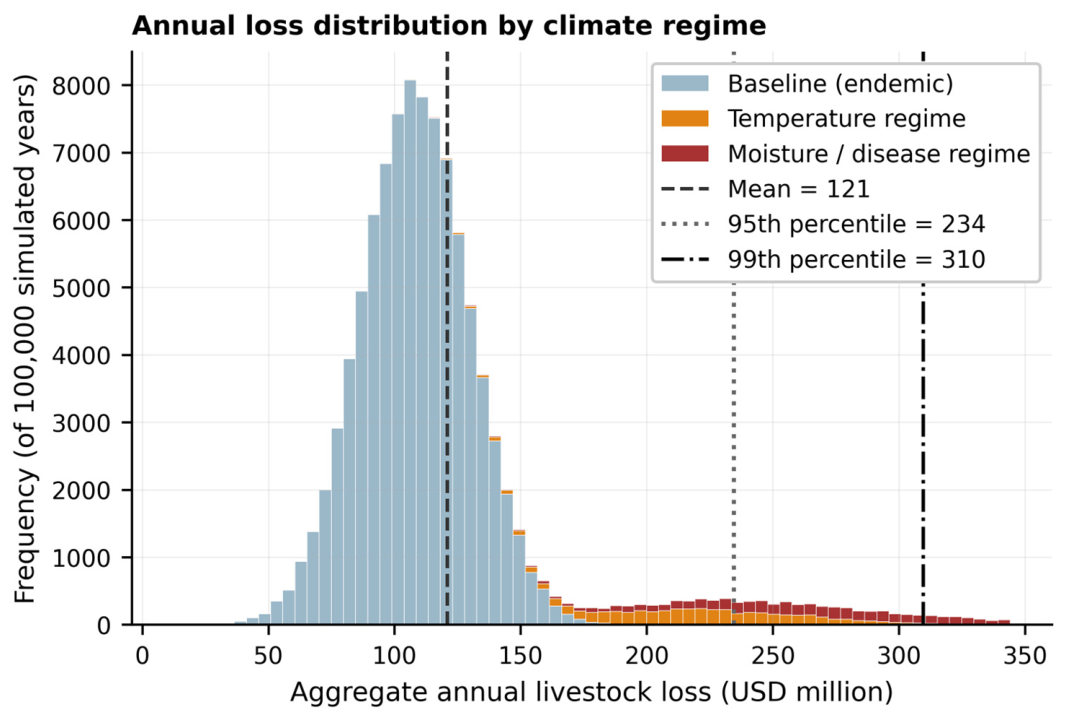
Figure 2.
Regime decomposition. Share of years, of expected loss, and of tail loss (beyond the 95th percentile) for each regime. Endemic mortality dominates the mean; the climate regimes dominate the tail.
Figure 2.
Regime decomposition. Share of years, of expected loss, and of tail loss (beyond the 95th percentile) for each regime. Endemic mortality dominates the mean; the climate regimes dominate the tail.
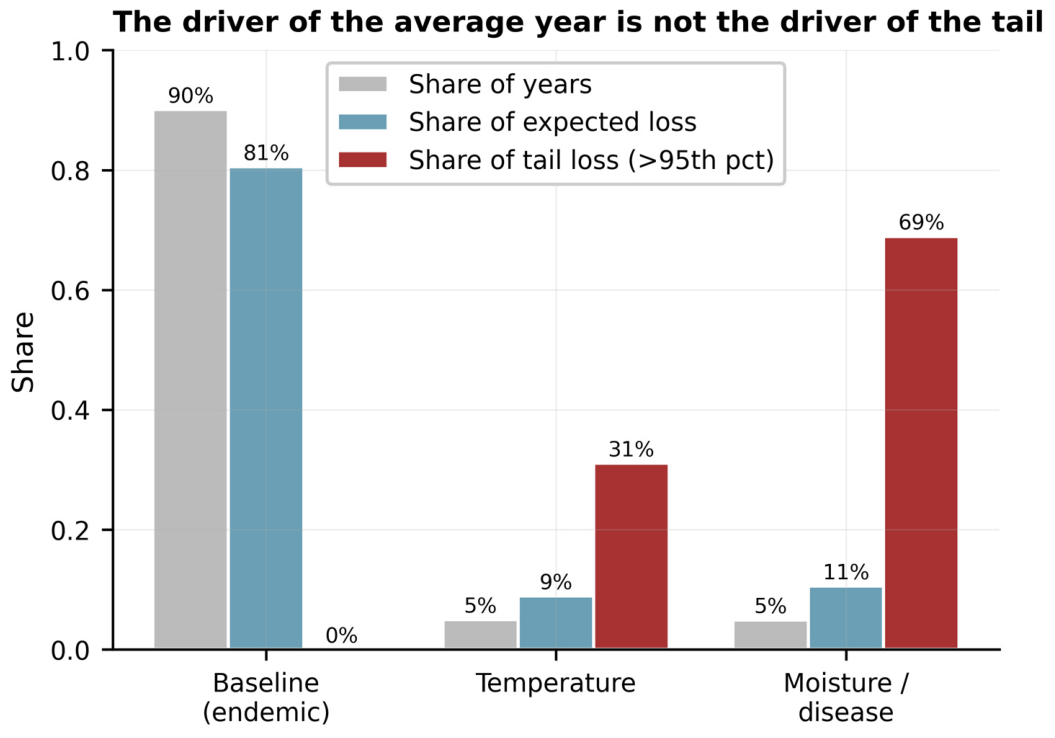
Figure 3.
Tornado sensitivity of the 99th-percentile annual loss to the elevated-regime parameters. The moisture- and disease-regime severity dominates.
Figure 3.
Tornado sensitivity of the 99th-percentile annual loss to the elevated-regime parameters. The moisture- and disease-regime severity dominates.
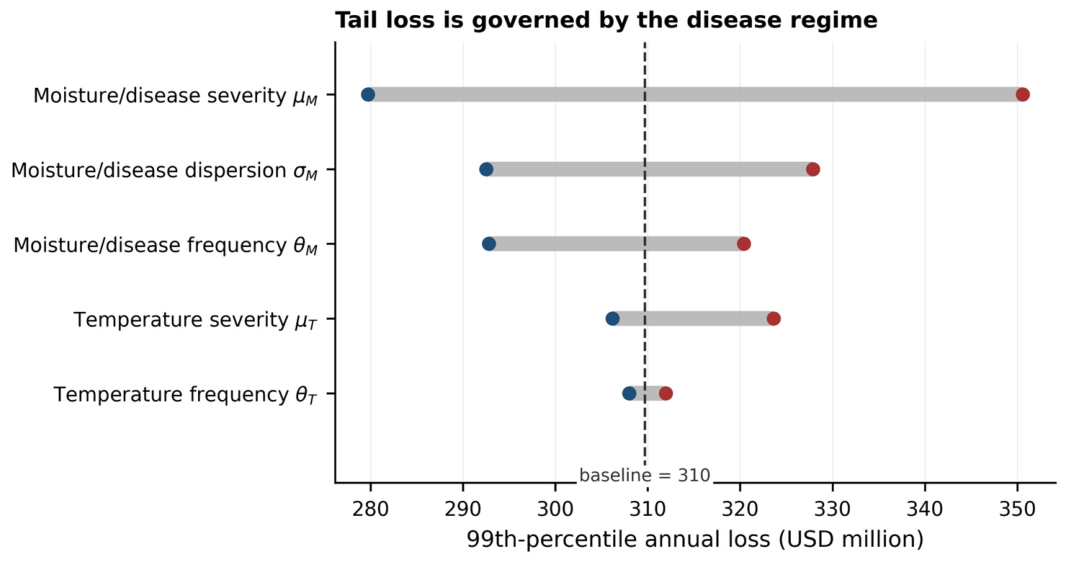
Figure 4.
Land-carrying-capacity pressure index over the coverage-subsidy grid. Values above one indicate stocking pressure above the sustainable benchmark.
Figure 4.
Land-carrying-capacity pressure index over the coverage-subsidy grid. Values above one indicate stocking pressure above the sustainable benchmark.
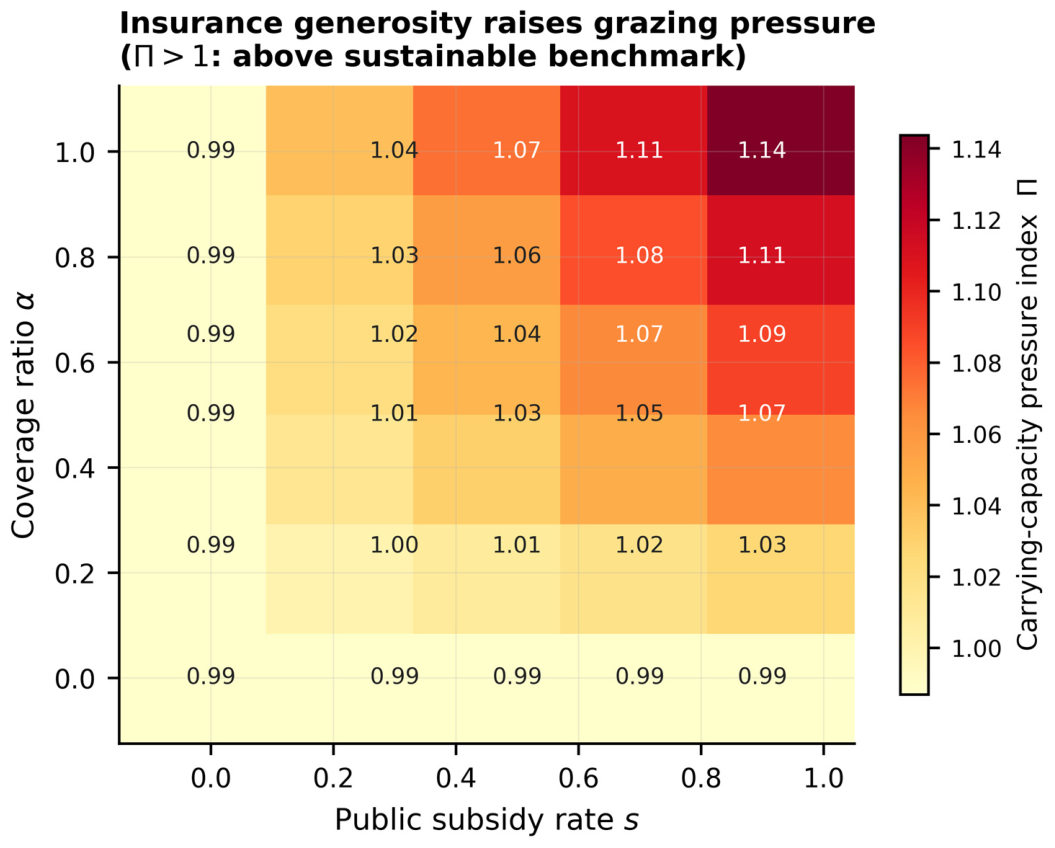
Figure 5.
Post-shock herd-rebuild trajectories. The uninsured path settles at the sustainable benchmark; generous insurance sustains stocking above it. Trajectories are illustrative, scaled to the carrying-capacity benchmark.
Figure 5.
Post-shock herd-rebuild trajectories. The uninsured path settles at the sustainable benchmark; generous insurance sustains stocking above it. Trajectories are illustrative, scaled to the carrying-capacity benchmark.
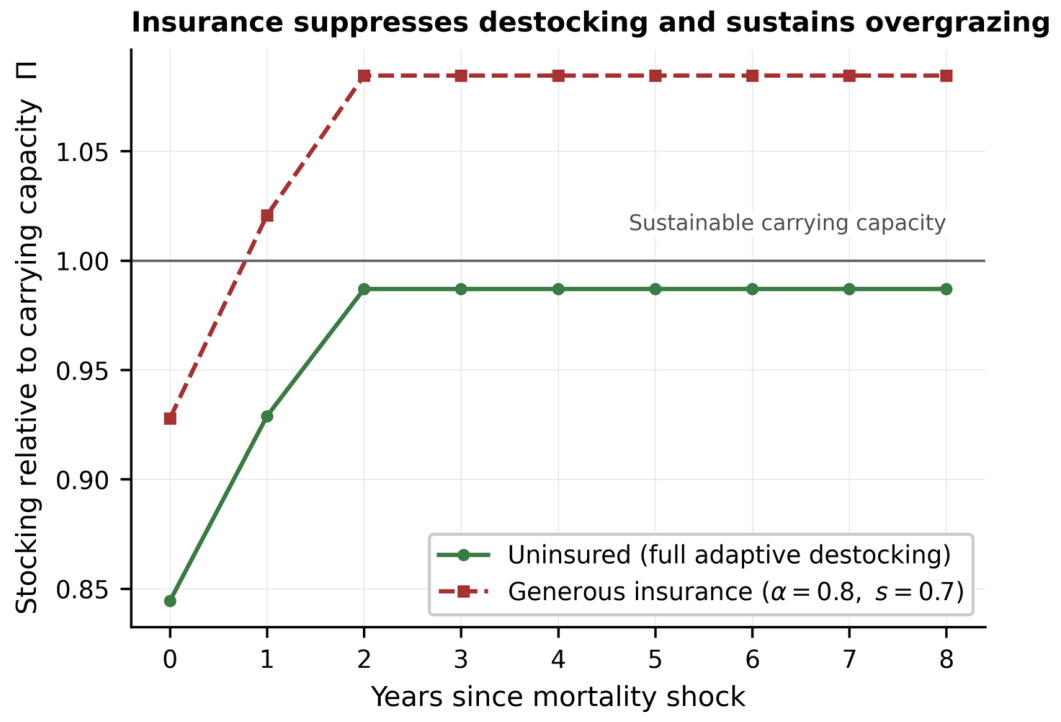
Table 1.
Environmental drivers, mortality regimes, and supporting evidence.
| Environmental driver | Mechanism for livestock loss | Mortality regime | Representative evidence |
| Heat and cold extremes | Thermoregulatory and metabolic failure; rising heatwave exposure; cold-snap kills | Temperature (T) | Belhadj Slimen et al. [7]; Thornton et al. [8]; Schuck-Paim et al. [30]; Hasan et al. [28]; Gayari et al. [29]; Malek and See [9]; Khounsy et al. [10] |
| Flooding and vector-borne disease | Clustered, correlated outbreak mortality (FMD, LSD, HS) | Moisture and disease (M) | Madin [11]; Smith et al. [12]; Aslam and Alkheraije [13]; Brito et al. [14]; Bin-Tarif et al. [15]; Wilhelm and Ward [16]; Sudhakar et al. [17]; World Organisation for Animal Health [18] |
| Endemic background | Routine, near-independent mortality | Baseline (B) | Boyd, Pai and Porth [19]; Pai, Boyd and Porth [20] |
| Insurance behavior | Destocking suppression; raised grazing pressure | Carrying-capacity layer | John et al. [25]; Gehring and Schaudt [26]; Bulte and Lensink [27]; Hänke and Barkmann [60] |
Table 2.
Climate-state mortality calibration.
| Parameter | Symbol | Value | Provenance |
|---|---|---|---|
| Baseline mortality | 0.100 | calibrated (project) | |
| Baseline dispersion | 0.020 | calibrated (project) | |
| Temperature regime mean | 0.200 | calibrated, anchored in heat- and cold-stress evidence | |
| Temperature regime dispersion | 0.040 | calibrated | |
| Temperature regime probability | 0.050 | calibrated, anchored in heatwave-exposure projections | |
| Moisture/disease regime mean | 0.240 | calibrated, anchored in outbreak evidence | |
| Moisture/disease regime dispersion | 0.050 | calibrated | |
| Moisture/disease regime probability | 0.050 | calibrated, anchored in outbreak frequency | |
| Baseline destocking fraction | 0.150 | stylized | |
| Insurance suppression strength | 1.000 | stylized | |
| Monte Carlo iterations | 100,000 | fixed seed for reproducibility (20260613) |
Disclaimer/Publisher’s Note: The statements, opinions and data contained in all publications are solely those of the individual author(s) and contributor(s) and not of MDPI and/or the editor(s). MDPI and/or the editor(s) disclaim responsibility for any injury to people or property resulting from any ideas, methods, instructions or products referred to in the content. |
© 2026 by the authors. Licensee MDPI, Basel, Switzerland. This article is an open access article distributed under the terms and conditions of the Creative Commons Attribution (CC BY) license (http://creativecommons.org/licenses/by/4.0/).
Copyright: This open access article is published under a Creative Commons CC BY 4.0 license, which permit the free download, distribution, and reuse, provided that the author and preprint are cited in any reuse.


