

Submitted:
15 June 2026
Posted:
16 June 2026
You are already at the latest version
Abstract
Introduction: The optimal surgical approach for elderly bladder cancer patients remains controversial. We compared perioperative morbidity and short-term outcomes in patients aged ≥75 years undergoing open radical cystectomy (ORC) versus robotic-assisted radical cystectomy (RARC). Methods: A retrospective, multicenter cohort study was performed including 179 patients aged ≥75 years, of whom 101 underwent RARC between 2021 and 2025, and 78 underwent ORC between 2016 and 2020. After 1:1 propensity score matching, 138 patients were analyzed to assess perioperative complications and oncological outcomes, adjusting for age, body mass index (BMI), pathological stage, comorbidities, prior chemotherapy, and type of urinary diversion. Perioperative complications and oncological outcomes were subsequently compared between the two groups. Results: Following propensity score matching, RARC was associated with longer operative time (332 vs. 247 min; p< 0.001) but resulted in significantly lower blood loss (310 vs. 743 mL; p< 0.001), reduced transfusion rates, shorter length of hospital stay (p< 0.001), and fewer overall intraoperative complications (8.7% vs. 18.8%; p=0.04). Patients undergoing RARC also experienced lower rates of any complications (43.4% vs. 62.3%; p=0.02), major complications (Clavien–Dindo III–V: 11.6% vs. 27.5%; p=0.03), and postoperative mortality (1.4% vs. 2.9%; p< 0.001) compared with ORC. In multivariate analysis, surgical approach independently predicted major complications, with RARC conferring a significantly lower risk (OR 0.75; 95% CI 0.51–0.88; p=0.04). Analysis of the learning curve showed a significant reduction in major complications over time for RARC (OR 0.68; 95% CI 0.53–0.93; p=0.01) but not for ORC. Conclusion: RARC offers superior perioperative outcomes, including reduced blood loss, shorter hospitalization, and lower rates of major complications, without compromising oncological control. These data support RARC as a safe and effective option for elderly patients undergoing radical cystectomy.
Keywords:
postoperative morbidity
; radical cystectomy
; advanced age
; short-term outcomes
1. Introduction
Bladder cancer (BCa) is the tenth most common cancer worldwide. In 2020, there were approximately 573 thousand new cases and over 212 thousand deaths globally. It predominantly affects men, with incidence rates up to four times higher than in women [1]. The average age at which BCa is diagnosed is 73 years, which is higher than the overall average age at which cancers are diagnosed, which is 65 years. [2]. The incidence of BCa increases with age; in the United States, approximately 90% of cases are diagnosed in individuals over the age of 55, with about 80% occurring in those aged 65 and older [3]. Given the strong association between age and BCa incidence, the disease is expected to represent an increasing public health challenge in the coming decades, particularly in the context of population aging and demographic expansion [4]. According to evidence-based guidelines, radical cystectomy (RC) with urinary diversion remains the gold standard treatment for muscle-invasive or high-risk non–muscle-invasive BCa [5,6]. RC is a complex surgical procedure and is associated with substantial postoperative morbidity, with overall complication rates reported to range from approximately 30% to 80% within 90 days after surgery [7,8]. Unfortunately, there is a paucity of evidence-based guidelines for the short- and long-term management of BCa in geriatric patients. Those over 75 years of age frequently present with multiple comorbidities, placing them at an even higher risk of complications and mortality. In geriatric patients with bladder cancer, there is frequently a high degree of uncertainty in treatment decision-making, leading many clinicians to choose conservative or palliative approaches such as transurethral resection of the bladder tumor (TURBT) rather than curative therapies. Several studies have reported that older patients more often receive less aggressive interventions and are under-represented in curative treatment groups [9]. Previous studies have shown that traditional ORC is associated with prolonged postoperative recovery and a higher risk of both morbidity and mortality [10,11,12,13]. Especially older patients with significant comorbidities are particularly disadvantaged. Studies have reported 90-day postoperative mortality rates of approximately 7–11% for patients aged 75–80 years, as well as an increased risk of complications compared with younger cohorts, with elderly patients also demonstrating significantly higher mortality at one year after RC [14]. Therefore, it is very important to evaluate a different approach to minimise the perioperative morbidity and mortality in geriatric patients. The rapid advancement of minimally invasive surgery with the establishment of RARC in recent years has resulted in faster recovery, reduced hospital stays and morbidity, prompt return to routine activities, and preservation of functional and oncological outcomes [15,16,17].
Given the increasing life expectancy, the rising incidence of BCa, and the paucity of trials comparing RARC with ORC in geriatric patients, there is a need for controlled data on the oncological risks and benefits. The aim of this study was to evaluate the outcomes of geriatric patients undergoing RARC compared with the current standard of care, ORC.
2. Materials and Methods
We conducted a retrospective, observational analysis of two institutional databases including patients aged ≥75 years diagnosed with bladder cancer. Only cases with complete records for preoperative characteristics, surgical details, pathological findings, and 30-day perioperative outcomes were included. Overall, perioperative outcomes of 179 consecutive patients were analyzed: 101 RARC between 2021 and 2025, and 78 underwent ORC between 2016 and 2020. The study was conducted in accordance with the Declaration of Helsinki. Ethical approval was granted by the Ethics Committee of the Westphalia-Lippe Medical Association (protocol no. 2022-764-f-S; approval date: 26 January 2023).
All patients received one of three urinary diversion options: ileal conduit, ureterostomy, or orthotopic neobladder. Decisions regarding urinary diversion were primarily based on the patient’s physical condition and informed consent. Preoperative risk assessment was performed according to the American Society of Anesthesiologists (ASA) classification, and common comorbidities as well as preoperative tumor staging were recorded. Baseline demographic and clinical characteristics, stratified by surgical approach (RARC vs. ORC) and patient factors (age, BMI, ASA, pathological stage), are summarized in Table 1.
The primary outcome measures were oncological outcomes, PSM, and early postoperative complications within 90 days, graded according to the Clavien-Dindo Classification (CDC) [17]. Complications were categorized as minor (<IIIa) or major (≥IIIa).
Secondary outcomes included operative variables, such as operative time, estimated blood loss (EBL), transfusion rates, and individual complication rates. Additional perioperative outcomes analyzed were time to oral intake, time to exsufflation, time to catheter removal, and length of postoperative hospital and intensive care stay. Pathological tumor stage and grade were determined according to the 2004 TNM classification and the World Health Organization (WHO) grading system, respectively [18].
Patients who underwent partial bladder resections or had a history of pelvic radiotherapy were excluded. Those with incomplete records or insufficient follow-up were also excluded (n = 11). Due to the retrospective design, some patient data were unavailable for the entire cohort; consequently, certain analyses were conducted on smaller subsets of patients.
3. Statistical Data Evaluation
Data were independently reviewed for internal consistency by two investigators. Baseline characteristics of patients undergoing ORC and RARC were first compared. Categorical variables were analyzed using Pearson’s chi-squared test, and continuous variables were compared using the Mann–Whitney U test. Continuous variables (e.g., age, BMI) are presented as medians with interquartile ranges (IQRs), and categorical variables (e.g., gender, ASA score, Charlson comorbidity index, comorbidities, operative time, pathological T stage, lymph node dissection, positive surgical margins, type of urinary diversion, and complications) are reported as frequencies and percentages.
To account for potential selection bias, observed differences in baseline characteristics between ORC and RARC patients were addressed using propensity score (PS) matching. A logistic regression PS model was constructed for surgical approach (ORC vs. RARC), including age, BMI, ASA score, prior surgery or radiotherapy, and clinical T- and N-stage. Given inherent baseline differences between groups, a 1:1 PS-matched analysis was performed to adjust for these variables. Propensity score matching mitigates bias typically associated with conventional multivariable modeling.
Finally, logistic regression analyses were used to assess associations between variables, and univariate and multivariate Cox proportional hazards models with a stepwise approach were applied to identify risk factors for overall mortality across surgical groups. Two-sided p-values <0.05 were considered statistically significant. All analyses were performed using SPSS v.22.0 (IBM Corp., Armonk, NY, USA) and Stata-SE 15 (StataCorp LP, College Station, TX, USA).
4. Results
Baseline Characteristics
A total of 179 patients aged 75 years or over with complete perioperative data were included in the study. Of these, 78 underwent ORC (median age 78.1 years, IQR 75–88) and 101 underwent RARC (median age 79.4 years, IQR 75–87). Baseline characteristics and perioperative outcomes, stratified by surgical approach, are detailed in Table 1.
The overall burden of severe comorbidity was modest, with only a minority of patients presenting with a Charlson Comorbidity Index (CCI) of at least 3 or ASA score of at least 3. The most prevalent comorbid conditions were coronary artery disease (n = 138; 77.1%), hypertension (n = 121; 67.6%), diabetes mellitus (n = 70; 39.1%), chronic kidney disease (n = 36; 20.1%) and chronic obstructive pulmonary disease (n = 31; 17.3%). Notably, over half of the patients (n = 98; 54.7%) required perioperative bridging of chronic anticoagulation, underscoring the clinical complexity of this population. The proportion of patients with prior abdominal surgery and/or chemotherapy was comparable between groups before matching (31.7–28.2%; p = 0.74) and identical after matching (31.9% in each group). Prior to matching, the RARC group had a significantly higher proportion of ASA Class III patients (65.3% vs. 34.6%; p < 0.05); propensity score matching achieved balance in ASA class distribution between groups.
Primary Outcomes
With respect to perioperative outcomes, significant differences between groups were observed for operative time and estimated blood loss (EBL). RARC patients had a longer operative time compared with the RARC group (332 vs. 247 min; p<0.001). Conversely, EBL was significantly lower in the RARC cohort (median 310 ml vs 743 ml in ORC; p<0.001). In line with this, perioperative transfusions were administered more frequently in the ORC group.
No association was found between oral anticoagulation and complication severity (χ2 test, p=0.634). Postoperatively, both serum albumin and haemoglobin levels declined significantly in both groups, with a greater reduction in haemoglobin observed following RARC.
Length of hospital stay was significantly shorter in the RARC group (p<0.001). No between-group differences were detected regarding urinary diversion, pathological outcomes, PSM. Preoperative characteristics of the overall cohort are summarized in Table 2.
Secondary Outcomes
Intraoperative complications occurred less frequently in the RARC group than in the ORC group (8.7% vs. 18.8%; p=0.04). Likewise, the overall rate of postoperative complications within 90 days of any Clavien–Dindo classification (CDC) grade was lower following RARC (43.74% vs. 62.3%; p=0.02).

Table 3.
Postoperative outcomes, Frequency of Minor and Major Complications in the Matched Cohort (n =.138)
Table 3.
Postoperative outcomes, Frequency of Minor and Major Complications in the Matched Cohort (n =.138)
| Variable After Propensity Matching | ORC (n = 69) | RARC (n = 69) | p-Value |
|---|---|---|---|
|
Intraoperative complications[no. (%)] no yes |
56 (81,2) 13 (18.8) |
63 (91.3) 6 (8.7) |
0.04 |
|
Surg. complications (CDC) 90 days [no. (%)] no I II IIIa IIIb IV V |
26 (37.7) 5 (7.2) 19 (27.5) 8 (11.5) 7 (10.1) 2 (2.9) 2 (2.9) |
39 (56.5) 6 (8.7) 16 (23.2) 4 (5.8) 2 (2.9) 1 (1.4) 1 (1.4) |
0.008 |
|
Complications 90 days infection ileus wound dehiscence bleeding Thromboembolic events Cardiopulmonary complications |
12 (28) 10 (23.3) 8 (18.6) 4 (9.3) 3 (7) 6 (13.9) |
13 (43.3) 6 (20) 7 (23.3) 1 (3.3) 1 (3.3) 2 (6.6) |
0.02 |
| Total complications, n (%) | 43 (62.3) | 30 (43.4) | 0.02 |
|
Major complications (III–V), n (%) |
19 (27.5) | 8 (11.6) | 0.03 |
Abbreviations: Pts: patients; IQR: interquartile ranges, CDC: surg. complications according to clavien dindo classification. Percentages have been rounded and may not add up to 100.
A significant reduction in major complications (Clavien–Dindo III–V) within 90 days was observed with RARC compared to ORC for the primary endpoint (11.6% vs. 27.5%; p=0.03) (Figure 1). Postoperative mortality (Clavien–Dindo class V) was also lower in the RARC group (1.4% vs. 2.9%; p < 0.001). The most frequent complications in both groups were wound dehiscence, infectious events and postoperative ileus (Table 4). Univariate and multivariate logistic regression analyses identified surgical approach as an independent predictor of major complications within 90 days (p<0.001), whereas sex, BMI, ASA score, operative time, CCI, and tumour grade showed no significant association. In multivariate analysis, surgical approach independently predicted major complications, with RARC conferring a significantly lower risk (OR 0.75; 95% CI 0.51–0.88; p=0.04) (Figure 2). No significant differences in morbidity or mortality were observed between continent and incontinent urinary diversions.
Sensitivity Analyses
Supplementary sensitivity analyses were performed to assess the robustness of the primary endpoints and to explore potential sources of bias. To evaluate the potential influence of the learning curve on postoperative complications, we compared the incidence of CD grade III or higher between the years 2016–2020 and 2021–2025. No significant difference was observed in the ORC cohort (OR 1.77, 95% CI 1.12–1.95; P = 0.44), whereas a significant reduction was noted in the RARC cohort (OR 0.68, 95% CI 0.53–0.93; P = 0.01).
5. Discussion
With ongoing population ageing, the incidence of BCa among older adults is projected to rise, thereby further increasing the burden on healthcare systems [21]. Consequently, optimizing the management of geriatric patients with invasive BCa has become increasingly important. Elderly patients with muscle-invasive or high-risk non–muscle-invasive disease requiring RC represent a particularly vulnerable population, as they frequently present with a substantial comorbidity burden and an inherently elevated risk of postoperative complications and mortality [14,22,23].
Comorbidity and BMI as Predictors of Postoperative Risk
Comorbidity burden—most commonly assessed using the CCI has consistently been shown to correlate with postoperative mortality following RC [24] and is widely recognized as a key predictor of complications and adverse outcomes [25]. Using a standardized methodology, Roghmann et al. further demonstrated that both CCI and BMI are significant risk factors for major complications [13]. Consistent with prior reports linking elevated BMI to wound-related complications, including surgical site infection and wound dehiscence [16,27], our findings confirm BMI as an independent predictor of these complications in patients undergoing ORC.
Importantly, our comparative analysis of RARC and ORC in patients aged ≥75 years reveals a differential impact of established risk factors between surgical approaches. While higher comorbidity burden (CCI ≥3) and impaired physical status (ASA ≥3) were significantly associated with both overall and major complications in the ORC cohort, these associations were not observed in patients undergoing RARC. Despite the higher prevalence of comorbidities in geriatric patients, RARC was associated with a significant attenuation of postoperative risk compared with ORC. Collectively, these findings suggest that although comorbidity burden remains a critical determinant of surgical risk in elderly patients, its impact may be mitigated by minimally invasive approaches such as RARC.
Complication Profile
The complication rate following RC has been the focus of several retrospective series [30,34,35]. Consistent with these reports, the overall rate of high-grade complications was significantly higher for ORC compared with RARC, although the absolute difference narrowed in subanalyses restricted to high-grade events. In our elderly cohort, RARC was associated with a significantly lower rate of high-grade complications than ORC, suggesting relative advantages in postoperative rehabilitation. This benefit extended across the distribution of complication grades and 30-day mortality, indicating a clinically meaningful reduction in early postoperative risk for older patients. Several limitations of this study should be acknowledged. Firstly, the retrospective design relied on follow-up to obtain survival data, which may have limited the accuracy of information regarding the precise timing of recurrence and death. Secondly, the sample size was relatively small, so it is possible that some patients over 75 years old, particularly those in poorer physical condition, were not considered candidates for such a major procedure. Consequently, our findings may primarily reflect the outcomes of older patients with relatively preserved functional status and a more favourable baseline health profile. Thirdly, the retrospective nature of the study precluded an assessment of postoperative quality of life. Future prospective, randomised studies incorporating age, comorbidity burden and urinary diversion stratification, along with long-term follow-up, are needed to evaluate the impact of RARC on elderly patients more definitively.
6. Conclusions
In this retrospective analysis, RARC was associated with a significantly lower overall complication rate compared with ORC in elderly patients. The robotic approach conferred marked reductions in intraoperative blood loss and length of hospital stay, reflecting a more favorable perioperative profile. Furthermore, higher comorbidity burden (CCI ≥3) and impaired physical status (ASA ≥3) retained predictive value for postoperative complications and short-term survival in the ORC cohort, but not in RARC patients. Overall, these findings indicate that RARC is a safe and effective surgical strategy for muscle-invasive or high-risk non–muscle-invasive BCa in geriatric patients, offering reduced intra- and postoperative risk and accelerated recovery relative to ORC.
Supplementary Materials
The following supporting information can be downloaded at the website of this paper posted on Preprints.org
Author Contributions
Sameh Hijazi and Ahmad Gaafar had full access to all the data in the study and takes responsibility for the integrity of the data and Bara Barakat had full access to the accuracy of the data analysis. Manuscript writing/editing: Bara Barakat, Ahmad Gaafar; Protocol/project development: Bara Barakat; Data collection or management: Sameh Hijazi, Ahmad Gaafar; Drafting of the manuscript: Bara Barakat, Joerg Bauer, Mahmoud Sayed, Raed Hakoub, Nico Adamini; Critical revision of the manuscript: Joerg Bauer, Mahmoud Sayed, Raed Hakoub, Nico Adamini; Administrative, technical, and material support: Bara Barakat, Mahmoud Sayed, Nico Adamini; Supervision: Sameh Hijazi, Ahmad Gaafar; Obtaining funding: None; Other (specify): None.
Funding
None.
Institutional Review Board Statement
All procedures performed in studies involving human participants were in accordance with the ethical standards of the institutional research committee and with the 1964 Helsinki declaration and its later amendments or comparable ethical standards. This article does not contain any studies with animals performed by any of the authors.
Financial disclosures
I certify that all conflicts of interest, including specific financial interests and relationships and affiliations relevant to the subject matter or materials discussed in the manuscript (eg: employment/ affiliation, grants or funding, consultancies, honoraria, stock ownership or options, expert testimony, royalties, or patents filed, received, or pending), are the following: None.
Conflicts of Interest
The authors declare that they have no relevant conflict of interest.
Abbreviations
Bladder cancer (BCa), radical cystectomy (RC), open radical cystectomy (ORC), robotic-assisted radical cystectomy (RARC), American Society of Anesthesiologists (ASA), Clavien– Dindo classification (CDC), estimated blood loss (EBL), interquartile ranges (IQRs), body mass index (BMI), Charlson Comorbidity Index (CCI), positive surgical margins (PSM).
References
- Sung, H.; Ferlay, J.; Siegel, R.L.; et al. Global cancer statistics 2020: GLOBOCAN estimates of incidence and mortality worldwide for 36 cancers in 185 countries. CA A Cancer J. Clin. 2021, 71, 209–249. [Google Scholar] [CrossRef]
- Cao, C.; Friedenreich, C.M.; Yang, L. Association of daily sitting time and leisure-time physical activity with survival among US cancer survivors. JAMA Oncol. 2022, 8, 395–403. [Google Scholar] [CrossRef] [PubMed]
- Siegel, R.L.; Miller, K.D.; Jemal, A. Cancer statistics. CA Cancer J. Clin. 2019, 69, 7–34. [Google Scholar] [CrossRef] [PubMed]
- Wéber, A.; Vigant, J.; Shah, R.; Morgan, E.; Laversanne, M.; Nagy, P.; Kenessev, I.; Znaor, A. Global burden of bladder cancer mortality in 2020 and 2040 according to GLOBOCAN estimates. 2024, 42(1), 237. [Google Scholar] [CrossRef] [PubMed]
- Alfred Witjes, J.; Lebret, T.; Compérat, E.M.; Cowan, N.C.; De Santis, M.; Bruins, H.M.; Hernández, V.; Espinós, E.L.; Dunn, J.; Rouanne, M.; Neuzillet, Y.; Veskimäe, E.; van der Heijden, A.G.; Gakis, G.; Ribal, M.J. Updated 2016 EAU guidelines on muscle- invasive and metastatic bladder Cancer. Eur. Urol. 2017, 71, 462–75. [Google Scholar] [CrossRef] [PubMed]
- Chang, S.S.; Bochner, B.H.; Chou, R.; et al. Treatment of non-metastatic muscle-invasive bladder cancer: AUA/ASCO/ASTRO/SUO guideline. J. Urol. 2017, 198, 552–559. [Google Scholar] [CrossRef] [PubMed]
- Maibom, S.; Joensen, U.; Poulsen, A.; Kehlert, H.; Brasso, K.; Røder, M. Short-term morbidity and mortality following radical cystectomy: a systematic review. 2021, 11(4), e043266. [Google Scholar] [CrossRef] [PubMed]
- Musch, M.; Janowski, M.; Steves, A.; Roggenbuck, U.; Boergers, A.; Davoudi, Y.; Loewen, H.; Groeben, H.; Kroepfl, D. Comparison of early postoperative morbidity after robot-assisted and open radical cystectomy: results of a prospective observational study. BJU Int. 2014, 113, 458–67. [Google Scholar] [PubMed]
- Carrion, A.; Huguet, J.; Ribal, M.; Domínguez, A.; Bonet, X.; Morote, J.; et al. Comparison of standard vs. palliative management for bladder cancer in patients older than 85 years: multicenter study of 317 de novo tumors. Urol. Oncol. 2020, 38(2), 40.e9–40.e15. [Google Scholar] [CrossRef] [PubMed]
- Xie, S.; Zhao, Z.; Feng, B.; et al. A comparative study of perioperative and survival outcomes of robot-assisted radical cystectomy in patients over 80 and under 80 years old. World J. Surg. Oncol. 2021, 19, 202. [Google Scholar] [CrossRef] [PubMed]
- Vetterlein, M.; Klemm, J.; Gild, Ph; Bradtke; Soave, A.; Dahlem, R.; Fisch, M.; Rink, M. Improving Estimates of Perioperative Morbidity After Radical Cystectomy Using the European Association of Urology Quality Criteria for Standardized Reporting and Introducing the Comprehensive Complication Index. Eur. Urol. 2020, 77(1), 55–65. [Google Scholar] [CrossRef] [PubMed]
- Svatek, R.S.; Fisher, M.B.; Matin, S.F.; et al. Risk factor analysis in a contemporary cystectomy cohort using standardized reporting methodology and adverse event criteria. J. Urol. 2010, 183, 929–934. [Google Scholar] [CrossRef] [PubMed]
- Roghmann, F.; Trinh, Q.D.; Braun, K.; et al. Standardized assessment of complications in a contemporary series of European patients undergoing radical cystectomy. Int. J. Urol. 2014, 21, 143–149. [Google Scholar] [PubMed]
- Tempo, J.; Felemban, S.; Qin, K.R.; Perera, M.; Ischia, J.; Bolton, D.; Murphy, D.G.; Kelly, B.; Watson, D.I.; O’Callaghan, M. Radical cystectomy mortality in older patients: a systematic review and metaanalysis. BJU Int. 2025, 136(1), 19–31. [Google Scholar] [CrossRef] [PubMed]
- Maibom, S.L.; Joensen, U. N.; Poulsen, A. M.; Kehlet, H.; Brasso, K.; Røder, M. Short-term morbidity and mortality following radical cystectomy: a systematic review. BMJ Open. 2021, 11(4), 043266. [Google Scholar] [CrossRef]
- Sathianathen, N.J.; Kalapara, A.; Frydenberg, M.; et al. Robotic-assisted radical cystectomy vs open radical cystectomy: systematic review and meta-analysis. J. Urol. 2019, 201 715–720. [Google Scholar] [PubMed]
- Soria, F.; Moschini, M.; D’Andrea, D.; et al. Comparative effectiveness in perioperative outcomes of robotic versus open radical cystectomy results from a multicenter contemporary retrospective cohort study. Eur. Urol. Focus 2020, 6, 1233–1239. [Google Scholar] [CrossRef] [PubMed]
- Dindo, D.; Demartines, N.; Clavien, P.A. Classification of surgical compli- cations: a new proposal with evaluation in a cohort of 6336 patients and results of a survey. Ann. Surg. 2004, 240, 205–213. [Google Scholar] [CrossRef] [PubMed]
- Sobin, L.H.; Gospodariwicz, M.; Wittekind, C. TNM classification of malignant tumors. In UICC International Union Against Cancer, 7th ed; Wiley- Blackwell, 2009; pp. 262–265. [Google Scholar]
- Eble, J.N.; Sauter, G.; Epstein, Jl; Sesterhenn, I. WHO classification of classification of tumours of the urinary system and male genital organs; IARCC Press: Lyon, 2004; pp. 29–34. [Google Scholar]
- Zhang, W.; Wei, Q.; Han, X.; Zheng, X.; Zhang, P. Global, regional, and national burdens of bladder cancer in individuals aged 60 years and older from 1990 to 2021: a cross-sectional study. Int. Urol. Nephrol. 2025. [Google Scholar] [CrossRef] [PubMed]
- Duwe, G.; Wagner, I.; Banasiewicz, K.; Frey, L.; Fischer, N.; Höfner, T. Radical cystectomy in patients aged <80 years versus ≥ 80 years: analysis of preoperative geriatric assessment scores in predicting postoperative morbidity and mortality. World J. Urol. 2024, 42(1), 552. [Google Scholar] [CrossRef] [PubMed]
- Fonteyne, V.; Rammant, E.; Decaestecker, K. Predicting perioperative mortality after radical cystectomy: comorbidity assessment tools are only part of the puzzle. Transl. Androl. Urol. 2019, 8(6), 781–784. [Google Scholar] [CrossRef] [PubMed]
- McFerrin, C.; Raza, S.; May, A.; Davaro, F.; Siddiqui, S.; Hamilton, Z. Charlson comorbidity score is associated with readmission to the index operative hospital after radical cystectomy and correlates with 90-day mortality risk. Int. Urol. Nephrol. 2019, 51(10), 1755–1762. [Google Scholar] [CrossRef] [PubMed]
- Maibom, S.; Joensen, U.; Poulsen, A.; Kehlet, H.; Brasso, K.; Røder, M. Short-term morbidity and mortality following radical cystectomy: a systematic review BMJ Open. 2021, 11(4), e043266. [Google Scholar] [CrossRef] [PubMed]
- Nasrallah, A.; Mansour, M.; Abou Heidar, N.; Ayoub, Ch; Najdi, J.; Tamim, H.; El Hajj, A. Risk factors for wound dehiscence following radical cystectomy: a prediction model. Ther. Adv. Urol. 2021, 13, 175. [Google Scholar] [CrossRef]
- Roberson, D.; McLeay, M.; Henning, G.; Morales-Martinez, G.; Thapa, P.; Khanna, A.; Frank, I.; Tollefson, M.; Shah, P.; Karnes, J.; Boorjian, S.; Sharma, V. The impact of prophylactic incisional negative pressure wound therapy on surgical site infection following open radical cystectomy. Urol. Oncol. 2025, 43(10), 586–593. [Google Scholar] [CrossRef] [PubMed]
- Liberman, D.; Lughezzani, G.; Sun, M.; Alasker, A.; Thuret, R.; Abdollah, F.; et al. Perioperative mortality is significantly greater in septuagenarian and octogenarian patients treated with radical cystectomy forurothelial carcinoma of the bladder. Urology 2011, 77, 660–6. [Google Scholar] [CrossRef] [PubMed]
- Bochner, B.H.; Dalbagni, G.; Marzouk, K.H.; et al. Randomized trial comparing open radical cystectomy and robot- assisted laparoscopic radical cystectomy: oncologic outcomes. Eur. Urol. 2018, 74(4), 465–471. [Google Scholar] [CrossRef] [PubMed]
- Parekh, D.J.; Reis, I.M.; Castle, E.P.; et al. Robot-assisted radical cystectomy versus open radical cystectomy in patients with bladder cancer (RAZOR): an open-label, randomised, phase 3, non-inferiority trial. Lancet 2018, 391(10139), 2525–2536. [Google Scholar] [CrossRef] [PubMed]
- Khan, M.S.; Omar, K.; Ahmed, K.; et al. Long-term oncological outcomes from an early phase randomised controlled three-arm trial of open, robotic, and laparoscopic radical cystectomy (CORAL). Eur. Urol. 2020, 77(1), 110–118. [Google Scholar] [CrossRef] [PubMed]
- Winters, B.R.; Bremjit, P.J.; Gore, J.L.; et al. Preliminary Comparative Effectiveness of Robotic Versus Open Radical Cystectomy in Elderly Patients. J. Endourol. 2016, 30, 212–7. [Google Scholar] [CrossRef] [PubMed]
- Kimura, S.; Iwata, T.; Foerster, B.; et al. Comparison of perioperative complications and health-related quality of life between robot-assisted and open radical cystectomy: a systematic review and meta-analysis. Int. J. Urol. 2019, 26(8), 760–774. [Google Scholar] [CrossRef] [PubMed]
- Khan, M.S.; Gan, C.; Ahmed, K.; et al. A single-centre early phase randomised controlled three-arm trial of open, robotic, and laparoscopic radical cystectomy (CORAL). Eur. Urol. 2016, 69(4), 613–621. [Google Scholar] [CrossRef] [PubMed]
- Richards, K.A.; Kader, A.K.; Otto, R.; Pettus, J.A.; Smith, J.J.; et al. Is robot- assisted radical cystectomy justified in the elderly? A comparison of robotic versus open radical cystectomy for bladder cancer in. J. Endourol. 2012, 26, 1301–1306. [Google Scholar] [CrossRef] [PubMed]
Figure 1.
Propensity Score- Matched Complication Analysis. ORC: open radical cystectomy; RARC: robot-assisted radical cystectomy; CDC: Clavien-Dindo classification.
Figure 1.
Propensity Score- Matched Complication Analysis. ORC: open radical cystectomy; RARC: robot-assisted radical cystectomy; CDC: Clavien-Dindo classification.
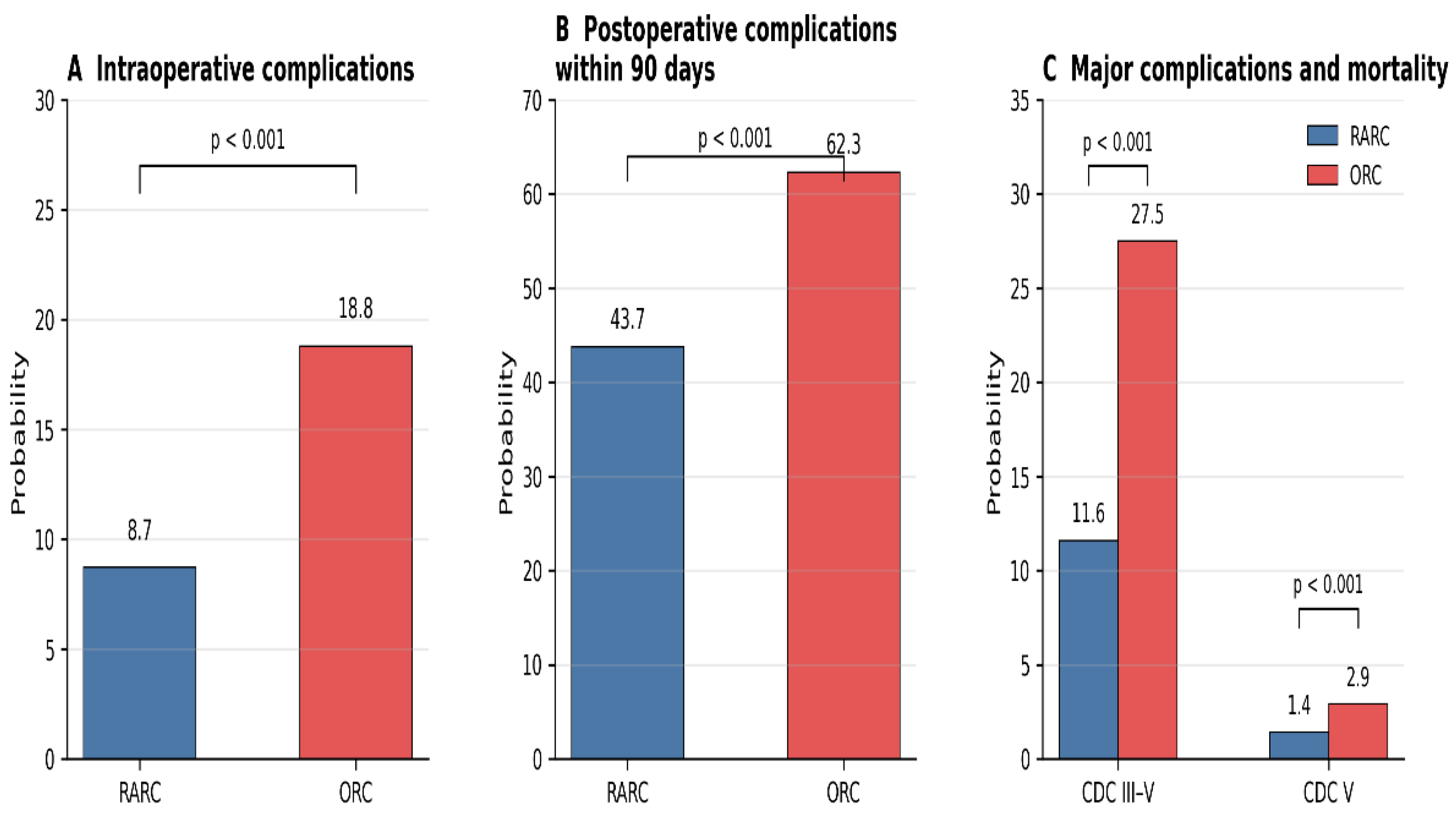
Figure 2.
Predictors of postoperative complications within 90 days, multivariable logistic regression analysis. ORC: open radical cystectomy; RARC: robot-assisted radical cystectomy; BMI: body-mass-index; ASA: American Society of Anesthesiologists.
Figure 2.
Predictors of postoperative complications within 90 days, multivariable logistic regression analysis. ORC: open radical cystectomy; RARC: robot-assisted radical cystectomy; BMI: body-mass-index; ASA: American Society of Anesthesiologists.
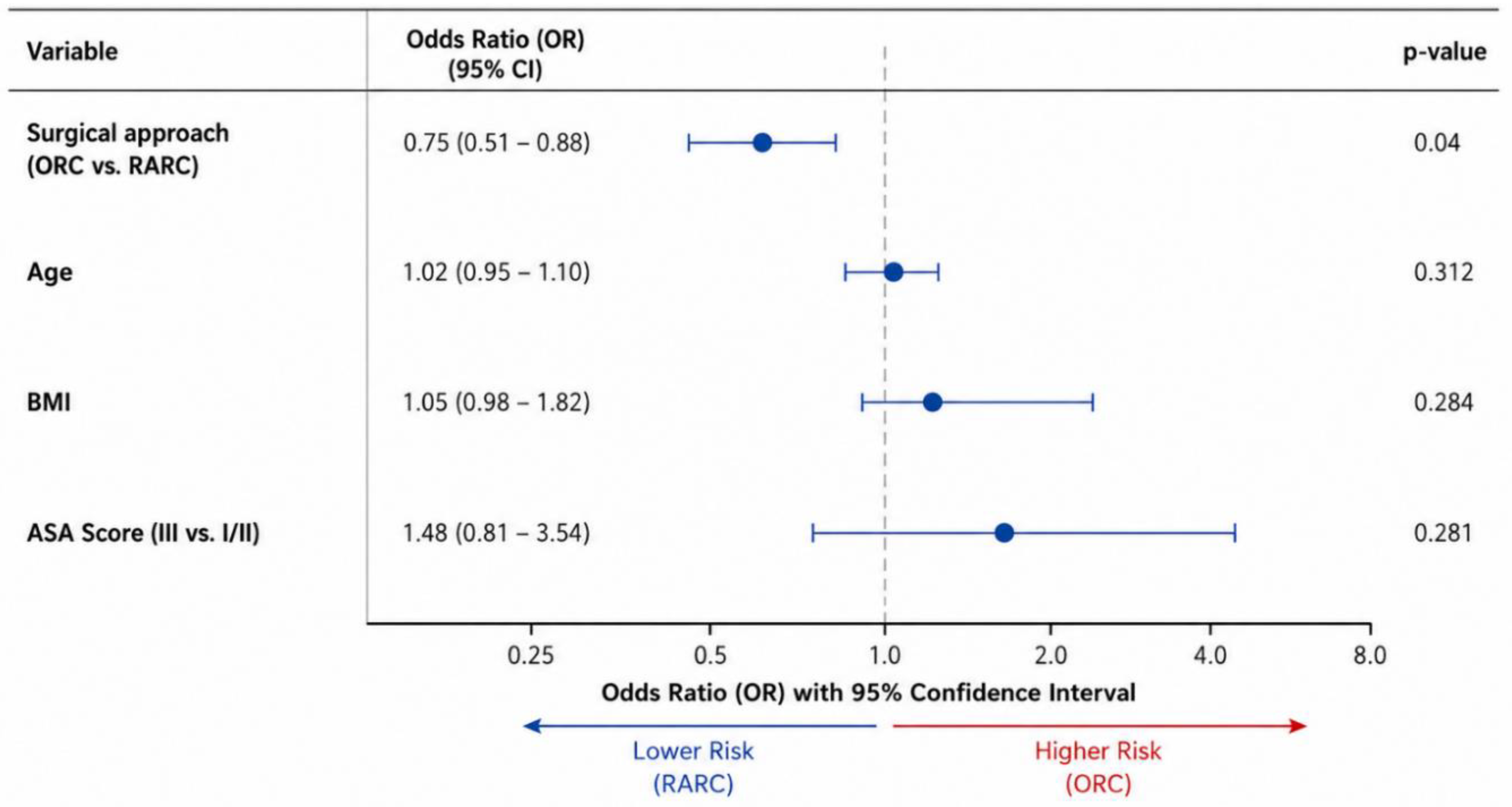
Table 1.
Baseline characteristics and clinical characteristics of all included patients before and after propensity score matching.
Table 1.
Baseline characteristics and clinical characteristics of all included patients before and after propensity score matching.
| Variable _________ Before Propensity Matching After Propensity Matching | ||||||||||
|---|---|---|---|---|---|---|---|---|---|---|
| ORC (n = 78) | RARC (n = 101) | SMD | p-Value | ORC (n = 69) | RARC (n = 69) | SMD | p-Value | |||
| Gender, n (%) | -0.08 | 0.70 | -0.04 | 0.61 | ||||||
| Male | 60 (76.9) | 75 (74.2) | 50 (72.6) | 52 (75.4) | ||||||
| Female | 18 (23.1) | 23 (25.7) | 19 (27.5) | 17 (24.6) | ||||||
| Age, median (IQR), years | 78.1 (75–88) | 79.4 (75–87) | 0.08 | 0.14 | 78.8 (75–87) | 79.0 (75–87) | 0.06 | 0.58 | ||
| BMI, Median (IQR) | 26.7 (23–33) | 26.9 (24–33) | 0.22 | 0.58 | 26.5 (24–31) | 26.5 (24–31) | 0.01 | 0.87 | ||
| ASA-Score, n (%) | 0.92 | <0.001 | 0.03 | 0.84 | ||||||
| I | 12 (15.4) | 15 (14.8) | 4 (5.8) | 4 (5.8) | ||||||
| II | 39 (50.0) | 20 (19.8) | 30 (43.5) | 30 (43.5) | ||||||
| III | 27 (34.6) | 66 (65.3) | 35 (50.7) | 35 (50.7) | ||||||
| CCI[no. (%)] | 0.84 | 0.15 | 0.02 | 0.81 | ||||||
| 3 | 32 (41) | 16 (15.8) | 13 (18.8) | 5 (7.2) | ||||||
| 4 | 37 (47.4) | 20 (19.8) | 27 (39.1) | 25 (36.2) | ||||||
| >5 | 9 (11.5) | 65 (64.3) | 29 (42.0) | 39 (56.5) | ||||||
| prior surgery or chemotherapy ᵃ, n (%) | 22 (28.2) | 32 (31.7) | 0.03 | 0.77 | 22 (31.9) | 22 (31.9) | 0.00 | 1.00 | ||
| Clinical T stage, n (%) | 0.26 | 0.06 | 0.02 | 0.78 | ||||||
| pT1+CIS | 39 (50) | 28 (27.7) | 26 (37.7) | 26 (37.7) | ||||||
| ≥ cT2 | 39 (50) | 73 (72.3) | 43 (62.3) | 43 (62.3) | ||||||
| pN+ | 7 (9) | 11 (10.9) | 5 (7.2) | 5 (7.2) | 0.00 | 1.00 | ||||
ᵃ Status following prior abdominal surgery and/or pelvic radiation therapy. Abbreviations: SMD: standardized mean difference, IQR: interquartile range, ORC: open radical cystectomy, RARC: robot-assisted radical cystectomy, CCI: Charlson Comorbidity Index, ASA: American Society of Anesthesiologists, BMI: body-mass-index (calculated as weight in kilograms divided by height in metres squared). Percentages have been rounded and may not add up to 100.
Table 2.
Intra- and postoperative outcomes and type of urinary diversion in the matched cohort (n=138).
Table 2.
Intra- and postoperative outcomes and type of urinary diversion in the matched cohort (n=138).
| Variable After Propensity Matching | ORC (n = 69) | RARC (n = 69) | p-Value |
|---|---|---|---|
| OP time[min],median (IQR) | 247 (181-297) | 332 (302- 389) | <0.001 |
| EBL [ml],median (IQR) | 743 (435-987) | 310 (224-455) | <0.001 |
|
Anticoagulants[no. (%)] No Yes |
41 (59.4) 28 (40.6) |
39 (56.5) 30 (43.5) |
0.87 |
| Length of stay [days], median (IQR) | 18 (15–24) | 12 (9–17) | < 0.001 |
|
Positive surgical margins[no. (%)] R0 R1 |
60 (87) 9 (13) |
59 (85.5) 10 (14.5) |
0.67 |
| LNI[no. (%)] | 5 (7.2) | 5 (7.2) | 1.0 |
|
Urinary diversion[no. (%)] Ileal conduit Neobladder Ureterostomy |
49 (71) 5 (723) 15 (21.7) |
55 (79.7) 7 (10.1) 7 (10.1) |
0.33 |
Abbreviations: IQR: interquartile ranges; ORC: open radical cystectomy; RARC: robotic-assisted radical cystectomy; EBL: estimated blood loss; LNI: lymph node invasion. Percentages have been rounded and may not add up to 100.
Table 4.
Odds ratios (OR) with a 95% confidence interval (CI) and p-values for uni- and multivariate logistic regression of postoperative complications 30d.
Table 4.
Odds ratios (OR) with a 95% confidence interval (CI) and p-values for uni- and multivariate logistic regression of postoperative complications 30d.
| Dependent: Complications Within 90 D | Univariate OR (95% CI) | p-Value | Multivariate OR (95% CI) | p-Value |
|---|---|---|---|---|
|
Surgical approaches[no. (%)] ORC RARC |
1.94 (1.69-2.58) |
<0.001 |
0.75 (0.51 - 0.88) |
0.04 |
| Age[no. (%)] |
2.19 (0.89-5.53) |
0.093 |
1.02 (0.95 - 1.10) |
0.312 |
| BMI |
1.89 (0.91-3.92) |
0.321 |
1.05 (0.98-1.82) |
0.284 |
| ASA-Score (III vs. I/II) |
1.77 (0.71-5.46) |
0.421 |
1.48 (0.81-3.54) |
0.281 |
Abbreviations:ASA: American Society of Anesthesiologists, BMI: body-mass-index.
Disclaimer/Publisher’s Note: The statements, opinions and data contained in all publications are solely those of the individual author(s) and contributor(s) and not of MDPI and/or the editor(s). MDPI and/or the editor(s) disclaim responsibility for any injury to people or property resulting from any ideas, methods, instructions or products referred to in the content. |
© 2026 by the authors. Licensee MDPI, Basel, Switzerland. This article is an open access article distributed under the terms and conditions of the Creative Commons Attribution (CC BY) license (http://creativecommons.org/licenses/by/4.0/).
Copyright: This open access article is published under a Creative Commons CC BY 4.0 license, which permit the free download, distribution, and reuse, provided that the author and preprint are cited in any reuse.