

Submitted:
14 June 2026
Posted:
16 June 2026
You are already at the latest version
Abstract
Background/Objectives: To evaluate the technical feasibility, safety, and therapeutic outcomes of the transradial approach for drug-eluting bead transarterial chemoembo-lization (DEB-TACE) as a patient-centric alternative to the conventional transfemoral route.
Methods: Between August 2018 and August 2022, patients with unresectable hepato-cellular carcinoma (HCC) eligible for DEB-TACE were prospectively enrolled in this study (ClinicalTrials.gov identifier: NCT07160374). To prevent radial artery spasm and occlusion, a standardized intra-arterial cocktail solution containing 3,000 IU of heparin, 200 μg of nitroglycerin, and 2.5 mg of verapamil was administered immediately after sheath insertion. The primary endpoint was technical success without crossover to the femoral approach. Secondary endpoints included safety profile, tumor response, and procedural parameters.
Results: A total of 37 patients were enrolled. Technical success was achieved in 100% of patients using the transradial approach, with zero crossover to the transfemoral ap-proach. A single major adverse event (liver abscess) occurred (2.7%). Radial artery pa-tency was preserved in all patients. All patients achieved immediate post-procedural ambulation. The objective response rate was 73% at first follow-up visit (median, 35 days; range, 14–60 days). The mean fluoroscopy time was 24 ± 9 minutes, and the mean dose area product was 142 ± 182 Gy·cm².
Conclusions: The transradial approach demonstrated high technical success and a fa-vorable safety profile for DEB-TACE without increasing radiation exposure. These findings suggest that this method represents a feasible and effective alternative to the conventional transfemoral route.
Keywords:
drug-eluting bead transarterial chemoembolization
; transradial route
; hepatocellular carcinoma
1. Introduction
Hepatocellular carcinoma (HCC) remains a major global health burden, and transarterial chemoembolization (TACE) is recommended as a first-line treatment for patients with intermediate-stage disease [1]. With the introduction of drug-eluting bead transarterial chemoembolization (DEB-TACE), therapeutic techniques have evolved toward more controlled drug delivery; however, the transfemoral approach has remained the predominant vascular access route for decades [1,2,3]. The transfemoral approach has several inherent limitations, including the risk of retroperitoneal hemorrhage and the need for 4–6 hours of mandatory supine bed rest. This immobilization can impair patient comfort by causing back pain and urinary retention, particularly in elderly patients or those with comorbidities [4,5].
The transradial approach is now widely used in coronary interventions and has demonstrated superior safety and improved patient quality of life compared with the transfemoral approach in large-scale randomized trials [6,7]. Despite these benefits, its adoption in interventional oncology has been limited by concerns regarding technical complexity, potential increases in radiation exposure, and catheter stability during superselective embolization [8,9]. Recent studies have increasingly supported the safety and feasibility of the transradial approach as a viable alternative to the transfemoral approach in various noncoronary visceral interventions [10,11]. Emerging evidence suggests that this approach may overcome these technical challenges while offering important advantages, including improved patient preference, reduced morbidity, and enhanced quality of life. Nevertheless, clinical data specifically addressing the use of the transradial approach for DEB-TACE in patients with HCC remain limited.
To address this knowledge gap, this study evaluated the technical feasibility of HepaSphere DEB-TACE performed via the transradial approach. Safety outcomes, procedural parameters, and early tumor response were also analyzed to determine whether the transradial approach could serve as an alternative to the conventional transfemoral approach for patients undergoing DEB-TACE. The principal finding was that transradial DEB-TACE was technically feasible, safe, and associated with encouraging early tumor response without an apparent increase in radiation exposure.
2. Materials and Methods
2.1. Study Design and Patient Population
This single-center prospective study was approved by the Institutional Review Board of Asan Medical Center (approval No. 2017-1433) and written informed consent was obtained from all participants. The study was registered at ClinicalTrials.gov (NCT07160374). Between August 2018 and August 2022, patients diagnosed with unresectable HCC who were candidates for DEB-TACE were screened. Inclusion criteria were age 19–80 years, Child–Pugh class A, and Barcelona Clinic Liver Cancer stage A or B [1,2]. Radial artery suitability was assessed using the Barbeau test, requiring type A, B, or C waveforms for inclusion [3]. Exclusion criteria included Barbeau type D waveforms [12], severe renal dysfunction (creatinine > 1.2 mg/dL), or the presence of portal vein thrombosis.
2.2. Transradial Approach
All procedures were performed via the left radial artery. Patients were positioned supine with the left arm abducted. Under ultrasound guidance, the left radial artery was accessed using a 21-gauge needle, and a 5-Fr hydrophilic sheath (Prelude; Merit Medical, South Jordan, UT, USA) was inserted. To mitigate the risk of radial artery spasm and occlusion, a standardized intra-arterial spasmolytic cocktail solution containing 3,000 IU of heparin, 200 μg of nitroglycerin, and 2.5 mg of verapamil was administered through the side arm of the sheath promptly after insertion [10,13]. After the procedure was completed, the sheath was removed, and hemostasis was achieved using a pneumatic compression device (TR-Band; Terumo, Tokyo, Japan), allowing for immediate ambulation.
2.3. DEB-TACE Procedure
HepaSphere (20–40 or 30–60 μm) was loaded with doxorubicin (maximum 75 mg per vial). In detail, the loading process involved adding 10 mL of doxorubicin solution to the spheres with initial mixing for 10 minutes, followed by the introduction of an additional 10 mL of the same solution. To ensure optimal ionic binding, the mixture was agitated periodically for one hour. After the supernatant was discarded, nonionic contrast medium was incorporated to achieve a total injectable volume of 30 mL. A 5-Fr catheter (Performa; Merit Medical) was used to navigate the aortic arch, followed by catheterization of the celiac artery or superior mesenteric artery (SMA). Subsequently, superselective embolization was carried out using a 1.7- or 1.9-Fr microcatheter (Pursue or Maestro [Merit Medical]; Progreat Lambda or Progreat [Terumo]). After superselective catheterization of the feeding artery, 100 μg of nitroglycerin was injected through the microcatheter into the target vessel to dilate the tumor-feeding artery and prevent proximal embolization [14,15]. The prepared HepaSphere suspension was then gradually administered at a rate of 1–3 mL/min until substantial flow reduction was observed. A 5-minute observational interval followed, allowing the microspheres to migrate more distally and redistribute within the tumor vasculature under physiological blood flow. Thereafter, additional microspheres were delivered if further embolization was required.
2.4. Outcome Assessment
The primary endpoint was technical success, defined as successful completion of the DEB-TACE via the transradial approach without conversion to the transfemoral approach. Secondary endpoints encompassed a comprehensive evaluation of safety, procedural parameters, and clinical efficacy. Safety was assessed by categorizing adverse events according to the Society of Interventional Radiology classification guidelines [16,17]. The first follow-up visit was scheduled approximately one month after the procedure, during which clinical assessment and laboratory testing were performed. The occurrence of radial artery occlusion was evaluated through clinical assessment of the radial artery pulse at the first follow-up visit. Procedural parameters were evaluated by procedure time, fluoroscopy time, and dose-area product (DAP). Clinical efficacy was evaluated by assessing tumor response at the first follow-up visit using contrast-enhanced computed tomography (CT) or magnetic resonance imaging (MRI) according to the modified Response Evaluation in Solid Tumors (mRECIST) criteria [18]. Finally, changes in biochemical profiles, including serum alpha-fetoprotein (AFP), aspartate aminotransferase (AST), alanine aminotransferase (ALT), and total bilirubin, were evaluated by comparing pre-procedural levels with those obtained at the first follow-up visit.
2.5. Statistical Analysis
Continuous variables are expressed as mean ± standard deviation or median (interquartile range [IQR]) based on the Shapiro–Wilk normality test. To compare pre- and post-procedural data, the paired t-test or Wilcoxon signed-rank test was employed as appropriate. Categorical variables were presented as frequencies and percentages. Missing data were addressed according to a predefined plan to maintain integrity; continuous values were managed via pairwise deletion, while complete-case analysis was used for categorical data. For any key variable with >10% missingness, a sensitivity analysis was planned to evaluate its potential impact on study outcomes. All analyses were performed using SPSS version 29 (IBM Corp., Armonk, NY, USA). All statistical tests were two-sided, and a p-value <0.05 was considered statistically significant.
3. Results
3.1. Study Population and Technical Outcomes
A total of 45 patients were screened for the study. Three patients declined to participate, and 42 patients were initially enrolled. During the study period, five patients were excluded from the final analysis because they were preemptively assigned to conventional TACE based on a multidisciplinary clinical decision prior to the intervention. Therefore, the final cohort consisted of 37 patients who underwent HepaSphere DEB-TACE treatment via the transradial approach (Figure 1).
The mean age of the study population was 65 ± 11 years, and there was a male predominance with 28 male patients (76%). Hepatitis B virus was the most common etiology of underlying liver disease, occurring in 21 patients (57%). The mean maximum tumor diameter was 5 ± 2 cm (Table 1).
The technical success of the transradial approach was 100% (37/37), with no instances of crossover to the transfemoral approach (Figure 2).
Regarding extrahepatic collateral pathways, potential parasitic feeding arteries were evaluated in 3/37 (8%) cases, involving the selective catheterization of the right inferior phrenic artery (2/37 [5%]) and the left inferior phrenic artery (1/37 [3%]). However, as no definitive tumor staining was identified on the selective angiograms of these arteries, additional embolization was not performed. Anatomical variations of the hepatic arteries were identified in 6/37 (16%) patients, including a left hepatic artery originating from the left gastric artery (4/37 [11%]) and a replaced right hepatic artery originating from the SMA (2/37 [5%]).
3.2. Safety
A major adverse event occurred in one patient (3%) who developed a liver abscess, which was managed with medical treatment. Minor adverse events were observed in seven patients (19%), all of which were managed conservatively. Post-embolization syndrome was the most common event, occurring in three patients; two experienced mild epigastric pain and transient fever, while one reported moderate nausea, all of which resolved within 48 hours following analgesic and antiemetic administration. Two patients showed transient laboratory abnormalities, including a temporary elevation of liver enzymes and a subclinical hemoglobin drop, while another patient developed a localized skin reaction. Access-site complications were limited to a single case (3%) of a minor hematoma (< 2 cm), which was successfully managed with simple manual compression. All patients maintained clinical radial artery patency at follow-up, and there were no cases of symptomatic radial artery occlusion or hand ischemia. The mean hospital stay was 3 ± 1 days, and all patients achieved immediate post-procedural ambulation without the requirement for prolonged bed rest (Table 2).
No statistically significant differences in serum markers were observed at the first follow-up visit compared to pre-procedural levels [AST: 38 ± 21 vs. 36 ± 17 U/L (p = 0.431); ALT: 29 ± 15 vs. 26 ± 11 U/L (p = 0.219); total bilirubin: 0.6 ± 0.3 vs. 0.6 ± 0.3 mg/dL (p = 0.466)].
3.3. Procedural Parameters and Oncologic Efficacy
The mean procedure time was 73 ± 22 minutes, and the mean fluoroscopy time was 24 ± 9 minutes. The DAP data were accessible for 36 of 37 patients (97.3%); one case was unavailable for radiation analysis due to a technical error in data recording. The mean DAP was 142 ± 182 Gy·cm². HepaSpheres of 20–40 μm were utilized in 23/37 (62%) sessions, 30–60 μm in 11/37 (30%), and a combination of both sizes in 3/37 (8%) cases. On average, 1.2 ± 0.4 vials were consumed per procedure, delivering a mean doxorubicin dose of 57 ± 17 mg. The tumor response was evaluated at the first follow-up visit (median, 35 days; range, 14–60 days) using the mRECIST criteria. Follow-up imaging with contrast-enhanced CT or MRI was successfully completed for all enrolled patients. The objective response rate (ORR) was 27/37 (73%). This comprised a complete response in 7/37 (19%) of patients and a partial response in 20/37 (54%). Stable disease was observed in the remaining 10/37 (27%) patients (Table 3).
No patient exhibited progressive disease at this initial follow-up assessment. Consequently, an overall disease control rate of 37/37 (100%) was achieved. Regarding the biochemical tumor response, the median AFP level significantly decreased from 12 (IQR, 3–157) to 5 (IQR, 2–14) ng/mL (p = 0.001).
4. Discussion
This prospective study suggests that the transradial approach for DEB-TACE is a feasible and effective alternative to the conventional transfemoral approach. By demonstrating a 100% technical success rate requiring no crossover to the transfemoral approach, the present findings support the technical feasibility of the transradial approach for DEB-TACE. The ORR observed in our cohort is comparable to the 69–86% range reported for transfemoral DEB-TACE, indicating that the transition from femoral to distal radial access does not compromise the precise delivery of embolic agents or overall therapeutic efficacy [19,20,21,22]. These data further consolidate the evidence supporting the transradial approach within the field of interventional oncology [5,8,22,23].
Patients with HCC frequently present with underlying coagulopathy, rendering optimal vascular access management essential for minimizing adverse events [17,24]. Historically, the conventional transfemoral approach has been associated with access-site complications in approximately 3% to 9% of cases, ranging from minor hematomas to potentially life-threatening retroperitoneal bleeding. These risks are attributed to the large caliber of the femoral artery and its deeper course, which makes optimal manual compression more challenging compared to the radial artery [5,25]. In line with previous randomized controlled trials and meta-analyses [6,23], the present results are consistent with the favorable safety profile reported for the transradial approach. We postulate that this advantage is derived from its anatomical characteristics; the distal radial artery is superficially located overlying the scaphoid and trapezium bones, allowing for more effective mechanical compression compared to the femoral approach [26]. Consequently, the present findings suggests that the transradial approach provides a stable and secure access route that minimizes hemorrhagic risks.
Given the chronic nature of HCC, where patients frequently require repeated TACE sessions, the preservation of the vascular access route is crucial. A major concern with the transradial approach is the risk of radial artery occlusion, which can preclude future access via the same site. In the present study, however, clinical radial artery patency was maintained in all patients at follow-up. This favorable patency rate may be attributable to routine administration of an intra-arterial spasmolytic cocktail solution containing 3,000 IU of heparin, 200 μg of nitroglycerin, and 2.5 mg of verapamil immediately after sheath insertion. This pharmacological strategy may have contributed to the prevention of radial artery spasm and thrombosis, which are the primary precursors to occlusion [12,27]. The preservation of radial artery patency establishes the left distal radial approach as a sustainable access route. This facilitates multiple TACE sessions through the same comfortable site without compromising future vascular options. [5,8].
Previous studies have raised concerns that the transradial approach may be associated with increased radiation exposure compared to the conventional transfemoral approach. Recent studies have reported mixed results; however, a randomized trial by Zhang et al. [8] demonstrated no significant differences in radiation dose between the two access sites. In this context, the present results indicate that the procedural parameters of the transradial approach are comparable or superior to those reported in recent comparative studies of the conventional femoral route [22,28,29], where reported mean procedural times range from 87 to 106 minutes, mean fluoroscopy times from 25 to 26 minutes, and mean DAP values from 175 to 193 Gy·cm2. These favorable outcomes remained consistent even in two cases involving celiac ostial stenosis. Although such technical challenges typically necessitate prolonged catheterization and increased radiation exposure, the present data suggest that the transradial approach can be performed efficiently without an apparent increase in radiation exposure, even in challenging clinical settings. These optimized outcomes may be associated with the expertise of the operators involved. In the present study, all procedures were performed by two experienced interventional radiologists with more than 10 years of experience who were highly skilled in both the transradial approach and hepatic interventions. However, this does not necessarily imply a prohibitive learning curve; recent evidence suggests that technical competency for visceral interventions can be achieved relatively quickly, with stable outcomes often reached after a limited number of cases [10,30].
The primary advantage of the transradial approach is the capacity for immediate post-procedural ambulation, eliminating the 4–6 hours of strict bed rest required after femoral access. This earlier mobility not only enhances patient comfort but also allows for immediate functional independence in daily activities, significantly reducing the burden of prolonged immobilization [31,32]. Recent prospective studies further support these findings, demonstrating that the transradial approach is a highly feasible strategy that effectively mitigates periprocedural physical distress while maintaining a safety profile comparable to the transfemoral approach [10]. By allowing patients to sit up and walk immediately after the procedure, the transradial approach significantly improves the overall perioperative experience and may be particularly beneficial for patients who poorly tolerate prolonged immobilization.
Our study has some limitations. First, this was a single-center prospective study with a relatively small cohort. While the prospective design ensures high data quality, the limited sample size and specific institutional setting may restrict the immediate generalizability of our findings to other centers. However, the use of a standardized prospective protocol may facilitate reproducibility in future multicenter studies and support further validation of the transradial approach. Second, the study was designed as a single-arm trial without a randomized control group undergoing transfemoral DEB-TACE. Consequently, a direct head-to-head comparison regarding procedural parameters could not be performed. Nonetheless, a comparison of the present data with established historical references for the transfemoral approach indicates that the transradial approach does not lead to an increased radiation burden. Third, the absence of DAP data for one patient might raise concerns regarding the completeness of the radiation analysis. However, this missing value accounts for less than 3% of the total cohort, making its impact negligible. Therefore, this marginal data loss does not compromise the statistical power or the validity of the reported parameters. Future multicenter studies with larger cohorts and randomized comparisons are warranted to validate these findings, assess long-term radial artery patency, and determine whether transradial access improves patient-reported outcomes and resource utilization in repeated DEB-TACE sessions.
5. Conclusions
The transradial approach was associated with high technical success and a favorable safety profile for DEB-TACE without increasing radiation exposure. These findings demonstrate that this method represents a feasible and effective alternative to the conventional transfemoral route.
Author Contributions
Conceptualization, J.H.S.; data curation, J.K., H.H.C., J.H.K., J.H.S. and S.Y.C.; formal analysis, J.K. and J.H.S.; funding acquisition, J.H.S.; investigation, J.K., H.H.C., J.H.S. and S.Y.C.; methodology, J.H.S.; project administration, J.H.S.; resources, H.H.C. and J.H.S.; software, J.K.; supervision, J.H.S.; validation, J.H.S.; visualization, J.K. and H.H.C.; writing—original draft preparation, J.K.; writing—review and editing, J.K., J.H.K. and J.H.S. All authors have read and agreed to the published version of the manuscript.
Funding
This study was supported by a grant from Merit Medical Systems, Inc.
Institutional Review Board Statement
This study was approved by the Institutional Review Board of our institution (approval No. 2017-1433).
Informed Consent Statement
Informed consent was obtained from all subjects involved in the study.
Data Availability Statement
The data presented in this study are available on request from the corresponding author. The data are not publicly available due to institutional restrictions and the inclusion of potentially identifiable patient information.
Conflicts of Interest
The authors declare no conflicts of interest.
Abbreviations
The following abbreviations are used in this manuscript:
| AFP | Alpha-fetoprotein |
| ALT | Alanine aminotransferase |
| AST | Aspartate aminotransferase |
| CT | Computed tomography |
| DAP | Dose-area product |
| DEB-TACE | Drug-eluting bead transarterial chemoembolization |
| HCC | Hepatocellular carcinoma |
| IQR | Interquartile range |
| IRB | Institutional Review Board |
| MRI | Magnetic resonance imaging |
| mRECIST | modified Response Evaluation Criteria in Solid Tumors |
| ORR | Objective response rate |
| SMA | Superior mesenteric artery |
| TACE | Transarterial chemoembolization |
References
- Reig, M.; Sanduzzi-Zamparelli, M.; Forner, A.; Rimola, J.; Ferrer-Fàbrega, J.; Burrel, M.; et al. BCLC strategy for prognosis prediction and treatment recommendations: The 2026 update. J. Hepatol. 2025. [Google Scholar] [CrossRef] [PubMed]
- Singal, A.G.; Llovet, J.M.; Yarchoan, M.; Mehta, N.; Heimbach, J.K.; Dawson, L.A.; et al. AASLD Practice Guidance on prevention, diagnosis, and treatment of hepatocellular carcinoma. Hepatology 2023, 78, 1922–1965. [Google Scholar] [CrossRef] [PubMed]
- Cho, Y.; Choi, J.W.; Kwon, H.; Kim, K.Y.; Lee, B.C.; Chu, H.H.; et al. Transarterial chemoembolization for hepatocellular carcinoma: 2023 expert consensus-based practical recommendations of the Korean Liver Cancer Association. J. Liver Cancer 2023, 23, 241–261. [Google Scholar] [CrossRef] [PubMed]
- Alan, J.; Alen, H.; Nail, Š. TRANSRADIAL VERSUS TRANSFEMORAL ARTERIAL APPROACH: A STUDY ON EFFICIENCY AND PATIENT COMFORT. Res. Educ. Rehabil. 2024, 7. [Google Scholar] [CrossRef]
- You, K.; Guo, T.; Sun, D.; Song, H.; Liu, Z. Transradial versus transfemoral approach for TACE: a retrospective study. BMC Gastroenterol. 2023, 23, 11. [Google Scholar] [CrossRef] [PubMed]
- Valgimigli, M.; Gagnor, A.; Calabró, P.; Frigoli, E.; Leonardi, S.; Zaro, T.; et al. Radial versus femoral access in patients with acute coronary syndromes undergoing invasive management: a randomised multicentre trial. Lancet 2015, 385, 2465–2476. [Google Scholar] [CrossRef] [PubMed]
- Jolly, S.S.; Yusuf, S.; Cairns, J.; Niemelä, K.; Xavier, D.; Widimsky, P.; et al. Radial versus femoral access for coronary angiography and intervention in patients with acute coronary syndromes (RIVAL): a randomised, parallel group, multicentre trial. Lancet 2011, 377, 1409–1420. [Google Scholar] [CrossRef] [PubMed]
- Zhang, X.; Luo, Y.; Tsauo, J.; Zhao, H.; Gong, T.; Li, J.; et al. Transradial versus transfemoral access without closure device for transarterial chemoembolization in patients with hepatocellular carcinoma: a randomized trial. Eur. Radiol. 2022, 32, 6812–6819. [Google Scholar] [CrossRef] [PubMed]
- Iezzi, R.; Pompili, M.; Posa, A.; Annicchiarico, E.; Garcovich, M.; Merlino, B.; et al. Transradial versus Transfemoral Access for Hepatic Chemoembolization: Intrapatient Prospective Single-Center Study. J. Vasc. Interv. Radiol. 2017, 28, 1234–1239. [Google Scholar] [CrossRef] [PubMed]
- Kim, J.; Chu, H.H.; Jung, K.H.; Kim, J.H.; Shin, J.H. Feasibility and Safety of Transradial Access for Renal Artery Embolization: A Single Center Prospective Study. Korean J. Radiol. 2025, 26, 360–367. [Google Scholar] [CrossRef] [PubMed]
- Posham, R.; Biederman, D.M.; Patel, R.S.; Kim, E.; Tabori, N.E.; Nowakowski, F.S.; et al. Transradial Approach for Noncoronary Interventions: A Single-Center Review of Safety and Feasibility in the First 1,500 Cases. J. Vasc. Interv. Radiol. 2016, 27, 159–166. [Google Scholar] [CrossRef] [PubMed]
- Barbeau, G.R.; Arsenault, F.; Dugas, L.; Simard, S.; Larivière, M.M. Evaluation of the ulnopalmar arterial arches with pulse oximetry and plethysmography: comparison with the Allen's test in 1010 patients. Am. Heart J. 2004, 147, 489–493. [Google Scholar] [CrossRef] [PubMed]
- Varenne, O.; Jégou, A.; Cohen, R.; Empana, J.P.; Salengro, E.; Ohanessian, A.; et al. Prevention of arterial spasm during percutaneous coronary interventions through radial artery: the SPASM study. Catheter Cardiovasc Interv. 2006, 68, 231–235. [Google Scholar] [CrossRef] [PubMed]
- Chu, H.H.; Gwon, D.I.; Kim, J.H.; Ko, G.Y.; Shin, J.H.; Yoon, H.K. Drug-Eluting Microsphere Versus Cisplatin-Based Transarterial Chemoembolization for the Treatment of Hepatocellular Carcinoma: Propensity Score-Matched Analysis. AJR Am. J. Roentgenol. 2020, 215, 745–752. [Google Scholar] [CrossRef] [PubMed]
- Cho, S.M.; Chu, H.H.; Kim, J.W.; Kim, J.H.; Gwon, D.I. Initial Transarterial Chemoembolization (TACE) Using HepaSpheres 20-40 µm and Subsequent Lipiodol TACE in Patients with Hepatocellular Carcinoma > 5 cm. Life 2021, 11. [Google Scholar] [CrossRef] [PubMed]
- Khalilzadeh, O.; Baerlocher, M.O.; Shyn, P.B.; Connolly, B.L.; Devane, A.M.; Morris, C.S.; et al. Proposal of a New Adverse Event Classification by the Society of Interventional Radiology Standards of Practice Committee. J. Vasc. Interv. Radiol. 2017, 28, 1432–1437.e1433. [Google Scholar] [CrossRef] [PubMed]
- Gaba, R.C.; Lokken, R.P.; Hickey, R.M.; Lipnik, A.J.; Lewandowski, R.J.; Salem, R.; et al. Quality Improvement Guidelines for Transarterial Chemoembolization and Embolization of Hepatic Malignancy. J. Vasc. Interv. Radiol. 2017, 28, 1210–1223.e1213. [Google Scholar] [CrossRef] [PubMed]
- Lencioni, R.; Llovet, J.M. Modified RECIST (mRECIST) assessment for hepatocellular carcinoma. Semin Liver Dis. 2010, 30, 52–60. [Google Scholar] [CrossRef] [PubMed]
- Nam, H.C.; Jang, B.; Song, M.J. Transarterial chemoembolization with drug-eluting beads in hepatocellular carcinoma. World J. Gastroenterol. 2016, 22, 8853–8861. [Google Scholar] [CrossRef] [PubMed]
- Chernyshenko, T.; Polkin, R.; Dvoinikova, E.; Shepelev, V.; Goncharuk, R. Drug-eluting beads transarterial chemoembolization vs conventional transarterial chemoembolization in the treatment of hepatocellular carcinoma in adult patients: a systematic review and update meta-analysis of observational studies. Front Oncol. 2024, 14, 1526268. [Google Scholar] [PubMed]
- Varela, M.; Real, M.I.; Burrel, M.; Forner, A.; Sala, M.; Brunet, M.; et al. Chemoembolization of hepatocellular carcinoma with drug eluting beads: efficacy and doxorubicin pharmacokinetics. J. Hepatol. 2007, 46, 474–481. [Google Scholar] [CrossRef] [PubMed]
- Ghosh, A.; Gupta, V.; Al Khalifah, A.; Akhter, N.M. Transradial versus transfemoral arterial access in DEB-TACE for hepatocellular carcinoma. J. Clin. Imaging Sci. 2022, 12, 38. [Google Scholar] [CrossRef] [PubMed]
- Worley, L.; Szekeres, D.; Akkipeddi, S.M.; Schartz, D.; Sharma, A.K. Transradial versus transfemoral access for treatment of HCC: a systematic review and meta analysis. Clin. Radiol. 2024, 79, 826–832. [Google Scholar] [CrossRef] [PubMed]
- Bo, S.T.; Zhu, J.; He, L.X.; Zhu, X.L. Transarterial chemoembolization for unresectable hepatocellular carcinoma: a comparative study between transradial and transfemoral approaches. Front Oncol. 2025, 15, 1553939. [Google Scholar] [CrossRef] [PubMed]
- Hadjivassiliou, A.; Cardarelli-Leite, L.; Jalal, S.; Chung, J.; Liu, D.; Ho, S.; et al. Left Distal Transradial Access (ldTRA): A Comparative Assessment of Conventional and Distal Radial Artery Size. Cardiovasc Interv. Radiol. 2020, 43, 850–857. [Google Scholar] [CrossRef] [PubMed]
- Kiemeneij, F. Left distal transradial access in the anatomical snuffbox for coronary angiography (ldTRA) and interventions (ldTRI). EuroIntervention 2017, 13, 851–857. [Google Scholar] [CrossRef] [PubMed]
- Dharma, S.; Shah, S.; Radadiya, R.; Vyas, C.; Pancholy, S.; Patel, T. Nitroglycerin plus diltiazem versus nitroglycerin alone for spasm prophylaxis with transradial approach. J. Invasive Cardiol. 2012, 24, 122–125. [Google Scholar] [PubMed]
- Zaarour, Y.; Derbel, H.; Tran, C.; Saccentia, L.; Longere, B.; Blain, M.; et al. Evaluation of a new beads reflux control microcatheter in drug-eluting bead transarterial chemoembolization. Res. Diagn. Interv. Imaging 2024, 10, 100048. [Google Scholar] [CrossRef] [PubMed]
- Hedjoudje, M.; Barat, M.; Dohan, A.; Lucas, A.; Dautry, R.; Coriat, R.; et al. Comparison Between Radial and Femoral Artery Access for Transarterial Chemoembolisation in Patients With Hepatocellular Carcinoma. Can. Assoc. Radiol. J. 2024, 75, 178–186. [Google Scholar] [PubMed]
- Chu, H.H.; Kim, J.W.; Shin, J.H.; Cho, S.B. Update on Transradial Access for Percutaneous Transcatheter Visceral Artery Embolization. Korean J. Radiol. 2021, 22, 72–85. [Google Scholar] [CrossRef] [PubMed]
- Du, N.; Yang, M.J.; Ma, J.Q.; Luo, J.J.; Zhang, Z.H.; Yu, T.Z.; et al. Transradial access chemoembolization for hepatocellular carcinoma in comparation with transfemoral access. Transl. Cancer Res. 2019, 8, 1795–1805. [Google Scholar] [CrossRef] [PubMed]
- Tsigkas, G.; Papageorgiou, A.; Moulias, A.; Kalogeropoulos, A.P.; Papageorgopoulou, C.; Apostolos, A.; et al. Distal or Traditional Transradial Access Site for Coronary Procedures: A Single-Center, Randomized Study. JACC Cardiovasc. Interv. 2022, 15, 22–32. [Google Scholar] [PubMed]
Figure 1.
Flow diagram of the patient enrollment. DEB-TACE: drug-eluting bead transarterial chemoembolization.
Figure 1.
Flow diagram of the patient enrollment. DEB-TACE: drug-eluting bead transarterial chemoembolization.
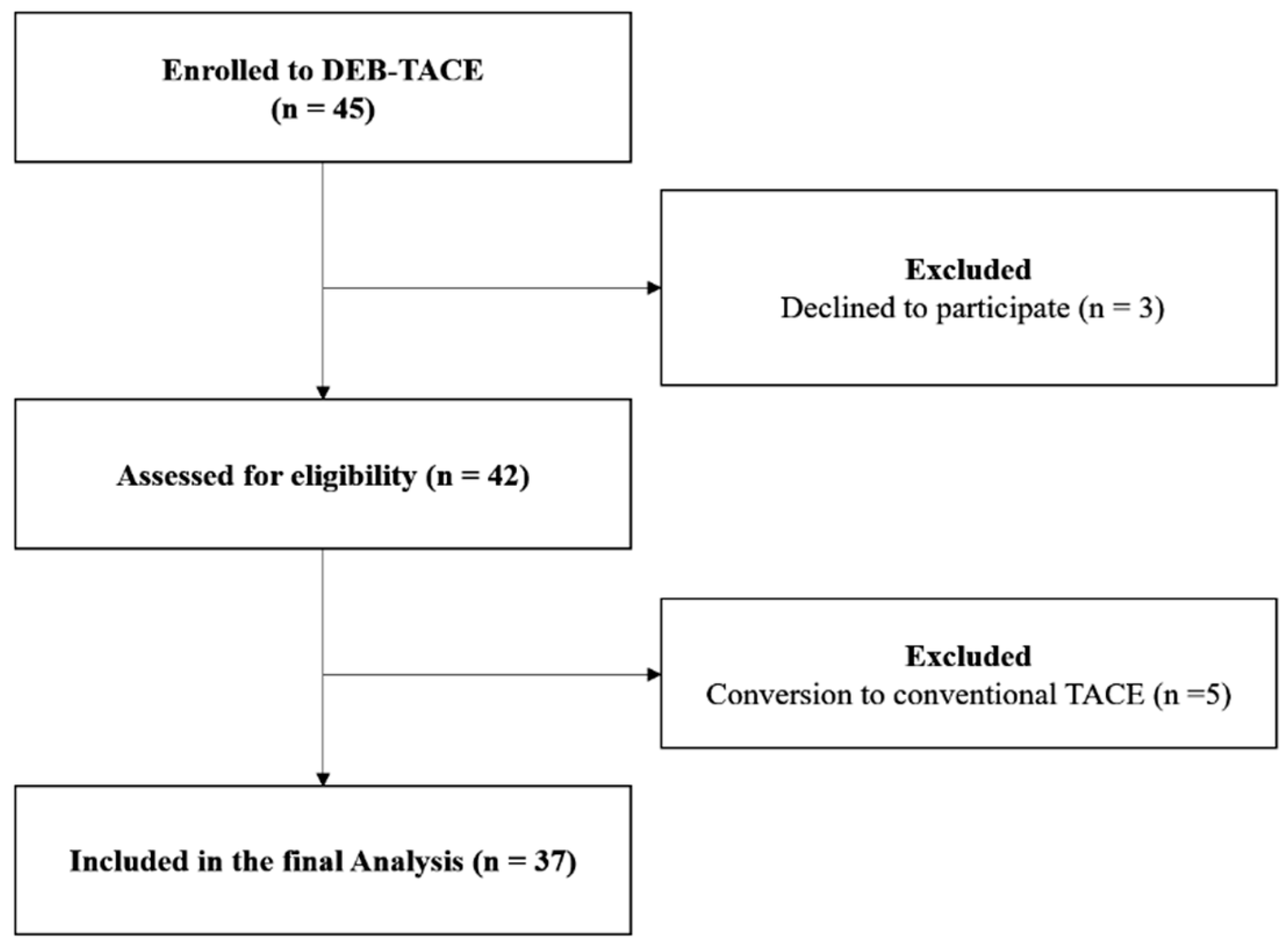
Figure 2.
Transradial TACE using HepaSphere in a 66-year-old female patient with hepatocellular carcinoma in the caudate lobe. (a) Pre-procedural ultrasonography of the left radial artery shows a patent vessel with a diameter of 2.2 mm, (b) celiac angiography performed via the left radial approach using a 5-Fr catheter (arrowheads) reveals a hypervascular tumor in segment 1 (arrow). (c) Superselective catheterization of the caudate artery is achieved using a 1.7-Fr microcatheter (arrowheads). Embolization was performed using HepaSphere (20–40 μm). (d) Final angiography demonstrating complete disappearance of the tumor stain (arrow), indicating successful devascularization.
Figure 2.
Transradial TACE using HepaSphere in a 66-year-old female patient with hepatocellular carcinoma in the caudate lobe. (a) Pre-procedural ultrasonography of the left radial artery shows a patent vessel with a diameter of 2.2 mm, (b) celiac angiography performed via the left radial approach using a 5-Fr catheter (arrowheads) reveals a hypervascular tumor in segment 1 (arrow). (c) Superselective catheterization of the caudate artery is achieved using a 1.7-Fr microcatheter (arrowheads). Embolization was performed using HepaSphere (20–40 μm). (d) Final angiography demonstrating complete disappearance of the tumor stain (arrow), indicating successful devascularization.
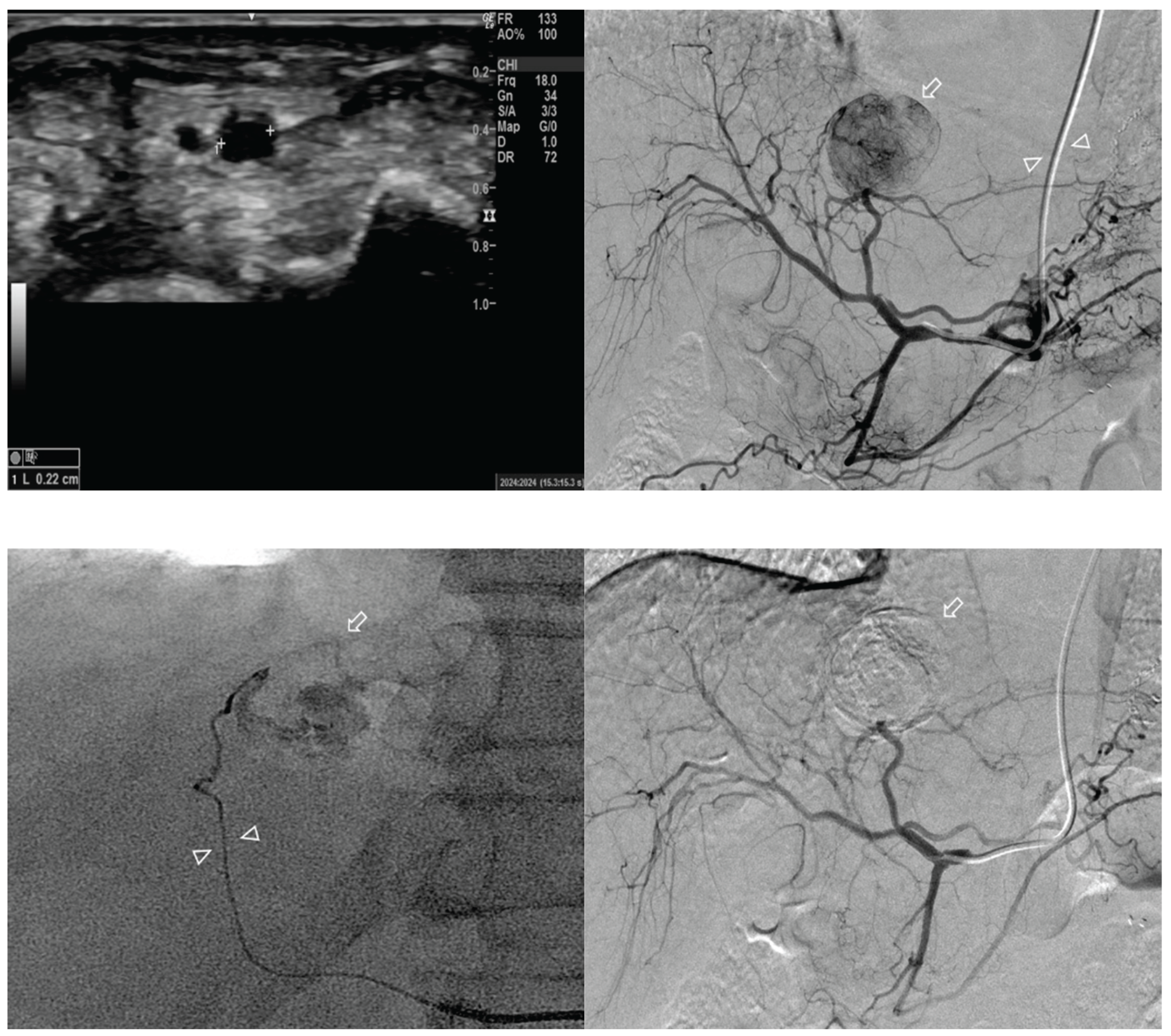

Table 1.
Baseline Characteristics of the Study Population.
| Characteristic | Value |
|---|---|
| Age (years) | 65 ± 11 |
| Sex | |
| Male | 28 (76) |
| Female | 9 (24) |
| Etiology | |
| Hepatitis B Virus | 21 (57) |
| Hepatitis C Virus | 2 (5) |
| Alcohol | 4 (11) |
| Others | 10 (27) |
| Child–Pugh Class | |
| A | 36 (97) |
| B | 1 (3) |
| Number of Lesions | |
| Single | 22 (61) |
| Multiple | 15 (41) |
| Maximum Tumor Size (cm) | 5 ± 2 |
| AFP (ng/mL) † | 12 (3–157) |
Continuous variables are expressed as the mean ± standard deviation, while categorical variables are presented as the number of patients with the corresponding percentage in parentheses. † Data are presented as median (interquartile range) because the data were not normally distributed HBV, hepatitis B virus; HCV, hepatitis C virus; AFP, alpha-fetoprotein.
Table 2.
Procedural Outcomes and Safety Profile of Transradial DEB-TACE.
| Variable | Value |
|---|---|
| Technical success rate | 37 (100) |
| Crossover to transfemoral approach | 0 (0) |
| Adverse event | |
| Major | 1 (3) |
| Minor | 7 (19) |
| Hospital stay (days) | 3 ± 1 |
Continuous variables are expressed as the mean ± standard deviation, while categorical variables are presented as the number of patients with the corresponding percentage in parentheses. DEB-TACE, drug-eluting bead transarterial chemoembolization.
Table 3.
Procedural Parameters and Radiation Dose of Transradial DEB TACE.
| Variable | Value |
|---|---|
| Total procedure time (min) | 73 ± 22 |
| Fluoroscopy time (min) | 24 ± 9 |
| Dose area product (Gy·cm2) | 142 ± 182 |
| Doxorubicin dose (mg) | 57 ± 17 |
| Number of HepaSphere vials | 1.2 ± 0.4 |
| Oncologic efficacy | |
| Complete response | 7 (19) |
| Partial response | 20 (54) |
| Stable disease | 10 (27) |
| Progressive disease | 0 (0) |
| Objective response rate | 27 (73) |
| Disease control rate | 37 (100) |
Continuous variables are expressed as the mean ± standard deviation, while categorical variables are presented as the number of patients with the corresponding percentage in parentheses. DEB-TACE, drug-eluting bead transarterial chemoembolization.
Disclaimer/Publisher’s Note: The statements, opinions and data contained in all publications are solely those of the individual author(s) and contributor(s) and not of MDPI and/or the editor(s). MDPI and/or the editor(s) disclaim responsibility for any injury to people or property resulting from any ideas, methods, instructions or products referred to in the content. |
© 2026 by the authors. Licensee MDPI, Basel, Switzerland. This article is an open access article distributed under the terms and conditions of the Creative Commons Attribution (CC BY) license.
Copyright: This open access article is published under a Creative Commons CC BY 4.0 license, which permit the free download, distribution, and reuse, provided that the author and preprint are cited in any reuse.


