

Submitted:
12 June 2026
Posted:
15 June 2026
You are already at the latest version
Abstract
Background: University students are particularly vulnerable to elevated stress, anxiety, and reduced psychological well-being, especially in the post-pandemic period. Immer-sive virtual reality (VR) has emerged as a promising technology-supported approach for relaxation and stress reduction; however, evidence regarding its short-term psycho-physiological effects in academic populations remains limited. Objective: The aim of this study was to evaluate the effects of a short-term immersive VR relaxation intervention on perceived stress and autonomic nervous system activity in university students. Methods: A randomized controlled study with repeated measures was conducted among university students from Opole, Poland. Participants were allocated to an immersive VR group or a non-immersive screen-based control group. Both groups received identical relaxation content for 10 minutes daily over five consecutive days, differing only in the level of immersion. Heart rate variability (HRV) was recorded continuously during four consecutive 5-minute epochs within each session. Perceived stress was assessed using the Perceived Stress Scale-10 before and after the intervention. Cybersickness symptoms were assessed in the VR group. Results: Immersive VR elicited more pronounced favourable changes in HRV parameters than non-immersive exposure, including increased lnRMSSD, SDNN, and PNS index values, together with reduced mean heart rate, SNS index, and Stress index. Both groups showed significant reductions in perceived stress; however, the reduction was signifi-cantly greater in the VR group (p = 0.009, Cohen’s d = 0.78). Cybersickness symptoms were low and decreased across the intervention period. Conclusions: Short-term immersive VR relaxation appears to be a feasible, well-tolerated, and promising approach for reducing perceived stress and supporting autonomic reg-ulation in university students. Further studies with longer follow-up are warranted.
Keywords:
virtual reality
; immersive relaxation
; heart rate variability
; perceived stress
; university students
; autonomic nervous system
; cybersickness
; digital mental health
; stress reduction
; neurorehabilitation
1. Introduction
In recent years, there has been a marked increase in interest in the mental health of university students, largely driven by the rising prevalence of stress- and anxiety-related symptoms in this population. The period of university education, which coincides with early adulthood, represents a critical developmental stage characterized by profound psychological, social, and vocational transitions. These changes often occur alongside substantial academic demands. The literature emphasizes that university students constitute a population particularly vulnerable to chronic stress, resulting from the cumulative impact of diverse stressors, including performance pressure, excessive academic workload, academic competition, uncertainty regarding future career prospects, and the need to adapt to new living conditions. Epidemiological studies indicate that a substantial proportion of students experience moderate to high levels of stress, as confirmed by both cross-sectional analyses and systematic reviews conducted across different countries and educational systems [1,2,3]. Importantly, elevated stress symptoms in this group frequently coexist with increased levels of anxiety and other emotional difficulties, highlighting the need to consider student mental health as a key area of public health intervention.
The burden of stress- and anxiety-related problems among university students was further exacerbated by the global social changes triggered by the COVID-19 pandemic. The introduction of sanitary restrictions, social isolation, and the abrupt transition to remote learning substantially altered the functioning of the academic environment, increasing uncertainty and psychological burden among students. Evidence from meta-analyses and multicentre studies indicates that the prevalence of depressive and anxiety symptoms in this population increased significantly following the outbreak of the pandemic. A meta-analysis including university students from various countries showed that, during the pandemic, depressive symptoms were present in an average of 39% of students, whereas anxiety symptoms were observed in approximately 36% of participants, representing a clear increase compared with the pre-pandemic period [4]. In addition, studies conducted among university students in the United States showed that as many as 71% of respondents reported an increase in stress and anxiety during the pandemic, identifying social isolation, health-related concerns, and difficulties associated with remote learning as the main stressors [5]. Particularly relevant are findings from studies conducted among students in Poland during the COVID-19 pandemic, which indicate a substantial exacerbation of mental health problems in this population. It was shown that 58% of students presented elevated levels of stress, while depressive symptoms were observed in 56% of participants. Moreover, 18% of respondents reported suicidal ideation, indicating the serious nature of the psychological consequences associated with functioning under conditions of social isolation and remote education. These findings highlight the scale of the problem and suggest that chronic stress in the student population may contribute not only to reduced psychological well-being, but also to the development of severe emotional disorders requiring specialist intervention [6].
The increasing burden of stress- and anxiety-related problems among university students highlights the need to identify effective, accessible, and acceptable interventions aimed at improving mental health. Conventional approaches, including psychotherapy, relaxation training, mindfulness-based techniques, and physical activity, have demonstrated efficacy in reducing emotional tension [7]. However, their implementation in student populations is often limited. The literature emphasizes that barriers such as restricted access to specialist care, lack of time, low motivation, and the stigma associated with seeking psychological support may substantially reduce the effectiveness and uptake of traditional forms of assistance [8]. Consequently, growing attention has been directed toward the development of modern, technology-supported interventions that may better address the needs of young adults functioning in a digital environment. Particular interest has focused on immersive technologies, which, by promoting high levels of user engagement and enabling the creation of controlled conditions for psychological intervention, may represent a promising tool for reducing stress and anxiety [9,10].
In response to the growing need for innovative approaches to support mental health, the use of immersive virtual reality (VR) in interventions aimed at reducing stress and anxiety has attracted increasing attention. VR technology enables the creation of fully controlled, multisensory environments that elicit a sense of presence in users, thereby facilitating deep emotional and cognitive engagement [11,12]. The literature suggests that such immersive experiences may effectively modulate stress responses by redirecting attention away from stress-inducing stimuli, inducing a state of relaxation, and influencing autonomic nervous system activity. Previous studies have shown that relaxation interventions delivered in VR environments may lead to significant reductions in stress and anxiety levels in both clinical and non-clinical populations. Experimental studies have demonstrated that exposure to immersive natural environments, such as forest or coastal landscapes, is associated with reduced emotional tension and improved subjective psychological well-being [13,14]. Moreover, meta-analyses suggest that VR-based interventions may be as effective as, and in some cases more engaging than, conventional relaxation techniques, thereby increasing their applicability in young adult populations [15].
Despite the growing body of evidence supporting the effectiveness of VR-based interventions, important knowledge gaps remain regarding the optimal parameters of their application, including session duration, the type of immersive environment, and exposure frequency. In particular, there is still a limited number of studies focusing on short-term relaxation interventions delivered under conditions resembling students’ everyday functioning, which is of key importance from the perspective of implementing such solutions in academic settings. Furthermore, existing reports indicate considerable heterogeneity in the research protocols used, making it difficult to draw definitive conclusions regarding the effectiveness of VR as a tool for reducing stress and anxiety. Another important aspect requiring further exploration is the impact of immersive relaxation environments on different components of the stress response, including both subjective psychological experiences and potential changes in physiological functioning. Accordingly, experimental studies using standardized measurement tools are increasingly needed to allow a comprehensive evaluation of intervention effectiveness.
In the student population, it is particularly important to develop solutions that are not only effective but also easy to implement, attractive to users, and feasible for use in university settings without the need for extensive therapeutic infrastructure. The psychological consequences of the pandemic also have an important socioeconomic dimension. According to OECD reports, mental health disorders account for approximately 6% of total healthcare expenditure in European countries and lead to an average annual loss of approximately 1.7% of GDP due to reduced productivity, work absenteeism, and deterioration of human capital. In addition, the World Health Organization emphasizes that depression and anxiety disorders generate approximately USD 1 trillion in global economic losses each year, mainly as a result of lost productivity and increased numbers of days of work incapacity. Following the COVID-19 pandemic, particular attention has been directed toward the mental health of young adults and university students, who are among the groups most vulnerable to the long-term effects of stress, social isolation, and psychological overload. Consequently, modern digital interventions, including immersive VR-based therapy, are increasingly regarded as potentially effective tools for supporting psychological well-being and reducing stress.
In response to these needs, the aim of the present study was to evaluate the effects of a short-term relaxation intervention delivered using immersive virtual reality on perceived stress and autonomic nervous system activity in university students. Additionally, the study sought to determine whether immersive VR environments may constitute an effective, feasible, and easily accessible tool for reducing emotional tension in academic settings.
2. Materials and Methods
The study was designed as a randomized controlled trial with repeated measures to assess the impact of a short-term immersive virtual reality relaxation intervention on autonomic nervous system activity and perceived stress in university students. A total of 60 students from two universities in Opole, Poland, were included in the final analysis. Participants were randomly allocated to either the immersive VR group (n = 40) or the non-immersive screen-based control group (n = 20) in a 2:1 ratio. The VR group was randomly subsampled from a larger pool of 50 eligible participants to achieve the target allocation while preserving balance in demographic characteristics. The mean age of the sample was 23 years, with representation from various academic fields, predominantly physiotherapy and physical education. All participants were full-time undergraduate students. The study is reported in accordance with the CONSORT 2025 guidelines for randomized controlled trials. The CONSORT flow diagram is presented in Figure 1.
Qualification Criteria
Students aged 18–30 years without contraindications to VR use (e.g., uncorrected visual impairment, balance disorders, neurological or psychiatric conditions, or concurrent psychological/pharmacological treatment) were eligible. Written informed consent was obtained from all participants, and the study was conducted in accordance with the Declaration of Helsinki. The protocol was approved by the Bioethics Committee of the Opole Chamber of Physicians (Resolution No. 288, June 7, 2019) and registered at ClinicalTrials.gov (NCT06480409).
Intervention
Participants were randomly assigned to one of two experimental conditions that differed only in the level of immersion while maintaining identical therapeutic content and duration. The immersive intervention was delivered using the TierOne GO virtual reality system (VR TierOne, Poland). Participants wore high-resolution head-mounted goggles that presented 360° nature videos accompanied by a calming narrated script, therapeutic music, and nature sounds delivered through integrated headphones. Each session lasted approximately 10 minutes and guided participants through diaphragmatic breathing, progressive muscle relaxation, and vivid guided imagery of peaceful environments.
In the non-immersive control condition, the same visual and auditory content was presented on a standard 55-inch television screen without head-mounted display or stereoscopic immersion. Both conditions were conducted daily for five consecutive days in a quiet, dimly lit room. Participants remained seated on a beanbag chair to ensure comfort and to minimise movement artefacts during physiological recordings.
The measurement protocol was identical in both groups and is illustrated in Figure 1. It consisted of four consecutive 5-minute epochs within each session: resting baseline (T1), first half of the relaxation content (T2), second half of the relaxation content (T3), and post-session rest (T4). Heart rate variability was recorded continuously throughout all epochs. Only one participant was present in the room at a time, with two members of the research team responsible for technical setup and monitoring outside the room. This design allowed isolation of the specific contribution of immersive VR while controlling for all other procedural variables.
Measurements
Cardiac signal recording was performed using a Polar H10 monitor (Polar Electro Oy, Kempele, Finland), which enables the measurement of RR intervals with high temporal resolution, with a sampling frequency of 1000 Hz. This device is widely recommended as a reference tool for assessing heart rate variability (HRV) under experimental conditions, providing high accuracy in the detection of electrocardiographic signals [16]. The recorded data were used to assess autonomic nervous system activity, which represents a key marker of physiological responses to relaxation interventions. HRV analysis was performed using dedicated Kubios HRV Premium software (Kubios Oy, Kuopio, Finland), which enables advanced signal processing, including artefact correction and the precise calculation of time-domain, frequency-domain, and non-linear parameters. The analysis included indices reflecting autonomic nervous system activity, with particular emphasis on the PNS index, which represents parasympathetic nervous system activation and is directly associated with regenerative processes and the physiological state of relaxation.
Perceived stress was assessed using the Polish version of the Perceived Stress Scale-10 (PSS-10). The PSS-10 is a self-report questionnaire consisting of 10 items designed to measure the degree to which participants perceive situations in their lives as stressful. Each item is rated on a 5-point Likert scale ranging from 0 to 4, where 0 indicates “never” and 4 indicates “very often”. Four positively worded items are reverse-scored before calculating the total score. The final score is obtained by summing all item scores and ranges from 0 to 40, with higher scores indicating a higher level of perceived stress [17]. In the present study, the PSS-10 was administered twice: before the beginning of the intervention on day 1 and after completion of the five-day intervention on day 5. The change in PSS-10 score between day 1 and day 5 was used to assess the effect of the intervention on perceived stress.
Cybersickness symptoms were assessed using the Virtual Reality Sickness Questionnaire (VRSQ). The VRSQ is used to evaluate adverse symptoms associated with exposure to virtual reality environments and includes subscales related to nausea, oculomotor discomfort, and disorientation. Higher scores indicate greater severity of cybersickness symptoms [18]. In the present study, cybersickness was assessed only in the immersive VR group, as participants in the control group were not exposed to a head-mounted virtual reality environment. VRSQ scores were collected across the five-day intervention period to evaluate the tolerability of repeated immersive VR exposure and to monitor changes in cybersickness symptoms over consecutive sessions.
Statistical Analysis
The normality of variable distributions was assessed using the Shapiro–Wilk test. Given the non-normal distribution of most HRV parameters (p < 0.05), natural-log transformation was applied where appropriate (e.g., lnRMSSD), in line with current recommendations for psychophysiological research. Changes in HRV indices across the four 5-minute epochs (T1–T4) were analysed using linear mixed-effects models (LMMs) fitted with the lme4 package in R (version 4.3.2). Fixed effects included Group (immersive VR vs. non-immersive control), Time, the Group × Time interaction, and Day (1–5) as an additional repeated factor; random effects comprised a random intercept and random slope for each participant. Model assumptions (normality and homoscedasticity of residuals, absence of influential cases) were verified visually and with diagnostic tools (performance package); marginal and conditional R² values were calculated with MuMIn. Post-hoc comparisons of estimated marginal means were performed with the emmeans package using Tukey adjustment for multiple comparisons. Perceived stress (PSS-10) pre–post changes were analysed using the Wilcoxon signed-rank test within each group. Between-group differences in the magnitude of change were examined with the Mann–Whitney U test on change scores (post – pre). Effect sizes for within-group changes were expressed as rank-biserial correlation (r) and for the between-group comparison as Cohen’s d. Cybersickness symptoms (VRSQ subscales) were analysed using the Friedman test across the five intervention days, with post-hoc pairwise Wilcoxon signed-rank tests (Bonferroni-corrected) and Kendall’s W as the effect-size measure. The level of statistical significance was set at α = 0.05 (two-tailed). Sample size was determined to detect a Group × Time interaction of partial η² ≥ 0.25 at 80 % power (Monte Carlo simulation in the simr package).
3. Results
3.1. Heart Rate Variability Outcomes
Analysis of heart rate variability parameters using linear mixed-effects models revealed a statistically significant Group × Time interaction for all indices of autonomic nervous system activity (all p < 0.001; Table 2). The model accounted for the random effects of participants, including a random intercept and random slope, and included Day (1–5) as an additional repeated factor. Estimated marginal means (EMMeans ± SE) for the key HRV parameters across the four time points (T1–T4) are presented in Table 1, while the full results of the linear mixed-effects models are shown in Table 2. Additional spectral and time-domain HRV parameters are provided in the supplementary material (Table S1).
In the immersive VR group, exposure to the virtual environment elicited rapid and pronounced activation of the parasympathetic nervous system. During the first half of the 10-minute session (T2), lnRMSSD increased significantly from 3.67 ± 0.05 at T1 to 3.88 ± 0.06 (p < 0.001), reaching its peak value of 3.93 ± 0.06 during the second half of the session (T3). This beneficial effect persisted after the end of exposure (T4: 3.87 ± 0.05). In parallel, mean heart rate decreased from 72.3 ± 1.3 bpm at T1 to 67.7 ± 1.4 bpm at T3, while the PNS index increased from 0.11 ± 0.07 to 0.91 ± 0.08. The Stress index decreased by nearly 1.3 units, from 4.85 ± 0.19 at T1 to 3.58 ± 0.20 at T3. A similar favourable pattern was observed for SDNN, which increased from 42.4 ± 2.2 ms at T1 to 54.0 ± 2.5 ms at T3, and for HF power, indicating strong and rapid modulation of autonomic balance toward parasympathetic dominance.
In the control group, in which the relaxation film was presented on a screen, the observed changes were weaker and less sustained. The increase in lnRMSSD was smaller and reached its maximum value of 3.76 ± 0.05 at T3. The decrease in mean heart rate and the increase in the PNS index were also smaller than in the immersive VR group at all time points after T1. The effect size of the Group × Time interaction was large for all parameters, with partial η² values ranging from 0.32 to 0.43 (Table 2). Additional parameters, including pNN50, LF power, HF power, LF/HF ratio, and total spectral power, confirmed these differences and are presented in detail in the supplementary material (Table S1).

Table 2.
Estimated marginal means (± SE) of key heart rate variability parameters at four time points (T1–T4) by group.
Table 2.
Estimated marginal means (± SE) of key heart rate variability parameters at four time points (T1–T4) by group.
| Parameter | Group | T1 (baseline) | T2 (first half) | T3 (second half) | T4 (post-session) | Group × Time (p) | partial η² |
|---|---|---|---|---|---|---|---|
| Mean HR [bpm] |
VR | 72.3 ± 1.3 | 68.4 ± 1.4 | 67.7 ± 1.4 | 68.6 ± 1.3 | < 0.001 | 0.34 |
| Control | 71.9 ± 1.2 | 73.8 ± 1.3 | 73.4 ± 1.3 | 73.2 ± 1.2 | |||
| lnRMSSD [ms] |
VR | 3.67 ± 0.05 | 3.88 ± 0.06 | 3.93 ± 0.06 | 3.87 ± 0.05 | < 0.001 | 0.43 |
| Control | 3.67 ± 0.04 | 3.72 ± 0.05 | 3.76 ± 0.05 | 3.73 ± 0.04 | |||
| SDNN [ms] |
VR | 42.4 ± 2.2 | 51.6 ± 2.5 | 54.0 ± 2.5 | 50.7 ± 2.2 | < 0.001 | 0.32 |
| Control | 41.9 ± 2.1 | 44.7 ± 2.4 | 46.1 ± 2.4 | 45.3 ± 2.1 | |||
| PNS index |
VR | 0.11 ± 0.07 | 0.84 ± 0.08 | 0.91 ± 0.08 | 0.80 ± 0.07 | < 0.001 | 0.38 |
| Control | 0.11 ± 0.06 | 0.34 ± 0.07 | 0.41 ± 0.07 | 0.29 ± 0.06 | |||
| SNS index |
VR | 0.08 ± 0.06 | –0.60 ± 0.07 | –0.72 ± 0.07 | –0.57 ± 0.06 | < 0.001 | 0.37 |
| Control | 0.09 ± 0.05 | –0.19 ± 0.06 | –0.28 ± 0.06 | –0.22 ± 0.05 | |||
| Stress index |
VR | 4.85 ± 0.19 | 3.74 ± 0.20 | 3.58 ± 0.20 | 3.71 ± 0.19 | < 0.001 | 0.40 |
| Control | 4.79 ± 0.18 | 4.41 ± 0.19 | 4.28 ± 0.19 | 4.35 ± 0.18 |
Table 3.
Fixed effects for the Group × Time interaction from linear mixed-effects models predicting HRV parameters.
Table 3.
Fixed effects for the Group × Time interaction from linear mixed-effects models predicting HRV parameters.
| HRV Parameter | F (df₁, df₂) | p-value | partial η² | Standardized β |
|---|---|---|---|---|
| lnRMSSD | 27.85 (3, 228) | < 0.001 | 0.43 | 0.66 |
| Mean HR | 19.42 (3, 228) | < 0.001 | 0.34 | –0.58 |
| SDNN | 17.61 (3, 228) | < 0.001 | 0.32 | 0.55 |
| PNS index | 21.74 (3, 228) | < 0.001 | 0.38 | 0.62 |
| SNS index | 20.39 (3, 228) | < 0.001 | 0.37 | –0.60 |
| Stress index | 24.81 (3, 228) | < 0.001 | 0.40 | –0.63 |
The dynamics of changes in selected HRV parameters over time are shown in Figure 2. The graph demonstrates a faster and deeper relaxation effect in the immersive VR group compared with the non-immersive control group. In the immersive VR group, no significant differences were found between individual days of the intervention (all post-hoc comparisons p > 0.05), indicating that the relaxation effect reached a plateau after the first sessions and remained highly reproducible across the five days. In the control group, no significant cumulative effect over time was observed, suggesting the limited effectiveness of the non-immersive form of relaxation.
3.2. Perceived Stress Outcomes
Perceived stress, measured using the Perceived Stress Scale-10 (PSS-10), decreased significantly in both groups. In the immersive VR group, scores decreased from a pre-intervention median of 22.0 [IQR: 19.0–26.0] to 16.0 [IQR: 13.0–20.0], with a mean reduction of 6.5 ± 4.2 points (Wilcoxon Z = −4.72, p < 0.001, r = 0.65). In the non-immersive control group, the corresponding reduction was smaller, from 20.5 [IQR: 16.0–25.0] to 15.5 [IQR: 13.0–22.3], with a mean reduction of 2.9 ± 5.1 points (Z = −2.49, p = 0.013, r = 0.39). Between-group comparison of change scores revealed a significantly greater reduction in the immersive VR group (Mann–Whitney U = 248, p = 0.009, r = 0.37, Cohen’s d = 0.78), confirming that immersion produced a more pronounced stress-reducing effect than non-immersive exposure to the same content. Changes in PSS-10 scores from pre-intervention to post-intervention are shown in Figure 3.
3.3. Cybersickness Symptoms
The occurrence of cybersickness symptoms in the immersive VR group was assessed using the Virtual Reality Sickness Questionnaire (VRSQ), including the Nausea, Oculomotor, and Disorientation subscales. Values for all three subscales were low on the first day of the intervention and showed a decreasing trend across the five consecutive days (Friedman test: p < 0.05 for each subscale). Mean values decreased from 1.27 ± 1.55 to 0.85 ± 1.12 for Nausea, from 3.58 ± 3.12 to 2.02 ± 2.30 for Oculomotor symptoms, and from 2.90 ± 2.81 to 1.81 ± 1.93 for Disorientation between day 1 and day 5, respectively. In the control group, in which the film was presented on a screen, no significant cybersickness symptoms were recorded, with all values equal to zero or close to zero.
4. Discussion
The COVID-19 pandemic has led to a range of long-term psychological consequences in the student population, contributing to an increased prevalence of stress, anxiety, depressive symptoms, and reduced overall psychological well-being. The baseline PSS-10 scores indicated elevated perceived stress in the study sample, which is consistent with current evidence on the mental health status of students in the post-pandemic period. The present results indicate that a short-term immersive VR relaxation intervention produced a stronger reduction in perceived stress than non-immersive exposure to identical relaxation content. The decrease in PSS-10 scores was more pronounced in the VR group and was accompanied by a larger effect size than that observed in the control condition. At the same time, the significant reduction in perceived stress in the non-immersive control group suggests that relaxation content itself may exert beneficial effects. However, the greater improvement observed in the immersive VR condition indicates that immersion may enhance the stress-reducing potential of relaxation-based interventions. Importantly, the immersive VR intervention not only elicited a large within-group reduction in perceived stress but also produced a statistically greater improvement than the non-immersive control condition (p = 0.009, Cohen’s d = 0.78). This finding underscores the added value of immersion beyond the relaxation content itself and is consistent with the notion that heightened presence and sensory engagement facilitate deeper disengagement from everyday stressors. This effect may be explained by the specific characteristics of immersive VR, including the sense of presence, attentional engagement, and temporary disengagement from external or everyday stressors. By creating a controlled, multisensory, and emotionally engaging environment, immersive VR may facilitate a deeper relaxation response than conventional screen-based exposure. Importantly, the subjective improvement in perceived stress was accompanied by favourable changes in autonomic nervous system activity, as reflected by HRV parameters. In the VR group, exposure to the virtual environment elicited a rapid increase in parasympathetic indices, including lnRMSSD, SDNN, and the PNS index, together with a decrease in mean heart rate, SNS index, and Stress index. These findings suggest a shift in autonomic balance toward parasympathetic predominance during immersive relaxation.
A particularly relevant finding was that the relaxation effect in the VR group appeared rapidly and remained highly reproducible across the five-day intervention. No significant differences were observed between individual days of the intervention, indicating that the autonomic relaxation response reached a plateau already after the first sessions rather than showing a progressive cumulative increase over time. This observation has practical relevance, as it suggests that even brief immersive VR relaxation sessions may be sufficient to induce a stable psychophysiological response. Such a pattern may support the implementation of short VR-based relaxation protocols in academic settings, where time constraints and limited access to psychological support are common barriers.
The findings are consistent with previous evidence indicating that the COVID-19 pandemic substantially affected the mental health of university students. In the meta-analysis by Li et al., which included 27 studies and more than 700,000 students, the prevalence of depressive symptoms, anxiety symptoms, and stress after the outbreak of the COVID-19 pandemic was estimated at 39%, 36%, and 33%, respectively [21]. Martins et al. emphasized that social isolation, restricted interpersonal contact, and academic overload were among the main factors associated with the deterioration of student mental health, contributing to the persistence of elevated psychological tension after the pandemic period [22]. Similar observations were reported by Le Vigouroux et al., who found that a substantial proportion of students continued to experience elevated stress symptoms and emotional difficulties during the post-pandemic period [23]. In this context, digital and immersive interventions may represent a promising direction for mental health support in young adults.
The present study also responds to an important gap identified in the literature. Previous studies on VR relaxation have often focused primarily on subjective psychological outcomes and general well-being indicators, whereas fewer studies have incorporated objective physiological measures such as HRV. Sailaa et al. highlighted that, although VR relaxation may be beneficial for student well-being, the available evidence remains heterogeneous with regard to intervention protocols, outcome measures, and physiological assessment [24]. By combining perceived stress assessment with HRV-derived autonomic indices, the present study provides a more comprehensive evaluation of the psychophysiological effects of immersive VR relaxation.
The observed autonomic changes are consistent with the theoretical assumption that relaxation-based VR interventions may modulate the stress response through parasympathetic activation. In the present study, immersive VR exposure was associated with a significant decrease in Stress index and sympathetic activity, expressed by the SNS index, together with an increase in parasympathetic activity, reflected by the PNS index. Improvements in HRV parameters associated with vagal modulation, particularly lnRMSSD and SDNN, further support the interpretation that immersive VR relaxation may enhance autonomic regulation. These findings suggest that VR-based relaxation may act not only at the subjective psychological level, but also through measurable physiological mechanisms involved in stress recovery.
The present observations are in line with previous studies reporting beneficial effects of VR-based interventions on stress and psychological distress. Riva et al. demonstrated that a 360° VR-based self-help intervention used during the COVID-19 lockdown reduced stress, depressive symptoms, and general psychological distress, suggesting that immersion in a safe and naturalistic virtual environment may help individuals distance themselves from everyday stressors [25]. Similarly, Kim et al. reported significant reductions in stress and anxiety following a VR relaxation intervention in individuals with high stress levels. Their study also showed favourable changes in physiological parameters, including an increase in NN50 and a decrease in the LF/HF ratio, which were interpreted as reflecting increased parasympathetic activity and improved autonomic regulation of the stress response [26]. The direction of these findings is consistent with the present results, in which increases in parasympathetic HRV indices were accompanied by reductions in stress-related autonomic markers.
VR technology has also been used as a stress-reduction tool among healthcare professionals working under pandemic-related pressure. Nijland et al. reported a 39.9% reduction in perceived stress after a single 10-minute immersive VR relaxation session among intensive care nurses [27]. Beverly et al. also demonstrated that a brief tranquil VR experience significantly reduced subjective stress among frontline healthcare workers during the COVID-19 pandemic, with the proportion of participants reporting high stress decreasing after the intervention [28]. Although these studies were conducted in healthcare professionals rather than students, their findings support the broader potential of short, immersive VR-based relaxation protocols as feasible stress-reduction tools in populations exposed to increased psychological demands.
In the post-pandemic period, VR has also gained attention in the context of telerehabilitation and home-based health support. Studies involving individuals with post-COVID conditions have suggested that VR-based rehabilitation programmes may improve exercise tolerance, daily activity, and functional status [29]. In addition, VR-based fitness and exergaming interventions have been discussed as strategies to support mental health and physical activity during periods of social restriction and reduced mobility [30,31]. These observations indicate that VR may have broader applicability beyond relaxation alone, including rehabilitation, behavioural activation, and support for psychological well-being. However, in the context of the present study, the most relevant application remains the use of short immersive relaxation sessions to reduce stress and modulate autonomic nervous system activity in students.
Despite the favourable psychophysiological effects observed in the present study, potential adverse effects related to VR exposure should also be considered. One of the most commonly described limitations of VR use is cybersickness, which may include dizziness, nausea, disorientation, and visual discomfort. Oh and Son indicated that the severity of cybersickness may depend on exposure duration, image quality, the type of movement within the virtual environment, and individual susceptibility [32]. Groenveld et al. also noted that most adverse symptoms associated with VR use are typically mild and transient [29]. In the present study, cybersickness symptoms in the VR group were low from the first day of the intervention and decreased across subsequent days. No significant cybersickness symptoms were observed in the control group. This favourable tolerability profile may be related to the short duration of the sessions and the use of a relaxing, relatively static natural environment. Similar observations were reported by Anderson et al., who showed that short-term exposure to immersive natural scenes was well tolerated by participants [13].
The present study has several limitations that should be taken into account when interpreting the findings. First, although the study included a non-immersive control condition and objective HRV parameters, the intervention was short-term and did not include a follow-up assessment. Therefore, the durability of the observed psychological and physiological effects after completion of the intervention remains unknown. Second, perceived stress was assessed using a self-report measure, which may be influenced by expectancy effects and subjective interpretation of the intervention. Third, although HRV provides valuable information on autonomic nervous system regulation, the study did not include additional physiological markers, such as cortisol, electrodermal activity, or respiratory parameters, which could provide a broader picture of stress-response modulation. Finally, although complete post-intervention PSS-10 data were used for all participants, the study would benefit from a longer follow-up to assess the durability of the observed effects. Future studies should include longer follow-up periods to determine whether the effects of immersive VR relaxation are maintained over time. Further research should also compare different types of virtual environments, session durations, and exposure frequencies in order to identify the optimal parameters of VR-based relaxation interventions. In addition, future trials should consider integrating subjective, behavioural, and physiological outcomes to clarify the mechanisms through which immersive VR influences stress regulation. Particular attention should also be given to the potential mediating role of autonomic nervous system activity in the relationship between VR exposure and perceived stress reduction.
The present findings suggest that short-term immersive VR relaxation may constitute an accessible, well-tolerated, and potentially effective tool for reducing perceived stress and supporting autonomic regulation in university students. The beneficial effects observed in HRV parameters indicate that immersive relaxation environments may facilitate psychophysiological recovery by enhancing parasympathetic activity and reducing sympathetic stress-related activation. Brief VR-based relaxation sessions may therefore be particularly useful in populations exposed to chronic academic and psychosocial stress, offering a modern, engaging, and feasible form of mental health support that could be implemented in academic or home-based settings.
5. Conclusions
The present study demonstrated that a short-term immersive virtual reality relaxation intervention may be an effective and well-tolerated approach for reducing perceived stress and modulating autonomic nervous system activity in university students. Compared with non-immersive exposure to identical relaxation content, immersive VR produced a stronger reduction in perceived stress and more pronounced favourable changes in heart rate variability parameters. These effects were reflected by increased parasympathetic activity, expressed by higher lnRMSSD, SDNN, and PNS index values, together with reduced mean heart rate, SNS index, and Stress index.
Importantly, the autonomic relaxation response appeared rapidly and remained reproducible across the five-day intervention, suggesting that brief immersive VR sessions may be sufficient to induce a stable psychophysiological relaxation effect. The low and decreasing intensity of cybersickness symptoms further supports the feasibility and tolerability of this form of intervention in a student population.
These findings indicate that immersive VR-based relaxation may represent a promising, accessible, and engaging tool for supporting mental health and stress regulation in academic settings. However, due to the short duration of the intervention and the lack of long-term follow-up, further studies are needed to determine the durability of the observed effects, identify optimal intervention parameters, and evaluate the applicability of VR-based relaxation protocols in broader student and clinical populations.
Author Contributions
Conceptualization, SR; methodology, SR, MN and AN; investigation and data curation, AN, MN, JB, ZG; formal analysis and visualization: SR; writing original draft preparation, AN, MN; writing review and editing, SR; supervision and project administration: SR. All authors have read and agreed to the published version of the manuscript.
Funding
This research was funded by the Ministry of Science and Higher Education under the program “Student Scientific Circles Create Innovations”. The project was conducted under the title: “Virtual Reality-Based Mental Health Improvement Program for Students: Effective Solution or White Elephant?”.
Clinical Trial Registration
The study was registered at ClinicalTrials.gov under the identifier NCT06480409.
Informed Consent Statement
Informed consent was obtained from all subjects involved in the study. Written informed consent for publication was obtained from the participants to publish this paper.
Data Availability Statement
The datasets generated and analysed during the current study are available from the corresponding author upon reasonable request.
Acknowledgments
The authors would like to thank all students who participated in the study for their involvement and cooperation during the intervention and assessment procedures. During the preparation of this manuscript, the authors used ChatGPT (OpenAI) for linguistic support and text editing assistance. The authors reviewed and edited all generated content and take full responsibility for the content of this publication.
Conflict of Interest
The authors declare no conflict of interest related to this study. The project was conducted independently, without any influence from external organizations or entities on the study design, data analysis, or interpretation of the results.
Abbreviations
| COVID-19 | Coronavirus Disease 2019 |
| HRV | Directory of open access journals |
| HF | High Frequency |
| IQR | Interquartile Range |
| LF | Low Frequency |
| LMM | Linear Mixed-Effects Model |
| lnRMSSD | Natural Logarithm of the Root Mean Square of Successive Differences |
| PNS | Parasympathetic Nervous System |
| PSS-10 | Perceived Stress Scale-10 |
| RR intervals | R-R Intervals |
| SD | Standard Deviation |
| SDNN | Standard Deviation of Normal-to-Normal Intervals |
| SE | Standard Error |
| SNS | Sympathetic Nervous System |
| VRSQ | Virtual Reality Sickness Questionnaire |
| VR | Virtual Reality |
References
- Beiter, R.; Nash, R.; McCrady, M.; Rhoades, D.; Linscomb, M.; Clarahan, M.; Sammut, S. The Prevalence and Correlates of Depression, Anxiety, and Stress in a Sample of College Students. J. Affect. Disord. 2015, 173, 90–96. [Google Scholar] [CrossRef] [PubMed]
- Pascoe, M.C.; Hetrick, S.E.; Parker, A.G. The Impact of Stress on Students in Secondary School and Higher Education. Int. J. Adolesc. Youth 2020, 25, 104–112. [Google Scholar] [CrossRef]
- Ramón-Arbués, E.; Gea-Caballero, V.; Granada-López, J.M.; Juárez-Vela, R.; Pellicer-García, B.; Antón-Solanas, I. The Prevalence of Depression, Anxiety and Stress and Their Associated Factors in College Students. IJERPH 2020, 17, 7001. [Google Scholar] [CrossRef] [PubMed]
- Li, Y.; Wang, A.; Wu, Y.; Han, N.; Huang, H. Impact of the COVID-19 Pandemic on the Mental Health of College Students: A Systematic Review and Meta-Analysis. Front. Psychol. 2021, 12, 669119. [Google Scholar] [CrossRef] [PubMed]
- Son, C.; Hegde, S.; Smith, A.; Wang, X.; Sasangohar, F. Effects of COVID-19 on College Students’ Mental Health in the United States: Interview Survey Study. J. Med. Internet Res. 2020, 22, e21279. [Google Scholar] [CrossRef] [PubMed]
- Rutkowska, A.; Cieślik, B.; Tomaszczyk, A.; Szczepańska-Gieracha, J. Mental Health Conditions Among E-Learning Students During the COVID-19 Pandemic. Front. Public Health 2022, 10, 871934. [Google Scholar] [CrossRef] [PubMed]
- Regehr, C.; Glancy, D.; Pitts, A. Interventions to Reduce Stress in University Students: A Review and Meta-Analysis. J. Affect. Disord. 2013, 148, 1–11. [Google Scholar] [CrossRef] [PubMed]
- Gulliver, A.; Griffiths, K.M.; Christensen, H. Perceived Barriers and Facilitators to Mental Health Help-Seeking in Young People: A Systematic Review. BMC Psychiatry 2010, 10, 113. [Google Scholar] [CrossRef] [PubMed]
- Rutkowski, S.; Nowak, M.; Nowakowska, A.; Pazdan, K.; Pawełczyk, W.; Galán-Mercant, A.; Rutkowska, A. Virtual Reality-Based Mental Health Improvement Program for Students: Solution or White Elephant? phr 2024, 28, 34–45. [Google Scholar] [CrossRef]
- Freeman, D.; Reeve, S.; Robinson, A.; Ehlers, A.; Clark, D.; Spanlang, B.; Slater, M. Virtual Reality in the Assessment, Understanding, and Treatment of Mental Health Disorders. Psychol. Med. 2017, 47, 2393–2400. [Google Scholar] [CrossRef] [PubMed]
- Chirico, A.; Gaggioli, A. When Virtual Feels Real: Comparing Emotional Responses and Presence in Virtual and Natural Environments. Cyberpsychology Behav. Soc. Netw. 2019, 22, 220–226. [Google Scholar] [CrossRef] [PubMed]
- Riva, G.; Wiederhold, B.K.; Mantovani, F. Neuroscience of Virtual Reality: From Virtual Exposure to Embodied Medicine. Cyberpsychology Behav. Soc. Netw. 2019, 22, 82–96. [Google Scholar] [CrossRef] [PubMed]
- Anderson, A.P.; Mayer, M.D.; Fellows, A.M.; Cowan, D.R.; Hegel, M.T.; Buckey, J.C. Relaxation with Immersive Natural Scenes Presented Using Virtual Reality. Aerosp. Med. Hum. Perform. 2017, 88, 520–526. [Google Scholar] [CrossRef] [PubMed]
- Browning, M.H.E.M.; Mimnaugh, K.J.; Van Riper, C.J.; Laurent, H.K.; LaValle, S.M. Can Simulated Nature Support Mental Health? Comparing Short, Single-Doses of 360-Degree Nature Videos in Virtual Reality With the Outdoors. Front. Psychol. 2020, 10, 2667. [Google Scholar] [CrossRef] [PubMed]
- Riches, S.; Jeyarajaguru, P.; Taylor, L.; Fialho, C.; Little, J.; Ahmed, L.; O’Brien, A.; Van Driel, C.; Veling, W.; Valmaggia, L. Virtual Reality Relaxation for People with Mental Health Conditions: A Systematic Review. Soc. Psychiatry Psychiatr. Epidemiol. 2023, 58, 989–1007. [Google Scholar] [CrossRef] [PubMed]
- Rutkowski, S.; Szary, P.; Sacha, J.; Casaburi, R. Immersive Virtual Reality Influences Physiologic Responses to Submaximal Exercise: A Randomized, Crossover Trial. Front. Physiol. 2021, 12, 702266. [Google Scholar] [CrossRef] [PubMed]
- Rutkowska, A.; Liska, D.; Cieślik, B.; Wrzeciono, A.; Broďáni, J.; Barcalová, M.; Gurín, D.; Rutkowski, S. Stress Levels and Mental Well-Being among Slovak Students during e-Learning in the COVID-19 Pandemic. Healthcare 2021, 9, 1356. [Google Scholar] [CrossRef] [PubMed]
- Kim, H.K.; Park, J.; Choi, Y.; Choe, M. Virtual Reality Sickness Questionnaire (VRSQ): Motion Sickness Measurement Index in a Virtual Reality Environment. Appl. Ergon. 2018, 69, 66–73. [Google Scholar] [CrossRef] [PubMed]
- Quigley, K.S.; Gianaros, P.J.; Norman, G.J.; Jennings, J.R.; Berntson, G.G.; De Geus, E.J.C. Publication Guidelines for Human Heart Rate and Heart Rate Variability Studies in Psychophysiology—Part 1: Physiological Underpinnings and Foundations of Measurement. Psychophysiology 2024, 61, e14604. [Google Scholar] [CrossRef] [PubMed]
- Laborde, S.; Mosley, E.; Thayer, J.F. Heart Rate Variability and Cardiac Vagal Tone in Psychophysiological Research – Recommendations for Experiment Planning, Data Analysis, and Data Reporting. Front. Psychol. 2017, 08. [Google Scholar] [CrossRef] [PubMed]
- Li, Y.; Wang, A.; Wu, Y.; Han, N.; Huang, H. Impact of the COVID-19 Pandemic on the Mental Health of College Students: A Systematic Review and Meta-Analysis. Front. Psychol. 2021, 12, 669119. [Google Scholar] [CrossRef] [PubMed]
- Martins, T.B.; Lorenzetti Branco, J.H.; Martins, T.B.; Santos, G.M.; Andrade, A. Impact of Social Isolation during the COVID-19 Pandemic on the Mental Health of University Students and Recommendations for the Post-Pandemic Period: A Systematic Review. Brain Behav. Immun.-Health 2025, 43, 100941. [Google Scholar] [CrossRef] [PubMed]
- Le Vigouroux, S.; Chevrier, B.; Montalescot, L.; Charbonnier, E. Post-Pandemic Student Mental Health and Coping Strategies: A Time Trajectory Study. J. Affect. Disord. 2025, 376, 260–268. [Google Scholar] [CrossRef] [PubMed]
- Sailaa, S.; Simon, R.; Valmaggia, L.R. Virtual Reality Relaxation for Student Wellbeing: A Systematic Review. Ment. Health Digit Technol. 2025, 2. [Google Scholar] [CrossRef]
- Riva, G.; Bernardelli, L.; Castelnuovo, G.; Di Lernia, D.; Tuena, C.; Clementi, A.; Pedroli, E.; Malighetti, C.; Sforza, F.; Wiederhold, B.K.; et al. A Virtual Reality-Based Self-Help Intervention for Dealing with the Psychological Distress Associated with the COVID-19 Lockdown: An Effectiveness Study with a Two-Week Follow-Up. IJERPH 2021, 18, 8188. [Google Scholar] [CrossRef] [PubMed]
- Kim, H.; Kim, D.J.; Kim, S.; Chung, W.H.; Park, K.-A.; Kim, J.D.K.; Kim, D.; Kim, M.J.; Kim, K.; Jeon, H.J. Effect of Virtual Reality on Stress Reduction and Change of Physiological Parameters Including Heart Rate Variability in People With High Stress: An Open Randomized Crossover Trial. Front. Psychiatry 2021, 12, 614539. [Google Scholar] [CrossRef] [PubMed]
- Nijland, J.W.H.M.; Veling, W.; Lestestuiver, B.P.; Van Driel, C.M.G. Virtual Reality Relaxation for Reducing Perceived Stress of Intensive Care Nurses During the COVID-19 Pandemic. Front. Psychol. 2021, 12, 706527. [Google Scholar] [CrossRef] [PubMed]
- Beverly, E.; Hommema, L.; Coates, K.; Duncan, G.; Gable, B.; Gutman, T.; Love, M.; Love, C.; Pershing, M.; Stevens, N. A Tranquil Virtual Reality Experience to Reduce Subjective Stress among COVID-19 Frontline Healthcare Workers. PLoS ONE 2022, 17, e0262703. [Google Scholar] [CrossRef] [PubMed]
- Groenveld, T.; Achttien, R.; Smits, M.; De Vries, M.; Van Heerde, R.; Staal, B.; Van Goor, H. COVID Rehab Group Feasibility of Virtual Reality Exercises at Home for Post–COVID-19 Condition: Cohort Study. JMIR Rehabil. Assist Technol. 2022, 9, e36836. [Google Scholar] [CrossRef] [PubMed]
- Yang, J.; Menhas, R.; Dai, J.; Younas, T.; Anwar, U.; Iqbal, W.; Ahmed Laar, R.; Muddasar Saeed, M. Virtual Reality Fitness (VRF) for Behavior Management During the COVID-19 Pandemic: A Mediation Analysis Approach. PRBM 2022, Volume 15, 171–182. [Google Scholar] [CrossRef] [PubMed]
- Viana, R.B.; De Lira, C.A.B. Exergames as Coping Strategies for Anxiety Disorders During the COVID-19 Quarantine Period. Games Health J. 2020, 9, 147–149. [Google Scholar] [CrossRef] [PubMed]
- Oh, H.; Son, W. Cybersickness and Its Severity Arising from Virtual Reality Content: A Comprehensive Study. Sensors 2022, 22, 1314. [Google Scholar] [CrossRef] [PubMed]
Figure 1.
Study flow.
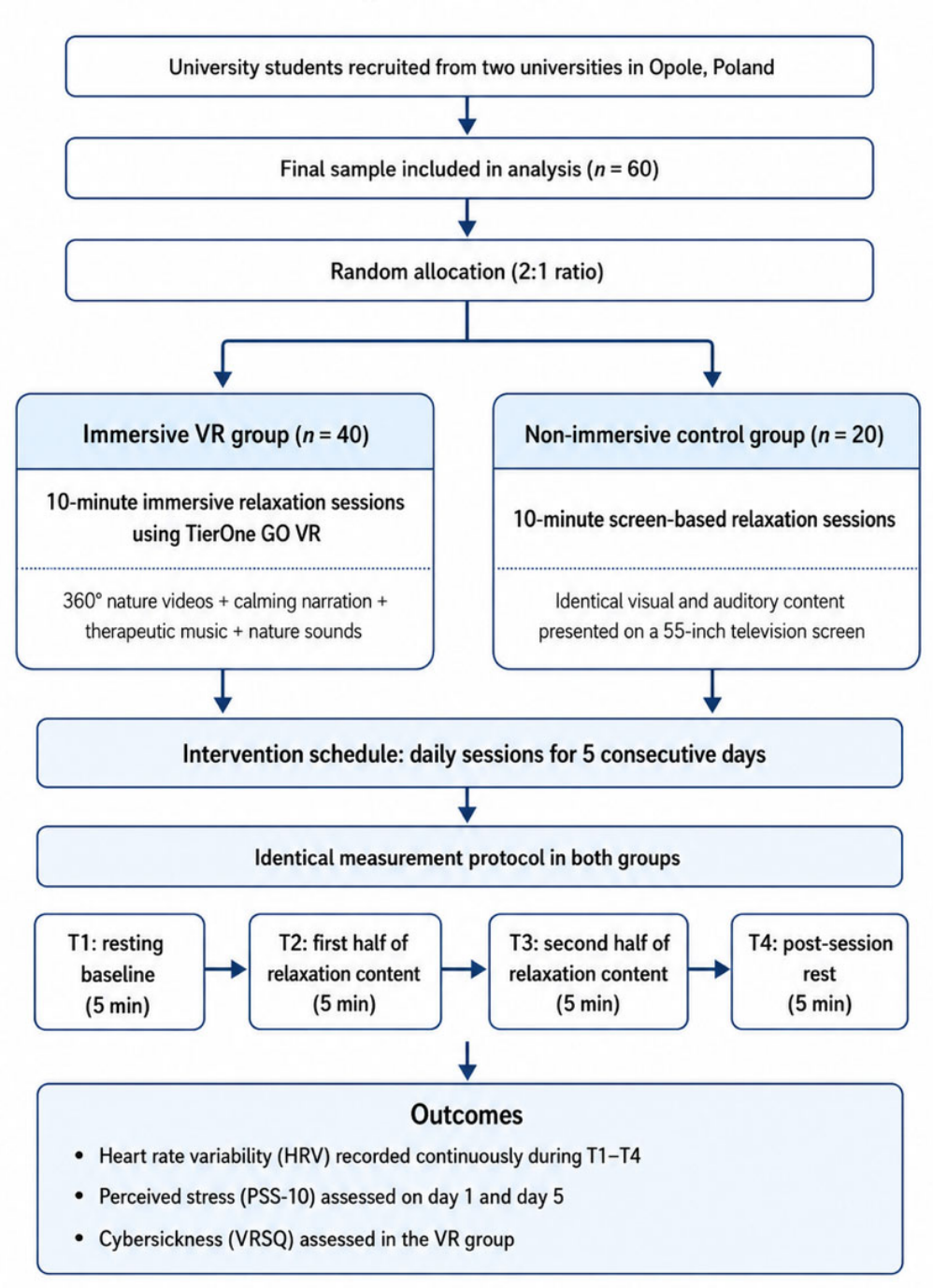
Figure 2.
Dynamics of selected heart rate variability parameters across time points (T1–T4) in the immersive VR group and the non-immersive control group.
Figure 2.
Dynamics of selected heart rate variability parameters across time points (T1–T4) in the immersive VR group and the non-immersive control group.
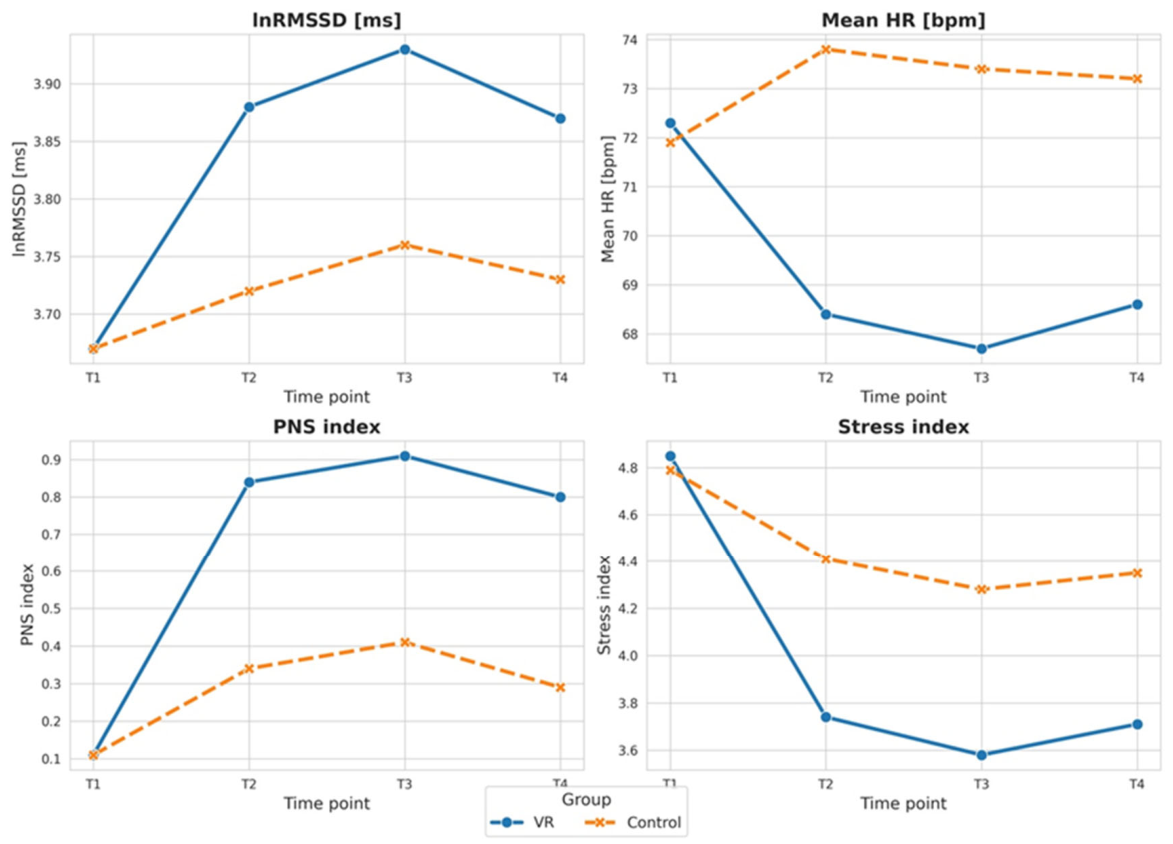
Figure 3.
Changes in perceived stress (PSS-10 scores) from pre-intervention (day 1) to post-intervention (day 5) in the immersive virtual reality group and the non-immersive control group.
Figure 3.
Changes in perceived stress (PSS-10 scores) from pre-intervention (day 1) to post-intervention (day 5) in the immersive virtual reality group and the non-immersive control group.
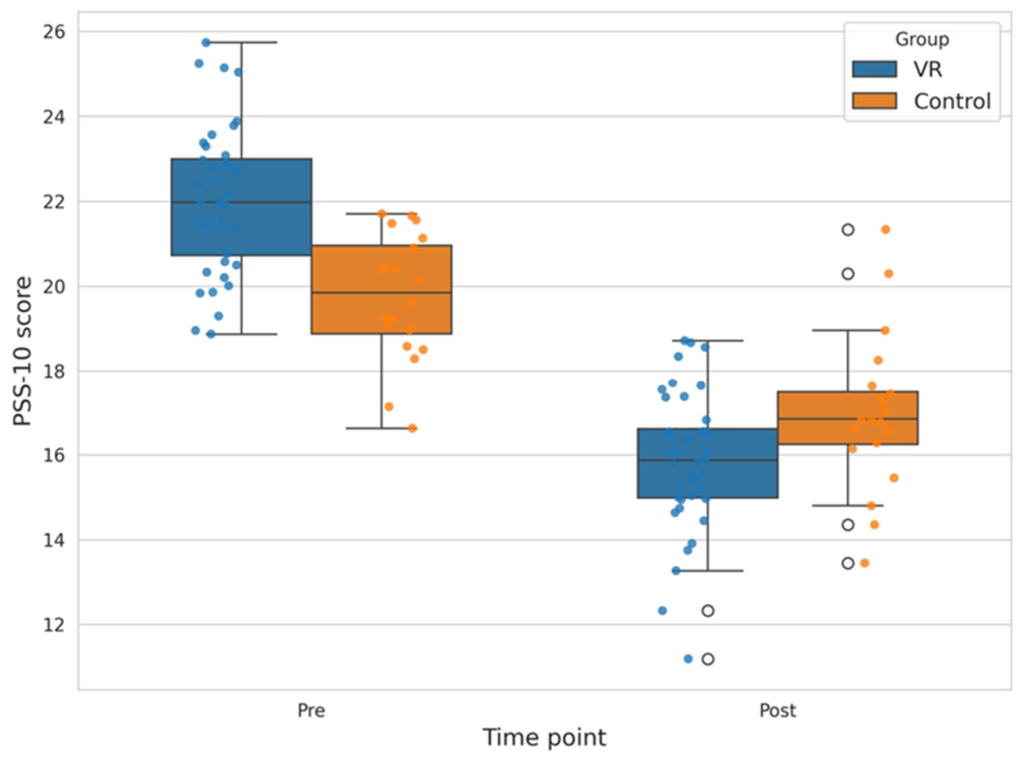
Table 1.
Baseline demographic and clinical characteristics of the study participants.
| Characteristic | Immersive VR group (n = 40) | Non-immersive control group (n = 20) | p-value |
|---|---|---|---|
| Age (years), mean ± SD | 23.0 ± 0.82 | 19.95±1.46 | 0.001 |
| Female, n (%) | 13 (75%) | 12 (60%) | 0.62 |
| Baseline PSS-10, median [IQR] | 22.0 [19.0–26.0] | 20.5 [16.0–25.0] | 0.31 |
| Baseline lnRMSSD (T1), mean ± SE | 3.67 ± 0.05 | 3.67 ± 0.04 | 0.98 |
Disclaimer/Publisher’s Note: The statements, opinions and data contained in all publications are solely those of the individual author(s) and contributor(s) and not of MDPI and/or the editor(s). MDPI and/or the editor(s) disclaim responsibility for any injury to people or property resulting from any ideas, methods, instructions or products referred to in the content. |
© 2026 by the authors. Licensee MDPI, Basel, Switzerland. This article is an open access article distributed under the terms and conditions of the Creative Commons Attribution (CC BY) license (http://creativecommons.org/licenses/by/4.0/).
Copyright: This open access article is published under a Creative Commons CC BY 4.0 license, which permit the free download, distribution, and reuse, provided that the author and preprint are cited in any reuse.


