

Submitted:
13 June 2026
Posted:
15 June 2026
You are already at the latest version
Abstract
We study the third-order rational difference equation \[ z_{n+1}=\frac{\alpha+z_n}{Cz_{n-1}+z_{n-2}}, \qquad \alpha,C>0, \] with positive initial conditions. This equation is associated with a period-six trichotomy governed by the threshold $\alpha C^2=1$. We prove that the unique positive equilibrium is locally asymptotically stable exactly when $\alpha C^2>1$, is nonhyperbolic but not locally asymptotically stable at equality, and is unstable below the threshold. Our principal result resolves both the critical component of the trichotomy and the generalized period-six conjecture formulated by Amleh and Ladas: if $\alpha C^2=1$, then every positive solution converges, along its six residue classes, to a positive solution whose period divides six. Every such periodic limiting orbit is classified explicitly. In the normalized variables $x_n=Cz_n$, and after a cyclic choice of origin, it has the form \[ \left(a,ac,c,a^{-1},(ac)^{-1},c^{-1}\right),\qquad a,c>0, \] and every nonconstant member has prime period six. The proof combines the known boundedness theorem with an exact six-step factorization over $\mathbb Z[a,b,c,q]$. The source package separates certificate generation from a distinct certificate-reading verification stage, implemented in the same exact computer-algebra environment, and includes the expanded polynomials, hashes, software versions, and execution instructions. We also exclude positive prime period-two and period-three solutions in the full normalized parameter domain and derive a strict weighted reciprocal-mean entropy estimate for the unresolved supercritical problem.
Keywords:
rational difference equation
; period-six convergence
; periodic-orbit classification
; local asymptotic stability
; computer-assisted proof
MSC: 39A10 (primary); 39A30; 37C25 (secondary)
1. Introduction
Rational difference equations provide elementary-looking models whose global dynamics can exhibit sharp transitions between bounded convergence, periodic limiting behavior, and unbounded oscillation; see, for example, [1,2,3]. We consider
where and . Positivity makes every denominator in (1) nonzero.
Camouzis and Ladas formulated a trichotomy for (1) in [4]; it was later recorded as Conjecture 6 by Ladas, Lugo, and Palladino [5]. Its proposed threshold is : global equilibrium convergence above the threshold, convergence to a solution of period dividing six at the threshold, and the existence of unbounded positive solutions below it. Lugo and Palladino treated degenerate subcases in [6]. Huang and Knopf’s main boundedness theorem [7] applies to the full equation (1): for , every positive solution is bounded when , including the boundary case, whereas positive unbounded solutions exist for suitable initial conditions when .
Amleh and Ladas first posed the special equation
as a period-six convergence problem and, in the same work, formulated the more general conjecture that for every each positive solution of
converges to a period-six solution [8]. Equation (2) is precisely the critical family in (1), with . Under the scaling and , it becomes
The normalized and original parametrizations of the periodic family are equivalent. More precisely, the classification proved in Corollary 2 shows that, after a cyclic choice of origin, a normalized cycle
corresponds, upon writing and , to the original-variable cycle
Thus the two-parameter family obtained below is exactly the family associated with the Amleh–Ladas critical equation, expressed in normalized coordinates.
Spahn and Zeilberger later revisited the member by experimental mathematics and symbolic computation and described their treatment of the first four Amleh–Ladas conjectures, including the period-six case, as semi-rigorous [9]. The present paper supplies an exact proof for every . Accordingly, the main theorem resolves the generalized Amleh–Ladas period-six conjecture and, equivalently, the critical branch of the Camouzis–Ladas trichotomy.
The critical proof has two ingredients. First, an elementary defect changes sign at every iterate. Second, an exact six-step factorization shows that each of the six residue subsequences is monotone. The positive numerator factor has 228 monomials and the positive denominator has 557 monomials, so printing either expansion in the article would obscure rather than clarify the argument. Both are supplied as machine-readable exact certificates. The archive contains distinct generation and verification programs. The certificate-reading verifier does not call the generator or factor the recurrence numerator; it reads the committed polynomials, checks their hashes and coefficient positivity, reconstructs the six iterates, and confirms the cross-multiplied identity over . Both stages use the same pinned SymPy environment, so this is an operationally separate exact verification stage rather than an implementation in a second computer-algebra system. No floating-point calculation enters the proof.
The paper is organized as follows. In Section 2 we determine the equilibrium and prove the exact local-stability threshold by an explicit Schur reduction. In Section 3 we normalize the critical equation and establish the certified six-step sign identity. The convergence theorem is proved in Section 4, together with the exact prime-period classification of the two-parameter periodic family. In Section 5 we normalize the general equation, state precisely the parameter range for the period-two and period-three exclusions, and derive a weighted reciprocal-mean entropy estimate. A numerical illustration of the proved critical theorem is given in Section 6; it is not used in any proof.
2. Equilibrium and the Local-Stability Threshold
Theorem 1
(Exact local-stability threshold). The positive equilibrium (5) is locally asymptotically stable if and only if
It is nonhyperbolic and not locally asymptotically stable when , and it is unstable when .
Proof.
Write . The linearization at is
Since , one has . Put
The characteristic polynomial is
We now display all Schur conditions rather than suppressing the reduction. For a real monic cubic
with , the Schur transform is
The cubic is Schur stable if and only if this quadratic is Schur stable. A real quadratic , with , is Schur stable exactly when
(see, for example, [10]). Here and hence
Because , the first quadratic condition is . Direct calculation gives
Also , so the initial condition is automatic. Consequently every characteristic root lies in the open unit disk exactly when .
Using (4), one obtains
The second factor is positive, so is equivalent to . In this case all characteristic roots lie strictly inside the unit disk, and the standard linearized-stability theorem for discrete dynamical systems yields local asymptotic stability of the equilibrium.
When , necessarily , and (7) factors as
The quadratic factor has the primitive sixth roots , so the equilibrium is nonhyperbolic. Nonhyperbolicity alone does not exclude nonlinear attraction, so the equality case requires an additional argument. At criticality introduce . For any , the initial state
generates, by direct substitution in the critical recurrence, the nonconstant period-six orbit
As , these periodic initial states approach the equilibrium state in normalized coordinates, equivalently in the original variables, but their forward orbits do not converge to the equilibrium. Hence the critical equilibrium is not locally attractive and therefore is not locally asymptotically stable.
It remains to justify instability below the threshold. Recall that . We first show that (7) has a root on the unit circle only when . Suppose . The values and exclude . Dividing the equation by and taking imaginary parts gives
so . Substitution in the real part yields
Since , a unit-modulus root therefore forces . Conversely, when the factorization (9) gives the two unit-modulus roots explicitly.
If , then , because . The Schur criterion fails, while the preceding calculation excludes roots on the unit circle. Hence at least one characteristic root has modulus strictly greater than one. The first-order companion map associated with (1) is continuously differentiable in a neighborhood of the positive equilibrium, and the eigenvalues of its derivative are the roots of (7). The standard linearized-instability theorem for discrete dynamical systems therefore implies that the equilibrium is unstable [10]. □
Remark 1.
The roots in (9) explain why the boundary dynamics is organized by six residue classes. The critical periodicity is therefore already visible in the linearization, although the global result requires a nonlinear argument.
3. Critical Normalization and an Exact Six-Step Identity
Define the defect
Lemma 1
(Alternating defect). Every positive solution of (12) satisfies
Consequently, either for every subsequent index, or the sign of alternates at each step. In particular,
Proof.
Using (12),
The denominator is positive. □
The factor appearing in the six-step identity below has a direct dynamical origin. For initial data , , and , the equality is exactly the condition . By Lemma 1, it then follows that for all subsequent indices, so and direct iteration gives
which repeats after six steps. Consequently, after denominators are cleared, the numerator of vanishes on the hypersurface and is divisible by . The computer-assisted certificate is needed not to discover this structural factor, but to identify the remaining quotient exactly and prove that all of its coefficients are positive.
The following identity provides the global six-step monotonicity. Its verification is exact, but computer-assisted.
Proposition 1
(Certified six-step sign identity). Let , and let (12) start from
There exist polynomials , every coefficient of which is strictly positive, such that
The polynomial has 228 monomials and total degree 16; has 557 monomials and total degree 19.
Proof.
Use the index correspondence
and define
The certificate generator performs exact rational simplification over and writes primitive expanded polynomials , normalized to have positive leading coefficient and coefficient content one. A separate certificate-reading verifier then reads those stored files rather than regenerating them. It checks their SHA-256 hashes against hard-coded proof-critical values and cross-checks those values with both the certificate summary and the archive manifest. It also checks term counts, degrees, coefficient contents, and strict positivity of every coefficient. It reconstructs from the recurrence and verifies the cross-multiplied identity
by reducing its exact numerator to the zero polynomial over . This proves (15). The generator and this verifier are separate executable stages, but both use the same pinned SymPy stack; they are therefore described as operationally separate rather than as a second-CAS verification. The archive additionally contains a standard-library sparse-polynomial verifier that parses the committed polynomials, reconstructs the six rational iterates without SymPy, and checks the same cleared polynomial identity using integer dictionary arithmetic. This implementation-diverse check is not a formal proof-assistant verification, but it removes dependence on SymPy for the final identity test. Because all coefficients of and are strictly positive, both polynomials are strictly positive on the positive orthant. All computations use exact integer or rational arithmetic; no numerical tolerance, interpolation, or random sampling is involved. □
Corollary 1
(Monotonicity along residue classes). For every positive solution of (12),
Therefore, for each , the subsequence is monotone.
Proof.
Apply Proposition 1 after shifting the initial index. All factors other than are positive. By Lemma 1, the sign of is constant on each residue class modulo six. □
4. Convergence to a Period Dividing Six
We now combine the preceding monotonicity with the boundedness theorem of Huang and Knopf [7].
Theorem 2
Proof.
The main theorem of Huang and Knopf [7] assumes and positive initial data and states that every positive solution of (1) is bounded whenever ; hence it applies directly on the equality surface considered here. Thus the normalized solution of (12) satisfies for some . It is also bounded away from zero, because
By Corollary 1, each of the six residue subsequences is monotone; boundedness and (18) therefore imply the existence of finite positive limits .
Fix r modulo six and let . Passing to the limit in (12) yields
Thus the six-periodic extension of satisfies the recurrence. This proves convergence to a solution of period dividing six. □
The critical equation also contains a large explicit family of exact period-six orbits.
Proposition 2
Then
and for all n. The orbit is the equilibrium precisely when ; for every its prime period is six.
Proof.
The initial defect is . Equation (14) implies for every , so
Successive substitution gives (20) and then repeats after six steps. Directly, the first recurrence step is
and the remaining terms follow similarly.
It remains to determine the prime period. Any prime period dividing six is 1, 2, 3, or 6. If the displayed orbit has period dividing three, then , so and hence ; next gives , hence . If it has period dividing two, then the even positions in (20) coincide, giving
Thus and , so again . The period-one case is contained in either argument. Therefore every non-equilibrium member has prime period six. □
Corollary 2
(Classification of all positive period-dividing-six orbits). Let be a positive periodic solution of (12) whose period divides six. Then there exist such that
Consequently, the equilibrium is the only solution with prime period less than six, and every other positive periodic solution whose period divides six has prime period six.
Proof.
For a solution whose period divides six, for every n. Applying the shifted identity of Proposition 1, all factors except are strictly positive; hence for every n. In particular,
Set and . The relation at gives , and the relations at successively give
This proves (21). The prime-period assertion follows from Proposition 2. □
Remark 2.
The exact family in Proposition 2 and its converse in Corollary 2 show that the critical limiting orbit cannot generally be replaced by the equilibrium. In particular, the conclusion of Theorem 2 can be sharpened: its limiting six-tuple is always of the form (21), and it is either the equilibrium or a prime period-six orbit.
5. Supercritical Normalization and Structural Reductions
We do not claim a proof of global equilibrium convergence for the entire supercritical region. Instead, this section records exact reductions that any such proof must exploit.
Let be given by (5) and set
Since , one has , and the normalized equation is
with equilibrium . By (8),
5.1. Exclusion of periods two and three
Proposition 3.
Assume , , and . Then (23) has no positive prime period-two solution. Its only positive solution with period dividing two is .
Proof.
If is a positive period-two orbit, then
Subtracting gives
The second factor is positive, so . The positive constant solutions satisfy . Since and , the unique positive root is . □
Proposition 4.
Assume , , and . Then (23) has no positive prime period-three solution. Its only positive solution with period dividing three is .
Proof.
Let be a positive period-three orbit. Then
Subtracting consecutive equations yields
Every coefficient multiplying a difference is positive. Thus the three differences , , and have the same sign unless they vanish. Since their sum is zero, all three vanish. The unique positive constant solution is 1. □
5.2. A weighted reciprocal-mean reduction
Define
Lemma 2.
When , the right side of (33) is a weighted arithmetic mean of , 1, and , with positive weights , , and q, respectively. In particular,
with strict inequalities unless or the three entries coincide. The same representation yields the following exact Jensen-gap estimate.
Proposition 5
Proof.
Remark 3
(What the entropy estimate does and does not prove). Proposition 5 is a local contraction statement for the reciprocal update , not a Lyapunov theorem for the full third-order system. The quantity on the right of (36) is not the same state functional evaluated at time , and the variable coefficient obstructs direct summation. Therefore the estimate alone does not imply convergence. Its precise value is that it supplies an explicit nonnegative dissipation term and identifies the unique zero-dissipation state. To complete the supercritical conjecture by this route one would need an additional comparison or a bounded-below finite-memory functional whose increment controls a sum of these Jensen gaps. The sixth-order organization at the critical boundary suggests examining functionals involving several consecutive phases, but no such functional is claimed here.
Problem 1.
6. Numerical Illustration
This computation illustrates only the proved critical theorem and does not enter its logical proof. For (12), take and
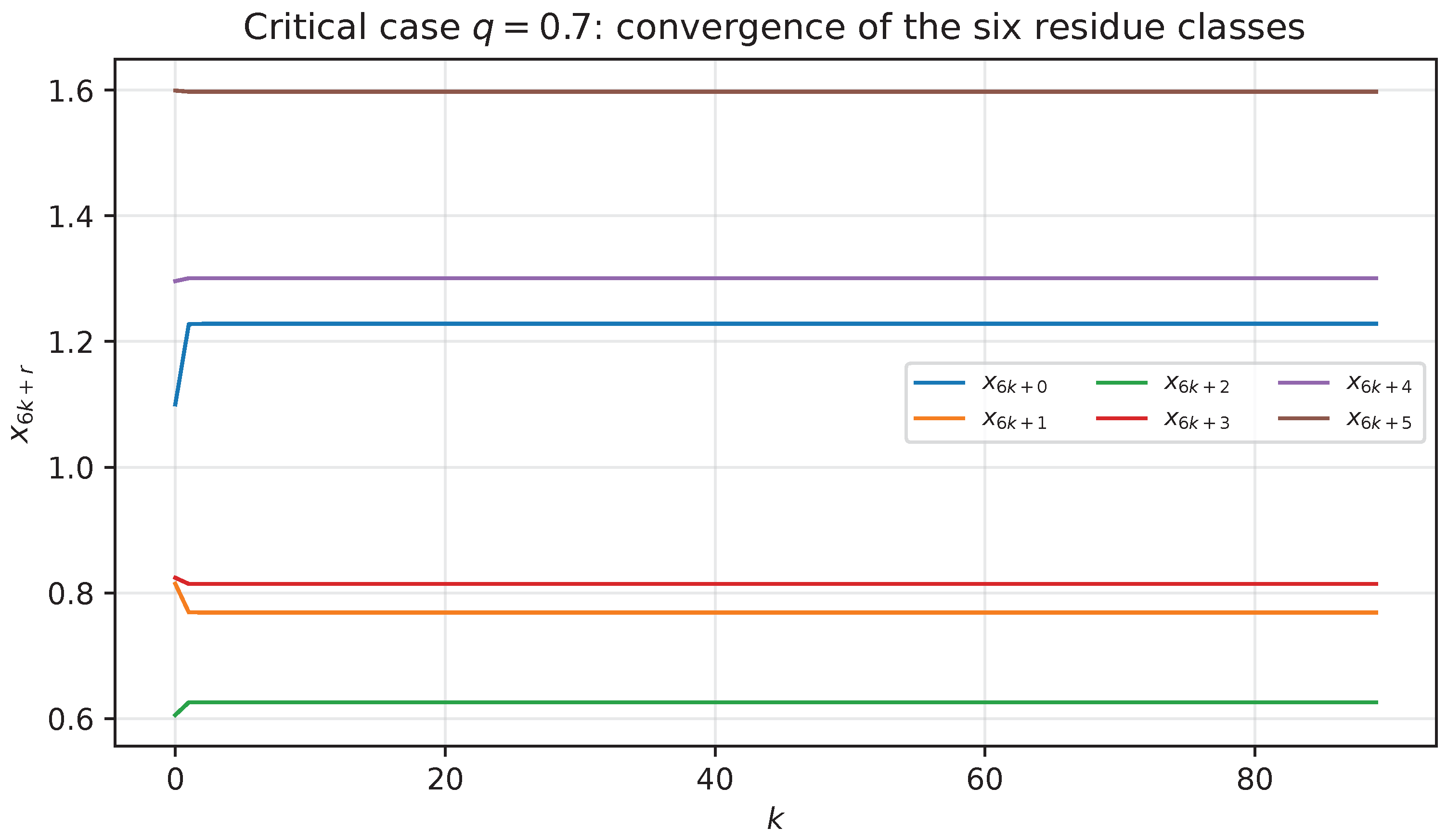
As guaranteed by Theorem 2, each residue subsequence is monotone and converges; the six limiting values need not coincide. A double-precision run of steps gives
The maximum residual in the classification relations
is below . These numerical values are only a reproducible consistency check; Figure 1 displays the six subsequences separately.
7. Conclusion
The threshold has two complementary meanings for (1). It is exactly the local-stability boundary of the positive equilibrium, and it is the parameter surface on which nonlinear period-six limiting behavior survives. Using the boundedness theorem of Huang and Knopf together with the exact factorization (15), we proved that every positive critical solution converges along its six residue classes to a positive orbit of period dividing six. We then classified all such positive periodic orbits: after a cyclic choice of origin they are exactly the family (21), with the constant member equal to the equilibrium and every nonconstant member of prime period six. This establishes the generalized Amleh–Ladas conjecture and the critical convergence assertion of the trichotomy.
Above the threshold, the equilibrium is locally asymptotically stable. More generally, throughout the parameter domain , , , the normalized equation has no positive prime two- or three-cycles. The weighted reciprocal-mean representation (33) and the exact Jensen-gap identity (37) provide a strict local contraction mechanism when . They do not by themselves define a Lyapunov function for the third-order recurrence; constructing the additional comparison or finite-memory functional needed for global equilibrium convergence remains open.
Funding
The author received no external funding for this work.
Institutional Review Board Statement
Not applicable.
Informed Consent Statement
Not applicable.
Data Availability Statement
No empirical dataset was generated or analyzed. The complete LaTeX source, exact symbolic certificates, checksum manifest, verification scripts, and numerical figure script accompany the manuscript and are designated for permanent publication as supplementary material with the version of record.
Use of Artificial Intelligence
Generative artificial intelligence was used to assist with language editing, organization, and LaTeX preparation. All mathematical statements, symbolic identities, and bibliographic entries were reviewed by the author, who assumes full responsibility for the content. The exact computer-assisted identity is reproducible with the supplied generator and is checked by a separate certificate-reading verifier implemented in the same pinned computer-algebra environment.
Acknowledgments
The author acknowledges preliminary numerical and software assistance received during an earlier stage of the project. That assistance was limited to exploratory computation and did not constitute the mathematical proof presented here. The author checked the final exact certificate, its verification output, and the complete manuscript and assumes responsibility for them.
Conflicts of Interest
The author declares that there is no conflict of interest.
Appendix A. Reproducible Symbolic Certificate and Archival Record
The supplementary source archive contains:
- (i)
- scripts/generate_certificate.py, which derives six exact iterates and writes the primitive expanded certificate polynomials;
- (ii)
- scripts/verify_certificate.py, an operationally separate SymPy certificate-reading verifier that reads the stored polynomials and checks the cross-multiplied identity;
- (iii)
- scripts/verify_certificate_sparse.py, an implementation-diverse verifier using only the Python standard library and sparse integer-polynomial arithmetic;
- (iv)
- certificates/P_polynomial.txt and certificates/Q_polynomial.txt, containing the complete expanded polynomials;
- (v)
- certificates/certificate_summary.txt, containing the normalization, term counts, total degrees, hashes, and reference software versions;
- (vi)
- requirements.txt and README.txt, containing the exact Python dependencies and clean-environment execution instructions;
- (vii)
- scripts/generate_figures.py, which reproduces Figure 1.
Both verifiers contain the proof-critical polynomial hashes as fixed constants. They also cross-check those constants against certificate_summary.txt and SHA256SUMS.txt; therefore altering a polynomial together with its adjacent metadata does not pass verification. After the file-hash, metadata, normalization, and coefficient checks, the SymPy verifier performs the following separate cross-multiplication:
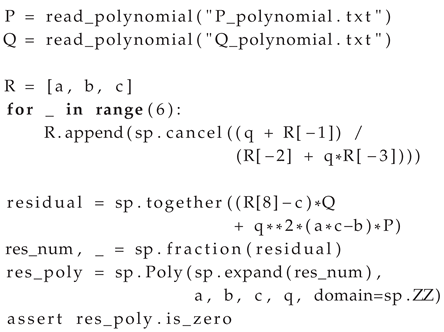
The standard-library verifier carries out the same test after forming uncancelled numerator–denominator pairs with sparse integer dictionaries and checking
where . On the reference environment (Python 3.13.5 and SymPy 1.14.0), each verification route runs in a few seconds and uses approximately GB of peak memory. These figures are informational rather than mathematical assumptions.
The complete source archive is designated as supplementary material for permanent publication with the version of record. The exact committed certificate files are identified by the following SHA-256 hashes:

A machine-readable checksum manifest, SHA256SUMS.txt, is included in the archive. The hard-coded verifier constants authenticate the proof-critical certificate files, while the manifest records the remaining archive contents. Together they distinguish the certificate and the accompanying source package byte-for-byte from later modifications.
References
- Kocic, V.L.; Ladas, G. Global Behavior of Nonlinear Difference Equations of Higher Order with Applications; Kluwer Academic Publishers: Dordrecht, 1993.
- Grove, E.A.; Ladas, G. Periodicity in Nonlinear Difference Equations; Chapman and Hall/CRC: Boca Raton, 2005.
- Camouzis, E.; Ladas, G. Dynamics of Third-Order Rational Difference Equations with Open Problems and Conjectures; Chapman and Hall/CRC: Boca Raton, 2007. [CrossRef]
- Camouzis, E.; Ladas, G. Three trichotomy conjectures. Journal of Difference Equations and Applications 2002, 8, 495–500. [CrossRef]
- Ladas, G.; Lugo, G.; Palladino, F.J. Open problems and conjectures on rational systems in three dimensions. Sarajevo Journal of Mathematics 2012, 8, 311–321. [CrossRef]
- Lugo, G.; Palladino, F.J. Unboundedness for some classes of rational difference equations. International Journal of Difference Equations 2009, 4, 97–113.
- Huang, Y.S.; Knopf, P.M. On the boundedness of solutions of a class of third-order rational difference equations. Journal of Difference Equations and Applications 2018, 24, 1541–1587. [CrossRef]
- Amleh, A.M.; Ladas, G. Convergence to periodic solutions. Journal of Difference Equations and Applications 2001, 7, 621–631. [CrossRef]
- Spahn, G.; Zeilberger, D. Experimenting with Discrete Dynamical Systems. Journal of Difference Equations and Applications 2024, 30, 1733–1746. [CrossRef]
- Elaydi, S. An Introduction to Difference Equations, 3 ed.; Springer: New York, 2005.
Figure 1.
Critical case : convergence of the six monotone residue subsequences.
Disclaimer/Publisher’s Note: The statements, opinions and data contained in all publications are solely those of the individual author(s) and contributor(s) and not of MDPI and/or the editor(s). MDPI and/or the editor(s) disclaim responsibility for any injury to people or property resulting from any ideas, methods, instructions or products referred to in the content. |
© 2026 by the authors. Licensee MDPI, Basel, Switzerland. This article is an open access article distributed under the terms and conditions of the Creative Commons Attribution (CC BY) license (http://creativecommons.org/licenses/by/4.0/).
Copyright: This open access article is published under a Creative Commons CC BY 4.0 license, which permit the free download, distribution, and reuse, provided that the author and preprint are cited in any reuse.


