

Submitted:
12 June 2026
Posted:
15 June 2026
You are already at the latest version
Abstract
Background/Objectives: Transurethral resection of bladder tumors (TURBT) is the standard for diagnosing and treating non-muscle-invasive bladder cancer. For lateral bladder wall tumors, obturator nerve stimulation can trigger sudden adductor contractions, raising the risk of perforation, hemorrhage, incomplete resection, and poor specimen quality. We evaluated the impact of obturator nerve block (ONB) on specimen quality and perioperative complications. Methods: In this single-center retrospective study, patients with lateral wall tumors treated by TURBT between October 2022 and December 2024 were divided into an ONB group (spinal anesthesia plus ONB) and a non-ONB group (spinal anesthesia alone). Specimen quality, perioperative complications, and 12-month recurrence were analyzed. Results: Of 219 patients (135 ONB, 84 non-ONB), high-quality specimens were more frequent with ONB (71.1% vs. 35.7%, p < 0.001). No perforations occurred with ONB versus 5 (6.0%) without (p = 0.008); hematuria (11.1% vs. 28.6%, p = 0.002) and 12-month recurrence (4.4% vs. 16.7%, p = 0.005) were also lower. Conclusions: ONB added to spinal anesthesia during TURBT for lateral wall tumors was associated with improved specimen quality and fewer perioperative complications. The lower recurrence rate should be considered hypothesis-generating, given the retrospective design and lack of multivariate adjustment; prospective studies are needed.
Keywords:
bladder cancer
; transurethral resection of bladder tumor
; obturator nerve block
; nonmuscle-invasive bladder cancer
; specimen quality
; detrusor muscle
1. Introduction
Bladder cancer is the seventh most common cancer diagnosed in men worldwide and the ninth when both sexes are considered [1]. In urological practice, approximately 75% of patients present with non-muscle-invasive forms, corresponding to stages Ta and T1, and this proportion is even higher in younger patients under 40 years of age. At these stages, transurethral resection of the bladder tumor (TURBT) is the standard method for both diagnosis and treatment [2,3]. The quality of the specimens obtained by endoscopic resection plays an essential role in correct disease staging and directly influences subsequent therapeutic management, including the indication for intravesical instillations, re-TURBT, or radical surgery. The presence of detrusor muscle fibers in the histopathological specimen is considered an important indicator of a complete, high-quality resection [4]. Their absence is a major factor for staging error, particularly understaging, with a potential negative impact on oncological outcomes [5,6,7,8]. In addition, coagulation artifacts may compromise the assessment of muscle invasion and resection margins. Thus, both the quality of the surgical procedure and the handling, fixation, and processing of specimens are decisive for obtaining a complete and accurate histopathological report [9].
The obturator reflex, caused by stimulation of the obturator nerve during TURBT for tumors located on the lateral bladder wall, produces sudden contractions of the thigh adductor muscles. This reaction may favor bladder perforation, intraoperative hemorrhage, and the retrieval of poor-quality tissue fragments, affecting both the safety of the procedure and the accuracy of histopathological evaluation [10,11,12]. The incidence of the obturator reflex is reported variably, particularly for tumors on the lateral wall, and has been associated with an increased risk of intraoperative complications and postoperative tumor recurrence [12,13]. Obturator nerve block combined with spinal anesthesia has been proposed as an effective method to prevent adductor contractions and reduce the risk of bladder perforation during TURBT [14,15,16]. Ultrasound- and/or nerve-stimulator-guided techniques can increase the precision of nerve localization and reduce the risk of puncture-related complications [17,18,19]. Nevertheless, data on the direct impact of obturator nerve block on the quality of the histopathological fragments obtained remain limited.
In this context, the aim of the present study was to objectively evaluate the influence of obturator nerve block on the quality of specimens obtained by TURBT and on the intraoperative safety profile, compared with the exclusive use of spinal anesthesia.
2. Materials and Methods
2.1. Study Design and Patients
We conducted a retrospective study that included all patients admitted to the Department of Urology of the Clinical County Emergency Hospital of Craiova between October 2022 and December 2024, diagnosed with bladder neoplasms identified by ultrasound and confirmed cystoscopically and histopathologically, located on the lateral bladder walls—a region where the risk of obturator reflex is considered significant. We evaluated demographic data, medical history and risk factors associated with bladder cancer, tumor size, invasion, degree of differentiation, histopathological specimen quality, and postoperative complications. Patients included in the final analysis were followed by imaging and cystoscopy for up to 12 months after resection and received oncological treatment according to current guidelines, as indicated by the multidisciplinary team. A single immediate postoperative intravesical instillation of epirubicin was administered, in accordance with current guideline recommendations for non-muscle-invasive bladder cancer, except in patients with intraoperative bladder perforation or clinically significant postoperative bleeding.
Patients aged ≥18 years, with American Society of Anesthesiologists (ASA) physical status I–III, preoperatively diagnosed with primary bladder tumors located on the lateral bladder walls, identified by imaging and confirmed cystoscopically, with an indication for TURBT under spinal anesthesia, were included. Eligible patients were those in whom the lesions were considered endoscopically resectable and preoperatively compatible with suspicion of non-muscle-invasive bladder cancer.
Patients who presented local infection at the puncture site, known allergy to local anesthetics, a history of major pelvic surgery with altered regional anatomy, pre-existing obturator neuropathy or motor deficit, inability to maintain adequate intraoperative positioning, or severe obesity impairing identification of anatomical landmarks were excluded.
The Ethics Committee of the Clinical County Emergency Hospital of Craiova approved this study (protocol code 27689; approved 29 May 2026) on the following grounds: (1) data were collected in a retrospective, observational, descriptive, and non-experimental study; (2) the study did not interfere with current medical care; (3) no substances were administered to patients and no biological samples were collected within the study; and (4) data were collected and analyzed anonymously, so that the confidentiality of patient data was not breached.
The following variables were collected: (1) baseline characteristics (age, sex, and comorbidities); (2) characteristics of the bladder neoplasm (location, tumor stage, type of surgical procedure, and intraoperative (bladder perforation) and postoperative (hematuria and urinary tract infection) complications); (3) histopathological specimen quality (Table 1); and (4) ultrasound and cystoscopic re-evaluation at a minimum of 12 months. Tumor stage was assessed using the 8th edition of the TNM Classification of Malignant Tumours of the Union for International Cancer Control [7]. Patients were divided into two groups according to obturator reflex control; this was performed depending on perioperative logistic availability and on the experience of the anesthesiologist, and resections were performed by a team of urologists experienced in these procedures.
2.2. Histopathological Quality Assessment
From a histopathological perspective, the quality of the fragments obtained by TURBT is essential for correct disease staging. An adequate fragment must allow complete evaluation of the tumor architecture and include the detrusor muscle, a key element for assessing the depth of invasion. The presence of detrusor is considered a surrogate marker of resection quality and allows reliable differentiation between non-muscle-invasive and muscle-invasive forms [4]. Thermal artifacts induced by electrocautery may compromise histological interpretation by altering tissue morphology and masking anatomical planes, limiting the evaluation of invasion and resection margins. Fragments lacking detrusor or with extensive artifacts are considered diagnostically suboptimal and are associated with an increased risk of understaging and early tumor recurrence. Therefore, the assessment of fragment quality must be systematically based on the presence of detrusor, architectural integrity, and the degree of coagulation artifacts (Table 1) [4,5]. This evaluation was performed by two pathologists experienced in urological pathology, as is standard practice in the urology department where the study was conducted; whenever feasible, the pathologists were blinded to the anesthesia technique.
2.3. Anesthesia and Surgical Technique
In the non-ONB group, TURBT was performed under standard spinal anesthesia [20], in the lithotomy position, using a bipolar resectoscope (Karl Storz 26 Fr, AUTOCON III 400, standard bipolar loop) with a continuous isotonic saline irrigation system. The procedure was carried out under standardized conditions, observing the intraoperative measures recommended to reduce the risk of obturator reflex: limiting diathermy current intensity, avoiding bladder overdistension, and consistently using the bipolar technique. These measures, frequently reported in the literature on the prevention of the “obturator jerk” during TURBT, have proven effective in reducing the incidence of adductor contractions and bladder perforations [14,16].
In the ONB group, spinal anesthesia was combined with an obturator nerve block (ONB) performed prior to resection [21]. With the patient in the lithotomy position, the obturator nerve was localized using anatomical landmarks and a nerve-stimulator-guided technique, with the aim of blocking the obturator nerve and abolishing the adductor reflex (Figure 1a,b).
For confirmation of the motor response and optimization of needle positioning, neurostimulation was used: initial stimulation at 2–3 mA (2 Hz, 0.1–0.3 ms), followed by gradual current reduction to 0.3–0.5 mA before injection, with disappearance of adductor contractions as a sign of block efficacy. These settings are those recommended for the classic neurostimulator technique in ONB. The equipment used was a Stimuplex HNS 12 neurostimulator (B. Braun, Germany), with current adjustable between 0 and 5 mA and selectable pulse duration (0.1/0.3/1.0 ms), together with 22G insulated needles (Stimuplex A/D, B. Braun) dedicated to peripheral nerve blocks. The local anesthetic was chosen according to the estimated procedure duration: for procedures lasting <2 h, mepivacaine 1–2% or lidocaine 1–2% (5–7 mL per nerve branch) was used, whereas for blocks of extended duration, bupivacaine 0.25–0.5% or ropivacaine 0.25–0.5% was used, in accordance with the literature [22]. TURBT was subsequently performed under the same technical conditions as in the non-ONB group.
2.4. Statistical Analysis
A comprehensive database incorporating all variables of interest was built using Microsoft Excel 2019 MSO (version 2304, Build 16.0.16327.20200). Detailed statistical analyses were performed using MedCalc software (version 20.218). Frequencies were expressed as absolute numbers and percentages. Continuous variables, which were not normally distributed, were compared using the Mann–Whitney U test, and categorical variables using the chi-square test with Yates’ continuity correction for 2×2 tables; the Fisher exact test was used instead of the chi-square test when an expected cell frequency was below 5. A p-value <0.05 was considered statistically significant.
3. Results
After applying the exclusion criteria, 27 of the 246 patients were excluded, and 219 patients remained eligible for the final analysis (Figure 2). Patients were assigned to two study groups: ONB (n = 135), in which obturator nerve block was performed in combination with spinal anesthesia, and non-ONB (n = 84), in which only standard spinal anesthesia was performed, without obturator block (Table 2).
Baseline demographic and clinicopathological characteristics were comparable between the two groups, with no statistically significant differences in age, body mass index, sex distribution, smoking status, alcohol consumption, tumor size, or tumor grade.
The median age was 73 years in the ONB group and 72 years in the non-ONB group (p = 0.220). Tumors larger than 3 cm were identified in 9.6% of patients in the ONB group and 13.1% in the non-ONB group (p = 0.318). Although tumor size did not differ significantly between groups, large bladder tumors are generally associated with technically more difficult resections, an increased risk of tissue fragmentation, and the possibility of incomplete resection—factors that may contribute to early recurrence. In this context, effective obturator reflex control may play an important role in optimizing resection quality, particularly for tumors located on the lateral bladder wall.
Statistically significant differences were observed between the two groups regarding the histopathological quality of resection specimens (p < 0.001). High-quality specimens (Quality 1) were obtained significantly more often in the ONB group than in the non-ONB group (71.1% vs. 35.7%). Conversely, intermediate-quality specimens (Quality 2) were more frequent in the non-ONB group (41.7% vs. 20.7%), and poor-quality fragments (Quality 3) were identified in 22.6% of non-ONB patients compared with only 8.1% in the ONB group.
The use of obturator nerve block was associated with a significant reduction in the rate of intraoperative bladder perforation. No perforations were recorded in the ONB group, compared with 5 cases (6.0%) in the non-ONB group (p = 0.008). All five perforations were managed conservatively by urinary catheter drainage, without the need for open or laparoscopic repair. Postoperative hematuria was also significantly less frequent in the ONB group than in the non-ONB group (11.1% vs. 28.6%, p = 0.002). Although urinary tract infections were less frequent in the ONB group (4.4% vs. 11.9%), this difference did not reach statistical significance (p = 0.073).
At the 12-month re-evaluation, the tumor recurrence rate was significantly lower in the ONB group than in the non-ONB group (4.4% vs. 16.7%, p = 0.005).
4. Discussion
Demographic and clinicopathological characteristics were comparable between the two groups, with no statistically significant differences in age, sex, tumor size, tumor grade, or tumor stage. This supports the comparability of the cohorts and reduces the likelihood that the observed differences in specimen quality and perioperative complications were influenced by major confounding factors.
Tumor size is an important factor in the technical complexity of TURBT, with large tumors frequently associated with an increased risk of tissue fragmentation, coagulation artifacts, and incomplete resection. In our study, the distribution of tumor size was comparable between the two groups, suggesting that the observed differences in specimen quality and perioperative complications were more likely influenced by obturator reflex control than by tumor size.
Particularly for tumors located on the lateral bladder wall, increased size may accentuate the technical difficulty of resection by requiring more extensive maneuvers and prolonged exposure to electrocautery, increasing susceptibility to adductor contractions and tissue trauma. Consistent with previously reported data, tumor size may influence the technical difficulty of TURBT and resection quality, particularly by increasing the risk of tissue fragmentation and extensive coagulation artifacts [4,6].
The obturator reflex causes sudden, uncontrolled contractions of the adductor muscles during resection, affecting the stability of the operative field and the precision of endoscopic maneuvers. These contractions may favor tissue fragmentation, charring, and the appearance of extensive thermal artifacts, limiting preservation of the histopathological specimen architecture [10,14]. In our study, the ONB group showed a significantly higher proportion of high-quality specimens and an important reduction in fragments considered suboptimal for histopathological evaluation. Consistent with previous studies, the obturator reflex represents an important factor of intraoperative instability during TURBT for lateral bladder wall tumors, influencing both the safety of the procedure and resection quality [23,24].
The quality of histopathological specimens is particularly important in the evaluation of tumors with suspected muscle invasion, because the presence and integrity of the detrusor muscle are essential for correct staging. Fragments affected by extensive thermal artifacts or tissue fragmentation may limit the assessment of invasion depth and favor understaging of the disease. In this context, the higher frequency of high-quality specimens observed in the ONB group may have important implications for the accuracy of histopathological evaluation and subsequent therapeutic management. This aspect is relevant for avoiding understaging, since reliable identification of the detrusor muscle allows correct exclusion of muscle invasion and the establishment of appropriate therapeutic management [4,5,25].
Although the incidence of urinary tract infections was lower in the ONB group, the difference did not reach statistical significance. Nevertheless, the lower rate of bladder perforation and postoperative hematuria observed in patients who received obturator nerve block may suggest a lower degree of tissue trauma and mucosal injury, with a possible favorable impact on the postoperative inflammatory and infectious profile [10,14]. Although the tumor recurrence rate was lower in the ONB group, these results should be interpreted with caution, given the relatively short follow-up period and the absence of multivariate adjustment for potential confounders, in particular the absence of adjustment for second (re-)transurethral resection, a strong determinant of recurrence in non-muscle-invasive bladder cancer. Effective obturator reflex control may contribute not only to reducing intraoperative complications but also to optimizing the oncological quality of TURBT by yielding better-preserved histopathological fragments more suitable for staging.
Limitations
The retrospective, single-center design may introduce selection bias and limits the generalizability of the results. The follow-up period was relatively short, limited to 12 months, and the statistical analysis was predominantly univariate, without multivariate adjustment for potential confounders. In addition, allocation to the two groups was not randomized but determined by perioperative logistic availability and anesthesiologist experience. Apart from the five non-ONB patients with intraoperative bladder perforation, in whom the immediate instillation was withheld in accordance with guideline recommendations, all patients received the same single immediate postoperative epirubicin instillation. Although this small imbalance could in principle have contributed to the higher recurrence observed in the non-ONB group, it is unlikely to fully account for the difference. Data on second (re-)TURBT were also not available for adjustment; given the univariate design and the short follow-up, the lower 12-month recurrence observed in the ONB group should be regarded as hypothesis-generating rather than confirmatory. Nevertheless, baseline demographic and clinicopathological characteristics were comparable between the two groups, reducing the likelihood of major confounding factors. In addition, the assessment of histopathological specimen quality may carry a degree of interobserver subjectivity. Despite these limitations, the results suggest a consistent association between obturator reflex control and improved TURBT quality.
5. Conclusions
Obturator nerve block combined with spinal anesthesia during TURBT for lateral bladder wall tumors was associated with significantly improved histopathological specimen quality and reduced intraoperative complications. Patients in the ONB group showed a higher frequency of high-quality fragments, with preserved tissue architecture and the presence of detrusor muscle—aspects essential for correct staging and adequate oncological evaluation.
Effective obturator reflex control may contribute not only to increased procedural safety but also to optimizing the oncological quality of TURBT by facilitating a more stable and precise resection. By reducing adductor contractions and increasing intraoperative stability, obturator nerve block may enable a more precise resection, with a favorable impact on histopathological evaluation and potentially on the quality of oncological treatment.
Author Contributions
Conceptualization, D.F.V. and C.V.O.; methodology, C.V.O. and M.M.; software, G.G.M. and A.E.S.; validation, M.A.R. and D.G.P.; formal analysis, N.V.C., D.F.V. and C.V.O.; investigation, C.V.O.; resources, D.F.V., C.V.O. and S.M.D.; data curation, M.A.R.; writing—original draft preparation, D.F.V. and G.F.M.; writing—review and editing, C.V.O.; visualization, G.F.M. and C.V.O.; supervision, D.F.V. and G.F.M.; project administration, C.V.O., D.F.V. and G.F.M. All authors have read and agreed to the published version of the manuscript.
Funding
The article processing charges were funded by the University of Medicine and Pharmacy of Craiova, Romania.
Institutional Review Board Statement
The study was conducted in accordance with the Declaration of Helsinki and approved by the Ethics Committee of the Clinical County Emergency Hospital of Craiova (protocol code 27689, date of approval 29 May 2026).
Informed Consent Statement
Patient consent was waived due to the retrospective and anonymized nature of the study.
Data Availability Statement
The data presented in this study are available on request from the corresponding author.
Conflicts of Interest
The authors declare no conflicts of interest.
References
- Bray, F.; Laversanne, M.; Sung, H.; Ferlay, J.; Siegel, R.L.; Soerjomataram, I.; Jemal, A. Global cancer statistics 2022: GLOBOCAN estimates of incidence and mortality worldwide for 36 cancers in 185 countries. CA Cancer J. Clin. 2024, 74, 229–263. [Google Scholar] [CrossRef] [PubMed]
- Compérat, E.; Larré, S.; Roupret, M.; Neuzillet, Y.; Pignot, G.; Quintens, H.; Houéde, N.; Roy, C.; Durand, X.; Varinot, J.; et al. Clinicopathological characteristics of urothelial bladder cancer in patients less than 40 years old. Virchows Arch. 2015, 466, 589–594. [Google Scholar] [CrossRef]
- Babjuk, M.; Burger, M.; Capoun, O.; Cohen, D.; Compérat, E.M.; Dominguez Escrig, J.L.; Gontero, P.; Liedberg, F.; Masson-Lecomte, A.; Mostafid, A.H.; et al. European Association of Urology guidelines on non-muscle-invasive bladder cancer (Ta, T1, and carcinoma in situ). Eur. Urol. 2022, 81, 75–94. [Google Scholar] [CrossRef] [PubMed]
- Mariappan, P.; Zachou, A.; Grigor, K.M.; Edinburgh Uro-Oncology Group. Detrusor muscle in the first, apparently complete transurethral resection of bladder tumour specimen is a surrogate marker of resection quality, predicts risk of early recurrence, and is dependent on operator experience. Eur. Urol. 2010, 57, 843–849. [Google Scholar] [CrossRef]
- Shoshany, O.; Mano, R.; Margel, D.; Baniel, J.; Yossepowitch, O. Presence of detrusor muscle in bladder tumor specimens—predictors and effect on outcome as a measure of resection quality. Urol. Oncol. 2014, 32, 40.e17–40.e22. [Google Scholar] [CrossRef]
- Mariappan, P.; Finney, S.M.; Head, E.; Somani, B.K.; Zachou, A.; Smith, G.; Mishriki, S.F.; N'Dow, J.; Grigor, K.M.; Edinburgh Urological Cancer Group. Good quality white-light transurethral resection of bladder tumours (GQ-WLTURBT) with experienced surgeons performing complete resections and obtaining detrusor muscle reduces early recurrence in new non-muscle-invasive bladder cancer. BJU Int. 2012, 109, 1666–1673. [Google Scholar] [CrossRef]
- Brierley, J.D.; Gospodarowicz, M.K.; Wittekind, C. (Eds.) TNM Classification of Malignant Tumours, 8th ed.; Wiley-Blackwell: Oxford, UK, 2017. [Google Scholar]
- Mariappan, P.; Johnston, A.; Padovani, L.; Clark, E.; Trail, M.; Hamid, S.; Hollins, G.; Simpson, H.; Thomas, B.G.; Hasan, R.; et al. Enhanced quality and effectiveness of transurethral resection of bladder tumour in non-muscle-invasive bladder cancer: a multicentre real-world experience from Scotland's Quality Performance Indicators Programme. Eur. Urol. 2020, 78, 520–530. [Google Scholar] [CrossRef]
- Rouprêt, M.; Yates, D.R.; Varinot, J.; Phé, V.; Chartier-Kastler, E.; Bitker, M.O.; Compérat, E. The presence of detrusor muscle in the pathological specimen after transurethral resection of primary pT1 bladder tumors and its relationship to operator experience. Can. J. Urol. 2012, 19, 6459–6464. [Google Scholar] [PubMed]
- Panagoda, P.I.; Vasdev, N.; Gowrie-Mohan, S. Avoiding the obturator jerk during TURBT. Curr. Urol. 2018, 12, 1–5. [Google Scholar] [CrossRef]
- Freisburger, C.; Nachtigall, B.; Wulf, H. Obturator nerve block: techniques and indications. Anasthesiol. Intensivmed. Notfallmed. Schmerzther. 2010, 45, 314–315. [Google Scholar] [CrossRef]
- García Rodríguez, J.; Jalón Monzón, A.; González Alvarez, R.C.; Ardura Laso, C.; Fernández Gomez, J.M.; Rodríguez Martinez, J.J.; Martínez Gómez, F.J.; Regadera Sejas, J.; González Huergo, F. An alternative technique to prevent obturator nerve stimulation during lateral bladder tumours transurethral resection. Actas Urol. Esp. 2005, 29, 445–447. [Google Scholar] [CrossRef] [PubMed]
- Bolenz, C.; Hautmann, R.E. Surgical treatment of bladder cancer: advances made in the past 50 years. Aktuelle Urol. 2019, 50, 366–377. [Google Scholar] [CrossRef]
- Krishan, A.; Bruce, A.; Khashaba, S.; Abouelela, M.; Ehsanullah, S.A. Safety and efficacy of transurethral resection of bladder tumor comparing spinal anesthesia with spinal anesthesia with an obturator nerve block: a systematic review and meta-analysis. J. Endourol. 2021, 35, 249–258. [Google Scholar] [CrossRef]
- Alavi, C.E.; Asgari, S.A.; Falahatkar, S.; Rimaz, S.; Naghipour, M.; Khoshrang, H.; Jafari, M.; Herfeh, N. Effectiveness of spinal anesthesia combined with obturator nerve blockade in preventing adductor muscle contraction during transurethral resection of bladder tumor. Turk. J. Urol. 2017, 43, 507–511. [Google Scholar] [CrossRef] [PubMed]
- Tekgül, Z.T.; Divrik, R.T.; Turan, M.; Konyalioğlu, E.; Şimşek, E.; Gönüllü, M. Impact of obturator nerve block on the short-term recurrence of superficial bladder tumors on the lateral wall. Urol. J. 2014, 11, 1248–1252. [Google Scholar] [CrossRef]
- Taha, A.M. Ultrasound-guided obturator nerve block: a proximal interfascial technique. Anesth. Analg. 2012, 114, 236–239. [Google Scholar] [CrossRef] [PubMed]
- Soong, J.; Schafhalter-Zoppoth, I.; Gray, A.T. Sonographic imaging of the obturator nerve for regional block. Reg. Anesth. Pain Med. 2007, 32, 146–151. [Google Scholar] [CrossRef]
- Ong, E.L.; Chan, S.T. Transurethral surgery and the adductor spasm. Ann. Acad. Med. Singap. 2000, 29, 259–262. [Google Scholar] [CrossRef]
- Olawin, A.M.; Das, J.M. Spinal Anesthesia. In StatPearls; StatPearls Publishing: Treasure Island, FL, USA, 2025; Available online: https://www.ncbi.nlm.nih.gov/books/NBK537299.
- Yoshida, T.; Nakamoto, T.; Kamibayashi, T. Ultrasound-guided obturator nerve block: a focused review on anatomy and updated techniques. BioMed Res. Int. 2017, 2017, 7023750. [Google Scholar] [CrossRef]
- Hadzic, A.; NYSORA Editorial Team. Obturator Nerve Block; The New York School of Regional Anesthesia: New York, NY, USA, 2023; Available online: https://www.nysora.com/techniques/lower-extremity/obturator-nerve-block.
- Horsanali, M.O.; Eren, H.; Dil, E.; Çağlayan, A.; Erdoğan, Ö.; Karaarslan, S. The effect of obturator nerve blockade on oncological outcomes of patients with lateral wall localized non-muscle invasive bladder cancer. J. Urol. Surg. 2023, 10, 199–205. [Google Scholar] [CrossRef]
- Erbay, G.; Akyol, F.; Karabakan, M.; Celebi, B.; Keskin, E.; Hirik, E. Effect of obturator nerve block during transurethral resection of lateral bladder wall tumors on the presence of detrusor muscle in tumor specimens and recurrence of the disease. Kaohsiung J. Med. Sci. 2017, 33, 86–90. [Google Scholar] [CrossRef] [PubMed]
- Kim, L.H.C.; Patel, M.I. Transurethral resection of bladder tumour (TURBT). Transl. Androl. Urol. 2020, 9, 3056–3072. [Google Scholar] [CrossRef] [PubMed]
Figure 1.
(a,b) Technique for performing the obturator nerve block (ONB).
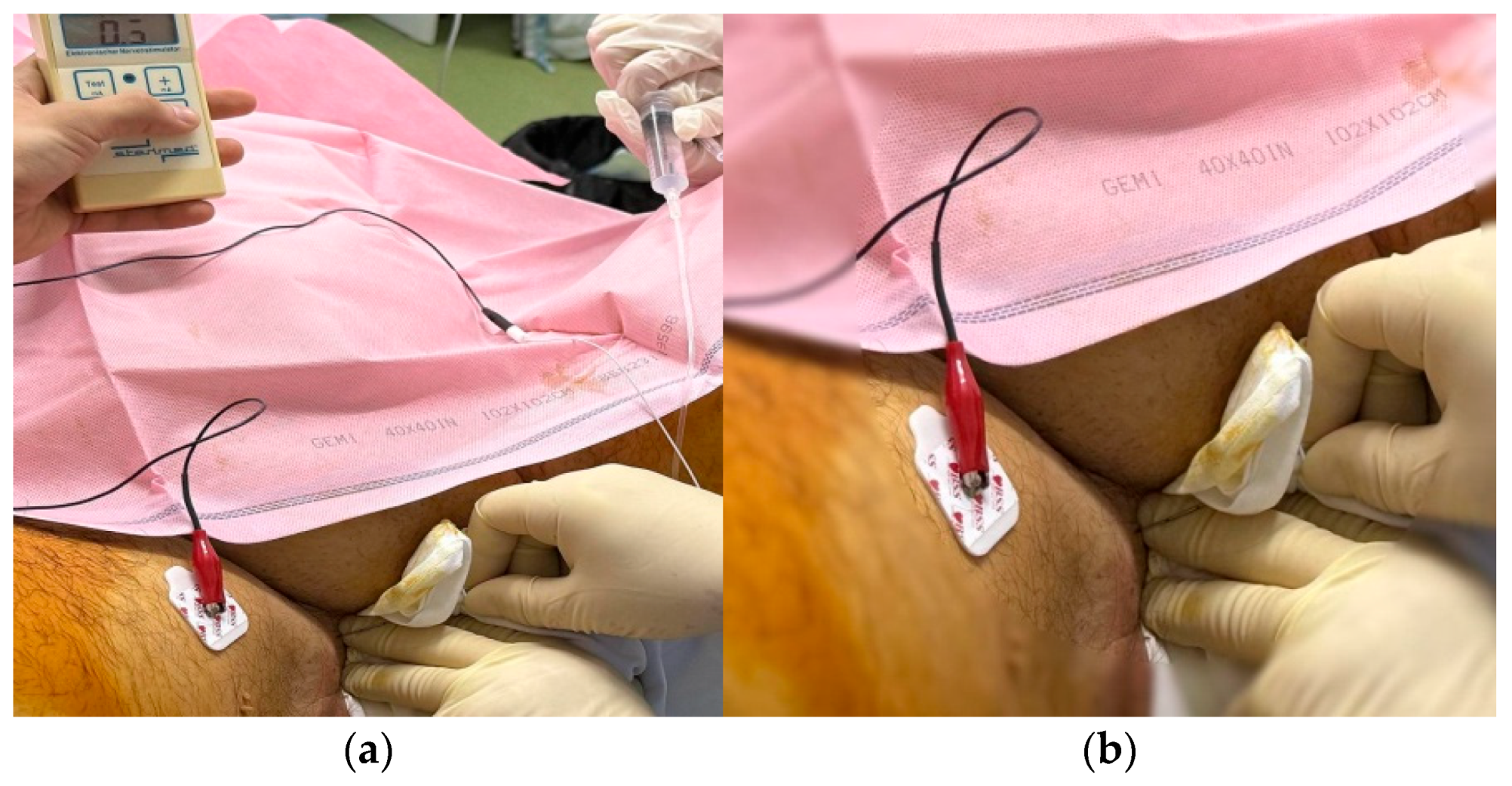
Figure 2.
Flow diagram of the patient-selection process.
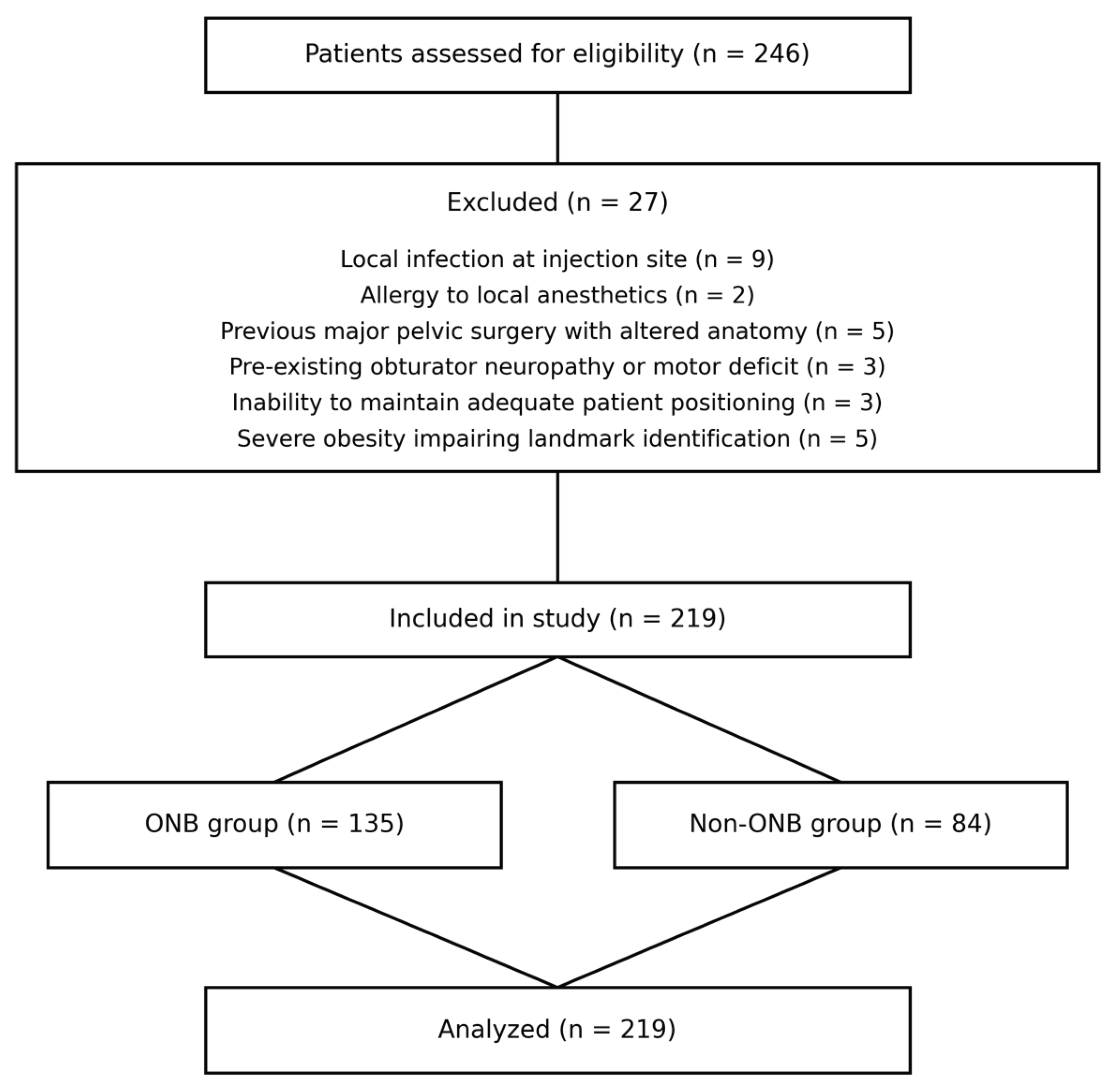

Table 1.
Histopathological criteria for assessing the quality of bladder tumor resection fragments.
| Quality Category | Histopathological Criteria | Diagnostic Value |
|---|---|---|
| Quality 1 (good) | Well-preserved tissue architecture; minimal or absent thermal artifacts; clear identification of the urothelial tumor, lamina propria, and presence of the detrusor muscle layer | Optimal for correct staging and grading; reliable assessment of invasion depth |
| Quality 2 (intermediate) | Moderate coagulation artifacts, with partial preservation of tissue architecture; detrusor muscle layer present but fragmented or partially masked | Acceptable for diagnosis and grading; limitations in precise assessment of invasion |
| Quality 3 (poor) | Extensive thermal artifacts, tissue fragmentation, or charring; absence of the detrusor muscle layer | Reduced diagnostic value; increased risk of pathological understaging and need for re-resection |
The primary endpoint of the study was the proportion of high-quality histopathological specimens, defined as Quality 1 fragments with preserved tissue architecture, minimal or absent thermal artifacts, and identifiable detrusor muscle. Secondary endpoints included intraoperative bladder perforation, postoperative hematuria, urinary tract infection, and 12-month tumor recurrence.
Table 2.
Clinicopathological characteristics of patients in the ONB and non-ONB groups.
| Parameter | Total (%) | ONB | non-ONB | p-Value |
|---|---|---|---|---|
| No. of cases | 219 (100.0%) | 135 (61.6%) | 84 (38.4%) | |
| Age, years | 73 (66–75) | 73 (68–75) | 72 (65.75–75) | 0.220 b |
| BMI, kg/m² | 26.57 (24.22–29.41) | 26.64 (24.22–29.41) | 26.39 (24.22–29.49) | 0.999 b |
| Sex (%) | 0.330 a | |||
| Male | 173 (79.0%) | 110 (81.5%) | 63 (75.0%) | |
| Female | 46 (21.0%) | 25 (18.5%) | 21 (25.0%) | |
| Smoking status | 72 (32.9%) | 47 (34.8%) | 25 (29.8%) | 0.531 a |
| Alcohol consumption | 137 (62.6%) | 88 (65.2%) | 49 (58.3%) | 0.381 a |
| Tumor size (%) | 0.318 a | |||
| ≤3 cm | 195 (89.0%) | 122 (90.4%) | 73 (86.9%) | |
| >3 cm | 24 (11.0%) | 13 (9.6%) | 11 (13.1%) | |
| Tumor grade (%) | 0.892 a | |||
| G1 | 52 (23.7%) | 32 (23.7%) | 20 (23.8%) | |
| G2 | 69 (31.5%) | 43 (31.9%) | 26 (31.0%) | |
| G3 | 98 (44.8%) | 60 (44.4%) | 38 (45.2%) | |
| Tumor stage (%) | 0.981 a | |||
| Ta | 78 (35.6%) | 48 (35.6%) | 30 (35.7%) | |
| T1 | 141 (64.4%) | 87 (64.4%) | 54 (64.3%) | |
| Histopathological quality of resection specimen (%) | <0.001 a,* | |||
| Quality 1 | 126 (57.5%) | 96 (71.1%) | 30 (35.7%) | |
| Quality 2 | 63 (28.8%) | 28 (20.7%) | 35 (41.7%) | |
| Quality 3 | 30 (13.7%) | 11 (8.1%) | 19 (22.6%) | |
| Complications (%) | ||||
| Perforation | 5 (2.3%) | 0 (0.0%) | 5 (6.0%) | 0.008 c,* |
| Hematuria | 39 (17.8%) | 15 (11.1%) | 24 (28.6%) | 0.002 a,* |
| Urinary tract infection | 16 (7.3%) | 6 (4.4%) | 10 (11.9%) | 0.073 a |
| Follow-up (%) | ||||
| 12-month recurrence | 20 (9.1%) | 6 (4.4%) | 14 (16.7%) | 0.005 a,* |
* statistically significant (p < 0.05); a chi-square test; b Mann–Whitney U test; c Fisher exact test; ONB, obturator nerve block; BMI, body mass index.
Disclaimer/Publisher’s Note: The statements, opinions and data contained in all publications are solely those of the individual author(s) and contributor(s) and not of MDPI and/or the editor(s). MDPI and/or the editor(s) disclaim responsibility for any injury to people or property resulting from any ideas, methods, instructions or products referred to in the content. |
© 2026 by the authors. Licensee MDPI, Basel, Switzerland. This article is an open access article distributed under the terms and conditions of the Creative Commons Attribution (CC BY) license (http://creativecommons.org/licenses/by/4.0/).
Copyright: This open access article is published under a Creative Commons CC BY 4.0 license, which permit the free download, distribution, and reuse, provided that the author and preprint are cited in any reuse.


