

Submitted:
11 June 2026
Posted:
12 June 2026
You are already at the latest version
Abstract
Corporate social responsibility (CSR) is increasingly expected to fill welfare gaps in rural communities, especially in transition economies where firms often provide schools, healthcare, infrastructure, and other quasi-public goods. If CSR improves rural living con-ditions, it should, in principle, help retain population. Yet migration theory suggests a more ambiguous possibility: development may not only reduce deprivation but also ex-pand the aspirations and capabilities that make mobility feasible. This study examines this paradox using district-level data from eight rural districts in Kazakhstan’s Akmola region from 2010 to 2021. Applying Partial Least Squares Structural Equation Modeling, we estimate how CSR, amenities, agricultural structure, and economic vitality shape net migration. The results show that CSR substantially improves local amenities, but ameni-ties alone do not generate a strong retention effect. Economic vitality remains the central driver of migration outcomes, while agricultural development has limited demographic effects. These findings suggest that CSR can improve rural welfare without necessarily preventing outmigration. In transition economies, corporate-led development may there-fore operate less as a demographic anchor than as part of a broader process through which rural residents become more capable of pursuing opportunities elsewhere.
Keywords:
rural migration
; corporate social responsibility
; economic vitality
; amenity
; agricultural modernization
; capability-aspiration framework
; Kazakhstan
1. Introduction
Corporate social responsibility (CSR) has increasingly become part of the development architecture of rural regions, especially in transition economies where public provision and private investment often overlap. Firms do not merely produce output or employment; in many rural communities, they also finance schools, clinics, roads, water systems, and other local services. The demographic implication appears straightforward: if corporate investment improves local living conditions, rural residents should have stronger reasons to stay. Yet migration is rarely that simple. Better schools, health services, and infrastructure may reduce deprivation, but they may also expand aspirations, information, and the practical capacity to move.
This paper examines this tension in the Akmola region of Kazakhstan. The core question is whether CSR acts as a force of rural retention or whether it becomes part of a broader transformation that enables mobility. The distinction matters because rural outmigration is often interpreted as a failure of local development. However, migration theory suggests a more nuanced mechanism: development may initially increase rather than reduce migration by relaxing constraints on mobility and widening perceived opportunity sets (de Haas, 2010; Clemens, 2011; Carling & Schewel, 2018). In this view, improved rural amenities need not “anchor” residents in place. They may instead increase human capital, reduce the costs of movement, and allow households to pursue urban opportunities more effectively.
Kazakhstan provides a particularly relevant setting for this inquiry. Akmola surrounds Astana, the national capital and a major center of employment, education, public administration, and investment. Rural districts in Akmola therefore operate within a sharp spatial gradient: they remain agriculturally important, but they are also exposed to the persistent pull of a nearby metropolitan economy. Recent studies of the Akmola–Astana migration system emphasize that migration decisions in the region reflect not only rural deprivation, but also institutional conditions, aspirations, and the perceived returns to mobility (Dufhues et al., 2024). This makes Akmola an analytically useful case for studying why improvements in rural conditions may coexist with continued depopulation.
The paper contributes to two literatures. First, it adds to work on rural migration by shifting attention from simple push–pull explanations to the possibility that local development can have ambiguous demographic effects. Second, it extends research on CSR and development by examining not only whether CSR improves community welfare, but whether such improvements translate into territorial stability. Existing CSR studies show that firms can play meaningful roles in local development, particularly where public services are incomplete or unevenly distributed (Idemudia, 2014). Much less is known, however, about whether CSR-financed amenities reduce rural outmigration or instead become part of the capability-building process through which residents become more mobile.
Empirically, the study uses a district-year panel of eight rural districts in Akmola from 2010 to 2021. We model CSR, amenities, agriculture, and economic vitality as multidimensional constructs and estimate their direct and indirect relationships with migration using Partial Least Squares Structural Equation Modeling. This approach is well suited to the paper’s objective because the key concepts are not single observable variables but bundles of complementary local conditions.
The findings point to a cautious interpretation of CSR as a rural development tool. CSR is associated with improvements in local amenities, but improved amenities alone do not generate a strong retention effect. Economic vitality remains central to migration outcomes, while better services may also reduce the barriers that prevent residents from accessing opportunities elsewhere. The results therefore suggest that CSR should not be understood simply as a demographic stabilizer. Rather, it is part of a wider process of rural transformation in which welfare improvement and population retention do not necessarily move together.
The remainder of the paper proceeds as follows. Section 2 reviews the literature on rural migration, development, and CSR. Section 3 describes the Akmola regional context and the data set. Section 4 presents the empirical strategy and PLS-SEM framework. Section 5 reports the results and discusses the results and presents policy implication. Section 6 concludes.
2. Terminology
This section examined key terminology such as migration, transition economy, regional inequality, economic dynamism, Agricultural Development, Corporate Social Responsibility (CSR), and the impact of rural infrastructure and amenities on migration.
Migration in transition economies is best understood as a response to special disparities in territorial development. Classical migration theory explains population movement through expected differences in income and employment opportunities across places (Harris & Todaro, 1970; Todaro, 1969). In transition settings, these incentives are often amplified by regional inequality, capital city concentration, uneven market access, and differences in public service provision. In Central Asia, rural development has frequently lagged behind urban centered growth, reinforcing persistent spatial disparities. Evidence from Kazakhstan likewise shows that population movement is shaped by regional income differences, with lower income regions facing stronger incentives for mobility, while distance constrains movement by raising the costs and risks of relocation (Aldashev & Dietz, 2014). These findings suggest that rural in migration is unlikely to depend on any single factor. It reflects whether rural areas offer sufficiently attractive economic and social conditions relative to urban alternatives.
Recent migration scholarship further complicates the assumption that development necessarily reduces outmigration. Improvements in education, infrastructure, and services can make rural areas more livable, but they can also expand the resources, information, aspirations, and capabilities needed to move (Carling & Schewel, 2018; de Haas, 2021). From this perspective, staying is not simply the absence of migration. It is an active outcome that depends on whether local conditions make remaining both feasible and desirable (Schewel, 2020). This insight is particularly important for rural transition economies, where better living conditions may coexist with continued population concentration in larger cities.
Economic vitality is one of the clearest territorial conditions shaping migration outcomes. When rural areas provide employment, income opportunities, and a broader economic base, they become more viable places to live and work. This logic follows expected income models, in which migration decisions respond to the perceived returns to staying versus moving (Harris & Todaro, 1970; Todaro, 1969). Conversely, weak labor demand and large rural urban income gaps increase the relative attractiveness of urban destinations (Aldashev & Dietz, 2014). For the present study, this implies that stronger local economic vitality should be positively associated with rural in migration because it improves the perceived opportunity structure of rural areas and raises the returns to staying or relocating there.
Agricultural development has a more ambiguous relationship with migration than overall economic vitality. In rural economies, agricultural production may support income, sustain local demand, and contribute to the viability of rural settlements. However, higher agricultural output does not necessarily generate broad based employment. In many transition contexts, restructuring, mechanization, and labor-saving technologies can increase production while reducing the demand for rural labor. Evidence from post socialist Russia shows that labor saving agricultural change, together with improved access to cities, has contributed to rural population decline (Sheludkov & Orlov, 2020). Related evidence from agrarian settings likewise suggests that productivity gains can encourage mobility when they displace labor rather than expand local opportunity (Bhandari & Ghimire, 2016). Agricultural performance may therefore matter less as a direct source of in migration than as one component of a broader rural opportunity structure.
CSR is especially relevant in transition economies because firms often operate in rural areas where public service provision is uneven. In such contexts, CSR may function not only as a reputational or legitimacy strategy, but also as a local development mechanism through support for schools, clinics, roads, training, and other community services (Frederiksen, 2018; Hilson, 2012). The CSR literature suggests that corporate programs can contribute to local development, community resilience, and rural livelihoods when they are aligned with local needs and supported by meaningful stakeholder engagement (Fordham et al., 2017; Mamo et al., 2024; Mbilima, 2021). For this reason, CSR is treated here as a mechanism that may improve rural amenities and wellbeing rather than as a direct demographic intervention.
Amenities have a dual relationship with migration. Better education, healthcare, and infrastructure can improve rural welfare and make staying more attractive. At the same time, these same improvements can expand mobility by increasing schooling, information, social networks, and the practical ability to move. Evidence from Nepal shows this duality clearly. Community services may reduce migration directly by improving local opportunities while also increasing migration indirectly through human and social capital accumulation (Massey et al., 2010). Similar evidence from education research shows that schooling can widen young people’s aspirations beyond local agrarian futures (Schewel & Fransen, 2018). At the same time, infrastructure may support retention when it narrows rural disadvantage and improves local viability (Cañal-Fernández & Álvarez, 2022).
This ambiguity is central to understanding CSR induced rural development. If CSR improves rural amenities, it may strengthen local wellbeing and reduce some pressures to leave. However, it may also expand the capabilities that allow individuals and households to pursue opportunities elsewhere. Existing CSR evidence is consistent with this dual logic. Studies in extractive settings show that corporate programs can reduce migration pressure by improving local opportunities but may also ease constraints that make mobility more feasible (Kale, 2020; Uduji & Okolo-obasi, 2020). The implication is that CSR may enhance rural wellbeing without necessarily producing stronger rural in migration.
Research gap and study argument
Although migration studies and CSR studies examine closely related processes, they rarely intersect directly. Migration research shows that income, employment, amenities, education, and infrastructure shape population movement, and only a small number of studies explicitly examine whether CSR influences migration outcomes, and most of this evidence comes from extractive settings rather than rural development more broadly (Gilberthorpe et al., 2016; Kale, 2020; Uduji & Okolo-obasi, 2021). Yet we know little about whether CSR-induced improvements in rural conditions translate into stronger rural in-migration. This gap is particularly important in Kazakhstan, where rural settlements face long-term demographic pressure, uneven regional development, and the strong pull of major urban centers (Dufhues et al., 2021; Makhanov et al., 2025). This study addresses that question by examining whether CSR strengthens rural amenities and whether those improvements are associated with greater rural in-migration, or whether they mainly improve living conditions while leaving broader spatial opportunity gaps intact.
3. Materials and Methods
3.1. Study Context and Data
3.1.1. The Area of Study
The Akmola region in northern Kazakhstan serves as a critical case for examining the spatial-economic tensions between rapid urbanization and rural transformation. It is uniquely positioned both geographically and institutionally as it surrounds the national capital, Astana, forming a high-intensity migration corridor that has evolved significantly since Kazakhstan’s independence. The proximity to the capital has facilitated distinct migratory flows driven by regional development disparities, labor market restructuring, and the concentration of public services within the urban core. These dynamics render the Akmola–Astana system an essential socio-economic laboratory for analyzing the effectiveness of rural retention policies against the powerful "pull" factors of a burgeoning administrative center (Jaxylykov, 2017).
Administratively, the Akmola region consists of 17 districts, of which this study focuses on eight strategically selected districts—Essil, Zharkaiyn, Zhaksy, Tselinograd, Shortandy, Arshaly, Zerendy, and Korgalzhyn—to reflect critical geographic, demographic, and economic contrasts (see Figure 1).
As the nation’s most productive agricultural zone, Akmola accounts for over 25% of Kazakhstan’s total grain output, with wheat and barley dominating 84% of the cultivated land. The region’s diverse landscape is increasingly integrated into national markets via the Astana logistical hub, a process further stimulated by state-led diversification in agro-processing and rural tourism through 2024 (Times of Central Asia, 2024).
The industrial trajectory of the Akmola region highlights a structural shift toward "intensive" agricultural models, which carries profound implications for rural outmigration. Between 2019 and 2020, output in the flour and vegetable oil processing sectors rose by 28.7% and 16.2%, respectively, signaling a transition from primary production to high-value-added agro-industries (United States Department of Agriculture [USDA], 2020). While this growth strengthens regional economic resilience (World Bank, 2023), the shift toward capital-intensive processing often displaces traditional rural labor. This creates a surplus of low-skilled workers who increasingly view migration to the capital as their primary economic recourse.
This technological transition is best exemplified by the adoption of "Agriculture 4.0" practices documented leading up to 2024. By 2020, over 95 large-scale farms had implemented precision agriculture technologies, including GPS-based machinery and digital field monitoring, supported by a 20% expansion in irrigated land between 2015 and 2019. However, the proliferation of such technologies underscores a growing divide between modernized agri-holdings and traditional rural communities. In this context, CSR emerges as a vital analytical lens: as these large-scale enterprises drive the modernization of the Akmola region, their role in maintaining local infrastructure and stabilizing the rural workforce becomes a decisive factor in either mitigating or accelerating the territorial consequences of rural outmigration.
3.1.2. Data and Variables
This study constructs a district-year panel for eight rural districts in the Akmola region of Kazakhstan over 2010–2021. The data combine official district-level statistics from the Bureau of National Statistics of the Agency for Strategic Planning and Reforms of the Republic of Kazakhstan with administrative information from district socio-economic development passports. The final sample contains 108 district-year observations and captures variation in migration, corporate social responsibility, agricultural structure, economic vitality, and local amenities.
The outcome variable is the net migration rate per 1,000 residents. The key explanatory domains are chosen to reflect the central question of the paper: whether local development and CSR-related improvements help retain rural populations or instead coincide with continued out-migration. CSR is measured as CSR expenditure per 1,000 residents. Agricultural structure is proxied by agricultural dependency, livestock per capita, and crop production per capita. Economic vitality is captured by business entities, total production, and average monthly income. Local amenities are measured by road infrastructure, medical access, and school access.
Table 1 reports summary statistics. The average net migration rate is negative, at −11.705 per 1,000 residents, indicating that out-migration is the dominant pattern in the sample. Yet the wide range, from −61.367 to 88.641, reveals substantial spatial and temporal heterogeneity in rural migration outcomes. This variation motivates the empirical analysis: even within the same region, rural districts differ sharply in their capacity to retain population.
The descriptive patterns also underscore the economic structure of the sample. Agriculture remains central to local economies, accounting for roughly two-thirds of total output on average. At the same time, business activity, income, production, and crop output vary considerably across districts. CSR and amenity indicators also display meaningful dispersion, suggesting that rural districts differ not only in productive capacity but also in the extent of community investment and access to public services. Taken together, these patterns indicate that the sample contains sufficient spatial and temporal heterogeneity to examine the paper’s central empirical question: whether CSR-related improvements and local development conditions are associated with rural population retention or continued out-migration.
3.2. Empirical Strategy
3.2.1. Partial Least Squares- Structural Equation Modeling
This study employs Partial Least Squares Structural Equation Modeling (PLS-SEM) to examine the multidimensional drivers of rural migration in Akmola, Kazakhstan. The method is well suited to this setting for three reasons. First, the key explanatory domains-agriculture, economic vitality, amenities, and CSR - are not directly observed as single variables but are constructed from multiple district-level indicators. Second, these constructs are conceptually formative: their indicators represent distinct dimensions that jointly define the construct rather than interchangeable manifestations of an underlying latent trait. Third, the district-level panel is relatively small and consists of socio-economic indicators that are unlikely to satisfy strong distributional assumptions. PLS-SEM is therefore appropriate because it accommodates formative measurement, performs well with small-to-medium samples, and prioritizes explained variation in endogenous outcomes (Fornell & Bookstein, 1982; Hair et al., 2022). This is particularly important in regional migration research, where migration outcomes are shaped by bundles of economic, infrastructural, agricultural, and institutional conditions rather than by isolated factors.
The empirical framework consists of two components. The measurement model links observed indicators to their corresponding latent constructs, while the structural model estimates the relationships among these constructs and net migration. This approach allows the analysis to capture both direct pathways - such as the effects of economic vitality and amenities on migration - and indirect pathways, including the possibility that CSR affects migration through improvements in local amenities.
3.2.2. Model Specification
The model specifies agriculture, economic vitality, amenities, and CSR as formative constructs (see Figure 2). In formative measurement, indicators define the construct; omitting one indicator changes the substantive meaning of the variable (Diamantopoulos & Winklhofer, 2001; Hair et al., 2019). This logic fits the present study. For example, amenities are formed by access to healthcare, education, transportation infrastructure, and distance to the capital. These indicators capture different dimensions of local living conditions and cannot be treated as interchangeable measures of a single latent trait.
The same reasoning applies to the other constructs. Economic vitality reflects business activity, unemployment, and production capacity. Agriculture captures crop output, livestock, and agricultural dependency. CSR represents locally embedded investments and activities that may improve public goods, social infrastructure, and community well-being. Together, these constructs capture the broader opportunity structure facing rural residents.
The structural model treats net migration per 1,000 residents as the endogenous outcome. Agriculture is expected to affect both economic vitality and migration, reflecting its central role in rural production systems. Economic vitality and amenities are modeled as direct determinants of migration. CSR is specified as an antecedent of amenities and may also exert a direct effect on migration, insofar as CSR initiatives improve local services, infrastructure, and perceived community viability.
This specification is designed to evaluate the central argument of the paper: improvements in rural economic and social conditions may enhance local well-being, but they do not necessarily halt outmigration. By increasing access to services, information, and human capital, amenities and CSR may simultaneously reduce local deprivation and expand residents’ capacity to pursue opportunities elsewhere.
4. Results
4.1. Measurement Model Assessment
To validate the formative measurement model, collinearity diagnostics was conducted. The results confirmed that most indicators remained below conservative thresholds, although access to education and healthcare exhibited higher VIF values; these were retained due to their theoretical importance in capturing the mechanisms through which CSR influences migration. Bootstrapping results identified that several indicators—including access to medicine, business entities per capita, and average monthly income—were significant contributors to their constructs. The redundancy analysis further provided support for convergent validity, as Agriculture (β = 0.966), Amenities (β = 0.946), and Economic Vitality (β = 0.713) showed strong correlations with their reflective proxy measures, all statistically significant at the 1% level. Collectively, these results affirm that the constructs reliably capture their intended domains and provide a sound basis for the subsequent structural analysis (Hair et al., 2022; Petter et al., 2007). Full validation procedures, diagnostic statistics, and supplementary tables are presented in the Appendix.
4.2. Structural Model Results
The PLS-SEM results describe the relationship offer insights into migration dynamics in the context of rural development, with particular emphasis on the role of CSR, as shown in Figure 3. The structural model was estimated using bootstrapping with 5,000 resamples, allowing for inference on the magnitude and statistical significance of the hypothesized relationships. Regarding the validity of the outer models, please see Appendix A.
Overall, the results are consistent with the view that rural development may operate through both push and pull channels. Economic vitality is positively associated with migration at a high level of statistical significance, suggesting that improvements in local economic conditions may facilitate outward mobility rather than necessarily reducing it. In contrast, agricultural dependency exhibits a negative but statistically insignificant relationship with migration, indicating a more limited direct association in this setting.
CSR is positively and strongly related to amenities, and amenities, in turn, show a statistically significant negative association with migration. This pattern suggests a more nuanced mechanism: while improvements in local conditions may be associated with lower immediate migration pressures, they may also expand individuals’ capabilities and aspirations. Taken together with the positive association between economic vitality and migration, the results are consistent with the interpretation that development—partly supported by CSR—may ease constraints on mobility. Overall, the findings suggest that improvements in rural well-being do not necessarily translate into reduced outmigration, as individuals may become better positioned to pursue opportunities in urban areas. To clarify this mechanism, we examine each pathway in greater detail below.
CSR-driven improvements in amenities play an important but indirect and limited role in shaping migration outcomes. CSR has a very strong and highly significant positive effect on amenities with β = 0.903 and statistical significance at the 1% level, indicating that it substantially enhances local services and infrastructure. However, amenities are negatively associated with migration with β = −0.179 and statistical significance at the 5% level. The magnitude of this effect is modest, suggesting only a limited influence on population inflows with moderate statistical confidence. Interpreted through the capability–aspiration framework, this pattern reflects a dual mechanism: while improved amenities raise individuals’ capabilities and quality of life, they do not necessarily generate the economic opportunities that drive migration decisions. Instead, enhanced living conditions may increase individuals’ awareness of and ability to pursue better opportunities elsewhere, reinforcing aspirational mobility. In this context, amenities can simultaneously improve local well-being while contributing to mobility capabilities, rather than serving as a strong retention or attraction factor. Importantly, the relatively small magnitude of this pathway is not sufficient to offset the strong positive effect of economic vitality on migration, highlighting that opportunity-driven forces dominate. Overall, this supports the paper’s broader argument that CSR improves rural conditions primarily through amenities, but its influence on migration operates through a weaker, indirect channel that does not fundamentally alter population flows when economic incentives continue to expand.
Economic vitality acts as a dominant pull factor for population influx. It shows a positive and highly statistically significant association with migration (β = 0.554), indicating that a one-standard-deviation increase in economic vitality is associated with a 0.554 standard deviation increase in net migration. This suggests that economic development increases the attractiveness of rural areas and draws individuals in, consistent with spatial equilibrium and Harris–Todaro–type migration frameworks in which individuals respond to expected economic opportunities. The magnitude and statistical strength of this pathway provide strong evidence that opportunity-driven incentives play a central role in shaping migration patterns, supporting the paper’s broader argument that the effects of development on migration depend on the specific channels through which development occurs.

Table 2.
Total Effects.
| Original sample (O) | SD | P values | |
|---|---|---|---|
| Agriculture → Migration | -0.115 | 0.077 | 0.137 |
| Amenity→ Migration | -0.179 | 0.074 | 0.015 |
| CSR → Amenity | 0.903 | 0.023 | 0.000 |
| CSR→ Migration | -0.162 | 0.068 | 0.017 |
| Economic Vitality → Migration | 0.554 | 0.063 | 0.000 |
In contrast, agriculture effect on migration is weak and uncertain in this context. The estimated effect is negative (β = −0.115) but not statistically significant at conventional levels. This suggests that agricultural production does not necessarily translate into the types of opportunity expansion—such as job creation—that typically generate strong pull effects in migration theory. It is consistent with empirical evidence from developing and transition economies, increases in agricultural production do not necessarily translate into substantial employment expansion or income diversification, especially in contexts characterized by mechanization or limited value-chain development. As a result, agricultural improvements may enhance overall well-being without generating sufficient incentives to retain or attract population.
4.3. Robustness Check
To assess robustness, additional Random Forest and Gradient Boosting models were estimated alongside the primary PLS-SEM framework. Although these approaches differ in interpretation—PLS-SEM provides signed path coefficients, whereas machine learning models capture predictive relevance—the main patterns remain consistent (see Appendix B). School access, CSR-related variables, and economic vitality remain salient predictors of migration. Agricultural dependency also appears important, but this should be interpreted as predictive relevance rather than a directional effect. Its salience likely reflects a structural condition distinct from agricultural production: while crop and livestock variables capture output scale, agricultural dependency signals limited economic diversification and a narrower local opportunity structure. Overall, these results reinforce the main argument that migration is shaped primarily by capability-enhancing conditions and relative opportunity structures rather than agricultural production alone.
5. Discussion
This study addresses a central question in development and migration research: how CSR operates within the complex dynamics of rural migration in a transition economy. While development policies and corporate interventions are often expected to stabilize rural populations, migration decisions are inherently multidimensional and shaped by both relative opportunities and capabilities (de Haas, 2010, 2021; Carling & Schewel, 2018). By focusing on CSR within this context, the study contributes to understanding not only whether development improves rural well-being, but also how such improvements interact with population mobility.
The central finding of this study is that improvements in rural economic conditions and CSR-driven amenities enhance overall well-being but do not reverse depopulation. Instead, these improvements appear to increase individuals’ capacity to pursue opportunities elsewhere. Economic vitality shows a strong and statistically significant positive association with migration, indicating that improved economic conditions attract and facilitate population movement. At the same time, CSR substantially enhances amenities, confirming its important role in improving local living conditions (Muthuri et al., 2012; Idemudia, 2014). However, amenities themselves are negatively associated with migration, and the magnitude of this effect is relatively modest, suggesting that improved livability alone is insufficient to stabilize population (Dufhues et al., 2021).
These findings support a key mechanism: development operates not only as a retention force but also as a mobility-enabling process. Economic vitality remains the dominant factor shaping migration patterns, reinforcing the role of opportunity-driven dynamics emphasized in classical migration theory (Todaro, 1969; Harris & Todaro, 1970). At the same time, from a capability–aspiration perspective, improvements in education, healthcare, and infrastructure expand individuals’ capabilities while simultaneously raising aspirations through greater exposure to alternative opportunities (Carling & Schewel, 2018; de Haas, 2021). As rural residents become better educated, healthier, and more connected, they are not necessarily more likely to remain; rather, they become more capable of leaving.
In this context, CSR contributes by significantly improving amenities and enhancing human capital and living conditions, yet its influence on migration operates indirectly and remains relatively limited in magnitude (Muthuri et al., 2012; Idemudia, 2014). This mechanism is further reinforced by regional disparities, particularly the widening gap between rural areas and the capital, Astana, which intensifies push–pull dynamics by reshaping perceptions of acceptable living standards (Young, 2013; Dufhues et al., 2024). As rural residents compare their relatively limited access to education, healthcare, and transport connectivity with the more abundant opportunities available in urban centers, migration becomes a rational and often strategic choice. Taken together, these findings suggest that CSR strengthens the conditions that enable mobility without fundamentally altering the structural incentives that drive migration.
The weak and statistically insignificant effect of agriculture further supports this interpretation. Despite improvements in agricultural productivity, particularly under capital-intensive modernization, these changes do not translate into sufficient employment or opportunity expansion to influence migration decisions. This highlights that not all forms of development carry equal weight in shaping population dynamics (Bhandari & Ghimire, 2016; Dufhues et al., 2021).
5.1. Policy Implications
The findings of this study suggest several important policy directions to address rural migration dynamics. Effective rural policy must prioritize job creation through region-specific economic strategies rather than relying solely on productivity gains or general amenity improvements. The findings indicate that direct and individually accessible employment opportunities are the primary drivers of migration, whereas increases in agricultural productivity—particularly under capital-intensive systems—do not generate sufficient job growth to retain population. As rural areas cannot compete with urban centers in scale and diversity of opportunities, policy efforts should focus on developing localized economic niches that enhance regional attractiveness. In this context, CSR can play a more impactful role by moving beyond universal interventions such as education and infrastructure, and instead supporting tailored initiatives aligned with local comparative advantages. For example, sectors such as rural tourism, agro-processing, or place-based industries offer potential pathways for both economic vitality and employment generation. By linking CSR activities to context-specific job creation and entrepreneurial opportunities, policymakers can better support sustainable rural economies while recognizing migration as part of ongoing structural transformation.
Second, policymakers should anticipate and mitigate the risk of rural polarization during the transition toward capital-intensive agriculture. As education and capabilities expand, more skilled individuals are better positioned to leave, while more vulnerable populations may remain in areas increasingly dominated by large, capital-intensive agricultural firms. This dynamic can widen socio-economic gaps within rural communities, particularly between those who benefit from modernization and those who are excluded from it. To address this, policymakers should implement inclusive measures that protect and support marginalized groups, including targeted social protection, access to essential services, and opportunities for skill development and labor market integration. Such policies are essential to ensure that rural transformation does not exacerbate inequality.
Third, policymakers should reposition smallholder farmers within evolving rural economies through tailored, context-specific strategies. As capital-intensive agricultural corporations expand, traditional smallholder farming may become less viable without adaptation. Rather than allowing displacement, policies should support the integration of smallholders into new value chains, including agro-processing, niche production, contract farming, and local entrepreneurship. Providing access to finance, technology, and training can help smallholders transition toward more competitive and sustainable roles. By aligning these strategies with regional strengths and market opportunities, policymakers can preserve rural livelihoods while adapting to structural change.
Fourth, recognize the dual role of amenities in migration dynamics. This study’s SEM results showed that improved amenities, such as education and healthcare, are negatively associated with migration retention, as they equip rural residents with greater capabilities and aspirations that often lead to relocation. Policies should acknowledge this paradox by adopting integrated rural–urban development strategies that improve local living standards while supporting informed and adaptive mobility. Rather than restricting migration, which undermines resilience, policies should enhance rural residents’ agency to make strategic decisions that balance local opportunities with urban prospects (de Haas, 2010).
In sum, effective policy must simultaneously promote CSR-linked job creation, manage an inclusive agricultural transition, diversify rural economies, and design strategies that view amenities as both anchors and enablers of mobility. Addressing migration in this way ensures that development policies do not treat migration solely as a problem but as part of a broader adaptive livelihood strategy in Kazakhstan’s evolving socio-economic landscape.
6. Conclusions
This study examined how CSR operates within the complex dynamics of rural migration in a transition economy of Kazakhstan. The findings show that improvements in economic conditions and CSR-driven amenities enhance overall rural well-being, yet do not necessarily prevent depopulation. Economic vitality emerges as the dominant driver of migration, while CSR contributes indirectly by improving local amenities. However, the effect of amenities on migration remains relatively modest, indicating that improvements in living conditions alone are insufficient to stabilize rural populations when broader economic opportunities continue to expand.
These results contribute to the literature by challenging the conventional assumption that rural development reduces migration. Instead, the findings support a capability-based perspective in which development simultaneously improves well-being and expands individuals’ ability to move. By incorporating CSR into this framework, the study demonstrates that corporate interventions play a meaningful role in enhancing local conditions, but do not fundamentally alter the structural incentives underlying rural depopulation. This provides a more nuanced understanding of how development, capability expansion, and mobility interact in rural transformation processes, particularly in transition economies.
From a policy perspective, the results suggest that CSR and rural development strategies should not be designed solely with the goal of preventing migration. Rather than treating migration as a problem to be curtailed, policymakers should recognize its role as part of an adaptive response to changing economic conditions. CSR initiatives may be more effective when combined with efforts to strengthen local employment opportunities and economic diversification, thereby aligning improvements in amenities with sustainable livelihood creation. More broadly, integrated rural–urban development strategies are needed to manage the interaction between improved local conditions and continued population mobility.
Future research can extend these findings by incorporating micro-level data would allow for a more direct analysis of the capability–aspiration mechanisms underlying migration decisions. In addition, distinguishing between different types of CSR activities—such as those focused on infrastructure versus employment generation—could provide clearer insight into their differentiated effects. Finally, comparative studies across regions and institutional contexts would help assess the broader applicability of these results and contribute to a more generalizable framework for understanding migration in the context of development.
Supplementary Materials
The following supporting information can be downloaded at the website of this paper posted on Preprints.org.
Author Contributions
Conceptualization, S.L.; D.Zh.; S-S.L. and A.B; methodology, S.L., S-S.L., and D.Zh.; software, S.L.; D.Zh.; S-S.L,Т.А.; validation, S.L., S-S.L., and D.Zh.; formal analysis, S.L., S-S.L., D.Zh. and Sh.A.; inves-tigation, S.L., S-S.L., D.Zh. and T.K.; resources, S.L., D.Zh., О.А., T.K., A.B. and А.N.; data curation, S.L., S-S.L., D.Zh., A.B. and Sh.A, writ-ing—original draft preparation, S.L., D.Zh., О.А. and S-S.L; writing—review and editing, S.L.,S-S.L., D.Zh. and A.B.; visualization, S.L.,S-S.L., D.Zh, Т.А., B.K., A.B. and T.K.; su-pervision, S.L., S-S.L.; project administration, S.L.,S-S.L., D.Zh., and А.N.; funding acquisition, D.Zh., О.А., A.B., B.K. and Sh.A. All authors have read and agreed to the published version of the manuscript.
Funding
The study was developed within the framework of the grant financing project of the Science Committee of the Ministry of Science and Higher Education of the Republic of Kazakhstan (IRN: AP23486198).
Institutional Review Board Statement
Not applicable.
Informed Consent Statement
Not applicable.
Data Availability Statement
The corresponding author can provide the data used in this study upon request.
Acknowledgments
We would like to express our sincere gratitude to the Ministry of Science and Higher Education of the Republic of Kazakhstan and the Akmola Region Administration for providing the opportunity to conduct this study. The study was developed within the framework of the grant financing project of the Science Committee of the Ministry of Science and Higher Education of the Republic of Kazakhstan (IRN: AP23486198).
Conflicts of Interest
The authors have no conflict of interest to declare.
Abbreviations
The following abbreviations are used in this manuscript:
| CSR | Corporate social responsibility |
| PLS | Partial Least Squares |
| SEM | Structural Equation Modeling |
Appendix A
Appendix A.1. Validation of the Formative Measurement Model
The validation of the formative measurement model followed established PLS-SEM guidelines, which emphasize procedures distinct from reflective specifications (Hair et al., 2022). Three main criteria were applied:
Appendix A.2. Collinearity Among Indicators
Collinearity diagnostics indicated that most formative indicators had VIF values well below the conservative threshold of 5, confirming minimal redundancy.
Table A1.
Collinearity Check.
| Variable | VIF |
|---|---|
| Medical Access | 10.277 |
| School Access | 10.503 |
| Agricultural Dependency | 1.339 |
| Average Monthly Income | 1.192 |
| CSR | 1 |
| Migration | 1 |
| Business Entities | 1.204 |
| Crop | 2.431 |
| Highways | 1.618 |
| Livestock | 1.967 |
| Total Production | 1.209 |
However, two indicators—Access to Medicine (VIF = 10.277) and Access to School (VIF = 10.503)—exceeded the typical cutoffs. Despite these high values, both were retained due to their strong theoretical and contextual importance. In the Kazakhstani setting, access to healthcare and education are not only essential dimensions of rural amenities but also key outcomes of national policy priorities and CSR programs. Omitting these indicators would compromise the conceptual breadth of the Amenity construct and obscure the very mechanisms through which CSR influences migration dynamics. This decision aligns with the principle that in formative specifications, the retention of theoretically indispensable indicators is preferable even in the presence of collinearity (Hair et al., 2022; Petter et al., 2007).
Appendix A.3. Outer Weights
The significance and relevance of the indicator weights were assessed through bootstrapping with 5,000 subsamples. Access to Medicine, Agricultural Dependency, Average Monthly Income, Business Entities, and Highways emerged as highly significant contributors to their respective constructs at the 0.1% level, while Livestock was significant at the 5% level. These results suggest that the indicators capture distinct and substantively relevant dimensions of the corresponding latent constructs.
Together, these findings confirm that the formative constructs of Agriculture, Economic Vitality, and Amenity are empirically aligned with their reflective proxies. This provides strong support for the convergent validity of the measurement model, ensuring that the constructs reliably capture the intended conceptual domains.
Table A2.
Outer Weight.
| Original sample | SD | P values | |
|---|---|---|---|
| Medical Access → Amenity | 1.160 | 0.147 | 0.000 |
| School Access → Amenity | -0.171 | 0.159 | 0.283 |
| Agricultural Dependency → Agriculture | 0.488 | 0.167 | 0.003 |
| Avg Monthly Income → Economic Vitality | -0.423 | 0.096 | 0.000 |
| Business Entities → Economic Vitality | 1.083 | 0.062 | 0.000 |
| Crop → Agriculture | 0.323 | 0.255 | 0.206 |
| Highways → Amenity | 0.191 | 0.059 | 0.001 |
| Livestock → Agriculture | 0.469 | 0.225 | 0.037 |
| Total Production → Economic Vitality | -0.187 | 0.098 | 0.057 |
By contrast, School Access, Crop, and Total Production were not statistically significant. Nevertheless, they were retained on the basis of their outer loadings (all exceeding 0.50) and their strong theoretical importance in capturing essential dimensions of rural amenities and economic vitality. For instance, access to schools constitutes a central policy and CSR-driven factor shaping educational opportunities in rural Kazakhstan, while crop production and total output remain indispensable indicators of agricultural and economic capacity. Consistent with recommendations for formative measurement models (Hair et al., 2022; Petter et al., 2007), such theoretically indispensable indicators were preserved to avoid altering the conceptual domain of the constructs.
Appendix A.4. Redundancy Analysis
Convergent validity of the formative constructs was evaluated through redundancy analysis, which examines the correlation between each formative construct and a reflective criterion variable that captures the same conceptual domain (Chin, 1998; Hair et al., 2022). In this study, investment per capita was employed as the reflective proxy for Economic Vitality, gravel roads (km) as the proxy for Amenity, and total agricultural output as the proxy for Agriculture. A path coefficient of 0.70 or higher is considered evidence of sufficient convergent validity.
The analysis produced strong and statistically significant results across all constructs. For Agriculture, the formative indicators (Agricultural Dependency, Livestock, Crop) collectively demonstrated a very high correlation with total agricultural output (Agriculture_R; β = 0.966, p < 0.001). This confirms that the formative measures adequately capture the structural weight and productivity of the agricultural sector.
Table A3.
Convergent Validity (Redundancy Analysis).
| Original sample | SD | P values | |
|---|---|---|---|
| Agriculture | 0.966 | 0.026 | 0 |
| Amenity | 0.946 | 0.012 | 0 |
| Economic Vitality | 0.713 | 0.045 | 0 |
Note: The results of the redundancy analysis, which was conducted to assess the convergent validity of the formative constructs. The analysis tested the correlation between each formative construct and its reflective proxy: total agricultural output (Agriculture), gravel roads per capita (Amenity), and investment per capita (Economic Vitality).
For Amenity, the formative indicators (Medical Access, School Access, Infrastructure) significantly converged with gravel road length (Amenity_R; β = 0.946, p < 0.001). This provides strong evidence that these indicators appropriately represent the broader construct of rural amenities, encompassing both public services and transport connectivity.
Figure A1.
Redundancy Analysis Path Coefficients.
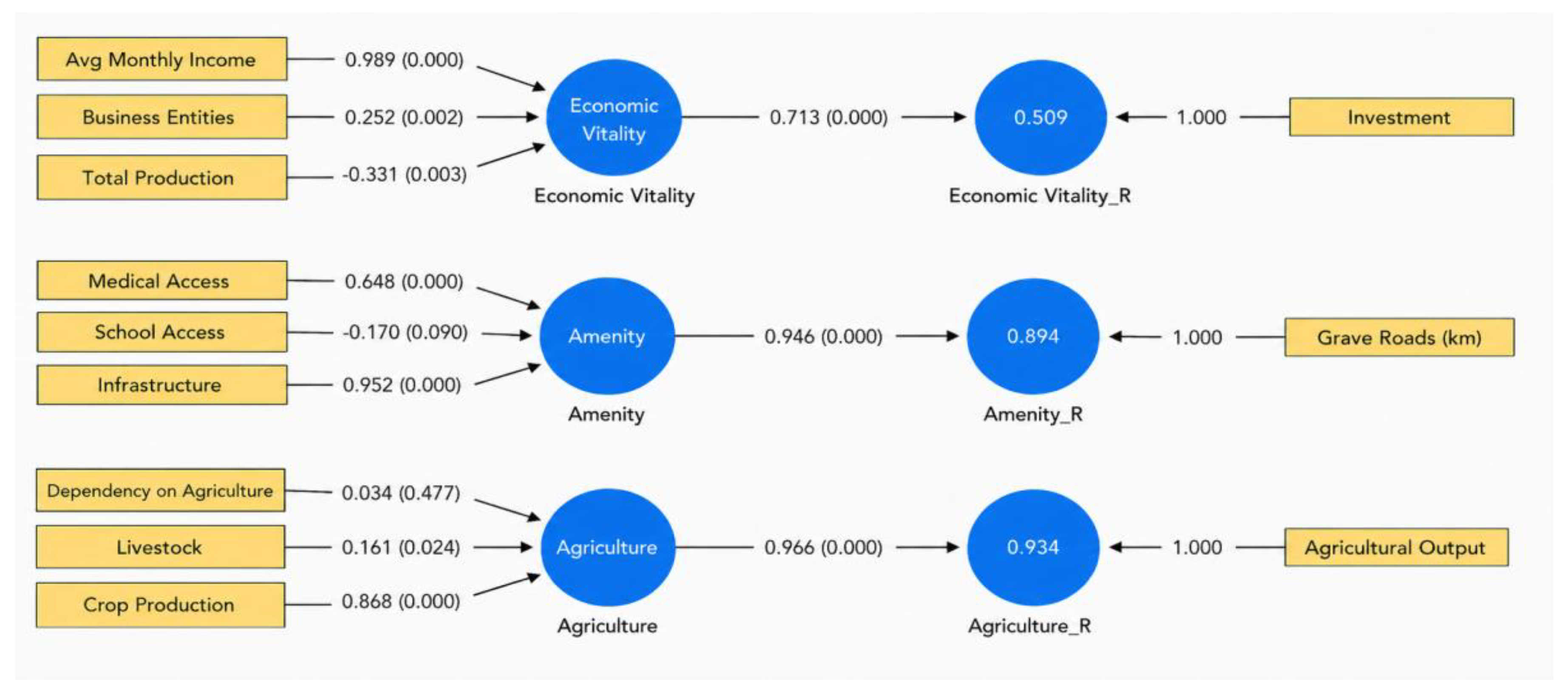
For Economic Vitality, the formative indicators (Average Monthly Income, Business Entities, Total production) significantly predicted investment per capita (Economic Vitality_R; β = 0.713, p < 0.001). Although this coefficient is lower than those for Agriculture and Amenity, it still exceeds the 0.70 benchmark, confirming sufficient convergent validity. This result suggests that local income, enterprise activity, and production levels are meaningfully reflected in district-level investment dynamics.
Appendix B
To examine whether the main findings are sensitive to model choice, we conducted additional robustness checks using Random Forest and Gradient Boosting models. These machine learning approaches complement the primary PLS-SEM analysis by allowing for non-linear relationships and interactions among observed predictors. Machine learning models report the relative contribution of each predictor to out-of-sample prediction accuracy. Feature importance scores therefore indicate predictive relevance, not causal effects or the direction of association.
The feature-importance results provide complementary support for the main argument of the paper. School access is the most influential predictor in both Random Forest and Gradient Boosting, indicating that education-related amenities contain substantial information for predicting migration outcomes. This finding is consistent with the capability–aspiration interpretation: education may improve local well-being while also expanding individuals’ capacity to pursue opportunities elsewhere. However, because feature importance does not provide directional effects, this result should not be interpreted as evidence that school access directly increases or decreases migration. CSR and economic variables also retain meaningful predictive relevance in the machine learning models. CSR appears among the mid-ranked predictors in both models, which is consistent with the PLS-SEM result that CSR matters primarily through its association with amenities rather than as a direct migration determinant.
Agricultural dependency also emerges as a salient predictor in both machine learning models. This pattern refines, rather than contradicts, the PLS-SEM results. In the structural model, Agriculture is specified as a broader construct combining dependency on agriculture, crop production, and livestock, and its direct association with migration is weak and statistically uncertain. In the machine learning models, by contrast, agricultural dependency is evaluated as a separate observed predictor. Its high predictive relevance suggests that agricultural dependency captures a structural condition distinct from agricultural production. Whereas crop and livestock variables reflect the scale of agricultural output, dependency on agriculture may signal limited economic diversification and a narrower local opportunity structure. Thus, agricultural dependency may be relevant for explaining variation in migration even when agriculture as a broad productive sector is not the dominant structural driver.
Taken together, the robustness checks support the main conclusion that migration dynamics are shaped by capability-enhancing conditions and relative opportunity structures, rather than by agricultural production alone.
Table A4.
Model Test Metric.
| Model | R2 | RMSE | MAE |
|---|---|---|---|
| Random Forest | 0.543 | 16.279 | 9.614 |
| Gradient Boosting | 0.515 | 16.767 | 9.720 |
Note: This table reports predictive performance for Random Forest, and Gradient Boosting models. R² measures the proportion of variation in migration outcomes explained by the model. RMSE and MAE report prediction errors, with lower values indicating better predictive accuracy.
Table A5.
Cross Validation.
| Model | R2_mean | R2_std | RMSE_mean | RMSE_std | MAE_mean | MAE_std |
|---|---|---|---|---|---|---|
|
Random Forest |
0.473 | 0.219 | 12.618 | 3.661 | 7.862 | 1.262 |
|
Gradient Boosting |
0.452 | 0.265 | 12.950 | 4.819 | 8.339 | 1.752 |
Note: Cross-validation tests how well the models generalize to unseen data. Reported metrics (e.g., cross-validated R², RMSE, MAE across folds) indicate the stability of model performance. Stable scores across folds suggest that results are not overfitted to one sample split, enhancing confidence in the robustness of findings. This table reports cross-validated model performance. The mean values summarize average predictive performance across folds, while the standard deviations indicate variation across folds. The results provide evidence on whether the models generalize beyond a single train-test split.
Table A6.
Feature Importance: Random Forest.
| Feature | Importance |
|---|---|
| School Access | 0.471 |
| Agricultural Dependency | 0.130 |
| CSR | 0.084 |
| Total Production | 0.081 |
| Average Monthly Income | 0.062 |
| Crop Production | 0.061 |
| Livestock | 0.057 |
| Business Entities (per 1000 people) | 0.031 |
| Infrastructure (Highway, km) | 0.022 |
Table A7.
Feature Importance: Gradient Boosting.
| Feature | Importance |
|---|---|
| School Access | 0.421 |
| Agricultural Dependency | 0.195 |
| Average Monthly Income | 0.166 |
| CSR | 0.078 |
| Livestock | 0.047 |
| Total Production | 0.042 |
| Crop Production | 0.025 |
| Infrastructure (Highway, km) | 0.018 |
| Business Entities (per 1000 people) | 0.007 |
Note (Table A6 and Table A7): These tables rank predictors by their relative importance in reducing prediction error. Unlike SEM, ML methods do not provide signs (positive or negative); they only indicate which variables matter most for prediction. In both Random Forest and Gradient Boosting, Access to School, one of the indicators of Amenity, is the top-ranked variable, reinforcing the main finding that educational opportunities drive migration outcomes. Readers should note that importance scores are relative weights, not causal effects, but the fact that education dominates across models underscores its centrality.
References
- Aldashev, A.; Dietz, B. Economic and spatial determinants of interregional migration in Kazakhstan. Econ. Syst. 2014, 38(3), 379–396. [Google Scholar] [CrossRef]
- Bhandari, P.; Ghimire, D. J. Rural agricultural change and individual out-migration. Rural Sociol. 2016, 81(4), 572–600. [Google Scholar] [CrossRef] [PubMed]
- Cañal-Fernández, V.; Álvarez, A. The role of infrastructures in rural depopulation. An econometric analysis. Econ. Agrar. Y Recur. Nat.-Agric. Resour. Econ. 2022, 22(2), 31–52. [Google Scholar] [CrossRef]
- Carling, J.; Schewel, K. Revisiting aspiration and ability in international migration. J. Ethn. Migr. Stud. 2018, 44(6), 945–963. [Google Scholar] [CrossRef]
- Chin, W. W. The partial least squares approach to structural equation modeling. In Modern methods for business research; Psychology Press, 1998; pp. 295–336, Available online: file:///C:/Users/w2/Downloads/1998ThePartialLeastSquaresApproachtoSEMchapter.pdf. [Google Scholar]
- Clemens, M. A. Economics and emigration: Trillion-dollar bills on the sidewalk? J. Econ. Perspect. 2011, 25(3), 83–106. Available online: https://pubs.aeaweb.org/doi/pdfplus/10.1257/jep.25.3.83. [CrossRef]
- de Haas, H. Migration transitions: A theoretical and empirical inquiry into the developmental drivers of international migration. Int. Migr. Rev. 2010, 44(1), 227–264. [Google Scholar] [CrossRef] [PubMed]
- de Haas, H. A theory of migration: The aspirations–capabilities framework. In Comparative Migration Studies; 2021; Volume 9, p. Article 8. [Google Scholar] [CrossRef] [PubMed]
- Diamantopoulos, A.; Winklhofer, H. M. Index construction with formative indicators: An alternative to scale development. J. Mark. Res. 2001, 38(2), 269–277. Available online: https://statmath.wu.ac.at/courses/r-se-mbr/dl/M1b_Diamantopoulos_2001.pdf. [CrossRef]
- Dufhues, T.; Möllers, J.; Traikova, D.; Buchenrieder, G.; Runschke, D. Why villagers stay put–A structural equation model on staying intentions. J. Rural Stud. 2021, 81, 345–357. [Google Scholar] [CrossRef] [PubMed]
- Dufhues, T. B.; Khamzina, D.; Buchenrieder, G. Migrant agency in an institutional context: The case of rural-to-urban migration from Akmola to Astana in Kazakhstan. Eur.-Asia Stud. 2024, 76(8), 433–460. [Google Scholar] [CrossRef]
- Fordham, A. E.; Robinson, G. M.; Blackwell, B. D. Corporate social responsibility in resource companies: Opportunities for developing positive benefits and lasting legacies. Resour. Policy 2017, 52, 366–376. [Google Scholar] [CrossRef]
- Fornell, C.; Bookstein, F. L. Two structural equation models: LISREL and PLS applied to consumer exit–voice theory. J. Mark. Res. 1982, 19(4), 440–452. [Google Scholar] [CrossRef]
- Frederiksen, T. Corporate social responsibility, risk and development in the mining industry. Resour. Policy 2018, 59, 495–505. [Google Scholar] [CrossRef]
- Gilberthorpe, E.; Agol, D.; Gegg, T. ‘Sustainable mining’? Corporate social responsibility, migration and livelihood choices in Zambia. J. Dev. Stud. 2016, 52(11), 1517–1532. [Google Scholar] [CrossRef]
- Hair, J. F.; Risher, J. J.; Sarstedt, M.; Ringle, C. M. When to use and how to report the results of PLS-SEM. Eur. Bus. Rev. 2019, 31(1), 2–24. [Google Scholar] [CrossRef]
- Hair, J. F.; Hult, G. T. M.; Ringle, C. M.; Sarstedt, M. A primer on partial least squares structural equation modeling (PLS-SEM), 3rd ed.; SAGE, 2022; Available online: https://link.springer.com/book/10.1007/978-3-030-80519-7.
- Harris, J. R.; Todaro, M. P. Migration, unemployment and development: A two-sector analysis. Am. Econ. Rev. 1970, 60(1), 126–142. Available online: https://www.aeaweb.org/aer/top20/60.1.126-142.pdf.
- Hilson, G. Corporate Social Responsibility in the extractive industries: Experiences from developing countries. Resour. Policy 2012, 37(2), 131–137. [Google Scholar] [CrossRef]
- Idemudia, U. Corporate social responsibility and development in Africa: Issues and possibilities. Geogr. Compass 2014, 8(7), 421–435. [Google Scholar] [CrossRef]
- Jaxylykov, S. The Northern region and the Southern people: Migration policies and patterns in Kazakhstan. CAP Papers, (184). 2017. Available online: https://www.centralasiaprogram.org/wp-content/uploads/2017/04/CAP-Papers-184-April-2017-Serik-Jaxylykov.pdf.
- Kale, S. S. From company town to company village: CSR and the management of rural aspirations in eastern India’s extractive economies. J. Peasant Stud. 2020, 47(6), 1211–1232. [Google Scholar] [CrossRef]
- Makhanov, K.B.; Khitakhunov, A.A.; Zhanaltay, Z.; Mussabekov, M.O. Post-soviet rural dynamics on the eastern steppe: geography of population change in kazakhstan’s countryside. J. Orient. Stud. 2025, Vol. 114(No.3). [Google Scholar] [CrossRef]
- Mamo, Y.A.; Sisay, A.M.; WoldeSilassie, B.D.; Angaw, K.W. Corporate social responsibilities contribution for sustainable community development: evidence from industries in Southern Ethiopia. Cogent Econ. Financ. 2024, 12:1, 2373540. [Google Scholar] [CrossRef]
- Massey, D. S.; Axinn, W. G.; Ghimire, D. J. Environmental change and out-migration: Evidence from Nepal. Popul. Environ. 2010, 32(2), 109–136. [Google Scholar] [CrossRef] [PubMed]
- Mbilima, F. Extractive industries and local sustainable development in Zambia: The case of corporate social responsibility of selected metal mines. Resour. Policy 2021, 74, 101441. [Google Scholar] [CrossRef]
- Muthuri, J. N.; Moon, J.; Idemudia, U. Corporate innovation and sustainable community development in developing countries. Bus. Soc. 2012, 51(3), 355–381. [Google Scholar] [CrossRef]
- Petter, S.; Straub, D.; Rai, A. Specifying formative constructs in information systems research. MIS Q. 2007, 31(4), 623–656. [Google Scholar] [CrossRef]
- Schewel, K. Understanding immobility: Moving beyond the mobility bias in migration studies. Int. Migr. Rev. 2020, 54(2), 328–355. [Google Scholar] [CrossRef]
- Schewel, K.; Fransen, S. Formal Education and Migration Aspirations in Ethiopia. In Population and Development Review. Volume44.; 2018; pp. P. 555–587. [Google Scholar] [CrossRef] [PubMed]
- Sheludkov, A. V.; Orlov, M. A. Topology of a settlement network as a factor of rural population dynamics: A case study of Tyumen oblast. Reg. Res. Russ. 2020, 10(3), 388–400. [Google Scholar] [CrossRef]
- Times of Central Asia. Diversification of rural tourism and agro-processing in Akmola. 2024. Available online: https://kazakhstan.un.org/sites/default/files/2025-02/CCA%20Kazakhstan%202024%20EN.pdf.
- Todaro, M. P. A model of labor migration and urban unemployment in less developed countries. Am. Econ. Rev. 1969, 59(1), 138–148. Available online: https://www.jstor.org/stable/1811100.
- Uduji, J. I.; Okolo-Obasi, E. N. Does corporate social responsibility (CSR) impact on development of women in small-scale fisheries of sub-Saharan Africa? Evidence from coastal communities of Niger Delta in Nigeria. In Marine policy; 2018; p. 118, Available online: file:///C:/Users/w2/Downloads/Does-CSR-impact-on-development-of-women-in-small-scale-fisheries-in-SSA.pdf. [Google Scholar]
- Uduji, J.I.; Okolo-Obasi, E.N. Does corporate social responsibility initiative restrain young people from irregular migration in sub-Saharan Africa? Evidence from Nigeria’s oil-producing communities. Soc. Responsib. J. 2021, 17(7), 914–936. [Google Scholar] [CrossRef]
- United States Department of Agriculture [USDA. Kazakhstan: Grain and feed annual. 2020. Available online: https://apps.fas.usda.gov/newgainapi/api/Report/DownloadReportByFileName?fileName=Grain%20and%20Feed%20Annual_Nur-Sultan%20(Astana)_Kazakhstan%20-%20Republic%20of_04-15-2020.
- World Bank. Kazakhstan economic update: Toward sustainable growth. 2023. Available online: https://www.worldbank.org/en/country/kazakhstan/publication/economic-update-spring-2023.
- Young, A. Inequality, the urban-rural gap, and migration. Q. J. Econ. 2013, 128(4), 1727–1785. [Google Scholar] [CrossRef]
Figure 1.
Districts of the study areas in the Akmola region (oblast).
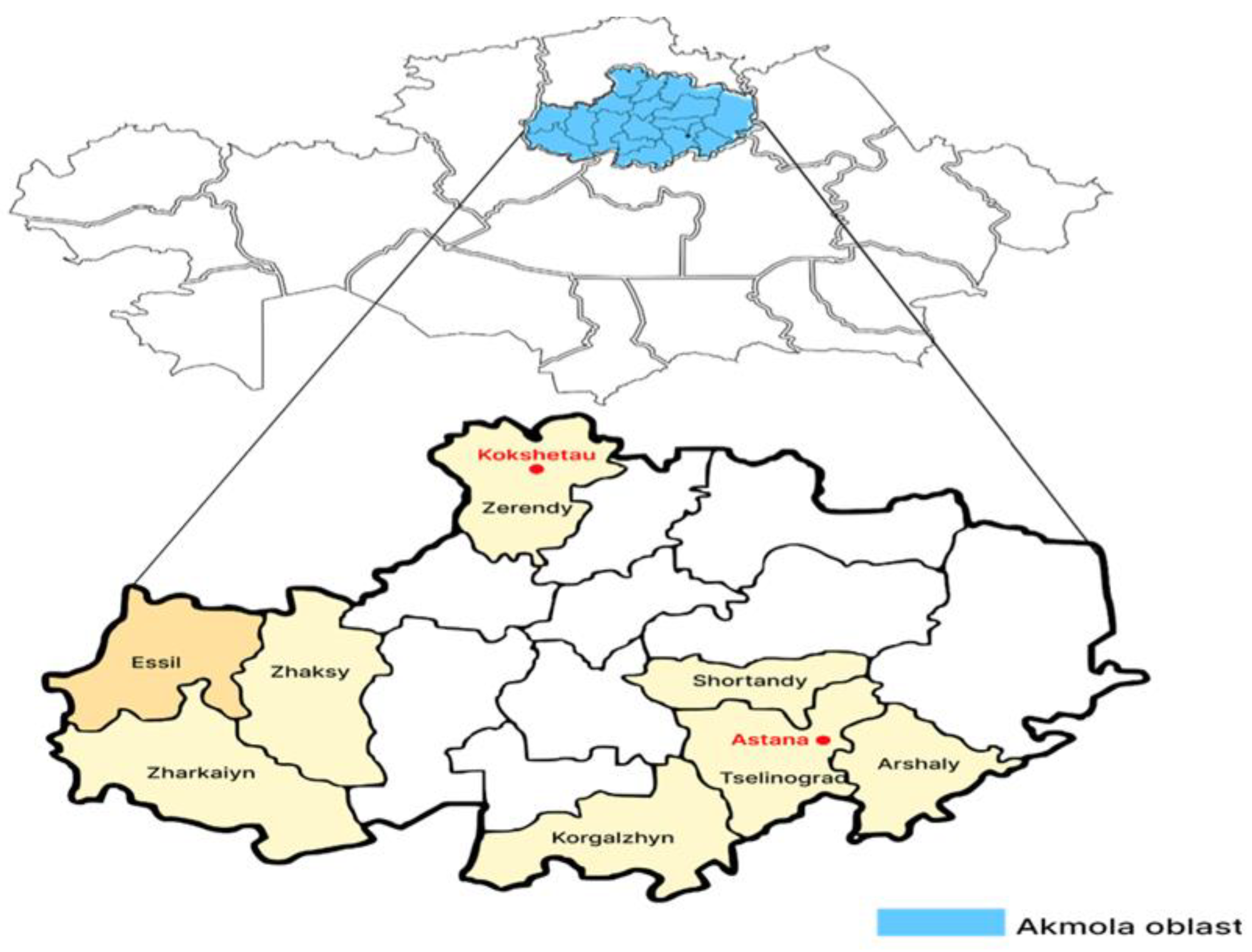
Figure 2.
Visual description of constructs and interconnections within the structural model. Source: own data.
Figure 2.
Visual description of constructs and interconnections within the structural model. Source: own data.
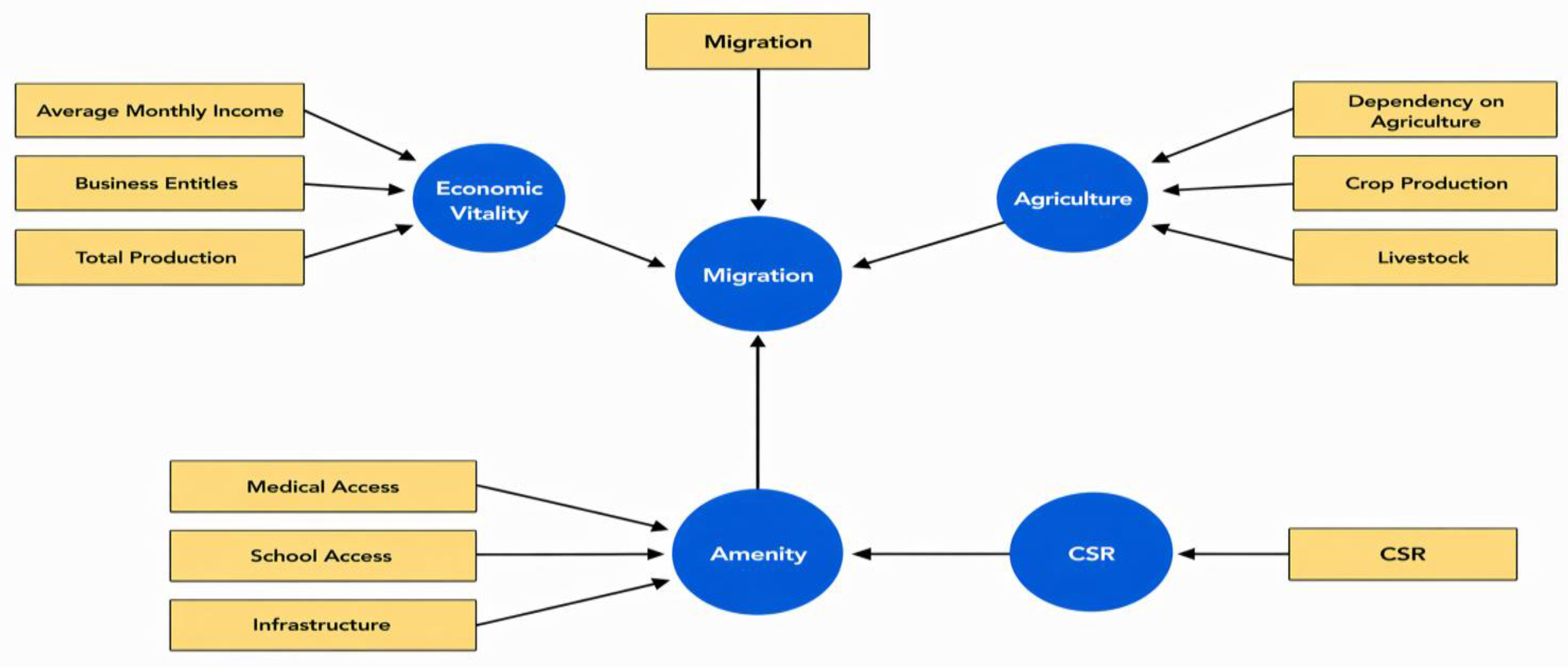
Figure 3.
Path Coefficients. Note: p-value in parenthesis.
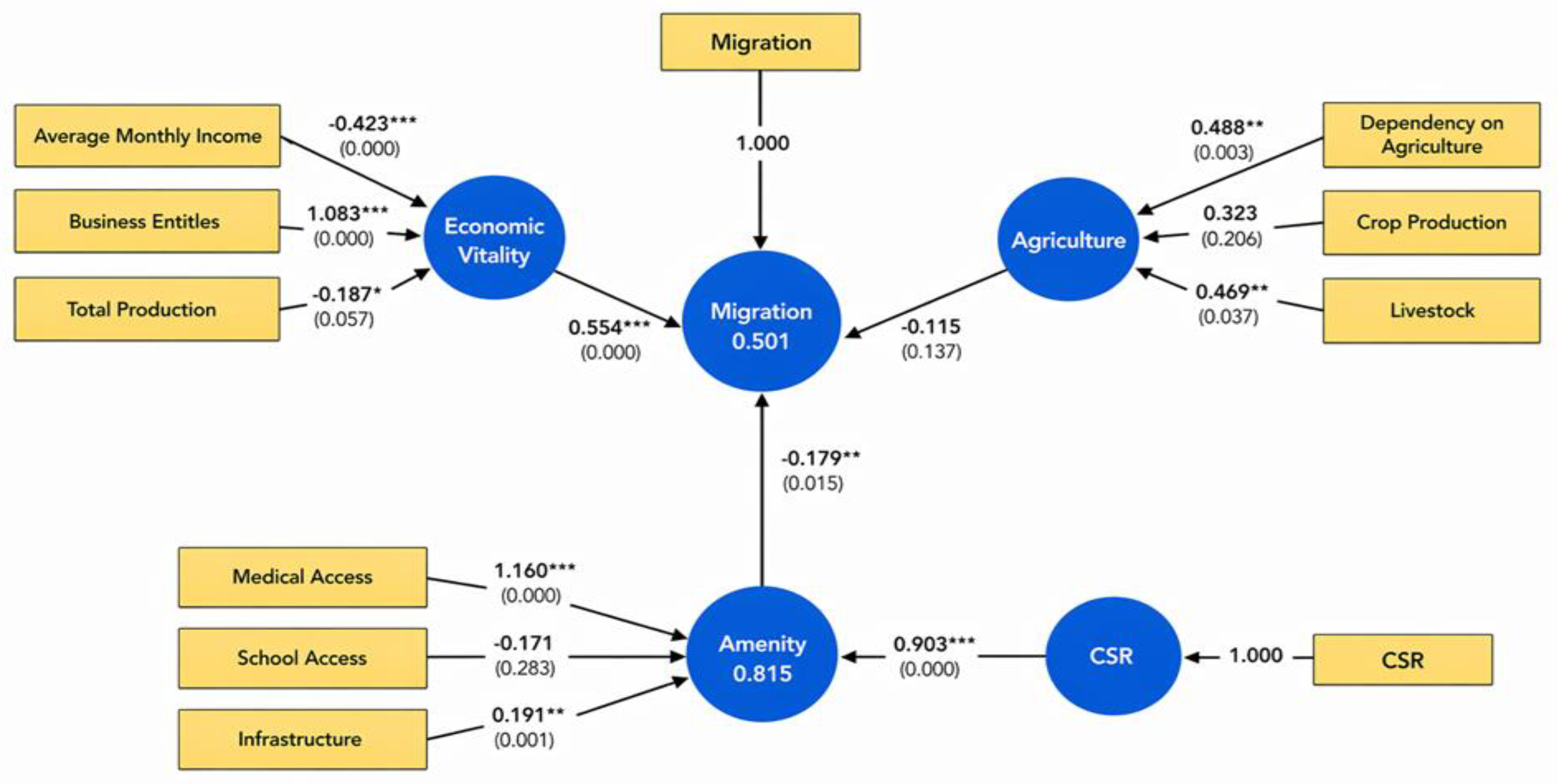
Table 1.
Summary Statistics.
| Latent | Variables | Measure | Mean | Min | Max | S.D. |
|---|---|---|---|---|---|---|
| Migration | Migration | Net population influx per 1,000 residents | -11.705 | -61.367 | 88.641 | 19.007 |
| CSR | CSR | CSR per 1,000 residents | 10.388 | 4.781 | 22.799 | 3.656 |
| Agriculture | Agricultural dependency | Share of agricultural production in total output | 0.671 | 0.146 | 0.975 | 0.238 |
| Livestock | Stock of livestock per capita | 0.317 | 0.067 | 1.341 | 0.230 | |
| Crop | Crop production per capita (in million tenge) | 1.162 | 0.059 | 13.812 | 1.750 | |
| Economic vitality | Business entities | Number of business entities per capita | 17.512 | 7.038 | 50.859 | 8.560 |
| Total production | Total production per capita (in million tenge) | 1.031 | 0.050 | 11.170 | 1.885 | |
| Average monthly income | Average monthly income (in tenge) | 117294.8 | 42052.0 | 339908.0 | 67289.6 | |
| Amenity | Highway | Total length of highway (in km) | 409.639 | 254.000 | 1037.5 | 214.187 |
| Medial access | Number of healthcare professionals per 1000 residents | 11.283 | 3.805 | 35.952 | 7.939 | |
| School access | Number of standard schools relative to school-aged children | 0.070 | 0.018 | 0.181 | 0.041 |
Note: Summary statistics are calculated using district-year observations. Migration, business entities and medical access are standardized per 1,000 residents. Crop production and total production per capita are reported in million tenge per capita. School access is measured as the number of standard schools relative to school-aged children. The number of observations is 108 for most variables, except agricultural dependency, which has 105 non-missing observations.
Disclaimer/Publisher’s Note: The statements, opinions and data contained in all publications are solely those of the individual author(s) and contributor(s) and not of MDPI and/or the editor(s). MDPI and/or the editor(s) disclaim responsibility for any injury to people or property resulting from any ideas, methods, instructions or products referred to in the content. |
© 2026 by the authors. Licensee MDPI, Basel, Switzerland. This article is an open access article distributed under the terms and conditions of the Creative Commons Attribution (CC BY) license (http://creativecommons.org/licenses/by/4.0/).
Copyright: This open access article is published under a Creative Commons CC BY 4.0 license, which permit the free download, distribution, and reuse, provided that the author and preprint are cited in any reuse.