

Submitted:
10 June 2026
Posted:
12 June 2026
You are already at the latest version
Abstract
Writing constitutes a central component in the assessment of knowledge at the university level, as it enables students to demonstrate disciplinary understanding and academic performance. Given the frequency with which learning is evaluated through written assignments, feedback provided through written comments becomes especially relevant. Although numerous studies (Prado & Pérez, 2021; Tapia-Ladino & Correa, 2022) position feedback as a valuable and necessary pedagogical practice there is still limited research in Latin America examining how students engage with and make use of the feedback they receive. This study aims to examine how university students construct meaning from feedback through peer interactions at a regional university in Chile. The research was conducted with fourth-year students enrolled in an English as a Second Language Teacher Education program. Participants completed a written assignment in pairs and subsequently received feedback from their teacher on their work. For data collection, feedback encounters (Esterhazy & Damşa, 2019) were organized, during which general guidelines were provided to support student interactions. These interactions were audio-recorded, transcribed, and analyzed through category coding using Nvivo15 software. The findings revealed that students construct meaning from feedback through two recursive and iterative interaction sequences. The first, an extended sequence, is organized around the stages of idea generation, revision, discussion, decision-making, and elaboration. The second, a shorter sequence, includes idea generation, revision, and elaboration. Both sequences contributed to students’ decision-making and following actions in the task.
Keywords:
academic writing
; actions in writing tasks
; feedback encounters peer interactions
; written feedback
Introduction
In formal teaching–learning contexts in Higher Education, one of the most common ways of demonstrating content understanding is through the production of written work. According to Nesi and Gardner (2012), writing enables students to articulate disciplinary knowledge and provide evidence of learning outcomes. Given the central role of writing in higher education and the frequency with which learning is assessed through written assignments, it is important to highlight the relevance of feedback provided through written comments (WCs) within these assessment processes.
The feedback process begins with the provision of WCs and culminates in the production of an improved academic text (Esterhazy, 2018). Within this process, it is particularly important to consider the underlying actions and interactions that contribute to the negotiation of meaning surrounding the received WCs.
From a socio-constructivist perspective (Ajjawi & Boud, 2017; Esterhazy, 2018; Evans, 2013), feedback is understood as a process shaped by students, teachers, contextual factors, materials, and the interactions that emerge among participants. In this sense, students play a main role, as they actively co-construct their learning. Consequently, feedback provided through WCs can be understood as a dialogic process which involves students, teachers, the task, and the educational context. The inherently dialogic nature of feedback enables students to interpret, reflect on, and discuss the feedback received on their writing assignments (Sommers, 2012)
Although numerous studies have positioned feedback as a valuable and necessary pedagogical practice (Prado & Pérez, 2021; Tapia-Ladino & Correa, 2022; Terrazos-Ungaro et al., 2021), there is still limited research in Latin America examining what students actually do with the feedback they receive. Furthermore, few studies have explored the processes that mediate the improvements students make to their work and support the decision-making required to fulfill assignment objectives. For this reason, it is particularly relevant to explore the interactions (understood as the different forms of exchange that occur among students according to Esterhazy & Damşa, 2019), that occur among students when reading and analyzing WCs on their written assignments. Along with the disciplinary context and the broader educational environment, these interactions seem to influence the development of academic writing in higher education.
Written Feedback
Feedback has been widely studied due to its contribution to formative assessment processes. As a practice that supports the development of students’ academic and social competencies (Tapia-Ladino et al., 2023), feedback plays a central role in the learning of academic writing. The understanding of feedback has undergone significant changes over time, shifting from an emphasis on corrective and unidirectional transmission of information toward a more dialogic perspective. This approach values not only the individual providing feedback, but also the different participants involved in the process, who act as active agents in the construction of meaning from the feedback received (Carless & Winston, 2020; Esterhazy & Damşa, 2019; Nicol, 2010). Contemporary research on feedback increasingly focuses on students and the ways in which they engage with feedback, particularly through the dialogue that emerges among students, the task, and the discipline.
Among the key characteristics that make feedback effective, its dialogic nature stands out. Several authors (Esterhazy & Damşa, 2019; Pérez & González, 2019) argue that dialogue within the feedback process occurs bidirectionally (e.g., teacher–student or peer-to-peer interactions) and involves additional resources such as the task itself, students’ prior knowledge, and the context in which the process takes place. In the same vein, Esterhazy and Damşa (2019) state that “to understand how feedback can become meaningful, we must scrutinize feedback processes and how they emerge through dialogic interactions between all actors involved” (p. 262). From this perspective, it becomes necessary to examine in depth the natural ways in which encounters, exchanges, and interactions among students develop around feedback processes in order to better understand the factors that make feedback not only effective, but also meaningful.
In summary, the provision of written feedback on students’ university writing assignments constitutes an essential component of the learning process and a means of contributing to students’ academic development. In this context, If the feedback offered is able to provide sufficient information for the students to realize what their mistakes are, they may be able to correct them and, as a result, write an improved version of their writings. According to Esterhazy (2018) the process of identifying what was wrong and discovering the way to correct those mistakes allows students to make improvements on their texts. WCs delivered effectively may contribute to the elaboration of better written texts only if students know the path to make changes successfully.
Written Comments
Among the multiple ways of providing feedback, written comments (WCs) have been identified as one of the most frequently used forms in academic writing contexts (Contreras & Zúñiga, 2017; Parr & Timperley, 2010; Tapia-Ladino et al., 2016, 2017, 2023). These studies have mainly focused on describing different types of written feedback and on examining the contribution of WCs to the development of academic writing. The authors suggest that WCs foster a dialogic dynamic that enables different forms of interaction among participants. However, this process may also be challenging for students, as feedback often focuses more on formal aspects of writing than on issues of content or meaning, making WCs difficult to interpret and apply.
According to Arancibia et al. (2019), WCs are resources presented as handwritten or electronic annotations consisting of at least one word that is delivered purposely. WCs assume a particular form, length, and written representation. In the present study, written feedback plays an important role as a guiding resource that also acts as genre-oriented feedback (Tapia-Ladino et al., 2017) This refers to written feedback focused on the characteristics of a specific text genre whose purpose is to support students in the process of acquiring and producing a particular genre.
A study conducted by Tapia-Ladino et al. (2020) examined what student writers do with the WCs provided by professors in undergraduate seminar courses. The study aimed to analyze the actions taken by university students based on the WCs they received. The findings revealed that most WCs were adopted by students. These findings highlight the value students attribute to this form of feedback and their interest in receiving it. At the same time, they raise questions regarding how students construct meaning from WCs through interaction and what additional factors contribute to this process.
Interactions for Meaning Making
The conceptualization of interactions adopted in this study is mainly based on the case study conducted by Esterhazy and Damşa (2019). According to the authors, interactions are understood as exchanges of different kinds that occur both among students or peers and between students and the task itself. These exchanges allow personal and collective interpretations of the feedback received to become visible and accessible to other members of a working group, thereby creating opportunities for the joint construction of meaning from written comments (WCs).
Consequently, this study adopts a socio-constructivist perspective (Ajjawi & Boud, 2017; Esterhazy, 2018) in which feedback is understood as a space that enables the development of interactions involving different actors and resources. From this perspective, interactions emerge through feedback processes and facilitate situated disciplinary dialogue. Likewise, other critical aspects influencing the feedback process include students’ prior disciplinary experience, the characteristics of the written task, and the physical space in which feedback is discussed. In this context, the meaning of WCs does not depend solely on the feedback provider; rather, it is co-constructed through the interactions that occur among students, teachers, and material resources.
Feedback creates new opportunities for students to analyze, interpret, understand, and act upon a task, reflecting a process of meaning (co-)construction. In this regard, meaning making can be understood as a process of knowledge creation grounded in peer interrelationships and in individuals’ interactions with the resources and objects present in their environment (Säljö, 2010). Thus, the interdependence among the factors involved in interaction facilitates the understanding of WCs and, consequently, promotes the implementation of actions in response to feedback.
In a study examining how knowledge is generated through interaction and materialized in knowledge objects, Damşa and Ludvigsen (2016) found that “in order for objects to be constructed, and interaction to be productive and contribute to the co-construction of a knowledge object, it requires joint efforts and an epistemic orientation, visible through a series of epistemic actions” (p. 14). These findings suggest that mutual collaboration and willingness to learn are necessary conditions for interactions to foster meaning making. The study also highlights the importance of examining interactions moment by moment, considering both the content of the interaction and its sequential organization in order to make temporality visible. This perspective involves observing multiple sessions in which ideas are generated around a specific task. In this sense, examining the detailed steps involved in the creation of new knowledge may contribute to a deeper understanding of how the process unfolds.
This study aligns with the premise that feedback begins with a WC and culminates in improvements in academic performance (Esterhazy & Damşa, 2019). Likewise, it considers it necessary to examine how students engage with the feedback they receive and what processes underlie the meaning-making of WCs. More specifically, this study seeks to understand what occurs during these exchanges, what students share (e.g., thoughts, beliefs, doubts, and suggestions), what types of information become visible to others, and how these elements contribute to the joint construction of meaning.
Esterhazy and Damşa (2019) propose “a two-dimensional model which describes how the meaning-making process occurs in a knowledge space” (p. 270). This space comprises a functional dimension, referring to declarative and procedural knowledge, and a contextual dimension, which largely represents disciplinary knowledge and specific aspects of the task. In other words, students move from the what (what they are going to do) to the how (how they are going to do it), while simultaneously shifting from broader disciplinary knowledge toward the more localized dimension of the task itself. According to the authors, this trajectory represents the pathway through which the co-construction of meaning circulates during feedback processes.
The bidimensional model proposed by Esterhazy and Damşa (2019) includes three stages in the meaning-making process. The first stage corresponds to the exploration of the WC and is oriented toward: (a) the content addressed in the WC, (b) the understanding of the disciplinary concept involved, and (c) the strategies used to identify sources of knowledge. The second stage involves the search for elaboration strategies, including strategies to: (a) access knowledge and (b) represent knowledge. Finally, the third stage corresponds to the materialization of actions, referring to the ways in which verbally expressed knowledge is transformed into textual representation or concrete modifications in the text. Together, these stages represent the different moments experienced by students from the instant a WC is approached and analyzed.
Similarly, Montes et al. (2018) argue that learning to write can be enhanced through peer interaction. The authors describe the implementation of peer review and collaborative forums within an online writing course for undergraduate students. Among the characteristics of interactions mediated by virtual environments that contributed to a successful experience, Montes et al. (2018) highlight the occurrence of peer review at different stages of text development. Additionally, they suggest that students require processing time after receiving peer feedback before incorporating suggestions and revising their texts. From this perspective, peer interaction is positioned as a pedagogical strategy that enhances learning and demonstrates the contribution of collaborative work to the development of academic writing. These claims align with the premise underlying the present study, which positions peer interaction as a key factor in the understanding of WCs and, ultimately, in the improvement of academic writing.
Methodology
This study adopts a qualitative–interpretative approach with an exploratory scope and a case study design. Qualitative research is grounded in an interpretative perspective and seeks to understand people’s actions and the meanings they attribute to their experiences (Hernández et al., 2014). The exploratory nature of the study allows, on the one hand, the generation of foundational knowledge for future research and, on the other hand, the possibility of identifying relevant aspects of the phenomenon under investigation (Morales, 2015). The case study design provides an in-depth understanding of the research problem and its context (Hernández-Sampieri & Mendoza, 2020). Furthermore, case studies investigate contemporary phenomena within their real-life contexts (Yin, 2014), which aligns with the purpose of the present study.
Participants
In this research, the participants consisted of a group of 13 fourth-year undergraduate students enrolled in an English as a Second Language (ESL) Teacher Education program at a regional university in Chile. These students were selected because they were familiar with written comments (WCs), as written assignments constitute a common form of assessment within their program. An additional characteristic of the previously mentioned participants is that they are bilingual speakers, with Spanish as their first language (L1) and English at an intermediate (B2) level as their second language (L2).
The case study corresponded to a pair of students who revised the WCs thoroughly. They showed disposition to carefully analyze the WCs received and discussed them deeply and in detail. They also showed to be critical of the information obtained through the feedback comments.
Task
As part of a university course entitled Assessment, students were required to write an argumentative text in English (L2). The assignment received written feedback from the course teacher, after which students were asked to review and reflect on the WCs provided on their drafts before submitting a final version for assessment. The central focus of the study was the set of interactions that emerged during feedback meetings, in which students discussed the WCs and negotiated their meaning. These meetings were conducted in the language preferred by the participants, either Spanish (L1) or English (L2).
Instruments
A two-step methodological procedure was designed for data collection: (1) the development of general guidelines to support the interactional activity, and (2) the organization of feedback encounters (Esterhazy, 2018), during which students discussed the feedback received through WCs.
The general guidelines (see Appendix 1) were designed to support both the duration and the quality of the interactions, minimizing the possibility that students would divert their attention to topics unrelated to the assignment. The second step consisted of organizing feedback encounters that enabled students to interact around the WCs received on the drafts of their written assignments.
Piloting and Validation
A pilot session was conducted to validate the usefulness and relevance of the general guidelines and the organization of the feedback encounters. The main purpose of the piloting was to anticipate potential issues that could introduce bias into the data collection process. The activity took place at the university where the study was conducted and involved a small group of two students who shared characteristics similar to those of the research participants.
During the session, participants were asked to discuss a set of written comments (WCs) provided on a writing assignment and attempt to improve the text based on the feedback received. They were provided with general guidelines to support the interaction and were instructed to audio-record their conversation and subsequently send the recording to the researcher via email. The oral interactions were transcribed and analyzed in order to obtain an initial overview of the data; however, these data were not included in the final analysis of the study.
To validate the content, relevance, and coherence of the general guidelines document through expert’s revision, the instrument was reviewed by Esterhazy (2018). The feedback received was considered to adapt and improve the protocol.
Data Collection
Data were collected during the feedback sessions, in which participant pairs or groups reviewed their commented drafts for the first time. Before the activity began, students received an informed consent form together with the general guidelines and were allowed to choose whether to conduct the interactions in English or Spanish, according to their preference. To record their conversation about the WCs, each pair or group audio-recorded their interactions independently and without the presence of the researcher. The audio files were subsequently sent to the researcher via email for transcription and analysis.
Data Analysis
For the data analysis process, all collected audio recordings were transcribed and anonymized. To protect participants’ identities, codes referring to each interaction were used. A total of six interactions were analyzed yet only one of them was considered for this case study. The total data collected generated approximately three hours and forty minutes of audio-recorded information. The case study represented 31 minutes out of the total audible information.
The data were analyzed using Nvivo 15 software. The coding process was primarily guided by the predetermined categories proposed by Esterhazy and Damşa (2019). However, an additional emergent category identified in the data was also incorporated into the analysis. This category, labeled Appreciations, captured evaluative comments and reflections expressed by participants during the interactions. The complete set of analytical categories is presented in Table 1.
The categories of analysis were not mutually exclusive; therefore, certain segments of the interactions could be coded under more than one category simultaneously. To ensure the reliability of the coding process, inter-coder agreement was calculated using Cohen’s kappa coefficient, which yielded a value of 0.80. This result indicates a high level of agreement and suggests a low influence of chance in the coding process.
Results
In order to illustrate the case study results, they were organized as it follows. First, we share the original assignment written by the pair of students together with the WC offered by the teacher. Then, we present the full interaction developed around one of the WC they received. This interaction is divided according to the meaning-making stages described above and is followed by an explanation of each stage. Finally, we include the final version of the writing assignment, which highlights the changes made in order to both compare the initial and final versions and illustrate the process of meaning-making. It should be noted that all excerpts correspond to the students’ original interactions; therefore, grammatical and spelling mistakes were not corrected.
In the following excerpt (Figure 1), the students discuss the WC “And modal verbs were practiced in class the same way they were assessed,” which refers to the Assessment Principle of Validity. The interaction begins when Student A asks Student B to read the WC aloud, as shown in Table 2.
In excerpt 1, we observe that after reading the WC out loud, doubt arises as to whether the comment refers to something positive or negative (line 2). This seems to be confusing for the students to elucidate (lines 3 and 4). Then, student A decides to review the portion of text written earlier in her assignment to place herself in the context in which the WC emerged (lines 5, 6, and 7) and resolve whether the WC was positive or negative. Both students continue seeking to make sense of the WC by reviewing what they had already written, in a certain way, seeking confirmation that what the teacher commented referred to content that they had already integrated into their argument (lines 9, 11 and 12).
When they identify the introductory sentence to the topic (line 13), they realize that what was requested in the WC was to integrate a missing content in the portion of text they reviewed (line 14), so they suggest incorporating that information (lines 15 and 16). The interaction carried out accounts for the exploration phase (Esterhazy & Damşa, 2019). Through this phase, the students seek to understand the WC by means of a discussion that incorporates the review of the actions performed in their task and the identification of the missing knowledge. In this case, students discussed whether the validity principle contained in the evaluation performed by Mr. Knot was strong, since the content had not only been presented, but also practiced (line 14).
As the discussion continues, the students engage in other meaning-making phases.
In this second part of the interaction, it is possible to identify how the students are oriented towards the search for elaboration strategies. At the beginning of the conversation, the students discuss the specific place in the text where they should add the missing content (lines 17 and 18). Then, doubt is raised about how to proceed from there. The instance begins with a question asking for clarification about the steps to follow (line 19). The answer received seems to be not so clear: No, I, I don’t think we should do something to the comment (line 20), since the decision of student A is to start formulating orally the content to solve the WC: So, we are going to write... as it could seen previously, or not?.... as it could be..., which was not precisely what student B proposed. This situation is finally clarified by student B’s proposal (line 22) to discuss and understand the WCs first, and work on the elaboration of the argument to be added later. Both students reach an agreement (lines 23 and 24) and decide that it is best to approach the activity in this way. The interaction presented here shows a process of planning strategies for representing knowledge. This includes both the determination of how it will be represented and when it should be done.
Towards the end of Excerpt 2, it is possible to notice the emergence of Appreciations in relation to the actions that were not performed in the task. First, student A admits that they overlooked the information they were supposed to add: Ok, so the first one we just missed it up, from which student B assumes responsibility for the mistake: My bad (line 28) and expresses guilt, while student A responds by attenuating the negative appreciation of the situation on two occasions: but, it’s not so bad (lines 27 and 29) which impacts in a way that takes the attention away from the negative appraisals and emphasizes that it is something possible to be solved.
According to the students’ planning, in the next stage, the decisions and actions discussed are executed. To demonstrate this phase, let us review Table 3 below.

Table 4.
Excerpt 3- Interaction group 2- WC 1.
| CE: And modal verbs were practiced in class the same way they were assessed |
| 31 B: The time for correction |
| 32 A: Yes, and improving. (laughs) So, the first question is about the modal verbs. Ah, ok. |
| 33 B: Yes, in content validity, aaah... yes, it was our fault. |
| 34 A: Yes. |
| 35 B: We made a mistake and we forgot to mention that …aaah… besides presenting the modal verbs, it was also practiced. So, we have to mention that now. |
| 36 A: We have to write that, so… |
| 37 B: Yes. |
| 38 A: We are going to add immediately after the… the last paragraph, right? |
| 39 B: Yes, maybe we should include… like here… like…(pointing at something in the text) |
| 40 A: Ah, ok, the same… |
| 41 B: …previously presented and practiced… |
| 42 A: …In the class. |
| 43 B: Yes, in his classes. |
| 44 A: Practiced in his classes. (starts writing at the same time that reads it out loud) |
| 45 B: Ah, we have here…, in his classes. |
| 46 A: Ah, ok…. practiced |
| 47 B: Yes. |
| 48 A: Modal verbs in his classes… |
| 49 B: …before assessing it in the test, which gave us an idea that he’s following a unit … (murmuring) |
| 50 A: Ok, now it’s more clear, because we… |
| 51 B: Yes. |
| 52 A: …we, we, we knew that, but we didn’t mention it like explicitly in this part, but we were referring to a previously present. |
| 53 B: Yes. Good! |
| 54 A: Ok, ok. |
| 55 B: First come here ready. |
In this last excerpt, it is possible to observe how the students move from the discussion of ideas about the WC and the planning of ways to represent knowledge, to a stage of materialization of actions (Esterhazy & Damşa, 2019) in the task. In this sample of the interaction, it is observed how they resume the dialogue from the reengagement with the context of the WC (lines 32 and 33). Then, they review the missing information, and the decisions made beforehand (lines 35 and 36) and before starting to execute any action, they negotiate what will be done: A: We are going to add immediately after the... the last paragraph, right? (line 38) and where exactly in the text: B: Yes, maybe we should include... like here... like...(line 39).
Student A starts executing the actions in task A: Practiced in his classes (line 44) while writing and reading at the same time. This allows Student B, as an outside observer, to assess the relevance and accuracy of what is being written. Thus, this action allows B’s collaborative participation in the corrections B: Ah, we have here..., in his classes (line 45). Then, student A makes a new review of the actions previously performed in the task: A: before assessing it in the test, which gave us an idea that he’s following a unit (line 49) probably as a way of checking that the integration of the new knowledge is well coupled to the idea that had already been presented. Finally (lines 50 -53) both students elaborate a joint conclusion about the error mentioned in the WC which has been corrected now.
The negotiation of decisions and the elaboration of appropriate ideas to solve the WC resulted in the new version of the text portion alluded to by the WC, which is presented in Figure 2.
Figure 2 clarifies the decisions and actions that were finally executed in the text. The process of co-construction of meaning of the WC carried out by interaction group 2 is evidenced by the data provided. The results empirically evidence the succession of ideas and the processes that occur in the instances of these meetings that allow peer-to-peer dialogue about the feedback received.
In summary, it is possible to identify two sequences of co-construction of meanings. One corresponds to a long sequence made of five steps (see Figure 3), which originates with the identification of the idea alluded to in the WC. Apparently, the idea contained in the WC triggers the immediate revision of the task in search of context, explanation and validity of the WC. Thus, a discussion begins in which the students jointly perform a series of actions together, which were categorized in this study (e.g., comprehension, questioning, etc.), and which trigger decisions made in agreement among peers before taking the form of a text elaborated and added to the task.
Regarding the short three steps sequence (Figure 4) found out through students’ interactions, it is possible to state that they usually occur when the idea triggered by the WC do not imply a high cognitive demand from the students.
These above-mentioned sequences (Figure 3 and Figure 4) have a recursive character and do not necessarily occur only once in the context of an interaction around a WC. That is to say, it may happen that after the elaboration, there is another revision and discussion and finally a re- elaboration of the argument in the text.
The results presented here respond to the sequences observed in the six interactions studied and do not only refer to the interaction of group 2, which was selected to represent the co-construction of meaning.
Discussion
In light of the findings presented in the study conducted by Esterhazy and Damşa (2019), our findings allow us to unpack the feedback process and demonstrate that the collaborative discussion of WCs among peers fosters the co-construction of meaning, while simultaneously facilitating and dynamizing this process. In addition, the results show that the collaborative flow of ideas encourages the search for solutions and offers multiple ways to address them. The contribution of diverse perspectives to both the co-construction of meaning and the resolution of the suggestions conveyed through WCs is undeniable, particularly considering students’ individual characteristics and differing levels of disciplinary and task-related knowledge.
The study illustrates the dialogic nature of feedback (Carless & Winston, 2020; Esterhazy & Damşa, 2019; Nicol, 2010) as mediated through peer interaction. Our findings contribute a valuable perspective to research on feedback as a dialogic process by considering WCs as an enabling resource for academic writing development. Furthermore, the study demonstrates how peer interaction promotes the active participation of students, resources, and contextual factors in the development of strategies that support writing improvement. In this context, the results also highlight the need to create opportunities for students to act upon feedback (Esterhazy, 2018) and to engage in collaborative discussions that facilitate feedback meaning-making processes.
Although we agree that the meaning of WCs is co-constructed through interactions among students, teachers, and resources—and therefore does not depend exclusively on the individual providing the feedback (Ajjawi & Boud, 2017)—our findings highlight the central role attributed to the teacher in students’ understanding of WCs. This is evidenced in several occasions in which students required the teacher’s assistance to interpret the feedback and clarify doubts before being able to act upon the task and implement modifications.
Finally, it can be affirmed that peer interactions, within the context of meetings in which WCs are discussed, constitute valuable instances that support the writing process. Our findings are consistent with those reported by Montes et al. (2018) in a study on peer review conducted in an online writing course in a higher education context. Both studies converge in showing that peer interaction benefits academic writing development. In addition, the studies demonstrate how collaborative writing practices may contribute not only to improved writing performance, but also to the development of more reflective and critical writers.
Conclusions
The present study reveals how the co-constructed understanding of feedback unfolds among the group of students observed at a regional university in Chile. In this regard, two interactional sequences were identified: an extended five-step sequence and a shorter three-step one. The development of each them appears to respond to the cognitive demands posed by the WCs.
The extended sequence consists of five stages: (a) the identification of an idea contained in the WC, which motivates (b) the revision of the task, (c) generates discussion among peers, and subsequently (d) promotes decision-making, ultimately leading to (e) the elaboration of a solution or response to the suggestion conveyed in the WC. The shorter sequence, in contrast, comprises only three stages: (a) the identification of an idea, followed by (b) decision-making and immediately (c) the elaboration of a solution to the WC.
The relevance of this study lies in providing, through systematic analysis, an in-depth understanding of how students construct meaning from the feedback they receive. In this way, the findings demonstrate how peer interaction facilitates the interpretation of messages conveyed through WCs while also supporting problem-solving and decision-making processes that lead to different forms of action aimed at improving academic writing. Beyond demonstrating the value of collaboratively constructing meaning around feedback, these findings raise important questions about the role of such interactions in shaping more reflective, critical, and autonomous writers.
Two limitations of the present study should be acknowledged. First, the cross-sectional design captures students’ collaborative meaning-making processes at a single point in time, making it difficult to determine how these processes may develop across repeated feedback encounters. Future longitudinal research could provide a richer understanding of the evolution of peer discussions and feedback engagement over time. Second, the study was conducted exclusively in a higher education context, limiting the scope of the findings to undergraduate learners. Further research in secondary education settings could explore the extent to which structured feedback discussions similarly support students’ writing development and engagement with feedback.
References
- Ajjawi, R.; Boud, D. Researching feedback dialogue: An interactional analysis approach. Assess. Eval. High. Educ. 2017, 42(2), 252–265. [Google Scholar] [CrossRef]
- Arancibia Gutiérrez, B.; Tapia-Ladino, M.; Correa Pérez, R. La retroalimentación durante el proceso de escritura de la tesis en carreras de pedagogía: Descripción de los comentarios escritos de los profesores guías. Rev. Signos 2019, 52(100), 242–264. [Google Scholar] [CrossRef]
- Carless, D.; Winstone, N. Teacher feedback literacy and its interplay with student feedback literacy. Teach. High. Educ. 2020, 28(1), 150–163. [Google Scholar] [CrossRef]
- Contreras-Pérez, G.; Zúñiga-González, C. Concepciones de profesores sobre retroalimentación: una revisión de la literatura. Magis Rev. Int. De Investig. En. Educ. 2017, 9(19), 69–90. [Google Scholar] [CrossRef]
- Damşa, C.; Ludvigsen, S. Learning through interaction and co-construction of knowledge objects in teacher education. Learn. Cult. Soc. Interact. 2016, 11, 1–18. [Google Scholar] [CrossRef]
- Esterhazy, R. What matters for productive feedback? Disciplinary practices and their relational dynamics. Assess. Eval. High. Educ. 2018, 43(8), 1302–1314. [Google Scholar] [CrossRef]
- Esterhazy, R.; Damşa, C. Unpacking the feedback process: an analysis of undergraduate students’ interactional meaning-making of feedback comments. Stud. High. Educ. 2019, 44, 260–274. [Google Scholar] [CrossRef]
- Evans, C. Making sense of assessment feedback in higher education. Rev. Educ. Res. 83 (1) 2013, 70–120. [Google Scholar] [CrossRef]
- Hernández, R.; Fernández, C.; Baptista, M. Metodología de la investigación.; McGraw-Hill, 2014. [Google Scholar]
- Hernández-Sampieri, R.; Mendoza, C. Metodología de la investigación: las rutas cuantitativa, cualitativa y mixta; McGraw-Hill, 2020. [Google Scholar]
- Montes, S.; Leiva, N.; Quiroga, R. Interacción social en el aprendizaje de la escritura: La integración de foros colaborativos y revisiones entre pares en cursos virtuales. In La lectura y la escritura en las disciplinas: lineamientos para su enseñanza; UNGS: Buenos Aires, 2018. [Google Scholar]
- Morales, N. Investigación exploratoria: tipos, metodología y ejemplos. 2015. Available online: https://www.lifeder.com/investigacion-exploratoria.
- Nesi, H.; Gardner, S. Genres across the disciplines: Student writing in higher education; Cambridge University Press, 2012. [Google Scholar]
- Parr, J.; Timperley, H. Feedback to writing, assessment for teaching and learning and student progress. Assess. Writ. 2010, 15(2), 68–85. [Google Scholar] [CrossRef]
- Pérez, G.; González, C. Prácticas y concepciones de retroalimentación en Formación Inicial Docente. Educ. E Pesqui. 2019, 45. [Google Scholar] [CrossRef]
- Prado, P.; Pérez, M. Los desafíos de la retroalimentación en la escritura. Estudio de caso en la enseñanza del español en secundaria en México. Diálogos sobre educación. Temas Actuales En. Investig. Educ. 2021, 12(23). [Google Scholar] [CrossRef]
- Säljö, R. Digital tools and challenges to institutional traditions of learning: technologies, social memory and the performative nature of learning. J. Comput. Assist. Learn. 2010, 26(1), 53–64. [Google Scholar] [CrossRef]
- Sommers, N. Responding to student writers; Macmillan Higher Education, 2012. [Google Scholar]
- Tapia-Ladino, M.; Arancibia, B.; Correa, R. Rol de los Comentarios Escritos en la Construcción de la tesis desde la perspectiva de estudiantes tesistas y profesores guías. Univ. Psychol. 2016, 15(4), 1–14. [Google Scholar] [CrossRef]
- Tapia-Ladino, M.; Correa, R. Implementación de retroalimentación de escritura académica en dos disciplinas universitarias. Form. Univ. 2022, 15(6), 23–34. [Google Scholar] [CrossRef]
- Tapia-Ladino, M.; Correa Pérez, R.; Arancibia-Gutiérrez, B. Retroalimentación escrita con Comentarios de Ajuste al Género (CEAG) según modo en tres áreas disciplinares universitarias. Perspect. Educ. 2023, 62(2), 194–213. [Google Scholar] [CrossRef]
- Tapia-Ladino, M.; De La Ho, M.; Sáez-Carrillo, K. ¿Qué hacen los escritores con los comentarios escritos (CE) que ofrecen los profesores a los seminarios de grado en programas de pedagogía en inglés? Alpha Osorno 2020, (51), 109–123. [Google Scholar] [CrossRef]
- Tapia-Ladino, M.; Correa, R.; Gutiérrez, B. Retroalimentación con comentarios escritos de ajuste al género (CEAG) en el proceso de elaboración de tesis de programas de formación de profesores. Leng. Mod. 2017, (50), 175–192. [Google Scholar]
- Terrazos-Ungaro, E.; Terrazos-Ungaro, M.; Alanya-Beltrán, J.; Valderrama-Zapata, C. Revisión de literatura sobre el proceso de retroalimentación orientada al aprendizaje de los estudiantes. Rev. Iberoam. De La. Educ. 2021, 24. [Google Scholar]
- Yin, R. Case study research design and methods, 5th ed.; Sage: Thousand Oaks, CA, 2014; p. 25. [Google Scholar]
Figure 1.
Original Assignment – Interaction group 2 - WC 1.
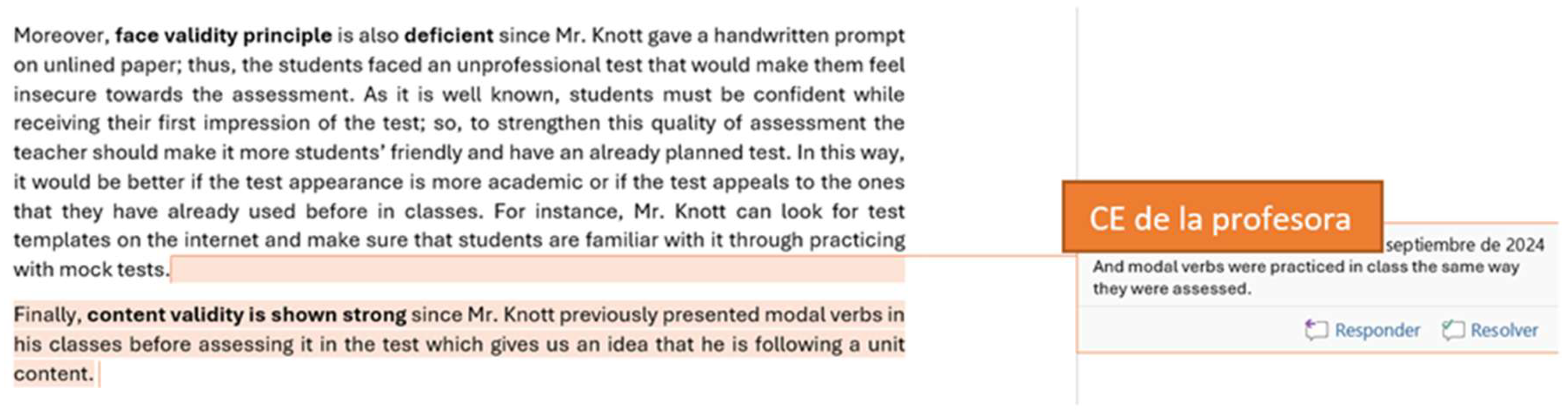
Figure 2.
Writing Assignment with Improvements – Interaction group 2 – WC1.
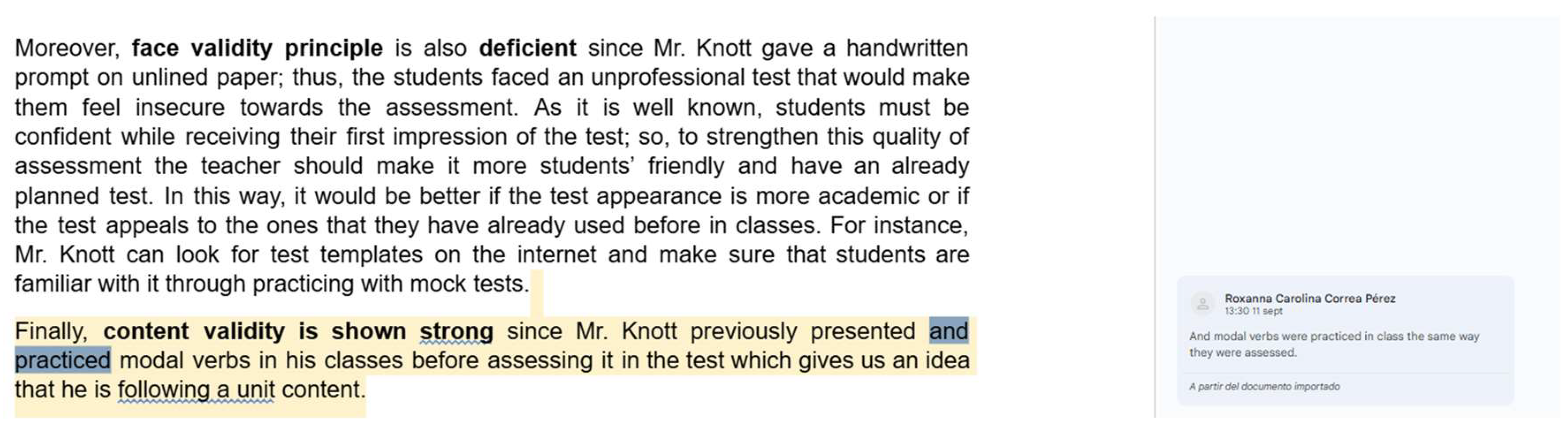
Figure 3.
Long sequence of meaning co-construction. Note: own source.
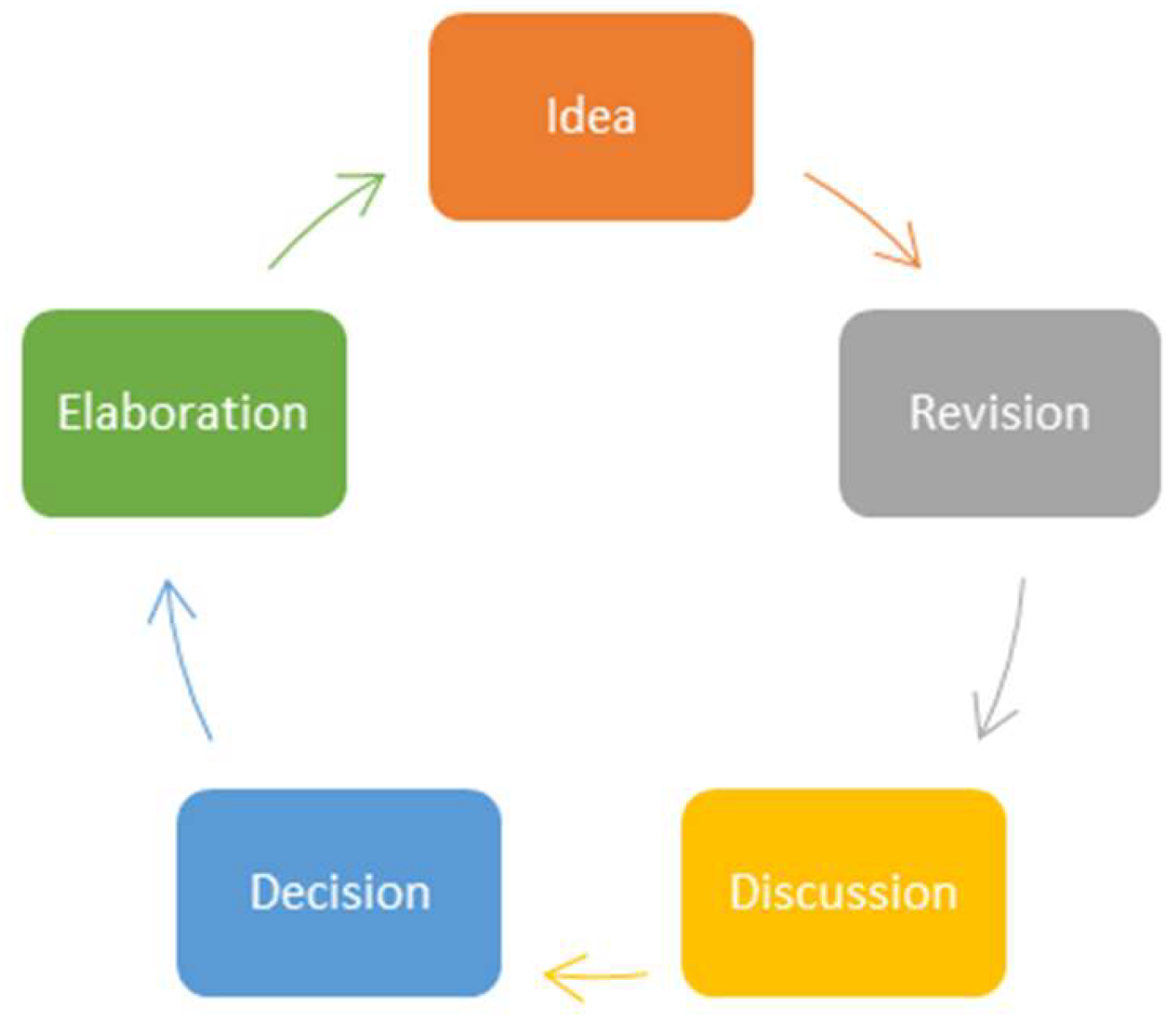
Figure 4.
Short sequence of meaning co-construction. Note: own source.

Table 1.
Student Interaction Analysis Categories.
| Categories | Definition |
|---|---|
| Read the comment out loud | They repeat aloud the feedback provided by the teacher. |
| Review of actions carried out | They check what they did in the task, specifically, they read the portion of text to which the WC refers. |
| Comprehension of the WC | They comment on whether they understand the indications referred to in the feedback received. |
| Disagreement with the WR | They show disapproval of the teacher’s comments on the assignment. |
| Fulfillment of teacher’s expectations | They make assumptions about what the teacher expected them to do in the task. |
| Rationale for decisions | They comment on the reasons why they performed some actions in the text. |
| Discussion | They review the actions taken in the text and negotiate decisions about what to do or not to do. |
| Identification of missing knowledge | They become aware of the necessary information to be incorporated, or the content that is not present (also any comments regarding spelling). |
| Relation with disciplinary content | They discuss the theoretical foundations. They connect with the theory, concepts or reading of the course (including references to the professor’s comments related to the subject). |
| Actions | They decide and/or execute the necessary changes to be made to the task. |
| Ways of accessing knowledge | They decide how to obtain the information they do not know (including references to consultation with teachers, documents or peers). |
| Appreciations | They make personal appraisals about their own work, their partner’s work, the work done together or the teacher’s work. |
Note: Own source.
Table 2.
Excerpt 1- Interaction group 2- WC 1.
| CE: And modal verbs were practiced in class the same way they were assessed |
| 1 A: Yes, first question is about content validity, and the professor… would you like to read? |
| 2 B: Yes. She said that modal verbs were practiced in class the same way they were assessed. So, I guess… It is a positive comment? |
| 3 A: right, because … |
| 4 B: I’m not sure. |
| 5 A: …we said content validity is shown strong, since Mr. Knot previously presented modal verbs in these classes… |
| 6 B: Presented… |
| 7 A: You need context, so… |
| 8 A: Or maybe we... |
| 9 A: Ah, we should specify one more time… |
| 10 B: If they practiced… |
| 11 A: Yes. That’s here… |
| 12 B: Yes. |
| 13 A: Because we said like strong, it is strong. |
| 14 B: Ah, we, we forgot to mention that they practiced. |
| 15 A: Ok, so we should include it. |
| 16 B: Yes. |
Table 3.
Excerpt 2- Interaction group 2- WC 1.
| CE: And modal verbs were practiced in class the same way they were assessed |
| 17 A: Here or… I mean, here in the same place where... professor… on, or maybe here? |
| 18 B: In, in the same place, like after presenting, and… |
| 19 A: Should we speak ok here, or nothing? |
| 20 B: No, I, I don’t think we should do something to the comment. |
| 21 A: So, we are going to write... as it could seen previously, or not?... as it could be… |
| 22 B: Amm… Maybe we check all the comments first and then we may... |
| 23 A: Aah, ok, yes! You’re right. |
| 24 B: I think it’s better. |
| 25 A: That’s right. Ok, so the first one we just missed it up. |
| 26 B: Yes, yes. |
| 27 A: It’s not so bad. |
| 28 B: My bad… |
| 29 A: No, but it’s not so bad |
| 30 B: Yes. |
Disclaimer/Publisher’s Note: The statements, opinions and data contained in all publications are solely those of the individual author(s) and contributor(s) and not of MDPI and/or the editor(s). MDPI and/or the editor(s) disclaim responsibility for any injury to people or property resulting from any ideas, methods, instructions or products referred to in the content. |
© 2026 by the authors. Licensee MDPI, Basel, Switzerland. This article is an open access article distributed under the terms and conditions of the Creative Commons Attribution (CC BY) license (http://creativecommons.org/licenses/by/4.0/).
Copyright: This open access article is published under a Creative Commons CC BY 4.0 license, which permit the free download, distribution, and reuse, provided that the author and preprint are cited in any reuse.