
Submitted:
10 June 2026
Posted:
11 June 2026
You are already at the latest version
Abstract
During the Little Ice Age (1490-1760), natural disasters were primarily caused by extreme weather conditions featuring significant drops in temperature, which caused damage to crops; the resulting decrease in agricultural production led to famines. Recurring famines, in turn, caused the outbreaks of pandemics, resulting in massive death worldwide. The Veritable Records of the Joseon Dynasty (朝鮮王朝實錄) recorded a wide range of unusual events during the Little Ice Age including significant drops in ground-level temperature, reduced crops, repeated famines, and the prevalence of infectious disease, along with abnormal changes in the sky. Additionally other disasters during the Little Ice Age included frequent crop damages from insects and the appearance of deformed animals. This paper focuses on the appearance of deformed animals. By analyzing the 271 cases of deformed animals identified in the Veritable Records. While investigating the main cause of the Little Ice Age, I noticed that what space science refers to as “cosmic dust” was brought into the earth’s atmosphere by a multitude of meteors or accumulated in the atmosphere due to atmospheric meteor explosions. The Veritable Records recorded unusual situations such as pressed dust or powder falling from the sky or thick fog blocking vision and causing darkness during the day. This paper thus regards such records of unusual situations as indications of the long-term accumulation of “space dust,” which this paper identifies as the cause of animal deformations. This paper also relies on thirty-eight cases of deformations in the German flugblatt published during the Little Ice Age. These resources were collected from the German National Museum in Nuremberg, Germany and other European institutes.
Keywords:
asteroid belt
; terrestrial impact
; meteor falling
; cosmic dust
; doomsday
; wrath of God
1. Introduction
In 1996, I published a paper on the natural anomaly of the “Little Ice Age.”1 A year later, in 1997, I was invited to an international academic conference in Hikone, Japan, where I presented the paper translated into English. The conference was organized by an association of scientists researching near-Earth objects, and my paper was published in the journal of this association in 1998.2
As a researcher of the Joseon period, I was immersed in the search for the causes of social turmoil and upheaval in the mid Joseon period when I became aware of the Western academic theory of the “General Crisis” of the 17th century.3 This theory provided a new explanation for the severe turmoil in European society in the 17th century in the context of the natural anomaly of temperature dropping. The mid Joseon period consisted of the 16th and the 17th centuries, and I hoped that the Veritable Records of Joseon Dynasty (hereinafter “the Veritable Records”) would confirm this if there was indeed a natural anomaly caused by a drop in temperature. Thus I commenced researching the entries of the Veritable Records of King Injo (1623–49), which dealt with part of this period. It was not difficult to read through the records spanning four or five years and find records related to an anomalously colder climate. Records of frost and frozen valley water were common in the fourth and the fifth months of the lunar calendar,4 and records of hail, frost, and unseasonal snow were also common in spring and autumn. Along with this, however, there were countless other unusual phenomena in the sky, including the frequent appearance of meteors.
This was a problem. There were more records of meteors the size of peaches flying in a certain direction with tails several feet long,5 meteors as large as a water bucket roaring and brightly illuminating the ground as they flew away, and meteors exploding in the air and creating strange shapes than the entries about the cold. There were countless more unusual phenomena in the sky, such as Venus appearing in the middle of the sky at midday and certain shapes of reddish and white colors appearing and disappearing in the sky.
The relationship between the two phenomena—namely, the cold on the ground and the anomalies in the sky—was not an easy problem for a historian to solve. With the help of an astrophysicist, I learned of the Luis Alvarez team’s theory of a very large asteroid impacting Earth during the Cretaceous period at the end of the Mesozoic Era. This was published in 1980.6 I soon realized that the theory of “Neo-Catastrophism” in the field of near-Earth objects had already made considerable progress in the late 1990s. I also became aware that the Society for Interdisciplinary Studies (SIS), founded in London in 1975 under the leadership of Immanuel Velikovsky, was actively pursuing the relationship between near-Earth objects, the Earth, and human history. The 1997 Hikone International Science Conference was also co-hosted by SIS members and related Japanese researchers. In August of the same year, the International Astronomical Congress was held in Fukuoka, and prior to the congress, the near-Earth object specialists held a preliminary section meeting in Hikone. It was very encouraging for me that the results of my research, which was based on the analysis of natural anomalies recorded in the Veritable Records, were presented at this conference and immediately published in a professional journal.
My research using the natural anomaly records in the Veritable Records was conducted as follows. First, according to the theory of the “general crisis of the 17th century,” I selected relevant material from the Veritable Records of this period. Records on abnormally cold weather and atmospheric anomalies were selected together. However, in order to ascertain the duration of these two phenomena, I had to look also at the Veritable Records falling outside of this period. In the end, the entire Veritable Records of Joseon Dynasty, from King Taejo of 1392 to King Cheoljong of 1864, became the subject of research. As a result of the analysis of 25,640 records related to natural anomalies in this period, it was determined that the combination of abnormally cold weather and atmospheric anomalies lasted for 270 years from 1490 to 1760. The theory of “general crisis of the 17th century” in the Western academia estimated the period of the temperature drop, or the Little Ice Age, to have existed about 80 years in the 17th century. Based on the analysis of the Veritable Records, however, a new estimate of this period is now extended to include the 16th century, the 17th century, and the first half of the 18th century.
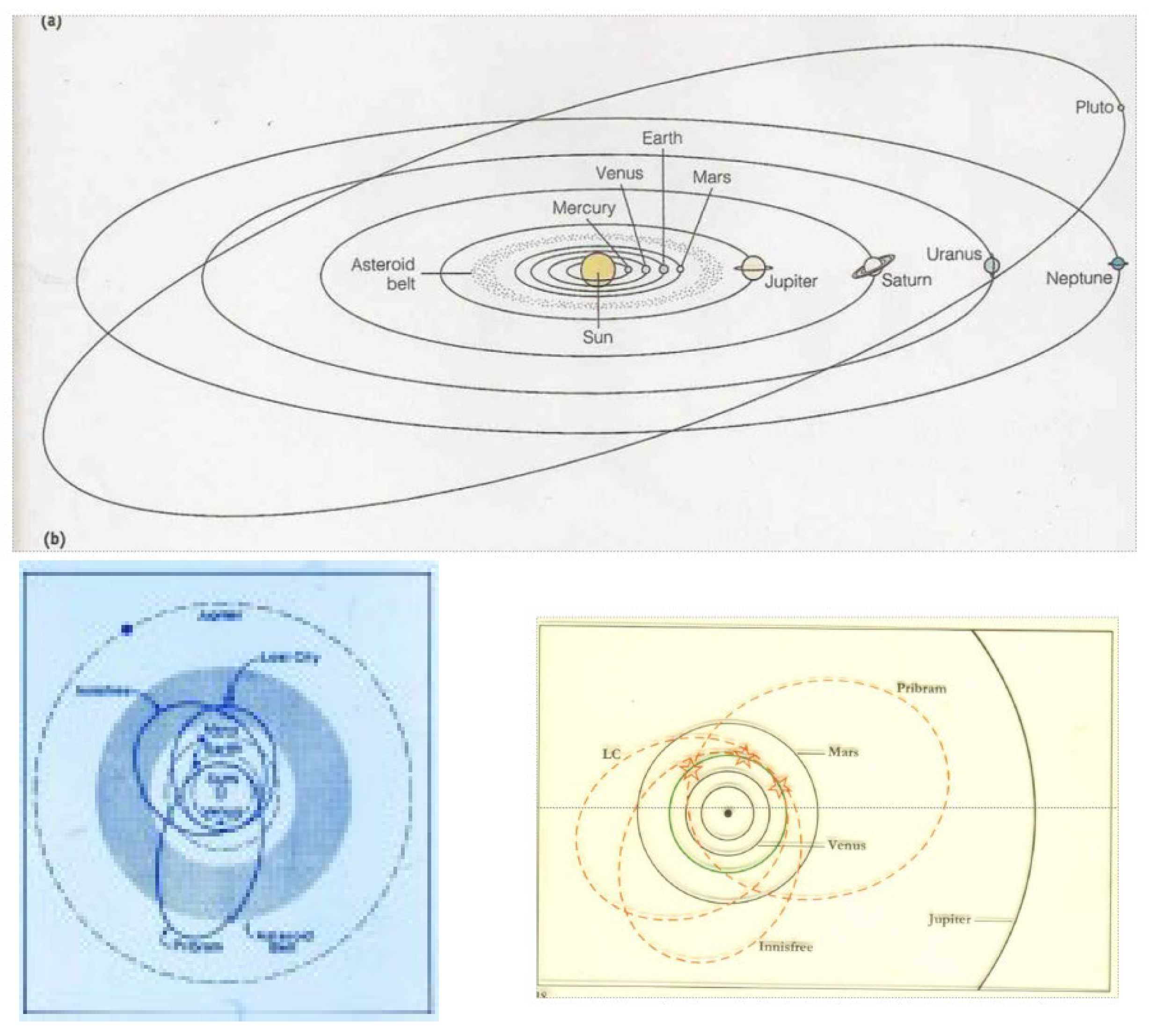
In the 2000s, as space science advanced, we began to understand that the image of our solar system had changed. We have learned of the existence of the asteroid belt, a large number of solid bodies floating between the orbits of Mars and Jupiter.7 Space scientists have postulated a “missing planet” as the reason for the existence of this belt.8 In other words, a planet the size of the Earth or Mars somehow disintegrated in this area, and that is why there are many large and small boulders floating around there. With the development of space telescopes, 200 million boulders have been counted thus far.9 These small and large boulders, pulled by the gravity of the sun, rotate in an elliptical orbit like a comet and at the moment they meet the circular orbit of Earth, they are pulled by the gravity of Earth and enter its atmosphere, causing terrestrial impacts in some cases.
In 1980, a team led by Berkeley astrophysicist Luis Alvarez was the first to scientifically demonstrate an “event” based on this principle. The team used the iridium layer lying between the Cretaceous and Cenozoic layers of the coastal terraces of Denmark and several other regions as a clue and analyzed it as the trace left by a very large asteroid (giant) that entered Earth’s atmosphere from the asteroid belt and impacted the Earth. In summary, the “external impact” phenomena first revealed by this study are as follows.
Figure 1.
Diagram Asteroid Belt and Asteroid Earth Entry (Source: Wicarder Reed and James S. Monroe, 2001, Historical Geology, 5th ed., (Pacific Grove, CA: Thomson Brooks/Cole Publishing), p. 7.).
Figure 1.
Diagram Asteroid Belt and Asteroid Earth Entry (Source: Wicarder Reed and James S. Monroe, 2001, Historical Geology, 5th ed., (Pacific Grove, CA: Thomson Brooks/Cole Publishing), p. 7.).
First, the huge amount of dust generated by the impact of the asteroid flew into the air, creating a greenhouse effect in the atmosphere, and the hot air turned into water vapor, causing a deluge. At the time of impact, the mineral solution melted in the hot air with a flash of light, and after circling several times around the earth, it was laid on the ground. The presence of the iridium layer between the rock layers attests to this. Even after a long period of rainfall cooled the hot air in the atmosphere, the sky was still covered with cosmic dust, which blocked the sun’s heat and light, and the atmosphere underwent a cosmic winter, freezing most of the then extant plants and animals to death. The interpretation of the Alvarez team is that this was the cause of the disappearance of the herbivorous dinosaurs, which were the masters of the Mesozoic Earth. The research team determined that the Mesozoic ecosystem of the Earth changed by more than 70% at this time. Many of the Mesozoic marine plants also became extinct, indicating that the impact site may have been in a coastal area.
Until this theory appeared, our understanding of life on Earth followed the Darwinian theory of evolution, which was based on gradualism. The Darwinists strongly opposed the catastrophism of the Louise Alvarez team. Based on the thickness of the iridium layer, the Louise Alvarez team estimated the size of the asteroid to be about 10 kilometers in diameter and the size of the crater left by the impact to be 150 kilometers in diameter. This estimate became a source of controversy because at the time, no craters of that size had been identified on Earth. However, a decade later, a satellite photo interpretation confirmed the existence of a crater of about the same size on the Yucatan Peninsula, both on the ground and below sea level. In the 1990s, Michael Rampino and his team at New York University established that the same phenomenon occurred at the end of the Paleozoic Era, by which the Earth’s ecosystem was thrust into the Mesozoic Era.10 Thus the cosmic impact theory has rewritten the Earth’s history from a new perspective.
The Little Ice Age phenomena revealed in the Veritable Records are interpreted as phenomena caused by small rocks in the asteroid belt entering the Earth’s atmosphere for 270 years. During the Little Ice Age, more than 3,000 meteors were observed with the naked eye from the viewing platform in Seoul.11 If we include all such occasions that occurred outside of Seoul, the number of meteors of all sizes that entered the Earth’s atmosphere over those 270 years is possibly in the hundreds of thousands and even millions. Meteors enter the atmosphere, explode, and become dust. Scientists call this “cosmic dust.” Cosmic dust sometimes enters the atmosphere together with a multitude of meteors, enveloping them. There are many records of such phenomena in the Veritable Records. This is known in the Veritable Records as an abnormal form of “fog,” which is one of the main topics of this paper. Based on about 25,670 records collated from the Veritable Records, 27 types of related phenomena caused by meteor explosions have been identified.
Our analysis postulated that 11, 11, and 5 types of phenomena were observed in the stratosphere, in the atmosphere, and on the ground, respectively. The ubiquitous appearance of deformed animals, which we intend to cover in this paper, could not be included as a related phenomenon at the time of publication of the previous paper due to various restrictions. Now, more than 20 years later, I would like to investigate, albeit belatedly, the ubiquitous appearance of deformed animals that were mainly caused by cosmic dust in this complementary paper.
2. Overview of the Little Ice Age phenomena in the Veritable Records
For the reader’s convenience, the results of the analysis of the natural anomaly records in the Veritable Records are introduced first below.
Table 1 shows the number of records of natural anomalies and disasters in the Veritable Records, divided into categories. In explaining the Little Ice Age phenomena, thus far I have mainly used Phenomena I (from 1 to 27) in the table and excluded Phenomena II (from 28 to 33) as disasters experienced by people on earth. In this paper, I would like to mention 30, Insect plagues, as it is a relevant issue. The survey on the appearance of deformed animals is presented separately for the first time in this paper, which was absent from the previous tabulation. Table 1 categorizes all records into 50-year units. First of all, it can be seen at a glance that the distribution of the 25,670 records of Phenomena I is concentrated between the 3rd period (1501~1550) and the 7th period (1701~1750). This result leads us to conclude that the Little Ice Age characterized by a temperature drop began in 1490 and lasted until 1760.
Table 2 shows the areas where the abnormal events of Phenomena I were observed, divided into Seoul and the provinces. In Seoul, where the central government was located, 20,360 events were observed, and 5,310 events were reported to the central government by the provinces, which is a ratio of 3.8:1. Of these, unusual phenomena unfolding in the sky were extremely rarely observed or reported from the provinces. On the other hand, meteorological phenomena that affect agriculture, such as thunder, hail, frost, snow, rain, and wind, were actively observed and reported from the provinces. In most cases, reports related to these phenomena were sent from counties and districts to the provincial governor, who then collected and reported them to the central government in a single batch. Therefore, one report by one provincial governor included reports from various towns within his jurisdiction, and thus one such report contains a variety of observations in actuality.
In order to explain the substance of the Little Ice Age events identified in Phenomena I, I will divide the events into Zones A, B, and C.
Zone A: Row 1–11
Zone B: Row 12–22
Zone C: Row 23–27
As mentioned above, when counting only those reported from the provinces, the number of anomalies that occurred in Zone A, i.e., in the sky, was not large. Except for one type, i.e., lightning and thunder, the anomalies in the sky were almost exclusively reported by the Office of Astronomy and Geomancy in the central government. Even in the first and the second periods before the Little Ice Age, various anomalies were mostly observed. However, in periods 1, 2, and 9, that is, outside the Little Ice Age, there were no such unusual phenomena as mysterious sounds from the heavens (Row 3), guest stars (Row 5), abnormal moon (Row 7), cosmic dust (Row 2), and darkness in daytime (Row 22). It should also be noted that there is a large difference in intensity between periods 1, 2, 8 and 9 and periods 3 to 7 for the same phenomena. For example, in the case of the meteors (Row 1), in periods 1 and 2, meteors were briefly described as “coming from somewhere and disappearing in a certain direction,” whereas in periods between 3 and 7, the descriptions are starkly different as shown in the following examples.
- A.
- Year 1589 (21st year of King Seonjo), Intercalary Month 6, Day 24 (eulsa).
Mijeon Garrison, Onseong, Hamgyeong Province
On the second day of this month, at the second night watch (21:00-23:00),12 a fireball appeared. It was shaped like a man sitting on a round rush mat, flying through the air as if it had a bow and arrows on its waist, heading north. This was followed by thunder, which sounded like ice breaking. The wind blew, and it was so hot that people could feel the heat on their faces.
- B.
- Year 1601 (34th year of King Seonjo), Month 12, Day 27 (gyeongin).
Ganggye Prefecture, Pyeongan Province
On the seventh day of this twelfth month, about five ri outside the north gate of Ganggye Prefecture, something that looked like a fire arrow, several feet long and red in color, descended from the middle of the sky. Pheasants, which had been hiding, were startled by thunderous sounds and flew away. Also, on the water in the prefecture, fire arrows flew along the fortifications, and thunderous sounds followed. At Idong Fort, the fire arrows fell into the fortress and smoke came out, which dissipated after a while.”
- C.
- Year 1608 (ascension year of Prince Gwanghae),13 Month 3, Day 12 (gihae).
Seoul (Hanseong Magistracy).
At sunset, before the stars had risen, a large fireball like a meteor came out of the middle of the northeastern sky and disappeared in the western sky. Its shape was like a large jar, its tail extended to the edge of the sky, and its sound was like a faint thunder. The red color illuminated the land, and it disappeared after a while.
- D.
- Year 1609 (1st year of Prince Gwanghae), Month 8, Day 25 (gyeyu).
Seoncheon County, Pyeongan Province.
“It was a clear day in the O hour (11:00–13:00), and not even a trace of a light cloud could be seen. Then suddenly, from the edge of the eastern sky, there was a sound like a cannon firing. A fireball in the shape of a straw bale fell toward the horizon and instantly disappeared. Where the fireball had passed, the heavens opened, which looked like a waterfall.”
The above examples are mostly reports of various phenomena that occurred when the meteors exploded. They show a marked difference from the shooting stars before the Little Ice Age. The difference in intensity is similar in other phenomena. In the case of the frost phenomenon, there are often records of frost in the fourth and the fifth month of the lunar calendar,14 or even ice in the mountain valleys during the same period. This is an unusual phenomenon that is not found at all in periods 1, 2, 8 and 9.
We shall try to sort out the situation in each of the three zones, A, B, and C. The zone distinction may not be strictly observed due to the overlapping relationship between the phenomena.
Zone A: (1) Meteors (2) Colored celestial vapors (3) Unusual sounds in the sky (4) Comets (5) Guest stars or new stars (6) Abnormal sun (7) Abnormal moon (8) Solar halos (9) Lunar halos (10) Daytime appearance of Venus (11) Thunder and lightning
(1) Meteors are small asteroids. (2) Colored celestial vapors are described as red, black, or white vapors. After a meteor entered the atmosphere and exploded, it drew a band in the sky with different colors depending on the mineral composition of the meteor. (3) This is what you would experience if you only heard the sound of the meteor as it flew by. This is a sonic phenomenon that a relatively large meteor can produce while flying. (4) This is different from asteroids and falls outside the subject of this paper. (5) This is different from asteroids and falls outside the subject of this paper.15 (6) and (7) are records of anomalies in the sun and moon, such as the sun and moon being red or purple, or the sun appearing to be two or three. (8) and (9) are halos, which were also observed in periods 1 and 2, but in periods 3 to 7, most of them are double or multiple halos. This is one of those cases where there is a striking difference in the intensity of the same phenomenon.
The anomalies of the sun and the moon are interpreted to be caused by the accumulation of cosmic dust in the atmosphere, which is produced during the explosion of asteroids or introduced from the outer space with a multitude of meteors. The following are examples of quasi-fog (22) that correspond to the cosmic dust phenomenon.
- E.
- Year 1520 (15th year of King Jungjong), Month 3, Day 16 (gapjin).
Jeolla Province.
It snowed in 13 towns including Gwangju, and frost descended in Suncheon. In Haenam and Gangjin, there was a thick yellowish fog, and hail and dust rain fell, obscuring sight.”
- F.
- Year 1602 (35th year of King Seonjo), Month 6, Day 13 (gyemyo).
Gangwon Province.
A cool wind had been blowing in Hoengseong since the beginning of the fifth month, and in Yangyang, Samcheok, and Ganseong, yellowish fog hung on all sides.
- G.
- Year 1605 (38th year of King Seonjo), Month 6, Day 29 (sinmi)
Yeosan County, Jeolla Province.
On the 13th day of this 6th month, in the sin hour (15:00–17:00), a white dragon appeared out of the clear sky, and it was clearly seen to be wriggling. As soon as a short time had passed, the surrounding area was covered with clouds and fog, there was a great deal of rain and wind, and lightning struck with thunder.
It is clear that the “yellowish fog” in the above case is not a common fog, but a phenomenon associated with a meteor explosion, i.e., cosmic dust. It is also clear that the “yellowish fog” covered the sun and moon and changed their colors. The expressions such as “heavy fog,” “thick fog,” “dusty fog,” “dense fog,” “black fog,” and “cloudy fog” are all related to the same phenomenon. The same is true for “turbid vapor” and “smoky vapor.”
The accumulation of cosmic dust blocked the heat and light of the sun, lowering the temperature of the atmosphere and causing unseasonal frost or snowfall. As mentioned above, the research of Luis Alvarez and his team has shown that after a large asteroid (giant) hits the earth, dust is blown into the sky and causes anomalies in the atmosphere on varying scales as follows: a greenhouse effect, a deluge, the circulation of cosmic dust in the atmosphere, and a cosmic winter. In addition, solar and lunar halos, which are caused by sunlight projecting on ice crystals in the atmosphere formed due to the drop in temperature, also occurred constantly. Double and quadruple solar halos were perceived as a warning from the heavens and evoked serious fears. The changes in the sun and moon were also interpreted politically as signs of encroachment on royal authority and became pretexts for political purges.16
The daytime appearance of Venus in (10) was just as serious. Venus, known as the Great White Star (taebaek), was a Confucian symbol for the chief minister. This star would begin to glow in the evening sky in the west as the sun was setting. In the Confucian worldview, it was only logical that it should do so, but its appearance in the heavens in daytime could be interpreted as a sign that the chief minister was coveting the throne. Apparently, this anomaly was caused by the accumulation of cosmic dust, which obscured the sunlight to the level of sunset, making it possible for Venus to appear earlier in the sky.
As described above, most of the anomalies in Zone A are interpreted as appearing due to the accumulation of cosmic dust in the atmosphere. The high frequency of lightning and thunder in (11) may be due to the fact that, in addition to actual thunder and lightning, the roar and flash of light generated when a meteor exploded in the atmosphere was also considered thunder and lightning.
The composition of the Earth’s atmosphere in atmospheric science is explained as follows. It can help us understand the phenomena that occurred in the two zones A and B above. The atmosphere is the layer of air that surrounds the Earth and extends from the surface to a height of about 1,000 km. The atmosphere can be divided into four zones as shown in Table 3. According to this table, the anomalous phenomena in the upper A zone correspond to those that appear in the mesosphere and the thermosphere, which is 50 km or more in altitude.
Zone B: (12) hail, (13) frost, (14) unseasonal snow, (15) torrential rain, (16) terrible rainstorm, (17) gale-force wind, (18) excessive snow, (19) colored snow and rain, (20) dust storm, (21) darkness in daytime, and (22) fog.
The phenomena in zone B occurred in the troposphere, extending from the earth’s surface to a height of about 11 km to 50 km, as shown in Table 3 above. Of the phenomena in this zone, those listed in (12), (13), and (14) correspond to the weather anomalies caused by the drop in temperature in Zone A.
Hail in (12) is recorded to have fallen regardless of the season or even have caused cases of death or injury to animals and people as well as crops due to its large dimensions. There are even cases of frost and snow falling in the fourth, the fifth and the sixth lunar months.
Windstorms and other weather anomalies may occur at any time in the four seasons, but the in the Little Ice Age, they were of higher intensity and had a very significant impact on crops and livelihoods, triggering the abandonment and loss of farming. Colored snow and rain listed in (19) are the result of the mineral components of cosmic dust coloring the snow and rain. Dust storms and daytime darkness listed in (20) and (21) are phenomena caused by cosmic dust accumulated in the atmosphere. This will be discussed again in detail in this paper. In my opinion, the direct cause of the outbreaks of deformed animal is related to this very phenomenon.
Zone C: (23) earthquake, (24) tsunami, (25) change of water color (in sea and river), (26) abnormally low temperature, and (27) abnormally high temperature.
The above phenomena occurred on the surface of the earth and at sea. A total of 1,500 earthquakes have been recorded in the Veritable Records, of which 1,221 occurred during the Little Ice Age. Among them, an earthquake swarm, in which a number of earthquakes occurs in a relatively short period of time, occurred in one area (Jungangjin, North Pyongan Province).17
The number of earthquakes recorded in the period 1, which does not belong to the Little Ice Age, is 183 times, and this raises a question as to how this was so. At least in the Little Ice Age, we may assume that there are cases of erroneously classifying meteor falls as earthquakes. Many of the meteors that fell during the Little Ice Age fell into the seas and rivers. This is especially true in the seas. In this case, there are records of the water turning red as the impact heated and “cooked” plankton in the water. The change in color was almost always described as red, or red tide.18
Records listed in (26) and (27) consist of abnormally cold or hot temperatures that do not match the seasonal weather. Abnormally low temperatures are not abnormal in light of the conditions of the Little Ice Age, while most cases of abnormally high temperatures were recorded between the 9th and the 12th month.19 However, 40 of the 87 cases occurred in the 200-year period before and after the Little Ice Age, and thus the percentage of such cases during the Little Ice Age is not particularly noteworthy.
3. Analysis of the Veritable Records Related to Deformed Animals
3.1. Statistical Processing of Records Related to Deformed Animals
When I surveyed the Veritable Records for the research of the Little Ice Age, I also collected records related to deformed animals. However, they were not included in the previous analysis because I did not have the knowledge to explain the correlation between Little Ice Age phenomena and the widespread appearance of deformed animals. Although I have yet to secure relevant scientific knowledge, I have decided to address the subject at the level of introducing relevant material for future research. I have determined that this issue should be studied as an issue of environment and disease.
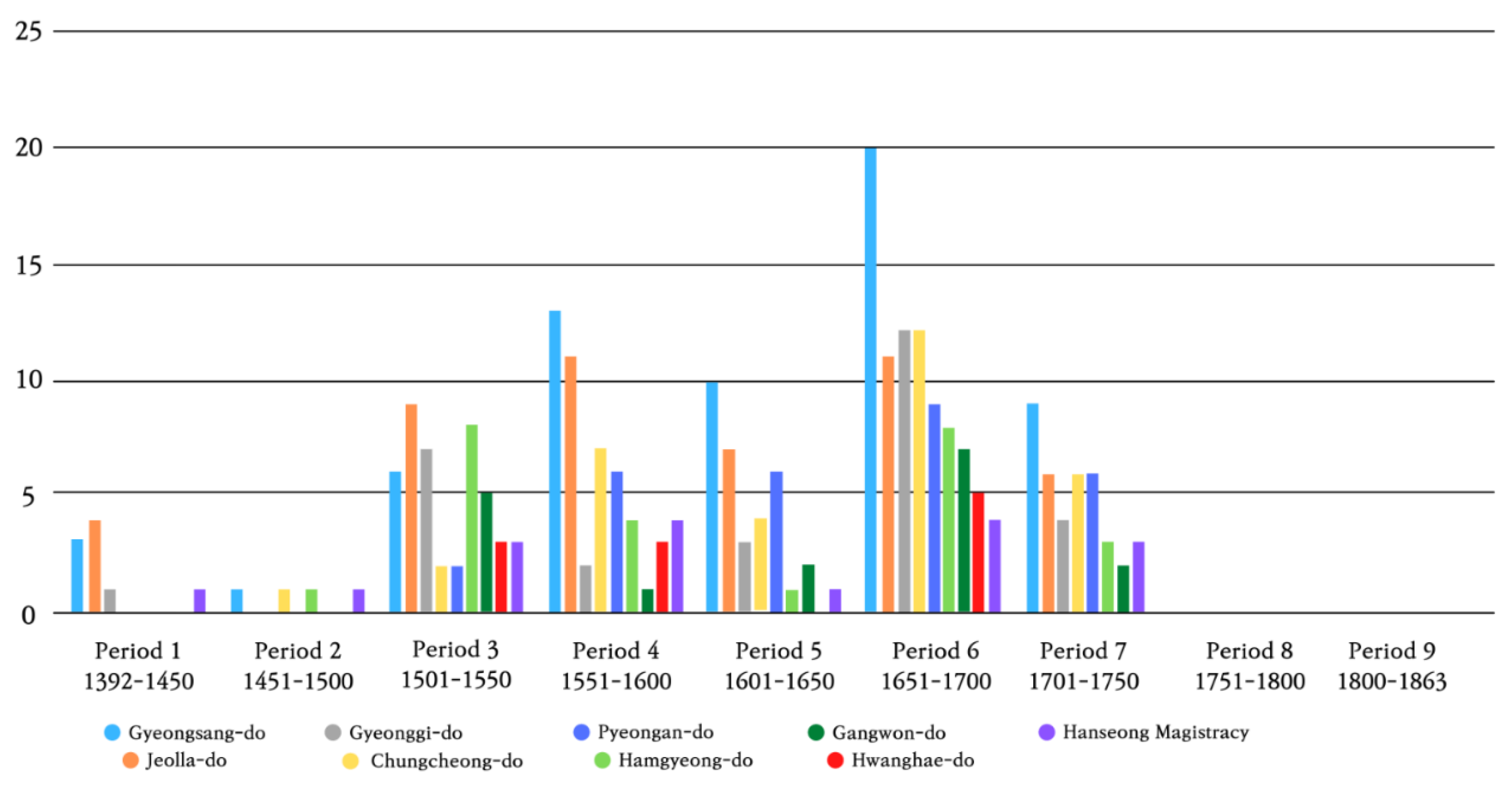
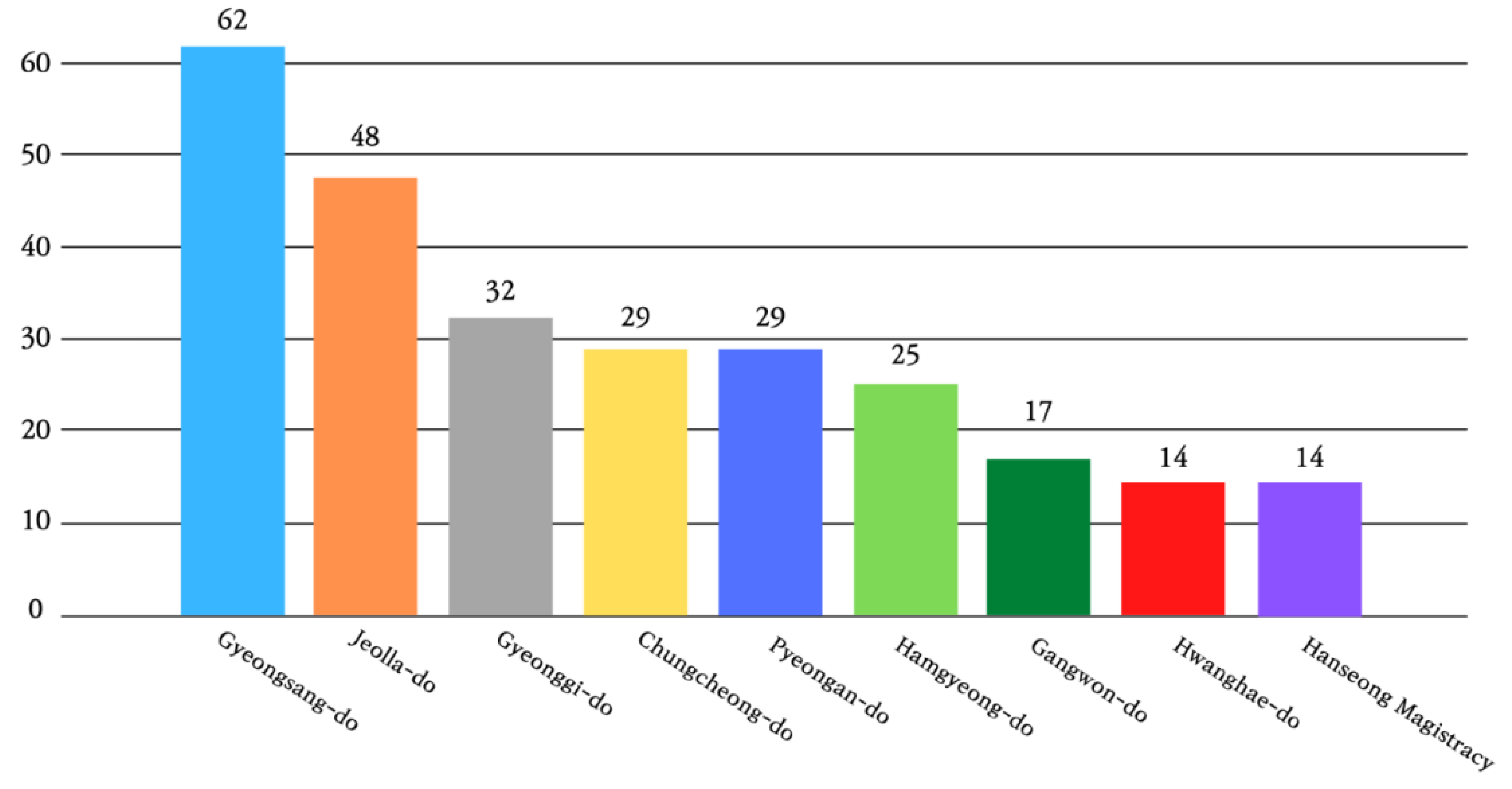
Table 4 shows the number of deformed animals for each 50-year period, based on the records of deformed animals in the Veritable Records. A total of 271 cases were recorded. Table 5 shows the results of this analysis by province. Gyeongsang, Jeolla, and Chungcheong Provinces, in that order, have the highest frequency, probably as a result of their population (household) ratios. Graph 1 shows the number of occurrences of deformed animals for each province for a 50-year period. The results are completely consistent with the Little Ice Age (1501–1750). It is confirmed that the deformed animals appeared intensively during the Little Ice Age. Graph 2 shows the number of deformities by province: Gyeongsang Province, Jeolla Province, Gyeonggi Province, Chungcheong Province, followed by Pyeongan Province, Hamgyeong Province, Gangwon Province, Hwanghae Province, and Hanseong Prefecture (Seoul).
Graph 1.
Number of Deformed Animal by Period (1392-1863).
Graph 2.
Number of Deformed Animals by Province (1392-1863).
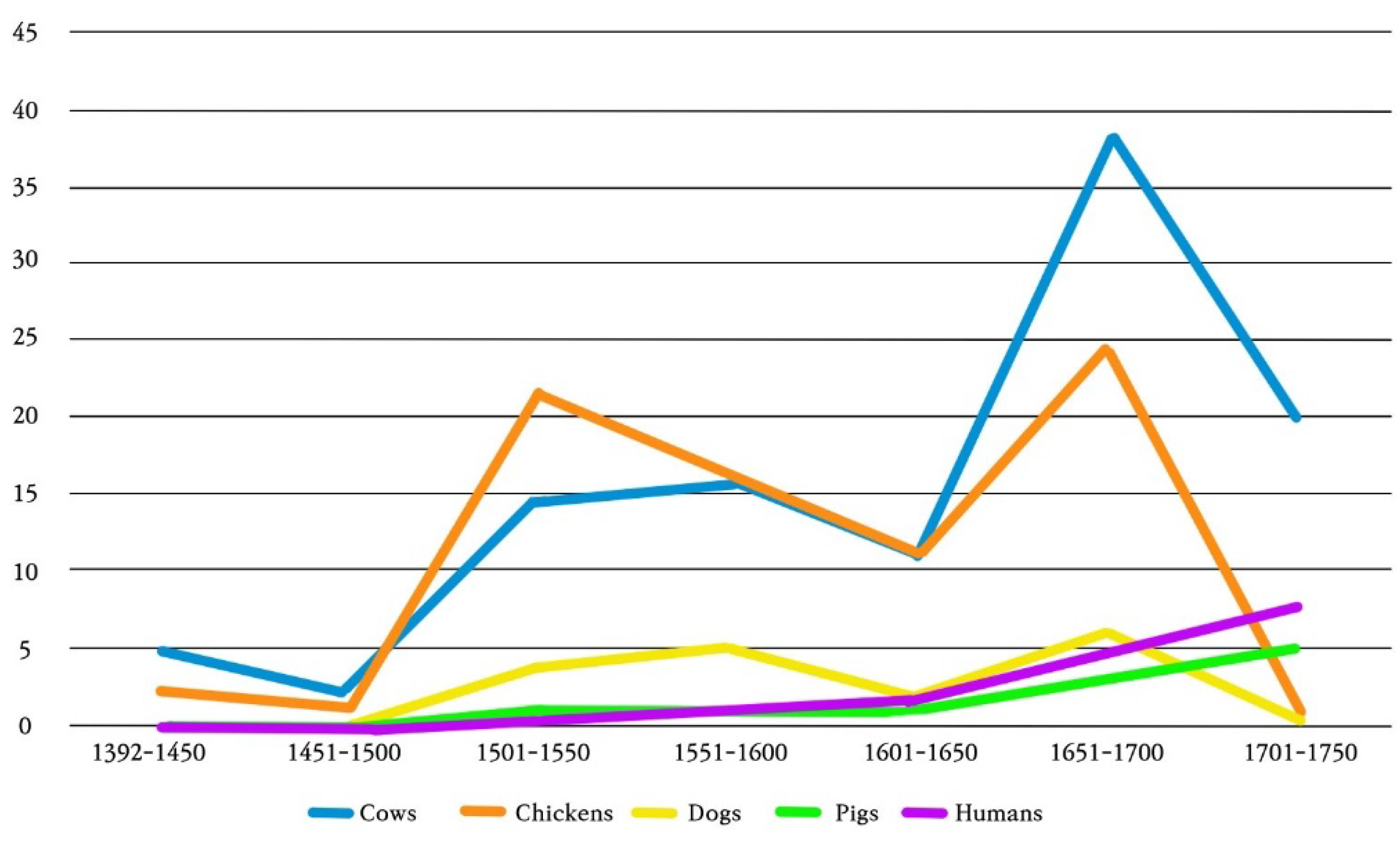
Graph 3 shows the frequency of deformity in the five categories of cattle, chickens, dogs, pigs, and humans. The high frequency of deformity in cows and chickens can be seen at a glance. The fact that the line turns downward in the period from 1551 to 1600 in both cases is the result of the incompleteness of the Veritable Records during this period, especially for the first half of King Seonjo’s reign (1567–1608). In other words, the records between the accession of King Seonjo and the Imjin War (1592) were lost due to the ravages of war, and the primary sources of the Veritable Records of King Seonjo and the Revised Veritable Records of King Seonjo for the relevant period were very insufficient. If there had been no effect of war, the downward curve would have continued upward.
Graph 3.
Number of Deformed Animals by Kind (1392-1750).
The order of the animals concerned in Table 4 is based on the order of appearance in the relevant records. In other words, cattle and chickens came first, followed by horses, dogs, pigs, cats, humans, and birds. Among birds, pheasants, ducks, sparrows, and swallows were recorded. Among others, ants, goats, and bears were found to have one or two cases of malformation. The majority of human deformities are in newborn babies, but there is also a record of a goat horn-like growth on the head of an adult.
3.2. Contemporary Perceptions of the Occurrence of Deformed Animals
The Joseon dynasty was a Confucian kingdom. In Confucianism, natural abnormalities were perceived as a warning from heaven to human beings to correct their errors. Therefore, when abnormal phenomena occurred frequently, self-examination to reflect on one’s mistakes was in order. As the person in charge of all the people, the king sought counsel from his officials regarding any issues that needed correction. Observing and recording the occurrence of abnormal phenomena was also considered a part of this effort at self-examination, and the king made efforts to enhance the system and organization of such observation and recording. As mentioned above, it was solar anomalies that were feared the most as a warning from heaven. The same was true for drought, which was directly related to agriculture. Although the appearance of deformed animals was of relatively low concern, it was a sign of a rupture in the order of nature, and thus was an object of fear.
Records of the occurrence of deformed animals can be found even before the Little Ice Age as follows.
- (1)
- Year 1412 (12th year of King Taejong), Month 7, Day 24 (jeongmi)
A cow gave birth to a calf in Suncheon Magistracy in Jeolla Province, which had four ears and grew horns in 10 days.
- (2)
- Year 1437 (19th year of King Sejong), Month 6, Day 24 (imo)
A hen turned into a rooster in the house of former education official Kang Jero in Haemi District in Chungcheong Province. It’s crest, toenails, feathers were all like a rooster. It even flew and crowed like a rooster. The King had an anomaly-resolving rite performed and sent a eunuch to examine it.
- (3)
- Year 1440 (22nd year of King Sejong), Month 9, Day 24 (gyehae)
The governor of Jeolla Province urgently reported, “A hen has turned into a rooster in a commoner’s house in Gangjin District (in Jeolla Province).”
- (4)
- Year 1454 (2nd year of King Danjong), Month 11, Day 18 (eulchuk)
In the house of elite trooper Yi Seongchun in Hoeryeong in Hamgyeong Province, a bull grew another horn between its two horns, and the horn was as long as one foot.
- (5)
- Year 1478 (9th year of King Seongjong), Month 8, Day 18 (jeongmi)
Governor of Gyeongsang Province Bak Geon urgently reported, “In the house of Shin Geum, a commoner in Ulsan District (in Gyeongsang Province), a cow gave birth to a calf, which was born with three legs in one place on its back.
The above examples are similar to the phenomena of deformed animals in the Little Ice Age described below. However, these five cases occurred over a period of more than 60 years, and the degree of frequency is too low to give them any special significance. However, there is room for consideration in the case of (5), which occurred in 1478. In my research, the base year for the beginning of the Little Ice Age phenomenon was 1490. However, as one of the phenomena in the solar system, the terrestrial impact phenomenon can have a precursor stage. The following anomalies in 1468 and 1476 can be regarded as such precursor phenomena.
- (6)
- Year 1468 (14th year of King Sejo), Month 9, Day 4 (gyeongsin)
A comet appeared, and the King ordered Chief Royal Secretary Kwon Gam and Ahn Hyorye to observe it. When they ascended to the astronomical platform and gazed upon the heavens, a black mass suddenly appeared in the southwest at the 3rd night watch (23:00 – 01:00). It was accompanied by a loud sound as if 10,000 horses were running in herds. A little later, there was lightning and thunder, followed by rain. When Kwon Gam and the others ascended to the platform again, they found that the radiating light of the comet was the same as before.
- (7)
- Year 1476 (7th year of King Seongjong), Month 12, Day 30 (gihae)
Yi Bong, the envoy for celebrating the Emperor’s birthday, urgently reported, “On the 11th day of the 12th month, your subject reached Haizhou Guard. At the beginning of the second night watch (21:00–23:00), there was a white lunar halo, which was about 40–50 feet in diameter. There was another halo, which had the faint light of blue and red color. It looked like a rainbow with a diameter of about 150–160 feet. The moon was flanked by this halo, which produced the appearance of two moons.
“The next morning, the rainbow-like solar halo remained. On the 12th day, the sun rose about 20 feet high,20 there was a red halo on both sides of the sun, again producing the appearance of two suns. The halo on the southern side stretched straight to the south for about 50 or 60 feet, as if they were laying down a piece of cloth, and the halo on the northern side of the sun stretched straight to the northeast, with a distance of 50 or 60 feet between the southern halo and the northern one. When the sun rose about 40 or 50 feet high, the halos finally disappeared.”
The entry quoted in (6) states that a comet appeared, and the chief royal secretary and a royal secretary went up to the astronomical platform and heard “a loud sound as if 10,000 horses were running in herds” from the sky around midnight. This is the sound that a relatively large meteor makes as it flies across the sky without being seen.
Case (7) is an example of a colored celestial vapor that appears after a meteor explodes during a meteor fall. The colored celestial vapor described above is of relatively large dimensions. This is a report dispatched to the king in Seoul by an envoy who saw the halos in Haizhou Guard in Liaoning Province on his return travel from a mission to Ming China as the envoy for celebrating the Chinese emperor’s birthday.
These two phenomena are common in the Little Ice Age, starting from 1490. They can be seen as precursors that occurred 24 and 32 years ahead of the full-fledged Little Ice Age, respectively. This is because such an event had never been recorded before. The deformed calf described in Case (5), which occurred in 1478, the middle point between the two events, also had a shape that was a precedent for cases that frequently occurred later, during the period of terrestrial impact. Thus, this case can be distinguished from cases (1) to (4) and can be regarded as an occurrence of deformity amid the precursor phenomena. The period between 1468 and 1490 was also a transition period in which the number of astronomical anomalies, commonly seen in the Little Ice Age, gradually increased. The record of events during this period is summarized in Table 6 below.
As shown in Table 6 above, after 1471, the phenomena related to terrestrial impact were not numerous, but they showed continuity, and the number increased rapidly as 1490 drew nearer. Cases (6) and (7) above can be seen as precursor phenomena leading to this period.21
In general, the reaction to the appearance of deformed animals is very serious. Confucian thought originally placed order and harmony as the highest value. Therefore, any mutation of life forms was taken seriously. In response to the report of the appearance of the deformed calf in Case (5), the king said, “It is a monster. Has this happened before? Make a report after surveying histories. He also said, “If the historian is to record this, he will need to see it in person.” This meant that the historian must have a chance to observe the actual calf in person. The next day, the king issued the following instructions to the State Council: “Monsters do not appear randomly; they are the result of the errors of man. All the anomalies are my fault, and I am truly astonished and afraid, as if I fell into a deep valley. Thus, I will revere Heaven and exert myself for the people in order to prevent disasters and remove the source of trouble.” He also instructed, “The responsibilities of the state councilors lie in harmonizing yin and yang, and thus the state councilors shall assist me in rectifying what I have failed to address.”
On the 9th day of the 10th month in 1494 (25th year of King Seongjong), a hen with three legs appeared in a house in the central district of Hanseong Magistracy (Seoul), stirring up a controversy among the king and his officials. The officials referred to several ancient Chinese incidents of three-legged hen and cited the ancient interpretation of those incidents: “If the king heeds and follows the words of his consorts, chickens will give birth to monsters.”
The officials then pointed to a large Buddhist ceremony hosted in Jasu Palace as a cause of this deformity.22 They also mentioned the unseemly behavior of the monks and women who gathered in Heungbok Temple outside the capital.
The king asked the officials why he was responsible for the occurrence of deformity when he did not support the Buddhist ceremony at Jasu Palace. The officials said that it would be highly improbable for the government to erect tents and repair the roads for the ceremony without the approval of the king. The king and his officials exchanged their opinions several times, insisting that their own opinions were correct.
What the officials emphasized was the ancient saying that if the king heeds the words of his consorts, anomalies inevitably occur in chicken. In the end, the king said, “I am responsible for all natural anomalies.” He then ordered the Royal Secretariat to bring the deformed hen. The next day, the officials of the Royal Secretariat actually brought the three-legged hen. The king said, “This hen is truly monstrous. It is improper to raise it until it fully grows.”
Since the 1490s, whenever there was a report of a deformed animal, there was a debate at the royal court. Reports of hens turning into roosters were often collected, and the debates were fierce. The changed sex in females and males was highly controversial because it was considered symbolic of disruption in yin and yang, which was considered the principle of all things. On the 12th day of the 4th month in 1516 (11th year of King Jungjong), the report that a calf with two faces on its head was born in Haenam in Jeolla Province, also surprised the royal court. The Office of Royal Decrees presented a memorial regarding this anomaly and the frequent natural disasters of the time as follows:
Year 1516 (11th year of King Jungjong), Month 4, Day 12
Since the accession of Your Majesty to the throne, extreme natural disasters and astonishing calamities have occurred every month and every year, but these days they are even worse. In the winter it never snows, in the spring it never rains. In the summer, there is frost, earthquakes strike the capital and the provinces, hail in the south, and dust rain in the west. Further, in Haenam District, a calf was born with two faces attached to one head. How can this be an anomaly that happens due to ordinary errors in human affairs?
The king’s answer to this helps us to understand the actual situation at the time.
“Since my accession to the throne, all kinds of disasters have occurred, and lately they have become worse. It is not possible to ascertain which disaster corresponds to which human affair, but how can such heavenly warnings be sent without cause? All of this has been caused by my lack of virtue. Thus, day and night I remain fearful and watchful, and I have no peace of mind even when lying down to sleep. I shall write down the three matters mentioned in the memorial on the right side of my seat and reflect upon them further.”
On the 24th day of the 10th month in 1559 (14th year of King Myeongjong), a hen turned into a rooster in a commoner’s house in Uiseong in Gyeongsang Province. A historian who participated in the compilation of the Veritable Records of King Myeongjong left the following comment:
The inalterability of yin and yang is an unchangeable principle for all the living things in the world, each of which receives its sex at birth and be either male or female for the duration of its life without alteration. In the district of Uiseong, it is said that a hen turned into a rooster, grew the crest and claws of a rooster, and crowed like a rooster. This is a deviation at its most extreme.
The Book of Rites states, “The hen does not crow at dawn. If a hen crows at dawn, the household will unravel.” If a hen crowing at dawn destroys the household, how much worse will it be if a hen turns into a rooster, grows the crest and claws of a rooster, and crows like a rooster?
At the time, the Queen Mother (Queen Munjeong) ruled the country from inside the palace, and her relatives wielded power from outside the palace. While the king was isolated at the top, monks prospered at the bottom. Yin and yang deviated from the norm, and evil portents continued. And yet, the ruler and the officials remained oblivious and knew no fear. Alas, how woeful!
The 13th king, Myeongjong (1534–67), acceded to the throne at the young age of 12, and his mother, Queen Munjeong (1501–1565), was regent for a long time. During the Little Ice Age, natural disasters and anomalies were interpreted through Confucianism, which emphasized the importance of examining oneself in fear and trembling. This led to serious political struggles over the causes of natural anomalies and even led to literati purges. When King Myeongjong ascended to the throne, the Literati Purge of the Eulsa Year (1545) occurred. During her son’s reign, Queen Munjeong brought in the monk Bou to conduct frequent Buddhist rites in an attempt to eliminate natural disasters with the help of Buddhism rather than Confucianism. The Little Ice Age disaster turned into a battle between Confucianism and Buddhism.23 The above comment by the historian also referred to this situation. After the deaths of Queen Munjeong and the monk Bou, Buddhist rites quickly diminished, but the natural disasters did not relent.
When a “monster,” or deformed animal, appeared, debates between the king and his officials over the responsibility of such deformity continued even after the 1520s. But it is intermittent. The study of nature and principle, which was a branch of neo-Confucianism developed by Zhu Xi, emphasized governing the people by self-cultivation. In the late 16th century, the study of nature and principle was focused on the philosophy of the heart. In the 17th century, the study of rites, which emphasized the practice of proper ritual procedures, gained traction.
In the meantime, the plight of the people reached extreme heights due to the combination of natural disasters and wars such as invasions by Toyotomi Hideyoshi and the invasions of the Jurchen from the north. This led to the emergence of practical studies, which focused on improving the tax collection system. For the proponents of practical studies, helping the people equated to governing the people by self-cultivation. As a result of the search for a new tribute payment system to help the people in the midst of calamity, the Daedong Act was enacted, and improvements in the payment system in lieu of military service were sought.24
3.3. Analysis of Animal Deformities by Kind
The preceding Table 3 summarizes the number of records concerning the occurrence of deformed animals. Following this table, let us review the actual number of deformities in each animal kind in the order of occurrence.
Cattle and chickens top the list with 108 and 79 cases, respectively. In both species, the head, limbs, or tail are not normal at birth. Table 7 below summarizes the two cases by period: calves born three or more at one delivery, and hens turned into roosters.
The total number of cattle and chickens is 108 and 79, respectively, as shown in Table 5. Out of these, the cases of deformity at birth for cattle and chickens amount to 99 and 54, respectively. Since the transformation of hens into roosters happened after birth, it must be distinguished from deformity at birth. But the process (appearance) of hens turning into roosters are considered together in the same group. The following are typical examples of deformities in cattle and chickens. Only the parts related to the deformities are excerpted and presented.
(1) Cattle (calves): 99 cases (out of 108)
1. Year 1515 (10th year of King Jungjong), Month 10, Day 4.
Gobu County, Jeolla Province.
There was a male calf with five legs. One leg was formed between two forelegs, with the same length as that of the other forelegs, but it had two knuckles, rather than one. It was bent and thus was of no use for standing or walking.
2. Year 1516 (10th year of King Jungjong), Month 2, Day 10. Haenam, Jeolla Province.
A cow gave birth to a stillborn calf, which had two heads, each of which had two eyes, one mouth and one nose. Each mouth had teeth in it.
3. Year 1519 (14th year of King Jungjong), Month 4, Day 9. Sangwon County, Pyongan Province.
A cow gave birth to a calf in a commoner’s house, but during its delivery, five legs came out first. The owner of the cow, detesting its monstrosity, cut its four legs. It was difficult to draw out the calf, which had one head, eight legs, four nostrils, three ears, two spines, two tails, a split below the navel, and two rumps. It was as if two persons were lying while embracing each other.
4. Year 1520 (15th year of King Jungjong), Month 4, Day 8. Daeheung District, Chungcheong Province.
A cow gave birth to a calf in a commoner’s house, and the calf had two more legs grown under the large knuckle on the hind leg.
5. Year 1557 (12th year of King Myeongjong), Month 3, Day 16. Yeonggwang, Jeolla Province.
When a cow was giving birth to a calf, the two hind legs came out first, but for the following four days, the calf did not come out. Because it was impossible to pull out the calf, a knife was inserted through the vagina of the cow to cut the calf and take it out. From the waist up, the calf was just like a normal calf, with a head, neck, ears, eyes, and both front legs, but the tip of the nose was split open about an inch. Below the waist it clearly had the shape of two cows, with two tails and four hind legs. On the back above the two connected legs, one leg and two feet were formed upward.
6. Year 1566 (21st year of King Myeongjong). Hapcheon, Gyeongsang Province.
In a commoner’s house, a cow gave birth to a female calf, which walked around on three legs because it was born without the left front leg.
7. Year 1675 (1st year of King Sukjong), Month 3, Day 22. Gilju, Hamgyeong Province.
A cow gave birth to twin male calves in a commoner’s house. The ears, eyes, mouth, and nose are each in their proper shape. While one calf had its head above its tail, the other calf had its head below its tail. Each had four legs, but they merged into one body from their stomachs and thighs down. There was a hole in the back.
8. Year 1684 (10th year of King Sukjong). Haeju, Hwanghae Province:
A cow gave birth to a calf with two tails in a commoner’s house.
The reported cases above cannot be regarded as isolated coincidences in that the shapes of the deformities are repeated in patterns. As will be discussed later, it is noteworthy that such deformed figures are depicted in practically the same form in German paintings (Flugblatt) from the same period in Europe. This is not a coincidental appearance limited to the Korean peninsula, but natural anomalies commonly experienced around the world in the same period.
(2) Chickens: 54 cases (out of 79)
1. Year 1515 (10th year of King Jungjong), Month 5, Day 20. Yeongheung Prefecture, Hamgyeong Province.
In a commoner’s house, a chick with four legs was born. The two legs in the back were a little shorter.
2. Year 1516 (11th year of King Jungjong), Month 2, Day 23.
Hwanggan District, Chungcheong Province.
A chick with four eyes, four legs, and two anuses was hatched.
3. Year 1519 (14th year of King Jungjong), Month 5, Day 25. Haeju, Hwanghae Province.
In a commoner’s house, a chick with four legs was hatched. Two legs were normal, but two legs came out upward above the tail, and these two legs merged into one at the bottom.
4. Year 1557 (12th year of King Myeongjong), Month 4, Day 7. Anseong, Gyeonggi Province.
A hen turned into a rooster. Its body was not yet completely changed, and the shape of the hen remained slightly from the bottom of both wings to the top of both feet, while the crest, neck feathers, and tail feathers was completely changed to those of a rooster. The change began when the chick was hatched in the year 1555, but in the first month of this year, the crest grew higher, the feathers on the tail grew longer, and at dawn it crowed together with other roosters. In summary, the crest and the tail feathers looked exactly like a rooster, but the body was not fully changed yet.
5. Year 1591 (24th year of King Seonjo), Month 4, Day 16. Bupyeong, Gyeonggi Province.
In the house of Hyeon Pyeongguk, a resident of Bupyeong, a hen incubated eggs, and 11 chicks were hatched as usual. But one chick wanted to hatch out but could not. When someone cracked it open, the egg contained a chick with one head, two bodies, four legs, and four wings. It died shortly after that.
6. Year 1601 (34th year of King Seonjo), Month 4, Day 28. Jangheung, Jeolla Province.
A hen raised by Song Misu, a post-station clerk, began to change its appearance since the first month of this year and became a rooster. When it crowed at dawn, its crow was the longest, and when it saw other hens, it tried to mate with them. While half of its feathers was yellow in color and still had the feathers of a hen, its tail was more than one foot long, and its crest was very large. Overall, it clearly had the shape of a rooster.
Like the calves mentioned above, these chicks are mutations of two or three intertwined organisms. This leads us to understand that these organisms were affected by environmental factors and became deformed. Examples 4 and 6 are noteworthy as they report the process of hens turning into roosters. They seem to correspond to epidermal deformation caused by environmental factors, not genetic factors. This is a subject that needs to be scientifically examined.
(3) Horses (foals): 17 cases in total
1. Year 1519 (14th year of King Jungjong), Month 5, Day 10. Ganseong, Gangwon Province.
A horse gave birth to a foal, which had one additional foot below each of its fore legs. Because the additional foot was slightly smaller and shorter, it could not reach the ground. It had six feet in all.
2. Year 1556 (11th year of King Myeongjong), Month 4, Day 27. Hamheung Prefecture, Hamgyeong Province.
A horse gave birth to a foal, which had two heads and four legs in front, and two legs and two tails in the back. As soon as it was born, it died.
3. Year 1668 (9th year of King Hyeonjong), Month 5, Day 5. Gyeongseong Prefecture, Hamgyeong Province.
Something formed in the horse’s right ear, it was shaped like a cockscomb. It looked neither like flesh nor a horn. It was about five pun long.25
These are deformed births, similar to the examples of the calves above. Example 2 describes a shape formed by two fetuses merging into one body. And the external transformation of Example 3 appears to have been the same phenomenon as that of a hen turning into a rooster.
(4) Dogs (puppies): 17 cases in total
1. Year 1556 (11th year of King Myeongjong), Month 10, Day 7. Bupyeong County, Gyeonggi Province.
A dog in a commoner’s house gave birth to a puppy, and it had one head and two legs. It was split below the waist into two rumps, each rump with two legs and one tail.
(5) Pigs: 10 cases in total
1. Year 1598 (31st year of King Seonjo), Month 1, Day 3. Jongseong Prefecture, Hamgyeong Province.
Kim Geumi, a local soldier in the prefecture, reported, “The sow that I keep farrowed piglets, and one of them has two heads and four eyes.” This was verified when the magistrate and his executive assistant went to see the piglet in person.
2. Year 1668 (9th year of King Hyonjong), Month 8, Day 26. Jeonju, Jeolla Province.
A pig was born with one head, two faces, two mouths, and three eyes.
3. Year 1643 (21st year of King Injo), Month 12, Day 9. Hanseong Magistracy.
A pig farrowed a pig in a house in the city. It had one head, two bodies, eight legs, and two tails.
The dogs and the pigs appear to have been two organisms that merged into one.
(6) Cats: 7 in total
1. Year 1555 (10th year of King Myeongjong), Yeongdeok District, Gyeongsang Province.
The cat in the house of a local clerk gave birth to a kitten, which had one body and two heads. The face, nose, eyes, and mouth were all in place in each head. When crying, the mouth on the left head could make sounds, but the mouth on the right head only opened and closed without making any sound.
2. Year 1655 (6th year of King Hyojong), Month 4, Day 25. Gapyeong County, Gyeonggi Province.
The cat gave birth to a kitten, which had one head, two bodies, two tails, two forelegs, and four hind legs. Additionally, one leg stuck out upward between the two backs.
The above cats also appear to have been two organisms merged into one.
(7) Humans: 17 in total
1. Year 1668 (9th year of King Hyeonjong), Month 5, Day 5. Myeongcheon, Hamgyeong Province.
On the right side of a person’s head grew a horn, which looked like the curved horn of a sheep.
2. Year 1668 (9th year of King Hyeonjong). Month 8, Day 26. Yongdam, Jeolla Province.
A 93-year-old man developed a horn above his right ear, which was about six pun long and resembled a cow’s horn.
Both people had external mutations. In the case of Example 1, the same shape can be seen in a French pictorial material in Europe, as described below.
(8) Birds: 12 cases in total
1. Year 1596 (29th year of King Seonjo), Month 4, Day 19. Jinjam District, Chungcheong Province.
The head, tail, and two wings of a female pheasant all changed to become a male pheasant.
2. Year 1604 (King Seonjo 37), Month 6, Day 6. Uiheung County, Gyeongsang Province.
A siskin hatched chicks, and one of them had red eyes and feathers as white as snow.
The first example above is a phenomenon similar to the external mutation of chickens, and the second is a mutation of eye and feather color rather than a mutation in the shape of its body. Other birds affected by mutation included ducks, sparrows, and swallows.
The other nine cases of mutation included ducks, ants, swallows, goats, and bears, with about one or two cases each. Of these, we will not go into detail here.
4. The Cause of Deformities: Cosmic Dust
The most important question in the development of Little Ice Age deformities is: what caused them? This is very important, but it is not an easy problem for a historian to solve. But I will endeavor to contribute whatever I can to future research of scientists by presenting records concerning the phenomena that seem to have had the greatest impact.
Table 8 collects records related to quasi-fog and colored snow and rain, which seem to have been the phenomena related to cosmic dust, and epidemics and insect plagues as diseases. The aforementioned cases of deformities are also included in order to understand the correlation between them.
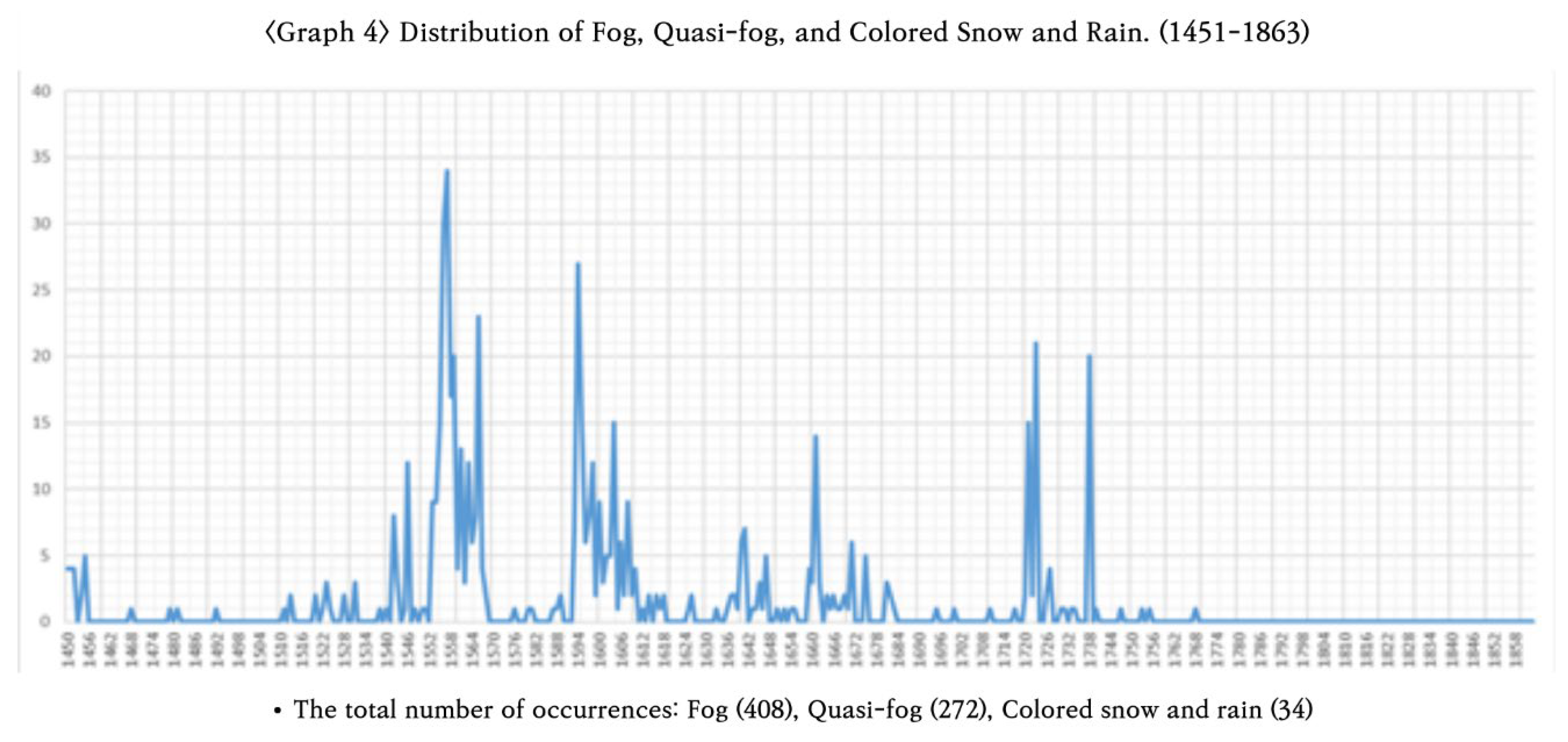
In order to understand quasi-fog, we will first look at the fog. The problem is that the number of records of fog for the first 100 years (1392–1490) of the Joseon dynasty, which was before the Little Ice Age, was counted as 119, which is a large number. This can be attributed to the active meteorological observation of the Office of Astronomy and Geomancy, rather than because the fog phenomenon itself was particularly frequent. On the 16th day of the 10th month of 1429 (11th year of King Sejong’s reign), the Office of Astronomy and Geomancy reported to King Sejong that there was dense fog. King Sejong instructed the Office of Astronomy and Geomancy not to report the fog because it was not a strange phenomenon. Despite the king’s instructions, the Office of Astronomy and Geomancy left the records with the figures above.
In the Little Ice Age, when referring to “fog,” expressions such as heavy fog, thick fog, dusty fog, dense fog, and cloudy fog are often used. In these cases, there is a high probability that they are phenomena related to cosmic dust, but since the expression indicates the concentration or amount of fog, it is classified as fog here. This means that during the Little Ice Age, “fog” may refer not to a mere fog but to a quasi-fog phenomenon where cosmic dust is almost certainly involved.
In the category of quasi-fog, only those expressions that refer to the substantive nature of fog, such as “yellow fog,” “black fog,” “putrid fog,” and “poisonous fog,” or “foggy vapor” are included. This category also includes turbid air, clouds of dust (smoke and dust), and falling dust. Graph 4 excludes the “fog” mentioned earlier and combines the later fog, quasi-fog, and colored snow and rain. This is sufficient to show the severity of cosmic dust in the Little Ice Age. In order to understand this, some typical examples of quasi-fog are listed below.
1. Year 1520 (15th year of King Jungjong), Month 3, Day 16 (gapjin). Jeolla Province.
Snow fell in 13 towns including Gwangju, and frost fell in Suncheon. In Haenam and Gangjin, there was a yellow fog that obscured sight, and hail and dust rain fell.
2. Year 1600 (33rd year of King Seonjo), Month 6, Day 13 (gapsin). Goseong District, Gyeongsang Province.
When the remaining people of the town were busy preparing foods for the Ming troops, they missed the time to sow spring and autumn barley. Even the sprouts that barely put forth were withered by the yellow fog that overshadowed them for days. This is a cause for serious concern. On the night of the 3rd day of the 5th month, there was a frost, and the wheat and barley and all the grain plants in the fields planted in the spring withered. There is little hope for them to ripen. This is no ordinary disaster.
3. Year 1602 (35th year of King Seonjo), Month 6, Day 13 (gyemyo). Gangneung Magistracy, Gangwon Province.
On the night of the 19th day of the 4th month, there was a frost, and all the rice plants withered away. On the night of the 20th day of the 4th month, Hoeyang Magistracy also had a succession of frosts, and nearly all of the millet, barely, and beans were frozen. … In Hoengseong, a cold wind continued to blow from the beginning of the 5th month, and in areas such as Yangyang, Samcheok, and Ganseong, a yellow fog hung in all directions.
4. Year 1605 (38th year of King Seonjo), Month 6, Day 29 (sinmi). Yeosan County, Jeolla Province.
On the 13th day of the 6th month, at the sin hour (15:00–17:00), a white dragon appeared out of the clear sky and was clearly seen writhing. After a while, clouds and fogs arose in all directions, making it difficult for one to discern one’s immediate vicinity. There was great wind, rain, lightning, and thunder. The house of Min Chungil, a 9th-rank military officer residing in the town, was uprooted by the wind and rain. The household items were blown away and were nowhere to be found. A three-year-old girl was also nowhere to be found. People searched for her, but to no avail. His father, 80 years of age, and his wife were both struck by lightning and left unconscious. They were in critical condition.
5. Year 1606 (39th year of King Seonjo), Month 10, Day 26. Gyeongwon, Hamgyeong Province.
In the morning of the 17th day of the 9th month, a westerly wind suddenly arose and covered the sky with sand and dust, and on the following day, a yellow haze, which was neither cloud nor fog, covered the sky in all directions, and the sunlight was very red but radiated little light. From the 20th day onward, the yellow haze became even worse, and it became dark day and night. It was impossible to discern anything from the distance of 100 space. More than ten days passed, and it was still not clear.
6. Year 1661 (2nd year of King Hyeonjong), Month 5, Day 5 (gyechuk). Hamgyeong Province.
A putrid fog rolled in, and when people were attacked by it, they could not bear the stench. There was frost in Buryeong, Samsu, and Gapsan, and hail in Gowon and Yeongheung.
7. Year 1661 (2nd year of King Hyeonjong), Month 8, Day 13 (gimi). Gangneung Magistracy, Gangwon Province.
A poisonous fog arose from the sea and attacked the people, causing five people to fall ill and die. When this became known, the king had the medical office send medicines to bring relief.
8. Year 1667 (8th year of King Hyeonjong), Month 5, Day 11 (gabin). Pyeonghae County, Wonyang Province (Gangwon Province).
A black fog came out from the seaside, and the heavens and earth became dim, so that it was impossible to discern one’s immediate vicinity.
9. Year 1669 (10th year of King Hyeonjong), Month 11, Day 17 (byeongo). Gyeongju, Gyeongsang Province.
On the 3rd of this month, at the o hour (11:00–13:00), a gale blew, blowing sand and stones. At the mi hour (13:00–15:00), the sky was filled with both fog and smoke, and the color of the sun gradually faded, making it difficult to distinguish people. From the sin hour (15:00–17:00) onward, the sun was blocked by a dark vapor until sunset.
10. Year 1670 (11th year of King Hyeonjong), Month 8, Day 9 (gyesa). Hamgyeong Province.
In Gapsan, Samsu and other towns, frost fell like snow on the 16th day of the seventh month, and frost fell early in all other towns. Hailstones fell heavily in Hamheung Prefecture. Some of them were egg-sized, and some of them were the size of bird eggs. They crushed various grain plants. In addition, a yellow vapor and a white vapor covered the area all at once, and buds immersed in these vapors withered instantly. The damage caused by the white vapor was much worse than that caused by the yellow vapor.
11. Year 1681 (7th year of King Sukjong), Month 4, Day 7 (gyeongin). Gangwon Province.
From the last day of the 3rd month onward, dust rain fell for three consecutive days. When the rain fell on garments, the garments turned yellow. When one looked at the rainwater, it was just like muddy water. Dark fog hung day and night.
Of the eleven examples, a yellow fog in 1–3 represents a condition different from that of common fog. Example 4 corresponds to a situation like a meteor explosion, showing the spectacle of a quasi-fog (cosmic dust). Example 5 uses an expression hwangae (yellow haze), describing the sight of an outpouring of a yellow fog. Examples 6 and 7 use expressions putrid fog and poisonous fog, describing the toxicity of a quasi-fog. Example 7 describes this type of fog as coming up from the sea and attacking with smoke, killing five people who were exposed to it. It is a factual record of the reality of toxic cosmic dust. Example 8 points out the eastern sea as the direction from which the quasi-fog was coming, and used the expression “black fog,” perhaps because of its dense concentration or its composition. Example 10 states that the sprouts of crops exposed to the yellow fog and the white fog instantly withered away. Example 11 states that the yellow color was so strong that it made rainwater look like muddy water.
The term daemu (dense fog) shows the possibility that “fog” may mean cosmic dust in certain cases. This term was used when describing a fog of long duration or a very dense fog. Examples are as follows.
12. Year 1734 (10th year of King Yeongjo), Month 12, Day 21 (imsul). Hanseong Magistracy (Seoul).
From the mi hour (13:00–15:00), dense fog filled the air in all directions, so that visibility was very low. In the evening, it became even worse, and people called out to each other, listening to each other’s voices and searching for each other as they went.
13. Year 1738 (14th year of King Yeongjo), Month 8, Day 23 (gyemyo). Gyeongsang Province.
A fog (daemu) hung for 20 days.
Examples 12 and 13 refer to dense fog and a fog of long duration, respectively. Neither can be regarded as a common fog. The weather conditions in Seoul (Hanseong) that lasted for nearly 50 days in the 3rd and 4th months of 1661 help us understand the actuality of “dense fog.”
〇 Year 1661 (2nd year of King Hyeonjong), Month 3 and 4. Hanseong Prefecture (Seoul).
12th day of 3rd month: For three days, it was dark in all directions as if dust were falling.
14th day of 3rd month: There was frost.
18th day of 3rd month: There was frost. This was the seventh consecutive day of darkness in all directions from dawn to dusk.
1st day of the 4th month: There was drought.
8th day of the 4th month: There was frost at dawn. When the sun rose, its color was very red.
9th day of the 4th month: From 6:00 a.m. to 6:00 p.m., it was dark on all sides as if dust were falling.
11th day of the 4th month: From 12:00 noon to 6:00 p.m., it was dark on all sides as if dust were falling.
12th day of the 4th month: From morning until night, it was dark on all sides as if dust were falling. The setting sun was purple. At night, the moon was red and emitted little light.
13th day of the 4th month: It was dark all day. When the sun rose, it was purple. At night, the moon was red.
18th day of the 4th month: There was frost at dawn. It was dark in all directions from dawn to dusk.
19th day of the 4th month: It was dark in all directions from dawn to dusk.
21st day of the 4th month: It was dark in all directions from dawn to dusk.
22nd day of the 4th month: It was dark in all directions from dawn to dusk.
23rd day of the 4th month: It was dark in all directions from dawn to dusk.
24th day of the 4th month: It was dark in all directions from dawn to dusk.
Based on the above records, in the 3rd and the 4th months of 1661, the Seoul area was enveloped in quasi-fog, namely, cosmic dust for nearly 50 days. The description of dusky weather, like dust falling, is sufficient to convey the scene of cosmic dust covering the atmosphere. The cold and darkness, the purple and red colors of the sun and moon, were also the result of cosmic dust blocking the sun’s heat and light. The repeated use of the phrase “it looks like dust is falling” is a historical record that tells us that the onslaught of cosmic dust was not a rare event, but a long-term, sustained phenomenon of environmental change caused by the entry of a meteor or a meteoric belt into the atmosphere.
Examples 2 and 7 above directly convey the threat that the cosmic dust phenomena posed to life forms. In Example 2, the wheat that had managed to sprout “turned yellow and withered because of the yellow fog,” while Example 7 states that a “poisonous fog” struck, causing people to fall ill and five of them to die. Example 10 also states that crop sprouts exposed to the yellow and the white vapors withered. The fact that quasi-fog, or cosmic dust, affects life forms is supported by the fact that the prevalence of quasi-fog coincides precisely with the prevalence of deformed animals.
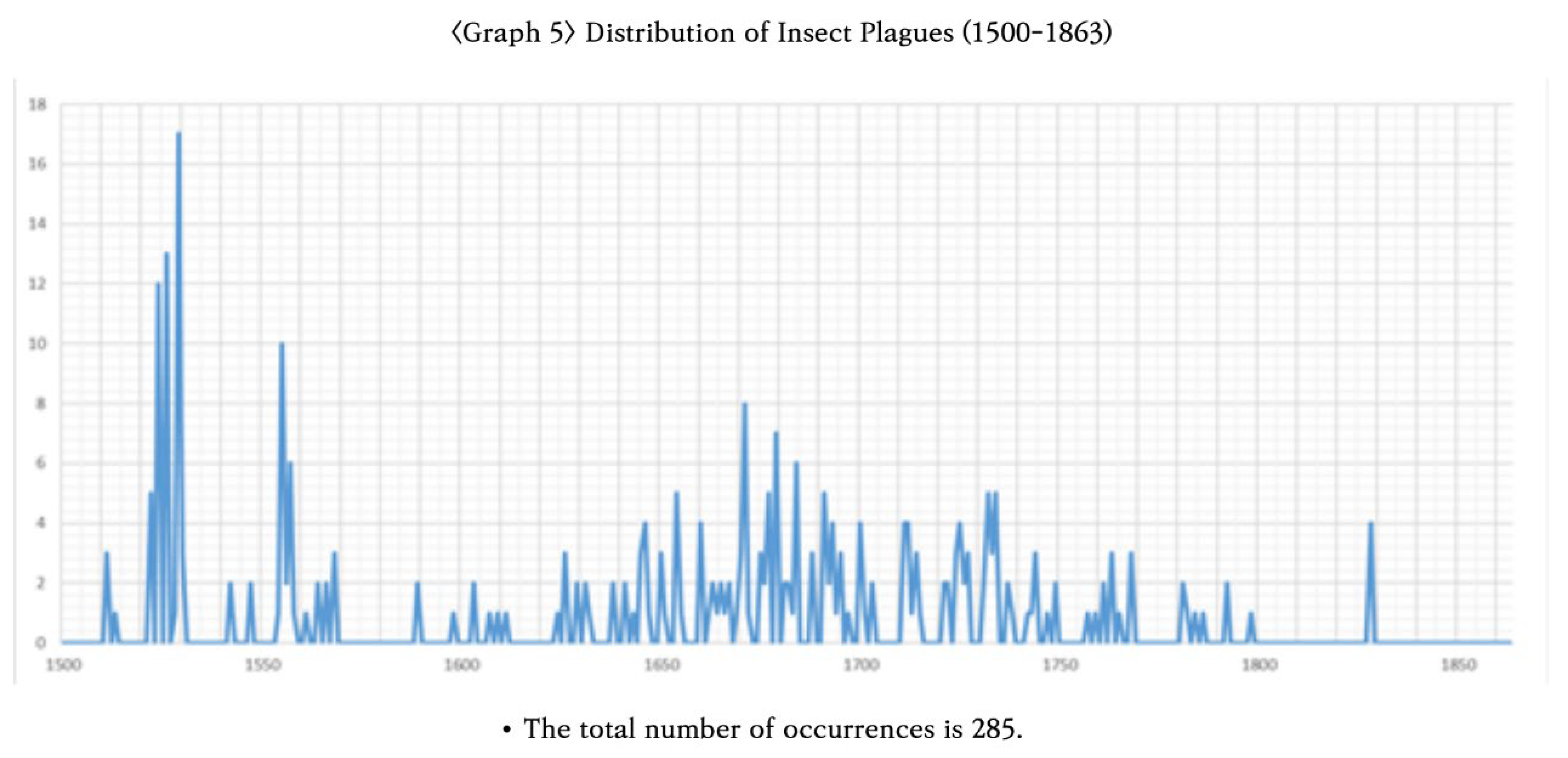
Graph 5 shows the distribution of insect plagues listed in Table 1. The high frequency of insect plagues means a crisis in the agroecosystem. If the weakened ecosystem of crops hit by a series of droughts and floods are compounded by insect plagues, it is fatal. The blow to the food supply leads to a situation where epidemics spread over people who were extremely malnourished due to starvation. The large number of epidemics and insect plagues in Table 8 coinciding with the outbreaks of fog shows a correlation among them. We will look at some of the more meaningful cases in this section. Grasshopper damage occurred most frequently. Let us look at some examples of major damage.
1. Year 1513 (8th year of King Jungjong), Month 4, Day 20 (muo). Hamgyeong Province.
The counties and towns of Hamgyeong Province suffered from drought and were damaged by yellow-black bugs. In the morning, there was a thick fog with clouds and rain, and in the afternoon, there was a strong wind, blowing dust.
2. Year 1524 (19th year of King Jungjong), Month 5, Day 14 (muin). Seoul (Hanseong Prefecture).
The insects descended upon areas such as the east royal fields. Each insect had a black body, a red head, and white feet. The insects gradually increased and damaged wheat and barley.
3. Year 1524 (19th year of King Jungjong), Month 5, Day 25 (gichuk). Gyeonggi Province.
In Yangju, insects with a black body and a red mouth devoured wheat and barley. In Gimpo, there were blue-black insects the size of two molting silkworms. They nibbled on ears of barley and the trunks and roots of millet. In Jinwi, blue-black insects consumed rice grains.
4. Year 1555 (10th year of King Myeongjong), Month 7, Day 22 (gabin). Pyeongan Province.
In the province, it has not rained at all in the capital since the beginning of the 7th month year until now. Every day yellow fog hangs in all directions, burning the ears of rice and causing insects to come.
5. Year 1556 (11th year of King Myeongjong), Month 7, Day 4 (gyeongsin). Geumsan, Jeolla Province.
Insects spread in the rice fields. The insect was mottled with yellow and black colors. Some of the insects were large, and some were small. They nibbled rice plants from root to stem. The rice plants turned yellow and withered immediately, failing to produce ears.
6. Year 1603 (36th year of King Seonjo), Month 8, Day 11 (gabo). Hamgyeong Province.
On the night of the 17th day of the 7th month, the rain poured down in Dancheon County, thunder shook the heavens and the earth, and even the mountains were shaken by violent winds, and the pine trees on the mountains were pulled out here and there. On the 18th day, … it stormed, and in the fields of the mountain villages, all the ears of various grain plants fell, and also the fields were filled with blue-red-yellow grasshoppers that gnawed at the stalks and leaves of the grain plants without leaving any. This year’s farming has already lost all hope, and the sight is so devastating that words cannot describe it.
7. Year 1670 (11th year of King Hyeonjong), Month 7, Day 11 (eulchuk). Samsu, Hamgyeong Province.
On the 5th day of the 6th month, there was a hailstorm, and the hailstone was about the size of a pigeon’s egg. Also, the fields were full of grasshoppers, which ate up the grain, turned into beetles, went into the water, and continued to do unremitting harm.
8. Year 1742 (18th year of King Yeongjo), Month 5, Day 22 (gyeongjin). Gangwon Province.
The drought lasted for a long time, and there was no wheat and barley to yield because of the yellow grubs (an insect that cuts and eats the roots).
9. Year 1747 (23rd year of King Yeongjo), Month 7, Day 4 (imjin). Chungcheong Province.
Towns such as Imcheon were badly affected by pests (diving beetle-shaped insect), and Yuseong County was badly affected by bollworms (grain-earworm: larva of snout moth).
It is noteworthy that the yellow-black beetle in Example 1 is connected to a thick fog environment. The same is true for example 4. It is said that the rice plants were dying due to insects brought in by continuous yellow fog. In Example 2, it is said that there was damage from insects falling from the sky in the east royal fields where the king personally cultivated land as an exemplar. An insect with a black body with a red mouth, a blue-black insect, and an insect with thin black and yellow patterns resembling a rice insect are examples of insects that had never been seen before. Mutations to beetles, larvae, and diving beetle-shaped insects were all abnormal occurrences. The most frequent species, the grasshopper, appeared in three colors: blue, red and yellow. All of these situations appear to be related to variations in environmental factors.
5. Deformed Animals in the German Flugblatt Items
I sought material from other countries that could confirm the Little Ice Age phenomena identified in the Veritable Records. I expected to find them in the historical material of neighboring countries, i.e., Japan and China, but I soon found out that both countries failed to keep consistent records of natural calamities due to the chaos of political changes during the Little Ice Age. Japan was in turmoil during the Warring States period, while China was unable to keep a consistent record due to the great upheaval during the change of power from the Ming dynasty to the Qing dynasty.26
However, in August 1995, I visited the National Museum of Science & Technology in Ottawa, Canada, on my way to attend the 18th International Congress of Historical Sciences in Montreal. There I discovered two German leaflets hanging on the wall of the aurora exhibition room. The discovery of these two German leaflets at the National Museum of Science & Technology in Ottawa, Canada, led to the discovery that many of the German leaflets contained material on the Little Ice Age anomalies. In this process, the American geographer Robert H. Eather’s book Majestic Lights: The Aurora in Science, History, and the Arts (1980) was of great help.27 The author of this book made the mistake of attributing the astonishing sky-scenes depicted in the 16th–17th century German leaflets to auroral phenomena, but the very detailed information in the bibliography section helped me to locate the various collections of the German leaflets.
On the strength of the above bibliography, I twice visited major libraries in Europe and the United States to collect information on German leaflets. In February 1997, I visited the Houghton Library of Harvard University, the major libraries of Oxford and Cambridge Universities in the UK, and the Germanische National Museum in Nuremberg, Germany.28 In this museum, I obtained copies of 91 leaflets related to the Little Ice Age phenomena.29
The second survey was conducted in July and August 1999 with the support of the German DAAD (Deutcher Akademisher Austauschienst) at the Herzog August Bibliothek (HAB) in Wolfenbüttel.30 During my stay, in addition to the Herzog August Library, I also studied the collections of the Darmstadt Library and the Wickiana Collection in the Zentralbibliothek Zürich (ZB).31 After completing the research at the Herzog August Library, I visited Darmstadt and the Zurich Central Library and collected copies of 250 leaflets from the Wickiana Collection.
Out of the itemss obtained from the above two surveys, only the following two collections will be utilized in this paper.
A. Nuremberg - 91 items from the collection of the German Ethnological Museum are introduced in the analysis.
B. Introduction to the material on deformed animals in the Deutsche illustrierte Flugblätter des 16. und 17. Jahrhunderts, a series of publications initiated by Professor Wolfgang Harms. Material in the two volumes of this series listed below will be used for analysis.
The timing of the production of the 91 items collected in A is shown in Table 9. As in the case of the classification of excerpts from the records of the Little Ice Age calamities in the Veritable Records, the production period is divided into 50-year units. The result was that the production period of the German leaflets completely coincided with that of the Little Ice Age (1491–1760) as confirmed by the Veritable Records. This is a fascinating result because it indicates that natural anomalies similar to those in the Korean Veritable Records were depicted in pictures in Germany. Until now, the European academic community has been unable to clarify the source of these drawings, and some have even suggested that they are the product of superstition. I have selected five representative examples of the Little Ice Age phenomena to be included in this report. (Appendix A)
The collection of material compiled by Professor Wolfgang Harms and his colleagues in B consists of seven books in total. The material on deformed animals that occurred during the Little Ice Age was found in the following two books.
- 1.
- Volume 1 (Band I): Material from the Herzog August Museum
(Die Sammlung der Herzog-August-Bibliothek in Wolfenbüttel Teil 1: Max Niemeyer Verlag., 1985)
- 2.
- Volume 7 (Band VII): Material from the Central Library of Zurich
(Die Sammlung der. Zentralbibliothek Zürich: Max Niemeyer Verlag, 1997)
1) Kommentierte Edition Teil 1 Die Wickiana I
2) Kommentierte Ausgabe Teil 2. Die Wickiana II
The above items are prefixed by the compilers with a bibliographical description of the material in the leaflets. Relying on this, basic information about the deformed animals has been obtained, and tables are prepared below. The leaflets (Flugblatt) pictured incredible and astonishing scenes and contained the main descriptions. They were similar to newspaper extras, produced with wood or metal plates in a few specific cities and distributed throughout the country. Many of them were copied from the original paper. This public relations activity seems to have been related to religious movements. The above collection of items was compiled by assigning “data identification numbers,” and I also sorted the materials according to this order. I surveyed (1) theme, (2) date, (3) place of occurrence or publication, and (4) a short comment on the current situation. The survey of each book is summarized in Table 10 and Table 11.
There are 11 cases surveyed in Table 10. There are five cases of deformed humans and animals: one calf, two infants, and two deformed adults. The rest are plant mutations, including two cases of bunches of grapes full of grapes and one case of multi-layered bunch of rye ears. All the animal mutations were interpreted as the wrath of God, and plant mutations were interpreted mostly as God’s blessing and a foretaste of a good harvest. Of the adult deformities, 10 were clearly named, while number 11 (from French sources) was considered a monster. In other words, a sheriff in Mézières region in France came across a “monster” near his house, which he described as a 35-year-old adult male figure. This figure is said to have had a horn on his head a wolfskin robe. The deformity of a horn in the head is an external mutation of the skin, like the fleshing hanging down like a scarf described in 10.
Twenty-seven cases were selected from the Wickiana collection of the Zurich Central Library in Table 10. Of these, three are plant mutations: a bunch of the ears of rye ( no. 4), a bunch of grapes (no. 9), and a bunch of the ears of wheat (no. 12). The three animal deformities are a lamb (no. 11), a rabbit (no. 26), and a cow (no. 27). The remaining 21 cases are all related to human deformities. All plant mutations were interpreted as a blessing from God, while animal deformities, especially human deformities, were interpreted as a sign of God’s wrath against unjust sin. The Book of Genesis, the first book of the Christian Bible, states that God created man in his own image, and thus deformities are considered sinful because they are against God’s will. In the Korean Veritable Records, cases of deformities in livestock were predominant, and there were very few cases of deformed children. The material in the German leaflets shows the opposite ratio. What this difference means is a subject for future comparative cultural historical study. Whether in Korea or in Europe, it is natural that the religion and spiritual worldview of the people who produced the records influenced the selection of the objects of observation. But there is no reason that the Confucian worldview of Joseon would have deliberately omitted the deformities of human infants. Such a relationship is a subject that needs to be analyzed and ascertained by collecting a wider range of related items. As can be seen in the translations in Appendix B, it should be noted that the leaflets state that in addition to the cited cases, similar deformities have been occurring frequently in many places simultaneously.
Finally, I would like to draw your attention to material No. 19 in Table 10. It shows a direct correlation between deformed children and natural disasters, with two deformed people on either side of a city destroyed by various disasters. In other words, it is noteworthy for its reference to direct correlation between the appearance of deformities and the Little Ice Age disasters. The main contents are as follows.32
A truly horrible picture and form of two miserably deformed births that appeared this year:
Together with the description of the devastating downpour of rain that happened recently at Horb in the state of Württemberg (in southwestern Germany) on the 15th of May of this year 78 (=1578).
Within a short time, so many signs and wonders followed one after another, so that the pious hearts were frightened. And truly, the fact that these signs are not without meaning and effect can unfortunately be seen daily here and there, near and afar, in the remarkable unrests, uprising wars and bloodshed, persecutions, devastations, betrayals, assassinations, false (heretic) teachings, invading armies of foreigners, pillage of famous places, unusual illnesses and epidemics, death of high persons, thunderstorms, raging winds, heavy downpours, birth of deformed children, and finally (can be seen) everywhere around in the inhuman infidelity and mistrust, in the unchristian quarrels, hardship, oppression,
acting like a Jew practicing usury, prebuying (i.e., buying goods before the markets are officially opened and to sell them later with usury) and manifold ignominies and vices, blasphemy, contempt and misuse of God’s word, derision of warnings given by pious people, disobedience against superiors and principals (magistrates etc.), and in short (can be seen) in today’s exaggerated false sense of security and the cooling of all love. Not to mention the miracles that just happened and still have to show their effects in the future, as there were the appearance of strange stars, comets, miraculous signs and flames of heaven, the darkening of sun and moon, earthquakes, and other frightful cases.
Thus you should look and contemplate alone these two deformed births as shown in the picture. Of these one was born this past January of this year (1578) at Evorigo in the county of Novara in the area of Milano of a fairly mature matron. The child had seven arms and seven heads of which the frontmost head had only one eye in the middle of the forehead and two pig ears, and at the bottom it had feet like a different animal. The other misborn (i.e., born with deformities) child or monster has also been born in this January of this year (1578) in the form as shown in the picture and of a woman in Piemont (NW Italy).33 …
Furthermore, there was recently on the 15th of May in the town Horb on the river Neckar a terrible flood, when by a downpour of rain large boulders of stone were swept from the near mountains through the town and these (stones and water) have carried and swept away everything they met with. Also, when the town gates were closed in order to stop them, the water broke through the wall behind the hospital and thus suddenly swept away people and cattle, corn and fruits and washed away twelve houses and ruined the others, tore up the meadows in the valley, destroyed the wells, uprooted the gravestones outside the town and swept them into the town, so that the dead persons swam amongst the living, especially a woman that had died in childbirth and had been buried shortly before. And it also caused other miseries, which to tell here would take too long. But from what has been told here one can easily see the wrath of God and what calamities have to be endured as soon as this wrath is kindled. Therefore it is high time to recognize such warnings and to repent, before even more horrible things happen and before God might be moved pour His wrath out over us. God may mercifully protect us from this. Amen. [VII, 114. Picture 5, Appendix II].
6. Conclusion: Looking forward to the Comparative Study of East and West
In the latter half of the 1970s, the 17th-century general crisis theory emerged, focusing on this period. This theory criticized the existing interpretation of the 17th century instability as the consequence of the of the collapse of the feudal system and instead emphasized that the natural anomaly of falling temperatures was the cause of unrest and warfare in many parts of the world. This groundbreaking theory led me to conduct a study of the Little Ice Age using the Veritable Records of the Joseon Dynasty, which faithfully recorded natural abnormalities from a Confucian perspective.
The Veritable Records is the national record of the Joseon Dynasty from 1392 to 1863. Throughout the entire period, I obtained 25,670 records of abnormal natural phenomena. As a result of analyzing these records, I found that about 80% of the records were concentrated in the third to seventh periods, and the final result showed that the period of 270 years from 1490 to 1760 was a period of falling temperatures, or the Little Ice Age. It was found that this was a period not only of quantitatively more disasters but also of a succession of extreme events whose intensity was incomparable to any other events before or since, within the recorded time period. Unlike the general crisis theory of the seventeenth century, which estimated the Little Ice Age as 70 or 80 years in the 17th century, the results of this study show an expansion of the period by about 100 years each at the beginning and at the end of the period previously postulated by the general crisis theory, to a total of 270 years. This result was reconfirmed by a survey of Flugblatt items in Germany. The leaflets were highly complementary to the Veritable Records as they showed in pictures the scenes of disasters that the Veritable Records described in words.
In the current study, which focuses on the appearance of deformed animals during the Little Ice Age, the Veritable Records further utilized 2,230 records related to land calamities such as famine (593 cases of drought, 651 cases of flooding, 385 cases of insect plague, 110 cases of famine, 465 cases of epidemics, and 26 others: Table 4). In addition to this, 271 records on deformed animals were added. As a result, the total number of related records in the Veritable Records utilized for the study of the Little Ice Age is 28,171. The most important result of this research is the fact that cosmic dust has been proven to be the cause of the appearance of deformed animals, as per the Neo-Catastrophism theory of the space science community. In both Korean and German records, the animals that develop deformities are similar, but it was noteworthy that many cases of deformed children appeared in Europe. This is in contrast to the many cases of deformed domestic animals such as cows, chickens, and horses in the Veritable Records entries. In the Christian world, this was due to the influence of the verse in the Book of Genesis of the Bible that states God made man in his own image. Some of the leaflets repeated the same cases of deformed infant or relayed previous reports. This leads one to contemplate on the need to highlight the civilizational differences between the two regions. Research on cosmic dust as a cause of deformities in animals needs to be further developed in comparison with fine particulate matter, which is a major theme of environmental science in the 21st century.34 This will hopefully be one of the statements that historical studies can suggest for contemporary environmental and climate issues.
The newly revealed duration of the Little Ice Age (1490-1760) as an extended calamity makes it necessary to examine the major phenomena of world history during this period in connection with it. Here I would like to offer some of my opinions and reiterate the importance of the study of the Little Ice Age.
First of all, Hugh Redwald Trevor-Roper (1914-2003), an eminent British historian, raised a big question about the history of European civilization that suddenly fell into a witch-hunting frenzy in the 16th century after the Renaissance bloomed in the 15th century.35 The newly identified duration of the Little Ice Age is expected to easily resolve his questions. In the midst of a prolonged natural disaster, the Europeans, because of the constant abandonment of farming and agricultural losses, conducted witch hunts, in which the female witches in charge of agricultural sacrifices were tried and executed on charges of being instructed by Satan to cause hail, drought, and flooding. In East Asia, natural disasters were interpreted in Korea as warnings from the heavens against human error, and the battle to find the culprit of the error became a means of political struggle, resulting in literati purges and constant political strife. In Japan, the 16th century natural disasters were seen as proof that the heavens had abandoned the shogun, and the Warring States period began.
Second, the timing of the Little Ice Age natural disasters has been extended to the end of the 15th century, creating the ground for a new interpretation of the most important phase of European history, the Reformation and the Wars of Religion. Now it is possible to view the Reformation movement as arising out of the increasing criticism of the Catholic Church as the numerous anomalies in the sky caused by meteor explosions were understood as signs of divine judgment. There was also a big difference between the Confucian interpretation of the appearance of deformed animals in Korea (Joseon) and the Christian understanding in Europe. The former feared that the harmony of yin and yang as the heavenly path, the principle of all things, had been broken, while in light of the words of the Book of Genesis, which states that God created man in His own image, the latter interpreted deformed births as a warning from God against human sin and an expression of the wrath of God. It is not difficult to see that the views similar to the ones expressed by the leaflet-maker in 1578, quoted at the end of the main body of this paper, on the two cases of deformed births in northern Italy and the terrible natural disaster in the city of Horb on the Neckar River in Germany, were some of the sources of the Reformation movement.
Thirdly, the precise determination of the upper limits of the Little Ice Age phenomena now allows for a new understanding of the development of natural science in Europe. In Europe, sky anomalies were originally the domain of astrology. Johannes Kepler (1571–1630) is famous as the man who passed from astrology to astronomy. Prior to this, Tycho Brahe (1546–1601) set up an observatory with the help of King Frederik II of Denmark and left many records of his observations of comets and other celestial anomalies in the sky. Many of the “comets” mentioned in the flyer were meteors that entered the atmosphere. In the 16th and 17th centuries, various efforts to observe celestial activity appeared because of the many anomalies that occurred across the sky. Their observational activities, which initially began to infer and confirm the will of God, began to discover the laws of the heavenly bodies. It is well known that the Italian Galileo Galilei (1564–1642) improved his telescope for accurate observations. It is now necessary to consider the possibility that the chaos in the sky created by the numerous meteors entering the earth, which were the cause of the Little Ice Age phenomena, triggered the development of modern natural science.
Fourth, such an extension of the Little Ice Age has also opened up new possibilities for interpreting the development of ritual studies and practical learning as a new trend in Korean Confucianism during the Little Ice Age. The Confucian scholars of the Joseon dynasty recognized the natural disasters of the Little Ice Age as warnings from the heavens against human error and emphasized the importance of right mind and right action as the disasters continued. In the 16th century, they mainly emphasized the cultivation of heart and mind from the perspective of neo-Confucian studies of nature and principle, believing that the cultivation of heart and mind and right action would resolve natural disasters. They stressed not only the cultivation of heart and mind, but also the practice of correct behavior, which led to the development of ritual studies. However, the natural disasters and natural calamities did not relent at all. In the 17th century, when the people’s livelihood fell into the worst condition due to repeated agricultural losses and wars, Confucian scholars made the improvement of the tax collection system their top priority, calling for the relief of the people. This was the very advent of practical learning. Unlike its East Asian neighbors, China and Japan, which both experienced regime changes amidst calamities, the Joseon dynasty in Korea survived intact because of this self-innovation in their principles of national governance.
In addition, the Little Ice Age phenomena seem to have much bearing on the discovery of the Americas and the formation of the Atlantic trading world. In the 16th century, Europeans searched for new sources of revenue and land amidst the uncertainty of the Reformation and the Wars of Religion, the witch hunts, the Thirty Years’ War, and other systemic upheavals. It was not a new frontier project planned on a stable ground. The Europeans who visited the new American continent found as a new source of revenue the fur of beavers and other animals. Animal pelts obtained from the American indigenous people attracted attention as a perfect material for making thermal clothing. The fur trade became a major source of income and industry in the early New World.36 The fur trade, with which the Russian Tsar enjoyed success through the settlement of Siberia, has found a new base in America. A similar phenomenon took place in Korea, Japan, China, and Manchuria (Jurchens), using cotton cloth, marten pelts, and other fur material, as well as silk and other heat-retaining material.37 Following animal fur, the same trend led to the widespread cultivation of cotton in the New World. It is also worth noting that the cold of the Little Ice Age in the 16th and 17th centuries led to the spread of fireplaces in Europe and the underfloor heating (ondol) system in Korea. The Little Ice Age revolutionized food, clothing, and housing in many parts of the world. (Jan. 15, 2021)
Appendix A
In order to understand the Little Ice Age phenomena, I would like to introduce some of the German Flugblatt items, all of which are held at the Germanisches National Museum in Nuremberg, Germany. I will give examples of the Veritable Records to the extent necessary.
On May 4, 1543, an astonishing sight occurred in Zessenhausen, two miles from Pforzheim. As the meteor fell, it looked as if a dragon appeared, and this picture was painted. It is said that the dragon vomited blood and the color of the river turned red. According to the examples in the Veritable Records, when meteors fell into the sea or rivers, the color of water often turned red because plankton were “cooked” by the extreme heat. The text (explanation) of the picture said, “This anomaly is one of the anomalies described in the Book of Revelation of John, and we must seek the will of God.” It is stated that this event happened at 4–5 p.m. on May 4, 1543.
On January 12, 1570, an amazing scene unfolded in the sky over Kuttenberg (now Kutná Hora, Czech Republic) in the Kingdom of Bohemia for four hours between 4 and 8 p.m. At first a black cloud appeared like a large mountain, then many stars appeared in this cloud, and above this black cloud there was a very large and long light like burning sulfur and in the shape of a ship. Then there stood burning torches like candles, and between them two large pillars of light, one on the east side and the other on the north side. So the whole town was illuminated as if it was burning. It looked as if blood was running down from the clouds between the two pillars. The same scene was seen in other parts of Bohemia at the same time. According to the Veritable Records, a similar scene also appeared on June 9, 1519 in Gyeongju Magistracy in Gyeongsang Province. In summary, the text of the painting then concludes as follows: We must be more pious lest almighty God pass the final judgment, for God does not give such a frightening sight in vain and that if we do not change and repent, the worst would come. Famine, death, war, and great damage are already everywhere. Josephus, a first-century historian, also wrote about a number of anomalies seen before the destruction of Jerusalem. … In one of the eight anomalies Josephus recorded, on Easter an ox which was to be sacrificed gave birth to a lamb before the eyes of all people.
Figure A1.
In Zessenhausen two miles from Pforzheim, 04/May/1543 (Plate 5).
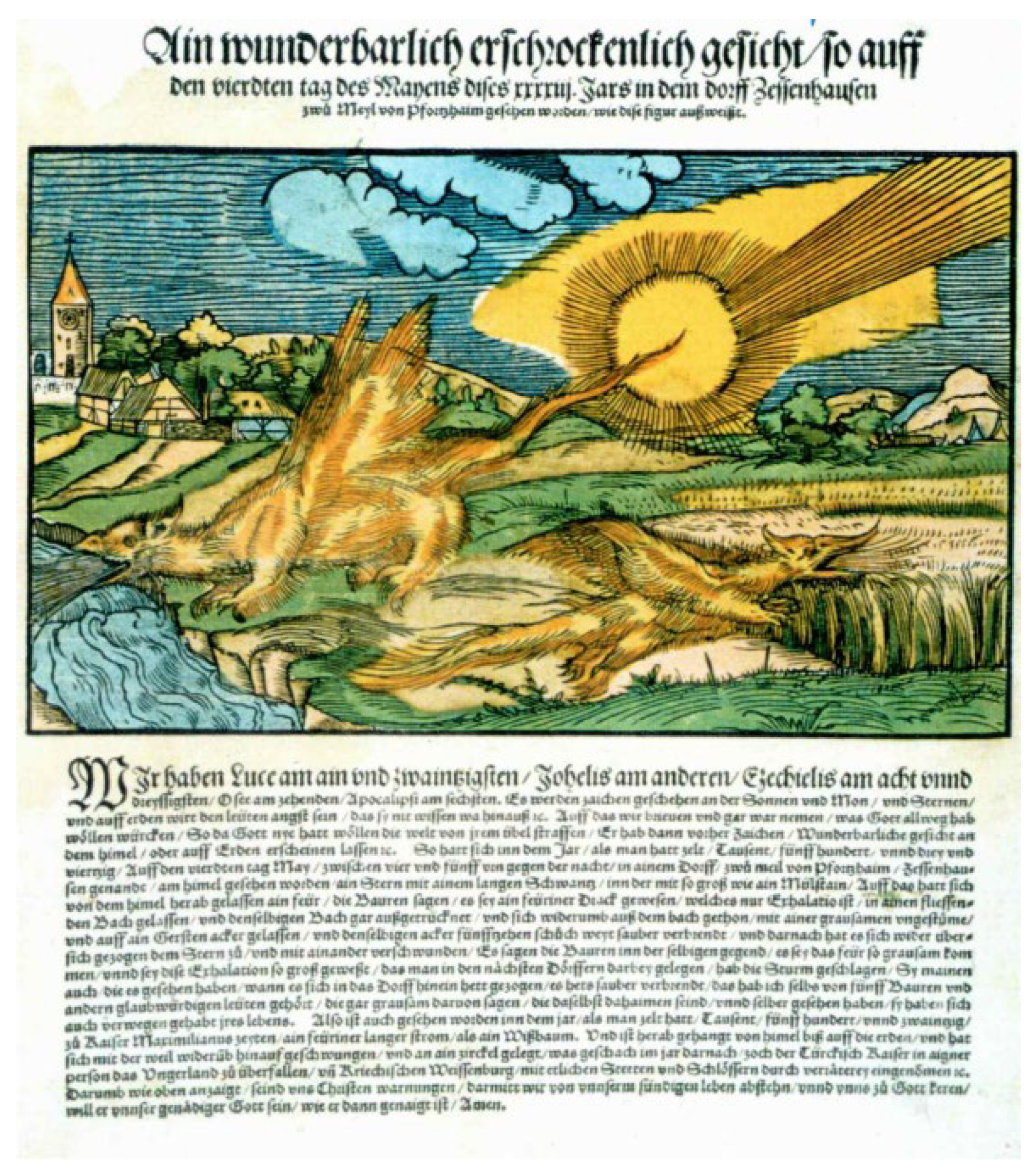
Figure A2.
At Kuttenberg in the Kron Bohem (Crown of Bohemia) and in other places and villages, 12/Jan./1570 (Plate 30).
Figure A2.
At Kuttenberg in the Kron Bohem (Crown of Bohemia) and in other places and villages, 12/Jan./1570 (Plate 30).
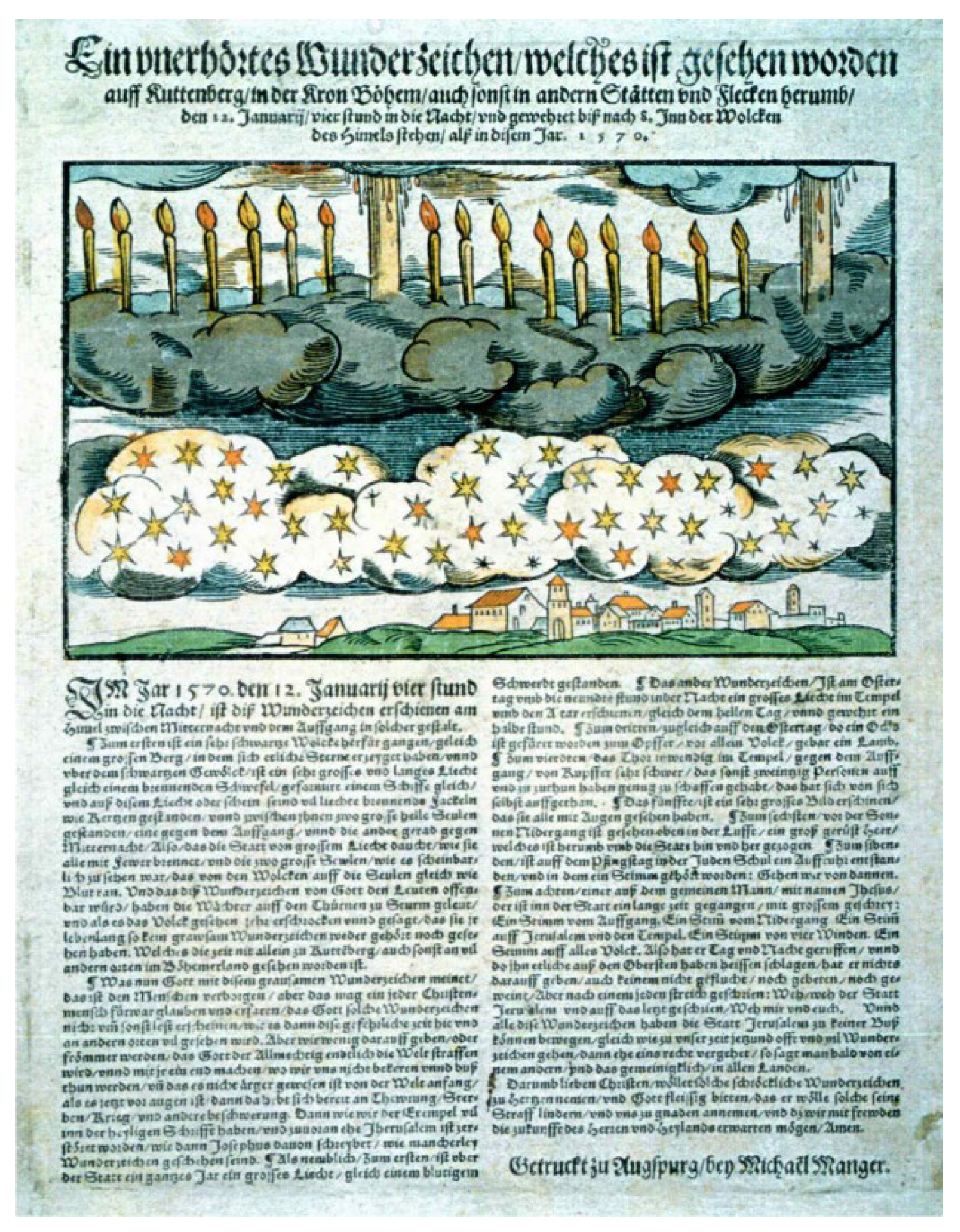
After referring to the eight anomalies recorded by Josephus, the text states that we Christians should take these dreadful signs to our hearts and pray to God for mercy.
Figure A3.
At Ghendt (Gent) in Flandern (Belgium), 18/Aug./1586 (Plate 45).
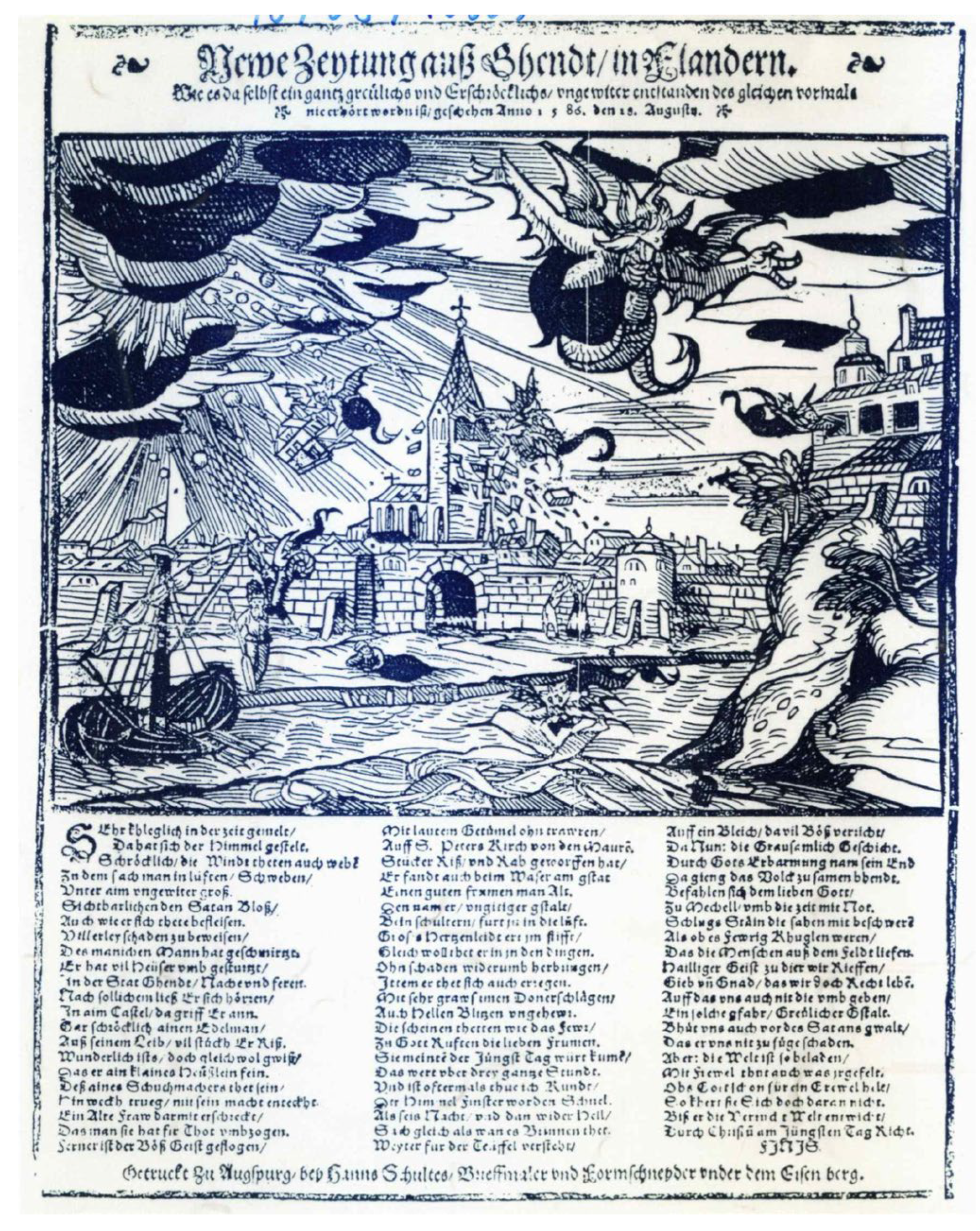
A terrifying scene of a thunderstorm in the Ghent area of Flandern in northern Belgium on August 18, 1586. A meteor exploded in the sky above, causing a storm that destroyed the city’s church buildings and blew away smaller buildings. In this painting, too, people felt that the crazy wind and heat of the meteor explosion was the manifestation of dragons, so they painted six dragons. One of the dragons is on the city wall, and another is in the water. The text described the lightning storm as “Satan the devil” and wrote that a nobleman’s body was torn into pieces. Many figures at the moment of the storm are depicted. The text concludes as follows: After Satan’s storm had passed, the city regained its calm through God’s mercy. Round stones on fire rained down on the neighboring Mechell area, and people rushed to the fields and shouted, “Holy Ghost, have mercy on us!” God punished people for the wickedness in the world and reminded them of the Day of Judgment.
A frightening scene occurred over Nuremberg on the night of October 5, 1591. At first the sky brightened and turned red like blood, but only for a short time. Thereafter appeared what looked like sharp white teeth. Around midnight, a white beam of light sparkled, and something like fire flared up. The text concludes that this is a sign of the wrath of God and that it is necessary for Christian hearts to pray to God in the name of Jesus Christ, believing that God the Almighty may at all times make all things turn out the best possible way.
This is believed to be the scene that unfolded when the meteor exploded over Nuremberg.
Figure A4.
At Nürnburg, 05/Oct./1591 (Plate 4).
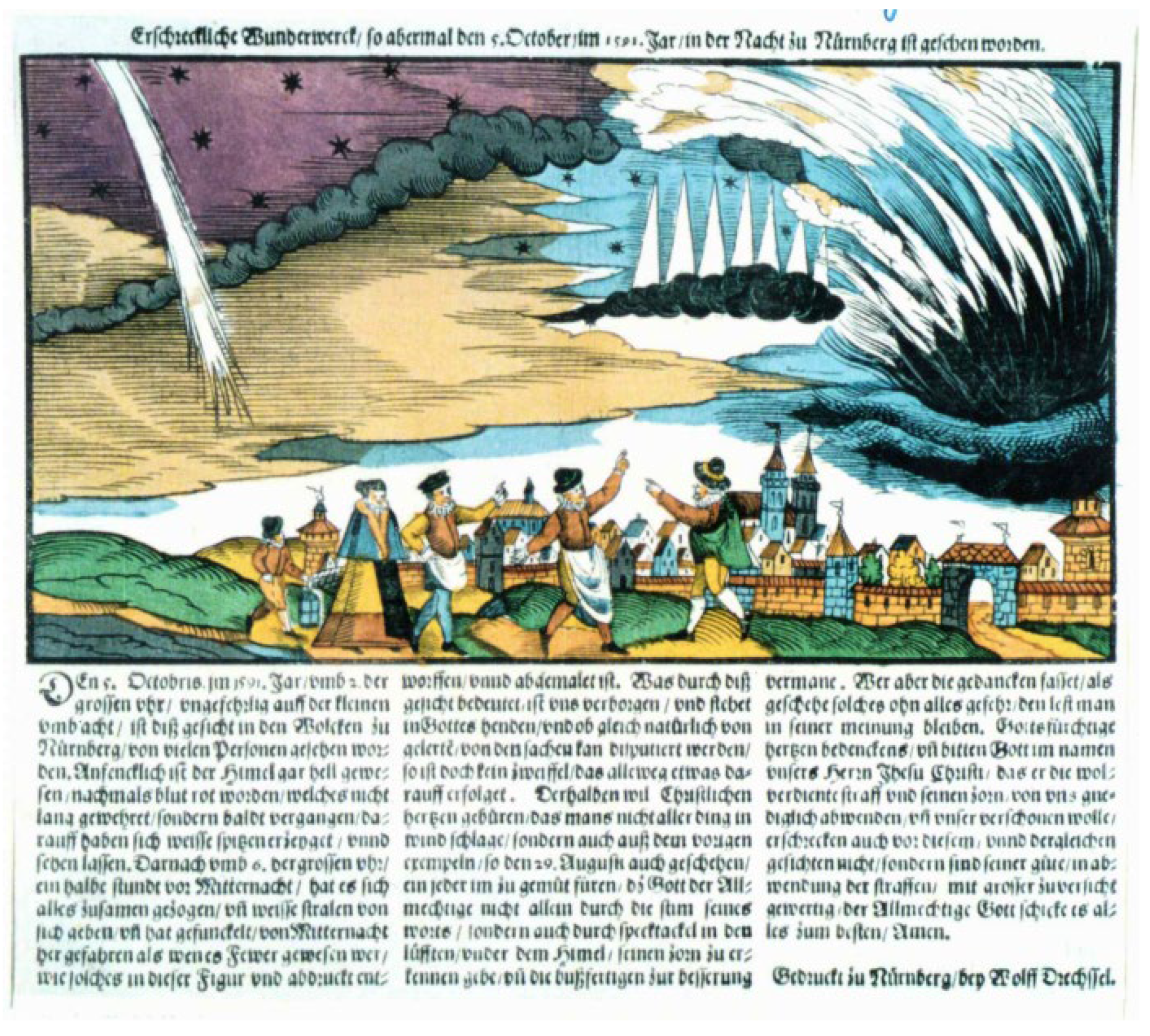
Figure A5.
In Augsburg, 15(25)/April/1681 (Plate 85).
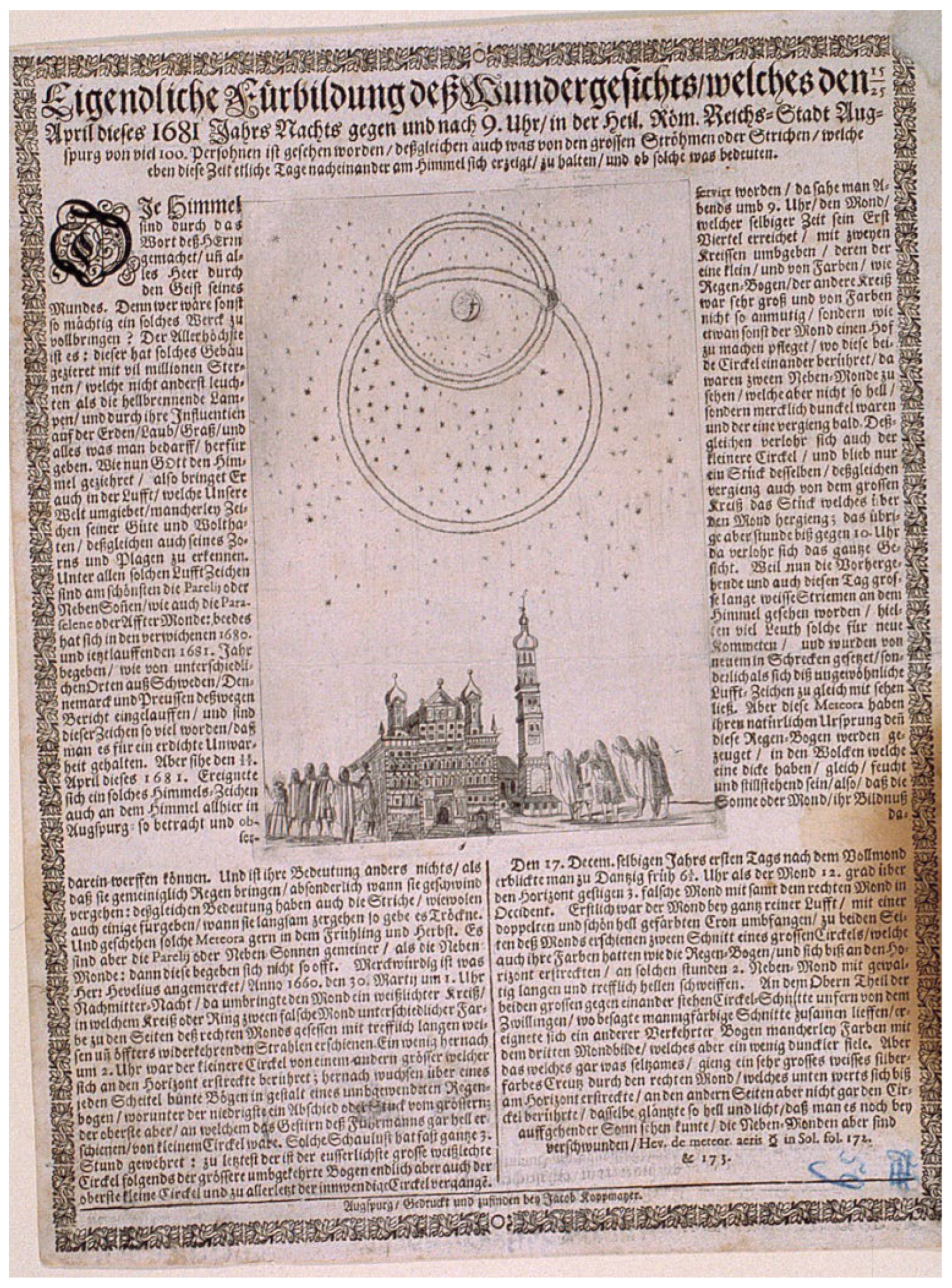
An astonishing sight seen by many people in Augsburg, the capital of the Holy Roman Empire, around 9:00 pm on April 15 (25), 1681. The sky was created by the word of God, who decorates the sky with stars, but also expresses his wrath. On a moonlit night, two circles like a rainbow were formed around the moon, one with color and the other without. At the point where the two circles met, another moon was formed. They all disappeared around ten o’clock. Today and a few days ago, a large and long white beam was seen in the sky, which people thought was comets, but today this strange sight appeared in the sky again.
The above is the description of the text, but it was in fact a multiple lunar halo that appeared on a moonlit night. The text states that the appearance of this sight was even more terrifying because a few days ago a white stream had just appeared in the sky and that people thought that the white beam was comets. This indicates that at that time, people associated the strange sight that appeared in the sky with comets. It was an incidental phenomenon of meteor explosions, and in the Veritable Records it was called “white vapor (K. baekgi 白氣).” What is most notable about this leaflet is that it depicts dust as dots inside and outside the moon. This is an important picture faithfully depicting cosmic dust, which is postulated in this paper as the cause of atmospheric and terrestrial anomalies, such as lunar halos, after a meteor explosion.
The reviewer introduced a statement by the Polish astronomer Johannes Hevelius (1611–1687) about the moon and the pseudo moon he observed at 1:00 a.m. on March 30, 1660. As of the 1680s, we can see a change in the emphasis on factual description, rather than on divine punishment as an expression of religious belief.
∗The original German text of Appendix A was deciphered by Dr. Johannes Reckel of the University of Göttingen.
Appendix B
Eleven German Flugblatt items on deformed children and deformed animals during the Little Ice Age were selected. Most of them are included in the Wickiana Collection of the Zurich Central Library. I consulted the commentary in Die Sammerlung Der Zentralbibliothek Zürich, Kommentierte Ausgavbe Teil 2: Die Wickiana I, II (Max Niemeyer Verlag, Tübingen), edited by Prof. Wolfgang Harms. I have consulted the commentaries and also provided some translations of the original text. To the extent necessary, I have given examples recorded in the Veritable Records. While the Veritable Records documented many cases of deformities in livestock, the German sources include many cases of deformed men and children.
The following is a story about a monster that Mr. Lauerdin, a local sheriff (?) in Mezieres, France, came across near his house. The text is written in small font sizes with many illegible parts, making it difficult to decipher accurately. The name of the place, Mezieres, is a common name in France, and it is difficult to pinpoint where it is. It is said to belong to the parish of Tuce, but this is uncertain. The eyewitness sheriff and the person who described it referred to the object of the picture as a “monster.” He had the appearance of a 35-year-old adult male. Mr. Lauerdin first saw him and fled to the woods, then he caught the monster with the help of coal miners who happened to be nearby at the time. Mr. Lauerdin seems to have said it was a monster because of his appearance, with a horn on his forehead and a wolfskin robe. (Deutsche Illustrierte Flufblätter Des 16. Und 17. Jahrhunderts Band 2 Die Sammerlung Der Herzog August Bibliothek in Wonfenbütel, Teil 1, Deciphered by Ryu Yeonseung). This matches the description of a man in the Veritable Records of King Hyeonjong, dated the 5th day of the 5th month of 1668: “A horn grew on the right side of the head of a man residing in Myeongcheon in Hamgyeong Province, which looked like a curved horn of a sheep.” This can be regarded as a case of deformity in the Little Ice Age. The wolfskin robe worn by the “monster” is also thought to be an example of the preferred thermal fur garments of the time.
Figure A6.
I. 232. A man in fur clothing with a horn on his head. Year, month and date unknown. Table 8, 11.
Figure A6.
I. 232. A man in fur clothing with a horn on his head. Year, month and date unknown. Table 8, 11.
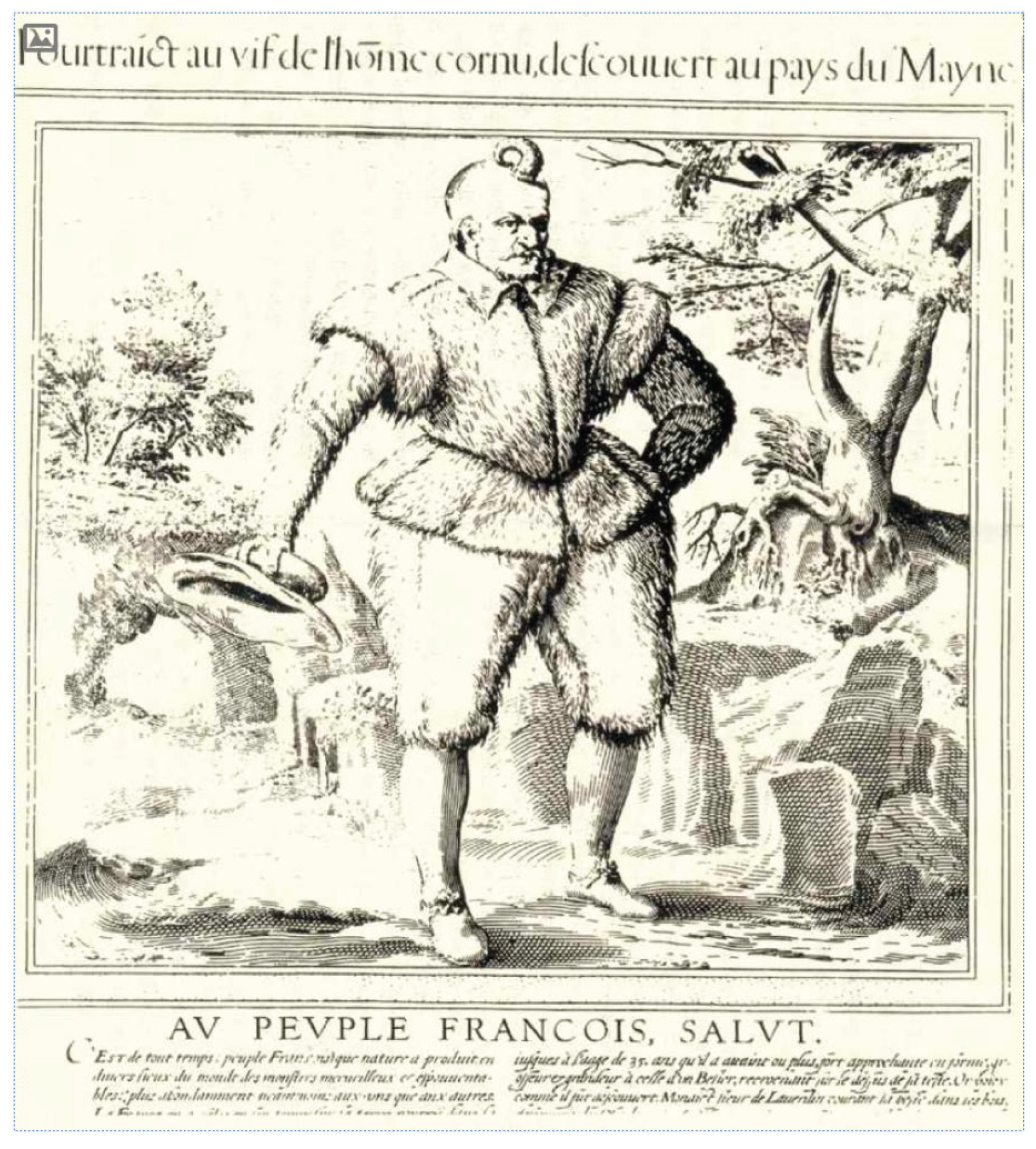
Figure A7.
VII, 7. 1570 An Article of the Deformed Pig. (Oct. 23, 1570), Table 9, 2.
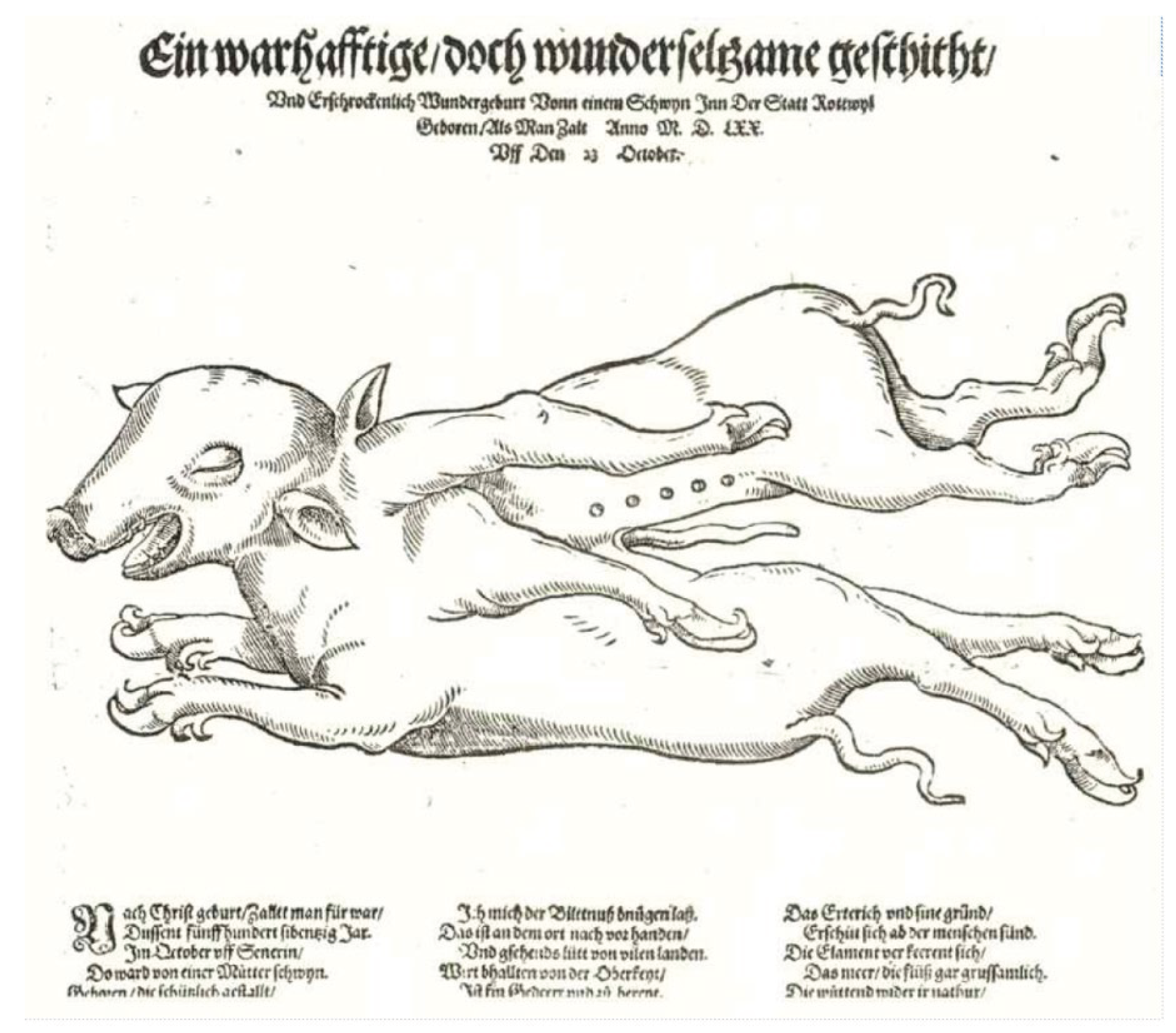
An astonishing true story. On October 23, 1570, in the city of Rottweil (now in the state of Baden-Württemberg in Germany), a sow gave birth to a horrifying piglet. This is not the first time something like this has happened here and there in recent years. God sends us many signals, but we do not pay attention. People only mock us when we talk about things like this. But look at the prophecies of the prophets about the final “Judgment Day” of God. Such phenomena as shaking the earth and upsetting the ocean waves are against the nature of things. It is through such forces that God’s authority and wonders are manifested. However, people do not pay attention to this. We humans must see and know the signals that God sends. Keep in mind the sermons that God gives us. Printed in Zurich by Christoffer Schwyzer. (translation by Ryu Yeonseung, see Footnote 24.)
Figure A8.
VII, 70. Two deformed children attached at their lower abdomens. Front and back drawings, Venice Ghetto, 1575. Table 9, 6.
Figure A8.
VII, 70. Two deformed children attached at their lower abdomens. Front and back drawings, Venice Ghetto, 1575. Table 9, 6.
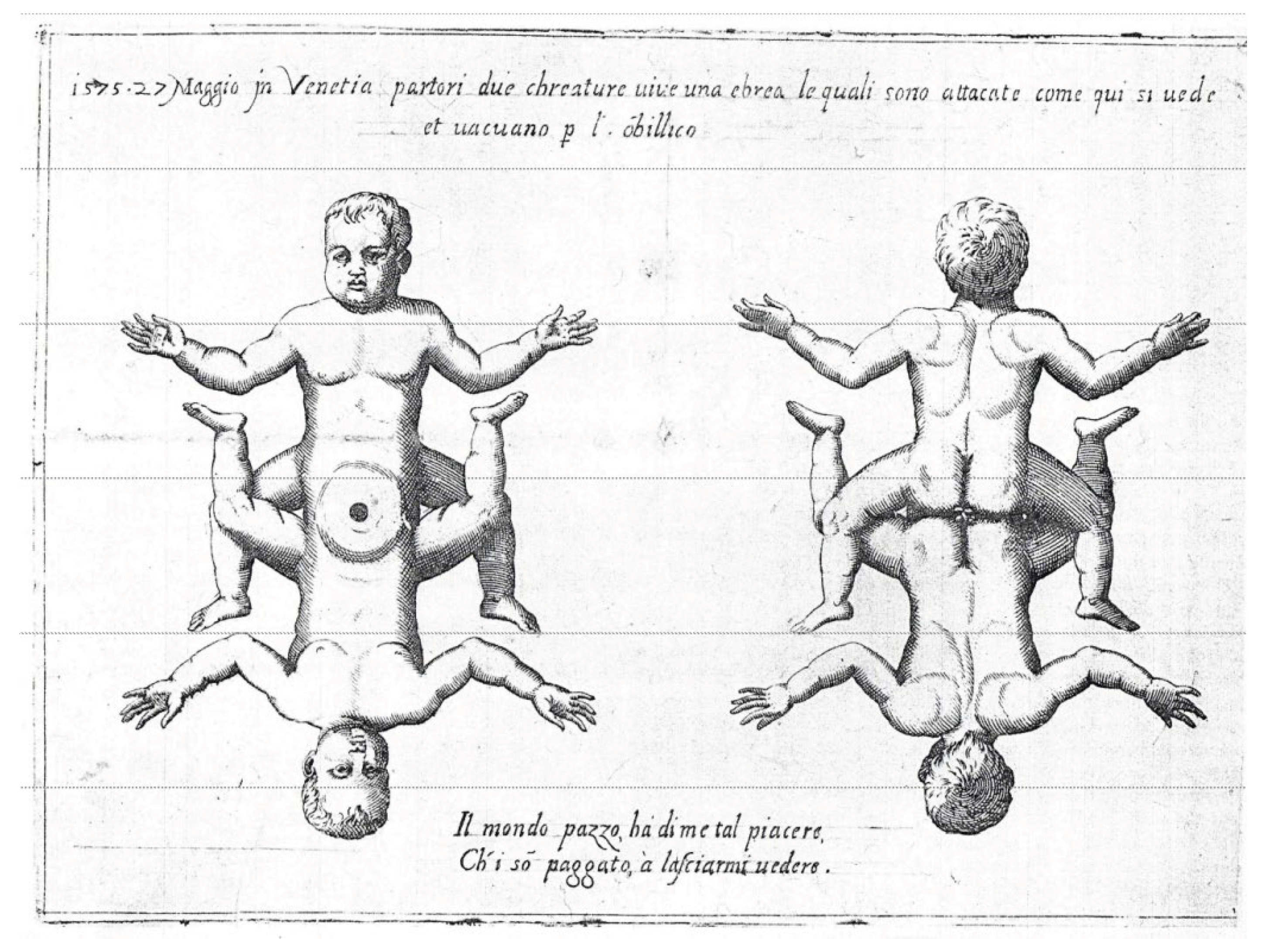
Items 5, 7, and 8 in Table 8 refer to the same anomaly and are the result of leaflets being made to announce this startling anomaly widely. The comments “ominous signs” and “biblical warnings” indicate this.
(1) Deformed child with a pig’s snout: (Born in Abent in 1578. A sow gave birth to a horrifying creature shaped like a calf. This story is similar to a story about a Spanish man who allegedly mated with a cow, which gave birth to a deformed child. (Quoter: The above story corresponds to (2) below.)
On the New Year’s night of this year of 1578 (the night that went from December 31 to January 1 in context?) a horrifying monster in the form of a child was born in the village of Cleeff (now Kleve) in Praest (Emmerich am Rhein, the border region with the Netherlands). It had a pig snout, a huge abdomen like a tower, and one hand and arm grown while attached to the inside of the abdomen. The other hand had six fingers, and both feet had six toes each. The genitals are shaped like a pocket. He died in the early afternoon of the New Year, and was buried in secret, his birth concealed. These days, monsters are born in many places. The Almighty God, the Creator of all creations, is giving His blessings to God-fearing people so that they can give birth to flawless children and glorify His name. On the other hand, it is a frightening sign that women who act rashly may give birth to such deformed children.
(2) Deformed calf: This half-human calf monster was the same as the one involving a Spaniard in Berg, i.e., Stettlin Hernberg in Hesse (?). Many people thought that some Spaniard had done something nasty to a cow and had produced such a deformed baby. (Translated by Ryu Yeonseung.)
Many people did not understand the deformed child in the shape of a calf and thought that it was caused by a man mating with a cow. However, there are several other deformed figures that look like a man in the upper body, including the head, and an animal in the lower body.
Figure A9.
VII, 109. Two terrifyingly deformed children born in Praest in 1578. Table 9, 13.
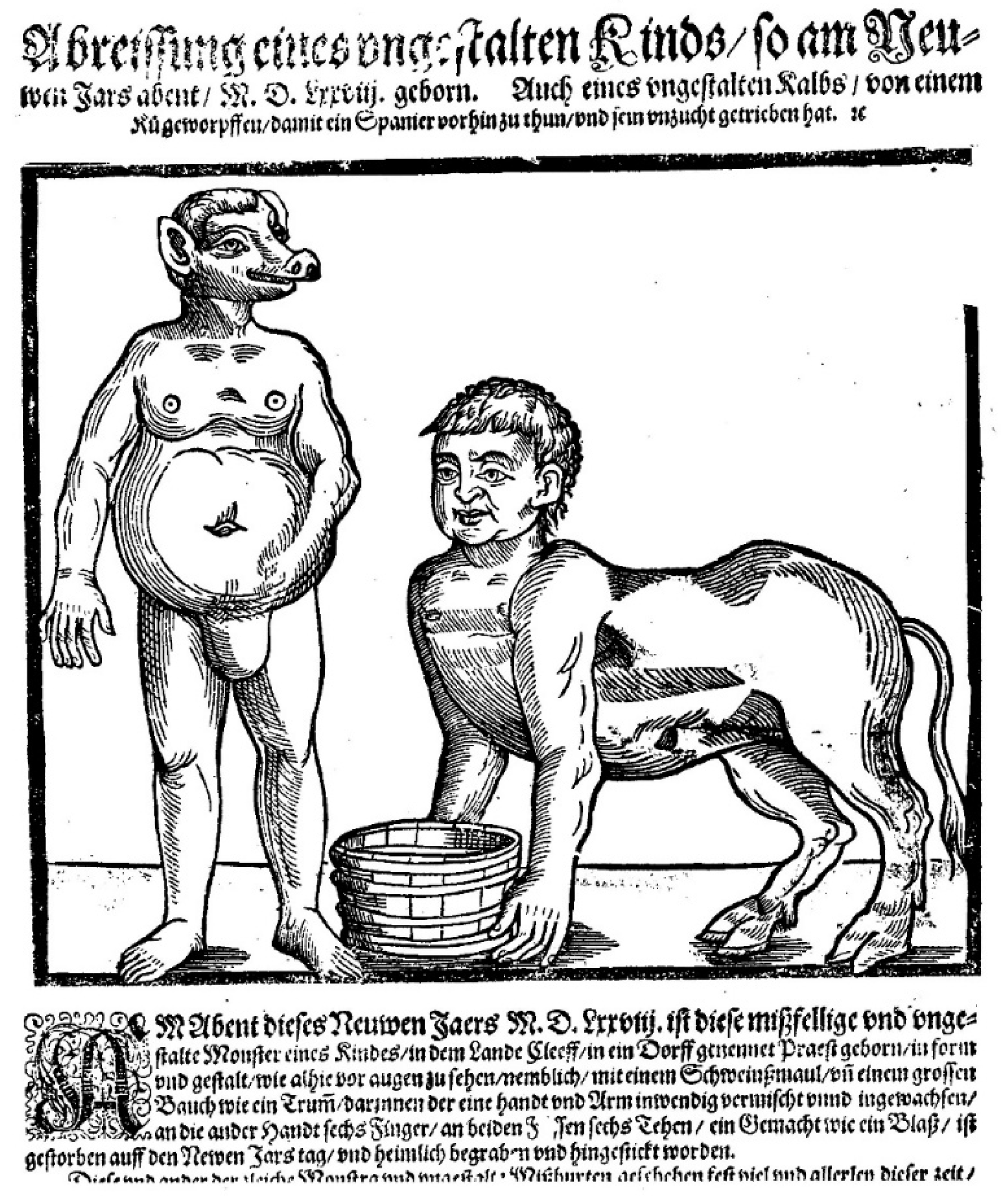
Figure A10.
VII, 114. Table 9, 19. Quoted at the end of the main body of this paper.
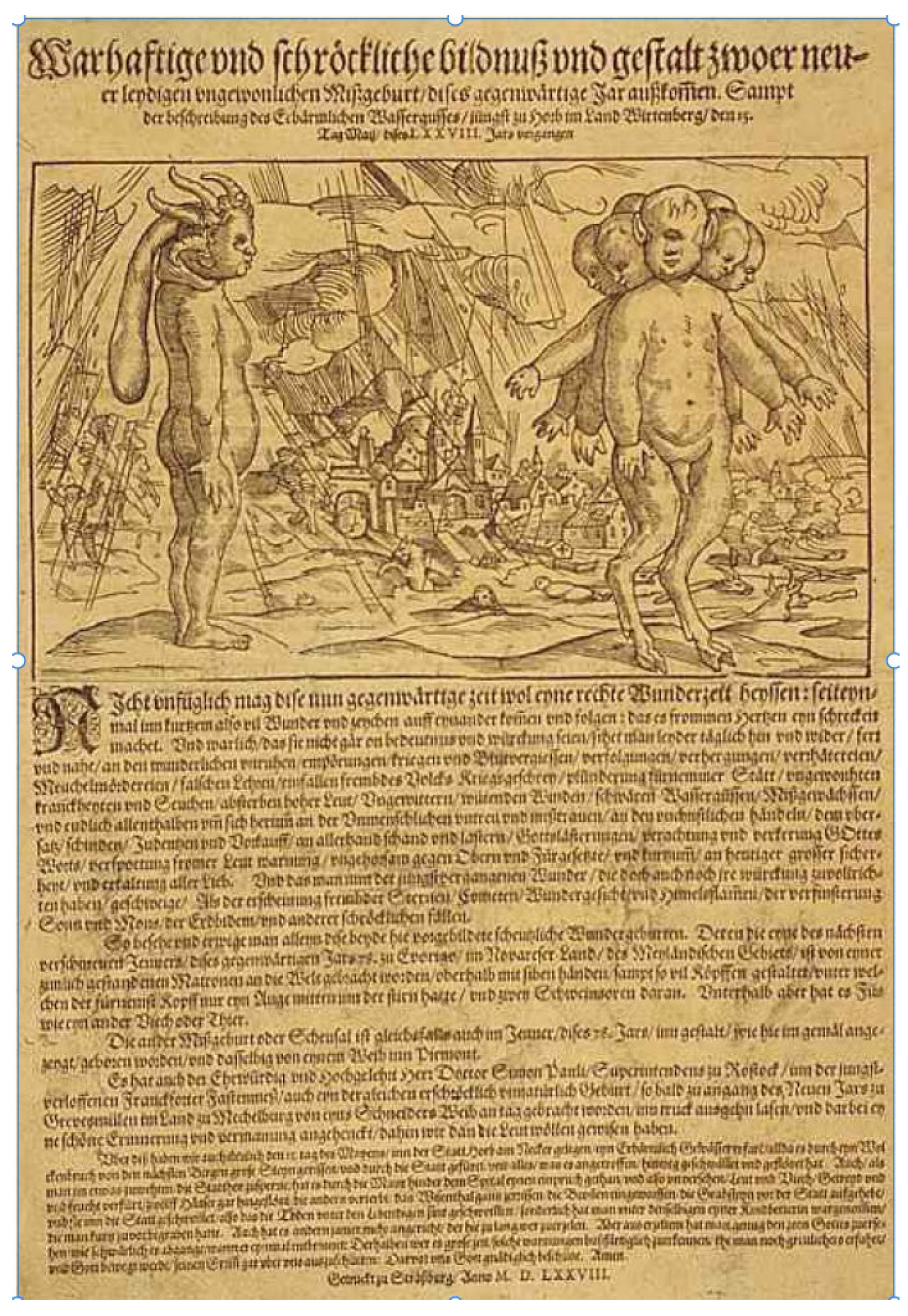
Figure A11.
VII, 115. A deformed figure like a monster. 1578. Table 9, 20.
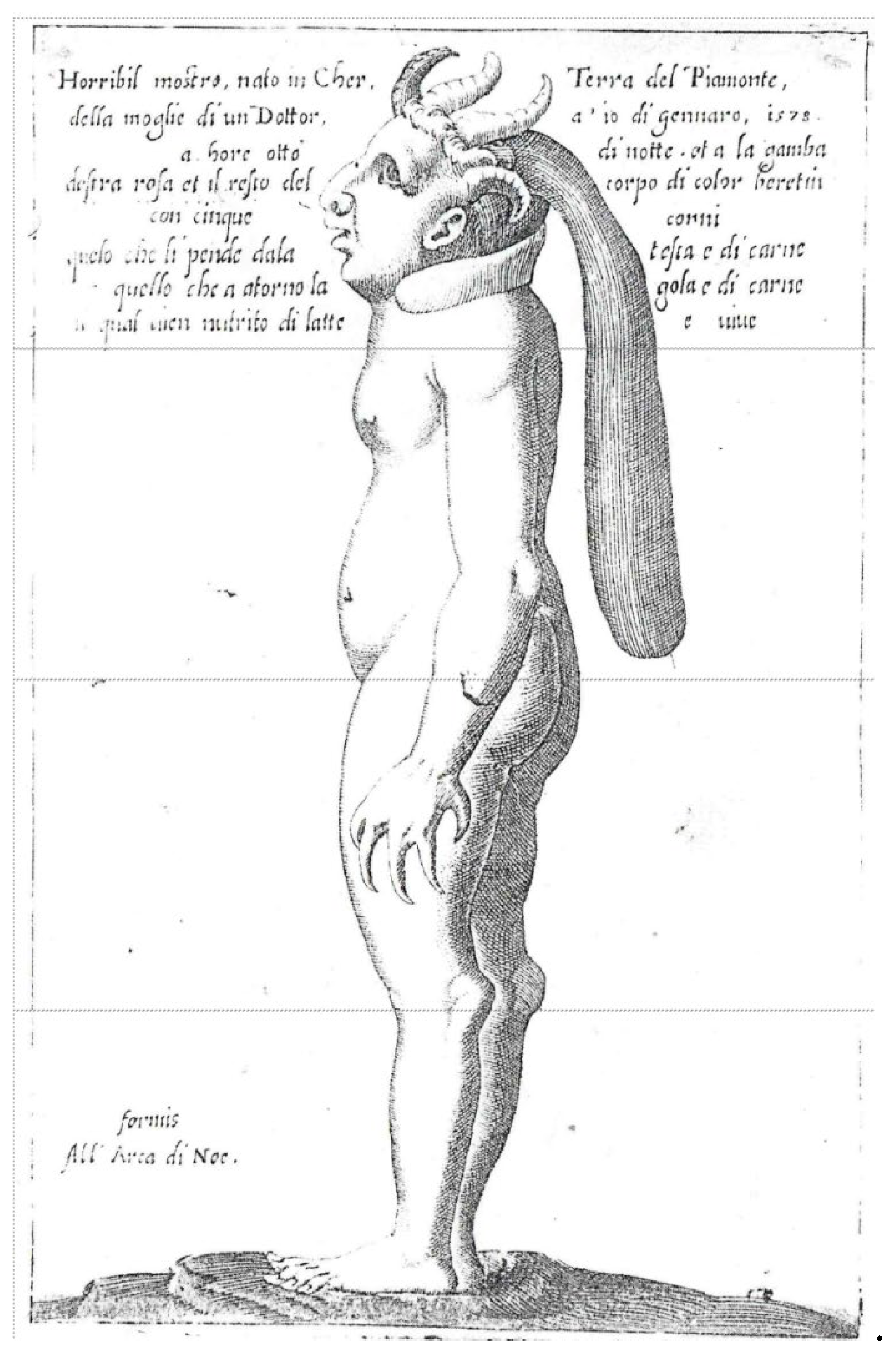
Monstrously deformed figure appearing at Chieri Piemong in northern Italy. The figure was described as follows: (1) a narrow, long handle descending from the back of the head to the buttocks, (2) five horns on the forehead, (3) plump skin on the back of the neck. (4) claw-shaped hands (5) legs with knees to the back (6) a feminine, round torso (7) puffy eyebrows, fleshy nose, and protruding lips.
The horrific birth of a deformed child. Elisabeth, the wife of Thomas Klauber, Meister of Bad Kaubenheim-Bad Kaubenheim in the Franken region (present-day northern Bavaria, around Nuremberg), gave birth to this infant on July 20, 1578.
After man fell and became corrupt and decadent, God told the woman, “You will give birth to your children in pain. Such pain in childbirth is remembered throughout the prophetic books, and the same is true of the birth of Christ the Lord. Even though many women were commanded to give birth, this is something that must be endured, and the pain can be forgotten. If God helps a pregnant woman by His grace and gives her a joyful glance, the fruit of her body will grow well, and all its limbs will be formed in a natural human form. In many cases, however, women give birth to deformed children who are horrible. This is not a human form at all because they have too many or too few limbs. There are many witnesses to this in old stories, and we experience it every day. Many learned people have pondered this problem, but what they determined as the actual cause is not satisfactory.
But we Christians know that this began with sin. Satan always tries to harm the natural birth of man. This horribly deformed child contains the punishment of God’s wrath, and through this we must remember that we want the birth of a human figure, and we do not want the birth of a deformed child. Thank God for giving us the human form and not giving us too many limbs or too few. We must pray that the inside of our shells will also be well shaped. This sermon of exhortation must be kept in mind by pregnant women.
Figure A12.
VII, 116. An Article of the Noyer Zeitung in 1578. Deformed child, front and back. Table 9, 21.
Figure A12.
VII, 116. An Article of the Noyer Zeitung in 1578. Deformed child, front and back. Table 9, 21.
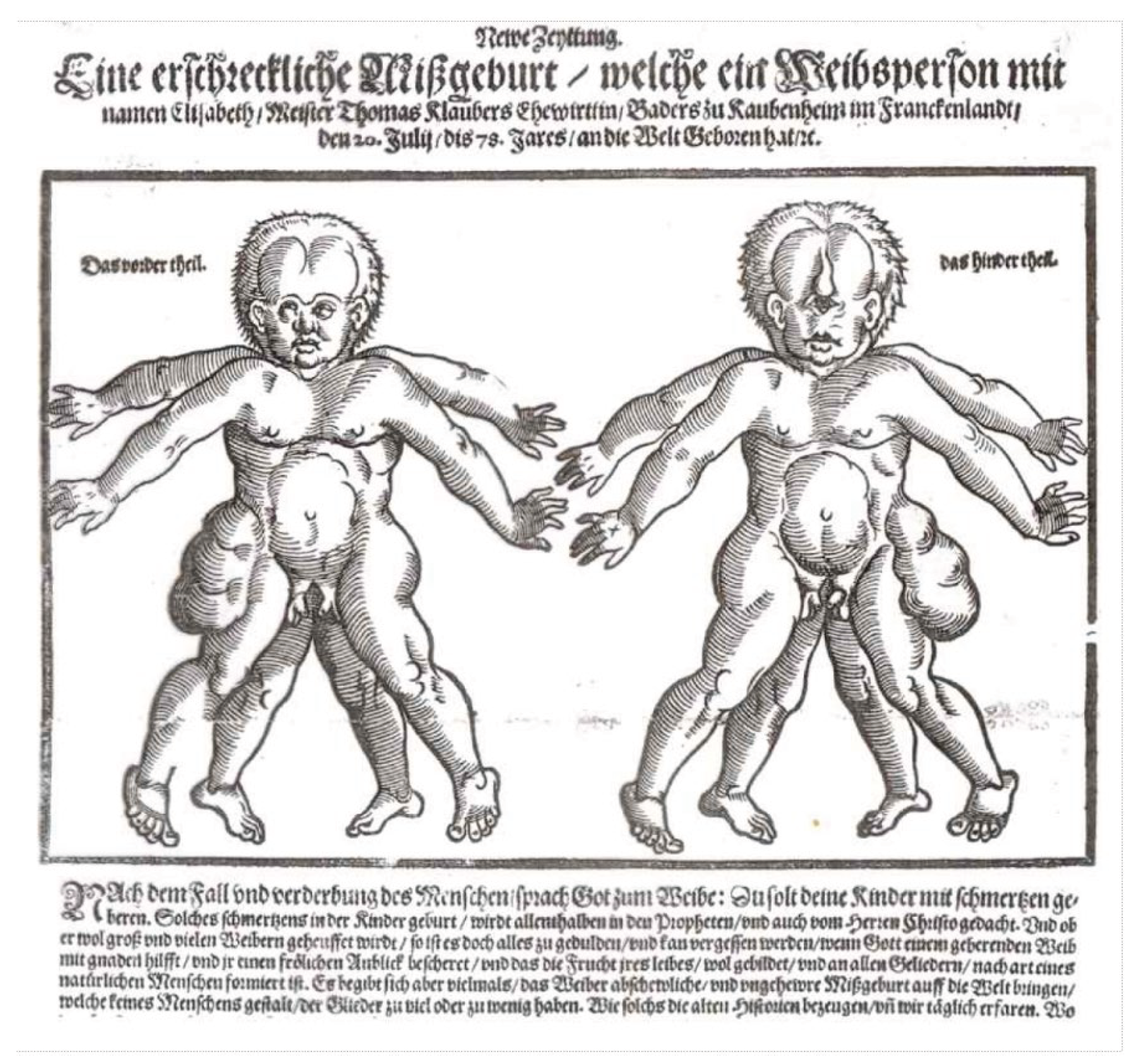
The deformed infant shown in the picture was stillborn on July 20, 1578, from Raubenheim. The officials of the area ordered a painter to draw and print it. May the Almighty God protect us and prevent us from giving birth to poor deformed children. Nuremberg area (and other street addresses).
Figure A13.
VII, 146. Deformed rabbit, Table 9, 26.
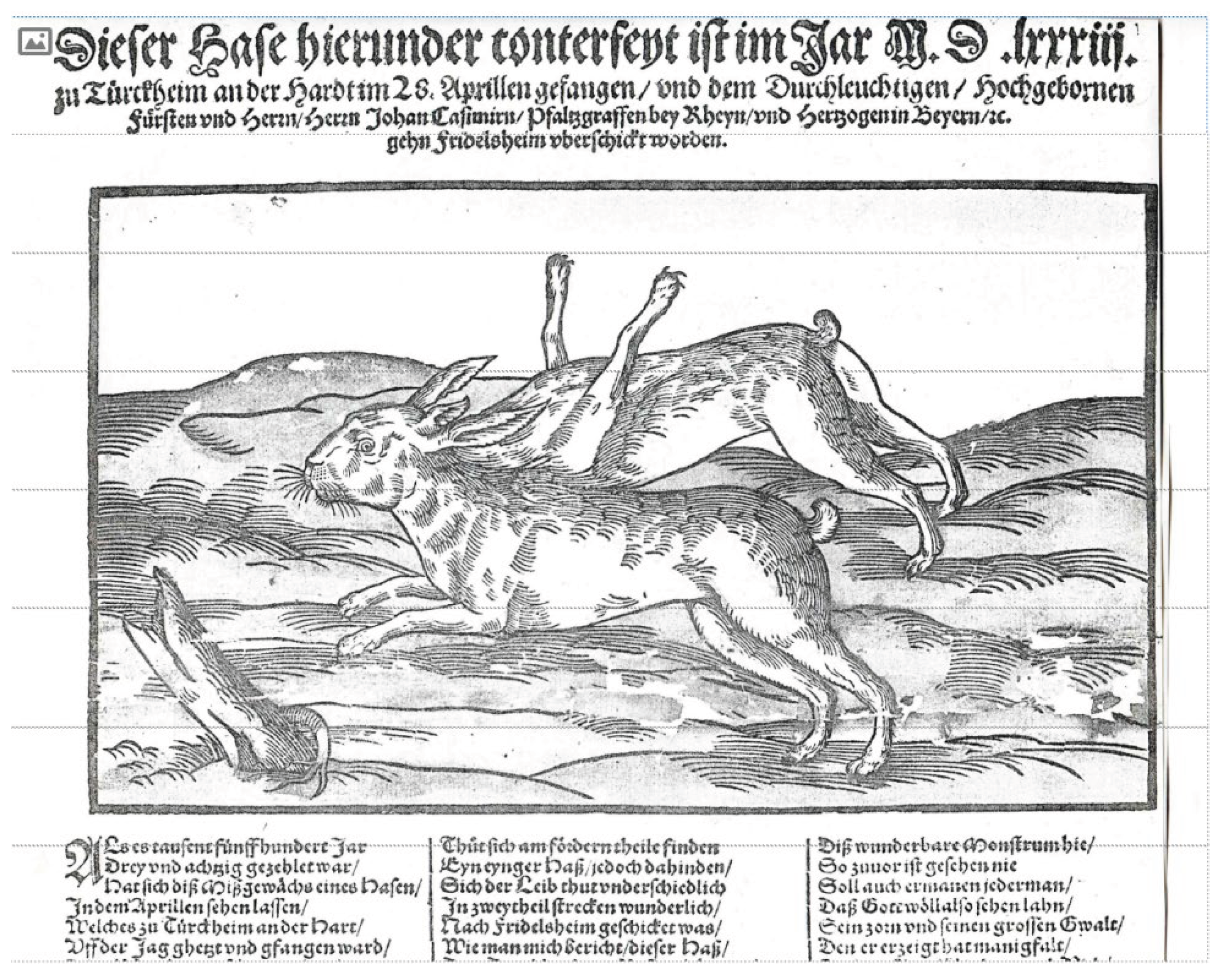
A deformed rabbit found by the hunter Johann Casimir (1543–1592) in Durkheim (Bad-Dürkheim, a small city in the Rhine-Neckar metropolitan region) on April 28, 1583. It has a normal torso with three ears and the upper body of another torso turned upside down. The text described the rabbit as a new manifestation of the wrath of God, which had already appeared in man. The leaflet was made in Heidelberg.
Figure A14.
VII, 178. Deformed cow, Table 9, 27.
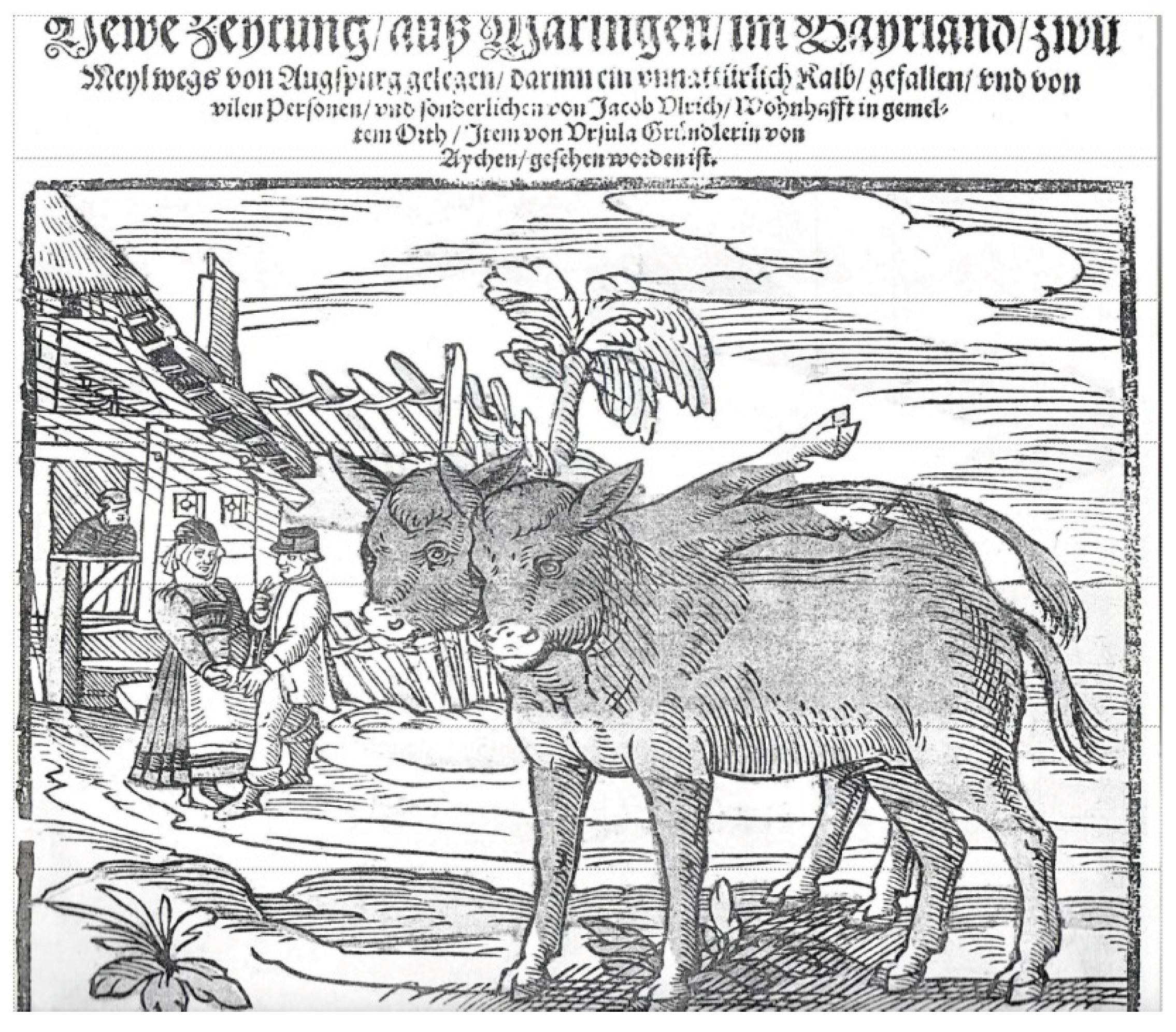
On June 22, 1587, a deformed cow appeared in Märingen in Bayrland near Ausburg. It was two animals joined into one, with two front legs, four hind legs, and two front legs protruding from its back. It has one upper and one lower tail. The text said, “Only God knows the exact meaning.”
Figure A15.
Deformity of a large-bodied grasshopper: “Mysterious natural phenomenon shown by the Lord or King of Hell (Chavalete, Scheol) through German grasshoppers” (Wickiana Collection, Zurich Central Library).
Figure A15.
Deformity of a large-bodied grasshopper: “Mysterious natural phenomenon shown by the Lord or King of Hell (Chavalete, Scheol) through German grasshoppers” (Wickiana Collection, Zurich Central Library).
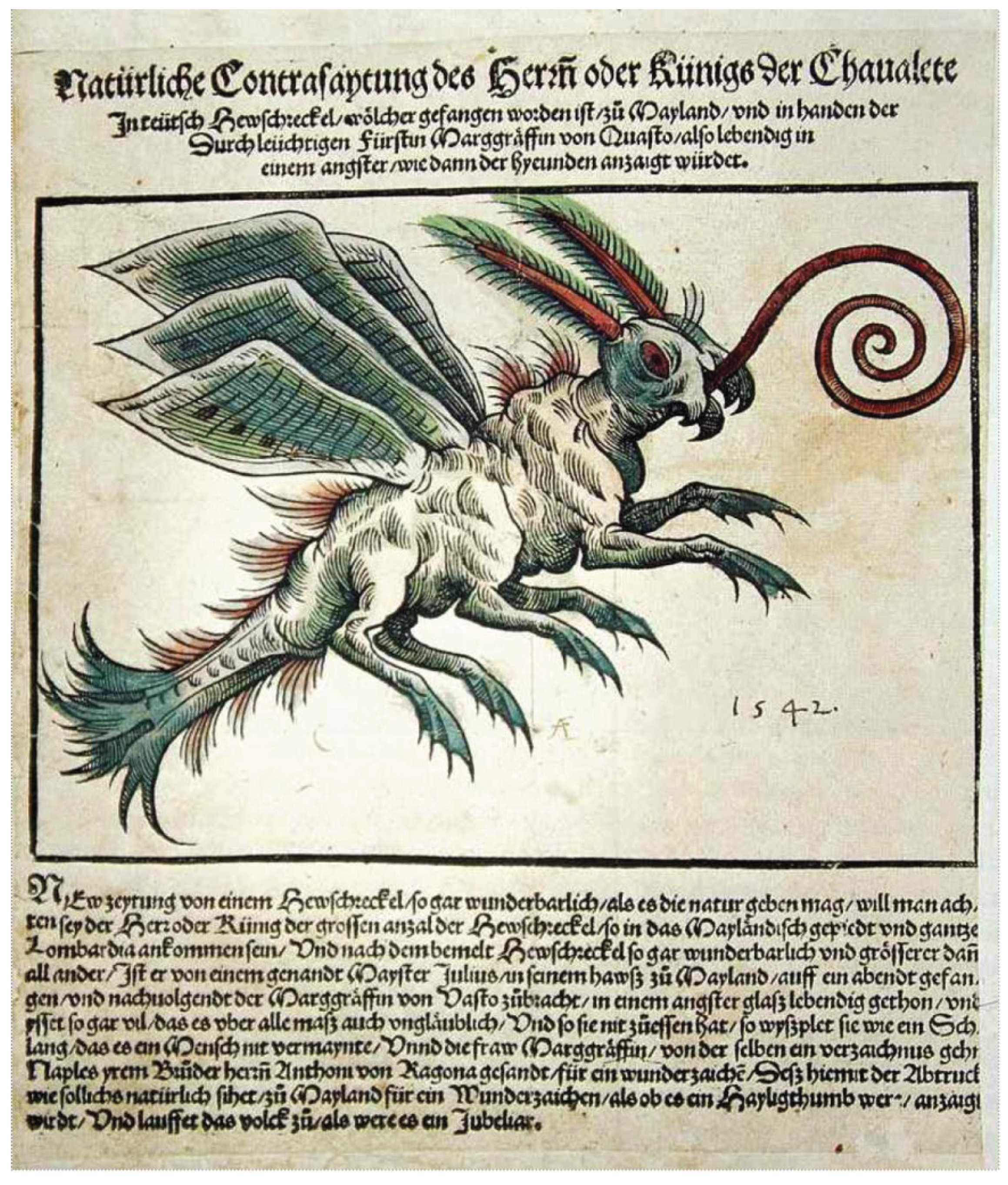
A grasshopper caught in Milan in 1542. This grasshopper, which was given to a countess of Vasto (now in southeastern Italy), seems to show us the alarming oath of God. The text refers to the damage as follows: Grasshoppers, much larger than ordinary ones, have appeared in enormous numbers, pecking at Milan and entering the whole of Lombardy. This grasshopper was caught one evening by a craftsman named Julius in his house in Milan, and he brought it to the attendants of the Countess of Vasto. It was no ordinary grasshopper, with its glossy skin and an insatiable appetite. It made a whispering sound that could be mistaken for a snake. The Count sent it to her elder brother, Anthoni Agona of Naples. Look at the printed portrayal of the grasshopper, which resembles the actual grasshopper that appeared as a sign in Milan. It looks like a sacred sign. Let the people cheer. (Translated by Ryu Yeonseung). In the Veritable Records, there are more than 231 records of insect plagues in the Little Ice Age (1490–1760), and locust damage accounts for one half of them. They were regarded as the main culprits of crop damage. But while the commentary on this painting questioned whether or not it was the work of the King of Hell, it used the expression “sacred sign” at the end.
The next one, 10-2, is almost the same. The area of occurrence is the same, but there is a difference in the year of occurrence—1556 instead of 1542. Of the people involved, the same name is mentioned. There may have been a confusion in the process of transmission.
Figure A16.
A grasshopper captured in Milan one day in July 1556.
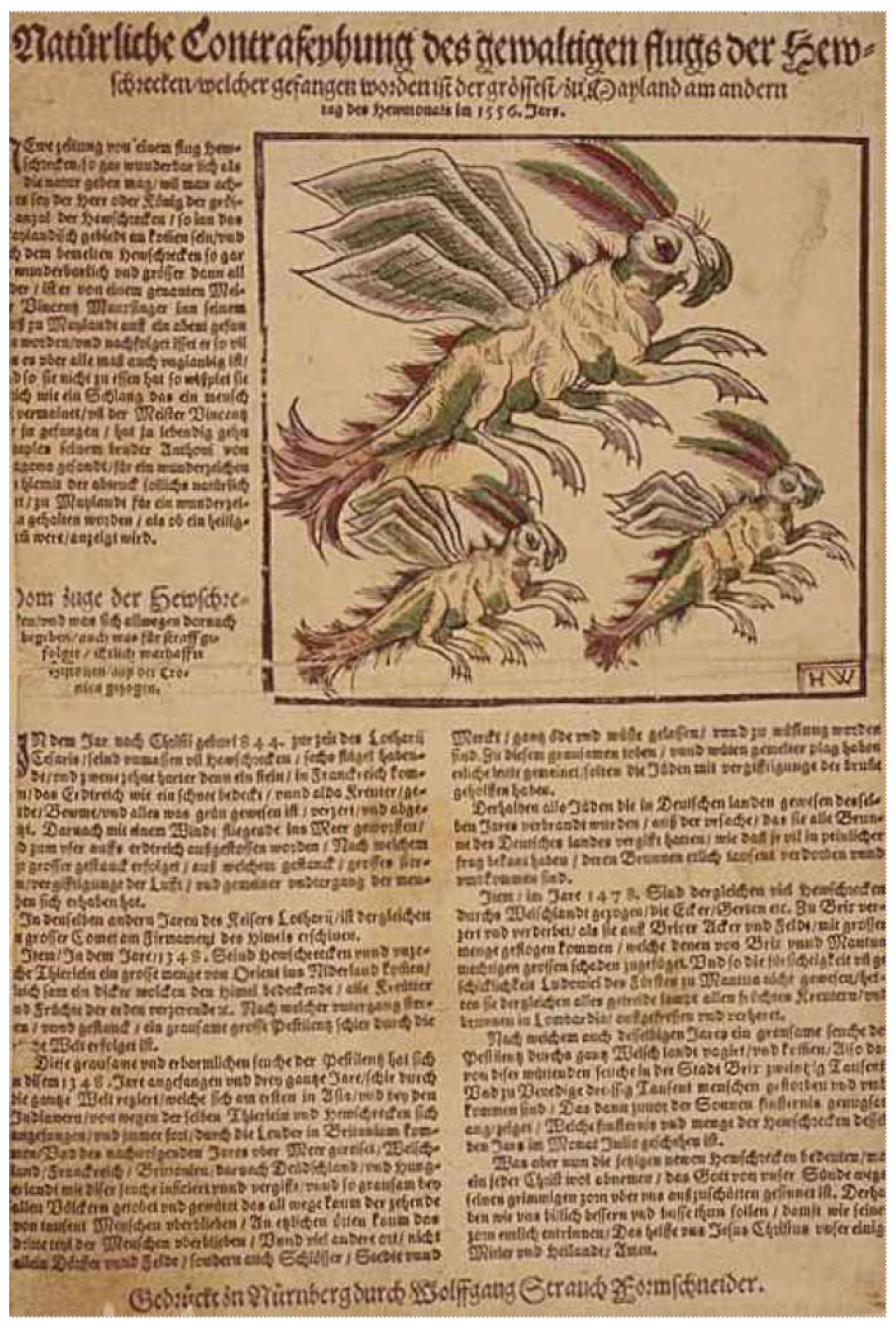
News about the appearance of an amazing and extraordinarily large grasshopper. The grasshopper’s tremendous flight, a sign of natural anomaly. This is the biggest one that was captured in Milan one day in July 1556. Let the people surmise whether this grasshopper, of which there are too many to count, is the will of God or the king of Hell. This grasshopper, which is much larger and stranger than the other grasshoppers pictured next to it that have invaded the Milan area, was captured by a man named Meir Vincentz Maursinger at his home in Milan. There are many unbelievable things about it, including its insatiable appetite. It is easy to mistake this grasshopper, whispering like a snake when there is no food. Mr. Vincentz, a craftsman, caught it alive and sent it to Anthoni Agona in Naples. The grasshopper was kept in Milan as a sign and displayed as a manifestation of sacredness.
∗ I was assisted in understanding the contents of the German material in Appendix B by Mr. Ryu Yeonseung, a specialist in Byzantine history.
** This paper was translated into English from Korean by Mr. Hacksun Cha.The template details the sections that can be used in a manuscript. Note that each section has a corresponding style, which can be found in the “Styles” menu of Word. Sections that are not mandatory are listed as such. The section titles given are for articles. Review papers and other article types have a more flexible structure.
References
- Alvarez, Luis W.; Alvarez, Walter; Asaro, Frank; Michel, Helen V.; et al. Extra-terrestrial Cause for the Cretaceous-Tertiary Extinction: Experimental Results and Theoretical Interpretation. Science 1980, 208, 1095–108. [Google Scholar] [CrossRef] [PubMed]
- Becker, Luann; Poreda, Robert J.; Hunt, Andrew G.; Bunch, Theodore E.; Rampino, Michael; et al. Impact Event at the Permian-Triassic Boundary: Evidence from Extraterrestrial Noble Gases in Fullerenes. Science 2001, 291, 1130–33. [Google Scholar] [CrossRef] [PubMed]
- Eather, Robert H. Majestic Lights: The Aurora in Science, History and the Arts; American Geophysical Union. Special Publications Series 18: Washington, DC, 1980. [Google Scholar]
- Hoyle, Fred; Wickramasinghe, Chandra. Diseases From Space; Harper & Row: New York, 1979. [Google Scholar]
- Parker, Geoffrey; Smith, Lesley M. (Eds.) The General Crisis of the Seventeenth Century; Routledge and Kegan Paul: Milton Park, 1978. [Google Scholar]
- Parker, Geoffrey; Smith, Lesley M. (Eds.) The General Crisis of the Seventeenth Century, 2nd ed.; Routledge and Kegan Paul: Milton Park, 1997. [Google Scholar]
- Sparrow, Giles. The Planets – A Journey Through the Solar System; Quercus: London, 2009. [Google Scholar]
- Trevor-Roper, H. R. The European Witch-Craze of the Sixteenth and Seventeenth Centuries; Harpercollins College Division: New York, 1969. [Google Scholar]
- Wicander, Reed; Monroe, James S. Historical Geology, 5th ed.; Thomson Brooks/Cole Publishing: Pacific Grove, CA, 2001. [Google Scholar]
- Wickramasinghe, Chandra. Cosmic Dragons: Life and Death on Our Planet; Souvenir Press: London, 2001. [Google Scholar]
- Yi, Tae-jin. Sobingi (1500–1750) ui cheonche hyeonsangjeok wonin: Joseon wangjo sillok ui gwallyeon girok bunseok [The Astronomical Causes of the Little Ice Age (1500–1750): An Analysis of the Relevant Records in the Veritable Records of Joseon Dynasty]. Guksagwan Nonchong [Collection of Papers on the Perspectives of Korean History] 1996a, 72, 1–50. [Google Scholar]
- Yi, Tae-jin. Sobinggi cheonbyeon jaei yeongu wa Joseon wangjo sillok: global history ui han jang [The Study of Natural Anomalies in the Little Ice Age and the Veritable Records of the Joseon Dynasty: A Chapter in Global History]. Yeoksa Hakbo [Journal of History] 1996b, 149, 1–45. [Google Scholar]
- Yi, Tae-jin. Meteor Fallings and Other Natural Phenomena Between 1500-1750 as Recorded in the Annals of the Chosen Dynasty (Korea). Celestial Mechanics and Dynamical Astronomy 1998a, 69, 199–220. [Google Scholar]
- Yi, Tae-jin. Jayeon jaehae jeonran ui pihae wa nongeop ui bokgu [Natural Disasters, Damage of War, and Restoration of Agriculture]. In Hanguksa [Korean History]; National Institute of Korean History: Seoul, 1998b; Volume 30. [Google Scholar]
- Yi, Tae-jin. Sangpyeongchang Jinhyulcheong ui seolchi unyeong gwa guhyul munje [Establishment and Operation of the Grain Loan and Relief Agencies]. In Hanguksa [Korean History]; National Institute of Korean History: Seoul, 1998c; Volume 30. [Google Scholar]
- Yi, Tae-jin. 16 segi Hanguk sasanggye ui cheondo wa oegye chunggyeok hyeonsang [The “Way of Heaven” and External Shock Phenomena in Sixteenth-Century Korean Thought]. Hanguksaron [Korean Historical Review] 2007, 53, 1–60. [Google Scholar]
| 1 | Yi Tae-jin, “Sobingi (1500–1750) ui cheonche hyeonsangjeok wonin: Joseon wangjo sillok ui gwallyeon girok bunseok [The Astronomical Causes of the Little Ice Age (1500–1750): An Analysis of the Relevant Records in the Veritable Records of Joseon Dynasty],” Guksagwan Nonchong [Collection of Papers on the Perspectives of Korean History], No. 72, 1996. This paper was presented first in English at “The Great Killers: Epidemics, Famines, and War,” a conference organized by the International Committee on Historical Demography, a subcommittee of the 18th International Congress of Historical Sciences, held in August 1995. Next year, the following paper was published with text that emphasized the importance of this topic from a world historical perspective. Yi Tae-jin, “Sobinggi cheonbyeon jaei yeongu wa Joseon wangjo sillok: global history ui han jang [The Study of Natural Anomalies in the Little Ice Age and the Veritable Records of the Joseon Dynasty: A Chapter in Global History,” Yeoksa Hakbo [Journal of History], No. 149, 1996. |
| 2 | Yi Tae-Jin, 1998, “Meteor Fallings and Other Natural Phenomena Between 1500-1750 as Recorded in the Annals of the Chosen Dynasty (Korea), Celestial Mechanics and Dynamical Astronomy 69, pp, 199-220 (Kluwer Academic Publishers. Printed in the Netherlands). This English paper was also published online at http://defendgaia.org/bobk/, a website for data and papers related to extraterrestrial objects, at the request of Bob Kobres, University of Geogia Libraries, who runs this website. An additional chapter on fires was added to the 4th Chapter. See http://defendgaia.org/bobk/korea/kmeteoro.html. |
| 3 | Geoffrey Parker and Lesley M. Smith, eds., The General Crisis of the Seventeenth Century (Milton Park: Routledge and Kegan Paul), 1978. |
| 4 | In 1623, the fourth and the fifth months of the lunar calendar roughly corresponded to May and June of the Gregorian calendar, respectively. Korea has four seasons, each season consisting of three months. May and June represent late spring and early summer, respectively. As a reference point, in May 1960, the lowest temperature was 6.4°C, and the highest temperature was 28.5°C. See https://www.weather.go.kr/w/obs-climate/land/past-obs/obs-by-day.do. |
| 5 | In the Veritable Records, the dimensions of these meteors are described from the perspective of the viewer watching the scene with the naked eye. |
| 6 | Luis W. Alvarez, Walter Alvarez, Frank Asaro, Helen V. Michel, 1980, “Extra-terrestrial Cause for the Cretaceous-Tertiary Extinction: Experimental Results and Theoretical Interpretation,” Science Vol. 208, No. 4448 (June 1980). |
| 7 | Wicarder Reed and James S. Monroe, 2001, Historical Geology, 5th ed., (Pacific Grove, CA: Thomson Brooks/Cole Publishing), p. 7. |
| 8 | Ernst J. Oepik, “The Missing Planet,” http://adsabs.harvard.edu/full/ 1978M%26P....18..327O |
| 9 | Giles Sparrow, “The Planets: A Journey Through the Solar System,” Quercus, p. 13. |
| 10 | Luann Becker, Robert J. Poreda, Andrew G. Hunt, Theodore E. Bunch, Michael Rampino, 2011, “Impact Event at the Permian-Triassic Boundary: Evidence from Extraterrestrial Noble Gases in Fullerenes,” Science, Vol. 291 (February 2001). |
| 11 | The viewing platform was installed in the Office of Astronomy and Geomancy (觀象監). |
| 12 | In Joseon, nighttime was marked by five gyeong 更, which was divided into five jeom 點. Because the length of night 夜刻 (yagak) changes throughout the year, the actual length of gyeong 更率 (gyeongryul) and the actual length of jeom 點率 (jeomryul) also changed throughout the year. Thus, only an approximate time can be given in our current twenty-four-hour system. |
| 13 | Because Gwanghae was dethroned on the 15th year of his reign, he was demoted to Prince Gwanghae, which was his title before his enthronement. See the Daily Records of Prince Gwanghae, Year 15 (1623), Month 3, Day 14 (gapjin), Entry 1. |
| 14 | As mentioned in a footnote above, the fourth and the fifth months of the lunar calendar roughly corresponded to late spring and early summer, respectively. |
| 15 | In astronomy, guest stars and new stars are regarded as supernovae. |
| 16 | Yi Tae-jin, “16 segi Hanguk sasanggye ui cheondo wa oegye chunggyeok hyeonsang [The “Way of Heaven” and External Shock Phenomena in Sixteenth-Century Korean Thought],” Hanguksaron [Korean Historical Review], Vol. 53. A typical example of this is that when the old guard elites denounced Jo Gwangjo of the emerging scholar official group, they used a solar anomaly in order to sway the king’s mind and entice him to order Jo Gwangjo to drink a lethal concoction. |
| 17 | During the four-month period from September 6, 1565 to January 26, 1566, 99 earthquakes were recorded to have occurred in the area of Nakakangjin, North Pyongan Province. Yi Tae-jin, 1996, previous paper, p.107: Yi Tae-Jin, 1998, ibid, p.219. Yi Gihwa, “Hanbando ui jijin wiheomdo [Degree of Seismic Hazard in the Korean Peninsula]”, 1983: Research Material (1998), Yi Gihwa gyosu nomunjip [Collection of Professor Yi Gihwa’s Papers], Dongnyeok jawon yeonguso [Institute of Power Sources], 2006, Retirement Anniversary Papers Compilation Committee. |
| 18 | Yi Tae-jin (1996), p. 119. |
| 19 | The 9th and the 12th lunar months roughly correspond to October and January of the Gregorian calendar, respectively. In Korea, October and January represent mid-autumn and mid-winter, respectively. |
| 20 | This is from the perspective of the observer with the naked eye. |
| 21 | Whether the comet that appeared in 1490 can be regarded as one of the Little Ice Age phenomena is another matter. When excerpting the Veritable Records, I counted comets not by the number of observations but only by the number of appearances. I viewed comets as a separate issue. |
| 22 | Jasu Palace was the place of abode for the concubine of King Sejo, who was the grandfather of King Seongjong. |
| 23 | Yi Tae-jin (2007), pp. 77-81. |
| 24 | Yi Tae-jin, “Jayeon jaehae jeonran ui pihae wa nongeop ui bokgu [Natural Disasters, Damage of War, and Restoration of Agriculture],” “Sangpyeongchang Jinhyulcheong ui seolchi unyeong gwa guhyul munje [Establishment and Operation of the Grain Loan and Relief Agencies],” Hanguksa [Korean History], Vol. 30, National Institute of Korean History (1998). |
| 25 | 1 pun equates to 3.333 mm. |
| 26 | I investigated the frequency of meteor appearances during the Jiajing era (1522–1566) recorded in the Mingshilu [Veritable Records of the Ming Dynasty] and compared it with the frequency during the contemporary period in the Veritable Records of the Joseon Dynasty and found a marked difference: 12 (Ming) versus 644 (Joseon). The Veritable Records of the Ming Dynasty was compiled under the principle of disclosure after compilation, and thus the record of natural disasters was likely greatly reduced for fear that it would be regarded as a rebuke of the preceding emperor’s immorality. On the other hand, the principle of non-disclosure after compilation was upheld in Joseon, and it seems that this ensured the veracity of records regarding natural disasters and anomalies. Yi Tae-jin (1996), pp. 92-93. |
| 27 | Published by the American Geophysical Union as part of the Special Publications Series 18. |
| 28 | At that time, I visited the Boston Public Library, the Bodleian Library at Oxford University, the University Library and the archives of the Department of Earth Science at Cambridge University, and the British Natural Museum in London. |
| 29 | Through Professor Eather’s book, I learned that this museum had a large collection of leaflet materials, so before my trip, I sent an e-mail to the museum to let them know in advance the schedule of my visit and the materials to be studied. A few days later, Reiner Schoch, the curator in charge, replied by fax, “The leaflets belong to a relatively large group of pictorial materials.” On the morning of Monday, February 17, I visited the museum with Mr. Yi Chang-woo, a doctoral student in philosophy at the Friedrich-Alexander-Universität Erlangen-Nürnberg (FAU) (now professor of philosophy at Catholic University in South Korea). When I visited the museum, more than 100 items were ready for viewing on a large table in the reading room. We selected 115 of them based on the pictures on them and applied for copies of them on a CD. When the copies of the material arrived, we examined them in detail and determined that 91 of them described the Little Ice Age phenomena. All of the explanations (text) about the paintings were written in Frankfurt calligraphy (Old German), but with the help of Dr. Johannes Reckel of the University of Göttingen, who was visiting Seoul National University at the time, we were able to secure English translations. |
| 30 | The research project was “Investigation on the German Pictorial Broad-sheets Flugblaetter of Natural Catastrophes during the Little Ice Age (c.1500–1760).” I would like to express special thanks to the DAAD for their support of this research. |
| 31 | Johann Jakob Wick (1522–1588) was a clergyman of the Predigerkirche Church, one of the four major churches in Zurich. Initially, he collected leaflets as news documents of his day for the period 1559–1588, and then he also integrated other leaflets from 1505 to 1559. See https://en.wikipedia.org/wiki/Wickiana. |
| 32 | The Flugblatt of 15th–16th century Germany is recorded in Frankfurt style, which can only be deciphered by an expert. The text was translated by Mr. Ryu Hyunseung, a graduate of the Department of German Language and Literature at Seoul National University who studied Byzantine culture in Germany. |
| 33 | See the picture in No. 5 in Appendix II. |
| 34 | Fred Hoyle, Chandra Wickramashinghe, Diseases From Space (1979). The authors of this book hypothesized in 1947 that there is a lot of dust being produced in nebula space, which was proven soon afterward. Based on this theory, they proposed in this book that the dust could enter the earth and cause disease. The author, Fred Hoyle, was the first Director of the Institute of Astronomy at Cambridge University in England. Chandra Vikgamashinov, a student of Hoyle, took up the subject of cosmic dust in earnest in 2001 in his solo book below. The term “cosmic dragons” used in this book refers to asteroids (meteors) that enter the earth’s atmosphere, Chandra Wickramasinghe, Cosmic Dragons: Life and Death on our Planet, Souvenir Press (2001). |
| 35 | H. R. Trevor-Roper, The European Witch-Craze of the Sixteenth and Seventeenth Centuries, Harpercollins College Div (1969). |
| 36 | Eric Jay Dolin, Fur, Fortune, and Empire: the Epic History of Fur History in America, W.W. Norton & Company, New York-London (2010). |
| 37 | Yi Tae-jin, “16 segi gukje gyoyeok ui baldal gwa Seoul sangeop ui seonggyeok [The Development of International Trade and the Characteristics of Commerce in Seoul in the Sixteenth Century],” in Yi Tae-jin et al., Seoul Sangeopsa [Commercial History of Seoul], Taehaksa (2000), pp. 101–105. |

Table 1.
Survey of the number of records of natural anomalies and natural disasters in the Veritable Records of Joseon Dynasty.
Table 1.
Survey of the number of records of natural anomalies and natural disasters in the Veritable Records of Joseon Dynasty.
| Number | Phenomenon | 1st Period | 2nd Period | 3rd Period | 4th Period | 5th Period | 6th Period | 7th Period | 8th Period | 9th Period | Total |
|---|---|---|---|---|---|---|---|---|---|---|---|
| 1 | Meteors | 103 | 69 | 422 | 387 | 766 | 740 | 695 | 239 | 10 | 3431 |
| 2 | Colored celestial vapors | 48 | 9 | 333 | 325 | 211 | 61 | 61 | 3 | 1 | 1052 |
| 3 | Unusual sounds from sky | 0 | 0 | 4 | 4 | 2 | 0 | 0 | 0 | 0 | 10 |
| 4 | Comets (Number of Reported Days /Number of Comets) | 21/5 | 198/8 | 221/6 | 102/8 | 37/4 | 102/8 | 84/5 | 75/3 | 374/14 | 1214/61 |
| 5 | “Guest stars” (Number of Reported Days /Number of Comets) |
0 | 0 | 0 | 127/3 | 102/1 | 0 | 14/3 | 22/2 | 0 | 265/9 |
| 6 | Abnormal sun | 6 | 0 | 16 | 27 | 23 | 9 | 13 | 2 | 0 | 96 |
| 7 | Abnormal moon | 0 | 0 | 1 | 10 | 6 | 1 | 0 | 2 | 0 | 20 |
| 8 | Solar halos | 424 | 352 | 1662 | 1378 | 266 | 121 | 239 | 44 | 1 | 4487 |
| 9 | Lunar halos | 27 | 16 | 145 | 557 | 78 | 116 | 176 | 27 | 0 | 1142 |
| 10 | Venus in daytime | 252 | 339 | 1186 | 397 | 829 | 1141 | 388 | 116 | 239 | 4887 |
| 11 | Thunder, lightning | 264 | 108 | 547 | 456 | 209 | 250 | 282 | 211 | 43 | 2370 |
| 12 | Hail | 177 | 68 | 578 | 260 | 223 | 295 | 262 | 108 | 35 | 2006 |
| 13 | Frost | 107 | 11 | 145 | 38 | 84 | 121 | 81 | 17 | 1 | 605 |
| 14 | Unseasonal snow | 37 | 3 | 70 | 32 | 35 | 117 | 65 | 18 | 0 | 377 |
| 15 | Catastrophic rain | 63 | 1 | 38 | 13 | 5 | 22 | 21 | 17 | 7 | 187 |
| 16 | Catastrophic rainstorms | 149 | 112 | 59 | 34 | 134 | 89 | 47 | 7 | 2 | 633 |
| 17 | Catastrophic windstorms | 46 | 4 | 61 | 28 | 30 | 42 | 16 | 3 | 2 | 232 |
| 18 | Heavy snow | 2 | 7 | 7 | 0 | 2 | 14 | 4 | 0 | 0 | 36 |
| 19 | Colored snow, rain | 14 | 8 | 29 | 18 | 8 | 11 | 1 | 1 | 0 | 90 |
| 20 | Dust storms | 0 | 0 | 1 | 2 | 7 | 19 | 0 | 0 | 0 | 29 |
| 21 | Daytime darkness | 0 | 0 | 1 | 0 | 14 | 24 | 13 | 2 | 0 | 54 |
| 22 | (Quasi)Fog | 144 | 20 | 45 | 280 | 91 | 22 | 48 | 1 | 0 | 651 |
| 23 | Earthquakes | 183 | 78 | 482 | 287 | 110 | 185 | 157 | 13 | 5 | 1500 |
| 24 | Tidal waves | 4 | 1 | 7 | 5 | 14 | 33 | 38 | 7 | 3 | 112 |
| 25 | Water color changes | 14 | 0 | 1 | 0 | 1 | 12 | 5 | 0 | 0 | 33 |
| 26 | Unusually low temperature | 8 | 1 | 28 | 3 | 11 | 9 | 4 | 0 | 0 | 64 |
| 27 | Unusually high temperature | 24 | 15 | 20 | 15 | 2 | 7 | 2 | 1 | 1 | 87 |
| I (total) | 2117 | 1420 | 6109 | 4785 | 3300 | 3563 | 2716 | 936 | 724 | 25670 | |
| 28 | Drought | 96 | 64 | 68 | 44 | 99 | 93 | 53 | 40 | 36 | 593 |
| 29 | Flood | 58 | 18 | 66 | 34 | 132 | 126 | 58 | 36 | 123 | 651 |
| 30 | Insect plagues | 88 | 12 | 118 | 37 | 45 | 27 | 35 | 20 | 3 | 385 |
| 31 | Famine | 32 | 4 | 38 | 15 | 5 | 15 | 1 | 0 | 0 | 110 |
| 32 | Epidemics | 22 | 7 | 133 | 15 | 37 | 100 | 108 | 35 | 8 | 465 |
| 33 | Other | 3 | 5 | 1 | 0 | 0 | 9 | 8 | 0 | 0 | 26 |
| II (total) | 299 | 110 | 424 | 145 | 636 | 370 | 263 | 131 | 170 | 2230 | |
| Total | 2416 | 1530 | 6533 | 4930 | 3936 | 3933 | 2979 | 1067 | 894 | 28218 |
Source: From the Veritable Records of King Taejo through the Veritable Records of King Cheoljong (1392–1863). 1st period: 1392–1450, 2nd period: 1451–1500, 3rd period: 1501–1550, 4th period: 1551–1600, 5th period: 1601–1650, 6th period: 1651–1700, 7th period: 1701–1750, 8th period: 1751–1800, 9th period: 1801–1863.
Table 2.
Number of Observations and Reports of Anomalies by Hangseong Magistracy and provinces.
| Phenomena | Hanseong Magistracy (Seoul) | Provinces | Total |
|---|---|---|---|
| Meteors | 3363 | 68 | 3431 |
| Colored celestial vapors | 1018 | 34 | 1052 |
| Unusual sounds from sky | 10 | 0 | 10 |
| Comets (Number of Reported Days) | 1212 | 2 | 1214 |
| “Guest stars” (Number of Reported Days) |
265 | 0 | 265 |
| Abnormal sun | 82 | 14 | 96 |
| Abnormal moon | 19 | 1 | 20 |
| Solar halos | 4459 | 5 | 4487 |
| Lunar halos | 1139 | 3 | 1142 |
| Venus in daytime | 4882 | 5 | 4887 |
| Thunder, lightning | 1434 | 936 | 2370 |
| Hail | 630 | 1376 | 2006 |
| Frost | 170 | 435 | 605 |
| Unseasonal snow | 68 | 309 | 377 |
| Unusually heavy rain | 129 | 58 | 187 |
| Severe rainstorms | 303 | 330 | 633 |
| Severe windstorms | 92 | 140 | 232 |
| Heavy snow | 21 | 15 | 36 |
| Colored snow, rain | 43 | 47 | 90 |
| Dust storms | 25 | 4 | 29 |
| Daytime darkness | 46 | 8 | 54 |
| (Quasi) Fog | 621 | 30 | 651 |
| Earthquakes | 216 | 1284 | 1500 |
| Tidal waves | 4 | 108 | 112 |
| Water color changes | 8 | 25 | 33 |
| Unusually low temperature | 40 | 24 | 64 |
| Unusually high temperature | 61 | 26 | 87 |
| Total | 20360 | 5310 | 25670 |
Table 3.
Composition of the Earth’s Atmosphere.
| Name | Height | Main conditions and phenomena |
|---|---|---|
| Thermosphere | about 80–1,000 km | little air, auroras observed |
| Mesosphere | about 50–80 km | little vapor, no atmospheric phenomena, many meteors observed |
| stratosphere | about 11–50 km | Ozone layer, stable, airways |
| Troposphere | land surface –11 km | convection of air, atmospheric phenomena |
Table 4.
Number of Deformed Animals (1392–1863).
| Time Period | Cows | Chickens | Horses | Dogs | Pigs | Cats | Humans | Fish | Birds | Others | Total Number |
|---|---|---|---|---|---|---|---|---|---|---|---|
| Period 1 1392–1450 |
5 | 2 | 0 | 0 | 0 | 0 | 0 | 0 | 0 | 2 | 9 |
| Period 2 1451–1500 |
2 | 1 | 0 | 0 | 0 | 0 | 0 | 0 | 0 | 1 | 4 |
| Period 3 1501–1550 |
15 | 22 | 1 | 4 | 0 | 1 | 1 | 0 | 0 | 1 | 45 |
| Period 4 1551–1600 |
16 | 17 | 2 | 5 | 1 | 1 | 1 | 2 | 6 | 0 | 51 |
| Period 5 1601–1650 |
11 | 11 | 2 | 2 | 1 | 1 | 2 | 1 | 2 | 2 | 35 |
| Period 6 1651–1700 |
39 | 25 | 2 | 6 | 3 | 4 | 5 | 0 | 2 | 2 | 88 |
| Period 7 1701–1750 |
20 | 1 | 2 | 0 | 5 | 0 | 8 | 0 | 2 | 1 | 39 |
| Period 8 1751–1800 |
0 | 0 | 0 | 0 | 0 | 0 | 0 | 0 | 0 | 0 | 0 |
| Period 9 1801–1863 |
0 | 0 | 0 | 0 | 0 | 0 | 0 | 0 | 0 | 0 | 0 |
| Total Number |
108 | 79 | 9 | 17 | 10 | 7 | 17 | 3 | 12 | 9 | 271 |
Table 5.
Number of Deformed Animals by Province (1392–1863).
| Time Period | Gyeongsang Province | Jeolla Province | Gyeonggi Province | Chungcheong Province | Pyeongan Province | Hamgyeong Province | Gangwon Province | Hwanghae Province | Hanseong Magistracy | Others | Total |
|---|---|---|---|---|---|---|---|---|---|---|---|
| Period 1 1392–1450 |
3 | 4 | 0 | 1 | 0 | 0 | 0 | 0 | 1 | 0 | 9 |
| Period 2 1451–1500 |
1 | 0 | 1 | 0 | 0 | 1 | 0 | 0 | 1 | 0 | 4 |
| Period 3 1501–1550 |
6 | 9 | 2 | 7 | 2 | 8 | 5 | 3 | 3 | 0 | 45 |
| Period 4 1551–1600 |
13 | 11 | 7 | 2 | 6 | 4 | 1 | 3 | 4 | 0 | 51 |
| Period 5 1601–1650 |
10 | 7 | 4 | 3 | 6 | 1 | 2 | 0 | 1 | 1 | 35 |
| Period 6 1651–1700 |
20 | 11 | 12 | 12 | 9 | 8 | 7 | 5 | 4 | 0 | 88 |
| Period 7 1701–1750 |
9 | 6 | 6 | 4 | 6 | 3 | 2 | 3 | 0 | 0 | 39 |
| Period 8 1751–1800 |
0 | 0 | 0 | 0 | 0 | 0 | 0 | 0 | 0 | 0 | 0 |
| Period 9 1801–1863 |
0 | 0 | 0 | 0 | 0 | 0 | 0 | 0 | 0 | 0 | 0 |
| Total Number |
62 | 48 | 32 | 29 | 29 | 25 | 17 | 14 | 14 | 1 | 271 |
Table 6.
List of meteor appearances and associated phenomena during 1471–1490.
| Year | Meteors | Venus in daytime | Quasi fog | Colored celestial vapors | Comets |
|---|---|---|---|---|---|
| 1471 | 1 | ||||
| 1472 | 1 | ||||
| 1473 | |||||
| 1474 | |||||
| 1475 | 5 | ||||
| 1476 | |||||
| 1477 | |||||
| 1478 | |||||
| 1479 | 1 | ||||
| 1480 | 1 | ||||
| 1481 | 2 | 11 | 1 | ||
| 1482 | 1 | ||||
| 1483 | 2 | 1 | |||
| 1484 | |||||
| 1485 | |||||
| 1486 | 1 | 5 | |||
| 1487 | 2 | ||||
| 1488 | 2 | 1 | |||
| 1489 | 10 | 1 | |||
| 1490 | 12 | 17 | 24 (number of observation) |
Table 7.
Summary of Cases of High Fertility in Cattle and Cases of Malformation in Chickens.
| Time period | Year | Cows: multiple calves at one delivery | Chickens: hens turning into roosters |
|---|---|---|---|
| I | 1392–1450 | 3 | 2 |
| II | 1451–1500 | ||
| III | 1501–1550 | 2 | 5 |
| IV | 1551–1600 | 3 | 5 |
| V | 1601–1650 | 4 | |
| VI | 1651–1700 | 9 | |
| VII | 1701–1750 | ||
| VIII | 1751–1800 | 1 | |
| IX | 1801–1863 | ||
| Total | 9 | 25 |
Table 8.
Cosmic dust and the occurrence of diseases and other related phenomena (1392–1863).
| Time Period | Fog | Quasi-fog | Colored snow and rain | Epidemics | Insect plagues | Total |
|---|---|---|---|---|---|---|
| Period 1 1392–1450 |
119 | 1 | 1 | 1 | 0 | 122 |
| Period 2 1451–1500 |
19 | 0 | 0 | 2 | 0 | 21 |
| Period 3 1501–1550 |
36 | 5 | 2 | 12 | 59 | 114 |
| Period 4 1551–1600 |
165 | 122 | 16 | 7 | 31 | 341 |
| Period 5 1601–1650 |
31 | 52 | 12 | 29 | 30 | 154 |
| Period 6 1651–1700 |
12 | 41 | 3 | 0 | 84 | 140 |
| Period 7 1701–1750 |
26 | 48 | 0 | 0 | 58 | 132 |
| Period 8 1751–1800 |
0 | 3 | 0 | 0 | 19 | 22 |
| Period 9 1801–1863 |
0 | 0 | 0 | 0 | 4 | 4 |
| Total Number |
408 | 272 | 34 | 51 | 285 | 1050 |
Table 9.
Distribution of German Flugblatt material related to natural disasters by period (Held in German National Museum, Nürenberg).
Table 9.
Distribution of German Flugblatt material related to natural disasters by period (Held in German National Museum, Nürenberg).
| Time period | Number | Time period | Number |
|---|---|---|---|
| 1491 - 1500 | 1 | 1631 - 1640 | 1 |
| 1501 - 1510 | 1 | 1641 - 1650 | 2 |
| 1511 - 1520 | 0 | 1651 - 1660 | 4 |
| 1521 - 1530 | 0 | 1661 - 1670 | 4 |
| 1531 - 1540 | 1 | 1671 - 1680 | 5 |
| 1541 - 1550 | 4 | 1681 - 1690 | 3 |
| 1551 - 1560 | 15 | 1691 - 1700 | 1 |
| 1561 - 1570 | 8 | 1701 - 1710 | 0 |
| 1571 - 1580 | 12 | 1711 - 1720 | 1 |
| 1581 - 1590 | 10 | 1721 - 1730 | 0 |
| 1591 - 1600 | 2 | 1731 - 1740 | 0 |
| 1601 - 1610 | 1 | 1741 - 1750 | 1 |
| 1611 - 1620 | 3 | Unclear | 2 |
| 1621 - 1630 | 12 | Total | 94 |
Table 10.
Occurrence of deformities in the first volume of German 16th-17th century picture leaflets.
Table 10.
Occurrence of deformities in the first volume of German 16th-17th century picture leaflets.
| Number | Data ID Number | Subject | Year | Place of occurrence | Interpretation |
|---|---|---|---|---|---|
| 1 | I, 218 | Deformed calves (bald, black or gray hair, large hooves, etc.) | 1523 | Saxony (Sachsen) |
Wrath of God |
| 2 | I, 219 | The cannibal monster (in Spain) | 1665 | Leipzig | |
| 3 | I, 220 | 2 cases of unique bunches of grapes | 1610 | Augsburg | God’s grace |
| 4 | I, 221 | one case of bunches of grapes with white beard | 1615 | Strasburg | Ominous omen, object for religious reflection |
| 5 | I, 222 | Multi-layered bundle of rye ears | 1622 | Bamberg | God’s blessing, announcement of a bountiful harvest |
| 6 | I, 225 | A new cluster of ears between two ears of wheat | 1627 | God’s grace, hope for better times | |
| 7 | I, 227 | Body of a baby girl with two connected heads and umbilical cord | 1581 | Königsberg | Catastrophe, Wrath of God against human sin and evil |
| 8 | I, 228 | Stillborn infant, protrusion behind the ear, pig’s tail, gluing of limbs | 1606 | Cologne | Ominous signs of God |
| 9 | I, 229 | twins merged and facing each other, flesh hanging down below the ears | 1606 | Cologne | Manifestation of God’s wrath |
| 10 | I, 230 | flesh around the ear hanging down like a scarf | (1566) | Hans de Moer, age 37 (1529-1570) | Wrath of God |
| 11 | I, 232 | Frenchman with flesh horn on his head |
Table 11.
Occurrence of deformities in the seventh volume of German 16th-17th century picture leaflet items.
Table 11.
Occurrence of deformities in the seventh volume of German 16th-17th century picture leaflet items.
| Number | Data ID Number | Subject | Year | Place of occurrence or publication | Interpretation |
|---|---|---|---|---|---|
| 1 | VII, 1 | Flesh around the ear hanging down like a scarf | 1570 | A Franks 41 years old Hans de Moer | A sign of God’s future orientation |
| 2 | VII, 7 | A deformed piglet with one head, two ears, eight feet, and two tails | 1570 | Rottweil (Zurich - Production) |
An ominous sign given by God for the sins of man |
| 3 | VII, 21 | Two humans joined with each other on their backs | Eisleben | A sign of the wrath of God | |
| 4 | VII, 29 | A bunch of rye with 130 ears | 1572 | Miracle of death and resurrection shown by God | |
| 5 | VII, 69 | Drawings of two stillborn infants joined to each other on their lower abdomens (illustrations of front and back) | 1575 | Venice, Ghetto | Ominous Omen |
| 6 | VII, 70 | Same as above (other production) | Same as above | Same as above | |
| 7 | VII, 71 | Scary birth deforminty (only the frontal deformity is shown) | Same as above | Same as above | Collector: Wick, ominous signs of a plague outbreak |
| 8 | VII, 72 | Astonishing birth deformity (only the frontal deformity is shown) | 1575 | Heidelberg | Also in Germany for publicity purposes. Biblical warning |
| 9 | VII, 95 | A large bunch of grapes on one of the three vines in a vineyard | 1577 | Nuremberg (near Ochsenfurt) |
Praise of God’s miracle |
| 10 | VII, 96 | Picture of a birth deformity (balloon shaped flesh protruding from the forehead, a cover around the nose, tail attached to the navel) | 1577, (June 27) |
Frankfurt am Main | Notice of an enforcement by God of biblical moral standards |
| 11 | VII, 107 | Deformed lamb | 1578 | A sign of God’s wrath warning of man’s destruction | |
| 12 | VII, 108 | Three sheaves of wheat | 1578 | Frankfurt am Main | God’s grace |
| 13 | VII, 109 | Two deformed infants (deformity of pig snout and deformity of cow-shaped body) | 1578 | Emmerich am Rhine | God’s warning intended to spur moral improvement |
| 14 | VII, 110 | Turban-shaped, six-layered flesh above the head, female breasts and male genitalia | 1578 (Dec. 20, 1577) | Duchy of Mecklenburg (Herzogtum Mecklenburg) | Distortion of the man made in the image of God as His son |
| 15 | VII, 111 | Two deformities (deformity of two bodies attached to each other, deformity without arms and eyes) | 1578 | Emmerich(Emmerich am Rhine) | Aberrant birth of man and beast that belong to God’s creation |
| 16 | VII, 112 | Deformed infant (7 heads and arms, pig’s ears, one eye, legs of a beast) | 1578 | God’s warning and urging | |
| 17 | VII, 113 | Same as above(German edition) | 1578 | Revelation of John | |
| 18 | 18 VII, 113a | Same as above(Italian edition) | 1578 | ||
| 19 | VII, 114 | Two deformed figures standing against the background of a city hit by a calamity | 1578 | Strasburg | Punishment for blasphemy, disobedience, and self-deception |
| 20 | VII, 115 | Scary monsters | 1578 | Venice, b1 | place of occurrence: Chieri Piemong, Northern Italy |
| 21 | VII, 116 | A male infant with the deformity of 4 arms and 4 legs joined together (illustrations of front and back) | 1578 | Nuremberg | deformity caused by the sins of man committed under the direction of satan |
| 22 | VII, 117 | A deformed male infant with two legs and arms attached to the chest | 1578 | Nuremberg | birth by wrongful act of sin |
| 23 | VII, 122 | two joined female torsos with a large face with long teeth and four arms | 1579 | warning against factional groups threatening Catholic unity | |
| 24 | VII, 134 | Deformed infant with two bodies joined together | 1580 | Frankfurt am Main | wrath of God |
| 25 | VII, 138 | body of a stillborn fetus | June 20, 1581 | Alich near Erfurt | |
| 26 | VII, 146 | A deformed rabbit with a normal body with three ears and another upturned upper body joined to the normal body | 1583 | Heidelberg | Wrath of God, already manifested in man, is marked anew in the rabbit. |
| 27 | VII, 178 | Two oxen joined to each other (2 front legs, 4 hind legs, 2 front legs on the back, two tails pointing up and down, respectively) | 1587 | Ausburg (Place of origin: Märingen, Bayrland) | Only God knows the definite meaning. |
Disclaimer/Publisher’s Note: The statements, opinions and data contained in all publications are solely those of the individual author(s) and contributor(s) and not of MDPI and/or the editor(s). MDPI and/or the editor(s) disclaim responsibility for any injury to people or property resulting from any ideas, methods, instructions or products referred to in the content. |
© 2026 by the authors. Licensee MDPI, Basel, Switzerland. This article is an open access article distributed under the terms and conditions of the Creative Commons Attribution (CC BY) license (http://creativecommons.org/licenses/by/4.0/).
Copyright: This open access article is published under a Creative Commons CC BY 4.0 license, which permit the free download, distribution, and reuse, provided that the author and preprint are cited in any reuse.