

Submitted:
10 June 2026
Posted:
10 June 2026
You are already at the latest version
Abstract
The analysis of basketball performance has increasingly incorporated advanced analytics and machine learning methods to understand better the factors that influence offensive efficiency and game dynamics. The present study aimed to identify performance profiles in basketball using unsupervised machine learning techniques and to examine the physical load and performance indicators that differentiate these profiles. Quarters from Greek U16 basketball matches were analyzed in two contexts: quarters from games with large score differences and quarters from games with small score differences. K-means clustering was applied separately to each dataset to identify latent performance patterns. The optimal number of clusters was determined using the Elbow method and silhouette analysis, which indicated a two-cluster solution for both datasets. Cluster visualization using t-distributed stochastic neighbor embedding (t-SNE) confirmed the presence of distinct performance profiles. Independent samples t-tests revealed significant differences between clusters across several physical load indicators, including jump load, total distance covered, accumulated acceleration load, and distance covered across different speed zones (p < .001). Clusters characterized by higher movement intensity also exhibited higher basketball performance efficiency indicators. Although higher-performance clusters showed numerically higher winning proportions in both contexts (large score differences: 66.7% vs. 42.9%; small score differences: 59.4% vs. 36.7%), chi-square analyses indicated that cluster membership was not significantly associated with game outcomes. Overall, the findings suggest that performance profiles in basketball are primarily differentiated by movement intensity and physical load characteristics, highlighting the importance of integrating both physical and technical performance indicators in basketball performance analysis.
Keywords:
basketball performance analysis
; unsupervised machine learning
; K-means clustering
; physical load
; movement intensity
; offensive performance
1. Introduction
Performance analysis has become an essential component of team sports, enabling coaches and performance staff to obtain objective, systematic information from matches to optimize decision-making regarding game plans, performance, and load management [1,2,3,4,5,6,7]. In this context, team sports are increasingly conceptualized as complex, dynamic systems composed of multiple interacting elements, where players, teams, and environmental constraints continuously adapt and evolve [6,8,9,10,11]. Nonlinear interactions, instability, and sensitivity to contextual factors distinguish such systems. This supports the concept that performance outcomes are derived from the interplay of numerous factors rather than isolated incidents and consequently shifts the focus of performance analysis from purely outcome-based approaches to more holistic perspectives and strategies [5,6,12].
Within this framework, basketball is a highly complex and intermittent team sport in which performance emerges from the continuous interaction among technical, tactical, and physical components [13]. In performance analysis, conventional box score statistics, such as points, rebounds, assists, steals, and turnovers, have long served as the primary metrics for evaluating individual and team contributions [14,15]. By examining variables such as points scored, rebounds, assists, turnovers, and shooting efficiency, coaches and analysts can gain valuable insights into factors influencing game outcomes [16,17,18]. Meanwhile, physical performance is expressed through high-intensity locomotor actions, including accelerations, decelerations, changes of direction, and jumping events, collectively defining the sport's external load demands [19,20,21]. Basketball performance is strongly influenced by contextual factors, which have been shown to affect both external load, defined as the physical demands imposed on the athlete, and internal load, reflecting the psychophysiological responses to these demands [22], as well as game-related statistics that capture technical and tactical efficiency and are closely associated with team success [16,17,18,23,24]. Among these factors, score differential and outcome represent critical contextual constraints that shape match dynamics [25]. Specifically, it has been demonstrated that balanced match situations, typically characterized by minimal score margins, are associated with higher external load responses than imbalanced match situations, where teams may regulate their effort and the pace of the match [22].
Basketball matches are structured into consecutive quarters interspersed with rest intervals and coach interventions, during which the physical, technical, and tactical demands of one period may influence player behavior and performance in subsequent periods through factors such as fatigue accumulation, pacing strategies, score evolution, and tactical adjustments [8,25,26]. Consequently, analyzing each quarter independently may facilitate a more precise differentiation between successful and unsuccessful performance, as contextual dynamics and performance indicators can vary substantially across match periods despite similar final match outcomes [27,28]. For instance, external demands appear to be largely consistent across different score margins, with only minor increases observed during quarters exhibiting larger point differences [29]. Similarly, internal load metrics, including session rating of perceived exertion (sRPE) and summated heart rate zones (SHRz), show elevated values under balanced conditions, reflecting the heightened physiological demands and competitive characteristics of close-score situations [22]. However, contrasting findings have been reported, with studies showing no significant influence of score differential on perceived exertion, suggesting that contextual factors may depend on competition level and sex [25,30].
Although several studies have examined contextual factors and performance responses in professional and semi-professional basketball, and more recently in under-18 players, evidence in younger age categories, such as U16, remains limited [29,31,32,33]. Youth basketball presents distinct performance characteristics compared to senior levels, largely due to differences in physical development, training exposure, and tactical maturity [29,34,35]. Recent research [29,35] has indicated that, in contrast to findings in adult populations [22], no significant disparities were identified between winning and losing quarters in youth basketball across most external load variables. However, further analysis reveals that contextual factors, such as the score differential, appear to exert a more significant effect. Specifically, within the context of losing quarters, close score situations were found to be associated with higher movement demands, including increased inertial movement analysis (IMA) and changes of direction (COD), in comparison to balanced quarters while no significant differences were observed across score differential categories within winning quarters, indicating a more stable performance profile when teams are in control of the game [35].
The analysis of basketball performance has evolved significantly in recent years, integrating advanced analytics and machine learning (ML) methods and moving beyond traditional box-score statistics toward a more nuanced understanding of game dynamics [16,17,23]. The emergence of advanced statistics, such as Performance Index Rating (PIR), effective field goal percentage (eFG%), and offensive and defensive ratings, along with the capacity and ability of ML to handle complex problems from multiple perspectives and predict outcomes accurately, has enabled analysts better to isolate a team’s performance [14,36]. Nevertheless, most applications of advanced analytics have been confined to professional leagues, with limited translation to youth contexts where skill variability, tactical discipline, and physical maturation substantially alter performance dynamics. Despite the growing use of performance analytics in basketball, limited research has examined performance patterns using unsupervised machine learning (ML) approaches that integrate both physical load and technical performance indicators. Identifying latent performance structures within match quarters may provide a more comprehensive understanding of how movement intensity and performance efficiency interact during the game. Therefore, the present study aimed to identify distinct performance profiles in U16 basketball using an unsupervised machine learning (ML) approach integrating external load demands and match-related basketball statistics. To the authors’ knowledge, this is the first study to examine quarter-based external load demands and basketball-related statistics in elite U16 basketball competition using a data-driven analytical framework. Specifically, the study sought to determine whether match-quarter performance profiles could be grouped into distinct clusters based on movement intensity and basketball efficiency statistics, and to identify the key performance indicators (KPIs) associated with different contextual factors, including close and large-margin quarters. By combining external load demands with match-related statistics, the present study aimed to provide a more comprehensive understanding of the multidimensional performance characteristics that define youth basketball and overall basketball performance, in which physical, technical, tactical, and contextual components continuously interact throughout competition. It was hypothesized that contextual factors, particularly score differential, would influence the characteristics of the identified performance profiles, with close-score-margin quarters exhibiting different combinations of physical and technical performance characteristics than large-score-margin quarters. Furthermore, it was expected that the performance characteristics observed in U16 basketball would differ from those previously reported in older age categories and adult populations, reflecting the distinct developmental, physical, and tactical demands of youth basketball competition. Additionally, it was expected that the identified clusters would demonstrate meaningful associations with quarter outcomes, with specific performance profiles being more frequently linked to successful match periods compared to unsuccessful ones.
2. Materials and Methods
2.1. Study Design
The present study employed a data-driven analytical approach to identify performance profiles in basketball using unsupervised machine learning techniques. The objective was to detect natural groupings of quarters based on external load demands and match-related statistics without predefined labels.
The dataset comprised 19 official games from the 2023–2024 Final 8 phase of the Greek U16 Basketball Championship. Match-related technical and tactical statistics were recorded using Sport Scout observational analysis software (Sport Scout STA Ver. 3.2, SportScout Group, Thessaloniki, Greece) and systematically documented in Microsoft Excel (Microsoft Inc., Washington, USA) to ensure accuracy and reliability for subsequent statistical analyses. External load demands were monitored using a team monitoring system integrated with inertial measurement units (KINEXON Sports, Munich, Germany). During each match, all players were continuously monitored from the beginning of the warm-up until the end of the match. However, external load variables were quantified exclusively based on actual playing time, including only periods when players were actively participating on court. Periods of inactivity, including warm-up activities, time-outs, substitutions, bench time, and rest intervals between quarters and halftime, were excluded from the analysis. Following each match, all external load variables were processed and computed using the proprietary KINEXON performance analysis software. Permission to monitor the official matches was obtained from all participating teams and from the Hellenic Basketball Federation (H.B.F./E.O.K.). All players and coaching staff were informed about the study procedures, requirements, potential benefits, and possible risks associated with participation. Participants were additionally informed that the monitoring procedures would not interfere with or affect match play or competitive performance in any way. Written consent from parents or guardians was obtained before data collection, along with approval from both the participating teams and the Hellenic Basketball Federation. The study was conducted in accordance with the ethical principles of the Declaration of Helsinki (2024 revision). Ethical approval was obtained from the Ethics Committee of the Department of Physical Education and Sport Science, Democritus University of Thrace (Protocol No. DUTH/EHDE/38826/966/31 January 2025). All participants provided written informed consent before participation.
The complete dataset included match-related statistics and external load variables for all four quarters of each game. Initially, the dataset consisted of 152 quarter team observations. External load and basketball performance data were available for all individual players participating in each quarter. Subsequently, variables representing accumulated demands and team performance outcomes, such as load metrics, points scored, rebounds, and assists, were aggregated as sums. In contrast, intensity-related metrics and shooting percentage variables were aggregated as averages. To ensure the dataset's consistency and completeness, quarter observations with at least one missing value in either the external load or basketball performance variables were excluded from the analysis. Consequently, incomplete quarter observations were removed, resulting in a final dataset of 117 observations for the statistical analysis. An unsupervised clustering framework was implemented to explore latent structures within the dataset. Specifically, the clustering analysis aimed to determine whether quarters’ performance could be grouped into distinct performance profiles based on movement intensity, physical load, and basketball efficiency variables. The clustering procedure was applied separately to quarters in matches with large score differences and to quarters in matches with small score differences, allowing examination of performance patterns under different competitive conditions. Following cluster identification, statistical analyses were conducted to examine differences between clusters and to evaluate the relationship between cluster membership and match outcomes.
2.2. Data
2.2.1. Match-Related Statistics Acquisition and Calculation
The following standard game-related statistics were recorded: field goals made (FGM), field goals attempted (FGA), 2-point shots made (2pt Made), 2-point shots attempted (2pt Att), 3-point shots made (3pt Made), 3-point shots attempted (3pt Att), free-throws made (FT Made), free-throws attempted (FT Att), offensive rebounds (Of Reb), defensive rebounds (Def Reb), total rebounds (total reb), assists (AST), drawn fouls (Draw Fouls), fouls committed (Fouls), turnovers (TO), steals (ST), blocked shots (blocks), points scored (points), and points per possession (PPP). The analysis also included advanced composite basketball metrics such as effective field goal percentage (eFG%), offensive rating (OFFRTG), assist-to-turnover ratio (AST/TO), defensive rebound percentage (DREB%), turnover percentage (TO%), possessions (POSS), and performance index rating (PIR).
eFG% provides a pace-independent measure of overall shooting efficiency by accounting for the added value of three-point field goals. The metric is calculated as eFG% = (FGM + 0.5 * 3 PM) / FGA [14]. OFFRTG captures a team's ability to score each time they get the ball and estimates the points they make over 100 possessions. The calculation formula is as follows: OFFRTG = Points / POSS × 100. Ball possessions (POSS) were calculated with the following formula: POSS = FGA + (0.454 * FT Att) + TO – Of Reb [14]. A possession is every sequence of events a team creates until they score a basket (including free throws) or lose the ball. TO% is estimating the percentage of team possessions that end in a turnover and is calculated as follows: TO% = (TO ÷ (FGA + (0.454 x FT Att) + TO)) x 100. AST/TO measures a team's playmaking efficiency by dividing total assists by total turnovers, indicating how many assists are made for every turnover. A higher AST/TO can indicate better ball control: AST/TO = Assists ÷ Turnovers. DREB% is the percentage of available defensive rebounds a team obtains, calculated as: Def Reb / (Def Reb + Opponent Of Reb) x 100. Higher percentages indicate superior defensive rebounding. Performance Index Rating (PIR) sums all positive player contributions (points, rebounds, assists, steals, blocks, fouls drawn) and subtracts negative ones (missed shots, turnovers, fouls committed) to determine overall player impact. The formula used for the calculation of the metric was: PIR = (Points + Total Rebounds + Assists + Steals + Blocks + Fouls Drawn) – (Missed Field Goals + Missed Free Throws + TO + Blocked Shots + Fouls Committed).
2.2.2. Match-Related Statistics Validation and Reliability Procedure
The match-related statistics were recorded by a seasoned professional basketball coach and a sports science graduate with over 10 years of experience in basketball performance analysis. To ensure the precision and reliability of the observations, the observer re-recorded five randomly selected games after a 4-week interval to validate the data. The results from the initial observation were compared with those from the second observation, yielding Cohen’s Kappa intra-observer correlation coefficients ranging from 0.91 to 0.95, indicating excellent agreement [37,38].
2.2.3. External Load Monitoring
Before the start of each game, a microsensor inertial measurement unit (IMU) (KINEXON Perform IMU, KINEXON Precision Technologies, Munich, Germany) was positioned in a custom leather case with a clip attached to the waistband of each participant’s playing uniform [39]. The device was positioned at the center of mass (COM), the intersection of the axial and sagittal planes, in line with the iliac crest on the posterior side of the body, following previously described procedures [39,40]. Across all games, microsensor data were continuously recorded during official competition and downloaded following each match for further analysis using proprietary KINEXON software (KINEXON Sports, Munich, Germany). The IMU device included a 3-axis accelerometer (±16 G; sampled at 100 Hz), a 3-axis gyroscope (±4000 deg/s; sampled at 200 Hz), and a 3-axis magnetometer (±16 μT; sampled at 100 Hz). EL metrics included Accumulated Acceleration Load (AAL), also referred to as Player Load (within device CV = 0.91–1.05%, between device CV = 1.02–1.90%) [40,41], which was calculated as the square root of the sum of the squared instantaneous rate of change of acceleration across the three vectors (X, Y, and Z axes), divided by 100 [52,57]. Data were expressed in arbitrary units (AU) [39,42]. The sum of the three highest AAL zones was used as an additional metric, referred to as AAL+. Mechanical Load (ML) is derived by accumulating all instantaneous acceleration and deceleration samples in the x and y planes. It was calculated as a weighted sum of the acceleration bin categories (accel1 to accel4 and decel1 to decel4). Jump Load (JL) is derived from the equation: JL = M × g × vertical displacement, where M is body mass (kg), g is the gravitational constant (m/s²), and vertical displacement corresponds to jump height (meters). Jump Load was expressed as the sum of the load generated from each jump. Jump variables were categorized as jumps performed over 30 cm (Jumps [O30cm]) and jumps performed under 30 cm (Jumps [U30cm]). Distance covered in speed zones was categorized into the following three zones: 1. low (0–10.8 km/h), 2. high (10.8–18.72 km/h), and 3. very high (>18.72 km/h). These zones are similar to those previously used in basketball research [42]. Physio Load was calculated as the product of distance covered (miles), body mass (lbs), and a sport-specific scaling factor provided by the software manufacturer. In addition, intensity-related variables were calculated by normalizing external load metrics to selected segments of active playing time and were expressed as relative values per minute (/min) [42].
2.2.4. Datasets
For the analysis, quarters were categorized according to the score difference during the game. Two match contexts were considered. The first dataset included quarters from 55 10-minute match periods characterized by large score differences (greater than six points), representing open-game conditions. These situations were selected to minimize tactical constraints associated with close-score scenarios and to capture more natural performance patterns. The second dataset included quarters from 62 10-minute periods of matches characterized by small score differences (five points or fewer), representing more balanced and tactically constrained match situations. This categorization allowed the examination of basketball performance profiles under different competitive conditions. Before analysis, the dataset was inspected for missing values and data inconsistencies. No missing values were identified in the variables included in the analysis.
2.3. Unsupervised Learning
To identify quarter performance profiles, an unsupervised ML approach was applied using the k-means clustering algorithm. K-means clustering partitions observations into groups by minimizing the within-cluster variance while maximizing between-cluster separation.
Before applying the clustering algorithm, all continuous variables were standardized using z-score normalization to ensure that variables measured on different scales contributed equally to the clustering process.
The clustering procedure was applied separately to the two datasets, corresponding to quarters occurring in matches with large score differences and quarters occurring in matches with small score differences. This approach allowed the identification of performance profiles under different competitive contexts.
The optimal number of clusters was determined using two internal validation techniques: the Elbow method and silhouette analysis. The Elbow method evaluates the within-cluster sum of squares across different cluster solutions, while the silhouette coefficient measures the degree of separation between clusters. The number of clusters corresponding to the highest silhouette score and the point of diminishing returns in the Elbow plot was selected as the optimal clustering solution. Furthermore, cluster separation was quantified using the mean absolute deviation of cluster-specific means from the global mean. This analysis enabled the identification of variables with the strongest discriminatory contribution across clusters.
To visualize the cluster structure, t-distributed stochastic neighbor embedding (t-SNE) was applied to project the high-dimensional data into a two-dimensional space. This visualization allowed for an intuitive representation of the clustering structure and the spatial distribution of observations.
2.4. Statistical Analysis
Descriptive statistics were calculated to summarize the characteristics of each cluster. Continuous variables were expressed as mean ± standard deviation.
Before inferential analysis, the distribution of continuous variables was assessed for normality using the Shapiro–Wilk test. The variables included in the analysis were found to follow an approximately normal distribution, allowing the use of parametric statistical tests.
To examine differences between clusters, independent samples t-tests were conducted for continuous variables. These analyses aimed to determine whether the clusters differed significantly across external load metrics and basketball match-related statistics. The statistical comparisons were performed separately for the two datasets, corresponding to quarters occurring in matches with large score differences and quarters occurring in matches with small score differences. Additionally, Cohen’s d was calculated to assess the effect size of the observed differences, which was interpreted according to conventional thresholds as small (≈0.2), medium (≈0.5), and large (≥0.8).
In addition, a chi-square test of independence was performed to examine the relationship between cluster membership and match outcome (win or loss). The effect size for the chi-square analysis was assessed using Cramer's V. All statistical analyses were performed in Python, using libraries including scikit-learn for machine learning and SciPy for statistical testing. Statistical significance was set at p < .05.
3. Results
The descriptive statistics for external load and locomotor variables across the 117 team-quarter observations analyzed are presented in Table 1. Across quarters, teams accumulated 7254.39 ± 1242.03 m, 1131.02 ± 183.35 AU of accumulated acceleration load, and 66.26 ± 16.39 total jumps, while the corresponding relative values were 83.62 ± 10.01 m/min, 13.08 ± 1.61 AU/min, and 0.74 ± 0.18 jumps/min.
The descriptive statistics for technical performance and match-related variables across the 117 team-quarter observations analyzed are presented in Table 2. Across quarters, teams averaged 14.98 ± 5.24 points, an offensive rating of 81.56 ± 31.92, 0.82 ± 0.32 points per possession, an eFG% of 0.40 ± 0.17, and a Performance Index Rating of 15.70 ± 10.13.
3.1. Large Score Differences
3.1.1. Determination of the Optimal Number of Clusters
To determine the optimal number of clusters, both the Elbow method and silhouette analysis were applied.
The Elbow method indicated a noticeable reduction in within-cluster sum of squares up to k = 2, after which the decrease became more gradual (Figure 1). This suggests that adding additional clusters does not substantially improve cluster compactness.
Similarly, silhouette analysis revealed the highest silhouette coefficient at k = 2, indicating that the two-cluster solution provided the most appropriate balance between cluster cohesion and separation (Figure 2).
Based on these results, the final clustering solution consisted of two clusters.
3.1.2. Visualization of Cluster Structure
To visualize the clustering structure in a reduced-dimensional space, t-distributed stochastic neighbor embedding (t-SNE) was applied. The t-SNE projection revealed a clear separation between the two clusters, suggesting that the identified clusters represent meaningful performance patterns within the dataset.
Observations belonging to Cluster 0 were primarily located in the upper region of the t-SNE space, while observations from Cluster 1 were concentrated in the lower region of the projection (Figure 3).
3.1.3. Cluster Characteristics
Descriptive statistics for the variables contributing most strongly to cluster separation are presented in Table 1. Cluster 0 demonstrated higher values across several external load metrics, including jump load, total distance covered, mechanical load, physio load, and accumulated acceleration load. In addition, Cluster 0 exhibited higher offensive ratings. These findings suggest that the clustering structure was primarily driven by variables related to movement intensity and physical load.
3.1.4. Statistical Differences Between Clusters
Independent samples t-tests revealed significant differences between clusters across several technical and physical performance indicators (Table 2). The higher-performance cluster showed significantly higher values for player efficiency rating, points scored, assists, points per possession, offensive rating, and field goals made. Additionally, the higher-performance cluster showed a significantly greater high-speed running distance, indicating that this cluster was characterized by both higher offensive efficiency and greater movement intensity.
3.1.5. Relationship Between Cluster Membership and Match Outcome
To examine whether the identified clusters were associated with match outcomes, the distribution of wins and losses across clusters was analyzed. As shown in Table 3, the higher-performance cluster had a higher proportion of winning outcomes (66.7%) than losses (33.3%). In contrast, the lower-performance cluster had a higher proportion of losses (57.1%) than wins (42.9%).
Although the higher-performance cluster showed a higher proportion of winning outcomes compared with the lower-performance cluster, a chi-square test of independence did not reveal a statistically significant association between cluster membership and match outcome, χ²(1) = 2.26, p = .133, Cramer's V = .20. In contrast, a numerical difference in win distribution was observed between clusters, cluster membership could not be considered significantly associated with match outcome.
3.2. Small Score Differences
3.2.1. Determination of the Optimal Number of Clusters
To determine the optimal number of clusters for possessions occurring in games with small score differences, both the Elbow method and silhouette analysis were applied.
The Elbow method showed a noticeable reduction in within-cluster sum of squares up to k = 2, after which the rate of improvement decreased substantially (Figure 4). Similarly, the silhouette analysis indicated that the highest silhouette coefficient corresponded to k = 2, suggesting that the two-cluster solution provided the most appropriate balance between cluster cohesion and separation (Figure 5).
Based on these criteria, the final clustering solution for quarters occurring in matches with small score differences consisted of two clusters.
3.2.2. Visualization of Cluster Structure
To visually examine the clustering structure, t-distributed stochastic neighbor embedding (t-SNE) was applied to project the high-dimensional dataset into a two-dimensional space.
The t-SNE projection revealed a clear separation between the two clusters, indicating that the clustering algorithm successfully identified distinct offensive performance patterns in possessions from games with small score differences.
Observations belonging to Cluster 0 were primarily located in one region of the projection space. In contrast, observations assigned to Cluster 1 were concentrated in a separate region, supporting the validity of the two-cluster solution (Figure 6).
3.2.3. Cluster Characteristics
Descriptive statistics for the variables contributing most strongly to cluster separation are presented in Table 4. Cluster 0 showed higher values for several physical load indicators than Cluster 1. In particular, Cluster 0 showed substantially greater total distance covered, distance covered across different speed zones, accumulated acceleration load, jump load, mechanical load, physio load, and mechanical intensity.
These findings indicate that Cluster 0 was characterized by greater movement intensity and higher physical load during quarters.
For example, Cluster 0 exhibited higher mean values for total distance covered (8363.19 m vs 6527.70 m), mechanical load (3029.18 vs 2384.45), physio load (1559.48 vs 1207.78), accumulated acceleration load (1285.52 vs 1031.32), jump load (19130.58 vs 14728.48), and AAL+ (885.97 vs 709.13).
Overall, these results suggest that quarters in games with small score differences can also be distinguished by movement intensity and physical load characteristics.
3.2.4. Statistical Differences Between Clusters
Independent samples t-tests were conducted to examine whether the observed differences between clusters were statistically significant. The analysis revealed significant differences across several physical load indicators (Table 5).
Specifically, the higher-performance cluster demonstrated significantly higher values for total distance covered, mechanical load, physio load, accumulated acceleration load, AAL+, jump load, and distance covered across different speed zones compared with the lower-performance cluster.
For example, the higher-performance cluster showed significantly greater total distance covered (t = 9.44, p < .001), mechanical load (t = 9.04, p < .001), and physio load (t = 8.66, p < .001) compared with the lower-performance cluster. Similarly, significant differences were observed in accumulated acceleration load (t = 8.94, p < .001), AAL+ (t = 8.53, p < .001), and jump load (t = 5.16, p < .001).
Additional differences were observed across movement speed zones, with the higher performance cluster exhibiting significantly greater distance covered in the 0–10.8 km/h, 10.8–18.72 km/h, and >18.72 km/h speed ranges.
Overall, these results indicate that the clusters identified in matches with small score differences are primarily differentiated by movement intensity and physical load characteristics.
3.2.5. Relationship Between Cluster Membership and Match Outcome
To examine whether cluster membership was associated with quarter outcomes, the distribution of wins and losses across clusters was analyzed. The contingency table for quarter outcomes across clusters is presented in Table 6. The higher-performance cluster showed a higher proportion of winning outcomes (59.4%) than the lower-performance cluster (36.7%). Conversely, the lower-performance cluster exhibited a higher proportion of losses (63.3%) than the higher-performance cluster (40.6%).
However, the chi-square test of independence did not reveal a statistically significant association between cluster membership and match outcome, χ²(1) = 2.35, p = .125, Cramer's V = .20. These results indicate that although differences in win distribution were observed between clusters, cluster membership cannot be considered significantly associated with match outcomes in quarters with small score differences.

Table 7.
Independent-samples t-test results comparing performance indicators between clusters for quarters in games with small score differences.
Table 7.
Independent-samples t-test results comparing performance indicators between clusters for quarters in games with small score differences.
| Variable |
Higher performance cluster (Mean ± SD) |
Lower performance cluster (Mean ± SD) |
t | p | Cohen’s d |
| Distance (m) | 8363.19 ± 643.02 | 6527.70 ± 864.28 | 9.44 | < .001 | 2.421 |
| Mechanical Load | 3029.18 ± 254.72 | 2384.45 ± 303.01 | 9.04 | < .001 | 2.31 |
| Physio Load | 1559.48 ± 154.92 | 1207.78 ± 164.24 | 8.66 | < .001 | 2.205 |
| Accumulated Acceleration Load | 1285.52 ± 78.97 | 1031.32 ± 135.73 | 8.94 | < .001 | 2.308 |
| AAL+ | 885.97 ± 57.59 | 709.13 ± 98.88 | 8.53 | < .001 | 2.204 |
| Distance 10.8–18.72 km/h | 2492.38 ± 559.71 | 1796.03 ± 270.58 | 6.30 | < .001 | 1.568 |
| Distance >18.72 km/h | 377.53 ± 136.77 | 210.63 ± 101.11 | 5.49 | < .001 | 1.381 |
| Distance 0–10.8 km/h | 5491.84 ± 764.80 | 4519.83 ± 683.73 | 5.28 | < .001 | 1.337 |
| Jump Load (J) | 19130.58 ± 3637.43 | 14728.48 ± 3068.43 | 5.16 | < .001 | 1.305 |
Table 8.
Distribution of match outcomes (win/loss) across clusters for possessions occurring in quarters with small score differences.
Table 8.
Distribution of match outcomes (win/loss) across clusters for possessions occurring in quarters with small score differences.
| Cluster | Loss (0) | Win (1) |
| Higher performance cluster | 40.6% | 59.4% |
| Lower performance cluster | 63.3% | 36.7% |
4. Discussion
The present study aimed to identify performance profiles in U16 basketball using an unsupervised machine learning approach that integrates external load demands and basketball-related statistics, and to examine the influence of contextual factors on these profiles. In agreement with the study hypotheses, the findings demonstrated that score differentials influenced the characteristics of the identified performance profiles, with quarters with close and large score margins exhibiting different combinations of physical and technical performance characteristics. Furthermore, the identified clusters demonstrated meaningful associations with quarter outcomes, with specific performance profiles more frequently linked to successful match periods. The findings also suggest that the physical and technical characteristics observed in U16 basketball differ from those previously reported in older age categories and adult populations, supporting the concept that youth basketball presents distinct developmental and tactical demands. Collectively, these results reinforce the multidimensional nature of basketball performance, highlighting the interaction between physical load demands, technical efficiency, and contextual game dynamics. In basketball, few studies have attempted to link mechanical (external) performance to technical–tactical indicators [43,44,45]. In studies that examined physical performance in relation to technical–tactical variables, the observed correlations were low [43,44,45]. The same applies to attempts to predict basketball performance using aggregated statistical data derived from training and competition loads across the microcycle of the season [46]. This may be due to the small sample size of athletes and the characteristics of their opponents. In any case, there is a lack of studies that simultaneously examine winners and losers using parameters that collectively reflect both physical performance and technical–tactical indicators. This is the first attempt to classify players into profiles and identify team-related grouping parameters on a quarter-by-quarter basis. In the following part of the discussion, the results are discussed in terms of the score differences between teams.
4.1. U16 External Load Demands
To the authors’ knowledge, there is currently no published study examining external load demands during elite U16 male basketball tournament competition using quarter-based analysis. The only available study that partially addresses this age category is [34], which compared U16 and U18 female basketball players in official matches and reported no statistically significant differences between the age groups. However, compared with the U16 female cohort of Cabarkapa et al. [34], the present U16 male players demonstrated substantially greater external load demands, including higher distance/min (83.62 ± 10.01 vs. 68.4 ± 3.4 m/min), maximal speed (22.32 ± 1.51 vs. 20.8 ± 1.1 km/h), average speed (5.02 ± 0.60 vs. 4.1 ± 0.2 km/h), jumps/min (0.74 ± 0.18 vs. 0.66 ± 0.1), and AAL/min (13.08 ± 1.61 vs. ≈6.68 AU/min). The present U16 male players demonstrated AAL values (13.08 ± 1.61 AU/min) that exceeded those previously reported in U18 male basketball players (11.02–11.39 AU/min) by Salazar et al. [47], while also remaining higher than values reported in professional (11.1 ± 2.0 AU/min). Svilar et al [48] and semi-professional basketball players (11.6 ± 1.5 AU/min) [49]. In contrast, jump frequency in the present study was substantially lower than the values reported for U18 players by Salazar et al. (1.55–1.67 jumps/min) [47] and for professional basketball players by Svilar et al. (1.11 ± 0.53 jumps/min) [48]. Similarly, the relative total distance covered in the present study (83.62 ± 10.01 m/min) was considerably lower than values previously reported for male professional players (133.1 ± 1.0 m/min) and college players (94.7 ± 9.2 m/min) [41,50]. These findings may indicate that, although the present U16 players covered a shorter relative distance and performed fewer jumping actions than older, more experienced basketball players, they were exposed to greater acceleration-based loads during competition. Since AAL represents a cumulative load across triaxial movement directions, elevated values may reflect a greater density of accelerations, decelerations, and rapid changes of direction rather than increased locomotor volume alone. One possible explanation is that younger players exhibit lower locomotor efficiency and reduced tactical organization during competition, resulting in more reactive, less structured movement patterns. Furthermore, the lower prevalence of organized half-court and set-play situations in youth basketball may increase transition-based activity and short-duration, high-intensity actions, while simultaneously reducing rebounding and shot-contest situations that commonly contribute to higher jump frequencies in elite senior competition.
4.2. Large Score Difference Matches
In matches characterized by large score differences, two clearly distinguishable performance profiles were identified. It was found that the technical–tactical performance parameters had a greater impact on the separation between Higher and Lower Performers, with Cohen’s d values ranging from 1.282 to 3.052. In fact, the technical–tactical performance parameters with the greatest influence were those related to steals, assists, and two-point field goals. Variables of physical performance associated with speed–power characteristics, such as AAL, AAL/min, distances covered—particularly distance at high speeds (10.8 to 18.72 km/h)—and jump-derived load indicators demonstrated moderate practical significance, as expressed by Cohen’s d.
Previous research consistently identified steals as a critical predictor of game outcomes because they disrupt the offense and create scoring opportunities [18,51,52]. The impact of steals extends beyond preventing opponents from scoring and increasing the time of possession. They also enable teams to initiate fast breaks, which typically lead to high-quality, efficient shots [18,53]. Moreover, assists and field goals are often identified as critical predictors of basketball outcomes, underscoring the importance of dynamic off-ball movement, effective spacing, and efficient ball circulation in generating high-quality scoring opportunities [18,54,55]. Studies have shown that factors such as OFFRTG and PIR are crucial predictors of success among the advanced box-score statistics that influence match performance and game outcomes [18,56,57]. Increased movement intensity may facilitate transition opportunities and fast-break situations, which are typically associated with superior offensive efficiency and higher-percentage shot opportunities due to temporary defensive imbalance and reduced defensive organization [58]. Additionally, it may also facilitate defensive disruption, enhance passing lanes, and promote more efficient shot selection. Additional physical performance indicators that have so far been associated with effective performance were highlighted in a study where mechanical activity and heart rate were linked to higher offensive efficiency indices [59]. Overall, the high-performance class won in 66.7% of cases. The combination of the technical, tactical, and performance indicators that contributed most to the formation of the classes suggests a sequence of events related to pressing defense that leads to steals and assists, with shot execution occurring at short range. However, despite these differences in offensive efficiency, cluster membership was not significantly associated with match outcome. This finding highlights that, although high-intensity offensive profiles are linked with improved offensive metrics, match success is likely influenced also by additional contextual factors, including defensive performance [51], game management [60], and situational decision-making [61] or even the influence of the score up to that point in the game, which completes the winners’ profile in each match period.
4.3. Small Score Difference Games
To date, match demands in U16 basketball have not been examined, and therefore, the impact of physical performance and technical–tactical effectiveness on determining game and quarter outcomes has not yet been investigated. Cluster differentiation was driven almost exclusively by physical load variables. Indicators such as total distance covered, mechanical and physiological load, and accumulated acceleration load were the primary contributors to cluster separation, with Cohen’s d values ranging from 1.043 to 2.42, which are considered very large. Technical parameters that contributed to class separation were POSS and ERS, with Cohen’s d values of 1.02 and 0.95, respectively, while differences in other technical efficiency variables were less pronounced. Variables showing medium effects included Average Playing Time, FT Att, Steals, Fouls, FGM, 2pt made, AST/TO, and Jumps U30 cm. Overall, it appears that in games with small score differences, physical performance parameters exert a greater influence. However, POSS and ERS showed large effects, and the aforementioned variables demonstrated medium effects. The relationship between POSS and game rhythm is complementary [62]. However, game rhythm does not directly relate to elevated performance [63].
This pattern suggests that in balanced and tactically constrained game situations, such as the playoffs, offensive performance profiles are shaped more by movement intensity than by clear differences in technical output. In such contexts, teams may rely more heavily on structured offensive systems, controlled pacing, and risk-minimization strategies, as they prioritize tactical execution and game control, aiming to reduce turnovers and enhance defensive intensity [65], thereby reducing variability in technical performance indicators across possessions. In interpreting the results, it should not be overlooked that variables such as Average Live Playing Time, FT, Steals, Fouls, FGM, 2pt, AST/TO, and jumps above 30 cm also contributed to class separation, demonstrating medium effect sizes (0.5 to 0.8). Although adjustments in game pace may be an important strategy for increasing offensive opportunities or enhancing defensive effectiveness, variations in team play styles and individual player characteristics suggest that faster or slower pacing does not necessarily guarantee competitive success [64]. Despite the clear differences between the two clusters, primarily in physical performance parameters and secondarily in offensive efficiency variables, the proportion of wins was 59.4%, which was not statistically significant. Consequently, while higher movement intensity remains a distinguishing characteristic of one cluster, it does not translate as clearly into superior offensive efficiency. Similarly, no significant association was found between cluster membership and match outcome, reinforcing the notion that determinants of performance in close games are multifactorial and highly context-dependent.
4.4. Comparison Between Game Contexts
A key contribution of the present study lies in comparing performance profiles across different score contexts. Across both large- and small-score-difference games, clustering consistently identified two profiles, primarily differentiated by movement intensity and physical load, indicating that these variables are fundamental components of offensive behavior in basketball. However, an important contextual distinction emerged. In games with large score differences, cluster separation was reflected in both physical and technical performance indicators. In contrast, in games with small score differences, separation was driven predominantly by physical variables. This suggests that the relationship between movement intensity and offensive efficiency is context-dependent. In more open game environments, such as quarters with large score differences, cluster separation was accompanied by clearer differences in technical and offensive efficiency indicators. Conversely, in balanced game situations, cluster separation was driven mainly by physical load variables, suggesting that higher movement intensity was not accompanied by a similarly clear advantage in offensive efficiency. Previous research has identified differences in external load measures across game quarters and has demonstrated positive, moderate-to-large relationships with box score statistics [65]. These findings imply that a faster game pace increases movement demands and scoring opportunities. By contrast, a recent study of professional men's basketball reported only small-to-trivial associations between basketball performance metrics and game loads [45]. This lack of association may result from athletes competing at the highest level, where decision-making, tactical, and technical skills likely contribute more significantly to success than external loads [66]. These findings support the conceptualization of basketball as a complex, dynamic system in which performance outcomes are shaped by the interaction of physical, technical, and contextual factors rather than by linear cause–and–effect relationships.
4.5. Practical Applications
This study highlights several novel insights for coaching basketball in the U16 age category. First, it analyzes load-related variables that have not yet been examined in this age group, even though this age group represents the gateway to subsequent competitive levels and is often the stage at which talent selection takes place. In addition, it attempts to identify key performance indicators (KPIs) in official high-level games from which the national championship winner emerged. In the data analysis, higher- and lower-performance groups were created for both periods with large and small score differences. It was found that in periods with large score differences, technical–tactical effectiveness predominated, followed by physical performance variables, forming a competitive profile characterized by pressing defenses and the creation of opportunities for successful transition offense from defense to attack. In periods with small score differences, physical performance variables generally prevail over offensive efficiency indicators. This finding may reflect teams’ emphasis on strategic discipline, minimizing errors, and maintaining overall control of the game. Overall, the results underscore the multifactorial nature of basketball performance even in the U16 category. It can be concluded that effectiveness largely depends on both physical performance and efficiency parameters, which together shape team and, to some extent, winner profiles. From a practical standpoint, the findings emphasize the need for targeted training that simultaneously develops physical performance capacities and basketball-specific skills. Finally, unsupervised machine learning techniques, such as clustering, provide a valuable framework for identifying latent performance patterns in complex datasets. These approaches can complement traditional performance analysis by revealing underlying structures that may not be apparent through conventional statistical methods.
4.6. Limitations
This study examined team effectiveness at the quarter level during the final phase of a national championship. The competition format stipulates that teams from different regions of the country represent their respective regions in the final phase, which does not necessarily include the eight strongest teams nationwide. This structure creates a competitive environment comprising very strong, strong, and moderate teams, which may have influenced the observed results, even though it provided the opportunity to analyze data from both small and large score differences. Future studies incorporating larger datasets across multiple competitions and seasons would improve robustness. Second, the analysis focused primarily on physical load and selected offensive performance indicators. Important contextual variables, such as defensive pressure, shot quality, spatial positioning, and tactical structures, were not included and may significantly influence offensive behavior. Third, as with all unsupervised learning approaches, cluster interpretation is inherently dependent on the variables included in the analysis. Alternative variable selection or methodological choices may lead to different clustering outcomes.
4.7. Future Directions
Future research should aim to extend these findings by incorporating larger and more diverse datasets, including different competitive levels and age groups. It would also be of interest to examine games across the entire competitive season rather than only in the final phase, while simultaneously analyzing both teams so that the parameters determining the winner and the loser can be identified at the game level rather than only at the quarter level. Moreover, in the existing literature, analytical data are typically derived from a single team, so the opponents' strengths and characteristics are not taken into account when shaping the results. The integration of player-tracking data would enable a more detailed examination of spatial and tactical dynamics, such as player positioning, spacing, and ball movement. Additionally, combining unsupervised learning techniques with predictive modeling approaches may enhance the ability to identify performance indicators associated with successful offensive outcomes. Such integrative approaches may help bridge the gap between descriptive performance analysis and applied performance optimization in basketball.
5. Conclusions
The present study investigated offensive performance profiles in basketball using an unsupervised machine learning approach to identify key indicators that differentiate offensive behavior across different score contexts. The findings consistently revealed two distinct performance profiles across both large and small score-difference matches, primarily differentiated by variables related to movement intensity and physical load. Across both contexts, indicators such as jump load, total distance covered, accumulated acceleration load, and distance covered across different speed zones emerged as the main factors driving cluster formation. Quarters characterized by higher movement intensity were generally associated with higher values in offensive efficiency indicators, including points scored assists, FGM, offensive rating, and player efficiency rating, particularly in games with large score differences. This finding suggests that while movement intensity and physical load are important components of offensive performance, match success is determined by a broader interaction of contextual, tactical, and potentially defensive factors. Overall, the results highlight the importance of adopting an integrated approach to basketball performance analysis that combines physical load metrics with technical performance indicators. Furthermore, the application of unsupervised machine learning techniques proved effective in identifying latent performance structures within complex datasets, offering a valuable tool for performance analysis in team sports. Future research should extend this approach by incorporating larger datasets and additional contextual variables, such as defensive behavior, spatial positioning, and tactical organization. The integration of physical, technical, and spatial data may provide a more comprehensive understanding of the determinants of offensive performance in basketball.
Author Contributions
Conceptualization, D.P., C.K. and A.C.; methodology, D.P., C.K., T.S. and A.C.; software, C.K., T.S. and P.F.; validation, A.C., A.A., P.M., M.M., D.P. and C.K.; formal analysis, C.K., P.F., T.S. and D.P.; investigation, D.P., P.A., D.B., M.P., A.D. and K.M.; resources, A.C., A.A., P.M., M.M., N.Z. and G.P.; data curation, D.P., C.K., P.F., P.A., D.B., M.P., A.D. and K.M.; writing—original draft preparation, D.P., C.K., P.F., D.B. and A.C.; writing—review and editing, A.C., A.A., P.M., M.M., N.Z., G.P., D.P. and C.K.; visualization, C.K., P.F. and T.S.; supervision, A.C., A.A., P.M., M.M. and N.Z.; project administration, A.C., A.A., P.M. and M.M.; funding acquisition, A.C., A.A., P.M. and M.M. All authors have read and agreed to the published version of the manuscript.
Funding
This research received funding from the project which is co-funded by the European Union – NextGenerationEU through the Recovery and Resilience Facility (RRF) for the period 2022–2025, with the contribution of the National Public Investment Programme (PIP) and national resources covering VAT (DLiS- ΥΠ3ΤA– 0559995). In the abstract, all the DLiS consortium members participated.
Institutional Review Board Statement
Ethical approval was granted by the Ethics Committee of the Department of Physical Education and Sport Science, Democritus University of Thrace (Protocol No: DUTH/EHDE/38826/966/31 January 2025).
Informed Consent Statement
Informed consent was obtained from all subjects involved in the study.
Data Availability Statement
The data are available from the corresponding Author following a reasonable request.
Acknowledgments
The authors have reviewed and edited the output and take full responsibility for the content of this publication.
Conflicts of Interest
The authors declare no conflicts of interest.
Appendix A
| Variable |
Higher Performance Cluster (Mean ± SD) |
Lower Performance Cluster (Mean ± SD) |
t | p | Cohen’s d |
| PIR | 28.63 ± 6.47 | 6.71 ± 7.80 | 11.356 | 0 | 3.052 |
| Points | 21.56 ± 3.54 | 11.07 ± 3.50 | 11.041 | 0 | 2.979 |
| Assists | 5.44 ± 1.63 | 2.11 ± 1.34 | 8.286 | 0 | 2.243 |
| PPP | 1.19 ± 0.36 | 0.59 ± 0.21 | 7.524 | 0 | 2.047 |
| OFFRTG | 119.20 ± 36.01 | 58.95 ± 21.47 | 7.503 | 0 | 2.042 |
| FGM | 7.33 ± 2.59 | 3.75 ± 1.40 | 6.351 | 0 | 1.731 |
| AST/TO | 2.23 ± 1.60 | 0.50 ± 0.35 | 5.479 | 0 | 1.503 |
| eFG% | 0.55 ± 0.23 | 0.31 ± 0.10 | 4.948 | 0 | 1.352 |
| Steals | 3.78 ± 1.74 | 1.82 ± 1.19 | 4.854 | 0 | 1.318 |
| 2pt Made | 5.30 ± 2.16 | 2.89 ± 1.55 | 4.724 | 0 | 1.282 |
| Distance over 18,72 km/h | 367.56 ± 143.33 | 231.89 ± 98.45 | 4.077 | 0 | 1.107 |
| 2pt Att | 11.30 ± 3.18 | 8.14 ± 2.81 | 3.888 | 0 | 1.051 |
| Distance/min over 18,72 km/h | 4.71 ± 2.14 | 2.94 ± 1.19 | 3.78 | 0.001 | 1.029 |
| DREB% | 0.77 ± 0.13 | 0.61 ± 0.18 | 3.821 | 0 | 1.025 |
| Distance 10,8-18,72 km/h | 2211.26 ± 358.45 | 1838.39 ± 433.09 | 3.483 | 0.001 | 0.936 |
| FGA | 16.22 ± 3.34 | 13.61 ± 2.15 | 3.437 | 0.001 | 0.934 |
| Speed (max.) (km/h) | 22.88 ± 1.25 | 21.67 ± 1.44 | 3.343 | 0.002 | 0.899 |
| Physio Load | 1390.83 ± 189.61 | 1204.10 ± 252.68 | 3.107 | 0.003 | 0.834 |
| Def Reb | 7.59 ± 1.80 | 5.82 ± 2.40 | 3.098 | 0.003 | 0.831 |
| AAL+ | 825.07 ± 115.37 | 719.31 ± 153.22 | 2.899 | 0.006 | 0.778 |
| Distance (m) | 7478.67 ± 1005.49 | 6549.54 ± 1350.84 | 2.9 | 0.006 | 0.778 |
| Distance/min 10,8-18,72 km/h | 26.75 ± 4.47 | 23.09 ± 4.97 | 2.869 | 0.006 | 0.772 |
| Jump Load (J) | 18282.89 ± 3765.48 | 15312.12 ± 4079.84 | 2.808 | 0.007 | 0.756 |
| Speed (Ø) (km/h) | 5.33 ± 0.59 | 4.88 ± 0.62 | 2.723 | 0.009 | 0.734 |
| Distance / min (m) | 88.80 ± 9.89 | 81.38 ± 10.36 | 2.716 | 0.009 | 0.732 |
| Jump Load / min (J) | 214.99 ± 53.84 | 180.24 ± 44.03 | 2.615 | 0.012 | 0.708 |
| Jumps (O30cm) | 39.41 ± 8.47 | 33.25 ± 9.52 | 2.536 | 0.014 | 0.683 |
| Total Reb | 10.59 ± 3.63 | 8.39 ± 2.88 | 2.483 | 0.016 | 0.672 |
| Accumulated Acceleration Load | 1156.51 ± 154.79 | 1036.70 ± 215.50 | 2.375 | 0.022 | 0.637 |
| Jumps/min (U30cm) | 0.38 ± 0.11 | 0.32 ± 0.09 | 2.078 | 0.043 | 0.562 |
| AAL+/min | 9.71 ± 1.46 | 8.87 ± 1.51 | 2.081 | 0.042 | 0.561 |
| Jumps (U30cm) | 31.00 ± 7.18 | 26.86 ± 7.71 | 2.063 | 0.044 | 0.556 |
| Fouls | 4.56 ± 1.55 | 3.68 ± 1.61 | 2.056 | 0.045 | 0.554 |
| Mechanical Load | 2638.64 ± 393.50 | 2388.42 ± 504.55 | 2.055 | 0.045 | 0.552 |
| Jumps/min (O30cm) | 0.46 ± 0.13 | 0.40 ± 0.11 | 2.024 | 0.048 | 0.547 |
| Accumulated Acceleration Load / min | 13.77 ± 1.55 | 12.88 ± 1.73 | 1.995 | 0.051 | 0.537 |
| Distance 0-10,8 km/h | 4898.48 ± 761.40 | 4478.32 ± 944.20 | 1.82 | 0.075 | 0.489 |
| Distance/min 0-10,8 km/h | 57.86 ± 4.96 | 55.28 ± 5.80 | 1.774 | 0.082 | 0.477 |
| Starting Score Diff. | 3.78 ± 13.50 | -2.71 ± 16.53 | 1.598 | 0.116 | 0.429 |
| Mechanical Intensity | 252.54 ± 48.06 | 235.12 ± 54.41 | 1.26 | 0.213 | 0.339 |
| ERS | 6.85 ± 0.86 | 6.52 ± 1.18 | 1.161 | 0.251 | 0.312 |
| POSS | 18.76 ± 2.92 | 18.08 ± 1.93 | 1.016 | 0.315 | 0.276 |
| Of Reb | 3.00 ± 2.69 | 2.57 ± 1.26 | 0.752 | 0.457 | 0.205 |
| Average Live Playing Time (min) | 10.84 ± 2.37 | 10.62 ± 2.96 | 0.316 | 0.754 | 0.085 |
| TO% | 0.19 ± 0.12 | 0.27 ± 0.10 | -2.476 | 0.017 | -0.67 |
| Blocks | 0.89 ± 0.89 | 0.82 ± 1.42 | 0.212 | 0.833 | 0.057 |
| 3pt Made | 2.04 ± 1.51 | 0.86 ± 0.71 | 3.699 | 0.001 | 1.01 |
| FT Made | 2.70 ± 2.07 | 2.71 ± 1.88 | -0.02 | 0.984 | -0.005 |
| 3pt Att | 5.30 ± 1.81 | 5.46 ± 2.46 | -0.289 | 0.774 | -0.078 |
| FT Att | 4.59 ± 3.00 | 4.89 ± 2.30 | -0.415 | 0.68 | -0.113 |
| Draw Fouls | 3.89 ± 1.67 | 4.36 ± 1.64 | -1.049 | 0.299 | -0.283 |
| TO | 3.52 ± 2.19 | 4.89 ± 2.04 | -2.404 | 0.02 | -0.649 |
Appendix B
| Variable |
Higher Performance Cluster (Mean ± SD) |
Lower Performance Cluster (Mean ± SD) |
t | p | Cohen’s d |
| Distance (m) | 8363.19 ± 643.02 | 6527.70 ± 864.28 | 9.438 | 0 | 2.421 |
| Accumulated Acceleration Load | 1285.52 ± 78.97 | 1031.32 ± 135.73 | 8.938 | 0 | 2.308 |
| Physio Load | 1559.47 ± 154.92 | 1207.78 ± 164.24 | 8.66 | 0 | 2.205 |
| AAL+ | 885.97 ± 57.59 | 709.13 ± 98.88 | 8.532 | 0 | 2.204 |
| Distance 10,8-18,72 km/h | 2492.38 ± 559.71 | 1796.03 ± 270.58 | 6.297 | 0 | 1.568 |
| Distance over 18,72 km/h | 377.53 ± 136.77 | 210.63 ± 101.11 | 5.487 | 0 | 1.381 |
| Distance 0-10,8 km/h | 5491.84 ± 764.80 | 4519.83 ± 683.73 | 5.282 | 0 | 1.337 |
| Jump Load (J) | 19130.57 ± 3637.43 | 14728.48 ± 3068.43 | 5.162 | 0 | 1.305 |
| Jumps (O30cm) | 41.31 ± 12.02 | 30.60 ± 7.37 | 4.259 | 0 | 1.066 |
| Speed (max.) (km/h) | 23.08 ± 1.33 | 21.62 ± 1.47 | 4.09 | 0 | 1.043 |
| POSS | 19.63 ± 2.73 | 17.14 ± 2.08 | 4.057 | 0 | 1.022 |
| ERS | 7.26 ± 0.98 | 6.36 ± 0.90 | 3.754 | 0 | 0.951 |
| Points | 15.44 ± 3.77 | 12.23 ± 3.17 | 3.632 | 0.001 | 0.918 |
| Average Live Playing Time (min) | 12.29 ± 2.03 | 10.66 ± 2.14 | 3.073 | 0.003 | 0.782 |
| FT Att | 5.69 ± 3.36 | 3.57 ± 1.91 | 3.078 | 0.003 | 0.769 |
| Jumps (U30cm) | 33.91 ± 10.07 | 28.10 ± 6.73 | 2.685 | 0.01 | 0.674 |
| FT Made | 3.31 ± 2.42 | 1.97 ± 1.43 | 2.691 | 0.01 | 0.673 |
| Steals | 2.72 ± 1.67 | 1.83 ± 1.26 | 2.364 | 0.021 | 0.596 |
| Fouls | 4.97 ± 1.62 | 3.97 ± 1.75 | 2.337 | 0.023 | 0.595 |
| FGM | 5.56 ± 1.70 | 4.63 ± 1.54 | 2.254 | 0.028 | 0.571 |
| 2pt Made | 4.56 ± 1.90 | 3.63 ± 1.63 | 2.071 | 0.043 | 0.524 |
| AST/TO | 1.31 ± 1.08 | 0.86 ± 0.63 | 2.03 | 0.048 | 0.508 |
| 2pt Att | 10.50 ± 3.66 | 8.90 ± 2.81 | 1.937 | 0.058 | 0.488 |
| Assists | 3.75 ± 1.98 | 2.90 ± 1.56 | 1.881 | 0.065 | 0.474 |
| PIR | 15.50 ± 6.03 | 12.67 ± 6.15 | 1.831 | 0.072 | 0.466 |
| FGA | 15.75 ± 3.76 | 14.20 ± 3.01 | 1.797 | 0.077 | 0.454 |
| OFFRTG | 78.89 ± 16.69 | 71.62 ± 17.32 | 1.682 | 0.098 | 0.428 |
| eFG% | 0.40 ± 0.12 | 0.37 ± 0.11 | 1.03 | 0.307 | 0.261 |
| Distance/min 10,8-18,72 km/h | 23.95 ± 3.52 | 22.97 ± 4.24 | 0.989 | 0.327 | 0.253 |
| Jump Load / min (J) | 189.11 ± 50.04 | 183.22 ± 38.96 | 0.519 | 0.606 | 0.131 |
| Distance / min (m) | 82.81 ± 8.02 | 81.91 ± 10.70 | 0.371 | 0.712 | 0.095 |
| Speed (Ø) (km/h) | 4.97 ± 0.48 | 4.91 ± 0.64 | 0.354 | 0.725 | 0.091 |
| Mechanical Intensity | 252.06 ± 40.10 | 228.50 ± 41.13 | 2.282 | 0.026 | 0.58 |
| PPP | 0.79 ± 0.17 | 0.72 ± 0.17 | 1.69 | 0.096 | 0.43 |
| Mechanical Load | 3029.18 ± 254.72 | 2384.45 ± 303.01 | 9.039 | 0 | 2.31 |
| TO% | 0.21 ± 0.10 | 0.23 ± 0.11 | -0.864 | 0.391 | -0.22 |
| Draw Fouls | 5.47 ± 1.34 | 3.80 ± 1.61 | 4.422 | 0 | 1.13 |
| TO | 4.06 ± 2.06 | 4.03 ± 2.33 | 0.052 | 0.959 | 0.013 |
| Of Reb | 2.69 ± 1.55 | 2.67 ± 2.31 | 0.041 | 0.967 | 0.011 |
| Distance/min over 18,72 km/h | 3.67 ± 1.52 | 2.90 ± 1.58 | 1.967 | 0.054 | 0.5 |
| Starting Score Diff. | 0.22 ± 10.62 | 0.67 ± 11.98 | -0.155 | 0.877 | -0.04 |
| Jumps/min (O30cm) | 0.38 ± 0.13 | 0.38 ± 0.09 | 0.015 | 0.988 | 0.004 |
| 3pt Att | 5.25 ± 2.64 | 5.30 ± 2.45 | -0.077 | 0.939 | -0.02 |
| 3pt Made | 1.00 ± 0.98 | 1.00 ± 0.98 | 0 | 1 | 0 |
| DREB% | 0.75 ± 0.16 | 0.75 ± 0.15 | -0.069 | 0.945 | -0.018 |
| Total Reb | 9.47 ± 2.42 | 9.77 ± 3.88 | -0.36 | 0.721 | -0.093 |
| Accumulated Acceleration Load / min | 12.80 ± 1.37 | 12.95 ± 1.70 | -0.402 | 0.69 | -0.103 |
| Def Reb | 6.78 ± 1.95 | 7.10 ± 2.63 | -0.539 | 0.592 | -0.138 |
| AAL+/min | 8.75 ± 1.07 | 8.94 ± 1.35 | -0.6 | 0.551 | -0.154 |
| Distance/min 0-10,8 km/h | 53.61 ± 8.82 | 55.91 ± 6.36 | -1.181 | 0.242 | -0.297 |
| Blocks | 0.75 ± 0.92 | 1.13 ± 1.20 | -1.41 | 0.164 | -0.361 |
| Jumps/min (U30cm) | 0.32 ± 0.08 | 0.35 ± 0.10 | -1.506 | 0.138 | -0.385 |
References
- Ribeiro, J.; Silva, P.; Duarte, R.; Davids, K.; Garganta, J. Team Sports Performance Analysed Through the Lens of Social Network Theory: Implications for Research and Practice. Sports Med. 2017, 47, 1689–1696. [Google Scholar] [CrossRef]
- Wright, C.; Atkins, S.; Jones, B.; Todd, J. The Role of Performance Analysts within the Coaching Process: Performance Analysts Survey ‘The Role of Performance Analysts in Elite Football Club Settings. Int. J. Perform. Anal. Sport 2013, 13, 240–261. [Google Scholar] [CrossRef]
- Gabbett, T.J. The Training—Injury Prevention Paradox: Should Athletes Be Training Smarter and Harder? Br. J. Sports Med. 2016, 50, 273–280. [Google Scholar] [CrossRef] [PubMed]
- Lord, F.; Pyne, D.B.; Welvaert, M.; Mara, J.K. Methods of Performance Analysis in Team Invasion Sports: A Systematic Review. J. Sports Sci. 2020, 38, 2338–2349. [Google Scholar] [CrossRef] [PubMed]
- Greenberg, W.; Clubb, J. Why ‘Best Practice’ Is Not Always Best in Sport. Br. J. Sports Med. 2021, 55, 1249–1250. [Google Scholar] [CrossRef]
- McLean, S.; Robertson, S.; Salmon, P.M. Complexity and Systems Thinking in Sport. J. Sports Sci. 2025, 43, 1–5. [Google Scholar] [CrossRef]
- McLean, S.; Read, G.J.M.; Hulme, A.; Dodd, K.; Gorman, A.D.; Solomon, C.; Salmon, P.M. Beyond the Tip of the Iceberg: Using Systems Archetypes to Understand Common and Recurring Issues in Sports Coaching. Front. Sports Act. Living 2019, 1, 49. [Google Scholar] [CrossRef] [PubMed]
- Travassos, B.; Araújo, D.; Duarte, R.; McGarry, T. Spatiotemporal Coordination Behaviors in Futsal (Indoor Football) Are Guided by Informational Game Constraints. Hum. Mov. Sci. 2012, 31, 932–945. [Google Scholar] [CrossRef]
- McGarry, T. Applied and Theoretical Perspectives of Performance Analysis in Sport: Scientific Issues and Challenges. Int. J. Perform. Anal. Sport 2009, 9, 128–140. [Google Scholar] [CrossRef]
- McGarry, T.; Anderson, D.I.; Wallace, S.A.; Hughes, M.D.; Franks, I.M. Sport Competition as a Dynamical Self-Organizing System. J. Sports Sci. 2002, 20, 771–781. [Google Scholar] [CrossRef]
- Reed, D.; Hughes, M. An Exploration of Team Sport as a Dynamical System. Int. J. Perform. Anal. Sport 2006, 6, 114–125. [Google Scholar] [CrossRef]
- Salmon, P.M.; McLean, S. Complexity in the Beautiful Game: Implications for Football Research and Practice. Sci. Med. Footb. 2020, 4, 162–167. [Google Scholar] [CrossRef]
- Stojanović, E.; Stojiljković, N.; Scanlan, A.T.; Dalbo, V.J.; Berkelmans, D.M.; Milanović, Z. The Activity Demands and Physiological Responses Encountered During Basketball Match-Play: A Systematic Review. Sports Med. 2018, 48, 111–135. [Google Scholar] [CrossRef]
- Kubatko, J.; Oliver, D.; Pelton, K.; Rosenbaum, D.T. A Starting Point for Analyzing Basketball Statistics. J. Quant. Anal. Sports 2007, 3. [Google Scholar] [CrossRef]
- Skinner, B.; Guy, S.J. A Method for Using Player Tracking Data in Basketball to Learn Player Skills and Predict Team Performance. PLoS ONE 2015, 10, e0136393. [Google Scholar] [CrossRef] [PubMed]
- Plakias, S.; Kokkotis, C.; Pantazis, D.; Tsatalas, T. Comparative Analysis of Key Performance Indicators in Euroleague and National Basketball Leagues. J. Phys. Educ. Sport 2024, 24. [Google Scholar] [CrossRef]
- Foteinakis, P.F.; Kokkotis, C.; Karamousalidis, G.; Avloniti, A.; Pavlidou, S.; Zaras, N.; Stampoulis, T.; Pantazis, D.; Aggelakis, P.; Balampanos, D.; et al. From Data to Decisions: Using Explainable Machine Learning to Predict EuroLeague Basketball Outcomes. Appl. Sci. 2025, 15, 12401. [Google Scholar] [CrossRef]
- Foteinakis, P.F.; Pavlidou, S.P. Game-Related Performance Metrics Differentiating Winning and Losing Teams in the Basketball Champions League. J. Phys. Educ. 2025, 36. [Google Scholar] [CrossRef]
- Fox, J.L.; Scanlan, A.T.; Stanton, R. A Review of Player Monitoring Approaches in Basketball: Current Trends and Future Directions. J. Strength Cond. Res. 2017, 31, 2021–2029. [Google Scholar] [CrossRef]
- Svilar, L.; Jukic, I. Load Monitoring System in Top-Level Basketball Team: Relationship between External and Internal Training Load. Kinesiology 2018, 50, 25–33. [Google Scholar] [CrossRef]
- Petway, A.J.; Freitas, T.T.; Calleja-González, J.; Medina Leal, D.; Alcaraz, P.E. Training Load and Match-Play Demands in Basketball Based on Competition Level: A Systematic Review. PLoS ONE 2020, 15, e0229212-. [Google Scholar] [CrossRef]
- Fox, J.L.; Stanton, R.; Sargent, C.; O’Grady, C.J.; Scanlan, A.T. The Impact of Contextual Factors on Game Demands in Starting, Semiprofessional, Male Basketball Players. Int. J. Sports Physiol. Perform. 2020, 15, 450–456. [Google Scholar] [CrossRef] [PubMed]
- Wang, J. Predictive Analysis of NBA Game Outcomes through Machine Learning. In Proceedings of the The 6th International Conference on Machine Learning and Machine Intelligence, October 27 2023; ACM: Chongqing China; pp. 46–55. [Google Scholar]
- Liang, Z.; Gao, Y.; Wang, J.; Liu, Z. Data-Driven Insights into Basketball Performance: Unveiling the Impact of Advanced Analytics on Player and Team Efficiency. Mol. Cell. Biomech. 2025, 22, 1083. [Google Scholar] [CrossRef]
- Sansone, P.; Alonso Perez Chao, E.; Li, F.; Gasperi, L.; Gómez-Ruano, M.A.; Conte, D. Contextual Factors Influencing Basketball Training and Competition Demands: A Systematic Review. Int. J. Sports Med. 2025, 46, 430–436. [Google Scholar] [CrossRef]
- Scanlan, A.T.; Tucker, P.S.; Dascombe, B.J.; Berkelmans, D.M.; Hiskens, M.I.; Dalbo, V.J. Fluctuations in Activity Demands Across Game Quarters in Professional and Semiprofessional Male Basketball. J. Strength Cond. Res. 2015, 29, 3006–3015. [Google Scholar] [CrossRef]
- Angel Gómez, M.; Lorenzo, A.; Sampaio, J.; Ibáñez, S.J.; Ortega, E. Game-Related Statistics That Discriminated Winning and Losing Teams from the Spanish Men’s Professional Basketball Teams. Coll. Antropol. 2008, 32, 451–456. [Google Scholar] [PubMed]
- Csataljay, G.; James, N.; Hughes, M.; Dancs, H. Performance Differences between Winning and Losing Basketball Teams during Close, Balanced and Unbalanced Quarters. J. Hum. Sport Exerc. 2012, 7, 356–364. [Google Scholar] [CrossRef]
- Pérez-Chao, E.; Gómez, M.; Scanlan, A.; Ribas, C.; Trapero, J.; Lorenzo, A. Influence of Game and Quarter Results on External Peak Demands during Games in Under-18 Years, Male Basketball Players. Biol. Sport 2023, 40, 365–375. [Google Scholar] [CrossRef]
- Piñar, M.I.; García, D.; Mancha-Triguero, D.; Ibáñez, S.J. Effect of Situational and Individual Factors on Training Load and Game Performance in Liga Femenina 2 Basketball Female Players. Appl. Sci. 2022, 12, 7752. [Google Scholar] [CrossRef]
- Bustamante-Sánchez, Á.; Alonso-Perez-Chao, E.; Portes, R.; Leite, N. Internal and External Loads in U16 Women’s Basketball Players Participating in U18 Training Sessions: A Case Study. Appl. Sci. 2025, 15, 11820. [Google Scholar] [CrossRef]
- Gonçalves, G.; Neta, P.; Ribeiro, J.; Guimaraes, E. Internal and External Loads during Formal Training and Competition, Physical Capacities, and Technical Skills in Youth Basketball: A Comparison between Starters and Rotation Players. J. Hum. Kinet. 2025, 96, 53–67. [Google Scholar] [CrossRef] [PubMed]
- Cabarkapa, D.V.; Cabarkapa, D.; Nagy, D.; Balogh, L.; Laczko, T.; Ratgeber, L. Game vs. Practice Differences in External Load in U16 and U18 Women’s Basketball Players. Sports 2025, 13, 296. [Google Scholar] [CrossRef]
- Zhang, S.; Li, M.; Qin, S.; Xing, W.; Zhai, Z.; Wang, X. Tracking Key Metrics: Fluctuations in External and Internal Load across Game Quarters in Collegiate Basketball Players. BMC Sports Sci. Med. Rehabil. 2025, 17, 336. [Google Scholar] [CrossRef] [PubMed]
- Garcia, F.; Molina, R.; Alonso Perez-Chao, E.; Li, M.; Zhang, S.; Salazar, H. Inertial Movement Demands Comparison between Winning and Losing Quarters in Youth Basketball Players. Kinesiology 2025, 57, 205–211. [Google Scholar] [CrossRef]
- Robertson, P.S. Man & Machine: Adaptive Tools for the Contemporary Performance Analyst. J. Sports Sci. 2020, 38, 2118–2126. [Google Scholar] [CrossRef] [PubMed]
- Cohen, J. A Coefficient of Agreement for Nominal Scales. Educ. Psychol. Meas. 1960, 20, 37–46. [Google Scholar] [CrossRef]
- Altman, D.G. Practical Statistics for Medical Research, 1st ed.; Chapman and Hall: London ; New York, 1991; ISBN 978-0-412-27630-9. [Google Scholar]
- Pantazis, D.; Kokkotis, C.; Zaras, N.; Balampanos, D.; Avloniti, A.; Stampoulis, T.; Foteinakis, P.F.; Frazis Christou, P.; Papoulias, G.; Aggelakis, P.; et al. Individualized Physical Performance Metrics in 3 × 3 Basketball Games Using Match-Play Data. Appl. Sci. 2026, 16, 2037. [Google Scholar] [CrossRef]
- Barrett, S.; Midgley, A.; Lovell, R. PlayerLoadTM: Reliability, Convergent Validity, and Influence of Unit Position during Treadmill Running. Int. J. Sports Physiol. Perform. 2014, 9, 945–952. [Google Scholar] [CrossRef]
- Koyama, T.; Nishikawa, J.; Yaguchi, K.; Irino, T.; Rikukawa, A. A Comparison of the Physical Demands Generated by Playing Different Opponents in Basketball Friendly Matches. Biol. Sport 2024, 41, 253–260. [Google Scholar] [CrossRef]
- Pantazis, D.; Stampoulis, T.; Balampanos, D.; Avloniti, A.; Kokkotis, C.; Aggelakis, P.; Protopapa, M.; Draganidis, D.; Emmanouilidou, M.; Retzepis, N.-O.; et al. Comparing Workloads Among Different Age Groups in Official Masters’ Basketball Matches: Implications for Physical Activity. Appl. Sci. 2025, 15, 4547. [Google Scholar] [CrossRef]
- Vučković, I.; Rátgéber, L.; Nagy, D.; Čabarkapa, D.; Mikić, M.; Kukić, F. Load Dynamics in Basketball: Insights from Wins and Losses. Montenegrin J. Sports Sci. Med. 2026, 15. [Google Scholar] [CrossRef]
- Fox, J.L.; Stanton, R.; O’Grady, C.J.; Teramoto, M.; Sargent, C.; Scanlan, A.T. Are Acute Player Workloads Associated with In-Game Performance in Basketball? Biol. Sport 2022, 39, 95–100. [Google Scholar] [CrossRef] [PubMed]
- García, F.; Fernández, D.; Martín, L. Relationship Between Game Load and Player’s Performance in Professional Basketball. Int. J. Sports Physiol. Perform. 2022, 17, 1473–1479. [Google Scholar] [CrossRef]
- Li, G.; Shang, L.; Qin, S.; Yu, H. The Impact of Internal and External Loads on Player Performance in Chinese Basketball Association. BMC Sports Sci. Med. Rehabil. 2024, 16, 194. [Google Scholar] [CrossRef] [PubMed]
- Salazar, H.; Garcia, F.; Svilar, L.; Castellano, J. Physical Demands in Three Different Basketball Competitions Played By the Same Under-18 Players. Montenegrin J. Sports Sci. Med. 2021, 10, 59–64. [Google Scholar] [CrossRef]
- Svilar, L.; Castellano, J.; Jukic, I. Comparison of 5vs5 Training Games and Match-Play Using Microsensor Technology in Elite Basketball. J. Strength Cond. Res. 2019, 33, 1897–1903. [Google Scholar] [CrossRef]
- Conte, D.; Kamarauskas, P.; Ferioli, D.; Scanlan, A.T.; Kamandulis, S.; Palauskas, H.; Lukonaitienė, I. Workload and Well-Being across Games Played on Consecutive Days during in-Season Phase in Basketball Players. J. Sports Med. Phys. Fit. 2021, 61. [Google Scholar] [CrossRef]
- Scanlan, A.; Dascombe, B.; Reaburn, P. A Comparison of the Activity Demands of Elite and Sub-Elite Australian Men’s Basketball Competition. J. Sports Sci. 2011, 29, 1153–1160. [Google Scholar] [CrossRef] [PubMed]
- Buyukcelebi, H.; Sahin, F.N.; Acak, M.; Uysal, H.Ş.; Sari, C.; Erkan, D.; Yatak, S.; Karayigit, R. Changes in Defensive Variables Determining Success in the NBA over the Last 10 Years. Appl. Sci. 2024, 14, 6696. [Google Scholar] [CrossRef]
- Leicht, A.S.; Gómez, M.A.; Woods, C.T. Explaining Match Outcome During The Men’s Basketball Tournament at The Olympic Games. J. Sports Sci. Med. 2017, 16, 468–473. [Google Scholar]
- Matulaitis, K.; Bietkis, T. Prediction of Offensive Possession Ends in Elite Basketball Teams. Int. J. Environ. Res. Public. Health 2021, 18, 1083. [Google Scholar] [CrossRef]
- Mikołajec, K.; Banyś, D.; Żurowska-Cegielska, J.; Zawartka, M.; Gryko, K. How to Win the Basketball Euroleague? Game Performance Determining Sports Results During 2003–2016 Matches. J. Hum. Kinet. 2021, 77, 287–296. [Google Scholar] [CrossRef] [PubMed]
- García, J.; Ibáñez, S.J.; Martinez De Santos, R.; Leite, N.; Sampaio, J. Identifying Basketball Performance Indicators in Regular Season and Playoff Games. J. Hum. Kinet. 2013, 36, 161–168. [Google Scholar] [CrossRef]
- Kamitsis, A.; Politis, K. Performance Indicators for Qualification to the Playoffs and the Final Four in Euroleague 2000–2022. J. Sports Anal. 2025, 11, 22150218251365222. [Google Scholar] [CrossRef]
- Sampaio, J.; McGarry, T.; Calleja-González, J.; Jiménez Sáiz, S.; Schelling, I.; Del Alcázar, X.; Balciunas, M. Exploring Game Performance in the National Basketball Association Using Player Tracking Data. PLoS ONE 2015, 10, 1–14. [Google Scholar] [CrossRef] [PubMed]
- Conte, D.; Favero, T.; Niederhausen, M.; Capranica, L.; Tessitore, A. Determinants of the Effectiveness of Fast Break Actions in Elite and Sub-Elite Italian Men’s Basketball Games. Biol. Sport 2017, 2, 177–183. [Google Scholar] [CrossRef] [PubMed]
- Bazanov, B.; Rannama, I. The Relationship between Physiological and Mechanical Load Indicators and Offensive Team Efficiency in Junior Male Basketball. In Proceedings of the 11th World Congress of Performance Analysis of Sport, Universidad de Alicante, 2017. [Google Scholar]
- Qiu, M.; Zhang, S.; Yi, Q.; Zhou, C.; Zhang, M. The Influence of “Momentum” on the Game Outcome While Controlling for Game Types in Basketball. Front. Psychol. 2024, 15, 1412840. [Google Scholar] [CrossRef]
- Rösch, D.; Schultz, F.; Höner, O. Decision-Making Skills in Youth Basketball Players: Diagnostic and External Validation of a Video-Based Assessment. Int. J. Environ. Res. Public. Health 2021, 18, 2331. [Google Scholar] [CrossRef]
- Sakalidis, K.E.; Pérez-Tejero, J.; Khudair, M.; Hettinga, F.J. Ball Possessions and Game Rhythm in Basketball Games Involving Players with and without Intellectual Impairments. J. Intellect. Disabil. Res. 2024, 68, 23–33. [Google Scholar] [CrossRef]
- Sampaio, J.; Drinkwater, E.J.; Leite, N.M. Effects of Season Period, Team Quality, and Playing Time on Basketball Players’ Game-related Statistics. Eur. J. Sport Sci. 2010, 10, 141–149. [Google Scholar] [CrossRef]
- Chen, R.; Zhang, M.; Xu, X.; Liu, Y. Game-Related Statistics for Distinguishing Winning and Losing Teams in Olympic Basketball: The Impact of Game Pace. J. Sports Sci. 2025, 1–12. [Google Scholar] [CrossRef] [PubMed]
- Brown, F.S.A.; Fields, J.B.; Jagim, A.R.; Baker, R.E.; Jones, M.T. Analysis of In-Season External Load and Sport Performance in Women’s Collegiate Basketball. J. Strength Cond. Res. 2023, 38, 318–324. [Google Scholar] [CrossRef]
- Ibáñez, S.J.; Sampaio, J.; Feu, S.; Lorenzo, A.; Gómez, M.A.; Ortega, E. Basketball Game-related Statistics That Discriminate between Teams’ Season-long Success. Eur. J. Sport Sci. 2008, 8, 369–372. [Google Scholar] [CrossRef]
Figure 1.
Elbow method for determining the optimal number of clusters based on within-cluster inertia values.
Figure 1.
Elbow method for determining the optimal number of clusters based on within-cluster inertia values.
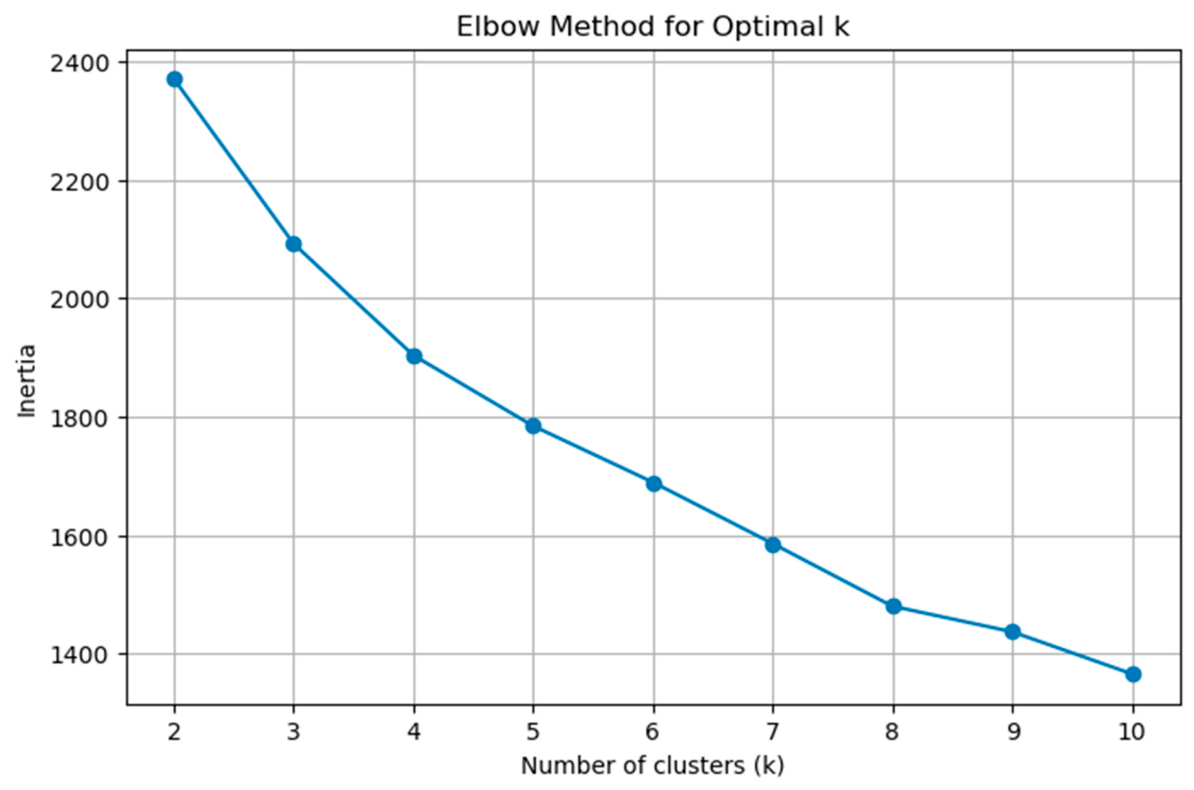
Figure 2.
Silhouette analysis showing the clustering quality for different numbers of clusters. The highest silhouette score was observed at k = 2.
Figure 2.
Silhouette analysis showing the clustering quality for different numbers of clusters. The highest silhouette score was observed at k = 2.
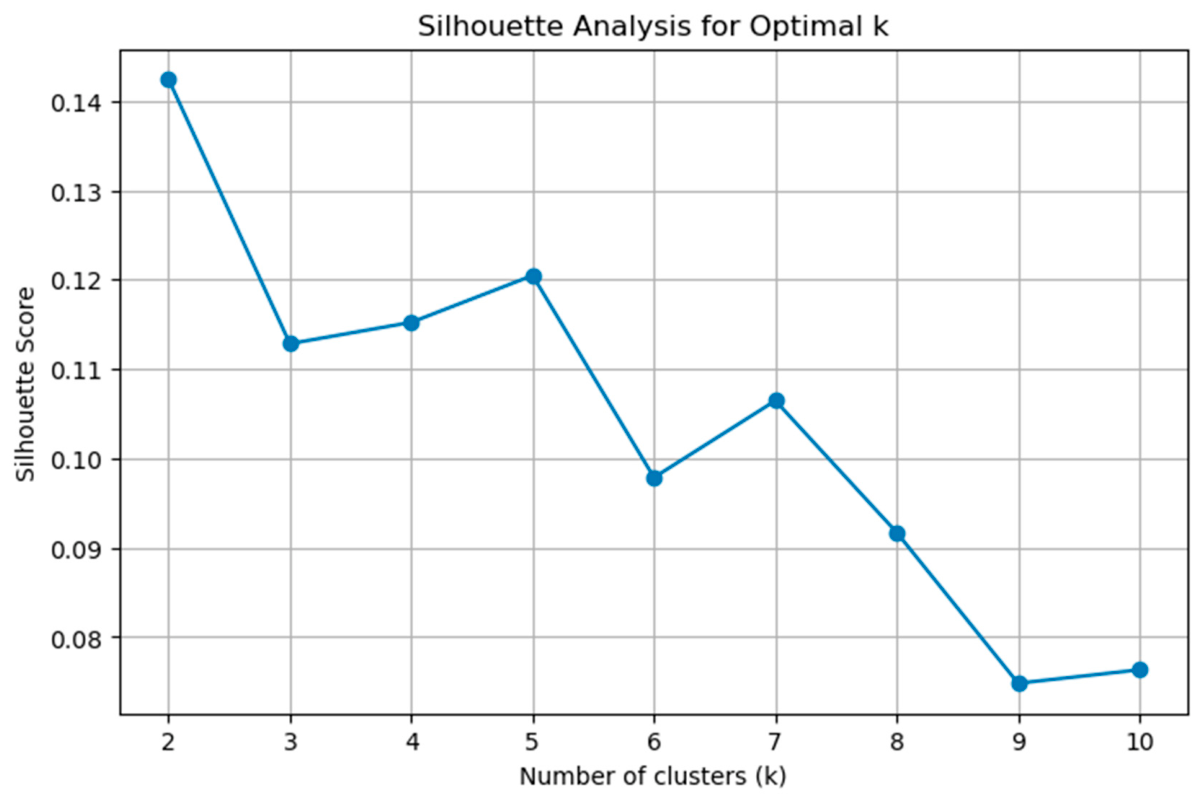
Figure 3.
Two-dimensional t-SNE visualization of quarters colored by cluster membership. Each point represents a single quarter.
Figure 3.
Two-dimensional t-SNE visualization of quarters colored by cluster membership. Each point represents a single quarter.
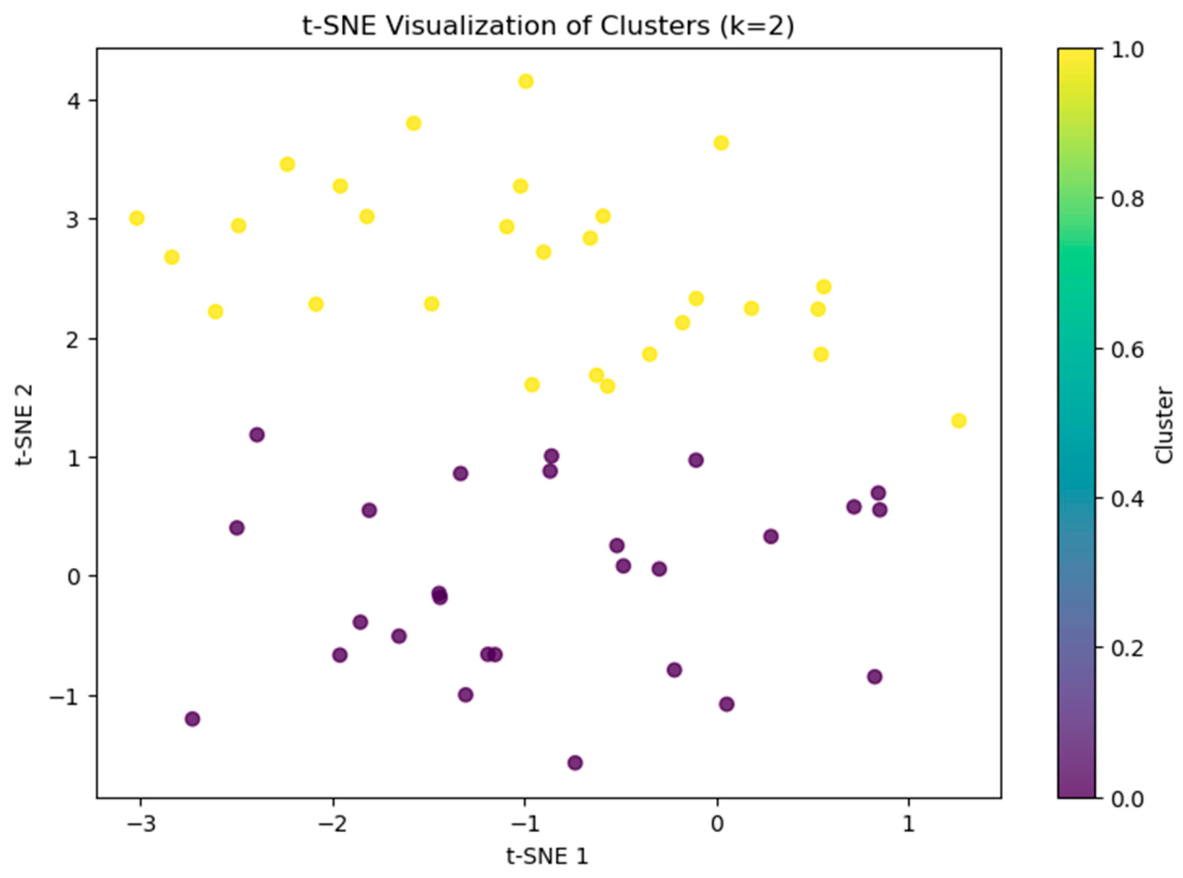
Figure 4.
Elbow method for determining the optimal number of clusters based on within-cluster inertia values.
Figure 4.
Elbow method for determining the optimal number of clusters based on within-cluster inertia values.
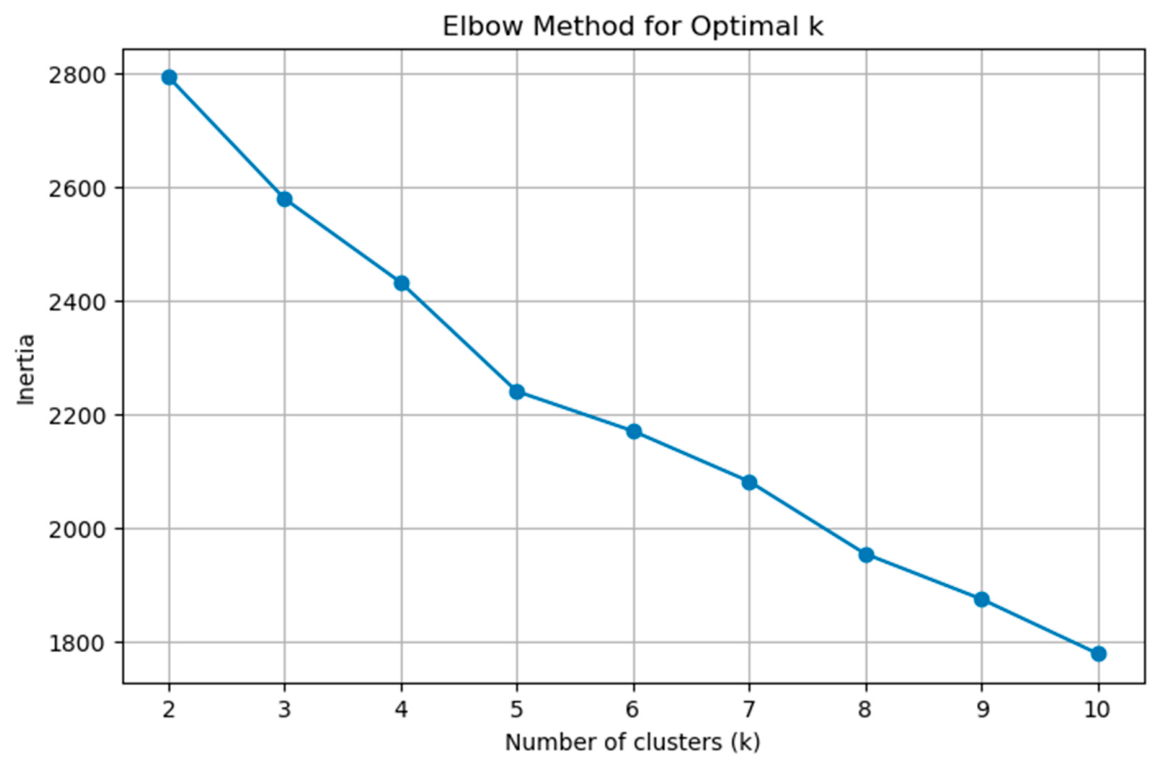
Figure 5.
Silhouette analysis showing the clustering quality for different numbers of clusters. The highest silhouette score was observed at k = 2.
Figure 5.
Silhouette analysis showing the clustering quality for different numbers of clusters. The highest silhouette score was observed at k = 2.
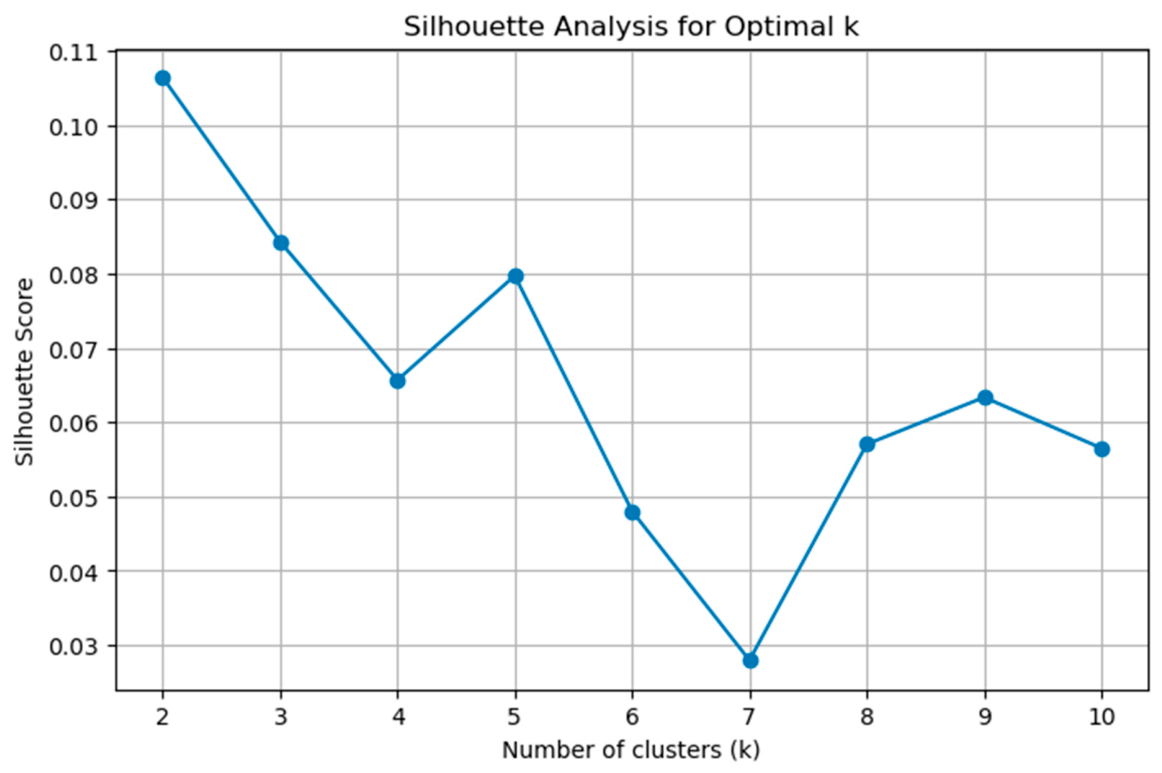
Figure 6.
Two-dimensional t-SNE visualization of quarters colored by cluster membership. Each point represents a single quarter.
Figure 6.
Two-dimensional t-SNE visualization of quarters colored by cluster membership. Each point represents a single quarter.
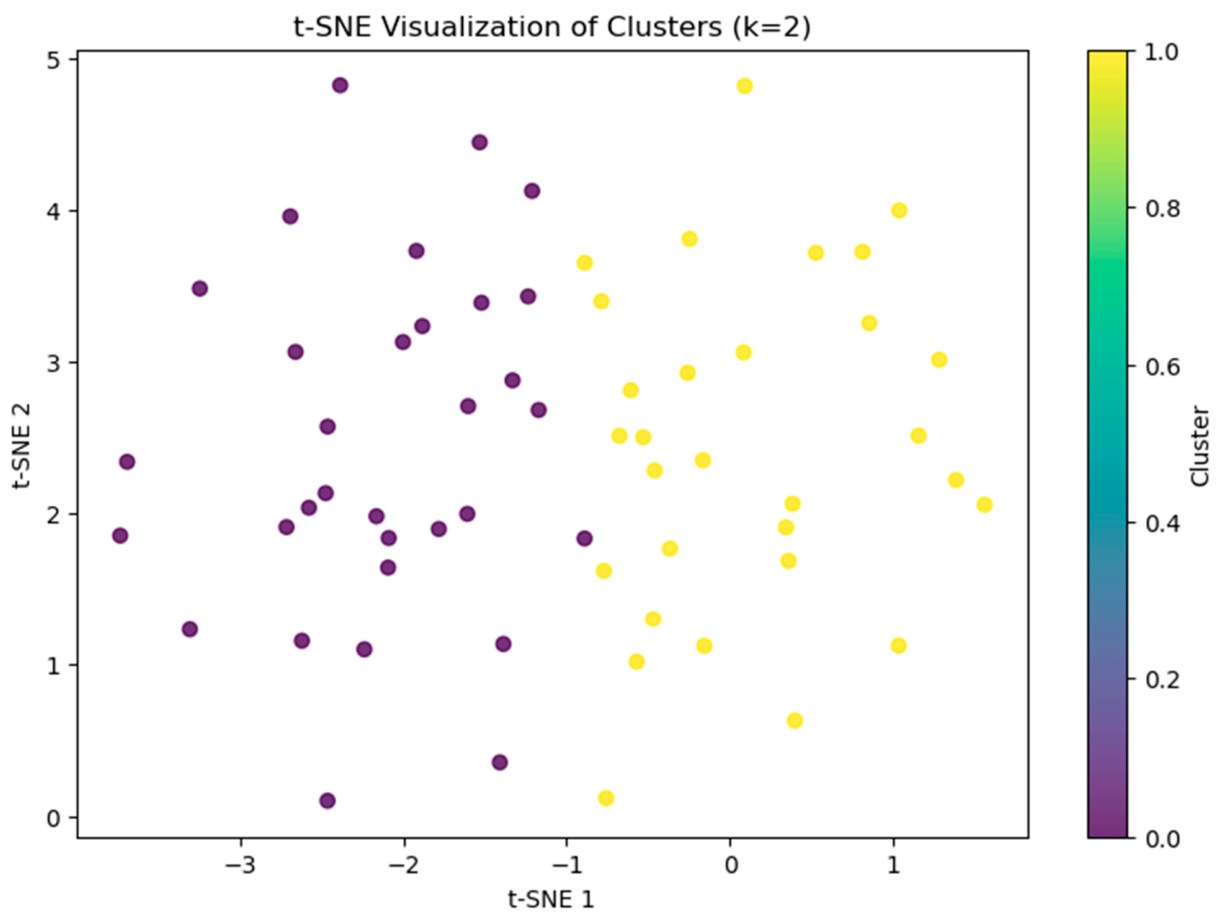
Table 1.
Descriptive statistics (mean ± SD) of external load and locomotor variables recorded during the 117 basketball game quarters.
Table 1.
Descriptive statistics (mean ± SD) of external load and locomotor variables recorded during the 117 basketball game quarters.
| Variables | Mean | SD |
| Speed (max.) (km/h) | 22.32 | 1.51 |
| Speed (Ø) (km/h) | 5.02 | 0.60 |
| Distance (m) | 7254.39 | 1242.03 |
| Distance 0-10,8 km/h | 4863.13 | 882.88 |
| Distance 10,8-18,72 km/h | 2092.44 | 507.90 |
| Distance over 18,72 km/h | 297.58 | 141.92 |
| Accumulated Acceleration Load | 1131.02 | 183.35 |
| Accumulated Acceleration Load/min | 13.08 | 1.61 |
| Jumps | 66,26 | 16,39 |
| Jumps (O30cm) | 36.20 | 10.40 |
| Jumps (U30cm) | 30.06 | 8.42 |
| Jumps/min | 0,74 | 0,18 |
| Jumps/min (O30cm) | 0.40 | 0.12 |
| Jumps/min (U30cm) | 0.34 | 0.10 |
| Distance/min (m) | 83.62 | 10.01 |
| Distance/min 0-10,8 km/h | 55.58 | 6.80 |
| Distance/min 10,8-18,72 km/h | 24.14 | 4.48 |
| Distance/min over 18,72 km/h | 3.54 | 1.76 |
Table 2.
Descriptive statistics (mean ± SD) of technical performance and game-related variables recorded during the 117 basketball game quarters.
Table 2.
Descriptive statistics (mean ± SD) of technical performance and game-related variables recorded during the 117 basketball game quarters.
| Variables | Mean | SD |
| Points | 14.98 | 5.24 |
| FT Made | 2.68 | 2.02 |
| FT Att | 4.70 | 2.78 |
| FT % | 54.95 | 28.95 |
| 2pt Made | 4.09 | 2.00 |
| 2pt Att | 9.71 | 3.33 |
| 2pt % | 43.60 | 18.57 |
| 3pt Made | 1.21 | 1.15 |
| 3pt Att | 5.32 | 2.34 |
| 3pt % | 23.04 | 21.83 |
| Fouls | 4.31 | 1.69 |
| Draw Fouls | 4.41 | 1.68 |
| Def Reb | 6.82 | 2.27 |
| Of Reb | 2.73 | 1.99 |
| Total Reb | 9.55 | 3.28 |
| Assists | 3.53 | 2.02 |
| Steals | 2.52 | 1.66 |
| Blocks | 0.90 | 1.11 |
| TO | 4.13 | 2.17 |
| PIR | 15.70 | 10.13 |
| DREB% | 0.72 | 0.16 |
| eFG% | 0.40 | 0.17 |
| AST/TO | 1.21 | 1.18 |
| OFFRTG | 81.56 | 31.92 |
| FGA | 14.95 | 3.27 |
| FGM | 5.30 | 2.23 |
| POSS | 18.42 | 2.58 |
| TO% | 0.22 | 0.11 |
| PPP | 0.82 | 0.32 |
Table 3.
Descriptive statistics (Mean ± SD) of the variables contributing most strongly to cluster separation.
Table 3.
Descriptive statistics (Mean ± SD) of the variables contributing most strongly to cluster separation.
| Variable | Cluster 0 - Higher performance | Cluster 1 - Lower performance |
| Jump Load (J) | 18282.89 ± 3765.48 | 15312.12 ± 4079.84 |
| Distance (m) | 7478.67 ± 1005.49 | 6549.54 ± 1350.84 |
| Distance 0–10.8 km/h (m) | 4898.48 ± 761.40 | 4478.32 ± 944.20 |
| Distance 10.8–18.72 km/h (m) | 2211.26 ± 358.45 | 1838.39 ± 433.09 |
| Distance >18.72 km/h (m) | 367.56 ± 143.33 | 231.89 ± 98.45 |
| Mechanical Load | 2638.64 ± 393.50 | 2388.42 ± 504.55 |
| Physio Load | 1390.83 ± 189.61 | 1204.10 ± 252.68 |
| Accumulated Acceleration Load | 1156.51 ± 154.79 | 1036.70 ± 215.50 |
| AAL+ | 825.07 ± 115.37 | 719.31 ± 153.22 |
| Offensive Rating (OFFRTG) | 119.20 ± 36.01 | 58.95 ± 21.47 |
Table 4.
Independent-samples t-test results comparing performance indicators across clusters.
| Variable | Higher performance cluster (Mean ± SD) | Lower performance cluster (Mean ± SD) | t | p | Cohen’s d |
| PIR | 28.63 ± 6.47 | 6.71 ± 7.80 | 11.36 | < .001 | 3.052 |
| Points | 21.56 ± 3.54 | 11.07 ± 3.50 | 11.04 | < .001 | 2.979 |
| Assists | 5.44 ± 1.63 | 2.11 ± 1.34 | 8.29 | < .001 | 2.243 |
| PPP | 1.19 ± 0.36 | 0.59 ± 0.21 | 7.52 | < .001 | 2.047 |
| OFFRTG | 119.20 ± 36.01 | 58.95 ± 21.47 | 7.50 | < .001 | 2.042 |
| FGM | 7.33 ± 2.59 | 3.75 ± 1.40 | 6.35 | < .001 | 1.731 |
| AST/TO | 2.23 ± 1.60 | 0.50 ± 0.35 | 5.48 | < .001 | 1.503 |
| Steals | 3.78 ± 1.74 | 1.82 ± 1.19 | 4.85 | < .001 | 1.318 |
| eFG% | 0.55 ± 0.23 | 0.31 ± 0.10 | 4.95 | < .001 | 1.352 |
| 2pt Made | 5.30 ± 2.16 | 2.89 ± 1.55 | 4.72 | < .001 | 1.282 |
| Distance >18.72 km/h | 367.56 ± 143.33 | 231.89 ± 98.45 | 4.08 | < .001 | 1.107 |
Table 5.
Distribution of match outcomes (win/loss) across clusters.
| Cluster | Loss (0) | Win (1) |
| Higher performance cluster | 33.3% | 66.7% |
| Lower performance cluster | 57.1% | 42.9% |
Table 6.
Descriptive statistics (Mean ± SD) of the variables contributing most strongly to cluster separation for quarters in matches with small score differences.
Table 6.
Descriptive statistics (Mean ± SD) of the variables contributing most strongly to cluster separation for quarters in matches with small score differences.
| Variable | Cluster 0 - Higher performance | Cluster 1 - Lower performance |
| Jump Load (J) | 19130.58 ± 3637.43 | 14728.48 ± 3068.43 |
| Distance (m) | 8363.19 ± 643.02 | 6527.70 ± 864.28 |
| Distance 0–10.8 km/h (m) | 5491.84 ± 764.80 | 4519.83 ± 683.73 |
| Distance 10.8–18.72 km/h (m) | 2492.38 ± 559.71 | 1796.03 ± 270.58 |
| Distance >18.72 km/h (m) | 377.53 ± 136.77 | 210.63 ± 101.11 |
| Mechanical Load | 3029.18 ± 254.72 | 2384.45 ± 303.01 |
| Physio Load | 1559.48 ± 154.92 | 1207.78 ± 164.24 |
| Accumulated Acceleration Load | 1285.52 ± 78.97 | 1031.32 ± 135.73 |
| AAL+ | 885.97 ± 57.59 | 709.13 ± 98.88 |
| Mechanical Intensity | 252.06 ± 40.10 | 228.50 ± 41.13 |
Disclaimer/Publisher’s Note: The statements, opinions and data contained in all publications are solely those of the individual author(s) and contributor(s) and not of MDPI and/or the editor(s). MDPI and/or the editor(s) disclaim responsibility for any injury to people or property resulting from any ideas, methods, instructions or products referred to in the content. |
© 2026 by the authors. Licensee MDPI, Basel, Switzerland. This article is an open access article distributed under the terms and conditions of the Creative Commons Attribution (CC BY) license (http://creativecommons.org/licenses/by/4.0/).
Copyright: This open access article is published under a Creative Commons CC BY 4.0 license, which permit the free download, distribution, and reuse, provided that the author and preprint are cited in any reuse.


