

Submitted:
10 June 2026
Posted:
10 June 2026
You are already at the latest version
Abstract
This paper develops a new generalized model that describes the complex dynamical behavior of a financial system through three state variables, namely the interest rate, investment demand and the price index. The developed model extends and improves numerous financial models available in the literature by incorporating two time delays. The first delay accounts for the time lag in price adjustment, whereas the second captures the delayed feedback effect on investment demand. For the first time in the context of financial systems, a novel threshold parameter is introduced to characterize the existence of equilibria. The dynamical properties of the proposed model, including the stability and the occurrence of Hopf bifurcation, are rigorously analyzed. Furthermore, sensitivity analysis and numerical simulations are conducted to investigate the influence of model parameters on the dynamics of the financial system and to illustrate the analytical results.
Keywords:
complexity
; financial system
; mathematical modeling
; stability
; Hopf bifurcation
; sensitivity analysis
1. Introduction
Complexity has become a fundamental concept in various disciplines, providing a robust framework for understanding systems composed of a large number of interacting elements whose collective behavior leads to emerging phenomena that cannot be fully explained by the properties of individual components alone. In physics, complexity is associated with nonlinear interactions, self-organization and emerging phenomena observed in systems like turbulent fluids, climate dynamics and complex networks [1,2,3]. In biology, complexity refers to the nonlinear interactions among interconnected components across multiple levels of intricate organization, from genes to ecosystems. Biological phenomena such as morphogenesis, immune responses, ecological dynamics, and evolution emerge from these interactions across different spatial and temporal scales [4]. In sociology, complexity is viewed as a mode of thinking that aims to understand reality through the interconnectedness, integration and recurring interactions of its components. According to Morin [5,6], social phenomena cannot be adequately explained by reductionist and fragmented approaches; rather, they must be analyzed as interconnected systems in which order and disorder, organization and uncertainty, and emergent properties coexist. His theory of complex thought emphasizes the need to connect disciplines and integrate multiple perspectives to understand the multidimensional nature of human and social reality.
In the context of economics, the proliferation of hyperconnected societies, together with the intricate and multilayered interdependencies among diverse economic agents, contributes to a significant increase in complexity. In [7], Rosser examined the concept of complexity in economics and distinguished several forms of complexity, including computational complexity, which relates to the difficulty of solving certain economic problems; dynamic complexity, which arises from nonlinear and sometimes chaotic behavior of economic systems; and hierarchical complexity, which results from the organization of economic phenomena at different interconnected levels. Building on this perspective, Arthur [8] proposed a conceptual framework for complexity economics, which is based on the proposition that the economy is not necessarily in equilibrium. Instead, economic agents (firms, consumers and investors) continually modify their actions and strategies according to the results of their collective interactions. Furthermore, the complexity in economics can be viewed as complex system composed of heterogeneous agents whose interactions lead to the emergence of macroeconomic phenomena such as business cycles and financial crises. This is fully consistent with the principles of complexity in diverse disciplines of science, including emergence, adaptation, feedback and nonlinearity interactions.
A financial system is composed of numerous interconnected elements and influenced by a variety of economic factors, including interest rates, investment demand and price indices. Due to its complex and nonlinear dynamics, a wide range of mathematical models has been proposed to understand and analyze the behavior of financial systems. In 1993, Huang and Li [9] proposed a financial model to describe the interactions between interest rate, investment demand, and price index. A simplified version this model was rigorously studied in 2001 by Ma and Chen [10,11]. Inspired by the idea of the chaotic Lorenz model [12], Liping et al. [13] formulated a new financial chaotic model. Further, they extended this model into fractional and stochastic versions using the Atangana-Baleanu (AB) fractional derivative. More recently, the modeling of the dynamics of nonlinear financial systems through the Hattaf fractional derivative, which generalizes the AB fractional derivative and others, has been fully studied in [14].
Delay differential equations (DDEs) are a generalization of ordinary differential equations (ODEs) and constitute a powerful mathematical tool for modeling the time delays that naturally occur between actions and responses, which arise in numerous processes across many disciplines. For instance, DDEs have been used in virology to model several time delays such as the time needed for infected cells to produce new virions after viral entry and the time necessary for the newly produced virions to become mature and infectious [15], as well as the immunological delay that refers to the time needed for immune response to recognize a viral antigen and become activated [16]. In epidemiology, DDEs permit to model the incubation period [17]. In macroeconomics, Kalecki [18] introduced the idea that there is a time delay between the decision of investment and its implementation. In 1999, Krawiec and Szydlowski [19] incorporated the idea of Kalecki into Kaldor model [20]. In 2017, Hattaf et al. [21] introduced a second time delay needed for the investment to be productive.
In the field of financial systems, Gao and Ma [22] incorporated a delayed feedback term into the second equation of the simplified financial model of Ma and Chen [10,11]. They investigated the impact of the delay on the financial system by considering it as a bifurcation parameter, and they proved that when this delay exceeds certain critical values, the equilibrium loses its stability and a Hopf bifurcation occurs. In 2019, Zhang and Zhu [23] pointed out that changes in prices do not immediately influence interest rates and that a time lag is often present in this relationship. Consequently, they introduced a time delay into the first equation of the simplified financial model of Ma and Chen in order to account for this price change delay. Additionally, a recent study on government debt and delayed feedback on the investment demand was investigated in 2026 by Phukan et al. [24].
The present study adopts an interdisciplinary approach and aims to understand and describe the complex dynamics of financial systems by developing a general model that encompasses all the previously mentioned financial models, both with and without delays. To this end, the organisation of the remainder of this paper is outlined as follows. The next section presents the new generalized financial model and its particular cases. Section 3 analyzes the dynamical behavior of the model. Finally, the last section is devoted to sensitivity analysis and numerical simulations.
2. New Generalized Financial Model and Its Special Cases
This section begins by developing a new generalized financial model that describes the interactions among various financial factors. It subsequently presents several particular cases of this model that have been introduced in previous studies.
The developed model is formulated by a nonlinear system of DDEs as follows:
where , and are the interest rate, the investment demand and the price index at time t, respectively. The parameters , and describe respectively the total saving amount, the cost per investment and the elasticity of the demand of the commercial markets. The interest rate increases at a rate of due to an increase in the price index, while denotes the natural growth rate of investment. In other words, captures the responsiveness of the interest rate to inflation and is interpreted as the rate of return on investment. The parameter represents the elasticity of investment, indicating that economic expansion and rising production costs prompt firms to raise prices, thereby increasing the rate of change of the price index. In addition, we assume that investment demand is negatively correlated with the square of the interest rate, represented by the term . This assumption models the idea that investment is highly sensitive to high interest rates, as well as the quadratic term emphasizes that the effect accelerates as rates increase. Furthermore, an increase in interest rates leads to a decrease in the price index at a rate of . This reflects that higher interest rates increase borrowing costs for firms and households, reducing spending and investment, which lowers overall demand for goods and services and puts downward pressure on prices. Finally, denotes the amount of debt borrowed from national or international institutions, represents the delay in price adjustment, and denotes the time lag in investment demand with feedback factor .
It is important to note that our financial model described by system (1) generalizes and improves various financial models existing in the literature. For example,
- When , , , , , and , we get the chaotic model in finance presented by Liping et al. [13].
- When , , , , , and , we obtain the delayed finance model of Zhang and Zhu [23].
- When , , , , , and ,, we get the financial model of Gao and Ma [22].
- When , , , , and , we obtain the recent financial model of Phukan et al. [24].
3. Dynamical Behavior of the New Financial Model
This section analyzes the dynamical behavior of our model by establishing the local stability of equilibria and the existence of Hopf bifurcation.
3.1. Equilibria
Now, we discuss the equilibria of our model by resolving the following system of algebraic equations:
From (2) and (4), we have
where and .
- If , then and . Hence, model (1) has an equilibrium point of the form .
-
If , then provided that . According to (3), we have
Therefore, we have the following result.
Theorem 3.1.
Assume that .
Remark 3.2.
Theorem 3.1 generalizes and extends the recent results presented in Propositions 1 and 2 of [24]. Indeed, these propositions are obtained as a special case by choosing and .
In the following, we assume that . This assumption means that the level of indebtedness is relatively low compared to two fundamental economic forces that are saving and demand elasticity. In practical terms, this indicates that the economy generates sufficient savings to sustain its activity and limit reliance on debt, while demand remains sufficiently elastic to adjust efficiently to changes in prices or output. Consequently, debt does not constitute a binding constraint in the system, as it is dominated both by internal financing capacity and by the flexibility of demand behavior. On the other hand, it follows from that and . Hence, we introduce the following threshold parameter given by
Based on Theorem 3.1, we get the following result.
3.2. Stability Analysis and Hopf Bifurcation
Obviously, the characteristic equation at () of model (1) is given by
Here, we investigate only the stability of , as the other equilibria can be analyzed similarly.
Lemma 3.4.
If , then the equilibrium is unstable for all .
Proof.
Let . We have and . By the intermediate value theorem, there exists a such that . Consequently, (7) admits at least one positive eigenvalue, implying that is unstable when . ■
The case . When , then (7) becomes
Hence, the roots of (8) are: , and are determined by
Since , we deduce that all roots of (9) have negative real parts if and only if
Therefore, we have the following result.
Lemma 3.5.
If and () holds, then the equilibrium is locally asymptotically stable for .
Remark 3.6.
The case and . Under this case, (7) can be written in the following form
It obvious that or
Let () be a root of (11). Hence,
which leads to
Let . Then (13) becomes
Since and for , we easily get the following result.
Lemma 3.7.
Assume that .
- (i)
- If , then (13) has no positive root.
- (ii)
- If , then (13) has a unique positive root given by
According to Lemmas 3.5 and 3.7, we obtain the following theorem.
Theorem 3.8.
Assume that and () holds. For , we have
- (i)
- If , then the equilibrium is locally asymptotically stable for all .
- (ii)
- If , then system (1) undergoes a Hopf bifurcation at when , . Moreover, the equilibrium is locally asymptotically stable for and unstable for , where
Proof.
The first result is evident and follows directly from Lemma 3.5 and part of Lemma 3.7.
On the other hand, it follows from of Lemma 3.7 that (13) has a unique positive root . From (12), we have
for . Hence, is a pair of purely imaginary roots of (11) with . So, let be the root of (11) with and . Differentiating both sides of (11) with respect to yields
which implies that
Hence,
Thus, the transversality condition is satisfied. It follows from the Hopf bifurcation theorem [26] that system (1) undergoes a Hopf bifurcation at when , . Moreover, by Lemma 3.5, the equilibrium is locally asymptotically stable when . Consequently, all roots of the characteristic equation (11) have negative real parts at . Since is the smallest value among the critical delays for which the roots of (11) become purely imaginary, it follows that remains locally asymptotically stable for and becomes unstable for . This completes the proof. ■
Remark 3.9.
Theorem 3.8 extends the results presented in Theorems 1 and 2 of [23].
The case and . In this case, we consider (7) with and in the stable regions. Regards as a parameter of bifurcation.
Since is considered in the stable regions, it suffices to investigate the stability analysis of the first characteristic factor of (7) given as follows:
Let () be a root of (16). Then
which implies that
- If , then (18) has no positive root.
- If , then (18) has a unique positive root given by
By (17), we get
for . So, is a pair of purely imaginary roots of (16) with . In addition, it follows from (16) that
Then
Thus,
which shows that the transversality condition holds. Hence, system (1) undergoes a Hopf bifurcation at the equilibrium point when , .
Based on the preceding analysis, we facilely obtain the following results.
Theorem 3.10.
Let in the stable regions. For , we have
- (i)
- If , then the equilibrium is locally asymptotically stable for all .
- (ii)
- If , then system (1) undergoes a Hopf bifurcation at when , . Additionally, the equilibrium is locally asymptotically stable when and becomes unstable when .
4. Sensitivity Analysis and Numerical Analysis
This section deals with sensitivity analysis and numerical simulations.
Sensitivity analysis helps to study how variations in model parameters influence the dynamics of a financial system. Since the value of the threshold parameter determines the stability of the trivial equilibrium, we compute the sensitivity index of with respect to each parameter p as follows:
Based on the explicit formula of established in (5), we have
Figure 1 presents the sensitivity indices associated with . It is known that positive sensitivity indices indicate that an increase in the corresponding parameter leads to an increase in , whereas negative indices indicate that increasing the parameter reduces . As shown in Table 1, the parameters , , and exert the greatest influence on the dynamics of the financial system. Specifically, increasing any of these parameters results in an increase in the threshold quantity . Conversely, increasing the values of , , , and leads to a decrease in .
To illustrate our analytical results, we use the values of the parameters presented in Table 1 with and . By a simple computation, the threshold parameter is equal to . It follows from Corollary 3.3 that model (1) has a unique equilibrium . Further, we have . Hence, the hypothesis () is satisfied. According to Lemma 3.5, the equilibrium is locally asymptotically stable when . We now investigate the dynamical behavior of model (1) for various values of the two time delays and . The presence of these delays can substantially influence the stability of the equilibrium and may generate complex dynamics, including oscillatory solutions and bifurcation phenomena. By varying and , we analyze how the delays affect the qualitative behavior of the system and determine the critical conditions under which stability changes occur.
For , all the assumptions of Theorem 3.8 (ii) are fulfilled. Therefore, system (1) undergoes a Hopf bifurcation at the equilibrium when the first delay reaches the critical value . Moreover, the equilibrium is locally asymptotically stable for , while it becomes unstable for . These dynamical behaviors are illustrated in Figure 2, Figure 3 and Figure 4.
Next, fixing in the stable region and choosing , we obtain the second critical delay value . Furthermore, since , Theorem 3.10 (ii) implies that system (1) undergoes a Hopf bifurcation at the equilibrium when . In addition, the equilibrium remains locally asymptotically stable for and loses its stability for . These results are illustrated in Figure 5, Figure 6 and Figure 7.
Funding
This research received no external funding.
Data Availability Statement
There is no data associated to this paper.
Conflicts of Interest
The authors declare no conflicts of interest.
References
- Anderson, P. W. More is different: broken symmetry and the nature of the hierarchical structure of science. Science 1972, 177(4047), 393–396. [Google Scholar] [CrossRef] [PubMed]
- Brereton, M. Synergetics: An introduction-nonequilibrium phase transitions and self-organisation in physics, chemistry and biology. Phys. Bull. 1978, 29(4), 181–181. [Google Scholar] [CrossRef]
- P. Bak, How NatureWorks: the science of self-organized criticality, Copernicus, 1996.
- S. A. Kauffman, The origins of order: Self-organization and selection in evolution, Spin glasses and biology (1992) 61-100.
- Morin, E. On Complexity; Hampton Press, 2008. [Google Scholar]
- Morin, E. Introduction à la pensée complexe, Paris, Du Seuil, 1990.
- Rosser, J. B. On the complexities of complex economic dynamics. J. Econ. Perspect. 1999, 13(4), 169–192. [Google Scholar] [CrossRef]
- W. B. Arthur, Complexity economics: a different framework for economic thought, Complexity and the Economy, Oxford University Press, 2015.
- Huang, D.S.; Li, H.Q. Theory and method of the nonlinear economics publishing; House of Sichuan University: Chengdu, 1993. [Google Scholar]
- Ma, J.; Chen, Y. Study for the bifurcation topological structure and the global complicated character of a kind of nonlinear finance system (I). Appl. Math. Mech. 2001, 22, 1240–1251. [Google Scholar] [CrossRef]
- Ma, J.; Chen, Y. Study for the bifurcation topological structure and the global complicated character of a kind of nonlinear finance system (II). Appl. Math. Mech. 2001, 22, 1375–1382. [Google Scholar] [CrossRef]
- Lorenz, E. N. Deterministic nonperiodic flow. J. Atmos. Sci. 1963, 20(2), 130–141. [Google Scholar] [CrossRef]
- Liping, C.; Khan, M. A.; Atangana, A.; Kumar, S. A new financial chaotic model in Atangana-Baleanu stochastic fractional differential equations. Alex. Eng. J. 2021, 60, 5193–5204. [Google Scholar] [CrossRef]
- Toufiq, K.; Lasfar, S.; Hattaf, K.; Adnaoui, K. Mathematical modeling and analysis of the dynamics of a nonlinear finance system via Hattaf fractional derivative and fixed point theory. Adv. Fixed Point Theory 2026, 16(5), 1–19. [Google Scholar] [CrossRef]
- Hattaf, K.; Yousfi, N. A class of delayed viral infection models with general incidence rate and adaptive immune response. Int. J. Dyn. Control 2016, 4(3), 254–265. [Google Scholar] [CrossRef]
- Hattaf, K. Global stability and Hopf bifurcation of a generalized viral infection model with multi-delays and humoral immunity. Phys. A Stat. Mech. Its Appl. 2020, 545, 123689. [Google Scholar] [CrossRef]
- Hattaf, K.; Lashari, A.; Louartassi, Y.; Yousfi, N. A delayed SIR epidemic model with a general incidence rate. Electron. J. Qual. Theory Differ. Equ. 2013, (3), 1–9. [Google Scholar] [CrossRef]
- Kalecki, M. A macrodynamic theory of business cycles. Econometrica 1935, 3, 327–344. [Google Scholar] [CrossRef]
- Krawiec, A.; Szydlowski, M. The Kaldor-Kalecki business cycle model. Ann. Oper. Res. 1999, 89, 89–100. [Google Scholar] [CrossRef]
- Kaldor, N. A model of the trade cycle. Econ. J. 1940, 50(197), 78–92. [Google Scholar] [CrossRef]
- Hattaf, K.; Riad, D.; Yousfi, N. A generalized business cycle model with delays in gross product and capital stock. Chaos Solitons Fractals 2016, 85, 110–119. [Google Scholar] [CrossRef]
- Gao, Q.; Ma, J. Chaos and Hopf bifurcation of a finance system. Nonlinear Dyn. 2009, 58, 209–216. [Google Scholar] [CrossRef]
- X. Zhang, H. Zhu, Hopf bifurcation and chaos of a delayed finance system, Complexity (2019) 1–18.
- Phukan, A.; Dehingia, K.; Sarmah, H. K.; Borah, L. Dynamical analysis of a time-delayed financial system with synchronization strategies. Sci. Prog. 2026, 109(1), 1–42. [Google Scholar] [CrossRef] [PubMed]
- Zhou, L.; Li, Y. A dynamic IS-LM business cycle model with two delays in capital accumulation equation. J. Comput. Appl. Math. 2009, 228, 182–187. [Google Scholar] [CrossRef]
- Hale, J. Theory of Functional Differential Equations; Springer: New York, 1977. [Google Scholar]
- Son, W. S.; Park, Y. J. Delayed feedback on the dynamical model of a financial system. Chaos Solitons Fractals 2011, 44, 208–217. [Google Scholar] [CrossRef]
Figure 1.
Sensitivity indices diagram for .
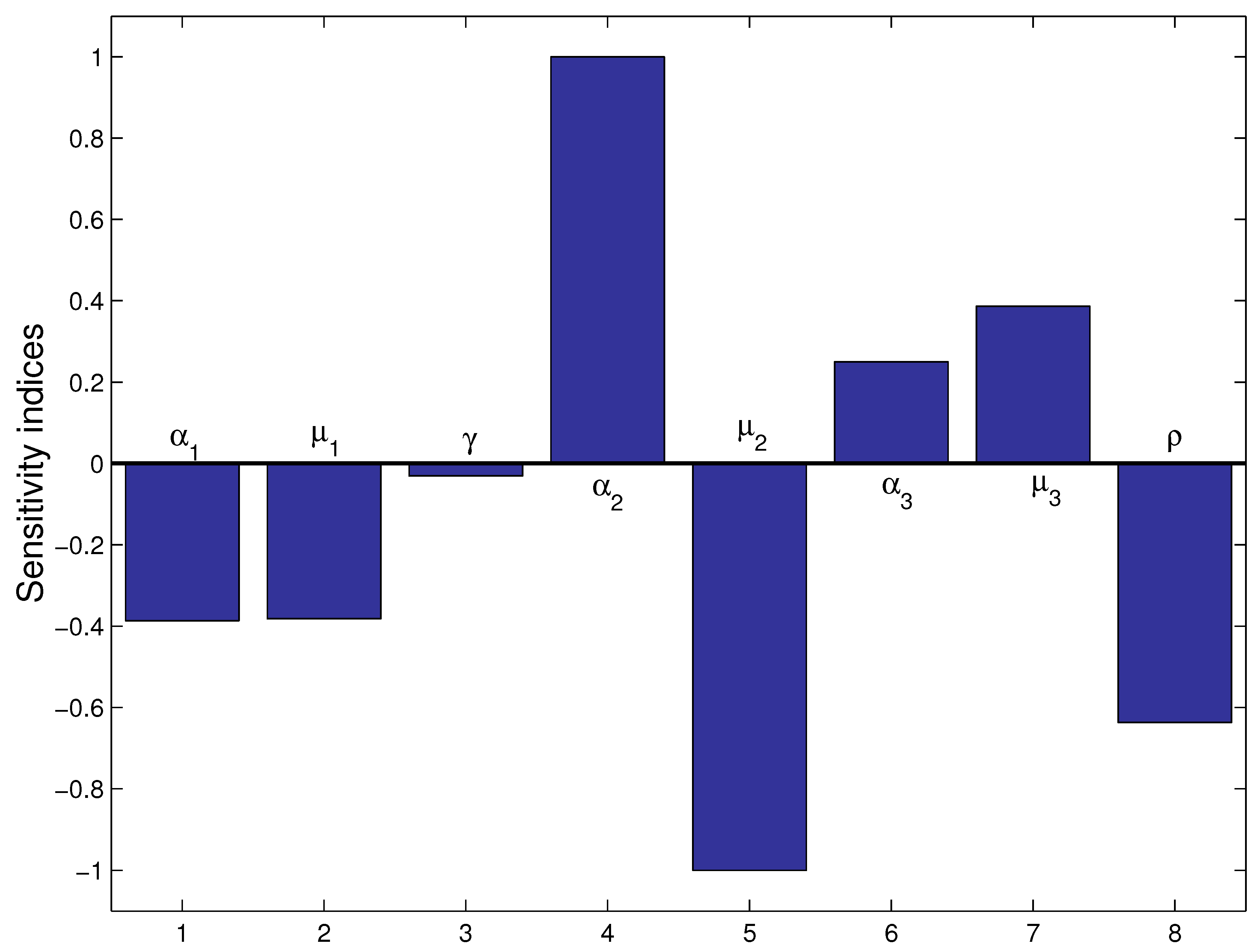
Figure 2.
Dynamics of model (1) for and .
Figure 2.
Dynamics of model (1) for and .
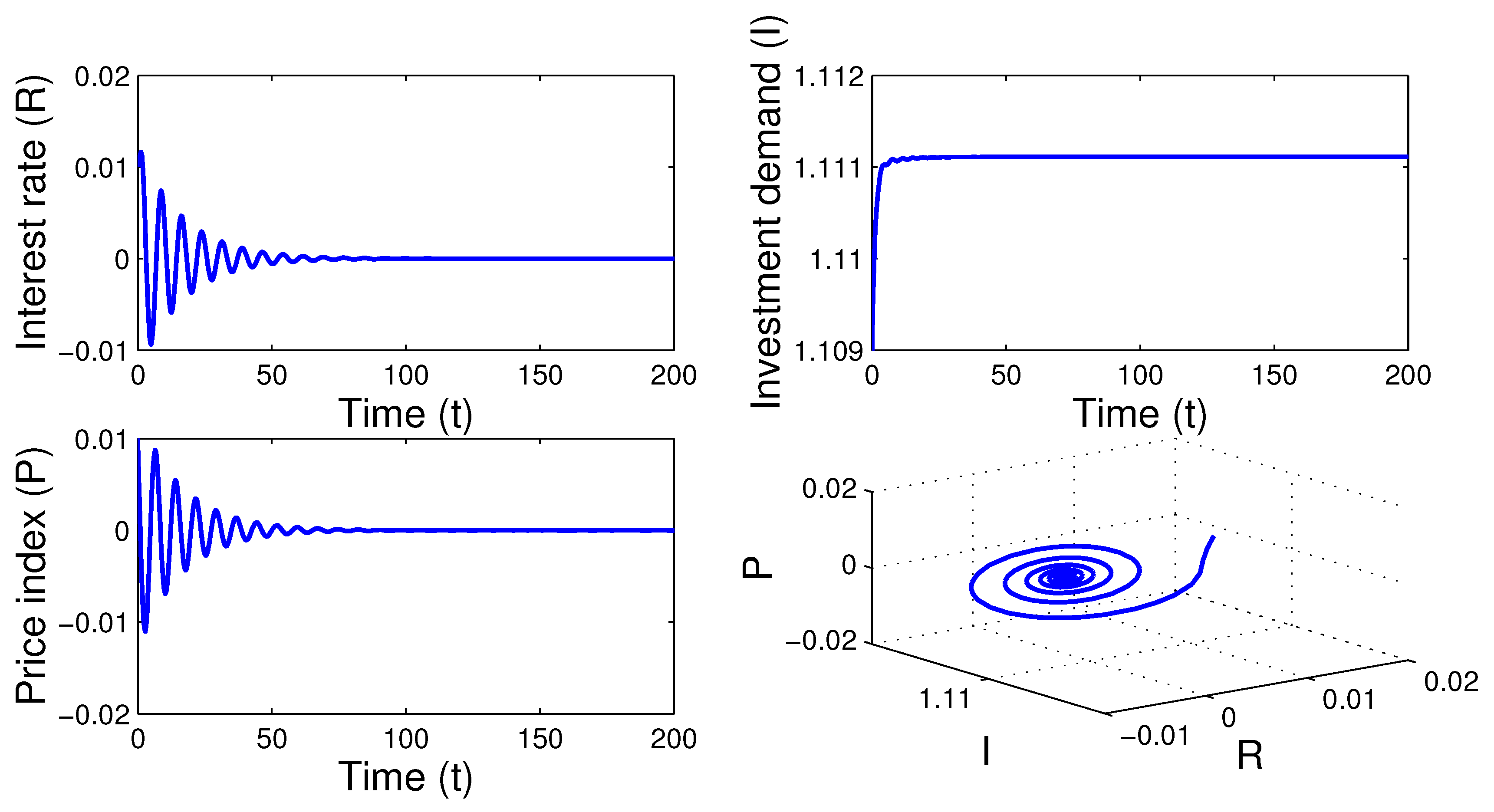
Figure 3.
Dynamics of model (1) for and .
Figure 3.
Dynamics of model (1) for and .
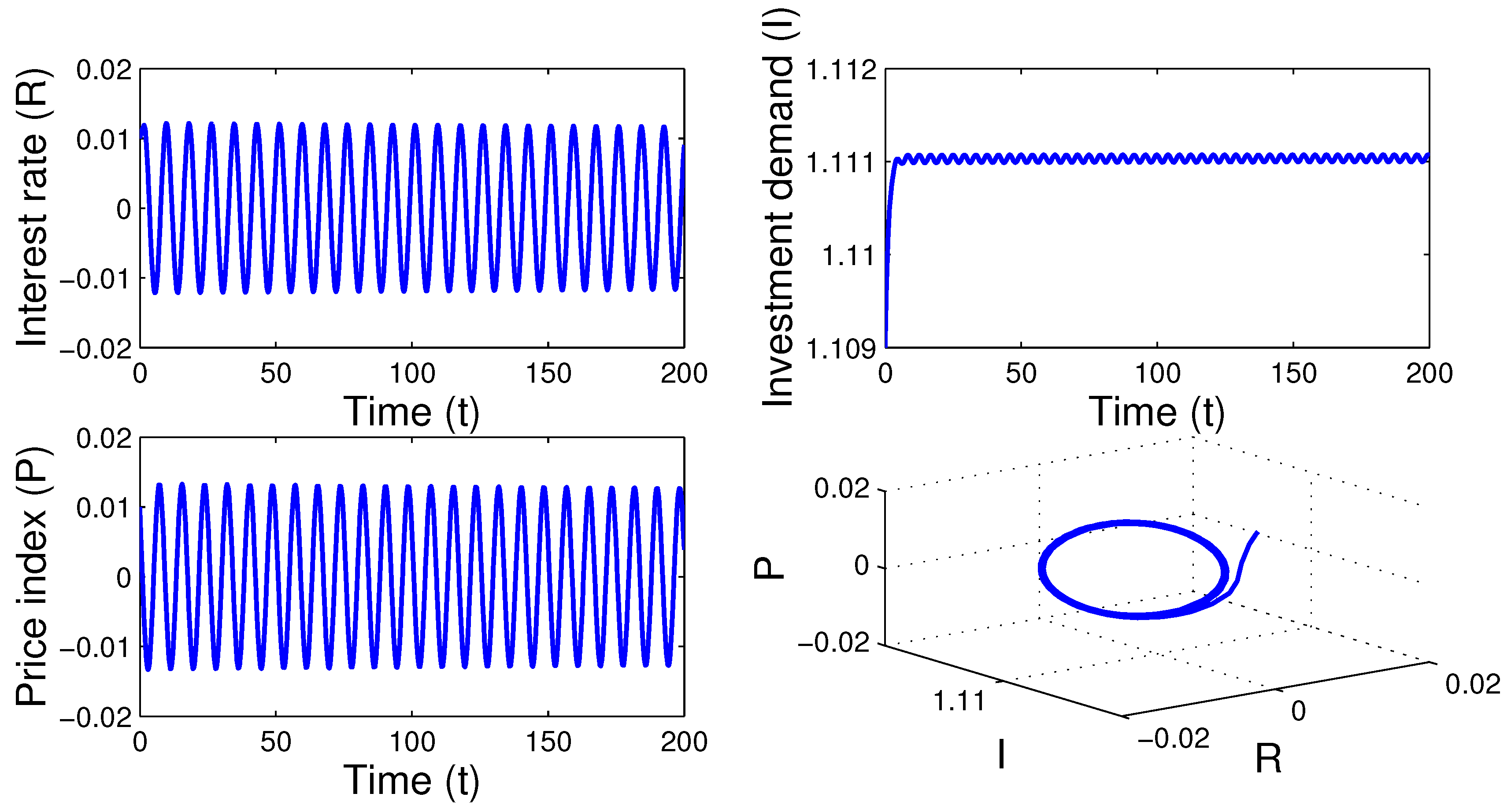
Figure 4.
Dynamics of model (1) for and .
Figure 4.
Dynamics of model (1) for and .
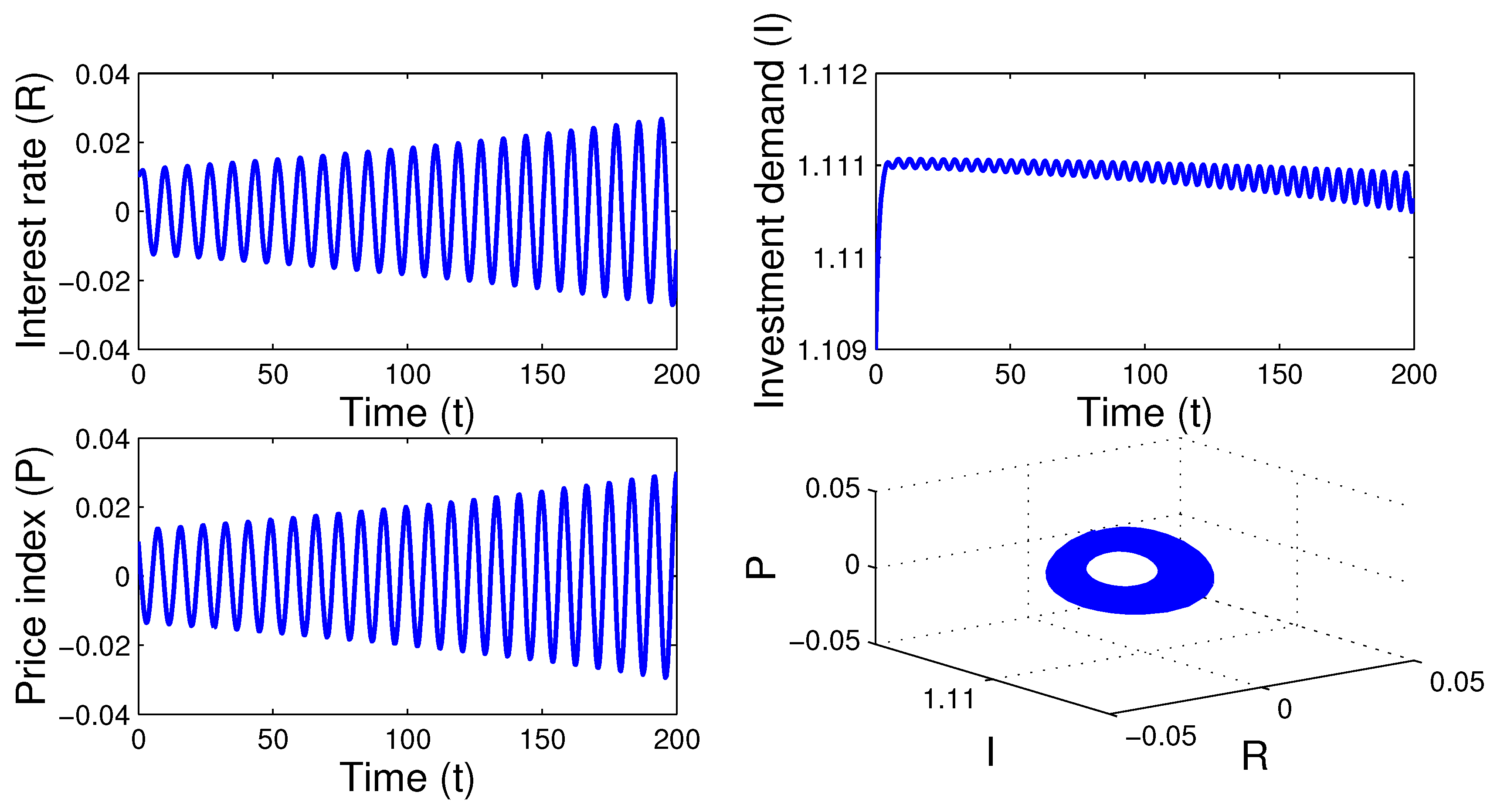
Figure 5.
Dynamics of model (1) for and .
Figure 5.
Dynamics of model (1) for and .
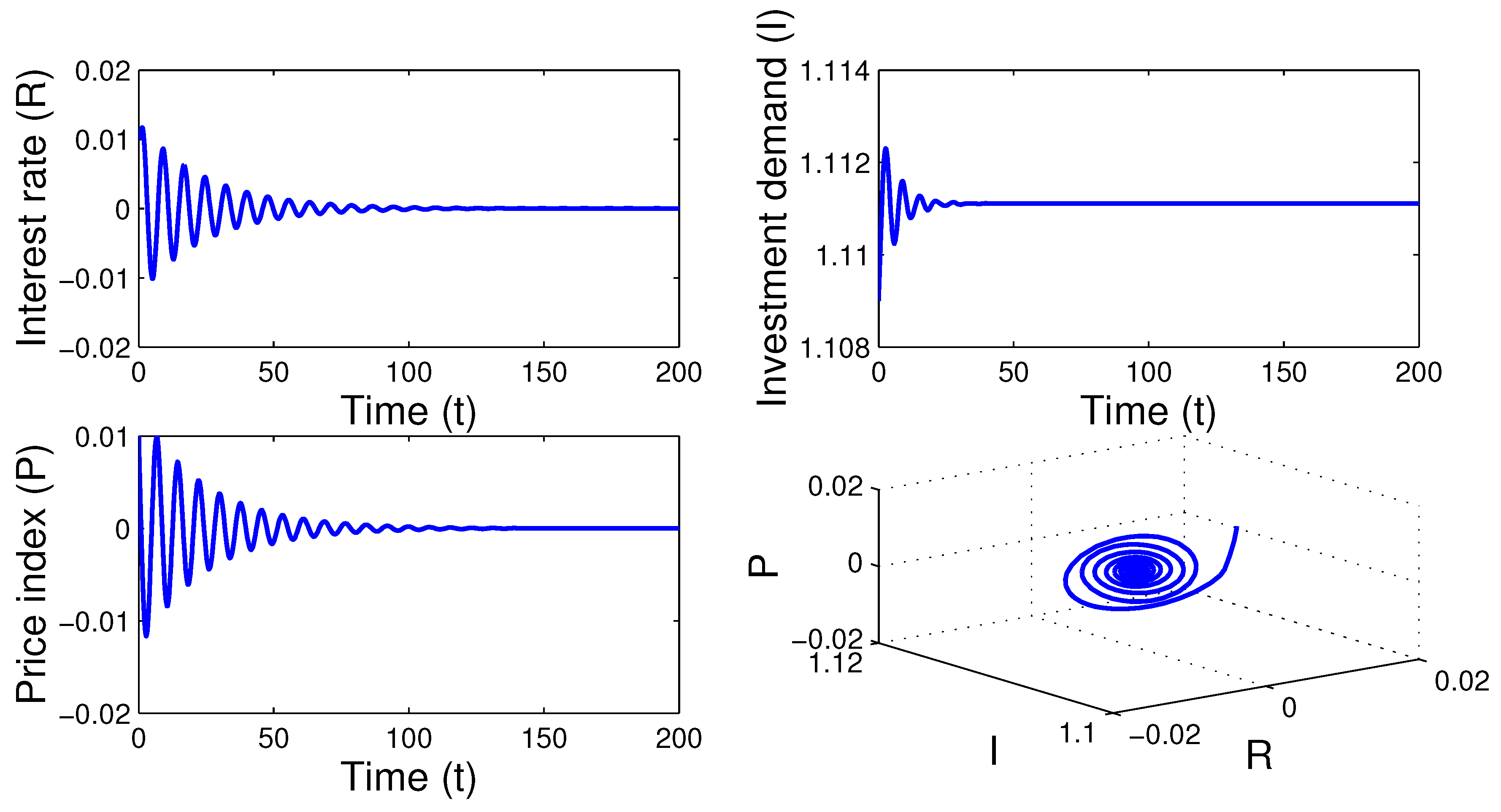
Figure 6.
Dynamics of model (1) for and .
Figure 6.
Dynamics of model (1) for and .
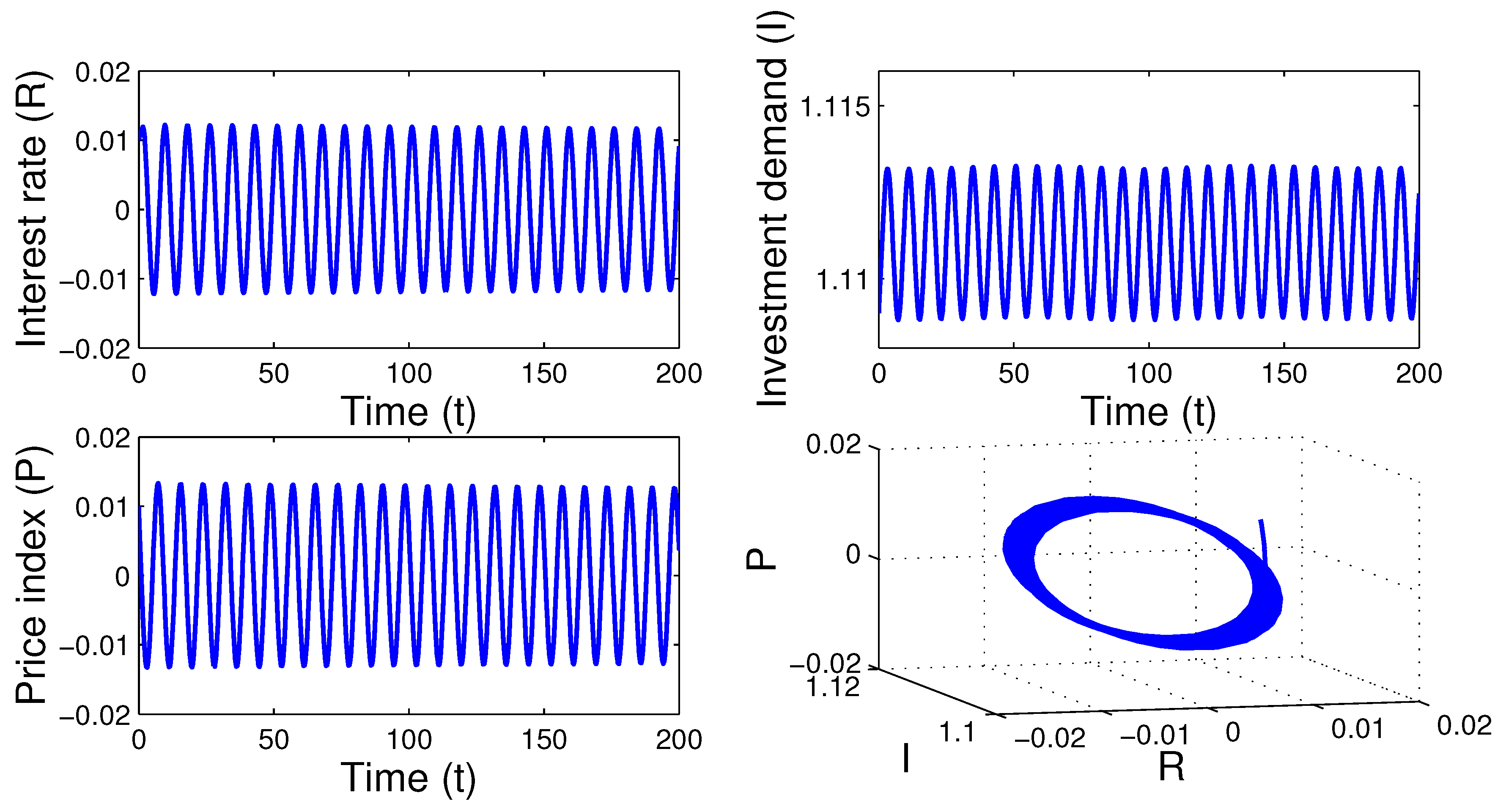
Figure 7.
Dynamics of model (1) for and .
Figure 7.
Dynamics of model (1) for and .
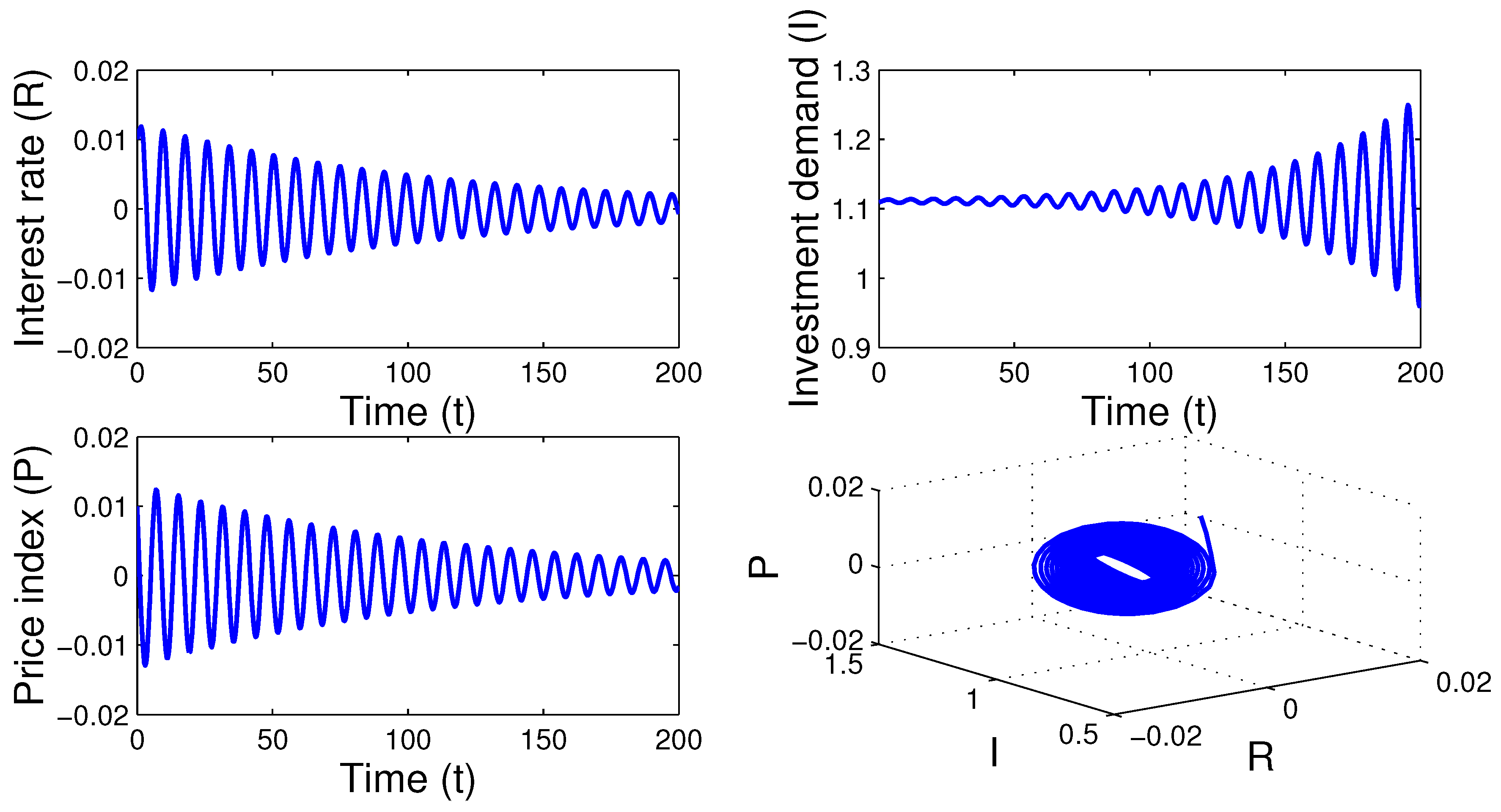

Table 1.
Sensitivity of with respect to the parameters.
| Parameter | Value | Sensitivity Index |
|---|---|---|
| 1 | -0.3869 | |
| 2 | -0.3822 | |
| 0.1 | -0.0306 | |
| 1 | 1 | |
| 0.9 | -1 | |
| 0.1 | 0.25 | |
| 0.4 | 0.3869 | |
| 1 | -0.6369 |
Disclaimer/Publisher’s Note: The statements, opinions and data contained in all publications are solely those of the individual author(s) and contributor(s) and not of MDPI and/or the editor(s). MDPI and/or the editor(s) disclaim responsibility for any injury to people or property resulting from any ideas, methods, instructions or products referred to in the content. |
© 2026 by the authors. Licensee MDPI, Basel, Switzerland. This article is an open access article distributed under the terms and conditions of the Creative Commons Attribution (CC BY) license (http://creativecommons.org/licenses/by/4.0/).
Copyright: This open access article is published under a Creative Commons CC BY 4.0 license, which permit the free download, distribution, and reuse, provided that the author and preprint are cited in any reuse.


