

Submitted:
09 June 2026
Posted:
11 June 2026
You are already at the latest version
Abstract
Digital transformation is reshaping industries, business models, and investment opportunities, creating new challenges for international portfolio management. The European communication services sector has become a strategic component of the digital economy, driven by advances in artificial intelligence (AI), digital platforms, 5G infrastructure, cloud computing, cybersecurity, and data-driven business models. Despite its importance, limited evidence exists regarding the effectiveness of portfolio optimisation strategies within digitally transforming sectors. This study investigates international portfolio optimisation using constituent firms of the MSCI Europe Communication Services 35/20 Capped Index. Drawing upon Modern Portfolio Theory and the Treynor–Black framework, an actively managed portfolio is constructed and evaluated against the SPDR® MSCI Europe Communication Services UCITS ETF and an equal-weight portfolio. Using daily market data, the analysis estimates asset returns, alpha and beta coefficients, portfolio weights, and risk-adjusted performance measures, including the Sharpe and Treynor ratios. Independent-samples t-tests are employed to assess the statistical significance of performance differences among investment strategies. The findings show that the Treynor–Black portfolio generated the highest annual return (23.2%), outperforming both the benchmark and equal-weight portfolios. However, the equal-weight portfolio achieved superior risk-adjusted performance, recording higher Sharpe and Treynor ratios, suggesting that diversification benefits outweighed the advantages of active security selection. Hypothesis testing indicates no statistically significant difference between the Treynor–Black and equal-weight portfolios, whereas a statistically significant difference exists between the proposed and benchmark portfolios. The study extends the international portfolio management literature by applying the Treynor–Black model to a digitally transforming sector. The findings suggest that portfolio performance is influenced not only by firm-level financial characteristics but also by broader digital and institutional environments. Firms operating within digitally advanced and well-governed economies appear better positioned to exploit technological innovation and generate sustainable long-term value. Overall, the results demonstrate that successful international portfolio optimisation requires balancing active security selection with diversification while recognising the role of digital transformation, governance quality, and innovation ecosystems in shaping investment performance within the digital economy.
Keywords:
international portfolio optimisation
; artificial intelligence (AI)
; digital transformation
; governance
; communication services sector
; treynor–black model
; international diversification
; portfolio performance
; MSCI europe communication services index
1. Introduction
The global economy is undergoing profound transformation driven by digitalisation, technological disruption, geopolitical uncertainty, and evolving regulatory priorities. The cascading effects of COVID-19, climate change, geopolitical instability, and rising economic nationalism have exposed structural weaknesses in existing governance, financial, and economic systems, challenging their capacity to ensure resilience and long-term sustainability (Alkaraan and Hussainey, 2025). In response, governments and businesses are increasing investments in artificial intelligence (AI), cloud computing, cybersecurity, advanced telecommunications infrastructure, and digital platforms, while initiatives such as the European Union’s Digital Decade Strategy seek to strengthen digital capabilities, innovation ecosystems, and international competitiveness (Teixeira and Tavares-Lehmann, 2022; Sadeghi et al., 2024). These developments are reshaping financial markets and investment decision-making, as technological capability, innovation capacity, and digital infrastructure increasingly complement traditional sources of competitive advantage (Feng et al., 2024). However, rapid technological change also creates new sources of uncertainty, increasing the importance of portfolio optimisation and risk management. In this context, digital and behavioural indicators can provide valuable insights into market dynamics, with digital attention measures serving as early warning signals of volatility and supporting more effective forecasting and investment decision-making (Lababidi et al., 2026). Consequently, integrating technological, behavioural, and financial information may contribute to more resilient financial systems and improved risk-adjusted investment performance.
The communication services sector provides a valuable setting for examining these developments. Once centred on telecommunications and traditional media, it has evolved into a digital ecosystem encompassing online platforms, streaming services, cloud communications, artificial intelligence applications, and advanced connectivity services. Through investments in 5G, cybersecurity, cloud technologies, and AI-enabled solutions, firms in the sector play a central role in Europe’s digital transformation. Despite its strategic importance, portfolio management research provides limited evidence on portfolio optimisation within innovation-intensive sectors. Most studies focus on broad market indices and diversification strategies, overlooking how digital transformation may reshape risk-return relationships through its effects on innovation capability, competitive positioning, growth opportunities, and firm performance.
A second limitation concerns the limited integration between the digital transformation and international portfolio management literature. Prior research shows that Industry 4.0 technologies enhance organisational performance and sustainable competitive advantage, while governance quality strengthens firms’ ability to convert technological investments into long-term value creation (Alkaraan et al., 2022; Alkaraan et al., 2023). More recent studies highlight the complementary roles of governance, innovation, and sustainability in improving organisational resilience, competitiveness, ESG performance, and financial outcomes (Angsoyiri et al., 2026a; Alkaraan et al., 2025). Similarly, AI-enabled Industry 4.0 technologies have been shown to accelerate innovation, digital integration, and ecosystem value creation when supported by effective governance structures (Alkaraan et al., 2026). Digital transformation also enhances organisational agility and resilience (Probojakti et al., 2025), while innovation capability strengthens the contribution of leadership and knowledge resources to organisational performance (Harsono et al., 2025). However, despite these advances, limited attention has been devoted to understanding how digital transformation, governance quality, innovation capability, and institutional effectiveness influence portfolio construction and investment performance. Consequently, an important theoretical and empirical gap remains at the intersection of international portfolio optimisation, digital transformation, governance, and investment performance. A third limitation relates to the application of active portfolio optimisation models within digitally transforming and innovation-intensive sectors. Although the Treynor–Black model remains one of the most influential active portfolio management frameworks, empirical applications have largely focused on broad market portfolios and traditional industries, with limited evidence regarding its effectiveness within the European communication services sector. This gap is particularly important because firms in the sector operate across countries characterised by varying levels of digital maturity, governance quality, institutional effectiveness, innovation capacity, and regulatory sophistication. Such differences may influence growth opportunities, risk profiles, organisational resilience, and long-term value creation, thereby affecting portfolio performance and investment outcomes. Moreover, effective governance structures play a critical role in supporting strategic transformation and sustainable value creation by strengthening internal and external control mechanisms and enhancing organisational adaptability (Angsoyiri et al., 2025). To address these limitations, this study focuses on the MSCI Europe Communication Services 35/20 Capped Index and applies the Treynor–Black optimisation framework to identify securities capable of generating superior risk-adjusted returns, examining whether an actively managed portfolio can outperform both a passive benchmark portfolio and an equal-weight portfolio.
Accordingly, the study addresses the following research questions:
RQ1
: Can an international portfolio constructed using the Treynor–Black optimisation model outperform the benchmark MSCI Europe Communication Services market portfolio?
RQ2
: Is there a significant difference in performance between a Treynor–Black optimised portfolio and an equal-weight portfolio within the European communication services sector?
RQ3
: To what extent can active portfolio optimisation create value within a digitally transforming sector characterised by technological innovation, digitalisation, and varying governance environments?
To address these research questions, the study tests the following hypotheses:
H1:
There is no statistically significant difference between the performance of the Treynor–Black portfolio and the equal-weight portfolio.
H2:
There is no statistically significant difference between the performance of the Treynor–Black portfolio and the benchmark MSCI Europe Communication Services market portfolio.
This study contributes to the literature in four important ways. First, it extends international portfolio management research by examining portfolio optimisation within a strategically important sector at the centre of Europe’s digital transformation agenda. Second, it bridges the gap between portfolio management and digital transformation research by exploring how digital maturity, governance quality, innovation capability, and institutional effectiveness may influence portfolio-level outcomes. Third, it provides empirical evidence regarding the effectiveness of the Treynor–Black model within a contemporary international investment setting. Finally, the study offers practical insights for investors, fund managers, and financial institutions regarding portfolio construction, security selection, diversification, and risk management within digitally transforming industries characterised by varying governance and institutional environments.
The remainder of the paper is organised as follows. Section 2 reviews the relevant literature and theoretical foundations underpinning international portfolio management and portfolio optimisation. Section 3 outlines the research methodology and portfolio construction framework. Section 4 presents the empirical analysis and portfolio optimisation results. Section 5 discusses the findings in light of digital transformation and governance quality. Finally, Section 6 concludes the study, highlights theoretical and managerial implications, identifies limitations, and proposes directions for future research.
2. Literature Review and Theoretical Framework
2.1. Theoretical Foundations of International Portfolio Optimisation
International portfolio optimisation seeks to maximise risk-adjusted returns through efficient asset allocation, diversification, and security selection. As financial markets have become increasingly integrated, investors have gained access to a broader range of investment opportunities across countries, sectors, and asset classes. Consequently, effective portfolio management requires balancing return generation with risk control in increasingly complex and interconnected market environments.
The foundations of portfolio optimisation originate from Modern Portfolio Theory (MPT) developed by Markowitz (1952). MPT demonstrates that investors can improve portfolio efficiency by combining imperfectly correlated assets, thereby reducing unsystematic risk without necessarily sacrificing expected returns. This principle gave rise to the efficient frontier, which identifies portfolios offering the highest expected return for a given level of risk.
Building upon MPT, the Capital Asset Pricing Model (CAPM) developed by Sharpe (1964), Lintner (1965), and Mossin (1966) explains the relationship between expected returns and systematic risk. CAPM distinguishes between systematic risk, which cannot be eliminated through diversification, and unsystematic risk, which can be diversified away. The model proposes that investors are compensated only for systematic risk, measured by beta, and provides the theoretical basis for estimating abnormal returns (alpha), a central concept in active portfolio management.
The increasing integration of global financial markets has further strengthened the importance of international diversification. Diversification across countries enables investors to benefit from differences in economic conditions, institutional environments, governance systems, and growth opportunities. Because international markets are often imperfectly correlated, global diversification can reduce portfolio volatility while preserving return potential, particularly during periods of economic uncertainty, technological disruption, and geopolitical instability.
Portfolio management strategies are generally classified as passive or active. Passive approaches seek to replicate benchmark performance through broad market exposure, often using exchange-traded funds (ETFs), whereas active approaches attempt to outperform benchmark portfolios through security selection and portfolio rebalancing. One of the most influential active portfolio management frameworks is the Treynor–Black model (Treynor and Black, 1973), which combines active security selection with passive market exposure. The model allocates capital according to expected abnormal returns and residual risk, thereby seeking to maximise risk-adjusted performance.
The Treynor–Black framework is particularly relevant in sectors characterised by rapid technological change, innovation intensity, and potential market inefficiencies, where firm-specific differences may create opportunities for superior returns. Collectively, MPT, CAPM, international diversification theory, and the Treynor–Black model provide the financial foundations for this study. However, these theories were largely developed before the emergence of the digital economy and therefore provide limited insight into how digital transformation, governance quality, innovation capability, and institutional effectiveness may influence investment opportunities and portfolio performance.
2.2. Digital Transformation, Governance, and Investment Performance: Conceptual Framework and Research Gap
Digital transformation has become a major driver of innovation, competitiveness, and long-term value creation. Advances in artificial intelligence (AI), cloud computing, big data analytics, digital platforms, telecommunications infrastructure, and Industry 4.0 technologies have reshaped business models and sources of competitive advantage. Within the communication services sector, these developments have accelerated the convergence of telecommunications, media, and digital services, creating growth opportunities while increasing technological complexity and competitive pressures. Prior research shows that digital transformation enhances organisational performance and sustainable competitive advantage (Alkaraan et al., 2022). Similarly, AI, cloud solutions, mobile accounting, and robotic process automation support business continuity, remote working, and operational efficiency (Al Mulla et al., 2025). Recent evidence further suggests that AI-enabled Industry 4.0 technologies accelerate innovation, digital integration, ESG performance, and ecosystem value creation, reinforcing the strategic importance of digital transformation for long-term competitiveness (Alkaraan et al., 2026).
The benefits of digital transformation, however, depend on governance quality and organisational capabilities. Digital transformation strengthens organisational agility and corporate resilience, enabling firms to respond more effectively to technological disruption and changing market conditions (Probojakti et al., 2025). Likewise, the integration of governance structures, innovation strategies, sustainability practices, and digital technologies enhances organisational resilience, competitiveness, and financial performance (Alkaraan et al., 2024; Alkaraan et al., 2025). Effective governance mechanisms also strengthen the relationship between technological investment, innovation outcomes, and value creation. In addition, transformational leadership and knowledge management enhance innovation capability and organisational effectiveness (Harsono et al., 2025). Collectively, these studies suggest that digitally mature and well-governed firms are better positioned to sustain long-term value creation, strengthen resilience, and enhance their investment attractiveness.
Drawing upon the theoretical foundations of portfolio optimisation, this study argues that differences in digital maturity, governance quality, innovation capability, and institutional effectiveness may influence portfolio performance indirectly through their effects on firm growth, resilience, competitive positioning, and risk-return characteristics. Firms operating within digitally advanced and institutionally robust environments are therefore expected to exhibit stronger abnormal return potential and greater investment attractiveness.
Despite growing interest in digital transformation and governance, several important gaps remain. First, portfolio optimisation research has devoted limited attention to sectors undergoing rapid digital transformation and technological disruption. Second, few studies have applied the Treynor–Black framework within the European communication services sector despite its strategic importance to Europe’s digital economy. Third, limited evidence exists regarding whether actively managed portfolios can outperform benchmark ETFs and equal-weight portfolios within innovation-intensive sectors characterised by heterogeneous risk-return profiles. Finally, although prior studies establish important links between digital transformation, governance quality, innovation capability, sustainability, and organisational performance, little is known about how these factors influence portfolio construction, security selection, and investment outcomes. This limitation is particularly important as firms increasingly operate within environments where digital capabilities, governance effectiveness, ESG performance, and institutional quality shape long-term value creation and investment attractiveness (Angsoyiri et al., 2026,b).
Accordingly, this study positions international portfolio optimisation at the intersection of portfolio management, digital transformation, governance, innovation, and sustainability research. It addresses an important theoretical and empirical gap by examining whether active portfolio optimisation can generate superior risk-adjusted returns within the European communication services sector, a sector at the forefront of digital transformation, innovation-led growth, and technological change.
3. Methodology
3.1. Research Design and Data Collection
This study adopts a quantitative research design to examine international portfolio optimisation within the European communication services sector. The analysis relies on historical financial market data to estimate risk-return relationships, construct optimised portfolios, evaluate performance, and test hypotheses using established financial models and statistical techniques.
The study is grounded in Modern Portfolio Theory (Markowitz, 1952), the Capital Asset Pricing Model (CAPM) (Sharpe, 1964; Lintner, 1965; Mossin, 1966), and the Treynor–Black portfolio optimisation framework (Treynor and Black, 1973). These theories provide the foundation for assessing whether active portfolio management can generate superior risk-adjusted returns relative to passive investment strategies.
The sample comprises all firms included in the MSCI Europe Communication Services 35/20 Capped Index, covering telecommunications services, digital platforms, media and entertainment, communication infrastructure, online marketplaces, advertising services, and digital content distribution. The SPDR® MSCI Europe Communication Services UCITS ETF is used as the benchmark market portfolio because it closely replicates the performance of the underlying index and serves as both the market portfolio for the Treynor–Black model and the benchmark for performance evaluation.
The empirical analysis is based on secondary financial data obtained from recognised financial databases and publicly available market sources. The dataset includes daily stock prices, ETF prices, market returns, and risk-free rate data. Daily observations provide sufficient data for estimating returns, beta coefficients, alpha values, residual variances, and portfolio performance measures.
The study period is divided into two phases. The portfolio formation period (2 January 2024–30 December 2024) is used to estimate portfolio optimisation parameters, while the portfolio evaluation period (2 January 2025–7 October 2025) is used to assess out-of-sample portfolio performance. This separation reduces the risk of overfitting and strengthens the robustness of the analysis.
3.2. Portfolio Optimisation Framework
Portfolio construction follows the Treynor–Black optimisation framework, which combines active security selection with passive market exposure. The model assumes that investors can identify securities capable of generating abnormal returns while maintaining the diversification benefits associated with market investment.
The optimisation procedure consists of four stages. First, daily returns are calculated for all constituent firms and the benchmark ETF. Second, beta coefficients, alpha values, and residual variances are estimated using the market model. Third, securities exhibiting favourable alpha-risk characteristics are selected for inclusion in the active portfolio. Finally, portfolio weights are determined according to the Treynor–Black allocation procedure, whereby capital is allocated according to the relationship between abnormal return and residual risk.
The final portfolio combines the actively managed portfolio with the benchmark ETF to maximise risk-adjusted returns while maintaining diversification and controlling firm-specific risk.
3.3. Portfolio Performance Evaluation and Hypothesis Testing
The proposed portfolio is evaluated against two alternative investment strategies: (1) the benchmark SPDR® MSCI Europe Communication Services UCITS ETF and (2) an equal-weight portfolio. This comparison enables an assessment of whether active portfolio optimisation provides additional value beyond passive investment and simple diversification strategies.
Portfolio performance is assessed using return and risk-adjusted measures, including portfolio return, beta, standard deviation, Sharpe ratio, Treynor ratio, and Jensen’s alpha. These measures evaluate profitability, risk exposure, diversification efficiency, and the value added through active management.
The following hypotheses are tested:
H1:
There is no statistically significant difference between the risk-adjusted performance of the Treynor–Black portfolio and the equal-weight portfolio.
H2:
There is no statistically significant difference between the risk-adjusted performance of the Treynor–Black portfolio and the benchmark ETF portfolio.
Independent-samples t-tests are conducted using daily portfolio returns during the evaluation period to determine whether statistically significant differences exist between portfolio strategies.
3.4. Data Analysis Techniques
The empirical analysis is conducted using Microsoft Excel and SPSS. Excel is used for data preparation, return calculations, portfolio optimisation, and performance measurement, while SPSS is employed for statistical analysis and hypothesis testing.
The analytical procedures include descriptive statistics, risk-return analysis, beta and alpha estimation, portfolio optimisation, performance comparison, independent-samples t-tests, and statistical significance testing. These techniques enable a rigorous evaluation of whether the proposed Treynor–Black portfolio outperforms the equal-weight portfolio and the benchmark ETF.
By integrating portfolio optimisation techniques with statistical testing, the study provides empirical evidence on the effectiveness of active portfolio management within a sector characterised by digital transformation, technological innovation, and evolving governance environments.
4. Empirical Analysis and Portfolio Optimisation Results
This section presents the empirical implementation of the proposed international portfolio optimisation framework using constituent firms included in the MSCI Europe Communication Services 35/20 Capped Index. Consistent with the study’s objectives, the analysis evaluates whether active portfolio optimisation can generate superior investment performance relative to passive benchmark strategies within a sector undergoing significant digital transformation and technological change. The empirical analysis proceeds through six stages. First, the benchmark portfolio and sector characteristics are examined. Second, the return and risk characteristics of constituent firms are analysed. Third, securities are screened using systematic risk (beta) and abnormal return (alpha) measures. Fourth, the Treynor–Black optimisation model is applied to construct the active portfolio. Fifth, portfolio performance is evaluated using established risk-adjusted performance measures. Finally, statistical hypothesis testing is conducted to compare the proposed portfolio against alternative investment strategies.
4.1. Benchmark Portfolio and Sector Characteristics
4.1.1. Benchmark Portfolio Selection
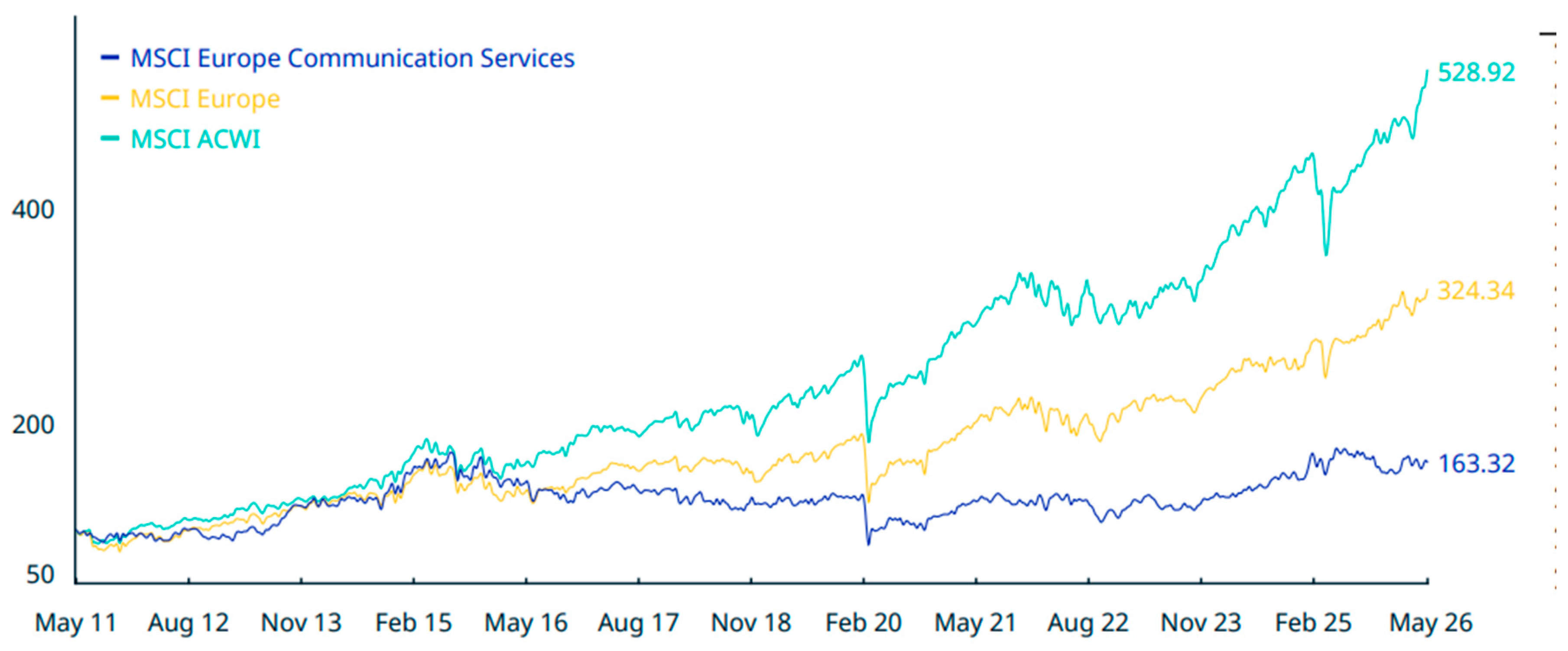
The European communication services sector has undergone substantial transformation over the past decade, evolving from a traditional telecommunications and media industry into a digitally enabled ecosystem encompassing online platforms, streaming services, digital advertising, cloud communications, artificial intelligence applications, and advanced connectivity solutions. As a result, the sector has become a key enabler of Europe’s digital economy, supporting technological innovation, digital infrastructure development, and innovation-led growth. To capture the performance of this rapidly evolving sector, this study employs the MSCI Europe Communication Services 35/20 Capped Index, a widely recognised benchmark comprising large- and mid-cap communication services companies across 15 developed European markets. Figure 1 presents the cumulative net return performance of the index over the period May 2011–May 2026, illustrating its long-term growth trajectory and increasing strategic importance within the European digital economy.
To provide a benchmark for portfolio construction and performance evaluation, the study employs the SPDR® MSCI Europe Communication Services UCITS ETF. The ETF closely tracks the MSCI Europe Communication Services 35/20 Capped Index and provides diversified exposure to 23 constituent companies operating across telecommunications, digital media, entertainment, advertising, online marketplaces, communication infrastructure, and related technology-enabled services. Managed by State Street Global Advisors Europe Limited and domiciled in Ireland under the UCITS regulatory framework, the ETF adopts a full physical replication strategy, thereby minimising tracking error and ensuring close alignment with the underlying index. Within this study, the ETF serves two important functions: first, as the market portfolio required for implementing the Treynor–Black optimisation model; and second, as the benchmark against which the performance of the proposed actively managed portfolio is evaluated. Consequently, it provides a robust and realistic reference point for assessing whether active portfolio optimisation can generate superior risk-adjusted returns relative to a passive investment strategy.

Table 1.
Cumulative performance and benchmark portfolio characteristics of the MSCI Europe Communication Services 35/20 Capped Index and SPDR® MSCI Europe Communication Services UCITS ETF (May 2011–May 2026).
Table 1.
Cumulative performance and benchmark portfolio characteristics of the MSCI Europe Communication Services 35/20 Capped Index and SPDR® MSCI Europe Communication Services UCITS ETF (May 2011–May 2026).
| Key Characteristics of the SPDR® MSCI Europe Communication Services UCITS | |
| Characteristics | Description |
| Full Fund Name | SPDR® MSCI Europe Communication Services UCITS ETF |
| Benchmark Index | MSCI Europe Communication Services 35/20 Capped Index |
| Fund Manager | State Street Global Advisors Europe Limited |
| Launch Date | 5 December 2014 |
| Domicile | Ireland |
| Assets Under Management (AUM) | €203.39 million (October 2025) |
| Number of Holdings | 23 constituent companies |
| Replication Method | Full Physical Replication |
| Regulatory Framework | Undertakings for Collective Investment in Transferable Securities (UCITS) |
 Source: Source: - State Street Global Advisors (SPDR ETFs) and MSCI Index Factsheet (2025). - https://www.msci.com/documents/10199/9af7b84f-c849-4318-a40d-01c5d13c92ac | |
4.1.2. Portfolio Composition and Sector Characteristics
The constituent firms and portfolio weightings of the benchmark ETF are presented in Figure 1. The portfolio comprises 23 leading European communication services companies operating across telecommunications, digital media, entertainment, advertising, online marketplaces, communication infrastructure, and related technology-enabled services. As such, the ETF provides diversified exposure to the principal segments of the modern European communication services sector.
Figure 1 indicates a relatively concentrated portfolio structure, with the ten largest holdings accounting for approximately 78% of total portfolio value. Deutsche Telekom AG and Spotify Technology SA represent the largest positions, reflecting their market leadership and strategic importance within the European communication services ecosystem. While this concentration increases exposure to firm-specific risk, it also reflects the dominant role of a small number of large-cap firms in shaping sector performance. Importantly, the portfolio remains diversified across a range of business models and revenue streams, including telecommunications infrastructure, digital content distribution, music streaming, online marketplaces, advertising services, and business information platforms. This diversity mirrors the growing convergence of telecommunications, technology, media, and digital services within Europe’s digital economy. From a portfolio optimisation perspective, the coexistence of mature telecommunications operators and rapidly expanding digital firms creates substantial variation in risk-return characteristics, providing a favourable setting for active portfolio management and the application of the Treynor–Black optimisation framework.
4.1.3. Geographic Diversification and Country Allocation of the Benchmark Portfolio
The geographic allocation of the benchmark portfolio provides an overview of the international diversification characteristics of the European communication services sector. As illustrated in Figure 2, the ETF maintains exposure across multiple European markets while exhibiting notable concentration in four key economies: Germany, Luxembourg, the United Kingdom, and France. Together, these countries account for approximately 70.8% of total portfolio value, reflecting their dominant position within the European communication services industry.
Germany represents the largest country allocation, accounting for 27.69% of portfolio value, followed by Luxembourg (18.59%), the United Kingdom (13.78%), and France (10.74%). The remaining 29.20% is distributed across other European markets, including the Netherlands, Sweden, Norway, Switzerland, Spain, Finland, and Italy. This distribution provides broad exposure to the European communication services sector while reducing dependence on any single national market. From an international portfolio optimisation perspective, the geographic composition of the ETF offers diversification benefits through exposure to multiple economic and market environments. At the same time, the concentration of holdings in several leading European economies reflects their significant contribution to sector growth, market capitalisation, and investment opportunities. Consequently, the benchmark portfolio provides a suitable foundation for evaluating whether active portfolio optimisation can generate superior risk-adjusted performance relative to a diversified passive investment strategy.
4.2. Return Characteristics of Constituent Firms
The first stage of the optimisation process involves estimating the return performance of constituent securities. Daily returns are calculated using the following expression:
Where (R_{it}) denotes the daily return of security (i), and (P_t) and (P_{t-1}) represent consecutive daily closing prices. The average return for each security is calculated as: [\bar{R_i}=\frac{\sum_{t=1}^{n}R_{it}}{n}]
[R_{it}=\frac{P_t-P_{t-1}}{P_{t-1}}]
Table 2 presents the average daily returns of the benchmark ETF and its constituent firms during the portfolio formation period (2 January 2024–30 December 2024). The results reveal considerable variation in return performance across the sector. As shown in Table 2, Spotify Technology SA generated the highest average daily return (0.003813), followed by CTS Eventim AG & Co. KGaA (0.001391), Scout24 SE (0.001131), Deutsche Telekom AG (0.001050), and BT Group plc (0.001035). These firms substantially outperformed the benchmark ETF, which recorded an average daily return of 0.000502 during the same period. In contrast, several firms generated negative average returns, including Infrastructure Wireless Italiane S.p.A. (-0.000610), Telecom Italia S.p.A. (-0.000440), Cellnex Telecom SA (-0.000390), and Orange SA (-0.000360).
The performance differences reported in Table 2 demonstrate significant heterogeneity among firms despite their common industry classification. From a portfolio management perspective, this variation is particularly important because it suggests that investment opportunities are not evenly distributed across the sector. Consequently, investors may be able to improve portfolio outcomes through active security selection rather than relying solely on passive exposure to the benchmark index. The results therefore provide preliminary support for the application of the Treynor–Black optimisation framework, which seeks to identify securities capable of generating superior returns relative to the market portfolio. Overall, the return dispersion observed in Table 2 provides a strong foundation for the subsequent analysis of systematic risk, abnormal returns, and portfolio optimisation opportunities.
4.3. Systematics Risk and Abnormal Performance Analysis
4.3.1. Beta Analysis and Systematic Risk Characteristics
Systematic risk is measured using the beta coefficient:
Where (R_i) represents the return of security (i) and (R_m) denotes the return of the market portfolio.
\beta_i=\frac{Cov(R_i,R_m)}{Var(R_m)}
Table 3.
Beta coefficients (β) of the benchmark ETF constituents during the portfolio formation period (2024).
Table 3.
Beta coefficients (β) of the benchmark ETF constituents during the portfolio formation period (2024).
| Asset / Company | Beta (β) | Asset / Company | Beta (β) |
| SPDR® MSCI Europe Communication Services UCITS ETF | – | Publicis Groupe SA | 0.089619 |
| Auto Trader Group PLC | 1.001447 | Scout24 SE | 0.748554 |
| Bolloré SE | 0.448476 | Spotify Technology SA | 0.518134 |
| BT Group plc | 1.204983 | Swisscom AG | 0.479947 |
| Cellnex Telecom SA | 0.499549 | Tele2 AB Class B | -0.041770 |
| CTS Eventim AG & Co. KGaA | 0.762596 | Telecom Italia S.p.A. | 1.166984 |
| Deutsche Telekom AG | 0.423818 | Telefónica SA | 0.853639 |
| Elisa Oyj Class A | -0.075020 | Telenor ASA | 0.083701 |
| Informa PLC | 0.211934 | Telia Company AB | 0.405644 |
| Infrastructure Wireless Italiane S.p.A. | 0.243555 | Universal Music Group NV | -0.127943 |
| Koninklijke KPN NV | 0.499074 | Vodafone Group PLC | 1.450587 |
| Orange SA | 0.732181 | WPP PLC | 0.256905 |
| Source: Author’s calculations based on daily trading data for constituent firms included in the MSCI Europe Communication Services 35/20 Capped Index during the portfolio formation period (2 January 2024–30 December 2024). | |||
Beta coefficients provide an indication of each firm’s exposure to systematic risk. Securities with beta values greater than one are more sensitive to market movements and are therefore expected to experience larger gains during favourable market conditions as well as greater losses during market downturns. Conversely, beta values below one indicate lower market sensitivity and more defensive investment characteristics, while negative beta values suggest an inverse relationship with market performance. The results reveal substantial variation in systematic risk across firms included in the MSCI Europe Communication Services Index. Vodafone Group PLC recorded the highest beta coefficient (β = 1.451), followed by BT Group plc (β = 1.205), Telecom Italia S.p.A. (β = 1.167), and Auto Trader Group PLC (β = 1.001). These firms exhibit the greatest responsiveness to market fluctuations and may offer enhanced return potential during periods of favourable market sentiment, albeit with higher levels of systematic risk.
A second group of firms demonstrates moderate market sensitivity, including Telefónica SA (β = 0.854), CTS Eventim AG & Co. KGaA (β = 0.763), Scout24 SE (β = 0.749), Orange SA (β = 0.732), Spotify Technology SA (β = 0.518), Cellnex Telecom SA (β = 0.500), and Koninklijke KPN NV (β = 0.499). These securities provide exposure to market growth opportunities while maintaining lower levels of systematic risk than the highest-beta firms. Several firms exhibit relatively defensive characteristics, including Deutsche Telekom AG (β = 0.424), Telia Company AB (β = 0.406), WPP PLC (β = 0.257), Infrastructure Wireless Italiane S.p.A. (β = 0.244), Informa PLC (β = 0.212), Telenor ASA (β = 0.084), and Publicis Groupe SA (β = 0.090). These firms are less sensitive to market fluctuations and may contribute to portfolio stability during periods of uncertainty. Interestingly, three firms reported negative beta coefficients: Universal Music Group NV (β = -0.128), Elisa Oyj Class A (β = -0.075), and Tele2 AB Class B (β = -0.042). Although relatively small in magnitude, these coefficients suggest limited dependence on broader market movements and indicate potential diversification benefi33ts.
The above results highlight the heterogeneous risk structure of the European communication services sector. The coexistence of high-beta growth-oriented firms, moderate-risk firms, and defensive securities creates favourable conditions for active portfolio optimisation. Such variation in systematic risk is particularly important within the Treynor–Black framework because it enables the identification of securities with different risk-return characteristics and provides the foundation for subsequent security screening and portfolio construction.
4.3.2. Alpha Analysis and Security Selection Opportunities
While beta measures a security’s exposure to systematic market risk, alpha captures the component of return that cannot be explained by market movements and therefore represents abnormal performance relative to the benchmark portfolio. Within the Treynor–Black framework, alpha plays a central role in identifying securities with the potential to outperform market expectations.
Alpha coefficients were estimated using the following expression:
Where (\alpha_i) denotes the abnormal return of security (i), (E(R_i)) represents the expected return of the security, (\beta_i) is the estimated beta coefficient, and (E(R_m)) is the expected return of the market portfolio. A positive alpha indicates that a security generated returns above those predicted by its level of systematic risk, whereas a negative alpha suggests underperformance relative to market expectations. Consequently, securities exhibiting positive alpha values represent potential candidates for inclusion in the actively managed component of the Treynor–Black portfolio.
\alpha_i=E(R_i)-\beta_iE(R_m)
Table 4.
Alpha coefficients (α) of the benchmark ETF constituents during the portfolio formation period (2024).
Table 4.
Alpha coefficients (α) of the benchmark ETF constituents during the portfolio formation period (2024).
| Asset / Company | Alpha (α) | Asset / Company | Alpha (α) |
| SPDR® MSCI Europe Communication Services UCITS ETF | – | Publicis Groupe SA | 0.000802 |
| Auto Trader Group PLC | 0.000116 | Scout24 SE | 0.000755 |
| Bolloré SE | -0.000035 | Spotify Technology SA | 0.003552 |
| BT Group plc | 0.000430 | Swisscom AG | -0.000290 |
| Cellnex Telecom SA | -0.000640 | Tele2 AB Class B | 0.001003 |
| CTS Eventim AG & Co. KGaA | 0.001008 | Telecom Italia S.p.A. | -0.001020 |
| Deutsche Telekom AG | 0.000837 | Telefónica SA | -0.000150 |
| Elisa Oyj Class A | 0.000019 | Telenor ASA | 0.000213 |
| Informa PLC | 0.000299 | Telia Company AB | 0.000210 |
| Infrastrutture Wireless Italiane S.p.A. | -0.000730 | Universal Music Group NV | 0.000143 |
| Koninklijke KPN NV | 0.000262 | Vodafone Group PLC | -0.000640 |
| Orange SA | -0.000730 | WPP PLC | 0.000335 |
| Source: Author’s calculations based on daily trading data for firms included in the MSCI Europe Communication Services 35/20 Capped Index during the portfolio formation period. | |||
The results reveal substantial variation in abnormal performance across constituent firms. Spotify Technology SA recorded the highest alpha coefficient (α = 0.003552), followed by CTS Eventim AG & Co. KGaA (α = 0.001008), Tele2 AB Class B (α = 0.001003), Deutsche Telekom AG (α = 0.000837), Publicis Groupe SA (α = 0.000802), and Scout24 SE (α = 0.000755). These firms demonstrated the strongest abnormal return potential during the portfolio formation period and therefore represent attractive candidates for active portfolio construction. Conversely, several firms generated negative alpha values, including Telecom Italia S.p.A. (α = -0.001020), Infrastructure Wireless Italiane S.p.A. (α = -0.000730), Orange SA (α = -0.000730), Vodafone Group PLC (α = -0.000640), Cellnex Telecom SA (α = -0.000640), Swisscom AG (α = -0.000290), Telefónica SA (α = -0.000150), and Bolloré SE (α = -0.000035). These results indicate that their observed returns fell below those predicted by their systematic risk profiles during the estimation period.
From a portfolio optimisation perspective, the findings provide strong support for active security selection. The wide dispersion in alpha values suggests that constituent firms do not contribute equally to portfolio performance and that abnormal return opportunities exist within the European communication services sector. Accordingly, the alpha estimates provide a critical input for the Treynor–Black optimisation process by identifying securities with superior risk-adjusted return potential for inclusion in the active portfolio.
4.4. Portfolio Construction Using the Treynor–Black Framework
4.4.1. Security Screening and Classification of Securities
Following the estimation of beta and alpha coefficients, all constituent firms were ranked according to their beta values and classified into two groups: high-beta securities and low-beta securities. This classification represents an important stage of the proposed portfolio optimisation framework because it allows portfolio composition to be aligned with anticipated market conditions. Table 5 presents the classification of all constituent firms according to their systematic risk (beta) and abnormal performance (alpha). The first group comprises 11 high-beta securities that exhibit greater sensitivity to market movements and are therefore expected to perform relatively well during periods of favourable market conditions. The second group consists of 12 low-beta securities characterised by lower exposure to systematic risk and greater defensive characteristics during periods of market uncertainty.
The results reveal substantial variation in both beta and alpha coefficients across constituent firms. Among the high-beta securities, Spotify Technology SA (α = 0.003552), CTS Eventim AG & Co. KGaA (α = 0.001008), and Scout24 SE (α = 0.000755) generated the strongest abnormal returns, suggesting significant potential for active portfolio inclusion. In contrast, Vodafone Group PLC and Telecom Italia S.p.A. recorded negative alpha values despite their high market sensitivity, indicating weaker risk-adjusted performance. Within the low-beta group, Tele2 AB Class B (α = 0.001003), Deutsche Telekom AG (α = 0.000837), and Publicis Groupe SA (α = 0.000802) demonstrated strong abnormal performance while maintaining relatively low exposure to market risk. These characteristics suggest that attractive investment opportunities may exist even among more defensive securities.
The combined analysis of beta and alpha provides a more comprehensive assessment of investment attractiveness than either measure in isolation. The findings support the application of the Treynor–Black optimisation framework, which seeks to identify securities capable of generating superior risk-adjusted returns while maintaining an appropriate balance between market exposure and firm-specific performance. This classification subsequently forms the basis for selecting the active portfolio under the expected positive market outlook for the European communication services sector.
4.4.2. Selection of Securities for the Active Portfolio
Following the classification of constituent firms according to their beta and alpha characteristics, the next stage involved selecting securities for inclusion in the actively managed portfolio. Consistent with the Treynor–Black optimisation framework, security selection was based primarily on alpha coefficients, which measure abnormal returns after controlling for systematic market risk. Given the positive market outlook for the European communication services sector, attention focused on the high-beta securities identified in Table 5. These firms were ranked according to their alpha values, and the six securities with the highest positive alphas were selected for inclusion in the active portfolio. This approach reflects the central objective of the Treynor–Black model: identifying securities capable of generating returns above those predicted by their market risk exposure. The results of the selection process are presented in Table 6.
As shown in Table 6, Spotify Technology SA recorded the highest alpha coefficient among all securities included in the high-beta group, indicating the strongest abnormal return performance during the portfolio formation period. CTS Eventim AG & Co. KGaA and Scout24 SE also generated substantial positive alpha values, suggesting considerable potential for excess return generation after accounting for systematic risk. Together with BT Group plc, Koninklijke KPN NV, and Auto Trader Group PLC, these firms demonstrated the most favourable combination of market sensitivity and abnormal return potential within the high-beta category. The selected portfolio also reflects the diversity of business models operating within the European communication services sector. The portfolio includes digital platform and streaming services (Spotify Technology SA), entertainment and event management services (CTS Eventim AG & Co. KGaA), digital marketplace businesses (Scout24 SE and Auto Trader Group PLC), telecommunications services (BT Group plc), and communication network infrastructure services (Koninklijke KPN NV). This composition provides exposure to multiple sources of value creation associated with digital transformation, platform-based business models, digital ecosystems, and next-generation communication technologies.
From an international portfolio optimisation perspective, the selected securities combine strong abnormal return potential with meaningful participation in the structural transformation of the European communication services industry. Consequently, the active portfolio is positioned to capture both firm-specific performance opportunities and broader sectoral growth dynamics. These securities subsequently form the basis for the Treynor–Black optimisation procedure, through which optimal portfolio weights and the allocation between the active portfolio and the benchmark ETF are determined.
4.4.3. Estimation of Residual Variance and Determination of Active Portfolio Weights
Following the selection of the six securities constituting the active portfolio, the next stage of the Treynor–Black optimisation process involves estimating the residual variance for each selected security. Residual variance represents the unsystematic component of risk that cannot be explained by movements in the market portfolio. Within the Treynor–Black framework, this measure plays a critical role because securities with higher abnormal returns and lower residual risk receive larger portfolio weights.
The residual variance for each security is calculated using the following equation:
Where:
[\sigma^2(\varepsilon_i)=\sigma^2(i)-\beta_i^2\sigma^2(m)]
(\sigma^2(\varepsilon_i)) = residual variance (unsystematic risk) of security (i)
(\sigma^2(i)) = total variance of security (i)
(\beta_i) = beta coefficient of security (i)
(\sigma^2(m)) = variance of the market portfolio represented by the benchmark ETF
The calculation separates firm-specific risk from systematic market risk and enables the identification of securities that generate abnormal returns efficiently relative to their residual risk exposure.
As reported in Table 7, noticeable differences exist in the residual risk characteristics of the selected securities. Spotify Technology SA exhibits the highest residual variance (0.000585), indicating relatively high firm-specific volatility. This result is not unexpected given Spotify’s business model, which operates within highly dynamic digital streaming and platform markets characterised by rapid technological change, evolving consumer preferences, and intense competitive pressures. While the company generated the highest alpha among all securities included in the analysis, it also exhibits the highest level of unsystematic risk.
BT Group plc (0.000363) and CTS Eventim AG & Co. KGaA (0.000329) also display relatively high residual variance values. These results suggest that firm-specific factors, including operational performance, strategic decisions, competitive positioning, and sector-specific developments, play an important role in explaining their return behaviour beyond general market movements.
In contrast, Scout24 SE (0.000121) and Koninklijke KPN NV (0.000118) exhibit the lowest residual variance values among the selected securities. These findings indicate comparatively lower levels of firm-specific risk and suggest that their return patterns are more stable relative to the other securities included in the active portfolio. From a portfolio optimisation perspective, such firms may be particularly attractive because they combine positive alpha values with relatively low residual risk exposure.
Auto Trader Group PLC occupies an intermediate position with a residual variance of 0.000224. While its firm-specific risk exceeds that of Scout24 SE and Koninklijke KPN NV, it remains substantially lower than that of Spotify Technology SA, BT Group plc, and CTS Eventim AG & Co. KGaA. The results presented in Table 7 highlight the importance of considering both abnormal returns and residual risk when constructing an optimal portfolio. Within the Treynor–Black model, securities are not selected solely because they generate positive alpha values. Instead, investment decisions are based on the relationship between alpha and residual variance. Securities capable of generating high abnormal returns while maintaining relatively low firm-specific risk are expected to contribute most effectively to portfolio performance. From the perspective of international portfolio optimisation in a digitally transforming sector, these findings demonstrate that digital growth opportunities are often accompanied by differing levels of firm-specific risk. Consequently, the Treynor–Black framework provides an appropriate mechanism for balancing return enhancement against residual risk exposure, thereby supporting the construction of an efficient and internationally diversified portfolio within the European communication services sector.
4.4.4. Determination of Active Portfolio Weights
A fundamental feature of the Treynor–Black optimisation framework is that portfolio weights are determined according to the relationship between a security’s abnormal return (alpha) and its residual variance. This approach ensures that portfolio allocations reflect both return-generating potential and firm-specific risk exposure. Securities generating higher abnormal returns relative to their residual risk receive larger portfolio weights and therefore contribute more significantly to overall portfolio performance.
The relative attractiveness of each security is measured using the alpha-to-residual variance ratio:
where:[\alpha_i] represents the abnormal return (alpha) of security i, and
[\frac{\alpha_i}{\sigma^2(\varepsilon_i)}]
[\sigma^2(\varepsilon_i)] denotes the residual variance of security i.
This ratio measures the amount of abnormal return generated per unit of unsystematic risk. Higher values indicate superior risk-adjusted abnormal performance and justify a greater allocation within the active portfolio.
Following the calculation of the alpha-to-residual variance ratios, the optimal weight assigned to each security within the active portfolio is determined as follows:
where:[W_i]represents the proportion of the active portfolio allocated to security i.
[W_i=\frac{\alpha_i/\sigma^2(\varepsilon_i)}{\sum_{i=1}^{n}\alpha_i/\sigma^2(\varepsilon_i)}]
This procedure ensures that securities exhibiting stronger abnormal return performance relative to residual risk receive proportionally larger allocations. Consequently, the resulting portfolio weights reflect each security’s contribution to the expected risk-adjusted performance of the active portfolio.
The results reveal substantial variation in the risk-adjusted abnormal performance of the selected securities. Scout24 SE recorded the highest alpha-to-residual variance ratio (6.218), closely followed by Spotify Technology SA (6.072), indicating that both firms generated exceptional abnormal returns relative to their levels of firm-specific risk. Consequently, these securities receive the largest allocations within the active portfolio, accounting for approximately 32.3% and 31.5% of portfolio value, respectively.
CTS Eventim AG & Co. KGaA also demonstrates strong performance, with a ratio of 3.064 and an allocation of 15.9%. Similarly, Koninklijke KPN NV achieves a favourable balance between abnormal return generation and residual risk, resulting in a portfolio weight of 11.5%. By contrast, BT Group plc and Auto Trader Group PLC receive smaller allocations because their abnormal returns are comparatively modest when evaluated relative to firm-specific risk.
From an international portfolio optimisation perspective, these findings highlight the importance of jointly evaluating return potential and residual risk rather than focusing solely on expected returns. The results indicate that firms operating in digitally enabled business segments, including digital platforms, online marketplaces, and technology-driven communication services, demonstrate particularly attractive risk-adjusted abnormal performance. This observation is consistent with the broader digital transformation trends characterising the European communication services sector and reinforces the value of active security selection within innovation-intensive industries.
The allocation structure presented in Table 8 reflects the central logic of the Treynor–Black model: capital is directed towards securities capable of generating superior abnormal returns while maintaining efficient control over firm-specific risk. These weights subsequently form the basis for constructing the active portfolio and determining the optimal allocation between active and passive investments.
The allocation structure presented in Table 9 highlights the key differences between the Treynor–Black optimisation framework and a naïve equal-weight strategy.
Under the Treynor–Black approach, portfolio weights are determined by each security’s risk-adjusted abnormal return potential, resulting in a concentrated allocation towards firms exhibiting the most favourable alpha-to-risk characteristics. Consequently, Spotify Technology SA and Scout24 SE receive substantially larger portfolio weights than under the equal-weight approach, reflecting their superior ability to generate abnormal returns relative to firm-specific risk. By contrast, the equal-weight portfolio allocates identical weights to all selected securities irrespective of differences in expected performance or risk characteristics. These contrasting allocation strategies provide an appropriate basis for evaluating whether active portfolio optimisation can create additional value beyond simple diversification. More importantly, the Treynor–Black portfolio exhibits greater exposure to firms benefiting from digital transformation, platform-based business models, data-driven innovation, and technology-enabled growth opportunities, while maintaining broad market exposure through the benchmark ETF. The subsequent performance analysis therefore examines whether this optimisation strategy translates into superior return generation and risk-adjusted performance during the evaluation period.
4.5. Portfolio Performance Evaluation
Following portfolio construction, the performance of the proposed portfolios was evaluated over the out-of-sample period from 2 January 2025 to 7 October 2025. Consistent with the objectives of this study, portfolio performance was assessed using both return-based and risk-adjusted measures, enabling an evaluation of whether active portfolio optimisation generates superior investment outcomes within the European communication services sector. Detailed return calculations, portfolio beta estimations, and risk-adjusted performance measures are reported in Appendices A–D; Appendix A (returns), Appendix B (beta), Appendix C (risk estimation), and Appendix D (risk-adjusted performance).
Portfolio returns were calculated as:
where (W_i) represents the portfolio weight of security (i), and (\bar{R}_i) denotes its average return during the evaluation period.
[\bar{R}P=\sum{i=1}^{n}W_i\bar{R}_i]
As reported in Table 10, the Treynor–Black portfolio generated a higher average daily return (0.000931) than the equal-weight portfolio (0.000767). When annualised, these returns correspond to 23.2% and 19.1%, respectively. The superior performance of the Treynor–Black portfolio suggests that active security selection contributed positively to return generation during the evaluation period and supports the argument that optimisation techniques can enhance portfolio returns within a digitally transforming sector. However, return performance alone provides an incomplete assessment of portfolio effectiveness because higher returns may be accompanied by greater levels of risk. Consequently, both portfolios were further evaluated using beta, standard deviation, the Sharpe ratio, and the Treynor ratio to assess performance relative to total and systematic risk.
The results presented in Table 11 reveal a clear trade-off between return maximisation and risk-adjusted performance. Consistent with the findings reported in Table 10, the Treynor–Black portfolio generated the highest annual return (23.2%). As shown in Table 11, the portfolio also maintained a beta close to unity (0.99163), indicating market-level systematic risk exposure. Furthermore, the positive Sharpe ratio (0.074) and Treynor ratio (0.213) indicate that the portfolio generated returns above the risk-free rate after accounting for both total and systematic risk.
By contrast, Table 11 shows that the equal-weight portfolio exhibited lower systematic risk (β = 0.80255) and lower overall volatility (σ = 2.401) than the Treynor–Black portfolio. Although its annual return was lower, the portfolio achieved superior Sharpe (0.0883) and Treynor (0.2641) ratios. These findings suggest that the diversification benefits associated with equal weighting outweighed the return advantages generated by active optimisation when performance is evaluated on a risk-adjusted basis. The evidence reported in Table 10 and Table 11 indicates that active portfolio optimisation enhanced absolute return performance, whereas the equal-weight strategy delivered stronger risk-adjusted performance. The findings therefore highlight the importance of balancing return enhancement with diversification efficiency when constructing international portfolios within digitally transforming sectors. While active optimisation may improve return generation, superior absolute returns do not necessarily translate into superior risk-adjusted outcomes. These results provide the empirical foundation for the formal hypothesis testing presented in the following section.
The comparison reveals that the Treynor–Black portfolio generated the highest absolute return, whereas the equal-weight portfolio achieved superior risk-adjusted performance. Specifically, the higher Sharpe and Treynor ratios of the equal-weight portfolio suggest that its diversification benefits outweighed the return advantages associated with active optimisation. These findings indicate that while active portfolio management can enhance return generation within a digitally transforming sector, simple diversification strategies may provide superior performance when evaluated on a risk-adjusted basis. This result offers important insights for investors seeking exposure to firms operating within Europe’s evolving digital communication ecosystem and provides the basis for the formal hypothesis testing presented in the following section
4.6. Hypothesis Testing Results
This section evaluates whether the proposed Treynor–Black portfolio generated performance that differed significantly from both the equal-weight portfolio and the benchmark ETF portfolio. The analysis was conducted using independent samples t-tests based on daily portfolio returns during the evaluation period (2 January 2025–10 July 2025).
4.6.1. Treynor–Black Portfolio Versus Equal-Weight Portfolio
The first hypothesis examines whether the Treynor–Black optimisation framework produced performance significantly different from the equal-weight portfolio.
H1:
There is no statistically significant difference between the performance of the Treynor–Black portfolio and the equal-weight portfolio.
Daily portfolio returns were calculated as: [R_P=\sum_{i=1}^{n}W_iR_i]
where (R_P) represents portfolio return, (W_i) denotes the portfolio weight allocated to security (i), and (R_i) represents the return of security (i).
As reported in Table 12, the Treynor–Black portfolio generated a higher average daily return than the equal-weight portfolio but also exhibited greater volatility. These findings are consistent with the earlier performance results presented in Table 10 and Table 11, which showed that active optimisation enhanced return generation while the equal-weight portfolio delivered stronger risk-adjusted performance.
As shown in Table 13, Levene’s test is significant (p = 0.045), indicating unequal variances; therefore, the unequal-variance results are interpreted. The reported p-value (0.169) exceeds the 5% significance threshold, indicating that H1 cannot be rejected. Although the Treynor–Black portfolio achieved higher returns, the difference is not statistically significant. This finding suggests that active optimisation did not significantly outperform the simpler equal-weight allocation strategy during the evaluation period.
4.6.2. Proposed Portfolio Versus Benchmark ETF Portfolio
The second hypothesis examines whether the proposed Treynor–Black portfolio outperformed the benchmark market portfolio represented by the SPDR® MSCI Europe Communication Services UCITS ETF.
H2:
There is no statistically significant difference between the performance of the proposed portfolio and the benchmark European communication services market portfolio.
As reported in Table 14, the proposed portfolio generated a higher average daily return than the benchmark ETF portfolio throughout the evaluation period. Although the proposed portfolio exhibited slightly higher volatility, it consistently produced superior average returns, supporting the earlier findings presented in Table 10 and Table 11.
As shown in Table 15, Levene’s test is not significant (p = 0.129), indicating that the equal-variance assumption is satisfied. The reported p-value (0.0293) is below the 5% significance threshold; therefore, H2 is rejected. The results indicate a statistically significant difference between the proposed portfolio and the benchmark ETF portfolio, providing empirical support for the effectiveness of active portfolio optimisation within the European communication services sector.
Overall, the hypothesis testing results reinforce the earlier portfolio performance analysis. While the Treynor–Black portfolio did not significantly outperform the equal-weight portfolio, it significantly outperformed the benchmark ETF portfolio. Together with the evidence reported in Table 10 and Table 11, these findings suggest that active portfolio optimisation enhanced return performance relative to the market benchmark, although the diversification benefits of equal weighting resulted in comparable overall performance.
5. Discussion of the Results: The Influence of Digital Transformation and Governance Quality on International Portfolio Optimisation
The findings of this study demonstrate that international portfolio optimisation within the European communication services sector should be interpreted within a broader ecosystem characterised by digital transformation, governance quality, innovation capability, and institutional effectiveness. While the empirical analysis focused on portfolio construction using the Treynor–Black optimisation framework, the results indicate that investment performance is influenced not only by firm-level financial characteristics but also by the digital and institutional environments in which firms operate. The European communication services sector provides a particularly relevant setting for this analysis because it operates at the intersection of technological innovation, digital infrastructure development, artificial intelligence adoption, platform-based business models, and rapidly evolving consumer demand.
The portfolio optimisation results provide important insights into the effectiveness of active portfolio management within this environment. The proposed Treynor–Black portfolio generated the highest annual return (23.2%), outperforming both the benchmark ETF portfolio and the equal-weight portfolio. Furthermore, the hypothesis testing results revealed a statistically significant difference between the proposed portfolio and the benchmark market portfolio (p < 0.05), providing empirical support for the effectiveness of active portfolio optimisation within the European communication services sector. These findings suggest that investors may be able to generate superior returns by actively identifying securities with favourable abnormal return characteristics rather than relying solely on passive exposure to sector-wide market indices. Consequently, the results support the central proposition of this study that international portfolio optimisation can create value within sectors undergoing rapid technological and digital transformation.
At the same time, the findings highlight the continuing importance of diversification and risk management. Although the Treynor–Black portfolio generated superior absolute returns, the equal-weight portfolio achieved higher Sharpe and Treynor ratios, indicating stronger risk-adjusted performance. Moreover, the difference between the Treynor–Black portfolio and the equal-weight portfolio was not statistically significant (p > 0.05). This result suggests that while active portfolio optimisation can enhance return generation, diversification remains a critical determinant of portfolio efficiency. The findings therefore reinforce a key principle of Modern Portfolio Theory (Markowitz, 1952): superior portfolio performance depends not only on return maximisation but also on the effective management of risk through diversification.
The digital transformation indicators presented in Figure 3 further help explain the investment attractiveness of the sector. Several countries represented within the benchmark portfolio, particularly Germany, Luxembourg, the United Kingdom, and France, rank among Europe’s most digitally advanced economies.
High levels of digital maturity support technology adoption, innovation ecosystems, digital infrastructure development, and advanced connectivity services. These conditions create favourable environments for communication service firms operating in digital platforms, cloud computing, artificial intelligence, cybersecurity, data analytics, online marketplaces, and next-generation telecommunications networks. As a result, digital transformation functions as an important driver of corporate growth, competitiveness, and long-term value creation, which ultimately influences portfolio-level performance.
Governance quality further reinforces the investment attractiveness of the European communication services sector. As illustrated in Figure 4, the principal countries represented within the benchmark portfolio demonstrate strong performance across key governance dimensions, including government effectiveness, regulatory quality, rule of law, accountability, and institutional stability. Such governance environments reduce uncertainty, strengthen investor protection, enhance transparency, and support efficient capital allocation, all of which are particularly important in digitally transforming sectors requiring continuous investment in technological infrastructure, innovation capabilities, and strategic transformation initiatives. Consistent with these findings, Onyemaechi et al. (2026) show that effective corporate governance practices, including board diversity, independence, expertise, and active board engagement, contribute positively to ESG performance, stakeholder trust, and long-term financial sustainability. Similarly, Alkaraan et al. (2022) and Alkaraan et al. (2023) demonstrate that firms operating within advanced digital ecosystems and supported by robust governance structures are better positioned to convert technological investments into sustainable competitive advantage and long-term value creation. Furthermore, Alkaraan et al. (2024) find that the integration of Industry 4.0 technologies, innovation strategies, governance mechanisms, and sustainability-oriented business models enhances organisational performance and resilience, while Probojakti et al. (2025) and Alkaraan et al. (2026) show that digital transformation strengthens organisational agility and corporate resilience under conditions of technological disruption and market uncertainty. Collectively, these studies suggest that governance quality and digital transformation operate as complementary drivers of competitiveness, resilience, and long-term value creation, ultimately contributing to portfolio performance and investment sustainability.
The present study extends this stream of literature beyond the firm level by demonstrating that differences in digital maturity, governance quality, innovation capacity, and institutional effectiveness can also influence portfolio optimisation outcomes and investment performance. The superior performance of the proposed portfolio relative to the benchmark market portfolio suggests that investors may benefit from allocating capital to firms operating within digitally advanced and well-governed environments. Consequently, digital transformation and governance quality should be viewed not only as drivers of organisational competitiveness and resilience but also as important determinants of international portfolio performance, investment attractiveness, and long-term value creation.
More broadly, the findings suggest that successful international portfolio optimisation should not rely exclusively on traditional financial indicators such as return, beta, or volatility. Investors should also consider country-level digital competitiveness, governance effectiveness, innovation ecosystems, and institutional quality when evaluating investment opportunities. In this respect, digital transformation and governance quality emerge as complementary drivers of portfolio performance, influencing growth opportunities, risk characteristics, investment resilience, and long-term value creation.
Overall, the results indicate that the European communication services sector offers an attractive environment for international portfolio optimisation because it combines strong digital capabilities, supportive institutional frameworks, advanced innovation ecosystems, and favourable growth prospects. The evidence suggests that active portfolio management can create value within such an environment, although the benefits of active optimisation should be balanced against the diversification advantages associated with simpler portfolio construction approaches. Consequently, successful portfolio management in digitally transforming sectors requires an integrated approach that combines active security selection, diversification, risk management, governance assessment, and an understanding of the broader technological forces shaping future economic and investment performance.
6. Conclusion
This study examined the effectiveness of international portfolio optimisation within a digitally transforming sector by focusing on constituent firms of the MSCI Europe Communication Services 35/20 Capped Index. The communication services sector represents a particularly relevant setting for portfolio analysis because it lies at the centre of Europe’s digital transformation agenda and is increasingly shaped by artificial intelligence (AI), digital platforms, cloud computing, advanced telecommunications infrastructure, big data analytics, and technology-enabled business models. Against this backdrop, the study developed and evaluated an international portfolio optimisation framework based on the Treynor–Black model and compared its performance with both an equal-weight portfolio and the benchmark market portfolio represented by the SPDR® MSCI Europe Communication Services UCITS ETF.
The empirical findings provide important insights into the effectiveness of active portfolio management within a digitally transforming and innovation-intensive sector. The Treynor–Black portfolio achieved the highest annual return (23.2%) and outperformed the benchmark market portfolio, demonstrating the potential of active security selection to identify firms capable of generating superior returns. However, the equal-weight portfolio generated stronger risk-adjusted performance, as evidenced by its higher Sharpe and Treynor ratios. Furthermore, the hypothesis testing results revealed no statistically significant difference between the performance of the Treynor–Black portfolio and the equal-weight portfolio (p > 0.05), indicating that the additional complexity associated with active optimisation did not generate statistically superior performance relative to a simpler diversification strategy. In contrast, a statistically significant difference was identified between the proposed portfolio and the benchmark ETF portfolio (p < 0.05), leading to the rejection of the second null hypothesis and providing empirical evidence that active portfolio optimisation can outperform passive market exposure within the European communication services sector.
More broadly, the findings suggest that portfolio performance is influenced not only by firm-level financial characteristics but also by the wider digital and institutional environments in which firms operate. The analysis demonstrated that the benchmark portfolio is concentrated in countries such as Germany, Luxembourg, the United Kingdom, and France, which exhibit high levels of digital maturity, governance effectiveness, innovation capability, regulatory quality, and institutional stability. These characteristics create favourable conditions for communication service firms to leverage digital technologies, invest in innovation, and develop sustainable competitive advantages. Consequently, digital transformation and governance quality emerge as important contextual determinants of portfolio performance, investment resilience, and long-term value creation.
Theoretical and Managerial Implications
From a theoretical perspective, this study contributes to the international portfolio management literature by extending the application of the Treynor–Black optimisation framework to a digitally transforming and innovation-intensive sector. Traditional portfolio optimisation studies have predominantly focused on financial variables, market risk, diversification benefits, and asset allocation decisions. In contrast, the present study demonstrates that portfolio performance may also be influenced by broader contextual factors, including digital transformation, governance quality, institutional effectiveness, and innovation capacity. By integrating these dimensions into the discussion of portfolio performance, the study establishes an important connection between international portfolio management and the growing literature on digital transformation, governance, and value creation.
The findings are broadly consistent with prior research emphasising the strategic role of digital transformation, governance quality, and innovation capability in enhancing organisational performance and long-term value creation. Previous studies suggest that firms operating within advanced digital ecosystems and supported by effective governance structures are better positioned to convert technological investments into sustainable competitive advantages and superior financial performance (Alkaraan et al., 2022; Alkaraan et al., 2023). Similarly, research indicates that the integration of Industry 4.0 technologies, governance mechanisms, innovation strategies, and sustainability-oriented business models contributes positively to organisational performance, resilience, and strategic competitiveness in increasingly dynamic business environments (Alkaraan et al., 2024; Alkaraan et al., 2025). Complementing these findings, recent evidence demonstrates that digital transformation enhances organisational agility and corporate resilience, both of which strengthen firms’ ability to respond to technological disruption, market uncertainty, and changing competitive conditions (Probojakti et al., 2025; Alkaraan et al., 2026).
Recent research also highlights the importance of leadership and knowledge-based capabilities in supporting innovation outcomes. For example, Harsono et al. (2025) demonstrate that transformational leadership and knowledge management significantly influence innovation capability, which in turn enhances innovation performance. Their findings emphasise the complex interrelationships between leadership, organisational learning, knowledge creation, and innovation-driven growth. Collectively, this body of literature suggests that the benefits of digital transformation extend well beyond operational efficiency to encompass broader strategic capabilities that support innovation, adaptability, resilience, sustainable growth, and long-term value creation.
The present study extends these insights beyond the firm level to the domain of international portfolio optimisation. While previous research has primarily examined the organisational consequences of digital transformation and governance quality, this study demonstrates that these factors may also influence portfolio-level outcomes through their impact on firm performance, growth opportunities, risk characteristics, and investment attractiveness. The empirical results indicate that active portfolio optimisation can generate superior returns relative to the benchmark market portfolio, while the discussion of digital maturity and governance quality suggests that firms operating within technologically advanced and institutionally robust environments may offer more attractive investment opportunities. Consequently, the study contributes to emerging debates concerning how digital ecosystems, governance effectiveness, and innovation-led growth influence investment performance within the digital economy.
More broadly, the findings suggest that international portfolio optimisation should not be viewed solely through the lens of traditional financial metrics. In sectors characterised by rapid technological change, investors may benefit from incorporating broader indicators relating to digital competitiveness, governance quality, innovation capability, and institutional effectiveness into portfolio construction and security selection decisions. Digital transformation and governance quality therefore emerge not only as drivers of firm-level competitiveness but also as important determinants of portfolio efficiency, risk-adjusted performance, and long-term investment value.
From a managerial perspective, the findings provide several important implications for investors, fund managers, and financial institutions. First, portfolio construction within digitally transforming sectors should incorporate assessments of digital maturity, innovation capability, governance effectiveness, and institutional quality alongside conventional financial indicators. Such considerations may assist investors in identifying firms that are better positioned to exploit technological opportunities and sustain long-term growth. Second, the results demonstrate that superior returns do not necessarily translate into superior risk-adjusted performance. Although the Treynor–Black portfolio generated the highest return, the equal-weight portfolio produced stronger risk-adjusted outcomes, highlighting the continuing importance of diversification in portfolio management.
Third, the findings suggest that active portfolio management can create value when combined with disciplined risk management and diversification strategies. Investors should therefore avoid excessive concentration in a small number of high-growth securities and instead seek an appropriate balance between return enhancement and portfolio stability. Finally, the study highlights the importance of country-level characteristics in international investment decision-making. Digital infrastructure, governance quality, regulatory effectiveness, innovation ecosystems, and institutional stability may all influence investment opportunities and portfolio performance. Consequently, international investors should complement firm-level financial analysis with a broader assessment of the digital and governance environments within which firms operate when making asset allocation and portfolio optimisation decisions.
Limitations and Suggestions for Future Research
Despite its contributions, this study is subject to several limitations. First, the analysis focuses exclusively on the European communication services sector and therefore may not fully capture the dynamics of other sectors or geographic regions. Second, the evaluation period covers a specific market environment and may not reflect longer-term structural changes associated with technological disruption, economic cycles, or regulatory developments. Third, the portfolio optimisation framework relies primarily on historical market data and therefore remains subject to the limitations inherent in historical performance analysis.
Future research could extend this study in several directions. First, alternative optimisation techniques, including the Black–Litterman model, multi-factor asset pricing models, machine learning approaches, and AI-driven portfolio construction frameworks, could be compared with the Treynor–Black model. Second, future studies may explicitly integrate governance indicators, ESG metrics, digital transformation measures, and digital competitiveness indices into portfolio optimisation models to examine their direct influence on portfolio performance. Third, comparative analyses across sectors, countries, and regions would provide deeper insights into how institutional quality, governance structures, and digital maturity affect investment outcomes. Finally, future research may explore the growing role of artificial intelligence, digital governance, sustainability performance, and innovation ecosystems as emerging drivers of portfolio returns in increasingly digitalised global capital markets.
In conclusion, this study provides evidence that international portfolio optimisation can create value within the European communication services sector, a sector positioned at the forefront of digital transformation and technological innovation. However, the findings also demonstrate that successful portfolio management requires more than the pursuit of superior returns. Effective investment strategies must integrate active security selection, international diversification, governance quality, digital transformation considerations, and risk management. As digitalisation, artificial intelligence, and innovation continue to reshape global industries and capital markets, understanding their implications for portfolio construction and investment performance will remain an increasingly important area for both academic research and professional investment practice.
Appendix A. Treynor–Black Portfolio Return Calculation
| Asset / Company | Portfolio Weight | Average Daily Return | Contribution |
| Spotify Technology SA | 0.211016 | 0.001718 | 0.000362 |
| CTS Eventim AG & Co. KGaA | 0.106480 | 0.000714 | 0.000076 |
| Scout24 SE | 0.216079 | 0.001153 | 0.000249 |
| BT Group plc | 0.041146 | 0.001102 | 0.000045 |
| Koninklijke KPN NV | 0.077058 | 0.000700 | 0.000054 |
| Auto Trader Group PLC | 0.017984 | 0.000276 | 0.000005 |
| SPDR® MSCI Europe Communication Services UCITS ETF | 0.330239 | 0.000627 | 0.000207 |
| Portfolio Return | 0.000931 | ||
| This appendix presents the detailed portfolio return calculations for both the Treynor–Black portfolio and the Equal-Weight portfolio during the evaluation period (2 January 2025 – 7 October 2025). Annualised Return:[0.000931 \times 250 = 0.232][= 23.2%] | |||
Appendix B. Portfolio Beta Calculations
| Security | Weight | Beta | Weighted Beta |
| Spotify Technology SA | 0.211016 | 0.518134 | 0.109 |
| CTS Eventim AG & Co. KGaA | 0.106480 | 0.762596 | 0.081 |
| Scout24 SE | 0.216079 | 0.748554 | 0.162 |
| BT Group plc | 0.041146 | 1.204983 | 0.050 |
| Koninklijke KPN NV | 0.077058 | 0.499074 | 0.038 |
| Auto Trader Group PLC | 0.017984 | 1.001447 | 0.018 |
| ETF | 0.330239 | 1.000000 | 0.330 |
| Portfolio Beta | 0.99163 | ||
| Portfolio beta was estimated using the weighted-average beta approach:[ \beta_P=\sum_{i=1}^{n}W_i\beta_i] where: [W_i] represents portfolio weight and[\beta_i] represents the beta coefficient of security (i). | |||
Appendix C. Portfolio Risk Results
Appendix D. Summary of Risk-Adjusted Performance: Sharpe Ratio and Treynor Ratio Calculations
| Measure | Treynor–Black | Equal-Weight |
| Daily Standard Deviation | 0.011460 | 0.009606 |
| Annualised Standard Deviation | 2.865 | 2.401 |
|
Portfolio variance was estimated using the variance-covariance matrix approach:
[\sigma^2_P = W’\Sigma W] where:[W] represents the vector of portfolio weights and [\Sigma] represents the variance-covariance matrix of asset returns. Portfolio standard deviation is calculated as:[\sigma_P=\sqrt{\sigma^2_P}] The Treynor–Black portfolio exhibited higher volatility due to its greater concentration in securities with stronger abnormal return potential, whereas the Equal-Weight portfolio benefited from broader diversification. | ||
| Measure | Treynor–Black | Equal-Weight |
| Sharpe Ratio | 0.074 | 0.0883 |
| Treynor Ratio | 0.213 | 0.2641 |
|
The Equal-Weight portfolio achieved superior risk-adjusted performance despite generating lower absolute returns.
The ECB Deposit Facility Rate of approximately 2% was adopted as the risk-free rate. Sharpe Ratio [Sharpe=\frac{R_P-R_f}{\sigma_P}] Treynor–Black Portfolio [\frac{0.232-0.02}{2.865}=0.074] Equal-Weight Portfolio [ \frac{0.191-0.02}{2.401}=0.0883] Treynor Ratio [Treynor=\frac{R_P-R_f}{\beta_P}] Treynor–Black Portfolio [ \frac{0.232-0.02}{0.99163}=0.213] Equal-Weight Portfolio[\frac{0.191-0.02}{0.80255}=0.2641] | ||
References
- Al Mulla, A.; Alkaraan, F.; Darwish, T. The Influence of COVID-19 on the Adoption of Disruptive Technologies in SMEs Practices: UAE Context. In From Digital Disruption to Dominance (Technological Innovation and Sustainability for Business Competitive Advantage); Shehadeh, M., Hussainey, K., Eds.; Emerald Publishing Limited: Leeds, 2025; pp. 299–311. [Google Scholar] [CrossRef]
- Alkaraan, F., M.Elmarzouky, V. G.Venkatesh, K.Hussainey, Y.Shi, and M.Zhang (2026). Artificial Intelligence-Powered Innovation Strategies for ESG Impact and Sustainable Ecosystems: A Natural-Resource-Based and Environmental-Legitimacy Perspective.” Business Strategy and the Environment1–25. [CrossRef]
- Alkaraan, F.; Hussainey, K. Current Issues in Governance, Economics and Finance: Toward Ecosystems. International Journal of Finance & Economics 2025. [Google Scholar] [CrossRef]
- Alkaraan, F.; Elmarzouky, M.; de Sousa Jabbour, A. B. L.; Jabbour, C. J. C.; Gulko, N. Maximising sustainable performance: Integrating servitisation innovation into green sustainable supply chain management under the influence of governance and Industry 4.0. Journal of Business Research 2025, 186, 115029. [Google Scholar] [CrossRef]
- Alkaraan, F.; Elmarzouky, M.; Hussainey, K.; Venkatesh, V. G.; Shi, Y.; Gulko, N. Reinforcing green business strategies with Industry 4.0 and governance towards sustainability: Natural-resource-based view and dynamic capability. Business Strategy and the Environment 2024, 33(4), 3588–3606. [Google Scholar] [CrossRef]
- Alkaraan, F.; Elmarzouky, M.; Hussainey, K.; Venkatesh, V. G. Sustainable strategic investment decision-making practices in UK companies: The influence of governance mechanisms on synergy between industry 4.0 and circular economy. Technological forecasting and social change 2023, 187, 122187. [Google Scholar] [CrossRef]
- Alkaraan, F.; Albitar, K.; Hussainey, K.; Venkatesh, V. G. Corporate transformation toward Industry 4.0 and financial performance: The influence of environmental, social, and governance (ESG). Technological Forecasting and Social Change 2022, 175, 121423. [Google Scholar] [CrossRef]
- Angsoyiri, D., Alkaraan, F., & John, J. (2026,a). “The Influence of Governance Structure on Business Innovation Strategies and ESG Performance”, AI-Powered Business Innovation Strategies, Governance and Sustainability: Interdisciplinary Perspectives, Fadi Alkaraan, Laura McQuade, Elena Nichele. [CrossRef]
- Angsoyiri, D., Alkaraan, F., & John, J. (2026,b). “Nexus Between Mergers and Acquisitions Strategies and ESG Performance: The Influence of Green Governance Structure”, Advances in Mergers and Acquisitions, Cary L. Cooper, Sydney Finkelstein . [CrossRef]
- Angsoyiri, D; Alkaraan, F; John, J. Disclosure of environmental management strategies practices and corporate performance: does green governance structure matter?”. Journal of Accounting Literature 2025, Vol. ahead-of-print No. ahead-of-print. [Google Scholar] [CrossRef]
- Eccles, R. G.; Ioannou, I.; Serafeim, G. The impact of corporate sustainability on organizational processes and performance. Management science 2014, 60(11), 2835–2857. [Google Scholar] [CrossRef]
- European Commission. The Digital Economy and Society Index (DESI). 2024. Available online: https://digital-strategy.ec.europa.eu/en/policies/desi (accessed on 5 June 2026).
- European Commission (2024) Report on the State of the Digital Decade 2024. European Commission. Available online: https://digital-strategy.ec.europa.eu/en/library/report-state-digital-decade-2024 (accessed on 5 June 2026).
- Feng, T.; Dong, X.; Wang, Y. Assessing the impact of digital transformation on capital market information efficiency under environmental uncertainty: Evidence from China. Plos one 2024, 19(1), e0295187. [Google Scholar] [CrossRef]
- Financial Reporting Council (FRC) (2024) UK Corporate Governance Code 2024. Financial Reporting Council: London; Available online: https://www.frc.org.uk/library/standards-codes-policy/corporate-governance/uk-corporate-governance-code (accessed on 5 June 2026).
- Friede, G.; Busch, T.; Bassen, A. ESG and financial performance: aggregated evidence from more than 2000 empirical studies. Journal of sustainable finance & investment 2015, 5(4), 210–233. [Google Scholar] [CrossRef]
- Harsono, T. W.; Hidayat, K.; Iqbal, M.; Abdillah, Y. Exploring the effect of transformational leadership and knowledge management in enhancing innovative performance: a mediating role of innovation capability. Journal of Manufacturing Technology Management 2025, 36(1), 227–250. [Google Scholar] [CrossRef]
- Kagermann, H.; Wahlster, W.; Helbig, J. Recommendations for Implementing the Strategic Initiative INDUSTRIE 4.0: Securing the Future of German Manufacturing Industry. Final Report of the Industrie 4.0 Working Group; Acatech – National Academy of Science and Engineering: Munich, 2013; Available online: https://en.acatech.de/publication/recommendations-for-implementing-the-strategic-initiative-industrie-4-0-final-report-of-the-industrie-4-0-working-group/ (accessed on 5 June 2026).
- Lababidi, N.M.M.; Katalo, H.R.; Kamakhli, Y. A. Hybrid FinTech-Driven Framework for Volatility Forecasting: The Role of Digital Attention and Technical Indicators in the Dubai Financial Market. J. Risk Financial Manag 2026, 19, 375. [Google Scholar] [CrossRef]
- Lintner, J. The Valuation of Risk Assets and the Selection of Risky Investments in Stock Portfolios and Capital Budgets. The Review of Economics and Statistics 1965, 47(1), 13–37. [Google Scholar] [CrossRef]
- Markowitz, H. Portfolio Selection. The Journal of Finance 1952, 7(1), 77–91. [Google Scholar] [CrossRef] [PubMed]
- Mossin, J. Equilibrium in a Capital Asset Market. Econometrica 1966, 34(4), 768–783. [Google Scholar] [CrossRef]
- OECD. OECD Corporate Governance Factbook 2023. Organisation for Economic Co-operation and Development: Paris, 2023; Available online: https://www.oecd.org/corporate/corporate-governance-factbook.htm (accessed on 5 June 2026).
- Onyemaechi, I. M., John, J., Wood, N., & Alkaraan, F. (2026). “Board Composition and ESG Performance in the UK Retail Market: Does Governance Matter?”, AI-Powered Business Innovation Strategies, Governance and Sustainability: Interdisciplinary Perspectives, Fadi Alkaraan, Laura McQuade, Elena Nichele. [CrossRef]
- Probojakti, W.; Utami, H. N.; Prasetya, A.; Riza, M. F. Driving sustainable competitive advantage in banking: The role of transformational leadership and digital transformation in organizational agility and corporate resiliency. Business Strategy and the Environment 2025, 34(1), 670–689. [Google Scholar] [CrossRef]
- Sadeghi, VJ; Garcia Perez, A; Vrontis, D; Bedford, D. Viewpoint: Digital resilience, new business models and international entrepreneurship in the era of knowledge-economy. Journal of Enterprise Information Management 2024, Vol. 37(No. 5), 1401–1417. [Google Scholar] [CrossRef]
- Sharpe, W. F. Capital Asset Prices: A Theory of Market Equilibrium under Conditions of Risk. The Journal of Finance 1964, 19(3), 425–442. [Google Scholar] [CrossRef]
- Schmidt, C.M.; Weber, T. (Eds.) Digital Enablers of the Circular Economy; acatech – National Academy of Science and Engineering: Munich, 2025; Available online: https://en.acatech.de/publication/digital-enablers-of-the-circular-economy/ (accessed on 5 June 2026).
- Solnik, B.H. Why not diversify internationally rather than domestically? Financial analysts journal 1974, 30(4), 48–54. [Google Scholar] [CrossRef]
- Teixeira, J. E.; Tavares-Lehmann, A. T. C. Industry 4.0 in the European union: Policies and national strategies. Technological Forecasting and Social Change 2022, 180, 121664. [Google Scholar] [CrossRef]
- Treynor, J. L.; Black, F. How to Use Security Analysis to Improve Portfolio Selection. The Journal of Business 1973, 46(1), 66–86. Available online: http://www.jstor.org/stable/2351280. [CrossRef]
- World Bank. World Development Indicators. World Bank: Washington, DC, 2024; Available online: https://databank.worldbank.org/source/world-development-indicators (accessed on 5 June 2026).
Figure 1.
Constituent companies and portfolio weights of the MSCI Europe Communication Services ETF.
Figure 1.
Constituent companies and portfolio weights of the MSCI Europe Communication Services ETF.
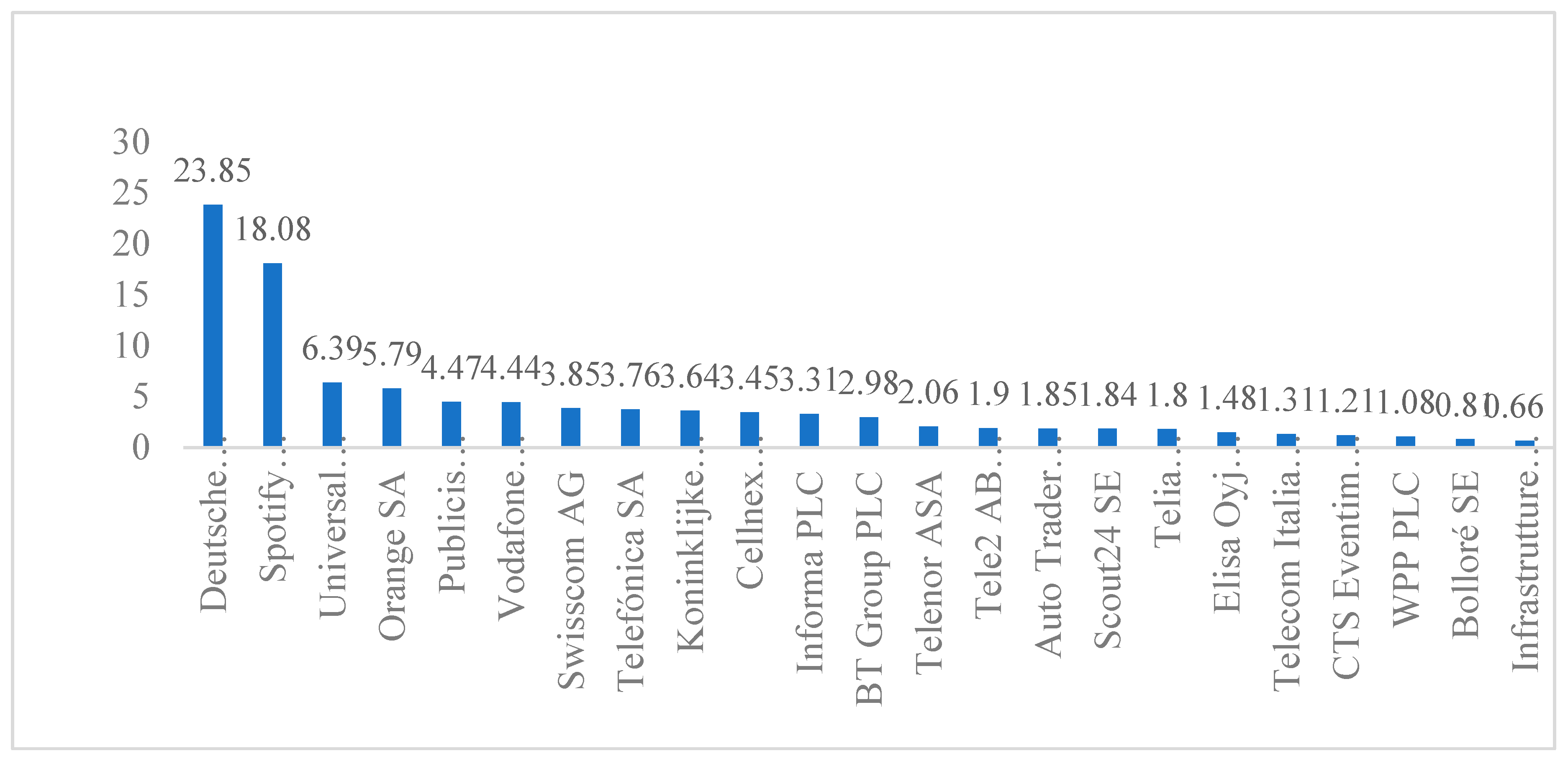
Figure 2.
- Geographic allocation of the SPDR® MSCI Europe Communication Services UCITS ETF.
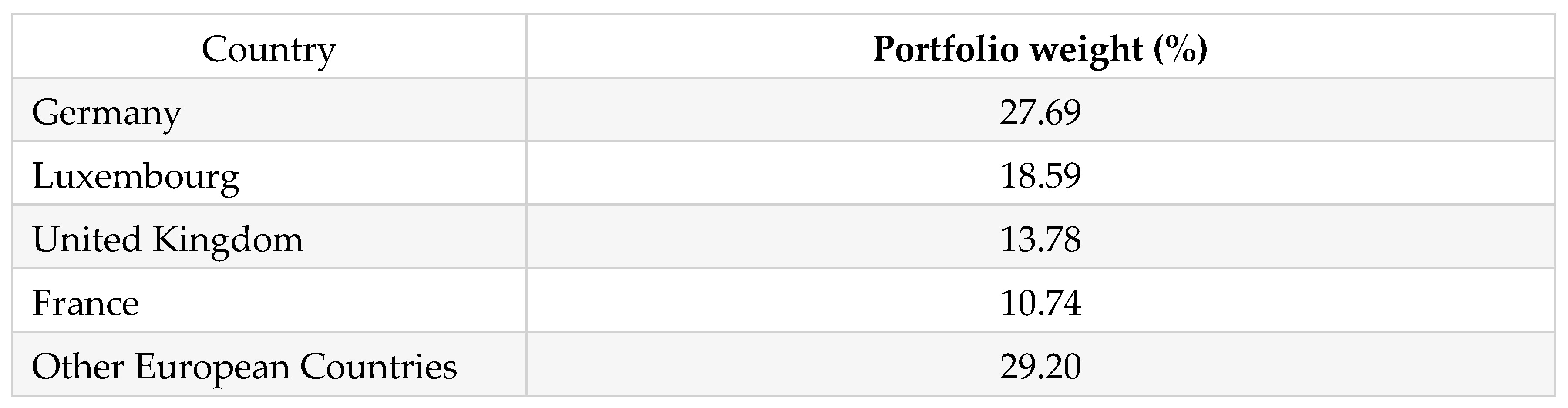
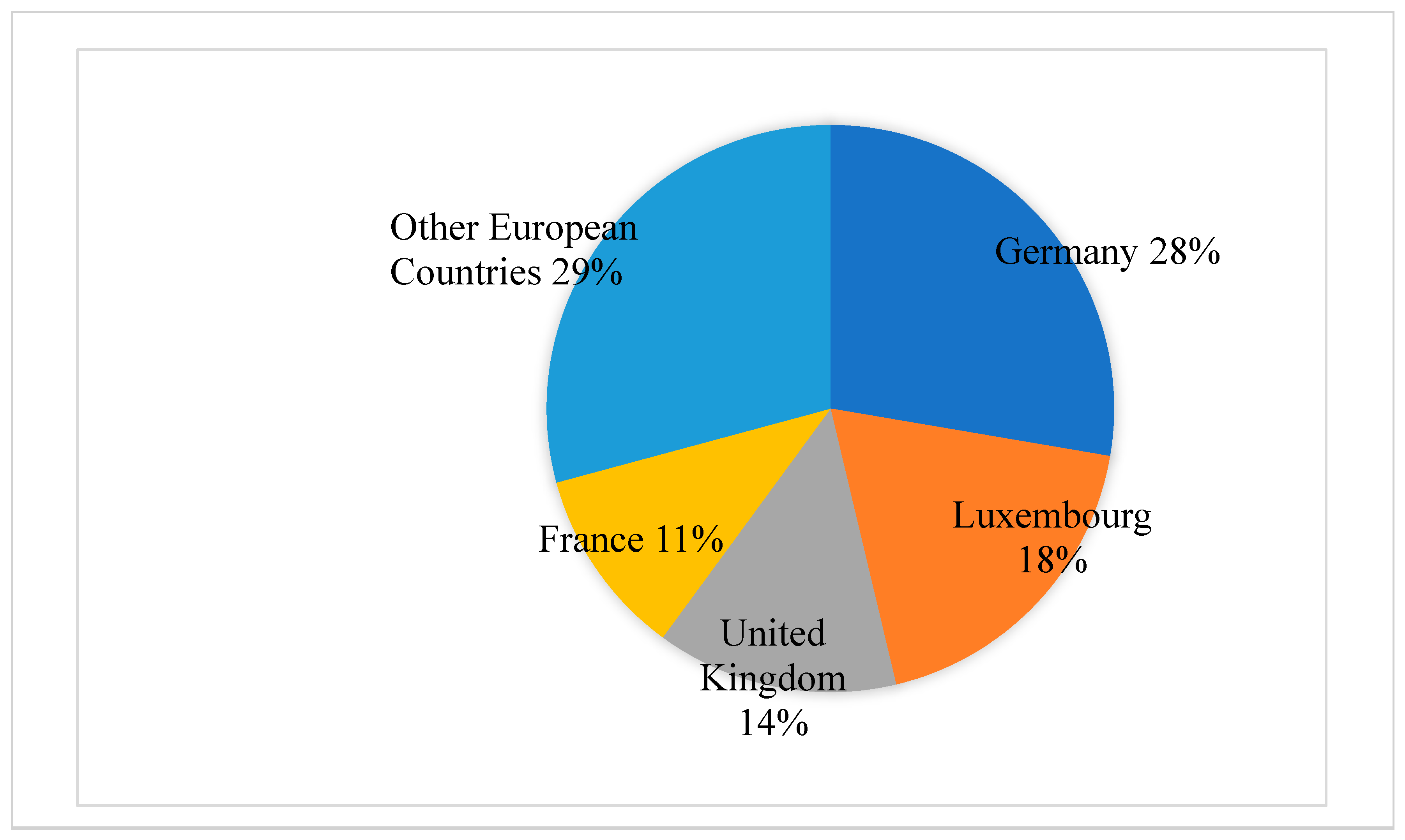
Figure 3.
Digital Economy and Society Index (DESI) Scores Across European Countries (2024). Source: European Commission, DESI (2024).
Figure 3.
Digital Economy and Society Index (DESI) Scores Across European Countries (2024). Source: European Commission, DESI (2024).
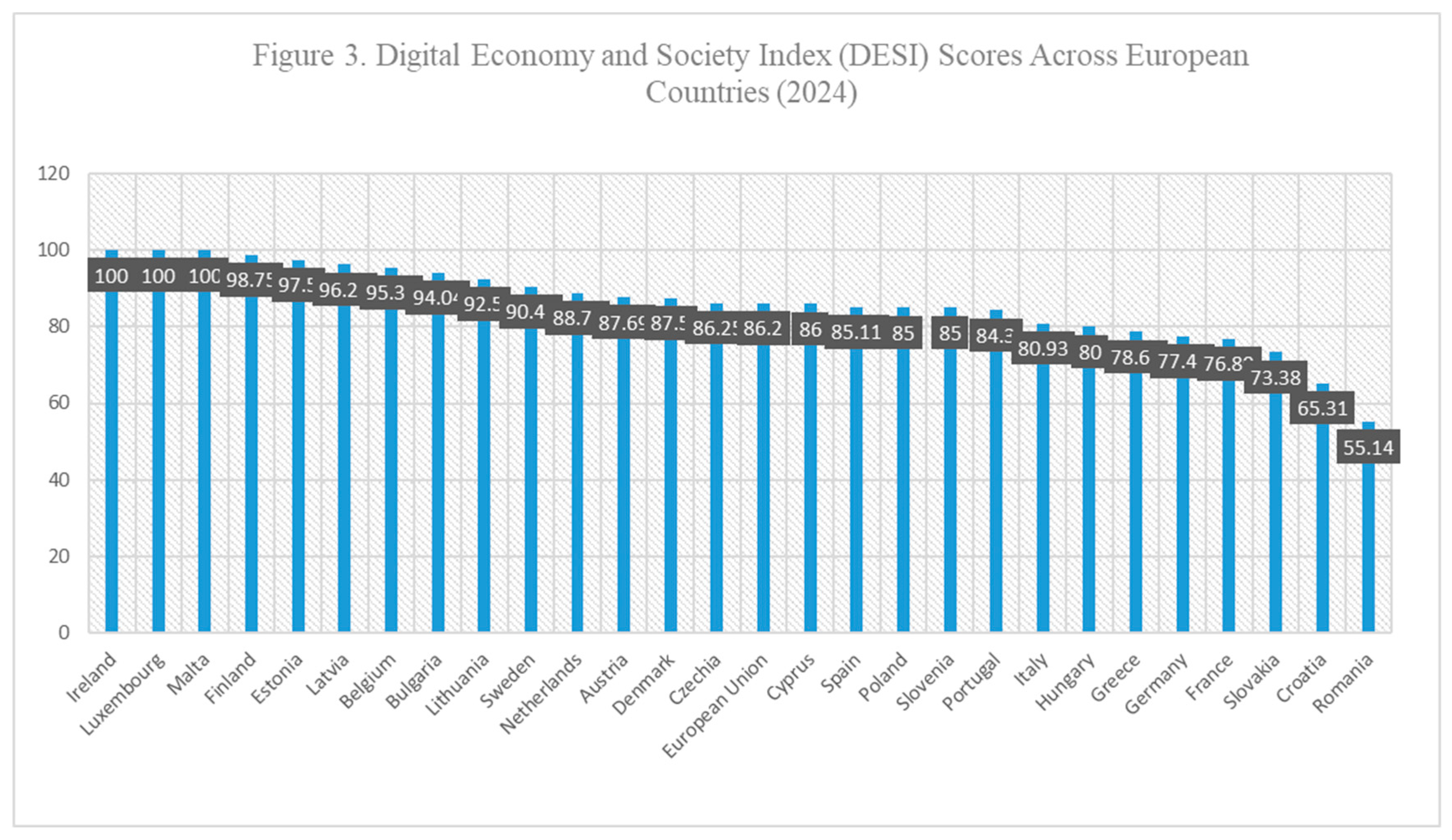
Figure 4.
The influence of governance structure. Source: Worldwide governance indicator -World Bank Group.
Figure 4.
The influence of governance structure. Source: Worldwide governance indicator -World Bank Group.
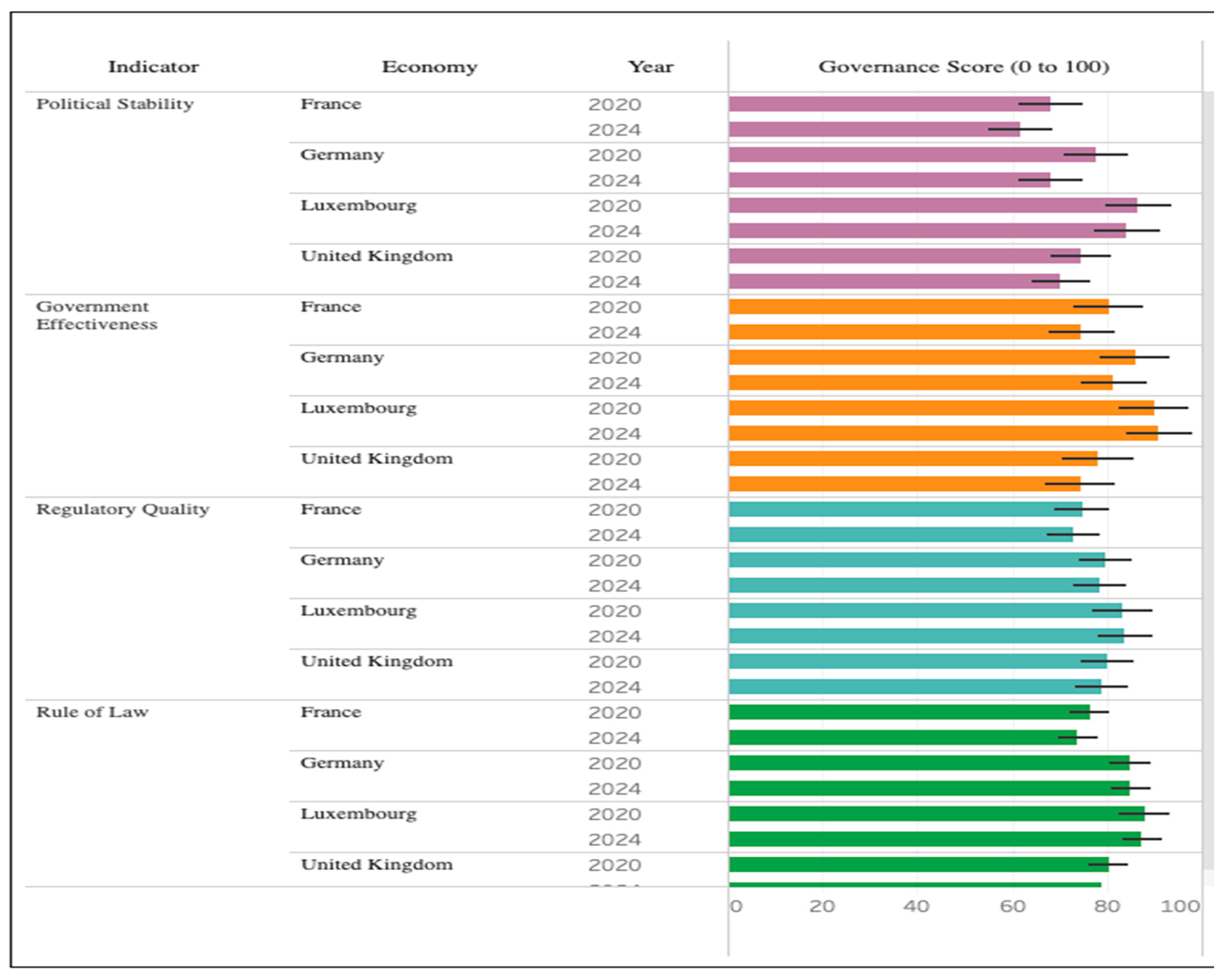
Table 2.
Average daily returns of the benchmark ETF and constituent firms during the portfolio formation period (2024).
Table 2.
Average daily returns of the benchmark ETF and constituent firms during the portfolio formation period (2024).
| Asset / company | Average daily return | Asset / company | Average daily return |
| SPDR® MSCI Europe Communication Services UCITS ETF (Benchmark ETF) | 0.000502176 | Publicis Groupe SA | 0.000847 |
| Auto Trader Group PLC | 0.000619005 | Scout24 SE | 0.001131 |
| Bolloré SE | 0.000190318 | Spotify Technology SA | 0.003813 |
| BT Group plc | 0.001035084 | Swisscom AG | -0.000052 |
| Cellnex Telecom SA | -0.000390 | Tele2 AB Class B | 0.000982 |
| CTS Eventim AG & Co. KGaA | 0.001391 | Telecom Italia S.p.A. | -0.000440 |
| Deutsche Telekom AG | 0.001050 | Telefónica SA | 0.000279 |
| Elisa Oyj Class A | -0.000018 | Telenor ASA | 0.000255 |
| Informa PLC | 0.000405 | Telia Company AB | 0.000414 |
| Infrastructure Wireless Italiane S.p.A. | -0.000610 | Universal Music Group NV | 0.00007861 |
| Koninklijke KPN NV | 0.000513 | Vodafone Group PLC | 0.0000907 |
| Orange SA | -0.000360 | WPP PLC | 0.000464 |
| Source: Author’s calculations based on daily trading data for constituent firms included in the MSCI Europe Communication Services 35/20 Capped Index during the portfolio formation period (2 January 2024–30 December 2024). | |||
Table 5.
Classification of constituent firms based on Beta and Alpha coefficients.
| Group | Asset / Company | Beta (β) | Alpha (α) |
| High-Beta | Vodafone Group PLC | 1.450587 | -0.000640 |
| High-Beta | BT Group plc | 1.204983 | 0.000430 |
| High-Beta | Telecom Italia S.p.A. | 1.166984 | -0.001020 |
| High-Beta | Auto Trader Group PLC | 1.001447 | 0.000116 |
| High-Beta | Telefónica SA | 0.853639 | -0.000150 |
| High-Beta | CTS Eventim AG & Co. KGaA | 0.762596 | 0.001008 |
| High-Beta | Scout24 SE | 0.748554 | 0.000755 |
| High-Beta | Orange SA | 0.732181 | -0.000730 |
| High-Beta | Spotify Technology SA | 0.518134 | 0.003552 |
| High-Beta | Koninklijke KPN NV | 0.499074 | 0.000262 |
| High-Beta | Cellnex Telecom SA | 0.499549 | -0.000640 |
| Low-Beta | Swisscom AG | 0.479947 | -0.000290 |
| Low-Beta | Bolloré SE | 0.448476 | -0.000035 |
| Low-Beta | Deutsche Telekom AG | 0.423818 | 0.000837 |
| Low-Beta | Telia Company AB | 0.405644 | 0.000210 |
| Low-Beta | WPP PLC | 0.256905 | 0.000335 |
| Low-Beta | Infrastructure Wireless Italiane S.p.A. | 0.243555 | -0.000730 |
| Low-Beta | Informa PLC | 0.211934 | 0.000299 |
| Low-Beta | Publicis Groupe SA | 0.089619 | 0.000802 |
| Low-Beta | Telenor ASA | 0.083701 | 0.000213 |
| Low-Beta | Tele2 AB Class B | -0.041770 | 0.001003 |
| Low-Beta | Elisa Oyj Class A | -0.075020 | 0.000019 |
| Low-Beta | Universal Music Group NV | -0.127943 | 0.000143 |
| Source: Author’s calculations based on daily trading data for constituent firms included in the MSCI Europe Communication Services 35/20 Capped Index during the portfolio formation period (2 January 2024–30 December 2024). | |||
Table 6.
Securities selected for the active portfolio.
| Asset / Company | Beta (β) | Alpha (α) |
| Spotify Technology SA | 0.518134 | 0.003552 |
| CTS Eventim AG & Co. KGaA | 0.762596 | 0.001008 |
| Scout24 SE | 0.748554 | 0.000755 |
| BT Group plc | 1.204983 | 0.000430 |
| Koninklijke KPN NV | 0.499074 | 0.000262 |
| Auto Trader Group PLC | 1.001447 | 0.000116 |
| Source: Author’s calculations based on the Treynor–Black security selection procedure. | ||
Table 7.
Residual Variance Estimates for the Selected Active Portfolio Securities.
| Asset / Company | Residual Variance ( \sigma^2(\varepsilon_i) ) |
| Spotify Technology SA | 0.000585031 |
| CTS Eventim AG & Co. KGaA | 0.000329000 |
| Scout24 SE | 0.000121480 |
| BT Group plc | 0.000363155 |
| Koninklijke KPN NV | 0.000118260 |
| Auto Trader Group PLC | 0.000224353 |
| Source: Author’s calculations based on daily trading data during the portfolio formation period (2 January 2024–30 December 2024). | |
Table 8.
Risk-Adjusted Abnormal Performance and Optimal Active Portfolio Weights under the Treynor–Black Framework.
Table 8.
Risk-Adjusted Abnormal Performance and Optimal Active Portfolio Weights under the Treynor–Black Framework.
| Asset / Company | Alpha-to-Residual Variance Ratio ((\alpha_i/\sigma^2(\varepsilon_i))) | Active Portfolio Weight ((W_i)) |
| Spotify Technology SA | 6.072082 | 0.315061 |
| CTS Eventim AG & Co. KGaA | 3.064006 | 0.158981 |
| Scout24 SE | 6.217777 | 0.322620 |
| BT Group plc | 1.183984 | 0.061433 |
| Koninklijke KPN NV | 2.217382 | 0.115053 |
| Auto Trader Group PLC | 0.517499 | 0.026851 |
| Total | – | 1.000000 |
| Source: Author’s calculations based on the Treynor–Black optimisation framework. | ||
Table 9.
Comparison of Portfolio Allocations under the Treynor–Black and Equal-Weight Approaches.
| Asset / Company | Treynor–Black Portfolio | Equal-Weight Portfolio |
| Spotify Technology SA | 0.211016 | 0.111627 |
| CTS Eventim AG & Co. KGaA | 0.106480 | 0.111627 |
| Scout24 SE | 0.216079 | 0.111627 |
| BT Group plc | 0.041146 | 0.111627 |
| Koninklijke KPN NV | 0.077058 | 0.111627 |
| Auto Trader Group PLC | 0.017984 | 0.111627 |
| SPDR® MSCI Europe Communication Services UCITS ETF | 0.330239 | 0.330239 |
| Total | 1.000000 | 1.000000 |
| Source: Author’s calculations. | ||
Table 10.
Portfolio return comparison: Treynor–Black and Equal-Weight Portfolios.
| Portfolio | Average Daily Return | Annualised Return |
| Treynor–Black Portfolio | 0.000931 | 0.232 |
| Equal-Weight Portfolio | 0.000767 | 0.191 |
| Source: Author’s calculations. The detailed security-level return contributions underlying the portfolio return calculations are reported in Appendix A. | ||
Table 11.
Comparative risk and risk-adjusted performance of the proposed portfolios.
| Performance Measure | Treynor–Black Portfolio | Equal-Weight Portfolio |
| Annual Return | 0.232 | 0.191 |
| Portfolio Beta | 0.99163 | 0.80255 |
| Annualised Standard Deviation | 2.865 | 2.401 |
| Sharpe Ratio | 0.074 | 0.0883 |
| Treynor Ratio | 0.213 | 0.2641 |
| Source: Author’s calculations. The calculations supporting portfolio beta, standard deviation, Sharpe ratio, and Treynor ratio are presented in Appendices B–D | ||
Table 12.
Descriptive Statistics of Daily Portfolio Returns.
| Portfolio | N | Mean | Std. Deviation | Std. Error Mean |
| Treynor–Black Portfolio | 194 | 0.00093121 | 0.01148737 | 0.00082688 |
| Equal-Weight Portfolio | 194 | 0.00076748 | 0.00960682 | 0.00068973 |
| Source: Author’s calculations. | ||||
Table 13.
Independent Samples t-Test: Treynor–Black versus Equal-Weight Portfolio.
| Test | F | Sig. | t | df | Sig. (2-tailed) |
| Equal variances assumed | 4.033 | 0.045 | 0.866 | 385 | 0.169 |
| Equal variances not assumed | – | – | 0.866 | 372.657 | 0.169 |
| Source: Author’s calculations. | |||||
Table 14.
Descriptive Statistics: Proposed Portfolio versus Benchmark ETF Portfolio.
| Portfolio | N | Mean | Std. Deviation | Std. Error Mean |
| Proposed Portfolio | 194 | 0.00093121 | 0.01148737 | 0.00082688 |
| Benchmark ETF Portfolio | 194 | 0.00062711 | 0.01006217 | 0.00072242 |
| Source: Author’s calculations. | ||||
Table 15.
Independent Samples t-Test: Proposed Portfolio versus Benchmark ETF Portfolio.
| Test | F | Sig. | t | df | Sig. (2-tailed) |
| Equal variances assumed | 2.314 | 0.129 | 0.769 | 385 | 0.0293 |
| Equal variances not assumed | – | – | 0.769 | 377.924 | 0.0293 |
| Source: Author’s calculations. | |||||
Disclaimer/Publisher’s Note: The statements, opinions and data contained in all publications are solely those of the individual author(s) and contributor(s) and not of MDPI and/or the editor(s). MDPI and/or the editor(s) disclaim responsibility for any injury to people or property resulting from any ideas, methods, instructions or products referred to in the content. |
© 2026 by the authors. Licensee MDPI, Basel, Switzerland. This article is an open access article distributed under the terms and conditions of the Creative Commons Attribution (CC BY) license (http://creativecommons.org/licenses/by/4.0/).
Copyright: This open access article is published under a Creative Commons CC BY 4.0 license, which permit the free download, distribution, and reuse, provided that the author and preprint are cited in any reuse.


