

Submitted:
08 June 2026
Posted:
11 June 2026
You are already at the latest version
Abstract
Rabies remains a fatal zoonotic disease of major public health and veterinary importance in Latin America. Although canine-mediated rabies has markedly declined in Colombia, sylvatic transmission persists in rural regions, and information on equine rabies in Putumayo is scarce. This study aimed to describe the epidemiological, clinical, pathological, and surveillance characteristics of laboratory-confirmed equine rabies cases in Putumayo, southern Colombia, during 2024–2025. A retrospective descriptive study was conducted using national surveillance data. Thirteen equids exposed to the virus were identified. Five were classified as suspected cases, and all of them died; four were laboratory-confirmed. The remaining animals also died but were not reported to the Colombian Agricultural Institute (ICA) for sample collection; however, they exhibited clinical signs consistent with rabies. Epidemiological and clinical variables, necropsy findings, and diagnostic timelines were analyzed. Laboratory confirmation was performed using direct immunofluorescence and histopathology. The four confirmed cases occurred in four separate outbreaks. All affected equines were unvaccinated and raised under extensive management systems. Progressive neurological deterioration led to 100% case fatality. Pathological findings consistently demonstrated central nervous system involvement. The median times from symptom onset to notification were 7.5 days, and from notification to laboratory diagnosis were 9.0 days. This study provides the first detailed characterization of equine rabies in Putumayo, suggesting ongoing sylvatic transmission and gaps in preventive vaccination. Strengthening integrated surveillance and One Health strategies is essential to reduce the rabies burden.
Keywords:
equine rabies
; sylvatic rabies
; Desmodus rotundus
; veterinary surveillance
; One Health
; zoonotic diseases
; Colombia
1. Introduction
Rabies remains one of the most lethal zoonotic diseases worldwide, causing acute and progressive encephalitis in mammals and leading almost invariably to death once clinical signs develop [1,2,3]. The disease is caused by the rabies virus (RABV), a neurotropic virus belonging to the genus Lyssavirus within the family Rhabdoviridae. Despite the availability of effective preventive measures, rabies continues to pose a major public health, veterinary, and socioeconomic burden, particularly in low- and middle-income countries [4]. In Latin America, sustained efforts have substantially reduced canine-mediated rabies; however, sylvatic transmission cycles, especially those involving hematophagous bats, remain a persistent and emerging threat to livestock and human populations [2,5,6,7].
In rural and peri-rural settings of South America, the common vampire bat (Desmodus rotundus) plays a central role in the maintenance and transmission of RABV [8,9,10,11]. Through repeated blood-feeding behavior, infected bats efficiently transmit the virus to herbivores, including cattle, horses, and other domestic animals. Among these species, equines are particularly vulnerable due to their frequent exposure in open grazing systems and their proximity to forested and fragmented landscapes that favor roosting and foraging by bats. Infected horses usually develop a paralytic or furious form of rabies, progressing rapidly to respiratory failure and death, resulting in substantial economic losses and potential occupational exposure for owners, veterinarians, and animal handlers [12,13].
Over the last two decades, Brazil has produced extensive epidemiological evidence demonstrating the widespread distribution and spatiotemporal clustering of equine rabies, highlighting its relevance as an endemic and neglected disease [3,12,14]. Similar patterns have been reported in other regions of Latin America, Africa, and Asia, emphasizing the global importance of rabies in equids. These studies have underscored the influence of environmental change, deforestation, livestock expansion, and cross-border animal movement on viral circulation and disease emergence. In contrast, information on equine rabies in Colombia remains remarkably scarce [3,15].
In Colombia, rabies continues to circulate in both urban and sylvatic cycles [6,9,16]. While urban outbreaks linked to dogs have been historically documented and progressively controlled, sylvatic rabies transmitted by bats persists as a major concern in rural areas [17,18,19,20,21]. In urban and periurban settings, the emergence of rabies in cats represents a concerning trend [21]. Most published research in the country has focused on bovine rabies, describing its geographical distribution, temporal trends, and associated ecological factors [6]. These studies have demonstrated sustained viral circulation in several departments and highlighted the need for strengthened surveillance and prevention strategies [4]. However, comparable investigations in equine populations are notably lacking, despite the ecological and epidemiological similarities between cattle and horses in endemic regions [22,23,24].
Putumayo, located in the southwestern Colombian Amazon, is a high-risk setting for zoonotic and vector-borne diseases due to its dense rainforests, extensive livestock activities, and intense cross-border mobility with Ecuador and Peru [25,26,27,28]. The region has been historically affected by multiple emerging and re-emerging infections, including yellow fever and sylvatic rabies [28,29]. Nevertheless, systematic documentation of rabies cases in equines from this department has not been previously reported in the scientific literature.
In this context, we describe four fatal cases of laboratory-confirmed equine rabies detected in Putumayo, southern Colombia. By presenting their clinical, epidemiological, and diagnostic characteristics, this study aims to contribute to the limited national and regional evidence on equine rabies, strengthen veterinary surveillance, and support One Health–based strategies for prevention and control in endemic regions.
2. Methods
2.1. Study Design and Case Definition
A retrospective descriptive study was conducted to characterize suspected and laboratory-confirmed equine rabies cases reported in the Department of Putumayo, southern Colombia, between December 2024 and October 2025. During this period, thirteen equids exposed to the virus were identified in three rural villages (veredas) in the municipalities of Orito and Villagarzón: El Retiro, San Gerardo, and Villa Luz (Figure 1). Of these, five were classified as suspected cases, and all had a fatal outcome; four of the deceased animals were laboratory-confirmed for infection with the Rabies virus and were included in the present analysis.
A suspected case of rabies in equines is defined by the presence of neurological signs, the most frequent of which are paralysis, ataxia, incoordination, and recumbency (falling), similar to those seen in bovine paralytic rabies. These symptoms are often associated with areas where vampire bats are present or a history of bat bites (https://www.ica.gov.co/areas/pecuaria/servicios/enfermedades-animales/rabia-silvestre-1/epidemiologia-rabia-silvestre.aspx).
Confirmed cases were defined as equines that presented with compatible neurological signs and tested positive for rabies virus (RABV) using official laboratory diagnostic methods.
2.2. Data Sources and Variables
Epidemiological, clinical, and laboratory data were obtained from the Colombian Agricultural Institute (ICA) surveillance system, field investigation reports, standardized outbreak notification forms, and structured databases.
The following variables were collected: year of occurrence, municipality and vereda, date of symptom onset, date of notification, outbreak identification, number of exposed animals, number of suspected and confirmed cases, vaccination status, probable origin of infection, and implementation of control measures. Clinical variables included general condition, locomotor alterations, neurological signs, behavioral changes, disease progression, and outcome. Pathological variables comprised gross and microscopic findings affecting the central nervous system and other organs. Time (in days) between disease beginning and notification to animal health authorities, between that and field visit for assessment and first sampling, as well as between sampling and DIF results, histopathology results, and IIF antigenic variants results, was calculated. Finally, the time between notification and final diagnosis was also assessed.
2.3. Field Investigation and Necropsy
Following the notification, veterinary officers conducted on-site investigations, including clinical assessment, epidemiological evaluation, and necropsy. Necropsies were performed in all fatal cases using standardized biosafety procedures. Macroscopic evaluation focused on the brain and meninges, assessing congestion, hyperemia, hemorrhages, edema, and cerebrospinal fluid volume. Peripheral organs were also examined to exclude alternative causes of neurological disease.
2.4. Laboratory Diagnosis and Viral Characterization
Brain tissue samples were collected aseptically from fatal cases and submitted to the authorized reference laboratory (Laboratorio Nacional de Diagnóstico Veterinario del Instituto Colombiano Agropecuario). Rabies diagnosis was performed using a direct immunofluorescence assay (DIF) to detect viral antigen, considered the gold standard.
Histopathological analyses were conducted on brain tissues to evaluate microscopic lesions compatible with viral encephalitis. In addition, antigenic typing of rabies virus isolates was performed by indirect immunofluorescence (IIF) using infected brain tissue from each case. Only laboratory-confirmed cases were included in the final analysis.
2.5. Ethical Considerations
All procedures were conducted in accordance with national veterinary surveillance and public health regulations. No experimental interventions were performed, and data were analyzed anonymously for research purposes.
3. Results
3.1. Epidemiological and Temporal Characteristics
Between December 2024 and October 2025, four laboratory-confirmed cases of equine rabies were identified in the department of Putumayo, southern Colombia (Figure 2). One case occurred in late 2024 (a horse, Equus ferus caballus), while three cases were reported in 2025 (one horse and two mules, Equus asinus × Equus caballus). All events were classified by the Colombian Agricultural Institute (ICA) as cases of sylvatic-origin rabies.
The confirmed cases corresponded to four epidemiological outbreaks. Three outbreaks involved a single equid, while one outbreak, reported in 2025 in Villagarzón, affected two animals simultaneously (in one, it was not possible to obtain samples) (Figure 1). The cases were distributed across the municipalities of Orito and Villagarzón (Figure 1), within rural settlements characterized by mixed agricultural–livestock systems and proximity to forested areas (Table 1).
All affected equines were maintained under extensive or semi-extensive management systems and were primarily used for agricultural and transport activities. None of the animals had documented records of prior rabies vaccination (Table 1).
The onset of clinical signs ranged from December 25, 2024, to October 11, 2025. All suspected cases were reported by the owners to the local ICA offices, thereby activating sanitary response protocols, epidemiological investigation (surveillance is carried out jointly with the health sector, within the framework of Decree 780 of 2016), outbreak control, and follow-up measures (Table 1). Field visits and sample collection were generally conducted within 1–3 days after notification, and laboratory confirmation was obtained within days to weeks (critical route of 6-9 days) (Table 2).
Analysis of operational surveillance intervals showed that the median time from the onset of clinical signs to notification by equine owners to local animal health authorities was 7.5 days (interquartile range [IQR]: 3.8–13.3 days). Following notification, field visits and initial sampling were conducted rapidly, with a median time of 1.0 day (IQR: 0.8–1.3 days). The median time from sampling to availability of direct immunofluorescence results was 7.0 days (IQR: 6.8–7.5 days), while histopathological results required a median of 15.0 days (IQR: 11.8–17.3 days). Antigenic typing by indirect immunofluorescence was completed after a median of 11.5 days (IQR: 10.3–17.0 days). Overall, the median interval between notification and final laboratory diagnosis was 9.0 days (IQR: 7.8–10.0 days), reflecting efficient coordination between field surveillance and diagnostic services (Table 2).
3.2. Outbreak Characteristics, Morbidity, and Mortality
The number of equids exposed per outbreak ranged from 1 to 9 (Table 1). Morbidity rates varied according to herd size, ranging from 11.1% in the largest outbreak to 100% in outbreaks involving single or paired animals.
All clinically affected equines died, resulting in a case fatality rate of 100% across all outbreaks. Overall mortality and lethality were 100%, reflecting the uniformly fatal outcome of rabies infection once neurological signs became evident. No cases of clinical recovery or prolonged survival were documented (rabies case fatality rate is almost 100% in humans and animals; the equines are highly susceptible to this disease, with rapid neurological progression and a high fatality rate).
3.3. Clinical Manifestations
All affected equines developed an acute and progressive neurological syndrome consistent with rabies infection. Initial manifestations included marked prostration, depressed general condition, and reduced responsiveness (Table 3).
As the disease progressed, animals exhibited claudication, altered gait, postural instability, and progressive motor incoordination. These signs rapidly evolved toward severe neurological dysfunction, including complete loss of standing ability and prolonged recumbency.
Involuntary pedal movements in the decubitus position, tremors, muscular fasciculations, and posterior limb paralysis characterized advanced stages. Several animals developed severe weakness and hypersensitivity to external stimuli. Terminal phases were frequently accompanied by cachexia secondary to the inability to feed, reflecting rapid clinical deterioration.
The frequency and distribution of the main clinical manifestations are summarized in Table 3. In all cases, the disease course was acute, and death occurred within a few days after the onset of neurological signs. No animals showed evidence of clinical stabilization or improvement before death.
3.4. Pathological Findings
Necropsies were performed in all affected animals. Gross pathological evaluation consistently revealed alterations of the central nervous system (Table 4).
The most frequent macroscopic finding was generalized cerebral congestion, accompanied by marked hyperemia of the meninges and cerebral cortex. In addition, a notable increase in cerebrospinal fluid volume was observed during cranial cavity opening in most cases, compatible with acute inflammatory processes affecting the central nervous system.
Severe vascular congestion and petechial hemorrhages were documented in several encephalic structures, and diffuse cerebral edema was observed in some animals. No significant lesions were detected in peripheral organs that could explain the neurological syndrome.
A summary of the main pathological findings is presented in Table 4. These macroscopic lesions were consistent with acute viral encephalitis and supported the diagnosis of rabies in conjunction with laboratory confirmation.
3.5. Laboratory Confirmation and Surveillance Response
The reference laboratory (Laboratorio Nacional de Diagnóstico Veterinario del ICA) confirmed four cases in accordance with national diagnostic protocols. Brain tissue samples collected during field investigations tested positive for the rabies virus (Table 4).
Laboratory confirmation was achieved using standardized diagnostic techniques, including direct immunofluorescence and antigenic typing by indirect immunofluorescence, in accordance with national surveillance guidelines. Similar diagnostic findings were obtained in all cases, confirming active rabies virus infection and supporting their classification as sylvatic rabies outbreaks (Table 4).
Following laboratory confirmation, comprehensive sanitary and epidemiological measures were implemented in all affected premises. These included activating territorial zoonosis councils to coordinate surveillance activities across the health and environment sectors, and capturing hematophagous bats on properties with fresh bites in areas where outbreak-control activities are underway.
Epidemiological investigations were conducted to identify potential sources of exposure and to assess the extent of viral circulation. Owners, animal handlers, and other exposed individuals were referred to public health authorities for risk assessment and, when indicated, post-exposure prophylaxis.
4. Discussion
This study documents five laboratory-confirmed cases of equine rabies in the department of Putumayo, southern Colombia, between 2024 and 2025, representing the first detailed clinical, epidemiological, and pathological description of this disease in equines in the international, peer-reviewed literature. Although rabies remains endemic in Colombia, published information on its occurrence in horses is extremely limited [6,9,11,16,20]. Therefore, the present case series provides novel evidence on the circulation of rabies virus in equine populations within a highly biodiverse and ecologically dynamic area of the Colombian Amazon, underscoring the importance of sylvatic transmission cycles in rural settings.
The temporal distribution of cases, with one event in 2024 followed by three in 2025, suggests sustained viral circulation rather than sporadic spillover [11]. This pattern is consistent with enzootic maintenance of rabies virus in wildlife reservoirs, particularly hematophagous bats, which are widely distributed in the region [6,8,11,14,16,21]. Putumayo’s extensive forest cover, fragmented landscapes, and expanding agricultural frontier create favorable conditions for bats to roost, forage, and interact with domestic animals. These ecological characteristics, combined with extensive livestock management systems, likely increase the vulnerability of equine populations to repeated exposure [6,30].
Previous national-scale modeling analyses based on municipality-level rabies outbreaks from 1982 to 2010 demonstrated that sylvatic rabies transmission in Colombia is geographically heterogeneous, with clusters of high incidence in some regions and few reported events in large areas, including parts of the Amazon [29]. These studies highlighted that low notification rates in remote departments may reflect limitations in surveillance and diagnostic capacity rather than the true absence of viral circulation [29]. Using environmental variables and ecological niche modeling, temperature and precipitation patterns, particularly during dry seasons, were identified as key drivers of the suitability for Desmodus rotundus infection [10,11,29]. Although the highest-incidence municipalities were located mainly outside Putumayo, the models supported the plausibility of sylvatic rabies risk in Amazonian settings where ecological conditions are favorable, but historical reporting has been limited [29]. In this context, the present case series provides contemporary field evidence that complements and validates these predictive assessments.
The geographic clustering of cases in Orito and Villagarzón (Figure 1) further supports the role of local ecological and environmental factors in shaping rabies transmission dynamics [9,11]. Mixed agricultural activities, proximity to riparian forests, and limited physical barriers between wildlife habitats and grazing areas characterize both municipalities [31,32]. Similar spatial patterns have been described in other endemic regions, where landscape configuration, deforestation, and land-use change facilitate contact between reservoir species and domestic hosts. In this context, equines may function as sentinel species, reflecting underlying viral circulation in surrounding ecosystems [12,33].
All affected animals in this series were unvaccinated, highlighting a persistent gap in preventive practices among equine owners in rural Colombia. Although rabies vaccination is widely promoted for dogs and cattle, horses are frequently overlooked in routine immunization programs across species, with administration handled by the producer (Resolution 9028 of 2024). [4,34]. This omission may be related to limited awareness of disease risk and economic constraints. There are geographical and access barriers that may affect vaccination. The absence of vaccination in all cases underscores the preventable nature of these fatal events and emphasizes the need to strengthen immunization coverage in at-risk areas [35]. Even before 2025, the availability of equine vaccines was limited, which restricted immunization strategies. In 2025, a new vaccine for this species was registered with the ICA (Colombian Agricultural Institute) and is now commercially available to producers.
In the department of Putumayo, the Instituto Colombiano Agropecuario (ICA) has implemented vaccination activities on rural farms against wildlife-associated rabies in susceptible species, particularly cattle and buffalo, with records available since 2017. According to these data, 176,172 animals were vaccinated during the first cycle of 2017, and 928 were vaccinated during the second cycle of the same year. Subsequently, vaccination coverage varied, ranging from 14,645 animals (first cycle of 2018) to 46,917 (first cycle of 2023) per cycle.
During the period associated with the equine rabies outbreaks reported here, 1,813 animals were vaccinated in the second cycle of 2024 and 45,008 in the first cycle of 2025. These records reflect the sustained implementation of immunization activities as the primary preventive and control measure in the region. However, the confirmation of rabies cases in equids highlights the persistence of epidemiological risk and the need to strengthen epidemiological surveillance strategies, implement strategic vaccination in susceptible species, and enhance risk communication in endemic areas.
The uniformly fatal outcome observed in this series is consistent with the natural history of rabies once neurological signs appear [1,2,4,21]. All affected equines developed rapidly progressive disease, culminating in death within a short period. The high case fatality rate reflects both the intrinsic virulence of the rabies virus, and there are no effective therapeutic options at advanced stages globally, nor in animals or humans. These findings reinforce the critical importance of prevention and early detection [36,37].
The clinical presentation documented in this study aligns with classical descriptions of rabies in herbivores. Initial nonspecific signs such as prostration and reduced responsiveness were followed by progressive locomotor impairment and overt neurological dysfunction. Advanced manifestations, including pedal movements, posterior limb paralysis, and prolonged recumbency, reflected severe central nervous system involvement. The presence of cachexia in terminal stages further illustrates the rapid deterioration associated with feeding incapacity and systemic exhaustion. Although aggressive behavior is often emphasized in rabies descriptions, particularly in carnivores, the predominantly paralytic form observed here is typical of infection in equines and other herbivores [38,39,40].
Postmortem findings provided additional support for the diagnosis and pathophysiological mechanisms of disease. Generalized cerebral congestion, meningeal hyperemia, increased cerebrospinal fluid volume, and petechial hemorrhages were consistently observed, indicating acute inflammatory and vascular disturbances within the central nervous system. These lesions are compatible with viral encephalitis and reflect disruption of the blood–brain barrier, neuronal injury, and immune-mediated responses. The absence of significant lesions in peripheral organs further supports the neurotropic nature of the rabies virus and its primary localization within neural tissues [41,42].
Laboratory confirmation using standardized diagnostic methods ensured the reliability of case classification. Direct immunofluorescence assays remain the gold standard for rabies diagnosis in animals and offer high sensitivity and specificity. The consistency of laboratory findings across all cases supports the homogeneity of infection and confirms active viral replication. The integration of field investigation, necropsy, and laboratory analysis illustrates the effectiveness of the surveillance framework when timely reporting occurs [43,44].
A notable strength of this series is the prompt notification by animal owners and the rapid response by veterinary authorities. Early reporting facilitated immediate field investigation, sample collection, and implementation of control measures. The responsiveness observed in these cases reflects the impact of ongoing surveillance efforts and highlights the importance of community engagement in disease control. This was further supported by analysis of operational time intervals, which showed a median delay of 7.5 days between symptom onset and notification, followed by a rapid field response within a median time of 1 day. These findings indicate a rapid initial recognition and strong institutional capacity for prompt follow-up once cases are reported [34,45,46].
Despite this effective response, the occurrence of multiple cases over consecutive years indicates that surveillance alone is insufficient to interrupt transmission. Persistent circulation in wildlife reservoirs requires integrated approaches addressing ecological, veterinary, and public health dimensions. In regions such as Putumayo, where human activities increasingly encroach on natural habitats, traditional compartmentalized control strategies are unlikely to achieve sustained success. Instead, coordinated interventions are needed to address bat ecology, livestock management, vaccination coverage, and community education [4,8,17,35].
The classification of all cases as sylvatic-origin rabies underscores the continuing importance of bat-mediated transmission in Colombia [17,47]. While canine rabies has been substantially reduced through vaccination campaigns, sylvatic cycles continue to represent a public health challenge [48]. Hematophagous bats play a significant ecological role in ecosystems, as they are integral to trophic dynamics and contribute to the natural balance of wildlife populations. In addition, they exhibit high mobility, complex social structures, and the capacity to exploit anthropogenic landscapes, which makes eradication technically and ecologically infeasible, since not all bat groups are infected with the Rabies virus, as viral circulation depends on specific epidemiological and environmental conditions.
At the same time, ecological and ecosystem-level factors are also important. The concept of One Health includes environmental health as a key component of this balance, including in the context of rabies. Consequently, control strategies should focus on epidemiological surveillance, timely vaccination of susceptible species, and technically justified selective vector control, prioritizing the reduction of transmission risk rather than the indiscriminate elimination of reservoir populations [9,10,11].
The findings of this study also have important public health implications. Equines often live in proximity to humans, and infected animals may expose owners, caretakers, veterinarians, and community members through bites, contact with saliva, or handling of carcasses [49,50]. The relatively short median interval between notification and final diagnosis observed in this study reflects efficient coordination between animal health laboratories and field services, which is essential for timely risk assessment and implementation of post-exposure prophylaxis in exposed individuals. The integration of veterinary and medical surveillance systems is therefore essential to ensure timely risk assessment and post-exposure prophylaxis [51].
From a One Health perspective, this case series illustrates the interconnectedness of environmental change, animal health, and human vulnerability. Deforestation, agricultural expansion, and settlement growth alter wildlife behavior and increase interspecific interactions. In Putumayo, these processes are occurring rapidly, driven by economic development and demographic pressures. The emergence of equine rabies in this context reflects broader ecological disruption and serves as an indicator of systemic imbalance. The documented diagnostic timelines further highlight how human, animal, and laboratory health systems interact operationally, reinforcing the importance of integrated surveillance platforms within a One Health framework [52,53].
The limited number of cases represents an inherent constraint of this study. As a descriptive series, it cannot establish causal relationships or quantify risk factors with statistical precision. Although necropsies are performed in all rabies cases, none were available for this report. This further restricts the detailed characterization of microscopic lesions. Additionally, information on bat population dynamics, roost distribution, and viral variants was unavailable, precluding a more refined ecological interpretation. Nevertheless, the systematic documentation of these cases provides valuable baseline information and a framework for future investigations.
Future research should integrate molecular epidemiology, spatial analysis, and ecological modeling to understand rabies transmission in southern Colombia better. Sequencing of viral isolates could clarify transmission pathways and identify potential links between outbreaks. Longitudinal surveillance of bat populations and livestock herds would facilitate early detection of viral circulation and evaluation of the effectiveness of interventions. Furthermore, socioeconomic studies exploring barriers to vaccination and reporting could inform tailored outreach strategies. Routine monitoring of surveillance performance indicators, such as notification delays and diagnostic turnaround times, should also be incorporated into national rabies control programs to identify operational gaps and guide quality improvement [54,55].
Preventing equine rabies in endemic regions requires sustained political commitment, resource allocation, and intersectoral collaboration. Vaccination programs must explicitly include horses and other equids, particularly in high-risk areas. Training veterinary personnel, expanding diagnostic capacity, and strengthening reporting systems are also critical components. Community participation, supported by culturally appropriate education initiatives, remains fundamental to long-term success. Improving early case recognition by owners and local practitioners may further reduce notification delays and enhance overall system performance [46,56].
4.1. Limitations
This study has several limitations that should be considered when interpreting its findings. First, the small number of laboratory-confirmed cases reflects the descriptive nature of this case series. It limits the ability to perform inferential statistical analyses or identify robust risk factors associated with equine rabies transmission in the region. Although the cases provide valuable baseline information, they may not fully represent the true burden of disease in Putumayo.
Second, the retrospective design relied on routinely collected surveillance data and field reports, which may be subject to incomplete documentation, recall bias, and variability in data quality. Some clinical and epidemiological variables could not be consistently verified for all suspected cases, and information on management practices and environmental exposures was limited.
Third, virological characterization was restricted to antigenic typing, and viral sequencing was not performed. Consequently, detailed phylogenetic relationships and transmission pathways could not be established. Similarly, comprehensive ecological data on bat populations, roosting sites, and movement patterns were unavailable, precluding more detailed analysis of reservoir dynamics.
Fourth, histopathological evaluation was limited to selected tissues and lacked standardized quantitative scoring. This may have restricted the detailed characterization of microscopic lesions associated with rabies infection.
Finally, moderate delays between symptom onset and notification may have resulted in underdetection of milder or atypical cases. Therefore, additional undiagnosed cases may have occurred in the study area. Despite these limitations, this study provides important initial evidence on equine rabies in southern Colombia and establishes a foundation for future surveillance and research efforts.
5. Conclusions
This study provides the first detailed characterization of equine rabies cases in Putumayo, Colombia, demonstrating sustained sylvatic transmission, uniformly fatal clinical outcomes, and consistent neurological pathology in affected animals. By integrating clinical, epidemiological, pathological, and operational surveillance data, this work offers a comprehensive overview of rabies dynamics in equine populations within an ecologically complex region of the Colombian Amazon.
The findings complement previous national modeling evidence by providing contemporary, field-based confirmation of rabies risk in Amazonian municipalities where historical reporting has been limited. Together, these data emphasize the vulnerability of unvaccinated equine populations in rural and peri-rural settings and highlight persistent gaps in preventive practices. The uniform absence of vaccination among affected animals underscores the preventable nature of these fatal events. It reinforces the urgent need to strengthen immunization strategies targeting equids in high-risk areas.
Author Contributions
I.C.S.R: Conceptualisation, methodology, formal analysis, investigation, writing—original draft preparation, and writing—review and editing; C.L.S.J.: Conceptualisation, methodology, formal analysis, investigation, writing—original draft preparation, and writing—review and editing; J.L.B.A: Conceptualisation, methodology, formal analysis, investigation, writing—original draft preparation, and writing—review and editing; D.K.B.A.: Conceptualisation, formal analysis, investigation, writing—original draft preparation, and writing—review and editing; A.J.RM.: Conceptualisation, investigation, writing—original draft preparation, and writing review and editing. All authors have read and agreed to the published version of the manuscript.
Funding
The current article processing charges (publication fees) were funded by the Facultad de Ciencias Médicas (FCM) (2-03-01-01), Universidad Nacional Autonoma de Honduras (UNAH), Tegucigalpa, MDC, Honduras, Central America (granted to Zambrano).
Institutional Review Board Statement
We confirm that the manuscript has been read and approved by all named authors and that no other persons have satisfied the criteria for authorship but are not listed. We further confirm that all have approved the order of authors listed in the manuscript. The material is original and has not been previously published elsewhere. Furthermore, we confirmed that no generative artificial intelligence (AI) or AI-assisted technologies were used in the writing process. ICA endorsed the content of this retrospective analysis.
Informed Consent Statement
Not applicable.
Data Availability Statement
Available upon reasonable request.
Acknowledgments
This article has been registered in the Research Proposal Registration of the Coordination of Scientific Integrity and Surveillance of Universidad Cientifica del Sur, Lima, Peru, under the number PI-50-2026-1365. This article is part of the project titled “Caracterización de la epidemiología y carga para la salud pública de enfermedades infecciosas emergentes y re-emergentes en Colombia y Latinoamérica” (Characterization of the epidemiology and public health burden of emerging and re-emerging infectious diseases in Colombia and Latin America), Código: PE005, of the Institución Universitaria Visión de las Américas. The authors express their gratitude to the Animal Protection Sub-Management, the Animal Health Technical Directorate, and the Epidemiological Surveillance Technical Directorate of the Colombian Agricultural Institute (ICA) for providing the official epidemiological data used in this study.
Conflicts of Interest
The authors do not have any conflicts of interest to report.
References
- Ali, Y.H.; Mohieddeen, T.A.G.; Abdellatif, M.M.; Ahmed, B.M.; Saeed, I.K.; Attaalfadeel, H.M.; Ali, A.A. Rabies in equids in Sudan. Onderstepoort J. Vet. Res. 2024, 91, e1–e10. [Google Scholar] [CrossRef]
- Oliveira, F.A.S.; Castro, R.J.S.; de Oliveira, J.F.; Barreto, F.M.; Farias, M.P.O.; Marinho, G.; Soares, M.; Silva-Júnior, A.; Schwarz, D.G.G. Geographical and temporal spread of equine rabies in Brazil. Acta Trop. 2022, 227, 106302. [Google Scholar] [CrossRef]
- Silva, V.V.D.; Leite, D.; Gonçalves, L.M.T.; Pinto, G.O.A.; Oliveira, P.R.F.; Mota, R.A. Space-time clustering of rabies in equines in Brazil from 2006 to 2023. Res. Vet. Sci. 2025, 193, 105724. [Google Scholar] [CrossRef]
- Bonilla-Aldana, D.K.; Ruiz-Saenz, J.; Martinez-Gutierrez, M.; Villamil-Gomez, W.; Mantilla-Meluk, H.; Arrieta, G.; León-Figueroa, D.A.; Benites-Zapata, V.; Barboza, J.J.; Muñoz-Del-Carpio-Toia, A.; et al. Zero by 2030 and OneHealth: The multidisciplinary challenges of rabies control and elimination. Travel Med. Infect. Dis. 2023, 51, 102509. [Google Scholar] [CrossRef] [PubMed]
- Rifakis, P.M.; Benitez, J.A.; Rodriguez-Morales, A.J.; Dickson, S.M.; De-La-Paz-Pineda, J. Ecoepidemiological and Social Factors Related to Rabies Incidence in Venezuela during 2002-2004. Int. J. BioMed Sci. 2006, 2, 1–6. [Google Scholar] [PubMed]
- Bonilla-Aldana, D.K.; Jimenez-Diaz, S.D.; Barboza, J.J.; Rodriguez-Morales, A.J. Mapping the Spatiotemporal Distribution of Bovine Rabies in Colombia, 2005-2019. Trop. Med. Infect. Dis. 2022, 7. [Google Scholar] [CrossRef] [PubMed]
- Ortega-Sánchez, R.; Bárcenas-Reyes, I.; Cantó-Alarcón, G.J.; Luna-Cozar, J.; E, R.A.; Contreras-Magallanes, Y.G.; González-Ruiz, S.; Cortez-García, B.; Milián-Suazo, F. Descriptive and Time-Series Analysis of Rabies in Different Animal Species in Mexico. Front Vet. Sci. 2022, 9, 800735. [Google Scholar] [CrossRef]
- Bonilla-Aldana, D.K.; Jimenez-Diaz, S.D.; Arango-Duque, J.S.; Aguirre-Florez, M.; Balbin-Ramon, G.J.; Paniz-Mondolfi, A.; Suárez, J.A.; Pachar, M.R.; Perez-Garcia, L.A.; Delgado-Noguera, L.A.; et al. Bats in ecosystems and their Wide spectrum of viral infectious potential threats: SARS-CoV-2 and other emerging viruses. Int. J. Infect. Dis. 2021, 102, 87–96. [Google Scholar] [CrossRef]
- Soler-Tovar, D.; Escobar, L.E. Rabies transmitted from vampires to cattle: An overview. PLoS ONE 2025, 20, e0317214. [Google Scholar] [CrossRef]
- Van de Vuurst, P.; Cifuentes-Rincon, A.; Bertke, A.S.; Soler-Tovar, D.; Reyes-Amaya, N.; Rodriguez Arévalo, F.; Cárdenas Hincapié, J.S.; Rivera-Monroy, J.; Escobar, L.E.; Hallerman, E. A preliminary assessment of population genetic structure of the common vampire bat (Desmodus rotundus) in Colombia. PeerJ 2025, 13, e20306. [Google Scholar] [CrossRef]
- Van de Vuurst, P.; Qiao, H.; Soler-Tovar, D.; Escobar, L.E. Climate change linked to vampire bat expansion and rabies virus spillover. Ecography 2024, 2024. [Google Scholar] [CrossRef]
- Sodré, D.N.A.; Rossi, G.A.M.; Mathias, L.A.; de Andrade Belo, M.A. Epidemiology and Control of Rabies in Cattle and Equines in Rondônia State, a Brazilian’s Legal Amazon Area. Animals 2023, 13. [Google Scholar] [CrossRef] [PubMed]
- Duarte, N.F.H.; Alencar, C.H.; Cavalcante, K.K.S.; Correia, F.G.S.; Romijn, P.C.; Araujo, D.B.; Favoretto, S.R.; Heukelbach, J. Increased detection of rabies virus in bats in Ceará State (Northeast Brazil) after implementation of a passive surveillance programme. Zoonoses Public Health 2020, 67, 186–192. [Google Scholar] [CrossRef]
- Meske, M.; Fanelli, A.; Rocha, F.; Awada, L.; Soto, P.C.; Mapitse, N.; Tizzani, P. Evolution of Rabies in South America and Inter-Species Dynamics (2009-2018). Trop. Med. Infect. Dis. 2021, 6. [Google Scholar] [CrossRef] [PubMed]
- Ribeiro, J.; Vieira, R.G.V.; Martins, C.M.; Ferreira, F.; Araujo, J.P.; Ullmann, L.S.; Dos Santos, A.P.; Biondo, A.W. Spatial Distribution of Bat Shelters and Livestock Rabies in Southern Brazil. Vector Borne Zoonotic Dis. 2021, 21, 785–795. [Google Scholar] [CrossRef]
- Arias Caicedo, M.R.; Xavier, D.A.; Arias Caicedo, C.A.; Andrade, E.; Abel, I. Epidemiological scenarios for human rabies exposure notified in Colombia during ten years: A challenge to implement surveillance actions with a differential approach on vulnerable populations. PLoS ONE 2019, 14, e0213120. [Google Scholar] [CrossRef]
- Páez, A.; Hernández, C.; Escobar, H.; Zapata, J.J.; Méndez, J.; Rey-Benito, G. Evaluation of the seroconversion as a response to rabies vaccination in dogs, Valle del Cauca, Colombia, 2009. Biomedica 2011, 31, 474–484. [Google Scholar] [CrossRef]
- Cediel, N.; de la Hoz, F.; Villamil, L.C.; Romero, J.; Díaz, A. The epidemiology of canine rabies in Colombia. Rev. Salud Publica (Bogota) 2010, 12, 368–379. [Google Scholar] [CrossRef]
- Lembo, T. The blueprint for rabies prevention and control: a novel operational toolkit for rabies elimination. PLoS Negl. Trop. Dis. 2012, 6, e1388. [Google Scholar] [CrossRef]
- Cediel, N.; Villamil, L.C.; Romero, J.; Renteria, L.; De Meneghi, D. Setting priorities for surveillance, prevention, and control of zoonoses in Bogotá, Colombia. Rev. Panam. Salud Publica 2013, 33, 316–324. [Google Scholar] [CrossRef] [PubMed]
- Fehlner-Gardiner, C.; Gongal, G.; Tenzin, T.; Sabeta, C.; De Benedictis, P.; Rocha, S.M.; Vargas, A.; Cediel-Becerra, N.; Gomez, L.C.; Maki, J.; et al. Rabies in Cats-An Emerging Public Health Issue. Viruses 2024, 16. [Google Scholar] [CrossRef] [PubMed]
- Seetahal, J.F.R.; Vokaty, A.; Vigilato, M.A.N.; Carrington, C.V.F.; Pradel, J.; Louison, B.; Sauers, A.V.; Roopnarine, R.; Arrebato, J.C.G.; Millien, M.F.; et al. Rabies in the Caribbean: A Situational Analysis and Historic Review. Trop. Med. Infect. Dis. 2018, 3. [Google Scholar] [CrossRef] [PubMed]
- Seetahal, J.F.R.; Sanchez-Vazquez, M.J.; Vokaty, A.; Carrington, C.V.F.; Mahabir, R.; Adesiyun, A.A.; Rupprecht, C.E. Of bats and livestock: The epidemiology of rabies in Trinidad, West Indies. Vet. Microbiol. 2019, 228, 93–100. [Google Scholar] [CrossRef]
- Streicker, D.G.; Winternitz, J.C.; Satterfield, D.A.; Condori-Condori, R.E.; Broos, A.; Tello, C.; Recuenco, S.; Velasco-Villa, A.; Altizer, S.; Valderrama, W. Host-pathogen evolutionary signatures reveal dynamics and future invasions of vampire bat rabies. Proc. Natl. Acad. Sci. U S A 2016, 113, 10926–10931. [Google Scholar] [CrossRef]
- Cardenas, R.; Sandoval, C.M.; Rodriguez-Morales, A.J.; Vivas, P. Zoonoses and climate variability. Ann. N Y Acad. Sci. 2008, 1149, 326–330. [Google Scholar] [CrossRef]
- Urrutia, L.C.; Patiño-Barbosa, A.M.; Arroyave-Valencia, F.; Sabogal-Roman, J.A.; Cardona-Ospina, J.A.; Rodriguez-Morales, A.J. Oroya Fever, Verruga Peruana, and Other Bartonelloses Incidence Rates in Colombia (2009-2013). Cureus 2018, 10, e3528. [Google Scholar] [CrossRef] [PubMed]
- Sanchez-Rojas, I.C.; Solarte-Jimenez, C.L.; Chamorro-Velazco, E.C.; Diaz-Llerena, G.E.; Arevalo, C.D.; Cuasquer-Posos, O.L.; Bonilla-Aldana, J.L.; Bonilla-Aldana, D.K.; Rodriguez-Morales, A.J. Yellow fever in Putumayo, Colombia, 2024. New Microbes New Infect. 2025, 64, 101572. [Google Scholar] [CrossRef]
- Sanchez-Rojas, I.C.; Bonilla-Aldana, D.K.; Solarte-Jimenez, C.L.; Bonilla-Aldana, J.L.; Belisario-Tovar, M.; Ortega-Gómez, S.; Zambrano-Quenan, V.M.; Perafan-Gomez, J.C.; Gomez-Ocampo, C.H.; Delgado-Cajigas, M.; et al. Fatal yellow fever among captive non-human primates in southern Colombia, 2025. Front Vet. Sci. 2025, 12, 1655474. [Google Scholar] [CrossRef]
- Brito-Hoyos, D.M.; Brito Sierra, E.; Villalobos Alvarez, R. Geographic distribution of wild rabies risk and evaluation of the factors associated with its incidence in Colombia, 1982-2010. Rev. Panam. Salud Publica 2013, 33, 8–14. [Google Scholar] [CrossRef]
- Rodriguez-Morales, A.J. Deforestation and Zoonotic arboviral diseases: A One Health challenge in the context of Oropouche and Yellow Fever re-emergence in Latin America. Ger. J. Vet. Res. 2026, 6, 9–15. [Google Scholar] [CrossRef]
- Acero, C.; Ordoñez, L.; Harris, M.; Rhodes, T.; Holland, A.; Gutierrez-Sanín, F. Navigating Chemical Toxicity in Coca Production in the Colombian Borderlands of Putumayo. Med. Anthropol. 2023, 42, 650–666. [Google Scholar] [CrossRef] [PubMed]
- Decaëns, T.; Martins, M.B.; Feijoo, A.; Oszwald, J.; Dolédec, S.; Mathieu, J.; Arnaud de Sartre, X.; Bonilla, D.; Brown, G.G.; Cuellar Criollo, Y.A.; et al. Biodiversity loss along a gradient of deforestation in Amazonian agricultural landscapes. Conserv Biol. 2018, 32, 1380–1391. [Google Scholar] [CrossRef]
- Caraballo, D.A.; Vico, M.L.; Piccirilli, M.G.; Hirmas Riade, S.M.; Russo, S.; Martínez, G.; Beltrán, F.J.; Cisterna, D.M. Bat Rabies in the Americas: Is Myotis the Main Ancestral Spreader? Viruses 2024, 16. [Google Scholar] [CrossRef] [PubMed]
- Misapa, M.C.; Bwalya, E.C.; Moonga, L.; Zimba, J.; Kabwali, E.S.; Silombe, M.; Mulwanda, E.C.; Mulenga, C.; Simuunza, M.C.; Sawa, H.; et al. Rabies Realities: Navigating Barriers to Rabies Control in Rural Zambia-A Case Study of Manyinga and Mwansabombwe Districts. Trop. Med. Infect. Dis. 2024, 9. [Google Scholar] [CrossRef]
- Chen, N.; Chen, Q.; Zhang, Y.; Zhu, M.; Yin, W.; Mu, D.; Li, Y.; Chen, Y.; Deng, Y.; Tang, X. Assessing Impacting Factors of Dog Owners’ Adoption of Dog Vaccination Against Rabies: A Cross-sectional Survey in Rural Areas - Guangxi Zhuang Autonomous Region, China, 2021. China CDC Wkly. 2021, 3, 883–888. [Google Scholar] [CrossRef] [PubMed]
- Khadra, M.N.; Abdat, W.; Alawneh, M.; Saymeh, A.; Abushama, A.; Alawneh, I. From initial suspicion to accurate diagnosis: unmasking rabies in a case of suspected Guillain-Barre syndrome. BMC Pediatr. 2025, 25, 648. [Google Scholar] [CrossRef]
- Liu, C.; Cahill, J.D. Epidemiology of Rabies and Current US Vaccine Guidelines. R I Med. J. (2013) 2020, 103, 51–53. [Google Scholar]
- Mesquita, L.P.; Gamon, T.H.M.; Cuevas, S.E.C.; Asano, K.M.; Fahl, W.O.; Iamamoto, K.; Scheffer, K.C.; Achkar, S.M.; Zanatto, D.A.; Mori, C.M.C.; et al. A rabies virus vampire bat variant shows increased neuroinvasiveness in mice when compared to a carnivore variant. Arch. Virol. 2017, 162, 3671–3679. [Google Scholar] [CrossRef]
- Viswanathan, N.; Sethuraman, S.; Rajasekaran, R.; Ramalingam, U.R.; Pitchai Navlon, R.J. Probable paralytic rabies in a dog: ante-mortem clinical diagnosis implications in limited resource settings. J. Infect. Dev. Ctries. 2024, 18, 1148–1151. [Google Scholar] [CrossRef] [PubMed]
- Cárdenas, G.; Salgado, P.; Laura-Foronda, E.; Popoca-Rodriguez, I.; Delgado-Hernández, R.D.; Rojas, R.; Palacios, E. Neglected and (re-)emergent infections of the CNS i n low-/middle-income countries. Infez. Med. 2021, 29, 513–525. [Google Scholar] [CrossRef]
- Antonucci, J.; Gehrke, L. Cerebral Organoid Models for Neurotropic Viruses. ACS Infect. Dis. 2019, 5, 1976–1979. [Google Scholar] [CrossRef] [PubMed]
- Soler-Rangel, S.; Jiménez-Restrepo, N.; Nariño, D.; Rosselli, D. Rabies encephalitis and extra-neural manifestations in a patient bitten by a domestic cat. Rev. Inst. Med. Trop. Sao Paulo 2020, 62, e1. [Google Scholar] [CrossRef]
- Ashwini, M.A.; Pattanaik, A.; Mani, R.S. Recent updates on laboratory diagnosis of rabies. Indian J. Med. Res. 2024, 159, 48–61. [Google Scholar] [CrossRef]
- Schlottau, K.; Freuling, C.M.; Müller, T.; Beer, M.; Hoffmann, B. Development of molecular confirmation tools for swift and easy rabies diagnostics. Virol. J. 2017, 14, 184. [Google Scholar] [CrossRef]
- Bitek, A.O.; Osoro, E.; Munyua, P.M.; Nanyingi, M.; Muthiani, Y.; Kiambi, S.; Muturi, M.; Mwatondo, A.; Muriithi, R.; Cleaveland, S.; et al. A hundred years of rabies in Kenya and the strategy for eliminating dog-mediated rabies by 2030. AAS Open Res. 2018, 1, 23. [Google Scholar] [CrossRef] [PubMed]
- Mohanty, P.; Boro, P.K.; Heydtmann, S.; Durr, S.; Tiwari, H.K. Rabies in rural northeast India: A case report emphasising the urgency of the One Health approach. One Health 2024, 19, 100850. [Google Scholar] [CrossRef]
- Tierradentro-García, L.O.; Cortés-Albornoz, M.C.; Talero-Gutiérrez, C. Of love and other demons: depicting human rabies in Colombia. Heliyon 2022, 8, e09703. [Google Scholar] [CrossRef]
- Paez, A.; Polo, L.; Heredia, D.; Nuñez, C.; Rodriguez, M.; Agudelo, C.; Parra, E.; Paredes, A.; Moreno, T.; Rey, G. An outbreak of human rabies transmitted by a cat in the town of Santander de Quilichao, Colombia, 2008. Rev. Salud Publica (Bogota) 2009, 11, 931–943. [Google Scholar] [CrossRef]
- Bonilla-Aldana, D.K.; Castaño-Betancourt, K.J.; Ortega-Martínez, J.M.; Ulloque-Badaracco, J.R.; Hernandez-Bustamante, E.A.; Benites-Zapata, V.A.; Rodriguez-Morales, A.J. Prevalence of zoonotic and non-zoonotic Rickettsia in horses: A systematic review and meta-analysis. New Microbes New Infect. 2023, 51, 101068. [Google Scholar] [CrossRef]
- Bonilla-Aldana, D.K.; Bonilla Carvajal, C.D.; Moreno-Ramos, E.; Barboza, J.J.; Rodriguez-Morales, A.J. Mapping Eastern (EEE) and Venezuelan Equine Encephalitides (VEE) among Equines Using Geographical Information Systems, Colombia, 2008-2019. Viruses 2023, 15. [Google Scholar] [CrossRef] [PubMed]
- Si, D.; Marquess, J.; Donnan, E.; Harrower, B.; McCall, B.; Bennett, S.; Lambert, S. Potential Exposures to Australian Bat Lyssavirus Notified in Queensland, Australia, 2009-2014. PLoS Negl. Trop. Dis. 2016, 10, e0005227. [Google Scholar] [CrossRef]
- Molina-Flores, B.; Vigilato, M.A.N.; Rocha, F.; Cossivi, O.; Corrales, M.; Vásquez Niño, G.A.; Faccini-Martínez Á, A.; Chiba de Castro, W.A.; Biondo, A.W.; Cediel-Becerra, N. Assessment of One Health Initiatives from a Veterinary Public Health Approach in Latin America and the Caribbean. Trop. Med. Infect. Dis. 2025, 10. [Google Scholar] [CrossRef]
- Pettan-Brewer, C.; Figueroa, D.P.; Cediel-Becerra, N.; Kahn, L.H.; Martins, A.F.; Biondo, A.W. Editorial: Challenges and successes of One Health in the context of planetary health in Latin America and the Caribbean. Front Public Health 2022, 10, 1081067. [Google Scholar] [CrossRef]
- Rojas-Sereno, Z.E.; Streicker, D.G.; Medina-Rodríguez, A.T.; Benavides, J.A. Drivers of Spatial Expansions of Vampire Bat Rabies in Colombia. Viruses 2022, 14. [Google Scholar] [CrossRef]
- Seetahal, J.F.R.; Vokaty, A.; Carrington, C.V.F.; Adesiyun, A.A.; Mahabir, R.; Hinds, A.Q.J.; Rupprecht, C.E. The History of Rabies in Trinidad: Epidemiology and Control Measures. Trop. Med. Infect. Dis. 2017, 2. [Google Scholar] [CrossRef]
- Desanti-Consoli, H.; Bouillon, J.; Chapuis, R.J.J. Equids’ Core Vaccines Guidelines in North America: Considerations and Prospective. Vaccines 2022, 10. [Google Scholar] [CrossRef]
Figure 1.
Map of Colombia and its Putumayo department, showing the villages where equine rabies was identified.
Figure 1.
Map of Colombia and its Putumayo department, showing the villages where equine rabies was identified.
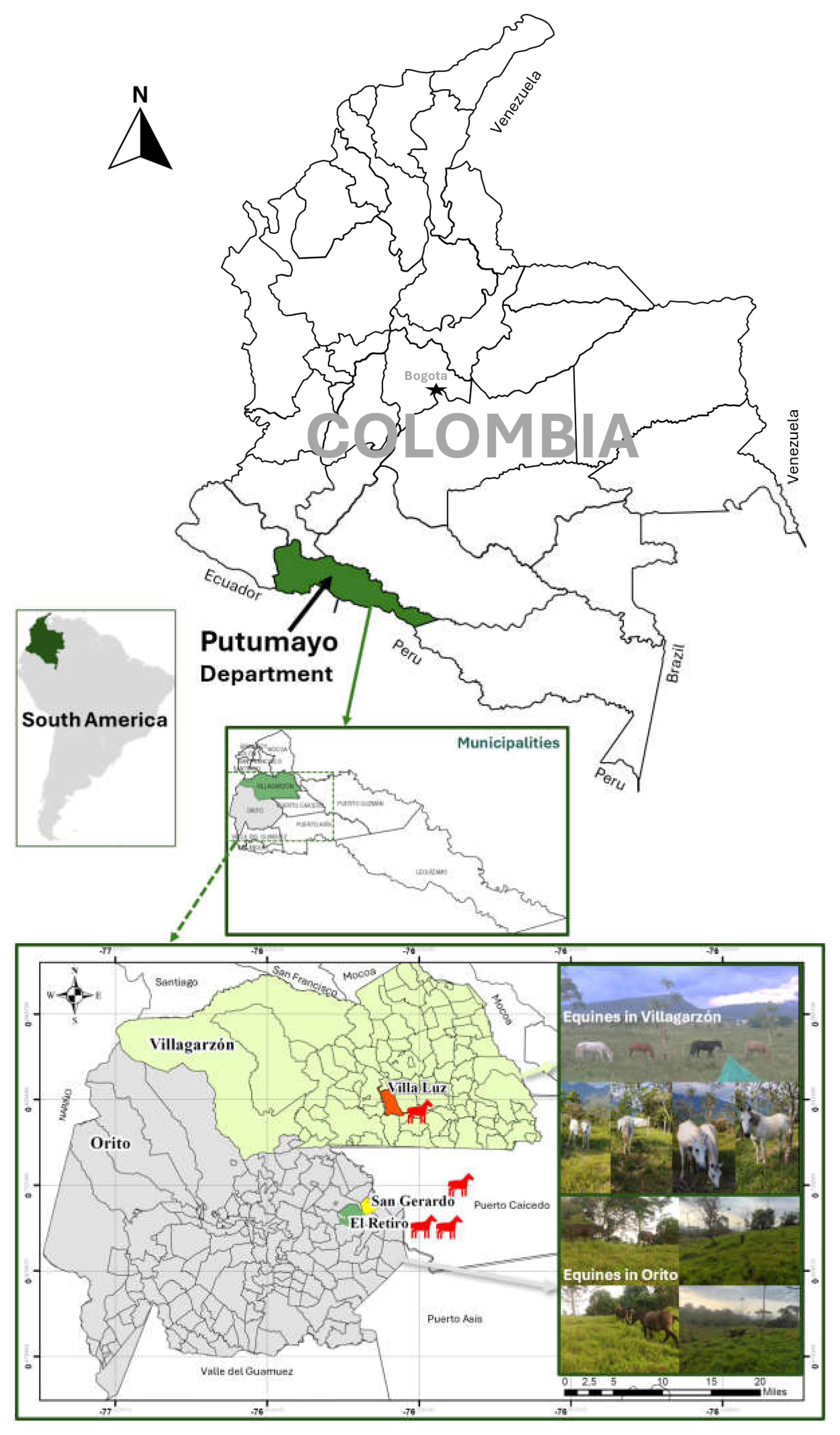
Figure 2.
Images of some of the dead equines with laboratory-confirmed rabies in Putumayo. A, from San Gerardo (2025) (Equus asinus × Equus caballus); B, from Villa Luz (2025) (Equus asinus × Equus caballus) (Source: ICA Report of Equine Rabies Cases).
Figure 2.
Images of some of the dead equines with laboratory-confirmed rabies in Putumayo. A, from San Gerardo (2025) (Equus asinus × Equus caballus); B, from Villa Luz (2025) (Equus asinus × Equus caballus) (Source: ICA Report of Equine Rabies Cases).
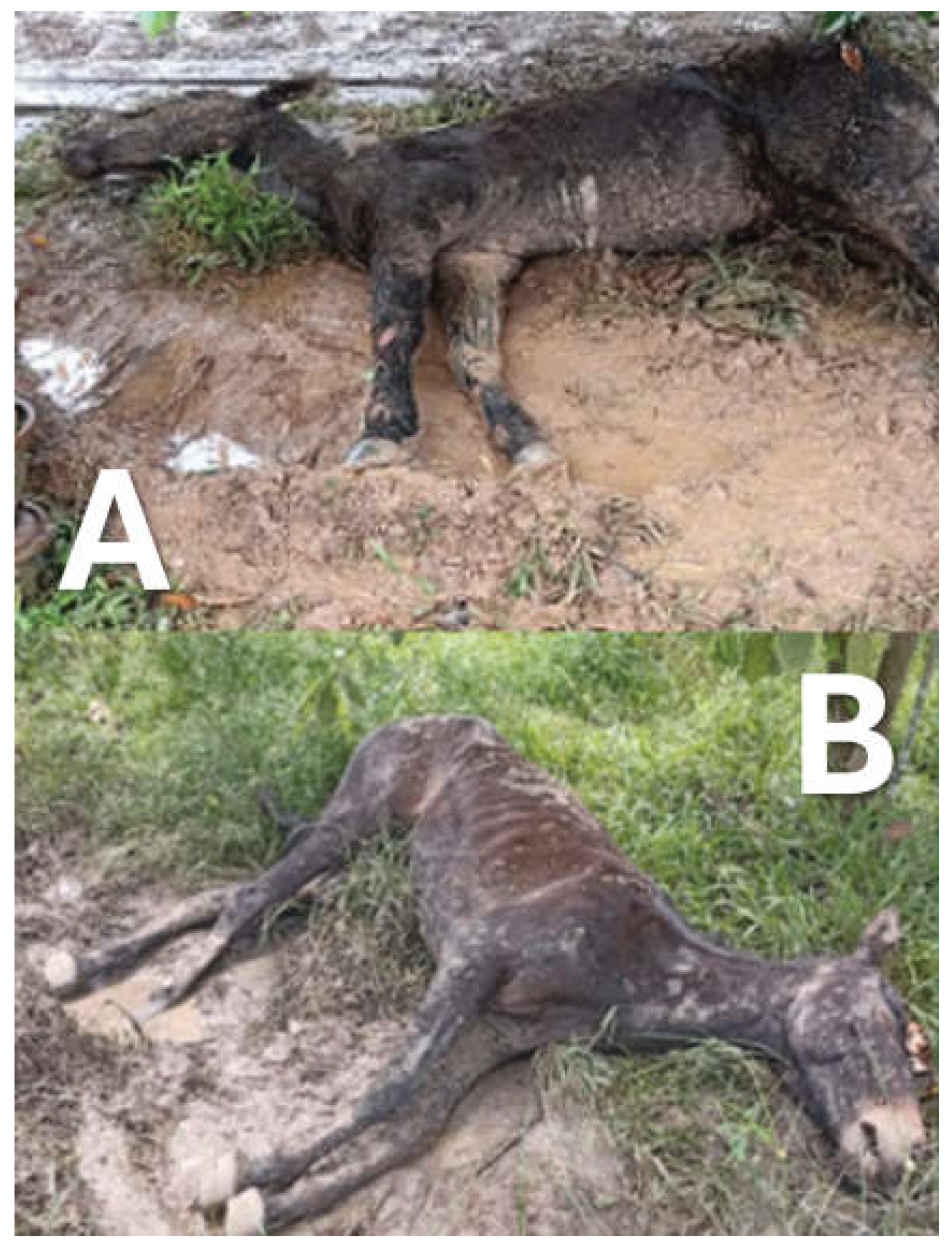

Table 1.
Epidemiological and Temporal Characteristics of Fatal Suspected and Laboratory-Confirmed Equine Rabies Cases in Putumayo, Colombia (2024–2025).
Table 1.
Epidemiological and Temporal Characteristics of Fatal Suspected and Laboratory-Confirmed Equine Rabies Cases in Putumayo, Colombia (2024–2025).
| Cases | ||||||||||
|---|---|---|---|---|---|---|---|---|---|---|
| # | Year | Municipality | Locality | Outbreak ID | Exposed Equids | Suspected | Confirmed | Species | Vaccination Status | Probable Origin |
| 1 | 2024 | Orito | El Retiro | O-01-2024 | 1 | 1 | 1 | Equus ferus caballus | Not vaccinated | Sylvatic |
| 2 | 2025 | Orito | San Gerardo | O-01-2025 | 9 | 1 | 1 | Equus asinus × Equus caballus | Not vaccinated | Sylvatic |
| 3 | 2025 | Orito | El Retiro | O-02-2025 | 1 | 1 | 1 | Equus ferus caballus | Not vaccinated | Sylvatic |
| 4 | 2025 | Villagarzón | Villa Luz | V-01-2025 | 1 | 1 | 1 | Equus asinus × Equus caballus | Not vaccinated | Sylvatic |
| 5 | 2025 | Villagarzón | Villa Luz | V-01-2025 | 1 | 1 | 0 | Equus asinus × Equus caballus | Not vaccinated | Sylvatic |
Table 2.
Operational Surveillance and Diagnostic Time Intervals in Equine Rabies Cases in Putumayo, Colombia (2024–2025).
Table 2.
Operational Surveillance and Diagnostic Time Intervals in Equine Rabies Cases in Putumayo, Colombia (2024–2025).
| Indicator | Median (Days) | IQR (Days) |
|---|---|---|
| Time between disease onset and notification | 7.5 | 3.8–13.3 |
| Time between notification and field visit/first sampling | 1 | 0.8–1.3 |
| Time between sampling and DIF results | 7 | 6.8–7.5 |
| Time between sampling and histopathology results | 15 | 11.8–17.3 |
| Time between sampling and IIF antigenic typing results | 11.5 | 10.3–17.0 |
| Time between notification and final laboratory diagnosis | 9 | 7.8–10.0 |
IQR, interquartile range. DIF, direct immunofluorescence. IIF, indirect immunofluorescence.
Table 3.
Main Clinical Manifestations Observed in Equines Suspected And Laboratory-Confirmed For Rabies In Putumayo, Colombia.
Table 3.
Main Clinical Manifestations Observed in Equines Suspected And Laboratory-Confirmed For Rabies In Putumayo, Colombia.
| Clinical Category | Manifestation | N | % |
|---|---|---|---|
| General condition | Prostration/marked depression | 5 | 100 |
| Behavioral changes | Reduced responsiveness | 5 | 100 |
| Locomotor alterations | Claudication/gait disturbance | 5 | 100 |
| Neurological signs | Ataxia/incoordination | 5 | 100 |
| Loss of standing ability | 5 | 100 | |
| Posterior limb paralysis | 4 | 80 | |
| Pedaling movements in recumbency | 4 | 80 | |
| Neuromuscular signs | Tremors/fasciculations | 3 | 60 |
| Systemic deterioration | Cachexia/inability to feed | 3 | 60 |
| Outcome | Death | 5 | 100 |
Table 4.
Gross Pathological and Laboratory Findings in Equines with Laboratory-Confirmed Rabies in Putumayo, Colombia.
Table 4.
Gross Pathological and Laboratory Findings in Equines with Laboratory-Confirmed Rabies in Putumayo, Colombia.
| Finding Category | Observation | N | % |
|---|---|---|---|
| Central nervous system | Generalized cerebral congestion | 4 | 100 |
| Meningeal and cortical hyperemia | 4 | 100 | |
| Increased cerebrospinal fluid volume | 3 | 75 | |
| Petechial hemorrhages | 3 | 75 | |
| Diffuse cerebral edema | 2 | 50 | |
| Peripheral organs | Significant lesions | 0 | 0 |
| Diagnostic methods | Direct immunofluorescence positive | 4 | 100 |
| Indirect immunofluorescence positive-Antigenic variant 3 | 1 | 25 | |
| Indirect immunofluorescence positive-Antigenic variant 5 | 3 | 75 | |
| Final diagnosis | Rabies virus infection (RABV) | 4 | 100 |
Disclaimer/Publisher’s Note: The statements, opinions and data contained in all publications are solely those of the individual author(s) and contributor(s) and not of MDPI and/or the editor(s). MDPI and/or the editor(s) disclaim responsibility for any injury to people or property resulting from any ideas, methods, instructions or products referred to in the content. |
© 2026 by the authors. Licensee MDPI, Basel, Switzerland. This article is an open access article distributed under the terms and conditions of the Creative Commons Attribution (CC BY) license (http://creativecommons.org/licenses/by/4.0/).
Copyright: This open access article is published under a Creative Commons CC BY 4.0 license, which permit the free download, distribution, and reuse, provided that the author and preprint are cited in any reuse.


