

Submitted:
08 June 2026
Posted:
10 June 2026
You are already at the latest version
Abstract
This paper examines how the travel intention of students is correlated with their mental health, in terms of stress reduction and psychological wellbeing. The study employs a combined model that integrates the Theory of Planned Behavior and Stress Recovery Theory to determine the role of travel intention, which is based on the travel self-efficacy, the pressure of social influence, the value of the travel experience, the perception of affordability, and the attitude towards tourism in affecting the mental health outcome of students. The paper examines the mediating capacities of travel involvement and social connectedness, and the moderating capacities of nature connectedness and travel frequency. Semi-structured interviews with 15 university students and survey among 604 students in various universities in Bangladesh were used to collect data. Hypotheses were tested using PLS-SEM. Findings indicate that travel intention enhance psychological wellbeing and reduce stress, and travel involvement and social connectedness are important mediators. These relations are mediated by nature connectedness and frequency of travel, which increases the restorative effect of travel. The results indicate that tourism could be a viable approach to student mental health promotion, which has both practical and theoretical consequences on university policy and future tourism psychological studies.
Keywords:
travel intention
; student’s mental health
; theory of planned behavior
; social connectedness
; travel self-efficacy
1. Introduction
University Students throughout the academic life faces different life stages which includes maintaining academic consistency and securing social identity. At a same time, students get prepared for handling financial pressures and uncertain employment situation over the years. A lot of students face challenges while, meeting these coinciding demands and fail to maintain emotional stability and overall mental wellbeing in the long run. While Professional counseling services are essential to psychological wellbeing, there are different lifestyle experiences which can eventually lead to a stress reliving situation. In recent times, tourism has gained an enormous popularity in terms, of ensuring mental recovery. Tourism is considered as a meaningful and experiential activity which is certainly capable of promoting mental wellbeing.
Travelling sets an opportunity to individuals to step out from their own comfort zones and breaks the everyday monotonous life routine. Actually, one can immerse in new setting to explore themselves in different physical and social contexts. These sort of changes enables the persons to stimulate positive emotions which, can lessen the habitual stress patterns and gives a fresh perspective of life. Existing studies shows, how travelling can improve the emotional and experiential opportunities that can lead to happiness and eventually ultimate life satisfaction (Nawijn & Strijbosch, 2021; Su et al., 2021). According to Filep and Laing, (2018), tourism is not only considered as a form of refreshment but also, gives opportunity for personal growth and self-reflection by enhancing self- worth, positive life engagement. Altogether these thoughts suggest tourism build experience and enhance mental health, particularly among the peoples who are consistently facing stress cycle.
Covid-19 pandemic and associated global disturbance further stretches the importance of tourism and its long run psychological significance. In covid-19 situation people had undergone a social isolation and restriction in mobility which afterwards, increased the emotional turmoil and press the stress button. As stated by Gossling et al. (2021), during lockdown the restrictions in mobility, leisure activities and enclosed environmental restrictions created severe mental turmoil. Tourism here pressed a point for emotional renewal and recovery by environmental change. In post pandemic context, students whose academic and social routines were disrupted embraced travel as a restorative aspect. However, despite of multiple benefits of tourism in wellbeing there are limited researches to find out motivational drivers in tourism and any suggestive unified framework.
To better understand these relationships, the present study integrates both of the theories, the Theory of Planned Behavior (TPB) and the Stress Recovery Theory (SRT). How individuals engaged in particular behaviors depend on their attitudes, perceive social expectations, and perceived behavioral control is rigorously demonstrated with TPB theory. Within tourism research, this framework has effectively predicted various forms of travel intention. Which includes wellness and sustainability related travel behaviors (Chuang et al., 2018; Do & Nguyen, 2025). When students perceive travel as feasible, socially supported, and psychologically beneficial they are more likely to practice strong intentions to participate in travelling. Which is also associated with improved mental health and a strategy for coping with stress?
TPB theory clarifies individual intention to travel but, it does not express how travel experiences can restore emotional aspect. SRT theory adds to TPB theory by adding experience of healing environments especially in natural environment that facilitate emotional recovery from stress. Empirical studies showed that, nature-based tourism experiences are associated with reduced stress and enhanced wellbeing (Qiu et al., 2020). For students, who come across natural environment and immersive environments may therefore, provide meaningful stress relief.
From an integrative point of view, travel intention can lead to mental health outcome by travel involvement, travel experience. Travel involvement means the degree of personal engagement and relevance individuals express while travel planning and participation. Students who involved more in travel experiences positively invest in cognitive energy. Travel involvement can act as a mediating link between intention and psychological outcomes. Additionally, planning trips, sharing expectations, and experiencing destinations with others can strengthen interpersonal bonds and foster a sense of belonging. Su et al. (2023) demonstrates that, social interaction during travel significantly enhances subjective wellbeing. University students in daily life are closely related with their peer groups and intention to travel can enhance their social connectedness while, contributing to stress reduction and mental wellbeing at the same time.
Individual characteristics may further influence the magnitude of tourism and its healing effects. Nature connectedness defined as an individual emotional attachment to the natural environment which, may intensify the psychological benefits. Additionally, the frequency of travel participation may shape wellbeing outcomes where regular engagement in travel could produce increasing restorative benefits. At the same time, repeated exposure may also modify the perceived intensity of each experience of travelling. Although research increasingly supports associations between tourism and wellbeing but, there are limited studies directly on university label students. By combining motivational and restorative perspectives, this study develops an integrated framework. That explains how travel intention could influence student mental health in both direct and indirect way. At the same time, while accounting for moderating influences of nature connectedness and travel frequency.
This study also contributes to the understanding of tourism as an experience-based resource for psychological wellbeing while, offering a practical implication for higher education institutions and policy makers. In conjunction with, promoting innovative strategies to enhance student mental wellbeing by stimulating enriching experiences beyond the classroom environment.
2. Literature Review
2.1. Underpinning Theory
This study blends the Theory of Planned Behavior and the Stress Reduction Theory to explain not only the formation of the travel intention but also the role of the travel experiences in enhancing the mental health of students by engaging in behavioral activities and restoring their psychology. Human behavior is one of the complicated terms to understand. Different theories and concepts have developed over the time to explore and grasp the influence of behavior (Ajzen, 1991). Here attitude refers to the positive and negative approach of certain behavior and its appeal in building behavioral beliefs (Hüsser & Ohnmacht, 2023; Rhodes & Courneya, 2003). In this article students' attitude towards tourism is influenced by their beliefs on stress reduction and psychological wellbeing. Subjective norms indicate the impact of an individual's response to certain important referent groups like family, friends, peers. Students are greatly affected by peer group pressure (Duffy, 2015). Perceived behavioral control is closely related with behavioral intention and actual behavior which reflects similarities with self-efficacy. This study intends to relate the factors of TPB theory to analyze the influence of tourism in students’ psychological wellbeing and stress reduction. Here along with the TPB theory some other elements from the Stress Recovery Theory (SRT) have been included to get a broader perspective. Originally developed by Ulrich (1983), SRT explores the importance of restorative environment in physiological and psychological stress reduction (Ulrich et al., 1991). This theory has been extensively applied in prime journals in the field of tourism like the Tourism Management and Journal of Travel research explaining how attitudes, social norms and how perceived behavior control influence travel intention and subsequent travel behavior (Reza Jalilvand & Samiei, 2012). This theory depicts that aesthetically beautiful and nature-oriented destinations trigger positive emotions and lessen stress. This is a relatively fast recovery process that is beneficial in terms of mood, anxiety, and psychological wellbeing. Nature connectedness can enhance this restorative effect, but the beneficial effect may be enhanced by extensive travelling due to repeated exposure to the conditions that relax them. Tourism can be a good coping strategy as students often feel a great deal of academic pressure and mental stress, which is why they should have an opportunity to relax and recover (Lin & Yang, 2024). Thus, students who go on a trip and actively engage in the experience, especially in natural environments, have more chances to feel relieved of stress and emotionally replenished. This restorative effect can be reinforced by nature connectedness, whereas the positive impact might be reinforced by extensive travel as a result of repeated exposure to relaxing conditions.
2.2. Hypothesis Development
H1: Travel Intention has a positive relation with student’s mental health
Students are often prone to various sources of stressor, such as academic, financial and social ones, which lead to an increased amount of stress and emotional exhaustion. The desire to travel can be viewed as a form of coping mechanism, since it offers students a perceived possibility of relaxing, recovering and having time to be off of routine activities(Zhu et al., 2020). Existing researches on tourism have demonstrated that positive anticipation of tourism experiences has the potential to improve subjective wellbeing as people can get emotional reward, as well as psychological relief while planning an upcoming trip even when the trip hasn’t started (Busser & Shulga, 2026; Nawijn & Filep, 2016). students with higher intentions to travel will have a better mental health outcome since the cognitive and emotional activities during the anticipation of traveling process would help in reducing stress and creating positive mood and psychological stability. More recent researches also indicate that the future-oriented leisure intentions can be linked to enhanced emotional regulation and life satisfaction because they develop the sense of control over their leisure life and future experiences (Dolnicar et al., 2013). There is an increasing number of researches being done on wellbeing in relation with hospitality and tourism(Bohon et al., 2016; Joseph Sirgy, 2019).
H2: Travel intention has a positive relation with travel involvement
Travel involvement includes students’ interest in planning, initiating and organizing the tour. Here, according to TPB theory, student’s involvement in tour largely depends on their attitude towards their intention, perceived value and attitude(Esfandiar & Hadinejad, 2025). Studies on wellness tourism explores that tourism decision making impacts tourist’s motivation and psychological engagement (Gan et al., 2023). Studies related to extended theory of Planned Behavior shows that that tourism motivation, value perception, and lifestyle changes impact visit intention and behavioral involvement. This also reflects how intention can be converted to more profound travel participation(Subawa et al., 2024). Moreover, risks and emotions mediates the link between intention and involvement (Güneş & Basgoze, 2024).
H3: Travel Involvement has a positive relation with student’s mental health
Student’s face huge pressure with their academic and personal life while continuously being stressed over academic result, future career and changing atmosphere of their personal life. It is essential for students to take care of their mental wellbeing while dealing with their everyday battle. Studies related to mindfulness shows that there is an optimistic association between psychological wellbeing, travel and mindfulness as they reflect that adapting mindfulness increases tourist’s satisfaction and pro-environmental behavior(Iacob et al., 2024). Therapeutic excursion exhibits a higher level of efficiency in anxiety reduction and energy restoration which eventually helps to fight against depression(Huang et al., 2025; Zhong et al., 2025). Expedition gives students the opportunity to relax and unwind the tensity that affects their psychological wellbeing. Literature related to systematic tourism wellbeing manifest a strong relationship between a good tour experience and the quality of life(Konstantopoulou et al., 2024).
H4: Travel intention has a positive relation with social connectedness
The connection between travel intention and social engagement is yet to discover. There are very few articles where this association has been discussed. Studies have showed that tourism, more specifically nature-based travel drives a positive influence in social connectedness(Diallo et al., 2022; Lee et al., 2019). When students intend to visit somewhere as an excursion, they automatically develop a social group where they build a common connection. Strong intention is often associated with the desire to plan for a shared tour experience which often lean to strong social ties (Li & Chan, 2021). Students expects to have a social bonding during the time of their outing and try to relate themselves with involved groups. Studies have showed that after covid 19 travel’s motive significantly include the influence of social connectedness and psychological wellbeing (Aebli et al., 2022).
H5: Social connectedness has a positive relation with student’s mental health
Social connectedness plays as a powerful indicator of the mental health of students. The sense of connectedness brings about emotional support, lessens loneliness, and improves a sense of belongingness, which are core issues in mental wellbeing. Research shows that when student’s integrative wellbeing depends on tourism where integration indicates the overall wellness of their emotional, social and overall quality of life (Qu et al., 2025). Interactions during a trip bring happiness, resilience and increase the satisfaction level, particularly for the young people. Students who get the opportunity to unwind themselves through leisure activities, site seeing and travel experience less stress and anxiety compared to others (Konstantopoulou et al., 2024; Nawijn & Filep, 2016). Public health researchers have proven that social connectedness protects adults from anxiety and depression, which subsequently leads to a good wellness state, especially anxiety developed after COVID-19 (Hüsser & Ohnmacht, 2023; Wickramaratne et al., 2022).
H6: Nature connectedness plays a moderating role in travel intention and student’s mental health
The nature connectedness determines the extent to which the travel intention impacts on the mental health since people who have stronger emotional attachment to natural environment get more restorative value in the expectations associated with travel. Exposure to natural environments and nature-based tourism improves recovery of stress, emotional renewal, and psychological wellbeing (Buckley et al., 2018; Clark et al., 2026). Psychological connection with nature has a significant impact on the mental health of college students and their willingness to trip (Ma et al., 2025). A sense of connection to the natural world can assist students to cope with stress better and get more sense in their lives, which further contributes to the improvement of mental wellbeing. The latest research that examines nature tourism and mental restoration have put nature connectedness as a moderator that intensifies the positive influence of travel intention on mental health: when intentions are directed towards nature-related experiences, individuals with high nature-related connectedness obtain disproportionately wellbeing benefits (Avecillas-Torres et al., 2025; Buckley, 2020).
H7: Travel frequency plays a moderating role in travel intention and student’s mental health
The frequency of travel moderates the degree to which travel intention can be translated into mental health gains. Recurring travel experiences ensure psychological recovery, emotional strength and stress relief opportunities(Chen et al., 2016; Tyagi et al., 2024). Students can relief their distress by taking short break and this will create a bridge between tour intention and their emotional wellness. In terms of frequency of vacation, highest level of stress and life satisfaction was reported to be associated with the highest number of vacationers with multiple vacations annually; mental health professionals and organizations include promoting regular and schedule vacations among students as a preventive measure against stress and burnout (Nurja & Bendo, 2025). Leisure travel frequency determines the quality of life of tourists by demonstrating this relationship via the moderating processes of happiness and psychological resilience, and also by further investigating who benefits most in terms of quality-of-life (Mulcahy et al., 2026).
H8: Travel involvement plays a positive mediating role between travel intention and student’s mental health
The framework for tourism behavior has explained the mechanism of tour outcome and satisfaction in a precise way. Only the intention of travelling cannot itself motivate students unless they get a memorable and worthwhile experience in their trip. So, the psychological engagement plays a mediating role in student’s desire to go on a tour and the outcome. Participation is the variable that describes the way travel intention turns into meaningful experience(Cao et al., 2023; Prayag et al., 2017). When tourists are more engaged, they devote both emotional and cognitive resources to the preparation and consumption of the experience, which increases the restorative impacts of tourism(Lin & Yang, 2024). When students engage more with the practical organization and arrangement of their excursion, they feel more included and the exposer gives them the ultimate satisfaction. A meaningful experience relates to a more satisfactory psychological outcome and hence it assures travel involvement as an intermediary between the travel intention and student mental health(Vada et al., 2022).
H9: Social Connectedness as a Mediator between Travel Intention and Students’ Mental Health
Social connectedness acts as a mediator between travel intention and mental health of students since the psychological outcomes of travel intention can be achieved to a large extent by the expected and real social ties created through travel. Travelling is one of the effective ways to strengthen students prosocial behavior and social engagement serves as tie between their psychological wellbeing and travel intention (Li et al., 2022). Also, Meeting the local residents during a visit, give tourist a vivid experience and lifelong moments to cherish (Gu et al., 2024; Stylidis et al., 2020). This eventually make them more connected with the people and place leading towards an emotional wellbeing for the students. travel intentions have been shown to include anticipations of social experiences and interpersonal connections, which boost a sense of belonging and social support, and such social resources, in turn, elevate mental health. Consequently, travel intention positively influences the mental health of students and indirectly through social connectedness, which implies that the wellbeing effects of travel lie in its social aspect instead of the practical relaxation or escape of the individual (Zhuang & Wang, 2024).
2.3. Conceptual Framework
The conceptual framework (Figure 1) of the study will be intended to examine how the travel intention affects student mental health, and several major constructs will be applied in the relationship. Travel intention of students, as an independent variable, is a higher-order formative construct that consists of five sub-constructs, including travel self-efficacy, social influence pressure, value of experience, perceived affordability, and attitude toward tourism. These sub-constructs in totality determine the intention of the students to travel and this factor is critical in boosting their mental health. The framework identifies two mediators, which include travel involvement and social connectedness. Travel involvement represents how much the students participate in the planning and experiencing of travel and this has been said to influence the mental health outcomes of the students in general. Social connectedness will be seen as that feeling of the sense of connection that the students feel with other people during traveling, which plays a vital role in terms of emotional well-being and alleviating stress.
Two moderators are also integrated into the framework nature connectedness and frequency of traveling. Nature connectedness mediates the association between travel intention and student mental health because it has been seen that exposure to nature can and does play a major role in stress relief and psychological recovery. The frequency of travel also plays a role in the intensity of this relationship whereby more the travelling, the more there could be cumulative benefits to the wellbeing of the students. Student mental health is defined as the dependent variable, which is measured in two constructs, stress reduction and psychological well-being. The framework assumes that better mental health outcomes are the ultimate result of travel intention that is mediated by travel involvement and social connectedness, and nature connectedness and travel frequency are the main moderators.
3. Materials and Methods
3.1. Research Design
The study utilized a mixed-method design in a sequence where it was exploratory in nature, followed by a quantitative phase that was confirmatory. The research is cross-sectional as quantitative data was measured at one point in time to prove the relationships between the constructs that were hypothesized. The conceptualization of the travel intention and student mental health in the Bangladeshi university setting was improved at the qualitative stage and the clarity of items were enhanced before the survey. The general structure aligns with sequential mixed-method reasoning, in which the initial qualitative data becomes the basis of initial instrument construction and model specification to be tested in large-scale (Creswell & Clark, 2007)
3.2. Phase 1: Qualitative Study
Phase 1 involved conducting semi-structured interviews with 15 university students to understand how travel intention is described by students, psychosocial processes by which tourism is connected to mental health and the contextual barriers and facilitators to restorative travel. A purposive selection was used to recruit participants to ensure that there is a variation of gender, academic discipline, and previous experience of leisure travelling. The interviews were about 35-50 minutes and were audio-taped with permission and transcribed word-for-word. Reflexive thematic analysis was applied to data-analysis, and it involved familiarization-coding-themes-development-review-definition process (Braun & Clarke, 2006)). The coding was informed by the theories, whereby the Theory of Planned Behavior (Ajzen, 1991; Benny, 2021) was used to inform the interpretation of the intention-related drivers, and the Stress Recovery Theory (Hartig et al., 1997) was used to interpret recovery-oriented drivers and mental health outcomes.
3.3. Phase 2: Quantitative Study
3.3.1. The Population and Sample Design
The target group was the undergraduate and post graduate learners of the Bangladesh public and privately run universities. The unit of sampling was a specific student of the university (at least 18 years) who was actively studying and did not refuse to take part. The calculation of the minimum sample size was done using the Cochran (1977) formula of large sample sizes which is; n0 = (Z r 2 p × (1- p)/ e r 2), where Z = 1.96, p = 0.5 and e = 0.05. This gives a minimum sample required of 384 respondents (Cochran, 1977). The online Google Form was used to collect the data within a specified fieldwork period (January-March 2026) via a non-probability approach of the combined convenience sampling and snowball circulation methods involving the university networks, classes, and student groups. The criteria of eligibility involved the following; currently enrolled in a university in Bangladesh, aged 18 years or above and having experience of leisure travelling as a relaxation or wellbeing activity. There was a total of 604 available responses, which is above the minimum requirement and provides adequate sample size in the PLS-SEM with mediation and moderation paths (Hair & Alamer, 2022; Sarstedt et al., 2021)
3.3.2. Data Collection Procedure
The survey tool was developed in the English language considering the need to provide the context-sensitive words that were developed during the qualitative stage and previously tested scales. The purpose of the study, voluntary participation, and guaranteed confidentiality were briefly presented and informed consent was inevitably made electronically prior to the respondents being allowed to access questionnaire items. The questionnaire had a simple wording, regular response anchors and logical order of sections to enhance the quality of responses. The screening of the responses was done with respect to completeness, straight-lining patterns, and duplication after which the final analysis was done which led to 604 valid cases being used in the modelling.
3.4. Measurement of Constructs
Multi-item measures were used (See table 1) to operationalize all constructs and these are based on other previous studies. The idea of travel intention was used as a higher-order construct, which is manifested through travel self-efficacy, social influence pressure, experience value, perceived affordability, and attitude toward tourism. The constructs operationalization of student mental health included stress reduction and psychological wellbeing as the higher-order constructs. Two mediators were added, including social connectedness and travel involvement to reflect on interpersonal and involvement processes through which the travel intention could be converted into mental health results, and nature connectedness was modeled as a moderator between travel and mental health results as a result of the affinity of individuals to nature. Everything was measured using a five-point Likert scale (1 = strongly disagree, 5 strongly agree).

Table 1.
Constructs, theoretical base, and measurement sources.
| Type | Construct (Full name) | Theory base | Primary source(s) | No. of items | Example item wording (abbrev.) |
| Independent (HOC: Travel Intention) | Travel Self-Efficacy | TPB (Perceived behavioral control/self-efficacy) |
(Bandura, 1997; Chen & Tung, 2014) |
4 | I can organize a leisure trip. |
| Independent (HOC: Travel Intention) | Social Influence Pressure | TPB (Subjective norms) | (Ajzen, 1991; Lam & Hsu, 2004) |
4 | Friends’ travel posts influence my choices. |
| Independent (HOC: Travel Intention) | Experience Value | TPB (Behavioral beliefs) | (Choe & Kim, 2019; Pine & Gilmore, 1998) |
4 | I prefer unique and meaningful destinations. |
| Independent (HOC: Travel Intention) | Perceived Affordability | TPB (Control beliefs) | (Choe & Kim, 2019) | 4 | Traveling for relaxation is affordable for me. |
| Independent (HOC: Travel Intention) | Attitude Toward Tourism (for wellbeing) | TPB (Attitude) | (Ajzen, 1991) | 4 | I feel positive about traveling for health. |
| Mediator | Travel Involvement | Engagement/Involvement perspective in leisure/tourism | (Havitz & Dimanche, 1997; Kyle & Chick, 2002) | 4 | I am highly involved in planning trips. |
| Mediator | Social Connectedness | Interpersonal connectedness/relatedness mechanism |
(Lee et al., 2001; Lee & Robbins, 1995) |
4 | Travel helps me feel connected to others. |
| Moderator | Nature Connectedness | SRT (Person–environment interaction) | (Mayer et al., 2009; Nisbet et al., 2009) | 4 | I feel emotionally connected to nature. |
| Dependent (HOC: Student Mental Health) | Stress Reduction | SRT (Stress recovery) | (Cohen et al., 1983) | 4 | Traveling reduces my stress. |
| Dependent (HOC: Student Mental Health) | Psychological Wellbeing | SRT (Positive outcomes) | (Sirgy, 2010; Tennant et al., 2007) | 4 | Travel improves my overall wellbeing. |
3.5. Analysis Procedure
Partial Least Squares Structural Equation Modeling (PLS-SEM) of SmartPLS was the method applied to analyze the quantitative model to fit a prediction-oriented study, complex models with higher-order constructs, and concurrent estimation of mediation and moderation effects (Hair & Alamer, 2022). The analysis was done in two stages. The reflective measurement model was initially evaluated on the basis of indicator loadings, internal consistency reliability (Cronbachs alpha and composite reliability), convergent, and discriminant validities based on the HTMT criterion. Second, collinearity diagnostics, bootstrapped path coefficients (5,000 subsamples), coefficient of determination (R2), effect sizes (f2), predictive relevance (Q2), and general model fit indicators like SRMR were used to assess the structural model where necessary. The assessment of the mediation effects was conducted in terms of bias-corrected bootstrapped indirect effects, and the moderation was determined through the product-indicator interaction evaluation of the assessment of the interaction term between nature connectedness and the focal predictor paths.
3.6. Common Method Bias
Since the survey was based on single-source self-reported scale, both procedural and statistical remedies to the common method bias (CMB) were employed, which is also in accordance with best-practice recommendations (Podsakoff et al., 2003). The respondents were also assured of anonymity and confidentiality and the process was voluntary as well as informed of the questionnaire instructions that there were no right or wrong answers thus decreasing the evaluation apprehension and social desirability. The items were selected using known scales and modified with particular care of wording so as to reduce ambiguity and the instrument was designed in such a way that the predictor and outcome constructs were presented in different sections to lessen the respondent desire to infer relationships. Statistically, the full collinearity test in PLS-SEM was applied to determine CMB with the variance inflation factor (VIF) of less than 3.3 meaning that common method variance is unlikely to produce biased parameter estimates (Kock, 2015). Moreover, a one-factor diagnosis was also tested, which would also show that a single latent factor did not explain most covariance between indicators, which would also indicate convergent validity that CMB was not a strong threat to validity.
3.7. Ethical Considerations
During the two stages of the research, ethical considerations were upheld. Before obtaining informed consent, the participants were informed of the study purpose, and voluntary participation and guaranteed confidentiality. No personal data were used in the survey, and the qualitative data were anonymized with the help of participant codes. All the data were kept in a safe place and were not utilized in any other way than to conduct academic research.
4. Results
4.1. Thematic Analyses (Qualitative analysis)
Table 2.
Thematic Analysis.
| Theme | Subtheme | Description | Example Quotes (Student Codes) |
| Travel Self-Efficacy (TPB) | Strong Confidence | Confidence in planning and organizing travel. | I am quite confident to deal with the travel logistics independently. (S1) I like the way of planning everything, flight booking, and activity selection. (S2) |
| Weak Confidence | Challenges faced in managing the planning process. | I usually get stressed when I would plan everything including accommodation and transport. (S3) Budgeting is a problem to me. I do not necessarily know how to budget the budget of a trip. (S4) |
|
| Social Influence Pressure (TPB) | Peer Encouragement | Influence of peers on travel decisions. | My friends are the ones who urge me to travel. They send me frequently links to journeys, and attempt to induce me to accompany them. (S5) I would be motivated when my friends discuss their trips, and make me want to go with them. (S6) |
| Peer Pressure | Feeling pressured to travel, especially when friends have already planned. | I am sometimes pressured by my friends that are extremely spontaneous regarding traveling. (S7) When my friends already have a plan I think I should go in with them even though I am not certain. (S8) |
|
| Experience Value (TPB) | Memorable Experiences | Travel experiences that create lasting memories. | The best experience was when I went to a small town with my friends and we explored a whole day hiking and enjoying the nature. (S9) The most valuable experiences I have in traveling are always related to nature or new culture. (S10) |
| Seeking Adventure | Preference for adventure travel. | "I enjoy adventure travel. Its uniqueness is the excitement of discovering new destinations and experimenting with new things. (S11) I prefer activities that are physically and mentally demanding such as hiking or visiting historical sites. (S12) |
|
| Perceived Affordability (TPB) | Financial Limitations | Financial constraints that limit travel options. | I am always concerned with budgeting. I seek cheap destinations, which will not empty my pockets. (S13) I tend to go to places that are not far and do not force me to use costly accommodation. (S14) |
| Affordable Travel Options | Choosing destinations and activities within budget. | I like places where I will be offered student discounts or where I can get cheap accommodation such as hostels. (S15) I usually do off-season traveling to evade an increase in costs and to seek better offers. (S1) |
|
| Attitude Toward Tourism for Wellbeing (SRT) | Stress Relief | Perception of travel as a means to reduce stress. | Travelling is among the most effective methods of stress relief. It makes me forget about the pressure associated with the university and allows me to take a break. (S2) I always come back to myself in a better mood, physically. It’s like a reset for my mind." (S3) |
| Self-Care | Travel as an act of self-care for mental health. | Tourism is a form of resetting with emotions to me. It is like having a moment of no longer being stressed with academic life and re-connecting with myself. (S4) Travel gives me a platform to reflect on my life which is a great aspect to the state of my mental health. (S5) |
|
| Travel Involvement (SRT) | Planning Engagement | Involvement in planning and decision-making for travel. | I am a very serious trip planner, in particular in finding out more about the destination and the activities. (S6) I like to look up the top places to visit and consider all the details of the trip. (S7) |
| Active Participation | The excitement and connection from being actively involved in planning. | The deeper I am into the planning process, the more excited I become about the trip. (S8) I think I am closer to the trip when I am personally involved in it organization. (S9) |
|
| Social Connectedness (SRT) | Strengthened Relationships | Travel enhancing bonds and relationships with peers. | Travel gives me a stronger friendship and family ties. We have something in common like experience and new adventures. (S10) Spending time with the friends when traveling brings in memorable life moments and strengthening our connections. (S11) |
| Peer Bonding | Feeling connected and bonded with friends during travel. | I like being very close to my friends whenever we are traveling. It is a good method to have quality time. (S12) It is always a unique thing to have some experiences and difficulties traveling with your best friends. (S13) |
|
| Perceived Restorativeness (SRT) | Environmental Restoration | The ability of new environments to restore mental well-being. | I re-adjust my psychological condition through being in nature, not in the city. It’s like I can breathe again." (S14) I get rejuvenated when I am in serene settings such as forests or around the sea. (S15) |
| Mental Clarity | Feeling clearer and more focused after a trip. | I will feel better after having been in nature. It assists me to be concentrated on what matters. (S1) Travel gives me the ability to relax my mind. I find myself in a position to concentrate more on the studies after a trip. (S2) |
|
| Stress Reduction (SRT) | Escaping Academic Pressure | Travel as an escape from the stress of university life. | I like to get away from the deadlines and assignments that are taking up the pressure, and the answer to this is traveling. (S3) I can also feel that I was able to take a break after I come back after a trip and can better concentrate on schoolwork. (S4) |
| Mental Recovery | How travel contributes to mental recovery and relaxation. | Burnout is relieved by making short visits to quiet places. I return in a rejuvenated mood. (S5) My travel stress is also minimized by the physical activity during the movement process such as hiking which makes me feel better. (S6) |
|
| Psychological Wellbeing (SRT) | Improved Mood | How travel contributes to emotional balance and happiness. | I like to travel because it cheers me up, particularly when I am in the natural setting or where I can relax. (S7) I always feel even happier and inspired after traveling, but in particular, when I am with my dearest people. (S8) |
| Emotional Balance | The restoration of emotional balance and clarity after travel. | I have noticed that after a trip I feel more at ease and positive about the future. (S9) Travel makes me emotionally balanced and clear. It makes me feel refreshed when I come back. (S10) |
|
| Nature Connectedness (Moderator) | Sense of Calmness | The calming effect of nature on mental wellbeing. | I feel the soothing influence of nature. The images, sounds and smells of the outdoor environment make me feel more calm and comfortable. (S11) Being in nature enables me to forget everything and concentrate on the present. (S12) |
| Travel Frequency (Moderator) | Impact on Stress | How frequent travel helps students cope with stress. | I travel a lot and this travel has enabled me to cope with stress. It provides me with a healthy outlet of recharging and forgetting the academic pressure. (S13) I also travel more now, since it makes me cope with stress and feel more balanced. (S14) |
The thematic analysis in Table 2 shows that the mental health outcome of students is directly influenced by travel intention, which is formed under the influence of such factors as travel self-efficacy, social influence, experience value, perceived affordability, and travel tourism attitude. Students who believed that they can organize and make trips, who are inspired by their peers and have meaningful traveling experiences are more likely to have a significant level of stress relief and psychological wellbeing after their trips. However, a major impediment that affected most students was financial limitations, which restricted their participation in restorative travelling. After all, mental health outcomes depend mainly on the attitude to tourism as a self-treatment or stress-relief practice.
4.2. Matrix Coding
With a matrix coding query, we get the opportunity to examine the relationship between various themes and their interaction (See table 3). It is possible to determine the interrelations between the themes, e.g., the role of self-efficacy in reduction of stress or the impact of social influence on psychological wellbeing.
Table 3.
Matrix Coding.
| Themes | Travel Self-Efficacy | Social Influence Pressure | Experience Value | Perceived Affordability | Attitude Toward Tourism | Social Connectedness | Travel Involvement | Nature Connectedness | Stress Reduction | Psychological Wellbeing |
| Travel Self-Efficacy | 1 | 1 | 1 | 0 | 1 | 0 | 1 | 0 | 1 | 1 |
| Social Influence Pressure | 1 | 1 | 1 | 1 | 1 | 1 | 1 | 0 | 1 | 1 |
| Experience Value | 1 | 1 | 1 | 1 | 1 | 1 | 1 | 0 | 1 | 1 |
| Perceived Affordability | 1 | 1 | 1 | 1 | 0 | 0 | 1 | 0 | 1 | 0 |
| Attitude Toward Tourism | 1 | 1 | 1 | 1 | 1 | 1 | 1 | 0 | 1 | 1 |
| Social Connectedness | 0 | 1 | 1 | 1 | 1 | 1 | 1 | 1 | 1 | 1 |
| Travel Involvement | 1 | 1 | 1 | 0 | 1 | 1 | 1 | 0 | 1 | 1 |
| Nature Connectedness | 0 | 0 | 1 | 0 | 1 | 1 | 1 | 1 | 1 | 1 |
| Stress Reduction | 1 | 1 | 1 | 1 | 1 | 1 | 1 | 1 | 1 | 1 |
| Psychological Wellbeing | 1 | 1 | 1 | 1 | 1 | 1 | 1 | 1 | 1 | 1 |
Travel Self-Efficacy has a proper relationship with social influence and travel involvement which means that, students who feel more confident about their capability of planning their trips will most likely participate in travelling. This, in its turn, improves their wellbeing and stress reduction. The Social Influence Pressure is associated with the experience value, attitude to tourism and involvement in traveling. The involvement of peers in encouraging students to travel increases engagement of the students towards travel which contributes to a reduction of stress and wellbeing. Experience Value has a strong impact on the stress reduction and psychological wellbeing. The students who perceive their travel experiences as meaningful (be it adventure, learning or restoring) demonstrate higher emotional recovery. Perceived Affordability is a key variable especially in its effect in the travel intentions. Students who view travelling as something affordable will tend to participate in travelling that will result in stress management improvements and the general state of their mental health. Attitude Towards Tourism is highly correlated with all other constructs and hence it is found that students who perceive tourism as a way of relieving stress have a high psychological wellbeing. Social Connectedness a theme that serves to mediate the positive outcomes of stress reduction and psychological wellbeing, which states that traveling with social connections (friends or family) increases the positive psychological effects of tourism. Travel Involvement is a moderator, the more the trip organization and involvement, the better the outcome in terms of de-stress and wellbeing. The moderator that enhances the effect of the travel on the psychological wellbeing is the Nature Connectedness, and the nature-based travel is especially restorative to the student. Spending time in nature can greatly decrease the amount of stress and enhance the mental health. The relationship between Stress Reduction and Psychological Wellbeing is highly interrelated because stress reduction leads to psychological wellbeing. Social factors and nature are major sources of these.
4.3. Word Frequency Analysis
Here in the table 4 the most frequent terms mentioned by students has been showed. This helps us identify the central concepts discussed in the interviews.
Table 2.
Word Frequency Analysis.
| Word | Frequency | Example Context |
| Travel | 20 | "I feel very confident about handling travel logistics on my own." |
| Stress | 18 | "Stress reduction is one of the main benefits of taking a trip." |
| Wellbeing | 14 | "I believe wellbeing is a result of both travel and social interaction." |
| Relax | 15 | "Travel helps me relax and unwind from the constant pressure of university." |
| Nature | 13 | "Nature plays a big role in helping me feel restored and mentally clear." |
| Confidence | 11 | "I feel a lot of confidence in planning my trips, especially when I have enough time." |
| Social | 10 | "I feel connected to others when we travel together, which contributes to my social wellbeing." |
| Recharged | 8 | "I always come back feeling recharged and ready to tackle my responsibilities." |
| Experience | 7 | "The experience of traveling to new places helps me grow emotionally." |
The most frequent terms are related to stress and wellbeing, indicating that students strongly associate travel with psychological restoration.
4.4. Connectedness Diagram
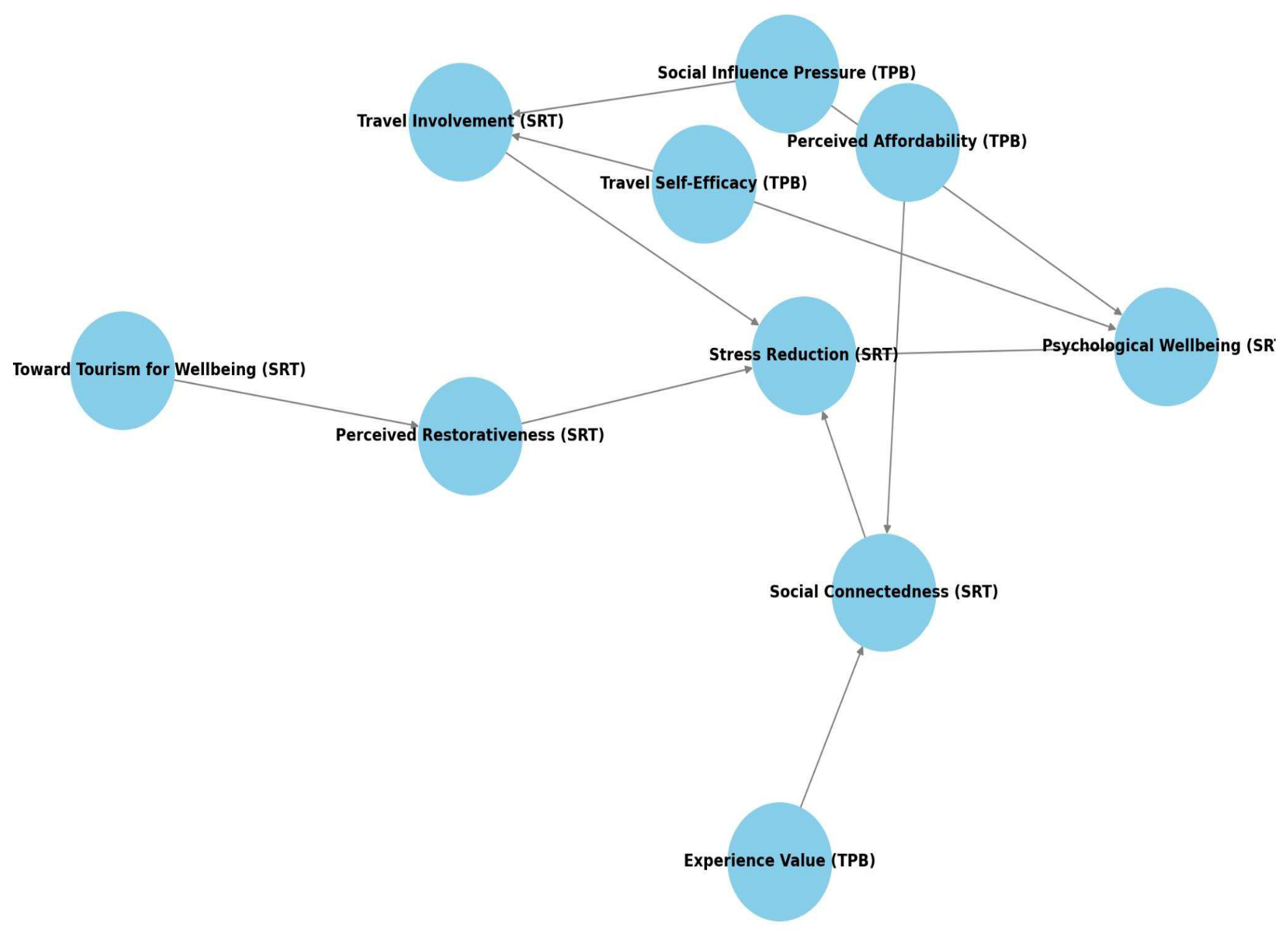
In the figure 2 the connectedness diagram has been showed. Travel Self-Efficacy and Social Influence Pressure determine Travel Involvement, which has an effect on Stress Reduction and Psychological Wellbeing. Experience Value and Perceived Restorative Ness are also associated with stress reduction and psychological wellbeing, and this proves the effects of meaningful experiences (e.g., nature) on students to be able to get their mind straight.
Figure 2.
Connectedness Diagram.
4.5. Qualitative Comparative Analysis (QCA)
Truth Table for QCA
Table 3.
QCA Truth Table.
| Travel Self-Efficacy | Social Influence Pressure | Experience Value | Perceived Affordability | Attitude Toward Tourism | Social Connectedness | Travel Involvement | Nature Connectedness | Stress Reduction | Psychological Wellbeing |
| 1 | 1 | 1 | 1 | 1 | 1 | 1 | 1 | 1 | 1 |
| 1 | 1 | 1 | 1 | 0 | 1 | 1 | 1 | 1 | 0 |
| 1 | 0 | 1 | 1 | 1 | 0 | 1 | 1 | 1 | 1 |
| 0 | 1 | 0 | 1 | 1 | 1 | 0 | 0 | 0 | 0 |
| 1 | 1 | 0 | 0 | 1 | 1 | 1 | 1 | 0 | 1 |
| 0 | 0 | 1 | 1 | 0 | 1 | 1 | 0 | 1 | 1 |
| 1 | 1 | 1 | 0 | 1 | 1 | 0 | 1 | 1 | 1 |
| 0 | 0 | 1 | 1 | 0 | 1 | 0 | 1 | 1 | 1 |
| 1 | 1 | 0 | 0 | 1 | 0 | 0 | 1 | 0 | 0 |
| 1 | 0 | 1 | 0 | 0 | 0 | 0 | 0 | 0 | 0 |
The rows of the truth table (Table 5) depict a different combination of the conditions (variables). 1 indicates the presence of the condition and 0 indicates the absence of the condition. The outcome columns (Stress Reduction and Psychological Wellbeing) indicate whether the outcome (1) or the non-occurrence (0) of each combination of conditions.
4.5. Measurement Model
Initially the validity and reliability of the model was tested by using PLSSEM 4 (See figure 3 and table 6). Afterwards, we designed and tested a structural model to assess the hypothesis. Item wise factor loadings, Variance Inflation Factor (VIF), Cronbach’s alpha, Rho_A, composite reliability, average variance extracted (AVE) have been checked for the purpose of assessing construct validity and reliability. According to the scholars, the cutoff point for the reliability value is 0.70 (Chin et al., 2003; Gujarati, 1970). Table 6 shows that all items have confirmed the desired value as factors loadings have a minimum value of 0.757 and maximum value 0.906 except item SIP3. To check the collinearity problem VIF values were assessed. VIF Values range from 1.259 to 3.136 which is less than 5. Therefore, the data set has no collinearity issue (Hair & Alamer, 2022). For the purpose of the measurement of internal consistency, we have assessed Cronbach's alpha, composite reliability and Rho_A. Composite reliability values are greater than 0.7. Cronbach’s alpha and Rho_A are also satisfactory because of having values greater than 0.7 except SIP construct. However, AVE values for all constructs are satisfactory as the values range from 0.541 to 0.806 which has reached the threshold 0.50.
Figure 3.
Measurement Model.
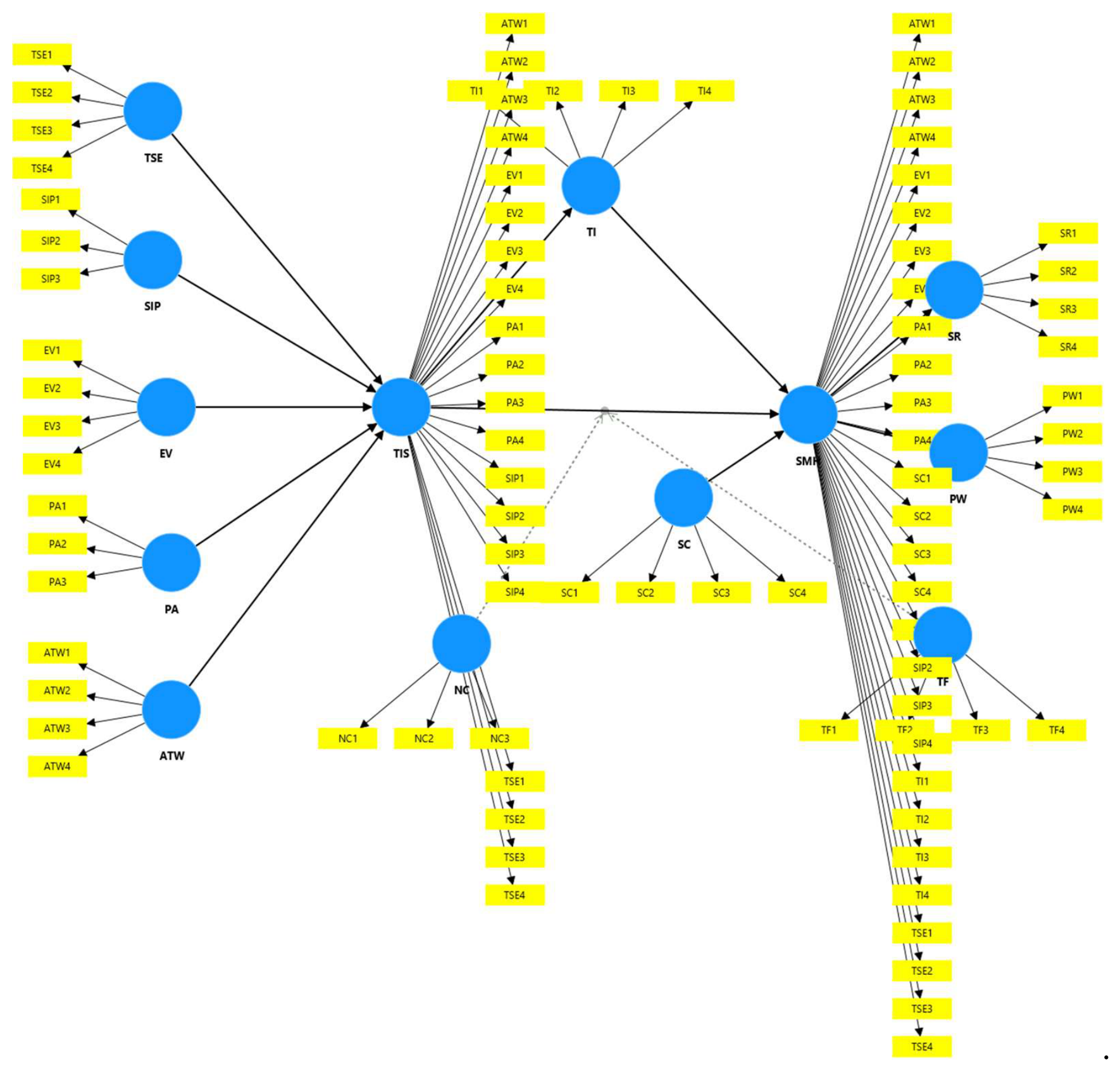
Table 4.
Internal consistency (measurement of the constructs).
| Constructs | Items | Factor loadings | Cronbach’s alpha | Rho_A | Composite reliability | AVE | VIF |
| Attitude toward tourism | ATW1 | 0.876 | 0.910 | 0.911 | 0.937 | 0.788 | 2.536 |
| ATW2 | 0.883 | 2.698 | |||||
| ATW3 | 0.906 | 3.136 | |||||
| ATW4 | 0.886 | 2.803 | |||||
| Experience value | EV1 | 0.851 | 0.851 | 0.854 | 0.900 | 0.691 | 2.045 |
| EV2 | 0.787 | 1.707 | |||||
| EV3 | 0.835 | 1.972 | |||||
| EV4 | 0.851 | 2.105 | |||||
| Nature connectedness | NC1 | 0.897 | 0.880 | 0.880 | 0.926 | 0.806 | 2.349 |
| NC2 | 0.901 | 2.516 | |||||
| NC3 | 0.895 | 2.433 | |||||
| Perceived affordability | PA1 | 0.815 | 0.686 | 0.688 | 0.827 | 0.614 | 1.418 |
| PA2 | 0.772 | 1.371 | |||||
| PA3 | 0.763 | 1.259 | |||||
| Psychological wellbeing | PW1 | 0.867 | 0.885 | 0.886 | 0.921 | 0.744 | 2.290 |
| PW2 | 0.858 | 2.265 | |||||
| PW3 | 0.879 | 2.544 | |||||
| PW4 | 0.845 | 2.118 | |||||
| Social connectedness | SC1 | 0.835 | 0.864 | 0.864 | 0.907 | 0.710 | 1.936 |
| SC2 | 0.852 | 2.145 | |||||
| SC3 | 0.845 | 2.075 | |||||
| SC4 | 0.838 | 2.006 | |||||
| Social influence pressure | SIP1 | 0.833 | 0.568 | 0.617 | 0.775 | 0.541 | 1.306 |
| SIP2 | 0.790 | 1.288 | |||||
| SIP3 | 0.553 | 1.077 | |||||
| Stress reduction | SR1 | 0.869 | 0.890 | 0.893 | 0.924 | 0.752 | 2.418 |
| SR2 | 0.837 | 2.207 | |||||
| SR3 | 0.882 | 2.610 | |||||
| SR4 | 0.879 | 2.582 | |||||
| Travel frequency | TF1 | 0.839 | 0.846 | 0.850 | 0.896 | 0.683 | 1.929 |
| TF2 | 0.851 | 2.156 | |||||
| TF3 | 0.802 | 1.736 | |||||
| TF4 | 0.813 | 1.948 | |||||
| Travel involvement | TI1 | 0.757 | 0.811 | 0.814 | 0.876 | 0.639 | 1.851 |
| TI2 | 0.824 | 1.872 | |||||
| TI3 | 0.845 | 2.003 | |||||
| TI4 | 0.769 | 1.567 | |||||
| Travel self-efficacy | TSE1 | 0.836 | 0.825 | 0.828 | 0.884 | 0.655 | 1.847 |
| TSE2 | 0.790 | 1.675 | |||||
| TSE3 | 0.810 | 1.704 | |||||
| TSE4 | 0.801 | 1.744 |
Abbreviations: AVE = average variance extracted; VIF = variance inflation factor.
Discriminant and convergent validity
Discriminant and convergent validity has been checked to assess whether the items are distinct from each other and they can properly reflect the corresponding measured constructs (MacKenzie et al., 2011). Therefore, Table 7 indicates the Fornell-Lacker Criteria which is satisfactory as the diagonal values are higher. As per Table 8, the HTMT ratio is well established as values are less than the cutoff point 0.90 (Henseler et al., 2015).
Fornell-Larcker Criterion
Table 7.
Fornell Larcker.
| ATW | EV | NC | PA | PW | SC | SIP | SR | TF | TI | TSE | |
| ATW | 0.888 | ||||||||||
| EV | 0.683 | 0.832 | |||||||||
| NC | 0.714 | 0.648 | 0.898 | ||||||||
| PA | 0.576 | 0.601 | 0.539 | 0.784 | |||||||
| PW | 0.730 | 0.622 | 0.715 | 0.542 | 0.862 | ||||||
| SC | 0.708 | 0.610 | 0.617 | 0.523 | 0.682 | 0.843 | |||||
| SIP | 0.451 | 0.523 | 0.401 | 0.457 | 0.434 | 0.477 | 0.736 | ||||
| SR | 0.781 | 0.623 | 0.697 | 0.568 | 0.771 | 0.694 | 0.420 | 0.867 | |||
| TF | 0.330 | 0.253 | 0.318 | 0.333 | 0.361 | 0.333 | 0.350 | 0.364 | 0.827 | ||
| TI | 0.660 | 0.652 | 0.635 | 0.589 | 0.631 | 0.609 | 0.454 | 0.641 | 0.390 | 0.799 | |
| TSE | 0.397 | 0.475 | 0.405 | 0.427 | 0.405 | 0.379 | 0.358 | 0.416 | 0.418 | 0.513 | 0.809 |
HTMT Matrix
Table 5.
HTMT.
| ATW | EV | NC | PA | PW | SC | SIP | SR | TF | TI | TSE | |
| ATW | |||||||||||
| EV | 0.773 | ||||||||||
| NC | 0.796 | 0.747 | |||||||||
| PA | 0.727 | 0.784 | 0.691 | ||||||||
| PW | 0.811 | 0.717 | 0.808 | 0.694 | |||||||
| SC | 0.799 | 0.710 | 0.707 | 0.679 | 0.779 | ||||||
| SIP | 0.608 | 0.725 | 0.550 | 0.708 | 0.592 | 0.667 | |||||
| SR | 0.865 | 0.712 | 0.784 | 0.725 | 0.867 | 0.790 | 0.573 | ||||
| TF | 0.373 | 0.297 | 0.364 | 0.430 | 0.412 | 0.387 | 0.520 | 0.416 | |||
| TI | 0.767 | 0.782 | 0.749 | 0.788 | 0.743 | 0.728 | 0.664 | 0.751 | 0.470 | ||
| TSE | 0.455 | 0.564 | 0.474 | 0.563 | 0.471 | 0.447 | 0.529 | 0.482 | 0.500 | 0.627 |
Cross loadings
Table 6.
Cross Loadings.
| ATW | EV | NC | PA | PW | SC | SIP | SR | TF | TI | TSE | |
| ATW1 | 0.876 | 0.645 | 0.663 | 0.512 | 0.645 | 0.615 | 0.437 | 0.705 | 0.278 | 0.591 | 0.373 |
| ATW2 | 0.883 | 0.575 | 0.612 | 0.489 | 0.628 | 0.634 | 0.367 | 0.680 | 0.272 | 0.597 | 0.331 |
| ATW3 | 0.906 | 0.623 | 0.646 | 0.527 | 0.675 | 0.640 | 0.433 | 0.703 | 0.308 | 0.577 | 0.355 |
| ATW4 | 0.886 | 0.578 | 0.611 | 0.516 | 0.643 | 0.626 | 0.360 | 0.684 | 0.313 | 0.579 | 0.349 |
| EV1 | 0.604 | 0.851 | 0.565 | 0.541 | 0.513 | 0.535 | 0.474 | 0.553 | 0.218 | 0.535 | 0.438 |
| EV2 | 0.499 | 0.787 | 0.464 | 0.451 | 0.511 | 0.466 | 0.393 | 0.459 | 0.233 | 0.508 | 0.337 |
| EV3 | 0.585 | 0.835 | 0.558 | 0.500 | 0.509 | 0.507 | 0.424 | 0.530 | 0.191 | 0.579 | 0.398 |
| EV4 | 0.577 | 0.851 | 0.560 | 0.504 | 0.538 | 0.516 | 0.444 | 0.525 | 0.201 | 0.545 | 0.401 |
| NC1 | 0.655 | 0.573 | 0.897 | 0.505 | 0.676 | 0.585 | 0.371 | 0.634 | 0.324 | 0.594 | 0.407 |
| NC2 | 0.649 | 0.578 | 0.901 | 0.474 | 0.633 | 0.533 | 0.341 | 0.625 | 0.276 | 0.561 | 0.337 |
| NC3 | 0.617 | 0.593 | 0.895 | 0.469 | 0.615 | 0.543 | 0.367 | 0.616 | 0.255 | 0.553 | 0.345 |
| PA1 | 0.484 | 0.521 | 0.485 | 0.815 | 0.444 | 0.414 | 0.392 | 0.476 | 0.240 | 0.510 | 0.306 |
| PA2 | 0.425 | 0.437 | 0.400 | 0.772 | 0.405 | 0.405 | 0.305 | 0.413 | 0.189 | 0.441 | 0.293 |
| PA3 | 0.442 | 0.452 | 0.378 | 0.763 | 0.422 | 0.411 | 0.371 | 0.442 | 0.347 | 0.429 | 0.402 |
| PA4 | 0.374 | 0.386 | 0.322 | 0.415 | 0.362 | 0.370 | 0.344 | 0.382 | 0.375 | 0.439 | 0.391 |
| PW1 | 0.692 | 0.560 | 0.675 | 0.484 | 0.867 | 0.606 | 0.397 | 0.687 | 0.336 | 0.564 | 0.381 |
| PW2 | 0.598 | 0.518 | 0.587 | 0.458 | 0.858 | 0.605 | 0.347 | 0.641 | 0.280 | 0.530 | 0.336 |
| PW3 | 0.611 | 0.544 | 0.613 | 0.489 | 0.879 | 0.573 | 0.373 | 0.668 | 0.320 | 0.538 | 0.338 |
| PW4 | 0.613 | 0.523 | 0.587 | 0.435 | 0.845 | 0.568 | 0.375 | 0.661 | 0.307 | 0.543 | 0.340 |
| SC1 | 0.618 | 0.541 | 0.531 | 0.457 | 0.560 | 0.835 | 0.423 | 0.581 | 0.239 | 0.529 | 0.318 |
| SC2 | 0.601 | 0.483 | 0.512 | 0.434 | 0.577 | 0.852 | 0.406 | 0.585 | 0.295 | 0.530 | 0.305 |
| SC3 | 0.569 | 0.512 | 0.514 | 0.440 | 0.590 | 0.845 | 0.396 | 0.573 | 0.305 | 0.522 | 0.352 |
| SC4 | 0.599 | 0.519 | 0.525 | 0.431 | 0.572 | 0.838 | 0.382 | 0.599 | 0.285 | 0.473 | 0.302 |
| SIP1 | 0.415 | 0.478 | 0.356 | 0.399 | 0.399 | 0.418 | 0.833 | 0.384 | 0.264 | 0.398 | 0.282 |
| SIP2 | 0.338 | 0.410 | 0.321 | 0.372 | 0.331 | 0.371 | 0.790 | 0.312 | 0.240 | 0.333 | 0.256 |
| SIP3 | 0.210 | 0.223 | 0.179 | 0.205 | 0.194 | 0.238 | 0.553 | 0.207 | 0.294 | 0.257 | 0.263 |
| SIP4 | 0.082 | 0.113 | 0.083 | 0.144 | 0.099 | 0.104 | 0.326 | 0.113 | 0.264 | 0.160 | 0.205 |
| SR1 | 0.740 | 0.601 | 0.669 | 0.511 | 0.666 | 0.623 | 0.430 | 0.869 | 0.327 | 0.600 | 0.393 |
| SR2 | 0.620 | 0.510 | 0.533 | 0.477 | 0.616 | 0.537 | 0.285 | 0.837 | 0.306 | 0.534 | 0.334 |
| SR3 | 0.669 | 0.545 | 0.618 | 0.504 | 0.701 | 0.590 | 0.393 | 0.882 | 0.321 | 0.553 | 0.366 |
| SR4 | 0.672 | 0.499 | 0.586 | 0.475 | 0.687 | 0.651 | 0.339 | 0.879 | 0.306 | 0.530 | 0.347 |
| TF1 | 0.301 | 0.219 | 0.305 | 0.329 | 0.354 | 0.313 | 0.327 | 0.326 | 0.839 | 0.360 | 0.354 |
| TF2 | 0.255 | 0.222 | 0.260 | 0.277 | 0.303 | 0.292 | 0.311 | 0.324 | 0.851 | 0.321 | 0.349 |
| TF3 | 0.305 | 0.219 | 0.282 | 0.247 | 0.284 | 0.248 | 0.254 | 0.299 | 0.802 | 0.314 | 0.361 |
| TF4 | 0.222 | 0.170 | 0.194 | 0.238 | 0.238 | 0.240 | 0.258 | 0.244 | 0.813 | 0.286 | 0.314 |
| TI1 | 0.479 | 0.527 | 0.503 | 0.482 | 0.501 | 0.514 | 0.389 | 0.496 | 0.327 | 0.757 | 0.424 |
| TI2 | 0.591 | 0.541 | 0.528 | 0.482 | 0.501 | 0.492 | 0.376 | 0.535 | 0.261 | 0.824 | 0.353 |
| TI3 | 0.562 | 0.569 | 0.555 | 0.482 | 0.557 | 0.496 | 0.337 | 0.549 | 0.315 | 0.845 | 0.438 |
| TI4 | 0.472 | 0.440 | 0.437 | 0.434 | 0.453 | 0.446 | 0.352 | 0.465 | 0.349 | 0.769 | 0.429 |
| TSE1 | 0.349 | 0.412 | 0.338 | 0.409 | 0.347 | 0.336 | 0.337 | 0.357 | 0.350 | 0.453 | 0.836 |
| TSE2 | 0.314 | 0.353 | 0.317 | 0.296 | 0.290 | 0.292 | 0.259 | 0.290 | 0.332 | 0.386 | 0.790 |
| TSE3 | 0.357 | 0.406 | 0.356 | 0.346 | 0.372 | 0.321 | 0.296 | 0.393 | 0.327 | 0.425 | 0.810 |
| TSE4 | 0.259 | 0.362 | 0.297 | 0.323 | 0.296 | 0.274 | 0.261 | 0.301 | 0.346 | 0.391 | 0.801 |
Higher order validity table
Table 10.
Higher order validity table.
| HOC | LOC | Outer weights | Outer loadings | VIF |
| TIS | ATW | 0.339 | 0.848 | 2.061 |
| EV | 0.292 | 0.869 | 2.387 | |
| PA | 0.252 | 0.795 | 1.802 | |
| SIP | 0.203 | 0.690 | 1.468 | |
| TSE | 0.185 | 0.639 | 1.365 | |
| SMH | PW | 0.583 | 0.952 | 2.463 |
| SR | 0.479 | 0.928 | 2.463 |
The table 10 shows the higher order validity table and here all the values are satisfactory along with the outer weights, outer loadings and VIF value.
R square
The analysis values of R2 values in the table 11 show the extent to which the model can explain the variance in the dependent variables. In the case of Psychological Wellbeing (PW), Stress Reduction (SR), and Travel Intention (TI), the model accounts about 58.9 to 62.5 percent of the variance, indicating a moderate explanatory power. Student Mental Health (SMH) has an R2 of 1.000 indicating that the independent variables have a perfect explanatory effect on the variance of this construct. The Travel Intention of Students (TIS) depicts an extremely high value of R2 of 0.996, which is nearly a perfect indication of predicting the intentions of students to travel based on what can be determined through the independent variables. The values of Adjusted R2 are also the same as those of R2 and this indicates that the model is not overfitted and the predictors are applicable to the results. On the whole, the analysis indicates that the model is effective in describing the relationships between travel intention and student mental health, and a good fit is observed in most constructs.
Table 11.
R square.
| R-square | R-square adjusted | |
| PW | 0.589 | 0.589 |
| SMH | 1.000 | 1.000 |
| SR | 0.625 | 0.624 |
| TI | 0.575 | 0.574 |
| TIS | 0.996 | 0.996 |
F square
F2 effect size analysis in the table 12 shows the strength of the relationships between variables. Attitude Towards Tourism (ATW), Experience Value (EV), and Perceived Affordability (PA) have a significant impact on Travel Self-Efficacy (TSE) with effects of large to medium magnitude, showing the significance of confidence in planning to travel. The effect of Social Connectedness (SC) on Social Influence Pressure (SIP) is very large, which means that social ties boost pressure by peers on the decision to travel. Travel Intention of Students (TIS) has a very large effect on TSE, indicating that intentions have a very strong effect on self-efficacy, with moderators such as Nature Connectedness and Travel Frequency having a smaller effect.
Table 12.
F square.
| ATW | EV | NC | PA | PW | SC | SIP | SMH | SR | TF | TI | TIS | TSE | |
| ATW | 15.244 | ||||||||||||
| EV | 9.848 | ||||||||||||
| NC | 0.056 | ||||||||||||
| PA | 5.192 | ||||||||||||
| SC | 61.335 | ||||||||||||
| SIP | 3.739 | ||||||||||||
| SMH | 1.435 | 1.664 | |||||||||||
| TF | 0.036 | ||||||||||||
| TI | 37.465 | ||||||||||||
| TIS | 283.454 | 1.353 | |||||||||||
| TSE | 10.341 |
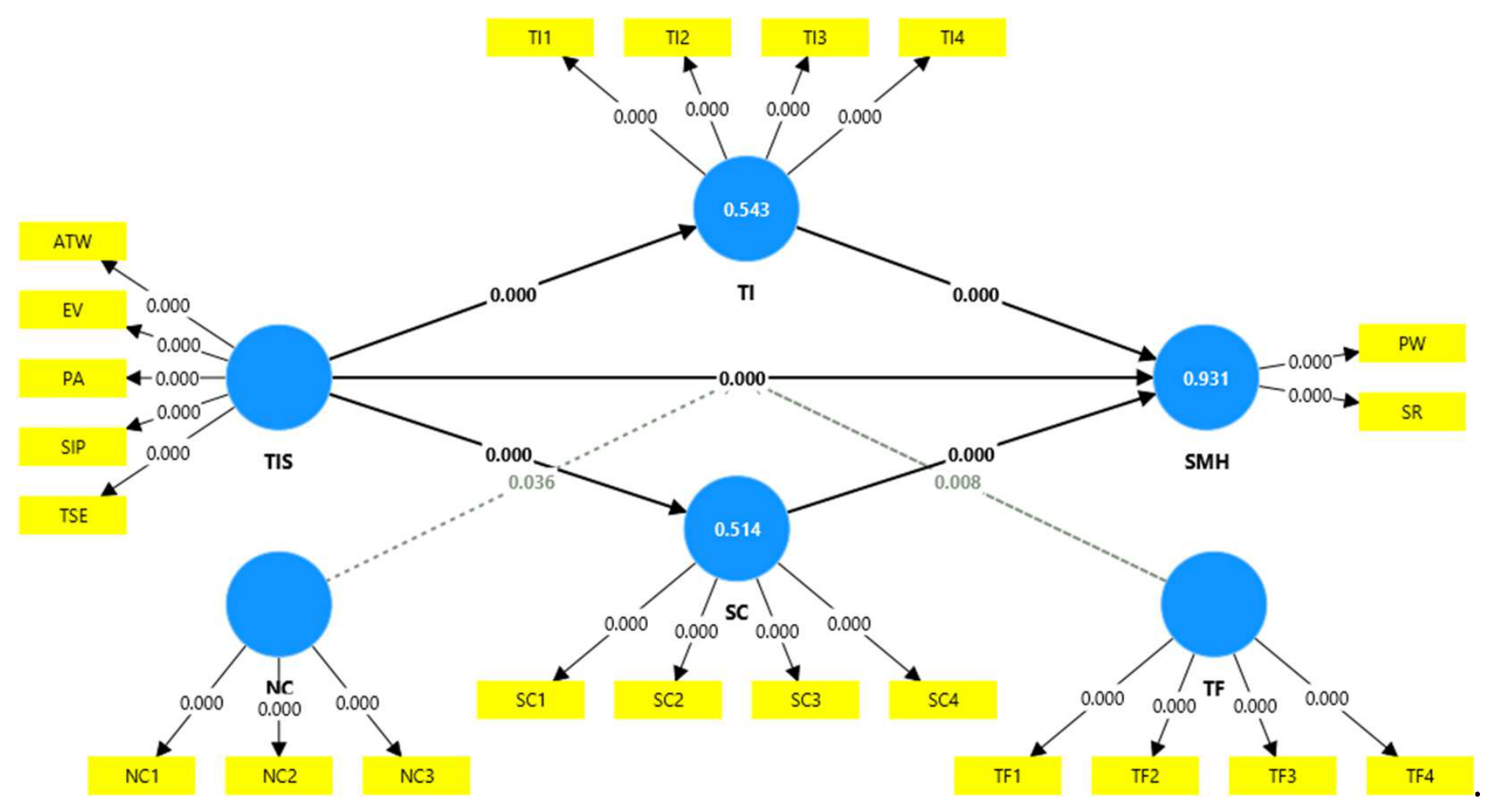
Figure 4.
Structural Model.
Hypothesis testing
Here the table 13 presents the direct relationship between the constructs and the table 14 represents the mediating effect. Here we can see that all of the hypotheses have been accepted as their T value is greater than 1.96 and P value is less than 0.05.
Table 7.
Path coefficient.
| Hypothesis | Relation | Beta value (β) | SD | T statistics | P values | Results |
| H1 | TIS -> SMH | 0.125 | 0.029 | 4.319 | 0.000 | Supported |
| H2 | TIS -> TI | 0.736 | 0.029 | 25.478 | 0.000 | Supported |
| H3 | TI -> SMH | 0.075 | 0.020 | 3.719 | 0.000 | Supported |
| H4 | TIS -> SC | 0.716 | 0.030 | 23.561 | 0.000 | Supported |
| H5 | SC -> SMH | 0.076 | 0.019 | 3.917 | 0.000 | Supported |
| H6 | NC x TIS -> SMH | 0.024 | 0.012 | 2.098 | 0.036 | Supported |
| H7 | TF x TIS -> SMH | -0.032 | 0.012 | 2.659 | 0.008 | Supported |
Table 8.
Mediating Effect (Specific Indirect).
| Hypothesis | Relation | Beta value (β) | SD | T statistics | P values | Results |
| H8 | TIS -> TI -> SMH | 0.055 | 0.016 | 3.586 | 0.000 | Supported |
| H9 | TIS -> SC -> SMH | 0.055 | 0.014 | 3.800 | 0.000 | Supported |
5. Discussion
The objective of this study was that Travel Intention Structure (TIS) has a positive effect on Student Mental Health (SMH) both directly and indirectly through travel involvement and social connectedness, and nature connectedness and travel frequency as the moderating variables. The findings provide strong empirical support for all proposed hypotheses, reinforcing the theoretical grounding established by prior scholars.
H1 assumed that TIS have a positive impact on SMH. This relationship is confirmed by the results (β = 0.125, p < 0.001), which shows that students with stronger travel intentions report improved psychological wellbeing. This finding aligns with the Theory of Planned Behavior, which posits that intention represents motivational readiness and serves as the most immediate determinant of behavior. According to scholars like (Ajzen, 1991) intention is a result of goal commitment which ultimately creates psychological positivity. Moreover, Nawijn & Filep (2016) argued that the positive affect is stimulated by anticipation of travel even before its actual participation. Therefore, the significant beta coefficient substantiates the argument that the process of forming travel intention in itself is an uplifting factor on the emotional state of students and a stress reliever.
H2 assumed that TIS has a positive effect on Travel Involvement. The extremely high effect (= 0.736, p < 0.001) proves that intention has a substantial influence on engagement. This high beta is in line with the behavioral models which focus on the translation of intention into cognitive and emotional investment. Similar results were reported by Gan et al. (2023) who found that people who intend to travel more pay more attention, put more effort, and dedicate more emotional energy to the activities related to travel. Therefore, the value of β = 0.736 is a strong support of H2.
H3 was that Travel Involvement has a positive impact on SMH. The effect size is not very large (= 0.075, p < 0.001) yet, it is statistically significant. This suggests that deeper engagement enhances wellbeing beyond mere intention. Iacob et al. (2024) reasoned that meaningful tourism engagement leads to self-reflection and self-enrichment. Similarly, Konstantopoulou et al. (2024) established that life satisfaction and positive emotions are enhanced by the immersive travel experience. In that way, the hypothesis that active involvement reinforces psychological benefits is justified by the empirical evidence.
H4 assumed the positive correlation between TIS and Social Connectedness. The results reveal a strong and significant effect (β = 0.716, p < 0.001), indicating that social bonding is significantly stimulated by travel intention. Tourism is a social phenomenon, and in most cases, there is collective experience that promotes belongingness (Su et al., 2023). Diallo et al 2022 highlighted that travel interactions have a major positive effect on subjective wellbeing due to the relational processes. Therefore, the high beta value ascertains that students who have stronger intentions to travel have high probabilities of developing social relationships.
H5 was that Social Connectedness has a positive effect on SMH. This assumption is supported by the large coefficient (β = 0.076, p < 0.001). The existing literature regarding the social wellbeing shows that peer relationships mitigate stress and enhance psychological resilience (Gössling et al., 2020; Konstantopoulou et al., 2024). Moreover, Qu et al. (2025) highlighted how social connection effects mental health, reinforcing the importance of interpersonal bonds and overall quality of life. Therefore, the empirical evidence supports H5 as it proves that the social relations related to the travels have a significant impact on the wellbeing of the student.
H6 tested the moderating effect of the Nature Connectedness on the relationship between TIS and SMH. The interaction effect is significant and positive (β = 0.024, p = 0.036) which implies that the psychological advantages of travel intention are higher in students who are more attached to nature. The observation can be affirmed by Stress Recovery Theory which argues that natural settings contribute to emotional renewal. Ma et al., 2025 discovered that nature-based tourism has a significant impact on lessening stress and improving wellbeing.
H7 assumed that Travel Frequency mediates TIS-SMH relationship. The negative and significant interaction (β = -0.032, p = 0.008). This moderation effect is empirically justified by a negative beta coefficient.
H8 and H9 tested effects of mediation. The H8 is confirmed by the indirect effect through Travel Involvement (β = 0.055, p = 0.001), which proves the intention to improve mental health through more intensive experience. Similarly, H9 is supported by the indirect impact of relational pathways via Social Connectedness (β = 0.055, p < 0.001), which implies that the psychological influence of travel intention is further explained by relational pathways. Vada et al., 2022 emphasized the importance of travel involvement which acts as an intermediary between the travel intention and student mental health. Besides, travel intention also positively influences the mental health of students and indirectly through social connectedness (Zhuang & Wang, 2024).
Overall, the trend of the beta coefficients proves that Travel Intention Structure is a multidimensional psychological driver. The highest correlations are found between TIS and its mediators (β =0.736; p =0.716), whereas direct and indirect implication on mental health, even though minor, are still statistically significant. Based on the existing behavioral and restorative theories and guided by the previous literature, all of the findings allow concluding about the validity of all hypotheses and prove the significant role of tourism in improving student mental health.
5. Conclusion
Drawing upon the Theory of Planned (TPB) and stress Recovery Theory (SRT), this study establishes a comprehensive framework elucidating the pathways through which travel intention significantly enhances university students’ mental health. The empirical findings confirm that the travel intention does not merely operate as an isolated cognitive precursor; it actively translates into psychological well-being through the pivotal mediating mechanisms of travel in socially cohesive excursions. Students successfully cultivate emotional resilience and mitigate stress caused by academic. Furthermore, the study uncovers the nuanced boundary conditions of these restorative effects. Nature connectedness significantly amplifies the psychological dividends of travel intention, validating the restorative capacity of natural environments. Interestingly, the moderating role of travel frequency presents a complex dynamic, suggesting that while travel is beneficial, repeated exposure may alter the perceived intensity or yield diminishing returns on mental recovery. Ultimately, this research positions tourism not just as a critical, experiential coping strategy for sustaining psychological stability among the student demography.
6. Recommendation
6.1. Practical Implications
The academic implications of this study are multifaceted, primarily advancing the theoretical intersections of tourism psychology and students' well-being. By successfully integrating the TPB theory with SRT theory, this research provides a novel, unified framework that explains not only the motivational drivers behind travel intention but also the restorative mechanism that facilitates emotional recovery. Form policy-making perspective, the empirical evidence linking travel intentions and execution to improved mental health necessitates a paradigm shift in hoe public health and educational administrators approach youth wellbeing. Higher education institution and government education boards should formulate integrated policies that recognize nature-based tourism and structured leisure travel as proactive mental health interventions rather than mere extracurricular luxuries. Policymakers could implement subsidized domestic travel programs or collaborate with local tourism boards to create affordable, nature-oriented retreats tailored specifically to the financial and psychological realities of the student demographic. On the societal level, this study champions a cultural reevaluation of leisure travel, framing it as an essential, experiential investment in holistic mental health rather than an unproductive diversion. As modern university students increasingly grapple with social isolation, financial pressures, and emotional turmoil, society must foster an environment that encourages social connectedness through shared travel experiences. Moreover, the significant moderating role of nature connectedness underscores a broader societal imperative to cultivate environmental appreciation.
6.2. Theoretical Implication
This study explores both Theory of Planned Behavior (TPB) and Stress Reduction Theory (SRT)to gain a better conceptual insight into the correlation between tourism and the mental health of students. In this context, TPB and SRT have been merged to reflect the relationship between them as well as their usage in practical tourism behavior and psychological health explanations. The theoretical implication of the proposed study is to expand the theoretical concept of tourism activities that might aid in enhancing the mental health of students. This research uncovers that the combination of TPB and SRT gives a clear picture on how to explain the travel intentions of students and the psychological gains achieved through tourism experiences. This research broadens the theoretical framework by incorporating two mediating variables, travel involvement and social connectedness as well as the theory of planned behavior (TPB) and Stress Recovery Theory (SRT) constructs. These mediators make the model stronger and provide it with a more accurate explanation on how tourism participation can help in enhancing mental health and well-being of students.
The contextual implication of this study explores that the proposed model can be applied and be utilized in terms of the given context of this demographic group. Students in South Asian country are sweat with stress and burden of study without any probable medium of relief. Tourism can be one of the useful methods to alleviate stress and enhance mental health in students in this case. Based on the model created within the current research, tourism is applicable as a feasible solution to enhance the psychological relaxation and wellbeing of students. Furthermore, the combination of Theory of Planned Behavior (TPB) and Stress Reduction Theory (SRT) offer an effective theoretical framework that explains how tourism activities may help in improving the mental health of students in this part of the region.
7. Limitations and Future Direction of the study
This study relies on a specific demographic, which is university students, and may limit the generalizability of the findings to other cohorts facing different structural stressors. The use of cross-sectional survey data to evaluate the structural model captures a specific moment in time, limiting the ability to establish definitive longitudinal causality between travel intention and long-term psychological well-being.
Future research should employ longitudinal or experimental design to track students’ mental health trajectories before, during and after travel experience to establish robust causal interferences. Also, scholars could expand to diversify the integrative framework, such as by working with young people, to observe that therapeutic mechanisms of travel involvement and social connectedness remain consistent across different high-stress groups.
Author Contributions
Conceptualization, F.F.S.; methodology, F.F.S and K.F.; software, S.KA.; validation, F.F.S and S.A.; formal analysis, S.K.A.; investigation, S.K.A and F.F.S; resources, F.F.S. and S.A; data curation, S.K.A.; writing—original draft preparation, S.A, K.A, N.R.S.N, F.A, and S.T.S ; writing—review and editing, S.A, F.F.S, K.F, S.K.A, F.A ; visualization, S.K.A.; supervision, S.A, F.F.S, N.R.S.N, K.F, S.K.A, F.A, and S.T.S.; project administration, S.K.A, K.F and N.R.S.N; All authors have read and agreed to the published version of the manuscript.
Funding
Authors thyself.
Institutional Review Board Statement
Not applicable
Informed Consent Statement
Not applicable
Acknowledgments
The authors would like to thank all the students who took part in this study, including attending the Focus Group Discussions (FGD) and completing the survey questionnaires. They contributed so much to this research in terms of their valuable contribution, time and co-operation in successful completion of this research.
Conflicts of Interest
The authors declare no conflicts of interest.
References
- Aebli, A.; Volgger, M.; Taplin, R. A two-dimensional approach to travel motivation in the context of the COVID-19 pandemic. Curr. Issues Tour. 2022, 25(1), 60–75. [Google Scholar] [CrossRef]
- Ajzen, I. The theory of planned behavior. Organ. Behav. Hum. Decis. Process. 1991, 50(2), 179–211. [Google Scholar] [CrossRef]
- Avecillas-Torres, I.; Herrera-Puente, S.; Galarza-Cordero, M.; Coello-Nieto, F.; Farfán-Pacheco, K.; Alvarado-Vanegas, B.; Ordóñez-Ordóñez, S.; Espinoza-Figueroa, F. Nature tourism and mental well-being: insights from a controlled context on reducing depression, anxiety, and stress. Sustainability 2025, 17(2), 654. [Google Scholar] [CrossRef]
- Bandura, A. Self-efficacy: The exercise of control; Freeman, 1997; Vol. 11. [Google Scholar]
- Benny, V. A Study on Attitude of Women Investors towards Stock Market Investment in Kerala; anvesak, 2021. [Google Scholar]
- Bohon, L. M.; Cotter, K. A.; Kravitz, R. L.; Cello, P. C., Jr.; Fernandez, Y.; Garcia, E. The theory of planned behavior as it predicts potential intention to seek mental health services for depression among college students. J. Am. Coll. Health 2016, 64(8), 593–603. [Google Scholar] [CrossRef] [PubMed]
- Braun, V.; Clarke, V. Using thematic analysis in psychology. Qual. Res. Psychol. 2006, 3(2), 77–101. [Google Scholar] [CrossRef]
- Buckley, R. Nature tourism and mental health: Parks, happiness, and causation. J. Sustain. Tour. 2020, 28(9), 1409–1424. [Google Scholar] [CrossRef]
- Buckley, R. C.; Brough, P.; Westaway, D. Bringing outdoor therapies into mainstream mental health. Front. Public Health 2018, 6, 119. [Google Scholar] [CrossRef]
- Busser, J. A.; Shulga, L. V. Tourism value co-creation: the more we contribute–the more we value. Tour. Manag. 2026, 113, 105292. [Google Scholar] [CrossRef]
- Cao, L.; Xie, D.; Qu, Y. A process perspective on experience co-creation: How pre-trip involvement prompts destination loyalty. Tour. Manag. 2023, 96, 104711. [Google Scholar] [CrossRef]
- Chen, C.-C.; Petrick, J. F.; Shahvali, M. Tourism experiences as a stress reliever: Examining the effects of tourism recovery experiences on life satisfaction. J. Travel Res. 2016, 55(2), 150–160. [Google Scholar] [CrossRef]
- Chen, M.-F.; Tung, P.-J. Developing an extended theory of planned behavior model to predict consumers’ intention to visit green hotels. Int. J. Hosp. Manag. 2014, 36, 221–230. [Google Scholar] [CrossRef]
- Chen, M.-F.; Tung, P.-J. Developing an extended theory of planned behavior model to predict consumers’ intention to visit green hotels. Int. J. Hosp. Manag. 2014, 36, 221–230. [Google Scholar] [CrossRef]
- Chin, W. W.; Marcolin, B. L.; Newsted, P. R. A Partial Least Squares Latent Variable Modeling Approach for Measuring Interaction Effects: Results From a Monte Carlo Simulation Study and an ElectronicMail Emotion/Adoption Study. Inf. Syst. Res. 2003, 14(no. 2), 189–217. [Google Scholar] [CrossRef]
- Choe, J. Y. J.; Kim, S. S. Development and validation of a multidimensional tourist’s local food consumption value (TLFCV) scale. Int. J. Hosp. Manag. 2019, 77, 245–259. [Google Scholar] [CrossRef]
- Chuang, L.-M.; Chen, P.-C.; Chen, Y.-Y. The determinant factors of travelers’ choices for pro-environment behavioral intention-integration theory of planned behavior, unified theory of acceptance, and use of technology 2 and sustainability values. Sustainability 2018, 10(6), 1869. [Google Scholar] [CrossRef]
- Clark, C.; Matarrita-Cascante, D.; Tkatch, J. R.; Fariha, M. S. Examining the competitive advantage of nature-based destinations: Applying a holistic resource-based theory framework. Tour. Manag. 2026, 112, 105281. [Google Scholar] [CrossRef]
- Cochran, W. Sampling Techniques, 3d ed Wiley; New York, 1977. [Google Scholar]
- Cohen, S.; Kamarck, T.; Mermelstein, R. A global measure of perceived stress. J. Health Soc. Behav. 1983, 385–396. [Google Scholar] [CrossRef]
- Creswell, J. W.; Clark, V. P. Mixed methods research; Thousand Oaks, CA, 2007. [Google Scholar]
- Diallo, M. F.; Diop-Sall, F.; Leroux, E.; Vachon, M.-A. How do tourism sustainability and nature affinity affect social engagement propensity? The central roles of nature conservation attitude and personal tourist experience. Ecol. Econ. 2022, 200, 107503. [Google Scholar] [CrossRef]
- Do, T. T.; Nguyen, H. N. T. Understanding Gen Y's Intentions toward Wellness Tourism in Vietnam: A Theory of Planned Behavior Approach. In Routledge Handbook of Tourism and Hospitality Development in Vietnam; Routledge, 2025; pp. 296–311. [Google Scholar]
- Dolnicar, S.; Lazarevski, K.; Yanamandram, V. Quality of life and tourism: A conceptual framework and novel segmentation base. J. Bus. Res. 2013, 66(6), 724–729. [Google Scholar] [CrossRef]
- Duffy, A. Friends and fellow travelers: comparative influence of review sites and friends on hotel choice. J. Hosp. Tour. Technol. 2015, 6(2), 127–144. [Google Scholar] [CrossRef]
- Esfandiar, K.; Hadinejad, A. A critical review of the theory of planned behaviour in tourism research. In Current Issues in Tourism; 2025; pp. 1–15. [Google Scholar]
- Filep, S.; Laing, J. Trends and directions in tourism and positive psychology. J. Travel Res. 2018, 57(3), 343–354. [Google Scholar] [CrossRef]
- Gan, T.; Zheng, J.; Li, W.; Li, J.; Shen, J. Health and wellness tourists’ motivation and behavior intention: The role of perceived value. Int. J. Environ. Res. Public Health 2023, 20(5), 4339. [Google Scholar] [CrossRef]
- Gössling, S.; Scott, D.; Hall, C. M. Pandemics, tourism and global change: a rapid assessment of COVID-19. J. Sustain. Tour. 2020, 29(1), 1–20. [Google Scholar] [CrossRef]
- Gu, T.; Xie, M.; Hao, E.; Wang, Y.; Zhou, S. Classifying and quantifying resident engagement in the sponge-style old community renewal of China: An analysis using the analytic network process–preference ranking organization method for enrichment evaluations II method. Buildings 2024, 14(12), 3773. [Google Scholar] [CrossRef]
- Gujarati, D. Use of Dummy Variables in Testing for Equality Between Sets of Coefficients in Two Linear Regressions: A Note. Am. Stat. 1970, 24(no. 1), 50–52. [Google Scholar] [CrossRef]
- Güneş, H. M.; Basgoze, P. Understanding the relationship between fear of pandemics and hotel visit intention: A multiple mediation model. J. Tour. Leis. Hosp. 2024, 5(2), 167–177. [Google Scholar] [CrossRef]
- Hair, J.; Alamer, A. Partial Least Squares Structural Equation Modeling (PLS-SEM) in second language and education research: Guidelines using an applied example. Res. Methods Appl. Linguist. 2022, 1(3), 100027. [Google Scholar] [CrossRef]
- Hartig, T.; Kaiser, F. G.; Bowler, P. A. Further development of a measure of perceived environmental restorativeness. In Institutet för bostads-och urbanforskning; 1997. [Google Scholar]
- Havitz, M. E.; Dimanche, F. Leisure involvement revisited: Conceptual conundrums and measurement advances. J. Leis. Res. 1997, 29(3), 245–278. [Google Scholar] [CrossRef]
- Henseler, J.; Ringle, C. M.; Sarstedt, M. A new criterion for assessing discriminant validity in variance-based structural equation modeling. J. Acad. Mark. Sci. 2015, 43(1), 115–135. [Google Scholar] [CrossRef]
- Huang, M.; Xiong, W.; Okumus, B.; Wen, J.; Fan, F. Indirect evidence of travel therapy for anxiety and depression: A network meta-analysis. J. Hosp. Tour. Manag. 2025, 65, 101360. [Google Scholar] [CrossRef]
- Hüsser, A. P.; Ohnmacht, T. A comparative study of eight COVID-19 protective measures and their impact on Swiss tourists’ travel intentions. Tour. Manag. 2023, 97, 104734. [Google Scholar] [CrossRef]
- Iacob, V.; de Jesus, S. N.; Carmo, C. An overview of mindfulness theories applied to tourism: systematic review update and bibliometric analysis. Qual. Quant. 2024, 58(3), 2213–2235. [Google Scholar] [CrossRef]
- Joseph Sirgy, M. Promoting quality-of-life and well-being research in hospitality and tourism. J. Travel Tour. Mark. 2019, 36(1), 1–13. [Google Scholar] [CrossRef]
- Kock, N. Common method bias in PLS-SEM: A full collinearity assessment approach. Int. J. E-Collab. (ijec) 2015, 11(4), 1–10. [Google Scholar] [CrossRef]
- Konstantopoulou, C.; Varelas, S.; Liargovas, P. Well-being and tourism: A systematic literature review. Economies 2024, 12(10), 281. [Google Scholar] [CrossRef]
- Kyle, G.; Chick, G. The social nature of leisure involvement. J. Leis. Res. 2002, 34(4), 426–448. [Google Scholar] [CrossRef]
- Lam, T.; Hsu, C. H. Theory of planned behavior: Potential travelers from China. J. Hosp. Tour. Res. 2004, 28(4), 463–482. [Google Scholar] [CrossRef]
- Lee, R. M.; Robbins, S. B. Measuring belongingness: The social connectedness and the social assurance scales. J. Couns. Psychol. 1995, 42(2), 232. [Google Scholar] [CrossRef]
- Lee, R. M.; Draper, M.; Lee, S. Social connectedness, dysfunctional interpersonal behaviors, and psychological distress: Testing a mediator model. J. Couns. Psychol. 2001, 48(3), 310. [Google Scholar] [CrossRef]
- Lee, Y.; Pennington-Gray, L.; Kim, J. Does location matter? Exploring the spatial patterns of food safety in a tourism destination. Tour. Manag. 2019, 71, 18–33. [Google Scholar] [CrossRef]
- Li, T. E.; Chan, E. T. “With a young spirit, we will be young forever”: Exploring the links between tourism and ageing well in contemporary China. Tour. Manag. 2021, 86, 104345. [Google Scholar] [CrossRef]
- Li, Y.; Wu, X.; Chu, Y.-J.; Guo, Y.-J. The impact of transformative tourism experiences on prosocial behaviors of college students: Multiple chain mediating effects of dispositional awe and social connectedness. Sustainability 2022, 14(20), 13626. [Google Scholar] [CrossRef]
- Lin, Y.-X.; Yang, Y. Understanding tourist restoration: an integrated framework from the perspective of environmental change. Asia Pac. J. Tour. Res. 2024, 29(2), 144–160. [Google Scholar] [CrossRef]
- Ma, C.; Zhao, M.; Zhang, Y. How does nature connectedness improve mental health in college students? A study of chain mediating effects. Behav. Sci. 2025, 15(5), 654. [Google Scholar] [CrossRef]
- MacKenzie, S. B.; Podsakoff, P. M.; Podsakoff, N. P. Construct measurement and validation procedures in MIS and behavioral research: Integrating new and existing Techniques1. MIS Q. 2011, 35(2), 293–A295. [Google Scholar] [CrossRef]
- Mayer, F. S.; Frantz, C. M.; Bruehlman-Senecal, E.; Dolliver, K. Why is nature beneficial? The role of connectedness to nature. Environ. Behav. 2009, 41(5), 607–643. [Google Scholar] [CrossRef]
- Mulcahy, R.; Prayag, G.; Pourfakhimi, S. Enhancing quality of life through travel, happiness, and psychological resilience: the influences of coping and vulnerability. J. Travel Res. 2026, 65(1), 183–204. [Google Scholar]
- Nawijn, J.; Filep, S. Two directions for future tourist well-being research. Ann. Tour. Res. 2016, 61(C), 221–223. [Google Scholar] [CrossRef]
- Nawijn, J.; Strijbosch, W. Experiencing tourism: Experiencing happiness? In Routledge handbook of the tourist experience; Routledge, 2021; pp. 24–36. [Google Scholar]
- Nawijn, J.; Strijbosch, W. The impact of travel anticipation on happiness. Ann. Tour. Res. 2021, 88, 103130. [Google Scholar]
- Nisbet, E. K.; Zelenski, J. M.; Murphy, S. A. The nature relatedness scale: Linking individuals' connection with nature to environmental concern and behavior. Environ. Behav. 2009, 41(5), 715–740. [Google Scholar]
- Nurja, I.; Bendo, I. The Impact of Vacation Length and Frequency on Enhancing Psychological Well-Being. Proceedings of The International Conference on Social Sciences and Humanities in the 21st Century, 2025. [Google Scholar]
- Pine, B. J.; Gilmore, J. H. Welcome to the experience economy; 1998. [Google Scholar]
- Podsakoff, P. M.; MacKenzie, S. B.; Lee, J.-Y.; Podsakoff, N. P. Common method biases in behavioral research: a critical review of the literature and recommended remedies. J. Appl. Psychol. 2003, 88(5), 879. [Google Scholar] [CrossRef] [PubMed]
- Prayag, G.; Hosany, S.; Muskat, B.; Del Chiappa, G. Understanding the relationships between tourists’ emotional experiences, perceived overall image, satisfaction, and intention to recommend. J. Travel Res. 2017, 56(1), 41–54. [Google Scholar] [CrossRef]
- Qiu, R. T.; Park, J.; Li, S.; Song, H. Social costs of tourism during the COVID-19 pandemic. Ann. Tour. Res. 2020, 84, 102994. [Google Scholar] [CrossRef]
- Qu, Y.; Zhou, S.; Zhang, Q. Integrative subjective well-being in tourism. J. Vacat. Mark. 2025, 13567667251318770. [Google Scholar] [CrossRef]
- Research: Guidelines Using an Applied Example. Res. Methods Appl. Linguist. 1(no. 3), 100027.
- Reza Jalilvand, M.; Samiei, N. The impact of electronic word of mouth on a tourism destination choice: Testing the theory of planned behavior (TPB). Internet Res. 2012, 22(5), 591–612. [Google Scholar] [CrossRef]
- Rhodes, R. E.; Courneya, K. S. Investigating multiple components of attitude, subjective norm, and perceived control: An examination of the theory of planned behaviour in the exercise domain. Br. J. Soc. Psychol. 2003, 42(1), 129–146. [Google Scholar] [CrossRef] [PubMed]
- Sarstedt, M.; Ringle, C. M.; Hair, J. F. Partial least squares structural equation modeling. In Handbook of market research; Springer, 2021; pp. 587–632. [Google Scholar]
- Sirgy, M. J. Toward a quality-of-life theory of leisure travel satisfaction. J. Travel Res. 2010, 49(2), 246–260. [Google Scholar]
- Stylidis, D.; Woosnam, K. M.; Ivkov, M. Tourists’ emotional solidarity with residents: A segmentation analysis and its links to destination image and loyalty. J. Destin. Mark. Manag. 2020, 17, 100458. [Google Scholar] [CrossRef]
- Su, L.; Huang, S.; Pearce, J. Toward a model of destination resident–tourist interactions and their psychological consequences. Tour. Manag. 2021, 86, 104345. [Google Scholar] [CrossRef]
- Su, L.; Pan, L.; Wen, J.; Phau, I. Effects of tourism experiences on tourists’ subjective well-being through recollection and storytelling. J. Vacat. Mark. 2023, 29(4), 479–497. [Google Scholar] [CrossRef]
- Su, L.; Tang, B.; Nawijn, J. How tourism activity shapes travel experience sharing: Tourist well-being and social context. Ann. Tour. Res. 2021, 91, 103316. [Google Scholar] [CrossRef]
- Subawa, N. S.; Yanti, N.; Mimaki, C. A.; Utami, M.; Prabarini, N. Exploring Tourist Behavior towards Bali Wellness Tourism Visits. Int. J. Res. Sci. Innov. (IJRSI) 2024, 705–730. [Google Scholar]
- Tennant, R.; Hiller, L.; Fishwick, R.; Platt, S.; Joseph, S.; Weich, S.; Parkinson, J.; Secker, J.; Stewart-Brown, S. The Warwick-Edinburgh mental well-being scale (WEMWBS): development and UK validation. Health Qual. Life Outcomes 2007, 5(1), 63. [Google Scholar] [CrossRef]
- Tyagi, A.; Tandon, U.; Mittal, A. Influence of memorable travel experience on psychological capital, mediated by mindfulness and moderated by restoration. Curr. Issues Tour. 2024, 27(11), 1784–1799. [Google Scholar] [CrossRef]
- Ulrich, R. S. Aesthetic and affective response to natural environment. In Behavior and the natural environment; Altman, I., Wohlwill, J. F., Eds.; Plenum Press, 1983; pp. 85–125. [Google Scholar]
- Ulrich, R. S.; Simons, R. F.; Losito, B. D.; Fiorito, E.; Miles, M. A.; Zelson, M. Stress recovery during exposure to natural and urban environments. J. Environ. Psychol. 1991, 11(3), 201–230. [Google Scholar] [CrossRef]
- Vada, S.; Prentice, C.; Filep, S.; King, B. The influence of travel companionships on memorable tourism experiences, well-being, and behavioural intentions. Int. J. Tour. Res. 2022, 24(5), 714–724. [Google Scholar]
- Wickramaratne, P. J.; Yangchen, T.; Lepow, L.; Patra, B. G.; Glicksburg, B.; Talati, A.; Adekkanattu, P.; Ryu, E.; Biernacka, J. M.; Charney, A. Social connectedness as a determinant of mental health: A scoping review. PLoS ONE 2022, 17(10), e0275004. [Google Scholar] [CrossRef]
- Zhong, L.; Xu, Z.; Li, X.; Law, R.; Wang, Y.; Zhu, M. Exploring the therapeutic potential of long-term virtual tourism: Empowering tourists on the path to depression recovery. Tour. Manag. 2025, 111, 105221. [Google Scholar] [CrossRef]
- Zhu, M.; Gao, J.; Zhang, L.; Jin, S. Exploring tourists’ stress and coping strategies in leisure travel. Tour. Manag. 2020, 81, 104167. [Google Scholar] [CrossRef]
- Zhuang, X.; Wang, Y. Social support and travel: Enhancing relationships, communication, and understanding for travel companions. Int. J. Tour. Res. 2024, 26(4), e2712. [Google Scholar] [CrossRef]
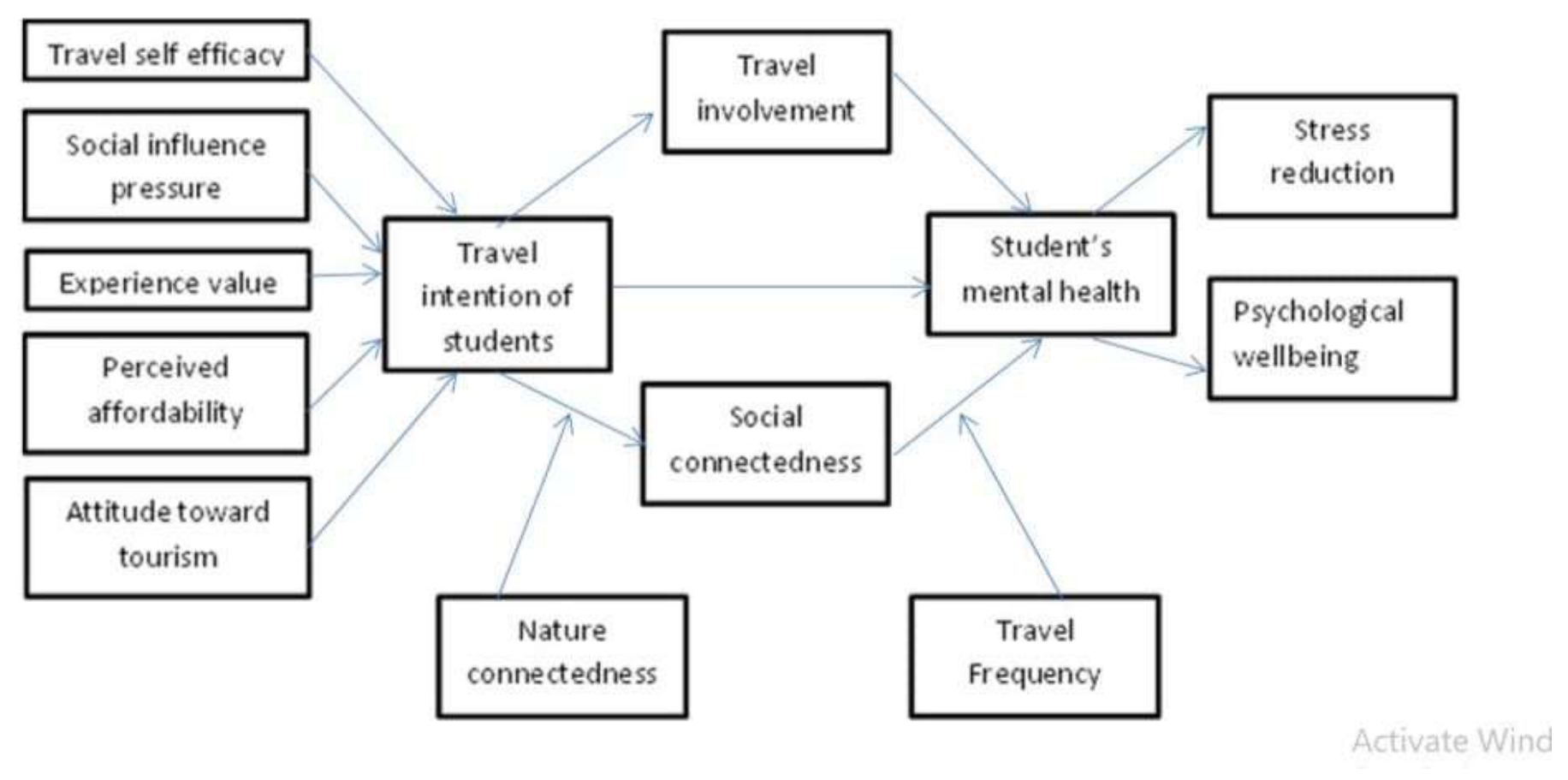
Disclaimer/Publisher’s Note: The statements, opinions and data contained in all publications are solely those of the individual author(s) and contributor(s) and not of MDPI and/or the editor(s). MDPI and/or the editor(s) disclaim responsibility for any injury to people or property resulting from any ideas, methods, instructions or products referred to in the content. |
© 2026 by the authors. Licensee MDPI, Basel, Switzerland. This article is an open access article distributed under the terms and conditions of the Creative Commons Attribution (CC BY) license (http://creativecommons.org/licenses/by/4.0/).
Copyright: This open access article is published under a Creative Commons CC BY 4.0 license, which permit the free download, distribution, and reuse, provided that the author and preprint are cited in any reuse.