

Submitted:
07 June 2026
Posted:
10 June 2026
You are already at the latest version
Abstract
INTRODUCTION: Delayed initiation of mepolizumab may influence long-term disease control and the achievement of clinical and functional outcomes in patients with uncontrolled severe asthma (SUA), but no definitive conclusions have yet been established regarding the optimal timing for biologic initiation. The aim of this study was to evaluate, in a real-world clinical setting, the effect of delayed mepolizumab initiation—from the moment patients first met EMA eligibility criteria— on the treatment response (using the EXACTO scale), clinical remission (according to SEPAR-REMAS criteria) and lung function at 12 months and 3 years after treatment initiation. MATERIAL AND METHODS: We conducted a retrospective observational cohort study including 148 patients with SUA treated with mepolizumab from January 2017 to November 2024 in our hospital. Patients were stratified into tertiles according to delay: ≤5 months, 6–19 months, and >19 months. Baseline demographic, clinical, and lung function characteristics were analyzed. RESULTS: Patients with shorter delay exhibited distinct significance baseline profiles, including higher eosinophil counts, lower IMB and current smoker, and better pre-treatment lung function (p< 0,05). Shorter delay was significantly associated with higher rates of good/complete response according to the EXACTO scale at both 12 months and 3 years (p< 0.05). Clinical remission rates were numerically higher in the early-treatment group, although differences did not reach statistical significance. No significant differences in lung function outcomes were observed between delay groups at either 12 months or 3 years. CONCLUSIONS: In conclusion, earlier initiation of mepolizumab after meeting EMA criteria is associated with improved clinical response, although it does not significantly influence remission rates or lung function recovery. These findings underscore the importance of timely treatment initiation and reinforce the relevance of accurate phenotypic and endotypic characterization to optimize biologic selection in SUA.
Keywords:
severe eosinophilic asthma
; mepolizumab
; clinical remission
; biologic timing
; treatment delay
Introduction
Severe uncontrolled asthma (SUA) is defined, according to the Spanish Guideline for Asthma Management, by persistently poor symptom control, frequent or severe exacerbations, and airflow limitation despite high-intensity treatment [1]. Biologic therapies targeting type 2 inflammatory pathways, such as mepolizumab—an anti interleukin 5 monoclonal antibody—have transformed the management of severe eosinophilic asthma by reducing exacerbations and oral corticosteroid (OCS) use, while improving clinical control and lung function [2]. The Spanish Society of Pulmonology and Thoracic Surgery (SEPAR) proposed the REMAS criteria as a multidimensional definition of clinical remission, requiring sustained fulfilment for ≥12 months of the following components: absence of exacerbations and rescue medication use, absence of OCS treatment, well-controlled asthma (defined as an ACT score ≥20), and normal or near-normal lung function (post-bronchodilator FEV1 ≥80% predicted or ≥90% of the patient’s best recorded value, together with a negative bronchodilator response) [3]. In addition, the 2025 Severe Asthma Consensus Document proposed the EXACTO scale as a tool to assess response to biologic treatment from 6 months onward and subsequently on an annual basis. Response is classified as absent, partial, good, or complete according to a score based on clinical, functional, and OCS reduction variables, with complete response defined as a score of 7 points (or 10 in OCS-dependent patients) and good response as 5–6 points (or 7–9 in OCS-dependent patients) [4]. Nevertheless, although the SEPAR-REMAS criteria and the EXACTO scale are not formally validated scales, both are expert consensus-based clinical assessment tools specifically designed for evaluating response to biologic therapy in severe asthma. Their use reflects current standard clinical practice and real-world decision-making regarding treatment continuation, optimization, or withdrawal.
Current evidence suggests that initiating mepolizumab during earlier stages of asthma or in patients with shorter disease duration is associated with higher rates of clinical remission and greater improvement in lung function [5,6,7]. However, there is limited evidence evaluating the effect of delayed initiation of mepolizumab according to the time elapsed since patients first fulfilled the European Medicines Agency (EMA) criteria for treatment initiation, as well as its relationship with treatment response assessed using specific tools for biologic-treated SUA patients, such as the EXACTO scale or SEPAR-REMAS clinical remission criteria in real world clinical practice. Therefore, the aim of this study was to evaluate, in a real-world clinical setting, the effect of delayed mepolizumab initiation—from the moment patients first met EMA eligibility criteria—on clinical remission (according to SEPAR-REMAS), treatment response (using the EXACTO scale), and lung function at 12 months and 3 years after treatment initiation.
Material and Methods
We conducted a retrospective observational cohort study including all patients aged ≥14 years with SUA treated with mepolizumab at the Severe Asthma Unit of our centre between January 2017 and November 2024. Baseline data collected at treatment initiation included demographic characteristics, clinical variables, OCS use, and pulmonary function parameters. All patients received fixed-dose mepolizumab 100 mg administered subcutaneously every four weeks, with treatment adherence supervised by specialized nursing staff. Clinical remission (according to SEPAR-REMAS) and treatment response (according to EXACTO) were assessed at 12 months and 3 years following treatment initiation. Delay in treatment initiation was defined as the interval (in months) between the date on which patients first fulfilled EMA criteria for mepolizumab initiation (≥2 severe exacerbations or ≥1 hospitalization in the previous year and blood eosinophil count ≥150 cells/µL or historical eosinophil counts ≥300 cells/µL) [8] and the administration of the first dose. Patients were classified into tertiles: ≤5 months, 6–19 months, and >19 months, as this approach provided homogeneous and comparable groups. Data were obtained retrospectively from electronic medical records. Sample size estimation was performed using G*Power software, assuming a significance level of α=0.05, a statistical power of 50%, and a moderate effect size, yielding a recommended minimum sample size greater than 140 patients. Therefore, inclusion of 148 subjects was considered adequate to detect clinically relevant differences and minimize the risk of type II error. Categorical variables were compared using the chi-square test, whereas continuous variables were analyzed using the Kruskal–Wallis test, as data were not normally distributed. A two-sided p value <0.05 was considered statistically significant. The study protocol was approved by the Provincial Clinical Research Ethics Committee of Seville (approval number 10/2025).
Results
148 patients were included in the analysis (mean age: 54±14 years; 60% women), distributed into three groups according to delay in mepolizumab initiation: ≤5 months (37.8%), 6–19 months (29.1%), and >19 months (33.1%) (p=0.424). Baseline characteristics at treatment initiation are shown in Table 1. Patients with shorter treatment delay (≤5 months) had significantly later asthma onset (p=0.033), as well as older age at the time of biologic eligibility (p=0.006). This subgroup also showed lower body mass index (p=0.019), lower obesity prevalence (p=0.005), and higher baseline eosinophilia (p=0.037). Regarding pulmonary function prior to biologic initiation, this subgroup also exhibited higher FEV1 (%) values (p=0.026) and higher absolute FEV1 in mL (p=0.039). Additionally, patients with longer treatment delay (>19 months) had a higher proportion of active smokers (p=0.002) and a lower proportion of biologic-naïve (p=0.001). Figure 1 shows the clinical outcomes following treatment initiation. Regarding treatment response variables (according to EXACTO), the group with shorter delay showed significantly higher rates of good/complete response both at 12 months (p=0.002) and at 3 years (p=0.027). Concerning clinical remission (according to SEPAR-REMAS), although remission was achieved more frequently in the shorter-delay group, no statistically significant differences were observed either at 12 months (p=0.684) or at 3 years (p=0.690). Finally, as it shows in Figure 2, lung function analysis at both 12 months and 3 years of follow-up showed no significant differences among treatment-delay groups.
Discussion
The potential impact of timing of biologic treatment initiation on short and long term clinical outcomes has been investigated in several immune-mediated inflammatory diseases, such as rheumatoid arthritis (RA), in which delayed introduction of biologic agents has been associated with structural joint damage and poorer clinical outcomes [9]. In asthma, however, the relevance of early biologic initiation remains an evolving area of research. Perez de Llano et al. draw a parallel between SUA and RA to analyze the potential benefits of establishing early treatment in SUA, concluding that a better clinical condition of the patient and more preserved lung function at the onset of biological treatment, together with a shorter duration of asthma, are associated with better response to biologics [6]. A post hoc analysis of the REDES study reported that longer asthma duration was associated with poorer baseline lung function and reduced functional recovery after 12 months of mepolizumab treatment, highlighting the potential importance of early treatment initiation [5]. Similarly, Pavord et al. observed higher rates of clinical remission among patients who initiated mepolizumab during earlier stages of the disease, characterized by shorter disease duration and/or lower severity [7]. In our study, although patients with longer treatment delay had significantly poorer lung function at baseline, total disease duration before biologic initiation was not specifically evaluated. Nevertheless, no definitive conclusions have yet been established regarding the optimal timing for biologic initiation or its impact on long-term clinical and functional evolution.
in our study, we considered that the ideal timing for biologic initiation should be defined according to the date on which patients first fulfilled EMA eligibility criteria for mepolizumab, rather than solely according to disease duration or severity. This approach is supported, on the one hand, by the mechanism of action of the drug itself, targeting T2 inflammation in which eosinophils represent the main effector cell [2] thereby emphasizing the importance of accurate phenotypic and endotypic characterization of SUA patients and appropriate biologic selection. On the other hand, EMA criteria incorporate clinical indicators of poor asthma control, such as exacerbations and hospitalizations, thus enhancing their applicability in daily clinical practice. Therefore, from a practical and decision-making perspective, the relevant “time zero” for potential therapeutic intervention could be better defined by eligibility for biologic treatment rather than by disease onset, which may encompass heterogeneous phenotypes ranging from intermittent or mild asthma to later progression toward severe disease. This approach is particularly relevant in real-world studies conducted within healthcare systems where access to biologic therapies is strictly regulated according to EMA indications and hospital pharmacy protocols. In this context, clinicians’ capacity to intervene is effectively determined by the moment patients meet eligibility criteria, making this time point more clinically actionable than disease duration per se. Consequently, evaluating treatment delay from the moment of EMA eligibility provides a more standardized and practice-oriented framework to assess potential undertreatment or delayed access to biologic therapy.
Using this approach, we also observed a significant effect on clinical disease evolution, as patients with longer delay exhibited poorer treatment response rates (according to the EXACTO scale) and lower clinical remission rates (according to SEPAR-REMAS), although the latter did not reach statistical significance. The absence of statistical significance for clinical remission may be explained by the strict definition of SEPAR-REMAS itself, since remission requires simultaneous fulfilment of all predefined components; therefore, failure to achieve a single variable prevents classification as remission despite an otherwise favourable clinical response. In contrast, functional evolution did not differ significantly between groups at either 12 months or 3 years. These findings suggest that delayed treatment initiation does not necessarily preclude functional recovery, although it may negatively affect clinical response to biologic therapy.
In this regard, baseline characteristics of the shorter-delay subgroup—including higher eosinophilia, better pulmonary function, lower obesity prevalence, lower rates of active smoking, and fewer switches from previous biologics—may predispose these patients to improved asthma control and a higher probability of treatment response. Altogether, these observations reinforce the importance of appropriate patient selection based on inflammatory phenotype/endotype, comorbidities, and previous biologic exposure in order to achieve favourable clinical and functional outcomes in routine clinical practice. Another possible hypothesis is a modulatory effect of mepolizumab on airway remodelling. The MESILICO and REMOMEPO studies suggest that anti–IL-5 therapy not only reduces eosinophilic inflammation but also attenuates structural airway changes [10,11]. REMOMEPO described reductions in reticular basement membrane thickness, bronchial smooth muscle mass, and extracellular matrix proteins, together with modulation of inflammatory cells and improvements in asthma control and FVC, whereas MESILICO reported similar structural and functional effects. These findings suggest that mepolizumab may facilitate functional recovery even in patients with poorer baseline lung function.
Finally, several aspects may explain the differences between our findings and those of previous studies and also constitute strengths of our work. These include the use of the EXACTO scale to assess treatment response and SEPAR-REMAS criteria to define clinical remission. Both tools integrate adequate clinical control, strict funct[5–7ional criteria (including bronchodilator testing and normal or near-normal FEV1), and absence of rescue medication use, thereby representing specific instruments designed for cohorts of biologic-treated SUA patients. Furthermore, the availability of follow-up data at both 12 months and 3 years provides one of the longest published evaluations of response to mepolizumab to date, since most available studies report follow-up periods of 12 or 24 months [5,6,7]. Additional strengths of our study include its independent design, absence of external pharmaceutical industry funding, and real-world clinical setting. Nevertheless, limitations include its retrospective design, relatively small sample size, and single-centre nature, all of which may limit generalizability of the findings.
In conclusion, in our real-world cohort of SUA patients treated with mepolizumab, longer delay in treatment initiation—from the time patients first fulfilled EMA eligibility criteria—was significantly associated with poorer treatment response according to the EXACTO scale, although without significantly compromising lung function recovery. Our findings reinforce the importance of appropriate selection of candidates for biologic therapy based on inflammatory phenotype/endotype, as well as the use of specific tools tailored to biologic-treated SUA patients to evaluate therapeutic response and long-term clinical and functional evolution. Nevertheless, further studies with larger sample sizes and prospective designs are needed to determine the optimal timing for biologic treatment initiation.
Author Contributions
All authors made a significant contribution to the work reported, whether that is in the conception, study design, execution, acquisition of data, analysis and interpretation, or in all these areas; took part in drafting, revising or critically reviewing the article; gave final approval of the version to be published; have agreed on the journal to which the article has been submitted; and agree to be accountable for all aspects of the work. The authors declare that artificial intelligence tools were used exclusively for partial translation support and for improving the English language style of the manuscript. No AI tools were employed for data analysis, interpretation of results, or drawing scientific conclusions. The authors take full responsibility for the content and integrity of the manuscript.
Funding
This research did not receive any specific grant from funding agencies in the public, commercial, or not-for-profit sectors.
Informed Consent Statement
This study was conducted in accordance with the principles of the Declaration of Helsinki and was reviewed and approved by the Ethics Committee of Virgen Macarena University Hospital on May 28, 2025 (sponsor code: EREMAG 2025). The requirement for written informed consent and a patient information sheet was waived by the Ethics Committee, as the study exclusively involved the use of pseudonymized clinical data. All applicable data protection regulations were strictly adhered to, and appropriate safeguards were implemented to ensure that no direct or indirect identification of the participants was possible.
Use of Artificial Intelligence
Artificial intelligence–based tools were employed to assist in the preparation of this manuscript, specifically for the refinement and correction of the English language translation, as well as for the optimization and polishing of the figures and tables included in the article.
Conflicts of Interest
Antonio León-Lloreda has received travel support from Chiesi, Bial, Menarini, and FAES. Belén Muñoz-Sánchez has received honoraria for travel related to congress attendance from Chiesi, FAES, Grifols, Gebro, and Sanofi/Regeneron. David Carlos Echavarría and Maria Polonio González has received travel support from AstraZeneca and FAES. Juan Francisco Medina-Gallardo has received consulting fees from AstraZeneca, Sanofi, GSK, Chiesi, and Menarini, as well as travel support from AstraZeneca, Bial, Orion, and Sanofi. M. Ferrer-Galván has received support for attending meetings and/or travel from Chiesi, Bial, and Menarini. Auxiliadora Romero-Falcón has received fees from AstraZeneca, GSK, and Chiesi. María Victoria Maestre Sánchez and Javier Diez Sierra certifies that she has no affiliations with or involvement in any organization or entity with any financial or non-financial interest (such as honoraria, educational grants, participation in speakers’ bureaus, membership, employment, consultancies, stock ownership, or other equity interest, as well as personal or professional relationships) in the subject matter or materials discussed in this manuscript. Francisco Javier Álvarez-Gutiérrez has received consulting fees from AstraZeneca, GSK, and Sanofi/Regeneron; speakers’ honoraria and/or manuscript support from AstraZeneca, GSK, Sanofi/Regeneron, and Orion Pharma; and travel support from AstraZeneca, Chiesi, Gebro, GSK, and Sanofi/Regeneron.A.R.F. has received fees from AstraZeneca, GSK, and Chiesi.
Abbreviations
SUA: Severe uncontrolled asthma; SEPAR: Spanish Society of Pulmonology and Thoracic Surgery; OCS: oral corticosteroid; ACT: Asthma Control Test; EMA: European Medicines Agency; BMI: body mass index; EGPA: eosinophilic granulomatosis with polyangiitis; FEV1: forced expiratory volume in one second; FVC: forced vital capacity.
References
- Plaza Moral, V.; Alobid, I.; Álvarez Rodríguez, C.; et al. GEMA 5.3. Spanish Guideline on the Management of Asthma. Open Respir. Arch. 2023, 5(4). [Google Scholar] [CrossRef] [PubMed]
- Agache, I.; Beltran, J.; Akdis, C.; et al. Efficacy and safety of treatment with biologicals for severe eosinophilic asthma: A systematic review for the EAACI Guidelines. Allergy 2020, 75, 1023–42. [Google Scholar] [CrossRef] [PubMed]
- Álvarez-Gutiérrez, F.J.; Casas-Maldonado, F.; Soto-Campos, G.; et al. Spanish Consensus on Remission in Asthma (REMAS). Arch. Bronconeumol. 2024, 60, 503–9. [Google Scholar] [CrossRef] [PubMed]
- Álvarez-Gutiérrez, F.J.; Blanco Aparicio, M.; Casas Maldonado, F.; Plaza, V.; Soto Campos, G.; González-Barcala, F.J.; et al. Consensus document for Severe Asthma. 2025 Update. Open Respir. Arch. 2025, 7(4), 100486. [Google Scholar] [CrossRef] [PubMed]
- González-Barcala, F.J.; Bobolea, I.; Domínguez-Ortega, J.; et al. Time is lung: preservation of lung function after earlier mepolizumab treatment. ERJ Open Res. 2025, 11, 1. [Google Scholar] [CrossRef] [PubMed]
- Pérez-de Llano, L.; Bonilla, M.G.; Luzon, E.; et al. Early treatment with biologics in severe asthma: scoping review and parallels with early RA. Open Respir. Arch. 2025, 7, 2. [Google Scholar] [CrossRef] [PubMed]
- Pavord, I.; Gardiner, F.; Heaney, L.G.; Domingo, C.; Price, R.G.; Pullan, A.; et al. Remission outcomes in severe eosinophilic asthma with mepolizumab therapy: Analysis of the REDES study. Front Immunol. 2023, 14, 1150162. [Google Scholar] [CrossRef] [PubMed]
- European Medicines Agency. Nucala (mepolizumab): EPAR—Product Information . EMA/EMEA/H/C/003860/II/0027. 2015. Available online: https://www.ema.europa.eu/en/documents/product-information/nucala-epar-product-information_en.pdf.
- Balanescu, A.; Wiland, P. Maximizing early treatment with biologics in rheumatoid arthritis: the ultimate breakthrough in joints preservation. Rheumatol. Int. 2013, 33, 1379–86. [Google Scholar] [CrossRef] [PubMed]
- Domvri, K.; Tsiouprou, I.; Bakakos, P.; Steiropoulos, P.; Katsoulis, K.; Kostikas, K.; et al. Effect of mepolizumab in airway remodeling in patients with late-onset severe asthma with an eosinophilic phenotype . J. Allergy Clin. Immunol. 2025, 155(2), 425–435. [Google Scholar] [CrossRef] [PubMed]
- Taillé, C.; Hamidi, F.; Heddebaut, N.; Poté, N.; Le Guen, P.; Le Brun, M. Impact of mepolizumab on airway remodeling and inflammation in severe eosinophilic asthma.; Chest, 5 Dec 2025; ISBN S0012-3692(25)05814-3. [Google Scholar]
Figure 1.
Impact of Delay in Mepolizuamb Initiation on Clinical Outcomes. b. b Statistical analysis employed (p < 0,05, with IC 95%): the chi-square test.
Figure 1.
Impact of Delay in Mepolizuamb Initiation on Clinical Outcomes. b. b Statistical analysis employed (p < 0,05, with IC 95%): the chi-square test.
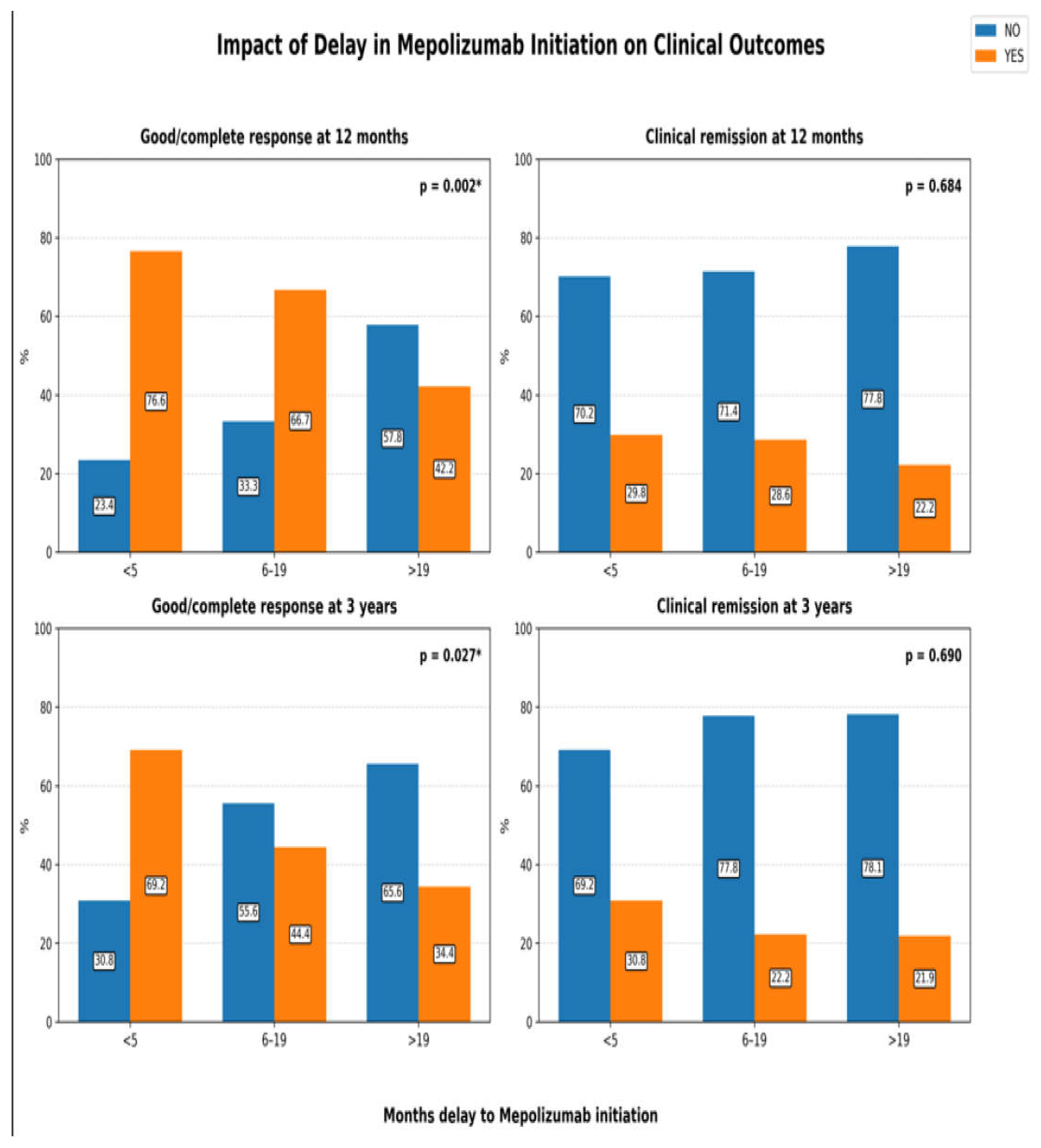
Figure 2.
Longitudinal pulmonary function according to delay in mepolizumab initiation c. c Statistical analysis employed (p < 0,05, with IC 95%): Kruskall Willis test (quantitative independent non-parametric variables).
Figure 2.
Longitudinal pulmonary function according to delay in mepolizumab initiation c. c Statistical analysis employed (p < 0,05, with IC 95%): Kruskall Willis test (quantitative independent non-parametric variables).
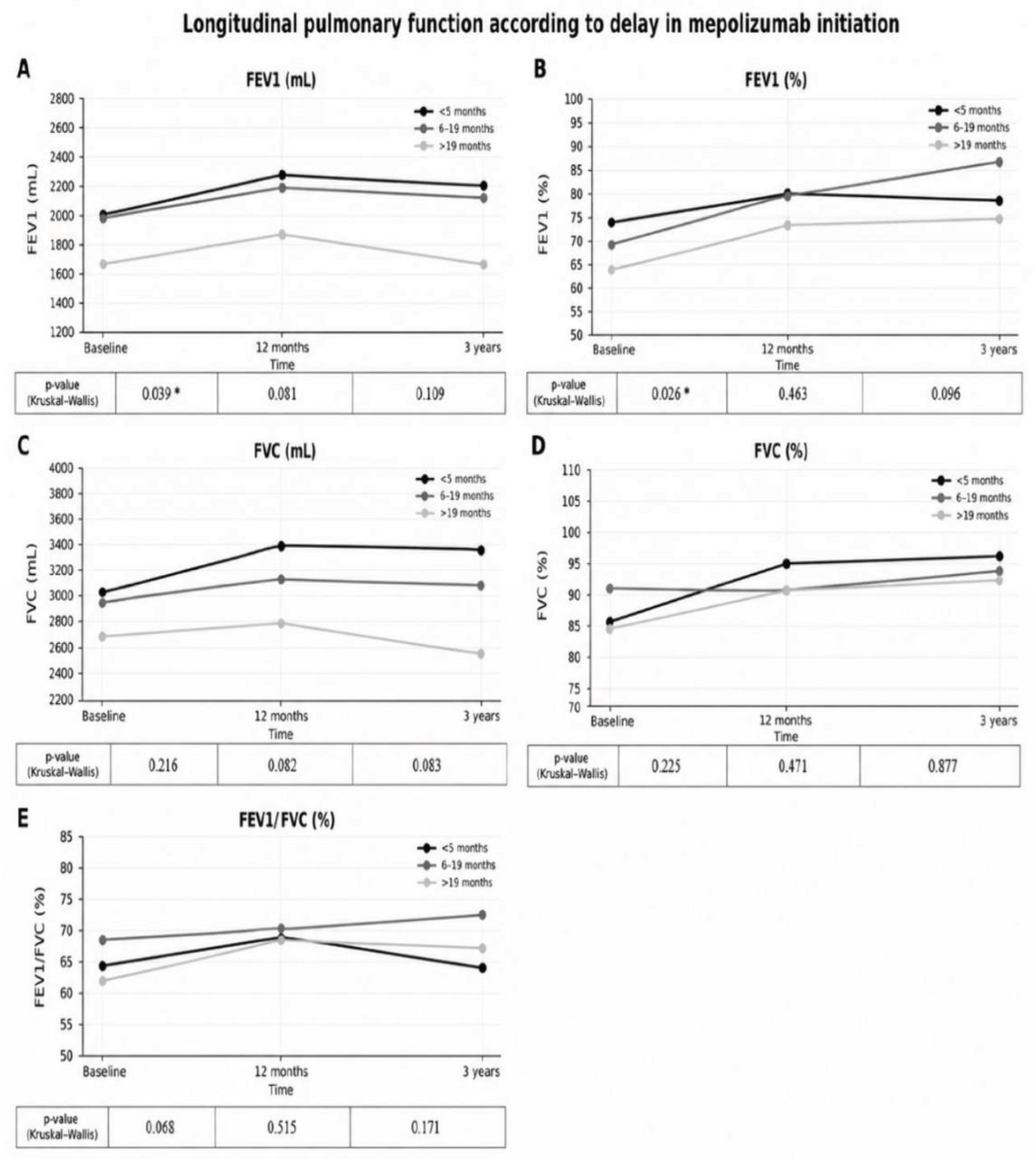

Table 1.
Baseline characteristics according to delay in mepolizumab initiation.
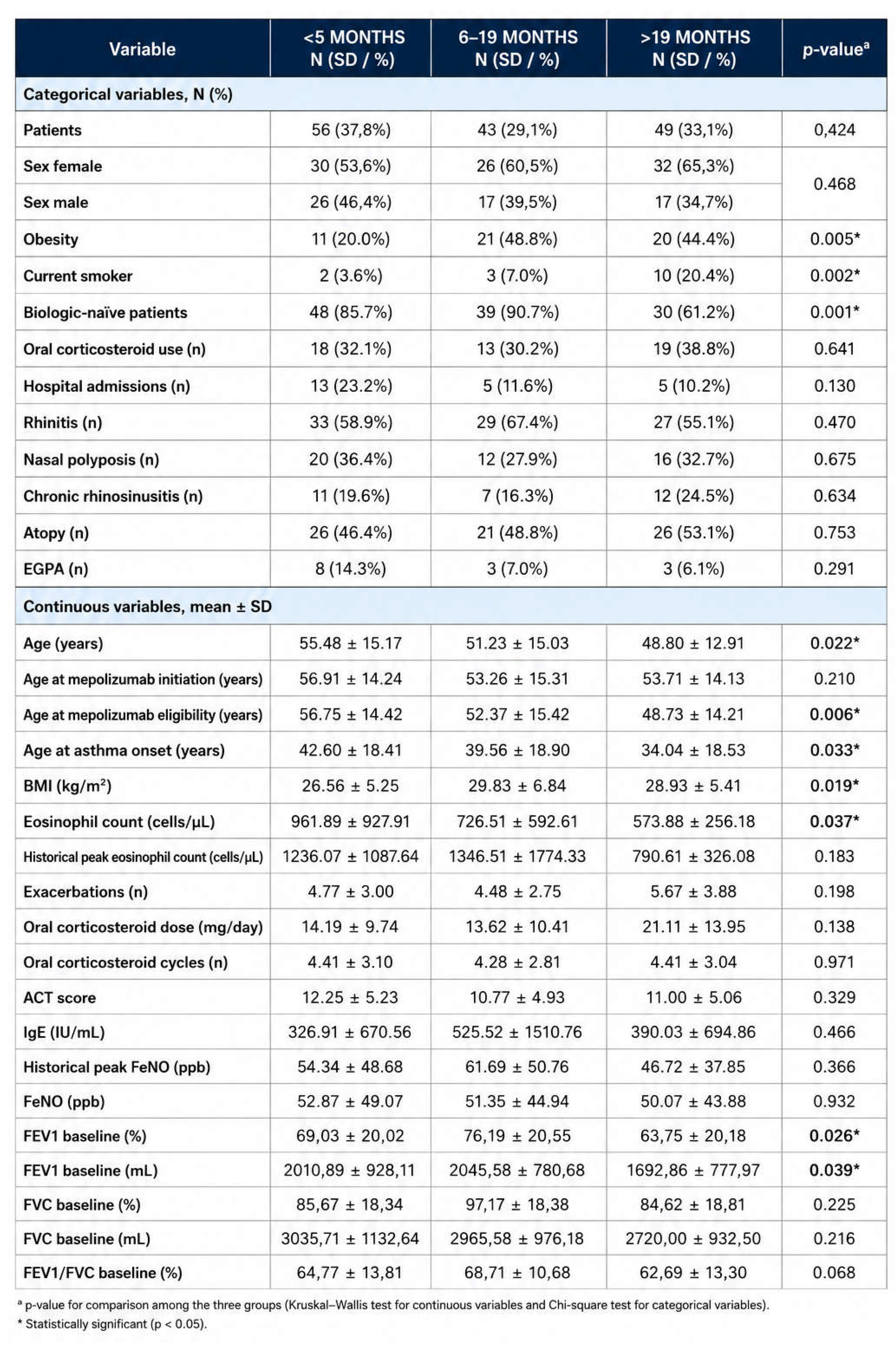 |
a Statistical analysis employed (p < 0,05, with IC 95%): Kruskall Willis test (quantitative independent non-parametric variables) and Chi-squared (cualitative variables).
Disclaimer/Publisher’s Note: The statements, opinions and data contained in all publications are solely those of the individual author(s) and contributor(s) and not of MDPI and/or the editor(s). MDPI and/or the editor(s) disclaim responsibility for any injury to people or property resulting from any ideas, methods, instructions or products referred to in the content. |
© 2026 by the authors. Licensee MDPI, Basel, Switzerland. This article is an open access article distributed under the terms and conditions of the Creative Commons Attribution (CC BY) license (http://creativecommons.org/licenses/by/4.0/).
Copyright: This open access article is published under a Creative Commons CC BY 4.0 license, which permit the free download, distribution, and reuse, provided that the author and preprint are cited in any reuse.


