
Submitted:
05 June 2026
Posted:
08 June 2026
You are already at the latest version
Abstract
Live-streaming commerce has become a critical information channel through which consumers evaluate products and make purchase decisions, yet brand manufacturers face substantial uncertainty when selecting live-streaming partners. This study investigates how streamer influence and consumer sensitivity to live-streaming service quality jointly shape optimal cooperation structures in platform-based commerce. We develop a game-theoretic decision framework comparing three cooperation modes—Nash negotiation, manufacturer-led, and streamer-led, and derive closed-form equilibria for pricing, service quality and profit allocation. The results show that manufacturer-led cooperation consistently maximizes brand profit by preserving incentives for service quality provision, while streamer-led cooperation can reduce overall efficiency when dominant streamers lack motivation to improve service quality. Using live-stream sales data from the Douyin (TikTok) platform covering multiple streamer tiers and two cosmetic brands, we empirically validate the model's predictions. The findings contribute to research on information processing and incentive alignment in platform-based live-streaming commerce.
Keywords:
cooperation strategy
; livestream commerce
; pricing
; game theory
1. Introduction
The proliferation of mobile internet and streaming technology has significantly transformed employment, consumption patterns, and the broader economy. Due to its immediacy, interactivity, and ability to foster customer loyalty, livestream selling has become a prominent e-commerce marketing strategy, effectively stimulating impulse purchases. The COVID-19 pandemic in 2020 accelerated the adoption of livestream commerce, resulting in rapid market growth. An increasing number of manufacturers now utilize live commerce as a primary channel for product distribution. In China, the live-streaming industry comprises over 15 million practitioners and 526 million users, with transaction volumes surpassing 4 trillion CNY. Notable streamers, including Luo Yonghao and Dong Yuhui, have achieved substantial sales and have fan bases exceeding 10 million. Major e-tailers such as Amazon, JD, Taobao, and TikTok have integrated live-streaming to strengthen market competitiveness [20].
Although live-stream selling can stimulate consumer demand, it does not invariably benefit firms1. Consequently, brand manufacturers must carefully assess both the potential benefits and risks of live-stream selling and make informed strategic decisions when selecting streamers for product promotion. This study aims to investigate cooperation partnerships between brand manufacturers and streamers in live-stream e-commerce. Specifically, the research pursues the following objectives: (1) To identify the optimal cooperation strategy for brand manufacturers when engaging in live-stream selling, by comparing three alternative collaboration modes: Nash-negotiation, manufacturer-led, and streamer-led strategies under different market conditions. (2) To analyze how streamer characteristics influence cooperation outcomes, with particular emphasis on streamer influence and live-stream service quality, and to clarify how these factors affect pricing decisions, commission structures, and profit distribution between brands and streamers. (3) To examine the role of consumer behavior in partnership selection, focusing on consumers’ sensitivity to streamer influence and live-stream service quality, and to determine how these behavioral factors shape demand and profitability across different cooperation strategies. (4) To derive managerial insights for sustainable live-stream e-commerce collaboration, by providing decision guidelines that help brand manufacturers select appropriate streamer partners and governance structures rather than indiscriminately cooperating with top-tier streamers. (5) To empirically validate the theoretical predictions using real live-stream sales data from the Douyin (TikTok) platform, thereby assessing the practical relevance of the proposed game-theoretic models.
To clarify these questions, this study introduces a decision-making framework that enables brand manufacturers to strategically assess and optimize collaborations with streamers for live-streaming sales. By developing three cooperation models and integrating factors such as streamer influence, service quality, and partner contribution, the framework guides brands in selectively partnering with streamers for sustained profitability. It cautions against indiscriminate collaboration with top streamers and highlights how balancing streamer influence, commission costs, and profit distribution leads to long-term success. Practical operational strategies are provided to ensure sustainable live-streaming e-commerce growth.
The structure of this paper is as follows. Section 2 surveys relevant literature and highlights the study’s contributions. Section 3 details the models framework. Section 4 introduces three strategy models: the Nash negotiation strategy, the brand manufacturer-led strategy, and the streamer-led strategy. Section 5 examines how consumer behavior drives strategy selection. Section 6 evaluates the proposed strategies using empirical data. Section 7 provides concluding remarks and discusses several limitations. All proofs are provided in the Appendix.
2. Literature Review
Live streaming e-commerce as a new marketing method has rapidly developed and garnered significant attention in recent years. Here, we review the most relevant literature on our topic.
2.1. Channel Strategy
With the rise of online retail channels in the Internet era, extensive research has examined retail channel structures and pricing in e-commerce [6,8,9,23,46]. Most studies address retail channel expansion and integration, focusing on consumer preferences for purchasing channels. For instance, ref. [6] analyze whether a manufacturer should establish a direct channel to compete with its own retailers to enhance overall profitability. Subsequently, ref. [40] investigate a retailer’s channel structure choice across three scenarios and finds that the optimal structure depends on customer acceptance rates. Ref. [49] review digital platform channel strategies across both direct and indirect structures. In response to the emergence of dominant retail platforms in China’s consumer electronics sector, ref. [31] examine manufacturers’ optimal channel selection and concludes that platform retailing is consistently advantageous. Similarly, ref. [43] explore a manufacturer’s channel decisions among three strategies. Additionally, ref. [35] find that hybrid channels consistently outperform pure agency selling when accounting for limited supplier capacity. Other than previous studies focus on offline-online multichannel shopping, ref. [?] utilize longitudinal customer data to find that cross-platform multichannel shopping lengthens, deepens, and broadens online customer Cfirm relationships.
Although prior research has addressed channel integration, expansion, and competition, limited attention has been given to collaboration with third-party channels for product sales. This gap highlights the need to analyze brand manufacturers’ strategies in selecting live streamers as e-commerce partners.
2.2. Live-Stream Selling Mode
As a new marketing model, live-streaming e-commerce has gained spectacular attention in recent years [10,13,16,25]. To understand the business value of live-streaming, [5] examine its impact on the e-commerce landscape by combining econometrics with deep learning. Based on the principal-agent theory, [32] build a game model to discuss manufacturers’ live-streaming introduction strategies and pricing strategies; [41] develop game theoretic models to examine whether a manufacturer should open a live-streaming shopping channel, while [27] think that live-streaming is not always beneficial to firms by examining the live-streaming strategies of vertically differentiated firms. [22] study an analytical model to study a retailer’s optimal BOPS strategies and corresponding pricing decisions for different channels. While [4] construct a brand-influencer signalling game model and finds that the amount of commission is influenced by the influencer’s popularity.
The rapid growth of livestream selling has prompted scholarly investigations from multiple perspectives. For instance, [18] examine channel choice and pricing strategies in the live-streaming context using a game-theoretic approach. [42] find that a manufacturer’s decision to adopt live-streaming is influenced by the commission rate and fixed signing bonus. As a novel shopping channel, live-streaming can reveal consumer quality preferences. [7] verify that collaboration between influencers and brand manufacturers can reduce return rates and enhance product quality, while [21] demonstrate that a firm’s optimal channel strategy is contingent on the streamer’s popularity and bargaining power within the live-streaming channel. Ref. [?] analyzes how streamers’ linguistic characteristics relate to the live-streaming sales performance in online B2B marketplaces, and [?] designs a predictive framework for sales in live-streaming by integrating large language models. Recently, comprehensive systematic reviews of live-streaming e-commerce have been provided by [19,28,36].
2.3. Consumer’S Behaviour
Recognizing the influence of consumer behavior on live-streaming sales, researchers have concentrated on modeling consumers’ purchasing intentions and engagement [1]. For instance, [30] examine the effect of product-content alignment in celebrity live broadcasts on consumer attitudes, while [39] investigate how product information quality and interaction quality affect customer purchase intentions within live-streaming platforms. Recent studies have employed empirical methods to analyze consumers’ purchase intentions in live-streaming contexts. For example, [33] propose a comprehensive framework to assess the relationships among customers’ perceived value of live-streaming. Using affordance actualization theory, [?] find that functional affordances toward AI-generated review summaries play important roles in shaping consumers’ perceived credibility. Additionally, [12] investigate how characteristics of virtual streamers, such as likeability.By analyzing the antecedents of virtual gifts in live-streaming, [?] reveal that self-presentation and live-streaming loyalty positively affect the monetary value of viewers’ gifts.
To elucidate the patterns by which customer engagement influences purchase intention and acquisition, [17] analyze the effects of interactions between live-stream shopping anchors and products on consumers’ purchase intentions and behaviors, while [47] examine customer engagement behaviors in live-streaming e-commerce using a regression model. Related research is also presented in [24,38].
The existing literature has extensively examined live-streaming topics; however, how brand manufacturers select streamers and determine pricing strategies remains under explored. This paper addresses this research gap by investigating the criteria brand manufacturers use to choose streamers for product promotion and the pricing strategies they employ, thereby providing theoretical recommendations to inform effective marketing strategies.
3. Problem Description and Assumption
A live-streaming commerce (LSC) scenario consists of a brand manufacturer (M) and a streamer (P). The brand manufacturer supplies premium products and reliable post-sale support, while the streamer showcases and promotes them during live sessions. The audience includes loyal fans who frequently purchase products endorsed by the streamer and casual viewers whose purchasing decisions depend on the streamer’s performance. To maximize sales revenue, the brand manufacturer seeks to choose the most suitable streamer for live selling. Three collaboration models are analyzed: Nash negotiation (N-Strategy), manufacturer-led (R-Strategy), and streamer-led (L-Strategy). In the N-Strategy, both parties simultaneously determine marginal revenue, sales commission, and service quality. In the R-Strategy or L-Strategy, one party exclusively determines these factors.
In accordance with the principles of risk sharing and incentive compatibility, the brand manufacturer compensates the streamer with a commission fee consisting of two components for live-streaming sales: a booth fee based on the streamer’s influence and a commission r per product sold [44,48]. This payment mechanism is widely adopted2. For instance, Ruo Yonghao, a prominent streamer in China with over 10 million fans, receives a fixed booth fee for product display and a 20%-30% commission on live-stream sales revenue. In contrast, streamers with fewer than 100,000 fans typically receive only a 0-10% commission3. Consistent with this practice, the proposed model assumes the booth fee is , where represents the streamer’s influence and is a basic link fee charged by the brand manufacturer.
As established in prior literature [3,7,37,45], the sales volume of products in a live-streaming room is defined as , where a denotes the actual demand from loyal fans and is normalized to 1 (). The term captures the floating demand from onlookers. Here, () represents the onlookers’ sensitivity to the streamer’s influence, and represents that the onlookers’ demand is influenced by the streamer’s influence, which means onlookers’ buying demand increasing with streamer’s influence, and can be clearly illustrated from the purchase volume in Ruo’s live-streaming selling. () denotes sensitivity to the streamer’s service quality. Refer to Zhang’s ([45]) and Chen’s ([3]) idea, in which they assumed that the demand depends both product’s price and streamer’s recommendation effort and influence, the term indicates streamer’s influence among fans increases, onlookers become less sensitive to price. The price per product is given by . The cost of the streamer’s service quality, which depends on her influence among fans, is defined as , as referred in [34,37,42].
For the brand manufacturer’s decision, the detailed sequence of events is shown in Figure 1. Firstly, the brand manufacturer announces to collaborate with a streamer to live streaming. Secondly, he decides which type of streamer to choose based on revenue maximization. The parameters involved in this paper are shown in Table 1.

Table 1.
Summary of notations.
| Notation | Description |
| Parameter | |
| i | Subscript, , where represent brand manufacturers and streamers, respectively. |
| j | Superscript, , represents -Strategy, respectively. |
| D | Product sales of live-streaming selling service system. |
| k | Streamer’s influence among fans, . |
| The fixed link fee charged by the brand manufacturer. | |
| Consumer’s sensitivity to streamer’s service quality in live-stream selling, . | |
| Consumer’s sensitivity to streamer’s influence among fans, . | |
| Decision variable | |
| w | Marginal revenue earned by the brand manufacturer per product being sold. |
| r | Commission obtained by the streamer for selling unit product. |
| q | Streamer’s service quality during live-streaming selling. |
| Derived function | |
| Total profit of the brand manufacturer under j-Strategy. | |
| Total profit of the streamer under j-Strategy. | |
| * | The asterisk indicates the optimal outcome. |
Based on above description and assumptions, the brand manufacturer and the streamer make decisions to maximize their profits, and the corresponding model are given as follows.
4. Model Analysis
4.1. Nash-Negotiation Strategy (N-Strategy)
In Nash-negotiation strategy (N-Strategy), the brand manufacturer and the streamer with almost equal status among consumers, and they simultaneously make decisions to maximize their benefits in live-stream selling service activities. That is, they independently determine the marginal revenue of product, commission and the live-streaming service quality. Thus, we have
Lemma 1.
Under N-Strategy, (i) the optimal decision of the brand manufacturer is ; (ii) the optimal decisions of the streamer are and .
Substituting and into functions (1) and (2), the participants’ profits are obtained as follows: and .
Lemma 1 shows that the optimal decisions are affected by the parameters , and k in the same way. When the brand manufacturer adopts the N-Strategy in a live-stream selling service system, we have , where . This means both the brand manufacturer and the streamer can lower consumers’ price sensitivity by improving the quality of live-streaming services. Further, the streamer can increase their commission and the live-streaming service quality by improving input-output efficiency, which is defined by the sensitivity coefficient of live-streaming service quality and the streamer’s influence.
Proposition 1.
Under N-Strategy, we have: (i) ; (ii) if , then , and if , then ; (iii) .
Proposition 1 shows that the effect of consumer sensitivity on profits is not uniform across all k under the N-Strategy. Specifically, the brand manufacturer’s profit always increases as increases under the N-Strategy. The streamer’s profit, however, depends on both and her influence k: the streamer’s profit increases with when , but it decreases with when . Additionally, the conversion rate of onlookers positively affects both participants’ profits. Thus, both the brand manufacturer and the streamer should consider measures to raise consumer sensitivity to live-streaming service quality and to increase onlooker conversion rates.
4.2. Brand Manufacturer-Led Strategy (R-Strategy)
In a live-streaming selling service system, the brand manufacturer takes the leading status while the streamer follows, which creates a Stackelberg game. The brand manufacturer first determines the product’s marginal revenue to maximize its profit. Then, the streamer maximizes her profit based on the product’s marginal revenue by deciding the unit commission charged to the brand manufacturer and the service quality in live-stream selling activity. This process leads to the following lemma, which can be derived using the inverse method.
Lemma 2.
Under R-Strategy, (i) the optimal decision of the brand manufacturer is ; (ii) the optimal decisions of the streamer are and .
Substituting and into (1) and (2), the maximum profits of the brand manufacturer and the streamer are obtained as follows: and .
Lemma 2 demonstrates that the optimal decision is not entirely uniformly affected by both , , and k. Specifically, , and , where , while and . Notably, is not affected by if the brand manufacturer adopts R-strategy. It highlights that if the brand manufacturer aims to increase marginal revenue by requesting that the streamer improve live-streaming service quality and expand its influence among consumers.
Proposition 2.
Under R-Strategy, we have and .
Proposition 2 shows that the participant’s profit is consistently affected by and for any fixed k under the R-Strategy. It shows that both profits increase with increases in and . Therefore, the brand manufacturer and the streamer can increase profits by improving consumers’ sensitivity to the streamer’s live-streaming service quality, increasing the conversion rate of onlookers, or expanding the streamer’s influence among consumers.
4.3. Streamer-Led Strategy (L-Strategy)
In the live-stream selling service system, if the streamer is the leader and the brand manufacturer is the follower, it also forms a Stackelberg game. But, the streamer first decides the commission and the live-streaming service quality to maximize her profit. Then, the brand manufacturer determines the marginal revenue of the product based on the commission and the live-streaming service quality set by the streamer to maximize his profit. This lemma can be obtained using the inverse method.
Lemma 3.
Under L-Strategy, (i) the optimal decision of the brand manufacturer is ; (ii) the optimal decisions of the streamer are and .
Substituting the above results into (1)and (2), we obtain the optimal profits obtained by the brand manufacturer and the streamer as follows: and .
Lemma 3 shows that the optimal decisions are uniformly affected by and k if the brand manufacturer takes L-Strategy in live-stream selling service systems, i.e., and , where . Thus, the brand manufacturer and the streamer can reduce consumers’ price sensitivity by increasing the streamer’s influence among consumers or improving the live-streaming service quality. Moreover, they can also enhance consumers’ stickiness to the streamer’s live-streaming sales service.
Proposition 3.
Under L-Strategy, we have .
Proposition 3 indicates the impact of and on participants’ profits under the L-Strategy. We find that their profits increase with and . Therefore, they can increase profits by improving consumers’ sensitivity to streamers’ service quality and expanding streamers’ influence among consumers, and the brand manufacturer can also improve product quality and after-sales service.
5. Comparative Analysis
5.1. The Impact Of On Brand Manufacturer’S Strategy
In this section, we analyze the influence of consumer sensitivity on the brand manufacturer’s cooperation strategy. By comparing the brand manufacturer’s marginal revenue, the streamer’s commission, service quality, and their related profits, we draw the following findings.
Proposition 4.
Under different cooperation strategies, the consumer demand satisfies: (i) if , and (ii) if .
Proposition 4 shows that a streamer’s role in live sales strongly influences consumers’ preferences. The extent to which consumer demand changes depends on how sensitive consumers are to the streamer’s service quality. For example, when , the brand makes the most extra money by picking the R-Strategy and the least by picking the L Strategy. As increases, there is a new range: when , the brand makes the most extra money by using the N-Strategy, see Figure 1 (, ). While no single strategy is best in every situation, the brand manufacturer earns the least extra money with the L-Strategy. Also, a popular streamer with many fans can heavily influence product prices and commissions during live sales. When starting live sales, the brand manufacturer needs to carefully consider how sensitive consumers are to price, the streamer’s service quality, and the streamer’s influence before choosing a partner.
Proposition 5.
Under different cooperation strategies, the brand manufacturer’s marginal revenue satisfies: (i) when ; (ii) when .
Proposition 5 shows that leveraging streamer status significantly impacts revenue. Here, a streamer’s status refers to their influence and popularity. The brand manufacturer’s marginal revenue depends on how sensitive consumers are to the streamer’s service quality during live streaming. A higher means greater sensitivity. For example, if , choosing the R-Strategy (recruiting a regular streamer) yields the highest marginal revenue. In contrast, the L-Strategy (collaborating with a lead streamer) produces the lowest. When , the N-Strategy (working with a newcomer streamer) can lead to the highest revenue, as shown in Figure 2 (). No single strategy guarantees maximum revenue at all times. However, the L-Strategy (lead streamer) typically yields the lowest marginal revenue because the lead streamer has a large, loyal fan base and controls pricing and commissions. Therefore, it is quite essential to evaluate consumer sensitivity to pricing, the streamer’s service quality and influence before selecting a streaming partner.
Proposition 6.
Under different cooperation strategies, the streamer’s commission satisfies: (i) if ; (ii) if ; (iii) if .
Proposition 6 indicates that the streamer’s status has a significant impact on their commission across different scenarios. We find that the streamer’s commission is affected by the consumer’s sensitivity to live-streaming service quality and the streamer’s influence power. Specifically, when , the streamer can obtain a considerable commission if she dominates and the brand manufacturer cooperates with a dominant streamer to perform live-stream selling; in contrast, the streamer in the following position has the lowest commission in this scenario. As increases such that , the brand manufacturer still cooperates with a dominant streamer for live-stream selling, allowing the streamer to obtain a considerable commission. In this intermediate scenario, however, the streamer in the Nash negotiation equilibrium position now has the lowest commission. When , the streamer in the following position is most satisfied, while in the N-Strategy, the streamer’s live consultation commission is at its minimum, as shown in Figure 3 (). Across all scenarios, we can also observe that, regardless of which streamer the brand manufacturer chooses to partner with for product sales, the streamer’s commission is not always at a disadvantage, as the streamer has advantages in market influence and consumer stickiness in live-stream sales.
Proposition 7.
Under different cooperation strategies, the streamer’s service quality in live-stream selling satisfies: (i) when ; (ii) when .
Proposition 7 indicates that the quality of a streamer’s live-stream selling service is significantly affected by consumers’ sensitivity to service quality and the streamer’s influence on consumers. When , the streamer provides high-quality live-streaming service under the N-Strategy, while preferring to offer low-quality service under the L-Strategy. For , the streamer must provide high-quality service under the R-Strategy, and only low-quality service is enough under the L-Strategyas illustrated in Figure 4 (). The lowest level of live-streaming service quality occurs when in a dominant position under the L-Strategy. A dominant streamer has advantages in commodity pricing, consumer influence, and consumer stickiness in live-streaming activities. Maintaining high-quality live-streaming can lead to increased profits for the streamer.
Proposition 8.
Under different cooperation strategies, the brand manufacturer’s profit satisfies: .
Proposition 8 suggests that brand manufacturers make the highest profit when they lead the live-streaming selling system, less when both parties employ the N-Strategy, and the lowest when the streamer is the leader in the streamer model. This is because the greater the brand manufacturer’s influence in a live-stream selling service system, the higher the brand manufacturer’s profit, as shown in Figure 5 (). While partnering with a dominant streamer appears advantageous due to pricing, market influence, and consumer loyalty, blindly following this trend may not guarantee matching profits. Therefore, it is critical that brand manufacturers strategically select suitable streamers based on their specific circumstances and brand strategy to maximize income and sustain long-term profitability.
Proposition 9.
For different cooperation strategies, the streamer’s profit satisfies: (i) when ; (ii) when ; (iii) when .
Proposition 9 indicates that a live-streamer’s status within a live-streaming service system significantly influences profit outcomes. Streamer profit is determined not only by status but also by the service’s input-output efficiency. When , the leading streamer achieves the highest profit, while the following streamer receives the lowest. For , the leading streamer continues to earn the highest profit, whereas the streamer employing the N-Strategy obtains the lowest income. When , the brand manufacturer dominates both the highest and lowest profits in the N-Strategy, as illustrated in Figure 6 (). Consequently, collaboration between streamers and brands of any rank should be guided by the streamer’s influence, with adjustments to live-streaming service quality and related factors to maximize profit.
Figures 5 and 6 demonstrate that the optimal strategy for a brand manufacturer is to select a less influential streamer, which enables greater control over the live-stream selling process. If consumers exhibit low sensitivity to live-streaming quality () or if the streamer possesses a substantial loyal fan base, the streamer derives the greatest benefit from collaborating with brand manufacturers to promote products. Conversely, streamers prefer to collaborate with well-known and influential brand manufacturers to enhance product visibility. This dynamic explains why top streamers can effectively sell products from any brand manufacturer through live-streaming, whereas lower-ranking streamers exercise greater caution when choosing well-known brands for live promotion.
5.2. The Impact Of K On Brand Manufacturer’S Strategy
In this section, we examine how the streamer’s charisma k influences the brand manufacturer’s cooperation strategy. The streamer’s charisma, as perceived by consumers, underpins her live-streaming sales ability, shaping consumers’ purchasing behavior and the manufacturer’s decisions. Our purpose is to clearly demonstrate, through numerical experiments, how varying k affects both the brand manufacturer’s profit and the streamer’s earnings. Specifically, we set , , and to isolate the effect of k.
First, a numerical example was used to analyze the impact of k on the streamer’s income under different cooperation strategies, as shown in Figure 7(a-c). The figure demonstrates the impact of different cooperation strategies on the streamer’s income when consumers have varying sensitivities to the live-streaming service quality, represented by different values of (=0.25, 0.5, 0.75). The results are as follows: (1) For a small , the impact of the streamer’s influence on the streamer’s income is consistently positive. However, the effect is most notable when the brand manufacturer leads the live-stream selling (see Figure 7(a)). (2) For larger values (=0.5, 0.75), the impact of the streamer’s charisma k on the streamer’s income is inconsistent. There is a critical point of the streamer’s charisma for the streamer’s income under N-Strategy . When , the streamer’s income increases with the increase of k, while when , the streamer’s income decreases with the rise of k (see Figure 7(b-c)). Furthermore, the figure shows that k significantly affects the streamer’s income in brand-manufacturer-led live-streaming activitiesa higher charisma results in higher input-output efficiency for the streamers. Therefore, in such instances, the streamer must expand her charisma among fans to improve her live-streaming income.
Second, a numerical example was used to analyze the impact of the streamer’s charisma k on the brand manufacturer’s profit under different cooperative strategies, as shown in Figure 8(a-c).
Figure 8 illustrates the impact of k on the brand manufacturer’s profit across different cooperation strategies. The figure shows that the brand manufacturer’s profit increases consistently with k, with a more pronounced effect at higher k values. Among the three cooperation strategies, the brand manufacturer-led approach generates the highest profit, while cooperating with a powerful streamer for live-stream selling results in the lowest profit. Generally, enhancing input-output efficiency and streamer influence power through live-streaming benefits the brand manufacturer’s profit. However, collaborating with a strong streamer may not maximize the brand manufacturer’s profits, as the streamer’s high commission rate can offset those gains.
5.3. Revenue Gaps
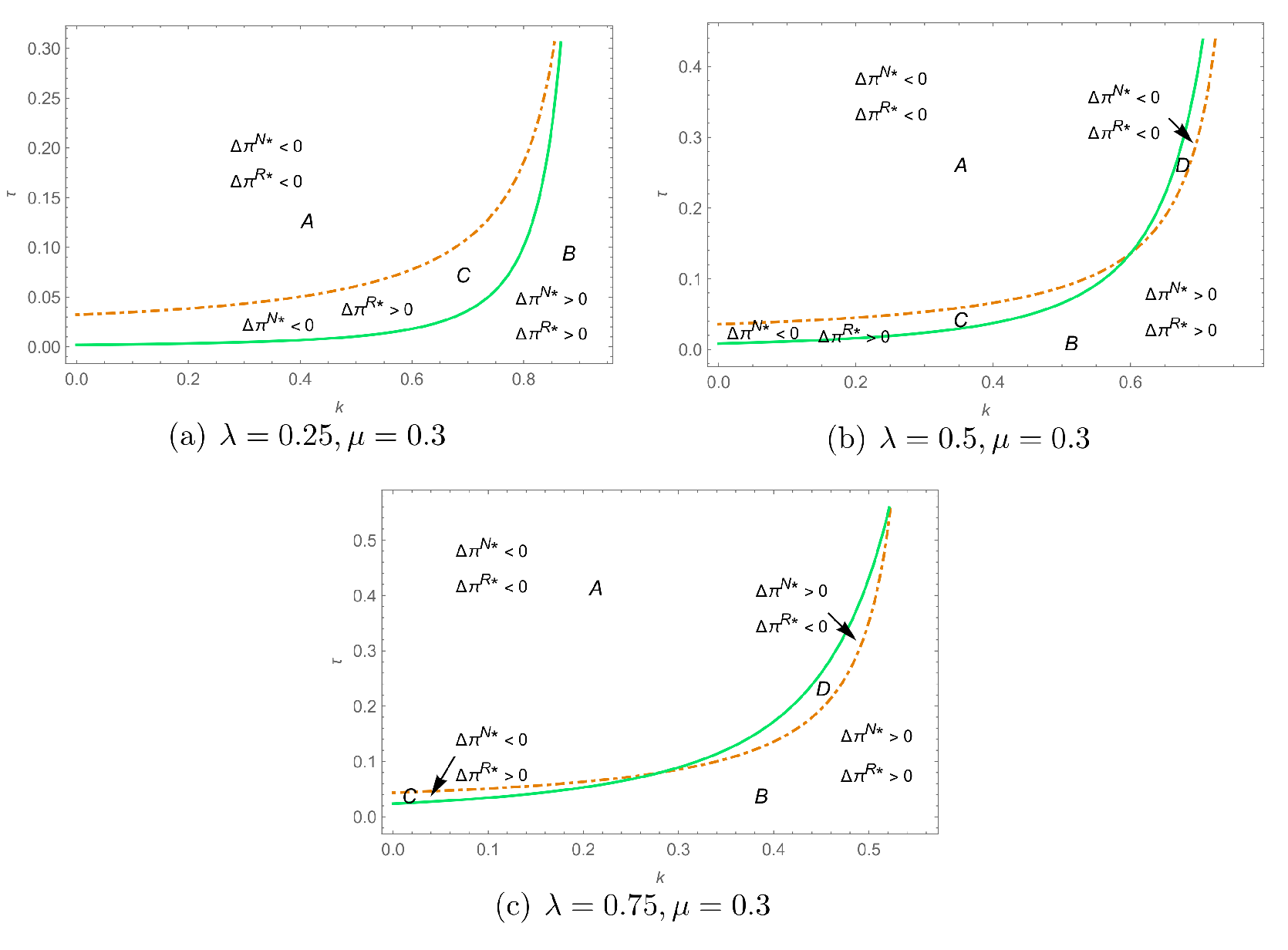
In this section, we will analyze the impact of two key parameters, namely, the streamer’s fixed link fee and her charisma in consumers k, on the revenue gaps of the participants in the live-stream selling service system. Thus, we have , where () denote the profit gaps in scenario j-Strategy, respectively. The brand manufacturer’s live-stream selling revenue is dominant when . If the streamer’s fixed link fee is lower, the brand manufacturer can get more revenue than the streamer in N-Strategy. Similarly, we also have , and . We can find that the brand manufacturer always gets lesser revenue than that of the streamer if he adopts L-strategy in live-streaming service system, while the brand manufacturer’s live-stream selling revenue can get more revenue than that of the streamer if . Without loss of generality, the parameters are set as follows: , and , and the results are presented in Figure 9(a-c) with corresponding to , , and , respectively.
Figure 9 shows that the brand manufacturer’s revenue doesn’t need to be dominant over the streamer’s in either scenario, N-Strategy or R-Strategy. The brand manufacturer’s revenue is higher than the streamer’s when the streamer’s fixed link fee, , and her charisma with consumers, k, fall within zone B. In comparison, the streamer’s revenue is higher than that of the brand manufacturer within zone A. In zones C and D, the participant’s revenue in the live-stream selling service system is not affected by the other player’s N-Strategy or R-Strategy. In summary, the brand manufacturer can achieve dominant revenue in a live-streaming service system if the streamer has high charisma and requires a low fixed link fee. Meanwhile, the streamer can generate dominant revenue if they ask for a high fixed link fee with modest charisma. For the streamer with low influence and a low fixed link fee, or with high charisma and a high fixed link fee, the brand manufacturer can adopt a suitable cooperative strategy within a live-streaming service system to generate considerable revenue.
6. Extensions
This section analyzes Douyin (TikTok) data to validate prior findings. Two representative cosmetic brands are examined: PerfectDiary (P-brand), a Chinese beauty company established in 2016 that emphasizes contemporary fashion and user-friendly makeup, and Este Lauder (E-brand), founded in 1946, which offers a broad portfolio of cosmetics, perfumes, and skincare products for both women and men. P-brand initiated collaboration with Douyin in February 2018 to enhance e-commerce live streaming, whereas E-brand commenced its live-streaming activities in early 2020 during the COVID-19 outbreak.
KOL streamers’ live streams are selected and promoted using a mixed strategy that combines a few star hosts with a larger number of mid-to-high-level vertical streamers to more comprehensively reach the target demographic of 18-23 year-old female users. For live-streaming sales, P-brand selects the best-selling items from the previous 30 days, including lipstick, highlighter/contour, eyeshadow, and makeup remover. The live-streaming sales data for P-brand and E-brand beauty series are collected from November 19, 2024, to November 25, 2024, on the Douyin (TikTok) platform (https://www.douyin.com/). These data include the streamer’s fan count, session count, sales volume, and total sales volume, as detailed in Table 2. However, several parameters remain unavailable, such as live-streaming stimulus and the fixed link fee.
Table 2.
The overviews of P-brand and E-brand in Douyin live-streaming platform
| Brand | Streamer’s ID | Fan size | Sessions | Average sales | Total sales | |
| (Thousand) | volume(item) | (Thousand, RMB) | ||||
| PerfectDiary | PerfectDiary01 | 6 | 75-100 | 250-500 | ||
| PerfectDiaryTop | 1879.6 | 12 | 10-25 | 100-250 | ||
| pd-xxx | 1047.1 | 14 | 2.5-5 | 10-25 | ||
| PerfectDiaryMZ | 523 | 6 | 7.5-5 | 25-50 | ||
| PerfectDiary19 | 233.1 | 4 | 25-50 | 10-25 | ||
| WM.live | 93.5 | 8 | 7.5-10 | 50-75 | ||
| EsteeLauder | 628xxx | 6536 | 7 | 100-250 | 500-750 | |
| naisgmg | 2246 | 3 | 100-250 | 250-500 | ||
| duoduo2016aa | 921 | 3 | 75-100 | 500-750 | ||
| 533xxx | 247 | 9 | 25-50 | 100-250 | ||
| 442xxx | 195 | 7 | 10-25 | 50-75 | ||
| 147xxx | 109 | 3 | 10-25 | 10-25 | ||
| Source: https://www.douyin.com/ |
The analysis reveals that, across all streamer tiers, well-known brands consistently outperform lesser-known brands in both sales volumes and session totals.
For P-brand manufacturers, collaborating with top-tier streamers yields higher total sales and session volume. For instance, PerfectDiary01 drives sales ranging from 41,670 to 83,300 CNY with 12.5 to 16.7 items per session, whereas general-level streamers like PerfectDiary19 sees significantly lower results. Despite some variability, per capita contribution rates and fan purchasing rates remain generally low.
For E-brand manufacturers, partnerships with top-level streamers lead to significant increases in both sales and sales volume per session. For instance, a streamer with 628,000 fans generated 71,428 to 107,123 CNY and 14.3 to 35.7 items per session. In contrast, general-level streamers with 442,000 fans produced only 7,142.8 to 10,714.3 CNY and 1.4 to 3.5 items per session. The per capita contribution rate ranges from 1.1% to 40.7%, and is generally higher with general-level streamers. Fan purchasing rates range from 1.6% to 27.1%.
In summary: (1) Mid- to low-end brand manufacturers generate lower revenue per session than medium- to high-end brands, regardless of streamer type. (2) Mid- to low-end brands focus on cost efficiency and tend to partner with ordinary streamers. (3) Medium- to high-end brands see more return from working with high-profile streamers.
7. Discussion and Implications
This study investigates strategic decisions that brand manufacturers face when partnering with streamers for live-stream selling. It examines the impact of both streamer status and consumer sensitivity to service quality on profitability and partnership choices. By integrating game-theoretic modeling with platform data from Douyin (TikTok), the findings yield several theoretical and practical insights. However, choosing the appropriate streaming partner is a crucial strategic challenge for brand manufacturers.
7.1. Theoretical Contributions
This research advances live-streaming commerce literature by endogenizing cooperation structure between brand manufacturers and streamers. Unlike prior studies that focus primarily on whether firms should adopt live-streaming (e.g., [27,41]) or on contract design under a fixed power structure (e.g., [3,45]), this study explicitly compares Nash negotiation, manufacturer-led, and streamer-led cooperation modes. The results demonstrate that power allocation within live-streaming partnerships fundamentally affects pricing, service quality provision, and profit distribution, offering a more comprehensive explanation of strategic heterogeneity observed in practice.
A key theoretical insight concerns the non-monotonic role of streamer influence in information provision. While existing research generally assumes that higher influencer popularity enhances sales performance, our findings show that excessive streamer dominance can weaken incentives to invest in live-streaming service quality, thereby reducing overall efficiency. This reveals a previously under explored moral hazard problem in live-stream commerce, where control over pricing and commissions distorts information quality incentives. From an information processing perspective, the study highlights that the effectiveness of live-streaming as an information channel depends not only on influence magnitude but also on how incentives shape the credibility and effort behind information delivery.
Moreover, this study identifies threshold effects of consumer sensitivity to service quality that condition optimal strategy selection. Rather than assuming linear effects of service quality or streamer effort, the analysis shows that different cooperation structures become optimal in different sensitivity regimes. These results deepen understanding of how consumer information processing feeds back into firm strategy, enriching theoretical models of digital commerce that incorporate behavioral responsiveness.
Finally, by combining analytical modeling with empirical validation using real platform data, this study bridges formal decision models and observed platform behavior. The alignment between theoretical predictions and empirical patterns strengthens the robustness and practical relevance of the proposed framework.
7.2. Managerial and Practical Implications
The findings provide actionable guidance for participants in live-streaming e-commerce. For brand manufacturers, the results caution against indiscriminate collaboration with top-tier streamers. Although highly influential streamers can expand demand, manufacturer-led cooperation consistently yields higher profits by preserving control over pricing and service quality incentives. In many cases, especially for mid- to low-end brands, partnering with ordinary or mid-tier streamers offers superior cost-benefit performance. Brand manufacturers should therefore evaluate streamer partnerships based on consumer sensitivity to live-streaming quality and strategic control considerations, rather than fan size alone.
For streamers, the results emphasize that influence power alone does not guarantee sustainable profitability. While dominant streamers can command higher commissions, excessive bargaining power may reduce long-term cooperation opportunities if service quality incentives weaken. Streamers with moderate influence can improve outcomes by investing in service quality and enhancing input–Coutput efficiency within manufacturer-led or negotiated cooperation structures.
7.3. Limitations and Future Research
Despite its contributions, this study has several limitations. First, streamer influence and service quality are modeled in a stylized manner; future research could incorporate richer behavioral or reputational dynamics. Second, consumer heterogeneity beyond service quality sensitivity may further affect strategy selection. Finally, extending the framework to multi-streamer or competitive brand settings would provide additional insights into platform-level dynamics.
Acknowledgments
constructive comments, which have significantly enhanced the quality of our work. This work is supported by Humanities and Social Sciences Fund of Ministry of Education(21YJA630008), Characteristic Innovation Project of Universities of Guangdong Province (2024WTSCX011), and Key Research Projects of Ordinary Universities in Guangdong Province(2025ZDZX4028).
Appendix A. The Proof of Lemma 1
Taking the first order partial derivatives of and with respect to and q, respectively, we have
From , and , and , it is obtained that is a concave function with respect to w, and is a joint concave function with respect to r and q under the condition of . That is, and have unique optimal decisions about w and , respectively.
By solving , and , the optimal decisions are given as follows: , and . □
Appendix B. The Proof of Proposition 1
(i) Taking the first order partial derivative of with respect to , we have .
(ii) For , we also have . Since , we obtain that if , and if .
(iii) Taking the first order partial derivative of with respect to , respectively, we have and . □
The proof of Lemma 2.
Taking the first-order partial derivative of with respect to r and q, respectively, we have
From Equations (6) and (7), the Hessian matrix of with respect to r and q can be obtained
It is obvious to verify that is a joint concave function with respect to r and q. Thus, has a unique equilibrium with respect to r and q under the condition . By solving equations and , we have and . Substituting and into and taking the first- and second-order partial derivative of with respect to w, we have and , that is, is a concave function with respect to w.
By solving , we get . Substituting into (8), we have , . □
The proof of Proposition 2.
Taking the first-order partial derivative of with respect to , respectively, we have and . Similarly, we also have and . □
The proof of Lemma 3. Taking the first- and second-order partial derivative of with respect to w, we have
which means that is a concave function with respect to w. Thus, has a unique optimal decision with respect to w. By solving , we have .
Substituting into and taking the first-order partial derivative of with respect to r and q, respectively, we have
From Equations (9) and (10), the Hessian matrix of with respect to r and q can be obtained as
It is obvious to verify that is a joint concave function with respect to r and q. Thus, has a unique equilibrium with respect to under .
By solving and , we have and . Substituting and into , we have . □
The proof of Proposition 3.
Taking the first-order derivative of with respect to , respectively, we have Similarly, we also have . □
The proof of Proposition 4.
By comparing the consumer’s demands under different cooperation strategies, we have which means that , and which means that . Thus, .
Similarly, , it is easy to versify that if , we have , and if , we have .
Therefore, we obtain that (i) when , and (ii) when . □
The proof of Proposition 5. Comparing the brand manufacturer’s marginal revenue under different scenarios, we have which means that , and which means that because of . Thus, we have .
Similarly, , it is easy to verify that if and if .
Therefore, we obtain that when , and when . □
The proof of Proposition 6.
Comparing the streamer’s commission obtained under different cooperation strategies, we have which means that .
Similarly, we also have and . Since , it is easy to verify that (i) if , then , and (ii) if , then and , and if , then .
Therefore, we obtain that (i) when ; (ii) when ; (iii) when . □
The proof of Proposition 7.
Comparing the streamer’s service quality in live-stream selling under different cooperation strategies, we have and which deduces that and , respectively. Thus, .
Similarly, . Since , we have if , and if .
Therefore, we get that if , and if . □
The proof of Proposition 8. By comparing the brand manufacturer’s profit under different cooperation strategies, we have which means that , and which means that . Thus, . □
The proof of Proposition 9. By comparing the streamer’s profit under different cooperation strategies, we have which means that .
Similarly, we also have and . Obviously, it is easy to verify that (i) if , then ; (ii) if , then and ; and , then .
Therefore, we get (i) when ; (ii) when ; and (iii) when . □
References
- Bawack, R. E.; Bonhoure, E.; Kamdjoug, J.-R. K.; Giannakis, M. How social media live streams affect online buyers: A uses and gratifications perspective. Int. J. Inf. Manag. 2023, 70, 102621. [Google Scholar] [CrossRef]
- Chen, H.; Dou, Y.; Xiao, Y. Understanding the role of live streamers in live-streaming e-commerce. Electron. Commer. Res. Appl. 2023, 59, 101266. [Google Scholar] [CrossRef]
- Chen, J.; Li, X.; Zhang, Y.; Zhi, B. Live streaming channel strategies in the presence of the dual effect of influencers. J. Retail. Consum. Serv. 2025a, 87, 104418. [Google Scholar] [CrossRef]
- Chen, M.; Zhou, Y.; Lyu, J. Preventing traffic manipulation in live-streaming selling: A signalling game perspective. Int. J. Prod. Res. 2025b, pages 1–20. [Google Scholar] [CrossRef]
- Cheng, C.; Hu, Y.; Lu, Y.; Hong, Y. Everyone can be a star: Understanding the role of live video streaming in online retail. Available at SSRN 3422615.
- Chiang, W. Y. K.; Chhajed, D.; Hess, J. D. Direct marketing, indirect profits: A strategic analysis of dual-channel supply-chain design. Manag. Sci. 2003, 49(1), 1–20. [Google Scholar] [CrossRef]
- Cui, L.; Li, X.; Yan, K.; Cheng, T. How should brand manufacturer cooperate with influencer in live streaming e-commerce? J. Electron. Commer. Res. 2024, 25(2), 121–146. [Google Scholar]
- Dokić, A.; Stamenković, M.; Stojković, D. Multiple channel strategy selection: A roadmap perspective for brick-and-click retailers. Electron. Commer. Res. Appl. 2023, 57, 101234. [Google Scholar] [CrossRef]
- Dong, C.; Huang, Q.; Fang, D. Channel selection and pricing strategy with supply chain finance and blockchain. Int. J. Prod. Econ. 2023, 265, 109006. [Google Scholar] [CrossRef]
- Du, Z.; Fan, Z.-P.; Sun, F. Live streaming sales: Streamer type choice and limited sales strategy for a manufacturer. Electron. Commer. Res. Appl. 2023, 61, 101300. [Google Scholar] [CrossRef]
- Gao, F.; Su, X. Omnichannel retail operations with buy-online-and-pick-up-in-store. Manag. Sci. 2017, 63(8), 2478–2492. [Google Scholar] [CrossRef]
- Gao, W.; Jiang, N.; Guo, Q. How do virtual streamers affect purchase intention in the live streaming context? a presence perspective. J. Retail. Consum. Serv. 2023, 73, 103356. [Google Scholar] [CrossRef]
- Gu, Z.; Zhao, X.; Wu, D. A model of shoppertainment live streaming. Manag. Sci. 2025, 71(8), 6816–6835. [Google Scholar] [CrossRef]
- Hu, J.; Li, L.; Zhang, H.; Zhu, X.; Yang, W. Dynamic pricing strategies for live broadcast platform considering reference effect and anchor influence. Syst. Eng.-Theory Pract. 2022, 42, 756–766. [Google Scholar]
- Hu, M.; Chaudhry, S. S. Enhancing consumer engagement in e-commerce live streaming via relational bonds. Internet Res. 2020, 30(3), 1019–1041. [Google Scholar] [CrossRef]
- Huang, L.; Liu, B.; Zhang, R. Channel strategies for competing retailers: Whether and when to introduce live stream? Eur. J. Oper. Res. 2024, 312(2), 413–426. [Google Scholar] [CrossRef]
- Huang, M.; Ye, Y.; Wang, W. The interaction effect of broadcaster and product type on consumers purchase intention and behaviors in livestreaming shopping. Nankai Bus. Rev. 2021, 9, 1–21. [Google Scholar]
- Ji, G.; Fu, T.; Li, S. Optimal selling format considering price discount strategy in live-streaming commerce. Eur. J. Oper. Res. 2023, 309(2), 529–544. [Google Scholar] [CrossRef]
- Lee, Z. W.; Liu, W. Z.; Chan, T. K.; Wei, G. G. Impulse buying in live streaming commerce: A literature review and research agenda. Inf. Manag. 2025, page 104220. [Google Scholar] [CrossRef]
- Li, Q.; Zhu, S.; Choi, T.-M.; Shen, B. Maintaining e-commerce supply chain viability: Addressing supply risks with a strategic live-streaming channel. Omega 2025a, 133, 103276. [Google Scholar] [CrossRef]
- Li, Y.; Ning, Y.; Fan, W.; Kumar, A.; Ye, F. Channel choice in live streaming commerce. Prod. Oper. Manag. 2024, 33(11), 2221–2240. [Google Scholar] [CrossRef]
- Li, Z.; Ullah, A.; Xu, Q.; Lev, B. Optimal buy-online-and-pick-up-in-store strategies in the livestreaming selling context. Int. J. Prod. Econ. 2025b, page 109711. [Google Scholar] [CrossRef]
- Liang, L.; Ye, F. Information transparency and business mode selection in online platforms under manufacturer competition. J. Bus. Res. 2024, 170, 114324. [Google Scholar] [CrossRef]
- Liu, X.; Wang, D.; Gu, M.; Yang, J. Research on the influence mechanism of anchors professionalism on consumers impulse buying intention in the livestream shopping scenario. Enterp. Inf. Syst. 2023, 17(7), 2065457. [Google Scholar] [CrossRef]
- Liu, Z.; Chen, H.; Zhang, X.; Gajpal, Y.; Zhang, Z. Optimal channel strategy for an e-seller: Whether and when to introduce live streaming? Electron. Commer. Res. Appl. 2024, 63, 101348. [Google Scholar] [CrossRef]
- Lou, C.; Yuan, S. Influencer marketing: How message value and credibility affect consumer trust of branded content on social media. J. Interact. Advert. 2019, 19(1), 58–73. [Google Scholar] [CrossRef]
- Lu, Y.; Duan, Y. Strategic live streaming choices for vertically differentiated products. J. Retail. Consum. Serv. 2024, 76, 103582. [Google Scholar] [CrossRef]
- Luo, X.; Lim, W. M.; Cheah, J.-H.; Lim, X.-J.; Dwivedi, Y. K. Live streaming commerce: A review and research agenda. J. Comput. Inf. Syst. 2025, 65(3), 376–399. [Google Scholar] [CrossRef]
- Mallipeddi, R. R.; Kumar, S.; Sriskandarajah, C.; Zhu, Y. A framework for analyzing influencer marketing in social networks: selection and scheduling of influencers. Manag. Sci. 2022, 68(1), 75–104. [Google Scholar] [CrossRef]
- Park, H. J.; Lin, L. M. The effects of match-ups on the consumer attitudes toward internet celebrities and their live streaming contents in the context of product endorsement. J. Retail. Consum. Serv. 2020, 52, 101934. [Google Scholar] [CrossRef]
- Shen, Y.; Willems, S. P.; Dai, Y. Channel selection and contracting in the presence of a retail platform. Prod. Oper. Manag. 2019, 28(5), 1173–1185. [Google Scholar] [CrossRef]
- Wang, L.; Song, Y.; Fan, T. Trategies of manufacturers introducing live streaming. Chin. J. Manag. Sci. 2022, pages 1–12. [Google Scholar]
- Wongkitrungrueng, A.; Assarut, N. The role of live streaming in building consumer trust and engagement with social commerce sellers. J. Bus. Res. 2020, 117, 543–556. [Google Scholar] [CrossRef]
- Xiao, Y.; Yu, J.; Zhou, S. X. Commit on effort or sales? value of commitment in live-streaming e-commerce. Prod. Oper. Manag. 2024, 33(11), 2241–2258. [Google Scholar] [CrossRef]
- Xie, X.; Hu, P.; Yu, J.; Dai, B. Impact of capacity on the supplier’s distribution channel selection in facing a retail platform. Nav. Res. Logist. 2021, 68(6), 837–854. [Google Scholar] [CrossRef]
- Xu, X.; Sun, H.; Jia, Q. A meta-analytic review of live streaming commerce research through the lens of means-end-chain. J. Bus. Res. 2025, 195, 115405. [Google Scholar] [CrossRef]
- Yang, W.; Govindan, K.; Zhang, J. Spillover effects of live streaming selling in a dual-channel supply chain. Transp. Res. Part E Logist. Transp. Rev. 2023, 180, 103298. [Google Scholar] [CrossRef]
- Ye, F.; Ji, L.; Ning, Y.; Li, Y. Influencer selection and strategic analysis for live streaming selling. J. Retail. Consum. Serv. 2024, 77, 103673. [Google Scholar] [CrossRef]
- Zhang, M.; Sun, L.; Qin, F.; Wang, G. A. E-service quality on live streaming platforms: Swift guanxi perspective. J. Serv. Mark. 2021, 35(3), 312–324. [Google Scholar] [CrossRef]
- Zhang, P.; He, Y.; Shi, C. V. Retailer’s channel structure choice: Online channel, offline channel, or dual channels? Int. J. Prod. Econ. 2017, 191, 37–50. [Google Scholar] [CrossRef]
- Zhang, T.; Tang, Z. Should manufacturers open live streaming shopping channels? J. Retail. Consum. Serv. 2023, 71, 103229. [Google Scholar] [CrossRef]
- Zhang, W.; Yu, L.; Wang, Z. Live-streaming selling modes on a retail platform. Transp. Res. Part E Logist. Transp. Rev. 2023a, 173, 103096. [Google Scholar] [CrossRef]
- Zhang, Y.; Hezarkhani, B. Competition in dual-channel supply chains: The manufacturers’ channel selection. Eur. J. Oper. Res. 2021, 291(1), 244–262. [Google Scholar] [CrossRef]
- Zhang, Y.; Xu, Q. Proportional incentive contracts in live streaming commerce supply chain based on target sales volume. Electron. Commer. Res. 2025, 25(1), 241–269. [Google Scholar] [CrossRef]
- Zhang, Y.; Xu, Q.; Zhang, G. Optimal contracts with moral hazard and adverse selection in a live streaming commerce market. J. Retail. Consum. Serv. 2023b, 74, 103419. [Google Scholar] [CrossRef]
- Zhang, Z.; Xu, H.; Chen, K.; Zhao, Y.; Liu, Z. Channel mode selection for an e-platform supply chain in the presence of a secondary marketplace. Eur. J. Oper. Res. 2023c, 305(3), 1215–1235. [Google Scholar] [CrossRef]
- Zheng, R.; Li, Z.; Na, S. How customer engagement in the live-streaming affects purchase intention and customer acquisition, e-tailer’s perspective. J. Retail. Consum. Serv. 2022, 68, 103015. [Google Scholar] [CrossRef]
- Zhou, C.; Li, H.; Yu, J. Incentive mechanism design for brand’s live streaming marketing under principal-agent relationship. Chin. J. Manag. Sci. 2025, 33(4), 265–275. [Google Scholar]
- Zhou, X.; Liu, H.; Li, J.; Zhang, K.; Lev, B. Channel strategies when digital platforms emerge: A systematic literature review. Omega 2023, 120, 102919. [Google Scholar] [CrossRef]
Figure 1.
Sequence of events.
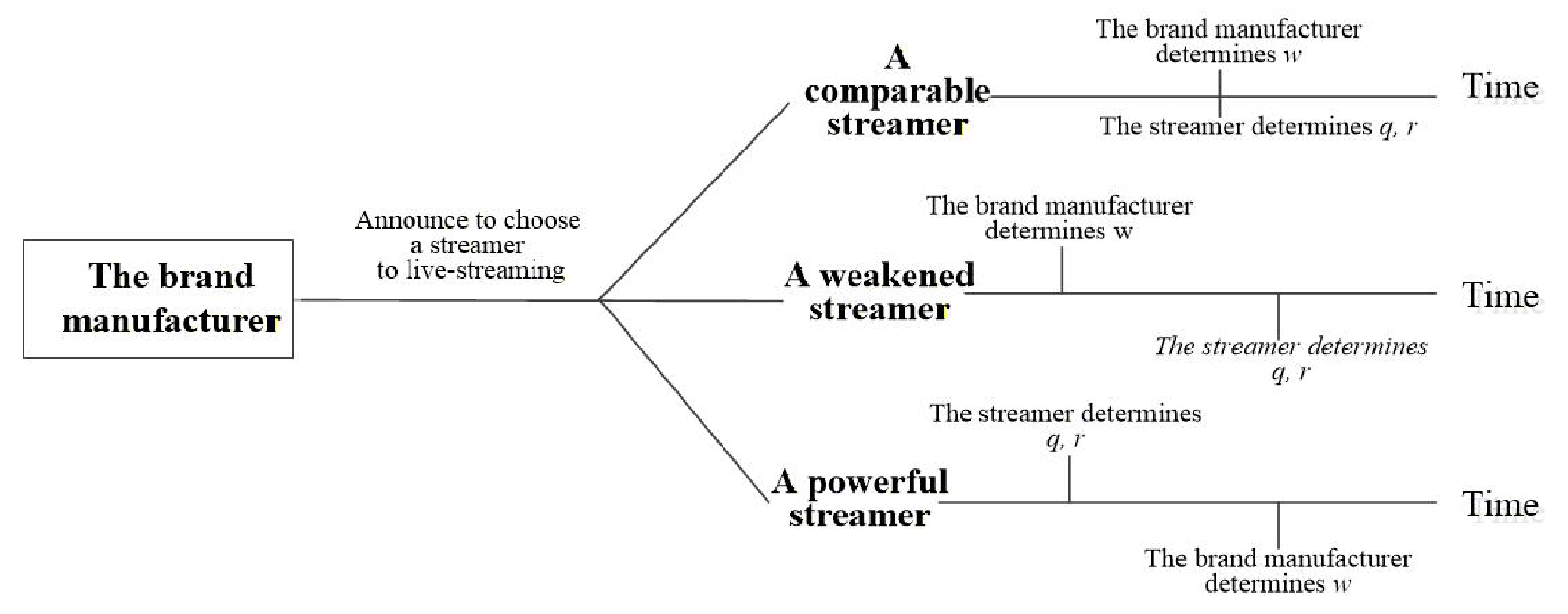
Figure 2.
The impact of on manufacturer’s marginal revenue.
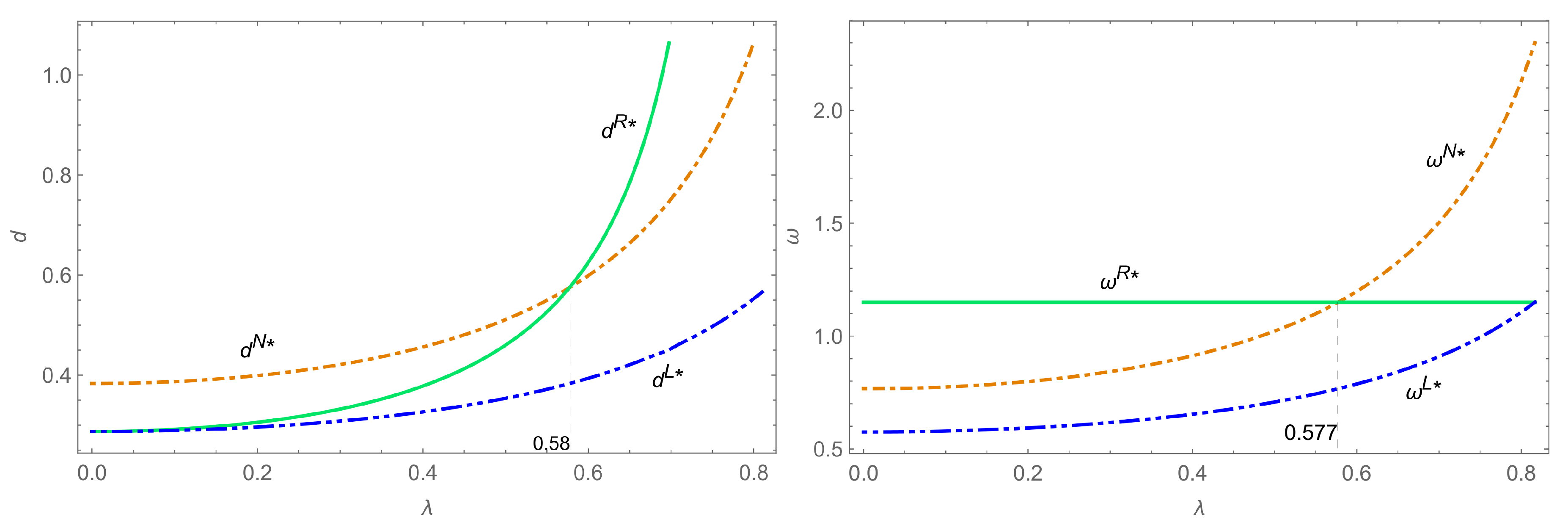
Figure 3.
The impact of on the streamer’s service quality.
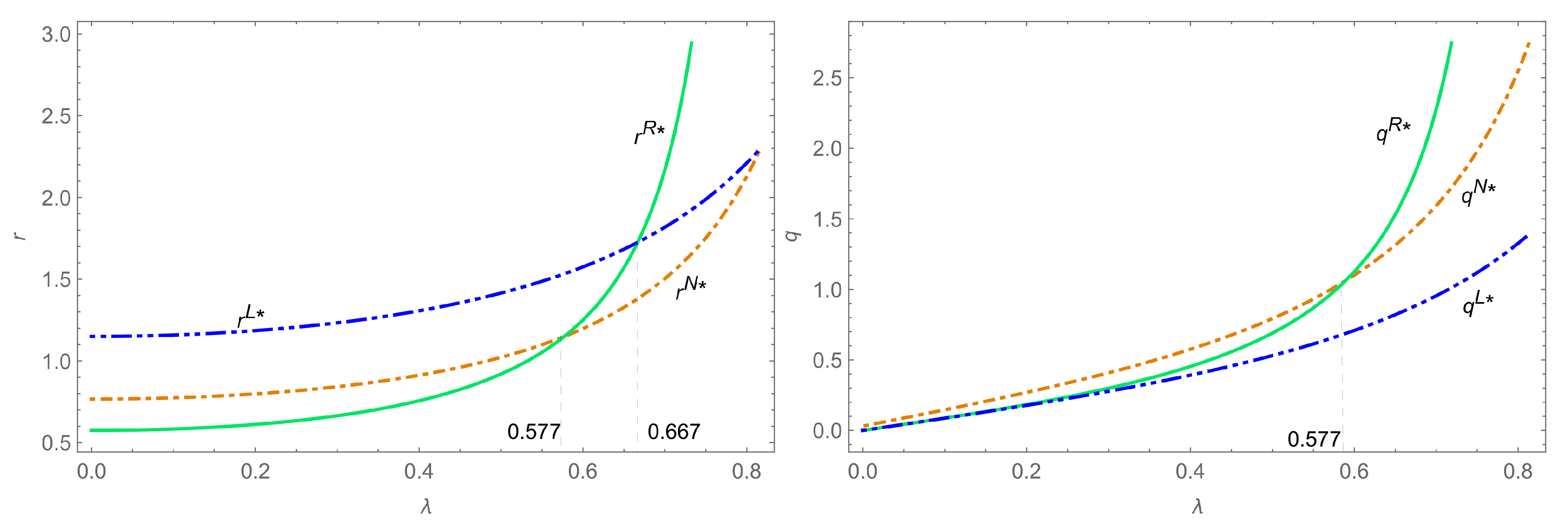
Figure 4.
The impactof on the streamer’s profits.
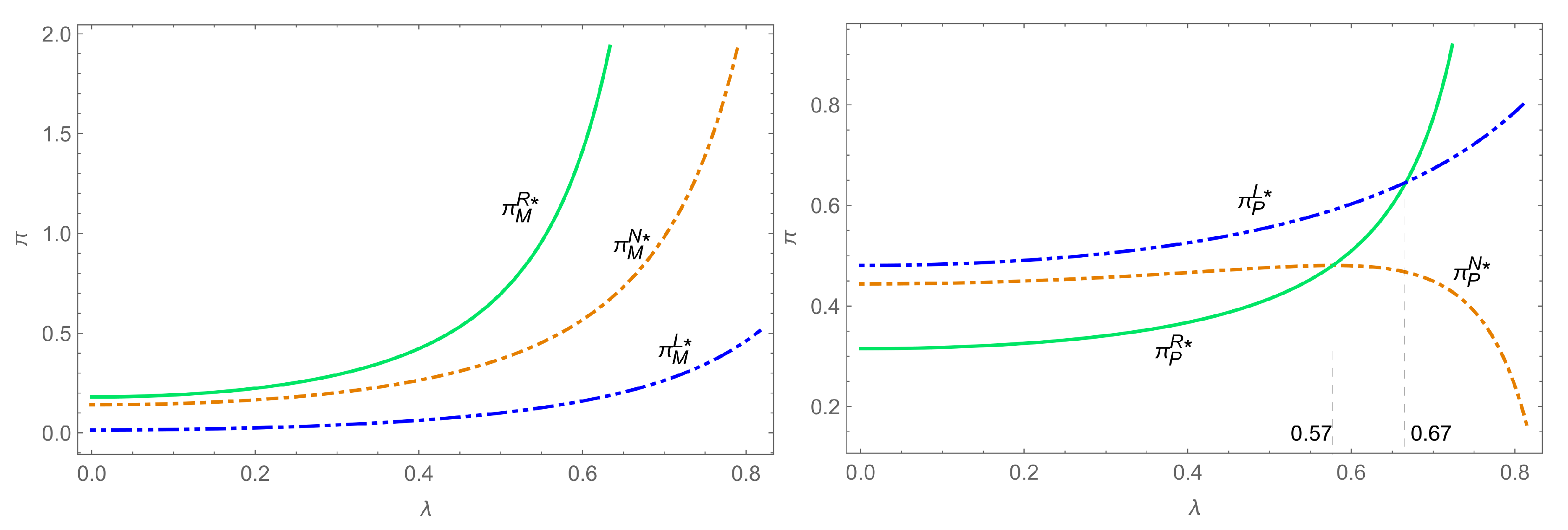
Figure 5.
The impact of k on the streamer’s profits.
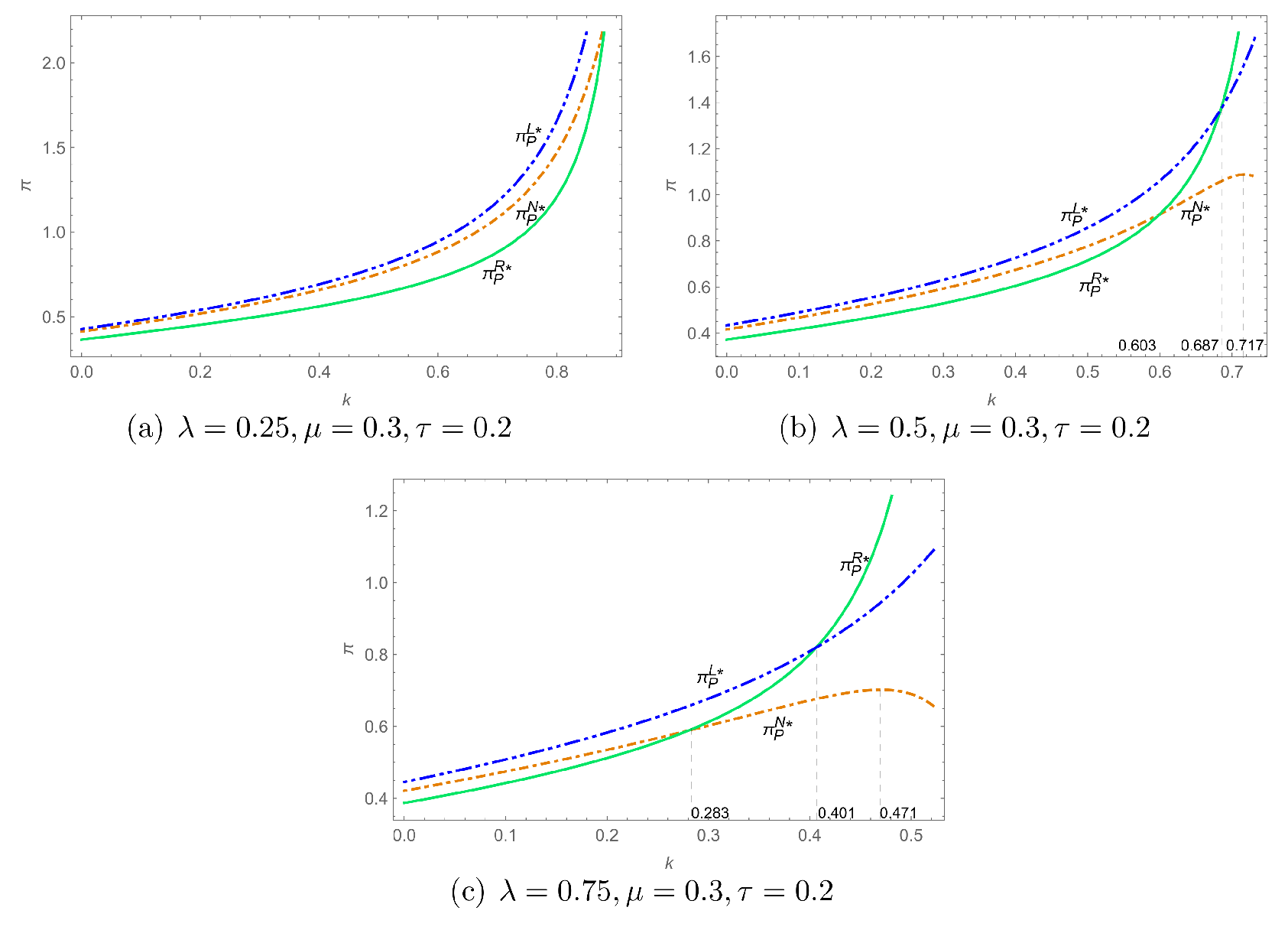
Figure 6.
The impact of k on the brand manufacturer’s profits.
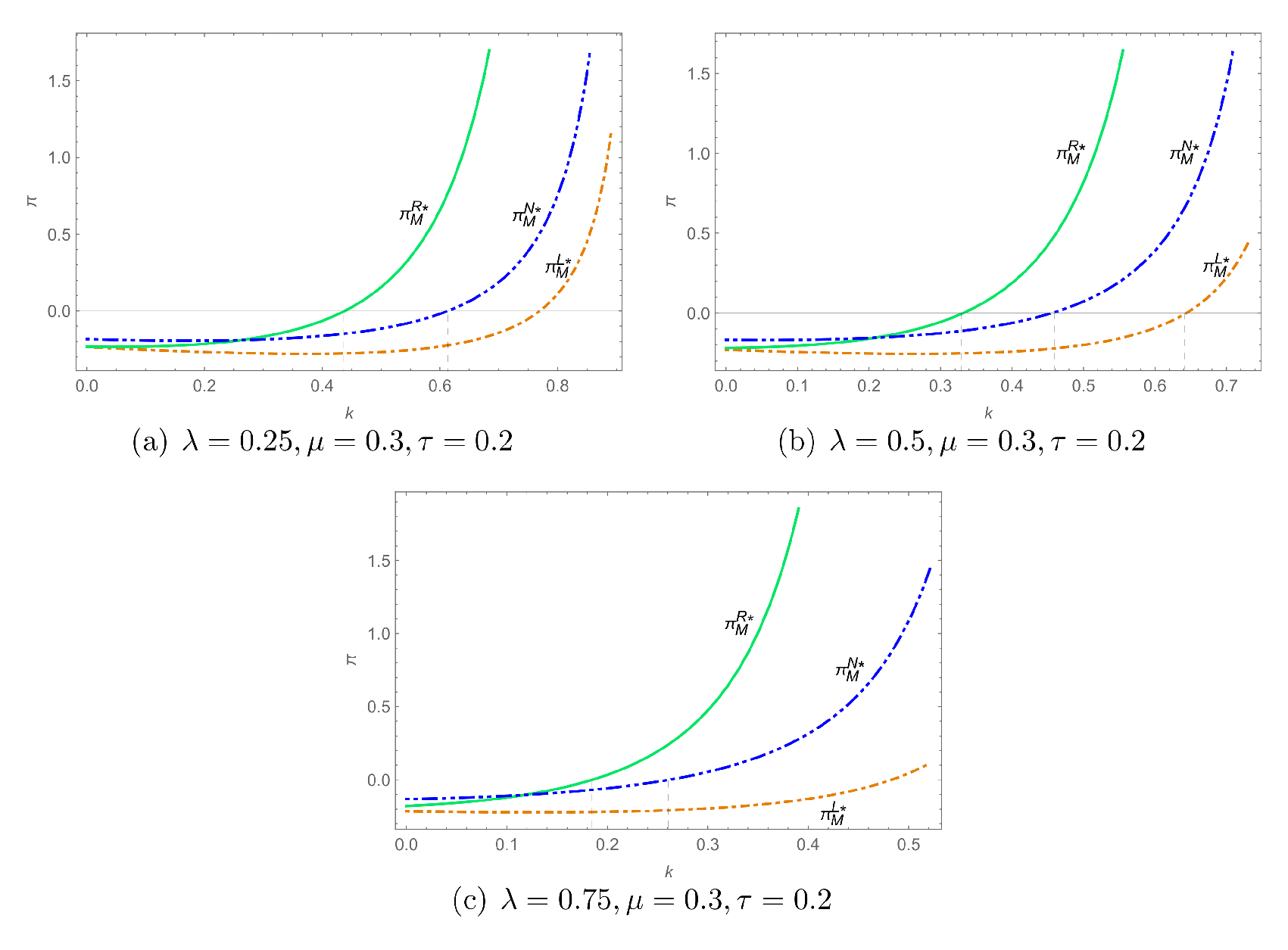
Figure 7.
The impact of and k on the revenue gaps.
Disclaimer/Publisher’s Note: The statements, opinions and data contained in all publications are solely those of the individual author(s) and contributor(s) and not of MDPI and/or the editor(s). MDPI and/or the editor(s) disclaim responsibility for any injury to people or property resulting from any ideas, methods, instructions or products referred to in the content. |
© 2026 by the authors. Licensee MDPI, Basel, Switzerland. This article is an open access article distributed under the terms and conditions of the Creative Commons Attribution (CC BY) license (http://creativecommons.org/licenses/by/4.0/).
Copyright: This open access article is published under a Creative Commons CC BY 4.0 license, which permit the free download, distribution, and reuse, provided that the author and preprint are cited in any reuse.


