

Submitted:
05 June 2026
Posted:
09 June 2026
You are already at the latest version
Abstract
Purpose: This study investigates how financial and entrepreneurial capability configurations differentiate internationalized from domestically oriented Thai SMEs. By adopting a decision‐science perspective, the study identifies the capability patterns that shape firms’ strategic international orientation.
Design/methodology/approach: This research, which utilizes survey and financial data from 179 Thai SMEs (2021–2023), employs an inductive machine learning approach based on Extreme Gradient Boosting (XGBoost). The analytical framework integrates profitability, liquidity, leverage, operational efficiency, international experience, team readiness, market knowledge, and institutional connectivity. Feature importance scores and confirmatory statistical tests are used to validate differentiating capability structures.
Findings: Internationalized SMEs demonstrate stronger financial agility, higher profitability, disciplined leverage, and superior resource utilization combined with entrepreneurial preparedness, as evidenced by international experience, risk tolerance, effective team coordination, and institutional embeddedness. In contrast, localized SMEs exhibit liquidity-heavy but low-dynamism profiles, limited network engagement, and weaker organizational readiness. The machine learning model highlights the non-linear interactions among these capabilities, achieving high predictive accuracy (92.59%).
Practical implications: The findings offer a capability-based diagnostic tool for managers and policymakers. Strengthening financial agility, team readiness, and institutional ties can enhance the global competitiveness of SMEs.
Originality/value: This study introduces a multidimensional, data-driven capability configuration model for SME internationalization, advancing decision science, dynamic capabilities, and network-based theories in emerging-market contexts.
Keywords:
SME internationalization
; capability configurations
; decision science
; machine learning
; financial agility
; emerging markets
1. Introduction
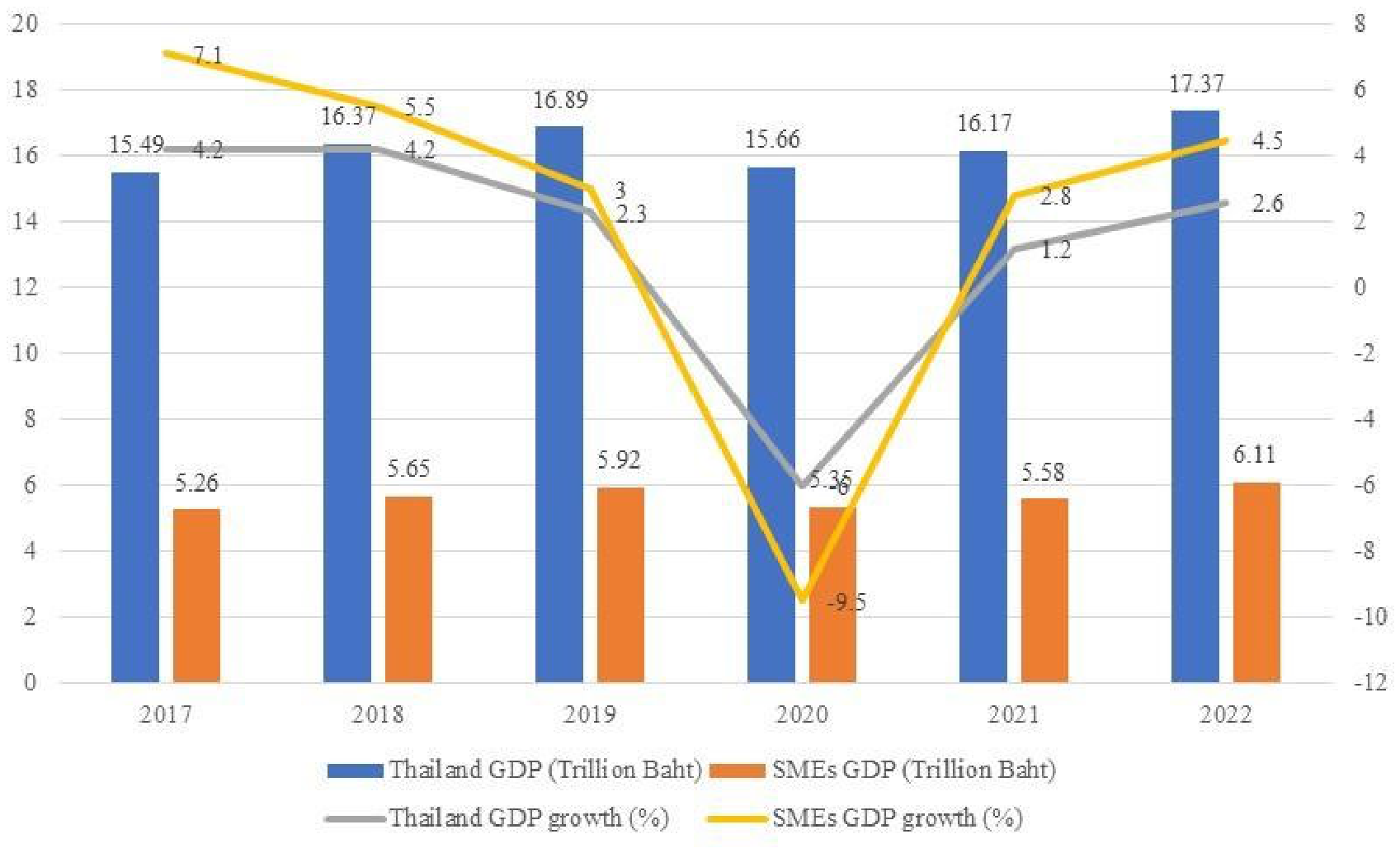
Small and medium-sized enterprises (SMEs) play a central role in economic development in emerging economies, and Thailand is no exception. SMEs contribute more than one-third of the national GDP and absorb a substantial share of the labor force, making their competitiveness critical for sustaining growth amid increasing globalization. Although Thailand’s SMEs have maintained a stable contribution to GDP, with an average share of 34.56% and an average growth rate of 4.5% between 2017 and 2022, domestic economic dynamism alone is insufficient for long-term resilience. As competitive pressures intensify, internationalization has become a strategic pathway for growth, risk diversification, and technological upgrading.
Figure 1.
GDP of SMEs in Thailand GDP. (Source: Office of the National Economic and Social Development Council).
Figure 1.
GDP of SMEs in Thailand GDP. (Source: Office of the National Economic and Social Development Council).
Despite the importance of this process, existing internationalization research has been disproportionately shaped by firms that have already succeeded in foreign markets (Khanthong, J., & Sakulkijkarn, W., 2024). Foundational theories—such as the Uppsala Internationalization Model, the Resource-Based View (RBV), and the Dynamic Capabilities Framework (DCF) primarily describe how firms accumulate knowledge, develop routines, and gradually increase foreign commitments (Johanson & Vahlne, 1977; Barney, 1991; Teece et al., 1997). While these perspectives have advanced understanding of the internationalization trajectory, they largely assume that expansion abroad is a natural or desirable progression. As a result, the sizable population of SMEs that remain exclusively domestic has received far less theoretical and empirical attention (Ferreira et al., 2020). The first gap in the literature, therefore, concerns asymmetry; we know considerably more about SMEs that internationalize than those that choose not to.
This omission is particularly consequential in emerging markets. Many Thai SMEs operate successfully at home yet hesitate to expand abroad due to capability shortages, limited resources, market uncertainty, or institutional weaknesses. Domestic orientation may reflect rational strategic choices rather than failure to grow (Tan & Sousa, 2015). However, the current literature does not clearly differentiate whether non-internationalization arises from financial constraints, insufficient entrepreneurial and organizational capabilities, or structural barriers embedded in the emerging-market context. This leads to a second gap: the domestic SME segment remains theoretically underexplored, with a limited understanding of the capability combinations that keep firms localized.
A third gap arises from the fragmented treatment of determinants of internationalization. Financial factors such as profitability, liquidity, leverage, and efficiency are typically analyzed separately from entrepreneurial, organizational, and relational capabilities. In practice, however, the strategic orientation of SMEs is shaped by the interaction between these financial and non-financial dimensions markets (Pascucci et al., 2021; Falavigna et al., 2024). Literature does not provide an integrated, empirically grounded framework that can capture how these multidimensional capability sets jointly determine whether SMEs operate internationally or domestically (Tukamuhabwa et al., 2021; Da Rocha et al., 2024).
Beyond these three classical gaps, a deeper conceptual gap underlies the SME internationalisation literature: the absence of a framework that explains why integration into wider economic space is selective, conditional, and configurational rather than uniform. Particularly, modern globalization is neither universally accessible nor uniform. Rather than being a linear expansion path that is accessible to every capable firm, cross-border participation is now increasingly perceived as contingent, selective, and irregular (Haddad, 2023; Gupta & Guidi, 2012). Recent research on global market interdependence indicates that integration and co-movement are dynamic and crisis-sensitive and are determined by the underlying institutional and geopolitical positioning rather than by straightforward market entry (Gupta, Haddad, & Selvanathan, 2024).
Globalization generates opportunities, but those opportunities are unevenly translated into firm-level participation because firms differ in the combinations of financial flexibility, organisational preparedness, and relational embeddedness they can mobilise. This logic resonates with the broader literature on global financial market integration, which treats integration as time-varying, structurally asymmetric, and shaped by underlying systemic positioning rather than as a stable convergence outcome (Haddad, 2023; Gupta, Haddad, & Selvanathan, 2024). Reframing SME participation in this way directs attention to how firm capability bundles condition systemic coupling, and away from a binary export-versus-domestic reading of internationalisation.
This study addresses these gaps by examining the capability configurations that distinguish internationalized Thai SMEs from those that remain localized. Drawing on financial ratios and non-financial indicators related to international experience, team readiness, operational adaptability, risk tolerance, and institutional connectivity, the paper employs an inductive, machine learning–based approach to identify the capability patterns associated with each group. Extreme Gradient Boosting (XGBoost) facilitates the analysis of non-linear interactions among financial and entrepreneurial dimensions, revealing structures that traditional linear methods may overlook (Chen et al., 2022). This study extends understanding of SME internationalization by shifting attention to configurational patterns rather than isolated variables (Keelson et al., 2024; Yildiz et al., 2023; Szkudlarek et al., 2020).
2. Literature Review
2.1. Theoretical Framework
SME internationalization has long been interpreted through several foundational theories that emphasize different dimensions of firm behavior. The Resource-Based View (RBV) argues that sustainable competitive advantage arises from valuable, rare, inimitable, and non-substitutable resources (Barney, 1991). Within this framework, profitability and resource deployment reflect managerial competence and the firm’s ability to finance international risk. However, the RBV assumes relative resource stability, limiting its explanatory power in volatile environments.
To address dynamic contexts, the Dynamic Capabilities Framework (DCF) conceptualizes advantage as the firm’s ability to integrate, reconfigure, and renew its resource base in response to environmental change (Teece et al., 1997; Teece, 2023). Dynamic capabilities such as opportunity sensing, resource orchestration, and strategic realignment are central to competing in foreign markets where uncertainty, regulatory heterogeneity, and institutional voids are common. For SMEs, dynamic capabilities translate into operational adaptability, organizational learning, and proactive opportunity development.
Financial theories complement these strategic perspectives. Pecking Order Theory (POT) suggests that firms prioritize internal financing and resort to external debt only when necessary, implying that liquidity constraints limit high-risk expansion into foreign markets (Myers, 1984; Myers & Majluf, 1984). Agency Theory (AGT), by contrast, highlights the disciplining role of moderate leverage in enhancing efficiency and growth potential (Jensen & Meckling, 1976; Jensen, 1986).
POT posits that firms prefer internal financing, implying liquidity constraints may limit internationalization (Myers, 1984; Myers & Majluf, 1984). Conversely, AGT argues that moderate debt enhances discipline and efficiency, potentially fostering international expansion (Jensen & Meckling, 1976; Jensen, 1986). Hence, while financial constraints hinder globalization, prudent leverage can promote it. From a process perspective, the UPM and Organizational Learning Theory (OLT) emphasize experiential learning and gradual internationalization (Johanson & Vahlne, 1977; Lyles, 1990). Yet, “born global” SMEs can bypass this incremental path through digitalization and dynamic capabilities. The revised UPM reflects globalization’s realities, highlighting non-linear, network-based internationalization where strong relationships enable market “leapfrogging” (Johanson & Vahlne, 2009).
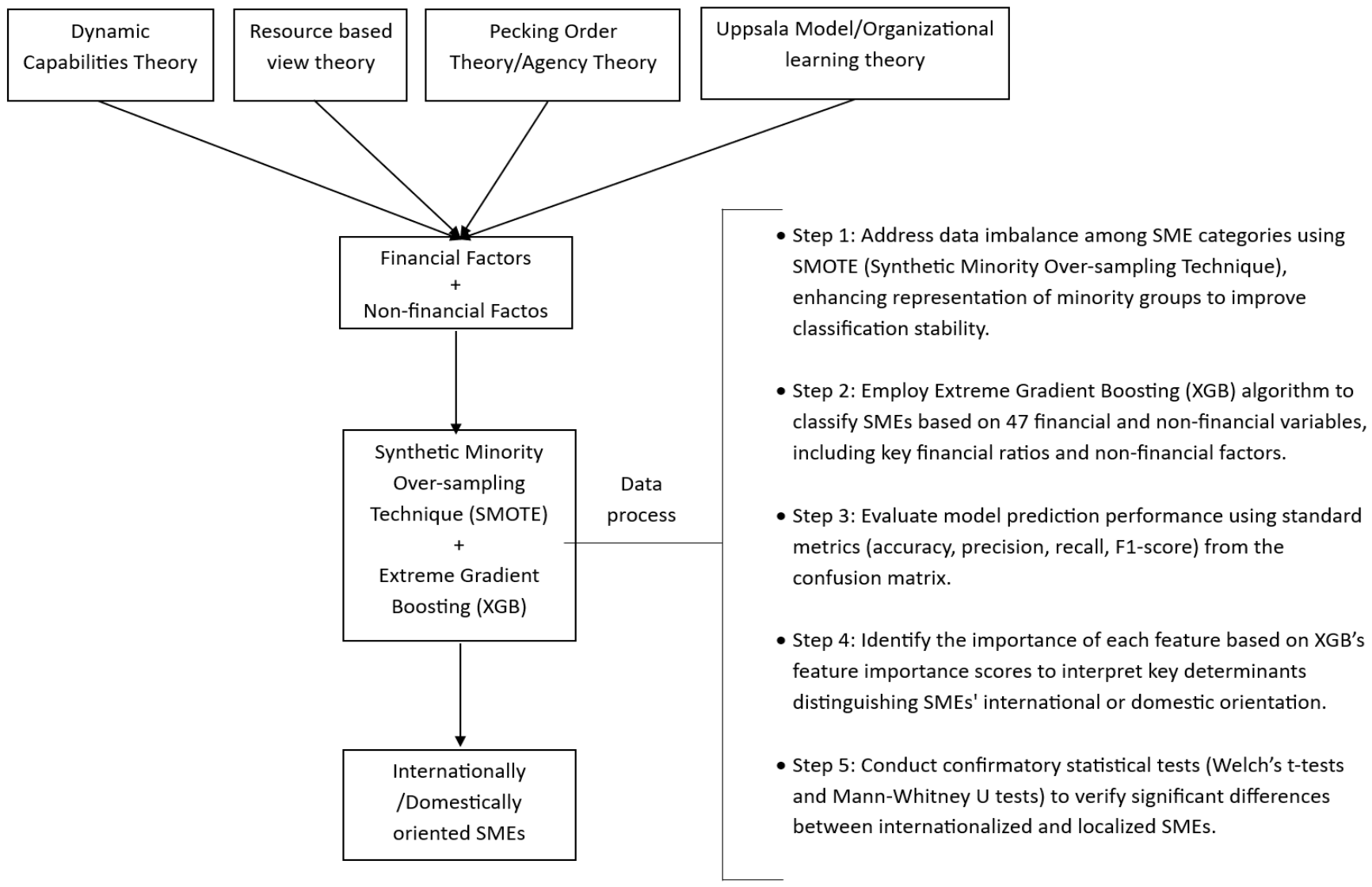
Together, these theories present a multidimensional framework: RBV and DCF explain internal and adaptive strengths; POT and AGT address financial discipline and constraints; UPM and OLT illuminate experiential and learning dynamics. The integration of these perspectives shows that SMEs’ international or domestic orientation depends on both financial foundations and non-financial capabilities, particularly resources, experience, networks, and adaptability. The model below proposes a combined theoretical framework to explain SMEs’ internationalization or localization orientation.
Figure 1.
Integrated Research Framework.
2.2. Conditional Globalisation, Capability Bundles, and Selective Integration
The theories surveyed above (RBV, DCF, POT, AGT, UPM, and OLT) collectively explain why firms differ in their willingness and capacity to engage foreign markets. Yet, taken together, they speak to a deeper question that frames this study: why do firms vary in the degree to which they become coupled with broader economic systems? Recent work on global financial market integration shows that integration is best understood as an evolving, conditional process rather than a fixed state, with co-movement and interdependence varying across time, regimes, and structural positions (Haddad, 2023). In a similar vein, evidence from Asian and developed equity markets demonstrates that interdependence is dynamic, time-varying, and crisis-sensitive rather than a one-directional convergence story (Gupta & Guidi, 2012). Translated to the SME context, these insights suggest that internationalisation is not a stable binary outcome but a contingent positioning outcome shaped by underlying capability bundles.
A second insight from this stream concerns the structured and asymmetric character of co-movement across units. Gupta, Haddad, and Selvanathan (2024) show that integration in the world economy is shaped by underlying institutional and geopolitical positioning, producing uneven, hierarchical patterns of co-movement rather than homogeneous convergence. By analogy, the alignment of SMEs with transnational economic structures is unlikely to be uniform; instead, it is mediated by firm-level capability bundles—financial agility, operational adaptability, human capital, market knowledge, and institutional embeddedness—that condition the depth and quality of systemic coupling.
A third implication concerns system-level positioning. Even though the work cited above is empirically located in financial markets and macro-level country studies (Paramati, Mo, & Gupta, 2017), the conceptual lesson translates well to SMEs in emerging economies: participation in globalisation is shaped by where actors sit within wider structures of opportunity and constraint. For Thai SMEs, this position is jointly determined by financial structure, entrepreneurial readiness, learning trajectories, and institutional ties. Internationalised SMEs are therefore better understood as more deeply coupled with cross-border information, relational, and capital networks, while domestically oriented SMEs may remain only partially or selectively connected—not necessarily as deficient firms, but as actors positioned differently within a conditionally globalised system. This conceptual repositioning provides the analytical bridge between the firm-level capability literatures reviewed in Section 2.1 and the empirical patterns identified by the machine-learning model in later sections.
2.3. Proposed Factors
This section identifies key factors, supported by prior studies, to be integrated into the analytical framework, reflecting the combined theoretical perspectives. The literature emphasizes that both financial and non-financial indicators are crucial in predicting and shaping SMEs’ strategic orientation toward either international or domestic markets.
- Financial factors (FR)
Financial factors are central to SMEs’ readiness for internationalization because they shape resource availability, capital access, and the capacity to absorb internationalization costs. Indicators of profitability, liquidity, leverage, asset utilization, and cost control capture a firm’s internal financial health and strategic flexibility. Evidence consistently shows that SMEs with stronger financial structures are more capable of sustaining global expansion, while domestically oriented firms often face inefficiency or liquidity pressures that restrict risk-taking.
Within the RBV, profitability ratios—return on assets (ROA, FR1), return on equity (ROE, FR2), gross profit margin (GPM, FR3), operating profit margin (OPM, FR4), and net profit margin (NPM, FR5)—reflect the firm’s ability to generate and mobilize internal resources (Ahmed et al., 2024; Daadmehr, 2024; Govindan et al., 2023; Hassan et al., 2023; Ahmad et al., 2022). High profitability signals efficient resource use and managerial competence (Barney, 1991), supports scale, and enables risk diversification in foreign markets (Hitt et al., 2006; Yildiz et al., 2023). Empirical evidence confirms that profitable SMEs more easily overcome entry barriers and adapt to global competition (Keelson et al., 2024; Buckley & Casson, 2020), whereas low-profit firms remain domestically constrained (Brozović et al., 2023; Falavigna et al., 2024). Profitability has long been shown to influence export intensity (Aybar & Thirunavukkarasu, 2005; Riahi-Belkaoui, 1998; Lu & Beamish, 2006), reaffirming the importance of FR1–FR5.
Liquidity and leverage jointly determine SMEs’ ability to sustain international commitments. The Pecking Order Theory argues that limited liquidity restricts foreign investment (Leong & Yang, 2021; Merkoulova & Zivanovic, 2022), with studies showing that financing constraints hinder both entry and persistence in foreign markets (Fauceglia, 2015; Pascucci et al., 2021). Key indicators include the current ratio (CRR, FR6), debt-to-equity (DTE, FR7), debt-to-assets (DTA, FR8), and equity multiplier (EM, FR9) (Rashid & Jabeen, 2018; Kabbach-de-Castro et al., 2022; Yang & Chen, 2023; Miranda-García & Segovia-Vargas, 2024). High liquidity reduces financing costs and increases resilience (Minetti & Zhu, 2011; Manova, 2012; Pascucci et al., 2021; Mansilla-Fernández & Milgram-Baleix, 2023), whereas, from an agency perspective, moderate leverage can enhance discipline, though excessive debt increases risk and limits export capacity (Guedhami et al., 2022; Hassen et al., 2024).
SMEs frequently face structural credit constraints that limit long-term investment (Forte & Salomé Moreira, 2018) and increase vulnerability to cash flow shocks (Rodeiro-Pazos et al., 2023; Al-Hyari et al., 2012). Although high liquidity supports survival, it often reduces strategic investment capacity. Evidence shows that SMEs with balanced leverage and sufficient liquidity are better positioned to exploit foreign opportunities (Fauceglia, 2015), while low liquidity combined with high leverage encourages defensive, domestic-focused strategies (Kim, 2016; Forte & Salomé Moreira, 2018). The joint assessment of FR6–FR9 thus provides insight into internationalization readiness.
Asset utilization efficiency and cost control also influence competitiveness. Total asset turnover (TAT, FR10), receivables turnover (ART, FR11), inventory turnover (INT, FR12), payables turnover (APT, FR13), and cost-to-revenue ratio (CRT, FR14) measure a firm’s ability to convert resources into outcomes (Kotane & Kuzmina-Merlino, 2017; Hyz et al., 2018; Breivik et al., 2023; Hossain & Sultana, 2024; Káčer & Alexy, 2025). High efficiency strengthens domestic competitiveness and supports export readiness (Fernández-López et al., 2020; Rodeiro-Pazos et al., 2023; Younis & Karmowska, 2025), whereas weak efficiency and long cash conversion cycles hinder international engagement (Kahiya & Dean, 2016; Mansilla-Fernández & Milgram-Baleix, 2023). While cost discipline is valuable, excessive rigidity may suppress innovation and slow foreign expansion (Rice et al., 2024; Hauser et al., 2013).
Taken together, the financial variables FR1–FR14, as shown in Table 1., provide a multidimensional assessment of SME financial health. Profitability supports resource mobilization, liquidity and leverage shape financial resilience, and efficiency enhances competitiveness. These factors collectively indicate whether SMEs possess the flexibility, stability, and resource strength needed to compete internationally.
- Non-financial factors (NF)
Non-financial factors shape the strategic and organizational foundations of SME internationalization by capturing elements of managerial mindset, operational adaptability, human capital, learning, and institutional engagement that do not appear in financial statements. These variables can be grouped into five integrated capability dimensions.
The first dimension, International Strategic Orientation, reflects firms’ forward-looking commitment to global markets. Expected International Earnings (EIE, NF1) indicate whether anticipated returns justify internationalization costs (Yi & Wang, 2012; Arbelo et al., 2024; Ramon-Jeronimo et al., 2019). Marketing Allocation Abroad (MAA, NF2) supports foreign visibility and positioning (Ishii & Yuki, 2025; Theingi & Purchase, 2011). International Risk Tolerance (IRT, NF3) facilitates early entry, network engagement, and experiential learning (Figueira-de-Lemos et al., 2011; Puthusserry et al., 2020; Vahlne, 2020). Long-term Global Focus (LGF, NF4) captures managerial vision (Mammadov & Wald, 2025; Torkkeli et al., 2018; Nummela et al., 2004), while Offshore Customer Knowledge (OCK, NF5) strengthens the firm’s understanding of foreign demand (Billore & Billore, 2019; Stoian et al., 2017). International Positioning Capability (IPC, NF6) reflects higher-order dynamic capabilities needed to sense, seize, and reconfigure opportunities abroad (Pfajfar et al., 2024).
The second dimension, Operational Readiness, reflects the extent to which SMEs can adapt production and supply-chain systems for cross-border operations. Production Scale-up Capacity (PSC, NF7) supports responsiveness to foreign market volume and variety (Koren et al., 2018; Herrigel, 2015; Ling-yee & Ogunmokun, 2008). Adaptive Supply Chain Capability (ASC, NF8) enhances resilience under structural shifts and disruptions (Tukamuhabwa et al., 2021; Richey et al., 2022; Mishra & Singh, 2022). Product Adaptation Capability (PAC, NF9) enables customization for foreign needs, while Logistics System Capacity (LSC, NF10) ensures end-to-end delivery reliability (Patrucco & Kähkönen, 2021). Together, these variables capture the operational flexibility highlighted by dynamic capabilities theory (Teece, 2023).
The third dimension, Human Capital and Team Readiness, covers leadership, skills, and coordination relevant for international work. Leadership Global Mindset (LGM, NF11) shapes strategic interpretation of global dynamics (Lyles, 1990; Augusto Felício et al., 2015; Miočević & Crnjak-Karanović, 2012). Cross-Cultural Communication Skills (CCS, NF12) facilitate negotiation and collaboration in diverse settings (Sabet & Chapman, 2023; Szkudlarek et al., 2020). International Task Coordination (ITC, NF13) supports cross-functional integration (Luo et al., 2010; Belderbos et al., 2024). Team International Readiness (TIR, NF14) strengthens export preparedness (Tate et al., 2021; Gerschewski et al., 2020), while International Marketing Personnel Access (IMA, NF15) ensures availability of staff with foreign-market knowledge (Kaleka & Morgan, 2019; Enderwick & Akoorie, 1994; Ipsmiller et al., 2021).
The fourth dimension, Market Experience and Knowledge, captures learning-based capabilities that reduce uncertainty in foreign environments. International Market Intelligence Access (IMI, NF16) supports data-driven decisions (İpek & Bıçakcıoğlu-Peynirci, 2020; Ishii & Kikumori, 2024). Trade Fair Participation (TFP, NF17) strengthens networking and signaling (Hansen, 1996; Rolf Seringhaus & Rosson, 1998). Experience Serving Foreign Clients (ESF, NF18) and Export Operation Experience (EOE, NF19) contribute to foreign market familiarity (Martí et al., 2017; Birru et al., 2019). Customs Clearance Experience (CCE, NF20) and Foreign Trade Regulation Knowledge (TRK, NF21) enhance compliance and help firms leverage trade agreements (Martí et al., 2017; Goel et al., 2021; Martín Martín et al., 2022; Mukunoki & Okoshi, 2025).
The fifth dimension, Digitalization and Institutional Connectivity, reflects the ability to leverage digital tools and external networks. Digital International Marketing (DIM, NF22) expands reach and reduces information asymmetries (Da Rocha et al., 2024). E-Commerce Channel Usage (ECU, NF23) facilitates rapid, cost-efficient international entry (Hånell et al., 2019; Vázquez-Martínez et al., 2021). Public and Private Export Assistance Participation (PPA, NF24) enhances export knowledge and commitment (Eun et al., 2011; Shamsuddoha et al., 2009). Finally, International Business Experience (IBE, NF25), Business Association Membership (institutional connectivity) (BAM, NF26), Past International Activity (PIA, NF27), Formal Association Membership (FAM, NF28), and International Network Involvement (INI, NF29) represent relational resources that strengthen opportunity recognition, legitimacy, and resource mobilization (Martín Martín et al., 2022; Yoon et al., 2020).
Collectively, these non-financial factors provide a comprehensive picture of SMEs’ internationalization capacity. They encompass strategic vision, operational flexibility, human and social capital, experiential learning, and digital and institutional embeddedness, forming the core non-financial foundations that complement financial indicators in shaping international or domestic strategic orientation. Table 2 summarizes these non-financial factor groups and their sources.
3. Data and Methodology
3.1. Data Collection and Sample
The empirical research is based on a sample of 179 Thai SMEs, which were surveyed over the period from 2021 to 2023. The database includes both financial and non-financial variables that are important in determining the capabilities of firms in both international and domestic markets. Financial information typically includes performance data such as profitability ratios, liquidity measures, and capital utilization measures. Non-financial information reflects entrepreneurial skills, e.g., international business experience, team preparedness, risk affinity, and institutional connectivity. This summary dataset enables us to compare the organization of processes in firms operating abroad and those active only on the home market from several perspectives. To ensure robustness, the dataset was partitioned into a training set (80%) and a testing set (20%) using random sampling. This stratification ensured that model training and validation were performed on disjoint subsets, thereby minimizing overfitting bias.
3.2. Methodology
The objective of this study is to identify the configurational differences between internationalized and localized SMEs in Thailand by examining how financial and entrepreneurial capabilities interact. Because SME internationalization is shaped by complex, non-linear, and interdependent relationships, a traditional hypothesis-testing approach would be inadequate. Instead, an inductive, machine learning–based method is employed, allowing patterns to emerge from the data without imposing restrictive linear assumptions (Mullainathan & Spiess, 2017; Shmueli, 2010). Extreme Gradient Boosting (XGBoost) is selected as the core analytical tool due to its predictive accuracy, efficiency, and interpretability. As an optimized implementation of gradient boosting, XGBoost builds ensembles of decision trees to minimize a regularized loss function (Chen & Guestrin, 2016). Several features make it well suited for this study.
First, robustness with heterogeneous, high-dimensional data: XGBoost can process continuous variables such as financial ratios alongside categorical or ordinal indicators of entrepreneurial orientation and institutional connectivity with minimal preprocessing—an advantage in SME research that often integrates accounting and survey-based data (Hastie et al., 2009).
Second, ability to model non-linearities and interactions: SME internationalization reflects the interplay of financial agility, risk orientation, team readiness, and institutional ties. XGBoost’s tree-based structure automatically captures non-linear effects and higher-order interactions that conventional regression models may miss (James et al., 2021).
Third, regularization and overfitting prevention: XGBoost incorporates L1 (Lasso) and L2 (Ridge) penalties, shrinkage, subsampling, and column sampling to control variance and improve generalization—important for studies with moderate sample sizes typical of SME datasets (Natekin & Knoll, 2013).
Fourth, interpretability: Despite being a machine learning model, XGBoost provides feature importance metrics—gain, cover, and frequency—that reveal the relative influence of financial and entrepreneurial variables on classification outcomes (Lundberg & Lee, 2017). This ensures the model contributes not only predictive accuracy but also theoretical insight.
Fifth, empirical validation in related fields: Gradient boosting has been successfully applied to corporate default prediction (Lessmann et al., 2015), SME credit scoring (Khandani et al., 2010), and entrepreneurial performance modeling (Cho & Kim, 2020), demonstrating its suitability for financial and organizational research.
In sum, XGBoost is used in this study as an instrumental tool: its capacity to handle non-linear interactions, control overfitting, and generate interpretable feature importance scores makes it well suited for surfacing the latent capability bundles associated with selective integration. The contribution of the paper, however, is not the predictive performance of the model. The conceptual contribution lies in interpreting the patterns the algorithm reveals through a conditional-globalization lens that treats firm-level capabilities as conditioning factors for systemic coupling with wider economic structures (Gupta & Guidi, 2012; Gupta, Haddad, & Selvanathan, 2024; Haddad, 2023; Paramati, Mo, & Gupta, 2017). The algorithm identifies the pattern; the theoretical contribution explains what the pattern means.
3.3. Handling Class Imbalance
A methodological challenge was the imbalance of firm categories: 68.72% were internationalized, 6.70% were potentially internationalizing, and 24.58% were localized. To mitigate this imbalance, the Synthetic Minority Over-sampling Technique (SMOTE) was employed to generate synthetic observations for the minority classes. This resumption ensures more stable classification by preventing bias toward the majority class.
3.4. Analytical Approach: Extreme Gradient Boosting (XGBoost)
Key analytic instrument used is Extreme Gradient Boosing (XGB), a machine learning algorithm that is proven to yield great performance in classification tasks dealing with high-dimensional and mixed homogeneous and heterogeneous data. We selected XGBoost because it can handle missing values, prevents overfitting, and also provides human-interpretable estimates of feature importances. In the research, this has led to the development of 47 financial and non-financial factors. FR indicators, such as ROA, ROE, CRR, DTE, and TAT were also added. Beyond financial characteristics, strategic features, namely international experience, readiness of operational team, risk preference toward international investment and institutional linkage were included. XGBoost is a scalable tree-boosting algorithm that constructs an additive ensemble of regression trees. Formally, let the training dataset be
where denotes the feature vector of SME is the binary class label (1 = internationalized, 0 = localized), is the sample size and is the number of features. XGBoost builds an additive ensemble of classification trees:
where is the space of regression trees.
The objective function at iteration is:
where l is the differentiable convex loss (logistic loss for binary classification), and Ω(ft) regularizes tree complexity:
with T as the number of leaves, w as the leaf weights, and γ, λ as regularization parameters. To optimize efficiently, XGBoost applies a second-order Taylor expansion of the loss:
where
This formulation allows for efficient computation of optimal splits at each node, making XGBoost scalable and accurate.
The predictive ability of the model was tested by a number of normal metrics which are calculated based on the concept of a confusion matrix. These statistics include accuracy, precision (or the fraction of positive identifications that were correct), recall (which is the proportion of actual positives that are correctly identified), and F1-score (which is the harmonic mean of precision and recall). Model performance was evaluated using standard classification metrics:
where TP, TN, FP, and FN represent true positives, true negatives, false positives, and false negatives, respectively.
The XGBoost classifier in this study achieved a test accuracy of 92.59%, with precision = 0.95 and recall = 0.86, demonstrating strong predictive ability in distinguishing internationalized from localized SMEs.
To interpret the model, gain-based feature importance scores from XGBoost were used to rank predictors. Financial indicators such as ROA, ROE, DTE Ratio, Total Asset Turnover, and CRR emerged as dominant. Non-financial features, including international experience, team readiness, and association membership, were also highly influential.
Subsequently, confirmatory statistical analyses (Welch’s t-test and Mann–Whitney U-test) were applied to verify significant differences in financial ratios between the two groups, ensuring robustness against heteroskedasticity and non-normality.
4. Results and Discussions
The use of the Extreme Gradient Boosting (XGBoost) machine learning approach enabled the systematic analysis of financial and operational attributes that characterize the internationalization process of Thai SMEs. The comparison shows sharp dichotomies in these two groups, as evident in the patterns of essential financial ratios and entrepreneurial performance measures.
4.1. Results
- Financial and Operational Efficiency
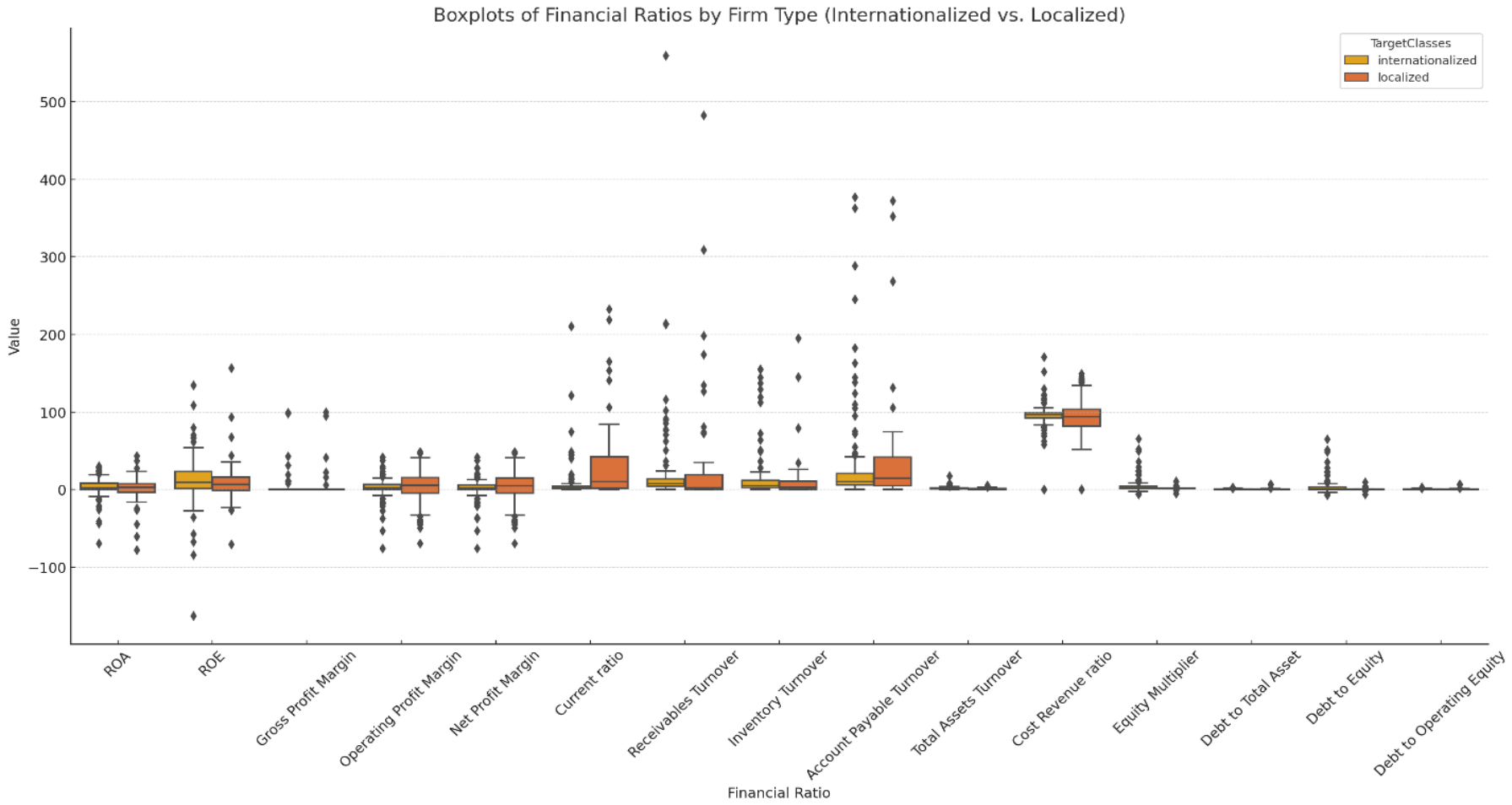
The analysis of the financial statement revealed that internationalized SMEs were significantly favored over their local counterparts in terms of financial health and operational performance. As shown in Figure 1, internationalized companies had significantly higher ROA, ROE, and GPM values. Operational efficiency metrics, such as INT and ART, also exhibited better performance in internationalized SMEs, although some operational metrics reflected less pronounced differences. Furthermore, as indicated by Figure 1, the internationalized SMEs cope with their financial risks better than the non-internationalized ones, as evidenced by relatively lower levels of DTE and CRT. On the other side, domestic SMEs would have more debt based on the higher values of DTE and DTA ratios, and are less cost-efficient.
The internationalized firms are thus shown to be more profitable and strategically consistent in managing their assets and risks, with more local firms adopting a conservative though for less efficient financial posture. Additional statistical analyses support these findings. As presented in Table 2, fifteen financial standard ratios were used for the enforcement of the significance of financial indicators’ differences of internationalized and localized SMEs, where the pairs of groups were compared by the Welch’s (t )-test and Mann-Whitney (U )-test. Nine ratios differed significantly or nearly significantly among the financial indicators. Differences across the groups were particularly marked for the CRR, where locally-owned SMEs held significantly greater liquidity (t-test p = 0.0007; Mann-Whitney p < 0.000001), an indication of cautious cash management, but possibly ineffective use of working capital.
Both the EM and the DTE were significantly different between the internationalized and the non-internationalized for slightly over p < 0.001, showing a stronger intention and capability of using strategic leverage for growth. ROA, ROE, GPM, OPM, and NPM were also in favor of internationalized firms, and they also showed many strong and statistically significant (p < 0.05) indicators. ART, INT, and APT were not statistically significant; however, TAT was significantly higher for internationalized SMEs (p < 0.0005), indicating better usage of resources. All in all, the financial and operational characteristics presented in Figure 1 and in Table 2 emphasize that internationalized SMEs are structurally better prepared for international competition. They shown better returns, higher asset utilization, and a more aggressive -But efficient- financial risk management against those of their local peers.
Figure 1.
Financial Performance Metrics Comparison Between Internationalized and Localized Thai SMEs.
Figure 1.
Financial Performance Metrics Comparison Between Internationalized and Localized Thai SMEs.
- Feature Importance in Entrepreneurial and Financial Classification
The feature importance analysis of the XGBoost model illuminated the variables driving the classification of SMEs by internationalization status. As indicated in Table 3, entrepreneurial skills became the dominant predictors where International Business Experience (NF25) was assessed the most important variable. This discovery further supports the importance of accumulated internationalization experience in supporting SME success overseas.
Other non-financial predictors such as team preparedness (NF14) and Business Association Membership (institutional connectivity) (NF26) were also strong predictors, indicating the importance of internal human resource capacity and external institutional networking for engaging with international markets. Other key entrepreneurial traits, such as risk attitude (NF3) and global strategic orientation (NF11), emphasize the importance of an active management orientation in mitigating the obstacles of internationalization.
The financial factors saw a similar effect. Leverage strategies utilizing either DTA or the EM, as well as total asset turnover and profitability ratios, such as ROA and ROE, were main financial predictors. Effective management of liquidity along with the efficiency of receivables also available in the predictive model but in a slightly less than other.
The combined analysis in Table 3 indicates that SME internationalization performance does not stem from isolated capabilities, but rather, a configuration of financial flexibility, entrepreneurial preparedness, and institutional embeddedness. Developed international SMEs not only perform better in financial terms, but they have non-financial capabilities that are essential to mitigate or adapt to the associated risks and challenges of entering and competing in overseas markets.
In contrast, the regional SMEs seem to be trapped with lesser entrepreneurial skills and with more conservative financial behaviors that do not allow them to enter on or sustain internationalization. These results offer strong empirical evidence of the multidimensional nature of the process of SME internationalization and the necessity for simultaneous development of financial, strategic and relational capabilities to achieve success in a global context.
The combined financial and non-financial predictors investigation with the XGBoost classification provides important information on the distinctive features of internationalized versus localized Thai. The model maintained good predictive power at key entrepreneurial and financial variables. NF25 was the most significant factor among non-financial predictors. This variable (FFI) as a sign of the firm’s previous exposure to international business confirms the other findings of the internationalization literature that international exposure would enable CCN to entangle inside foreign markets. Similarly, global indicators like NF14 (team readiness) and NF26 (association membership) highlight the role of internal human capital and external institutional connections in enabling the internationalization process. Other entrepreneurial dimensions, such as NF3 (risk orientation) and NF11 (strategic orientation), also indicate that a management orientation and capacity for development are important in influencing international behavior.
From the financial ratios, two leverage measures (DTA and EM) appeared to be the strongest predictor. This finding suggests that internationalized firms are more prone to strategic financial risk-taking, increasing the use of debt to finance their growth. Furthermore, the operating capability through the variable TAT and profitability (ROA and ROE), at large have shown courteous results in favor of internationalized SMEs, ensuring that in term of performance and resource utilization, SMEs depend directly and closely in the global competition.
Altogether these findings offer strong empirical validation for a multidimensional model of SME internationalization. The complementary relationship between entrepreneurial readiness and financial strategy seems to be that firms which show both readiness and capability are more likely to succeed in international operations. This highlights the need for policy that offers more than just funding support, and develops international experience, managerial capability and long-term strategy for locally based SMEs.
To summarize, the composite financial and entrepreneurial analysis demonstrates that internationalized SMEs exhibit a distinct configuration of capabilities combining higher levels of financial flexibility, a strategic management of operations, entrepreneurial preparedness and institutional embeddedness. These firms exploit profitability, efficiency in operations, risk-taking propensity, and external networks to maintain competitive advantages in overseas markets. On the other hand, local SMEs, although having an higher liquidity cushion and a more conservative financial posture, seem to have a weaker profitability, less strategic readiness and less connection with the external world. This differentiation in ability highlights the fact that what distinguishes successful internationalization among the SMEs is not their financial capacity or entrepreneurial qualities (all things being equal); it is how they combine these in a coherent whole. Identifying and plugging these multi-faceted capability gaps is key to helping the international expansion goals of local firms.
Consequently, the findings show that internationalized SMEs exhibit a distinctive bundle of financial agility, disciplined leverage, asset-utilization efficiency, international experience, team readiness, and institutional embeddedness. We interpret this not as evidence of having 'more' resources, but as evidence of deeper systemic coupling with cross-border information, relational, and capital networks. Localized SMEs, by contrast, exhibit liquidity-heavy and more conservative profiles consistent with a buffered.
5. Discussion
This study provides new empirical evidence that SME internationalization is a multidimensional capability phenomenon, shaped by the interplay of financial agility, entrepreneurial readiness, and institutional embeddedness. By combining inductive machine learning techniques with theoretical frameworks, the findings extend prior international business and finance scholarships in several directions.
- Financial Capabilities and Strategic Agility
Our results demonstrate that internationalized SMEs consistently outperform localized firms in terms of profitability (ROA, ROE, GPM), leverage management, and resource efficiency (TAT). This confirms prior evidence that profitability and financial strength facilitate internationalization by lowering financing constraints and absorbing risk (Lu & Beamish, 2006; Contractor et al., 2005). From the RBV, these financial indicators reflect effective resource deployment, yet our findings go further by showing that financial agility, strategic use of leverage, balanced liquidity, and efficient cost control, operates as a dynamic capability enabling adaptation to uncertain international markets (Teece, 2023; Sapienza et al., 2006).
The findings also reconcile tensions in POT and AGT. While localized SMEs exhibit liquidity hoarding consistent with pecking order reasoning, internationalized firms deploy leverage strategically, consistent with the disciplining and growth-enabling effects of debt (Campello et al., 2010). This suggests that financial constraints hinder international expansion (Fauceglia, 2015; Manova, 2012), yet financial flexibility, conceptualized as a proactive capability, enables SMEs to overcome liabilities of foreignness and exploit global opportunities (Cumming et al., 2014).
- Entrepreneurial Orientation and Organizational Preparedness
The feature importance analysis revealed that international experience, team readiness, and risk-taking are among the most influential drivers of SME internationalization. This resonates with the entrepreneurial orientation framework, which identifies innovativeness, proactiveness, and risk-taking as central to cross-border expansion. The critical role of managerial readiness and absorptive capacity reinforces the OLT, indicating that SMEs with teams capable of integrating external knowledge are more likely to internationalize successfully.
Importantly, our findings show that entrepreneurial orientation is not sufficient in isolation but interacts synergistically with financial agility. This supports configurational perspectives in strategic management (Fiss, 2011), emphasizing that international success arises from complementary bundles of capabilities rather than isolated traits. SMEs that combine entrepreneurial proactiveness with financial resourcefulness are more likely to overcome internationalization barriers and exploit foreign opportunities (Autio, 2017; Prashantham & Floyd, 2019).
- Institutional Connectivity and Relational Capital
Institutional memberships, international networks, and trade-fair participation emerged as strong non-financial predictors, reinforcing the importance of network theory of internationalization Johanson & Vahlne, 1977). Relational capital mitigates information asymmetries, provides legitimacy in foreign markets, and enables SMEs to mobilize external resources. Evidence from emerging markets suggests that institutional connectivity is particularly critical where formal market-supporting institutions are weaker (Jackson, 2012). This finding also aligns with research on born globals and accelerated internationalizers, which shows that networks enable firms to bypass gradual stages of internationalization. For Thai SMEs, participation in associations and international partnerships not only compensates for resource limitations but also amplifies learning effects, enhancing export intensity and resilience.
6. Conclusions
6.1. Key Findings
This study examined the capability configurations that differentiate internationalized from localized SMEs in Thailand using an inductive, machine learning–based approach. By integrating financial indicators with entrepreneurial and institutional variables, the analysis provides a multidimensional understanding of SME internationalization. Three findings stand out.
First, financial agility is a defining capability of internationalized SMEs. These firms combine higher profitability, disciplined leverage, and efficient resource utilization with the ability to reconfigure financial structures to support expansion. Localized SMEs, in contrast, maintain liquidity-heavy, risk-averse profiles that restrict growth beyond domestic markets.
Second, entrepreneurial readiness and organizational preparedness are critical. International experience, risk tolerance, and globally oriented leadership significantly predict cross-border expansion. These capabilities help SMEs leverage knowledge-based assets, identify opportunities, and mitigate liabilities of foreignness.
Third, institutional connectivity and relational capital enable SMEs to overcome structural barriers common in emerging markets. Internationalized firms benefit from association membership, export-support programs, and cross-border networks that provide knowledge, legitimacy, and resource access.
In conclusion, internationalized Thai SMEs are best understood not as a different type of firm, but as the same population operating with a more tightly integrated bundle of capabilities. Financial agility, entrepreneurial readiness, and institutional connectivity are not three independent traits but mutually reinforcing: relational capital opens information channels that lower the perceived risk of expansion; entrepreneurial orientation translates that information into commitments; and disciplined financial structures supply the slack that turns commitments into action. Localized SMEs, by contrast, do not lack any single capability in isolation — they exhibit a configuration in which liquidity-preserving financial postures, limited international exposure of decision-makers, and thinner cross-border ties co-occur and reinforce one another, producing a stable but internally bounded equilibrium. This configurational reading reframes "internationalization" in the Thai SME context as a question of capability coupling rather than capability possession, with direct implications for policy: interventions that target only one dimension — financing alone, training alone, or matchmaking alone — are unlikely to shift firms across the boundary the data reveal.
6.2. Theoretical Contributions
This study contributes to international business and finance research in four ways.
First, it advances the resource-based view (RBV) and the dynamic capabilities view (DCV) by reframing financial agility not as a static endowment of valuable, rare, and inimitable assets, but as a dynamic capability in its own right. Internationalized SMEs do not merely hold more profitable, less leveraged, or more efficiently deployed financial positions; they are observably more capable of reconfiguring those positions to absorb shocks and fund expansion under volatility. This repositions financial management — typically treated as a back-office function — as a source of international competitiveness, and complements the largely operations- and innovation-centred treatment of dynamic capabilities in the existing literature.
Second, the study extends entrepreneurial orientation (EO) research. The dominant EO literature treats innovativeness, proactiveness, and risk-taking as quasi-independent drivers of international expansion. Our findings point to a more configurational reading: entrepreneurial readiness predicts internationalization most strongly in combination with financial agility, rather than on its own. This is consistent with configurational and equifinality arguments in strategic management, which hold that competitive outcomes arise from coherent bundles of practices rather than from any single dimension.
Third, the study reinforces and qualifies network theory in emerging markets. Internationalized SMEs in our sample depend heavily on alliances, association memberships, and relational capital — consistent with the network-internationalization argument that ties supply the knowledge, legitimacy, and resource access required to overcome the liability of outsidership (Johanson & Vahlne, 2009). In weak institutional environments, such ties also act as functional substitutes for missing formal mechanisms (Jackson, 2012; Meyer & Peng, 2015). Taken together, these three contributions converge on an integrated framework in which financial, entrepreneurial, and relational capabilities operate as complementary bundles whose joint configuration — not their individual levels — shapes SME international expansion.
Fourth, and most relevant to the present special issue, the firm-level findings provide a candidate micro-foundation for the asymmetric, time-varying integration patterns documented in the financial globalization literature, in which national markets exhibit selective rather than uniform co-movement with global systems (Gupta & Guidi, 2012; Haddad, 2023; Gupta, Haddad, & Selvanathan, 2024). One source of this macro asymmetry may lie below the country level: within a single emerging market, firms differ systematically in the capability bundles through which cross-border information, capital, and relational flows are channelled. Internationalized SMEs can thus be read as firm-level carriers of integration, while localized SMEs occupy partially buffered positions arising from capability gaps, structural exclusion, or rational equilibria under uncertainty. The argument is interpretive rather than econometric: SMEs are not claimed to co-move in the technical sense, but aggregate measures of integration (e.g., Paramati, Mo, & Gupta, 2017) likely mask substantial firm-level heterogeneity in how that integration is realized. Within this framing, the XGBoost model functions as an inductive instrument for surfacing non-linear capability bundles, and the conditional-globalization lens supplies their interpretive context. The paper's contribution is therefore the identification of firm-level conditions associated with selective participation in globalized systems, rather than a binary classification of firms.
6.3. Practical and Policy Implications
For SME managers, the evidence emphasizes the need to balance financial discipline with entrepreneurial risk-taking. Solely prioritizing liquidity may ensure short-term security but hinders long-term competitiveness. Managers should cultivate financial agility, invest in innovation, and build globally competent teams capable of absorbing international knowledge.
For policymakers, the findings highlight that financial support alone is insufficient. Effective interventions must integrate financial assistance with capability development—improving managerial readiness, enhancing institutional connectivity, and facilitating network participation. Export-promotion agencies and industry associations should adopt holistic support models that strengthen financial literacy, global orientation, and relational capital simultaneously.
For investors and financial institutions, the results suggest that international potential is not reflected solely in financial metrics. Firms with strong entrepreneurial orientation and institutional embeddedness may offer more resilient and growth-oriented prospects than those judged solely on balance-sheet indicators.
6.4. Limitations and Avenues for Future Research
This study has several limitations that suggest opportunities for further work. First, although the dataset is extensive, the findings reflect the Thai context and may not fully generalize to other emerging economies. Replicating this configurational approach in Southeast Asia, Latin America, or Africa would help test boundary conditions.
Second, the analysis relies on financial ratios and survey-based indicators, which do not capture broader intangible capabilities such as innovation strength, digital readiness, or ESG practices. Future research should incorporate these variables to provide a more comprehensive view.
Third, while machine learning reveals patterns and interactions, it does not establish causality. A mixed-method or hybrid approach—combining machine learning with structural equation modeling or qualitative comparative analysis—would deepen theoretical interpretation.
Fourth, cross-sectional data limit the study’s ability to assess capability evolution. Longitudinal research could trace how SMEs reconfigure capabilities in response to market shocks, technological change, or international learning.
Finally, future research could explore how specific policy instruments interact with firm-level capabilities to influence internationalization outcomes, offering more actionable insights for emerging-market governments.
6.5. Concluding Remarks
This study shows that SME internationalization in emerging markets is best understood through a capability-based, configurational lens. Financial agility, entrepreneurial readiness, and institutional connectivity function not as isolated drivers but as mutually reinforcing elements enabling firms to overcome constraints and pursue opportunities abroad. By applying advanced machine learning methods, the study highlights the complex, non-linear interactions underlying these capabilities and contributes to methodological innovation in international business research.
Positioned within RBV, Dynamic Capabilities, Entrepreneurial Orientation, and Network Theory, the findings offer a more integrated understanding of how SMEs navigate globalization. For practitioners and policymakers, the results underscore the need for strategies and interventions that strengthen the complementarities among financial, entrepreneurial, and relational resources. Ultimately, the study demonstrates that successful SME internationalization arises not from financial strength alone or entrepreneurial ambition alone, but from the orchestrated interplay of resources, adaptive capabilities, and institutional ties. This multidimensional configuration provides a pathway for localized firms to overcome barriers, compete internationally, and contribute to economic development in emerging markets.
Funding
This study was sponsored by a research grant from the Faculty of Business Administration and Accountancy, Khon Kaen University, Thailand.
Data Availability
The data used in this study were obtained from the National Office of Small and Medium Enterprises Promotion (OSMEP) in Thailand. You should contact the corresponding author for more information.
Informed Consent Statement
The national Office of Small and Medium Enterprises Promotion (OSMEP) in Thailand provided secondary data for this study. Since the figures were anonymous and aggregated at the company level, neither formal ethical approval nor participants’ consent was required.
Use of Artificial Intelligence (AI) Tools
During the drafting of this script, the authors utilized generative AI tools to help with correcting language and making the expression clearer. All content created with AI tools has been seen and approved by the author, who accepts full responsibility for the integrity and accuracy of the final manuscript.
Conflicts of Interest
The authors declared no potential conflicts of interest with respect to the research, authorship, and/or publication of this article.
References
- Ahmad, M., Bashir, R., & Waqas, H. (2022). Working capital management and firm performance: are their effects same in covid 19 compared to financial crisis 2008? Cogent Economics & Finance, 10(1), 2101224. [CrossRef]
- Ahmed, F., Rahman, M. U., Rehman, H. M., Imran, M., Dunay, A., & Hossain, M. B. (2024). Corporate capital structure effects on corporate performance pursuing a strategy of innovation in manufacturing companies. Heliyon, 10(3), e24677. [CrossRef]
- Al-Hyari, K., Al-Weshah, G., & Alnsour, M. (2012). Barriers to internationalisation in SMEs: evidence from Jordan. Marketing Intelligence & Planning, 30(2), 188-211. [CrossRef]
- Arbelo, A., Arbelo-Pérez, M., & Pérez-Gómez, P. (2024). Internationalization and individual firm performance: a resource-based view. Eurasian Business Review, 14(4), 881-915. [CrossRef]
- Augusto Felício, J., Caldeirinha, V. R., & Ribeiro-Navarrete, B. (2015). Corporate and individual global mindset and internationalization of European SMEs. Journal of Business Research, 68(4), 797-802. [CrossRef]
- Autio, E. (2017). Strategic Entrepreneurial Internationalization: A Normative Framework. Strategic Entrepreneurship Journal, 11(3), 211-227. [CrossRef]
- Aybar, B., & Thirunavukkarasu, A. (2005). Emerging Market Multinationals: An Analysis of Performance and Risk Characteristics. Journal of Asia-Pacific Business, 6(2), 5-39. [CrossRef]
- Barney, J. (1991). Firm Resources and Sustained Competitive Advantage. Journal of Management, 17(1), 99-120. [CrossRef]
- Belderbos, R., Castellani, D., Du, H. S., & Lee, G. H. (2024). Internal versus external agglomeration advantages in investment location choice: The role of global cities’ international connectivity. Journal of International Business Studies, 55(6), 745-763. [CrossRef]
- Billore, S., & Billore, G. (2019). Internationalization of SMEs and market orientation: A study of customer knowledge, networks and cultural knowledge. European Business Review, 32(1), 69-85. [CrossRef]
- Bird, A., & Mendenhall, M. E. (2016). From cross-cultural management to global leadership: Evolution and adaptation. Journal of World Business, 51(1), 115-126. [CrossRef]
- Birru, W. T., Runhaar, P., Zaalberg, R., Lans, T., & Mulder, M. (2019). Explaining Organizational Export Performance by Single and Combined International Business Competencies. Journal of Small Business Management, 57(3), 1172-1192. [CrossRef]
- Breivik, J., Larsen, N. M., Thyholdt, S. B., & Myrland, Ø. (2023). Measuring inventory turnover efficiency using stochastic frontier analysis: building materials and hardware retail chains in Norway. International Journal of Systems Science: Operations & Logistics, 10(1), 1964635. [CrossRef]
- Brozović, D., Jansson, C., & Boers, B. (2023). Strategic flexibility and growth of small and medium-sized enterprises: a study of enablers and barriers. Management Decision, 63(6), 1914-1935. [CrossRef]
- Buckley, P. J., & Casson, M. (2020). The Internalization Theory of the Multinational Enterprise: Past, Present and Future. British Journal of Management, 31(2), 239-252. [CrossRef]
- Campello, M., Graham, J. R., & Harvey, C. R. (2010). The Real Effects of Financial Constraints: Evidence from a Financial Crisis. Journal of Financial Economics, 97(3), 470-487. [CrossRef]
- Chen, T., & Guestrin, C. (2016). XGBoost. Paper presented at the Proceedings of the 22nd ACM SIGKDD International Conference on Knowledge Discovery and Data Mining. [CrossRef]
- Chen, X., Liu, X., & Zhu, Q. (2022). Comparative analysis of total factor productivity in China's high-tech industries. Technological Forecasting and Social Change, 175, 121332. [CrossRef]
- Contractor, F., Hsu, C. C., & Kundu, S. (2005). Explaining export performance: A comparative study of international new ventures in Indian and Taiwanese software industry. Management International Review, 45, 83-110.
- Cumming, D. J., Leboeuf, G., & Schwienbacher, A. (2014). Crowdfunding Models: Keep-it-All vs. All-or-Nothing. SSRN Electronic Journal. [CrossRef]
- Da Rocha, A., Neves da Fonseca, L., & Kogut, C. S. (2024). Small firm internationalization using digital platforms: an assessment and future research directions. International Marketing Review, 41(5), 981-1015. [CrossRef]
- Daadmehr, E. (2024). Workplace sustainability or financial resilience? Composite-financial resilience index. Risk Management, 26(2), 7. [CrossRef]
- Enderwick, P., & Akoorie, M. (1994). Pilot Study Research Note: The Employment of Foreign Language Specialists and Export Success – The Case of New Zealand. International Marketing Review, 11(4), 4-18. [CrossRef]
- Eun, W., Lee, S., Seo, Y.-S., & Kim, E.-Y. (2011, 2011//). A Study on Utilization of Export Assistance Programs for SMEs and Their Exportation Performance in Korea. Paper presented at the Ubiquitous Computing and Multimedia Applications, Berlin, Heidelberg.
- Falavigna, G., Giannini, V., & Ippoliti, R. (2024). Internationalization and financial constraints: Opportunities, obstacles, and strategies. International Economics, 179, 100510. [CrossRef]
- Fauceglia, D. (2015). Credit constraints, firm exports and financial development: Evidence from developing countries. The Quarterly Review of Economics and Finance, 55, 53-66. [CrossRef]
- Fernández-López, S., Rodeiro-Pazos, D., & Rey-Ares, L. (2020). Effects of working capital management on firms’ profitability: evidence from cheese-producing companies. Agribusiness, 36(4), 770-791. [CrossRef]
- Ferreira, J., Coelho, A., & Moutinho, L. (2020). Dynamic capabilities, creativity and innovation capability and their impact on competitive advantage and firm performance: The moderating role of entrepreneurial orientation. Technovation, 92-93, 102061. [CrossRef]
- Figueira-de-Lemos, F., Johanson, J., & Vahlne, J.-E. (2011). Risk management in the internationalization process of the firm: A note on the Uppsala model. Journal of World Business, 46(2), 143-153. [CrossRef]
- Fiss, P. C. (2011). Building Better Causal Theories: A Fuzzy Set Approach to Typologies in Organization Research. Academy of Management Journal, 54(2), 393-420. [CrossRef]
- Forte, R., & Salomé Moreira, A. (2018). Financial Constraints and Small and Medium-Sized Firms’ Export Propensity: Evidence from Portuguese Manufacturing Firms. International Journal of the Economics of Business, 25(2), 223-241. [CrossRef]
- Gerschewski, S., Scott-Kennel, J., & Rose, E. L. (2020). Ready to export? The role of export readiness for superior export performance of small and medium-sized enterprises. The World Economy, 43(5), 1253-1276. [CrossRef]
- Goel, R. K., Mazhar, U., & Saunoris, J. W. (2021). Identifying the corrupt cog in the wheel: Dimensions of supply chain logistics and cross-country corruption. Australian Economic Papers, 60(4), 693-709. [CrossRef]
- Govindan, K., Karaman, A. S., Uyar, A., & Kilic, M. (2023). Board structure and financial performance in the logistics sector: Do contingencies matter? Transportation Research Part E: Logistics and Transportation Review, 176, 103187. [CrossRef]
- Grabowska, S., & Saniuk, S. (2022). Assessment of the Competitiveness and Effectiveness of an Open Business Model in the Industry 4.0 Environment. Journal of Open Innovation: Technology, Market, and Complexity, 8(1), 57. [CrossRef]
- Guedhami, O., Knill, A., Megginson, W. L., & Senbet, L. W. (2022). The dark side of globalization: Evidence from the impact of COVID-19 on multinational companies. Journal of International Business Studies, 53(8), 1603-1640. [CrossRef]
- Gupta, R., & Guidi, F. (2012). Cointegration relationship and time varying co-movements among Indian and Asian developed stock markets. International Review of Financial Analysis, 21, 10-22. [CrossRef]
- Gupta, R., Haddad, S., & Selvanathan, E. A. (2024). Global power and stock market co-movements: A study of G20 markets. Global Finance Journal, 62, Article 101028. [CrossRef]
- Haddad, S. (2023). Global financial market integration: A literature survey. Journal of Risk and Financial Management, 16(12), 495. [CrossRef]
- Hånell, S. M., Rovira Nordman, E., Tolstoy, D., & Özbek, N. (2019). “It’s a new game out there”: e-commerce in internationalising retail SMEs. International Marketing Review, 37(3), 515-531. [CrossRef]
- Hansen, K. (1996). The dual motives of participants at international trade shows: An empirical investigation of exhibitors and visitors with selling motives. International Marketing Review, 13(2), 39-53. [CrossRef]
- Hassan, M. S., Mohiuddin, M., & Rahim, M. M. (2023). Impacts of Profitability and Growth on Stock Returns of the listed Manufacturing Companies at Dhaka Stock Exchange in Bangladesh. International Journal of Managerial and Financial Accounting, 1(1), 1. [CrossRef]
- Hassen, N. T., Lema, M., & Nemera, G. (2024). Financial and marketing approach to export performance: the mediation role of promotion and research and development. Cogent Business & Management, 11(1), 2315658. [CrossRef]
- Hastie, T., Tibshirani, R., & Friedman, J. (2009). The Elements of Statistical Learning. New York: Springer New York.
- Hauser, C., Hogenacker, J., & Wagner, K. (2013). International market diversification of innovative European SMEs - what role do various innovation strategies play? International Journal of Entrepreneurial Venturing, 5(3), 310. [CrossRef]
- Herrigel, G. (2015). Globalization and the German industrial production model. Journal for Labour Market Research, 48(2), 133-149. [CrossRef]
- Hitt, M. A., Tihanyi, L., Miller, T., & Connelly, B. (2006). International Diversification: Antecedents, Outcomes, and Moderators. Journal of Management, 32(6), 831-867. [CrossRef]
- Hossain, M. S., & Sultana, M. (2024). Digitalization of corporate finance and firm performance: global evidence and analysis. Journal of Financial Economic Policy, 16(4), 501-539. [CrossRef]
- Hyz, A. B., Kalantonis, P., & Stavroulakis, D. (2018). Management of working capital - the Achilles heel of small and medium enterprises: the case of Greece. International Journal of Financial Services Management, 9(1), 47-59. [CrossRef]
- İpek, İ., & Bıçakcıoğlu-Peynirci, N. (2020). Export market orientation: An integrative review and directions for future research. International Business Review, 29(4), 101659. [CrossRef]
- Ipsmiller, E., Brouthers, K. D., & Dikova, D. (2021). Which export channels provide real options to SMEs? Journal of World Business, 56(6), 101245. [CrossRef]
- Ishii, R., & Kikumori, M. (2024). Export market orientation, performance and international partner selection: word-of-mouth referral versus direct contact. International Marketing Review, 41(7), 117-139. [CrossRef]
- Ishii, R., & Yuki, S. (2025). Export market orientation and new product performance: the moderating roles of process and output controls. Journal of Strategic Marketing, 33(5), 606-619. [CrossRef]
- Jackson, G. A. (2012). Winning in Emerging Markets: A Roadmap for Strategy and Execution, by Tarun Khanna and Krishna G. Palepu. Journal of Business-to-Business Marketing, 19(2), 174-180.
- James, G., Witten, D., Hastie, T., & Tibshirani, R. (2021). Statistical Learning. In Springer Texts in Statistics (pp. 15-57): Springer US.
- Jensen, M. (1986). Agency Costs of Free Cash Flow, Corporate Finance, and Takeovers. American Economic Review, 76(2), 323-329. [CrossRef]
- Jensen, M. C., & Meckling, W. H. (1976). Theory of the Firm: Managerial Behavior, Agency Costs and Ownership Structure. Journal of Financial Economics, 3(4), 305-360. [CrossRef]
- Johanson, J., & Vahlne, J.-E. (1977). The Internationalization Process of the Firm, A Model of Knowledge Development and Increasing Foreign Market Commitments. Journal of International Business Studies, 8(1), 23-32. [CrossRef]
- Johanson, J., & Vahlne, J.-E. (2009). The Uppsala internationalization process model revisited: From liability of foreignness to liability of outsidership. Journal of International Business Studies, 40(9), 1411-1431. [CrossRef]
- Kabbach-de-Castro, L. R., Kirch, G., & Matta, R. (2022). Do internal capital markets in business groups mitigate firms’ financial constraints? Journal of Banking & Finance, 143, 106573. [CrossRef]
- Káčer, M., & Alexy, M. (2025). SMEs’ failure prediction: are machine learning models superior? Studies in Economics and Finance. [CrossRef]
- Kahiya, E. T., & Dean, D. L. (2016). Export Stages and Export Barriers: Revisiting Traditional Export Development. Thunderbird International Business Review, 58(1), 75-89. [CrossRef]
- Kaleka, A., & Morgan, N. A. (2019). How marketing capabilities and current performance drive strategic intentions in international markets. Industrial Marketing Management, 78, 108-121. [CrossRef]
- Keelson, S. A., Cúg, J., Amoah, J., Petráková, Z., Addo, J. O., & Jibril, A. B. (2024). The Influence of Market Competition on SMEs’ Performance in Emerging Economies: Does Process Innovation Moderate the Relationship? Economies, 12(11). [CrossRef]
- Khanthong, J., & Sakulkijkarn, W. (2024). Development of Internationalization Process Model of Thai Small and Medium Enterprises (SMEs) in Emerging Markets: A Study of Brazil, Russia, India, China, and South Africa (BRICS). Evolutionary Studies In Imaginative Culture, 8.2(S1), 828-840. [CrossRef]
- Kim, H.-S. (2016). Firms’ leverage and export market participation: Evidence from South Korea. International Economics, 148, 41-58. [CrossRef]
- Koren, Y., Gu, X., & Guo, W. (2018). Reconfigurable manufacturing systems: Principles, design, and future trends. Frontiers of Mechanical Engineering, 13(2), 121-136. [CrossRef]
- Kotane, I., & Kuzmina-Merlino, I. (2017). Analysis of Small and Medium Sized Enterprises’ Business Performance Evaluation Practice at Transportation and Storage Services Sector in Latvia. Procedia Engineering, 178, 182-191. [CrossRef]
- Leong, C. K., & Yang, Y. C. (2021). Constraints on “Doing Good”: Financial constraints and corporate social responsibility. Finance Research Letters, 40, 101694. [CrossRef]
- Lessmann, S., Baesens, B., Seow, H.-V., & Thomas, L. C. (2015). Benchmarking state-of-the-art classification algorithms for credit scoring: An update of research. European Journal of Operational Research, 247(1), 124-136. [CrossRef]
- Ling-yee, L., & Ogunmokun, G. O. (2008). An empirical study of manufacturing flexibility of exporting firms in China: How do strategic and organizational contexts matter? Industrial Marketing Management, 37(6), 738-751. [CrossRef]
- Lu, J. W., & Beamish, P. W. (2006). SME internationalization and performance: Growth vs. profitability. Journal of International Entrepreneurship, 4(1), 27-48. [CrossRef]
- Lundberg, S. M., & Lee, S.-I. (2017). A unified approach to interpreting model predictions. Paper presented at the Proceedings of the 31st International Conference on Neural Information Processing Systems, Long Beach, California, USA.
- Luo, C., Mallick, D. N., & Schroeder, R. G. (2010). Collaborative product development: Exploring the role of internal coordination capability in supplier involvement. European Journal of Innovation Management, 13(2), 244-266. [CrossRef]
- Lyles, M. A. (1990). A RESEARCH AGENDA FOR STRATEGIC MANAGEMENT IN THE 1990s. Journal of Management Studies, 27(4), 363-375. [CrossRef]
- Maes, E., Dewaelheyns, N., Fuss, C., & Van Hulle, C. (2019). The impact of exporting on financial debt choices of SMEs. Journal of Business Research, 102, 56-73. [CrossRef]
- Makioka, R. (2021). The impact of export promotion with matchmaking on exports and service outsourcing. Review of International Economics, 29(5), 1418-1450. [CrossRef]
- Mammadov, A., & Wald, A. (2025). The Role of Cultural Intelligence and Emotional Intelligence in the Internationalization of SMEs: Does Global Mindset Matter? Management International Review, 65(1), 115-144. [CrossRef]
- Manova, K. (2012). Credit Constraints, Heterogeneous Firms, and International Trade. The Review of Economic Studies, 80(2), 711-744. [CrossRef]
- Mansilla-Fernández, J. M., & Milgram-Baleix, J. (2023). Working capital management, financial constraints and exports: evidence from European and US manufacturers. Empirical Economics, 64(4), 1769-1810. [CrossRef]
- Martí, L., Martín, J. C., & Puertas, R. (2017). A DEA-logistics performance index. Journal of Applied Economics, 20(1), 169-192. [CrossRef]
- Martín Martín, O., Chetty, S., & Bai, W. (2022). Foreign market entry knowledge and international performance: The mediating role of international market selection and network capability. Journal of World Business, 57(2), 101266. [CrossRef]
- Meier, A., Eller, R., & Peters, M. (2025). Creating competitiveness in incumbent small- and medium-sized enterprises: A revised perspective on digital transformation. Journal of Business Research, 186, 115028. [CrossRef]
- Merkoulova, Y., & Zivanovic, B. (2022). Financial constraints and financing sources in mergers and acquisitions. Pacific-Basin Finance Journal, 74, 101814. [CrossRef]
- Meyer, K. E., & Peng, M. W. (2015). Theoretical foundations of emerging economy business research. Journal of International Business Studies, 47(1), 3-22. [CrossRef]
- Minetti, R., & Zhu, S. C. (2011). Credit constraints and firm export: Microeconomic evidence from Italy. Journal of International Economics, 83(2), 109-125. [CrossRef]
- Miocevic, D., & Crnjak-Karanovic, B. (2012). Global mindset – a cognitive driver of small and medium-sized enterprise internationalization: The case of Croatian exporters. EuroMed Journal of Business, 7(2), 142-160. [CrossRef]
- Miranda-García, M., & Segovia-Vargas, M.-J. (2024). Financial constraints and sustainability in bioeconomy firms. Global Policy, 15(S7), 65-82. [CrossRef]
- Mishra, R., & Singh, R. K. (2022). A systematic literature review on supply chain resilience in SMEs: learnings from COVID-19 pandemic. International Journal of Quality & Reliability Management, 40(5), 1172-1202. [CrossRef]
- Mukunoki, H., & Okoshi, H. (2025). Wake Not a Sleeping Lion: Free Trade Agreements and Decision Rights in Multinationals. Review of International Economics, 33(3), 505-518. [CrossRef]
- Mullainathan, S., & Spiess, J. (2017). Machine Learning: An Applied Econometric Approach. Journal of Economic Perspectives, 31(2), 87-106. [CrossRef]
- Myers, S. C. (1984). The Capital Structure Puzzle. The Journal of Finance, 39(3), 574-592. [CrossRef]
- Myers, S. C., & Majluf, N. S. (1984). Corporate Financing and Investment Decisions When Firms Have Information That Investors Do Not Have. Journal of Financial Economics, 13(2), 187-221. [CrossRef]
- Natekin, A., & Knoll, A. (2013). Gradient boosting machines, a tutorial. Frontiers in Neurorobotics, 7. [CrossRef]
- Nummela, N., Saarenketo, S., & Puumalainen, K. (2004). A Global Mindset, A Prerequisite for Successful Internationalization? Canadian Journal of Administrative Sciences / Revue Canadienne des Sciences de l'Administration, 21(1), 51-64. [CrossRef]
- Paramati, S. R., Mo, D., & Gupta, R. (2017). The effects of stock market growth and renewable energy use on CO2 emissions: Evidence from G20 countries. Energy Economics, 66, 360-371. [CrossRef]
- Pascucci, F., Domenichelli, O., Peruffo, E., & Gregori, G. L. (2021). Family ownership and the export performance of SMEs: the moderating role of financial constraints and flexibility. Journal of Small Business and Enterprise Development, 29(4), 602-626. [CrossRef]
- Patrucco, A. S., & Kähkönen, A.-K. (2021). Agility, adaptability, and alignment: new capabilities for PSM in a post-pandemic world. Journal of Purchasing and Supply Management, 27(4), 100719. [CrossRef]
- Pfajfar, G., Mitręga, M., & Shoham, A. (2024). International dynamic marketing capabilities: developments and a research agenda. International Marketing Review, 41(1), 1-41. [CrossRef]
- Pietrovito, F., & Pozzolo, A. F. (2021). Credit constraints and exports of SMEs in emerging and developing countries. Small Business Economics, 56(1), 311-332. [CrossRef]
- Prashantham, S., & Floyd, S. W. (2019). Navigating liminality in new venture internationalization. Journal of Business Venturing, 34(3), 513-527. [CrossRef]
- Puthusserry, P., Khan, Z., Knight, G., & Miller, K. (2020). How Do Rapidly Internationalizing SMEs Learn? Exploring the Link Between Network Relationships, Learning Approaches and Post-entry Growth of Rapidly Internationalizing SMEs from Emerging Markets. Management International Review, 60(4), 515-542. [CrossRef]
- Ramon-Jeronimo, J. M., Florez-Lopez, R., & Araujo-Pinzon, P. (2019). Resource-Based View and SMEs Performance Exporting through Foreign Intermediaries: The Mediating Effect of Management Controls. Sustainability, 11(12). [CrossRef]
- Rashid, A., & Jabeen, N. (2018). Financial frictions and the cash flow – external financing sensitivity: evidence from a panel of Pakistani firms. Financial Innovation, 4(1), 15. [CrossRef]
- Riahi-Belkaoui, A. (1998). The effects of the degree of internationalization on firm performance. International Business Review, 7(3), 315-321. [CrossRef]
- Rice, J., Martin, N., Raziq, M. M., Memon, M. A., & Fieger, P. (2024). Strategic planning, budget monitoring and growth optimism: evidence from Australian SMEs. European Business Review, 36(6), 962-980. [CrossRef]
- Richey, R. G., Roath, A. S., Adams, F. G., & Wieland, A. (2022). A Responsiveness View of logistics and supply chain management. Journal of Business Logistics, 43(1), 62-91. [CrossRef]
- Rodeiro-Pazos, D., Fernández-López, S., Rios-Rodríguez, R., & Dios-Vicente, A. (2023). Working capital management and firm sales growth: Evidence from fish processing industry. Agribusiness, 39(4), 1254-1278. [CrossRef]
- Rolf Seringhaus, F. H., & Rosson, P. J. (1998). Management and performance of international trade fair exhibitors: government stands vs independent stands. International Marketing Review, 15(5), 398-412. [CrossRef]
- Sabet, P. G. P., & Chapman, E. (2023). A window to the future of intercultural competence in tertiary education: A narrative literature review. International Journal of Intercultural Relations, 96, 101868. [CrossRef]
- Sapienza, H. J., Autio, E., George, G., & Zahra, S. A. (2006). A Capabilities Perspective on the Effects of Early Internationalization on Firm Survival and Growth. Academy of Management Review, 31(4), 914-933. [CrossRef]
- Shamsuddoha, A. K., Yunus Ali, M., & Oly Ndubisi, N. (2009). Impact of government export assistance on internationalization of SMEs from developing nations. Journal of Enterprise Information Management, 22(4), 408-422. [CrossRef]
- Shmueli, G. (2010). To Explain or to Predict? Statistical Science, 25(3). [CrossRef]
- Stoian, M.-C., Rialp, J., & Dimitratos, P. (2017). SME Networks and International Performance: Unveiling the Significance of Foreign Market Entry Mode. Journal of Small Business Management, 55(1), 128-148. [CrossRef]
- Tan, Q., & Sousa, C. M. P. (2015). Leveraging marketing capabilities into competitive advantage and export performance. International Marketing Review, 32(1), 78-102. [CrossRef]
- Tate, E., Decker, V., & Just, C. (2021). Evaluating Collaborative Readiness for Interdisciplinary Flood Research. Risk Analysis, 41(7), 1187-1194. [CrossRef]
- Teece, D. J. (2023). The Evolution of the Dynamic Capabilities Framework. In R. Adams, D. Grichnik, A. Pundziene, & C. Volkmann (Eds.), Artificiality and Sustainability in Entrepreneurship: Exploring the Unforeseen, and Paving the Way to a Sustainable Future (pp. 113-129). Cham: Springer International Publishing.
- Teece, D. J., Pisano, G., & Shuen, A. (1997). Dynamic capabilities and strategic management. Strategic Management Journal, 18(7), 509-533.
- Theingi, & Purchase, S. (2011). How exporters’ and intermediaries’ resources influence export performance. Australasian Marketing Journal (AMJ), 19(2), 100-107. [CrossRef]
- Torkkeli, L., Nummela, N., & Saarenketo, S. (2018). A Global Mindset – Still a Prerequisite for Successful SME Internationalisation? In Key Success Factors of SME Internationalisation: A Cross-Country Perspective (Vol. 34, pp. 0). [CrossRef]
- Tsougkou, E., Cadogan, J. W., Boso, N., Hodgkinson, I. R., Oliveira, J. S., Laukkanen, T.,… Story, V. M. (2025). International product adaptation and performance: A systematic analysis of the literature and agenda for future research. Journal of World Business, 60(1), 101597. [CrossRef]
- Tukamuhabwa, B., Mutebi, H., & Kyomuhendo, R. (2021). Competitive advantage in SMEs: effect of supply chain management practices, logistics capabilities and logistics integration in a developing country. Journal of Business and Socio-economic Development, 3(4), 353-371. [CrossRef]
- Vahlne, J.-E. (2020). Development of the Uppsala model of internationalization process: From internationalization to evolution. Global Strategy Journal, 10(2), 239-250. [CrossRef]
- Vázquez-Martínez, U. J., Morales-Mediano, J., & Leal-Rodríguez, A. L. (2021). The impact of the COVID-19 crisis on consumer purchasing motivation and behavior. European Research on Management and Business Economics, 27(3), 100166. [CrossRef]
- Yang, J., & Chen, X. (2023). Financial performance feedback, institutional ownership and green innovation: evidence from China. Chinese Management Studies, 18(2), 526-549. [CrossRef]
- Yi, J., & Wang, C. (2012). The decision to export: Firm heterogeneity, sunk costs, and spatial concentration. International Business Review, 21(5), 766-781. [CrossRef]
- Yildiz, H. E., Morgulis-Yakushev, S., Holm, U., & Eriksson, M. (2023). A relational view on the performance effects of international diversification strategies. Journal of International Business Studies, 54(1), 203-217. [CrossRef]
- Yoon, J., Sung, S., & Ryu, D. (2020). The Role of Networks in Improving International Performance and Competitiveness: Perspective View of Open Innovation. Sustainability, 12(3). [CrossRef]
- Younis, H., & Karmowska, J. (2025). ‘We need to play safe’: SME internationalization in a munificent environment. Journal of Business Research, 199, 115493. [CrossRef]

Table 1.
Key financial factors.
| Code | Financial Ratio | Description | Sources |
|---|---|---|---|
| Profitability and Performance | |||
| FR1 | Return on Assets (ROA) | Measures of the net income generated per unit of total assets. | Ahmed et al., 2024; Daadmehr, 2024; Govindan et al., 2023; Hassan et al., 2023; Ahmad et al., 2022 |
| FR2 | Return on Equity (ROE) | Assesses a firm’s profitability relative to shareholders’ equity. | |
| FR3 | Gross Profit Margin (GPM) | Indicates the percentage of revenue remaining after deducting the cost of goods sold. | |
| FR4 | Operating Profit Margin (OPM) | Measures efficiency in core operations excluding interest and taxes. | |
| FR5 | Net Profit Margin (NPM) | Reflects the proportion of net income to total revenue. | |
| Liquidity and Financial Leverage | |||
| FR6 | Current Ratio (CRR) | Assesses short-term liquidity by comparing current assets to current liabilities. | Rashid & Jabeen, 2018; Kabbach-de-Castro et al., 2022; Yang & Chen, 2023; Miranda-García & Segovia-Vargas, 2024 |
| FR7 | Debt-to-equity Ratio (DTE) | Evaluates financial leverage by comparing total debt to shareholder equity. | |
| FR8 | Debt-to-Total-Asset Ratio (DTA) | Indicates the share of assets financed through debt. | |
| FR9 | Equity Multiplier (EM) | Represents the degree of financial leverage. | |
| Efficiency and Control | |||
| FR10 | Total Asset Turnover (TAT) | Evaluates how efficiently a firm uses assets to generate revenue. | Kotane & Kuzmina-Merlino, 2017; Hyz et al., 2018; Breivik et al., 2023; Hossain & Sultana, 2024; Káčer & Alexy, 2025 |
| FR11 | Accounts Receivables Turnover (ART) | Measures how efficiently the firm collects receivables. | |
| FR12 | Inventory Turnover (INT) | Assesses the efficiency of inventory management. | |
| FR13 | Account Payable Turnover (APT) | Evaluates how quickly a firm pays its suppliers. | |
| FR14 | Cost-to-Revenue Ratio (CRT) | Indicates overall cost control relative to revenues. | |
(Source: authors).
Table 2.
Key non-financial factors.
| Code | Non-financial Ratio | Description | Sources |
|---|---|---|---|
| International Strategic Orientation | |||
| NF1 | Expected International Earnings (EIE) | This factor shows the anticipations of future international earnings. | Yi & Wang, 2012; Torkkeli et al., 2018; Billore & Billore, 2019; Ramon-Jeronimo et al., 2019; Pfajfar et al., 2024; Ishii & Yuki, 2025 |
| NF2 | Marketing Allocation Abroad (MAA) | This factor shows the assignment of marketing resources to foreign markets. | |
| NF3 | International Risk Tolerance (IRT) | This factor shows the level of risk in international business tolerated by the firm. | |
| NF4 | Long-Term Global Focus (LGF) | This factor shows the extent of the long-term global business focus. | |
| NF5 | Offshore Customer Knowledge (OCK) | This factor shows the manager’s knowledge of offshore customer needs. | |
| NF6 | International Positioning Capability (IPC) | This factor shows the manager’s knowledge of the positioning game. | |
| Operational Readiness | |||
| NF7 | Production Scale-Up Capacity (PSC) | This factor shows the capability of modifying production capacity by adding or removing resources and/or changing system components. | Koren et al., 2018; Patrucco & Kähkönen, 2021; Tukamuhabwa et al., 2021; Tsougkou et al., 2025 |
| NF8 | Adaptive Supply-Chain Capability (ASC) | This factor shows the adjustment of the supply chain’s design to meet structural shifts in markets or modify the supply network. | |
| NF9 | Product Adaptation Capability (PAC) | This factor shows the customization of products for foreign markets. | |
| NF10 | Logistics System Capacity (LSC) | This factor shows the ability of a firm’s end-to-end logistics network. | |
| Human Capital & Team Readiness | |||
| NF11 | Leadership Global Mindset (LGM) | This factor shows the ability of leaders and top management teams to understand worldwide business dynamics and integrate them into their strategic decision-making. | Luo et al., 2010; Bird & Mendenhall, 2016; Kaleka & Morgan, 2019; Tate et al., 2021; Sabet & Chapman, 2023 |
| NF12 | Cross-Cultural Communication Skills (CCS) | This factor shows the ability to communicate effectively and appropriately in intercultural situations based on one’s intercultural knowledge, skills, and attitudes. | |
| NF13 | International Task Coordination (ITC) | This factor shows internal coordination capability, defined as the firm’s ability to coordinate different departments and functions, significantly affects collaborative outcomes. | |
| NF14 | Team International Readiness (TIR) | This factor shows the extent to which team members are prepared to perform tasks, reflecting their collaborative proximity and capacity for action. | |
| NF15 | International Marketing Personnel Access (IMA) | This factor shows the ability to understand the target market and associated institutional arrangements, which requires personnel with international marketing knowledge. | |
| Market Experience & Knowledge | |||
| NF16 | International Market Intelligence Access (IMI) | This factor shows the extent to which a firm is able to access, analyze, and use information about export/international markets to support decision making. | Martí et al., 2017; Birru et al., 2019; İpek & Bıçakcıoğlu-Peynirci, 2020; Makioka, 2021 |
| NF17 | Trade Fair Participation (TFP) | This factor shows the level of participation in international trade activities or networking programs to find customers. | |
| NF18 | Experience Serving Foreign Clients (ESF) | This factor shows the experience of delivering to international customers. | |
| NF19 | Export Operation Experience (EOE) | This factor shows the firm’s accumulated export activities. | |
| NF20 | Customs Clearance Experience (CCE) | This factor shows the understanding of procedures, documents, and coordination with customs clearance. | |
| NF21 | Foreign Trade Regulations Knowledge (TRK) | This factor shows understanding of international trade regulations (laws, standards, procedures, regulations) and trade agreements. | |
| Digitalization & Institutional Connectivity | |||
| NF22 | Digital International Marketing (DIM) | This factor shows the ability of digital platform applications to perform international marketing. | Eun et al., 2011; Hånell et al., 2019; Da Rocha et al., 2024 |
| NF23 | E-Commerce Channel Usage (ECU) | This factor shows the ability to use the internet channels to sell/exchange goods and services. | |
| NF24 | Public and Private Export Assistance Participation (PPA) | This factor shows the ability of support programs provided by the public and/or private sectors to enhance enterprises’ export capacity and efficiency. | |
| NF25 | International Business Experience (IBE) | This factor quantifies the accumulated history and breadth of a firm’s involvement in international transactions and operations. | |
| NF26 | Business Association Membership (institutional connectivity) (BAM) | This factor measures the firm's active participation in formal business associations, trade groups, chambers of commerce, or industry bodies. | |
| Relational & International Footprint | |||
| NF27 | Past international activity (PIA) | This factor shows the experience in previous foreign market entry. | Martín Martín et al., 2022; Yoon et al., 2020 |
| NF28 | Formal association membership (FAM) | This factor shows the ability to participate in business associations. | |
| NF29 | International network involvement (INI) | This factor shows the ability to participate in international linkages | |
(Source: authors).
Table 2.
Statistical Comparison of Financial Ratios Between Internationalized and Localized SMEs.
| FR Indicators | Mean (Intl.) | Mean (Local) |
t-Test p-value |
Mann-Whitney p-value |
|---|---|---|---|---|
| CRR | 7.67 | 34.47 | 0.0007 | < 0.000001 |
| EM | 5.15 | 1.56 | 0.0002 | < 0.000001 |
| DTE | 4.15 | 0.56 | 0.0002 | < 0.000001 |
| TAT | 1.85 | 1.02 | 0.0005 | < 0.0001 |
| ROA | 6.82 | 2.15 | 0.0156 | 0.0068 |
| ROE | 12.37 | 6.4 | 0.0204 | 0.0073 |
| GPM | 5.14 | 3.28 | 0.0345 | 0.0101 |
| OPM | 4.76 | 2.00 | 0.052 | 0.0213 |
| NPM | 4.19 | 1.3 | 0.0642 | 0.035 |
| ART | 22.07 | 35.05 | 0.3006 | 0.1724 |
| INT | 4.57 | 5.33 | 0.1852 | 0.2249 |
| APT | 10.23 | 8.96 | 0.3741 | 0.1982 |
| CRT | 85.4 | 92.31 | 0.0923 | 0.0647 |
| DTA | 0.6 | 0.52 | 0.627 | 0.000001 |
| DTE | 0.6 | 0.52 | 0.627 | 0.000001 |
Table 3.
Top Combined Features for SME Internationalization Classification.
| Rank | Feature Name | Type | Description | Importance Score |
|---|---|---|---|---|
| 1 | NF25 | Entrepreneurial | International business experience | 0.088 |
| 2 | NF14 | Entrepreneurial | No internal capability obstacles (team/staff readiness) | 0.081 |
| 3 | DTA | Financial | Proportion of assets financed through debt | 0.078 |
| 4 | NF3 | Entrepreneurial | Risk tolerance level in international investment | 0.072 |
| 5 | TAT | Financial | Efficiency of asset utilization in generating revenue | 0.067 |
| 6 | NF26 | Entrepreneurial | Business association membership (institutional connectivity) | 0.065 |
| 7 | ROA | Financial | Return on assets | 0.062 |
| 8 | EM | Financial | Financial leverage ratio | 0.060 |
| 9 | NF4 | Entrepreneurial | Commitment to long-term international goals | 0.056 |
| 10 | ROE | Financial | Return on equity | 0.052 |
| 11 | CRR | Financial | Liquidity position | 0.050 |
| 12 | ART | Financial | Efficiency in collecting receivables | 0.047 |
| 13 | NF11 | Entrepreneurial | Management’s global strategic mindset | 0.046 |
| 14 | NF16 | Entrepreneurial | Availability of international market information | 0.044 |
| 15 | GPM | Financial | Profitability before indirect costs | 0.041 |
Note: Feature importance scores are derived from XGBoost classification based on 179 SME observations. Higher scores indicate stronger predictive contribution to distinguishing internationalization from localized firms. Variables are ranked by normalized importance scores. Inter_3_xx represents non-financial questionnaire responses.
Disclaimer/Publisher’s Note: The statements, opinions and data contained in all publications are solely those of the individual author(s) and contributor(s) and not of MDPI and/or the editor(s). MDPI and/or the editor(s) disclaim responsibility for any injury to people or property resulting from any ideas, methods, instructions or products referred to in the content. |
© 2026 by the authors. Licensee MDPI, Basel, Switzerland. This article is an open access article distributed under the terms and conditions of the Creative Commons Attribution (CC BY) license (http://creativecommons.org/licenses/by/4.0/).
Copyright: This open access article is published under a Creative Commons CC BY 4.0 license, which permit the free download, distribution, and reuse, provided that the author and preprint are cited in any reuse.