

Submitted:
05 June 2026
Posted:
08 June 2026
You are already at the latest version
Abstract
This study introduces a novel physical layer authentication technique for Internet of Things (IoT) networks, leveraging Channel State Information (CSI) data from Wi-Fi signals to distinguish between authorized and unauthorized nodes, thereby enhancing security without compromising performance. Its novelty lies in the integrated framework that employs Non-negative Matrix Factorization (NMF) for efficient feature selection and a Gaussian Mixture Model (GMM) to identify complex patterns within the CSI data, adapting to the dynamic nature of IoT networks. The model demonstrates exceptional classification proficiency, achieving an accuracy rate of 99.83% and a recall of 100%, which is important for critical applications such as cybersecurity and anomaly detection, where identifying threats is of key importance. Furthermore, the F1-score of 99.84% reflects a strong balance between precision and recall. From a practical standpoint, the system is designed for efficiency and minimal resource consumption, exhibiting good computational efficiency, reduced training duration, and lower energy consumption compared to more complex architectures such as CNN and CNN+LSTM. This balance of high performance and resource efficiency makes it particularly suitable for deployment in resource-constrained IoT environments.
Keywords:
IoT
; GMM
; NMF
; CSI
; lightweight
; authentication
; ESP32
1. Introduction
The Internet of Things (IoT) is a network of connected objects and sensors that is vital in a variety of fields, including industries, smart cities, healthcare, and agriculture. It enables the automation, observation, and management of diverse systems, predominantly depending on a wireless connection for the interchange of data [1]. In order to address security problems in source-constrained situations, efforts have been made to build lightweight encryption algorithms for Wireless Sensor Networks (WSN) and the Internet of Things [2]. The effort to adopt a lightweight paradigm in diverse technological frameworks, particularly concerning security within wireless IoT infrastructures, necessitates the navigation of a multifaceted landscape of trade-offs. One significant hurdle associated with this task is achieving a balance between improving performance and the critical necessity of maintaining stringent security measures. In efforts to decrease resource demands, touching on processing potential, memory allocation, and energy levels, there appears to be a related risk of compromising security soundness. Conventional cryptography techniques are frequently computationally expensive for nodes [3], and key management presents difficulties for authentication systems that depend on secret keys [4,5]. This is pertinent when additional complexities, such as key management protocols, are integrated. Consequently, although lightweight methodologies aim to improve performance metrics, they must simultaneously address intrinsic vulnerabilities that materialise from the adoption of simplified or inadequately secure key management practices. Established cryptographic techniques, which customarily rely on set frameworks and notions about device performance, may experience obstacles in adequately securing such diverse situations. This change might uncover security flaws, highlighting the urgent demand for solutions that are equally flexible and strong across various devices and scenarios [6]. Compared with typical cryptographic solutions, PHYsical (PHY) layer techniques reveal a promising substitute. These methodologies capitalize on the intrinsic physical attributes of the communication medium to strengthen security measures. As a case in point, individuals could use the unique aspects of wireless signals, which encompass signal power and fluctuations over time, to set up secure communication channels. By focusing on the physical layer, these techniques can offer intrinsic security enhancements, as they do not require extensive computational resources or intricate key management systems [7]. This groundbreaking technique strengthens security while ensuring that the mobility and efficiency essential for the operational success of IoT devices are retained. In essence, although the drive for lightweight solutions within IoT networks encounters various challenges, particularly those around performance and security, investigating the PHY layer techniques uncovers a workable pathway to attain both targets. By re-evaluating the implementation of security and focusing on the distinctive attributes of the physical communication layer, it becomes feasible to devise solutions that are both effective and efficient, thus facilitating the sustained advancement and deployment of IoT technologies.
Using PHY-layer authentication, lightweight authentication can be achieved, and the trade-off between IoT network security and performance may be addressed. The PHY-layer authentication algorithms can identify if a node is authorised or unauthorised based on the physical characteristics of wireless communication. The number of characteristics of the physical layer that are often exploited, including Carrier Frequency Offset (CFO), In-phase Quadrature phase Imbalance (IQI), Channel Impulse Response (CIR) and Signal Strength Indicator (SSI) [8,9] are received by CSI [10,11].
In this article, CSI is utilized to improve the authentication process by harnessing its inherent capacity to distinctly characterize wireless channels and accurately differentiate between authorized and unauthorized IoT nodes. In contrast to other attributes of the physical-layer, CSI captures the nuanced spatial-temporal dynamics of the wireless medium, facilitating more robust device identification even in challenging conditions, such as suboptimal signal-to-noise ratios [12]. By reflecting fluctuations in signal propagation, variations in power, and temporal channel behaviours, CSI furnishes a more comprehensive and discriminative fingerprint of communicating devices. This dependence on fundamental physical-layer characteristics—intrinsic attributes of wireless communication rather than environment-specific artefacts—enhances security while promoting broader applicability beyond strictly controlled laboratory environments [13]. As a result, the inherent resilience and versatility of CSI render it a compelling basis for scalable and robust IoT authentication frameworks.
To address the challenges of security and resource limitations in IoT networks, our proposed physical layer authentication method leverages NMF and GMM. NMF plays a crucial role by mitigating the high dimensionality and redundancy in CSI matrices, effectively reducing processing load and extracting salient features essential for accurate authentication in resource-limited IoT devices [14]. This approach enhances computational efficiency, alleviates overfitting risks, and demonstrates superior resilience to noise, making it robust in dynamic environmental conditions. Following NMF, the GMM component further enhances suitability by adeptly representing intricate distributions and handling the heterogeneous characteristics of CSI data, which is critical for dynamic IoT networks. GMMs also offer resilience to noise, preserve data integrity, and are scalable for managing extensive datasets. This integrated methodology not only exploits the inherent nonlinear and probabilistic characteristics of CSI data but also upholds computational efficiency, making it highly suitable for implementation in resource-constrained IoT wireless networks. Promising applications of CSI are demonstrated in applications as a behavioural biometric [15,16,17].
The main contributions of this paper are:
- To introduce a novel low-resource-consuming physical layer authentication method specifically designed for IoT devices with Wi-Fi capabilities. This method successfully addresses the unique difficulties that arise in IoT contexts, guaranteeing improved security and flexibility in the intricacies of networked systems.
- Achieving initial authentication by exploiting the CSI data obtained from the nodes. Using the different physical placements of devices within the system to enhance the authentication accuracy.
- Using the CSI data from these nodes, an enhanced NMF + GMM-based method is proposed to categorize the nodes as permitted or unauthorized. This model offers a more efficient and reliable authentication mechanism that adapts to the dynamic and constantly changing nature of IoT networks.
- Employes amplitude of the CSI data in the suggested model for both testing and training. The robustness of the model in various circumstances is demonstrated by its thorough validation of efficacy and reliability through intensive training and rigorous testing procedures, as well as by comparison with deep learning models and state-of-the-art methods.
2. Literature Review
Traditional CSI-based authentication methods, such as Dynamic Time Warping (DTW) and the Neyman-Pearson (NP) test, require significant knowledge of channel behaviour, limiting their performance in dynamic communication situations [10,18]. These methods perform less well in real-world situations because they have trouble with complicated patterns and time-variant channels. Deep Neural Networks (DNNs), such as Convolutional Neural Networks (CNNs), Recurrent Neural Networks (RNNs), and hybrid Convolutional Recurrent Neural Networks (CRNNs), have been developed in [19] to overcome these constraints. While RNNs are better at capturing the temporal correlations between frequencies, CNNs are better at extracting local characteristics from CSI. By combining the two, the CRNN model increases robustness and accuracy. The proposed method has the advantage of DNNs being automatically adapting to varying conditions, also having the capability to reduce false alarms and missed detections in comparison with other techniques, along with being capable of capturing local and temporal patterns in CSI data. However, this methodology requires high resources to execute in real-time, and there is the possibility that DNNs overfit if diversity in training CSI data is not available.
CSI in OFDM systems provides rich data for WiFi sensing applications such as device-free localisation, human pose recognition, and person identification. Historically, research has relied on the Intel 5300 Network Interface Card (NIC) to gather CSI data. Its mobility and versatility are limited by the requirement for a host computer, which prevents researchers from investigating scenarios such as mobile receiver (RX) devices or active repositioning. [20] presents a low-cost CSI collection method that uses the ESP32 microcontroller and the Espressif IoT Development Framework. The ESP32 offers mobility and repositioning capabilities that were previously unattainable with conventional equipment, allowing data collection with a smartphone or in a single pocket. They have demonstrated that by including the mobility to the Rx nodes, they have achieved a 29.4 per cent increase in accuracy is achieved. ESP32 has the advantage of being compact, independent, and can be repositioned for optimised sensing tasks. The proposed technique is not applicable to complex real-time processing, which might need more processing power. ESP32 has limited computation power, and as the accuracy is directly dependent on the location of the node, it might decrease according to the location, therefore bringing another challenge to the proposed methodology.
[21] proposed work to tackle the challenge of other physical layer authentication methods based on channel characteristics that rely on quantisation algorithms to simplify the authentication, but they perform worse due to quantisation mistakes and difficulties in determining the right thresholds. Their research introduces the Multiple CIRs PLA (MCP) scheme and the Enhanced Multiple CIRs PLA (EMCP) scheme, two novel CIR-based PLA (Physical Layer authentication) methods designed to overcome these problems. By eliminating the need for quantisation, the MCP approach increases the accuracy of authentication. By adding the channel correlation coefficient, the EMCP scheme improves performance even further and offers higher authentication reliability. Their proposed methodology benefits from directly exploiting CSI data by bypassing quantisation to obtain high accuracy in low SNR (signal-to-noise) ratio conditions, but certainly, the effectiveness of this scheme can decline with reduced channel correlation and low SNR, which can restrict its use in certain environments.
The work presented in [22] assesses the viability of implementing WiFi sensing systems on the edge by exploiting CSI data, with an emphasis on inexpensive microcontrollers such as the ESP32. The study investigates machine learning and signal processing techniques that are currently in use and can be used with CSI data on edge devices. The study addresses critical difficulties and methodologies necessary for signal processing, dimensionality reduction, and real-time machine learning inference right at the edge. The work fine-tunes machine learning models to improve accuracy across several scales of sensing tasks, from large-scale activity and location sensing to hand gesture detection using Tree-structured Parzen Estimator (TPE) hyperparameter optimisation. This method benefits from being feasible for real-time CSI data processing and machine learning inference on edge devices using optimised signal processing techniques, and they employed Tensorflow Lite (TFlite) to execute a machine learning interface on ESP32 with limited computation power, for online predictions without the requirement of a powerful cloud-based infrastructure. However, because of the resource constraint, it may not be applicable for high-dimensional signal processing to run complex models.
In [23], a ResNet-based method for physical layer authentication in the IIoT (Industrial Internet of Things) environment is presented to address the issue of building a scheme to achieve high authentication accuracy in complex and diverse channels due to the occlusion of the metal device that contains dynamic mobile nodes. In their proposed method, they have implemented an exponentially averaging data augmentation algorithm and transfer learning parameter tuning for training the model to speed up network coverage and increase the detection accuracy. The proposed method leverages the transfer learning using the ResNet50 pre-trained model to achieve a very high 99.64 percent accuracy, and data augmentation to resolve the issue of overfitting. ResNet offers high accuracy, but requires high computational resources, which can be a challenge in the case of resource-constrained connected IoT devices. In addition, the complexity of this method may increase with the decrease in the number of nodes in IIoT.
An improved deep learning-based PLS (Physical Layer Security) model named BAAE (Bahdanau Attention AutoEncoder) is presented in [24] to address the issue of traditional deep learning-based PLS models that rely on large datasets to obtain high authentication accuracy, which face challenges in dynamic environments due to Doppler shift and multipath fading caused by varying mobility velocities of the users. The proposed model focuses on extracting relevant channel features and mitigating interference, such as Inter-Symbol Interference (ISI) and Inter-Carrier Interference (ICI). This method has the advantage of not being dependent on large data availability for the training and achieved 99.6 percent accuracy which is not affected by the Dopper shift effect. The model is tested on simulation based on China Telecom’s 5G network parameters and so needs to be tested on real-world CSI data; this model is tailored to dynamic CSI predictions only and may give different results on other types of communication scenarios where different factors influence PLS performance, and since this method is a deep learning-based method, so it demands high computational power to execute.
The variability of mobile surroundings poses difficulties, including spatial position ambiguity and channel instability, which reduces PLA’s dependability. Maintaining constant authentication performance in mobile contexts is challenging due to oscillations in CSI caused by device mobility and environmental dynamics. [25] suggests TSST-PLA (Time-Sensitive Secure Transmission - Physical Layer Authentication), a knowledge-enhanced PLA algorithm that takes into account past knowledge about wireless channels and mobile devices, as a solution to these problems. The program seeks to increase the reliability of authentication by extracting stable channel features and confirming the rationality of mobile trajectories through the use of a novel three-scale feature model and trajectory verification. The proposed algorithm leverages prior knowledge to mitigate the effect of channel instability and spatial variations and is able to extract the stable channel characteristics from unstable CSI to improve the accuracy of location prediction. However, the performance of the proposed method can be limited in environments where such knowledge is sparse or unavailable, and also, the performance is poor for distant Rx-Tx because of low SNR. A comprehensive survey of deep learning methods used in Human Activity Recognition (HAR) that leverages CSI data in the context of WiFi-based sensing technologies is presented in [26]. The paper identifies several limitations regarding the application of CNNs in HAR. One key limitation arises from the input adaptation process; when each dimension of time-series sensor readings is treated as a separate channel for 1D convolution, the approach tends to ignore the crucial dependencies that exist between these different dimensions and sensors, potentially affecting performance . Furthermore, a broader challenge for traditional AI algorithms, including convolutional models, is their inherent focus on local features. This characteristic can be restrictive, as it may not adequately capture the intricate spatial and temporal relationships present across diverse sensor modalities and varying time intervals within time-series data from wearable devices. A new security approach is proposed in [27] that can address the demands of 6G networks and overcome the limitations of conventional complex-based cryptographic protocols. In this paper, PLS is identified as a key candidate technology to meet these evolving security requirements in this area, and has proposed a novel security system that leverages RNNs for channel prediction by utilising predicted CSI parameters as an authentication mechanism. Channel prediction is presented as an effective strategy to acquire up-to-date CSI, even in challenging conditions like channel ageing and mobility. By continuously tracking the wireless channel through predicted CSI, the system aims to prevent network attacks, such as spoofing, where illegitimate users attempt to impersonate legitimate communication. The accuracy results indicate that this method can generate alarms when spoofing is detected. Furthermore, the proposed approach is designed to complement existing upper-layer authentication protocols, thereby enhancing the overall security performance in wireless networks. This suggests a promising direction for improving wireless security in the context of 6G systems by integrating physical layer characteristics with advanced machine learning techniques. A channel-based PLA proposed in [28] leverages the randomness of wireless multipath fading channels. It predicts future channel impulse responses using RNNs, suitable for time-series prediction and anomaly detection. The CGAN architecture features a generator for synthetic CSI matrices and a discriminator to identify legitimate versus fake matrices, using previous CSI magnitudes as conditional input. Various loss functions were explored, including binary cross-entropy (BCE) and mean-squared error (MSE), with a hybrid approach to mitigate vanishing gradients. Results showed that standalone RNNs achieved lower MSE in channel prediction than CGAN generators. However, a CGAN-trained discriminator with GRU cells and a hybrid loss function reached 98.5% accuracy in authentication, comparable to a standalone GRU network. The CGAN discriminator learned the boundaries for legitimate transmitters without a predefined error threshold. GRU RNNs outperformed LSTM RNNs in channel prediction, but the absence of false positives for illegitimate transmitters does not guarantee they will always be denied authentication.
3. Proposed Methodology
The methodology used in this research, as shown in Figure 1, entails a systematic framework for the classification of authorised and unauthorised nodes using CSI data. The experimental configuration comprises four authorised nodes alongside one unauthorised node, from which CSI data are meticulously gathered under controlled experimental conditions utilising ESP32 microcontrollers. This unrefined data undergo an initial pre-processing phase that includes noise reduction, normalisation, and segmentation to maintain both quality and consistency. In order to mitigate the high dimensionality inherent in CSI data, NMF is employed, which facilitates the extraction of the most salient features while maintaining the nonnegative characteristics of the signals. The resultant reduced feature set is subsequently integrated into a GMM, which capitalises on its probabilistic and soft clustering attributes to execute the classification of the data. The GMM’s capability to allocate data points to multiple clusters with varying probabilities enables a nuanced analysis of CSI patterns, rendering it particularly adept at differentiating between legitimate and illegitimate transmissions within dynamic wireless environments.
3.1. Experiment setup and Data Collection
CSI embodies the detailed subcarrier-level channel response inherent in Orthogonal Frequency-Division Multiplexing (OFDM). It documents the variations in amplitude and phase as the frame transitions from the transmitter to the receiver through the frequency lattice [22,29]. To investigate this variation, an OFDM transmitter introduces known pilot tones, either interspersed within the payload or aggregated as a preamble, thereby enabling the receiver to deduce the channel vector H as CSI via the following equation:
In this formulation, denotes the i-th pilot symbol transmitted over the channel, represents the signal received at the antenna corresponding to that pilot, and is the additive noise component affecting the transmission. The term is a complex scalar coefficient characterising the channel for the i-th subcarrier, with its real and imaginary parts jointly capturing the multipath propagation effects experienced by the signal.
Our experimental apparatus consists of two Espressif modules: ESP32-WROVER-IE, designated as access point (AP), and ESP32-WROOM-32, designated as client transmitters, as shown in Figure 2. Both modules are equipped with a dual-core Xtensa® LX6 CPU (240 MHz, approximately 600 MIPS) and provide Wi-Fi 802.11n at 2.4 GHz (with a maximum throughput of 150 Mb ), supplemented by Bluetooth capabilities. The primary distinction between the two lies in their RF configurations: the WROVER-IE is equipped with an external u.FL connector, whereas the WROOM-32 is integrated with an onboard PCB antenna, and this architectural divergence facilitates modulation of the link budget without disrupting the silicon commonalities.
CSI data were meticulously collected within the Computer Laboratory at Sichuan University using the ESP32-CSI-Tool [30]. Four sanctioned WROOM-32 nodes were strategically distributed throughout the laboratory, perpetually transmitting data to the WROVER-IE Access Point (AP). A fifth unauthorised node was positioned externally, simulating adversarial signals directed towards the same AP as presented in Figure 3.
Each acquired frame reveals 128 CSI coefficients, which correspond to two complex taps per 64 subcarriers derived from the Legacy Long Training Field (LLTF)—the Wi-Fi preamble segment designated for coarse synchronisation and channel estimation. To ensure statistical robustness, we recorded approximately one million CSI instances per node, culminating in an aggregate of complex samples. Each instance occupies 128 bytes, encoding magnitude-phase pairs that are essential for the subsequent feature extraction pipeline.
This extensive, high-resolution dataset constitutes the foundation for the training and validation of the proposed method in the following sections, thereby facilitating a rigorous distinction between authorised and unauthorised nodes in realistic indoor wireless environments.
3.2. Data Preprocessing
Raw CSI data inherently comprise complex-valued vectors that encapsulate both amplitude and phase components, thus facilitating a comprehensive multidimensional signal representation. In order to optimise the analysis and reduce dimensionality, the CSI data are subjected to a transformation that emphasises amplitude information over phase, owing to the latter’s vulnerability to erratic variations induced by multipath propagation and environmental reflections. The phase information is theoretically informative. In practice, it is highly susceptible to stochastic distortions arising from hardware imperfections, carrier frequency offsets, clock asynchrony, multipath fading, and dynamic environmental reflections. These effects can make abrupt, non-linear phase fluctuations that are difficult to stabilise without extensive calibration and compensation, which can make phase features inherently noisy and unreliable for consistent modelling [31]. The amplitude component exhibits significantly greater resilience to such disturbances because it directly reflects signal power attenuation and channel gain characteristics, which remain comparatively stable across time and spatial variations.
Following the computation of amplitude, the dataset undergoes dimensional refinement by eliminating null subcarriers, ensuring a more efficient feature set for analysis. This process culminates in a refined dataset that enhances the reliability of subsequent analyses and model training
Formally, for each data point within the CSI framework, the amplitude A is calculated through the Euclidean norm of its complex components:
where each CSI vector consists of 128 raw values that represent 64 subcarriers, with the corresponding real and imaginary components. The structure of the CSI data is presented in Figure 4. Following the computation of amplitude, the dataset undergoes dimensional refinement by eliminating null subcarriers, those channels that demonstrate near-zero signal-to-noise ratios and therefore possess negligible informational value, culminating in a refined feature set comprising 53 amplitude attributes. The data subcarriers that convey authentic payloads, along with pilot subcarriers designated for channel estimation, are preserved to ensure the integrity of CSI.
To alleviate the detrimental effects of ambient noise and interference, Z-score normalisation is employed on the amplitude features, thereby standardising the data distribution to a mean of zero and a variance of one, as illustrated by the equation:
where x represents an amplitude feature, denotes the population mean and signifies the standard deviation. This normalisation process enhances the convergence characteristics and stability for ensuing analytical modelling.
The normalised dataset is methodically partitioned into training and testing subsets using an 80:20 split ratio. This stratified partitioning promotes rigorous iterative optimisation and unbiased assessment.
3.3. Feature Selection via Non-negative Matrix Factorization
To mitigate the elevated dimensionality and inherent redundancy frequently observed in raw CSI matrices, NMF was employed as the principal mechanism for feature extraction. In contrast to alternative decomposition methodologies, NMF facilitates a parts-based, additive representation through the imposition of non-negativity constraints upon the factorised matrices. This inherent non-negativity proves particularly beneficial in the modelling of signal strength characteristics, which are intrinsically non-negative.
NMF represents a robust methodology that provides numerous benefits for the analysis of data. A significant characteristic of this technique is the imposition of a non-negativity constraint, which corresponds to the physical attributes of diverse datasets, thereby enhancing interpretability, particularly in contexts extending beyond physical layer authentication [32]. Moreover, NMF proficiently decreases the dimensionality of high-dimensional datasets while maintaining critical features, which not only augments computational efficiency but also alleviates the risk of overfitting [33]. The methodology yields sparse representations that highlight the most pertinent characteristics, a factor that is essential for a variety of applications in the domain of machine learning [34]. In addition, NMF exhibits superior resilience to noise present in datasets when juxtaposed with conventional feature selection methodologies, rendering it suitable for practical applications frequently affected by environmental variables. The components derived from the NMF function as parts-based representations, offering valuable insights into the fundamental structures of the data, a feature that is often absent in alternative feature extraction techniques [14]. Finally, NMF’s flexibility enables its customisation for a variety of data types and applications, establishing it as a versatile instrument for various feature extraction contexts [35]. NMF feature extraction, compared to PCA, shows a superior feature representation capability at lower feature dimensions, particularly for attack categories with scarce or localised features, and leads to faster convergence speeds during the training process of abnormal detection methods, outperforming both PCA feature extraction and direct training with raw data [36,37].
Let denote the CSI measurement matrix, where m is the number of observations and n is the number of subcarriers or spatial dimensions. NMF seeks to approximate through the product of two lower-rank non-negative matrices:
where and , with representing the latent dimension. In this study, k is empirically set to 10, balancing model compactness with the preservation of salient signal features.
The factor matrix , which encodes the low-dimensional projection of the original CSI data, serves as the discriminative input feature set for the subsequent classification task. Its structure encapsulates the dominant components of signal variation while eliminating noise and redundancy, thus facilitating efficient and interpretable modelling for physical layer authentication.
The decomposition process was executed using the scikit-learn NMF implementation, configured with a maximum of 2000 iterations, a random initialisation seed of 42 and a number of components as 10 to ensure reproducibility across experimental trials.
3.4. Classification Using Gaussian Mixture Model
Subsequent to the process of dimensionality reduction, the resultant latent features are subjected to probabilistic modelling utilising a Gaussian Mixture Model. A GMM offers numerous advantages in comparison to alternative algorithms for the classification of physical layer authentication utilising CSI data. A principal advantage is their adaptability to represent intricate distributions; GMM can proficiently amalgamate multiple Gaussian components to conform to the heterogeneous characteristics of CSI data, as elucidated in [38]. Furthermore, GMMs demonstrate resilience to noise, which is essential for practical applications where data may be susceptible to various interferences; this proficiency in preserving data integrity under adverse conditions has been underscored in [39]. The soft clustering attribute of GMMs permits data points to be affiliated with multiple clusters with differing probabilities, thereby enabling more refined interpretations and enhancing classification precision in physical layer authentication endeavours [40]; moreover, GMMs are scalable and can adeptly manage extensive datasets, a critical necessity in physical layer authentication scenarios [41], highlighting the efficacy of the expectation-maximization algorithm in high-dimensional CSI data. This model operates on the premise that the observed data originate from a superposition of multiple multivariate Gaussian distributions. Such a modelling approach is particularly effective in discerning the multimodal characteristics and inherent stochastic variability present within wireless channel states, distinguishing between authorised and unauthorised nodes. The reduced features, denoted as , are formally modelled by the following probability density function:
where are the mixing coefficients, are the mean vectors, and are the diagonal covariance matrices corresponding to the i-th Gaussian component. In this study, the number of components K was determined to be 14 through iterative runs of the algorithm, with K=14 yielding the best results in terms of the employed matrices in this work.
The classifier outputs posterior probabilities that indicate the likelihood of a sample belonging to a specific class (authorised or unauthorised). A threshold-based decision rule is then applied for binary classification.
The imposition of a diagonal covariance structure was implemented to streamline computational complexity and mitigate the risk of overfitting, particularly given the moderate dimensionality of the features. The classifier subsequently yields posterior probabilities which quantify the likelihood of a given sample’s affiliation with a specific class (i.e., authorised or unauthorised). A threshold-based decision rule is then applied to facilitate binary classification.
The integrated methodology not only exploits the inherent nonlinear and probabilistic characteristics of CSI data but also upholds computational efficiency, rendering it highly suitable for implementation in resource-constrained IoT wireless networks, ultimately contributing to the enhancement of node authentication and the robustness of security measures.
4. Results and Discussion
The utilization of computational hardware resources by an algorithm plays a pivotal role concerning performance in practical applications, as exemplified in [42,43,44,45,46]. The utilization of computational hardware resources by an algorithm plays a crucial role in determining performance in practical applications, as exemplified in [42]. This becomes especially significant for Artificial Intelligence (AI) algorithms as they learn and train from the data fed to them, and based on that, they do the classification of authorised and unauthorised nodes. The efficient use of hardware resources is crucial to optimising the performance of AI algorithms, especially when dealing with large datasets and complex computations in real time, where models are trained with new data periodically [47,48]. Efficient utilisation of hardware not only improves performance, but also contributes to energy savings, which makes it essential for the deployment of AI in resource-constrained environments [49]. The system configuration utilized for this research paper is based on a high-performance device, specifically the L-W-CAT-5031BFX, equipped with a 13th Generation Intel(R) Core(TM) i9-13950HX processor operating at 2.20 GHz and 32.0 GB of installed RAM (31.5 GB usable). This configuration supports a 64-bit operating system on an x64-based processor, ensuring efficient processing capabilities for computational tasks. The research leverages Python as the primary programming language, utilizing the Scikit-learn library for machine learning tasks, which provides robust tools for data analysis and model evaluation. Additionally, TensorFlow is used for deep learning applications, enabling the implementation of complex neural networks and facilitating advanced model training.
For the evaluation of resource consumption, we measured five important hardware resources [50]
1. CPU usage: The utilisation of the Central Processing Unit (CPU) is quantified as the proportion of the processor’s comprehensive available time that was effectively employed by the program throughout its execution period. This metric is derived by taking the sum of the total CPU time (comprising both user time and system time) and dividing it by the total elapsed wall-clock time, subsequently multiplying the result by 100 to represent it in percentage form. This particular metric serves as an indicator of the degree to which the CPU was actively engaged in processing tasks.
2. Total CPU time: The CPU time represents the cumulative duration that the CPU allocates to the execution of a program’s directives, encompassing both user-mode and system-mode functionalities. This metric encapsulates the genuine computational effort expended in the execution of the code, thereby omitting intervals of inactivity or waiting. The CPU time is determined by aggregating both user and system time.
3. Average Memory usage [44]: The mean memory usage represents the average memory consumption throughout the execution duration. This metric is derived by performing multiple assessments of memory utilisation during the execution phase and subsequently computing the arithmetic mean of these observations. This approach provides a comprehensive understanding of the use of sustained memory.
where N is the number of samples taken during the runtime.
4. Peak memory usage: Peak memory usage denotes the largest memory allocation documented throughout the execution of the programme. Employing tracemalloc, it quantifies the peak volume of memory used at any given instant, reflecting the most extreme memory requirements imposed by the programme on the system.
5. Estimated RAM usage [45]:
A calculation relating to the amount of data that are processed and the efficiency of the algorithms employed, often expressed through a general formula applicable in machine learning or data processing tasks.
where:
- n = number of data samples (instances)
- d = number of features (attributes) per sample
- m = memory overhead (constant factor representing additional memory usage due to the algorithm, data structures, etc.)
This formula provides a rough estimate of the memory required to hold the dataset in memory, along with any additional overhead associated with processing the data [51].
6. Estimated energy consumption:
The energy consumption associated with the proposed algorithm denotes the aggregate electrical energy necessary to execute the algorithm on a specified hardware platform. This is conventionally quantified in joules and is computed as the integral of power over a designated time interval. For pragmatic considerations, it can be approximated by using:
where E is the energy consumed, P is the average power drawn (in watts), and t is the execution time (in seconds). Power P may be further derived from voltage and current measurements, i.e.,
This metric offers critical insights into the energy efficiency of the algorithm and is essential to assess performance, particularly in energy-constrained environments such as embedded systems, mobile devices, or expansive cloud infrastructure [46].
An empirical assessment of computational resource requirements was performed during the training phase in four distinct architectures: the proposed method, CNN [52], Long Short-Term Memory (LSTM), and a hybrid CNN+LSTM model [53]. In our experiment, all deep learning models—including the CNN, LSTM, and the proposed CNN-LSTM hybrid, all were trained under identical environmental conditions. Specifically, every model utilised the Adam optimiser with a batch size of 32 for 25 epochs. CNN+LSTM integrated Dropout rate of 0.3 and CNN and LSTM integrated Dropout rate of 0.2 to ensure robust generalisation. The input tensors were consistently normalised and reshaped to (N, features, 1) to maintain data integrity throughout the comparative study, where N represents the Batch Size. The results of this assessment are illustrated in the accompanying figure. The primary objective was to examine the efficiency and scalability of the models in terms of CPU utilisation, training duration, memory footprint, and energy consumption, metrics that are crucial in practical deployment contexts where resource limitations are frequently significant.
The comparison of average CPU usage and average CPU time for each model during the training phase, as presented in Figure 5 and Figure 6, respectively, highlights significant differences in their computational demands and training efficiency. The Hybrid CNN and LSTM Model exhibited the highest average CPU usage at 262.24% and a lengthy training duration of 16960.56 seconds, indicating its substantial computational requirements. The CNN model closely trailed at 227.12%, with a training time of 4057.84 seconds, primarily due to its operations being parallelizable, which effectively capitalises on multicore processing capabilities. The Proposed Method, designed for efficiency, showed an average CPU usage of 211.91%, likely resulting from the integration of custom regularisation techniques and dynamic training components; however, it excelled in training duration, completing the process in just 264.48 seconds. Finally, the LSTM Model, which is defined by its sequential data dependencies and the absence of inherent parallelism, had the lowest average CPU usage at 197.75% but faced an extensive training time of 10591.95 seconds, reflecting the trade-off between its lower computational load and longer training duration. Overall, while the hybrid model had the highest CPU usage and longest training time, the Proposed Method achieved a remarkable balance between efficiency and reduced training duration.
The memory footprint plays a crucial role in assessing the scalability of a model, particularly within edge or resource-limited environments, and from conducted expariment obtained memory is presented in the Figure 5. Although the Proposed Method exhibited a comparatively elevated average memory usage of 874.13 MB, its maximum memory consumption remained consistent at the same figure, suggesting stable memory allocation and effective utilisation without significant fluctuations. Conversely, both the CNN and CNN+LSTM models attained peak memory utilizations exceeding 1048 MB, which indicates the presence of extensive intermediate activation maps and hierarchical feature representations. The LSTM model, which requires the retention of temporal hidden states across successive time steps, similarly demonstrated a peak memory utilisation of 1056.15 MB. Notably, the CNN+LSTM exhibited an unexpectedly low average memory usage of 371.68 MB, potentially attributable to proactive memory management strategies between layers or to batched computations involving smaller input windows.
The energy consumption was inferred from the power profiles of the CPU and the duration of training. The Proposed Method exhibited an energy consumption of only 9256.95 J, which reinforces its character as low resource-consuming and energy-efficient, as shown in Figure 7. This contrasts sharply with CNN+LSTM, which exhibited an energy expenditure of an astounding 593,619.69 J, followed closely by LSTM at 370,718.36 J. The CNN required 142,024.53 J, thus reaffirming the notion that deeper or hybrid architectures, while potentially yielding improved accuracy, impose substantial cost. These findings are of great significance in situations where energy limitations are crucial, particularly in mobile health monitoring and IoT systems.
The Proposed Method also demonstrated exceptional memory efficiency, using only 80.02 MB of RAM, in contrast to 448.2 MB for CNN and LSTM, and 448.26 MB for CNN+LSTM, and is presented in Figure 5. This reduction implies a lesser number of trainable parameters, optimised layer architecture, and minimal overhead in internal data structures. It also highlights the model’s relevance for implementation on devices with limited RAM, particularly embedded systems.
The comparative analysis of resource utilisation distinctly demonstrates that the Proposed Method attains enhanced training efficiency, characterised by markedly reduced training duration, diminished energy expenditure, and negligible memory overhead, all while sustaining competitive performance indicators. Although more intricate models, such as CNN+LSTM, may yield slightly superior predictive accuracy, they incur substantially greater computational and energy costs. These conclusions significantly favour the application of the Proposed Method in cases that require elevated precision and computational resourcefulness.
We have compared the results of the proposed method with CNN, LSTM, and CNN+LSTM models on unseen test data. To evaluate the performance of the proposed model, the following matrices are exploited.
1. Accuracy:
The metric of accuracy is defined as the ratio of instances that have been accurately predicted (including both true positives and true negatives) to the aggregate number of instances. This metric serves to assess the comprehensive efficacy of a classification model by reflecting the ratio of total correct predictions to the entirety of the predictions executed.
where:
- = True Positives
- = True Negatives
- = False Positives
- = False Negatives
2. Precision:
Precision refers to the proportion of accurately predicted positive instances (true positives) relative to the aggregate of predicted positive instances (the total of true positives and false positives). This metric evaluates the correctness of positive predictions, addressing the inquiry: "Among all instances classified as positive, how many are genuinely positive?"
3. Recall:
Recall, frequently referred to as Sensitivity or the True Positive Rate, represents the proportion of accurately identified positive instances relative to the total number of actual positive instances (which is the aggregate of true positives and false negatives). This metric evaluates the efficacy of a model in locating all pertinent positive cases, addressing the inquiry: "Of the total true positive instances, how many were recognised by the model?"
4. F1 score:
The F1 score represents the harmonic mean of Precision and Recall, thereby offering a singular metric that effectively harmonises both dimensions. Its application is particularly advantageous when one aims to reconcile the trade-off between precision and recall, or when addressing the challenges associated with imbalanced datasets.
An In-depth review of the four structures, the proposed Method, CNN, LSTM, and CNN + LSTM, carried out on the dataset of the assessment test, demonstrates slight variations in performance statistics, specifically in relation to precision, recall, and F1 score, as shown in Figure 8. The Proposed Method exhibits exceptional classification proficiency, attaining an accuracy of 99.83% and a flawless recall of 100%, which is of paramount importance in critical fields such as cybersecurity and anomaly detection, where failure to identify a threat (false negatives) can yield far more detrimental consequences than generating false positives.
Although CNN and CNN+LSTM models exhibit a slight advantage over the Proposed Method in terms of precision (99.932% compared to 99.67%), this nominal trade-off is justified by the absence of false negatives of the proposed method, as evidenced by its recall metric. Additionally, the F1-score of 99.84% reflects a strong equilibrium between precision and recall, making it extremely competitive when compared to the CNN+LSTM hybrid (99.93%) and LSTM (99.87%).
Significantly, what distinguishes the Proposed Method from its counterparts is not solely its elevated detection capabilities but also its enhanced computational efficiency throughout the training phase. The model recorded a mere 264.48 seconds of CPU time with an average CPU utilisation of 211. 91%, markedly less than the CNN + LSTM training duration that exceeds 16,000 seconds. It also showcased superior memory management, using an average of 874.13 MB of memory with a peak at the same value, alongside an estimated model RAM footprint of only 80.02 MB, which is approximately 5.6 times smaller than the memory demands of the CNN+LSTM model (448.26 MB). Furthermore, the expected energy requirement for the training of the Proposed Method was just 9256.95 J, illustrating its exceptional efficiency compared to the 593,619.69 J utilised by the CNN+LSTM framework.
These advantages in terms of training duration: minimal CPU time, reduced memory utilisation, and lower energy footprint, position the Proposed Method not only as a high-performing classifier on unseen data but also as a resource-efficient alternative. Having these two benefits is significant in realistic deployment environments where computational capabilities could be scarce or instant processing is needed. In conclusion, while the CNN+LSTM model achieves a marginal lead in composite test metrics, the Proposed Method presents the most favourable balance between performance and computational expense. Its impeccable recall, near-optimal accuracy and F1-score, coupled with a low resource-consuming training footprint, render it an exemplary candidate for deployment in environments where detection reliability, speed, and efficiency are of utmost priority.
The Proposed Method is further compared to other state-of-the-art methods and is presented in Table 1. The thorough investigation demonstrates the greater effectiveness of the Proposed Method when applied to wireless authentication leveraging CSI. Among the methodologies evaluated, the proposed method achieves the highest documented precision of 99 83%, surpassing a variety of deep learning and machine learning frameworks. For example, although VGG11 [54] establishes a robust image-centric CSI authentication framework and achieves over 90% accuracy through sophisticated augmentation and loss strategies, its performance remains conspicuously inferior to that of the Proposed Method. In addition, the CNN-RNN blended configuration [19], which combines spatial and spectral learning to refine channel representation, achieves an accuracy of 99.7%, slightly lower than our recommended strategy.
The CNN+LSTM model [55] achieves an accuracy of 99.9%, which is the closest to the Proposed Method; however, it frequently incurs elevated computational expenses and complexity as a result of its hybrid architecture. In contrast, the proposed method maintains its competitive performance while embodied in a more efficient design. The GMM [56], which is based on statistical modelling using Euclidean and correlation characteristics, achieves a detection probability of 97%, a figure markedly lower and less adaptable compared to deep learning methodologies. Similarly, ELM [57], a rapid learning algorithm refined through AdaBoost, reports an accuracy of 98.91% with fewer than 900 training samples, but it confronts challenges in performance consistency attributable to the initialisation of random weights.
Moreover, the CSI-PUF approach [58], which circumvents traditional classification by depending on unique hardware-based identifiers, achieves a maximum accuracy of 97.17%, yet it exhibits a deficiency in adaptability to novel scenarios and fails to facilitate classification-based learning. Within this context, the Proposed Method differentiates itself by effectively balancing high accuracy, generalisation, and computational efficiency, thereby positioning itself as a state-of-the-art solution for CSI-based device authentication in dynamic wireless environments.
5. Conclusions
In conclusion, the proposed physical layer authentication method that uses CSI demonstrates a significant advancement in ensuring secure and efficient authentication for IoT devices with Wi-Fi capabilities. Using the unique characteristics of the CSI data, the method effectively classifies nodes as authorised or unauthorised, addressing the challenges posed by dynamic wireless environments. The extensive experimental validation reveals that the proposed approach not only achieves a remarkable accuracy of 99.83% but also maintains a flawless recall of 100%, underscoring its reliability in critical applications such as cybersecurity and anomaly detection. Furthermore, the method exhibits superior computational efficiency, with minimal CPU utilisation, reduced training duration, and significantly lower energy consumption compared to more complex architectures such as CNN and CNN + LSTM. This balance between high performance and resource efficiency makes the proposed method particularly suitable for deployment in environments where computational resources are constrained. The ESP32 has capabilities of mobility and repositioning and thus has advantages for data collection, allowing for scenarios previously unattainable with conventional equipment. However, the ESP32 has limited computation power, and its accuracy might decrease depending on the node’s location, posing a challenge for the proposed methodology. In general, the research contributes to the evolving landscape of secure IoT communications, offering a robust solution that improves both security and operational efficiency in real-world applications. Future research can focus on transitioning the proposed model to real-time online inference within resource-constrained environments, specifically targeting platforms such as the ESP32 and other MCUs. This deployment pipeline can utilise TensorFlow Lite Micro and Post-Training Quantisation (PTQ) to compress the models into an optimised 8-bit integer format. By evolving the system from a high-performance computational baseline to a quantised MCU realisation, autonomous, low-latency physical layer security at the IoT sensing frontier can be delivered.
Author Contributions
Conceptualization, M.R. and Y.R.; methodology, M.R.; validation, M.R., J.C. and S.P.; formal analysis, S.P., J.C.; investigation, S.P., J.C.; data curation, M.R. and Y.R.; writing—original draft preparation, M.R., S.P., J.C.; writing—review and editing, M.R., S.P., J.C.; supervision, J.C., S.P. All authors have read and agreed to the published version of the manuscript.
Funding
This research received no external funding.
Institutional Review Board Statement
Not applicable.
Data Availability Statement
Data is availabile at https://ieee-dataport.org/documents/csi-datasets.
Conflicts of Interest
The authors declare no conflicts of interest.
References
- Javanmardi, S.; Shojafar, M.; Mohammadi, R.; Alazab, M.; Caruso, A.M. An SDN perspective IoT-Fog security: A survey. Comput. Netw. 2023, 229, 109732. [Google Scholar] [CrossRef]
- Rana, M.; Mamun, Q.; Islam, R. Lightweight cryptography in IoT networks: A survey. Future Gener. Comput. Syst. 2022, 129, 77–89. [Google Scholar] [CrossRef]
- Garg, P.; Singh, D.K. Analysis of cryptographic encryption algorithm design to Secure IoT Devices: A review. Mater. Today Proc. 2022, 51, 810–814. [Google Scholar] [CrossRef]
- Rana, S.; Parast, F.K.; Kelly, B.; Wang, Y.; Kent, K.B. A comprehensive survey of cryptography key management systems. J. Inf. Secur. Appl. 2023, 78, 103607. [Google Scholar] [CrossRef]
- Rao, P.M.; Deebak, B.D. A comprehensive survey on authentication and secure key management in internet of things: Challenges, countermeasures, and future directions. Ad. Hoc Netw. 2023, 146, 103159. [Google Scholar] [CrossRef]
- El-Hajj, M.; Mousawi, H.; Fadlallah, A. Analysis of lightweight cryptographic algorithms on IoT hardware platform. Future Internet 2023, 15, 54. [Google Scholar] [CrossRef]
- Ding, Z.; He, D.; Qiao, Q.; Li, X.; Gao, Y.; Chan, S.; Choo, K.K.R. A lightweight and secure communication protocol for the IoT environment. IEEE Trans. Dependable Secur. Comput. 2023, 21, 1050–1067. [Google Scholar] [CrossRef]
- Ran, Y.; Al-Shwaily, H.; Tang, C.; Tian, G.Y.; Johnston, M. Physical layer authentication scheme with channel based tag padding sequence. IET Commun. 2019, 13, 1776–1780. [Google Scholar] [CrossRef]
- Shi, C.; Liu, J.; Liu, H.; Chen, Y. WiFi-enabled user authentication through deep learning in daily activities. ACM Trans. Internet Things 2021, 2, 1–25. [Google Scholar] [CrossRef]
- Wang, S.; Huang, K.; Xu, X.; Zhong, Z.; Zhou, Y. CSI-based physical layer authentication via deep learning. IEEE Wirel. Commun. Lett. 2022, 11, 1748–1752. [Google Scholar] [CrossRef]
- Jiang, P.; Wu, H.; Xin, C. A channel state information based virtual MAC spoofing detector. High-Confid. Comput. 2022, 2, 100067. [Google Scholar] [CrossRef]
- Pecoraro, G.; Di Domenico, S.; Cianca, E.; De Sanctis, M. CSI-based fingerprinting for indoor localization using LTE signals. EURASIP J. Adv. Signal Process. 2018, 2018, 49. [Google Scholar] [CrossRef]
- Zhang, J.; Ardizzon, F.; Piana, M.; Shen, G.; Tomasin, S. Physical Layer-Based Device Fingerprinting For Wireless Security: From Theory To Practice. IEEE Transactions on Information Forensics and Security 2025. [Google Scholar] [CrossRef]
- Friedman, H.; Maina-Kilaas, A.R.; Schalkwyk, J.; Ahmed, H.; Haddock, J. An Interpretable Joint Nonnegative Matrix Factorization-Based Point Cloud Distance Measure. In Proceedings of the 2023 57th Annual Conference on Information Sciences and Systems (CISS); IEEE, 2023; pp. 1–6. [Google Scholar]
- Custance, O.; Khan, S.; Parkinson, S. Transformer Network-based Gait Identification using WiFi. IEEE Trans. Biom. Behav. Identity Sci. 2025, 1–1. [Google Scholar] [CrossRef]
- Custance, O.; Khan, S.; Parkinson, S.; Sheng, Q.Z. Parameter-Efficient Domain Adaption for CSI Crowd-Counting via Self-Supervised Learning with Adapter Modules. arXiv 2026, arXiv:cs.CV/2601.02203. [Google Scholar]
- Custance, O.; Khan, S.; Parkinson, S. Why Commodity WiFi Sensors Fail at Multi-Person Gait Identification: A Systematic Analysis Using ESP32, 2026. arXiv arXiv:cs.CV/2601.02177.
- Vogt, H.; Li, C.; Sezgin, A.; Zenger, C. On the precise phase recovery for physical-layer authentication in dynamic channels. In Proceedings of the 2019 IEEE International Workshop on Information Forensics and Security (WIFS); IEEE, 2019; pp. 1–6. [Google Scholar]
- Wang, Q.; Li, H.; Zhao, D.; Chen, Z.; Ye, S.; Cai, J. Deep Neural Networks for CSI-Based Authentication. IEEE Access 2019, 7, 123026–123034. [Google Scholar] [CrossRef]
- Hernandez, S.M.; Bulut, E. Lightweight and Standalone IoT Based WiFi Sensing for Active Repositioning and Mobility. In Proceedings of the 2020 IEEE 21st International Symposium on "A World of Wireless, Mobile and Multimedia Networks" (WoWMoM), 2020; pp. 277–286. [Google Scholar] [CrossRef]
- Xie, N.; Chen, J.; Huang, L. Physical-Layer Authentication Using Multiple Channel-Based Features. IEEE Trans. Inf. Forensics Secur. 2021, 16, 2356–2366. [Google Scholar] [CrossRef]
- Hernandez, S.M.; Bulut, E. WiFi Sensing on the Edge: Signal Processing Techniques and Challenges for Real-World Systems. IEEE Commun. Surv. Tutor. 2023, 25, 46–76. [Google Scholar] [CrossRef]
- Jing, T.; Huang, H.; Gao, Q.; Wu, Y.; Huo, Y.; Wang, Y. Multi-User Physical Layer Authentication Based on CSI Using ResNet in Mobile IIoT. IEEE Trans. Inf. Forensics Secur. 2024, 19, 1896–1907. [Google Scholar] [CrossRef]
- Han, J.; Li, Y.; Liu, G.; Ma, J.; Zhou, Y.; Fang, H.; Wu, X. Model-Driven Learning for Physical Layer Authentication in Dynamic Environments. IEEE Commun. Lett. 2024, 28, 572–576. [Google Scholar] [CrossRef]
- Wang, Q.; Liang, W.; Zhang, J.; Wang, K.; Jiang, X. Knowledge-Enhanced Physical Layer Authentication for Mobile Devices. IEEE Trans. Consum. Electron. 2024, 1–1. [Google Scholar] [CrossRef]
- Kaseris, M.; Kostavelis, I.; Malassiotis, S. A comprehensive survey on deep learning methods in human activity recognition. Mach. Learn. Knowl. Extr. 2024, 6, 842–876. [Google Scholar] [CrossRef]
- Martins, J.; Gomes, M.; Silva, V.; Dinis, R. Deep learning-based channel prediction for wireless physical layer security. In Proceedings of the 2024 IEEE International Mediterranean Conference on Communications and Networking (MeditCom). IEEE, 2024; pp. 114–118. [Google Scholar]
- Germain, K.S.; Kragh, F. Channel prediction and transmitter authentication with adversarially-trained recurrent neural networks. IEEE Open J. Commun. Soc. 2021, 2, 964–974. [Google Scholar] [CrossRef]
- Luo, F.; Khan, S.; Jiang, B.; Wu, K. Vision Transformers for Human Activity Recognition Using WiFi Channel State Information. IEEE Internet Things J. 2024, 11, 28111–28122. [Google Scholar] [CrossRef]
- Hernandez, S.M.; Bulut, E. Lightweight and Standalone IoT Based WiFi Sensing for Active Repositioning and Mobility. In Proceedings of the 21st International Symposium on "A World of Wireless, Mobile and Multimedia Networks" (WoWMoM 2020), Cork, Ireland, Jun. 2020. [Google Scholar]
- Du, L.; Shang, S.; Zhang, L.; Li, C.; Yang, J.; Tian, X. Multidomain Correlation-Based Multidimensional CSI Tensor Generation for Device-Free Wi-Fi Sensing. CMES-Comput. Model. Eng. Sci. 2024, 140. [Google Scholar] [CrossRef]
- Zhang, Y.; Wang, L.; Li, J. Non-negative matrix factorization for feature selection: A review. J. Mach. Learn. Res. 2021, 22, 1–30. [Google Scholar]
- Saberi-Movahed, F.; Berahman, K.; Sheikhpour, R.; Li, Y.; Pan, S. Nonnegative matrix factorization in dimensionality reduction: A survey. arXiv 2024, arXiv:2405.03615. [Google Scholar] [CrossRef]
- Feng, X.R.; Li, H.C.; Wang, R.; Du, Q.; Jia, X.; Plaza, A. Hyperspectral unmixing based on nonnegative matrix factorization: A comprehensive review. IEEE J. Sel. Top. Appl. Earth Obs. Remote Sens. 2022, 15, 4414–4436. [Google Scholar] [CrossRef]
- Del Corso, G.M.; Romani, F. Adaptive nonnegative matrix factorization and measure comparisons for recommender systems. Appl. Math. Comput. 2019, 354, 164–179. [Google Scholar] [CrossRef]
- Yuan, Y.; Yu, N.; Zheng, Z.; Yang, Y.; Ma, K.; Liu, Z.; Chen, C.; Zhang, J. Enhancing Network Abnormal Detection With NMF-SECNN: Leveraging Deep Feature Learning for High-Precision Traffic Analysis. IEEE Trans. Netw. Sci. Eng. 2025, 12, 2069–2080. [Google Scholar] [CrossRef]
- Li, F.; Gao, Q.; Wang, Q.; Yang, M.; Deng, C. Tensorized Soft Label Learning Based on Orthogonal NMF. IEEE Trans. Neural Netw. Learn. Syst. 2024, 1–13. [Google Scholar] [CrossRef]
- Reynolds, D. Gaussian mixture models. In Encyclopedia of biometrics; Springer, 2015; pp. 827–832. [Google Scholar]
- Passah, A.K.A.; Chorti, A.; de Lamare, R.C. Enhanced Multiuser CSI-Based Physical Layer Authentication Based on Information Reconciliation. IEEE Wireless Communications Letters, 2024. [Google Scholar]
- Cavicchia, C.; Vichi, M.; Zaccaria, G. Gaussian mixture model with an extended ultrametric covariance structure. Adv. Data Anal. Classif. 2022, 16, 399–427. [Google Scholar] [CrossRef]
- Lai, Z.; Chang, Z.; Sha, M.; Zhang, Q.; Xie, N.; Chen, C.; Niyato, D. A Comprehensive Survey on Physical Layer Authentication Techniques: Categorization and Analysis of Model-Driven and Data-Driven Approaches. ACM Comput. Surv. 2025, 57, 1–35. [Google Scholar] [CrossRef]
- Bermejo-Sabbagh, C.; Orozco-del Castillo, M.G.; Valdiviezo-Navarro, J.C.; Ortiz-Sánchez, P.A.; Cuevas-Cuevas, N.L. Hardware performance analysis for deep learning-based mistletoe detection in UAV imagery. Comput. Electron. Agric. 2025, 237, 110629. [Google Scholar] [CrossRef]
- Somvanshi, S.; Islam, M.M.; Chhetri, G.; Chakraborty, R.; Mimi, M.S.; Shuvo, S.A.; Islam, K.S.; Javed, S.A.; Rafat, S.A.; Dutta, A.; et al. From Tiny Machine Learning to Tiny Deep Learning: A Survey. arXiv 2025, arXiv:2506.18927. [Google Scholar] [CrossRef]
- Maitra, S.; Richards, D.; Abdelgawad, A.; Yelamarthi, K. Performance Evaluation of IoT Encryption Algorithms: Memory, Timing, and Energy. In Proceedings of the 2019 IEEE Sensors Applications Symposium (SAS), 2019; pp. 1–6. [Google Scholar] [CrossRef]
- Dennis; Kurian, Don. EdgeML: Machine Learning for resource-constrained edge devices.
- Pereira, G.C.C.F.; Alves, R.C.A.; Silva, F.L.d.; Azevedo, R.M.; Albertini, B.C.; Margi, C.B. Performance Evaluation of Cryptographic Algorithms over IoT Platforms and Operating Systems. Secur. Commun. Netw. 2017, 2017, 2046735. [Google Scholar] [CrossRef]
- Zeng, Z.; Sapatnekar, S.S. Energy-efficient hardware acceleration of shallow machine learning applications. In Proceedings of the 2023 Design, Automation & Test in Europe Conference & Exhibition (DATE); IEEE, 2023; pp. 1–6. [Google Scholar]
- Kazmierczak, J.; Salama, K.; Huerta, V.; Bahadur, S.K.J. MLOps: Continuous delivery and automation pipelines in machine learning. 2024. Available online: https://cloud.google.com/architecture/mlops-continuous-delivery-and-automation-pipelines-in-machine-learning.
- Chandra, V.; Chen, Y.; Yoo, S. Introduction to the special section on energy-efficient AI chips. 2022. [Google Scholar] [CrossRef]
- HPC Wiki contributors. Performance Metrics. https://hpc-wiki.info/hpc/Performance_metrics, 2025. Accessed: 2025-07-09.
- Estrada, R.; Valeriano, I.; Aizaga, X. CPU usage prediction model: a simplified VM clustering approach. In Proceedings of the Conference on Complex, Intelligent, and Software Intensive Systems; 2023, Springer, 2023; pp. 210–221. [Google Scholar]
- Roopak, M.; Tian, G.Y.; Chambers, J. Deep learning models for cyber security in IoT networks. In Proceedings of the 2019 IEEE 9th annual computing and communication workshop and conference (CCWC); IEEE, 2019; pp. 0452–0457. [Google Scholar]
- Roopak, M.; Tian, G.Y.; Chambers, J. An intrusion detection system against DDoS attacks in IoT networks. In Proceedings of the 2020 10th annual computing and communication workshop and conference (CCWC); IEEE, 2020; pp. 0562–0567. [Google Scholar]
- Wang, S.; Huang, K.; Xu, X.; Zhong, Z.; Zhou, Y. CSI-Based Physical Layer Authentication via Deep Learning. IEEE Wirel. Commun. Lett. 2022, 11, 1748–1752. [Google Scholar] [CrossRef]
- Roopak, M.; Ran, Y.; Chen, X.; Tian, G.Y.; Parkinson, S. Channel state information based physical layer authentication for Wi-Fi sensing systems using deep learning in Internet of things networks. IET Wireless Sensor Systems 2024. [Google Scholar] [CrossRef]
- Qiu, X.; Jiang, T.; Wu, S.; Hayes, M. Physical layer authentication enhancement using a Gaussian mixture model. IEEE Access 2018, 6, 53583–53592. [Google Scholar] [CrossRef]
- Yan, J.; Ma, C.; Kang, B.; Wu, X.; Liu, H. Extreme learning machine and AdaBoost-based localization using CSI and RSSI. IEEE Commun. Lett. 2021, 25, 1906–1910. [Google Scholar] [CrossRef]
- Song, Y.; Liu, W.; Zhu, H.; Gong, Y.; Li, Y.; Huang, J.; Deng, Y. Enhancing wircless channel authentication in industrial control: Attack-resistant CSI-based PUF. Ad. Hoc Netw. 2025, 103919. [Google Scholar] [CrossRef]
Figure 1.
Proposed methodology’s flow graph
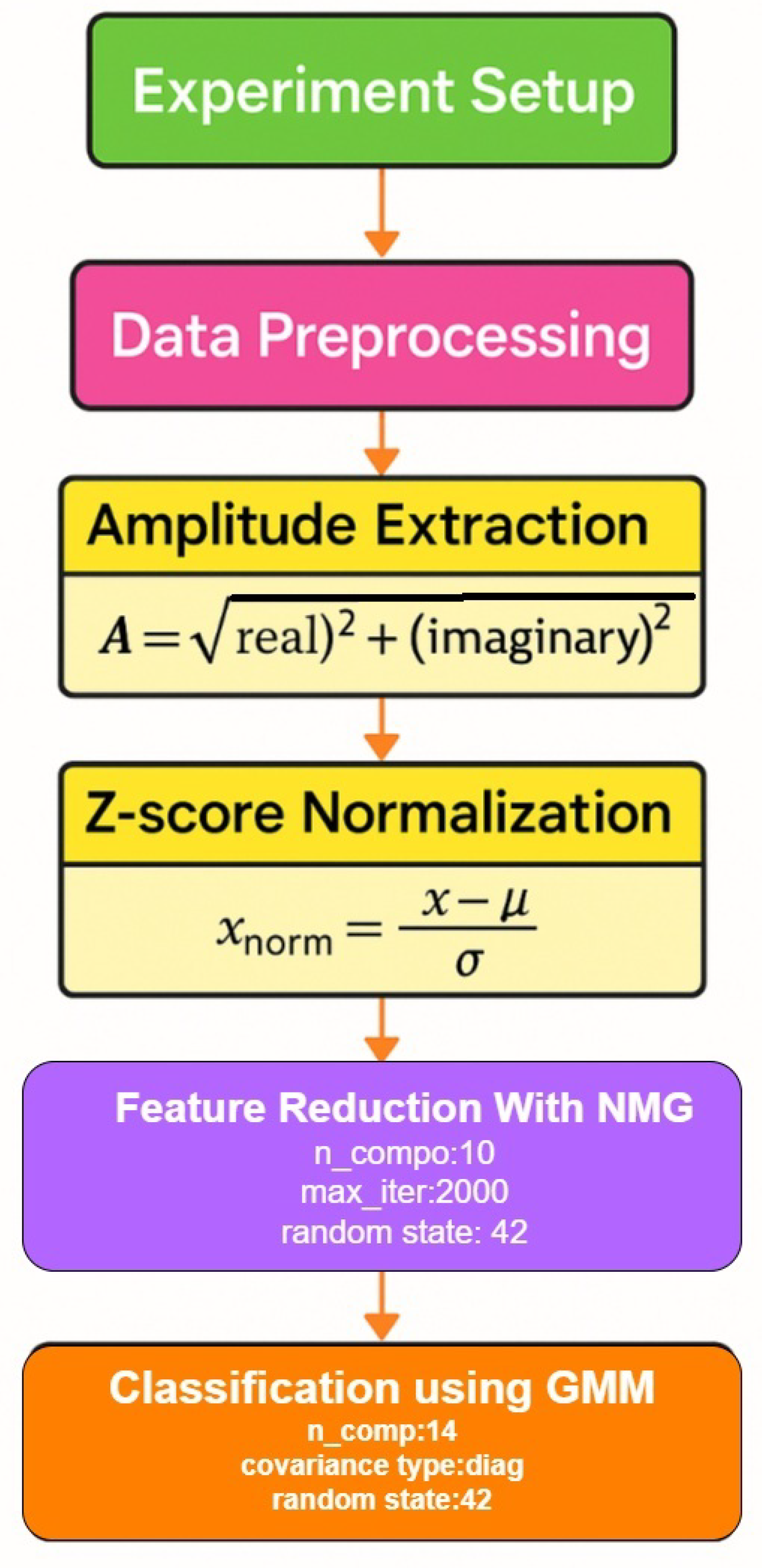
Figure 2.
ESP32 Modules Used in the Experiment
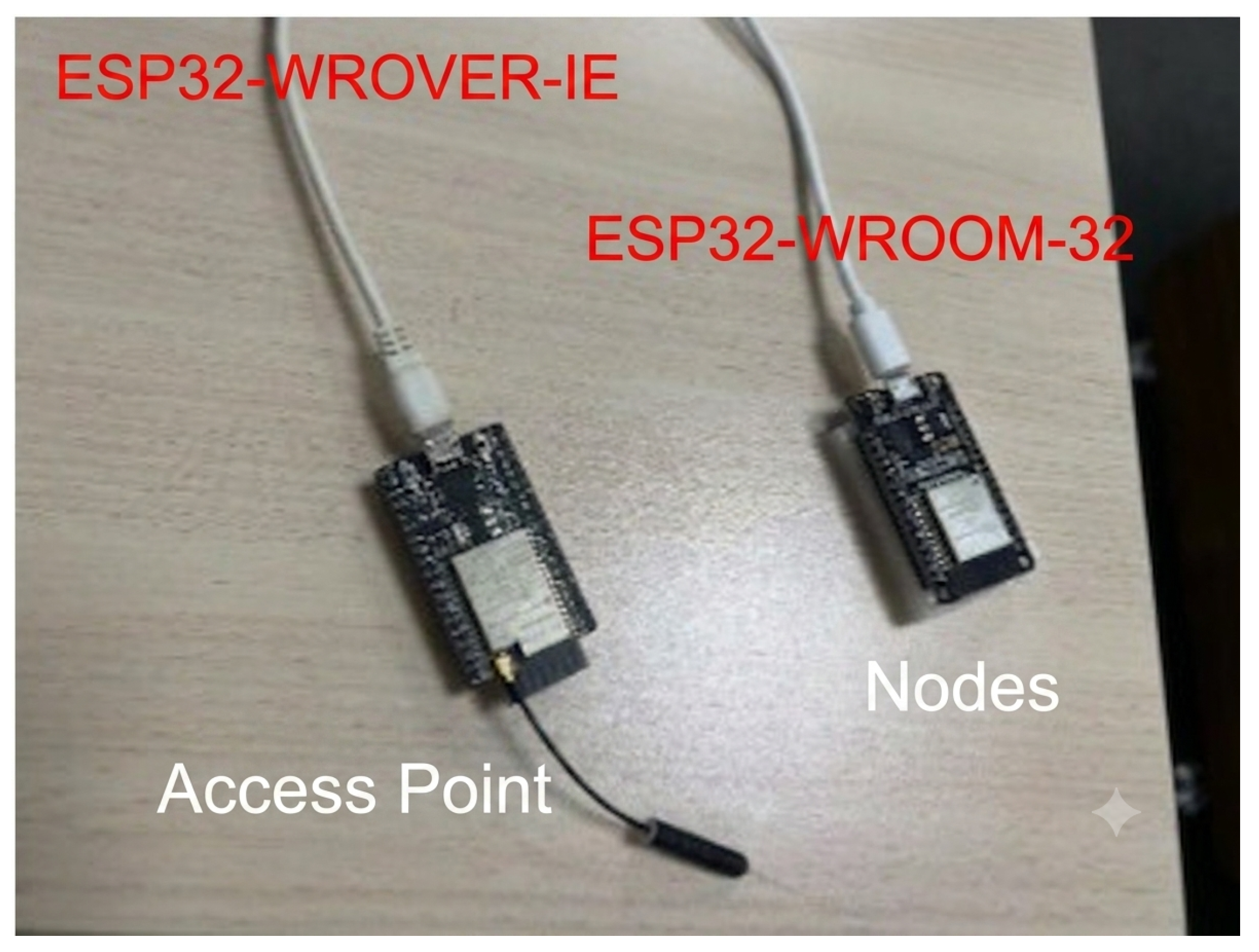
Figure 3.
Experiment Setup in Lab explaining the positions of the nodes
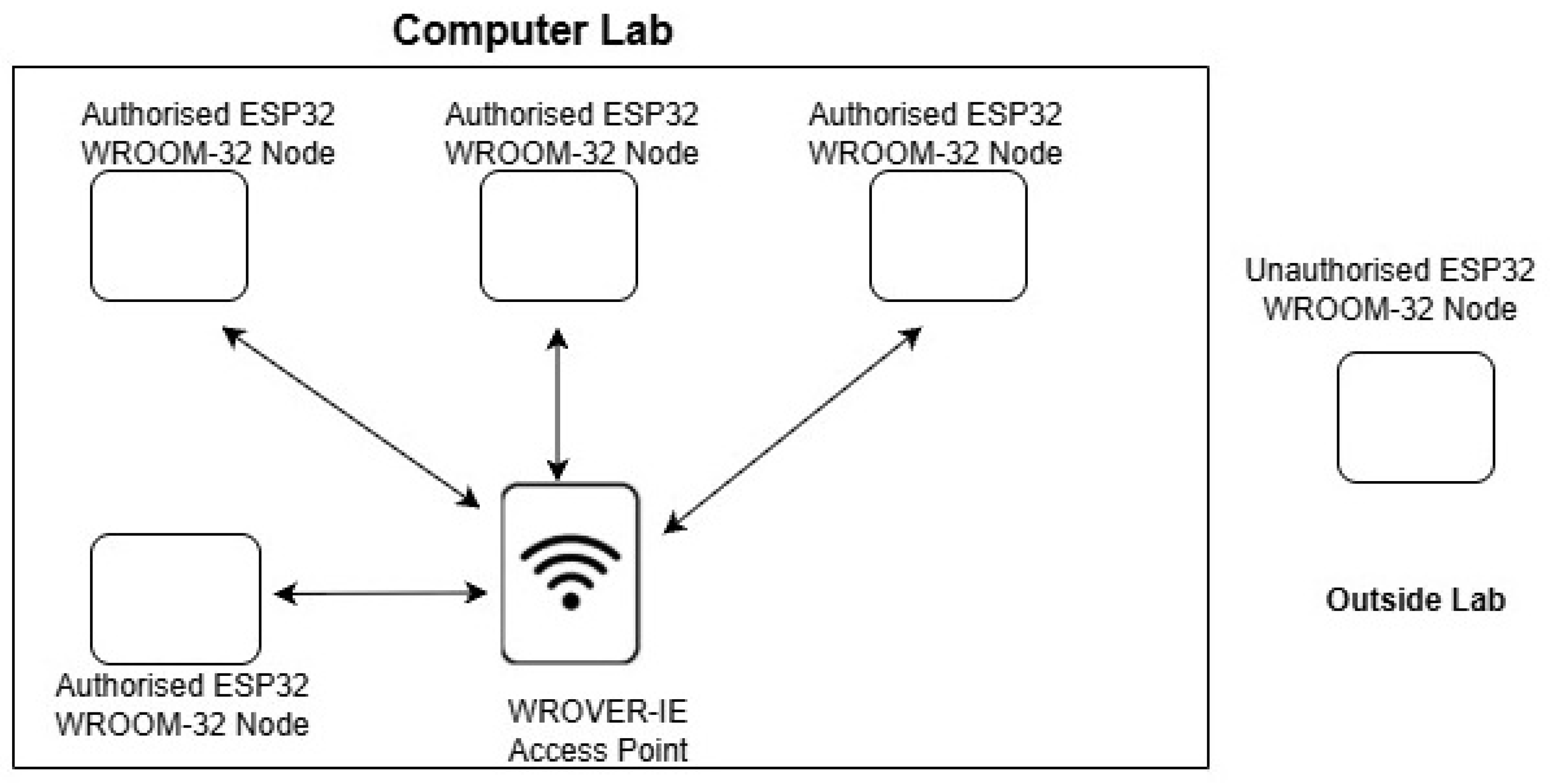
Figure 4.
Layout of subcarrier types in the Wi-Fi frequency domain [22]
Figure 4.
Layout of subcarrier types in the Wi-Fi frequency domain [22]
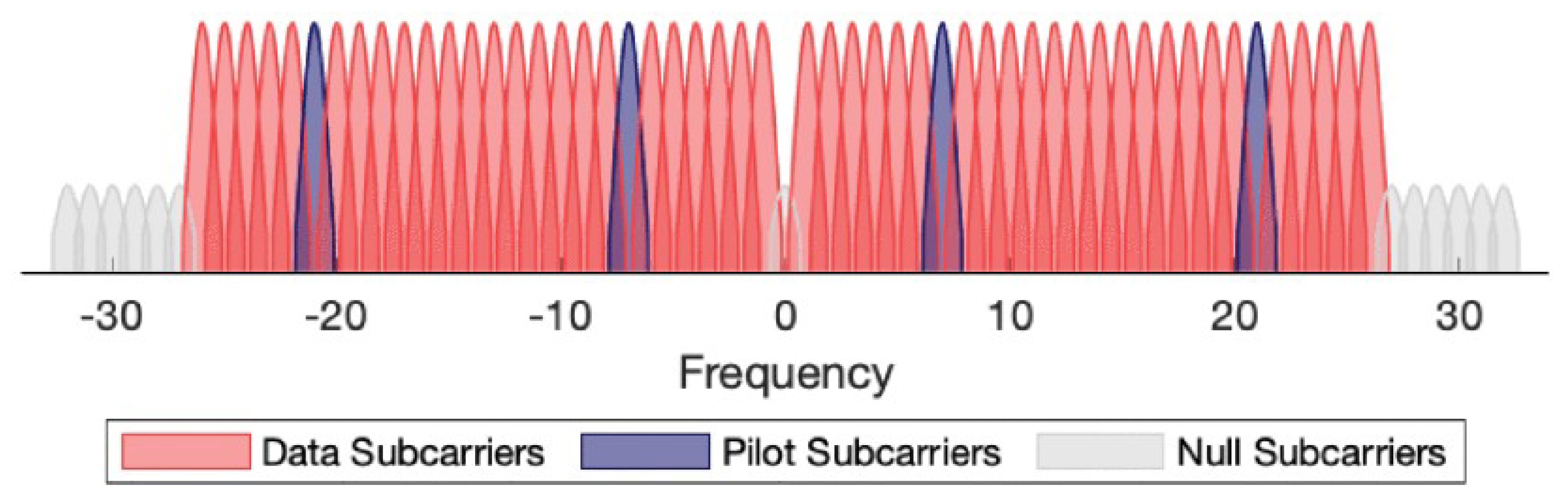
Figure 5.
Comparison of computer resource consumption on training data by Proposed Method, CNN, LSTM, and CNN+LSTM models.
Figure 5.
Comparison of computer resource consumption on training data by Proposed Method, CNN, LSTM, and CNN+LSTM models.
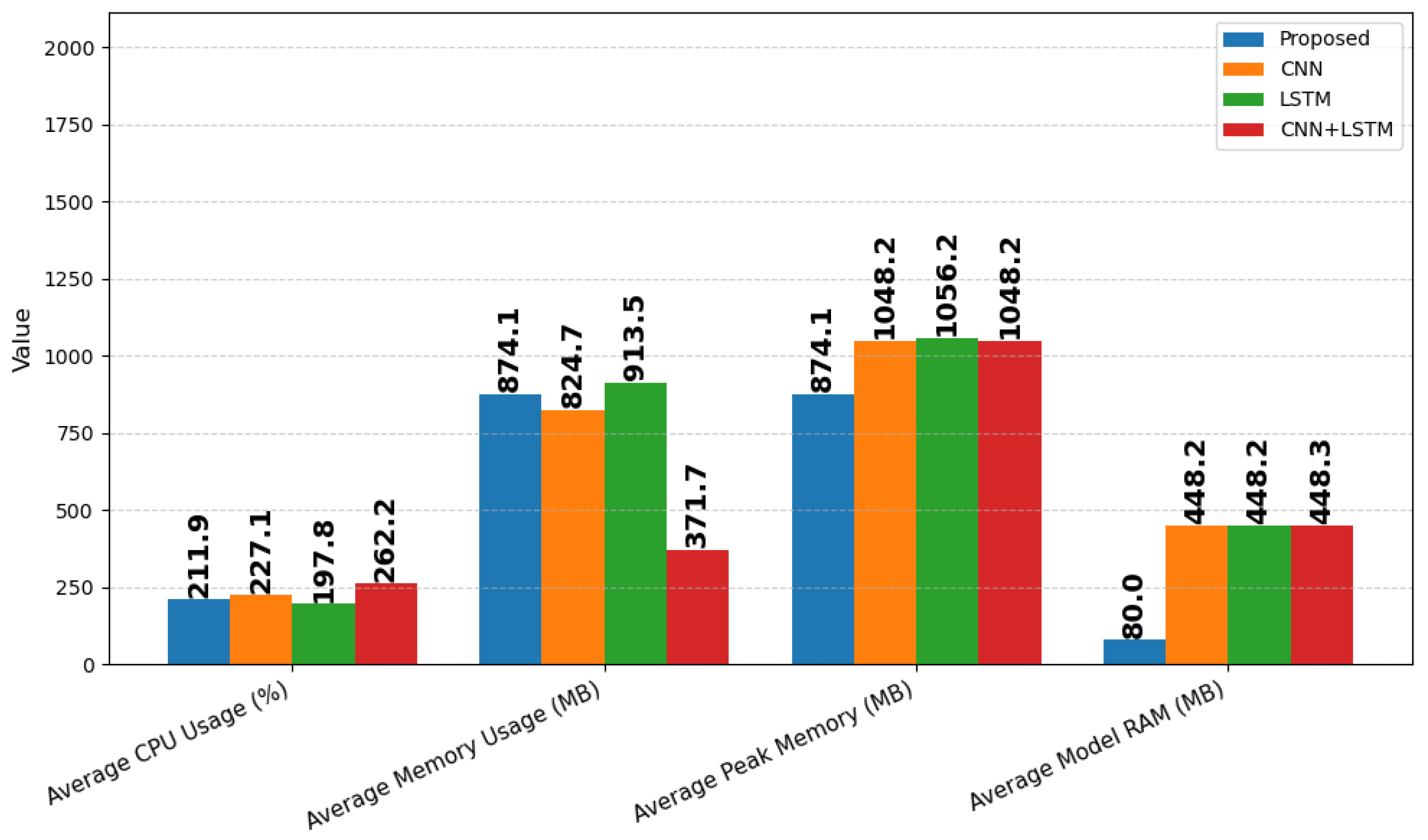
Figure 6.
Comparison of CPU time consumption by Proposed Method, CNN, LSTM and CNN+LSMT models.
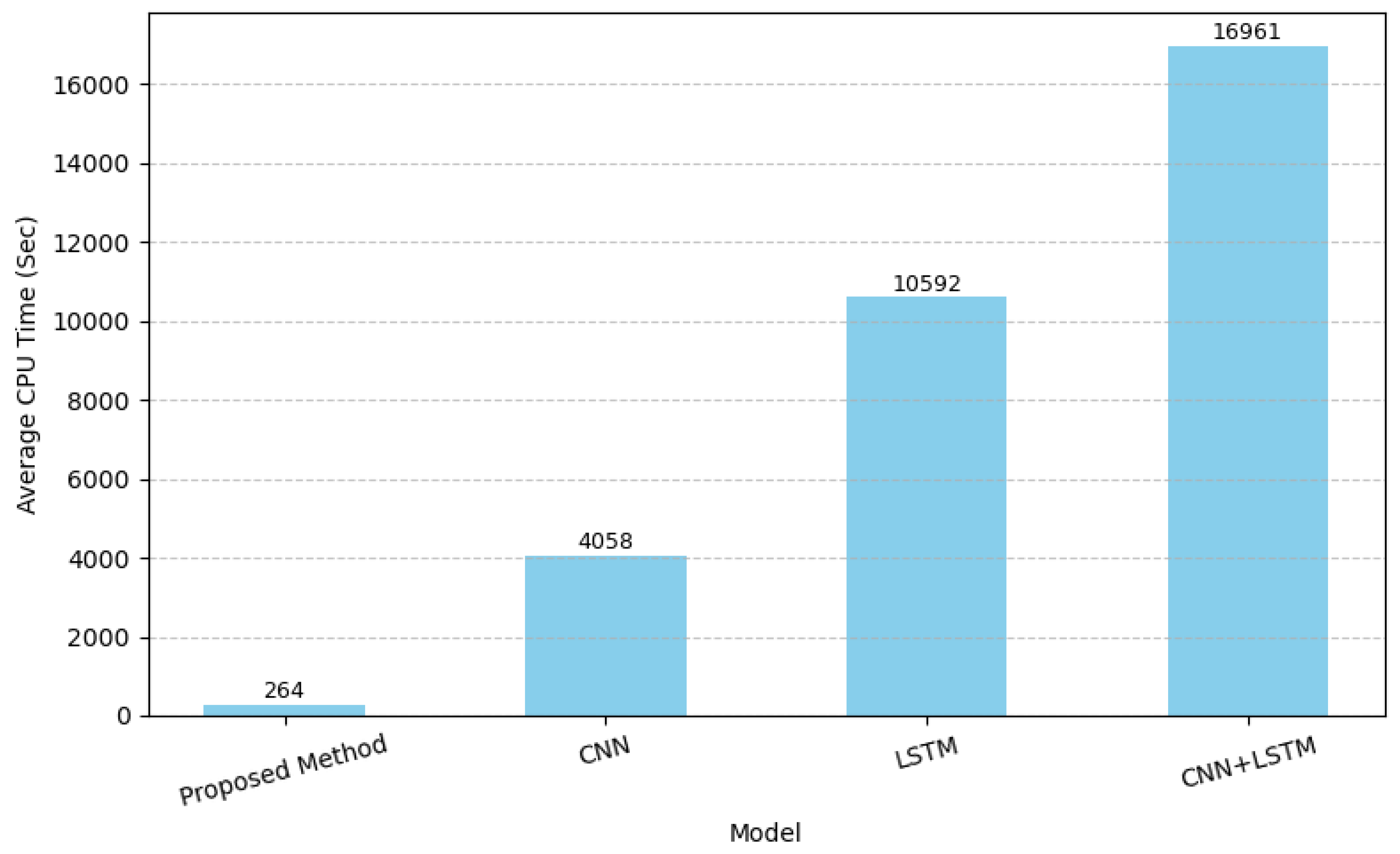
Figure 7.
Comparison of energy consumption by Proposed Method, CNN, LSTM and CNN+LSTM models.
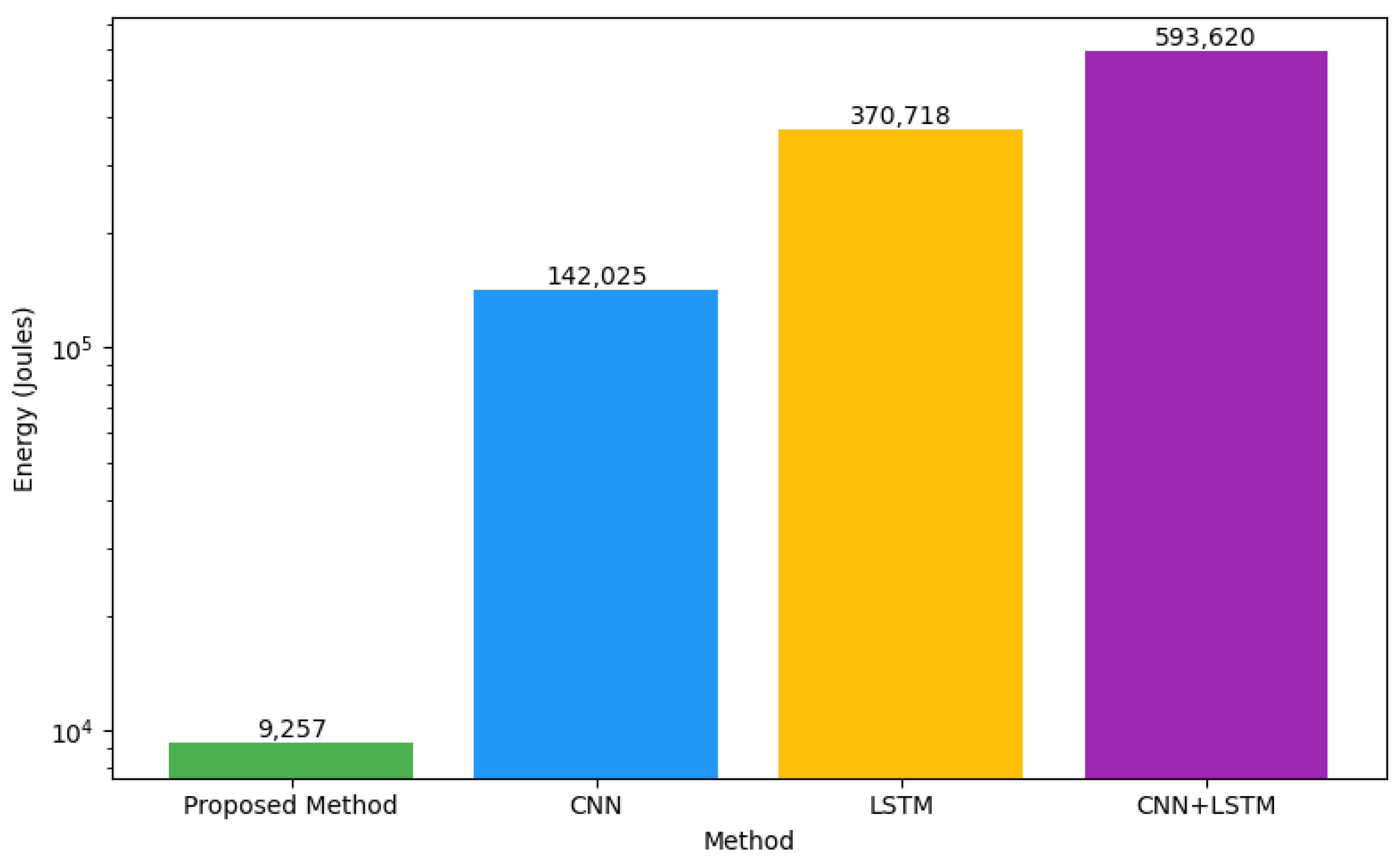
Figure 8.
Comparison of results on test data of Proposed Method with CNN, LSTM, CNN+LSMT
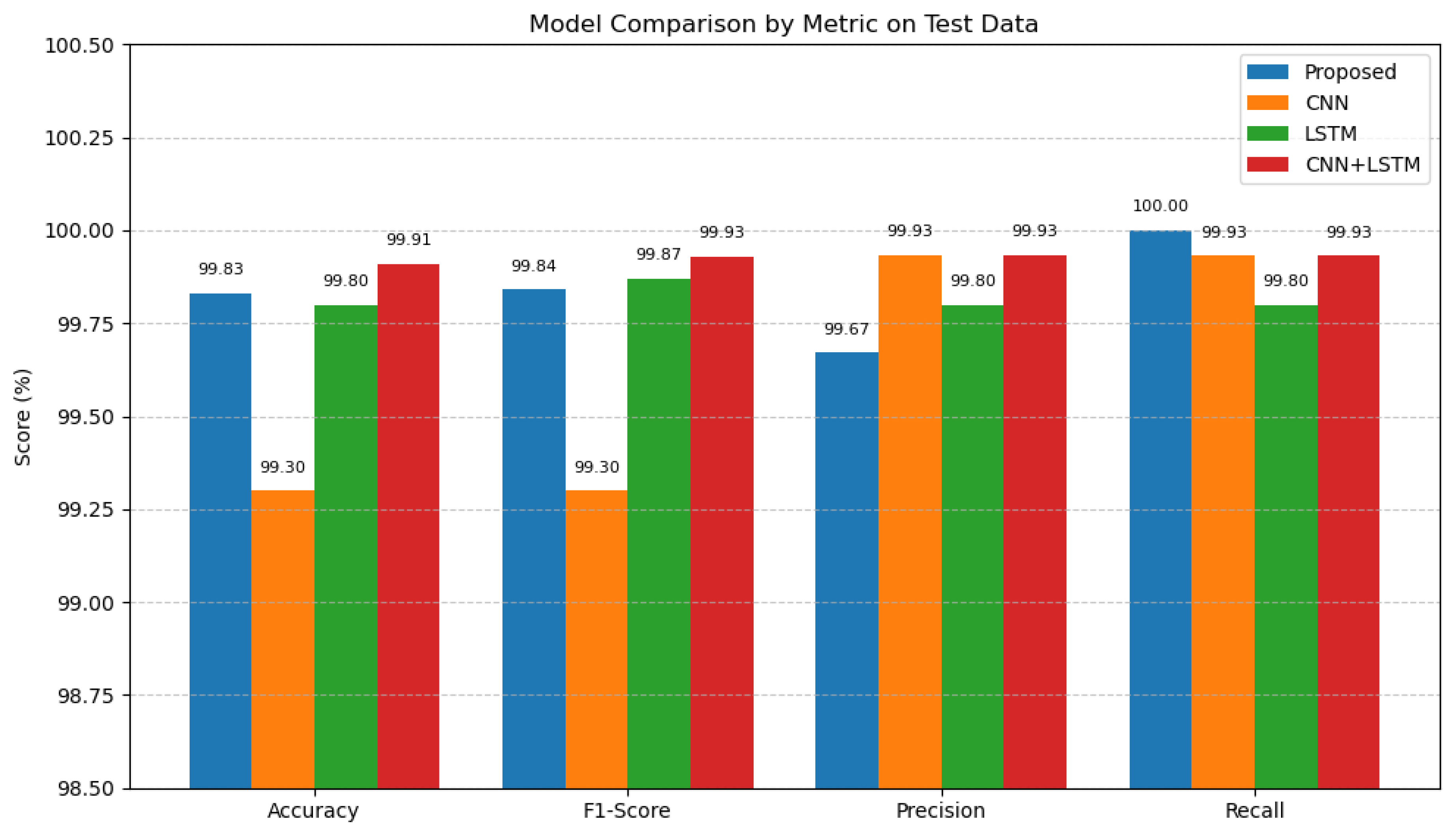

Table 1.
Performance comparison of different methods based on accuracy and probability of detection.
Disclaimer/Publisher’s Note: The statements, opinions and data contained in all publications are solely those of the individual author(s) and contributor(s) and not of MDPI and/or the editor(s). MDPI and/or the editor(s) disclaim responsibility for any injury to people or property resulting from any ideas, methods, instructions or products referred to in the content. |
© 2026 by the authors. Licensee MDPI, Basel, Switzerland. This article is an open access article distributed under the terms and conditions of the Creative Commons Attribution (CC BY) license (http://creativecommons.org/licenses/by/4.0/).
Copyright: This open access article is published under a Creative Commons CC BY 4.0 license, which permit the free download, distribution, and reuse, provided that the author and preprint are cited in any reuse.