

Submitted:
06 June 2026
Posted:
09 June 2026
You are already at the latest version
Abstract
Automated corrosion inspection is essential in the maritime industry, where continuous monitoring of ship hulls and docking infrastructure is necessary to ensure operational safety and structural reliability. However, many existing predictive and deep learning-based approaches depend heavily on large annotated datasets, extensive training procedures, and substantial computational resources, limiting their practicality in real-world and resource-constrained inspection environments. To address these challenges, this work presents a compact and fully unsupervised corrosion segmentation framework for ship docking images based on graph-based similarity modeling and community-aware clustering. The proposed approach constructs pixel-level structural representations using lightweight graph descriptors, performs coarse clustering to obtain initial segmentation labels, and refines spatial consistency through Leiden community detection. Unlike conventional unsupervised segmentation techniques that frequently over-smooth fine structures or generate overly simplified partitions, the proposed method preserves localized corrosion patterns while effectively suppressing segmentation noise. We compare the framework against established unsupervised segmentation methods, including graph-based segmentation, probabilistic aggregation, mean-shift segmentation, and normalized cuts, using compactness, silhouette coefficient, and edge density as evaluation metrics. Experimental observations demonstrate that the proposed approach achieves improved structural delineation and boundary preservation while remaining entirely training-free and computationally efficient. By leveraging graph-based similarity matching without reliance on supervised learning, the framework offers a scalable and interpretable solution for practical industrial inspection scenarios. The lightweight design further supports potential adaptation to broader structural monitoring applications, including pipelines, offshore systems, and large-scale infrastructure inspection.
Keywords:
image segmentation
; unsupervised learning
; graph-based methods
; clustering
; computer vision
; pattern recognition
; image analysis
; structural monitoring
; industrial inspection
; infrastructure assessment
; feature extraction
; machine learning applications
; data-driven analysis
; automated inspection
; intelligent monitoring
1. Introduction
The maritime industry depends heavily on the structural reliability and long-term integrity of vessels to ensure operational safety, regulatory compliance, and economic sustainability. Corrosion and surface degradation on ship hulls remain among the most significant challenges in marine environments, where prolonged exposure to moisture, salinity, and harsh weather conditions accelerates material deterioration. To maintain safety standards and comply with international maritime regulations such as the International Convention for the Safety of Life at Sea (SOLAS), ships are required to undergo periodic inspection and maintenance procedures, often involving expensive dry-docking operations. Traditionally, corrosion assessment is performed through manual visual inspection by trained professionals. Although effective, this process is labor-intensive, time-consuming, and susceptible to subjective variability across inspectors and operating conditions. Consequently, automated image-based inspection systems have gained increasing attention as scalable alternatives for supporting routine maritime maintenance and structural monitoring.
Recent advances in computer vision and image segmentation have demonstrated strong potential for automated corrosion detection and defect localization in industrial environments. Deep learning-based segmentation approaches, including convolutional architectures and hierarchical feature extraction methods, have shown promising performance in identifying corrosion patterns on marine hulls and metallic surfaces [1,2]. In parallel, intelligent inspection systems based on machine vision, digital twin technologies, and autonomous robotic platforms have further improved the efficiency of structural monitoring workflows [3]. Drone-assisted inspection systems equipped with AI-based navigation and detection algorithms are also being explored for automated analysis of complex hull geometries and confined docking structures [3]. Despite these advances, many existing approaches rely heavily on supervised learning paradigms that require extensive annotated datasets, repeated retraining, and substantial computational infrastructure. Such requirements limit practical deployment in real-world maritime inspection settings, particularly in low-resource environments where labeled data availability and computational accessibility remain constrained.
Although image segmentation has been extensively studied across computer vision applications, unsupervised corrosion segmentation for maritime inspection remains comparatively underexplored. Most existing corrosion detection pipelines depend on supervised semantic segmentation frameworks trained on carefully annotated datasets, which are difficult and expensive to construct for marine environments. In contrast, unsupervised segmentation approaches offer a lightweight alternative by enabling separation of corroded and non-corroded regions without requiring pixel-level annotations. Binary segmentation frameworks are particularly useful in industrial inspection settings because they simplify interpretation and enable rapid identification of structurally degraded regions. Previous studies have shown that clustering-based segmentation and pseudo-label optimization strategies can support effective feature separation even in challenging inspection imagery with limited defect visibility [4]. However, many classical unsupervised segmentation methods tend to produce overly smooth or structurally simplistic partitions, reducing their ability to preserve localized corrosion boundaries and fine-grained defect patterns.
Data preprocessing also plays a significant role in improving segmentation quality under noisy and low-resolution imaging conditions. Techniques such as normalization, feature refinement, and dimensionality reduction are commonly employed to improve structural consistency and suppress irrelevant variations [8–11]. However, increasing reliance on complex predictive models and deep architectures introduces scalability concerns for long-term deployment. Continuous retraining, high computational demands, and infrastructure requirements make many supervised solutions difficult to maintain in real-time industrial environments, particularly for large-scale inspection systems operating under limited computational budgets.
Motivated by these limitations, this work presents a compact and fully unsupervised framework for corrosion segmentation in ship docking images using graph-based similarity modeling and Leiden community refinement. The proposed method constructs lightweight pixel-level structural descriptors, performs clustering-based initialization, and refines segmentation coherence through graph community optimization. Unlike conventional unsupervised approaches that frequently over-smooth defect regions, the proposed framework preserves localized corrosion structures while remaining entirely training-free and computationally efficient. The approach is specifically designed for practical deployment in resource-constrained inspection environments where interpretability, scalability, and minimal infrastructure dependence are essential.
The primary contributions of this work are summarized as follows:
- We develop a fully unsupervised binary segmentation framework for corrosion detection in ship docking images using graph-based similarity matching and community refinement.
- We introduce a lightweight structural descriptor representation that enables effective separation of corroded and non-corroded regions without supervised training.
- We integrate clustering and Leiden community detection to improve spatial coherence while preserving localized corrosion boundaries and fine structural patterns.
- We evaluate the proposed framework against multiple established unsupervised segmentation approaches using quantitative structural metrics and qualitative analysis.
- We provide a computationally efficient and scalable inspection framework suitable for deployment in low-resource and real-world industrial monitoring environments.
The proposed framework establishes a practical foundation for scalable maritime defect inspection while also demonstrating potential applicability to broader industrial monitoring tasks such as offshore infrastructure assessment, pipeline inspection, and structural surface analysis.
2. Related Works
Corrosion remains one of the most significant challenges affecting the maritime industry, particularly in large carrier ships, offshore infrastructure, and docking systems where prolonged exposure to saline and humid environments accelerates material degradation. Structural corrosion not only increases operational and maintenance costs but also introduces major safety concerns associated with hull weakening, leakage, and mechanical failure [12–14]. Traditional inspection strategies largely depend on manual visual assessment during scheduled maintenance and dry-docking procedures. Although widely adopted, these approaches are labor-intensive, time-consuming, and susceptible to inconsistencies arising from environmental conditions and subjective interpretation [15]. Consequently, automated inspection systems based on computer vision and machine learning have gained increasing attention due to their ability to improve inspection efficiency, reduce operational overhead, and support scalable structural monitoring.
Recent developments in image analysis and defect detection have demonstrated the effectiveness of automated segmentation frameworks for identifying corrosion and surface anomalies in industrial environments. Supervised deep learning architectures such as YOLO-based detectors, transformer-assisted segmentation models, and convolutional encoder-decoder networks have shown strong performance in identifying low-contrast defects and corrosion boundaries [16–20]. Self-supervised and pseudo-label optimization strategies have further improved segmentation capability in scenarios with limited annotations by leveraging clustering-based feature learning and weak supervision [16]. In parallel, large-scale segmentation models such as the Segment Anything Model (SAM) have highlighted the potential of foundation models for industrial inspection tasks involving variable defect morphology and limited sample availability [19]. Despite these advances, many existing methods remain heavily dependent on large annotated datasets, repeated retraining, and substantial computational infrastructure, limiting practical deployment in resource-constrained maritime environments.
Unsupervised image segmentation methods offer an attractive alternative for corrosion inspection because they avoid the dependence on pixel-level labels while remaining computationally efficient and interpretable. Clustering-based techniques such as K-means and Mean Shift remain widely used due to their ability to group structurally similar pixels into homogeneous regions [21,22]. More recently, graph-based segmentation and spectral clustering methods have demonstrated improved capability for handling complex textures and irregular surface structures [23]. Self-supervised architectures, including autoencoder-based frameworks and pseudo-label generation methods such as U2Seg, have also shown promising performance across segmentation benchmarks without requiring explicit annotations [24]. Hybrid approaches that combine classical graph partitioning with feature learning are particularly relevant for industrial inspection because they improve segmentation consistency under varying scales, textures, and imaging conditions [21,24,25].
Binary segmentation frameworks are especially useful in corrosion detection because they simplify inspection outputs into interpretable corroded and non-corroded regions. Several recent studies have focused on improving binary masking through adaptive thresholding, attention mechanisms, and lightweight decoder architectures. For example, adaptive thresholding modules dynamically estimate segmentation thresholds to improve defect localization under varying illumination conditions [26]. Architectures such as GateNet selectively propagate contextual information across multiple feature scales to improve boundary discrimination [27], while lightweight segmentation networks like EBSNet simplify decoding operations while preserving segmentation quality [28]. Difference-aware decoding strategies inspired by human visual perception have also demonstrated improved robustness in separating foreground defects from noisy industrial backgrounds [29]. These developments collectively highlight the growing importance of lightweight and interpretable segmentation methods for industrial defect analysis.
Among classical unsupervised segmentation algorithms, graph partitioning methods remain particularly influential due to their strong structural interpretability. The normalized cuts algorithm formulates segmentation as a graph partitioning problem where similarity within segments is maximized while dissimilarity between segments is minimized. Given graph partitions A and B, the normalized cut criterion is defined as:
where represents the total edge weight connecting regions A and B, and denotes the total connection weight between region A and all nodes in the graph. In corrosion inspection, normalized cuts can effectively separate large degraded regions from surrounding surfaces using texture and intensity similarities.
Mean Shift segmentation is another widely used unsupervised clustering technique that identifies dense regions in feature space by iteratively shifting data points toward local density maxima. The Mean Shift vector is estimated as:
where is the kernel function and denotes the neighborhood around feature point x. Mean Shift is particularly useful for identifying homogeneous corrosion patches because corroded regions often exhibit consistent texture and intensity characteristics.
Felzenszwalb’s graph-based segmentation algorithm represents images as weighted graphs where pixels correspond to nodes and edge weights encode local similarity relationships. The segmentation criterion prioritizes strong intra-region similarity while preserving differences across neighboring regions. The dissimilarity measure between regions and is expressed as:
where denotes the edge weight between neighboring pixels p and q. This method is especially useful for corrosion boundary detection because rust regions frequently exhibit sharp local intensity variations and irregular surface transitions.
Agglomerative clustering approaches perform bottom-up hierarchical grouping by iteratively merging similar clusters according to a predefined linkage criterion. Ward’s linkage criterion minimizes the increase in intra-cluster variance during merging and is defined as:
where A and B represent clusters, and denote their centroids, and and correspond to cluster sizes. Hierarchical clustering methods are particularly useful in corrosion inspection because they allow gradual aggregation of structurally similar regions, enabling segmentation of diverse corrosion textures and patterns.
Although these classical methods provide useful structural priors for image segmentation, many tend to produce overly simplified partitions or fail to preserve localized defect boundaries in challenging inspection imagery. Motivated by these limitations, the present work combines graph-based similarity modeling with clustering and Leiden community refinement to improve spatial coherence while preserving fine-grained corrosion structures in a fully unsupervised and computationally efficient manner.
3. Methodology
An overview of the proposed pipeline is shown in Figure 1. Each input image is first converted to grayscale and resized to a fixed resolution for computational efficiency.
Given a grayscale image , a pixel-level grid graph is constructed, where each node corresponds to pixel and edges connect spatially adjacent pixels. Each node stores its intensity value . Edge weights are defined to capture local structural variation as:
where denotes the Euclidean distance between neighboring pixels and controls spatial smoothing.
For each node, a low-dimensional structural descriptor is computed using its intensity, graph degree, and average weighted difference with neighboring nodes:
Descriptors from all images are pooled and clustered globally using K-means with , corresponding to corrosion and non-corrosion regions. The resulting cluster assignments are mapped back to individual images to obtain initial binary label maps.
To improve spatial coherence and suppress noise, the initial labels are refined using Leiden community detection on a similarity graph. Pairwise similarities between adjacent nodes are computed as:
with edges retained above a sparsity threshold. Leiden optimization is initialized using the K-means labels and iteratively refines community assignments. The final corrosion region is identified as the cluster exhibiting higher intensity variance, producing a binary segmentation mask without any supervised training.
3.1. Evaluation Metrics
Evaluating segmentation quality in unsupervised settings remains challenging because no ground-truth annotations are available for direct comparison. Consequently, intrinsic evaluation metrics are commonly employed to assess the structural quality, coherence, and separability of segmented regions. These metrics provide insight into how effectively a segmentation method preserves meaningful structures, suppresses noise, and delineates boundaries between regions of interest.
For the corrosion segmentation task considered in this work, four widely used evaluation metrics are employed to analyze segmentation performance:
- Compactness Score
- Silhouette Coefficient
- Edge Density
- Number of Segments
These metrics collectively evaluate both the internal consistency of segmented regions and the clarity of the boundaries separating corrosion from non-corrosion areas.
Compactness Score.
The compactness score measures the geometric cohesion of segmented regions by comparing the segmented area to the corresponding boundary length. Regions with higher compactness are generally more spatially coherent and less fragmented. The compactness measure is defined as:
where is a small constant introduced to avoid division by zero.
The segmented area is computed as the number of pixels belonging to the segmented region:
where denotes the indicator function.
The perimeter corresponds to the length of the region boundary and is estimated using edge detection:
where denotes the edge map generated using Canny edge detection.
Silhouette Coefficient.
The silhouette coefficient evaluates how well each pixel fits within its assigned cluster relative to neighboring clusters. It measures the degree of separation between segmented regions and is widely used in clustering evaluation. The silhouette coefficient is defined as:
where a denotes the average intra-cluster distance between a pixel and all other pixels within the same segment, and b represents the minimum average inter-cluster distance between the pixel and pixels belonging to other clusters. Higher silhouette values indicate stronger separation and improved clustering consistency.
Edge Density.
Edge density quantifies the ratio of boundary pixels to the total number of pixels in the image. This metric reflects the sharpness and structural definition of segmented boundaries. It is computed as:
where the number of edge pixels is obtained from the detected boundary map and the total number of pixels is given by:
with h and w denoting the image height and width, respectively. Higher edge density values generally indicate stronger preservation of structural boundaries and fine-grained corrosion patterns.
Number of Segments.
The number of segments represents the total number of distinct clusters identified within the segmented image. It provides insight into the granularity and partitioning behavior of the segmentation algorithm and is computed as:
where denotes the set of unique labels present in the segmentation output.
Together, these metrics provide a comprehensive evaluation framework for assessing unsupervised segmentation quality in corrosion detection tasks. They enable quantitative analysis of spatial coherence, cluster separability, structural preservation, and segmentation granularity, offering meaningful insight into the effectiveness of lightweight graph-based segmentation approaches in challenging industrial inspection environments.
4. Analysis and Results
The proposed method is evaluated against commonly used unsupervised segmentation approaches using compactness, silhouette coefficient, and edge density as quantitative indicators of segmentation quality. Compactness reflects intra-region homogeneity, the silhouette coefficient measures cluster separability, and edge density captures the preservation of meaningful boundaries between segmented regions. Across all methods, comparable cluster separability is observed. However, the proposed approach achieves a higher edge density and compactness, indicating improved boundary delineation of corrosion regions while maintaining spatial coherence. These results suggest that the method effectively balances structural preservation and noise suppression in challenging inspection scenarios.
4.1. Experimental Setup
All experiments were conducted using Python 3.10 within a Windows 10 environment. The computational setup consisted of a system equipped with 8GB RAM and an AMD Ryzen 5 5000 series processor. Development and experimentation were primarily performed using Google Colaboratory to ensure reproducibility and ease of execution.
The proposed framework was implemented as a lightweight and fully unsupervised segmentation pipeline without the need for GPU-intensive model training. Standard scientific computing and image processing libraries were employed for graph construction, clustering, similarity analysis, and segmentation evaluation. Since the approach does not rely on deep neural network optimization or iterative supervised learning, the computational overhead remained relatively low throughout experimentation, making the framework suitable for deployment in resource-constrained industrial inspection environments.
4.2. Dataset Description
The dataset used in this study was collected during dry-docking operations on large maritime vessels between 2019 and 2020 and was specifically designed to support corrosion inspection research [30]. The dataset consists of 39 ship hull images captured using two different camera systems under practical inspection conditions. The data are separated into high-resolution and low-resolution subsets, where the low-resolution images contain additional challenges such as varying illumination, surface noise, structural artifacts, and inconsistent texture quality.
All images correspond to hull regions identified by trained inspectors as potentially corroded or structurally degraded during routine inspection procedures. In this work, we focus primarily on the low-resolution subset to evaluate the robustness of the proposed framework under realistic and challenging industrial conditions. These images provide an appropriate benchmark for assessing segmentation quality in practical maritime environments where image quality is often inconsistent and defect boundaries are difficult to isolate.
4.3. Discussion of Unsupervised Segmentation Methods
To evaluate the effectiveness of the proposed framework, we compare it against several established unsupervised segmentation approaches commonly used in image analysis and structural inspection tasks. The comparison includes graph-based segmentation, probabilistic aggregation, Mean Shift segmentation, and normalized cuts. Evaluation is performed using the intrinsic segmentation metrics discussed previously, namely compactness, silhouette coefficient, and edge density.
The graph-based segmentation method achieved a compactness score of 24.88 with a silhouette coefficient of 1.00, indicating strong cluster separability between segmented regions. The corresponding edge density value of 0.0245 suggests moderate preservation of structural boundaries while maintaining relatively smooth segmentation transitions. Although the method was able to distinguish broad foreground and background regions, the resulting segmentation remained relatively coarse for localized corrosion analysis.
Probabilistic aggregation demonstrated improved compactness with a score of 52.00 while maintaining a silhouette coefficient of 1.00. The lower edge density value of 0.0201 indicates smoother transitions between neighboring regions, producing more cohesive segmentation structures than the graph-based approach. However, this smoothing behavior may suppress subtle corrosion boundaries and reduce sensitivity to smaller structural variations.
Mean Shift segmentation achieved a compactness score of 115.68, representing a significant improvement in region cohesion compared to the previous baseline methods. The silhouette coefficient remained at 1.00, indicating clear separation between clusters. However, the edge density value decreased to 0.0133, suggesting that the segmentation process introduced stronger smoothing effects that reduced boundary sharpness. While this behavior improves spatial consistency, it may also lead to the loss of fine-grained corrosion patterns and localized structural details.
Normalized cut segmentation achieved a compactness score of 17.38 with an edge density value of 0.0249. Similar to graph-based segmentation, the method preserved broad structural boundaries while maintaining effective cluster separation. However, the relatively lower compactness indicates weaker intra-region coherence, limiting its ability to generate refined segmentation structures under challenging imaging conditions.
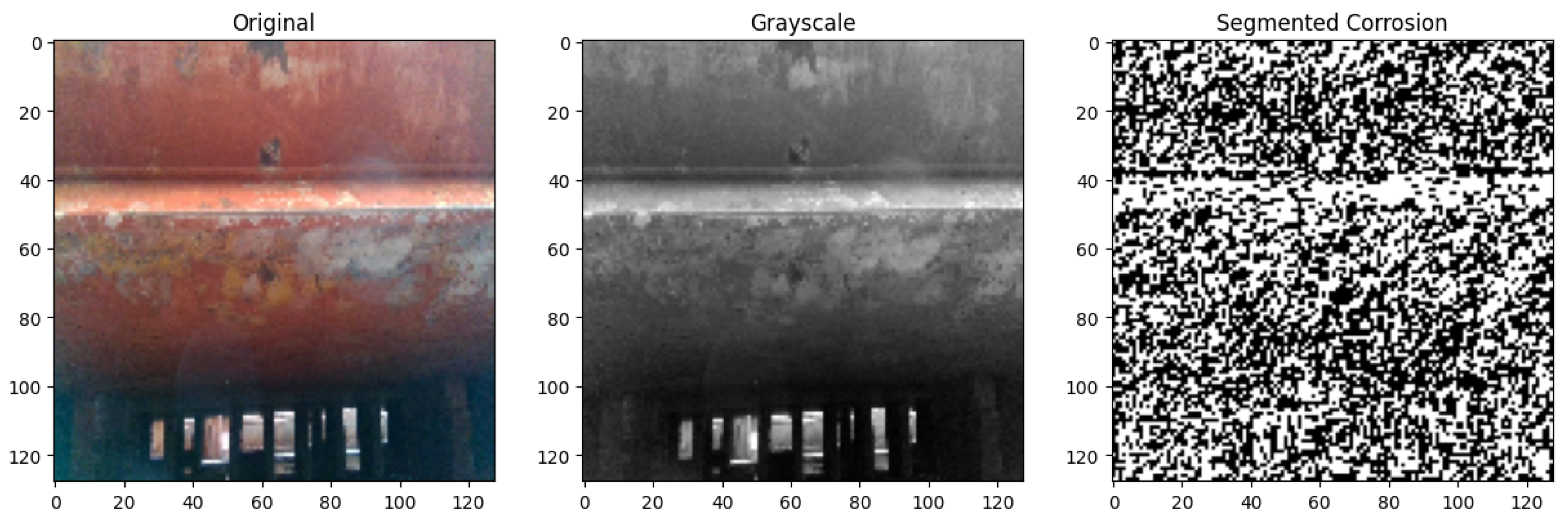
The proposed graph-based clustering and Leiden refinement framework demonstrated the strongest overall performance across the evaluated structural metrics. As shown in Table 1, the proposed method achieved the highest compactness score of 136.61 while simultaneously producing a substantially higher edge density value of 0.2789. This combination suggests that the framework successfully preserves localized corrosion boundaries and fine structural transitions without excessively smoothing the segmentation output. Unlike conventional unsupervised methods that often generate simplified partitions or diffuse region boundaries, the proposed approach maintains sharper delineation between corroded and non-corroded areas while preserving spatial coherence through graph community refinement.
An additional observation is that all methods achieved a silhouette coefficient of 1.00, indicating strong separability between the generated clusters. Consequently, the primary differences between methods emerge from their ability to preserve structural boundaries and maintain coherent segmentation regions. In this context, the proposed framework demonstrates a more balanced segmentation behavior by combining strong region compactness with significantly improved edge preservation.
Figure 2.
Qualitative comparison of corrosion segmentation on a representative docking-area image using existing unsupervised methods from the literature.
Figure 2.
Qualitative comparison of corrosion segmentation on a representative docking-area image using existing unsupervised methods from the literature.
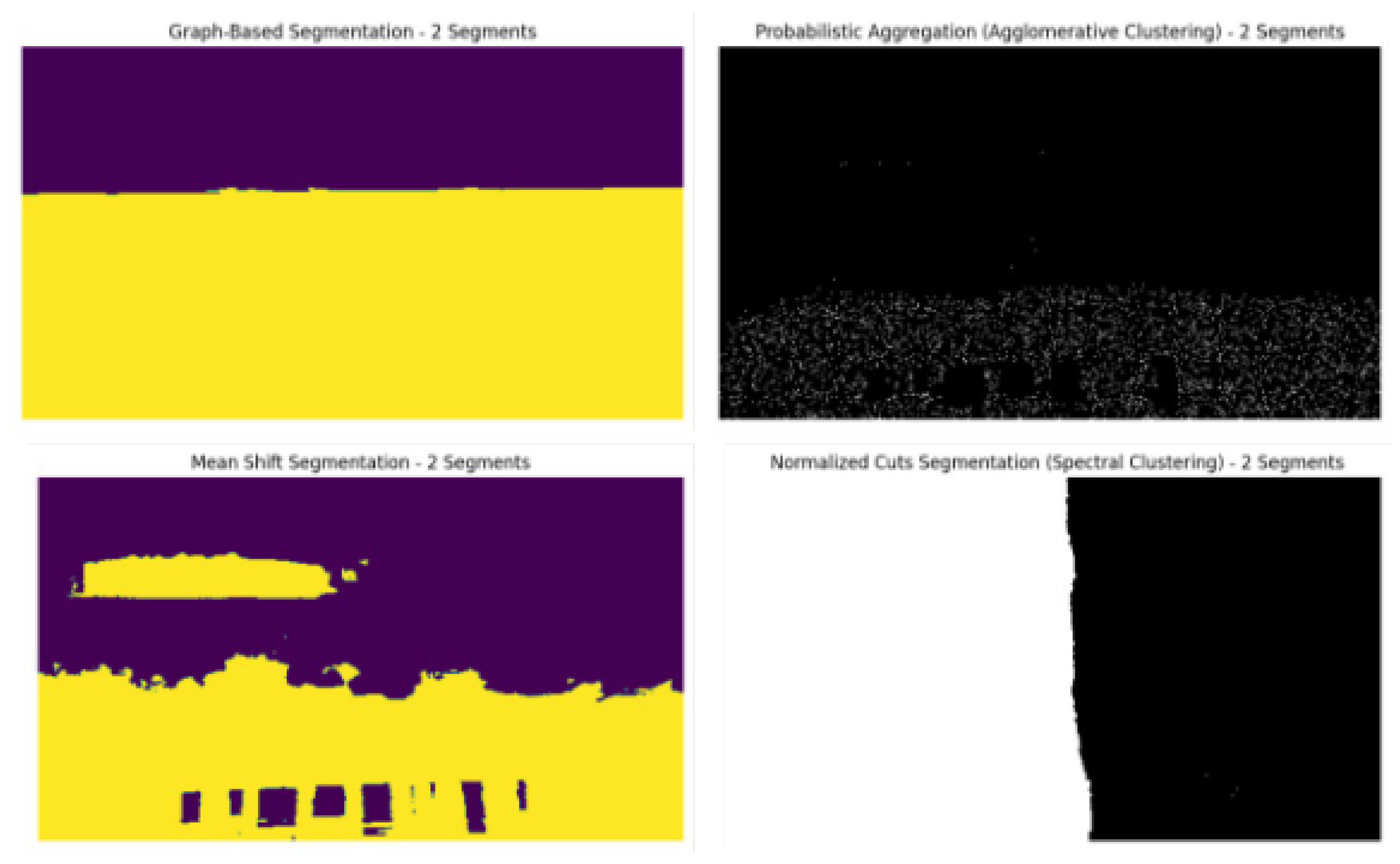
Qualitative observations further support the quantitative findings. Existing methods frequently produced overly smooth segmentations that failed to capture subtle corrosion structures and localized degradation patterns present in low-resolution docking images. In contrast, the proposed framework generated more structurally detailed segmentation masks with reduced fragmentation and clearer boundary definition. These results highlight the effectiveness of integrating graph-based similarity modeling with Leiden community optimization for practical corrosion inspection tasks in noisy industrial environments.
Overall, the experimental analysis demonstrates that the proposed lightweight unsupervised framework provides improved structural sensitivity, stronger boundary preservation, and enhanced segmentation coherence compared to several widely used unsupervised segmentation techniques. The fully training-free design additionally supports scalability and practical deployment in real-world maritime inspection systems operating under computational and data constraints.
Figure 3.
Segmentation result produced by the proposed graph-based clustering and community refinement approach.
Figure 3.
Segmentation result produced by the proposed graph-based clustering and community refinement approach.
5. Conclusions
This work presents a compact, fully unsupervised framework for corrosion segmentation in ship docking images. The proposed approach demonstrates strong structural sensitivity, particularly in preserving fine corrosion patterns, while remaining computationally efficient and training-free. Despite slightly lower compactness, the method achieves improved boundary delineation and scalability, making it suitable for deployment in large-scale and resource-constrained inspection environments where labeled data and model-heavy solutions are impractical.
6. Conclusions
This work presented a compact and fully unsupervised framework for corrosion segmentation in ship docking images using graph-based similarity modeling and Leiden community refinement. The proposed approach was designed to address the limitations commonly associated with supervised and computationally intensive segmentation methods, particularly in maritime inspection environments where labeled datasets, computational infrastructure, and real-time adaptability remain significant challenges.
Experimental analysis demonstrated that several conventional unsupervised segmentation approaches, including graph-based segmentation, probabilistic aggregation, Mean Shift segmentation, and normalized cuts, were capable of separating broad structural regions within the images. However, many of these methods produced overly smooth or simplified partitions that struggled to preserve localized corrosion structures and fine-grained defect boundaries. While Mean Shift achieved relatively strong region compactness, it introduced substantial smoothing effects that reduced boundary sharpness. Similarly, graph-based and normalized cut approaches preserved larger structural transitions but lacked sufficient segmentation detail for challenging low-resolution inspection imagery.
In contrast, the proposed framework demonstrated stronger structural sensitivity and improved boundary preservation while maintaining spatial coherence across segmented regions. The integration of clustering-based initialization with Leiden community refinement enabled more detailed delineation between corroded and non-corroded areas, particularly under noisy and low-resolution conditions. Quantitative evaluation further showed that the proposed method achieved the highest compactness and edge density values among the evaluated approaches, indicating improved preservation of meaningful structural transitions and localized corrosion patterns.
An important advantage of the proposed framework is its fully training-free and lightweight design. Unlike deep learning-based segmentation systems that require extensive annotated datasets and repeated retraining, the proposed method relies on graph similarity relationships and structural clustering, enabling efficient deployment under limited computational resources. This makes the framework especially suitable for practical industrial inspection environments where scalability, interpretability, and low infrastructure requirements are essential.
Beyond maritime corrosion inspection, the proposed segmentation strategy may also be applicable to broader industrial and structural monitoring tasks, including infrastructure assessment, pipeline inspection, surface degradation analysis, and related defect detection scenarios where lightweight unsupervised segmentation is advantageous.
7. Future Directions and Limitations
Although the proposed framework demonstrates promising performance for unsupervised corrosion segmentation, several opportunities remain for further improvement and extension.
One important future direction involves the development of hybrid segmentation frameworks that combine the interpretability and efficiency of unsupervised methods with the representational power of supervised deep learning models [31–35]. Hybrid approaches could leverage unlabeled inspection data for structural feature learning while incorporating supervised refinement in scenarios where annotated data are partially available. Such strategies may improve segmentation robustness and enhance sensitivity toward subtle structural degradation patterns.
Another potential research direction involves improving robustness under highly variable environmental conditions. Real-world maritime inspection images often exhibit inconsistent illumination, motion blur, noise, occlusions, and varying surface textures. Incorporating adaptive preprocessing strategies, multi-scale similarity modeling, or domain adaptation techniques could improve generalization across different vessel types, inspection devices, and environmental settings.
Future work may also explore the integration of temporal and sequential inspection data for monitoring corrosion progression over time [36–40]. Combining image-based segmentation with temporal structural analysis or sensor-driven monitoring systems could support predictive maintenance frameworks capable of identifying degradation trends before severe structural failure occurs. Such extensions may be particularly valuable for autonomous inspection systems and large-scale industrial monitoring applications.
In addition, the proposed framework may be extended beyond maritime inspection to applications such as bridge and pipeline monitoring, industrial surface analysis, aerospace inspection, and agricultural imaging. Since the method operates without task-specific training, it offers flexibility for adaptation across multiple structural segmentation problems involving limited labeled data.
Despite the promising results, several limitations should also be acknowledged. First, the evaluation primarily relies on intrinsic segmentation metrics such as compactness, silhouette coefficient, and edge density. While these metrics provide meaningful structural insight, additional benchmarking against larger public datasets and alternative segmentation evaluation criteria would further strengthen the analysis.
Second, the current framework focuses primarily on binary separation between corroded and non-corroded regions. More complex degradation patterns, including microcracks, layered corrosion, or subtle surface anomalies, may require richer structural descriptors and more advanced segmentation strategies. Improving sensitivity toward fine-grained defects remains an important direction for future research.
Finally, although the lightweight and training-free nature of the framework provides strong computational advantages, purely unsupervised approaches may not always achieve the same level of semantic understanding as large-scale supervised models trained on extensive datasets. Future hybrid approaches that combine graph-based structural refinement with learned feature representations may offer an effective balance between computational efficiency, interpretability, and segmentation accuracy.
Acknowledgments
The authors would like to acknowledge the AAAI 2026 Workshop on EGSAI, where this work was accepted and presented as part of the workshop’s three-minute presentation session. The recognition and feedback received during the workshop significantly contributed to the refinement and discussion of this research. The implementation and experimental code associated with this work is publicly available at: https://github.com/IsshaanSingh2701/Corrosion-Segmentation-in-Ships.
References
- Chliveros, G.; Tzanetatos, I.; Kontomaris, S. V. A Deep Learning Image Corrosion Classification Method for Marine Vessels Using an Eigen Tree Hierarchy Module. Coatings 2024. [Google Scholar] [CrossRef]
- Yu, Q.; Han, Y. Recognition of Surface Corrosion Morphology on Coastal Engineering Structures Using Machine Vision Technology. 2024. [Google Scholar] [CrossRef]
- Stensrud, E.; Bjørdalsbakke, H. O.; Hamre, G.; Raeissi, B.; Richardsen, T.; Torstensen, A.; McKay, D. Risk-Based Inspections Using Digital Twins for Hulls and Structures of Floating Assets. 2024. [Google Scholar] [CrossRef]
- Bai, D.; Li, G.; Jiang, D.; Jiang, G.; Hao, Z.; Zhou, D.; Ju, Z. Unsupervised Method for Detecting Surface Defects in Steel Based on Joint Optimization of Pseudo-Labeling and Clustering. Meas. Sci. Technol. 2024. [Google Scholar] [CrossRef]
- Das, A.; Dorafshan, S.; Kaabouch, N. Autonomous Image-Based Corrosion Detection in Steel Structures Using Deep Learning. Sensors 2024. [Google Scholar] [CrossRef] [PubMed]
- Yuvaneswaren, R. S.; Prakash, S.; Sudha, K. A YOLOv8-based Model for Precise Corrosion Segmentation in Industrial Imagery. 2024. [Google Scholar] [CrossRef] [PubMed]
- Bobadilla, R. B.; Barbosa, N.; Fernández Muñoz, S.; Lourenço, M. I.; Caprace, J.-D. Deep Learning’s Role in Transforming Offshore Asset Corrosion Monitoring. 2024. [Google Scholar] [CrossRef]
- Gupta, P., Sehgal, N. K., and Acken, J. M. (2024). Practical Aspects in Machine Learning. Synthesis Lectures on Engineering, Science, and Technology. [CrossRef]
- Sharma, R., Sandhu, J. K., and Bharti, V. (2024). Experimental Analysis of a Multimodal Biometric System Using Preprocessing and Feature Extraction Techniques and Their Impact on Analytical Results. [CrossRef]
- Kalita, J., Bhattacharyya, D. K., and Roy, S. (2024). Data Preparation. [CrossRef]
- Valenkova, D.; Lyanova, A. I.; Tarapata, S. S.; Sinitca, A. M. Data Preprocessing Influence on the Medical Images Segmentation Quality. 2023. [Google Scholar] [CrossRef]
- Kumar, R.; Chaudhary, V. K.; Pramanik, N.; Ghosh, S. Economic and Environmental Impact of Corrosion. In Advances in Chemical and Materials Engineering Book Series; 2024. [Google Scholar] [CrossRef]
- Widiarti, Y.; Setiawan, E.; Prasetiyo, H. A.; Budianto, B.; Sutrisno, I.; Adianto, A.; Rahmat, M. B. Corrosion Detection on Ship Hull Using ROV Based on Convolutional Neural Network. Int. J. Mar. Eng. Innov. Res. 2024. [Google Scholar] [CrossRef]
- Asadi, F.; Paredes, M. Corrosion Sensors Used for Structural Health Monitoring of Offshore Vessels and Tanks. 2024. [Google Scholar] [CrossRef]
- Kyaw, A. Y. Application of Advanced Technology on Transport Ships as a Technological Revolution in the Maritime Industry. Marit. Park J. Marit. Technol. Soc. 2024. [Google Scholar] [CrossRef]
- Bai, D.; Li, G.; Jiang, D.; Jiang, G.; Hao, Z.; Zhou, D.; Ju, Z. Unsupervised Method for Detecting Surface Defects in Steel Based on Joint Optimization of Pseudo-Labeling and Clustering. Meas. Sci. Technol. 2024. [Google Scholar] [CrossRef]
- Yuvaneswaren, R. S.; Prakash, S.; Sudha, K. A YOLOv8-based Model for Precise Corrosion Segmentation in Industrial Imagery. 2024. [Google Scholar] [CrossRef]
- Pei, J.; Li, S.; Li, Y. A Real-time Surface Defects Detection Model via Dual-branch Feature Extraction and Dynamic Multi-scale Fusion Attention. 2024. [Google Scholar] [CrossRef]
- Zhong, X.; Chen, H.; Xie, J.; Yi, J.; You, Z. Y.; Zeng, D.; Zhou, L.; Chen, K.; Liu, W.; Wu, Z. Segment Anything Model for Industrial Vision: A Comprehensive Evaluation with a New Metric, a New Dataset, and a Toolbox. 2024. [Google Scholar] [CrossRef] [PubMed]
- Zhang, C.; Zhenjun, Y. Image Processing-based Surface Defect Detection Method. 2024. [Google Scholar] [CrossRef]
- Bai, D.; Li, G.; Jiang, D.; Jiang, G.; Hao, Z.; Zhou, D.; Ju, Z. Unsupervised Method for Detecting Surface Defects in Steel Based on Joint Optimization of Pseudo-Labeling and Clustering. Meas. Sci. Technol. 2024. [Google Scholar] [CrossRef]
- Li, H. A Summary of Unsupervised Learning Methods; 2023. [Google Scholar] [CrossRef]
- Reddy, K. A.; Saran, B.; Adityaja, A. M.; Shigwan, S. J.; Kumar, N. V. N. UnSegGNet: Unsupervised Image Segmentation using Graph Neural Networks. 2024. [Google Scholar] [CrossRef]
- Niu, D.; Wang, X.; Han, X.; Lian, L.; Herzig, R.; Darrell, T. Unsupervised Universal Image Segmentation. arXiv 2023. [Google Scholar] [CrossRef]
- van Nierop, W. L.; Schneider, J. M.; de With, P. H. N.; van der Sommen, F. Unsupervised Cell Segmentation by Invariant Information Clustering. 2024. [Google Scholar] [CrossRef]
- Lei, Q.; Li, R.; Zhong, J.; Wang, C.; Dai, Q. Adaptive Thresholding Based on Multi-task Learning for Refining Binary Medical Image Segmentation. 2023. [Google Scholar] [CrossRef]
- Zhao, X.; Pang, Y.; Zhang, L.; Lu, H.; Zhang, L. Towards Diverse Binary Segmentation via a Simple yet General Gated Network. arXiv 2023. [Google Scholar] [CrossRef]
- Du, B.; Liao, S.; Han, J. EBSNet: Efficient Binary Semantic Segmentation Network; 2023. [Google Scholar] [CrossRef]
- Li, J.; He, W.; Zhang, H. Towards Complex Backgrounds: A Unified Difference-Aware Decoder for Binary Segmentation. arXiv 2022. [Google Scholar] [CrossRef]
- Chliveros, G., Tzanetatos, I., and Kamzelis, K. (2021). MaVeCoDD Dataset: Marine Vessel Hull Corrosion in Dry-Dock Images. Mendeley Data, V1. [CrossRef]
- Talukdar, W.; Biswas, A. Synergizing Unsupervised and Supervised Learning: A Hybrid Approach for Accurate Natural Language Task Modeling. Int. J. Innov. Sci. Res. Technol. 2024. [Google Scholar] [CrossRef]
- Miyaki, S.; Nishimoto, S.; Tokuoka, Y.; Yamada, T.; Morikura, T.; Funahashi, A. Cell Segmentation Without Annotation by Unsupervised Domain Adaptation Based on Cooperative Self-learning. 2024. [Google Scholar] [CrossRef]
- He, Q.; Yan, K.; Luo, Q.; Yi, D. Y.; Wang, P.; Han, H.; Liu, D. Exploring Unlabeled Data in Multiple Aspects for Semi-supervised MRI Segmentation. Health Data Sci. 2024. [Google Scholar] [CrossRef] [PubMed]
- Zhang, Y.; Xu, C. Unsupervised Camouflaged Object Segmentation as Domain Adaptation. 2024. [Google Scholar] [CrossRef]
- Yang, Z.; Niu, H.; Wang, X.; Huang, L.; Yang, K. An Unsupervised Semantic Segmentation Method that Combines the ImSE-Net Model with SLICm Superpixel Optimization. Int. J. Digit. Earth 2024. [Google Scholar] [CrossRef]
- Ben Seghier, M. E. A.; Knudsen, O. Ø.; Skilbred, A. W. B.; Hoeche, D. An Intelligent Framework for Forecasting and Investigating Corrosion in Marine Conditions Using Time Sensor Data. npj Materials Degradation 2023. [Google Scholar] [CrossRef]
- Yuvaneswaren, R. S.; Prakash, S.; Sudha, K. A YOLOv8-based Model for Precise Corrosion Segmentation in Industrial Imagery. 2024. [Google Scholar] [CrossRef]
- Tung, D. D.; Viet, N. H.; Hung, H. An Innovative Pipeline for Corrosion Segmentation in Telecommunication Infrastructure. 2024. [Google Scholar] [CrossRef]
- Chliveros, G.; Tzanetatos, I.; Kontomaris, S. V. A Deep Learning Image Corrosion Classification Method for Marine Vessels Using an Eigen Tree Hierarchy Module. Coatings 2024. [Google Scholar] [CrossRef]
- Khatib, J.; Dalam, S.; Padang, I.; Juliarsyah, M. R.; Wikarta, A. Development of Corrosion Segmentation Using Deep Learning Double Architecture Method to Assist the Analysis and Evaluation Process of Corrosion Inspection. Indones. J. Comput. Sci. 2024. [Google Scholar] [CrossRef]
Figure 1.
Unsupervised corrosion segmentation pipeline based on graph construction, clustering, and community refinement.
Figure 1.
Unsupervised corrosion segmentation pipeline based on graph construction, clustering, and community refinement.
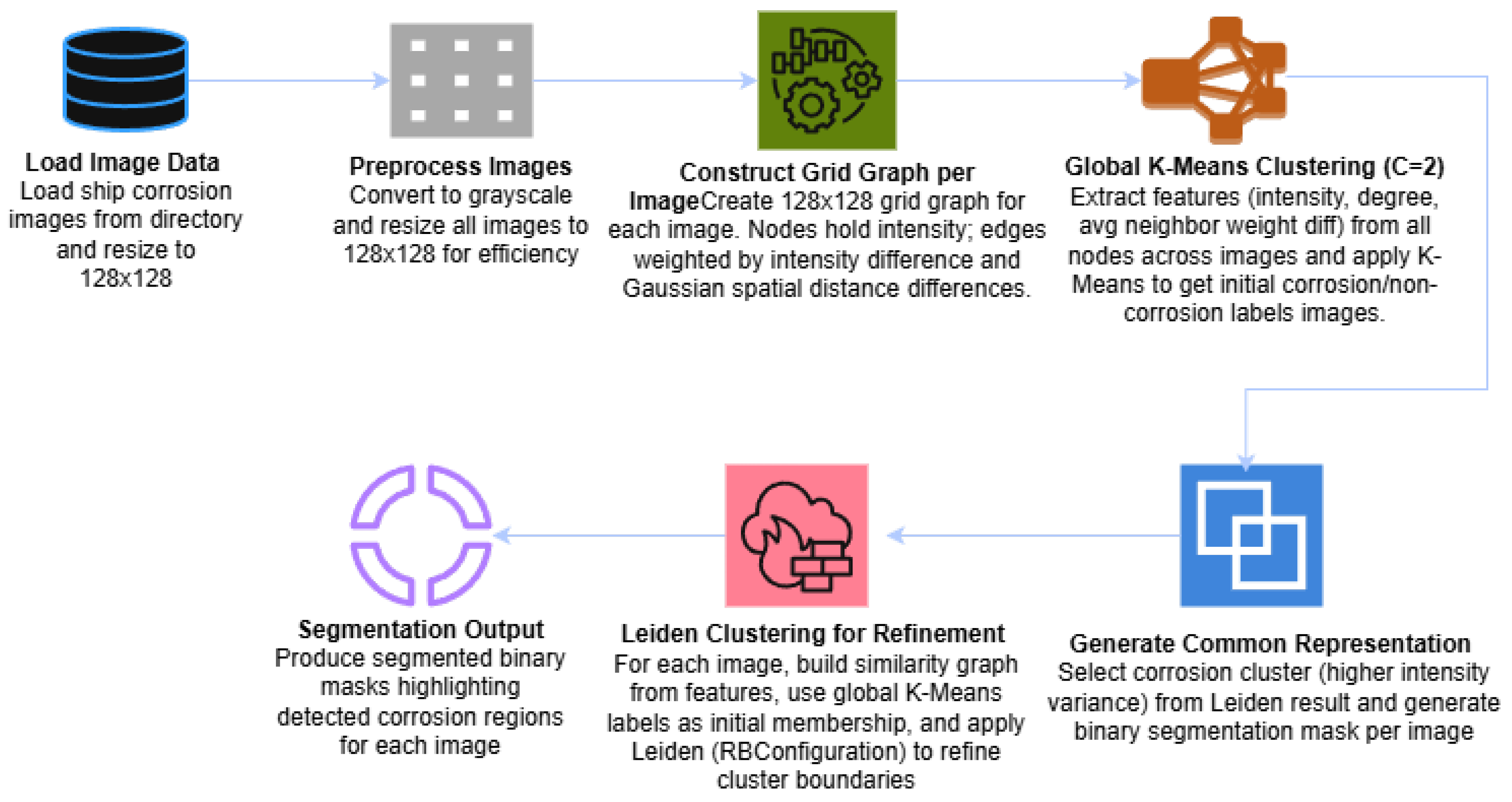

Table 1.
Quantitative comparison of unsupervised segmentation methods.
| Segmentation Method | Compactness | Silhouette | Edge Density |
|---|---|---|---|
| Graph Segmentation | 24.88 | 1.00 | 0.0245 |
| Probabilistic Aggregation | 52.00 | 1.00 | 0.0201 |
| Mean Shift Segmentation | 115.68 | 1.00 | 0.0133 |
| Normalized Cut Segmentation | 17.38 | 1.00 | 0.0249 |
| Proposed Method | 136.61 | 1.00 | 0.2789 |
Disclaimer/Publisher’s Note: The statements, opinions and data contained in all publications are solely those of the individual author(s) and contributor(s) and not of MDPI and/or the editor(s). MDPI and/or the editor(s) disclaim responsibility for any injury to people or property resulting from any ideas, methods, instructions or products referred to in the content. |
© 2026 by the authors. Licensee MDPI, Basel, Switzerland. This article is an open access article distributed under the terms and conditions of the Creative Commons Attribution (CC BY) license (http://creativecommons.org/licenses/by/4.0/).
Copyright: This open access article is published under a Creative Commons CC BY 4.0 license, which permit the free download, distribution, and reuse, provided that the author and preprint are cited in any reuse.


