

Submitted:
06 June 2026
Posted:
08 June 2026
You are already at the latest version
Abstract
Dementia is a major global public health challenge, with a substantial proportion of risk attributed to potentially modifiable factors across the life course. Despite this, public understanding of dementia prevention remains limited and is often characterised by misconceptions regarding causation, inevitability, and controllability. Dementia is frequently perceived as a normal consequence of ageing, while awareness of modifiable risk factors is uneven across cardiovascular, metabolic, psychosocial, and environmental domains. This conceptual review synthesises literature from dementia literacy research, health literacy theory, behavioural science, and implementation science to examine the persistent gap between epidemiological evidence and public understanding. It argues that this gap cannot be explained by information deficits alone, but instead reflects the interpretive processes through which biomedical evidence is filtered through pre-existing mental models, health literacy capacities, behavioural appraisals, and structural conditions. Building on this synthesis, the paper proposes the Dementia Prevention Literacy Translation Framework (DPLTF), which conceptualises dementia prevention literacy as a multi-level, dynamic translation process linking biomedical evidence, public mental models, health literacy processes, behavioural appraisal, and preventive action. Rather than a linear pathway, the framework emphasises reciprocal interactions and feedback loops across these levels, alongside cross-cutting structural and environmental influences that shape opportunities for interpretation and action. The DPLTF is presented as an interpretive conceptual model rather than a predictive theory. Its central contribution is to position public interpretive mental models as a key mediating mechanism in the translation of epidemiological evidence into behavioural engagement. The framework highlights why increases in awareness alone are unlikely to produce sustained behavioural change without addressing how individuals understand, evaluate, and integrate dementia risk information within their social and structural contexts. Ultimately, bridging the gap between evidence and action requires multi-level interventions that extend beyond awareness-raising to strengthen interpretive capacity, support integrated understandings of dementia risk, enhance perceived behavioural control, and address structural barriers to prevention.
Keywords:
dementia prevention literacy
; health literacy
; dementia risk
; conceptual framework
; behavioural translation
; public health education
Introduction
Dementia is one of the most significant public health challenges of the twenty-first century. More than 55 million people are currently living with dementia worldwide, and prevalence is projected to increase substantially in the coming decades due to population ageing (World Health Organisation, 2023). The condition places considerable burden on individuals, families, health systems, and long-term care infrastructure.
Dementia is not a single disease but a clinical syndrome encompassing multiple neurodegenerative and cerebrovascular conditions, including Alzheimer’s disease, vascular dementia, dementia with Lewy bodies, and frontotemporal dementia (Alzheimer’s Society, n.d.; Livingston et al., 2024). Although these conditions differ in aetiology and clinical presentation, evidence indicates that dementia risk is shaped by a range of modifiable factors across the life course, including cardiovascular, metabolic, psychosocial, and environmental determinants (Livingston et al., 2024).
Despite advances in epidemiological understanding, public knowledge of dementia prevention remains inconsistent. Population studies suggest that many people view dementia as a normal part of aging or as largely genetic, which limits the perception of controllability (Cations et al., 2018; Nagel et al., 2021). Recognition of certain modifiable risk factors also varies, with cardiovascular and metabolic risk factors often less well recognised than lifestyle-related ones (Negesa et al., 2020).
This discrepancy raises an important question for health education: why does robust epidemiological evidence on dementia prevention not consistently translate into public understanding and preventive action? This review addresses this question through a conceptual synthesis of relevant literature.
Methodology
This paper adopts a conceptual review approach to examine the relationship between dementia prevention evidence and public understanding of modifiable dementia risk factors. This work is based on the methodology for health literacy assessment developed by Nutbeam and Lloyd (2021) and directly addresses the well-documented shortcomings in public health knowledge of the evidence for epidemiological risk (Parial et al., 2020; Livingston et al., 2024). Unlike systematic reviews, conceptual reviews seek to integrate evidence across multiple disciplines in order to develop theoretical interpretations and explanatory frameworks rather than provide exhaustive evidence synthesis.
Comprehensive searches of academic databases and key, high impact reviews were used to identify literature on dementia literacy, prevention and risk perception. Key sources include the 2024 report from the Lancet Commission on dementia prevention (Livingston et al., 2024), and seminal work on public understanding including Low and Anstey (2009), Nutbeam and Lloyd (2021), and Parial et al. (2021).
Sources were selected on the basis of their relevance to understanding how scientific evidence concerning dementia risk factors is interpreted and translated into public understanding and behavioural engagement. The review does not aim to provide a comprehensive synthesis of all available literature. Rather, it seeks to develop a conceptual interpretation of the processes through which dementia prevention knowledge may be translated, misunderstood, accepted, or rejected.
This approach is in line with conceptual review methods that focus on theoretical integration and framework development across different bodies of literature (Nutbeam & Lloyd, 2021; Luft et al., 2022).
Conceptualising the Translation Gap in Dementia Prevention Literacy
Rather than conceptualising low dementia literacy as a simple deficit in knowledge, this paper frames it as a translational gap between biomedical evidence and public interpretation. Baez et al. (2026) state epidemiological knowledge about dementia risk does not translate directly into behaviour. Instead, Siette et al., (2023) and Baez et al. (2026) indicate information is filtered through existing beliefs about ageing, disease causation, personal susceptibility, and perceived controllability. Such interpretive processes shape how risk information is understood, evaluated, and used in everyday decision-making (Reyna & Rivers, 2008; Blalock & Reyna, 2016).
Drawing upon dementia literacy research, health literacy theory, behavioural science, and implementation science (Carey, 2026a; Carey, 2026b), this review proposes the Dementia Prevention Literacy Translation Framework (DPLTF). The framework conceptualises dementia prevention literacy as a multi-level process involving interactions between biomedical evidence, public mental models, health literacy processes, behavioural appraisal, and structural conditions. Rather than operating as a linear sequence, these components interact dynamically and may facilitate or impede the translation of prevention evidence into public understanding and action.
The framework is intended as an interpretive model rather than a predictive theory. Its purpose is to provide an integrative lens through which the persistent gap between dementia prevention evidence and public understanding may be better understood.
Biomedical Evidence and the Complexity of Dementia Risk
This is not to suggest that epidemiological knowledge about dementia risk translates directly into behavioural change, as highlighted by the landmark report of Livingston et al. (2024). Rather, dementia prevention information is interpreted through existing beliefs and assumptions about ageing, disease causation, and personal agency, which influence how individuals evaluate the relevance and credibility of prevention messages (Akyol et al., 2020; Bacsu et al., 2023; Pickard, 2018). As Bruinsma et al. (2023) observed, these beliefs play an important role in shaping the interpretation and uptake of dementia risk-reduction information. This interpretive process forms a central mechanism within the Dementia Prevention Literacy Translation Framework, linking scientific evidence to behavioural engagement.
This review synthesises evidence from dementia literacy, health literacy, behavioural science, and implementation research to develop a conceptual interpretation of this translation process. The aim is to provide an integrative lens for understanding why prevention knowledge may not consistently translate into behavioural engagement.
Epidemiological research identifies multiple potentially modifiable risk factors for dementia. The 2024 Lancet Commission reports 14 such factors, including hypertension, obesity, diabetes, physical inactivity, smoking, depression, social isolation, hearing loss, traumatic brain injury, and air pollution (Livingston et al., 2024).
These risk factors operate cumulatively and interact over the life course. Dementia risk is therefore probabilistic rather than deterministic, arising from multiple interrelated exposures. This complexity poses challenges for public communication, particularly where risk is translated into simplified causal narratives.
Public Mental Models of Dementia
Public understanding of dementia is often shaped by simplified mental models in which Alzheimer’s disease functions as the dominant reference point for the condition (Cahill et al., 2015; Low & Anstey, 2009). Therefore, important distinctions between different dementia aetiologies, like vascular and neurodegenerative routes, may go unnoticed by the general public (Low & Anstey, 2009; Karantzoulis & Galvin, 2011; Smith et al., 2014; Venkat et al., 2015).
Dementia is also frequently perceived as an inevitable consequence of ageing or as primarily genetically determined. Such beliefs appear to persist even in contexts where prevention messaging is present. These mental models are important because they influence how new information is interpreted and whether it is regarded as relevant to personal risk.
Where dementia is perceived as unavoidable, information regarding modifiable risk factors may be discounted or interpreted as having limited practical relevance.
Health Literacy and Interpretation of Risk Information
According to Liu et al. (2020) and Nutbeam & Lloyd (2021) health literacy is the ability to access, understand, evaluate and apply health information in context. It plays a central role in shaping how epidemiological evidence is translated into personal understanding.
Evidence suggests that awareness of dementia risk factors is uneven across domains. Physical activity is relatively well recognised, whereas cardiovascular, metabolic, psychosocial, and environmental determinants are less consistently understood as relevant to brain health (Nagel et al., 2021; Alzheimer’s Disease International, 2023).
A key issue is not simply knowledge acquisition, but the integration of information across health domains (Torab-Miandoab et al., 2023). Cardiovascular and metabolic conditions, for example, are often not conceptually linked to cognitive outcomes despite strong epidemiological associations. This fragmentation may limit the development of coherent understandings of dementia risk.
Behavioural Translation and Emotional Responses
Knowledge of risk does not necessarily result in behavioural change. Behavioural theories emphasise the importance of perceived threat, self-efficacy, and emotional responses in shaping action.
Protection Motivation Theory suggests that protective behaviour is more likely when individuals perceive both a meaningful threat and an effective coping response (Rogers, 1983). In the context of dementia, fear is commonly reported but is not always accompanied by a sense of controllability.
Evidence indicates that high levels of dementia-related fear, in the absence of perceived efficacy, may contribute to avoidance or disengagement rather than preventive action (Watson et al., 2023; Lin et al., 2025). Emotional responses may therefore shape the processing of risk information and influence whether it is acted upon.
Structural and Contextual Influences
Sustained preventative action involves more than just behavioural intention. Exposure to risk factors and the viability of modifying behaviour are influenced by structural factors such as socioeconomic status, education, healthcare access, and environmental circumstances (Damschroder et al., 2009; Barakat & Konstantinidis, 2023; Braveman & Gottlieb, 2014).
These constraints highlight that dementia prevention is embedded within broader social and environmental systems (National Academies of Sciences, Engineering, and Medicine, 2021). As such, individual-level knowledge and motivation must be understood in relation to structural conditions that enable or limit action.
The Dementia Prevention Literacy Translation Framework (DPLTF): Pathways of Evidence Translation, Interpretation, and Action
According to the literature reviewed by Berkman et al. (2011), Nutbeam and Lloyd (2021) and Squiers et al. (2012), dementia prevention literacy is best understood as a multi-level translation process that interprets, integrates, and transforms scientific evidence into personally meaningful understanding and possible behavioural action.
According to Middleton et al. (2013), there may be significant gaps between epidemiological data and behavioural engagement at several stages, such as when interpreting risk information, evaluating personal significance, and putting new behavior into practice.
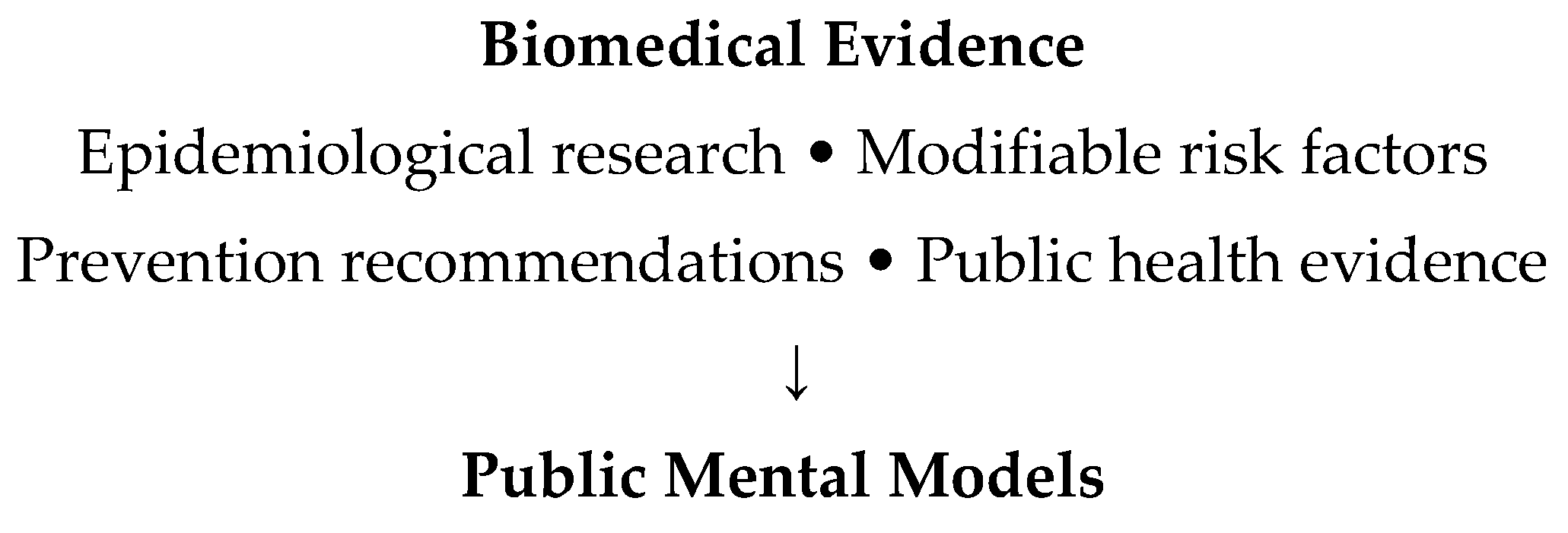
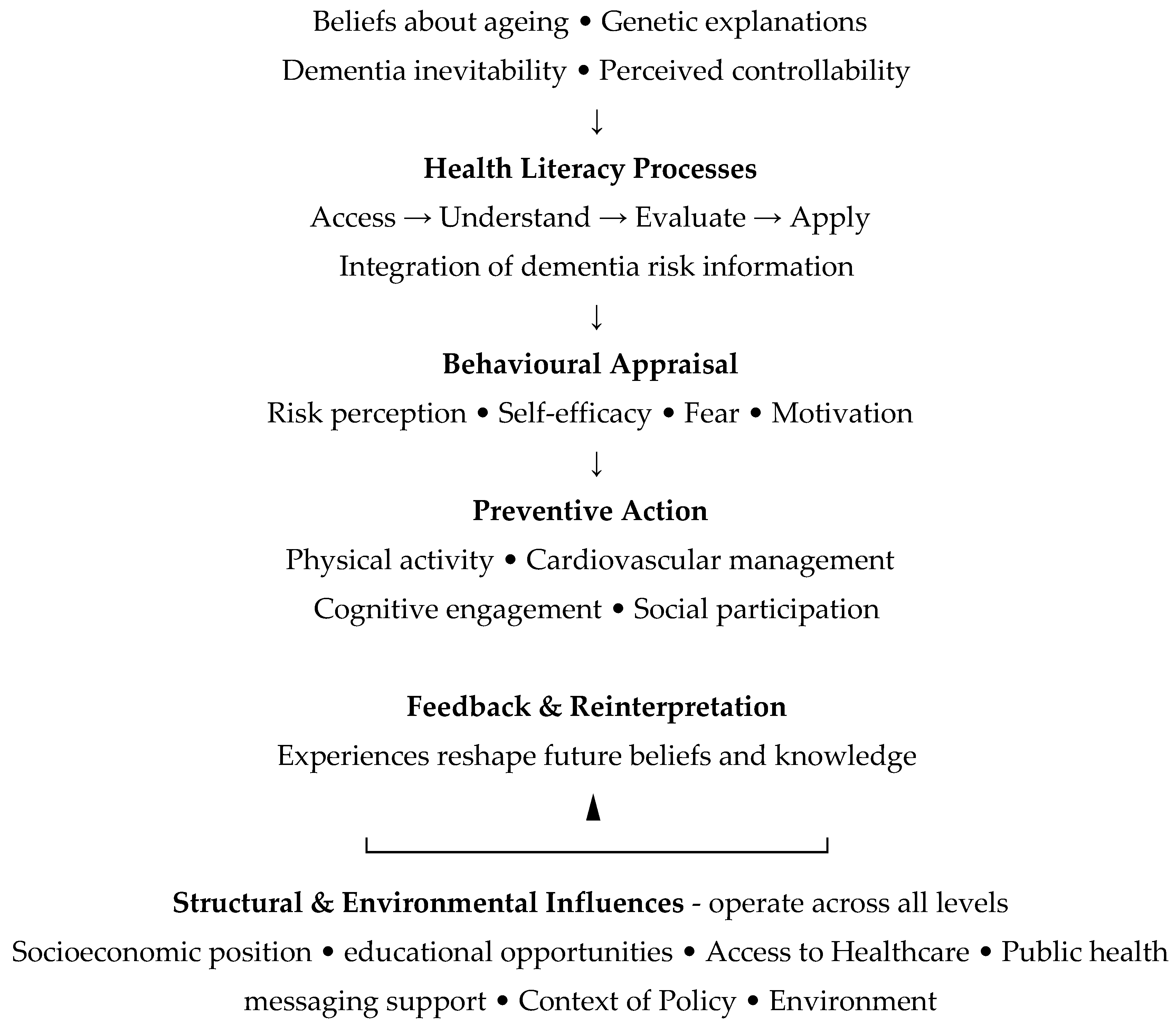
To conceptualise these interacting processes, the Dementia Prevention Literacy Translation Framework (DPLTF) is proposed (Figure 1). To show how dementia prevention knowledge is translated, processed, and used across several levels of influence, the framework incorporates findings from dementia literacy research, health literacy theory, behavioural science, and implementation science (Carey, 2026). The framework begins with biomedical evidence, which provides the scientific foundation for understanding dementia risk. Contemporary epidemiological research demonstrates that dementia risk is influenced by multiple potentially modifiable factors operating across the life course (Livingston et al., 2024). However, the complexity, cumulative nature, and probabilistic character of this evidence may present challenges for public communication and understanding.
The second component comprises public mental models, which influence how dementia-related information is initially interpreted. Research suggests that many individuals continue to view dementia as an inevitable consequence of ageing or as primarily genetically determined (Cations et al., 2018; Nagel et al., 2021). These pre-existing beliefs shape the interpretation of incoming dementia-related information and influence perceived relevance, credibility, and controllability.
The third element consists of health literacy procedures that assess a person’s capacity to secure, comprehend, evaluate, and use health information (Liu et al., 2020; Nutbeam & Lloyd, 2021, Urstad et al., 2022). Awareness of dementia risk factors appears uneven across domains, with lifestyle factors often more readily recognised than cardiovascular, metabolic, psychosocial, and environmental determinants (Nagel et al., 2021; Alzheimer’s Disease International, 2023). Consequently, individuals may develop fragmented rather than integrated understandings of dementia risk.
The fourth component is behavioural appraisal, through which information is evaluated in terms of personal susceptibility, perceived severity, response efficacy, and self-efficacy. Protection Motivation Theory proposes that behavioural engagement depends upon both perceived threat and perceived coping efficacy (Rogers, 1983). Dementia is frequently regarded as a highly feared condition (Watson et al., 2023), yet fear alone may be insufficient to promote preventive action if individuals perceive limited control over outcomes (Lin et al., 2025).
The fifth component involves preventive action. According to the National Academies of Sciences, Engineering, and Medicine [NASEM], 2021, people who view dementia risk as personally relevant and who think preventive behaviours are effective and attainable may be more inclined to participate in risk-reduction activities, such as physical activity and cardiovascular risk (Kim et al., 2014; Curran et al., 2021)
However, motivation does not necessarily translate into sustained action, as behavioural implementation is shaped by broader contextual conditions (Bosco et al., 2020 Gitlin et al., 2020; Horstkötter et al., 2021;).
Structural and environmental influences operate across all stages of the framework rather than functioning as a discrete sequential component. Socioeconomic resources, including educational opportunities, healthcare access, social support, environmental conditions, and public health infrastructure, can either help or hinder the ability to interpret dementia information and act upon it (Damschroder et al., 2009; Barakat & Konstantinidis, 2023; Braveman & Gottlieb, 2014).
Importantly, the framework is not conceptualised as a strictly linear process. Experiences of ageing, healthcare engagement, behavioural success or failure, and changes in health status may subsequently reshape beliefs about dementia risk and prevention (Livingston et al., 2020; Livingston et al., 2024). These feedback mechanisms influence future interpretation of dementia-related information and may strengthen or weaken engagement with prevention behaviours. Dementia prevention literacy is therefore conceptualised as a dynamic and reciprocal process operating across cognitive, behavioural, and structural levels.
Figure 1 presents the Dementia Prevention Literacy Translation Framework (DPLTF), illustrating the sequential and reciprocal pathways through which dementia prevention evidence is translated into public understanding, behavioural motivation, and preventive action, alongside the cross-cutting influence of structural and environmental conditions.
Framework Pathways
The downward arrows represent the progressive translation of dementia prevention evidence from scientific knowledge into behavioural engagement. At each stage, information may be reinforced, modified, misunderstood, or rejected, creating potential points at which translation may break down.
- Biomedical Evidence → Public Mental Models: Biomedical evidence first enters public consciousness through existing mental models, which influence how dementia risk is interpreted and whether prevention messages are perceived as credible, relevant, and personally meaningful. Pre-existing beliefs regarding ageing, genetics, and disease causation may either facilitate or impede acceptance of prevention information.
- Public Mental Models → Health Literacy Processes: Existing beliefs influence an individual’s willingness and capacity to engage with dementia-related information. Health literacy processes determine the extent to which individuals can access, understand, evaluate, and apply information regarding dementia risk and prevention.
- Health Literacy Processes → Behavioural Appraisal: Information that has been successfully understood and integrated is subsequently evaluated in terms of personal relevance. Individuals assess their susceptibility to dementia, the seriousness of the condition, the effectiveness of preventive behaviours, and their confidence in their ability to undertake risk-reduction actions.
- Behavioural Appraisal → Preventive Action: Behavioural appraisal influences whether motivation is translated into action. Individuals who perceive dementia risk as personally relevant and who believe preventive behaviours are both effective and achievable are more likely to engage in risk-reduction activities, including physical activity, cardiovascular risk management, cognitive stimulation, social participation, and other health-promoting behaviours. Preventive action represents the behavioural endpoint of the framework and reflects the implementation and maintenance of risk-reduction behaviours in everyday life. However, motivation alone may be insufficient to sustain behavioural change over time, and successful implementation may depend upon broader contextual conditions.
- Feedback and Reinterpretation: The feedback pathway illustrates the reciprocal nature of the framework. Experiences of ageing, healthcare engagement, behavioural success or failure, and changes in health status may subsequently reshape beliefs and influence future interpretations of dementia prevention information. These experiences may strengthen or weaken engagement with prevention behaviours.
- Structural and Environmental Influences: Structural and environmental influences operate across all stages of the framework rather than functioning as a separate sequential component. Socioeconomic resources, educational opportunities, healthcare access, social support, public health messaging, and environmental conditions may either facilitate or constrain movement through the framework and the translation of knowledge into action.
These components are conceptually distinct but empirically interdependent, and may operate simultaneously rather than as strictly sequential stages.
Relationship to Existing Theory
The Dementia Prevention Literacy Translation Framework builds upon several established theoretical perspectives while addressing limitations in their application to dementia prevention literacy.
Health literacy frameworks offer valuable insights into how people obtain, comprehend, assess, and apply health information (Liu et al., 2020; Nutbeam & Lloyd, 2021, Urstad et al., 2022). However, they provide less explicit attention to the role of pre-existing beliefs regarding ageing and dementia in shaping interpretation before information is processed.
Protection Motivation Theory offers a useful account of how threat perceptions and coping appraisals influence behavioural responses (Rogers, 1983). Nevertheless, the theory focuses primarily on motivational processes and provides limited consideration of broader structural influences affecting behavioural implementation.
Implementation science frameworks emphasise contextual influences on evidence translation and uptake (Damschroder et al., 2009). However, these approaches have largely been developed within organisational and healthcare settings and may not fully explain how members of the public interpret and engage with dementia prevention information.
The proposed framework integrates insights from these perspectives while positioning public interpretation as the central mechanism linking scientific evidence to behavioural engagement. In doing so, it provides a conceptual explanation for why increasing awareness alone may not consistently result in improved dementia prevention literacy or behavioural change.
The DPLTF is also conceptually consistent with Context–Mechanism–Outcome (CMO) approaches commonly used in implementation science and realist evaluation (Carey, 2026a; Carey, 2026b). Within the framework, public mental models, health literacy processes, and behavioural appraisal function as mechanisms through which dementia prevention information is interpreted, integrated, and acted upon, while structural and environmental influences provide the contextual conditions that may facilitate or constrain engagement. Preventive behaviours and risk-reduction activities represent the primary outcomes of these interacting processes. However, the DPLTF extends generic CMO approaches by explicitly modelling the pathways through which dementia prevention evidence is translated into public understanding, behavioural motivation, and preventive action.
The primary contribution of the DPLTF lies in explicitly positioning interpretive mental models as the central mediating mechanism between epidemiological evidence and behavioural engagement in dementia prevention.
Implications for Health Education and Public Health Practice
The synthesis presented in this review suggests that dementia prevention literacy should be understood as a translational process rather than a simple knowledge deficit.
Interventions focused exclusively on increasing awareness are therefore unlikely to produce substantial behavioural change. More comprehensive approaches may be required that:
- support coherent public understanding of dementia as a syndrome with multiple aetiologies
- strengthen integration of systemic health concepts, particularly cardiovascular–brain relationships
- enhance interpretive capacity through health literacy-focused strategies
- improve perceived behavioural control through actionable and feasible guidance
- address structural barriers that limit prevention opportunities.
These considerations suggest that dementia prevention is not solely an educational issue, but also involves cognitive and structural dimensions.
From a Context–Mechanism–Outcome perspective, effective dementia prevention interventions must address both the mechanisms through which individuals interpret and respond to prevention information and the contextual conditions that influence whether preventive behaviours can be initiated and sustained (Carey, 2026a; Carey, 2026b). This highlights the need for multi-level approaches that combine education, behaviour change support, and attention to broader social and environmental determinants of health.
Limitations
This review has several limitations. First, as a conceptual review, it does not employ systematic review methodology and therefore does not provide a comprehensive synthesis of all available evidence. Literature was selected on the basis of conceptual relevance rather than formal inclusion and exclusion criteria, which may introduce selection bias and the possibility that relevant studies were overlooked.
Second, the Dementia Prevention Literacy Translation Framework proposed in this paper is intended as a conceptual and interpretive model rather than a predictive theory. The framework has been developed through theoretical integration of evidence drawn from dementia literacy research, health literacy, behavioural science, and implementation science, but it has not yet been empirically validated. Consequently, the relationships proposed between framework components require empirical examination and validation.
Finally, although the framework is intended to have broad applicability, the literature informing its development is drawn predominantly from studies conducted in high-income countries. Future research should examine the relevance and applicability of the framework across diverse cultural, socioeconomic, and health system contexts, and should explore how its components can be operationalised and tested using quantitative, qualitative, and mixed-methods approaches.
Conclusions
This review has argued that the gap between dementia prevention evidence and public understanding reflects a translational disconnect between biomedical knowledge and public interpretation. Rather than arising from information deficits alone, this gap reflects differences in how dementia risk is cognitively structured, emotionally processed, and socially constrained.
By synthesising literature from dementia epidemiology, health literacy research, behavioural science, and implementation studies, this paper highlights the importance of interpretive frameworks in shaping public understanding of dementia prevention. Future research may further examine how these translational processes operate across different populations and contexts, with the aim of informing more effective health education strategies.
Institutional Review Board Statement
Ethical approval was not required for this study as it is a conceptual paper based on analysis of existing literature and does not involve human participants, primary data collection, or identifiable data.
References
- Adrian-Kalchhauser, I.; Sultan, S. E.; Shama, L. N. S.; Spence-Jones, H.; Tiso, S.; Keller Valsecchi, C. I.; Weissing, F. J. Understanding ‘Non-genetic’ Inheritance: Insights from Molecular-Evolutionary Crosstalk. Trends in ecology & evolution 2020, 35(12), 1078–1089. [Google Scholar] [CrossRef]
- Akyol, M.; Şahin, S.; Özkral, B.; Ünsal, A.; Akçiçek, F. Determining Middle-Aged and Older Adults’ Health Beliefs to Change Lifestyle and Health Behavior for Dementia Risk Reduction. American Journal of Alzheimer’s Disease & Other Dementias 2020, 35. Available online: https://journals.sagepub.com/doi/10.1177/1533317519898996.
- Alzheimer’s Disease International. World Alzheimer report 2023: Global trends in dementia awareness . 2023. Available online: https://www.alzint.org.
- Alzheimer’s Society. Types of dementia . n.d. Available online: https://www.alzheimers.org.uk.
- Bacsu, J. D.; Kortzman, A.; Fraser, S.; Chasteen, A. L.; MacDonald, J.; O’Connell, M. E. Understanding Intersectional Ageism and Stigma of Dementia: Protocol for a Scoping Review. JMIR research protocols 2023, 12, e46093. [Google Scholar] [CrossRef] [PubMed]
- Baez, S.; Marquez, S. R.; Rosická, A. M.; Gillan, C. M. Social disadvantage outweighs knowledge in dementia risk. Alzheimer’s & dementia: the journal of the Alzheimer’s Association 2026, 22(2), e71260. [Google Scholar] [CrossRef]
- Barakat, C.; Konstantinidis, T. A Review of the Relationship between Socioeconomic Status Change and Health. International journal of environmental research and public health 2023, 20(13), 6249. [Google Scholar] [CrossRef]
- Berkman, N. D.; Sheridan, S. L.; Donahue, K. E.; Halpern, D. J.; Viera, A.; Crotty, K.; Holland, A.; Brasure, M.; Lohr, K. N.; Harden, E.; Tant, E.; Wallace, I.; Viswanathan, M. Health literacy interventions and outcomes: an updated systematic review. Evidence report/technology assessment 2011, (199), 1–941. [Google Scholar]
- Blalock, S. J.; Reyna, V. F. Using fuzzy-trace theory to understand and improve health judgments, decisions, and behaviours: A literature review. In Health psychology: official journal of the Division of Health Psychology; American Psychological Association, 2016; Volume 35, 8, pp. 781–792. [Google Scholar] [CrossRef]
- Bosco, A.; Jones, K. A.; Di Lorito, C.; Stephan, B. C. M.; Orrell, M.; Oliveira, D. Changing lifestyle for dementia risk reduction: Inductive content analysis of a national UK survey. PloS one 2020, 15(5), e0233039. [Google Scholar] [CrossRef]
- Braveman, P.; Gottlieb, L. The social determinants of health: it’s time to consider the causes of the causes; Public health reports: Washington, D.C., 2014; Volume 129, Suppl 2(Suppl 2), pp. 19–31. [Google Scholar] [CrossRef]
- Bruinsma, J.; Heger, I.; Loukas, V. S.; Kassiotis, T.; Karanasiou, G.; Fotiadis, D. I.; Hanke, S.; Crutzen, R. Public Perspectives on Lifestyle-Related Behavior Change for Dementia Risk Reduction: An Exploratory Qualitative Study in The Netherlands. Journal of Alzheimer’s disease: JAD 2023, 95(4), 1635–1642. [Google Scholar] [CrossRef]
- Carey, P. Beyond Information Delivery: Towards a Realist-Informed Conceptual Framework for the Evaluation of Digital Dementia Education; Preprints, 2026a. [Google Scholar] [CrossRef]
- Carey, P. Reconceptualising Dementia Education: From Information Transfer to Behavioural and Contextual Change . Preprints 2026b. [Google Scholar] [CrossRef]
- Cations, M.; Radisic, G.; Crotty, M.; Laver, K. What does the general public understand about prevention and treatment of dementia? PLOS ONE 2018, 13(4), e0196085. [Google Scholar] [CrossRef]
- Cahill, S.; Pierce, M.; Werner, P.; Darley, A.; Bobersky, A. A systematic review of the public’s knowledge and understanding of Alzheimer’s disease and dementia. Alzheimer Disease & Associated Disorders 2015, 29(3), 255–275. [Google Scholar] [CrossRef]
- Curran, E.; Chong, T. W. H.; Godbee, K.; Abraham, C.; Lautenschlager, N. T.; Palmer, V. J. General population perspectives of dementia risk reduction and the implications for intervention: A systematic review and thematic synthesis of qualitative evidence. PloS one 2021, 16(9), e0257540. [Google Scholar] [CrossRef] [PubMed]
- Damschroder, L. J.; Aron, D. C.; Keith, R. E.; Kirsh, S. R.; Alexander, J. A.; Lowery, J. C. Fostering implementation of health services research findings into practice: A consolidated framework for advancing implementation science. Implementation Science 4 2009, 50. [Google Scholar] [CrossRef] [PubMed]
- Gitlin, L. N.; Baier, R. R.; Jutkowitz, E.; Baker, Z. G.; Gustavson, A. M.; Sefcik, J. S.; Hodgson, N. A.; Koeuth, S.; Gaugler, J. E. Dissemination and Implementation of Evidence-Based Dementia Care Using Embedded Pragmatic Trials. Journal of the American Geriatrics Society 2020, 68 Suppl 2(Suppl 2), S28–S36. [Google Scholar] [CrossRef] [PubMed]
- Hesselink, G.; Cheng, J.; Schoon, Y. A systematic review of instruments to measure health literacy of patients in emergency departments. Academic Emergency Medicine 2022, 29(7), 890–901. Available online: https://onlinelibrary.wiley.com/doi/10.1111/acem.14428. [CrossRef]
- Horstkötter, D.; Deckers, K.; Köhler, S. Primary Prevention of Dementia: An Ethical Review. Journal of Alzheimer’s disease: JAD 2021, 79(2), 467–476. [Google Scholar] [CrossRef]
- Karantzoulis, S.; Galvin, J. E. Distinguishing Alzheimer’s disease from other major forms of dementia. Expert Review of Neurotherapeutics 2011, 11(11), 1579–1591. [Google Scholar] [CrossRef]
- Kim, S.; Sargent-Cox, K.; Cherbuin, N.; Anstey, K. J. Development of the motivation to change lifestyle and health behaviours for dementia risk reduction scale. Dementia and Geriatric Cognitive Disorders Extra 2014, 4(2), 172–183. [Google Scholar] [CrossRef]
- Lin, R.; Bartels, S. L.; Batalik, L.; Su, J. J. The Moderating Role of Dementia-Related Fear in the Relationship Between Perceived Cognitive Decline and Motivation for Dementia Risk Reduction Behaviours in Community-Dwelling Middle-Aged and Older Adults. International Journal of Geriatric Psychiatry 2025, e70130. [Google Scholar] [CrossRef]
- Livingston, G.; Huntley, J.; Sommerlad, A.; Ames, D.; Ballard, C.; Banerjee, S.; Brayne, C.; Burns, A.; Cohen-Mansfield, J.; Cooper, C.; Costafreda, S. G.; Dias, A.; Fox, N.; Gitlin, L. N.; Howard, R.; Kales, H. C.; Kivimäki, M.; Larson, E. B.; Ogunniyi, A.; Orgeta, V.; Mukadam, N. Dementia prevention, intervention, and care: 2020 report of the Lancet Commission. Lancet (London, England) 2020, 396(10248), 413–446. [Google Scholar] [CrossRef]
- Livingston, G.; Huntley, J.; Liu, K. Y.; Costafreda, S. G.; Selbæk, G.; Alladi, S.; Ames, D.; Banerjee, S.; Burns, A.; Brayne, C.; Fox, N. C.; Ferri, C. P.; Gitlin, L. N.; Howard, R.; Kales, H. C.; Kivimäki, M.; Larson, E. B.; Nakasujja, N.; Rockwood, K.; Samus, Q.; Mukadam, N. Dementia prevention, intervention, and care: 2024 report of the Lancet Commission. The Lancet 2024, 404(10452), 572–628. [Google Scholar] [CrossRef]
- Liu, C.; Wang, D.; Liu, C.; Jiang, J.; Wang, X.; Chen, H.; Ju, X.; Zhang, X. What is the meaning of health literacy? A systematic review and qualitative synthesis. Family medicine and community health 2020, 8(2), e000351. [Google Scholar] [CrossRef]
- Low, L. F.; Anstey, K. J. Dementia literacy: recognition and beliefs on dementia of the Australian public. Alzheimer’s & dementia: the journal of the Alzheimer’s Association 2009, 5(1), 43–49. [Google Scholar] [CrossRef]
- Luft, J. A.; Jeong, S.; Idsardi, R.; Gardner, G. Literature Reviews, Theoretical Frameworks, and Conceptual Frameworks: An Introduction for New Biology Education Researchers. CBE life sciences education 2022, 21(3), rm33. [Google Scholar] [CrossRef]
- Middleton, K. R.; Anton, S. D.; Perri, M. G. Long-Term Adherence to Health Behavior Change. American journal of lifestyle medicine 2013, 7(6), 395–404. [Google Scholar] [CrossRef] [PubMed]
- Nagel, A. K.; Loetscher, T.; Smith, A. E.; Keage, H. A. D. What do the public really know about dementia and its risk factors? Dementia 2021, 20(7), 2424–2440. [Google Scholar] [CrossRef] [PubMed]
- National Academies of Sciences; Engineering; and Medicine. Reducing the impact of dementia in America: A decadal survey of the behavioural and social sciences; National Academies Press, 2021; Available online: https://www.ncbi.nlm.nih.gov/books/NBK574343/.
- Negesa, L. B.; Magarey, J.; Rasmussen, P.; Hendriks, J. M. L. Patients’ knowledge on cardiovascular risk factors and associated lifestyle behaviour in Ethiopia in 2018: A cross-sectional study. PloS one 2020, 15(6), e0234198. [Google Scholar] [CrossRef] [PubMed]
- Nutbeam, D.; Lloyd, J. E. Understanding and responding to health literacy as a social determinant of health. Annual Review of Public Health 42 2021, 159–173. [Google Scholar] [CrossRef]
- Parial, L. L.; Lam, S. C.; Ho, J. Y. S.; Suen, L. K. P.; Leung, A. Y. M. Public knowledge of the influence of modifiable cardiovascular risk factors on dementia: a systematic literature review and meta-analysis. Aging & Mental Health 2021, 25(8), 1395–1409. [Google Scholar] [CrossRef]
- Pickard, S. Health, illness and frailty in old age: a phenomenological exploration. Journal of aging studies 2018, 47, 24–31. [Google Scholar] [CrossRef]
- Reyna, V. F.; Rivers, S. E. Current Theories of Risk and Rational Decision Making. Developmental review: DR 2008, 28(1), 1–11. [Google Scholar] [CrossRef]
- Rogers, R. W. Cognitive and physiological processes in fear appeals and attitude change: A revised theory of protection motivation. In Social psychophysiology: A sourcebook; Cacioppo, J. T., Petty, R. E., Eds.; Guilford Press, 1983; pp. 153–176. [Google Scholar]
- Siette, J.; Taylor, N.; Deckers, K.; Köhler, S.; Braithwaite, J.; Valenzuela, M.; Armitage, C. J. Advancing Australian public health initiatives targeting dementia risk reduction. Australasian Journal on Ageing 2022, 41(2), e190–e195. [Google Scholar] [CrossRef]
- Siette, J.; Dodds, L.; Deckers, K.; Köhler, S.; Armitage, C. J. Cross-sectional survey of attitudes and beliefs towards dementia risk reduction among Australian older adults. BMC public health 2023, 23(1), 1021. [Google Scholar] [CrossRef]
- Smith, B. J.; Ali, S.; Quach, H. Public knowledge and beliefs about dementia risk reduction: A national survey of Australians. BMC Public Health 14 2014, 661. [Google Scholar] [CrossRef] [PubMed]
- Squiers, L.; Peinado, S.; Berkman, N.; Boudewyns, V.; McCormack, L. The health literacy skills framework. Journal of health communication 2012, 17 Suppl 3, 30–54. [Google Scholar] [CrossRef] [PubMed]
- Torab-Miandoab, A.; Samad-Soltani, T.; Jodati, A.; Rezaei-Hachesu, P. Interoperability of heterogeneous health information systems: a systematic literature review. BMC medical informatics and decision making 2023, 23(1), 18. [Google Scholar] [CrossRef]
- Urstad, K. H.; Andersen, M. H.; Larsen, M. H.; Borge, C. R.; Helseth, S.; Wahl, A. K. Definitions and measurement of health literacy in health and medicine research: a systematic review. BMJ open 2022, 12(2), e056294. [Google Scholar] [CrossRef]
- Venkat, P.; Chopp, M.; Chen, J. Models and mechanisms of vascular dementia. Experimental neurology 2015, 272, 97–108. [Google Scholar] [CrossRef]
- Watson, R.; Sanson-Fisher, R.; Bryant, J.; Mansfield, E. Dementia is the second most feared condition among Australian health service consumers: Results of a cross-sectional survey. BMC Public Health 23 2023, 876. [Google Scholar] [CrossRef] [PubMed]
- World Health Organization. Global status report on the public health response to dementia . 2023. Available online: https://www.who.int.
Figure 1.
Dementia Prevention Literacy Translation Framework (DPLTF): An Integrative Model of Evidence Translation and Behavioural Engagement. Note: The framework conceptualises dementia prevention literacy as a dynamic translation process through which biomedical evidence is interpreted, evaluated, and transformed into behavioural engagement. Structural and environmental factors influence all stages.
Figure 1.
Dementia Prevention Literacy Translation Framework (DPLTF): An Integrative Model of Evidence Translation and Behavioural Engagement. Note: The framework conceptualises dementia prevention literacy as a dynamic translation process through which biomedical evidence is interpreted, evaluated, and transformed into behavioural engagement. Structural and environmental factors influence all stages.
Disclaimer/Publisher’s Note: The statements, opinions and data contained in all publications are solely those of the individual author(s) and contributor(s) and not of MDPI and/or the editor(s). MDPI and/or the editor(s) disclaim responsibility for any injury to people or property resulting from any ideas, methods, instructions or products referred to in the content. |
© 2026 by the authors. Licensee MDPI, Basel, Switzerland. This article is an open access article distributed under the terms and conditions of the Creative Commons Attribution (CC BY) license (http://creativecommons.org/licenses/by/4.0/).
Copyright: This open access article is published under a Creative Commons CC BY 4.0 license, which permit the free download, distribution, and reuse, provided that the author and preprint are cited in any reuse.


