

Submitted:
02 June 2026
Posted:
04 June 2026
You are already at the latest version
Abstract
The Evil Twin attack, which involves creating rogue Wi-Fi access points that impersonate legitimate networks, remains one of the most persistent and adaptive threats in cybersecurity, despite more than two decades having passed since its first public demonstration in 2005. This paper aims to provide a comprehensive analysis of the evolution of this attack, perceived as an “invisible enemy” due to its low detectability and systematic underestimation in incident reports. The study addresses key questions: how the Evil Twin attack has evolved, how its methods and tools have changed, where it currently stands, and where it may be heading in the future. The paper compiles evidence from conference presentations, academic publications, government reports, industry analyses, and media coverage, as well as selected defense mechanisms such as WIPS, WPA3, Protected Management Frames, ETGuard, and the Trusted Wireless Environment framework. An original taxonomy of Evil Twin attack mutations is proposed, along with a ten-stage Kill Chain model ([A]–[J]) mapped onto the MITRE ATT&CK framework, an exposure time metric Te as a key evolutionary parameter, and models quantifying attack cost-effectiveness and efficiency. The analysis demonstrates that the Evil Twin remains a persistent and adaptive threat, whose effectiveness stems from the combination of technical vulnerabilities, user trust in familiar network names, and the difficulty of unambiguous attribution and classification of incidents.
Keywords:
Evil Twin
; rogue access point
; Wi-Fi security
; wireless networks
; WIPS
; WPA3
; trusted wireless environment
; Man-in-the-Middle
; cybersecurity
1. Introduction
The Evil Twin attack involves creating an unauthorized access point (rogue access point) with an identical SSID and configuration to a legitimate wireless network access point, for the purpose of intercepting network traffic or user credentials. It should be emphasized that the term Evil Twin is sometimes erroneously equated in the literature with the broader category of Rogue Access Point or Wi-Fi Honeypot [1], whereas in the strict sense, Evil Twin constitutes a specific subtype of these threats, characterized by the deliberate impersonation of a particular, existing network.
The first public demonstrations of the Evil Twin attack took place in 2004–2005. In its early phase, the attack required only a single device with a Wi-Fi card operating in monitor mode, appropriate software (e.g., AirSnort), and physical presence within range of the target network. Within a few minutes, it was possible to intercept network traffic, including passwords, session data, and login credentials.
Over the course of two decades, the Evil Twin attack has undergone a significant evolution – from a simple rogue access point in public venues, through advanced variants incorporating automation (KARMA, MANA) and social engineering integration, to contemporary, highly automated campaigns leveraging mobile technologies, artificial intelligence, and IoT infrastructure [2,3]. At present, the Evil Twin no longer constitutes an isolated incident but rather functions as a complex initialization vector for offensive campaigns, encompassing multiple tactics within the MITRE ATT&CK framework.
This paper provides a comprehensive review of the Evil Twin attack evolution over the period 2005–2026. The objectives of this article are: (1) a systematic chronological analysis of key incidents, demonstrations, and publications; (2) the development of an original taxonomy of attack mutations; (3) the introduction of an exposure time metric as a quantitative evolutionary parameter; (4) mapping the attack onto the MITRE ATT&CK framework and an original Kill Chain model; and (5) the identification of gaps in existing classification systems and incident reporting frameworks.
The scope of this work is limited to the analysis of Evil Twin attack evolution in the strict sense, i.e., impersonation of a legitimate access point using an identical SSID. Related but distinct techniques have been intentionally excluded: KARMA (2008) and MANA (2013) are tools that automate the Evil Twin, but their detailed description falls outside the conceptual scope of this paper; the KRACK attack (Key Reinstallation Attack, 2017) [4] is a separate cryptographic threat, unrelated to access point impersonation. These techniques are mentioned in the context of evolution but do not constitute a subject of separate analysis.
Table 1 presents a chronological overview of key events related to the Evil Twin attack, and Figure 1 provides their graphical representation on a timeline. Events are classified into six categories according to their role in the evolution of the threat: Demo – public demonstrations and conference workshops (e.g., Black Hat, DEF CON); Tool – emergence of new offensive tools or frameworks; Incident – confirmed attacks, penetration tests (red team), field experiments, and their legal aftermath; Standard – introduction of technical standards or security frameworks; Research – scientific publications and research projects; Case study – case studies of educational or documentary nature. This typology was adopted to ensure a consistent classification of events ranging from purely demonstrative to operational, while maintaining the readability of the chronology.
2. Methodology
This paper takes the form of a narrative review, which is justified by the specificity of the subject under study: Evil Twin attacks are documented across heterogeneous sources (scientific literature, government reports, industry documentation, conference materials, media coverage), a significant portion of which is not indexed in standard bibliographic databases. A systematic review following the PRISMA methodology would be inadequate given the dominance of grey literature and the absence of standardized protocols for Evil Twin incident reporting. The adopted approach combines elements of qualitative and quantitative analysis in order to reconstruct the evolution of the attack and develop original conclusions regarding its mutations. The methodology was designed to ensure reliability, reproducibility, and objectivity, while accounting for limitations arising from the underestimation of incidents in available sources. The research process was divided into three main stages: data collection, analysis, and synthesis incorporating original contributions.
2.1. Stage 1: Data Collection
Data were collected from diverse, credible sources of academic, industry, and institutional character, covering the period from 2005 to January 2026. The main source categories were:
- Scientific and conference literature: a review of presentations and papers from key events such as Black Hat USA (2005, 2011, 2015, 2016), DEF CON (2007), and academic publications (e.g., Case of Study: Identity Theft in a University WLAN from 2013 and ETGuard: Detecting D2D Attacks using Wireless Evil Twins from 2019).
- Security institution and government reports: analysis of official documents, including the Office of Inspector General (OIG) report of the U.S. Department of the Interior from 2020, OPCW statements from 2018, WatchGuard Threat Lab research (2021–2023), and CISA and ENISA reports from 2025–2026.
- Recent industry data from 2025–2026: CVE vulnerability reports1, vendor analyses, and data from NIST (SP 800-97), Verizon DBIR (2023–2026), and IBM X-Force Threat Intelligence.
Source selection was based on the criteria of: relevance (direct reference to evil twin or rogue AP), recency (priority given to data from the last decade), and diversity (a mix of academic, government, and industry sources). The databases searched included IEEE Xplore, ACM Digital Library, Springer Link, Google Scholar, and institutional repositories (NIST, ENISA, CISA), using the following search phrases: “evil twin”, “rogue access point”, “Wi-Fi spoofing”, “wireless MitM”. In total, over 100 sources were analyzed, encompassing scientific publications, industry reports, technical documentation, and conference materials. A simplified source selection diagram, adapted from the PRISMA methodology for the purposes of this narrative review, is presented in Figure 2.
2.2. Stage 2: Data Analysis
The analysis was conducted along two dimensions: chronological (tracking the attack evolution from 2005 to 2026) and thematic (classification of attack mutations). A data triangulation method was employed, involving cross-comparison of documented incidents with deployed defense mechanisms and identified gaps.
In quantitative terms, a statistical analysis was conducted, focusing on the phenomenon of underestimation and misclassification of Evil Twin attacks in industry reports. In leading reports such as the Verizon DBIR editions 2023–2026 [5,6], the Evil Twin attack does not appear as a separate category. Incidents exhibiting characteristics of this attack vector are absorbed into broader groups:
Limitations of the analysis included, among others, the lack of full access to confidential reports and potential biases in industry sources. To minimize these, data were cross-verified against independent institutional sources, e.g., by comparing NIST SP 800-97 recommendations2 [14,15] with the ENISA Threat Landscape3 2025 reports [16,17].
2.3. Stage 3: Synthesis and Original Contribution
Based on the conducted data analysis, a synthesis of key trends was developed: the gradual shortening of the rogue access point lifespan, the transition from attacks requiring prolonged physical presence to ephemeral variants, the hybridization of techniques, and the systematic underestimation of the attack in industry reports.
The primary contribution is an original, extended taxonomy of Evil Twin attack mutations – a comprehensive classification developed on the basis of data synthesis from 2005–2026, systematizing the attack evolution in a manner not previously presented in scientific literature or industry reports. The taxonomy divides mutations into four main categories:
- Classical mutation (2005–2013): long-lived rogue APs with active deauthentication and traffic sniffing.
- Hybrid mutation (2014–2019): technical integration with social engineering – phishing captive portals and D2D (Device-to-Device, i.e., direct communication between devices without infrastructure mediation), where the rogue AP serves solely for initial infection and then disappears.
- Flash mutation (2020–2026): ultra-short-lived attacks, often without the use of deauthentication (bypassing PMF), based on natural client roaming.
- Opportunistic-hybrid mutation (projected 2026+): combination of flash mutation with contextual elements and automation.
The second contribution is original mathematical modeling of attack dynamics, centered on the concept of exposure time (). The third contribution is a proposal to extend incident reporting policies with a mandatory, separate category of “Wi-Fi Spoofing / Rogue AP Impersonation” in global reports.
3. The Problem of Documentation and Classification of Evil Twin Attacks
Despite the technical feasibility and confirmed demonstrations, the number of publicly documented, real-world Evil Twin attacks resulting in legal proceedings remains small. A review of the literature and industry reports allows the identification of several systematic causes of this phenomenon.
3.1. Low Attack Detectability
The Evil Twin attack is characterized by a high degree of mimicry – the victim connects to a fake network with an identical SSID, observing no anomalies at the user interface level. Data interception occurs transparently (traffic sniffing or presentation of a fake login portal). The consequences of the attack often become apparent only after weeks or months (e.g., unauthorized banking transactions, account takeovers), which leads to systematic underreporting (i.e., incidents being reported to a lesser extent than they actually occur, deflating statistics) of the phenomenon.
Detection methods (packet timing analysis, signal triangulation, beacon fingerprinting) require specialized knowledge and tools unavailable to average users [18,19]. The disparity between the ease of preparing the attack (tools such as Wi-Fi Pineapple, hostapd-wpe, Wifiphisher [20]) and the complexity of its detection constitutes a significant factor contributing to the low reporting rate.
3.2. Difficulties in Identifying and Apprehending the Perpetrator
The Evil Twin attack is short-lived and mobile in nature – the attacker uses portable equipment (laptop, Raspberry Pi, Wi-Fi card), operates for a few minutes to several hours, and then leaves the location. The absence of permanent infrastructure (unlike botnets or C2 servers) and the lack of traces in the victim’s infrastructure logs significantly impede perpetrator identification. The physical proximity required to conduct the attack makes it targeted, yet simultaneously difficult to monitor at scale.
3.3. Misclassification in Industry Reports
In leading industry reports (Verizon DBIR, IBM X-Force, ENISA Threat Landscape), there is no separate category for “Evil Twin” or “Rogue Access Point”. Incidents exhibiting characteristics of this attack vector are classified as phishing, Man-in-the-Middle [13], identity theft, or unauthorized access. At the level of analytical platforms, SIEM tools (Splunk, QRadar) and the MITRE ATT&CK framework do not possess a dedicated tag for Evil Twin attacks, resulting in their labeling as MitM or phishing by SOC (Security Operations Center) and DFIR (Digital Forensics and Incident Response) teams.
3.4. Impact of Protective Mechanisms on Attack Attractiveness
The development of transport layer protections such as HTTPS Everywhere (a browser extension enforcing encrypted HTTPS connections) and HSTS (HTTP Strict Transport Security, a server-side mechanism forcing HTTPS usage) has reduced the effectiveness of basic attack variants. At the same time, the absence of a central, global incident database distinguishing Evil Twin attacks further contributes to the underestimation of the phenomenon’s scale in global statistics.
4. Chronological Analysis of Key Incidents and Demonstrations
This section presents a chronological review of key events related to the Evil Twin attack, encompassing conference demonstrations, confirmed incidents, scientific publications, and industry initiatives over the period 2005–2025. Each case study is described in a standardized format: context, method employed, outcome, and significance for the evolution of the attack.
4.1. Black Hat USA 2005: First Public Demonstration
The first publicly documented demonstration of the Evil Twin attack was conducted at the Black Hat USA conference in 2005. The presentation entitled “Rogue Squadron: Evil Twins, 802.11intel, Radical RADIUS, and Wireless Weaponry for Windows”, by Beetle and Bruce Potter (The Shmoo Group) [21], included a detailed discussion of the mechanism for creating a competing access point with an identical SSID and higher signal strength in order to intercept user connections.
The demonstration showcased the use of tools such as Airsnarf (SoftAP, DHCP, fake DNS server, Apache) for creating a rogue access point. Attacks on captive portals, web authentication, and EAP protocols (PEAP, TTLS, MSCHAPv2) were demonstrated, enabling credential interception even in WPA/Enterprise networks. This presentation established the Evil Twin as a viable threat vector for public and conference environments.
4.2. DEF CON 15 (2007): The Multipot Variant
At the DEF CON 15 conference in 2007, KN Gopinath presented the work “Multipot: A More Potent Variant of Evil Twin” [22,23,24], introducing a multi-point attack variant. Unlike the classic Evil Twin utilizing a single rogue access point, Multipot was based on the simultaneous operation of multiple access points on different channels (e.g., channels 3 and 10) with an identical SSID.
The significance of this demonstration lay in revealing the ineffectiveness of WIPS systems based on the deauthentication mechanism. In a multi-point configuration, after session interruption on one channel, the client automatically switched to an alternative access point, maintaining TCP/HTTP communication continuity. The demonstration showed that with an access point configuration (where N denotes the number of channels simultaneously monitored by the WIPS sensor), the attack becomes resistant to session isolation.
4.3. Black Hat Workshops (2011–2016): Practical Training
During 2011–2016, a series of advanced workshops on wireless network security were conducted at Black Hat conferences, led by Vivek Ramachandran [25,26] and Thomas d’Otreppe de Bouvette4 (creator of Aircrack-ng [27]).
The 2011 workshops [28] covered the practical execution of Evil Twin attacks using hostapd and dnsmasq tools, forcing device reconnection to the rogue access point via deauthentication (aireplay-ng), and performing Man-in-the-Middle attacks on HTTP/HTTPS traffic. Subsequent editions (2015 [29], 2016 [30]) expanded the scope to include radio spectrum analysis and advanced key cracking techniques, confirming that despite the introduction of HTTPS and HSTS, the combination of deauthentication and a cloned captive portal continued to pose a real threat.
4.4. Case Study: University of Santiago De Guayaquil (2013)
Briones, Coronel, and Chavez-Burbano [31] described a practical case study of an Evil Twin attack conducted in the academic environment of the University of Santiago de Guayaquil (Ecuador). The paper documented a scenario in which the attacker created a rogue access point impersonating the university network protected by the WPA-EAP (802.1X) protocol, and subsequently used the Social Engineering Toolkit (SET) [32,33] to clone the login page (captive portal) and intercept user credentials.
Although the paper did not introduce a new detection or attack method, it constituted an important example of the Evil Twin’s transition from pure traffic sniffing to a variant based on phishing supported by a rogue access point. The study demonstrated that in environments with poorly configured radio authentication, the user is unable to distinguish the legitimate network from the fake one at the device interface level.
4.5. Republican National Convention in Cleveland (2016)
In July 2016, during the Republican National Convention (RNC) in Cleveland (Ohio), numerous rogue Wi-Fi networks were identified with names referencing the political context (e.g., “Vote Hillary”, “Vote Trump”, “FBI Surveillance Van”) [34]. Journalists, including Glenn Greenwald [35,36] (The Intercept [37,38]), identified at least a dozen rogue access points in the vicinity of the Quicken Loans Arena convention center.
The rogue networks were characterized by stronger signals than the legitimate access points, and upon connection, users were exposed to network traffic interception or redirected to cloned login pages. This incident constituted one of the most widely publicized cases of an Evil Twin attack in the context of a large-scale political event and highlighted the vulnerability of Wi-Fi infrastructure to social engineering attack variants in high-turnover user environments.
4.6. GRU Operation Against the OPCW in The Hague (2018)
In April 2018, four officers of the Russian military intelligence service (GRU, Unit 26165 / APT28) conducted a close-access operation directed against the Organisation for the Prohibition of Chemical Weapons (OPCW) [39,40] in The Hague, which at that time was investigating the poisoning of Sergei Skripal [41] using the Novichok nerve agent [42] and the alleged chemical attack in Douma (Syria) [43].
Cyber operators Aleksei Morenets [44,45] and Yevgeny Serebriakov [46,47], along with HUMINT (Human Intelligence) support (Oleg Sotnikov [48,49], Aleksei Minin [50,51]) [52], placed Wi-Fi signal interception equipment (panel antennas, laptops, Wi-Fi Pineapple or an analogous device) in the trunk of a rental car parked near the OPCW headquarters. The objective was to create a rogue access point impersonating the organization’s legitimate network in order to intercept login credentials [53,54,55].
The operation was disrupted on April 13, 2018, by the Dutch military intelligence service MIVD in cooperation with allies. Analysis of the seized equipment confirmed earlier operations against WADA in Switzerland and Malaysia [56]. This incident constitutes one of the best-documented cases of the use of a close-access Evil Twin attack in an intelligence operation, confirming that this vector is employed by state-sponsored threat actors (APTs) in the context of espionage.
4.7. DOI OIG Penetration Tests (2018–2019)
In 2018–2019, the Office of Inspector General (OIG) of the U.S. Department of the Interior (DOI) conducted a series of ethical penetration tests using the Evil Twin attack, described in a report from September 2020 [57,58].
Tests were conducted across 91 locations representing all offices and organizational units of the DOI, using low-cost equipment (Raspberry Pi 2 with open-source Kali Linux software, cost below 200 USD per unit), controlled via a smartphone from publicly accessible places (e.g., park benches, visitor areas). The attacks were not detected by IT security systems or physical security at any of the tested locations. In the networks of four offices, user credentials were successfully obtained and used to gain access to wireless networks.
The report constitutes one of the best-documented examples of ethical use of the Evil Twin attack in a government environment, simultaneously demonstrating the low cost of conducting the attack, high effectiveness, and the absence of detection capabilities on the defenders’ side.
4.8. ETGuard: D2D Attack Detection (2019)
Jain, Laxmi, Gaur, and Mosbah [59] proposed the ETGuard framework for detecting Evil Twin attacks in 802.11a/b/g networks, operating in pre-association mode based on beacon frame fingerprinting. The system, based on a client-server architecture, analyzed temporal sequences and beacon frame fields, demonstrating that the temporal emission profile is unique to each access point and can serve to distinguish a legitimate AP from a rogue one.
The research involved 12 attack scenarios using three types of rogue access point implementation: hardware (dedicated AP), software (laptop as soft AP), and mobile (phone as hotspot). Tests demonstrated high detection accuracy (no false negatives, one false positive). Furthermore, the authors demonstrated a new scenario in which the Evil Twin served as a temporary infection vector for mobile devices (particularly Android) – the rogue access point operated only until the malicious payload was delivered via the captive portal, after which it was deactivated.
The work demonstrated that most existing WIPS/WIDS systems (Cisco WLC, Aruba, AirTight) are unable to detect short-lived, ephemeral Evil Twin variants, opening a new research direction in passive detection based on beacon frame analysis. Alternative approaches include the use of SDN architecture for centralized detection [60], client-side RTT analysis [61], and machine learning techniques on AWID3 datasets [62].
4.9. WatchGuard Threat Lab Research (2021–2023)
The WatchGuard Threat Lab team [63] conducted an empirical verification of the security level of publicly available Wi-Fi networks across more than 45 facilities in multiple countries (including the USA, Poland, United Kingdom, Germany, Brazil), encompassing international airports, hotel chains, and restaurant chains [64,65].
The study was based on the verification of six threat categories defined within the Trusted Wireless Environment (TWE) standard [66], announced by WatchGuard Technologies in 2018. The TWE standard defines six Wi-Fi threat categories requiring automatic detection and blocking: (1) Rogue Access Point – an unauthorized access point connected to the LAN; (2) Evil Twin Access Point – an access point impersonating a legitimate network; (3) Neighbor Access Point – an unsecured neighboring network; (4) Rogue Client – a device carrying malware; (5) Ad-Hoc Network – direct P2P connections bypassing security; (6) Misconfigured Access Point – configuration errors facilitating attack. This classification became the basis for industry certifications (e.g., Security+) [67].
4.9.1. Research Results
The researchers verified both the vulnerability to Evil Twin attacks and the depth of post-exploitation data access, encompassing Man-in-the-Middle attacks with code injection (traffic injection), HTTP data interception, and simulation of fake login prompts (credential harvesting).
Key findings indicate that: (a) none of the tested hotels passed the test successfully; (b) most locations had advanced firewalls but lacked protection at the radio layer (no WIPS systems); (c) only 9% of locations (exclusively in the United Kingdom) had active prevention systems capable of automatically blocking rogue access points; (d) 91% of tested locations were vulnerable to the Evil Twin attack.
These results provided an argument for accelerating the deployment of the WPA3 standard and Protected Management Frames (PMF) functionality. Independent tests conducted by Miercom [68] demonstrated that most leading wireless infrastructure vendors (Cisco, Aruba, Ruckus, Ubiquiti) without a dedicated WIPS module are unable to automatically block an Evil Twin attack. Furthermore, it was shown that only access points with a dedicated third radio for continuous band scanning are able to maintain the TWE standard without interrupting data transmission.
4.9.2. Critical Assessment of the TWE Standard
The TWE standard is sometimes criticized as “marketing packaging” for WIPS technology that existed previously. However, it should be noted that before the introduction of TWE, there was no unified, measurable definition of radio security requirements that went beyond connection encryption (WPA2/WPA3). TWE established a security threshold encompassing automatic detection and blocking of six threat categories, which influenced the development of requirements for the hospitality industry [64] and critical infrastructure.
Table 2 summarizes the discussed defense mechanisms, indicating their type, scope of operation, and key limitations in the context of protection against the Evil Twin attack. Mechanisms are ordered chronologically by year of introduction (or earliest publication), allowing the evolution of defensive approaches to be traced in parallel with the development of the attack itself.
4.10. Attacks at Airports in Australia (2024)
In April and May 2024, the Australian Federal Police arrested a man accused of conducting a series of Evil Twin attacks aboard domestic flights and at airports in Perth, Melbourne, and Adelaide [69,70]. The attacker used a portable Wi-Fi access point to create rogue networks with identical names (SSIDs) to the official airline hotspots (e.g., “Qantas Free Wi-Fi”). Upon connecting, passengers were redirected to cloned login pages where they submitted credentials for email and social media accounts.
Detection occurred when airline personnel reported a suspicious network. The perpetrator was charged with 9 cybercrime offences, carrying a maximum penalty of up to 10 years imprisonment. This case constitutes one of the few documented Evil Twin attacks in a mobile environment that resulted in criminal prosecution, confirming the effectiveness of this attack vector in high-turnover environments despite the widespread adoption of HTTPS and WPA3.
4.11. Attack Warnings in Brazil (2025)
In 2025, Brazilian technology media published a series of warnings regarding Evil Twin attacks on public networks in major metropolitan areas, particularly in São Paulo [71,72]. Reports by TechTudo [71], Olhar Digital [72], and Canaltech [73] documented scenarios in which attackers created rogue access points with SSIDs identical to legitimate networks in shopping centres and public transport stations, employing Man-in-the-Middle techniques and fake captive portals to intercept credentials and financial data.
Although these publications were primarily media warnings (without detailed police reports or victim statistics), they indicated a growing threat in countries experiencing rapid expansion of public Wi-Fi availability. Recommendations from security agencies (CISA, NCSC, CERT-FR) advising users to disable Wi-Fi in public spaces corroborated the continued relevance of this threat.
5. Authors’ Contribution: Analysis, Modelling, and Classification of the Evil Twin Attack
5.1. MITRE ATT &CK and the Evil Twin Attack
Within the MITRE ATT&CK framework, the Evil Twin attack does not appear as a distinct, standalone technique. It constitutes an example of a complex entry vector that, depending on its implementation, may realise multiple tactics and techniques simultaneously. From the MITRE ATT&CK perspective, Evil Twin represents a compelling example of threat evolution, having progressed from a simple, technical Wi-Fi attack to an advanced campaign initialisation mechanism.
5.1.1. Position of the Evil Twin Attack in the MITRE ATT &CK Framework
Within MITRE ATT&CK5, Evil Twin is not a distinctly delineated technique but rather a complex attack vector. Fundamentally, Evil Twin corresponds to the Initial Access tactic (TA0001). As attack techniques evolved, the scope of applicable tactics expanded to include:
- Credential Access (TA0006) – credential theft through phishing on captive portals,
- Collection (TA0009) – passive and active network traffic eavesdropping,
- Defense Evasion (TA0005) – circumvention of HTTPS protections (e.g., SSL stripping),
- Command and Control (TA0011) – integration with command and control channels,
- Lateral Movement (TA0008) – leveraging obtained credentials for lateral movement within the network.
5.1.2. Chronological Evolution of the Evil Twin Attack
The evolution of the Evil Twin attack has been divided into successive phases, with particular emphasis on their characteristics and the corresponding scope of MITRE ATT&CK tactics.
Period 2004–2007: Classical Evil Twin and deauthentication attacks. The earliest form of the attack consisted of establishing a rogue access point with an SSID identical to that of the legitimate network. The primary objective was passive data collection through traffic sniffing. The attack aligned almost exclusively with the Initial Access and Collection tactics.
Period 2008–2013: Automation and captive portal phishing (KARMA/MANA). The KARMA and MANA techniques enabled active responses to probe requests, significantly increasing the effectiveness of connection hijacking. Evil Twin began to realise the Credential Access tactic.
Period 2014–2017: Active Man-in-the-Middle and HTTPS circumvention. The widespread adoption of HTTPS and HSTS necessitated further adaptation – SSL stripping techniques and traffic manipulation. Feng et al. [95] additionally demonstrated the feasibility of conducting a MitM attack without a rogue access point, utilising ICMP redirects. The attack already encompassed elements of Defense Evasion.
Period 2018–2019: Close-access Evil Twin and short-lived variants. Attacks became short-lived, precisely targeted, and executed in close proximity to the victim. The scope of the attack expanded to include Lateral Movement.
Period 2020–2022: Ultra-short emissions and malware delivery. Further reduction of rogue AP activity time to several tens of seconds, facilitated by the circumvention of PMF mechanisms [77,78]. The objective increasingly shifted towards malware delivery – the Command and Control tactic.
Period 2023–2025: “Flash” Evil Twin and integration with offensive campaigns. The most recent phase is characterised by a high degree of automation. Evil Twin no longer functions as a standalone attack but rather as a module initiating a full kill chain, encompassing multiple MITRE ATT&CK tactics simultaneously.
Table 3 presents the evolution of the Evil Twin attack within the context of the MITRE ATT&CK framework.
The evolution of the attack was accompanied by a systematic increase in the difficulty of detection and defence, as well as an expansion of the applicable MITRE ATT&CK tactics. As a result, Evil Twin has ceased to be merely a technical threat and has become a complex component of cyber operations, requiring multi-layered monitoring and response strategies.
5.2. Kill Chain of the Evil Twin Attack – A Conceptual Perspective
The Evil Twin attack implements a non-standard kill chain in which the initial access phase occurs at the radio layer, prior to any classical logical contact with the victim’s system. The ET kill chain can be described as a physical/wireless/cyber hybrid, in which individual stages may proceed extremely rapidly or even in parallel.
5.2.1. Evil Twin Kill Chain Stages
- [A] Reconnaissance (radio reconnaissance) – identification of SSIDs, security types, client behaviour, probe requests.
- [B] Weaponization (ET preparation)6 – configuration of the rogue AP, captive portal, and automation.
- [C] Delivery (vector delivery) – deauthentication, SSID spoofing, forced connection.
- [D] Initial Access (TA0001) – the victim connects to the rogue AP.
- [E] Credential Access (TA0006) – credential phishing, session token interception.
- [F] Collection (TA0009) – traffic sniffing, session hijacking, data interception.
- [G] Execution / Payload Delivery (optional) – malware delivery via captive portal or MITM.
- [H] Command and Control (TA0011) – C2 communication initialisation, beaconing.
- [I] Lateral Movement (TA0008) – lateral movement within the victim’s network.
- [J] Impact (TA0040) – further operational objectives of the campaign.
Table 4 provides a consolidated reference of all ten Kill Chain stages with their corresponding MITRE ATT&CK mappings and the layer at which each stage operates.
Key observations indicate that Evil Twin shifts the beginning of the classical kill chain before the traditional Initial Access stage. The Reconnaissance and Delivery processes are executed at the radio layer. Modern variants significantly reduce the duration of the entire kill chain to merely a few seconds. A review of mitigation techniques for individual kill chain stages is presented in [96].
5.2.2. Kill Chain – MITRE ATT &CK Mapping
The MITRE ATT&CK ↔ Kill Chain diagram demonstrates that the Evil Twin attack cannot be unambiguously assigned to a single framework tactic. It constitutes a complex initialisation vector that realises multiple tactics in parallel, with its initial phases occurring beyond the classical Initial Access moment, at the radio and behavioural layers.
Table 5 presents a comprehensive mapping of the proposed mutation taxonomy of the Evil Twin attack onto the Kill Chain (stages [A]–[J]) and the MITRE ATT&CK framework.
The compiled data reveal several key evolutionary trends: a systematic extension of the kill chain (from stages [D]–[F] to the full range [A]–[J]), an increase in the number of MITRE ATT&CK tactics realised in each successive attack generation, and the transformation of the Evil Twin role from a standalone vector to an offensive campaign initialisation module.
5.3. Evil Twin as a Campaign Initialisation Vector
5.3.1. Introduction and Concept Redefinition
In the existing literature, the Evil Twin attack is most commonly described as a standalone technique consisting of impersonating a legitimate access point. This paper proposes an alternative interpretation: the Evil Twin attack should not be treated as a discrete technique but rather as a specialised campaign initialisation vector, analogous to email phishing, watering hole attacks7, or malicious USB drives.
5.3.2. Evil Twin and the Limitations of the Classical Technical Perspective
Classifying the Evil Twin attack as a standalone technique leads to several significant oversimplifications. First, such an approach focuses exclusively on the access point impersonation mechanism, overlooking the preceding radio reconnaissance phases. Second, it reduces the analysis of the attack to a single stage within frameworks such as MITRE ATT&CK, disregarding the fact that contemporary Evil Twin implementations realise multiple tactics in parallel.
5.3.3. Evil Twin as a Kill Chain Initialisation Vector
Analysis of the Evil Twin attack chain proposed in this paper (stages [A]–[J]) demonstrates that its operation commences prior to the classical Initial Access moment. The reconnaissance ([A]), preparation ([B]), and delivery ([C]) phases are executed at the radio layer and are not unambiguously mapped to MITRE ATT&CK tactics.
The moment the victim connects to the rogue access point ([D]) does not constitute the conclusion of the attack but rather its critical inflection point, enabling the activation of subsequent kill chain stages. Evil Twin serves as an initiating mechanism, analogously to other campaign initialisation vectors.
5.3.4. Comparison with Other Initialisation Vectors
A comparison of Evil Twin with classical initialisation vectors reveals significant functional similarities. At the same time, Evil Twin is distinguished by several characteristics: it exploits user trust in the network infrastructure (rather than in message content), operates at the radio layer (which is less extensively monitored), and modern mutations are characterised by very short exposure times.
5.3.5. Implications for Threat Modelling and Defence
Adopting the perspective of Evil Twin as a campaign initialisation vector necessitates extending classical MITRE ATT&CK-based models to incorporate the phases preceding Initial Access, as well as monitoring the radio layer as an integral part of threat detection systems.
5.4. Proposed Metric: Exposure Time
5.4.1. Introduction and Motivation
The MITRE ATT&CK framework classifies adversary actions by answering the questions of what was executed and for what purpose. However, this model does not account for the temporal dimension, which in the case of attacks operating at the radio layer has critical operational significance.
In this paper, we introduce a new analytical metric – the Evil Twin attack exposure time – defined as the time interval during which the rogue access point remains active and generates detectable artefacts.
5.4.2. Absence of the Temporal Dimension in MITRE ATT &CK
One of the significant limitations of the MITRE ATT&CK framework is the absence of a built-in mechanism enabling the formal description of the temporal dynamics of individual attack technique execution. The model relies on a binary classification in which a given technique is marked as either utilised or not utilised, without accounting for parameters such as duration. In the context of Evil Twin attacks, the absence of the temporal dimension becomes particularly problematic, as short-lived emissions exhibit significantly lower radio detectability despite achieving the same tactical objectives. Louca et al. [97] additionally demonstrated the feasibility of conducting an Evil Twin attack using the 802.11v protocol, which further complicates temporal analysis.
5.4.3. Formalisation of Exposure Time
To quantitatively capture the dynamics of the Evil Twin attack, we propose defining the exposure time as the total period during which the attack remains active and potentially detectable:
where: – attack exposure time [s]; – attack preparation and initialisation time on the attacker’s side [s] (from the emission of the first frame to the achievement of operational readiness); – victim interaction time with the attack infrastructure [s]; – detectable radio artefact generation time [s].
Representative ranges enable the estimation of the total in typical scenarios: : 1–10 [s], : 5–30 [s], : 5–15 [s], yielding –55 [s] for contemporary attacks.
5.4.4. Exposure Time Scale
To enable a comparable assessment of the profitability and detectability of Evil Twin attacks, we propose a scale based on exposure time (Table 6).
The scale illustrates the inverse relationship between exposure time and attack profitability: the shorter , the greater the asymmetry in favour of the attacker.
5.4.5. Attack Profitability Model
To quantitatively assess the attractiveness of the attack from the adversary’s perspective, we propose a profitability function:
where: – profitability of the Evil Twin attack as a function of exposure time; – probability of attack detection by defensive mechanisms (WIDS/WIPS/SOC) as a function of time, .
The denominator reflects inverse proportionality: the shorter the exposure time, the greater the profitability. The numerator represents the “safety” of the attack. The model demonstrates that each additional second of attack duration is “more expensive” than the previous one – reducing the attack from 20 [s] to 10 [s] doubles the profitability, whereas reducing it from 120 [s] to 110 [s] constitutes a marginal change.
5.4.6. Attack Effectiveness Model: The “Compromise Window” Concept
As an extension of the profitability model, we introduce an attack effectiveness metric (), accounting for the dynamics of data exfiltration8:
where: – probability of initial connection establishment by the victim (); – data exfiltration intensity function over time t; – probability of attack detection.
Table 7 presents typical modelling assumptions for .
Sensitivity analysis with fixed [s], units, yields: ; ; – variants exploiting auto-connect achieve up to 8–9× higher effectiveness.
It should be emphasised that the presented models (, , ) are conceptual-analytical in nature and constitute a proposal of theoretical frameworks for further validation. The principal limitation is the assumption of additivity of the components – in real-world scenarios, the phases , , and may partially overlap. Furthermore, the linear approximation of is a simplification; the actual detectability function depends on the configuration of WIDS/WIPS systems, sensor density, and the network traffic profile. Empirical validation in controlled test environments, utilising tools such as Wi-Fi Pineapple Mk VII or hostapd-mana, constitutes a key direction for future research.
5.5. Proposed Mutation Taxonomy of the Evil Twin Attack
5.5.1. Introduction and Concept Redefinition
In the scientific literature, the Evil Twin attack is most commonly classified as a variant or technique within broader categories. In this paper, the authors propose a new classification in which the Evil Twin attack is treated not as a “variant” or “technique,” but as an evolutionary mutation. This perspective enables capturing: changes in the attack’s function, changes in the attack’s role within full campaigns, and changes in the attack’s relationship to other kill chain stages.
5.5.2. Variants Vs. Mutations
Traditional classification focuses on tools (classical Evil Twin, KARMA/MANA, MITM with SSL stripping, Wi-Fi Pineapple variants) but does not encompass the changing function of the attack or its transformations within larger operations.
Evolutionary mutations, by contrast, represent the process of attack adaptation in response to changing technologies, defence methods, and the operational objectives of adversaries. Each mutation is not simply a version of the previous one but constitutes a response to new challenges.
5.5.3. Key Findings
- Functional transformation: the changing function of the attack, from a simple technique to a multi-stage vector, demonstrates the mutational character of this threat.
- Attack role: the changing role in offensive campaigns enables multifunctional utilisation – not only as an Initial Access vector but as a tool initiating further techniques.
- New classification: the mutation taxonomy enables a more precise capture of the Evil Twin attack’s evolution and its adaptation to new technological challenges.
The temporal boundaries of individual mutations were established based on pivotal changes in attack characteristics: the year 2013 marks the emergence of the MANA framework, which automated impersonation of WPA-Enterprise networks and initiated the integration of Evil Twin with social engineering (captive portal phishing); the year 2019 denotes the transition to short-lived (flash) variants, driven by the widespread adoption of PMF (IEEE 802.11w) and the necessity to circumvent deauthentication; the year 2026 represents the projected boundary beyond which opportunistic-hybrid mutations leveraging AI and IoT may dominate the threat landscape.
Figure 3 presents a graphical representation of the proposed Evil Twin attack mutation taxonomy, illustrating the relationships between individual categories, their temporal scope, and key distinguishing characteristics.
5.6. Mapping the Evil Twin Attack Beyond MITRE ATT &CK
5.6.1. Introduction and Problem Definition
The MITRE ATT&CK framework commences at the Initial Access stage (TA0001). However, the Evil Twin attack executes actions that begin at the radio layer and may be exploited to acquire information even before the classical TA0001. This layer is not accounted for in the classical MITRE ATT&CK model, which creates a gap in the context of comprehensive classification of wireless attack vectors.
5.6.2. The Radio Layer as an Attack Domain
- Reconnaissance [A]: interception of information on available APs, SSIDs, channels – a phase not covered by ATT&CK, pertaining exclusively to the radio layer.
- Weaponization [B]: configuration of the rogue AP – preparation of conditions for obtaining Initial Access.
- Delivery [C]: access point impersonation and forcing the victim’s connection – a technique not described in ATT&CK in the radio context.
5.6.3. Comparison with Existing MITRE ATT &CK Extensions
The problem of incomplete coverage of attack domains within MITRE ATT&CK is not unique to the radio layer. The MITRE organisation has already developed framework extensions for specific environments: ATT&CK for ICS (Industrial Control Systems) encompasses tactics and techniques dedicated to industrial control systems, including manipulation of physical processes (Impact – T0831 Manipulation of Control) and techniques specific to protocols such as Modbus and OPC UA. Analogously, ATT&CK for Mobile extends the model with techniques characteristic of mobile devices, such as T1437 (Standard Application Layer Protocol) and T1430 (Location Tracking).
Both extensions confirm the validity of creating specialised domains when the classical Enterprise model does not cover key attack vectors. In the case of the Wi-Fi radio layer, the situation is analogous: phases [A]–[C] of the proposed Kill Chain (Reconnaissance, Weaponization, Delivery at the radio layer) have no counterparts in any existing MITRE extensions. ATT&CK for Mobile does include technique T1465 (Rogue Wi-Fi Access Points); however, its description is limited to a conceptual level and does not encompass a detailed mutation taxonomy or a temporal dimension.
5.6.4. Implications and Conclusions
The MITRE ATT&CK framework does not encompass adversary actions at the radio layer as a separate domain, which constitutes a significant gap in the classification of Wi-Fi attacks. The Evil Twin attack commences before the classical Initial Access and involves actions in phases [A]–[C] executed at the radio layer. Vanhoef [98] demonstrated that vulnerabilities at the Wi-Fi frame aggregation and fragmentation level (FragAttacks) extend beyond the MITRE ATT&CK classification. Existing extensions (ICS, Mobile) confirm the feasibility and value of creating specialised domains. We propose considering an analogous extension, “ATT&CK for Wireless,” encompassing: radio reconnaissance (SSID scanning, probe request analysis), radio layer weaponisation (rogue AP configuration, beacon spoofing), and radio layer delivery (forced connection through deauthentication or roaming manipulation). Such an extension would enable more comprehensive modelling of Wi-Fi attacks and their role in APT campaigns.
6. Hypotheses on the Evolution of the Evil Twin Attack
6.1. Introduction
The evolution of Evil Twin attacks exhibits a clear tendency towards increasing effectiveness, reducing exposure time, and automation. The objective of this section is to present hypotheses regarding further development – propositions for verification that may serve as inspiration for new empirical research.
6.2. Hypothesis 1 – Near-Zero Exposure Attacks
H1: The further evolution of the Evil Twin attack will trend towards near-zero exposure attacks, executed in a fully automated manner by mobile devices, with minimal user involvement.
Contemporary mutations are characterised by very short values, which in the most recent variants amount to merely several tens of seconds. Automation and the advancement of 5G/AI may lead to a complete reduction of activity time to near-zero [99], significantly impeding detection. The consequences include the necessity for detection methods to evolve towards behavioural anomaly analysis.
6.3. Hypothesis 2 – AI Exploitation
H2: The Evil Twin attack will leverage artificial intelligence for the automated creation of rogue access points and precise attack targeting. AI may enable intelligent victim detection, dynamic real-time SSID generation, and the utilisation of data from previous attacks for adaptation.
6.4. Hypothesis 3 – IoT Integration
H3: With the growing number of IoT devices, the Evil Twin attack will integrate with mobile devices, routers, and smart IoT devices, enabling a broader attack reach and improved concealment from detection systems. IoT devices do not always possess adequate protection mechanisms, rendering them new attack vectors.
6.5. Hypothesis 4 – Complex Attacks Leveraging 5G
H4: With the widespread adoption of 5G technology, the Evil Twin attack will become more complex, leveraging higher transfer speeds and lower latency to conduct attacks on a global scale. The consequences include an increased threat to major cities and public areas, as well as a reduction in the time from initiation to data exfiltration.
7. Summary and Conclusions
This paper constitutes a comprehensive study of the evolution of the Evil Twin attack, one of the most persistent and adaptive threats in the domain of wireless network security. Since its first public demonstration in 2005 at the Black Hat conference, this attack has undergone a profound transformation – from passive network traffic interception to advanced, hybrid variants integrating elements of social engineering, automation, and artificial intelligence.
The chronological analysis, based on a data triangulation methodology drawing from scientific literature, industry reports (e.g., Verizon DBIR, IBM X-Force, WatchGuard Threat Lab), and institutional reports (NIST, ENISA, CISA), revealed a systematic reduction in exposure time, hybridisation of techniques, and a growing underestimation of incidents in global statistics, where these attacks are subsumed under broader categories such as phishing (16–19% of entry vectors in DBIR 2025) and credential abuse (22%).
The key authorial contribution is the redefinition of the Evil Twin attack not as an isolated technique but as an offensive campaign initialisation vector, implementing a non-standard kill chain with emphasis on the phases preceding Initial Access (TA0001). The proposed mutation taxonomy divides the evolution into four categories: classical (2005–2013), hybrid (2014–2019), flash (2020–2026), and opportunistic-hybrid (projected 2026+).
An exposure time metric was introduced:
with empirical time ranges. The scale categorises attacks from very short (<10 [s], very high profitability) to long (>120 [s], very low profitability). The profitability model and the effectiveness model quantify the trade-off between minimising and maximising gains. These tools address a gap in MITRE ATT&CK – the missing temporal dimension – and propose extending incident reporting with a dedicated “Wi-Fi Spoofing / Rogue AP Impersonation” category.
Evil Twin does not disappear but rather mutates in response to security measures, becoming a resilient threat within the 5G/IoT ecosystem. Its underestimation in industry reports leads to a chronic underestimation of scale, which delays the development of defences. From a practical perspective, this paper recommends reducing WIDS detection cycles below 10–20 [s] [100,101], integrating AI/ML for beacon analysis [93], and updating standards (ENISA/NIST/CISA) to account for opportunistic flash mutations.
Limitations include model simplifications (e.g., additivity of , linear ) and the lack of complete data on confidential incidents. Directions for future research include validation through penetration testing, estimation of for tools such as Wi-Fi Pineapple Mk VII, and extension to BLE/5G attacks. Ultimately, this paper underscores the attack-defence asymmetry, where minimisation of overshadows the significance of technical improvements, opening the path to the adaptation of frameworks and reporting policies for improved visibility of radio-layer threats.
Author Contributions
Conceptualization, P.A.; methodology, P.A.; investigation, P.A.; formal analysis, P.Z.; resources, P.A.; data curation, P.A.; writing—Original draft preparation, P.A. and P.Z.; writing—Review and editing, P.A. and P.Z.; supervision, P.Z.
Funding
This research was funded by the Polish Ministry of Science and Higher Education under Grant 0313/SBAD/1315.
Institutional Review Board Statement
Not applicable.
Informed Consent Statement
Not applicable.
Data Availability Statement
No new datasets were created or analyzed during the current study. All information discussed in this review is based on publicly available sources, technical reports, scientific publications, conference materials, and governmental documentation cited in the References section.
Acknowledgments
During the preparation of this manuscript, the authors used Claude (Anthropic 2025) to support language editing and improve the clarity, style, and readability of the text. The authors have reviewed and edited the output and take full responsibility for the content of this publication.
Conflicts of Interest
The authors declare no conflicts of interest.
| 1 | E.g., CVE-2018-6402: the possibility of forcing Ecobee 4 devices to deauthorize and connect to an unencrypted Wi-Fi network with the same SSID, even if the device settings specify WPA2 encryption, provided the competing network has a stronger signal. |
| 2 | NIST SP 800-97 is a key document on Wi-Fi security – it discusses rogue AP detection, beacon fingerprinting, and mutual authentication as defenses against the Evil Twin. |
| 3 | An annual ENISA threat report – in the 2024–2025 editions, attacks on Wi-Fi/5G are classified as MitM/network interception. |
| 4 | Thomas d’Otreppe de Bouvette – creator of Aircrack-ng, the most popular Wi-Fi security auditing toolkit (first version: February 2006) and the OpenWIPS-ng wireless intrusion detection system. |
| 5 | In MITRE ATT&CK, the closest techniques are: T1557 – Adversary-in-the-Middle, T1595 – Active Scanning. |
| 6 | Weaponization – a phase of the attack model (kill chain): preparation of the “attack payload,” i.e., development of tools, exploits, and fake portals. This is not yet an attack on the victim – it is the arming stage prior to logical contact. |
| 7 | Watering hole attacks are sophisticated cyberattacks in which adversaries compromise legitimate, niche websites frequently visited by a specific target group. |
| 8 | The function was intentionally employed rather than a simple product – one cannot assume that data are exfiltrated at a constant rate. For example: at the onset of the attack, may be low (observation phase), but when the user logs into their bank – increases dramatically. |
References
- Alotaibi, B.; Elleithy, K. Rogue Access Point Detection: Taxonomy, Challenges, and Future Directions. Wireless Personal Communications, 2016. [Google Scholar] [CrossRef]
- Kohlios, C.P.; Hayajneh, T. A Comprehensive Attack Flow Model and Security Analysis for Wi-Fi and WPA3. Electronics 2018, 7, 284. [Google Scholar] [CrossRef]
- Nazir, R.; Laghari, A.A.; Kumar, K.; David, S.; Ali, M. Survey on Wireless Network Security. Arch. Comput. Methods Eng. 2022, 29, 1591–1610. [Google Scholar] [CrossRef]
- Vanhoef, M.; Piessens, F. Key Reinstallation Attacks: Forcing Nonce Reuse in WPA2. In Proceedings of the Proceedings of the 2017 ACM SIGSAC Conference on Computer and Communications Security (CCS), 2017; ACM; pp. 1313–1328. [Google Scholar] [CrossRef]
- Verizon. Data Breach Investigations Report (DBIR). Accessed. 2025. (accessed on 2026-01-15).
- Verizon. 2025 Data Breach Investigations Report. Verizon Bus. Accessed. 2025. (accessed on 2026-01-15). Technical report. [Google Scholar]
- Verizon. Credential Stuffing and Credential Abuse – DBIR Insights. Accessed. 2025. (accessed on 2026-01-15).
- Beyond Identity. Key Takeaways from the Verizon DBIR 2025, 2025. Accessed. (accessed on 2026-01-15).
- Keepnet Labs. Verizon DBIR 2025 Analysis: Key Findings. Accessed. 2025. (accessed on 2026-01-15).
- Mimecast. Verizon DBIR: Human Error Remains Top Factor. Accessed. 2025. (accessed on 2026-01-15).
- SpyCloud. Insights from the Verizon DBIR 2025, 2025. Accessed. (accessed on 2026-01-15).
- Descope. Verizon DBIR 2025: Identity and Access Trends. Accessed. 2025. (accessed on 2026-01-15).
- Conti, M.; Dragoni, N.; Lesyk, V. A Survey of Man In The Middle Attacks. IEEE Commun. Surv. Tutor. 2016, 18, 2027–2051. [Google Scholar] [CrossRef]
- National Institute of Standards and Technology. NIST Special Publication 800-97: Establishing Wireless Robust Security Networks. Accessed. 2007. (accessed on 2026-01-15). Technical report, NIST. [Google Scholar]
- Frankel, S.; Eydt, B.; Owens, L.; Scarfone, K. Establishing Wireless Robust Security Networks: A Guide to IEEE 802.11i; Accessed; NIST, 2007; (accessed on 2026-01-15)Technical Report SP 800-97. [Google Scholar]
- European Union Agency for Cybersecurity (ENISA). ENISA Threat Landscape 2025; Accessed; ENISA, 2025; (accessed on 2026-01-15)Technical report. [Google Scholar]
- European Union Agency for Cybersecurity (ENISA). ENISA Threat Landscape 2025 – Booklet; Accessed; ENISA, 2025; (accessed on 2026-01-15)Technical report. [Google Scholar]
- Banakh, R.; Nyemkova, E.; Justice, C.; Piskozub, A.; Lakh, Y. Data Mining Approach for Evil Twin Attack Identification in Wi-Fi Networks. Data 2024, 9, 119. [Google Scholar] [CrossRef]
- Wakhloo, A.; Ghergulescu, I.; Moldovan, A.N. Investigation of WiFi Security Auditing Tools for Evil Twin Attacks and Detection. In Proceedings of the Hybrid Intelligent Systems (HIS 2023); Springer, 2024; Vol. 1060, p. LNNS . [Google Scholar] [CrossRef]
- Chatzisofroniou, G.; Kotzanikolaou, P. Exploiting WiFi Usability Features for Association Attacks in IEEE 802.11: Attack Analysis and Mitigation Controls. J. Comput. Secur. 2022, 30, 357–380. [Google Scholar] [CrossRef]
- Beetle; Potter, B. Rogue Squadron: Evil Twins, 802.11intel, Radical RADIUS, and Wireless Weaponry for Windows. Black Hat. USA Accessed. 2005. (accessed on 2026-05-06). [Google Scholar]
- Gopinath, K.N. Multipot: A More Potent Variant of Evil Twin. DEF CON 15. Accessed. 2007. (accessed on 2026-05-06).
- Gopinath, K.N. Multipot: A More Potent Variant of Evil Twin – Whitepaper. Accessed. 2007. (accessed on 2026-05-06).
- Gopinath, K.N. Multipot: A More Potent Variant of Evil Twin – Presentation. Accessed. 2007. (accessed on 2026-05-06).
- Ramachandran, V. Official Instagram Profile, 2026. Accessed. (accessed on 2026-05-06).
- Ramachandran, V. Official Facebook Profile, 2026. Accessed. (accessed on 2026-05-06).
- d’Otreppe de Bouvette, T. Aircrack-ng, 2006. Official project website. Accessed. (accessed on 2026-05-06).
- Black Hat USA 2011 Archives. Accessed. 2011; (accessed on 2026-05-06).
- Advanced Wi-Fi Pentesting. Black Hat. USA 2015 Train. Accessed. 2015. (accessed on 2026-05-06).
- Advanced Wi-Fi Attack and Defense for Hackers and Pentesters. Black Hat USA 2016 Training, Accessed. 2016; (accessed on 2026-05-06).
- Briones, J.M.; Coronel, M.A.; Chavez-Burbano, P. Case of Study: Identity Theft in a University WLAN, Evil Twin and Cloned Authentication Web Interface. International Journal of Wireless and Ad Hoc Communication. Accessed. 2013. (accessed on 2026-05-06). [CrossRef]
- TrustedSec. Social Engineer Toolkit, 2026. GitHub repository. Accessed. (accessed on 2026-05-06).
- TrustedSec. Social Engineer Toolkit User Manual. Accessed. 2026. (accessed on 2026-05-06).
- Shinal, J. Fake Wi-Fi Hotspots Lure RNC Attendees. USA Today. Accessed. 2016. (accessed on 2026-05-06).
- Greenwald, G. Journalists and Trump delegates among those tricked by fake Wi-Fi networks at RNC, 2016. The Intercept. Accessed. (accessed on 2026-05-06).
- Intercept, T. Glenn Greenwald Profile, 2026. Accessed. (accessed on 2026-05-06).
- The Intercept Digital media outlet founded in 2014. Accessed. 2014. (accessed on 2026-05-06).
- Intercept, T. The Intercept, 2026. Accessed. (accessed on 2026-05-06).
- Organisation for the Prohibition of Chemical Weapons. OPCW – About Us, 2026. Official OPCW website. Accessed. (accessed on 2026-05-06).
- OPCW. Organisation for the Prohibition of Chemical Weapons. Accessed. 2026. (accessed on 2026-05-06).
- Government of the United Kingdom. Salisbury attack: UK government response, 2018. Accessed; Official UK government collection; (accessed on 2026-05-06).
- Organisation for the Prohibition of Chemical Weapons. Summary of the Report on Activities Carried Out in Support of a Request for Technical Assistance by the United Kingdom. Technical Report S/1612/2018, OPCW, 2018. Accessed. (accessed on 2026-05-06). Technical report confirming nerve agent identification.
- Organisation for the Prohibition of Chemical Weapons. Report of the OPCW Fact-Finding Mission in Syria Regarding the Incident of Alleged Use of Chemical Weapons in Douma. Technical Report S/1731/2019, OPCW, 2019. Final report. Accessed. (accessed on 2026-05-06).
- Federal Bureau of Investigation. Aleksei Sergeyevich Morenets, 2026. Accessed. (accessed on 2026-05-06).
- UK Sanctions List – Aleksei Morenets, 2026. Accessed. (accessed on 2026-05-06).
- Federal Bureau of Investigation. Evgenii Mikhaylovich Serebriakov. Accessed. 2026. (accessed on 2026-05-06).
- OpenSanctions Entry – Evgenii Serebriakov. Accessed. 2026. (accessed on 2026-05-06).
- Federal Bureau of Investigation. Oleg Mikhaylovich Sotnikov, 2026. Accessed. (accessed on 2026-05-06).
- OpenSanctions. Oleg Mikhaylovich Sotnikov. Accessed. 2026; (accessed on 2026-05-06).
- Federal Bureau of Investigation. Alexey Valerevich Minin, 2026. Accessed. (accessed on 2026-05-06).
- OpenSanctions. Alexey Valerevich Minin. Accessed. 2026. (accessed on 2026-05-06).
- Lowenthal, M.M. Intelligence: From Secrets to Policy, 8th ed.; CQ Press: Washington, DC, 2020. [Google Scholar]
- Government of the United Kingdom. Minister for Europe statement: Attempted hacking of the OPCW by Russian military intelligence. Accessed. 2018. (accessed on 2026-05-06).
- OPCW. EC-89 United States National Statement, 2018. Accessed. (accessed on 2026-05-06).
- BBC News. Russia cyber-plots: US, UK and Netherlands allege attacks. Accessed. 2018. (accessed on 2026-05-06).
- Intelligence, CrowdStrike. FANCY BEAR (APT28): A Window into Russia’s Cyber Espionage Operations. Technical report, CrowdStrike. Accessed. 2016. (accessed on 2026-05-06). Threat intelligence report.
- U.S. Department of the Interior Office of Inspector General. Evil Twins, Eavesdropping, and Password Cracking: How OIG Successfully Attacked the U.S. Department of the Interior’s Wireless Networks. Accessed. 2020. (accessed on 2026-05-06).
- GovInfo. Evil Twins, Eavesdropping, and Password Cracking. Accessed. 2020. (accessed on 2026-05-06).
- Jain, V.; Laxmi, V.; Gaur, M.S.; Mosbah, M. ETGuard: Detecting D2D Attacks Using Wireless Evil Twins. Accessed. 2019, [1903.05843. (accessed on 2026-05-06).
- Shrivastava, P.; Jamal, M.S.; Kataoka, K. EvilScout: Detection and Mitigation of Evil Twin Attack in SDN Enabled WiFi. IEEE Trans. Netw. Serv. Manag. 2020, 17, 89–102. [Google Scholar] [CrossRef]
- Kitisriworapan, S.; Jansang, A.; Phonphoem, A. Client-Side Rogue Access-Point Detection Using a Simple Walking Strategy and Round-Trip Time Analysis. EURASIP J. Wirel. Commun. Netw. 2020, 2020, 252. [Google Scholar] [CrossRef]
- da Silva, L.M.; Andreghetti, V.M.; Romero, R.A.F.; Branco, K.R.L.J.C. Analysis and Identification of Evil Twin Attack through Data Science Techniques Using AWID3 Dataset. In Proceedings of the Proceedings of the 6th International Conference on Machine Learning and Machine Intelligence (MLMI 2023), 2023; ACM; pp. 168–175. [Google Scholar] [CrossRef]
- WatchGuard Technologies. WatchGuard Technologies. Accessed. 2026; (accessed on 2026-05-06).
- WatchGuard Technologies. Six Wi-Fi Attacks Impacting Hotel Guests. Accessed. 2026. (accessed on 2026-05-06).
- WatchGuard Technologies. Exposed: Networks Vulnerable to Evil Twin Attacks. Accessed. 2026. (accessed on 2026-05-06).
- WatchGuard Technologies. Trusted Wireless Environment. Accessed. 2026. (accessed on 2026-05-06).
- Messer, P. Rogue Access Points, 2026. Accessed. (accessed on 2026-05-06).
- Miercom. Miercom, 2026. Accessed. (accessed on 2026-05-06).
- Australian Federal Police. Man charged over creation of Evil Twin free Wi-Fi networks to access personal data. Accessed. 2024. (accessed on 2026-05-06).
- Security Affairs. Evil Twin WiFi attack on plane, 2024. Accessed. (accessed on 2026-05-06).
- TechTudo. Depois que conheci esse golpe, nunca mais usei redes de Wi-Fi públicas. Accessed. 2025. (accessed on 2026-05-06).
- Digital, Olhar. Cuidado com o Evil Twin! Conheça o golpe do Wi-Fi falso e veja como se prevenir. Accessed. 2025. (accessed on 2026-05-06).
- Canaltech. Agências dos EUA e Europa recomendam desligar Wi-Fi ao sair de casa. entenda. Accessed. 2025. (accessed on 2026-05-06).
- Jana, S.; Kasera, S.K. On Fast and Accurate Detection of Unauthorized Wireless Access Points Using Clock Skews. In Proceedings of the Proceedings of the 14th ACM International Conference on Mobile Computing and Networking (MobiCom). ACM, 2008; pp. 104–115. [Google Scholar] [CrossRef]
- Han, H.; Sheng, B.; Tan, C.C.; Li, Q.; Lu, S. A Timing-Based Scheme for Rogue AP Detection. IEEE Trans. Parallel Distrib. Syst. 2011, 22, 1912–1925. [Google Scholar] [CrossRef]
- Lanze, F.; Panchenko, A.; Ponce-Alcaide, I.; Engel, T. Undesired Relatives: Protection Mechanisms Against the Evil Twin Attack in IEEE 802.11. In Proceedings of the Proceedings of the 10th ACM International Symposium on QoS and Security for Wireless and Mobile Networks (Q2SWinet), 2014; ACM; pp. 87–98. [Google Scholar] [CrossRef]
- Schepers, D.; Ranganathan, A.; Vanhoef, M. On the Robustness of Wi-Fi Deauthentication Countermeasures. In Proceedings of the Proceedings of the 15th ACM Conference on Security and Privacy in Wireless and Mobile Networks (WiSec ’22), 2022; ACM; pp. 245–256. [Google Scholar] [CrossRef]
- Lounis, K.; Ding, S.H.H.; Zulkernine, M. Cut It: Deauthentication Attacks on Protected Management Frames in WPA2 and WPA3. In Proceedings of the Foundations and Practice of Security (FPS 2021); Springer, 2022; Vol. 13291, LNCS, pp. 235–251. [Google Scholar] [CrossRef]
- Cisco Systems. Cisco Adaptive Wireless Intrusion Prevention System. Accessed. 2026. (accessed on 2026-05-07).
- Cisco Systems. Cisco CleanAir Technology. Accessed. 2026. (accessed on 2026-05-07). [Google Scholar]
- Cheng, Y.; Liao, X.; Wu, B. Who is Peeping at Your Passwords at Starbucks? — To Catch an Evil Twin Access Point. In Proceedings of the Proceedings of the 2010 IEEE/IFIP International Conference on Dependable Systems and Networks (DSN); IEEE, 2010; pp. 323–332. [Google Scholar] [CrossRef]
- Monica, D.; Ribeiro, C. WiFiHop — Mitigating the Evil Twin Attack through Multi-hop Detection. Proceedings of the Proceedings of the 16th European Symposium on Research in Computer Security (ESORICS 2011) 2011, Vol. 6879, LNCS, 21–39. [Google Scholar] [CrossRef]
- Yang, C.; Song, Y.; Gu, G. Active User-Side Evil Twin Access Point Detection Using Statistical Techniques. IEEE Trans. Inf. Forensics Secur. 2012, 7, 1638–1651. [Google Scholar] [CrossRef]
- Nakhila, O.; Zou, C. User-Side Wi-Fi Evil Twin Attack Detection Using Random Wireless Channel Monitoring. In Proceedings of the Proceedings of the 2016 IEEE Military Communications Conference (MILCOM); IEEE, 2016; pp. 1243–1248. [Google Scholar] [CrossRef]
- Kuo, E.C.; Chang, M.S.; Kao, D.Y. User-Side Evil Twin Attack Detection Using Time-Delay Statistics of TCP Connection Termination. In Proceedings of the Proceedings of the 20th International Conference on Advanced Communication Technology (ICACT); IEEE, 2018; pp. 1–6. [Google Scholar] [CrossRef]
- Hewlett Packard Enterprise. Aruba RFProtect Wireless Intrusion Protection. Accessed. 2026. (accessed on 2026-05-07).
- Cisco Systems. Cisco Meraki Air Marshal, 2026. Accessed. (accessed on 2026-05-07).
- Vanhoef, M.; Ronen, E. Dragonblood: Analyzing the Dragonfly Handshake of WPA3 and EAP-pwd. In Proceedings of the 2020 IEEE Symposium on Security and Privacy (SP), 2020; pp. 517–533. [Google Scholar] [CrossRef]
- Halbouni, A.; Ong, L.Y.; Leow, M.C. Wireless Security Protocols WPA3: A Systematic Literature Review. IEEE Access 2023, 11, 112438–112450. [Google Scholar] [CrossRef]
- Chatzoglou, E.; Kampourakis, G.; Kolias, C. How is Your Wi-Fi Connection Today? DoS Attacks on WPA3-SAE. J. Inf. Secur. Appl. 2022, 64, 103058. [Google Scholar] [CrossRef]
- Kamble, A.; Kshirsagar, D. Feature Selection in Wireless Intrusion Detection System for Evil Twin Attack Detection. In Proceedings of the Proceedings of the 3rd International Conference on Innovative Sustainable Computational Technologies (CISCT); IEEE, 2023; pp. 1–6. [Google Scholar] [CrossRef]
- Liu, X.; Yang, J.; Chen, Y.; Guo, X.; Xie, Y. Real-Time Identification of Rogue WiFi Connections in the Wild. IEEE Access 2022, 10, 126896–126910. [Google Scholar] [CrossRef]
- Thankappan, M.; Rifa-Pous, H.; Garrigues, C. A Signature-Based Wireless Intrusion Detection System Framework for Multi-Channel Man-in-the-Middle Attacks Against Protected Wi-Fi Networks. IEEE Access 2024, 12, 23096–23121. [Google Scholar] [CrossRef]
- Thankappan, M.; Rifa-Pous, H.; Garrigues, C. A distributed and cooperative signature-based intrusion detection system framework for multi-channel man-in-the-middle attacks against protected Wi-Fi networks. Int. J. Inf. Secur. 2024, 23, 3457–3479. [Google Scholar] [CrossRef]
- Feng, X.; Li, Q.; Sun, K.; Yang, Y.; Xu, K. Man-in-the-Middle Attacks without Rogue AP: When WPAs Meet ICMP Redirects. In Proceedings of the 2023 IEEE Symposium on Security and Privacy (SP), 2023; pp. 694–709. [Google Scholar] [CrossRef]
- Muthalagu, R.; Sanjay, S. Evil Twin Attack Mitigation Techniques in 802.11 Networks. Int. J. Adv. Comput. Sci. Appl. (IJACSA) 2021, 12. [Google Scholar] [CrossRef]
- Louca, C.; Peratikou, A.; Stavrou, S. A Novel Evil Twin MiTM Attack through 802.11v Protocol Exploitation. Comput. Secur. 2023, 130, 103261. [Google Scholar] [CrossRef]
- Vanhoef, M. Fragment and Forge: Breaking Wi-Fi Through Frame Aggregation and Fragmentation. In Proceedings of the 30th USENIX Security Symposium (USENIX Security 21), 2021; pp. 161–178. [Google Scholar]
- Braga, D.D.A.; Kulatova, N.; Sabt, M.; Fouque, P.A.; Bhargavan, K. From Dragondoom to Dragonstar: Side-channel Attacks and Formally Verified Implementation of WPA3 Dragonfly Handshake. In Proceedings of the 2023 IEEE 8th European Symposium on Security and Privacy (EuroSP), 2023; pp. 707–723. [Google Scholar] [CrossRef]
- Kumar, Y.; Kumar, V. A Systematic Review on Intrusion Detection System in Wireless Networks: Variants, Attacks, and Applications. Wireless Personal Communications, 2023. [Google Scholar] [CrossRef]
- Nivaashini, M.; Thangaraj, P. Computational Intelligence Techniques for Automatic Detection of Wi-Fi Attacks in Wireless IoT Networks. Wirel. Netw. 2021, 27, 2761–2784. [Google Scholar] [CrossRef]
Figure 1.
Evolution of the Evil Twin attack – timeline of key events (2005–2025).
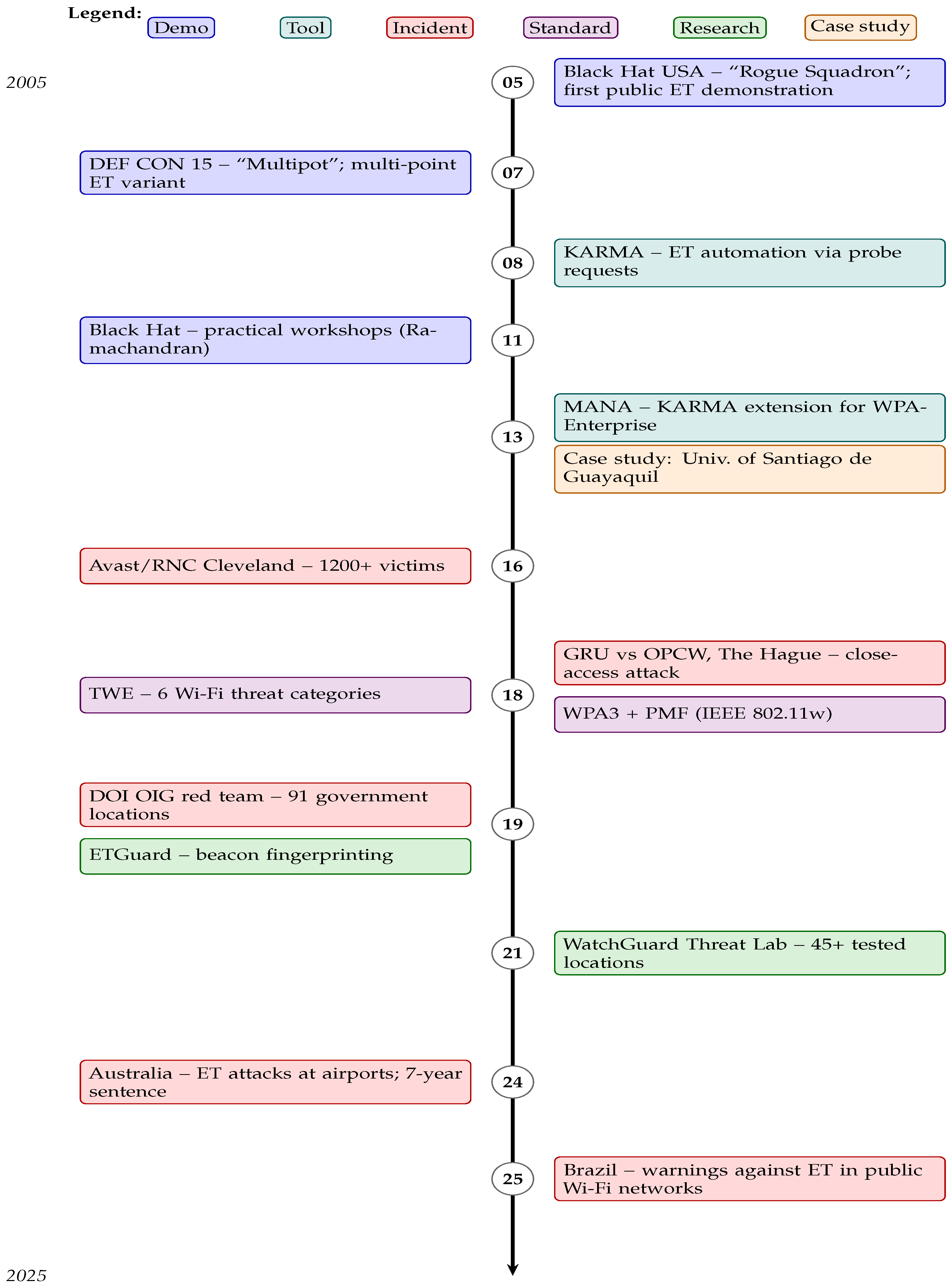
Figure 2.
Simplified source selection diagram (adapted from PRISMA) for narrative review.
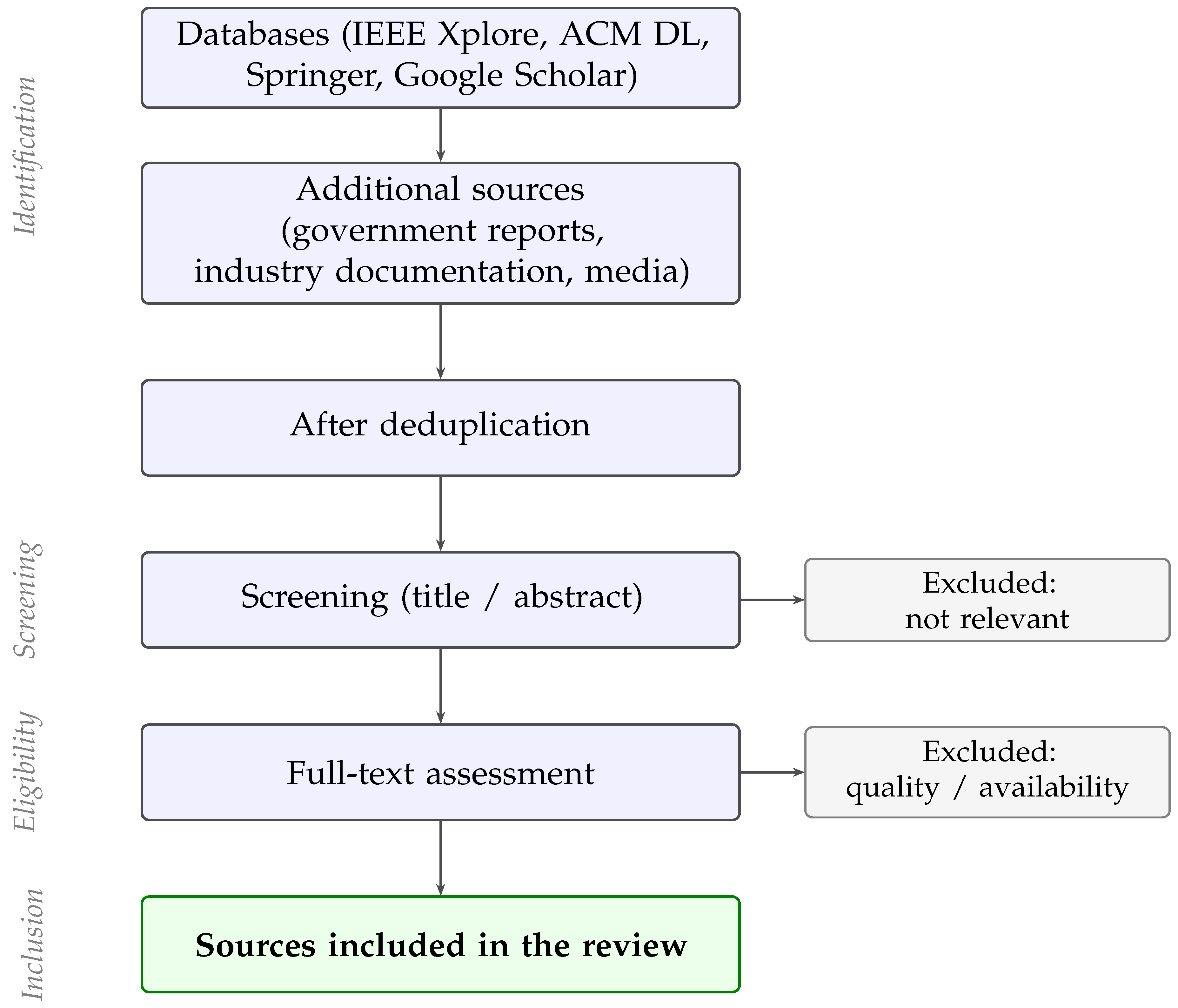
Figure 3.
Proposed Evil Twin attack mutation taxonomy – four evolutionary categories with key distinguishing characteristics.
Figure 3.
Proposed Evil Twin attack mutation taxonomy – four evolutionary categories with key distinguishing characteristics.
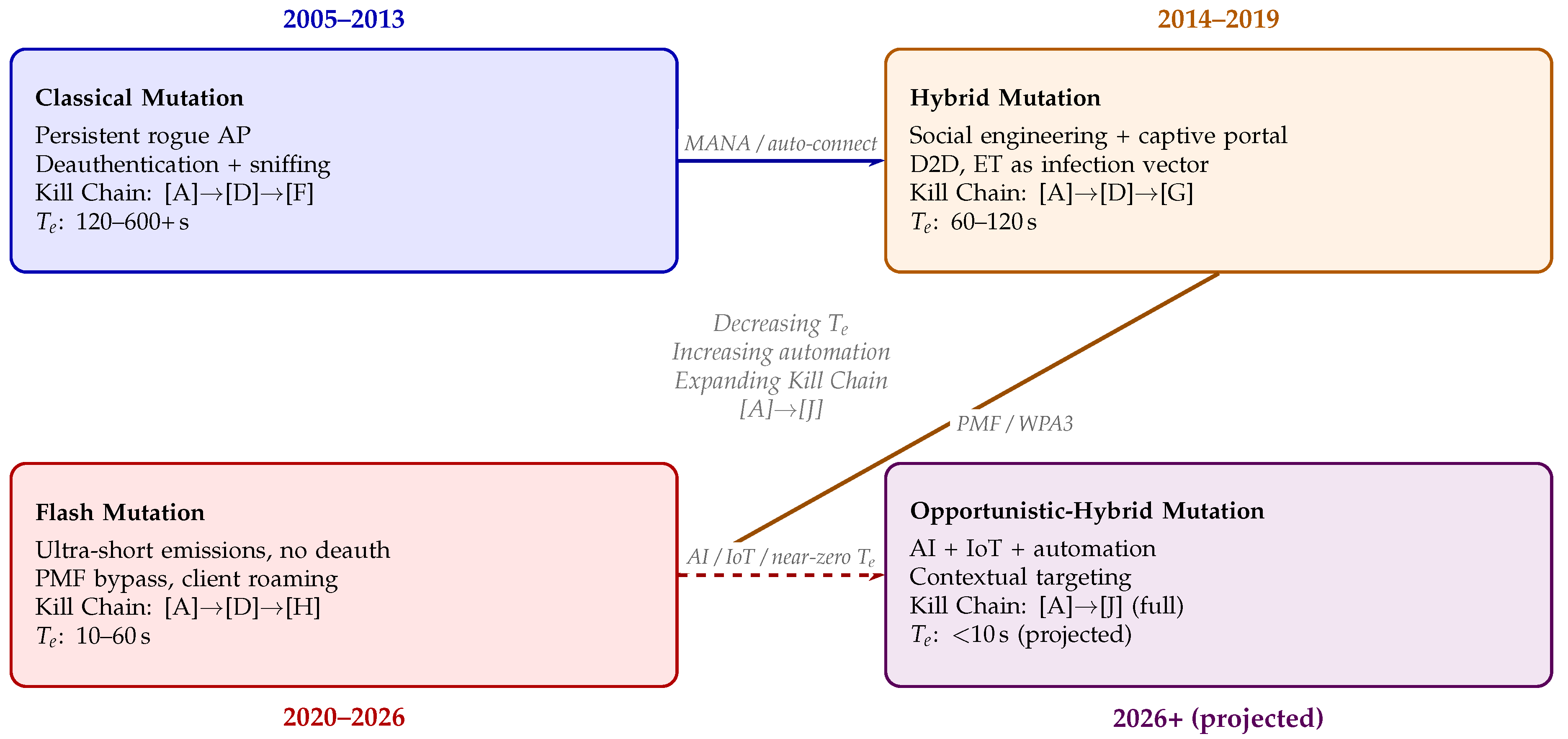

Table 1.
Chronology of key events related to the Evil Twin attack (2005–2025).
| Year | Type | Event / Significance |
|---|---|---|
| 2005 | Demo | Black Hat USA — “Rogue Squadron” (Beetle, Potter); first public ET demonstration |
| 2007 | Demo | DEF CON 15 — “Multipot”; multi-point ET variant bypassing WIPS |
| 2008 | Tool | KARMA — ET automation through probe request listening |
| 2011 | Demo | Black Hat — Ramachandran workshops; practical ET training |
| 2013 | Tool | MANA — KARMA extension incorporating WPA-Enterprise attacks |
| 2013 | Case study | University of Santiago de Guayaquil — ET + SET + cloned captive portal |
| 2016 | Incident | Avast at RNC, Cleveland — 1200+ victims, 68.3% identities exposed |
| 2018 | Incident | GRU vs OPCW, The Hague — confirmed intelligence operation (close-access) |
| 2018 | Standard | WPA3 + PMF (IEEE 802.11w) — management frame protection |
| 2018–19 | Incident | DOI OIG, USA — ET test across 91 government locations; no detection |
| 2018 | Standard | Trusted Wireless Environment — 6 Wi-Fi threat categories |
| 2019 | Research | ETGuard (Jain et al.) — ET detection based on beacon fingerprinting |
| 2021–23 | Research | WatchGuard Threat Lab — tests across 45+ locations; 91% vulnerable |
| 2024 | Incident | Australia — ET attacks at airports; 7-year and 4-month sentence |
| 2025 | Incident | Brazil — media warnings against ET in public networks |
Table 2.
Comparison of defense mechanisms against the Evil Twin attack.
| Mechanism | Year | Protection Type | Scope of Operation | Limitations Against ET |
|---|---|---|---|---|
| WPA2-Enterprise (EAP-TLS) | 2004 | Mutual authentication | RADIUS certificate verification; encrypted transmission | Requires PKI; not for public networks; client may accept forged cert. |
| Clock skew / HW FP | 2008–14 | Passive detection | AP ID via TSF clock skew [74,75] or HW traits [76] | Calibration needed; environmental sensitivity; limited scalability |
| PMF (802.11w) | 2009/18 | Frame protection | Blocks deauth/disassoc spoofing; mandatory in WPA3 [77] | No protection against ET without deauth (new clients, open nets, auto-connect) [78] |
| WIPS (dedicated radio) | 2010+ | Active det./blocking | Continuous scanning; rogue AP detection; containment frames | Dedicated HW with 3rd radio; ineffective for short ET (<60 s); cost |
| Cisco wIPS / CleanAir | 2010+ | Spectrum + WIPS | Interference and rogue AP detection at spectrum level [79,80] | Cisco HW only; no protocol-level attack detection |
| Client-side detection | 2010–18 | Active/passive | Route analysis [81]; WiFiHop [82]; stats [83]; channel mon. [84]; TCP delay [85] | Network-dependent; limited in high-load networks |
| Aruba RFProtect | 2012+ | Multi-sensor | Threat classification; auto rogue AP containment [86] | Sensor density dependent; false positives in multi-tenant env. |
| Meraki Air Marshal | 2014+ | Cloud WIPS | Auto SSID spoof detection; cloud mgmt [87] | Requires cloud; limited local policy control |
| WPA3-SAE | 2018 | Encryption | No offline dictionary attacks; forward secrecy; per-session protection [88,89] | Does not verify AP identity — encrypted connection to rogue AP possible [90] |
| TWE (6 categories) | 2018 | Comprehensive standard | Auto detection and blocking of 6 Wi-Fi threat types; HW cert. | Single vendor (WatchGuard); certified HW required; no independent audit |
| ETGuard | 2019 | Passive fingerprinting | Beacon frame sequence analysis; real-time pre-assoc. detection | Academic prototype; 802.11a/b/g only; needs production validation |
| EvilScout (SDN) | 2020 | Detection + mitigation | SDN-based centralised ET detection and containment [60] | Requires SDN; not for traditional networks |
| ML-based WIDS | 2022–23 | ML classification | Feature sel. + classifiers on AWID/AWID3 [62,91]; CSI FP [92] | Training data needed; limited cross-HW generalisability |
| Sig.-based MC-MitM IDS | 2024 | Passive signature-based | Distributed multi-ch. MitM detection [93,94]; TPR≥90% | 60 s delay; sensor deployment; known signatures only |
Table 3.
Evolution of the Evil Twin attack (2004–2025) in the context of MITRE ATT&CK.
| Period | Variant / Platform | Data Theft | D./D. | MITRE Tactics | Cases |
|---|---|---|---|---|---|
| 2004–07 | Classical ET + deauth; laptop + Wi-Fi card | Sniffing | V.L/V.L | TA0001, TA0009 | — |
| 2008–13 | KARMA/MANA + portal; Pineapple Mk4 | Portal phish. + sniff. | L/L | TA0001, TA0006 | Conf. |
| 2014–17 | SSL strip / HSTS bypass; Pineapple + bettercap | MitM, cred. harv. | L–M/M | TA0006, TA0009, TA0005 | RNC ’16 |
| 2018–19 | Close-access ET, D2D; spec. HW / RPi | 802.1X cred. theft | M–H/M | TA0001, TA0006, TA0008 | OPCW, DOI |
| 2020–22 | Ultra-short (<60 s), PMF bypass; RPi 4/Zero | Malware via portal | H/H | TA0001, TA0005, TA0011 | Few publ. |
| 2023–25 | Flash ET, AI portals; phone + Pineapple | AI phish., token theft | V.H/V.H | TA0001, TA0006, TA0009, TA0011 | AU ’24, BR ’25 |
Table 4.
Consolidated reference of Evil Twin Kill Chain stages.
| Stage | Name | Layer | MITRE ATT&CK | Description |
|---|---|---|---|---|
| [A] | Reconnaissance | Radio | (pre-TA0001) | SSID scanning, probe request analysis, client behaviour profiling |
| [B] | Weaponization | Radio | (pre-TA0001) | Rogue AP configuration, captive portal preparation, automation setup |
| [C] | Delivery | Radio | (pre-TA0001) | Deauthentication, SSID spoofing, forced client connection |
| [D] | Initial Access | Network | TA0001 | Victim connects to rogue AP — critical inflection point |
| [E] | Credential Access | Application | TA0006 | Phishing via captive portal, session token interception |
| [F] | Collection | Network | TA0009 | Traffic sniffing, session hijacking, data interception |
| [G] | Execution / Payload Delivery | Application | TA0002 | Malware delivery via portal or MitM (optional) |
| [H] | Command & Control | Network | TA0011 | C2 channel initialisation, beaconing |
| [I] | Lateral Movement | Network | TA0008 | Movement within victim’s network using obtained credentials |
| [J] | Impact | Application | TA0040 | Further campaign objectives, data exfiltration, disruption |
Table 5.
Comprehensive mapping: Evil Twin – Kill Chain – MITRE ATT&CK.
| Period / Mutation | Dominant Char. | Kill Chain | MITRE Tactics | Notes |
|---|---|---|---|---|
| 2004–07 Classical ET | AP spoof, sniffing | A→B→C→D→F | TA0001, TA0009 | Simple, passive |
| 2008–13 KARMA/MANA | SSID auto, captive portal | A→...→E→F | TA0001, TA0006, TA0009 | Active credential theft |
| 2014–17 SSL stripping | Active MITM, HTTPS bypass | A→...→F→G | +TA0005 | Increased complexity |
| 2018–19 Close-access | Short-lived, prepayload | A→...→G→H | +TA0011 | ET as campaign initiator |
| 2020–22 Ultra-short ET | PMF bypass, mobile D2D | A→...→I | +TA0008 | Lateral movement |
| 2023–25 Flash ET + AI | AI phishing, cred. stuffing | A→...→J | +TA0040 | Full kill chain |
Table 6.
Proposed exposure time scale categories ().
| Range | Level | Typical Attack Character | Detectability | Profitability |
|---|---|---|---|---|
| 0–10 s | Very short | Flash / fully automated (PMKID, rapid KARMA/MANA) | Very low | Very high |
| 10–30 s | Short | Automated ET + deauth / probe response spoofing | Low | High |
| 30–60 s | Medium | Contemporary automated ET (full beacon/probe/deauth emission) | Medium | Moderate |
| 60–120 s | Long | Classical ET with captive portal or manual interaction | High | Low |
| > 120 s | Very long | Persistent rogue AP (presence maintenance) | Very high | Very low |
Table 7.
Assumptions for the estimated value of .
| Scenario / Attack Mutation | Range | Ref. Value |
|---|---|---|
| Aggressive variants with KARMA/MANA + auto-connect | 0.70–0.90 | 0.85 |
| Flash mutation without deauthentication (strong signal + roaming) | 0.10–0.40 | 0.35 |
| Classical / hybrid with captive portal | 0.20–0.50 | 0.25–0.35 |
| Mass deauthentication (pre-PMF) | 0.80–0.95 | 0.90 |
| Enterprise environments WPA3-Enterprise + certificates | 0.05–0.20 | 0.10 |
Disclaimer/Publisher’s Note: The statements, opinions and data contained in all publications are solely those of the individual author(s) and contributor(s) and not of MDPI and/or the editor(s). MDPI and/or the editor(s) disclaim responsibility for any injury to people or property resulting from any ideas, methods, instructions or products referred to in the content. |
© 2026 by the authors. Licensee MDPI, Basel, Switzerland. This article is an open access article distributed under the terms and conditions of the Creative Commons Attribution (CC BY) license (http://creativecommons.org/licenses/by/4.0/).
Copyright: This open access article is published under a Creative Commons CC BY 4.0 license, which permit the free download, distribution, and reuse, provided that the author and preprint are cited in any reuse.


