
Submitted:
02 June 2026
Posted:
03 June 2026
You are already at the latest version
Abstract
The widespread implementation of next-generation sequencing (NGS) has revolution-ized clinical genetics, yet the identification of variants of uncertain significance (VUS) frequently hinders definitive diagnoses. Here, we report the molecular and functional characterization of a novel BTD missense variant to resolve a complex six-year diagnostic odyssey in a patient with suspected partial biotinidase (BTD) deficiency missed by newborn screening. The patient, presenting with moderate developmental delay, hypo-tonia, and motor impairment, was found to harbor two compound heterozygous variants in the BTD gene: the well-known hypomorphic pathogenic variant p.(Asp424His) and a novel VUS, p.(Thr459Met). To determine the precise molecular impact of the VUS, we combined in silico structural predictions with in vitro functional assays. Site-directed mutagenesis, followed by expression in recombinant HEK-293T cells, revealed that the p.(Thr459Met) variant dramatically impairs protein secretion and significantly reduces both intracellular and extracellular biotinidase enzymatic activity, comparable to other established pathogenic mutations. Further in vivo validation in patient plasma confirmed a partial reduction in overall BTD activity. These findings reclassify the p.(Thr459Met) variant as a likely pathogenic hypomorphic allele. This study highlights the critical ne-cessity of functional molecular validation to accurately interpret VUS, overcome the limitations of newborn screening, and achieve precision medicine in metabolic disorders.
Keywords:
biotinidase deficiency
; BTD gene
; variant of uncertain significance (VUS)
; functional validation
; hypomorphic mutations
; diagnostic odyssey
; newborn screening
; precision medicine
1. Introduction
Biotinidase (BTD) deficiency (OMIM #253260) is an autosomal recessive metabolic disorder characterized by the inability to recycle endogenous biotin (vitamin B7) or release it from dietary proteins. This disruption leads to secondary biotin depletion, causing a wide spectrum of clinical manifestations, including hypotonia, respiratory difficulties, hearing loss, seizures, and psychomotor delay. Fortunately, early biotin supplementation can alleviate and often completely prevent the onset of these symptoms, making timely diagnosis crucial [1,2].
Clinically, BTD deficiency is classified into two primary forms based on residual serum enzyme activity: profound and partial deficiency [3]. Individuals with profound untreated deficiency (serum BTD activity less than 10% of the normal mean) present with severe, early-onset clinical findings such as intractable seizures, profound hypotonia, eczematoid skin rashes, alopecia, ataxia, and severe developmental delay. If left untreated, life-threatening metabolic complications, including ketolactic acidosis, organic aciduria, and hyperammonemia, may arise. In contrast, individuals with partial BTD deficiency (10% to 30% of mean normal activity) typically present a milder phenotype and may even remain asymptomatic. However, during periods of metabolic stress—such as infection, fever, or fasting—they can decompensate and develop severe neurological and cutaneous symptoms analogous to profound deficiency [4]. Serum BTD activity levels greater than 30% are generally considered normal [5,6]. Notably, the clinical spectrum is broad; late-onset presentations have been documented in adults suffering from optic neuropathy and/or peripheral neuropathy, who were frequently misdiagnosed with multiple sclerosis before severe BTD deficiency was ultimately identified [7].
The disorder is driven by loss-of-function (LOF) pathogenic variants in the BTD gene (NCBI: 686; HGNC: 1122). These genetic alterations can result in either null alleles, causing complete absence of functional enzyme, or hypomorphic alleles, which produce enzymes with residual, partial activity. This allelic heterogeneity directly contributes to the vast phenotypic variability observed in patients [8]. One of the most prevalent hypomorphic variants is NP_001357587.1:p.(Asp424His) (often historically referred to in the literature as p.Asp444His) [9]. Compound heterozygosity for this hypomorphic variant in trans with a null BTD variant typically results in partial BTD deficiency, yielding an expected enzymatic activity of approximately 20–25% [9,10]. Conversely, individuals homozygous for the p.(Asp424His) variant generally retain 45–50% enzyme activity—similar to heterozygous carriers of a single null variant—and usually do not require biotin supplementation. Despite these established patterns, patients with atypical or borderline enzymatic activity often suffer misdiagnoses due to non-specific clinical features and inconclusive laboratory screenings.
The advent of next-generation sequencing (NGS) has significantly accelerated the diagnosis of rare metabolic diseases. Nevertheless, the frequent identification of variants of uncertain significance (VUS) poses a major challenge for clinical management. In this study, we present a translational approach to resolve a complex diagnostic odyssey spanning six years. Despite undergoing newborn screening and extensive clinical evaluations, the patient's partial BTD deficiency was only suspected after an NGS trio-exome identified compound heterozygous variants in the BTD gene: a known pathogenic hypomorphic variant and a novel VUS. The primary objective of this study was to ascertain the precise molecular and functional impact of this VUS through in silico modeling, in vitro site-directed mutagenesis, and in vivo enzymatic assays, thereby enabling its clinical reclassification and securing a definitive precision diagnosis.
2. Results
2.1. Clinical Presentation and Diagnostic Odyssey
The patient is a six-year-old girl referred to the Clinical Genetics Department due to moderate developmental delay, gait alterations, feeding difficulties, and recurrent respiratory infections. She is the second child of a healthy, non-consanguineous couple. The pregnancy was achieved via in vitro fertilization (dichorionic, diamniotic twin pregnancy) following two years of primary infertility. Delivery was induced at 38+3 weeks, resulting in a cesarean section with no neonatal complications. Birth weight was 2,630 g, and standard newborn metabolic and otoacoustic screenings were reported as normal (notably, BTD screening was not included in the national newborn screening program at that time).
The patient's diagnostic odyssey commenced at two months of age when she was evaluated for hypotonia and early developmental delay. Early intervention and occupational therapy were initiated at four months. Throughout her early childhood, she suffered from frequent respiratory infections (bronchiolitis, pneumonia, pharyngitis) and gastrointestinal issues, including frequent vomiting and solid feeding intolerance. At six years of age, she lacks bladder control, exhibits a clumsy gait with frequent falls and poor protective reflexes, and requires educational support, physiotherapy, and speech therapy.
Extensive clinical evaluations yielded largely non-specific findings. Brain MRI, electroencephalogram (EEG), Brainstem Evoked Response Audiometry (BERA), echocardiography, and abdominal ultrasounds were normal. Ophthalmologic evaluation revealed pale optic discs, and Visual Evoked Potentials (VEP) detected mild-to-moderate cortical delay. Electromyography (EMG) indicated a mild myopathy, accompanied by slightly elevated transaminases and creatine kinase (CK).
Initial genetic testing, including chromosomal microarray analysis (CMA), was normal. Subsequent whole-exome sequencing (WES) identified three heterozygous variants: a VUS in RLIM (p.Gly74Ser), a VUS in KMT2C (p.Ser3588Leu), and a likely pathogenic variant in ATR (p.Ala669GlufsTer4). None of these findings adequately explained the patient's phenotype. Finally, an Exome-Trio analysis revealed two variants in compound heterozygosity in exon 4 of the BTD gene: the well-established hypomorphic pathogenic variant NM_001370658.1:c.1270G>C; p.(Asp424His) and a novel VUS, NM_001370658.1:c.1376C>T; p.(Thr459Met). The latter has a minor allele frequency of 0.08% in gnomAD and had not been previously reported in BTD-deficient patients.
Following this genetic finding, serum BTD enzymatic activity was measured, revealing a level of 4.90 nmol/min/mL (normal range: 7.80–13.50 nmol/min/mL). The patient was subsequently started on oral biotin supplementation, which led to a significant improvement in both muscular and cognitive functions after 14 months of treatment. Sanger sequencing successfully confirmed the compound heterozygous state in the proband and the carrier status in the unaffected parents and sibling (Figure 1), consistent with an autosomal recessive inheritance pattern.
2.2. In Silico and Structural Analysis of the BTD p.(Thr459Met) Variant
To preliminarily assess the impact of the p.(Thr459Met) variant, computational predictive algorithms were employed. Although certain algorithms predicted the substitution to be tolerated, evolutionary conservation analysis demonstrated that the Thr459 residue is strictly conserved across multiple species, even in non-mammals, underscoring its functional or structural importance (Figure 2). Additionally, several missense variants in close proximity to this residue (e.g., p.Ala458Pro, p.Ala458Thr, p.Gly460Arg, p.His465Gln, and p.Leu466Gln) are established pathogenic mutations [11,12,13,14].
Three-dimensional in silico modeling further supported the deleterious nature of the substitution. The Thr459 residue directly interacts with Glu416, Ser414, and Tyr418 (Figure 3). Notably, mutations in Glu416 and Tyr418 have been previously reported in patients with BTD deficiency [15,16]. Although Thr459 does not interact directly with Ala419—a key residue for maintaining the regional three-dimensional structure—an amino acid change at position 459 could disrupt this intricate interaction network and critically destabilize the protein.
2.3. In Vitro Functional Characterization: Protein Expression and Enzymatic Activity
To definitively clarify the clinical significance of the p.(Thr459Met) variant, in vitro functional assays were performed. The known hypomorphic variant p.(Asp424His) [9], along with the established pathogenic variants p.(Gln436His), p.(Ala458Thr), and p.(Arg518Ser) [10,12,17], were included as positive controls for impaired function, while the p.(Pro371Ser) variant served as a benign control[10,12,17].
Western blot analysis of transfected HEK-293T cells (Figure 4) revealed both intracellular and extracellular expression of the wild-type (WT) BTD, the benign p.(Pro371Ser) variant, and the hypomorphic p.(Asp424His) variant. However, the novel p.(Thr459Met) variant exhibited a dramatic reduction in expression, particularly in the extracellular culture medium, mirroring the behavior of severe pathogenic controls like p.(Gln436His) and p.(Arg518Ser), which were only detectable in the cell lysate.
Subsequent in vitro enzymatic assays corroborated these findings (Figure 5). All pathogenic controls exhibited significantly reduced enzymatic activity both intracellularly and extracellularly, whereas the benign control-maintained WT-like activity. The p.(Thr459Met) variant demonstrated significantly diminished biotinidase activity, falling strictly within the range of the pathogenic controls, confirming its deleterious impact on protein function and secretion.
2.4. In Vivo Validation and Variant Reclassification
To correlate the in vitro findings with physiological conditions, in vivo BTD activity was quantified in plasma samples from the proband, asymptomatic family members, and five unrelated healthy controls (Figure 6). While unaffected family members and controls exhibited normal relative BTD activity (ranging from 89.4% to 106.6% of the normalized WT average), the proband displayed a noticeable reduction, retaining only 75.8% of relative activity.
In light of the compelling functional evidence (impaired protein secretion and reduced in vitro enzymatic activity) combined with the in vivo enzymatic data and family segregation, the p.(Thr459Met) variant is officially reclassified as "Likely Pathogenic" according to the ACMG criteria (PM2, PP3, PM3, PS3). It operates as a loss-of-function (LOF) hypomorphic variant which, in compound heterozygosity with the p.(Asp424His) variant, induces partial BTD deficiency.
3. Discussion
In this study, we report the case of a six-year-old girl who endured a prolonged diagnostic odyssey, spanning from two months of age until a definitive diagnosis of partial BTD deficiency was secured through the functional reclassification of a novel VUS. The diagnostic breakthrough was only achieved when multidisciplinary efforts translated genetic findings into a precise molecular diagnosis.
To reclassify the p.(Thr459Met) variant, in silico modeling and evolutionary conservation studies provided the first clues of its pathological nature. However, because computational predictions are not definitive, functional in vitro validation was paramount. Most pathogenic variants in BTD are usually missense or frameshift mutations found in a homozygous or compound heterozygous state [18]. BTD is known to be a secreted protein, although it exhibits both intracellular and extracellular expression [17]. The underlying reasons for this duality remain poorly understood. Our in vitro results show that the p.(Thr459Met) variant behaves similarly to established pathogenic controls, exhibiting a drastic reduction in expression, particularly in the culture medium, suggesting a severe impairment in protein secretion.
Furthermore, we observed that pathogenic mutations exhibit distinct intracellular versus extracellular activity profiles, as previously reported [19]. The p.(Asp424His) variant showed the greatest discrepancy (41.5% intracellular vs. 81.9% extracellular activity). The p.(Thr459Met) variant also displayed reduced and variable activity (67.8% intracellular vs. 51.6% extracellular), aligning closely with the pathogenic control p.(Ala458Thr). It has been proposed that the deleterious effect of the p.(Asp424His) variant is primarily related to a decrease in protein quantity rather than a complete loss of intrinsic catalytic activity [19], which explains its enormous phenotypic variability. In fact, neither the Asp424 nor the Thr459 residues belong to the core catalytic active site of the protein [20].
The genotype identified in our proband involves two hypomorphic variants in trans, leading to a mild reduction in overall BTD activity. Based on our functional data, it is highly likely that p.(Thr459Met) exerts a more severe LOF effect than p.(Asp424His). It is generally assumed that homozygotes possessing two hypomorphic alleles (such as homozygous p.Asp424His) will not develop the disease and should not be treated with biotin [5]. However, in reality, homozygous p.(Asp424His) patients with profound enzyme deficiency, as well as heterozygotes with partial deficiency, have indeed been described [21,22]. Interestingly, although our proband’s absolute plasma BTD activity was abnormally low (4.9 nmol/min/mL), her relative in vivo activity was 75.8% compared to healthy controls. While this relative value remains above the classic 30% diagnostic threshold for partial deficiency, the absolute biochemical deficit clearly correlated with the onset of her symptoms.
It is well-documented that clinical manifestations and BTD activity can be influenced by preanalytical variables—such as age, prematurity, neonatal jaundice, and sample temperature during storage or transport [23,24,25,26]—as well as epigenetic factors, modifier genes, or variable dietary biotin intake. Indeed, while most individuals with partial BTD deficiency [27] and even some with profound deficiency [28] remain asymptomatic, up to 28% of patients suffer from delayed diagnoses [27]. This underscores that current standard detection methods may be insufficient for mild or atypical presentations.
This discrepancy highlights a critical clinical concept: the genotype-phenotype correlation in partial BTD deficiency is not strictly linear. More importantly, it emphasizes that next-generation sequencing (NGS) is the perfect complement to biochemical newborn screening, rather than just a secondary diagnostic tool. Biochemical screening can occasionally be non-resolutive due to borderline enzymatic activities or the aforementioned preanalytical variables. When metabolic or imaging tests are inconsistent and BTD deficiency is suspected, a plasma enzymatic assay strictly complemented by comprehensive genetic analysis is necessary to achieve a precise diagnosis without delay.
The widespread implementation of NGS represents a monumental milestone in clinical genetics. However, the frequent identification of VUS remains a significant stumbling block. Resolving these variants requires rigorous, multidisciplinary functional studies linking clinical phenotypes with molecular pathogenesis. In conclusion, our study demonstrates that combining functional assays with comprehensive genomic analysis is essential to overcome the limitations of standard biochemical screening, resolve diagnostic odysseys, and achieve true precision medicine in metabolic disorders.
4. Materials and Methods
4.1. Patient and Family Recruitment
The proband and her immediate family members (father, mother, and sibling) were recruited through the Clinical Genetics Department at the Hospital General Universitario de Toledo (Spain). A previous next-generation sequencing (NGS) analysis, which identified a pathogenic variant and a variant of uncertain significance (VUS) in the BTD gene, had been performed at an external medical center. Following a comprehensive medical examination, serum biotinidase concentrations were independently determined by an external laboratory according to the protocol described by González et al. [29]. For the present genetic and functional studies, 5–10 mL of peripheral venous blood was collected from each participant following written informed consent. Samples were aliquoted and stored at −80 °C at the Medical Genetics Laboratory of the Universidad de Castilla-La Mancha (UCLM).
4.2. Computational Studies and Pathogenicity Prediction
To predict the potential pathogenicity of the identified genetic variants, multiple in silico prediction algorithms were utilized, including SIFT, PolyPhen-2, and Align GVGD. Tertiary protein structure predictions and interaction mappings were conducted using the AlphaFold Protein Structure Database (#AF-P43251-F1-v4; EMBL-EBI). Evolutionary conservation of the BTD protein amino acid residues was analyzed using ClustalX2 software. The target residues (Asp424 and Thr459) were compared against known pathogenic control variants (Gln436, Ala458, Arg518) and a benign variant (Pro371) across diverse species along the evolutionary scale (Homo sapiens, Pan troglodytes, Macaca mulatta, Sus scrofa, and Gallus gallus).
4.3. DNA Extraction and Variant Confirmation
Genomic DNA (gDNA) was extracted from peripheral blood leukocytes using the E.Z.N.A. Blood DNA Kit (Omega Bio-tek, Norcross, GA, USA) following the manufacturer’s instructions. DNA concentration and purity were assessed using a NanoDrop ND-1000 spectrophotometer (Thermo Fisher Scientific, Waltham, MA, USA).
The genetic variants identified by NGS were validated in the proband and analyzed for segregation in the family members via Sanger sequencing. Specific PCR primers were designed to flank the intronic regions of exon 4 of the BTD gene: forward 5′-TCCACGTCTGTTCCAATGGC-3′ and reverse 5′-GCTTGGCTGGGAGAATGACC-3′. PCR amplification was performed in a 50 µL reaction volume containing 50 ng of gDNA template, 1X standard reaction buffer, 0.2 mM dNTP mixture, 0.2 µM of each primer, 2.5% DMSO, and 1 U of Taq DNA polymerase (Biotools, Madrid, Spain). Thermocycling conditions consisted of an initial denaturation at 94 °C for 5 min, followed by 40 cycles of 94 °C for 30 s, 55 °C for 20 s, and 72 °C for 30 s, with a final extension at 72 °C for 5 min. Terminator cycle sequencing was performed using the BigDye Terminator v3.1 Cycle Sequencing Kit (Applied Biosystems, Foster City, CA, USA), and products were analyzed on a 3730xl Automated DNA Analyzer (Applied Biosystems).
4.4. Plasmid Constructs and Site-Directed Mutagenesis
To generate mutant clones, the variants of interest were introduced into a pCMV6 expression vector (OriGene, RC204153) encoding myc-DDK-tagged human biotinidase. Mutagenesis was performed using the QuikChange II XL Site-Directed Mutagenesis Kit (Agilent Technologies, Santa Clara, CA, USA) along with specific custom-designed primers (Table 1). Competent cells were transformed via heat shock with the recombinant DNA and grown on LB-agar plates supplemented with 50 µg/mL kanamycin. Positive clones were selected and confirmed by PCR and Sanger sequencing. Recombinant plasmids were purified using the GeneJET Plasmid Miniprep Kit (Thermo Fisher Scientific).
4.5. Cell Culture and Transient Transfection
HEK-293T cells were cultured in Dulbecco’s Modified Eagle Medium (DMEM, 1X) supplemented with 4.5 g/L glucose, L-glutamine, sodium pyruvate, 10% fetal bovine serum (Capricorn Scientific, Ebsdorfergrund, Germany), and 1% penicillin-streptomycin (Gibco, Grand Island, NY, USA). Transfections were performed in triplicate in 6-well plates using 1 µg of the respective mutant or wild-type (WT) plasmid and the Canfast transfection reagent (Canvax, Córdoba, Spain). A vector encoding a Green Fluorescent Protein (GFP) reporter gene was used as a negative and transfection efficiency control. Cells and culture media were harvested 48 h post-transfection and stored at −80 °C.
4.6. Protein Detection by Western Blot
Thirty microliters of cell lysate or culture medium were denatured in Laemmli buffer at 95 °C for 5 min. Proteins were separated by SDS-PAGE (4% stacking gel, 10% resolving gel) at 30 mA for 2 h and subsequently transferred to a nitrocellulose membrane (Amersham, UK) using a semi-dry transfer system at 15 V for 10 min (Thermo Fisher Scientific). Membranes were blocked with 10% non-fat dry milk in TTBS for 1 h at room temperature on a shaker. Recombinant BTD protein was detected using a primary monoclonal anti-myc antibody (Santa Cruz Biotechnology, Dallas, TX, USA; diluted 1:500) incubated overnight at 4 °C. Following three washes, the membranes were incubated with an HRP-conjugated secondary IgG antibody (Santa Cruz Biotechnology; diluted 1:1000) for 1 h. Chemiluminescent signals were developed using the SuperSignal West Femto Maximum Sensitivity Substrate (Thermo Fisher Scientific) and visualized on an ImageQuant LAS 4000 imaging system.
4.7. In Vitro BTD Enzymatic Assay
Harvested cells were lysed in 150 µL of RIPA buffer (Thermo Fisher Scientific) supplemented with protease inhibitors and DTT. Lysates were incubated on ice for 10 min, vortexed for 30 s twice, and centrifuged to clear cellular debris. To measure BTD enzymatic activity, 15 µL of either cell lysate or culture medium was mixed with 150 µL of substrate solution (0.15 M potassium phosphate pH 6.5, 0.1 mM DTT, and 50 µM biotinyl-6-aminoquinoline [BAQ]) and incubated for 3 h at 37 °C. The fluorescent product was quantified using spectrophotometric techniques with an excitation wavelength of 350 nm and an emission wavelength of 520 nm.
4.8. In Vivo BTD Enzymatic Assay
Plasma was isolated from 4 mL of peripheral blood collected from all family members and five unrelated healthy control individuals (without symptoms of BTD deficiency). Blood was centrifuged at 2000× g for 10 min. Plasma aliquots of 500 µL were immediately frozen at −80 °C until further use. The in vivo BTD enzymatic assay was performed using 15 µL of plasma, following the exact same protocol and substrate conditions described above for the in vitro assay.
4.9. Statistical Analysis
For recombinant BTD analyses, two independent in vitro experiments were conducted, each comprising triplicate measurements per variant. Enzymatic activity was expressed as a relative percentage of the WT BTD activity (defined as 100%) after subtracting the basal endogenous activity measured in the GFP-transfected negative control. For plasma in vivo BTD assays, triplicate measurements were obtained for each subject. Activity was expressed relative to the mean value of the healthy controls and asymptomatic family members (defined as 100%). Data are presented as the mean ± standard deviation (SD). Statistical significance was determined using a two-sample t-test (assuming equal variances) using Microsoft Excel (Microsoft 365 version). A p-value < 0.05 was considered statistically significant (*: p < 0.05; **: p < 0.01; ***: p < 0.001).
5. Conclusions
This study underscores the profound clinical utility of integrating comprehensive genomic sequencing with rigorous functional validation to resolve complex diagnostic odysseys. We successfully reclassified a novel BTD VUS, p.(Thr459Met), as a likely pathogenic hypomorphic allele, definitively diagnosing a six-year case of partial BTD deficiency that had escaped standard newborn screening. Importantly, this case demonstrates that the genotype-phenotype correlation in partial BTD deficiency is not always strictly predictable by standard biochemical limits alone. Consequently, NGS should not be viewed merely as a secondary tool, but rather as an essential complement to biochemical screening. When metabolic or imaging tests are inconsistent, the synergistic combination of plasma enzymatic activity profiling, deep genomic sequencing, and targeted molecular functional studies is imperative to ensure timely, precise diagnoses and to unlock the full potential of precision medicine in metabolic disorders.
Author Contributions
Conceptualization, C.d.D.-B. and F.S.-S.; Methodology, F.S.-S.; Investigation, C.T.-P., M.M.-H., M.P.L.-G., C.d.D.-B. and F.S.-S.; Formal analysis, M.M.-H.; Data curation, C.T.-P. and F.S.-S.; Validation, C.T.-P. and F.S.-S.; Writing—original draft preparation, C.T.-P. and M.P.L.-G.; Writing—review and editing, C.T.-P., M.M.-H., M.P.L.-G., C.d.D.-B. and F.S.-S.; Visualization, M.M.-H., M.P.L.-G. and F.S.-S.; Supervision, M.P.L.-G., C.d.D.-B. and F.S.-S.; Funding acquisition, F.S.-S. All authors have read and agreed to the published version of the manuscript.
Funding
The Medical Genetics Laboratory of the Universidad de Castilla-La Mancha maintains a collaboration agreement with the Health Service of Castilla-La Mancha and receives funding to perform genetic analyses on patients from the Servicio de Salud de Castilla-La Mancha (SESCAM). Additionally, this research received funding from the Association for the Divulgation of Oncological and Genetic Studies (ADAO).
Institutional Review Board Statement
The study was conducted in accordance with the Declaration of Helsinki. Formal ethical review and approval were waived for this specific study as the genetic and functional analyses were conducted within the scope of routine clinical diagnostic assistance under an official institutional agreement between the regional public health service (SESCAM) and the University of Castilla-La Mancha (UCLM), rather than as part of a prospective research trial.
Informed Consent Statement
Informed consent was obtained from all subjects involved in the study. Written informed consent has been obtained from the patient´s parents to publish this paper.
Data Availability Statement
The original contributions presented in the study are included in the article. The p.(Asp424His) and p.(Thr459Met) BTD variants identified in the patient have been submitted to the Leiden Open Variation Database (LOVD) under the ID #0001047048. Further inquiries can be directed to the corresponding author.
Acknowledgments
We deeply appreciate the willingness and continuous collaboration of the family participating in this study, which made the publication of this work possible.
Conflicts of Interest
The authors declare no conflicts of interest.
Abbreviations
The following abbreviations are used in this manuscript:
| NGS | Next-generation sequencing |
| BTD | Biotinidase |
| VUS | Variant of uncertain significance |
| LOF | Loss of function |
References
- Secor McVoy, J.R.; Levy, H.L.; Lawler, M.; Schmidt, M.A.; Ebers, D.D.; Hart, P.S.; et al. Partial biotinidase deficiency: Clinical and biochemical features. J. Pediatr. 1990, 116(1), 78–83. [Google Scholar] [CrossRef]
- Wolf, B.; Heard, G.S.; Weissbecker, K.A.; McVoy, J.R.S.; Grier, R.E.; Leshner, R.T. Biotinidase deficiency: Initial clinical features and rapid diagnosis. Ann. Neurol. 1985, 18(5), 614–7. [Google Scholar] [CrossRef] [PubMed]
- Devanapalli, B.; Sze Hui Wong, R.; Lim, N.; Ian Andrews, P.; Vijayan, K.; Kim, W.T.; et al. Biotinidase deficiency: A treatable neurometabolic disorder. Brain Dev. Case Rep. 2024, 2(2), 100021. [Google Scholar] [CrossRef]
- Akgun, A.; Sen, A.; Onal, H. Clinical, biochemical and genotypical characteristics in biotinidase deficiency. J. Pediatr. Endocrinol. Metab. 2021, 34(11), 1425–33. [Google Scholar] [CrossRef] [PubMed]
- Wiltink, R.C.; Kruijshaar, M.E.; Van Minkelen, R.; Onkenhout, W.; Verheijen, F.W.; Kemper, E.A.; et al. Neonatal screening for profound biotinidase deficiency in the Netherlands: consequences and considerations. Eur. J. Hum. Genet. 2016, 24(10), 1424–9. [Google Scholar] [CrossRef]
- Wolf, B.; Grier, R.E.; Allen, R.J.; Goodman, S.I.; Kien, C.L. Biotinidase deficiency: the enzymatic defect in late-onset multiple carboxylase deficiency. Clin. Chim. Acta 1983, 131(3), 273–81. [Google Scholar] [CrossRef]
- Wolf, B. Biotinidase deficiency should be considered in individuals thought to have multiple sclerosis and related disorders. Mult. Scler. Relat. Disord. 2019, 28, 26–30. [Google Scholar] [CrossRef]
- Sivri, H.S.K.; Genç, G.A.; Tokatli, A.; Dursun, A.; Coşkun, T.; Aydin, H.I.; et al. Hearing loss in biotinidase deficiency: genotype-phenotype correlation. J. Pediatr. 2007, 150(4), 439–42. [Google Scholar] [CrossRef]
- Swango, K.L.; Demirkol, M.; Hüner, G.; Pronicka, E.; Sykut-Cegielska, J.; Schulze, A.; et al. Partial biotinidase deficiency is usually due to the D444H mutation in the biotinidase gene. Hum. Genet. 1998, 102(5), 571–5. [Google Scholar] [CrossRef] [PubMed]
- Norrgard, K.J.; Pomponio, R.J.; Hymes, J.; Wolf, B. Mutations Causing Profound Biotinidase Deficiency in Children Ascertained by Newborn Screening in the United States Occur at Different Frequencies than in Symptomatic Children. Pediatr. Res. 1999, 46(1), 20–7. [Google Scholar] [CrossRef]
- Karaca, M.; Özgül, R.K.; Ünal, Ö.; Yücel-Yılmaz, D.; Kılıç, M.; Hişmi, B.; et al. Detection of biotinidase gene mutations in Turkish patients ascertained by newborn and family screening. Eur. J. Pediatr. 2015, 174(8), 1077–84. [Google Scholar] [CrossRef]
- Procter, M.; Wolf, B.; Mao, R. Forty-eight novel mutations causing biotinidase deficiency. Mol. Genet Metab. 2016, 117(3), 369–72. [Google Scholar] [CrossRef] [PubMed]
- Sarafoglou, K.; Bentler, K.; Gaviglio, A.; Redlinger-Grosse, K.; Anderson, C.; McCann, M.; et al. High incidence of profound biotinidase deficiency detected in newborn screening blood spots in the Somalian population in Minnesota. J. Inherit. Metab. Dis. 2009, 32(S1), 169–73. [Google Scholar] [CrossRef] [PubMed]
- Yang, Y.; Yang, J.Y.; Chen, X.J. Biotinidase deficiency characterized by skin and hair findings. Clin. Dermatol. 2020, 38(4), 477–83. [Google Scholar] [CrossRef]
- Funghini, S.; Tonin, R.; Malvagia, S.; Caciotti, A.; Donati, M.A.; Morrone, A.; et al. High frequency of biotinidase deficiency in Italian population identified by newborn screening. Mol. Genet Metab. Rep. 2020, 25, 100689. [Google Scholar] [CrossRef]
- Hsu, R.H.; Chien, Y.H.; Hwu, W.L.; Chang, I.F.; Ho, H.C.; Chou, S.P.; et al. Genotypic and phenotypic correlations of biotinidase deficiency in the Chinese population. Orphanet J Rare Dis [Internet]. Available online: https://ojrd.biomedcentral.com/articles/10.1186/s13023-018-0992-2.
- Wolf, B.; Jensen, K.P.; Barshop, B.; Blitzer, M.; Carlson, M.; Goudie, D.R.; et al. Biotinidase deficiency: Novel mutations and their biochemical and clinical correlates. Hum. Mutat. 2005, 25(4), 413–413. [Google Scholar] [CrossRef]
- Kannan, B.; Navamani, H.K.; Jayaseelan, V.P.; Arumugam, P. A Rare Biotinidase Deficiency in the Pediatrics Population: Genotype-Phenotype Analysis. J. Pediatr. Genet. 2023, 12(1), 1–15. [Google Scholar] [CrossRef]
- Borsatto, T.; Sperb-Ludwig, F.; Blom, H.J.; Schwartz, I.V.D. Effect of BTD gene variants on in vitro biotinidase activity. Mol. Genet Metab. 2019, 127(4), 361–7. [Google Scholar] [CrossRef]
- Azizinejad, F.; Aminzadeh, M.; Tahmasebi-Birgani, M.; Heidari, S.; Ghandil, P. Identification of the mutations in BTD gene in Iranian patients with biotinidase deficiency and evaluating their genotype-phenotype correlations. Gene 2025, 935, 149020. [Google Scholar] [CrossRef] [PubMed]
- Sharma, R.; Kucera, C.R.; Nery, C.R.; Lacbawan, F.L.; Salazar, D.; Tanpaiboon, P. Biotinidase biochemical and molecular analyses: Experience at a large reference laboratory. Pediatr. Int. Off. J. Jpn. Pediatr. Soc. 2024, 66(1), e15726. [Google Scholar] [CrossRef]
- Sürücü Kara, İ.; Köse, E.; Koç Yekedüz, M.; Eminoğlu, F.T. A different approach to the evaluation of the genotype-phenotype relationship in biotinidase deficiency: repeated measurement of biotinidase enzyme activity. J Pediatr. Endocrinol. Metab JPEM 2023, 36(11), 1061–71. [Google Scholar] [CrossRef] [PubMed]
- Canda, E.; Kalkan Uçar, S.; Çoker, M. Biotinidase Deficiency: Prevalence, Impact And Management Strategies. Pediatr. Health Med. Ther. 2020, 11, 127–33. [Google Scholar]
- Canda, E.; Yazici, H.; Er, E.; Kose, M.; Basol, G.; Onay, H.; et al. Single center experience of biotinidase deficiency: 259 patients and six novel mutations. J. Pediatr. Endocrinol. Metab. 2018, 31(8), 917–26. [Google Scholar] [CrossRef]
- Henderson, M.P.A.; McIntosh, N.; Chambers, A.; Desormeaux, E.; Kowalski, M.; Milburn, J.; et al. Biotinidase activity is affected by both seasonal temperature and filter collection cards. Clin. Biochem. 2023, 115, 129–36. [Google Scholar] [CrossRef]
- Strovel, E.T.; Cowan, T.M.; Scott, A.I.; Wolf, B. Laboratory diagnosis of biotinidase deficiency, 2017 update: a technical standard and guideline of the American College of Medical Genetics and Genomics. Genet Med. 2017, 19(10), 1–10. [Google Scholar] [CrossRef]
- Tankeu, A.T.; Van Winckel, G.; Elmers, J.; Jaccard, E.; Superti-Furga, A.; Wolf, B.; et al. Biotinidase deficiency: What have we learned in forty years? Mol. Genet Metab. 2023, 138(4), 107560. [Google Scholar] [CrossRef]
- Wolf, B.; Norrgard, K.; Pomponio, R.J.; Mock, D.M.; McVoy, J.R.; Fleischhauer, K.; et al. Profound biotinidase deficiency in two asymptomatic adults. Am. J. Med. Genet. 1997, 73(1), 5–9. [Google Scholar] [CrossRef]
- González, E.C.; Diaz, L.; Frómeta, A.; Herrera, D.; Montenegro, A. Ensayo cuantitativo para la determinación de la actividad hidrolítica de la enzima biotinidasa. Biomédica 2001, 21(4), 360. [Google Scholar] [CrossRef]
Figure 1.
A. Sanger confirmation of variants in the proband and family members. Arrows show the mutated nucleotide for each variant. B. Genealogy of the family studied. Genotypes for both variants are shown below the symbols. WT: wild type allele.
Figure 1.
A. Sanger confirmation of variants in the proband and family members. Arrows show the mutated nucleotide for each variant. B. Genealogy of the family studied. Genotypes for both variants are shown below the symbols. WT: wild type allele.
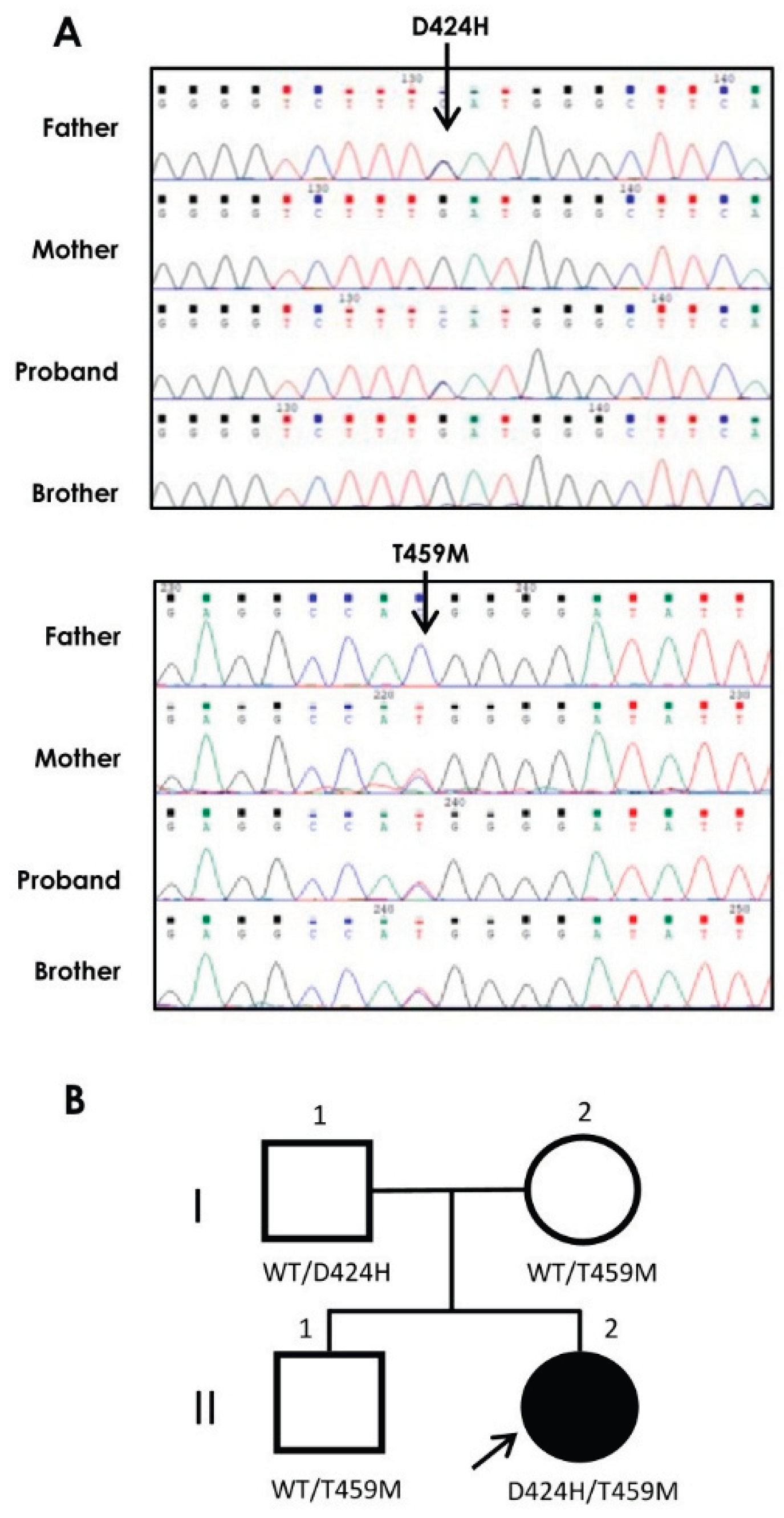
Figure 2.
Multiple sequence alignment of BTD protein in various species on the evolutionary scale, including humans in the first row. Arrow indicates residue T459. Asterisk (*) indicates that at that position the residues are 100% identical. Two dots (:), indicate positions where conservative substitutions have been made. One dot (.), indicates positions where less conservative substitutions have been made.
Figure 2.
Multiple sequence alignment of BTD protein in various species on the evolutionary scale, including humans in the first row. Arrow indicates residue T459. Asterisk (*) indicates that at that position the residues are 100% identical. Two dots (:), indicate positions where conservative substitutions have been made. One dot (.), indicates positions where less conservative substitutions have been made.

Figure 3.
Three-dimensional structure of biotidinase showing the interactions of the Thr459 residue with 3 amino acids. In pink the affected amino acids are shown, Thr459 in A, Glu416 in B, Ser414 in C and Tyr418 in D.
Figure 3.
Three-dimensional structure of biotidinase showing the interactions of the Thr459 residue with 3 amino acids. In pink the affected amino acids are shown, Thr459 in A, Glu416 in B, Ser414 in C and Tyr418 in D.
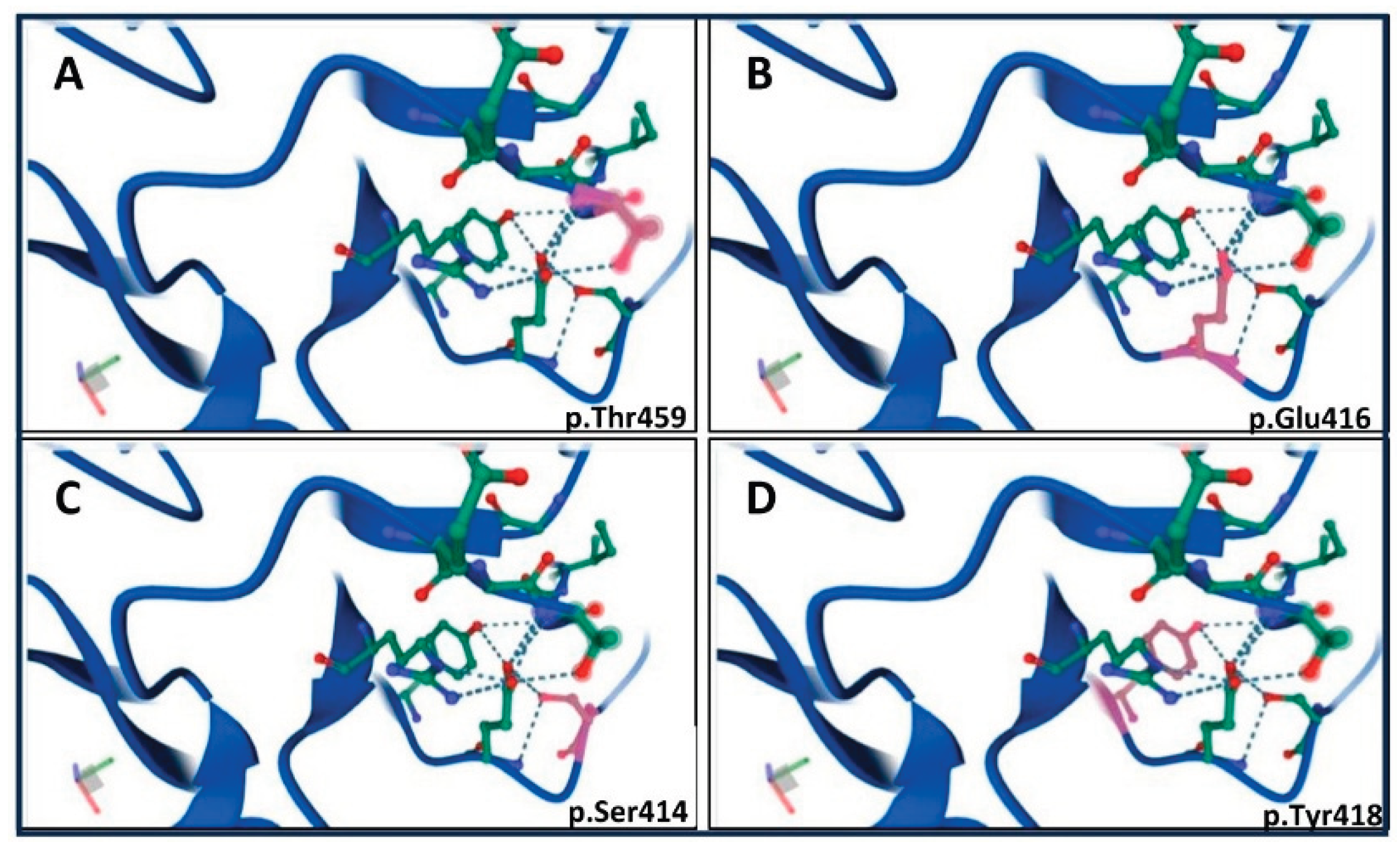
Figure 4.
Biotidinase expression (wild type and mutant versions) in culture medium and cell lysate. GFP protein was used as transfection control.
Figure 4.
Biotidinase expression (wild type and mutant versions) in culture medium and cell lysate. GFP protein was used as transfection control.
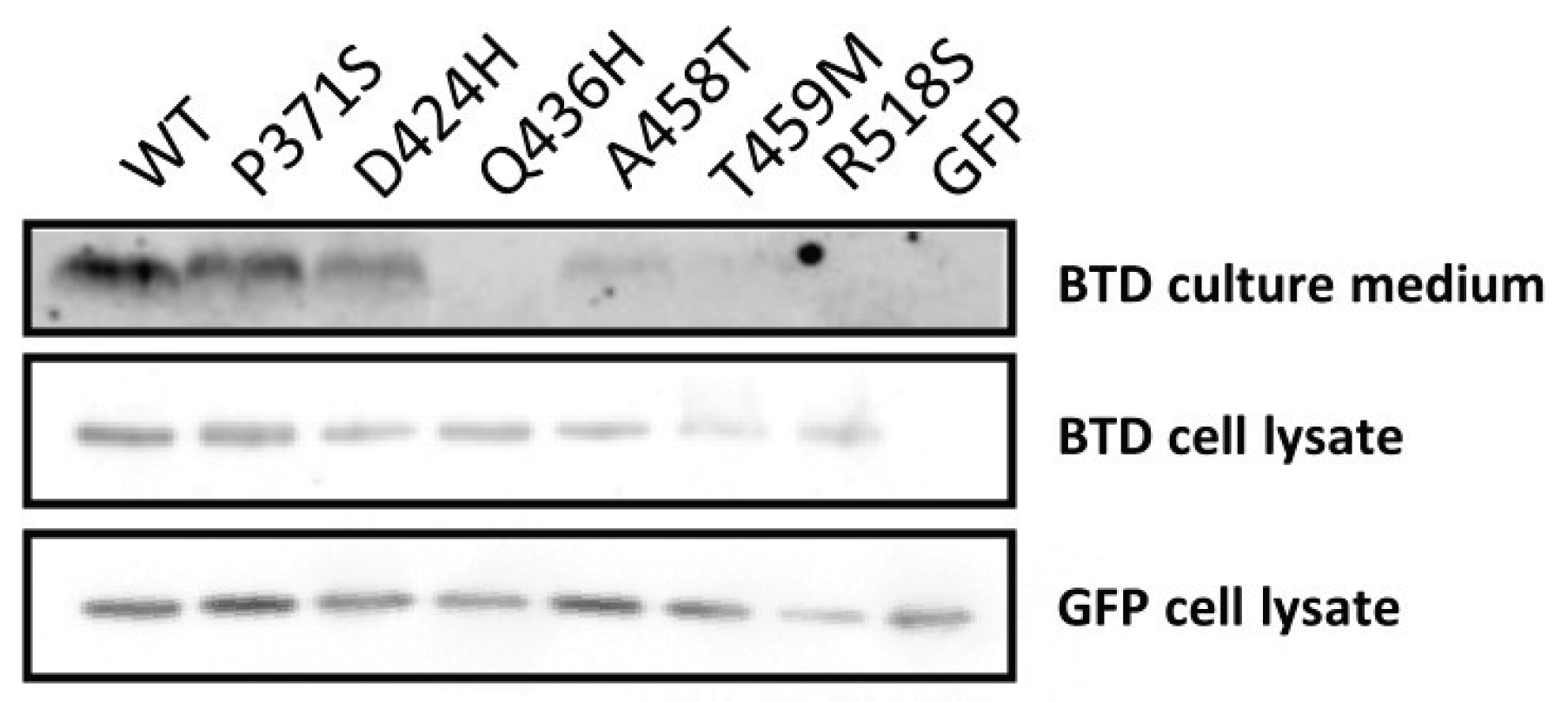
Figure 5.
Biotinidase enzyme activity (wild type and mutant versions) in cell lysates (A) and in extracellular medium (B). BC: benign control; PC: pathogenic control. *: P<0.05; **: P<0.01; ***: P<0.001.
Figure 5.
Biotinidase enzyme activity (wild type and mutant versions) in cell lysates (A) and in extracellular medium (B). BC: benign control; PC: pathogenic control. *: P<0.05; **: P<0.01; ***: P<0.001.
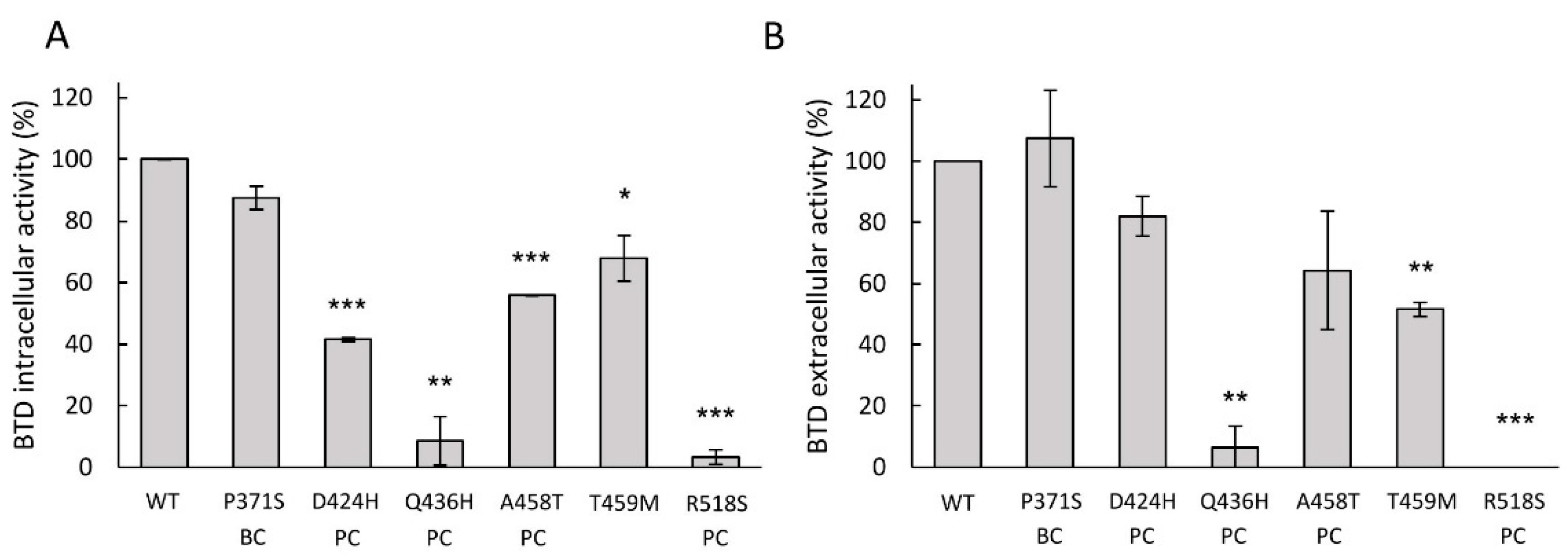
Figure 6.
Biotinidase enzyme activity in the plasma of the proband and family members. The activity of the controls represents the average of 5 different individuals and the asymptomatic family members. ***: P<0.001.
Figure 6.
Biotinidase enzyme activity in the plasma of the proband and family members. The activity of the controls represents the average of 5 different individuals and the asymptomatic family members. ***: P<0.001.
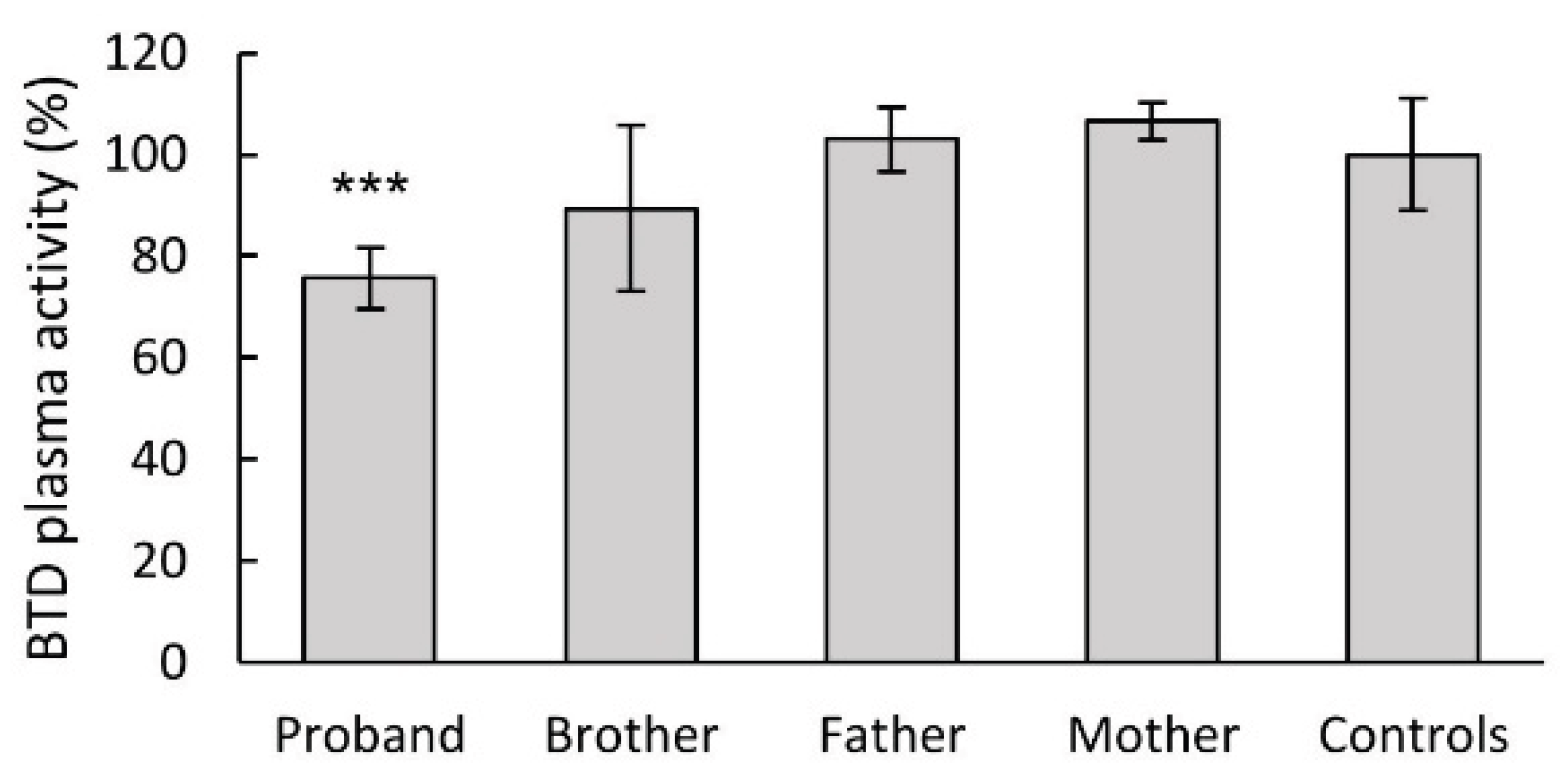

Table 1.
Primers used for targeted site-directed mutagenesis. Bold nucleotides indicate the introduced nucleotide changes.
Table 1.
Primers used for targeted site-directed mutagenesis. Bold nucleotides indicate the introduced nucleotide changes.
| Name | Primer (5’→3’ sense) |
| BTD-P371S-UP | CAAGTGGAACGTGAATGCTTCTCCCACATTTCACTCTG |
| BTD-P371S-DW | CAGAGTGAAATGTGGGAGAAGCATTCACGTTCCACTTG |
| BTD-D424H-UP | GCCCTGGGGGTCTTTCATGGGCTTCACACAG |
| BTD-D424H-DW | CTGTGTGAAGCCCATGAAAGACCCCCAGGGC |
| BTD-Q436H-UP | GGCACTTACTACATCCACGTGTGTGCCCTGGTC |
| BTD-Q436H-DW | GACCAGGGCACACACGTGGATGTGTAAGTGCC |
| BTD-A458T-UP | GGACAGGAAATCACAGAGACCACGGGGATATTTGAGT |
| BTD-A458T-DW | ACTCAAATATCCCCGTGGTCTCTGTGATTTCCTTGTCC |
| BTD-T459M-UP | CAGGAAATCACAGAGGCCATGGGGATATTTGAGTTTCAC |
| BTD-T459M-DW | GTGAAACTCAAATATCCCCATGGCCTCTGTGATTTCCTG |
| BTD-R518S-UP | GGCGGCTCTCTATGGGTGCTTGTATGAGAGGG |
| BTD-R518S-DW | CCCTCTCATACAAGCACCCATAGAGAGCCGCC |
Disclaimer/Publisher’s Note: The statements, opinions and data contained in all publications are solely those of the individual author(s) and contributor(s) and not of MDPI and/or the editor(s). MDPI and/or the editor(s) disclaim responsibility for any injury to people or property resulting from any ideas, methods, instructions or products referred to in the content. |
© 2026 by the authors. Licensee MDPI, Basel, Switzerland. This article is an open access article distributed under the terms and conditions of the Creative Commons Attribution (CC BY) license (http://creativecommons.org/licenses/by/4.0/).
Copyright: This open access article is published under a Creative Commons CC BY 4.0 license, which permit the free download, distribution, and reuse, provided that the author and preprint are cited in any reuse.


