

Submitted:
02 June 2026
Posted:
03 June 2026
You are already at the latest version
Abstract
Background/Objectives: Pelvic floor dysfunctions (PFD) have functional and psychosocial impact. Although pelvic floor rehabilitation is recommended as first-line care, effectiveness depends on access, communication, adherence support, and self-management. This study quantified patient–professional alignment and translated gaps into care-improvement recommendations using a Delphi-Dialogue Patients–Professionals (DDPP) framework.
Methods: A two-phase observational study with Real-Time Delphi-based feasibility assessment was conducted within the Spanish Society of Physical Medicine and Rehabilitation (SERMEF). In Phase 1, parallel online surveys were completed by patients with PFD (n = 225) and rehabilitation professionals (n = 164). Shared items were rated on a six-point Likert scale. Concordance was explored using descriptive statistics and an operational divergence index combining mean differences and differences in agreement proportions. In Phase 2, ten recommendations were assessed for feasibility by 35 PM&R physicians and two Spanish Incontinence Association representatives.
Results: Alignment was heterogeneous and domain-specific. The greatest divergences concerned digital competence, information timing, bladder/bowel diaries, and adherence. Divergence was bidirectional: professionals rated diaries and some group-based activities as more useful, whereas patients reported higher digital competence, timelier information, and better adherence. Strong alignment was observed for hybrid care models, written and video-based instructions, app-supported follow-up, and satisfaction. Feasibility ratings supported prioritization of adherence monitoring tools, pathway visibility, and digital monitoring applications; home exercise programs and educational materials emerged as consolidation targets.
Conclusions: Patient–professional divergence appears to reflect context-dependent differences in perceived value rather than generalized disagreement. The DDPP framework offers a structured exploratory approach to translate experiential gaps into feasibility-informed service-improvement priorities.
Keywords:
pelvic floor disorders
; rehabilitation
; patient-professional alignment
; real-time delphi
; adherence
; care delivery
; value-based health care
1. Introduction
Pelvic floor dysfunctions (PFD) comprise a heterogeneous group of conditions—including urinary incontinence, pelvic organ prolapse, anorectal dysfunction, and chronic pelvic pain—that represent a substantial and growing public health challenge. Their high prevalence, significant impact on quality of life, and associated functional and psychosocial burden position PFD as a priority condition within contemporary rehabilitation and chronic care frameworks. Epidemiological studies indicate that up to one-third of women may experience at least one PFD during their lifetime, with increasing prevalence associated with aging, parity, and comorbidities, while remaining clinically relevant in male and neurological populations [1,2,3].
Despite this burden, PFD remains under-recognized and frequently undertreated. Barriers such as symptom normalization, social stigma, and variability in access to specialized care contribute to delayed diagnosis and suboptimal management [3]. In response, international guidelines from the International Continence Society (ICS), the European Association of Urology (EAU), and other scientific societies consistently recommend pelvic floor muscle training and multimodal rehabilitation as first-line treatment across most pelvic floor disorders [4,5,6]. These interventions—combining structured exercise programs, behavioral strategies, biofeedback, and patient education—have demonstrated robust efficacy under controlled conditions.
However, the effectiveness of pelvic floor rehabilitation in real-world clinical settings is not determined solely by the intrinsic efficacy of interventions, but by how they are delivered, understood, and sustained over time. In this context, pelvic floor rehabilitation represents a paradigmatic model of chronic care in which outcomes depend critically on long-term adherence, patient engagement, and continuity of care. Consequently, variability in access, communication, follow-up organization, and adherence support may significantly modulate clinical effectiveness, even when evidence-based interventions are prescribed.
Within this framework, the transition toward participatory rehabilitation models has become a central paradigm. Evidence from rehabilitation research demonstrates that shared decision-making, individualized goal setting, and active patient participation are associated with improved adherence, satisfaction, and functional outcomes [7,8,9]. In pelvic floor dysfunctions—where symptom perception and patient-reported outcomes are central to treatment evaluation—aligning therapeutic strategies with patient expectations, preferences, and capabilities is particularly critical.
Nevertheless, a persistent implementation gap remains between guideline-based recommendations and routine clinical practice. Structural barriers—including heterogeneity in referral pathways, limited availability of specialized pelvic floor units, and fragmentation across care levels—continue to constrain optimal service delivery [10,11,12]. In parallel, discrepancies between patient and professional perspectives regarding information timing, treatment expectations, adherence challenges, and follow-up models may further compromise the effectiveness of rehabilitation pathways. Similar misalignments have been described in other rehabilitation domains as key determinants of suboptimal engagement and discontinuity of care [13].
This phenomenon can be conceptualized as a prescription–experience mismatch, in which clinically validated interventions are not fully translated into effective practice due to differences between what is prescribed and how care is perceived, understood, and implemented by patients. This mismatch is particularly relevant in pelvic floor rehabilitation, where treatment success relies heavily on self-management, correct execution of exercises, and sustained behavioral change.
The increasing integration of digital health solutions introduces additional complexity. Telemedicine, mobile applications, and hybrid care models combining face-to-face and remote follow-up offer the potential to improve accessibility, efficiency, and continuity of care [14,15]. However, their clinical value depends on structured integration into care pathways and on patient-related factors such as digital literacy, usability, and perceived benefit. In pelvic floor rehabilitation—where feedback, supervision, and adherence monitoring are essential—these factors are critical to ensure safety and effectiveness.
Taken together, these considerations highlight a key unmet need: a comprehensive understanding of how patients and professionals perceive pelvic floor rehabilitation care, where their perspectives converge or diverge, and which aspects of care delivery should be prioritized for improvement. Existing literature has predominantly focused on clinical efficacy or professional-driven models, with limited integration of patient experience into the design and optimization of rehabilitation pathways.
In this context, the Delphi-Dialogue Patients–Professionals (DDPP) methodology provides a structured and participatory approach to bridge this gap. By combining parallel assessments of patient and professional perspectives with a structured feasibility-assessment process, this framework enables the quantification of alignment and divergence across clinically relevant domains and facilitates the translation of these findings into prioritized, feasible recommendations. Previous applications in rehabilitation have demonstrated its potential to integrate experiential and clinical knowledge, supporting patient-centered innovation in care delivery [13].
Therefore, the present study applies the DDPP framework to pelvic floor dysfunctions within Physical Medicine and Rehabilitation (PM&R) settings. The aim is to systematically compare patient and professional perspectives on pelvic floor rehabilitation care, identify priority gaps in domains such as access, communication, adherence, and follow-up, and generate a structured set of actionable recommendations to inform the development of more coordinated, accessible, and stakeholder-informed rehabilitation pathways.
2. Objectives
2.1. General Aim
To identify and quantify key areas of convergence and divergence between patients with pelvic floor dysfunctions (PFD) and Physical Medicine and Rehabilitation (PM&R) professionals regarding the perceived quality of PM&R care in Spain, and to translate these findings into prioritized, actionable service-improvement recommendations through a Delphi-based feasibility-assessment process promoted within the Spanish Society of Physical Medicine and Rehabilitation (SERMEF).
2.2. Specific Objectives
To capture and compare patient and professional perceptions of PM&R care pathways in PFD, including access to specialized rehabilitation, perceived involvement of the rehabilitation team, adequacy and timing of information, and follow-up organization.
To explore alignment and misalignment in domains related to communication channels, home-program adherence support, group-based interventions, and digital/remote models (telemedicine, apps, hybrid follow-up), identifying where expectations and preferences diverge.
To quantify patient–professional divergence using the DDPP concordance framework (differences in central tendency and high agreement proportions), enabling prioritization of the most clinically and organizationally relevant gaps.
To generate a set of recommendations for improving patient-centered PM&R care in PFD and to assess their perceived feasibility through a Delphi process enabling an eventual prioritization based on both patient–professional divergence and implementation feasibility.
3. Materials and Methods
3.1. Study Design and Context
This study followed the Delphi-Dialogue Patients–Professionals (DDPP) framework to analyze concordance between patients and professionals regarding the quality of PM&R care for pelvic floor dysfunctions (PFD) in Spain. It was developed under SERMEF leadership with a defined coordinating group (research team) and external reviewers, including patient representatives from the Spanish Incontinence Association (ASIA) and PM&R clinicians with expertise in PFD.
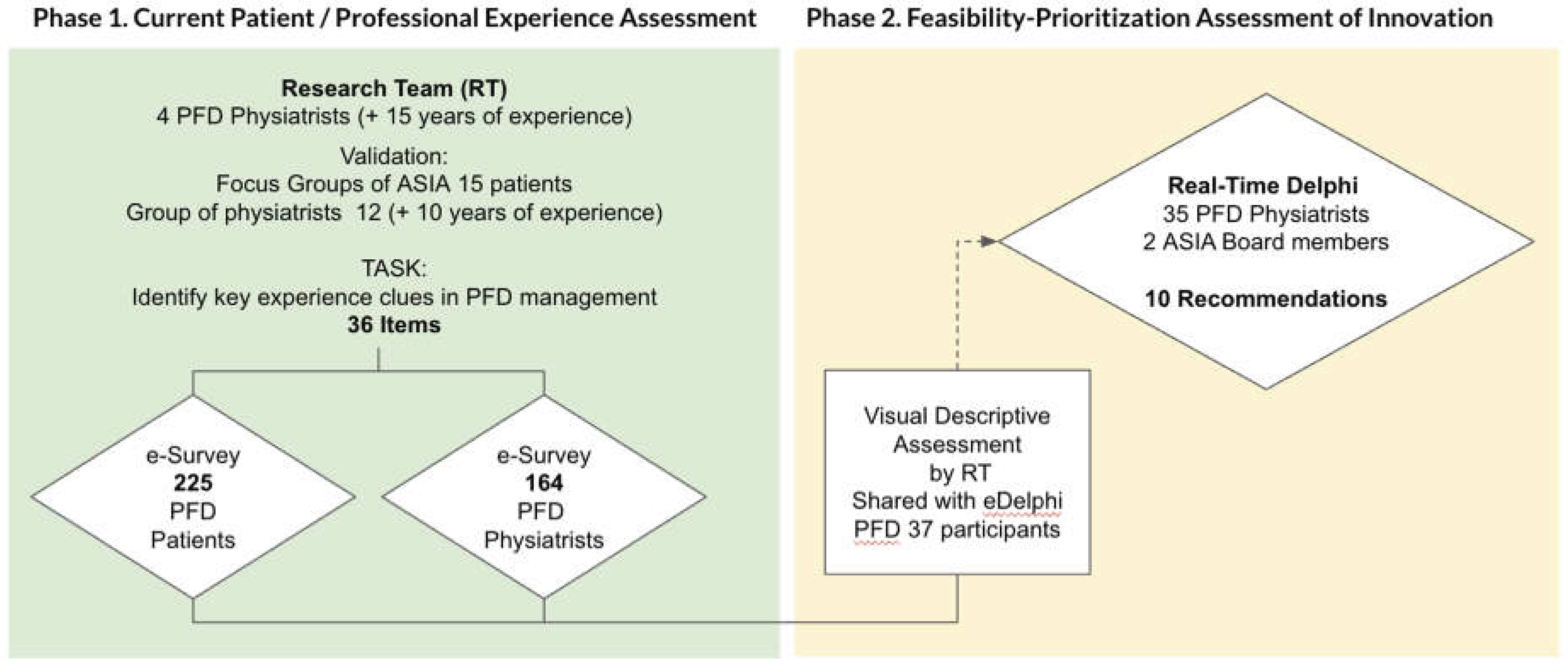
The study was organized into a preparatory stage and two sequential analytical phases. The preparatory stage consisted of questionnaire development, expert review, and content review of the parallel patient and professional surveys, conducted between May 2022 and January 2023. Phase 1 consisted of survey deployment and comparative analysis of patient–professional alignment and divergence, conducted between February and April 2023. Phase 2 consisted of the formulation of recommendations from the Phase 1 findings and their subsequent feasibility assessment through a Real-Time Delphi-based process conducted in May 2024. This sequence allowed the study to move from instrument development, to empirical comparison of patient and professional perspectives, and finally to implementation-oriented prioritization of recommendations.
Figure 1.
Study workflow: preparatory stage, Phase 1 survey-based patient–professional comparison, and Phase 2 Real-Time Delphi-based feasibility assessment.
Figure 1.
Study workflow: preparatory stage, Phase 1 survey-based patient–professional comparison, and Phase 2 Real-Time Delphi-based feasibility assessment.
3.2. Survey Development and Structure
Two parallel online questionnaires, one for patients and one for professionals, were developed by the DDPP PFD research team composed of four senior PM&R physicians with expertise in pelvic floor dysfunction. Item content was reviewed by a panel involving 12 physiatrists with more than 10 years of experience in PFD and 15 patients from different autonomous communities across Spain from the Spanish Incontinence Association (ASIA). The review process focused on content relevance, face validity, clarity, patient comprehensibility, and equivalence between the patient and professional versions of the questionnaire. No formal psychometric validation or pilot study was conducted.
Both surveys shared a common structure:
- A profile section collecting respondent characteristics.
- A common core of 25 items addressing general aspects of PM&R care.
- A PFD-specific module including 14 items addressing context-relevant aspects of pelvic floor rehabilitation care.
Items addressed domains reflected in the results presentation, including perceived support and involvement of rehabilitation teams, access barriers, adherence difficulties, information timing, self-management tools, and attitudes toward remote communication and digital support tools.
Equivalence between the patient and professional questionnaires was ensured by using parallel formulations addressing the same care component from each stakeholder perspective. Thus, each matched item referred to the same underlying aspect of pelvic floor rehabilitation care, while adapting the wording to the respondent’s role. For example, patients were asked about the information they had received, whereas professionals were asked about the information they usually provided. This approach enabled direct comparison of perceptions while preserving the experiential position of each group.
All evaluative items were rated on a six-point Likert scale, ranging from 1 = very low/poor to 6 = very high/excellent. The use of an even-numbered scale avoided a neutral midpoint and was intended to encourage respondents to express a directional assessment of each care component.
3.3. Participants and Recruitment
Two target populations were included in this study:
Patients: Adults (≥18 years) with pelvic floor dysfunction who were receiving or had previously received Physical Medicine and Rehabilitation (PM&R) care. Patients were recruited through national patient associations, with the collaboration of the Spanish Incontinence Association (ASIA), as well as through pelvic floor rehabilitation units across Spain. These recruitment pathways ensured inclusion of patients with diverse clinical profiles and care experiences within the national PM&R setting.
Professionals: Rehabilitation physicians (PM&R) and physiotherapists with clinical experience in pelvic floor dysfunction management. Recruitment was conducted nationwide through the SERMEF, ensuring broad representation across different healthcare settings.
Participation was voluntary and anonymous. All participants accessed the questionnaires via a secure online platform and provided informed consent prior to participation. Eligibility was confirmed through initial screening questions, and completion of the profile section was required before responding to the survey items.
The final survey sample included 225 patients with PFD and 164 rehabilitation professionals. Their demographic and professional characteristics are reported in the Results section.
3.4. Procedure
The DDPP PFD workflow followed a predefined sequence comprising questionnaire development and validation, survey deployment, descriptive and comparative analysis, recommendation formulation by the research team, and Real-Time Delphi-based feasibility assessment.
Survey responses were collected and aggregated to compare patient and professional perspectives on shared items and to identify gaps relevant for service redesign—particularly in access to specialized rehabilitation units, communication practices, adherence support, and the role of telemedicine/digital tools in follow-up.
3.5. Outcomes and Concordance Analysis
The primary analytical objective was to assess the degree of alignment and divergence between patients and professionals across shared survey domains.
Descriptive statistics were calculated for each item and group, including mean (μ), standard deviation (σ), and the proportion of high-agreement responses (A), defined as ratings in the upper categories of the Likert scale (scores 5–6). For calculation purposes, A was used as a proportion; values are displayed as percentages in the tables.
To operationalize divergence in a clinically interpretable manner, a composite divergence score (d) was applied. This score combined a standardized difference index (SDI) with the gap in high-agreement proportions (ΔA):
- SDI
- = |μ_pat − μ_pro| / √[(σ²_pat + σ²_pro)/2]
- SDI
- ΔA = |(A_pat − A_pro)| / min(A_pat, A_pro)
- d
- = SDI × ΔA
The resulting divergence score, labelled here as d, should not be interpreted as Cohen’s d or as a validated statistical effect size. It was used as an exploratory operational score to support prioritization of patient–professional discrepancies by combining two complementary dimensions: distance in mean ratings and asymmetry in high-agreement responses. Higher values indicate greater divergence in both central tendency and strength of agreement. The divergence score should therefore be interpreted as an exploratory prioritization aid rather than a psychometric or inferential metric.
Because the ΔA component may amplify differences when one group shows low high-agreement proportions, the score was interpreted together with the underlying mean values, standard deviations, and high-agreement proportions, rather than as a standalone measure of clinical relevance.
Inferential p-values were not calculated because the study was not designed to test predefined hypotheses for each item. The analytical purpose was to identify and prioritize patterns of perceptual divergence between stakeholder groups. Given the exploratory and implementation-oriented purpose of the study, the analysis intentionally prioritized pattern identification over hypothesis testing. In addition, the ordinal structure of Likert responses and the large number of item-level comparisons supported the use of descriptive statistics and the operational divergence score as more appropriate tools for implementation-oriented interpretation.
Items were ranked according to the divergence score (d) to identify priority areas for improvement in pelvic floor rehabilitation care.
3.6. Delphi Stage for Recommendations
In May 2024, a structured modified Real-Time Delphi-based feasibility assessment was conducted to evaluate the implementation feasibility of the recommendations derived from Phase 1. The process integrated synchronous participation, real-time anonymized feedback, and within-session rescoring to support iterative refinement of feasibility ratings. The panel included 37 participants: 35 PM&R physicians with clinical experience in pelvic floor rehabilitation and two representatives from the Board of the Spanish Incontinence Association (ASIA) (Table 1). Participants were selected purposively because of their clinical expertise, experience in pelvic floor care, or role in representing patient perspectives. The Delphi panel was not intended to reproduce the Phase 1 survey sample; rather, it functioned as an implementation-oriented assessment group. Some participants had previous knowledge of the DDPP process, but the feasibility assessment was conducted as an independent phase focused on recommendations rather than on individual survey responses.
Before rating the recommendations, participants received a structured summary of the Phase 1 findings, including descriptive comparisons between patients and professionals and the main areas of convergence and divergence. The research team then presented ten pre-formulated recommendations. These recommendations were not generated automatically from the highest-ranking items; instead, survey items were grouped interpretively according to their clinical meaning, care-delivery relevance, and conceptual proximity within the pelvic floor rehabilitation pathway.
The process was conducted synchronously using the SmartDelphi platform. Participants rated each recommendation on a six-point Likert scale ranging from very difficult to implement to quite easy to implement. Real-time anonymized group feedback was displayed after the initial rating, allowing participants to compare their individual assessment with the distribution of group responses. Participants were then allowed to reconsider and modify their scores during the same session. This process corresponds to a structured modified Real-Time Delphi approach integrating synchronous interaction, anonymized feedback, and within-session rescoring. The process was closed once all recommendations had been rated, group feedback had been reviewed, and no further score modifications were submitted within the allotted session time.
The purpose of this phase was not to generate new recommendations de novo, but to assess the perceived feasibility of implementing the pre-formulated recommendations. Feasibility ratings were summarized using mean, standard deviation, median, and interquartile range. These ratings were interpreted together with the mean divergence score associated with the linked survey items, allowing recommendations to be positioned according to two complementary criteria: the magnitude of the patient–professional gap and expected feasibility of implementation.
No predefined consensus threshold was applied; therefore, the results are interpreted as perceived feasibility ratings rather than formal consensus statements.
3.7. Ethics and Data Protection
This study was conducted in accordance with the principles of the Declaration of Helsinki and complied with all applicable Spanish and European regulations on biomedical research and data protection, including the Spanish Biomedical Research Law 14/2007, the Royal Decree 1090/2015, and the General Data Protection Regulation (GDPR, EU 2016/679).
In accordance with Articles 2 and 3 of Law 14/2007 and Article 2 of Royal Decree 1090/2015, formal CEIm approval was not required according to the applicable Spanish regulatory framework and the anonymous, non-interventional, survey-based nature of the study.
Survey data were collected anonymously through a secure web platform. No identifiable or sensitive information was stored, and all responses were aggregated for analysis to preserve confidentiality. During the Real-Time Delphi phase, responses remained fully anonymized, and only group-level feedback was shared to avoid any attribution of individual opinions.
The study protocol was internally reviewed and endorsed by the Spanish Society of Physical Medicine and Rehabilitation (SERMEF). Recruitment of patients and professionals was supported by national hospital networks, ensuring compliance with ethical and legal standards for non-interventional survey-based research.
4. Results
The comparative analysis revealed a structured but heterogeneous pattern of alignment and divergence between patients’ and professionals’ perceptions of pelvic floor rehabilitation care, with differences varying across domains rather than following a uniform direction.
4.1. Participant Characteristics
4.2. Comparison of Experiences Between Patients and Professionals
Patient–professional differences across all matched survey items are summarized in Table 4. The table includes all matched items formulated in parallel in both questionnaires and is ordered according to the magnitude of divergence between groups.
To facilitate interpretation and prioritization, differences were quantified using a synthetic divergence indicator (d), as defined in the Methods section. This indicator integrates two complementary dimensions: the standardized difference between patient and professional mean scores (SDI), capturing the magnitude of perceptual discrepancy, and the high-agreement gap (ΔA), capturing differences in the proportion of strong agreement (scores 5–6) between groups. The resulting index does not represent a classical effect size, but rather an operational measure of divergence that combines distance and consensual relevance.
Under this framework, values of d close to zero indicate strong alignment, characterized by similar perceptions and comparable levels of high agreement. Increasing values of d reflect growing divergence, arising from larger perceptual differences, reduced overlap in strong endorsement, or both.
As shown in Table 4, the highest divergence values were observed in items related to perceived digital competence, timing of information delivery, usefulness and difficulty of bladder/bowel diaries, and adherence to prescribed programs. Moderate divergences were also observed in selected items related to psychosocial support and group-based interventions. In contrast, low d values were observed for items related to hybrid care models, written and video-based exercise instructions, and overall satisfaction with follow-up, indicating areas of relative consensus between patients and professionals.
4.3. Second Phase: Structuring and Prioritization of Recommendations
In the second phase, the research team formulated ten care-improvement recommendations based on the Phase 1 patient–professional divergence analysis. These recommendations were not intended to reproduce individual survey items, but to synthesize groups of linked items into actionable proposals for improving pelvic floor rehabilitation care. They were subsequently submitted to a Real-Time Delphi-based feasibility assessment with 37 participants: 35 physiatrists and two ASIA Board representatives.
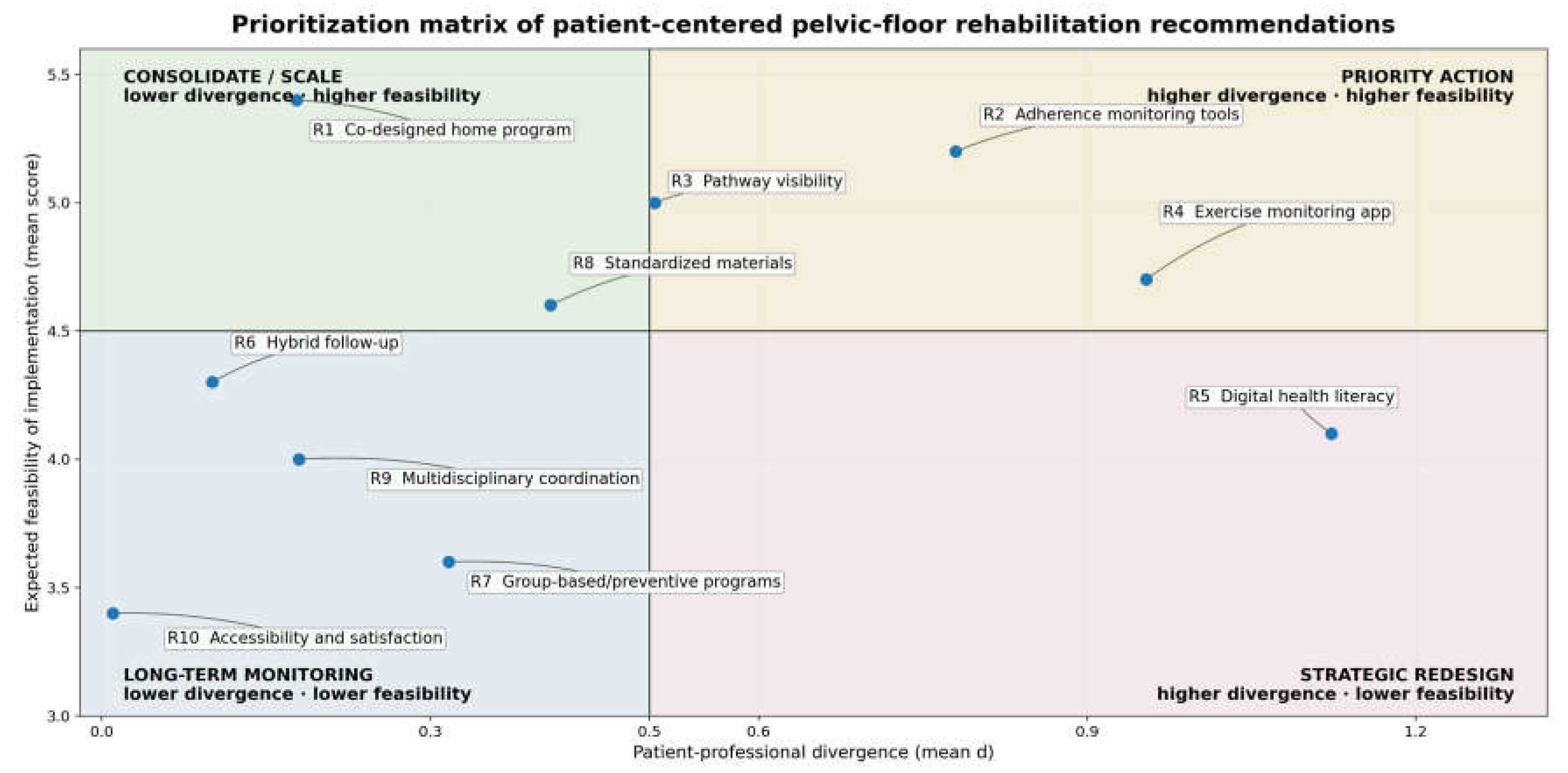
To support implementation-oriented prioritization, each recommendation was mapped according to two criteria: its mean divergence score, calculated from the linked survey items, and its perceived feasibility of implementation.
Recommendations located in the higher-divergence/higher-feasibility quadrant (Figure 4)—including adherence monitoring tools, increased visibility of pelvic floor rehabilitation pathways, and digital monitoring applications—represent priority targets for intervention, as they address relevant patient–professional gaps while remaining operationally feasible. Conversely, recommendations with higher divergence but lower feasibility, such as digital health literacy programs, may require broader organizational support and should be interpreted as strategic redesign priorities. Recommendations with lower divergence but higher feasibility, such as co-designed home exercise programs and standardized educational materials, may be suitable for consolidation and scaling.
Figure 2 and Figure 3 illustrate, respectively, the analytical feedback shared with participants and the Smart Delphi interface 2024 version (www.smartdelphi.com) used to support real-time consensus building.
Table 5 and Table 6 summarize the recommendations derived from Phase 1 and their feasibility assessment in the Real-Time Delphi phase. Table 5 links each recommendation to the survey items on which it is based and reports the mean divergence value. Table 6 presents the feasibility ratings provided by Delphi participants.
Recommendations were expressed as implementation-oriented care-improvement proposals. They were not direct restatements of individual survey items, nor were they selected exclusively from the highest-divergence items. Instead, the research team grouped linked survey items according to clinical meaning, pathway relevance, and potential for service redesign. Therefore, some recommendations include items with low divergence when these represent areas of alignment that could support feasible implementation.
Cut-offs: divergence = 0.50 | feasibility = 4.5.
The feasibility threshold of 4.5 was selected to identify recommendations with clearly high perceived feasibility within the six-point feasibility scale.
The divergence threshold of 0.50 was selected pragmatically to distinguish recommendations with higher operational divergence within the observed distribution while preserving interpretability of the prioritization matrix.
These thresholds were selected pragmatically for visual stratification purposes only and were not intended as validated decision rules.
Figure 4.
Prioritization matrix of pelvic floor rehabilitation recommendations.
4.4. Final Proposal: Strategic Domains for Care Improvements (ID) in Pelvic Floor Rehabilitation
Building on the comparative analysis and the structured recommendations derived from Phase 2, the research team consolidated the findings into four strategic domains for care improvements. These domains integrate patient–professional divergences, areas of alignment, and implementation feasibility considerations, providing an implementation-oriented framework to guide the redesign of pelvic floor rehabilitation pathways within PM&R services.
ID1. Access, visibility, and organizational coordination in pelvic floor rehabilitation.
Improving the visibility and integration of pelvic floor rehabilitation within PM&R care pathways emerged as a central organizational priority. Recommendations focused on clarifying referral circuits, improving accessibility to specialized rehabilitation units, reinforcing multidisciplinary coordination, and enhancing continuity of care across consultations and follow-up visits. Structured and traceable communication processes may reduce fragmentation, improve navigability of care pathways, and increase patient confidence in rehabilitation services.
ID2. Education, self-management, and adherence support.
Long-term effectiveness of pelvic floor rehabilitation depends heavily on sustained patient engagement and self-management capacity. This domain emphasizes the implementation of co-designed home exercise programs, standardized educational materials, and adherence-monitoring strategies adapted to patient needs and functional context. The findings suggest that improving adherence requires not only prescribing exercises, but also supporting patients through clear instructions, progressive self-management strategies, and individualized follow-up mechanisms capable of identifying barriers to long-term engagement.
ID3. Digital support and hybrid rehabilitation models.
The study identified broad acceptance of hybrid rehabilitation approaches combining face-to-face and remote follow-up. This domain includes the development of structured tele-rehabilitation pathways, digital monitoring tools, and interventions aimed at improving digital health literacy. Importantly, the findings support a progressive and patient-centered integration of technology, in which digital tools complement rather than replace in-person rehabilitation. Ensuring usability, accessibility, and alignment with patient capabilities emerged as essential conditions for successful implementation.
ID4. Prevention, personalization, and participatory rehabilitation strategies.
Beyond symptom management, pelvic floor rehabilitation requires preventive and personalized approaches capable of adapting to functional status, psychosocial burden, motivation, and previous rehabilitation experience. This domain incorporates preventive and group-based rehabilitation programs, personalized progression strategies, and participatory models integrating patient experience into continuous service improvement. Embedding personalization and prevention into rehabilitation pathways may facilitate more adaptive, proactive, and value-based models of pelvic floor care.
5. Discussion
5.1. Principal Findings and Added Value Beyond Existing Evidence
This study provides a structured, stakeholder-informed analysis of pelvic floor rehabilitation care by integrating patient and professional perspectives and by subsequently assessing the feasibility of derived recommendations through a Real-Time Delphi process with 37 participants. Beyond describing current practices, its main contribution lies in identifying and quantifying clinically meaningful divergences between stakeholders and translating them into prioritized, actionable strategic domains for care improvements.
While the effectiveness of pelvic floor rehabilitation is well established in clinical trials and guideline recommendations [4,5,6], considerably less attention has been paid to how care is perceived, experienced, and operationalized in real-world clinical settings. In this context, the present findings suggest that variability in care delivery is not only structural but also perceptual. Divergences were particularly concentrated in domains directly linked to adherence, communication, and self-management, with the highest divergence values observed in items related to perceived digital competence, information timing, self-monitoring tools, and adherence. Selected items related to psychosocial support and group-based interventions showed moderate divergence.
These results extend previous observations in other rehabilitation fields, where misalignment between stakeholders has been identified as a key factor limiting the effectiveness of otherwise evidence-based interventions [13].
Importantly, these findings suggest that the limitations of pelvic floor rehabilitation may not be exclusively related to resource availability or technical efficacy. Instead, the results suggest that part of the unmet need may be associated with gaps between prescribed interventions and patient-perceived value. These implementation gaps suggest that rehabilitation effectiveness may depend partly on how interventions are understood, accepted, and sustained in daily life.
Consequently, this study shifts the analytical focus from “what to deliver” to “how care is experienced, interpreted, and maintained” in routine clinical practice. By explicitly quantifying areas of convergence and divergence and linking them to feasible strategic domains for care improvements, the DDPP framework may add translational value by helping to connect evidence-based recommendations with implementation priorities in real-world rehabilitation pathways.
5.2. Patient–Professional Divergences: Implications for Adherence and Self-Management
One of the most relevant findings is the identification of substantial divergences in domains related to self-management tools, digital competence, and perceived usefulness of specific interventions. Items related to bladder/bowel diary use, digital competence, and adherence showed the highest levels of disagreement between patients and professionals (Table 4).
This pattern suggests that clinically recommended interventions are not always translated into equivalent patient-perceived usefulness or long-term integration into daily practice. This phenomenon is particularly relevant in pelvic floor rehabilitation, where treatment success relies heavily on long-term adherence to home-based exercise programs.
Previous studies have consistently shown that adherence is a critical determinant of outcomes in pelvic floor muscle training [6]. However, adherence should not be interpreted solely as a patient-related behavioral issue, but rather as an emergent property of the interaction between intervention design, communication, and patient experience. In this regard, recent evidence indicates that digital and mobile health interventions can significantly improve adherence in chronic conditions, particularly when they incorporate feedback mechanisms, behavioral support, and personalization strategies [16,17,18]. This is particularly relevant in pelvic floor dysfunctions, where treatment success is closely linked to patient-reported outcomes and symptom perception, rather than solely to objective clinical measures.
These findings support the potential value of moving from prescriptive toward more collaborative rehabilitation models, directly supporting strategic domains for care improvement 2 (education, self-management, and sustained adherence).
5.3. Information Timing and Communication: A Persistent Implementation Gap
Another key area of divergence concerns the timing and adequacy of information delivery. In contrast to other domains, this difference was directionally inverted: patients reported higher agreement that information was provided at the appropriate time, whereas professionals expressed a more critical perception of this aspect of care. This finding suggests that, from the patient perspective, information is generally perceived as timely and sufficient, while professionals tend to consider that information delivery may be suboptimal or require improvement.
This divergence highlights a potential mismatch not in access to information itself, but in how its timing and adequacy are evaluated. It may reflect differences in expectations regarding optimal communication, with professionals applying stricter standards for information delivery than those perceived by patients in their care experience.
Notably, this finding contrasts with current guideline frameworks, which emphasize patient education as a core component of pelvic floor rehabilitation [4,5], suggesting that implementation of these recommendations remains inconsistent in routine clinical practice. In chronic care models, insufficient or poorly timed information has been consistently associated with lower engagement, reduced adherence, and decreased satisfaction [7].
In pelvic floor dysfunctions—where stigma, delayed consultation, and uncertainty are common—early and structured communication is particularly relevant. These findings may support strategic domain 1 for care improvement (access, visibility, and coordination), indicating that communication gaps are not only interpersonal but also organizational in nature.
5.4. Digital Health and Hybrid Models: Convergence with Conditional Acceptance
In contrast to areas of divergence, the study identified relatively high levels of convergence in domains related to hybrid care models, written and video-based instructions, and overall follow-up satisfaction. This suggests that both patients and professionals recognize the value of combining in-person and remote care.
These findings align with recent evidence suggesting that tele-rehabilitation can support rehabilitation delivery when appropriately integrated into clinical pathways [14,15]. However, the present results add an important nuance: acceptance of digital health appears to be conditional.
While patients showed good acceptance of supportive tools, greater divergence was observed in domains requiring higher levels of digital engagement. This is consistent with literature suggesting that the effectiveness of digital health interventions may depend not only on availability, but also on usability, perceived value, and patient engagement [17,19].
Moreover, mobile health interventions and app-based tools have been shown to improve adherence and self-management when integrated within structured care models rather than used as isolated solutions [16,18]. Therefore, digital health should not be understood as a replacement for face-to-face care, but as an adaptive layer within rehabilitation pathways.
These findings directly support strategic domains for care improvement 3 (digital support and hybrid follow-up models), emphasizing the need for progressive and implementation-oriented digital integration.
5.5. Organizational Factors: Access, Visibility, and Coordination of Care
A notable finding is the relative alignment between patients and professionals regarding access to pelvic floor units, reflected by low divergence values. However, this apparent agreement should be interpreted cautiously.
Moderate ratings in both groups suggest that access is perceived as suboptimal, even if similarly so. This may reflect a phenomenon of “aligned dissatisfaction,” where systemic limitations are normalized by both stakeholders.
These findings underscore that access should be understood not only in terms of availability, but also in terms of visibility, navigability, and integration within healthcare systems. In line with current evidence, fragmented care pathways and variability in referral processes remain key barriers to optimal rehabilitation delivery [11,12].
From a health systems perspective, this represents a structural rather than purely clinical issue, reinforcing the relevance of strategic domains for care improvement 1 as a foundational element for improving pelvic floor rehabilitation services.
5.6. Implications for Implementation and Service Redesign
The findings of this study may have practical implications for the redesign of pelvic floor rehabilitation pathways within PM&R services. Rather than suggesting that patient and professional perspectives are generally opposed, the results indicate that misalignment is concentrated in specific operational domains, particularly digital competence, timing of information delivery, bladder/bowel diary use, adherence support, and selected aspects of psychosocial and group-based care. These areas may therefore represent priority targets for service improvement.
From an implementation perspective, the DDPP framework may provide a structured approach to identify service-improvement priorities grounded in both patient and professional perspectives. Its potential added value lies in combining two complementary sources of information: the magnitude of patient–professional divergence and the perceived feasibility of implementing specific recommendations. This makes it possible to distinguish between actions that are immediately feasible, such as structured home exercise programs or adherence monitoring tools, and actions that may require broader organizational support, such as digital health literacy programs or reinforced multidisciplinary coordination.
This approach is consistent with emerging frameworks in implementation science, which emphasize stakeholder integration as a key mechanism to bridge the gap between evidence and practice [20]. As previously demonstrated [13], the DDPP model facilitates translation of divergence into structured, feasible innovation strategies.
By making divergences explicit and linking them to feasible innovations, the DDPP framework provides a scalable strategy to bridge the gap between evidence and practice. In this context, the integration of digital health and patient engagement strategies represents a key opportunity to enhance the scalability, efficiency, and sustainability of pelvic floor rehabilitation models [19,21].
Importantly, the recommendations derived from this process should not be interpreted as evidence of clinical effectiveness. They should be understood as implementation-oriented priorities that require further testing in real-world rehabilitation settings. Future studies should assess whether these strategies may contribute to better adherence support, patient satisfaction, continuity of rehabilitation care, and, ultimately, improved patient-reported and clinical outcomes.
6. Limitations
This study has several limitations. First, the samples were non-probabilistic and recruited through professional networks, pelvic floor rehabilitation units, and patient associations. Therefore, selection bias is possible, and participants may have had greater interest in pelvic floor rehabilitation, digital tools, or participatory care models than the broader population of patients and professionals. The sample should not be interpreted as nationally representative of all patients with pelvic floor dysfunction or all rehabilitation professionals in Spain.
Second, all data were self-reported. Patient responses reflected perceived experiences of care, while professional responses reflected perceived usual practice. The study did not include objective measures of adherence, clinical outcomes, treatment completion, symptom improvement, or service utilization. Consequently, the identified divergences should be interpreted as perceptual and operational gaps rather than as direct evidence of differences in clinical effectiveness.
Third, although the patient and professional questionnaires were designed as parallel instruments, perfect equivalence between some matched items cannot be assumed. Some items necessarily captured different experiential positions, such as information received by patients versus information usually provided by professionals. This may have influenced the magnitude and interpretation of patient–professional divergence. In addition, the questionnaires underwent expert and patient review for content and face validity, but no formal psychometric validation was performed
Fourth, the composite divergence score used in this study was exploratory and operational. It was not intended to replace inferential statistics or to function as a validated effect-size measure. Its purpose was to support prioritization by combining differences in mean ratings with differences in high-agreement proportions. No external validation or sensitivity analysis of the divergence metric was performed. Future studies should further validate this approach and compare it with alternative concordance metrics.
Fifth, the Real-Time Delphi-based phase assessed perceived feasibility rather than actual implementation. Feasibility ratings may not fully predict real-world adoption, sustainability, cost, or organizational impact. In addition, the Delphi phase was conducted approximately one year after the initial survey phase, and changes in clinical practice, digital-health adoption, or organizational context during this interval may have influenced participants’ ratings.
Finally, the study was conducted in the Spanish PM&R context and was promoted through SERMEF and ASIA. Although the findings may be relevant to other rehabilitation settings, generalizability to other countries, healthcare systems, professional disciplines, or pelvic floor care models should be considered with caution.
7. Conclusions
This study suggests that key challenges in pelvic floor rehabilitation are not limited to the availability or efficacy of interventions, but also concern how these interventions are perceived, implemented, and sustained in routine clinical practice. The identified patient–professional divergences suggest gaps between prescribed rehabilitation strategies and patient-perceived implementation in routine care..
By integrating patient and professional perspectives, the Delphi-Dialogue Patients–Professionals (DDPP) framework provides a structured method to identify actionable gaps and prioritize feasibility-informed service-improvement recommendations. The findings support the need for more coordinated care pathways, enhanced patient education, structured adherence support, and progressive integration of digital and hybrid models tailored to patient capabilities.
Ultimately, advancing pelvic floor rehabilitation may benefit from a shift toward more integrated, adaptive, and participatory care models, in which clinical recommendations are better aligned with patient experience and healthcare system organization.
Author Contributions
Conceptualization, L. G-F, H. B-A, S. H-V, I. M-P, J. V-P and J.M M-F; methodology, H. B-A, J.M M-F; software, M.C-P, A. T-O, J. F-P; validation, I. M.-P., J. V-P., L. G-F, C. M-B, H. B-A and J.M. M-F; formal analysis, M. C-P, A. T-O, J.M. M-F.; investigation L. G-F, H. B-A, S. H-V, I. M-P, J. V-P and J.M. M-F.; resources, C. M-B and H. B-A; data curation, M. C-P and J. F-P.; writing—original draft preparation, L. G-F, H. B-A, S. H-V and J.M. M-F; writing—review and editing, L. G-F, H. B-A, S. H-V and J.M. M-F.; visualization, L. G-F, H. B-A, S. H-V, I. M-P, J. V-P.; supervision, H. B-A and J.M. M-F; project administration, L. G-F and H. B-A.; funding acquisition L. G-F , C. M-B and H. B-A.
Funding
This research was funded by the Spanish Society of Physical Medicine and Rehabilitation (SERMEF). Grant number 03/2023. The authors declare that the funding organization had no involvement in the study design, data collection, analysis, interpretation, manuscript writing, or decision to publish the results.
Institutional Review Board Statement
This study was conducted in accordance with the principles of the Declaration of Helsinki and complied with all applicable Spanish and European regulations on biomedical research and data protection, including the Spanish Biomedical Research Law 14/2007, the Royal Decree 1090/2015, and the General Data Protection Regulation (GDPR, EU 2016/679). In accordance with Articles 2 and 3 of Law 14/2007 and Article 2 of Royal Decree 1090/2015, this research did not require evaluation by a Research Ethics Committee (CEIm) because it involved anonymized online surveys without intervention or collection of personal health data and therefore did not constitute a biomedical study involving human biological samples or therapeutic procedures.
Informed Consent Statement
Participation was voluntary for both patients and professionals. All participants received an online information sheet explaining the study objectives, procedures, and data protection safeguards, and provided informed consent prior to participation. Eligibility was confirmed through initial screening questions ensuring that (a) patients had a diagnosis of pelvic floor dysfunction and prior exposure to rehabilitation care, and (b) professionals had active clinical involvement in pelvic floor rehabilitation management. Survey data were collected anonymously through a secure web platform. No identifiable or sensitive information was stored, and all responses were aggregated for analysis to preserve confidentiality. During the Delphi phase, responses remained fully anonymized, and only group-level feedback was shared to avoid attribution of individual opinions. The study protocol was reviewed internally by the coordinating research team and endorsed by the Spanish Society of Physical Medicine and Rehabilitation (SERMEF). Patient recruitment was supported by the Asociación de Incontinencia (ASIA), and professional recruitment was conducted through national clinical networks, ensuring compliance with ethical and legal standards for non-interventional, survey-based research.
Data Availability Statement
The anonymized aggregated data supporting the findings of this study are available from the corresponding author upon reasonable request. Individual-level data are not publicly available due to privacy and data-protection restrictions.
Acknowledgments
The authors thank Àngels Roca-Font, President of the Spanish Incontinence Association (ASIA), and Maite Carreras-Alberti, National Communications Coordinator of ASIA, for their valuable contributions to this study, including the involvement of ASIA patients from different autonomous communities across Spain.
Conflicts of Interest
The authors declare no conflicts of interest. The funder (Spanish Society of Physical Medicine and Rehabilitation, SERMEF) had no role in the design of the study; in the collection, analyses, or interpretation of data; in the writing of the manuscript; or in the decision to publish the results. Innex Labs and Institut del Futur are non-profit spin-off entities linked to the Universitat Politècnica de Catalunya (UPC). Their participation in the study was exclusively related to methodological and technical support (Delphi platform development, data visualization, and facilitation methodology), without any commercial interest or industry sponsorship associated with the research. Accordingly, their involvement should be interpreted within an academic and non-profit collaborative framework connected to the Universitat Politècnica de Catalunya.
Abbreviations
| SERMEF | Spanish Society of Physical Medicine and Rehabilitation |
| ASIA | Incontinence Association of Spain |
| PFD | Pelvic floor dysfunctions |
| PM&R | Physical Medicine and Rehabilitation |
| DDPP | Delphi-Dialogue Patients–Professionals |
| SDI | Standardized Difference Index |
| ΔA | Difference in high-agreement proportions |
| IQR | Interquartile range |
| GDPR | General Data Protection Regulation |
| CEIm | Research Ethics Committee |
References
- Abrams, P.; Cardozo, L.; Wagg, A.; Wein, A. Incontinence, 6th ed.; International Continence Society: Bristol, UK, 2017. [Google Scholar]
- Milsom, I.; Gyhagen, M. The prevalence of urinary incontinence. Climacteric 2019, 22, 217–222. [Google Scholar] [CrossRef] [PubMed]
- Kenton, K.; Mueller, E.R. The global burden of female pelvic floor disorders. BJU Int. 2006, 98 (Suppl. 1), 1–5. [Google Scholar] [CrossRef] [PubMed]
- European Association of Urology (EAU). EAU Guidelines on Urinary Incontinence 2020; EAU Guidelines Office: Arnhem, The Netherlands, 2020; Available online: https://d56bochluxqnz.cloudfront.net/media/EAU-Guidelines-on-Urinary-Incontinence-2020.pdf (accessed on 22 April 2026).
- American Urological Association (AUA); Society of Urodynamics; Female Pelvic Medicine; Urogenital Reconstruction (SUFU). Diagnosis and Treatment of Idiopathic Overactive Bladder in Adults: AUA/SUFU Guideline; American Urological Association: Linthicum, MD, USA, 2024; Available online: https://www.auanet.org/guidelines-and-quality/guidelines/idiopathic-overactive-bladder (accessed on 22 April 2026).
- Dumoulin, C.; Cacciari, L.P.; Hay-Smith, E.J.C. Pelvic floor muscle training versus no treatment, or inactive control treatments, for urinary incontinence in women. Cochrane Database Syst. Rev. 2018, 10, CD005654. [Google Scholar] [CrossRef] [PubMed]
- Rose, A.; Rosewilliam, S.; Soundy, A. Shared decision making within goal setting in rehabilitation settings: A systematic review. Patient Educ. Couns. 2017, 100, 65–75. [Google Scholar] [CrossRef] [PubMed]
- Vahdat, S.; Hamzehgardeshi, L.; Hessam, S.; Hamzehgardeshi, Z. Patient involvement in health care decision making: A review. Iran. Red. Crescent Med. J. 2014, 16, e12454. [Google Scholar] [CrossRef] [PubMed]
- Sagen, J.S.; Kjeken, I.; Habberstad, A.; Linge, A.D.; Simonsen, A.E.; Lyken, A.D.; Irgens, E.L.; Framstad, H.; Lyby, P.S.; Klokkerud, M.; et al. Patient involvement in the rehabilitation process is associated with improvement in function and goal attainment: Results from an explorative longitudinal study. J. Clin. Med. 2024, 13, 320. [Google Scholar] [CrossRef] [PubMed]
- National Institute for Health and Care Excellence. Pelvic floor dysfunction: prevention and non-surgical management (NG210); NICE: London, UK, 2021; Available online: https://www.nice.org.uk/guidance/ng210 (accessed on 22 April 2026).
- Hodyl, N.; Mason, G.; Ribbons, K.; Bailey, L.; O’Malley, A.; Ward, T.; Walker, F.R.; et al. Barriers and enablers for accessing rehabilitation services: Findings from the Rehabilitation Choices Study, Part 1—Healthcare professionals' perspectives. Health Expect. 2024, 27, e14120. [Google Scholar] [CrossRef] [PubMed]
- Patel, A.; Gellhorn, A.; Neerukonda, K.; Kwasnica, C. Multidisciplinary collaborative consensus statement on the barriers and solutions to care access, patient and caregiver support, and clinical capacity and capability for patients with spasticity. PM R 2024, 16, 278–286. [Google Scholar] [CrossRef] [PubMed]
- Bascuñana-Ambrós, H.; Formigo-Couceiro, J.; Climent-Barberá, J.M.; Guirao-Cano, L.; Catta-Preta, M.; Trejo-Omeñaca, A.; Monguet-Fierro, J.M. Aligning minds in spasticity care—A two-phase Delphi-dialogue study of patients and professionals in Spain. Toxins 2026, 18, 56. [Google Scholar] [CrossRef] [PubMed]
- Lee, A.C.; Deutsch, J.E.; Holdsworth, L.; Kaplan, S.L.; Kosakowski, H.; Latz, R.; McNeary, L.L.; O’Neil, J.; Ronzio, O.; Sanders, K.; Sigmund-Gaines, M.; Wiley, M.; Russell, T. Telerehabilitation in physical therapist practice: A clinical practice guideline from the American Physical Therapy Association. Phys. Ther. 2024, 104, pzae045. [Google Scholar] [CrossRef] [PubMed]
- Hao, J.; Yao, Z.; Remis, A.; Huang, B.; Li, Y.; Yu, X. Pelvic floor muscle training in telerehabilitation: A systematic review and meta-analysis. Arch. Gynecol. Obstet. 2024, 309(5), 1753–1764. [Google Scholar] [CrossRef] [PubMed]
- Alkhuzaimi, F.; Rainey, D.; Brown Wilson, C.; et al. The impact of mobile health interventions on service users' health outcomes and the role of health professions: A systematic review of systematic reviews. BMC Digit. Health 2025, 3, 3. [Google Scholar] [CrossRef]
- Marcolino, M.S.; Oliveira, J.A.Q.; D’Agostino, M.; Ribeiro, A.L.; Alkmim, M.B.M.; Novillo-Ortiz, D. The impact of mHealth interventions: Systematic review of systematic reviews. JMIR Mhealth Uhealth 2018, 6, e23. [Google Scholar] [CrossRef] [PubMed]
- Lang, S.; McLelland, C.; MacDonald, D.; et al. Do digital interventions increase adherence to home exercise rehabilitation? A systematic review of randomized controlled trials. Arch. Physiother. 2022, 12, 24. [Google Scholar] [CrossRef] [PubMed]
- Lemmo, D.; Bianco, R.; Mezza, F.; De Luca, V.; Illario, M.; Iaccarino, G.; Freda, M.F. Between regulatory functions and emotional burden: Balancing engagement in digital health interventions for self-care in chronic illness. Front. Psychol. 2025, 16, 1685934. [Google Scholar] [CrossRef] [PubMed]
- Nilsen, P. Making sense of implementation theories, models, and frameworks. In Implementation Science 3.0; Albers, B., Shlonsky, A., Mildon, R., Eds.; Springer: Cham, Switzerland, 2020; pp. 53–79. [Google Scholar]
- Teisberg, E.; Wallace, S.; O’Hara, S. Defining and implementing value-based health care: A strategic framework. Acad. Med. 2020, 95, 682–685. [Google Scholar] [CrossRef] [PubMed]
Figure 2.
Sample screenshot illustrating the type of analytical information shared with the 37 Real-Time Delphi feasibility-assessment participants.
Figure 2.
Sample screenshot illustrating the type of analytical information shared with the 37 Real-Time Delphi feasibility-assessment participants.
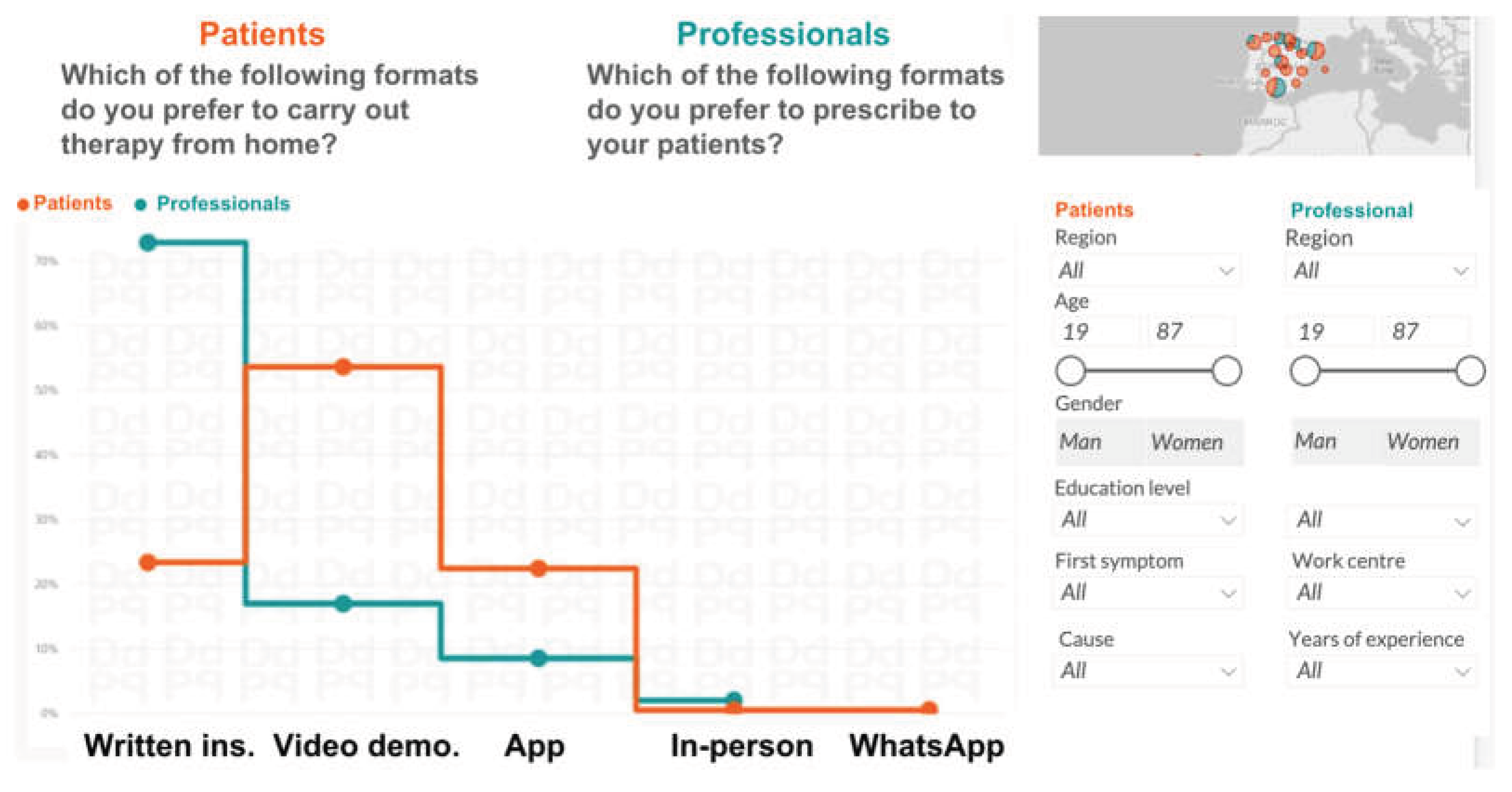
Figure 3.
Sample screen of the SmartDelphi tool used to support the synchronous Real-Time Delphi-based feasibility assessment.
Figure 3.
Sample screen of the SmartDelphi tool used to support the synchronous Real-Time Delphi-based feasibility assessment.
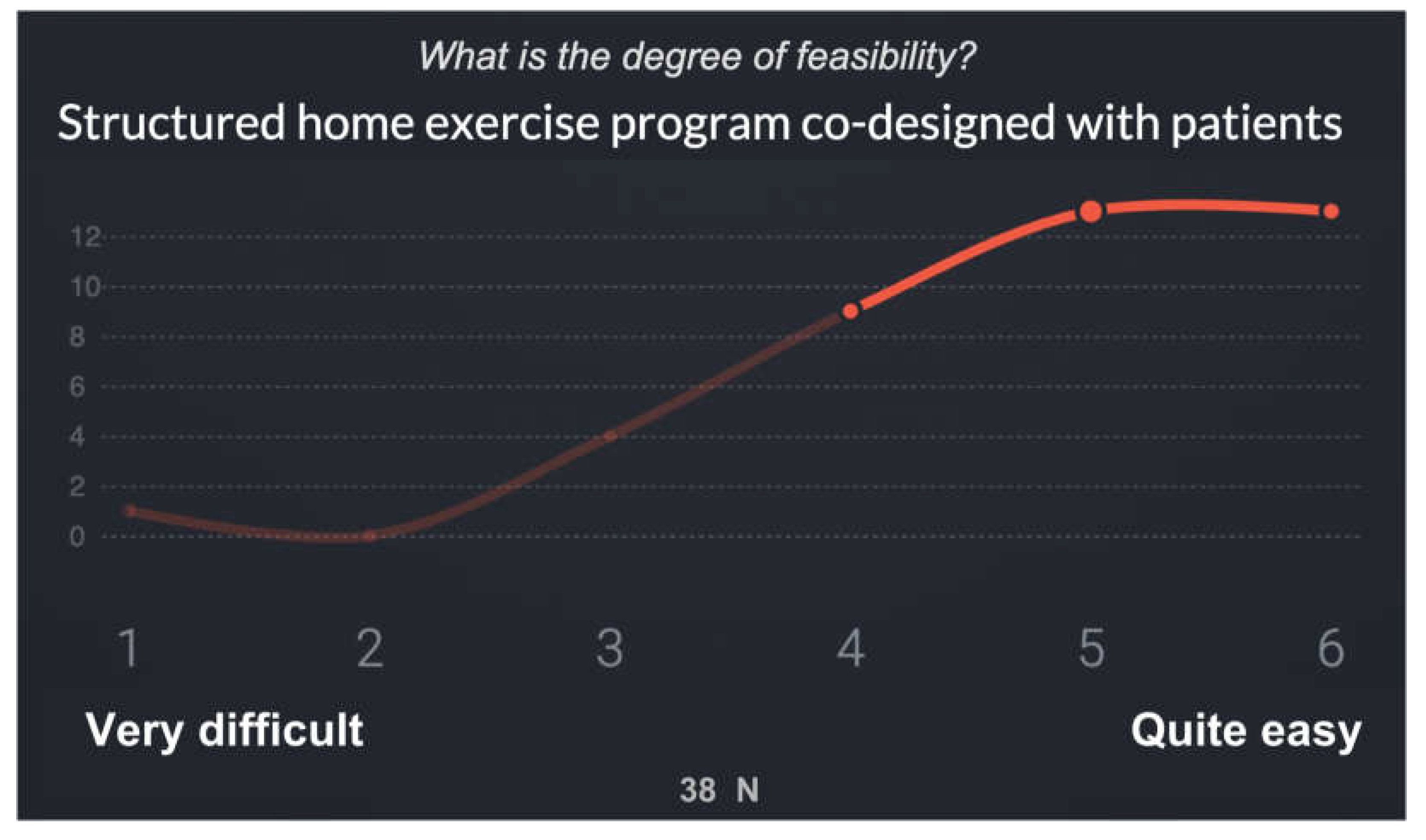

Table 1.
Characteristics of the Real-Time Delphi-based feasibility assessment.
| Characteristic | Category |
| Total participants | 37 |
| PM&R physicians | Pelvic floor rehabilitation expertise (35) |
| ASIA Board representatives | Patient association representatives (2) |
| Selection strategy | Purposive selection |
| Role of the panel | Feasibility assessment of pre-formulated recommendations |
| Rating format | Six-point Likert scale |
| Feedback procedure | Real-time anonymized group feedback |
| Possibility to modify scores | Yes, during the synchronous session |
Table 2.
Characteristics of patient survey respondents.
| Characteristic | Category | n | % |
| Total patient responses | 225 | 100.0 | |
| Gender | Female | 198 | 88.1 |
| Male | 27 | 11.9 | |
| Non-binary | 0 | 0.0 | |
| Educational level | University studies | 112 | 50.0 |
| Secondary education / vocational training | 79 | 35.0 | |
| Primary education | 31 | 13.7 | |
| No formal education | 3 | 1.3 | |
| Living situation | Independent private home | 211 | 93.8 |
| Private home with family caregiver | 11 | 4.9 | |
| Residential facility | 3 | 1.3 | |
| Private home with professional non-family caregiver | 0 | 0.0 | |
| Supported housing | 0 | 0.0 | |
| Pelvic floor condition reported (patient can report more than one) | Urinary incontinence | 146 | 64.6 |
| Fecal incontinence | 74 | 32.7 | |
| Gas incontinence | 65 | 28.8 | |
| Pelvic organ prolapse | 41 | 18.1 | |
| Pelvic pain | 39 | 17.3 | |
| Main symptom | Urinary incontinence | 113 | 50.4 |
| Fecal incontinence | 52 | 23.0 | |
| Pelvic pain | 22 | 9.7 | |
| Pelvic organ prolapse | 22 | 9.7 | |
| Gas incontinence | 16 | 7.1 | |
| Time since onset of main symptom | <1 year | 43 | 19.0 |
| 1–5 years | 102 | 45.1 | |
| 6–10 years | 35 | 15.5 | |
| 11–15 years | 19 | 8.4 | |
| 15–20 years | 8 | 3.5 | |
| >20 years | 19 | 8.4 | |
| Previously assessed by PM&R for PFD | Yes | 181 | 80.5 |
| No | 44 | 19.5 | |
| Received rehabilitation/physiotherapy treatment for PFD | Yes | 161 | 71.7 |
| No | 64 | 28.3 | |
| Chronic disease in addition to PFD | Yes | 92 | 40.7 |
| No | 133 | 59.3 | |
| Mobility difficulties | Yes | 31 | 13.7 |
| No | 194 | 86.3 |
Table 3.
Characteristics of professional survey respondents.
| Characteristic | Category | n | % |
| Total professional responses | 164 | 100.0 | |
| Gender | Female | 154 | 93.9 |
| Male | 10 | 6.1 | |
| Non-binary | 0 | 0.0 | |
| Professional category | PM&R physician | 101 | 61.6 |
| Physiotherapist | 63 | 38.4 | |
| Nursing | 0 | 0.0 | |
| Other | 0 | 0.0 | |
| Workplace | Complex/reference hospital | 56 | 34.1 |
| Area hospital, approx. 400 beds | 51 | 31.1 | |
| Basic general hospital, approx. 200 beds | 26 | 15.9 | |
| Local hospital, approx. 100 beds | 16 | 9.8 | |
| Other | 15 | 9.1 | |
| Experience in pelvic floor dysfunctions | <5 years | 65 | 39.6 |
| 6–10 years | 45 | 27.4 | |
| 11–15 years | 35 | 21.3 | |
| 16–20 years | 11 | 6.7 | |
| >20 years | 8 | 4.9 | |
| Average successive PFD patients/week | <5 | 41 | 25.0 |
| 5–10 | 53 | 32.3 | |
| 11–15 | 25 | 15.2 | |
| 16–20 | 22 | 13.4 | |
| >20 | 23 | 14.0 | |
| Average new PFD patients/week | <5 | 96 | 58.5 |
| 5–10 | 49 | 29.9 | |
| 11–15 | 15 | 9.1 | |
| 16–20 | 4 | 2.4 | |
| >20 | 0 | 0.0 | |
| Works in a multidisciplinary pelvic floor unit | Yes | 83 | 50.6 |
| No | 81 | 49.4 | |
| University teaching activity | Yes | 33 | 20.1 |
| No | 131 | 79.9 |
Table 4.
Differences in perception between patients and professionals ordered by divergence.
| Patients | Professionals | |||||||||
| ID | Item | μ | σ | A | μ | σ | A | SDI | ΔA | d |
| Q5 | Ability to use Internet in relation to pathology | 4.68 | 1.52 | 65.0 | 3.54 | 0.84 | 12.2 | 0.93 | 4.33 | 4.02 |
| Q2 | Information received/provided at the right time | 4.19 | 1.76 | 51.8 | 2.95 | 1.37 | 14.6 | 0.79 | 2.54 | 1.99 |
| Q29 | Usefulness of bladder/bowel diary | 2.93 | 1.67 | 20.3 | 4.39 | 1.16 | 54.3 | 1.01 | 1.67 | 1.69 |
| Q7 | Fulfilment/adherence to prescribed treatment programs | 4.36 | 1.45 | 53.1 | 3.78 | 1.00 | 20.7 | 0.47 | 1.57 | 0.74 |
| Q28 | Difficulty completing bladder/bowel diary | 2.64 | 1.75 | 18.0 | 3.93 | 1.16 | 31.7 | 0.87 | 0.76 | 0.66 |
| Q26 | Need for complementary Psychology/Psychiatry treatment | 3.07 | 1.86 | 27.0 | 4.30 | 1.09 | 46.3 | 0.81 | 0.72 | 0.58 |
| Q33 | Interest/usefulness of talks and group therapy program | 3.73 | 1.76 | 36.3 | 4.68 | 0.97 | 67.1 | 0.67 | 0.85 | 0.57 |
| Q8 | Usefulness of remote communication with rehabilitation team | 4.34 | 1.61 | 56.6 | 3.80 | 1.22 | 26.8 | 0.38 | 1.11 | 0.42 |
| Q10 | Sufficiency of phone consultations for home therapy | 3.49 | 1.50 | 25.7 | 3.06 | 1.21 | 11.6 | 0.31 | 1.22 | 0.38 |
| Q34 | Usefulness of previous group therapy | 3.30 | 2.08 | 40.0 | 4.57 | 1.10 | 58.3 | 0.77 | 0.46 | 0.35 |
| Q20 | Impact of pathology on social life | 4.63 | 1.48 | 62.8 | 5.47 | 0.71 | 92.7 | 0.72 | 0.48 | 0.34 |
| Q21 | Impact of pathology on quality of life | 4.65 | 1.44 | 61.9 | 5.43 | 0.74 | 91.5 | 0.68 | 0.48 | 0.33 |
| Q11 | Sufficiency of video consultations for home therapy | 3.69 | 1.53 | 33.2 | 3.27 | 1.18 | 16.5 | 0.31 | 1.01 | 0.31 |
| Q19 | Agreement on therapeutic goals | 4.24 | 1.61 | 51.2 | 4.76 | 1.02 | 65.9 | 0.38 | 0.29 | 0.11 |
| Q18 | Resolution of doubts/needs via remote consultation | 3.44 | 1.53 | 27.9 | 3.30 | 1.38 | 18.9 | 0.10 | 0.48 | 0.05 |
| Q9 | Need for occasional face-to-face visits to follow home therapy | 3.78 | 1.70 | 37.6 | 4.30 | 1.26 | 43.3 | 0.35 | 0.15 | 0.05 |
| Q14 | Motivation for virtual therapy with other patients | 3.35 | 1.77 | 31.4 | 3.55 | 1.31 | 23.8 | 0.12 | 0.32 | 0.04 |
| Q31 | Written instructions help perform home exercises | 4.24 | 1.60 | 52.2 | 4.68 | 0.98 | 59.1 | 0.33 | 0.13 | 0.04 |
| Q30 | Adherence to pharmacological treatment | 3.86 | 2.08 | 47.0 | 3.95 | 1.04 | 31.1 | 0.05 | 0.51 | 0.03 |
| Q1 | Sufficient information about pelvic floor pathology | 4.75 | 1.53 | 69.0 | 4.60 | 0.98 | 59.8 | 0.12 | 0.15 | 0.02 |
| Q22 | Satisfaction with consultation time | 4.62 | 1.56 | 64.0 | 4.45 | 1.26 | 55.5 | 0.12 | 0.15 | 0.02 |
| Q25 | Social/psychological impact considered in assessment | 4.79 | 1.61 | 70.1 | 5.05 | 1.00 | 76.8 | 0.20 | 0.10 | 0.02 |
| Q4 | Face-to-face reviews meet patient expectations | 4.64 | 1.66 | 67.8 | 4.53 | 0.94 | 58.5 | 0.08 | 0.16 | 0.01 |
| Q23 | Follow-up visits help continue home exercises | 4.57 | 1.56 | 61.5 | 4.45 | 1.15 | 55.6 | 0.08 | 0.11 | 0.01 |
| Q36 | Mobile apps recommended by professionals help perform home exercises | 4.34 | 1.58 | 54.0 | 4.52 | 1.02 | 59.1 | 0.14 | 0.09 | 0.01 |
| Q15 | Usefulness of requesting telehealth-based consultations | 3.74 | 1.67 | 36.3 | 3.90 | 1.38 | 39.0 | 0.11 | 0.07 | 0.01 |
| Q3 | Rehabilitation team involvement in care | 4.85 | 1.63 | 74.4 | 5.05 | 0.98 | 78.0 | 0.15 | 0.05 | 0.01 |
| Q13 | Usefulness of sharing experiences virtually with other patients | 3.52 | 1.75 | 32.7 | 3.92 | 1.25 | 33.5 | 0.26 | 0.02 | 0.01 |
| Q27 | Ease of access to pelvic floor rehabilitation unit | 3.64 | 1.85 | 38.1 | 3.63 | 1.41 | 33.5 | 0.00 | 0.14 | 0.00 |
| Q6 | Usefulness of prescribed home exercise programs | 4.64 | 1.47 | 61.9 | 4.63 | 1.19 | 55.5 | 0.01 | 0.12 | 0.00 |
| Q16 | Telehealth-based visit can substitute some face-to-face visits | 3.01 | 1.62 | 20.4 | 3.07 | 1.45 | 18.3 | 0.04 | 0.11 | 0.00 |
| Q17 | Usefulness/need of preparatory instructions before remote consultation | 4.04 | 1.54 | 42.5 | 4.13 | 1.31 | 44.5 | 0.06 | 0.05 | 0.00 |
| Q24 | App for home training upload and professional follow-up | 4.69 | 1.59 | 67.3 | 4.76 | 1.17 | 64.0 | 0.04 | 0.05 | 0.00 |
| Q32 | Video exercises help perform home exercises | 4.64 | 1.46 | 62.4 | 4.73 | 0.95 | 64.6 | 0.07 | 0.04 | 0.00 |
| Q35 | Usefulness of complementary devices for home exercises | 4.64 | 1.39 | 69.2 | 4.79 | 0.97 | 67.3 | 0.12 | 0.03 | 0.00 |
| Q12 | Hybrid in-person/remote program would cover needs | 4.43 | 1.53 | 56.2 | 4.50 | 1.15 | 56.7 | 0.05 | 0.01 | 0.00 |
Table 5.
Recommendations to innovate pelvic floor rehabilitation care delivery.
| No. | Recommendation | L.S.I.* | Description | Mean d** |
| 1 | Implement a structured home exercise program co-designed with patients | Q6, Q7, Q19, Q31, Q32 | Develop individualized home-based exercise plans agreed upon with patients, including clear goals, progression criteria, written/video support, and adherence tracking. | 0.178 |
| 2 | Integrate adherence monitoring tools into pelvic floor rehabilitation | Q7, Q28, Q29, Q30 | Use simple monitoring mechanisms, digital or paper-based, to track adherence, bladder/bowel diary completion, perceived usefulness, and pharmacological treatment adherence. | 0.780 |
| 3 | Increase the visibility of pelvic floor rehabilitation pathways in PM&R consultations | Q1, Q2, Q3, Q27 | Explicitly incorporate pelvic floor rehabilitation activities into clinical workflows to clarify information delivery, timing, professional involvement, referral circuits, and accessibility. | 0.505 |
| 4 | Develop a digital application to monitor pelvic floor exercise programs | Q5, Q7, Q24, Q35, Q36 | Implement an app allowing patients to record exercises and professionals to access adherence data, integrating complementary devices and mobile-app support where appropriate. | 0.954 |
| 5 | Promote digital health literacy tailored to pelvic floor patients | Q5, Q8, Q17, Q18 | Provide basic training, support materials, and preparatory instructions to ensure safe and effective use of digital tools, remote communication, and remote consultation. | 1.123 |
| 6 | Implement hybrid follow-up models — in-person + remote — for pelvic floor care | Q9, Q10, Q11, Q12, Q15, Q16, Q18, Q23 | Combine face-to-face visits, phone consultations, video consultations, remote consultation requests, and structured remote follow-up to optimize continuity of care. | 0.101 |
| 7 | Develop group-based and preventive pelvic floor health programs with graduated difficulty levels | Q13, Q14, Q20, Q21, Q26, Q33, Q34 | Implement group-based and preventive rehabilitation programs adapted to functional status, psychosocial burden, motivation, and previous rehabilitation experience, incorporating progressive self-management support to improve adherence and quality of life. | 0.317 |
| 8 | Standardize educational materials for pelvic floor rehabilitation | Q1, Q2, Q17, Q31, Q32 | Provide written, visual, video-based, and preparatory materials to support understanding, timely information, and long-term engagement. | 0.410 |
| 9 | Reinforce multidisciplinary coordination in pelvic floor rehabilitation | Q3, Q19, Q25, Q26 | Improve coordination between physicians, physiotherapists, psychology/psychiatry, and other professionals to ensure coherent care plans, shared goals, and attention to psychosocial impact. | 0.180 |
| 10 | Improve global accessibility and patient satisfaction with pelvic floor services | Q4, Q22, Q23, Q27 | Address barriers to access and continuously monitor patient satisfaction regarding consultation time, follow-up quality, continuity of care, and accessibility to specialized pelvic floor rehabilitation services. | 0.010 |
*L.S.I. = Linked Survey Items, referring to the matched survey items reported in Table 4. **Mean d was calculated as the average divergence score of the linked survey items included in each recommendation.
Table 6.
Feasibility ratings of care-improvement recommendations in the Real-Time Delphi-based assessment.
Table 6.
Feasibility ratings of care-improvement recommendations in the Real-Time Delphi-based assessment.
| N | Recommendation | μ | σ | Med | IQR |
| R1 | Structured home exercise program co-designed with patients | 5.4 | 0.8 | 6 | 1 |
| R2 | Adherence monitoring tools in pelvic floor rehabilitation | 5.2 | 0.9 | 5 | 1 |
| R3 | Visibility of pelvic floor rehabilitation pathways | 5.0 | 1.0 | 5 | 1 |
| R4 | Digital app for monitoring pelvic floor exercises | 4.7 | 1.1 | 5 | 2 |
| R8 | Standardized educational materials | 4.6 | 1.2 | 5 | 2 |
| R6 | Hybrid follow-up models | 4.3 | 1.3 | 4 | 2 |
| R5 | Digital health literacy programs | 4.1 | 1.4 | 4 | 3 |
| R9 | Multidisciplinary coordination reinforcement | 4.0 | 1.2 | 4 | 2 |
| R7 | Preventive pelvic floor health programs | 3.6 | 1.5 | 4 | 3 |
| R10 | Improve accessibility and global satisfaction | 3.4 | 1.6 | 3 | 3 |
Note: Values represent feasibility ratings provided by Delphi participants during the Real-Time Delphi phase. These ratings were used to support prioritization when interpreted together with the mean divergence values reported in Table 4.
Disclaimer/Publisher’s Note: The statements, opinions and data contained in all publications are solely those of the individual author(s) and contributor(s) and not of MDPI and/or the editor(s). MDPI and/or the editor(s) disclaim responsibility for any injury to people or property resulting from any ideas, methods, instructions or products referred to in the content. |
© 2026 by the authors. Licensee MDPI, Basel, Switzerland. This article is an open access article distributed under the terms and conditions of the Creative Commons Attribution (CC BY) license (http://creativecommons.org/licenses/by/4.0/).
Copyright: This open access article is published under a Creative Commons CC BY 4.0 license, which permit the free download, distribution, and reuse, provided that the author and preprint are cited in any reuse.


