
Submitted:
02 June 2026
Posted:
03 June 2026
You are already at the latest version
Abstract
Background A novel fixed-dose combination of vilanterol 25-µg, umeclidinium 62.5-µg, and fluticasone furoate 200-µg (VIL-UME-FF) in dry powder inhaler (DPI) was developed by M/s. Zydus Healthcare Limited for managing persistent asthma. Methods In this phase 3, multicenter, parallel group, open-label, randomized trial, patients received either test (VIL-UME-FF DPI) or reference DPI (indacaterol 150-µg, glycopyrronium 50-µg, and mometasone furoate 160-µg; IND-GLY-MF DPI). The primary endpoint was change from baseline in trough forced expiratory volume-1 (FEV1) at week-12. Secondary endpoints included trough forced vital capacity (FVC), post-bronchodilator FEV1 and FVC, and asthma control test (ACT) score. Results A total of 258 participants (18-65 years) were enrolled (Test: 129; Reference: 129). The least square mean change in trough FEV1 at week-12 was 342.9 (21.3) ml for the test group and 327.6 (21.4) ml for the reference group (p=0.6141). The lower limit of 95% confidence interval for the difference between the groups was -44.19 ml, well-above the predefined non-inferiority margin (-150 ml). At week-12, trough FVC, post-bronchodilator FEV1 and FVC, and ACT scores were comparable between the study groups. Conclusion VIL-UME-FF DPI was non-inferior to IND-GLY-MF DPI in improving trough FEV1 and other efficacy parameters and was well-tolerated in Indian patients with persistent asthma.
Keywords:
vilanterol
; umeclidinium
; fluticasone furoate
; dry powder inhaler
; asthma
; phase 3
; randomized
; non-inferiority
1. Introduction
Asthma is a chronic condition that affects the lung airways. These airways move air in and out of the lungs, but in asthma, they become inflamed and narrowed, which makes it harder to breathe out [1]. Symptoms include intermittent dyspnea, coughing, and wheezing. According to a report from the World Health Organization, around 260 million people were affected by asthma in 2019 and resulted in more than 450,000 deaths [2]. In India, asthma being a widespread disease, affecting millions of people of all age groups with the estimated prevalence of more than 2.0% [3,4].
Though asthma is incurable; it can be managed by several methods, including monitoring and avoiding triggers causing asthma, and use of medicine in case of acute attacks; however, progressive, uncontrolled asthma exacerbations can cause death if not treated urgently. Global Initiative for Asthma (GINA) recommended a treatment guidance for the effective management of asthma. According to GINA guidelines 2024 [1], a combination of low dose inhaled corticosteroid (ICS) with long acting β2 agonist (LABA) (GINA step 3 treatment) is the first-line treatment for persistent asthma to reduce risk of severe acute conditions. Furthermore, a fixed dose combination of medium-to-high dose ICS with LABA is recommended as step 4 treatment by GINA.
Reports indicates that about 40% patients having persistent asthma have symptoms even with step 4 treatment by GINA. These patients have a lower quality of life, reduced work productivity, and increased need requirement of emergency situations or hospital-based medical care [5]. In such cases, adding an inhaled long-acting muscarinic antagonist (LAMA) has been shown to provide additional benefits by improving lung function and reducing asthma exacerbations [6,7].
To improve treatment adherence and to stabilize the disease in patients with asthma who have symptoms even after the treatment with medium-to-high dose ICS with LABA, once daily single inhaler fixed dose combinations (FDCs) of ICS + LABA + LAMA (such as mometasone furoate-indacaterol-glycopyrronium FDC, fluticasone furoate-vilanterol + umeclidinium FDC, and beclomethasone-formoterol-glycopyrronium FDC have been approved for clinical use globally. In India, two dry powder inhaler (DPI) formulations, FDC of indacaterol 150 µg + glycopyrronium 50 µg + mometasone furoate 160 µg (IND-GLY-MF) approved since November 2022 and FDC of vilanterol 25 µg + glycopyrronium 50 µg + fluticasone furoate 200 µg (VIL-GLY-FF) approved since March 2025 in asthma indication. [8,9,10,11].
M/s. Zydus Healthcare Limited, India, has developed a FDC of vilanterol 25 µg + umeclidinium 62.5 µg+ fluticasone furoate 200 µg (VIL-UME- FF) in DPI formulation. This phase 3, randomized, non-inferiority clinical trial compared the efficacy and safety of VIL-UME-FF with IND-GLY-MF in Indian patients with persistent asthma.
2. Methods
2.1. Study Design and Participants
This prospective, randomized, parallel, active-controlled, open-label, multicenter, phase 3 clinical study was conducted from May 15, 2025, to September 30, 2025, at total 8 different sites in India which were geographically equally distributed. Patients were included in the study if (1) they were literate men or women (aged 18 - 65 years with a diagnosis of asthma ≥12 months before screening, (2) at screening spirometry, had prebronchodilator forced expiratory volume 1 (FEV1) of 40-80% of the predicted normal value and bronchodilator reversibility i.e., increase in FEV1 of ≥12% and ≥200 ml after salbutamol inhalation, (3) had been using ICS/LABA combination for ≥3 months with medium or high stable doses for ≥4 weeks before screening, (4) had an asthma control test [ACT] score of ≤15 at screening, and (5) had ≥1 severe asthma exacerbation within past 12 months (but not within 6 weeks) before screening. Exclusion criteria are presented in Supplementary material.
Patients without adequately controlled asthma despite medium-to-high dose ICS + LABA combination therapy were screened (visit 1) within 3 days before their enrolment. The eligible patients were then enrolled and subjected to randomization into two study groups (test group FDC: patients receiving VIL-UME-FF DPI and reference group FDC: patients receiving IND-GLY-MF DPI as per their randomization number on baseline visit (visit 2, day 0). After randomization, patients were followed up on an outpatient basis with scheduled visits at week 4 (visit 3), week 8 (visit 4), and week 12 (visit 5).
Patients in the test group and reference group received the one VIL-UME-FF FDC capsule and one IND-GLY-MF FDC capsule respectively, daily through oral inhalation route using Respihaler device.
The study protocol was approved by the DCGI and by independent/institutional ethics committee (IEC) of each participating site and the trial was registered with the Clinical Trial Registry of India (CTRI) (Registration No.: CTRI/2025/04/085959). The study was conducted following the ethical principles of Declaration of Helsinki and guidelines of International Council for Harmonisation of Technical Requirements for Pharmaceuticals for Human Use, Good Clinical Practice, Central Drugs Standard Control Organization, New Drug and Clinical Trial Rules 2019 and Ethical Guidelines for Biomedical Research on Human Subjects by Indian Council of Medical Research. Written informed consents were obtained from all enrolled patients.
2.2. Objectives and Endpoints
The primary objective of this study was to evaluate the efficacy of VIL-UME-FF DPI compared with IND-GLY-MF DPI in patients with persistent asthma. The primary endpoint included the change from baseline in trough FEV1 at the end of the study, week 12. The secondary endpoints were the change from baseline in trough FEV1 at week 4, trough FVC at weeks 4 and 12, post-bronchodilator FEV1 and FVC at weeks 4 and 12, and ACT score at weeks 4, 8, and 12. Other secondary endpoints were determination of proportion of rescue medication free days during the treatment period, asthma exacerbation episodes during the study, and global impression of change in the disease condition by the participants at the end of the study. Safety endpoints included treatment-emergent adverse events (TEAEs) and serious TEAEs reported during the study, and overall tolerability of study medications.
2.3. Statistical Analysis
Statistical analysis was performed using SAS® (Version 9.4) system software (SAS Institute Inc., USA). Data were presented as mean ± standard deviation (SD)/standard error (SE) or frequency (percentage). Descriptive statistics were used for different variables at baseline. Results were considered statistically significant if p-value was <0.05. Analysis of covariance (ANCOVA) adjusted for baseline trough FEV1 and two independent samples t-tests were applied to analyze the data.
At least 232 evaluable patients (116 in each study group) were required to demonstrate non-inferiority of the test group to the reference group at 90% power with 0.025 level of significance and a non-inferiority margin of 150 ml (assuming no difference in the change in trough FEV1 at week 12 between the two study groups and common standard deviation of 350 ml). Considering a dropout rate of 10% and a randomization scheme of 1:1, 258 patients (129 in each study group) were enrolled in this study.
3. Results
3.1. Patient Disposition and Baseline Characteristics
Figure 1 shows the CONSORT diagram of patient disposition. Of 285 screened individuals, 258 (test group: 129, reference group: 129) patients were randomized. One patient from the reference group withdrew the consent, therefore, a total of 257 patients (test group: 129, reference group: 128) were included in mITT and PP population and analyzed. The mean age ± SD of enrolled patients was 39.9 ± 11.3 years in the test group and 41.6 ± 11.3 years in the reference group. Male to female ratio was 78:51 and 86:43 in the test and reference groups, respectively. The mean ± SD height (164.2 ± 7.6 cm and 164.2 ± 8.5 cm), weight (61.5 ± 9.3 kg and 62.2 ± 8.5 kg), were almost identical in the test and reference groups. Nearly 90% patients of both study groups had no history of smoking. Overall, demographic and baseline characteristics were comparable between the study groups (Table 1). Since there was only one discontinuation and no major protocol deviation, the mITT and PP populations have same number of patients for analysis and hence the data were identical for both populations.
3.2. Trough FEV1 Response
Baseline, week 4, and week 12 trough FEV1 response was comparable between both study groups (Table S1). In terms of primary end point, the change in least square mean (SE) in trough FEV1 at week 12 from baseline was 342.9 (21.3) ml and 327.6 (21.4) ml for the test and reference groups, respectively, with a non-significant (p=0.6141) least mean difference of 15.2 ml (Table 2). The lower limit of 95% confidence interval (CI) for the difference between the test group and the reference group for the mean change in trough FEV1 at week 12 from baseline was -44.2 ml (well above the predefined non-inferiority margin of -150 ml). Hence, the test drug was noninferior to the reference drug for the mean change in trough FEV1 at week 12 from baseline.
The mean (±SD) trough FEV1 response at week 4 was 1730.5 ± 394.1 and 1771.6 ± 465.6 in the test and reference groups, respectively (Table 1). The mean change (±SD) in trough FEV1 at week 4 from baseline was 174.7 ± 265.0 and 163.0 ± 251.1 in the test and reference groups, respectively, with no significant difference (p=0.9398) between the two groups.
3.3. Evaluation of Trough FVC, Post-Bronchodilator FEV1 and FVC, and ACT Score
Trough FVC values at baseline, week 4, and week 12 were comparable between the two study groups (Table S2). The mean change ± SD in trough FVC at week 4 (194.7 ± 300.4 ml and 165.2 ± 320.4 ml; p=0.590) and week 12 (354.2 ± 280.8 ml and 344.2 ± 275.0 ml; p=0.974) from baseline was not significantly different in the test and reference groups, respectively (Table 3). Similarly, post-bronchodilator FEV1 and FVC, and ACT score values were comparable between the study groups (Table S2), no significant difference in change at week 4, week 8 (only for ACT score), and week 12 from baseline (Table 3).
3.4. Rescue Medication and Asthma Exacerbation
With respect to rescue medication-free days at week 4, week 8, and week 12, the mean number of days (±SD) in the test group (0.84 ± 0.12, 0.88 ± 0.09, and 0.91 ± 0.09, respectively) and the reference group (0.85 ± 0.13, 0.88 ± 0.12, and 0.91 ± 0.13, respectively) was comparable. None of the enrolled patients in both the study groups reported asthma exacerbation in this study.
3.5. PGIC
At week 12, PGIC in disease condition was similar in both study groups. Most patients in both groups reported much improved (test group, 56.59%; reference group, 61.72%) and very much improved (test group, 33.33%; reference group, 26.56%) disease condition (Table 4).
3.6. Overall Tolerability Evaluation
At week 12, overall tolerability evaluation was similar in both study groups. Most patients in both groups reported “excellent” (test group, 56.6%; reference group, 54.3%) and “good” (test group, 38.0%; reference group, 38.8%) disease condition. (Table 5)
3.7. Safety
The incidence, causality, and severity of treatment-emergent adverse events (TEAEs) were comparable between the treatment groups (Table 6). In total, 65 (25.2%) patients experienced 66 TEAEs in the study; 27 (20.9%; 27 events) and 38 (29.5%; 39 events) patients in the test and reference groups, respectively. The most frequent (>4 %) TEAE reported in the reference group was headache while none of the TEAEs reported in the test group had an incidence greater than 4%. Furthermore, in this study, no death and no serious TEAEs were observed. TEAEs in both the treatment groups were mild to moderate in severity. Mild TEAEs were observed in 53 patients (21 and 32 from the test and reference groups, respectively), whereas 12 patients (6 and 6 from the test and reference groups, respectively) experienced moderate TEAEs. All AEs were resolved completely during the study period only. No apparent difference was observed between the study groups in laboratory parameters, vital signs, physical examination, and electrocardiograms during the study.
4. Discussion
M/s Zydus Healthcare Limited conducted this phase 3 trial to evaluate the efficacy and safety of VIL-UME-FF FDC DPI in comparison with DCGI approved FDC DPI, IND-GLY-MF. The study achieved its primary end point by demonstrating non-inferiority between VIL-UME-FF and IND-GLY-MF with respect to trough FEV1 response at week 12; the mean improvement in trough FEV1 from baseline was 342 mL and 372 mL in the test group and reference group, respectively, at the end of the study and change from baseline in trough FEV1 at the end of study was above the non-inferiority margin of -150 ml.
Additionally with respect to secondary end points, the effect of once daily VIL-UME-FF on trough FVC, post-bronchodilator FEV1 and FVC and ACT score showed no significant difference compared with once daily IND-GLY-MF. Both the groups showed similar outcomes for rescue medication-free days, instances of asthma exacerbations and PGIC in the disease condition. Both test and reference drug are similar with respect to overall tolerability evaluation as well. Safety profile of VIL-UME-FF was similar with that of IND-GLY-MF FDC.
The concept of adding LAMA to ICS + LABA combination for the management of uncontrolled asthma has been studied for long, with tiotropium soft mist inhaler being the first approved LAMA in 2012 [12]. In recent years, multiple clinical studies have contributed to the development of a single inhaler triple therapy aimed at improving treatment compliance and patient convenience. Importantly, the synergistic effect of triple therapy has demonstrated superior efficacy in controlling asthma exacerbations, as evidenced by multiple phase III studies [8,13]. The FDC of IND-GLY-MM was thoroughly evaluated through a series of clinical trials, called the PLATINUM clinical program [14]. This program included phase III clinical studies designed to assess the safety and efficacy of the inhaled IND/GLY/MF in patients with inadequately controlled asthma. The IRIDIUM study in this program first evaluated the efficacy of once daily dosing of the IND/GLY/MF combination and demonstrated that the addition of GLY (a LAMA) to medium- or high-dose IND/MF combination significantly improves trough FEV1 response over 26 weeks. Once daily DPI inhaler of IND-GLY-MF is already available in India for clinical use.
A double bind, three period cross over study was conducted among 421 patients with Asthma which evaluated the dose response of UME-FF (via inhalation route) [15]. The study reported that across all treatment periods, trough FEV1 was improved with UME-FF compared to FF (treatment difference 0.055 L, p=0.018). No treatment related effects on laboratory parameters were reported in the study [15]. The study concluded that addition of UME with current FF treatment can be used as a viable treatment option in patient with Asthma. In our study comparison of FDC VIL-UME-FF was performed against the already approved combination of IND-GLY-MF. Further efficacy of UME in three drug combination (FF-UME-VI) was evaluated against FF-VI in patients with Asthma in a double bling, randomised, phase 3 trial [16]. The study demonstrated significant (p<0.0001) improvement in FEV1 score from baseline for FF-UME-VI versus FF-VI. Addition of UME to FF-VI resulted in small, dose related improvements compared with FF-VI. The study suggested that single inhaler FF-UME-VI was an effective treatment option with a favourable risk benefit profile for patients with Asthma. [16]. Result of our study demonstrated comparable (non-inferior) results in treatment outcomes (Trough FEV1 response, trough FVC, post-bronchodilator FEV1 and FVC, and ACT score) and safety parameters (tolerability and TEAE) in patients with Asthma receiving VIL-UME-FF. Overall, these results support the efficacy of UME in Asthma compared to conventional approved therapy.
M/s. Zydus Healthcare Limited has developed triple drug FDC in a dry powder inhaler (VIL-UME-FF) and has compared its safety and efficacy with IND-GLY-MF FDC. M/s. Zydus Healthcare Limited has presented outcome of this Phase III clinical trial in the subject expert committee (SEC) organized by Central Drugs Standard Control Organisation (CDSCO) in December 2025 and as per minutes of meeting (MoM) released on CDSCO website in public domain, SEC committee granted permission to manufacture and market this FDC, vilanterol 25 µg, umeclidinium 62.5 µg and fluticasone furoate 200 µg FDC in DPI formulation.
This study was conducted to evaluate and compare the efficacy and safety of FDC of Vilanterol 25 µg, Umeclidinium 62.5 µg and Fluticasone furoate 200 µg DPI with Indacaterol 150 µg, Glycopyrronium 50 µg and Mometasone furoate 160 µg DPI which is approved & marketed triple drug FDC of ICS/LABA/LAMA in the country for management of asthma.
The following were the key strengths of this study: (1) patients were recruited from different sites located across India, ensuring wide geographical representation; (2) sample size was sufficiently large; and (3) comparison with a well-known active and approved FDC drug. The main limitation of this study was recruitment of patients from a single country (India) and open-label nature of study design.
5. Conclusion
In this Phase III trial, the once-daily dry-powder inhaler fixed-dose combination (FDC) of vilanterol, umeclidinium, and fluticasone furoate (VIL-UME-FF) was demonstrated to be non-inferior to the indacaterol, glycopyrronium, and mometasone furoate FDC (IND-GLY-MF) in improving trough FEV1 at Week 12. Both therapies showed comparable efficacy, safety, and tolerability across multiple assessed endpoints. This triple-drug LABA–LAMA–ICS regimen, delivered via a single inhaler once daily, represents a valuable addition to asthma management, offering the potential for improved disease control and enhanced treatment adherence among patients with persistent asthma.
Funding
This study was funded by M/s. Zydus Healthcare Limited, India.
Authors’ contribution:
1 Pankaj Vyas Investigation; Supervision; Writing – Review & Editing 2 Mitul Chaudhari Investigation; Supervision; Writing – Review & Editing 3 Jaydip Deb Investigation; Supervision; Writing – Review & Editing 4 Amit Bhate Investigation; Supervision; Writing – Review & Editing 5 Manish Jain Investigation; Supervision; Writing – Review & Editing 6 Akash Balki Investigation; Supervision; Writing – Review & Editing 7 Ram Kaulgud Investigation; Supervision; Writing – Review & Editing 8 Abhay Javia Investigation; Supervision; Writing – Review & Editing 9 Deven Parmar Conceptualization; Visualization; Supervision; Writing – Review & Editing 10 Kevinkumar Kansagra Conceptualization; Visualization; Supervision; Writing – Review & Editing 11 Hardik Pathak Project Administration; Writing – Original Draft.
Informed Consent Statement
Written informed consents were obtained from all enrolled patients.
Data Availability Statement
Most of the data of this study are presented in the manuscript. Additional supporting raw data may be obtained from corresponding author on request.
Acknowledgments
The study was funded by M/s. Zydus Healthcare Limited, India. We thank the investigators and patients at the investigative sites for their support during the conduct of the study.
Conflicts of Interest
Deven Parmar, Kevinkumar Kansagra and Hardik Pathak are employees of Zydus Lifesciences Ltd., Ahmedabad, India. All other authors have no conflict of interests to declare.
References
- GINA. Global strategy for asthma management and prevention 2024. Available online: https://ginasthma.org/reports/.
- World Health Organization. Asthma Key facts. 6 May 2024. Available online: https://www.who.int/newsroom/fact-sheets/detail/asthma.
- Singh, S.; Salvi, S.; Mangal, D.K.; et al. Prevalence, time trends and treatment practices of asthma in India: the Global Asthma Network study. ERJ Open Res. 2022, 8(2), 005282021. [Google Scholar] [CrossRef] [PubMed]
- Serebrisky, D.; Wiznia, A. Pediatric Asthma: A global epidemic. Ann. Glob. Health 2019, 85(1), 6. [Google Scholar] [CrossRef] [PubMed]
- Gessner, C.; Kornmann, O.; Maspero, J.; et al. Fixed-dose combination of indacaterol/glycopyrronium/mometasone furoate once-daily versus salmeterol/fluticasone twice-daily plus tiotropium once-daily in patients with uncontrolled asthma: A randomised, Phase IIIb, non-inferiority study (ARGON). Respir. Med. 2020, 170, 106021. [Google Scholar] [CrossRef] [PubMed]
- Kerstjens, H.A.M.; Maspero, J.; Chapman, K.R.; et al. Once-daily, single-inhaler mometasone indacaterol- glycopyrronium versus mometasone-indacaterol or twice-daily fluticasone- salmeterol in patients with inadequately controlled asthma (IRIDIUM): a randomised, double-blind, controlled phase 3 study. Lancet Respir. Med. 2020, 8(10), 1000–1012. [Google Scholar] [CrossRef] [PubMed]
- Blair, H.A. Indacaterol/Glycopyrronium/Mometasone: A Review in Asthma. Drugs 2021, 81(6), 709–719. [Google Scholar] [CrossRef] [PubMed]
- Rogliani, P.; Matera, M.G.; Facciolo, F.; et al. Beclomethasone dipropionate, formoterol fumarate and glycopyrronium bromide: synergy of triple combination therapy on human airway smooth muscle ex vivo. Br. J. Pharmacol. 2020, 177(5), 1150–1163. [Google Scholar] [CrossRef] [PubMed]
- Kerstjens, H.A.M.; Maspero, J.; Chapman, K.R.; et al. Once-daily, single-inhaler mometasone-indacaterol- glycopyrronium versus mometasone-indacaterol or twice-daily fluticasone- salmeterol in patients with inadequately controlled asthma (IRIDIUM): a randomised, double-blind, controlled phase 3 study. Lancet Respir. Med. 2020, 8(10), 1000–1012. [Google Scholar] [CrossRef] [PubMed]
- Blair, H.A. Indacaterol/glycopyrronium/mometasone: a review in asthma. Drugs 2021, 81(6), 709–719. [Google Scholar] [CrossRef] [PubMed]
- Syed, Y.Y. Fluticasone furoate/vilanterol: a review of its use in patients with asthma. Drugs 2015, 75(4), 407–418. [Google Scholar] [CrossRef] [PubMed]
- Anzueto, M. Miravitlles, Tiotropium in chronic obstructive pulmonary disease – a review of clinical development. Respir. Res. 2020, 21 199. [Google Scholar] [CrossRef]
- Agusti; Fabbri, L.; Lahousse, L.; et al. Single inhaler triple therapy (SITT) in asthma: systematic review and practice implications. Allergy 2022, 77(4), 1105–1113. [Google Scholar] [CrossRef] [PubMed]
- Pelaia; Crimi, C.; Crimi, N.; et al. Indacaterol/glycopyrronium/mometasone fixed dose combination for uncontrolled asthma. Expert Rev. Respir. Med. 2022, 16(2), 183–195. [Google Scholar] [CrossRef] [PubMed]
- Lee, L.A.; Yang, S.; Kerwin, E.; Trivedi, R.; Edwards, L.D.; Pascoe, S. The effect of fluticasone furoate/umeclidinium in adult patients with asthma: a randomized, dose-ranging study. Respir. Med. 2015, 109(1), 54–62. [Google Scholar] [CrossRef] [PubMed]
- Lee, L.A.; Bailes, Z.; Barnes, N.; Boulet, L.P.; Edwards, D.; Fowler, A.; et al. Efficacy and safety of once-daily single-inhaler triple therapy (FF/UMEC/VI) versus FF/VI in patients with inadequately controlled asthma (CAPTAIN): a double-blind, randomised, phase 3A trial. Lancet Respir. Med. 2021, 9(1), 69–84. [Google Scholar] [CrossRef] [PubMed]
Figure 1.
CONSORT DIAGRAM DPI, dry powder inhaler; mITT, modified intended-to-treat; PP, per-protocol.
Figure 1.
CONSORT DIAGRAM DPI, dry powder inhaler; mITT, modified intended-to-treat; PP, per-protocol.
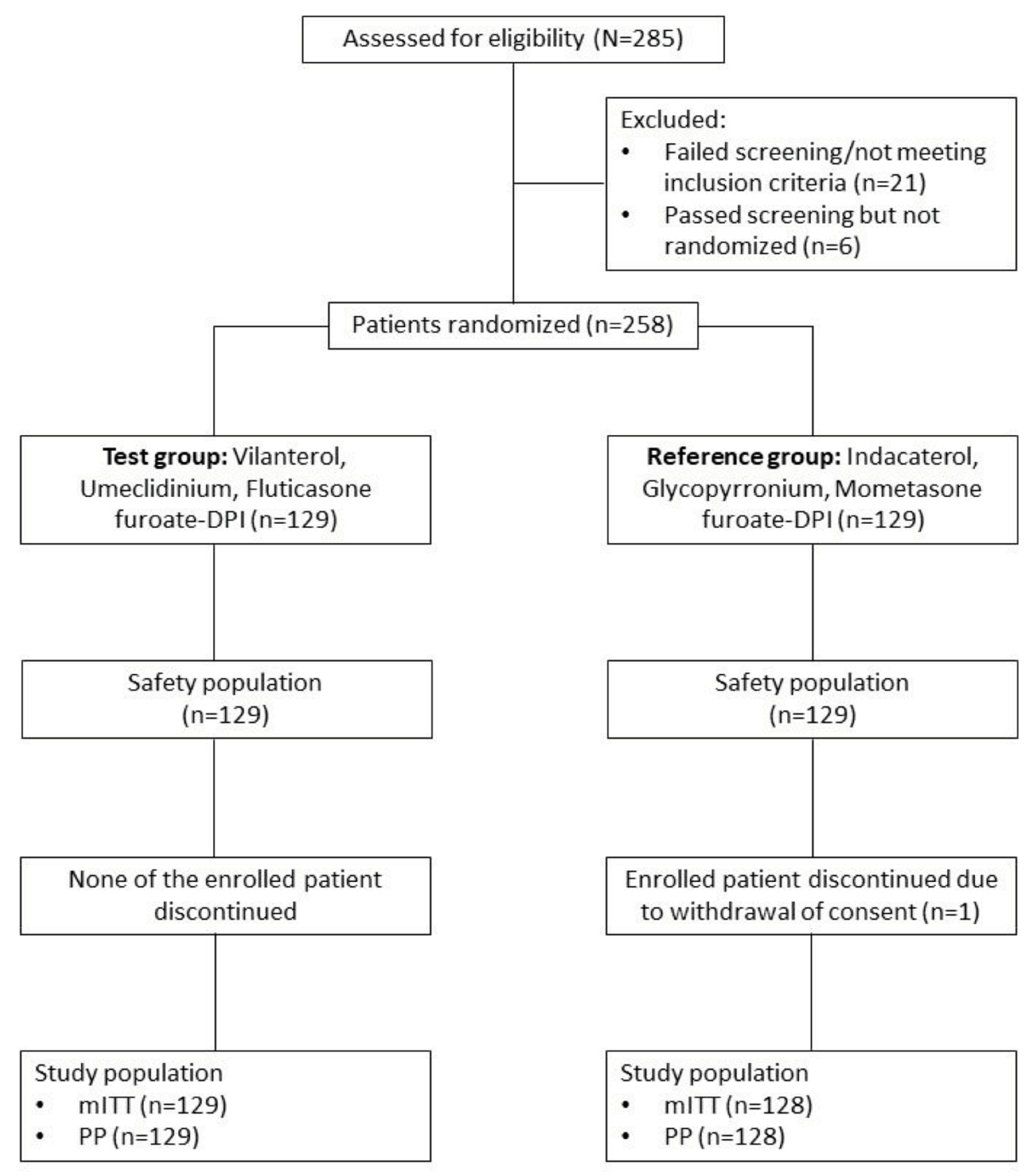

Table 1.
Demographic details and baseline characteristics of participants.
| Characteristics | Test Group (N=129) | Reference Group (N=129) |
| Age, years | ||
| mean ± SD | 39.9 ± 11.3 | 41.6 ± 11.3 |
| Median (min-max) | 39.0 (19.0-64.0) | 41.0 (19.0-62.0) |
| Sex (male:female) | 78:51 | 86:43 |
| Height, cm | ||
| mean ± SD | 164.2 ± 7.6 | 164.2 ± 8.5 |
| Median (min-max) | 165.0 (140.0-180.0) | 166.0 (136.0-182.0) |
| Weight, kg | ||
| mean ± SD | 61.5 ± 9.3 | 62.2 ± 8.5 |
| Median (min-max) | 62.0 (38.0-92.4) | 62.1 (38.0-93.2) |
| ACT Score – PP Population and mITT Population; | ||
| Visit 1 (Baseline) | Test Group (N=129) | Reference Group (N=128) |
| Mean ± SD | 12.3 ± 1.4 | 12.2 ± 1.5 |
| Median (min-max) | 12.0 (9, 15) | 12.0 (8, 15) |
N = number of participants in each study group. Values are represented as number, n (%) or means ± standard deviations or median (range) Test Group = Patients received Vilanterol, Umeclidinium, and Fluticasone furoate (from Zydus Healthcare Ltd.)] – DPI formulation Reference Group = Patients received Indacaterol, Glycopyrronium, and Mometasone furoate (Approved product)] – DPI formulation Abbreviations: BMI, body mass index; DPI, dry powder inhaler; max, maximum; min, minimum; SD, standard deviation.
Table 2.
Trough FEV1 response at week 12.
| Change in trough FEV1 response at week 12 from baseline |
Test Group (N=129) |
Reference Group (N=128) |
| Least square mean (SE) | 342.9 (21.3) ml | 327.6 (21.4) ml |
| Least square mean difference | 15.2 ml | |
| 95% CI | (-44.2, 74.6) mL | |
| p-value | 0.6141 | |
N = number of patients in each study group Test Group = Patients received Vilanterol, Umeclidinium, and Fluticasone furoate (from Zydus Healthcare Ltd.)] – DPI formulation Reference Group = Patients received Indacaterol, Glycopyrronium, and Mometasone furoate (Approved product)] – DPI formulation. Abbreviations: CI, confidence interval; DPI, dry powder inhaler; FEV, forced expiratory volume; SE, standard error.
Table 3.
Change in trough FVC, post-bronchodilator FEV1 and FVC, and ACT score.
| Change from baseline in |
Test Group (N = 129) |
Reference Group (N = 128) |
p-value |
| Trough FVC (ml) | |||
| At week 4 | 194.7 ± 300.4 | 165.2 ± 320.4 | 0.590 |
| At week 12 | 354.2 ± 280.8 | 344.2 ± 275.0 | 0.974 |
| Post-bronchodilator FEV1 (ml) | |||
| At week 4 | 186.1 ± 254.1 | 148.0 ± 221.4 | 0.285 |
| At week 12 | 329.8 ± 259.1 | 306.0 ± 244.9 | 0.572 |
| Post-bronchodilator FVC (ml) | |||
| At week 4 | 150.8 ± 330.2 | 167.7 ± 289.4 | 0.579 |
| At week 12 | 338.8 ± 259.6 | 358.1 ± 262.5 | 0.486 |
| ACT score | |||
| At week 4 | 3.4 ± 2.0 | 3.4 ± 2.0 | 0.645 |
| At week 8 | 6.0 ± 2.0 | 5.9 ± 2.1 | 0.362 |
| At week 12 | 8.4 ± 1.6 | 8.1 ± 1.9 | 0.136 |
N = number of participants in each study group Values are represented as mean ± SD Test Group = Patients received Vilanterol, Umeclidinium, and Fluticasone furoate (from Zydus Healthcare Ltd.)] – DPI formulation Reference Group = Patients received Indacaterol, Glycopyrronium, and Mometasone furoate (Approved product)] – DPI formulation Abbreviations: ACT, asthma control test; DPI, dry powder inhaler; FEV, forced expiratory volume; FVC, forced vital capacity; SD, standard deviation.
Table 4.
Patient-reported global impression of change in the disease condition.
| PGIC criteria | Test Group (N=129) | Reference Group (N=128) |
| -3 (very much worse) | - | - |
| -2 (much worse) | - | - |
| -1 (minimally worse) | - | - |
| 0 (no change) | - | - |
| +1 (minimally improved) | 12 (9.3) | 14 (10.9) |
| +2 (much improved) | 73 (56.6) | 79 (61.7) |
| +3 (very much improved) | 43 (33.3) | 34 (26.6) |
N = number of participants in each study group Values are represented as number, n (%) Test Group = Patients received Vilanterol, Umeclidinium, and Fluticasone furoate (from Zydus Healthcare Ltd.)] – DPI formulation Reference Group = Patients received Indacaterol, Glycopyrronium, and Mometasone furoate (Approved product)] – DPI formulation Abbreviations: DPI, dry powder inhaler; PGIC, Patient-reported global impression.
Table 5.
Summary of Overall Tolerability Evaluation.
| Visit | Tolerability grade |
Test Group (N=129) n (%) |
Reference Group (N=129) n (%) |
| Visit 5 | Excellent | 73 (56.6) | 70 (54.3) |
| Good | 49 (38.0) | 50 (38.8) | |
| Fair | 7 (5.4) | 8 (6.2) | |
| Poor | 0 (0) | 0 (0) |
N = number of participants in each study group Values are represented as number, n (%) Test Group = Patients received Vilanterol, Umeclidinium, and Fluticasone furoate (from Zydus Healthcare Ltd.)] – DPI formulation Reference Group = Patients received Indacaterol, Glycopyrronium, and Mometasone furoate (Approved product)] – DPI formulation Abbreviations: DPI, dry powder inhaler.
Table 6.
Summary of treatment-emergent adverse events as per the type, severity grade, relatedness to treatment, and outcome.
Table 6.
Summary of treatment-emergent adverse events as per the type, severity grade, relatedness to treatment, and outcome.
| Description |
Test Group (N = 129) |
Reference Group (N = 129) |
| Total number of TEAEs | 27 | 39 |
| Total number of serious TEAEs | 0 | 0 |
| Number of patients (%) with at least one TEAE | 27 (20.9) | 38 (29.5) |
| TEAEs (severity grade) | ||
| Mild | 21 | 32 |
| Moderate | 6 | 6 |
| TEAEs (related to study treatment) | ||
| Not Related | 10 | 15 |
| Related | 17 | 24 |
| TEAEs (based on outcome) | ||
| Resolved/Recovered | 27 | 39 |
TEAE classification is demonstrated in the safety population (n=258) N = number of participants in each study group. Test Group = Patients received Vilanterol, Umeclidinium, and Fluticasone furoate (from Zydus Healthcare Ltd.)] – DPI formulation Reference Group = Patients received Indacaterol, Glycopyrronium, and Mometasone furoate (Approved product)] – DPI formulation Abbreviations: DPI, dry powder inhaler; TEAE, treatment-emergent adverse event.
Disclaimer/Publisher’s Note: The statements, opinions and data contained in all publications are solely those of the individual author(s) and contributor(s) and not of MDPI and/or the editor(s). MDPI and/or the editor(s) disclaim responsibility for any injury to people or property resulting from any ideas, methods, instructions or products referred to in the content. |
© 2026 by the authors. Licensee MDPI, Basel, Switzerland. This article is an open access article distributed under the terms and conditions of the Creative Commons Attribution (CC BY) license.
Copyright: This open access article is published under a Creative Commons CC BY 4.0 license, which permit the free download, distribution, and reuse, provided that the author and preprint are cited in any reuse.


