
Submitted:
01 June 2026
Posted:
02 June 2026
You are already at the latest version
Abstract
Background/Objectives: Endoscopic electroporation — including electrochemotherapy, calcium electroporation, irreversible electroporation and pulsed-field ablation — is an intended non-thermal, configuration-dependent platform increasingly applied to selected colorectal neoplasms. Early experience suggests roles in palliative haemostasis, luminal symptom control and local disease management, but the field is heterogeneous and methodologically immature, and uncontrolled diffusion is a real risk. Methods: We performed a narrative review of the mechanistic, preclinical and clinical literature on electroporation-based therapies relevant to colorectal neoplasia, with emphasis on endoscopic delivery, and synthesised the governance and reporting requirements for responsible adoption. Results: Mechanistically, reversible electroporation underpins electrochemotherapy and calcium electroporation, while irreversible electroporation and pulsed-field ablation produce drug-free, predominantly non-thermal cell death; these modes are not interchangeable. Across published colorectal cohorts the most consistent signal is for palliative haemostatic and symptom-control use; salvage, local-control and complex-polyp applications are less mature, and organ-preservation, immune-priming and neoadjuvant uses remain investigational. A recurring weakness is that effect depends on a configuration of patient, lesion and procedural parameters that current reporting frequently omits, so that “treatment delivered” is an inadequate unit of analysis. To address this, we propose SENTAL (Special Endoscopic Non-Thermal Ablation Therapy) as a service model: a two-axis classification (clinical intent first, timing/role modifier second), a six-domain minimum dataset with structured CTCAE and Clavien–Dindo safety grading that distinguishes “none” from “not recorded”, denominator-disciplined outcome reporting, and a four-layer governance cycle. Conclusions: Endoscopic electroporation should be adopted as a controlled clinical-learning process rather than diffused on the basis of favourable anecdotes. A configuration-dependent bioelectric therapy requires a configuration-aware clinical service, disciplined vocabulary and registry-linked governance to generate evidence adequate for health-technology appraisal.
Keywords:
endoscopic electroporation
; calcium electroporation
; electrochemotherapy
; irreversible electroporation
; pulsed-field ablation
; colorectal cancer
; colorectal neoplasia
; palliative endoscopy
; clinical governance
; registry
1. Introduction
The introduction of new procedural technologies into colorectal practice has repeatedly outpaced the clinical language and evaluative structures needed to use them well. The significant polyp and early colorectal cancer (SPECC) concept is instructive: it gave clinicians a practical frame for lesions that were neither straightforward benign polyps nor conventional cancers, and in doing so promoted careful assessment, documentation, multidisciplinary team (MDT) discussion and the avoidance of both under- and overtreatment [1,2,3,4]. The enduring principle that “decisions are more important than incisions” captures the value of a shared vocabulary applied to a difficult clinical boundary.
Electroporation-based therapies now occupy an analogous position. Electroporation is the application of short, high-intensity electric pulses that transiently or permanently increase the permeability of the cell membrane [5,6]. When membrane permeabilisation is reversible and used to facilitate intracellular delivery of a cytotoxic agent such as bleomycin or cisplatin, the approach is termed electrochemotherapy; the European Standard Operating Procedures of Electrochemotherapy (ESOPE) established its efficacy and safety for cutaneous and subcutaneous metastases [6,7]. Calcium electroporation, in which supraphysiological intracellular calcium is delivered in place of a cytotoxic drug, produces tumour cell death through adenosine triphosphate depletion and is attractive for its low cost and favourable safety profile [8]. When pulses are tuned to produce permanent permeabilisation and cell death without a drug, the result is irreversible electroporation; closely related high-frequency and biphasic protocols are increasingly described as pulsed-field ablation [9]. These modalities are mechanistically related but not interchangeable, and each carries distinct assumptions, endpoints and safety considerations.
Adapting these principles to endoluminal delivery through a flexible endoscope is comparatively recent. A first-in-human phase 1 study demonstrated the feasibility of endoscopic electroporation for colorectal cancer [9], and subsequent cohorts have reported calcium electroporation delivered endoscopically with an emphasis on palliative luminal benefit [10]. Early experience suggests potential value in patients poorly served by standard options: frail or comorbid patients with bleeding luminal colorectal cancer, patients requiring local symptom control, patients in whom escalation to stoma, major surgery, radiotherapy or systemic therapy would be disproportionate, and selected patients with complex, recurrent or residual lesions in whom non-thermal ablation may have a future role [9,10,11,12,13,14,15,16]. However, the field remains at an early stage of evidence development, dominated by small single-centre cohorts, phase 1 studies, implementation reports and conference-reported series.
The central problem this review addresses is that endoscopic electroporation is a configuration-dependent intervention whose biological effect cannot be inferred from the mere fact of device use. The same nominal indication may produce very different effects depending on electrode contact, treatment geometry, coverage, tissue conductivity and pulse delivery. Promising case series therefore cannot, by themselves, define how the intervention should be selected, delivered, reported or governed. This review surveys the mechanistic and clinical evidence, defines where that evidence is strong and where it is preliminary, and proposes a structured framework — the Special Endoscopic Non-Thermal Ablation Therapy (SENTAL) model — for controlled adoption, disciplined classification and registry-linked governance. The aim is explicitly not to argue that electroporation is established definitive therapy for colorectal cancer, but to define the clinical language, minimum dataset and governance architecture required before broader dissemination.
2. Materials and Methods
This review was designed as a narrative evidence synthesis rather than a systematic review, because the colorectal evidence base is small, heterogeneous and dominated by early-phase cohorts, service-development reports and conference abstracts. The searches were intended to identify mechanistic and clinical literature relevant to endoscopic or colorectal electroporation, not to support pooled quantitative estimates. We searched PubMed, Embase and the Cochrane Library from database inception to 31 January 2026 (final search update, 31 January 2026) for English-language publications, using combinations of the terms “electroporation”, “electrochemotherapy”, “calcium electroporation”, “irreversible electroporation”, “pulsed-field ablation”, “endoscopic”, “colorectal”, “rectal cancer” and “colorectal polyp”, supplemented by hand-searching of reference lists and relevant conference proceedings.
Clinical reports were included if they described electroporation-based therapy delivered to, or directly relevant to, colorectal or endoluminal targets, irrespective of design (phase 1 studies, prospective or retrospective cohorts, case series, implementation reports and conference abstracts were all eligible given the early state of the field). Reports limited to unrelated tumour sites were included only where they informed mechanism, dosimetry or safety, and were not used to support colorectal efficacy claims. Preclinical and translational studies were used only for mechanistic context. Conference abstracts were included but are identified as such throughout and were weighted as preliminary, signal-generating evidence. Non-English publications, and reports providing no extractable clinical or mechanistic detail, were excluded.
Because the included studies were few, heterogeneous in design, intervention and endpoint, and frequently did not report a delivery configuration sufficient for comparison, neither a quantitative synthesis nor a formal risk-of-bias assessment was appropriate or informative; a structured risk-of-bias appraisal across such disparate early reports would convey false precision rather than meaningful discrimination. Evidence maturity was therefore assigned narratively and transparently to each application using three pragmatic categories — early clinical signal (supported by more than one independent clinical cohort or series), early/case-level (supported mainly by single-centre or case-level experience), and investigational/research-only (supported by mechanistic rationale or non-colorectal data but without an established colorectal clinical signal) — with the basis for each assignment stated in the text and in Table 2. The governance, classification and reporting components of the SENTAL model were developed conceptually from the reviewed evidence and from established frameworks for surgical and device innovation, namely the IDEAL and IDEAL-D recommendations and the principles of real-world evidence generation [19,20,21,22]. No new patient data were generated for this review; the illustrative vignettes used to demonstrate the classification (Supplementary Material) are hypothetical and do not describe identifiable patients.
The exploratory pooled denominators in Table 3 were derived conservatively and are descriptive only. Table 2 reports each study’s headline cohort at the level the source reported it; Table 3 does not reuse these headline cohorts as denominators. For each outcome, a pooled fraction was formed only where the contributing datasets reported that outcome at the same unit of analysis (procedure or patient) with a comparable definition. On this basis, procedure-level outcomes that were uniformly reported — technical completion and procedure-level serious adverse events — were pooled across the datasets reporting per-procedure data, giving a procedure denominator of 80. For patient-level outcomes whose evaluable populations or definitions differed between sources — specifically patient-level serious adverse events and permanent bleeding cessation — a defensible pooled denominator could not be reconstructed; these outcomes are therefore reported as “not estimable from extractable data” rather than as a spurious pooled fraction. The remaining entries are single-study figures, identified as such, and are not pooled. No imputation was performed: where an outcome was not reported for a given patient or procedure, that record was excluded from the denominator rather than counted as a non-event. Every numerator and denominator in Table 3 must be re-verified against the primary source before submission.
3. Mechanisms and Modalities of Electroporation Relevant to Colorectal Neoplasia
An appreciation of mechanism is essential because it explains why electroporation behaves differently from the thermal ablative techniques familiar to endoscopists. Argon plasma coagulation, radiofrequency ablation and laser therapy all act by coagulative thermal destruction, and their dose–effect relationships, depth of injury and healing characteristics are governed by heat transfer. Electroporation, by contrast, acts on the cell membrane through an applied electric field, and its assumptions cannot simply be transferred from thermal techniques.
The preclinical and translational literature on electroporation is substantial and predates its endoluminal application. Decades of work established the biophysics of pore formation, the dependence of effect on field strength and pulse parameters, and the relative sparing of collagen-rich structures, providing the rationale for treating tumours adjacent to vessels, ducts and nerves [5,6]. This body of evidence, derived largely from cutaneous, hepatic, pancreatic and soft-tissue applications, informs reasonable expectations for the colorectum but also signals the principal hazard of extrapolation: the electric field distribution, and therefore the treated volume, is highly sensitive to local geometry and tissue heterogeneity, which differ in the deformable, peristaltic, fluid-filled luminal environment from the relatively fixed parenchymal targets in which much of the prior experience was accrued.
3.1. Reversible Electroporation and Electrochemotherapy
When an external electric field exceeds a threshold, transient aqueous pores form in the lipid bilayer and membrane permeability increases reversibly [5]. This phenomenon is exploited in electrochemotherapy, in which reversible electroporation transiently admits an otherwise poorly permeant cytotoxic drug — most commonly bleomycin, occasionally cisplatin — dramatically increasing its intracellular concentration and cytotoxicity [6]. The ESOPE project standardised pulse parameters and electrode configurations and demonstrated high local response rates with low morbidity for cutaneous and subcutaneous metastases of varied histology [7]. The technique’s strengths — a localised effect, sparing of connective-tissue architecture and repeatability — are precisely the features that make endoluminal application attractive.
Beyond direct cytotoxicity, electrochemotherapy and related electroporation modalities can elicit local and systemic immune responses through immunogenic cell death, release of tumour antigens and alteration of the tumour microenvironment [6,8]. This immunological dimension is the rationale for combining electroporation with immune checkpoint inhibition and underlies the emerging interest in immune-priming strategies; it also means that response assessment confined to the treated lesion may underestimate the biological footprint of the intervention. For colorectal application these effects remain hypotheses requiring formal study rather than established mechanisms of clinical benefit.
3.2. Calcium Electroporation
Calcium electroporation substitutes supraphysiological calcium chloride for a cytotoxic drug. Internalised calcium overwhelms membrane pumps, depletes adenosine triphosphate and triggers tumour cell death, while normal cells with greater metabolic reserve are relatively spared [8]. The approach is inexpensive, widely available, does not require handling of cytotoxic agents, and has a favourable safety profile, making it well suited to a palliative or resource-constrained context. These properties underpin much of the early colorectal endoscopic experience [10,12].
3.3. Irreversible Electroporation and Pulsed-Field Ablation
When pulse strength and number are increased beyond the reversible threshold, permeabilisation becomes permanent and cells die without any adjuvant drug; this is irreversible electroporation. Because the dominant mechanism is non-thermal, irreversible electroporation can, in principle, ablate tissue while preserving the extracellular matrix and adjacent critical structures such as ducts and large vessels — a property leveraged in pancreatic and hepatic applications. High-frequency biphasic variants, frequently termed pulsed-field ablation, reduce muscle stimulation and the need for neuromuscular blockade and have attracted intense interest in cardiac electrophysiology [9]. In the colorectum, these drug-free ablative modes are of greatest theoretical interest for complex or recurrent polyps, where avoidance of thermal injury and preservation of the wall may be advantageous, though clinical data remain sparse.
3.4. Why Configuration Determines Effect
Across all modalities, the delivered biological effect depends on the local electric field actually achieved in the target tissue, which is in turn a function of electrode geometry and contact, applied voltage, pulse number, duration, interval and polarity, tissue conductivity and impedance, and the proportion of the intended target reached by effective pulses (coverage) [5,6,9]. Two patients with the same nominal indication may experience markedly different effects if these parameters differ. This configuration-dependence is the single most important conceptual point for safe adoption: it means that “treatment delivered” is an inadequate unit of analysis, and that meaningful evaluation requires capture of the delivery configuration, not merely the indication and the outcome. The principal features distinguishing the four modalities, and their current colorectal evidence maturity, are summarised in Table 1.
4. Clinical Evidence in Colorectal Neoplasia
A central principle of responsible adoption is distinguishing what has been observed from what is proposed. The current evidence maturity differs markedly across potential applications, and conflating them risks overstating the readiness of the field. The principal colorectal clinical reports are summarised in Table 2, which maps each study by domain, design or publication status, modality and delivery, patient and procedure counts, and contribution to synthesis; an exploratory audited pooling of extractable denominators across these datasets is presented in Table 3. The narrative below interprets that evidence by application.

Table 2.
Principal colorectal clinical evidence base.
| Study / record | Domain | Design / status | Modality / delivery | Patients / procedures | Contribution to synthesis |
|---|---|---|---|---|---|
| Falk Hansen 2020 [9] | Palliative luminal CRC | Phase 1 full-text clinical study | ECT / endoscopic EndoVE | 7 patients; one or two treatments each | Narrative synthesis; bleeding directionally supportive; not procedure-level pooled |
| Broholm 2023 [10] | Palliative luminal CRC | Phase 1 full-text clinical study | CaEP / endoscopic EndoVE | 6 patients; 12 procedures | Narrative synthesis; not primary procedure-level pooled |
| Broholm 2024 [11] | Neoadjuvant before surgery | Prospective full-text clinical study | CaEP / endoscopic EndoVE | 21 patients; 21 procedures | Procedure-level pool; surgery-as-planned estimate |
| Adeyeye 2025 [12] | Palliative luminal CRC | Full-text case series | CaEP / endoscopic EndoVE | 16 patients; 36 procedures | Procedure-level pool; bleeding, symptom/QoL and safety outcomes |
| Ngo-Stuyt eP435 [13] | Palliative luminal CRC | Conference abstract | EP / endoscopic | 3 patients; 12 procedures (verify against abstract) | Procedure-level pool; bleeding and safety outcomes |
| Ngo-Stuyt eP444 [14] | nECT after nCRT in LARC | Randomised phase II abstract | ECT / endoscopic-assisted | 8 intervention patients; 8 procedures | Procedure-level pool; RoB 2 appraisal |
| Beintaris 2025 [15] | Palliative luminal CRC | Conference abstract | CaEP / endoscopic | 3 patients; 3 procedures | Procedure-level pool; bleeding and safety outcomes |
| Rega 2022 [16] | Organ preservation / recurrence | Mixed-intent case report | ECT / transanal or percutaneous non-endoscopic | 3 patients | Patient-level safety and narrative synthesis |
CaEP, calcium electroporation; CRC, colorectal cancer; ECT, electrochemotherapy; EndoVE, endoscopic electroporation (EndoVE system); EP, electroporation; LARC, locally advanced rectal cancer; nCRT, neoadjuvant chemoradiotherapy; nECT, neoadjuvant electrochemotherapy; RoB 2, Cochrane risk-of-bias tool, version 2.
4.1. Palliative Haemostatic and Symptom-Control Use
The most developed clinical signal relates to palliative luminal treatment of advanced colorectal cancer, particularly bleeding control and symptom relief. The first-in-human phase 1 study of endoscopic electrochemotherapy established the feasibility and early safety of delivering pulsed electric fields to luminal colorectal tumours, with acceptable tolerability and no procedure-attributable mortality, although it was a small dose-finding cohort not designed to demonstrate efficacy [9]. Subsequent calcium electroporation experience extended the approach to a drug-free protocol and supported the plausibility of palliative luminal benefit, including reduction in tumour-related bleeding and transfusion requirement in selected patients, again in small numbers and with heterogeneous follow-up [10]. United Kingdom case-series and implementation experience have described palliative haemostasis and local symptom control in patients unsuitable for standard options, and have set out a deliverable service pathway with attention to selection, consent and follow-up [12,17]. Conference-reported prospective single-centre experience has subsequently described early clinical outcomes within a tertiary colorectal electroporation pathway, though as an abstract it awaits full peer-reviewed reporting [18].
Read together, several consistent observations emerge: technical completion of the procedure is generally achievable in appropriately selected luminal targets; the dominant treatment intent across reports is palliative, with haemostasis the most frequently described benefit; the safety signal is reassuring within the limits of small samples, with adverse events typically minor and self-limiting; and repeat treatments are common, reflecting a palliative rather than ablative-curative intent. Equally consistent are the limitations: cohorts are small and predominantly single-centre, protocols and pulse parameters differ between groups, response definitions and follow-up intervals are heterogeneous, and there is no comparative efficacy data against the existing palliative pathway of radiotherapy, stenting, transfusion or supportive care. These data are therefore best interpreted as feasibility and signal-generating evidence rather than definitive comparative efficacy. Nonetheless, for frail or comorbid patients with bleeding luminal disease in whom radiotherapy, systemic therapy, stenting, diversion or surgery may be unsuitable or disproportionate, the early haemostatic signal is clinically meaningful and warrants rigorous prospective evaluation.
4.2. Salvage and Local-Control Use
Some patients require local control after prior treatment, recurrence, residual luminal disease or failed standard local therapy. Here the relevant endpoint is frequently not complete tumour eradication but local symptom control, reduction of tumour-related bleeding, avoidance of urgent deterioration or prevention of disproportionate escalation. The evidence for this use is less mature than for palliation and rests largely on selected case-level or service-development experience. It requires structured prospective evaluation, clear denominators, endoscopic and histological follow-up, and explicit comparison with established pathways such as endoscopic mucosal resection (EMR), endoscopic submucosal dissection (ESD), transanal surgery, radiotherapy or radical surgery.
4.3. Organ-Preservation Use
For selected rectal neoplasia the organ-preservation landscape is expanding, driven by watch-and-wait strategies after a clinical complete response to neoadjuvant therapy. Whether electroporation can contribute to sustained local control as a consolidative local treatment is an open and investigational question. Organ-preservation electroporation must be distinguished sharply from established curative therapy: any claim of definitive treatment requires prospective evidence, adequate follow-up, histological and radiological correlation, and clearly defined salvage pathways. At present this application should be confined to approved research or controlled service-development frameworks.
4.4. Adjunctive or Premalignant-Margin Use
Drug-free ablative modes may have a future role in complex or recurrent colorectal polyps, particularly where thermal injury is undesirable or resection is technically high risk, for example as adjunctive treatment of a scar, base or margin after endoscopic resection. This application raises questions distinct from cancer palliation — residual neoplasia, histological confirmation, recurrence, surveillance interval and comparison with EMR, ESD or surgery — and the supporting evidence is currently early and largely theoretical.
4.5. Neoadjuvant and Translational Use
Electroporation may also be evaluated as a translational intervention before planned surgery or systemic therapy, for example to study pathological response, immune activation through immunogenic cell death and antigen release, tissue remodelling or tumour microenvironment change. In the colorectum, a prospective study has reported neoadjuvant calcium electroporation in potentially curable disease, with most patients proceeding to surgery as planned, providing early feasibility and safety data in a curative-intent pathway [11]; and a randomised phase II abstract has reported endoscopic-assisted electrochemotherapy added to neoadjuvant chemoradiotherapy in locally advanced rectal cancer, although as an abstract it requires full reporting and formal risk-of-bias appraisal before its results can be weighted [14]. Preclinical and non-colorectal data further suggest electroporation-based therapies can provoke local and systemic immune responses, providing a rationale for immune-priming strategies, but in the colorectum these translational applications remain research-only. Such use requires protocolised endpoints, formal ethical approval, and a design that does not delay definitive treatment.
4.6. Safety Profile and Adverse-Event Reporting
Across the reported colorectal experience the procedure has generally appeared tolerable, with adverse events that are typically self-limiting; the absence of a thermal mechanism is hypothesised to reduce the risk of deep coagulative injury, although clinically relevant thermal effects can still occur if delivery, contact or application density are poorly controlled [9,10]. However, the safety evidence base is constrained by the same limitations as the efficacy data: small numbers, heterogeneous protocols, inconsistent adverse-event definitions and variable follow-up. A particular concern is that adverse events are frequently reported without a structured severity grading, and that the absence of recorded events is too readily interpreted as the absence of events. Adoption of the Common Terminology Criteria for Adverse Events and the Clavien–Dindo classification, together with explicit recording that distinguishes “none” from “not recorded”, is therefore a prerequisite for any credible safety appraisal and is built into the framework proposed below. To illustrate both the promise and the fragility of the current evidence, Table 3 presents an exploratory audit of the denominators that can be extracted from these datasets. Where outcomes were reported per procedure, a defensible pool could be formed: across the procedure-level datasets all reported procedures were technically completed (80/80) and no serious device- or procedure-related events were recorded (0/80). For several patient-level outcomes, including patient-level serious adverse events and permanent bleeding cessation, a defensible pooled denominator could not be reconstructed because the outcome-evaluable populations and definitions differed between sources; these are therefore marked as not estimable rather than reported as a spurious pooled fraction. The remaining figures are single-study estimates. All Table 3 values are descriptive and hypothesis-generating only; the sparse, heterogeneous data cannot exclude rare harms.
Table 3.
Audited extractable denominators for exploratory pooled analysis.
| Outcome | Unit | Contributing datasets | Crude numerator / denominator | Interpretation |
|---|---|---|---|---|
| Technical completion | Procedure | Broholm 2024; Adeyeye 2025; Ngo-Stuyt eP435; Ngo-Stuyt eP444; Beintaris 2025 | 80/80 | All reported procedures were technically completed; modelled estimates are exploratory. |
| Serious device/procedure-related adverse events | Patient | Patient-level data not uniformly reported across datasets | Not estimableᵃ | Patient-level pooling not defensible from extractable data; no serious device/procedure-related event was reported in any contributing dataset, but a pooled patient denominator cannot be reliably reconstructed. |
| Serious device/procedure-related adverse events | Procedure | Five procedure-level datasets | 0/80 | No observed serious device/procedure-related events in extractable procedure-level pool. |
| Permanent bleeding cessation | Patient | Reported in several datasets but with varying definitions | Not estimableᵃ | Directionally the strongest therapeutic signal across reports, but a defensible pooled denominator cannot be reconstructed because bleeding-evaluable populations and cessation definitions differ between sources. |
| Symptom or QoL improvement | Patient | Adeyeye 2025 (single study) | 16/18ᵇ | Single-study estimate; encouraging but heterogeneous symptom domains; not pooled. |
| Complete tumour-surface treatment | Procedure | Broholm 2024 (single study) | Reported per protocolᵇ | Single-study estimate; not pooled. Numerator and denominator to be taken directly from Broholm 2024; a strict 100% coverage threshold applied to the eP444 abstract would reclassify some procedures and is not combined here owing to differing coverage definitions. |
| Surgery as planned after neoadjuvant CaEP | Patient | Broholm 2024 | 19/21 | Single-study estimate; not pooled. |
All pooled estimates are exploratory descriptive summaries of heterogeneous early data and do not constitute a meta-analysis. ᵃ Not estimable: a defensible pooled denominator could not be reconstructed from the source reports because the relevant outcome-evaluable population was not uniformly defined or reported. ᵇ Single-study figure (not pooled); numerator and denominator to be confirmed against the primary source before submission. Procedure-level pooled denominators (technical completion; procedure-level serious adverse events) are the number of procedures in the datasets reporting that outcome per procedure. CaEP, calcium electroporation; QoL, quality of life.
5. The SENTAL Framework for Controlled Adoption
The heterogeneity of the evidence and the configuration-dependence of the technology together motivate a structured approach to adoption. We propose SENTAL — Special Endoscopic Non-Thermal Ablation Therapy — as a service model rather than a device label, summarised as a five-stage clinical-learning pathway (Figure 1). It has five defining features: it is endoscopic, and therefore integrated with endoscopy-unit governance and post-procedure surveillance; it is intended to be non-thermal, with the recognition that clinically relevant thermal injury may occur if delivery is poorly controlled; it is configuration-dependent; it is MDT-governed rather than operator-selected; and it is registry-linked, capturing the parameters that determine effect.
5.1. A Disciplined Classification: Intent First, Modifier Second
A key risk in a developing field is terminology inflation. Terms such as palliative, salvage, rescue, emergency, bridging, neoadjuvant, priming, adjuvant, adjunct, boost, consolidation and de-escalation are all potentially useful, but treating them as a flat list of independent indications conflates clinical intent, timing, urgency, mechanism and strategy. We therefore propose a two-axis classification (Figure 2; Table 4, with full definitions in Supplementary Table S1). Axis 1 defines the parent indication by clinical intent: symptom-control/palliative; organ-preservation; salvage/local-control; adjunctive or premalignant-margin; and neoadjuvant/translational electroporation. Axis 2 supplies a modifier describing timing, role, urgency or strategy — rescue, emergency haemostatic, bridging, boost, consolidation, priming or de-escalation — applied as an adjective rather than a standalone indication.
Thus a patient with advanced rectal cancer and recurrent bleeding despite previous radiotherapy is not labelled simply “rescue electroporation” but as symptom-control/palliative electroporation, rescue modifier, haemostatic endpoint. The emergency modifier warrants particular caution: it should be reserved for carefully selected haemostatic scenarios after resuscitation and senior multidisciplinary discussion, and should not imply suitability for complete obstruction, perforation or uncontrolled sepsis, where urgent surgery, stenting, diversion or radiological intervention is required. This hierarchy reduces semantic clutter while preserving clinically meaningful distinctions, and it maps directly onto a structured registry field for treatment intent.
5.2. The King’s SENTAL Service Pathway
A practical service requires more than procedural availability; it is a pathway from referral to registry-linked learning. Referrals from colorectal MDTs, gastroenterology, oncology, palliative care, external trusts and inpatient pathways should specify diagnosis, lesion site, symptoms, treatment intent, previous therapy, performance status, frailty, imaging, endoscopy, histology and the clinical question being asked. All cases should undergo documented MDT review that classifies the parent indication and any modifier, documents expected endpoints, records why standard options are unsuitable, and defines in advance what would count as failure, escalation or non-response. Procedure planning should document lesion location, morphology, circumference, bleeding status, obstruction, access, expected contact difficulty, intended treatment zone, safety ceiling, anaesthetic plan and escalation strategy; for electroporation the critical question is not whether treatment was delivered but to what area, with what contact and what coverage. Minimum procedural documentation should capture device or probe, modality, calcium or drug details, pulse settings, number of applications, impedance, contact quality, intended and achieved coverage, immediate tissue response, technical completion, adverse events and image or video documentation. Post-procedure governance should include immediate recovery assessment, an early safety check, a 30-day adverse-event review, a 3-month response assessment and longer follow-up by indication, with response assessed across clinical, endoscopic, radiological, histological and resource-based domains. Predefined escalation triggers — perforation, uncontrolled bleeding, sepsis, unexpected deep injury, repeated non-response, inability to achieve coverage, obstructive deterioration, uncontrolled pain, device malfunction, or concern that continued local treatment is delaying more appropriate therapy — should prompt review irrespective of the scheduled cycle.
5.3. Why Registry Capture Is Central
Because effect is configuration-dependent, a registry that records only whether the patient improved cannot explain why one lesion responded and another did not. A SENTAL registry should capture at least six linked domains: patient context (age, frailty, comorbidity, performance status, anticoagulation, previous therapy and treatment priorities); lesion phenotype (site, size, morphology, circumference, bleeding, obstruction, histology and prior local treatment); procedural configuration (modality, probe, electrode geometry, calcium or drug delivery, pulse settings, applications, contact and coverage); safety (adverse events, serious adverse events, timing, severity, attribution, preventability and escalation); multimodal response (haemostasis, symptoms, endoscopy, radiology, histology, retreatment and survival); and health-system impact (admission, readmission, transfusion, iron therapy, emergency attendance, stoma, surgery, stent, radiotherapy, systemic therapy and resource use). The dataset should distinguish patient-, lesion-, molecular-, procedure-, follow-up- and event-level data, so that molecular information — mismatch repair or microsatellite instability status, KRAS, NRAS, BRAF, HER2, NTRK and POLE/POLD1 status, consensus molecular subtype and circulating tumour DNA — is entered at the patient or lesion level and not re-entered at each procedure unless retesting has occurred. Crucially, adverse-event fields must distinguish “none” from “not recorded”: a blank safety field is not neutral data, and structured grading using the Common Terminology Criteria for Adverse Events and the Clavien–Dindo classification allows severity to aggregate across cases.
5.4. Denominator Discipline and Escalation Avoidance
Escalation avoidance is an attractive but easily abused endpoint. SENTAL should not report “stoma avoided”, “surgery avoided” or “admission avoided” unless the anticipated escalation was prospectively documented and clinically plausible. Avoidance claims should be anchored to one of three structures: an MDT-recorded intended-management decision, a predefined comparator pathway, or a published benchmark. Where no such counterfactual exists, the outcome should be reported as an observed escalation rate expressed as a numerator over a defined eligible denominator within specified time windows — for example, “stoma required within 90 days: n/N” — rather than as an unsupported avoidance claim. The same discipline applies to transfusion, admission, radiotherapy, systemic escalation, emergency intervention and palliative-care escalation. This prevents favourable anecdotes from becoming unmeasurable endpoints.
5.5. A Four-Layer Governance Cycle
The operational companion to the concept is a four-layer governance cycle feeding a shared registry. Monthly morbidity and mortality review is case-based and addresses safety, morbidity, escalation and pathway learning. Quarterly key performance indicator audit assesses registry completeness, pathway fidelity and procedural documentation against provisional targets. Six-monthly standard operating procedure review updates consent, patient information, MDT criteria and stop rules in light of accumulating evidence. Annual service reporting integrates activity, safety, outcomes, escalation, learning and research-readiness for institutional and external accountability. Any single event meeting a predefined trigger threshold is escalated immediately rather than awaiting the scheduled review. Together these components allow SENTAL to function as a genuine service-development model rather than a purely semantic proposal.
6. Governance, Evidence Generation and Health-Technology Readiness
The future of endoscopic electroporation in colorectal neoplasia will depend less on whether individual cases appear impressive and more on whether the field can produce credible, reproducible and comparable evidence. Maturity adequate for health-technology appraisal requires clear indication definitions, standardised treatment-intent classification, procedural standards, safety attribution, coverage reporting, minimum dataset adoption, adverse-event definitions, patient-relevant endpoints, defined follow-up intervals, registry completeness, health-economic data and, ultimately, prospective comparative designs. Depending on the final indication, device status and evidence question, formal evaluation may sit within interventional-procedure guidance, medical-technology evaluation, local new-procedure governance, or research pathways approved by a research ethics committee and health research authority.
This staged, transparent approach is consistent with the IDEAL and IDEAL-D frameworks for surgical and device innovation, which describe an orderly progression from first-in-human studies through development, exploration, assessment and long-term study, and with the broader movement toward real-world evidence generation for complex interventions [19,20,21,22]. SENTAL is intended to support, not replace, these formal routes: it provides the disciplined vocabulary, structured dataset and governance cadence that make staged evaluation possible. A key distinction must be maintained throughout: SENTAL is not a claim that electroporation is established definitive therapy for colorectal cancer, but a framework for determining where, how and for whom it can be delivered safely, and what evidence is required before wider dissemination.
Health-economic evidence will be decisive and is currently almost entirely absent for endoscopic electroporation in the colorectum. For a palliative-led indication the relevant comparison is not against cure but against the existing pathway of radiotherapy, stenting, transfusion, repeated admission and supportive care, and the plausible value proposition is a reduction in these resource-intensive events and an improvement in patient-reported outcomes at acceptable cost. Capturing transfusion episodes, iron therapy, emergency attendance, bed-days and subsequent escalations — as the proposed minimum dataset requires — is therefore not an administrative afterthought but a core component of the evidence needed for appraisal. The eventual comparative designs will be shaped by indication: a pragmatic randomised comparison may be feasible for elective palliative haemostasis, whereas registry-based comparative-effectiveness or stepped-wedge approaches may be more realistic where equipoise, rarity or urgency preclude individual randomisation. In every case, prospectively defined comparators and denominators are what convert a promising local experience into transferable evidence.
The framework is as important for what it prevents as for what it enables. SENTAL should not become a device marketing label, a synonym for a single generator or probe, a route to uncontrolled diffusion, or a means of bypassing multidisciplinary scrutiny. It should not collapse palliative haemostasis, organ preservation, complex-polyp ablation and curative-intent local therapy into one undifferentiated outcome category, nor report response without defining denominator, coverage, retreatment, timing, competing treatments and patient-level goals. The central safeguard is disciplined language: palliative bleeding control is not tumour eradication, local response is not cure, organ preservation is not the omission of radical treatment, and escalation avoidance is meaningful only when escalation was plausible, undesirable and prospectively defined.
7. Discussion
Endoscopic electroporation cannot be safely understood as a simple procedural add-on. Its effect depends on biological context, technical delivery and pathway governance, and without a structured service model early positive experience may lead to uncontrolled diffusion, inconsistent reporting and premature claims. With a structured model, the same early experience can instead generate interpretable clinical learning. For oncology readers, the relevance of SENTAL lies not only in local palliation but in defining how bioelectric therapies can be evaluated responsibly as tumour-directed, immune-modulating and service-dependent interventions. The strength of the SPECC analogy is that SPECC did not merely describe a lesion type; it changed how colorectal teams approached a difficult boundary, promoting careful assessment, documentation, referral, MDT discussion and proportional treatment [1,2,3,4]. SENTAL aims to do something similar for selected colorectal neoplasia patients who fall between conventional treatment categories.
This review has limitations. It is a narrative rather than a systematic review, reflecting the early and heterogeneous state of the evidence, which is dominated by small single-centre cohorts and does not yet support quantitative synthesis. The classification, minimum dataset and governance cycle are proposals informed by the literature and by established innovation frameworks; they require prospective evaluation and external validation, and the specific quality thresholds within the governance cycle are provisional and should be calibrated against real service data. The endorsed combinations within the two-axis classification represent a clinical position that other groups may reasonably refine. Because SENTAL is an author-developed framework derived from early evidence and local service-development experience, external validation through multicentre use, Delphi consensus or registry-based adoption is required before it can be treated as a field standard. Finally, much of the supporting mechanistic and safety evidence derives from non-colorectal sites, and extrapolation to endoluminal colorectal delivery should remain cautious.
Notwithstanding these limitations, the direction of travel is clear. The question is not simply whether electroporation works, but where, how, for whom, with what configuration, against what comparator and under what governance. Answering those questions requires the field to adopt common language, careful case selection, multidisciplinary governance, minimum datasets, procedural transparency, registry capture and honest endpoint definition.
Several research priorities follow directly. First, multicentre adoption of a shared minimum dataset and a common classification would allow individual-centre experience to be pooled and compared, mitigating the small-sample, single-centre limitation that currently constrains the field. Second, prospective studies should report the delivery configuration — contact, coverage and pulse parameters — alongside outcomes, so that response and non-response can be related to what was actually delivered rather than to the indication alone. Third, patient-reported outcome and health-economic endpoints should be embedded from the outset, given that the leading indication is palliative and that value, not cure, is the relevant currency. Fourth, the immunological effects of electroporation, well described in other settings, warrant dedicated translational evaluation in colorectal disease before immune-priming claims are made. A coordinated, registry-linked and governance-led approach offers the most credible route from the present early signal to evidence adequate for guideline and health-technology appraisal.
8. Conclusions
Endoscopic electroporation is a promising but configuration-dependent intervention for selected colorectal neoplasms in which standard pathways may be unsuitable, disproportionate or incomplete. The current evidence most strongly supports palliative haemostatic and symptom-control use, while organ-preservation, adjunctive and translational applications remain early or investigational. The immediate task is not uncontrolled expansion but controlled adoption: classifying use by clinical intent first and by timing, urgency or treatment role second; capturing a structured minimum dataset with disciplined safety grading and denominator-based reporting; and embedding delivery within a multidisciplinary, registry-linked governance cycle. A configuration-dependent bioelectric therapy requires a configuration-aware clinical service. SENTAL is proposed as that service model.
Supplementary Materials
The following supporting information can be downloaded at the website of this paper posted on Preprints.org, Table S1 (full definitions for the SENTAL parent indications, companion to Table 3) and the illustrative clinical vignettes mapped to the SENTAL two-axis classification.
Author Contributions
Conceptualization, A.A.A.; methodology, A.A.A.; writing—original draft preparation, A.A.A.; writing—review and editing, A.A.A., B.H. and A.H.; visualization, A.A.A.; supervision, B.H. and A.H. All authors have read and agreed to the submitted version of the manuscript.
Funding
This review received no specific external funding.
Institutional Review Board Statement
Not applicable. This review did not involve new human participants, animal experiments or new patient-level data; the illustrative vignettes are hypothetical and do not describe identifiable patients.
Informed Consent Statement
Not applicable.
Data Availability Statement
No new primary patient-level data were created or analysed for this review. All data sources are published or publicly available and are cited in the manuscript.
Conflicts of Interest
A.A.A. (Ademola A. Adeyeye) is a Senior Surgical Research Fellow and Doctoral Fellow at King’s College Hospital NHS Foundation Trust and King’s College London. His doctoral programme is supported through the PULSAR Investigator-Initiated Research (IIR) Agreement between King’s College London / King’s College Hospital NHS Foundation Trust and Mirai Medical Ltd (IRAS 337105), under which tuition is funded via the IIR training budget. A.A.A. reports no personal consultancy, advisory, speaker, equity, royalty, intellectual-property licensing, honoraria or travel relationship with Mirai Medical or with any other electroporation device manufacturer. A.H. (Mr Amyn Haji) is Consultant Colorectal Surgeon and Interventional Endoscopist at King’s College Hospital NHS Foundation Trust and Reader in Surgery at King’s College London. A.H. discloses a personal consultancy and equity arrangement with Mirai Medical Ltd. A.H.’s relationship with Mirai Medical Ltd is declared to the King’s College London IP & Licensing function and is subject to the institutional conflict-of-interest policy. A.H. does not hold any registry-governance role that could direct data access, analysis, interpretation or publication of SENTAL outputs in a manner that would advantage Mirai Medical Ltd. B.H. (Prof. Bu’Hussain Hayee): disclosure to be confirmed before submission, including any personal consultancy, advisory, speaker, equity or royalty relationship with any electroporation device manufacturer or gastrointestinal-endoscopy device manufacturer in the preceding 36 months; any institutional research funding from electroporation device manufacturers; and any intellectual-property holdings relevant to endoscopic electroporation. No device manufacturer or other commercial entity had any role in the conception, drafting, interpretation, approval or decision to submit this manuscript, and no manufacturer had access to the manuscript before submission.
Abbreviations
The following abbreviations are used in this manuscript:
| CaEP | calcium electroporation |
| CRC | colorectal cancer |
| CTCAE | Common Terminology Criteria for Adverse Events |
| ECT | electrochemotherapy |
| EMR | endoscopic mucosal resection |
| EndoVE | endoscopic electroporation (EndoVE system) |
| EP | electroporation |
| ESD | endoscopic submucosal dissection |
| ESOPE | European Standard Operating Procedures of Electrochemotherapy |
| IRE | irreversible electroporation |
| KPI | key performance indicator |
| LARC | locally advanced rectal cancer |
| MDT | multidisciplinary team |
| nCRT | neoadjuvant chemoradiotherapy |
| PFA | pulsed-field ablation |
| QoL | quality of life |
| RoB 2 | Cochrane risk-of-bias tool, version 2 |
| SENTAL | Special Endoscopic Non-Thermal Ablation Therapy |
| SOP | standard operating procedure |
| SPECC | significant polyp and early colorectal cancer |
References
- Morson, B. The Polyp-Cancer Sequence in the Large Bowel. Proc. R. Soc. Med. 1974, 67, 451–457. [Google Scholar] [CrossRef] [PubMed]
- Moran, B.; Dattani, M. “SPECC and SPECULATION”: Is a Significant Polyp Benign or an Early Colorectal Cancer? How Do We Know and What Do We Do? Colorectal Dis. 2016, 18, 745–748. [Google Scholar] [CrossRef]
- Moran, B.J. SPECC: Concept, Clinical Relevance and Application. Colorectal Dis. 2019, 21 (Suppl. 1), 6–7. [Google Scholar] [CrossRef] [PubMed]
- Moran, B.J. The UK Significant Polyp and Early Colorectal Cancer (SPECC) Programme. Acta Oncol. 2019, 58 (Suppl. 1), S77–S78. [Google Scholar] [CrossRef] [PubMed]
- Rutter, M.D.; Chattree, A.; Barbour, J.A.; Thomas-Gibson, S.; Bhandari, P.; Saunders, B.P.; Veitch, A.M.; Anderson, J.; Rembacken, B.J.; Loughrey, M.B.; et al. British Society of Gastroenterology/Association of Coloproctologists of Great Britain and Ireland Guidelines for the Management of Large Non-Pedunculated Colorectal Polyps. Gut 2015, 64, 1847–1873. [Google Scholar] [CrossRef]
- Mir, L.M.; Orlowski, S. Mechanisms of Electrochemotherapy. Adv. Drug Deliv. Rev. 1999, 35, 107–118. [Google Scholar] [CrossRef]
- Marty, M.; Sersa, G.; Garbay, J.R.; Gehl, J.; Collins, C.G.; Snoj, M.; Billard, V.; Geertsen, P.F.; Larkin, J.O.; Miklavcic, D.; et al. Electrochemotherapy — An Easy, Highly Effective and Safe Treatment of Cutaneous and Subcutaneous Metastases: Results of ESOPE. Eur. J. Cancer Suppl. 2006, 4, 3–13. [Google Scholar] [CrossRef]
- Frandsen, S.K.; Vissing, M.; Gehl, J. A Comprehensive Review of Calcium Electroporation — A Novel Cancer Treatment Modality. Cancers 2020, 12, 290. [Google Scholar] [CrossRef]
- Falk Hansen, H.; Bourke, M.G.; Stigaard, T.; Clover, A.J.P.; Buckley, M.; O’Riordain, M.; Winter, D.C.; Gehl, J. Electrochemotherapy for Colorectal Cancer Using Endoscopic Electroporation: A Phase 1 Clinical Study. Endosc. Int. Open 2020, 8, E124–E132. [Google Scholar] [CrossRef]
- Broholm, M.; Pommergaard, H.C.; Gögenur, I.; Svendsen, L.B.; Kristiansen, V.B.; Gehl, J. Endoscopic Calcium Electroporation for Colorectal Cancer. Endosc. Int. Open 2023, 11, E444–E452. [Google Scholar] [CrossRef]
- Broholm, M.; Vogelsang, R.; Bulut, M.; Gögenur, M.; Stigaard, T.; Orhan, A.; Schefte, X.; Fiehn, A.-M.K.; Gehl, J.; Gögenur, I. Neoadjuvant Calcium Electroporation for Potentially Curable Colorectal Cancer. Surg. Endosc. 2024, 38, 697–705. [Google Scholar] [CrossRef]
- Adeyeye, A.A.; Olabintan, O.; Ayubi, H.; Gao, H.; Saini, A.; Emmanuel, A.; Haji, A. Palliative Luminal Treatment of Colorectal Cancer Using Endoscopic Calcium-Electroporation: First Case Series from the United Kingdom. J. Clin. Med. 2025, 14, 4138. [Google Scholar] [CrossRef]
- Ngo-Stuyt, L.; Bulut, M.; Gögenur, I. Palliative Treatment of Colorectal Cancer Using Electroporation (eP435). Endoscopy (Conference abstract). 2024, 56 (Suppl. 1), S. [Google Scholar] [CrossRef]
- Ngo-Stuyt, L.; Vogelsang, R.; Broholm, M.; Bulut, M.; Seiersen, M.; Jakobsen, A.L.; Johannesen, H.H.; Stigaard, T.; Gehl, J.; Gögenur, I. Endoscopic-Assisted Electrochemotherapy in Addition to Neoadjuvant Treatment of Locally Advanced Rectal Cancer: A Randomized Clinical Phase II Trial (eP444). Endoscopy (Conference abstract). 2024, 56 (Suppl. 1), S. [Google Scholar] [CrossRef]
- Beintaris, I.; Abdulhannan, P.; Etherson, K.; Jacob, J. Calcium Electroporation for Palliation of Colorectal Cancer (eP205). Endoscopy (Conference abstract). 2025, 57 (Suppl. 1), S. [Google Scholar] [CrossRef]
- Rega, D.; Granata, V.; Petrillo, A.; Pace, U.; Di Marzo, M.; Fusco, R.; Tatangelo, F.; Botti, G.; Delrio, P. Electrochemotherapy of Primary Colon Rectum Cancer and Local Recurrence: Case Report and Prospective Analysis. J. Clin. Med. 2022, 11, 2745. [Google Scholar] [CrossRef] [PubMed]
- Adeyeye, A.A.; Haji, A. Establishing a Salvage Endoscopic Electroporation Service for Colorectal Cancer: The King’s Protocol for Clinical Implementation. J. Clin. Med. 2025, 14, 8436. [Google Scholar] [CrossRef]
- Adeyeye, A.A.; Ayubi, H.; Olabintan, O.; Campion, J.; Haji, A. Clinical Experience and Outcomes of Endoscopic Electroporation for Colorectal Cancer: A Prospective Cohort Study from a Single Tertiary Centre. Gastrointest. Endosc. 2026, 103, S297, (conference abstract). [Google Scholar] [CrossRef]
- McCulloch, P.; Altman, D.G.; Campbell, W.B.; Flum, D.R.; Glasziou, P.; Marshall, J.C.; Nicholl, J. for the Balliol Collaboration. No Surgical Innovation Without Evaluation: The IDEAL Recommendations. Lancet 2009, 374, 1105–1112. [Google Scholar] [CrossRef]
- Marcus, H.J.; Payne, C.J.; Hughes-Hallett, A.; Marcus, A.P.; Yang, G.Z.; Darzi, A.; Nandi, D. IDEAL-D Framework for Device Innovation: A Consensus Statement on the Preclinical Stage. Ann. Surg. 2022, 275, 73–79. [Google Scholar] [CrossRef]
- Harris, P.A.; Taylor, R.; Thielke, R.; Payne, J.; Gonzalez, N.; Conde, J.G. Research Electronic Data Capture (REDCap) — A Metadata-Driven Methodology and Workflow Process for Providing Translational Research Informatics Support. J. Biomed. Inform. 2009, 42, 377–381. [Google Scholar] [CrossRef]
- Sherman, R.E.; Anderson, S.A.; Dal Pan, G.J.; Gray, G.W.; Gross, T.; Hunter, N.L.; LaVange, L.; Marinac-Dabic, D.; Marks, P.W.; Robb, M.A.; et al. Real-World Evidence — What Is It and What Can It Tell Us? N. Engl. J. Med. 2016, 375, 2293–2297. [Google Scholar] [CrossRef]
Figure 1.
The SENTAL clinical-learning pathway. Five sequential stages (clinical need; multidisciplinary team selection; endoscopic electroporation delivery; multimodal response assessment; governance learning loop) are linked by a feedback loop in which governance output refines patient selection and delivery. CRC, colorectal cancer; CTCAE, Common Terminology Criteria for Adverse Events; KPI, key performance indicator; MDT, multidisciplinary team; SOP, standard operating procedure.
Figure 1.
The SENTAL clinical-learning pathway. Five sequential stages (clinical need; multidisciplinary team selection; endoscopic electroporation delivery; multimodal response assessment; governance learning loop) are linked by a feedback loop in which governance output refines patient selection and delivery. CRC, colorectal cancer; CTCAE, Common Terminology Criteria for Adverse Events; KPI, key performance indicator; MDT, multidisciplinary team; SOP, standard operating procedure.
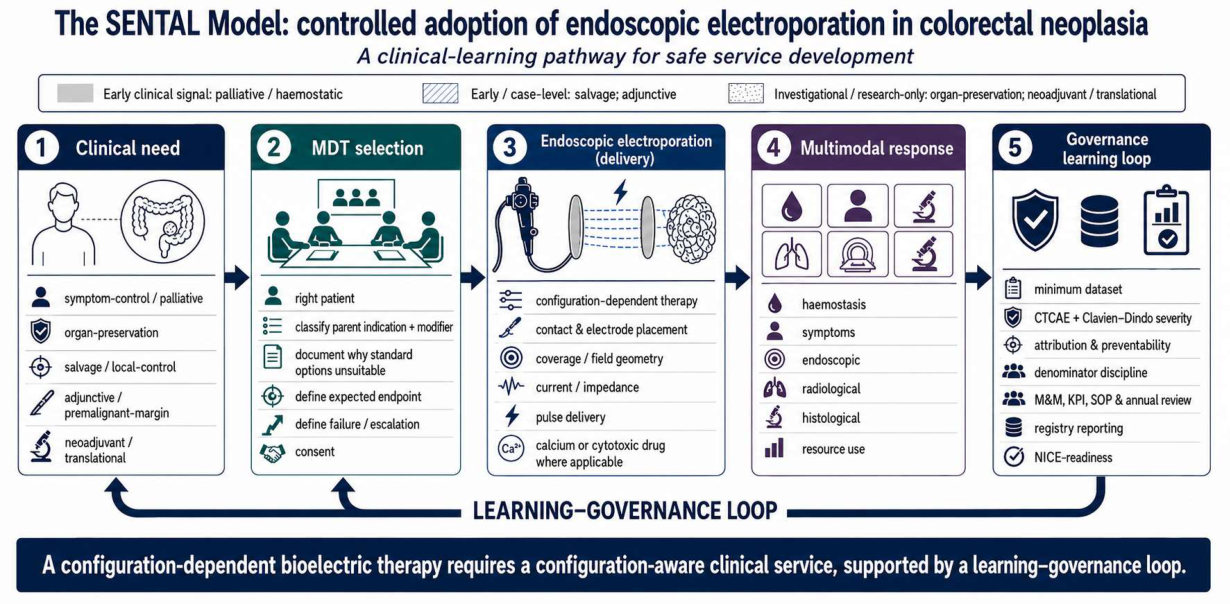
Figure 2.
The SENTAL two-axis classification. Parent indication by clinical intent (rows) is combined with a timing/role/urgency modifier (columns); filled cells indicate endorsed combinations and dashed cells indicate combinations not endorsed as routine standalone labels. Each indication carries a typical primary endpoint and an evidence-maturity level. A complete label is assembled as parent indication + modifier + endpoint. EP, electroporation.
Figure 2.
The SENTAL two-axis classification. Parent indication by clinical intent (rows) is combined with a timing/role/urgency modifier (columns); filled cells indicate endorsed combinations and dashed cells indicate combinations not endorsed as routine standalone labels. Each indication carries a typical primary endpoint and an evidence-maturity level. A complete label is assembled as parent indication + modifier + endpoint. EP, electroporation.
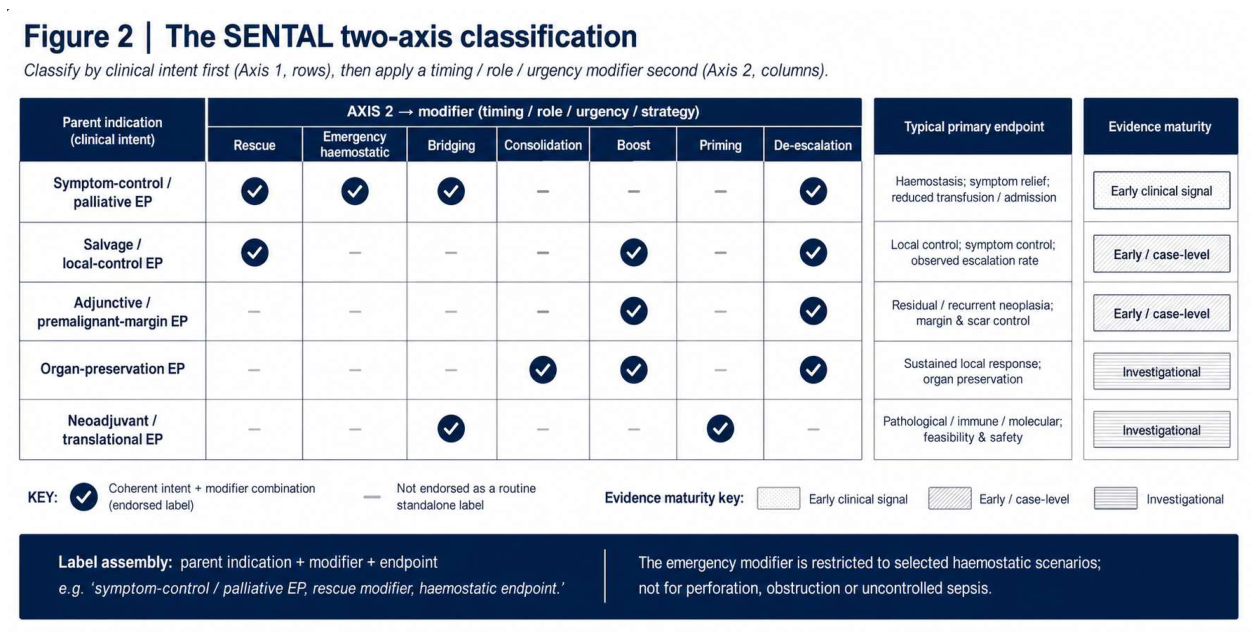
Table 1.
Comparison of electroporation modalities relevant to colorectal neoplasia.
| Modality | Membrane effect | Drug required? | Main clinical logic | Colorectal evidence maturity |
|---|---|---|---|---|
| Electrochemotherapy (ECT) | Reversible permeabilisation | Yes — bleomycin or cisplatin | Local potentiation of an intracellular cytotoxic; established for cutaneous/subcutaneous metastases | Early clinical signal (phase 1) [9] |
| Calcium electroporation (CaEP) | Reversible permeabilisation | No — calcium chloride | Drug-free cytotoxicity via ATP depletion; low cost, favourable safety | Early clinical signal [10,11,12,13] |
| Irreversible electroporation (IRE) | Permanent permeabilisation | No | Non-thermal ablation sparing matrix and adjacent critical structures | Investigational in colorectum |
| Pulsed-field ablation (PFA) | Permanent permeabilisation (high-frequency, biphasic) | No | Reduced muscle stimulation; of interest for complex/recurrent polyps | Investigational / theoretical in colorectum |
ATP, adenosine triphosphate; ECT, electrochemotherapy; CaEP, calcium electroporation; IRE, irreversible electroporation; PFA, pulsed-field ablation.
Table 4.
The SENTAL two-axis classification (concise). Full definitions are provided in Supplementary Table S1.
Table 4.
The SENTAL two-axis classification (concise). Full definitions are provided in Supplementary Table S1.
| Parent indication | Permitted modifiers | Primary endpoint | Evidence maturity | Governance caution |
|---|---|---|---|---|
| Symptom-control / palliative EP | Rescue; emergency haemostatic; bridging; de-escalation | Haemostasis; reduced transfusion / admission; symptom relief | Early clinical signal [9,10,11,12,13] | Not curative; emergency modifier restricted to selected haemostatic scenarios, not perforation/obstruction/sepsis |
| Salvage / local-control EP | Rescue; boost; de-escalation | Local control; symptom control; need for further treatment | Early / case-level | Document prior therapy, residual target and salvage alternatives |
| Adjunctive / premalignant-margin EP | Boost (focal / margin ablation); de-escalation | Residual / recurrent neoplasia; margin & scar control | Early / investigational | Avoid “adjuvant” as a standalone label; compare with established polyp pathways |
| Organ-preservation EP | Consolidation; boost; de-escalation | Sustained local response; organ preservation | Investigational | Research/service-development only; protocolised follow-up and salvage pathway required |
| Neoadjuvant / translational EP | Priming; neoadjuvant; bridging | Pathological / immune / molecular / feasibility | Research-only | REC/HRA approval; must not delay definitive treatment |
EP, electroporation. Modifiers describe timing, urgency, role or strategy within a parent indication and are not standalone indications.
Disclaimer/Publisher’s Note: The statements, opinions and data contained in all publications are solely those of the individual author(s) and contributor(s) and not of MDPI and/or the editor(s). MDPI and/or the editor(s) disclaim responsibility for any injury to people or property resulting from any ideas, methods, instructions or products referred to in the content. |
© 2026 by the authors. Licensee MDPI, Basel, Switzerland. This article is an open access article distributed under the terms and conditions of the Creative Commons Attribution (CC BY) license.
Copyright: This open access article is published under a Creative Commons CC BY 4.0 license, which permit the free download, distribution, and reuse, provided that the author and preprint are cited in any reuse.


