

Submitted:
01 June 2026
Posted:
02 June 2026
You are already at the latest version
Abstract
Acute pain remains one of the most prevalent and burdensome clinical challenges requiring pharmacological intervention, yet opioids — with their well-documented risks of respiratory depression, addiction, and overdose — remain a cornerstone of moderate-to-severe pain management in the absence of efficacious alternatives. Suzetrigine (VX-548) is a novel preferential inhibitor of the voltage-gated sodium channel isoform Nav1.8, recently approved by the US Food and Drug Administration for the treatment of moderate-to-severe acute pain. Through specific inhibition of Nav1.8, which is expressed predominantly in nociceptive sensory neurons of the peripheral nervous system, suzetrigine offers a mechanistically targeted approach to reduce pain at the level of the primary afferent, bypassing the central nervous system circuitry involved in opioid-associated adverse effects. In this review, we examine both the scientific foundation and clinical utility of suzetrigine, integrating evidence from molecular and structural biology, electrophysiology, preclinical animal models, and Phase II and III randomized controlled clinical trials. We discuss the unique allosteric mechanism by which suzetrigine selectively inhibits Nav1.8 to suppress nociceptor excitability, and review six trials, five of which show evidence demonstrating significant analgesic efficacy relative to placebo, and a favorable safety profile. We discuss key limitations of the current clinical evidence base including modest, and sometimes nonexistent efficacy, albeit at the tested doses. Overall, suzetrigine may serve as a proof-of-concept for the development of other sodium channel isoform-specific modulators as targeted therapeutic intervention for a range of diseases. Moreover, the development of cost-effective alternatives to prescription opioids may have substantial population health benefits. Further study with more varied pain types with longer durations including thoroughly examining sex differences with suzetrigine as a monotherapy (i.e. with no use of “rescue” medications) relative to prescription opioids or nonsteroidal anti-inflammatory drugs (NSAIDs) will provide valuable information that could widely benefit acute pain patients and form a scaffolding to bridge the gap between the well-established preclinical foundation and clinical research to enhance the quality of life of those currently living with chronic pain.
Keywords:
Nav1.8
; pain
; voltage-gated sodium channel
; analgesia
; peripheral nervous system
; VX-548
; nociceptor
1. Introduction
Acute pain is among the most common and burdensome symptoms encountered for which pharmacological intervention is necessary. Despite substantial efforts to develop novel analgesics, opioids remain commonly utilized for the treatment of moderate-to-severe pain, highlighting the general lack of efficacious alternatives that circumvent the harms associated with opioid therapy. Suzetrigine (VX-548) is a first-in-class preferential inhibitor of the voltage-gated sodium channel Nav1.8 to treat acute pain. As Nav1.8 is nearly exclusively expressed in the peripheral nervous system (PNS), suzetrigine represents a targeted approach to attenuate pain sensation at the level of the nociceptor. By bypassing central nervous system (CNS) neural circuitry involved in reward and respiration, suzetrigine seeks to offer pain reduction without the appreciable addiction potential and negative impacts on respiratory function associated with opioid-based pain management approaches and additionally provides substantial advantages relative to over-the-counter analgesics (NSAIDs, etc.). In this review, we discuss the scientific foundation for suzetrigine as a novel analgesic, the preclinical and clinical evidence for its use, and the overall impact that suzetrigine has in the context of pain management and the development of other precision medicine approaches in voltage-gated sodium channel pharmacology.
2. Methods
A structured literature search was conducted to identify relevant peer-reviewed articles related to the basic mechanisms, pharmacological properties, preclinical results, and clinical impact of suzetrigine. Databases, such as PubMed Central and Google Scholar, were utilized to retrieve the articles referenced. During the search, keywords included but not limited to: suzetrigine, Nav1.8 inhibitor, VX-548, opioid pain relief mechanisms, pain, pain relief, analgesic medications, nociceptive pain, suzetrigine clinical trials. As of February 27, 2026, a search of “Suzetrigine OR VX-548” in PubMed yielded 91 results. After an initial screen of topical relevance, we included only articles that were peer-reviewed primary research articles in the English language that were 1) studies investigating the mechanisms of action and properties of suzetrigine or VX-548, 2) preclinical studies involving Nav1.8 inhibition in various model systems, 3) clinical studies including Phase II or III clinical trial data on suzetrigine, or in a few limited cases 4) other review articles/commentaries focusing on suzetrigine efficacy, cost (Nikitin et al., 2025), adverse effects or voltage-gated sodium channel isoform-specific pharmacology. In a few places, we summarized the results of the clinical trials using Cohen’s d in which the magnitude of the effect size for group differences was expressed in terms of Cohen’s d where 0.2, 0.5, and 0.8 are small, medium, and large, respectively (Sullivan and Feinn, 2012).
3. Background: Scientific Premise
Voltage-gated sodium channels are central determinants of cellular excitability – they directly contribute to the generation and propagation of action potentials (APs) (Hille, 2001; Bean, 2007). Upon membrane depolarization, voltage-gated sodium channels open and permit an influx of sodium ions into the cell. The incoming sodium initiates a feed-forward cycle of depolarization which is responsible for the upstroke of the AP. Within milliseconds of opening, voltage-gated sodium channels inactivate, and together with the opening of delayed-rectifier voltage-gated potassium channels, the membrane rapidly repolarizes comprising the downstroke of the AP (Hille, 2001; Bean, 2007). Once at relatively negative membrane potentials, inactivated sodium channels recover and again become sensitive to open in response to depolarized membrane potentials. This cyclic progression from closed to open to inactivated states, forms the basis for each AP.
There are nine unique voltage-gated sodium channel alpha subunits encoded by different genes: SCN1A, SCN2A, SCN3A, SCN4A, SCN5A, SCN8A, SCN9A, SCN10A, and SCN11A (Goldin, 1999). Each of these genes is uniquely expressed in terms of cell type, tissue, and developmental timing of expression (Table 1) (Goldin, 1999; Catterall, 2012). Based on their unique expression profile, it is unsurprising then that genetic variants in each of these genes can lead to highly specific syndromes/disorders (Table 1).
Voltage-gated sodium channels are the molecular targets of many compounds including both environmental toxins and therapeutic drugs(Catterall, 2012; Wengert et al., 2024). Drugs that inhibit voltage-gated sodium channels are used to treat cardiac arrhythmias, severe epilepsy, neuropathic pain, and local anesthesia (Bhattacharya et al., 2009; Remme and Wilde, 2014; Brodie, 2017; Wengert et al., 2024). Yet, because most currently available drugs (i.e. oxcarbazepine, lamotrigine, etc.) are relatively nonselective for one channel isoform relative to others, pharmacological agents targeting voltage-gated sodium channels have substantial adverse effects (i.e. dizziness, drowsiness, headache, cardiac arrhythmia, etc.) (Brodie, 2017).
Fueled by a greater structural understanding of each of the eukaryotic voltage-gated sodium channels (Ahuja et al., 2015; Yan et al., 2017; Huang et al., 2022), the past few years has brought about clear gains in developing sodium channel isoform-specific small-molecule inhibitors to treat epilepsy and chronic pain (Rosker et al., 2007; Ahuja et al., 2015; Alexandrou et al., 2016; Johnson et al., 2022). Preferential inhibitors are currently in development for Nav1.2 and Nav1.6 for the treatment of severe epilepsy (Johnson et al., 2022; Goodchild et al., 2024), and Nav1.7 and Nav1.8 for the treatment of pain (Ahuja et al., 2015; Alexandrou et al., 2016; Vaelli et al., 2024; Osteen et al., 2025; Stewart et al., 2025). The scientific premise is straightforward: through greater preferential effect on particular sodium channel isoforms expressed in certain cellular populations and/or tissues, clinicians will be able to provide more targeted and efficacious treatment, meanwhile limiting the adverse effects through inhibition of other channels beyond the intended target (i.e. blocking Nav1.5 in the heart when the target is Nav1.8 in the PNS).
4. Preclinical Studies
Suzetrigine was developed as a small-molecule specific inhibitor of Nav1.8 to treat pain (Jones et al., 2025; Osteen et al., 2025; Yuan et al., 2026). Because Nav1.8 is expressed exclusively in the dorsal root ganglia (DRG) of the PNS where it primarily contributes to the cellular excitability of nociceptive afferents, selective blockade of Nav1.8 would be expected to reduce pain sensation through direct attenuation of the first-order nociceptor neuron (Han et al., 2016a) (Figure 1). This mechanism of action contrasts with that of opioid analgesics which heavily influence CNS function to attenuate the perception of pain (Pasternak, 2005), and NSAID-based analgesia which is exerted through reducing peripheral inflammation and influencing brain regions involved in descending pain modulation (Cashman, 1996).
Preclinical studies have provided the foundation for suzetrigine as a potent and selective inhibitor of Nav1.8. Osteen et al., (2025) showed blockade of TTX-resistant (presumably mediated by Nav1.8) in cultured primary human DRG neurons by VX-548 with an IC50 of 0.68 +- 0.16 nM (Osteen et al., 2025). This study also examined the impact of suzetrigine on each of the sodium channel isoforms and showcased more than 31,000-fold greater selectivity for Nav1.8 than for any of the other channel isoforms (Osteen et al., 2025). This report further demonstrated that suzetrigine inhibited Nav1.8 via a unique allosteric mechanism relative to other voltage-gated sodium channel modulators that typically bind at the local anesthetic site (Kuo, 1998; Tikhonov and Zhorov, 2017). Domain swapping experiments identified a particularly important role for a sequence of amino acids: lysine, lysine, glycine, and serine (KKGS), found in the S3 to S4 extracellular loop of the second voltage-sensing domain (VSD2) of Nav1.8, but not other isoforms (Osteen et al., 2025) (Figure 1). Further supporting this unique allosteric mechanism is evidence that co-application of suzetrigine with bupivacaine or ropivacaine, traditional sodium channel blockers that bind at the local anesthetic site resulted in simple additive inhibition of Nav1.8 currents, with no evidence of antagonism or competition (Osteen et al., 2025).
Electrophysiological experiments also identified that the Nav1.8 inhibitor suzetrigine exhibits the unusual property in that its inhibitory effect is dramatically reduced by depolarization (Vaelli et al., 2024; Osteen et al., 2025). These results imply that suzetrigine most strongly binds to the resting state (i.e. closed) voltage-gated channel, and that opening of the channel alters the binding site in the extracellular cleft formed by the S3 and S4 helices to reduce the affinity of the drug by more than 100 times (Vaelli et al., 2024; Jo et al., 2025).
Through targeted inhibition of Nav1.8, theoretically, suzetrigine should have profound effects on the excitability of DRG neurons to reduce the frequency of AP generation and potentially influence passive membrane and AP properties. Supporting this view, suzetrigine exhibited a dose-dependent impact on the probability of AP generation in an isolated human DRG neuron (Uhelski et al., 2026; Osteen et al., 2025). In terms of individual AP properties, suzetrigine decreased the peak of the AP without a strong effect on the rising phase or the AP threshold voltage (Uhelski et al., 2026; Stewart et al., 2025). Suzetrigine application also led to a strong narrowing of the AP (Stewart et al., 2025). These results suggest that Nav1.7, which is more sensitive to activation at more hyperpolarized voltages, contributes strongly to the upstroke of the AP in DRG neurons while Nav1.8 with its slower inactivation kinetics and resurgent sodium currents (Vijayaragavan et al., 2001; Xiao et al., 2019), influences the falling phase of the AP more strongly (Stewart et al., 2025). In measurements of repetitive neuronal spiking, suzetrigine application typically reduced the frequency of repetitive AP generation (Uhelski et al., 2026; Osteen et al., 2025; Stewart et al., 2025). Overall, these experiments provide the physiological foundation for the overall scientific mechanism that suzetrigine is an effective and potent inhibitor of Nav1.8 and nociceptive afferent excitability.
There are also a few lines of evidence from in vivo rodent studies that support the case that suzetrigine is an effective analgesic and that its use is well tolerated with reduced risk of addiction or dependency. Mice were examined to identify the effect of suzetrigine in numerous distinct pain models including the formalin test, complete Freud’s adjuvant (CFA) induced thermal hypersensitivity test, and mechanical hyperalgesia in the partial sciatic nerve injury-induced neuropathic pain model (Ali et al., 2025). Suzetrigine treatment at 1 mg/kg and 10 mg/kg reduced nociceptive behavior when administered 30 minutes before intraplantar formalin injection (Ali et al., 2025). Similarly, suzetrigine produced time and dose-dependent analgesia in response to CFA-induced thermal hypersensitivity (Ali et al., 2025). In the sciatic nerve injury model of neuropathic pain, suzetrigine (10 mg/kg) rapidly increased mechanical withdrawal thresholds within 30 minutes, but by 60 minutes the analgesic effect was no longer observed (Ali et al., 2025). Successive daily treatment with suzetrigine did not influence the magnitude of analgesia suggesting that repetitive dosing over this time scale did not induce strong tolerance or altered physiological response to suzetrigine (Ali et al., 2025). As evidence for the safety of suzetrigine, abrupt cessation of chronic treatment (after 30 days) in rats did not impact body weight or body temperature, two measures in which morphine-treated rats showed significant differences following withdrawal (Osteen et al., 2025). Spontaneous motor function in the 14 hours following abrupt cessation of treatment was also not different in suzetrigine-treated mice relative to vehicle controls, while morphine-treated rats displayed less movement (Osteen et al., 2025). Notwithstanding that there are a limited number of reports of behavioral studies investigating suzetrigine directly (Ali et al., 2025; Osteen et al., 2025), the available peer-reviewed evidence is supportive of the view that suzetrigine is safe and effective at ameliorating pain in rodent models
5. Pharmacokinetic Considerations
The absorption, distribution, metabolism, and elimination of suzetrigine have been characterized in adults (Osteen et al., 2025) and in the package insert (https://www.accessdata.fda.gov/drugsatfda_docs/label/2025/219209s000lbl.pdf). Based on the package insert, the time to maximum concentration following fasted-state oral administration is 3.0 hours, with 99% protein binding. Suzetrigine is metabolized via hepatic cytochrome P450, particularly 3A4 to its biologically active metabolite M6-suzetrigine (Yu and Zhou, 2024). The elimination half-life is about one-day (i.e. 23.6 hours for suzetrigine and 33.0 hours for M6-suzetrigine). The excretion is about half (49.9%) in feces with almost all of the remainder (44.0%) in urine.
A single rat study found evidence for pronounced sex differences in suzetrigine metabolism including a twelve-fold greater maximum concentration, double the half-life and a fifty-fold increased area under the concentration curve in females following oral administration (Yu and Zhou, 2024). These robust sex differences were replicated with doubling of the half-life and a six-fold greater area under the concentration curve in females subsequent to intraveneous administration. These findings, and their functional implications, should be investigated more closely in other animal models and humans including in trials to determine if males require higher doses to reach similar plasma levels and overcome potential sex-based differences in bioavailability. Structural modifications of suzetrigine with the development of a female and male specific formulation could potentially be necessary to achieve more equivalent pharmacokinetics in both sexes (Yuan et al. 2026).
Considering this metabolic mechanism, suzetrigine would be expected to exhibit drug-drug interactions with other drugs that induce or inhibit CYP3A function and therefore should be used cautiously (Yuan et al., 2026). Persons of reproductive age identifying as “women” should be cautioned to also consider the use of non-hormonal contraception suzetrigine, as a CYP3A substrate could lower plasma concentrations of progestin-based birth control. Pharmacists and other health care providers should also counsel patients to avoid use of grapefruit containing products(Yuan et al., 2026).
Taken together, suzetrigine’s selective inhibition of the peripherally-expressed Nav1.8 positions it as a mechanistically-distinct analgesic that should make it a potential candidate for co-administration with opioids and NSAIDs in certain cases of acute moderate to severe pain. The mechanistic complementarity suggests that combining suzetrigine and opioids could achieve equivalent or superior analgesia with lower opioid doses- an attractive feature to reduce exposure to opioid-related adverse effects. Importantly however, co-administration of suzetrigine alongside other analgesic agents has yet to be investigated in animal models and clinical trials, although limited in vitro evidence suggests that targeting of voltage-gated sodium channels with traditional local anesthetic agents is mechanistically additive to sodium current inhibition provided by suzetrigine (Osteen et al., 2025). Further clinical research regarding drug-drug interactions in the context of multimodal analgesia among varied patient populations is a pressing need.
6. Clinical Trials
Suzetrigine has also recently been investigated in numerous randomized, double-blind clinical trials to provide direct evidence for safety, and efficacy in human patients experiencing acute pain. Of note, at the time of writing April 2026, the results of only five of these clinical trials have been published in peer-reviewed journals (Jones et al., 2023; Bertoch et al., 2025; McCoun et al., 2025), while two Phase II and III clinical trials for painful diabetic peripheral neuropathy (NCT05660538) and lumbosacral radiculopathy (NCT06176196) are underway. Note that two of these publications each contain two trials (Jones et al. 2023; Bertoch et al. 2025). A summary of the clinical trial findings is provided in Table 2.
A Phase II study of suzetrigine in painful lumbosacral radiculopathy (NCT06176196), results of which were released only as a press release, revealed that suzetrigine produced a mean −2.02 point reduction from baseline on the 11-point Numeric Pain Rating Scale (NPRS) at Week 12, compared to −1.98 for placebo (Vertex Pharmaceuticals, 2024). Although the study was not powered for between-group statistical comparison, the near-identical within-group changes suggest no clinically meaningful incremental benefit of suzetrigine over placebo for this indication — a finding consistent with the high placebo response rates commonly observed in neuropathic pain trials (Alsaloum et al., 2025).
Two phase-two randomized, double-blind trials were completed to evaluate suzetrigine in acute pain patients following abdominoplasty (NCT05034952) or bunionectomy (NCT04977336) (Jones et al., 2023). Patients were randomly assigned to high-dose suzetrigine (100 mg followed by 50 mg every 12 hours), mid-dose suzetrigine (60 mg followed by 30 mg every 12 hours), low-dose suzetrigine (20 mg followed by 10 mg every 12 hours), hydrocodone bitartrate/acetaminophen (5 mg/325 mg every six hours), or placebo, and were assessed for time-weighted sum of pain intensity difference over 48 hours. Patients in the high-dose suzetrigine treatment group, but not the mid or low dose groups, experienced a significant reduction of pain relative to the placebo group for both abdominoplasty and bunionectomy within 48 hours (Jones et al., 2023). Suzetrigine was therefore interpreted by the authors as comparable to pain management with hydrocodone/acetaminophen. Fewer patients withdrew from the high-dose suzetrigine group for lack of efficacy than from the hydrocodone/acetaminophen or placebo groups (Jones et al., 2023). Most adverse effects in the trials were mild or moderate, most commonly nausea, headache, constipation, dizziness, and vomiting. Of the few serious adverse events that occurred, none were considered by the site investigators to be directly related to suzetrigine treatment (Jones et al., 2023). Overall, these results suggested safety and possible efficacy of suzetrigine in the context of acute pain.
However, there have been numerous criticisms of the Jones et al. trial (Wallace, 2023; Karri et al., 2025; Nikitin et al., 2025). First, females accounted for the vast preponderance (98.3%) of the abdominoplasty trial but disparities due to sex were less pronounced in the in the bunionectomy (55.5% female) trial. Second, at the time of writing the individual responsible for the Statistical Analysis Plan (SAP) had their information redacted (Vertex Pharmaceuticals, 2022, see also Vertex Pharmaceuticals, 2023a; 2023b). Third, the potential confounding role of NSAIDs across treatment groups appears to have not been fully taken into account. NSAIDs have a well-established role as opioid-sparing in perioperative procedures (Martinez et al., 2019). A randomized controlled trial of ambulatory surgery patients determined that ibuprofen (1,200 mg/day) decreased pain at 72 hours and decreased hydrocodone (5 mg) / acetaminophen (500 mg) usage at 48 (effect size = ~0.8) and 72 hours (effect size = ~0.5) significantly more than placebo (White et al., 2011). As has been also pointed by others (Wallace, 2023), ibuprofen with doses up to 1,600 mg/day was an allowable rescue medication in the Jones et al. study. Although the SAP indicated that the percent of participants using rescue medication, and the total rescue medication use from 0 to 48 hours would be reported, both trials did not report on ibuprofen use making it challenging to untangle the effect of suzetrigine relative to NSAIDs (Jones et al., 2023). Fourth, the results from the positive control condition are difficult to interpret given that pain ratings over 48 hours were not statistically different between hydrocodone 5 mg/acetaminophen 325 mg (every 6 hours) and placebo in either the abdominoplasty or bunionectomy trials (Supplemental Figure S1 and Supplemental Table S1). This is surprising because hydrocodone/acetaminophen is among the most prescribed and distributed analgesics in the United States (Piper et al., 2018; Alsultan and Guo, 2022). Jones et al. had a reasonable basis for selecting this combination as a positive control for comparison, as it was presumably expected to produce a clear, detectable analgesic signal — making the null finding against placebo particularly difficult to explain. Fifth, section 6.1.2 of the SAP noted that “Time to onset of “confirmed perceptible pain relief” and “meaningful pain relief” after the first dose of study drug” would be dependent measures (Vertex, 2022) but this was not reported (Jones et al., 2023). Based on our calculations, the Cohen’s d effect size at 48 hours for the Sum of the Pain Intensity Differences with the high-dose VX-548 was 0.42 in the abdominoplasty trial and 0.41 in the bunionectomy trials. Although a large placebo response and lack of validated biomarkers make studying acute pain challenging (Alsaloum et al., 2025), there are reasonable concerns as to whether these outcomes should be considered clinically meaningful (Wallace, 2023; Supplemental Table 1). Lastly, as the Patient Global Assessment (PGA) was part of the SAP but not the published report, this raises the potential concern of selective reporting (Karri et al., 2025).
In two additional randomized, double-blind, placebo- and active-controlled Phase III bunionectomy (NCT05553366) and abdominoplasty (NCT05558410) trials (Bertoch et al., 2025), adults with moderate-to-severe postoperative pain received a 100 mg oral loading dose followed by 50 mg every 12 hours and were compared to both placebo and hydrocodone/acetaminophen over a 48-hour treatment period (Bertoch et al., 2025). The N per group completing the trials was 168 to 396 in the abdominoplasty trial and 177 to 389 in the bunionectomy trial. The trials’ primary outcome was the time-weighted summed pain intensity difference over 48 hours (SPID48), which showed that suzetrigine significantly reduced pain in both surgery models when compared to a placebo although significantly greater analgesia relative to hydrocodone/acetaminophen was not observed (Bertoch et al., 2025). Suzetrigine led to a faster onset of clinically meaningful analgesia than placebo, defined as a reduction of at least 2 points on the 0-10 NPRS. Median times to achieve this reduction were 119 minutes verses 480 minutes after bunionectomy (95% CI, 14.0 to 44.6; P = 0.0002) and 240 minutes versus 480 minutes after bunionectomy (95% CI, 14.0 to 44.6; P = 0.0002). Hydrocodone/acetaminophen produced more rapid initial pain relief than suzetrigine in the abdominoplasty trial. Interestingly, the incidence of vomiting/nausea, a common side-effect observed in response to opioid-based treatments, was lower in the suzetrigine-treated group relative to the hydrocodone/acetaminophen group in both studies as an important secondary outcome (Bertoch et al., 2025). Overall, these investigations suggest that suzetrigine was safe and well-tolerated.
The percent of randomized and dosed participants who discontinued treatment due to lack of efficacy was not determined or analyzed in Bertoch et al. 2025. In the abdominoplasty trial, both active treatments reduced efficacy-related dropout relative to placebo (28.6%), with suzetrigine (10.6%) outperforming hydrocodone/acetaminophen (15.5%; p < .05) (Figure 2A). Interestingly, the bunionectomy trial told a contrasting story: suzetrigine's dropout rate due to lack of efficacy (12.0%) was not significantly different from placebo (16.2%), whereas hydrocodone/acetaminophen (7.9%) was (Figure 2B). This failure to separate from placebo on a real-world retention measure in the bunionectomy trial reinforces concerns about suzetrigine's analgesic adequacy in that surgical context. As in the Jones et al., trial, there are also concerns about the clinical meaning underlying the analgesic effect observed in the Bertoch et al., study. The Cohen’s d for the SPID at 48 hours in the abdominoplasty trial was moderate at 0.531 imputed and 0.505 as treated, but the effect size was only small in bunionectomy trial at .319 imputed and .296 as treated. Second, the sample characteristics were analyzed by the Institute for Clinical and Economic Review (ICER) and the diversity by sex in both trials (85-98% female) was rated “Poor” (https://icer.org/assessment/acute-pain-2025/).
Suzetrigine's efficacy and safety across larger acute pain groups has been reinforced by Phase III open-label safety research that assessed the medication in people with moderate-to-severe acute pain of both surgical and non-surgical origin for up to 14 days (McCoun et al., 2025). In 256 individuals with moderate or severe pain, at least one dose of suzetrigine was delivered (100 mg initial dose followed by 50 mg every 12 hours) before assessing safety and tolerability as well as patient perceptions of effectiveness (McCoun et al., 2025). Suzetrigine treatment was generally well-tolerated with only mild or moderate adverse effects observed including headache, nausea, constipation, rash, and others (McCoun et al., 2025). Two (0.8%) patients in the study had serious adverse events: One patient experienced suicidal ideation, and one experienced cellulitis. Overall, patients perceived pain reduction with 244 of 299 (81.6%) individuals reporting good, very good, or excellent on the global assessment of pain. Only about one in eleven (8.8%) non-surgical patients and approximately one in five surgical patients (18.0%) rated suzetrigine's overall effectiveness at the end of two weeks as "poor" or "fair" (McCoun et al., 2025).
Some caveats regarding the McCoun et al. 2025 trial are also noteworthy. Similar to the previous trials (Jones et al., 2023; Bertoch et al., 2025), suzetrigine was not assessed as a monotherapy, with almost three-quarters (73.0%) of participants using ibuprofen or acetaminophen as part of multimodal treatment (McCoun et al., 2025). The maximum allowable acetaminophen dose was 2,600 mg and ibuprofen was 1,600 mg in a 24 hours (SAP, 2023b). Three pre-specified outcomes from the SAP (Vertex, 2023b) were absent from the published paper and supplementary materials: mean daily rescue medication dose (acetaminophen and ibuprofen reported separately), attribution of pain resolution to suzetrigine versus rescue medication, and suicidality assessed via the Columbia Suicide Severity Rating Scale. Inclusion of these details would have facilitated a more thorough assessment of the trial results.
Beyond the lumbosacral radiculopathy trial's failure to separate from placebo, the absence of a peer-reviewed publication warrants attention. Best practices in clinical research call for summary results to be posted in clinical trial registries within 12 months of study completion and published in a peer-reviewed journal within 24 months (Chan et al., 2025). This standard is particularly important for a first-in-class analgesic targeting one of the most common reasons patients seek primary care. Although Vertex has consistently registered trial methods at ClinicalTrials.gov, including the Phase II acute pain (NCT05160636), diabetic peripheral neuropathy (NCT05660538), and lumbosacral radiculopathy (NCT06176196) trials, registration satisfies a regulatory minimum but is not a substitute for peer-reviewed publication. Major publishers routinely publish null findings, and registered reports, in which methods are peer-reviewed prior to data collection, are an established mechanism for ensuring the scientific record does not reflect selective reporting of results. As of this writing, the lumbosacral radiculopathy null result has been available only as a corporate press release for 17 months since December 2024 (Vertex Pharmaceuticals, 2024). For a drug now approved and actively prescribed for acute pain, this gap in the published literature represents a meaningful deficit in the evidence base available to clinicians.
7. Discussion
There are 80.2 million people in the US that experience pain necessitating prescription medication (Lopez et al., 2026). Suzetrigine represents a meaningful scientific advance because it is the first isoform-selective sodium-channel inhibitor to demonstrate Phase III success in human pain, validating a long-standing hypothesis that peripheral, molecularly targeted analgesia can achieve pain relief with minimal engagement of the CNS. By selectively stabilizing Nav1.8 in its closed state through allosteric binding to the VSD2 domain, suzetrigine provides a potentially mechanistically precise way to suppress nociceptor excitability while avoiding the broad, non-selective sodium-channel blockade that has historically limited other pharmacological agents. This advance potentially marks a turning point in mechanism-based drug development: It confirms that targeting a single nociceptor-specific sodium channel isoform, rather than modulating multiple CNS pathways, can produce analgesia with a substantially improved safety profile (Osteen et al., 2025). As the first clinical validation of Nav1.8 as a druggable pain target, suzetrigine establishes a new therapeutic framework for peripherally restricted analgesics and is generally encouraging for the development of future isoform-selective sodium-channel modulators (Huang et al., 2024).
In the realm of analgesia and acute postoperative pain contexts, suzetrigine is emerging as a potentially meaningful contributor to pain reduction. Clinical trials showed that pain reduction was found to be comparable, but not superior, to opioid comparators, highlighting that suzetrigine should be viewed primarily as an additional pain management tool rather than a replacement for opioids (Jones et al., 2023; Bertoch et al., 2025; McCoun et al., 2025). Use of suzetrigine alongside other analgesics, although promising, has yet to be investigated directly. The adverse effects of suzetrigine were relatively mild including headaches, dizziness, nausea, and constipation, and serious adverse events were rare in the clinical trials and assumed to be unrelated to suzetrigine treatment, but further studies are also needed to more fully understand the nature of these adverse reactions considering the assumed peripherally-acting mechanistic basis for suzetrigine. Importantly, neither respiratory depression nor evidence of drug misuse, common challenges associated with opioid-based treatments, were reported in any of the clinical trials (Jones et al., 2023; Bertoch et al., 2025; McCoun et al., 2025; Osteen et al., 2025). Taken together, although more animal model and clinical studies are needed, the outlook for suzetrigine is encouraging.
Despite promising results to date, we and others have identified important limitations to the studies in which suzetrigine has been investigated and gaps which need to be addressed with additional research (Wallace, 2023; Karri et al., 2025; Nikitin et al., 2025; Siddiqui et al., 2026). From a mechanistic standpoint, Nav1.8 is expressed in intracardiac neurons where it contributes to AP frequency and overall cardiac electrical activity (Verkerk et al., 2012; Han et al., 2016b). This raises the risk that suzetrigine could exhibit deleterious impacts on cardiac function in patients beyond the intended analgesic effects. Additional studies in model systems and patients are needed to clarify the impact that suzetrigine has on the excitability of cardiomyocytes and intracardiac neurons as well as overall cardiac function. Given the abundant use of rescue medication in Phase II/III trials (Jones et al., 2023; Bertoch et al., 2025; McCoun et al., 2025), an additional preclinical priority would be to complete an extended ( > 2 weeks) head-to-head comparison of suzetrigine, as a monotherapy, with a single NSAID at a high dose, also as a monotherapy, and subsequently completing trials of both pain and adverse effects from multiple organ systems in humans including headache, constipation, nausea, and dizziness (Hang Kong et al., 2024). Many over the counter NSAIDs (e.g. diclofenac, ketorlak, ibuprofen) already have a well-established profile in adults from randomized controlled trials for their opioid sparing effects as well as acute and intermediate term (weeks) adverse effects(Martinez et al., 2019).
Conclusions regarding the long-term efficacy of suzetrigine are constrained by trial design: while the pivotal Phase III surgical trials assessed the primary efficacy endpoint over 48 hours (SPID48), total treatment duration across all Phase III studies was limited to 14 days (Bertoch et al., 2025; McCoun et al., 2025). Whether selective Nav1.8 inhibition confers meaningful benefit in persistent or chronic pain states remains an open question, as current clinical evidence is derived almost exclusively from acute postoperative and short-term non-surgical contexts (Alsaloum et al., 2025; Karri et al., 2025). Data on more diverse patient populations including elderly patients and people with several comorbid diseases, who frequently have altered pharmacokinetics or are more vulnerable to negative pharmacological effects, are still scarce because current research have also used relatively controlled (i.e. homogeneous and single pain types) patient populations (Bertoch et al., 2025; Irfan et al., 2026).
Suzetrigine is not only an important development for the goal of generating efficacious non-opioid analgesics, but it also highlights the potential for isoform-specific voltage-gated sodium channel targeting for the treatment of other channelopathy-related diseases (Huang et al., 2024; Wengert et al., 2024). Recent advances in the structural biology of voltage-gated sodium channels and artificial intelligence, have enabled researchers to visualize sodium channel structures with greater precision, identify isoform-specific binding pockets, and develop more selective inhibitors (Huang et al., 2024). Driven by highly specific expression across the body and over developmental time, each voltage-gated sodium channel isoform is associated with unique physiological function, and when aberrantly functioning, specific pathophysiologies including epilepsy, cardiac arrythmia, sensory and movement dysfunction, pain, and others. Beyond the development of Nav1.8-specific blockers, specific inhibitors of Nav1.2 (He et al., 2024), Nav1.3 (Li et al., 2022), Nav1.6 (Johnson et al., 2022), and Nav1.7 (McDonnell et al., 2018; Dormer et al., 2023; Wu et al., 2023) are at various stages of preclinical and clinical investigation. Suzetrigine offers a possible glimpse of the clinical future for the use of these targeted therapeutic agents and serves as a model for future ion channel drug development. Yet suzetrigine’s limitations should also be taken in to account. This includes considerable debate whether the benefits of suzetrigine are clinically meaningful (Wallace, 2023). The existing clinical trials should be viewed with caution due to a pattern of deviating from the registered methods and selective reporting of dependent measures.
Suzetrigine represents a genuine pharmacological milestone: It is the first non-opioid to be approved for acute pain in the US in over two-decades (Yuan et al. 2026), and it is the first proof-of-concept that isoform-specific targeting of voltage-gated sodium channels can translate to help patients. The broader promise of this approach, in which distinct channel-related pathological states drive the selection of highly specific pharmacological agents, positions suzetrigine as the first entry in what will hopefully become a new class of precision therapeutics. However, the clinical evidence base supporting the current approval and use of suzetrigine has multiple meaningful limitations underscoring the need for future rigorous studies before the promise of isoform-specific sodium channel pharmacotherapy can be realized.
8. Conclusion
Suzetrigine is an important milestone in the advancement of non-opioid analgesics, presenting a unique and decisive approach to acute pain management through the selective inhibition of the peripherally expressed Nav1.8. Phase II and III clinical trials have demonstrated some degree of effectiveness with effect sizes often that are small or , at best, moderate of this mechanism-based strategy, confirming that targeting nociceptor activity at its source can yield meaningful analgesia without engaging central opioid pathways. By validating Nav1.8 as a druggable and clinically impactful target that produces pain relief often within weeks but not hours, suzetrigine establishes a new framework for precision analgesia, one that prioritizes isoform selectivity, peripheral restriction, and improved safety profiles over traditional agents like opioids and NSAIDs. Although its long-term durability, applicability to chronic pain states, and performance in diverse patient populations remain areas for continued investigation, the current evidence positions suzetrigine as a foundational step toward safer and more targeted pain therapeutics. As research expands, the success of suzetrigine will hopefully catalyze the development of additional isoform-selective sodium-channel modulators, marking a broader shift toward mechanism-driven innovation in pain management.
Author Contributions
All authors took part in manuscript drafting and revising.
Funding
No external support was received for this report although the open-access fee was generally provided by Geisinger Commonwealth School of Medicine internal funds to ERW. BJP has received research support in the past-few years from the Geisinger Academic Clinical Research Center (#01, 03, 05) for pain studies.
Acknowledgments
The authors acknowledge student peers of the Geisinger College of Health Sciences (GCHS) Human Neuroscience Course for their thoughtful feedback during the drafting of this manuscript. Artificial Intelligence tools including Microsoft Copilot M365, ChatGPT5.3, and Claude Sonnet 4.6 identified some relevant research articles, checked grammar and revised the manuscript text. GCHS’s Iris Johnston provided timely and abundant inter-library loan support.
Conflicts of Interest
The authors report no conflicts of interest.
References
- Ahuja, S., Mukund, S., Deng, L., Khakh, K., Chang, E., Ho, H., et al. (2015). Structural basis of Nav1.7 inhibition by an isoform-selective small-molecule antagonist. Science 350. [CrossRef]
- Alexandrou, A. J., Brown, A. R., Chapman, M. L., Estacion, M., Turner, J., Mis, M. A., et al. (2016). Subtype-Selective Small Molecule Inhibitors Reveal a Fundamental Role for Nav1.7 in Nociceptor Electrogenesis, Axonal Conduction and Presynaptic Release. PloS one 11, e0152405. [CrossRef]
- Ali, M. Y., Antunes, F. T. T., Huang, S., Chen, L., and Zamponi, G. W. (2025). Pharmacological inhibition of NaV1.8 by suzetrigine reveals potent analgesic potential without tolerance development in mice. Mol Brain 18, 86. [CrossRef]
- Alsaloum, M., Vasylyev, D., and Waxman, S. G. (2025). Targeting sodium channels — challenges for acute pain and the leap to chronic pain. Nat Rev Neurol 21, 567–576. [CrossRef]
- Alsultan, M. M., and Guo, J. J. (2022). Utilization, Spending, and Price of Opioid Medications in the US Medicaid Programs Between 1991 and 2019. Am Health Drug Benefits 15, 31–37.
- Bean, B. P. (2007). The action potential in mammalian central neurons. Nature Reviews Neuroscience 8, 451–465. [CrossRef]
- Bertoch, T., D’Aunno, D., McCoun, J., Solanki, D., Taber, L., Urban, J., et al. (2025). Suzetrigine, a Nonopioid NaV1.8 Inhibitor for Treatment of Moderate-to-severe Acute Pain: Two Phase 3 Randomized Clinical Trials. Anesthesiology 142, 1085–1099. [CrossRef]
- Bhattacharya, A., Wickenden, A. D., and Chaplan, S. R. (2009). Sodium Channel Blockers for the Treatment of Neuropathic Pain. Neurotherapeutics 6, 663–678. [CrossRef]
- Brodie, M. J. (2017). Sodium Channel Blockers in the Treatment of Epilepsy. CNS Drugs 31, 527–534. [CrossRef]
- Cashman, J. N. (1996). The Mechanisms of Action of NSAIDs in Analgesia. Drugs 52, 13–23. [CrossRef]
- Catterall, W. A. (2012). Voltage-gated sodium channels at 60: Structure, function and pathophysiology. Journal of Physiology 590, 2577–2589. [CrossRef]
- Chan, A.-W., Karam, G., Pymento, J., Askie, L. M., Silva, L. R. da, Aymé, S., et al. (2025). Reporting summary results in clinical trial registries: updated guidance from WHO. The Lancet Global Health 13, e759–e768. [CrossRef]
- Dormer, A., Narayanan, M., Schentag, J., Achinko, D., Norman, E., Kerrigan, J., et al. (2023). A Review of the Therapeutic Targeting of SCN9A and Nav1.7 for Pain Relief in Current Human Clinical Trials. Journal of Pain Research 16, 1487–1498. [CrossRef]
- Goldin, A. L. (1999). Diversity of mammalian voltage-gated sodium channels., in Annals of the New York Academy of Sciences, 38–50. [CrossRef]
- Goodchild, S. J., Shuart, N. G., Williams, A. D., Ye, W., Parrish, R. R., Soriano, M., et al. (2024). Molecular Pharmacology of Selective NaV1.6 and Dual NaV1.6/NaV1.2 Channel Inhibitors that Suppress Excitatory Neuronal Activity Ex Vivo. ACS Chem. Neurosci. 15, 1169–1184. [CrossRef]
- Han, C., Huang, J., and Waxman, S. G. (2016a). Sodium channel Nav1.8. Neurology 86, 473–483. [CrossRef]
- Han, C., Huang, J., and Waxman, S. G. (2016b). Sodium channel Nav1.8. Neurology 86, 473–483. [CrossRef]
- Hang Kong, A. Y., Tan, H. S., and Habib, A. S. (2024). VX-548 in the treatment of acute pain. Pain Management 14, 477–486. [CrossRef]
- He, G., Zheng, Y., Chang, S., Wang, L., Yang, X., Hao, H., et al. (2024). Discovery of Novel Pyrimidine-Based Derivatives as Nav1.2 Inhibitors with Efficacy in Mouse Models of Epilepsy. J. Med. Chem. 67, 12912–12931. [CrossRef]
- Hille, B. (2001). Ion channels of excitable membranes. Edition 3. [CrossRef]
- Huang, J., Pan, X., and Yan, N. (2024). Structural biology and molecular pharmacology of voltage-gated ion channels. Nat Rev Mol Cell Biol 25, 904–925. [CrossRef]
- Huang, X., Jin, X., Huang, G., Huang, J., Wu, T., Li, Z., et al. (2022). Structural basis for high-voltage activation and subtype-specific inhibition of human Nav1.8. Proceedings of the National Academy of Sciences 119, e2208211119. [CrossRef]
- Irfan, Q., Zaidi, S. M. M., Zohair, M., Abbasi, L., Abbas, Z., and Alvi, M. H. (2026). Safety and efficacy of Suzetrigine (VX-548) for acute moderate to severe pain in adults; a systematic review and meta-analysis. Journal of Clinical Anesthesia 111, 112156. [CrossRef]
- Jo, S., Fujita, A., Osorno, T., Stewart, R. G., Vaelli, P. M., and Bean, B. P. (2025). Differential state-dependent Nav1.8 inhibition by suzetrigine, LTGO-33, and A-887826. J Gen Physiol 157, e202413719. [CrossRef]
- Johnson, J. P., Focken, T., Khakh, K., Tari, P. K., Dube, C., Goodchild, S. J., et al. (2022). NBI-921352, a first-in-class, NaV1.6 selective, sodium channel inhibitor that prevents seizures in Scn8a gain-of-function mice, and wild-type mice and rats. eLife 11. [CrossRef]
- Jones, J., Correll, D. J., Lechner, S. M., Jazic, I., Miao, X., Shaw, D., et al. (2023). Selective Inhibition of NaV1.8 with VX-548 for Acute Pain. N Engl J Med 389, 393–405. [CrossRef]
- Jones, M., Demery, A., and Al-Horani, R. A. (2025). Suzetrigine: A Novel Non-Opioid Analgesic for Acute Pain Management—A Review. DDC 4, 32. [CrossRef]
- Karri, J., D’Souza, R. S., and Cohen, S. P. (2025). Between promise and peril: role of suzetrigine as a non-opioid analgesic. BMJ Med 4, e001431. [CrossRef]
- Kuo, C.-C. (1998). A Common Anticonvulsant Binding Site for Phenytoin, Carbamazepine, and Lamotrigine in Neuronal Na+ Channels. Molecular Pharmacology 54, 712–721. [CrossRef]
- Li, X., Xu, F., Xu, H., Zhang, S., Gao, Y., Zhang, H., et al. (2022). Structural basis for modulation of human NaV1.3 by clinical drug and selective antagonist. Nat Commun 13, 1286. [CrossRef]
- Lopez, A., Menzie, A. M., Kenderes, M., and Rubin, J. L. (2026). A real-world database analysis of the prevalence of pain medication use in the United States. PAIN Reports 11, e1396. [CrossRef]
- Martinez, L., Ekman, E., and Nakhla, N. (2019). Perioperative Opioid-sparing Strategies: Utility of Conventional NSAIDs in Adults. Clinical Therapeutics 41, 2612–2628. [CrossRef]
- McCoun, J., Winkle, P., Solanki, D., Urban, J., Bertoch, T., Oswald, J., et al. (2025). Suzetrigine, a Non-Opioid NaV1.8 Inhibitor With Broad Applicability for Moderate-to-Severe Acute Pain: A Phase 3 Single-Arm Study for Surgical or Non-Surgical Acute Pain. J Pain Res 18, 1569–1576. [CrossRef]
- McDonnell, A., Collins, S., Ali, Z., Iavarone, L., Surujbally, R., Kirby, S., et al. (2018). Efficacy of the Nav1.7 blocker PF-05089771 in a randomised, placebo-controlled, double-blind clinical study in subjects with painful diabetic peripheral neuropathy. PAIN 159, 1465. [CrossRef]
- Nikitin, D., Rind, D. M., McQueen, B., Raymond, F., Sanchez, S., DiStefano, M. J., et al. (2025). The effectiveness and value of suzetrigine for moderate to severe acute pain: A summary from the Institute for Clinical and Economic Review’s Midwest Comparative Effectiveness Public Advisory Council. JMCP 31, 729–734. [CrossRef]
- Osteen, J. D., Immani, S., Tapley, T. L., Indersmitten, T., Hurst, N. W., Healey, T., et al. (2025). Pharmacology and Mechanism of Action of Suzetrigine, a Potent and Selective NaV1.8 Pain Signal Inhibitor for the Treatment of Moderate to Severe Pain. Pain Ther 14, 655–674. [CrossRef]
- Pasternak, G. W. (2005). Molecular Biology of Opioid Analgesia. Journal of Pain and Symptom Management 29, 2–9. [CrossRef]
- Piper, B. J., Shah, D. T., Simoyan, O. M., McCall, K. L., and Nichols, S. D. (2018). Trends in Medical Use of Opioids in the U.S., 2006–2016. American Journal of Preventive Medicine 54, 652–660. [CrossRef]
- Remme, C. A., and Wilde, A. A. (2014). Targeting sodium channels in cardiac arrhythmia. Current Opinion in Pharmacology 15, 53–60. [CrossRef]
- Rosker, C., Lohberger, B., Hofer, D., Steinecker, B., Quasthoff, S., and Schreibmayer, W. (2007). The TTX metabolite 4,9-anhydro-TTX is a highly specific blocker of the Nav1.6 voltage-dependent sodium channel. American Journal of Physiology - Cell Physiology 293. [CrossRef]
- Siddiqui, A., Xu, J. L., and Abramowicz, A. E. (2026). Suzetrigine for the Treatment of Acute Pain: Comment. Anesthesiology 144, 495. [CrossRef]
- Stewart, R. G., Osorno, T., Fujita, A., Jo, S., Ferraiuolo, A., Carlin, K., et al. (2025). Modulation of human dorsal root ganglion neuron firing by the Nav1.8 inhibitor suzetrigine. Proceedings of the National Academy of Sciences 122, e2503570122. [CrossRef]
- Sullivan, G. M., and Feinn, R. (2012). Using Effect Size—or Why the P Value Is Not Enough. J Grad Med Educ 4, 279–282. [CrossRef]
- Tikhonov, D. B., and Zhorov, B. S. (2017). Mechanism of sodium channel block by local anesthetics, antiarrhythmics, and anticonvulsants. J Gen Physiol 149, 465–481. [CrossRef]
- Uhelski, M. L., Schaub, M. K., Espinosa, F., Heles, M., Cortes, N., Li, Y., et al. (2022). Suzetrigine (VX-548) exhibits activity-dependent effects on human dorsal root ganglion neurons with differential pain etiology. PAIN, 10.1097/j.pain.0000000000003931. [CrossRef]
- Vaelli, P., Fujita, A., Jo, S., Zhang, H.-X. B., Osorno, T., Ma, X., et al. (2024). State-Dependent Inhibition of Nav1.8 Sodium Channels by VX-150 and VX-548. Mol Pharmacol 106, 298–308. [CrossRef]
- Verkerk, A. O., Remme, C. A., Schumacher, C. A., Scicluna, B. P., Wolswinkel, R., de Jonge, B., et al. (2012). Functional NaV1.8 Channels in Intracardiac Neurons. Circulation Research 111, 333–343. [CrossRef]
- Vijayaragavan, K., O’Leary, M. E., and Chahine, M. (2001). Gating Properties of Nav1.7 and Nav1.8 Peripheral Nerve Sodium Channels. J. Neurosci. 21, 7909–7918. [CrossRef]
- Wallace, M. S. (2023). Trials for Managing Acute Pain — A Clinically Meaningful Small Effect Size? New England Journal of Medicine 389, 464–465. [CrossRef]
- Wengert, E. R., Miralles, R. M., and Patel, M. K. (2024). “Voltage-Gated Sodium Channels as Drug Targets in Epilepsy-Related Sodium Channelopathies,” in Ion Channels as Targets in Drug Discovery, eds. G. Stephens and E. Stevens (Cham: Springer International Publishing), 91–114. [CrossRef]
- White, P. F., Tang, J., Wender, R. H., Zhao, M., Time, M., Zaentz, A., et al. (2011). The Effects of Oral Ibuprofen and Celecoxib in Preventing Pain, Improving Recovery Outcomes and Patient Satisfaction After Ambulatory Surgery. Anesthesia & Analgesia 112, 323. [CrossRef]
- Wu, Q., Huang, J., Fan, X., Wang, K., Jin, X., Huang, G., et al. (2023). Structural mapping of Nav1.7 antagonists. Nat Commun 14, 3224. [CrossRef]
- Xiao, Y., Barbosa, C., Pei, Z., Xie, W., Strong, J. A., Zhang, J.-M., et al. (2019). Increased Resurgent Sodium Currents in Nav1.8 Contribute to Nociceptive Sensory Neuron Hyperexcitability Associated with Peripheral Neuropathies. J. Neurosci. 39, 1539–1550. [CrossRef]
- Yan, Z., Zhou, Q., Wang, L., Wu, J., Zhao, Y., Huang, G., et al. (2017). Structure of the Nav1.4-β1 Complex from Electric Eel. Cell 170, 470-482.e11. [CrossRef]
- Yu, G., and Zhou, X. (2024). Gender difference in the pharmacokinetics and metabolism of VX-548 in rats. Biopharm Drug Dispos 45, 107–114. [CrossRef]
- Yuan, S., Ji, H., Lu, Y., Zhang, Z., and Tang, H. (2026). The Clinical Application of Suzetrigine. J Pain Palliat Care Pharmacother, 1–10. [CrossRef]
Figure 1.
Mechanism of action of suzetrigine. (A) Primary sequence of voltage-gated sodium channel Nav1.8. Domains I through IV, each with six transmembrane segments (S1-6) are shown in unique colors. Suzetrigine binds a unique motif (KKGS) in the extracellular loop between the S3 and S4 of DII. This site is notably distinct from the local anesthetic site in S6 of DIV, and is also distinct from regions of the channel most associated with fast inactivation (the loop DIII and DIV). (B) Cartoon depiction suzetrigine preferential binding to voltage-gated sodium channels in the closed state. This binding preference is unique relative to other voltage-gated sodium channel blockers which exhibit enhanced affinity for depolarized channel states (open and inactivated). (C) Due to high levels of Nav1.8 expression in nociceptive neurons in the dorsal root ganglion, suzetrigine reduces the frequency of action potentials (APs) generated in response to painful stimuli. The reduction in APs in this first-order neuron, results in dampened pain signal being transmitted up the spinal cord to the brain. Ultimately this results in an attenuation of pain perception.
Figure 1.
Mechanism of action of suzetrigine. (A) Primary sequence of voltage-gated sodium channel Nav1.8. Domains I through IV, each with six transmembrane segments (S1-6) are shown in unique colors. Suzetrigine binds a unique motif (KKGS) in the extracellular loop between the S3 and S4 of DII. This site is notably distinct from the local anesthetic site in S6 of DIV, and is also distinct from regions of the channel most associated with fast inactivation (the loop DIII and DIV). (B) Cartoon depiction suzetrigine preferential binding to voltage-gated sodium channels in the closed state. This binding preference is unique relative to other voltage-gated sodium channel blockers which exhibit enhanced affinity for depolarized channel states (open and inactivated). (C) Due to high levels of Nav1.8 expression in nociceptive neurons in the dorsal root ganglion, suzetrigine reduces the frequency of action potentials (APs) generated in response to painful stimuli. The reduction in APs in this first-order neuron, results in dampened pain signal being transmitted up the spinal cord to the brain. Ultimately this results in an attenuation of pain perception.
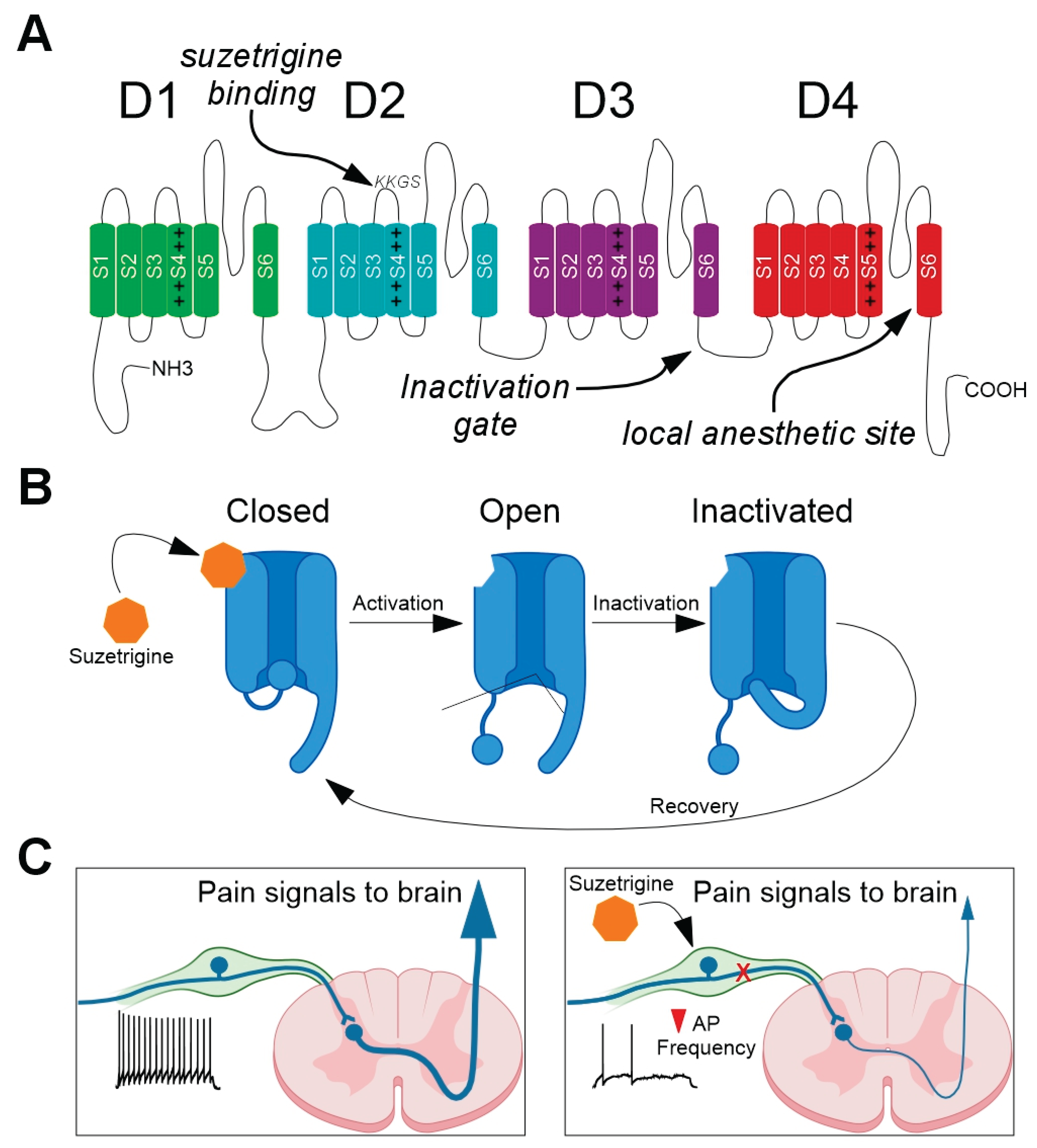
Figure 2.
Percent of randomized and dosed participants who discontinued treatment due to lack of efficacy that received placebo, hydrocodone (5 mg) / acetaminophen (325 mg every 6 hours, HC/ACAP), or suzetrigine (100 mg loading, 50 mg every 12 hours) in the abdominoplasty (A) or bunionectomy (B) trials of Bertoch et al. 2025. Chi-square pp < .05 or ppp < .0005 versus placebo; hp < .05 versus hydrocodone / acetaminophen.
Figure 2.
Percent of randomized and dosed participants who discontinued treatment due to lack of efficacy that received placebo, hydrocodone (5 mg) / acetaminophen (325 mg every 6 hours, HC/ACAP), or suzetrigine (100 mg loading, 50 mg every 12 hours) in the abdominoplasty (A) or bunionectomy (B) trials of Bertoch et al. 2025. Chi-square pp < .05 or ppp < .0005 versus placebo; hp < .05 versus hydrocodone / acetaminophen.
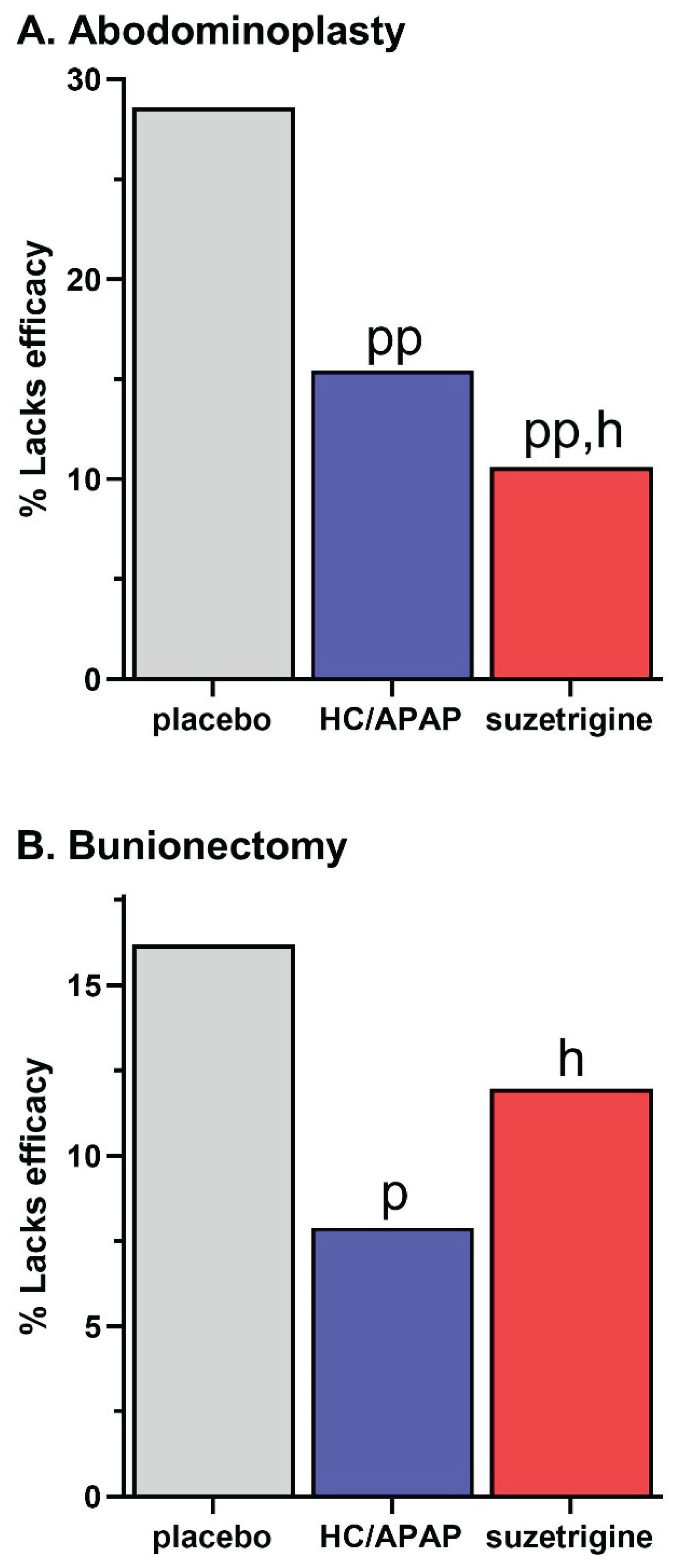

Table 1.
Functional diversity of voltage-gated sodium channel alpha subunits.
| Gene | Channel Isoform | Primary Cellular Populations | Primary Tissue | Developmental Timing | Associated Syndromes |
|---|---|---|---|---|---|
| SCN1A | Nav1.1 | CNS Neurons (Inhibitory) | Brain, Spinal cord | Low prenatally -> increases postnatally |
Epilepsy, ASD, GEFS+, Migraine, ID |
| SCN2A | Nav1.2 | CNS Neurons (Excitatory) | Brain, Spinal cord | Fetal development through adulthood | Epilepsy, ASD, ID |
| SCN3A | Nav1.3 | CNS and PNS Neurons | Brain, Spinal cord | Expression Peaks in prenatal and early neonatal periods | Epilepsy, Congenital Cortical Malformation, ASD |
| SCN4A | Nav1.4 | Skeletal muscle fibers | Skeletal Muscle | Fetal development through adulthood | Hyperkalemic periodic paralysis, Hypokalemic periodic paralysis, paramyotonia congenita, congenital myopathy |
| SCN5A | Nav1.5 | Cardiomyocytes | Heart (atria, ventricles, conduction system) | Fetal development through adulthood | Long QT syndrome, Brugada syndrome, cardiac conduction disease, atrial fibrillation, dilated cardiomyopathy |
| SCN8A | Nav1.6 | CNS Neurons | Brain, Spinal cord | Low prenatally -> increases postnatally | Epilepsy, ASD, Intellectual Disability |
| SCN9A | Nav1.7 | Nociceptive sensory neurons, sympathetic neurons | Dorsal root ganglia, trigeminal ganglia, autonomic ganglia | Fetal development through adulthood | Congenital insensitivity to pain, primary erythromelalgia, paroxysmal extreme pain disorder |
| SCN10A | Nav1.8 | Nociceptive sensory neurons (C-fibers) | Dorsal root ganglia; peripheral nerves | Appears postnatally; persists into adulthood | Small fiber neuropathy, erythromelalgia |
| SCN11A | Nav1.9 | Nociceptive sensory neurons | Dorsal root ganglia; enteric neurons | Postnatal and adult expression | Familial episodic pain syndrome; Congenital insensitivity to pain; Painful neuropathy |
Table 2.
Summary of clinical trial information for suzetrigine.
| Feature | Phase II RCT (Jones et al., 2023) | Phase III RCTs (Bertoch et al., 2025) | Phase III Single-Arm Open-Label (McCoun et al., 2025) |
|---|---|---|---|
| Study Design | Two phase 2, randomized, double blind, placebo and active controlled trials in acute postoperative pain after abdominoplasty or bunionectomy. | Two phase 3, randomized, double blind, placebo and hydrocodone bitartrate/acetaminophen controlled trials after abdominoplasty or bunionectomy. | Phase 3, single arm, open label study in surgical and non surgical acute pain. |
| Total Enrollment / N | Abdominoplasty N = 303; bunionectomy N = 274. | Abdominoplasty N = 1,118; bunionectomy N = 1,073. | N = 256 received at least one dose of suzetrigine. |
| Sex Breakdown | Predominantly women. Abdominoplasty female counts by arm: 75/76, 74/74, 73/76, 76/77; bunionectomy female counts by arm: 53/60, 57/62, 25/33, 50/60, 49/59. | Abdominoplasty: 1,098/1,118 (98%) female; bunionectomy: 912/1,073 (85%) female. | 173/256 (67.6%) female; 83/256 (32.4%) male. |
| Pain Model | Established acute postoperative pain models: abdominoplasty (soft tissue pain) and bunionectomy (bone pain). | Established acute postoperative pain models: abdominoplasty (soft tissue pain) and bunionectomy (bone pain). | Broad acute pain population: 222 surgical (86.7%) and 34 non surgical (13.3%). |
| Sample Type | Adults 18 to 75 years with postoperative pain rated moderate or severe on VRS and at least 4 on NPRS. | Adults with postoperative pain rated moderate to severe on VRS and at least 4 on NPRS after surgery. | Adults 18 to 80 years with moderate or severe acute pain on VRS and at least 4 on NPRS after surgery or with new non surgical pain. |
| Dosing Regimen | Abdominoplasty: high dose, 100 mg loading then 50 mg q12h; middle dose, 60 mg loading then 30 mg q12h; HB/APAP 5/325 mg q6h; placebo q6h. Bunionectomy: same high and middle dose arms plus low dose, 20 mg loading then 10 mg q12h; HB/APAP 5/325 mg q6h; placebo q6h. | Suzetrigine 100 mg loading dose then 50 mg q12h; hydrocodone bitartrate/acetaminophen 5/325 mg q6h; placebo for 48 h. | Suzetrigine 100 mg first dose then 50 mg q12h for 14 days or until pain resolution; rescue acetaminophen 650 mg and ibuprofen 400 mg q6h allowed. |
| Treatment Duration | 48 hours. | 48 hours. | Up to 14 days or until pain resolution. |
| Primary Efficacy vs Placebo | High dose VX-548 reduced pain vs placebo: LS mean SPID48 difference 37.8 (95% CI 9.2 to 66.4) after abdominoplasty and 36.8 (95% CI 4.6 to 69.0) after bunionectomy; lower doses were similar to placebo. | Primary endpoint achieved in both trials: LS mean SPID48 difference 48.4 (95% CI 33.6 to 63.1; P < 0.0001) after abdominoplasty and 29.3 (95% CI 14.0 to 44.6; P = 0.0002) after bunionectomy. | No placebo comparator. At end of treatment, 83.2% (213/256) rated suzetrigine as good, very good, or excellent on patient global assessment. |
| Efficacy vs Opioid Comparator | Active comparator included, but the main analysis compared each VX-548 dose with placebo; no direct efficacy conclusion versus HB/APAP was drawn. | Not superior to HB/APAP on SPID48: abdominoplasty difference 6.6 (95% CI -5.4 to 18.7; P = 0.2781); bunionectomy difference -20.2 (95% CI -32.7 to -7.7; P = 0.0016). | No active comparator arm. |
| Onset of Meaningful Relief | Not formally analyzed. | Median time to at least 2 point NPRS reduction: 119 min vs 480 min placebo after abdominoplasty and 240 min vs 480 min placebo after bunionectomy. | Not directly assessed in this single arm study. |
| Common Adverse Events | Headache and constipation were common with VX-548; the most common events occurring in at least 10% of any group included nausea, headache, constipation, dizziness, and vomiting in abdominoplasty, and nausea and headache in bunionectomy. | Most common adverse events occurring in at least 4% of any group were nausea, constipation, headache, dizziness, hypotension, and vomiting. | Headache (7.0%), constipation (3.5%), nausea (3.1%), fall (2.3%), and rash (2.0%). |
| Serious Adverse Events | Serious adverse events were rare; none were considered related to active treatment or placebo. | After abdominoplasty, serious adverse events were 2.5% with suzetrigine, 1.6% with HB/APAP, and 2.3% with placebo, and none were considered related; after bunionectomy, there were no serious adverse events. | 2/256 (0.8%) serious adverse events, cellulitis and suicidal ideation; both were considered not related to suzetrigine. |
| Respiratory Depression | Not reported | Not reported | Not reported |
| Euphoria / Abuse Signal | Not specifically reported as a trial endpoint in this paper. | Peripheral nonopioid mechanism is emphasized, but formal abuse signal testing was not presented as a trial endpoint in this report. | The paper states there is no evidence of addictive potential based on mechanism, preclinical data, and prior clinical adverse event data, but this was not a formal endpoint in this study. |
| CNS Effects | Peripheral NaV1.8 selectivity is emphasized, but no formal CNS effects endpoint was reported. | NaV1.8 is described as not being expressed in the human brain or spinal cord, supporting lack of central opioid-like effects, but CNS effects were not a formal endpoint. | The paper states suzetrigine does not have CNS side effects associated with opioids based on high NaV1.8 selectivity, but this is mechanistic rationale rather than a dedicated endpoint. |
| Key Limitation | Short treatment window (48 h) and no direct powered comparison versus HB/APAP. | Short duration (48 h) and postoperative acute pain models only. | Single arm design, no data beyond 14 days. |
Disclaimer/Publisher’s Note: The statements, opinions and data contained in all publications are solely those of the individual author(s) and contributor(s) and not of MDPI and/or the editor(s). MDPI and/or the editor(s) disclaim responsibility for any injury to people or property resulting from any ideas, methods, instructions or products referred to in the content. |
© 2026 by the authors. Licensee MDPI, Basel, Switzerland. This article is an open access article distributed under the terms and conditions of the Creative Commons Attribution (CC BY) license (http://creativecommons.org/licenses/by/4.0/).
Copyright: This open access article is published under a Creative Commons CC BY 4.0 license, which permit the free download, distribution, and reuse, provided that the author and preprint are cited in any reuse.


