

Submitted:
31 May 2026
Posted:
02 June 2026
You are already at the latest version
Abstract
Evolutionary algorithms (EAs) are widely used nature-inspired optimization methods capable of solving complex and high-dimensional problems across science and engineering. Foundational paradigms such as genetic algorithms, genetic programming, differential evolution, evolution strategies, and evolutionary programming have expanded into multi-objective, surrogate-assisted, hybrid, and large-scale variants, broadening their applicability to dynamic and datadriven environments. This survey provides a structured review of EAs from a domain-centric perspective, focusing on how different techniques are designed for engineering problems. Applications are examined across renewable energy, civil and structural engineering, electronics, industrial optimization, healthcare, robotics, and smart cities. We present an updated taxonomy of classical and emerging algorithms, consolidate recent application studies, and review benchmarking and reproducibility practices essential for fair evaluation. Key challenges including scalability, constraint handling, and exploration–exploitation balance are discussed alongside future directions such as EA–deep learning integration, federated optimization, and interpretable evolution. This survey offers an updated view of EAs and their engineering relevance.
Keywords:
evolutionary computation
; multi-objective optimization
; surrogate-assisted EAs
; CMA-ES
; adaptive DE
; memetic algorithms
; GPU-accelerated EAs
; medical image analysis
; smart grids
; evolutionary robotics
1. Introduction
Evolutionary algorithms (EAs) constitute a central paradigm in computational intelligence and soft computing, providing population-based optimization frameworks inspired by the principles of natural selection and biological evolution [1,2]. Since their inception in the 1960s and 1970s, with foundational contributions from pioneers such as John Holland, Ingo Rechenberg, and Lawrence Fogel, EAs have evolved from conceptual biological metaphors into mature optimization methodologies with strong theoretical foundations and broad applicability. Representative classes include genetic algorithms (GAs) [3,4,5,6], genetic programming (GP) [7,8], differential evolution (DE) [9,10], evolution strategies (ES) [11,12], and evolutionary programming (EP) [13]. These approaches use iterative processes of variation, selection, and inheritance to effectively explore high-dimensional, multimodal, and rugged fitness landscapes where classical optimization methods often fail [14,15]. The enduring success of EAs arises from their ability to maintain population diversity, perform global search, and adaptively balance exploration and exploitation [16,17]. Their parallel evaluation of candidate solutions provides effectiveness against local optima, noise, and non-convexity, enabling widespread adoption in engineering design optimization [18], scheduling [19], image and signal processing, bioinformatics [20], and environmental modeling [21]. Furthermore, their flexible and modular nature facilitates hybridization with learning paradigms such as neural architecture search (NAS), reinforcement learning, and adaptive control [22]. In recent years, EA research has accelerated significantly, driven by advances in computation, availability of large-scale datasets, and integration with emerging fields such as quantum computing, AI, and big data analytics [23].
Although EAs have been widely reviewed, most prior surveys remain largely algorithm-centric, emphasizing taxonomies, operators, theory, and benchmark behavior. These works classify methods by their internal mechanics but provide limited insight into how different EA variants are adapted to the needs of specific engineering domains. With the rapid growth of domain-designed EA designs in areas such as energy systems, healthcare, and intelligent infrastructure, a synthesized view that links algorithmic choices to problem-driven requirements is increasingly needed.
This survey addresses that gap by offering a domain-centric synthesis of evolutionary algorithms. While covering classical EA families and modern hybrid approaches, the discussion is organized around major application domains where EAs have demonstrated significant impact. The goal is to help practitioners understand which EA variants suit particular problem characteristics, clarify how methodological developments translate to domain performance, and highlight trends emerging from real-world deployments. In addition, this survey consolidates theoretical foundations, methodological diversity, and cross-domain applications while highlighting open challenges such as scalability, convergence reliability, computational cost, and integration with large-scale and data-driven systems. The analysis underscores how EAs continue to evolve as essential tools for next-generation intelligent optimization.
2. Methodological Review Framework
This survey adopts a transparent and reproducible review protocol to ensure search completeness, consistent screening, and domain-relevant coverage.
2.1. Search Strategy
A comprehensive search was performed across IEEE Xplore, Scopus, Web of Science, ScienceDirect, and SpringerLink for the period 2015–2025. Core EA keywords included “evolutionary algorithm”, “genetic algorithm”, “differential evolution”, “evolution strategies”, “genetic programming”, “memetic algorithm”, “surrogate-assisted evolutionary algorithm”. To ensure methodological transparency and reproducibility, the complete Boolean search strings for all databases including explicit AND/OR structures and domain-specific filters are provided in the Supplementary Appendix (Appendix A). The initial retrieval yielded 2,183 records; after removing duplicates (412) and non-English works (76), 1,695 items remained for screening.
2.2. Screening and Selection Criteria
A total of 953 papers underwent full-text review. The refined inclusion and exclusion criteria are:
Inclusion Criteria:
- Peer-reviewed journal or conference papers (2015–2025);
- Evaluation on two or more benchmark functions or one real-world engineering case;
- Explicit description of EA components (representation, operators, selection);
- Sufficient experimental detail for replication (parameter settings, dataset/task description, and statistical reporting).
Exclusion Criteria:
- Pure swarm-intelligence studies lacking EA components;
- Works without replicable methodology (missing parameters, unclear benchmarks, incomplete metrics);
- Non-archival content (theses, non-reviewed preprints, posters, tutorials).
After applying these criteria, 312 publications formed the final corpus analyzed throughout the survey.
2.3. Classification and Taxonomy Approach
The selected works were organized using a dual-axis taxonomy comprising an algorithmic axis (GA, DE, ES/CMA-ES, GP, EP, hybrid EAs, and quantum-inspired EAs) and an application axis (healthcare, engineering design, energy systems, AI/ML, robotics, and smart cities). Figure 1 provides a unified visualization linking EA families to their dominant application domains.
Rationale Behind the Taxonomy: Different EA families possess distinct representations and search dynamics that naturally align with specific domain requirements. CMA-ES and related evolution strategies are favored in engineering and structural optimization due to their Gaussian sampling and covariance adaptation suited for high-dimensional, ill-conditioned landscapes. GAs with discrete encodings and recombination remain prevalent in routing, scheduling, and other combinatorial tasks. Differential evolution is widely applied in energy systems, control, and parameter estimation because of its simple vector-based mutation and noise resilience. Hybrid and memetic EAs dominate medical imaging and healthcare tasks, where domain heuristics, prior knowledge, and multi-objective trade-offs are critical. By integrating algorithmic and application axes, the taxonomy provides the domain-centric lens central to this survey, clarifying how methodological characteristics map onto real-world problem structures.
2.4. Study Overview
The final corpus spans one decade and covers classical, hybrid, surrogate-assisted, and quantum-inspired evolutionary algorithms.
3. Foundations of Evolutionary Algorithms
3.1. Core Mechanisms of Evolutionary Algorithms
Evolutionary algorithms are population-based stochastic optimizers driven by the principles of selection, recombination, and mutation. Although these mechanisms are standard and well documented in classical textbooks, we briefly summarize them here for completeness and refer readers to Table 1 for a compact overview of how each operator shapes exploration and exploitation. The generic evolutionary update can be written as
Here , , and denote selection, crossover, and mutation, respectively. Algorithm 1 outlines the modular workflow. These components collectively enable EAs to maintain diversity, refine promising regions, and navigate rugged fitness landscapes.
| Algorithm 1 Generic Evolutionary Algorithm Framework |
|
3.2. Theoretical Foundations and Their Practical Implications
A theoretical understanding of evolutionary algorithms provides insight into their expected convergence behavior, stability, and search efficiency. These results not only clarify why certain EA variants behave as they do but also guide practitioners in choosing suitable operators, mutation strengths, population sizes, and hybridization strategies. Below we synthesize key theoretical concepts and highlight their practical implications.
3.2.1. Markov-Chain Convergence
Many EAs can be modeled as homogeneous Markov chains on a finite state space . If mutation ensures positive probability of reaching any feasible solution, the chain becomes irreducible and aperiodic, implying a stationary distribution:
Practical implication: algorithms with mutation operators that guarantee reachability (e.g., Gaussian noise, bit-flip mutation) avoid search stagnation and theoretically ensure long-term access to optimal regions.
3.2.2. Runtime Analysis and Drift Bounds
Runtime is often expressed as the hitting time to an optimal region:
Drift analysis quantifies expected progress via a potential function :
Additive drift leads to linear convergence; multiplicative drift yields logarithmic convergence.
Practical implication: algorithms that maintain diversity and proportional improvement achieve faster convergence on structured problems.
3.2.3. Landscape Properties: Discrete vs. Continuous
Discrete EAs rely on Hamming-neighborhood connectivity, whereas ES/CMA-ES use Gaussian sampling:
yielding linear contraction on smooth convex landscapes [2,26].
Practical implication: CMA-ES or continuous EAs are preferable for smooth, real-valued optimization, while bit-string EAs excel on combinatorial structures.
3.2.4. Self-Adaptation and Parameter Dynamics
Adaptive rules update parameters such as mutation strength:
Practical implication: success-based or learning-driven parameter control is crucial on noisy or multi-modal landscapes where static settings fail.
3.2.5. Multiobjective Optimization Guarantees
Classical MOEAs satisfy polynomial-time approximation bounds:
with IGD and hypervolume converging under adequate diversity.
Practical implication: practitioners must ensure diversity preservation for reliable Pareto front approximation.
3.2.6. Constraint-Handling Theory
Penalty-based reformulations use:
while feasibility-based rules offer stronger guarantees under certain geometries.
Practical implication: constraint-handling should be aligned with the structure of feasible regions; feasibility-based rules often outperform penalties when constraints are tight or nonlinear.
3.2.7. No-Free-Lunch Limits
For uniform distributions over all objective functions, implying no universally superior optimizer.
Practical implication: this motivates the diversity of EA variants, hybridization strategies, and domain-specific adaptations discussed in subsequent sections. Designing operators, representations, and learning components to problem structure is essential for practical performance gains.
4. Types of Evolutionary Algorithms
Evolutionary algorithms constitute a broad family of population-based optimizers that differ in representation, variation operators, and selection strategies, leading to distinct performance characteristics across domains. Rather than cataloguing each method in isolation, this section adopts a domain-centric perspective: we summarize core algorithm families, highlight their strengths and limitations, and analyze where they are most suitable in engineering and scientific practice. The comparative taxonomies presented in Table 2 and Table 3 organize classical and advanced EA paradigms, respectively, linking algorithmic principles to their characteristic strengths, weaknesses, and ideal application contexts.
4.1. Genetic Algorithms (GAs)
GAs are population-based metaheuristics that evolve candidate solutions via selection, crossover, and mutation. Given a search space and objective function , the population is iteratively evaluated, varied, and updated, as summarized in Algorithm 2. GAs support binary, real-valued, permutation, and graph encodings, making them broadly applicable in discrete and combinatorial domains.
| Algorithm 2 Genetic Algorithm (GA) |
|
GAs perform well when meaningful building blocks can be recombined, such as in scheduling, routing, feature selection, and structured design tasks [40,41,42,43,44,45,46,47]. However, their performance typically weakens on high-dimensional continuous landscapes where operators lack directional bias and where DE or CMA-ES are more effective. Recent advances include improved encodings and automated configuration [48,49], quantum-inspired and coevolutionary variants [39,50], and hybrid GA–ML or GA–RL frameworks [43,51,52,53,54] that enhance exploration and convergence efficiency.
Comparative Analysis and Domain Suitability
Compared with DE and CMA-ES, which operate directly on continuous vectors, GAs depend on encodings and schema-based recombination, making them most suitable for discrete, combinatorial, or structured search spaces. Relative to GP, GAs are less interpretable but simpler and more computationally efficient. Overall, GAs are preferred when problem structure enables meaningful recombination of partial solutions, while continuous optimization is better handled by DE or CMA-ES.
4.2. Evolution Strategies (ES, CMA-ES)
Evolution Strategies (ES) are derivative-free optimizers designed for continuous domains, with CMA-ES being the most influential modern variant. CMA-ES adapts a multivariate Gaussian sampling distribution, and updates its mean by weighted recombination of the best individuals:
Step-size and covariance adaptation enable invariance to affine transformations and strong performance on non-separable, ill-conditioned landscapes. The core procedure is summarized in Algorithm 3. The covariance update limits CMA-ES scalability in high dimensions, and reliable estimation requires large populations, giving high evaluation cost. Its Gaussian sampling also lacks a natural analogue in discrete or permutation spaces, making unmodified CMA-ES unsuitable for combinatorial problems. Consequently, lighter DE or PSO variants often outperform CMA-ES in low-dimensional or evaluation-constrained settings.
| Algorithm 3 Covariance Matrix Adaptation ES (CMA-ES) |
|
To reduce these issues, recent research explores reference vector–based ranking for multiobjective search [55], cooperative coevolution and landscape-aware grouping for large-scale optimization [56], noise-resilient population-size control [57], and parallel or chaotic variants [58,59]. Hybrid extensions broaden CMA-ES applications, including NAS [60], multimodal niching with PSO [61], microrobotics and trajectory planning [58,62], photonic device optimization [63,64], geophysical imaging [23,36], and wireless communication system design [65].
Comparative Analysis and Domain Suitability
Relative to GAs and DE, ES/CMA-ES provide principled step-size control and anisotropic search, making them highly effective on non-separable, ill-conditioned continuous problems. However, their quadratic update cost and reliance on continuous sampling make them less suitable for very high-dimensional or discrete tasks, where DE or GA variants tend to be more efficient. CMA-ES is therefore most appropriate when precise continuous optimization is required and sufficient evaluations are available to exploit local landscape geometry.
4.3. Differential Evolution (DE)
DE is a population-based optimizer for continuous spaces, defined by its geometry-driven mutation strategy. At generation g, each solution generates a donor vector
followed by crossover with rate to produce a trial vector, and selection retains the fitter candidate (Algorithm 4). Its simplicity, directional search via population differences, and low computational cost make DE highly effective on multimodal continuous landscapes. DE’s main limitations stem from its reliance on continuous vector arithmetic making it poorly suited for categorical or combinatorial spaces without specialized encodings and its sensitivity to F and , which can cause stagnation when diversity collapses. To address these issues, recent work proposes self-adaptive and collaborative DE variants for dynamic environments [66], Bayesian-assisted hybrid DE for antenna design [37], and fuzzy-logic or bidirectional DE for improved stability and search reliability [67,68,69]. Multiobjective and multitask extensions enhance performance on conflicting objectives [70,71,72], while surrogate-assisted DE accelerates expensive evaluations [73] at the cost of potential model bias. DE continues to see broad application in robotics [74], energy systems [75,76], ultrasonic sensing [77], plasma devices [78], power electronics [79], cybersecurity [80,81], scheduling [82], VANET security [83], and antenna optimization [84]. Fractional-order DE [85] further enhances exploration using historical dynamics, though at the expense of additional hyperparameters.
| Algorithm 4 Differential Evolution (DE) |
|
Comparative Analysis and Domain Suitability
Compared to GAs, which naturally suit binary and permutation encodings, DE excels in continuous domains due to its directional mutation. Relative to CMA-ES, DE is cheaper per generation and easier to tune, but lacks full covariance adaptation and is more prone to stagnation. Thus, DE is most suitable for medium-scale continuous optimization, whereas GA, CMA-ES, or domain-specific MOEAs are preferable for combinatorial, highly constrained, or strongly multiobjective tasks.
4.4. Genetic Programming (GP)
GP evolves symbolic structures trees, linear expressions, and grammars to produce interpretable models, making it well suited for symbolic regression and transparent decision-making. Semantics-aware variants [86,87] improve search efficiency and reduce bloat by guiding variation with functional meaning, though GP still faces high computational cost and uncontrolled structural growth. GP has been extended to multiobjective and large-scale tasks in classification, routing, and scheduling [88,89,90,91,92], where hierarchical or rule-based structures are advantageous. Its performance generally weakens in high-dimensional continuous spaces, where numerical optimizers such as DE or CMA-ES converge more reliably. Federated GP [93] reduce privacy constraints by evolving local models but introduces communication and heterogeneity challenges. In software engineering, GP supports program synthesis and metamorphic relation generation [94,95], offering interpretability benefits compared to LLM-based generators but limited by semantic complexity and long-range dependencies. Overall, GP is most effective when interpretability, symbolic reasoning, or structural flexibility is required, despite scalability and representation challenges (Table 4).
Comparative Analysis and Domain Suitability
Unlike GA, DE, or CMA-ES, which operate on fixed-length numeric encodings, GP searches over variable-length symbolic programs. This enables discovery of human-readable rules but increases computational overhead and risks bloat. For large-scale continuous optimization, DE or CMA-ES typically offer superior efficiency, whereas GP excels in domains requiring symbolic structure or interpretable models. GP therefore complements, rather than replaces, numeric evolutionary methods.
4.5. Multi-Objective and Many-Objective EAs
MOEAs extend single-objective EAs to optimize conflicting criteria such as accuracy, model size, and computational cost by generating Pareto optimal solutions [103,104]. MaOEAs further scale these ideas through dominance relaxation, indicator-based selection, and decomposition strategies to remain effective in high-dimensional objective spaces. MOEAs have become increasingly important in NAS, where accuracy, efficiency, and resource constraints must be optimized jointly. Representative methods include CNN-GA [105], AE-CNN [106], AE-CNN+E2EPP [107], MOEA-PS [108], NPENAS-NP [109], EEEA-Net-C [110], CGP-NAS [111], SMCSO [112], and SPNAS [113]. These frameworks integrate Pareto-based selection, probabilistic modeling, and self-adaptive mutation to co-optimize accuracy and computational efficiency. As summarized in Table 5, EA-based NAS methods achieve competitive CIFAR-10/100 performance while significantly reducing GPU-day requirements, with models such as MOEA-PS [108] and SMCSO [112] illustrating the growing importance of MOEA/MaOEA paradigms in resource-aware architecture discovery.
Comparative Analysis and Domain Suitability
MOEAs and MaOEAs provide principled mechanisms for discovering trade-offs without predefined weightings, making them well suited to engineering design, energy planning, and NAS. However, dominance-based methods degrade as objectives increase; hence MaOEAs rely on reference vectors or indicator-based criteria to retain selection pressure. In practice, MOEAs are preferred when the number of objectives is small and Pareto front interpretability is important, whereas MaOEAs are more appropriate for high-dimensional settings where user-defined preferences or performance indicators guide search.
4.6. Hybrid, Memetic, Surrogate-Assisted, Reinforcement Learning–Enhanced, and Quantum Evolutionary Algorithms
Advanced evolutionary paradigms integrate global EA search with learning, modeling, or local refinement to overcome limitations of classical EAs such as high evaluation cost, slow convergence, and weak exploitation.
4.6.1. Surrogate-Assisted Evolutionary Algorithms (SAEAs)
SAEAs couple EAs with predictive models to reduce evaluation cost in expensive optimization [118,119,120]. Surrogates include ANNs [121,122,123], BP networks [124], Gaussian Processes/Kriging [125,126,127,128], RBF models [126], SVR [129], and adaptive systems (ANFIS, BFNN) [130,131]. SAEAs follow iterative surrogate construction and EA-based search, supporting applications such as energy-efficient buildings [121,122,132], motors [124], aero-engines [131], antenna/ship design [125,126,127], manufacturing [123,128,130,133], and energy systems [129]. AutoSAEA [134] automates surrogate and infill selection. Despite efficiency gains, SAEAs face challenges of surrogate bias and drift in high-dimensional or noisy settings.
4.6.2. Memetic and Hybrid Evolutionary Algorithms
Memetic and hybrid EAs combine EA-based global exploration with heuristic or deterministic local search. Applications include drone–truck routing [135], vehicular offloading [136], satellite scheduling [137], berth–crane assignment [138], hybrid flow-shops [139], energy-aware job shops [140], setup-dependent scheduling [141], human–robot collaboration [142], and sustainable manufacturing [143]. They also support NAS [144], multimodal TSP [145], localization [146], polar codes [147], subpixel mapping [148], and facility layout [149]. While hybrids improve exploitation and convergence, they are sensitive to local-search design and domain heuristics.
4.6.3. Reinforcement Learning–Assisted Evolutionary Algorithms (RL-EAs)
RL-EAs adapt operators, parameters, or selection rules using learned policies [150]. Q-learning improves GA-based scheduling [151,152,153,154,155], while Dueling DQN aids satellite scheduling [156] and Actor–Critic supports production planning [157]. PPO stabilizes combinatorial search [158]. In DE, Q-learning and policy-gradient methods adjust mutation strategies [159,160,161]. RL also enhances ABC [162,163,164,165,166,167] and dynamic routing [168]. In MOEAs, RL selects objectives [169,170,171] or weights [172,173,174,175]. Further examples include PSO–RL [165,176], GP–RL [177], multitask MFEA–RL [178], and inverse-RL hybrids [179]. RL-EAs handle dynamic environments but incur training overhead and reward-sensitivity.
Comparative Analysis and Domain Suitability
SAEAs are most effective when evaluations are expensive (aerospace, simulation-driven design), but vulnerable to surrogate bias. Memetic/Hybrid EAs accelerate convergence where local refinement is meaningful (scheduling, manufacturing, NAS), though performance depends on problem-specific heuristics. RL-EAs excel in dynamic or heterogeneous environments (routing, resource allocation, multiagent coordination), but require extensive interactions and careful reward shaping. QEAs introduce quantum-inspired diversity and search operators, offering potential advantages in combinatorial problems but remain limited by hardware and simulator constraints.
Overall, these paradigms complement classical GA/DE/ES by addressing evaluation cost (SAEA), exploitation (memetic/hybrid), adaptivity (RL-EA), and diversity (QEA), enabling more efficient and domain-aware search in complex real-world applications.

Table 6.
Recent applications and methodological advances of Surrogate-Assisted Evolutionary Algorithms (SAEAs) in engineering and optimization domains (2020–2025).
Table 6.
Recent applications and methodological advances of Surrogate-Assisted Evolutionary Algorithms (SAEAs) in engineering and optimization domains (2020–2025).
| Field | Authors / Year | Surrogate Model(s) | Objectives | Evolutionary Framework |
|---|---|---|---|---|
| Application-oriented SAEAs | ||||
| Building energy-efficient design | Bre et al. [121] 2020 | ANN | Multi-objective | NSGA-II |
| Gonçalves et al. [132] 2020 | Adaptive surrogate | Multi-objective | NSGA-II | |
| Chegari et al. [122] 2021 | ANN | Multi-objective | GA | |
| Motor manufacturing | Li et al. [124] 2021 | BP network | Multi-objective | MOPSO |
| Aero-engine compressor design | Baert et al. [131] 2020 | BFNN | Multi-objective | Online SAEA |
| Antenna design | Zhang et al. [125] 2020 | Gaussian Process | Single-objective | DE |
| Yu et al. [126] 2020 | Kriging, RBF, ANN | Single-objective | PSO, DE | |
| Ship design | Wang et al. [127] 2021 | Kriging | Single-objective | GA |
| Automobile design | Li et al. [130] 2022 | ANFIS | Multi-objective | SSPEA |
| Wang et al. [133] 2021 | RSM, Kriging | Multi-objective | MOGA | |
| Su et al. [123] 2021 | ANN | Multi-objective | NSGA-II | |
| Wing optimization | Wansaseub et al. [128] 2020 | Kriging | Multi-objective | Latin Hypercube + DE |
| Energy and power | Ma et al. [129] 2021 | SVR | Multi-objective | NSGA-II |
| Methodological advances in SAEAs | ||||
| Cross-domain (expensive many-objective optimization) | Zhai et al. [133] 2023 | Global + Local Kriging (composite surrogate) | Many-objective | Composite SAEA with filling sampling criterion |
Table 7.
RL-Assisted Evolutionary Algorithms by EA Type.
| EA Type | Problem Domain | RL Role |
|---|---|---|
| Genetic Algorithm (GA) | ||
| Q-learning [151,152,153,154,155] | Scheduling, team formation | Operator control, task allocation |
| Dueling DQN [156] | Satellite scheduling | Dual-state evaluation |
| Actor–Critic [157] | Steel scheduling | Adaptive trade-off learning |
| PPO [158] | TSP, VRP, bin packing | Stable policy optimization |
| Differential Evolution (DE) | ||
| Variational PG [159] | Continuous SOP | Stochastic policy mutation |
| Policy Gradient [160] | Parameter tuning | Mutation rate control |
| Q-learning [161] | Trajectory design | Reward-based selection |
| Artificial Bee Colony (ABC) | ||
| Q-learning [162,163,165,166,167,180] | Flow-shop, traffic | Sequence, allocation rules |
| DQN [168] | Vehicle routing | Route exploration |
| MOEAs (MA, MOEA/D, NSGA-II/III) | ||
| Q-learning [172,173,175,181] | Job/flow-shop | Pareto weight tuning |
| DQN [169,170,171] | Energy, cloud | Objective adaptation |
| Hyper-Heuristic / Ensemble | ||
| Q-learning [151,182,183] | Energy, routing | Heuristic selection |
| DDQN / Double Q [184] | Packing, scheduling | Reward stability |
| Other EAs | ||
| PSO (Q-learning) [165,176] | Assembly, SOP | Velocity tuning |
| GP (Q-learning) [177] | Team formation | Task matching |
| MFEA (Q-learning) [178] | Multitask | Task transfer learning |
| MFO (Inverse RL) [179] | SOP | Expert reward imitation |
5. Applications of Evolutionary Algorithms
Evolutionary algorithms have been successfully applied across a wide range of scientific and engineering domains due to their global search capability, flexibility in handling diverse problem structures, and effectiveness in multi-objective and constraint-aware optimization. This section provides a domain-balanced overview of key application areas, focusing on healthcare, energy systems, robotics, and smart cities. Table 8 summarizes representative works across diverse fields.
5.1. Healthcare and Biomedical Applications
EAs play a central role in complex clinical optimization tasks such as radiation therapy planning, where multi-objective EAs optimize beam angles, dose distributions, and organ-at-risk protection [185,186,187,188]. Advanced MOEAs incorporate clinical priors and pattern-mining strategies to improve treatment diversity and stability [189]. In genomics, GAs and DE aid in disease-gene identification and feature selection from high-dimensional datasets [190,191]. In medical image segmentation, evolutionary NAS yields efficient architectures for few-shot and domain-shift scenarios [192,193,194,195].
Limitations and Open Challenges: EAs face obstacles including high computational cost for 3D medical imaging, difficulty integrating privacy regulations (HIPAA/GDPR), and limited interpretability in clinical pipelines. Scaling evolutionary NAS to large medical datasets also remains challenging.
5.2. Energy Systems and Smart Grid Optimization
Energy systems require effective optimization under uncertainty, renewable variability, and stringent operational constraints. EAs have been widely used for unit commitment, economic dispatch, and renewable energy planning [196,197]. Differential evolution and MOEAs are widely used for optimizing photovoltaic systems, microgrids, and wind-farm layouts due to their resilience to noisy, nonlinear objectives. Hybrid surrogate-assisted EAs further accelerate simulations for building energy design [121,122].
Limitations and Open Challenges: Dynamic, real-time grid operation demands faster convergence than classical EAs typically provide. Large-scale grid models challenge scalability, and surrogate drift may affect reliability. Future directions include hardware-aware EAs, online adaptation, and federated evolutionary control for geographically distributed systems.
5.3. Robotics, Control, and Autonomous Systems
Robotics applications use EAs for control tuning, trajectory planning, swarm coordination, and behavior synthesis. CMA-ES and DE excel in continuous control tasks such as manipulation, aerial robotics, and microrobotics [62,63]. Genetic programming and hybrid EAs evolve interpretable controllers and task policies, while evolutionary RL approaches enable adaptation in dynamic environments [151,152,158].
Limitations and Open Challenges: Real-time constraints restrict population sizes and evaluation budgets. Simulation-to-reality gaps reduce transferability, and safety-aware optimization remains underexplored. High-dimensional robotic systems necessitate more scalable, sample-efficient evolutionary controllers.
5.4. Smart Cities, Transportation, and Logistics
EAs support infrastructure planning, transportation scheduling, routing, and multi-criteria decision-making in smart cities. Applications include lane-reservation systems [198], traffic routing [168], supply-chain optimization [199], and cyber-physical coordination in IoT environments [200]. Multi-objective EAs enable trade-offs between efficiency, emissions, and congestion key factors in sustainable urban mobility.
Limitations and Open Challenges: Smart-city systems introduce dynamic, multi-agent environments where objectives evolve over time. Real-time EAs must operate under communication constraints and partial observability. Federated EAs, RL-EA hybrids, and decentralized optimization frameworks are promising future directions.
5.5. Artificial Intelligence and Machine Learning
EAs are increasingly integrated into AI pipelines for feature selection, hyperparameter tuning, and neural architecture search [201,202]. Multi-modal learning setups employ evolutionary multi-objective optimization for sensor fusion and model selection [203,204]. In secure IoT systems, post-quantum EA–blockchain frameworks enhance resilience and privacy [200]. Evolutionary NAS (ENAS) designs efficient architectures, while hybrid EA–RL and EA–gradient approaches balance accuracy and computational cost [205,206]. As shown in Figure 2, ENAS methods are generally categorized into three major evolutionary paradigms: EA, Swarm Intelligence, and Hybrid Search Strategies.
Limitations and Open Challenges: Evolutionary NAS remains computationally expensive. Hybrid EA LLM systems introduce interpretability and consistency challenges. Distributed AI introduces synchronization and latency issues that complicate evolutionary search.
6. Challenges and Problems in Evolutionary Algorithms
EAs face persistent challenges that limit their scalability, effectiveness, and deployment in modern large-scale systems. Figure 3 summarizes the major issues and commonly adopted mitigation strategies.
6.1. Scalability
High-dimensional problems expand the search space exponentially, requiring larger populations and stronger diversity preservation. CMA-ES suffers from covariance updates, while L-SHADE and related DE variants scale better through self-adaptation. Modern settings such as federated or privacy-constrained optimization further strain scalability since subpopulations operate with limited coordination.
Promising Reduction Approaches: Cooperative and decomposition-based EAs offer dimensionality reduction but rely on accurate variable grouping; surrogate-assisted models reduce evaluation cost but introduce approximation bias; parallel/distributed EAs provide speedups but increase communication overhead; hardware-aware GPU-accelerated implementations help, though irregular operators limit full parallelism.
6.2. Balancing Exploration and Exploitation
Over-exploration slows convergence, whereas excessive exploitation causes premature stagnation. Static mutation or crossover rates struggle in dynamic or multimodal landscapes. RL-assisted EAs and island models provide adaptive control but require extra computation and careful design.
Promising Reduction Approaches: Self-adaptive operators, niching and clustering for diversity preservation, hybrid global local search, and RL-based operator control enhance balance, though each introduces risks such as oscillation, slower convergence, or additional training overhead.
6.3. Parameter Sensitivity and Self-Adaptation
EA performance depends heavily on mutation rates, crossover probabilities, population size, and selection pressure. Sensitivity becomes more severe in multiobjective and large-scale optimization. Self-adaptive and AutoML-driven tuning [227] reduce manual effort but add extra meta-parameters and computational burden.
Promising Reduction Approaches: Co-evolving parameters, meta-EAs, and learning-guided control mechanisms help improve parameter adaptation, but their performance depends heavily on population size and stable reward signals.
6.4. Computational Cost and Efficiency
Population-based evaluation makes EAs expensive for simulation-based design, NAS, robotics, and multi-physics tasks. Even with GPU parallelism, evaluating thousands of candidates per generation remains a bottleneck.
Promising Reduction Approaches: Surrogate-assisted EAs reduce evaluation cost but risk search bias; weight-sharing and pruning accelerate NAS but may distort fitness ranking; quantum-inspired and probabilistic EAs improve global exploration but remain small-scale; hardware-aware EAs show promise but depend on platform-specific tuning.
6.5. Benchmarking, Reproducibility, and Comparison
Reproducibility is hindered by heterogeneous implementations, inconsistent reporting, and sensitivity to random seeds or hardware differences. Distributed and federated optimization further complicate reproducibility due to communication delays and data shifts.
Promising Reduction Approaches: Standardized benchmark suites (e.g., COCO, LSGO, NAS-Bench), open-source repositories, statistical testing with effect sizes, and emerging federated benchmarking infrastructures improve transparency but require community-wide adoption.
7. Future Research Directions and Trends
Evolutionary algorithms are entering a transformative phase driven by the dual need for scalability and intelligence. Their future trajectory is shaped by two primary drivers: (1) Hybridization with complementary computational paradigms, and (2) Integration with emerging technologies such as quantum computing, LLMs, and federated systems. These drivers are supported by three foundational pillars that must co-evolve: (1) Theoretical grounding, (2) Domain-scale real-world deployment, and (3) Interpretability and trust. Together, these elements form a convergent roadmap for next-generation evolutionary computation.
7.1. Hybrid Evolutionary Algorithms as the Central Driver
Hybrid evolutionary algorithms (HEAs) will remain the cornerstone of future EA research. The ability to combine population-based exploration with gradient-based refinement, swarm heuristics, reinforcement learning, or local search enables the creation of adaptive and problem-aware optimizers. A key future direction involves dynamic operator orchestration, where hybrid components are selected or weighted based on real-time landscape feedback. This includes RL-driven operator scheduling, adaptive switching between exploration modes, and learning-guided pruning of ineffective search branches. Such hybridization is not only algorithmic but also architectural: future EAs will behave as self-evolving systems that restructure their own operators and representations during the optimization process.
7.2. Integration with Emerging Technologies: The Expanding Frontier
Hybridization intersects directly with technological advances, creating several emerging pathways for EA development.
7.2.1. Quantum Computing and Quantum-inspired EAs
Quantum-inspired EAs offer richer search distributions, parallel exploration, and theoretical speedups. Beyond classical optimization, methods like QDistEvol [228] will increasingly target problems native to quantum devices, including quantum error correction, quantum control, and circuit layout. A specific research direction is the development of quantum–classical co-evolution, where quantum subroutines evaluate fitness or generate offspring, while classical EAs guide global population dynamics.
7.2.2. Federated and Edge Evolutionary Computation
Federated and distributed environments demand optimization under privacy, communication, and heterogeneity constraints. Federated surrogate-assisted EAs [35,229] and evolutionary game-theoretic models [230,231,232] provide early foundations, but substantial gaps remain. Future directions include:
- Theoretical models of communication-efficient evolution under limited bandwidth,
- Incentive-compatible EAs for multi-agent and multi-owner data settings,
- Distributed multi-objective evolution with partial or inconsistent objective visibility.
These directions are essential for deploying EAs in smart cities, IoT ecosystems, and cyber-physical infrastructure.
7.3. Large Language Models (LLMs) as Evolutionary Meta-Controllers
LLMs are emerging as powerful agents capable of automating EA operator design, mutation generation, and adaptation logic. Frameworks such as LLaMEA [233,234] demonstrate that LLMs can synthesize new heuristics, self-correct search failures, and propose operator modifications using linguistic feedback. Figure 4 illustrates this co-evolution paradigm. Future work includes:
- LLM-driven operator innovation: generating new mutation/crossover families conditioned on landscape descriptors.
- Self-reflective evolution: EAs provide search logs, and LLMs respond with operator adjustments.
- Hybrid symbolic–numeric search: LLMs evolve symbolic rules while EAs refine numeric parameters.
This synergy could create autonomous evolutionary frameworks capable of reconfiguring themselves without human intervention.
7.4. Real-world Applications and Societal Impact
EAs are increasingly positioned to address global challenges across climate science, energy sustainability, personalized healthcare, and resilient urban infrastructure. Unlike conventional optimizers, their multi-objective nature enables them to balance conflicting goals such as energy efficiency versus emissions, accuracy versus interpretability, or cost versus resilience. Future research should target:
- Decarbonization and renewable energy systems: optimizing multi-scale models for smart grids, energy storage, and demand forecasting.
- Climate modeling and environmental resilience: integrating uncertainty-aware EAs for long-term climate scenario simulations.
- Precision medicine: evolving interpretable and privacy-preserving diagnostic pipelines.
- Real-time robotics and autonomous systems: building fast, hardware-aware EAs for dynamic control.
These directions align EAs with major societal missions such as sustainability, healthcare equity, and global risk mitigation.
7.5. Theoretical Foundations to Support Next-Generation EAs
Despite strong empirical success, theoretical understanding lags behind algorithmic innovation. Future theory must move beyond asymptotic convergence and provide actionable insights for modern algorithm families. Specific future directions include:
- Runtime and stability analysis of RL-EAs: identifying when learned adaptation policies outperform static operators.
- Theoretical models for federated evolution: quantifying how communication delays, heterogeneous data, and partial participation shape convergence.
- Landscape-aware operator theory: linking mutation/crossover dynamics to curvature, modality, or gradient surrogate information.
- Complexity bounds for hybrid and quantum-inspired EAs: developing computable performance guarantees for multi-layered or quantum-driven search.
These theoretical developments are key to improving the predictability, reliability, and safety of hybrid EA systems.
7.6. Enhanced Interpretability and Trustworthiness
As EAs move into medical diagnosis, financial decision-making, defense, and public infrastructure, interpretability becomes essential. Emerging work on visualizing evolutionary trajectories, tracing operator contributions, and extracting symbolic approximations of evolved solutions marks early progress. Future directions include:
- Causal interpretability: understanding which operators or genetic components drive solution improvements.
- Human-in-the-loop evolution: enabling experts to guide search trajectories interactively.
- Explainable multi-objective trade-offs: visualizing preference changes and Pareto dynamics in real time.
These tools will increase trust and accountability in domains where evolution-based decisions must be auditable.
7.7. Summary of Findings
EAs are evolving into intelligent optimization frameworks that combine evolutionary search with learning, distributed computation, and quantum-inspired mechanisms. Hybridization and integration with emerging technologies form the core research engine, supported by advances in theory, interpretability, and domain-focused deployment. These developments strengthen the role of EAs as scalable, transparent, and societally impactful optimizers.
7.8. Recommendations for Practitioners and Researchers
Practitioners should exploit domain knowledge in fitness modeling, adopt hybrid and automated tuning strategies, and prefer interpretable or resource-aware designs for real-world deployment. Researchers should pursue deeper theory for adaptive and learning-driven EAs, explore quantum and federated evolutionary paradigms, and prioritize transparent, reproducible, and societally aligned EA methodologies.
8. Conclusion
Evolutionary algorithms have matured into a diverse and powerful class of optimization methods, but their effectiveness is fundamentally shaped by the interaction between algorithmic design and domain characteristics. This survey adopted a domain-centric perspective, synthesizing EA foundations, algorithm families, and applications across engineering, energy, healthcare, transportation, and AI. By linking representation choices, variation operators, convergence behavior, and hybridization potential to domain requirements, the survey offers a structured guide for selecting suitable EA approaches. Several overarching insights emerge. First, no single EA is universally superior performance depends on fitness landscape structure, constraints, and evaluation cost. Second, hybridization has become the dominant trend, integrating evolutionary search with machine learning, surrogate modeling, reinforcement learning, and quantum-inspired mechanisms to improve scalability and effectiveness. Third, the increasing use of EAs in safety-critical and data-sensitive environments highlights the need for stronger theoretical guarantees, transparency, and interpretability. Looking forward, EAs are poised to evolve from standalone optimizers to essential components of next-generation intelligent systems. Their strengths in handling uncertainty, multiobjective trade-offs, and distributed information make them well-suited for emerging challenges in sustainable energy, climate resilience, personalized medicine, autonomous systems, and large-scale AI. As computational infrastructures and hybrid paradigms advance, evolutionary computation will continue to play a central role in optimization-driven intelligence for complex and dynamic real-world systems.
Appendix A. Supplementary Appendix: Complete Boolean Search Strings
To support reproducibility, the complete Boolean search strings used in the literature retrieval stage are provided below. All queries were executed for the period 2015–2025.
Appendix A.1. IEEE Xplore
(("evolutionary algorithm" OR "genetic algorithm" OR "genetic programming" OR"differential evolution" OR "evolution strategy" OR "memetic algorithm" OR"surrogate-assisted evolutionary algorithm") AND ("engineering" OR "optimization" OR"design" OR "medical" OR "energy" OR "robotics" OR "smart systems")) AND (Publication Year: 2015–2025)
Appendix A.2. Scopus
TITLE-ABS-KEY("evolutionary algorithm" OR "genetic algorithm" OR "genetic programming" OR "differential evolution" OR "evolution strategy" OR "memetic algorithm" OR"surrogate-assisted evolutionary algorithm" ) AND TITLE-ABS-KEY(engineering OR medical OR energy OR robotics OR design) AND (PUBYEAR > 2014)
Appendix A.3. Web of Science
TS = ("evolutionary algorithm" OR "genetic algorithm" OR "genetic programming" OR"differential evolution" OR "evolution strategy" OR "memetic algorithm") AND TS =("optimization" OR "engineering" OR "medical imaging" OR "energy system" OR "robotics" OR "smart city")
Appendix A.4. SpringerLink / ScienceDirect
("evolutionary algorithm" OR
"genetic algorithm" OR
"differential evolution" OR
"evolution strategy" OR
"genetic programming" OR
"memetic algorithm")
AND
("engineering" OR "medical" OR "energy" OR "robotics" OR "control")
AND
(year:[2015 TO 2025])
References
- Saborido, R.; Ruiz, A. B.; González-Gallardo, S.; Luque, M.; Borrego, A. Performance assessment of population-based multiobjective optimization algorithms using composite indicators. IEEE Transactions on Evolutionary Computation 2025. [Google Scholar] [CrossRef]
- Deng, L.; Liu, S. Unlocking new potentials in evolutionary computation with complex network insights: A brief survey. Arch. Comput. Methods Eng. 2025, 1–15. [Google Scholar] [CrossRef]
- Kuş, Z.; Kiraz, B. Evolutionary architecture optimization for retinal vessel segmentation. IEEE J. Biomed. Health Inform. 2023, 27, 5895–5903. [Google Scholar] [CrossRef]
- Bai, X.; Jiang, H.; Li, C.; Ullah, I.; Dabel, M. M. A.; Bashir, A. K.; Wu, Z.; Ge, S. S. Efficient hybrid multi-population genetic algorithm for multi-uav task assignment in consumer electronics applications. IEEE Trans. Consum. Electron. 2025, 71, 2395–2406. [Google Scholar] [CrossRef]
- Zhao, J.; Xu, P.; Wu, X.; Pei, J.; Fu, H.; Li, Y. Power losses optimization of MMCs based on quantum genetic algorithm for HVdc transmission application. IEEE Trans. Circuits Syst. I Regul. Pap. 72, 1902–1915, 2025. [CrossRef]
- Kim, J.-L.; Eor, E. A genetic algorithm for solving sudoku based on multiarmed bandit selection. IEEE Trans. Games 2025, 17, 429–441. [Google Scholar] [CrossRef]
- Criado, P. R.; Rolanía, D. B.; de la Hoz, D.; Manrique, D. Estimation of distribution algorithm for grammar-guided genetic programming. EComput. 2024, 32, 339–370. [Google Scholar] [CrossRef]
- Wang, S.; Mei, Y.; Zhang, M.; Yao, X. Genetic programming with niching for uncertain capacitated arc routing problem. IEEE Trans. EComput. 2022, 26, 73–87. [Google Scholar] [CrossRef]
- Feng, Y.; Sheng, W.; Wang, Z.; Xiao, G.; Li, Q.; Li, L.; Wang, Z. Memetic differential evolution with adaptive niching selection and diversity-driven strategies for multimodal optimization. IEEE Trans. Emerg. Top. Comput. Intell. 9, 1322–1339, 2025. [CrossRef]
- Qian, W.; Wu, Y.; Wang, Z. New wtod protocol-based fault detection filter design for interval type-2 fuzzy systems via an adaptive differential evolution algorithm. IEEE Trans. Neural Netw. Learn. Syst. 36, 19119–19132, 2025. [CrossRef]
- Fan, L.; Yu, D.; Hao Cheong, K.; Wang, Z. Optimal evolution strategy for continuous strategy games on complex networks via reinforcement learning. IEEE Trans. Neural Netw. Learn. Syst. 2025, 36, 12827–12839. [Google Scholar] [CrossRef]
- Fang, W.; He, J.; Li, W.; Ma, W.; Zhang, L.; Lan, X.; Yang, G.; Chen, J.; Li, T. Unknown cyber threat discovery empowered by genetic evolution without prior knowledge. IEEE Trans. Inf. Forensics Secur. 2025, 20, 9552–9567. [Google Scholar] [CrossRef]
- Pan, J.-S.; Song, P.-C.; Chu, S.-C.; Snášel, V.; Watada, J. Machine learning-enabled evolutionary two-stage stochastic programming. IEEE Trans. Emerg. Top. Comput. Intell. 2025, 1–12. [Google Scholar] [CrossRef]
- Lin, G.-Y.; Chen, Z.-G.; Liu, C.; Jiang, Y.; Kwong, S.; Zhang, J.; Zhan, Z.-H. A landscape-aware differential evolution for multimodal optimization problems. IEEE Trans. Evol. Comput. 2025, 1–1. [Google Scholar] [CrossRef]
- Zhou, X.; Li, N.; Fan, L.; Li, H.; Cheng, B.; Wang, M. Adaptive niching differential evolution algorithm with landscape analysis for multimodal optimization. Inf. Sci. 700, 121842, 2025. [CrossRef]
- Bian, C.; Zhou, Y.; Li, M.; Qian, C. Stochastic population update can provably be helpful in multi-objective evolutionary algorithms. Artif. Intell. 2025, 341, 104308. [Google Scholar] [CrossRef]
- Cui, Z.; Wu, Y.; Zhao, T.; Zhang, W.; Chen, J. A two-stage accelerated search strategy for large-scale multi-objective evolutionary algorithm. Inf. Sci. 686, 121347, 2025. [CrossRef]
- Hu, G.; Song, K.; Abdel-salam, M. Sub-population evolutionary particle swarm optimization with dynamic fitness-distance balance and elite reverse learning for engineering design problems. Adv. Eng. Softw. 2025, 202, 103866. [Google Scholar] [CrossRef]
- Li, Q.-Y.; Pan, Q.-K.; Wang, L.; Gao, L.; Li, W.-M. Dynamic cascaded flow-shop scheduling using an evolutionary greedy algorithm. IEEE Trans. EComput. 2025, 29, 1490–1501. [Google Scholar] [CrossRef]
- Manoharan, H.; Edalatpanah, S. Evolutionary bioinformatics with veiled biological database for health care operations. Comput. Biol. Med. 2025, 184, 109418. [Google Scholar] [CrossRef]
- Goel, T.; Verma, S.; Tanveer, M.; Suganthan, P. Alzheimer’s disease diagnosis from MRI and SWI fused image using self adaptive differential evolutionary RVFL classifier. Inf. Fusion 118, 102917, 2025. [CrossRef]
- Wang, C.; Zhao, J.; Li, L.; Jiao, L.; Liu, F.; Liu, X.; Yang, S. Knowledge-aware evolutionary graph neural architecture search. Knowl.-Based Syst. 2025, 309, 112810. [Google Scholar] [CrossRef]
- Zhang, Q.; Yang, S.; Liu, M.; Liu, J.; Jiang, L. A new crossover mechanism for genetic algorithms for steiner tree optimization. IEEE Trans. Cybern. 2022, 52, 3147–3158. [Google Scholar] [CrossRef] [PubMed]
- Doerr, B.; Krejca, M. S.; Rudolph, G. Runtime analysis for multi-objective evolutionary algorithms in unbounded integer spaces. Proc. AAAI Conf. Artif. Intell. 39, 26955–26963, 2025. [CrossRef]
- Liang, Y.; Wang, X.; Zhao, H.; Han, T.; Wei, Z.; Li, Y. A covariance matrix adaptation evolution strategy variant and its engineering application. Appl. Soft Comput. 2019, 83, 105680. [Google Scholar] [CrossRef]
- Zhong, X.; Yao, X.; Qiao, K.; Gong, D.; Jin, Y. An indicator-based evolutionary algorithm for large-scale constrained multi-objective optimization. IEEE Trans. Evol. Comput. 2025, 1–1. [Google Scholar] [CrossRef]
- Awad, A.; Hawash, A.; Abdalhaq, B. A genetic algorithm (GA) and swarm-based binary decision diagram (BDD) reordering optimizer reinforced with recent operators. IEEE Trans. EComput. 2023, 27, 535–549. [Google Scholar] [CrossRef]
- Sun, Y.; Yen, G. G.; Yi, Z. IGD indicator-based evolutionary algorithm for many-objective optimization problems. IEEE Trans. EComput. 2019, 23, 173–187. [Google Scholar] [CrossRef]
- He, Z.; Yen, G. G. Many-objective evolutionary algorithm: Objective space reduction and diversity improvement. IEEE Trans. EComput. 2016, 20, 145–160. [Google Scholar] [CrossRef]
- Xu, Y.; Xu, C.; Zhang, H.; Huang, L.; Liu, Y.; Nojima, Y.; Zeng, X. A multi-population multi-objective evolutionary algorithm based on the contribution of decision variables to objectives for large-scale multi/many-objective optimization. IEEE Trans. Cybern. 2023, 53, 6998–7007. [Google Scholar] [CrossRef]
- Das, S.; Mallipeddi, R.; Maity, D. Adaptive evolutionary programming with p-best mutation strategy. Swarm EComput. 2013, 9, 58–68. [Google Scholar] [CrossRef]
- Mundhenk, T.; Landajuela, M.; Glatt, R.; Santiago, C. P.; Petersen, B. K.; et al. Symbolic regression via deep reinforcement learning enhanced genetic programming seeding. Adv. Neural Inf. Process. Syst. 2021, 34, 24912–24923. [Google Scholar]
- Zhong, J.; Dong, J.; Liu, W.-L.; Feng, L.; Zhang, J. Multiform genetic programming framework for symbolic regression problems. IEEE Trans. EComput. 2025, 29, 429–443. [Google Scholar] [CrossRef]
- Gu, Y.-R.; Bian, C.; Li, M.; Qian, C. Subset selection for evolutionary multiobjective optimization. IEEE Trans. EComput. 2024, 28, 403–417. [Google Scholar] [CrossRef]
- Xu, J.; Jin, Y.; Du, W. A federated data-driven evolutionary algorithm for expensive multi-/many-objective optimization. Complex Intell. Syst. 2021, 7, 3093–3109. [Google Scholar] [CrossRef]
- Hajebi, M.; Hoorfar, A. Multiple buried target reconstruction using a multiscale hybrid of diffraction tomography and CMA-ES optimization. IEEE Trans. Geosci. Remote Sens. 2022, 60, 1–13. [Google Scholar] [CrossRef]
- Gao, T.-Y.; Jiao, Y.-C.; Zhang, Y.-X.; Zhang, L. A hybrid self-adaptive differential evolution algorithm with simplified bayesian local optimizer for efficient design of antennas. IEEE Trans. Antennas Propag. 2025, 73, 391–404. [Google Scholar] [CrossRef]
- Zhang, R.; Jiao, L.; Li, L.; Liu, X.; Liu, F.; Yang, S. A quantum evolutionary learning tracker for video. IEEE Trans. EComput. 2024, 28, 418–431. [Google Scholar] [CrossRef]
- Ibarrondo, R.; Gatti, G.; Sanz, M. Quantum genetic algorithm with individuals in multiple registers. IEEE Trans. EComput. 2024, 28, 788–797. [Google Scholar] [CrossRef]
- Takagi, S.; Sekine, M.; Nakaegawa, T.; Hsiao, S.-N. Optimization of rf frequencies in dual-frequency capacitively coupled plasma apparatus using genetic algorithm (ga) and plasma simulation. IEEE Trans. Semicond. Manuf. 2023, 36, 547–552. [Google Scholar] [CrossRef]
- Antonello, F.; Baraldi, P.; Zio, E.; Serio, L. A niching augmented evolutionary algorithm for the identification of functional dependencies in complex technical infrastructures from alarm data. IEEE Syst. J. 2022, 16, 5777–5786. [Google Scholar] [CrossRef]
- Aulia, D.; Sarno, R.; Hidayati, S. C.; Rivai, M. Optimization of the electronic nose sensor array for asthma detection based on genetic algorithm. IEEE Access 2023, 11, 74924–74935. [Google Scholar] [CrossRef]
- Wei, J.; Zhu, G.; Fan, Z.; Liu, J.; Rong, Y.; Mo, J.; Li, W.; Chen, X. Genetic u-net: Automatically designed deep networks for retinal vessel segmentation using a genetic algorithm. IEEE Trans. Med. Imaging 2022, 41, 292–307. [Google Scholar] [CrossRef]
- Cao, Y.; Feng, W.; Quan, Y.; Bao, W.; Dauphin, G.; Ren, A.; Yuan, X.; Xing, M. Forest disaster detection method based on ensemble spatial–spectral genetic algorithm. IEEE J. Sel. Top. Appl. Earth Obs. Remote Sens. 2022, 15, 7375–7390. [Google Scholar] [CrossRef]
- Liu, Y.; Yu, C.; Liang, X.; Qiu, Z.; Zhang, X.; Lian, C.; Li, J.; Ji, J.; Shan, P.; Lyu, X.; et al. Genetic algorithms and machine learning enhanced laser displacement sensor point cloud augmentation for low-cost, large-scale flatness measurements. IEEE Sens. J. 2023, 23, 26114–26125. [Google Scholar] [CrossRef]
- Chen, H.; Chen, C.; Wang, Y. Auto-design of multi-pass cell with small size and long optical path length using parallel multi-population genetic algorithm. IEEE Sens. J. 2022, 22, 6518–6527. [Google Scholar] [CrossRef]
- Fernandes, J. Moura; de Oliveira, G. M. Barbosa; Carneiro, M. Guimarães. Network optimization based on genetic algorithm for high-level data classification. IEEE Lat. Am. Trans. 2023, 21, 295–301. [Google Scholar] [CrossRef]
- Jiang, J.; Sun, Z.; Lu, R.; Pan, L.; Peng, Z. Real relative encoding genetic algorithm for workflow scheduling in heterogeneous distributed computing systems. IEEE Trans. Parallel Distrib. Syst. 2025, 36, 1–14. [Google Scholar] [CrossRef]
- Ye, F.; Doerr, C.; Wang, H.; Bäck, T. Automated configuration of genetic algorithms by tuning for anytime performance. IEEE Trans. EComput. 2022, 26, 1526–1538. [Google Scholar]
- Yu, Y.; Mo, J.; Deng, Q.; Zhou, C.; Li, B.; Wang, X.; Yang, N.; Tang, Q.; Feng, X. Memristor parallel computing for a matrix-friendly genetic algorithm. IEEE Trans. EComput. 2022, 26, 901–910. [Google Scholar] [CrossRef]
- Hu, Y.; Liu, J.; Yan, H.; Guo, X. Schedule disruption recovery in liner shipping service based on a reinforcement learning-enabled adaptive genetic algorithm. IEEE Trans. Intell. Transp. Syst. 2024, 25, 21622–21633. [Google Scholar] [CrossRef]
- Ullah, J.; Li, H.; Yinhui, Z.; Ehsan, M.; Soupios, P. Enhancing reservoir characterization: Genetic algorithm-assisted correction of pore aspect ratio using cnn-lstm in petrophysical modeling. IEEE Trans. Geosci. Remote Sens. 2025, 63, 1–11. [Google Scholar] [CrossRef]
- Zhou, J.; Wu, Q.; Zhou, M.; Wen, J.; Al-Turki, Y.; Abusorrah, A. LAGAM: a length-adaptive genetic algorithm with markov blanket for high-dimensional feature selection in classification. IEEE Trans. Cybern. 2023, 53, 6858–6869. [Google Scholar] [CrossRef]
- Khan, P. W.; Byun, Y. C. Optimized dissolved oxygen prediction using genetic algorithm and bagging ensemble learning for smart fish farm. IEEE Sens. J. 2023, 23, 15153–15164. [Google Scholar] [CrossRef]
- Kumar, A.; Das, S.; Mallipeddi, R. A reference vector-based simplified covariance matrix adaptation evolution strategy for constrained global optimization. IEEE Trans. Cybern. 2022, 52, 3696–3709. [Google Scholar] [CrossRef]
- Wu, Y.; Peng, X.; Wang, H.; Jin, Y.; Xu, D. Cooperative coevolutionary CMA-ES with landscape-aware grouping in noisy environments. IEEE Trans. EComput. 2023, 27, 686–700. [Google Scholar] [CrossRef]
- Li, Z.; Zhang, S.; Cai, X.; Zhang, Q.; Zhu, X.; Fan, Z.; Jia, X. Noisy optimization by evolution strategies with online population size learning. IEEE Trans. Syst. Man. Cybern. Syst. 2022, 52, 5816–5828. [Google Scholar] [CrossRef]
- Cheng, G.; Hu, Y.; Jing, W.; An, R.; Gao, C. Trajectory correction of the rocket for aerodynamic load shedding based on deep neural network and the chaotic evolution strategy with covariance matrix adaptation. IEEE Trans. Aerosp. Electron. Syst. 2024, 60, 844–856. [Google Scholar] [CrossRef]
- Duan, Q.; Shao, C.; Zhou, G.; Zhang, M.; Zhao, Q.; Shi, Y. Distributed evolution strategies with multi-level learning for large-scale black-box optimization. IEEE Trans. Parallel Distrib. Syst. 2024, 35, 2087–2101. [Google Scholar] [CrossRef]
- Sinha, N.; Chen, K.-W. Neural architecture search using covariance matrix adaptation evolution strategy. EComput. 2024, 32, 177–204. [Google Scholar] [CrossRef]
- Luo, W.; Qiao, Y.; Lin, X.; Xu, P.; Preuss, M. Hybridizing niching, particle swarm optimization, and evolution strategy for multimodal optimization. IEEE Trans. Cybern. 2022, 52, 6707–6720. [Google Scholar] [CrossRef]
- Liu, Y.; Hou, Z.; Qu, J.; Liu, X.; Fan, Q. Optimized RRT planning with CMA-ES for autonomous navigation of magnetic microrobots in complex environments. IEEE/ASME Trans. Mechatron. 2024, 29, 4826–4835. [Google Scholar] [CrossRef]
- Shen, Y.; Zhao, X.; Zhang, Y.; Zhao, Z.; Jiang, Z.; Liang, C.; Zhou, Y.; Hu, Z.; Huang, T. Optimization of waveguide bend loss in integrated optical gyroscope based on CMA-ES algorithm. IEEE Sens. J. 2025, 25, 32266–32273. [Google Scholar] [CrossRef]
- Patwary, M. I. H.; Bashir, T.; Iguchi, A.; Tsuji, Y. Optimal design of THz NRD rat-race circuit using function expansion based topology optimization method with CMA-ES. IEEE Photonics J. 2024, 16, 1–12. [Google Scholar] [CrossRef]
- Yin, T.; Li, L.; Lin, W.; Hu, H.; Ma, D.; Liang, J.; Bai, T.; Pan, C.; Han, Z. Joint active and passive beamforming optimization for multi-irs-assisted wireless communication systems: A covariance matrix adaptation evolution strategy. IEEE Trans. Veh. Technol. 2023, 72, 9281–9292. [Google Scholar] [CrossRef]
- Qin, H.; Bai, W.; Xiang, Y.; Liu, F.; Han, Y.; Wang, L. A self-adaptive collaborative differential evolution algorithm for solving energy resource management problems in smart grids. IEEE Trans. EComput. 2024, 28, 1427–1441. [Google Scholar] [CrossRef]
- de Jesús Rubio, J. Differential evolution algorithm for fast gains learning in a high-gain controller. IEEE Trans. Neural Netw. Learn. Syst. 2025, 36, 14201–14212. [Google Scholar] [CrossRef]
- Huang, H.; Li, T.; Li, B.; Wang, W.; Sun, Y. A bidirectional differential evolution-based unknown cyberattack detection system. IEEE Trans. EComput. 2025, 29, 459–473. [Google Scholar] [CrossRef]
- Zhang, S. X.; Liu, Y. H.; Hu, X. R.; Zheng, L. M.; Zheng, S. Y. Fully informed fuzzy logic system assisted adaptive differential evolution algorithm for noisy optimization. IEEE Trans. Fuzzy Syst. 2025, 33, 1876–1888. [Google Scholar] [CrossRef]
- Lv, D.; Xiong, G.; Fu, X.; Wong, M.-C.; Dessaint, L.-A.; Al-Haddad, K. Economic emission dispatch with stochastic renewable power and voltage source converters via reinforcement learning multi-objective differential evolution. IEEE Trans. Power Syst. 2024, 39, 6889–6900. [Google Scholar] [CrossRef]
- Wang, S.; Zhou, A.; Zhang, Y. Differential evolution with perturbation estimation strategy for multiobjective optimization. Chin. J. Electron. 2025, 34, 871–880. [Google Scholar] [CrossRef]
- Hou, Y.; Shen, Y.; Han, H.; Wang, J. Many-task differential evolutionary algorithm based on bi-space similarity. IEEE Trans. EComput. 2025, 29, 1215–1226. [Google Scholar] [CrossRef]
- Yu, L.; Meng, Z.; Zhu, H. A hierarchical surrogate-assisted differential evolution with core space localization. IEEE Trans. Cybern. 2025, 55, 939–952. [Google Scholar] [CrossRef]
- Xie, S.; Zhong, H.; Li, Y.; Xu, S.; Liu, W.; Bian, S.; Zhang, S. Predictive control for an ankle rehabilitation robot using differential evolution optimization algorithm-based fuzzy narx model. IEEE Trans. Neural Syst. Rehabil. Eng. 33, 1886–1895, 2025. [CrossRef]
- Priyadarshi, N.; Bhaskar, M. S.; Almakhles, D. A novel hybrid whale optimization algorithm differential evolution algorithm-based maximum power point tracking employed wind energy conversion systems for water pumping applications: Practical realization. IEEE Trans. Ind. Electron. 2024, 71, 1641–1652. [Google Scholar] [CrossRef]
- Han, Y.; Zhang, X.; Liu, J.; Liu, G.; Yan, W. Application of remote sensing technologies in monitoring and managing renewable energy sources. IEEE Trans. Consum. Electron. 2025, 71, 4729–4735. [Google Scholar] [CrossRef]
- Xiong, J.; Mao, P.; Li, X. Enhancing ultrasonic time-of-flight estimation using adaptive differential evolution and levenberg–marquardt algorithm. IEEE Sens. J. 2024, 24, 1224–1232. [Google Scholar] [CrossRef]
- Lan, F.; Lai, H.; Guo, Z.; Duan, Z.; Gong, Y.; Xiao, F.; Gong, H. Optimal design of a novel semi-elliptical bending waveguide slow wave structure via multistage collaborative deep learning and differential evolution algorithm. IEEE Trans. Plasma Sci. 2024, 52, 2991–2997. [Google Scholar] [CrossRef]
- Yao, Q.; Chen, J.; Yang, K.; Yao, J.; Zhang, J.; Dai, Y.; Tang, W.; Zhang, B.; Guo, Y. Efficient automatic design of igbt structural parameters using differential evolution and machine learning model. IEEE Trans. Comput.-Aided Des. Integr. Circuits Syst. 2025, 44, 1059–1069. [Google Scholar] [CrossRef]
- Ouyang, H.; Liu, D.; Li, S.; Ding, W.; Zhan, Z.-H. Two-stage deep feature selection method using voting differential evolution algorithm for pneumonia detection from chest x-ray images. IEEE Trans. Emerg. Top. Comput. Intell. 2025, 9, 918–932. [Google Scholar] [CrossRef]
- Zhang, Y.; Xu, X.; Shi, Y. Construction and analysis of network cloud security situation awareness system based on dbn-de algorithm. J. Cyber Secur. Mobil. 2024, 13, 439–459. [Google Scholar] [CrossRef]
- Laili, Y.; Wang, X.; Zhang, L.; Ren, L. Dsac-configured differential evolution for cloud–edge–device collaborative task scheduling. IEEE Trans. Ind. Inform. 2024, 20, 1753–1763. [Google Scholar] [CrossRef]
- Alkhalidy, M.; Bany Taha, M.; Chowdhury, R.; Talhi, C.; Ould-Slimane, H.; Mourad, A. Optimizing cp-abe decryption in urban vanets: A hybrid reinforcement learning and differential evolution approach. IEEE Open J. Commun. Soc. 2024, 5, 6535–6545. [Google Scholar] [CrossRef]
- Peng, F.; Chen, X.; Xue, J. Ai-assisted antenna optimization: Integrating evolutionary and inverse cascade neural networks with differential evolution. IEEE Trans. Antennas Propag. 2025, 73, 4384–4396. [Google Scholar] [CrossRef]
- Wang, K.; Gao, S.; Zhou, M.; Zhan, Z.-H.; Cheng, J. Fractional order differential evolution. IEEE Trans. EComput. 2025, 29, 822–835. [Google Scholar] [CrossRef]
- Huang, Z.; Mei, Y.; Zhong, J. Semantic linear genetic programming for symbolic regression. IEEE Trans. Cybern. 2024, 54, 1321–1334. [Google Scholar] [CrossRef]
- Błądek, I.; Krawiec, K. Counterexample-driven genetic programming for symbolic regression with formal constraints. IEEE Trans. EComput. 2023, 27, 1327–1339. [Google Scholar] [CrossRef]
- Zhou, Y.; Yang, N.; Huang, X.; Lee, J.; Kwong, S. A novel multiobjective genetic programming approach to high-dimensional data classification. IEEE Trans. Cybern. 2024, 54, 5205–5216. [Google Scholar] [CrossRef]
- Wang, S.; Mei, Y.; Zhang, M. A multi-objective genetic programming algorithm with dominance and archive for uncertain capacitated arc routing problem. IEEE Trans. EComput. 2023, 27, 1633–1647. [Google Scholar] [CrossRef]
- Huang, Z.; Mei, Y.; Zhang, F.; Zhang, M. Multitask linear genetic programming with shared individuals and its application to dynamic job shop scheduling. IEEE Trans. EComput. 2024, 28, 1546–1560. [Google Scholar] [CrossRef]
- Xu, M.; Mei, Y.; Zhang, F.; Zhang, M. Genetic programming with lexicase selection for large-scale dynamic flexible job shop scheduling. IEEE Trans. EComput. 2024, 28, 1235–1249. [Google Scholar] [CrossRef]
- Huang, Z.; Mei, Y.; Zhang, F.; Zhang, M. Toward evolving dispatching rules with flow control operations by grammar-guided linear genetic programming. IEEE Trans. EComput. 2025, 29, 217–231. [Google Scholar] [CrossRef]
- Dong, J.; Zhong, J.; Chen, W.-N.; Zhang, J. An efficient federated genetic programming framework for symbolic regression. IEEE Trans. Emerg. Top. Comput. Intell. 2023, 7, 858–871. [Google Scholar] [CrossRef]
- Ayerdi, J.; Terragni, V.; Jahangirova, G.; Arrieta, A.; Tonella, P. GenMorph: automatically generating metamorphic relations via genetic programming. IEEE Trans. Softw. Eng. 2024, 50, 1888–1900. [Google Scholar] [CrossRef]
- Sobania, D.; Petke, J.; Briesch, M.; Rothlauf, F. A comparison of large language models and genetic programming for program synthesis. IEEE Trans. EComput. 2025, 29, 1434–1448. [Google Scholar] [CrossRef]
- Pei, W.; Xue, B.; Shang, L.; Zhang, M. Detecting overlapping areas in unbalanced high-dimensional data using neighborhood rough set and genetic programming. IEEE Trans. EComput. 2023, 27, 1130–1144. [Google Scholar] [CrossRef]
- Ardeh, M. A.; Mei, Y.; Zhang, M.; Yao, X. Knowledge transfer genetic programming with auxiliary population for solving uncertain capacitated arc routing problem. IEEE Trans. EComput. 2023, 27, 311–325. [Google Scholar] [CrossRef]
- Qu, Y.; Xin, B.; Wang, Q.; Wang, M.; Guo, M. Automated discovery of efficient behavior strategies for distributed shape formation of swarm robots by genetic programming. IEEE Trans. Autom. Sci. Eng. 2024, 21, 7599–7615. [Google Scholar] [CrossRef]
- Zhang, H.; Chen, Q.; Xue, B.; Banzhaf, W.; Zhang, M. Modular multitree genetic programming for evolutionary feature construction for regression. IEEE Trans. EComput. 2024, 28, 1455–1469. [Google Scholar] [CrossRef]
- Al-Helali, B.; Chen, Q.; Xue, B.; Zhang, M. Genetic programming for feature selection based on feature removal impact in high-dimensional symbolic regression. IEEE Trans. Emerg. Top. Comput. Intell. 2024, 8, 2269–2282. [Google Scholar] [CrossRef]
- Haut, N.; Banzhaf, W.; Punch, B. Active learning in genetic programming: Guiding efficient data collection for symbolic regression. IEEE Trans. EComput. 2025, 29, 1100–1111. [Google Scholar] [CrossRef]
- Mei, Y.; Chen, Q.; Lensen, A.; Xue, B.; Zhang, M. Explainable artificial intelligence by genetic programming: A survey. IEEE Trans. EComput. 2023, 27, 621–641. [Google Scholar] [CrossRef]
- Li, L.; Qiu, Q.; Xiao, Z.; Lin, Q.; Gu, J.; Ming, Z. A two-stage hybrid multi-objective optimization evolutionary algorithm for computing offloading in sustainable edge computing. IEEE Trans. Consum. Electron. 2024, 70, 735–746. [Google Scholar] [CrossRef]
- Xie, Y.; Zhao, Q.; Zhou, W.; Zhu, Z. Evolutionary dynamic multiobjective optimization with learning across problems. IEEE Trans. EComput. 29, 1561–1574, 2025. [CrossRef]
- Sun, Y.; Xue, B.; Zhang, M.; Yen, G. G.; Lv, J. Automatically designing CNN architectures using the genetic algorithm for image classification. IEEE Trans. Cybern. 2020, 50, 3840–3854. [Google Scholar] [CrossRef]
- Sun, Y.; Xue, B.; Zhang, M.; Yen, G. G. Completely automated CNN architecture design based on blocks. IEEE Trans. Neural Netw. Learn. Syst. 2019, 31, 1242–1254. [Google Scholar] [CrossRef] [PubMed]
- Sun, Y.; Wang, H.; Xue, B.; Jin, Y.; Yen, G. G.; Zhang, M. Surrogate-assisted evolutionary deep learning using an end-to-end random forest-based performance predictor. IEEE Trans. EComput. 2020, 24, 350–364. [Google Scholar] [CrossRef]
- Xue, Y.; Chen, C.; Słowik, A. Neural architecture search based on a multi-objective evolutionary algorithm with probability stack. IEEE Trans. EComput. 2023, 27, 778–786. [Google Scholar] [CrossRef]
- Wei, C.; Niu, C.; Tang, Y.; Wang, Y.; Hu, H.; Liang, J. NPENAS: neural predictor guided evolution for neural architecture search. IEEE Trans. Neural Netw. Learn. Syst. 2023, 34, 8441–8455. [Google Scholar] [CrossRef] [PubMed]
- Termritthikun, C.; Jamtsho, Y.; Ieamsaard, J.; Muneesawang, P.; Lee, I. EEEA-Net: An early exit evolutionary neural architecture search. Eng. Appl. Artif. Intell. 2021, 104, 104397. [Google Scholar] [CrossRef]
- Garcia-Garcia, C.; Morales-Reyes, A.; Escalante, H. J. Continuous cartesian genetic programming based representation for multi-objective neural architecture search. Appl. Soft Comput. 2023, 147, 110788. [Google Scholar] [CrossRef]
- Xue, Y.; Hu, B.; Neri, F. A surrogate model with multiple comparisons and semi-online learning for evolutionary neural architecture search. IEEE Trans. Emerg. Top. Comput. Intell. 2025, 1–13. [Google Scholar] [CrossRef]
- Jiang, P.; Xue, Y.; Neri, F. Score predictor-assisted evolutionary neural architecture search. IEEE Trans. Emerg. Top. Comput. Intell. 2025, 1–15. [Google Scholar] [CrossRef]
- Tan, Z.; Guo, D.; Chen, J.; Chen, L. M2M-Net: multi-objective neural architecture search using dynamic m2m population decomposition. Neural Comput. Appl. 2025, 37, 22473–22491. [Google Scholar] [CrossRef]
- Qiu, Z.; Bi, W.; Xu, D.; Guo, H.; Ge, H.; Liang, Y.; Lee, H. P.; Wu, C. Efficient self-learning evolutionary neural architecture search. Appl. Soft Comput. 2023, 146, 110671. [Google Scholar] [CrossRef]
- Chu, X.; Zhang, B.; Xu, R. FairNas: rethinking evaluation fairness of weight sharing neural architecture search. In Proceedings of the IEEE/CVF International Conference on computer vision; 2021, pp. 12239–12248.
- Ying, C.; Klein, A.; Christiansen, E.; Real, E.; Murphy, K.; Hutter, F. Nas-Bench-101: towards reproducible neural architecture search. International conference on machine learning, 2020; pp. 7105–7114. [Google Scholar]
- Onzo, B. M.; Xue, Y.; Neri, F. Surrogate-assisted evolutionary neural architecture search based smart-block discovery. Expert Syst. With Appl. 277, 127237, 2025. [CrossRef]
- He, C.; Zhang, Y.; Gong, D.; Ji, X. A review of surrogate-assisted evolutionary algorithms for expensive optimization problems. Expert Syst. With Appl. 2023, 217, 119495. [Google Scholar] [CrossRef]
- Xue, Y.; Zhang, X.; Neri, F.; Xue, B.; Zhang, M. Graph neural network-based surrogate model for evolutionary neural architecture search. IEEE Trans. Syst. Man. Cybern. Syst. 2025, 55, 9631–9644. [Google Scholar] [CrossRef]
- Bre, F.; Roman, N.; Fachinotti, V. D. An efficient metamodel-based method to carry out multi-objective building performance optimizations. Energy Build. 2020, 206, 109576. [Google Scholar] [CrossRef]
- Chegari, B.; Tabaa, M.; Simeu, E.; Moutaouakkil, F.; Medromi, H. Multi-objective optimization of building energy performance and indoor thermal comfort by combining artificial neural networks and metaheuristic algorithms. Energy Build. 2021, 239, 110839. [Google Scholar] [CrossRef]
- Su, S.; Li, W.; Li, Y.; Garg, A.; Gao, L.; Zhou, Q. Multi-objective design optimization of battery thermal management system for electric vehicles. Appl. Therm. Eng. 2021, 196, 117235. [Google Scholar] [CrossRef]
- Li, Y.; Li, C.; Garg, A.; Gao, L.; Li, W. Heat dissipation analysis and multi-objective optimization of a permanent magnet synchronous motor using surrogate-assisted method. Case Stud. Therm. Eng. 2021, 27, 101203. [Google Scholar] [CrossRef]
- Zhang, Z.; Chen, H. C.; Cheng, Q. S. Surrogate-assisted quasi-newton enhanced global optimization of antennas based on a heuristic hypersphere sampling. IEEE Trans. Antennas Propag. 2020, 69, 2993–2998. [Google Scholar] [CrossRef]
- Yu, M.; Li, X.; Liang, J. A dynamic surrogate-assisted evolutionary algorithm framework for expensive structural optimization. Struct. Multidiscip. Optim. 2020, 61, 711–729. [Google Scholar] [CrossRef]
- WANG, J.; WANG, Y.; YI, J.; HAN, T.; JIANG, P.; WU, J.; CHENG, Y.; LIU, J. Genetic optimization method of ship strong frame based on sequential surrogate model. Chin. J. Ship Res. 2021, 16, 44–52. [Google Scholar]
- Wansaseub, K.; Sleesongsom, S.; Panagant, N.; Pholdee, N.; Bureerat, S. Surrogate-assisted reliability optimisation of an aircraft wing with static and dynamic aeroelastic constraints. Int. J. Aeronaut. Space Sci. 2020, 21, 723–732. [Google Scholar] [CrossRef]
- Ma, Y.; Wang, J.; Xiao, Y.; Zhou, L.; Zhu, Z. Two-level surrogate-assisted transient parameters design optimization of a wound-field synchronous machine. IEEE Trans. Energy Convers. 2021, 37, 737–747. [Google Scholar] [CrossRef]
- Li, J.; Zhou, Q.; Williams, H.; Xu, H.; Du, C. Cyber-physical data fusion in surrogate-assisted strength pareto evolutionary algorithm for phev energy management optimization. IEEE Trans. Ind. Inform. 2021, 18, 4107–4117. [Google Scholar] [CrossRef]
- Baert, L.; Chérière, E.; Sainvitu, C.; Lepot, I.; Nouvellon, A.; Leonardon, V. Aerodynamic optimization of the low-pressure turbine module: Exploiting surrogate models in a high-dimensional design space. J. Turbomach. 2020, 142, 031005. [Google Scholar] [CrossRef]
- Gonçalves, D.; Sheikhnejad, Y.; Oliveira, M.; Martins, N. One step forward toward smart city utopia: Smart building energy management based on adaptive surrogate modelling. Energy Build. 2020, 223, 110146. [Google Scholar] [CrossRef]
- Wang, N.; Li, C.; Li, W.; Chen, X.; Li, Y.; Qi, D. Heat dissipation optimization for a serpentine liquid cooling battery thermal management system: An application of surrogate assisted approach. J. Energy Storage 2021, 40, 102771. [Google Scholar] [CrossRef]
- Xie, L.; Li, G.; Wang, Z.; Cui, L.; Gong, M. Surrogate-assisted evolutionary algorithm with model and infill criterion auto-configuration. IEEE Trans. EComput. 2024, 28, 1114–1126. [Google Scholar] [CrossRef]
- Zhai, R.; Mei, Y.; Guo, T.; Du, W. A collaborative drone-truck delivery system with memetic computing optimization. IEEE Trans. Syst. Man. Cybern. Syst. 2024, 54, 3618–3630. [Google Scholar] [CrossRef]
- Ren, H.; Liu, K.; Yan, G.; Li, Y.; Zhan, C.; Guo, S. A memetic algorithm for cooperative complex task offloading in heterogeneous vehicular networks. IEEE Trans. Netw. Sci. Eng. 2023, 10, 189–204. [Google Scholar] [CrossRef]
- Song, Y.; Suganthan, P. N.; Pedrycz, W.; Yan, R.; Fan, D.; Zhang, Y. Energy-efficient satellite range scheduling using a reinforcement learning-based memetic algorithm. IEEE Trans. Aerosp. Electron. Syst. 2024, 60, 4073–4087. [Google Scholar] [CrossRef]
- Xu, L.-S.; Huang, T.; Zhao, B.-W.; Gong, Y.-J.; Liu, J. Continuous berth allocation and time-variant quay crane assignment: Memetic algorithm with a heuristic decoding method. IEEE Trans. Intell. Transp. Syst. 2025, 26, 3387–3401. [Google Scholar] [CrossRef]
- Liu, H.; Zhao, F.; Wang, L.; Xu, T.; Dong, C. Evolutionary multitasking memetic algorithm for distributed hybrid flow-shop scheduling problem with deterioration effect. IEEE Trans. Autom. Sci. Eng. 22, 1390–1404, 2025. [CrossRef]
- Li, R.; Gong, W.; Wang, L.; Lu, C.; Zhuang, X. Surprisingly popular-based adaptive memetic algorithm for energy-efficient distributed flexible job shop scheduling. IEEE Trans. Cybern. 2023, 53, 8013–8023. [Google Scholar] [CrossRef]
- Chen, F.; Luo, C.; Gong, W.; Lu, C. Two-stage adaptive memetic algorithm with surprisingly popular mechanism for energy-aware distributed hybrid flow shop scheduling problem with sequence-dependent setup time. Complex Syst. Model. Simul. 2024, 4, 82–108. [Google Scholar] [CrossRef]
- Yu, F.; Lu, C.; Yin, L.; Zhang, B. A self-learning memetic algorithm for human-robot collaboration scheduling in energy-efficient distributed mixed fuzzy welding shop. IEEE Trans. Autom. Sci. Eng. 22, 6595–6607, 2025. [CrossRef]
- Wang, Y.; Han, Y.; Wang, Y.; Wang, X.; Liu, Y.; Gao, K. Reinforcement learning-assisted memetic algorithm for sustainability-oriented multiobjective distributed flow shop group scheduling. IEEE Trans. Syst. Man. Cybern. Syst. 2025, 55, 2399–2413. [Google Scholar] [CrossRef]
- Dong, J.; Hou, B.; Feng, L.; Tang, H.; Tan, K. C.; Ong, Y.-S. A cell-based fast memetic algorithm for automated convolutional neural architecture design. IEEE Trans. Neural Netw. Learn. Syst. 2023, 34, 9040–9053. [Google Scholar] [CrossRef]
- Jian, S.-J.; Hsieh, S.-Y. A niching regression adaptive memetic algorithm for multimodal optimization of the euclidean traveling salesman problem. IEEE Trans. EComput. 2023, 27, 1413–1426. [Google Scholar] [CrossRef]
- Wang, Z.; Gong, M.; Li, P.; Xie, F.; Zhang, M. A bilevel gene-based multiobjective memetic algorithm for passive localization system deployment optimization. IEEE Trans. EComput. 2023, 27, 355–369. [Google Scholar] [CrossRef]
- Liu, L.; Yuan, W.; Liang, Z.; Ma, X.; Zhu, Z. Construction of polar codes based on memetic algorithm. IEEE Trans. Emerg. Top. Comput. Intell. 2023, 7, 1539–1553. [Google Scholar] [CrossRef]
- Ma, A.; Zhou, W.; Song, M.; Zhong, Y. Multiobjective memetic spatiotemporal subpixel mapping for remote sensing imagery. IEEE Trans. Geosci. Remote Sens. 2023, 61, 1–18. [Google Scholar] [CrossRef]
- Tang, L.; Li, Z.; Hao, J.-K. Solving the single-row facility layout problem by k-medoids memetic permutation group. IEEE Trans. EComput. 2023, 27, 251–265. [Google Scholar] [CrossRef]
- Li, P.; Hao, J.; Tang, H.; Fu, X.; Zheng, Y.; Tang, K. Bridging evolutionary algorithms and reinforcement learning: A comprehensive survey on hybrid algorithms. IEEE Trans. EComput. 2025, 29, 1707–1728. [Google Scholar] [CrossRef]
- Cheng, L.; Tang, Q.; Zhang, L.; Yu, C. Scheduling flexible manufacturing cell with no-idle flow-lines and job-shop via Q-learning-based genetic algorithm. Comput. Ind. Eng. 2022, 169, 108293. [Google Scholar] [CrossRef]
- Du, Y.; Li, J.-q.; Chen, X.-l.; Duan, P.-y.; Pan, Q.-k. Knowledge-based reinforcement learning and estimation of distribution algorithm for flexible job shop scheduling problem. IEEE Trans. Emerg. Top. Comput. Intell. 2022, 7, 1036–1050. [Google Scholar] [CrossRef]
- Zhao, F.; Hu, X.; Wang, L.; Xu, T.; Zhu, N.; Jonrinaldi. A reinforcement learning-driven brain storm optimisation algorithm for multi-objective energy-efficient distributed assembly no-wait flow shop scheduling problem. Int. J. Prod. Res. 2023, 61, 2854–2872. [Google Scholar] [CrossRef]
- Zhao, F.; Zhou, G.; Wang, L. A cooperative scatter search with reinforcement learning mechanism for the distributed permutation flowshop scheduling problem with sequence-dependent setup times. IEEE Trans. Syst. Man. Cybern. Syst. 2023, 53, 4899–4911. [Google Scholar] [CrossRef]
- Zheng, J.; Zhong, J.; Chen, M.; He, K. A reinforced hybrid genetic algorithm for the traveling salesman problem. Comput. Oper. Res. 2023, 157, 106249. [Google Scholar] [CrossRef]
- Song, Y.; Ou, J.; Suganthan, P. N.; Pedrycz, W.; Yang, Q.; Xing, L. Learning adaptive genetic algorithm for earth electromagnetic satellite scheduling. IEEE Trans. Aerosp. Electron. Syst. 2023, 59, 9010–9025. [Google Scholar] [CrossRef]
- Li, T.; Meng, Y.; Tang, L. Scheduling of continuous annealing with a multi-objective differential evolution algorithm based on deep reinforcement learning. IEEE Trans. Autom. Sci. Eng. 2023, 21, 1767–1780. [Google Scholar] [CrossRef]
- Liu, H.; Zong, Z.; Li, Y.; Jin, D. NeuroCrossover: an intelligent genetic locus selection scheme for genetic algorithm using reinforcement learning. Appl. Soft Comput. 2023, 146, 110680. [Google Scholar] [CrossRef]
- Zhang, H.; Sun, J.; Wang, Y.; Shi, J.; Xu, Z. Variational reinforcement learning for hyper-parameter tuning of adaptive evolutionary algorithm. IEEE Trans. Emerg. Top. Comput. Intell. 2022, 7, 1511–1526. [Google Scholar] [CrossRef]
- Liu, X.; Sun, J.; Zhang, Q.; Wang, Z.; Xu, Z. Learning to learn evolutionary algorithm: A learnable differential evolution. IEEE Trans. Emerg. Top. Comput. Intell. 2023, 7, 1605–1620. [Google Scholar] [CrossRef]
- Peng, L.; Yuan, Z.; Dai, G.; Wang, M.; Tang, Z. Reinforcement learning-based hybrid differential evolution for global optimization of interplanetary trajectory design. Swarm EComput. 2023, 81, 101351. [Google Scholar] [CrossRef]
- Zhao, F.; Wang, Z.; Wang, L.; Xu, T.; Zhu, N.; et al. A multi-agent reinforcement learning driven artificial bee colony algorithm with the central controller. Expert Syst. With Appl. 2023, 219, 119672. [Google Scholar] [CrossRef]
- Li, H.; Gao, K.; Duan, P.-Y.; Li, J.-Q.; Zhang, L. An improved artificial bee colony algorithm with q-learning for solving permutation flow-shop scheduling problems. IEEE Trans. Syst. Man. Cybern. Syst. 2022, 53, 2684–2693. [Google Scholar] [CrossRef]
- Zhao, F.; Jiang, T.; Wang, L. A reinforcement learning driven cooperative meta-heuristic algorithm for energy-efficient distributed no-wait flow-shop scheduling with sequence-dependent setup time. IEEE Trans. Ind. Inform. 2022, 19, 8427–8440. [Google Scholar] [CrossRef]
- Yu, H.; Gao, K.-Z.; Ma, Z.-F.; Pan, Y.-X. Improved meta-heuristics with Q-learning for solving distributed assembly permutation flowshop scheduling problems. Swarm EComput. 2023, 80, 101335. [Google Scholar] [CrossRef]
- Wang, J.; Lei, D.; Cai, J. An adaptive artificial bee colony with reinforcement learning for distributed three-stage assembly scheduling with maintenance. Appl. Soft Comput. 2022, 117, 108371. [Google Scholar] [CrossRef]
- Lin, Z.; Gao, K.; Wu, N.; Suganthan, P. N. Scheduling eight-phase urban traffic light problems via ensemble meta-heuristics and Q-learning based local search. IEEE Trans. Intell. Transp. Syst. 2023, 24, 14415–14426. [Google Scholar] [CrossRef]
- Zhou, B.; Zhao, Z. An adaptive artificial bee colony algorithm enhanced by deep q-learning for milk-run vehicle scheduling problem based on supply hub. Knowl.-Based Syst. 2023, 264, 110367. [Google Scholar] [CrossRef]
- Tian, Y.; Yao, L.; Shao, S.; Zhang, Y.; Zhang, X. Deep reinforcement learning based adaptive environmental selection for evolutionary multi-objective optimization. In 2024 IEEE congress on evolutionary computation (CEC); IEEE, 2024; pp. 1–8. [Google Scholar]
- Jia, Y.; Yan, Q.; Wang, H. Q-learning driven multi-population memetic algorithm for distributed three-stage assembly hybrid flow shop scheduling with flexible preventive maintenance. Expert Syst. With Appl. 2023, 232, 120837. [Google Scholar] [CrossRef]
- Zhou, Y.; Ren, Y.; Xu, M.; Feng, G. An improved NSGA-III algorithm based on deep Q-networks for cloud storage optimization of blockchain. IEEE Trans. Parallel Distrib. Syst. 2023, 34, 1406–1419. [Google Scholar] [CrossRef]
- Li, R.; Gong, W.; Lu, C.; Wang, L. A learning-based memetic algorithm for energy-efficient flexible job-shop scheduling with type-2 fuzzy processing time. IEEE Trans. EComput. 2022, 27, 610–620. [Google Scholar] [CrossRef]
- Li, R.; Gong, W.; Lu, C. A reinforcement learning based RMOEA/D for bi-objective fuzzy flexible job shop scheduling. Expert Syst. With Appl. 2022, 203, 117380. [Google Scholar] [CrossRef]
- Li, W.; He, S.; Mao, X.; Li, B.; Qiu, C.; Yu, J.; Peng, F.; Tan, X. Multi-agent evolution reinforcement learning method for machining parameters optimization based on bootstrap aggregating graph attention network simulated environment. J. Manuf. Syst. 2023, 67, 424–438. [Google Scholar] [CrossRef]
- Li, Y.; Liao, C.; Wang, L.; Xiao, Y.; Cao, Y.; Guo, S. A reinforcement learning-artificial bee colony algorithm for flexible job-shop scheduling problem with lot streaming. Appl. Soft Comput. 2023, 146, 110658. [Google Scholar] [CrossRef]
- Li, W.; Liang, P.; Sun, B.; Sun, Y.; Huang, Y. Reinforcement learning-based particle swarm optimization with neighborhood differential mutation strategy. Swarm EComput. 2023, 78, 101274. [Google Scholar] [CrossRef]
- Guo, Y.; Wang, H.; He, L.; Pedrycz, W.; Suganthan, P. N.; Xing, L.; Song, Y. A reinforcement learning-assisted genetic programming algorithm for team formation problem considering person-job matching. Neurocomputing 2025, 130917. [Google Scholar] [CrossRef]
- Li, S.; Gong, W.; Wang, L.; Gu, Q. Evolutionary multitasking via reinforcement learning. IEEE Trans. Emerg. Top. Comput. Intell. 2023, 8, 762–775. [Google Scholar] [CrossRef]
- Zhao, F.; Wang, Q.; Wang, L. An inverse reinforcement learning framework with the Q-learning mechanism for the metaheuristic algorithm. Knowl.-Based Syst. 2023, 265, 110368. [Google Scholar] [CrossRef]
- Zhao, F.; Wang, Z.; Wang, L. A reinforcement learning driven artificial bee colony algorithm for distributed heterogeneous no-wait flowshop scheduling problem with sequence-dependent setup times. IEEE Trans. Autom. Sci. Eng. 2022, 20, 2305–2320. [Google Scholar] [CrossRef]
- Li, P.; Xue, Q.; Zhang, Z.; Chen, J.; Zhou, D. Multi-objective energy-efficient hybrid flow shop scheduling using Q-learning and GVNS driven NSGA-II. Comput. Oper. Res. 2023, 159, 106360. [Google Scholar] [CrossRef]
- Cheng, L.; Tang, Q.; Zhang, L.; Zhang, Z. Multi-objective Q-learning-based hyper-heuristic with Bi-criteria selection for energy-aware mixed shop scheduling. Swarm EComput. 2022, 69, 100985. [Google Scholar] [CrossRef]
- Shang, C.; Ma, L.; Liu, Y. Green location routing problem with flexible multi-compartment for source-separated waste: A Q-learning and multi-strategy-based hyper-heuristic algorithm. Eng. Appl. Artif. Intell. 2023, 121, 105954. [Google Scholar] [CrossRef]
- Tu, C.; Bai, R.; Aickelin, U.; Zhang, Y.; Du, H. A deep reinforcement learning hyper-heuristic with feature fusion for online packing problems. Expert Syst. With Appl. 2023, 230, 120568. [Google Scholar] [CrossRef]
- Mou, L. W.; Sun, J. X.; Cheng, Y. J. An efficient method for designing subarrayed phased arrays with all-azimuth wide beam-scanning range. IEEE Trans. Antennas Propag. 2025, 73, 6697–6706. [Google Scholar] [CrossRef]
- Gutierrez, M.; Cabrera-Guerrero, G.; Lagos, C. A reduced variable neighbourhood search for the beam angle optimisation problem. IEEE Trans. Emerg. Top. Comput. Intell. 2023, 7, 1499–1510. [Google Scholar] [CrossRef]
- Si, L.; Zhang, X.; Zhang, Y.; Yang, S.; Tian, Y. An efficient sampling approach to offspring generation for evolutionary large-scale constrained multi-objective optimization. IEEE Trans. Emerg. Top. Comput. Intell. 9, 2080–2092, 2025. [CrossRef]
- Yang, W.; Zhang, G.; Liu, Y.; An, Z. Heat exposure assessment and comfort path recommendations for leisure jogging based on street view imagery and gps trajectories. Sustain. Cities Soc. 2025, 119, 106099. [Google Scholar] [CrossRef]
- Cao, R.; Chen, W.; Zhang, T.; Si, L.; Pei, X.; Zhang, X. Pattern mining-based evolutionary multi-objective algorithm for beam angle optimization in intensity-modulated radiotherapy. Complex Intell. Syst. 11, 188, 2025. [CrossRef]
- Ye, B.; Fan, J.; Xue, L.; Zhuang, Y.; Luo, P.; Jiang, A.; Xie, J.; Li, Q.; Liang, X.; Tan, J.; et al. iMLGAM: integrated machine learning and genetic algorithm-driven multiomics analysis for pan-cancer immunotherapy response prediction. Imeta 4, e70011, 2025. [CrossRef]
- Nguyen, P. T.; Coetzee, S. G.; Silacheva, I.; Hazelett, D. J. Genome-wide association studies are enriched for interacting genes. BioData Min. 18(3), 2025. [CrossRef] [PubMed]
- Yasmin, F.; Xue, Y.; Hasan, M.; Sinha, A.; Ding, W.; Liu, H. EvoBTSeg: Evolutionary architecture search for compact and precise heterogeneous brain tumor segmentation. In IEEE Transactions on Emerging Topics in Computational Intelligence; 2026, pp. 1–14.
- Wang, B.; Pei, W.; Xue, B.; Zhang, M. A multiobjective genetic algorithm to evolving local interpretable model-agnostic explanations for deep neural networks in image classification. IEEE Trans. EComput. 2024, 28, 903–917. [Google Scholar] [CrossRef]
- Yasmin, F.; Hasan, M.; Abdulla, S.; Hassan, M. M.; Radjabovich, R. S.; Khader, A.; Ahmed, A.; Xue, Y. Optimizing brain tumor segmentation networks through evolutionary neural architecture search. 2025 International Conference on Digital Image Computing: Techniques and Applications (DICTA); pp. 1–8.
- Yasmin, F.; Hasan, M.; Liu, H.; Ali, A.; Muhammad, G.; Xue, Y. Resource-aware evolutionary neural architecture search for cardiac mri segmentation. 2025 28th International Conference on Computer and Information Technology (ICCIT), 2025; pp. 2819–2824. [Google Scholar]
- Trivedi, A.; Srinivasan, D.; Pal, K.; Saha, C.; Reindl, T. Enhanced multiobjective evolutionary algorithm based on decomposition for solving the unit commitment problem. IEEE Trans. Ind. Inform. 2015, 11, 1346–1357. [Google Scholar] [CrossRef]
- Zhang, Z.-X.; Chen, W.-N.; Shi, W.; Jeon, S.-W.; Zhang, J. An individual evolutionary game model guided by global evolutionary optimization for vehicle energy station distribution. IEEE Trans. Comput. Soc. Syst. 2024, 11, 1289–1301. [Google Scholar] [CrossRef]
- Che, A.; Wu, P.; Chu, F.; Zhou, M. Improved quantum-inspired evolutionary algorithm for large-size lane reservation. IEEE Trans. Syst. Man. Cybern. Syst. 2015, 45, 1535–1548. [Google Scholar] [CrossRef]
- Ding, X.; Liu, T. A history information-guided evolutionary algorithm for the multiobjective vehicle routing problem with time windows. IEEE Sens. J. 2024, 24, 35787–35800. [Google Scholar] [CrossRef]
- Ali, W.; Din, I. U.; Almogren, A.; Altameem, A.; Rodrigues, J. J. P. C. Post-quantum blockchain-based secure framework for trustworthy consumer internet of things. IEEE Transactions on Consumer Electronics 1–1. [CrossRef]
- Song, X.; Zhang, Y.; Zhang, W.; He, C.; Hu, Y.; Wang, J.; Gong, D. Evolutionary computation for feature selection in classification: A comprehensive survey of solutions, applications and challenges. Swarm EComput. 2024, 90, 101661. [Google Scholar] [CrossRef]
- Xue, Y.; Yuan, L.; Fang, W.; Hasan, M. K.; Aurangzeb, K. Evolutionary neural architecture search based on pre-trained surrogate model. Appl. Soft Comput. 114145, 2025. [CrossRef]
- Zhang, J.; Yang, Y.-J. Adaptive large model building for consumer electronics data fusion via multi-modal multi-objective evolutionary algorithm. IEEE Trans. Consum. Electron. 1–1, 2025. [CrossRef]
- Yasmin, F.; Xue, Y.; Hasan, M.; Muhammad, G. EPSO-Net: A multi-objective evolutionary neural architecture search with PSO-guided mutation fusion for explainable brain tumor segmentation. Inf. Fusion 2026, 104119. [Google Scholar] [CrossRef]
- Xue, Y.; Tong, W.; Neri, F.; Chen, P.; Luo, T.; Zhen, L.; Wang, X. Evolutionary architecture search for generative adversarial networks based on weight sharing. IEEE Trans. EComput. 2023, 28, 653–667. [Google Scholar] [CrossRef]
- Xue, Y.; Zhu, A. An effective surrogate-assisted rank method for evolutionary neural architecture search. Appl. Soft Comput. 2024, 167, 112392. [Google Scholar] [CrossRef]
- Xiao, Z.; Qiu, Q.; Li, L.; Feng, Y.; Lin, Q.; Ming, Z. An efficient service-aware virtual machine scheduling approach based on multi-objective evolutionary algorithm. IEEE Trans. Serv. Comput. 2024, 17, 2027–2040. [Google Scholar] [CrossRef]
- Rajesh, C.; Sadam, R.; Kumar, S. An evolutionary U-shaped network for retinal vessel segmentation using binary teaching–learning-based optimization. Biomed. Signal Process. Control 2023, 83, 104669. [Google Scholar] [CrossRef]
- Kuş, Z.; Kiraz, B.; Göksu, T. K.; Aydın, M.; Özkan, E.; Vural, A.; Kiraz, A.; Can, B. Differential evolution-based neural architecture search for brain vessel segmentation. Eng. Sci. Technol. An. Int. J. 2023, 46, 101502. [Google Scholar] [CrossRef]
- Li, H.; Zhang, Y.; Zuo, Q. Multi-objective evolutionary optimization boosted deep neural networks for few-shot medical segmentation with noisy labels. IEEE J. Biomed. Health Inform. 2025, 29, 4362–4373. [Google Scholar] [CrossRef]
- Fuentes-Tomás, J.-A.; Mezura-Montes, E.; Acosta-Mesa, H.-G.; Márquez-Grajales, A. Tree-based codification in neural architecture search for medical image segmentation. IEEE Trans. EComput. 2024, 28, 597–607. [Google Scholar] [CrossRef]
- Sheng, H.; Liu, H.-L.; Lai, Y.; Zeng, S.; Chen, L. Hierarchical encoding method for retinal segmentation evolutionary architecture search. IEEE Trans. Emerg. Top. Comput. Intell. 2025, 9, 480–493. [Google Scholar] [CrossRef]
- Ying, W.; Zheng, Q.; Wu, Y.; Yang, K.; Zhou, Z.; Chen, J.; Ye, Z. Efficient multi-objective evolutionary neural architecture search for U-Nets with diamond atrous convolution and transformer for medical image segmentation. Appl. Soft Comput. 2023, 148, 110869. [Google Scholar] [CrossRef]
- Yu, C.; Wang, Y.; Tang, C.; Feng, W.; Lv, J. Eu-net: Automatic u-net neural architecture search with differential evolutionary algorithm for medical image segmentation. Comput. Biol. Med. 2023, 167, 107579. [Google Scholar] [CrossRef]
- Yasmin, F.; Xue, Y.; Hasan, M.; Gabbouj, M.; Hasan, M. K.; Aurangzeb, K.; Muhammad, G. Evo-GrayNet: colon polyp detection and segmentation using evolutionary network architecture search. IEEE Trans. Instrum. Meas. 2025, 1–14. [Google Scholar] [CrossRef]
- Hasan, M.; Yasmin, F.; Liu, H.; Hassan, M. M.; Radjabovich, R. S.; Xue, Y. Automated polyp segmentation using evolutionary neural architecture search. In 2025 International Conference on Digital Image Computing: Techniques and Applications (DICTA); pp. 1–7.
- Coccia, M.; Roshani, S.; Mosleh, M. Evolution of quantum computing: Theoretical and innovation management implications for emerging quantum industry. IEEE Trans. Eng. Manag. 2024, 71, 2270–2280. [Google Scholar] [CrossRef]
- Xue, Y.; Han, X.; Wang, Z. Self-adaptive weight based on dual-attention for differentiable neural architecture search. IEEE Trans. Ind. Inform. 2024, 20, 6394–6403. [Google Scholar] [CrossRef]
- Xue, Y.; Zha, J.; Pelusi, D.; Chen, P.; Luo, T.; Zhen, L.; Wang, Y.; Wahib, M. Neural architecture search with progressive evaluation and subpopulation preservation. IEEE Trans. EComput. 2025, 29, 1678–1691. [Google Scholar] [CrossRef]
- De Prisco, R.; Zaccagnino, G.; Zaccagnino, R. Evocomposer: An evolutionary algorithm for 4-voice music compositions. EComput. 2020, 28, 489–530. [Google Scholar] [CrossRef]
- Neumann, A.; Alexander, B.; Neumann, F. Evolutionary image transition and painting using random walks. EComput. 2020, 28, 643–675. [Google Scholar] [CrossRef]
- Susanto, F.; Budi, S.; de Souza, P.; Engelke, U.; He, J. Design of environmental sensor networks using evolutionary algorithms. IEEE Geosci. Remote Sens. Lett. 2016, 13, 575–579. [Google Scholar] [CrossRef]
- Yuan, B.; Li, B.; Chen, H.; Yao, X. A new evolutionary algorithm with structure mutation for the maximum balanced biclique problem. IEEE Trans. Cybern. 2015, 45, 1054–1067. [Google Scholar] [CrossRef] [PubMed]
- Cabello-Franco, E.-J.; Anton, D.; Ramirez-Juidias, E.; Perea-Torres, F. Optimizing water demand in citrus orchards: a novel model using evolutionary algorithms on sentinel-1 time series data. COGENT FOOD Agric. 2025, 11. [Google Scholar] [CrossRef]
- Long, Q.; Tao, X.; Shi, Y.; Zhang, S. Evolutionary game analysis among three green-sensitive parties in green supply chains. IEEE Trans. EComput. 2021, 25, 508–523. [Google Scholar] [CrossRef]
- Gao, Y.; Ning, J.; Zhang, M. An evolutionary game dynamic analysis of enterprise technological innovation implementation strategy: From the perspective of green bonds. IEEE Trans. Eng. Manag. 2024, 71, 11551–11564. [Google Scholar] [CrossRef]
- Han, X.; Xue, Y.; Wang, Z.; Zhang, Y.; Muravev, A.; Gabbouj, M. SaDENAS: A self-adaptive differential evolution algorithm for neural architecture search. Swarm EComput. 2024, 91, 101736. [Google Scholar] [CrossRef]
- Webster, M. A.; Browne, D. E. Engineering quantum error correction codes using evolutionary algorithms. IEEE Trans. Quantum Eng. 2025, 6, 1–14. [Google Scholar] [CrossRef]
- Xu, J.; Jin, Y.; Du, W.; Gu, S. A federated data-driven evolutionary algorithm. Knowl.-Based Syst. 2021, 233, 107532. [Google Scholar] [CrossRef]
- Chen, T.; Wang, F.; Hou, W.; Tang, S.; Zheng, Z. Dynamic incentive model for federated learning model trading via evolutionary game theory. In ICASSP 2025 - 2025 IEEE International Conference on Acoustics, Speech and Signal Processing (ICASSP); pp. 1–5.
- Chen, Y.; Zhang, Y.; Wang, S.; Wang, F.; Li, Y.; Jiang, Y.; Chen, L.; Guo, B. Dim-ds: Dynamic incentive model for data sharing in federated learning based on smart contracts and evolutionary game theory. IEEE Internet Things J. 2022, 9, 24572–24584. [Google Scholar] [CrossRef]
- Yasser, Z.; Hammoud, A.; Mourad, A.; Otrok, H.; Dziong, Z.; Guizani, M. Federated learning and evolutionary game model for fog federation formation. IEEE Internet Things J. 2025, 12, 4183–4196. [Google Scholar] [CrossRef]
- Wu, X.; Wu, S.-H.; Wu, J.; Feng, L.; Tan, K. C. Evolutionary computation in the era of large language model: Survey and roadmap. IEEE Trans. EComput. 2025, 29, 534–554. [Google Scholar] [CrossRef]
- Stein, N. v.; Bäck, T. LLaMEA: A large language model evolutionary algorithm for automatically generating metaheuristics. IEEE Trans. EComput. 2025, 29, 331–345. [Google Scholar] [CrossRef]
Figure 1.
Taxonomy of evolutionary algorithms showing algorithmic families (left) and major application domains (right).
Figure 1.
Taxonomy of evolutionary algorithms showing algorithmic families (left) and major application domains (right).
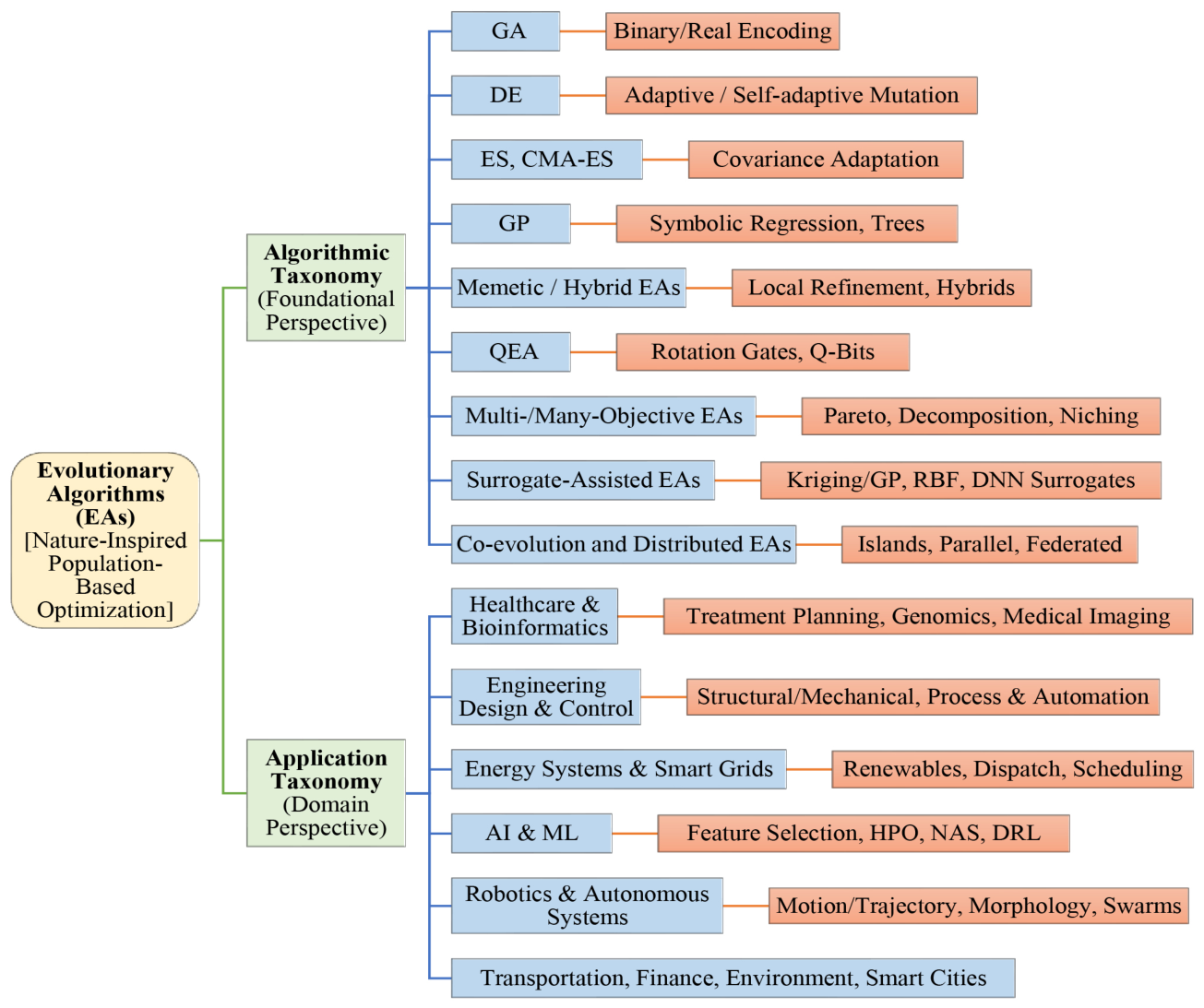
Figure 2.
Categorization of ENAS frameworks into EA-based, swarm intelligence-based, and hybrid evolutionary search strategies used for neural architecture optimization.
Figure 2.
Categorization of ENAS frameworks into EA-based, swarm intelligence-based, and hybrid evolutionary search strategies used for neural architecture optimization.
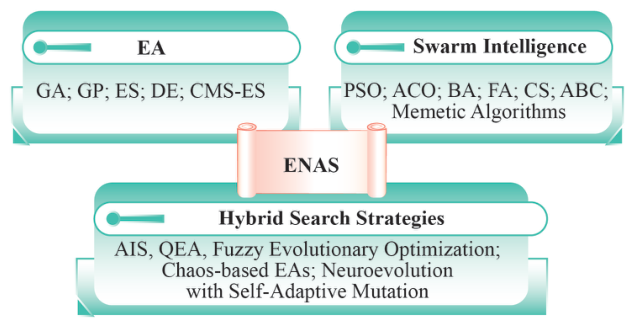
Figure 3.
Challenges and corresponding solution strategies in evolutionary algorithms, illustrating key limitations such as scalability, parameter sensitivity, and computational cost along with their common mitigation approaches.
Figure 3.
Challenges and corresponding solution strategies in evolutionary algorithms, illustrating key limitations such as scalability, parameter sensitivity, and computational cost along with their common mitigation approaches.
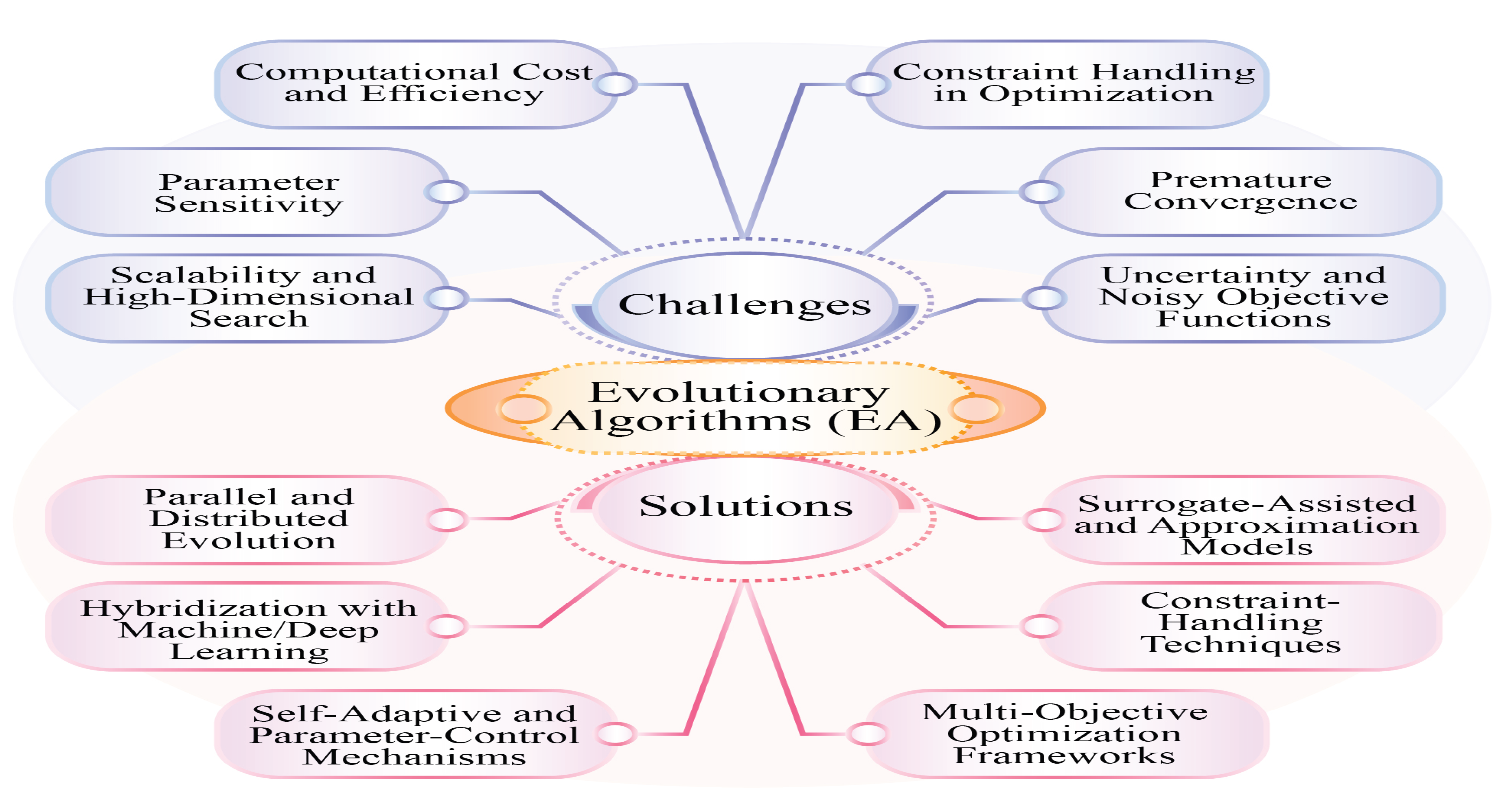
Figure 4.
Conceptual workflow illustrating the integration of LLMs with EAs.
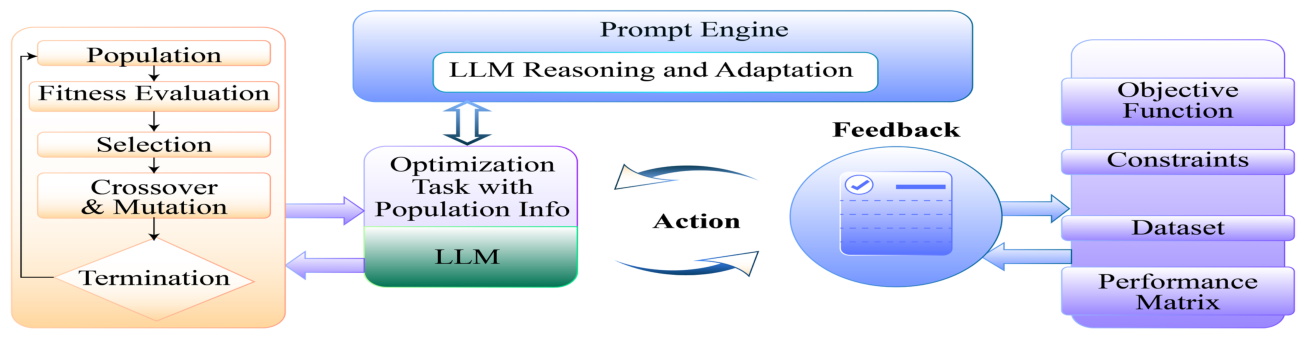
Table 1.
Relation between EA mechanisms and exploration–exploitation behavior.
| Mechanism | Primary Role | Exploration | Exploitation | Control Parameter |
|---|---|---|---|---|
| Initialization | Provide diverse starting points | High | Low | Population size N |
| Selection | Prefer high-quality solutions | Low | High | Selection pressure |
| Crossover | Recombine traits | Moderate | Moderate | |
| Mutation | Inject random variations | High | Low | |
| Elitism | Preserve top individuals | Low | Very High | Elite ratio |
| Termination | Stop search | – | – |
Table 2.
Taxonomy of Classical Evolutionary Algorithms: algorithmic principles, strengths/weaknesses, and ideal application contexts.
Table 2.
Taxonomy of Classical Evolutionary Algorithms: algorithmic principles, strengths/weaknesses, and ideal application contexts.
| Category | Core Principle | Representation | Application Scope | Representative Variants | Key Strengths / Weaknesses | Ideal Application Context |
|---|---|---|---|---|---|---|
| GA [27,28] | Survival of fittest via crossover/mutation | Binary, real, permutation | Single/multi-objective, constrained, dynamic | Canonical GA, Micro-GA, NSGA-II, NSGA-III, Quantum-GA | Strengths: flexible encoding, rich operators, great for discrete structure. Weaknesses: premature convergence, encoding sensitivity, weak on high-dim continuous spaces. | Scheduling, routing, feature selection, topology/structure design. |
| ES / CMA-ES [29] | Self-adaptive mutation; covariance adaptation | Real-valued vectors | Continuous, constrained, noisy, dynamic | CMA-ES, LM-CMA, MA-ES, NES, RS-CMSA | Strengths: rotation-invariant search, excellent on ill-conditioned landscapes. Weaknesses: updates, large evaluation budgets; poor direct handling of discrete variables. | Robotics, aerospace, photonics, mechatronic design, continuous black-box problems. |
| DE [30] | Differential mutation + crossover | Real-valued vectors | Continuous, dynamic, multi-objective | JADE, SHADE, L-SHADE, jDE, CoDE, SaDE | Strengths: simple and competitive on multimodal continuous spaces. Weaknesses: mutation relies on vector arithmetic → unsuitable for permutations; stagnation risk. | Antenna design, renewable energy, controller tuning, process control. |
| EP [31] | Mutation-driven evolution; stochastic selection | Real-coded, Gaussian/Cauchy | Continuous, dynamic, uncertain | Fast-EP, Adaptive EP, Mixed-Mutation EP, ADM-EP | Strengths: stable under noise, conceptually simple. Weaknesses: weak recombination, slower exploitation compared to CMA-ES/DE. | Power/traffic systems, uncertain environments, signal optimization. |
| GP [32,33] | Evolution of symbolic expressions/programs | Tree-, graph-, grammar-based | Symbolic regression, classification, model discovery | CGP, GEP, semantic GP, multi-gene GP | Strengths: interpretable symbolic structures; rule discovery. Weaknesses: computationally expensive, bloat, unstable in high-dim continuous tasks. | Symbolic modeling, control law discovery, program synthesis, explainable ML. |
Table 3.
Taxonomy of Advanced Evolutionary Algorithms: multi-objective, hybrid, learning-enhanced, and quantum evolutionary paradigms.
Table 3.
Taxonomy of Advanced Evolutionary Algorithms: multi-objective, hybrid, learning-enhanced, and quantum evolutionary paradigms.
| Category | Core Principle | Representation | Application Scope | Representative Variants | Key Strengths / Weaknesses | Ideal Application Context |
|---|---|---|---|---|---|---|
| MOEA [34] | Pareto dominance / decomposition | Real or mixed encoding | Multi-objective, constrained, large-scale | NSGA-II, NSGA-III, MOEA/D, SPEA2, HypE | Strengths: explicit trade-offs, strong diversity maintenance. Weaknesses: dominance weakens with many objectives; parameter sensitivity. | Engineering design, smart grids, manufacturing, resource scheduling. |
| MaOEA [35] | Indicator/vector-based selection for objectives | Real-valued or indicator-based | Many-objective, dynamic, large-scale | MaOEA-IGD, MOEA/DD, MaOEA-R2, ref-vector MaOEA | Strengths: scalable preference modeling. Weaknesses: complex reference set design; harder decision support. | Climate modeling, multi-robot coordination, multi-criteria design. |
| Memetic / Hybrid EAs [36,37] | EA + local search, heuristics, ML/DL models | Binary, real, hybrid | Dynamic, constrained, multi-objective | GA+BDD, DE+PSO, EA+RL, EA+DNN | Strengths: strong exploitation, improved convergence speed/quality. Weaknesses: higher complexity; dependence on domain knowledge or local solvers. | Industrial automation, medical image segmentation, adaptive control, design automation. |
| QEA [38,39] | Qubit superposition, rotation gates | Qubit amplitudes | Combinatorial, stochastic, multi-objective | QEA, QIGA, QD-EA, quantum NSGA-II, QDistEvol | Strengths: high diversity via superposition; quantum-inspired operators. Weaknesses: simulator cost; limited scalability; hardware constraints. | Quantum circuit design, cryptography, hybrid quantum–classical pipelines. |
Table 4.
Recent advances in Genetic Programming (GP): core contributions, objectives, and outcomes.
| Problem / Domain | Representation | Main Idea / Contribution | Objective(s) | Data / Benchmark |
|---|---|---|---|---|
| Symbolic Regression [86] GitHub [87] GitHub | Linear / Tree GP | Semantic encoding with mutate-and-divide propagation; counterexample-driven search with SMT verification | Error, Size, Feasibility | SR benchmarks (UCI, real-world) |
| High-dim Classification [88] [96] | Tree GP (MO-GP / NRS) | Multiobjective GP with feature-archive mining; rough-set detection for class overlap in unbalanced data | Accuracy, Diversity, F1/AUC | High-dimensional datasets |
| Dynamic Scheduling [90,91,92] | Linear / Grammar GP | Multitask LGP and grammar-guided LGP for interpretable, small scheduling heuristics | Makespan, Interpretability, Transferability | DFJSS / DJSS benchmarks |
| Routing Optimization [89,97] | GP Hyper-heuristic | -dominance strategy with archive; knowledge transfer using auxiliary population | Effectiveness, Policy Size | UCARP and related routing tasks |
| Federated / Privacy-aware SR [93] GitHub | Gene Expression | Federated GP with mean-shift aggregation and self-learning GEP for decentralized SR | Error, Privacy, Generalization | Distributed SR datasets |
| Program Synthesis & Testing [94,95] GitHub | Tree GP | Comparison of GP and LLMs on synthesis benchmarks | Success Rate, Fault Detection | PSB / Java benchmarks |
| Swarm Robotics [98] | Tree GP + Multi-agent Sim | GP-evolved behavior primitives enabling decentralized swarm control for shape formation | Completion Time, Generalization | DSF synthetic and real tasks |
| Feature Construction & FS [99,100] | Modular / Tree GP | Multi-tree modular GP for reusable features; feature removal impact for high-dimensional SR | Accuracy, Feature Reduction, Size | SRBench, regression datasets |
| Active, Explainable GP [101,102] | Ensemble / Survey | Pareto-guided active learning via uncertainty-diversity metrics; taxonomy of intrinsic vs post-hoc interpretability | Label Efficiency, Interpretability | SR pools / literature review |
Table 5.
Comparison of EA-Based NAS Methods on CIFAR-10 and CIFAR-100 Datasets. A dash (–) indicates results not reported in the original paper.
Table 5.
Comparison of EA-Based NAS Methods on CIFAR-10 and CIFAR-100 Datasets. A dash (–) indicates results not reported in the original paper.
| Model | Year | CIFAR-10 | CIFAR-100 | Resorces Link | ||||
|---|---|---|---|---|---|---|---|---|
| Params (M) | Error (%) | GPU Days | Params (M) | Error (%) | GPU Days | |||
| SMCSO [112] | 2025 | 3.46 | 2.88 | 1.32 | 3.72 | 19.34 | 2.00 | |
| SPNAS [113] | 2025 | 6.33 | 1.80 | 1.4 | 6.7 | 12.74 | 1.6 | |
| M2M-Net [114] | 2024 | 3.79 | 2.44 | 6.0 | 3.83 | 15.23 | 6.0 | |
| MOEA-PS [108] | 2023 | 3.0 | 2.77 | 2.6 | 5.8 | 18.97 | 5.2 | |
| NPENAS-NP [109] | 2023 | 3.5 | 2.54 | 1.8 | – | – | – | GitHub |
| CGP-NAS [111] | 2023 | 4.04 | 3.70 | 11.5 | 5.9 | 20.63 | 11.28 | |
| ESENet [115] | 2023 | 4.53 | 3.56 | 9.0 | 4.53 | 23.65 | 9.0 | |
| EEEA-Net-C [110] | 2021 | 3.6 | 2.46 | 0.52 | – | – | – | GitHub |
| FairNAS-A [116] | 2021 | – | 1.80 | 12.0 | – | 12.70 | 12.0 | GitHub |
| CNN-GA [105] | 2020 | 2.9 | 3.22 | 35 | 4.1 | 20.53 | 40 | GitHub |
| AE-CNN [106] | 2020 | 2.0 | 3.44 | 27 | 5.4 | 22.40 | 36 | |
| AE-CNN + E2EPP [107] | 2020 | 4.3 | 5.30 | 7 | – | – | – | |
| CARS [117] | 2020 | 3.6 | 2.62 | 0.4 | – | – | – | GitHub |
Table 8.
Representative works on evolutionary techniques by application area
| Application Area | Examples |
|---|---|
| Engineering Design & Control [19,207] | Structural optimization, robotics, circuit design, controller tuning |
| Energy Systems [196,197] | Unit commitment, smart grids, renewable energy optimization |
| Healthcare & Bioinformatics [3,43,208,209,210,211,212,213,214,215,216] | Medical image segmentation, drug discovery, genomics, feature selection |
| Transportation & Logistics [197,199] | Vehicle routing, lane reservation, supply chain optimization |
| Science & Technology [12,39,217] | Quantum computing, innovation management, scientometric analysis |
| Neural architecture search (NAS) [37,66,205,218,219] | Differentiable NAS, self-adaptive weights, dual-attention mechanisms, evolutionary NAS |
| Creative Domains [220,221] | Music composition, evolutionary art, image/video generation |
| Environmental Science [222,223,224] | Climate modeling, pollution monitoring, resource allocation |
| Games & Artificial Intelligence [225,226] | NPC behavior evolution, strategy games, EA+RL hybrids |
| Education & Social Systems | Curriculum optimization, policy design, social simulations |
Disclaimer/Publisher’s Note: The statements, opinions and data contained in all publications are solely those of the individual author(s) and contributor(s) and not of MDPI and/or the editor(s). MDPI and/or the editor(s) disclaim responsibility for any injury to people or property resulting from any ideas, methods, instructions or products referred to in the content. |
© 2026 by the authors. Licensee MDPI, Basel, Switzerland. This article is an open access article distributed under the terms and conditions of the Creative Commons Attribution (CC BY) license (http://creativecommons.org/licenses/by/4.0/).
Copyright: This open access article is published under a Creative Commons CC BY 4.0 license, which permit the free download, distribution, and reuse, provided that the author and preprint are cited in any reuse.