

Submitted:
30 May 2026
Posted:
01 June 2026
You are already at the latest version
Abstract
Background/Objectives: Primary care access in Alberta, Canada is dictated by geography, attachment, timeliness, continuity, and local service burdening. Physician and primary care delivery in rural communities are subject to travel burden, workforce fragility, and intermittency, while suburban communities have immediate proximity to facilities, but are also challenged by delayed access, low attachment, and fragmented episodic care. These access challenges are echoed in rural and frontier contexts in the United States including the state of Wyoming. In this systematic review and narrative synthesis we investigated if and how care coordination between community pharmacists and family physicians, increases primary care access in rural and suburban Alberta, and how transferable those findings are to rural Wyoming and other similar frontier settings. Methods: We searched PubMed/MEDLINE, Embase, Scopus, CINAHL, and the Cochrane Library using controlled vocabulary and free-text terms to identify English-language peer-reviewed studies and practice-relevant evidence published from 1 January 2010 to 19 April 2026 related to primary care access, rural, suburban and frontier settings, Alberta, Wyoming, community pharmacy, pharmacist prescribing, physician-pharmacist collaboration, medication management, chronic disease care, continuity, and emergency department use. Earlier landmark primary-care, physician-pharmacist collaboration, and medication-safety studies were retained only when necessary for conceptual framing. Results: We screened 34 eligible records for inclusion in the narrative synthesis, and seven official contextual sources were included for jurisdictional interpretation. Strong evidence demonstrates that pharmacists are accessible primary care extenders where community services are coordinated with family physicians through documentation, referral pathways, red-flag protocols, and shared medication plans. The strongest evidence is specific to hypertension, cardiovascular risk reduction, and medication management and chronic disease monitoring. Direct Alberta-Wyoming comparative intervention evidence is limited. Conclusions: Physician-pharmacist coordinated care should be implemented prospectively as a geographically tailored access model, not a physician replacement model, with evaluation of access, continuity, medication safety, emergency department use and equity.
Keywords:
primary care access
; rural health
; suburban health
; Alberta
; Wyoming
; community pharmacists
; family physicians
; physician-pharmacist collaboration
; pharmacist prescribing
; medication management
; chronic disease
; emergency department utilization
; narrative synthesis
1. Introduction
Access to primary care is a foundational determinant of health-system performance as early first-contact care, longitudinal relationships, preventive counseling, medication management, and chronic disease monitoring influence downstream emergency department use, hospitalization, patient experience, and equity [1,2,3]. Access to primary care is not simply the physical presence of a clinician. The patient-centred access framework proposed by Levesque and colleagues conceptualizes access at the interface between health-system dimensions and population abilities, including approachability, acceptability, availability and accommodation, affordability, and appropriateness [1]. This multidimensional model is important when evaluating rural, suburban, and frontier communities as different communities can experience different access failures within the same health system.
Rural healthcare in Canada has long been associated with workforce shortages, long travel distances, service fragility, and reduced availability of specialized and allied health services [3,4]. Alberta-specific evidence illustrates how geography can become a practical access barrier. Spatial-access studies of people with osteoarthritis in Alberta identified rural-urban differences in local and non-local primary care use and showed that rural and remote communities may experience substantially longer realized travel times to general practitioners, orthopedic surgeons, and physiotherapists than metropolitan communities [8,9]. These studies are disease-specific, but they demonstrate a broader health-planning principle: local access, travel time, and continuity should be measured directly rather than assumed from the presence of a regional service.
Suburban Alberta presents a different access problem. Suburban communities usually have greater physical proximity to clinics, pharmacies, urgent care centres, and metropolitan health infrastructure than remote communities, but proximity does not guarantee attachment, same-day access, continuity, or appropriateness. A large Canadian survey found persistent gaps in primary care attachment and urgent appointment access, and Alberta policy analyses have described a substantial post-pandemic shortage of family physician services [5,6]. Therefore, suburban access problems may be expressed less as distance and more as delayed appointments, low attachment, walk-in dependence, repeated episodic care, and poor information flow between providers.
Comparisons to the United States are clinically and policy relevant, but the Alberta-Wyoming comparison should not be understood as a comparison of jurisdictions with equivalent total population size. Rather, Wyoming was chosen because it illustrates a rural/frontier access context in which geography, dispersed communities, travel distance, workforce pressure, and local professional relationships shape the practical availability of primary care in ways that are meaningfully comparable to the rural access mechanisms identified in Alberta. Alberta also includes large metropolitan and suburban corridors, whereas Wyoming provides a more explicitly frontier comparator; this contrast is useful because it separates absolute population size from the access mechanisms that matter most for service delivery. Health Resources and Services Administration data showed 47 primary care Health Professional Shortage Area designations in Wyoming as of March 31, 2026, with 243,465 people in shortage-designated areas and 30 additional practitioners estimated as needed to remove designations [11]. The Wyoming Office of Rural Health has jurisdictional responsibility for workforce and shortage-designation analysis, technical assistance, collaboration, and telecommunications-enabled access to care for underserved populations [12]. Qualitative and policy research unique to Wyoming also shows that rural patients in the state value trust, communication, adequate time with providers, and the impact of practical barriers such as weather, distance, and payer constraints [13,14]. These findings make the Alberta-Wyoming comparison methodologically defensible despite the two jurisdictions' differences in population scale, insurance structure, regulation, and reimbursement.
Community pharmacists are positioned at an important interface between these access problems. They are widely distributed, frequently available without appointment, and often contacted more frequently than physicians by patients requiring medications, monitoring, or self-care advice. United States Medicare data show that older adults visit community pharmacies more often than they encounter primary care physicians, with the difference particularly large in rural nonmetropolitan areas [16]. United States geographic-access studies also show that most people live near a community pharmacy, although rural access remains more vulnerable than suburban or urban access and depends heavily on independent or regional pharmacies [17,18]. In Alberta, pharmacist scope has expanded to include prescribing authorities, medication adaptation and renewal, injection services, laboratory test ordering and interpretation, and other clinical services for appropriately authorized pharmacists [19,20,21].
The question is not: Should pharmacists replace family physicians? A more clinically relevant question is: Can coordinated pharmacist-family physician care expand the effective capacity of primary care systems while retaining continuity, medication safety, and diagnostic escalation? Coordination is critical, since speeding access may increase fragmentation if the pharmacy encounter is disconnected from the patient's regular clinic, shared medication list or follow-up plan [7,8]. This systematic review therefore synthesizes evidence on access barriers, pharmacy access, pharmacist prescribing, community pharmacy care clinics, physician-pharmacist collaboration, chronic disease outcomes, emergency department use, medication safety, and Alberta-Wyoming transferability.
2. Materials and Methods
2.1. Protocol and Review Question
A structured review protocol was developed before synthesis but was not registered in PROSPERO or another public registry. A public protocol is therefore not available. The review was conducted as a systematic review with narrative synthesis because the evidence base included heterogeneous study designs, jurisdictions, access indicators, intervention models, and outcomes. The manuscript was prepared in accordance with the Preferred Reporting Items for Systematic Reviews and Meta-Analyses (PRISMA) 2020 statement where applicable to a narrative synthesis without meta-analysis [43].
The review question was framed as follows: among adults and families living in rural and suburban Alberta, and in comparable rural/frontier United States settings exemplified by Wyoming, how does coordinated community pharmacist-family physician care, compared with usual physician-centred or fragmented episodic access pathways, influence timely access, medication management, chronic disease monitoring, continuity, emergency department utilization, medication safety, and equity?
2.2. Eligibility Criteria
Eligibility criteria were designed to capture Alberta-specific access evidence, Canadian pharmacy practice evidence, and United States/Wyoming comparator evidence relevant to transferability. The prespecified contemporary publication window for included peer-reviewed and practice-relevant evidence was 1 January 2010 to 19 April 2026. Earlier landmark primary-care, physician-pharmacist collaboration, and medication-safety studies were retained only when necessary for conceptual framing or foundational interpretation. Because few studies directly compare rural and suburban Alberta with rural Wyoming under a coordinated pharmacist-family physician model, transferable evidence was included when the mechanism of access or care coordination was clearly relevant.

Table 1.
Eligibility criteria for the systematic review.
| Domain | Inclusion criteria | Exclusion criteria |
| Population | Adults, families or general community populations living in rural, remote, suburban, peri-urban, small urban, frontier or metropolitan settings, with priority given to Alberta, Canadian and Wyoming/U.S. frontier evidence. | Pediatric-only studies unless the access model applied to whole-community primary care; inpatient-only cohorts; studies without community access relevance. |
| Intervention/exposure | Community pharmacist-led, pharmacist-integrated or pharmacist-family physician coordinated care; pharmacist prescribing; medication review; chronic disease monitoring; common-ailment care; point-of-care testing; referral; telepharmacy; collaborative practice agreements; shared care plans. | Dispensing-only studies, product-supply-only papers, pharmacy workforce papers without patient-care implications, or models not linked to primary care access. |
| Comparator/context | Usual care; physician- or nurse-practitioner-centred care; local versus non-local care; rural versus suburban/urban access; pre-post implementation of pharmacy services; U.S. frontier comparator contexts. | Studies with no interpretable comparator, access context, coordination mechanism or implementation relevance. |
| Outcomes | Attachment, appointment timeliness, travel distance/time, local care use, emergency department or urgent-care use, medication access, medication safety, chronic disease markers, cardiovascular risk, patient experience, continuity, equity and implementation outcomes. | Studies reporting only attitudes or awareness without access, service-use, clinical, safety or implementation outcomes. |
| Designs | Systematic reviews, randomized trials, cohort studies, cross-sectional studies, routine-data studies, qualitative and mixed-methods studies, and highly relevant policy/regulatory documents used for context. | Narrative opinion pieces without evidence unless used only for policy context; editorials without implementation relevance; animal or laboratory studies. |
| Publication window | Peer-reviewed evidence and selected official sources from 1 January 2010 to 19 April 2026; earlier landmark primary-care and medication-safety studies were retained when necessary for conceptual framing. | Superseded policy documents, non-English texts that could not be reliably interpreted, or conference abstracts without sufficient data unless describing a very recent Alberta pharmacy access model. |
2.3. Information Sources and Search Strategy
Search strategies were specified for PubMed/MEDLINE, Embase, Scopus, CINAHL, and the Cochrane Library. The last search was conducted on 19 April 2026. Searches combined controlled vocabulary and free-text terms for primary care access, rural health, suburban or peri-urban settings, frontier settings, Alberta, Canada, Wyoming, community pharmacists, pharmacist prescribing, physician-pharmacist collaboration, pharmacy clinics, chronic disease management, medication review, medication safety, emergency department use, and continuity of care. Reference lists of included reviews and key Alberta, Canadian, and United States pharmacy-access studies were checked for additional eligible publications. Grey literature was restricted to official health-system, regulatory, or shortage-area documents used to interpret current jurisdictional context; these documents were not treated as intervention-effect studies.
The PubMed/MEDLINE core search string was: ("Primary Health Care"[Mesh] OR "Health Services Accessibility"[Mesh] OR access*[tiab] OR attachment[tiab] OR continuity[tiab] OR "care coordination"[tiab] OR "emergency department"[tiab] OR "ambulatory care sensitive"[tiab]) AND (rural[tiab] OR remote[tiab] OR suburban[tiab] OR periurban[tiab] OR "peri-urban"[tiab] OR frontier[tiab] OR Alberta[tiab] OR Canada[tiab] OR Wyoming[tiab] OR "United States"[tiab]) AND (pharmacist*[tiab] OR pharmacy[tiab] OR "community pharmacy"[tiab] OR "pharmacist prescribing"[tiab] OR "physician pharmacist"[tiab] OR "family physician pharmacist"[tiab] OR "collaborative practice"[tiab] OR "minor ailment"[tiab] OR "common ailment"[tiab]) AND ("2010/01/01"[Date - Publication] : "2026/04/19"[Date - Publication]).
The Embase core string was: (primary health care/exp OR health care access/exp OR access*:ti,ab OR attachment:ti,ab OR continuity:ti,ab OR 'care coordination':ti,ab OR 'emergency department':ti,ab OR 'ambulatory care sensitive':ti,ab) AND (rural:ti,ab OR remote:ti,ab OR suburban:ti,ab OR periurban:ti,ab OR 'peri-urban':ti,ab OR frontier:ti,ab OR Alberta:ti,ab OR Canada:ti,ab OR Wyoming:ti,ab OR 'United States':ti,ab) AND (pharmacist/exp OR pharmacy/exp OR pharmacist*:ti,ab OR 'community pharmacy':ti,ab OR 'pharmacist prescribing':ti,ab OR 'physician pharmacist':ti,ab OR 'collaborative practice':ti,ab OR 'minor ailment':ti,ab OR 'common ailment':ti,ab) AND [2010–2026]/py AND [humans]/lim.
The Scopus core string was: TITLE-ABS-KEY(access* OR attachment OR continuity OR "care coordination" OR "emergency department" OR "ambulatory care sensitive") AND TITLE-ABS-KEY(rural OR remote OR suburban OR periurban OR "peri-urban" OR frontier OR Alberta OR Canada OR Wyoming OR "United States") AND TITLE-ABS-KEY(pharmacist* OR pharmacy OR "community pharmacy" OR "pharmacist prescribing" OR "physician pharmacist" OR "collaborative practice" OR "minor ailment" OR "common ailment") AND PUBYEAR > 2009 AND PUBYEAR < 2027.
The CINAHL core string was: (MH "Primary Health Care" OR MH "Health Services Accessibility" OR access* OR attachment OR continuity OR "care coordination" OR "emergency department") AND (rural OR remote OR suburban OR periurban OR "peri-urban" OR frontier OR Alberta OR Canada OR Wyoming OR "United States") AND (pharmacist* OR pharmacy OR "community pharmacy" OR "pharmacist prescribing" OR "physician pharmacist" OR "collaborative practice" OR "minor ailment" OR "common ailment"), limited to human studies published from 2010 to 2026.
The Cochrane Library core string was: (rural OR remote OR suburban OR frontier OR Alberta OR Canada OR Wyoming OR "United States") AND (primary care OR access OR continuity OR coordination OR emergency department) AND (pharmacist OR pharmacy OR "community pharmacy" OR prescribing OR "physician pharmacist" OR "collaborative practice" OR "minor ailment" OR "common ailment" OR "pharmacy care clinic").
2.4. Study Selection and Data Extraction
Titles, abstracts, and full texts were screened against the eligibility criteria by the author team. Records were first assessed for relevance to primary care access, rural/suburban/frontier context, community pharmacy, pharmacist-family physician coordination, medication management, chronic disease care, or emergency department use. Full-text reports were then assessed for population, intervention or exposure, comparator or context, outcomes, and relevance to Alberta-Wyoming transferability. Disagreements were resolved by discussion until consensus was reached. No automation tools were used to make eligibility decisions.
Extracted data included study design, country/province/state, rural/suburban/frontier comparator, population, pharmacist role, family physician or prescriber coordination mechanism, access outcome, chronic disease or medication-management outcome, emergency department or health-system utilization outcome, implementation considerations, and limitations. Where available, summary statistics and effect estimates were extracted. Where summary statistics were not directly comparable across studies, findings were synthesized narratively and tabulated by mechanism. Study selection was summarized using a PRISMA 2020-style flow diagram [43]
The finalized evidence set and Alberta-Wyoming comparator update yielded 34 distinct eligible peer-reviewed or practice-evaluation records to undergo narrative synthesis. Seven official policy, regulatory, data, or methodological sources were referenced for contextual interpretation of jurisdictional context, reporting standards, scope of practice, or shortage-area definitions, but were not considered intervention-effect studies.
2.5. Quality and Certainty Assessment
Methodological quality was evaluated using applicable Critical Appraisal Skills Programme checklists, and certainty was synthesized using GRADE domains (risk of bias, inconsistency, indirectness, imprecision, and other considerations including magnitude of effect and applicability) [41,42]. Randomized pharmacist trials were evaluated for adequacy of allocation, follow-up, outcome measurement, and intervention fidelity. Observational access studies were evaluated for representativeness, exposure and outcome ascertainment, confounding, and ecological limitations. Systematic reviews were evaluated for search completeness, eligibility clarity, risk-of-bias assessment, and synthesis appropriateness. Jurisdictional transferability was evaluated separately because evidence generated in Alberta, Canada, the United States, or Wyoming may differ in reimbursement, scope, documentation, and referral pathways.
2.6. Synthesis
Meta-analysis was not considered feasible across the evidence on such heterogeneous access indicators, intervention models, jurisdictions, and outcome definitions. Narrative synthesis methods were employed, organizing results across six a priori themes: (1) barriers to rural and suburban access to care in Alberta; (2) comparability of Wyoming and United States frontier-state contexts; (3) community pharmacy as a geographic and temporal point of access; (4) pharmacist-family physician coordination for chronic disease management; (5) common ailments, emergency department use, and medication safety; and (6) conditions of implementation needed to maintain continuity and equity. Comparisons were used to explore heterogeneity by jurisdiction, rurality, scope of interventions, coordination mechanism, type of outcomes assessed, and study design. Pooled measures of effect, sensitivity analyses, and statistical tests for reporting bias were not performed as the evidence base was deemed not amenable to quantitative synthesis. Interpretation of the transferability of jurisdictional experiences was informed by the cross-jurisdictional composition of the review team, which provided Alberta primary care and community pharmacy perspectives, as well as Wyoming advanced practice nursing and rural/frontier healthcare perspectives.
3. Results
3.1. Study Selection
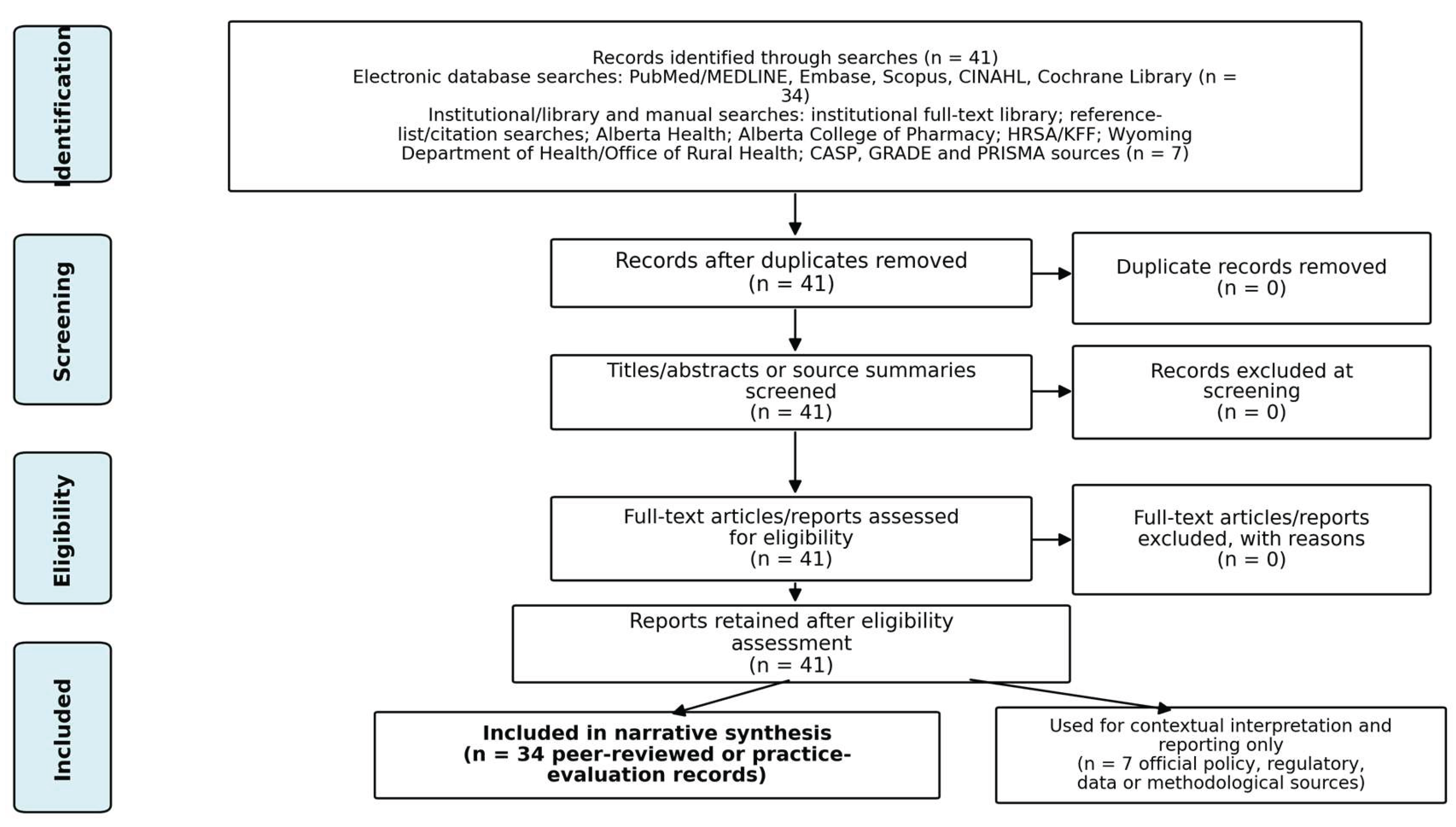
Search and targeted comparator update yielded 34 unique eligible records for narrative synthesis, after removal of duplicates and checking citations. All eligible records were retrieved. Seven contextual sources were cited separately to support interpretation of jurisdictional coverage, pharmacist scope of practice, definitions of shortage-areas, and reporting guidance. The PRISMA 2020-style flow diagram is shown in Figure 1.
3.2. Characteristics of the Evidence Base
The four components of the evidence base each represented overlapping bodies of literature. The first described primary care access and rural-urban disparities in Canada and Alberta, specifically: conceptual frameworks and Canadian survey data [1,2,3]; Alberta continuity research, Alberta primary care reform analysis, and Alberta spatial-access studies [4,5,6,7,8,9,10]; the second described Wyoming and United States frontier-state access problems, specifically: shortage-area data, Wyoming rural health policy context, and rural patient experience research [11,12,13,14]; the third evaluated community pharmacists as accessible primary care extenders, specifically: pharmacy accessibility, pharmacist prescribing, pharmacy care clinics, common-ailment services, and chronic disease management [16,17,18,19,20,21,22,23,24,25,27,28,29,30,31,32,33,34,35]; and the fourth addressed coordination and safety, specifically: physician-pharmacist collaboration, continuity, medication-related emergency visits, and medication harms [26,29,30,31,32,33,34,35,36,37,38,39,40].
There was limited direct evidence of comparison of rural Alberta, suburban Alberta and rural Wyoming under the same jurisdictional coordinated pharmacist-family physician model. As such, the results of this review should be viewed as a synthesis of clinically transportable mechanisms as opposed to evidence that one jurisdictional model will reliably yield the same effect in another setting. The strongest direct clinical evidence related to pharmacist's role in management of blood pressure, cardiovascular risk and chronic disease medication therapy; the weakest evidence related to ED substitution and rural versus suburban comparative effectiveness.
Table 2.
Summary of included studies and key contextual sources relevant to coordinated primary care access in Alberta, Wyoming and comparable settings.
Table 2.
Summary of included studies and key contextual sources relevant to coordinated primary care access in Alberta, Wyoming and comparable settings.
| Study/source | Design and setting | Access or coordination focus | Interpretation for Alberta-Wyoming comparison |
| Levesque et al., 2013 [1] | Conceptual framework for patient-centred access. | Defines access through health-system dimensions and population abilities. | Supports interpreting Alberta and Wyoming access as multidimensional rather than distance alone. |
| Kiran et al., 2024 [5] | Canadian cross-sectional survey of primary care experiences. | Examined attachment, urgent appointment access and patient priorities. | Shows that access problems persist even where physical proximity may be reasonable. |
| Jacobs et al., 2025 [6] | Alberta primary care reform analysis. | Quantified family physician and nurse practitioner requirements to address unmet primary care needs. | Supports the need for team-based extension of capacity rather than relying only on physician recruitment. |
| McDonald et al., 2024 [7] | Alberta retrospective continuity study. | Examined clinic and family physician continuity in relation to outcomes and utilization. | Supports designing pharmacy access to strengthen, not weaken, continuity. |
| Liu et al., 2022 [8,9] | Alberta non-local care and spatial-access studies. | Measured rural-urban patterns in local care use and travel times. | Supports rural travel burden and local-service availability as Alberta access targets. |
| KFF/HRSA and Wyoming Office of Rural Health [11,12] | Official shortage-area and rural health context. | Described primary care HPSA designations and workforce/access functions in Wyoming. | Supports Wyoming as an appropriate U.S. frontier comparator. |
| Singh et al., 2018 [13] | Wyoming qualitative focus group study. | Identified rural patient expectations, trust, communication and engagement barriers. | Adds patient-centred evidence that rural access is relational as well as geographic. |
| Bodenheimer and Smith, 2013 [15] | U.S. primary care capacity analysis. | Argued that demand-capacity gaps can be addressed through team-based roles including pharmacists. | Supports coordinated role extension rather than physician substitution. |
| Berenbrok et al., 2020 [16] | U.S. Medicare cross-sectional study. | Compared pharmacy visits with primary care physician encounters. | Supports pharmacists as frequent contact points, especially in rural nonmetropolitan areas. |
| Berenbrok et al., 2022; Sharareh et al., 2024 [17,18] | U.S. national pharmacy-access analyses. | Mapped pharmacy proximity and drive-time access by rurality. | Supports pharmacy as accessible infrastructure while emphasizing rural vulnerability. |
| Tannenbaum and Tsuyuki; Raiche et al. [19,20] | Canadian pharmacist-scope literature. | Described expanded pharmacist roles and Canadian scope variability. | Supports Alberta-specific implementation rather than assuming uniform scope across jurisdictions. |
| Ramrattan et al.; Al Hamarneh et al. [23,24] | Alberta pharmacy care clinic evidence and evaluation framework. | Described clinic use and proposed ED outcome classification for pharmacy care clinics. | Directly relevant to Alberta implementation and ED evaluation. |
| Walpola et al., 2024 [25] | Systematic review of pharmacist prescribing and medicine access. | Synthesized effects of pharmacist prescribing on access to medicines. | Supports prescribing as a timely-access mechanism, with implementation caveats. |
| Chaudhri et al., 2023 [26] | Systematic review/meta-analysis of GP-pharmacist collaboration. | Examined effects of bidirectional collaboration on cardiovascular risk factors. | Supports care coordination between prescribers and pharmacists. |
| Tsuyuki et al.; Hunt et al.; McLean et al. [27,28,29,30] | Randomized pharmacist or pharmacist-physician chronic disease trials. | Evaluated hypertension and cardiovascular risk management. | Provides strongest clinical evidence for coordinated pharmacist roles. |
| Cheema et al.; Coutureau et al.; Newman et al. [31,32,33] | Systematic reviews/umbrella review of pharmacist chronic disease interventions. | Synthesized hypertension, diabetes and chronic disease outcomes. | Supports generalizability of pharmacist chronic disease management beyond a single trial. |
| Paudyal et al.; Chambers et al. [34,35] | Systematic reviews of minor ailments and medicines optimization. | Evaluated substitution, optimization and overprescribing initiatives. | Supports common-ailment and medication optimization pathways when safety and referral criteria are explicit. |
| Matzke et al.; Rodis et al. [36,37] | U.S. collaborative care and FQHC pharmacist models. | Evaluated or described pharmacist integration in physician-linked primary care settings. | Supports U.S. feasibility of integrated pharmacist care within primary care infrastructure. |
| Zed et al.; Samoy et al.; Juurlink et al. [38,39,40] | Medication-safety studies. | Documented medication-related ED visits, hospitalizations and drug-drug interaction risks. | Supports monitoring medication safety as both a benefit and risk of expanded pharmacy roles. |
3.3. Rural and Suburban Access Barriers in Alberta
Geographic and service-distribution evidence provide the strongest support for the rural Alberta access problem. Alberta spatial-access studies have shown that rural and remote communities are more likely to experience longer travel times and higher non-local utilisation, particularly when seeking services outside of routine primary care [8,9]. These barriers are not simply a matter of inconvenience. For the management of chronic disease, medication titration, preventive follow-up and post-discharge care, travel burden can result in delayed assessment, less frequent monitoring, and greater use of urgent or episodic alternatives.
Travel-time measures have done less well at representing access to primary care in the suburbs. Suburbanites may live close to clinics or pharmacies, yet remain unattached to a longitudinal clinician, unable to get same-day advice, or forced to shuttle among walk-in clinics, urgent care clinics, and emergency departments. Survey evidence from Canada and evidence from Alberta health reform experiences [5,6] suggest that attachment and timeliness of appointments continue to be major problems even when health services are in walking distance or a short drive. As a result, access in suburban Alberta should be measured in terms of attachment, access to same-or next-day appointments, communication with one's regular clinic, walk-in clinic use, urgent-care clinic use, emergency department diversion, and continuity, rather than just travel time.
The rural-suburban distinction also has implications for implementation. Rural models should focus on local assessment, travel minimization, community-based monitoring and communication with a regional physician or nurse practitioner. Suburban models should focus on timeliness, follow-up of chronic diseases, medication continuity, common-ailment pathways and avoidance of disconnected episodic care. In both contexts, access improvements are most likely when community pharmacists are part of a coordinated medical neighbourhood as opposed to a parallel walk-in system.
3.4. Wyoming and U.S. Frontier-State Comparability
Wyoming can provide a useful United States comparator because the comparison is based on access geography and service-delivery constraints rather than on equivalence in total population size. The relevant similarity is that rural Alberta and rural/frontier Wyoming both include dispersed communities where travel burden, weather constraints, workforce recruitment challenges, and reliance on local professional relationships can affect timely access to primary care. Alberta spatial-access evidence shows that rural and remote communities may experience longer travel times and greater reliance on non-local care [8,9]. In Wyoming, HRSA data show that 47 primary care HPSA designations were in effect as of March 31, 2026, affecting 243,465 people in shortage areas and with an additional 30 primary care practitioners estimated to be needed to remove the designations [11]. The Wyoming Office of Rural Health describes the state’s role in workforce and shortage-designation analysis, technical assistance, collaboration, and telecommunications-enabled access [12].
Wyoming-specific qualitative evidence also supports that rural patients appreciate the relationship dimensions of time, trust, respectful communication, explanations, and medication literacy assistance [13]. These aspects of relational continuity are particularly pertinent to coordination between a pharmacist and family physician as the community pharmacist may be the most accessible and proximal health professional who can reinforce medication plans, identify potential red flags, and ensure referral back to the patient's usual clinician. Wyoming policy commentary has also reported that access and cost concerns may eclipse other public health priorities in a largely rural state [14].
The Alberta-Wyoming analogy should not be overstated. Alberta is part of a Canadian provincial health system with wide public insurance and more advanced pharmacist scope. Wyoming is part of the United States system, where insurance, payment, collaborative practice authority, and patient cost-sharing may vary. But the underlying access issue is similar enough for translational interpretation: both settings require coordinated, accountable mechanisms to expand primary care capacity when family physicians are absent, geographically remote, or unable to provide timely follow-up.
3.5. Community Pharmacy as a Geographic and Temporal Access Point
Community pharmacies are often described as accessible because they are widely distributed, routinely used, and commonly available without appointment. United States Medicare data showed that community pharmacy visits outnumbered primary care physician encounters among older adults, and the difference was larger in rural nonmetropolitan areas than in metropolitan areas [16]. A nationwide United States geographic information systems analysis found that almost 90% of Americans lived within five miles of a community pharmacy, but rural access relied heavily on independent and regional pharmacies [17]. A later drive-time study found that rural census tracts had lower pharmacy access than suburban and urban tracts at both 10- and 20-minute drive times [18].
These findings have two implications. First, pharmacies are plausible access points for medication-related assessment, chronic disease monitoring, common ailments, and referral. Second, pharmacy access itself is not guaranteed in rural settings. Rural communities may depend on a single independent pharmacy, and closures or staffing shortages can remove a critical local health access point. Therefore, rural pharmacist-family physician coordination must include sustainability, locum coverage, telehealth linkage, professional support, and clear referral relationships.
For suburban populations, the benefit is typically one of more geographically robust access, with integration being the greatest barrier. While rapid renewal of medications, common-ailment assessment, blood pressure measurement, adherence support, medication reconciliation, and chronic disease monitoring are all examples of services that community pharmacies are capable of providing, if documentation and communication of these encounters does not consistently reach the patient's clinic-of-record, fragmentation may be further exacerbated. Measures of access provided by a suburban pharmacy model should therefore be considered in tandem with those of continuity and safety.
3.6. Pharmacist-Family Physician Coordination and Chronic Disease Management
The strongest clinical evidence for pharmacist integration concerns chronic disease and cardiovascular risk management. Alberta trials are particularly relevant because they were conducted in a jurisdiction where pharmacist prescribing and clinical service reimbursement are comparatively advanced. The RxACTION trial found clinically important blood pressure reductions with pharmacist prescribing for hypertension [27]. The RxEACH trial showed that community pharmacist case finding and prescribing/care reduced cardiovascular risk among patients with poorly controlled cardiovascular risk factors [28]. Earlier interprofessional pharmacist/nurse evidence and United States physician-pharmacist trials similarly support improved hypertension management when pharmacists are integrated into care pathways [29,30].
Systematic reviews support these conclusions. Community pharmacy interventions have been linked to improved blood pressure control [31], pharmacist-led primary care interventions can improve glycemic control in adults with type 2 diabetes [32], and umbrella-review evidence has found clinical, utilization, and economic benefits across the chronic disease spectrum [33]. A systematic review and meta-analysis of general practitioner-pharmacist collaboration found that bidirectional collaboration can improve cardiovascular risk factors, lending support to the particular relevance of coordinated care versus isolated pharmacy activity [26].
The translational lesson for Wyoming is not that Alberta's regulatory scheme is transportable in any lock-step fashion. The mechanism may be transportable; family physicians continue to diagnose, make complex decisions, and provide longitudinal oversight, while pharmacists are available for medication review and titration support, adherence counselling, laboratory or point-of-care follow-up if they have such authority, medication problem identification, and timely referral. It is only defensible when the pharmacist and physician are on the same care plan page with clear communication about medication changes and concordance on red-flag criteria.
3.7. Common Ailments, Emergency Department Use and Medication Safety
Common-ailment pathways may improve timely access when patients can obtain assessment and treatment for defined conditions within pharmacist scope. Systematic review evidence suggests that pharmacy-based minor ailment schemes may substitute for some other provider encounters, but substitution should not be interpreted automatically as improved access [34]. Access gains depend on clear eligibility criteria, red-flag screening, documentation, referral pathways, and follow-up for worsening symptoms or diagnostic uncertainty.
Recent Alberta pharmacy care clinic evidence is directly relevant. A community pharmacy care clinic study in Lethbridge reported substantial use for common ailments, chronic disease management, point-of-care testing, and public health services, with a notable proportion of patients reporting no family physician [24]. An Alberta-informed framework proposed that emergency department outcomes should be evaluated using three groups: pharmacist-manageable primary-care-sensitive conditions, adverse medication events, and medically appropriate emergency department referrals [23]. This framework is important because pharmacist involvement could reduce some low-acuity emergency visits, but it could also increase appropriate referrals when red flags are identified.
Medication safety must be treated as a core outcome, not an afterthought. Medication-related emergency department visits, drug-related hospitalizations, and clinically important drug-drug interactions have been documented in Canadian studies [38,39,40]. Expanded pharmacist roles may reduce these harms through medication reconciliation, interaction review, and adherence support, but prescribing expansion also requires safeguards. The appropriate safety question is whether pharmacist prescribing and medication adaptation are supported by assessment, laboratory information where needed, follow-up, documentation, and referral when the condition exceeds pharmacy scope.
Table 3.
Transferability matrix for Alberta and Wyoming/frontier U.S. settings.
| Domain | Alberta interpretation | Wyoming/U.S. frontier analogue | Synthesis implication |
| Primary access problem | Rural: distance, local service fragility and workforce gaps; suburban: attachment, appointment timeliness and fragmented episodic care. | Frontier/rural: HPSA designations, long travel distances, small-community service dependence and workforce recruitment challenges. | Mechanisms are analogous, but payment and scope differ. |
| Role of family physician | Longitudinal diagnosis, complex care, care plans, referral and continuity. | Primary care physician availability may be limited in shortage areas; continuity may depend on regional or networked care. | Pharmacist access should extend physician capacity, not replace physician-led longitudinal care. |
| Role of community pharmacist | Medication review, adaptation/renewal, prescribing where authorized, chronic disease monitoring, common ailments and referral. | Medication management and collaborative practice can provide local support where physician availability is limited. | Transferability strongest for medication-related and chronic disease follow-up functions. |
| Rural implementation emphasis | Travel reduction, local monitoring, telehealth linkage, regional referral and pharmacy sustainability. | Frontier travel barriers and local pharmacy vulnerability make sustainability central. | Rural models need support for staffing, documentation and cross-site referral. |
| Suburban implementation emphasis | Timely access, medication continuity, common ailments, chronic disease titration and walk-in/urgent-care diversion. | Comparable U.S. suburban access issues may involve insurance and network fragmentation. | Suburban models should measure continuity and fragmentation, not only visit volume. |
| Safety requirements | Red-flag screening, medication reconciliation, lab access when appropriate, documentation and follow-up. | Collaborative practice agreements and referral thresholds are essential where pharmacists act under protocol. | Safety infrastructure is a prerequisite for transferability. |
| Evaluation outcomes | Attachment, timeliness, travel time, local care use, ED use, medication-related ED visits, clinical markers, patient-reported access and equity. | HPSA metrics, ED/urgent-care use, pharmacy access, chronic disease control, medication safety and patient trust. | Comparable outcome sets allow cross-jurisdiction evaluation despite system differences. |
3.8. Certainty of Evidence
Certainty was moderate to high for pharmacist effects on hypertension and cardiovascular risk management, moderate for the accessibility of community pharmacists as frequent patient contact points, low to moderate for improved medication access and common-ailment substitution, low for emergency department impact, and very low for direct rural Alberta versus suburban Alberta versus Wyoming comparative effectiveness. The lower certainty for comparative effectiveness reflects indirectness rather than absence of plausible mechanism.
Table 4.
CASP-informed GRADE summary of key findings.
| Finding | Certainty | Rationale |
| Rural Alberta residents experience greater geographic barriers to local primary care and related services than metropolitan residents. | Moderate | Supported by Alberta spatial-access studies and Canadian rural health literature; magnitude varies by service, community and condition. |
| Suburban residents can face important access barriers even when geographic proximity is better. | Low to moderate | Supported by Canadian survey and Alberta reform evidence; Alberta-specific suburban stratification remains limited. |
| Wyoming and similar U.S. frontier states present access challenges analogous to rural Alberta. | Low to moderate | Supported by HPSA data, Wyoming rural health context and qualitative Wyoming evidence; system differences create indirectness. |
| Community pharmacists are accessible and frequent patient-contact points. | Moderate | Supported by U.S. Medicare and geographic-access studies; rural pharmacy access remains vulnerable. |
| Pharmacist-family physician collaboration improves chronic disease and cardiovascular risk outcomes. | Moderate to high | Supported by randomized trials and systematic reviews, especially for blood pressure and cardiovascular risk factors. |
| Pharmacy-based common-ailment pathways can reduce demand on other providers. | Low to moderate | Supported by systematic review evidence, but access gains depend on scope, triage and communication. |
| Pharmacy care clinics reduce emergency department use for pharmacist-manageable conditions. | Low | Plausible and supported by an Alberta evaluation framework; direct outcome evidence remains emerging. |
| Coordinated pharmacist access strengthens continuity when linked with shared documentation and referral pathways. | Low to moderate | Supported by continuity literature and care coordination logic; direct comparative studies of integrated versus standalone pharmacy access are limited. |
| Pharmacist integration is equally effective in rural Alberta, suburban Alberta and rural Wyoming. | Very low | Direct comparative evidence is sparse; effectiveness likely differs by geography, staffing, reimbursement, scope and referral infrastructure. |
4. Discussion
4.1. Principal Interpretation
The available evidence supports the use of coordinated pharmacist-family physician care as an access-enhancing strategy for rural and suburban Alberta and has direct relevance to rural Wyoming and analogous frontier settings in the United States. The evidence does not support a simplistic claim that the expansion of community pharmacy services alone will solve primary care access problems. The best-supported model is a coordinated, tiered access pathway in which pharmacists provide rapid local support for medication-related needs, common ailments, chronic disease monitoring, cardiovascular risk management, prescription adaptation or renewal, point-of-care testing and referral, while family physicians and other primary care clinicians retain responsibility for diagnosis, complex care, longitudinal management, and escalation.
This perspective is consistent with much of the primary care capacity literature: The issue is not just the number of physicians but the unmet demand of the population relative to the capacity of existing delivery models [15]. Pharmacists can help fill that gap when they are integrated into the primary care team. The benefit is greatest when pharmacists do things for which their training and access position are well suited: medication assessment, adherence support, blood pressure and glycemic monitoring, risk-factor management, common-ailment protocols, medication reconciliation, and early identification of red flags.
4.2. Alberta-Wyoming Comparison and Transferability
The available evidence supports the use of coordinated pharmacist-family physician care as an access-enhancing strategy for rural and suburban Alberta and has direct relevance to rural Wyoming and analogous frontier settings in the United States. The evidence does not support a simplistic claim that the expansion of community pharmacy services alone will solve primary care access problems. The best-supported model is a coordinated, tiered access pathway in which pharmacists provide rapid local support for medication-related needs, common ailments, chronic disease monitoring, cardiovascular risk management, prescription adaptation or renewal, point-of-care testing and referral, while family physicians and other primary care clinicians retain responsibility for diagnosis, complex care, longitudinal management, and escalation.
This perspective is consistent with much of the primary care capacity literature: The issue is not just the number of physicians but the unmet demand of the population relative to the capacity of existing delivery models [15]. Pharmacists can help fill that gap when they are integrated into the primary care team. The benefit is greatest when pharmacists do things for which their training and access position are well suited: medication assessment, adherence support, blood pressure and glycemic monitoring, risk-factor management, common-ailment protocols, medication reconciliation, and early identification of red flags.
The Alberta-Wyoming comparison strengthens the external relevance of the review because the two settings share access mechanisms despite different health financing systems. In rural Alberta and rural Wyoming, geography and workforce scarcity can make family physician access intermittent, delayed, or non-local. Community pharmacists may therefore represent a practical local access point for medication and chronic disease services. In suburban Alberta, the main issue is often timeliness and fragmentation rather than long travel distance. The comparable United States problem is not always rurality alone, but the broader demand-capacity gap and the need for accountable team-based access in underserved communities.
Transferability is strongest for medication-related and chronic disease monitoring functions because those mechanisms are supported by trials, systematic reviews, and real-world pharmacy access data [16,17,18,25,26,27,28,29,30,31,32,33]. Transferability is weaker for emergency department diversion because direct evidence is still emerging and because diversion can be unsafe if red-flag screening or referral pathways are weak [23,34]. Therefore, implementation in Wyoming or other United States frontier states should be framed as a coordinated access intervention requiring evaluation, not as a general claim that pharmacist visits replace physician visits.
4.3. Proposed Coordinated Care Model
A practical model would be built around the clinical relationship between the patient, the family physician or primary care clinic, and community pharmacist. The pharmacist would have the authority and workflow support to evaluate defined medication and common-ailment problems, renew or adapt medications within their scope of practice, monitor chronic disease markers, provide adherence and lifestyle counseling and "refer back" to the physician, nurse practitioner or emergency department when red flags and/or diagnostic uncertainty are present. The family physician or clinic would receive documentation of the encounter, medication changes, and follow-up recommendations. The model would be evaluated using access and continuity measures.
Table 5.
Proposed coordinated pharmacist-family physician access model for Alberta and Wyoming/frontier U.S. settings.
Table 5.
Proposed coordinated pharmacist-family physician access model for Alberta and Wyoming/frontier U.S. settings.
| Component | Core coordinated model | Rural Alberta emphasis | Suburban Alberta emphasis | Wyoming/frontier U.S. emphasis |
| Access point | Community pharmacy assessment for defined medication issues, common ailments and chronic disease monitoring. | Local first-contact option may reduce travel and non-local care. | Rapid assessment may reduce delays and walk-in/urgent-care congestion. | Frontier first-contact option where physician access is scarce or distant. |
| Clinical scope | Medication review, prescribing/adaptation where authorized, point-of-care testing, immunization, chronic disease follow-up and referral. | Useful where physician/NP access is intermittent or distant. | Useful where attachment exists but timely appointments are limited. | Can operate through collaborative practice agreements and physician-supervised protocols. |
| Continuity mechanism | Document service, communicate medication changes, refer back to regular clinician and use shared care plans. | Prevents isolated episodic care in small communities. | Prevents pharmacy clinics from becoming another disconnected walk-in pathway. | Supports team-based care across dispersed sites. |
| Safety mechanism | Red-flag screening, medication reconciliation, interaction review, follow-up plan and ED referral criteria. | Protects patients when diagnostic resources are limited. | Protects patients in high-volume pharmacies and after-hours contexts. | Critical in systems with variable insurance and scope-of-practice rules. |
| Evaluation outcomes | Attachment, timeliness, travel time, local care use, ED visits, medication-related ED visits, clinical markers, patient-reported access and equity. | Emphasize travel burden, local access and service sustainability. | Emphasize timeliness, fragmentation and continuity. | Emphasize HPSA access metrics, rural pharmacy sustainability, chronic disease outcomes and ED/urgent-care use. |
4.4. Implementation Considerations
Implementation should start with the access problem which a community is attempting to solve. In rural communities it may be avoiding travel for medication review, blood pressure rechecks, uncomplicated common ailments, or follow-up after medication changes. In suburban communities it may be timely appointments, medication continuity, and avoidance of fragmented walk-in care. In rural Wyoming and other US frontier communities, solutions may include sustainable collaborative practice arrangements that allow pharmacists to support local care while maintaining physician oversight and referral.
Multiple implementation conditions are required. Pharmacists need workflow capacity (private consultation space, documentation tools, sustainable reimbursement, etc.), family physicians need a reliable mechanism to receive and review pharmacy documentation without unmanageable administrative burden, patients need clear messaging that pharmacy access is additive to, and not a substitute for, longitudinal primary care, safety protocols need to identify red flags, scope-limiting conditions, suggested follow-up intervals, and emergency referral thresholds, and finally, evaluations should be stratified by geography, attachment, age, sex, income, Indigenous identity where ethically and appropriately available, immigration status, disability, and insurance or payer status where applicable.
Additional considerations apply to the implementation environment in the United States. Authority for collaborative practice, billing, pharmacist provider status, state scope rules, insurance coverage and pharmacy sustainability all differ. Therefore, a Wyoming model should be locally adapted rather than imported wholesale from Alberta. The basic logic of implementation, however, is similar: aligning the pharmacist's accessibility and medication expertise with the family physician's diagnostic, longitudinal, and complex-care role.
4.5. Strengths and Limitations
This review has several strengths, including a pre-defined review question, pre-defined search strategy, explicit eligibility criteria, CASP-informed appraisal, GRADE certainty domains, and PRISMA 2020-style flow diagram. Another strength was the international, cross-jurisdictional composition of the review team that includes healthcare system perspectives both in Alberta and Wyoming (family medicine, advanced practice nursing, and community pharmacy), which supported interpretation of clinical transferability across Canadian provincial and United States frontier healthcare settings, while the formal synthesis itself was well-grounded in our predefined eligibility criteria, PRISMA reporting, CASP-informed appraisal, and GRADE certainty assessment. This synthesis also distinguishes geographic access, timeliness, continuity, medication safety, and equity rather than treating access as a single outcome.
The main limitation is indirectness. Few studies directly compare coordinated pharmacist-family physician care across rural Alberta, suburban Alberta, and rural Wyoming. Many pharmacist trials and reviews measure clinical outcomes rather than direct measures of attachment, travel burden, or emergency department substitution. Most access studies classify rurality broadly and do not isolate suburban Alberta. Some Wyoming evidence is qualitative or policy-contextual rather than interventional. In addition, because meta-analysis was not appropriate, the synthesis depends on narrative interpretation across heterogeneous designs. These limitations should be addressed through prospective evaluations using standardized access, continuity, equity, medication-safety, and utilization outcomes.
4.6. Research Implications
Future studies should advance from descriptions of access problems and should prospectively assess coordinated care pathways. Methodological priority designs include pragmatic trials, stepped-wedge implementation studies, interrupted time series analyses of pharmacy care clinic expansion, and linked administrative-data studies using emergency department, pharmacy, primary care, and laboratory records. Studies should stratify by rural, remote, suburban, metropolitan, and frontier residence, and should prespecify whether the intended outcome is improved access, improved clinical control, reduced emergency department use, improved continuity, improved medication safety, or improved equity.
Key outcomes would include: (1) primary care attachment and continuity; (2) same- or next-day access; (3) travel time and local versus non-local care; (4) emergency department visits for pharmacist-manageable primary-care-sensitive conditions; (5) medication-related emergency department visits or hospitalizations; (6) markers of chronic disease control (e.g., blood pressure, HbA1c, lipid control, inhaler technique); (7) patient-reported access and trust; (8) provider communication; (9) equity; and (10) cost-effectiveness. Alberta and Wyoming evaluations should use similar measures to the extent possible so that evidence can facilitate cross-jurisdiction learning while still taking into account important regulatory and financing differences.
5. Conclusions
Access to health care in rural and suburban Alberta can be conceptualized as a complex problem with seven interrelated facets of geography, attachment, timeliness, continuity, appropriateness, medication access and system navigation. Rural communities often face travel distance and dependence on non-local service, while suburban communities face long waits for appointments, unattached status, dependence on walk-ins, and fragmented episodic care. Rural Wyoming and other frontier United States settings have comparable access levers including workforce shortage designations, population distribution, and professional relationship networks. Community pharmacists are geographically situated to fill gaps in selected access domains due to their distribution, walk-in status, medication expertise, and potential for coordinated care with family physicians. The best-supported role is not substitution for family physicians but rather coordinated extension of primary care services: assessment of common ailments, medication review, prescribing of medication renewals or adaptations, monitoring of chronic disease, cardiovascular risk management, point-of-care testing, patient education, and referral. Alberta pharmacist trials, Canadian and international systematic reviews, US pharmacy-access studies, and collaborative physician-pharmacist care evidence support this role, specifically for hypertension, cardiovascular risk, and medication management. Direct Alberta-Wyoming comparative data are lacking and thus implementation in either context should be accompanied by evaluation. Rural models should prioritize local access, reduced travel, and regional continuity. Suburban models should prioritize timely access, medication continuity, and reduced fragmentation. Wyoming and other frontier-state models should prioritize sustainable collaborative practice, documentation, reimbursement, and safety protocols. Across all settings, coordinated pharmacist-family physician care can strengthen primary care access where it is documented, made accountable, clinically bounded, and evaluated for both benefit and harm.
Supplementary Materials
The following supporting information can be downloaded at the website of this paper posted on Preprints.org., Supplementary File S1: PRISMA 2020 checklist.
Author Contributions
Conceptualization, D.K. and T.K.; methodology, D.K., T.K., J.L.M.S., S.F. and M.O..; investigation, D.K. and T.K.; data curation, D.K.; formal analysis, D.K., T.K. and J.L.M.S.; writing-original draft preparation, D.K.; writing-review and editing, D.K., T.K., J.L.M.S., S.F., D.D. and M.O. supervision, T.K. All authors have read and agreed to the submitted version of the manuscript.
Abbreviations
CASP: Critical Appraisal Skills Programme; ED: emergency department; GRADE: Grading of Recommendations Assessment, Development and Evaluation; HPSA: Health Professional Shortage Area; PRISMA: Preferred Reporting Items for Systematic Reviews and Meta-Analyses; US: United States.
Funding
This research received no external funding.
Institutional Review Board Statement
Not applicable; this systematic review analyzed previously published literature and did not involve new human or animal participant research.
Informed Consent Statement
Not applicable.
Data Availability Statement
Data sharing is not applicable because this article analyzes previously published literature and publicly accessible sources cited in the manuscript.
Acknowledgments
Not applicable.
Conflicts of Interest
The authors declare no conflicts of interest.
References
- Levesque, J.F.; Harris, M.F.; Russell, G. Patient-Centred Access to Health Care: Conceptualising Access at the Interface of Health Systems and Populations. Int. J. Equity Health 2013, 12, 18. [CrossRef]
- Starfield, B.; Shi, L.; Macinko, J. Contribution of Primary Care to Health Systems and Health. Milbank Q. 2005, 83, 457-502. [CrossRef]
- Sibley, L.M.; Weiner, J.P. An Evaluation of Access to Health Care Services along the Rural-Urban Continuum in Canada. BMC Health Serv. Res. 2011, 11, 20. [CrossRef]
- Wilson, C.R.; Rourke, J.; Oandasan, I.F.; Bosco, C. Progress Made on Access to Rural Healthcare in Canada. Can. J. Rural Med. 2020, 25, 14-19. [CrossRef]
- Kiran, T.; Daneshvarfard, M.; Wang, R.; Beyer, A.; Kay, J.; Breton, M.; Brown-Shreves, D.; Condon, A.; Green, M.E.; Hedden, L.; et al. Public Experiences and Perspectives of Primary Care in Canada: Results from a Cross-Sectional Survey. CMAJ 2024, 196, E646-E656. [CrossRef]
- Jacobs, P.; Bell, N.R.; Woudstra, D. Primary Care Reform in Alberta: Costs for Family Physicians and Expanded Roles of Independent Nurse Practitioners. Can. Fam. Physician 2025, 71, e135-e139. [CrossRef]
- McDonald, T.; Ronksley, P.E.; Cook, L.L.; Patel, A.B.; Seidel, J.; Lethebe, B.C.; et al. The Impact of Primary Care Clinic and Family Physician Continuity on Patient Health Outcomes: A Retrospective Analysis from Alberta, Canada. Ann. Fam. Med. 2024, 22, 223-229. [CrossRef]
- Liu, X.; Seidel, J.E.; McDonald, T.; Patel, A.B.; Waters, N.; Bertazzon, S.; Shahid, R.; Marshall, D.A. Rural-Urban Differences in Non-Local Primary Care Utilization among People with Osteoarthritis: The Role of Area-Level Factors. Int. J. Environ. Res. Public Health 2022, 19, 6392. [CrossRef]
- Liu, X.; Seidel, J.E.; McDonald, T.; Patel, A.B.; Waters, N.; Bertazzon, S.; Shahid, R.; Marshall, D.A. Rural-Urban Disparities in Realized Spatial Access to General Practitioners, Orthopedic Surgeons, and Physiotherapists among People with Osteoarthritis in Alberta, Canada. Int. J. Environ. Res. Public Health 2022, 19, 7706. [CrossRef]
- Alberta Health. Rural Health Action Plan 2024-2027. Government of Alberta: Edmonton, AB, Canada, 2024.
- KFF. Primary Care Health Professional Shortage Areas (HPSAs). State Health Facts. KFF: San Francisco, CA, USA, 2026.
- Wyoming Department of Health. Office of Rural Health. Wyoming Department of Health: Cheyenne, WY, USA, 2026.
- Singh, R.; Scott, H.; Krueger, K.; Bush, E.J. Healthcare Engagement and Encounters in a Rural State: A Focus Group Study. Innov. Pharm. 2018, 9, 944. [CrossRef]
- Scott, C.; Koller, C.F. Wyoming: A Rural/Interior State Perspective on Public Health Priorities. Am. J. Public Health 2019, 109, 705-707. [CrossRef]
- Bodenheimer, T.S.; Smith, M.D. Primary Care: Proposed Solutions to the Physician Shortage without Training More Physicians. Health Aff. (Millwood) 2013, 32, 1881-1886. [CrossRef]
- Berenbrok, L.A.; Gabriel, N.; Coley, K.C.; Hernandez, I. Evaluation of Frequency of Encounters with Primary Care Physicians vs Visits to Community Pharmacies among Medicare Beneficiaries. JAMA Netw. Open 2020, 3, e209132. [CrossRef]
- Berenbrok, L.A.; Tang, S.; Gabriel, N.; Guo, J.; Sharareh, N.; Patel, N.; Dickson, S.R.; Hernandez, I. Access to Community Pharmacies: A Nationwide Geographic Information Systems Cross-Sectional Analysis. J. Am. Pharm. Assoc. 2022, 62, 1816-1822.e2. [CrossRef]
- Sharareh, N.; Zheutlin, A.R.; Qato, D.M.; Guadamuz, J.; Bress, A.; Vos, R.O. Access to Community Pharmacies Based on Drive Time and by Rurality across the Contiguous United States. J. Am. Pharm. Assoc. 2024, 64, 476-482. [CrossRef]
- Tannenbaum, C.; Tsuyuki, R.T. The Expanding Scope of Pharmacists' Practice: Implications for Physicians. CMAJ 2013, 185, 1228-1232. [CrossRef]
- Raiche, T.; Pammett, R.; Dattani, S.; Dolovich, L.; Hamilton, K.; Kennie-Kaulbach, N.; McCarthy, L.; Jorgenson, D. Community Pharmacists' Evolving Role in Canadian Primary Health Care: A Vision of Harmonization in a Patchwork System. Pharm. Pract. (Granada) 2020, 18, 2171. [CrossRef]
- Alberta College of Pharmacy. Standards of Practice for Pharmacists and Pharmacy Technicians. Alberta College of Pharmacy: Edmonton, AB, Canada, 2025.
- Gysel, S.C.; Tsuyuki, R.T. The Pharmacist Primary Care Clinic: The Evolution of Pharmacy Practice? Can. Pharm. J. (Ott.) 2024, 157, 47-49. [CrossRef]
- Ramrattan, D.A.; Al Hamarneh, Y.N.; Tsuyuki, R.T.; Simpson, S.H. Proposed ICD-10 Framework for Identifying Emergency Department Visits That May Be Impacted by Community Pharmacy Care Clinics. Int. J. Clin. Pharm. 2026, 48, 1058-1068. [CrossRef]
- Al Hamarneh, Y.N.; Ramrattan, D.A.; Tsuyuki, R.T.; Sullivan, K.W.; Pan, B.; Simpson, S.H. What Services Do People Seek When They Visit a Community Pharmacy Care Clinic? Can. Pharm. J. (Ott.) 2026, 159, 59-69. [CrossRef]
- Walpola, R.L.; Issakhany, D.; Gisev, N.; Hopkins, R.E. The Accessibility of Pharmacist Prescribing and Impacts on Medicines Access: A Systematic Review. Res. Social Adm. Pharm. 2024, 20, 475-486. [CrossRef]
- Chaudhri, K.; Caleres, G.; Saunders, S.; Michail, P.; Di Tanna, G.L.; Lung, T.; Liu, H.; Joshi, R. Does Collaboration between General Practitioners and Pharmacists Improve Risk Factors for Cardiovascular Disease and Diabetes? A Systematic Review and Meta-Analysis. Glob. Heart 2023, 18, 7. [CrossRef]
- Tsuyuki, R.T.; Houle, S.K.D.; Charrois, T.L.; Kolber, M.R.; Rosenthal, M.M.; Lewanczuk, R.; Campbell, N.R.C.; Cooney, D.; McAlister, F.A. Randomized Trial of the Effect of Pharmacist Prescribing on Improving Blood Pressure in the Community: The Alberta Clinical Trial in Optimizing Hypertension (RxACTION). Circulation 2015, 132, 93-100. [CrossRef]
- Tsuyuki, R.T.; Al Hamarneh, Y.N.; Jones, C.A.; Hemmelgarn, B.R. The Effectiveness of Pharmacist Interventions on Cardiovascular Risk: The Multicenter Randomized Controlled RxEACH Trial. J. Am. Coll. Cardiol. 2016, 67, 2846-2854. [CrossRef]
- Hunt, J.S.; Siemienczuk, J.; Pape, G.; Rozenfeld, Y.; MacKay, J.; LeBlanc, B.H.; Touchette, D. A Randomized Controlled Trial of Team-Based Care: Impact of Physician-Pharmacist Collaboration on Uncontrolled Hypertension. J. Gen. Intern. Med. 2008, 23, 1966-1972. [CrossRef]
- McLean, D.L.; McAlister, F.A.; Johnson, J.A.; King, K.M.; Makowsky, M.J.; Jones, C.A.; Tsuyuki, R.T.; SCRIP-HTN Investigators. A Randomized Trial of the Effect of Community Pharmacist and Nurse Care on Improving Blood Pressure Management in Patients with Diabetes Mellitus: Study of Cardiovascular Risk Intervention by Pharmacists-Hypertension (SCRIP-HTN). Arch. Intern. Med. 2008, 168, 2355-2361. [CrossRef]
- Cheema, E.; Sutcliffe, P.; Singer, D.R.J. The Impact of Interventions by Pharmacists in Community Pharmacies on Control of Hypertension: A Systematic Review and Meta-Analysis of Randomized Controlled Trials. Br. J. Clin. Pharmacol. 2014, 78, 1238-1247. [CrossRef]
- Coutureau, C.; Slimano, F.; Mongaret, C.; Kanagaratnam, L. Impact of Pharmacists-Led Interventions in Primary Care for Adults with Type 2 Diabetes on HbA1c Levels: A Systematic Review and Meta-Analysis. Int. J. Environ. Res. Public Health 2022, 19, 3156. [CrossRef]
- Newman, T.V.; San-Juan-Rodriguez, A.; Parekh, N.; Swart, E.C.S.; Klein-Fedyshin, M.; Shrank, W.H.; Hernandez, I. Impact of Community Pharmacist-Led Interventions in Chronic Disease Management on Clinical, Utilization, and Economic Outcomes: An Umbrella Review. Res. Social Adm. Pharm. 2020, 16, 1155-1165. [CrossRef]
- Paudyal, V.; Watson, M.C.; Sach, T.; Porteous, T.; Bond, C.M.; Wright, D.J.; Cleland, J.; Barton, G.; Holland, R. Are Pharmacy-Based Minor Ailment Schemes a Substitute for Other Service Providers? A Systematic Review. Br. J. Gen. Pract. 2013, 63, e472-e481. [CrossRef]
- Chambers, D.; Preston, L.; Clowes, M.; et al. Pharmacist-Led Primary Care Interventions to Promote Medicines Optimisation and Reduce Overprescribing: A Systematic Review of UK Studies and Initiatives. BMJ Open 2024, 14, e081934. [CrossRef]
- Matzke, G.R.; Moczygemba, L.R.; Williams, K.J.; Czar, M.J.; Lee, W.T. Impact of a Pharmacist-Physician Collaborative Care Model on Patient Outcomes and Health Services Utilization. Am. J. Health Syst. Pharm. 2018, 75, 1039-1047. [CrossRef]
- Rodis, J.L.; Sevin, A.; Awad, M.H.; Porter, B.; Glasgow, K.; Hornbeck Fox, C.; Pryor, B.; Haga, S.B. Pharmacists in Federally Qualified Health Centers: Models of Care to Improve Chronic Disease. Prev. Chronic Dis. 2019, 16, E153. [CrossRef]
- Zed, P.J.; Abu-Laban, R.B.; Balen, R.M.; Loewen, P.S.; Hohl, C.M.; Brubacher, J.R.; Wilbur, K.; Wiens, M.O.; Samoy, L.J.; Lacaria, K.; et al. Incidence, Severity and Preventability of Medication-Related Visits to the Emergency Department: A Prospective Study. CMAJ 2008, 178, 1563-1569. [CrossRef]
- Samoy, L.J.; Zed, P.J.; Wilbur, K.; Balen, R.M.; Abu-Laban, R.B.; Roberts, M. Drug-Related Hospitalizations in a Tertiary Care Internal Medicine Service of a Canadian Hospital: A Prospective Study. Pharmacotherapy 2006, 26, 1578-1586. [CrossRef]
- Juurlink, D.N.; Mamdani, M.; Kopp, A.; Laupacis, A.; Redelmeier, D.A. Drug-Drug Interactions among Elderly Patients Hospitalized for Drug Toxicity. JAMA 2003, 289, 1652-1658. [CrossRef]
- Critical Appraisal Skills Programme. CASP Checklists. CASP: Oxford, UK, 2024.
- Guyatt, G.H.; Oxman, A.D.; Sultan, S.; Glasziou, P.; Akl, E.A.; Alonso-Coello, P.; Atkins, D.; Kunz, R.; Brozek, J.; Montori, V.; et al. GRADE Guidelines: 9. Rating Up the Quality of Evidence. J. Clin. Epidemiol. 2011, 64, 1311-1316. [CrossRef]
- Page, M.J.; McKenzie, J.E.; Bossuyt, P.M.; Boutron, I.; Hoffmann, T.C.; Mulrow, C.D.; Shamseer, L.; Tetzlaff, J.M.; Akl, E.A.; Brennan, S.E.; et al. The PRISMA 2020 Statement: An Updated Guideline for Reporting Systematic Reviews. BMJ 2021, 372, n71. [CrossRef]
Figure 1.
PRISMA 2020 flow diagram for study selection. Counts reflect the completed author-verified search and targeted Alberta-Wyoming comparator update. Contextual policy, regulatory, shortage-area and reporting sources were cited for jurisdictional interpretation or reporting guidance and were not treated as intervention-effect studies [43].
Figure 1.
PRISMA 2020 flow diagram for study selection. Counts reflect the completed author-verified search and targeted Alberta-Wyoming comparator update. Contextual policy, regulatory, shortage-area and reporting sources were cited for jurisdictional interpretation or reporting guidance and were not treated as intervention-effect studies [43].
Disclaimer/Publisher’s Note: The statements, opinions and data contained in all publications are solely those of the individual author(s) and contributor(s) and not of MDPI and/or the editor(s). MDPI and/or the editor(s) disclaim responsibility for any injury to people or property resulting from any ideas, methods, instructions or products referred to in the content. |
© 2026 by the authors. Licensee MDPI, Basel, Switzerland. This article is an open access article distributed under the terms and conditions of the Creative Commons Attribution (CC BY) license (http://creativecommons.org/licenses/by/4.0/).
Copyright: This open access article is published under a Creative Commons CC BY 4.0 license, which permit the free download, distribution, and reuse, provided that the author and preprint are cited in any reuse.


