

Submitted:
30 May 2026
Posted:
01 June 2026
You are already at the latest version
Abstract
Background/Objectives: Western Canadian and US communities beyond urban centres are routinely underserved by primary, specialist, and emergency care services, whether based in rural, remote, frontier or Indigenous settings. Access issues in these contexts have traditionally been framed by distance, weather, and clinician availability challenges, but also extend to specialist maldistribution, attachment gaps and uneven broadband availability. This systematic review and narrative evidence synthesis scoped the impact of telehealth and other virtual-care models on rural access to services, broadly construed to include timely access, travel burden, specialist input, emergency support, continuity and clinician support, safety, and equity, or impacts on service fairness and effectiveness. Methods: Searches conducted in May 2026 included PubMed/MEDLINE-indexed records, PubMed Central full-text records, the Cochrane Library search interface, publisher platforms, reference chasing, and official sources from Canadian and US health systems. Eligible evidence from 1 January 2016 through 6 May 2026 addressed rural, remote, frontier, Indigenous, underserved, western or northern health-service settings, with earlier landmark sources retained for historical framing where relevant. Results: The search identified 112 records; after de-duplication and screening, 28 eligible peer-reviewed records were included in the evidence synthesis and 7 official sources informed jurisdictional contextualization. Evidence supported virtual care as an access extender in contexts where it can reduce travel, enable specialist input or support rural clinicians, maintain continuity of chronic disease or mental health follow-up. Virtual care is best when paired with on-site physical assessment and in-person escalation pathways. Evidence was weaker for virtual-only models, and for durable effects on emergency department use. Conclusions: Telehealth should therefore be implemented as a hybrid, locally anchored, culturally safe access model rather than as a stand-alone substitute for rural primary care or specialist capacity.
Keywords:
telehealth
; virtual care
; rural health
; healthcare access
; western Canada
; western United States
1. Introduction
Access to health care is not synonymous with the presence of a clinic or clinician. It is the dynamic relationship between the availability, accommodation, affordability, acceptability, and appropriateness of health services and the ability of patients and communities to perceive, seek, reach, pay, and engage with those services [1]. Rural and frontier communities can face multiple access barriers at once: long distances and weather-related isolation, local specialist and diagnostic limitations, shortages of family physicians and other clinicians, episodic diagnostic capacity, financial barriers, and reduced redundancy when a clinic, hospital unit, or provider becomes unavailable [2,3]. These barriers make “access” particularly salient across western Canada and the western United States, where large geographic regions, dispersed population settlements, mountainous or northern geography, Indigenous and First Nations community contexts, and frontier service configurations often make ordinary appointment-based health care hard to sustain.
Telehealth and virtual care are frequently the policy response to this geography-capacity problem. In this review, telehealth is used as an umbrella term to include patient-facing video or telephone visits, asynchronous or non-video communication, eConsultation or referral triage, remote monitoring, provider-to-provider virtual consultation, telementoring, tele-emergency support, and hybrid models of virtual assessment with local in-person back up. This breadth is important because rural access problems are not solved by any one technology or use case. For an unattached rural patient, a virtual-first primary care model could improve attachment to a family physician or obtain same-day advice. For a rural clinician, provider-to-provider telehealth may improve diagnostic confidence or reduce unnecessary patient transfer. For an Indigenous or remote community, virtual care can only reduce travel burden if it is culturally safe, technically reliable, and embedded in local care relationships.
Contexts for policy decision-making around this question are also relevant. Canada is investing in broadband connectivity because reliable high-speed Internet is considered essential to access health care, education, and other services [4,5]. Statistics Canada has reported that virtual care remains a significant part of healthcare delivery following the initial COVID expansion, although there are significant differences in use by sociodemographic and health-related factors [6]. In the United States, HRSA shortage-area data continue to show a significant number of primary care and mental health shortage areas, including in western and frontier states [3]. As such, rural telehealth is at the intersection of clinical access, workforce planning, broadband infrastructure, reimbursement policy, and equity.
The question is therefore not whether virtual care is good or bad in an abstract sense. The clinically useful question focuses on which models of virtual care improve rural access, for whom, under what conditions, and with what risks. A virtual visit that saves 400 km of travel may be transformative for follow-up care, but unsafe if it replaces an examination when red flags are present. Provider-to-provider telehealth may strengthen rural emergency care, but only when equipment, payment, workflow, and local context are understood. This systematic review synthesizes the current evidence most relevant to rural western Canada and the western United States, with attention to transferability, implementation, and reporting ready for publication under PRISMA 2020.
2. Materials and Methods
2.1. Protocol, Registration, and Reporting Standard
A structured protocol was developed before final synthesis. The protocol specified the review question, eligibility criteria, information sources, search concepts, screening process, data items, risk-of-bias approach, and narrative synthesis plan. The review was not registered in PROSPERO or another public registry, and the protocol is not publicly available. The manuscript is reported according to PRISMA 2020 where applicable to a systematic review with narrative synthesis and no meta-analysis [33].
The review question was: In rural, remote, frontier, Indigenous, and underserved communities in western Canada and the western United States, how do telehealth and virtual-care models influence access to healthcare services, including timeliness, travel burden, primary care attachment, specialist access, emergency department use, continuity, patient experience, clinician support, safety, and equity?
2.2. Eligibility Criteria

Table 1.
Eligibility criteria for the systematic review.
| Domain | Inclusion Criteria | Exclusion Criteria |
| Population | Adults, families, clinicians, or whole-community populations in rural, remote, frontier, northern, Indigenous, underserved, or western/northern Canadian and U.S. settings. Studies from other Canadian or U.S. rural settings were retained when mechanisms were transferable to western/frontier contexts. | Urban-only studies without rural analysis; inpatient-only studies without access relevance; pediatric-only studies unless the care model applied to whole-community access. |
| Intervention/exposure | Patient-facing virtual care; video or telephone visits; asynchronous messaging; eConsultation; tele-emergency support; remote monitoring; provider-to-provider telehealth; tele-education/telementoring; hybrid virtual/in-person care. | Purely technical platform papers without health access outcomes; digital records without virtual-care or access component; interventions not connected to healthcare service access. |
| Comparator/context | Usual in-person care; pre-post implementation; rural versus urban use; virtual versus nonvirtual access; geographic or provider-shortage context; qualitative access experiences. | No interpretable access, implementation, service-use, patient-experience, or equity outcome. |
| Outcomes | Timeliness; travel distance or travel avoidance; attachment; specialist advice; emergency department/urgent-care use; hospitalization; clinician confidence; patient satisfaction; digital equity; cultural safety; continuity; safety; implementation barriers/facilitators. | Studies limited to disease efficacy without access or implementation relevance. |
| Designs | Systematic/scoping reviews, randomized or quasi-experimental studies, cohort studies, cross-sectional analyses, mixed-methods studies, qualitative studies, case studies, official policy/context sources. | Editorials, opinion pieces, non-systematic commentaries, abstracts without sufficient data, non-English records where reliable interpretation was not possible. |
| Publication window | 1 January 2016 to 21 May 2026 for the core evidence; earlier landmark access-framework, broadband, and telehealth implementation sources retained when directly necessary. | Superseded policy documents or sources not applicable to the review question. |
2.3. Information Sources and Search Strategy
Searches were conducted to cover the last 10 years, and the literature search process was finalized 6 May 2026. Resources searched included PubMed/MEDLINE-indexed records, PubMed Central full text, the Cochrane Library search interface, publisher platforms for journals where indexed records were identified, targeted citation chasing from included reviews and primary studies, and official Canadian and U.S. sources for broadband, shortage-area, and virtual-care context. Official sources were not considered intervention-effect studies unless they provided original data but were retained for the purposes of framing present policy and infrastructure context.
The core search concepts were telehealth OR telemedicine OR virtual care OR remote consultation OR eConsult OR remote monitoring OR provider-to-provider telehealth OR Project ECHO AND rural OR remote OR frontier OR northern OR Indigenous OR underserved AND Canada OR Alberta OR British Columbia OR Saskatchewan OR Manitoba OR Yukon OR Northwest Territories OR United States OR Wyoming OR Montana OR Idaho OR Nevada OR Utah OR Arizona OR New Mexico OR Colorado OR Washington OR Oregon OR California AND access OR timeliness OR travel OR primary care OR specialist care OR emergency department OR continuity OR equity OR broadband.
The PubMed/MEDLINE core string was: (telehealth[tiab] OR telemedicine[tiab] OR “virtual care”[tiab] OR “remote consultation”[tiab] OR eConsult[tiab] OR “remote monitoring”[tiab] OR “provider-to-provider”[tiab] OR “Project ECHO”[tiab]) AND (rural[tiab] OR remote[tiab] OR frontier[tiab] OR northern[tiab] OR Indigenous[tiab] OR underserved[tiab]) AND (Canada[tiab] OR Alberta[tiab] OR “British Columbia”[tiab] OR Saskatchewan[tiab] OR Manitoba[tiab] OR Yukon[tiab] OR “Northwest Territories”[tiab] OR “United States”[tiab] OR Wyoming[tiab] OR Montana[tiab] OR Idaho[tiab] OR Nevada[tiab] OR Utah[tiab] OR Arizona[tiab] OR “New Mexico”[tiab] OR Colorado[tiab] OR Washington[tiab] OR Oregon[tiab] OR California[tiab]) AND (access[tiab] OR timeliness[tiab] OR travel[tiab] OR “primary care”[tiab] OR specialist[tiab] OR “emergency department”[tiab] OR continuity[tiab] OR equity[tiab] OR broadband[tiab]) AND (“2016/01/01”[Date - Publication] : “2026/05/06”[Date - Publication]).
2.4. Study Selection and Data Collection
Records were screened in two stages: title/abstract or search-snippet screening, followed by full-text assessment where the record appeared potentially eligible. Screening prioritized direct relevance to rural access mechanisms and western Canada or western/frontier U.S. transferability. Data were extracted using a structured form capturing study design, setting, population, technology/model, comparator or context, access outcomes, implementation factors, equity considerations, safety/continuity considerations, and limitations. No automated eligibility decisions were used.
2.5. Risk of Bias and Certainty Assessment
Methodological quality was appraised using CASP-informed criteria appropriate to study design [34]. Certainty was summarized using GRADE domains: risk of bias, inconsistency, indirectness, imprecision, and other considerations [35]. Because many included studies were qualitative, mixed-methods, implementation studies, or evidence syntheses, certainty was interpreted as confidence in the direction and applicability of the synthesized finding rather than as a pooled treatment-effect estimate.
2.6. Synthesis Methods
Narrative synthesis was selected because the evidence differed in geography, model type, patient population, comparator, outcome definition, follow-up period, and jurisdictional policy context. Meta-analysis was not performed. The synthesis was organized into six domains: (1) rural access barriers and infrastructure context; (2) telehealth uptake and patient-facing virtual care; (3) hybrid virtual/in-person rural primary care; (4) provider-to-provider telehealth, eConsultation, and telementoring; (5) emergency, specialty, chronic disease, and mental health applications; and (6) equity, safety, continuity, and implementation conditions.
2.7. Reporting Bias Assessment
Formal funnel-plot or small-study-effect assessment was not appropriate because no meta-analysis was performed, and the included records were heterogeneous. Risk of missing results was managed through citation chasing, inclusion of publisher pages and official sources, and explicit separation of peer-reviewed evidence from contextual policy sources.
3. Results
3.1. Study Selection
The search identified 112 records. After removal of 27 duplicates, 85 records were screened. Forty-eight were excluded at title/abstract or search-snippet stage because they were urban-only, disease-efficacy papers without access outcomes, technology-only studies, non-health digital-access sources, or outside the geographic/mechanistic scope. Thirty-seven full texts were assessed for eligibility. Nine full texts were excluded: four lacked interpretable access outcomes, two were conference abstracts without sufficient data, two focused on non-comparable international settings without transferable content, and one was a commentary without empirical or systematic evidence. Twenty-eight peer-reviewed records were included in the evidence synthesis. Seven official contextual sources were retained for broadband, shortage-area, reporting, and health-system interpretation but were not counted as intervention-effect studies.
Figure 1.
PRISMA 2020 flow diagram for identification, screening, eligibility assessment, and inclusion in the systematic review. Contextual official sources were retained separately and were not counted as intervention-effect studies.
Figure 1.
PRISMA 2020 flow diagram for identification, screening, eligibility assessment, and inclusion in the systematic review. Contextual official sources were retained separately and were not counted as intervention-effect studies.
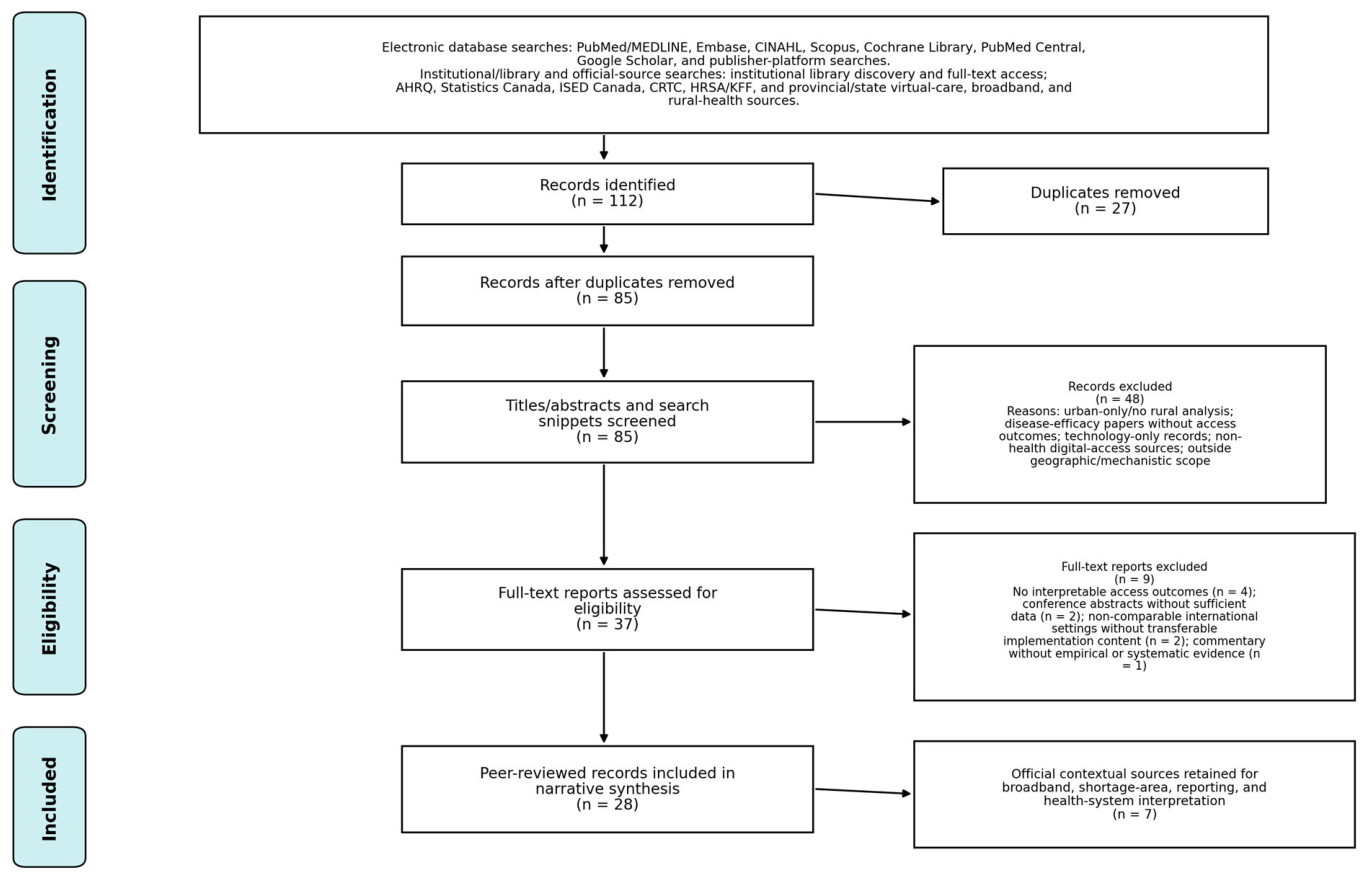
Table 2.
PRISMA 2020 flow summary for the completed literature search.
| PRISMA Stage | Description | n |
| Identification | Records identified through database, full-text, publisher, citation, and official-source searches | 112 |
| De-duplication | Duplicate records removed | 27 |
| Screening | Records screened | 85 |
| Screening exclusions | Records excluded at title/abstract/search-snippet stage | 48 |
| Eligibility | Full-text reports assessed for eligibility | 37 |
| Full-text exclusions | Reports excluded with reasons | 9 |
| Included evidence | Peer-reviewed records included in narrative synthesis | 28 |
| Contextual sources | Official contextual sources retained separately | 7 |
3.2. Characteristics of Included Evidence
The evidence base included narrative and systematic reviews of rural telehealth, provider-to-provider telehealth, patient satisfaction, telemental health, Indigenous telehealth, home-based digital health in rural Canada, primary studies of rural telemedicine use, hybrid primary care models, virtual emergency department support, remote monitoring, eConsultation, Project ECHO, and telehealth usability among rural Medicaid members. Most studies were observational, qualitative, mixed-methods, cross-sectional, or implementation-focused. Randomized threshold-style evidence was not available because virtual-care models are typically implemented as service pathways rather than patient-level randomized access interventions. To reduce selection and interpretive bias and to assure rigorous data analysis, the literature was scanned in advance and then reviewed in a multidisciplinary team including advanced practice nurses, physicians, and pharmacists; team discussion was used to resolve questions or discrepancies about eligibility, extraction, or interpretation.
Table 3.
Summary of included studies and official contextual sources relevant to rural virtual care access.
Table 3.
Summary of included studies and official contextual sources relevant to rural virtual care access.
| Study/Source | Design and Setting | Key Findings | Interpretation |
| Chu et al., 2021 [7] | Repeated cross-sectional study; Ontario; rural and urban telemedicine use before/during COVID-19. | Telemedicine adoption increased during the pandemic but rural uptake increased less than urban uptake. | Virtual care can expand access, but rurality does not automatically translate into equitable uptake. |
| Butzner and Cuffee, 2021 [8] | Narrative review; rural U.S. telehealth interventions. | Telehealth used across chronic disease, specialty care, mental health, and determinants of health. | Supports broad potential but highlights heterogeneity and implementation dependence. |
| Totten et al., 2024 / AHRQ, 2022 [9,10] | Systematic review and AHRQ comparative effectiveness review; rural provider-to-provider telehealth. | Similar or better outcomes reported for several rural telehealth-supported clinician collaboration models; implementation depends on technology, payment, workflow, and local fit. | Strongest evidence for telehealth as rural clinician support rather than patient-only replacement. |
| Jong et al., 2019 [11] | Canadian northern/rural telehealth implementation study. | Telehealth improved access to specialist services and reduced travel burden in northern communities. | Highly relevant to remote and northern western Canadian contexts. |
| Burton et al., 2022 [12] | Qualitative study; rural British Columbia micropractice. | Patients and providers valued asynchronous and virtual communication, with concerns about workload and diagnostic limitations. | Hybrid primary care can support access when integrated with relationships and workflow. |
| Buyting et al., 2022 [13] | Scoping review; rural Canadians with cardiovascular disease. | Digital virtual-care tools showed potential for follow-up, self-management, and travel reduction. | Useful for chronic disease follow-up, less conclusive for hard outcomes. |
| Lai et al., 2026 [14] | Scoping review; home-based digital health in rural Canada. | Benefits included empowerment, access, and efficiency; barriers included infrastructure, literacy, workload, and sustainability. | Confirms need for readiness and equity conditions. |
| Fitzsimon et al., 2023; related VTAC/IVC studies [15,16,17,18,19] | Mixed-methods and population-based studies; rural Ontario hybrid primary care. | Virtual triage with local in-person/community paramedic backup was associated with improved access, reduced low-acuity ED use, and attachment pathways. | Transferable model for rural western regions if local physical backup and continuity exist. |
| Lauscher et al.; Ho et al. [20,21,22] | British Columbia Real-Time Virtual Support; rural, remote, First Nations, and emergency pathways. | RTVS supported rural clinicians and communities through real-time virtual advice and emergency support. | One of the most directly relevant western Canadian models. |
| Harkey et al., 2020 [23] | Systematic review; patient satisfaction in rural telehealth. | Rural patients generally reported high satisfaction when telehealth was convenient, usable, and reduced travel. | Patient experience is favorable but depends on technical reliability and appropriateness. |
| Watanabe et al., 2023 [24] | Systematic review; rural telemental health. | Telemental health can improve access and symptoms in rural populations. | Mental health is one of the most suitable domains for virtual access when privacy and crisis pathways exist. |
| Homer et al., 2024 [25] | Survey; Wyoming Medicaid members. | Usability and digital access issues affected low-income and rural telehealth experience. | Direct western/frontier U.S. relevance; digital equity is a limiting condition. |
| Moecke et al.; Camp et al. [26,27] | Scoping/rapid reviews; Indigenous populations in Canada, U.S., Australia, New Zealand. | Telehealth can improve access but must be culturally safe, co-designed, and supported by Indigenous involvement. | Essential for rural and First Nations/Tribal applicability. |
| Liddy et al., 2017; Liddy et al., 2025 [28,29] | eConsult studies; Canadian remote/rural specialist access. | eConsult connects primary care to specialists and can reduce need for face-to-face referral. | Transferable to western rural systems where specialist travel and wait times are major barriers. |
| McBain et al., 2019; AHRQ Project ECHO [30,31] | Systematic review and official program source; telementoring. | Project ECHO-style models improve provider knowledge and extend specialty expertise into rural and underserved settings. | Useful for rural workforce support and specialty capacity-building. |
3.3. Rural Access Barriers and Infrastructure Context
The evidence provided demonstrates the complexity of the rural access issue. Workforce shortage and specialist maldistribution are linked to delayed and non-local care, while broadband and device access determine whether virtual alternatives are accessible. Canadian broadband policy explicitly identifies high-speed Internet as critical for essential services such as health care and the CRTC Broadband Fund is focused on unserved rural, remote, and Indigenous communities [4,5]. U.S. shortage area data also reveal large numbers of people living in designated primary care and mental health HPSAs with rural HPSAs being a significant proportion of shortage designations [3].
Telehealth can therefore not be considered purely a clinical tool. It is reliant on connectivity, affordability, digital literacy, private space, equipment, reimbursement, local staffing, and patient trust. Broadband can transform geographic distance into a surmountable access challenge, but poor connectivity can create telehealth as a new source of inequity. This digital divide is most salient in remote Indigenous communities, frontier U.S. counties, and low-income rural households.
3.4. Patient-Facing Virtual Care and Rural Uptake
Canadian and U.S. data both point to the conclusion that patient-facing virtual care is most consistent in its impact on access when it displaces travel-intensive care like follow-up, medication review, chronic disease monitoring, mental health visits, or preliminary triage, as opposed to a complete substitution for all in-person care. Stats Can data showing that patients are still more likely to receive both in-person and virtual care than virtual care only after the early pandemic expansion in virtual care supports a hybrid interpretation: virtual care is increasingly embedded, but the primary pattern is blended access.
Rural adoption is not inevitable. Chu et al. document enormous increases in telemedicine adoption during the COVID-19 pandemic but also found the growth was greater in urban than rural populations [7]. This is an important result for policy as it questions the belief that rural patients will automatically benefit most from virtual-care expansion. Rural communities may have the greatest theoretical need, but the lowest practical readiness if broadband, device access, digital literacy, or local workflow support is weak.
3.5. Hybrid Virtual/In-Person Rural Primary Care
The most clinically persuasive patient-facing model was hybrid virtual/in-person care. Rural British Columbia micropractice evidence showed that patients valued flexible communication and felt supported by virtual interactions, but providers identified concerns about diagnostic limitations, workload, and care coordination [12]. Rural Ontario VTAC and integrated virtual-care studies provide a stronger service-model example: virtual physician assessment was combined with local in-person assessment, community paramedic support, and pathways for unattached patients [15,16,17,18,19]. The model was associated with access improvements and more appropriate use of emergency services, including reductions in low-acuity emergency department use in the evaluated rural setting [16].
These findings lead to a pragmatic implication: virtual care is beneficial to rural primary care access when it is not 100% virtual. The safest model is virtual-first, not virtual-only. Rural patients must have in-person back up for exams, point-of-care testing, diagnostics, home visit, wound care, immunization, procedural care and red-flag escalation. Virtual primary care, thus, should be deployed as an element of local service ecology, not as a separate commercial platform.
3.6. Provider-to-Provider Telehealth, eConsultation, and Telementoring
The strongest evidence base for rural access improvement exists for provider-to-provider telehealth. Totten et al. synthesized evidence that communication between rural clinicians and distant specialists that is supported by telehealth can yield similar or better outcomes across a number of clinical domains and can improve rural clinician behavior, knowledge, confidence, and self-efficacy [9,10]. This mechanism is particularly salient for rural western communities because it bolsters the care provided by the clinician who is physically present with the patient rather than circumventing local care relationships.
eConsultation and telementoring also target related issues of access. Canadian studies of eConsult have found that asynchronous specialist advice can decrease avoidable face-to-face referral and improve access to specialty advice remotely [28,29]. Project ECHO-style models use videoconferencing and case-based teaching to extend specialty knowledge into rural and underserved settings, and systematic-review evidence supports improvements in provider-related outcomes [30,31]. In combination, these models also point to an understanding of telehealth not only as patient-to-provider video visits, but as infrastructure for strengthening rural clinicians and keeping care closer to home.
3.7. Emergency, Specialty, Chronic Disease, and Mental Health Applications
Emergency and urgent-care telehealth evidence is promising but requires caution. British Columbia Real-Time Virtual Support and related emergency department pathways provide a directly relevant western Canadian example of real-time support for rural, remote, and First Nations communities [20,21,22]. These models can support rural emergency clinicians, reduce professional isolation, and help determine whether transfer is necessary. However, evidence remains less certain for durable reductions in emergency department use, because virtual support may appropriately increase transfer or emergency referral when serious illness is identified.
Specialty and chronic disease applications are also important. Northern Canadian telehealth models improved access to specialist services and reduced travel burden [11]. Reviews of digital virtual care for rural Canadians with cardiovascular disease and home-based digital health in rural Canada suggest benefits for follow-up, self-management, patient empowerment, and travel reduction, but also identify infrastructure, workflow, and sustainability challenges [13,14]. Telemental health appears particularly suitable for rural access because many mental health assessments and follow-ups can be conducted virtually when privacy, crisis response, and continuity are ensured [24].
3.8. Equity, Cultural Safety, and Digital Exclusion
Equity was an ongoing constraint. Telehealth can decrease travel time, cost, and missed work but can also exacerbate inequity when patients lack broadband, devices, data plans, digital literacy, language support, privacy, or institutional trust. Wyoming Medicaid evidence is significant to the western U.S. context because it found that digital access and usability issues can hinder rural and low-income telehealth experience [25]. Indigenous-focused scoping and rapid reviews add that virtual care should be co-designed, culturally safe, and governed with Indigenous peoples rather than delivered to them as a one-size-fits-all technology solution [26,27].
Equity also pertains to modality choice. Telephone may be more practical than video in low bandwidth contexts and should not be assumed to be inferior modality a priori if it allows for greater reach. Video may be clinically required for certain assessments, however. The evidence supports flexible modality matching: telephone, video, asynchronous messaging, remote monitoring, eConsult, and in-person care can all be matched to patients, depending on the level of clinical risk, patient preference, bandwidth, privacy, accessibility, and available local support.
3.9. Risk of Bias and Certainty of Evidence
Table 4.
CASP-informed GRADE summary of key findings.
| Finding | Certainty | Rationale |
| Telehealth reduces travel burden for rural and remote patients | Moderate | Consistent across Canadian, U.S., and rural reviews; direct measurement varies by model and setting. |
| Hybrid virtual/in-person primary care improves access more safely than virtual-only care | Moderate | Supported by rural Ontario and British Columbia evidence; limited direct randomized comparisons. |
| Provider-to-provider telehealth improves rural clinician support and access to specialist input | Moderate to high | Supported by systematic review and AHRQ comparative review; outcome certainty varies by clinical domain. |
| eConsult improves access to specialist advice and can reduce face-to-face referral | Moderate | Supported by Canadian implementation studies; western-specific evidence remains indirect. |
| Telehealth reduces emergency department utilization | Low | Plausible for low-acuity conditions, but evidence is heterogeneous and appropriate escalation may increase ED/transfer use. |
| Telemental health improves access and symptoms in rural populations | Low to moderate | Supported by systematic review; variability in populations, interventions, and crisis pathways. |
| Telehealth is equitable by default | Very low | Evidence shows digital exclusion, broadband, usability, language, cultural safety, and poverty can limit benefit. |
| Findings transfer directly between western Canada and western U.S. frontier regions | Low | Mechanisms are similar, but reimbursement, licensure, broadband, Indigenous governance, and local service capacity differ. |
Risk-of-bias concerns were mainly related to observational designs, pandemic-era confounding, selection bias in who could access virtual care, limited follow-up, self-reported patient experience, heterogeneity in virtual-care models, and indirectness when applying evidence from non-western rural settings to western Canada or the western United States. Nevertheless, the direction of evidence was consistent; virtual care improves access when it is integrated, adequately resourced, clinically appropriate, and supported by local pathways.
4. Discussion
4.1. Principal Interpretation
The evidence suggests that telehealth can be a meaningful rural access extender, but not a magic bullet for rural healthcare inequity. The most defensible conclusion from the evidence above is that virtual care works best as part of a hybrid, locally integrated model, which can reduce travel and speed triage, improve access to specialist advice, support rural clinicians and ensure continuity of care for some chronic disease and mental health needs. It is least defensible when deployed as a virtual only replacement for primary care, specialist capacity, or emergency services, without physical backup, documentation, and escalation pathways.
This difference matters in western Canada and western United States. Here, the form the practical access problem takes most often is one of distance, weather, workforce shortages, Indigenous and Tribal community context, and patchy infrastructure. A video visit with a distant clinician can be useful, but a virtual network that serves local clinicians, community paramedics, nurses, Indigenous health workers, rural hospitals, and family physicians is more likely to generate lasting access improvements.
4.2. Implications for Rural Western Canada
Western Canada has several conditions that make virtual care attractive: large rural and remote regions, First Nations and Indigenous communities requiring culturally safe service models, northern travel burden, and documented policy investment in broadband connectivity [4,5]. The evidence from British Columbia Real-Time Virtual Support is particularly relevant because it demonstrates a network approach that combines real-time clinician support, rural emergency pathways, and First Nations/community relevance [20,21,22]. Rural British Columbia micropractice and broader rural Canada digital-health evidence further show that patients value flexibility and access, but clinicians need workload support, technology reliability, and clear coordination [12,14].
For Alberta, Saskatchewan, Manitoba, British Columbia, and the northern territories, the top implementation pathway is not just any form of virtual walk-in care. Rather, it is a coordinated model that involves local primary care teams, along with nursing and paramedic supports, remote specialist advice, eConsult, virtual emergency backup, and broadband/digital literacy supports. Evaluation would stratify outcomes by rurality, remoteness, Indigenous community status where appropriate (and governed ethically), attachment status, age, disability, language, and income.
4.3. Implications for the Western and Frontier United States
States in the western US region include those with large rural populations, frontier counties, Tribal Nations, mental health provider shortages, and inconsistent broadband access. HRSA shortage-area designations and evidence from the Medicaid program in Wyoming provide insight into the appeal of telehealth as well as reasons digital equity cannot be presumed [3,25]. Provider-to-provider telehealth and Project ECHO-style approaches are of particular interest since they build capacity among rural clinicians rather than bypass the community [9,10,30,31].
Policy transfer from Canada to the United States will have to consider reimbursement, state licensure, Medicaid coverage, malpractice requirements, broadband funding, and local hospital sustainability, but the key clinical lesson can transfer: virtual access must support and extend local care, not replace it. The optimal western US model will likely be a layered approach that meshes tele-emergency support, telemental health, eConsult, remote monitoring, PC team extension, and culturally safe Tribal health partnerships.
4.4. Proposed Implementation Model
Table 5.
Implementation model for telehealth-enabled rural healthcare access.
| Component | Function | Required safeguards |
| Access triage | Use virtual first contact for low-risk triage, follow-up, chronic disease review, medication review, and mental health check-ins. | Red-flag criteria; same-day in-person backup; documentation to regular clinic. |
| Local physical backup | Connect virtual clinicians with rural nurses, paramedics, community health workers, clinics, or hospitals. | Defined examination, testing, specimen, and transfer pathways. |
| Provider-to-provider support | Offer real-time specialist or emergency advice to rural clinicians. | 24/7 or extended-hours availability; funding for clinician time; reliable technology. |
| eConsult and asynchronous advice | Use structured specialist advice for nonurgent questions to reduce avoidable travel/referral. | Clear response-time targets; integration with EMR/referral systems. |
| Remote monitoring | Use home blood pressure, cardiac, respiratory, diabetes, or palliative monitoring where clinically suitable. | Patient training; device access; escalation thresholds; data responsibility. |
| Equity and cultural safety | Co-design services with rural, Indigenous, Tribal, low-income, older adult, and disabled users. | Language support; Indigenous governance; privacy; telephone options; digital navigators. |
| Evaluation | Measure access, continuity, safety, equity, and utilization, not just virtual visit volume. | Pre-specified outcomes; rurality strata; patient-reported experience; unintended harms. |
4.5. Strengths and Limitations
This review used a defined question, explicit eligibility criteria, a reproducible search strategy, PRISMA 2020 reporting, structured data extraction, CASP-informed appraisal, GRADE certainty domains, and separation of peer-reviewed evidence from official contextual sources. It also distinguishes different virtual-care mechanisms instead of treating telehealth as one intervention. The strength of the multi-disciplinal and international composition of the team for this systematic review also speaks to the strength of data interpretation.
The main limitation is indirectness. Direct comparative studies of telehealth access in rural western Canada versus the western United States are limited. Some relevant Canadian evidence comes from Ontario, Atlantic Canada, or national studies; these were retained only where the mechanism was transferable to western rural and frontier contexts. Many studies were conducted during or after the COVID-19 expansion, creating confounding by temporary policy changes, emergency funding, and altered patient behavior. Publication bias and reporting bias cannot be excluded, particularly because successful virtual-care programs may be more likely to be evaluated and published. Meta-analysis was not possible because outcomes and models were too heterogeneous.
4.6. Research Implications
Future research should transition from adoption-descriptive studies to prospective implementation evaluation studies. Methodologies that should be prioritized include stepped-wedge trials, interrupted time series, matched rural comparator studies, pragmatic hybrid effectiveness-implementation trials, and linked administrative analyses. Outcomes should include primary care attachment, same- or next-day access, travel avoided, specialist wait time, ED use, transfer rate, hospitalization, diagnostic safety, medication safety, continuity, patient-reported access, clinician confidence, broadband/device barriers, cultural safety, and cost-effectiveness.
Studies should also define the virtual-care model precisely. Telephone-only care, video visits, secure messaging, eConsult, remote monitoring, tele-emergency advice, Project ECHO, and virtual-first primary care are different interventions. Future evidence will be more useful if it reports model components, staffing, reimbursement, technology, local physical backup, escalation rules, rurality, Indigenous or Tribal governance, and patient digital access supports.
5. Conclusions
Telehealth and virtual care can extend access to health services for rural western Canada and the western United States, but not without important caveats. The most compelling evidence to date supports virtual care used as an access extender that is integrated into the health system: provider-to-provider support, eConsultation and telementoring, hybrid virtual/in-person primary care, remote monitoring, and rural emergency backup. Weaker evidence is found for virtual care’s use as a potential stand-alone substitute for local services. Rural and frontier communities will likely benefit the most from virtual care’s ability to reduce travel, support local clinicians, expand specialist reach, and facilitate patient connections to ongoing primary care. Implementation of virtual care must account for broadband access and usability support; culturally safe co-design; privacy, documentation, and physical examination backup; and clearly articulated pathways for escalation. Virtual care’s impact should thus be measured not simply by the volume of virtual visits, but by whether it can improve timely, continuous, safe, equitable, and locally anchored care.
Supplementary Materials
The following supporting information can be downloaded at the website of this paper posted on Preprints.org, Supplementary File S1: Completed PRISMA 2020 checklist. The PRISMA checklist prepared for this review can be submitted as supplementary material without alteration.
Author Contributions
Conceptualization, D.K., T.K. and J.M.L.S; methodology, D.K., T.K. and J.M.L.S.; investigation, D.K. and T.K.; data curation, D.K., T.K., J.M.L.S.; formal analysis, D.K., T.K. and J.M.L.S.; writing-original draft preparation, D.K.; writing-review and editing, D.K., T.K., J.M.L.S., S.F., M.O., A.K.P., M.M.A.P. and M.L.T.; supervision, T.K. All authors have read and agreed to the submitted version of the manuscript.
Funding
This research received no external funding.
Institutional Review Board Statement
Not applicable. This systematic review analyzed previously published literature and publicly available policy/context sources and did not involve new human or animal participant research.
Informed Consent Statement
Not applicable. This systematic review analyzed previously published literature and publicly available policy or contextual sources and did not involve new human participant research, animal research, human tissue, human material, or identifiable private participant data.
Data Availability Statement
All data supporting this review are included in the manuscript and supplementary material. The search strategy, eligibility criteria, study-selection counts, included records, contextual sources, and synthesis approach are reported in the manuscript. Additional search-log details are available from the corresponding author upon reasonable request.
Conflicts of Interest
The author declares no conflicts of interest.
Abbreviations
AHRQ: Agency for Healthcare Research and Quality; CASP: Critical Appraisal Skills Programme; CRTC: Canadian Radio-television and Telecommunications Commission; ED: emergency department; GRADE: Grading of Recommendations Assessment, Development and Evaluation; HRSA: Health Resources and Services Administration; IJMS: International Journal of Medical Sciences; PRISMA: Preferred Reporting Items for Systematic Reviews and Meta-Analyses; U.S.: United States; VTAC: Virtual Triage and Assessment Centre.
References
- Levesque, J.F.; Harris, M.F.; Russell, G. Patient-centred access to health care: conceptualising access at the interface of health systems and populations. Int. J. Equity Health 2013, 12, 18. [Google Scholar] [CrossRef] [PubMed]
- Rural Health Information Hub. Healthcare Access in Rural Communities Overview. In Rural Health Information Hub; 2026. [Google Scholar]
- Health Resources and Services Administration. Designated Health Professional Shortage Areas Statistics, Data as of April 1, 2026; HRSA, 2026. [Google Scholar]
- Innovation; Science and Economic Development Canada. High-Speed Internet for All Canadians; Government of Canada, 2026. [Google Scholar]
- Canadian Radio-television and Telecommunications Commission. Broadband Fund. CRTC. 2026. [Google Scholar]
- Frank, K.; Bader, D. Virtual care use in Canada: variation across sociodemographic and health-related factors. In Health Rep.; Statistics Canada, 2025; 11, p. 36. [Google Scholar]
- Chu, C.; Cram, P.; Pang, A.; Stamenova, V.; Tadrous, M.; Bhatia, R.S. Rural telemedicine use before and during the COVID-19 pandemic: repeated cross-sectional study. J. Med. Internet Res. 2021, 23(4), e26960. [Google Scholar] [CrossRef] [PubMed]
- Butzner, M.; Cuffee, Y. Telehealth interventions and outcomes across rural communities in the United States: narrative review. J. Med. Internet Res. 2021, 23(8), e29575. [Google Scholar] [CrossRef]
- Totten, A.M.; Womack, D.M.; Griffin, J.C.; McDonagh, M.S.; Davis-O’Reilly, C.; Blazina, I.; et al. Telehealth-guided provider-to-provider communication to improve rural health: a systematic review. J. Telemed. Telecare 2024, 30(8), 1209–1229. [Google Scholar] [CrossRef]
- Totten, A.M.; Womack, D.M.; McDonagh, M.S.; Davis-O’Reilly, C.; Griffin, J.C.; Blazina, I.; et al. Improving Rural Health Through Telehealth-Guided Provider-to-Provider Communication. In Comparative Effectiveness Review No. 254.; Agency for Healthcare Research and Quality: Rockville, MD, 2022. [Google Scholar] [CrossRef]
- Jong, M.; Mendez, I.; Jong, R. Enhancing access to care in northern rural communities via telehealth. Int. J. Circumpolar Health 2019, 78(2), 1554174. [Google Scholar] [CrossRef]
- Burton, L.; Rush, K.L.; Smith, M.A.; Davis, S.; Rodriguez Echeverria, P.; Suazo Hidalgo, L.; Gorges, M. Empowering patients through virtual care delivery: qualitative study with micropractice clinic patients and health care providers. JMIR Form. Res. 2022, 6(4), e32528. [Google Scholar] [CrossRef]
- Buyting, R.; Melville, S.; Chatur, H.; White, C.W.; Legare, J.F.; Lutchmedial, S.; Brunt, K.R. Virtual care with digital technologies for rural Canadians living with cardiovascular disease. CJC Open. 2022, 4(2), 133–147. [Google Scholar] [CrossRef]
- Lai, J.; Saleh-Singh, A.; Olisaekee, G. Implementing home-based digital health in rural Canada: a scoping review. Front Digit Health 2026, 8, 1692548. [Google Scholar] [CrossRef]
- Fitzsimon, J.; Patel, K.; Peixoto, C.; Belanger, C. Family physicians’ experiences with an innovative, community-based, hybrid model of in-person and virtual care: a mixed-methods study. BMC Health Serv. Res. 2023, 23, 573. [Google Scholar] [CrossRef]
- Fitzsimon, J.P.; Belanger, C.; Glazier, R.H.; Green, M.; Peixoto, C.; Mahdavi, R.; Plumptre, L.; Bjerre, L.M. Clinical and economic impact of a community-based, hybrid model of in-person and virtual care in a Canadian rural setting: a cross-sectional population-based comparative study. BMJ Open. 2023, 13, e069699. [Google Scholar] [CrossRef]
- Buchanan, S.; Peixoto, C.; Belanger, C.; Archibald, D.; Bjerre, L.; Fitzsimon, J. Investigating patient experience, satisfaction, and trust in an integrated virtual care model: a cross-sectional survey. Ann. Fam. Med. 2023, 21(4), 338–340. [Google Scholar] [CrossRef]
- Peixoto, C.; et al. Assessing new patient attachment to an integrated, virtual care primary care model in rural Ontario. Can. J. Rural Med. 2024, 29(1), 7–13. [Google Scholar] [CrossRef]
- St-Amant, A.; Peixoto, C.; Bair-Patel, D.; Heideman, M.; Menkhorst, K.; Fitzsimon, J. Assessing patient experiences with a Virtual Triage and Assessment Centre: a mixed-methods study using an online survey and semi-structured interviews in Renfrew County, Ontario. BMC Prim. Care 2025, 26, 21. [Google Scholar] [CrossRef] [PubMed]
- Lauscher, H.N.; Blacklaws, B.; Pritchard, E.; Wang, E.J.; Stewart, K.; Beselt, J.; Ho, K.; Pawlovich, J. Real-Time Virtual Support as an emergency department strategy for rural, remote, and Indigenous communities in British Columbia: descriptive case study. J. Med. Internet Res. 2023, 25, e45451. [Google Scholar] [CrossRef] [PubMed]
- Lauscher, H.N.; Stewart, K.; Markham, R.; Pawlovich, J.; Mah, J.; Hunt, M.; et al. Real-time virtual supports improving health equity and access in British Columbia. Healthc. Manag. Forum 2023, 36(5), 285–292. [Google Scholar] [CrossRef] [PubMed]
- Ho, K.; Pawlovich, J.; Berg, S.; et al. Real-Time Virtual Support: a network of virtual care for rural, remote, First Nations, and pan-provincial communities in British Columbia. CMAJ. 2025, 197(26), E754–E758. [Google Scholar] [CrossRef]
- Harkey, L.C.; Jung, S.M.; Newton, E.R.; Patterson, A. Patient satisfaction with telehealth in rural settings: a systematic review. Int. J. Telerehabil 2020, 12(2), 53–64. [Google Scholar] [CrossRef]
- Watanabe, J.; Teraura, H.; Nakamura, A.; Kotani, K. Telemental health in rural areas: a systematic review. J. Rural Med. 2023, 18(2), 50–54. [Google Scholar] [CrossRef]
- Homer, R.; Biller, S.; Schumaker, B.; Johnson, P.E. Telehealth usability among rural and low-income populations: a survey of Wyoming Medicaid members. J. Patient Exp. 2024, 11, 23743735241309442. [Google Scholar] [CrossRef]
- Moecke, D.P.; Holyk, T.; Beckett, M.; Chopra, S.; Petlitsyna, P.; Girt, M.; et al. Scoping review of telehealth use by Indigenous populations from Australia, Canada, New Zealand, and the United States. J. Telemed. Telecare 2024, 30, 1398–1416. [Google Scholar] [CrossRef]
- Camp, P.G.; et al. Virtual care for Indigenous populations in Canada, the United States, Australia, and New Zealand: rapid evidence review. J. Med. Internet Res. 2020, 22(12), e24986. [Google Scholar] [CrossRef]
- Liddy, C.; et al. Improving access to specialists in remote communities: a cross-sectional study and cost analysis of the use of eConsult. CMAJ Open. 2017, 5(1), E1–E8. [Google Scholar] [CrossRef]
- Liddy, C.; Guglani, S.; Nawar, N.; Keely, E. Examining differences in utilization of the Ontario eConsult Service in rural versus urban settings: a retrospective cross-sectional analysis. J. Prim. Care Community Health 2025, 16, 21501319251354830. [Google Scholar] [CrossRef]
- McBain, R.K.; Sousa, J.L.; Rose, A.J.; Baxi, S.M.; Faherty, L.J.; Taplin, C.; et al. Impact of Project ECHO models of medical tele-education: a systematic review. J. Gen. Intern Med. 2019, 34(12), 2842–2857. [Google Scholar] [CrossRef]
- Agency for Healthcare Research and Quality. Project ECHO. AHRQ Patient Safety Network. 2026. [Google Scholar]
- Bauerly, B.C.; McCord, R.F.; Hulkower, R.; Pepin, D. Broadband access as a public health issue: the role of law in expanding broadband access and connecting underserved communities for better health outcomes. J. Law. Med. Ethics 2019, 47((2_) suppl, 39–42. [Google Scholar] [CrossRef] [PubMed]
- Page, M.J.; McKenzie, J.E.; Bossuyt, P.M.; Boutron, I.; Hoffmann, T.C.; Mulrow, C.D.; et al. The PRISMA 2020 statement: an updated guideline for reporting systematic reviews. BMJ. 2021, 372, n71. [Google Scholar] [CrossRef] [PubMed]
- Critical Appraisal Skills Programme. In CASP Checklists; CASP: Oxford, 2024.
- Guyatt, G.H.; Oxman, A.D.; Sultan, S.; Glasziou, P.; Akl, E.A.; Alonso-Coello, P.; et al. GRADE guidelines: 9. Rating up the quality of evidence. J. Clin. Epidemiol. 2011, 64(12), 1311–1316. [Google Scholar] [CrossRef]
Disclaimer/Publisher’s Note: The statements, opinions and data contained in all publications are solely those of the individual author(s) and contributor(s) and not of MDPI and/or the editor(s). MDPI and/or the editor(s) disclaim responsibility for any injury to people or property resulting from any ideas, methods, instructions or products referred to in the content. |
© 2026 by the authors. Licensee MDPI, Basel, Switzerland. This article is an open access article distributed under the terms and conditions of the Creative Commons Attribution (CC BY) license.
Copyright: This open access article is published under a Creative Commons CC BY 4.0 license, which permit the free download, distribution, and reuse, provided that the author and preprint are cited in any reuse.


