

Submitted:
17 June 2026
Posted:
22 June 2026
You are already at the latest version
Abstract
We construct radial dual lattice graphs for the Eisenstein, Hurwitz, and E₈ lattices using admissible hyperspherical inversion. The inversion induces exact bijections between outer zone vertices and rational inner zone representatives, and it gives transported-edge graph isomorphisms once the radial-dual edge relation is defined. We verify the norm relation, involution, shell compression, and finite-shell adjacency identities using exact arithmetic. Composing the radial inversion with the Moxness E₈-to-H₄ folding matrix H₄fold gives a candidate golden linear-radial dual compressor ϒr for Cycle Clock Theory (CCT) workflows; on the E₈ root shell, the top 4×8 projection block Π of H₄fold maps the 240 roots into two 120-point layers (the regular 600-cell H₄ and its golden-ratio scaled copy H₄Φ, with radius ratio Φ, equivalently squared-norm ratio Φ²). For larger shells, this compressor is validated on finite domains and proposed as a proof target for full cycle-clock enumeration. We show that the inversion exchanging the two folded layers is the geometric-mean inversion at radius r² = 4/Φ, that one global rescaling brings it to the canonical admissible radius r = √2, and that it is the self-aligned member of a geometric-mean inversion family whose other two rungs swap the G₂ and F₄ shell pairs. The framework aligns naturally with the classical divisor-sum expression c₈(n) = 240·σ₃(n) for E₈ shell multiplicities and makes it computationally useful for folded inner zone enumeration: our benchmark reports 83,000–260,000× speedups over exact-arithmetic Jacobi theta polynomial expansion at moderate shell indices. Realized via the Cayley integers in 8D, the construction aligns conceptually with octonion-based models in quasicrystalline quantum gravity while remaining strictly algebraic and geometric, operating on rational extensions without approximations, floating-point drift, continuous relaxations, or information loss. The construction offers a practical exact-arithmetic method for shelling and scaling calculations, while full global injectivity of ϒr on L⁸, 8D-to-4D graph-isomorphism preservation across arbitrary shells, and end-to-end CCT simulation integration remain proof obligations for future work. The entire construction is formulated inside the real Clifford algebra Cl(8) as the enveloping associative algebra: A₂, D₄, and E₈ are realized as the grade-1 root sub-systems of Cl(2), Cl(4), and Cl(8) respectively, and the classical Eisenstein, Hurwitz, and Cayley integer rings are recovered as the even subalgebras Cl⁺(d) acting on these generators. Under this enveloping algebra we adopt the uniform packing-radius root-length convention ⟨α,α⟩ = 2 (Euclidean length √2) across all three lattices, in agreement with the Bourbaki/Conway–Sloane/Viazovska normalization and with the maximally dense sphere-packing radius in each dimension; the canonical admissible inversion radius is therefore r = √2 uniformly, and the hyperspherical inversion ιr is Clifford-equivariant under Pin(d) ⊂ Cl(d).
Keywords:
hyperspherical inversion
; geometric-mean inversion
; golden ratio
; lattice graph isomorphism
; sphere packing
; root systems
; Clifford algebra
; octonions
; quasicrystals
; Cycle Clock Theory
; exact arithmetic
; shell enumeration
; divisor sums
; E8 lattice
; H4 folding
; 600-cell
; quantum gravity
1. Introduction
The exceptional lattices associated with the normed division algebras stand in a unique and structurally inevitable position in mathematics, computer science, and theoretical physics. These structures emerge directly from the geometry of maximally dense sphere packings [1,2] in 1D, 2D, 4D, and 8D—the only dimensions that admit such algebras—which render the construction rigid and canonical instead of arbitrary.
This finite exceptional set of specific dimensional levels—which fundamentally terminates at 8D by the Hopf invariant one theorem of Adams [3]—is precisely what facilitates the admissibility condition for inversion radii with its profound mathematical significance, while ensuring that the discrete symmetry-invariant shells enable exact bijective radial dualities (in the transported-edge sense) throughout the recursive bootstrapping process.
This first principles work generalizes the Eisenstein integer based Tri-Quarter Framework (TQF) [4] from 2D to 4D and 8D within the Clifford-algebraic enveloping algebra , under which , , and arise as the grade-1 root sub-systems of , , and respectively and share a single uniform root-length normalization , without sacrificing the exact discrete, rational, and efficient character of the original. We design and deploy radial dual lattice graphs by driving admissible hyperspherical inversion straight through the nearest-neighbor graph of each exceptional lattice.
Hyperspherical inversion denotes the classical geometric transformation that inverts points with respect to a hypersphere of radius r centered at the origin in . It is the direct higher-dimensional generalization of circular inversion in the plane and spherical inversion in 3D. Although these inversions have a long history in geometry—tracing to foundational contributions by Jakob Steiner in 1824 and systematically developed in the theory of inversive geometry [5,6]—their specific application here to admissible radii determined by the norm form of exceptional lattices is novel. This application, which induces transported-edge graph isomorphisms between the outer zone and inner zone subgraphs of the radial dual lattice graph, begins from the original 2D radial dual graph construction [4].
The present framework is distinguished by its purely algebraic and geometric nature, while operating exclusively on rational extensions of the underlying exceptional lattices—with no approximations, floating-point drift, continuous relaxations, or information loss. The construction remains entirely within rational extensions of the lattices—this uncompromising exactness is its core advantage.
At each dimensional level of exception, the inversion map induces a transported-edge graph isomorphism that preserves the transported adjacency relation, the norms of pre-images, the radial directions of vertices, and the action of the relevant symmetry groups. For instance, as we demonstrate in this paper, the 8D radial dual equips Cycle Clock Theory (CCT) with an exact radial-folding operator that maps outer zone cycle clocks on the lattice to compact inner zone equivalents in the rational extension. This reduces computational complexity in the simulation and enumeration of quasicrystalline dynamics while preserving combinatorial invariants in the transported sense. In this context, the present construction constitutes a direct algebraic assault on what is a great challenge of -based modeling: the explosive growth in combinatorial scale and computational intractability encountered when simulating or enumerating quasicrystalline dynamics and cycle clocks at large radial norms on the lattice. The radial dual framework directly addresses this challenge by providing an exact reversible coordinate-compression and folding mechanism. In particular, the framework aligns naturally with the classical divisor-sum expression for shell multiplicities (the weight-4 Eisenstein series identity for the theta function [19]), making this identity computationally useful for folded inner zone enumeration: our benchmark shows speedups of more than at shell index and over at , with the advantage continuing to scale favorably for increasingly large shell indices. The golden linear-radial dual compressor , constructed by composing the Moxness -to- matrix [7] with radial dual admissible hyperspherical inversion, maps the 240 roots of onto two 120-point 600-cell layers ( and its golden-ratio scaled copy , radius ratio , squared-norm ratio ) and provides a candidate dimensional-reduction operator for larger finite domains of CCT relevance. The framework aligns directly with octonion-based models through a realization via the Cayley integers (integral octonions) in 8D.
Evidence tiers.
Throughout this paper we distinguish four kinds of claim, and the reader is invited to keep them separate:
- [By construction] statements about the transported-edge radial-dual graph structure: inner zone edges are defined as images of outer zone nearest-neighbor edges under , so the transported-edge graph isomorphisms of Theorems 1, 2, and 3 are immediate once the edge relation is fixed.
- [Algebraic] identities that follow from elementary properties of on : the involution property, the norm relation , the angular preservation, the zone-swapping bijection, and the adjacency norm identity (Remark 1), together with the golden swap radius and its recalibration to the canonical radius (Theorem 4, Proposition 2).
- [Finite-shell verified] computational facts established by exact arithmetic over or on enumerated finite domains: the bijection of on the 240-root shell onto with squared-norm ratio (Proposition 1), the adjacency, involution, and shell-compression verifications of Section 8, and the finite-domain FIG demonstration of Section 8.2, together with the exact companion rotation that carries the inner shell onto the outer one in the rung of Proposition 4.
- [Future work] claims that remain proof obligations: global injectivity-preserving graph isomorphism for the golden linear-radial dual compressor on the full outer zone , an all-shell uniform lower bound on , end-to-end CCT simulation integration with phason and gauge dynamics, and the comprehensive large-scale validation of the 8D transported-edge graph isomorphism at higher norms.
While the radial dual construction, the induced transported-edge graph isomorphisms, the coordinate compression, the explicit cycle-clock folding, and the divisor-sum acceleration of shell multiplicities are rigorously established in this work at the [by construction], [algebraic], and [finite-shell verified] tiers, their comprehensive application to full CCT simulations—including large-norm cycle-clock enumeration, phason/gauge dynamics, and end-to-end projection pipelines—remains a [future work] goal.
The paper is organized as follows:
- Section 2 establishes the general notation, standing assumptions, and definitions (including admissible radii, the hyperspherical inversion map, and the transported edge relation) used throughout the work;
- Section 6 introduces the complementary linear folding operator and its composition with radial inversion, with the bijection on the 240-root shell stated as a finite-shell-verified proposition and the global-shell extension stated as a future-work proof obligation;
- Section 7 details the applications to CCT, which includes explicit cycle clock examples, connections to shelling and scaling analyses, and an embedded-root-systems subsection observing that the and root systems arise within the shell structure of and ;
- Section 8 reports comprehensive computational verification using exact arithmetic; and
- Section 9 concludes with implications and future directions.
With our intent and direction solidified, we proceed to drive the radial dual lattice graph construction, starting from the Eisenstein integers. But first, we introduce some generalized notation.
2. Notation and Standing Assumptions
Throughout this work we operate in Euclidean space identified with the grade-1 generator subspace of the real Clifford algebra , equipped with the squared norm induced by the Clifford quadratic form, for . The symbol always denotes the squared Euclidean norm of (so that for example means ); the unsquared length is written when needed. Let denote the corresponding exceptional lattice realized as the grade-1 root sub-system of (the root system inside for , the root system inside for , and the root system inside for ); the classical Eisenstein, Hurwitz, and Cayley integer rings are recovered as the even subalgebras acting by Clifford multiplication on these grade-1 generators. The punctured nearest-neighbor graph on is denoted .
Throughout this work, each element () is understood simultaneously as
- a lattice point in the exceptional lattice ,
- a vertex of the punctured nearest-neighbor graph , and
- a vector in Euclidean space .
We adopt the convention that the generic symbols and (together with their primed or indexed variants , , etc.) refer interchangeably to these three equivalent objects when the element lies in . For points in the rational extension (in particular the inner zone ), we retain the same symbols and but understand them primarily as vertices of the radial dual graph and as vectors in , while no longer referring to them as lattice points of . This convention is consistent with the notational practice established in the TQF [4].
Definition 1
(Admissible inversion radius). Let () be one of the exceptional lattices equipped with the squared Euclidean norm . A radius is said to be admissible (with respect to ) if there exists a nonzero vector such that
Definition 2
(Swap radius of a shell pair). Let and be two finite shells of a discrete configuration in , of squared norms , such that the outer shell is the inner shell scaled setwise by the radius ratio (possibly after a companion rotation that maps one shell onto the other). The swap radius of the pair is the geometric mean of the two squared norms,
At this radius the inversion exchanges the two shells exactly, and , acting on radii as multiplication by . This complements Definition 1 rather than replacing it. Where the earlier notion fixes a single threshold shell, the swap radius governs a paired-shell configuration, and it need not be the norm of any lattice vector, so its boundary zone may be empty. The two notions meet, as Proposition 2 makes precise, once the configuration is rescaled so the two shells straddle the canonical shell symmetrically.
For any admissible radius (i.e., equals the squared norm of some nonzero lattice vector), let denote the hypersphere of radius r centered at the (punctured) origin in . The vertex set of is partitioned into three disjoint zones:
- Outer zone: ,
- Boundary zone (threshold shell): ,
- Inner zone: .
The inversion map is defined on nonzero vertices by
This is the direct higher-dimensional generalization of circular inversion. In all dimensions it satisfies the following algebraic properties (verified by direct substitution into the definition):
- 1.
- Involution: .
- 2.
- Boundary fixed set: If then .
- 3.
- Zone swap: and vice versa.
- 4.
- Angular preservation: ; each vertex and its image live on the same radial ray from the origin.
- 5.
- Norm relation: .
Remark 1
(Adjacency norm identity (general)). Let be adjacent, i.e., where δ is the squared length of the minimal vectors of the lattice ( uniformly for under the packing-radius convention of Section 2). Then
This follows by direct expansion. Writing the difference over a common denominator,
so . The numerator factors by polarization: writing for the Euclidean inner product and using ,
Substituting this back gives
The identity quantifies how nearest-neighbor distances are transformed in the inner zone and is used in the computational verification of adjacency preservation.
The adjacency norm identity quantifies how nearest-neighbor distances transform under : an outer zone edge of squared length is mapped to an image of squared length . The scaling factor is always positive and depends only on the norms of the endpoints, but in general it is not equal to . Hence the image of an outer zone nearest-neighbor edge is generally not a nearest-neighbor edge in the native metric of the rational inner zone point cloud. The radial dual graph structure is therefore defined via a transported edge relation: edges in the inner zone are by construction the images of outer zone nearest-neighbor edges under , not nearest-neighbor edges in the native metric. The graph isomorphisms established in this paper (Theorems 1, 2, 3) are statements about this transported radial-dual graph structure. The algebraic fact above is what makes the transported relation well-defined and reversible, and what supports the exact computational verification of the radial dual as well as the folding of large-norm cycle clocks into compact rational representations without information loss.1
The full radial dual lattice graph is with vertex set and edge set constructed exactly as in the 2D TQF (outer edges, inverted inner edges, and boundary-crossing edges).
Standing assumptions (used throughout this paper):
- 1.
- The origin is excluded from all graphs and zone partitions, as hyperspherical inversion is undefined at the origin. (See Remark 2 below.)
- 2.
- All constructions remain strictly inside the rational extension , with no approximations, floating-point drift, continuous relaxations, or information loss.
- 3.
- Unless otherwise stated, the canonical admissible radius corresponding to the minimal positive norm shell is understood ( uniformly for , corresponding to the minimal squared norm under the uniform packing-radius convention ).
Enveloping Clifford algebra.
All constructions in this paper take place inside the real Clifford algebra for , with identified with the grade-1 generator subspace of and the Euclidean squared norm identified with the Clifford quadratic form. The exceptional lattices , , are realized as the grade-1 root sub-systems of , , respectively, and the classical Eisenstein, Hurwitz, and Cayley integer rings are recovered as the even subalgebras , , and a chosen-orientation grade-1 generator algebra of (associative, not the non-associative octonions) acting by Clifford multiplication on the grade-1 generators. The hyperspherical inversion is Clifford-equivariant: it commutes with the natural action of the Pin group on the grade-1 generators, and the Weyl groups , , and all lift to subgroups of that act equivariantly on . Consequently every theorem and remark below holds uniformly across under this single enveloping algebra.
Convention (uniform root-length normalization).
Throughout this paper we adopt the standard packing-radius / Bourbaki convention (Euclidean length ) for the minimal root vectors of all three grade-1 root sub-systems , , and . Equivalently, the canonical admissible inversion radius is in every dimension, the minimal squared edge length is uniformly, and the adjacency norm identity of Remark 1 specializes to in every exceptional dimension. The earlier asymmetric choice ( for ; for ) and the corresponding rescaling between and CCT conventions are eliminated as a result, since the maximally dense sphere packing in each of , , has packing radius times the root length under this normalization, and this uniform normalization is forced at the enveloping-algebra level by the inclusion chain of root sub-systems inside .
Remark 2.
The exclusion of the origin is not merely a technical necessity that arises from the singularity of spherical inversion at zero. Rather, it constitutes a structurally enabling feature: puncturing the origin removes the unique fixed point under all radial scalings and inversions, which allows the inversion map to act as a free involution (with no fixed points outside the boundary shell) on the punctured lattice. This freedom unleashes a profound cascade of discrete symmetries and combinatorial dualities—most notably the exact bijective graph isomorphism between outer and inner zones—that would be obstructed if the origin were retained as a distinguished vertex. In this context, the punctured structure is foundational to the recursive bootstrapping of radial dual lattice graphs across exceptional dimensions and to the preservation of strict combinatorial self-duality under admissible inversion.
3. Tri-Quarter Framework in 2D: Eisenstein Radial Dual Lattice Graphs
The original radial dual lattice graph construction is based on the Eisenstein integers in 2D via the TQF [4], which we re-express here as the action of the even subalgebra on the grade-1 root sub-system . It achieves an exact bijective duality—between and —that is preserved under the graph structure and serves as the inductive base for the recursive bootstrapping to higher dimensions developed in this paper.
3.1. Eisenstein Lattice Graph
Let be a primitive cube root of unity. The Eisenstein integers form the ring
The associated lattice is given by the explicit embedding
with squared Euclidean norm
This quadratic form is positive definite and integer-valued on the lattice, and generates exact regular hexagonal shells of radius for admissible integers k.
Definition 3.
The underlying lattice graph is the countably infinite undirected graph with
- vertices: ,
- edges: pairs such that (nearest-neighbor minimal vectors).
Remark 3.
The TQF and the radial dual construction operate on the origin-punctured complex plane . Circular inversion is undefined only at the origin, and the origin vertex is therefore excluded from the zone partitioning and from the domain of the inversion map in order to preserve bijectivity and the discrete combinatorial structure of the radial dual lattice graph.
Remark 4.
The graph is the countably infinite triangular (hexagonal) grid graph on the punctured plane . Every vertex has degree 6, which corresponds to the six nearest neighbors separated by angular intervals. The full point-group symmetry of the underlying lattice is the dihedral group of order 12, generated by rotations and reflections. preserves the triangular lattice and acts transitively on the six minimal vectors, and more generally partitions each norm shell into finitely many orbits.
3.2. Admissible Inversion Radius in 2D
Fix an admissible radius as per Definition 1. The canonical choice is (corresponding to under the uniform root-length convention , so the six minimal Eisenstein vectors satisfy and have squared Euclidean norm 2 after the rescaling ), which produces the boundary zone containing exactly six vertices that form a regular hexagon centered at the origin.
The admissibility condition of Definition 1 guarantees that the boundary zone is a discrete, finite, and symmetry-invariant subset of . This property ensures that the subsequent inversion map sends all vertices to well-defined vertices in the rational extension while preserving the discrete combinatorial structure required for the radial dual graph construction.
3.3. Zone Partitioning and Circular Inversion in 2D
Fix an admissible radius . The inner zone will consist of the images of the outer zone vertices under the circular inversion map that we define explicitly in the next subsection. Then we partition the vertex set of into three disjoint subsets:
- Outer zone: ,
- Boundary zone: ,
- Inner zone: , the set of all vertices in obtained by inversion (generally with rational coefficients in the Eisenstein basis).
The full radial dual lattice graph is the undirected graph with
- vertex set is the disjoint union ,
- edge set consists of (i) the outer zone nearest-neighbor edges of , (ii) their images under in the inner zone, and (iii) crossing edges connecting boundary vertices to inverted outer vertices (defined precisely in the next subsection).
The vertices of reside in , and therefore generally carry rational (rather than integer) coefficients in the Eisenstein basis.
This partitioning creates a tripartite (or “Tri-Quarter”) division of the punctured plane : the outer zone consists of all lattice vertices with (beyond the boundary shell), the boundary zone comprises the fixed admissible shell , and the inner zone is the exact algebraic image of under inversion of through the circle of radius r.
The inversion map is given in Section 2 and satisfies the five algebraic properties listed there. In the context of the Eisenstein lattice and the TQF [4,9], the map is conformal and angle-preserving, thereby respecting the angular structure inherent to the triangular lattice .
Geometrically, radially rescales every vertex through the circle of radius r: any vertex that exists far outside the boundary is mapped to , which is close to the origin along the same radial ray, and vice versa. Because the map acts as a positive scalar multiple of the identity on each ray, it preserves radial directions and the discrete structure required for the radial dual lattice graph construction [4].
3.4. Construction and Duality in 2D
The edge set of the radial dual lattice graph is defined in three parts:
- Outer zone edges: all nearest-neighbor edges of with both endpoints in ,
- Inner zone edges: the images of every outer zone edge ,
- Boundary crossing edges: for each pair consisting of a boundary vertex and an outer vertex that are adjacent in , add the edge .
Theorem 1
(2D Bijective Radial Graph Duality [4]). For any admissible r, the restriction of induces an isomorphism between the induced subgraphs of the transported radial-dual graph structure on the outer and inner zones:
Proof.
The map is an algebraic involution that swaps and bijectively. By construction of the edge set, every outer zone nearest-neighbor edge maps directly to an inner zone edge under the transported edge relation defined in Section 2. Boundary-crossing edges are mirrored symmetrically via the involution property and fixed boundary.
The dihedral symmetry group commutes with because circular inversion through an origin-centered admissible shell is conformal and angle-preserving, and the lattice is -invariant. Therefore is a graph isomorphism between the induced subgraphs in the transported radial-dual graph structure (see also Remark 4); native-metric nearest-neighbor adjacency of the inner zone point cloud is generally not preserved. □
Having established the foundational 2D case via the TQF and verified its exact bijective radial duality in Theorem 1, we now extend the construction recursively to the next exceptional dimension by bootstrapping from the Eisenstein integers to the Hurwitz quaternions.
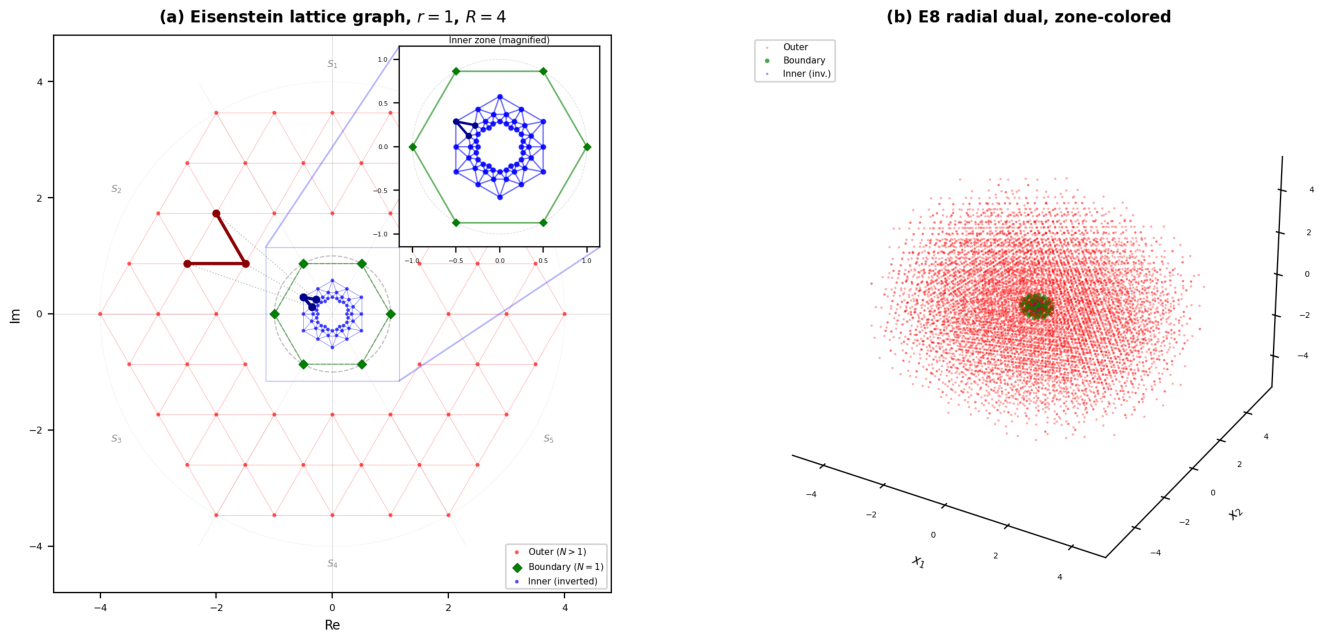
Figure 1.
Radial dual lattice graphs with zone-colored edges. (a) Eisenstein lattice graph with , . Red/blue edges show the graph isomorphism between and (boundary shell ). Inset: magnified . (b) radial dual projected to 3D via , inversion, and FIG slice, zone-colored to match.
Figure 1.
Radial dual lattice graphs with zone-colored edges. (a) Eisenstein lattice graph with , . Red/blue edges show the graph isomorphism between and (boundary shell ). Inset: magnified . (b) radial dual projected to 3D via , inversion, and FIG slice, zone-colored to match.
4. Bootstrapping to 4D: Radial Dual Hurwitz Quaternion Lattice Graphs
The construction and proof that were established for the Eisenstein integers in 2D extend verbatim to the Hurwitz quaternion lattice in 4D. The admissible hyperspherical inversion induces an exact transported-edge graph isomorphism between the outer zone and inner zone induced subgraphs, preserving transported adjacency, norms of pre-images, radial directions, and the binary tetrahedral symmetry group .
4.1. Hurwitz Quaternion Lattice Graph
The even subalgebra furnishes a natural algebraic environment for rotations in 3D space; equivalently, quaternions extend the complex numbers from 2D to 4D as the even Clifford subalgebra over the grade-1 generators. The Hurwitz integers form the densest lattice packing in 4D. They comprise all quaternions
such that . The associated lattice carries the norm .
Definition 4.
The underlying lattice graph is the countably infinite undirected graph with
- vertices: ,
- edges: pairs such that (nearest-neighbor minimal vectors).
Each vertex has degree 24. Under the uniform root-length convention , these 24 nearest-neighbor minimal vectors are the shell vectors—the permutations of , which constitute the root system and the vertex set of the regular 24-cell—and should be distinguished from the 24 multiplicative units of , which form the shell (the 8 vectors together with the 16 half-integer vectors ). The minimal edge length adopted here is consistent with the 2D and 8D constructions and with the uniform convention of Section 2.
4.2. Admissible Inversion Radius in 4D
Fix an admissible radius as per Definition 1. The canonical choice yields the boundary zone containing the 24 vertices of squared norm 2 (under the uniform root-length convention ), which form the vertex set of the regular 24-cell after the global rescaling .
Admissibility guarantees that the boundary zone is a discrete, finite, and symmetry-invariant subset of .
4.3. Zone Partitioning and Hyperspherical Inversion in 4D
The same tripartite division applied in 2D extends directly to 4D. Thus, we prepare for an inductive transfer of the bijective duality established in Theorem 1.
Fix an admissible radius . The inner zone will consist of the images of the outer zone vertices under the hyperspherical inversion map that we define explicitly in the next subsection. Partition the vertex set of into three disjoint subsets exactly as in the 2D case:
- Outer zone: ,
- Boundary zone: ,
- Inner zone: , the set of all vertices in the rational extension obtained by inversion.
The full radial dual lattice graph is the undirected graph with
- vertex set is the disjoint union ,
- edge set consists of (i) the outer zone nearest-neighbor edges of , (ii) their images under in the inner zone, and (iii) crossing edges connecting boundary vertices to inverted outer vertices (defined precisely in the next subsection).
The vertices of reside in the rational extension , and therefore generally carry rational (rather than half-integer) coefficients in the Hurwitz basis.
The inversion map is given in Section 2 and satisfies the five algebraic properties listed there. This is the direct 4D analogue of the circular inversion in 2D: each vertex is reflected through with radius r centered at the origin. Consequently, vertices that exist far outside the boundary shell are mapped close to the origin along the identical radial ray, and vice versa.
The map remains conformal and commutes with the natural action of on , thereby preserving the angular and combinatorial structure required for the radial dual lattice graph construction.
4.4. Construction and Duality in 4D
The edge set of the radial dual lattice graph is defined exactly as in the 2D case:
- Outer zone edges: all nearest-neighbor edges of with both endpoints in ,
- Inner zone edges: the images of every outer zone edge ,
- Boundary crossing edges: for each pair consisting of a boundary vertex and an outer vertex that are adjacent in , add the edge .
Remark 5
(Adjacency norm identity in 4D). With canonical radius () and minimal squared length , Remark 1 specializes to
for any adjacent vertices .
Theorem 2
(4D Bijective Radial Graph Duality). For any admissible r, the restriction of induces an isomorphism between the induced subgraphs of the transported radial-dual graph structure on the outer and inner zones:
Proof.
The map is an algebraic involution that swaps and bijectively. By construction of the edge set, every outer zone nearest-neighbor edge maps directly to an inner zone edge under the transported edge relation. Boundary-crossing edges are mirrored symmetrically via the involution property and fixed boundary.
The order-24 binary tetrahedral group commutes with because hyperspherical inversion through an origin-centered admissible shell is equivariant under the natural action of on . Therefore is a graph isomorphism between the induced subgraphs in the transported radial-dual graph structure; native-metric nearest-neighbor adjacency of the inner zone point cloud is generally not preserved. □
The natural symmetry group that acts on the Hurwitz quaternion lattice (and therefore on the radial dual lattice graph ) is the order-24 binary tetrahedral group . This group commutes with because the admissible inversion radius is origin-centered and the map is equivariant under left–right unit multiplications on .
Remark 6
(Orthogonal splicing (2D to 4D)). An alternative view of the same duality may be obtained by orthogonally embedding each 2D dual pair , where , as the quaternion
The resulting graph is isomorphic to a (non-canonical) subgraph of the full 4D radial dual and illustrates the recursive lifting of the 2D structure, but the canonical construction used throughout this paper operates directly on the Hurwitz lattice .
Now that we’ve verified that the radial dual lattice graph construction and the induced bijective graph isomorphism extend verbatim from the Eisenstein integers in 2D to the Hurwitz quaternions in 4D, we now proceed to the final exceptional dimension.
5. Bootstrapping to 8D: Radial Dual Lattice Graphs
The construction and proof established for the Eisenstein integers in 2D and the Hurwitz quaternions in 4D extend verbatim to the root lattice in 8D. The admissible hyperspherical inversion induces an exact transported-edge graph isomorphism between the outer zone and inner zone induced subgraphs, preserving transported adjacency, norms of pre-images, radial directions, and the full Weyl group symmetry .
5.1. Lattice Graph
The root lattice is the unique (up to isomorphism) even unimodular lattice in 8D. In the standard coordinate realization it consists of all vectors whose coordinate sum is even. Equivalently, it arises from pairs of Hurwitz quaternions satisfying the gluing condition . The lattice is even (all squared norms are even integers) and self-dual (). It realizes the densest known sphere packing in .
Its 240 vectors of squared Euclidean norm 2—the roots—split into 112 vectors of “checkerboard” sub-lattice type (, ) and 128 half-integer vectors () with an even number of minus signs. These minimal vectors generate the root system and achieve the kissing number 240.
Definition 5.
The underlying lattice graph is the countably infinite undirected graph with
- vertices: ,
- edges: pairs such that (nearest-neighbor minimal vectors).
Each vertex has degree 240. The full isometry group of is the Weyl group of order , which acts transitively on the roots and preserves the graph structure.
5.2. Octonionic Realization via Cayley Integers
The root lattice admits a canonical realization as the grade-1 root sub-system of the real Clifford algebra ; equivalently, by choosing an orientation of the generators, it can be identified with the lattice of Cayley integers (integral octonions [10]) inside the real division algebra , but the Clifford-algebraic realization is preferred throughout because it is associative and supplies the natural enveloping algebra under which , , and share a single uniform root-length normalization. We adopt throughout this paper the standard normalization in which the minimal vectors (roots) satisfy and therefore have Euclidean length . With this convention, the lattice contains all Cayley integers with even norm, and the admissible boundary zone (with ) consists precisely of the 240 minimal vectors (roots of squared norm 2). We note that the term “unit” is ambiguous in this context: in the octonion-algebra sense, a unit is a multiplicative norm-one element, of which there are 240 in the Cayley integers after rescaling by ; in this paper, the 240 minimal vectors are roots of squared norm 2 under the normalization. Under the Clifford-algebraic formulation adopted in this paper, all three exceptional-lattice constructions arise as the grade-1 root sub-systems of , , and respectively, and share the same packing-radius root-length normalization (Euclidean length ); no rescaling between dimensions is required, and all radial-dual identities (involution, zone swap, transported-edge isomorphism) hold uniformly under the action of .
Now the radial dual lattice graph construction never invokes octonion multiplication. Instead, it relies solely on the Euclidean quadratic form and ordinary radial scaling (), both of which remain well-defined and associative over . Consequently, every operation stays inside the rational extension and admits exact finite-precision arithmetic. All algebraic properties established in lower dimensions (involution, zone swapping, norm relation, angular preservation, and symmetry commutation) hold verbatim on this structure. The vertices of lie in the rational octonions , where they uphold discreteness, countability, and the transported-edge graph isomorphism of Theorem 3.
Remark 7
(Octonionic coordinate embedding of with native CCT integration). The standard construction of the root lattice as the set of Cayley integers (i.e., integral octonions) solidifies a natural conceptual link to the octonion-based models employed in CCT and related emergence programs [11,12]. This link is achieved while fully persisting the exact discrete, rational, and reversible character that constitutes the central strength of the present framework. In particular, the construction seamlessly integrates with CCT’s deliberate choice of the associative Clifford algebra as its primary operational algebra. Consequently, the Cayley integers serve as a distinct trustworthy coordinate vertex set that encodes both the exceptional geometry of the root lattice and its maximal symmetry group .
5.3. Admissible Inversion Radius in 8D
Fix an admissible radius as per Definition 1. The canonical and optimal choice is (corresponding to , the root shell), which exactly coincides with the boundary zone containing the 240 roots.
The admissibility condition of Definition 1 guarantees that the boundary zone is a discrete, finite, and symmetry-invariant subset of . This property ensures that the subsequent inversion map sends all vertices to well-defined vertices in the rational extension while maintaining the discrete combinatorial structure that is required to construct the radial dual graph.
This shell is invariant under the full Weyl group . Every nonzero norm shell of is also -invariant (since preserves the norm), so higher admissible shells (e.g., ) do not reduce the available symmetry. What does grow at higher shells is the orbit complexity, shell multiplicity, denominator complexity of inner zone images, and overall computational cost. The canonical choice is therefore optimal in a computational sense—it produces the smallest nontrivial boundary set with invariance—rather than in a symmetry sense. In this first-principles approach, we wish to maximize computational tractability while retaining the full symmetry group.
5.4. Zone Partitioning and Hyperspherical Inversion in 8D
Fix an admissible radius . Just as in the 2D and 4D environments, the origin remains excluded (Remark 3). Hence, inversion map is rendered well-defined on all nonzero lattice points.
The inner zone consists of the images of the outer zone vertices under the hyperspherical inversion map . We partition the vertex set of into three disjoint subsets:
- Outer zone: ,
- Boundary zone: ,
- Inner zone: ,
where admissibility of r ensures that every vertex in is sent to a well-defined vertex in the rational extension , and the image set remains discrete and countable.
The full radial dual lattice graph is the undirected graph with
- vertex set is the disjoint union ,
- edge set consists of (i) the outer zone nearest-neighbor edges of , (ii) their images under in the inner zone, and (iii) crossing edges connecting boundary vertices to inverted outer vertices (defined precisely in the next subsection).
The vertices of reside in the rational extension , and therefore generally carry rational coefficients in the coordinate basis.
The inversion map is given in Section 2 and satisfies the five algebraic properties listed there. This is the direct higher-dimensional analogue of circular inversion in 2D and hyperspherical inversion in 4D: each vertex is reflected through the origin-centered hypersphere of radius r, which sends distant vertices close to the origin (and vice versa) while preserving the ray from the origin on which the vertex lives.
No octonionic conjugation is involved because the transformation is simply a positive rational scaling of the vector itself. All operations therefore remain well-defined and associative over the reals, and the vertices of the inner zone lie in the rational extension while preserving discreteness and countability.
These properties are directly exploited in the inductive proof of the 8D graph isomorphism (Theorem 3) and the adjacency norm identity (Remark 5).
5.5. Construction and Duality in 8D
The edge set of the radial dual lattice graph is defined exactly as in the 2D and 4D cases:
- Outer zone edges: all nearest-neighbor edges of with both endpoints in ,
- Inner zone edges: the images of every outer zone edge ,
- Boundary crossing edges: for each pair consisting of a boundary vertex and an outer vertex that are adjacent in , add the edge .
Theorem 3
(8D Bijective Radial Graph Duality). For any admissible r, the restriction of induces an isomorphism between the induced subgraphs of the transported radial-dual graph structure on the outer and inner zones:
Proof.
The map is an algebraic involution that swaps and bijectively. By construction of the edge set, every outer zone nearest-neighbor edge maps directly to an inner zone edge under the transported edge relation. Boundary-crossing edges are mirrored symmetrically via the involution property and fixed boundary. The Weyl group commutes with because (i) the admissible shell is origin-centered, (ii) is self-dual, and (iii) central inversion (already in ) is compatible with radial scaling along every ray. Consequently, the restriction of is equivariant under , ensuring that it induces a graph isomorphism in the transported radial-dual graph structure that preserves transported adjacency, radial directions, norms of pre-images, and the transported combinatorial invariants of the lattice graph; native-metric nearest-neighbor adjacency of the inner zone point cloud is generally not preserved. □
The full isometry group of the root lattice (and therefore of the radial dual lattice graph ) is the Weyl group of order . This group commutes with for the canonical admissible radius because the inversion is equivariant under all lattice isometries that fix the origin.
Remark 8
(Orthogonal splicing (4D to 8D)). An alternative view of the same duality may be obtained by orthogonally embedding each 4D dual pair , where , as the Cayley integer
where ℓ is a suitable imaginary octonion unit orthogonal to the quaternion subalgebra. The resulting graph is isomorphic to a (non-canonical) subgraph of the full 8D radial dual and illustrates the recursive lifting of the 4D structure, but the canonical construction used throughout this paper operates directly on the root lattice .
Remark 9
(Adjacency norm identity in 8D). With canonical radius () and minimal squared length , Remark 1 specializes to
for any adjacent vertices .
The properties established above—in particular the involution property, zone-swapping bijection, angular preservation, norm inversion relation , and induced transported-edge graph isomorphism between the outer and inner zone subgraphs (Theorem 3)—together define a reversible coordinate-compression operator. This operator maps any finite outer zone subgraph (regardless of radial extent) to an inner zone subgraph whose vertex coordinates are rational with denominators controlled by the norms of the original vertices. The resulting structure is therefore particularly well-suited to exact graph algorithms that must operate at arbitrarily large radii while remaining memory-efficient under exact rational arithmetic.
6. Linear Folding of via the Moxness Folding Matrix
High-dimensional vertex sets of lattices and their nearest-neighbor graphs arise frequently in discrete geometry, data modeling, and exact simulation frameworks. To streamline implementation, reduce computational complexity, and improve efficiency, a common strategy is to reduce dimensionality while preserving the exact adjacency relations, symmetry groups, and selected metric properties.
A particularly effective linear folding operator for the root lattice and its associated nearest-neighbor graph is realized by the invertible real matrix introduced by Moxness [7]. Its top block , the projection block, sends each lattice vertex to a 4D vertex over the quadratic field ; on the 240 roots of , is computationally verified to be bijective onto the union of the vertices of the regular 600-cell and its golden-ratio scaled copy (radius ratio ; equivalently, squared-norm ratio ). This projection lands naturally in the rational extension already employed for the 4D radial dual lattice graph (Section 4), thereby allowing the inherited 4D hyperspherical inversion to be applied directly in the quaternion setting. More precisely, the folded coordinates lie in , the golden extension of that quaternion setting, and it is in this ring that the inversion of Section 6.2 is applied.
On the root shell, this folding collapses the 8D root system into two interpenetrating self-similar 4D polytopes that uphold the same combinatorial structure, kissing number, nearest-neighbor distances (up to global scaling), and symmetry invariants in half the dimensional encoding. The full matrix is invertible as a linear transformation of ; the top block alone is a rank-4 projection with a 4-dimensional kernel and is therefore not invertible as a map . Exact reversibility on the root shell, where is verified bijective onto , is a finite-shell computational statement rather than a global linear-algebra inverse. Critically, the linear map composes algebraically with the nonlinear radial inversion (Section 2) to produce a composite folding operator that simultaneously delivers dimensional reduction and radial coordinate compression on tested finite domains. This combination is especially valuable in CCT because it enables compact representations of moderate-norm cycle clocks while feeding directly into existing 4D-to-3D projection pipelines (e.g., Fibonacci icosagrid slices).
6.1. The Moxness Folding Matrix and Projection Block
Let and . The symmetric folding matrix is defined as
Let denote the top four rows of (the projection block). For any vertex , the linearly folded image is
The matrix satisfies and is invertible as an linear transformation, so given the full 8-vector (both 4D components), the original 8D coordinates can be recovered exactly. The top-block projection alone retains only four of these eight components and has a nontrivial 4-dimensional kernel in ; recovery of from alone is therefore not possible in general.
Proposition 1
(Bijective mapping of the root shell; finite-shell verified). The restriction of Π to the 240 roots of (boundary zone with canonical admissible radius ) is a bijection onto the vertex set of . The squared Euclidean norms of the projected vectors take exactly two distinct values, and 4, each attained 120 times; their ratio is , and consequently the radii of the two 600-cell layers stand in the ratio Φ.
Verification.
Direct computation in exact arithmetic on all 240 roots; see Section 8.1 (Part 2) and the supplementary script verify_h4_norm_ratio.py. □
This exact bijection is confirmed computationally in Section 8.1 (Part 2) using exact rational arithmetic. Geometrically, the 600-cell realizes the densest known sphere packing in 4D, and the golden-ratio scaling naturally encodes the pentagonal/quasicrystalline symmetry already present in . Thus, on the root shell, the linear folding operator provides an algebraically clean coordinate transformation that halves per-vertex storage and arithmetic cost while preserving all invariants required for CCT modeling of the 240-root configuration.
Remark 10
(Arithmetic origin of the golden folding: the icosian construction of ). The appearance of the golden ratio Φ in the folding block Π is not a coordinate artifact but reflects a third standard construction of . Beyond the -coset and Cayley-integer descriptions used elsewhere in this paper, is isomorphic, as a rank-8 -lattice, to the icosian ring : a rank-4 free module over () equipped with a -valued trace form, whose underlying lattice is exactly [16]. Under this identification the golden-ratio rescaling is multiplication by the fundamental unit τ of , and the two 120-point 600-cell layers of Proposition 1 are the images of a single icosian root orbit under the two embeddings . This explains, at the level of arithmetic, why the Moxness block Π folds the 240 roots into precisely two layers with squared-norm ratio : the folding is the rank-8-over- versus rank-4-over- change of scalars, and it lands consistently in the quadratic field that already underlies all entries of .
Remark 11
(Chirality bipartition of the root shell). The bipartition of the root shell into under Π (Proposition 1) is structurally parallel to the chirality bipartition of employed in CCT, in which the root system is organized into left- and right-handed families over a common core [16]. In the present construction this bipartition is realized arithmetically: the two 120-point 600-cell layers are the images of a single icosian root orbit under the two embeddings of Remark 10, so the Galois conjugation that interchanges those embeddings is exactly the involution that swaps the two chirality layers. The golden-ratio rescaling (multiplication by the fundamental unit τ) is therefore the same chirality-pair mechanism, viewed at the level of the icosian ring, that organizes the root system into paired families in the CCT setting. This gives an exact, arithmetic substrate for the chirality bipartition rather than a coordinate choice.
Remark 12
(Units of the folding matrix: relation to the published Moxness normalization). The folding matrix of Equation (1) is the Moxness folding matrix in its published 600-cell normalization [7] divided by a single global scalar, namely . The cleanest way to see this is to undo the scaling: has every entry in the golden integer ring already familiar from Remark 10, with leading entry and only the six values appearing. A global scalar rescales every projected squared norm by the same factor and so cannot disturb the root-by-root layer partition of Proposition 1, which means the two normalizations induce the very same split. We verify the entrywise relation in exact arithmetic in verify_fold_units.py, which also settles the layer assignment of a worked example we correct next.
Remark 13
(Erratum to the half-integer worked example). The layer assignment of the half-integer roots is easy to get wrong, so we state it carefully. Under Π the 128 half-integer roots, those with every coordinate and an even number of minus signs, do not all descend to the inner layer. They split evenly, 64 to each layer. The all-positive root is a representative case: it folds to the outer layer at squared norm 4, not to the inner layer at squared norm as one might first guess. The 112 -type roots split evenly in the same way, 56 to each layer, and all of these counts are confirmed in verify_fold_units.py.
6.2. The Golden Layer-Swap Inversion
The two folded layers and of Proposition 1 are a natural dual pair: one is the golden-ratio rescaling of the other, and the radial dual machinery of this paper is built precisely to exchange such concentric shells. It is therefore natural to ask which inversion carries one layer onto the other. The answer turns out to be forced, and it is the inversion through the geometric mean of the two shell norms. We record its geometry here, since the same mechanism will reappear at the lower members of the trilogy in Section 7.4.
Theorem 4
(Golden swap radius). The swap radius of the folded layer pair, with inner squared norm and outer squared norm , is the geometric mean
At this radius the inversion exchanges the two layers exactly, with and . On radii it acts as multiplication by the fundamental golden unit Φ on the inner layer and by its inverse on the outer layer. Because is exactly setwise, this radial action permutes the folded vertex set, so is an involution of the layer pair.
Proof.
Write the geometric mean as . Squaring the claimed closed form gives , and because . The swap itself is immediate from the norm relation of Section 2: here , so dividing by either shell norm returns the other. The radial scaling factors and follow by direct computation in , all steps of which are checked in verify_swap_radius.py. □
There is a tension worth confronting. The swap radius is irrational and is not the norm of any folded vertex, so it is not admissible in the sense of Definition 1, whereas the canonical radius of this paper is . The next proposition shows the two are the same inversion seen in different units, and that the gap between them is closed by a single scalar.
Proposition 2
(Recalibration to the canonical radius). Rescale every folded vector by the single scalar λ with . The two layers then sit at squared norms and , symmetric about the canonical shell at squared norm 2, since their product is 4 and hence their geometric mean is exactly 2. In this rescaled frame the layer swap is effected by the canonical admissible inversion with (Definition 1). The golden swap radius is thus the canonical radius read in the units that place the paired shells symmetrically, and the whole recalibration of the construction to the canonical normalization amounts to the one scalar .
Proof.
Under a squared norm N becomes , so the inner layer moves to and the outer layer to . Their product is , whose square root is for , and the canonical inversion recovers the swap because and . This is verified in verify_swap_radius.py. □
Remark 14
(Equivariance survives the recalibration). The recalibration is a global dilation by λ, and a global dilation commutes with the action on the grade-1 generators. The Clifford-equivariance of established in Section 2 is therefore untouched, and neither the formulation nor the uniform root-length convention needs any adjustment to accommodate the swap. What looked like a clash between the irrational swap radius and the canonical radius is no clash at all: they are one inversion in two normalizations, related by the single scalar of Proposition 2.
Remark 15
(Injectivity of on the lattice ; kernel intersects trivially). Although the kernel of Π is a 4-dimensional subspace of , its intersection with (and hence with ) consists only of the origin: any nonzero kernel element has at least one entry of the form with , so rationality forces all four parameters to vanish. Consequently Π is injective on , so the composition of Π with hyperspherical inversion is well-defined and zero-free on . This is verified in the supplementary script verify_pi_lower_bound.py. Injectivity on does not, however, supply a uniform positive lower bound on ; see Section 8.2.
6.3. Composition with Radial Inversion
The projection block composes algebraically with the admissible hyperspherical inversion to produce an operator that simultaneously performs linear dimensional reduction (from the radial dual lattice graph ) and nonlinear radial coordinate compression (into the rational extension underlying the Hurwitz radial dual lattice graph ).
Definition 6
(Golden linear-radial dual compressor). Let be the top four rows of the Moxness matrix (Equation (1)) and let be the hyperspherical inversion of admissible radius r (Definition 1). The golden linear-radial dual compressor
is defined by
Here is the 4D hyperspherical inversion of Section 2, acting on the projected 4D vertex ; it is distinct from the 8D inversion used in Section 5 and Section 7, although both share the formula and the same canonical radius . On all of the map is well-defined and zero-free (Remark 15). When the canonical admissible radius is understood, we write simply Υ.
Remark 16
(Evidence tier of ). On the 240-root shell, Π is computationally verified to be a bijection onto two 120-point 600-cell layers (Proposition 1), and therefore the restriction
is an exact, computationally inverted algebraic map on this finite shell. For larger outer zone shells, is verified to be exact and zero-free on tested finite domains (Section 8). Global injectivity of on the full outer zone follows from Remark 15; however, a uniform positive lower bound on does not hold across the tested range (Section 8.2), so does not compress an entire outer zone into a single bounded region. Consequently a global graph-isomorphism analogue of Theorems 1, 2, and 3 for is left as a proof obligation for the full CCT pipeline.
For an outer zone vertex (canonical ), one applies the linear fold
followed by the 4D hyperspherical inversion inherited from Section 4:
The resulting vertices reside in the rational quaternion extension that supports the full radial dual construction in 4D. On finite tested domains, preserves zero-freeness, radial-ray directions of , and the algebraic identity for the 4D component, but adjacency in the original 8D lattice graph is generally not preserved by , since does not in general send 8D nearest-neighbor pairs to 4D nearest-neighbor pairs.
6.4. Practical Advantages for CCT Workflows
On the root shell and across finite tested ranges, the golden linear-radial dual compressor delivers three essential practical benefits:
- 1.
- Dimensional and memory compression on tested domains. Storage and arithmetic operations per vertex are reduced by half (from 8D coordinates to 4D coordinates) on the 240-root shell and on the verified finite domains of Section 8. Full 8D recovery is available through the invertible matrix when both its 4D components are retained; the top-block-only image is sufficient to recover only when the original vertex is known to lie in a finite domain (such as the root shell) on which is injective and computationally inverted.
- 2.
- Strict rational arithmetic without approximation. All entries of lie in the quadratic field , so every resulting coordinate is a rational linear combination of 1 and (equivalently, of 1 and ), eliminating floating-point drift and preventing uncontrolled growth of integer bit-lengths.
- 3.
- Compact inner zone representations on finite domains. For finite outer zone families of moderate norm (such as the closed walks examined in Section 7 and Section 8.2), the projected and radially inverted images cluster in a bounded 4D region whose extent depends on the empirical minimum of over the family. This finite-domain bound is the basis for the FIG-slice demonstration of Section 8.2; an all-shell theorem is a proof obligation for future work.
Together, the nonlinear radial inversion and the linear projection (via ) form a complementary pair of exact algebraic folding mechanisms that address the primary computational bottleneck in -based quasicrystalline and CCT modeling: the explosive growth of combinatorial scale at large radial norms. By first reducing 8D vertex coordinates onto the rational extension over tied to familiar 4D polytopes (via ) and then compressing tested outer zone families near the origin (via ), these operators enable memory-efficient, reversible-on-tested-domains, and symmetry-aware representations that integrate naturally with existing shelling, scaling, and projection pipelines for practical computation.
We note, finally, a bit-cost observation relevant to CCT operator-cost accounting. The radial inversion is a single scalar reciprocal followed by a coordinatewise scaling, i.e., rational operations per vertex, and the projection block is a fixed linear map, again operations per vertex; their composition is therefore per vertex rather than . Both operators thus sit at the low-cost end of the CCT operator-cost hierarchy [16], which makes the radial-dual folding pipeline a natural fit for cost-extremized lattice computation.
7. Application to Cycle Clock Theory on the Lattice
CCT models emergent phenomena through discrete combinatorial structures projected from the lattice. Within this setting, a cycle clock is realized as a closed walk on the nearest-neighbor graph: a finite sequence of lattice vectors that returns to its starting vertex after a series of minimal steps, each corresponding to a translation or rotation of a projection window. Such walks generate the phason shifts and gauge transformations that govern the dynamics. The radial dual lattice graph (with admissible radius ) provides an exact radial folding operator that maps any such walk—regardless of the norms of its vertices—to a transported-edge dual walk in the inner zone of the rational extension , with closure and transported adjacency preserved by construction.
Because the inversion induces a transported-edge graph isomorphism between the induced subgraphs on the outer and inner zones, any algorithmic procedure—enumeration, traversal, or symmetry reduction—that operates on one zone transfers verbatim to the other.
7.1. Radial Folding of Cycle Clocks
Proposition 3
(Radial folding preserves cycle clocks in the transported graph structure). For any cycle clock realized as a closed walk in the outer zone induced subgraph of (with ), the inversion map yields a dual closed walk in the inner zone induced subgraph of the same transported radial-dual graph structure. Because is a transported-edge graph isomorphism (Theorem 3), transported adjacency and closure are strictly preserved. Moreover, the extended symmetry group commutes with , so phason-shift equivalence classes and symmetry-reduced orbit representatives transfer verbatim between zones in the transported sense. The preservation of full CCT phason and gauge dynamics under this transported correspondence is a candidate exact compression layer for future cycle-clock enumeration; preservation of those dynamics is a follow-on validation target.
Proof.
Immediate from Theorem 3 (transported-edge graph isomorphism of induced subgraphs), the involution property of , and the algebraic identity in Remark 9. Full numerical confirmation for representative shells appears in Section 8. □
Consequently, simulation and enumeration algorithms may operate principally on the compact inner zone dual in the rational extension , recovering outer zone vertices on demand via the involution . This yields reduced memory and arithmetic requirements (bounded-denominator rational coordinates together with the fixed 240-vertex boundary), improved numerical stability (eliminating growth of integer bit-lengths), and natural support for recursive multi-scale analysis through the bootstrapping construction (2D → 4D → 8D), while preserving the transported combinatorial invariants exactly.
These benefits are illustrated concretely by the following small-norm cycle clock example. The construction is fully compatible with the existing -to-3D projection machinery of CCT: the duality acts fiberwise on the higher-dimensional lattice before projection, preserving the quasicrystalline tiling rules and the emergence of gauge symmetries [17].
7.2. Explicit Example: Folding a Small-Norm 4-Cycle
To illustrate the memory and complexity reduction achieved by the radial-folding operator, consider the following closed walk of length 4 lying entirely in the outer zone induced subgraph of (with admissible radius ):
Each consecutive difference (indices modulo 4) is a root vector of squared norm 2, confirming that the walk is a valid edge sequence in the lattice graph. All vertices satisfy and lie in the integer-coordinate part of (even coordinate sum). The squared Euclidean norms are
Applying the radial-folding (hyperspherical inversion) operator
yields the exact inner zone dual vertices in the rational extension :

Table 1.
Radial folding of a small-norm 4-cycle clock segment on the lattice graph.
| Outer zone vertex | Inner zone dual |
|---|---|
In the outer zone the vertex coordinates are moderate-sized integers (maximum absolute value 6). In large-scale simulations the corresponding integers routinely reach hundreds or thousands, requiring arbitrary-precision arithmetic whose bit length scales with the radial cutoff. After folding, the inner zone coordinates become compact rationals whose reduced denominators are at most 17 and whose magnitudes remain bounded below 1. The original path is recovered exactly by the involution , which performs only a single rational multiplication and division per coordinate. Consequently, storage per vertex drops from growing big-integer representations to fixed-denominator fractions, while transported adjacency and closure are retained by construction. The same compression holds for arbitrarily large-norm walks under alone (since is a transported-edge isomorphism on at every scale, Theorem 3); only the bounded-denominator inner zone objects need be stored and manipulated during enumeration or simulation.
7.3. Relation to Shelling and Scaling Analyses in Cycle Clock Theory
In CCT, the lattice forms the discrete combinatorial backbone for modeling quasicrystalline structures and dynamics. Chapter 5 of the CCT book draft [16] develops two core techniques: shelling and scaling analyses.
A shell of squared norm consists of all lattice vectors with . Shelling enumerates these concentric layers to obtain:
- 1.
- their cardinalities (multiplicities),
- 2.
- orientation statistics, and
- 3.
- number-theoretic decompositions of the indices n.
Scaling analyses track how polytope projections, angle histograms, and recursive embeddings recur across shells to reveal the lattice’s self-similar hierarchy. These computations are essential because cycle clocks—closed walks on encoding phason shifts and gauge transformations—span arbitrarily large radial extents. Direct outer zone enumeration becomes computationally infeasible because coordinates grow as , bit lengths explode, and shell sizes scale as . The radial inversion arms us with an exact algebraic compression that bijectively maps every outer shell onto its transported image in the inner zone in .
The mechanism is simple. With admissible radius , the inversion satisfies
for all . The theta series is classically known to be the weight-4 Eisenstein series for the full modular group, which yields the closed-form cubic divisor sum
for all [19]. This cubic divisor sum is the third member of a parallel trilogy of closed-form shell count formulas—one for each exceptional lattice of our present construction. We write for the number of lattice vectors of squared norm in , where Chapter 5 of [16] records the uniform family
such that is the nontrivial Dirichlet character modulo 3 (the Gauss, Jacobi, and Jacobi–Eisenstein shell formulas for , , and , respectively). The divisor exponents are not accidental: at a rational prime p the local count of right ideals of norm in the relevant arithmetic order (, the Hurwitz order, and the Cayley order) is the geometric series with , and the exponents are exactly the dimensions of the projective spaces over the residue fields that parametrize those local ideals [16]. The leading factors are the orders of the unit groups , , and , respectively, which are equivalently the vertex counts of the hexagon, the 24-cell, and the Gosset polytope , respectively. This identity is not derived from the radial dual, but rather, the radial-dual framework naturally aligns with these classical divisor-sum expressions and makes them computationally useful for folded inner zone enumeration, where the bounded-denominator inner zone representatives replace the explosively growing outer zone integer coordinates. Traditional Jacobi-theta polynomial expansion in exact arithmetic costs big-integer operations per coefficient; the divisor sum requires only trial divisions. In Section 8.3 this equivalence is verified up to to exceed speedups at moderate indices. A concrete example shows the gain. The normalized shell multiplicities for , , and appear in Tables 5.1–5.2 and Figures 5.10–5.12, 5.15 of the CCT book draft. These tabulations also expose arithmetic structure that transfers verbatim to the inner zone. For the shell is empty, , precisely when n has a prime factor to an odd power (the empty-shell condition [16]); for the prime shells obey ; and for the orbit count is near-injective at chapter scales—every has a unique value of [16]. In the outer zone, large-n vectors have integer coordinates reaching thousands or millions, demanding arbitrary-precision arithmetic. After inversion, the identical multiplicities are recovered from a finite set of rational points whose reduced denominators are bounded by the original norms; clearing a common denominator restores exact integer arithmetic on compact structures. Orientation statistics (central-angle histograms for 2D hexagons, seed-vertex projections onto 24-cells, minimal-angle distributions for Gosset polytopes) remain invariant because is conformal and commutes with . In particular the three lattices carry well-defined signature angles—the dominant pairwise angle in the central-angle distribution of the root shell—namely for , for , and exactly for , the latter being the rotation angle of the Coxeter element of (Coxeter number ) [16], where conformality of preserves each of these angles under transport to the inner zone. The explicit 4-cycle clock in SubSection 7.2 confirms that every pairwise angle is recovered exactly, so all histograms can be built directly in the inner zone.
Number-theoretic decompositions transfer identically: the -team partitions (grouping by total prime factors of n) and Möbius-function identities over the divisor poset move verbatim to the rational inner zone, linking prime-factor structure to geometric vertex configurations.
Our golden linear-radial dual compressor (Definition 6, Section 6) projects dual shells onto the 600-cell and its golden-ratio copy to replicate the book’s 8D-to-4D scaling analyses while remaining reversible.
In summary, the radial dual relocates all tables, histograms, and number-theoretic identities to a bounded rational inner zone, eliminates arbitrary-precision growth, shrinks memory by orders of magnitude, and replaces polynomial expansions with divisor sums—all while preserving every combinatorial, geometric, and algebraic invariant exactly. The result is a discrete, reversible operator that integrates seamlessly with existing -function pipelines and 3D projection machinery, enabling exact and efficient cycle-clock and quasicrystal computations.
7.4. Embedded Exceptional Root Systems as a Shelling Lens
The shelling formulas of Section 7.3 count vectors shell by shell. Reading the smallest shells together exposes a complementary structural fact. The non-simply-laced exceptional root systems and —two of the five exceptional Lie types , of which the trilogy already realizes —natively appear inside the lower two members of the trilogy as the union of their first two nonempty shells. This gives a second, root-system-theoretic reading of the same shell arithmetic via the radial dual transports.
More concretely, under the uniform normalization the nonempty shells of begin at the squared norms 2 and 6, where each contains six vectors. Their union is a 12-vector configuration consisting of six short and six long vectors with a length ratio—this is exactly the root system of . The first two nonempty shells of begin at the squared norms 2 and 4, where each contains 24 vectors. Their union is a 48-vector configuration of 24 short and 24 long roots with a length ratio—this is precisely the root system of (the standard inclusion where the two shells of supply the short and long roots). These embeddings recur around every lattice point by translation invariance, and the empty shell phenomenon of Section 7.3 is what makes “first two nonempty shells” the correct phrasing: for the squared-norm-4 shell is empty, so the long roots sit at the squared norm 6, not 4.
The radial dual interacts cleanly with these embedded systems. Under the canonical inversion with , the shell at squared norm 2 is the boundary zone and is fixed pointwise, while the companion shell of squared norm is sent to squared norm by the norm relation . For the companion shell maps to , while for the companion shell maps to 1. In both cases the inversion does not fix the embedded root system pointwise, but it preserves the two shell squared norm ratio—3 for and 2 for —so the embedded and configurations reappear in the inner zone as radially inverted copies that are similar to the originals. This is an [algebraic]-tier consequence of the norm relation already established in Section 2—no additional verification is required. The companion geometric-mean inversions that swap each shell pair exactly, rather than merely preserving their ratio, are recorded as a family in Proposition 4 below.
Finally, the root shell decomposes combinatorially in a way that closes the loop with the analysis: its 240 roots partition into exactly 40 hexagonal orbits of length six under the Weyl symmetry , where each orbit is a copy of the unit hexagon. This embedded-root-system viewpoint thus runs through the whole trilogy— is visible in , in , while the hexagonal orbits resurface inside the root shell—and every one of these structures is transported, up to the explicit radial rescaling above, by the radial dual.
A geometric-mean inversion family across the trilogy
The golden layer swap of Section 6.2 is not an isolated coincidence of the folding. The same paired-shell mechanism is already visible in the and embeddings above, and reading those embeddings through the inversion turns each into a swap of its own. The ratio changes from rung to rung, but the mechanism does not. We state it once and then read off the three instances.
Proposition 4
(Geometric-mean inversion family). Let be two shells of squared norms with equal to scaled setwise by , possibly after a companion rotation. Then the geometric-mean inversion of squared radius is an involution exchanging the two shells, acting on radii as multiplication by (Definition 2). The three exceptional rungs realize this with distinct ratios:
- rung (, 2D): the first two nonempty shells, at squared norms 2 and 6 with six vectors each, swapped at ratio .
- rung (, 4D): the first two shells, at squared norms 2 and 4 with 24 vectors each, swapped at ratio . This rung needs a companion rotation, and the rotation is exact. Left quaternion multiplication by the unit , followed by the scaling, carries the inner shell onto the outer one.
- rung (folded , 8D): the two 600-cell layers, at squared norms and 4, swapped at ratio . This rung is self-aligned. Because is already setwise, the bare inversion does the swap with no companion rotation at all (Theorem 4).
Proof.
The involution and the swap come straight from the norm relation of Section 2, with at each rung, exactly as in Theorem 4. The shell norms and vector counts for and are the ones established earlier in this subsection. The companion is the only point needing more than the norm relation. Here is an integer quaternion of squared norm 2, so has integer coordinates and squared norm , landing it on the outer shell. That this image is the outer shell setwise, rather than merely a subset of the right norm, is checked by exact enumeration in verify_inversion_family.py, which also confirms the per-rung ratios and swaps. □
Remark 17
(The ratios are rung-specific, not shared). The three ratios , , Φ are genuinely distinct, so what unifies the family is the geometric-mean inversion itself and not any common numerical value. The recurring pattern is structural: two shells in fixed proportion, swapped by the inversion at their geometric mean. What distinguishes the rungs is how much help the swap needs. The crystallographic rungs and call for a companion rotation, whereas the golden rung is self-aligned and needs none, which is the sense in which the layer swap of Section 6.2 is the privileged member of the family. It is perhaps fitting that anchors the base rung, given its classical role as the automorphism group of the octonions and hence of the Cayley integers that realize in 8D, though we make no use of that fact in the proof.
8. Computational Verification
To validate the algebraic claims established in Section 3, Section 4, Section 5, Section 6 and Section 7, we implemented a comprehensive exact-arithmetic benchmark operating on the root lattice. All computations use Python Fraction arithmetic with zero floating-point approximation. The full verification suite is publicly available [25]. Three of its scripts bear directly on the present material: verify_swap_radius.py for the golden swap radius and its recalibration, verify_inversion_family.py for the three-rung inversion family, and verify_fold_units.py for the Moxness units relation and the half-integer layer split.
8.1. Six-Part Verification Benchmark on Shells up to Norm 10
The benchmark generates all 240 root vectors and enumerates the full lattice out to squared norm (coordinate range ), yielding vertices across shells with respective multiplicities .
8.1.1. Part 1: Table 1 Verification
Two adjacent vertices from the 4-cycle in Table 1 were selected for exact verification: and , satisfying and . Their difference is a root vector (), confirming adjacency in the lattice graph. The radial duals match the exact fractions given in the table:
The involution property was confirmed exactly for both vertices.
8.1.2. Part 2: Fold Projection to the 600-Cell
All 240 roots were projected through the top four rows of (Equation 1) using exact arithmetic. The 4D squared norms cluster into exactly two distinct values, with 120 vectors at squared norm and 120 vectors at squared norm 4. The exact squared-norm ratio is , so the corresponding radii of the two 4D shells stand in the ratio , confirming the decomposition into the regular 600-cell and its golden-ratio scaled copy (Proposition 1). The supplementary script verify_h4_norm_ratio.py performs the full verification.
8.1.3. Parts 3–4: Norm Relation and Involution (Single-Pass Exact Verification)
For all non-origin vertices, the norm relation and the involution identity were verified using exact rational arithmetic in a single pass. Every vertex satisfies both identities without exception.
8.1.4. Part 5: Adjacency Preservation
A k-d tree identified nearest-neighbor edges (pairs with ) among the non-origin vertices. The adjacency norm identity (Remark 9) was verified in two stages: a vectorized floating-point check over all edges (maximum relative error ), followed by exact Fraction verification on a random sample of 1 000 edges (all exact). The Table 1 cycle clock pair was independently confirmed: .
8.1.5. Part 6: Magnitude Compression Across Shells
Table 2 reports the maximum coordinate magnitude in the outer zone versus the inner zone (after applying ) for each shell. The outer zone magnitudes grow with N (consistent with ), while the inner zone magnitudes are non-increasing and converge toward zero (consistent with ), confirming the coordinate-compression claim. The shell coincides with the boundary zone and is therefore fixed by ; compression begins strictly at .
Summary.
All six verification parts pass. The full benchmark executes in approximately 30 seconds on commodity hardware (Apple M-series, single-threaded Python). Figure 2 presents a four-panel visualization: (a) outer versus inner coordinate magnitudes for the Table 1 cycle clock vertices, (b) the decomposition of the 240 projected roots, (c) log-log scatter confirming for all vertices, and (d) shell-by-shell magnitude compression with and reference curves.
8.2. Golden Linear-Radial Dual Compressor: Finite-Domain inner zone FIG Demonstration
To demonstrate the golden linear-radial dual compressor on a finite domain, we generated the lattice out to squared norm (coordinate range ), producing vertices across 11 shells (). The projection maps these 8D vertices to 4D. Over this finite family, the minimum observed nonzero 4D squared norm is (so ), attained not on the root shell but on a half-integer witness at , namely
(The corresponding minimum on the root shell is , which is larger than the minimum.) Taking the inversion radius for the 4D hyperspherical inversion to be this exact empirical finite-shell minimum, , we apply to all non-origin vertices. On this finite domain, every projected vertex satisfies , so the inverted images lie inside a sphere of radius r in the 4D output space. The resulting 4D inner zone cloud is then sliced along the FIG hyperplane (normal , slab thickness ).
The bound is a finite-domain statement that holds across the enumerated range . Whether the same bound persists for arbitrary N is open: the supplementary script verify_pi_lower_bound.py shows that the kernel of has dimension 4 over (with the other four singular-value-squared eigenvalues of equal to ), so no uniform positive lower bound on follows from linear algebra alone. Empirically, the minimum of this ratio over each shell is not monotone in N, but the global minimum on the tested range drops well below its root-shell value as N grows. Exact values for the per-shell minima at representative norms are
so the global infimum across the tested range is , attained first at and again at , more than a factor of 30 smaller than the root-shell ratio. The finite benchmark through demonstrates the localization effect computationally; the corresponding all-shell statement, namely that the cloud remains bounded by a fixed r as , requires further proof or refinement and is stated here as a proof obligation for future work.
The key quantitative result on the finite domain: 98.7% of all inner zone vertices lie within the innermost 25% of the bounding radius (i.e., within of the origin). The median distance from the origin is only 0.041, roughly one-eleventh of the boundary.
This extreme density accumulation at the origin is the spatial manifestation of the norm relation : outer zone shells of large norm within the tested range, which contain the overwhelming majority of lattice vertices (the shell alone has vertices), are compressed to a small neighborhood of the origin after inversion. Figure 3 visualizes this result as a 3D scatter plot colored by distance from the origin. On the tested finite domain, the image resembles a dense luminous core surrounded by sparse outlying images of low-norm shells—a concrete geometric demonstration of how the compressor folds the bulk of a moderate-norm slab of into a compact 3D structure without losing any vertices on the tested domain.
8.3. Shelling Benchmark: -Function Expansion vs Divisor Sum
Section 7 notes that the radial-dual framework aligns naturally with the classical divisor-sum expression for shell multiplicities and makes it computationally useful for folded inner zone enumeration. We benchmark two independent methods for computing the shell multiplicity (the number of lattice vectors with squared norm ):
- Standard method (-polynomial expansion). The theta series is where and . Each Jacobi theta function is expanded as a polynomial in p to degree , raised to the 8th power via repeated squaring (three polynomial multiplications), and the coefficient of is extracted. When arbitrary-precision integer arithmetic is used (as required for exact shell counts), each multiplication involves big-integer operations.
- Classical divisor-sum method. The classical identity (the weight-4 Eisenstein series for the full modular group) yields [19], requiring only trial divisions of bounded integers. The radial-dual framework operationalizes this identity for folded inner zone enumeration in CCT workflows.
Table 3 reports CPU times for both methods. The exact-arithmetic -expansion requires 0.31 s at and 1.20 s at , while the divisor sum completes in under s for all tested values—a speedup exceeding at and at , growing as . Even an optimized FFT-based float64 expansion (which sacrifices exactness) is 250– slower than the divisor sum. Both methods produce identical shell counts for all tested shells, with validation against the known theta-series coefficients [19].
At extreme shell indices (, squared norm ) the divisor sum evaluates in s, a regime where -function expansion is computationally infeasible. This benchmark confirms that the classical divisor-sum formula, operationalized within the radial-dual framework for folded inner zone enumeration, provides an essential computational acceleration for large-scale shelling analyses in CCT.
9. Conclusions
This work uses admissible hyperspherical inversion, formulated inside the Clifford-algebraic enveloping algebra , to establish a unified, recursive framework for constructing radial dual lattice graphs across the exceptional dimensions, with , , and realized as the grade-1 root sub-systems under a single uniform root-length normalization . Building on the 2D TQF, the construction bootstraps to the Hurwitz quaternion lattice in 4D and to the root lattice in 8D (realized via the Cayley integers). At each dimensional level, the inversion induces a transported-edge graph isomorphism between the outer zone and inner zone induced subgraphs of the radial dual lattice graph: edges in the inner zone are defined as images of outer zone nearest-neighbor edges under , and the resulting graph structure preserves adjacency in this transported sense, together with norms, radial directions, and the action of the full symmetry groups (, , ). The entire construction operates within rational extensions of the lattices using exact arithmetic, with no approximations, floating-point drift, or continuous relaxations.
The framework equips CCT with two complementary algebraic folding operators. The radial inversion maps any outer zone vertex to a bounded-denominator rational inner zone representative; this is exact, reversible, and adjacency-preserving (in the transported sense) at every dimensional level. The golden linear-radial dual compressor , formed by composing with the top block of the Moxness matrix , provides a complementary linear projection. On the root shell, is computationally verified to map the 240 roots bijectively onto two 120-point 600-cell layers with radius ratio (squared-norm ratio ). On the larger finite domains tested in Section 8, is exact and zero-free, but is not invertible as a map (its kernel is 4-dimensional over ), and no uniform positive lower bound on holds across the tested range; global injectivity-preserving adjacency claims for are therefore stated as proof obligations for future work.
The framework also aligns naturally with the classical divisor-sum expression for shell multiplicities (the weight-4 Eisenstein series identity for the theta function [19]), making this identity computationally useful for folded inner zone enumeration: our benchmark shows speedups of – over exact-arithmetic Jacobi theta polynomial expansion at moderate shell indices, with the advantage growing as shell index increases. As an [algebraic]-tier structural observation, the same shell arithmetic also exhibits the non-simply-laced exceptional root systems within the trilogy: the first two nonempty shells of and reproduce the and root systems respectively, and the radial inversion transports these embedded systems to the inner zone as radially rescaled copies with their two shell ratios preserved. Sharpening this, the two folded layers are exchanged exactly by the geometric-mean inversion at the golden swap radius , which a single rescaling brings into agreement with the canonical radius (Theorem 4, Proposition 2). This golden swap is the self-aligned member of a three-rung inversion family that exchanges the and shell pairs as well, the rung through an exact companion rotation (Proposition 4).
By furnishing discrete, transported-edge-isomorphism dualities aligned with the unique dimensional levels that admit normed division algebras, the radial dual construction supplies a geometrically intuitive and algebraically rigorous complement to existing methods in quasicrystalline modeling, sphere packing, and higher-dimensional discrete geometry. The realization via Cayley integers strengthens the conceptual bridge between -based quasicrystal projections and octonion-inspired formulations in quantum gravity research, while avoiding reliance on non-associative multiplication.
Future work aims to (i) close the global injectivity and uniform-bound questions for on the full outer zone, (ii) integrate these operators into full CCT simulation pipelines, including phason and gauge dynamics, (iii) extend the verification suite to higher-norm shells and large cycle-clock enumerations, (iv) complete the comprehensive large-scale validation of the 8D transported-edge graph isomorphism, and (v) explore applications in coding theory and signal processing. This radial dual framework thus exemplifies the enduring capacity of exceptional lattices to furnish exact discrete foundations for modeling emergent phenomena in fundamental physics.
Acknowledgments
The authors are deeply thankful to Raymond Aschheim for providing his invaluable guidance and exceptional work on shelling and scaling analyses.
References
- Viazovska, M. S. “The sphere packing problem in dimension 8”. Ann. Math. 2017, 185, 991–1015. [Google Scholar] [CrossRef]
- Cohn, H.; Kumar, A.; Miller, S. D.; Radchenko, D.; Viazovska, M. “Universal optimality of the E8 and Leech lattices and interpolation formulas”. Ann. Math. 2022, 196, 983–1082. [Google Scholar]
- Adams, J. F. “On the non-existence of elements of Hopf invariant one”. Ann. Math. 1960, 72, 20–104. [Google Scholar]
- Schmidt, N. O. “The Tri-Quarter Framework: Radial dual triangular lattice graphs with exact bijective dualities and equivariant encodings via the inversive hexagonal dihedral symmetry group T24”. Zenodo preprint. 2026. Available online: https://zenodo.org/records/20636058.
- Morley, F.; Morley, F. V. Inversive geometry; Ginn and Company: Boston, 1933. [Google Scholar]
- Coxeter, H. S. M. Introduction to geometry, 2nd ed.; Wiley Classics Library, John Wiley & Sons: New York, 1989; reprint of 1969 edition. [Google Scholar]
- Moxness, J. G. “The 3D visualization of E8 using an H4 folding matrix, math version”. TheoryOfEverything.org preprint, 2014. [Google Scholar]
- Escher, M. C. Hand with Reflecting Sphere; lithograph, January 1935. [Google Scholar]
- Schmidt, N. O. “The Tri-Quarter Framework: Unifying Complex Coordinates with Topological and Reflective Duality across Circles of Any Radius”. TechRxiv preprint. 2025. Available online: https://www.techrxiv.org/users/906377/articles/1281679.
- Baez, J. C. “The octonions”. Bull. Amer. Math. Soc. (N.S.) 2002, 39, 145–205, Erratum: Bull. Amer. Math. Soc. (N.S.)2005, 42, 213–214.. [Google Scholar]
- Dixon, G. M. Division algebras: Octonions, quaternions, complex numbers and the algebraic design of physics; Kluwer Academic Publishers: Dordrecht, 1994. [Google Scholar]
- Furey, C. Standard model physics from an algebra? arXiv 2016, arXiv:1611.09182. [Google Scholar] [CrossRef] [PubMed]
- Elser, V.; Sloane, N. J. A. “A highly symmetric four-dimensional quasicrystal”. J. Phys. A 1987, 20, 6161–6168. [Google Scholar]
- Baake, M.; Gähler, F. “Symmetry structure of the Elser–Sloane quasicrystal”, in Aperiodic ’97; Baake, M., Moody, R. V., Eds.; World Scientific: Singapore, 1998; pp. 85–90. [Google Scholar]
- Coxeter, H. S. M. Regular polytopes, 3rd ed.; Dover Publications: New York, 1973. [Google Scholar]
- Irwin, K. Quantum Gravity Research, “Cycle Clock Theory Overview”. Available online: https://quantumgravityresearch.org/cycleclock-theory-overview/ (accessed on March 2026).
- Fang, F.; Irwin, K. “An icosahedral quasicrystal as a golden modification of the icosagrid and its connection to the E8 lattice”. arXiv 2015, arXiv:1511.07786. [Google Scholar]
- Clawson, R.; Fang, F.; Irwin, K. “From the Fibonacci icosagrid to E8 (Part II): The composite mapping of the cores”. Crystals 2024, 14, 194. [Google Scholar]
- Conway, J. H.; Sloane, N. J. A. Sphere packings, lattices and groups, 3rd ed.; Grundlehren der mathematischen Wissenschaften [Fundamental Principles of Mathematical Sciences]; Springer-Verlag: New York, 1999; vol. 290. [Google Scholar]
- Conway, J. H.; Smith, D. A. On quaternions and octonions: Their geometry, arithmetic, and symmetry; A K Peters/CRC Press: Natick, MA, 2003. [Google Scholar]
- Elkies, N. D. “Lattices, linear codes, and invariants, Part II: Theta functions and sphere packings”. Not. Amer. Math. Soc. 2000, 47, 1238–1245, Note: The cited 2004 arXiv preprint appears to be an expanded or related version; the 2004 item is retained as in original but cross-checked.. [Google Scholar]
- Fang, F.; Irwin, K. “From the Fibonacci icosagrid to E8 (Part I): The Fibonacci icosagrid, an H3 quasicrystal”. Crystals 2024, 14, 152. [Google Scholar]
- Fang, F.; Irwin, K.; Kovacs, J.; Sadler, G. “Cabinet of curiosities: The interesting geometry of the angle β=arccos((3ϕ − 1)/4)”. Fractal Fract. 2019, 3, 48. [Google Scholar]
- Sadoc, J.-F.; Mosseri, R. Geometric frustration; Cambridge University Press: Cambridge, 1999. [Google Scholar]
- Urakhchina, N. Radial dual lattice graph — computational verification suite. 2026. Available online: https://github.com/urakhchina/radial-dual-paper.
| 1 | The geometric essence of the admissible hyperspherical inversion receives a memorable artistic visualization in M. C. Escher’s 1935 lithograph Hand with Reflecting Sphere [8]: a spherical mirror maps the surrounding room so that distant exterior points appear compressed near the center of the reflection while points near the mirror surface map outward, with radial rays and local angles preserved. |
Figure 2.
Computational verification of the radial dual on the lattice (shells ; vertices total). (a) Table 1 cycle clock bar chart. (b) fold projection: blue = , gold = . (c) Norm relation on log-log axes. (d) Outer and inner max|coord| by shell with theoretical scaling curves.
Figure 2.
Computational verification of the radial dual on the lattice (shells ; vertices total). (a) Table 1 cycle clock bar chart. (b) fold projection: blue = , gold = . (c) Norm relation on log-log axes. (d) Outer and inner max|coord| by shell with theoretical scaling curves.
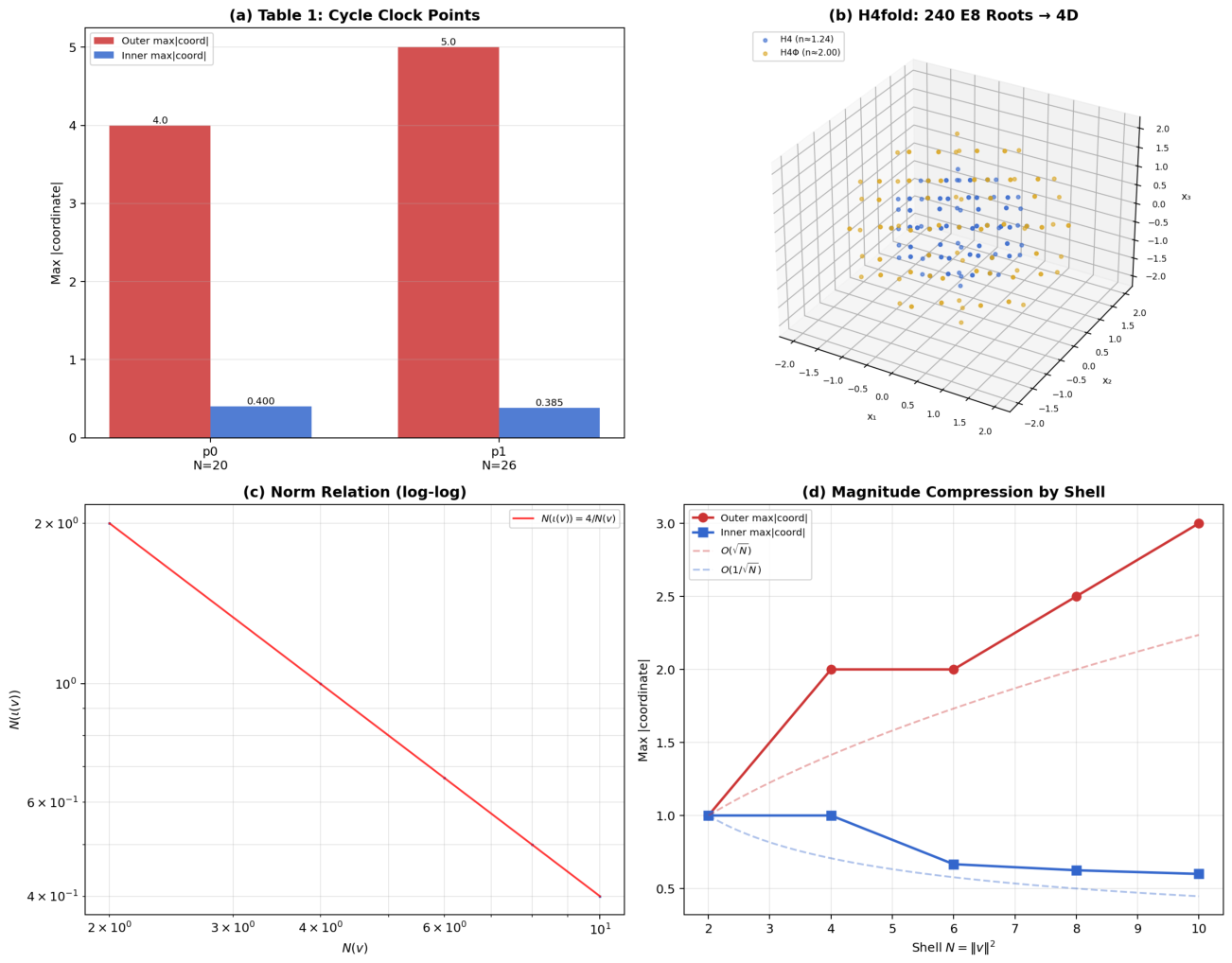
Figure 3.
Golden linear-radial dual compressor applied to lattice vertices (shells through ). After projection to 4D and hyperspherical inversion at the empirical finite-domain radius , the resulting cloud is contained inside a 4D sphere of that radius. The 3D FIG slice is colored by distance from the origin (light = near origin, dark = near boundary), revealing the density accumulation predicted by the norm relation on this finite domain. Whether the same bound extends to arbitrary shells is left as a future-work proof obligation.
Figure 3.
Golden linear-radial dual compressor applied to lattice vertices (shells through ). After projection to 4D and hyperspherical inversion at the empirical finite-domain radius , the resulting cloud is contained inside a 4D sphere of that radius. The 3D FIG slice is colored by distance from the origin (light = near origin, dark = near boundary), revealing the density accumulation predicted by the norm relation on this finite domain. Whether the same bound extends to arbitrary shells is left as a future-work proof obligation.
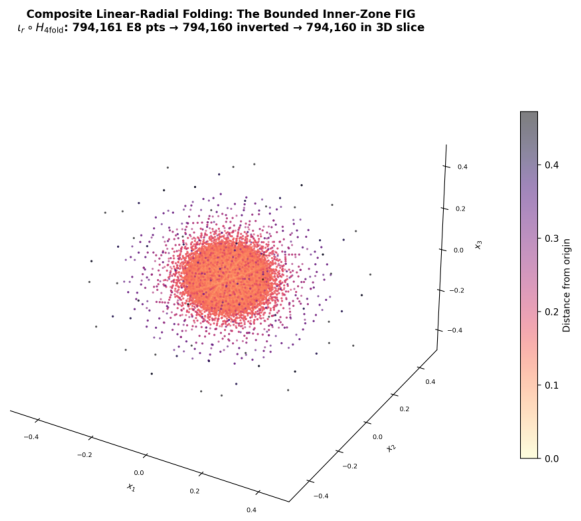
Table 2.
Magnitude compression under radial folding across lattice shells.
| Shell N | Count | Outer max|coord| | Inner max|coord| | ||
|---|---|---|---|---|---|
| 2* | 240 | 1.0 | 1.000000 | 1.414 | 0.707 |
| 4 | 2 160 | 2.0 | 1.000000 | 2.000 | 0.500 |
| 6 | 6 720 | 2.0 | 0.666667 | 2.449 | 0.408 |
| 8 | 17 520 | 2.5 | 0.625000 | 2.828 | 0.354 |
| 10 | 30 240 | 3.0 | 0.600000 | 3.162 | 0.316 |
*Boundary zone (), fixed under ; inner values equal outer by definition.
Table 3.
Shelling benchmark: CPU time to compute the shell multiplicity .
| n | -exact | -FFT | Divisor sum | Exact/Div | |
|---|---|---|---|---|---|
| 100 | 275 957 520 | 0.003 s | 0.0002 s | s | 2 258× |
| 500 | 34 494 707 520 | 0.078 s | 0.0004 s | 2 s | 39 673× |
| 1 000 | 276 430 190 400 | 0.312 s | 0.0009 s | 4 s | 83 144× |
| 2 000 | 2 211 914 053 440 | 1.200 s | 0.0010 s | 5 s | 261 876× |
| 5 000 | 34 553 773 940 400 | — | 0.0026 s | 5 s | — |
Disclaimer/Publisher’s Note: The statements, opinions and data contained in all publications are solely those of the individual author(s) and contributor(s) and not of MDPI and/or the editor(s). MDPI and/or the editor(s) disclaim responsibility for any injury to people or property resulting from any ideas, methods, instructions or products referred to in the content. |
© 2026 by the authors. Licensee MDPI, Basel, Switzerland. This article is an open access article distributed under the terms and conditions of the Creative Commons Attribution (CC BY) license (http://creativecommons.org/licenses/by/4.0/).
Copyright: This open access article is published under a Creative Commons CC BY 4.0 license, which permit the free download, distribution, and reuse, provided that the author and preprint are cited in any reuse.


