
Submitted:
27 May 2026
Posted:
29 May 2026
You are already at the latest version
Abstract
Background: Diphtheria is an acute infectious disease caused by Corynebacterium diphtheriae. Despite several worldwide outbreaks, it is now considered as a rare disease by industrialized countries. Clinical manifestations usually account for oropharyngeal lesions but rare cases of systemic involvement (mainly endocarditis) had been described among non-toxigenic strains. Case description: We report the case of a patient who experienced septic shock, disseminated intravascular coagulation and multiorgan failure due to Corynebacterium diphtheriae infection. The pathogen was further characterized as a highly toxigenic strain. Infective endocarditis with mitral and aortic valves vegetations led to early multiorgan septic embolization. Major stroke, liver function impairment, heart failure and acute kidney injury were the main findings. Unlike the typical forms of infection caused by this pathogen, there was no evidence of airways or skin involvement. Furthermore, apart from hemocultures, none of the other investigations (pharyngeal swabs, bronchoalveolar lavages, urine culture) ever tested positive for the bacteria. Conclusions: The report we present describes a case of C. diphtheriae infection with much atypical characteristics: (i) lack of any pathognomonic signs or symptoms; (ii) extensive endocarditic process (very uncommon for toxigenic strains); (iii) early septic emboli development, with rapid evolution to multiorgan failure; (v) detection of disseminated intravascular coagulation. Despite disseminated intravascular coagulation is a known complication of septic shock, regardless for the etiological agent, by our literature research this is the first known case driven by C. diphtheriae infection in the adult.
Keywords:
Corynebacterium diphtheriae
; disseminated intravascular coagulation
; infective endocarditis
; septic shock
; toxigenic strain
1. Introduction
Diphtheria is an acute infectious disease caused by Corynebacterium diphtheriae; a non-capsulated, gram-positive bacillus [1].
The pathogen is commonly transmitted by droplets, although rare cases of contact transmission have been described [2]. Commonly it causes laryngopharyngitis, distinguishable by the presence of pathognomonic pseudomembranes: greyish plaques, with potential necrotic-hemorrhagic evolution, observable mainly in the palatine tonsils, but potentially affecting the soft palate, hypopharynx and larynx as well [3]. Cutaneous diphtheria is otherwise characterized by indolent skin ulcers covered with pseudomembranes, and it tends to involve the limbs [3].
Exotoxin production is the primary cause of virulence. Not all strains are toxigenic; toxin production depends on the expression of a specific gene, carried by a circular DNA molecule, acquired after a β-lysogenic phage interaction [2]. Exotoxin is also responsible for the potential systemic manifestations: myocarditis, cranial nerves peripheral paralysis and acute kidney injury (AKI) [3,4]. Despite that, toxigenic strains commonly cause respiratory symptoms, whereas non-toxigenic strains have been described as a possible cause of infective endocarditis (IE) [5,6].
Although the global vaccination coverage rate has reached 86%, new outbreaks could still be observed. Considering that humans are the only reservoir of the pathogen, the status of healthy carriers might represent an important condition for the persistence of the disease [7].
Hereafter we describe the case of a patient whom developed early and extensive cardiac valves injuries, septic shock, multiorgan failure (MOF) and disseminated intravascular coagulation (DIC) after a toxigenic C. diphtheriae stain infection.
2. Case Presentation
Signed consent was acquired from the patient prior to the publication of this case report.
An adult male accessed the emergency department complaining about persistent fever, rigor nucalis, headache and disabling arthromyalgias, predominantly affecting wrists, hands, ankles and feet. He reported a recent trip to a foreign country, but excluded any raw food consumption, contact with febrile people, or tick bites. Medical history only referred to mild psoriasis, without ongoing therapy.
Psoriatic patches were seen on the elbows, without any other dermatological issues. Neither the cardiopulmonary physical examination nor the airways evaluation reported any lesion. Blood tests revealed hypokalemia (3.1 mM), neutrophilic leukocytosis (13,750 U/μL) and thrombocytopenia (70,000 U/μL) (Figure S1). A highly toxigenic C. diphtheriae stain was detected in hemocultures. Notably, all nasopharyngeal swabs performed tested negative. Furthermore, an otolaryngologist’s evaluation excluded pharyngeal pseudomembranes as well as any other pharyngeal lesions. Similarly, the multiple optical bronchoscopies performed during hospitalization never showed any tracheal or bronchial injury.
The patient suddenly experienced left hemiplegia and aphasia. A computed tomography (CT) showed acute occlusion of the proximal tract of the right middle cerebral artery (MCA) (Figure 1). Given thrombocytopenia, intravenous fibrinolytic treatment was unfeasible due to an unacceptable hemorrhagic risk. Thus, thromboaspiration was carried out. Cultures from sample material later tested positive for C. diphtheriae, assessing the diagnosis of septic cerebral embolism. Even though the interventional procedure was successful, further CT scans revealed an ischemic progression in MCA territories. Midline shift associated with compression of the ventricular system eventually led to decompressive craniectomy to be performed (Figure S2).
CT scan was further extended to the abdomen to detect any other sites of embolization; two large ischemic areas were observed in the middle-upper third of the spleen and in the upper pole of the left kidney (Figure 2).
The persistent increase in troponin subunit levels (up to 1178 ng/mL) led to suspicion of cardiac involvement. Transesophageal echocardiography (TEE) was therefore performed. Severe insufficiency of the aortic valve was observed due to multiple vegetations and rupture of the right coronary cusp (Video S3). Two vegetations affecting both the atrial and ventricular sides of the mitral valve were detected as well. The major (17 mm) presented with central vacuolization and multiple perforations, which was the cause of severe valve insufficiency (Video S4).
Given MOF, treatment required a multidisciplinary approach. Once the pathogen was isolated from hemocultures and an antibiogram was obtained (Table 1), antibiotic therapy was started with piperacillin/tazobactam, clindamycin and gentamicin. After brain septic emboli confirm, meropenem was added to optimize central nervous system penetration. Given the characterization as a highly toxigenic strain, an intravenous diphtheria antitoxin infusion was also introduced.
Renal replacement therapy was started as well. Not only it allowed for AKI therapy but also granted for septic cytokine adsorption.
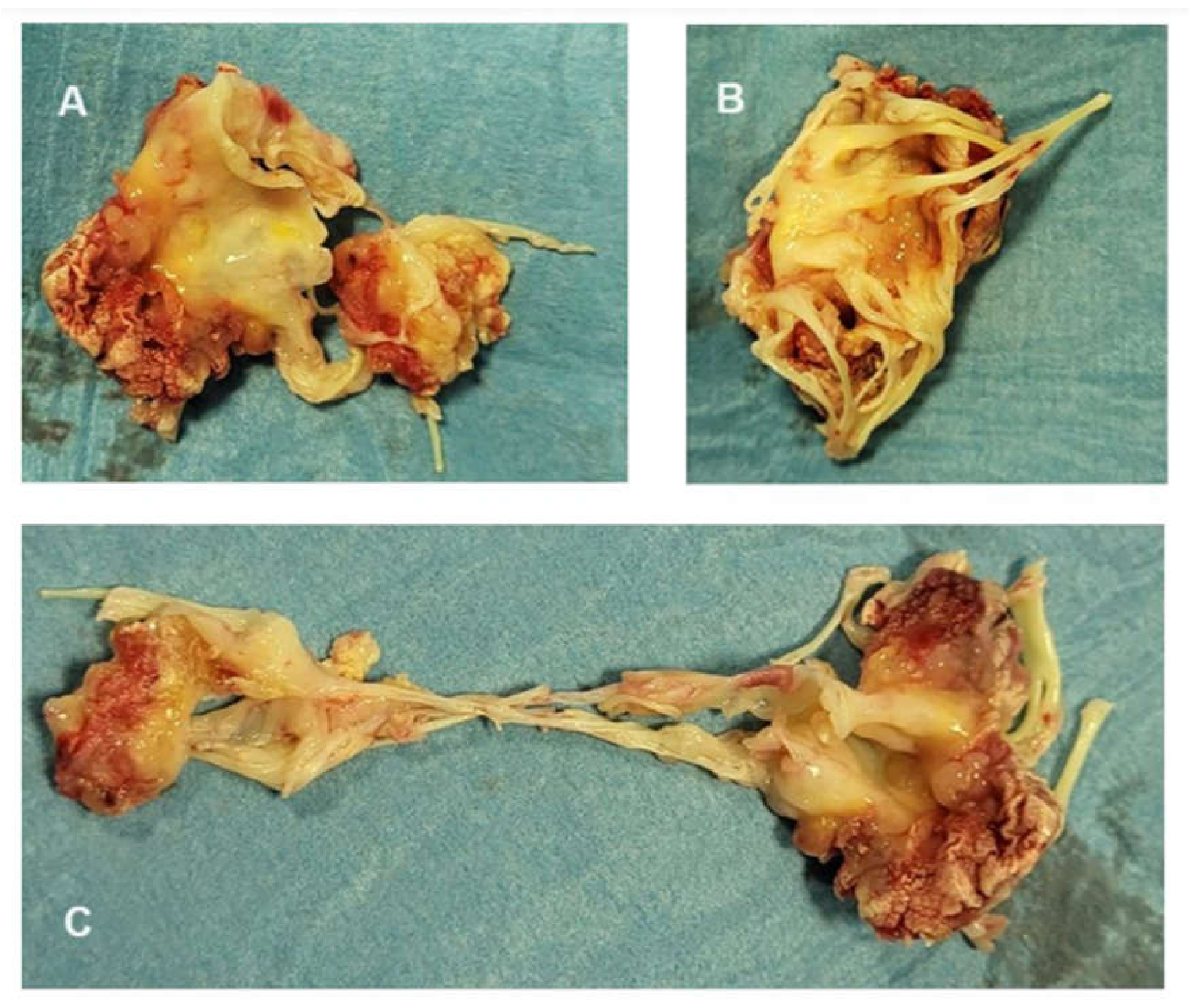
Mitral and aortic valves severe insufficiency required cardiac surgery for valve replacement. Intra-operative evaluation showed florid vegetations on all aortic valve cusps and a pseudo-aneurysmal cavity at the sub-commissural trigone between the right and left coronary cusps. Large vegetations with severe remodeling of the valve leaflets and sub-valvular apparatus were also observed on the mitral valve (Figure 2).
Figure 3.
Intra-operative specimen of mitral valve: (A) Atrial face showing a destructive process due to a massive vegetation; (B) Ventricular side: intact chordae tendineae but extensive nodulations among peripheral surfaces of both cusps; (C) Extensive vegetation affecting antero-septal cusp (left-side of the image) and massive vegetations on atrial side of both cusps (right-side of the image).
Figure 3.
Intra-operative specimen of mitral valve: (A) Atrial face showing a destructive process due to a massive vegetation; (B) Ventricular side: intact chordae tendineae but extensive nodulations among peripheral surfaces of both cusps; (C) Extensive vegetation affecting antero-septal cusp (left-side of the image) and massive vegetations on atrial side of both cusps (right-side of the image).
The patient was discharged to ward on the 106th day of hospitalization (Figure S5).
3. Discussion
Diphtheria incidence progressively decreased worldwide. This is attributable to the increasing vaccination coverage, particularly following the introduction of the trivalent diphtheria-tetanus-pertussis vaccine (DTP) [8]. A fully completed DTP vaccination cycle (3 doses plus one booster every ten years) can prevent 87% of symptomatic cases but does not prevent the infection [7]. The status of healthy carrier might thus represent an important condition for disease transmission, despite patients with asymptomatic diseases have been shown to transmit the pathogen at a 24% the rate of symptomatic cases [7].
The patient described in our report correctly followed the infancy vaccination cycle but never underwent adulthood boosters administration. This may justify the systemic evolution of the infection that he experienced. Interestingly, none of his relatives, whom he lived in close contact at home, ever showed any symptoms.
C. diphtheriae is commonly transmitted by droplets and normally causes symptoms affecting oropharynx or upper airways. The lack of any ascertained source of infection makes our report atypical. No pathognomonic lesion (pseudomembranes) nor upper airways neither cutaneous injuries have ever been detected. Furthermore, the patient did not manifest any risk factors (traumatic injuries, tick bites, journeys into endemic areas, contact with known febrile people).
Atypical presentation, lack of pathognomonic lesions and sudden clinical worsening led to a challenging diagnosis. Meningoencephalitis was suspected during the first medical visit due to migraine and rigor nucalis. Lumbar puncture was not performed because of prompt symptoms regression after steroids and non-steroidal anti-inflammatory drugs administration, absence of further typical semiotic signs and relative contraindication due to thrombocytopenia.
Unexpected cerebral thrombosis associated with thrombocytopenia, endocarditis and AKI, in a known psoriatic patient, aroused suspicion for lupus overlapping syndrome [9]. Such a diagnosis was further excluded due to the absence of circulating autoantibodies.
Before C. diphtheriae isolation, the evidence of massive valve vegetations led to a prompt search for IE most addressed pathogens. Streptococcus pyogenes was excluded by negative nasopharyngeal swabs and antistreptolysin test. Staphylococcal infection was ruled out on both epidemiological and clinical criteria due to the absence of risk factors (such as drug abuse, cardiac implanted electronic devices, or recent surgery) and the lack of impairment of the right-side heart valves [10]. HACEK group pathogens were excluded due to the absence of any risk factors: congenital heart disease, periodontitis, polymicrobial wound infections, otitis media, or pharyngeal abscesses [11].
C. diphtheriae cellular adhesion mechanism had been largely studied but not yet fully understood. The main bonding factors appear to be adhesive pili, which mediate interaction between the pathogen and host’s fibrinogen or collagen [12]. Further genomic studies showed that the expression of a single gene (spa—pilus gene cluster) may provide an advantage in colonizing different tissues in the host [13]. This evidence may indicate a different cellular tropism, possibly explaining the rapid and extensive damage to cardiac valves, but not to oropharynges, which was observed in our case.
More, our report showed the simultaneous presence of thrombotic foci associated with thrombocytopenia. This raised suspicion for DIC. The Japanese Association for Acute Medicine score, which has been proven to be a reliable indicator of DIC in septic patients, was diagnostic for DIC when applied to our case [14] (Table 2). Despite C. diphtheriae infection might represent a very rare cause of DIC in pediatric patients, by our literature research, this is the first known case in the adult [4].
4. Conclusions
This report describes a case of C. diphtheriae infection with much atypical characteristics: (i) development in a patient without any risk-behavior apart from an uncomplete adulthood immunization; (ii) absolute lack of typical signs and symptoms; (iii) fast and extensive aggression of cardiac valves driven by a toxigenic strain; (iv) early septic embolization; (v) rapid evolution to septic shock and MOF; (vi) DIC development. Despite disseminated intravascular coagulation is a known complication of septic shock, regardless for the etiological agent, by our literature research this is the first known case driven by C. diphtheriae infection in the adult.
These characteristics might be addressed by the pathogen’s anomalous expression of virulence factors, which might had given a peculiar tropism to endocardium, rather than oropharynx mucosal cells.
Supplementary Materials
The following supporting information can be downloaded at the website of this paper posted on Preprints.org.
Author Contributions
Conceptualization, M.F.; investigation, M.F.; data curation, M.F.; writing—original draft preparation, M.F.; writing—review and editing, M.F., I.M.; supervision, F.B. All authors have read and agreed to the published version of the manuscript.
Funding
The authors did not receive support from any organization for the submitted work.
Informed Consent
Signed informed consent has been obtained from the patient prior to the publication of this case report.
Data Availability
Data will be made available on request.
Acknowledgments
None.
Conflicts of Interest
The authors have no conflicts of interest to declare that are relevant to the content of this article.
References
- Sharma, N.C.; Efstratiou, A.; Mokrousov, I.; Mutreja, A.; Das, B.; Ramamurthy, T. Diphtheria. Nat. Rev. Dis. Prim. 2019, 5, 81. [Google Scholar] [CrossRef] [PubMed]
- Parveen, S.; Bishai, W.R.; Murphy, J.R. Corynebacterium diphtheriae: Diphtheria Toxin, the tox Operon, and Its Regulation by Fe2+ Activation of apo-DtxR. Microbiol. Spectr. 2019, 7. [Google Scholar] [CrossRef] [PubMed]
- Hadfield, T.L.; McEvoy, P.; Polotsky, Y.; Tzinserling, V.A.; Yakovlev, A.A. The pathology of diphtheria. J. Infect. Dis. 2000, 181, S116–S120. [Google Scholar] [CrossRef] [PubMed]
- Byard, R.W. Diphtheria—‘The strangling angel’ of children. J. Forensic Leg. Med. 2013, 20, 65–68. [Google Scholar] [CrossRef] [PubMed]
- Lovelock, T.; du Plessis, M.; van der Westhuizen, C.; et al. Non-toxigenic Corynebacterium diphtheriae endocarditis: A cluster of five cases. S. Afr. J. Infect. Dis. 2024, 39, 539. [Google Scholar] [CrossRef] [PubMed]
- Sharma, N.C.; Efstratiou, A.; Mokrousov, I.; Mutreja, A.; Das, B.; Ramamurthy, T. Diphtheria. Nat. Rev. Dis. Prim. 2019, 5, 81. [Google Scholar] [CrossRef] [PubMed]
- Truelove, S.A.; Keegan, L.T.; Moss, W.J.; et al. Clinical and Epidemiological Aspects of Diphtheria: A Systematic Review and Pooled Analysis. Clin. Infect. Dis. 2020, 71, 89–97. [Google Scholar] [CrossRef] [PubMed]
- Clarke, K.E.N.; MacNeil, A.; Hadler, S.; Scott, C.; Tiwari, T.S.P.; Cherian, T. Global Epidemiology of Diphtheria, 2000-20171. Emerg. Infect. Dis. 2019, 25, 1834–1842. [Google Scholar] [CrossRef] [PubMed]
- Yu, H.; Nagafuchi, Y.; Fujio, K. Clinical and Immunological Biomarkers for Systemic Lupus Erythematosus. Biomolecules 2021, 11, 928. [Google Scholar] [CrossRef] [PubMed]
- Wang, A.; Gaca, J.G.; Chu, V.H. Management Considerations in Infective Endocarditis: A Review. JAMA 2018, 320, 72–83. [Google Scholar] [CrossRef] [PubMed]
- Khaledi, M.; Sameni, F.; Afkhami, H.; Hemmati, J.; Asareh Zadegan Dezfuli, A.; Sanae, M.J.; Validi, M. Infective endocarditis by HACEK: A review. J. Cardiothorac. Surg. 2022, 17, 185. [Google Scholar] [CrossRef] [PubMed]
- Ott, L.; Möller, J.; Burkovski, A. Interactions between the Re-Emerging Pathogen Corynebacterium diphtheriae and Host Cells. Int. J. Mol. Sci. 2022, 23, 3298. [Google Scholar] [CrossRef] [PubMed]
- Sangal, V.; Blom, J.; Sutcliffe, I.C.; von Hunolstein, C.; Burkovski, A.; Hoskisson, P.A. Adherence and invasive properties of Corynebacterium diphtheriae strains correlates with the predicted membrane-associated and secreted proteome. BMC Genom. 2015, 16, 765. [Google Scholar] [CrossRef] [PubMed]
- Wada, H.; Matsumoto, T.; Yamashita, Y. Diagnosis and treatment of disseminated intravascular coagulation (DIC) according to four DIC guidelines. J. Intensive Care 2014, 2, 15. [Google Scholar] [CrossRef] [PubMed]
Figure 1.
(A) Three-dimensional reconstruction of angiographic CT brain scan showing right MCA lack of perfusion (arrow) due to septic emboli. (B) CT brain scan, coronal axis, assessing the diagnosis of acute right MCA occlusion (note the lack of contrast-enhancement distal to the arrow).
Figure 1.
(A) Three-dimensional reconstruction of angiographic CT brain scan showing right MCA lack of perfusion (arrow) due to septic emboli. (B) CT brain scan, coronal axis, assessing the diagnosis of acute right MCA occlusion (note the lack of contrast-enhancement distal to the arrow).
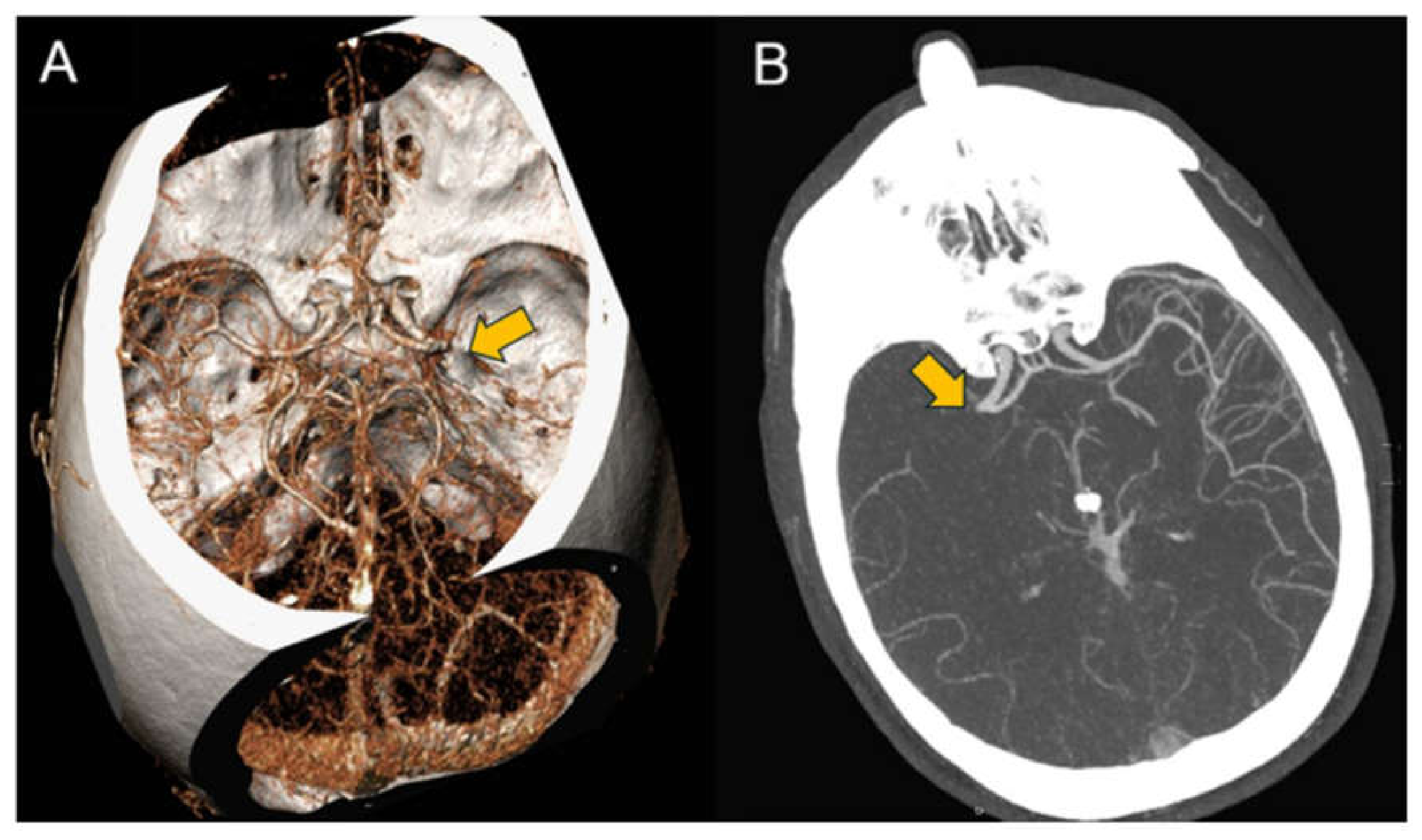
Figure 2.
Multiple abdominal coronal (A,C) and transverse (B,D) scans assessing for the diagnosis of ischemic lesions due to septic emboli among left kidney (marker at (A,B)) and upper left pole of spleen (marker at C,D).
Figure 2.
Multiple abdominal coronal (A,C) and transverse (B,D) scans assessing for the diagnosis of ischemic lesions due to septic emboli among left kidney (marker at (A,B)) and upper left pole of spleen (marker at C,D).
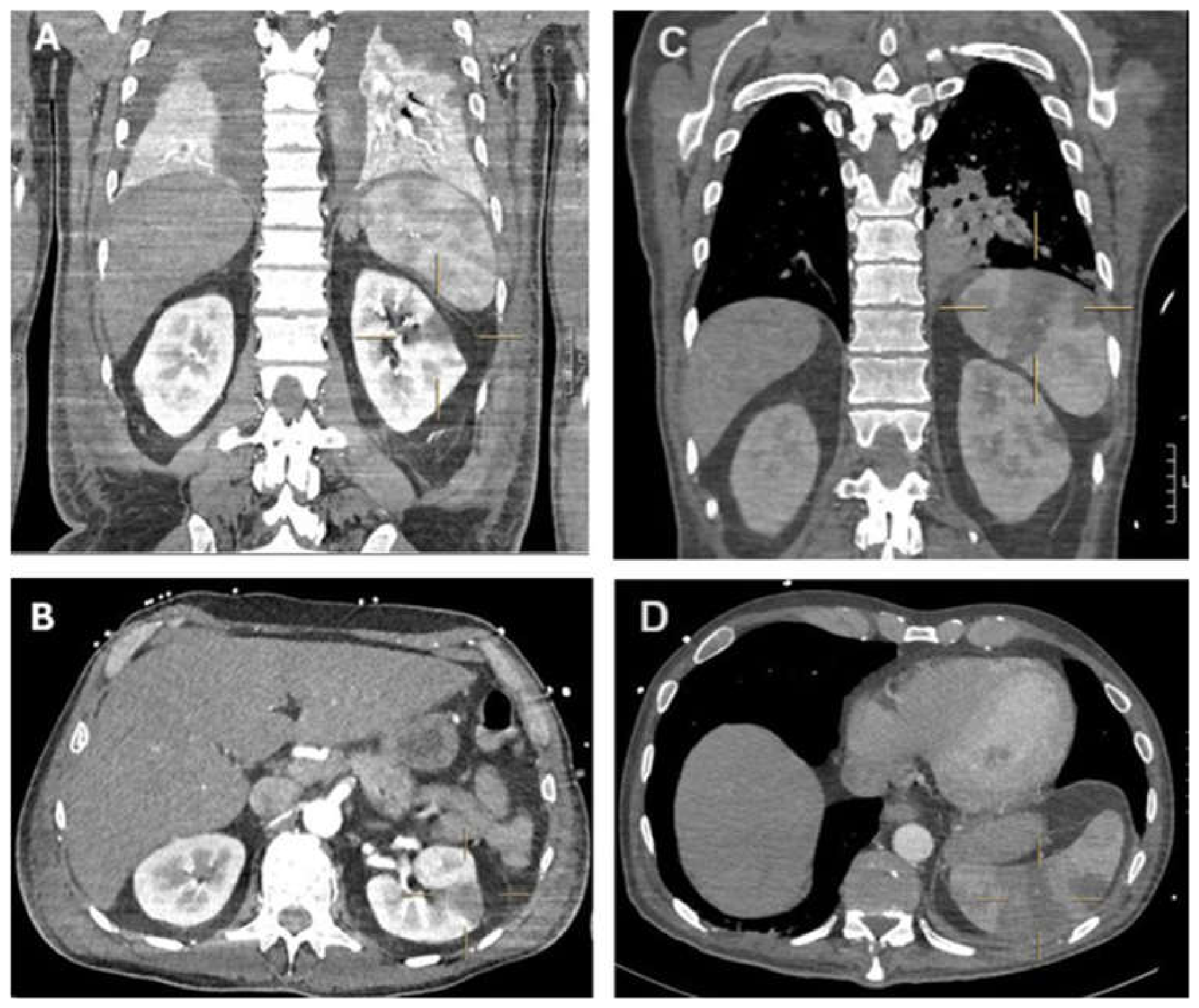

Table 1.
Antibiogram obtained from hemocultures. S = sensitive; I = intermediate; R = resistant; MIC = minimal inhibitory concentration; CFU = colony forming units.
Table 1.
Antibiogram obtained from hemocultures. S = sensitive; I = intermediate; R = resistant; MIC = minimal inhibitory concentration; CFU = colony forming units.
| Test: hemoculture; Pathogen: C. diphtheriae; Concentration: 10^5 CFU/mL | ||
| Antibiotic | MIC | Efficacy profile |
| Amoxicillin | 0.125 | S |
| Cefotaxime | 0.5 | I |
| Ciprofloxacin | 0.75 | R |
| Clindamycin | 0.38 | S |
| Doxycycline | 0.125 | S |
| Erythromycin | 0.047 | S |
| Linezolid | 0.19 | S |
| Meropenem | 0.064 | S |
| G penicillin | 0.094 | I |
| Rifampicin | < 0.002 | S |
| Tetracycline | 0.19 | S |
| Trimethoprim/sulfamethoxazole | 1.5 | R |
Table 2.
Japanese Association for Acute Medicine score for disseminated intravascular coagulation diagnosis, and parameters seen in our report. INR = international normalized ratio; SIRS = systemic inflammatory response syndrome; WBC = white blood cells; bpm = beats per minute; MV = mechanical ventilation.
Table 2.
Japanese Association for Acute Medicine score for disseminated intravascular coagulation diagnosis, and parameters seen in our report. INR = international normalized ratio; SIRS = systemic inflammatory response syndrome; WBC = white blood cells; bpm = beats per minute; MV = mechanical ventilation.
| JAAM Score | Our Case Report | ||
| Factors | Points | Parameters | Points |
| Platelet count | |||
| <80 × 10^3 u/μL or >50% decrease within 24 h |
3 | 50 × 10^3 u/μL | 3 |
| ≥80 × 10^3 and <120 × 10^3 u/μL or 30–50% decrease between 24 h |
1 | ||
| ≥120.000 | 0 | ||
| INR | |||
| ≥1.2 | 1 | 1.32 | 1 |
| <1.2 | 0 | ||
SIRS score:
| |||
| ≥3 positive parameters | 1 | 3 parameters | 1 |
| <3 positive parameters | 0 | ||
| Fibrine degradation products | |||
| D-dimer ≥ 25 μg/mL | 3 | 2.75 | 0 |
| D-Dimer 10–25 μg/mL | 1 | ||
| D-dimer < 10 μg/mL | 0 | ||
| Total (≥4 is diagnostic for DIC) | 5 | ||
Disclaimer/Publisher’s Note: The statements, opinions and data contained in all publications are solely those of the individual author(s) and contributor(s) and not of MDPI and/or the editor(s). MDPI and/or the editor(s) disclaim responsibility for any injury to people or property resulting from any ideas, methods, instructions or products referred to in the content. |
© 2026 by the authors. Licensee MDPI, Basel, Switzerland. This article is an open access article distributed under the terms and conditions of the Creative Commons Attribution (CC BY) license (http://creativecommons.org/licenses/by/4.0/).
Copyright: This open access article is published under a Creative Commons CC BY 4.0 license, which permit the free download, distribution, and reuse, provided that the author and preprint are cited in any reuse.


