

Submitted:
18 May 2026
Posted:
28 May 2026
You are already at the latest version
Abstract
Cancer metabolism research has long been shaped by a pathway-centric paradigm, in which individual biochemical routes—most prominently aerobic glycolysis (the Warburg effect)—are studied and targeted in relative isolation. Accumulating evidence from systems biology, multi-omics profiling, and computational oncology suggests, however, that this view is insufficient to explain the adaptive resilience that solid tumors routinely demonstrate against metabolic inhibitors. Here we propose a conceptual synthesis: the tumor dynamic metabolic interaction network (DMIN), a graph-theoretic framework in which metabolic enzymes and transporters constitute nodes, substrate fluxes define weighted edges, and the system's overall state is governed by topological properties such as betweenness centrality and eigenvector centrality. Within this framework, we elaborate the hypothesis of dynamic network collapse (DNC)—the notion that simultaneous perturbation of several high-centrality nodes may push the tumor metabolic network beyond a thermodynamic instability threshold, triggering irreversible functional disintegration that cannot be escaped through known compensatory rerouting. We review the three dominant metabolic axes of tumor survival—glucose (GLUT1/HK2/PKM2), glutamine (SLC1A5/GLS1), and lactate efflux (MCT1/MCT4)—and examine how each contributes to immunosuppression through metabolic competition with cytotoxic T lymphocytes and through the acidification of the tumor microenvironment. We further discuss genome-scale metabolic models, flux balance analysis, and graph neural network approaches that may render the DNC concept computationally actionable. The clinical implications of multi-node targeting are considered alongside the limitations of existing evidence and unresolved methodological challenges. Although the DNC hypothesis remains to be tested experimentally in relevant in vivo models, it provides a coherent rationale for the next generation of combination metabolic therapies and for patient-specific metabolic profiling as a decision tool.
Keywords:
cancer metabolism
; Warburg effect
; tumor microenvironment
; metabolic network
; flux balance analysis
; MCT1
; MCT4
; glutaminolysis
; graph neural network
; immunometabolism
; combination therapy
; dynamic network collapse
1. Introduction
Aerobic glycolysis in cancer cells, first described by Otto Warburg in the 1920s and subsequently quantified by positron emission tomography with 18F-fluorodeoxyglucose, remains one of the most reproducible metabolic hallmarks of malignant tissue [1,2]. The mechanistic basis of the Warburg effect—constitutive upregulation of glucose transporters (GLUT1, GLUT3), overexpression of hexokinase 2 (HK2), and accumulation of the pyruvate kinase M2 isoform (PKM2)—has been characterized in considerable detail, and pharmaceutical inhibitors targeting each of these steps have been developed and tested [3]. Yet despite decades of research, glycolytic inhibitors have not translated into routine clinical practice for solid tumors, and the reasons for this deserve careful consideration.
One central obstacle is metabolic plasticity: the ability of cancer cells to rewire their metabolic networks in response to nutrient deprivation or pharmacological interference. When glucose utilization is pharmacologically restricted, many tumor types upregulate glutamine-dependent anaplerosis, fatty acid oxidation, or macropinocytosis to sustain biosynthetic and energetic demands [4,5]. Conversely, inhibition of glutamine metabolism can be compensated by enhanced glucose uptake or alternative carbon sources such as acetate. This compensatory flexibility is not accidental; it is the predictable consequence of treating a complex network as though it were a simple linear pathway.
Network science offers a more principled framework for understanding such robustness. Biological metabolic networks share structural features with other complex systems: scale-free topology, the existence of highly connected hubs, and modularity [6]. In such networks, targeted removal of peripheral nodes causes little systemic disruption, while simultaneous perturbation of multiple high-centrality nodes can produce cascading failure—a phenomenon well characterized in infrastructure and ecological systems but underexplored in cancer biology [7]. Emerging computational evidence suggests that tumor metabolic networks are no exception, and that rational identification of co-essential metabolic nodes may unlock therapeutically exploitable vulnerabilities inaccessible to single-agent strategies [8].
In this review we integrate insights from classical cancer metabolism, immunometabolism, tumor microenvironment biology, and computational systems biology to advance the concept of the Dynamic Metabolic Interaction Network (DMIN) and the associated hypothesis of Dynamic Network Collapse (DNC). We argue that this framework offers both an explanatory account of why mono-target metabolic therapies fail and a conceptual roadmap toward more effective combination strategies. Importantly, we present this as an emerging hypothesis grounded in existing evidence—not as an established clinical doctrine—and we highlight the methodological gaps that future experimental work must address.
2. The Tumor as a Dynamic Metabolic Interaction Network
2.1. Conceptual Definition of DMIN
We define the Dynamic Metabolic Interaction Network (DMIN) as a time-varying, context-dependent weighted graph G(V, E, W, t), where V is the set of metabolic nodes (enzymes, transporters, metabolites, and regulatory proteins), E represents directional substrate or regulatory interactions, W(e,t) is the weight of each edge—corresponding to the metabolic flux through that reaction at time t—and t captures the dynamic nature of the network under evolving nutrient, oxygen, and therapeutic conditions. The qualifier 'dynamic' is critical: it emphasizes that tumor metabolic networks are not static structures but systems that continuously reconfigure in response to intrinsic signals (oncogenic drivers, epigenetic state) and extrinsic pressures (nutrient availability, immune cell activity, drug exposure).
This formulation is deliberately abstract to accommodate multiple levels of resolution. At the enzyme level, nodes may correspond to individual catalytic proteins such as LDHA or GLS1. At the pathway module level, entire glycolytic or glutaminolytic subroutines may be collapsed into aggregate nodes, with inter-module fluxes forming edges. The appropriate level of resolution depends on the analytical question and the available experimental data (Figure 1).
2.2. Network Topology and Metabolic Hubs
The topology of human metabolic networks has been characterized through genome-scale reconstruction efforts, most notably the Recon2 and Human1 models, which encompass approximately 13,000 reactions, 4,000 metabolites, and 3,000 gene-associated enzymes [9,10]. Analysis of these networks reveals a scale-free degree distribution, with a small number of highly connected metabolites—including ATP, NADH, NADPH, and CoA—serving as global hubs that participate in hundreds of reactions. Metabolic enzymes that occupy high-betweenness-centrality positions in such networks are of particular interest for therapeutic targeting because their perturbation has a disproportionate effect on overall network flux [11].
In cancer-specific network reconstructions—generated by integrating transcriptomic or proteomic data with generic genome-scale models via algorithms such as GIMME, iMAT, or INIT—several enzymes consistently emerge as high-centrality nodes across tumor types: HK2 (bridging glycolysis and the pentose phosphate pathway), PHGDH (linking glycolysis to serine biosynthesis), GLS1 (entry point of glutaminolysis), and LDHA (coupling glycolysis to NAD+ regeneration and lactate export) [12]. The co-occurrence of these enzymes as metabolic hubs across multiple tumor types suggests a convergent evolutionary logic in cancer metabolism and raises the possibility that their simultaneous inhibition could have synergistic consequences.
2.3. Metabolic Plasticity as a Network Property
Metabolic plasticity—the capacity of cancer cells to maintain viability under nutrient stress—emerges from two structural features of the DMIN: redundancy and modularity. Redundancy refers to the existence of alternative paths connecting the same metabolic source and sink; modularity refers to the semi-independent organization of the network into functional clusters (glycolysis, TCA cycle, pentose phosphate pathway, one-carbon metabolism) that can be individually up- or downregulated [13]. Both features confer robustness but also impose constraints: highly modular networks require inter-module hubs that cannot be bypassed, and it is at these topological bottlenecks that the DMIN is most vulnerable to perturbation [8].
3. Key Metabolic Axes of Tumor Survival
3.1. The Glucose Axis: Glycolysis and Biosynthesis
The glucose metabolic axis encompasses substrate uptake via GLUT1 and GLUT3, phosphorylation by HK2 to glucose-6-phosphate, flux through the Embden–Meyerhof–Parnas pathway, and terminal processing of pyruvate by LDHA to lactate. This axis serves not merely as an energy supply route but as a biosynthetic hub: branching reactions from glucose-6-phosphate feed the pentose phosphate pathway (ribose synthesis, NADPH production), glycolytic intermediates support serine and glycine synthesis, and the TCA cycle is replenished through pyruvate carboxylation [1,3].
HK2 is particularly noteworthy from a network perspective because it occupies a strategic position at the intersection of the glycolytic pathway, the pentose phosphate pathway, and glycogen synthesis. Deletion of HK2 in mouse models of lung and breast cancer produces significant tumor suppression without equivalent toxicity in normal tissues, which preferentially express HK1—an isoform with distinct regulatory properties [14]. PKM2, the M2 isoform of pyruvate kinase, plays a complementary role by existing in a low-activity tetrameric state that slows glycolytic flux and thereby promotes accumulation of upstream biosynthetic intermediates. The balance between dimeric (inactive) and tetrameric (active) PKM2 is regulated by oncogenic signaling including EGFR and FGFR1, making this enzyme a context-sensitive node whose contribution to the network varies between tumor types and growth conditions [15].
3.2. The Glutamine Axis: Anaplerosis and Redox Homeostasis
Glutamine serves as the primary anaplerotic substrate in most rapidly proliferating cancers, replenishing TCA cycle intermediates that are diverted for biosynthesis [16]. The mitochondrial enzyme glutaminase 1 (GLS1) - the rate-limiting enzyme for glutamine catabolism—is overexpressed in a wide range of solid tumors and hematological malignancies, driven in part by MYC-mediated transcriptional activation and by the mTORC1 pathway [17]. The transporter SLC1A5 (ASCT2), which mediates cellular glutamine import, is similarly overexpressed and has been validated as a therapeutic target in preclinical models [18].
Beyond its role in anaplerosis, glutamine feeds multiple biosynthetic and regulatory pathways: it is the nitrogen donor for nucleotide synthesis, a precursor for glutathione (the cell's primary antioxidant), and a co-substrate for asparagine synthetase and carbamoyl phosphate synthetase. The glutamine axis is therefore not a simple linear pathway but itself a branched sub-network with multiple outputs that serve distinct cellular functions. Inhibition of GLS1 with CB-839 (telaglenastat) has demonstrated activity in clinical trials, though emerging data indicate that resistance frequently arises through metabolic rerouting - particularly via increased PHGDH-dependent serine synthesis and arginine uptake [19] - illustrating the very plasticity that the DMIN framework predicts.
3.3. The Lactate Axis: MCT Transporters and Immune Suppression
The monocarboxylate transporter family (MCT1–MCT4, encoded by SLC16A1–SLC16A4) mediates the proton-coupled bidirectional transport of lactate, pyruvate, and ketone bodies across the plasma membrane [20]. In the context of the Warburg effect, MCT4 serves as the primary efflux transporter in glycolytic, hypoxic cancer cells (driven by HIF-1α–mediated transcription), while MCT1 mediates both lactate export in oxidative cells and lactate import in cells exploiting the reverse Warburg effect—a metabolic symbiosis in which cancer-associated fibroblasts produce lactate that is then consumed by oxidative tumor cells [21].
The immunosuppressive consequences of MCT-mediated lactate efflux are increasingly recognized as a significant mechanism of tumor immune evasion. Extracellular lactate in the tumor microenvironment (TME) reaches concentrations of 10–30 mM—approximately an order of magnitude above systemic levels—creating a strongly acidic milieu (pH 6.5–6.8) that impairs the effector function of cytotoxic T lymphocytes (CTL), reduces NK cell cytotoxicity, skews tumor-associated macrophages toward an M2 immunosuppressive phenotype, and promotes differentiation of regulatory T cells (Treg) [22,23]. The MCT axis thus represents a critical link between cancer metabolic reprogramming and immune evasion, making it a particularly attractive target for combined metabolic-immunotherapeutic strategies.
AZD3965, a selective MCT1 inhibitor developed by AstraZeneca, has completed phase I clinical evaluation with an established recommended phase II dose of 10 mg twice daily [24]. Its activity is preferentially observed in tumors with high MCT1 and low MCT4 expression, and resistance mediated by MCT4 upregulation has been documented both preclinically and in patient-derived material—a predictable consequence of the network's redundancy [25]. Dual MCT1/MCT4 inhibition, explored with syrosingopine and through combinations with simvastatin, may partially address this limitation [26].
4. The Immune System as a Metabolic Competitor in the TME
4.1. Competition for Glucose and Glutamine
The metabolic competition between tumor cells and tumor-infiltrating immune cells is now recognized as a fundamental determinant of anti-tumor immunity [27]. CD8+ CTL, which must undergo rapid proliferative expansion and cytokine secretion upon antigen recognition, depend heavily on aerobic glycolysis in a manner that mirrors—but cannot match—the glucose consumption rates of Warburg-active tumor cells [28]. Single-cell metabolomic studies and the METAFlux computational framework have demonstrated that in the TME, tumor cells and immune cells simultaneously compete for glucose and glutamine, with tumor cells routinely out-competing CTL due to their higher transporter expression and constitutively active glycolytic flux [29].
This metabolic competition translates directly into functional impairment: CTL in glucose-depleted conditions show reduced IFN-γ and TNF-α production, diminished cytotoxic granule release, and accelerated exhaustion defined by co-expression of PD-1, TIM-3, and LAG-3 [30]. Importantly, the competition is not simply for energy; tumor-derived glutamine depletion impairs mTOR signaling in CTL, disrupting their activation-induced metabolic reprogramming and blunting the effector response [31]. This creates a self-reinforcing cycle in which the tumor's metabolic dominance suppresses the immune response that would otherwise constrain tumor growth.
4.2. Lactate-Mediated Immunosuppression and the TME Acidic Niche
Lactate functions as more than an inert metabolic waste product in the TME. At millimolar concentrations, extracellular lactate enters immune cells via MCT1 and disrupts glycolysis by product inhibition of LDHA, reducing intracellular ATP and impairing motility, proliferation, and cytokine synthesis [22]. The accompanying acidification suppresses cytokine secretion independently of lactate per se, as demonstrated by experiments showing that buffering TME pH alone partially restores CTL function even in the presence of high lactate [32]. Conversely, lactate promotes the immunosuppressive function of Treg and type II macrophages, which rely more heavily on oxidative phosphorylation and thus tolerate the acidic, high-lactate environment [23].
MCT-targeting strategies therefore have a dual therapeutic rationale: they impair tumor cell metabolism directly, and they partially restore immune competence by reducing the lactate burden in the TME. This immune-metabolic synergy is a key argument for combining MCT inhibitors with immune checkpoint blockade—a strategy supported by preclinical data showing enhanced anti-tumor CTL activity when lactate efflux is pharmacologically restricted [33].
4.3. Myeloid Cells and the Immunosuppressive Stromal Network
Beyond CTL and Treg, the immunosuppressive TME is populated by myeloid-derived suppressor cells (MDSC), tumor-associated macrophages (TAM), and cancer-associated fibroblasts (CAF)—each with distinct metabolic profiles that shape their immunomodulatory function [34]. M2-polarized TAM preferentially oxidize fatty acids and generate arginase-1 and IDO1, which deplete arginine and tryptophan respectively—amino acids essential for T cell function. CAF contribute to the immunosuppressive metabolic landscape by secreting lactate (reverse Warburg), consuming oxygen, and remodeling the extracellular matrix to create physical barriers to T cell infiltration. The DMIN concept must therefore encompass not only the intracellular metabolic network of cancer cells but the intercellular metabolic network of the entire TME ecosystem (Figure 2).
5. Metabolic Plasticity and Resistance to Monotherapy
A recurring and frustrating clinical observation is that metabolic inhibitors that demonstrate striking activity in cell culture and mouse xenograft models fail to produce durable responses in patients. The most mechanistically coherent explanation for this discrepancy is that tumor cells in vivo face selection pressure that rapidly amplifies pre-existing or newly acquired metabolic flexibility—a process that is inadequately modeled in vitro [35].
This flexibility operates through several mechanisms. First, transcriptional reprogramming: oncogenic transcription factors including MYC, HIF-1α, and NRF2 coordinately regulate large portions of the metabolic network, and their activity can be rapidly modulated by nutrient sensors such as mTORC1, AMPK, and SIRT1. Glucose restriction, for example, activates AMPK which suppresses mTORC1, induces fatty acid oxidation, and promotes autophagic nutrient recycling—collectively substituting for lost glycolytic output [4]. Second, epigenetic remodeling: metabolite concentrations, including acetyl-CoA (histone acetylation), α-ketoglutarate and succinate (histone and DNA methylation), and NAD+ (sirtuin activity) are mechanistically coupled to the epigenome, creating metabolic-epigenetic feedback loops that can reprogram gene expression within hours of environmental change [36].
Third, intercellular metabolic exchange: in the TME, tumor cells can receive metabolic substrates from adjacent stromal cells, including lactate (reverse Warburg), lipids from CAF, and amino acids from autophagic macrophages. This metabolic coupling effectively decouples tumor cell viability from dependence on any single nutrient source, severely limiting the efficacy of nutrient-deprivation strategies [37]. Together, these mechanisms constitute a formidable argument for multi-target approaches and against the implicit assumption underlying most metabolic drug development—that cancer cells have a fixed, attackable metabolic phenotype.
6. The Dynamic Network Collapse Hypothesis
6.1. Conceptual Formulation
The Dynamic Network Collapse (DNC) hypothesis posits that a tumor metabolic network can be driven into irreversible functional failure by simultaneously perturbing a set of high-centrality nodes that, when disrupted together, exceed the network's capacity for compensatory rerouting. The key concept is that of a collapse threshold: below it, the network reorganizes and survives; above it, metabolic flux through essential biosynthetic and energetic pathways drops below the minimum required for cell viability, and cell death follows in a manner that cannot be rescued by the activation of known alternative routes. This threshold is not a fixed property of individual nodes but an emergent property of the network's topology and thermodynamic state.
The DNC hypothesis is related to but distinct from the concept of synthetic lethality, which typically refers to the non-viability of cells carrying two simultaneous genetic alterations. Synthetic lethality operates at the level of individual gene pairs; DNC operates at the level of the network as a whole, and the 'alterations' in question are pharmacological perturbations of metabolic fluxes rather than genetic knockouts. Furthermore, synthetic lethality is often cancer-cell-specific by virtue of a pre-existing tumor suppressor loss; DNC relies on the identification of nodes that are essential in the metabolically rewired state of tumor cells but dispensable in normal cells with greater metabolic flexibility. We propose this as a hypothesis rather than an established principle, as rigorous experimental validation in immunocompetent in vivo models remains to be performed (Figure 3).
6.2. Predicted Collapse Targets
Based on published network centrality analyses and co-essentiality mapping from CRISPR-Cas9 dropout screens in cancer cell line panels (DepMap), we suggest that the following node combinations are candidate DNC-inducing perturbations: (i) simultaneous inhibition of HK2 and GLS1, which removes both the glucose and glutamine inputs to the metabolic network while leaving OXPHOS intact in normal cells [38]; (ii) dual blockade of MCT1 and MCT4, which prevents lactate efflux and creates irreversible intracellular acidosis in glycolytic cells [26]; and (iii) combined inhibition of LDHA and the serine synthesis pathway (PHGDH/PSAT1), which disrupts NAD+ regeneration and one-carbon metabolism simultaneously [39]. Each of these perturbations has documented individual activity; the DNC hypothesis predicts that their combination produces a qualitatively different outcome—network collapse—rather than merely additive suppression.
7. Mathematical Formalization of the DMIN and Collapse Conditions
7.1. Graph Representation
Formally, we represent the DMIN as a directed weighted graph G = (V, E, W), where:
V = {v1, v2, ..., vn} — set of nodes (enzymes, transporters, metabolites);
E ⊆ V × V — directed edges (substrate-product or regulatory relationships);
W: E → R+ — weight function mapping each edge to a non-negative metabolic flux.
The state of the system at time t is characterized by the flux vector F(t) = {f_ij(t)} for all edges (i,j) ∈ E. The system state function S(G, t) is defined as the weighted sum of fluxes through a set of essential reactions R* ⊂ E:
where w_r is an importance weight reflecting the contribution of reaction r to cell viability (determined empirically from CRISPR essentiality scores). Network collapse is defined by the condition:
where S_threshold represents the minimum flux through essential reactions compatible with cell survival - a quantity that can in principle be estimated from nutrient uptake measurements and growth rate assays.
S(G, t) = Σ(r ∈ R*) w_r · f_r(t)
S(G, t) < S_threshold
7.2. Node Centrality and Vulnerability Scoring
The vulnerability of a node v to therapeutic targeting is operationalized as a composite centrality score C(v):
where BC(v) is the betweenness centrality of node v (proportion of shortest paths between all node pairs that pass through v), EC(v) is the eigenvector centrality (a measure of influence accounting for the centrality of neighbors), and E_score(v) is an empirical essentiality score derived from genome-wide CRISPR-Cas9 dropout data (e.g., CERES score from DepMap). The parameters α, β, and γ are weights to be calibrated from experimental data. Nodes with high C(v) are prioritized as DNC targets because their removal maximally perturbs global network topology.
C(v) = α · BC(v) + β · EC(v) + γ · E_score(v)
7.3. Flux Balance Analysis and Genome-Scale Models
Flux Balance Analysis (FBA) is the computational backbone of metabolic network modeling. Given a genome-scale metabolic model (GEM) such as Human1 or Recon3D, FBA predicts steady-state metabolic fluxes by solving a linear programming problem:
where v - is the flux vector, c - is an objective coefficient vector (typically biomass production), S - is the stoichiometric matrix, and lb/ub - are lower and upper flux bounds. Cancer-specific GEMs are generated by integrating transcriptomic, proteomic, or metabolomic data from patient samples to constrain reaction activities, producing personalized flux predictions that capture inter-tumor metabolic heterogeneity [40].
Maximize: c^T · v
Subject to: S · v = 0 (steady-state mass balance)
lb ≤ v ≤ ub (thermodynamic and capacity constraints)
The METAFlux framework, developed at MD Anderson Cancer Center and published in Nature Communications, extends FBA to single-cell RNA-seq data, enabling mapping of metabolic flux heterogeneity within the TME and identification of competitive metabolic interactions between tumor cells and immune cells at single-cell resolution [29]. This approach is particularly relevant to the DNC concept because it can, in principle, predict how the metabolic state of CTL and tumor cells co-evolves in response to pharmacological perturbations of tumor metabolism.
Multi-objective FBA (MO-FBA) represents a further development that better captures the trade-offs inherent in cancer metabolism—between maximizing biomass production, NADPH generation for redox defense, and lactate secretion for TME acidification [41]. Impairment of Pareto-optimal flux configurations through targeted enzyme perturbations correlates with fitness reduction in cancer cell models, suggesting that Pareto deviation could serve as a computational surrogate for DNC (Figure 4).
8. Critical Nodes, Bottlenecks, and the Logic of Network Collapse
Several metabolic nodes have emerged from independent lines of evidence—network topology, CRISPR essentiality mapping, and clinical biomarker data—as high-priority candidates for multi-node targeting strategies.
LDHA occupies a unique position because its product, lactate, serves both as a terminal electron acceptor for NAD+ regeneration (essential for glycolytic flux) and as the primary immunosuppressive metabolite exported into the TME. LDHA is transcriptionally regulated by MYC and HIF-1α, is rarely mutated in cancer, and its loss is not well tolerated by glycolytically active tumor cells while being partially compensated by LDHB in normal tissues [3]. Small-molecule LDHA inhibitors including FX11 and galloflavin have demonstrated preclinical activity, though cardiotoxicity and poor pharmacokinetics remain challenges for clinical translation [42].
GLS1 connects the glutamine axis to the TCA cycle and, through glutamate, to glutathione synthesis. Its position as the rate-limiting step of glutaminolysis and its regulation by MYC make it a high-centrality node whose inhibition predictably induces oxidative stress and biosynthetic insufficiency. The DNC framework predicts that GLS1 inhibition alone is insufficient to collapse the network because cells can compensate through increased glucose-dependent anaplerosis; however, simultaneous inhibition of GLS1 and HK2 removes both primary carbon inputs, creating a synthetic lethality at the network level that has been demonstrated in vitro in several tumor models [43].
MCT4 is the dominant lactate efflux transporter in glycolytic, HIF-1α-high tumor cells, and its inhibition represents an underexplored therapeutic opportunity. Because MCT4 expression is the primary mechanism of resistance to MCT1 inhibitors such as AZD3965, agents that selectively inhibit MCT4 or that dually inhibit both isoforms are urgently needed [25]. Atorvastatin and syrosingopine have been reported to inhibit MCT4 at pharmacologically relevant concentrations and to synergize lethally with metformin through NAD+ depletion, suggesting a repurposing opportunity that merits systematic preclinical evaluation [26].
Critically, the collapse threshold in the DNC model is not merely the sum of individual inhibitory effects; it depends on the network topology such that the combined effect of disrupting two highly connected nodes can be non-linear—synergistic in a manner that reflects topological rather than pharmacodynamic synergy. This prediction is consistent with published observations of synthetic lethality between metabolic enzyme pairs and provides a theoretical framework for rationalizing and prioritizing combination screening experiments.
Network-Based Explanation of Resistance
The DMIN framework provides a coherent mechanistic account of resistance to metabolic therapies. When a high-centrality node is inhibited, the network responds by redistributing flux through alternative paths—a topological compensation analogous to traffic rerouting in a road network. The extent and speed of this compensation depends on the density of alternative paths connecting the perturbed node's substrates to downstream essentials. For nodes with high betweenness centrality (i.e., those lying on many shortest paths), alternative routing requires longer detours that incur thermodynamic costs; for nodes with low centrality, bypass is facile.
This perspective suggests that resistance to any single metabolic inhibitor is essentially guaranteed in tumors with sufficient genetic and epigenetic diversity, because some cells will pre-exist or rapidly acquire compensatory flux rerouting that bypasses the targeted node. DNC-inducing strategies, by targeting multiple high-centrality nodes simultaneously, aim to remove all viable rerouting options—but this requires careful selection of target combinations such that no single alternative path can substitute for the lost function of all perturbed nodes simultaneously. Computational FBA combined with CRISPR synthetic lethality screens represents the most tractable approach to identifying such combinations systematically.
10. Artificial Intelligence and Computational Prediction
10.1. Graph Neural Networks for Drug Synergy Prediction
Graph Neural Networks (GNNs) represent a natural computational architecture for metabolic network analysis because they operate directly on graph-structured data, propagating information through neighborhood aggregation in a manner that captures both local and global topological features [44]. In cancer pharmacology, GNNs have been applied to predict synergistic drug combinations from protein-protein interaction networks, gene expression profiles, and drug molecular graphs [45]. SynerGNet, published in Biomolecules in 2024, demonstrated balanced accuracy of 0.73 in predicting drug pair synergy across cancer cell lines by integrating gene expression, copy number variation, mutation data, and drug molecular features into a cancer-specific graph framework [45].
The extension of GNN approaches to metabolic network-specific drug synergy prediction—where nodes represent metabolic enzymes rather than protein interaction network genes—is an active and underexplored research frontier. Such models would need to incorporate flux information (available from FBA) as edge weights, essentiality scores as node features, and inhibitor selectivity as drug descriptors. The DNC concept provides a clear biological objective function for training such models: prediction of drug combinations that reduce the state function S(G) below the collapse threshold, rather than merely maximizing growth inhibition.
10.2. Personalized Metabolic Mapping
The ultimate clinical application of the DMIN framework is patient-specific metabolic profiling—generation of a personalized GEM from a patient's tumor transcriptome or proteome, computation of node centrality and flux vulnerabilities, and selection of a combination therapy targeting the identified high-centrality nodes. Proof-of-concept for this approach has been demonstrated in radiation resistance: personalized FBA models of 915 TCGA patient tumors accurately predicted redox metabolism differences and identified patient-specific gene targets for selective radiosensitization [40]. Extending this paradigm to systemic metabolic combination therapy requires advances in computational efficiency, model validation, and prospective clinical integration—challenges that represent the leading edge of computational oncology.
Multi-omics integration is essential for model accuracy: transcriptomic data alone underestimates post-translational regulation of enzyme activity, and metabolomic measurements—the most direct readout of network state—remain underrepresented in large-scale tumor biobanks. Emerging liquid biopsy technologies that enable metabolite profiling from plasma or urine samples may provide practical and minimally invasive means to monitor TME metabolic state longitudinally during therapy [46].
11. Therapeutic Implications
11.1. Multi-Node Targeting Strategies
The DNC hypothesis generates specific predictions for combination therapy design. Rather than combining drugs based on empirical screens or additive pathway coverage, it prioritizes combinations that simultaneously disrupt two or more high-centrality nodes whose combined perturbation exceeds the collapse threshold. Based on current network-centrality data and preclinical evidence, three such combinations appear particularly promising: (i) HK2 inhibition (2-deoxy-D-glucose or lonidamine mitochondrial-targeted derivative) combined with GLS1 inhibition (CB-839)—targeting both primary carbon inputs; (ii) dual MCT1/MCT4 blockade (AZD3965 plus atorvastatin or syrosingopine) combined with LDHA inhibition - collapsing both lactate efflux and NAD+ regeneration; and (iii) PHGDH inhibition combined with LDHA inhibition—disrupting both one-carbon metabolism and glycolytic redox coupling [39,42].
Each of these combinations has mechanistic precedent in existing preclinical literature; what is novel in the DNC framing is the explicit topological rationale for why these specific combinations may produce non-additive effects and why the individual components, though active alone, are insufficient for durable tumor control. We emphasize that these remain preclinical hypotheses that require validation in immunocompetent syngeneic animal models before clinical translation.
11.2. Metabolic-Immune Combination Strategies
The immunometabolic dimension of the DMIN framework suggests that metabolic therapies that reduce tumor lactate burden may synergize with immune checkpoint inhibitors. Mechanistically, reduced TME lactate concentration relieves the metabolic impairment of CTL, while checkpoint inhibition removes the PD-1/PD-L1 signaling brake on T cell activation. This combination addresses both the metabolic and signaling barriers to effective anti-tumor immunity. Preclinical evidence supporting this strategy has been reported in multiple solid tumor models [33], and at least one clinical trial (NCT04524260) is evaluating AZD3965 in combination with durvalumab in advanced solid tumors.
Beyond checkpoint inhibitors, the interaction between metabolic therapy and adoptive cell therapies (CAR-T, CAR-NK) deserves attention. MCT1 inhibition with AR-C155858 has been shown to enhance the anti-tumor activity of anti-CD19 CAR-T cells in B-cell lymphoma models by reducing lactate in the TME while sparing CAR-T cells that co-express MCT4 [33]. This differential expression of MCT isoforms between glycolytic tumor cells and activated immune effectors may provide a therapeutic window for selective TME deacidification (Figure 5).
11.3. Toward Personalized Metabolic Oncology
The integration of personalized GEM modeling into clinical decision-making represents a long-term but conceptually compelling vision. In this paradigm, a patient's tumor biopsy undergoes multi-omics profiling (transcriptomics, proteomics, metabolomics), and the resulting data are used to parameterize a patient-specific DMIN. Computational analysis identifies the highest-centrality nodes in that specific network and predicts which drug combinations most efficiently push the network toward collapse. The resulting 'metabolic vulnerability card' is then used to guide therapeutic selection—analogous in concept to genomic tumor profiling but operating at the level of metabolic flux rather than mutation status.
This vision faces substantial methodological obstacles: metabolomic data from clinical biopsies are technically demanding and often underrepresented in biobanks; model validation against clinical outcomes requires prospective study designs that are expensive and time-consuming; and the computational infrastructure for routine clinical GEM analysis is not yet in place. Nevertheless, proof-of-concept demonstrations in radiation resistance [40] and subtype-specific lung cancer diagnosis [47] suggest that the approach is scientifically tractable and clinically relevant.
11.4. Current Limitations
Several important caveats circumscribe the clinical applicability of the DNC concept. First, the collapse threshold S_threshold is currently a theoretical construct; its empirical determination for any given tumor type requires systematic dose-response experiments across multiple node combinations, ideally in three-dimensional organoid systems or patient-derived xenografts with intact stromal architecture. Second, most existing evidence for metabolic combination synergy comes from cell line experiments, which do not adequately model metabolic heterogeneity, nutrient delivery by vasculature, or immune-metabolic interactions. Third, normal tissue toxicity remains a critical concern: high-centrality metabolic nodes in tumor cells may also be high-centrality in proliferating normal cells (intestinal epithelium, bone marrow, activated lymphocytes), requiring careful dose optimization and potentially tumor-targeted drug delivery strategies.
12. Future Directions
Several research avenues flow naturally from the DMIN/DNC framework. First, construction of TME-scale metabolic models that explicitly represent the metabolic interactions between tumor cells, CTL, TAM, CAF, and MDSC in a single multi-cellular graph would enable prediction of how modifying one cell type's metabolism affects the metabolic state—and hence the immunological function—of other compartments. METAFlux represents a step in this direction but is currently limited to inferred rather than measured fluxes [29].
Second, longitudinal multi-omics profiling of patients enrolled in metabolic combination therapy trials would provide empirical data to validate or refute the DNC collapse threshold model. Plasma metabolomics and circulating tumor DNA analysis offer non-invasive windows into tumor metabolic dynamics that can be sampled repeatedly during treatment. Third, the development of computational tools that automate patient-specific DMIN analysis—analogous to variant interpretation pipelines in clinical genomics—would accelerate the translation of the personalized metabolic profiling concept. Open-source GEM reconstruction pipelines now make it feasible to generate patient-specific models from RNA-seq data within hours [47].
Fourth, experimental validation of predicted DNC-inducing combination using immunocompetent syngeneic mouse models is an essential next step. The critical comparison is not simply tumor growth delay but assessment of whether the combination produces lasting tumor control that is immune-dependent—detectable as loss of efficacy in T cell-depleted mice and as increased TME T cell infiltration in treated tumors. Fifth, investigation of the relationship between tumor microbiome composition and DMIN topology may reveal additional modulatory variables: gut and intratumoral microbiota influence metabolite availability, immune cell polarization, and even drug pharmacokinetics, all of which affect the network's flux state [48].
13. Conclusions
The Warburg effect established the principle that cancer metabolism is qualitatively distinct from normal tissue metabolism and, in principle, therapeutically exploitable. Decades of subsequent research have elaborated this principle into a rich catalogue of metabolic alterations spanning glycolysis, glutaminolysis, lipid synthesis, one-carbon metabolism, and redox homeostasis. What this review argues is that the conceptual framework within which these alterations are interpreted—individual pathways to be blocked one at a time—is fundamentally mismatched to the organizational reality of cancer metabolism, which operates as a redundant, adaptive, and interconnected network.
The DMIN framework and DNC hypothesis offer an alternative conceptual architecture: treating the tumor metabolic network as a complex system whose global state, rather than the activity of any individual pathway, determines the fate of cancer cells. In this framing, therapeutic efficacy requires network-level disruption, not pathway-level inhibition; and such disruption requires simultaneous targeting of multiple high-centrality nodes that, when perturbed together, exceed the network's compensatory capacity. This is not merely a theoretical claim—it is consistent with the established failures of metabolic monotherapy, with emerging preclinical evidence for metabolic combination synergy, and with the mathematical properties of robust complex networks.
We present this framework as a hypothesis to be tested rather than a proven principle. The experimental and computational work required to validate, refine, or refute it—including construction of multi-cellular TME metabolic models, systematic identification of DNC node combinations, and prospective clinical integration of personalized metabolic profiling—defines a productive and scientifically tractable research agenda. If validated, the DNC concept may provide the principled basis for the next generation of cancer metabolic therapies: combinations designed not by empirical screening but by network topology, and personalized not by molecular subtype but by individual patient metabolic flux profiles.
Author Contributions
S.H.K. conceived the review concept, designed the network framework, and wrote the manuscript. L.M.B. contributed to sections on tumor microenvironment and immunometabolism. Y.A.A. contributed to sections on computational modeling and AI applications. V.M.S. contributed to sections on mathematical formalization and therapeutic implications. All authors reviewed and approved the final manuscript.
Funding
This research received no specific grant from any funding agency in the public, commercial, or not-for-profit sectors.
Ethical statement (AI disclosure)
During the preparation of this work, the authors used Claude (Anthropic) (version/period: 2025–2026) for language refinement, grammar checking, and stylistic editing. All content generated with the assistance of this tool was carefully reviewed and edited by the authors, who confirm its accuracy and take full responsibility for the integrity and originality of the final manuscript. This work represents an original scientific contribution of the authors. No artificial intelligence tool is listed as a co-author. Claude (Anthropic) was used solely as an auxiliary tool for English language editing and stylistic improvement; all scientific ideas, analyses, and conclusions were independently developed, verified, and approved by the authors.
Acknowledgments
The authors acknowledge the contributions of the scientific community whose published work forms the foundation of this review. No direct experimental data were generated in this study.
Conflict of Interest
The authors declare no conflict of interest.
References
- Vander Heiden, M.G.; Cantley, L.C.; Thompson, C.B. Understanding the Warburg effect: the metabolic requirements of cell proliferation. Science 2009, 324(5930), 1029–1033. [Google Scholar] [CrossRef]
- Hanahan, D.; Weinberg, R.A. Hallmarks of cancer: the next generation. Cell. 2011, 144(5), 646–674. [Google Scholar] [CrossRef]
- Liberti, M.V.; Locasale, J.W. The Warburg effect: how does it benefit cancer cells? Trends Biochem Sci. 2016, 41(3), 211–218. [Google Scholar] [CrossRef]
- DeBerardinis, R.J.; Chandel, N.S. Fundamentals of cancer metabolism. Sci. Adv. 2016, 2(5), e1600200. [Google Scholar] [CrossRef]
- Altman, B.J.; Stine, Z.E.; Dang, C.V. From Krebs to clinic: glutamine metabolism to cancer therapy. Nat. Rev. Cancer 2016, 16(10), 619–634. [Google Scholar] [CrossRef] [PubMed]
- Jeong, H.; Mason, S.P.; Barabási, A.L.; Oltvai, Z.N. Lethality and centrality in protein networks. Nature 2001, 411(6833), 41–42. [Google Scholar] [CrossRef]
- Barabási, A.L.; Gulbahce, N.; Loscalzo, J. Network medicine: a network-based approach to human disease. Nat. Rev. Genet. 2011, 12(1), 56–68. [Google Scholar] [CrossRef]
- Lee, D.S.; Park, J.; Kay, K.A.; et al. The implications of human metabolic network topology for disease comorbidity. Proc. Natl. Acad. Sci. USA 2008, 105(29), 9880–9885. [Google Scholar] [CrossRef] [PubMed]
- Thiele, I.; Swainston, N.; Fleming, R.M.; et al. A community-driven global reconstruction of human metabolism. Nat. Biotechnol. 2013, 31(5), 419–425. [Google Scholar] [CrossRef]
- Robinson, J.L.; Kocabaş, P.; Wang, H.; et al. An atlas of human metabolism. Sci. Signal. 2020, 13(624), eaaz1482. [Google Scholar] [CrossRef] [PubMed]
- Folger, O.; Jerby, L.; Frezza, C.; et al. Predicting selective drug targets in cancer through metabolic networks. Mol. Syst. Biol. 2011, 7, 501. [Google Scholar] [CrossRef]
- Jerby, L.; Wolf, L.; Denkert, C.; et al. Metabolic associations of reduced proliferation and oxidative stress in advanced breast cancer. Cancer Res. 2012, 72(22), 5712–5720. [Google Scholar] [CrossRef] [PubMed]
- Ravasz, E.; Somera, A.L.; Mongru, D.A.; Oltvai, Z.N.; Barabási, A.L. Hierarchical organization of modularity in metabolic networks. Science 2002, 297(5586), 1551–1555. [Google Scholar] [CrossRef]
- Patra, K.C.; Wang, Q.; Bhaskar, P.T.; et al. Hexokinase 2 is required for tumor initiation and maintenance and its systemic deletion is therapeutic in mouse models of cancer. Cancer Cell. 2013, 24(2), 213–228. [Google Scholar] [CrossRef]
- Hitosugi, T.; Kang, S.; Vander Heiden, M.G.; et al. Tyrosine phosphorylation inhibits PKM2 to promote the Warburg effect and tumor growth. Sci. Signal. 2009, 2(97), ra73. [Google Scholar] [CrossRef]
- DeBerardinis, R.J.; Mancuso, A.; Daikhin, E.; et al. Beyond aerobic glycolysis: transformed cells can engage in glutamine metabolism that exceeds the requirement for protein and nucleotide synthesis. Proc. Natl. Acad. Sci. USA 2007, 104(49), 19345–19350. [Google Scholar] [CrossRef]
- Gao, P.; Tchernyshyov, I.; Chang, T.C.; et al. c-Myc suppression of miR-23a/b enhances mitochondrial glutaminase expression and glutamine metabolism. Nature 2009, 458(7239), 762–765. [Google Scholar] [CrossRef] [PubMed]
- Bhutia, Y.D.; Babu, E.; Ramachandran, S.; Ganapathy, V. Amino acid transporters in cancer and their relevance to 'glutamine addiction': novel targets for the design of a new class of anticancer drugs. Cancer Res. 2015, 75(9), 1782–1788. [Google Scholar] [CrossRef]
- Momcilovic, M.; Bailey, S.T.; Lee, J.T.; et al. The GSK3 signaling axis regulates adaptive glutamine metabolism in lung squamous cell carcinoma. Cancer Cell. 2018, 33(5), 905–921.e5. [Google Scholar] [CrossRef] [PubMed]
- Halestrap, A.P.; Wilson, M.C. The monocarboxylate transporter family—role and regulation. IUBMB Life 2012, 64(2), 109–119. [Google Scholar] [CrossRef]
- Whitaker-Menezes, D.; Martinez-Outschoorn, U.E.; Lin, Z.; et al. Evidence for a stromal-epithelial 'lactate shuttle' in human tumors: MCT4 is a marker of oxidative stress in cancer-associated fibroblasts. Cell Cycle 2011, 10(11), 1772–1783. [Google Scholar] [CrossRef]
- Brand, A.; Singer, K.; Koehl, G.E.; et al. LDHA-associated lactic acid production blunts tumor immunosurveillance by T and NK cells. Cell Metab. 2016, 24(5), 657–671. [Google Scholar] [CrossRef]
- Certo, M.; Tsai, C.H.; Pucino, V.; Ho, P.C.; Mauro, C. Lactate modulation of immune responses in inflammatory versus tumour microenvironments. Nat. Rev. Immunol. 2021, 21(3), 151–161. [Google Scholar] [CrossRef] [PubMed]
- Halford, S.E.R.; Veal, G.J.; Wedge, S.R.; et al. A phase I dose-escalation study of AZD3965, an oral monocarboxylate transporter 1 inhibitor, in patients with advanced cancer. Clin. Cancer Res. 2023, 29(8), 1429–1439. [Google Scholar] [CrossRef] [PubMed]
- Xu, Z.; Wang, X.; Cheng, H.; Li, J.; Zhang, X.; Wang, X. The role of MCT1 in tumor progression and targeted therapy: a comprehensive review. Front Immunol. 2025, 16, 1610466. [Google Scholar] [CrossRef]
- Benjamin, D.; Robay, D.; Hindupur, S.K.; et al. Dual inhibition of the lactate transporters MCT1 and MCT4 is synthetic lethal with metformin due to NAD+ depletion in cancer cells. Cell Rep. 2018, 25(11), 3047–3058.e4. [Google Scholar] [CrossRef]
- Chang, C.H.; Qiu, J.; O'Sullivan, D.; et al. Metabolic competition in the tumor microenvironment is a driver of cancer progression. Cell. 2015, 162(6), 1229–1241. [Google Scholar] [CrossRef]
- Pearce, E.L.; Poffenberger, M.C.; Chang, C.H.; Jones, R.G. Fueling immunity: insights into metabolism and lymphocyte function. Science 2013, 342(6155), 1242454. [Google Scholar] [CrossRef] [PubMed]
- Huang, Y.; Mohanty, V.; Dede, M.; et al. Characterizing cancer metabolism from bulk and single-cell RNA-seq data using METAFlux. Nat. Commun. 2023, 14(1), 4883. [Google Scholar] [CrossRef]
- Ho, P.C.; Bihuniak, J.D.; Macintyre, A.N.; et al. Phosphoenolpyruvate is a metabolic checkpoint of anti-tumor T cell responses. Cell. 2015, 162(6), 1217–1228. [Google Scholar] [CrossRef]
- Lv, D.; Wu, X.; Zhang, X.; et al. Glutamine: a new strategy for targeted metabolic therapy in the tumor microenvironment. Cell Death Discov. 2025, 11, 234. [Google Scholar] [CrossRef]
- Pilon-Thomas, S.; Kodumudi, K.N.; El-Kenawi, A.E.; et al. Neutralization of tumor acidity improves antitumor responses to immunotherapy. Cancer Res. 2016, 76(6), 1381–1390. [Google Scholar] [CrossRef]
- Bola, B.M.; Chadwick, A.L.; Michopoulos, F.; et al. Inhibition of monocarboxylate transporter-1 (MCT1) by AZD3965 enhances radiosensitivity by reducing lactate transport. Mol. Cancer Ther. 2014, 13(12), 2805–2816. [Google Scholar] [CrossRef]
- Cassetta, L.; Pollard, J.W. Targeting macrophages: therapeutic approaches in cancer. Nat. Rev. Drug Discov. 2018, 17(12), 887–904. [Google Scholar] [CrossRef] [PubMed]
- Hangauer, M.J.; Viswanathan, V.S.; Ryan, M.J.; et al. Drug-tolerant persister cancer cells are vulnerable to GPX4 inhibition. Nature 2017, 551(7679), 247–250. [Google Scholar] [CrossRef] [PubMed]
- Kaelin, W.G., Jr.; McKnight, S.L. Influence of metabolism on epigenetics and disease. Science 2013, 339(6116), 1336–1340. [Google Scholar] [CrossRef]
- Sousa, C.M.; Biancur, D.E.; Wang, X.; et al. Pancreatic stellate cells support tumour metabolism through autophagic alanine secretion. Nature 2016, 536(7617), 479–483. [Google Scholar] [CrossRef]
- Birsoy, K.; Wang, T.; Chen, W.W.; Freinkman, E.; Abu-Remaileh, M.; Sabatini, D.M. An essential role of the mitochondrial electron transport chain in cell proliferation is to enable aspartate synthesis. Cell. 2015, 162(3), 540–551. [Google Scholar] [CrossRef] [PubMed]
- Locasale, J.W.; Grassian, A.R.; Melman, T.; et al. Phosphoglycerate dehydrogenase diverts glycolytic flux and contributes to oncogenesis. Nat. Genet. 2011, 43(9), 869–874. [Google Scholar] [CrossRef]
- Lewis, J.E.; Forshaw, T.E.; Boothman, D.A.; Furdui, C.M.; Kemp, M.L. Personalized genome-scale metabolic models identify targets of redox metabolism in radiation-resistant tumors. Cell Syst. 2021, 12(1), 68–81.e11. [Google Scholar] [CrossRef]
- Zielinski, D.C.; Jamshidi, N.; Corbett, A.J.; et al. Systems biology analysis of drivers underlying hallmarks of cancer cell metabolism. Sci. Rep. 2017, 7, 41241. [Google Scholar] [CrossRef]
- Le, A.; Cooper, C.R.; Gouw, A.M.; et al. Inhibition of lactate dehydrogenase A induces oxidative stress and inhibits tumor progression. Proc. Natl. Acad. Sci. USA 2010, 107(5), 2037–2042. [Google Scholar] [CrossRef] [PubMed]
- Qing, G.; Li, B.; Vu, A.; et al. ATF4 regulates MYC-mediated neuroblastoma cell death upon glutamine deprivation. Cancer Cell. 2012, 22(5), 631–644. [Google Scholar] [CrossRef]
- Gogoshin, G.; Rodin, A.S. Graph neural networks in cancer and oncology research: emerging and future trends. Cancers 2023, 15(24), 5858. [Google Scholar] [CrossRef]
- Liu, M.; Srivastava, G.; Ramanujam, J.; Brylinski, M. SynerGNet: a graph neural network model to predict anticancer drug synergy. Biomolecules 2024, 14(3), 253. [Google Scholar] [CrossRef]
- Sullivan, M.R.; Danai, L.V.; Lewis, C.A.; et al. Quantification of microenvironmental metabolites in murine cancers reveals determinants of tumor nutrient availability. Elife 2019, 8, e44235. [Google Scholar] [CrossRef]
- Varga, J.; Dobson, L.; Vadász, T.; et al. Multi-omic data integration and exploiting metabolic models using systems biology approach increase precision in subtyping and early diagnosis of cancer. Quant. Biol. 2025. [Google Scholar] [CrossRef]
- Gopalakrishnan, V.; Spencer, C.N.; Nezi, L.; et al. Gut microbiome modulates response to anti–PD-1 immunotherapy in melanoma patients. Science 2018, 359(6371), 97–103. [Google Scholar] [CrossRef]
Figure 1.
Cancer metabolism as a dynamic interaction network (DMIN). A systems-level representation of tumor metabolism depicted as a weighted interaction network. Key metabolic nodes (GLUT1, HK2, PKM2, GLS1, LDHA, MCT1, and MCT4) are connected by directed edges representing metabolic fluxes, with edge thickness indicating flux intensity. Color coding distinguishes glucose (blue), glutamine (green), and lactate (red) metabolism. The tumor microenvironment (TME) includes cytotoxic T lymphocytes (CTLs), tumor-associated macrophages (TAMs), and cancer-associated fibroblasts (CAFs), highlighting metabolic competition, lactate exchange, and immunosuppressive interactions. Lactate export contributes to extracellular acidification (low pH), reinforcing tumor progression. The network emphasizes topological organization and metabolic adaptability rather than linear pathways. Abbreviations: GLUT1, glucose transporter 1; HK2, hexokinase 2; PKM2, pyruvate kinase M2; GLS1, glutaminase 1; LDHA, lactate dehydrogenase A; MCT1/4, monocarboxylate transporters 1 and 4; TME, tumor microenvironment; CTLs, cytotoxic T lymphocytes; TAMs, tumor-associated macrophages; CAFs, cancer-associated fibroblasts.
Figure 1.
Cancer metabolism as a dynamic interaction network (DMIN). A systems-level representation of tumor metabolism depicted as a weighted interaction network. Key metabolic nodes (GLUT1, HK2, PKM2, GLS1, LDHA, MCT1, and MCT4) are connected by directed edges representing metabolic fluxes, with edge thickness indicating flux intensity. Color coding distinguishes glucose (blue), glutamine (green), and lactate (red) metabolism. The tumor microenvironment (TME) includes cytotoxic T lymphocytes (CTLs), tumor-associated macrophages (TAMs), and cancer-associated fibroblasts (CAFs), highlighting metabolic competition, lactate exchange, and immunosuppressive interactions. Lactate export contributes to extracellular acidification (low pH), reinforcing tumor progression. The network emphasizes topological organization and metabolic adaptability rather than linear pathways. Abbreviations: GLUT1, glucose transporter 1; HK2, hexokinase 2; PKM2, pyruvate kinase M2; GLS1, glutaminase 1; LDHA, lactate dehydrogenase A; MCT1/4, monocarboxylate transporters 1 and 4; TME, tumor microenvironment; CTLs, cytotoxic T lymphocytes; TAMs, tumor-associated macrophages; CAFs, cancer-associated fibroblasts.
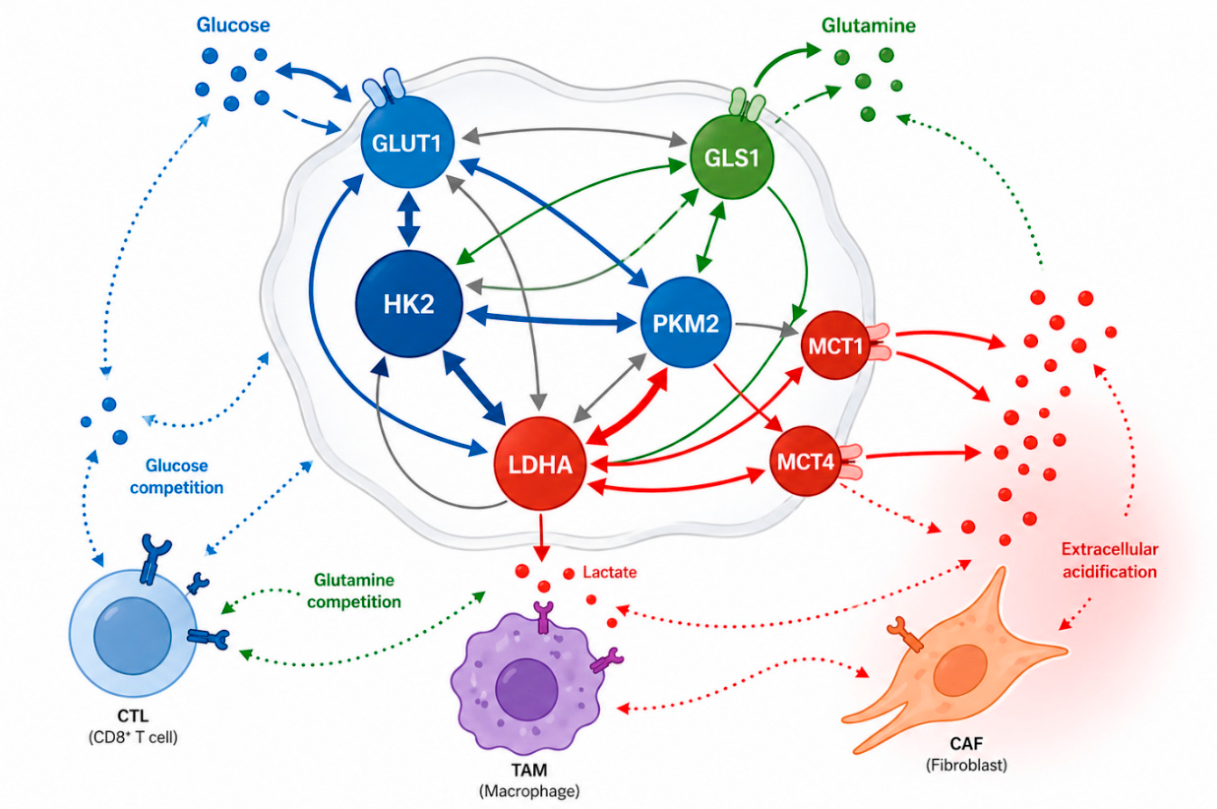
Figure 2.
Immunometabolic interactions in the tumor microenvironment. A schematic of metabolic crosstalk between tumor cells and surrounding immune and stromal components. Tumor cells preferentially consume glucose and glutamine, limiting nutrient availability for cytotoxic T lymphocytes (CTLs) and contributing to T cell exhaustion. Lactate secretion promotes an acidic microenvironment (low pH), supporting tumor-associated macrophage (TAM) polarization and cancer-associated fibroblast (CAF)-mediated tumor progression. The figure illustrates how metabolic competition and byproduct exchange drive immunosuppression and tumor survival. Abbreviations: TME, tumor microenvironment; CTLs, cytotoxic T lymphocytes (CD8⁺ T cells); TAMs, tumor-associated macrophages; CAFs, cancer-associated fibroblasts; GLUT1, glucose transporter 1; SLC1A5, solute carrier family 1 member 5 (glutamine transporter); GLS1, glutaminase 1; LDHA, lactate dehydrogenase A; MCT1/4, monocarboxylate transporters 1 and 4; pH, hydrogen ion concentration; H⁺, proton; IFN-γ, interferon gamma; TNF-α, tumor necrosis factor alpha; IL-10, interleukin 10; TGF-β, transforming growth factor beta; PD-1, programmed cell death protein 1; PD-L1, programmed death-ligand 1; ROS, reactive oxygen species.
Figure 2.
Immunometabolic interactions in the tumor microenvironment. A schematic of metabolic crosstalk between tumor cells and surrounding immune and stromal components. Tumor cells preferentially consume glucose and glutamine, limiting nutrient availability for cytotoxic T lymphocytes (CTLs) and contributing to T cell exhaustion. Lactate secretion promotes an acidic microenvironment (low pH), supporting tumor-associated macrophage (TAM) polarization and cancer-associated fibroblast (CAF)-mediated tumor progression. The figure illustrates how metabolic competition and byproduct exchange drive immunosuppression and tumor survival. Abbreviations: TME, tumor microenvironment; CTLs, cytotoxic T lymphocytes (CD8⁺ T cells); TAMs, tumor-associated macrophages; CAFs, cancer-associated fibroblasts; GLUT1, glucose transporter 1; SLC1A5, solute carrier family 1 member 5 (glutamine transporter); GLS1, glutaminase 1; LDHA, lactate dehydrogenase A; MCT1/4, monocarboxylate transporters 1 and 4; pH, hydrogen ion concentration; H⁺, proton; IFN-γ, interferon gamma; TNF-α, tumor necrosis factor alpha; IL-10, interleukin 10; TGF-β, transforming growth factor beta; PD-1, programmed cell death protein 1; PD-L1, programmed death-ligand 1; ROS, reactive oxygen species.
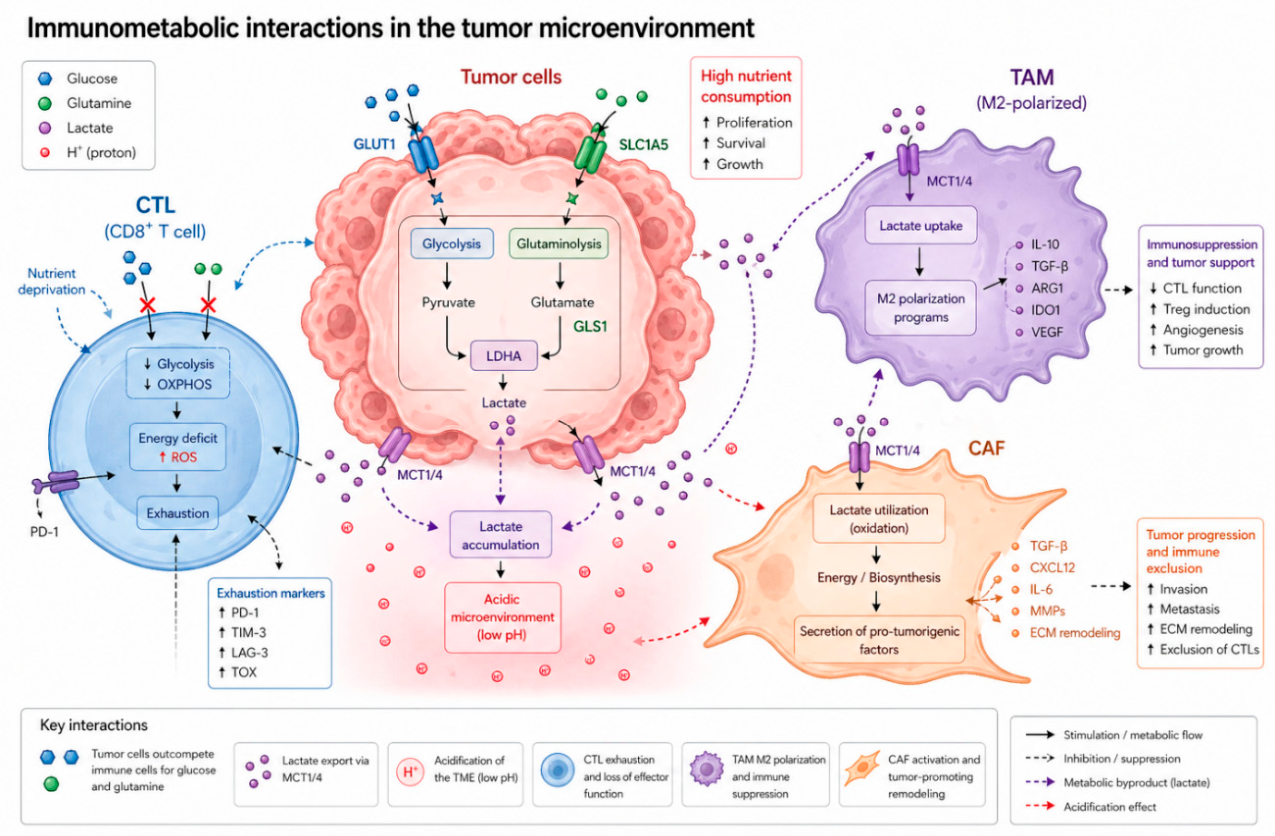
Figure 3.
Dynamic Network Collapse (DNC) model of tumor metabolism. A three-panel schematic illustrating network robustness under targeted perturbations. (A) An intact metabolic network with high connectivity, redundancy, and multiple alternative pathways. (B) Single-node inhibition induces compensatory flux rerouting, preserving overall network function and demonstrating metabolic plasticity. (C) Multi-node inhibition (HK2, GLS1, LDHA, MCT1/4) results in network fragmentation, loss of flux, and absence of alternative routes, leading to systemic collapse. Network robustness is quantified as S(G), with collapse occurring when S(G) falls below a critical threshold (Sthreshold). Abbreviations: GLUT1, glucose transporter 1; HK2, hexokinase 2; PKM2, pyruvate kinase M2; GLS1, glutaminase 1; LDHA, lactate dehydrogenase A; MCT1/4, monocarboxylate transporters 1 and 4; TME, tumor microenvironment; CTLs, cytotoxic T lymphocytes; TAMs, tumor-associated macrophages; CAFs, cancer-associated fibroblasts; DNC, Dynamic Network Collapse.
Figure 3.
Dynamic Network Collapse (DNC) model of tumor metabolism. A three-panel schematic illustrating network robustness under targeted perturbations. (A) An intact metabolic network with high connectivity, redundancy, and multiple alternative pathways. (B) Single-node inhibition induces compensatory flux rerouting, preserving overall network function and demonstrating metabolic plasticity. (C) Multi-node inhibition (HK2, GLS1, LDHA, MCT1/4) results in network fragmentation, loss of flux, and absence of alternative routes, leading to systemic collapse. Network robustness is quantified as S(G), with collapse occurring when S(G) falls below a critical threshold (Sthreshold). Abbreviations: GLUT1, glucose transporter 1; HK2, hexokinase 2; PKM2, pyruvate kinase M2; GLS1, glutaminase 1; LDHA, lactate dehydrogenase A; MCT1/4, monocarboxylate transporters 1 and 4; TME, tumor microenvironment; CTLs, cytotoxic T lymphocytes; TAMs, tumor-associated macrophages; CAFs, cancer-associated fibroblasts; DNC, Dynamic Network Collapse.
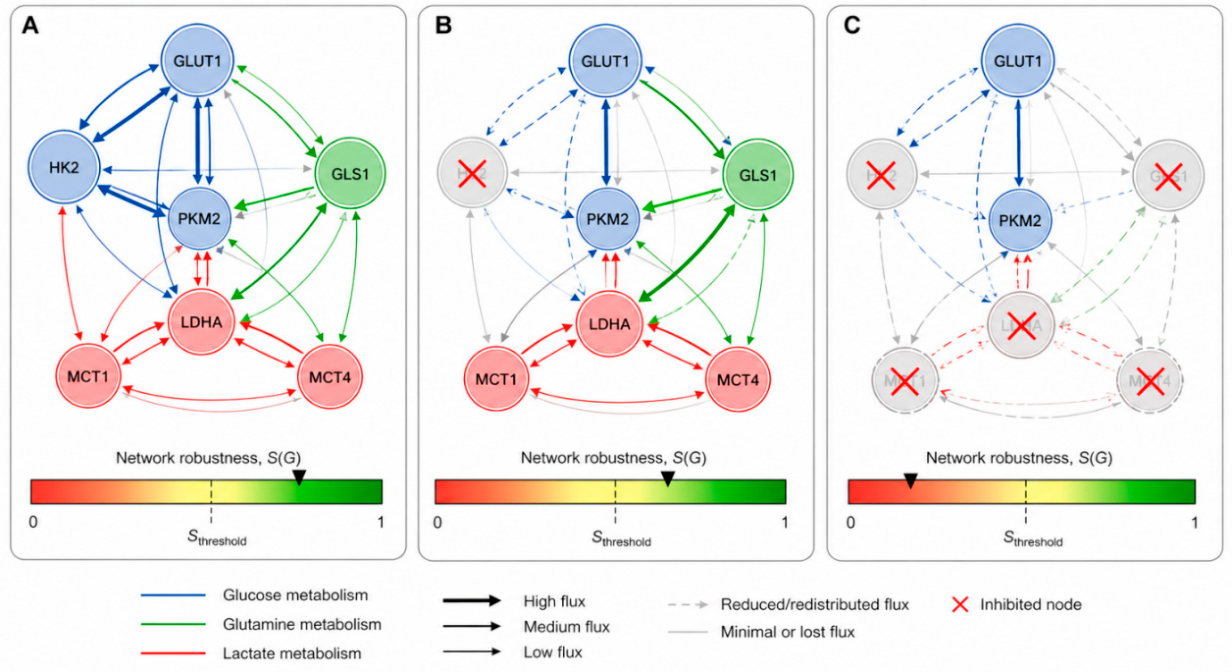
Figure 4.
Mathematical and graph-theoretic formalization of the DMIN framework. A conceptual and quantitative representation of tumor metabolism as a directed, weighted graph G(V, E, W), where nodes represent metabolic enzymes and transporters, and edges represent metabolic fluxes. Network properties including betweenness centrality, eigenvector centrality, and essentiality scores define node importance and vulnerability. The system state is described by a flux vector F(t), and metabolic viability is modeled as a function S(G, F(t)). Network collapse is defined by the condition S(G) < S_threshold, emphasizing that tumor robustness arises from network topology rather than individual components. Abbreviations: GLUT1, glucose transporter 1; HK2, hexokinase 2; PKM2, pyruvate kinase M2; GLS1, glutaminase 1; LDHA, lactate dehydrogenase A; MCT1/4, monocarboxylate transporters 1 and 4; PHGDH, phosphoglycerate dehydrogenase; TME, tumor microenvironment; CTLs, cytotoxic T lymphocytes (CD8⁺ T cells); TAMs, tumor-associated macrophages; CAFs, cancer-associated fibroblasts; ECM, extracellular matrix; IFN-γ, interferon gamma; PD-1, programmed cell death protein 1; Arg-1, arginase 1; IL-10, interleukin 10; 2-DG, 2-deoxy-D-glucose; CB-839, glutaminase inhibitor; FX11, lactate dehydrogenase A inhibitor; AZD3965, monocarboxylate transporter 1 inhibitor; Syrosingopine, dual MCT1/MCT4 inhibitor; NCT-503, phosphoglycerate dehydrogenase inhibitor; S(G), network viability function; F(t), metabolic flux vector; BC, betweenness centrality; EC, eigenvector centrality; DNC, dynamic network collapse.
Figure 4.
Mathematical and graph-theoretic formalization of the DMIN framework. A conceptual and quantitative representation of tumor metabolism as a directed, weighted graph G(V, E, W), where nodes represent metabolic enzymes and transporters, and edges represent metabolic fluxes. Network properties including betweenness centrality, eigenvector centrality, and essentiality scores define node importance and vulnerability. The system state is described by a flux vector F(t), and metabolic viability is modeled as a function S(G, F(t)). Network collapse is defined by the condition S(G) < S_threshold, emphasizing that tumor robustness arises from network topology rather than individual components. Abbreviations: GLUT1, glucose transporter 1; HK2, hexokinase 2; PKM2, pyruvate kinase M2; GLS1, glutaminase 1; LDHA, lactate dehydrogenase A; MCT1/4, monocarboxylate transporters 1 and 4; PHGDH, phosphoglycerate dehydrogenase; TME, tumor microenvironment; CTLs, cytotoxic T lymphocytes (CD8⁺ T cells); TAMs, tumor-associated macrophages; CAFs, cancer-associated fibroblasts; ECM, extracellular matrix; IFN-γ, interferon gamma; PD-1, programmed cell death protein 1; Arg-1, arginase 1; IL-10, interleukin 10; 2-DG, 2-deoxy-D-glucose; CB-839, glutaminase inhibitor; FX11, lactate dehydrogenase A inhibitor; AZD3965, monocarboxylate transporter 1 inhibitor; Syrosingopine, dual MCT1/MCT4 inhibitor; NCT-503, phosphoglycerate dehydrogenase inhibitor; S(G), network viability function; F(t), metabolic flux vector; BC, betweenness centrality; EC, eigenvector centrality; DNC, dynamic network collapse.
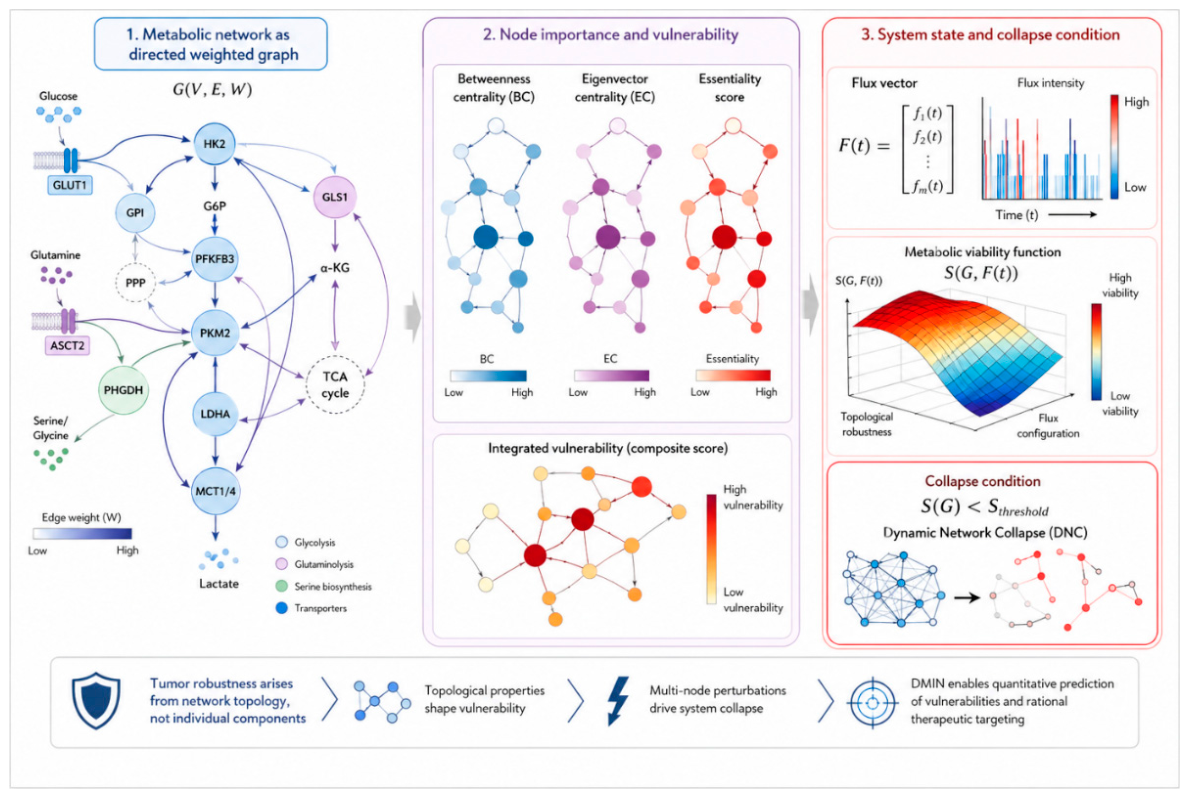
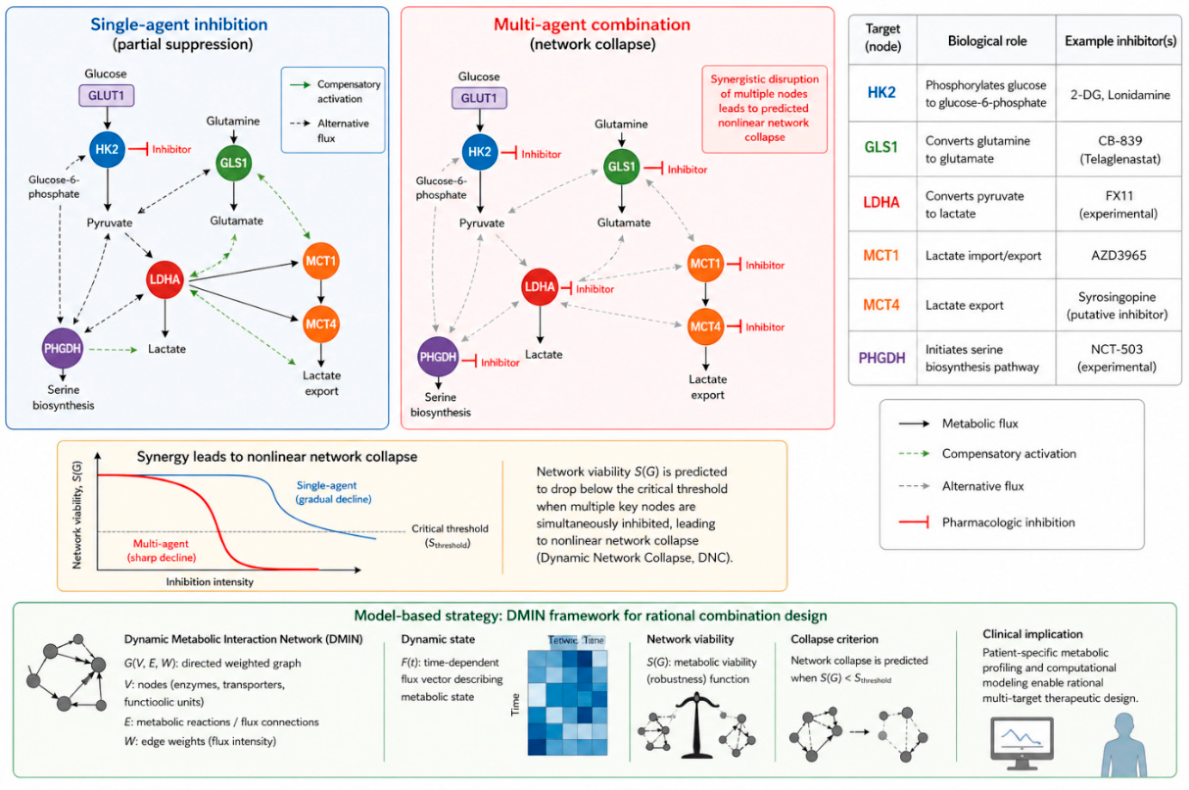
Figure 5.
Therapeutic targeting and combinatorial strategies in tumor metabolism. Comparison of single-agent inhibition versus multi-agent targeting within the metabolic network. Single-node inhibition produces partial suppression with compensatory pathway activation, maintaining network functionality. In contrast, combinatorial targeting of multiple key nodes (e.g., HK2, GLS1, LDHA, MCT1/4) induces synergistic disruption, leading to nonlinear network collapse. Representative metabolic targets and inhibitors are shown, highlighting the importance of multi-node intervention to overcome metabolic redundancy and plasticity. Abbreviations: GLUT1, glucose transporter 1; HK2, hexokinase 2; PKM2, pyruvate kinase M2; GLS1, glutaminase 1; LDHA, lactate dehydrogenase A; MCT1/4, monocarboxylate transporters 1 and 4; PHGDH, phosphoglycerate dehydrogenase; TME, tumor microenvironment; CTLs, cytotoxic T lymphocytes; TAMs, tumor-associated macrophages; CAFs, cancer-associated fibroblasts; PD-1, programmed cell death protein 1; IFN-γ, interferon gamma; IL-10, interleukin 10; Arg-1, arginase 1; ECM, extracellular matrix; M2, M2-polarized macrophages; DNC, Dynamic Network Collapse; DMIN, Dynamic Metabolic Interaction Network, G(V, E, W), directed weighted graph representing the metabolic network, where V denotes nodes (metabolic enzymes, transporters, and functional units), E denotes edges (metabolic reactions and flux connections), and W represents edge weights corresponding to flux intensity; F(t), time-dependent flux vector describing dynamic metabolic state of the system; S(G), metabolic viability (or system robustness) function dependent on network topology G and flux configuration; S_threshold, critical viability threshold defining network collapse condition (S(G) < S_threshold).
Figure 5.
Therapeutic targeting and combinatorial strategies in tumor metabolism. Comparison of single-agent inhibition versus multi-agent targeting within the metabolic network. Single-node inhibition produces partial suppression with compensatory pathway activation, maintaining network functionality. In contrast, combinatorial targeting of multiple key nodes (e.g., HK2, GLS1, LDHA, MCT1/4) induces synergistic disruption, leading to nonlinear network collapse. Representative metabolic targets and inhibitors are shown, highlighting the importance of multi-node intervention to overcome metabolic redundancy and plasticity. Abbreviations: GLUT1, glucose transporter 1; HK2, hexokinase 2; PKM2, pyruvate kinase M2; GLS1, glutaminase 1; LDHA, lactate dehydrogenase A; MCT1/4, monocarboxylate transporters 1 and 4; PHGDH, phosphoglycerate dehydrogenase; TME, tumor microenvironment; CTLs, cytotoxic T lymphocytes; TAMs, tumor-associated macrophages; CAFs, cancer-associated fibroblasts; PD-1, programmed cell death protein 1; IFN-γ, interferon gamma; IL-10, interleukin 10; Arg-1, arginase 1; ECM, extracellular matrix; M2, M2-polarized macrophages; DNC, Dynamic Network Collapse; DMIN, Dynamic Metabolic Interaction Network, G(V, E, W), directed weighted graph representing the metabolic network, where V denotes nodes (metabolic enzymes, transporters, and functional units), E denotes edges (metabolic reactions and flux connections), and W represents edge weights corresponding to flux intensity; F(t), time-dependent flux vector describing dynamic metabolic state of the system; S(G), metabolic viability (or system robustness) function dependent on network topology G and flux configuration; S_threshold, critical viability threshold defining network collapse condition (S(G) < S_threshold).
Disclaimer/Publisher’s Note: The statements, opinions and data contained in all publications are solely those of the individual author(s) and contributor(s) and not of MDPI and/or the editor(s). MDPI and/or the editor(s) disclaim responsibility for any injury to people or property resulting from any ideas, methods, instructions or products referred to in the content. |
© 2026 by the authors. Licensee MDPI, Basel, Switzerland. This article is an open access article distributed under the terms and conditions of the Creative Commons Attribution (CC BY) license (http://creativecommons.org/licenses/by/4.0/).
Copyright: This open access article is published under a Creative Commons CC BY 4.0 license, which permit the free download, distribution, and reuse, provided that the author and preprint are cited in any reuse.


