

Submitted:
27 May 2026
Posted:
28 May 2026
You are already at the latest version
Abstract
Background/Objectives: Functional biomarkers of vascular stiffness (FBM-VS) may serve as an effective tool for predicting and monitoring the effectiveness of preventive strategies against accelerated vascular ageing in healthy populations within the framework of P4 medicine. The aim of this study was to perform a comparative analysis of a standardized to hydrostatic column height passive head-up tilt test (stHUTT) and a simplified supine-to-sitting test (SST) for measuring FBM-VS in a paired sample of young healthy subjects. Materials and Methods: This observational cross-sectional study included 95 healthy adults aged 18–20 years (54 women and 41 men). Brachial-ankle pulse wave velocity (baPWV) was measured in three positions: baseline supine position (baPWVb), during stHUTT (baPWVst), and after transitioning to a sitting position (baPWVsit). The functional reserve of orthostatic circulatory regulation (FR) and the functional reserve coefficient (FRC) were calculated for the stHUTT (FRst and FRCst) and during the supine-to-sitting test (FRsit and FRCsit). Results: The results showed unidirectional orthostatic changes in baPWV during both tests (significant increase compared to baseline supine values): baPWVst and baPWVsit in stHUTT and during the SST increased from 8.6 [8.1; 9.1] m/s to 13.4 [12.1; 14.4] m/s and to 15.2 [13.4; 16.1] m/s (p < 0.001), respectively. FBM-VS values in the SST were higher compared to stHUTT: FRsit = 6.4 [5.25; 7.75] m/s vs. FRst = 4.85 [3.7; 5.75] m/s (p < 0.001), and FRCsit = 0.74 [0.59; 0.9] vs. FRCst = 0.55 [0.45; 0.68] (p < 0.001). The variance of these parameters was also significantly higher in the SST. Regression analysis showed a significant positive correlation between the values of functional biomarkers measured in both orthostatic tests. Conclusions: The supine-to-sitting test may be used for the personalized diagnostic assessment of functional biomarkers in healthy populations. To assess their prognostic value and to provide personalized long-term monitoring to control the effectiveness of preventive measures against vascular ageing in healthy individuals within the framework of the P4 medicine, a prospective cohort study is required.
Keywords:
chronic age-related vascular diseases
; risk-based prevention
; pulse wave velocity
; head-up tilt test
; functional biomarker of vascular stiffness
; orthostatic changes in PWV
; P4 medicine
; prediction vascular stiffness
; orthostatic supine-to-sitting test
1. Introduction
The high prevalence of arterial hypertension (AH) and other age-related vascular diseases (ARVDs) remains a major public health challenge worldwide [1,2,3,4]. Moreover, an increasing trend in prevalence has been observed among younger populations [5,6]. Primordial and primary prevention of ARVDs are currently based on the management of well-established population-level risk factors [7,8,9,10,11,12]. Nevertheless, the upward trajectory in disease prevalence persists, and future projections remain concerning: prevalence is expected to continue rising, accompanied by substantial economic burdens [4,13]. This outlook underscores the need to enhance the efficacy of primary ARVDs prevention and to shift from reactive healthcare toward predictive and personalized approaches [14]. Whereas primary prevention targets individuals at high risk for vascular diseases, growing attention is being directed toward primordial prevention, which focuses on preventing the emergence of risk factors themselves [15]. This strategy appears both promising and feasible within the framework of P4 medicine [16,17,18]. Its core principles—prediction, prevention, participation and personalization—are increasingly being integrated into clinical practice [14,17,19]. Undoubtedly, the prediction and prevention of potential health deterioration and quality-of-life decline, leveraging advances in genomics, transcriptomics, proteomics, metabolomics, and bioinformatics, are of paramount importance. Equally critical, however, is the application of P4 medicine principles to anticipate ARVDs risk in apparently healthy populations and to implement preventive measures before these risks reach clinically significant thresholds in otherwise asymptomatic individuals.
Increased arterial stiffness represents a major independent risk factor for AH and other ARVDs [3,20,21,22,23]. Conventional assessment methods, typically performed under resting conditions in the supine position, yield only indirect estimates of aortic or peripheral arterial wall status [24,25,26,27]. Arterial stiffness measurements, particularly those derived from pulse wave velocity (PWV) analysis, reflect both structural and functional components. These components are highly dependent on the neurohormonal status, which undergoes substantial modulation in response to postural changes in hydrostatic pressure [28,29,30]. We have proposed functional biomarkers of vascular stiffness designed to evaluate the adaptive capacity of the arterial wall in response to hydrostatic pressure alterations induced by changes in body position [31,32]. For their assessment, we employed a head-up tilt test (Luanda Protocol) standardized to hydrostatic column height (stHUTT), which adjusted for inter-individual height differences and enabled more precise evaluation of orthostatic hemodynamic regulation [33]. Using this protocol, it was possible to determine the characteristics of FBM-VS in independent cohorts stratified by racial, gender and age subgroups [31,32,34].
The implementation of this approach as a potential P4 medicine tool necessitated personalization of hydrostatic loading; furthermore, the requirement for a tilt table rendered the assessment of functional vascular stiffness biomarkers (FBM-VS) both logistically complex and cost prohibitive. To address these limitations, we developed a simplified SST that generates a personalized hydrostatic load in the sitting position, proportional to the subject’s height, without requiring specialized equipment. Consequently, this simplified test enables the assessment of both baseline vascular stiffness, which primarily reflects structural properties, and functional stiffness, which characterizes the adaptive capacity of the arterial wall. Given that functional impairments often precede structural alterations, this personalized approach, when applied to the study of age-related changes, may serve as a foundation for anticipating future increases in arterial stiffness and as a tool for evaluating the efficacy of primordial prevention within the P4 medicine paradigm. The aim of the study was a comparative analysis of the application of a stHUTT and a simplified SST for measuring FBM-VS in a paired sample of healthy young subjects.
2. Materials and Methods
2.1. Participants
The research was conducted at Smolensk State Medical University and in the Functional Haemodynamics Laboratory of the Research Institute of Rehabilitation at the Federal Scientific and Clinical Centre for Resuscitation and Rehabilitation in 2024–2025.

Table 1.
The characteristics of young adults.
| Participants | N = 95 |
|---|---|
| Sex (Male/Female) | 41/54 |
| Age (years) | 18 [18;20] |
| Height (cm) | 175 [168.5;181] |
| Body mass index (kg/m2) | 21.3 [19.2;24] |
Note: The data are presented as Me [range]—median—for parameters that were not normally distributed, quartiles — [25%; 75%] — margins of the interquartile range, p—the significance of inter-group differences in selected characteristics.
Inclusion criteria: healthy participants aged between 18 and 20; who had undergone a routine medical examination with objective laboratory parameters within normal ranges, body mass index 21.3 [19.2; 24] kg/m2; blood pressure 100–130/75–85 mm Hg; no history of taking any medication. Participants were advised to refrain from smoking and alcohol consumption for two days prior to the study, as well as to avoid coffee and strenuous physical activity 24 hours before the measurements.
Exclusion criteria: cardiac arrhythmia, acute heart disease, history of the cardiovascular diseases, peripheral arterial blood flow disorders, history of orthostatic intolerance, peripheral edema, signs of thrombophlebitis or complicated varicose veins, body mass index over 30 kg/m2.
2.2. Orthostatic Tests Procedure
The study was divided into three stages: rest in a supine position (baseline), the stHUTT at an individual tilt angle ensuring a standard hydrostatic column height of 130 cm – the Luanda protocol – and the subjects’ active transition to a sitting position. Each stage lasted 10 minutes. We did not apply the extended study protocol, which included a return to the baseline position after the stHUTT and after the sitting position, as in our previous studies on the same cohort using the stHUTT, all parameters returned to baseline values upon returning to the baseline position [34]. After the stHUTT, the subject was seated on a standard chair with a seat height of 46 cm and a straight backrest. Depending on their height, the subjects exhibited a knee flexion angle of 110° or more.
2.3. Haemodynamic Measurements
All measurements of systolic blood pressure (SBP), diastolic blood pressure (DBP), , and brachial-ankle pulse wave velocity (baPWV) were performed using a multichannel sphygmomanometer (ABI-System 100 PWV, BOSO, Berlin, Germany) after 10 minutes of rest in each of the three positions: the baseline position, the stHUTT and the sitting position. The measurements were taken three times, the first measurement was excluded, and the second and third measurements were averaged. The reference side was defined as the arm with the higher systolic blood pressure (SBP), and all subsequent measurements were recorded on this side. In addition, calculations for FBM-VS: the functional reserve of orthostatic blood circulation regulation (FR) during stHUTT (FRst) and during the supine-to-sitting test (FRsit), and the FR coefficients in the same tests (FRСst and FRСsit) were performed.
FRst = (baPWVst – baPWVb)
FRsit = (baPWVsit – baPWVb)
FRCst = (baPWVst – baPWVb)/ baPWVb = FRst / baPWVb
FRCsit = (baPWVsit – baPWVb)/ baPWVb = FRsit / baPWVb
where baPWVb is baPWV at baseline (supine position), baPWVst is baPWV in the stHUTT position, and baPWVsit is baPWV in the sitting position [31].
2.4. Statistical Analysis
For data collection, adjustment, and systematization, as well as for visualization of the results, Microsoft Excel 2021 and STATISTICA 10 (TIBCO Software, Palo Alto, CA, USA) were used. Nominal data were presented as absolute values. Quantitative variables without a normal distribution were described using the median and quartiles (25th–75th percentiles, Q1–Q3). The Kolmogorov–Smirnov test was applied to assess the distribution pattern. To describe the variability of functional biomarkers obtained during the stHUTT and in supine-to-sitting test, variance (σ2) was additionally calculated. Comparisons of dependent samples (paired observations) were performed using the Wilcoxon signed-rank test. The relationships between the indices obtained during both tests were assessed using linear regression analysis. A p-value <0.05 was considered statistically significant.
3. Results
In accordance with the primary objective of this study, we compared brachial blood pressure (BP) and functional biomarkers of vascular stiffness (FBM-VS) across body positions: stHUTT and SST (Table 2).
During the stHUTT and SST, SBP and DBP remained within normal ranges. Comparative analysis demonstrated higher values for these parameters in the sitting position (p < 0.001). During the functional tests, baPWV significantly increased compared with baseline values (baPWVb = 8.6 [8.1; 9.1], p < 0.0001). During the SST, this parameter was significantly higher than during the stHUTT (baPWVsit = 15.2 [13.4; 16.1] m/s vs. baPWVst = 13.4 [12.1; 14.4] m/s, p < 0.001). Functional biomarkers, including FR and FRC, were also higher during the SST than during the stHUTT (FRsit = 6.4 [5.25; 7.75] m/s vs. FRst = 4.85 [3.7; 5.75] m/s; FRCsit = 0.74 [0.59; 0.9] vs. FRCst = 0.55 [0.45; 0.68], p < 0.001).
In addition, we performed a correlation analysis of biomarkers measured using both tests in paired samples (Figure 1).
The graph demonstrates the linear regression of FR values in both tests. A strong positive association was observed between the values obtained in the simplified supine-to-sitting test and in the stHUTT, with a correlation coefficient of r = 0.676 (p < 0.0001).
A comparison of FRC values calculated during the stHUTT test and the simplified SST also revealed a strong correlation (r = 0.673, p < 0.0001).
The stHUTT protocol was developed to minimize the influence of height variability on the outcomes of these measurements. In our study, to evaluate the effectiveness of mitigating this factor, we conducted a quantitative assessment of the variance of FBM-VS measured during stHUTT and the simplified SST (Table 3).
A comparative analysis of FBM-VS variability revealed a significant increase in biomarker variability during the simplified SST: baPWV variability increased from 2.86 during the stHUTT to 4.28 during simplified SST, FR from 1.92 to 3.19, and FRC from 0.02 to 0.04. We attribute the increased variability in functional biomarker values during simplified SST to the greater influence of differences in hydrostatic column heights — which depend on the subjects’ height—as opposed to the standard hydrostatic load used in stHUTT. This is of great importance for selecting an appropriate research protocol when testing related and unrelated samples.
4. Discussion
Prediction plays a pivotal role in the prevention of early-onset chronic diseases. Currently, forecasting arterial hypertension and other age-related vascular diseases relies primarily on population-based risk stratification. While acknowledging the established value of this approach, it is equally critical to apply P4 medicine principles to risk markers that may be pathogenetically linked to the development of these conditions and are capable of elevating all-cause mortality, thereby serving as key indicators of biological age [21,35,36,37]. The greatest clinical utility may be achieved by monitoring such markers during the preclinical phase of chronic disease development, i.e., within ostensibly healthy populations. It is well established that age-related increases in vascular wall stiffness are synonymous with vascular ageing and may follow three distinct trajectories: normal, supernormal, and accelerated. Accelerated vascular ageing substantially amplifies the risk of ARVDs and hastens target organ damage [38,39,40,41]. There is broad consensus regarding the necessity of early detection of this accelerated ageing phenotype, even prior to the onset of structural alterations in the vascular wall, as it significantly enhances the efficacy of primary ARVDs prevention. Regular monitoring of the FBM-VS index in the general population may become one of the possible diagnostic strategies for the early detection of an undesirable vascular ageing phenotype.
The importance of predicting accelerated vascular stiffening in healthy cohorts has necessitated the development of an appropriate diagnostic protocol. In one of our previous pilot studies, we investigated baseline stiffness and the FBM-VS index in healthy individuals from different age groups [31]. Our study confirmed the well-documented age-related trend towards an increase in baseline baPWV. We found the opposite trend: the FBM-VS index decreased significantly with age, which may have important prognostic significance. Conducting personalized longitudinal follow-up of FBM-VS in healthy subjects from a young age may enable the diagnosis of an unfavorable vascular ageing scenario at the preclinical stage, thereby allowing the prediction of future ARVD risks. The core tenets of P4 medicine emphasize prediction and personalization; in this context, personalization is operationalized through the individualized standardization of hydrostatic loading.
To assess the applicability of this simplified protocol, the need for which we outlined above, we compared the measurement results obtained during the stHUTT and the SST. In the sitting position, systolic blood pressure (SBP) and diastolic blood pressure (DBP) values were significantly higher than during the stHUTT, consistent with findings from a study employing a comparable protocol in a similar young cohort [42]. The functional biomarkers FR and FRC were significantly higher during the SST compared to the stHUTT (p < 0.001). The orthostatic increase in stiffness, quantified via pulse wave velocity in the sitting versus supine positions, aligned with published data [43]. It should be noted that these findings have been inconsistent across other studies. Specifically, when employing a comparable protocol with measurement of carotid-femoral pulse wave velocity (cfPWV), no statistically significant difference in values between the supine and sitting positions was detected. [44]. These findings can be explained by differences in the vascular beds being assessed: cfPWV primarily measures the stiffness of the aorta and large elastic arteries, in which the content of smooth muscle cells—which mediate responses to neurohormonal changes—is minimal. In contrast, our study utilized brachial-ankle pulse wave velocity (baPWV), which encompasses muscular-type arteries of the lower extremities. In these vessels, hydrostatic pressure increases substantially during orthostatic challenges, thereby eliciting a more pronounced physiological response.
In both the stHUTT and SST, the correlation coefficient between FRsit and FRst was 0.67 (p < 0.0001), and between FRCsit and FRCst was 0.68 (p < 0.0001) (Figure 1 and Figure 2). Group-level analysis revealed greater variability in FR (3.19 vs. 1.92 m2/s2) and FRC (0.04 vs. 0.02) during the SST compared to the stHUTT. This is likely attributable to the wider distribution of hydrostatic column heights, which inherently varies with subject stature in the sitting position. Thus, we observed unidirectional changes in functional vascular stiffness biomarkers under both types of hydrostatic loading, which demonstrated satisfactory mutual correlation. The quantitative discrepancies in FBM-VS values are, in our view, related to the greater inter-individual variation in height and, consequently, in hydrostatic column height during sitting, which modulates the magnitude of the adaptive neurohormonal shift during the stress test.
The stHUTT protocol proves more effective for both cross-sectional and longitudinal population-based FBM-VS studies in independent cohorts. Standardized hydrostatic loading enables more precise analysis of intergroup differences in response to an identical physiological stimulus. Conversely, the SST is inherently more personalized, as it is directly dependent on individual stature. The advantages of this protocol include operational simplicity, strict personalization of the hydrostatic load based on individual anthropometry, and feasibility in both clinical and home-based settings, provided appropriate equipment is available. Its application for dynamic assessment of FBM-VS requires strict reproducibility of test conditions (i.e., maintaining a constant vertical distance from the foot support surface to the vertex of the head - hydrostatic column height in the sitting position). Personalized standardization of hydrostatic load can be achieved as follows: during the initial implementation of the protocol, the vertical height from the vertex of the head to the foot support should be recorded, with the knees flexed at an angle of no less than 110 degrees. During repeated FBM-VS measurements in longitudinal follow-up, the required height can be reproduced either by adjusting the chair seat height or, more conveniently, by modifying the elevation of the footrest, thereby ensuring a constant vertical distance from the support surface to the vertex across all sessions. Assessments are preferably conducted in the morning, 1–2 hours after a light breakfast, to minimize the potential effects of circadian rhythms and psychoemotional status on the neurohormonal background.
The simplified FBM-VS assessment protocol was developed for personalized quantitative analysis of age-related dynamics during longitudinal monitoring of functional changes, as well as for evaluating the effectiveness of interventions aimed at slowing vascular ageing. However, this test is less suitable for cross-sectional epidemiological studies. Dynamic assessment of FBM-VS may become a novel tool within P4 medicine for personalized prediction of accelerated arterial wall stiffening and for improving the effectiveness of primary prevention of hypertension and other ARVDs. It enables objective, individualized monitoring of vascular ageing progression in a young healthy population, allowing early detection of the onset of structural vascular wall remodeling and its progression. In the future, this approach may prove valuable not only for the development of optimal preventive strategies but also for optimizing the treatment of chronic ARVDs through objective evaluation of the effects of interventions on FBM-VS dynamics.
5. Conclusions
The supine-to-sitting test may be used for the personalized diagnostic assessment of functional biomarkers in healthy populations. To assess their prognostic value and to provide personalized long-term monitoring to control the effectiveness of preventive measures against vascular ageing in healthy individuals within the framework of the P4 medicine, a prospective cohort study is required.
Author Contributions
Conceptualization, V.N.D., data curation, D.A.P., I.V.B. and J.A.P.; investigation, D.A.P., J.A.P.; methodology, V.N.D., D.S.Y., V.M.T.; project administration, V.N.D., V.M.T., A.V.G.; resources, V.M.T., A.V.G.; software, D.A.P., I.V.B., J.A.P.; supervision, D.S.Y., V.M.T., A.V.G.; writing—original draft, V.N.D.; writing—review and editing, D.S.Y. All authors have read and agreed to the published version of the manuscript.
Funding
This research received no external funding.
Institutional Review Board Statement
The study was conducted in Moscow, Russia. The study strictly followed the guidelines of the Declaration of Helsinki and was approved by the Ethics Committee of the Federal Research and Clinical Center of Intensive Care Medicine and Rehabilitology (protocol N 1, 2017).
Informed Consent Statement
Informed consent was obtained from all subjects involved in the study.
Data Availability Statement
The data that support the findings of this study are available from the corresponding author, Victor N. Dorogovtsev, upon reasonable request.
Acknowledgments
During the preparation of this manuscript, the authors used ChatGPT (OpenAI, GPT-5.3) for the purposes of proofreading the text and identifying grammatical and stylistic errors. The authors have reviewed and edited the output and take full responsibility for the content of this publication.
Conflicts of Interest
The authors declare no conflicts of interest.
Abbreviations
The following abbreviations are used in this manuscript:
| AH | Arterial Hypertension |
| ARVDs | Age-Related Vascular Diseases |
| baPWV | Brachial–Ankle Pulse Wave Velocity |
| BP | Blood Pressure |
| cfPWV | Carotid–Femoral Pulse Wave Velocity |
| DBP | Diastolic Blood Pressure |
| FBM-VS | Functional Biomarkers of Vascular Stiffness |
| FR | Functional Reserve |
| FRC | Functional Reserve Coefficient |
| P4 Medicine | Predictive, Preventive, Personalised and Participatory Medicine |
| SBP | Systolic Blood Pressure |
| sit | Sitting position |
| st | Standardized head-up tilt position |
| SST | Supine-to-Sitting Test |
| stHUTT | Standardized to hydrostatic column height Head-Up Tilt Test |
References
- Bao, M.; Wang, L. The Longitudinal Trend of Hypertension Prevalence in Chinese Adults from 1959 to 2018: A Systematic Review and Meta-Analysis. Ann. Palliat. Med. 2020, 9, 2485–2497. [Google Scholar] [CrossRef] [PubMed]
- Erina, A.M.; Rotar, O.P.; Solntsev, V.N.; Shalnova, S.A.; Deev, A.D.; Baranova, E.I.; Konradi, O.A.; Boytsov, S.A.; Shlyakhto, E.V. Epidemiology of Arterial Hypertension in Russian Federation - Importance of Choice of Criteria of Diagnosis. Kardiologiia 2019, 59, 5–11. [Google Scholar] [CrossRef]
- Mensah, G.A.; Fuster, V.; Murray, C.J.L.; Roth, G.A.; Mensah, G.A.; Abate, Y.H.; Abbasian, M.; Abd-Allah, F.; Abdollahi, A.; Abdollahi, M.; et al. Global Burden of Cardiovascular Diseases and Risks, 1990-2022. J. Am. Coll. Cardiol. 2023, 82, 2350–2473. [Google Scholar] [CrossRef]
- Anderer, S. Hypertension Burden Increasing Worldwide, With Stark Disparities. JAMA 2026. [Google Scholar] [CrossRef] [PubMed]
- Guo, J.W.; Ning, H.; Allen, N.B.; Reges, O.; Gabriel, K.P.; Lloyd-Jones, D.M. Association of Cardiovascular Health in Young Adulthood With Long-Term Blood Pressure Trajectories. Am. J. Hypertens. 2024, 37, 667–673. [Google Scholar] [CrossRef]
- Jones, D.W.; Ferdinand, K.C.; Taler, S.J.; Johnson, H.M.; Shimbo, D.; Abdalla, M.; Altieri, M.M.; Bansal, N.; Bello, N.A.; Bress, A.P.; et al. 2025 AHA/ACC/AANP/AAPA/ABC/ACCP/ACPM/AGS/AMA/ASPC/NMA/PCNA/SGIM Guideline for the Prevention, Detection, Evaluation and Management of High Blood Pressure in Adults: A Report of the American College of Cardiology/American Heart Association Joint Committee on Clinical Practice Guidelines. Circulation 2025, CIR.0000000000001356. [Google Scholar] [CrossRef]
- Whelton, P.K. Primary Prevention of HypertensionClinical and Public Health Advisory From the National High Blood Pressure Education Program. JAMA 2002, 288, 1882. [Google Scholar] [CrossRef]
- Walker, J.; Won, D.; Guo, J.; Rana, J.S.; Allen, N.B.; Ning, H.; Lloyd-Jones, D.M. Cumulative Life’s Essential 8 Scores and Cardiovascular Disease Risk. JAMA Cardiol. 2025. [Google Scholar] [CrossRef] [PubMed]
- Aburto, N.J.; Hanson, S.; Gutierrez, H.; Hooper, L.; Elliott, P.; Cappuccio, F.P. Effect of Increased Potassium Intake on Cardiovascular Risk Factors and Disease: Systematic Review and Meta-Analyses. BMJ 2013, 346, f1378–f1378. [Google Scholar] [CrossRef]
- Bloomfield, G.S. WHO STEPS and the Future of Cardiovascular Disease Prevention. JAMA Cardiol. 2025, 10, 1087–1089. [Google Scholar] [CrossRef]
- Claas, S.A.; Arnett, D.K. The Role of Healthy Lifestyle in the Primordial Prevention of Cardiovascular Disease. Curr. Cardiol. Rep. 2016, 18, 56. [Google Scholar] [CrossRef]
- Mick, N.; Savadogo, L.G.B.; Théodore, N. Health Behaviors to Prevent Cardiovascular Risk: A Systematic Review. BMC Cardiovasc Disord. 2025, 25, 853. [Google Scholar] [CrossRef]
- Harris, E. Heart Disease Prevalence, Medical Costs Will Soar in US by 2050. JAMA 2024. [Google Scholar] [CrossRef]
- Sagner, M.; McNeil, A.; Puska, P.; Auffray, C.; Price, N.D.; Hood, L.; Lavie, C.J.; Han, Z.-G.; Chen, Z.; Brahmachari, S.K.; et al. The P4 Health Spectrum - A Predictive, Preventive, Personalized and Participatory Continuum for Promoting Healthspan. Prog. Cardiovasc Dis. 2017, 59, 506–521. [Google Scholar] [CrossRef] [PubMed]
- Chiou, A.; Hermel, M.; Chai, Z.; Eiseman, A.; Jeschke, S.; Mehta, S.; Khan, U.; Hoodbhoy, Z.; Safdar, N.; Khoja, A.; et al. Going from Primary to Primordial Prevention: Is the Juice Worth the Squeeze? Curr. Cardiol. Rep. 2024, 26, 1135–1143. [Google Scholar] [CrossRef]
- Hood, L.; Flores, M. A Personal View on Systems Medicine and the Emergence of Proactive P4 Medicine: Predictive, Preventive, Personalized and Participatory. New Biotechnol. 2012, 29, 613–624. [Google Scholar] [CrossRef] [PubMed]
- Flores, M.; Glusman, G.; Brogaard, K.; Price, N.D.; Hood, L. P4 Medicine: How Systems Medicine Will Transform the Healthcare Sector and Society. Pers. Med. 2013, 10, 565–576. [Google Scholar] [CrossRef]
- Slim, K.; Selvy, M.; Veziant, J. Conceptual Innovation: 4P Medicine and 4P Surgery. J. Visc. Surg. 2021, 158, S12–S17. [Google Scholar] [CrossRef]
- Alonso, S.G.; de la Torre Díez, I.; Zapiraín, B.G. Predictive, Personalized, Preventive and Participatory (4P) Medicine Applied to Telemedicine and eHealth in the Literature. J. Med. Syst. 2019, 43, 140. [Google Scholar] [CrossRef] [PubMed]
- Beros, A.; Sluyter, J.; Hughes, A.; Hametner, B.; Wassertheurer, S.; Scragg, R. Arterial Stiffness and Incident Chronic Kidney Disease: A Large Population-Based Cohort Study. J. Nephrol. 2024. [Google Scholar] [CrossRef]
- Laurent, S.; Boutouyrie, P.; Asmar, R.; Gautier, I.; Laloux, B.; Guize, L.; Ducimetiere, P.; Benetos, A. Aortic Stiffness Is an Independent Predictor of All-Cause and Cardiovascular Mortality in Hypertensive Patients. Hypertension 2001, 37, 1236–1241. [Google Scholar] [CrossRef] [PubMed]
- Miyagi, T.; Ishida, A.; Shinzato, T.; Ohya, Y. Arterial Stiffness Is Associated With Small Vessel Disease Irrespective of Blood Pressure in Stroke-Free Individuals. Stroke 2023, 54, 2814–2821. [Google Scholar] [CrossRef] [PubMed]
- Safar, M.E. Arterial Stiffness as a Risk Factor for Clinical Hypertension. Nat. Rev. Cardiol. 2018, 15, 97–105. [Google Scholar] [CrossRef]
- Pathrose, A.; Ma, L.; Berhane, H.; Scott, M.B.; Chow, K.; Forman, C.; Jin, N.; Serhal, A.; Avery, R.; Carr, J.; et al. Highly Accelerated Aortic 4D Flow MRI Using Compressed Sensing: Performance at Different Acceleration Factors in Patients with Aortic Disease. Magn. Reson. Med. 2021, 85, 2174–2187. [Google Scholar] [CrossRef]
- Xing, C.; Xie, X.; Wu, Y.; Xu, L.; Guan, X.; Li, F.; Zhan, X.; Yang, H.; Li, J.; Zhou, Q.; et al. Reference Values of Carotid Intima-Media Thickness and Arterial Stiffness in Chinese Adults Based on Ultrasound Radio Frequency Signal: A Nationwide, Multicenter Study. Chin. Med. J. (Engl) 2024, 137, 1802–1810. [Google Scholar] [CrossRef]
- Houriez-Gombaud-Saintonge, S.; Mousseaux, E.; Bargiotas, I.; De Cesare, A.; Dietenbeck, T.; Bouaou, K.; Redheuil, A.; Soulat, G.; Giron, A.; Gencer, U.; et al. Comparison of Different Methods for the Estimation of Aortic Pulse Wave Velocity from 4D Flow Cardiovascular Magnetic Resonance. J. Cardiovasc Magn. Reson 2019, 21, 75. [Google Scholar] [CrossRef]
- The Reference Values for Arterial Stiffness’ Collaboration Determinants of Pulse Wave Velocity in Healthy People and in the Presence of Cardiovascular Risk Factors: ‘Establishing Normal and Reference Values. Eur. Heart J. 2010, 31, 2338–2350. [CrossRef] [PubMed]
- Saito, M.; Foldager, N.; Mano, T.; Iwase, S.; Sugiyama, Y.; Oshima, M. Sympathetic Control of Hemodynamics during Moderate Head-up Tilt in Human Subjects. Env. Med. 1997, 41, 151–155. [Google Scholar]
- Patel, S.; Rauf, A.; Khan, H.; Abu-Izneid, T. Renin-Angiotensin-Aldosterone (RAAS): The Ubiquitous System for Homeostasis and Pathologies. BioMed Pharmacother. 2017, 94, 317–325. [Google Scholar] [CrossRef]
- László, Z.; Rössler, A.; Hinghofer-Szalkay, H.G. Cardiovascular and Hormonal Changes with Different Angles of Head-up Tilt in Men. Physiol. Res. 2001, 50, 71–82. [Google Scholar] [CrossRef]
- Dorogovtsev, V.; Yankevich, D.; Martyushev-Poklad, A.; Borisov, I.; Grechko, A.V. The Importance of Orthostatic Increase in Pulse Wave Velocity in the Diagnosis of Early Vascular Aging. J. Clin. Med. 2024, 13, 5713. [Google Scholar] [CrossRef] [PubMed]
- Dorogovtsev, V.N.; Yankevich, D.S.; Tsareva, V.M.; Punin, D.A.; Borisov, I.V.; Dekhnich, N.N.; Grechko, A.V. Gender Difference in Orthostatic Vascular Stiffness Increase in Young Subjects. Diagnostics 2025, 15, 517. [Google Scholar] [CrossRef]
- Dorogovtsev, V.N.; Yankevich, D.S.; Goswami, N. Effects of an Innovative Head-Up Tilt Protocol on Blood Pressure and Arterial Stiffness Changes. JCM 2021, 10, 1198. [Google Scholar] [CrossRef]
- Dorogovtsev, V.N.; Yankevich, D.S.; Petrova, M.V.; Torshin, V.I.; Severin, A.E.; Borisov, I.V.; Podolskaya, J.A.; Grechko, A.V. Detection of Preclinical Orthostatic Disorders in Young African and European Adults Using the Head-Up Tilt Test with a Standardized Hydrostatic Column Height: A Pilot Study. Biomedicines 2022, 10, 2156. [Google Scholar] [CrossRef]
- Georgianos, P.I.; Sarafidis, P.A.; Lasaridis, A.N. Arterial Stiffness: A Novel Cardiovascular Risk Factor in Kidney Disease Patients. Curr. Vasc. Pharmacol. 2015, 13, 229–238. [Google Scholar] [CrossRef]
- Lee, J.-G.; Joo, S.-J. Arterial Stiffness and Cardiovascular Risk. Korean J. Intern Med. 2019, 34, 504–506. [Google Scholar] [CrossRef] [PubMed]
- Bulpitt, C.J.; Rajkumar, C.; Cameron, J.D. Vascular Compliance as a Measure of Biological Age. J. Am. Geriatr. Soc. 1999, 47, 657–663. [Google Scholar] [CrossRef]
- Cunha, P.G.; Boutouyrie, P.; Nilsson, P.M.; Laurent, S. Early Vascular Ageing (EVA): Definitions and Clinical Applicability. Curr. Hypertens. Rev. 2017, 13, 8–15. [Google Scholar] [CrossRef]
- Bruno, R.M.; Nilsson, P.M.; Engström, G.; Wadström, B.N.; Empana, J.-P.; Boutouyrie, P.; Laurent, S. Early and Supernormal Vascular Aging: Clinical Characteristics and Association With Incident Cardiovascular Events. Hypertension 2020, 76, 1616–1624. [Google Scholar] [CrossRef]
- Rossman, M.J.; LaRocca, T.J.; Martens, C.R.; Seals, D.R. Healthy Lifestyle-Based Approaches for Successful Vascular Aging. J. Appl. Physiol. 2018, 125, 1888–1900. [Google Scholar] [CrossRef] [PubMed]
- Kucharska-Newton, A.M.; Stoner, L.; Meyer, M.L. Determinants of Vascular Age: An Epidemiological Perspective. Clin. Chem. 2019, 65, 108–118. [Google Scholar] [CrossRef] [PubMed]
- Oyake, K.; Murayama, J.; Tateishi, T.; Mochida, A.; Matsumoto, M.; Tsujikawa, M.; Kondo, K.; Otaka, Y.; Momose, K. Comparison of the Sit-up Test and Head-up Tilt Test for Assessing Blood Pressure and Hemodynamic Responses in Healthy Young Individuals. Blood Press Monit. 2022, 27, 79–86. [Google Scholar] [CrossRef]
- Karaki, M.; Kunimatsu, N.; Watanabe, K.; Tomoto, T.; Fukuie, M.; Sugawara, J.; Ogoh, S. The Validity of Carotid-Femoral Pulse Wave Velocity in the Seated Posture as an Index of Central Arterial Stiffness. Am. J. Physiol.-Regul. Integr. Comp. Physiol. 2025, 328, R145–R153. [Google Scholar] [CrossRef] [PubMed]
- Nürnberger, J.; Michalski, R.; Türk, T.R.; Saez, A.O.; Witzke, O.; Kribben, A. Can Arterial Stiffness Parameters Be Measured in the Sitting Position? Hypertens. Res. 2011, 34, 202–208. [Google Scholar] [CrossRef] [PubMed]
Figure 1.
Linear regression plot of paired measurements of functional reserve coefficient (FR) obtained during the stHUTT and the simplified supine-to-sitting test.
Figure 1.
Linear regression plot of paired measurements of functional reserve coefficient (FR) obtained during the stHUTT and the simplified supine-to-sitting test.
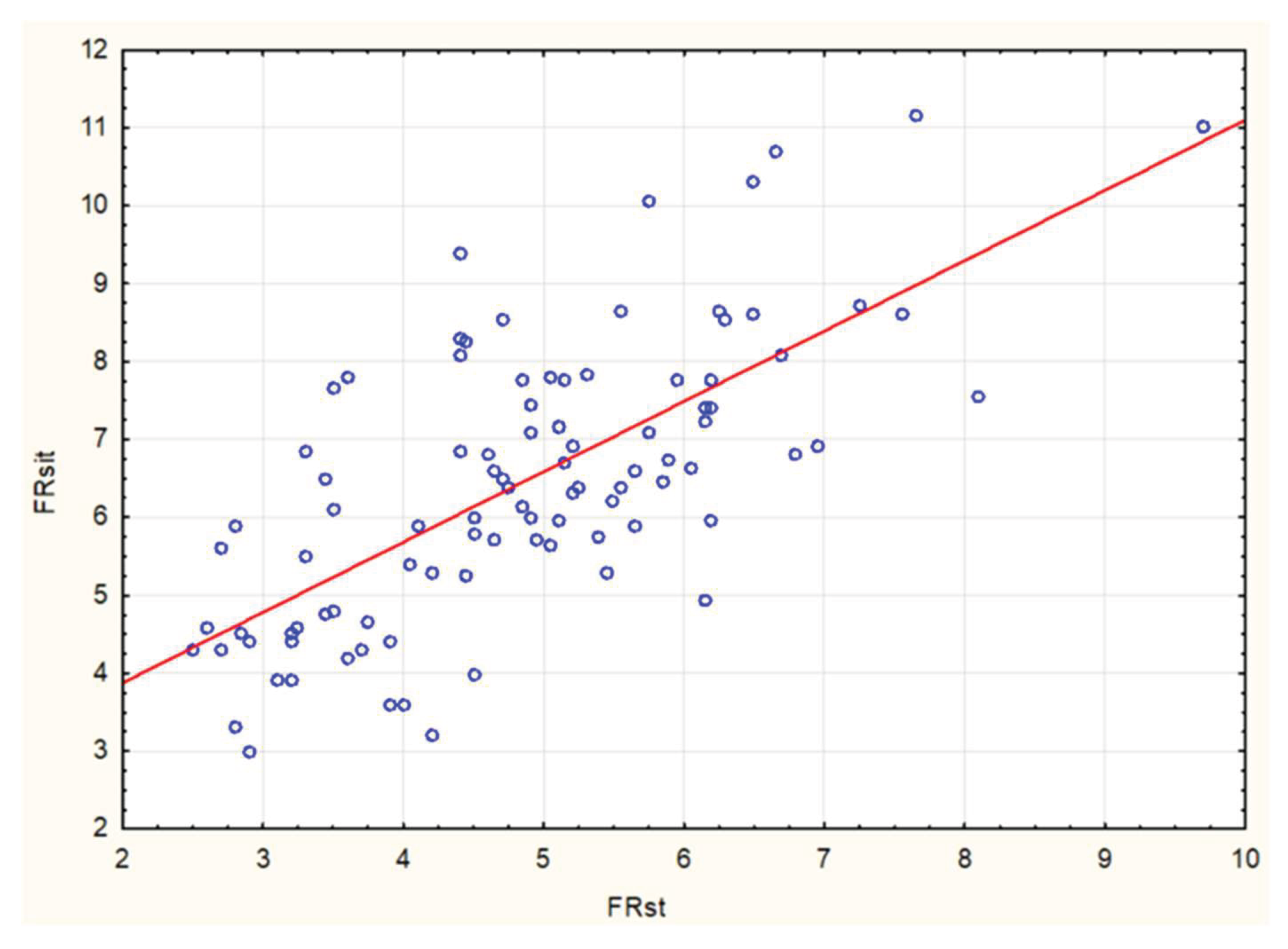
Figure 2.
Linear regression graph between paired measurements of functional reserve coefficient (FRC) obtained during the stHUTT and the simplified SST.
Figure 2.
Linear regression graph between paired measurements of functional reserve coefficient (FRC) obtained during the stHUTT and the simplified SST.
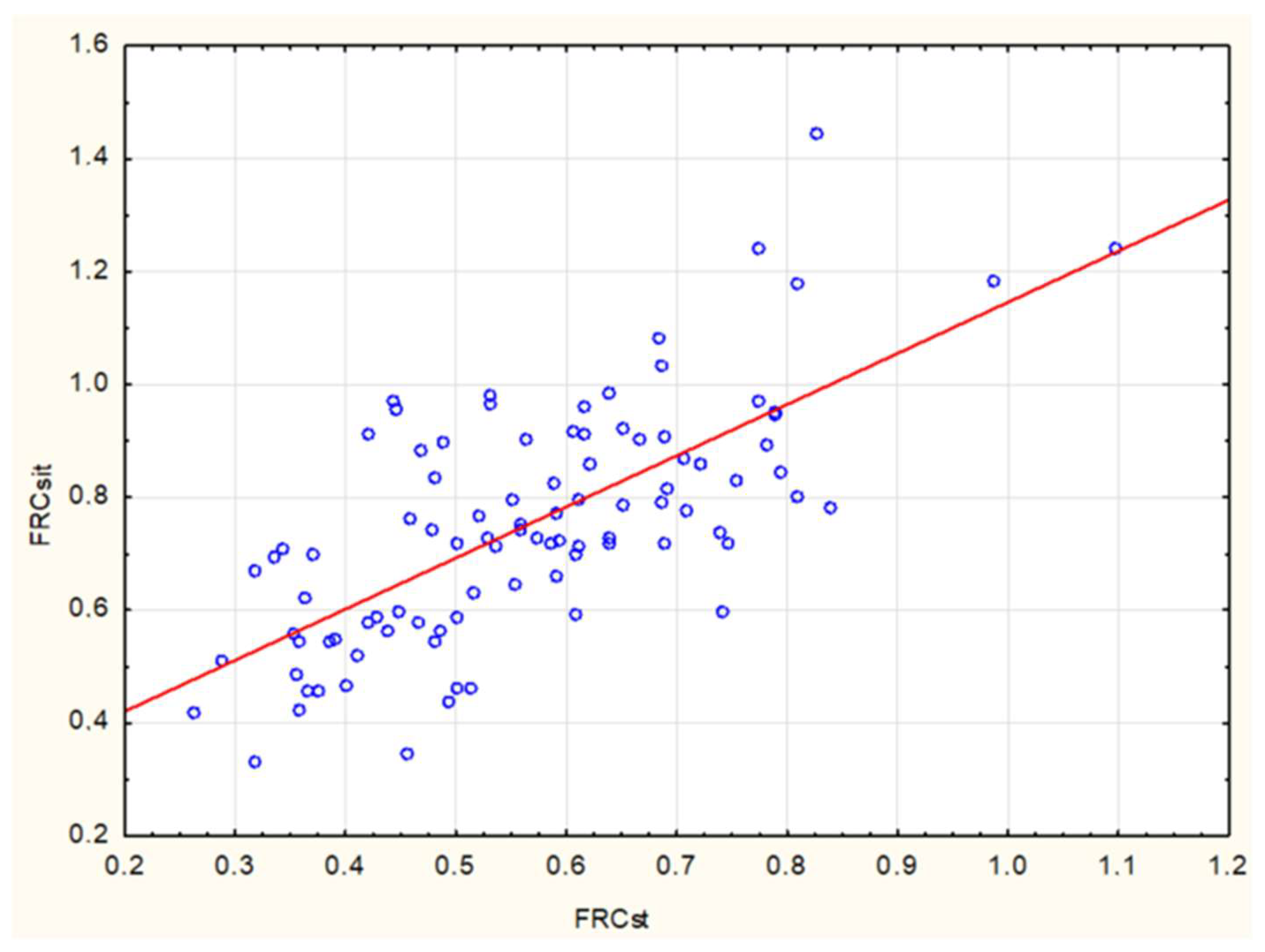
Table 2.
Hemodynamic parameters and vascular stiffness markers in young healthy subjects according to body position.
Table 2.
Hemodynamic parameters and vascular stiffness markers in young healthy subjects according to body position.
| Parameters | stHUTT (st) |
SST (sit) |
p |
|---|---|---|---|
| SBP mmHg | 111 [103; 118] | 117 [112; 122] | < 0.001 |
| DBP mmHg | 72 [66; 77] | 77 [73.5; 80.5] | < 0.001 |
| baPWV m/s | 13.4 [12.1; 14.4] | 15.2 [13.4; 16.1] | < 0.001 |
| FR m/s | 4.85 [3.7; 5.75] | 6.4 [5.25; 7.75] | < 0.001 |
| FRC | 0.55 [0.45; 0.68] | 0.74 [0.59; 0.9] | < 0.001 |
Note: SBP, systolic brachial blood pressure; DBP, diastolic brachial blood pressure; baPWV, brachial–ankle pulse wave velocity; FR, functional reserve; FRC, functional reserve coefficient. Values are presented as median [interquartile range]. Subscripts denote measurement condition: st, stHUTT; sit, supine-to-sitting test. Intergroup differences were considered significant at p < 0.05.
Table 3.
Quantitative assessment of the variance (σ2) of functional biomarkers during the stHUTT and during the SST.
Table 3.
Quantitative assessment of the variance (σ2) of functional biomarkers during the stHUTT and during the SST.
| Parameters | HUTT (st) |
Sitting (sit) |
|---|---|---|
| σ2(baPWV) m2/s2 | 2.86 | 4.28 |
| σ2(FR) m2/s2 | 1.92 | 3.19 |
| σ2(FRC) | 0.02 | 0.04 |
Note: σ2, variance; baPWV, brachial–ankle pulse wave velocity; FR, functional reserve; FRC, functional reserve coefficient. Subscripts denote measurement condition: st, stHUTT; sit, supine-to-sitting test.
Disclaimer/Publisher’s Note: The statements, opinions and data contained in all publications are solely those of the individual author(s) and contributor(s) and not of MDPI and/or the editor(s). MDPI and/or the editor(s) disclaim responsibility for any injury to people or property resulting from any ideas, methods, instructions or products referred to in the content. |
© 2026 by the authors. Licensee MDPI, Basel, Switzerland. This article is an open access article distributed under the terms and conditions of the Creative Commons Attribution (CC BY) license (http://creativecommons.org/licenses/by/4.0/).
Copyright: This open access article is published under a Creative Commons CC BY 4.0 license, which permit the free download, distribution, and reuse, provided that the author and preprint are cited in any reuse.


