

Submitted:
27 May 2026
Posted:
28 May 2026
You are already at the latest version
Abstract
While generative AI enhances efficiency, it simultaneously undermines the professional authority of high performers, thereby posing an expert identity threat to these high performers. Contrary to traditional perspectives that view identity threats as triggers of passive defensiveness, this paper constructs a moderated mediation model based on the dual-dimensional structure of identity (centrality-solidarity). A two-stage questionnaire analysis of 323 employees reveals that: (1) high performers perceive stronger expert identity threats; (2) these threats conversely prompt them to guide colleagues in using AI; (3) task-AI fit positively moderates this mediation effect. This study breaks through the traditional defense paradigm, confirming that high performers achieve identity compensation and power regeneration through helping others and empowering them, providing insights for organizations to promote the transformation of excellent employees into "human-AI collaboration mentor ".
Keywords:
high performers
; expert identity threat
; helping behavior
; task-AI fit
1. Introduction
The adoption of generative AI has become ubiquitous, altering the way people work, how teams collaborate, and the general employee experience. An important finding is that AI significantly reduces the bar to knowledge work performance, especially when it comes to boosting the performance of weaker workers and new hires (Brynjolfsson, Li, & Raymond, 2025; SimanTov Nachlieli, 2025). This “advantage-dilution” effect could be a problem for the long-standing advantage of high performers. According to the identity threat theory, if a person feels that a central identity is being threatened, their response will include a defensive reaction, such as disparagement of the threatening person or entity, avoidance, or withdrawal (Petriglieri, 2011). From this one could therefore deduce that in order to avoid further loss of the performance gap and to protect their professional image and reputation, high performers might even actively withdraw their help-giving. Furthermore, new studies have shown that people are more likely to perceive their peers' AI as being lazy, which in turn leads them to devalue the peers' moral standards and decreases the amount of helping they provide them (Zhou et al., 2025). Together, the findings of these studies seem to point in the same direction – that the increased presence of AI in the workplace hinders the interpersonal assistance behaviors of employees.
Yet, according to the performance motivation model, threat to resource loss could cause increased vigilance towards negative environments. Furthermore, the model could suggest that this threat could make people more actively look for effective environmental cues. In addition, it is possible that such processes would also speed up the adaptation outcomes (Sijbom et al. , 2018). Since some threatening situations involve constraints, evidence might show that people are more likely to exhibit unique value using proactive differentiation strategies. Results reveal that people don't like to be passive (Petriglieri, 2011). By extension, it can be assumed that when the identity threat is provoked by AI adoption in high performers where their self-definition is centered on their expertise, they may paradoxically choose to support other employees in order to reconstruct their identity as well as regenerate power.
The academic community has been confused between two conceptually distinct dimensions of identity—centrality and solidarity—as noted in recent studies (Tajfel & Turner, 2004; Johnson et al. , 2025), and contradictory conclusions have arisen about the effects of identity threat experiences. Identity centrality is the "internal side" and solidarity is the "external side": the centrality of an identity is how important it is to the individual's sense of self, and the solidarity of an identity is how strong the individual feels about their relationship to others or to the group. Based on this two-dimensional perspective, we argue that highly central expert identity is a characteristic of high performers, which makes them more susceptible to experiencing the advantage-dilution effect from AI. Threats to this core identity elicit a response in solidarity dimension, where they seek to respond and reinforce their relationship with colleagues. This internal mechanism encourages top performers to take action, embrace AI, and show leadership by guiding colleagues, resulting in a sense of identity compensation and power regeneration, as opposed to responding in a non-beneficial manner by refusing to use AI or by stigmatizing its use.
The current study builds on this foundation by shifting the understanding of identity threat from a unidimensional perspective to a core prediction that contrasts with the literature: When AI is transforming the power dynamics in the workplace, high performers' perceived threat to their identity will paradoxically increase their willingness to actively coach others in the use of AI. This judgment directly questions the "AI inhibits helping" effect (Zhou et al. , 2025). Based on this, this paper further proposes task-AI fit as a boundary condition: high performers when the fit between AI and their core tasks is high, experience a stronger sense of identity threat and thus are more likely to engage in identity compensation through the mechanism of helping behavior.
Based on the theoretical reasoning outlined above, this study aims to address and reconcile theoretical tensions in the existing literature, making three key contributions: First, moving beyond the conventional lens of identity threat theory, we integrate the logic of positive coping under high threat with the dual-dimensional structure of identity (centrality and solidarity). In doing so, we propose and validate a pathway of "positive identity reshaping" for high performers in AI contexts, thereby challenging the prevailing "AI inhibits helping" perspective. Second, drawing simultaneously on identity centrality and solidarity, we uncover a positive coping mechanism among individuals with high-centrality identities under threatening conditions and incorporate the concept of "power reshaping" into the analytical framework. Third, we extend task–technology fit theory to the domain of identity threat research in AI contexts for the first time, revealing the moderating role of technological characteristics on employees' identity perceptions and behavioral responses.
2. Theoretical Basis and Research Hypothesis
2.1. Expert Identity Threat and High Performers
The implementation of human–AI collaboration in organizations has disrupted traditional work paradigms, altered the content and individual roles, and facilitated the redistribution of resources, power, and influence within organizations (Davenport & Kirby, 2015). This technological shift poses unique challenges to high performers who have long occupied positions of capability advantage, compelling them to reevaluate their personal value orientations and organizational standing, thereby inducing strong identity threats (Scheepers & Ellemers, 2005). Identity threat refers to an individual’s experience of potential harm to the value, meaning, uniqueness, or continuity of a central identity (Petriglieri, 2011). But identity threat occurs when the processes of identity construction, adaptation and evaluation do not meet the three fundamental principles of continuity, uniqueness and self-esteem (Breakwell, 2015). Recent studies also revealed that expert identity threat occurs when the person receives information or feedback that contradicts his/her expert identity (Kang & Kim, 2022). Building on this foundation, the present study proposes that following the introduction of AI into the workplace, high performers will exhibit stronger perceptions of expert identity threat.
First, according to the cognitive appraisal model of stress (Lazarus, 2003), individuals engage in primary appraisal of environmental events, evaluating their relevance, consistency, and potential impact on personal goals. AI has been shown to enhance overall organizational efficiency and decision-making quality (Shrestha et al., 2021). However, the benefits are distributed asymmetrically among employees. Low performers and novice employees experience a stronger empowering effect from AI and achieve greater performance improvements (Brynjolfsson et al., 2025; Mirbabaie et al., 2021; SimanTov Nachlieli, 2025). In contrast, high performers’ core value and organizational status derive from their disproportionate performance advantages and scarce abilities (Aguinis & O’Boyle, 2014). Consequently, the widespread adoption of AI directly reduces the relative performance gap of high performers, leading them to perceive a loss of core achievement goals and a dilution of their long-standing advantages. Such events—highly relevant to work goals and inherently conflicting—are systematically appraised as threats and trigger stress responses (Lazarus, 1993). Moreover, AI not only undermines high performers’ external achievement goals but also erodes their internal self-identity, directly challenging their legitimacy as organizational experts.
Secondly, identity centrality reflects the degree to which a given identity is core to and important within an individual’s self-concept (Johnson et al., 2025). High performers tend to internalize excellent performance, professional advantages, and expert roles as central to their self-definition (Bolinger et al., 2018). Consequently, expert identity holds greater centrality for them. According to identity threat theory, the higher the centrality of an identity, the more sensitive individuals become to cues that threaten that identity, and the stronger their emotional reactions (Johnson et al., 2025; Petriglieri, 2011). Specifically, AI threatens high performers’ expert identity along three dimensions:
At the organizational structure level, organizations typically allocate the resources, delegate higher decision-making authority, and confer higher status to high performers in order to sustain their professional advantages (Ulrich & Call, 2025). However, the evidence may suggest that AI could provide the judgments, solutions, and decision support approaching expert-level proficiency (Malik et al., 2021), the results might indicate that this capability appears to blur the role boundaries between experts and non-experts, deprive high performers of their distinctive identity. Concurrently, AI transforms tacit knowledge accumulated over long periods into immediately accessible explicit capabilities, weakening the knowledge monopoly advantage that high performers have long relied upon (Dell’Acqua et al., 2023; Liu, 2025), further intensifying their anxiety over the devaluation of their expert status.
At the social network level, high performers have traditionally occupied central positions at the social network level and that these individuals accumulated the social capital by guiding colleagues, solving complex problems, and leading collaborative projects (Agrawal et al., 2017; Oldroyd & Morris, 2012). However, the emergence of AI has shifted ordinary employees toward self-service problem-solving, this shift reduces their reliance on experts and that it reduces help-seeking from high performers (Lin et al., 2024). The results might suggest that this development severs the original pathways through which high performers accumulated the social capital. In an effort to maintain their authority and network status, high performers are compelled to invest additional resources, yet they face the dilemma of continuously diminishing marginal returns, leading to stagnant social capital accumulation (Adler & Kwon, 2002).
At the workflow level, key organizational processes may demonstrate that workflow design could maximize the professional contributions of high performers. When AI competes with them on the dimensions of core competence, the role continuity and self-consistency of high performers are disrupted, and identity defense mechanisms arise to protect the integrity of their self-concept (Swann, 1992).
Furthermore, by "instantizing" and "democratizing" deep professional capabilities, AI directly reduces the scarce value of high performers, significantly diminishing their expert aura and irreplaceability.
In summary, whether it is the initial evaluation process based on stress cognition or the threat sensitivity stemming from high-centrality identity, high performers are more likely to perceive the expert identity threat posed by AI than ordinary employees. Based on this, it is proposed that:
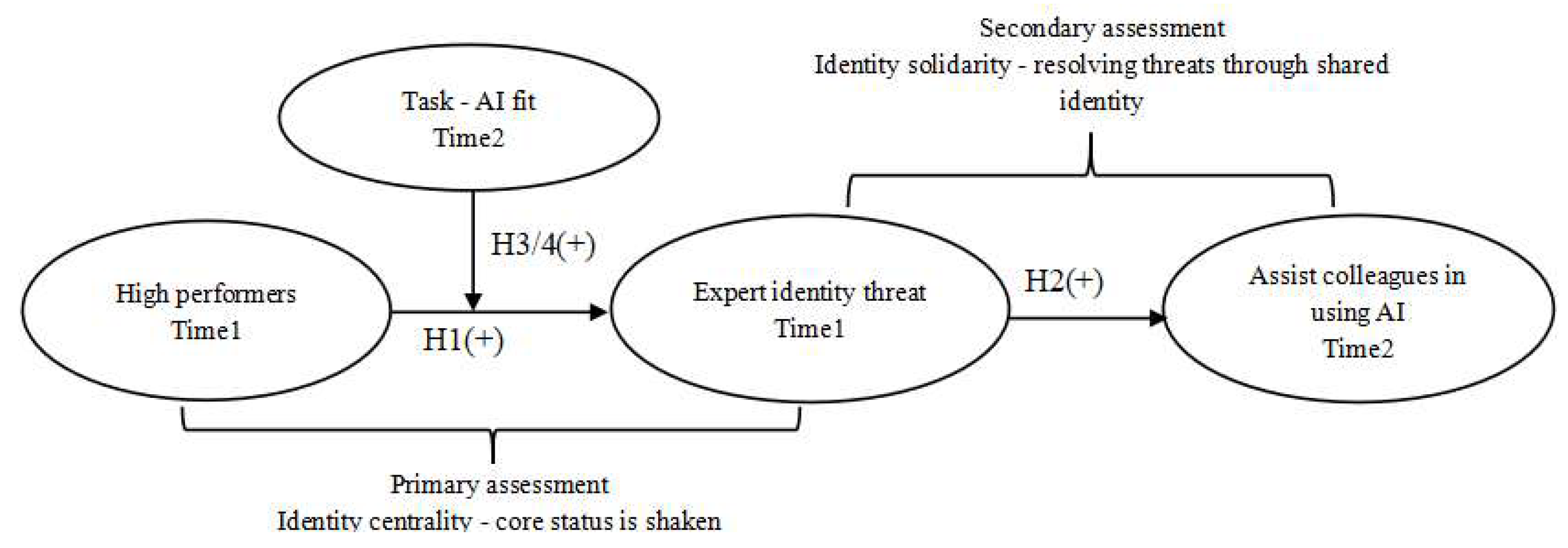
H1: High performers positively influence their perception of expert identity threat. The higher an individual's performance level, the more likely they are to perceive greater expert identity threat.
2.2. Expert identity threat and helping behavior
The introduction of AI will enhance the perception of expert identity threat among high performers, but existing theoretical and empirical evidence has not yet reached a consensus on the behavioral responses that such threats will elicit. This study proposes that, in the context of AI reshaping the power structure in the workplace, expert identity threat will not lead high performers to adopt passive defenses such as avoidance, withdrawal, or belittling the source of the threat. Instead, it may stimulate their pro-social behavior of actively guiding colleagues in using AI through positive identity restructuring. This is mainly due to the dual-dimensional structure of identity.
Identity comprises two core dimensions that are theoretically independent yet functionally synergistic (Johnson et al., 2025). Moreover, identity centrality refers to the importance of a given identity to an individual's self-definition, representing that an inward-focused self-evaluation occurs. Solidarity refers to the perceived strength of one's relationships with others or the group, representing that an outward-focused social connection emerges. These two dimensions might play distinct roles in responding to the identity threats. Identity centrality determines an individual’s sensitivity to such threats. Because high performers’ expert identity is characterized by high centrality, they are particularly sensitive to the “advantage dilution” effect of AI. In contrast, solidarity shapes the coping resources and strategic choices available to individuals. High solidarity drives individuals to maintain their identity by strengthening social connections, consolidating group relationships, and demonstrating professional value—rather than resorting to negative strategies such as alienation, confrontation, or rejection of technology. It is through this mechanism that high performers are prompted to actively guide and empower others, thereby achieving identity compensation, value reconfirmation, and power regeneration in the process of helping others, ultimately realizing positive identity reshaping.
The helping behavior may suggest that solidarity fundamentally demonstrates a dual struggle over human–AI agency and organizational social status. The two dimensions might indicate that mutual reinforcement could establish the core motivation for positive identity reshaping. Moreover, in the struggle for human–AI agency, AI's powerful capabilities could challenge human professional dominance and task control. Yet, AI seems to lack in areas that are central to human capabilities: complex decision making, emotional empathy, and contextual understanding. Moreover, the results might indicate that high-performing individuals might have more real-world experiences, better judgment, and more ability to apply unstructured problem-solving (Jia et al. , 2024). They can show their added value in creating effective prompts, adapting the way they interact with AI based on task scenarios, and detecting and resolving deviations in AI output, skills that are not easily replicable by AI. Adopting high performance in AI usage norms, providing instructional approaches to human–AI collaboration, and defining the limits of AI application can further reinforce a status hierarchy in which “humans lead AI” and “experts control technology” to reinforce the irreplaceability of high performers in the human–AI collaboration system. However, in the battle for social status in the organization, AI eradicates the knowledge monopoly and scarcity advantages that high performers have always enjoyed, potentially undermining their professional standing. High performers can, however, actively support colleagues with AI guidance, bringing them back to the forefront of knowledge sharing and technology empowerment, reclaiming their roles as tech experts, team leaders and opinion formers. In so doing, they reconstruct their social standing and power in the new technology.
Moreover, solidarity can change the options people are willing to choose when coping and inspire them to want to help over the long term through the two connected paths of self-efficacy beliefs and emotional resources. At the level of ability beliefs, strong solidarity can build a sense of social support and expectations for support; thus, high-performing employees are more likely to receive positive feedback and recognition during coaching, boosting their self-concept of competence and self-efficacy. At the same time, high performers have accumulated extensive professional knowledge and technical insights, as well as stable self-efficacy (Agrawal et al., 2017; Mikalef & Gupta, 2021); they can offer strong support for the training process. Regarding the emotions of the people during that time, it was said that "the scent of a rose will never be forgotten by its donor". Helping behavior itself can enhance self-esteem, strengthen positive self-evaluation, and generate emotional benefits (Glomb et al., 2011), effectively alleviating status anxiety and preventing a negative spiral of “threat–depletion–withdrawal” (Marr & Thau, 2014; Ma & Zhu, 2023). This virtuous cycle of “threat arousal → solidarity drive → helping benefits → identity reinforcement” further consolidates high performers’ stable tendency to proactively engage in coaching behavior.
In summary, due to their high identity centrality as experts, high performers are more sensitive to AI induced threats; and due to their high solidarity, they choose to guide colleagues as a positive coping mechanism, thereby achieving identity compensation and power regeneration through dual status competition. Based on this reasoning, we propose the following:
H2: The relationship between high performance levels and the tendency to assist colleagues in using AI is mediated by expert identity threat perception. That is, the higher the employee's performance level, the stronger their perceived expert identity threat, and the more inclined they are to actively assist colleagues in using AI.
2.3. The Moderating Effect of task-AI Fit
The theoretical analysis above suggests that high performers’ propensity to actively guide colleagues is heightened by expert identity threat. However, this effect is not uniformly strong across all contexts. The present study posits that task–AI fit—defined as the degree of alignment between AI system capabilities and work task requirements—serves as a key boundary condition (Goodhue & Thompson, 1995; Dharanikota & Marakas, 2021).
At the functional level, high task-AI fit can output high-precision, high-quality professional judgments and decision-making schemes, driving organizations to restructure decision-making power allocation with efficiency as the orientation (Jarrahi, 2018), transforming high performers from "core decision-making subjects" to "human-AI collaborative decision-making participants", directly weakening their professional dominance and irreplaceability - "Its performance in your best skills is better than yours". At the usability level, high task-AI fit simplifies complex professional tasks into standardized, low-threshold operations, transforming the tacit knowledge accumulated by high performers over time into reproducible and universal automated processes, rapidly reducing the professional learning costs of ordinary employees and dismantling the knowledge monopoly that high performers rely on to maintain their advantages (Liu, 2025) - "The experience you rely on for survival, it easily teaches it to everyone". At the reliability level, AI can output stably and remain online permanently, making colleagues more inclined to adopt AI's suggestions when they need help (Sun & Ding, 2025). This may make high performers perceive their status as a reference point in the team being replaced by AI, and their informal power, prestige, and influence being marginalized (Craig et al., 2019)- "Your inevitable human biases stand out particularly under the relatively accurate output of AI".
This suggests that the higher the task–AI fit, the stronger AI’s substitution effect on the expert role, and the more pronounced the high performers’ loss of sense of meaning, erosion of discursive power, and decline in autonomy (Mirbabaie et al., 2022), correspondingly increasing their perception of expert identity threat.
More importantly, higher task–AI fit also intensifies ordinary employees’ dependence on AI, which in turn means that high performers face greater challenges in competing for human–AI agency and organizational social status. This heightened pressure makes them more likely to rely on identity solidarity and to achieve identity maintenance and compensation by actively guiding colleagues in using AI. First, higher task–AI fit increases both the frequency and the demands of human–AI collaboration in daily work, thereby creating broader opportunities for high performers to translate their long-accumulated professional knowledge and technical insights into practical helping behaviors (Agrawal et al., 2017; Mikalef & Gupta, 2021). Secondly, although ordinary employees are increasingly using AI, there are still considerable deficiencies in the high-level "control" of AI, such as prompt optimization, adapting to different contexts in conversation, and recognizing and correcting bias in AI outputs. At the same time, high performers have accumulated more hands-on experience and a stronger professional sense, are better equipped to handle unpredictable problems (Jia et al., 2024), and can help guide other employees through technical difficulties and display human-professional traits that AI cannot reproduce. In addition, the strong social ties and high expectations for support that come with a high degree of solidarity make it easier for top performers to receive positive feedback and recognition when assisting colleagues who frequently use AI, thus strengthening their position at the core of the team's social network (Eckenhofer, 2010). Through the combined effects of these multiple mechanisms, high performers experience a stronger sense of expert identity threat when task–AI fit is high, and they become more inclined to pursue identity compensation and value reconfirmation through specific guiding behaviors. Based on this reasoning, we propose the following:
H3: Task-AI fit positively moderates the relationship between high performance levels and expert identity threat perception. That is, the higher the fit between AI and a specific task, the stronger the identity threat perception of high performers.
H4: The positive moderating effect of task-AI fit on high performance level indirectly influences the tendency to guide colleagues in using AI through expert identity threat perception. That is, when task-AI fit is high, this indirect effect is stronger.
In summary, the research model is illustrated in the figure below:
Figure 1.
Theoretical model.
3. Methodology
3.1. Procedure and Data Collection
This study employed a questionnaire survey method for data collection. The mining industry is characterized by high risk, high process standardization, and a clearly defined hierarchical system. Its work scenarios naturally require the human–AI co-operation and the professional identity of the employees is directly linked to their job-related skills. These characteristics make the mining industry a promising research domain to study the identity threat of experts in human–AI collaboration situations. So, a mining group in China, and three subsidiaries of the group, were chosen as research cases. These businesses have implemented AI into their day-to-day office tasks, including report analysis, data analysis, programming and text writing. For example, the AI tools in the safety supervision department can be used for risk and hazard identification, the generation of safety inspection report, pattern analysis of historical accident data and the drafting of rectification notices. In the meantime, the production technology department uses AI to analyze the mining efficiency and operating parameters of the equipment, which helps to assess the operating status of the equipment and the adaptability of the operating conditions.
Before the completion of the formal questionnaire survey, the research team visited the field for three days to gain insight into the use of AI in the above-mentioned work situations. Furthermore, the team, through informal discussions and on-site observations, have identified three important phenomena that seemed to be related to the key theme of this study. Moreover, on the operational level, the feedback from the various department's managers would show that the implementation of the AI-based intelligent tools was successful at enhancing the standardization and efficiency of task execution. Since the very basic and procedural type of work was studied it can be concluded that task completion quality and speed were significantly improved. Feedback is good and is improving well. However, the informal conversations and the field observations have indicated that significant variations have emerged in the cognitive and emotional reactions of the employees towards AI's integration into their jobs. However, the senior employees and core team members demonstrated that prudent deliberation regarding changes in job content, upgrading skill requirements, and their own role positioning within the team appeared significant. In light of these findings, at the organizational management level, the enterprise management generally recognized that the introduction of AI might not merely represent a simple technological upgrade but also could entail that systematic adjustments to management systems and organizational behavior were necessary. Additionally, the examples suggest that how to reflect human-AI collaboration contributions in performance evaluation, how to promote the transformation and upgrading of traditional training systems, and how to optimize team collaboration models to adapt to new workflows had all become core issues that management actively focuses on and explores in driving AI implementation. Examples show issues central. Therefore, the research team have reached that a cooperation agreement with enterprise management and the relevant departments could establish the foundation to conduct this important study.
Data collection was concentrated between July 2025 and October 2025. Based on the strict numbering of survey participants, the subjects were gathered at the survey site, with a total of 412 participants in the survey. Before the survey, members of the research team explained the meaning of each question in the questionnaire item by item to help the subjects fill in the answers truthfully. To reduce homogeneity sampling error, data were collected at two time points, as follows: ① Time point 1 (T₁), participants were asked to fill out the subordinate task performance questionnaire and complete the measurement of expert identity threat perception and control variables. ② Time point 2 (T₂), one month after the T₁ survey, the research team revisited the enterprise and asked participants to continue filling out the helping behavior questionnaire and task-AI fit questionnaire. A total of 412 questionnaires were distributed in this study. After excluding invalid questionnaires containing missing data and those with obvious careless filling, 323 valid questionnaires remained, with a questionnaire recovery rate of 78.4%.
After excluding invalid questionnaires containing missing data and those filled out carelessly, there were 323 valid questionnaires remaining, with a questionnaire recovery rate of 78.4%. Among the valid samples, in terms of gender, males accounted for 60.7% and females accounted for 39.3%; in terms of age, those under 25 years old accounted for 2.8%, those aged 26 to 30 accounted for 8%, those aged 31 to 40 accounted for 26.9%, those aged 41 to 50 accounted for 36.8%, those aged 51 to 60 accounted for 23.5%, and those over 60 accounted for 1.9%; in terms of education level, those with a college degree or below accounted for 27.6%, those with a bachelor's degree accounted for 40.2%, those with a master's degree accounted for 23.9%, and those with a doctoral degree accounted for 1.9%; in terms of work experience, those with 1 to 5 years of work experience accounted for 20.7%, those with 6 to 10 years accounted for 17.3%, those with 11 to 15 years accounted for 13%, those with 16 to 20 years accounted for 16.7%, those with 21 to 25 years accounted for 10.5%, those with 26 to 30 years accounted for 14.2%, and those with over 30 years accounted for 7.4%.
3.2. Variable Measurement
The measurement process of variables strictly follows academic norms to ensure the reliability and validity of the scales. This study gives priority to mature scales that have been revised and widely applied by domestic scholars. For foreign authoritative scales that do not yet have a Chinese version (such as the Expert Identity Threat Scale), the standardized procedure of "translation-back translation-revision" is strictly followed: First, two English major master's degree students independently translate the scale, and the research team integrates the translations to form the initial Chinese version. Then, two management doctoral students who have not been exposed to the original scale independently conduct back translation to restore the English version. Finally, the research team compares and discusses the translation and back translation results item by item, revises items with ambiguous expressions and insufficient situational adaptability, and finally forms the official Chinese version of the scale.
High performers. Utilizing the task performance scale (Welbourne et al., 1998), which consists of 4 items, to measure the performance level of employees. Sample items include: "Compared to other employees in the department, how many tasks have you completed?" and "Compared to other employees in the department, how is the quality of your work?" The scale employs a 5-point Likert scoring method, with a scoring range from 1 (very low) to 5 (very high). In this study, the Cronbach's α coefficient for this scale is 0.911.
Expert identity threat. Adapted from the identity threat scale (Jaspal et al., 2020), this scale consists of 4 items, measuring the degree of perception of individuals towards the threat to their expert identity. Sample items include: "I believe that AI has diminished my sense of value as an expert" and "AI makes me feel inadequate as an expert". The scale adopts a 5-point Likert scoring method, with a scoring range from 1 (strongly disagree) to 5 (strongly agree). In this study, the Cronbach's α coefficient of this scale is 0.937.
Task-AI Fit. Adapted from the task-technology fit scale (Goodhue & Thompson, 1995), this scale consists of 8 items, measuring the degree to which employees perceive the fit between AI and their own work tasks. Sample items include: "I believe the data or suggestions provided by AI are accurate and meet my work needs" and "I can quickly find the required functions for data in the AI system". The scale adopts a 7-point Likert scoring method, with a scoring range from 1 (completely disagree) to 7 (completely agree). In this study, the Cronbach's α coefficient of this scale is 0.929.
Assisting Colleagues in Using AI. Adapted from the proactive helping behavior scale (Koopmann, 2016), this scale consists of 4 items, measuring employees' behavioral tendencies towards proactively providing assistance to colleagues in using AI. Sample items include: "When colleagues encounter difficulties in using AI, I will help them analyze the essence of the problem, so that they can independently solve similar AI application problems in the future" and "I will share my experience in using AI with colleagues to help them solve problems in AI usage." The scale employs a 7-point Likert scoring method, with a scoring range from 1 (completely disagree) to 7 (completely agree). In this study, the Cronbach's alpha coefficient for this scale is 0.914, indicating good internal consistency reliability.
Control variable. To avoid the problem of a competing cause and improve the reliability of the research results, this paper introduces control variables for "human agency scale" and "AI dependency", as well as demographic information such as gender, age, education level and years of service. Thus, it is hoped that the potential confounding effects of "role cognition" and "tool dependency psychology" on the main effect in human-AI collaboration can be disentangled, and a purer and more reliable estimate of the theoretical pathway "performance → identity threat → helping behavior" can be obtained.
Among them, human agency scale measures an individual's perception of their degree of dominance in human-AI collaboration. Its concept is akin to a scale from a human perspective, which can precisely locate an individual on a continuous spectrum ranging from "fully automated by AI" to "fully manual by human", indicating the expected or desired degree of intervention for a specific task (Shao et al., 2025). If left uncontrolled, cognitive differences in individuals' understanding of their roles may confuse the correlation between performance and threat, while role cognition itself may also directly drive helping behavior, thereby interfering with the mediating path from identity threat to helping behavior. This study adopts the established research practices (Shao et al., 2025), using a single-item measurement to ask, "If this task is assisted by an artificial intelligence system, how much collaboration between you and the artificial intelligence system is needed to effectively complete this task?" The scale ranges from 1 ("The artificial intelligence can complete the task completely independently") to 5 ("Without continuous human participation, the artificial intelligence cannot function").
Artificial intelligence dependency reflects an individual's psychological dependence on the functionality of AI tools. This dependency may simultaneously amplify the skill anxiety of high performers (thereby obscuring the impact of performance on threat) and stimulate their willingness to guide out of technological enthusiasm rather than identity compensation (thereby obscuring the impact of threat on behavior). This study adopts the established research practices (Zhang et al., 2025), assessing respondents' perceptions through a single item - "After completing tasks using generative AI, have you noticed an increased dependency on technology?" The scoring range is from 1 (strongly disagree) to 5 (strongly agree).
4. Results
4.1. Validity of Data Structure
This article employs confirmatory factor analysis to examine the discriminant validity among various variables. Table 1 shows that, compared with other models, the four-factor model has the most ideal fit indices, indicating that the four latent variables involved in this study have high discriminant validity. Subsequently, add a common method variance (CMV) to the four-factor structure to construct a five-factor model structure (Podsakoff, 2003). It was found that the fit results improved (χ2/df=2.249, RMSEA=0.062, CFI=0.965, TLI=0.954), indicating the presence of a certain degree of common method bias. However, by comparing the models before and after controlling for latent factors, the improvement in indicators such as RMSEA, CFI, and TLI was limited, less than 0.025, suggesting that common method bias does not pose a threat to the interpretation of research results.
4.2. Descriptive Statistical Analysis
As can be seen from Table 2, there is a significant positive correlation between high performers and expert identity threat (r = 0.225, p < 0.001), as well as task-AI fit (r = 0.297, p < 0.001). Expert identity threat is significantly positively correlated with helping behavior (r = 0.373, p < 0.001) and task-AI fit (r = 0.370, p < 0.001). This provides a basis for subsequent hypothesis testing.
4.3. Hypothesis Testing
The results of the hierarchical regression analysis (see Table 3) indicate that Model 2 has an overall explanatory power increase of 5.2% (ΔR2=0.052) compared to Model 1, and the regression coefficient of high performers on expert identity threat is significant (β=0.245, p < 0.001). Therefore, Hypothesis 1 is supported. Meanwhile, as shown in Model 5, high performers should exhibit higher levels of helping behavior (β=0.440, p < 0.001). Furthermore, as shown in Model 6, expert identity threat has a significant positive impact on helping behavior (β=0.210, p < 0.001). By comparing Model 5 and Model 6, it can be seen that the significant influence of high performers on helping behavior weakens with the introduction of the expert identity threat variable (from Model 5 to Model 6, β decreases from 0.440 to 0.388, p < 0.001). Based on the above analysis, this study believes that Hypothesis 2 is supported, and expert identity threat plays a partial mediating role in the relationship between high performers and helping behavior. Furthermore, this study employs Bootstrap sampling for mediating effect research, with 5000 sampling iterations. The 95% confidence interval does not include the number 0 [0.027, 0.176], indicating that expert identity threat mediates the influence of high performers on helping behavior, Hypothesis 2 is valid.
Subsequently, this study examined the moderating effect of task-AI fit. In Table 3, Model 3 indicates that the interaction term between high performers and task-AI fit is significant (β=0.121, p<0.05), suggesting a significant positive moderating effect of task-AI fit on the relationship between high performers and expert identity threat. Hypothesis 3 is supported. To further validate Hypothesis 3, this study employed the JOHNSON-NEYMAN method to illustrate the specific shape of the moderating effect, as shown in Figure 2.
As can be seen from Figure 2, for the portion where the task-AI fit is greater than -1.159, the confidence bands of the simple slope lines are all above the 0 axis, excluding 0, and thus are significant. Since the slope lines are greater than 0 and generally slope upward to the right, it implies that as the task-AI fit increases, high performers' perception of expert identity threat intensifies. Hence, Hypothesis 3 is supported.
Finally, this study employed Mplus to examine the moderated mediation effect, with 5000 bootstrap samples. Table 4 reveals significant differences in the indirect effects across varying levels of task-AI fit (β=0.072, confidence interval [0.006, 0.148], excluding 0). This indicates the presence of a moderated mediation effect. Furthermore, the indirect effect is stronger when task-AI fit is higher (β=0.081, confidence interval [0.028, 0.156], excluding 0) compared to when task-AI fit is lower (β=0.009, confidence interval [-0.019, 0.070], including 0). In other words, task-AI fit enhances the relationship between expert status threat and helping behavior among high performers. Consequently, Hypothesis 4 is supported.
5. Discussion
5.1. Theoretical Contribution
Drawing on an identity threat perspective, this study explores the motivational mechanisms through which high performers actively guide colleagues to use AI in human–AI collaboration contexts, and makes theoretical contributions in three key respects.
First, within the framework of identity threat theory, we integrate social identity theory and the dual-dimensional structure of identity to concretize the mechanism of “positive identity reshaping” among high performers in the AI context. Petriglieri (2011) posits that individuals’ responses to identity threats are not limited to avoidance or devaluation; rather, they depend on threat intensity and situational characteristics. When threats are weak, individuals tend to adopt strategies such as avoidance, concealment, or disparagement of the threat source. However, when threats are sufficiently strong and individuals find it difficult to change the external environment, they may adopt more positive coping strategies, such as actively reshaping their identity. This insight provides the basic theoretical framework for our study. Yet, research to date most commonly assumes that people will resort to negative coping strategies in the situation of AI (Zhou et al. 2025) and Petriglieri's theory is not specific about what identity characteristics or threat-source characteristics will prompt the shift from avoidance to positive reshaping. To fill this gap, we propose to view AI as “algorithmic outgroup” formally introduced by organizations, deeply integrated in core workflows and high in legitimacy and penetration. More importantly, we further incorporate the dual-dimensional structure of identity—centrality and solidarity—into our model, thereby revealing the transformation mechanism from “threat sensitivity” to “choice of coping strategies.” Specifically, centrality determines whether individuals feel threatened, and solidarity determines how they respond to threats. This directly answers Johnson and colleagues’ theoretical call regarding how the dual-dimensional structure of identity interacts to shape behavior, and provides a new analytical language for understanding the evolution of expert roles in the AI era. Thus, within the existing framework, this paper offers a more refined mechanistic explanation: centrality governs threat sensitivity, and solidarity governs coping strategy choice. In doing so, it responds directly to Johnson et al.’s call and concretizes Petriglieri’s “threat intensity → coping style” curve into a clear pathway: high-legitimacy/high-penetration threat + high identity centrality + solidarity→ positive identity reshaping.
Secondly, extending the task-technology fit theory from "performance consequences" to "identity consequences" reveals the "double-edged sword" effect of technology fit, and proposes a new theoretical proposition of "identity cost of technology fit." Existing research on task-AI fit has focused on how technology enhances task efficiency for nearly three decades (Goodhue & Thompson, 1995), implicitly treating "high fit" as a purely positive variable. This paper breaks through this paradigm and finds that high task-AI fit, while enhancing organizational efficiency, can exacerbate identity threats for high performers. Therefore, technology fit is not only an efficiency variable but also an identity variable. This finding resonates with research on AI induced identity threats (Mirbabaie et al., 2022) but further advances the literature: we not only identify the source of the threat (high fit) but also reveal the pathway through which such threats can be transformed (from guided behavior into organizational learning resources). Therefore, this paper proposes a seemingly paradoxical theory that technology threats to employees can transform into a catalyst for organizational learning, under certain conditions. This proposition brings an alternative theoretical lens to the “efficiency first” uni-dimensional logic that has been central to technology adoption studies and offers a new lens for future studies of the “winners and losers” dynamics of technological change. In practice, this discovery suggests that managers might be giving up high performers' identity for the sake of complete alignment with AI. But, when proactive identity compensation mechanisms are put into place, like the ability for the final review of key results generated by AI, and then add context-based information by the team member, this can be an opportunity for team empowerment.
Thirdly, this research reveals the “AI inhibits helping behavior” conclusion of previous empirical studies, discovers the behavior logic of high performers in AI contexts and presents the theory of “status-driven heterogeneity in helping behavior. This conclusion implies that AI as a whole undermines the culture of helping each other out at work. As the present study shows, though, the picture is quite different with “high performers” and “active guidance”: high performers, in response to the threat of AI, actually turn to colleagues more for guidance. This contrast suggests that the effects of AI on interpersonal helping are not one-way—whether it is beneficial or not relies on the status features and behavioral types of those involved. Additionally, we suggest a micro-political mechanism of “dual status competition”, high performers engage in guiding behavior to assert their dominance in the human–AI collaboration, claim their sovereignty over AI, consolidate core position in the team, and compete for the image of technical authority within the organization.
This finding integrates status management research and helping behavior research (Pettit et al., 2016; Nadler et al., 2009), constructs a framework of status-driven heterogeneity in helping behavior, and provides a theoretical starting point for future research to explore the differentiated behaviors of employees with different statuses during technological transformations. Finally, practically speaking, this result indicates that following AI introduction, managers should generally not expect to experience an overall decrease in helping behavior, but rather, look at whether high-status actors possess enough 'guidance space' which may enable them to become the key disseminators of a culture of human–AI collaboration. Organizations should proactively set up guidance platforms for high performers (such as AI Q&A forums within a company, human-AI collaboration workshops across different departments), so that they can help others and help themselves to the win-win situation of identity compensation and organizational value creation.
In conclusion, this study refines key predictions of the identity threat theory and extends our understanding of what coping strategies high performers may employ when facing identity threatened by AI. These three theoretical contributions merge task–technology fit theory from the efficiency paradigm to the identity paradigm, and question the one-sided conclusion that “AI prohibits help. ” All three theoretical contributions point to a general theoretical problem: In the current age of human–AI interaction, which is entrenched in the labor market, the coping strategies of employees with an identity threat no longer entail passive defense, but rather active construction. How organizations design institutional spaces to guide this transformation will become an important frontier in future organizational behavior research. This study provides a preliminary theoretical framework and empirical evidence for this frontier issue, and lays a theoretical foundation for subsequent research to explore similarities and differences in employee identity dynamics across different technological types and cultural backgrounds.
5.2. Practical Implications
This study breaks with the traditional “threat-defense” reactive logic and reveals a positive pathway through which high performers achieve identity compensation and power regeneration by helping and empowering others. These findings suggest that organizations should not view high performers as risk targets to be replaced by AI during intelligent transformation; rather, they should position them as “architects” and “gatekeepers” in the human–AI collaborative ecosystem.
First, role upgrading: establishing a "human–AI collaboration mentor" role to transform identity anxiety into process design authority. Moreover, the evidence indicates that high performers could possess significant motivation to reshape their self-identity and actively assist ordinary employees in using AI to enhance work efficiency. Furthermore, the results demonstrate that organizations should encourage these individuals to take the lead in upgrading their roles from "business executors" to "human–AI collaboration mentor". High performers should be authorized to deconstruct complex business requirements and transform unstructured problems into executable logical chains for AI, and redefine workflow. This process may establish a closed-loop mechanism of "AI draft generation → expert scenario calibration → AI iterative optimization → expert final review and approval" and formulating important task handover rules among different AI roles. Such measures not only leverage high performers’ tacit knowledge, precipitating it into irreplaceable idiosyncratic human capital, but also establish their technical authority within the new production relations as they guide ordinary employees in using AI.
Secondly, process reengineering: embedding “human authority gateways” to turn technical compatibility into an identity anchor. organizations need to implement reverse intervention in automated processes in response to the potential deskilling crisis induced by high task–AI fit. Furthermore, this important intervention might reconstruct that the identity value of experts could be preserved through human authority. In highly automated processes, deliberately retain the “human gate” that requires intervention by human experts. For example, mandate that AI-generated data analysis reports or drafts must undergo contextual calibration, bias correction, and value judgment by high performers, and can only take effect after being signed off and released. Simultaneously, require high performers to document their thought process for each calibration as decision notes, thereby transforming these notes into organizational knowledge assets. This mechanism results in a substantial identity compensation for top performers, and allows them to practically command those around them to stop falling into the AI traps and to produce output of higher quality, with the handles of “last line of defense” and “final decision-maker”.
Thirdly, institutional innovation: an "AI mentor point system" could show that organizations could measure the mentoring behavior as one of the indicators for promotion. Given the counterintuitive results of “AI inhibits assistance" the organizations may want to proactively take on the high performers' mentoring drive and institutionalize it. These practices include: Implementing a “AI mentor” position that rotates among peers to facilitate weekly optimization meetings with colleagues, optimizing colleagues' AI interaction instructions in person, creating departmental “AI pitfall-avoidance guides” that distill common deviations in AI output and how to correct them, and holding debriefing sessions to develop repeatable workflows for human–AI collaboration. Points are clearly defined for each activity and directly related to year-end bonuses and promotion eligibility. This system not only enables maximum performance of high performers by converting the motivation to help into solidarity, but also allows the high performers to satisfy their psychological needs for consolidating their image as technical authorities by performing helping behavior.
5.3. Limitations and Future Research
Although this study has put forward a mechanism for positive identity reconstruction, some issues in the theoretical model have yet to be resolved in later studies.
First, the partial mediation effect indicates that other paths to the effect exist. Hypothesis 2 shows that the partial mediation may indicate that expert identity threat is not the only reason for high performers' helping behavior in this context; other possible paths include impression management, where people actively show off their AI skills to build a good name, or prosocial motivation, where they genuinely want to help their colleagues adjust to the new situation. Other dimensions of organizational citizenship behavior may also provide some reasons for this, such as voice and conscientiousness. More research can be conducted to identify the mediation paths of the above mechanisms and determine their respective strengths of impact in different organizations. Despite this, the boundary conditions for various mechanisms, such as team climate and leadership style, have not been studied to see if context modifies these associations.
Secondly, the non-linear effect of task–AI fit has not been studied. This study assumes that fit and threat perception are positively correlated linearly. However, if the fit is too high—that is to say, if the AI can complete all the tasks by itself without the need for humans—high-achieving individuals may cease to feel the need to "compete with AI for attention" and thus fully withdraw from the arena to pursue other essential value-adding endeavors. In such cases, the sense of threat may be relatively high and then fall; as a result, helping behavior may also decline due to the feeling of futility. Future research can investigate whether there is an inverted U-shaped moderation effect of task-AI fit and determine its critical inflection point.
Thirdly, the long-term costs and possible adverse effects of "positive identity restructuring" have not been investigated. Although guiding high-performing colleagues to meet their identity needs actively, it may result in role overload, an increase in time cost, and even passive dependence or envy from other employees. An excessive leading of high-performing individuals may enhance their status as "firefighters" and fail to distribute knowledge among the rest of the team. In the future, a longitudinal study can be conducted to follow up on the long-term effects of a positive identity renovation on the well-being, work-life balance, and teamwork of high-performing employees.
Fourthly, strengthen direct measurement and causal identification of solidarity. Solidarity appears to be a theoretical mechanism in this study, but it has not been directly observed. Future research will develop or adapt measurement instruments for solidarity and use experimental or longitudinal designs to improve causal inference.
6. Conclusions
Based on an identity threat theory, this study examines the motivating factors that drive high-performing employees to lead by example in AI cooperation. Empirical evidence shows that high performers experience a stronger threat to their expert identity (H1). The threat perception partially mediates their willingness to actively lead colleagues in the application of AI (H2). Task-AI fit positively moderates the relationship between high performance level and threat perception (H3), and also moderates the indirect effect of threat perception (H4). In other words, when AI's capabilities are closely aligned with the main functions, top performers are more likely to feel that their sense of being an expert is being reduced, and therefore are driven to reorient their identity and display their worth by leading others.
Author Contributions
Conceptualization, J.M. and J.W.; investigation, Z.L.; writing—original draft preparation, J.M and J.W; writing—review and editing, J.M., J.W. and Z.L.; validation, J.M. and J.W.; data curation, J.M. and J.W.; visualization, J.M. and J.W.; supervision, J.M. and Z.L. All authors have read and agreed to the published version of the manuscript.
Funding
This research received no external funding.
Institutional Review Board Statement
The study was conducted in accordance with the Declaration of Helsinki. Ethical review and approval were waived for this study as the study did not require institutional ethical approval, as it involved an anonymous survey and provided participants with the option to decline participation. According to Article 32, Paragraph 2 of the Measures for Ethical Review of Life Sciences and Medical Research Involving Human Subjects (National Health Commission of China, 2023), ethical review exemption is permitted under certain conditions. Specifically, the regulation states that research using anonymized data may be exempted from ethical review. Our study involved only anonymous questionnaire surveys, used anonymized data, did not involve any invasive procedures or interventions, and did not collect sensitive personal information. Therefore, in accordance with the above regulation, formal ethical approval was not required for this study.
Informed Consent Statement
Informed consent was obtained from all subjects involved in the study.
Data Availability Statement
The data are available from the corresponding authors on reasonable requests.
Conflicts of Interest
The authors declare no conflicts of interest.
References
- Adler, P.S.; Kwon, S.-W. Social Capital: Prospects for a New Concept. Acad. Manag. Rev. 2002, 27, 17–40. [Google Scholar] [CrossRef]
- Agrawal, A.; McHale, J.; Oettl, A. How stars matter: Recruiting and peer effects in evolutionary biology. Res. Policy 2017, 46, 853–867. [Google Scholar] [CrossRef]
- Aguinis, H.; O'BOyle, E. Star Performers in Twenty-First Century Organizations. Pers. Psychol. 2013, 67, 313–350. [Google Scholar] [CrossRef]
- Bolinger, A.R.; Klotz, A.C.; Leavitt, K. Contributing from Inside the Outer Circle: The Identity-Based Effects of Noncore Role Incumbents on Relational Coordination and Organizational Climate. Acad. Manag. Rev. 2018, 43, 680–703. [Google Scholar] [CrossRef]
- Breakwell, G.M. Coping with Threatened Identities; Taylor & Francis: London, United Kingdom; ISBN, 2015. [Google Scholar]
- Brynjolfsson, E.; Li, D.; Raymond, L. Generative AI at Work. Q. J. Econ. 2025, 140, 889–942. [Google Scholar] [CrossRef]
- Craig, K.; Thatcher, J.B.; Grover, V. The IT Identity Threat: A Conceptual Definition and Operational Measure. J. Manag. Inf. Syst. 2019, 36, 259–288. [Google Scholar] [CrossRef]
- Davenport, T. H.; Kirby, J. Staying Employed in an Era of Very Smart Machines. Harv. Bus. Rev. 2015, 93(9), 20–20. [Google Scholar]
- Dell’ACqua, F.; McFowland, E.; Mollick, E.; Lifshitz, H.; Kellogg, K.C.; Rajendran, S.; Krayer, L.; Candelon, F.; Lakhani, K.R. Navigating the Jagged Technological Frontier: Field Experimental Evidence of the Effects of Artificial Intelligence on Knowledge Worker Productivity and Quality. Organ. Sci. 2026, 37, 403–423. [Google Scholar] [CrossRef]
- Dharanikota, S.; Marakas, G. M. Does AI reliance lead to performance? A task-technology fit theory perspective. 2021. [Google Scholar]
- Eckenhofer, E. M. Is centrality the key to high performance? J. Compet. 2010. [Google Scholar]
- Glomb, T.M.; Bhave, D.P.; Miner, A.G.; Wall, M. DOING GOOD, FEELING GOOD: EXAMINING THE ROLE OF ORGANIZATIONAL CITIZENSHIP BEHAVIORS IN CHANGING MOOD. Pers. Psychol. 2011, 64, 191–223. [Google Scholar] [CrossRef]
- Goodhue, D.L.; Thompson, R.L. Task-Technology Fit and Individual Performance. MIS Q. 1995, 19, 213–236. [Google Scholar] [CrossRef]
- Jarrahi, M.H. Artificial intelligence and the future of work: Human-AI symbiosis in organizational decision making. Bus. Horiz. 2018, 61, 577–586. [Google Scholar] [CrossRef]
- Jaspal, R.; Lopes, B.; Wignall, L. The Coping with Identity Threat Scale: Development and Validation in a University Student Sample. Identity 2020, 20, 225–238. [Google Scholar] [CrossRef]
- Jia, N.; Luo, X.; Fang, Z.; Liao, C. When and How Artificial Intelligence Augments Employee Creativity. Acad. Manag. J. 2024, 67, 5–32. [Google Scholar] [CrossRef]
- Johnson, H.H.; Umphress, E.; Bates, J.T.; Parkinson, S.M.; Sheppard, L.D. Does Identification Hurt or Help Under Identity Threat? The Exacerbating Role of Identity Centrality on Feeling Offended and the Buffering Role of Coworker Solidarity on Identity-Protection Behaviors. Acad. Manag. J. 2025, 68, 50–80. [Google Scholar] [CrossRef]
- Kang, S.H.; Kim, J.W. The Fragility of Experts: A Moderated-Mediation Model of Expertise, Expert Identity Threat, and Overprecision. Acad. Manag. J. 2022, 65, 577–605. [Google Scholar] [CrossRef]
- Koopmann, J. A theoretical model of autonomous helping and dependent helping in teams; University of Florida, 2016. [Google Scholar]
- Lazarus, R.S. From Psychological Stress to the Emotions: A History of Changing Outlooks. Annu. Rev. Psychol. 1993, 44, 1–22. [Google Scholar] [CrossRef] [PubMed]
- Lin, M.; Zhang, Z.; Wu, G. Determinants of employees’ willingness to seek help from robots. Int. J. Hosp. Manag. 2024, 119. [Google Scholar] [CrossRef]
- Liu, X. AI-Driven Transformation of Tacit Knowledge Sharing—A Case Study of DeepSeek. Adv. Soc. Sci. (in Chinese). 2025, 14(7), 573–583. [Google Scholar] [CrossRef]
- Ma, J.; Zhu, M. Accept or change your fate: Exploring the Golem effect and underdog effect of underdog expectations. Acta Psychol. Sin. 2023, 55, 1029–1048. [Google Scholar] [CrossRef]
- Malik, A.; De Silva, M.T.; Budhwar, P.; Srikanth, N. Elevating talents' experience through innovative artificial intelligence-mediated knowledge sharing: Evidence from an IT-multinational enterprise. J. Int. Manag. 2021, 27. [Google Scholar] [CrossRef]
- Marr, J.C.; Thau, S. Falling from Great (and Not-So-Great) Heights: How Initial Status Position Influences Performance after Status Loss. Acad. Manag. J. 2014, 57, 223–248. [Google Scholar] [CrossRef]
- Mikalef, P.; Gupta, M. Artificial intelligence capability: Conceptualization, measurement calibration, and empirical study on its impact on organizational creativity and firm performance. Inf. Manag. 2021, 58. [Google Scholar] [CrossRef]
- Mirbabaie, M.; Brünker, F.; Frick, N.R.J.M.; Stieglitz, S. The rise of artificial intelligence – understanding the AI identity threat at the workplace. Electron. Mark. 2021, 32, 73–99. [Google Scholar] [CrossRef]
- Mirbabaie, M.; Stieglitz, S.; Brünker, F.; Hofeditz, L.; Ross, B.; Frick, N.R.J. Understanding Collaboration with Virtual Assistants – The Role of Social Identity and the Extended Self. Bus. Inf. Syst. Eng. 2020, 63, 21–37. [Google Scholar] [CrossRef]
- Nadler, A.; Harpaz-Gorodeisky, G.; Ben-David, Y. Defensive helping: Threat to group identity, ingroup identification, status stability, and common group identity as determinants of intergroup help-giving. J. Pers. Soc. Psychol. 2009, 97, 823–834. [Google Scholar] [CrossRef] [PubMed]
- Oldroyd, J.B.; Morris, S.S. Catching Falling Stars: A Human Resource Response to Social Capital's Detrimental Effect of Information Overload on Star Employees. Acad. Manag. Rev. 2012, 37, 396–418. [Google Scholar] [CrossRef]
- Petriglieri, J.L. Under Threat: Responses to and the Consequences of Threats to Individuals' Identities. Acad. Manag. Rev. 2011, 36, 641–662. [Google Scholar] [CrossRef]
- Pettit, N.C.; Doyle, S.P.; Lount, R.B.; To, C. Cheating to get ahead or to avoid falling behind? The effect of potential negative versus positive status change on unethical behavior. Organ. Behav. Hum. Decis. Process. 2016, 137, 172–183. [Google Scholar] [CrossRef]
- Podsakoff, P.M.; MacKenzie, S.B.; Lee, J.-Y.; Podsakoff, N.P. Common method biases in behavioral research: A critical review of the literature and recommended remedies. J. Appl. Psychol. 2003, 88, 879–903. [Google Scholar] [CrossRef]
- Scheepers, D.; Ellemers, N. When the pressure is up: The assessment of social identity threat in low and high status groups. J. Exp. Soc. Psychol. 2005, 41, 192–200. [Google Scholar] [CrossRef]
- Shao, Y.; Zope, H.; Jiang, Y.; Pei, J.; Nguyen, D.; Brynjolfsson, E.; Yang, D. Future of work with ai agents: Auditing automation and augmentation potential across the us workforce. arXiv 2025, arXiv:2506.06576. [Google Scholar]
- Shrestha, Y.R.; Krishna, V.; von Krogh, G. Augmenting organizational decision-making with deep learning algorithms: Principles, promises, and challenges. J. Bus. Res. 2021, 123, 588–603. [Google Scholar] [CrossRef]
- Sijbom, R.B.L.; Anseel, F.; Crommelinck, M.; De Beuckelaer, A.; De Stobbeleir, K.E.M. Why seeking feedback from diverse sources may not be sufficient for stimulating creativity: The role of performance dynamism and creative time pressure. J. Organ. Behav. 2017, 39, 355–368. [Google Scholar] [CrossRef]
- SimanTov-Nachlieli, I. More to Lose: The Adverse Effect of High Performance Ranking on Employees’ Preimplementation Attitudes Toward the Integration of Powerful AI Aids. Organ. Sci. 2025, 36, 1–20. [Google Scholar] [CrossRef]
- Swann, W.B.; Stein-Seroussi, A.; Giesler, R.B. Why people self-verify. J. Pers. Soc. Psychol. 1992, 62, 392–401. [Google Scholar] [CrossRef]
- Tajfel, H.; Turner, J.C. The Social Identity Theory of Intergroup Behavior, 2nd ed.; Nelson-Hall: Chicago, IL, USA, 1986. [Google Scholar]
- Ulrich, M.D.; Call, M.L. Pay Premiums and Peer Spillovers: Unpacking the Value Proposition of Employing Stars as They Age. J. Manag. 2023, 51, 1418–1452. [Google Scholar] [CrossRef]
- Sun, Z.; Ding, J. Trusting the Middle in the TNO Trust Task: How Medium Risk and Reliability Shape AI-Assisted Advice-Taking. Hum. Behav. Emerg. Technol. 2025, 2025. [Google Scholar] [CrossRef]
- Welbourne, T.M.; Johnson, D.E.; Erez, A. THE ROLE-BASED PERFORMANCE SCALE: VALIDITY ANALYSIS OF A THEORY-BASED MEASURE. Acad. Manag. J. 1998, 41, 540–555. [Google Scholar] [CrossRef]
- Zhang, L.; Xu, J. The paradox of self-efficacy and technological dependence: Unraveling generative AI's impact on university students' task completion. Internet High. Educ. 2024, 65. [Google Scholar] [CrossRef]
- Zhou, X.; Chen, C.; Li, W.; Yao, Y.; Cai, F.; Xu, J.; Qin, X. How Do Coworkers Interpret Employee AI Usage: Coworkers' Perceived Morality and Helping as Responses to Employee AI Usage. Hum. Resour. Manag. 2025, 64, 1077–1097. [Google Scholar] [CrossRef]
Figure 2.
The moderating effect of task-AI fit (JOHNSON-NEYMAN diagram).
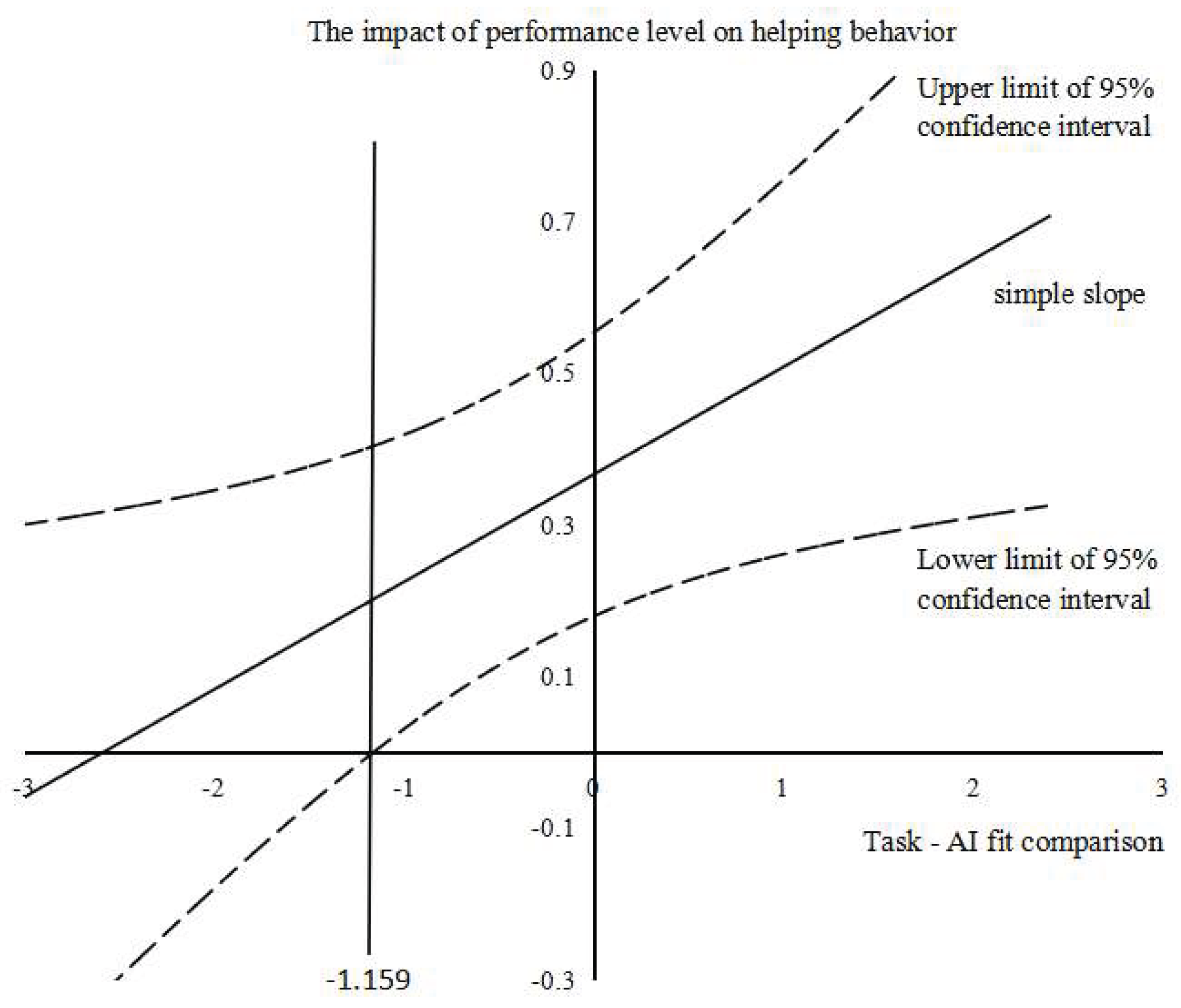

Table 1.
Results of Confirmatory Factor Analysis.
| model | Containing factors | χ2 | df | χ2/df | RMSEA | CFI | TLI |
| Model 1 | Four factors: HP, TAF, EIT, HB | 458.887 | 164 | 2.798 | 0.075 | 0.943 | 0.934 |
| Model 2 | Three factors: HP+TAF, EIT, HB | 1305.741 | 167 | 7.819 | 0.146 | 0.779 | 0.748 |
| Model 3 | Two factors: HP+TAF, EIT+HB | 2153.944 | 169 | 12.745 | 0.191 | 0.614 | 0.566 |
| Model 4 | Single factor: HP+TAF+EIT+HB | 2935.483 | 170 | 17.268 | 0.225 | 0.463 | 0.399 |
| Model 5 | HP, TAF, EIT, HB, CMV | 323.916 | 144 | 2.249 | 0.062 | 0.965 | 0.954 |
Note: HP stands for High Performers, TAF for Task-AI Fit, EIT for Expert Identity Threat, and HB for Helping Behavior.
Table 2.
Mean, standard deviation, and correlation coefficient of each research variable (N=323).
| M | SD | 1 | 2 | 3 | 4 | 5 | 6 | 7 | 8 | 9 | |
| 1. Gender | 1.390 | 0.489 | - | ||||||||
| 2. Education | 3.920 | 1.001 | 0.061 | - | |||||||
| 3. Age | 3.760 | 1.047 | -0.226*** | -0.215*** | - | ||||||
| 4. Length of service | 3.510 | 1.952 | -0.16** | -0.267*** | 0.687*** | - | |||||
| 5. Human agency scale | 3.660 | 1.035 | 0.028 | 0.044 | 0.049 | -0.023 | - | ||||
| 6. AI dependency | 3.680 | 0.824 | -0.062 | 0.076 | 0.082 | 0.047 | -0.094 | - | |||
| 7. High performers | 3.951 | 0.563 | 0.044 | 0.164** | 0.208*** | 0.123* | 0.051 | 0.242*** | - | ||
| 8. Task - AI fit | 4.592 | 0.986 | -0.09 | -0.109 | 0.003 | 0.029 | -0.191 | 0.331*** | 0.248*** | - | |
| 9. Expert identity threat | 3.016 | 0.950 | -0.076 | -0.115* | 0.200** | 0.177** | -0.062 | 0.318*** | 0.297*** | 0.370*** | - |
| 10. Helping behavior | 4.940 | 0.987 | -0.061 | -0.070 | 0.063 | 0.050 | -0.121* | 0.291*** | 0.430*** | 0.489*** | 0.373*** |
Note: N=323, *p<0.1, **p<0.05, ***p<0.001.
Table 3.
Hierarchical regression analysis results (N=323).
|
variable |
Expert identity threat | Helping behavior | ||||||||||
| Model 1 | Model 2 | Model 3 | Model 4 | Model 5 | Model 6 | |||||||
| β | s.e | β | s.e | β | s.e | β | s.e | β | s.e | β | s.e | |
| Gender | -0.015 | 0.104 | -0.040 | 0.101 | -0.015 | 0.098 | -0.031 | 0.111 | -0.076 | 0.101 | -0.067 | 0.098 |
| Academic qualification | -0.097 | 0.052 | -0.144** | 0.051 | -0.092 | 0.050 | -0.083 | 0.055 | -0.169*** | 0.051 | -0.139** | 0.050 |
| Age | 0.114 | 0.066 | 0.055 | 0.065 | 0.082 | 0.064 | 0.026 | 0.071 | -0.080 | 0.065 | -0.092 | 0.064 |
| Length of service | 0.055 | 0.035 | 0.051 | 0.034 | 0.048 | 0.033 | -0.010 | 0.038 | -0.018 | 0.034 | -0.029 | 0.033 |
| Human agency scale | -0.033 | 0.048 | -0.045 | 0.047 | 0 | 0.046 | -0.091 | 0.051 | -0.113* | 0.047 | -0.103* | 0.046 |
| AI dependence | 0.310*** | 0.061 | 0.256*** | 0.061 | 0.186*** | 0.061 | 0.286*** | 0.065 | 0.190*** | 0.060 | 0.136** | 0.061 |
| High performers | 0.245*** | 0.092 | 0.217*** | 0.095 | 0.440*** | 0.091 | 0.388*** | 0.092 | ||||
| Task - AI fit | 0.218*** | 0.054 | ||||||||||
| High performers* Task - AI fit |
0.121* | 0.061 | ||||||||||
| Expert identity threat | 0.210*** | 0.055 | ||||||||||
| Helping behavior | ||||||||||||
| R2 △R2 F |
0.145 - 8.955*** |
0.197 0.052 11.027*** |
0.258 0.061 12.091*** |
0.103 - 6.054*** |
0.269 0.166 16.538*** |
0.304 0.035 17.148*** |
||||||
Note: N=323, *p<0.1, **p<0.05, ***p<0.001.
Table 4.
Analysis results of moderated mediation effect.
| High performers (X) → Expert identity threat (M) → Helping behavior (Y) | ||||
| moderator variable | Phase One X→M [95% confidence interval] |
Phase Two M→Y [95% confidence interval] |
Indirect effect PXM×PMY [95% confidence interval] |
Total effect PXY+ PXM×PMY [95% confidence interval] |
| High task-AI fit | 0.355 [0.208,0.474] |
0.229 [0.073,0.412] |
0.081 [0.028,0.156] |
0.364 [0.245,0.490] |
| Low task-AI fit | 0.162 [-0.015,0.304] |
0.058 [-0.163,0.274] |
0.009 [-0.019,0.070] |
0.292 [0.169,0.420] |
| Difference | 0.193 [0.009,0.389] |
0.171 [-0.093,0.415] |
0.072 [0.006,0.148] |
0.072 [0.006,0.148] |
Disclaimer/Publisher’s Note: The statements, opinions and data contained in all publications are solely those of the individual author(s) and contributor(s) and not of MDPI and/or the editor(s). MDPI and/or the editor(s) disclaim responsibility for any injury to people or property resulting from any ideas, methods, instructions or products referred to in the content. |
© 2026 by the authors. Licensee MDPI, Basel, Switzerland. This article is an open access article distributed under the terms and conditions of the Creative Commons Attribution (CC BY) license.
Copyright: This open access article is published under a Creative Commons CC BY 4.0 license, which permit the free download, distribution, and reuse, provided that the author and preprint are cited in any reuse.