

Submitted:
23 May 2026
Posted:
27 May 2026
You are already at the latest version
Abstract
Conventional dermatological therapies primarily target downstream inflammatory mediators or rely on antioxidant strategies, often without directly addressing the upstream electrophilic chemistry that contributes to tissue damage. Here, we propose a unifying framework based on the Electrophilic Flux (e-Flux) theory, in which a single class of topically applicable agents—Passive Electron Donors (PEDs)—may address diverse dermatological and mucosal conditions by nucleophilically neutralizing pathogenic electrophiles at Stage III of the e-Flux cascade. We review the electrophilic mechanisms underlying five representative conditions: neurogenic skin inflammation driven by 4-hydroxynonenal (4-HNE)-mediated TRPA1 activation, retinoid dermatitis associated with retinaldehyde-induced irritation, aging-related body odor linked to 2-nonenal accumulation, allergic rhinitis mediated by TRPA1-dependent neurogenic inflammation in the nasal mucosa, and migraine involving trigeminal TRPA1 sensitization. For each condition, we outline how upstream electrophile neutralization by PEDs may provide mechanistic advantages over conventional approaches that act further downstream. This perspective positions PED-based topical formulations as a rational, multi-target therapeutic platform grounded in electrophilic chemistry, rather than in empirical antioxidant or anti-inflammatory paradigms.
Keywords:
passive electron donor
; electrophilic flux
; neurogenic inflammation
; TRPA1
; nucleophilic neutralization
1. Introduction
The skin and mucosal surfaces constitute the body’s principal interfaces with environmental stressors, including ultraviolet radiation, chemical irritants, allergens, and microbial metabolites. Although these insults are diverse in origin, many converge on a shared molecular process: the generation of reactive electrophilic compounds, particularly α,β-unsaturated aldehydes, that covalently modify cellular nucleophiles such as protein thiols, nucleobases, and membrane-associated lipids [1]. The Electrophilic Flux (e-Flux) theory, recently proposed by Uno (2026), conceptualizes this process as a six-stage cascade through which metabolic and environmental stressors give rise to pathogenic electrophilic compounds:
Stage I (Trigger) → Stage II (Mitochondrial electron leakage / ROS generation) → Stage III (Electrophilic compound formation: 4-HNE, MDA, acrolein, 2-nonenal, DOPA-quinone, retinaldehyde) → Stage IV (TRP channel activation) → Stage V (Neuropeptide release: CGRP, Substance P) → Stage VI (Tissue-specific pathology).
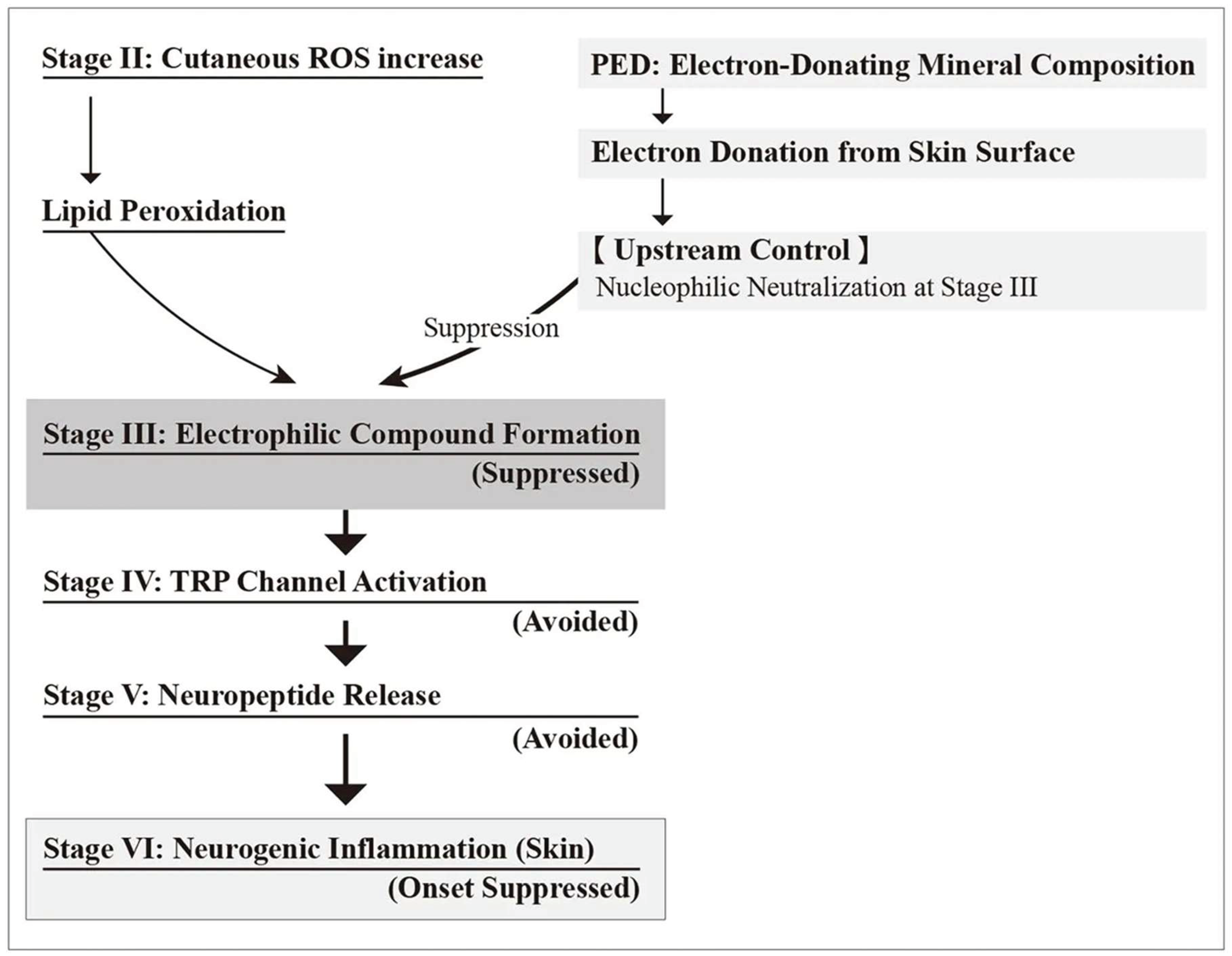
Conventional therapeutic strategies generally intervene at downstream stages of this cascade, such as Stage V, as exemplified by anti-CGRP antibodies for migraine, or Stage VI, as exemplified by corticosteroids for inflammatory disorders. These approaches can be clinically effective, but they do not directly extinguish the upstream electrophilic signal that initiates and propagates the cascade (Figure 1). Antioxidant strategies, including vitamin C and vitamin E, act primarily at Stage II by scavenging reactive oxygen species; however, they are not designed to reverse covalent electrophile–nucleophile adducts once these modifications have been established at Stage III [2]. Passive Electron Donors (PEDs) represent a mechanistically distinct intervention strategy. These inorganic, mineral-based compositions exhibit electron-donating capacity, as assessed by oxidation–reduction potential (ORP), and are proposed to neutralize electrophilic compounds at Stage III through nucleophilic addition reactions. By targeting the upstream electrophilic signal rather than downstream inflammatory or neuropeptide-mediated responses, PED-based intervention may preserve physiological processes such as CGRP-mediated vasodilation, wound healing, and gastrointestinal motility while attenuating pathogenic electrophile-driven signaling (Figure 2) [3]. In this Perspective, we examine five dermatological and mucosal conditions in which electrophilic chemistry appears to play a central pathogenic role. We further discuss how a single PED-based topical platform may address these conditions through a shared upstream mechanism, providing a chemistry-grounded rationale for multi-target intervention across seemingly distinct clinical manifestations.
2. Neurogenic Skin Inflammation: 4-HNE → TRPA1 → CGRP
2.1. The Electrophilic Trigger
4-Hydroxynonenal (4-HNE) is a prototypical α,β-unsaturated aldehyde formed during the lipid peroxidation of ω-6 polyunsaturated fatty acids in cell membranes. In the skin, 4-HNE can be generated in response to ultraviolet radiation, thermal injury, chemical irritants, and endogenous inflammatory processes [4]. Owing to its electrophilic nature, 4-HNE contains three principal reactive sites: the C1 aldehyde group, which can react with lysine ε-amino groups; the C2=C3 double bond, which acts as a Michael acceptor for cysteine thiols; and the C4 hydroxyl group [5].
2.2. TRPA1 as an Electrophilic Sensor
Transient Receptor Potential Ankyrin 1 (TRPA1) serves as a major electrophile-sensitive ion channel in sensory neurons innervating the skin. Electrophilic compounds, including 4-HNE, acrolein, and methylglyoxal, can activate TRPA1 through covalent modification of specific cysteine residues, such as C621, C641, and C665, within its N-terminal ankyrin repeat domain [6]. TRPA1 activation promotes calcium influx and subsequent release of pro-inflammatory neuropeptides, including calcitonin gene-related peptide (CGRP) and substance P, from sensory nerve terminals. This process contributes to neurogenic inflammation, characterized by vasodilation, plasma extravasation, and immune cell recruitment [7].
2.3. Clinical Manifestations
The 4-HNE–TRPA1–CGRP/substance P axis may contribute to several inflammatory skin conditions in which oxidative stress, barrier disruption, or environmental electrophiles are prominent pathogenic features.
| Condition | Putative Electrophilic Trigger | Representative Clinical Features |
| Atopic dermatitis | 4-HNE generated during barrier disruption and oxidative stress | Pruritus, erythema, lichenification |
| Contact dermatitis | Environmental electrophiles and secondary 4-HNE formation | Burning sensation, vesiculation, edema |
| Psoriasis | Chronic oxidative stress associated with 4-HNE generation | Keratinocyte hyperproliferation, erythematous plaques |
| Thermal burn | Acute lipid peroxidation and consequent 4-HNE formation | Pain, erythema, blistering |
2.4. PED Intervention at Stage III
Topical application of Passive Electron Donors (PEDs) is proposed to intervene upstream at Stage III by reducing the availability or reactivity of 4-HNE before it engages TRPA1 on sensory nerve terminals. Mechanistically, the nucleophilic, electron-donating mineral composition may interact with the electrophilic C2=C3 double bond of 4-HNE through a Michael-type addition process, thereby converting the reactive aldehyde into a less electrophilic adduct. By attenuating this upstream electrophilic signal, PED-based intervention would be expected to reduce TRPA1-driven neurogenic inflammation while preserving physiological neuropeptide signaling, including basal CGRP-mediated vascular homeostasis, wound-healing responses, normal sensory function, and appropriate inflammatory responses to infection.
3. Retinoid Dermatitis: Retinaldehyde as a Potential Electrophilic Irritant
3.1. The Retinoid Paradox
Topical retinoids, including tretinoin, retinaldehyde, and retinol, are among the most widely used interventions for photoaging and acne-related skin remodeling. Their clinical utility, however, is frequently limited by retinoid dermatitis, a constellation of adverse cutaneous reactions that includes burning, peeling, erythema, and dryness and is particularly common during treatment initiation [8]. This so-called “retinoid reaction” has traditionally been attributed to accelerated epidermal turnover and barrier perturbation, but emerging mechanistic evidence suggests that sensory neuron activation by retinoid-related intermediates may also contribute to the irritant response.
3.2. Retinaldehyde as a Stage III Electrophilic Intermediate
Retinaldehyde, also known as retinal, contains an aldehyde group conjugated to a polyene system, conferring electrophilic reactivity under appropriate biochemical conditions. As such, retinaldehyde may participate in reactions with cellular nucleophiles, including Schiff base formation with lysine residues and potential Michael-type interactions with cysteine thiols. In the epidermis, the metabolic sequence from retinol to retinaldehyde and ultimately to retinoic acid generates retinaldehyde as an intermediate before its enzymatic oxidation to the receptor-active end product, retinoic acid. Yin et al. (2013) showed that retinoids can activate the irritant receptor TRPV1 and induce sensory hypersensitivity [9]. Within the e-Flux framework, these observations raise the possibility that locally accumulated retinaldehyde, or related retinoid-derived electrophilic intermediates, may interact with sensory nerve terminals before complete enzymatic conversion to retinoic acid. This mechanism could provide a chemical link between retinoid metabolism, TRP channel activation, and the burning or stinging sensations characteristic of retinoid dermatitis.
3.3. e-Flux Interpretation
From the perspective of the e-Flux framework, retinoid dermatitis may be interpreted as a treatment-associated Stage III → Stage IV → Stage V cascade, in which electrophilic retinoid intermediates contribute to sensory neuron activation and downstream neurogenic inflammation:
Retinaldehyde or related retinoid-derived electrophilic intermediates (Stage III) → TRPV1/TRPA1 sensitization or activation (Stage IV) → CGRP/substance P release (Stage V) → Neurogenic inflammation and irritant dermatitis (Stage VI).
This interpretation does not exclude the established contributions of epidermal turnover, barrier disruption, or altered differentiation. Rather, it proposes that electrophile-sensitive sensory signaling may represent an additional upstream mechanism linking retinoid exposure to cutaneous irritation.
3.4. PEDs as Potential Mitigators of Retinoid Dermatitis
Co-application of topical Passive Electron Donors (PEDs) with retinoid therapy may provide a mechanistically rational approach to improving retinoid tolerability. In principle, PEDs could reduce the local electrophilic burden associated with excess retinaldehyde or related reactive retinoid intermediates, thereby limiting TRP channel activation by these species while preserving the downstream therapeutic actions of retinoic acid. This strategy may offer potential advantages by addressing putative irritant chemistry upstream, rather than simply reducing retinoid exposure or relying on nonspecific barrier support.
This approach differs conceptually from conventional mitigation strategies, such as moisturizers, reduced application frequency, or lower retinoid concentrations, which primarily reduce exposure or improve barrier support. By contrast, PED-based intervention is intended to target the putative irritant chemistry upstream, although its efficacy and optimal formulation would require direct experimental and clinical validation.
4. Aging-Associated Body Odor: 2-Nonenal as a Stage III Electrophile
4.1. The Chemistry of Aging-Associated Odor
2-Nonenal is an α,β-unsaturated aldehyde that has been identified as a key volatile contributor to age-associated body odor, commonly referred to as kareishū in Japanese. Haze et al. (2001) reported that 2-nonenal was detected predominantly in subjects aged 40 years and older, with levels tending to increase with age [10]. This compound is thought to arise primarily through the autoxidation of ω-7 unsaturated fatty acids, particularly palmitoleic acid (C16:1 ω-7), on the skin surface.
4.2. Electrophilic Properties of 2-Nonenal
From a chemical standpoint, 2-nonenal shares the α,β-unsaturated aldehyde motif that characterizes electrophilic lipid peroxidation products such as 4-HNE. Kim et al. (2025) described the electrophilic reactivity of 2-nonenal as follows [11]: “From a chemical structural perspective, 2-nonenal is an α,β-unsaturated aldehyde that exhibits high reactivity toward nucleophilic functional groups. The C-3 double bond in 2-nonenal is electrophilic, making it susceptible to nucleophilic attack.” Consistent with this reactivity, Kim et al. demonstrated a nucleophilic scavenging mechanism using N-trans-feruloylputrescine, in which the amine group (-NH₂) reacts with the aldehyde group (-CHO) of 2-nonenal to form a Schiff base, followed by dehydration and cyclization. Under the reported experimental conditions, 10 mM N-trans-feruloylputrescine removed more than 90% of 2-nonenal through this nucleophile-mediated mechanism [11]. These findings support the broader concept that α,β-unsaturated aldehydes on the skin surface may be chemically attenuated by appropriately designed nucleophilic agents.
4.3. Application of the e-Flux Framework
Within the e-Flux framework, 2-nonenal can be regarded as a Stage III electrophilic compound, analogous in chemical class to other α,β-unsaturated aldehydes such as 4-HNE. Unlike 4-HNE, which is typically discussed in the context of inflammatory lipid peroxidation, 2-nonenal is particularly relevant to skin-surface volatile chemistry and odor generation. A simplified pathway may be described as follows: Aging-associated changes in sebaceous lipid composition → Increased availability of ω-7 unsaturated fatty acids → Skin-surface autoxidation → 2-nonenal formation (Stage III electrophile) → Volatile emission → Aging-associated body odor. This interpretation positions aging-associated body odor not merely as a cosmetic or microbial phenomenon, but as a surface-level electrophilic chemistry problem involving the generation and persistence of a volatile α,β-unsaturated aldehyde.
4.4. PED-Based Deodorization Strategy
Topical application of Passive Electron Donors (PEDs) may offer a mechanistically distinct approach to aging-associated body odor by targeting the electrophilic chemistry of 2-nonenal rather than masking odor or suppressing perspiration. In principle, a nucleophilic, electron-donating topical composition could reduce the reactivity or persistence of 2-nonenal on the skin surface, thereby attenuating odor at its chemical source.
| Approach | Primary Mechanism | Principal Limitation |
| Conventional deodorant | Fragrance-based odor masking | Does not chemically reduce 2-nonenal formation or persistence |
| Antiperspirant | Aluminum salts reduce sweating by obstructing sweat ducts | Primarily targets perspiration rather than sebaceous lipid autoxidation |
| Antibacterial strategy | Reduces odor-associated bacterial metabolism | May not address non-bacterial autoxidation-derived aldehydes such as 2-nonenal |
| PED-based nucleophilic attenuation | Proposed chemical reduction or neutralization of electrophilic 2-nonenal | Requires formulation-specific validation of aldehyde scavenging, skin compatibility, and odor reduction |
The rationale for a PED-based approach is strengthened by the fact that 2-nonenal formation is largely associated with non-enzymatic oxidation of skin-surface lipids rather than bacterial metabolism alone. Therefore, antimicrobial strategies may be insufficient when the dominant odorant arises from autoxidative chemistry. By targeting 2-nonenal as a Stage III electrophilic aldehyde, PED-based topical formulations may provide a chemistry-grounded deodorization strategy that complements or extends beyond conventional fragrance, antiperspirant, and antibacterial approaches.
5. Allergic Rhinitis: TRPA1-Mediated Neurogenic Inflammation in the Nasal Mucosa
5.1. Nasal TRPA1 in Allergic Inflammation
Accumulating evidence implicates Transient Receptor Potential Ankyrin 1 (TRPA1) in nasal hyperreactivity and neurogenic inflammation associated with allergic rhinitis. Fang et al. (2021) reported increased TRPA1 expression in the nasal mucosa of ovalbumin-induced allergic rhinitis mice, and pharmacological inhibition of TRPA1 significantly attenuated airway inflammation and hyperresponsiveness [12]. Fu et al. (2024) further showed that TRPA1 knockdown reduced the expression of substance P and calcitonin gene-related peptide (CGRP) in the nasal submucosa and trigeminal ganglion neurons [13]. In addition, Li et al. (2024) demonstrated that TRPA1 activation in nasal epithelial cells can stimulate thymic stromal lymphopoietin (TSLP) production through the Ca²⁺/NFAT pathway, thereby linking epithelial sensory signaling to downstream adaptive immune responses [14].
5.2. The Electrophilic Cascade in Allergic Rhinitis
Within the e-Flux framework, allergic inflammation in the nasal mucosa may involve an electrophile-sensitive neuroimmune cascade. A simplified sequence can be described as follows: Allergen exposure → Mast cell degranulation and inflammatory cell activation → Reactive oxygen species generation (Stage II) → Lipid peroxidation → 4-HNE and related electrophile formation (Stage III) → TRPA1 activation or sensitization on trigeminal afferents and nasal epithelial cells (Stage IV) → CGRP/substance P release and epithelial cytokine signaling (Stage V) → Vasodilation, mucus hypersecretion, sneezing reflex, and nasal hyperreactivity (Stage VI). This neurogenic component may amplify the initial IgE-mediated allergic response by promoting neuropeptide release, epithelial cytokine production, vascular changes, and reflex hypersensitivity. In this model, electrophilic lipid peroxidation products such as 4-HNE are not necessarily the primary cause of allergic rhinitis, but may act as upstream chemical amplifiers that sustain or intensify nasal symptoms after the initial allergen-triggered immune response has been initiated.
5.3. Potential PED Application to the Nasal Mucosa
A PED-containing topical formulation designed for nasal mucosal use could, in principle, interrupt this cascade at Stage III by reducing the local burden of reactive electrophiles generated during allergic inflammation. By attenuating 4-HNE or related electrophilic species before they activate or sensitize TRPA1-expressing trigeminal afferents and epithelial cells, such an approach may reduce neurogenic amplification of allergic symptoms while preserving essential mucosal defense mechanisms. Potential mechanistic effects of nasal PED application may include attenuation of local electrophilic burden, reduction of TRPA1-mediated neurogenic amplification, and modulation of epithelial sensory signaling.
6. Migraine: Trigeminal TRPA1 Sensitization and the FEPS Connection
6.1. TRPA1 in Trigeminal Nociceptive Signaling
TRPA1 channels expressed within the trigeminal nociceptive system have been implicated in migraine-relevant peripheral sensitization and neurogenic inflammation. Electrophilic compounds, including 4-HNE, acrolein, and environmental irritants, can activate or sensitize TRPA1-expressing meningeal and trigeminal nociceptors, leading to calcitonin gene-related peptide (CGRP) release, vasodilation, and inflammatory signaling within the dural vasculature [15]. In this context, TRPA1 may function as an electrophile-sensitive molecular amplifier that links oxidative or environmental chemical stress to trigeminovascular activation. Familial Episodic Pain Syndrome (FEPS), associated with gain-of-function variants in TRPA1 such as N855S, provides a human genetic model of enhanced TRPA1 sensitivity [16]. Although FEPS is clinically distinct from typical migraine, the lowered activation threshold of TRPA1 in this condition supports the broader concept that heightened electrophile-sensitive nociceptive signaling can contribute to paroxysmal pain phenotypes, including migraine-like or migraine-associated manifestations.
6.2. Genetic and Clinical Evidence Linking TRPA1 to Migraine Susceptibility
Several lines of genetic and clinical evidence support a role for TRPA1 in migraine susceptibility, particularly in early-onset or pain-comorbid phenotypes. Kowalska et al. (2020) reported that the TRPA1 rs959976 polymorphism was significantly associated with migraine onset before 15 years of age (OR = 1.88, p = 0.02) [17]. Angus-Leppan et al. (2016) described a four-generation family with autosomal dominant co-inheritance of episodic limb pain and migraine, accompanied by systemic CGRP elevation during attacks [18]. These observations suggest that TRPA1-related nociceptive sensitization may contribute to a subset of migraine phenotypes characterized by enhanced peripheral pain sensitivity. Notably, recurrent limb pain resembling FEPS-like episodic pain has been reported in a substantial proportion of pediatric migraine patients. Such clinical overlap does not establish a single shared mechanism for all migraine cases, but it supports the possibility that TRPA1-dependent peripheral sensitization may be relevant in selected migraine subgroups, particularly those with early onset, cutaneous allodynia, or episodic limb pain comorbidity.
6.3. Topical PEDs for Migraine-Associated Peripheral Sensitization: Rationale
Although migraine is a complex neurovascular disorder involving both central and peripheral mechanisms, topical PED application to regions innervated by trigeminal and upper cervical afferents, such as the temporal, periorbital, occipital, or cervical areas, may represent a mechanistically plausible adjunctive strategy. Rather than treating migraine as a purely central disorder, this approach targets the peripheral electrophilic burden that may contribute to TRPA1 sensitization in cutaneous, meningeal, or trigeminocervical nociceptive pathways. Potential mechanisms include reduction of local electrophilic burden in peripheral tissues innervated by trigeminal or cervical afferents, decreased TRPA1-mediated peripheral sensitization in nociceptive terminals, attenuation of cutaneous allodynia associated with migraine-associated sensory hypersensitivity, and complementarity with systemic CGRP- or inflammatory pathway–targeted therapies. This approach should be regarded as an adjunctive and hypothesis-driven strategy rather than a replacement for established migraine therapies. Its potential advantage lies in targeting electrophile-sensitive peripheral amplification while avoiding broad suppression of physiological CGRP signaling. However, the relevance of topical electrophile attenuation to migraine outcomes would require direct validation in appropriate preclinical models and carefully designed clinical studies, particularly in patient subgroups with cutaneous allodynia, early-onset migraine, or FEPS-like pain features.
8. Mechanistic Advantages and Complementarity Relative to Conventional Approaches
8.1. Comparison with Conventional Antioxidants
Conventional antioxidants, including vitamin C, vitamin E, and polyphenols, primarily act at Stage II of the e-Flux cascade by reducing reactive oxygen species or interrupting oxidative chain reactions. However, once electrophilic carbonyl species such as 4-HNE or 2-nonenal have been generated at Stage III, their biological effects are mediated not only by redox imbalance but also by covalent interactions with cellular nucleophiles. In this context, attenuation of electrophile-driven signaling may require nucleophilic trapping or chemical reduction of electrophilic reactivity, rather than antioxidant electron transfer alone [2]. This distinction may help explain why antioxidant-rich dermatological formulations can show variable or incomplete efficacy in conditions where electrophilic lipid peroxidation products have already accumulated. PED-based intervention is therefore conceptually distinct from conventional antioxidant strategies, as it is proposed to act downstream of ROS generation but upstream of TRP channel activation, neuropeptide release, and tissue-specific inflammatory manifestations.
8.2. Comparison with Anti-Inflammatory Agents
Anti-inflammatory agents, including corticosteroids and nonsteroidal anti-inflammatory drugs (NSAIDs), act primarily by suppressing downstream inflammatory pathways and clinical manifestations. These therapies can be highly effective in appropriate clinical contexts, but they do not necessarily address upstream electrophile formation or electrophile-sensitive sensory signaling. Consequently, symptoms may recur after discontinuation if the upstream chemical and inflammatory drivers remain active. Long-term use of conventional anti-inflammatory agents may also be limited by well-recognized adverse effects, such as skin atrophy with topical corticosteroids and gastrointestinal toxicity with systemic NSAIDs. By contrast, PED-based intervention is proposed to target an earlier chemical layer of the cascade, potentially reducing electrophile-driven amplification without broadly suppressing downstream inflammatory responses. This distinction suggests a possible complementary role for PEDs rather than a direct replacement for established anti-inflammatory therapies.
8.3. Comparison with Anti-CGRP Therapies
Anti-CGRP monoclonal antibodies, such as erenumab, galcanezumab, and fremanezumab, target Stage V signaling by inhibiting CGRP or its receptor and have established clinical utility in migraine prevention. However, because CGRP also contributes to physiological processes, including vascular regulation, gastrointestinal motility, and tissue repair, systemic CGRP pathway inhibition may be associated with mechanism-related adverse events in susceptible patients.
Reported pharmacovigilance signals include Raynaud’s phenomenon, constipation, alopecia, and concerns regarding wound healing [19]. In contrast, PED-based intervention is not intended to block CGRP signaling directly. Rather, it is proposed to reduce upstream electrophilic triggers that may promote TRPA1-dependent CGRP release in selected peripheral contexts. In principle, this upstream approach could attenuate pathological neurogenic amplification while preserving basal and physiologically beneficial CGRP functions. This distinction is particularly relevant when considering PEDs as adjunctive, locally acting strategies rather than systemic substitutes for anti-CGRP therapies.
8.4. Comparison with Conventional Deodorant Strategies
Conventional deodorant approaches address body odor through fragrance masking, reduction of perspiration, or modulation of odor-associated bacterial metabolism. These strategies can be useful for many forms of body odor, but they may be less effective when the dominant odorant arises from non-enzymatic autoxidation of skin-surface lipids, as is the case for 2-nonenal-associated aging odor. Because 2-nonenal is an α,β-unsaturated aldehyde with electrophilic reactivity, a nucleophilic attenuation strategy offers a chemically distinct approach to reducing its persistence on the skin surface. PED-based formulations may therefore complement conventional deodorants by targeting the odorant molecule itself rather than masking its perception or reducing sweat production. Direct validation of 2-nonenal scavenging, odor reduction, formulation stability, and skin tolerability would nevertheless be required to establish this approach in practical deodorant applications.
9. Safety Considerations
The safety profile of PED-based topical or mucosal formulations will depend on their chemical composition, particle characteristics, formulation vehicle, concentration, and site of application. In principle, PED compositions may be expected to support favorable local tolerability when they meet several key criteria: the active components are composed of food-additive-grade inorganic minerals; the formulation demonstrates electron-donating capacity, as assessed by oxidation–reduction potential (ORP), without generating reactive intermediates; the product does not disrupt normal skin barrier function or mucosal physiology; and the formulation is compatible with commonly used topical agents, including retinoids, sunscreens, moisturizers, and other dermatological preparations. For mucosal applications, additional considerations are required, including pH, osmolarity, mucociliary clearance, local irritation potential, retention time, and effects on epithelial barrier integrity. Accordingly, although mineral-based PED formulations may offer a favorable conceptual safety profile, their practical use in dermatological or mucosal settings should be supported by formulation-specific assessments of cytotoxicity, irritation, sensitization, barrier compatibility, and repeated-use tolerability.
10. Future Directions and Testable Predictions
The e-Flux/PED framework generates several experimentally testable predictions that can be evaluated using biochemical, cellular, formulation-based, and clinical approaches.
Future studies should distinguish between direct chemical scavenging of electrophiles, downstream reduction of TRP channel activation, and clinical symptom improvement.
11. Conclusions
The e-Flux framework provides a chemistry-centered perspective for understanding how diverse dermatological and mucosal conditions may converge on a shared upstream layer of electrophile-driven tissue stress. Across conditions such as neurogenic skin inflammation, retinoid dermatitis, aging-associated body odor, allergic rhinitis, and migraine-associated peripheral sensitization, reactive electrophilic species—particularly α,β-unsaturated aldehydes and related carbonyl compounds—may contribute to cellular nucleophile modification, TRP channel activation or sensitization, neuropeptide release, and downstream inflammatory or sensory manifestations. Within this framework, topical Passive Electron Donors (PEDs) represent a mechanistically rational approach for targeting Stage III electrophilic species before they propagate downstream neurogenic or inflammatory signaling. By attenuating pathogenic electrophilic intermediates through nucleophilic chemistry, PED-based formulations may offer a multi-target platform that acts upstream of conventional anti-inflammatory, antioxidant, deodorant, or neuropeptide-directed strategies. Importantly, this approach is not intended to replace established therapies, but rather to complement them by addressing a chemical layer of pathology that is not directly targeted by many current interventions. This conceptual shift—from antioxidant-centered redox control to electrophile-focused chemical attenuation, and from downstream suppression to upstream modulation—has implications for both therapeutic development and the broader understanding of epithelial stress responses. The convergence of aging-associated odor, retinoid irritation, allergic rhinitis, neurogenic skin inflammation, and selected migraine-related phenotypes under an electrophile-sensitive framework illustrates the heuristic value of the e-Flux model. Future biochemical, cellular, formulation-based, and clinical studies will be essential to determine the extent to which PED-mediated electrophile attenuation can be translated into safe and effective interventions across these distinct but chemically connected conditions.
Conflicts of Interest
K.U. is the inventor on pending Japanese patent applications related to Passive Electron Donor (PED) compositions (filed May 23, 2026). E.S. declares no competing interests.
AI Disclosure
AI-assisted tools were used for language editing and formatting. All scientific content, theoretical frameworks, and conclusions are solely the work of the authors.
References
- Esterbauer, H.; Schaur, R.J.; Zollner, H. Chemistry and biochemistry of 4-hydroxynonenal, malonaldehyde and related aldehydes. Free Radic. Biol. Med. 1991, 11(1), 81–128. [Google Scholar] [CrossRef] [PubMed]
- Uno, K. Beyond Oxidative Stress: Upstream Control of the ROS–TRP–CGRP Axis Through Nucleophilic Neutralization of Electrophilic Compounds—A Paradigm Shift in Inflammaging. Manuscript submitted. 2026. [Google Scholar]
- Japanese patent application, pending. Passive Electron Donor Composition for Upstream Control of Electrophilic Flux. 23 May 2026.
- Zhong, H.; Yin, H. Role of lipid peroxidation derived 4-hydroxynonenal (4-HNE) in cancer: focusing on mitochondria. Redox Biol. 2015, 4, 193–199. [Google Scholar] [CrossRef] [PubMed]
- Schaur, R.J.; Siems, W.; Bresgen, N.; Eckl, P.M. 4-Hydroxy-nonenal—A Bioactive Lipid Peroxidation Product. Biomolecules 2015, 5(4), 2247–2337. [Google Scholar] [CrossRef] [PubMed]
- Hinman, A.; Chuang, H.H.; Bautista, D.M.; Julius, D. TRP channel activation by reversible covalent modification. Proc. Natl. Acad. Sci. 2006, 103(51), 19564–19568. [Google Scholar] [CrossRef] [PubMed]
- Benemei, S.; Fusi, C.; Trevisan, G.; Geppetti, P. The TRPA1 channel in migraine mechanism and treatment. Br. J. Pharmacol. 2014, 171(10), 2552–2567. [Google Scholar] [CrossRef] [PubMed]
- Mukherjee, S.; Date, A.; Patravale, V.; Korting, H.C.; Roeder, A.; Weindl, G. Retinoids in the treatment of skin aging: an overview of clinical efficacy and safety. Clin. Interv. Aging 2006, 1(4), 327–348. [Google Scholar] [CrossRef] [PubMed]
- Yin, S.; Bhatt, D.K.; Bhatt, D.; et al. Retinoids activate the irritant receptor TRPV1 and produce sensory hypersensitivity. J. Clin. Investig. 2013, 123(9), 3941–3951. [Google Scholar] [CrossRef] [PubMed]
- Haze, S.; Gozu, Y.; Nakamura, S.; Kohno, Y.; Sawano, K.; Ohta, H.; Yamazaki, K. 2-Nonenal newly found in human body odor tends to increase with aging. J. Investig. Dermatol. 2001, 116(4), 520–524. [Google Scholar] [CrossRef] [PubMed]
- Kim, H.M.; Kim, J.H.; Jeon, J.S.; Kim, C.Y. Eggplant Phenolamides: 2-Nonenal Scavenging and Skin Protection Against Aging Odor. Molecules 30(10), 2129, 2025. [CrossRef] [PubMed]
- Fang, Z.; Yi, F.; Peng, Y.; Zhang, J.J.; et al. Inhibition of TRPA1 reduces airway inflammation and hyperresponsiveness in mice with allergic rhinitis. FASEB J. 2021, 35(5), e21428. [Google Scholar] [CrossRef] [PubMed]
- Fu, Y.; et al. Critical role of sensory neuronal TRPA1 signals in mediating cough hypersensitivity in allergic rhinitis. Eur. Respir. J. 2024, 64 (Suppl 68), PA329. [Google Scholar] [CrossRef]
- Li, J.; et al. Role of TRPV1 and TRPA1 in TSLP production in nasal epithelial cells. Int. Immunopharmacol. 2024, 131, 111916. [Google Scholar] [CrossRef] [PubMed]
- Nassini, R.; Materazzi, S.; Benemei, S.; Geppetti, P. The TRPA1 channel in inflammatory and neuropathic pain and migraine. Rev. Physiol. Biochem. Pharmacol. 2014, 167, 1–43. [Google Scholar] [CrossRef] [PubMed]
- Kremeyer, B.; Lopera, F.; Cox, J.J.; et al. A gain-of-function mutation in TRPA1 causes familial episodic pain syndrome. Neuron 2010, 66(5), 671–680. [Google Scholar] [CrossRef] [PubMed]
- Kowalska, M.; Prendecki, M.; Kapelusiak-Pielok, M.; et al. Analysis of Genetic Variants in SCN1A, SCN2A, KCNK18, TRPA1 and STX1A as a Possible Marker of Migraine. Curr. Genom. 2020, 21(3), 224–236. [Google Scholar] [CrossRef] [PubMed]
- Angus-Leppan, H.; Guiloff, R.J.; Benson, K.; Burn, D.J. Familial limb pain and migraine: 8-year follow-up of four generations. Cephalalgia 2016, 36(11), 1086–1093. [Google Scholar] [CrossRef] [PubMed]
- Sun, W.; Li, H.; Xia, Q.; Chen, L.; Liu, N.; Pang, X. Adverse event reporting of four anti-Calcitonin gene-related peptide monoclonal antibodies for migraine prevention: a real-world study based on the FDA adverse event reporting system. Front. Pharmacol. 2024, 14, 1257282. [Google Scholar] [CrossRef] [PubMed]
Figure 1.
The ROS–TRP–CGRP Axis in Cutaneous Nerve Endings. Schematic representation of the e-Flux cascade from inflammatory stimuli (allergens, UV radiation, burns/trauma, retinoids) through Stage II (ROS increase/oxidative stress), lipid peroxidation, Stage III (electrophilic compound formation: 4-HNE, 2-nonenal, retinaldehyde), Stage IV (TRP channel activation), Stage V (neuropeptide release: CGRP, Substance P), and Stage VI (neurogenic inflammation) to clinical manifestations (pruritus, pain, erythema, burning sensation).
Figure 1.
The ROS–TRP–CGRP Axis in Cutaneous Nerve Endings. Schematic representation of the e-Flux cascade from inflammatory stimuli (allergens, UV radiation, burns/trauma, retinoids) through Stage II (ROS increase/oxidative stress), lipid peroxidation, Stage III (electrophilic compound formation: 4-HNE, 2-nonenal, retinaldehyde), Stage IV (TRP channel activation), Stage V (neuropeptide release: CGRP, Substance P), and Stage VI (neurogenic inflammation) to clinical manifestations (pruritus, pain, erythema, burning sensation).
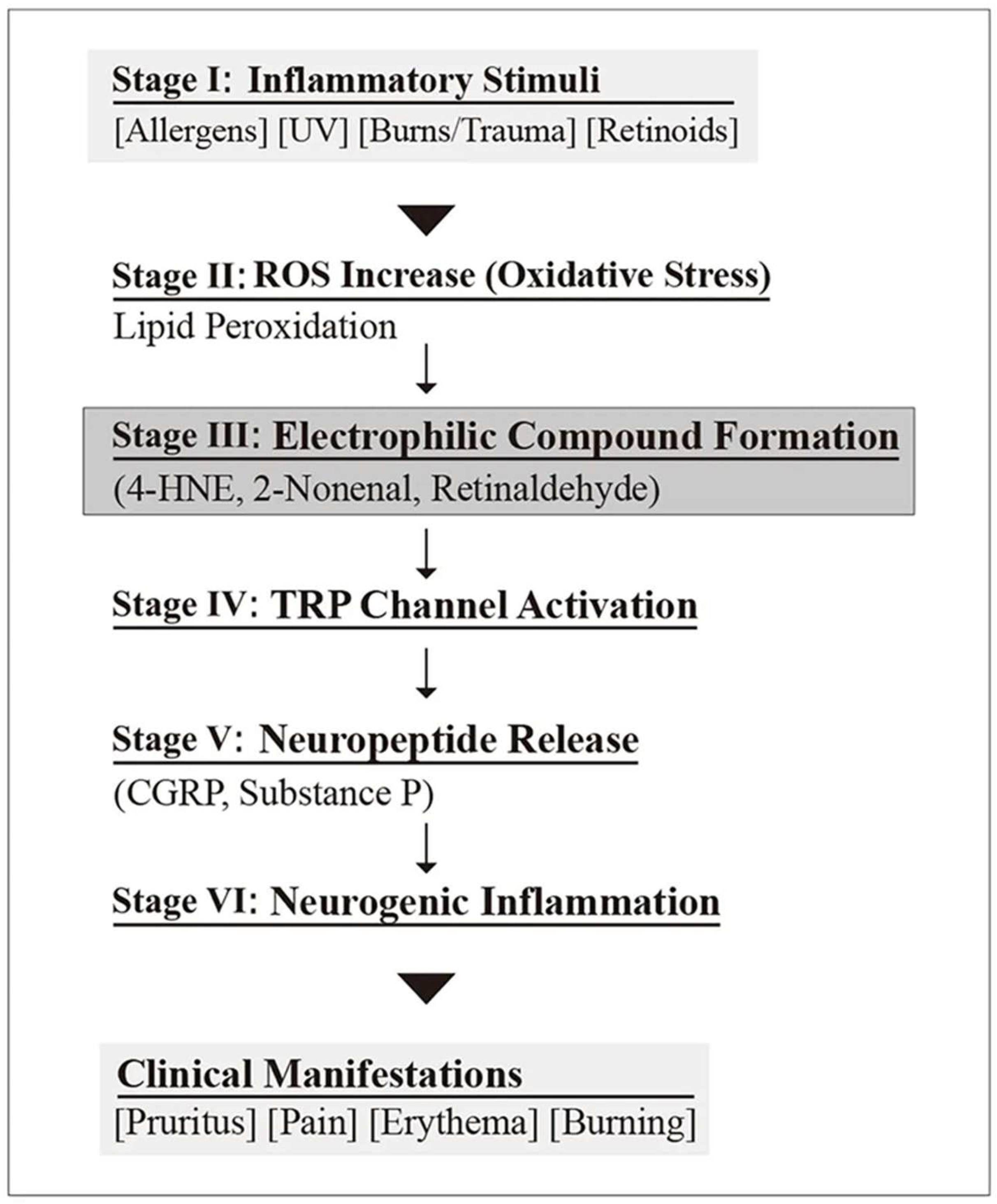
Figure 2.
Upstream Control of the ROS–TRP–CGRP Axis by Passive Electron Donors (PED). PED mineral composition provides electron donation from the skin surface, achieving nucleophilic neutralization at Stage III (upstream control). This suppresses electrophilic compound formation, thereby avoiding downstream TRP channel activation (Stage IV) and neuropeptide release (Stage V), resulting in suppression of neurogenic inflammation onset (Stage VI). Dashed lines indicate suppressed/avoided pathway steps.
Figure 2.
Upstream Control of the ROS–TRP–CGRP Axis by Passive Electron Donors (PED). PED mineral composition provides electron donation from the skin surface, achieving nucleophilic neutralization at Stage III (upstream control). This suppresses electrophilic compound formation, thereby avoiding downstream TRP channel activation (Stage IV) and neuropeptide release (Stage V), resulting in suppression of neurogenic inflammation onset (Stage VI). Dashed lines indicate suppressed/avoided pathway steps.
Disclaimer/Publisher’s Note: The statements, opinions and data contained in all publications are solely those of the individual author(s) and contributor(s) and not of MDPI and/or the editor(s). MDPI and/or the editor(s) disclaim responsibility for any injury to people or property resulting from any ideas, methods, instructions or products referred to in the content. |
© 2026 by the authors. Licensee MDPI, Basel, Switzerland. This article is an open access article distributed under the terms and conditions of the Creative Commons Attribution (CC BY) license.
Copyright: This open access article is published under a Creative Commons CC BY 4.0 license, which permit the free download, distribution, and reuse, provided that the author and preprint are cited in any reuse.


