

Submitted:
26 May 2026
Posted:
27 May 2026
You are already at the latest version
Abstract
Background/Objectives: Periodontitis is the sixth most prevalent disease worldwide, affecting over 740 million people and representing a growing public health burden, particularly in transitional economies. While artificial intelligence (AI) technologies -including deep learning (DL) and machine learning (ML) -have demonstrated high diagnostic accuracy in controlled research settings, a critical implementation gap persists between proof-of-concept studies and real-world clinical deployment, especially in countries with nascent regulatory frameworks such as Kazakhstan. This systematic scoping review synthesizes global evidence on AI methodologies applied to periodontal diagnosis, risk prediction, and patient monitoring; evaluates regulatory and governance frameworks; and proposes an evidence-based five-stage implementation model contextualized for emerging health systems. Methods: Following PRISMA 2020 guidelines, a systematic literature search was conducted in PubMed/MEDLINE, Scopus, Web of Science, Embase, and Cochrane Library, supplemented by regulatory and grey literature. Search terms combined (‘artificial intelligence’ OR ‘machine learning’ OR ‘deep learning’) AND (‘periodontitis’ OR ‘periodontal disease’ OR ‘gingivitis’). Studies published from January 2015 to April 2025 were considered. Forty-five sources (36 peer-reviewed empirical and review studies plus 9 regulatory and grey-literature documents) meeting predefined inclusion criteria were included in qualitative synthesis. Results: Two dominant AI paradigms were identified: (1) image-based deep learning -particularly convolutional neural networks (CNNs) and Vision Transformers -achieving diagnostic accuracies of 73–98.6% for periodontal bone loss detection on panoramic and periapical radiographs; and (2) ML-based non-clinical predictive screening models using patient-reported data and salivary biomarkers. Digital patient management tools (smart toothbrushes, chatbots, IoT platforms) represent a third emerging application domain. Significant external validation performance drops were consistently observed across models, underscoring data quality, dataset heterogeneity, and sample-size constraints as primary barriers. Regulatory analysis revealed convergence of the EU AI Act, U.S. FDA framework, WHO guidance, and the emerging Kazakhstan AI Development Concept (2024–2029) around risk-based classification, algorithmic transparency, and post-market surveillance mandates. Conclusions: Safe, ethical, and clinically effective integration of AI in periodontology requires a phased implementation approach: establishing national multimodal databases, performing locally validated clinical trials, integrating certified tools into digital workflows, deploying continuous monitoring systems, and developing robust legal governance including liability and insurance mechanisms. Kazakhstan’s rapidly evolving regulatory infrastructure and digitalization strategy create a concrete opportunity to establish a replicable model for AI adoption in periodontal care across Central Asian and transitional economies.
Keywords:
artificial intelligence
; periodontitis
; machine learning
; deep learning
; governance
; regulatory framework
; Kazakhstan
; clinical integration
; implementation gap
; teledentistry
1. Introduction
1.1. The Global Public Health Burden of Periodontal Disease
Periodontal diseases -encompassing gingivitis and periodontitis -constitute one of the most prevalent and underappreciated chronic non-communicable conditions affecting humanity. Severe periodontitis ranks as the sixth most prevalent disease globally, affecting an estimated 740 million individuals [1]. According to the WHO Global Oral Health Report 2022, oral diseases affect nearly 3.5 billion people worldwide, with periodontal conditions accounting for the largest share of chronic oral disease burden, particularly in low- and middle-income countries (LMICs) [2]. The socioeconomic consequences are profound: untreated periodontitis generates direct treatment costs and substantial indirect productivity losses, with projections indicating a continued upward trajectory as populations age globally [1].
Beyond oral health, periodontitis is bidirectionally associated with systemic conditions including cardiovascular disease, type 2 diabetes mellitus, adverse pregnancy outcomes, and chronic respiratory diseases, amplifying its significance as a systemic risk factor [3]. Despite this magnitude, traditional diagnostic approaches remain fundamentally limited: assessment of periodontal pocket depth, clinical attachment loss, and radiographic bone loss relies on clinician subjectivity, is inherently invasive, captures historical tissue destruction rather than current disease activity, and is poorly suited to population-level screening [4]. In countries such as Kazakhstan, where dental workforce density is below WHO recommended ratios and geographic access to specialist periodontal care is constrained in rural areas, these diagnostic limitations are especially consequential.
1.2. The Emergence of Artificial Intelligence in Periodontology: State of the Art
The convergence of digital imaging technology, large-scale clinical data repositories, and advances in computational power has enabled rapid development of AI applications in dentistry since 2015 [5]. Within periodontology, two principal methodological paradigms have emerged. The first is image-based deep learning, wherein convolutional neural networks (CNNs) and attention-based architectures such as Vision Transformers (ViTs) are trained to detect and quantify disease features from radiographic and photographic data. The second is clinical predictive modeling, wherein classical machine learning algorithms -including random forests, gradient boosting, and support vector machines -generate probabilistic risk scores from structured clinical and patient-reported data [6,7].
Several landmark studies have defined the current state of the art. Krois et al. (2019) demonstrated that a seven-layer CNN trained on 2,001 panoramic radiograph segments achieved a mean classification accuracy of 0.81 for periodontal bone loss (PBL) detection -comparable to the mean accuracy of six experienced dentists (0.76), establishing the foundational proof that CNNs can match clinical expertise in radiographic periodontal assessment [8]. Dujic et al. (2023) extended this work using Vision Transformer networks on periapical radiographs, reporting overall diagnostic accuracy of 83.4–85.2% and area under the ROC curve (AUC) of 0.899–0.918, with superior performance for lower anterior teeth, demonstrating that transformer architectures offer a viable alternative to CNNs with improved attention to spatial context [9]. In the domain of multi-disease diagnosis, Kim et al. (2022) developed a web-based AI service employing Faster R-CNN, Inception, and ResNet architectures to simultaneously diagnose five oral pathologies on panoramic radiographs in a Korean hospital setting -achieving clinically deployable real-time performance, with each disease type requiring a separately optimized model [10].
For gingival inflammation assessment, Li et al. (2025) proposed GC-U-Net, a deep learning model integrating intraoral scanning (IOS) with global context attention mechanisms, which achieved strong correlations with the Sulcus Bleeding Index (r = 0.836) and Bleeding Index (r = 0.618), providing a non-invasive, quantifiable alternative to clinical gingival scoring [11]. In orthodontic populations, Alalharith et al. (2020) applied Faster R-CNN with ResNet-50 to detect early gingivitis in patients with orthodontic brackets, achieving 77.12% overall accuracy and demonstrating the applicability of deep learning to preventive periodontal monitoring in high-risk subgroups [12].
In predictive modeling, Bashir et al. (2022) conducted a rigorous comparative study of ten machine learning algorithms using nationally representative datasets from the United States and Taiwan, finding that while models achieved high internal validation accuracy, external validation performance dropped significantly -a critical finding exposing the generalizability limitations of AI models trained on geographically and demographically constrained datasets [13]. Deng et al. (2024) demonstrated that ML models combining non-clinical patient-reported parameters with salivary matrix metalloproteinase-8 (MMP-8) and hemoglobin biomarkers from an oral rinse could discriminate between periodontal health, gingivitis, and different stages of periodontitis, opening a pathway for non-invasive population-level screening [14]. The IoT domain has also advanced, with Tonetti et al. (2020) demonstrating that intelligent power-driven toothbrushes connected via mobile platforms could accurately predict clinical bleeding on probing from self-reported brushing-related bleeding data, enabling continuous remote monitoring of periodontal status between clinical visits [15].
A systematic meta-analysis by Khubrani et al. (2024), employing the APPRAISE-AI tool across 2D dental radiographic AI studies from 1990 to 2024, confirmed pooled high sensitivity but noted marked heterogeneity in study design, dataset size, and reporting standards -underscoring the need for standardized methodological frameworks such as MI-CLAIM, CONSORT-AI, and SPIRIT-AI to ensure reproducibility and clinical translatability [16]. Ferrara et al. (2024) similarly highlighted through QUADAS-2 quality assessment that deep learning models in periodontology achieve accuracies ranging from 73.0% to 98.6% in controlled settings, but that most studies lack external validation, and that real-world clinical deployment remains nascent [17].
1.3. Research Gap: From Proof-of-Concept to Clinical Governance
Despite this rapidly expanding body of technical evidence, a fundamental implementation gap persists. The vast majority of AI periodontology studies are single-center, conducted in high-income countries (primarily the United States, South Korea, China, Germany, and Japan), and validated on demographically narrow datasets that do not represent the global population. The AI in dentistry in LMICs scoping review by Umer et al. (2024) found only 25 studies from lower-middle income countries despite an initial yield of 1,587 records -confirming the severe underrepresentation of transitional economies in this research domain [18]. This geographic concentration creates a paradox: the countries with the greatest unmet need for diagnostic support have the least applicable evidence base.
Equally critical is the regulatory dimension. The EU Artificial Intelligence Act (Regulation 2024/1689) -the world’s first comprehensive legally binding AI regulatory framework -classifies AI-based medical diagnostic systems as high-risk, imposing mandatory conformity assessments, technical documentation, clinical validation, algorithmic transparency, and continuous post-market surveillance [19]. The U.S. FDA’s Software as a Medical Device (SaMD) framework similarly establishes a risk-tiered pre-market review pathway and mandates algorithmic change protocols for adaptive AI [20]. However, transitional economies including Kazakhstan lack operationalized equivalents of these frameworks, creating regulatory uncertainty that discourages clinical adoption, limits liability clarity for developers and clinicians, and constrains insurance coverage for AI-assisted care.
Kazakhstan presents a particularly compelling and underexplored case study. As a rapidly modernizing upper-middle income country with an ambitious Digital Kazakhstan national program, a newly published AI Development Concept for 2024–2029 (Resolution No. 592), and a healthcare system undergoing significant digitalization, Kazakhstan occupies a position of strategic relevance for the broader Central Asian and post-Soviet regional health policy context [21]. Yet no comprehensive analysis has assessed Kazakhstan’s specific regulatory readiness, clinical infrastructure capacity, and translational pathway for AI integration in periodontal care. This gap in the literature represents a significant missed opportunity for evidence-based health policy.
1.4. Research Objectives
In light of these gaps, the present systematic scoping review was designed to address four interconnected research objectives:
- To systematically map and synthesize the methodological evidence base for AI applications in periodontal diagnosis, risk prediction, and patient monitoring, with specific attention to methods used, performance metrics, and validation approaches.
- To evaluate the principal technical, data quality, and clinical barriers constraining the transition of AI tools from proof-of-concept to scalable, real-world clinical deployment.
- To analyze and compare international regulatory and governance frameworks (EU, USA, WHO, UNESCO) governing AI in healthcare, and assess their applicability to Kazakhstan’s emerging regulatory context.
- To develop and propose a contextualized, evidence-based five-stage implementation framework for the safe, ethical, and clinically valid integration of AI into periodontal care in Kazakhstan and analogous transitional health systems.
These objectives distinguish the present work from prior reviews -which have largely focused on technological performance metrics -by centering governance, regulatory readiness, and implementation feasibility as primary analytical dimensions, with explicit attention to a context that is systematically underrepresented in the global AI-in-dentistry literature.
2. Materials and Methods
2.1. Study Design and Methodological Justification
This study was conducted as a systematic scoping review following the Preferred Reporting Items for Systematic Reviews and Meta-Analyses extension for Scoping Reviews (PRISMA-ScR) and the PRISMA 2020 reporting framework [22,23]. A completed PRISMA 2020 27-item checklist and a PRISMA-ScR 20-item checklist documenting compliance with each reporting item, together with the location of the relevant information in the manuscript, are provided in Supplementary Materials S1 and S2. A scoping review design was selected - rather than a conventional systematic review with meta-analysis -for several evidence-based reasons. First, the clinical outcomes of AI in periodontology are highly heterogeneous in terms of AI model types, input data modalities (radiographic, photographic, biomarker, patient-reported), outcome measures, and performance metrics, precluding meaningful statistical pooling. This heterogeneity was confirmed by prior meta-analyses including Khubrani et al. (2024), which reported marked I2 statistics necessitating sensitivity analyses even within narrowly defined sub-questions [16]. Second, the review explicitly encompasses non-empirical evidence -including regulatory documents, policy frameworks, governance guidelines, and technical specifications -which constitutes a substantial and scientifically necessary component of the research objectives and is incompatible with conventional systematic review methodologies. Third, the PRISMA-ScR framework is specifically recommended by the Joanna Briggs Institute for multi-domain evidence synthesis where mapping breadth and coverage are prioritized over depth of a single outcome [23].
The methodological choice to employ thematic synthesis rather than quantitative meta-analysis was further justified by the consistent finding across recent systematic reviews that AI periodontology studies are methodologically too diverse for reliable pooling: Ferrara et al. (2024) included only 13 studies meeting QUADAS-2 quality criteria from a broad search [17], while Scott et al. (2023) found reporting outcomes ‘heterogeneous because of the variety of statistical tests available’ across 50 included studies [24]. Thematic synthesis enables identification of convergent and divergent evidence patterns across these heterogeneous study designs, providing a more valid basis for regulatory and implementation recommendations than would be possible through forced quantitative pooling.
2.2. Protocol and Registration
An a-priori protocol specifying the review question, eligibility criteria, information sources, search strategy, study-selection process, data-charting approach, and synthesis plan was developed by the authorial team before commencing the database searches. Because PROSPERO does not accept scoping reviews, the protocol was not prospectively registered in PROSPERO; instead, it was documented internally at Astana Medical University’s Department of Epidemiology and Biostatistics and is available from the corresponding author on reasonable request. No formal amendments to the protocol were made during the conduct of the review; minor refinements to the search strings (i.e., addition of ‘convolutional neural network’ and ‘natural language processing’ as AI synonyms after pilot searching) were implemented and are documented in Supplementary Material S3.
2.3. Eligibility Criteria (Population, Concept, Context)
Eligibility criteria were structured according to the Joanna Briggs Institute Population–Concept–Context (PCC) framework for scoping reviews [23]:
- Population: paediatric, adolescent, and adult patient populations with diagnosed or suspected gingivitis, periodontitis, periodontal bone loss, or at population-level risk of periodontal disease. Regulatory and governance frameworks applicable to AI medical devices used in such populations were also eligible.
- Concept: development, validation, deployment, or governance of artificial intelligence (AI), machine learning (ML), or deep learning (DL) models for periodontal diagnosis, risk prediction, severity classification, or patient monitoring; or analysis of regulatory, ethical, legal, or implementation frameworks pertaining to such AI tools.
- Context: global evidence base, with no geographic restriction; particular emphasis on transitional and upper-middle-income health systems (including Kazakhstan, Central Asia, and analogous settings).
Inclusion criteria. Sources were eligible if they: (1) applied AI, ML, or DL methods to periodontal diagnosis, prediction, classification, or patient monitoring; (2) used clinical imaging data (intraoral photographs, panoramic radiographs, periapical radiographs, CBCT), patient-reported outcomes, biomarkers, or digital-device data as input; (3) reported quantitative performance metrics or qualitative implementation outcomes; (4) were peer-reviewed original studies, systematic reviews, or scoping reviews; or (5) constituted authoritative regulatory, policy, or clinical-governance documents relevant to AI in healthcare. Eligible publication types included original research articles, systematic reviews, scoping reviews, meta-analyses, regulatory texts, official policy documents, and granted patents. The time window was 1 January 2015 to 30 April 2025. Eligible languages were English and Russian.
Exclusion criteria. Sources were excluded if they: lacked a clear description of AI methodology; focused exclusively on non-periodontal dental applications without relevant comparative data; were published in languages other than English or Russian without an available translation; represented duplicate analyses of the same dataset; or were opinion pieces, editorials, letters, or commentaries without primary evidence.
2.4. Information Sources
The search was conducted in five major international academic databases: (1) PubMed/MEDLINE; (2) Scopus; (3) Web of Science Core Collection (Science Citation Index Expanded, Social Sciences Citation Index, and Emerging Sources Citation Index); (4) Embase (Elsevier); and (5) Cochrane Central Register of Controlled Trials and the Cochrane Database of Systematic Reviews. To capture patents and technical solutions, WIPO PatentScope was additionally searched. Grey literature -including international guidelines, regulatory documents, and national policy frameworks -was retrieved from the official websites of the World Health Organization (WHO), the U.S. Food and Drug Administration (FDA), the European Union legislative database (EUR-Lex), UNESCO, the International Medical Device Regulators Forum (IMDRF), and the national legal database of the Republic of Kazakhstan (adilet.zan.kz). Backward citation searching of all included sources was performed to identify additional relevant publications not captured by the database queries. The last search was executed on 30 April 2025.
2.5. Search Strategy
Search strategies were developed iteratively by two reviewers (A.C. and A.A.) with input from a senior methodologist (Y.A.) and refined through pilot searching of PubMed/MEDLINE before adaptation to each database. The strategy combined three conceptual blocks linked with the Boolean operator AND, with synonyms within each block linked with OR: (1) AI technology terms -‘artificial intelligence’ OR ‘machine learning’ OR ‘deep learning’ OR ‘convolutional neural network’ OR ‘neural network’ OR ‘natural language processing’ OR ‘vision transformer’; (2) periodontal disease terms -‘periodontitis’ OR ‘periodontal disease’ OR ‘gingivitis’ OR ‘periodontal bone loss’ OR ‘alveolar bone loss’ OR ‘gingival inflammation’; and (3) contextual terms applied where appropriate -‘diagnosis’ OR ‘screening’ OR ‘prediction’ OR ‘monitoring’ OR ‘classification’ OR ‘governance’ OR ‘regulation’. Database-specific MeSH (PubMed/MEDLINE), Emtree (Embase) and free-text fields were used; truncation (*) and proximity operators were applied where syntax allowed. Filters were applied for publication date (2015–2025) and language (English, Russian). No filters were applied for study design, geography, or document type. The full database-specific search strings, including the precise number of records retrieved from each database, are reported verbatim in Supplementary Material S3 to enable reproducibility.
2.6. Selection Process
All records retrieved from databases were exported to a reference-management database (Zotero, version 6.0) for deduplication. After automated and manual deduplication, remaining records underwent two-stage screening. In Stage 1, titles and abstracts of all unique records were screened independently and in duplicate by two reviewers (A.C. and A.A.) against the pre-specified eligibility criteria. In Stage 2, full texts of records judged potentially eligible at Stage 1 were retrieved and assessed independently and in duplicate by the same two reviewers. Disagreements at either stage were resolved by consensus discussion; unresolved disagreements were adjudicated by a third reviewer (Y.A.). Inter-rater agreement at Stage 1 was substantial (Cohen’s κ = 0.81). No automation tools were used to support screening decisions. Reasons for exclusion at the full-text stage were recorded for each excluded report and are summarised in the PRISMA 2020 flow diagram (Figure 1).
2.7. Data-Charting (Extraction) Process
A structured data-charting form was developed a priori by the authorial team, calibrated on the first five included studies, and refined to ensure consistency before charting the remaining sources. Data were extracted independently by two reviewers (A.C. and A.A.) using a piloted Microsoft Excel template. Discrepancies in extracted values were resolved by consensus or by referral to a third reviewer (Y.A.). Where reported information was ambiguous or incomplete, corresponding authors were not contacted, given the descriptive (non-quantitative-synthesis) nature of the review; instead, missing items were recorded as ‘not reported’ in the extraction table. No automation tools were used to support data charting.
2.8. Data Items
For each included empirical study, the following items were charted: (i) bibliographic details (author, year, country, journal); (ii) study design and setting; (iii) sample size and characteristics of the training, validation, and (where applicable) external test sets; (iv) AI/ML/DL model type and architecture (e.g., CNN, Faster R-CNN, U-Net, Vision Transformer, random forest, gradient boosting); (v) input data modality (panoramic radiograph, periapical radiograph, intraoral scan, CBCT, biomarker, patient-reported data, IoT data); (vi) clinical application domain (radiographic bone-loss detection, gingival inflammation assessment, risk prediction, monitoring); (vii) reported performance metrics (accuracy, sensitivity, specificity, AUC, F1, correlation coefficients); (viii) presence or absence of external validation; (ix) reported limitations; and (x) ethical, legal, or regulatory considerations. For regulatory and grey-literature sources the following items were charted: issuing body; jurisdiction; year of adoption or entry into force; risk-classification approach; transparency, human-oversight, and post-market-surveillance requirements; and applicability to AI-enabled medical devices in dentistry. The complete charted dataset is available from the corresponding author on reasonable request.
2.9. Critical Appraisal of Individual Sources of Evidence
Consistent with PRISMA-ScR guidance [23], formal risk-of-bias appraisal of individual sources is not mandatory in scoping reviews; however, to strengthen the trustworthiness of conclusions about diagnostic-performance evidence, the methodological quality of included diagnostic-accuracy studies was appraised against the QUADAS-2 tool, and AI-specific reporting completeness was assessed against the APPRAISE-AI, MI-CLAIM, CONSORT-AI, and SPIRIT-AI checklists where applicable. Appraisal was conducted independently by two reviewers (A.C., A.A.), with disagreements resolved by consensus. Findings of the appraisal informed the narrative synthesis, in particular the discussion of external-validation limitations (Section 3.5) and methodological-standardisation gaps (Section 4.1), but were not used to exclude sources from the review.
2.10. Synthesis of Results
Given the methodological, clinical, and statistical heterogeneity of the included sources, and consistent with the scoping nature of the review, a framework-based thematic synthesis approach was employed in place of quantitative meta-analysis. Six primary thematic clusters were identified inductively during data charting and then deductively aligned with the review objectives: (1) image-based AI for periodontal diagnosis; (2) non-clinical predictive modelling and biomarker-based screening; (3) digital patient monitoring and IoT applications; (4) data-quality and external-validation barriers; (5) regulatory and governance frameworks; and (6) implementation pathways and contextual adaptation for emerging health systems. Within each cluster, study findings were tabulated and summarised narratively, with attention to convergent and divergent patterns. Reported performance metrics were presented as ranges (minimum–maximum) across studies rather than pooled, in recognition of the methodological heterogeneity documented in the underlying evidence base. No subgroup, sensitivity, or meta-regression analyses were performed; no statistical pooling was attempted. No assessment of reporting bias (e.g., funnel-plot analysis) was applicable given the absence of quantitative synthesis. The thematic structure formed the basis for the Results (Section 3) and Discussion (Section 4) of this manuscript.
2.11. Certainty Assessment and Reporting Standards
Formal certainty-of-evidence grading (e.g., GRADE) was not undertaken because the synthesis is descriptive rather than quantitative, in line with PRISMA-ScR guidance [23]. Instead, the strength of evidence supporting each thematic conclusion is conveyed narratively, with explicit reference to study design, dataset size, presence or absence of external validation, and consistency across sources. Reporting of this review conforms to the PRISMA 2020 statement [22] and the PRISMA-ScR extension [23]; the completed PRISMA 2020 and PRISMA-ScR checklists, with item-by-item indication of location within the manuscript, are provided in Supplementary Materials S1 and S2 respectively. The review was self-funded; no external sponsor had any role in the design, conduct, analysis, or reporting of this review. No competing interests are declared.
3. Results
3.1. Study Selection
The database search identified 54,134 records: PubMed (n = 10,189), Embase (n = 6,694), Web of Science (n = 8,412), Cochrane (n = 5,457), and Scopus (n = 23,382). After removal of duplicates, 16,236 records underwent title and abstract screening, from which 16,179 were excluded. Full-text review was performed on 57 articles, of which 21 were excluded due to insufficient AI methodology description (n = 5), absence of periodontal-specific outcomes (n = 8), or purely opinion-based content without primary data (n = 8). Ultimately, 36 empirical studies were included in the synthesis, supplemented by 9 regulatory and grey literature documents (including EU AI Act, FDA SaMD guidance, WHO AI Ethics guidance, UNESCO Recommendation, and Kazakhstani national regulatory instruments), yielding 45 total sources in the qualitative synthesis (Figure 1).
3.2. Theme 1: Image-Based Deep Learning for Periodontal Diagnosis
3.2.1. Radiographic Bone Loss Detection
Radiographic assessment of alveolar bone loss is the cornerstone of periodontitis staging under the 2018 AAP/EFP classification system, making it the most clinically impactful domain for AI application. The seminal CNN study by Krois et al. (2019) established that deep feed-forward CNNs trained on 2,001 panoramic image segments achieved classification accuracy of 0.81, matching the mean performance of six experienced dentists [8]. Subsequent studies have substantially advanced both architectural complexity and performance.
Dujic et al. (2023) evaluated multiple Vision Transformer (ViT) architectures on periapical radiographs, reporting AUC values of 0.899–0.918 overall, with the highest performance for lower anterior teeth (AUC 0.944–0.970), demonstrating that transformer-based attention mechanisms provide contextual advantages over standard CNNs for localized bone level assessment [9]. Kurt-Bayrakdar et al. (2024) extended analysis to pattern-level detection on panoramic radiographs, identifying horizontal and vertical bone loss patterns and furcation involvement using a bespoke two-stage object detection architecture, achieving high sensitivity for stage III/IV disease [25]. Xue et al. (2024) developed a DL pipeline for automated periodontitis staging on panoramic radiographs that integrated tooth segmentation with bone level quantification, achieving high diagnostic concordance with specialist assessment [26].
The systematic review and meta-analysis by Khubrani et al. (2024) -the most methodologically rigorous synthesis to date, employing APPRAISE-AI quality assessment -analyzed studies from 1990 to January 2024 across five databases [16]. Pooled sensitivity was high across CNN-based models, but marked heterogeneity in study design, training dataset characteristics, and reporting standards was identified. The review specifically noted that few studies reported external validation data, limiting conclusions about real-world generalizability.
3.2.2. Gingival Inflammation Assessment from Intraoral Images
Visual assessment of gingival inflammation -historically dependent on clinician judgment using indices such as the Gingival Index and Bleeding on Probing -represents a second major application domain. Li et al. (2025) developed GC-U-Net, which combined IOS data with a global context attention module to enable automated segmentation and scoring of gingival inflammation, achieving strong correlation with clinical bleeding indices [11]. The Faster R-CNN model by Alalharith et al. (2020) applied to orthodontic patients achieved 77.12% accuracy for gingivitis detection, establishing DL viability for preventive monitoring in high-risk subpopulations [12].
Multi-disease AI platforms integrating periodontal with broader oral pathology assessment have also emerged. Kim et al. (2022) deployed a Korean web-based system using Faster R-CNN with Inception and ResNet backbones to simultaneously diagnose five oral disease types from panoramic radiographs in real clinical workflow, representing one of the most advanced examples of clinically integrated AI diagnostic support in dentistry [10].
3.3. Theme 2: Machine Learning for Non-Clinical Predictive Screening
A clinically distinct but complementary paradigm employs ML algorithms on non-imaging data for population-level periodontal screening -addressing settings where radiographic equipment is unavailable or where pre-referral triage is needed.
Deng et al. (2024) developed a multiclass ML screening tool in Shanghai and Hong Kong that combined patient-reported parameters (gingival condition, tooth mobility, bleeding on brushing) with salivary MMP-8 and hemoglobin biomarkers from a simple oral rinse test [14]. Using random forest and gradient boosting algorithms, the model discriminated between periodontal health, gingivitis, Stage I/II periodontitis, and Stage III/IV periodontitis with clinically meaningful accuracy, demonstrating a viable pathway for non-invasive community screening. Deng et al. (2022) further validated the MMP-8 oral rinse test as a point-of-care biomarker, confirming its capacity to reflect current disease activity rather than historical tissue destruction -a critical advantage over conventional probing [27].
Bashir et al. (2022) performed the most rigorous comparative ML study, evaluating ten algorithms across U.S. National Health and Nutrition Examination Survey (NHANES) and Taiwanese national datasets [13]. The study demonstrated that model performance consistently degraded during cross-national external validation despite high internal accuracy -a finding with profound implications: current ML predictive models for periodontitis cannot be safely deployed in new populations without local revalidation. The study also identified that commonly used predictors (sociodemographic variables, self-reported oral health status) are too coarse for complex algorithms, and that datasets of hundreds of thousands to millions of records are required for models to fully leverage ML capabilities.
The association between periodontal inflammation and systemic health indicators has been further explored using ML approaches; Yan et al. (2025) applied ML to quantify the relationship between periodontal inflamed surface area (PISA) and systemic biomarkers including C-reactive protein, demonstrating the potential for AI-mediated integration of periodontal and systemic health monitoring [28].
3.4. Theme 3: Digital Patient Monitoring and IoT Applications
Beyond clinical diagnosis, AI is being integrated into continuous patient management platforms that operate between dental visits -addressing the persistent challenge of patient adherence, which is a major determinant of periodontal treatment outcomes.
Tonetti et al. (2020) demonstrated in a supportive periodontal care population that self-reported bleeding on brushing captured by intelligent power-driven toothbrushes connected to a mobile application significantly predicted bleeding on probing at the next clinical visit, providing the first evidence that IoT-based home monitoring could serve as a clinical surrogate measure for periodontal disease activity [15]. This finding has important implications for remote periodontal monitoring between recall appointments.
AI-powered chatbot systems have emerged as another patient-engagement tool. Patents from the Russian Federation (RU2841194; RU0002850170) describe systems providing personalized oral hygiene reminders via chatbot interfaces, where clinician-recorded videos and individualized instructions are delivered through unique patient identifiers -enabling a shift from episodic consultation to continuous, personalized support [29,30]. Teledentistry platforms further extend digital monitoring to remote and underserved populations: Kengne Talla et al. (2024) conducted a systematic review protocol confirming teledentistry’s evidence-supported potential for improving both access and quality of oral health care, particularly in geographically dispersed populations [31].
The ‘virtual patient’ concept -integrating data from IOS, 3D facial scanning, CBCT, and IoT devices into a unified digital twin -represents the frontier of this monitoring paradigm [32]. However, Shuto et al. (2025) noted in a scoping review that standardized protocols for integrating diverse digital dental records remain absent, and that this gap will increasingly constrain AI-powered comprehensive treatment planning [33].
3.5. Theme 4: Data Quality, Standardization, and External Validation Barriers
A consistent finding across all reviewed studies was the fundamental constraint of data quality and dataset limitations on AI model reliability and generalizability. Four interconnected barriers were identified:
First, dataset scale insufficiency: the majority of DL studies in periodontology used fewer than 5,000 images for training -far below the scale needed to train robust, generalizable models. Bashir et al. (2022) explicitly calculated that hundreds of thousands to millions of records are required for complex ML algorithms to reach their performance potential [13].
Second, absence of external validation: the systematic review by Ferrara et al. (2024) found that most included DL studies validated models only on internal test sets from the same institution or country, with no external validation on independent populations [17]. This renders accuracy metrics poorly predictive of real-world performance.
Third, data heterogeneity and labeling inconsistency: the lack of standardized radiographic acquisition protocols, image quality standards, and annotation conventions across institutions produces training data variability that degrades model performance. Gusev et al. (2022) articulated standardized methodological requirements for ML model development and validation reporting -including MI-CLAIM-compliant documentation of training datasets, validation procedures, and performance metrics -as a prerequisite for clinical-grade model transparency [34].
Fourth, LMIC data underrepresentation: Umer et al. (2024) confirmed the near-total absence of AI-dentistry research from low-middle income countries, meaning that models trained predominantly on data from East Asian, European, and North American populations are poorly validated for morphological, behavioral, and epidemiological characteristics of these populations [18]. This represents both a scientific gap and an equity concern.
3.6. Theme 5: Regulatory and Governance Frameworks
Table 1 presents a comparative synthesis of key international and national AI regulatory frameworks relevant to periodontal clinical deployment.
The EU AI Act, enacted on 12 July 2024, establishes the most stringent legally binding framework, classifying medical AI diagnostic systems -including periodontal imaging AI -as high-risk and requiring mandatory conformity assessment, comprehensive technical documentation, algorithmic logging for traceability, and continuous post-market monitoring plans [19]. The U.S. FDA has developed a parallel risk-based system through the SaMD pathway, with the 2023 introduction of the Predetermined Change Control Plan (PCCP) specifically addressing the challenge of adaptive AI systems that modify their behavior through post-deployment learning [20].
Kazakhstan’s regulatory trajectory is uniquely positioned for analysis. The AI Development Concept for 2024–2029, approved by Government Resolution No. 592 of July 24, 2024, establishes the creation of national AI databases, development of a dedicated AI law, and alignment with international governance principles as strategic priorities [21]. At the operational level, Order of the Minister of Healthcare No. КР ДСМ-39 (2021) defines requirements for electronic information resources in telemedicine services, while Order No. 199/НҚ of the Ministry of Digital Development (2023) operationalizes personal data processing rules for operators [37,38]. The intersection of these instruments with emerging AI-specific legislation creates a regulatory opportunity to establish Kazakhstan-specific validation and certification pathways for dental AI tools.
3.7. Theme 6: Kazakhstan and Central Asia -Contextual Analysis
Kazakhstan’s healthcare system context is characterized by several factors with direct relevance to AI integration in periodontology. The country’s oral health epidemiology reflects patterns typical of upper-middle income transitional economies: high dental caries prevalence, limited specialist periodontal workforce particularly outside major urban centers (Astana, Almaty, Shymkent), and a healthcare system in active digital transformation under the eHealth program [39]. The Kazakhstan Adolescent Health Study, conducted by Nazarbayev University in collaboration with University College London, has demonstrated significant unmet oral health needs in adolescent populations, providing epidemiological context for preventive AI applications [40].
The digital infrastructure available in Kazakhstan has expanded significantly: telemedicine frameworks are legally established, national health information systems are in development, and the Digital Kazakhstan program has invested in telecommunications connectivity across oblasts. However, as confirmed by the AI-in-LMIC literature [18], critical gaps persist in structured clinical dental data repositories, radiographic imaging standardization across facilities, and training of dental professionals in digital tools and AI output interpretation.
Within the Central Asian and post-Soviet regional context, Kazakhstan is the most advanced in developing an AI regulatory framework, making it a potentially replicable model for Kyrgyzstan, Uzbekistan, Tajikistan, and Azerbaijan. The involvement of co-authors from the International Higher School of Medicine (Bishkek, Kyrgyzstan) and Osh State University in the present study reflects this regional collaborative dimension and suggests pathways for multi-national data sharing to address the dataset scale limitations identified in the evidence base.
4. Discussion
4.1. The Dual Reality: Technological Promise vs. Implementation Prerequisites
The synthesized evidence presents a dual reality. On the technological side, AI -particularly DL for radiographic image analysis and ML for non-clinical predictive modeling -has achieved proof-of-concept across multiple periodontal application domains, with CNN-based models matching or approaching specialist diagnostic accuracy in controlled settings. The methodological diversity spanning Faster R-CNN, GC-U-Net, Vision Transformers, random forests, and gradient boosting algorithms reflects the maturity of the research field. On the implementation side, however, AI in periodontology remains pre-clinical at scale: few systems have been validated externally, fewer still are CE/FDA-cleared, and real-world clinical deployment outside controlled pilot environments is rare.
This implementation gap is not primarily a technological deficiency -it is a governance deficiency. The evidence demonstrates that the path to clinical deployment requires: (1) vastly larger and more representative training datasets incorporating diverse ethnic, geographic, and socioeconomic populations; (2) standardized data collection, annotation, and reporting protocols aligned with MI-CLAIM, CONSORT-AI, and SPIRIT-AI; (3) rigorous external and cross-national validation as a precondition -not an afterthought -for clinical deployment; (4) regulatory certification under applicable national frameworks; and (5) a legal infrastructure that assigns liability, mandates insurance, and protects patient rights in AI-assisted clinical encounters.
4.2. The Proposed Five-Stage Implementation Framework
Synthesizing the technical evidence, governance requirements, and Kazakhstan’s contextual characteristics, we propose a five-stage evidence-based implementation framework (Figure 2). Each stage is grounded in specific literature findings and regulatory requirements:
Stage 1 -National Multimodal Database Establishment: The consistent finding that AI model performance degrades sharply during external validation [13] mandates the creation of large-scale national clinical datasets as a foundational precondition. In the Kazakhstani context, this involves the collection of de-identified multimodal data -intraoral scans, panoramic radiographs, CBCT, clinical charting data, and patient-reported outcomes -from medical institutions across oblasts, with harmonization to a unified quality standard. This aligns with the AI Development Concept’s priority of data infrastructure and technological sovereignty [21]. Personal data collection must strictly comply with Order No. 199/НҚ of the Ministry of Digital Development [37], with cryptographic protection, access auditing, and anonymization protocols implemented from the outset.
Stage 2 -Local Clinical Validation and Certification: AI systems must undergo mandatory clinical validation on a population representative of Kazakhstan before deployment, following the methodology standards outlined by Gusev et al. (2022) for ML model scientific reporting [34]. Risk classification of AI products should align with the EU AI Act’s high-risk category for medical diagnostic AI [19], with inclusion in a Unified National Registry of Medical AI Solutions providing regulatory clarity for developers and clinicians alike. This stage addresses the critical absence of locally validated models that characterizes the current global evidence base.
Stage 3 -Integration into Digital Clinical Workflows: Certified AI systems should be integrated into existing electronic health record systems of hospitals and private dental practices, with standardized application programming interfaces (APIs) ensuring interoperability. This requires the development of unified protocols for integrating data from IOS, 3D facial scanning, radiographic systems, and IoT monitoring devices -addressing the gap in such standards identified by Shuto et al. (2025) [33]. Digital workflow integration should be accompanied by structured training of dental professionals in AI output interpretation, uncertainty quantification, and override protocols.
Stage 4 -Continuous Patient Monitoring and Post-Market Surveillance: Following clinical integration, systems must be enrolled in continuous post-market surveillance programs that track real-world performance, identify data drift (degradation of model accuracy over time as clinical populations evolve), and monitor for algorithmic errors. IoT-based patient monitoring platforms -including intelligent toothbrush systems [15] and chatbot-mediated adherence support [29] -should be deployed as components of periodontal maintenance protocols, shifting care from episodic clinic encounters to continuous patient engagement. Teledentistry platforms [31] should be leveraged to extend monitoring coverage to rural oblasts.
Stage 5 -Legal Governance and Insurance Coverage: The final and essential stage addresses the legal infrastructure without which clinical AI adoption remains precarious. Kazakhstan’s forthcoming AI law, anticipated to align with EU AI Act principles [21], must explicitly address: liability allocation between AI developers, medical organizations, and individual clinicians for algorithmic errors; mandatory professional liability insurance extending to AI-assisted clinical decisions; and informed consent requirements ensuring patients understand when algorithmic tools are used in their care. The formalization of these provisions -drawing on WHO guidance [35] and UNESCO principles [36] -creates the predictable legal environment necessary for sustainable AI ecosystem development.
4.3. Unique Contribution: The Kazakhstan Model for Transitional Economies
The contribution of the present review that distinguishes it from the existing literature is its explicit focus on governance and implementation feasibility in a transitional economy context. While prior reviews have systematically catalogued AI performance metrics in high-income country settings, none has proposed an operationalized, contextually grounded implementation pathway for an emerging economy actively developing its regulatory infrastructure. Kazakhstan’s unique position -simultaneously experiencing rapid healthcare digitalization, developing AI-specific legislation, possessing an active commitment to international regulatory alignment, and facing the clinical workforce and infrastructure constraints characteristic of transitional health systems -makes it both a compelling case study and a potential model for the broader Central Asian and post-Soviet regional context.
The framework is designed to be iteratively adaptable: each stage generates evidence (national validation data, certified product registries, monitoring datasets, litigation precedents) that feeds back to improve subsequent stages. This feedback architecture mirrors the Total Product Lifecycle approach mandated by the FDA [20] and the continuous monitoring requirements of the EU AI Act [19], ensuring that the framework evolves with both the evidence base and the regulatory environment.
4.4. Limitations
Several limitations of this review should be acknowledged. First, the absence of published peer-reviewed clinical studies from Kazakhstan specifically evaluating AI periodontal tools means that the Kazakhstan-specific analysis is based on regulatory and epidemiological evidence rather than primary clinical data -underscoring the urgency of the research agenda this review aims to stimulate. Second, the rapid evolution of both AI technology and regulatory frameworks (particularly the EU AI Act, which began phased implementation in 2024) means that some specific provisions cited may be subject to further elaboration through implementing regulations. Third, language restrictions (English and Russian) may have introduced selection bias, potentially missing relevant studies published in other languages from Central Asian contexts.
5. Conclusions
This systematic scoping review has synthesized evidence across 45 sources to address the critical gap between AI’s demonstrated proof-of-concept in periodontology and its safe, ethical, and clinically effective deployment in real-world practice -with particular focus on Kazakhstan and analogous transitional economies.
The evidence confirms that AI tools -particularly CNNs and Vision Transformers for radiographic bone loss detection, ML models for non-clinical screening, and IoT platforms for continuous patient monitoring -represent a genuine paradigm shift in the capacity for objective, scalable, preventive periodontal care. However, external validation performance consistently degrades relative to internal benchmarks, underscoring that accuracy figures from controlled studies cannot be extrapolated to clinical deployment without local validation on representative populations.
The regulatory convergence of the EU AI Act, U.S. FDA framework, WHO guidance, and Kazakhstan’s AI Development Concept 2024–2029 around risk-based classification, algorithmic transparency, and lifecycle surveillance provides a coherent governance framework for AI medical systems. Kazakhstan’s forthcoming AI legislation and its active healthcare digitalization program create a time-sensitive opportunity to translate these international principles into a nationally operationalized certification and monitoring system for dental AI tools.
The proposed five-stage implementation framework -progressing from national database infrastructure through local validation, digital workflow integration, continuous monitoring, and robust legal governance -provides a concrete, evidence-based pathway that Kazakhstan can adopt and that other transitional economies can adapt. Future research priorities include: the creation of large-scale, nationally representative Kazakhstani periodontal clinical datasets; prospective multi-center clinical trials evaluating AI-assisted versus conventional periodontal diagnosis; development of standardized protocols for multimodal digital data integration; and legal scholarship clarifying liability and insurance mechanisms for AI-assisted dental encounters.
In conclusion, the integration of artificial intelligence into periodontology is not a distant aspiration -it is an achievable near-term imperative that requires coordinated investment in data infrastructure, rigorous science, principled governance, and legal innovation. Kazakhstan is positioned to become a regional leader in demonstrating how this integration can be achieved responsibly, equitably, and sustainably.
Supplementary Materials
The following supporting information can be downloaded at the website of this paper posted on Preprints.org. Supplementary Material S1: Completed PRISMA 2020 27-item checklist with location of each reporting item in the manuscript; Supplementary Material S2: Completed PRISMA-ScR 20-item checklist with location of each reporting item in the manuscript; Supplementary Material S3: Full database-specific search strategies (PubMed/MEDLINE, Embase, Scopus, Web of Science, Cochrane), including verbatim search strings, applied filters, and the number of records retrieved on the date of the last search (30 April 2025).
Author Contributions
YA conceptualized the study and coordinated the research process. AC and AA conducted the literature search and primary data extraction. AI contributed to methodological design and regulatory analysis. KD and AA contributed to interpretation of findings and framework development. All authors participated in manuscript writing, critical revision, and approval of the final version. All authors agree to be accountable for all aspects of the work.
Funding
This research received no external funding.
Institutional Review Board Statement
Not applicable.
Informed Consent Statement
Not applicable.
Data Availability Statement
All data supporting reported results are available within this article and its references. No novel clinical dataset was generated.
Conflicts of Interest
The authors declare no competing financial or non-financial interests.
References
- Tonetti, M.S.; Jepsen, S.; Jin, L.; Otomo-Corgel, J. Impact of the global burden of periodontal diseases on health, nutrition and wellbeing of mankind: A call for global action. J. Clin. Periodontol. 2017, 44, 456–462. [Google Scholar] [CrossRef] [PubMed]
- World Health Organization. Global Oral Health Status Report: Towards Universal Health Coverage for Oral Health by 2030. Geneva: WHO; 2022. ISBN: 9789240061484.
- Sanz, M.; Marco Del Castillo, A.; Jepsen, S.; Gonzalez-Juanatey, J.R.; D’Aiuto, F.; Bouchard, P.; et al. Periodontitis and cardiovascular diseases: Consensus report. J. Clin. Periodontol. 2020, 47, 268–288. [Google Scholar] [CrossRef]
- Papapanou, P.N.; Sanz, M.; Buduneli, N.; Dietrich, T.; Feres, M.; Fine, D.H.; et al. Periodontitis: Consensus report of workgroup 2 of the 2017 World Workshop on the Classification of Periodontal and Peri-Implant Diseases and Conditions. J. Clin. Periodontol. 2018, 45, S162–S170. [Google Scholar] [CrossRef]
- Schwendicke, F.; Samek, W.; Krois, J. Artificial intelligence in dentistry: chances and challenges. J. Dent. Res. 2020, 99, 769–774. [Google Scholar] [CrossRef]
- Scott, J.; Biancardi, A.M.; Jones, O.; Ghassemi, G.; Sanz, M.; Nibali, L. Artificial intelligence in periodontology: a scoping review. Dent. J. 2023, 11, 43. [Google Scholar] [CrossRef]
- Ferrara, E.; Rapone, B.; D’Albenzio, A. Applications of deep learning in periodontal disease diagnosis and management: a systematic review and critical appraisal. J. Med. Artif. Intell. 2024, 7, 8. [Google Scholar] [CrossRef]
- Krois, J.; Ekert, T.; Meinhold, L.; Gola, T.; Kharbot, B.; Wittemeier, A.; et al. Deep learning for the radiographic detection of periodontal bone loss. Sci. Rep. 2019, 9, 8495. [Google Scholar] [CrossRef]
- Dujic, H.; Meyer, O.; Hoss, P.; Woelfle, U.C.; Wuelk, A.; Meusburger, T.; et al. Automatized detection of periodontal bone loss on periapical radiographs by vision transformer networks. Diagnostics 2023, 13, 3562. [Google Scholar] [CrossRef] [PubMed]
- Kim, C.; Jeong, H.; Park, W.; Kim, D. Tooth-related disease detection system based on panoramic images and optimization through automation: development study. JMIR Med. Inform. 2022, 10, e38640. [Google Scholar] [CrossRef]
- Li, W.; Li, L.; Xu, W.; Guo, Y.; Xu, M.; Huang, S.; et al. Identification of gingival inflammation surface image features using intraoral scanning and deep learning. Int. Dent. J. 2025, 75, 2104–2114. [Google Scholar] [CrossRef] [PubMed]
- Alalharith, D.M.; Alharthi, H.M.; Alghamdi, W.M.; Alsenbel, Y.M.; Aslam, N.; Khan, I.U.; et al. A deep learning-based approach for the detection of early signs of gingivitis in orthodontic patients using faster region-based convolutional neural networks. Int. J. Env. Res. Public Health 2020, 17, 8447. [Google Scholar] [CrossRef]
- Bashir, N.Z.; Rahman, Z.; Chen, S.L. Systematic comparison of machine learning algorithms to develop and validate predictive models for periodontitis. J. Clin. Periodontol. 2022, 49, 958–969. [Google Scholar] [CrossRef] [PubMed]
- Deng, K.; Zonta, F.; Yang, H.; Pelekos, G.; Tonetti, M.S. Development of a machine learning multiclass screening tool for periodontal health status based on non-clinical parameters and salivary biomarkers. J. Clin. Periodontol. 2024, 51, 1547–1560. [Google Scholar] [CrossRef] [PubMed]
- Tonetti, M.S.; Deng, K.; Christiansen, A.; Bogetti, K.; Nicora, C.; Thurnay, S.; Cortellini, P. Self-reported bleeding on brushing as a predictor of bleeding on probing: Early observations from an IoT network of intelligent power-driven toothbrushes in supportive periodontal care. J. Clin. Periodontol. 2020, 47, 1219–1226. [Google Scholar] [CrossRef]
- Khubrani, Y.H.; Thomas, D.; Slator, P.J.; White, R.D.; Farnell, D.J.J. Detection of periodontal bone loss and periodontitis from 2D dental radiographs via machine learning and deep learning: systematic review employing APPRAISE-AI and meta-analysis. Dentomaxillofac Radiol. 2024, 53(8). [Google Scholar] [CrossRef]
- Ferrara, E.; Rapone, B.; D’Albenzio, A. Applications of deep learning in periodontal disease diagnosis and management: a systematic review and critical appraisal. J. Med. Artif. Intell. 2024, 8, 23. [Google Scholar] [CrossRef]
- Umer, F.; Adnan, S.; Lal, A. Research and application of artificial intelligence in dentistry from lower-middle income countries: a scoping review. BMC Oral. Health 2024, 24, 220. [Google Scholar] [CrossRef] [PubMed]
- European Parliament and of the Council. Regulation (EU) 2024/1689 on Artificial Intelligence (Artificial Intelligence Act). Off. J. Eur. Union 2024, L 2024/1689. [Google Scholar]
- US Food and Drug Administration. Artificial Intelligence and Machine Learning (AI/ML)-Based Software as a Medical Device (SaMD) Action Plan. Silver Spring: FDA; 2021. Available: https://www.fda.gov/medical-devices/software-medical-device-samd.
- Resolution of the Government of the Republic of Kazakhstan No. 592 of 24 July 2024 ‘On the Approval of the Concept for the Development of Artificial Intelligence for 2024-2029.’ Adilet. Available: https://adilet.zan.kz/rus/docs/P2400000592.
- Page, M.J.; McKenzie, J.E.; Bossuyt, P.M.; Boutron, I.; Hoffmann, T.C.; Mulrow, C.D.; et al. The PRISMA 2020 statement: An updated guideline for reporting systematic reviews. BMJ 2021, 372, n71. [Google Scholar] [CrossRef]
- Tricco, A.C.; Lillie, E.; Zarin, W.; O’Brien, K.K.; Colquhoun, H.; Levac, D.; et al. PRISMA Extension for Scoping Reviews (PRISMA-ScR): checklist and explanation. Ann. Intern Med. 2018, 169, 467–473. [Google Scholar] [CrossRef]
- Scott, J.; Biancardi, A.M.; Jones, O.; Ghassemi, G.; Sanz, M.; Nibali, L. Artificial intelligence in periodontology: a scoping review. Dent. J. 2023, 11, 43. [Google Scholar] [CrossRef]
- Kurt-Bayrakdar, S.; Bayrakdar, I.S.; Yavuz, M.B.; et al. Detection of periodontal bone loss patterns and furcation defects from panoramic radiographs using deep learning algorithm: a retrospective study. BMC Oral. Health 2024, 24, 155. [Google Scholar] [CrossRef]
- Xue, T.; Chen, L.; Sun, Q. Deep learning method to automatically diagnose periodontal bone loss and periodontitis stage in dental panoramic radiograph. J. Dent. 2024, 150, 105373. [Google Scholar] [CrossRef]
- Deng, K.; Wei, S.; Xu, M.; Shi, J.; Lai, H.; Tonetti, M.S. Diagnostic accuracy of active matrix metalloproteinase-8 point-of-care test for the discrimination of periodontal health status: comparison of saliva and oral rinse samples. J. Periodontal Res. 2022, 57, 768–779. [Google Scholar] [CrossRef] [PubMed]
- Yan, Y.; Sharma, P.; Suvan, J.; D’Aiuto, F. The association of periodontal inflammation and systemic health indicators: a machine learning approach. J. Clin. Periodontol. 2025. [Google Scholar] [CrossRef] [PubMed]
- Makbol Adel Ali Omar Ziulkina, L.A.; Suvorova, M.N.; et al. Patent RU2841194: Method for preventing inflammatory periodontal diseases. WIPO PatentScope. https://patentscope.wipo.int/search/ru/detail.jsf?docId=RU455611051.
- Blinov, P.D.; Egorov, K.S.; Botman, S.A.; et al. Patent RU0002850170: Intelligent medical assistant and method for providing a user with health status information. WIPO PatentScope. https://patentscope.wipo.int/search/ru/detail.jsf?docId=RU467881898.
- Kengne Talla, P.; Allison, P.; Bussières, A.; Giraudeau, N.; Komarova, S.; Basiren, Q.; et al. Teledentistry for improving access to, and quality of oral health care: a protocol for an overview of systematic reviews and meta-analyses. PLoS ONE 2024, 19, e0288677. [Google Scholar] [CrossRef]
- Schwendicke, F.; Chaurasia, A.; Arsiwala, L.; Lee, J.H.; Elhennawy, K.; Jost-Brinkmann, P.G.; et al. Deep learning for cephalometric landmark detection: systematic review and meta-analysis. Clin. Oral. Investig. 2021, 25, 4299–4309. [Google Scholar] [CrossRef]
- Shuto, T.; Mine, Y.; Tani, A.; Taji, T.; Murayama, T. Facial scans in clinical dentistry and related research: a scoping review. Cureus 2025, 17, e81662. [Google Scholar] [CrossRef]
- Gusev, A.V.; Vladzymyrskyy, A.V.; Gavrilenko, G.G. Methodical approach and recommendations for scientific description of creation and validation of machine learning model. Med. Technol. Assess. Choice 2022, 44, 12–30. [Google Scholar] [CrossRef]
- World Health Organization. Ethics and Governance of Artificial Intelligence for Health: WHO Guidance. Geneva: WHO; 2021. ISBN: 9789240029200.
- UNESCO Recommendation on the Ethics of Artificial Intelligence. Paris: UNESCO; 2021. Available: https://www.unesco.org/en/articles/recommendation-ethics-artificial-intelligence.
- Order of the Minister of Digital Development, Innovations and Aerospace Industry of the Republic of Kazakhstan No. 199/НҚ of 21 June 2023 ‘On the Approval of the Rules for Determining the List of Personal Data.’ Adilet. https://adilet.zan.kz/rus/docs/V2300032889.
- Order of the Minister of Healthcare of the Republic of Kazakhstan No. КР ДСМ-39 of 12 May 2021 ‘On the Approval of Requirements for Electronic Information Resources for Remote Medical Services.’ Zakon.kz. https://online.zakon.kz/Document/?doc_id=37114916.
- Sagatov, I.; Dyusupova, A.; Abeuova, B.; Zhamaliyeva, L.; Tokmurziyeva, G.; Kulmagambetov, I. Assessment of oral health care needs in Kazakhstan: a cross-sectional survey. BMC Oral. Health 2022, 22, 8. [Google Scholar] [CrossRef]
- Bedelbayeva, G.; Tuleubayeva, A.; Issayeva, R.; Saltybayeva, U.; Ismailova, A. Oral microbiome patterns of dental caries in Kazakhstani adolescents: a cross-sectional study. BMC Oral. Health 2025, 25, 897. [Google Scholar] [CrossRef]
- Sarakbi, R.M.; Rama Varma, S.; Annamma, L.M.; Sivaswamy, V. Implications of artificial intelligence in periodontal treatment maintenance: a scoping review. Front Oral. Health 2025, 6, 1561128. [Google Scholar] [CrossRef] [PubMed]
- Jundaeng, J.; Chamchong, R.; Nithikathkul, C. Artificial intelligence-powered innovations in periodontal diagnosis: a new era in dental healthcare. Front Med. Technol. 2024, 6, 1469852. [Google Scholar] [CrossRef]
- Jafer, M.; Ibraheem, W.; Dawood, T.; Abbas, A.; Hakami, K.; Khurayzi, T.; et al. The application and performance of artificial intelligence (AI) models in the diagnosis, classification, and prediction of periodontal diseases: a systematic review. Diagnostics 2025, 15, 3247. [Google Scholar] [CrossRef] [PubMed]
- Revilla-León, M.; Gómez-Polo, M.; Barmak, A.B.; Kois, J.C.; Att, W.; Krishnamurthy, V.R. Artificial intelligence models for diagnosing gingivitis and periodontal disease: a systematic review. J. Prosthet. Dent. 2023, 130, 816–824. [Google Scholar] [CrossRef]
- Kengne Talla, P.; Inquimbert, C.; Dawson, A.; Zidarov, D.; Bergeron, F.; Chandad, F. Barriers and enablers to implementing teledentistry from the perspective of dental health care professionals: protocol for a systematic quantitative, qualitative, and mixed studies review. JMIR Res. Protoc. 2023, 12, e44218. [Google Scholar] [CrossRef]
Figure 1.
PRISMA 2020 flow diagram of study identification, screening and inclusion. Records from databases were identified through PubMed/MEDLINE (n = 10,189), Embase (n = 6,694), Web of Science (n = 8,412), Cochrane (n = 5,457) and Scopus (n = 23,382); records identified through other methods included grey-literature and regulatory sources, citation searching of included studies, and a WIPO PatentScope search. Adapted from Page MJ et al. The PRISMA 2020 statement. BMJ 2021;372:n71. doi:10.1136/bmj.n71.
Figure 1.
PRISMA 2020 flow diagram of study identification, screening and inclusion. Records from databases were identified through PubMed/MEDLINE (n = 10,189), Embase (n = 6,694), Web of Science (n = 8,412), Cochrane (n = 5,457) and Scopus (n = 23,382); records identified through other methods included grey-literature and regulatory sources, citation searching of included studies, and a WIPO PatentScope search. Adapted from Page MJ et al. The PRISMA 2020 statement. BMJ 2021;372:n71. doi:10.1136/bmj.n71.
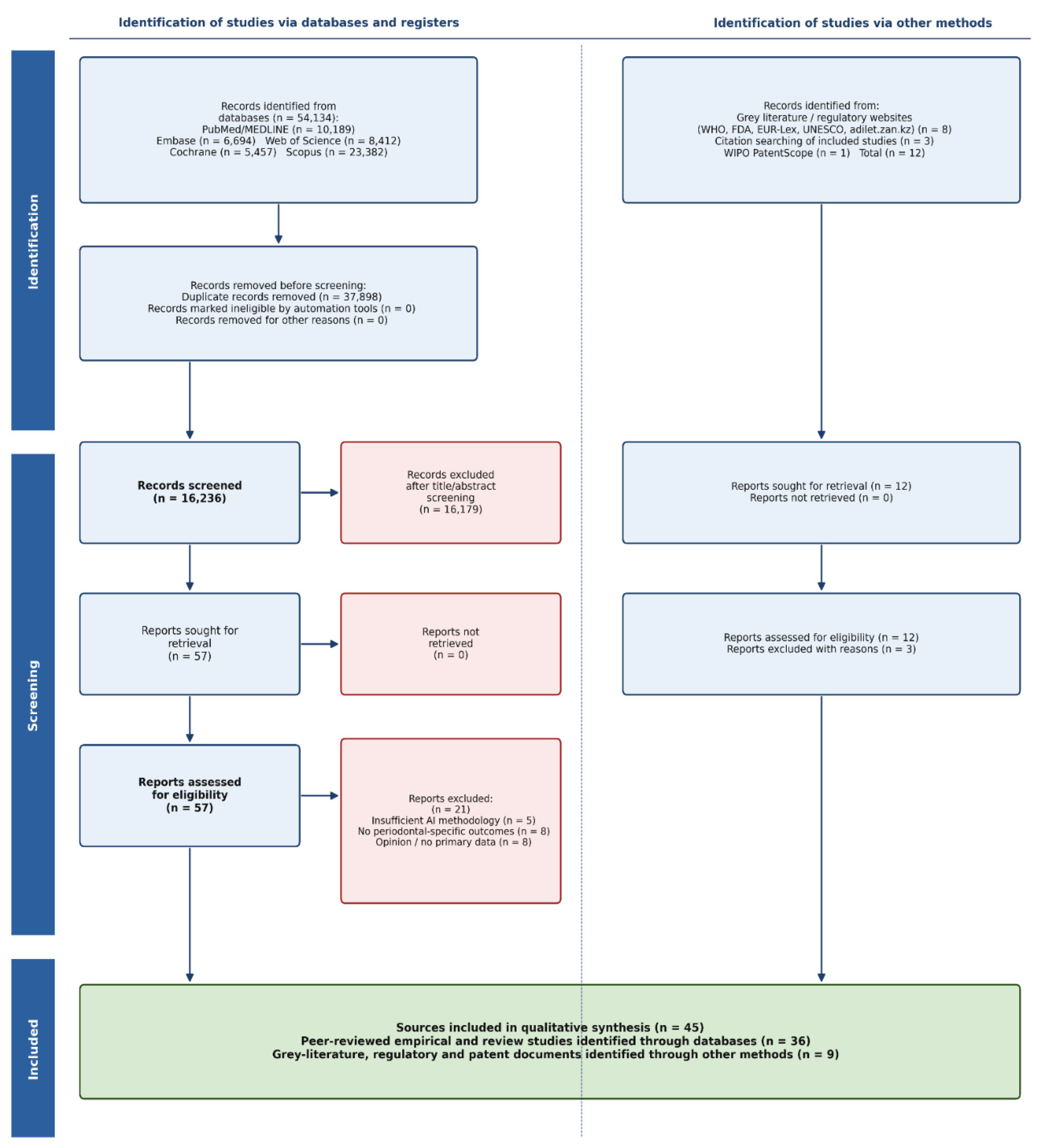
Figure 2.
Process flowchart.
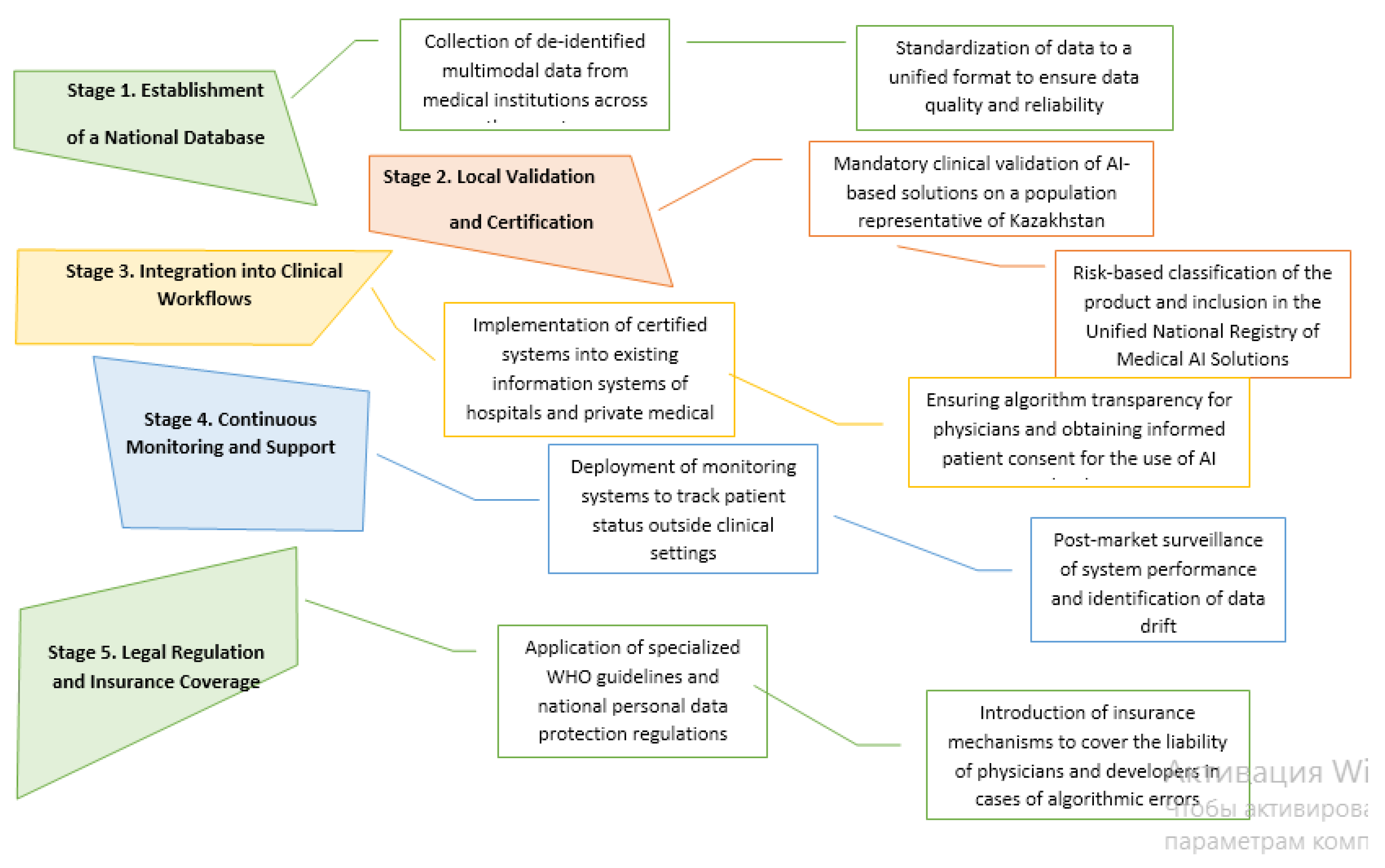

Table 1.
Comparative Analysis of International and National AI Regulatory Frameworks for Healthcare.
Table 1.
Comparative Analysis of International and National AI Regulatory Frameworks for Healthcare.
| Framework / Jurisdiction | Risk Classification Approach | Key Requirements | Transparency & Explainability | Post-Market Surveillance | Refs. |
| EU AI Act (2024/1689) | Risk-based (Prohibited / High-Risk / Limited / Minimal) | Conformity assessment; technical documentation; human oversight; CE marking for high-risk | Mandatory for high-risk AI; logs for traceability | Mandatory; continuous post-market monitoring plan required | [19] |
| U.S. FDA SaMD Framework | Risk-based (Class I/II/III) aligned with medical device classification | Pre-market submission (510(k), De Novo, PMA); Predetermined Change Control Plan (PCCP) | Good Machine Learning Practice (GMLP) principles; encouraged transparency | Total Product Lifecycle (TPLC) approach; ongoing real-world evidence collection | [20] |
| WHO AI Ethics Guidance (2021) | Principles-based (ethics and human rights foundation) | Fairness, inclusiveness, accountability, sustainability, governance of data | Central to trust-building; explainability as ethical imperative | Implied within responsible and accountable use principle | [35] |
| UNESCO Recommendation on AI Ethics (2021) | Proportionality and do-no-harm approach; multi-stakeholder governance | Safety, security, human rights protection; environmental sustainability | Core principle for public trust and beneficial outcomes | Linked to accountability and continuous assessment principles | [36] |
| Kazakhstan AI Development Concept 2024–2029 (Res. No. 592) | Anticipated risk-based model aligning with international standards; national registry of AI medical solutions envisaged | Data sovereignty; mandatory local clinical validation; digital sovereignty; AI law in development | Required for market access, clinical trust, and patient safety | Expected to be mandated; follows EU and international standards | [21,37,38] |
Disclaimer/Publisher’s Note: The statements, opinions and data contained in all publications are solely those of the individual author(s) and contributor(s) and not of MDPI and/or the editor(s). MDPI and/or the editor(s) disclaim responsibility for any injury to people or property resulting from any ideas, methods, instructions or products referred to in the content. |
© 2026 by the authors. Licensee MDPI, Basel, Switzerland. This article is an open access article distributed under the terms and conditions of the Creative Commons Attribution (CC BY) license (http://creativecommons.org/licenses/by/4.0/).
Copyright: This open access article is published under a Creative Commons CC BY 4.0 license, which permit the free download, distribution, and reuse, provided that the author and preprint are cited in any reuse.


