

Submitted:
15 November 2026
Posted:
17 November 2026
You are already at the latest version
Abstract
Advances in persistent memory, reusable skills and adaptive training are making recursive self-improvement (RSI) increasingly relevant to healthcare agents. RSI concerns changes to the procedures that generate future improvements. This survey connects these developments with healthcare evidence by distinguishing component updates, training-generator changes and revisions of improvement procedures. We examine applications in diagnosis, reporting and question answering, together with challenges in evaluation, reliability, privacy and update governance. Current evidence supports persistent component updates and selected generator gains, while the effects of revised improvement procedures on subsequent learning remain untested in the mapped studies. An accompanying evidence map and evaluation templates support study comparison and future research.
Keywords:
recursive self-improvement
; healthcare agent
; agent harness
; large language model
; persistent memory
; clinical decision support
1. Introduction
Large language model (LLM) agents combine language reasoning with tools and coordinated workflows for diagnosis, medical question answering (QA) and radiology reporting. [1,2,3] Their continuing use raises a central question about how experience from completed cases changes later behavior and the capacity for subsequent learning.
An agent’s behavior depends on its model and surrounding harness, which organizes memory, tool access and orchestration. [4] Prompting and retrieval-augmented generation (RAG) supply instructions and external information. [5,6] Persistent memory, reusable skills and parameter updates allow completed tasks to change what later cases can draw on. The model-plus-harness decomposition locates these changes, while their generation and evaluation determine how learning proceeds.
Reflexion and ExpeL turn feedback into reusable information. [7,8] Agent Hospital accumulates simulated clinical experience, ClinicalAgents retrieves diagnostic templates, and SkillRL combines policy learning with an evolving skill library. [9,10,11] CoEvolve also changes the training distribution alongside the agent policy. [12]
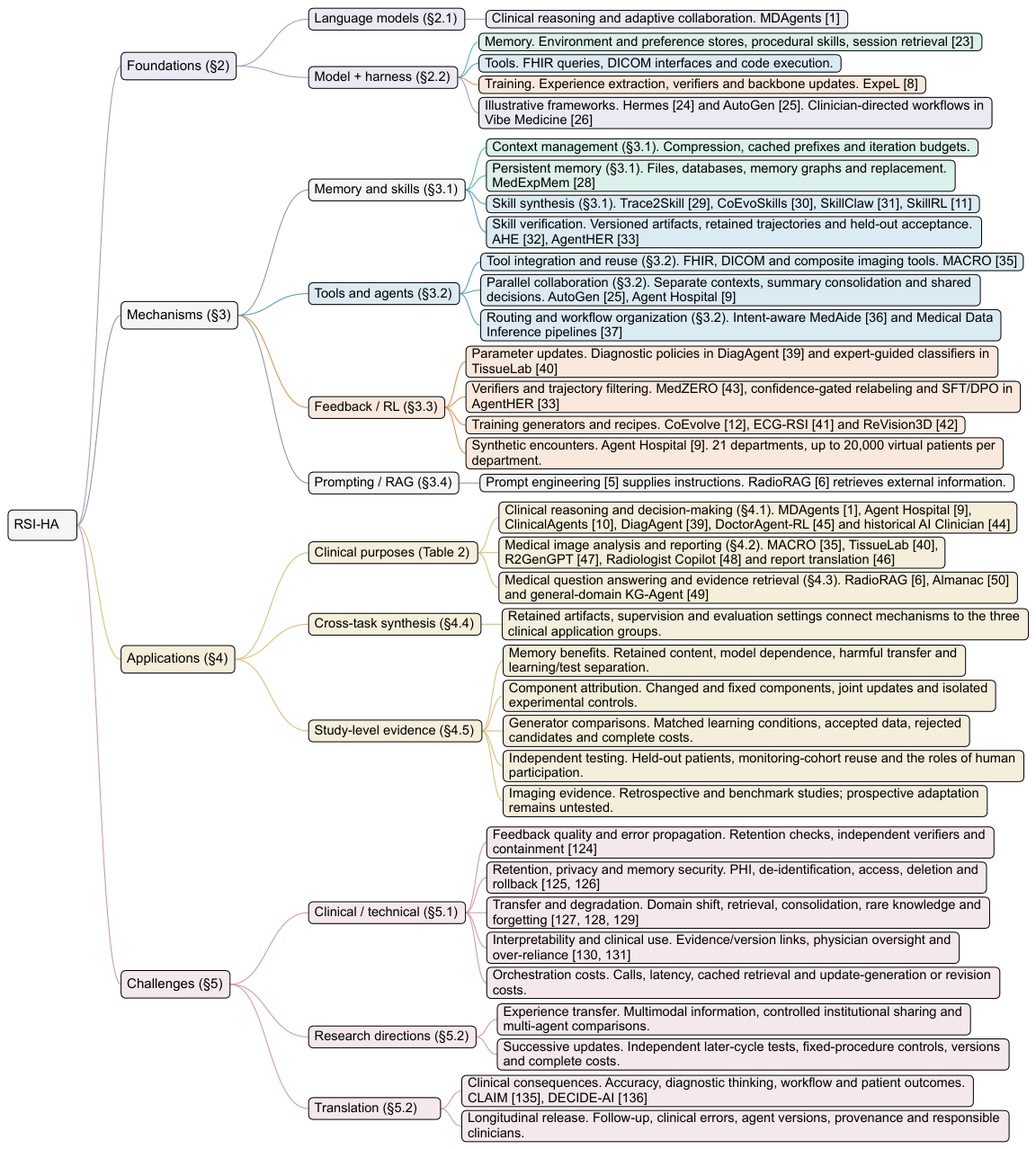
Figure 1 places 28 selected studies in the chronology of the 85-study evidence map. Figure 2 connects the mechanisms of persistent change with their healthcare applications, supporting evidence and clinical challenges.
Figure 1.
Timeline of selected healthcare-agent studies, grouped by update target and positioned by first public release. Shaded ribbons illustrate conceptual connections between update targets. Year intervals are not drawn to scale.
Figure 1.
Timeline of selected healthcare-agent studies, grouped by update target and positioned by first public release. Shaded ribbons illustrate conceptual connections between update targets. Year intervals are not drawn to scale.
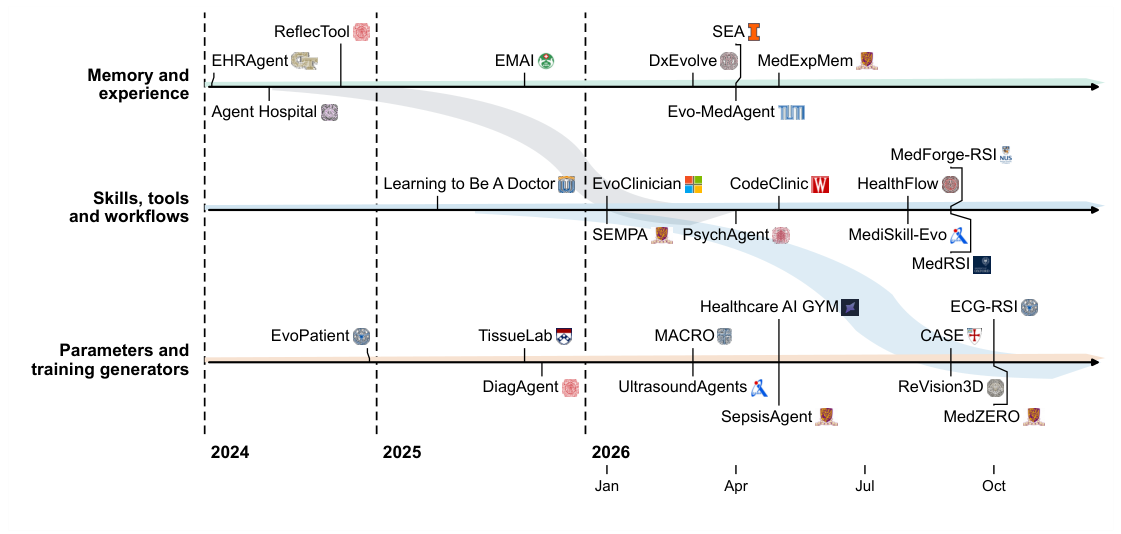
Figure 2.
Overview of the review, linking agent foundations, improvement mechanisms, healthcare applications and clinical challenges. Bracketed numbers identify representative references, including contextual comparators.
Figure 2.
Overview of the review, linking agent foundations, improvement mechanisms, healthcare applications and clinical challenges. Bracketed numbers identify representative references, including contextual comparators.
1.1. Scope and Focus of the Review
Following Liu et al., we distinguish component updates from revisions to the procedure governing later improvement when assessing recursive self-improvement (RSI). [13] Retaining a corrected radiology report changes memory. Revising how corrections are selected, generalized into skills or evaluated changes parts of the improvement procedure. Demonstrating RSI requires testing whether those revisions improve subsequent learning. STOP, the Darwin Gödel Machine and Hyperagents examine changes to agent software and the procedures that generate subsequent improvements. [14,15,16]
Existing reviews cover clinical-agent capabilities, deployment and broader RSI frameworks. [2,17,18,19,20] We complement prior healthcare prompt-engineering reviews [5] by comparing what experience persists, how updates are generated and selected, and how later performance is tested. We assess mechanism change, performance gains and clinical validation separately. Table 1 compares this survey with related work.

Table 1.
Comparison with related work.
| Work | Type | Main focus | What this review adds |
|---|---|---|---|
| Duan et al. [17] | RSI framework | Autonomy and recursion forms | Identify which components and improvement procedures change in healthcare studies |
| Zhu et al. [18] | Clinical-agent review | Capabilities, scaling and deployment | Compare how experience is retained and tested on later cases |
| Pu et al. [19] | Trustworthy-RSI framework | Risks, safeguards and evaluation | Record reported experimental controls and clinical evaluation settings |
| Han et al. [20] | Physical-AI review | Changes to learners and improvement procedures | Examine the tests supporting each type of change in healthcare |
| MedRSI [21] | Medical-agent method | Reusable tools from diagnostic failures | Include the method as a coded primary study in the evidence map |
| This review | Healthcare RSI review | Persistent updates and evidence of improvement | Provide an 85-study map with source locators, a coding guide and evaluation templates |
1.2. Literature Search Process
On 4 November 2026, we searched arXiv, PubMed, Europe PMC and OpenAlex for studies first available from January 2023, combining agent, improvement and healthcare terms with a separate RSI-focused query strand. Screening and extraction were LLM-assisted, with author decisions on borderline eligibility and clinical-evaluation categories.
Eligible primary studies retained experience across healthcare cases via memory, skills, workflows, interaction-trained policies or training generators. We excluded within-case reflection, static retrieval, general-domain methods with incidental medical tasks and one-off fixed-data post-training, identifying contextual comparators separately. The evidence map contains 85 studies. The update categories are analytical conventions rather than standardized evidence grades, and differences in terminology, tasks, datasets, controls and uncertainty reporting limit cross-study comparisons.
2. Foundations of Healthcare Agents
2.1. Large Language Models
Healthcare agents use a language model to interpret clinical inputs and propose actions. MDAgents illustrates how this capability can be embedded in adaptive collaboration. [1]
Supervised fine-tuning (SFT) and reinforcement learning (RL) update model parameters. Persistent memory and tool orchestration instead change the surrounding harness.
2.2. Model and Harness Architecture
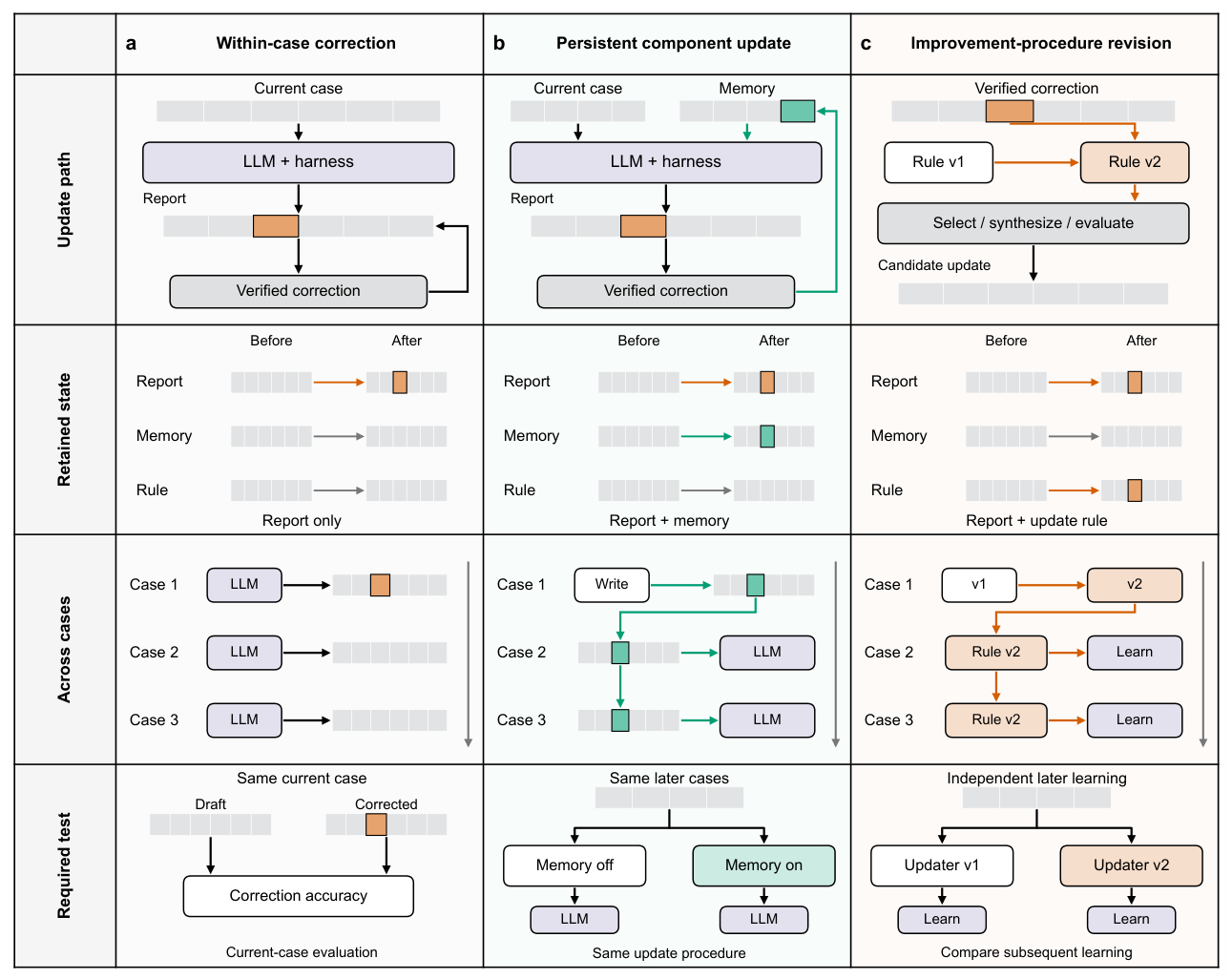
Figure 3 uses the same report correction to distinguish a change to the current answer, a persistent component update and a revision of the improvement procedure.
Figure 3.
Three kinds of change illustrated with the same report-correction example. Colored segments mark the edited report item, retained case or revised rule. Panel a changes the current output. Panel b retains a verified case for later use under the same update procedure (Level 1). Level 2 changes a training generator or recipe under a fixed update procedure. Panel c revises the selection or synthesis rule governing updates. Level 3 requires independent evidence that the revision improves subsequent learning, comparing original and revised procedures from the same initial agent under matched data and compute budgets.
Figure 3.
Three kinds of change illustrated with the same report-correction example. Colored segments mark the edited report item, retained case or revised rule. Panel a changes the current output. Panel b retains a verified case for later use under the same update procedure (Level 1). Level 2 changes a training generator or recipe under a fixed update procedure. Panel c revises the selection or synthesis rule governing updates. Level 3 requires independent evidence that the revision improves subsequent learning, comparing original and revised procedures from the same initial agent under matched data and compute budgets.
Orchestration assembles current input, retained context and available skills, then manages reasoning and tool actions. Session-bounded configurations retain information within a task, whereas persistent configurations expose selected artifacts to later tasks. An illustrative prompt assembly is
where the terms denote role constraints, environment memory, clinician preferences, loaded skills and project context, and ∥ denotes concatenation. ReAct alternates observations, reasoning and actions. [22] Context selection therefore affects which retained information can influence each action.
Memory.
Environment/preference memory, procedural skills and searchable session records retain different forms of experience. [23] Electronic health record (EHR) configurations and report formats supply local context, while skills encode reusable task steps. Hierarchical skill loading exposes descriptions before retrieving full specifications and supporting references, limiting how much material enters the active context.
Tools.
Clinical configurations can expose EHR endpoints through Fast Healthcare Interoperability Resources (FHIR), knowledge bases and code execution. Imaging tools can use the Digital Imaging and Communications in Medicine (DICOM) standard. Tool access defines the available actions, while retained invocation sequences can change how later tasks combine them.
Training.
Experience extraction connects completed interactions to reusable information. [8] A coordinator can collect trajectories, verifiers assess medical criteria, and a training service update the backbone from selected examples.
Hermes illustrates bounded persistent stores and hierarchical skill loading, while AutoGen provides an alternative framework for agent orchestration. [24,25] In Vibe Medicine, clinicians set objectives, direct skill-augmented agents through natural language and review outputs while retaining domain decisions. [26]
3. Mechanisms Supporting Recursive Self-Improvement
Experience can persist as retrieved information, reusable procedures, learned parameters or rules for generating training material.
3.1. Memory and Skill Engineering
Memory engineering determines what survives a completed task and how later tasks retrieve it. Active context, persistent stores and procedural skills retain different information and require different tests. [23] WMIP shows that strong single-step arithmetic does not ensure reliable cumulative state tracking, and that output protocols change measured accuracy. [27]
3.1.1. Short-Term Context Management
Context compression selects which observations remain available near the model’s input limit. Clinical summaries need abnormal findings, temporal relationships and unresolved alternatives to support later reasoning. Cached prefixes reduce repeated processing, while iteration budgets limit action sequences. These execution choices affect information access and task completion, rather than deciding which experience enters a persistent store.
3.1.2. Long-Term Persistent Memory Design
Bounded files, databases and memory graphs differ in how they organize, retrieve and replace retained information. [23] Replacement policies determine whether an entry is preserved, merged or removed. In medical settings, the useful unit may be a local workflow exception, a guideline variant, a clinician preference or a case-derived diagnostic note.
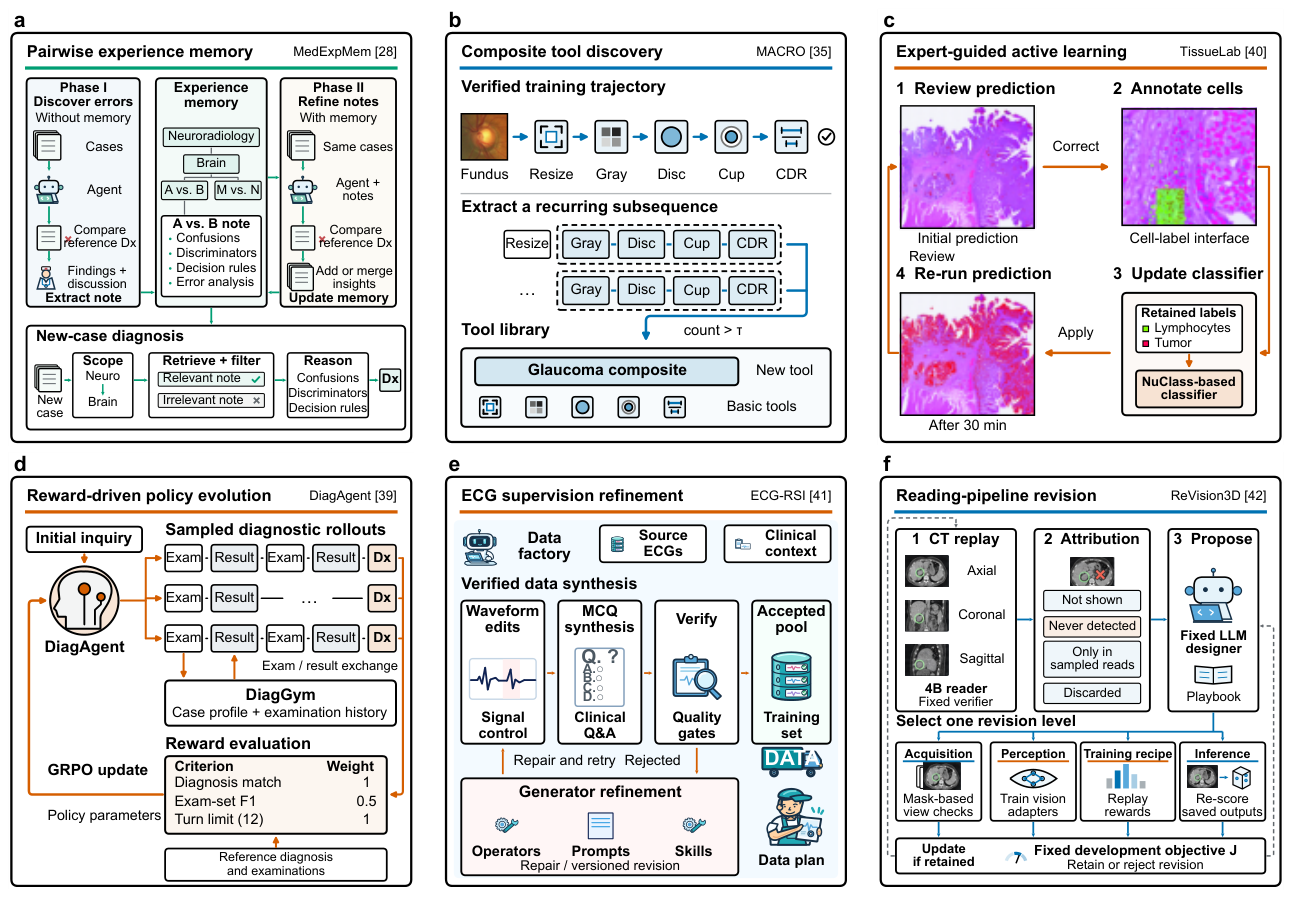
MedExpMem retains structured differential-diagnosis notes extracted from a model’s errors, with a separate library for each model and unchanged diagnostic-model parameters (Figure 4a). [28] Its anatomical index and relevance filtering determine which notes reach a new case.
3.1.3. Skill Memory and Experience Synthesis
Skill synthesis turns execution experience into guidance or reusable procedures. [8] Existing approaches differ in when they create or revise a skill. Trace2Skill responds to missing skills, [29] CoEvoSkills to performance deterioration, [30] and SkillClaw consolidates duplicate skills. [31] SkillRL couples an evolving skill library with high-quality training trajectories. [11]
CoEvolve supplies a different signal, inconsistent repeated rollouts of the same task under a fixed policy. These exceed 45% of extracted tool-use feedback signals. [12] Variation between similar patients introduces additional between-case differences, so it represents a proposed clinical extension of that trigger.
Verification of skill updates.
Generation and acceptance address different questions. Versioned components, retained trajectories and falsifiable predictions make proposed changes attributable and testable. [30,32,33] A held-out acceptance rule admits a replacement only when its validation score improves. Clinical assessment additionally asks whether that score captures consequential errors and workflow effects.
Evidence from related work. SkillsBench tests the value of curated skills, whereas AHE studies observability-driven harness evolution for coding agents. SkillsBench v1 evaluated 86 tasks across 11 domains, reporting a mean gain of 16.2 percentage points. [34] Its two-task healthcare subset rose from 34.2% to 86.1%, a 51.9-point gain, but is absent from the later v4 domain breakdown. AHE increased Terminal-Bench 2 pass@1 from 69.7% to 77.0% over ten iterations, with tools, middleware and memory explaining the gain rather than the system prompt. [32] Transfer to other model families added 5.1–10.1 points without re-evolution.
3.2. Tool and Multi-Agent Engineering
3.2.1. Tool Integration and Reuse
FHIR queries, guideline retrieval, DICOM viewers, segmentation and code execution can supply actions within a clinical workflow. Experience changes this workflow when successful combinations become reusable actions. MACRO extracts recurring fragments from verified imaging trajectories into composite tools and accumulates image-feature memory during training episodes (Figure 4b). [35]
3.2.2. Parallel Multi-Agent Collaboration
Separate subagent contexts can support differential diagnosis, imaging/laboratory review and medication checking, with summaries informing a shared decision. AutoGen provides a coordination framework, [25] while Agent Hospital illustrates specialty consultation. [9] Persistent improvement additionally depends on which shared experiences survive the consultation and how later encounters use them.
Routing and workflow organization determine which learned capability reaches a case. MedAide uses intent-aware routing across four medical benchmarks. [36] Medical Data Inference proposes a seven-agent pipeline covering ingestion through inference on geriatric, palliative-care and colonoscopy data, including de-identification and model/data matching. [37] Reinventing Clinical Dialogue organizes four communication archetypes across planning, memory, action, collaboration and evolution. [38]
3.3. Feedback-Driven Updates and RL Trajectories
Parameter updates retain experience in the model producing actions. DiagAgent learns an examination-selection and diagnostic policy from trajectories in a simulated clinical environment (Figure 4d). [39] TissueLab instead uses expert inspection and retained annotations to update lightweight classifiers within image-analysis workflows (Figure 4c). [40]
Figure 4.
Representative persistent updates. (a) Experience notes, [28] (b) composite tools, [35] (c) classifier updating, [40] (d) diagnostic policy, [39] (e) training generators, [41] and (f) reading pipelines. [42] Adapted from the cited frameworks. TissueLab’s annotation interface shows a different field of view from its initial and updated predictions. Sequences, waveforms and workflow icons are illustrative.
Figure 4.
Representative persistent updates. (a) Experience notes, [28] (b) composite tools, [35] (c) classifier updating, [40] (d) diagnostic policy, [39] (e) training generators, [41] and (f) reading pipelines. [42] Adapted from the cited frameworks. TissueLab’s annotation interface shows a different field of view from its initial and updated predictions. Sequences, waveforms and workflow icons are illustrative.
Verifier design. Medical verifiers can assess outputs against guideline criteria and physician labels. MedZERO uses prescribed reward and curation rules to select training data. [43] Rewards need to distinguish correctness from confident presentation and allow appropriate uncertainty. Agreement among generated candidates requires independent validation before it supplies a correctness signal.
Trajectory filtering. Verifier-thresholded best-of-N selection, illustrated by Atropos, retains high-scoring trajectories. AgentHER also recovers information from failures through classification, outcome extraction, confidence-gated relabeling and SFT/direct preference optimization (DPO) packaging. [33] Across four models, it gains 7.6–11.4 percentage points over success-only training. Relabeling precision rises from 94.1% to 97.1% on WebArena, with 96.0% on ToolBench. Reaching baseline performance requires half as many successful demonstrations.
Training-data evolution. Generated encounters can supply both a source of agent experience and candidate training material. Agent Hospital generates labeled encounters across 21 departments, with up to 20,000 virtual patients per department. [9]
CoEvolve changes the training distribution during Group Relative Policy Optimization (GRPO), using forgetting, repeated-task boundary variation and rare-pattern signals to guide re-exploration. [12] Execution-validated task–solution pairs enter policy training. ECG-RSI revises synthesis operators, prompts and skills that produce ECG training examples (Figure 4e). [41] ReVision3D revises reader configurations, training recipes and inference programs through retrospective CT replay (Figure 4f). [42]
3.4. Relationships with Prompting and Retrieval
4. Applications in Healthcare
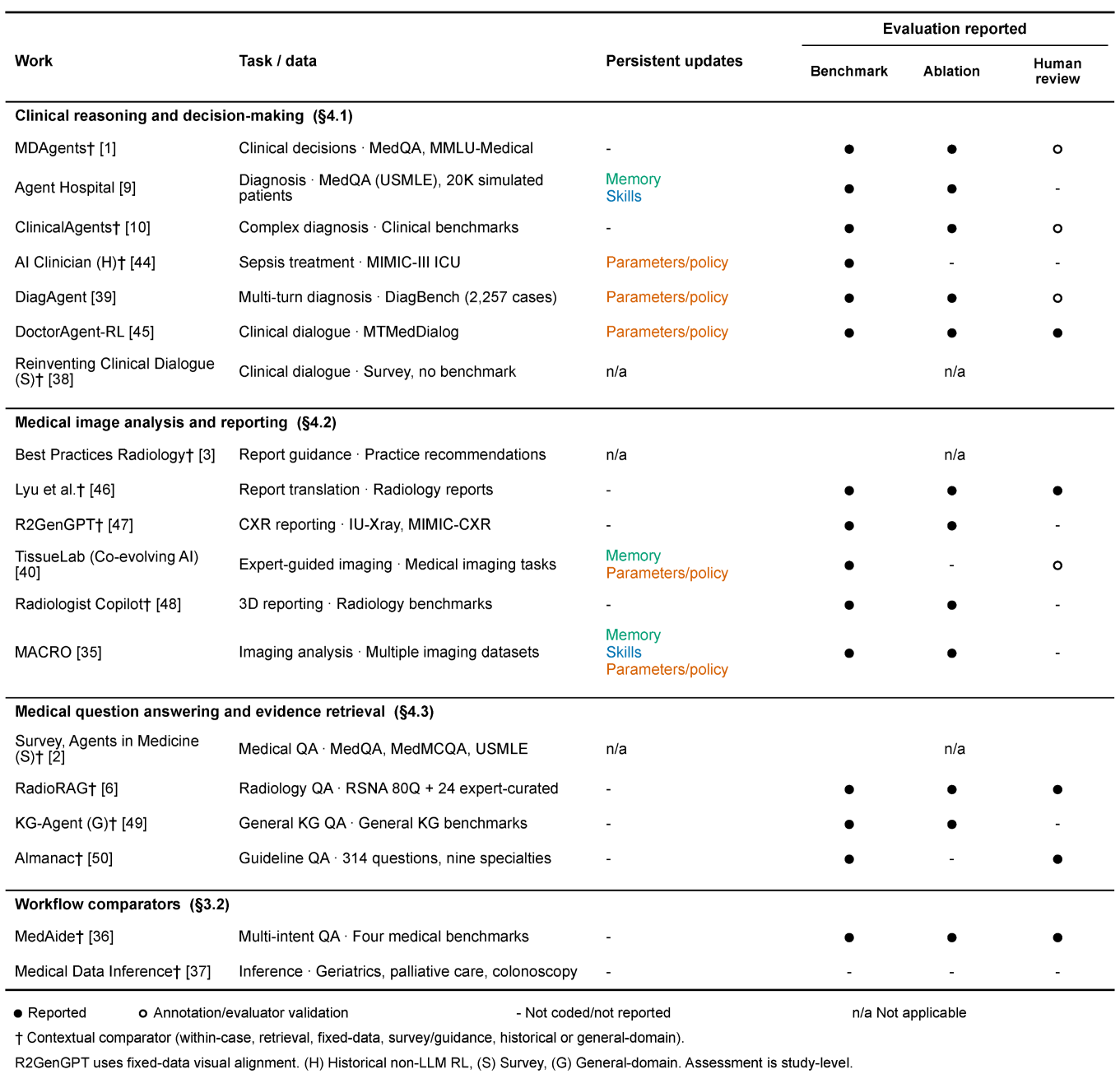
Healthcare tasks differ in what can be learned from a completed case and when reliable feedback becomes available. Table 2 groups representative systems by clinical purpose, with workflow comparators listed separately. Persistent update labels identify memory retained across distinct interactions, skills or experience synthesized from execution, and outcome-driven parameter or reward-driven policy updates. Broader feedback-driven adaptation also includes non-parametric changes.
Surveys, guidance, the general-domain KG-Agent and the historical non-LLM AI Clinician provide context for the application comparisons.
Table 2.
Healthcare applications, persistent updates and study-level evaluation. Benchmarks include study-specific reference cases, and ablations include controlled component or training-configuration comparisons. No applicable entry reports prospective clinical evaluation.
Table 2.
Healthcare applications, persistent updates and study-level evaluation. Benchmarks include study-specific reference cases, and ablations include controlled component or training-configuration comparisons. No applicable entry reports prospective clinical evaluation.
4.1. Clinical Reasoning and Decision-Making
Clinical reasoning covers diagnostic assessment, examination selection and treatment decisions. For diagnosis, the central comparison concerns whether experience from earlier patients helps a later, distinct case. Agent Hospital retains cases and experience text while its base LLMs stay frozen. [9] After 20,000 simulated patients per department, mean internal diagnosis accuracy across 21 departments rises from 77.0% to 95.3%. GPT-4o MedQA accuracy increases from 88.22% to 92.22%, 0.70 points above the strongest reported baseline, Medprompt (91.52%). GPT-3.5 gains 16 points over Direct prompting.
MDAgents adapts collaboration depth to case complexity and outperforms fixed groups on MedQA. [1] ClinicalAgents combines mutable patient Working Memory, static diagnostic Experience Memory and Monte Carlo Tree Search (MCTS). [10]
Sequential clinical decision-making can retain experience in a policy for choosing questions, examinations or treatment actions. DiagAgent learns examination and diagnosis policies in an EHR-derived interactive world model. [39] On DiagBench’s 750-case MIMIC-IV subset, its 14B model gains 11.20 diagnostic-accuracy points and its 7B model gains 17.58 examination-recommendation F1 points. Both comparisons use Claude-4-Sonnet, strongest among 11 evaluated LLMs on these metrics. DiagBench has 2257 physician-validated cases overall. DoctorAgent-RL instead uses multi-agent RL on MTMedDialog to refine progressive symptom elicitation. [45]
4.2. Medical Image Analysis and Reporting
For image analysis, MACRO links retained image features with reusable composite tools (Figure 4b). [35] TissueLab adds a persistent feedback path, retaining outputs and learning from expert inspection of image-analysis workflows. [40]
In report generation, the learning opportunity lies in separating factual corrections from stylistic preferences and retaining information useful to later reports. Prompted patient-language translation [46] and Radiologist Copilot’s within-report observation, template selection, drafting and quality control [48] provide task-level comparators.
4.3. Medical Question Answering and Evidence Retrieval
Medical QA connects changing external knowledge with retained experience about how to use it. KG-Agent traverses knowledge graphs and reports that LLaMA2-7B tuned on 10K general-domain samples outperforms larger models. [49] RadioRAG supplies domain retrieval, while Almanac evaluates clinical answers with clinician ratings. [6,50]
4.4. Synthesis Across Tasks
Across tasks, experience may become retrieved content, a reusable workflow or a learned policy. MACRO combines P/S/R changes during training, whereas TissueLab links retained outputs and expert annotations to classifier updates (P/R). Agent Hospital combines cases and synthesized experience (P/S). ClinicalAgents supplies within-case comparators, while AI Clinician, DiagAgent and DoctorAgent-RL illustrate R-only updates.
4.5. Study-Level Evidence for Persistent and Recursive Improvement
The L0–L3 scale distinguishes current-case or session state (L0), persistent component updates under fixed procedures (L1), changing generators (L2) and revised update procedures tested on subsequent learning (L3). [19,20] L2 components construct, select or evaluate later learning material under a fixed procedure for revising generators. Dual task/generator roles without isolated attribution are implicit L2, whereas fixed-rule note conditioning remains L1. STOP, Hyperagents and the Darwin Gödel Machine provide general-domain comparisons for changes to improvement procedures. [14,15,16]
Among the 85 mapped studies, the highest evidenced level is L0 for one study, L1 for 66 and L2 for 18 (six explicit and 12 implicit). No study reaches L3 or reports prospective clinical evaluation, and 41 are preprints. Only ECG-RSI and ReVision3D provide matched generator controls, each testing one revision.
Memory content and transfer. Memory studies span simulated consultations, retrospective streams and offline libraries. [51,52,53,54] PrivMeSA’s patient-disjoint replay with synthetic identifiers reduces specialist messages per case from 7.02 to 5.98, with quarter-wise accuracy within 0.008 of memory-off. [55] AgentClinic’s notebook helps Llama-3-70B but harms GPT-3.5 and GPT-4o-mini on the same evolving case stream. [56] MedExpMem reports overall gains without variance, yet memory changes correct to incorrect diagnoses in 1.3%–5.8% of 227 temporally held-out Eurorad teaching cases across seven models. [28] These results make harmful transfer and model dependence part of the comparison, alongside average accuracy and communication savings.
The provenance of memory also changes the meaning of transfer. EHR and diagnostic agents retain information across different clinical workflows, [57,58,59,60,61,62] while diagnostic/triage memories, evidence graphs and trajectory pools retain different artifacts. [63,64,65,66] Training-only banks and sequential adaptation need distinct learning/test boundaries. [67,68,69] HealthClaw’s frozen-writeback synthetic-year probes and GSEM’s unclear independent holdout illustrate different limits on interpreting later-case performance. [70,71] Unclear test-stream memory population also affects several clinical agents, [62,72,73] including AMR’s memory filling. [74]
Attribution to components and update procedures. EvoClinician and Skemex retain fixed update operators, [75,76] while task and update-producing roles are not isolated in PsychAgent and MACRO. [35,77] PrivMeSA retains a fixed distiller, and MedRSI lacks isolated evidence for benefit from a changing improver. [21] MedForge-RSI protects improvement mechanisms, whereas VIBEMed’s comparison tests parameter tuning. [78,79] Asclepius makes this attribution concrete, gaining 0.625 critical-action points on held-out batches (), while manual evolution alone adds 0.02 (). [80] A successful combined system can therefore leave the contribution of one update mechanism unresolved.
Skill and workflow studies likewise vary in the object they revise. Some use fixed skill generators, [81,82,83] while others revise workflows, prompt programs or role norms. [84,85,86] MedDCR and CodeClinic examine skill/workflow adaptation, [87,88] and TEMPLAR induces templates once before freezing them. [89] Operational reflections and assessment rules offer further update targets, [90,91,92] but evaluator evolution and controller comparisons still lack isolated updater benefit or held-out updater transfer. [93,94,95] MedGuard and BridgeGap retain case-local patient memory, placing the persistence question at a different boundary. [96,97]
Training generators and revision costs. Curriculum and simulated-policy studies change what the learner encounters, [98,99,100,101] but EvoPatient bundles doctor components and MedZERO alternates models under fixed reward and curation rules. [43,102] ECG-RSI’s first-round seven-benchmark score is , versus with operators frozen and with skills frozen (mean±standard deviation, source Table 15). [41] Accepted-data and learner-training settings match, but candidate counts differ (16,193/36,723/22,398). Generator revision and rejected candidates therefore belong in the cost comparison. Physician review covers generated questions, not patient outcomes.
ReVision3D changes adapters, a recipe and inference code under a fixed designer, verifier and acceptance rule. [42] Its recipe yields 0.49 recall versus 0.41 for equal-compute training, with inconsistent designer/manual attribution. Retrospective liver recall reaches 0.79 (88/111 lesions) at no more than 0.5 false positives per patient, with some patients reused from earlier comparisons. None of 14 later proposals exceeds the noise floor. Together, these two studies support bounded L2 contributions and show why one successful revision leaves repeated downstream learning an open question. ClinVerse lacks a fixed-improver control, [103] and Recursive Reward Improvement remains a general-domain comparison excluded from the healthcare map. [104]
Independent evaluation and human involvement. DxEvolve, EvoMDT and HealthFlow test experience transfer through independent hospital cases or external retrospective assessment. [105,106,107] Checkpoint-selected MedRSI uses retrospective tests, MedForge-RSI separates final evaluation while disclosing earlier contamination, [21,78] and ReclAIm reuses its labeled monitoring cohort. [108] Simulated or repeated-stream gains require corresponding learning/test boundaries, [109,110,111] with MedEvoEval’s held-out outcome gains not significant. R4Agent retains unverified exemplars, whereas TopoAgent distills evaluation-benchmark skills. [112,113]
Pharmacist corrections and annotation validation concern the quality of different retained artifacts. [114,115] TCM-SEA reports sealed-test gains with one evolution seed and no physician review, [116] while VDSS reports a single-clinician regret trend. [117]
Imaging and radiology reports. Twenty-five studies use images or radiology reports, including institutional data and external report-text transfer. [21,73,118,119] Their explicit and implicit L2 cases have different attribution limits. [35,42,94,99,120,121,122] TheraAgent and SAGEAgent use documented outcomes, [73,123] but no mapped study tests learning from actual radiologists’ report corrections or prospective reporting adaptation. No mapped healthcare study tests an editable meta-level procedure comparable to Hyperagents. [16]
5. Challenges and Future Directions
Persistent agents create a chain through which feedback becomes retained experience, influences later actions and may alter subsequent updates.
5.1. Technical and Clinical Challenges
Feedback quality and error propagation. An erroneous report revision retained in memory may be reused across cases or consolidated into a skill. [124] Source checking before retention and testing on independent cases address different points in this process. Verifiers also require independent assessment, especially when updaters can change acceptance criteria. The Darwin Gödel Machine showed more objective hacking when agents could inspect hallucination checks. [15] STOP’s sandbox-bypass evaluation supplies a general-domain example for testing containment and prompt integrity. [14]
Retention, privacy and memory security. Persistent stores can expose protected health information (PHI), conversations and re-identifiable examples. DICOM de-identification must address burned-in identifiers and metadata beyond the eighteen US Health Insurance Portability and Accountability Act (HIPAA) Safe Harbor identifiers, informed by Supplement 55 and the PS3.15 Basic Confidentiality Profile. [125] Access, retention and deletion controls remain relevant during local execution. Lin et al. distinguish Write, Store, Retrieve, Execute, Share and Forget/Rollback. [126] The earlier “mnemonic sovereignty” framing has a proposed clinical extension here. Entry screening addresses writing, while later retrieval, execution and sharing can expose retained errors or sensitive information. Source and version records need to connect affected memories and skills to their subsequent uses and rollback.
Transfer and cumulative degradation. Retained experience may encounter different scanners, preprocessing or institutional terminology. Pneumonia-detection area under the receiver operating characteristic curve (AUC) was 0.931 internally versus 0.815 externally, while another convolutional neural network (CNN) identified hospitals with 99.95–99.98% accuracy. [127] Preprocessing flipped up to 42% of EEG trial predictions across six datasets. [128] As libraries grow, consolidation, specialty partitions and adaptive search can reduce retrieval burdens, with task-specific thresholds protecting rare, important knowledge. Parameter updates add catastrophic-forgetting risks, [129] motivating earlier-task evaluation alongside new tasks and candidate mitigations such as elastic weight consolidation (EWC) and diverse replay.
Interpretability, autonomy and clinical use. Tracing an error requires links between the recommendation, source evidence, tool actions and the memory, skill, model and updater versions involved. Reasoning traces alone do not establish explanatory faithfulness. Greater autonomy can extend the consequences of a systematic error. General-domain S1CogBench tests sensitivity to evidence and memory load, [130] while a clinical workflow could escalate novel, high-stakes or low-confidence cases for physician adjudication. Uncertainty information and override opportunities support this review’s decision-support position.
Radiologists’ edits mix factual corrections with stylistic preferences, and acceptance may reflect automation bias. [131] Because pathology or follow-up labels may arrive months later, recording edit types and evidence available at each update distinguishes immediate feedback from later confirmation.
Orchestration costs. Coordination adds calls and latency. A six-agent consultation using 30–50 LLM calls remains illustrative, rather than a measured clinical-system comparison. Context pooling, cached retrieval and background training are candidate responses. Cost evaluation needs to include update generation and revision alongside the task calls that use the accepted agent.
5.2. Research and Translational Directions
Experience transfer across modalities and institutions. Multimodal work can connect images, DICOM metadata, reports and longitudinal comparisons to test which experience transfers between cases. [40] Federated training would require local trajectory collection, controlled sharing and independent cross-institution testing.
Independent assessment of successive updates. CogBattery and CogEEGAgent illustrate human-referenced evaluation and independent confirmation, respectively. [132,133] Matched fixed-procedure comparators, complete generation costs and evaluated versions are needed to test whether revised procedures improve subsequent learning. Persistent-agent benchmarks should measure retention, skill transfer and successive updates. At least 50 tasks remains a provisional design suggestion, not a validated threshold.
Clinical consequences of retained experience. Clinical evaluation should build on task-level gains by assessing diagnostic thinking, treatment, patient outcomes and societal effects under the Fryback–Thornbury hierarchy. [134] MACD’s retrospective reader study illustrates aided-accuracy assessment. [63] For persistent agents, the next step is to measure changes in clinicians’ diagnostic assessments and subsequent care attributable to retained experience. These effects remain unestablished in the mapped evidence. CLAIM and DECIDE-AI can structure imaging-AI reporting and early clinical evaluation, respectively. [135,136]
Longitudinal translation and accountable release. Clinical studies should jointly track accuracy, errors, workflow effects and agent versions. Six-month to one-year follow-up remains a proposed starting horizon, with duration determined by task and event rate. Privacy-preserving memory needs explicit storage, access, retrieval and deletion assumptions. Preferences, guideline changes and longitudinal oncology or infectious-disease care provide candidate uses for persistent agents. Each released update needs a link to its provenance, tests and responsible clinicians, allowing later outcomes to be attributed to the agent actually used.
6. Conclusion
This survey connects improvement mechanisms, healthcare applications and study-level evidence to clarify progress toward recursive self-improvement. Current evidence supports persistent adaptation through memory, reusable skills and learned policies, alongside bounded gains from changing training generators. Whether revising the improvement procedure itself improves subsequent learning remains untested in the mapped studies. Future work should evaluate successive updates on independent cases and establish their effects on clinical decisions, workflows and patient outcomes.
Author Contributions
Dengzhe Hou contributed to conceptualization, methodology, formal analysis, investigation, data curation, validation, visualization, project administration, drafting the original manuscript, and reviewing and editing the manuscript. Zihao Wu contributed to methodology, investigation, and reviewing and editing the manuscript. Yuwen Zeng, Lingyu Jiang and Fangzhou Lin contributed to reviewing and editing the manuscript. Kazunori D Yamada contributed to resources, supervision, project administration, and reviewing and editing the manuscript.
Data Availability Statement
Study records, search and screening logs, and evaluation templates are available through the project website and GitHub repository.
Conflicts of Interest
The authors declare no competing interests.
References
- Kim, Y.; Park, C.; Jeong, H.; Chan, Y.S.; Xu, X.; McDuff, D.; Lee, H.; Ghassemi, M.; Breazeal, C.; Park, H.W. MDAgents: An Adaptive Collaboration of LLMs for Medical Decision-Making. In Proceedings of the Advances in Neural Information Processing Systems; Curran Associates, Inc., 2024; Vol. 37, pp. 79410–79452. [Google Scholar] [CrossRef]
- Wang, W.; Ma, Z.; Wang, Z.; Wu, C.; Ji, J.; Chen, W.; Li, X.; Yuan, Y. A survey of llm-based agents in medicine: How far are we from baymax? Find. Assoc. Comput. Linguist. ACL 2025, 10345–10359. [Google Scholar] [CrossRef]
- Bluethgen, C.; Veen, D.V.; Zakka, C.; Link, K.E.; Fanous, A.H.; Daneshjou, R.; Frauenfelder, T.; Langlotz, C.P.; Gatidis, S.; Chaudhari, A. Best Practices for Large Language Models in Radiology. Radiology 2025, 315, e240528, [2412.01233. [Google Scholar] [CrossRef]
- Sumers, T.R.; Yao, S.; Narasimhan, K.; Griffiths, T.L. Cognitive Architectures for Language Agents. Trans. Mach. Learn. Res. 2024, arXiv:2309.02427. [Google Scholar] [CrossRef]
- Wang, J.; Shi, E.; Yu, S.; Wu, Z.; Hu, H.; Ma, C.; Dai, H.; Yang, Q.; Kang, Y.; Wu, J.; et al. Prompt engineering for healthcare: Methodologies and applications. Meta-Radiology 2026, 4, 100190. [Google Scholar] [CrossRef]
- Tayebi Arasteh, S.; Lotfinia, M.; Bressem, K.; Siepmann, R.; Adams, L.; Ferber, D.; Kuhl, C.; Kather, J.N.; Nebelung, S.; Truhn, D. RadioRAG: Online Retrieval-Augmented Generation for Radiology Question Answering. Radiol. Artif. Intell. 2025, 7, e240476. [Google Scholar] [CrossRef]
- Shinn, N.; Cassano, F.; Gopinath, A.; Narasimhan, K.; Yao, S. Reflexion: Language Agents with Verbal Reinforcement Learning. Proc. Adv. Neural Inf. Process. Syst. (NeurIPS) 2023, Vol. 36, 8634–8652. [Google Scholar] [CrossRef]
- Zhao, A.; Huang, D.; Xu, Q.; Lin, M.; Liu, Y.J.; Huang, G. ExpeL: LLM Agents Are Experiential Learners. Proc. Proc. AAAI Conf. Artif. Intell. 2024, Vol. 38, 19632–19642. [Google Scholar] [CrossRef]
- Li, J.; Lai, Y.; Li, W.; Ren, J.; Zhang, M.; Kang, X.; Wang, S.; Li, P.; Zhang, Y.Q.; Ma, W.; et al. Agent Hospital: A Simulacrum of Hospital with Evolvable Medical Agents. arXiv 2024, arXiv:2405.02957. [Google Scholar]
- Ge, Z.; Li, H.; Wang, Y.; Hu, N.; Zhang, C.J.; Li, Q. ClinicalAgents: Multi-Agent Orchestration for Clinical Decision Making with Dual-Memory. Proceedings of the Proceedings of the 32nd ACM SIGKDD Conference on Knowledge Discovery and Data Mining 2026, V.2, 2603.26182. [Google Scholar] [CrossRef]
- Xia, P.; Chen, J.; Wang, H.; Liu, J.; Zeng, K.; Wang, Y.; Han, S.; Zhou, Y.; Zhao, X.; Chen, H. SkillRL: Evolving Agents via Recursive Skill-Augmented Reinforcement Learning, 2026 Accepted at NeurIPS 2026.
- Yang, S.; Ma, Z.; Huang, T.; Hu, Y.; Wang, Y.; Chu, X. CoEvolve: Training LLM Agents via Agent-Data Mutual Evolution. In Proceedings of the Proceedings of the 64th Annual Meeting of the Association for Computational Linguistics; Association for Computational Linguistics, 2026; Volume 1, pp. 23015–23036. [Google Scholar] [CrossRef]
- Liu, S.; Lin, Z.; Zhang, Y.; Ren, Y.; Wu, Y.; Li, Y.; Wang, Z.; Fu, Z.; Ye, J. The Path to Recursive Self-Improving Agents: Foundation, Framework, and Future Directions. Preprints.org, 2026. Version 1. Preprints 2026. not peer reviewed. [Google Scholar] [CrossRef]
- Zelikman, E.; Lorch, E.; Mackey, L.; Kalai, A.T. Self-Taught Optimizer (STOP): Recursively Self-Improving Code Generation. In Proceedings of the Conference on Language Modeling (COLM), 2024; p. 2310.02304. [Google Scholar]
- Zhang, J.; Hu, S.; Lu, C.; Lange, R.T.; Clune, J. Darwin Gödel Machine: Open-Ended Evolution of Self-Improving Agents. In Proceedings of the The Fourteenth International Conference on Learning Representations, 2026. [Google Scholar]
- Zhang, J.; Zhao, B.; Yang, W.; Foerster, J.; Clune, J.; Jiang, M.; Devlin, S.; Shavrina, T. Hyperagents. arXiv 2026, arXiv:2603.19461. [Google Scholar] [CrossRef]
- Duan, Y.; Liu, Y.; Tang, Z.; Chen, H.; Zhou, J.; Liu, Y.; Xu, B.; Wu, Y.; Chen, S.; Zhou, Y.; et al. The Last AI Built by Humans: Toward Genuine Recursive Self-Improvement. arXiv 2026, arXiv:2609.11873. [2609.11873]. Version 3 reviewed.. [Google Scholar]
- Zhu, C.; Tian, L.; Tan, B.; Zhou, Z.; Sun, Y.; Wang, Y.; Lv, C.; Wen, Y.; He, Y.; Lin, J.; et al. The Path to Self-Evolving Clinical Systems: Scaling Medical Agents from Assistance to Autonomy. arXiv 2026, arXiv:2607.11175. [2607.11175]. Version 2 reviewed. [Google Scholar]
- Pu, J.; Gao, A.; Bai, J.; Wang, Q.; Wen, T.; Zhao, J.; Qu, K.; Zhang, J.; Shen, C.; Sun, Z.; et al. Trustworthy Recursive Self-Improvement in the Era of Large Models: Foundation, Risks, Evaluation and Open Challenges. arXiv 2026, arXiv:2610.35193. [Google Scholar] [CrossRef]
- Han, X.; Luo, K.; Fu, Z.; Zhu, Z.; Feng, Z.; Wang, C.; Xu, R.; Meng, W.; Zhang, X. Recursive Self-Improvement in Physical AI: Mechanisms, Evidence, and Evaluation. arXiv 2026, arXiv:2610.38266. [Google Scholar] [CrossRef]
- Wu, J.; Zhu, J.; Hu, M.; Liu, F.; Pan, J. MedRSI: Recursive Self-Improvement for Medical Agents via Clinically Aligned Self-Evolution. arXiv 2026, arXiv:2609.24838. [Google Scholar] [CrossRef]
- Yao, S.; Zhao, J.; Yu, D.; Du, N.; Shafran, I.; Narasimhan, K.R.; Cao, Y. ReAct: Synergizing Reasoning and Acting in Language Models. In Proceedings of the The Eleventh International Conference on Learning Representations (ICLR), 2023. [Google Scholar]
- Du, P. Memory for Autonomous LLM Agents: Mechanisms, Evaluation, and Emerging Frontiers. arXiv 2026, arXiv:2603.07670. [Google Scholar]
- NousResearch. Hermes Agent documentation. Online documentation. 2026. (accessed on 8 November 2026).
- Wu, Q.; Bansal, G.; Zhang, J.; Wu, Y.; Li, B.; Zhu, E.; Jiang, L.; Zhang, X.; Zhang, S.; Liu, J.; et al. AutoGen: Enabling Next-Gen LLM Applications via Multi-Agent Conversations. In Proceedings of the First Conference on Language Modeling, 2024; p. 2308.08155. [Google Scholar]
- Wu, Z.; Xu, S.; Chen, B.; Wan, S.; Li, Y.; Ruan, W.; Lyu, Y.; Li, S.; Zhu, D.; Liu, T.; et al. Vibe Medicine: Redefining Biomedical Research Through Human-AI Co-Work. arXiv 2026, arXiv:2604.23674. [Google Scholar]
- Hou, D.; Jiang, L.; Li, D.; Li, Z.; Lin, F.; Yamada, K.D. WMIP: A Working-Memory-Inspired Programmable Probe of Cumulative State Tracking in Large Language Models. arXiv 2026, arXiv:2603.27343. [Google Scholar]
- Feng, Q.; Huang, Z.; Zhu, Y.; Gu, Y.; Chu, W.C.W.; Zhang, X.; Dou, Q. MedExpMem: Adapting Experience Memory for Differential Diagnosis. In Proceedings of the Medical Image Computing and Computer Assisted Intervention – MICCAI 2026, 2026; Springer; Lecture Notes in Computer Science; pp. 430–440. [Google Scholar] [CrossRef]
- Ni, J.; Liu, Y.; Liu, X.; Sun, Y.; Zhou, M.; Cheng, P.; Wang, D.; Zhao, E.; Jiang, X.; Jiang, G. Trace2Skill: Distill Trajectory-Local Lessons into Transferable Agent Skills. In Proceedings of the Proceedings of the 2026 Conference on Empirical Methods in Natural Language Processing, 2026; pp. 17556–17577. [Google Scholar] [CrossRef]
- Zhang, H.; Fan, S.; Zou, H.P.; Chen, Y.; Wang, Z.; Zhou, J.; Li, C.; Huang, W.C.; Yao, Y.; Zheng, K.; et al. CoEvoSkills: Self-Evolving Agent Skills via Co-Evolutionary Verification. In Proceedings of the Conference on Language Modeling (COLM), 2026; p. 2604.01687. [Google Scholar]
- Ma, Z.; Yang, S.; Ji, Y.; Wang, X.; Wang, Y.; Hu, Y.; Huang, T.; Chu, X. SkillClaw: Let Skills Evolve Collectively with Agentic Evolver. arXiv 2026, arXiv:2604.08377. [Google Scholar]
- Lin, J.; Liu, S.; Pan, C.; Lin, L.; Dou, S.; Xi, Z.; Huang, X.; Yan, H.; Han, Z.; Gui, T.; et al. Agentic Harness Engineering: Observability-Driven Automatic Evolution of Coding-Agent Harnesses. arXiv 2026, arXiv:2604.25850. [Google Scholar]
- Ding, L. AgentHER: Hindsight Experience Replay for LLM Agent Trajectory Relabeling. arXiv 2026, arXiv:2603.21357. [Google Scholar]
- Li, X.; et al. SkillsBench: Benchmarking How Well Agent Skills Work Across Diverse Tasks. arXiv 2026, arXiv:2602.12670. [Google Scholar]
- Fan, L.; Dai, P.; Deng, Z.; Wang, H.; Gong, X.; Zheng, Y.; Ou, Y. Evolving Medical Imaging Agents via Experience-driven Self-skill Discovery. arXiv 2026, arXiv:2603.05860. [Google Scholar]
- Yang, D.; Wei, J.; Li, M.; Liu, J.; Liu, L.; Hu, M.; He, J.; Ju, Y.; Zhou, W.; Liu, Y.; et al. MedAide: Information Fusion and Anatomy of Medical Intents via LLM-based Agent Collaboration. Inf. Fusion 2026, 127, 103743. [Google Scholar] [CrossRef]
- Shimgekar, S.R.; Vassef, S.; Goyal, A.; Saha, K.; Zonooz, P.; Kumar, N. Agentic AI Framework for End-to-End Medical Data Inference. In Proceedings of the 2025 IEEE International Conference on Bioinformatics and Biomedicine (BIBM); IEEE, 2025; pp. 7807–7810. [Google Scholar] [CrossRef]
- Zhi, X.; Zhao, H.; Wu, L.; Zhao, C.; Zhu, H. Reinventing Clinical Dialogue: Agentic Paradigms for LLM Enabled Healthcare Communication. arXiv 2025, arXiv:2512.01453. [Google Scholar]
- Qiu, P.; Wu, C.; Liu, J.; Zheng, Q.; Liao, Y.; Wang, H.; Yue, Y.; Fan, Q.; Zhen, S.; Wang, J.; et al. Evolving Interactive Diagnostic Agents in a Virtual Clinical Environment. arXiv 2025, arXiv:2510.24654. [Google Scholar]
- Li, S.; Xu, J.; Bao, T.; Liu, Y.; Liu, Y.; Liu, Y.; Wang, L.; Lei, W.; Wang, S.; Xu, Y.; et al. A Co-Evolving Agentic AI System for Medical Imaging Analysis. arXiv 2025, arXiv:2509.20279. [Google Scholar]
- Wang, X.; Chen, Z.; Zheng, C.; Lao, J.; Wang, Q.; Lin, H.; Liu, J.; Lu, Z.; Jin, H.; Wang, J.; et al. ECG-RSI: Recursive Self-Improvement through Targeted Electrocardiogram Waveform Evolution. arXiv 2026, arXiv:2610.17718. [Google Scholar] [CrossRef]
- Lee, H.H.; Zhou, Y.; Yu, Y.; Gu, S.; Wu, Y. ReVision3D: Attribution-Guided Recursive Self-Improvement for 3D Medical Perception. arXiv 2026, arXiv:2609.32984. [Google Scholar] [CrossRef]
- Dang, X.; Ruan, W.; Yang, X.; Wang, J.; Hu, X.; Li, J.; Heng, P.A. MedZERO: Self-Evolving Agents for Open-Ended Medical Reasoning Through Controlled Knowledge Accumulation, 2026, [2610.08327]. Author-Rep. Accept. At. NeurIPS 2026. [Google Scholar] [CrossRef]
- Komorowski, M.; Celi, L.A.; Badawi, O.; Gordon, A.C.; Faisal, A.A. The Artificial Intelligence Clinician learns optimal treatment strategies for sepsis in intensive care. Nat. Med. 2018, 24, 1716–1720. [Google Scholar] [CrossRef]
- Feng, Y.; Wang, J.; Zhou, L.; Lei, Z.; Li, Y. DoctorAgent-RL: A Multi-Agent Collaborative Reinforcement Learning System for Multi-Turn Clinical Dialogue. In Proceedings of the ICASSP 2026 - 2026 IEEE International Conference on Acoustics, Speech and Signal Processing (ICASSP); IEEE, 2026; pp. 16952–16956. [Google Scholar] [CrossRef]
- Lyu, Q.; Tan, J.; Zapadka, M.E.; Ponnatapura, J.; Niu, C.; Myers, K.J.; Wang, G.; Whitlow, C.T. Translating radiology reports into plain language using ChatGPT and GPT-4 with prompt learning: Results, limitations, and potential. Vis. Comput. Ind. Biomed. Art. 2023, 6, 9. [Google Scholar] [CrossRef]
- Wang, Z.; Liu, L.; Wang, L.; Zhou, L. R2GenGPT: Radiology Report Generation with Frozen LLMs. Meta-Radiology 2023, 1, 100033. [Google Scholar] [CrossRef]
- Yu, Y.; Huang, Z.; Mu, L.; Zhang, S.; Zhang, X. Radiologist Copilot: An Agentic Framework Orchestrating Specialized Tools for Reliable Radiology Reporting. arXiv 2025, arXiv:2512.02814. [Google Scholar]
- Jiang, J.; Zhou, K.; Zhao, W.X.; Song, Y.; Zhu, C.; Zhu, H.; Wen, J.R. KG-Agent: An Efficient Autonomous Agent Framework for Complex Reasoning over Knowledge Graph. In Proceedings of the Proceedings of the 63rd Annual Meeting of the Association for Computational Linguistics; Association for Computational Linguistics, 2025; Volume 1, pp. 9505–9523, [2402.11163. [Google Scholar] [CrossRef]
- Zakka, C.; Shad, R.; Chaurasia, A.; Dalal, A.R.; Kim, J.L.; Moor, M.; Fong, R.; Phillips, C.; Alexander, K.; Ashley, E.; et al. Almanac: Retrieval-Augmented Language Models for Clinical Medicine. NEJM AI 2024, 1, AIoa2300068. [Google Scholar] [CrossRef]
- Lan, K.; Jin, B.; Zhu, Z.; Chen, S.; Zhang, S.; Zhu, K.Q.; Wu, M. Depression Diagnosis Dialogue Simulation: Self-improving Psychiatrist with Tertiary Memory. arXiv, Version 2; 2024, arXiv:2409.15084, 2024-10-09. [Google Scholar] [CrossRef]
- Almansoori, M.; Kumar, K.; Cholakkal, H. MedAgentSim: Self-Evolving Multi-Agent Simulations for Realistic Clinical Interactions. In Proceedings of the Medical Image Computing and Computer Assisted Intervention – MICCAI 2025; Springer Nature Switzerland; Lecture Notes in Computer Science; 2025; Vol. 15968, pp. 362–372. [Google Scholar] [CrossRef]
- Shen, W.; Jian, B.; Li, J.; Liu, C.; Moll, J.; Hu, X.; Rueckert, D.; Li, H.B.; Pan, J. Evo-MedAgent: Beyond One-Shot Diagnosis with Agents That Remember, Reflect, and Improve. arXiv 2026, arXiv:2604.14475. Version 1. [Google Scholar] [CrossRef]
- Shi, D.; Li, Y.; Yi, X.; Wang, L. EMR: Self-Evolving Medical Multi-Agent System via Experience Mining and Reuse. arXiv 2026, arXiv:2609.15161. [Google Scholar]
- Wang, D.; Zhang, Y.; Sun, B.; Stinard, A.; Shang, Y.; Wang, S.; Tian, Y. PrivMeSA: Privacy-Aware Self-Evolving Multi-Agent System for Medicine via Local-Remote LLM Collaboration. arXiv 2026, arXiv:2609.38458. [Google Scholar] [CrossRef]
- Schmidgall, S.; Ziaei, R.; Harris, C.; Kim, J.W.; Reis, E.P.; Jopling, J.; Moor, M. AgentClinic: A multimodal benchmark for tool-using clinical AI agents. npj Digit. Med. 2026, 9, 499. [Google Scholar] [CrossRef]
- Shi, W.; Xu, R.; Zhuang, Y.; Yu, Y.; Zhang, J.; Wu, H.; Zhu, Y.; Ho, J.C.; Yang, C.; Wang, M.D. EHRAgent: Code Empowers Large Language Models for Few-shot Complex Tabular Reasoning on Electronic Health Records. In Proceedings of the Proceedings of the 2024 Conference on Empirical Methods in Natural Language Processing, 2024; pp. 22315–22339. [Google Scholar] [CrossRef]
- Liao, Y.; Jiang, S.; Wang, Y.; Wang, Y. ReflecTool: Towards Reflection-Aware Tool-Augmented Clinical Agents. Proceedings of the Proceedings of the 63rd Annual Meeting of the Association for Computational Linguistics 2025, Volume 1, 13507–13531. [Google Scholar] [CrossRef]
- Liao, Y.; Xuan, C.; Cai, Y.; Yang, L.; Chen, Z.; Wang, Y.; Wang, Y. AgentEHR: Advancing Autonomous Clinical Decision-Making via Retrospective Summarization. In Proceedings of the Proceedings of the 2026 Conference on Empirical Methods in Natural Language Processing; Lee, H.Y., Dev, S., Li, J.J., Elliott, D., Eds.; Budapest, Hungary, 2026; pp. 34870–34917. [Google Scholar] [CrossRef]
- Ghaffari, M.; Sen, B.; Sabetpour, N.; Fatehi, N.; Agarwal, A.; Morato, C. LearnActCoder: Role-Aware Error Memory for Adaptive Clinical Coding Agents. arXiv 2026, arXiv:2609.19721. [Google Scholar] [CrossRef]
- Chen, K.; Li, X.; Yang, T.; Wang, H.; Yang, G.; Huo, J.; Gao, Y. MDTeamGPT: Mitigating Context Collapse and Enabling Self-Evolution in Medical Multi-Agent Reasoning. In Proceedings of the Findings of the Association for Computational Linguistics: ACL 2026; Liakata, M., Moreira, V.P., Zhang, J., Jurgens, D., Eds.; San Diego, California, United States, 2026; pp. 28578–28606. [Google Scholar] [CrossRef]
- Chen, Z.; Shen, Y.; Widjaja, F.; Xu, Y.; Sun, L.; Wang, Z.; Chen, H.; Dai, W.; Zhou, J. SkinGPT-X: A Self-Evolving Collaborative Multi-Agent System for Transparent and Trustworthy Dermatological Diagnosis. arXiv 2026, arXiv:2603.26122. [Google Scholar] [CrossRef]
- Li, W.; Yan, R.; Zhang, X.; Chen, L.; Zhu, H.; Zhao, J.; Li, J.; Li, M.; Cao, W.; Jiang, Z.; et al. MACD: Multi-Agent Clinical Diagnosis with Self-Learned Knowledge for LLM. arXiv 2025, arXiv:2509.20067. [Google Scholar] [CrossRef]
- Lu, W.; Liu, K.; Wang, J.; Peng, X.; Shen, T.; Zhu, F.; Zhang, W.; Zhu, J.; Xin, T.; Vasilakos, A.V. Advancing Chinese Conversation-based Patient Guidance with a Benchmark and Knowledge-Evolvable Assistant. IEEE J. Biomed. Health Inform. 2025, 1–12. [Google Scholar] [CrossRef]
- Dai, X.; Meng, Z.; Fan, Z.; Tang, Y.; Jiang, G.; Niu, Z.; Liu, Z. CDEG: Learning Decision-Critical Evidence for Long-Horizon Diagnostic Agents. arXiv 2026, arXiv:2608.22899. [Google Scholar] [CrossRef]
- Zeng, S.; Thompson, M.; Etzioni, R.; Yetisgen, M. Traj-Evolve: A Self-Evolving Multi-Agent System for Patient Trajectory Modeling in Lung Cancer Early Detection. arXiv 2026, arXiv:2606.02812. [Google Scholar] [CrossRef]
- Chen, K.; Qi, J.; Huo, J.; Tian, P.; Meng, F.; Yang, X.; Gao, Y. A Self-Evolving Framework for Multi-Agent Medical Consultation Based on Large Language Models. In Proceedings of the ICASSP 2025 - IEEE International Conference on Acoustics, Speech and Signal Processing, 2025. [Google Scholar] [CrossRef]
- Chen, K.; Gao, Y. MDTace: Agentic Context Engineering for Multi-disciplinary Team Medical Consultation. Proc. Intell. Comput. Theor. Appl. (ICIC 2026) First online. 19 July 2026; publisher citation year 2027, 2027(Vol. 16649), 81–92. [Google Scholar] [CrossRef]
- Wu, H.; Wang, Z.; Rao, Z.; Lin, H.; Zhu, J.; Cai, Q.; Zhou, Y.; Lin, A.; Wang, H.; Xiong, H. U-EHR: A Self-Evolving EHR Agent with Step-Level Credit Assignment and UCB-Guided Memory Retrieval. Proceedings of the Proceedings of the 32nd ACM SIGKDD Conference on Knowledge Discovery and Data Mining 2026, V.2, 12420–12431. [Google Scholar] [CrossRef]
- Li, H.; Deng, J.; Jin, T.; Han, J.; Wang, Y.; Wang, Z.; Si, Q.; Gong, W.; Zhuang, X.; You, J.; et al. A Self-Evolving Agent for Longitudinal Personal Health Management. arXiv 2026, arXiv:2607.13940. [Google Scholar]
- Han, X.; Fan, Y.; Zhao, S.; Wang, H.; Qin, B. GSEM: Graph-based Self-Evolving Memory for Experience Augmented Clinical Reasoning. In Proceedings of the Proceedings of the 2026 Conference on Empirical Methods in Natural Language Processing, 2026; pp. 11637–11660. [Google Scholar] [CrossRef]
- Ji, X.; Li, Z.; Zeng, L.; Hu, L.; Wang, Y.; Zhang, K.; Shi, L.; Wei, M.; Chen, L.; Guo, L.; et al. Early diagnosis of axial spondyloarthritis in primary care using multi-agent systems. npj Digit. Med. 2026, 9, 185. [Google Scholar] [CrossRef]
- Chen, Z.; Wang, J.; Chen, Y.; Ji, X.; Hu, X.; Hong, J.; Bosbach, W.A.; Rominger, A.; Afshar-Oromieh, A.; Shan, H.; et al. TheraAgent: Multi-Agent Framework with Self-Evolving Memory and Evidence-Calibrated Reasoning for PET Theranostics. arXiv 2026, arXiv:2603.13676. [Google Scholar] [CrossRef]
- Murugesan, P.; Yang, L.; Chen, X.; Fan, X. Adaptive Memory and Reflection Multi-Agent System for Medical Question Answering. arXiv 2026, arXiv:2608.19029. [Google Scholar] [CrossRef]
- He, Y.; Liu, J.; Hu, Z.; Chen, Y.; Liu, Y.; Sui, Y.; Li, Y.; Chen, N.; Hu, J.; Hooi, B.; et al. EvoClinician: A Self-Evolving Agent for Multi-Turn Medical Diagnosis via Test-Time Evolutionary Learning, 2026. arXiv arXiv:csv1, 2026-01-30. [CrossRef]
- Sun, H.; Li, W.; Zhang, Y.; Lin, Z.; Zhang, F.; Chen, K.; He, X.; Li, Y.; Liu, M.; Liu, L.; et al. Experience Makes Skillful: Enabling Generalizable Medical Agent Reasoning via Self-Evolving Skill Memory. Accepted at NeurIPS 2026, 2026. Accepted at NeurIPS 2026. [CrossRef]
- Yang, Y.; Li, J.; Pan, Q.; Zhou, J.; Chen, K.; Chen, Q.; Zhao, J.; Zhou, N.; Li, X.; He, L. PsychAgent: An Experience-Driven Lifelong Learning Agent for Self-Evolving Psychological Counselor, 2026. arXiv arXiv:csv3, 2026-04-28; v1 2026-04-01. [CrossRef]
- Chen, Z.; Feng, M. MedForge-RSI: Medical Deepfake Detection via Recursive Self-Improvement. arXiv 2026, arXiv:2609.36549. [Google Scholar]
- Zhang, Q.; Ren, Y.; Qin, S.; Zhang, X.; Zhang, L.; Huang, J.; Liu, Z.; Liu, C.; Feng, H.; Chen, J.; et al. Toward Vibe Medicine: A Self-Evolving Multi-Agent Framework for Clinical Decision Support. Meta-Radiology 2026, 4, 100223. [Google Scholar] [CrossRef]
- Yuan, G.C.; Zhang, X.; Kim, S.E.; Luo, L.; Rajpurkar, P. Asclepius: An Adaptive Harness for Long-Horizon Clinical Agents. Proceedings of the Findings of the Association for Computational Linguistics: EMNLP 2026 Association for Computational Linguistics 2026, 44611–44629. [Google Scholar] [CrossRef]
- Cao, L.; Shen, Y.; Luo, T.; Du, S.; Peng, H.; Guo, Y. GuideSkill: Evolving Executable LLM Agent Skills for Guideline-Grounded Clinical Reasoning. arXiv 2026, arXiv:2607.26160. [Google Scholar] [CrossRef]
- Wu, R.; Xie, S.; Sun, Y.; Tong, H.; Zhao, F. MediSkill-Evo: Process-Constrained Self-Evolution for Evidence-Grounded Clinical Interaction. arXiv 2026, arXiv:2608.23397. [Google Scholar] [CrossRef]
- Li, Y.; Lin, J.; Wang, Y. Skill-CDPO: Evolving Agent Tool-Use via Critical Step Preference Optimization. Proc. Find. Assoc. Comput. Linguist. EMNLP 2026, 2026, 42309–42326. [Google Scholar] [CrossRef]
- Zhuang, Y.; Jiang, W.; Zhang, J.Y.; Yang, Z.; Zhou, J.T.; Zhang, C. Learning to Be a Doctor: Searching for Effective Medical Agent Architectures. In Proceedings of the Proceedings of the 33rd ACM International Conference on Multimedia; 2025; pp. 6996–7005. [Google Scholar] [CrossRef]
- Li, S.; Hao, J.; Liu, X. Inference-Time Agentic Decision Rules Beat Longer Evolving Search for Multi-Image Medical Reasoning. arXiv 2026, arXiv:2607.27564. [Google Scholar] [CrossRef]
- Ruan, H.; Jiang, X.; Li, Z.; Jia, W.; Xu, X.; Shan, X.F.; Chen, S.; Ye, X. A Self-Evolving LLM Agent Framework for Role-Based Norm Compliance in Healthcare. Proc. Find. Assoc. Comput. Linguist. ACL 2026, 2026, 22562–22577. [Google Scholar] [CrossRef]
- Zheng, J.; Nassar, I.; Vu, T.; Zhong, X.; Lin, Y.; Liu, T.; Duong, L.; Li, Y.F. MedDCR: Learning to Design Agentic Workflows for Medical Coding. In Proceedings of the Findings of the Association for Computational Linguistics: ACL 2026; Liakata, M., Moreira, V.P., Zhang, J., Jurgens, D., Eds.; San Diego, California, United States, 2026; pp. 12878–12893. [Google Scholar] [CrossRef]
- Ossowski, T.; Liu, X.; Maqbool, D.; Dhanuka, V.; Zhang, S.; Poon, H.; Afshar, M.; Bradshaw, T.; Hu, J. CodeClinic: Evaluating Automation of Coding Skills for Clinical Reasoning Agents. arXiv 2026, arXiv:2605.09675. [Google Scholar] [CrossRef]
- Hu, X.; Liu, M.; Wang, Z.; Zhang, X.; Huang, Y.; Wang, Z.; Anmahaepong, K.; Li, Y.; Chen, Y.; Yang, H.; et al. TEMPLAR: Agentic induction and evolution of standardized radiology reporting templates from large-scale clinical corpora. arXiv 2026, arXiv:2610.05247. [Google Scholar] [CrossRef]
- Mokssit, Y.; Ravi, K.; Nie, M.; Kim, J.; Liu, C. FHIR-AgentEval: A modular sandbox for benchmarking clinical LLM agents with memory-augmented configurations. npj Digit. Med. 2026. [Google Scholar] [CrossRef]
- Xing, S.; Wu, K.; Xia, X.; He, H.; Jiang, M.; Chen, J.; Fu, T. ClinicalReTrial: Clinical Trial Redesign with Self-Evolving Agents. In Proceedings of the Findings of the Association for Computational Linguistics: EMNLP 2026; Lee, H.Y., Dev, S., Li, J., Elliott, D., Eds.; Budapest, Hungary, 2026; pp. 16296–16330. [Google Scholar] [CrossRef]
- Mao, S.; Yang, Y. A Self-Reflective Multi-Agent Physician Recommendation Framework. In Proceedings of the CNML 2026, 2026. [Google Scholar] [CrossRef]
- Jiang, J.; Lei, Y.; Xu, Y.; Wang, Z.; Wang, Z.; Zong, L.; Huang, H.; Li, Z.; Huo, Z.; Chen, Y.; et al. Self-Evolving Dual-Role Deliberation for Medication Recommendation from Clinical Records. Proc. Find. Assoc. Comput. Linguist. EMNLP 2026, 2026, 20985–21004. [Google Scholar] [CrossRef]
- Fan, Z.; Ren, X.; Wang, Y.; Chen, R.; Meng, Z.; Hu, K.; Liu, J.; Wu, J.; Zhai, W.; Xu, H.; et al. MedEnv: Scaling Multimodal Virtual Medical Environments for Long-Horizon Diagnosis. Proc. Med. Image Comput. Comput. Assist. Interv.-MICCAI 2026 2026, Vol. 16886, 420–429. [Google Scholar] [CrossRef]
- Chen, W. From API Acknowledgment to Clinical State: Runtime Governance, Controlled Self-Evolution, and Cost in MedAgentBench. SSRN Work. Pap. 2026. [Google Scholar] [CrossRef]
- Shi, Y.; Wang, Q.; Gao, S.; Zhou, J.; Lin, J.; Ying, Z.; Zeng, X.; Lin, C. MedGuard: An LLM-based gatekeeper for detecting clinical risks in Chinese telemedicine consultations. npj Digit. Med. 2026. [Google Scholar] [CrossRef]
- Li, W.; Yang, T.; Yang, J.; Chao, F. BridgeGap: Belief-Grounded Training for Medical Dialogue Agents. In Proceedings of the Proceedings of the 2026 Conference on Empirical Methods in Natural Language Processing, 2026; pp. 44932–44947. [Google Scholar] [CrossRef]
- Chen, H.; Qi, L.; Brown, S.; Metelski, D.; Xia, T.; Lee, J.; Wang, Q.; Riley, K.; Wang, F.; Yao, W. Cura 1T: Healthcare Foundation Model via Recursive Self-Improvement. arXiv 2026, arXiv:2607.15314. [Google Scholar] [CrossRef]
- Liu, J.; He, Y.; He, Y.; Guo, P.; Yang, D.; Myronenko, A.; Zhao, C.; Ye, H.; Qi, T.; Zhou, Y.; et al. BaT: Towards Self-Evolving Medical Research Agent with Stage Rubrics. arXiv 2026, arXiv:2608.16211. [Google Scholar] [CrossRef]
- Jeong, M. Healthcare AI GYM for Medical Agents. arXiv 2026, arXiv:2605.02943. [Google Scholar] [CrossRef]
- Wu, M.; Yan, Y.; Cai, Z.; Ji, K.; Fang, C.; Sheng, Z.; Wang, X.; Wang, R.; Zhang, H.; Li, S.; et al. Agentifying Patient Dynamics within LLMs through Interacting with Clinical World Model. arXiv 2026, arXiv:2605.14723. [Google Scholar] [CrossRef]
- Du, Z.; Zheng, L.; Hu, R.; Xu, Y.; Li, X.; Sun, Y.; Chen, W.; Wu, J.; Cai, H.; Ying, H. LLMs Can Simulate Standardized Patients via Agent Coevolution. In Proceedings of the Proceedings of the 63rd Annual Meeting of the Association for Computational Linguistics; Association for Computational Linguistics, 2025; Volume 1, pp. 17278–17306. [Google Scholar] [CrossRef]
- Chen, S.; Chen, F.; Ding, X.; Chen, W.; Wei, Z. ClinVerse: A Realistic Multi-Agent Diagnostic Environment for Training and Evaluating Medical Agents. arXiv 2026, arXiv:2610.34878. [Google Scholar] [CrossRef]
- Dai, W.; Liu, Q.; Qin, G.; Han, X.; Naumann, T.; Liang, P.P.; Zhang, S. Recursive Reward Improvement via Adversarial Meta-Prompt Evolution. arXiv 2026, arXiv:2610.21040. [Google Scholar] [CrossRef]
- Ren, R.; Wang, Y.; Liang, Y.; Luo, L.; Liu, J.; Wang, H.; Feng, C.; Zhang, Y.; Miao, C.; Wen, J.R.; et al. Emulating Clinician Cognition via Self-Evolving Deep Clinical Research. arXiv 2026, arXiv:2603.10677. Version 1. [Google Scholar] [CrossRef]
- Liu, Q.; Hu, Z.; Huang, T.; Niu, Y.; Zhang, X.; Ma, S.; Lin, C.; Huat, G.K.; Kwon, H.E.; Gao, F.; et al. EvoMDT: A self-evolving multi-agent system for structured clinical decision-making in multi-cancer. npj Digit. Med. 2026, 9, 124. [Google Scholar] [CrossRef]
- Zhu, Y.; Wang, Z.; Qi, Y.; Gu, L.; Sui, D.; Hu, H.; Zhang, X.; He, Z.; Wang, Y.; He, J.; et al. HealthFlow: Automating electronic health record analysis via a strategically self-evolving multi-agent framework. npj Digit. Med. 2026, 9, 660. [Google Scholar] [CrossRef]
- Tzanis, E.; Klontzas, M.E. ReclAIm: A Multiagent Framework for Monitoring and Correcting Performance Decline in Medical Imaging AI. Radiol. Artif. Intell. 2026, 8, e250923. [Google Scholar] [CrossRef]
- Liu, P.; Ding, R.; Mao, Y.; Jiang, Z.; Ye, Y.; Gao, Y.; Zhang, Y.; Sun, R.; Lai, L.; Qian, Z. OpenHospital: A Thing-in-itself Arena for Evolving and Benchmarking LLM-based Collective Intelligence. arXiv 2026, arXiv:2603.14771. [Google Scholar] [CrossRef]
- Li, B.; Du, S.; Guo, Y. Joint Optimization of Reasoning and Dual-Memory for Self-Learning Diagnostic Agent. arXiv 2026, arXiv:2604.07269. [Google Scholar] [CrossRef]
- Zhang, H. MedEvoEval: Evaluating Continual Evolution of Doctor Agents through Simulated Clinical Episodes. arXiv 2026, arXiv:2606.28900. [Google Scholar] [CrossRef]
- Sayeedi, M.F.A.; Rahman, R.; Bhuiyan, S.T.; Wasi, S.; Islam, A.; Alam, S.B.; Rahman, A.M. Route, Retrieve, Reflect, Repair: Self-Improving Agentic Framework for Visual Detection and Linguistic Reasoning in Medical Imaging. arXiv 2026, arXiv:2601.08192. [Google Scholar] [CrossRef]
- Meng, G.; Gu, P.; Li, X.; Shi, Y.; Chambers, E.W.; Chen, D.Z. TopoAgent: An Agentic Framework for Automated Topology Learning in Medical Imaging. arXiv 2026, arXiv:2606.29763. [Google Scholar] [CrossRef]
- Dou, Y.; Deng, Z.; Xing, T.; Xiao, J.; Peng, S. Autonomous Pharmaceutical Care with Large Language Models. In Proceedings of the 2024 IEEE International Conference on Bioinformatics and Biomedicine (BIBM), 2024. [Google Scholar] [CrossRef]
- Rugo, H.; Forsythe, A.; Flora, D.; Glück, S.; Grieve, S.; Campden, R.; Liu, R.J.; Musat, M.; Rege, J.M.; Kaufman, P.A.; et al. Development and validation of a human-supervised AI-augmented living oncology evidence platform: A breast cancer pilot study. ESMO Real. World Data Digit. Oncol. 2026, 13, 100770. [Google Scholar] [CrossRef]
- Wang, Y.; Lin, Z.; Liu, J.; Zhang, T.; Wang, N. Learning from Expert-Corrected Misdiagnoses: A Self-Evolving Consultation Agent for Traditional Chinese Medicine after Failed Treatment. arXiv 2026, arXiv:2610.40663. [Google Scholar] [CrossRef]
- Li, S.; Tan, X.; Wang, Q.; Zhao, W.; Zhan, C.; Hao, T.; Wang, X.; Gu, L.; Eils, R.; Qiu, X. Human-In-The-Loop Multi-agent Ventilator Decision Support with Contextual Bandit Preference Learning. In Proceedings of the Medical Image Computing and Computer Assisted Intervention – MICCAI; 2026; Volume 2026, pp. 290–300. [Google Scholar] [CrossRef]
- Feng, S.; Su, P. Self-Evolving Diagnostic Framework based Gated Residual Adapters and OpenClaw-Based Medical Agents. Int. J. Comput. Sci. Inf. Technol. 2026, 8, 1–11. [Google Scholar] [CrossRef]
- Li, J.; Zhou, T.; Zhou, Z.; Wei, X.; Song, H.; Wang, Z.; Chen, Y.; Lv, H. Experience-guided multi-agent interpretable framework for radiology report summarization. Comput. Methods Programs Biomed. 2026, 273, 109078. [Google Scholar] [CrossRef]
- Zhu, Y.; Zhou, K.; Wu, D.; Meng, G. UltrasoundAgents: Hierarchical Multi-Agent Evidence-Chain Reasoning for Breast Ultrasound Diagnosis. arXiv 2026, arXiv:2603.10852. [Google Scholar] [CrossRef]
- Wang, S.; Yang, J.; Wu, K.; Ji, X.; Ye, Y.; Chen, Z.; Xiong, M.; Fang, W.; Liu, M.; Xu, M.; et al. MIRA: Medical Image Reflection for Agentic Diagnosis. arXiv 2026, arXiv:2608.10827. [Google Scholar] [CrossRef]
- Shao, M.; Yu, C.; Wu, Y.; Wang, F.; Shao, L.; Long, Y.; Wang, J.; Yuan, H.; Liu, S. From Given to Gathered Evidence: Agentic Learning for Longitudinal Medical Reasoning. arXiv 2026, arXiv:2609.39566. [Google Scholar] [CrossRef]
- Qu, C.; Cui, C.; Lu, Z.; Zhu, J.; Yao, T.; Guo, J.; Xiong, J.; Zhu, Y.; Yang, Y.; Landman, B.A.; et al. SAGEAgent: A Self-evolving Agent for Cost-Aware Modality Acquisition in Multimodal Survival Prediction. In Proceedings of the Medical Image Computing and Computer Assisted Intervention – MICCAI; 2026; Volume 2026, pp. 536–546. [Google Scholar] [CrossRef]
- Pal, A.; Umapathi, L.K.; Sankarasubbu, M. Med-HALT: Medical Domain Hallucination Test for Large Language Models. In Proceedings of the Proceedings of the 27th Conference on Computational Natural Language Learning (CoNLL), 2023; Association for Computational Linguistics; pp. 314–334. [Google Scholar] [CrossRef]
- Moore, S.M.; Maffitt, D.R.; Smith, K.E.; Kirby, J.S.; Clark, K.W.; Freymann, J.B.; Vendt, B.A.; Tarbox, L.R.; Prior, F.W. De-identification of Medical Images with Retention of Scientific Research Value. RadioGraphics 2015, 35, 727–735. [Google Scholar] [CrossRef]
- Lin, Z.; Hao, X.; Fu, R.; Cui, S.; Chen, K.; Li, C.; Li, Z.; Xiong, F. A Survey on Long-Term Memory Security in LLM Agents: Attacks, Defenses, and Governance Across the Memory Lifecycle. In Proceedings of the Proceedings of the 2026 Conference on Empirical Methods in Natural Language Processing, 2026; pp. 52221–52235. [Google Scholar] [CrossRef]
- Zech, J.R.; Badgeley, M.A.; Liu, M.; Costa, A.B.; Titano, J.J.; Oermann, E.K. Variable generalization performance of a deep learning model to detect pneumonia in chest radiographs: A cross-sectional study. PLoS Med. 2018, 15, e1002683. [Google Scholar] [CrossRef]
- Hou, D.; Wu, Z.; Jiang, L.; Li, Z.; Lin, F.; Yamada, K.D. Same Brain, Different Prediction: How Preprocessing Choices Undermine EEG Decoding Reliability. arXiv 2026, arXiv:2605.07212. [Google Scholar] [CrossRef]
- Kirkpatrick, J.; Pascanu, R.; Rabinowitz, N.; Veness, J.; Desjardins, G.; Rusu, A.A.; Milan, K.; Quan, J.; Ramalho, T.; Grabska-Barwinska, A.; et al. Overcoming catastrophic forgetting in neural networks. Proc. Natl. Acad. Sci. 2017, 114, 3521–3526. [Google Scholar] [CrossRef]
- Hou, D.; Yamada, K.D. S1CogBench: What System One Decision Models Can and Cannot Do on Cognitive Experiments. arXiv 2026, arXiv:2611.00911. [Google Scholar]
- Goddard, K.; Roudsari, A.; Wyatt, J.C. Automation Bias: A Systematic Review of Frequency, Effect Mediators, and Mitigators. J. Am. Med. Inform. Assoc. 2012, 19, 121–127. [Google Scholar] [CrossRef]
- Hou, D.; Jiang, L.; Lin, F.; Yamada, K.D. CogBattery: Human-Referenced Evaluation of Cognitive Task Behavior and Structure in Language Models. arXiv 2026, arXiv:2607.24999. [Google Scholar] [CrossRef]
- Hou, D.; Jiang, L.; Lin, F.; Yamada, K.D. CogEEGAgent: Toward Autonomous Cognitive EEG Analysis with Grounded Execution and Selection-Aware Verification. arXiv 2026, arXiv:2607.25045. [Google Scholar] [CrossRef]
- Fryback, D.G.; Thornbury, J.R. The Efficacy of Diagnostic Imaging. Med. Decis. Mak. 1991, 11, 88–94. [Google Scholar] [CrossRef]
- Tejani, A.S.; Klontzas, M.E.; Gatti, A.A.; Mongan, J.T.; Moy, L.; Park, S.H.; Kahn, C.E.; et al. Checklist for Artificial Intelligence in Medical Imaging (CLAIM): 2024 Update. Radiol. Artif. Intell. 2024, 6, e240300. [Google Scholar] [CrossRef]
- Vasey, B.; Nagendran, M.; Campbell, B.; Clifton, D.A.; Collins, G.S.; Denaxas, S.; Denniston, A.K.; Faes, L.; Geerts, B.; Ibrahim, M.; et al. Reporting guideline for the early-stage clinical evaluation of decision support systems driven by artificial intelligence: DECIDE-AI. Nat. Med. 2022, 28, 924–933. [Google Scholar] [CrossRef]
Disclaimer/Publisher’s Note: The statements, opinions and data contained in all publications are solely those of the individual author(s) and contributor(s) and not of MDPI and/or the editor(s). MDPI and/or the editor(s) disclaim responsibility for any injury to people or property resulting from any ideas, methods, instructions or products referred to in the content. |
© 2026 by the authors. Licensee MDPI, Basel, Switzerland. This article is an open access article distributed under the terms and conditions of the Creative Commons Attribution (CC BY) license.
Copyright: This open access article is published under a Creative Commons CC BY 4.0 license, which permit the free download, distribution, and reuse, provided that the author and preprint are cited in any reuse.