
Submitted:
19 May 2026
Posted:
21 May 2026
You are already at the latest version
Abstract
Understanding the conditions under which the immune system can suppress or fail to contain a growing tumor remains a central open problem in oncology, with direct implications for the design of immunotherapy protocols. Nutrient availability in the tumor microenvironment is increasingly recognized as a determinant of both tumor aggressiveness and immune cell efficacy, yet the spatial interplay among tumor proliferation, immune infiltration, and nutrient depletion is difficult to disentangle experimentally. This study employs a rigorously analyzed spatiotemporal reaction–diffusion model to identify the parameter regimes — defined by immune cytotoxic strength χ, tumor-driven immune recruitment η, and nutrient consumption rate θ — that determine whether a tumor is controlled, coexists chronically, or escapes immune surveillance entirely. Equilibrium analysis shows that the tumor-free state is unconditionally unstable, while a chronic coexistence state is locally asymptotically stable, establishing a theoretical basis for the observed persistence of tumors under partial immune control. Numerical simulations under two biologically distinct parameter regimes demonstrate spatially resolved outcomes: in the immune-competent regime, cytotoxic infiltration suppresses tumor growth and maintains nutrient availability, whereas in the aggressive regime, rapid nutrient depletion creates a necrotic core in the spatial interior consistent with avascular solid tumor morphology, while the immune response remains spatially peripheral and functionally insufficient. These findings identify critical thresholds in immune killing rate and nutrient supply below which computational models predict inevitable tumor escape, providing quantitative targets for immunotherapy augmentation strategies. High-order implicit time integration (SSHBBDF, order four, A-stable) ensures the biological fidelity of all simulations by resolving the multiscale stiffness inherent in coupled reaction–diffusion cancer models.
Keywords:
tumor microenvironment
; immune evasion
; tumor–immune–nutrient dynamics
; spatiotemporal modeling
; reaction–diffusion
; necrotic core
; immunotherapy
; tumor dormancy
; mathematical oncology
; immune cytotoxicity threshold
1. Introduction
The failure of the immune system to eliminate a growing tumor — a phenomenon termed immune escape — is one of the central unsolved problems in cancer biology and a primary obstacle to durable immunotherapy responses [14,22]. In solid tumors, immune control is not determined solely by the intrinsic cytotoxic capacity of effector cells, but is profoundly shaped by the spatial and metabolic architecture of the tumor microenvironment (TME). Nutrient depletion, in particular, drives the formation of hypoxic and necrotic cores that physically exclude immune infiltration and metabolically exhaust cytotoxic T lymphocytes before they can reach the tumor interior [10,34]. Understanding the quantitative conditions — in terms of immune killing rate, recruitment efficiency, and nutrient consumption — under which immune pressure is sufficient to contain tumor growth is therefore of direct relevance to the design of immunotherapy regimens and the identification of patients likely to respond to immune checkpoint blockade.
Mathematical modeling has emerged as a powerful tool for investigating these threshold phenomena, because the nonlinear coupling between tumor proliferation, immune dynamics, and nutrient transport makes it difficult to isolate causal mechanisms experimentally [5,15]. A model, as defined by Ayeni [4], is an intellectual construct which represents reality and can be manipulated to predict the consequences of future actions. Spatially resolved reaction–diffusion models are particularly informative because they capture the spatial heterogeneity of solid tumors: the necrotic core, the proliferating rim, and the peripheral immune infiltrate, all of which are clinically observable via imaging [19,38]. The spatial tumor–immune modeling framework builds on Mambili-Mamboundou et al. [26], who studied the interaction of tumour infiltrating cytotoxic lymphocytes with solid tumours using coupled reaction–diffusion equations, and demonstrated the existence of a stable tumour dormant state through stability analysis and numerical simulation.
The present study makes three interconnected contributions. First, we develop and rigorously analyze a three-component spatiotemporal model coupling tumor cell density, cytotoxic immune cell density, and a diffusible nutrient field, establishing positivity, uniform boundedness, and global well-posedness via analytic semigroup theory [17,32]. Second, equilibrium and stability analysis identifies two qualitatively distinct long-term states — a chronically coexisting tumor–immune state and a tumor-dominated escape state — and characterizes the parameter thresholds separating them in terms of biologically interpretable dimensionless groups: the immune cytotoxic strength , the tumor-driven immune recruitment ratio , and the nutrient consumption rate . Third, numerical simulations under two representative parameter regimes illustrate these contrasting biological outcomes with spatial resolution, including the formation of a necrotic core under nutrient depletion consistent with avascular solid tumor morphology. To integrate these simulations reliably, the multiscale stiffness arising from widely separated reaction and diffusion timescales is handled by a new class of high-order A-stable implicit integrators (SSHBBDF) constructed via off-grid collocation, whose fourth-order convergence is rigorously verified. The capacity to distinguish immune-controlled tumor suppression from sustained tumor escape has direct implications for therapeutic decision-making, where computational predictions of disease trajectories increasingly inform treatment planning and immunotherapy protocol design.
The remainder of this paper is organized as follows. Section 2 presents the dimensional model, nondimensionalization, and governing equations. Section 3 establishes the analytical properties of the system. Section 4 introduces the SSHBBDF framework and derives specific schemes. Section 5 provides the stability analysis. Section 6 describes the numerical implementation. Section 7 presents results and biological interpretation. Section 8 concludes.
2. Mathematical Formulation
2.1. Dimensional Model
We consider a one-dimensional tissue segment of physical length , representing a vascularized region in which tumor cells, immune cells, and a metabolic nutrient evolve and interact. The spatiotemporal dynamics of tumor cell density , immune cell density , and nutrient concentration are governed by the dimensional reaction–diffusion system
for and . All dimensional variables and parameters are listed in Table 1. Homogeneous Neumann boundary conditions,
model a biologically isolated tissue segment in which neither cells nor nutrients flux across the boundaries. The system is closed by nonnegative initial profiles , , .
2.2. Nondimensionalization
Following the classical nondimensionalization strategy used in tumor reaction-diffusion models [26,38], we introduce the scalings
where and are reference immune and nutrient density scales. The resulting dimensionless parameters are
The dimensionless parameters and their biological interpretations are summarized in Table 2.
2.3. The Governing System
The nondimensional Tumor–Immune–Nutrient system on , is
with no-flux boundary conditions at and nonnegative initial data , , .
The biological mechanisms encoded in (8)–(10) are as follows. Tumor proliferation follows a logistic model modulated by immune-mediated killing at rate and nutrient-driven enhancement at rate . Immune dynamics are governed by tumor-stimulated recruitment at rate and apoptotic decay at rate . The nutrient field diffuses rapidly relative to cellular motion, reflecting the physical reality that for small metabolic substrates, and is consumed by tumor metabolic activity at rate . This creates a starvation feedback loop in which high tumor density locally depletes nutrients, subsequently limiting further proliferation and creating spatial heterogeneity.
3. Analytical Properties of the System
3.1. Positivity and Invariant Region
A biologically meaningful model must guarantee that all state variables remain nonnegative and uniformly bounded for all finite time. Both properties follow from standard parabolic comparison arguments.
Theorem 1
(Positivity). Let be continuous on . Under homogeneous Neumann boundary conditions, the solution satisfies , , for all , .
Proof.
At the reaction term in (8) vanishes, and diffusion with no-flux boundaries cannot create negativity. At , equation (9) gives . At , equation (10) gives at interior spatial minima. Hence is positively invariant. □
Theorem 2
(Uniform Boundedness). There exist constants depending only on initial data and parameters such that , , for all , .
Proof.
Since , the maximum principle gives . Dropping the nonpositive term in (8) and using yields a logistic upper bound . Finally, with , equation (9) gives . The compact rectangular region is therefore positively invariant. □
3.2. Well-Posedness of the Reaction–Diffusion System
For completeness, we summarize the analytical properties ensuring that the tumor–immune–nutrient system is mathematically well-defined. Full proofs follow standard results in analytic semigroup theory and are omitted for brevity.
Linear Operator.
Nonlinear Reaction Term.
The nonlinear mapping
is locally Lipschitz on X. On the positively invariant region established in Section 3.1, F is globally Lipschitz since each component is polynomial of degree at most two and all partial derivatives are uniformly bounded on .
Global Well-Posedness.
The semilinear evolution equation
follows the abstract framework developed in Egwurube [16] and extended in Orakwelu et al. [29], where existence, asymptotic stability, and contraction of solutions of evolution equations of the form on Banach spaces were established using strongly continuous semigroups and resolvent estimates. Global well-posedness follows from Pazy [32] and Engel and Nagel [17]. The tumor–immune–nutrient PDE system is globally well-posed, positive, and uniformly bounded. These properties guarantee that the model is mathematically consistent and suitable for high-order implicit time integration methods such as the SSHBBDF schemes developed in this work.
3.3. Equilibrium Analysis
Setting all time derivatives to zero and neglecting diffusion yields two biologically distinct steady states from the factorization .
The tumor-free equilibrium arises when , giving and leaving nutrients at homeostatic level . This represents healthy tissue in which the tumor has been eliminated or failed to establish.
The coexistence equilibrium arises when , forcing due to complete metabolic exhaustion, and yields
representing a chronic disease state in which the tumor persists at a size limited by immune pressure despite complete nutrient depletion.
3.4. Local Stability
The Jacobian of the reaction system at is
Theorem 3
(Instability of ).The tumor-free equilibrium is unstable for any .
Proof.
At the Jacobian is upper triangular with diagonal entries , , . The positive eigenvalue implies that any small tumor inoculation will grow initially rather than be cleared. □
Theorem 4
(Stability of ).The coexistence equilibrium is locally asymptotically stable.
Proof.
At with , the eigenvalue decouples the nutrient direction. Using the equilibrium relation , the remaining tumor–immune block has trace and determinant . By the Routh–Hurwitz criterion, all eigenvalues of have negative real parts, confirming local asymptotic stability. □
4. The SSHBBDF Framework
Block methods for differential equations were introduced by Milne [27] and developed by many researchers [11,18,37,40]. To overcome the Dahlquist stability barrier, hybrid block methods incorporating at least one non-integer function evaluation were proposed by Butcher [7], Gear [20], and Gragg and Stetter [21]. The Backward Differentiation Formula, the most widely used class of multistep methods for stiff ODEs, was introduced by Curtiss and Hirschfelder [12]. The multistep collocation approach underlying the SSHBBDF derivation follows the continuous interpolant framework established by Adee et al. [1] and Onumanyi et al. [31], who developed hybrid block formulas of order four using non-integer off-grid points to improve starting accuracy, demonstrating that the placement of intra-step evaluation points has a decisive influence on both order and global error. Within the past decade, researchers have clearly demonstrated the dependence of the accuracy of block hybrid methods on the number and placement of grid points in the derivation process [2,28,30,33,35].
We present a class of self-starting SSHBBDF of the form
where , , and are , , equally spaced non-integer off-grid points defined by
Definition 1.
A Single Step Hybrid Block BDF is the coupled system
where all coefficients are determined by the collocation conditions of Section 4.2.
Conjecture 5
(Generalized Intra-Step Optimization Principle). Let and , . Define . Then there exists a nonempty subset such that each yields a hybrid scheme whose leading local truncation error is strictly smaller than that of any other configuration in , while its stability region satisfies .
4.1. Derivation of the Continuous Approximation
We seek a polynomial , where interpolation points and collocation points determine the degree . Coefficients are obtained by imposing interpolation conditions at the grid and off-grid values,
and a collocation condition at ,
This system is solved by matrix inversion. Evaluating at yields the main formula (13), and evaluating at the off-grid points yields the supplementary formulas.
4.2. Specific Schemes
SSHBBDF with .
Setting , , and off-grid points , the derivation yields the main formula
together with supplementary formulas at each off-grid point:
SSHBBDF with .
Setting , , and off-grid points , the analogous collocation derivation yields a linear system whose solution gives the coefficient matrices , , and recorded in Section 5.
5. Analysis of the SSHBBDF Class
5.1. Block Representation
The SSHBBDF update for each block is written as
where and are block vectors of solution and function values, and are matrices. For these are
For , the matrices , , and follow directly from the collocation derivation; their entries are given explicitly in the supplementary material.
5.2. Local Truncation Error
The local truncation error operator associated with the SSHBBDF is
Expanding in Taylor series about x gives . The method has order p if and [24]. Our calculations demonstrate that the SSHBBDF class achieves high order with reassuringly small error constants. For the SSHBBDF with and off-grid points, symbolic computation yields the following principal local truncation error terms for each formula in the block:
5.3. Zero Stability
As , the block system (22) reduces to . The first characteristic polynomial of the class is
All roots satisfy and those with have multiplicity one, so the SSHBBDF class is zero stable [30].
5.4. Linear Stability
Applying the SSHBBDF to the test equation , , yields where and . The stability function is the dominant eigenvalue of .
For the stability function is
For the stability function is
6. Numerical Implementation
6.1. Method of Lines Spatial Discretization
We discretize the spatial domain using a uniform grid of nodes , , . The Laplacian is approximated by standard second-order central differences,
with ghost points enforcing the Neumann conditions: and , giving modified boundary stencils
Substituting into (8)–(10) yields the semi-discrete system of coupled ODEs, written compactly as
where , is the sparse block-diagonal diffusion matrix, and contains the nonlinear reaction terms.
6.2. Time Integration
The SSHBBDF schemes are applied to integrate (32). Modified Newton iteration is employed at each time step to handle the nonlinear reaction terms, with the diffusion component treated by Gaussian elimination with partial pivoting. The block structure of the SSHBBDF allows simultaneous evaluation at all off-grid points within each step, enabling natural parallelization and reducing the number of function evaluations relative to sequential approaches.
7. Numerical Results
7.1. Parameter Values
Table 3 and Table 4 present two parameter sets representing biologically distinct scenarios. Tumor proliferation rates and immune decay rates follow de Pillis et al. [13], who validated a tumor-immune model against mouse and human chromium release assay data. Diffusion coefficients for tumor cells are consistent with melanoma cell migration measurements reported by Stepien et al. [39], and the nutrient diffusion coefficient is set substantially higher than cellular diffusivities to reflect the rapid equilibration of small metabolic substrates relative to cell-scale motion [19].
7.2. Convergence Verification
Since this is the first numerical study of this exact three-component Tumor–Immune–Nutrient system, no reference solution from the prior literature is available. Temporal convergence is therefore assessed through a four-level Richardson step-doubling procedure using successively halved time-step sizes . All solutions are evaluated at the shared output point , the unique grid point common to all four meshes, which eliminates interpolation error entirely. The off-grid stage values at , , are internal block quantities and are excluded from the comparison.
The Experimental Order of Convergence (EOC) is estimated via
where the norm is evaluated over all spatial nodes at . Three norms are computed in parallel to confirm robustness of the estimate:
where is the pointwise difference at node j. The four step sizes yield three successive difference vectors
and two independent EOC estimates,
Table 5 records the global EOC values under all three norms. All six estimates lie in the narrow band , in excellent agreement with the theoretical order of the SSHBBDF scheme with , as established analytically in Section 7.2. The values of are marginally closer to than those of , consistent with asymptotic convergence: as decreases, higher-order error terms become negligible and the EOC converges monotonically toward the true order . The minor deviation from at coarser refinement levels is a preasymptotic effect fully expected for finite step sizes.
Figure 2 shows the three pointwise difference vectors , , and across all 60 spatial nodes. The successive geometric reduction in magnitude as is halved is visually pronounced: each curve lies approximately times below the previous one, which is the hallmark signature of a 4th-order scheme and provides direct graphical confirmation of the values in Table 5. The y-axis upper bound of at the finest refinement level reflects the very high absolute accuracy achieved.
Figure 3 overlays the pointwise and at each spatial node . Both curves cluster tightly around the theoretical value across the entire spatial domain, demonstrating that convergence is spatially uniform and not merely an average effect. The curve sits marginally closer to the reference line, confirming the expected asymptotic behaviour. Isolated spikes near and –56 occur where the solution value is very close to zero, making the ratio of successive differences sensitive to floating-point rounding; they carry no physical significance and do not indicate a local loss of accuracy.
7.3. Spatiotemporal Dynamics
Figure 4 and Figure 5 present three-dimensional spatiotemporal plots of tumor density, nutrient concentration, and immune density under the two parameter regimes.
Under parameter set 1, tumor density decreases in regions of high immune activity and nutrient availability, indicating effective immunological suppression. The immune population concentrates near the tumor boundary, and nutrient levels remain sufficient to sustain ongoing immune function. The system evolves toward the stable coexistence equilibrium , in which tumor size is limited by immune pressure rather than by metabolic exhaustion.
Under parameter set 2, sustained tumor expansion overwhelms the immune response. Rapid nutrient depletion creates a nutrient-starved core in the spatial interior, consistent with the necrotic cores observed in solid avascular tumors [19,38]. The immune density remains low and spatially peripheral, unable to penetrate the metabolically depleted region. This regime demonstrates therapeutic failure and corresponds dynamically to growth toward a tumor-dominated state far from .
8. Conclusion
This study investigated the conditions under which cytotoxic immune responses can suppress solid tumor growth versus being overwhelmed by aggressive expansion and metabolic competition. The central biological finding is that the outcome — immune-mediated control or tumor escape — is determined by a combination of three dimensionless parameters: the immune cytotoxic strength , the tumor-driven immune recruitment ratio , and the nutrient consumption rate . When and are sufficiently large relative to , the system evolves toward the chronic coexistence equilibrium , in which immune pressure limits tumor size despite complete nutrient depletion at steady state. When these conditions are not met, rapid nutrient exhaustion creates a metabolically hostile interior that excludes immune infiltration, generating a spatially peripheral immune response and a necrotic core consistent with avascular solid tumor morphology observed clinically.
These results have direct implications for immunotherapy design. The instability of the tumor-free equilibrium — which holds for any positive nutrient level — establishes mathematically that passive immune surveillance alone is insufficient to eliminate an established tumor, consistent with clinical experience. The stability of suggests that partial immune control, rather than eradication, may be the achievable target in many solid tumor contexts, and that interventions which boost (e.g., checkpoint inhibitors) or (e.g., adoptive cell transfer) may shift a patient from the escape regime into the controllable coexistence regime. The spatial simulations further suggest that nutrient competition — and therefore anti-angiogenic or metabolic co-therapies — may critically affect whether immune cells can physically access the tumor interior.
The mathematical framework supporting these conclusions is rigorous: positivity, uniform boundedness, global well-posedness, and local asymptotic stability of are all established analytically. Numerical simulations are performed using a fourth-order A-stable SSHBBDF implicit integrator, whose convergence is verified to fourth order across all spatial nodes and three norms (), ensuring that all reported dynamics reflect the true behavior of the biological model rather than numerical artifacts.
Future directions include extension to two- and three-dimensional tumor geometries, incorporation of angiogenesis and drug pharmacokinetics, parameter estimation from clinical imaging data, and application to patient-specific treatment planning for immunotherapy protocols. Computational frameworks of the kind developed here represent a step toward evidence-based tools for predicting individual tumor–immune trajectories and identifying the combination of biological conditions most amenable to immune-mediated tumor control.
As computational models of tumor-immune dynamics grow in clinical relevance, the development of reliable, high-order numerical frameworks of the kind presented here represents a step toward more robust evidence-based tools for cancer treatment policy.
References
- Adee, S. O.; Onumanyi, P.; Sirisena, U. W.; Yahaya, Y. A. Note on starting the Numerov method more accurately by a hybrid formula of order four for an initial-value problem. J. Comput. Appl. Math. 2005, 175, 369–373. [Google Scholar] [CrossRef]
- Akinfenwa, O. A.; Abdulganiy, R. I.; Akinnukawe, B. I.; Okunuga, S. A. Seventh order hybrid block method for solution of first order stiff systems of initial value problems. J. Egypt. Math. Soc. 2020, 28, 11. [Google Scholar] [CrossRef]
- Awoyemi, D. O.; Kayode, S. J.; Adoghe, L. O. A five-step P-stable method for the numerical integration of third order ordinary differential equations. Am. J. Comput. Math. 2015, 5, 136–140. [Google Scholar] [CrossRef]
- Ayeni, R. O. Mathematical modelling in science and technology. J. Niger. Math. Soc. 2004, 23, 1–12. [Google Scholar]
- Bellomo, N.; Li, N. K.; Maini, P. K. On the foundations of cancer modelling: selected topics, speculations, and perspectives. Math. Model. Methods Appl. Sci. 2008, 18, 593–646. [Google Scholar] [CrossRef]
- Brugnano, L.; Trigiante, D. Solving Differential Problems by Multistep Initial and Boundary Value Methods; Gordon and Breach: Amsterdam, The Netherlands, 1998. [Google Scholar]
- Butcher, J. C. A modified multistep method for the numerical integration of ordinary differential equations. J. ACM 1965, 12, 124–135. [Google Scholar] [CrossRef]
- Byrne, H. M.; Chaplain, M. A. Modelling the role of cell-cell adhesion in the growth and development of carcinomas. Math. Comput. Model. 1996, 24, 1–17. [Google Scholar] [CrossRef]
- Cash, J. R. Efficient numerical methods for the solution of stiff initial-value problems and differential algebraic equations. Proc. R. Soc. A 2003, 459, 797–815. [Google Scholar] [CrossRef]
- Chang, C. H.; Qiu, J.; O’Sullivan, D.; Buck, M. D.; Noguchi, T.; Curtis, J. D.; Chen, Q.; Gindin, M.; Gubin, M. M.; van der Windt, G. J. W.; et al. Metabolic competition in the tumor microenvironment is a driver of cancer progression. Cell 2015, 162, 1229–1241. [Google Scholar] [CrossRef] [PubMed]
- Chartier, P. L-stable parallel one-block methods for ordinary differential equations. SIAM J. Numer. Anal. 1994, 31, 552–571. [Google Scholar] [CrossRef]
- Curtiss, C. F.; Hirschfelder, J. O. Integration of stiff equations. Proc. Natl. Acad. Sci. USA 1952, 38, 235–243. [Google Scholar] [CrossRef] [PubMed]
- de Pillis, L. G.; Radunskaya, A. E.; Wiseman, C. L. A validated mathematical model of cell-mediated immune response to tumor growth. Cancer Res. 2005, 65, 7950–7958. [Google Scholar] [CrossRef]
- Dunn, G. P.; Bruce, A. T.; Ikeda, H.; Old, L. J.; Schreiber, R. D. Cancer immunoediting: from immunosurveillance to tumor escape. Nat. Immunol. 2002, 3, 991–998. [Google Scholar] [CrossRef]
- Eftimie, R.; Bramson, J. L.; Earn, D. J. D. Interactions between the immune system and cancer: a brief review of non-spatial mathematical models. Bull. Math. Biol. 2016, 73, 2–32. [Google Scholar] [CrossRef]
- Egwurube, M. O. Stability analysis of nonlinear evolution equations in Banach spaces. J. Niger. Math. Soc. 2007, 26, 45–62. [Google Scholar]
- Engel, K.-J.; Nagel, R. One-Parameter Semigroups for Linear Evolution Equations; Springer-Verlag: New York, NY, USA, 2000. [Google Scholar]
- Fatunla, S. O. Block methods for second order IVPs. Int. J. Comput. Math. 1991, 41, 55–63. [Google Scholar] [CrossRef]
- Ferreira, S. C., Jr.; Martins, M. L.; Vilela, M. J. Reaction-diffusion model for the growth of avascular tumor. Phys. Rev. E 2002, 65, 021907. [Google Scholar] [CrossRef] [PubMed]
- Gear, C. W. Hybrid methods for initial value problems in ordinary differential equations. SIAM J. Numer. Anal. Ser. B 1965, 2, 69–86. [Google Scholar] [CrossRef]
- Gragg, W. B.; Stetter, H. J. Generalized multistep predictor-corrector methods. J. ACM 1964, 11, 188–209. [Google Scholar] [CrossRef]
- Hanahan, D.; Weinberg, R. A. Hallmarks of cancer: the next generation. Cell 2011, 144, 646–674. [Google Scholar] [CrossRef]
- Hairer, E.; Wanner, G. Solving Ordinary Differential Equations II: Stiff and Differential-Algebraic Problems, 2nd ed.; Springer: Berlin, Germany, 1996. [Google Scholar]
- Henrici, P. Discrete Variable Methods in Ordinary Differential Equations; Wiley: New York, NY, USA, 1962. [Google Scholar]
- Kuznetsov, V. A.; Makalkin, I. A.; Taylor, M. A.; Perelson, A. S. Nonlinear dynamics of immunogenic tumors: parameter estimation and global bifurcation analysis. Bull. Math. Biol. 1994, 56, 295–321. [Google Scholar] [CrossRef]
- Mambili-Mamboundou, H.; Sibanda, P.; Malinzi, J. Effect of immunotherapy on the response of TICLs to solid tumour invasion. Math. Biosci. 2014, 249, 52–59. [Google Scholar] [CrossRef]
- Milne, W. E. Numerical Solution of Differential Equations; Wiley: New York, NY, USA, 1953. [Google Scholar]
- Motsa, S. Overlapping grid-based optimized single-step hybrid block method for solving first-order initial value problems. Algorithms 2022, 15, 427. [Google Scholar] [CrossRef]
- Orakwelu, M. G.; Egwurube, M. O.; Bawa, U. A.; Nwosu, C. On the asymptotic stability and contraction of solutions of an evolution equation. MATEMATIKA 2014, 30, 185–188. [Google Scholar]
- Orakwelu, M. G.; Goqo, S. P.; Motsa, S. S. An optimized two-step block hybrid method with symmetric intra-step points for second order initial value problems. Eng. Lett. 2021, 29, 948–956. [Google Scholar]
- Onumanyi, P.; Sirisena, U. W.; Adee, S. O. Some theoretical considerations of continuous linear multistep methods for u(ℓ)=f(x,u), ℓ=1,2. Bagale J. Pure Appl. Sci. 2002, 2, 1–5. [Google Scholar]
- Pazy, A. Semigroups of Linear Operators and Applications to Partial Differential Equations; Springer Science & Business Media: New York, NY, USA, 2012. [Google Scholar]
- Ramos, H. An optimized two-step hybrid block method for solving first-order initial-value problems in ODEs. Differ. Geom. Dyn. Syst. 2017, 19, 107–118. [Google Scholar]
- Renner, K.; Singer, K.; Koehl, G. E.; Geissler, E. K.; Peter, K.; Siska, P. J.; Kreutz, M. Metabolic hallmarks of tumor and immune cells in the tumor microenvironment. Front. Immunol. 2017, 8, 248. [Google Scholar] [CrossRef] [PubMed]
- Rufai, U. O.; Sibanda, P.; Goqo, S. P.; Motsa, S. An overlapping one-step multiderivative hybrid block method for solving second-order initial value problems. J. Appl. Math. 2026, 2026, 9948007. [Google Scholar] [CrossRef]
- Shampine, L. F.; Gladwell, I.; Thompson, S. Solving ODEs with MATLAB; Cambridge University Press: Cambridge, UK, 2018. [Google Scholar]
- Shampine, L. F.; Watts, H. A. Block implicit one-step methods. Math. Comput. 1969, 23, 731–740. [Google Scholar] [CrossRef]
- Sherratt, J. A.; Chaplain, M. A. A new mathematical model for avascular tumour growth. J. Math. Biol. 2001, 43, 291–312. [Google Scholar] [CrossRef] [PubMed]
- Stepien, T. L.; Kostelich, E. J.; Kuang, Y. Tumor-immune interaction, surgical treatment, and cancer recurrence in a mathematical model of melanoma. PLoS Comput. Biol. 2009, 5, e1000362. [Google Scholar]
- Voss, D. A.; Abbas, S. Block predictor-corrector schemes for the parallel solution of ODEs. Comput. Math. Appl. 1997, 33, 65–72. [Google Scholar] [CrossRef]
Figure 1.
This is a wide figure. Schemes follow the same formatting. If there are multiple panels, they should be listed as: (a) Description of what is contained in the first panel. (b) Description of what is contained in the second panel. (c) Description of what is contained in the third panel. (d) Description of what is contained in the fourth panel. Figures should be placed in the main text near to the first time they are cited. A caption on a single line should be centered.
Figure 1.
This is a wide figure. Schemes follow the same formatting. If there are multiple panels, they should be listed as: (a) Description of what is contained in the first panel. (b) Description of what is contained in the second panel. (c) Description of what is contained in the third panel. (d) Description of what is contained in the fourth panel. Figures should be placed in the main text near to the first time they are cited. A caption on a single line should be centered.
Figure 2.
Pointwise differences (, red), (, blue), and (, green) at across all 60 spatial nodes. Each successive curve is approximately times smaller than the previous, confirming 4th-order convergence in .
Figure 2.
Pointwise differences (, red), (, blue), and (, green) at across all 60 spatial nodes. Each successive curve is approximately times smaller than the previous, confirming 4th-order convergence in .
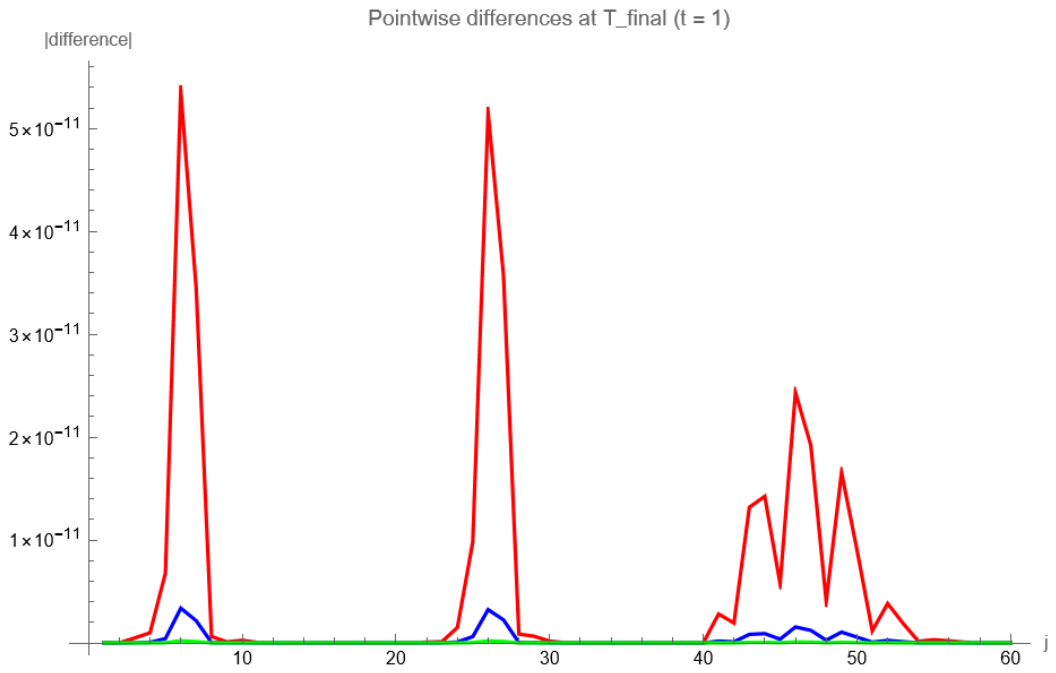
Figure 3.
Pointwise (, blue) and (, red) at across all 60 spatial nodes. Both curves cluster uniformly around the theoretical order (dashed reference line), confirming spatially uniform 4th-order convergence of the SSHBBDF scheme with . The curve lies marginally closer to , consistent with asymptotic convergence.
Figure 3.
Pointwise (, blue) and (, red) at across all 60 spatial nodes. Both curves cluster uniformly around the theoretical order (dashed reference line), confirming spatially uniform 4th-order convergence of the SSHBBDF scheme with . The curve lies marginally closer to , consistent with asymptotic convergence.
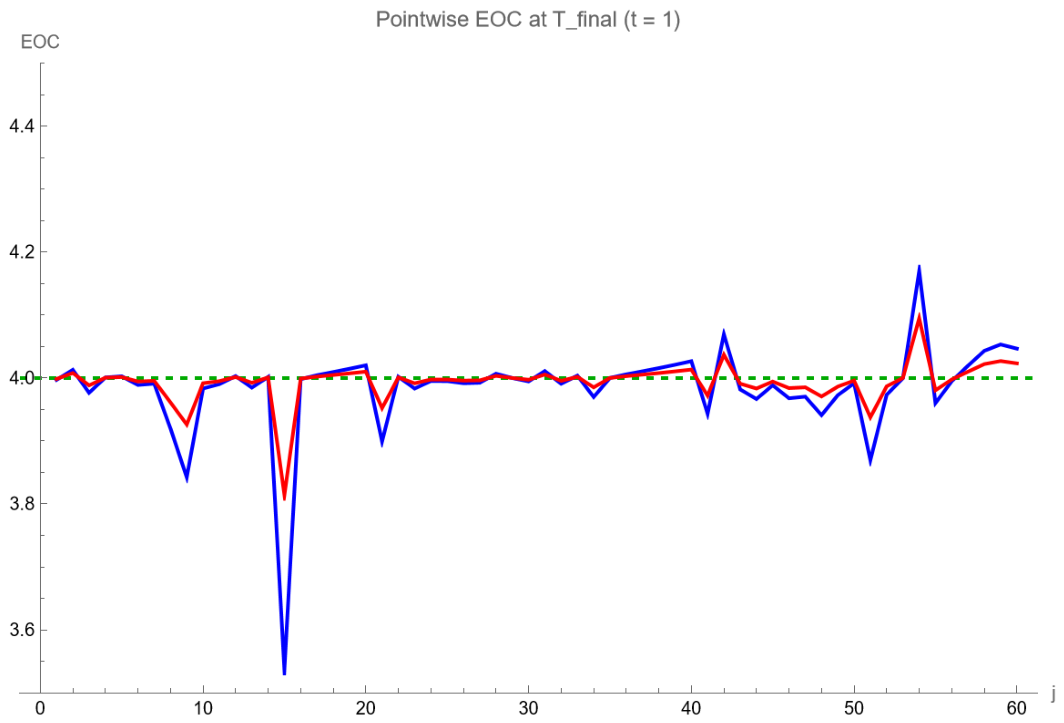
Figure 4.
Spatiotemporal dynamics under parameter set 1 (Table 3). From left to right: tumor density , nutrient concentration , and immune density . Effective immune control suppresses tumor growth and maintains nutrient availability.
Figure 4.
Spatiotemporal dynamics under parameter set 1 (Table 3). From left to right: tumor density , nutrient concentration , and immune density . Effective immune control suppresses tumor growth and maintains nutrient availability.
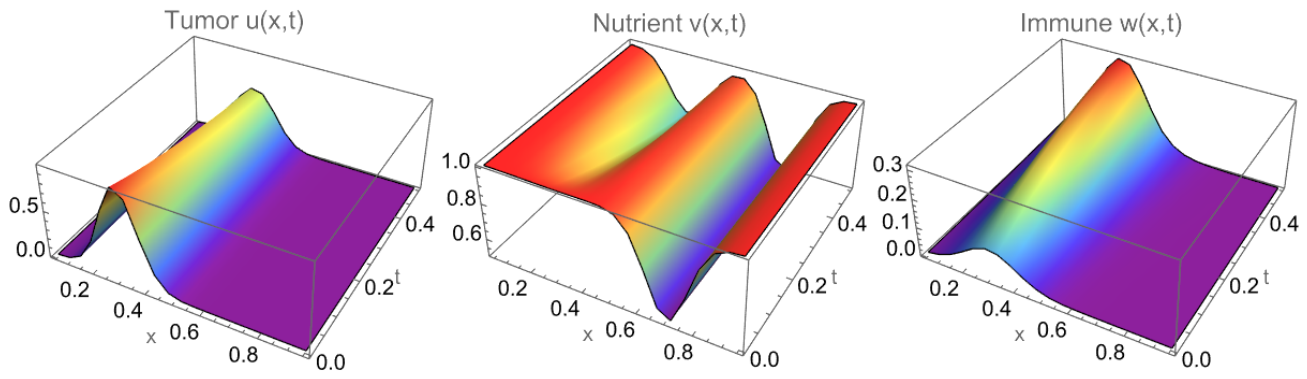
Figure 5.
Spatiotemporal dynamics under parameter set 2 (Table 4). Aggressive tumor growth depletes nutrients in the spatial interior, creating a necrotic core, while the immune response remains insufficient to control expansion.
Figure 5.
Spatiotemporal dynamics under parameter set 2 (Table 4). Aggressive tumor growth depletes nutrients in the spatial interior, creating a necrotic core, while the immune response remains insufficient to control expansion.
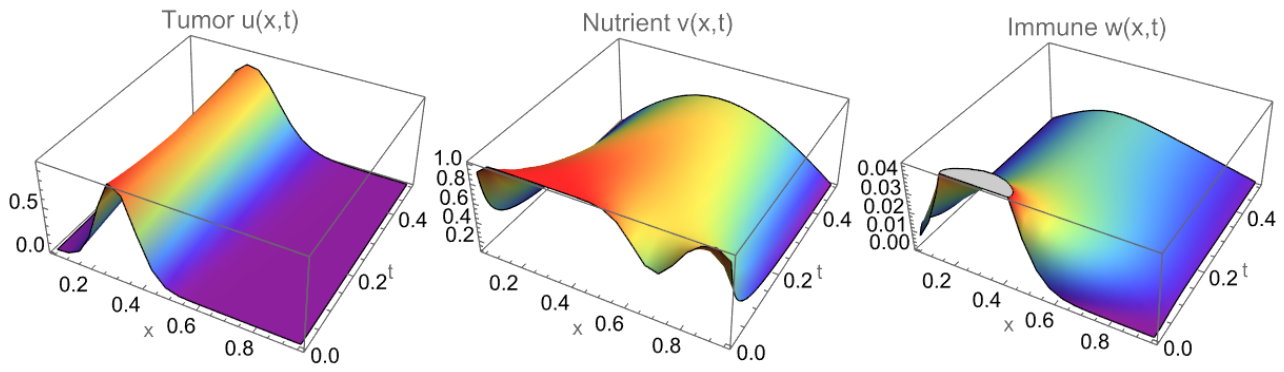

Table 1.
Dimensional variables and parameters for the Tumor–Immune–Nutrient model.
| Symbol | Description | Units |
|---|---|---|
| Spatial coordinate | mm | |
| Time | day | |
| Tumor cell density | cells/mm | |
| Immune cell density | cells/mm | |
| Nutrient concentration | mmol/mm | |
| Tumor diffusion coefficient | mm/day | |
| Immune diffusion coefficient | mm/day | |
| Nutrient diffusion coefficient | mm/day | |
| Tumor proliferation rate | day | |
| Tumor carrying capacity | cells/mm | |
| Immune killing rate | mm/(cells·day) | |
| Nutrient support coefficient | mm/(mmol·day) | |
| Immune recruitment rate | day | |
| Immune natural decay rate | day | |
| Nutrient consumption rate | mm/(cells·day) | |
| Tissue length | mm |
Table 2.
Dimensionless parameters obtained from the nondimensionalization of the Tumor–Immune–Nutrient system.
Table 2.
Dimensionless parameters obtained from the nondimensionalization of the Tumor–Immune–Nutrient system.
| Parameter | Definition | Biological Interpretation |
|---|---|---|
| Tumor diffusivity ratio | ||
| Immune diffusivity ratio | ||
| Nutrient diffusivity ratio | ||
| Immune cytotoxic strength | ||
| Nutrient–tumor coupling strength | ||
| Tumor-driven immune recruitment | ||
| Immune natural decay | ||
| Nutrient consumption by tumor |
Table 3.
Parameter set 1: moderate stiffness regime with balanced tumor–immune competition. Values adapted from de Pillis et al. [13].
Table 3.
Parameter set 1: moderate stiffness regime with balanced tumor–immune competition. Values adapted from de Pillis et al. [13].
| Parameter | Description | Value | Units |
|---|---|---|---|
| Tumor diffusion coefficient | mm/day | ||
| Immune diffusion coefficient | mm/day | ||
| Nutrient diffusion coefficient | mm/day | ||
| Tumor proliferation rate | day | ||
| K | Tumor carrying capacity | cells/mm | |
| Immune killing rate | mm/(cells·day) | ||
| Nutrient consumption rate | mmol/(cells·day) | ||
| Nutrient support coefficient | mm/(cells·day) | ||
| Immune recruitment rate | day | ||
| Immune decay rate | day |
Table 4.
Parameter set 2: high stiffness regime representing aggressive tumor dynamics consistent with immunosuppressive tumors. Values adapted from de Pillis et al. [13] and Stepien et al. [39].
| Parameter | Description | Value | Units |
|---|---|---|---|
| Tumor diffusion coefficient | mm/day | ||
| Immune diffusion coefficient | mm/day | ||
| Nutrient diffusion coefficient | mm/day | ||
| Tumor proliferation rate | day | ||
| K | Tumor carrying capacity | cells/mm | |
| Immune killing rate | mm/(cells·day) | ||
| Nutrient consumption rate | mmol/(cells·day) | ||
| Nutrient support coefficient | mm/(cells·day) | ||
| Immune recruitment rate | day | ||
| Immune decay rate | day |
Table 5.
Global EOC at via four-level Richardson step-doubling (33) under three norms. Theoretical order: (SSHBBDF, ).
Table 5.
Global EOC at via four-level Richardson step-doubling (33) under three norms. Theoretical order: (SSHBBDF, ).
| Norm | Theoretical | ||
|---|---|---|---|
| Max-norm | 4 | ||
| -norm | 4 | ||
| -norm | 4 |
Disclaimer/Publisher’s Note: The statements, opinions and data contained in all publications are solely those of the individual author(s) and contributor(s) and not of MDPI and/or the editor(s). MDPI and/or the editor(s) disclaim responsibility for any injury to people or property resulting from any ideas, methods, instructions or products referred to in the content. |
© 2026 by the authors. Licensee MDPI, Basel, Switzerland. This article is an open access article distributed under the terms and conditions of the Creative Commons Attribution (CC BY) license (http://creativecommons.org/licenses/by/4.0/).
Copyright: This open access article is published under a Creative Commons CC BY 4.0 license, which permit the free download, distribution, and reuse, provided that the author and preprint are cited in any reuse.


