

Submitted:
20 May 2026
Posted:
21 May 2026
You are already at the latest version
Abstract
A central challenge in the structural diagnostics of paintings is the accurate, repeatable non-invasive, ideally non-contact, assessment for the detailed documentation of subsurface defects such as detachments and cracks generated by inter-layer de-cohesion resulting in material degradation and interrelated propagation of defects; all of which precede visible detection of surface damage. The ultimate aim is the protection of the precious irreplaceable painted surface. Currently advanced imaging techniques used in structural diagnosis of artworks, including Digital Holographic Speckle Pattern Interferometry (DHSPI), Infrared Thermography (IRT), Digital Speckle Shearography (DSS), are used in providing the valuable structural information. Main contribution is in subsurface defect localisation and despite differences in resolution, displacement sensitivity, defect characterisation, depth discrimination, efficiency of data retrieval, info utilisation and quantitative phase retrieval, under the especially demanding constrains in the investigation in Cultural Heritage (CH) documentation, these techniques can trace subsurface and bulk discontinuities’ safely and efficiently.
Digital Holographic Speckle Pattern Interferometry (DHSPI), is a custom-made interferometry system, based on principles of holographic and speckle interferometry, developed to respond to the unique combination of requirements in CH and for structural documentation in paintings diagnostics; which either on wood or wall represent a continuous mechanics problem of a solid object with an inhomogeneous stratigraphic anisotropic construction that mathematically becomes an interferometric phase-field multi-physics interpretation problem. The portable DHSPI lab prototype aims to solve it, implements highly coherent diverged laser beams for safely illuminating large scale surfaces and recording digital sequence of images of the surface as displaced after a transient alteration; which are processed under numerical phase reconstruction algorithms to provide a whole and local phase-resolvable full-field measurement of out-of-plane surface-normal displacements induced by controlled low thermal excitation. It combines a novel thermo-mechanical monitoring methodology for substantiate a richer description of defect morphology features and structure dynamics.
In this work the conceptual foundation of DHSPI as a CH tool is presented, its evolution from classical holographic interferometry to digital implementations with sequential interferometry and progressive implementation of sequential thermo-interferometry application is discussed, while DHSPI applicability to the multi-layered structures of CH as appear in wall- panel- and canvas paintings, is analysed. Related systems are also discussed in relevance of CH demands. Particular emphasis is placed on interferometric sensitivity mechanisms, fringe pattern wrapped phase utilisation and unwrapped phase-map interpretation, excitation strategies, and comparative performance against established non-destructive testing techniques. The presented critical technical and advanced methodological review briefly also explores emerging perspectives, including multi-modal instrumentation as hybrid DHSPI–thermography AI-assisted automatic interpretation. and the lab-based conceptual framework of multi-channel holographic recording for simultaneous displacement component extraction. By synthesis in optical metrology and heritage diagnostics developments, this work positions DHSPI within a broader era-transition from passive-imaging toward information-based diagnostics through the post-imaging interference analysis, a displacement-based structural metrology approach, contributing to the advancement in multi-modal preventive conservation strategies for paintings and large-format heritage surfaces. It proposes to hold-on to DHSPI as a high-sensitivity monitoring multitask tool capable of guiding implementation of complimentary techniques and addressing unresolved challenges in painting conservation from standardised documentation protocols to research on aging deterioration mechanisms.
Keywords:
Digital Holographic Speckle Pattern Interferometry (DHSPI) holographic interferometry
; cultural heritage diagnostics
; structural monitoring of paintings
; non-destructive testing (NDT)
; thermo-mechanical response
; phase retrieval
; multimodal diagnostics
1. Introduction
1.1. The Interferometry Solution in Structural Diagnosis of Paintings
Paintings constitute complex, multi-layered multi-interfaced solid systems composed of combination of anisotropic materials and arbitrary constructions varying from diverse supports being either wooden panel-paintings or canvas -paintings or wall- paintings, several ground layers, the various palette of pigments in pictorial strata, and the frequent use of protective layers of varnishes, all combined in one structural physical body termed “painting”; creating one of the most popular and precious testimonials of social identities. These multi-layered assemblies are dimensional responsive structures exhibiting heterogeneous mechanical behaviour governed by environmental fluctuations, material aging, defect growth and residual stresses introduced naturally or during construction and/or conservation interventions [1,2,3,4,5]. Early-stage deterioration phenomena -including detachments, micro-cracking, voids, material loss, blistering, subsurface degradation phenomena- mostly develop slowly but steadily at microscopic scales well before macroscopic damage becomes visually detectable. The timely identification of such defects for pro-active maintenance before they generate damage on irreplaceably precious artistic painted surface remains a central challenge in paintings preventive conservation.
Over the past three decades, non-destructive testing (NDT) methodologies have been increasingly integrated into cultural heritage diagnostics. Among the most established approaches is Infrared Thermography, which exploits transient or steady-state thermal diffusion contrasts to reveal subsurface irregularities [6,7,8]. Although highly valuable for shallow defect detection and large-area surveys, its depth resolution and quantitative interpretation are inherently limited by heat propagation physics and material-dependent thermal diffusivity. Optical interferometric techniques have also gained prominence due to their ND contactless application and exceptional displacement sensitivity [9,10,11]. Some variations include electronic speckle pattern interferometry and shearography both provide full-field measurements of displacement in non-contact manner and the latter numerically produces the derivatives of displacement while it offers robustness against environmental perturbations; however, its measurement of strain gradients rather than absolute displacements complicate interpretation in multi-layered viscoelastic systems such as paintings. Similarly, Electronic Speckle Pattern Interferometry enables higher sensitivity deformation mapping but may be constrained by stability requirements and fringe analysis complexity in situ as has been demonstrated experimentally in artwork diagnosis applications through large European projects [48]. From the other hand the precursor of all, Optical Holographic Interferometry offering the highest information content was the first to be applied on painting diagnosis but faced severe limitation for in-situ application limiting this unprecedented resolution, of thousands of lines per mm, within laboratory constrains [12,13,14,15,16,17]. The introduction of Digital Holographic recording marked a significant evolution in coherent metrology for in-situ applications by enabling numerical reconstruction, phase extraction, fringe post-processing, improved methodology flexibility, compared to classical optical holographic recording [18]. When combined with speckle interferometry principles, Digital Holographic Speckle Pattern Interferometry (DHSPI) offers nanometre sensitivity to out-of-plane surface displacements while maintaining full-field capability and local-field high resolution details [19]. Despite these advances in instrumentation, several fundamental challenges persist in the structural diagnostics of paintings.
Primary, although interferometric techniques provide high sensitivity, the requirement for nanometric-scale quantitative displacement-and-defect mapping remains critical for data-based pro-active decisions in CH. Inborn or early-stage defects, delaminations or interface de-cohesion between ground and paint layers may produce extremely small out-of-plane deformations under natural mild excitation which are gone mostly undetectable. The problem is not per se the extremely-small defect alone but their spatial density inside the material that accumulates enhancing their impact on surface through their interaction. Detecting such movements and hidden defects demands to approach far from the simple logic of passive imaged defect detection and approach the problem with high information content, data-time-series and phase-resolved measurements capable of resolving the information density in various levels, from μm kinetic reactions to sub-wavelength optical-path changes of defect morphologies, while maintaining sufficient signal-to-noise ratio in diffusely reflecting, height-variable and optically heterogeneous surfaces. Subsequently, a persistent difficulty lies in distinguishing localized interfacial defects and their expansion from global dimensional dynamically changing response, a whole vs local field differentiation. Paintings are dimensionally responsive systems; hygroscopic influences provoking shrinking-swelling, thermal expansion, and viscoelastic relaxation induce global deformation patterns that may obscure data retrieval since they mimic defect-induced patterns of displacement fields due to defects, an inherent problem in interference patterns formation [20,21,22]. Interpreting whole-field interferometric fringes vs local–field defect-induced discontinuities requires methodological measuring procedure capable of enhancing spatial selectivity and discriminating between defect-related mechanical discontinuities and global substrate response, either in uniform or uneven whole-field [19]. Additionally, CH environments impose strict operational constraints, creating the need for ethically-imposed low-excitation with stable fully non-contact configurations compatible with delicate cultural objects. Thermo-mechanical loading must remain at minimal transient influence at the levels of every-day fluctuations, environmental perturbations must be controlled, and acquisition procedures must tolerate micro-vibrations and slow drift typical of in situ measurements in museums or conservation studios. Consequently, diagnostic techniques must combine high optical sensitivity with practical robustness and methodologies with experimental flexibility.
These challenges collectively motivate continued refinement of digital holographic interferometry methodologies and system tailored specifically to artwork materials were taken into account in DHSPI development.
1.2. Holographic Interferometry Towards Cultural Heritage Applications
Holographic interferometry has long been recognized for its capacity to detect sub-micrometric surface displacements through phase-sensitive recording of coherent wavefronts [22,23]. Classical double-exposure holography enabled the visualization of deformation fields through fringe patterns corresponding to optical path differences induced by mechanical or thermal excitation between two exposures at initial and deformed state as shown in Figure 1; assume surface position at “before” and “after” while an optical path alteration took place, optical path generated by reflection on a changing surface creates two slightly different wavefronts which by superposition at recording plane give rise to a phase-field governed by the laws of interference and diffraction. In this sense the surface points act as spatial reflector for the incident photons which interfere either constructively (wavefront generate bright fringe) or destructively (generate dark fringe) and micro-displacements are recordable.
While optical holographic interferometry was uniquely sensitive with the highest spatial information density reaching spatial frequencies up to 2.500 thousand lines/mm @recording plane, early implementations required photographic silver halide recording media and stringent environmental stability within laboratory conditions, limiting their portability and routine applicability in conservation environments. Thus the transition to digital recording technologies significantly transformed the strict-boundary conditions in regards to the operational framework of holographic metrology. The emergence of digital sensors and numerical reconstruction algorithms enabled real-time phase extraction, quantitative displacement mapping, and improved robustness against experimental drift. In particular, digital speckle-based interferometric techniques permitted full-field analysis of diffusely reflecting surfaces, a critical requirement for artwork materials that lack specular reflectivity.
Within the context of cultural heritage, holographic methods were progressively adapted to address the specific constraints posed by painted objects of art. These constraints include safety protocols, sensitivity to environmental fluctuations, limited tolerance to mechanical impact through excitation, and the necessity for remote non-contact operation. Unlike industrial components, artworks exhibit complex viscoelastic and hygroscopic behaviour, meaning that induced deformation fields reflect not only structural defects but also intrinsic dimensional response to environmental stimuli. Consequently, the direct application of industrial holographic inspection protocols to heritage diagnostics required careful adaptation over the years of careful methodology developments. This was necessary since artwork materials differ significantly from engineered components in terms of mechanical fragility, environmental sensitivity, and heterogeneous stratigraphy as shown in a schematic cross-section of painted surface on canvas or wood or wall, Figure 2.
Keeping in mind that industrially-applied holographic interferometry was primarily developed for industrial applications such as aerospace components, composite panels, mechanical assemblies, metallic structures, etc., which are typical systems with relatively homogeneous mechanical properties tolerating much stronger excitation, as for example the vacuum loading and mechanical or pressure stressing within purely controlled environments. they differ substantially from application on Cultural Heritage (CH). Paintings, in contrast to industrial components, are irreplaceably precious but aged and mechanically fragile constructions exhibiting continuous three-dimensional hygroscopic responses which cannot tolerate strong loading of any type, and last but not least are usually examined in semi-controlled field or museum conditions. So the direct transfer of industrial methods and excitation is inappropriate in cultural heritage investigation contexts.
Therefore, methodological refinements became necessary in order to address those very important differences. In the development of the holographic interferometry technique to adapt into CH singularities some key features were studied and improved among which: the minimisation of any mechanical or any other loading factor during minimum provoked excitation, the enhancement of interpretability of displacement fields especially for multi-layered constructions, the improvement of spatial selectivity of deformation mapping and defect documentation, as well as the maintenance of interferometric stability in non-laboratory strict boundary conditions. These adaptations gradually marked the evolution from general-purpose optical and digital holographic interferometry toward specialized interferometric strategies tailored to the mechanical behaviour of cultural heritage materials [24,25].
1.3. Digital Holographic Speckle Pattern Interferometry (DHSPI) as a Sequential Thermo-Mechanical Monitoring Method
The evolution of Digital Holographic Speckle Pattern Interferometry (DHSPI) in cultural heritage diagnostics did not merely involve the digital replacement of classical holographic recording media, rather, it gradually developed into a problem-oriented, adaptive monitoring framework specifically configured to address the mechanical and environmental singularities of paintings [26,27,28,29]. In Figure 3 it is shown a photo of the portable DHSPI system on its custom-made CH-adapted implementation while examining a Byzantine wall-painting hwile in Figure 4a-I an example of interferogram processing from raw wrapped phase to 3D surface morphology revealing the influence of a local detachment on surface.
The system comprises from the head including the optics and laser, while two thermal lamps as seen as peripheral excitation system for induced displacement captured by the CCD and transferred to the PC. DHSPI operates on a real-time sequential acquisition principle to capture the full cycle of equilibrium process expressed as surface dispalcements. An initial reference hologram is recorded under equilibrium conditions (ΔT = 0), representing the un-deformed optical state of the object. A controlled, low-energy thermal excitation (ΔT ≠ 0) is subsequently introduced, inducing a mild thermo-mechanical response within the multilayered structure. Instead of relying on a double-exposure procedure of a single before-after comparison (H0H1), the excitation cycle producing the deformation process is monitored continuously (t01t02…t0ν) through the acquisition of sequential interferometric recordings (H0H1…Hν), capturing the progressive evolution of the displacement field until thermal equilibrium is re-established (ΔT = 0). This time-resolved approach serves multiple purposes. Primary, it enables the observation of deformation kinetics rather than only final displacement states, providing insight into the transient mechanical behaviour of the stratified system. Secondly, by correlating interferometric phase evolution with simultaneously monitored temperature variations, the method ensures that excitation remains minimal and mechanically non-invasive while the role of temperature impact can be questioned. Acquisition is terminated only when both thermal disturbance and induced mechanical response approach negligible levels at zero-order fringe and min temperature difference, thereby preserving the structural integrity of the artwork while has been monitored in a full cooling-down cycle with temperature differences visualising different fringe manifestations. The sequential recording strategy may generate extensive sets of raw holographic data, often comprising hundreds of interferograms obtained through controlled phase-shifting procedures from just a single measurement. Such temporal redundancy introduces an intrinsic statistical robustness to the measurement process. Individual interferograms affected by occasional rigid-body motion or external perturbations do not compromise the overall displacement evaluation, as the cumulative dataset enables consistent phase reconstruction and validation [30,31,32,33].
Beyond statistical robustness, DHSPI shown in Figure 3, employs a dual and complementary interpretative framework based on sequential wrapped and unwrapped phase analysis [31]. The wrapped phase maps, examined in their temporal evolution during controlled thermal excitation and subsequent relaxation, provide significantly more detailed info than rapid visualization of whole-body deformation. As temperature fluctuates within the multilayered structure, localized subsurface defects manifest at sequential frames as distinct phase anomalies embedded within the global deformation or whole-field. Observed sequentially, these anomalies can be isolated and their movement can be tracked individually, allowing the detailed dynamic study of each defect’s mechanical response over time revealing defect boundaries and interactions. This time-resolved wrapped analysis enables precise spatial localization of defect regions of interest (ROI). By scaling the interferometric field to the actual physical dimensions of the surface, quantitative coordinates of defect peaks and boundaries can be determined [32]. Moreover, monitoring the temporal evolution of phase anomalies provides insight into depth-related mechanical behaviour, expansion characteristics, and interaction mechanisms between neighbouring defects allowing critical interactions to be studied [33]. Interconnected or propagating defects may therefore be identified through correlated phase evolution patterns that would remain obscured in static or single-image analyses. Subsequent phase unwrapping permits quantitative three-dimensional displacement mapping and detailed geometric documentation of defect morphology, as shown in Figure 4a-I, where a single defect, detachment, has been isolated and processed to reveal its impact on surface and its dynamics of expansion, Certain structural relationships, such as defect interconnection pathways or progressive propagation phenomena may be more clearly revealed within sequential wrapped phase datasets than in fully unwrapped maps, where global phase continuity reconstruction can reduce visibility of subtle relational dynamics. The combined use of wrapped temporal tracking and unwrapped quantitative mapping thus constitutes in DHSPI methodology a complementary analytical strategy that enhances both interpretability and structural documentation applicable in a very large variety of CH problems [33,34,35,36].
Through the integration of controlled thermal excitation, sequential interferometric monitoring, and statistically validated phase reconstruction, DHSPI evolved from a strict optical within laboratory metrology technique into a resilient diagnostic methodology tailored for fragile, dimensionally responsive, complex-stratigraphy artworks, and large-scale cultural heritage materials [36,38]. These characteristics significantly enhance measurement accuracy in semi-controlled or externally exposed environments, including large-scale in situ investigations where perfect vibration isolation is unattainable [38]. Such robustness has enabled successful application of DHSPI in the examination of extended surfaces, including wall paintings and other large-format heritage structures. Its capacity to operate under minimal loading conditions while maintaining nanometric sensitivity establishes it as a distinct model within non-destructive structural diagnostics of paintings.
1.4. Optical Spatial Selectivity of Whole vs Local Fields
While sequential thermo-mechanical DHSPI monitoring significantly enhanced robustness and interpretability in deformation analysis, the broader field of optical coherent holographic inspection in cultural heritage also explored alternative strategies to address a central interpretative difficulty that is the separation of localized defect-induced deformation from dominant global dimensional response [39,40,41]. In multi-layered, hygroscopic systems such as paintings, uniform excitation often produces large-scale deformation fields that can obscure subtle interfacial discontinuities. However, in CH investigation subtle discontinuities may cover evolution of significant damage. Masking-based multi-channel exposure holographic methodologies were also examined and introduced as a spatial modulation strategy aimed at improving defect localization without modifying the fundamental interferometric sensitivity configuration [42]. By selectively restricting or segmenting the object wave contribution during successive holographic exposures, while maintaining a constant reference beam geometry, it became possible to isolate specific regions of the differential displacement among exposures of surface deformation during cooling, and examine their mechanical response under identical geometry and sensitivity conditions. This ensured that variations observed in the phase distribution originated from localized structural behaviour rather than from alterations in optical alignment or whole-field structural behaviour. In such multi-exposure masking procedures, successive recordings are obtained while systematically modifying the spatial transmission conditions of the object beam as shown in geometry scheme of Figure 5. An off-axis transmission overhead configuration with two object beams, one reference, and a masking sequence of object beam is implemented using a Q-switched ruby pulsed laser and pulse duration 15 ns. Because the reference beam remains unchanged, interferometric sensitivity is preserved across exposures, enabling direct comparative evaluation between masked and unmasked states. This is an optical geometry approach that enhances the visibility of localized deformation anomalies by reducing the dominance of whole-body substrate motion in reconstructed phase maps. These spatially selective acquisition methods proved particularly effective for dimensionally responsive artwork materials, where hygroscopic expansion, thermal gradients, or viscoelastic relaxation generate coherent whole-field deformation patterns in a typical cooling-down procedure. By selectively probing regions of interest under controlled conditions, masking-based holographic inspection facilitates improved localization of interfacial detachments, crack initiation zones, mechanically decoupled areas within stratified structures, linear dissipation and nonlinear effects become distinct.
Masking-based multi-channel exposure methodologies and DHSPI sequential monitoring therefore represent distinct yet complementary methodological directions within cultural heritage holographic inspection developments. While DHSPI emphasizes time-resolved phase tracking under controlled thermo-mechanical equilibrium, masking-based approaches emphasize spatial selectivity through optical lab-based object beam modulation. Together, they illustrate the progressive adaptation of optical holographic interferometry to the diagnostic singularities of paintings and other large-scale heritage surfaces in digital holographic interferometry, inside and outside of the optical laboratory or in fully portable system as DHSPI finally became.
2. DHSPI for Painting Diagnostics
2.1. Interferometric Sensitivity and Displacement Mapping
The measurement principle of DHSPI is fundamentally based in phase-shifting in a phase-resolved acquisition of interferometric sequence [25,28]. When a coherently illuminated surface undergoes deformation, the optical path of the scattered object-wave changes, producing a measurable phase variation in the reconstructed holographic field [20,21]. This natural or provoked surface displacement provides the information content of measurements.
The phase difference between two object states can be generally expressed as
Δφ=φ1-φ0 is the phase variation due to length variation from surface displacement, the distance between surface and DHSPI sensor changes, ΔL is the optical path variation, due to length variation, and eq1 is
Where λ is the laser wavelength and ΔL is the optical path length variation, between surface and sensor, corresponding to the generated phase variation Δφ.
In paintings examination either panel- canvas- wall-paintings, one common features dominate, and this is the multi-layered construction leading, by various factors as aging and environmental fluctuations, to the loss of cohesion between layers. This launch of decohesion once it starts creates series of detachments between layers and when detachments deformed expand primarily towards z direction. The optical geometry used in recording this z displacement should be made sensitive to out-of-plane motion through sensitivity vectors laying on the bisector of illumination and observation beams. Thus in DHSPI, described as in a general interferometric configuration, the phase change is related to the displacement vector u,
through the sensitivity vector s, thus eq.2, becomes
u=(ux,uy,uz)
The sensitivity vector depends on the illumination and observation geometry and on typical DHSPI arrangements employed in painting diagnostics, the configuration is optimized for dominant out-of-plane sensitivity, since subsurface detachments and any sort of interfacial decohesion primarily induce surface-normal deformation components under mild thermal excitation. Because the excitation energy is intentionally minimal, induced displacements are extremely small, in the nanometric regime. Phase-resolved detection is implemented through unwrapping algorithms on wrapped interferograms to extract and mapping the detailed deformation, defect morphology and displacement information. Sensitivity vector, resolution, minimum excitation, tested performing on artworks, samples and real, contribute to develop suitable and specific investigation methodologies for DHSPI system. In Figure 6 it is shown a Byzantine icon sample [52] into the laboratory strict experimental arrangement during investigation on methodologies development and standardisation, which are shown on Table 1.
In heritage-adapted DHSPI implementations, coherent illumination is typically provided by a continuous-wave TEM00 Solid-State Laser operating at 532 nm. The high spatial coherence of the fundamental transverse electromagnetic mode ensures stable speckle formation across diffusely reflecting surfaces, while the long temporal coherence length of the CW source supports precise phase reconstruction over extended optical paths. The choice of wavelength directly influences displacement sensitivity, since a 2π phase shift corresponds to a path change equal to one wavelength. For a 532 nm source, this implies that nanometric-scale surface displacements generate measurable fractional phase variations, enabling sub-wavelength displacement resolution under controlled phase-shifting acquisition.
2.2. Sequential Phase Retrieval and Controlled Phase Shifting
To obtain accurate phase information, DHSPI employs multi-step phase shifting through controlled phase increments are introduced in the reference beam via implementation of a pzt mirror on the reference beam path, to record multiple interferograms for each object state during its cooling-down process after natural or induced thermal excitation. A typical 5-step is implememted and the recorded intensity at each pixel can be written as:
where Ι0 represents the average intensity, Ιm the modulation amplitude, φ the object phase, and δk the imposed phase shift for each acquisition step.
Solving the resulting system yields the wrapped phase distribution φ(x,y). The use of multi-step (5N) phase shifting improves phase accuracy, suppresses noise, and reduces sensitivity to intensity fluctuations that it is an important feature for in situ CH applications. Within the sequential thermo-mechanical method described in Section 1, this phase retrieval procedure is repeated continuously throughout excitation and relaxation. The result is a time-resolved series of phase maps describing deformation evolution until thermal equilibrium is restored.
2.3. Sensitivity Considerations for Multi-Layered Artwork Materials
Although the mathematical formulation of interferometric sensitivity is straightforward, its interpretation in multilayered, dimensionally responsive systems requires dual diagnostic approach, since paintings do not behave as isotropic elastic plates; rather, they exhibit stratified mechanical response influenced by support anisotropy, ground brittleness, pigment composition, and environmental impact. Under low to mild thermal stimulation, as it is implied by DHSPI methodologies, the observed phase variation represents the superposition of multiple elements starting with the substrate deformation representing the overall reaction of the object as it accommodates the temperature differences provoked by hygroscopic expansion within its structural elements and it is termed as the whole-field, and the localised elements of discontinuities as the detachments, interface de-cohesion, and as well as any hidden defect induced discontinuities manifests distinctly which are termed as local-fields. The methodological ability implemented in DHSPI to resolve whole-field and local field nanometric displacement allows localized anomalies to be visualised and accurately detected even when embedded within the larger global deformation whole-fields as in Figure 4a-i [19]. However, correct sequential study leading to information rich and detailed interpretation requires consideration of stability, excitation uniformity, boundary constraints, and temporal deformation behaviour. The sequential acquisition methodology therefore plays a critical role not only in measurement robustness but also in structural diagnosis interpretation, allowing differentiation between transient global whole-field response and persistent localised defect signatures, within the whole-field. During DHSPI sequential acquisition methodology manifestation of whole deformation field vs local defect fields is temporally variable diversifying them directly and even visually.
2.4. Sensitivity and Other Interferometric Techniques
The diagnostic effectiveness of interferometric methods in painting analysis depends not only on nominal displacement sensitivity but also on the nature of the measured quantity and its interpretability within complex, multilayered, dimensionally responsive systems. Although several coherent optical and NDT techniques share similar phase-resolved based foundations, their sensitivity vectors, measurement parameters, variability of environments, applicability, and practical behaviour under Cultural heritage conditions differ significantly [43,44,45,46,47]. DHSPI can be discussed on the view of its counterparts too.
2.4.1. Shearography
Another technique introduced two decades ago in CH research is Shearography (DSS), a speckle-based technique that measures displacement gradients rather than absolute displacements for industrial and aircraft inspection [39,40,41,48]. The recorded phase variation arises from the interference between two laterally sheared wavefronts scattered from neighbouring points on the object surface and is proportional to the spatial derivative of the displacement field between neighbouring photons due to laterally sheared object points introduced by optical element. In simplified one-dimensional form, the measurable phase variation can be expressed as:
where Δx is the imposed shear distance and u(x) is the surface displacement field. In comparison with DHSPI a contrast is presumed since DHSPI directly measures the displacement itself projected along the interferometric sensitivity direction, as:
This distinction is particularly relevant in cultural heritage applications. Paintings are irreplaceable, mechanically fragile objects, and diagnostic procedures must operate under minimal excitation energy to avoid structural stress. Under such mild thermal or environmental stimulation, deformation amplitudes are intentionally small and often spatially smooth. In these conditions, the displacement gradient ∂u/∂x may be weak even when the absolute displacement is mechanically meaningful. Because shearography responds primarily to spatial derivatives, its effective phase contrast depends on how rapidly deformation changes over the shear distance. Slowly varying displacement fields, common in early-stage interfacial detachments or subtle hygroscopic response, may therefore produce limited shearographic signal, even though they represent important structural information for preventive conservation. DHSPI, by directly measuring surface-normal out-of-plane displacement amplitude, retains sensitivity to these small, low-gradient deformation components. At the same time, shearography’s immunity offers important advantages. Its differential nature makes it inherently less sensitive to rigid-body motion and environmental vibration, and it can be effective for detecting strain concentrations associated with pronounced structural discontinuities. For larger or more abrupt defects, gradient-based visualization may provide clear and rapid indication of structural anomalies.
In the context of cultural heritage diagnostics though, where early-stage defect detection, deformation kinetics, detailed structural documentation, defect hidden propagation and interconnection with other defects, and long-term monitoring are critical, direct displacement-sensitive methods such as DHSPI provide enhanced capability for resolving nanometric surface-normal motion under low-energy excitation. Shearography is a valuable tool, particularly where strain concentration mapping and vibration tolerance are primary considerations. In this context, shearography was implemented in a multi-modality instrumentation of European project MULTIENCODE that provided a step-wise inspection procedure from low to high resolution investigation of defect kinetics for originality assessment [48]. As a result, shearography is inherently sensitive to localised strain concentrations and is relatively immune to whole-field deformation while robust against surrounding rigid-body motions and thus fits requirments for monitoring larger strain concentrations. However, in multi-layered artwork systems, the interpretation of displacement derivatives can be less intuitive than direct displacement mapping. Multimodal application solved the methodology approach and path the way for future multi-modalities multi-instrument approaches [48,50].
2.4.2. Electronic Speckle Pattern Interferometry (ESPI)
Termed Electronic Speckle Pattern Interferometry (ESPI) is the coherent optical technique using electronic recording medium and it is historically referred to the first versions of TV holography that were originally developed as a real-time speckle interferometry technique in which two object beams interfere directly at the detector plane without classical analogue photosensitive holographic recording [49,51]. In most early implementations, no separate reference beam was employed; instead, interference occurred between two states of the scattered object wave, enabling visualization of deformation through fringe evolution. ESPI became widely used for full-field deformation analysis, particularly for in-plane displacement measurement and vibration studies. By appropriate optical configuration, ESPI can be made sensitive to either in-plane or out-of-plane displacement components but its main principal strength lies in in-plane real-time fringe visualization with relatively straightforward optical arrangements, which made it attractive for structural non-destructive testing applications. DHSPI, while also implements speckle interferometry principles, differs in its holographic recording architecture. Both ESPI and DHSPI are phase-sensitive techniques capable of quantitative displacement measurement through phase-shifting procedures. The distinction between them does not lie in fundamental differences in optical lay-out sensitivity, but rather in recording geometry and reconstruction strategy, as in classical speckle interferometry using electronic recording configurations, interference occurs directly between object wave components or between object states, and deformation is visualized through pure speckle fringe contrast modulation. Quantitative phase extraction is achievable through multi-step acquisition, but the recorded signal corresponds directly to intensity variations of the speckle field. Instead in DHSPI, the holographic arrangement for interference between object and reference waves remains dominant but recorded in a digital holographic configuration, allowing high-contrast interference and numerical reconstruction of the complex optical field. The software architecture enables enhanced flexibility in digital filtering, phase stabilization, and sequential phase analysis with these capabilities being particularly advantageous for time-resolved monitoring under controlled low thermo-mechanical excitation required in heritage applications and detailed defect documentation [52].
From a physical standpoint, both ESPI and DHSPI can achieve sub-wavelength displacement resolution under stable conditions. The distinction becomes especially relevant in cultural heritage diagnostics, where examined objects are mechanically fragile and excitation energy must remain minimal. In such contexts, several practical differences acquire importance as it is the phase reconstruction that in DHSPI reconstructs the complex optical field digitally, enabling refined phase stabilization and filtering strategies, the sequential monitoring that in the DHSPI framework integrates controlled thermo-mechanical excitation with continuous strong interference and phase-resolved acquisition, enabling deformation kinetics and defect evolution to be monitored over time. Last but not least the environmental robustness of DHSPI due to sequential acquisition and statistical redundancy enhancing tolerance to gradual environmental drift in semi-controlled heritage environments, are comprising unique application advantages resulting in successful interferometric measurments for on-field campaigns. ESPI, by contrast, is often implemented for rapid qualitative fringe visualization. While quantitative phase extraction is possible, traditional ESPI applications frequently emphasize differential fringe comparison between states. For pronounced deformation fields or vibration modes, this approach can be highly effective.
In cultural heritage, where early-stage interface detachments may generate extremely small and slowly evolving displacement fields, the ability to perform stable digital phase reconstruction and time-resolved monitoring becomes particularly advantageous. DHSPI therefore provides enhanced interpretative capability for preventive conservation strategies, while ESPI remains a valuable complementary interferometric tool for deformation visualization and structural assessment.
2.4.3. Infrared Thermography-Multimodal Development Progress
Unlike interferometric methods, Infrared Thermography measures temperature distribution rather than displacement and its diagnostic capability is based on detecting thermal diffusion anomalies caused by subsurface discontinuities but while thermography is highly effective for rapid, large-area surveys and qualitative defect localization, its depth resolution and quantitative interpretation are governed by thermal diffusion physics rather than nanometric mechanical sensitivity [50]. Consequently, Thermography provides thermal contrast information while DHSPI provides mechanical displacement information upgrading the multi-modality of combination into unprecedented achieved rich information content [56]. Particular benefit for point-wise techniques such as Nuclear Magnetic Resonance (NMR), THz, Raman, etc can be DHSPIs whole vs local field analysis to indicate the region of interests for direct access. This strategy in multi-instrument investigation ca save lot of time and facilitate application of pointwise complimentary diagnostics. It is thus seeming that the multimodality and multi-instrumentation approach is the next physics-based path to a pro-active structural analysis in Cultural heritage. These modalities are highly complementary. In fact, controlled thermal excitation used in DHSPI may be informed or guided by thermographic inspection, suggesting potential hybrid diagnostic strategies in multi-modality systems and methodologies development [57,58,59,60].
2.4.4. Sensitivity Considerations in Heritage Context
From a purely theoretical perspective, several interferometric methods can achieve sub-wavelength sensitivity. However, as seen in Table 2, practical sensitivity in CH diagnostics is constrained by several parameters requiring separate solution [50].
Although interferometric techniques are theoretically capable of sub-wavelength displacement sensitivity, practical measurement resolution in cultural heritage diagnostics is governed by a combination of optical, mechanical, and environmental factors. For DHSPI operating at a wavelength of 532 nm, a full 2π phase shift corresponds to an optical path variation equal to one wavelength. In reflection geometry as it is the DHSPI operation, this corresponds to a surface-normal displacement of approximately λ/2 out-of-plane dispalcement, i.e., 266 nm. Fractional phase changes detected through multi-step phase shifting therefore allow if needed resolutions well below this value, enabling nanometric-scale displacement measurement under controlled conditions. However, the effective displacement resolution is not determined solely by wavelength. In practice, as is seen in Table 3 it depends on more features of the applied method.
In CH applications, additional constraints arise from the requirement of minimal excitation energy. Because paintings and wall paintings are structurally fragile and dimensionally responsive, induced deformation must remain small to avoid structural stress. Consequently, measured phase variations may be close to the noise-floor, making phase stability and statistical robustness critical. The sequential acquisition strategy described in Section 1 plays a central role in reducing uncertainty. By generating extensive interferogram datasets and applying multi-step phase retrieval, random noise contributions can be averaged and phase consistency validated over time. Occasional rigid-body disturbances or environmental perturbations do not necessarily invalidate the measurement, provided that phase reconstruction remains statistically coherent across the dataset damaged frames can be discharged. Spatial resolution is also influenced by optical configuration and imaging geometry. At extended object-to-sensor distances, such as those required for large-scale wall painting investigations, lateral resolution depends on lens aperture, working distance, and sensor pixel size. While increasing stand-off distance may reduce spatial sampling density, successful high-contrast interferometric recording and appropriate optical configuration, both designed in DHSPI system, allow accurate deformation mapping even for large-format surfaces.
At this point, it is very important for CH applications to distinguish between theoretical sensitivity and practical detectability. A technique may possess nanometric phase sensitivity in ideal laboratory conditions, yet fail to reveal meaningful structural information and even worst can obscure the structural condition evaluation; if not properly suited for the problem to be solved. A wrong use of a technique to answer a question that is not suited to answer can have negative effects on the conservation decisions and the tendency of conservators towards interferometry techniques. Additionally, not significant data can be collected if environmental instability or inappropriate excitation or inappropriate measurement parameters, dominates the measurement. In cultural heritage diagnostics, practical sensitivity must therefore be evaluated in relation to performance criteria within the unique constrains imposed by CH nature of investigation as the object fragility, limitation in environmental control, constrains in excitation amplitude, required diagnostic resolution, and specific problem of investigation requiring answers.
Under such presuositions, DHSPI combination of optical holographic recording parameters, fast digital acquisition, multiple data sets usage, continuous monitoring, phase-resolved acquisition, recording in synchronicity with excitation cycle, controlled excitation, sequential statistical validation, and post-processing exploitation of whole and local fields, defines its effective measurement capability.
4. Conclusions
The structural diagnostics of paintings demand methodologies capable of resolving nanometric deformation under strictly ethical controlled, non-contact conditions. Unlike industrial components, artworks are irreplaceable, mechanically fragile, and dimensionally responsive systems whose structural integrity must be possible to be evaluated without inducing stress or irreversible alteration. In this context, interferometric techniques have progressively evolved from laboratory-based optical metrology tools into specialized diagnostic frameworks tailored to the singular requirements of cultural heritage.
This review has examined the theoretical foundations and methodological development of Digital Holographic Speckle Pattern Interferometry (DHSPI) as a sequential thermo-mechanical monitoring paradigm. By integrating controlled low-energy excitation, multi-step phase shifting, and time-resolved phase reconstruction, DHSPI enables nanometric surface-normal displacement measurement while preserving object integrity. The combination of wrapped phase tracking for dynamic defect localization and unwrapped phase reconstruction for quantitative mapping provides a complementary analytical framework particularly suited to multilayered, hygroscopic artwork systems.
Comparative analysis with shearography and ESPI demonstrates that while all speckle-based interferometric techniques share sub-wavelength phase sensitivity, their practical effectiveness in cultural heritage contexts depends on the measured observable data richness, effective acquisition strategy, and robustness under semi-controlled environmental conditions. In preventive conservation scenarios, where early-stage detachments, subtle mechanical decoupling, and deformation kinetics are of primary concern, the direct displacement sensitivity and sequential monitoring capability of DHSPI provide enhanced interpretative depth.
Masking-based holographic inspection strategies further illustrate the broader methodological adaptation of optical coherent interferometry to heritage applications, emphasizing spatial selectivity and targeted defect localization. Together, these developments reflect a gradual methodological transition from general-purpose optical testing to culturally responsive structural diagnostics.
Looking forward, displacement-sensitive interferometry may be understood as part of a broader methodological transition in cultural heritage science: a shift from contrast-based imaging toward displacement-based post-imaging structural metrology. Whereas traditional imaging techniques primarily document dubious imaging, surface appearance or thermal response, DHSPI interrogates thoroughly the mechanical state of multilayered systems through nanometric deformation measurement. This distinction is particularly relevant for preventive conservation, where early-stage interfacial decohesion and subtle mechanical decoupling often precede visible deterioration.
The sequential thermo-mechanical monitoring paradigm further extends this perspective by enabling time-resolved structural assessment. Rather than providing a static indication of defect presence, DHSPI supports analysis of deformation evolution, equilibrium behaviour, and mechanical interaction between discontinuities. Such capabilities reposition structural diagnostics from simple detection toward dynamic characterization of structure response.
The integration of DHSPI with complementary modalities, particularly Infrared Thermography, signals a parallel transition for DHSPI toward multimodal diagnostic frameworks where therminterferometry analyse both displacement and thermal gradients at one simultaneous data-set. By combining thermal diffusion mapping with displacement-sensitive interferometry under controlled excitation, both thermal and mechanical signatures of subsurface defects can be evaluated within coordinated analytical workflows. This convergence of physical observables enhances interpretative depth and represents a self-validated substantive advancement in structural diagnostics for cultural heritage.
Within this evolving framework, DHSPI may be regarded not merely as a high-sensitivity interferometric technique, but as a displacement-based structural diagnostic highly-informative platform aligned with the ethical, material, and environmental constraints of conservation practice and the plethora of conservation problems. Its continued refinement and integration into multimodal approaches have the potential to further advance preventive conservation of paintings and large-scale painted heritage surfaces.
Acknowledgments
Here I acknowledge the past European projects especially Laseract and Multiencode that provided the main funding for development of Holographic Interferometry for Cultural Heritage that resulted to the development of DHSPI methodologies and system construction, as well as the EC project iphotocult Nr 101132448 as it provides the funds for multi-modality DHSPI development.
References
- Atkinson, J. Environmental conditions for the safeguarding of collections: A background to the current debate on the control of relative humidity and temperature. Stud. Conserv. 2014, 59, 205–212. [Google Scholar] [CrossRef]
- Forsberg, F.; Johansson, M.; Gradin, P. 3D strain in wood exposed to bending. Strain 2010, 46, 47–60. [Google Scholar] [CrossRef]
- Dupré, J.-C.; Jullien, D.; Uzielli, L.; Hesser, F.; Riparbelli, L. Experimental study of the hygromechanical behaviour of a historic painting on wooden panel. J. Cult. Herit. 2020. [Google Scholar] [CrossRef]
- Thomson, G. The Museum Environment, 2nd ed.; Butterworth-Heinemann: London, UK, 1990. [Google Scholar]
- Simpson, W. Wood Handbook: Wood as an Engineering Material; USDA Forest Service, 1999. [Google Scholar]
- Laureti, S.; Mlekmohammadi, H.; Burrascano, P.; Hutchins, A.; Senni, L.; Silipigni, G.; Maldague, X.; Ricci, M. Pulse-compression thermography for defect detection in paintings. NDT E Int. 2018, 98, 147–154. [Google Scholar] [CrossRef]
- Ibarra-Castanedo, C.; Gonzalez, D.; Klein, M.; Pilla, M.; Vallerand, S. Infrared image processing and data analysis. Infrared Phys. Technol. 2004, 46, 75–83. [Google Scholar] [CrossRef]
- Tornari, V.; Andrianakis, M.; Hatzigiannakis, K.; Kosma, K.; Detalle, V.; Bourguignon, E.; Giovannacci, D.; Brissaud, D. Complementarity of DHSPI and infrared thermography for cultural heritage diagnostics. Int. J. Eng. Res. Sci. 2016, 2, 129–141. [Google Scholar]
- Schirripa, S.G.; Ambrosini, D.; Paoletti, D. Optical methods for mosaic diagnostics. J. Opt. 1998, 29, 394–400. [Google Scholar] [CrossRef]
- Paoletti, D.; Schirripa, S.G.; D’Altorio, A. Holographic nondestructive testing in art diagnostics. Rev. Phys. Appl. 1989, 24, 389–399. [Google Scholar] [CrossRef]
- Amadesi, S.; D’Altorio, A.; Paoletti, D. Single-two hologram interferometry. J. Opt. 1983, 14, 243–246. [Google Scholar] [CrossRef]
- Gulker, G.; Hinsch, K.; Holscher, C.; Kramer, A.; Neunaber, H. In-situ ESPI for stone decay investigation. Proc. SPIE 1990, 1162, 156–167. [Google Scholar]
- Boone, P.M.; Markov, V.B. Examination of museum objects by video holography. Stud. Conserv. 1995, 40, 103–109. [Google Scholar] [CrossRef]
- Osten, W.; Elandaloussi, F.; Mieth, U. Automatic fringe processing in optical metrology. Opt. Metrol. 1998, 98–107. [Google Scholar]
- Tornari, V. Laser interference-based techniques in structural inspection of artworks. Anal. Bioanal. Chem. 2007, 387, 761–780. [Google Scholar] [CrossRef]
- Tornari, V.; Bonarou, A.; Castellini, P.; Esposito, E.; Osten, W.; Kalms, M.; Smyrnakis, N.; Stasinopulos, S. Laser-based systems for structural diagnostics of artwork. Proc. SPIE 2001, 4402. [Google Scholar] [CrossRef]
- Dändliker, R.; Jacquot, P. Holographic Interferometry and Speckle Methods; Wiley, 1991. [Google Scholar]
- Tornari, V. Development of portable DHSPI for remote-access monitoring. Strain 2018, 55. [Google Scholar] [CrossRef]
- Chen, Z.; Zhou, W.; Yu, Y.; Tornari, V.; Artioli, G. Defect isolation using weighted least-squares algorithm. Digital 2024, 4, 104–113. [Google Scholar] [CrossRef]
- Vest, C.M. Holographic Interferometry; Wiley, 1979. [Google Scholar]
- Kreis, T. Handbook of Holographic Interferometry; Wiley-VCH: Weinheim, Germany, 2005. [Google Scholar]
- Jüptner, W. Nondestructive testing with interferometry. Fringe 2003, 315–324. [Google Scholar]
- Schnars, U.; Jüptner, W. Digital Holography: Digital Hologram Recording, Numerical Reconstruction, and Related Techniques; Springer: Berlin, Germany, 2005. [Google Scholar]
- Dainty, J.C. Laser Speckle and Related Phenomena; Springer, 1975. [Google Scholar]
- Creath, K. Phase-Shifting Holographic Interferometry. In Holographic Interferometry, Springer Series in Optical Sciences; Rastogi, P. K., Ed.; 1994; Volume 68, pp. 109–150. [Google Scholar]
- Tornari, V.; Bonarou, A.; Antonucci, L. Sequential holographic interferometric recording. Fringe 2001, 680–685. [Google Scholar]
- Hariharan, P.; Oreb, B.F.; Eiju, T. Digital phase-shifting interferometry. Appl. Opt. 1987, 26, 2504–2506. [Google Scholar] [CrossRef]
- Yu, Y.; Zhou, W.; Orphanos, Y.; Tornari, V. Phase shifting digital holography. J. Shanghai Univ. 2006, 10, 59. [Google Scholar] [CrossRef]
- Picart, P.; Leval, J. General theoretical formulation of image formation in digital Fresnel holography. J. Opt. Soc. Am. A 2008, 25, 1744–1761. [Google Scholar] [CrossRef]
- Tornari, V. Spatial coordinates in interferometry fringes. J. Basic Appl. Phys. 2012, 1, 39–48. [Google Scholar]
- Tornari, V.; Bernikola, E.; Tsiranidou, E. Micro-mapping of defect morphology in frescoes. Herit. Digit. Era 2013, 1, 2. [Google Scholar]
- Tornari, V.; Tsiranidou, E.; Bernikola, E. Fringe-pattern association to defect types. Appl. Phys. A 2012, 106, 397–410. [Google Scholar] [CrossRef]
- Tornari, V. Photomechanical effects of laser ablation. Adv. Opt. 2014, 105482. [Google Scholar]
- Zitek, P.; Vlyhidal, T.; Fiser, J.; Tornari, V.; Bernikola, E.; Tsigarida, N. Moisture risk in historic wood. Build. Environ. 2015, 94, 218–230. [Google Scholar]
- Tornari, Vivi. A symmetry concept and significance of fringe patterns as a direct diagnostic tool in artwork conservation. Light Adv. Manuf. 2022, 3, 18. [Google Scholar] [CrossRef]
- Tornari, V.; Tsiranidou, E.; Bernikola, E. Crack growth on canvas paintings. Adv. Res. 2014, 2, 967–986. [Google Scholar] [CrossRef]
- Tornari, V.; Andrianakis, M.; Duchêne, S.; Nowik, W.; Brissaud, D.; Giovannacci, D.; Küppers, M.; Rehorn, C.; Blümich, B.; Ricci, G.; Artioli, G. Multimodal diagnostics on Giotto fresco. J. Cult. Herit. 2023, 63, 206–216. [Google Scholar] [CrossRef]
- Tornari, V.; Bernikola, E.; Nevin, A.; Kouloumpi, E.; Doulgeridis, M.; Fotakis, C. Non-contact holography inspection of artworks. Sensors 2008, 8, 8401–8422. [Google Scholar] [CrossRef]
- Kalms, M.K.; Osten, W. Mobile shearography system. Opt. Eng. 2003, 42, 1188–1196. [Google Scholar] [CrossRef]
- Sirohi, R. Shearography: A chronological review. Light Adv. Manuf. 2021, 2, 35. [Google Scholar]
- Groves, R.; Osten, W.; Doulgeridis, M.; Kouloumpi, E.; Green, T.; Hackney, S.; Tornari, V. Shearography for cultural heritage. Proc. SPIE 2007, 6618. [Google Scholar]
- Tornari, V.; Bernikola, E.; Nevin, A.; Kouloumpi, E.; Doulgeridis, M.; Fotakis, C. Fully-Non-Contact Masking-Based Holography Inspection on Dimensionally Responsive Artwork Materials. Sensors 2008, 8(12), 8401–8422. [Google Scholar] [CrossRef]
- Paoletti, D.; Spagnolo, G.S. Portable TV holography for frescoes. Stud. Conserv. 1995, 40, 127–132. [Google Scholar] [CrossRef]
- Garrido, I.; Lagüela, S.; Arias, P. Infrared thermography in infrastructure inspection. Infrastructures 2018. [Google Scholar] [CrossRef]
- Maldague, X.P.V. Theory and Practice of Infrared Technology for Nondestructive Testing; Wiley: New York, NY, USA, 2001. [Google Scholar]
- Mouhoubi, K.; Detalle, V.; Vallet, J.-M.; Bodnar, J.-L. Infrared thermography for mural paintings. J. Imaging 2019, 5, 72. [Google Scholar] [CrossRef]
- Bodnar, J.-L.; Candoré, J.-C.; Nicolas, J.-L.; Szatanik, G.; Detalle, V. Stimulated infrared thermography in mural paintings. NDT E Int. 2012, 49, 40–46. [Google Scholar] [CrossRef]
- EC PROJECTS: MULTI-ENCODE EC project, Multifunctional encoding system for assessment of movable cultural heritage, 2005-2009, coordinator Dr. Vivi Tornari, Grant agreement ID: 6427 and LASERACT EC project EVK4-CT-2002-00096. Available online: https://cordis.europa.eu/project/id/EVK4-CT-2002-00096.
- Boone, P. M.; Markov, V. B. Examination of Museum Objects by Means of Video Holography. Stud. Conserv. 1995, 40(2), 103–109. [Google Scholar] [CrossRef]
- Mouhoubi, K.; Detalle, V.; Vallet, J.-M.; Bodnar, J.-L. Improvement of the Non-Destructive Testing of Heritage Mural Paintings Using Stimulated Infrared Thermography and Frequency Image Processing. J. Imaging 2019, 5(9), 72. [Google Scholar] [CrossRef] [PubMed]
- Osten, W. Active optical metrology - a definition by examples. Proc. SPIE 1998, 3478, 11–25. [Google Scholar]
- Kouloumpi, E.; Tornari, V.; Groves, R.M.; Hustinx, G.; Ólafsdóttir, J.; Moutsatsou, A.; Tsaroucha, C.; Georges, M.; Terlixi, A.; Trompeta, M. Laser-based structural diagnosis: A museum’s point of view. 2008. [Google Scholar]
- Groves, R.M.; Pradarutti, B.; Kouloumpi, E.; Osten, W.; Notni, G. Multi-sensor evaluation of a wooden panel painting using terahertz imaging and shearography. Optical Metrology 2009. [Google Scholar]
- Krzemień, L.; Łukomski, M.; Kijowska, A.; Mierzejewska, B.I. Combining digital speckle pattern interferometry with shearography in a new instrument to characterize surface delamination in museum artefacts. J. Cult. Herit. 2015, 16, 544–550. [Google Scholar] [CrossRef]
- Sfarra, S.; Theodorakeas, P.; Ibarra-Castanedo, C.; Avdelidis, N.P.; Paoletti, A.; Paoletti, D.; Hrissagis, K.; Bendada, A.; Koui, M.; Maldague, X.P. Importance of integrated results of different non-destructive techniques in order to evaluate defects in panel paintings: the contribution of infrared, optical and ultrasonic techniques. Optical Metrology 2011. [Google Scholar]
- Tornari, V.; Andrianakis, M.; Hatzigiannakis, K.; Kosma, K.; Detalle, V.; Giovanacci, D. Combination of interferometry and thermography data for cultural heritage structural diagnostic research. Optical Metrology SPIE 2017, 10331. [Google Scholar] [CrossRef]
- Perlini, L.; Ambrosini, D.; Daffara, C. A versatile system for in-situ speckle and thermography-based diagnostics of artifacts. In IOP Conference Series: Materials Science and Engineering; 2018; p. 364. [Google Scholar]
- Tornari, V.; Andrianakis, Michalis; Hatzigiannakis, Kostas; Kosma, Kiki; Detalle, Vincent; Bourguignon, Elsa; Giovannacci, David; Brissaud, Didier. Complimentarity of digital holographic speckle pattern interferometry and simulated infrared thermography for Cultural Heritage structural diagnostic research. Int. J. Eng. Res. Sci. (IJOER) 2016, 2. [Google Scholar]
- Available online: https://www.science4heritage.org/COSTG7/booklet/chapters/interferometry.
- Zhang, Huiling; Zhou, Wenjing; Li, Guanghua; Chen, Yao; Qu, Liang; Yu, Yingjie; Tornari, Vivi. Three-Dimensional Digital Holographic Characterization and Molecular Dynamics-Based Propagation Prediction of Surface Microcracks in Mural Paintings. Available at SSRN: https://ssrn.com/abstract=5340395. [CrossRef]
Figure 1.
Scheme of the principle of superposition among two slightly displaced coherent light beams, before-after. The optical path change between neighbouring points as PP’, MM’ dictates the intensity distribution formed under constructive and destructive interference.
Figure 1.
Scheme of the principle of superposition among two slightly displaced coherent light beams, before-after. The optical path change between neighbouring points as PP’, MM’ dictates the intensity distribution formed under constructive and destructive interference.
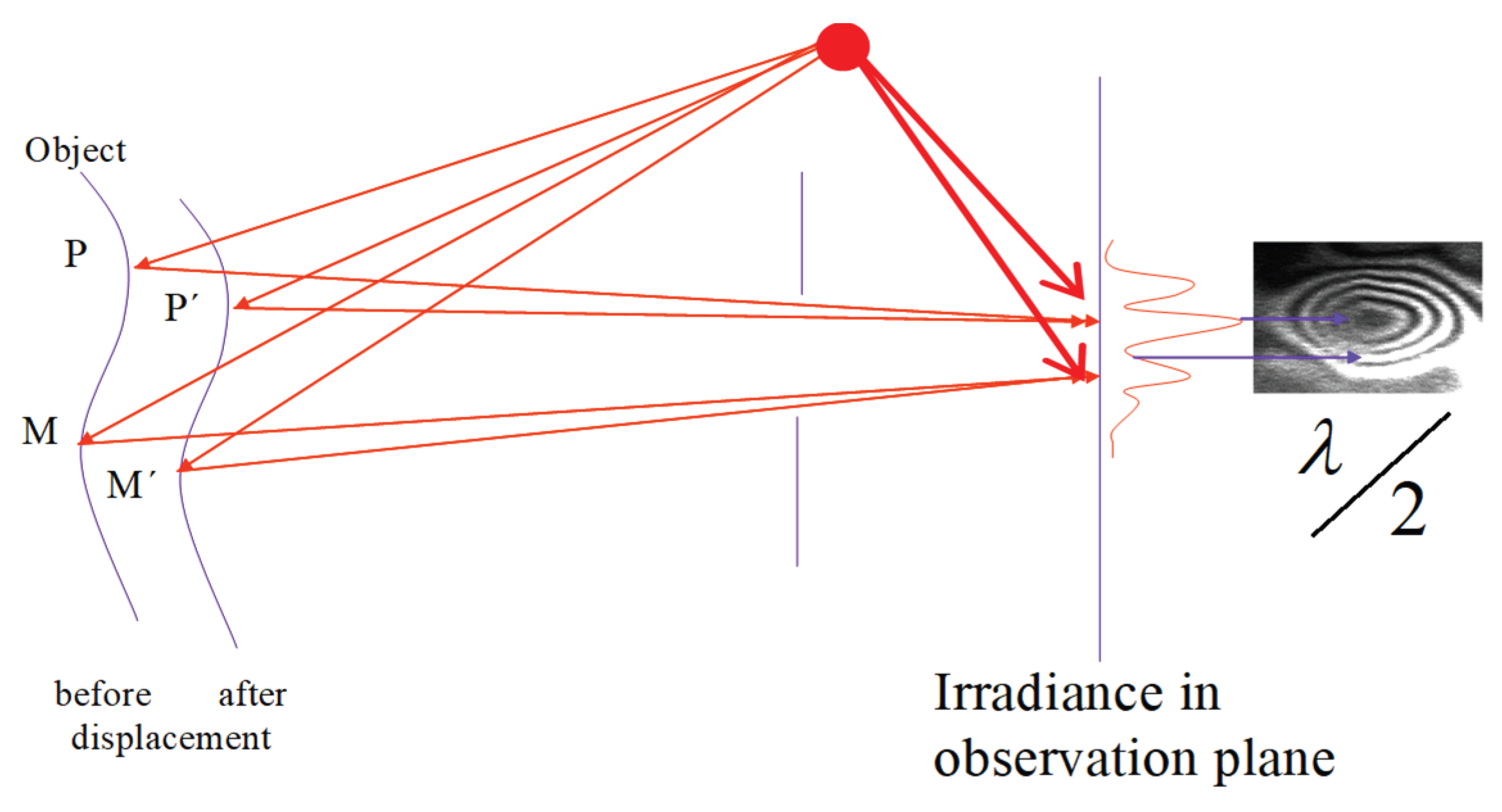
Figure 2.
Cross-section scheme showing the multi-layered stratigraphy and the inhomogeneous construction of painted surfaces.
Figure 2.
Cross-section scheme showing the multi-layered stratigraphy and the inhomogeneous construction of painted surfaces.
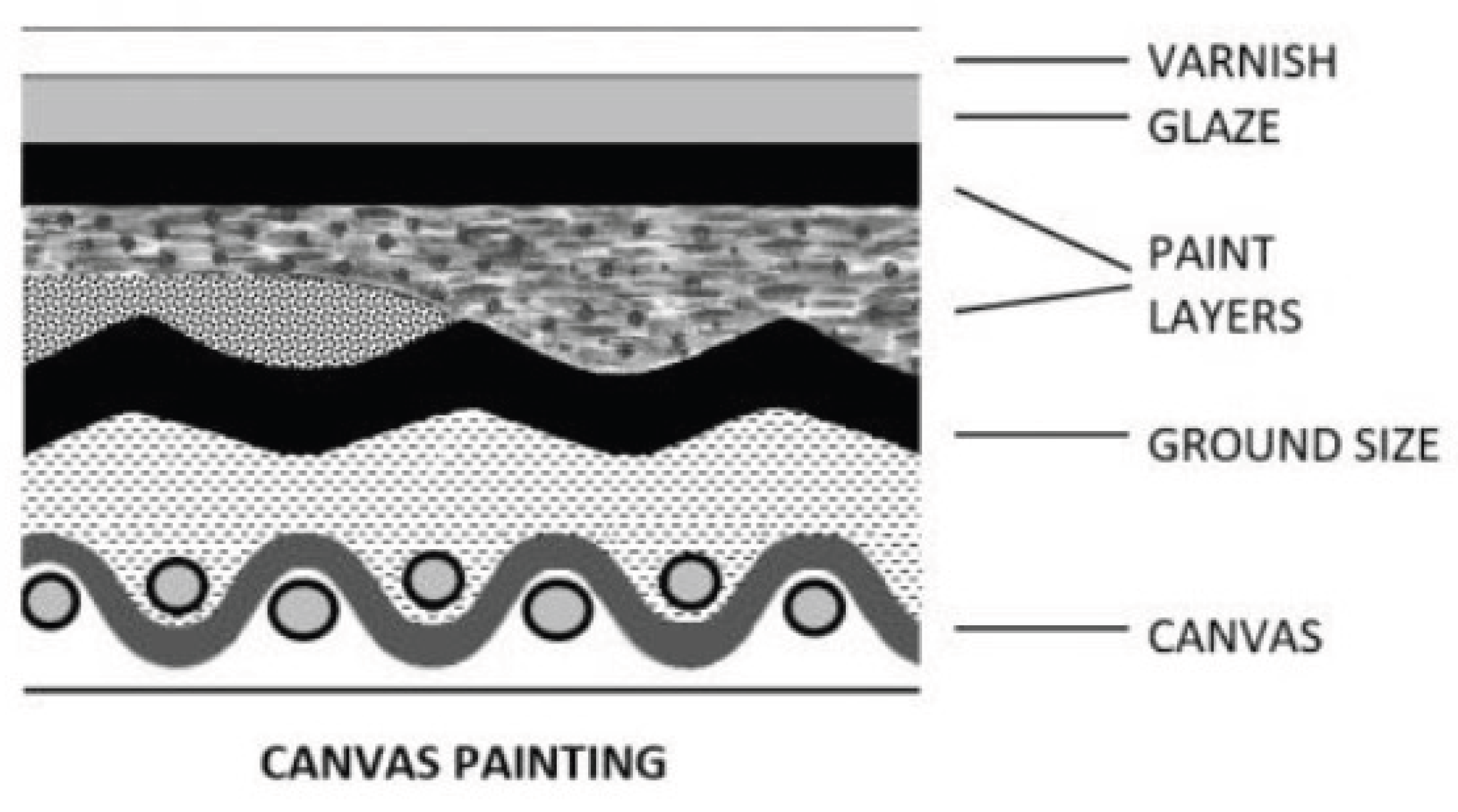
Figure 3.
Photo of DHSPI in front of a Byzantine wall-painting. In red circle is seen the head hosting optics and laser, and on side the two thermal lamps and the PC.
Figure 3.
Photo of DHSPI in front of a Byzantine wall-painting. In red circle is seen the head hosting optics and laser, and on side the two thermal lamps and the PC.
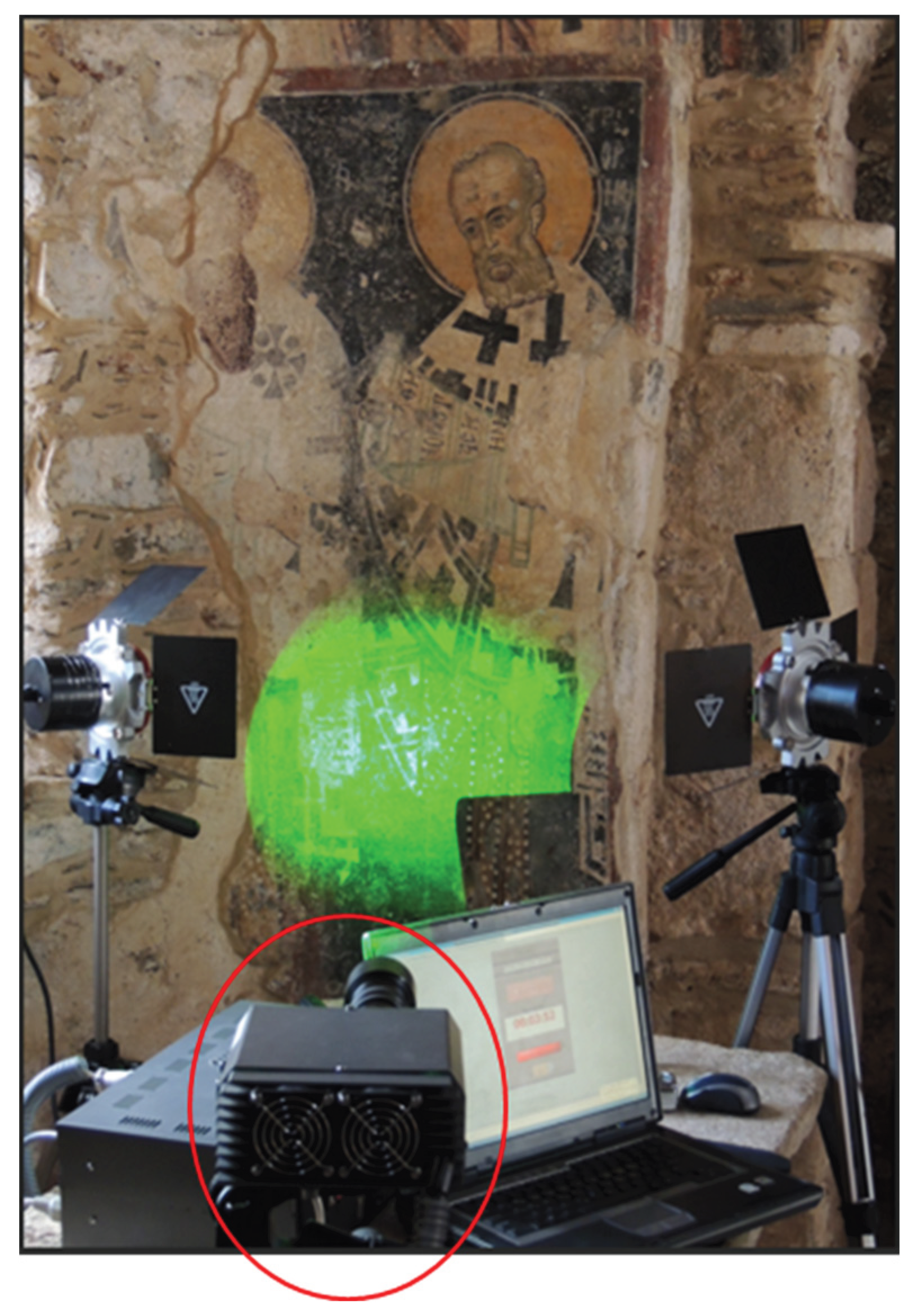
Figure 4.
a-i. Example of defect extraction from painted surface by means of DHSPI. In a) it is shown a characteristic interferogram with an invisible structured detachment with crack, b) unwrapped phase, c) defect extraction d) and e) local field for defect mapping f-h) 3D of the surface in whole field views and in i) the surface deformation (whole field) with the defect (local field) superimposed.
Figure 4.
a-i. Example of defect extraction from painted surface by means of DHSPI. In a) it is shown a characteristic interferogram with an invisible structured detachment with crack, b) unwrapped phase, c) defect extraction d) and e) local field for defect mapping f-h) 3D of the surface in whole field views and in i) the surface deformation (whole field) with the defect (local field) superimposed.
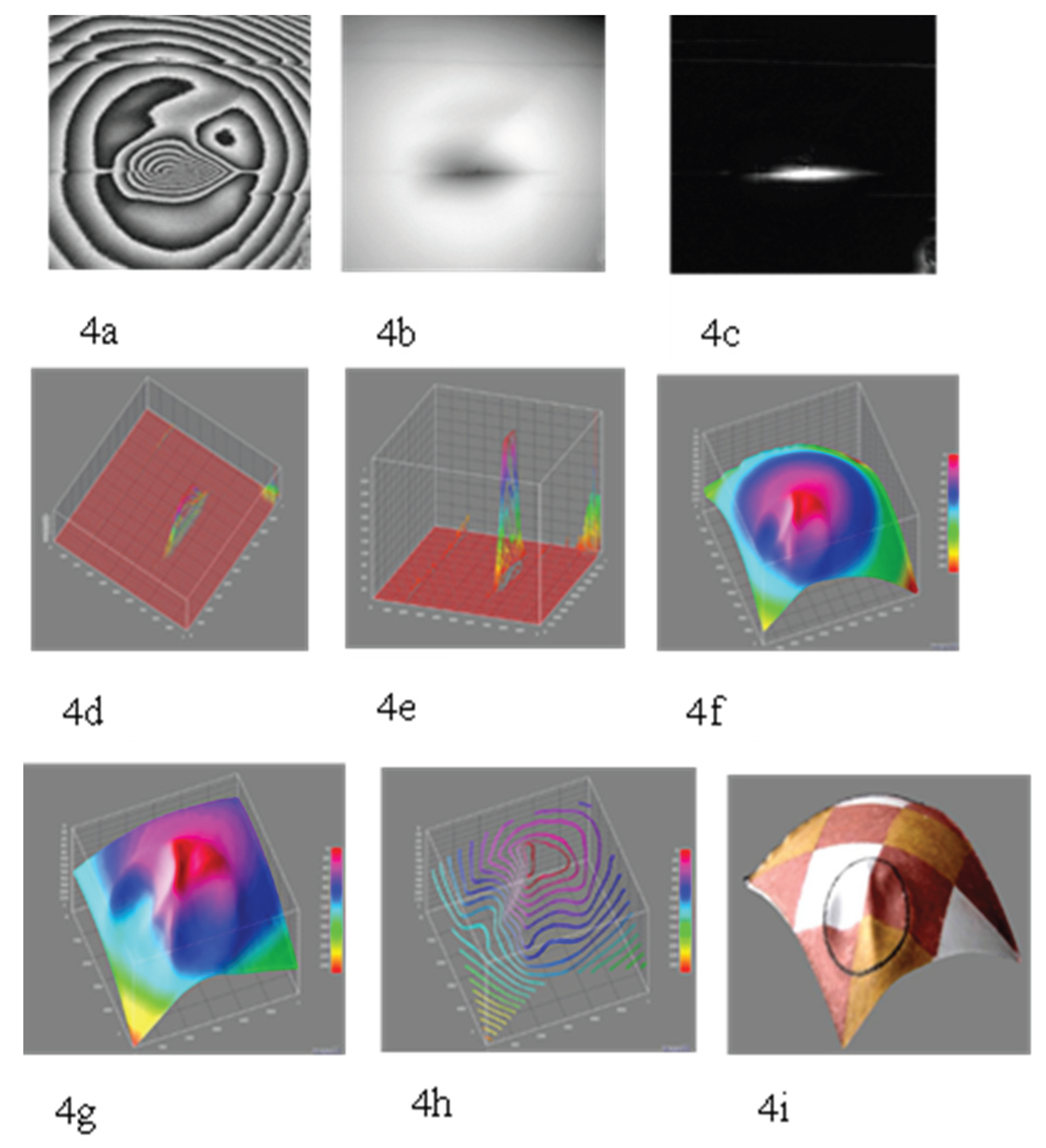
Figure 5.
In a) the off-axis optical holographic geometry for multi-channel masking procedure at recording level, OVH: Overhead, CB: Cube beam-splitter, OB: Object beams, RB: Reference beam, H: Hologram recording plane, L: Lens, M: mirror, and in b) a table with suggested vertical recording scheme with spatial selectivity within sensitivity vectors.
Figure 5.
In a) the off-axis optical holographic geometry for multi-channel masking procedure at recording level, OVH: Overhead, CB: Cube beam-splitter, OB: Object beams, RB: Reference beam, H: Hologram recording plane, L: Lens, M: mirror, and in b) a table with suggested vertical recording scheme with spatial selectivity within sensitivity vectors.
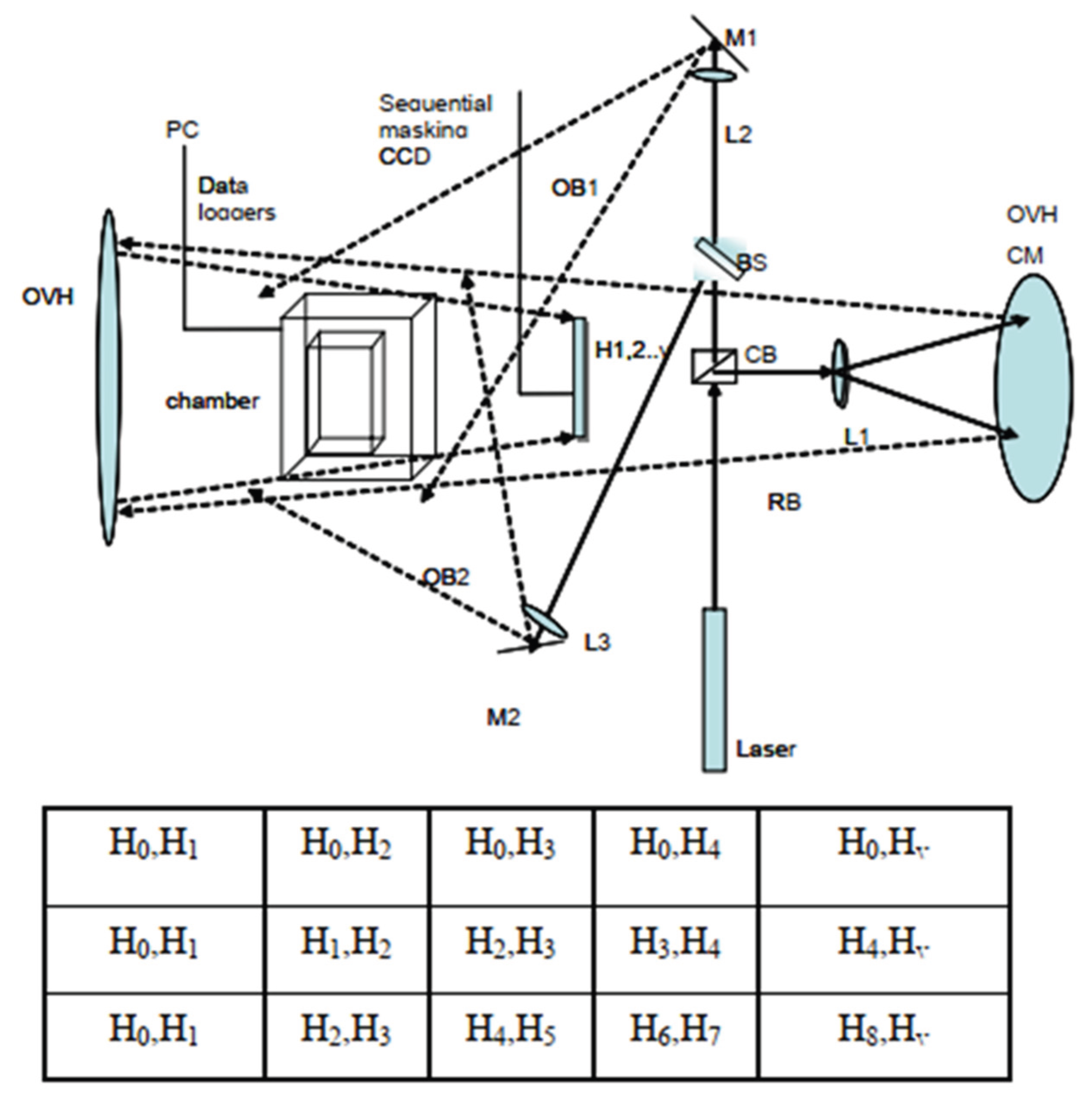
Figure 6.
Example of Byzantine icon sample used during documentation methodologies development. The diffuse laser illumination is seen to cover the full surface while two thermal lamps are implemented to stimulate displacement (in systematic seasonal monitoring methodology the samples are inside chamber).
Figure 6.
Example of Byzantine icon sample used during documentation methodologies development. The diffuse laser illumination is seen to cover the full surface while two thermal lamps are implemented to stimulate displacement (in systematic seasonal monitoring methodology the samples are inside chamber).
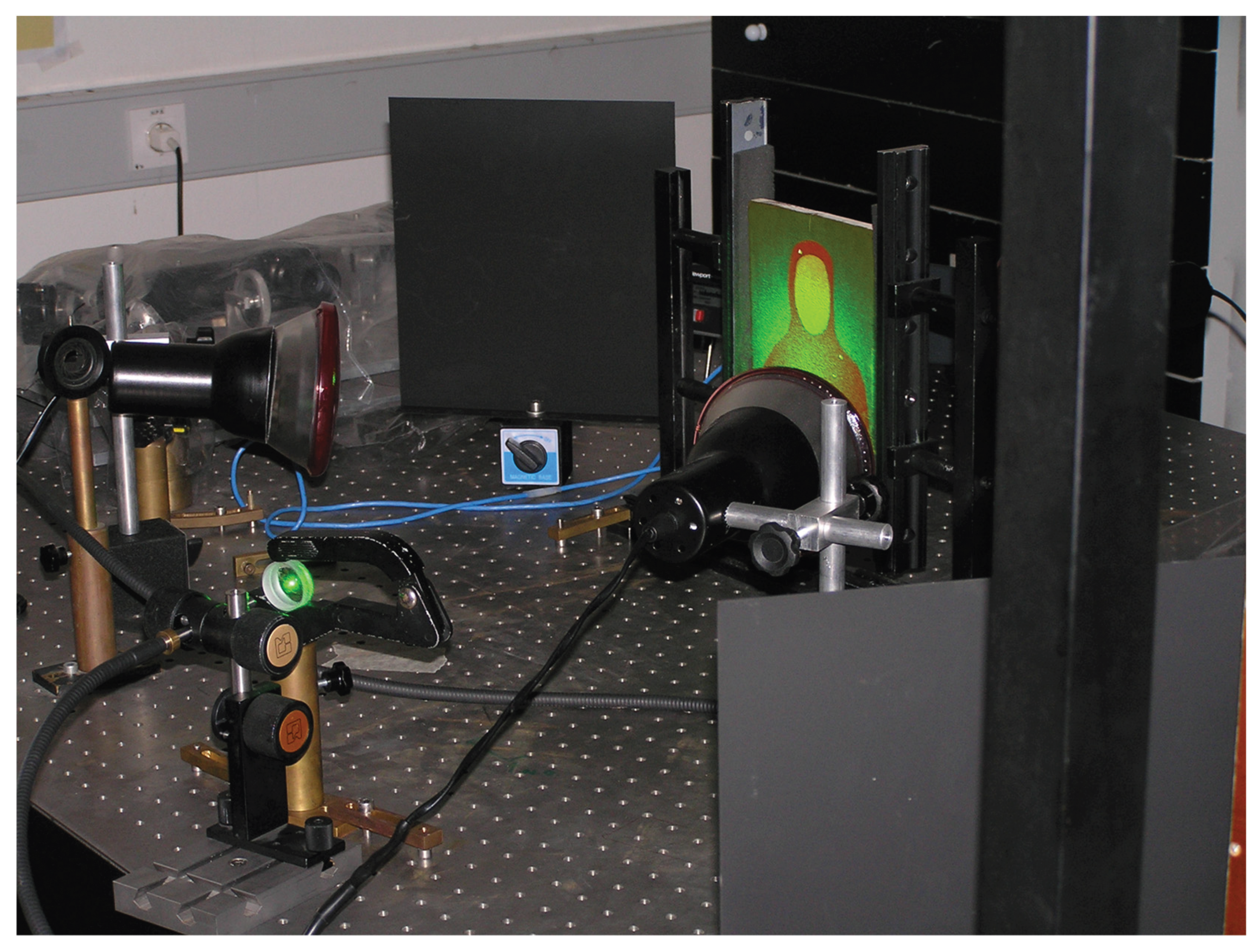

Table 1.
DHSPI Applications in paintings conservation.
| DETAILED DEFECT DOCUMENTATION | SYSTEMATIC SEASONAL MONITORING | IMPACT ASSESSMENT PROCEDURES (e.g Before-After Loan, Originality) |
CONSERVATION ACTIONS EVALUATION |
RESEARCH on handling, transporting, packaging, cleaning, etc |
Table 2.
Interferometry Application constrains vs CH inspection constrains.
| a. Environmental stability | High information content loss, measurement error by low frequency noise, sudden vibrations |
| b. Excitation amplitude limitations | Low-mild excitation safety only |
| c. Surface optical heterogeneity | No surface preparation strict |
| d. Mechanical fragility of the object | Non-contact, remote access |
Table 3.
Recording method resolution constrains.
| a. Phase-shifting accuracy |
| b. Signal-to-noise ratio of the recorded interferograms |
| c. Speckle contrast and optical coherence |
| d. Detector characteristics (pixel size, dynamic range) |
| e. Mechanical stability during acquisition |
Disclaimer/Publisher’s Note: The statements, opinions and data contained in all publications are solely those of the individual author(s) and contributor(s) and not of MDPI and/or the editor(s). MDPI and/or the editor(s) disclaim responsibility for any injury to people or property resulting from any ideas, methods, instructions or products referred to in the content. |
© 2026 by the author. Licensee MDPI, Basel, Switzerland. This article is an open access article distributed under the terms and conditions of the Creative Commons Attribution (CC BY) license.
Copyright: This open access article is published under a Creative Commons CC BY 4.0 license, which permit the free download, distribution, and reuse, provided that the author and preprint are cited in any reuse.


