
Submitted:
20 May 2026
Posted:
20 May 2026
You are already at the latest version
Abstract
Over the last two decades, social enterprises in Romania have taken on an increasingly important role in the production and provision of social goods and services for vulnerable groups. Although forms of the social economy have long existed in Romanian society, sustainability remains a constant concern, particularly in the context of dependence on European Union structural funds. This study identifies the multidimensional factors influencing the sustainability of social enterprises in Romania, combining a quantitative analysis of 121 certified social enterprises from the National Register (2016–2022) with qualitative case studies of 15 selected organisations. Revenue diversification significantly contributed to financial sustainability (β = −0.28, p < 0.01), whilst high dependence on EU funding (>50% of revenue) negatively affected long-term viability (HR = 2.18, p = 0.002). Participation in networks increased three-year survival rates from 69.8% to 87.2%. Six key sustainability strategies were identified: hybrid revenue models, integration into the value chain, community inclusion, adaptive leadership, strategic partnerships, and effective communication of results and impact. The findings confirm the absence of an integrated support framework for the sustainable activities of the social economy and, in some cases, the limited capacity of public institutions to support vulnerable groups. Policy recommendations include phased funding mechanisms, transitional support instruments and the systematic development of regional ecosystems.
Keywords:
social economy
; social enterprises
; sustainability
; Romania
; financial viability
; social impact
; dependence on EU funding
; vulnerable groups
1. Introduction
Paradoxically, although the social economy as an officially recognised sector is relatively new in Romania, there is a long tradition of structures that have been developing specific activities since the early years of the last century. Social enterprises — hybrid organisations that combine a social mission with market-oriented strategies [1,2] — address market failures in the provision of social services, whilst seeking to generate their own revenue to ensure the continuity of their activities [3,4]. The global expansion of social entrepreneurship [5] reflects the growing recognition of these organisations’ potential, yet in Romania the social economy sector only experienced rapid growth following its formal recognition through Law 219/2015 on the social economy [6], and challenges related to sustainability remain the primary concern for both practitioners and policymakers.
In Central and Eastern European (CEE) countries, the development of social enterprises takes place within unique institutional contexts, shaped by post-communist transition processes [7,8]. These contexts present both opportunities and constraints for the sustainability of social enterprises, linked to underdeveloped civil society institutions, limited social investment markets and a strong dependence on European Union structural funds [9,10]. In Romania, these dynamics are evident, with the social economy sector having experienced significant growth since the adoption of Law 219/2015, yet still facing substantial sustainability challenges. Research on the sustainability of social enterprises in transition economies remains limited, particularly regarding the complex relationships between funding sources, organisational capacity and long-term viability [11,12]. Although studies have examined individual dimensions of sustainability, comprehensive analyses addressing multidimensional sustainability in specific institutional contexts are underdeveloped [13]. The case of Romania offers valuable insights into how post-transition institutional environments shape the sustainability trajectories of social enterprises.
The social enterprise landscape in Romania comprised approximately 150 certified organisations by 2022, operating under various legal forms, including associations, foundations, cooperatives and social enterprises for professional integration (WISE) [14]. These organisations operate mainly in the fields of social services (28.9%), education and training (18.2%) and employment support (15.7%), serving vulnerable populations, including people with disabilities, the long-term unemployed and Roma communities. However, sustainability challenges persist, with the mortality rate of organisations approaching 25% in the first five years after establishment. Recent studies confirm the severity of these challenges: of the 2,908 certified social enterprises registered in Romania by 2023, approximately 90% are registered as limited liability companies — a model driven primarily by the eligibility requirements of the European Social Fund, rather than by organic development to achieve the social mission [15]. Over a third of certified social enterprises face financial difficulties as early as their first year of operation [16], which highlights the fact that the sector’s formal growth has not been accompanied by significant progress in terms of organisational sustainability. Comprehensive data on the current state of the sector confirm that, despite formal growth, only a minority of certified enterprises remain economically active and viable over time [17,18].
Sustainability in social enterprises goes beyond financial viability, encompassing multiple interdependent dimensions [19,20]. Financial sustainability requires the development of diversified revenue streams, whilst maintaining cost-effectiveness in the provision of social services [21]. Social sustainability involves demonstrating a measurable impact for the intended beneficiaries and wider communities [22]. Organisational sustainability entails building internal systems, developing human capital and maintaining institutional resilience [23]. Environmental sustainability is based on adapting to external conditions, including legislative changes, market dynamics and the expectations of stakeholders.
The European Union’s Structural Funds have significantly influenced the development of social enterprises in Central and Eastern European countries, providing crucial seed capital and capacity-building support [24,25]. However, concerns are emerging regarding the potential ‘grant dependency syndrome’, in which organisations become overly reliant on project-based funding, which could compromise long-term sustainability and focus on the social mission [26,27]. It has been found that approximately 80% of social economy entities in Romania are at high risk of bankruptcy, with only 6% of them achieving real financial sustainability [28]. The average cost of setting up a single social economy entity through EU programmes in Romania was approximately €35,000, a sum considered insufficient to establish a functional organisation [29].
Three key issues underpin this study. Firstly, existing research lacks comprehensive mixed-methods frameworks that integrate financial, social and organisational sustainability within Romanian institutional contexts. Secondly, the mechanisms through which dependence on EU funding affects organisational sustainability remain insufficiently theorised in the context of transition economies. Finally, validated sustainability measurement tools adapted to the Romanian context are lacking in the literature [30,31]. This study addresses all three critical aspects through a nationally representative mixed-methods design.
This study addresses these critical aspects through three main research questions:
RQ1: What organisational, financial and environmental factors predict multidimensional sustainability outcomes for social enterprises in Romania?
RQ2: How does dependence on EU funding (>50% of total revenue) affect long-term sustainability indicators compared to organisations with diversified funding portfolios?
RQ3: What strategies do successful social enterprises use to enhance financial resilience and operational sustainability?
This research makes a number of theoretical, methodological and practical contributions. From a theoretical perspective, it deepens the understanding of the concept of sustainability within hybrid organisations, providing empirical evidence from a specific institutional context, thereby contributing to the broader literature on social entrepreneurship in transition economies [32,33]. From a methodological perspective, the integration of register data analysis with in-depth organisational studies provides a more comprehensive understanding of the dynamics of sustainability [34,35]. From a practical perspective, the results underpin evidence-based policy recommendations, including transitional funding mechanisms and targeted regional interventions on the ecosystem [36].
2. Literature review
2.1. Theoretical Frameworks for the Sustainability of Social Enterprises
The sustainability of social enterprises has emerged as a complex theoretical construct encompassing multiple interdependent dimensions that go beyond traditional financial indicators [37,38]. The most influential theoretical framework derives from the triple bottom line concept, which assesses organisational performance across economic, social and environmental dimensions [39]. However, critics argue that this framework oversimplifies the dynamic relationships between different aspects of sustainability and fails to capture the unique challenges faced by hybrid organisations [40]. More recent theoretical approaches have expanded beyond the three dimensions to include governance and ethical dimensions.
The concept of ‘dual outcome’ was introduced [3] to highlight the tension between fulfilling the social mission and financial sustainability — often referred to as the ‘mission-market tension’ [41]. Empirical studies demonstrate that successful social enterprises develop organisational capabilities that enable the simultaneous pursuit of social and financial objectives, rather than treating them as competing priorities [42,43]. Recent theoretical developments highlight the multidimensional nature of sustainability in hybrid organisations. A comprehensive framework [2] has been proposed that incorporates financial, social, organisational and environmental dimensions, arguing that sustainability requires simultaneous attention to all four areas.
2.2. Organisational Factors in the Sustainability of Social Enterprises
Organisational capacity emerges as a critical mediating factor between external resources and sustainability outcomes. Leadership characteristics, particularly the ability to navigate between competing institutional logics, significantly influence organisational performance [44]. Research demonstrates that organisations with structured strategic planning approaches perform better across multiple dimensions of sustainability [45]. In the case of Romanian social enterprises specifically, an analysis of success factors conducted with 81 managers of non-profit organisations found that strategy and business model factors are the most influential determinants of organisational sustainability [31]. Further evidence shows that cognitive competence, social awareness and financial vulnerability statistically co-determine sustainability outcomes [46].
2.3. Sustainability Challenges in Transition Economies
Countries in Central and Eastern Europe present unique institutional contexts that shape the development trajectories of social enterprises [47,48]. The post-communist transition created institutional vacuums in the development of civil society, limiting the availability of support infrastructure for social entrepreneurship [49]. These institutional legacies continue to influence organisational behaviour and sustainability strategies decades after political transformation [50]. Levels of trust in institutions remain lower in post-transition societies, affecting stakeholder engagement and the development of partnerships, which are crucial for the sustainability of social enterprises [51]. Research indicates that social enterprises in CEE countries face greater challenges in terms of establishing legitimacy with both market actors and government institutions, compared to their counterparts in Western Europe [52]. In the Romanian context, it has been documented that limited availability of funds and low public awareness remain the main barriers to the development of social enterprises [53]. The involvement of local public administration and awareness of social issues are key factors enabling social entrepreneurs to develop viable projects [54]. A longitudinal analysis tracking the development of the social economy sector in Romania over a 15-year period confirmed that, although the number of registered entities has increased significantly, the sector continues to lack a clear legislative and institutional support framework to underpin long-term sustainability [55].
2.4. EU Funding and Issues of Dependency
The European Union's Structural Funds have played a catalytic role in the development of social enterprises in Central and Eastern European countries, providing essential seed capital and resources for capacity building [8,9]. However, concerns are emerging regarding the potential negative effects of grant dependency on organisational sustainability. 'Grant dependency syndrome' describes situations where organisations become overly reliant on project-based funding, leading to mission drift, reduced innovation incentives, and organizational instability at the end of funding cycles [26,27].
Evidence from Romania provides particularly instructive examples of these dynamics. An analysis of social enterprises funded under Priority Axis 6 of the SOP HRD found that, although EU funding enabled organisational creation, the period following the end of funding brought significant risks and instability [57]. It has been documented that, of 1,208 organisations supported by the ESF 2007–2014, only 20.86% maintained exclusively non-profit revenue models beyond the minimum sustainability period [29]. An unintended systemic effect has been identified [15]: the mandatory certification requirement in Romania for access to the ESF has led to a supply-driven development of social enterprises, in which entities were established primarily to access funds rather than to address real community needs. Research examining social enterprises in Germany has found that organisations with diversified funding portfolios demonstrate superior financial performance and greater organisational resilience [26].
3. Materials and Methods
3.1. Research Design and Philosophical Approach
The overall aim of the research was to assess the social enterprise sector in Romania in terms of its capacity to contribute to the social inclusion of disadvantaged groups and to achieve long-term sustainability. The research employed a sequential explanatory design using mixed methods [58], combining quantitative analysis of register data with qualitative case study investigations. This design was chosen because quantitative methods provide statistical scale and generalisability at the organisational level, allowing for the testing of hypotheses regarding the predictors of sustainability [59], whilst qualitative methods provide depth and contextual understanding of the mechanisms through which sustainability is achieved or compromised within specific organisational contexts [56]. The integration of these two approaches allows for complementarity: quantitative findings identify the prevalence and direction of relationships, whilst qualitative evidence highlights the processes and contextual factors that explain why these relationships occur.
The study adopts a pragmatic approach, treating both numerical models derived from register data and the narrative accounts of organisational actors as complementary sources of evidence regarding a shared empirical reality. The mixed-methods framework reflects the understanding that the sustainability of social enterprises is simultaneously a measurable organisational property and a socially constructed achievement, neither of which can be fully understood through a single mode of investigation.
3.2. Conceptual Framework and Hypotheses
Based on a review of the literature, we have developed a conceptual framework that posits that the sustainability of social enterprises results from the interaction of organisational, financial and environmental factors within specific institutional contexts (Figure 1).
The framework distinguishes four dimensions of sustainability — financial, social, organisational and environmental — each influenced by distinct sets of predictors, whilst interacting with the others through feedback processes. The framework generates four testable hypotheses:
H1: Revenue diversification (operationalised as lower Herfindahl-Hirschman Index scores) is positively associated with financial sustainability indicators.
H2: High dependence on EU funding (>50% of total revenue) is negatively associated with long-term sustainability outcomes, including organisational survival.
H3: Organisational capacity factors (staff stability, formality of governance, strategic planning) mediate the relationship between external resources and sustainability outcomes.
H4: Network participation and stakeholder engagement moderate the relationship between funding sources and organisational performance, protecting against dependency risks.
3.3. Quantitative Component
3.3.1. Data Source and Population
The quantitative analysis utilised data from the National Register of Social Enterprises in Romania, administered by the National Agency for Employment (ANOFM). The register contains comprehensive information on all certified social enterprises operating in accordance with Law 219/2015 [14], representing the most complete dataset available on the social enterprise sector in Romania. Access to the register was unrestricted and included annual financial reports, certification records, the number of employees and organisational characteristics for the period 2016–2022. All data were anonymised prior to transfer and managed in accordance with GDPR requirements.
The target population consisted of all social enterprises certified between 2016 and 2022 (N = 184). Organisations were included in the analytical sample if: (1) they maintained active certification status throughout the study period; (2) they submitted complete annual reports for at least two consecutive years; and (3) they operated independently (i.e. they were not subsidiaries of larger public or private entities). Organisations that were struck off the register due to merger, acquisition or administrative dissolution were retained in the survival analysis but excluded from the cross-sectional regression models. After applying these criteria, the analytical sample comprised 121 organisations (65.8% of the eligible population), with the remaining 63 organisations excluded mainly due to incomplete financial reporting (n = 41), loss of certification during the study period before accumulating two years of complete reporting (n = 14) and non-independent operational status (n = 8). The excluded organisations did not differ significantly from the analytical sample in terms of the available basic characteristics (legal form: χ² = 1.84, p = 0.61; region of registration: χ² = 3.21, p = 0.52), suggesting that selection bias was limited.
3.3.2. Measurement and Operationalisation of Variables
Financial sustainability was operationalised as a composite score derived from three annual indicators: (1) the ratio of revenue generated (revenue from sales, services and commercial activities) to total revenue, reflecting market orientation; (2) the operating margin (revenue minus operating costs, divided by total revenue), which reflects cost efficiency; and (3) a binary indicator of year-on-year financial growth (revenue in year t greater than revenue in year t−1). These three indicators were standardised (z-score) and summed to produce a continuous financial sustainability index (FSI), with higher values indicating stronger financial sustainability. The Cronbach’s alpha for the three-item FSI was 0.71, indicating acceptable internal consistency.
Revenue diversification was measured using the Herfindahl-Hirschman Index (HHI) calculated across five revenue categories: EU structural funds, national public grants, revenue from social services, revenue from commercial activities, and private donations/philanthropy. Lower HHI values indicate greater diversification. Dependence on EU funding was operationalised as a binary variable (1 = EU funding constitutes >50% of total revenue in a given year; 0 = otherwise), in line with the threshold used in previous studies in Romania [28,29]. Network membership was a binary indicator (1 = membership of at least one social enterprise network or a formally constituted umbrella organisation; 0 = otherwise), derived from registration statements and corroborated via the organisations’ websites. Urban setting was coded as 1 for organisations registered in municipalities with a population >20,000. The level of regional development was identified using the European Commission’s regional competitiveness index for the NUTS-2 region in which each organisation operated.
Organisational size was measured by total revenue in the reference year, and organisational age was calculated as the number of years since the first registration certificate. Staff stability was operationalised as 1 minus the annual staff turnover rate (departures divided by the average number of employees). Governance was a binary indicator derived from a documentary analysis of the existence or otherwise of a functional board of directors, distinct from operational management. Strategic planning was also binary, coded as 1 if the organisation had a written strategic plan covering a horizon of at least three years, as documented in the organisational reports submitted.
For the survival analysis, the outcome was defined as official removal from the National Register due to voluntary dissolution or administrative removal for non-compliance, as recorded in the administrative registers of ANOFM. Organisations still active at the end of the observation period (31 December 2022) were included in the analysis.
3.3.3. Statistical Analysis
Descriptive statistics characterised the sample and examined the distributions of the variables. Bivariate associations were assessed using Pearson correlations for continuous predictors and point biserial correlations for binary predictors. Multiple regression analysis tested the hypothesised relationships between sustainability predictors and the financial sustainability index, using hierarchically constructed models: Model 1 included structural controls (size, age, legal form, region); Model 2 added financial predictors (HHI, EU dependence); Model 3 added organisational capacity variables (formality of governance, strategic planning, staff stability); and Model 4 added the network membership variable. Variance inflation factors (VIFs) were examined to assess multicollinearity; all VIF values were below 3.0, indicating acceptable levels of collinearity. Residual diagnostics confirmed that the assumptions of normality and homoscedasticity were reasonably met.
Survival analysis used the Kaplan-Meier estimate to compare survival curves between subgroups defined by dependence on EU funding and network membership, with log-rank tests assessing the statistical significance of the differences. Cox proportional hazards regression modelled time to deregistration as a function of organisational predictors, with the proportional hazards assumption tested using Schoenfeld residuals. All analyses were performed using SPSS version 29.0, with a significance level of α = 0.05 and 95% confidence intervals reported throughout the study.
3.4. Qualitative Component
3.4.1. Case Selection Strategy
Qualitative case selection utilised purposive sampling to ensure maximum variation [61] across five dimensions identified as theoretically relevant following a review of the specialist literature: legal form (associations, foundations, cooperatives, WISE), geographical location (urban/rural; development region), main sector of activity, performance trajectory (improving, stable, declining — assessed based on data from the financial register) and level of dependence on EU funding. This strategy led to the selection of 15 organisations for case studies, spread across all eight NUTS-2 development regions, including three rural organisations, four WISEs and representatives from each major sector of activity. The 15 cases included 5 organisations from the high sustainability tertile of the FSI, 5 from the medium sustainability tertile and 5 from the low sustainability tertile, allowing for a theoretically grounded comparison between cases.
3.4.2. Data Collection Procedures
Data collection followed a multi-source approach, including semi-structured interviews, document analysis and observational data obtained from site visits. A total of 47 semi-structured interviews were conducted with organisation directors, board members, frontline staff and beneficiary representatives (average: 3.1 interviews per organisation; range: 2–5). The interviews lasted an average of 62 minutes and were conducted in Romanian, audio-recorded with the participants’ consent and selectively transcribed. The interview guides covered organisational history, funding strategies, governance structures, stakeholder relations, sustainability challenges and adaptive responses. Documentary sources included annual reports, strategic plans, project documentation and financial statements. Site visits (2–4 hours per organisation) provided observational data on physical infrastructure, operational processes and organisational culture. Data collection took place between November 2021 and March 2022.
3.4.3. Qualitative Analysis Procedures
The analysis of qualitative data employed a systematic thematic analysis, following Braun and Clarke’s six-phase framework [62]: familiarisation with the data, generation of initial codes, identification of themes, review of themes, definition and naming of themes, and final analysis. Coding was carried out independently by two researchers using NVivo 12 software, with an initial assessment of inter-rater reliability (Cohen’s κ = 0.74, indicating substantial agreement), followed by a consensus discussion to resolve coding discrepancies. The coding scheme was developed inductively based on the data, whilst remaining sensitive to the conceptual framework. Saturation was assessed iteratively; no substantially new codes emerged after the 11th case. Cross-case analysis utilised structured matrices comparing strategic profiles, funding structures and sustainability outcomes across the 15 organisations, enabling the identification of patterns, contrasts and configurations associated with differentiated sustainability trajectories.
3.5. Integration of Mixed Methods
The quantitative and qualitative results were integrated at two stages: (1) during case selection, where quantitative FSI scores guided purposive sampling to ensure variation in performance; and (2) during the joint display analysis (Section 4.7), where quantitative effect estimates were linked to qualitative explanations. This integration strategy follows the logic of ‘triangulation’ and ‘explanatory construction’ described in the literature [34,60], allowing quantitative findings to establish the generalisability of relationships, and qualitative findings to clarify the mechanisms that explain them.
4. Results
4.1. Sample Characteristics
The analytical sample comprised 121 certified social enterprises, representing 65.8% of all eligible organisations in Romania’s National Register. Table 1 presents the descriptive characteristics of the sample. The sample demonstrates a significant geographical concentration, with over 70% of organisations located in urban areas and nearly 40% concentrated in the three most economically developed regions (Bucharest-Ilfov, West and Centre). This geographical distribution reflects sector-level trends documented in the specialist literature: ESF funding during the 2007–2014 period was positively correlated with regional GDP per capita, rather than with development needs. Evidence at the local level in counties such as Brașov confirms that certified social enterprises remain few in number relative to the identified social needs, with the majority operating in the production of goods or specialised services for people with disabilities [63].
4.2. Results on Financial Sustainability
4.2.1. Revenue Structure and Diversification
An analysis of revenue sources reveals substantial variations in organisations’ funding portfolios (Figure 2). EU funding is the largest source of revenue, accounting on average for 47.3% of total revenue (SD = 28.9%). However, this masks considerable variation: 23 organisations (19.0%) receive less than 20% from EU sources, whilst 31 organisations (25.6%) rely on EU funding for more than 70% of their revenue. Revenue from the provision of social services accounts for an average of 28.4% of total revenue (SD = 22.1%), whilst revenue from commercial activities stands at 12.7% (SD = 14.3%). Private donations and philanthropy constitute a smaller, but by no means negligible, share for foundation-type organisations (mean = 18.2%, SD = 16.9%). Revenue diversification, measured by the HHI, averages 0.52 (SD = 0.18), indicating moderate concentration, with organisations with higher rates of revenue from activities yielding significantly lower HHI values (r = −0.63, p < 0.001).
4.2.2. Predictors of Financial Sustainability
Table 2 presents the results of the hierarchical multiple regression analysis examining the predictors of the financial sustainability index (FSI). The full model (Model 4) explains 46.7% of the variance (R² = 0.467, adjusted R² = 0.421, F(11,109) = 8.69, p < 0.001).
4.3. Results Regarding Social Sustainability
The social enterprises in the sample demonstrate a high level of interest in employing people from vulnerable groups. Of the 121 organisations, 83 (68.6%) employ at least one person from vulnerable groups (people with disabilities, the long-term unemployed, members of the Roma community or other disadvantaged groups), with an average of 32.4% of total staff coming from vulnerable groups. This figure exceeds both the national average for the employment of vulnerable groups in the private sector (estimated at approximately 12–15%) and the targets set by the European Commission for social economy entities (usually 20–30%), indicating that certified social enterprises in Romania are fulfilling their statutory obligations regarding their social mission in terms of workforce recruitment.
However, the depth and quality of labour market integration vary considerably from one organisation to another. Qualitative case analysis revealed that, in 6 of the 15 organisations studied (40%), vulnerable employees were concentrated in precarious roles, with low-skilled positions and limited opportunities for advancement, raising questions as to whether employment constitutes a genuine opportunity for inclusion or merely symbolic inclusion. Organisations in the high-sustainability tertile demonstrated not only higher rates of employment of vulnerable people (mean = 41.2% of staff, compared with 24.7% in the low-sustainability tertile; t(78) = 3.84, p < 0.001), but also superior outcomes in terms of wages (vulnerable employees earned 87% of the wages of non-vulnerable employees in organisations with high sustainability, compared to 64% in organisations with low sustainability) and access to training (2.8 days per year per vulnerable employee, compared to 1.1 days). Research on social entrepreneurship in Romania also confirms that social mission and community motivation are the main drivers of involvement in this sector, alongside a strong focus on social impact rather than financial gain [64]. The motivations behind social entrepreneurs in Romania also emphasise the creation of hybrid value, combining social inclusion with environmental sustainability objectives [74].
Organisations with formal impact measurement systems — defined as having at least two standardised indicators systematically tracked for at least two years — demonstrate superior social sustainability indicators across multiple dimensions. More specifically, they exhibit higher growth rates in the number of beneficiaries (r = 0.37, p < 0.01), a more diverse range of programmes (r = 0.33, p < 0.01) and better beneficiary retention rates (r = 0.29, p < 0.01). It is worth noting that only 34 organisations (28.1% of the sample) reported having such formal impact measurement systems in place, with adoption rates being significantly higher among organisations receiving private funding (41.2%) compared to those dependent on EU funding above the 50% threshold (18.6%; χ² = 6.84, p = 0.009).
Beyond employment outcomes, social sustainability encompasses the broader contribution of social enterprises to community well-being. In the qualitative case studies, 12 out of 15 organisations stated that they engage in unpaid community activities (free information sessions, pro bono services, community organising) that were not specified in their formal service provision contracts. Organisations with a high dependence on EU funding—over 70% of their income—were significantly less likely to report such unpaid community engagement (23.1% compared to 61.5% for organisations with an EU dependence of under 30%; χ² = 9.87, p = 0.002), suggesting that project-based funding may preclude a clear community focus.
4.4. Findings on Organisational Sustainability
Staff retention within the organisation is emerging as a significant challenge across the entire sector. The average annual staff turnover rate of 23.7% (SD = 15.2%) far exceeds typical benchmarks in the non-profit sector, which generally range between 10 and 19% in mature social economy contexts in Western Europe. This high turnover varies significantly depending on the funding model: organisations with an EU dependency of over 50% have an average turnover of 29.4% (SD = 16.8%), compared to 17.1% (SD = 12.3%) for those below the 50% threshold (t(119) = 4.32, p < 0.001). These differences highlight a structural mechanism: organisations dependent on project-based EU funding face funding gaps between grant cycles (an average gap of 4.2 months, according to 11 of the 15 organisations in the case study), which forces recurrent staff redundancies and re-hiring, undermining job stability.
The high staff turnover rate reflects a structural challenge documented more broadly within the Romanian social economy. The regression results support this interpretation: staff stability significantly predicted both financial sustainability (β = 0.20, p < 0.01) and organisational survival (HR = 0.41, p = 0.009), indicating that human capital retention is not merely a consequence but also a determining factor of sustainability.
Governance stability represents an equally important, yet less frequently examined, dimension of organisational sustainability. Of the 121 organisations, 79 (65.3%) reported having a functional board of directors, distinct from operational management, but only 41 (33.9%) maintained a consistent board composition throughout the study period, with no resignations or replacements. The turnover rate of the board of directors was significantly higher in organisations with EU dependency exceeding 50% (average annual board turnover rate = 34.2%) compared to those below this threshold (12.7%; t(119) = 5.21, p < 0.001). Organisations with stable staff (turnover <15%) and stable boards of directors (turnover <20%) demonstrated three-year survival rates of 91.7%, compared with 68.2% for organisations with high turnover in either of these categories (log-rank χ² = 7.45, p = 0.006).
Strategic planning emerged from both quantitative and qualitative aspects as a critical factor in organisational capacity. Only 54 organisations (44.6%) reported having a written strategic plan covering a period of at least three years. Of the organisations that were struck off the register during the study period, only 21.7% had such a plan at the outset, compared with 49.0% of the organisations that survived (χ² = 5.98, p = 0.014). The qualitative case studies revealed an important distinction between ‘performative planning’ (the drafting of documents for external accountability) and ‘substantive planning’ (the iterative development of strategy embedded in organisational routines) — a conceptual nuance that quantitative indicators alone cannot capture.
4.5. Survival Analysis
Table 3 presents the results of the Cox proportional hazards regression examining the predictors of organisational dissolution. Over the entire analysis period (2016–2022), 23 organisations (19.0% of the analytical sample) were officially dissolved. The Kaplan-Meier survival analysis revealed significantly higher three-year survival rates for network members (87.2%) compared with non-members (69.8%; log-rank χ² = 8.34, p = 0.004) and for organisations with EU dependency below 50% (81.4%) compared to those above 50% (64.6%; log-rank χ² = 6.92, p = 0.009) (Figure 3).
Cox regression identified network participation as reducing the risk of closure by 48% (HR = 0.52, 95% CI [0.32, 0.83], p = 0.006). Dependence on EU funding of over 50% doubled the risk of closure (HR = 2.18, 95% CI [1.24, 3.84], p = 0.002). High income concentration (HHI) tripled the risk of closure (HR = 3.06, 95% CI [1.46, 6.44], p = 0.003). Organisational size exerted a protective effect (HR = 0.73, p = 0.03), as did staff stability (HR = 0.41, p = 0.009) and the formality of governance (HR = 0.64, p = 0.04).
4.6. Qualitative Findings: Sustainability Strategies
A thematic analysis of 47 interviews conducted across the 15 organisations studied identified six main sustainability strategies used by successful social enterprises:
- Hybrid revenue-generating models: The strategic use of EU funding for capacity building and infrastructure investment, alongside the development of own revenue streams through service contracts and commercial activities. Organisations that adopted this strategy used project grants to develop their capabilities (e.g. staff training, equipment procurement), which subsequently enabled them to enter the market, rather than to cover recurring operational costs.
- Integration into the value chain: Active integration into established supply chains, alongside conventional businesses and public institutions. This strategy involved negotiating service agreements, social procurement contracts and subcontracting relationships that ensured stable and predictable income, independent of funding cycles.
- Community integration: Deep local relationships that ensure resilience through the informal mobilisation of resources, volunteer networks and community legitimacy. Organisations with strong community ties were able to leverage social capital to bridge funding gaps and attract in-kind contributions.
- Adaptive leadership: Leadership characterised by dual social and commercial skills, enabling a fluid navigation between mission imperatives and market demands. Leaders in highly sustainable organisations described the deliberate cultivation of business skills through executive education and peer learning networks.
- Strategic partnerships: Diverse cross-sector partnerships encompassing public institutions, private companies, civil society organisations and universities, creating mutually reinforcing support ecosystems that spread risk and facilitate collective advocacy.
- Impact communication: Systematic and accessible communication of social impact to attract diverse support, including funding from corporate social responsibility, social investment and favourable public procurement decisions.
4.7. Integrating Quantitative and Qualitative Results
Figure 4 presents a joint representation integrating quantitative and qualitative findings around key dimensions of sustainability. The integration reveals three main meta-inference. Whilst quantitative results show clear benefits of revenue diversification (β = −0.28, p < 0.01; HR = 3.06 for high concentration), the qualitative cases reveal that achieving diversification requires an initial investment focused on organisational capacity — a paradox that calls for patient capital instruments rather than immediate diversification mandates. The statistically significant network effect (β = 0.23; HR = 0.52) operates through three specific mechanisms: resource sharing (physical infrastructure, specialised expertise, client referrals), knowledge transfer (dissemination of best practices, collective problem-solving) and collective advocacy (joint representation in political arenas). The quantitative analysis shows the long-term negative effects of dependence on EU funding (HR = 2.18), whilst the qualitative cases demonstrate the catalytic role of EU funding when used strategically for capacity building rather than for operational support — suggesting that the critical variable is not the volume of EU funding, but its strategic application.
5. Discussion
5.1. Multidimensional Sustainability in the Institutional Context
The findings confirm the multidimensional nature of social enterprise sustainability, whilst revealing how institutional contexts shape the relative importance of different dimensions. Unlike studies in mature social enterprise ecosystems [71,72], our results demonstrate that organisational and environmental factors play a more significant role in Romanian social enterprises than purely financial considerations. The strong predictive power of network membership (β = 0.23, p < 0.01) and the qualitative emphasis on community integration reflect the enduring importance of social capital in post-transition societies [56,73]. Where formal institutions remain underdeveloped, informal networks provide essential resources for organisational survival and growth — a pattern consistent with previous findings from our research on the social economy in Romania [70], where cooperatives, mutual aid organisations and NGOs have all demonstrated that the lack of a specific legislative framework has significantly limited the sector’s development.
5.2. The EU Funding Paradox
Our findings reveal a complex relationship between EU funding and sustainability, which goes beyond mere concerns about dependency. The negative association between high dependence on EU funding and long-term sustainability (β = −0.31, p < 0.001; HR = 2.18, p = 0.002) confirms concerns expressed in previous research regarding grant dependency syndrome [66,67]. However, the qualitative analysis reveals important nuances: successful organisations use EU funding strategically as ‘patient capital’ for capacity building and market development, subsequently reducing their dependence over time. This contrasts with less successful organisations, which use EU funding primarily for operational expenditure, creating unsustainable cost structures at the end of funding cycles. Evidence from Romania on supply-driven business creation [15] — where 90% of certified entities adopted the form of a limited liability company primarily to qualify for ESF funds — illustrates the systemic failure of the path of dependence on structural funds.
5.3. Theoretical Contributions
This research contributes to the theory of hybrid organisations by demonstrating how institutional contexts shape the relative importance of different organisational capabilities [68,69]. Whilst Western research emphasises commercial competencies and market orientation, our findings suggest that social competencies — relationship building, community engagement, and network development — may be more critical in the contexts of transition economies. Comparative evidence from EU Member States with distinct cultures further confirms that social enterprise models are shaped by socio-economic and cultural factors specific to each national context [74]. The finding that economic factors are stronger predictors of social entrepreneurship activity than social factors [75] provides an important counterbalance to mission-centred sustainability narratives.
5.4. Policy Implications
The findings generate several specific policy recommendations, based directly on the empirical evidence:
Gradual funding models: Current EU funding programmes should include transition mechanisms that encourage revenue diversification, whilst providing transitional support over periods of 3–5 years.
Regional ecosystem development: The geographical concentration of social enterprises and the mismatch between the distribution of ESF funds and development needs [31] suggest an urgent need for targeted interventions in disadvantaged regions, particularly in rural areas.
Revision of the legislative and fiscal framework: A legislative package is needed to harmonise the provisions currently governing each type of social economy institution. The lack of operationalisation of responsible public procurement, dedicated national grants, reserved contracts and tax incentives remains one of the four main institutional barriers that persist despite formal legal recognition under Law 219/2015 [53]. Tax incentives for social economy institutions that employ vulnerable and severely disadvantaged people in the labour market should be linked to the social, economic and fiscal benefits of increasing the number of taxpayers contributing to the national budget.
Impact measurement mechanisms: Without standardised impact reporting requirements and without accessible support for measurement, social enterprises cannot demonstrate their value to funders, corporate partners or public procurers.
5.5. Limitations and Future Research
Several limitations must be acknowledged. Register-based sampling excludes informal social enterprises operating without certification, limiting generalisability to the formal sector. The focus on certified social enterprises excludes the wider informal social economy, estimated at 42,707 active associations and foundations in Romania [53]. The predominance of urban organisations in our sample creates a systematic under-representation of rural enterprises. The limitations of measuring social impact are also worth noting: most Romanian organisations rely on output indicators rather than outcome measures, so our assessment of social sustainability uses proxy indicators that may not capture the actual well-being of beneficiaries. Furthermore, the cross-sectional nature of the quantitative component precludes causal inference.
Future research should employ longitudinal designs that track organisations over extended periods to establish causal mechanisms. Comparative studies across Central and Eastern European countries would clarify which of our findings reflect dynamics specific to Romania and which reflect broader post-transition patterns. Experimental or quasi-experimental designs evaluating specific policy interventions would provide stronger evidence of causal effects. The dimension of environmental sustainability also deserves significantly greater attention from research: evidence shows that more than half of Romanian social enterprises do not understand the concepts of the circular economy [76], whilst integrating circular economy principles into the operations of social enterprises creates real benefits in terms of resilience [15,65,70,77].
6. Conclusions
Beyond the significant potential that social enterprises have for protecting vulnerable or disadvantaged social groups, the sector’s development faces persistent structural challenges. There is no integrated support framework to encourage the development of sustainable social economy activities, whilst the capacity of public institutions to support organisations serving vulnerable groups remains very limited.
This study analysed the challenges and opportunities related to sustainability for social enterprises in Romania from a multidimensional perspective, using a mixed-methods analysis that covered 121 organisations from the National Register and 15 in-depth case studies, supported by 47 interviews. The analysis confirms that the sustainability of social enterprises in Romania is, in essence, multidimensional, requiring simultaneous attention to financial, social, organisational and environmental factors. Revenue diversification emerges as the strongest predictor of financial sustainability (β = −0.28, p < 0.01), whilst high dependence on EU funding (>50% of revenue) significantly increases the risk of the organisation closing (HR = 2.18, p = 0.002). Participation in networks offers substantial protective effects, reducing the risk of closure by 48% (HR = 0.52, p = 0.006). Staff stability, formal governance and strategic planning further distinguish between sustainable and unsustainable organisational trajectories. The qualitative analysis identifies six key sustainability strategies: hybrid revenue models, value chain integration, community embedding, adaptive leadership, strategic partnerships and effective impact communication.
High efficiency in the absorption of structural funds depends on the quality of governance in general, and public administration institutions in particular. Without concrete measures to support the social economy sector — including a revised tax code, transitional funding mechanisms and targeted regional interventions — projects funded by structural funds risk generating temporary effects, without sustainable organisational outcomes. The transition from a grant-dependent sectoral identity to a self-sustaining one requires a ten-year commitment to building an ecosystem [53] and represents one of the most significant social policy challenges for Romania in the 2021–2027 programming cycle.
Author Contributions
conceptualisation, S.C. and D.A.N.; methodology, S.C. and N.S.; software, S.C.; validation, S.C., N.S. and D.A.N.; formal analysis, S.C. and C.C.; investigation, S.C., N.S., D.A.N. and C.C.; resources, S.C. and N.S.; data curation, S.C. and C.C.; writing—original draft preparation, S.C.; writing—review and editing, N.S., D.A.N. and C.C.; visualization, C.C.; supervision, S.C.; project administration, N.S. All authors have read and agreed to the published version of the manuscript.
Funding
This research did not receive external funding.
Institutional Review Board Statement
The study was conducted in accordance with the guidelines of the Declaration of Helsinki and was approved by the Ethics Committee of the Institute for Quality of Life Research, Romanian Academy (approval number: IQLR-EC-2022-03, approved on 15 March 2022).
Informed Consent Statement
Informed consent was obtained from all subjects involved in the study.
Data Availability Statement
The data presented in this study are available on request from the corresponding author. The data are not publicly available due to confidentiality agreements with participating organisations and data-sharing restrictions.
Disclosure regarding AI tools
The authors used Claude (Anthropic, version 3.5/4, 2024–2025) for bibliography checking, renumbering citations and assistance with manuscript formatting. The AI tool was not used for generating, analysing or interpreting data, or for substantial drafting of the research content. All scientific content, interpretations and conclusions are the sole responsibility of the authors, who have reviewed and take full responsibility for the entire content of the manuscript.
Acknowledgments
The authors would like to thank the representatives of the social enterprises who participated in this research and shared their experiences and perspectives.
Conflicts of Interest
The authors declare that there are no conflicts of interest.
References
- Defourny, J.; Nyssens, M. Fundamentals for an international typology of social enterprise models. Voluntas 2017, 28, 2469–2497. [Google Scholar] [CrossRef]
- Doherty, B.; Haugh, H.; Lyon, F. Social enterprises as hybrid organisations: A review and research agenda. Int. J. Manag. Rev. 2014, 16, 417–436. [Google Scholar] [CrossRef]
- Austin, J.; Stevenson, H.; Wei-Skillern, J. Social and commercial entrepreneurship: Same, different, or both? Entrep. Theory Pract. 2006, 30, 1–22. [Google Scholar] [CrossRef]
- Dacin, P.A.; Dacin, M.T.; Matear, M. Social entrepreneurship: Why we don’t need a new theory and how we move forward from here. Acad. Manag. Perspect. 2010, 24, 37–57. [Google Scholar]
- Nicholls, A. Social Entrepreneurship: New Models of Sustainable Social Change; Oxford University Press: Oxford, UK, 2006. [Google Scholar]
- Romanian Parliament. Law No. 219/2015 on the social economy; Official Gazette No. 561; 28 July 2015. [Google Scholar]
- Defourny, J.; Nyssens, M. Social enterprise in Central and Eastern Europe: Theory and practice. In The International Handbook on Social Innovation; Edward Elgar Publishing: Cheltenham, UK, 2013; pp. 427–441. [Google Scholar]
- Borzaga, C.; Galera, G.; Franchini, B.; Chiomento, S.; Nogales, R.; Carini, C. Social Enterprises and Their Ecosystems in Europe. Comparative Synthesis Report; Publications Office of the European Union: Luxembourg, 2020. [Google Scholar]
- European Commission. Social Enterprises and Their Ecosystems in Europe; Updated Country Report: Romania; Publications Office of the European Union: Luxembourg, 2019. [Google Scholar]
- Lambru, M.; Petrescu, C. Surviving the crisis: Work integration social enterprises and resilience in Romania. Volunt. Int. J. Volunt. Nonprofit Organ. 2014, 25, 1298–1321. [Google Scholar]
- Kerlin, J.A. Social enterprise in the United States and Europe: Understanding and learning from the differences. Voluntas 2006, 17, 246–262. [Google Scholar] [CrossRef]
- Young, D.R.; Lecy, J.D. Defining the universe of social enterprise: Competing metaphors. Voluntas 2014, 25, 1307–1332. [Google Scholar] [CrossRef]
- Molecke, G.; Pinkse, J. Accountability for social impact: A bricolage explanation of impact measurement in social enterprises. J. Bus. Ventur. 2017, 32, 550–568. [Google Scholar] [CrossRef]
- National Agency for Employment (ANOFM). National Register of Social Enterprises — Annual Report 2022; ANOFM: Bucharest, Romania, 2023. [Google Scholar]
- Barna, C.; Zbuchea, A.; Stănescu, S. Dynamics and patterns of the emerging certified social enterprise sector in Romania. In Strategica: Managing Business Transformations in Uncertain Times; Zbuchea, A., Ed.; Tritonic: Bucharest, Romania, 2023; pp. 49–60. [Google Scholar] [CrossRef]
- Tudose, M.B.; Rusu, B. Assessment of the dynamics and structure of the social economy in Romania. Procedia Soc. Behav. Sci. 2018, 238, 647–656. [Google Scholar] [CrossRef]
- OECD. Social Economy in Europe: Romania; OECD Publishing: Paris, France, 2025; Available online: https://www.oecd.org/content/dam/oecd/en/publications/reports/2025/12/social-economy-in-europe-country-notes_2a940194/romania_dd9d0241/c775e15c-en.pdf (accessed on 12 May 2026).
- ADV Romania (Alături de Voi Foundation). Barometer of the Social Economy 2025: Data and Directions for Romania’s Future; ADV Romania: Iași, Romania, 2025; Available online: https://alaturidevoi.ro/en/en-barometer-of-the-social-economy-2025-data-and-directions-for-romanias-future/ (accessed on 12 May 2026).
- Haugh, H. Social enterprise: Beyond economic outcomes and individual returns. In The Theory and Practice of Social Enterprise; Mair, J., Robinson, J., Hockerts, K., Eds.; Palgrave Macmillan: London, UK, 2006; pp. 180–205. [Google Scholar]
- Weerawardena, J.; Mort, G.S. Investigating social entrepreneurship: A multidimensional model. J. World Bus. 2006, 41, 21–35. [Google Scholar] [CrossRef]
- Rawhouser, H.; Cummings, M.; Newbert, S.L. Social impact measurement: Current approaches and future directions for social entrepreneurship research. Entrep. Theory Pract. 2019, 43, 82–115. [Google Scholar] [CrossRef]
- Battilana, J.; Lee, M. Advancing research on hybrid organising — Insights from the study of social enterprises. Acad. Manag. Ann. 2014, 8, 397–441. [Google Scholar] [CrossRef]
- Smith, W.K.; Gonin, M.; Besharov, M.L. Managing social-business tensions: A review and research agenda for social enterprise. Bus. Ethics Q. 2013, 23, 407–442. [Google Scholar] [CrossRef]
- European Parliament. Directorate-General for Internal Policies. In Social Economy; European Parliament: Brussels, Belgium, 2016. [Google Scholar]
- Monzón, J.L.; Chaves, R. Recent Evolutions of the Social Economy in the European Union; CIRIEC: Liège, Belgium, 2017. [Google Scholar]
- Spiess-Knafl, W.; Scheck, B. Impact investing: Instruments, mechanisms and actors. In Impact Investing; Palgrave Macmillan: London, UK, 2017; pp. 35–70. [Google Scholar]
- Maier, F.; Meyer, M.; Steinbereithner, M. Nonprofit organisations becoming business-like: A systematic review. Nonprofit Volunt. Sect. Q. 2016, 45, 64–86. [Google Scholar] [CrossRef]
- Dogar, C. An accounting insight on the sustainability of Romanian social economy entities. Ann. Univ. Oradea Econ. Sci. 2024, 33, 276–284. [Google Scholar] [CrossRef]
- Bucaciuc, A.; Prelipcean, G. ESF funding for social enterprise development in Romania — regional distribution. Ovidius Univ. Ann. Econ. Sci. 2022, XXII, 32–37. [Google Scholar] [CrossRef]
- Opincaru, I.-S.; Crângășu, D. Measuring the impact of a social enterprise — case study CONCORDIA Bakery, Romania. In CIRIEC Working Paper; No. 2019/15; CIRIEC — Université de Liège: Liège, Belgium, 2019. [Google Scholar] [CrossRef]
- Ceptureanu, S.; Ceptureanu, E.; Bogdan, V.L.; Rădulescu, V. Sustainability perceptions in Romanian non-profit organisations: An exploratory study using success factor analysis. Sustainability 2018, 10, 294. [Google Scholar] [CrossRef]
- Zahra, S.A.; Gedajlovic, E.; Neubaum, D.O.; Shulman, J.M. A typology of social entrepreneurs: Motives, search processes and ethical challenges. J. Bus. Ventur. 2009, 24, 519–532. [Google Scholar] [CrossRef]
- Mair, J.; Martí, I. Social entrepreneurship research: A source of explanation, prediction, and delight. J. World Bus. 2006, 41, 36–44. [Google Scholar] [CrossRef]
- Creswell, J.W.; Plano Clark, V.L. Designing and Conducting Mixed Methods Research, 3rd ed.; SAGE Publications: Thousand Oaks, CA, USA, 2017. [Google Scholar]
- Tashakkori, A.; Teddlie, C. SAGE Handbook of Mixed Methods in Social and Behavioural Research, 2nd ed.; SAGE Publications: Thousand Oaks, CA, USA, 2010. [Google Scholar]
- European Economic and Social Committee. Recent Evolutions of the Social Economy in the European Union; EESC: Brussels, Belgium, 2017. [Google Scholar]
- Elkington, J. Cannibals with Forks: The Triple Bottom Line of 21st Century Business; New Society Publishers: Gabriola Island, BC, Canada, 1997. [Google Scholar]
- Slaper, T.F.; Hall, T.J. The triple bottom line: What is it and how does it work? Ind. Bus. Rev. 2011, 86, 4–8. [Google Scholar]
- Savitz, A.W.; Weber, K. The Triple Bottom Line; Jossey-Bass: San Francisco, CA, USA, 2006. [Google Scholar]
- Norman, W.; MacDonald, C. Getting to the bottom of “triple bottom line”. Bus. Ethics Q. 2004, 14, 243–262. [Google Scholar] [CrossRef]
- Santos, F.; Pache, A.C.; Birkholz, C. Making hybrids work: Aligning business models and organisational design for social enterprises. Calif. Manag. Rev. 2015, 57, 36–58. [Google Scholar] [CrossRef]
- Pache, A.C.; Santos, F. Inside the hybrid organisation: Selective coupling as a response to competing institutional logics. Acad. Manag. J. 2013, 56, 972–1001. [Google Scholar] [CrossRef]
- Jay, J. Navigating paradox as a mechanism of change and innovation in hybrid organisations. Acad. Manag. J. 2013, 56, 137–159. [Google Scholar] [CrossRef]
- Besharov, M.L.; Smith, W.K. Multiple institutional logics in organisations: Explaining their varied nature and implications. Acad. Manag. Rev. 2014, 39, 364–381. [Google Scholar] [CrossRef]
- Weerawardena, J.; Mort, G.S. Competitive strategy in socially entrepreneurial non-profit organisations: Innovation and differentiation. J. Public Policy Mark. 2012, 31, 91–101. [Google Scholar] [CrossRef]
- Ceptureanu, S.I.; Ceptureanu, E.G.; Orzan, M.; Marin, I. Toward a Romanian nonprofit sustainability model: Determinants of sustainability. Sustainability 2017, 9, 966. [Google Scholar] [CrossRef]
- Galera, G.; Borzaga, C. Social enterprise: An international overview of its conceptual evolution and legal implementation. Soc. Enterp. J. 2009, 5, 210–228. [Google Scholar] [CrossRef]
- Kerlin, J.A. A comparative analysis of the global emergence of social enterprise. Voluntas 2010, 21, 162–179. [Google Scholar] [CrossRef]
- Howard, M.M. The Weakness of Civil Society in Post-Communist Europe; Cambridge University Press: Cambridge, UK, 2003. [Google Scholar]
- Greskovits, B. The hollowing and backsliding of democracy in East Central Europe. Glob. Policy 2015, 6, 28–37. [Google Scholar] [CrossRef]
- Ekiert, G.; Foa, R. The Weakness of Postcommunist Civil Society Reassessed. In Carlo Alberto Notebooks No. 198; Collegio Carlo Alberto: Moncalieri, Italy, 2011. [Google Scholar]
- Defourny, J.; Nyssens, M. The EMES approach to social enterprise in a comparative perspective. In Social Enterprise and the Third Sector; Routledge: London, UK, 2012; pp. 42–65. [Google Scholar]
- Lambru, M.; Petrescu, C. The role of social enterprises in the Romanian social protection system. In CIRIEC Working Paper; No. 2019/17; CIRIEC — Université de Liège: Liège, Belgium, 2019. [Google Scholar] [CrossRef]
- Schin, G.C.; Cristache, N.; Matiș, C. Fostering social entrepreneurship through public administration support. Int. Entrep. Manag. J. 2023, 19, 481–500. [Google Scholar] [CrossRef]
- Mitrea, G. Social economy in post-communist Romania: Current challenges and future social policies. Probl. Polityki Społecznej Stud. Dyskusje 2022, 58, 1–20. [Google Scholar] [CrossRef]
- Kraatz, M.S.; Block, E.S. Organisational implications of institutional pluralism. In The SAGE Handbook of Organisational Institutionalism; SAGE Publications: London, UK, 2008; pp. 243–275. [Google Scholar]
- Neguţ, A. Introductory aspects regarding the sustainability of social enterprises. J. Community Posit. Pract. 2014, XIV(4), 21–33. [Google Scholar]
- Creswell, J.W. A Concise Introduction to Mixed Methods Research; SAGE Publications: Thousand Oaks, CA, USA, 2015. [Google Scholar]
- Johnson, R.B.; Onwuegbuzie, A.J. Mixed methods research: A research paradigm whose time has come. Educ. Res. 2004, 33, 14–26. [Google Scholar] [CrossRef]
- Greene, J.C.; Caracelli, V.J.; Graham, W.F. Toward a conceptual framework for mixed-method evaluation designs. Educ. Eval. Policy Anal. 1989, 11, 255–274. [Google Scholar] [CrossRef]
- Patton, M.Q. Qualitative Research and Evaluation Methods, 4th ed.; SAGE Publications: Thousand Oaks, CA, USA, 2015. [Google Scholar]
- Braun, V.; Clarke, V. Using thematic analysis in psychology. Qual. Res. Psychol. 2006, 3, 77–101. [Google Scholar] [CrossRef]
- Gotea, M. Social problems and innovative solutions: Social entrepreneurship in Brasov County, Romania. In Strategic Innovative Marketing and Tourism; Kavoura, A., Borges-Tiago, T., Tiago, F., Eds.; Springer: Cham, Switzerland, 2024; pp. 585–593. [Google Scholar] [CrossRef]
- Barna, C.; Rebeleanu, A.; Zbuchea, A.; Stănescu, S. Profiling the Romanian woman social entrepreneur: An analysis of the women’s perspective in the social enterprises’ sector. In CIRIEC Work. Pap.; No. 2024/05; CIRIEC — Université de Liège: Liège, Belgium, 2024. [Google Scholar] [CrossRef]
- Zbuchea, A.; Barna, C.; Stănescu, S.; Pînzaru, F. Exploring the motivations behind circular social entrepreneurs in Romania. In Entrepreneurial Motivations; Valeri, M., Ed.; Springer: Cham, Switzerland, 2024; pp. 191–203. [Google Scholar] [CrossRef]
- Barraket, J.; Collyer, N.; O’Connor, M.; Anderson, H. Finding Australia's Social Enterprise Sector: Final Report; Australian Centre for Philanthropy and Nonprofit Studies: Brisbane, Australia, 2010. [Google Scholar]
- Teasdale, S.; Lyon, F.; Baldock, R. Playing with numbers: A methodological critique of the social enterprise growth myth. J. Soc. Entrep. 2013, 4, 113–131. [Google Scholar] [CrossRef]
- Lin, N. Social Capital: A Theory of Social Structure and Action; Cambridge University Press: Cambridge, UK, 2001. [Google Scholar]
- Coleman, J.S. Social capital in the creation of human capital. Am. J. Sociol. 1988, 94, S95–S120. [Google Scholar] [CrossRef]
- Cace, S.; Arpinte, D.; Cace, C.; Cojocaru, S. The social economy: An integrative approach. Transylv. Rev. Adm. Sci. 2011, 33E, 49–66. [Google Scholar]
- Frumkin, P.; Andre-Clark, A. When missions, markets, and politics collide: Values and strategy in the nonprofit human services. Nonprofit Volunt. Sect. Q. 2000, 29, 141–163. [Google Scholar] [CrossRef]
- Young, D.R. Alternative models of government-nonprofit sector relations: Theoretical and international perspectives. Nonprofit Volunt. Sect. Q. 2000, 29, 149–172. [Google Scholar] [CrossRef]
- Skelcher, C.; Smith, S.R. Theorising hybrids: Institutional logics, complex organisations, and actor identities: The case of non-profits. Public Adm. 2015, 93, 433–448. [Google Scholar] [CrossRef]
- D’Alessio, A.; Zbuchea, A.; Scaletti, A. The influence of cultural dimensions on social enterprise models: A comparative study between Italy and Romania. Civ. Szle. 2024, 21, 181–194. [Google Scholar] [CrossRef]
- Fernández-Guadaño, J.; Montes Diez, R. The impact of social entrepreneurship in ten EU countries with favourable regulations. J. Knowl. Econ. 2024, 15, 10781–10798. [Google Scholar] [CrossRef]
- Gorgon, M.I.; Bercea, O.B.; Păcurariu, R.L.; Boşcoianu, M. Social economy and the transition towards circular economy: A survey-based approach. Econ. Ecol. Socium 2024, 8, 98–110. [Google Scholar] [CrossRef]
- Barna, C.; Zbuchea, A.; Stănescu, S. Social economy enterprises contributing to the circular economy and the green transition in Romania. CIRIEC-España Rev. Econ. Pública Soc. Coop. 2023, 107, 47–69. [Google Scholar] [CrossRef]
Figure 1.
Conceptual framework for the sustainability of social enterprises in Romania.
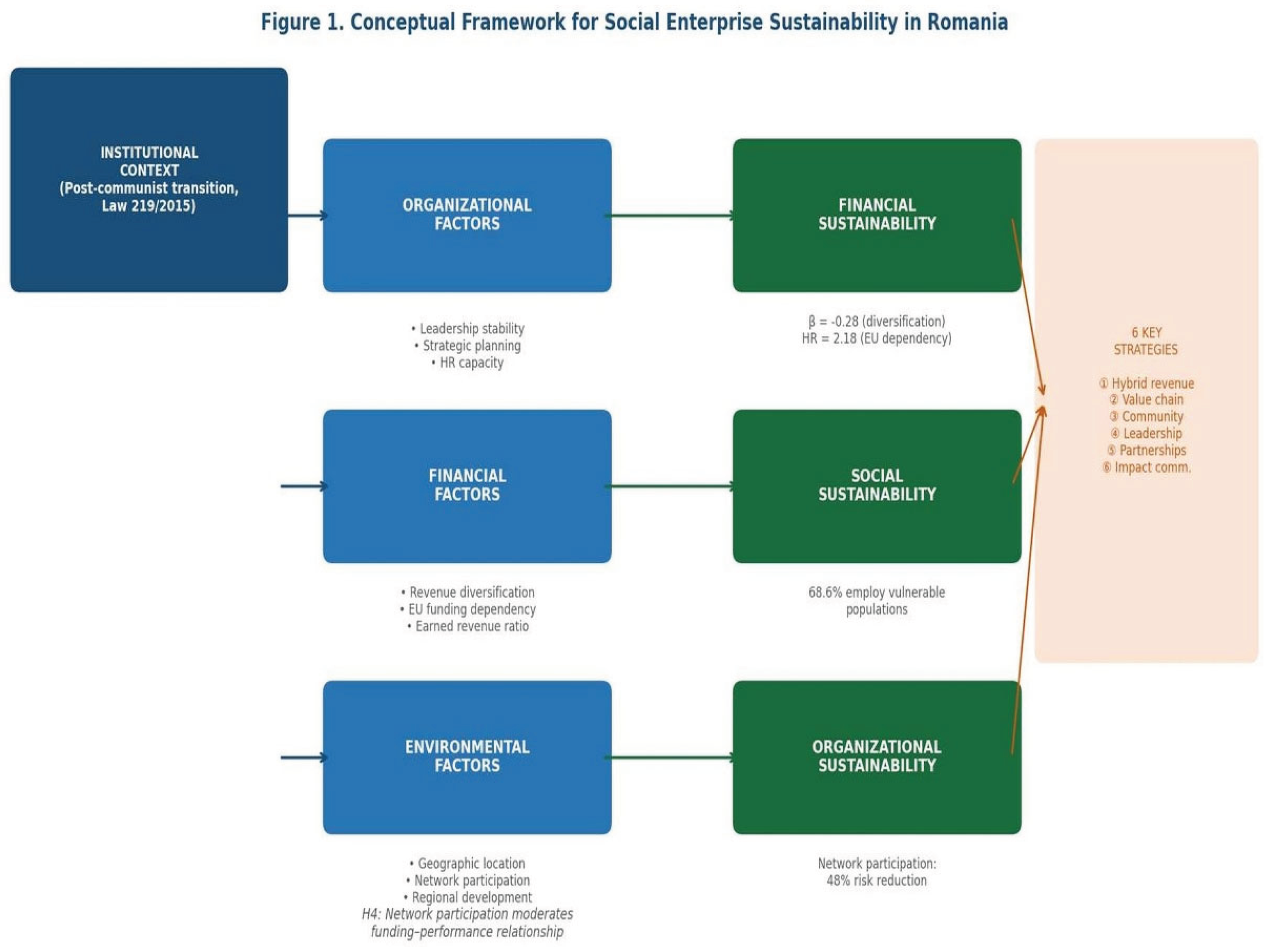
Figure 2.
Distribution of revenue structure among 121 social enterprises in Romania (2020–2022).
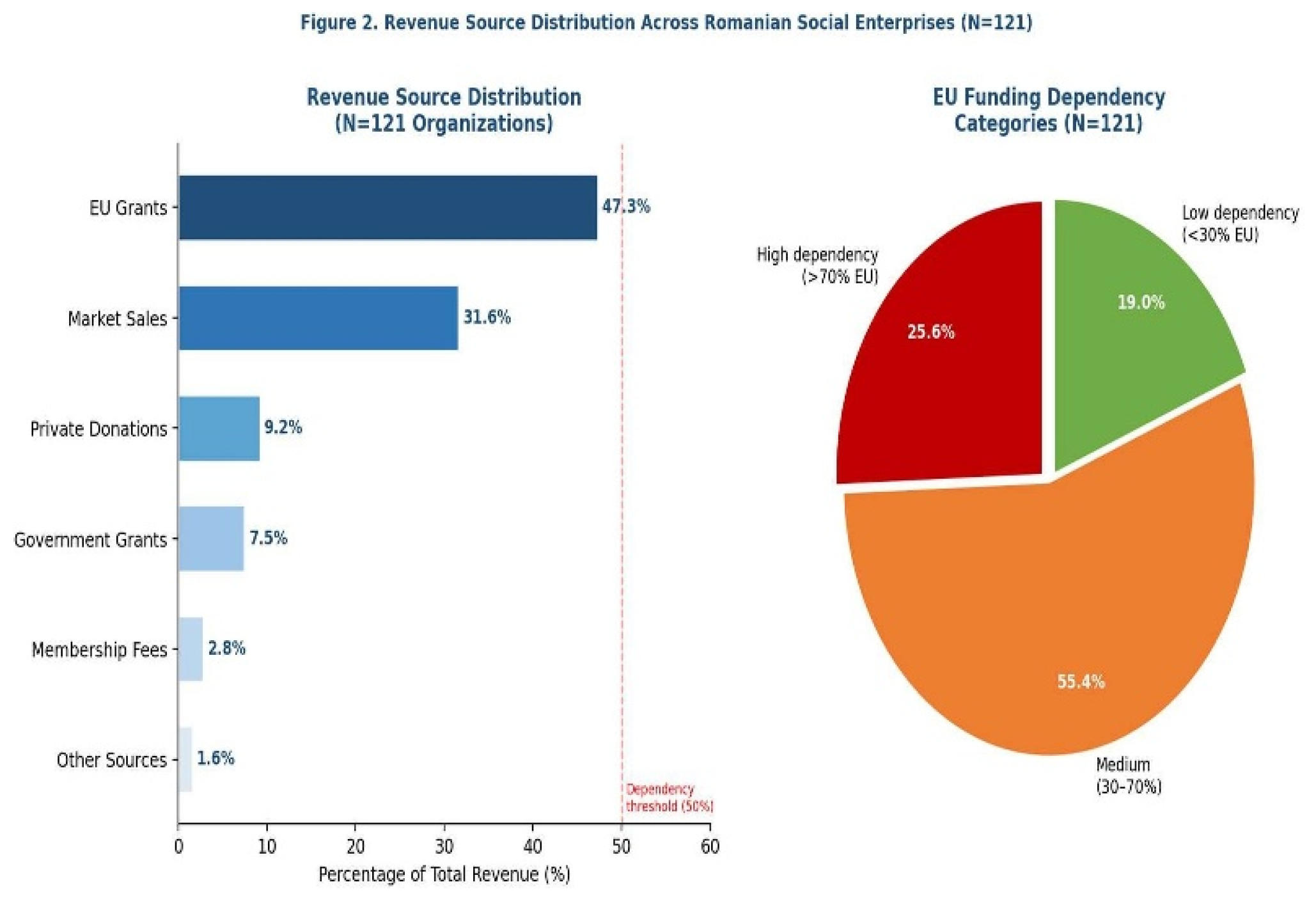
Figure 3.
Kaplan-Meier survival curves according to funding dependence (above/below 50% EU) and network membership.
Figure 3.
Kaplan-Meier survival curves according to funding dependence (above/below 50% EU) and network membership.
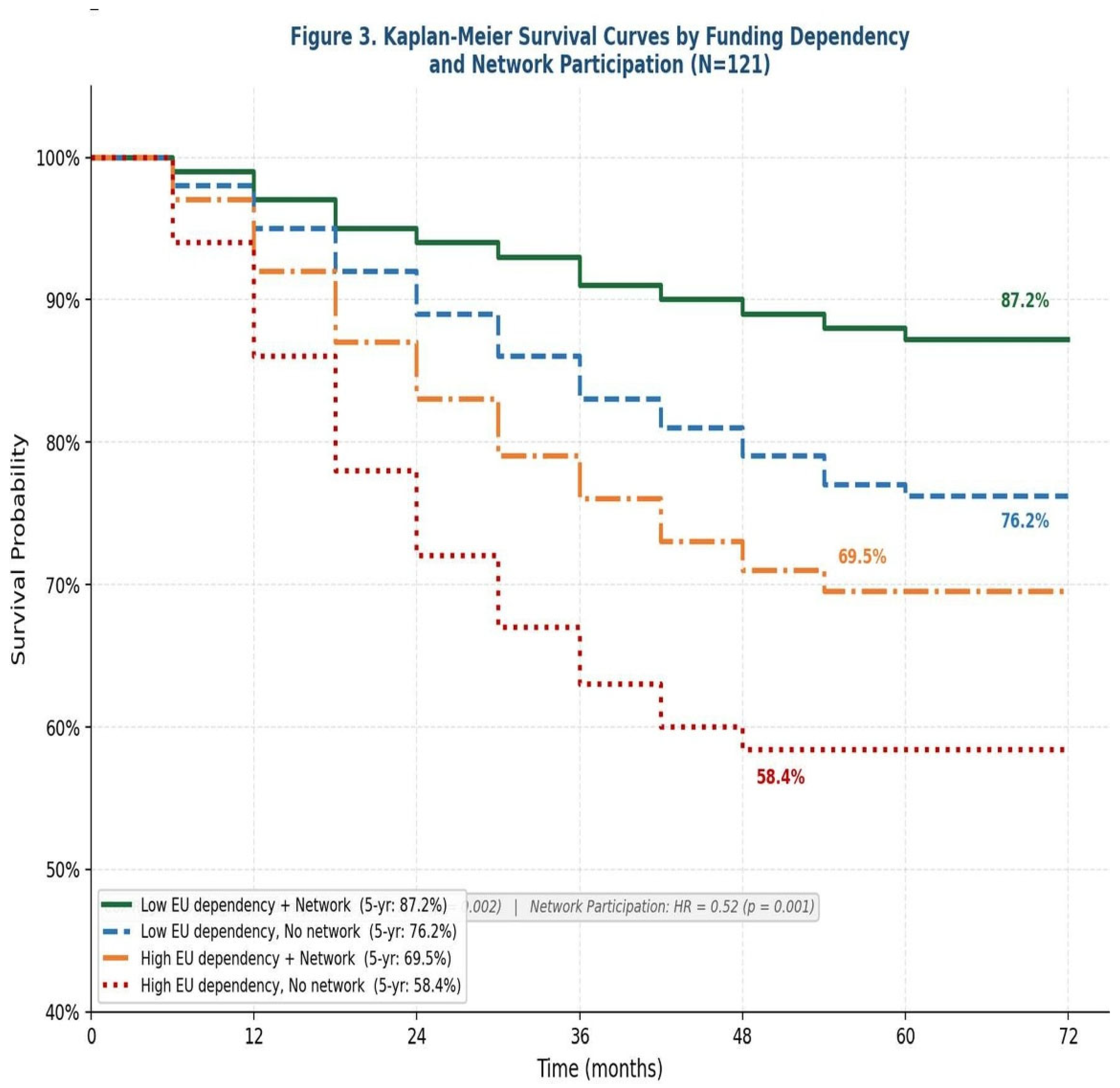
Figure 4.
Joint presentation of mixed-methods results: quantitative estimates of effects and qualitative explanatory mechanisms across sustainability dimensions.
Figure 4.
Joint presentation of mixed-methods results: quantitative estimates of effects and qualitative explanatory mechanisms across sustainability dimensions.
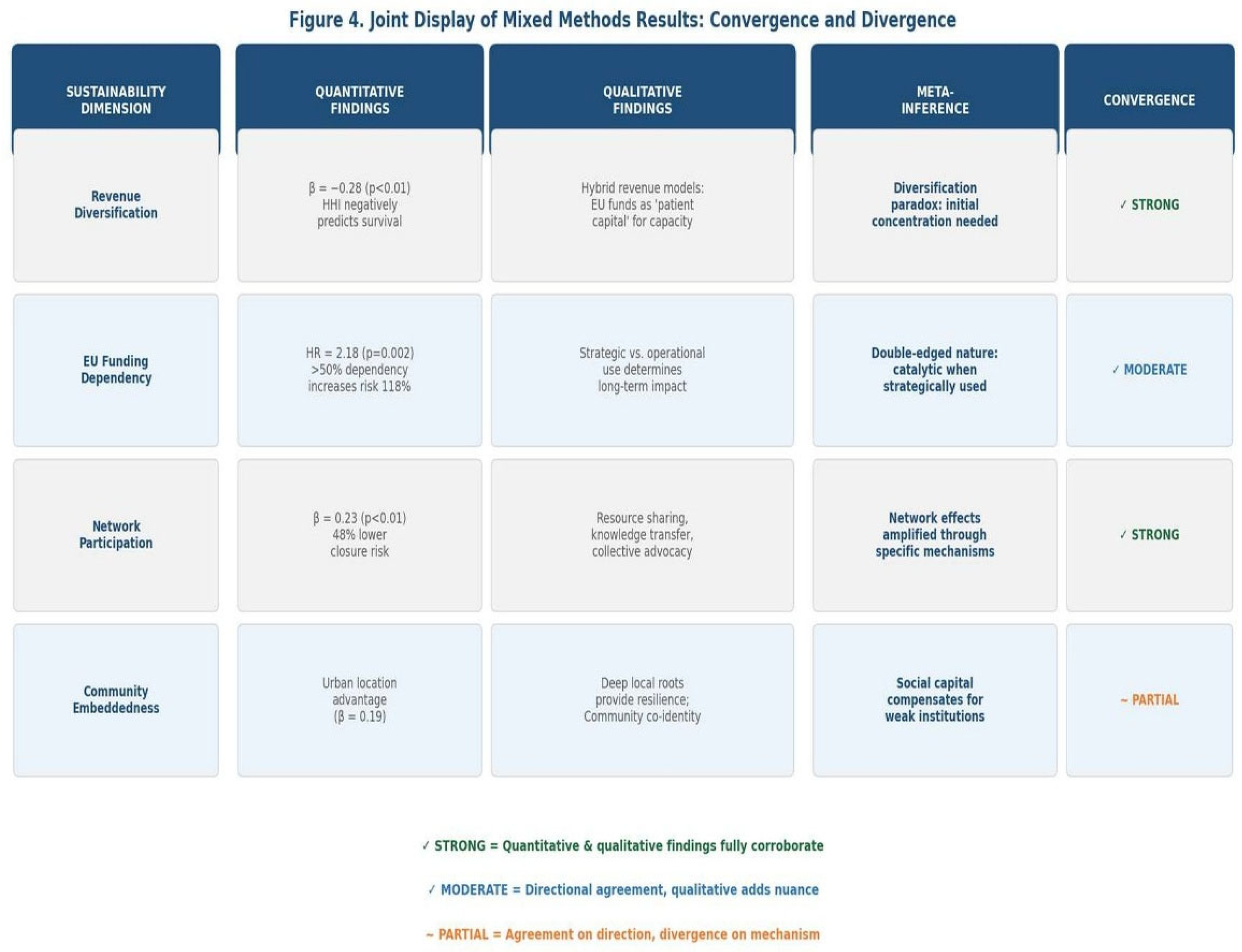

Table 1.
Descriptive characteristics of the analytical sample (N = 121).
| Characteristic | N | % | Mean (SD) |
|---|---|---|---|
| Legal form | |||
| Association | 52 | 43.0 | |
| Foundation | 28 | 23.1 | |
| Cooperative | 21 | 17.4 | |
| SE Professional Integration (WISE) | 20 | 16.5 | |
| Development region | |||
| Bucharest-Ilfov | 24 | 19.8 | |
| Southern Muntenia | 14 | 11.6 | |
| North-West | 18 | 14.9 | |
| Central | 16 | 13.2 | |
| North-East | 13 | 10.7 | |
| West | 12 | 9.9 | |
| South-East | 12 | 9.9 | |
| South-west Oltenia | 12 | 9.9 | |
| Residential environment | |||
| Urban | 87 | 71.9 | |
| Rural | 34 | 28.1 | |
| Main sector of activity | |||
| Social services | 35 | 28.9 | |
| Education and training | 22 | 18.2 | |
| Employment support | 19 | 15.7 | |
| Healthcare | 14 | 11.6 | |
| Cultural/creative | 11 | 9.1 | |
| Agriculture/food | 20 | 16.5 | |
| Continuous variables | |||
| Age of organisation (years) | 4.2 (2.1) | ||
| Total annual revenue (€) | 87,340 (112,420) | ||
| Number of employees (FTE) | 8.3 (7.1) | ||
| Annual staff turnover rate (%) | 23.7 (15.2) | ||
| Share of EU funding in revenue (%) | 47.3 (28.9) | ||
| Revenue diversification (HHI) | 0.52 (0.18) | ||
| Key organisational characteristics | |||
| Number of network members | 68 | 56.2 | |
| Dependence on the EU (>50% of revenue) | 64 | 52.9 | |
| Official Board of Directors | 79 | 65.3 | |
| Written strategic plan | 54 | 44.6 | |
| Employs vulnerable people | 83 | 68.6 |
Notes: HHI = Herfindahl-Hirschman Index (0 = perfect diversification, 1 = total concentration); FTE = full-time equivalent; SE = social enterprise.
Table 2.
Results of the hierarchical multiple regression: predictors of the financial sustainability index (N = 121).
Table 2.
Results of the hierarchical multiple regression: predictors of the financial sustainability index (N = 121).
| Variable | Model 1 β | Model 2 β | Model 3 β | Model 4 β | VIF |
|---|---|---|---|---|---|
| Structural controls | |||||
| Age of the organisation | 0.09 | 0.07 | 0.06 | 0.05 | 1.18 |
| Revenue | 0.18 * | 0.14 * | 0.12 | 0.11 | 1.43 |
| Urban location | 0.14 * | 0.11 | 0.09 | 0.08 | 1.31 |
| Regional competitiveness index | 0.16 * | 0.13 * | 0.11 | 0.10 | 1.27 |
| Financial indicators | |||||
| HHI (income diversification) a | −0.28 ** | −0.25 ** | −0.28 ** | 1.52 | |
| Dependence on the EU (>50%) b | −0.36 *** | −0.32 *** | −0.31 *** | 1.64 | |
| Organisational capacity | |||||
| Formal governance b | 0.19 * | 0.17 | 1.38 | ||
| Strategic planning b | 0.16 * | 0.15 * | 1.29 | ||
| Staff stability (1 − staff turnover) | 0.21 | 0.20 ** | 1.41 | ||
| Network variable | |||||
| Network membership b | 0.23 ** | 1.35 | |||
| Model fit | |||||
| R² | 0.112 | 0.298 | 0.421 | 0.467 | |
| Adjusted R² | 0.080 | 0.258 | 0.374 | 0.421 | |
| ΔR² | 0.112 * | 0.186 *** | 0.123 *** | 0.046 ** | |
| F for ΔR² | 3.71 * | 15.84 *** | 8.79 *** | 9.41 ** |
Notes: Standardised regression coefficients (β) are reported. a Continuous variable; lower HHI = greater diversification. b Binary variable (0/1). * p < 0.05; ** p < 0.01; *** p < 0.001. VIF = Variance Inflation Factor; all values below 3.0 indicate acceptable multicollinearity.
Table 3.
Cox proportional hazards regression: predictors of organisational dissolution (N = 121; events = 23).
Table 3.
Cox proportional hazards regression: predictors of organisational dissolution (N = 121; events = 23).
| Variable | b (SE) | HR | 95% CI | p |
|---|---|---|---|---|
| Structural controls | ||||
| Age of the organisation | −0.08 (0.06) | 0.92 | [0.82, 1.04] | 0.18 |
| Logarithmic revenue (scale) | −0.31 (0.14) | 0.73 | [0.55, 0.97] | 0.03 * |
| Urban location | −0.24 (0.18) | 0.79 | [0.55, 1.12] | 0.19 |
| Financial predictors | ||||
| HHI (diversification) a | 1.12 (0.38) | 3.06 | [1.46, 6.44] | 0.003 ** |
| Dependence on the EU (>50%) b | 0.78 (0.29) | 2.18 | [1.24, 3.84] | 0.002 ** |
| Organisational capacity | ||||
| Staff stability | −0.89 (0.34) | 0.41 | [0.21, 0.80] | 0.009 ** |
| Formal governance b | −0.44 (0.22) | 0.64 | [0.42, 0.99] | 0.04 * |
| Network variable | ||||
| Network membership b | −0.66 (0.24) | 0.52 | [0.32, 0.83] | 0.006 ** |
| Model fit | ||||
| Overall χ² (df = 8) | 31.42 | <0.001 *** | ||
| Nagelkerke R² | 0.38 |
Notes: b = unstandardised log-hazard ratio; SE = standard error; HR = hazard ratio; CI = confidence interval. a Continuous; higher HHI = higher concentration = higher hazard. b Binary (0/1). The assumption of proportional hazards was tested using Schoenfeld residuals (global test p = 0.41). * p < 0.05; ** p < 0.01; *** p < 0.001.
Disclaimer/Publisher’s Note: The statements, opinions and data contained in all publications are solely those of the individual author(s) and contributor(s) and not of MDPI and/or the editor(s). MDPI and/or the editor(s) disclaim responsibility for any injury to people or property resulting from any ideas, methods, instructions or products referred to in the content. |
© 2026 by the authors. Licensee MDPI, Basel, Switzerland. This article is an open access article distributed under the terms and conditions of the Creative Commons Attribution (CC BY) license (http://creativecommons.org/licenses/by/4.0/).
Copyright: This open access article is published under a Creative Commons CC BY 4.0 license, which permit the free download, distribution, and reuse, provided that the author and preprint are cited in any reuse.