

Submitted:
18 May 2026
Posted:
21 May 2026
You are already at the latest version
Abstract
Background/Objectives: Airway inflammation and small airway disease (SAD) are key features of asthma. Inflammation can be assessed by blood eosinophil count (Eos) and exhaled nitric oxide (NO) parameters, including fractional exhaled nitric oxide (FeNO), bronchial NO flux (J’awNO), and alveolar NO concentration (CANO), the latter re-flecting distal airway inflammation. We aimed to evaluate the association between Eos and the degree of airway inflammation as specified by exhaled NO parameters, and their relationships with small airway obstruction assessed by spirometric and ple-thysmographic indices. Methods: We conducted an observational study of asthmatic outpatients who underwent spirometry, plethysmography, and exhaled NO measure-ments. Multivariable linear regression was used to estimate associations between Eos and FeNO, J’awNO, CANO, and small airway ventilatory function indices, adjusting for age, sex, body mass index, and treatments. Results: The analytic cohort included 121 patients (49 men; 72 women; median age 54.2 years). Small-airway obstruction and a range of airway inflammation severity were observed. Median (IQR) values were: FEF75 z-score −0.62 (0.96); FEF25–75 z-score −1.27 (1.29); RV z-score 1.26 (0.94); RV/TLC z-score 1.60 (1.10); J’awNO 60.20 nL/min (102.80); FeNO 23.61 ppb (37.61); CANO 3.80 ppb (4.12); and Eos 260 cells/µL (430). Log-transformed Eos (log[Eos]) was associated with FeNO, J’awNO, and CANO (adjusted β [95% CI]: 12.02 [9.35–14.69], 33.27 [25.34–41.19], and 1.14 [0.84–1.43], respectively). Log(Eos) was also positively associated with RV and RV/TLC, but negatively associated with FEF25–75, FEF75, and FEV1. Similarly, CANO was positively associated with RV and RV/TLC and inversely associated with FEF25–75 and FEF75. No significant associations were observed for FeNO or J’awNO. Conclusions: Blood eo-sinophils were independently associated with all exhaled NO parameters. The associa-tion between CANO and small airway ventilatory function indices supports a link between distal airway inflammation and SAD in asthma.
Keywords:
asthma
; small airway disease
; airway inflammation
; exhaled nitric oxide
; alveolar NO concentration
; blood eosinophils
1. Introduction
Asthma is a major global health problem affecting more than 300 million people and characterized by chronic airway inflammation and variable expiratory airflow limitation and symptoms [1,2]. It is now well-established that asthma involves the entire bronchial tree, extending from the central bronchi to the lung periphery [3,4]. The small airways (non-cartilaginous airways < 2 mm in internal diameter), historically termed the "quiet zone" [5] because they contribute little to total airway resistance in healthy lungs, are a major site of inflammation and obstruction [6,7]. Small airway disease (SAD) is highly prevalent across all degrees of asthma severity and is increasingly recognized as a key determinant of poor disease control, frequent exacerbations, and severe refractory phenotypes [6,8].
Despite the clinical importance of the distal lung, assessing SAD remains challenging because there is no single gold-standard diagnostic test [4]. While impulse oscillometry (IOS) and nitrogen washout testing are sensitive for detecting peripheral dysfunction, spirometry remains the most widely available and standardized technique in clinical practice [9,10]. Although FEV1 is relatively insensitive to early peripheral changes, mid-to-late expiratory flows, such as forced expiratory flow between 25% and 75% of forced vital capacity (FEF25–75) and forced expiratory flow at 75% of forced vital capacity (FEF75), have been shown to be valuable indicators of small airway obstruction [9,11]. Mechanistically, FEF75 captures late-expiratory flow at low lung volumes, when flow limitation is dominated by peripheral non-cartilaginous small airways that are prone to dynamic compression and premature closure, making it more sensitive to distal airway dysfunction than FEV1 or volume-averaged indices [12,13,14,15]. In addition, this premature airway closure and consequent air trapping, characteristic features of SAD, are reflected by residual volume (RV) and the residual volume to total lung capacity ratio (RV/TLC), making these parameters valuable indices in its clinical assessment [9,16,17].
Accurate assessment of airway inflammation is crucial for asthma management [18]. Blood eosinophil count (Eos) serves as a systemic marker of type 2 (T2) inflammation, and fractional exhaled nitric oxide measured at a standard flow of 50 mL/s (FeNO) is an established noninvasive biomarker of eosinophilic airway inflammation [1,19]. However, FeNO primarily reflects nitric oxide (NO) generated within the proximal conducting airways and may fail to detect inflammation in the peripheral lung [20]. To address this limitation, mathematical models of pulmonary NO exchange, most commonly the two-compartment model, partition exhaled NO into two flow-independent parameters: bronchial NO flux (J’awNO) and alveolar NO concentration (CANO) [20,21,22]. Validated in multiple studies, CANO is considered a specific biomarker of distal lung inflammation, whereas J’awNO reflects proximal airway NO production [18,23,24].
The relationship between the distal inflammatory milieu and small airway dysfunction remains incompletely characterized in asthma. This study therefore aimed to investigate the associations between inflammatory biomarkers and small airway obstruction to improve understanding of the pathophysiology of the so-called silent zone in patients with asthma.
2. Materials and Methods
2.1. Study Design and Population
We conducted an observational analysis of asthmatic outpatients who attended the Unit of Lung Function Testing, Department of Respiratory Physiology, Cochin University Hospital, Paris, France, between May 2020 and February 2023. Participant flow is shown in the STROBE diagram (Figure 1). Inclusion criteria were age 18-85 years, physician-diagnosed asthma, and availability of spirometry, plethysmography, and exhaled NO measurements. Exclusion criteria were recent upper airway infection or pneumonia (< 1 month), inability to perform CANO measurement, or unavailable Eos. All pulmonary function tests (PFTs), including exhaled NO measurements, were performed routinely after obtaining informed consent. The study complied with institutional regulations, and the need for additional written consent was waived by the local ethics committee.
2.2. Pulmonary Function Test
PFTs were performed using a MasterScreen Body system (CareFusion, Höchberg, Germany) according to American Thoracic Society/European Respiratory Society (ATS/ERS) guidelines [25]. Global Lung Function Initiative (GLI) reference equations were used to calculate predictive values and z-scores [26,27]. Z-scores express the standardized deviations of measured PFT parameters from the corresponding GLI reference distributions, with negative values indicating lower-than-predicted measurements and positive values indicating higher-than-predicted measurements relative to the reference population.
2.3. Exhaled Nitric Oxide Measurement
Exhaled NO was measured before spirometry using an electrochemical analyzer (FeNO⁺ Hyp’air, MGC Diagnostics Corporation, B-5503 Sorinnes, Belgium) in accordance with the ATS/ERS recommendations [27,28]. After a full inspiration to total lung capacity with NO-free air, subjects exhaled against the device while maintaining a positive mouth pressure between 5 and 20 cmH₂O to ensure stable expiratory flows of 50, 100, and 150 mL/s. At each flow rate, at least two reproducible measurements (coefficient of variation <10%) were obtained; a third measurement was performed when necessary. Mean NO output values at each flow rate were used to derive flow-independent parameters. CANO and J’awNO were calculated using the two-compartment model as previously described [22]. FeNO and CANO are reported in parts per billion (ppb); J’awNO is reported in nanoliters per minute (nL/min).
2.4. Blood Eosinophils Count
Peripheral Eos were obtained from routine blood samples collected within three months of the pulmonary function and exhaled NO assessments. Eos were measured by standard automated differential cell counters and reported as cells per microliter (cells/µL). Eos values were log-transformed for statistical modelling when required because of skewed distributions.
2.5. Statistical Analyses
Analyses were performed with R software (R Foundation for Statistical Computing). Data are presented as mean (SD) or median [interquartile range, IQR] as appropriate according to variable distribution. Associations between log-transformed eosinophil counts [log(Eos)], exhaled NO parameters (FeNO, J’awNO, CANO), and ventilatory function indices were assessed using multivariable regression models with appropriate distribution (Gamma for exhaled NO outcomes and normal for z-scores), adjustements for sex, age, body mass index (BMI). Results are reported as adjusted average marginal slopes, representing adjusted expected mean differences in the outcome per unit increase in the predictor of interest. Statistical inference was based on 95% confidence intervals (CI) and two-sided null-hypothesis testing with significance threshold of p < 0.05.
3. Results
3.1. Studied Population
Between May 2020 and February 2023, 121 consecutive adult outpatients with asthma and available exhaled NO, PFT and Eos measurements were included (Figure 1). The cohort was middle-aged overall, with a median BMI in the overweight range. Most patients (92.6%) were not active smokers. All patients were receiving inhaled corticosteroid (ICS) therapy at the time of assessment, and approximately one half (58/112, 48%) had an atopic background. Relevant respiratory comorbidities included chronic obstructive pulmonary disease (8/121, 7%), rhinosinusitis (52/121, 43%), and bronchiectasis (14/121, 11.6%).
Nearly half of the patients (57/121, 47%) had Eos > 300 cells/µL. Exhaled NO measurements showed a gradient across flow-dependent and compartment-derived indices. FeNO at 50 mL/s was in the low-to-intermediate range (median value of 23.6 ppb), and decreased at higher expiratory flows (14.7 ppb at 100 mL/s, and 11.4 ppb at 150 mL/s). J’awNO remained high (median 60.2 nL/min; 90th percentile range 16.3-266.5 nL/min). CANO was also elevated (median 3.8 ppb; 90th percentile range 1.2-16.3 ppb. Mid- to late-expiratory flow indices were reduced on average, with negative mean z-scores for FEF25–75 and FEF75, whereas plethysmographic indices of air trapping were elevated, with positive mean z-scores for RV and RV/TLC (Table 1).
3.2. Relationships Among Systemic Eosinophilia, Exhaled NO Markers, and Small-Airway Obstruction
After adjustment for covariates, higher log-transformed Eos [log(Eos)] was consistently associated with higher levels of all exhaled NO markers (Table 2, Figure 2). J′awNO showed the largest absolute marginal slopeof 33.27 nl/min; (95% CI 25.34-41.19). Significant positive associations were also found for FeNO at 50 mL/s (adjusted marginal slope 12.02 ; 95% CI 9.35–14.69) and CANO (adjusted marginal slope 1.14 ppb; 95% CI 0.84–1.43]).
Regression analyses indicate that higher Eos were also associated with worse ventilatory function and greater gas trapping (Table 2, Figure 3). Specifically, increasing Eos were associated with lower FEF25–75, FEF75, and FEV1 z-scores, together with higher RV and RV/TLC z-scores; all associations were statistically significant. As shown in Table 3 and Figure 3, each 1-ppb increase in CANO was significantly associated with higher RV and RV/TLC z-scores and with lower FEF25–75 and FEF75 z-scores. In contrast, no significant associations were observed for FeNO or J’awNO. The association between CANO and FEV1 z-score was not statistically significant.
4. Discussion
We found that all exhaled NO parameters correlated positively with Eos, reinforcing their role as markers of T2 airway inflammation. The robustness of these associations is consistent with clinical guidance that identifies these measurements as validated noninvasive biomarkers of eosinophilic (T2) airway inflammation in asthma [19,29]. Elevated FeNO is characteristic of T2-high phenotypes and has been widely documented to correlate with eosinophilic airway infiltration [1,30,31]. Our data support the utility of combining Eos and FeNO to stratify T2 status, since these biomarkers reflect complementary aspects of the inflammatory cascade, including cytokine-driven eosinophil recruitment and inducible nitric oxide synthase (iNOS) expression [1,19,31,32,33].
J’awNO showed the large marginal slope in relation to Eos (33.27), a finding consistent with prior work indicating that J’awNO primarily reflects NO production in the proximal conducting airways [23,34,35]. Importantly, we also observed a small but significant positive association between Eos and CANO (adjusted marginal slope = 1.14). Whereas standard FeNO is dominated by NO produced in the proximal airway and may miss distal pathology, CANO is a distinct surrogate for inflammation in the peripheral airways and alveolar region [20,36,37]. This result reinforces earlier reports showing that CANO correlates with eosinophil counts in bronchoalveolar lavage (BAL) fluid but not necessarily with sputum or bronchial wash eosinophils [23]. Other studies have similarly reported elevated CANO in patients with eosinophilic asthma, particularly when small-airway involvement may be missed by spirometry alone [37,38,39,40].
The correlation of Eos with both J’awNO and CANO suggests that systemic eosinophilia is associated with inflammatory activity throughout the bronchial tree, supporting the concept that partitioned exhaled NO parameters reflect the spatial extent of T2 inflammation down to the distal lung. Elevated CANO in the presence of eosinophilia is clinically relevant because distal inflammation has been linked to poor asthma control, frequent exacerbations, and air trapping, even when FEV1 is preserved [6,41]. Thus, the positive association between Eos and CANO in our cohort suggests that patients with high systemic eosinophil counts may harbor clinically meaningful peripheral lung inflammation that warrants targeted assessment using partitioned NO measurement.
Our results suggest that, in addition to their relationship with exhaled NO parameters, elevated Eos levels were associated with lower FEF25–75, FEF75, and FEV1, as well as higher RV and RV/TLC. This pattern is indicative of reduced airflow throughout the airways and air trapping, hallmark features of obstructive inflammatory airway diseases. These observations are in line with previous reports [42,43]. Taken together with the associations between systemic Eos and exhaled NO parameters discussed above, these findings suggest that exhaled NO markers may also be closely related to small airway ventilatory indices characteristic of SAD, as well as to FEV1, a conventional spirometric index of overall airflow limitation in asthma.
When examining this possibility, we observed an inverse association of CANO with FEF25–75 and FEF75, but not with FEV1, whereas the proximal inflammatory markers (FeNO and J’awNO) showed no significant relationship with these spirometric indices. These findings support the notion of compartmentalized airway inflammation in asthma and suggest that CANO can reveal peripheral lung impairment not captured by traditional proximal indicators. Prior studies using models that account for axial diffusion have reported significant correlations between distal NO measures and mid-to-late expiratory flows (for example, FEF25-75) but not with FEV1/FVC or sputum eosinophils [35,44]. Other reports have shown strong negative correlations between CANO and FEF75 or FEF50 in patients with asthma or asthma-like symptoms despite normal conventional lung function indices, suggesting that increasing distal inflammation is associated with declining small airway patency [11,44]. Beyond spirometry, the association between CANO and SAD has been supported by other PFTs, including body plethysmography, IOS, and multiple breath nitrogen washout [36,45]. This was indeed shown in our study, in which CANO was positively associated with RV and RV/TLC, two plethysmographic indices reflecting SAD [9].
The physiological link between CANO and FEF25–75 or FEF75 is consistent with pathological observations in severe asthma: histological studies show that small airways are major sites of inflammation and remodeling, with dense inflammatory cells infiltration extending from the bronchioles toward alveolar tissue [4,46,47]. If distal inflammation is not adequately controlled, it may progress to persistent SAD [3,48]. Because the distal airways have a large total cross-sectional area, substantial obstruction can develop in this "quiet zone" with minimal impact on FEV1 or total airway resistance, which may explain why CANO tracks with FEF25–75 and FEF75 (but not with FEV1) while proximal NO markers do not [4,7,49]. Whereas FEF25–75 and FEF75 reflect SAD by detecting distal airflow limitation, RV and RV/TLC represent some of the earliest manifestations of SAD, arising from premature airway closure, where small airways collapse at higher lung volumes before expiration is complete, leading to air trapping or lung hyperinflation [16,17].
Clinically, the associations between CANO and spirometric and plethysmographic indices help explain discordant patterns in which CANO is elevated while FeNO remains normal. ICS effectively suppress proximal airway inflammation by reducing iNOS expression (lowering FeNO and J’awNO) but may incompletely treat the distal lung because peripheral deposition is limited by aerosol particle size and airway geometry [50,51,52]. Prior studies have reported isolated CANO elevation in symptomatic patients despite standard assessments, and higher CANO in more severe or refractory asthma even under high dose ICS, suggesting that the distal compartment can remain a reservoir of ongoing inflammation associated with reduced distal expiratory flows such as FEF25–75 and FEF75 [23,45]. Mechanistically, higher CANO in the setting of peripheral obstruction may reflect both increased NO production from inflamed small airway or alveolar regions and altered NO transport dynamics (including axial diffusion), which can amplify distal NO signals when small airway narrowing is present [24,35]. Together, these data suggest that CANO can complement FeNO, spirometry and plethysmography as a biomarker for identifying a small airway phenotype that may require targeted therapeutic strategies.
Our study has several limitations. First, CANO was calculated using the standard two-compartment model, which does not account for axial diffusion from the conducting airways to the alveolar region and may therefore overestimate CANO in some circumstances [24,35,53]. Second, SAD was assessed using spirometric indices, which are effort-dependent and more variable than other small-airway-specific techniques such as IOS or multiple-breath nitrogen washout; these methods were not available in our study [9,49]. Third, we used Eos as a systemic marker of T2 inflammation; although correlations were significant, we lacked invasive measures (BAL or transbronchial biopsies) to directly confirm eosinophilic infiltration in distal lung tissue [23,46]. Finally, the cross-sectional design precludes causal inference regarding the role of ICS treatment in the observed associations, and whether distal inflammation drives progression of small airway obstruction over time.
5. Conclusions
In this cohort, blood eosinophil levels were independently and consistently associated with exhaled NO indices across airway compartments. Only the distal NO component (CANO) showed an inverse association with small airway ventilatory indices, supporting a link between distal airway inflammation and SAD in asthma. These findings suggest that partitioned multi-flow exhaled NO measurements may complement standard FeNO and spirometry by capturing distal inflammatory activity relevant to small airway involvement.
Author Contributions
Conceptualization, A.T.D.-X; methodology, H.P.-N., T.H.-H., and A.T.D.-X.; formal analysis, N.-N.L.-D..; investigation, H.P.-N., T.H.-H., F.A., S.H.-M., C.M., I.H., and N.R.; data curation, H.P.-N., T.H.-H., and A.T.D.-X.; writing—original draft preparation, H.P.-N., T.H.-H., and A.T.D.-X.; writing—review and editing, all authors; supervision, A.T.D.-X. All authors have read and agreed to the published version of the manuscript.
Funding
This research received no external funding.
Institutional Review Board Statement
Ethical approval was not applicable to this study because it used an anonymized database.
Informed Consent Statement
Informed consent has been obtained from the patients.
Data Availability Statement
Data were extracted from the patients’ individual records before anonymization. They are stored in the authors’ database, but they are not publicly accessible to ensure patients’ confidentiality is fully protected.
Acknowledgments
This article is a revised and expanded version of an abstract entitled “Distal airway inflammation is linked to small airway disease in asthma”, which was presented at the ERS Congress 2025, Amsterdam, Netherlands, 27 September–1 October 2025 [54].
Conflicts of Interest
The authors declare no conflicts of interest.
References
- Global Initiative for Asthma. Global Strategy for Asthma Management and Prevention. Available online: https://www.ginasthma.org (accessed on 27 January 2026).
- Kraft, M.; Richardson, M.; Hallmark, B.; Billheimer, D.; Van den Berge, M.; Fabbri, L.M.; Van der Molen, T.; Nicolini, G.; Papi, A.; Rabe, K.F. The role of small airway dysfunction in asthma control and exacerbations: a longitudinal, observational analysis using data from the ATLANTIS study. Lancet Respir. Med. 2022, 10, 661–668. [Google Scholar] [CrossRef]
- Postma, D.S.; Brightling, C.; Baldi, S.; Van den Berge, M.; Fabbri, L.M.; Gagnatelli, A.; Papi, A.; Van der Molen, T.; Rabe, K.F.; Siddiqui, S. Exploring the relevance and extent of small airways dysfunction in asthma (ATLANTIS): baseline data from a prospective cohort study. Lancet Respir. Med. 2019, 7, 402–416. [Google Scholar] [CrossRef]
- Carr, T.F.; Altisheh, R.; Zitt, M. Small airways disease and severe asthma. World Allergy Organ. J. 2017, 10, 20. [Google Scholar] [CrossRef] [PubMed]
- Mead, J. The lung's "quiet zone". N. Engl. J. Med. 1970, 282, 1318–1319. [Google Scholar] [CrossRef] [PubMed]
- van der Wiel, E.; ten Hacken, N.H.; Postma, D.S.; van den Berge, M. Small-airways dysfunction associates with respiratory symptoms and clinical features of asthma: a systematic review. J. Allergy Clin. Immunol. 2013, 131, 646–657. [Google Scholar] [CrossRef] [PubMed]
- Aaron, C.P. Listening in the quiet zone: will evaluation of small airways pay off? Lancet Respir. Med. 2019, 7, 368–369. [Google Scholar] [CrossRef]
- Usmani, O.S.; Singh, D.; Spinola, M.; Bizzi, A.; Barnes, P.J. The prevalence of small airways disease in adult asthma: a systematic literature review. Respir. Med. 2016, 116, 19–27. [Google Scholar] [CrossRef]
- McNulty, W.; Usmani, O.S. Techniques of assessing small airways dysfunction. Eur. Clin. Respir. J. 2014, 1, 25898. [Google Scholar] [CrossRef]
- Perez, T.; Chanez, P.; Dusser, D.; Devillier, P. Small airway impairment in moderate to severe asthmatics without significant proximal airway obstruction. Respir. Med. 2013, 107, 1667–1674. [Google Scholar] [CrossRef]
- Wang, J.; Wu, K.; Cheng, X.; Chen, X.; Qi, Y.; Zhao, L. The value of concentration of alveolar nitric oxide in diagnosing small airway dysfunction in patients with stable asthma. Clin. Respir. J. 2023, 17, 357–363. [Google Scholar] [CrossRef]
- Ikeda, T.; Yamauchi, Y.; Uchida, K.; Oba, K.; Nagase, T.; Yamada, Y. Reference value for expiratory time constant calculated from the maximal expiratory flow-volume curve. BMC Pulm. Med. 2019, 19, 208. [Google Scholar] [CrossRef]
- Milic-Emili, J.; Torchio, R.; D’Angelo, E. Closing volume: a reappraisal (1967–2007). Eur. J. Appl. Physiol. 2007, 99, 567–583. [Google Scholar] [CrossRef]
- Hogg, J.C.; Paré, P.D.; Hackett, T.-L. The contribution of small airway obstruction to the pathogenesis of chronic obstructive pulmonary disease. Physiol. Rev. 2017, 97, 529–552. [Google Scholar] [CrossRef]
- Dominelli, P.B.; Molgat-Seon, Y.; Foster, G.E.; Dominelli, G.S.; Haverkamp, H.C.; Henderson, W.R.; Sheel, A.W. Quantifying the shape of maximal expiratory flow-volume curves in healthy humans and asthmatic patients. Respir. Physiol. Neurobiol. 2016, 220, 46–53. [Google Scholar] [CrossRef]
- Cottini, M.; Lombardi, C.; Micheletto, C. Small airway dysfunction and bronchial asthma control: the state of the art. Asthma Res. Pract. 2015, 1, 13. [Google Scholar] [CrossRef]
- Stanojevic, S.; Kaminsky, D.A.; Miller, M.R.; Thompson, B.; Aliverti, A.; Barjaktarevic, I.; Cooper, B.G.; Culver, B.; Derom, E.; Hall, G.L. ERS/ATS technical standard on interpretive strategies for routine lung function tests. Eur. Respir. J. 2022, 60. [Google Scholar] [CrossRef] [PubMed]
- Sprio, A.E.; Bertolini, F.; Fucà, R.; Levra, S.; Carriero, V.; Högman, M.; Ricciardolo, F.L. Alveolar nitric oxide and peripheral oxygen saturation in frequent exacerbators with asthma: a pilot study. Int. Arch. Allergy Immunol. 2022, 183, 105–115. [Google Scholar] [CrossRef] [PubMed]
- Dweik, R.A.; Boggs, P.B.; Erzurum, S.C.; Irvin, C.G.; Leigh, M.W.; Lundberg, J.O.; Olin, A.-C.; Plummer, A.L.; Taylor, D.R.; Applications, A.T.S.C.o.I.o.E.N.O.L.f.C. An official ATS clinical practice guideline: interpretation of exhaled nitric oxide levels (FENO) for clinical applications. Am. J. Respir. Crit. Care Med. 2011, 184, 602–615. [Google Scholar] [CrossRef]
- George, S.C.; Hogman, M.; Permutt, S.; Silkoff, P.E. Modeling pulmonary nitric oxide exchange. J. Appl. Physiol. 2004, 96, 831–839. [Google Scholar] [CrossRef] [PubMed]
- Tsoukias, N.M.; Shin, H.-W.; Wilson, A.F.; George, S.C. A single-breath technique with variable flow rate to characterize nitric oxide exchange dynamics in the lungs. J. Appl. Physiol. 2001, 91, 477–487. [Google Scholar] [CrossRef]
- Tsoukias, N.M.; George, S.C. A two-compartment model of pulmonary nitric oxide exchange dynamics. J. Appl. Physiol. 1998, 85, 653–666. [Google Scholar] [CrossRef]
- Berry, M.; Hargadon, B.; Morgan, A.; Shelley, M.; Richter, J.; Shaw, D.; Green, R.; Brightling, C.; Wardlaw, A.; Pavord, I. Alveolar nitric oxide in adults with asthma: evidence of distal lung inflammation in refractory asthma. Eur. Respir. J. 2005, 25, 986–991. [Google Scholar] [CrossRef] [PubMed]
- Kerckx, Y.; Michils, A.; Van Muylem, A. Airway contribution to alveolar nitric oxide in healthy subjects and stable asthma patients. J. Appl. Physiol. 2008, 104, 918–924. [Google Scholar] [CrossRef]
- Graham, B.L.; Steenbruggen, I.; Miller, M.R.; Barjaktarevic, I.Z.; Cooper, B.G.; Hall, G.L.; Hallstrand, T.S.; Kaminsky, D.A.; McCarthy, K.; McCormack, M.C. Standardization of spirometry 2019 update. An official American thoracic society and European respiratory society technical statement. Am. J. Respir. Crit. Care Med. 2019, 200, e70–e88. [Google Scholar] [CrossRef] [PubMed]
- Quanjer, P.H.; Stanojevic, S.; Cole, T.J.; Baur, X.; Hall, G.L.; Culver, B.H.; Enright, P.L.; Hankinson, J.L.; Ip, M.S.; Zheng, J.; ERS Global Lung Function Initiative. Multi-ethnic reference values for spirometry for the 3–95-yr age range: the global lung function 2012 equations. Eur. Respir. J. 2012. [Google Scholar] [CrossRef]
- Hall, G.L.; Filipow, N.; Ruppel, G.; Okitika, T.; Thompson, B.; Kirkby, J.; Steenbruggen, I.; Cooper, B.G.; Stanojevic, S.; Arets, B. Official ERS technical standard: Global Lung Function Initiative reference values for static lung volumes in individuals of European ancestry. Eur. Respir. J. 2021, 57. [Google Scholar] [CrossRef]
- Society, A.T.S.E.R. ATS/ERS recommendations for standardized procedures for the online and offline measurement of exhaled lower respiratory nitric oxide and nasal nitric oxide, 2005. Am. J. Respir. Crit. Care Med. 2005, 171, 912–930. [Google Scholar] [CrossRef] [PubMed]
- Korevaar, D.A.; Westerhof, G.A.; Wang, J.; Cohen, J.F.; Spijker, R.; Sterk, P.J.; Bel, E.H.; Bossuyt, P.M. Diagnostic accuracy of minimally invasive markers for detection of airway eosinophilia in asthma: a systematic review and meta-analysis. Lancet Respir. Med. 2015, 3, 290–300. [Google Scholar] [CrossRef]
- Fahy, J.V. Type 2 inflammation in asthma—present in most, absent in many. Nat. Rev. Immunol. 2015, 15, 57–65. [Google Scholar] [CrossRef]
- Puckett, J.L.; George, S.C. Partitioned exhaled nitric oxide to non-invasively assess asthma. Respir. Physiol. Neurobiol. 2008, 163, 166–177. [Google Scholar] [CrossRef]
- Strunk, R.C.; Szefler, S.J.; Phillips, B.R.; Zeiger, R.S.; Chinchilli, V.M.; Larsen, G.; Hodgdon, K.; Morgan, W.; Sorkness, C.A.; Lemanske, R.F., Jr. Relationship of exhaled nitric oxide to clinical and inflammatory markers of persistent asthma in children. J. Allergy Clin. Immunol. 2003, 112, 883–892. [Google Scholar] [CrossRef]
- Christenson, S.A.; Hanania, N.A.; Bhatt, S.P.; Bafadhel, M.; Rabe, K.F.; Vogelmeier, C.F.; Papi, A.; Singh, D.; Laws, E.; Dakin, P. Type 2 inflammation biomarkers and their association with response to dupilumab in COPD (BOREAS): an analysis of a randomised, placebo-controlled, phase 3 trial. Lancet Respir. Med. 2025, 13, 687–697. [Google Scholar] [CrossRef]
- Shin, H.-W.; Rose-Gottron, C.M.; Cooper, D.M.; Newcomb, R.L.; George, S.C. Airway diffusing capacity of nitric oxide and steroid therapy in asthma. J. Appl. Physiol. 2004, 96, 65–75. [Google Scholar] [CrossRef]
- Kobayashi, D.; Tochino, Y.; Kanazawa, H.; Ichimaru, Y.; Kyoh, S.; Asai, K.; Hirata, K. Comparison of alveolar nitric oxide concentrations using two different methods for assessing small airways obstruction in asthma. Respirology 2011, 16, 862–868. [Google Scholar] [CrossRef]
- Matsumoto, H.; Niimi, A.; Jinnai, M.; Nakaji, H.; Takeda, T.; Oguma, T.; Otsuka, K.; Inoue, H.; Yamaguchi, M.; Matsuoka, H. Association of alveolar nitric oxide levels with pulmonary function and its reversibility in stable asthma. Respiration 2011, 81, 311–317. [Google Scholar] [CrossRef]
- Asano, T.; Kanemitsu, Y.; Takemura, M.; Fukumitsu, K.; Kurokawa, R.; Inoue, Y.; Takeda, N.; Yap, J.M.G.; Ito, K.; Kitamura, Y. Small airway inflammation is associated with residual airway hyperresponsiveness in Th2-high asthma. J. Asthma 2020, 57, 933–941. [Google Scholar] [CrossRef] [PubMed]
- Mahut, B.; Delclaux, C.; Tillie-Leblond, I.; Gosset, P.; Delacourt, C.; Zerah-Lancner, F.; Harf, A.; de Blic, J. Both inflammation and remodeling influence nitric oxide output in children with refractory asthma. J. Allergy Clin. Immunol. 2004, 113, 252–256. [Google Scholar] [CrossRef] [PubMed]
- Paraskakis, E.; Brindicci, C.; Fleming, L.; Krol, R.; Kharitonov, S.A.; Wilson, N.M.; Barnes, P.J.; Bush, A. Measurement of bronchial and alveolar nitric oxide production in normal children and children with asthma. Am. J. Respir. Crit. Care Med. 2006, 174, 260–267. [Google Scholar] [CrossRef]
- Volbeda, F.; Broekema, M.; Lodewijk, M.E.; Hylkema, M.N.; Reddel, H.K.; Timens, W.; Postma, D.S.; ten Hacken, N.H. Clinical control of asthma associates with measures of airway inflammation. Thorax 2013, 68, 19–24. [Google Scholar] [CrossRef]
- Paraskakis, E.; Sarikloglou, E.; Fouzas, S.; Steiropoulos, P.; Tsalkidis, A.; Bush, A. Improved prediction of asthma exacerbations by measuring distal airway inflammation. Eur. Respir. J. 2022, 60. [Google Scholar] [CrossRef] [PubMed]
- de Groot, J.C.; Storm, H.; Amelink, M.; de Nijs, S.B.; Eichhorn, E.; Reitsma, B.H.; Bel, E.H.; Ten Brinke, A. Clinical profile of patients with adult-onset eosinophilic asthma. ERJ Open Res. 2016, 2. [Google Scholar] [CrossRef]
- Tosca, M.A.; Silvestri, M.; Solari, N.; Rossi, G.A.; Ciprandi, G. Inflammation markers and FEF25-75: a relevant link in children with asthma. Allergy Asthma Immunol. Res. 2016, 8, 84–85. [Google Scholar] [CrossRef]
- Lehtimäki, L.; Kankaanranta, H.; Saarelainen, S.; Turjanmaa, V.; Moilanen, E. Peripheral inflammation in patients with asthmatic symptoms but normal lung function. J. Asthma 2005, 42, 605–609. [Google Scholar] [CrossRef]
- van Veen, I.H.; Sterk, P.J.; Schot, R.; Gauw, S.A.; Rabe, K.F.; Bel, E.H. Alveolar nitric oxide versus measures of peripheral airway dysfunction in severe asthma. Eur. Respir. J. 2006, 27, 951–956. [Google Scholar] [CrossRef]
- Balzar, S.; Wenzel, S.; Chu, H. Transbronchial biopsy as a tool to evaluate small airways in asthma. Eur. Respir. J. 2002, 20, 254–259. [Google Scholar] [CrossRef]
- Dolhnikoff, M.; da Silva, L.F.; de Araujo, B.B.; Gomes, H.A.; Fernezlian, S.; Mulder, A.; Lindeman, J.H.; Mauad, T. The outer wall of small airways is a major site of remodeling in fatal asthma. J. Allergy Clin. Immunol. 2009, 123, 1090–1097. e1091. [Google Scholar] [CrossRef] [PubMed]
- Burgel, P.R. The role of small airways in obstructive airway diseases. Eur. Respir. Rev. 2011, 20, 023–033. [Google Scholar] [CrossRef] [PubMed]
- Almeshari, M.A.; Stockley, J.; Sapey, E. The diagnosis of asthma. Can physiological tests of small airways function help? Chron. Respir. Dis. 2021, 18, 14799731211053332. [Google Scholar] [CrossRef] [PubMed]
- Gelb, A.F.; Taylor, C.F.; Nussbaum, E.; Gutierrez, C.; Schein, A.; Shinar, C.M.; Schein, M.J.; Epstein, J.D.; Zamel, N. Alveolar and airway sites of nitric oxide inflammation in treated asthma. Am. J. Respir. Crit. Care Med. 2004, 170, 737–741. [Google Scholar] [CrossRef]
- Lehtimäki, L.; Kankaanranta, H.; Saarelainen, S.; Turjanmaa, V.; Moilanen, E. Inhaled fluticasone decreases bronchial but not alveolar nitric oxide output in asthma. Eur. Respir. J. 2001, 18, 635–639. [Google Scholar] [CrossRef]
- Lipworth, B.; Manoharan, A.; Anderson, W. Unlocking the quiet zone: the small airway asthma phenotype. Lancet Respir. Med. 2014, 2, 497–506. [Google Scholar] [CrossRef] [PubMed]
- Condorelli, P.; Shin, H.-W.; Aledia, A.S.; Silkoff, P.E.; George, S.C. A simple technique to characterize proximal and peripheral nitric oxide exchange using constant flow exhalations and an axial diffusion model. J. Appl. Physiol. 2007, 102, 417–425. [Google Scholar] [CrossRef] [PubMed]
- Pham-Ngoc, H.; Hua-Huy, T.; Lê-Dông, N.-N.; Aubourg, F.; Habib-Maillard, S.; Martin, C.; Honoré, I.; Roche, N.; Dinh-Xuan, A.T. Distal airway inflammation is linked to small airway disease in asthma (abstract). Eur. Respir. J. 2025, 66 Suppl. 69, PA4701. [Google Scholar]
Figure 1.
Study flow chart. Legend : eNO : exhaled nitric oxide ; PFT : pulmonary function testing ; CANO : alveolar nitric oxide concentration (by multi-sampling flows maneuver).
Figure 1.
Study flow chart. Legend : eNO : exhaled nitric oxide ; PFT : pulmonary function testing ; CANO : alveolar nitric oxide concentration (by multi-sampling flows maneuver).
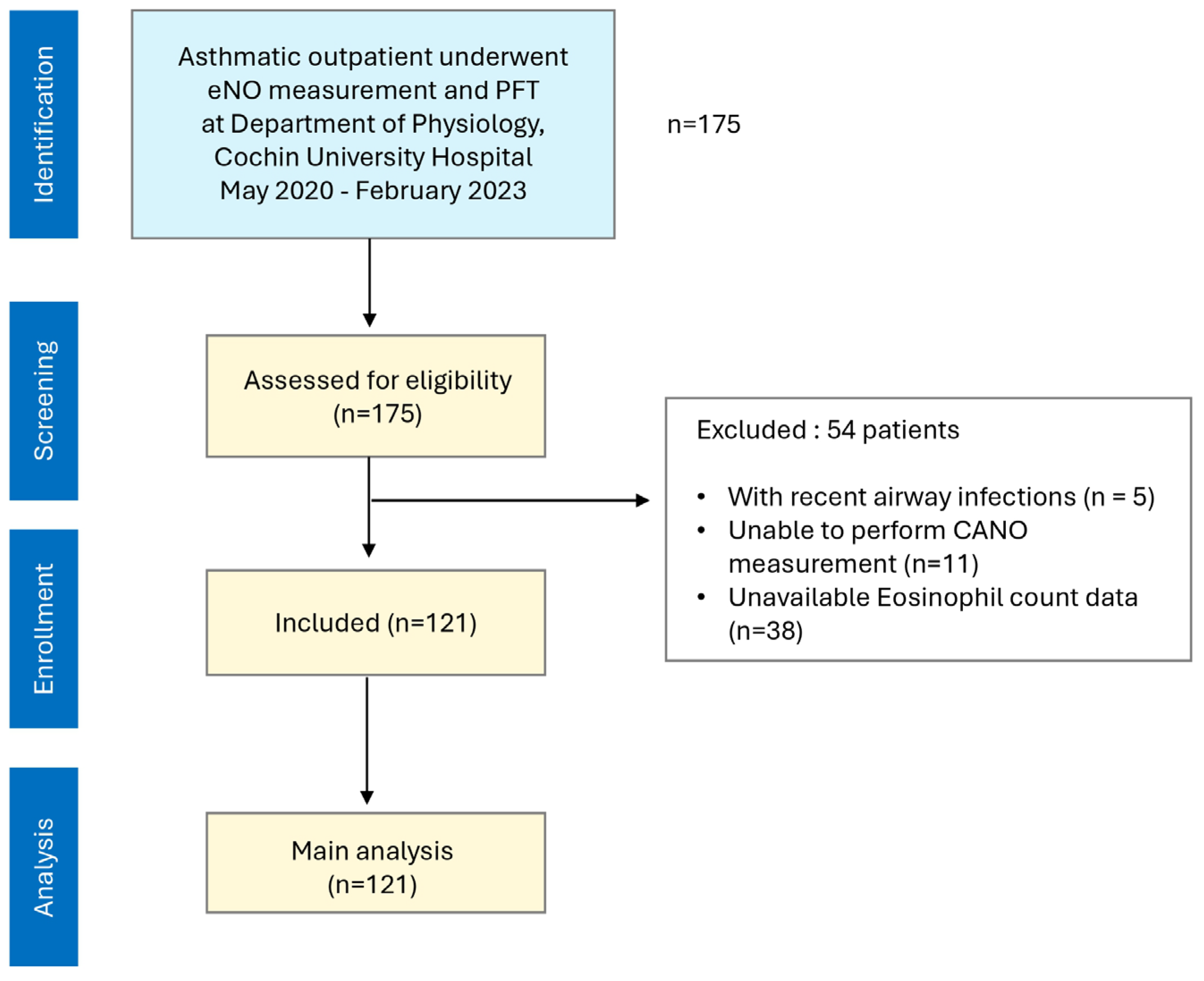
Figure 2.
Association between eosinophil count and exhaled nitric oxide markers. Legend: Regression plots illustrating the non-linear relationship between eosinophil count and the three main exhaled nitric oxide (eNO) markers: FeNO, CANO, and J’awNO. The x-axis shows log-transformed eosinophil count, and the y-axis the corresponding eNO outcome. FeNO and J’awNO were also log-transformed to stabilize variance. Dots indicate individual observations. The black curve represents the mean predicted value, and the shaded bands the 95% confidence interval, derived from a generalized linear model with a quadratic term for log-transformed eosinophil count. FeNO, fractional exhaled nitric oxide; J’awNO, maximal bronchial nitric oxide flux; CANO, alveolar nitric oxide concentration.
Figure 2.
Association between eosinophil count and exhaled nitric oxide markers. Legend: Regression plots illustrating the non-linear relationship between eosinophil count and the three main exhaled nitric oxide (eNO) markers: FeNO, CANO, and J’awNO. The x-axis shows log-transformed eosinophil count, and the y-axis the corresponding eNO outcome. FeNO and J’awNO were also log-transformed to stabilize variance. Dots indicate individual observations. The black curve represents the mean predicted value, and the shaded bands the 95% confidence interval, derived from a generalized linear model with a quadratic term for log-transformed eosinophil count. FeNO, fractional exhaled nitric oxide; J’awNO, maximal bronchial nitric oxide flux; CANO, alveolar nitric oxide concentration.
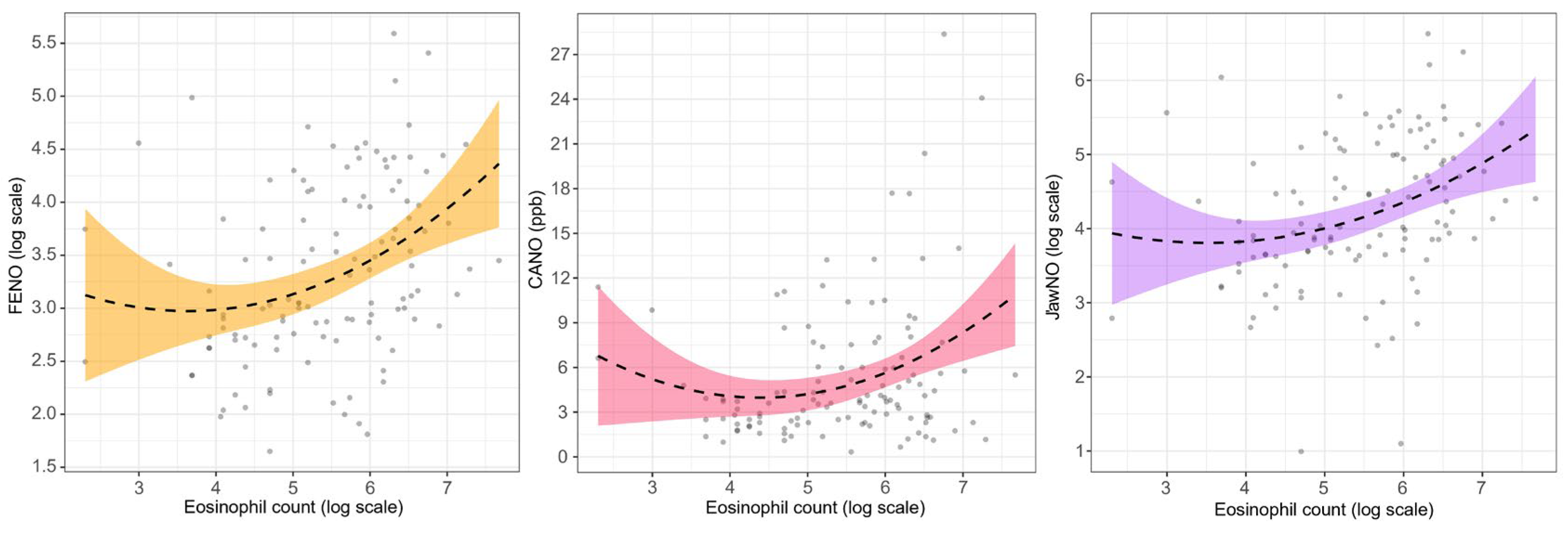
Figure 3.
Adjusted associations of pulmonary function test outcomes with two inflammatory markers. Legend: The graphs show the expected change in z-scores for lung function parameters (rows, from top to bottom: FEV1, FEF25–75, FEF75, and RV) as a function of increasing eosinophil count (left panel, logarithmic scale) and CANO (right panel, in ppb). In each graph, the black curve represents the median partial derivative of the regression equation with respect to the predictor of interest. The shaded bands represent the 25th, 75th and 95th percentile range of those effects, from the innermost to the outermost band. The horizontal dotted line indicates the null effect. FEV1, forced expiratory volume in 1 second; FEF25–75, forced expiratory flow between 25% and 75% of FVC; FEF75, forced expiratory flow at 75% of FVC; RV, residual volume; CANO, alveolar nitric oxide concentration.
Figure 3.
Adjusted associations of pulmonary function test outcomes with two inflammatory markers. Legend: The graphs show the expected change in z-scores for lung function parameters (rows, from top to bottom: FEV1, FEF25–75, FEF75, and RV) as a function of increasing eosinophil count (left panel, logarithmic scale) and CANO (right panel, in ppb). In each graph, the black curve represents the median partial derivative of the regression equation with respect to the predictor of interest. The shaded bands represent the 25th, 75th and 95th percentile range of those effects, from the innermost to the outermost band. The horizontal dotted line indicates the null effect. FEV1, forced expiratory volume in 1 second; FEF25–75, forced expiratory flow between 25% and 75% of FVC; FEF75, forced expiratory flow at 75% of FVC; RV, residual volume; CANO, alveolar nitric oxide concentration.
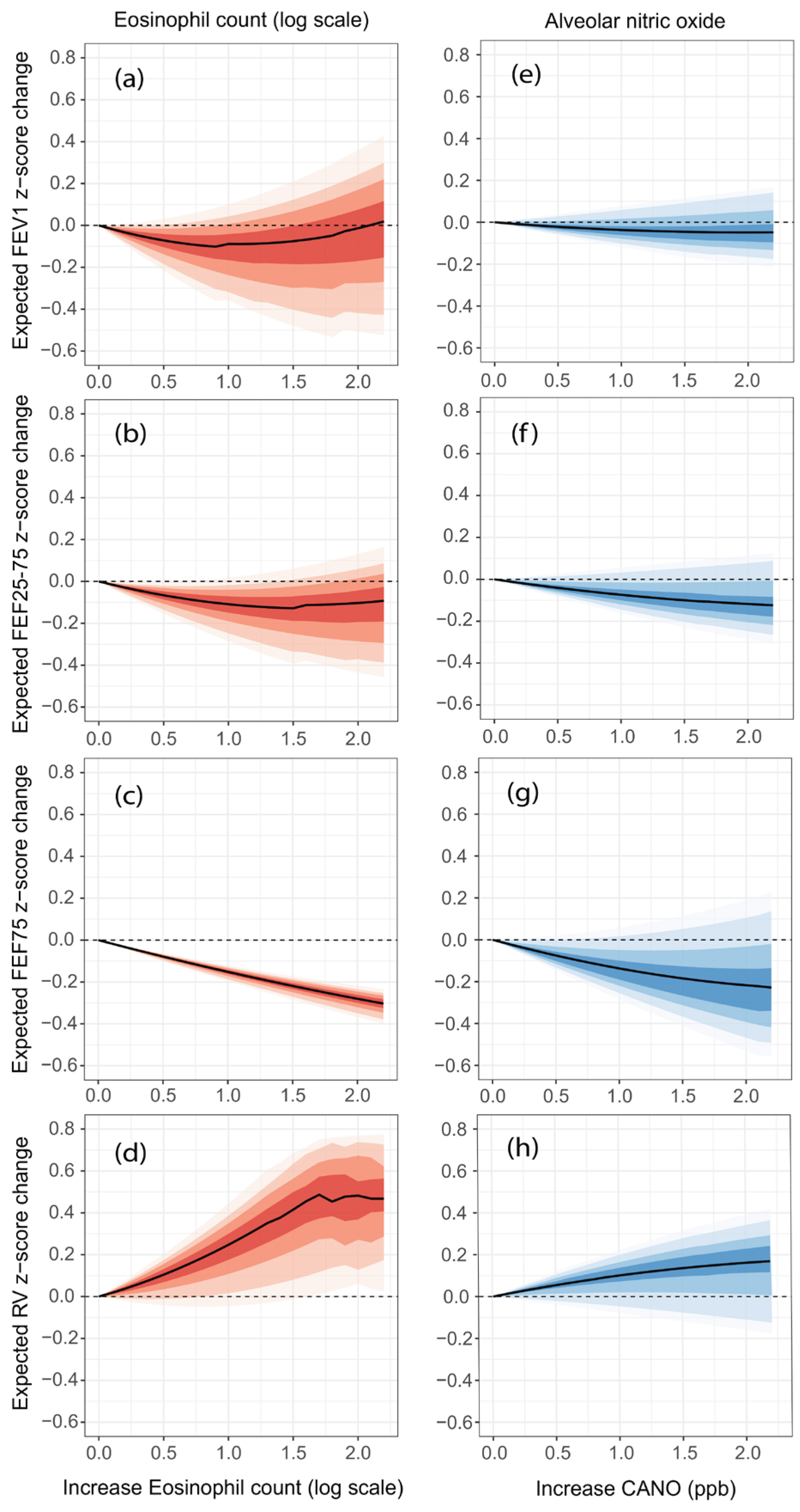

Table 1.
Characteristics of the study population.
| Parameters | Unit | Distribution characteristics* |
| Age | years | 54.23 (15.99) |
| Height | cm | 167.10 (9.28) |
| BMI | kg/m2 | 24.6 [22.10 ; 28.00] |
| Eosinophil count | 260 [110 ; 540] | |
| Exhaled nitric oxide | ||
| FeNO (50 ml/s) | ppb | 23.61 [15.36 ; 52.97] |
| FeNO (100 ml/s) | ppb | 14.69 [9.30 ; 33.30] |
| FeNO (150 ml/s) | ppb | 11.42 [7.20 ; 23.64] |
| J’awNO | nl/min | 60.20 [38.40 ; 141.20] |
| CANO | ppb | 3.80 [2.50 ; 6.62] |
| Forced spirometry | ||
| FEV1 z-score | -1.49 (1.46) | |
| FVC z-score | -0.92 (1.31) | |
| FEV1/FVC z-score | -1.16 (1.27) | |
| FEF25-75 z-score | -1.27 (1.29) | |
| FEF75 z-score | -0.62 (0.96) | |
| Plethysmography | ||
| TLC z-score | 0.29 (1.22) | |
| FRC z-score | 0.76 (0.96) | |
| RV z-score | 1.26 (0.94) | |
| RV/TLC z-score | 1.60 (1.10) | |
| VC z-score | -0.95 (1.36) |
Note : Data are presented as mean (SD) or median [IQR] as appropriate according to variable distribution. BMI, body mass index; IgE, immunoglobulin E; FeNO, fractional exhaled nitric oxide; J’awNO, maximal bronchial nitric oxide flux; CANO, alveolar nitric oxide concentration; FEV1, forced expiratory volume in 1 second; FVC, forced vital capacity; FEF25–75, forced expiratory flow between 25% and 75% of FVC; FEF75, forced expiratory flow at 75% of FVC; TLC, total lung capacity; FRC, functional residual capacity; RV, residual volume; VC, vital capacity. z-scores are expressed for PFT variables relative to GLI reference equations [Refs], with lower values indicating lower-than-predicted function and higher values indicating higher-than-predicted values relative to the reference population.
Table 2.
Association between log-transfirmed eosinophil count, exhaled NO levels and small airway ventilatory function indices.
Table 2.
Association between log-transfirmed eosinophil count, exhaled NO levels and small airway ventilatory function indices.
| Response variables | Unadjusted marginal slope | Adjusted marginal slope* | ||||
| Estimate | 95%CI | P value# | Estimate | 95%CI | P value# | |
| FeNO 50 ml/s (ppb) | 15.724 | 12.670 – 18.778 | <0.0001 | 12.017 | 9.349 – 14.685 | <0.0001 |
| FeNO 100 ml/s (ppb) | 7.889 | 6.178 – 9.601 | <0.0001 | 6.307 | 4.798 – 7.816 | <0.0001 |
| FeNO 150 ml/s (ppb) | 6.278 | 5.102 – 7.454 | <0.0001 | 4.814 | 3.793 – 5.835 | <0.0001 |
| J’awNO (nl/min) | 43.298 | 34.249 – 52.348 | <0.0001 | 33.267 | 25.340 – 41.194 | <0.0001 |
| CANO (ppb) | 1.675 | 1.332 – 2.018 | <0.0001 | 1.136 | 0.841 – 1.432 | <0.0001 |
| RV z-score | 0.135 | 0.075 – 0.196 | <0.0001 | 0.136 | 0.075 – 0.196 | <0.0001 |
| RV/TLC z-score | 0.107 | 0.035 – 0.179 | 0.0035 | 0.128 | 0.056 – 0.201 | 0.0005 |
| FEF25-75 z-score | -0.168 | -0.251 ; -0.086 | <0.0001 | -0.169 | -0.253 ; -0.085 | <0.0001 |
| FEF75 z-score | -0.171 | -0.233 ; -0.110 | <0.0001 | -0.169 | -0.230 ; -0.109 | <0.0001 |
| FEV1 z-score | -0.193 | -0.286 ; -0.100 | <0.0001 | -0.201 | -0.295 ; -0.106 | <0.0001 |
Note : The estimand was the raw or adjusted average marginal slope, defined as the average partial derivative of the model-based expected outcome with respect to log eosinophil count across the study population. Thus, each estimate represents the absolute change in the response variable associated with a 1-unit increase in log(eosinophil count). # Adjusted marginal slopes were estimated from regression models including sex, age, and body mass index as covariates. Exhaled nitric oxide outcomes were modeled using a Gamma distribution; lung function outcomes expressed as z-scores were modeled using a Gaussian distribution. Log-transformed eosinophil count was modeled using a quadratic polynomial term to allow for potential non-linearity. CI, confidence interval; FeNO, fractional exhaled nitric oxide; J’awNO, maximal bronchial nitric oxide flux; CANO, alveolar nitric oxide concentration; FEF25–75, forced expiratory flow between 25% and 75% of FVC; FEF75, forced expiratory flow at 75% of FVC; FEV1, forced expiratory volume in 1 second; RV, residual volume; TLC, total lung capacity. # p values are two-sided and test the null hypothesis that the adjusted average marginal slope equals 0. Results were considered statistically significant at p < 0.05.
Table 3.
Association between alveolar nitric oxide level and small airway ventilatory function indices.
Table 3.
Association between alveolar nitric oxide level and small airway ventilatory function indices.
|
Response variables |
Unadjusted marginal slope | Adjusted marginal slope # | ||||
| Estimate | 95%CI | P value | Estimate | 95%CI | P value | |
| RV z-score | 0.113 | 0.073 ; 0.152 | <0.001 | 0.106 | 0.065 ; 0.146 | <0.001 |
| RV/TLC z-score | 0.059 | 0.012 ; 0.106 | 0.013 | 0.065 | 0.016 ; 0.115 | 0.009 |
| FEF25-75 z-score | -0.058 | -0.112 ; -0.004 | 0.036 | -0.078 | -0.135 ; -0.020 | 0.008 |
| FEF75 z-score | -0.109 | -0.171 ; -0.046 | < 0.001 | -0.156 | -0.229 ; -0.082 | <0.001 |
| FEV1 z-score | -0.030 | -0.091 ; 0.031 | 0.340 (NS) | -0.042 | -0.107 ; 0.022 | 0.200 (NS) |
Note : The estimand was the raw or adjusted average marginal slope, defined as the average partial derivative of the model-based expected outcome with respect to CANO across the study population. # Adjusted marginal slopes were estimated from Gaussian regression models for z-score outcomes, with adjustment for sex, age, and body mass index. CANO was modeled using a quadratic polynomial term to allow for potential non-linearity. Accordingly, each estimate represents the adjusted absolute change in the lung function z-score associated with a 1-ppb increase in CANO. CI, confidence interval; CANO, alveolar nitric oxide concentration; FEF25–75, forced expiratory flow between 25% and 75% of FVC; FEF75, forced expiratory flow at 75% of FVC; FEV1, forced expiratory volume in 1 second; RV, residual volume; TLC, total lung capacity. p values are two-sided and test the null hypothesis that the adjusted average marginal slope equals 0, at the significance threshold of p<0.05.
Disclaimer/Publisher’s Note: The statements, opinions and data contained in all publications are solely those of the individual author(s) and contributor(s) and not of MDPI and/or the editor(s). MDPI and/or the editor(s) disclaim responsibility for any injury to people or property resulting from any ideas, methods, instructions or products referred to in the content. |
© 2026 by the authors. Licensee MDPI, Basel, Switzerland. This article is an open access article distributed under the terms and conditions of the Creative Commons Attribution (CC BY) license (http://creativecommons.org/licenses/by/4.0/).
Copyright: This open access article is published under a Creative Commons CC BY 4.0 license, which permit the free download, distribution, and reuse, provided that the author and preprint are cited in any reuse.


